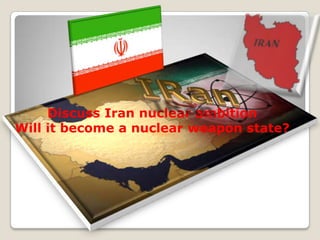
IRanDiscuss Iran nuclear ambitionWill it become a nuclear weapon state?
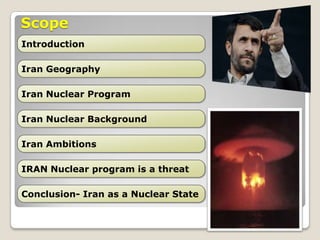
ScopeIntroductionIran GeographyIran Nuclear ProgramIran Nuclear BackgroundIran AmbitionsIRAN Nuclear program is a threat Conclusion- Iran as a Nuclear State
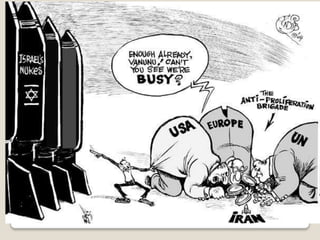
IntroductionOn December 3, 2007, the U.S NIC released an unclassified summary of the NIE entitled "Iran: Nuclear Intentions and Capabilities." Although the assessment states that Iran's "nuclear weapons program" was halted in 2003,“ Moreover, other statements in the document, along with extensive evidence in the public domain, suggest that other activities relevant to the possible production of nuclear weapons continue. more intensive inspections of its nuclear programconcerns call for continued international pressure on IranIran is going to possess the nuclear weapon in the year 2010Who is IRAN?Is it going to be a nuclear state?
Iran is a Regional Power, and holds an important position in International Energy  Security and World Economy reserves of Petroleum and Natural Gaz. Iran is a founding member of the UN, NAM, OIC and OPEC. The political system of Iran, based on the 1979 constitution The highest state authority is the Supreme Leader. Shia Islam is the official religion and Persian is the official language.Iran ranks second in the world in natural gas reserves and also second in Oil reserves. It is OPEC's 2nd largest oil exporter. It has the potential to become an Energy SuperpowerIran holds 10% of the world's proven oil reserves and 15% of its Gas. Iran GeographyIran officially the Islamic Republic of Iran is a country in Western Asia, The 18th largest country in the world in terms of area at 1,648,195 km²,Its area roughly equals that of the United Kingdom, France, Spain, and Germany combined, or somewhat more than the US state of Alaska.. Iran has a population of over 70 million .It is a country of particular significance owing to its location in the Middle East and central Eurasia.Iran is bordered on the north by Armenia, Azerbaijan and Turkmenistan. As Iran is a littoral state of the Caspian Sea, Kazakhstan and Russia are also Iran's direct neighbors to the north. Iran is bordered on the east by Afghanistan and Pakistan, on the south by the Persian Gulf and the Gulf of Oman, on the west by Iraq and on the northwest by Turkey. Tehran is the capital, the country's largest city and the political, cultural, commercial and industrial centerMiddle EastPersian Gulf
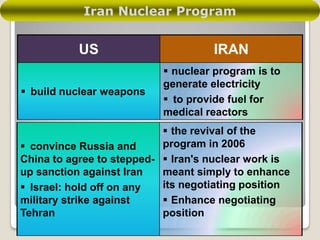
Iran Nuclear Program
IRAN Nuclear Background
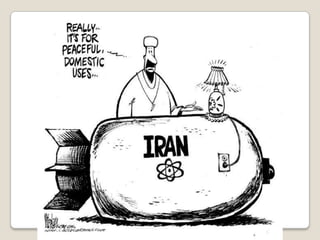
IRAN Nuclear BackgroundIran continues to insist on the peaceful character of its nuclear program. However, along with achieving progress in enriching uranium, Tehran has developed missiles capable of reaching Israel  as well as parts of eastern and southeastern Europe. These developments have increased the international concern over its nuclear program
IRAN Nuclear Threat
    Iranian Long term ambitions(According to US)Establish hegemony in Middle EastEstablish Shia ascendancy over that hegemonyEject West from the regionControl ResourcesDestroy Israel
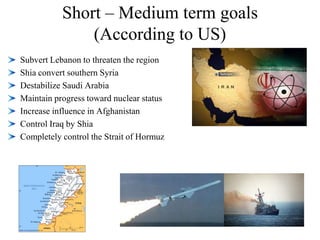
Short – Medium term goals(According to US)Subvert Lebanon to threaten the regionShia convert southern SyriaDestabilize Saudi ArabiaMaintain progress toward nuclear statusIncrease influence in AfghanistanControl Iraq by ShiaCompletely control the Strait of Hormuz
IRAN Nuclear program remains a major threat In the beginning of 2007, the nuclear technology expansion by the Iran government has obtained  major effect from the America, UK, Germany and France. The America are very excited to stop the Iranian effort to develop the nuclear technology for it peace aims. Nevertheless, the America that Iran would at last change its nuclear technology development  into making of a nuclear weapon. the Iranian government decided to reactivate the research over the nuclear development in Natanz. This nuclear station had been closed by (IAEA) for almost four years.Without a doubt, Iran is reconstruction its nuclear infrastructure. A threat many believe has more direct consequences for the US than the ‘weapon of mass destruction’ threat that the Pentagon is so consumed with., domestic and international politics, social and economy.
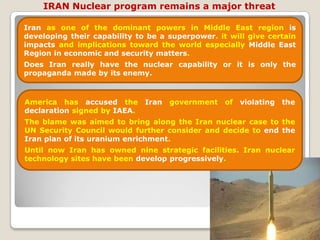
IRAN Nuclear program remains a major threat Iran as one of the dominant powers in Middle East region is developing their capability to be a superpower. it will give certain impacts and implications toward the world especially Middle East Region in economic and security matters. Does Iran really have the nuclear capability or it is only the propaganda made by its enemy. America has accused the Iran government of violating the declaration signed by IAEA. The blame was aimed to bring along the Iran nuclear case to the UN Security Council would further consider and decide to end the Iran plan of its uranium enrichment.Until now Iran has owned nine strategic facilities. Iran nuclear technology sites have been develop progressively.
Location of known Iranian nuclear facilities
Conclusion(is Iran going to be a nuclear State?)Thus since its infancy stage until current development of its nuclear program, Iran’s ambition to be a nuclear state is becoming a reality. As highlighted earlier on, Iran’s ambitions to be a nuclear state since the Shah period.Iran feels its valuable oil which is draining out, should be used for high-value products, not simple electricity. Despite being imposed by UN Security Council resolutions and the U.S-led economic sanctions, even with the threat of additional sanctions looming, Iran is not backing down.On the contrary, many of Iran’s success, including access to the nuclear fuel producing of heavy water, have been achieved under sanctions. In fact, determination to continue the nuclear program and retaliate against any Western attack is strong in Iran. Iranian President Ahmadinejad said “They should know that the Iranian nation will not yield to pressure and will not let its rights be trampled on.” Hence, during the 31st anniversary of the Islamic revolution early this year, he proclaimed, probably the eight times in recent years, Iran is now a nuclear state. He added that Iran is capable to enrich the nuclear fuel to twenty percent and the uranium to higher levels.
Conclusion(is Iran going to be a nuclear State?)In conclusion, despite being the subject of the most extensive and intensive campaign of denial, obstruction, and the international community has been subject to bias, Iran has exercised its inalienable right to peaceful nuclear technology in becoming a nuclear state. Iran believes it has a legal right to enrich uranium for peaceful purposes under the NPT, a right which in 2005 the U.S, UK, Germany and France began to assert had been forfeited by a clandestine nuclear program that came to light in 2002.Accordingly, Iran does have the right to acquire a full nuclear fuel cycle for peaceful purposes under the terms of the NPT, and the Iranian government has been able to find ways to justify all of its activities to date as research, related to nuclear power. It has claimed that its concealed and secret efforts are the result of its fears that the U.S or Israel might attack. Additionally, Iran compares its treatment as a signatory to the NPT with three nuclear-armed nations that have signed the NPT – Israel, India and Pakistan. Each of these nations developed an indigenous nuclear weapons capability: Israel by 1966, India by 1974, and Pakistan by 1990.
Discussion

Iran as anuclear state

  • 1.
    IRanDiscuss Iran nuclearambitionWill it become a nuclear weapon state?
  • 2.
    ScopeIntroductionIran GeographyIran NuclearProgramIran Nuclear BackgroundIran AmbitionsIRAN Nuclear program is a threat Conclusion- Iran as a Nuclear State
  • 3.
    IntroductionOn December 3,2007, the U.S NIC released an unclassified summary of the NIE entitled "Iran: Nuclear Intentions and Capabilities." Although the assessment states that Iran's "nuclear weapons program" was halted in 2003,“ Moreover, other statements in the document, along with extensive evidence in the public domain, suggest that other activities relevant to the possible production of nuclear weapons continue. more intensive inspections of its nuclear programconcerns call for continued international pressure on IranIran is going to possess the nuclear weapon in the year 2010Who is IRAN?Is it going to be a nuclear state?
  • 4.
    Iran is aRegional Power, and holds an important position in International Energy Security and World Economy reserves of Petroleum and Natural Gaz. Iran is a founding member of the UN, NAM, OIC and OPEC. The political system of Iran, based on the 1979 constitution The highest state authority is the Supreme Leader. Shia Islam is the official religion and Persian is the official language.Iran ranks second in the world in natural gas reserves and also second in Oil reserves. It is OPEC's 2nd largest oil exporter. It has the potential to become an Energy SuperpowerIran holds 10% of the world's proven oil reserves and 15% of its Gas. Iran GeographyIran officially the Islamic Republic of Iran is a country in Western Asia, The 18th largest country in the world in terms of area at 1,648,195 km²,Its area roughly equals that of the United Kingdom, France, Spain, and Germany combined, or somewhat more than the US state of Alaska.. Iran has a population of over 70 million .It is a country of particular significance owing to its location in the Middle East and central Eurasia.Iran is bordered on the north by Armenia, Azerbaijan and Turkmenistan. As Iran is a littoral state of the Caspian Sea, Kazakhstan and Russia are also Iran's direct neighbors to the north. Iran is bordered on the east by Afghanistan and Pakistan, on the south by the Persian Gulf and the Gulf of Oman, on the west by Iraq and on the northwest by Turkey. Tehran is the capital, the country's largest city and the political, cultural, commercial and industrial centerMiddle EastPersian Gulf
  • 5.
  • 6.
  • 7.
    IRAN Nuclear BackgroundIrancontinues to insist on the peaceful character of its nuclear program. However, along with achieving progress in enriching uranium, Tehran has developed missiles capable of reaching Israel as well as parts of eastern and southeastern Europe. These developments have increased the international concern over its nuclear program
  • 10.
  • 11.
    Iranian Long term ambitions(According to US)Establish hegemony in Middle EastEstablish Shia ascendancy over that hegemonyEject West from the regionControl ResourcesDestroy Israel
  • 12.
    Short – Mediumterm goals(According to US)Subvert Lebanon to threaten the regionShia convert southern SyriaDestabilize Saudi ArabiaMaintain progress toward nuclear statusIncrease influence in AfghanistanControl Iraq by ShiaCompletely control the Strait of Hormuz
  • 13.
    IRAN Nuclear programremains a major threat In the beginning of 2007, the nuclear technology expansion by the Iran government has obtained major effect from the America, UK, Germany and France. The America are very excited to stop the Iranian effort to develop the nuclear technology for it peace aims. Nevertheless, the America that Iran would at last change its nuclear technology development into making of a nuclear weapon. the Iranian government decided to reactivate the research over the nuclear development in Natanz. This nuclear station had been closed by (IAEA) for almost four years.Without a doubt, Iran is reconstruction its nuclear infrastructure. A threat many believe has more direct consequences for the US than the ‘weapon of mass destruction’ threat that the Pentagon is so consumed with., domestic and international politics, social and economy.
  • 14.
    IRAN Nuclear programremains a major threat Iran as one of the dominant powers in Middle East region is developing their capability to be a superpower. it will give certain impacts and implications toward the world especially Middle East Region in economic and security matters. Does Iran really have the nuclear capability or it is only the propaganda made by its enemy. America has accused the Iran government of violating the declaration signed by IAEA. The blame was aimed to bring along the Iran nuclear case to the UN Security Council would further consider and decide to end the Iran plan of its uranium enrichment.Until now Iran has owned nine strategic facilities. Iran nuclear technology sites have been develop progressively.
  • 15.
    Location of knownIranian nuclear facilities
  • 18.
    Conclusion(is Iran goingto be a nuclear State?)Thus since its infancy stage until current development of its nuclear program, Iran’s ambition to be a nuclear state is becoming a reality. As highlighted earlier on, Iran’s ambitions to be a nuclear state since the Shah period.Iran feels its valuable oil which is draining out, should be used for high-value products, not simple electricity. Despite being imposed by UN Security Council resolutions and the U.S-led economic sanctions, even with the threat of additional sanctions looming, Iran is not backing down.On the contrary, many of Iran’s success, including access to the nuclear fuel producing of heavy water, have been achieved under sanctions. In fact, determination to continue the nuclear program and retaliate against any Western attack is strong in Iran. Iranian President Ahmadinejad said “They should know that the Iranian nation will not yield to pressure and will not let its rights be trampled on.” Hence, during the 31st anniversary of the Islamic revolution early this year, he proclaimed, probably the eight times in recent years, Iran is now a nuclear state. He added that Iran is capable to enrich the nuclear fuel to twenty percent and the uranium to higher levels.
  • 19.
    Conclusion(is Iran goingto be a nuclear State?)In conclusion, despite being the subject of the most extensive and intensive campaign of denial, obstruction, and the international community has been subject to bias, Iran has exercised its inalienable right to peaceful nuclear technology in becoming a nuclear state. Iran believes it has a legal right to enrich uranium for peaceful purposes under the NPT, a right which in 2005 the U.S, UK, Germany and France began to assert had been forfeited by a clandestine nuclear program that came to light in 2002.Accordingly, Iran does have the right to acquire a full nuclear fuel cycle for peaceful purposes under the terms of the NPT, and the Iranian government has been able to find ways to justify all of its activities to date as research, related to nuclear power. It has claimed that its concealed and secret efforts are the result of its fears that the U.S or Israel might attack. Additionally, Iran compares its treatment as a signatory to the NPT with three nuclear-armed nations that have signed the NPT – Israel, India and Pakistan. Each of these nations developed an indigenous nuclear weapons capability: Israel by 1966, India by 1974, and Pakistan by 1990.
  • 20.

Editor's Notes

  • #5 Iran officially the Islamic Republic of Iran is a country in Western Asia, The 18th largest country in the world in terms of area at 1,648,195 km²,Its area roughly equals that of the United Kingdom, France, Spain, and Germany combined, or somewhat more than the US state of Alaska.. Iran has a population of over 70 million .It is a country of particular geostrategic significance owing to its location in the Middle East and central Eurasia. Iran is bordered on the north by Armenia, Azerbaijan and Turkmenistan. As Iran is a littoral state of the Caspian Sea, which is an inland sea and condominium, Kazakhstan and Russia are also Iran's direct neighbors to the north. Iran is bordered on the east by Afghanistan and Pakistan, on the south by the Persian Gulf and the Gulf of Oman, on the west by Iraq and on the northwest by Turkey. Tehran is the capital, the country's largest city and the political, cultural, commercial and industrial center of the nation..Iran is a regional power,[15][16] and holds an important position in international energy security and world economy as a result of its large reserves of petroleum and natural gas. Iran is a founding member of the UN, NAM, OIC and OPEC. The political system of Iran, based on the 1979 constitution, comprises several intricately connected governing bodies. The highest state authority is the Supreme Leader. Shia Islam is the official religion and Persian is the official languageIran ranks second in the world in natural gas reserves and also second in oil reserves.[157] It is OPEC's 2nd largest oil exporter. It has the potential to become an energy superpowerIran holds 10% of the world's proven oil reserves and 15% of its gas. It is OPEC's second largest exporter and the world's fourth oil producer.
  • #19 Thus since its infancy stage until current development of its nuclear program, Iran’s ambition to be a nuclear state is becoming a reality. As highlighted earlier on, Iran’s ambitions to be a nuclear state is due to several intertwining factors throughout the years since the Shah period. In taking a stance that the Shah expressed decades ago, Iran feels its valuable oil which is draining out, should be used for high-value products, not simple electricity. Despite being imposed by UN Security Council resolutions and the U.S-led economic sanctions, even with the threat of additional sanctions looming, Iran is not backing down.   On the contrary, many of Iran’s success, including access to the nuclear fuel cycle and producing of heavy water, have been achieved under sanctions. In fact, determination to continue the nuclear program and retaliate against any Western attack is strong in Iran. In his televised speech on 31 August 2006, Iranian President Ahmadinejad said “They should know that the Iranian nation will not yield to pressure and will not let its rights be trampled on.” Hence, during the 31st anniversary of the Islamic revolution early this year, he proclaimed, probably the eight times in recent years, Iran is now a nuclear state. He added that Iran is capable to enrich the nuclear fuel to twenty percent and the uranium to higher levels.   In conclusion, despite being the subject of the most extensive and intensive campaign of denial, obstruction, intervention and misinformation, and the international community has been subject to bias, politicised and exaggerated information on the Iranian nuclear program and activities, Iran has exercised its inalienable right to peaceful nuclear technology in becoming a nuclear state. Iran believes it has a legal right to enrich uranium for peaceful purposes under the NPT, a right which in 2005 the U.S, UK, Germany and France began to assert had been forfeited by a clandestine nuclear program that came to light in 2002.  Accordingly, Iran does have the right to acquire a full nuclear fuel cycle for peaceful purposes under the terms of the NPT, and the Iranian government has been able to find ways to justify all of its activities to date as research, related to nuclear power, minor mistakes, or the result of importing contaminated equipment. It has claimed that its concealed and secret efforts are the result of its fears that the U.S or Israel might attack what it claims are legitimate activities. Additionally, Iran compares its treatment as a signatory to the NPT with three nuclear-armed nations that have signed the NPT – Israel, India and Pakistan. Each of these nations developed an indigenous nuclear weapons capability: Israel by 1966, India by 1974, and Pakistan by 1990.Ahmadinejad’s televised speech in response to U.S President Bush statement: “Iran’s Defiance Will Bring Consequences,” http://www.cnn.com/2006/WORLD/meast/08/31/irandeadline/index.htm, (3 March 2010).“Iran is a Nuclear State,” http://www.heritage.org, (3 March 2010).
  • #20 Thus since its infancy stage until current development of its nuclear program, Iran’s ambition to be a nuclear state is becoming a reality. As highlighted earlier on, Iran’s ambitions to be a nuclear state is due to several intertwining factors throughout the years since the Shah period. In taking a stance that the Shah expressed decades ago, Iran feels its valuable oil which is draining out, should be used for high-value products, not simple electricity. Despite being imposed by UN Security Council resolutions and the U.S-led economic sanctions, even with the threat of additional sanctions looming, Iran is not backing down.   On the contrary, many of Iran’s success, including access to the nuclear fuel cycle and producing of heavy water, have been achieved under sanctions. In fact, determination to continue the nuclear program and retaliate against any Western attack is strong in Iran. In his televised speech on 31 August 2006, Iranian President Ahmadinejad said “They should know that the Iranian nation will not yield to pressure and will not let its rights be trampled on.” Hence, during the 31st anniversary of the Islamic revolution early this year, he proclaimed, probably the eight times in recent years, Iran is now a nuclear state. He added that Iran is capable to enrich the nuclear fuel to twenty percent and the uranium to higher levels.   In conclusion, despite being the subject of the most extensive and intensive campaign of denial, obstruction, intervention and misinformation, and the international community has been subject to bias, politicised and exaggerated information on the Iranian nuclear program and activities, Iran has exercised its inalienable right to peaceful nuclear technology in becoming a nuclear state. Iran believes it has a legal right to enrich uranium for peaceful purposes under the NPT, a right which in 2005 the U.S, UK, Germany and France began to assert had been forfeited by a clandestine nuclear program that came to light in 2002.  Accordingly, Iran does have the right to acquire a full nuclear fuel cycle for peaceful purposes under the terms of the NPT, and the Iranian government has been able to find ways to justify all of its activities to date as research, related to nuclear power, minor mistakes, or the result of importing contaminated equipment. It has claimed that its concealed and secret efforts are the result of its fears that the U.S or Israel might attack what it claims are legitimate activities. Additionally, Iran compares its treatment as a signatory to the NPT with three nuclear-armed nations that have signed the NPT – Israel, India and Pakistan. Each of these nations developed an indigenous nuclear weapons capability: Israel by 1966, India by 1974, and Pakistan by 1990.Ahmadinejad’s televised speech in response to U.S President Bush statement: “Iran’s Defiance Will Bring Consequences,” http://www.cnn.com/2006/WORLD/meast/08/31/irandeadline/index.htm, (3 March 2010).“Iran is a Nuclear State,” http://www.heritage.org, (3 March 2010).