Contents title
Contents subjects
Dear readers,
This edition of the Eye on Defence provides insights on how the guided missile
programs have evolved over the years, summarizes the key elements of the
approved Strategic Partnership Policy along with its major takeaways and
highlights a couple of relevant updates for the sector. Also given the increased
air travel and recent policy updates, we have also endeavoured to give an
overview of the civil aviation sector in India.
Our first article focuses on the evolution of guided missiles of India from the Integrated Guided
Missile Development Program (IGMDP) and beyond. We have provided insights on the variants of
the missiles, also attempting to identify comparable missiles of a few major countries. We have
also made an attempt to highlight the major missile programs under development and / or being
procured.
The second article summarizes the Strategic Partnership Policy which was approved on 31st May
2017. The article follows the Strategic Partner concept from the Dhirendra Singh Committee
Report where it was at an ideation stage, till recently, where it has evolved into a policy. The
article also summarizes the eligibility criteria and selection process for the SP and the OEM, the
two major stakeholders.
The third article highlights a couple of significant updates in the sector. One on the amendments
to the SCOMET list of dual use goods, services and technology for exports and the other on the
issue of licencing authority for defence goods.
Our fourth article is an attempt to provide a holistic overview of the civil aviation sector in
India. Given the boom in air travel, Indian aviation industry is on a steep curve trying to match
the dynamics of demand and supply. We have endeavoured to highlight the steps that the
Government has taken / is taking to give the growth story the required support.
Among the other regular sections, we have the global A&D industry buzz, the domestic industry
news, RFIs/RFPs released, new projects and investments, joint ventures and alliances and
country-level deals. On the Industrial Licensing front, there are a few clarifications still pending
and with the process being taken offline – there are still a few issues at hand. There seem to be no
fresh ILs issued.
I hope you find this issue useful. It has been our constant endeavour to make this publication
increasingly relevant to you, and we will appreciate your comments and suggestions in this
regard.
.
K. Ganesh Raj
Partner and Leader
Contents
Introduction
Development of guided
missiles in India
Strategic Partnership
Policy – finally seeing the
light of day!
SCOMET List and
Industrial Licencing –
relevant updates
Indian civil aviation – a
story set to fly further
and farther!
Request for information
(April 2017—June 2017)
Request for proposal
(April 2017 – June 2017)
New projects/
investments/contracts
JVs and alliances
Country-level deals and
initiatives
Industry buzz
Global industry buzz
Analysis of M&A trends
Eye on Defence
July 2017
02
14
18
22
28
30
34
36
38
40
42
44
2 | Eye on Defence
Introduction
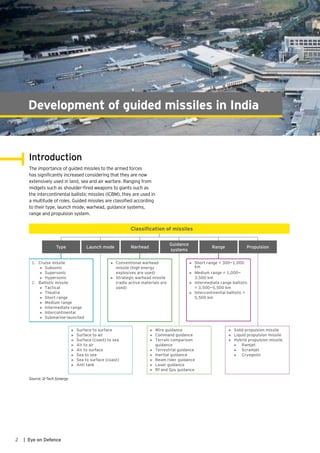
The importance of guided missiles to the armed forces
has significantly increased considering that they are now
extensively used in land, sea and air warfare. Ranging from
midgets such as shoulder-fired weapons to giants such as
the intercontinental ballistic missiles (ICBM), they are used in
a multitude of roles. Guided missiles are classified according
to their type, launch mode, warhead, guidance systems,
range and propulsion system.
PropulsionType Launch mode Warhead
Guidance
systems
Range
1. Cruise missile
► Subsonic
► Supersonic
► Hypersonic
2. Ballistic missile
► Tactical
► Theatre
► Short range
► Medium range
► Intermediate range
► Intercontinental
► Submarine-launched
► Conventional warhead
missile (high energy
explosives are used)
► Strategic warhead missile
(radio active materials are
used)
Classification of missiles
► Wire guidance
► Command guidance
► Terrain comparison
guidance
► Terrestrial guidance
► Inertial guidance
► Beam rider guidance
► Laser guidance
► Rf and Gps guidance
► Surface to surface
► Surface to air
► Surface (coast) to sea
► Air to air
► Air to surface
► Sea to sea
► Sea to surface (coast)
► Anti tank
► Short range = 300—1,000
km
► Medium range = 1,000—
3,500 km
► Intermediate range ballistic
= 3,500—5,500 km
► Intercontinental ballistic >
5,500 km
► Solid propulsion missile
► Liquid propulsion missile
► Hybrid propulsion missile
► Ramjet
► Scramjet
► Cryogenic
Source: Q-Tech Synergy
Development of guided missiles in India
3Eye on Defence |
The speed capability of guided missiles is expressed in
Mach numbers. A Mach number is the ratio of the speed
of an object to the speed of sound in the medium through
which the object is moving. Under standard atmospheric
conditions, sonic is about 766 miles per hour (Mach 1.0).
Guided missiles are classified according to their speed as
shown below:
•	 Subsonic: Up to Mach 0.8
•	 Transonic: Mach 0.8 to Mach 1.2
•	 Supersonic: Mach 1.2 to Mach 5.0
•	 Hypersonic: Above Mach 5.0
Integrated Guided Missile
Development Program
(IGMDP)
The IGMDP was initiated under the guidance of Dr. Abdul
Kalam, as the Defence Research and Development
Laboratory (DRDL) Director in 1983. Initially four projects
were to be pursued concurrently under the IGMDP:
•	 Short Range Surface-to-Surface Missile (Prithvi)
•	 Short Range Low-Level Surface-to-Air Missile
(Trishul)
•	 Medium Range Surface-to-Air Missile (Akash)
•	 Third-Generation Anti-Tank Missile (Nag)
The Agni missile was initially conceived in the IGMDP as a
technology demonstrator project in the form of a re-entry
vehicle, and was later upgraded to a ballistic missile with
different ranges. As part of this program, the Interim Test
Range (ITR) at Balasore in Orissa was also developed for
missile testing.
4 | Eye on Defence
Prithvi missile
The importance of guided missiles to the armed forces
has significantly increased considering that they are now
extensively used in land, sea and air warfare. Ranging from
midgets such as shoulder-fired weapons to giants such as
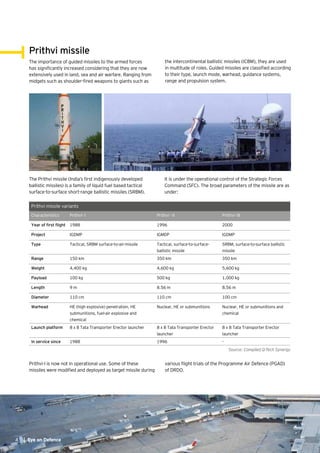
The Prithvi missile (India’s first indigenously developed
ballistic missiles) is a family of liquid fuel based tactical
surface-to-surface short-range ballistic missiles (SRBM).
It is under the operational control of the Strategic Forces
Command (SFC). The broad parameters of the missile are as
under:
Prithvi missile variants
Characteristics Prithvi- I Prithvi - II Prithvi- III
Year of first flight 1988 1996 2000
Project IGDMP IGMDP IGDMP
Type Tactical, SRBM surface-to-air-missile Tactical, surface-to-surface-
ballistic missile
SRBM, surface-to-surface ballistic
missile
Range 150 km 350 km 350 km
Weight 4,400 kg 4,600 kg 5,600 kg
Payload 100 kg 500 kg 1,000 kg
Length 9 m 8.56 m 8.56 m
Diameter 110 cm 110 cm 100 cm
Warhead HE (high explosive) penetration, HE
submunitions, fuel-air explosive and
chemical
Nuclear, HE or submunitions Nuclear, HE or submunitions and
chemical
Launch platform 8 x 8 Tata Transporter Erector launcher 8 x 8 Tata Transporter Erector
launcher
8 x 8 Tata Transporter Erector
launcher
In service since 1988 1996 -
the intercontinental ballistic missiles (ICBM), they are used
in multitude of roles. Guided missiles are classified according
to their type, launch mode, warhead, guidance systems,
range and propulsion system.
Source: Compiled Q-Tech Synergy
Prithvi-I is now not in operational use. Some of these
missiles were modified and deployed as target missile during
various flight trials of the Programme Air Defence (PGAD)
of DRDO.
5Eye on Defence |
Trishul missile
Trishul missile had a range of 12 km and were fitted with a
5.5 kg warhead. It was designed to be used against low-level
(sea skimming) targets at short range. The system had been
developed to defend naval vessels against missiles and also
as a short-range surface-to-air missile on land. The project
was shut down in February 2008 because of its inability
to meet the operational requirements and shortfall in
performance as against its stated design parameters. It was
de-linked from user service and projected as a technology
demonstrator.
Akash missile
Akash is a medium-range surface-to-air missile (SAM) with
an intercept range of 30 km. It has a launch weight of 720
kg, a diameter of 35 cm and is 5.8 meters long with a speed
of around Mach 2.5. It can reach an altitude of 18 km. The
missile has a terminal guidance system capable of working
through electronic countermeasures. The entire Akash
SAM system allows for attacking multiple targets (up to 4
per battery). The Akash missile’s use of ramjet propulsion
system allows it to maintain its speed without deceleration.
The missile is supported by a multi-target and multi-function
phased array fire control radar called the “Rajendra”
with a range of about 80 km in search (60 km in terms of
engagement).
Nag missile
Nag is a third generation, all-weather, top attack “fire-
and-forget” anti-tank missile, with a range of 3 km to 7
km. Nag can be mounted on an infantry vehicle, while a
helicopter-launch version named “Helina” is also planned
for integration with the HAL Dhruv helicopter. The Indian
Army has conducted repeated test firings and user trials but
is yet to give the go ahead for its induction into service.
Beyond IGMDP
In January 2008, consequent to completion of IGMDP,
the focus shifted toward the development of long-range
strategic missiles, capable of delivering nuclear warheads.
Creation of the Strategic Forces Command (SFC), a tri-
service command, exclusively for managing the strategic
resources in terms of nuclear warfare, has given further
impetus to this effort.
Agni missile
Agni missile is a family of medium to intercontinental
range surface-to-surface ballistic missiles developed by
the Advanced Systems Laboratory (ASL) under DRDO. The
missile uses solid fuel and has an instant reaction time.
Agni missile variants
Variant Length Weight Range Status Launch Platform
Agni I
Stage –I
15 m 12 tonne Medium Range
Ballistic Missile
(MRBM) 700 km —
1,250 km
Tested in January 2002
(operational)
8 x 8 Tata TELAR (transporter erector
launcher) Rail Mobile Launcher
Agni II 20 m 18 tonne MRBM 2,000 km
—3,000 km
Test conducted again on 7
April 2013 (operational)
8 x 8 Tata TELAR
Agni III 17 m 22 tonne IRBM 3,500 km —
5,000 km
First tested on 12 April
2007 (operational)
8 x 8 Tata TELAR
Agni IV 20 m 17 tonne IRBM 3,000 km —
4,000 km
First tested on 15
November 2011
(operational)
8 x 8 Tata TELAR
Agni V 17.5 m 50 tonne ICBM 5,000 km —
8,000 km
First tested on 19 April
2012 (under testing)
8 × 8 Tatra TEL and rail mobile launcher
(canisterized missile package)
Agni VI 20 m 50 tonne ICBM 8,000 km —
10,000 km
Under development 8 × 8 Tatra TEL and rail mobile launcher
(canisterized missile package) Arihant Class
Submarine (Submarine Launched Ballistic
Missile [SLBM] version — K6)
Source: Compiled Q-Tech Synergy
6 | Eye on Defence
7
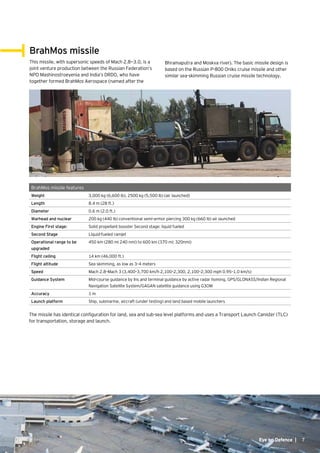
BrahMos missile
This missile, with supersonic speeds of Mach 2.8—3.0, is a
joint venture production between the Russian Federation’s
NPO Mashinostroeyenia and India’s DRDO, who have
together formed BrahMos Aerospace (named after the
BrahMos missile features
Weight 3,000 kg (6,600 lb), 2500 kg (5,500 lb) (air launched)
Length 8.4 m (28 ft.)
Diameter 0.6 m (2.0 ft.)
Warhead and nuclear 200 kg (440 lb) conventional semi-armor piercing 300 kg (660 lb) air launched
Engine First stage: Solid propellant booster Second stage: liquid fueled
Second Stage Liquid-fueled ramjet
Operational range to be
upgraded
450 km (280 mi; 240 nmi) to 600 km (370 mi; 320nmi)
Flight ceiling 14 km (46,000 ft.)
Flight altitude Sea skimming, as low as 3–4 meters
Speed Mach 2.8–Mach 3 (3,400–3,700 km/h; 2,100–2,300, 2,100–2,300 mph; 0.95–1.0 km/s)
Guidance System Mid-course guidance by Ins and terminal guidance by active radar homing, GPS/GLONASS/Indian Regional
Navigation Satellite System/GAGAN satellite guidance using G3OM
Accuracy 1 m
Launch platform Ship, submarine, aircraft (under testing) and land based mobile launchers
Bhramaputra and Moskva river). The basic missile design is
based on the Russian P-800 Oniks cruise missile and other
similar sea-skimming Russian cruise missile technology.
The missile has identical configuration for land, sea and sub-sea level platforms and uses a Transport Launch Canister (TLC)
for transportation, storage and launch.
7Eye on Defence |
8 | Eye on Defence
BrahMos variants
Characteristics BrahMos I BrahMos II
Type Supersonic cruise missile Hypersonic cruise missile
Operational range 450 km (280 mi; 240 nmi) 600 km (370 mi)
Speed Mach 2.8–Mach 3 (3,400–3,700 km/h;
2,100–2,300 mph; 0.95–1.0 km/s)
Mach 7 (8,575 km/h; 5,328 mph; 2,382.0 m/s)
Launch platform Ship, submarine, aircraft and land-based mobile
launchers
Ship, submarine, aircraft and land-based mobile
launchers
Others common features •	 Universal for multiple platforms
•	 “Fire and forget principle of operation
•	 High supersonic speed all through the flight
•	 Long flight range with varieties of flight trajectories
•	 Low radar signature
•	 Shorter flight times leading to lower target dispersion and quicker engagement
•	 Pinpoint accuracy with high lethal power aided by large kinetic energy on impact
The land-launched and ship-launched versions are already
in service, with the air- and submarine-launched versions
currently in the testing phase. A hypersonic version of the
missile is also currently under development with speed of
Mach 7—8 to boost aerial fast strike capability. Its propulsion
is based on the Russian missile, and missile guidance has
been developed by BrahMos Aerospace.
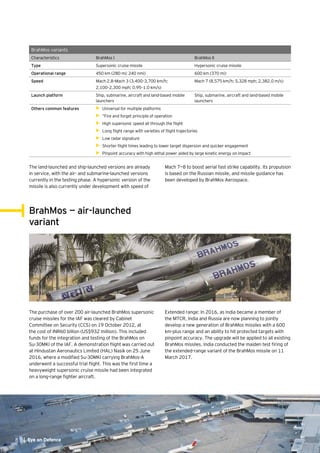
BrahMos — air-launched
variant
The purchase of over 200 air-launched BrahMos supersonic
cruise missiles for the IAF was cleared by Cabinet
Committee on Security (CCS) on 19 October 2012, at
the cost of INR60 billion (US$932 million). This included
funds for the integration and testing of the BrahMos on
Su-30MKI of the IAF. A demonstration flight was carried out
at Hindustan Aeronautics Limited (HAL) Nasik on 25 June
2016, where a modified Su-30MKI carrying BrahMos-A
underwent a successful trial flight. This was the first time a
heavyweight supersonic cruise missile had been integrated
on a long-range fighter aircraft.
Extended range: In 2016, as India became a member of
the MTCR, India and Russia are now planning to jointly
develop a new generation of BrahMos missiles with a 600
km-plus range and an ability to hit protected targets with
pinpoint accuracy. The upgrade will be applied to all existing
BrahMos missiles. India conducted the maiden test firing of
the extended-range variant of the BrahMos missile on 11
March 2017.
8 | Eye on Defence
9Eye on Defence |
BrahMos NG missile
BrahMos NG (Next Generation) is a mini version of the
existing BrahMos, with a 290 km range and Mach 3.5 speed.
The missile weighs ~1.5 tons and is 5 meters in length,
making it 50% lighter and three meters shorter than its
predecessor. BrahMos NG will have lesser RCS (Radar Cross
Section) compared to its predecessor, making it harder
for air defence systems to locate and engage the target.
BrahMos NG will have land, air, shipborne and submarine
tube launched variants.
K missile series
The K family of missiles includes the following:
•	 K-15 (renamed as B-05): An SLBM version of the
Shaurya missile, the K-15 with a ~1,000 km range,
will be integrated with the Arihant class submarine.
India’s DRDL designed and developed the missile, while
Advanced Systems Laboratory (ASL) developed the
motors and propulsion systems.
•	 K-4: Developed by India’s DRDO, the K-4 will have a
~3,500 km range and be an intermediate range SLBM.
It is expected to arm the INS Arihant, which has the
capability to carry 4 K-4s while the upcoming planned
Astra missiles
•	 Astra is an active radar homing beyond-visual-range
air-to-air missile (BVRAAM) designed to be capable
of engaging targets at varying range and altitudes,
allowing for engagement of both short-range targets
(up to 20 km) and long-range targets (up to 80 km)
using alternative propulsion modes. The missile uses
Nirbhay missiles
•	 India is said to be in the intermediate stages of
developing a new cruise missile, Nirbhay . The subsonic
Nirbhay is reportedly 6 m in length with a 520 mm
diameter. It weighs 1,000 kg and has a 1,000 km range
The flight tests are expected to take place this year. The
missile will arm the Sukhoi Su30MKI, Mikoyan MiG29K,
HAL Tejas and future inductions such as the Dassault
Rafale, Sukhoi and possibly the Mikoyan MiG35. The Sukhoi
SU30MKI would carry three missiles, while the other fighter
aircraft would carry one each. The submarine-launched
variant will be capable of being fired from the new P75I
class of submarines.
SSBNs would be able to carry 8 K-4s. The missile is
powered by solid rocket propellants and is currently
undergoing technical trials followed by development
trials in 2018.
•	 K-5: This is another missile in the K-family developed by
India to boost its second-strike capabilities. The missile
is expected to have a range of ~5,000 km carrying
a 2-tonne payload, which can carry four multiple
independently targetable re-entry vehicle (MIRV)
warheads of 500 kg each.
a solid fuel propellant called hydroxyl-terminated
polybutadiene (HTPB). The warhead is a 15 kg HE,
which is activated by a proximity fuse. The missile’s
maximum speed is Mach 4 and can attain a maximum
altitude of 20 km.
with a speed of 0.7 Mach. The missile has met with
one success but three failures during tests in the past
5 years. The fifth test scheduled for 31 May 2017 was
deferred due to a technical snag.
9Eye on Defence |
10 | Eye on Defence
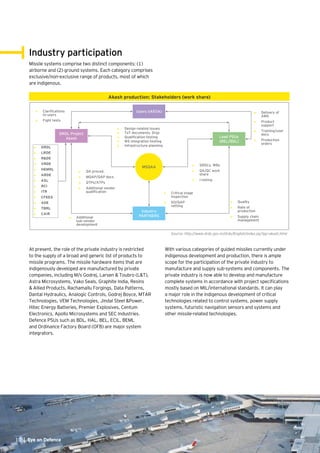
Industry participation
Missile systems comprise two distinct components: (1)
airborne and (2) ground systems. Each category comprises
exclusive/non-exclusive range of products, most of which
are indigenous.
DRDL Project
Akash
Users (IAF/IA)
Lead PSUs
(BEL/BDL)
Industry
PARTNERS
MSQAA
► Delivery of
AMS
► Product
support
► Training/user
docs
► Production
orders
► Quality
► Rate of
production
► Supply chain
management
► SRDCs, WBs
► QA/QC work
share
► I-noting
► Critical stage
inspection
► SO/QAP
vetting
► Additional
sub-vendor
development
► QA proced.
► MQAP/QAP docs
► QTPs/ATPs
► Additional vendor
qualification
► Design-related issues
► ToT documents, Drgs
► Qualification testing
► WS integration testing
► Infrastructure planning► DRDL
► LRDE
► R&DE
► VRDE
► HEMRL
► ARDE
► ASL
► RCI
► ITR
► CFEES
► ADE
► TBRL
► CAIR
► Clarifications
to users
► Fight tests
Akash production: Stakeholders (work share)
Source: http://www.drdo.gov.in/drdo/English/index.jsp?pg=akash.html
At present, the role of the private industry is restricted
to the supply of a broad and generic list of products to
missile programs. The missile hardware items that are
indigenously developed are manufactured by private
companies, including M/s Godrej, Larsen & Toubro (L&T),
Astra Microsystems, Vako Seals, Graphite India, Resins
& Allied Products, Rachamallu Forgings, Data Patterns,
Dantal Hydraulics, Analogic Controls, Godrej Boyce, MTAR
Technologies, VEM Technologies, Jindal Steel &Power,
Hitec Energy Batteries, Premier Explosives, Centum
Electronics, Apollo Microsystems and SEC Industries.
Defence PSUs such as BDL, HAL, BEL, ECIL, BEML
and Ordinance Factory Board (OFB) are major system
integrators.
With various categories of guided missiles currently under
indigenous development and production, there is ample
scope for the participation of the private industry to
manufacture and supply sub-systems and components. The
private industry is now able to develop and manufacture
complete systems in accordance with project specifications
mostly based on MIL/international standards. It can play
a major role in the indigenous development of critical
technologies related to control systems, power supply
systems, futuristic navigation sensors and systems and
other missile-related technologies.
10 | Eye on Defence
11Eye on Defence |
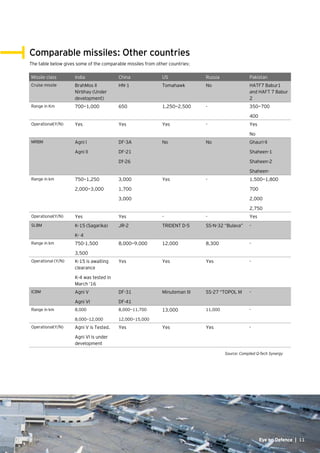
Comparable missiles: Other countries
The table below gives some of the comparable missiles from other countries:
Missile class India China US Russia Pakistan
Cruise missile BrahMos II
Nirbhay (Under
development)
HN-1 Tomahawk No HATF7 Babur1
and HAFT 7 Babur
2
Range in Km 700—1,000 650 1,250—2,500 - 350—700
400
Operational(Y/N) Yes Yes Yes - Yes
No
MRBM Agni I
Agni II
DF-3A
DF-21
Df-26
No No Ghauri-II
Shaheen-1
Shaheen-2
Shaheen-
Range in km 750—1,250
2,000—3,000
3,000
1,700
3,000
Yes - 1,500—1,800
700
2,000
2,750
Operational(Y/N) Yes Yes - - Yes
SLBM K-15 (Sagarika)
K- 4
JR-2 TRIDENT D-5 SS-N-32 “Bulava” -
Range in km 750-1,500
3,500
8,000—9,000 12,000 8,300 -
Operational (Y/N) K-15 is awaiting
clearance
K-4 was tested in
March ‘16
Yes Yes Yes -
ICBM Agni V
Agni VI
DF-31
DF-41
Minuteman III SS-27 “TOPOL M -
Range in km 8,000
8,000—12,000
8,000—11,700
12,000—15,000
13,000 11,000 -
Operational(Y/N) Agni V is Tested.
Agni VI is under
development
Yes Yes Yes -
Source: Compiled Q-Tech Synergy
11Eye on Defence |
12 | Eye on Defence
Export
The intergovernmental agreement between India and
Russia to develop the BrahMos stipulates that both
countries would have to approve an export sale. India and
Russia intend to make 2,000 BrahMos supersonic cruise
missiles over the next 10 years through their joint venture
company, and nearly 50% of them are expected to be
exported to friendly countries that have expressed interest
New technologies
There is also a need to continuously enhance the
performance of our missile systems through induction of
new technologies.
Some of the recent technological achievements by DRDO
laboratories in the domain are:
•	 Quick response solenoid valve (QRSV) based on
switched magneto motive force (S-MMF) technology
with fast response time and reduced weight has been
developed. This will be useful for reaction control
systems (RCS) and velocity trimming packages (VTP) of
strategic and air defence missiles.
Missile procurements
Israel: The “missile country” for India
The growing Israel—India defence cooperation is reflected
in the recent deals for procurement of missiles.
•	 Barak: In April 2017, India approved the procurement
of 100 Barak surface-to-air missiles for the Navy for
around ~US$130 million from Israel’s Rafael Advance
Defense Systems Limited, under the “Buy (Global)”
category1
.The Barak SAM can be used to track and
shoot down rival subsonic and supersonic missiles,
fighter aircraft, maritime patrolling aircraft, helicopters
and sea skimming missiles.
•	 MRSAM: India approved the procurement of 40
units of Medium Range Surface to Air Defence Missile
(MRSAM) systems from Israel for the Indian Army, for
~US$2.5 billion2
. The first deliveries are expected in
2023. The system is being jointly developed by Israel
Aerospace Industries (IAI) and DRDO. It has a range of
50—70 km.
•	 LRSAM: India approved the procurement of Long
Range Surface to Air Defence Missile systems (LRSAM)
from Israel for the Indian Navy, in a US$630 million
in the missile, such as the Philippines, Malaysia, Vietnam,
South Africa, Egypt, Oman and Brunei. Southeast Asian and
Latin American countries have also expressed interest in
the system, with particular interest in the naval and coastal
defence versions. The APAC nation would be a friendly
nation that neither Russia nor India has any conflicts with.
•	 Beam switching antenna for secure bi-directional data
link is being developed.
•	 A high accuracy force feedback pendulous
accelerometer using quartz material as pendulum is
being developed. The accelerometer can be used for
long-range missiles.
•	 A high-resolution seeker has been developed for anti-
tank application with a 4 km range and a lock on before
launch feature.
•	 Lethality enhanced proximity fuze has been designed for
air-target intercept systems that detect the range and
velocity of incoming target with high resolution.
contract3
. The LRSAM is under joint development by
IAI and DRDO in collaboration with Israel’s ELTA and
Rafael and various India private companies, with Bharat
Electronics Limited (BEL) as the prime contractor.
Each system comprises at least one launcher carrying
8 missiles. The Indian Navy intends to equip its four
Kolkata class destroyers with the LRSAMs.
BEL is also looking to sign a contract by the end of
2018 for another 7 LRSAMs to equip its P-17A stealth
frigates. The Navy plans to procure a total of 12
LRSAMs for ~US$2 billion4
.
•	 QRSAM: India recently carried out a test firing of
its SPYDER Quick Reaction Surface to Air Missile
(QRSAM), procured under a 2008 contract for 18 units
worth ~US$1 billion, which was delayed due to the
unavailability of Tatra trucks5
. The defence system that
comprises two missiles — Python and Derby — has a
strike range of 15 km in low altitude.
Reflective of the growing ties between the two
countries, Israel is set to overtake the US as India’s
largest arms supplier for FY176
.
12 | Eye on Defence
13Eye on Defence |
Conclusion
The Government’s endeavor is to adopt new technologies
and make Indian missiles among the powerful missiles of the
world. This is a challenging task and requires a concerted
effort by all the stakeholders. The joint production efforts
by DRDO and other private Indian companies are a step in
the right direction.
Notes:
1
http://www.defenseworld.net/news/18906/
India_Approves_Purchase_Of_Israeli_Barak_Missiles#.
WTZNA01dD4g
2
http://www.timesofisrael.com/indias-modi-approves-nis-9-
4-billion-missile-deal-with-israel/
3
http://defense-update.com/20170521_lrsam-2.html
4
http://www.thehindubusinessline.com/companies/
bel-eyes-deal-for-7-more-navy-missile-systems/
article9718636.ece
5
http://www.newindianexpress.com/states/odisha/2017/
may/12/israeli-spyder-missile-test-a-hit-1603851.html
6
http://www.business-standard.com/article/current-
affairs/israel-to-pip-us-as-india-s-largest-arms-
supplier-117040700057_1.html
References
•	 “Missiles,” Defence Research & Development
Organisation website, https://www.drdo.gov.in/drdo/
English/index.jsp?pg=Prithvi.jsp, accessed 25 May
2017
•	 “India successfully test fires indigenously developed
Prithvi-II missile,” The Indian Express, 18 May 2016, via
Factiva
•	 “List of Indian missiles,” Quick GS website, http://
www.quickgs.com/list-of-indian-missiles-with-range/,
accessed 25 May 2017
•	 “How Does India’s Launched K-4 Stack Up Against
Pakistan, China?,” The Quint, 31 January 2017, via
Factiva
13Eye on Defence |
14 | Eye on Defence
Strategic Partnership Policy:
Finally seeing the light of day!
The Strategic Partnership Model, first mentioned in the
Dhirendra Singh Committee report in July 2015 and further
detailed out in the Aatre Committee report in December
2015, was finally approved as a policy, albeit as a revised
version. The intent is to develop a comprehensive industrial
ecosystem within the country while focusing on indigenous
manufacturing.
With a vision to create capacity in the private sector on a
long-term basis, over and above the capacity existing in
the public sector, the policy has seen two years and two
different ministers. Harmonizing the policy with initiatives
such as “Make in India” and coupled with path breaking
reforms in industrial and FDI policies, the policy is a welcome
development for the benefit of the Private Indian defence
industry.
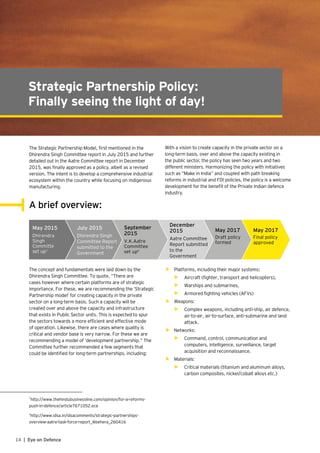
A brief overview:
May 2015
Dhirendra
Singh
Committe
set up1
July 2015
Dhirendra Singh
Committee Report
submitted to the
Government
September
2015
V.K.Aatre
Committee
set up2
December
2015
Aatre Committee
Report submitted
to the
Government
May 2017
Draft policy
formed
May 2017
Final policy
approved
The concept and fundamentals were laid down by the
Dhirendra Singh Committee. To quote, “There are
cases however where certain platforms are of strategic
importance. For these, we are recommending the ‘Strategic
Partnership model’ for creating capacity in the private
sector on a long-term basis. Such a capacity will be
created over and above the capacity and infrastructure
that exists in Public Sector units. This is expected to spur
the sectors towards a more efficient and effective mode
of operation. Likewise, there are cases where quality is
critical and vendor base is very narrow. For these we are
recommending a model of ‘development partnership.” The
Committee further recommended a few segments that
could be identified for long-term partnerships, including:
•	 Platforms, including their major systems:
•	 Aircraft (fighter, transport and helicopters),
•	 Warships and submarines,
•	 Armored fighting vehicles (AFVs)
•	 Weapons:
•	 Complex weapons, including anti-ship, air defence,
air-to-air, air-to-surface, anti-submarine and land
attack.
•	 Networks:
•	 Command, control, communication and
computers, intelligence, surveillance, target
acquisition and reconnaissance.
•	 Materials:
•	 Critical materials (titanium and aluminum alloys,
carbon composites, nickel/cobalt alloys etc.)
1
http://www.thehindubusinessline.com/opinion/for-a-reforms-
push-in-defence/article7671052.ece
2
http://www.idsa.in/idsacomments/strategic-partnerships-
overview-aatre-task-force-report_lkbehera_260416
15Eye on Defence |
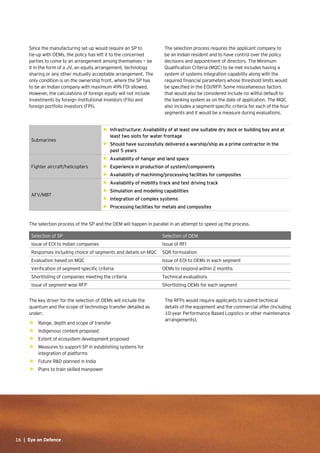
The Aatre Task Force further streamlined the segmentation
under two separate groups, classifying them as “system of
system projects” and “other projects”:
Taking a cue from the Aatre Task Force report, a draft policy
was prepared that laid down the qualification criteria with
the financial and technical parameters for selection. The
final Strategic Partnership Policy was released on 31 May
2107.
The segments identified include:
1.	 	Fighter aircraft
2.	 	Helicopters
3.	 	Submarines
4.	 	AFV/Main battle tanks (MBT)
Group I segments Group II segments
Aircraft Metallic material and alloys
Helicopters Non-metallic material (including composites and polymers)
Aero engines Ammunition (including smart ammunition)
Submarines
Warships
Guns (including artillery guns)
Armored vehicles (including tanks)
A maximum of 13 SPs to be selected
7 SPs (one for each segment) 6 SPs (two for each segment)
The Task Force recommended aircraft, helicopters,
submarines and armored vehicles, including tanks, in Group
I and ammunition, including smart ammunition, in Group II
to be considered for selection in the initial phase.
The seventh chapter of the DPP 2016 on Strategic
Partnership Policy is divided into sections, with an
introduction to the model, the identified segments and the
organization structure forming the first section. The second
section details the selection procedure.
The policy targets to create an ecosystem including the SP
itself, which is expected to be the system integrator with
other stakeholders including, among others, development
partners, specialized vendors and suppliers — especially
from the MSME sector.
The Strategic Partnership Policy
16 | Eye on Defence16 | Eye on Defence
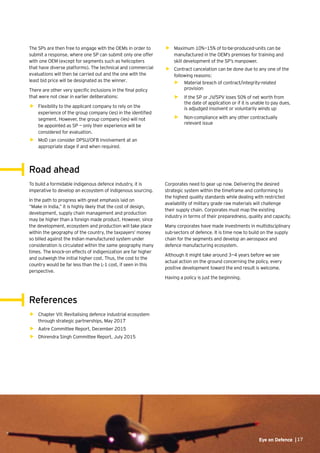
Since the manufacturing set up would require an SP to
tie-up with OEMs, the policy has left it to the concerned
parties to come to an arrangement among themselves — be
it in the form of a JV, an equity arrangement, technology
sharing or any other mutually acceptable arrangement. The
only condition is on the ownership front, where the SP has
to be an Indian company with maximum 49% FDI allowed.
However, the calculations of foreign equity will not include
investments by foreign institutional investors (FIIs) and
foreign portfolio investors (FPI).
The selection process requires the applicant company to
be an Indian resident and to have control over the policy
decisions and appointment of directors. The Minimum
Qualification Criteria (MQC) to be met includes having a
system of systems integration capability along with the
required financial parameters whose threshold limits would
be specified in the EOI/RFP. Some miscellaneous factors
that would also be considered include no willful default to
the banking system as on the date of application. The MQC
also includes a segment-specific criteria for each of the four
segments and it would be a measure during evaluations.
Submarines
•	 Infrastructure: Availability of at least one suitable dry dock or building bay and at
least two slots for water frontage
•	 Should have successfully delivered a warship/ship as a prime contractor in the
past 5 years
Fighter aircraft/helicopters
•	 Availability of hangar and land space
•	 Experience in production of system/components
•	 Availability of machining/processing facilities for composites
AFV/MBT
•	 Availability of mobility track and test driving track
•	 Simulation and modeling capabilities
•	 Integration of complex systems
•	 Processing facilities for metals and composites
The selection process of the SP and the OEM will happen in parallel in an attempt to speed up the process.
Selection of SP Selection of OEM
Issue of EOI to Indian companies Issue of RFI
Responses including choice of segments and details on MQC SQR formulation
Evaluation based on MQC Issue of EOI to OEMs in each segment
Verification of segment-specific criteria OEMs to respond within 2 months
Shortlisting of companies meeting the criteria Technical evaluations
Issue of segment-wise RFP Shortlisting OEMs for each segment
The key driver for the selection of OEMs will include the
quantum and the scope of technology transfer detailed as
under:
•	 Range, depth and scope of transfer
•	 Indigenous content proposed
•	 Extent of ecosystem development proposed
•	 Measures to support SP in establishing systems for
integration of platforms
•	 Future R&D planned in India
•	 Plans to train skilled manpower
The RFPs would require applicants to submit technical
details of the equipment and the commercial offer (including
10-year Performance Based Logistics or other maintenance
arrangements).
17Eye on Defence |Eye on Defence |17
The SPs are then free to engage with the OEMs in order to
submit a response, where one SP can submit only one offer
with one OEM (except for segments such as helicopters
that have diverse platforms). The technical and commercial
evaluations will then be carried out and the one with the
least bid price will be designated as the winner.
There are other very specific inclusions in the final policy
that were not clear in earlier deliberations:
•	 Flexibility to the applicant company to rely on the
experience of the group company (ies) in the identified
segment. However, the group company (ies) will not
be appointed as SP — only their experience will be
considered for evaluation.
•	 MoD can consider DPSU/OFB involvement at an
appropriate stage if and when required.
•	 Maximum 10%—15% of to-be-produced-units can be
manufactured in the OEM’s premises for training and
skill development of the SP’s manpower.
•	 Contract cancelation can be done due to any one of the
following reasons:
•	 Material breach of contract/integrity-related
provision
•	 If the SP or JV/SPV loses 50% of net worth from
the date of application or if it is unable to pay dues,
is adjudged insolvent or voluntarily winds up
•	 Non-compliance with any other contractually
relevant issue
Corporates need to gear up now. Delivering the desired
strategic system within the timeframe and conforming to
the highest quality standards while dealing with restricted
availability of military grade raw materials will challenge
their supply chain. Corporates must map the existing
industry in terms of their preparedness, quality and capacity.
Many corporates have made investments in multidisciplinary
sub-sectors of defence. It is time now to build on the supply
chain for the segments and develop an aerospace and
defence manufacturing ecosystem.
Although it might take around 3—4 years before we see
actual action on the ground concerning the policy, every
positive development toward the end result is welcome.
Having a policy is just the beginning.
To build a formidable indigenous defence industry, it is
imperative to develop an ecosystem of indigenous sourcing.
In the path to progress with great emphasis laid on
“Make in India,” it is highly likely that the cost of design,
development, supply chain management and production
may be higher than a foreign made product. However, since
the development, ecosystem and production will take place
within the geography of the country, the taxpayers’ money
so billed against the Indian manufactured system under
consideration is circulated within the same geography many
times. The knock-on effects of indigenization are far higher
and outweigh the initial higher cost. Thus, the cost to the
country would be far less than the L-1 cost, if seen in this
perspective.
•	 Chapter VII: Revitalising defence industrial ecosystem
through strategic partnerships, May 2017
•	 Aatre Committee Report, December 2015
•	 Dhirendra Singh Committee Report, July 2015
Road ahead
References
18 | Eye on Defence
SCOMET list and Industrial Licensing:
Relevant updates
Special Chemicals, Organisms, Materials, Equipment and
Technologies (SCOMET) update
Appendix 3 of Schedule 2 of ITC (HS) Classification contains
the control list of India, also referred to as the SCOMET
list, which covers dual use (civil and military applications)
goods, services and technology for exports. This is a
comprehensive list of items that are either prohibited or
require authorization for exporting out of the country owing
to potential risks of use.
India’s Directorate General of Foreign Trade (DGFT) updated
the SCOMET List via Notification No. 5, dated 24 April
2017, to be effective from 01 May 2017. The updates
included revision of the existing categories and the addition
of a new category, Category 8, which caters to “Special
Materials and Related Equipment, Material Processing,
Electronics, Computers, Telecommunications, Information
Security, Sensors and Lasers, Navigation and Avionics,
Marine, Aerospace and Propulsions.” This has been done
as part of India’s obligations as member of the Missile
Technology Control Regime (MTCR) and as an adherent to
the Nuclear Suppliers Group (NSG) guidelines.
More importantly, the addition of Munitions List
under Category 6 brings it in line with the “Wassenaar
Arrangement on Export Controls for Conventional Arms and
Dual-Use Goods.” India has been aligning its policies to gain
entry into the global non-proliferation regimes, including the
Wassenaar Arrangement and the Australia Group.
The list, which was under “Reserved” earlier has been
populated now. It has a total of 22 items whose exports
would now be governed by the revised Standard Operating
Procedure issued by the Department of Defence Production
(DDP). The Military Stores list notified vide Notification
No. 115 (RE-2013/2009-14) dated 13 March 2015 now
stands revoked. The revised SCOMET list now includes nine
categories:
Category SCOMET
0 Nuclear materials, nuclear-related other materials, equipment and technology
1 Toxic chemical agents and other chemicals
2 Microorganisms and toxins
3 Materials, materials processing equipment and related technologies (not under Category 0)
4 Nuclear-related other equipment and technology
5 Aerospace systems, equipment, including production and test equipment, related technology and specially
designed components and accessories
6 Munitions list
7 Electronics, computers and information technology, including information security
8 Special Materials and Related Equipment, Material Processing, Electronics, Computers,
Telecommunications, Information Security, Sensors and Lasers, Navigation and Avionics, Marine,
Aerospace and Propulsions
19Eye on Defence |
Industrial Licenses (ILs)
The revision would benefit India in the long run as getting
aligned to global norms and control regimes/becoming a
member would further enable increased access to trade
exports in critical and strategic items.
•	 The role of Indian companies in the global supply
chain would be enhanced as there would be access to
high-end technology and critical use items, resulting in
increased trade activity.
•	 India would also gain from increased knowledge sharing
on sensitive dual use goods and technologies.
The Ministry of Home Affairs (MHA) through its Notification
S.O. 1636 (E) dated 19 May 2017, clarified that the
authority to grant manufacturing licenses in respect of
the category of arms and ammunition and defence items
provided in the Schedule to the Notification has been
delegated to the Secretary, Department of Industrial Policy
and Promotion (DIPP).
The notification, however, clearly mentioned that the
Secretary, DIPP, will function under the supervision and
control of the MHA and will not issue any instructions
without the MHA’s prior consent. The notification also
mentioned that DIPP’s powers may be revoked if necessary
in public interest.
The Schedule to the Notification mentioned the broad
categories of arms and ammunition that require licensing
and hence approval from DIPP:
•	 Tanks and other AFVs
•	 Defence aircraft, spacecraft and parts thereof
•	 Warships of all kinds
•	 Arms and ammunition and allied items of defence
equipment; and parts and accessories thereof, other
than small arms of caliber up to 12.7 mm as defined
under Arms rules 2016 and parts, components and
ammunition for such small arms.
The notification also states a revised time line of 30 days for
processing SCOMET applications, compared to the 45-day
period earlier — reflecting an increased focus on improving
efficiency in the system.
Press Note 3 (2014 series) had almost similar
comprehensive categories of items that DIPP was authorized
to issue ILs for, and it was specifically clarified that items
not included in the list would not require ILs for defence
purposes.
20 | Eye on Defence20 | Eye on Defence
However the “devil is in the detail.” The list of defence items
notified as per the MHA notification at hand is different
from the Press Note 3, to the extent shown below:
The major issues at hand remain:
•	 No harmony between the two lists: Press Note 3 and
MHA notification
•	 The IL issuing authority for items not present in the
MHA notification is not clear
•	 Status of around 80 IL pending applications, for
equipment ranging from tanks to UAVs and warships2
•	 Not clear why the IL application process has been taken
offline
Category As per the MHA Notification S.O. 1636 (E)…
1) Tanks and other AFVs
2) Defence aircraft, space craft and parts
thereof
•	 Does not mention “including but not limited to”; not clear if this
has any significant meaning
3) Warships of all kinds •	 Does not include small arms of caliber 12.7 mm as per Arms
Rules, 2016 and parts, components and ammunition for such
small arm.
4) Arms and ammunition and allied items
of defence equipment; parts and
accessories thereof
•	 Does not include products under the sub heads:
•	 Electronic equipment
•	 Armored or protective equipment
•	 Specialized equipment for military training or simulators
•	 Imaging/countermeasure equipment specially designed for
military use
•	 Concealment and deception equipment designed for military
application
Also, with MHA being the supervising authority for all
decisions by DIPP, benefits from this overarching role are
also not clear. More than 340 ILs had been issued till June
2016, with close to 130 ILs being issued in the past 3—4
years alone1
. An early clarification would further help the
development of a defence manufacturing ecosystem in
India.
References
•	 DGFT Notification No 5 / 2015-2020, 24th April 2017
•	 MHA, Notification S.O. 1636 (E), 19 May 2017
•	 DIPP, Press Note 3 (2014 series), 26th June 2014
•	 “Defence licensing moves offline, firms concerned,” The
Economic Times, 7 June 2017, via Factiva
21Eye on Defence |Eye on Defence |21
22 | Eye on Defence
Indian civil aviation: A story set to fly
further and farther!
India’s civil aviation sector: An overview
Organizational setup in India
Civil Aviation, “the better half” of the aerospace and
defence sector, is one of the many sunrise sectors in India’s
growth story — solely based on the high growth rates
projected in air travel. Given the scope and opportunities
available, the sector has the potential to drive the country’s
economy with its multiplier effect on the other sectors.
According to a study by International Civil Aviation
Organisation (ICAO), the output and employment multipliers
for a country’s economy from its aviation sector are at
3.25x and 6.10x respectively1
, reflecting the simultaneous
growth in ancillary industries.
In the context of global aviation, India is a key market with
a growing population coupled with an increased propensity
toward air travel. Factors such as availability of low cost
airlines, modern airports, higher disposable income, FDI
The Ministry of Civil Aviation (MoCA) is responsible for
the formulation of policies and programs for development
and regulation of the sector in the country. The current
framework also includes the following regulatory and
attached organizations:
and increased competition among industry players continue
to contribute to the growth rates. Indian air transport
(including air freight) received FDI worth around US$1 billion
beginning April 2000 till March 2017, which, although
insignificant when compared to the other sectors, still
reflects the focus on the sector in India.
Domestic passenger traffic in India grew at ~18% CAGR from
61 million in FY14 to 100 million in FY17, making India the
third largest aviation market globally, behind the US (719
million) and China (436 million) 2
.
In a country like India, where the sector is yet to achieve
its full potential, the relevant ministry and the concerned
regulatory bodies play a big role in setting up the dynamics
and in getting the ball rolling.
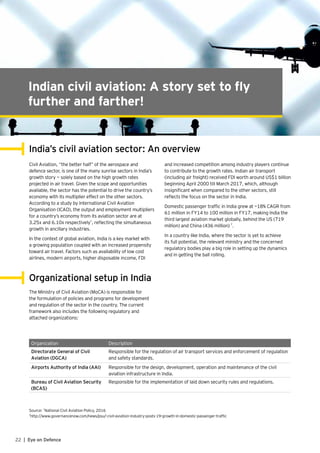
Organization Description
Directorate General of Civil
Aviation (DGCA)
Responsible for the regulation of air transport services and enforcement of regulation
and safety standards.
Airports Authority of India (AAI) Responsible for the design, development, operation and maintenance of the civil
aviation infrastructure in India.
Bureau of Civil Aviation Security
(BCAS)
Responsible for the implementation of laid down security rules and regulations.
Source:
1
National Civil Aviation Policy, 2016
2
http://www.governancenow.com/news/psu/-civil-aviation-industry-posts-19-growth-in-domestic-passenger-traffic
23Eye on Defence |
Irrespective of the kind of setup the country has, the
aviation sector requires long gestation periods for the
players to consistently have a good financial bottom-line.
It is a trade-off between high volumes, higher market
share and profitability. The high investment costs involving
purchasing/leasing of commercial aircraft and their regular
maintenance are also a factor.
Indian aviation sector
The main drivers of growth in the aviation sector include
GDP growth, population and the frequency of air travel
among others. The potential for the sector is immense in
India. Indian air passenger traffic, across most of the last
few years, has witnessed increased revenue passenger
kilometer (RPK) and available seat kilometer (ASK),
reflecting increased demand and capacity respectively.
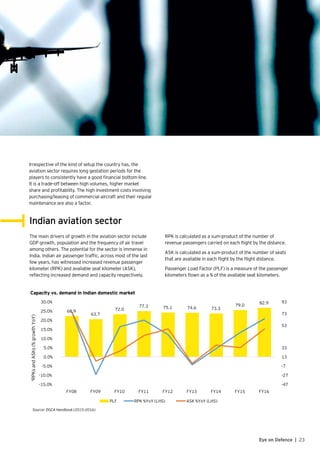
RPK is calculated as a sum-product of the number of
revenue passengers carried on each flight by the distance.
ASK is calculated as a sum-product of the number of seats
that are available in each flight by the flight distance.
Passenger Load Factor (PLF) is a measure of the passenger
kilometers flown as a % of the available seat kilometers.
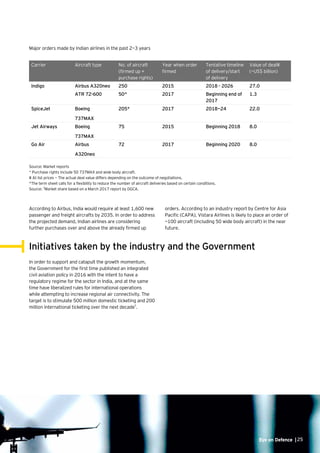
Capacity vs. demand in Indian domestic market
68.9
63.7
72.0
77.3 75.1 74.6 73.3
79.0
82.9
-47
-27
-7
13
33
53
73
93
-15.0%
-10.0%
-5.0%
0.0%
5.0%
10.0%
15.0%
20.0%
25.0%
30.0%
FY08 FY09 FY10 FY11 FY12 FY13 FY14 FY15 FY16
'RPKsandASKs(%growthYoY)
PLF RPK %YoY (LHS) ASK %YoY (LHS)
Source: DGCA Handbook (2015-2016)
24 | Eye on Defence24 | Eye on Defence
In the past few years, scheduled Indian airlines have
witnessed volatile year-on-year changes in RPKs and ASKs
but a relatively range-bound PLF; FY16 was the first time
during this period where PLF breached the 80% ceiling,
reflecting increased occupancy. As per International Air
Transport Association (IATA), at a global level, airlines have
consistently averaged above 75% PLF in the last decade.
With over a 1,000 aircraft expected to be on order, the
Indian aviation sector is at a stage where for every aircraft
in service, there are ~2.2 aircraft on order3
. This is the
highest for any aviation market in the world. However, this
also brings to the fore concerns of infrastructure challenges
that could affect the economics of the sector.
Challenges faced by the Indian aviation sector
Indian airlines
Metrics such as RPKs, ASKs and PLFs when viewed in
exclusivity do not give a complete picture of the health of
the sector/industry.
•	 Costs: The financial health of the airline sector and its
players is impacted by a number factors such as the
revenue from tickets sale, other revenues and cost of
operations. Fuel, for example, makes up close to 35%—
40% of the total cost component for an Indian airline
and is one of the main factors for the rising costs.
•	 Airport capacity constraints: Congestion and slot
constraints at major airports are expected to continue
at least in the near future as new terminals and runways
will take time to develop.
The Indian aviation market is becoming increasingly
competitive. There have been airlines that have suffered
from high operational costs, flawed strategies and even lack
of dynamic pricing, but there are also others that are still
surviving.
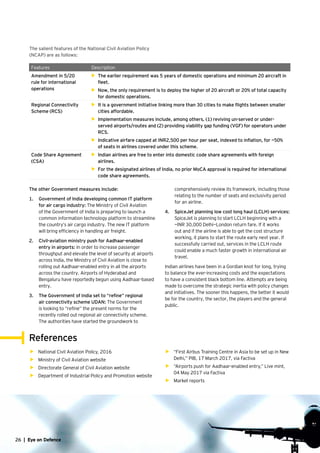
The five major airlines in the aviation space in India
command more than 90%4
of the market share, with Indigo
being a consistent market leader.
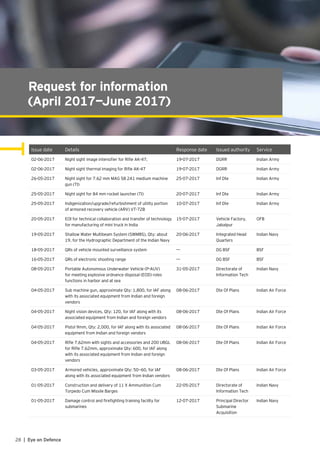
Indian airlines, especially the leading ones, have order books
to the tune of hundreds of aircraft projected to be delivered
sometime during the next decade, reflecting the anticipation
for high to very high demand.
•	 Airspace: While the current congestion issues at
hand continue to prevail, the situation could worsen
in the coming few years as more new aircraft enter
the ecosystem. Air navigation services would require
a major overhaul to be able to effectively continue
operations.
39.7%
13.6%
18%
13.0%
8.6%
7.0%
Indigo
Air India
Jet Airways
SpiceJet
Go Air
Others
Source:
3
http://www.livemint.com/Companies/Cb4bW14f4YnRDmZm29pqYL/Jet-Vistara-to-order-200-planes--CAPA.html
25Eye on Defence |Eye on Defence |25
Major orders made by Indian airlines in the past 2—3 years
According to Airbus, India would require at least 1,600 new
passenger and freight aircrafts by 2035. In order to address
the projected demand, Indian airlines are considering
further purchases over and above the already firmed up
Source: Market reports
* Purchase rights include 50 737MAX and wide body aircraft.
# At list prices — The actual deal value differs depending on the outcome of negotiations.
^The term sheet calls for a flexibility to reduce the number of aircraft deliveries based on certain conditions.
Source:
4
Market share based on a March 2017 report by DGCA.
Initiatives taken by the industry and the Government
In order to support and catapult the growth momentum,
the Government for the first time published an integrated
civil aviation policy in 2016 with the intent to have a
regulatory regime for the sector in India, and at the same
time have liberalized rules for international operations
while attempting to increase regional air connectivity. The
target is to stimulate 500 million domestic ticketing and 200
million international ticketing over the next decade5
.
Carrier Aircraft type No. of aircraft
(firmed up +
purchase rights)
Year when order
firmed
Tentative timeline
of delivery/start
of delivery
Value of deal#
(~US$ billion)
Indigo Airbus A320neo 250 2015 2018 - 2026 27.0
ATR 72-600 50^ 2017 Beginning end of
2017
1.3
SpiceJet Boeing
737MAX
205* 2017 2018—24 22.0
Jet Airways Boeing
737MAX
75 2015 Beginning 2018 8.0
Go Air Airbus
A320neo
72 2017 Beginning 2020 8.0
orders. According to an industry report by Centre for Asia
Pacific (CAPA), Vistara Airlines is likely to place an order of
~100 aircraft (including 50 wide body aircraft) in the near
future.
26 | Eye on Defence
The salient features of the National Civil Aviation Policy
(NCAP) are as follows: 	
Features Description
Amendment in 5/20
rule for international
operations
•	 The earlier requirement was 5 years of domestic operations and minimum 20 aircraft in
fleet.
•	 Now, the only requirement is to deploy the higher of 20 aircraft or 20% of total capacity
for domestic operations.
Regional Connectivity
Scheme (RCS)
•	 It is a government initiative linking more than 30 cities to make flights between smaller
cities affordable.
•	 Implementation measures include, among others, (1) reviving un-served or under-
served airports/routes and (2) providing viability gap funding (VGF) for operators under
RCS.
•	 Indicative airfare capped at INR2,500 per hour per seat, indexed to inflation, for ~50%
of seats in airlines covered under this scheme.
Code Share Agreement
(CSA)
•	 Indian airlines are free to enter into domestic code share agreements with foreign
airlines.
•	 For the designated airlines of India, no prior MoCA approval is required for international
code share agreements.
The other Government measures include:
1.	 Government of India developing common IT platform
for air cargo industry: The Ministry of Civil Aviation
of the Government of India is preparing to launch a
common information technology platform to streamline
the country’s air cargo industry. The new IT platform
will bring efficiency in handling air freight.
2.	 Civil-aviation ministry push for Aadhaar-enabled
entry in airports: In order to increase passenger
throughput and elevate the level of security at airports
across India, the Ministry of Civil Aviation is close to
rolling out Aadhaar-enabled entry in all the airports
across the country. Airports of Hyderabad and
Bengaluru have reportedly begun using Aadhaar-based
entry.
3.	 The Government of India set to “refine” regional
air connectivity scheme UDAN: The Government
is looking to “refine” the present norms for the
recently rolled out regional air connectivity scheme.
The authorities have started the groundwork to
comprehensively review its framework, including those
relating to the number of seats and exclusivity period
for an airline.
4.	 SpiceJet planning low cost long haul (LCLH) services:
SpiceJet is planning to start LCLH beginning with a
~INR 30,000 Delhi—London return fare. If it works
out and if the airline is able to get the cost structure
working, it plans to start the route early next year. If
successfully carried out, services in the LCLH route
could enable a much faster growth in international air
travel.
Indian airlines have been in a Gordian knot for long, trying
to balance the ever-increasing costs and the expectations
to have a consistent black bottom line. Attempts are being
made to overcome the strategic inertia with policy changes
and initiatives. The sooner this happens, the better it would
be for the country, the sector, the players and the general
public.
References
•	 National Civil Aviation Policy, 2016
•	 Ministry of Civil Aviation website
•	 Directorate General of Civil Aviation website
•	 Department of Industrial Policy and Promotion website
•	 “First Airbus Training Centre in Asia to be set up in New
Delhi,” PIB, 17 March 2017, via Factiva
•	 “Airports push for Aadhaar-enabled entry,” Live mint,
04 May 2017 via Factiva
•	 Market reports
26 | Eye on Defence
27Eye on Defence |Eye on Defence |27
28 | Eye on Defence
Request for information
(April 2017—June 2017)
Issue date Details Response date Issued authority Service
02-06-2017 Night sight image intensifier for Rifle AK-47, 19-07-2017 DGRR Indian Army
02-06-2017 Night sight thermal imaging for Rifle AK-47 19-07-2017 DGRR Indian Army
26-05-2017 Night sight for 7.62 mm MAG 58 2A1 medium machine
gun (TI)
25-07-2017 Inf Dte Indian Army
25-05-2017 Night sight for 84 mm rocket launcher (TI) 20-07-2017 Inf Dte Indian Army
25-05-2017 Indigenization/upgrade/refurbishment of utility portion
of armored recovery vehicle (ARV) VT-72B
10-07-2017 Inf Dte Indian Army
20-05-2017 EOI for technical collaboration and transfer of technology
for manufacturing of mini truck in India
15-07-2017 Vehicle Factory,
Jabalpur
OFB
19-05-2017 Shallow Water Multibeam System (SWMBS), Qty: about
19, for the Hydrographic Department of the Indian Navy
20-06-2017 Integrated Head
Quarters
Indian Navy
18-05-2017 QRs of vehicle mounted surveillance system --- DG BSF BSF
16-05-2017 QRs of electronic shooting range --- DG BSF BSF
08-05-2017 Portable Autonomous Underwater Vehicle (P-AUV)
for meeting explosive ordnance disposal (EOD) roles
functions in harbor and at sea
31-05-2017 Directorate of
Information Tech
Indian Navy
04-05-2017 Sub machine gun, approximate Qty: 1,800, for IAF along
with its associated equipment from Indian and foreign
vendors
08-06-2017 Dte Of Plans Indian Air Force
04-05-2017 Night vision devices, Qty: 120, for IAF along with its
associated equipment from Indian and foreign vendors
08-06-2017 Dte Of Plans Indian Air Force
04-05-2017 Pistol 9mm, Qty: 2,000, for IAF along with its associated
equipment from Indian and foreign vendors
08-06-2017 Dte Of Plans Indian Air Force
04-05-2017 Rifle 7.62mm with sights and accessories and 200 UBGL
for Rifle 7.62mm, approximate Qty: 600, for IAF along
with its associated equipment from Indian and foreign
vendors
08-06-2017 Dte Of Plans Indian Air Force
03-05-2017 Armored vehicles, approximate Qty: 50—60, for IAF
along with its associated equipment from Indian vendors
08-06-2017 Dte Of Plans Indian Air Force
01-05-2017 Construction and delivery of 11 X Ammunition Cum
Torpedo Cum Missile Barges
22-05-2017 Directorate of
Information Tech
Indian Navy
01-05-2017 Damage control and firefighting training facility for
submarines
12-07-2017 Principal Director
Submarine
Acquisition
Indian Navy
Issue date Details Response date Issued authority Service
10-04-2017 Advance night vision device for INSAS rifle 20-04-2017 HQ Northern Comd
(Arty)
Indian Army
10-04-2017 Passive night sight for INSAS rifle 17-04-2017 HQ Northern Comd
(Arty)
Indian Army
10-04-2017 Long-range thermal imaging camera 18-04-2017 HQ Northern Comd
(Arty)
Indian Army
10-04-2017 Medium-range thermal imaging camera 18-04-2017 HQ Northern Comd
(Arty)
Indian Army
06-04-2017 Expression of interest for identifying suitable partner for
joint working on bullet proofing of vehicles
05-05-2017 MIDHANI MIDHANI
04-04-2017 EOI — For indigenization of ACP and CAMU for Hawk
Aircraft
08-05-2017 Bangalore -
Aircraft Division.
HAL
29Eye on Defence |
30 | Eye on Defence
Request for proposal
(April 2017—June 2017)
Issue date Details Response date Issued authority Service
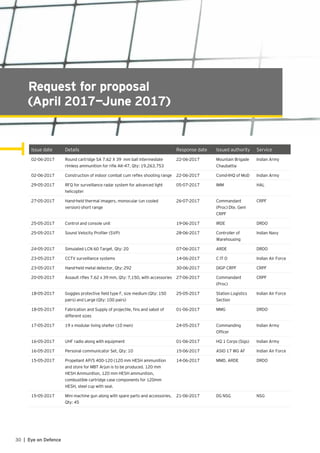
02-06-2017 Round cartridge SA 7.62 X 39 mm ball intermediate
rimless ammunition for rifle AK-47, Qty: 19,263,753
22-06-2017 Mountain Brigade
Chaubattia
Indian Army
02-06-2017 Construction of indoor combat cum reflex shooting range 22-06-2017 Comd-IHQ of MoD Indian Army
29-05-2017 RFQ for surveillance radar system for advanced light
helicopter
05-07-2017 IMM HAL
27-05-2017 Hand-held thermal imagers, monocular (un cooled
version) short range
26-07-2017 Commandant
(Proc) Dte. Genl
CRPF
CRPF
25-05-2017 Control and console unit 19-06-2017 IRDE DRDO
25-05-2017 Sound Velocity Profiler (SVP) 28-06-2017 Controller of
Warehousing
Indian Navy
24-05-2017 Simulated LCN 60 Target, Qty: 20 07-06-2017 ARDE DRDO
23-05-2017 CCTV surveillance systems 14-06-2017 C IT O Indian Air Force
23-05-2017 Hand-held metal detector, Qty: 292 30-06-2017 DIGP CRPF CRPF
20-05-2017 Assault rifles 7.62 x 39 mm, Qty: 7,150, with accessories 27-06-2017 Commandant
(Proc)
CRPF
18-05-2017 Goggles protective field type F, size medium (Qty: 150
pairs) and Large (Qty: 100 pairs)
25-05-2017 Station Logistics
Section
Indian Air Force
18-05-2017 Fabrication and Supply of projectile, fins and sabot of
different sizes
01-06-2017 MMG DRDO
17-05-2017 19 x modular living shelter (10 men) 24-05-2017 Commanding
Officer
Indian Army
16-05-2017 UHF radio along with equipment 01-06-2017 HQ 1 Corps (Sigs) Indian Army
16-05-2017 Personal communicator Set, Qty: 10 15-06-2017 ASIO 17 WG AF Indian Air Force
15-05-2017 Propellant AP/S 400-120 (120 mm HESH ammunition
and store for MBT Arjun is to be produced. 120 mm
HESH Ammunition, 120 mm HESH ammunition,
combustible cartridge case components for 120mm
HESH, steel cup with seal.
14-06-2017 MMD, ARDE DRDO
15-05-2017 Mini machine gun along with spare parts and accessories,
Qty: 45
21-06-2017 DG NSG NSG
31Eye on Defence |
Issue date Details Response date Issued authority Service
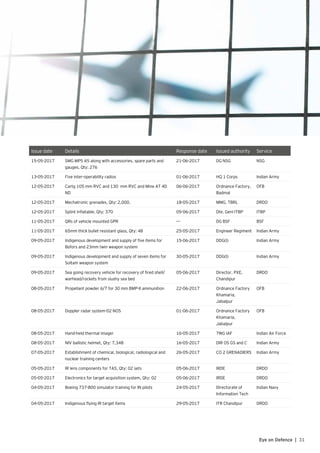
15-05-2017 SMG MP5 A5 along with accessories, spare parts and
gauges, Qty: 276
21-06-2017 DG NSG NSG
13-05-2017 Five inter-operability radios 01-06-2017 HQ 1 Corps Indian Army
12-05-2017 Cartg 105 mm RVC and 130 mm RVC and Mine AT 4D
ND
06-06-2017 Ordnance Factory,
Badmal
OFB
12-05-2017 Mechatronic grenades, Qty: 2,000. 18-05-2017 MMG, TBRL DRDO
12-05-2017 Splint inflatable, Qty: 370 05-06-2017 Dte. Genl ITBP ITBP
11-05-2017 QRs of vehicle mounted GPR --- DG BSF BSF
11-05-2017 65mm thick bullet resistant glass, Qty: 48 25-05-2017 Engineer Regiment Indian Army
09-05-2017 Indigenous development and supply of five items for
Bofors and 23mm twin weapon system
15-06-2017 DDG(I) Indian Army
09-05-2017 Indigenous development and supply of seven items for
Soltam weapon system
30-05-2017 DDG(I) Indian Army
09-05-2017 Sea going recovery vehicle for recovery of fired shell/
warhead/rockets from slushy sea bed
05-06-2017 Director, PXE,
Chandipur
DRDO
08-05-2017 Propellant powder 6/7 for 30 mm BMP-II ammunition 22-06-2017 Ordnance Factory
Khamaria,
Jabalpur
OFB
08-05-2017 Doppler radar system-02 NOS 01-06-2017 Ordnance Factory
Khamaria,
Jabalpur
OFB
08-05-2017 Hand-held thermal imager 16-05-2017 7WG IAF Indian Air Force
08-05-2017 NIV ballistic helmet, Qty: 7,348 16-05-2017 DIR OS GS and C Indian Army
07-05-2017 Establishment of chemical, biological, radiological and
nuclear training centers
26-05-2017 CO 2 GRENADIERS Indian Army
05-05-2017 IR lens components for TAS, Qty: 02 sets 05-06-2017 IRDE DRDO
05-05-2017 Electronics for target acquisition system, Qty: 02 05-06-2017 IRDE DRDO
04-05-2017 Boeing 737-800 simulator training for IN pilots 24-05-2017 Directorate of
Information Tech
Indian Navy
04-05-2017 Indigenous flying IR target items 29-05-2017 ITR Chandipur DRDO
32 | Eye on Defence32 | Eye on Defence
Issue date Details Response date Issued authority Service
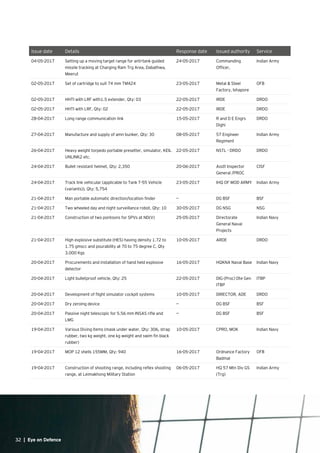
04-05-2017 Setting up a moving target range for anti-tank guided
missile tracking at Charging Ram Trg Area, Dabathwa,
Meerut
24-05-2017 Commanding
Officer,
Indian Army
02-05-2017 Set of cartridge to suit 74 mm TM424 23-05-2017 Metal & Steel
Factory, Ishapore
OFB
02-05-2017 HHTI with LRF with1.5 extender, Qty: 03 22-05-2017 IRDE DRDO
02-05-2017 HHTI with LRF, Qty: 02 22-05-2017 IRDE DRDO
28-04-2017 Long range communication link 15-05-2017 R and D E Engrs
Dighi
DRDO
27-04-2017 Manufacture and supply of amn bunker, Qty: 30 08-05-2017 57 Engineer
Regiment
Indian Army
26-04-2017 Heavy weight torpedo portable presetter, simulator, KEIL
UNLINK2 etc.
22-05-2017 NSTL - DRDO DRDO
24-04-2017 Bullet resistant helmet, Qty: 2,350 20-06-2017 Asstt Inspector
General /PROC
CISF
24-04-2017 Track link vehicular (applicable to Tank T-55 Vehicle
(variants)), Qty: 5,754
23-05-2017 IHQ OF MOD ARMY Indian Army
21-04-2017 Man portable automatic direction/location finder -- DG BSF BSF
21-04-2017 Two wheeled day and night surveillance robot, Qty: 10 30-05-2017 DG NSG NSG
21-04-2017 Construction of two pontoons for SPVs at ND(V) 25-05-2017 Directorate
General Naval
Projects
Indian Navy
21-04-2017 High explosive substitute (HES) having density 1.72 to
1.75 gmscc and pourability at 70 to 75 degree C, Qty
3,000 Kgs
10-05-2017 ARDE DRDO
20-04-2017 Procurements and installation of hand held explosive
detector
16-05-2017 HQKNA Naval Base Indian Navy
20-04-2017 Light bulletproof vehicle, Qty: 25 22-05-2017 DIG (Proc) Dte Gen
ITBP
ITBP
20-04-2017 Development of flight simulator cockpit systems 10-05-2017 DIRECTOR, ADE DRDO
20-04-2017 Dry zeroing device -- DG BSF BSF
20-04-2017 Passive night telescopic for 5.56 mm INSAS rifle and
LMG
-- DG BSF BSF
19-04-2017 Various Diving items (mask under water, Qty: 306, strap
rubber, two kg weight, one kg weight and swim fin black
rubber)
10-05-2017 CPRO, MOK Indian Navy
19-04-2017 MOP 12 shells 155MM, Qty: 940 16-05-2017 Ordnance Factory
Badmal
OFB
19-04-2017 Construction of shooting range, including reflex shooting
range, at Leimakhong Military Station
06-05-2017 HQ 57 Mtn Div GS
(Trg)
Indian Army
33Eye on Defence |Eye on Defence |33
Issue date Details Response date Issued authority Service
18-04-2017 Invitation of quotations for hiring of services for design
activities related to in ships for a duration of 02 years for
DNA (MoD Cell) at IHQ-MoD (Navy)
08-05-2017 Directorate of
Administration
Integrated
Headquarters
Indian Navy
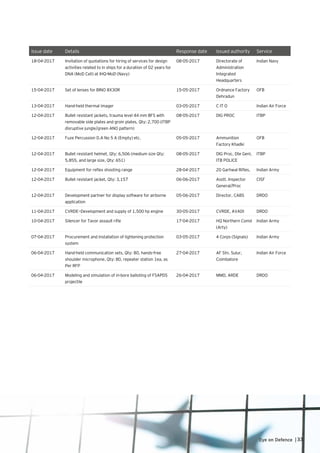
15-04-2017 Set of lenses for BINO 8X30R 15-05-2017 Ordnance Factory
Dehradun
OFB
13-04-2017 Hand-held thermal imager 03-05-2017 C IT O Indian Air Force
12-04-2017 Bullet resistant jackets, trauma level 44 mm BFS with
removable side plates and groin plates, Qty: 2,700 (ITBP
disruptive jungle/green ANO pattern)
08-05-2017 DIG PROC ITBP
12-04-2017 Fuze Percussion D.A No 5 A (Empty) etc. 05-05-2017 Ammunition
Factory Khadki
OFB
12-04-2017 Bullet resistant helmet, Qty: 6,506 (medium size Qty:
5,855, and large size, Qty: 651)
08-05-2017 DIG Proc, Dte Genl,
ITB POLICE
ITBP
12-04-2017 Equipment for reflex shooting range 28-04-2017 20 Garhwal Rifles, Indian Army
12-04-2017 Bullet resistant jacket, Qty: 3,157 06-06-2017 Asstt. Inspector
General/Proc
CISF
12-04-2017 Development partner for display software for airborne
application
05-06-2017 Director, CABS DRDO
11-04-2017 CVRDE—Development and supply of 1,500 hp engine 30-05-2017 CVRDE, AVADI DRDO
10-04-2017 Silencer for Tavor assault rifle 17-04-2017 HQ Northern Comd
(Arty)
Indian Army
07-04-2017 Procurement and installation of lightening protection
system
03-05-2017 4 Corps (Signals) Indian Army
06-04-2017 Hand-held communication sets, Qty: 80, hands-free
shoulder microphone, Qty: 80, repeater station 1ea, as
Per RFP
27-04-2017 AF Stn. Sulur,
Coimbatore
Indian Air Force
06-04-2017 Modeling and simulation of in-bore balloting of FSAPDS
projectile
26-04-2017 MMD, ARDE DRDO
34 | Eye on Defence34 | Eye on Defence
New projects/investments/contracts
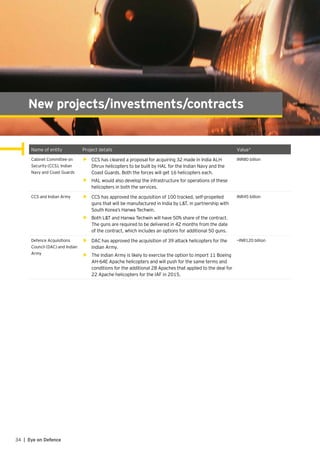
Name of entity Project details Value*
Cabinet Committee on
Security (CCS), Indian
Navy and Coast Guards
•	 CCS has cleared a proposal for acquiring 32 made in India ALH
Dhruv helicopters to be built by HAL for the Indian Navy and the
Coast Guards. Both the forces will get 16 helicopters each.
•	 HAL would also develop the infrastructure for operations of these
helicopters in both the services.
INR80 billion
CCS and Indian Army •	 CCS has approved the acquisition of 100 tracked, self-propelled
guns that will be manufactured in India by L&T, in partnership with
South Korea’s Hanwa Techwin.
•	 Both L&T and Hanwa Techwin will have 50% share of the contract.
The guns are required to be delivered in 42 months from the date
of the contract, which includes an options for additional 50 guns.
INR45 billion
Defence Acquisitions
Council (DAC) and Indian
Army
•	 DAC has approved the acquisition of 39 attack helicopters for the
Indian Army.
•	 The Indian Army is likely to exercise the option to import 11 Boeing
AH-64E Apache helicopters and will push for the same terms and
conditions for the additional 28 Apaches that applied to the deal for
22 Apache helicopters for the IAF in 2015.
~INR120 billion
35Eye on Defence |Eye on Defence |35
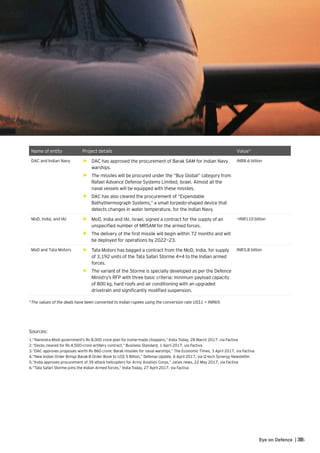
Name of entity Project details Value*
DAC and Indian Navy •	 DAC has approved the procurement of Barak SAM for Indian Navy
warships.
•	 The missiles will be procured under the “Buy Global” category from
Rafael Advance Defense Systems Limited, Israel. Almost all the
naval vessels will be equipped with these missiles.
•	 DAC has also cleared the procurement of “Expendable
Bathythermograph Systems,” a small torpedo-shaped device that
detects changes in water temperature, for the Indian Navy.
INR8.6 billion
MoD, India, and IAI •	 MoD, India and IAI, Israel, signed a contract for the supply of an
unspecified number of MRSAM for the armed forces.
•	 The delivery of the first missile will begin within 72 months and will
be deployed for operations by 2022—23.
~INR110 billion
MoD and Tata Motors •	 Tata Motors has bagged a contract from the MoD, India, for supply
of 3,192 units of the Tata Safari Storme 4×4 to the Indian armed
forces.
•	 The variant of the Storme is specially developed as per the Defence
Ministry’s RFP with three basic criteria: minimum payload capacity
of 800 kg, hard roofs and air conditioning with an upgraded
drivetrain and significantly modified suspension.
INR3.8 billion
*The values of the deals have been converted to Indian rupees using the conversion rate US$1 = INR69.
Sources:
1.	“Narendra Modi government’s Rs 8,000 crore plan for home-made choppers,” India Today, 28 March 2017, via Factiva
2.	“Decks cleared for Rs 4,500-crore artillery contract,” Business Standard, 1 April 2017, via Factiva
3.	“DAC approves proposals worth Rs 860 crore; Barak missiles for naval warships,” The Economic Times, 3 April 2017, via Factiva
4.	“New Indian Order Brings Barak-8 Order Book to US$ 5 Billion,” Defense Update, 6 April 2017, via Q-tech Synergy Newsletter
5.	“India approves procurement of 39 attack helicopters for Army Aviation Corps,” Janes news, 22 May 2017, via Factiva
6.	“Tata Safari Storme joins the Indian Armed forces,” India Today, 27 April 2017, via Factiva
36 | Eye on Defence
JVs and alliances
Name of entity Nature of transaction Value
Reliance Defence
Limited and LIG Nex1,
South Korea
•	 Reliance Defence Ltd. and LIG Nex1 have entered into a strategic
partnership to jointly manufacture defence equipment for the
Indian armed forces. LIG Nex1 is a leading manufacturer of smart
heavy weapons including anti—ship missiles, anti—tank—guided
missiles (ATGM) and guided rockets.
•	 Both the companies will explore opportunities for developing
defence equipment such as air defence and surveillance radar,
sensors and missiles.
NA
Dynamatic Technologies
Limited and Magal
Security Systems
(Magal-S3), Israel
•	 Dynamatic Technologies has signed a cooperation agreement
with an Israeli company, Magal Security Systems (Magal-S3), for
pursuing integrated security projects in India.
•	 The partnership will focus on the demand for high-end security
products and solutions for critical infrastructure, and on providing
combined integrated border management solutions (CIBMS) aimed
to address the challenges in securing Indian borders.
NA
HAL and Rostec Corp.,
Russia
•	 HAL and Rostec Corp. incorporated a 50.5:49.5 JV, India‐Russia
Helicopters Limited (IRHL), to manufacture and assemble multi‐role
Helicopters. The majority share will be owned by HAL.
•	 The JV is set‐up as part of the initial Inter‐government agreement
signed during the Indian Prime Minister’s visit to Russia in
December 2015.
NA
Garden Reach
Shipbuilding and
Engineers Ltd. (GRSE)
and Rolls Royce
•	 GRSE and Rolls Royce have entered into an agreement to assemble
naval engines in India.
•	 As per the agreement, Rolls Royce’s 12V and 16V 4,000 M90 type
engines will be assembled in GRSE’s diesel engine plant in Ranchi.
NA
Sources:
1.	“Reliance Defence teams up with South Korean co LIG Nex1 ,” Business Line, 17 April 2017, via Factiva
2.	“Dynamatic Technologies up 6%, enters into agreement with Magal-S3,” Money Control, 7 April 2017, via Factiva
3.	“Rolls-Royce, GRSE ink pact to assemble naval engines in India,” The Economic Times, 5 May 2015, via Factiva
4.	“Russia approves helicopter joint venture with India,” IHS Janes, 7 April 2017, via Factiva
37Eye on Defence |
38 | Eye on Defence
Country-level deals and initiatives
Country Nature of transaction Additional details
Republic of Korea •	 India and the Republic of Korea (RoK) signed
an inter-governmental Memorandum of
Understanding (MoU) for defence industry co-
operation in shipbuilding.
•	 Both the countries will recommend organizations
for collaborating in the implementation of
specific defence projects.
•	 The MoU will be initially valid for a period of five years
and would be automatically extendable for further
successive five year at a time.
•	 The inter-governmental MoU was conceived under the
overall umbrella of the “Special Strategic Partnership”
between both sides as declared in the joint statement
of the Prime Minister of India and the President of
Korea in May 2015.
The UK •	 The MoD, India, and the Secretary of State for
Defence, the UK, issued a joint statement on the
India-UK defence partnership.
•	 The partnership will encompass not only
cooperation in defence industry but also stronger
military-to-military engagement, including
training and advanced joint exercises.
•	 	The partnership will focus on capability and technology
development and seek to harness the complementary
strengths of both nations in defence manufacturing.
•	 The joint statement was issued during the visit of
the Secretary of State for Defence Sir Michael Fallon
to India for the India-UK Strategic Defence Dialogue
during 11—14 April 2017.
The US •	 A delegation from the MoD, India, visited the US
to discuss the entire range of cooperation under
the Defence Technology and Trade Initiative
(DTTI).
•	 Various mechanisms and possibilities are being
explored for gaining some niche technologies
with the US.
•	 The US reaffirmed India’s designation as a major
defence partner and emphasized the importance of its
strategic relationship.
39Eye on Defence |
Country Nature of transaction Additional details
Spain •	 India and Spain signed seven agreements
during the Indian Prime Minister’s visit to Spain,
agreeing to cooperate in the fields of cyber
security, renewable energy, organ transplant and
technical cooperation in civil aviation.
•	 Both the countries will enhance cooperation
between their defence industries, including co-
development of co-production agreements and
technical cooperation.
•	 In particular, the agreements will focus on the
advanced aerospace sector and will include the
participation of the Spanish Defence Industry in the
Make in India program for the Indian defence markets
and third country exports.
Fiji •	 India and Fiji have signed an MoU for stepping up
defence and security ties.
•	 The MoU covers several areas of cooperation,
including in the defence industry, military training
and humanitarian assistance and disaster
management.
•	 The MoU was signed during a meeting of Minister of
Defence and National Security of Fiji and the Minister
of Defence, India, in New Delhi.
Sources:
1.	“India and Republic of Korea sign Inter-Governmental MOU for Defence Industry Co-Operation in Shipbuilding,” PIB, 21 April 2017, via Factiva
2.	“Joint Statement on India-United Kingdom Defence Partnership,” Business Standard, 17 April 2017, via Q-tech Synergy Newsletter
3.	“US reaffirms India’s designation as Major Defence Partner,” The Economic Times, 18 April 2017, via Q-tech Synergy Newsletter
4.	“Indian team in U.S. for defence technology talks,” The Hindu, 9 April 2017, via Q-tech Synergy Newsletter
5.	“India, Spain Sign Seven Agreements, Set to Enhance Defense Ties,” Sputnik, 1 June 2017, via Factiva
6.	“India and Fiji Sign MoU on Defence Cooperation,” PIB, 29 May 2017, via Q-tech Synergy Newsletter
7.	“India, Fiji ink pact to ramp up defence cooperation,” Hindustan Times, 29 May 2017, via Factiva
40 | Eye on Defence
Industry buzz
India Navy successfully test-fires MRSAM
The Indian Navy has successfully test fired MRSAM, jointly
developed by DRDO, India, and IAI. The tests was conducted
from INS Kochi. The MRSAM is powered by a dual-pulse
solid propulsion system and has a range of 70 km.
(Source: “Navy successfully test fires MR-SAM from INS Kochi,” One
India, 17 May 2017, via Factiva)
India test-fires an Israeli air defence system
successfully
The Surface-to-air Python and Derby (Spyder) missile
system was test fired from ITR at Chandipur against a UK-
made unmanned aerial target. The Spyder is a short-range
air-to-air defence system and has been acquired from Israel.
The missile is modified to be used as surface-to-air system.
(Source: “Israeli Spyder missile test a hit,” The New Indian Express, 12
May 2017, via Q-tech Synergy Newsletter)
LCA Tejas demonstrates air-to-air beyond-
visual-range missile firing capability
Indigenous LCA Tejas demonstrated its air-to-air and
beyond-visual-range missile firing capability with the
successful test firing of the Derby missile. The missile
launch was performed in lock-on-after-launch mode for
a BVR target in the look-down mode and the target was
destroyed.
(Source: “Light Combat Aircraft Tejas successfully demonstrates Air-to-
Air Beyond-Visual-Range missile firing capability,” Financial Express, 12
May 2017, via Q-tech Synergy Newsletter)
Advanced version of the BrahMos missile test
fired successfully
The Indian Army test-fired an advanced version of the
BrahMos short-range ramjet supersonic cruise missile
from the Andaman and Nicobar islands. The missile is an
advanced version based on the land-attack Block-III variety.
Its anti-ship variety is currently the world’s fastest cruise
missile of its kind in existence.
(Source: “Indian Army test-fires advanced version of BrahMos missile,”
IB Times, 3 May 2017, via Q-tech Synergy Newsletter)
NITI Aayog seeks INR1,700 billion for defence
buys by 2020
The NITI Aayog has sought INR1,720 billion by 2019—20
for India’s military to buy weapons and related hardware
and equipment. This is keeping in mind changing global and
regional security scenarios as well as the dynamic nature of
the demands of the Indian armed forces.
(Source: “Niti seeks Rs 1.7 lakh crore for military buys by 2020,” The
Asian Age, 29 April 2017, via Q-tech Synergy Newsletter)
MoD floats new tender for the multi-barrel
rocket launchers
MoD has floated a new bid worth ~INR138 billion to buy
six regiments of homemade Pinaka multi-barrel rocket
launchers. The order for the acquisition is expected to be
placed within 18 months. The order will be split between the
prime state-owned contractors Bharat Earth Movers Limited
and the Ordnance Factories Board and private sector
defence companies L&T and Tata Power SED.
(Source: “India floats repeat tender for homemade rocket launchers
valued at $2B,” Defense News, 11 May 2017, via Q-tech Synergy
Newsletter)
41Eye on Defence |
MoD planning to set up a specialized defence
procurement organization
The MoD is planning to establish a specialized defence
procurement organization primarily to streamline mega
arms acquisitions and build a robust defence industrial base
in India. The organization will integrate the longwinded and
cumbersome arms acquisitions, offsets, defence production
and other such processes.
(Source: “Government to set up specialised defence procurement
organisation,” The Economic Times, 15 May 2017, via Q-Tech Synergy
Newsletter)
OFB to increase production rate of key defence
equipment
The OFB has planned to increase the production of arms
and ammunition with the objective of reducing imports and
meeting armed forces requirements. It is creating added
capacities in the production of T-90 tanks and Pinaka
rockets at the various ordnance factories. The OFB has
also started production of Bimodular Charge Systems
(propellants) for high-caliber artillery guns.
(Source: “Ordnance Factory Board aims to create self-sufficiency in
defence production,” Financial Express, 18 March 2017, via Factiva)
Tamil Nadu to announce its aerospace and
defence policy soon
The state government of Tamil Nadu is framing its
aerospace and defence policy. The government is also
developing an aerospace park at Sriperumbudur on 267
acres. Tamil Nadu is an attractive destination for aerospace
and defence manufacturing due to good infrastructure,
including seven airports, four major ports, 20 minor ports,
road network and sufficient power supply.
(Source: “Tamil Nadu govt to frame aerospace and defence policy,”
Business Line, 5 June 2017, via Factiva)
Private firms to help HAL on its light combat
aircraft program
HAL has outsourced part-production of the light combat
aircraft, Tejas, to Indian private companies with an objective
of speeding up the production to cover up the dwindling
number of IAF fighter jets. The fuselage and the wing
production work has been outsourced to three companies
and HAL plans to turn into an integrator for the program.
(Source: “Pvt firms to produce Tejas body, wings; HAL to play
integrator,” Tribune India, 20 March 2017, via Factiva)
Punj Lloyd Raksha Systems (PLRS) establishes
its first manufacturing plant in Madhya Pradesh
PLRS, a JV between Punj Lloyd and Israel Weapons
Industries (IWI), has set‐up its plant at Madhya Pradesh,
and intends to start making gun components and export
them to Israel. PLRS would manufacture weapons such as
X95 assault rifle, Galil Sniper, Tavor assault rifle, Negev
light machine gun and Ace assault rifles. The weapons
will be assembled as per the 100% transfer of technology
agreement.
(Source: “IWI Establishes Small Arms Manufacturing Plant in India,”
Israel Defense, 7 May 2017, via Factiva)
42 | Eye on Defence
Global industry buzz
Aerospace and defence developments in foreign countries
The US armed forces are facing
declining readiness and shortfall
of fighter aircraft
•	 The US armed forces are facing declining aircraft readiness rates and aging airframes. During
2014—16, the mission-capable rates for all fleets of the US Air Force (USAF) fleet fell from 74% to
72%. The US Navy and Marine Corps have only ~50% fleets ready for missions.
•	 	Due to declining readiness, the USAF has identified improving readiness as its highest investment
priority.
•	 The US Navy and Marine corps have highlighted a shortfall of about 100 strike fighter aircraft.
The armed forces have requested for more purchases of Boeing F/A-18 Super Hornets and
Lockheed Martin F-35 aircraft.
Russian arms players to focus
on domestic demand for defense
equipment
•	 Russian defense equipment exports have witnessed a decline in recent years primarily due to low
demand of defense equipment from India and China. Both India and China account for more than
50% of the defense exports (in 2016), and the recent trend of focus on indigenization is expected
to hurt Russian defense exports.
•	 However, the domestic demand is healthy driven by the focus on military modernization, which is
also affecting foreign sales.
•	 Russia has also planned a ramp-up for its Su-34 aircraft driven by the new demand from the
armed forces.
Australia to increase its
defense budget focused on the
Integrated Investment Program
(IIP) for its armed forces
•	 The Ministry of Defense, Australia, has announced an increase in the defence budget by
approximately 6% in real terms in FY18, rising to US$25.6 billion.
•	 Australia aims to increase the defence budget to 2% of its GDP by FY21. Over the next decade,
Australia’s defence spending is expected to increase by over 80%, from US$23.9 billion in FY17
to US$43.3 billion in FY26.
•	 Australia will spend ~US$150 billion over the next 10 years under the IIP on new military
hardware, with US$65.7 billion allocated for the Royal Australian Navy’s (RAN) shipbuilding
program alone.
Saudi Arabia and the US finalize
arms deal worth US$110 billion
•	 The US and Saudi Arabia have signed arms deals worth almost US$110 billion. The arms package
could value up to US$350 billion over a decade to help Saudi Arabia boost its defense capabilities.
•	 The package includes US arms and maintenance, ships, air missile defense and maritime security.
The deal was signed during President Trump’s visit to Saudi Arabia.
Japan to strengthen its defense
ties with various countries in
Europe
•	 Japan plans to conclude separate treaties on transfer of defense equipment and technology with
Italy, Germany and Sweden that will give Japan’s armed forces an access to advanced technology
from those countries.
•	 Japan has also agreed with the UK to explore options for co-developing a future fighter aircraft.
Japan’s Acquisition Technology and Logistics Agency (ATLA) has agreed to exchange information
about future fighter technology with the UK MoD.
43Eye on Defence |
Major updates from US-based defence contractors
Key players look to enhance
cost savings and lead time by
using 3-D printing and adjusting
supplier base
•	 Boeing is aiming to achieve cost savings of US$2 million to US$3 million for each 787 Dreamline
aircraft by using 3-D printed components. Boeing is working on printing the first structural
titanium parts for its 787 Dreamliner.
•	 Lockheed Martin is expanding the number of components it manufactures via 3-D printing,
reducing the manufacturing time from six to one and a half months and the assembly time from
12 hours to 3 hours.
•	 Boeing is making adjustments to its supplier base focused on cost savings. It is moving to new
suppliers for key items, resulting in savings of more than US$1 billion annually. It plans to bring
production of 737 and 777 flap actuation systems in-house.
Lockheed Martin focusing on
cost reduction on its F-35
aircraft program; won a key
contract for mobile radar
system
•	 Lockheed Martin plans to reduce the price of the F-35A fighter jet to $85 million or lower per
aircraft by 2019 as part of its F-35 program, aiming to increase international sales by 50% in the
next five years through the program.
•	 The US Navy awarded Lockheed Martin a US$1 billion deal for logistics and sustainment services
for the F-35 Lightning II program, covering ground maintenance and depot activation.
•	 The US DoD awarded a US$1.6 billion contract to Lockheed Martin for mobile radar systems.
Boeing bags major defence
contacts from the US and
international customers worth
more than US$5 billion
•	 Boeing has won a US$3.4 billion five-year contract from the US Army, for 244 AH-64Es and 24
Apache Echo models.
•	 Boeing has also secured a US$2.2 billion contract for 17 P-8A Poseidon maritime patrol aircraft
for the US Navy (11 aircraft), and export customers Australia (4 aircraft) and the UK (2 aircraft).
Sources:
1.	“Russia To Ramp-Up Production of Sukhoi Su-34,” AIN Online, 10 April 2017, via Factiva.
2.	“As Russian Arms Sales Slow, Moscow Focus Now on Domestic Weapons Modernization,” USNI News, 17 April 2017, via Factiva.
3.	“Australia to Increase Defense Budget,” The Diplomat, 11 May 2017, via AIA Daily News.
4.	“Canadian defense minister: Helo upgrades worth the billions,” Defense News, 9 May 2017, via AIA Daily News.
5.	“U.S. Nears $100 Bln Arms Deal for Saudi Arabia: White House official,” Fox Business, 12 May 2017, via AIA Daily News.
6.	“Japan partners with UK to study future fighter,” Flight Global, 27 March 2017, via Factiva.
7.	“Japan bolsters defense-technology cooperation with Europe,” Nikkei Asian Review, 11 May 2017, via AIA Daily News.
8.	“Boeing receives $2.2bn order for 17 P-8As,” Flight Global, 4 April 2017, via AIA Daily News.
9.	“Boeing, US Army make multibillion, multiyear AH-64E deal official,” Defense News, 22 March 2017, via AIA Daily News .
10.	“Printed titanium parts expected to save millions in Boeing Dreamliner costs,” Channel NewsAsia, 11 April 2017, via AIA Daily News.
11.	“Lockheed, Aerojet bet on 3-D printing for manufacturing,” Space News, 12 April 2017, via AIA Daily News.
12.	“Supplier Changes Let Boeing Reap $1 Billion In Savings,” Aviation Week, 1 March 2017, via AIA Daily News.
13.	“Lockheed Martin lands $1.6B Army mobile radar contract,” C4ISRNET, 4 April 2017, via AIA Daily News.
14.	“Lockheed expanding counterfire radar to meet US Army’s capability gaps,” Defense News, 24 April 2017, via AIA Daily News.
15.	“Lockheed scores $1 billion in F-35 maintenance,” Flight Global, 28 February 2017, via Factiva.
16.	“Marillyn Hewson: Lockheed Aims to Reduce F-35A Cost to $85M Per Aircraft by 2019,” Executive Biz, 23 March 2017, via AIA Daily News.
44 | Eye on Defence
Analysis of M&A trends
A&D highlights: 2017
1
Deal value
•	 1Q17 deal value was up 490% compared to 1Q16, from
US$1.7 billion to US$10.2 billion.
A&D deals yearly view (2011-YTD2017*)
30,696
11,497
9,708
15,625
56,655
17,619
10,510
235 240
215
250
234
187
55
2011 2012 2013 2014 2015 2016 2017
A&D Value (US$ million) A&D deals
•	 The largest transaction to date is the US$9.4 billion paid
by Safran SA to acquire Zodiac Aerospace SA, which is
90% of the year to date transaction value.
•	 Big data featured in the acquisitions made by Thales SA
and KEYW.
1
Thomson One (01 January 2011—3 May 2017)
45Eye on Defence |
A&D deals quarterly view (1Q11-2Q17*)
0
10
20
30
40
50
60
70
80
90
0
5,000
10,000
15,000
20,000
25,000
30,000
35,000
40,000
45,000
50,000
#ofDeals
Dealvalue(US$million)
A&D Value (US$ million) A&D deals
For more information , please contact:
K. Ganesh Raj
Partner and Leader
Aerospace and Defence Practice
Ernst & Young Pvt. Ltd.
Tel: + 91 120 671 7110
Email: ganesh.raj@in.ey.com
Amit Dugar
Senior Consultant
Business Tax Advisory
Aerospace & Defence
Ernst & Young Pvt. Ltd
Mob: +91 9705813268
Email: amit.dugar@in.ey.com
Ahmedabad
2nd
floor, Shivalik Ishaan
Near C.N. Vidhyalaya
Ambawadi
Ahmedabad - 380 015
Tel:	 + 91 79 6608 3800
Fax:	+ 91 79 6608 3900
Bengaluru
6th
, 12
th
& 13
th
floor
“UB City”, Canberra Block
No.24 Vittal Mallya Road
Bengaluru - 560 001
Tel:	 + 91 80 4027 5000
	 + 91 80 6727 5000
	 + 91 80 2224 0696
Fax:	+ 91 80 2210 6000
Ground Floor, ‘A’ wing
Divyasree Chambers
# 11, O’Shaughnessy Road
Langford Gardens
Bengaluru - 560 025
Tel:	 +91 80 6727 5000
Fax:	+91 80 2222 9914
Chandigarh
1st
Floor, SCO: 166-167
Sector 9-C, Madhya Marg
Chandigarh - 160 009
Tel: 	+91 172 331 7800
Fax: 	+91 172 331 7888
Chennai
Tidel Park, 6th
& 7
th
Floor
A Block (Module 601,701-702)
No.4, Rajiv Gandhi Salai
Taramani, Chennai - 600 113
Tel:	 + 91 44 6654 8100
Fax:	+ 91 44 2254 0120
Delhi NCR
Golf View Corporate Tower B
Sector 42, Sector Road
Gurgaon - 122 002
Tel:	 + 91 124 464 4000
Fax:	+ 91 124 464 4050
3rd
& 6
th
Floor, Worldmark-1
IGI Airport Hospitality District
Aerocity, New Delhi - 110 037
Tel: + 91 11 6671 8000
Fax + 91 11 6671 9999
4th
& 5
th
Floor, Plot No 2B
Tower 2, Sector 126
NOIDA - 201 304
Gautam Budh Nagar, U.P.
Tel:	 + 91 120 671 7000
Fax: 	+ 91 120 671 7171
Hyderabad
Oval Office, 18, iLabs Centre
Hitech City, Madhapur
Hyderabad - 500 081
Tel:	 + 91 40 6736 2000
Fax:	+ 91 40 6736 2200
Jamshedpur
1st Floor, Shantiniketan Building
Holding No. 1, SB Shop Area
Bistupur, Jamshedpur – 831 001
Tel:		 +91 657 663 1000
BSNL:	 +91 657 223 0441
Kochi
9th
Floor, ABAD Nucleus
NH-49, Maradu PO
Kochi - 682 304
Tel:	 + 91 484 304 4000
Fax:	+ 91 484 270 5393
EY offices
Kolkata
22 Camac Street
3rd
Floor, Block ‘C’
Kolkata - 700 016
Tel:	 + 91 33 6615 3400
Fax:	91 33 2281 7750
Mumbai
14th
Floor, The Ruby
29 Senapati Bapat Marg
Dadar (W), Mumbai - 400 028
Tel:	 + 91 22 6192 0000
Fax:	+ 91 22 6192 1000
5th
Floor, Block B-2
Nirlon Knowledge Park
Off. Western Express Highway
Goregaon (E)
Mumbai - 400 063
Tel:	 + 91 22 6192 0000
Fax:	+ 91 22 6192 3000
Pune
C-401, 4th
floor
Panchshil Tech Park
Yerwada
(Near Don Bosco School)
Pune - 411 006
Tel:	 + 91 20 6603 6000
Fax:	+ 91 20 6601 5900
About EY
EY is a global leader in assurance, tax, transaction and
advisory services. The insights and quality services we
deliver help build trust and confidence in the capital
markets and in economies the world over. We develop
outstanding leaders who team to deliver on our
promises to all of our stakeholders. In so doing, we play
a critical role in building a better working world for our
people, for our clients and for our communities.
EY refers to the global organization, and may refer to
one or more, of the member firms of Ernst & Young
Global Limited, each of which is a separate legal entity.
Ernst & Young Global Limited, a UK company limited
by guarantee, does not provide services to clients. For
more information about our organization, please visit
ey.com.
Ernst & Young LLP is one of the Indian client serving
member firms of EYGM Limited. For more information
about our organization, please visit www.ey.com/in.
Ernst & Young LLP is a Limited Liability Partnership,
registered under the Limited Liability Partnership Act,
2008 in India, having its registered office at 22 Camac
Street, 3rd Floor, Block C, Kolkata - 700016
© 2017 Ernst & Young LLP. Published in India.
All Rights Reserved.
EYIN1706-071
ED None
This publication contains information in summary form
and is therefore intended for general guidance only. It is
not intended to be a substitute
for detailed research or the exercise of professional
judgment. Neither Ernst & Young LLP nor any other
member of the global Ernst & Young organization can
accept any responsibility for loss occasioned to any
person acting or refraining from action as a result of
any material in this publication. On any specific matter,
reference should be made to the appropriate advisor.
VS
Ernst & Young LLP
EY | Assurance | Tax | Transactions | Advisory
EY refers to the global organization, and/or one or more of the
independent member firms of Ernst & Young Global Limited
ey.com/in
@EY_India EY|LinkedIn EY India EY India careers

Eye on Defence July 2017

  • 1.
    Contents title Contents subjects Dearreaders, This edition of the Eye on Defence provides insights on how the guided missile programs have evolved over the years, summarizes the key elements of the approved Strategic Partnership Policy along with its major takeaways and highlights a couple of relevant updates for the sector. Also given the increased air travel and recent policy updates, we have also endeavoured to give an overview of the civil aviation sector in India. Our first article focuses on the evolution of guided missiles of India from the Integrated Guided Missile Development Program (IGMDP) and beyond. We have provided insights on the variants of the missiles, also attempting to identify comparable missiles of a few major countries. We have also made an attempt to highlight the major missile programs under development and / or being procured. The second article summarizes the Strategic Partnership Policy which was approved on 31st May 2017. The article follows the Strategic Partner concept from the Dhirendra Singh Committee Report where it was at an ideation stage, till recently, where it has evolved into a policy. The article also summarizes the eligibility criteria and selection process for the SP and the OEM, the two major stakeholders. The third article highlights a couple of significant updates in the sector. One on the amendments to the SCOMET list of dual use goods, services and technology for exports and the other on the issue of licencing authority for defence goods. Our fourth article is an attempt to provide a holistic overview of the civil aviation sector in India. Given the boom in air travel, Indian aviation industry is on a steep curve trying to match the dynamics of demand and supply. We have endeavoured to highlight the steps that the Government has taken / is taking to give the growth story the required support. Among the other regular sections, we have the global A&D industry buzz, the domestic industry news, RFIs/RFPs released, new projects and investments, joint ventures and alliances and country-level deals. On the Industrial Licensing front, there are a few clarifications still pending and with the process being taken offline – there are still a few issues at hand. There seem to be no fresh ILs issued. I hope you find this issue useful. It has been our constant endeavour to make this publication increasingly relevant to you, and we will appreciate your comments and suggestions in this regard. . K. Ganesh Raj Partner and Leader Contents Introduction Development of guided missiles in India Strategic Partnership Policy – finally seeing the light of day! SCOMET List and Industrial Licencing – relevant updates Indian civil aviation – a story set to fly further and farther! Request for information (April 2017—June 2017) Request for proposal (April 2017 – June 2017) New projects/ investments/contracts JVs and alliances Country-level deals and initiatives Industry buzz Global industry buzz Analysis of M&A trends Eye on Defence July 2017 02 14 18 22 28 30 34 36 38 40 42 44
  • 2.
    2 | Eyeon Defence Introduction The importance of guided missiles to the armed forces has significantly increased considering that they are now extensively used in land, sea and air warfare. Ranging from midgets such as shoulder-fired weapons to giants such as the intercontinental ballistic missiles (ICBM), they are used in a multitude of roles. Guided missiles are classified according to their type, launch mode, warhead, guidance systems, range and propulsion system. PropulsionType Launch mode Warhead Guidance systems Range 1. Cruise missile ► Subsonic ► Supersonic ► Hypersonic 2. Ballistic missile ► Tactical ► Theatre ► Short range ► Medium range ► Intermediate range ► Intercontinental ► Submarine-launched ► Conventional warhead missile (high energy explosives are used) ► Strategic warhead missile (radio active materials are used) Classification of missiles ► Wire guidance ► Command guidance ► Terrain comparison guidance ► Terrestrial guidance ► Inertial guidance ► Beam rider guidance ► Laser guidance ► Rf and Gps guidance ► Surface to surface ► Surface to air ► Surface (coast) to sea ► Air to air ► Air to surface ► Sea to sea ► Sea to surface (coast) ► Anti tank ► Short range = 300—1,000 km ► Medium range = 1,000— 3,500 km ► Intermediate range ballistic = 3,500—5,500 km ► Intercontinental ballistic > 5,500 km ► Solid propulsion missile ► Liquid propulsion missile ► Hybrid propulsion missile ► Ramjet ► Scramjet ► Cryogenic Source: Q-Tech Synergy Development of guided missiles in India
  • 3.
    3Eye on Defence| The speed capability of guided missiles is expressed in Mach numbers. A Mach number is the ratio of the speed of an object to the speed of sound in the medium through which the object is moving. Under standard atmospheric conditions, sonic is about 766 miles per hour (Mach 1.0). Guided missiles are classified according to their speed as shown below: • Subsonic: Up to Mach 0.8 • Transonic: Mach 0.8 to Mach 1.2 • Supersonic: Mach 1.2 to Mach 5.0 • Hypersonic: Above Mach 5.0 Integrated Guided Missile Development Program (IGMDP) The IGMDP was initiated under the guidance of Dr. Abdul Kalam, as the Defence Research and Development Laboratory (DRDL) Director in 1983. Initially four projects were to be pursued concurrently under the IGMDP: • Short Range Surface-to-Surface Missile (Prithvi) • Short Range Low-Level Surface-to-Air Missile (Trishul) • Medium Range Surface-to-Air Missile (Akash) • Third-Generation Anti-Tank Missile (Nag) The Agni missile was initially conceived in the IGMDP as a technology demonstrator project in the form of a re-entry vehicle, and was later upgraded to a ballistic missile with different ranges. As part of this program, the Interim Test Range (ITR) at Balasore in Orissa was also developed for missile testing.
  • 4.
    4 | Eyeon Defence Prithvi missile The importance of guided missiles to the armed forces has significantly increased considering that they are now extensively used in land, sea and air warfare. Ranging from midgets such as shoulder-fired weapons to giants such as The Prithvi missile (India’s first indigenously developed ballistic missiles) is a family of liquid fuel based tactical surface-to-surface short-range ballistic missiles (SRBM). It is under the operational control of the Strategic Forces Command (SFC). The broad parameters of the missile are as under: Prithvi missile variants Characteristics Prithvi- I Prithvi - II Prithvi- III Year of first flight 1988 1996 2000 Project IGDMP IGMDP IGDMP Type Tactical, SRBM surface-to-air-missile Tactical, surface-to-surface- ballistic missile SRBM, surface-to-surface ballistic missile Range 150 km 350 km 350 km Weight 4,400 kg 4,600 kg 5,600 kg Payload 100 kg 500 kg 1,000 kg Length 9 m 8.56 m 8.56 m Diameter 110 cm 110 cm 100 cm Warhead HE (high explosive) penetration, HE submunitions, fuel-air explosive and chemical Nuclear, HE or submunitions Nuclear, HE or submunitions and chemical Launch platform 8 x 8 Tata Transporter Erector launcher 8 x 8 Tata Transporter Erector launcher 8 x 8 Tata Transporter Erector launcher In service since 1988 1996 - the intercontinental ballistic missiles (ICBM), they are used in multitude of roles. Guided missiles are classified according to their type, launch mode, warhead, guidance systems, range and propulsion system. Source: Compiled Q-Tech Synergy Prithvi-I is now not in operational use. Some of these missiles were modified and deployed as target missile during various flight trials of the Programme Air Defence (PGAD) of DRDO.
  • 5.
    5Eye on Defence| Trishul missile Trishul missile had a range of 12 km and were fitted with a 5.5 kg warhead. It was designed to be used against low-level (sea skimming) targets at short range. The system had been developed to defend naval vessels against missiles and also as a short-range surface-to-air missile on land. The project was shut down in February 2008 because of its inability to meet the operational requirements and shortfall in performance as against its stated design parameters. It was de-linked from user service and projected as a technology demonstrator. Akash missile Akash is a medium-range surface-to-air missile (SAM) with an intercept range of 30 km. It has a launch weight of 720 kg, a diameter of 35 cm and is 5.8 meters long with a speed of around Mach 2.5. It can reach an altitude of 18 km. The missile has a terminal guidance system capable of working through electronic countermeasures. The entire Akash SAM system allows for attacking multiple targets (up to 4 per battery). The Akash missile’s use of ramjet propulsion system allows it to maintain its speed without deceleration. The missile is supported by a multi-target and multi-function phased array fire control radar called the “Rajendra” with a range of about 80 km in search (60 km in terms of engagement). Nag missile Nag is a third generation, all-weather, top attack “fire- and-forget” anti-tank missile, with a range of 3 km to 7 km. Nag can be mounted on an infantry vehicle, while a helicopter-launch version named “Helina” is also planned for integration with the HAL Dhruv helicopter. The Indian Army has conducted repeated test firings and user trials but is yet to give the go ahead for its induction into service. Beyond IGMDP In January 2008, consequent to completion of IGMDP, the focus shifted toward the development of long-range strategic missiles, capable of delivering nuclear warheads. Creation of the Strategic Forces Command (SFC), a tri- service command, exclusively for managing the strategic resources in terms of nuclear warfare, has given further impetus to this effort.
  • 6.
    Agni missile Agni missileis a family of medium to intercontinental range surface-to-surface ballistic missiles developed by the Advanced Systems Laboratory (ASL) under DRDO. The missile uses solid fuel and has an instant reaction time. Agni missile variants Variant Length Weight Range Status Launch Platform Agni I Stage –I 15 m 12 tonne Medium Range Ballistic Missile (MRBM) 700 km — 1,250 km Tested in January 2002 (operational) 8 x 8 Tata TELAR (transporter erector launcher) Rail Mobile Launcher Agni II 20 m 18 tonne MRBM 2,000 km —3,000 km Test conducted again on 7 April 2013 (operational) 8 x 8 Tata TELAR Agni III 17 m 22 tonne IRBM 3,500 km — 5,000 km First tested on 12 April 2007 (operational) 8 x 8 Tata TELAR Agni IV 20 m 17 tonne IRBM 3,000 km — 4,000 km First tested on 15 November 2011 (operational) 8 x 8 Tata TELAR Agni V 17.5 m 50 tonne ICBM 5,000 km — 8,000 km First tested on 19 April 2012 (under testing) 8 × 8 Tatra TEL and rail mobile launcher (canisterized missile package) Agni VI 20 m 50 tonne ICBM 8,000 km — 10,000 km Under development 8 × 8 Tatra TEL and rail mobile launcher (canisterized missile package) Arihant Class Submarine (Submarine Launched Ballistic Missile [SLBM] version — K6) Source: Compiled Q-Tech Synergy 6 | Eye on Defence
  • 7.
    7 BrahMos missile This missile,with supersonic speeds of Mach 2.8—3.0, is a joint venture production between the Russian Federation’s NPO Mashinostroeyenia and India’s DRDO, who have together formed BrahMos Aerospace (named after the BrahMos missile features Weight 3,000 kg (6,600 lb), 2500 kg (5,500 lb) (air launched) Length 8.4 m (28 ft.) Diameter 0.6 m (2.0 ft.) Warhead and nuclear 200 kg (440 lb) conventional semi-armor piercing 300 kg (660 lb) air launched Engine First stage: Solid propellant booster Second stage: liquid fueled Second Stage Liquid-fueled ramjet Operational range to be upgraded 450 km (280 mi; 240 nmi) to 600 km (370 mi; 320nmi) Flight ceiling 14 km (46,000 ft.) Flight altitude Sea skimming, as low as 3–4 meters Speed Mach 2.8–Mach 3 (3,400–3,700 km/h; 2,100–2,300, 2,100–2,300 mph; 0.95–1.0 km/s) Guidance System Mid-course guidance by Ins and terminal guidance by active radar homing, GPS/GLONASS/Indian Regional Navigation Satellite System/GAGAN satellite guidance using G3OM Accuracy 1 m Launch platform Ship, submarine, aircraft (under testing) and land based mobile launchers Bhramaputra and Moskva river). The basic missile design is based on the Russian P-800 Oniks cruise missile and other similar sea-skimming Russian cruise missile technology. The missile has identical configuration for land, sea and sub-sea level platforms and uses a Transport Launch Canister (TLC) for transportation, storage and launch. 7Eye on Defence |
  • 8.
    8 | Eyeon Defence BrahMos variants Characteristics BrahMos I BrahMos II Type Supersonic cruise missile Hypersonic cruise missile Operational range 450 km (280 mi; 240 nmi) 600 km (370 mi) Speed Mach 2.8–Mach 3 (3,400–3,700 km/h; 2,100–2,300 mph; 0.95–1.0 km/s) Mach 7 (8,575 km/h; 5,328 mph; 2,382.0 m/s) Launch platform Ship, submarine, aircraft and land-based mobile launchers Ship, submarine, aircraft and land-based mobile launchers Others common features • Universal for multiple platforms • “Fire and forget principle of operation • High supersonic speed all through the flight • Long flight range with varieties of flight trajectories • Low radar signature • Shorter flight times leading to lower target dispersion and quicker engagement • Pinpoint accuracy with high lethal power aided by large kinetic energy on impact The land-launched and ship-launched versions are already in service, with the air- and submarine-launched versions currently in the testing phase. A hypersonic version of the missile is also currently under development with speed of Mach 7—8 to boost aerial fast strike capability. Its propulsion is based on the Russian missile, and missile guidance has been developed by BrahMos Aerospace. BrahMos — air-launched variant The purchase of over 200 air-launched BrahMos supersonic cruise missiles for the IAF was cleared by Cabinet Committee on Security (CCS) on 19 October 2012, at the cost of INR60 billion (US$932 million). This included funds for the integration and testing of the BrahMos on Su-30MKI of the IAF. A demonstration flight was carried out at Hindustan Aeronautics Limited (HAL) Nasik on 25 June 2016, where a modified Su-30MKI carrying BrahMos-A underwent a successful trial flight. This was the first time a heavyweight supersonic cruise missile had been integrated on a long-range fighter aircraft. Extended range: In 2016, as India became a member of the MTCR, India and Russia are now planning to jointly develop a new generation of BrahMos missiles with a 600 km-plus range and an ability to hit protected targets with pinpoint accuracy. The upgrade will be applied to all existing BrahMos missiles. India conducted the maiden test firing of the extended-range variant of the BrahMos missile on 11 March 2017. 8 | Eye on Defence
  • 9.
    9Eye on Defence| BrahMos NG missile BrahMos NG (Next Generation) is a mini version of the existing BrahMos, with a 290 km range and Mach 3.5 speed. The missile weighs ~1.5 tons and is 5 meters in length, making it 50% lighter and three meters shorter than its predecessor. BrahMos NG will have lesser RCS (Radar Cross Section) compared to its predecessor, making it harder for air defence systems to locate and engage the target. BrahMos NG will have land, air, shipborne and submarine tube launched variants. K missile series The K family of missiles includes the following: • K-15 (renamed as B-05): An SLBM version of the Shaurya missile, the K-15 with a ~1,000 km range, will be integrated with the Arihant class submarine. India’s DRDL designed and developed the missile, while Advanced Systems Laboratory (ASL) developed the motors and propulsion systems. • K-4: Developed by India’s DRDO, the K-4 will have a ~3,500 km range and be an intermediate range SLBM. It is expected to arm the INS Arihant, which has the capability to carry 4 K-4s while the upcoming planned Astra missiles • Astra is an active radar homing beyond-visual-range air-to-air missile (BVRAAM) designed to be capable of engaging targets at varying range and altitudes, allowing for engagement of both short-range targets (up to 20 km) and long-range targets (up to 80 km) using alternative propulsion modes. The missile uses Nirbhay missiles • India is said to be in the intermediate stages of developing a new cruise missile, Nirbhay . The subsonic Nirbhay is reportedly 6 m in length with a 520 mm diameter. It weighs 1,000 kg and has a 1,000 km range The flight tests are expected to take place this year. The missile will arm the Sukhoi Su30MKI, Mikoyan MiG29K, HAL Tejas and future inductions such as the Dassault Rafale, Sukhoi and possibly the Mikoyan MiG35. The Sukhoi SU30MKI would carry three missiles, while the other fighter aircraft would carry one each. The submarine-launched variant will be capable of being fired from the new P75I class of submarines. SSBNs would be able to carry 8 K-4s. The missile is powered by solid rocket propellants and is currently undergoing technical trials followed by development trials in 2018. • K-5: This is another missile in the K-family developed by India to boost its second-strike capabilities. The missile is expected to have a range of ~5,000 km carrying a 2-tonne payload, which can carry four multiple independently targetable re-entry vehicle (MIRV) warheads of 500 kg each. a solid fuel propellant called hydroxyl-terminated polybutadiene (HTPB). The warhead is a 15 kg HE, which is activated by a proximity fuse. The missile’s maximum speed is Mach 4 and can attain a maximum altitude of 20 km. with a speed of 0.7 Mach. The missile has met with one success but three failures during tests in the past 5 years. The fifth test scheduled for 31 May 2017 was deferred due to a technical snag. 9Eye on Defence |
  • 10.
    10 | Eyeon Defence Industry participation Missile systems comprise two distinct components: (1) airborne and (2) ground systems. Each category comprises exclusive/non-exclusive range of products, most of which are indigenous. DRDL Project Akash Users (IAF/IA) Lead PSUs (BEL/BDL) Industry PARTNERS MSQAA ► Delivery of AMS ► Product support ► Training/user docs ► Production orders ► Quality ► Rate of production ► Supply chain management ► SRDCs, WBs ► QA/QC work share ► I-noting ► Critical stage inspection ► SO/QAP vetting ► Additional sub-vendor development ► QA proced. ► MQAP/QAP docs ► QTPs/ATPs ► Additional vendor qualification ► Design-related issues ► ToT documents, Drgs ► Qualification testing ► WS integration testing ► Infrastructure planning► DRDL ► LRDE ► R&DE ► VRDE ► HEMRL ► ARDE ► ASL ► RCI ► ITR ► CFEES ► ADE ► TBRL ► CAIR ► Clarifications to users ► Fight tests Akash production: Stakeholders (work share) Source: http://www.drdo.gov.in/drdo/English/index.jsp?pg=akash.html At present, the role of the private industry is restricted to the supply of a broad and generic list of products to missile programs. The missile hardware items that are indigenously developed are manufactured by private companies, including M/s Godrej, Larsen & Toubro (L&T), Astra Microsystems, Vako Seals, Graphite India, Resins & Allied Products, Rachamallu Forgings, Data Patterns, Dantal Hydraulics, Analogic Controls, Godrej Boyce, MTAR Technologies, VEM Technologies, Jindal Steel &Power, Hitec Energy Batteries, Premier Explosives, Centum Electronics, Apollo Microsystems and SEC Industries. Defence PSUs such as BDL, HAL, BEL, ECIL, BEML and Ordinance Factory Board (OFB) are major system integrators. With various categories of guided missiles currently under indigenous development and production, there is ample scope for the participation of the private industry to manufacture and supply sub-systems and components. The private industry is now able to develop and manufacture complete systems in accordance with project specifications mostly based on MIL/international standards. It can play a major role in the indigenous development of critical technologies related to control systems, power supply systems, futuristic navigation sensors and systems and other missile-related technologies. 10 | Eye on Defence
  • 11.
    11Eye on Defence| Comparable missiles: Other countries The table below gives some of the comparable missiles from other countries: Missile class India China US Russia Pakistan Cruise missile BrahMos II Nirbhay (Under development) HN-1 Tomahawk No HATF7 Babur1 and HAFT 7 Babur 2 Range in Km 700—1,000 650 1,250—2,500 - 350—700 400 Operational(Y/N) Yes Yes Yes - Yes No MRBM Agni I Agni II DF-3A DF-21 Df-26 No No Ghauri-II Shaheen-1 Shaheen-2 Shaheen- Range in km 750—1,250 2,000—3,000 3,000 1,700 3,000 Yes - 1,500—1,800 700 2,000 2,750 Operational(Y/N) Yes Yes - - Yes SLBM K-15 (Sagarika) K- 4 JR-2 TRIDENT D-5 SS-N-32 “Bulava” - Range in km 750-1,500 3,500 8,000—9,000 12,000 8,300 - Operational (Y/N) K-15 is awaiting clearance K-4 was tested in March ‘16 Yes Yes Yes - ICBM Agni V Agni VI DF-31 DF-41 Minuteman III SS-27 “TOPOL M - Range in km 8,000 8,000—12,000 8,000—11,700 12,000—15,000 13,000 11,000 - Operational(Y/N) Agni V is Tested. Agni VI is under development Yes Yes Yes - Source: Compiled Q-Tech Synergy 11Eye on Defence |
  • 12.
    12 | Eyeon Defence Export The intergovernmental agreement between India and Russia to develop the BrahMos stipulates that both countries would have to approve an export sale. India and Russia intend to make 2,000 BrahMos supersonic cruise missiles over the next 10 years through their joint venture company, and nearly 50% of them are expected to be exported to friendly countries that have expressed interest New technologies There is also a need to continuously enhance the performance of our missile systems through induction of new technologies. Some of the recent technological achievements by DRDO laboratories in the domain are: • Quick response solenoid valve (QRSV) based on switched magneto motive force (S-MMF) technology with fast response time and reduced weight has been developed. This will be useful for reaction control systems (RCS) and velocity trimming packages (VTP) of strategic and air defence missiles. Missile procurements Israel: The “missile country” for India The growing Israel—India defence cooperation is reflected in the recent deals for procurement of missiles. • Barak: In April 2017, India approved the procurement of 100 Barak surface-to-air missiles for the Navy for around ~US$130 million from Israel’s Rafael Advance Defense Systems Limited, under the “Buy (Global)” category1 .The Barak SAM can be used to track and shoot down rival subsonic and supersonic missiles, fighter aircraft, maritime patrolling aircraft, helicopters and sea skimming missiles. • MRSAM: India approved the procurement of 40 units of Medium Range Surface to Air Defence Missile (MRSAM) systems from Israel for the Indian Army, for ~US$2.5 billion2 . The first deliveries are expected in 2023. The system is being jointly developed by Israel Aerospace Industries (IAI) and DRDO. It has a range of 50—70 km. • LRSAM: India approved the procurement of Long Range Surface to Air Defence Missile systems (LRSAM) from Israel for the Indian Navy, in a US$630 million in the missile, such as the Philippines, Malaysia, Vietnam, South Africa, Egypt, Oman and Brunei. Southeast Asian and Latin American countries have also expressed interest in the system, with particular interest in the naval and coastal defence versions. The APAC nation would be a friendly nation that neither Russia nor India has any conflicts with. • Beam switching antenna for secure bi-directional data link is being developed. • A high accuracy force feedback pendulous accelerometer using quartz material as pendulum is being developed. The accelerometer can be used for long-range missiles. • A high-resolution seeker has been developed for anti- tank application with a 4 km range and a lock on before launch feature. • Lethality enhanced proximity fuze has been designed for air-target intercept systems that detect the range and velocity of incoming target with high resolution. contract3 . The LRSAM is under joint development by IAI and DRDO in collaboration with Israel’s ELTA and Rafael and various India private companies, with Bharat Electronics Limited (BEL) as the prime contractor. Each system comprises at least one launcher carrying 8 missiles. The Indian Navy intends to equip its four Kolkata class destroyers with the LRSAMs. BEL is also looking to sign a contract by the end of 2018 for another 7 LRSAMs to equip its P-17A stealth frigates. The Navy plans to procure a total of 12 LRSAMs for ~US$2 billion4 . • QRSAM: India recently carried out a test firing of its SPYDER Quick Reaction Surface to Air Missile (QRSAM), procured under a 2008 contract for 18 units worth ~US$1 billion, which was delayed due to the unavailability of Tatra trucks5 . The defence system that comprises two missiles — Python and Derby — has a strike range of 15 km in low altitude. Reflective of the growing ties between the two countries, Israel is set to overtake the US as India’s largest arms supplier for FY176 . 12 | Eye on Defence
  • 13.
    13Eye on Defence| Conclusion The Government’s endeavor is to adopt new technologies and make Indian missiles among the powerful missiles of the world. This is a challenging task and requires a concerted effort by all the stakeholders. The joint production efforts by DRDO and other private Indian companies are a step in the right direction. Notes: 1 http://www.defenseworld.net/news/18906/ India_Approves_Purchase_Of_Israeli_Barak_Missiles#. WTZNA01dD4g 2 http://www.timesofisrael.com/indias-modi-approves-nis-9- 4-billion-missile-deal-with-israel/ 3 http://defense-update.com/20170521_lrsam-2.html 4 http://www.thehindubusinessline.com/companies/ bel-eyes-deal-for-7-more-navy-missile-systems/ article9718636.ece 5 http://www.newindianexpress.com/states/odisha/2017/ may/12/israeli-spyder-missile-test-a-hit-1603851.html 6 http://www.business-standard.com/article/current- affairs/israel-to-pip-us-as-india-s-largest-arms- supplier-117040700057_1.html References • “Missiles,” Defence Research & Development Organisation website, https://www.drdo.gov.in/drdo/ English/index.jsp?pg=Prithvi.jsp, accessed 25 May 2017 • “India successfully test fires indigenously developed Prithvi-II missile,” The Indian Express, 18 May 2016, via Factiva • “List of Indian missiles,” Quick GS website, http:// www.quickgs.com/list-of-indian-missiles-with-range/, accessed 25 May 2017 • “How Does India’s Launched K-4 Stack Up Against Pakistan, China?,” The Quint, 31 January 2017, via Factiva 13Eye on Defence |
  • 14.
    14 | Eyeon Defence Strategic Partnership Policy: Finally seeing the light of day! The Strategic Partnership Model, first mentioned in the Dhirendra Singh Committee report in July 2015 and further detailed out in the Aatre Committee report in December 2015, was finally approved as a policy, albeit as a revised version. The intent is to develop a comprehensive industrial ecosystem within the country while focusing on indigenous manufacturing. With a vision to create capacity in the private sector on a long-term basis, over and above the capacity existing in the public sector, the policy has seen two years and two different ministers. Harmonizing the policy with initiatives such as “Make in India” and coupled with path breaking reforms in industrial and FDI policies, the policy is a welcome development for the benefit of the Private Indian defence industry. A brief overview: May 2015 Dhirendra Singh Committe set up1 July 2015 Dhirendra Singh Committee Report submitted to the Government September 2015 V.K.Aatre Committee set up2 December 2015 Aatre Committee Report submitted to the Government May 2017 Draft policy formed May 2017 Final policy approved The concept and fundamentals were laid down by the Dhirendra Singh Committee. To quote, “There are cases however where certain platforms are of strategic importance. For these, we are recommending the ‘Strategic Partnership model’ for creating capacity in the private sector on a long-term basis. Such a capacity will be created over and above the capacity and infrastructure that exists in Public Sector units. This is expected to spur the sectors towards a more efficient and effective mode of operation. Likewise, there are cases where quality is critical and vendor base is very narrow. For these we are recommending a model of ‘development partnership.” The Committee further recommended a few segments that could be identified for long-term partnerships, including: • Platforms, including their major systems: • Aircraft (fighter, transport and helicopters), • Warships and submarines, • Armored fighting vehicles (AFVs) • Weapons: • Complex weapons, including anti-ship, air defence, air-to-air, air-to-surface, anti-submarine and land attack. • Networks: • Command, control, communication and computers, intelligence, surveillance, target acquisition and reconnaissance. • Materials: • Critical materials (titanium and aluminum alloys, carbon composites, nickel/cobalt alloys etc.) 1 http://www.thehindubusinessline.com/opinion/for-a-reforms- push-in-defence/article7671052.ece 2 http://www.idsa.in/idsacomments/strategic-partnerships- overview-aatre-task-force-report_lkbehera_260416
  • 15.
    15Eye on Defence| The Aatre Task Force further streamlined the segmentation under two separate groups, classifying them as “system of system projects” and “other projects”: Taking a cue from the Aatre Task Force report, a draft policy was prepared that laid down the qualification criteria with the financial and technical parameters for selection. The final Strategic Partnership Policy was released on 31 May 2107. The segments identified include: 1. Fighter aircraft 2. Helicopters 3. Submarines 4. AFV/Main battle tanks (MBT) Group I segments Group II segments Aircraft Metallic material and alloys Helicopters Non-metallic material (including composites and polymers) Aero engines Ammunition (including smart ammunition) Submarines Warships Guns (including artillery guns) Armored vehicles (including tanks) A maximum of 13 SPs to be selected 7 SPs (one for each segment) 6 SPs (two for each segment) The Task Force recommended aircraft, helicopters, submarines and armored vehicles, including tanks, in Group I and ammunition, including smart ammunition, in Group II to be considered for selection in the initial phase. The seventh chapter of the DPP 2016 on Strategic Partnership Policy is divided into sections, with an introduction to the model, the identified segments and the organization structure forming the first section. The second section details the selection procedure. The policy targets to create an ecosystem including the SP itself, which is expected to be the system integrator with other stakeholders including, among others, development partners, specialized vendors and suppliers — especially from the MSME sector. The Strategic Partnership Policy
  • 16.
    16 | Eyeon Defence16 | Eye on Defence Since the manufacturing set up would require an SP to tie-up with OEMs, the policy has left it to the concerned parties to come to an arrangement among themselves — be it in the form of a JV, an equity arrangement, technology sharing or any other mutually acceptable arrangement. The only condition is on the ownership front, where the SP has to be an Indian company with maximum 49% FDI allowed. However, the calculations of foreign equity will not include investments by foreign institutional investors (FIIs) and foreign portfolio investors (FPI). The selection process requires the applicant company to be an Indian resident and to have control over the policy decisions and appointment of directors. The Minimum Qualification Criteria (MQC) to be met includes having a system of systems integration capability along with the required financial parameters whose threshold limits would be specified in the EOI/RFP. Some miscellaneous factors that would also be considered include no willful default to the banking system as on the date of application. The MQC also includes a segment-specific criteria for each of the four segments and it would be a measure during evaluations. Submarines • Infrastructure: Availability of at least one suitable dry dock or building bay and at least two slots for water frontage • Should have successfully delivered a warship/ship as a prime contractor in the past 5 years Fighter aircraft/helicopters • Availability of hangar and land space • Experience in production of system/components • Availability of machining/processing facilities for composites AFV/MBT • Availability of mobility track and test driving track • Simulation and modeling capabilities • Integration of complex systems • Processing facilities for metals and composites The selection process of the SP and the OEM will happen in parallel in an attempt to speed up the process. Selection of SP Selection of OEM Issue of EOI to Indian companies Issue of RFI Responses including choice of segments and details on MQC SQR formulation Evaluation based on MQC Issue of EOI to OEMs in each segment Verification of segment-specific criteria OEMs to respond within 2 months Shortlisting of companies meeting the criteria Technical evaluations Issue of segment-wise RFP Shortlisting OEMs for each segment The key driver for the selection of OEMs will include the quantum and the scope of technology transfer detailed as under: • Range, depth and scope of transfer • Indigenous content proposed • Extent of ecosystem development proposed • Measures to support SP in establishing systems for integration of platforms • Future R&D planned in India • Plans to train skilled manpower The RFPs would require applicants to submit technical details of the equipment and the commercial offer (including 10-year Performance Based Logistics or other maintenance arrangements).
  • 17.
    17Eye on Defence|Eye on Defence |17 The SPs are then free to engage with the OEMs in order to submit a response, where one SP can submit only one offer with one OEM (except for segments such as helicopters that have diverse platforms). The technical and commercial evaluations will then be carried out and the one with the least bid price will be designated as the winner. There are other very specific inclusions in the final policy that were not clear in earlier deliberations: • Flexibility to the applicant company to rely on the experience of the group company (ies) in the identified segment. However, the group company (ies) will not be appointed as SP — only their experience will be considered for evaluation. • MoD can consider DPSU/OFB involvement at an appropriate stage if and when required. • Maximum 10%—15% of to-be-produced-units can be manufactured in the OEM’s premises for training and skill development of the SP’s manpower. • Contract cancelation can be done due to any one of the following reasons: • Material breach of contract/integrity-related provision • If the SP or JV/SPV loses 50% of net worth from the date of application or if it is unable to pay dues, is adjudged insolvent or voluntarily winds up • Non-compliance with any other contractually relevant issue Corporates need to gear up now. Delivering the desired strategic system within the timeframe and conforming to the highest quality standards while dealing with restricted availability of military grade raw materials will challenge their supply chain. Corporates must map the existing industry in terms of their preparedness, quality and capacity. Many corporates have made investments in multidisciplinary sub-sectors of defence. It is time now to build on the supply chain for the segments and develop an aerospace and defence manufacturing ecosystem. Although it might take around 3—4 years before we see actual action on the ground concerning the policy, every positive development toward the end result is welcome. Having a policy is just the beginning. To build a formidable indigenous defence industry, it is imperative to develop an ecosystem of indigenous sourcing. In the path to progress with great emphasis laid on “Make in India,” it is highly likely that the cost of design, development, supply chain management and production may be higher than a foreign made product. However, since the development, ecosystem and production will take place within the geography of the country, the taxpayers’ money so billed against the Indian manufactured system under consideration is circulated within the same geography many times. The knock-on effects of indigenization are far higher and outweigh the initial higher cost. Thus, the cost to the country would be far less than the L-1 cost, if seen in this perspective. • Chapter VII: Revitalising defence industrial ecosystem through strategic partnerships, May 2017 • Aatre Committee Report, December 2015 • Dhirendra Singh Committee Report, July 2015 Road ahead References
  • 18.
    18 | Eyeon Defence SCOMET list and Industrial Licensing: Relevant updates Special Chemicals, Organisms, Materials, Equipment and Technologies (SCOMET) update Appendix 3 of Schedule 2 of ITC (HS) Classification contains the control list of India, also referred to as the SCOMET list, which covers dual use (civil and military applications) goods, services and technology for exports. This is a comprehensive list of items that are either prohibited or require authorization for exporting out of the country owing to potential risks of use. India’s Directorate General of Foreign Trade (DGFT) updated the SCOMET List via Notification No. 5, dated 24 April 2017, to be effective from 01 May 2017. The updates included revision of the existing categories and the addition of a new category, Category 8, which caters to “Special Materials and Related Equipment, Material Processing, Electronics, Computers, Telecommunications, Information Security, Sensors and Lasers, Navigation and Avionics, Marine, Aerospace and Propulsions.” This has been done as part of India’s obligations as member of the Missile Technology Control Regime (MTCR) and as an adherent to the Nuclear Suppliers Group (NSG) guidelines. More importantly, the addition of Munitions List under Category 6 brings it in line with the “Wassenaar Arrangement on Export Controls for Conventional Arms and Dual-Use Goods.” India has been aligning its policies to gain entry into the global non-proliferation regimes, including the Wassenaar Arrangement and the Australia Group. The list, which was under “Reserved” earlier has been populated now. It has a total of 22 items whose exports would now be governed by the revised Standard Operating Procedure issued by the Department of Defence Production (DDP). The Military Stores list notified vide Notification No. 115 (RE-2013/2009-14) dated 13 March 2015 now stands revoked. The revised SCOMET list now includes nine categories: Category SCOMET 0 Nuclear materials, nuclear-related other materials, equipment and technology 1 Toxic chemical agents and other chemicals 2 Microorganisms and toxins 3 Materials, materials processing equipment and related technologies (not under Category 0) 4 Nuclear-related other equipment and technology 5 Aerospace systems, equipment, including production and test equipment, related technology and specially designed components and accessories 6 Munitions list 7 Electronics, computers and information technology, including information security 8 Special Materials and Related Equipment, Material Processing, Electronics, Computers, Telecommunications, Information Security, Sensors and Lasers, Navigation and Avionics, Marine, Aerospace and Propulsions
  • 19.
    19Eye on Defence| Industrial Licenses (ILs) The revision would benefit India in the long run as getting aligned to global norms and control regimes/becoming a member would further enable increased access to trade exports in critical and strategic items. • The role of Indian companies in the global supply chain would be enhanced as there would be access to high-end technology and critical use items, resulting in increased trade activity. • India would also gain from increased knowledge sharing on sensitive dual use goods and technologies. The Ministry of Home Affairs (MHA) through its Notification S.O. 1636 (E) dated 19 May 2017, clarified that the authority to grant manufacturing licenses in respect of the category of arms and ammunition and defence items provided in the Schedule to the Notification has been delegated to the Secretary, Department of Industrial Policy and Promotion (DIPP). The notification, however, clearly mentioned that the Secretary, DIPP, will function under the supervision and control of the MHA and will not issue any instructions without the MHA’s prior consent. The notification also mentioned that DIPP’s powers may be revoked if necessary in public interest. The Schedule to the Notification mentioned the broad categories of arms and ammunition that require licensing and hence approval from DIPP: • Tanks and other AFVs • Defence aircraft, spacecraft and parts thereof • Warships of all kinds • Arms and ammunition and allied items of defence equipment; and parts and accessories thereof, other than small arms of caliber up to 12.7 mm as defined under Arms rules 2016 and parts, components and ammunition for such small arms. The notification also states a revised time line of 30 days for processing SCOMET applications, compared to the 45-day period earlier — reflecting an increased focus on improving efficiency in the system. Press Note 3 (2014 series) had almost similar comprehensive categories of items that DIPP was authorized to issue ILs for, and it was specifically clarified that items not included in the list would not require ILs for defence purposes.
  • 20.
    20 | Eyeon Defence20 | Eye on Defence However the “devil is in the detail.” The list of defence items notified as per the MHA notification at hand is different from the Press Note 3, to the extent shown below: The major issues at hand remain: • No harmony between the two lists: Press Note 3 and MHA notification • The IL issuing authority for items not present in the MHA notification is not clear • Status of around 80 IL pending applications, for equipment ranging from tanks to UAVs and warships2 • Not clear why the IL application process has been taken offline Category As per the MHA Notification S.O. 1636 (E)… 1) Tanks and other AFVs 2) Defence aircraft, space craft and parts thereof • Does not mention “including but not limited to”; not clear if this has any significant meaning 3) Warships of all kinds • Does not include small arms of caliber 12.7 mm as per Arms Rules, 2016 and parts, components and ammunition for such small arm. 4) Arms and ammunition and allied items of defence equipment; parts and accessories thereof • Does not include products under the sub heads: • Electronic equipment • Armored or protective equipment • Specialized equipment for military training or simulators • Imaging/countermeasure equipment specially designed for military use • Concealment and deception equipment designed for military application Also, with MHA being the supervising authority for all decisions by DIPP, benefits from this overarching role are also not clear. More than 340 ILs had been issued till June 2016, with close to 130 ILs being issued in the past 3—4 years alone1 . An early clarification would further help the development of a defence manufacturing ecosystem in India. References • DGFT Notification No 5 / 2015-2020, 24th April 2017 • MHA, Notification S.O. 1636 (E), 19 May 2017 • DIPP, Press Note 3 (2014 series), 26th June 2014 • “Defence licensing moves offline, firms concerned,” The Economic Times, 7 June 2017, via Factiva
  • 21.
    21Eye on Defence|Eye on Defence |21
  • 22.
    22 | Eyeon Defence Indian civil aviation: A story set to fly further and farther! India’s civil aviation sector: An overview Organizational setup in India Civil Aviation, “the better half” of the aerospace and defence sector, is one of the many sunrise sectors in India’s growth story — solely based on the high growth rates projected in air travel. Given the scope and opportunities available, the sector has the potential to drive the country’s economy with its multiplier effect on the other sectors. According to a study by International Civil Aviation Organisation (ICAO), the output and employment multipliers for a country’s economy from its aviation sector are at 3.25x and 6.10x respectively1 , reflecting the simultaneous growth in ancillary industries. In the context of global aviation, India is a key market with a growing population coupled with an increased propensity toward air travel. Factors such as availability of low cost airlines, modern airports, higher disposable income, FDI The Ministry of Civil Aviation (MoCA) is responsible for the formulation of policies and programs for development and regulation of the sector in the country. The current framework also includes the following regulatory and attached organizations: and increased competition among industry players continue to contribute to the growth rates. Indian air transport (including air freight) received FDI worth around US$1 billion beginning April 2000 till March 2017, which, although insignificant when compared to the other sectors, still reflects the focus on the sector in India. Domestic passenger traffic in India grew at ~18% CAGR from 61 million in FY14 to 100 million in FY17, making India the third largest aviation market globally, behind the US (719 million) and China (436 million) 2 . In a country like India, where the sector is yet to achieve its full potential, the relevant ministry and the concerned regulatory bodies play a big role in setting up the dynamics and in getting the ball rolling. Organization Description Directorate General of Civil Aviation (DGCA) Responsible for the regulation of air transport services and enforcement of regulation and safety standards. Airports Authority of India (AAI) Responsible for the design, development, operation and maintenance of the civil aviation infrastructure in India. Bureau of Civil Aviation Security (BCAS) Responsible for the implementation of laid down security rules and regulations. Source: 1 National Civil Aviation Policy, 2016 2 http://www.governancenow.com/news/psu/-civil-aviation-industry-posts-19-growth-in-domestic-passenger-traffic
  • 23.
    23Eye on Defence| Irrespective of the kind of setup the country has, the aviation sector requires long gestation periods for the players to consistently have a good financial bottom-line. It is a trade-off between high volumes, higher market share and profitability. The high investment costs involving purchasing/leasing of commercial aircraft and their regular maintenance are also a factor. Indian aviation sector The main drivers of growth in the aviation sector include GDP growth, population and the frequency of air travel among others. The potential for the sector is immense in India. Indian air passenger traffic, across most of the last few years, has witnessed increased revenue passenger kilometer (RPK) and available seat kilometer (ASK), reflecting increased demand and capacity respectively. RPK is calculated as a sum-product of the number of revenue passengers carried on each flight by the distance. ASK is calculated as a sum-product of the number of seats that are available in each flight by the flight distance. Passenger Load Factor (PLF) is a measure of the passenger kilometers flown as a % of the available seat kilometers. Capacity vs. demand in Indian domestic market 68.9 63.7 72.0 77.3 75.1 74.6 73.3 79.0 82.9 -47 -27 -7 13 33 53 73 93 -15.0% -10.0% -5.0% 0.0% 5.0% 10.0% 15.0% 20.0% 25.0% 30.0% FY08 FY09 FY10 FY11 FY12 FY13 FY14 FY15 FY16 'RPKsandASKs(%growthYoY) PLF RPK %YoY (LHS) ASK %YoY (LHS) Source: DGCA Handbook (2015-2016)
  • 24.
    24 | Eyeon Defence24 | Eye on Defence In the past few years, scheduled Indian airlines have witnessed volatile year-on-year changes in RPKs and ASKs but a relatively range-bound PLF; FY16 was the first time during this period where PLF breached the 80% ceiling, reflecting increased occupancy. As per International Air Transport Association (IATA), at a global level, airlines have consistently averaged above 75% PLF in the last decade. With over a 1,000 aircraft expected to be on order, the Indian aviation sector is at a stage where for every aircraft in service, there are ~2.2 aircraft on order3 . This is the highest for any aviation market in the world. However, this also brings to the fore concerns of infrastructure challenges that could affect the economics of the sector. Challenges faced by the Indian aviation sector Indian airlines Metrics such as RPKs, ASKs and PLFs when viewed in exclusivity do not give a complete picture of the health of the sector/industry. • Costs: The financial health of the airline sector and its players is impacted by a number factors such as the revenue from tickets sale, other revenues and cost of operations. Fuel, for example, makes up close to 35%— 40% of the total cost component for an Indian airline and is one of the main factors for the rising costs. • Airport capacity constraints: Congestion and slot constraints at major airports are expected to continue at least in the near future as new terminals and runways will take time to develop. The Indian aviation market is becoming increasingly competitive. There have been airlines that have suffered from high operational costs, flawed strategies and even lack of dynamic pricing, but there are also others that are still surviving. The five major airlines in the aviation space in India command more than 90%4 of the market share, with Indigo being a consistent market leader. Indian airlines, especially the leading ones, have order books to the tune of hundreds of aircraft projected to be delivered sometime during the next decade, reflecting the anticipation for high to very high demand. • Airspace: While the current congestion issues at hand continue to prevail, the situation could worsen in the coming few years as more new aircraft enter the ecosystem. Air navigation services would require a major overhaul to be able to effectively continue operations. 39.7% 13.6% 18% 13.0% 8.6% 7.0% Indigo Air India Jet Airways SpiceJet Go Air Others Source: 3 http://www.livemint.com/Companies/Cb4bW14f4YnRDmZm29pqYL/Jet-Vistara-to-order-200-planes--CAPA.html
  • 25.
    25Eye on Defence|Eye on Defence |25 Major orders made by Indian airlines in the past 2—3 years According to Airbus, India would require at least 1,600 new passenger and freight aircrafts by 2035. In order to address the projected demand, Indian airlines are considering further purchases over and above the already firmed up Source: Market reports * Purchase rights include 50 737MAX and wide body aircraft. # At list prices — The actual deal value differs depending on the outcome of negotiations. ^The term sheet calls for a flexibility to reduce the number of aircraft deliveries based on certain conditions. Source: 4 Market share based on a March 2017 report by DGCA. Initiatives taken by the industry and the Government In order to support and catapult the growth momentum, the Government for the first time published an integrated civil aviation policy in 2016 with the intent to have a regulatory regime for the sector in India, and at the same time have liberalized rules for international operations while attempting to increase regional air connectivity. The target is to stimulate 500 million domestic ticketing and 200 million international ticketing over the next decade5 . Carrier Aircraft type No. of aircraft (firmed up + purchase rights) Year when order firmed Tentative timeline of delivery/start of delivery Value of deal# (~US$ billion) Indigo Airbus A320neo 250 2015 2018 - 2026 27.0 ATR 72-600 50^ 2017 Beginning end of 2017 1.3 SpiceJet Boeing 737MAX 205* 2017 2018—24 22.0 Jet Airways Boeing 737MAX 75 2015 Beginning 2018 8.0 Go Air Airbus A320neo 72 2017 Beginning 2020 8.0 orders. According to an industry report by Centre for Asia Pacific (CAPA), Vistara Airlines is likely to place an order of ~100 aircraft (including 50 wide body aircraft) in the near future.
  • 26.
    26 | Eyeon Defence The salient features of the National Civil Aviation Policy (NCAP) are as follows: Features Description Amendment in 5/20 rule for international operations • The earlier requirement was 5 years of domestic operations and minimum 20 aircraft in fleet. • Now, the only requirement is to deploy the higher of 20 aircraft or 20% of total capacity for domestic operations. Regional Connectivity Scheme (RCS) • It is a government initiative linking more than 30 cities to make flights between smaller cities affordable. • Implementation measures include, among others, (1) reviving un-served or under- served airports/routes and (2) providing viability gap funding (VGF) for operators under RCS. • Indicative airfare capped at INR2,500 per hour per seat, indexed to inflation, for ~50% of seats in airlines covered under this scheme. Code Share Agreement (CSA) • Indian airlines are free to enter into domestic code share agreements with foreign airlines. • For the designated airlines of India, no prior MoCA approval is required for international code share agreements. The other Government measures include: 1. Government of India developing common IT platform for air cargo industry: The Ministry of Civil Aviation of the Government of India is preparing to launch a common information technology platform to streamline the country’s air cargo industry. The new IT platform will bring efficiency in handling air freight. 2. Civil-aviation ministry push for Aadhaar-enabled entry in airports: In order to increase passenger throughput and elevate the level of security at airports across India, the Ministry of Civil Aviation is close to rolling out Aadhaar-enabled entry in all the airports across the country. Airports of Hyderabad and Bengaluru have reportedly begun using Aadhaar-based entry. 3. The Government of India set to “refine” regional air connectivity scheme UDAN: The Government is looking to “refine” the present norms for the recently rolled out regional air connectivity scheme. The authorities have started the groundwork to comprehensively review its framework, including those relating to the number of seats and exclusivity period for an airline. 4. SpiceJet planning low cost long haul (LCLH) services: SpiceJet is planning to start LCLH beginning with a ~INR 30,000 Delhi—London return fare. If it works out and if the airline is able to get the cost structure working, it plans to start the route early next year. If successfully carried out, services in the LCLH route could enable a much faster growth in international air travel. Indian airlines have been in a Gordian knot for long, trying to balance the ever-increasing costs and the expectations to have a consistent black bottom line. Attempts are being made to overcome the strategic inertia with policy changes and initiatives. The sooner this happens, the better it would be for the country, the sector, the players and the general public. References • National Civil Aviation Policy, 2016 • Ministry of Civil Aviation website • Directorate General of Civil Aviation website • Department of Industrial Policy and Promotion website • “First Airbus Training Centre in Asia to be set up in New Delhi,” PIB, 17 March 2017, via Factiva • “Airports push for Aadhaar-enabled entry,” Live mint, 04 May 2017 via Factiva • Market reports 26 | Eye on Defence
  • 27.
    27Eye on Defence|Eye on Defence |27
  • 28.
    28 | Eyeon Defence Request for information (April 2017—June 2017) Issue date Details Response date Issued authority Service 02-06-2017 Night sight image intensifier for Rifle AK-47, 19-07-2017 DGRR Indian Army 02-06-2017 Night sight thermal imaging for Rifle AK-47 19-07-2017 DGRR Indian Army 26-05-2017 Night sight for 7.62 mm MAG 58 2A1 medium machine gun (TI) 25-07-2017 Inf Dte Indian Army 25-05-2017 Night sight for 84 mm rocket launcher (TI) 20-07-2017 Inf Dte Indian Army 25-05-2017 Indigenization/upgrade/refurbishment of utility portion of armored recovery vehicle (ARV) VT-72B 10-07-2017 Inf Dte Indian Army 20-05-2017 EOI for technical collaboration and transfer of technology for manufacturing of mini truck in India 15-07-2017 Vehicle Factory, Jabalpur OFB 19-05-2017 Shallow Water Multibeam System (SWMBS), Qty: about 19, for the Hydrographic Department of the Indian Navy 20-06-2017 Integrated Head Quarters Indian Navy 18-05-2017 QRs of vehicle mounted surveillance system --- DG BSF BSF 16-05-2017 QRs of electronic shooting range --- DG BSF BSF 08-05-2017 Portable Autonomous Underwater Vehicle (P-AUV) for meeting explosive ordnance disposal (EOD) roles functions in harbor and at sea 31-05-2017 Directorate of Information Tech Indian Navy 04-05-2017 Sub machine gun, approximate Qty: 1,800, for IAF along with its associated equipment from Indian and foreign vendors 08-06-2017 Dte Of Plans Indian Air Force 04-05-2017 Night vision devices, Qty: 120, for IAF along with its associated equipment from Indian and foreign vendors 08-06-2017 Dte Of Plans Indian Air Force 04-05-2017 Pistol 9mm, Qty: 2,000, for IAF along with its associated equipment from Indian and foreign vendors 08-06-2017 Dte Of Plans Indian Air Force 04-05-2017 Rifle 7.62mm with sights and accessories and 200 UBGL for Rifle 7.62mm, approximate Qty: 600, for IAF along with its associated equipment from Indian and foreign vendors 08-06-2017 Dte Of Plans Indian Air Force 03-05-2017 Armored vehicles, approximate Qty: 50—60, for IAF along with its associated equipment from Indian vendors 08-06-2017 Dte Of Plans Indian Air Force 01-05-2017 Construction and delivery of 11 X Ammunition Cum Torpedo Cum Missile Barges 22-05-2017 Directorate of Information Tech Indian Navy 01-05-2017 Damage control and firefighting training facility for submarines 12-07-2017 Principal Director Submarine Acquisition Indian Navy
  • 29.
    Issue date DetailsResponse date Issued authority Service 10-04-2017 Advance night vision device for INSAS rifle 20-04-2017 HQ Northern Comd (Arty) Indian Army 10-04-2017 Passive night sight for INSAS rifle 17-04-2017 HQ Northern Comd (Arty) Indian Army 10-04-2017 Long-range thermal imaging camera 18-04-2017 HQ Northern Comd (Arty) Indian Army 10-04-2017 Medium-range thermal imaging camera 18-04-2017 HQ Northern Comd (Arty) Indian Army 06-04-2017 Expression of interest for identifying suitable partner for joint working on bullet proofing of vehicles 05-05-2017 MIDHANI MIDHANI 04-04-2017 EOI — For indigenization of ACP and CAMU for Hawk Aircraft 08-05-2017 Bangalore - Aircraft Division. HAL 29Eye on Defence |
  • 30.
    30 | Eyeon Defence Request for proposal (April 2017—June 2017) Issue date Details Response date Issued authority Service 02-06-2017 Round cartridge SA 7.62 X 39 mm ball intermediate rimless ammunition for rifle AK-47, Qty: 19,263,753 22-06-2017 Mountain Brigade Chaubattia Indian Army 02-06-2017 Construction of indoor combat cum reflex shooting range 22-06-2017 Comd-IHQ of MoD Indian Army 29-05-2017 RFQ for surveillance radar system for advanced light helicopter 05-07-2017 IMM HAL 27-05-2017 Hand-held thermal imagers, monocular (un cooled version) short range 26-07-2017 Commandant (Proc) Dte. Genl CRPF CRPF 25-05-2017 Control and console unit 19-06-2017 IRDE DRDO 25-05-2017 Sound Velocity Profiler (SVP) 28-06-2017 Controller of Warehousing Indian Navy 24-05-2017 Simulated LCN 60 Target, Qty: 20 07-06-2017 ARDE DRDO 23-05-2017 CCTV surveillance systems 14-06-2017 C IT O Indian Air Force 23-05-2017 Hand-held metal detector, Qty: 292 30-06-2017 DIGP CRPF CRPF 20-05-2017 Assault rifles 7.62 x 39 mm, Qty: 7,150, with accessories 27-06-2017 Commandant (Proc) CRPF 18-05-2017 Goggles protective field type F, size medium (Qty: 150 pairs) and Large (Qty: 100 pairs) 25-05-2017 Station Logistics Section Indian Air Force 18-05-2017 Fabrication and Supply of projectile, fins and sabot of different sizes 01-06-2017 MMG DRDO 17-05-2017 19 x modular living shelter (10 men) 24-05-2017 Commanding Officer Indian Army 16-05-2017 UHF radio along with equipment 01-06-2017 HQ 1 Corps (Sigs) Indian Army 16-05-2017 Personal communicator Set, Qty: 10 15-06-2017 ASIO 17 WG AF Indian Air Force 15-05-2017 Propellant AP/S 400-120 (120 mm HESH ammunition and store for MBT Arjun is to be produced. 120 mm HESH Ammunition, 120 mm HESH ammunition, combustible cartridge case components for 120mm HESH, steel cup with seal. 14-06-2017 MMD, ARDE DRDO 15-05-2017 Mini machine gun along with spare parts and accessories, Qty: 45 21-06-2017 DG NSG NSG
  • 31.
    31Eye on Defence| Issue date Details Response date Issued authority Service 15-05-2017 SMG MP5 A5 along with accessories, spare parts and gauges, Qty: 276 21-06-2017 DG NSG NSG 13-05-2017 Five inter-operability radios 01-06-2017 HQ 1 Corps Indian Army 12-05-2017 Cartg 105 mm RVC and 130 mm RVC and Mine AT 4D ND 06-06-2017 Ordnance Factory, Badmal OFB 12-05-2017 Mechatronic grenades, Qty: 2,000. 18-05-2017 MMG, TBRL DRDO 12-05-2017 Splint inflatable, Qty: 370 05-06-2017 Dte. Genl ITBP ITBP 11-05-2017 QRs of vehicle mounted GPR --- DG BSF BSF 11-05-2017 65mm thick bullet resistant glass, Qty: 48 25-05-2017 Engineer Regiment Indian Army 09-05-2017 Indigenous development and supply of five items for Bofors and 23mm twin weapon system 15-06-2017 DDG(I) Indian Army 09-05-2017 Indigenous development and supply of seven items for Soltam weapon system 30-05-2017 DDG(I) Indian Army 09-05-2017 Sea going recovery vehicle for recovery of fired shell/ warhead/rockets from slushy sea bed 05-06-2017 Director, PXE, Chandipur DRDO 08-05-2017 Propellant powder 6/7 for 30 mm BMP-II ammunition 22-06-2017 Ordnance Factory Khamaria, Jabalpur OFB 08-05-2017 Doppler radar system-02 NOS 01-06-2017 Ordnance Factory Khamaria, Jabalpur OFB 08-05-2017 Hand-held thermal imager 16-05-2017 7WG IAF Indian Air Force 08-05-2017 NIV ballistic helmet, Qty: 7,348 16-05-2017 DIR OS GS and C Indian Army 07-05-2017 Establishment of chemical, biological, radiological and nuclear training centers 26-05-2017 CO 2 GRENADIERS Indian Army 05-05-2017 IR lens components for TAS, Qty: 02 sets 05-06-2017 IRDE DRDO 05-05-2017 Electronics for target acquisition system, Qty: 02 05-06-2017 IRDE DRDO 04-05-2017 Boeing 737-800 simulator training for IN pilots 24-05-2017 Directorate of Information Tech Indian Navy 04-05-2017 Indigenous flying IR target items 29-05-2017 ITR Chandipur DRDO
  • 32.
    32 | Eyeon Defence32 | Eye on Defence Issue date Details Response date Issued authority Service 04-05-2017 Setting up a moving target range for anti-tank guided missile tracking at Charging Ram Trg Area, Dabathwa, Meerut 24-05-2017 Commanding Officer, Indian Army 02-05-2017 Set of cartridge to suit 74 mm TM424 23-05-2017 Metal & Steel Factory, Ishapore OFB 02-05-2017 HHTI with LRF with1.5 extender, Qty: 03 22-05-2017 IRDE DRDO 02-05-2017 HHTI with LRF, Qty: 02 22-05-2017 IRDE DRDO 28-04-2017 Long range communication link 15-05-2017 R and D E Engrs Dighi DRDO 27-04-2017 Manufacture and supply of amn bunker, Qty: 30 08-05-2017 57 Engineer Regiment Indian Army 26-04-2017 Heavy weight torpedo portable presetter, simulator, KEIL UNLINK2 etc. 22-05-2017 NSTL - DRDO DRDO 24-04-2017 Bullet resistant helmet, Qty: 2,350 20-06-2017 Asstt Inspector General /PROC CISF 24-04-2017 Track link vehicular (applicable to Tank T-55 Vehicle (variants)), Qty: 5,754 23-05-2017 IHQ OF MOD ARMY Indian Army 21-04-2017 Man portable automatic direction/location finder -- DG BSF BSF 21-04-2017 Two wheeled day and night surveillance robot, Qty: 10 30-05-2017 DG NSG NSG 21-04-2017 Construction of two pontoons for SPVs at ND(V) 25-05-2017 Directorate General Naval Projects Indian Navy 21-04-2017 High explosive substitute (HES) having density 1.72 to 1.75 gmscc and pourability at 70 to 75 degree C, Qty 3,000 Kgs 10-05-2017 ARDE DRDO 20-04-2017 Procurements and installation of hand held explosive detector 16-05-2017 HQKNA Naval Base Indian Navy 20-04-2017 Light bulletproof vehicle, Qty: 25 22-05-2017 DIG (Proc) Dte Gen ITBP ITBP 20-04-2017 Development of flight simulator cockpit systems 10-05-2017 DIRECTOR, ADE DRDO 20-04-2017 Dry zeroing device -- DG BSF BSF 20-04-2017 Passive night telescopic for 5.56 mm INSAS rifle and LMG -- DG BSF BSF 19-04-2017 Various Diving items (mask under water, Qty: 306, strap rubber, two kg weight, one kg weight and swim fin black rubber) 10-05-2017 CPRO, MOK Indian Navy 19-04-2017 MOP 12 shells 155MM, Qty: 940 16-05-2017 Ordnance Factory Badmal OFB 19-04-2017 Construction of shooting range, including reflex shooting range, at Leimakhong Military Station 06-05-2017 HQ 57 Mtn Div GS (Trg) Indian Army
  • 33.
    33Eye on Defence|Eye on Defence |33 Issue date Details Response date Issued authority Service 18-04-2017 Invitation of quotations for hiring of services for design activities related to in ships for a duration of 02 years for DNA (MoD Cell) at IHQ-MoD (Navy) 08-05-2017 Directorate of Administration Integrated Headquarters Indian Navy 15-04-2017 Set of lenses for BINO 8X30R 15-05-2017 Ordnance Factory Dehradun OFB 13-04-2017 Hand-held thermal imager 03-05-2017 C IT O Indian Air Force 12-04-2017 Bullet resistant jackets, trauma level 44 mm BFS with removable side plates and groin plates, Qty: 2,700 (ITBP disruptive jungle/green ANO pattern) 08-05-2017 DIG PROC ITBP 12-04-2017 Fuze Percussion D.A No 5 A (Empty) etc. 05-05-2017 Ammunition Factory Khadki OFB 12-04-2017 Bullet resistant helmet, Qty: 6,506 (medium size Qty: 5,855, and large size, Qty: 651) 08-05-2017 DIG Proc, Dte Genl, ITB POLICE ITBP 12-04-2017 Equipment for reflex shooting range 28-04-2017 20 Garhwal Rifles, Indian Army 12-04-2017 Bullet resistant jacket, Qty: 3,157 06-06-2017 Asstt. Inspector General/Proc CISF 12-04-2017 Development partner for display software for airborne application 05-06-2017 Director, CABS DRDO 11-04-2017 CVRDE—Development and supply of 1,500 hp engine 30-05-2017 CVRDE, AVADI DRDO 10-04-2017 Silencer for Tavor assault rifle 17-04-2017 HQ Northern Comd (Arty) Indian Army 07-04-2017 Procurement and installation of lightening protection system 03-05-2017 4 Corps (Signals) Indian Army 06-04-2017 Hand-held communication sets, Qty: 80, hands-free shoulder microphone, Qty: 80, repeater station 1ea, as Per RFP 27-04-2017 AF Stn. Sulur, Coimbatore Indian Air Force 06-04-2017 Modeling and simulation of in-bore balloting of FSAPDS projectile 26-04-2017 MMD, ARDE DRDO
  • 34.
    34 | Eyeon Defence34 | Eye on Defence New projects/investments/contracts Name of entity Project details Value* Cabinet Committee on Security (CCS), Indian Navy and Coast Guards • CCS has cleared a proposal for acquiring 32 made in India ALH Dhruv helicopters to be built by HAL for the Indian Navy and the Coast Guards. Both the forces will get 16 helicopters each. • HAL would also develop the infrastructure for operations of these helicopters in both the services. INR80 billion CCS and Indian Army • CCS has approved the acquisition of 100 tracked, self-propelled guns that will be manufactured in India by L&T, in partnership with South Korea’s Hanwa Techwin. • Both L&T and Hanwa Techwin will have 50% share of the contract. The guns are required to be delivered in 42 months from the date of the contract, which includes an options for additional 50 guns. INR45 billion Defence Acquisitions Council (DAC) and Indian Army • DAC has approved the acquisition of 39 attack helicopters for the Indian Army. • The Indian Army is likely to exercise the option to import 11 Boeing AH-64E Apache helicopters and will push for the same terms and conditions for the additional 28 Apaches that applied to the deal for 22 Apache helicopters for the IAF in 2015. ~INR120 billion
  • 35.
    35Eye on Defence|Eye on Defence |35 Name of entity Project details Value* DAC and Indian Navy • DAC has approved the procurement of Barak SAM for Indian Navy warships. • The missiles will be procured under the “Buy Global” category from Rafael Advance Defense Systems Limited, Israel. Almost all the naval vessels will be equipped with these missiles. • DAC has also cleared the procurement of “Expendable Bathythermograph Systems,” a small torpedo-shaped device that detects changes in water temperature, for the Indian Navy. INR8.6 billion MoD, India, and IAI • MoD, India and IAI, Israel, signed a contract for the supply of an unspecified number of MRSAM for the armed forces. • The delivery of the first missile will begin within 72 months and will be deployed for operations by 2022—23. ~INR110 billion MoD and Tata Motors • Tata Motors has bagged a contract from the MoD, India, for supply of 3,192 units of the Tata Safari Storme 4×4 to the Indian armed forces. • The variant of the Storme is specially developed as per the Defence Ministry’s RFP with three basic criteria: minimum payload capacity of 800 kg, hard roofs and air conditioning with an upgraded drivetrain and significantly modified suspension. INR3.8 billion *The values of the deals have been converted to Indian rupees using the conversion rate US$1 = INR69. Sources: 1. “Narendra Modi government’s Rs 8,000 crore plan for home-made choppers,” India Today, 28 March 2017, via Factiva 2. “Decks cleared for Rs 4,500-crore artillery contract,” Business Standard, 1 April 2017, via Factiva 3. “DAC approves proposals worth Rs 860 crore; Barak missiles for naval warships,” The Economic Times, 3 April 2017, via Factiva 4. “New Indian Order Brings Barak-8 Order Book to US$ 5 Billion,” Defense Update, 6 April 2017, via Q-tech Synergy Newsletter 5. “India approves procurement of 39 attack helicopters for Army Aviation Corps,” Janes news, 22 May 2017, via Factiva 6. “Tata Safari Storme joins the Indian Armed forces,” India Today, 27 April 2017, via Factiva
  • 36.
    36 | Eyeon Defence JVs and alliances Name of entity Nature of transaction Value Reliance Defence Limited and LIG Nex1, South Korea • Reliance Defence Ltd. and LIG Nex1 have entered into a strategic partnership to jointly manufacture defence equipment for the Indian armed forces. LIG Nex1 is a leading manufacturer of smart heavy weapons including anti—ship missiles, anti—tank—guided missiles (ATGM) and guided rockets. • Both the companies will explore opportunities for developing defence equipment such as air defence and surveillance radar, sensors and missiles. NA Dynamatic Technologies Limited and Magal Security Systems (Magal-S3), Israel • Dynamatic Technologies has signed a cooperation agreement with an Israeli company, Magal Security Systems (Magal-S3), for pursuing integrated security projects in India. • The partnership will focus on the demand for high-end security products and solutions for critical infrastructure, and on providing combined integrated border management solutions (CIBMS) aimed to address the challenges in securing Indian borders. NA HAL and Rostec Corp., Russia • HAL and Rostec Corp. incorporated a 50.5:49.5 JV, India‐Russia Helicopters Limited (IRHL), to manufacture and assemble multi‐role Helicopters. The majority share will be owned by HAL. • The JV is set‐up as part of the initial Inter‐government agreement signed during the Indian Prime Minister’s visit to Russia in December 2015. NA Garden Reach Shipbuilding and Engineers Ltd. (GRSE) and Rolls Royce • GRSE and Rolls Royce have entered into an agreement to assemble naval engines in India. • As per the agreement, Rolls Royce’s 12V and 16V 4,000 M90 type engines will be assembled in GRSE’s diesel engine plant in Ranchi. NA Sources: 1. “Reliance Defence teams up with South Korean co LIG Nex1 ,” Business Line, 17 April 2017, via Factiva 2. “Dynamatic Technologies up 6%, enters into agreement with Magal-S3,” Money Control, 7 April 2017, via Factiva 3. “Rolls-Royce, GRSE ink pact to assemble naval engines in India,” The Economic Times, 5 May 2015, via Factiva 4. “Russia approves helicopter joint venture with India,” IHS Janes, 7 April 2017, via Factiva
  • 37.
  • 38.
    38 | Eyeon Defence Country-level deals and initiatives Country Nature of transaction Additional details Republic of Korea • India and the Republic of Korea (RoK) signed an inter-governmental Memorandum of Understanding (MoU) for defence industry co- operation in shipbuilding. • Both the countries will recommend organizations for collaborating in the implementation of specific defence projects. • The MoU will be initially valid for a period of five years and would be automatically extendable for further successive five year at a time. • The inter-governmental MoU was conceived under the overall umbrella of the “Special Strategic Partnership” between both sides as declared in the joint statement of the Prime Minister of India and the President of Korea in May 2015. The UK • The MoD, India, and the Secretary of State for Defence, the UK, issued a joint statement on the India-UK defence partnership. • The partnership will encompass not only cooperation in defence industry but also stronger military-to-military engagement, including training and advanced joint exercises. • The partnership will focus on capability and technology development and seek to harness the complementary strengths of both nations in defence manufacturing. • The joint statement was issued during the visit of the Secretary of State for Defence Sir Michael Fallon to India for the India-UK Strategic Defence Dialogue during 11—14 April 2017. The US • A delegation from the MoD, India, visited the US to discuss the entire range of cooperation under the Defence Technology and Trade Initiative (DTTI). • Various mechanisms and possibilities are being explored for gaining some niche technologies with the US. • The US reaffirmed India’s designation as a major defence partner and emphasized the importance of its strategic relationship.
  • 39.
    39Eye on Defence| Country Nature of transaction Additional details Spain • India and Spain signed seven agreements during the Indian Prime Minister’s visit to Spain, agreeing to cooperate in the fields of cyber security, renewable energy, organ transplant and technical cooperation in civil aviation. • Both the countries will enhance cooperation between their defence industries, including co- development of co-production agreements and technical cooperation. • In particular, the agreements will focus on the advanced aerospace sector and will include the participation of the Spanish Defence Industry in the Make in India program for the Indian defence markets and third country exports. Fiji • India and Fiji have signed an MoU for stepping up defence and security ties. • The MoU covers several areas of cooperation, including in the defence industry, military training and humanitarian assistance and disaster management. • The MoU was signed during a meeting of Minister of Defence and National Security of Fiji and the Minister of Defence, India, in New Delhi. Sources: 1. “India and Republic of Korea sign Inter-Governmental MOU for Defence Industry Co-Operation in Shipbuilding,” PIB, 21 April 2017, via Factiva 2. “Joint Statement on India-United Kingdom Defence Partnership,” Business Standard, 17 April 2017, via Q-tech Synergy Newsletter 3. “US reaffirms India’s designation as Major Defence Partner,” The Economic Times, 18 April 2017, via Q-tech Synergy Newsletter 4. “Indian team in U.S. for defence technology talks,” The Hindu, 9 April 2017, via Q-tech Synergy Newsletter 5. “India, Spain Sign Seven Agreements, Set to Enhance Defense Ties,” Sputnik, 1 June 2017, via Factiva 6. “India and Fiji Sign MoU on Defence Cooperation,” PIB, 29 May 2017, via Q-tech Synergy Newsletter 7. “India, Fiji ink pact to ramp up defence cooperation,” Hindustan Times, 29 May 2017, via Factiva
  • 40.
    40 | Eyeon Defence Industry buzz India Navy successfully test-fires MRSAM The Indian Navy has successfully test fired MRSAM, jointly developed by DRDO, India, and IAI. The tests was conducted from INS Kochi. The MRSAM is powered by a dual-pulse solid propulsion system and has a range of 70 km. (Source: “Navy successfully test fires MR-SAM from INS Kochi,” One India, 17 May 2017, via Factiva) India test-fires an Israeli air defence system successfully The Surface-to-air Python and Derby (Spyder) missile system was test fired from ITR at Chandipur against a UK- made unmanned aerial target. The Spyder is a short-range air-to-air defence system and has been acquired from Israel. The missile is modified to be used as surface-to-air system. (Source: “Israeli Spyder missile test a hit,” The New Indian Express, 12 May 2017, via Q-tech Synergy Newsletter) LCA Tejas demonstrates air-to-air beyond- visual-range missile firing capability Indigenous LCA Tejas demonstrated its air-to-air and beyond-visual-range missile firing capability with the successful test firing of the Derby missile. The missile launch was performed in lock-on-after-launch mode for a BVR target in the look-down mode and the target was destroyed. (Source: “Light Combat Aircraft Tejas successfully demonstrates Air-to- Air Beyond-Visual-Range missile firing capability,” Financial Express, 12 May 2017, via Q-tech Synergy Newsletter) Advanced version of the BrahMos missile test fired successfully The Indian Army test-fired an advanced version of the BrahMos short-range ramjet supersonic cruise missile from the Andaman and Nicobar islands. The missile is an advanced version based on the land-attack Block-III variety. Its anti-ship variety is currently the world’s fastest cruise missile of its kind in existence. (Source: “Indian Army test-fires advanced version of BrahMos missile,” IB Times, 3 May 2017, via Q-tech Synergy Newsletter) NITI Aayog seeks INR1,700 billion for defence buys by 2020 The NITI Aayog has sought INR1,720 billion by 2019—20 for India’s military to buy weapons and related hardware and equipment. This is keeping in mind changing global and regional security scenarios as well as the dynamic nature of the demands of the Indian armed forces. (Source: “Niti seeks Rs 1.7 lakh crore for military buys by 2020,” The Asian Age, 29 April 2017, via Q-tech Synergy Newsletter) MoD floats new tender for the multi-barrel rocket launchers MoD has floated a new bid worth ~INR138 billion to buy six regiments of homemade Pinaka multi-barrel rocket launchers. The order for the acquisition is expected to be placed within 18 months. The order will be split between the prime state-owned contractors Bharat Earth Movers Limited and the Ordnance Factories Board and private sector defence companies L&T and Tata Power SED. (Source: “India floats repeat tender for homemade rocket launchers valued at $2B,” Defense News, 11 May 2017, via Q-tech Synergy Newsletter)
  • 41.
    41Eye on Defence| MoD planning to set up a specialized defence procurement organization The MoD is planning to establish a specialized defence procurement organization primarily to streamline mega arms acquisitions and build a robust defence industrial base in India. The organization will integrate the longwinded and cumbersome arms acquisitions, offsets, defence production and other such processes. (Source: “Government to set up specialised defence procurement organisation,” The Economic Times, 15 May 2017, via Q-Tech Synergy Newsletter) OFB to increase production rate of key defence equipment The OFB has planned to increase the production of arms and ammunition with the objective of reducing imports and meeting armed forces requirements. It is creating added capacities in the production of T-90 tanks and Pinaka rockets at the various ordnance factories. The OFB has also started production of Bimodular Charge Systems (propellants) for high-caliber artillery guns. (Source: “Ordnance Factory Board aims to create self-sufficiency in defence production,” Financial Express, 18 March 2017, via Factiva) Tamil Nadu to announce its aerospace and defence policy soon The state government of Tamil Nadu is framing its aerospace and defence policy. The government is also developing an aerospace park at Sriperumbudur on 267 acres. Tamil Nadu is an attractive destination for aerospace and defence manufacturing due to good infrastructure, including seven airports, four major ports, 20 minor ports, road network and sufficient power supply. (Source: “Tamil Nadu govt to frame aerospace and defence policy,” Business Line, 5 June 2017, via Factiva) Private firms to help HAL on its light combat aircraft program HAL has outsourced part-production of the light combat aircraft, Tejas, to Indian private companies with an objective of speeding up the production to cover up the dwindling number of IAF fighter jets. The fuselage and the wing production work has been outsourced to three companies and HAL plans to turn into an integrator for the program. (Source: “Pvt firms to produce Tejas body, wings; HAL to play integrator,” Tribune India, 20 March 2017, via Factiva) Punj Lloyd Raksha Systems (PLRS) establishes its first manufacturing plant in Madhya Pradesh PLRS, a JV between Punj Lloyd and Israel Weapons Industries (IWI), has set‐up its plant at Madhya Pradesh, and intends to start making gun components and export them to Israel. PLRS would manufacture weapons such as X95 assault rifle, Galil Sniper, Tavor assault rifle, Negev light machine gun and Ace assault rifles. The weapons will be assembled as per the 100% transfer of technology agreement. (Source: “IWI Establishes Small Arms Manufacturing Plant in India,” Israel Defense, 7 May 2017, via Factiva)
  • 42.
    42 | Eyeon Defence Global industry buzz Aerospace and defence developments in foreign countries The US armed forces are facing declining readiness and shortfall of fighter aircraft • The US armed forces are facing declining aircraft readiness rates and aging airframes. During 2014—16, the mission-capable rates for all fleets of the US Air Force (USAF) fleet fell from 74% to 72%. The US Navy and Marine Corps have only ~50% fleets ready for missions. • Due to declining readiness, the USAF has identified improving readiness as its highest investment priority. • The US Navy and Marine corps have highlighted a shortfall of about 100 strike fighter aircraft. The armed forces have requested for more purchases of Boeing F/A-18 Super Hornets and Lockheed Martin F-35 aircraft. Russian arms players to focus on domestic demand for defense equipment • Russian defense equipment exports have witnessed a decline in recent years primarily due to low demand of defense equipment from India and China. Both India and China account for more than 50% of the defense exports (in 2016), and the recent trend of focus on indigenization is expected to hurt Russian defense exports. • However, the domestic demand is healthy driven by the focus on military modernization, which is also affecting foreign sales. • Russia has also planned a ramp-up for its Su-34 aircraft driven by the new demand from the armed forces. Australia to increase its defense budget focused on the Integrated Investment Program (IIP) for its armed forces • The Ministry of Defense, Australia, has announced an increase in the defence budget by approximately 6% in real terms in FY18, rising to US$25.6 billion. • Australia aims to increase the defence budget to 2% of its GDP by FY21. Over the next decade, Australia’s defence spending is expected to increase by over 80%, from US$23.9 billion in FY17 to US$43.3 billion in FY26. • Australia will spend ~US$150 billion over the next 10 years under the IIP on new military hardware, with US$65.7 billion allocated for the Royal Australian Navy’s (RAN) shipbuilding program alone. Saudi Arabia and the US finalize arms deal worth US$110 billion • The US and Saudi Arabia have signed arms deals worth almost US$110 billion. The arms package could value up to US$350 billion over a decade to help Saudi Arabia boost its defense capabilities. • The package includes US arms and maintenance, ships, air missile defense and maritime security. The deal was signed during President Trump’s visit to Saudi Arabia. Japan to strengthen its defense ties with various countries in Europe • Japan plans to conclude separate treaties on transfer of defense equipment and technology with Italy, Germany and Sweden that will give Japan’s armed forces an access to advanced technology from those countries. • Japan has also agreed with the UK to explore options for co-developing a future fighter aircraft. Japan’s Acquisition Technology and Logistics Agency (ATLA) has agreed to exchange information about future fighter technology with the UK MoD.
  • 43.
    43Eye on Defence| Major updates from US-based defence contractors Key players look to enhance cost savings and lead time by using 3-D printing and adjusting supplier base • Boeing is aiming to achieve cost savings of US$2 million to US$3 million for each 787 Dreamline aircraft by using 3-D printed components. Boeing is working on printing the first structural titanium parts for its 787 Dreamliner. • Lockheed Martin is expanding the number of components it manufactures via 3-D printing, reducing the manufacturing time from six to one and a half months and the assembly time from 12 hours to 3 hours. • Boeing is making adjustments to its supplier base focused on cost savings. It is moving to new suppliers for key items, resulting in savings of more than US$1 billion annually. It plans to bring production of 737 and 777 flap actuation systems in-house. Lockheed Martin focusing on cost reduction on its F-35 aircraft program; won a key contract for mobile radar system • Lockheed Martin plans to reduce the price of the F-35A fighter jet to $85 million or lower per aircraft by 2019 as part of its F-35 program, aiming to increase international sales by 50% in the next five years through the program. • The US Navy awarded Lockheed Martin a US$1 billion deal for logistics and sustainment services for the F-35 Lightning II program, covering ground maintenance and depot activation. • The US DoD awarded a US$1.6 billion contract to Lockheed Martin for mobile radar systems. Boeing bags major defence contacts from the US and international customers worth more than US$5 billion • Boeing has won a US$3.4 billion five-year contract from the US Army, for 244 AH-64Es and 24 Apache Echo models. • Boeing has also secured a US$2.2 billion contract for 17 P-8A Poseidon maritime patrol aircraft for the US Navy (11 aircraft), and export customers Australia (4 aircraft) and the UK (2 aircraft). Sources: 1. “Russia To Ramp-Up Production of Sukhoi Su-34,” AIN Online, 10 April 2017, via Factiva. 2. “As Russian Arms Sales Slow, Moscow Focus Now on Domestic Weapons Modernization,” USNI News, 17 April 2017, via Factiva. 3. “Australia to Increase Defense Budget,” The Diplomat, 11 May 2017, via AIA Daily News. 4. “Canadian defense minister: Helo upgrades worth the billions,” Defense News, 9 May 2017, via AIA Daily News. 5. “U.S. Nears $100 Bln Arms Deal for Saudi Arabia: White House official,” Fox Business, 12 May 2017, via AIA Daily News. 6. “Japan partners with UK to study future fighter,” Flight Global, 27 March 2017, via Factiva. 7. “Japan bolsters defense-technology cooperation with Europe,” Nikkei Asian Review, 11 May 2017, via AIA Daily News. 8. “Boeing receives $2.2bn order for 17 P-8As,” Flight Global, 4 April 2017, via AIA Daily News. 9. “Boeing, US Army make multibillion, multiyear AH-64E deal official,” Defense News, 22 March 2017, via AIA Daily News . 10. “Printed titanium parts expected to save millions in Boeing Dreamliner costs,” Channel NewsAsia, 11 April 2017, via AIA Daily News. 11. “Lockheed, Aerojet bet on 3-D printing for manufacturing,” Space News, 12 April 2017, via AIA Daily News. 12. “Supplier Changes Let Boeing Reap $1 Billion In Savings,” Aviation Week, 1 March 2017, via AIA Daily News. 13. “Lockheed Martin lands $1.6B Army mobile radar contract,” C4ISRNET, 4 April 2017, via AIA Daily News. 14. “Lockheed expanding counterfire radar to meet US Army’s capability gaps,” Defense News, 24 April 2017, via AIA Daily News. 15. “Lockheed scores $1 billion in F-35 maintenance,” Flight Global, 28 February 2017, via Factiva. 16. “Marillyn Hewson: Lockheed Aims to Reduce F-35A Cost to $85M Per Aircraft by 2019,” Executive Biz, 23 March 2017, via AIA Daily News.
  • 44.
    44 | Eyeon Defence Analysis of M&A trends A&D highlights: 2017 1 Deal value • 1Q17 deal value was up 490% compared to 1Q16, from US$1.7 billion to US$10.2 billion. A&D deals yearly view (2011-YTD2017*) 30,696 11,497 9,708 15,625 56,655 17,619 10,510 235 240 215 250 234 187 55 2011 2012 2013 2014 2015 2016 2017 A&D Value (US$ million) A&D deals • The largest transaction to date is the US$9.4 billion paid by Safran SA to acquire Zodiac Aerospace SA, which is 90% of the year to date transaction value. • Big data featured in the acquisitions made by Thales SA and KEYW. 1 Thomson One (01 January 2011—3 May 2017)
  • 45.
    45Eye on Defence| A&D deals quarterly view (1Q11-2Q17*) 0 10 20 30 40 50 60 70 80 90 0 5,000 10,000 15,000 20,000 25,000 30,000 35,000 40,000 45,000 50,000 #ofDeals Dealvalue(US$million) A&D Value (US$ million) A&D deals
  • 46.
    For more information, please contact: K. Ganesh Raj Partner and Leader Aerospace and Defence Practice Ernst & Young Pvt. Ltd. Tel: + 91 120 671 7110 Email: ganesh.raj@in.ey.com Amit Dugar Senior Consultant Business Tax Advisory Aerospace & Defence Ernst & Young Pvt. Ltd Mob: +91 9705813268 Email: amit.dugar@in.ey.com
  • 47.
    Ahmedabad 2nd floor, Shivalik Ishaan NearC.N. Vidhyalaya Ambawadi Ahmedabad - 380 015 Tel: + 91 79 6608 3800 Fax: + 91 79 6608 3900 Bengaluru 6th , 12 th & 13 th floor “UB City”, Canberra Block No.24 Vittal Mallya Road Bengaluru - 560 001 Tel: + 91 80 4027 5000 + 91 80 6727 5000 + 91 80 2224 0696 Fax: + 91 80 2210 6000 Ground Floor, ‘A’ wing Divyasree Chambers # 11, O’Shaughnessy Road Langford Gardens Bengaluru - 560 025 Tel: +91 80 6727 5000 Fax: +91 80 2222 9914 Chandigarh 1st Floor, SCO: 166-167 Sector 9-C, Madhya Marg Chandigarh - 160 009 Tel: +91 172 331 7800 Fax: +91 172 331 7888 Chennai Tidel Park, 6th & 7 th Floor A Block (Module 601,701-702) No.4, Rajiv Gandhi Salai Taramani, Chennai - 600 113 Tel: + 91 44 6654 8100 Fax: + 91 44 2254 0120 Delhi NCR Golf View Corporate Tower B Sector 42, Sector Road Gurgaon - 122 002 Tel: + 91 124 464 4000 Fax: + 91 124 464 4050 3rd & 6 th Floor, Worldmark-1 IGI Airport Hospitality District Aerocity, New Delhi - 110 037 Tel: + 91 11 6671 8000 Fax + 91 11 6671 9999 4th & 5 th Floor, Plot No 2B Tower 2, Sector 126 NOIDA - 201 304 Gautam Budh Nagar, U.P. Tel: + 91 120 671 7000 Fax: + 91 120 671 7171 Hyderabad Oval Office, 18, iLabs Centre Hitech City, Madhapur Hyderabad - 500 081 Tel: + 91 40 6736 2000 Fax: + 91 40 6736 2200 Jamshedpur 1st Floor, Shantiniketan Building Holding No. 1, SB Shop Area Bistupur, Jamshedpur – 831 001 Tel: +91 657 663 1000 BSNL: +91 657 223 0441 Kochi 9th Floor, ABAD Nucleus NH-49, Maradu PO Kochi - 682 304 Tel: + 91 484 304 4000 Fax: + 91 484 270 5393 EY offices Kolkata 22 Camac Street 3rd Floor, Block ‘C’ Kolkata - 700 016 Tel: + 91 33 6615 3400 Fax: 91 33 2281 7750 Mumbai 14th Floor, The Ruby 29 Senapati Bapat Marg Dadar (W), Mumbai - 400 028 Tel: + 91 22 6192 0000 Fax: + 91 22 6192 1000 5th Floor, Block B-2 Nirlon Knowledge Park Off. Western Express Highway Goregaon (E) Mumbai - 400 063 Tel: + 91 22 6192 0000 Fax: + 91 22 6192 3000 Pune C-401, 4th floor Panchshil Tech Park Yerwada (Near Don Bosco School) Pune - 411 006 Tel: + 91 20 6603 6000 Fax: + 91 20 6601 5900
  • 48.
    About EY EY isa global leader in assurance, tax, transaction and advisory services. The insights and quality services we deliver help build trust and confidence in the capital markets and in economies the world over. We develop outstanding leaders who team to deliver on our promises to all of our stakeholders. In so doing, we play a critical role in building a better working world for our people, for our clients and for our communities. EY refers to the global organization, and may refer to one or more, of the member firms of Ernst & Young Global Limited, each of which is a separate legal entity. Ernst & Young Global Limited, a UK company limited by guarantee, does not provide services to clients. For more information about our organization, please visit ey.com. Ernst & Young LLP is one of the Indian client serving member firms of EYGM Limited. For more information about our organization, please visit www.ey.com/in. Ernst & Young LLP is a Limited Liability Partnership, registered under the Limited Liability Partnership Act, 2008 in India, having its registered office at 22 Camac Street, 3rd Floor, Block C, Kolkata - 700016 © 2017 Ernst & Young LLP. Published in India. All Rights Reserved. EYIN1706-071 ED None This publication contains information in summary form and is therefore intended for general guidance only. It is not intended to be a substitute for detailed research or the exercise of professional judgment. Neither Ernst & Young LLP nor any other member of the global Ernst & Young organization can accept any responsibility for loss occasioned to any person acting or refraining from action as a result of any material in this publication. On any specific matter, reference should be made to the appropriate advisor. VS Ernst & Young LLP EY | Assurance | Tax | Transactions | Advisory EY refers to the global organization, and/or one or more of the independent member firms of Ernst & Young Global Limited ey.com/in @EY_India EY|LinkedIn EY India EY India careers