Head and Neck
(Osteology)
Group 4 Presentation
Sphenoid
Bone
1Group 4 presentaion
Group names
• Abdiwadud Ahmed (Karama)
• Abdiaziz Abdirashid Ahmed
• Sa’id Abdalle Abdirahman
Group 4 presentaion 2
Sphenoid bone
• Lies at the base of the skull in front of
petrous part of temporal bone and basilar
part of occipital bone.
• It resembles a bat with outstretching
wings.
Group 4 presentaion 3
Group 4 presentaion 4
Group 4 presentaion 5
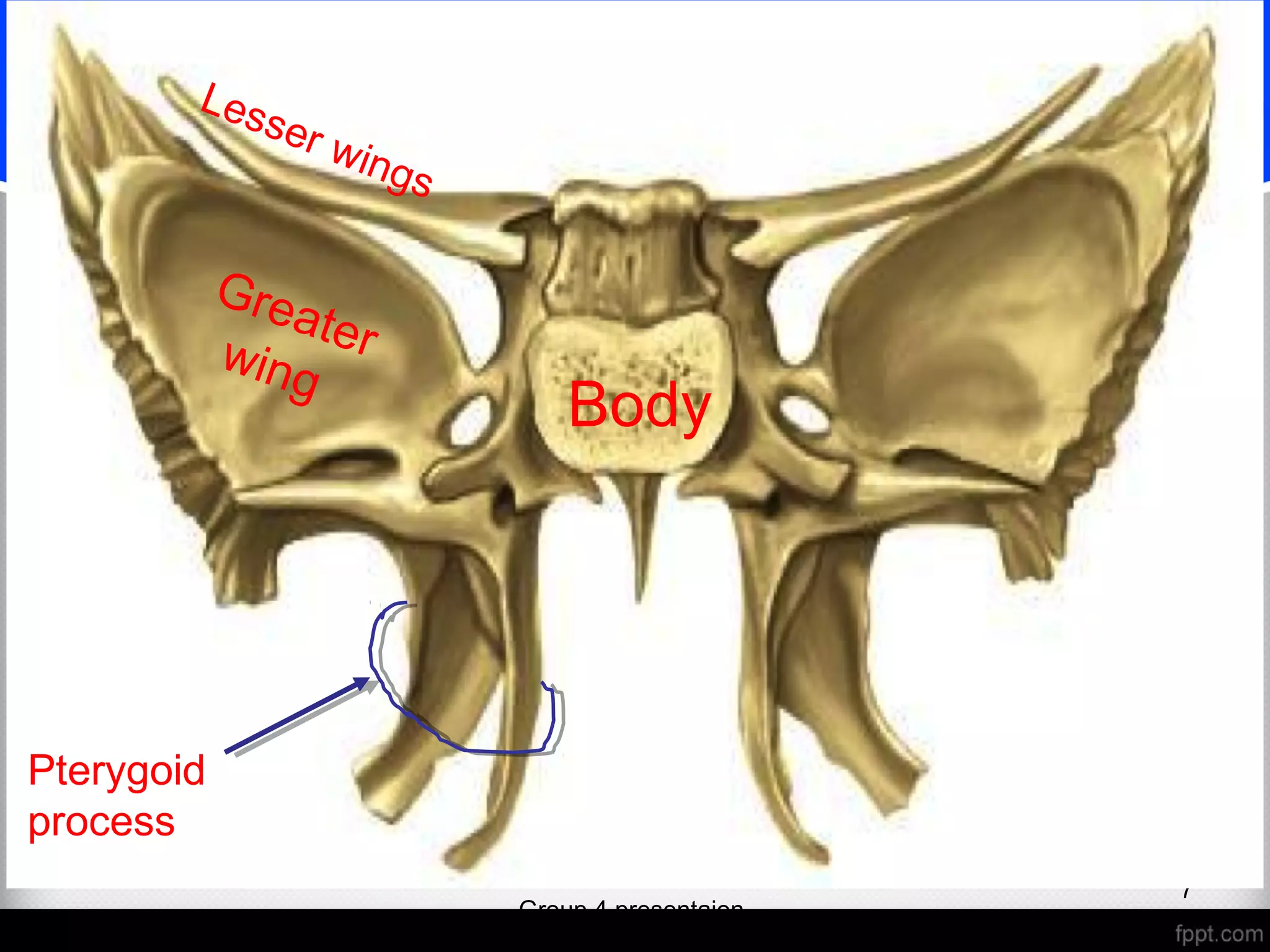
Parts of sphenoid bone
• Body: forms the central part
• 2 Greater wings Project laterally from the
• 2 lesser wings sides of the body
• 2 pterygoid processes
Group 4 presentaion 6
Group 4 presentaion
7
Body
Lesser wings
Greaterwing
Pterygoid
process
Body
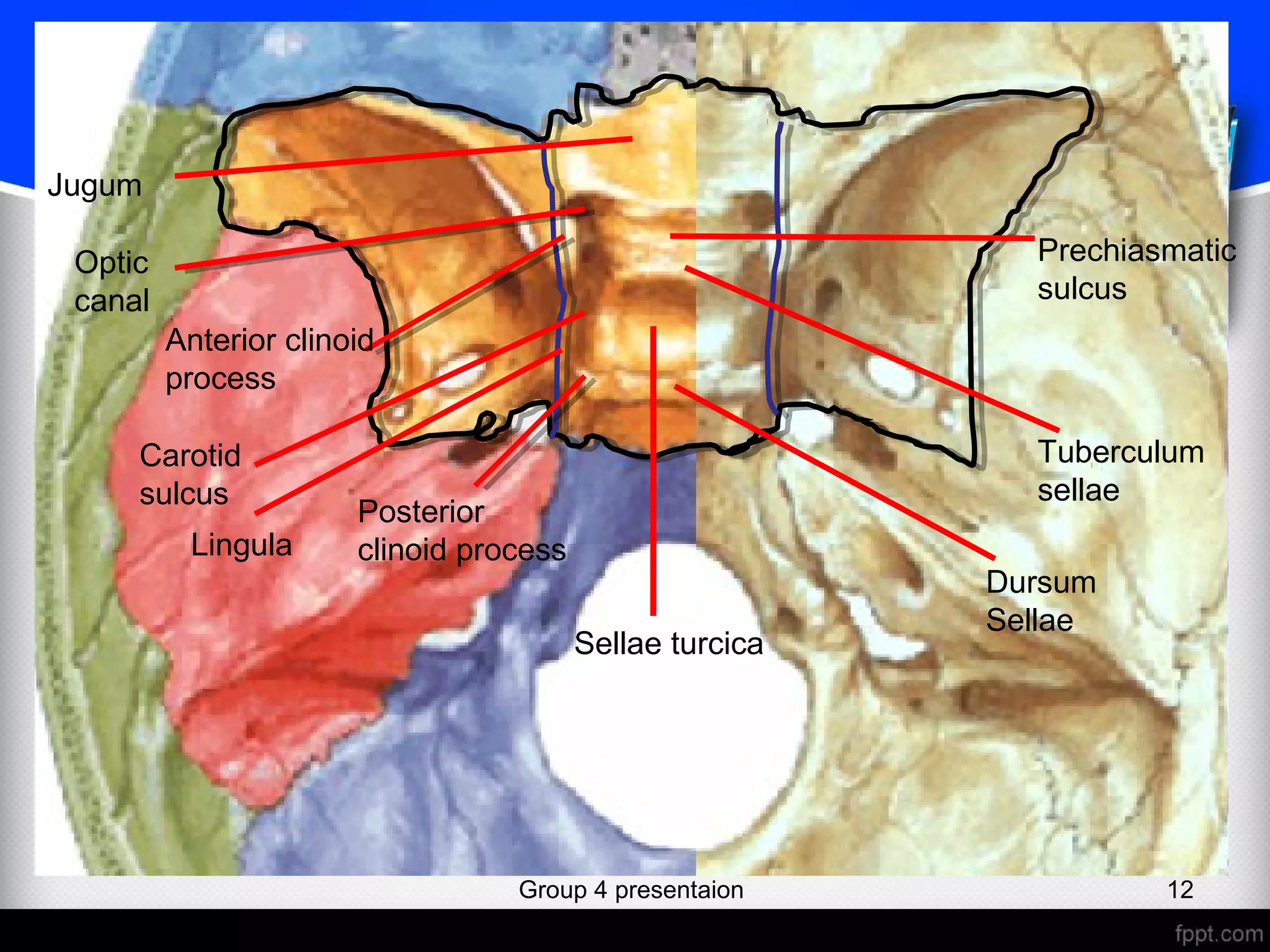
• Cubical in shape and possesses 6 surfaces:
• Superior, 2 lateral, anterior, inferior and
posterior.
• Contains two large air sinuses, separated
from each other by a septum.
Group 4 presentaion 8
Surfaces
• Superior (cerebral) surface: articulates anteriorly
with the cribriform plate of ethmoid bone.
• Features
• Sella turcica Jugum
• Tuberculum sellae Prechiasmatic groove
• Optic canal
• 2 anterior clinoid processes
• 2 posterior clinoid processes
• Dursum sellae
Group 4 presentaion 9
Cont…
• Lateral surface: 2 united with the greater wings
and medial pterygoid plate
• Processes:
• Carotid sulcus
• Lingula
• Anterior surface: it has:-
• Sphenoidal crest
• Sphenoidal air sinuses
Group 4 presentaion 10
Cont….
• Inferior surfaces: forms the roof of the
posterior part corresponding nasal cavity.
• Posterior surface:
• Articulates with the basilar part of occipital bone
Group 4 presentaion 11
Group 4 presentaion 12
Anterior clinoid
process
Posterior
clinoid process
Sellae turcica
Dursum
Sellae
Carotid
sulcus
Jugum
Optic
canal
Prechiasmatic
sulcus
Tuberculum
sellae
Lingula
Greater wings
• Are two strong processes which curve
upwards and laterally from the sides of the
body.
• It has:
• 2 surfaces: cerebral (superior), lateral and
inferior (orbital) surfaces
• 2 borders: posterior and squamosal
Group 4 presentaion 13
Surfaces
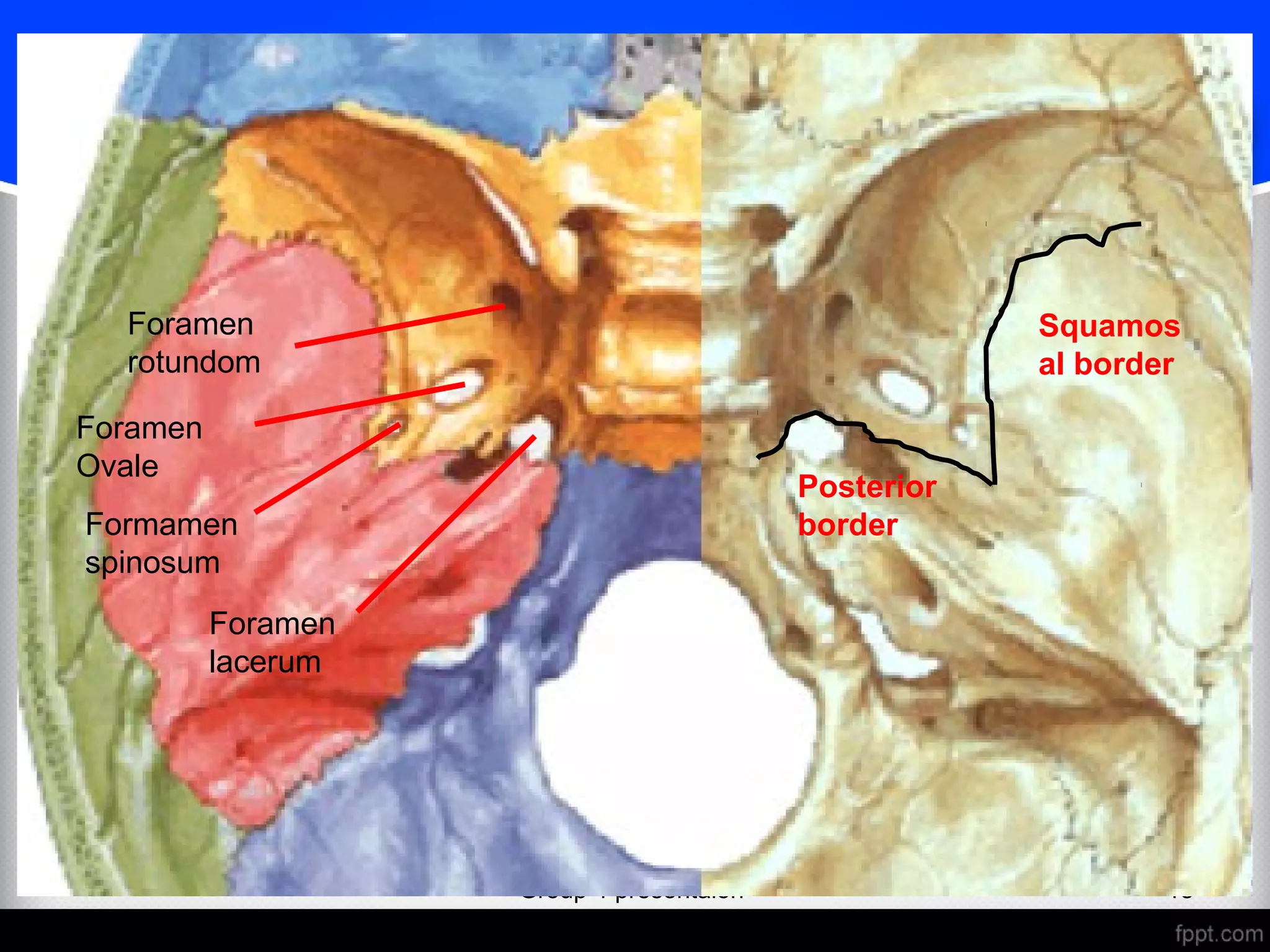
• Cerebral surface: forms the part of the
floor of middle cranial fossa.
• Foramina:
• Foramen rotundom
• Foramen ovale
• Foramen spinosum
Group 4 presentaion 14
Cont…..
• Lateral surface: convex in its general
outline
• Inferior surface (orbital): directs
forwards and medially and forms postero-
lateral wall of orbital cavity
Group 4 presentaion 15
Group 4 presentaion 16
Borders
1. Posterior border: its medial border is
non-articular and forms the anterior
border of the foramen lacerum
• Its lateral part articulates with petrous
part of temporal bone
2. Squamosal border: articulates with
squamous part of temporal bone.
Group 4 presentaion 17
Group 4 presentaion 18
Foramen
rotundom
Foramen
Ovale
Formamen
spinosum
Foramen
lacerum
Squamos
al border
Posterior
border
Lesser wings
• Are two triangular plates projecting
laterally from upper and anterior parts of
the body of sphenoid bone.
• Connected to the body by two roots b/w
which lies optic canal.
• Have 2 surfaces and 2 borders.
Group 4 presentaion 19
Surfaces
1. Cerebral surface: smooth and supports
part of the frontal lobe of the brain.
2. Inferior surface: forms posterior part of
roof of orbit and upper boundary of
superior orbital fissure.
Group 4 presentaion 20
Borders
1. Anterior border: articulates with posterior
border of orbital plate of frontal lobe.
2. Posterior border: its medial end forms the
anterior clinoid process, to which is attached
the anterior end of free border of tentorium
cerebri.
• Optic canal: lies b/w the 2 roots of lesser
wings.
• Superior orbital fissure: triangular passage
lying b/w the greater and lesser wings and
leading from cranial to orbital cavityGroup 4 presentaion 21
Group 4 presentaion 22
Superior
orbital
fissure
Anterior border
Posterior border
Optic canal
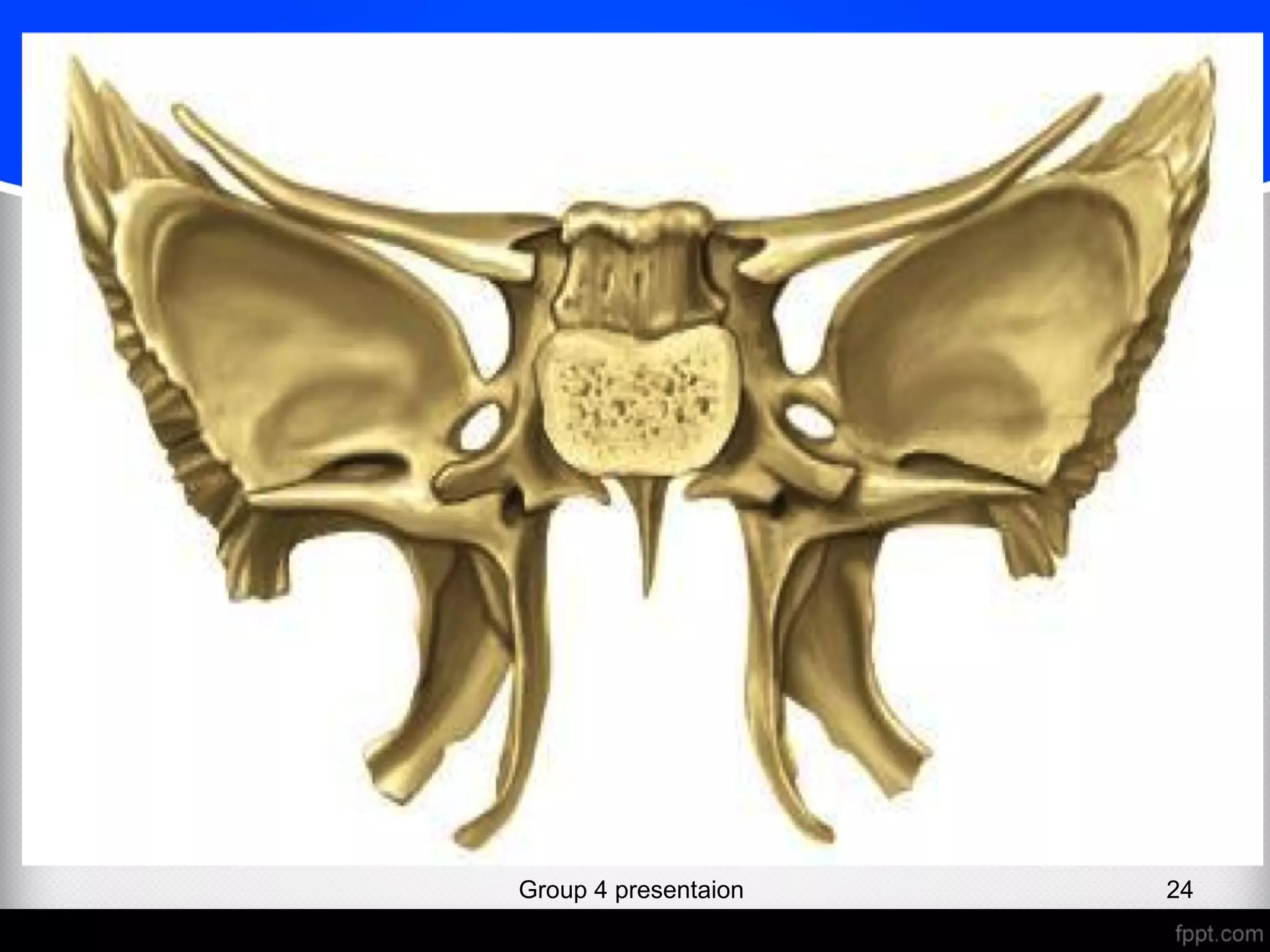
Pterygoid process
• On each side descending perpendicularly from
the region where the greater wing of sphenoid
unite with the body of shenoid bone.
• Consists of lateral and medial plates, where
upper part is fussed in front.
• pterygoid fissure: an angular gap which
separates the plates below, its margins
articulate with perpendicular process of palatine
bone
Group 4 presentaion 23
Group 4 presentaion 24
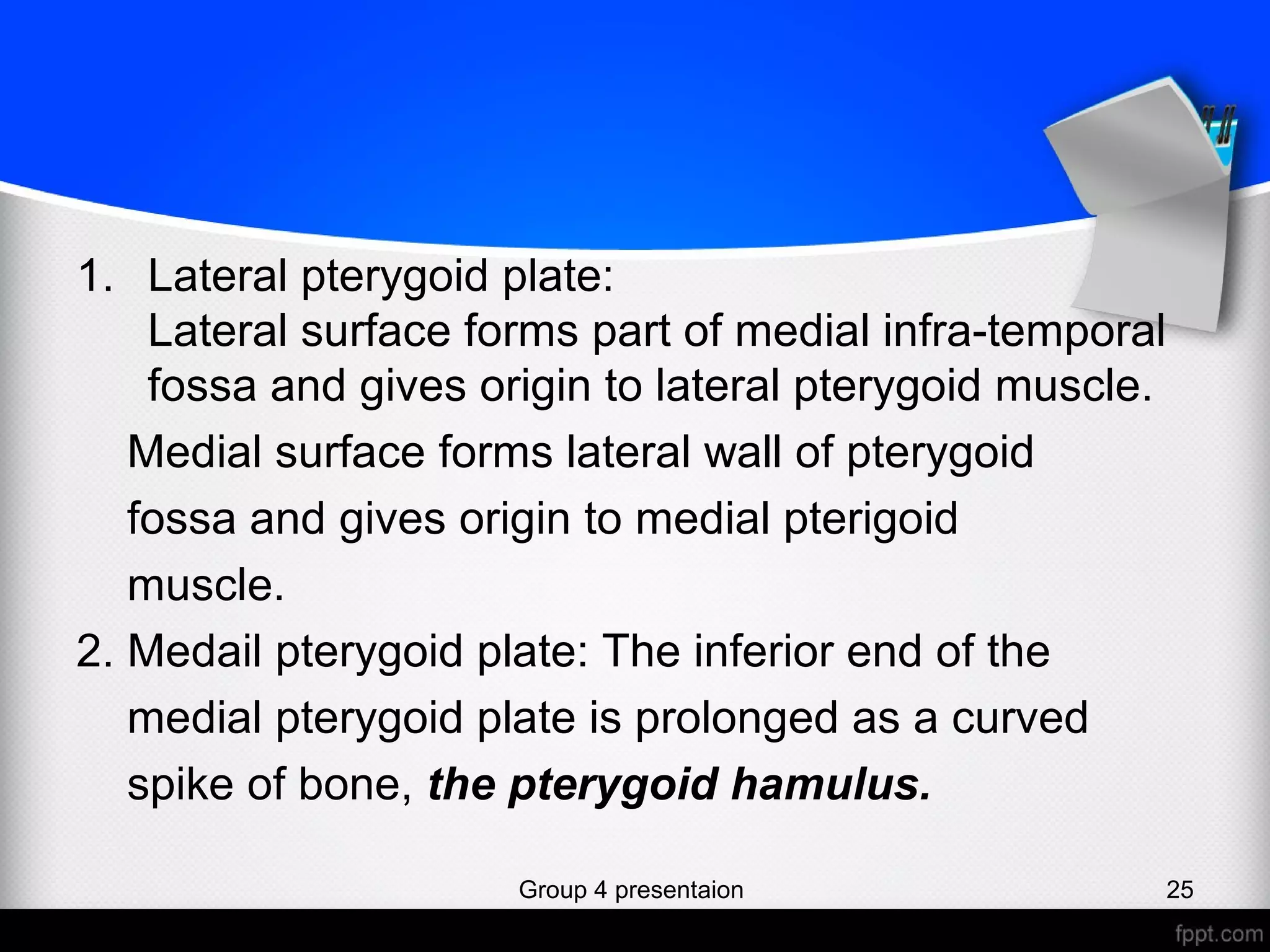
1. Lateral pterygoid plate:
Lateral surface forms part of medial infra-temporal
fossa and gives origin to lateral pterygoid muscle.
Medial surface forms lateral wall of pterygoid
fossa and gives origin to medial pterigoid
muscle.
2. Medail pterygoid plate: The inferior end of the
medial pterygoid plate is prolonged as a curved
spike of bone, the pterygoid hamulus.
Group 4 presentaion 25
Views of the bone in detail
Group 4 presentaion 26
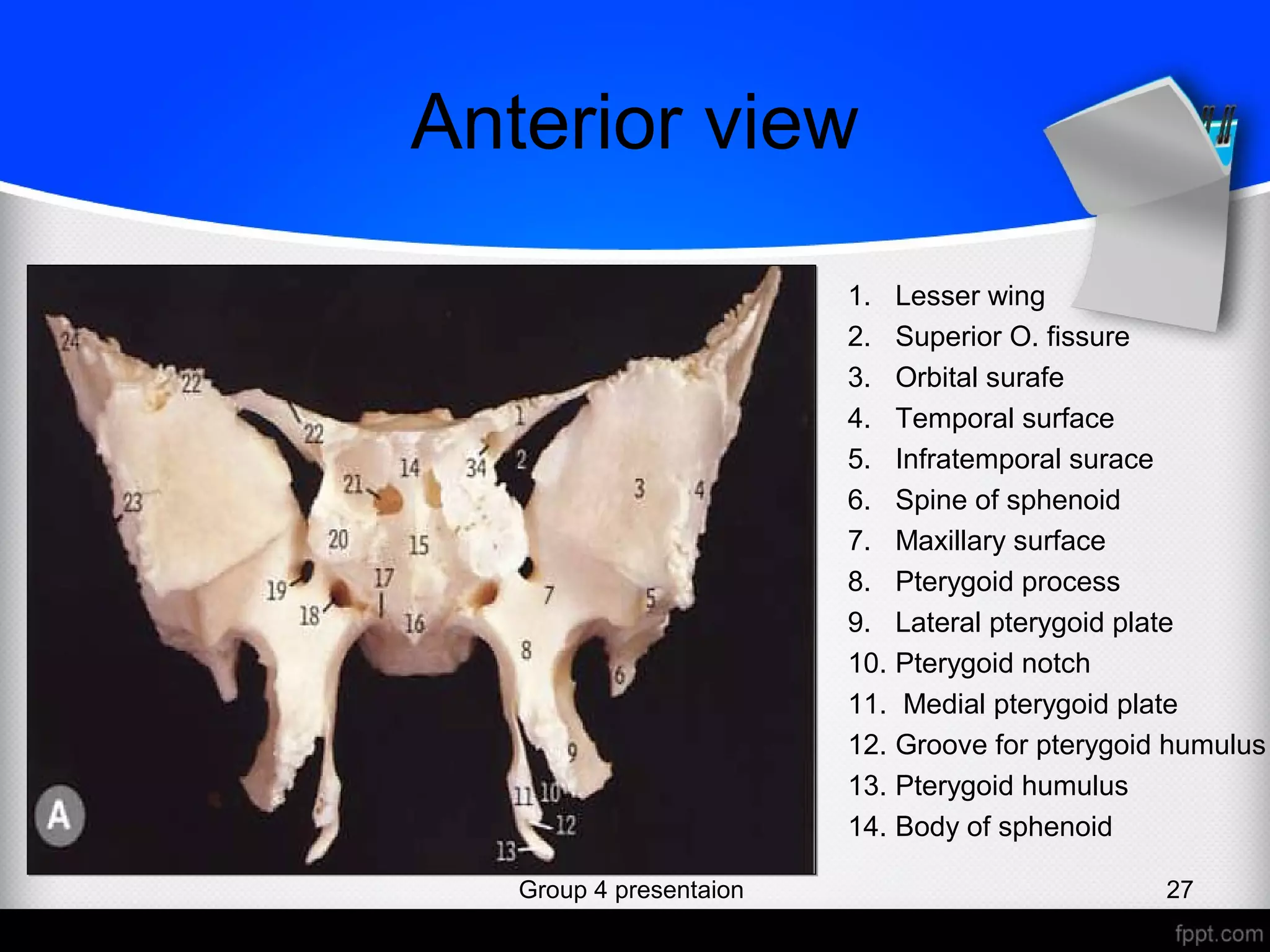
Anterior view
1. Lesser wing
2. Superior O. fissure
3. Orbital surafe
4. Temporal surface
5. Infratemporal surace
6. Spine of sphenoid
7. Maxillary surface
8. Pterygoid process
9. Lateral pterygoid plate
10. Pterygoid notch
11. Medial pterygoid plate
12. Groove for pterygoid humulus
13. Pterygoid humulus
14. Body of sphenoid
Group 4 presentaion 27
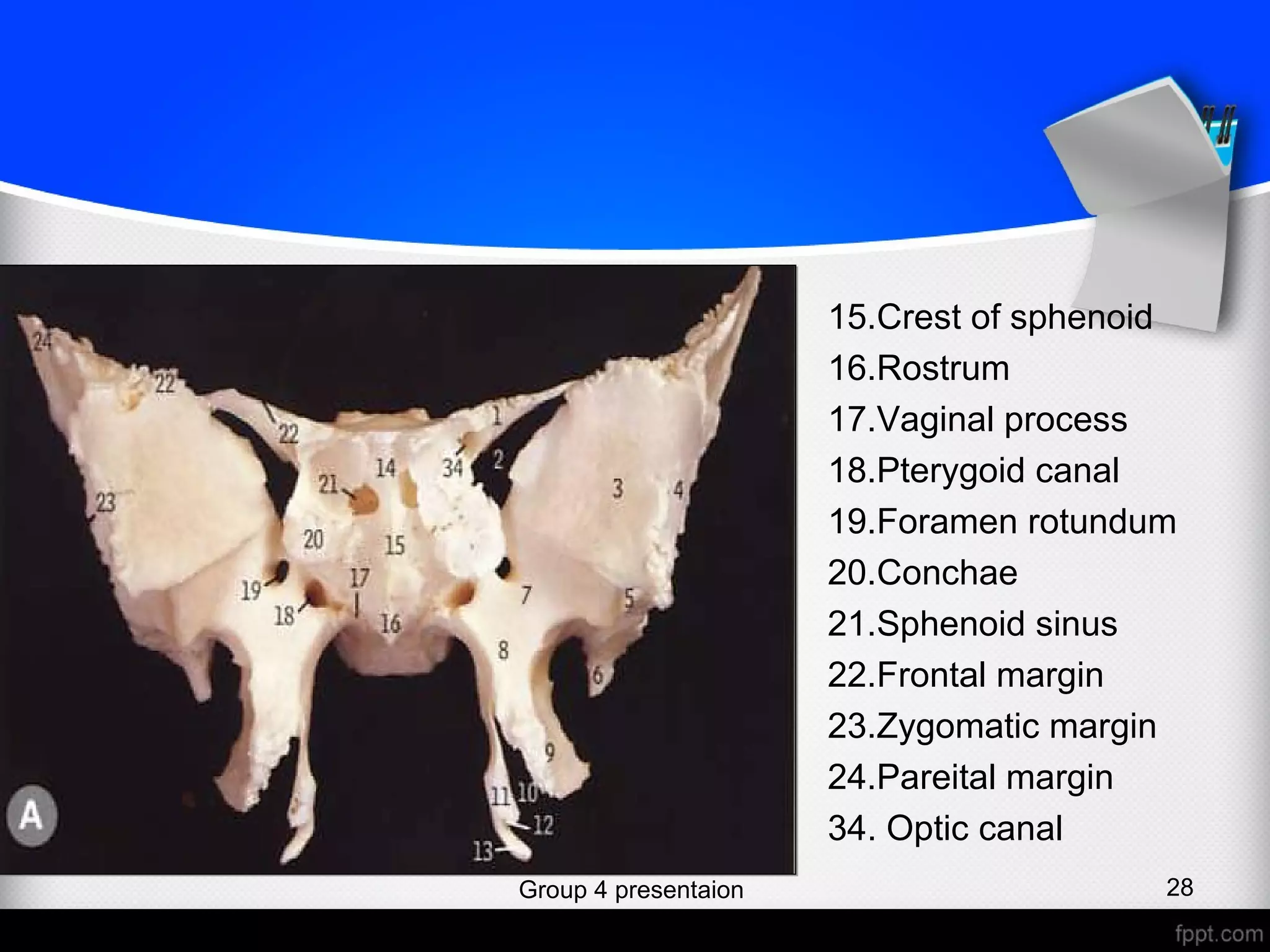
15.Crest of sphenoid
16.Rostrum
17.Vaginal process
18.Pterygoid canal
19.Foramen rotundum
20.Conchae
21.Sphenoid sinus
22.Frontal margin
23.Zygomatic margin
24.Pareital margin
34. Optic canal
Group 4 presentaion 28
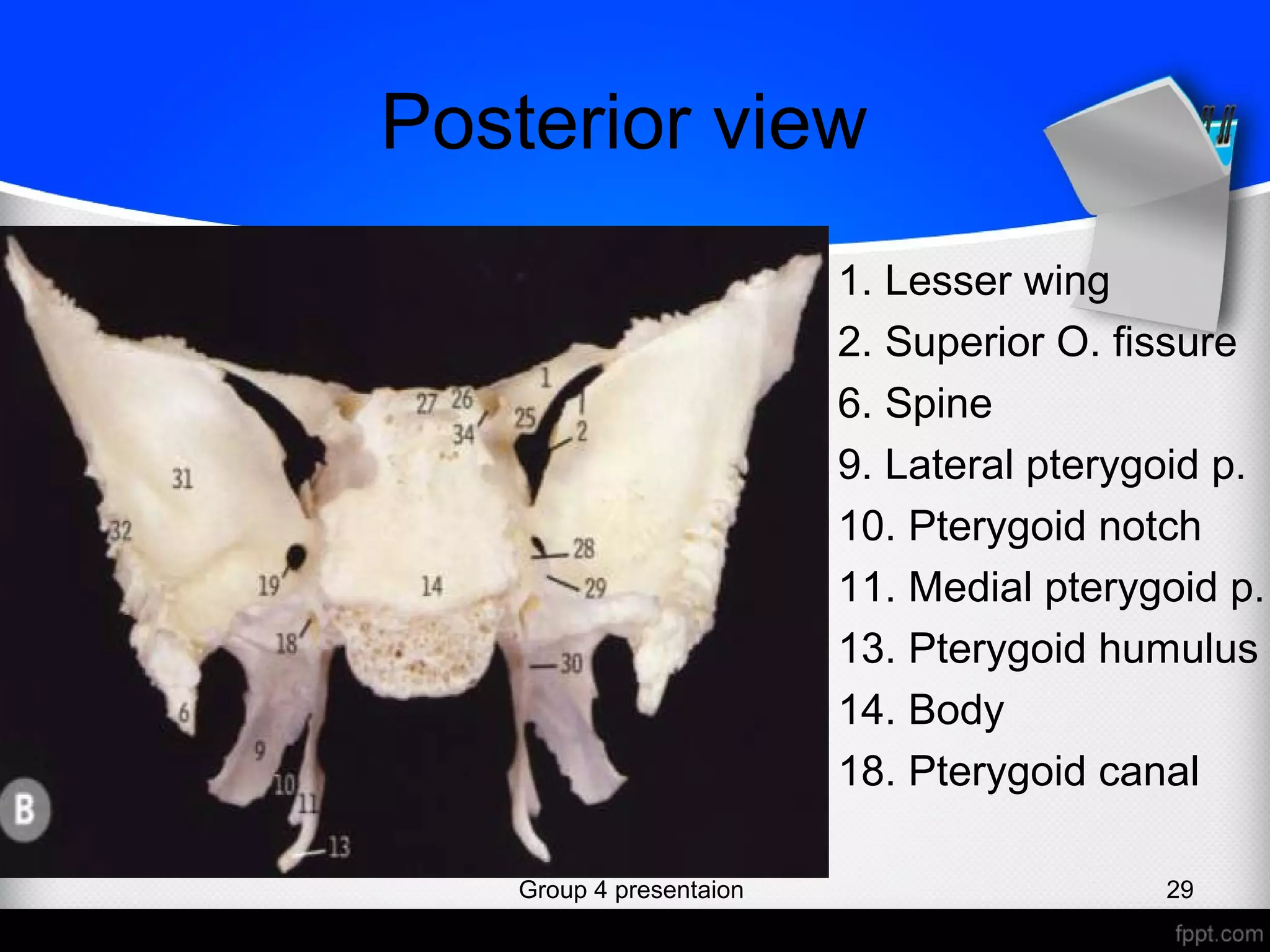
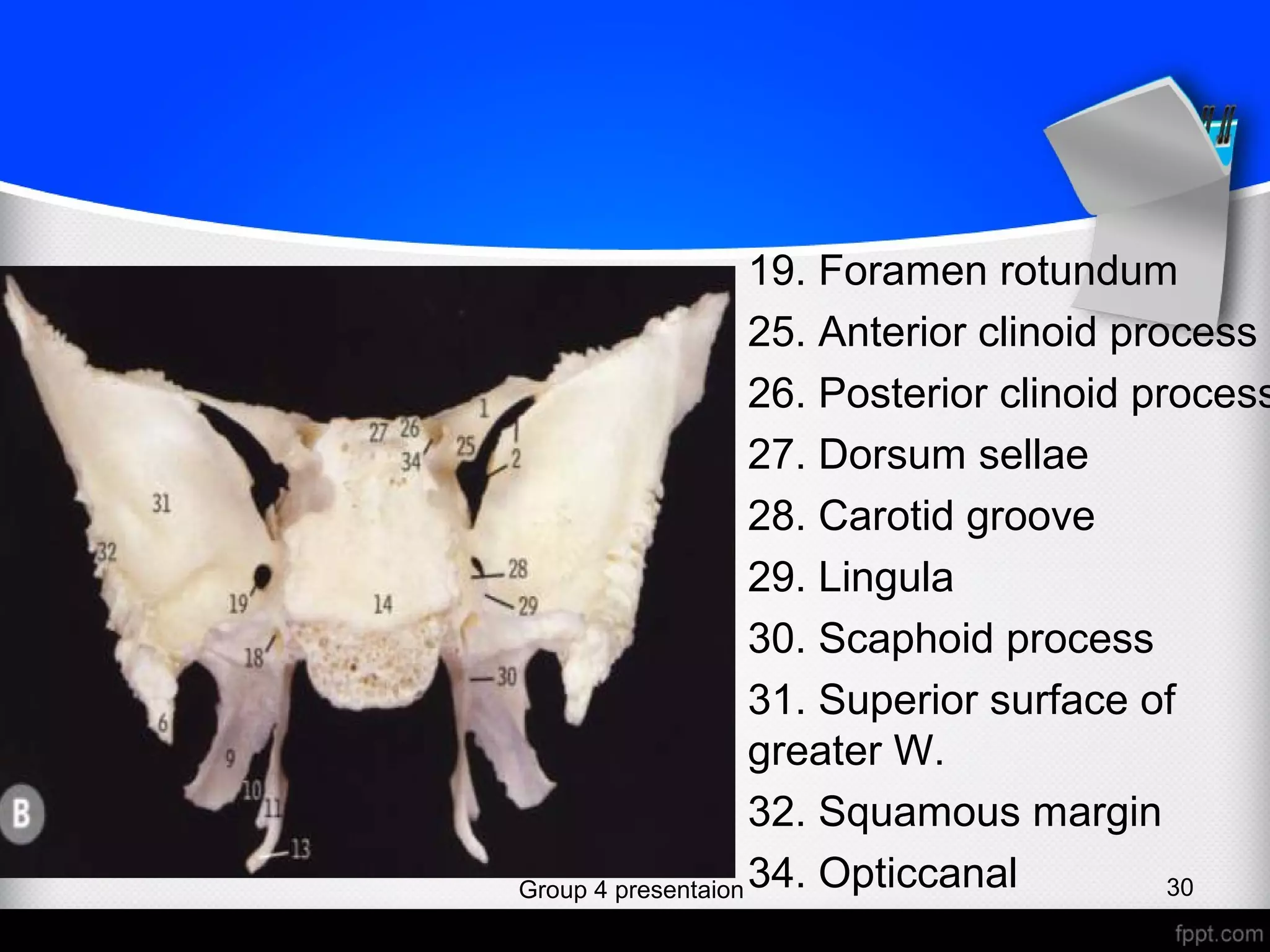
Posterior view
1. Lesser wing
2. Superior O. fissure
6. Spine
9. Lateral pterygoid p.
10. Pterygoid notch
11. Medial pterygoid p.
13. Pterygoid humulus
14. Body
18. Pterygoid canal
Group 4 presentaion 29
19. Foramen rotundum
25. Anterior clinoid process
26. Posterior clinoid process
27. Dorsum sellae
28. Carotid groove
29. Lingula
30. Scaphoid process
31. Superior surface of
greater W.
32. Squamous margin
34. OpticcanalGroup 4 presentaion 30
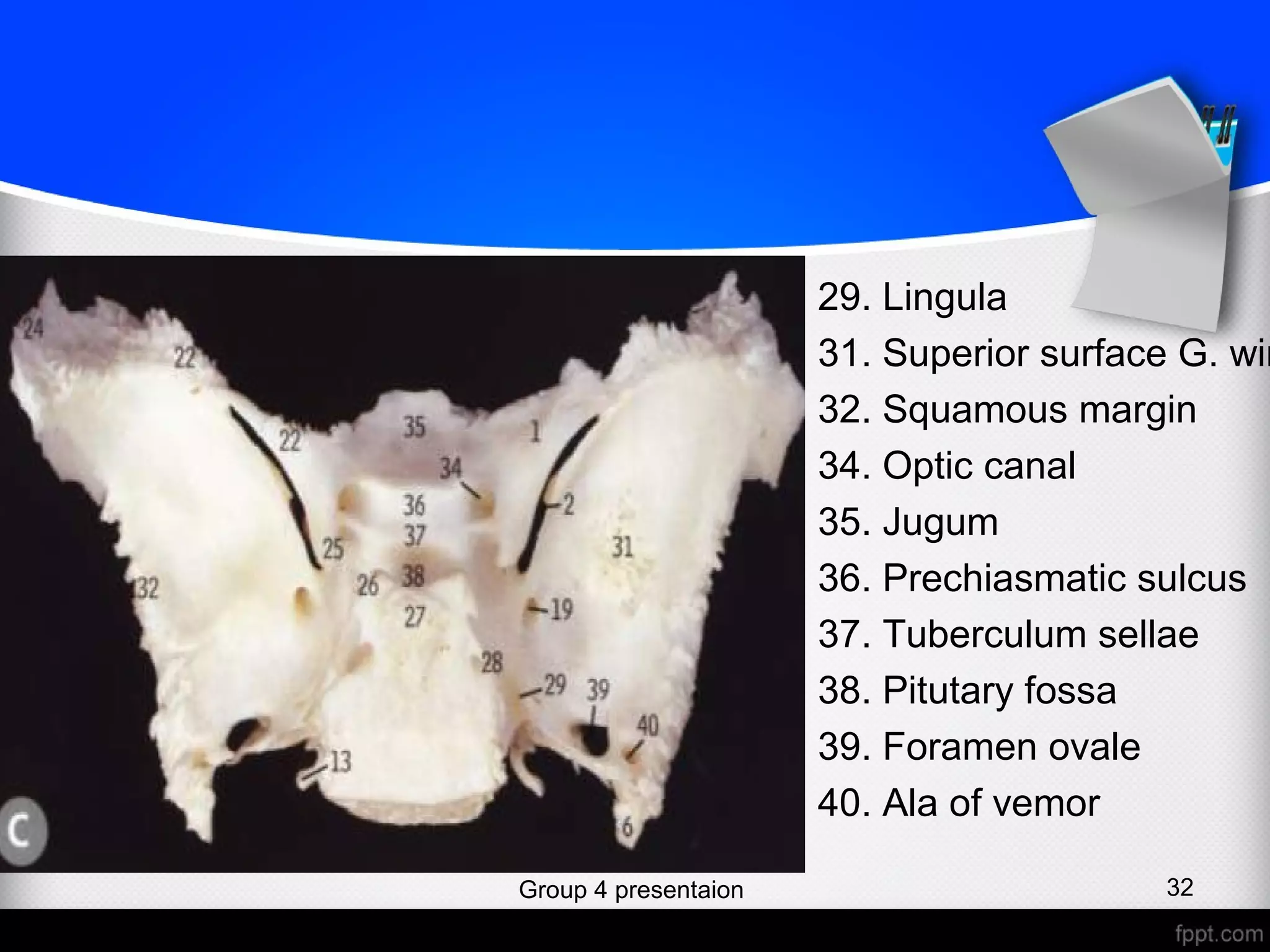
Superior veiw
1. Lesser wing
2. Superior O. fissure
6. Spine
13. Humulus
19. Foramen rotundum
22. Frontal margin
24. Parietal margin
25. Anterior C. process
26. Posterior C. process
27. Dorsum sellae
28. Carotid groove
Group 4 presentaion 31
29. Lingula
31. Superior surface G. win
32. Squamous margin
34. Optic canal
35. Jugum
36. Prechiasmatic sulcus
37. Tuberculum sellae
38. Pitutary fossa
39. Foramen ovale
40. Ala of vemor
Group 4 presentaion 32
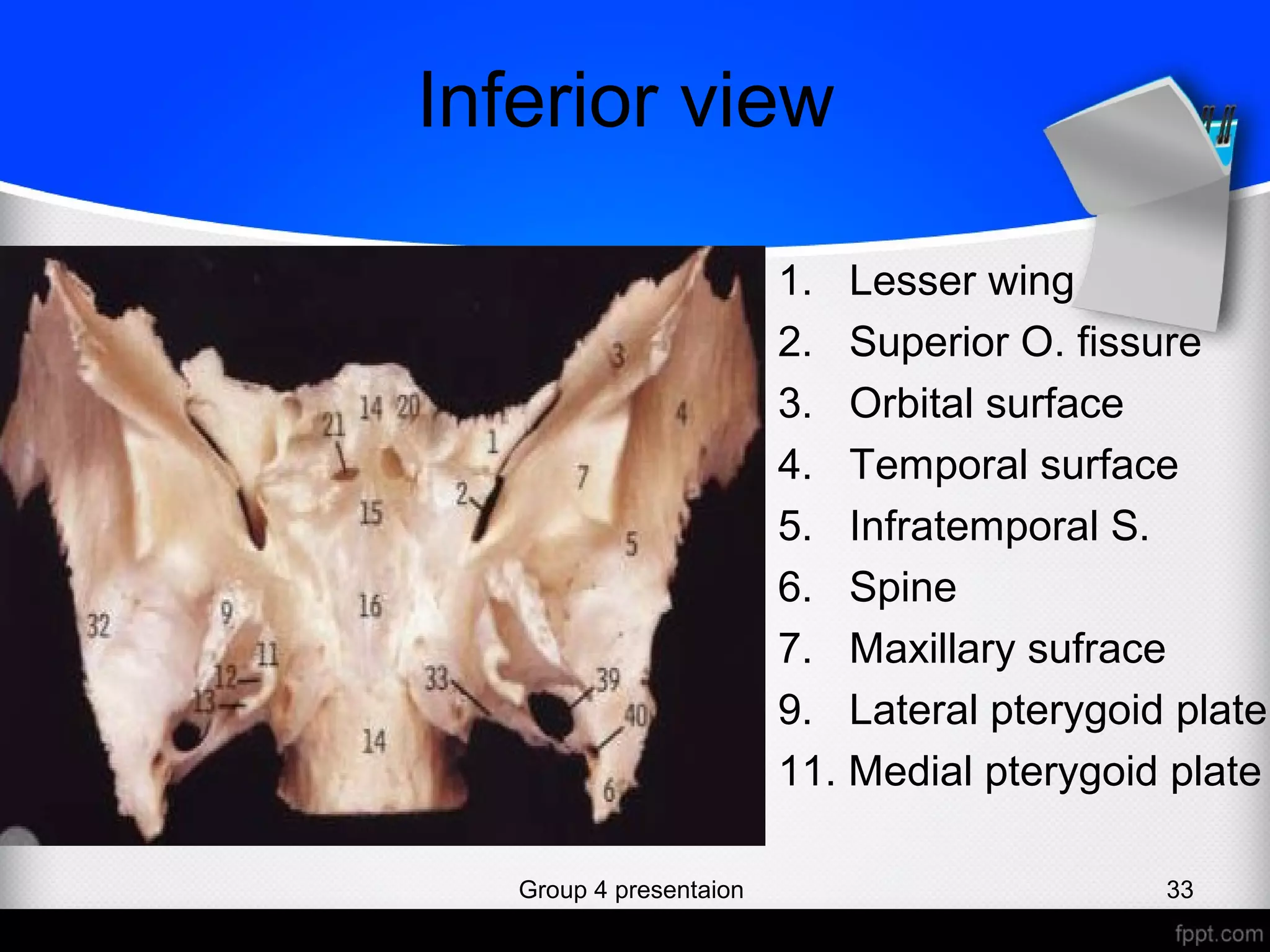
Inferior view
1. Lesser wing
2. Superior O. fissure
3. Orbital surface
4. Temporal surface
5. Infratemporal S.
6. Spine
7. Maxillary sufrace
9. Lateral pterygoid plate
11. Medial pterygoid plate
Group 4 presentaion 33
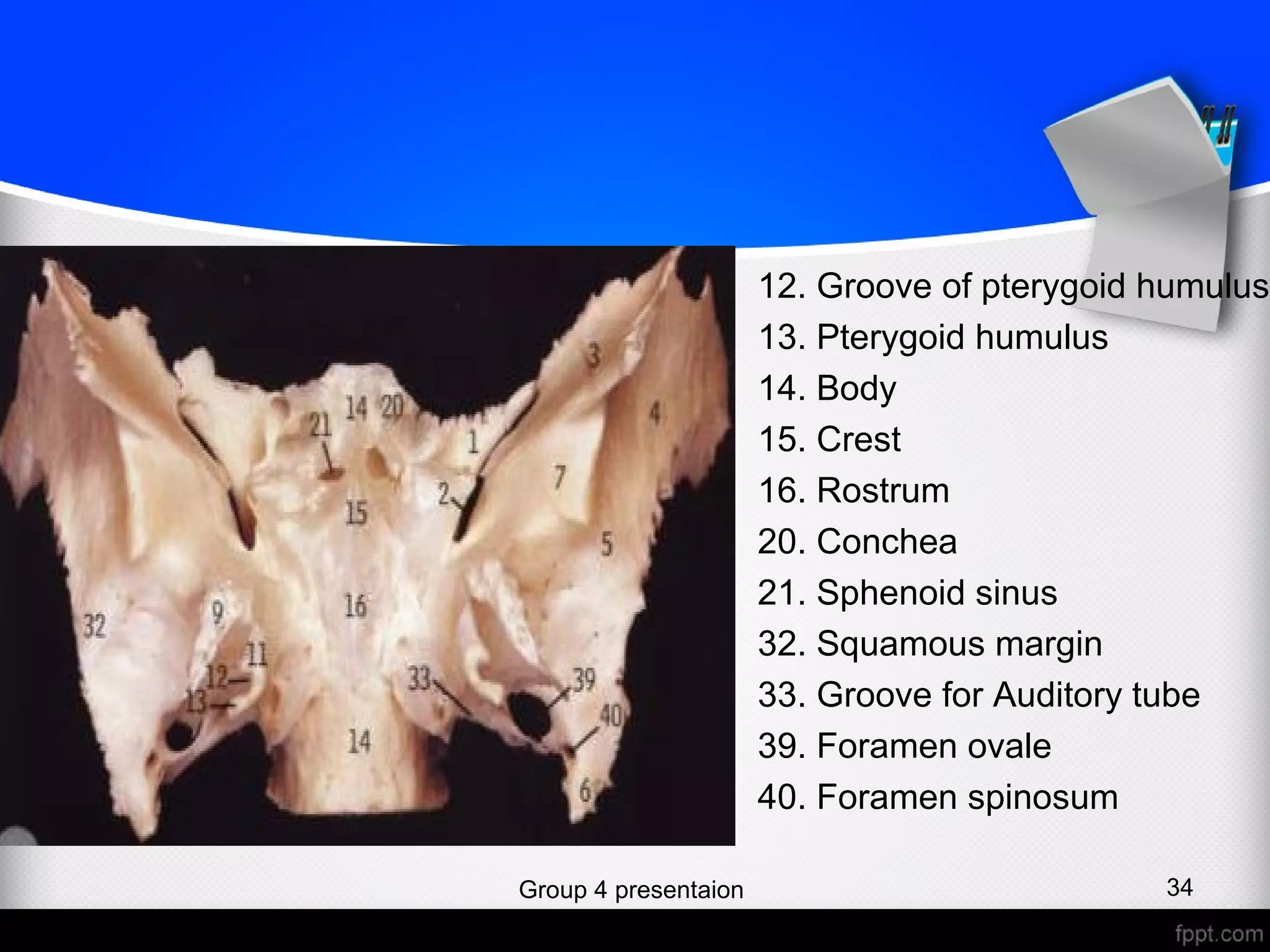
12. Groove of pterygoid humulus
13. Pterygoid humulus
14. Body
15. Crest
16. Rostrum
20. Conchea
21. Sphenoid sinus
32. Squamous margin
33. Groove for Auditory tube
39. Foramen ovale
40. Foramen spinosum
Group 4 presentaion 34
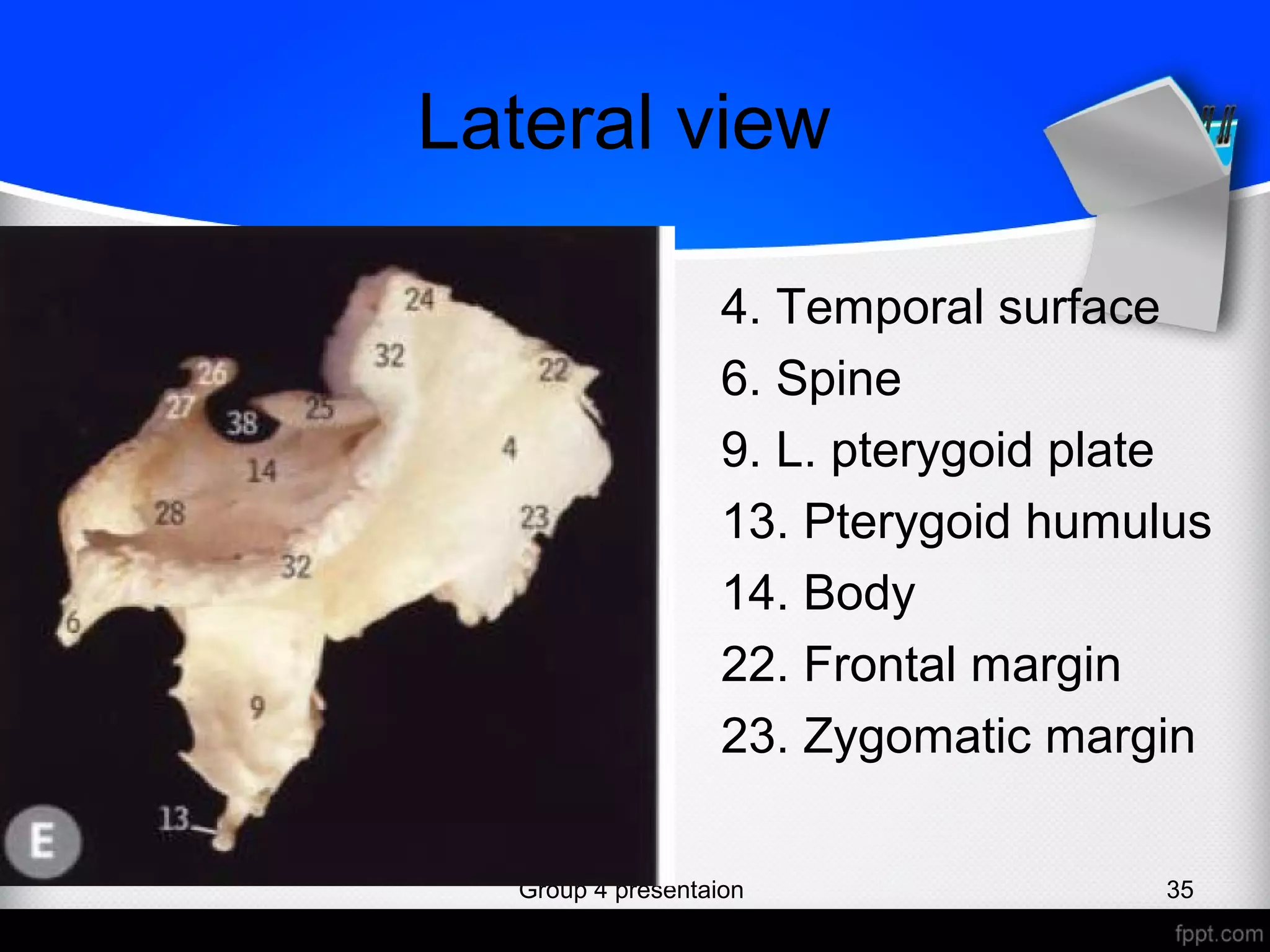
Lateral view
4. Temporal surface
6. Spine
9. L. pterygoid plate
13. Pterygoid humulus
14. Body
22. Frontal margin
23. Zygomatic margin
Group 4 presentaion 35
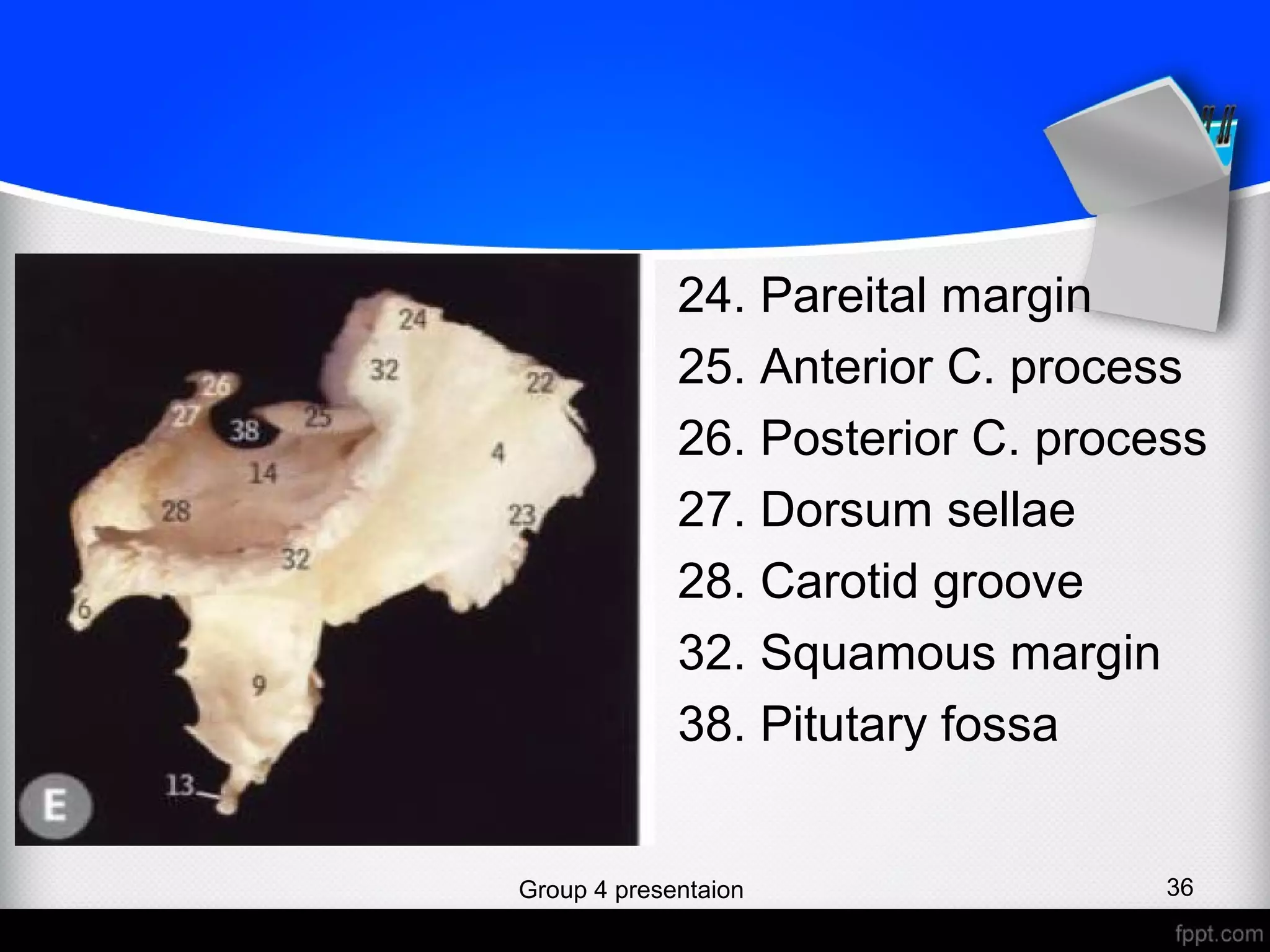
24. Pareital margin
25. Anterior C. process
26. Posterior C. process
27. Dorsum sellae
28. Carotid groove
32. Squamous margin
38. Pitutary fossa
Group 4 presentaion 36
Group 4 presentaion 37

Sphenoid bone (osteology)

  • 1.
    Head and Neck (Osteology) Group4 Presentation Sphenoid Bone 1Group 4 presentaion
  • 2.
    Group names • AbdiwadudAhmed (Karama) • Abdiaziz Abdirashid Ahmed • Sa’id Abdalle Abdirahman Group 4 presentaion 2
  • 3.
    Sphenoid bone • Liesat the base of the skull in front of petrous part of temporal bone and basilar part of occipital bone. • It resembles a bat with outstretching wings. Group 4 presentaion 3
  • 4.
  • 5.
  • 6.
    Parts of sphenoidbone • Body: forms the central part • 2 Greater wings Project laterally from the • 2 lesser wings sides of the body • 2 pterygoid processes Group 4 presentaion 6
  • 7.
    Group 4 presentaion 7 Body Lesserwings Greaterwing Pterygoid process
  • 8.
    Body • Cubical inshape and possesses 6 surfaces: • Superior, 2 lateral, anterior, inferior and posterior. • Contains two large air sinuses, separated from each other by a septum. Group 4 presentaion 8
  • 9.
    Surfaces • Superior (cerebral)surface: articulates anteriorly with the cribriform plate of ethmoid bone. • Features • Sella turcica Jugum • Tuberculum sellae Prechiasmatic groove • Optic canal • 2 anterior clinoid processes • 2 posterior clinoid processes • Dursum sellae Group 4 presentaion 9
  • 10.
    Cont… • Lateral surface:2 united with the greater wings and medial pterygoid plate • Processes: • Carotid sulcus • Lingula • Anterior surface: it has:- • Sphenoidal crest • Sphenoidal air sinuses Group 4 presentaion 10
  • 11.
    Cont…. • Inferior surfaces:forms the roof of the posterior part corresponding nasal cavity. • Posterior surface: • Articulates with the basilar part of occipital bone Group 4 presentaion 11
  • 12.
    Group 4 presentaion12 Anterior clinoid process Posterior clinoid process Sellae turcica Dursum Sellae Carotid sulcus Jugum Optic canal Prechiasmatic sulcus Tuberculum sellae Lingula
  • 13.
    Greater wings • Aretwo strong processes which curve upwards and laterally from the sides of the body. • It has: • 2 surfaces: cerebral (superior), lateral and inferior (orbital) surfaces • 2 borders: posterior and squamosal Group 4 presentaion 13
  • 14.
    Surfaces • Cerebral surface:forms the part of the floor of middle cranial fossa. • Foramina: • Foramen rotundom • Foramen ovale • Foramen spinosum Group 4 presentaion 14
  • 15.
    Cont….. • Lateral surface:convex in its general outline • Inferior surface (orbital): directs forwards and medially and forms postero- lateral wall of orbital cavity Group 4 presentaion 15
  • 16.
  • 17.
    Borders 1. Posterior border:its medial border is non-articular and forms the anterior border of the foramen lacerum • Its lateral part articulates with petrous part of temporal bone 2. Squamosal border: articulates with squamous part of temporal bone. Group 4 presentaion 17
  • 18.
    Group 4 presentaion18 Foramen rotundom Foramen Ovale Formamen spinosum Foramen lacerum Squamos al border Posterior border
  • 19.
    Lesser wings • Aretwo triangular plates projecting laterally from upper and anterior parts of the body of sphenoid bone. • Connected to the body by two roots b/w which lies optic canal. • Have 2 surfaces and 2 borders. Group 4 presentaion 19
  • 20.
    Surfaces 1. Cerebral surface:smooth and supports part of the frontal lobe of the brain. 2. Inferior surface: forms posterior part of roof of orbit and upper boundary of superior orbital fissure. Group 4 presentaion 20
  • 21.
    Borders 1. Anterior border:articulates with posterior border of orbital plate of frontal lobe. 2. Posterior border: its medial end forms the anterior clinoid process, to which is attached the anterior end of free border of tentorium cerebri. • Optic canal: lies b/w the 2 roots of lesser wings. • Superior orbital fissure: triangular passage lying b/w the greater and lesser wings and leading from cranial to orbital cavityGroup 4 presentaion 21
  • 22.
    Group 4 presentaion22 Superior orbital fissure Anterior border Posterior border Optic canal
  • 23.
    Pterygoid process • Oneach side descending perpendicularly from the region where the greater wing of sphenoid unite with the body of shenoid bone. • Consists of lateral and medial plates, where upper part is fussed in front. • pterygoid fissure: an angular gap which separates the plates below, its margins articulate with perpendicular process of palatine bone Group 4 presentaion 23
  • 24.
  • 25.
    1. Lateral pterygoidplate: Lateral surface forms part of medial infra-temporal fossa and gives origin to lateral pterygoid muscle. Medial surface forms lateral wall of pterygoid fossa and gives origin to medial pterigoid muscle. 2. Medail pterygoid plate: The inferior end of the medial pterygoid plate is prolonged as a curved spike of bone, the pterygoid hamulus. Group 4 presentaion 25
  • 26.
    Views of thebone in detail Group 4 presentaion 26
  • 27.
    Anterior view 1. Lesserwing 2. Superior O. fissure 3. Orbital surafe 4. Temporal surface 5. Infratemporal surace 6. Spine of sphenoid 7. Maxillary surface 8. Pterygoid process 9. Lateral pterygoid plate 10. Pterygoid notch 11. Medial pterygoid plate 12. Groove for pterygoid humulus 13. Pterygoid humulus 14. Body of sphenoid Group 4 presentaion 27
  • 28.
    15.Crest of sphenoid 16.Rostrum 17.Vaginalprocess 18.Pterygoid canal 19.Foramen rotundum 20.Conchae 21.Sphenoid sinus 22.Frontal margin 23.Zygomatic margin 24.Pareital margin 34. Optic canal Group 4 presentaion 28
  • 29.
    Posterior view 1. Lesserwing 2. Superior O. fissure 6. Spine 9. Lateral pterygoid p. 10. Pterygoid notch 11. Medial pterygoid p. 13. Pterygoid humulus 14. Body 18. Pterygoid canal Group 4 presentaion 29
  • 30.
    19. Foramen rotundum 25.Anterior clinoid process 26. Posterior clinoid process 27. Dorsum sellae 28. Carotid groove 29. Lingula 30. Scaphoid process 31. Superior surface of greater W. 32. Squamous margin 34. OpticcanalGroup 4 presentaion 30
  • 31.
    Superior veiw 1. Lesserwing 2. Superior O. fissure 6. Spine 13. Humulus 19. Foramen rotundum 22. Frontal margin 24. Parietal margin 25. Anterior C. process 26. Posterior C. process 27. Dorsum sellae 28. Carotid groove Group 4 presentaion 31
  • 32.
    29. Lingula 31. Superiorsurface G. win 32. Squamous margin 34. Optic canal 35. Jugum 36. Prechiasmatic sulcus 37. Tuberculum sellae 38. Pitutary fossa 39. Foramen ovale 40. Ala of vemor Group 4 presentaion 32
  • 33.
    Inferior view 1. Lesserwing 2. Superior O. fissure 3. Orbital surface 4. Temporal surface 5. Infratemporal S. 6. Spine 7. Maxillary sufrace 9. Lateral pterygoid plate 11. Medial pterygoid plate Group 4 presentaion 33
  • 34.
    12. Groove ofpterygoid humulus 13. Pterygoid humulus 14. Body 15. Crest 16. Rostrum 20. Conchea 21. Sphenoid sinus 32. Squamous margin 33. Groove for Auditory tube 39. Foramen ovale 40. Foramen spinosum Group 4 presentaion 34
  • 35.
    Lateral view 4. Temporalsurface 6. Spine 9. L. pterygoid plate 13. Pterygoid humulus 14. Body 22. Frontal margin 23. Zygomatic margin Group 4 presentaion 35
  • 36.
    24. Pareital margin 25.Anterior C. process 26. Posterior C. process 27. Dorsum sellae 28. Carotid groove 32. Squamous margin 38. Pitutary fossa Group 4 presentaion 36
  • 37.