Pharynx
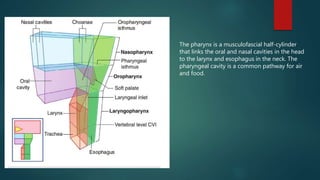
The pharynx is a musculofascial half-cylinder
that links the oral and nasal cavities in the head
to the larynx and esophagus in the neck. The
pharyngeal cavity is a common pathway for air
and food.
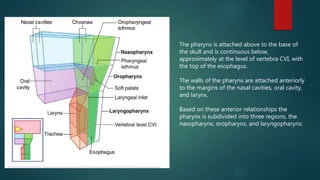
The pharynx is attached above to the base of
the skull and is continuous below,
approximately at the level of vertebra CVI, with
the top of the esophagus.
The walls of the pharynx are attached anteriorly
to the margins of the nasal cavities, oral cavity,
and larynx.
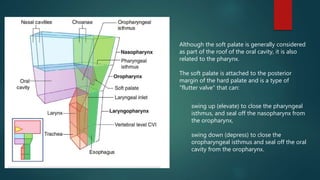
Based on these anterior relationships the
pharynx is subdivided into three regions, the
nasopharynx, oropharynx, and laryngopharynx:
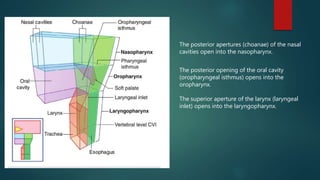
The posterior apertures (choanae) of the nasal
cavities open into the nasopharynx.
The posterior opening of the oral cavity
(oropharyngeal isthmus) opens into the
oropharynx.
The superior aperture of the larynx (laryngeal
inlet) opens into the laryngopharynx.
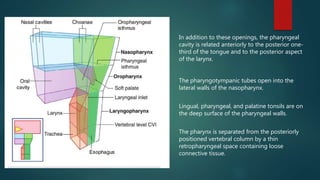
In addition to these openings, the pharyngeal
cavity is related anteriorly to the posterior one-
third of the tongue and to the posterior aspect
of the larynx.
The pharyngotympanic tubes open into the
lateral walls of the nasopharynx.
Lingual, pharyngeal, and palatine tonsils are on
the deep surface of the pharyngeal walls.
The pharynx is separated from the posteriorly
positioned vertebral column by a thin
retropharyngeal space containing loose
connective tissue.
Although the soft palate is generally considered
as part of the roof of the oral cavity, it is also
related to the pharynx.
The soft palate is attached to the posterior
margin of the hard palate and is a type of
"flutter valve" that can:
swing up (elevate) to close the pharyngeal
isthmus, and seal off the nasopharynx from
the oropharynx,
swing down (depress) to close the
oropharyngeal isthmus and seal off the oral
cavity from the oropharynx.
Skeletal Framework
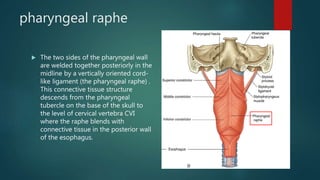
pharyngeal raphe
 The two sides of the pharyngeal wall
are welded together posteriorly in the
midline by a vertically oriented cord-
like ligament (the pharyngeal raphe) .
This connective tissue structure
descends from the pharyngeal
tubercle on the base of the skull to
the level of cervical vertebra CVI
where the raphe blends with
connective tissue in the posterior wall
of the esophagus.
SuperiorAttachment
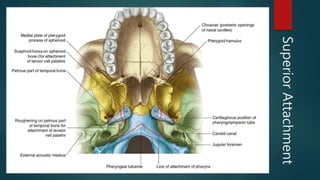
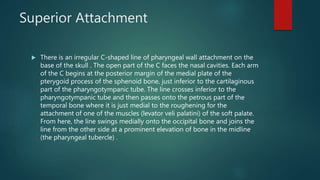
Superior Attachment
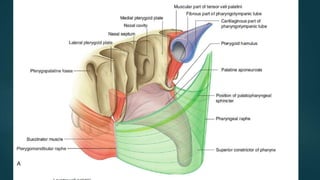
 There is an irregular C-shaped line of pharyngeal wall attachment on the
base of the skull . The open part of the C faces the nasal cavities. Each arm
of the C begins at the posterior margin of the medial plate of the
pterygoid process of the sphenoid bone, just inferior to the cartilaginous
part of the pharyngotympanic tube. The line crosses inferior to the
pharyngotympanic tube and then passes onto the petrous part of the
temporal bone where it is just medial to the roughening for the
attachment of one of the muscles (levator veli palatini) of the soft palate.
From here, the line swings medially onto the occipital bone and joins the
line from the other side at a prominent elevation of bone in the midline
(the pharyngeal tubercle) .
Anterior Attachments
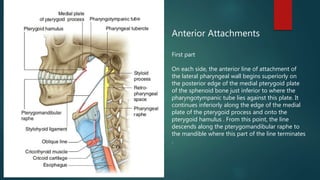
First part
On each side, the anterior line of attachment of
the lateral pharyngeal wall begins superiorly on
the posterior edge of the medial pterygoid plate
of the sphenoid bone just inferior to where the
pharyngotympanic tube lies against this plate. It
continues inferiorly along the edge of the medial
plate of the pterygoid process and onto the
pterygoid hamulus . From this point, the line
descends along the pterygomandibular raphe to
the mandible where this part of the line terminates
.
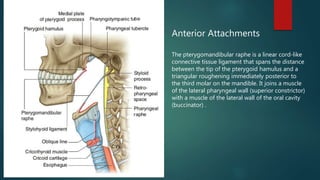
Anterior Attachments
The pterygomandibular raphe is a linear cord-like
connective tissue ligament that spans the distance
between the tip of the pterygoid hamulus and a
triangular roughening immediately posterior to
the third molar on the mandible. It joins a muscle
of the lateral pharyngeal wall (superior constrictor)
with a muscle of the lateral wall of the oral cavity
(buccinator) .
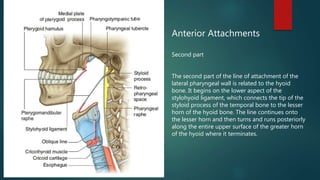
Anterior Attachments
Second part
The second part of the line of attachment of the
lateral pharyngeal wall is related to the hyoid
bone. It begins on the lower aspect of the
stylohyoid ligament, which connects the tip of the
styloid process of the temporal bone to the lesser
horn of the hyoid bone. The line continues onto
the lesser horn and then turns and runs posteriorly
along the entire upper surface of the greater horn
of the hyoid where it terminates.
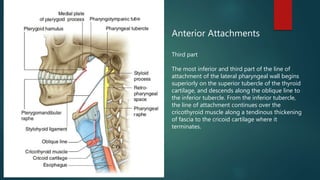
Anterior Attachments
Third part
The most inferior and third part of the line of
attachment of the lateral pharyngeal wall begins
superiorly on the superior tubercle of the thyroid
cartilage, and descends along the oblique line to
the inferior tubercle. From the inferior tubercle,
the line of attachment continues over the
cricothyroid muscle along a tendinous thickening
of fascia to the cricoid cartilage where it
terminates.
Pharyngeal wall
Muscles
The muscles of the pharynx are organized into two groups based on the
orientation of muscle fibers.
The constrictor muscles have fibers oriented in a circular direction relative to
the pharyngeal wall, whereas the longitudinal muscles have fibers oriented
vertically.
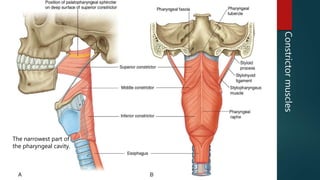
Constrictormuscles
The narrowest part of
the pharyngeal cavity.
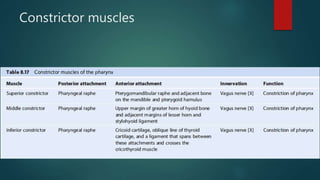
Constrictor muscles
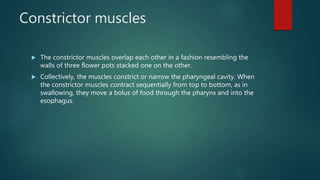
 The constrictor muscles overlap each other in a fashion resembling the
walls of three flower pots stacked one on the other.
 Collectively, the muscles constrict or narrow the pharyngeal cavity. When
the constrictor muscles contract sequentially from top to bottom, as in
swallowing, they move a bolus of food through the pharynx and into the
esophagus.
Constrictor muscles
Constrictor muscles
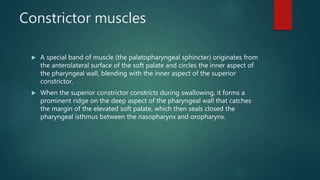
 A special band of muscle (the palatopharyngeal sphincter) originates from
the anterolateral surface of the soft palate and circles the inner aspect of
the pharyngeal wall, blending with the inner aspect of the superior
constrictor.
 When the superior constrictor constricts during swallowing, it forms a
prominent ridge on the deep aspect of the pharyngeal wall that catches
the margin of the elevated soft palate, which then seals closed the
pharyngeal isthmus between the nasopharynx and oropharynx.
Longitudinal muscles
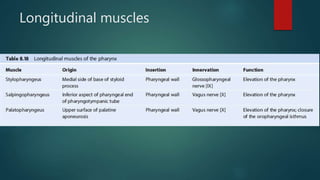
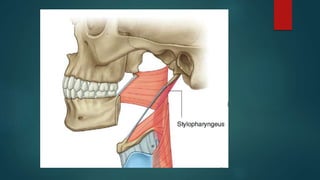
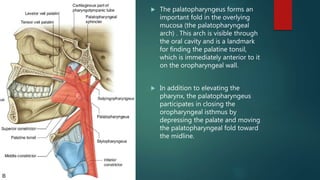
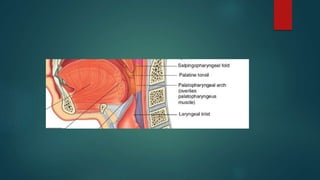
 The palatopharyngeus forms an
important fold in the overlying
mucosa (the palatopharyngeal
arch) . This arch is visible through
the oral cavity and is a landmark
for finding the palatine tonsil,
which is immediately anterior to it
on the oropharyngeal wall.
 In addition to elevating the
pharynx, the palatopharyngeus
participates in closing the
oropharyngeal isthmus by
depressing the palate and moving
the palatopharyngeal fold toward
the midline.
Fascia
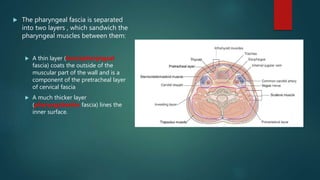
 The pharyngeal fascia is separated
into two layers , which sandwich the
pharyngeal muscles between them:
 A thin layer (buccopharyngeal
fascia) coats the outside of the
muscular part of the wall and is a
component of the pretracheal layer
of cervical fascia
 A much thicker layer
(pharyngobasilar fascia) lines the
inner surface.
Gaps in the pharyngeal wall and
structures passing t h rough them
 Above the margin o f the superior constrictor, the pharyngeal wall is
deficient in muscle and completed by pharyngeal fascia.
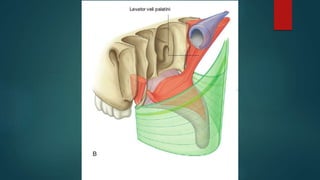
 The levator veli palatini passes through the pharyngeal fascia inferior to
the pharyngotympanic tube and enters the soft palate.
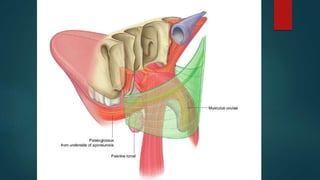
 The tendon of the tensor veli palatini turns medially around the pterygoid
hamulus and passes through the origin of the buccinator muscle to enter
the soft palate.
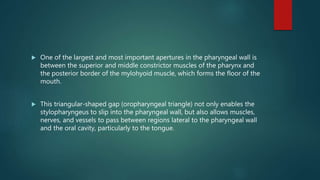
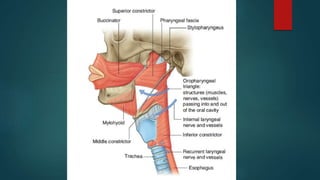
 One of the largest and most important apertures in the pharyngeal wall is
between the superior and middle constrictor muscles of the pharynx and
the posterior border of the mylohyoid muscle, which forms the floor of the
mouth.
 This triangular-shaped gap (oropharyngeal triangle) not only enables the
stylopharyngeus to slip into the pharyngeal wall, but also allows muscles,
nerves, and vessels to pass between regions lateral to the pharyngeal wall
and the oral cavity, particularly to the tongue.
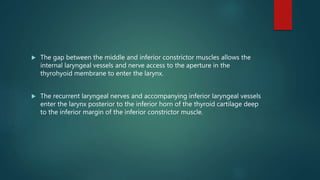
 The gap between the middle and inferior constrictor muscles allows the
internal laryngeal vessels and nerve access to the aperture in the
thyrohyoid membrane to enter the larynx.
 The recurrent laryngeal nerves and accompanying inferior laryngeal vessels
enter the larynx posterior to the inferior horn of the thyroid cartilage deep
to the inferior margin of the inferior constrictor muscle.
Nasopharynx
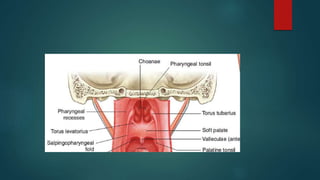
 The nasopharynx is behind the posterior apertures (choanae) of the nasal
cavities and above the level of the soft palate.
 Its ceiling is formed by the sloping base of the skull and consists of the
posterior part of the body of the sphenoid bone and the basal part of the
occipital bone.
 The position of the pharyngeal isthmus is marked on the pharyngeal wall
by a mucosal fold caused by the underlying palatopharyngeal sphincter,
which is part of the superior constrictor muscle.
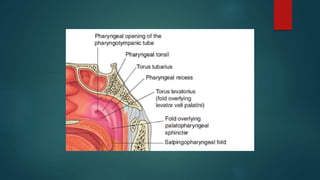
 There is a large collection of lymphoid tissue (the pharyngeal tonsil) in the
mucosa covering the roof of the nasopharynx. Enlargement of this tonsil,
known then as adenoids , can occlude the nasopharynx so that breathing is
only possible through the oral cavity.
 The most prominent features on each lateral wall of the nasopharynx are :
 the pharyngeal opening of the pharyngotympanic tube,
 mucosal elevations and folds covering the end of the pharyngotympanic tube
and the adjacent muscles.
 The opening of the pharyngotympanic tube is posterior to and slightly
above the level of the hard palate, and lateral to the top of the soft palate.
 Because the pharyngotympanic tube projects into the nasopharynx from a
posterolateral direction, its posterior rim forms a n elevation or bulge on
the pharyngeal wall.
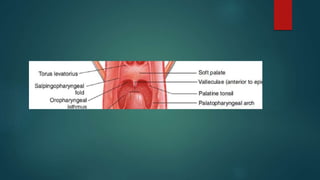
 Posterior to this tubal elevation (torus tubarius) is a deeprecess
(pharyngeal recess)
 Mucosal folds related t o the pharyngotympanic tube include:
 the small vertical salpingopharyngeal fold, which descends from the tubal
elevation and overlies the salpingopharyngeus muscle, and
 a broad fold or elevation (torus levatorius) that appears to emerge from just
under the opening of the pharyngotympanic tube, continues medially onto the
upper surface of the soft palate, and overlies the levator veli palatini muscle.
Oropharynx
 The oropharynx is posterior to the oral cavity, inferior to the level of the
soft palate, and superior to the upper margin of the epiglottis.
 The palatoglossal folds (arches) , one on each side, that cover the
palatoglossal muscles, mark the boundary between the oral cavity and the
oropharynx.
 The arched opening between the two folds is the oropharyngeal isthmus.
 Just posterior and medial to these folds are another pair of folds (arches) ,
the palatopharyngeal folds, one on each side, that overlie the
palatopharyngeus muscles .
 The anterior wall of the oropharynx inferior to the oropharyngeal isthmus
is formed by the upper part of the posterior one-third or pharyngeal part
of the tongue.
 Large collections of lymphoid tissue (the lingual tonsils) are in the mucosa
covering this part of the tongue.
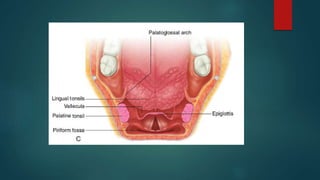
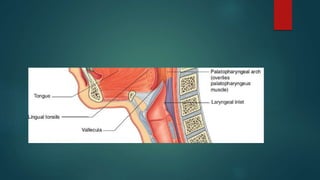
 A pair of mucosal pouches (valleculae) , one on each side of the midline,
between the base of the tongue and epiglottis, are depressions formed
between a midline mucosal fold and two lateral folds that connect the
tongue to the epiglottis.
Laryngopharynx
 The laryngopharynx extends from the superior margin of the epiglottis to
the top of the esophagus at the level of vertebra CVI
 The laryngeal inlet opens into the anterior wall o f the laryngopharynx.
Inferior to the laryngeal inlet, the anterior wall consists of the posterior
aspect of the larynx.
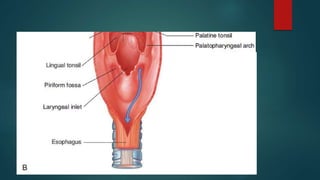
 There is another pair of mucosal recesses (piriform fossae) between the
central part of the larynx and the more lateral lamina of the thyroid
cartilage. The piriform fossae form channels that direct solids and liquids
from the oral cavity around the raised laryngeal inlet and into the
esophagus.
Vessels
Arteries
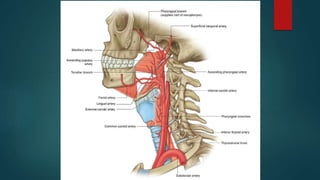
 Numerous vessels supply the pharyngeal wall {Fig. 8 . 2 0 2 ) . Arteries that
supply upper parts o f the pharynx include:
 the ascending pharyngeal artery,
 the ascending palatine and tonsillar branches of the facial artery, and
 numerous branches of the maxillary and the lingual arteries.
 All these vessels are from the external carotid artery.
 Arteries that supply the lower parts of the pharynx include pharyngeal
branches from the inferior thyroid artery, which originates from the
thyrocervical trunk of the subclavian artery.
Veins
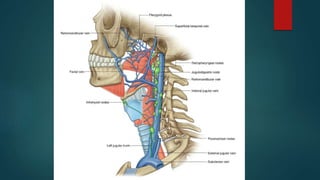
 Veins of the pharynx form a plexus , which drains superiorly into the
pterygoid plexus in the infratemporal fossa, and inferiorly into the facial
and internal jugular veins
Lymphatics
 Lymphatic vessels from the pharynx drain into the deep cervical nodes
and include retropharyngeal (between the nasopharynx and vertebral
column), paratracheal, and infrahyoid nodes.
 The palatine tonsils drain through the pharyngeal wall into the
jugulodigastric nodes in the region where the facial vein drains into the
internal jugular vein (and inferior to the posterior belly of the digastric
muscle).
Nerves
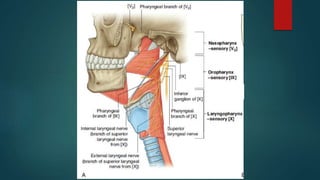
 Motor and most sensory innervation (except for the nasal region) of the
pharynx is mainly through branches of the vagus [X] and glossopharyngeal
[IX] nerves, which form a plexus in the outer fascia of the pharyngeal wall.
 The pharyngeal plexus i s formed by:
 the pharyngeal branch of the vagus nerve [X] ,
 branches from the external laryngeal nerve from the superior laryngeal
branch of the vagus nerve [X] , and
 pharyngeal branches of the glossopharyngeal nerve [IX] .
 The pharyngeal branch of the vagus nerve [X] originates from the upper
part of its inferior ganglion above the origin of the superior laryngeal
nerve and is the major motor nerve of the pharynx.
 All muscles of the pharynx are innervated by the vagus nerve [X] mainly
through the pharyngeal plexus, except for the stylopharyngeus , which is
innervated directly by a branch of the glossopharyngeal nerve [IX]
 Each subdivision o f the pharynx has a different sensory innervation:
 The nasopharynx is innervated by a pharyngeal branch of the maxillary nerve
[V2] that originates in the pterygopalatine fossa and passes through the
palatovaginal canal in the sphenoid bone to reach the roof of the pharynx.
 The oropharynx is innervated by the glossopharyngeal nerve [IX] via the
pharyngeal plexus .
 The laryngopharynx is innervated by the vagus nerve [X] via the internal branch
of the superior laryngeal artery.
Thanks for Attention

Pharynx

  • 1.
  • 2.
    The pharynx isa musculofascial half-cylinder that links the oral and nasal cavities in the head to the larynx and esophagus in the neck. The pharyngeal cavity is a common pathway for air and food.
  • 3.
    The pharynx isattached above to the base of the skull and is continuous below, approximately at the level of vertebra CVI, with the top of the esophagus. The walls of the pharynx are attached anteriorly to the margins of the nasal cavities, oral cavity, and larynx. Based on these anterior relationships the pharynx is subdivided into three regions, the nasopharynx, oropharynx, and laryngopharynx:
  • 4.
    The posterior apertures(choanae) of the nasal cavities open into the nasopharynx. The posterior opening of the oral cavity (oropharyngeal isthmus) opens into the oropharynx. The superior aperture of the larynx (laryngeal inlet) opens into the laryngopharynx.
  • 5.
    In addition tothese openings, the pharyngeal cavity is related anteriorly to the posterior one- third of the tongue and to the posterior aspect of the larynx. The pharyngotympanic tubes open into the lateral walls of the nasopharynx. Lingual, pharyngeal, and palatine tonsils are on the deep surface of the pharyngeal walls. The pharynx is separated from the posteriorly positioned vertebral column by a thin retropharyngeal space containing loose connective tissue.
  • 6.
    Although the softpalate is generally considered as part of the roof of the oral cavity, it is also related to the pharynx. The soft palate is attached to the posterior margin of the hard palate and is a type of "flutter valve" that can: swing up (elevate) to close the pharyngeal isthmus, and seal off the nasopharynx from the oropharynx, swing down (depress) to close the oropharyngeal isthmus and seal off the oral cavity from the oropharynx.
  • 7.
  • 8.
    pharyngeal raphe  Thetwo sides of the pharyngeal wall are welded together posteriorly in the midline by a vertically oriented cord- like ligament (the pharyngeal raphe) . This connective tissue structure descends from the pharyngeal tubercle on the base of the skull to the level of cervical vertebra CVI where the raphe blends with connective tissue in the posterior wall of the esophagus.
  • 9.
  • 10.
    Superior Attachment  Thereis an irregular C-shaped line of pharyngeal wall attachment on the base of the skull . The open part of the C faces the nasal cavities. Each arm of the C begins at the posterior margin of the medial plate of the pterygoid process of the sphenoid bone, just inferior to the cartilaginous part of the pharyngotympanic tube. The line crosses inferior to the pharyngotympanic tube and then passes onto the petrous part of the temporal bone where it is just medial to the roughening for the attachment of one of the muscles (levator veli palatini) of the soft palate. From here, the line swings medially onto the occipital bone and joins the line from the other side at a prominent elevation of bone in the midline (the pharyngeal tubercle) .
  • 11.
    Anterior Attachments First part Oneach side, the anterior line of attachment of the lateral pharyngeal wall begins superiorly on the posterior edge of the medial pterygoid plate of the sphenoid bone just inferior to where the pharyngotympanic tube lies against this plate. It continues inferiorly along the edge of the medial plate of the pterygoid process and onto the pterygoid hamulus . From this point, the line descends along the pterygomandibular raphe to the mandible where this part of the line terminates .
  • 12.
    Anterior Attachments The pterygomandibularraphe is a linear cord-like connective tissue ligament that spans the distance between the tip of the pterygoid hamulus and a triangular roughening immediately posterior to the third molar on the mandible. It joins a muscle of the lateral pharyngeal wall (superior constrictor) with a muscle of the lateral wall of the oral cavity (buccinator) .
  • 13.
    Anterior Attachments Second part Thesecond part of the line of attachment of the lateral pharyngeal wall is related to the hyoid bone. It begins on the lower aspect of the stylohyoid ligament, which connects the tip of the styloid process of the temporal bone to the lesser horn of the hyoid bone. The line continues onto the lesser horn and then turns and runs posteriorly along the entire upper surface of the greater horn of the hyoid where it terminates.
  • 14.
    Anterior Attachments Third part Themost inferior and third part of the line of attachment of the lateral pharyngeal wall begins superiorly on the superior tubercle of the thyroid cartilage, and descends along the oblique line to the inferior tubercle. From the inferior tubercle, the line of attachment continues over the cricothyroid muscle along a tendinous thickening of fascia to the cricoid cartilage where it terminates.
  • 15.
  • 16.
    Muscles The muscles ofthe pharynx are organized into two groups based on the orientation of muscle fibers. The constrictor muscles have fibers oriented in a circular direction relative to the pharyngeal wall, whereas the longitudinal muscles have fibers oriented vertically.
  • 17.
    Constrictormuscles The narrowest partof the pharyngeal cavity.
  • 18.
    Constrictor muscles  Theconstrictor muscles overlap each other in a fashion resembling the walls of three flower pots stacked one on the other.  Collectively, the muscles constrict or narrow the pharyngeal cavity. When the constrictor muscles contract sequentially from top to bottom, as in swallowing, they move a bolus of food through the pharynx and into the esophagus.
  • 19.
  • 20.
    Constrictor muscles  Aspecial band of muscle (the palatopharyngeal sphincter) originates from the anterolateral surface of the soft palate and circles the inner aspect of the pharyngeal wall, blending with the inner aspect of the superior constrictor.  When the superior constrictor constricts during swallowing, it forms a prominent ridge on the deep aspect of the pharyngeal wall that catches the margin of the elevated soft palate, which then seals closed the pharyngeal isthmus between the nasopharynx and oropharynx.
  • 21.
  • 23.
     The palatopharyngeusforms an important fold in the overlying mucosa (the palatopharyngeal arch) . This arch is visible through the oral cavity and is a landmark for finding the palatine tonsil, which is immediately anterior to it on the oropharyngeal wall.  In addition to elevating the pharynx, the palatopharyngeus participates in closing the oropharyngeal isthmus by depressing the palate and moving the palatopharyngeal fold toward the midline.
  • 25.
  • 26.
     The pharyngealfascia is separated into two layers , which sandwich the pharyngeal muscles between them:  A thin layer (buccopharyngeal fascia) coats the outside of the muscular part of the wall and is a component of the pretracheal layer of cervical fascia  A much thicker layer (pharyngobasilar fascia) lines the inner surface.
  • 27.
    Gaps in thepharyngeal wall and structures passing t h rough them  Above the margin o f the superior constrictor, the pharyngeal wall is deficient in muscle and completed by pharyngeal fascia.  The levator veli palatini passes through the pharyngeal fascia inferior to the pharyngotympanic tube and enters the soft palate.  The tendon of the tensor veli palatini turns medially around the pterygoid hamulus and passes through the origin of the buccinator muscle to enter the soft palate.
  • 30.
     One ofthe largest and most important apertures in the pharyngeal wall is between the superior and middle constrictor muscles of the pharynx and the posterior border of the mylohyoid muscle, which forms the floor of the mouth.  This triangular-shaped gap (oropharyngeal triangle) not only enables the stylopharyngeus to slip into the pharyngeal wall, but also allows muscles, nerves, and vessels to pass between regions lateral to the pharyngeal wall and the oral cavity, particularly to the tongue.
  • 31.
     The gapbetween the middle and inferior constrictor muscles allows the internal laryngeal vessels and nerve access to the aperture in the thyrohyoid membrane to enter the larynx.  The recurrent laryngeal nerves and accompanying inferior laryngeal vessels enter the larynx posterior to the inferior horn of the thyroid cartilage deep to the inferior margin of the inferior constrictor muscle.
  • 33.
  • 34.
     The nasopharynxis behind the posterior apertures (choanae) of the nasal cavities and above the level of the soft palate.  Its ceiling is formed by the sloping base of the skull and consists of the posterior part of the body of the sphenoid bone and the basal part of the occipital bone.  The position of the pharyngeal isthmus is marked on the pharyngeal wall by a mucosal fold caused by the underlying palatopharyngeal sphincter, which is part of the superior constrictor muscle.
  • 35.
     There isa large collection of lymphoid tissue (the pharyngeal tonsil) in the mucosa covering the roof of the nasopharynx. Enlargement of this tonsil, known then as adenoids , can occlude the nasopharynx so that breathing is only possible through the oral cavity.
  • 37.
     The mostprominent features on each lateral wall of the nasopharynx are :  the pharyngeal opening of the pharyngotympanic tube,  mucosal elevations and folds covering the end of the pharyngotympanic tube and the adjacent muscles.
  • 38.
     The openingof the pharyngotympanic tube is posterior to and slightly above the level of the hard palate, and lateral to the top of the soft palate.  Because the pharyngotympanic tube projects into the nasopharynx from a posterolateral direction, its posterior rim forms a n elevation or bulge on the pharyngeal wall.  Posterior to this tubal elevation (torus tubarius) is a deeprecess (pharyngeal recess)
  • 39.
     Mucosal foldsrelated t o the pharyngotympanic tube include:  the small vertical salpingopharyngeal fold, which descends from the tubal elevation and overlies the salpingopharyngeus muscle, and  a broad fold or elevation (torus levatorius) that appears to emerge from just under the opening of the pharyngotympanic tube, continues medially onto the upper surface of the soft palate, and overlies the levator veli palatini muscle.
  • 41.
  • 42.
     The oropharynxis posterior to the oral cavity, inferior to the level of the soft palate, and superior to the upper margin of the epiglottis.  The palatoglossal folds (arches) , one on each side, that cover the palatoglossal muscles, mark the boundary between the oral cavity and the oropharynx.  The arched opening between the two folds is the oropharyngeal isthmus.  Just posterior and medial to these folds are another pair of folds (arches) , the palatopharyngeal folds, one on each side, that overlie the palatopharyngeus muscles .
  • 44.
     The anteriorwall of the oropharynx inferior to the oropharyngeal isthmus is formed by the upper part of the posterior one-third or pharyngeal part of the tongue.  Large collections of lymphoid tissue (the lingual tonsils) are in the mucosa covering this part of the tongue.
  • 45.
     A pairof mucosal pouches (valleculae) , one on each side of the midline, between the base of the tongue and epiglottis, are depressions formed between a midline mucosal fold and two lateral folds that connect the tongue to the epiglottis.
  • 48.
  • 49.
     The laryngopharynxextends from the superior margin of the epiglottis to the top of the esophagus at the level of vertebra CVI
  • 50.
     The laryngealinlet opens into the anterior wall o f the laryngopharynx. Inferior to the laryngeal inlet, the anterior wall consists of the posterior aspect of the larynx.
  • 52.
     There isanother pair of mucosal recesses (piriform fossae) between the central part of the larynx and the more lateral lamina of the thyroid cartilage. The piriform fossae form channels that direct solids and liquids from the oral cavity around the raised laryngeal inlet and into the esophagus.
  • 54.
  • 55.
    Arteries  Numerous vesselssupply the pharyngeal wall {Fig. 8 . 2 0 2 ) . Arteries that supply upper parts o f the pharynx include:  the ascending pharyngeal artery,  the ascending palatine and tonsillar branches of the facial artery, and  numerous branches of the maxillary and the lingual arteries.  All these vessels are from the external carotid artery.  Arteries that supply the lower parts of the pharynx include pharyngeal branches from the inferior thyroid artery, which originates from the thyrocervical trunk of the subclavian artery.
  • 57.
    Veins  Veins ofthe pharynx form a plexus , which drains superiorly into the pterygoid plexus in the infratemporal fossa, and inferiorly into the facial and internal jugular veins
  • 59.
    Lymphatics  Lymphatic vesselsfrom the pharynx drain into the deep cervical nodes and include retropharyngeal (between the nasopharynx and vertebral column), paratracheal, and infrahyoid nodes.  The palatine tonsils drain through the pharyngeal wall into the jugulodigastric nodes in the region where the facial vein drains into the internal jugular vein (and inferior to the posterior belly of the digastric muscle).
  • 60.
    Nerves  Motor andmost sensory innervation (except for the nasal region) of the pharynx is mainly through branches of the vagus [X] and glossopharyngeal [IX] nerves, which form a plexus in the outer fascia of the pharyngeal wall.
  • 61.
     The pharyngealplexus i s formed by:  the pharyngeal branch of the vagus nerve [X] ,  branches from the external laryngeal nerve from the superior laryngeal branch of the vagus nerve [X] , and  pharyngeal branches of the glossopharyngeal nerve [IX] .
  • 62.
     The pharyngealbranch of the vagus nerve [X] originates from the upper part of its inferior ganglion above the origin of the superior laryngeal nerve and is the major motor nerve of the pharynx.  All muscles of the pharynx are innervated by the vagus nerve [X] mainly through the pharyngeal plexus, except for the stylopharyngeus , which is innervated directly by a branch of the glossopharyngeal nerve [IX]
  • 64.
     Each subdivisiono f the pharynx has a different sensory innervation:  The nasopharynx is innervated by a pharyngeal branch of the maxillary nerve [V2] that originates in the pterygopalatine fossa and passes through the palatovaginal canal in the sphenoid bone to reach the roof of the pharynx.  The oropharynx is innervated by the glossopharyngeal nerve [IX] via the pharyngeal plexus .  The laryngopharynx is innervated by the vagus nerve [X] via the internal branch of the superior laryngeal artery.
  • 65.