
B Y - ARTI SINGH
B.S.A. College
CLONING VECTORS
CONTENT
 What is vector
 What is cloning
 Process of molecular cloning
 Cloning vectors
 Features of cloning vector
 Importance of cloning vector
 Types of cloning vector
WHAT IS VECTORS?
 A vector is a DNA molecule which is used for transporting exogenous
DNA into the host cell.
General characteristics of a vector:
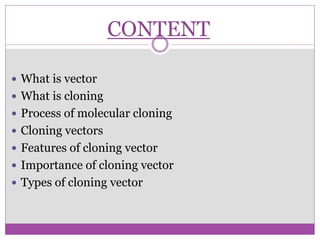
 It should have an Origin of Replication, known as ori, so that the
vector is capable of autonomous replication inside the host organism.
 It must possess a compatible restriction site for insertion of DNA
molecule.
 A vector should always harbour a selectable marker to screen the
recombinant organism. This selectable marker can be an antibiotic
resistance gene.
 For easy incorporation into the host machinery, a vector should itself
be small in size and be able to integrate large size of the insert.
WHAT IS CLONING?
 Cloning in biotechnology refers to the process of
creating clones of organisms or copies
of cells or DNA fragments (molecular cloning).
PROCESS OF MOLECULAR CLONING
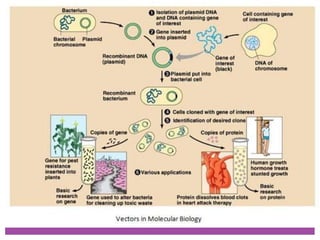
The whole process of molecular cloning involves the
following steps:
 Digestion of DNA fragments of the target segment and
the vector DNA with the help of restriction enzymes,
 Ligation of the target segment with the vector DNA
with the help of DNA ligases, and
 Introduction of the ligated segment into the host cell
for propagation.
CLONING VECTOR
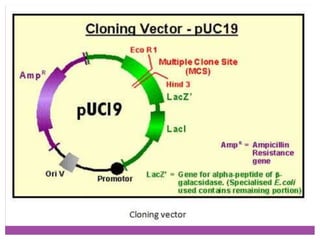
 A cloning vector is also a fragment of DNA which is
capable of self-replication and stable maintenance
inside the host organism. It can be extracted from a
virus, plasmid or cells of a higher organism.
The cloning vectors must possess the following general
characteristics:
 It should small in size.
 It must have an origin of replication.
 It must also be compatible with the host organism.
 It must possess a restriction site.
 The introduction of donor fragment must not intervene
with the self-replicating property of the cloning vector.
 A selectable marker, possibly an antibiotic resistance
gene, must be present to screen the recombinant cells.
 The introduction of donor fragment must not intervene
with the self-replicating property of the cloning vector.
 A selectable marker, possibly an antibiotic resistance
gene, must be present to screen the recombinant cells.
FEATURES OF CLONING VECTORS
Origin of Replication (ori)
 A specific set/ sequence of nucleotides where replication
initiates.
 For autonomous replication inside the host cell.
 Foreign DNA attached to ori also begins to replicate.
Cloning Site
 Point of entry or analysis for genetic engineering.
 Vector DNA at this site is digested and foreign DNA is
inserted with the aid of restriction enzymes.
 Recent works have discovered plasmids with multiple
cloning sites (MCS) which harbour up to 20 restriction
sites.
Selectable Marker
 Gene that confers resistance to particular antibiotics or
selective agent which, under normal conditions, is fatal for the
host organism.
 Confers the host cell the property to survive and propagate in
culture medium containing the particular antibiotics.
Marker or Reporter Gene
 Permits the screening of successful clones or recombinant
cells.
 Utilised extensively in blue-white selection.
Inability to Transfer via Conjugation
 Vectors must not enable recombinant DNA to escape to the
natural population of bacterial cells.
IMPORTANCE OF CLONING VECTOR
 Cloning Vectors are used as the vehicle for
transporting foreign genetic material into another
cell. This foreign segment of DNA is replicated and
expressed using the machinery of the host organism.
 A cloning vector facilitates amplification of a single
copy DNA molecule into many copies. Molecular
gene cloning is difficult without the use of the
cloning vectors.
TYPES OF CLONING VECTOR
 Plasmids
 Bateriophages
 Phasmids
 Cosmids
 BACs
 YACs
 HACs
 Retroviral
1. PLASMIDS
Plasmids were the first vectors to be used in gene cloning. They are
naturally occurring and autonomously replicating extra-
chromosomal double-stranded circular DNA molecules. However, not
all plasmids are circular in origin.
 They are present in bacteria, archaea, and eukaryotes.
 The size of plasmids ranges from 1.0 kb to 250 kb.
 DNA insert of up to 10 kb can be cloned in the plasmids.
 The plasmids have high copy number which is useful for production
of greater yield of recombinant plasmid for subsequent experiments.
 The low copy number plasmids are exploited under certain conditions
like the cloned gene produces the protein which is toxic to the cells.
 Plasmids only encode those proteins which are essential for their own
replication. These protein-encoding genes are located near the ori.
NOMENCLATURE
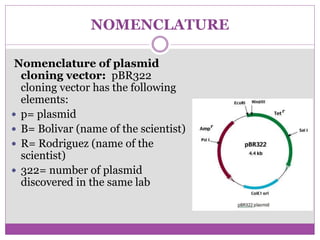
Nomenclature of plasmid
cloning vector: pBR322
cloning vector has the following
elements:
 p= plasmid
 B= Bolivar (name of the scientist)
 R= Rodriguez (name of the
scientist)
 322= number of plasmid
discovered in the same lab
ADVANTAGES AND DISADVANTAGES
Advantages of using Plasmids as vectors:
 Easy to manipulate and isolate because of small size.
 More stable because of circular configuration.
 Replicate independent of the host.
 High copy number.
 Detection easy because of antibiotic-resistant genes.
Disadvantages of using Plasmids as vectors:
 Large fragments cannot be cloned.
 Size range is only 0 to 10kb.
 Standard methods of transformation are inefficient.
2. BACTERIOPHAGES
 Bacteriophages or phages are viruses which infect
bacterial cells.
 The most common bacteriophages utilized in gene
cloning are Phage λ and M13 Phage.
 A maximum of 53 kb DNA can be packaged into the
phage.
 If the vector DNA is too small, it cannot be packaged
properly into the phage.
 Examples: Phage Lambda, M13 Phage, etc.
Phage Lambda λ
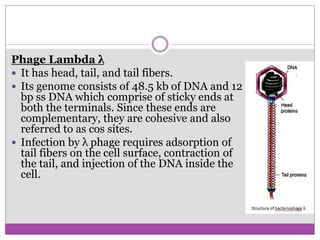
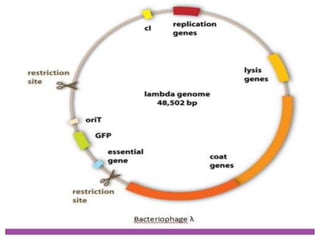
 It has head, tail, and tail fibers.
 Its genome consists of 48.5 kb of DNA and 12
bp ss DNA which comprise of sticky ends at
both the terminals. Since these ends are
complementary, they are cohesive and also
referred to as cos sites.
 Infection by λ phage requires adsorption of
tail fibers on the cell surface, contraction of
the tail, and injection of the DNA inside the
cell.
M13 Phage
 These vectors are used for obtaining single-stranded
copies of the cloned DNA.
 They are utilized in DNA sequencing and in vitro
mutagenesis.
 M13 phages are derived from filamentous
bacteriophage M13. The genome of M13 is 6.4 kb.
 DNA inserts of large sizes can be cloned.
 From the double-stranded inserts, pure single-
stranded DNA copies are obtained.
TYPES OF PHAGE VECTORS
There are 2 types of phage vectors:
 Insertion vectors- these contain a particular
cleavage site where the foreign DNA of up to 5-11 kb
can be inserted.
 Replacement vectors- the cleavage sites flank a
region which contains genes not necessarily
important for the host, and these genes can be
deleted and replaced by the DNA insert.
ADVANTAGES
Advantages of using Phage Vectors
 They are way more efficient than plasmids for
cloning large inserts.
 Screening of phage plaques is much easier than
identification of recombinant bacterial colonies.
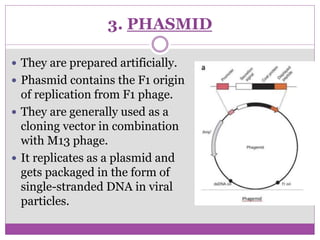
3. PHASMID
 They are prepared artificially.
 Phasmid contains the F1 origin
of replication from F1 phage.
 They are generally used as a
cloning vector in combination
with M13 phage.
 It replicates as a plasmid and
gets packaged in the form of
single-stranded DNA in viral
particles.
ADVANTAGES
Advantages of using Phagemids:
 They contain multiple cloning sites.
 An inducible lac gene promoter is present.
 Blue-white colony selection is observed.
4. COSMIDS
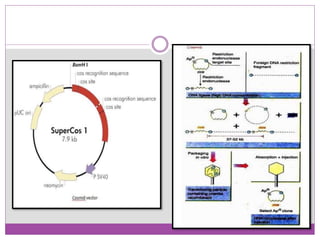
 Cosmids are plasmids.
 They are capable of incorporating the bacteriophage λ
DNA segment. This DNA segment contains cohesive
terminal sites (cos sites).
 Cos sites are necessary for efficient packaging of DNA
into λ phage particles.
 Large DNA fragments of size varying from 25 to 45 kb
can be cloned.
 They are also packaged into λ This permits the foreign
DNA fragment or genes to be introduced into the host
organism by the mechanism of transduction.
ADVANTAGES AND DISADVANTAGES
Advantages of using cosmids as vectors:
 They have high transformation efficiency and are
capable of producing a large number of clones from a
small quantity of DNA.
 Also, they can carry up to 45 kb of insert compared to
25 kb carried by plasmids and λ.
Disadvantages of using cosmids as vectors:
 Cosmids cannot accept more than 50 kb of the insert.
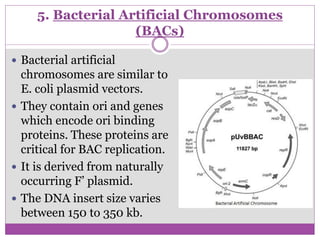
5. Bacterial Artificial Chromosomes
(BACs)
 Bacterial artificial
chromosomes are similar to
E. coli plasmid vectors.
 They contain ori and genes
which encode ori binding
proteins. These proteins are
critical for BAC replication.
 It is derived from naturally
occurring F’ plasmid.
 The DNA insert size varies
between 150 to 350 kb.
ADVANTAGES AND DISADVANTAGES
Advantages of BACs:
 They are capable of accommodating large sequences without any
risk of rearrangement.
 BACs are frequently used for studies of genetic or infectious
disorders.
 High yield of DNA clones is obtained.
Disadvantages of BACs:
 They are present in low copy number.
 The eukaryotic DNA inserts with repetitive sequences are
structurally unstable in BACs often resulting in deletion or
rearrangement.
6. Yeast Artificial Chromosomes (YACs)
 A large DNA insert of up to 200 kb can be cloned.
 They are used for cloning inside eukaryotic cells.
These act as eukaryotic chromosomes inside the host
eukaryotic cell.
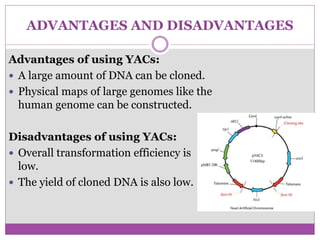
 It possesses the yeast telomere at each end.
 A yeast centromere sequence (CEN) is present which
allows proper segregation during meiosis.
 The ori is bacterial in origin.
 Both yeast and bacterial cells can be used as hosts.
ADVANTAGES AND DISADVANTAGES
Advantages of using YACs:
 A large amount of DNA can be cloned.
 Physical maps of large genomes like the
human genome can be constructed.
Disadvantages of using YACs:
 Overall transformation efficiency is
low.
 The yield of cloned DNA is also low.
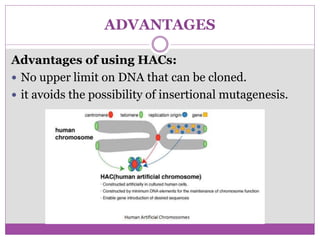
7. Human Artificial Chromosomes (HACs)
 Human artificial chromosomes are artificially
synthesized.
 They are utilized for gene transfer or gene delivery
into human cells.
 It can carry large amounts of DNA inserts.
 They are used extensively in expression studies and
determining the function of the human
chromosomes.
ADVANTAGES
Advantages of using HACs:
 No upper limit on DNA that can be cloned.
 it avoids the possibility of insertional mutagenesis.
8. RETROVIRAL VECTORS
 Retroviruses are the virus with RNA as the genetic
material.
 Retroviral vectors are used for introduction of novel or
manipulated genes into the animal or human cells.
 The viral RNA is converted into DNA with the help of
reverse transcriptase and henceforth, efficiently integrated
into the host cell.
 Any gene of interest can be introduced into the retroviral
genome. This gene of interest can then integrate into host
cell chromosome and reside there.
Advantages of using retroviral vectors:
 They are widely used as a tool to study and analyze
oncogenes and other human genes.
THANK YOU

Cloning vectors

  • 1.
    B Y -ARTI SINGH B.S.A. College CLONING VECTORS
  • 2.
    CONTENT  What isvector  What is cloning  Process of molecular cloning  Cloning vectors  Features of cloning vector  Importance of cloning vector  Types of cloning vector
  • 3.
    WHAT IS VECTORS? A vector is a DNA molecule which is used for transporting exogenous DNA into the host cell. General characteristics of a vector:  It should have an Origin of Replication, known as ori, so that the vector is capable of autonomous replication inside the host organism.  It must possess a compatible restriction site for insertion of DNA molecule.  A vector should always harbour a selectable marker to screen the recombinant organism. This selectable marker can be an antibiotic resistance gene.  For easy incorporation into the host machinery, a vector should itself be small in size and be able to integrate large size of the insert.
  • 4.
    WHAT IS CLONING? Cloning in biotechnology refers to the process of creating clones of organisms or copies of cells or DNA fragments (molecular cloning).
  • 5.
    PROCESS OF MOLECULARCLONING The whole process of molecular cloning involves the following steps:  Digestion of DNA fragments of the target segment and the vector DNA with the help of restriction enzymes,  Ligation of the target segment with the vector DNA with the help of DNA ligases, and  Introduction of the ligated segment into the host cell for propagation.
  • 7.
    CLONING VECTOR  Acloning vector is also a fragment of DNA which is capable of self-replication and stable maintenance inside the host organism. It can be extracted from a virus, plasmid or cells of a higher organism. The cloning vectors must possess the following general characteristics:  It should small in size.  It must have an origin of replication.  It must also be compatible with the host organism.  It must possess a restriction site.
  • 8.
     The introductionof donor fragment must not intervene with the self-replicating property of the cloning vector.  A selectable marker, possibly an antibiotic resistance gene, must be present to screen the recombinant cells.  The introduction of donor fragment must not intervene with the self-replicating property of the cloning vector.  A selectable marker, possibly an antibiotic resistance gene, must be present to screen the recombinant cells.
  • 10.
    FEATURES OF CLONINGVECTORS Origin of Replication (ori)  A specific set/ sequence of nucleotides where replication initiates.  For autonomous replication inside the host cell.  Foreign DNA attached to ori also begins to replicate. Cloning Site  Point of entry or analysis for genetic engineering.  Vector DNA at this site is digested and foreign DNA is inserted with the aid of restriction enzymes.  Recent works have discovered plasmids with multiple cloning sites (MCS) which harbour up to 20 restriction sites.
  • 11.
    Selectable Marker  Genethat confers resistance to particular antibiotics or selective agent which, under normal conditions, is fatal for the host organism.  Confers the host cell the property to survive and propagate in culture medium containing the particular antibiotics. Marker or Reporter Gene  Permits the screening of successful clones or recombinant cells.  Utilised extensively in blue-white selection. Inability to Transfer via Conjugation  Vectors must not enable recombinant DNA to escape to the natural population of bacterial cells.
  • 12.
    IMPORTANCE OF CLONINGVECTOR  Cloning Vectors are used as the vehicle for transporting foreign genetic material into another cell. This foreign segment of DNA is replicated and expressed using the machinery of the host organism.  A cloning vector facilitates amplification of a single copy DNA molecule into many copies. Molecular gene cloning is difficult without the use of the cloning vectors.
  • 13.
    TYPES OF CLONINGVECTOR  Plasmids  Bateriophages  Phasmids  Cosmids  BACs  YACs  HACs  Retroviral
  • 14.
    1. PLASMIDS Plasmids werethe first vectors to be used in gene cloning. They are naturally occurring and autonomously replicating extra- chromosomal double-stranded circular DNA molecules. However, not all plasmids are circular in origin.  They are present in bacteria, archaea, and eukaryotes.  The size of plasmids ranges from 1.0 kb to 250 kb.  DNA insert of up to 10 kb can be cloned in the plasmids.  The plasmids have high copy number which is useful for production of greater yield of recombinant plasmid for subsequent experiments.  The low copy number plasmids are exploited under certain conditions like the cloned gene produces the protein which is toxic to the cells.  Plasmids only encode those proteins which are essential for their own replication. These protein-encoding genes are located near the ori.
  • 15.
    NOMENCLATURE Nomenclature of plasmid cloningvector: pBR322 cloning vector has the following elements:  p= plasmid  B= Bolivar (name of the scientist)  R= Rodriguez (name of the scientist)  322= number of plasmid discovered in the same lab
  • 16.
    ADVANTAGES AND DISADVANTAGES Advantagesof using Plasmids as vectors:  Easy to manipulate and isolate because of small size.  More stable because of circular configuration.  Replicate independent of the host.  High copy number.  Detection easy because of antibiotic-resistant genes. Disadvantages of using Plasmids as vectors:  Large fragments cannot be cloned.  Size range is only 0 to 10kb.  Standard methods of transformation are inefficient.
  • 17.
    2. BACTERIOPHAGES  Bacteriophagesor phages are viruses which infect bacterial cells.  The most common bacteriophages utilized in gene cloning are Phage λ and M13 Phage.  A maximum of 53 kb DNA can be packaged into the phage.  If the vector DNA is too small, it cannot be packaged properly into the phage.  Examples: Phage Lambda, M13 Phage, etc.
  • 18.
    Phage Lambda λ It has head, tail, and tail fibers.  Its genome consists of 48.5 kb of DNA and 12 bp ss DNA which comprise of sticky ends at both the terminals. Since these ends are complementary, they are cohesive and also referred to as cos sites.  Infection by λ phage requires adsorption of tail fibers on the cell surface, contraction of the tail, and injection of the DNA inside the cell.
  • 20.
    M13 Phage  Thesevectors are used for obtaining single-stranded copies of the cloned DNA.  They are utilized in DNA sequencing and in vitro mutagenesis.  M13 phages are derived from filamentous bacteriophage M13. The genome of M13 is 6.4 kb.  DNA inserts of large sizes can be cloned.  From the double-stranded inserts, pure single- stranded DNA copies are obtained.
  • 21.
    TYPES OF PHAGEVECTORS There are 2 types of phage vectors:  Insertion vectors- these contain a particular cleavage site where the foreign DNA of up to 5-11 kb can be inserted.  Replacement vectors- the cleavage sites flank a region which contains genes not necessarily important for the host, and these genes can be deleted and replaced by the DNA insert.
  • 22.
    ADVANTAGES Advantages of usingPhage Vectors  They are way more efficient than plasmids for cloning large inserts.  Screening of phage plaques is much easier than identification of recombinant bacterial colonies.
  • 23.
    3. PHASMID  Theyare prepared artificially.  Phasmid contains the F1 origin of replication from F1 phage.  They are generally used as a cloning vector in combination with M13 phage.  It replicates as a plasmid and gets packaged in the form of single-stranded DNA in viral particles.
  • 24.
    ADVANTAGES Advantages of usingPhagemids:  They contain multiple cloning sites.  An inducible lac gene promoter is present.  Blue-white colony selection is observed.
  • 25.
    4. COSMIDS  Cosmidsare plasmids.  They are capable of incorporating the bacteriophage λ DNA segment. This DNA segment contains cohesive terminal sites (cos sites).  Cos sites are necessary for efficient packaging of DNA into λ phage particles.  Large DNA fragments of size varying from 25 to 45 kb can be cloned.  They are also packaged into λ This permits the foreign DNA fragment or genes to be introduced into the host organism by the mechanism of transduction.
  • 26.
    ADVANTAGES AND DISADVANTAGES Advantagesof using cosmids as vectors:  They have high transformation efficiency and are capable of producing a large number of clones from a small quantity of DNA.  Also, they can carry up to 45 kb of insert compared to 25 kb carried by plasmids and λ. Disadvantages of using cosmids as vectors:  Cosmids cannot accept more than 50 kb of the insert.
  • 28.
    5. Bacterial ArtificialChromosomes (BACs)  Bacterial artificial chromosomes are similar to E. coli plasmid vectors.  They contain ori and genes which encode ori binding proteins. These proteins are critical for BAC replication.  It is derived from naturally occurring F’ plasmid.  The DNA insert size varies between 150 to 350 kb.
  • 29.
    ADVANTAGES AND DISADVANTAGES Advantagesof BACs:  They are capable of accommodating large sequences without any risk of rearrangement.  BACs are frequently used for studies of genetic or infectious disorders.  High yield of DNA clones is obtained. Disadvantages of BACs:  They are present in low copy number.  The eukaryotic DNA inserts with repetitive sequences are structurally unstable in BACs often resulting in deletion or rearrangement.
  • 30.
    6. Yeast ArtificialChromosomes (YACs)  A large DNA insert of up to 200 kb can be cloned.  They are used for cloning inside eukaryotic cells. These act as eukaryotic chromosomes inside the host eukaryotic cell.  It possesses the yeast telomere at each end.  A yeast centromere sequence (CEN) is present which allows proper segregation during meiosis.  The ori is bacterial in origin.  Both yeast and bacterial cells can be used as hosts.
  • 31.
    ADVANTAGES AND DISADVANTAGES Advantagesof using YACs:  A large amount of DNA can be cloned.  Physical maps of large genomes like the human genome can be constructed. Disadvantages of using YACs:  Overall transformation efficiency is low.  The yield of cloned DNA is also low.
  • 32.
    7. Human ArtificialChromosomes (HACs)  Human artificial chromosomes are artificially synthesized.  They are utilized for gene transfer or gene delivery into human cells.  It can carry large amounts of DNA inserts.  They are used extensively in expression studies and determining the function of the human chromosomes.
  • 33.
    ADVANTAGES Advantages of usingHACs:  No upper limit on DNA that can be cloned.  it avoids the possibility of insertional mutagenesis.
  • 34.
    8. RETROVIRAL VECTORS Retroviruses are the virus with RNA as the genetic material.  Retroviral vectors are used for introduction of novel or manipulated genes into the animal or human cells.  The viral RNA is converted into DNA with the help of reverse transcriptase and henceforth, efficiently integrated into the host cell.  Any gene of interest can be introduced into the retroviral genome. This gene of interest can then integrate into host cell chromosome and reside there. Advantages of using retroviral vectors:  They are widely used as a tool to study and analyze oncogenes and other human genes.
  • 35.