The RSA Algorithm
Fundamental Theorem of Arithmetic
Presented By;
Antony P Saiji
S7 CSA ,Roll no:16
VJCET
Fundamental Theorem of Arithmetic
• Every Composite Number can be expressed (Factorized) as a product of
Prime Numbers, And these factorization is unique apart from the order in
which the Factor occur.
The RSA Algorithm
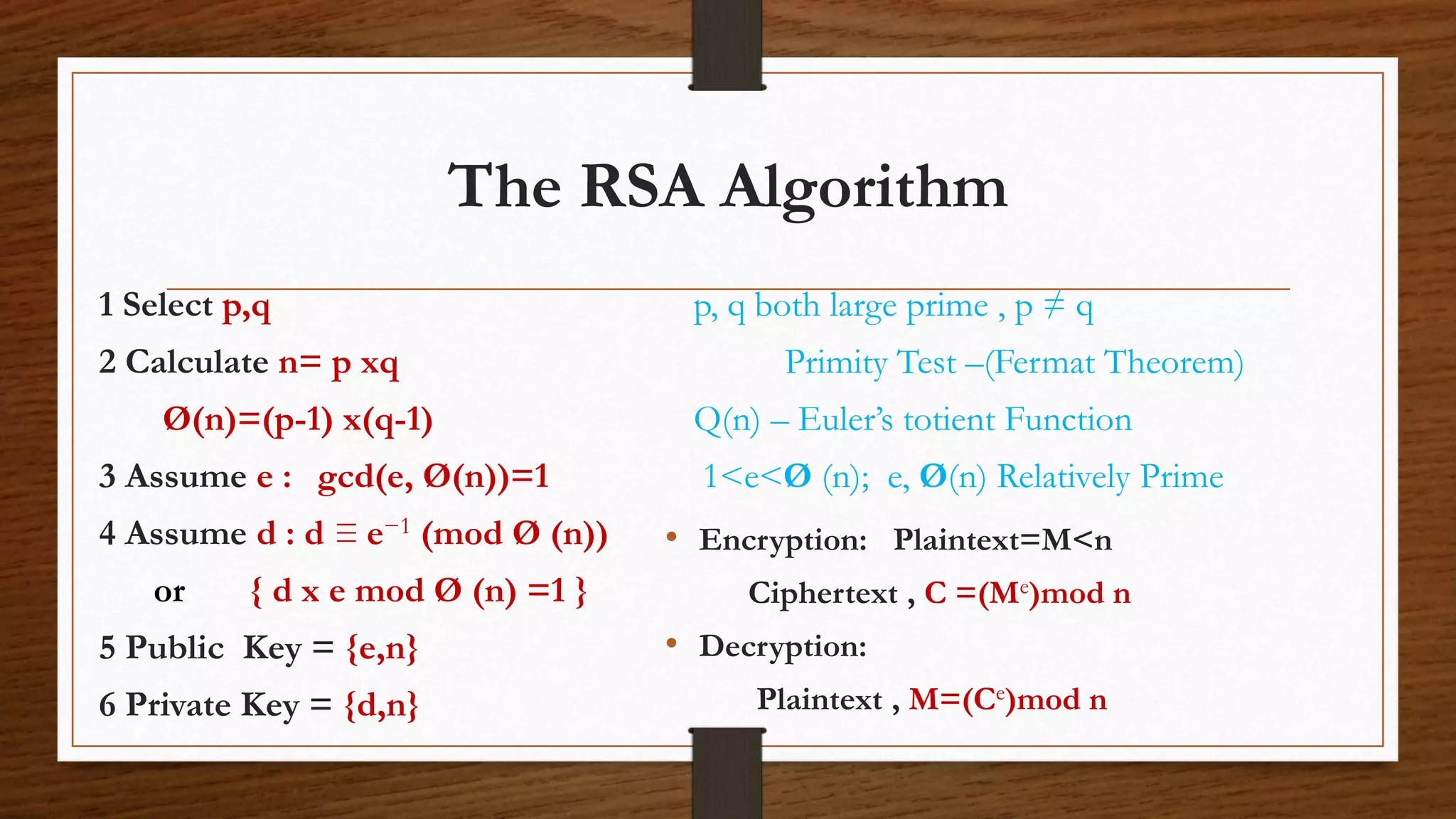
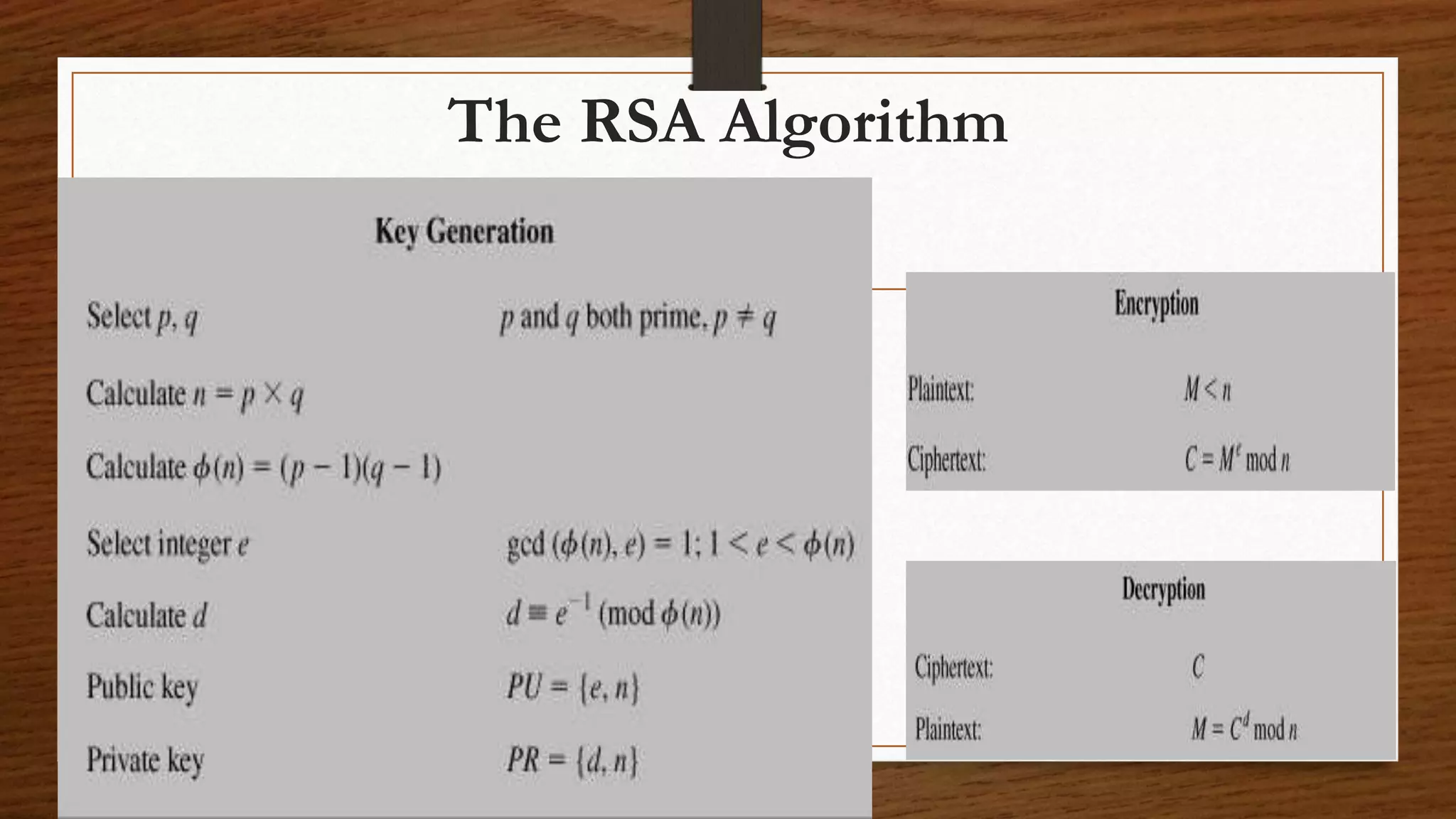
1 Select p,q
2 Calculate n= p xq
Ø(n)=(p-1) x(q-1)
3 Assume e : gcd(e, Ø(n))=1
4 Assume d : d ≡ e−1 (mod Ø (n))
or { d x e mod Ø (n) =1 }
5 Public Key = {e,n}
6 Private Key = {d,n}
p, q both large prime , p ≠ q
Primity Test –(Fermat Theorem)
Q(n) – Euler’s totient Function
1<e<Ø (n); e, Ø(n) Relatively Prime
• Encryption: Plaintext=M<n
Ciphertext , C =(Me)mod n
• Decryption:
Plaintext , M=(Ce)mod n
The RSA Algorithm
• An important requirement in a number of cryptographic algorithms is the
ability to choose a large prime number. An area of ongoing research is
the development of efficient algorithms for determining if a randomly
chosen large integer is a prime number.
• Its like Prime Numbers are the basic building block of a Number.
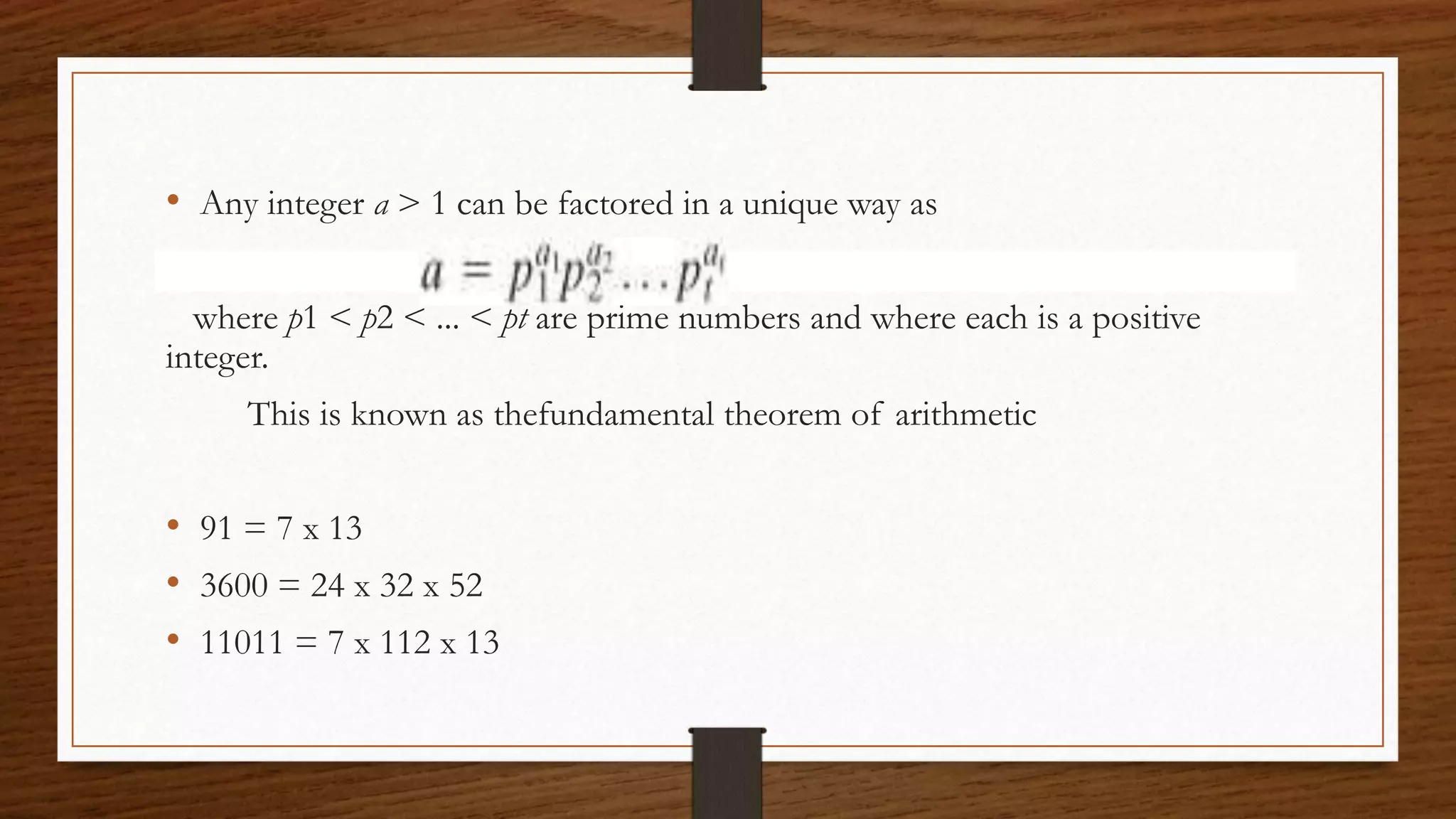
• Any integer a > 1 can be factored in a unique way as
where p1 < p2 < ... < pt are prime numbers and where each is a positive
integer.
This is known as thefundamental theorem of arithmetic
• 91 = 7 x 13
• 3600 = 24 x 32 x 52
• 11011 = 7 x 112 x 13
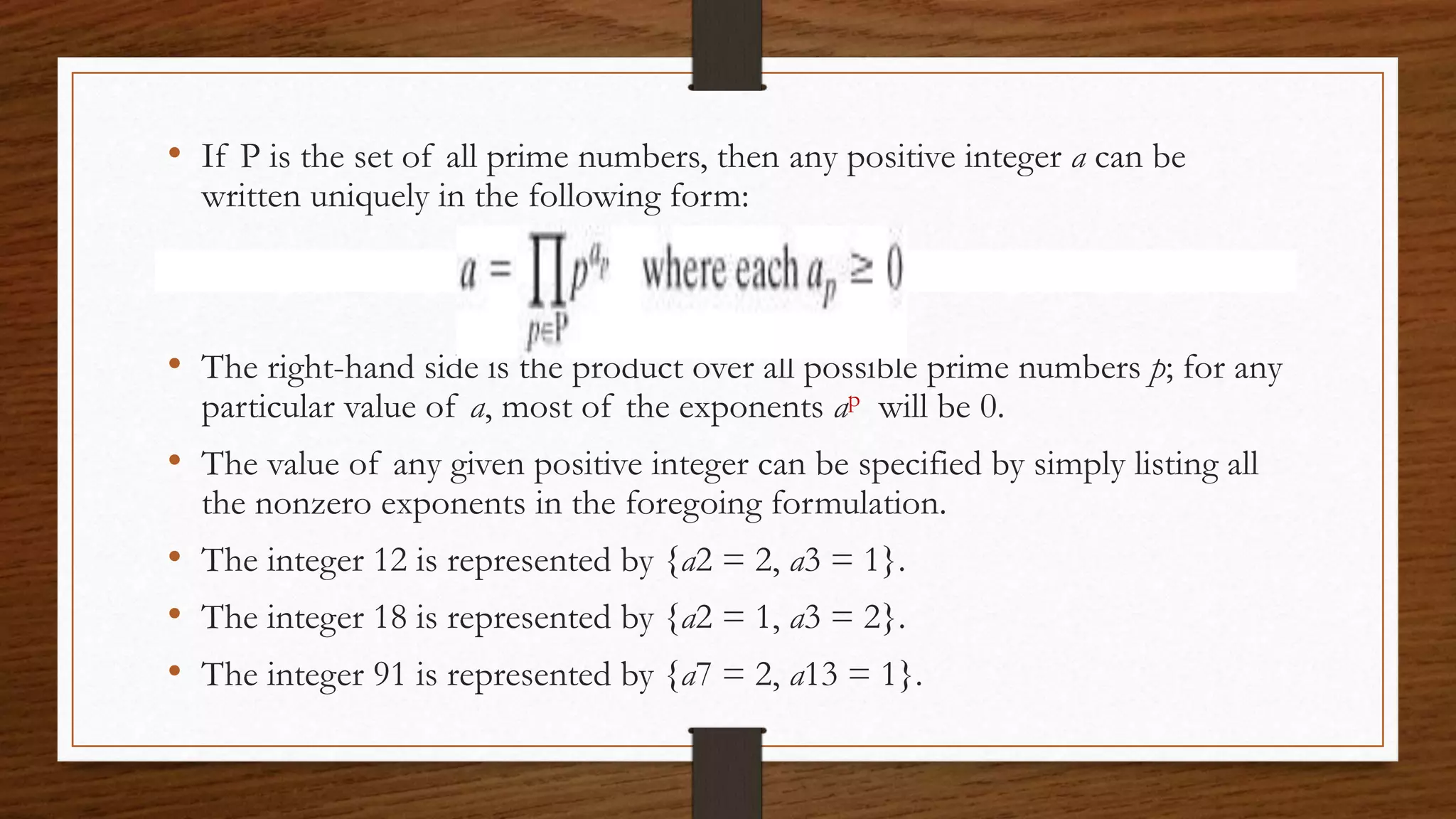
• If P is the set of all prime numbers, then any positive integer a can be
written uniquely in the following form:
• The right-hand side is the product over all possible prime numbers p; for any
particular value of a, most of the exponents ap will be 0.
• The value of any given positive integer can be specified by simply listing all
the nonzero exponents in the foregoing formulation.
• The integer 12 is represented by {a2 = 2, a3 = 1}.
• The integer 18 is represented by {a2 = 1, a3 = 2}.
• The integer 91 is represented by {a7 = 2, a13 = 1}.
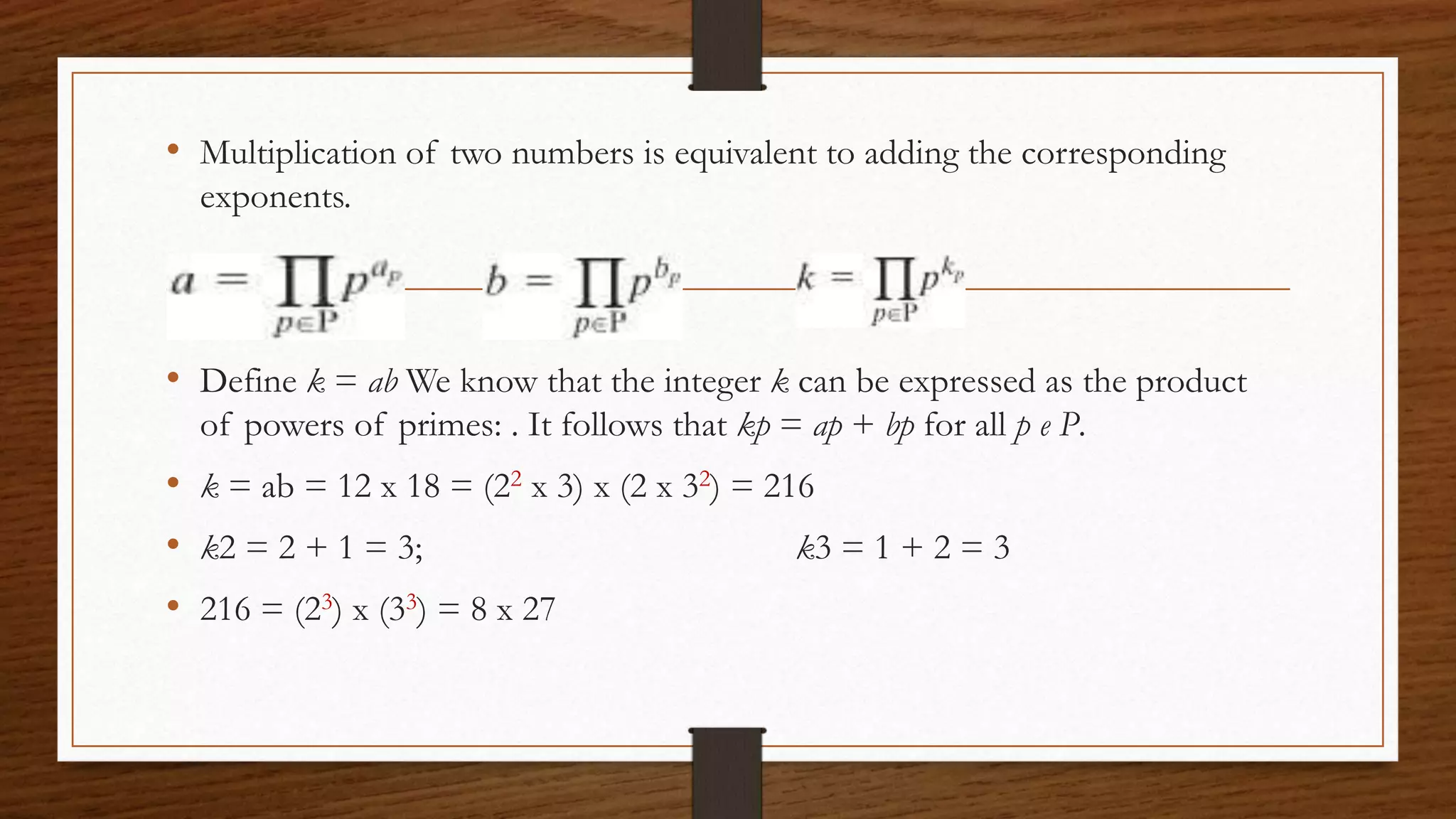
• Multiplication of two numbers is equivalent to adding the corresponding
exponents.
• Define k = ab We know that the integer k can be expressed as the product
of powers of primes: . It follows that kp = ap + bp for all p e P.
• k = ab = 12 x 18 = (22 x 3) x (2 x 32) = 216
• k2 = 2 + 1 = 3; k3 = 1 + 2 = 3
• 216 = (23) x (33) = 8 x 27
What does it mean, in terms of the prime
factors of a and b, to say that a divides b?
• Any integer of the form can be divided only by an integer that is of a lesser or equal
power of the same prime number, with j <=n. Thus, we can say the following:
If a|b, then a_p b_p then for all p.
• a = 12; b = 36; 12|36
• 12 = 22 x 3 ; 36 = 22 x 32
• a2 = 2 = b2
• a3 = (1<= 2) = b3
• Thus, the inequality (a_p) <=(b_p) is satisfied for all prime numbers.
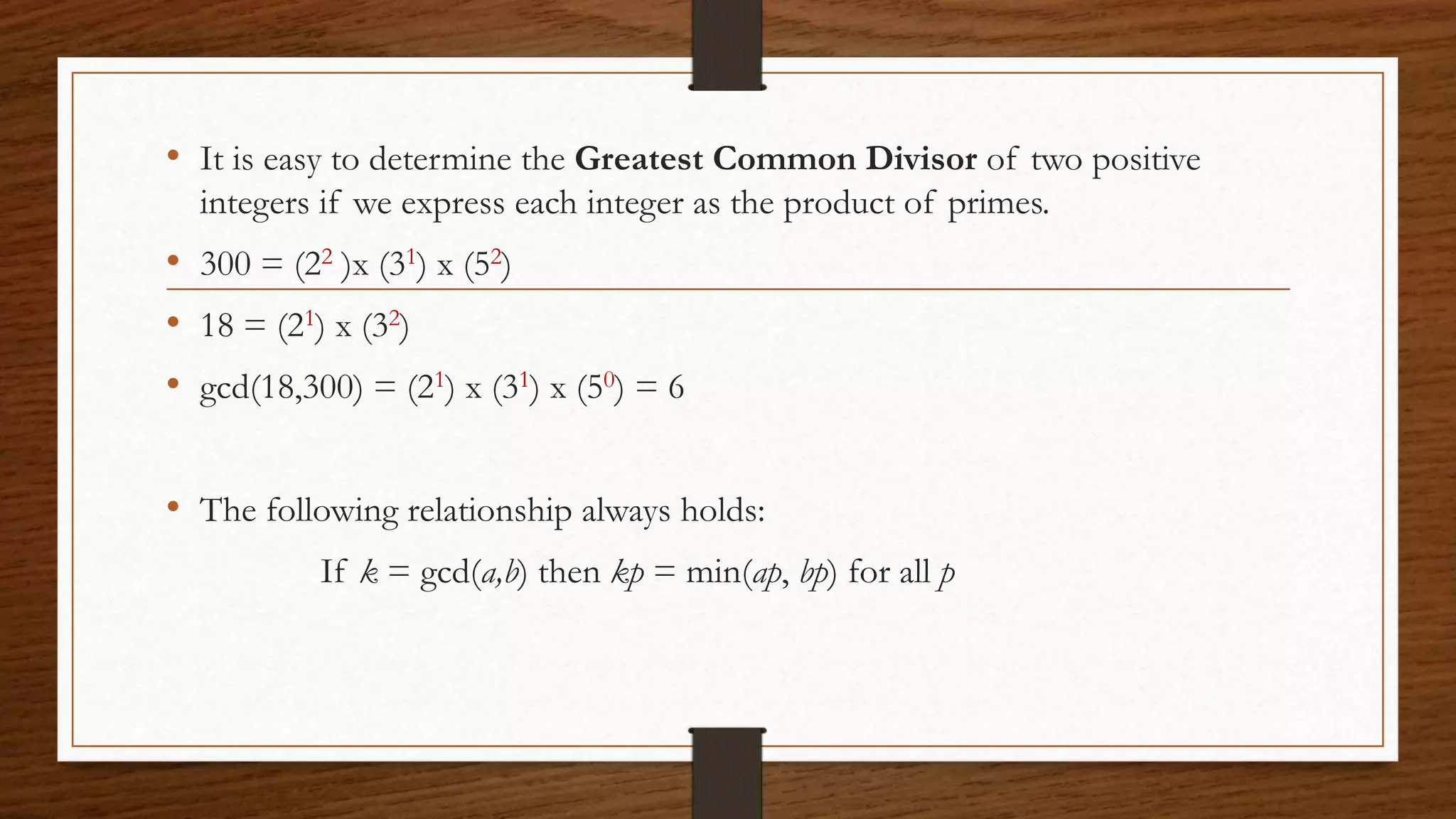
• It is easy to determine the Greatest Common Divisor of two positive
integers if we express each integer as the product of primes.
• 300 = (22 )x (31) x (52)
• 18 = (21) x (32)
• gcd(18,300) = (21) x (31) x (50) = 6
• The following relationship always holds:
If k = gcd(a,b) then kp = min(ap, bp) for all p

The RSA Algorithm

  • 1.
    The RSA Algorithm FundamentalTheorem of Arithmetic Presented By; Antony P Saiji S7 CSA ,Roll no:16 VJCET
  • 2.
    Fundamental Theorem ofArithmetic • Every Composite Number can be expressed (Factorized) as a product of Prime Numbers, And these factorization is unique apart from the order in which the Factor occur.
  • 3.
    The RSA Algorithm 1Select p,q 2 Calculate n= p xq Ø(n)=(p-1) x(q-1) 3 Assume e : gcd(e, Ø(n))=1 4 Assume d : d ≡ e−1 (mod Ø (n)) or { d x e mod Ø (n) =1 } 5 Public Key = {e,n} 6 Private Key = {d,n} p, q both large prime , p ≠ q Primity Test –(Fermat Theorem) Q(n) – Euler’s totient Function 1<e<Ø (n); e, Ø(n) Relatively Prime • Encryption: Plaintext=M<n Ciphertext , C =(Me)mod n • Decryption: Plaintext , M=(Ce)mod n
  • 4.
  • 5.
    • An importantrequirement in a number of cryptographic algorithms is the ability to choose a large prime number. An area of ongoing research is the development of efficient algorithms for determining if a randomly chosen large integer is a prime number. • Its like Prime Numbers are the basic building block of a Number.
  • 6.
    • Any integera > 1 can be factored in a unique way as where p1 < p2 < ... < pt are prime numbers and where each is a positive integer. This is known as thefundamental theorem of arithmetic • 91 = 7 x 13 • 3600 = 24 x 32 x 52 • 11011 = 7 x 112 x 13
  • 7.
    • If Pis the set of all prime numbers, then any positive integer a can be written uniquely in the following form: • The right-hand side is the product over all possible prime numbers p; for any particular value of a, most of the exponents ap will be 0. • The value of any given positive integer can be specified by simply listing all the nonzero exponents in the foregoing formulation. • The integer 12 is represented by {a2 = 2, a3 = 1}. • The integer 18 is represented by {a2 = 1, a3 = 2}. • The integer 91 is represented by {a7 = 2, a13 = 1}.
  • 8.
    • Multiplication oftwo numbers is equivalent to adding the corresponding exponents. • Define k = ab We know that the integer k can be expressed as the product of powers of primes: . It follows that kp = ap + bp for all p e P. • k = ab = 12 x 18 = (22 x 3) x (2 x 32) = 216 • k2 = 2 + 1 = 3; k3 = 1 + 2 = 3 • 216 = (23) x (33) = 8 x 27
  • 9.
    What does itmean, in terms of the prime factors of a and b, to say that a divides b? • Any integer of the form can be divided only by an integer that is of a lesser or equal power of the same prime number, with j <=n. Thus, we can say the following: If a|b, then a_p b_p then for all p. • a = 12; b = 36; 12|36 • 12 = 22 x 3 ; 36 = 22 x 32 • a2 = 2 = b2 • a3 = (1<= 2) = b3 • Thus, the inequality (a_p) <=(b_p) is satisfied for all prime numbers.
  • 10.
    • It iseasy to determine the Greatest Common Divisor of two positive integers if we express each integer as the product of primes. • 300 = (22 )x (31) x (52) • 18 = (21) x (32) • gcd(18,300) = (21) x (31) x (50) = 6 • The following relationship always holds: If k = gcd(a,b) then kp = min(ap, bp) for all p