Unpacking a Training
Package and units of
competency
August 2015
Bernadette Delaney
Session Aims
• Understand the development of training packages
• Understand changes in training packages- New Standards
• Understand the components of training packages
• Interpret the new units of competency
• Unpack training packages to plan your training program
• Implications for RTOs
• Identify compliance issues in planning
Session Aims
Main Points
Training Packages have the content & standards that you train
and assess against.
They provide a map for your training and assessment.
They demonstrate if you are compliant by providing the right
training.
Reflection
If you teach the requirements of the training package you
prepare students to be work ready.
Section 1
What is a Training
Package and
How is it developed?
What do training packages describe?
Training packages describe
workplace standards, not
training or education.
What do training packages describe?
• Set of nationally endorsed standards, assessment
requirements and qualifications
• Provide guidance on what should be in your training-
about competence/work ready
• Provide guidance on the amount of training
• Provide assessment requirements
Training packages do not -
• Training packages do not provide an off-the-shelf resource
ready to be used for training.
• Training packages provide a framework and definition of
the skills required, but they do not describe how people
should be trained, or provide information on delivery and
funding.
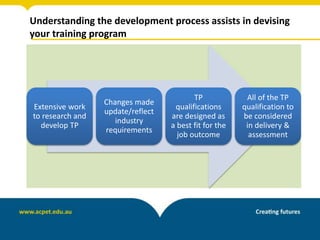
Understanding the development process assists in devising
your training program
Extensive work
to research and
develop TP
Changes made
update/reflect
industry
requirements
TP
qualifications
are designed as
a best fit for the
job outcome
All of the TP
qualification to
be considered
in delivery &
assessment
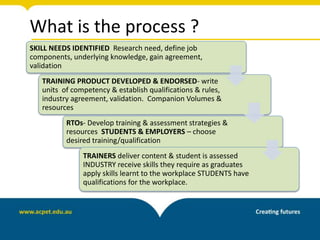
What is the process ?
SKILL NEEDS IDENTIFIED Research need, define job
components, underlying knowledge, gain agreement,
validation
TRAINING PRODUCT DEVELOPED & ENDORSED- write
units of competency & establish qualifications & rules,
industry agreement, validation. Companion Volumes &
resources
RTOs- Develop training & assessment strategies &
resources STUDENTS & EMPLOYERS – choose
desired training/qualification
TRAINERS deliver content & student is assessed
INDUSTRY receive skills they require as graduates
apply skills learnt to the workplace STUDENTS have
qualifications for the workplace.
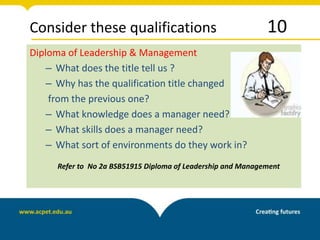
Consider these qualifications 10
Diploma of Leadership & Management
– What does the title tell us ?
– Why has the qualification title changed
from the previous one?
– What knowledge does a manager need?
– What skills does a manager need?
– What sort of environments do they work in?
Refer to No 2a BSB51915 Diploma of Leadership and Management
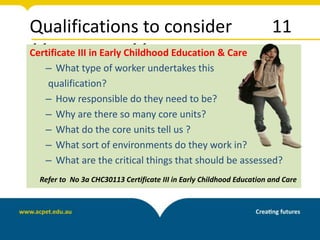
Qualifications to consider 11
11 11Certificate III in Early Childhood Education & Care
– What type of worker undertakes this
qualification?
– How responsible do they need to be?
– Why are there so many core units?
– What do the core units tell us ?
– What sort of environments do they work in?
– What are the critical things that should be assessed?
Refer to No 3a CHC30113 Certificate III in Early Childhood Education and Care
Changing qualifications 12
Reflection – write down your points
How have the skills and knowledge changed in these two
occupations over the last few years and why have they
changed ?
Refer to mapping information on No 2a BSB51915 and No 3a
CHC30113 .
Changing qualifications
Reflection
• Change from management to leadership and management.
• Additional skills for managers, manager as ‘leader’.
• Children’s services changed to child care educator. Over the years this has
changed from child care worker to child care educator. CHCECE009 Use an
approved learning framework to guide practice
• HLTFA311A Apply first aid changed to HLTAID004 Provide an emergency first
aid response in an education and care setting
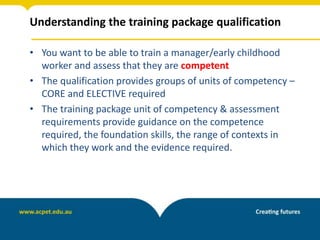
Understanding the training package qualification
• You want to be able to train a manager/early childhood
worker and assess that they are competent
• The qualification provides groups of units of competency –
CORE and ELECTIVE required
• The training package unit of competency & assessment
requirements provide guidance on the competence
required, the foundation skills, the range of contexts in
which they work and the evidence required.
Section 2
Changes in Training
Packages
Understanding these
changes
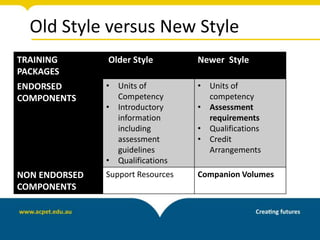
Old Style versus New Style
TRAINING
PACKAGES
Older Style Newer Style
ENDORSED
COMPONENTS
• Units of
Competency
• Introductory
information
including
assessment
guidelines
• Qualifications
• Units of
competency
• Assessment
requirements
• Qualifications
• Credit
Arrangements
NON ENDORSED
COMPONENTS
Support Resources Companion Volumes
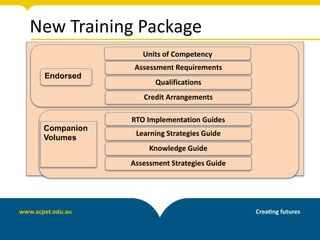
New Training Package
Endorsed
Companion
Volumes
Units of Competency
Assessment Requirements
Qualifications
Credit Arrangements
RTO Implementation Guides
Learning Strategies Guide
Knowledge Guide
Assessment Strategies Guide
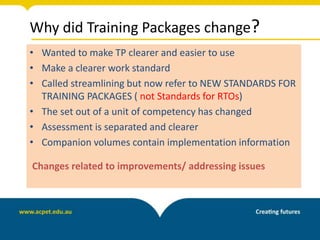
Why did Training Packages change?
• Wanted to make TP clearer and easier to use
• Make a clearer work standard
• Called streamlining but now refer to NEW STANDARDS FOR
TRAINING PACKAGES ( not Standards for RTOs)
• The set out of a unit of competency has changed
• Assessment is separated and clearer
• Companion volumes contain implementation information
Changes related to improvements/ addressing issues
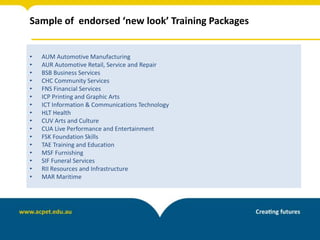
Sample of endorsed ‘new look’ Training Packages
• AUM Automotive Manufacturing
• AUR Automotive Retail, Service and Repair
• BSB Business Services
• CHC Community Services
• FNS Financial Services
• ICP Printing and Graphic Arts
• ICT Information & Communications Technology
• HLT Health
• CUV Arts and Culture
• CUA Live Performance and Entertainment
• FSK Foundation Skills
• TAE Training and Education
• MSF Furnishing
• SIF Funeral Services
• RII Resources and Infrastructure
• MAR Maritime
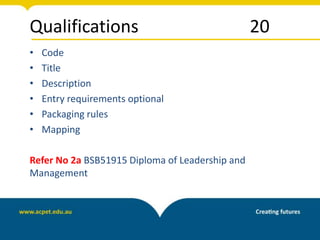
Qualifications 20
• Code
• Title
• Description
• Entry requirements optional
• Packaging rules
• Mapping
Refer No 2a BSB51915 Diploma of Leadership and
Management
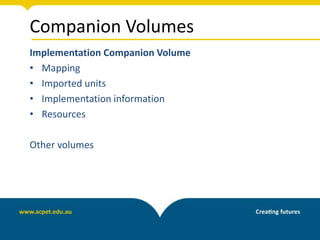
Companion Volumes
Implementation Companion Volume
• Mapping
• Imported units
• Implementation information
• Resources
Other volumes
In summary : What has changed
NEW TRAINING PACKAGE
Endorsed
Unit of competency
Assessment Requirements
Qualifications
Credit arrangements
AND mandatory
Companion Volumes- Implementation
REPLACES
Large volume of training package
Section 3
What are the components of
new training packages ?
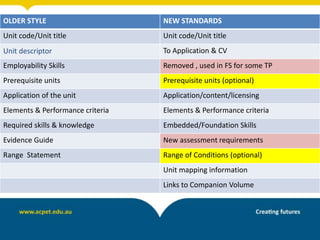
OLDER STYLE NEW STANDARDS
Unit code/Unit title Unit code/Unit title
To Application & CV
Employability Skills Removed , used in FS for some TP
Prerequisite units Prerequisite units (optional)
Application of the unit Application/content/licensing
Elements & Performance criteria Elements & Performance criteria
Required skills & knowledge Embedded/Foundation Skills
Evidence Guide New assessment requirements
Range Statement Range of Conditions (optional)
Unit mapping information
Links to Companion Volume
Unit descriptor
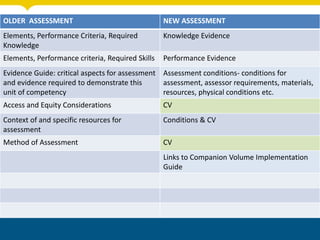
OLDER ASSESSMENT NEW ASSESSMENT
Elements, Performance Criteria, Required
Knowledge
Knowledge Evidence
Elements, Performance criteria, Required Skills Performance Evidence
Evidence Guide: critical aspects for assessment
and evidence required to demonstrate this
unit of competency
Assessment conditions- conditions for
assessment, assessor requirements, materials,
resources, physical conditions etc.
Access and Equity Considerations CV
Context of and specific resources for
assessment
Conditions & CV
Method of Assessment CV
Links to Companion Volume Implementation
Guide
Changes in Training Packages 26
No 4 a , 4b, No 5 documents
Refer to CHCECE003 unit and assessment requirements
Provide Care for Children
And the old unit it replaces CHCCN302A Provide care for
children .
Examine the set out to see the changes .
What will be in a unit of competency
ELEMENTS
MANDATORY FIELD
Elements describe the essential outcomes.
• Elements describe actions or outcomes that are demonstrable and
assessable.
PERFORMANCE CRITERIA
MANDATORY FIELD
Performance criteria describe the performance needed to demonstrate
achievement of the element.
1.1 Performance criteria clearly relate to the element.
1.2 They are expressed as a standard.
1.3 They specify the required performance in relevant tasks, roles, and skills.
1.4 They reflect the applied knowledge that enables competent performance.
What will be in a unit of competency
FOUNDATION SKILLS
MANDATORY FIELD
• This section describes those language, literacy, numeracy
and employment skills that are essential to performance.
• Foundation skills essential to performance in this unit, but
not explicit in the performance criteria are listed here,
along with a brief context statement.
• Where all foundation skills essential to performance in this
unit are explicit in the performance criteria insert:
• Foundation skills essential to performance are explicit in
the performance criteria of this unit of competency.
Consider 29
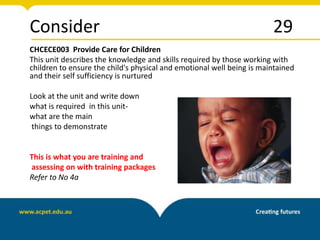
CHCECE003 Provide Care for Children
This unit describes the knowledge and skills required by those working with
children to ensure the child's physical and emotional well being is maintained
and their self sufficiency is nurtured
Look at the unit and write down
what is required in this unit-
what are the main
things to demonstrate
This is what you are training and
assessing on with training packages
Refer to No 4a
Consider 30
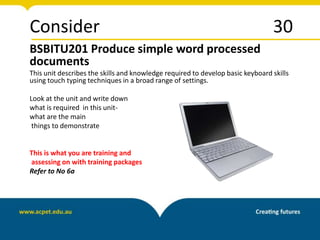
BSBITU201 Produce simple word processed
documents
This unit describes the skills and knowledge required to develop basic keyboard skills
using touch typing techniques in a broad range of settings.
Look at the unit and write down
what is required in this unit-
what are the main
things to demonstrate
This is what you are training and
assessing on with training packages
Refer to No 6a
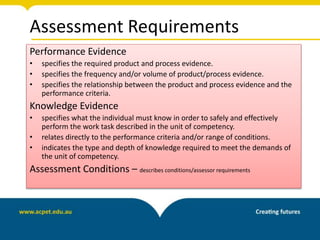
Assessment Requirements
Performance Evidence
• specifies the required product and process evidence.
• specifies the frequency and/or volume of product/process evidence.
• specifies the relationship between the product and process evidence and the
performance criteria.
Knowledge Evidence
• specifies what the individual must know in order to safely and effectively
perform the work task described in the unit of competency.
• relates directly to the performance criteria and/or range of conditions.
• indicates the type and depth of knowledge required to meet the demands of
the unit of competency.
Assessment Conditions – describes conditions/assessor requirements
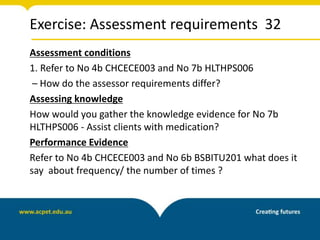
Exercise: Assessment requirements 32
Assessment conditions
1. Refer to No 4b CHCECE003 and No 7b HLTHPS006
– How do the assessor requirements differ?
Assessing knowledge
How would you gather the knowledge evidence for No 7b
HLTHPS006 - Assist clients with medication?
Performance Evidence
Refer to No 4b CHCECE003 and No 6b BSBITU201 what does it
say about frequency/ the number of times ?
Foundation Skills – language, literacy, numeracy and employability skills
that are essential to performance
• ACSF – learning, reading, writing, oral
communication and numeracy
• Core Skills for Work – Navigate the
World of work; Get the Work Done;
Interact with Others
Every Unit has Foundation Skills
Reading – what indicates reading
• appropriate documentation
• comply with directions
• follow written procedures
• interpret and monitor
Writing- what indicates writing
• complete reports
• document
• identify
• inventory
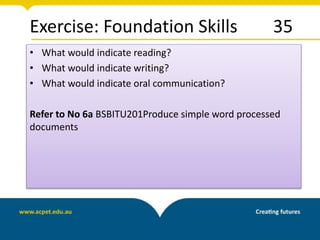
Exercise: Foundation Skills 35
• What would indicate reading?
• What would indicate writing?
• What would indicate oral communication?
Refer to No 6a BSBITU201Produce simple word processed
documents
Section 4
Unpacking training package
components to plan your
training program
Unpacking
• It is first necessary to 'unpack' the Training Package to plan
• Unpacking simply means reading & organising all the detail
in the qualifications, units & assessment requirements
• Enables trainers to develop effective learning and
assessment strategies.
Why unpack?
Unpacking results in an understanding of the:
• units of competency and their requirements
• qualification requirements Core and electives- Packaging
rules
• relationship between individual units of competency, to aid
the planning of delivery and assessment
• relationship between the qualification and its occupational
outcome.
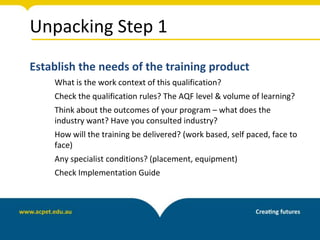
Unpacking Step 1
Establish the needs of the training product
What is the work context of this qualification?
Check the qualification rules? The AQF level & volume of learning?
Think about the outcomes of your program – what does the
industry want? Have you consulted industry?
How will the training be delivered? (work based, self paced, face to
face)
Any specialist conditions? (placement, equipment)
Check Implementation Guide
Unpacking Step 1
Implementation Guide - A mandatory work
placement has been included in several qualifications
in this training package.
CHC30113 Certificate III in Early Childhood Education
and Care 120 hours
Check -
• Learning Strategies Guide
• Knowledge Guide
• Assessment Strategies Guide
Unpacking Step 2
Identify participants’ needs
Who is this program for?
What are their skills?
Are there areas of weakness that will need to be
considered?
Where will they learn?
What do they hope to gain?
Step 2 Identify participants’ needs
• Are they workers, school leavers, mature learners or
other?
• Do they have existing skills and knowledge?
• What is their current language, literacy and numeracy
(LLN) level?
• Will they require additional support for LLN?
• Do they have special needs e.g. physical or intellectual
disability?
• Where will delivery and assessment take place?
Step 2 Identify participants’ needs
Reflection
• How will I identify participant’s needs?
Unpacking Step 3
Identify how you will organise the program
Clustered delivery & assessment?
Modes of instruction & training?
What facilities will you use?
How much time has been allocated?
Unpacking Step 3
45
The importance of mapping
You must study the units of competency and the assessment
requirements to make sure the requirements are covered. This is
best done through mapping.
• Read the unit of competency and the assessment requirement to gain a good
understanding of what is required for learning & assessment.
• Identify what needs to be taught, learnt and assessed
• Sources resources
• Decide how you will structure the program
Refer to No 8 Content Mapping and No 9 Assessment Mapping
Section 5
What does all this mean
for RTOs ?
Implications for RTOs
• Mapping of training to the units and assessment
requirements
• Amount of training & learning outlined
• Assessment requirements more specific
• Mapping of assessment tools
• Integration of Foundation Skills
• Changing resources
• Checking and mapping assessor requirements
Planning
• Refer to delivery of training and assessment
• Covering the unit of competency and the
assessment requirements
Your planning & unpacking needs to keep in
mind the Regulatory Standards.
Standards for Registered Training Organisations (RTOs) 2015
1.1 The RTO’s training and assessment strategies and
practices, including the amount of training they provide, are
consistent with the requirements of training packages and
VET accredited courses and enable each learner to meet the
requirements for each unit of competency or module in
which they are enrolled.
• Evidence on the amount of training to be provided?
• What content should you cover?
• What is the Volume of Learning for the qualification?
• Strategies and practices enable each learner to achieve
requirements.
Standards for Registered Training Organisations (RTOs) 2015
1.2 For the purposes of Clause 1.1, the RTO determines the amount
of training they provide to each learner with regard to:
• the existing skills, knowledge and the experience of the
learner;
• the mode of delivery; and
• where a full qualification is not being delivered, the number
of units and/or modules being delivered as a proportion of
the full qualification.
• Standards now require that ‘amount of training’ is determined
relative to learner’s existing skills and knowledge and mode of
delivery.
• Pretraining assessment, including LLN
Standards for Registered Training Organisations (RTOs) 2015
1.3 The RTO has, for all of its scope of registration, and consistent with its
training and assessment strategies, sufficient:
• trainers and assessors to deliver the training and assessment;
• educational and support services to meet the needs of the learner
cohort/s undertaking the training and assessment;
• learning resources to enable learners to meet the requirements for
each unit of competency, and which are accessible to the learner
regardless of location or mode of delivery; and
• facilities, whether physical or virtual, and equipment to
accommodate and support the number of learners undertaking the
training and assessment.
Standards now explicitly state that staff, facilities, resources and equipment
must be in place for the RTO’s entire scope of registration at all times.
Standards for Registered Training Organisations (RTOs) 2015
1.4 The RTO meets all requirements specified in the relevant
training package or VET accredited course.
Similar to 1.1
Follow training package requirements
Standards for Registered Training Organisations (RTOs) 2015
1.5 The RTO’s training and assessment practices are relevant
to the needs of industry and informed by industry
engagement.
• Standards now explicitly require that training and
assessment practices are informed by industry
engagement.
Standards for Registered Training Organisations (RTOs) 2015
1.6 The RTO implements a range of strategies for industry
engagement and systematically uses the outcome of that
industry engagement to ensure the industry relevance of:
its training and assessment strategies, practices and
resources; and
the current industry skills of its trainers and
assessors.
• Standards now require that the currency of trainers and
assessors industry skills be informed by industry
engagement.
Compliance issues 55
• Volume of Learning- is it enough training to cover the requirements and
to prepare for assessment
• Do not cover the unit in your training and assessment -Look at TAS,
resources, delivery plans, assessment tools
• Consistency in own documents
• Planning does not cover all the requirements – no consulting with industry
• Packaging rules are incorrect
• Codes are incorrect
• Resources not appropriate
• Assessment not based on the unit of competency requirements
• “Tick sheets” rather than assessment tools
MUST FOLLOW THE TRAINING PACKAGE
Developing training and assessment strategies
Understanding:
• Delivery and assessment strategy
• Training plan- how will you delivery, sequence, content
• Learning and assessment
• Planning
What is it?
• Essentially a plan of how you meet all the training and
assessment requirements outlined in the Training
package or curriculum document. It will be presented to
meet learner needs and reflect industry consultation.
What does it do?
• It guides the trainer
• It arranges the material to train with what suits the learner
• It lists learner needs
• It correctly lists the qualification - Codes, titles, packaging
rules
• It lists the assessment approach -matrix
• It lists the trainers
• Validation approach
Activities to be undertaken in the development of a TAS
• Determine industry requirements
• Select qualification/units of competency
• Resources needed
• Mapping assessment & content
• Determine target group needs
• Determine delivery and assessment schedule
• Determine evidence gathering/assessment method
• Validate assessment strategies
• Other details
Select a qualification
• What is on your scope?
• What units of competency can be offered?
• Industry views on packaging?
• Potential learner needs?
Development of your delivery plan (TAS) and unpacking are
linked.
Summary
• The background of training packages
• New Standards
• Components of training packages
• Unpacking the new units of competency
• The importance of foundation skills
• Unpacking new assessment requirements
• Identify compliance issues in planning
Context
Dept of Industry & Science
http://www.industry.gov.au/skills/trainingpackages/Pages/
default.aspx
• Standards for Training Packages
ASQA
• Standards for RTOs 2015
• Standards for VET Regulators
• Standards for VET Accredited Courses
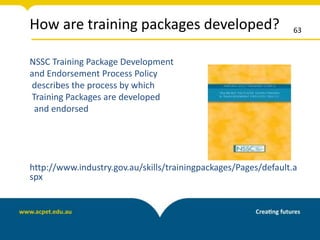
How are training packages developed?
NSSC Training Package Development
and Endorsement Process Policy
describes the process by which
Training Packages are developed
and endorsed
http://www.industry.gov.au/skills/trainingpackages/Pages/default.a
spx
63
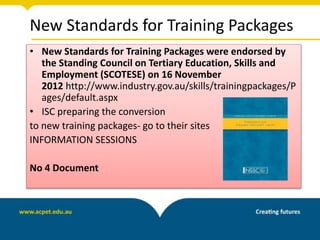
New Standards for Training Packages
• New Standards for Training Packages were endorsed by
the Standing Council on Tertiary Education, Skills and
Employment (SCOTESE) on 16 November
2012 http://www.industry.gov.au/skills/trainingpackages/P
ages/default.aspx
• ISC preparing the conversion
to new training packages- go to their sites
INFORMATION SESSIONS
No 4 Document
Getting information
Industry Skills Councils www.isc.org.au
Australian Skills Quality Authority – fact sheets
http://www.asqa.gov.au/media-and-
publications/publications.html
Training.gov.au http://training.gov.au/
The quality stamp

Unpacking a training package

  • 1.
    Unpacking a Training Packageand units of competency August 2015 Bernadette Delaney
  • 2.
    Session Aims • Understandthe development of training packages • Understand changes in training packages- New Standards • Understand the components of training packages • Interpret the new units of competency • Unpack training packages to plan your training program • Implications for RTOs • Identify compliance issues in planning
  • 3.
    Session Aims Main Points TrainingPackages have the content & standards that you train and assess against. They provide a map for your training and assessment. They demonstrate if you are compliant by providing the right training. Reflection If you teach the requirements of the training package you prepare students to be work ready.
  • 4.
    Section 1 What isa Training Package and How is it developed?
  • 5.
    What do trainingpackages describe? Training packages describe workplace standards, not training or education.
  • 6.
    What do trainingpackages describe? • Set of nationally endorsed standards, assessment requirements and qualifications • Provide guidance on what should be in your training- about competence/work ready • Provide guidance on the amount of training • Provide assessment requirements
  • 7.
    Training packages donot - • Training packages do not provide an off-the-shelf resource ready to be used for training. • Training packages provide a framework and definition of the skills required, but they do not describe how people should be trained, or provide information on delivery and funding.
  • 8.
    Understanding the developmentprocess assists in devising your training program Extensive work to research and develop TP Changes made update/reflect industry requirements TP qualifications are designed as a best fit for the job outcome All of the TP qualification to be considered in delivery & assessment
  • 9.
    What is theprocess ? SKILL NEEDS IDENTIFIED Research need, define job components, underlying knowledge, gain agreement, validation TRAINING PRODUCT DEVELOPED & ENDORSED- write units of competency & establish qualifications & rules, industry agreement, validation. Companion Volumes & resources RTOs- Develop training & assessment strategies & resources STUDENTS & EMPLOYERS – choose desired training/qualification TRAINERS deliver content & student is assessed INDUSTRY receive skills they require as graduates apply skills learnt to the workplace STUDENTS have qualifications for the workplace.
  • 10.
    Consider these qualifications10 Diploma of Leadership & Management – What does the title tell us ? – Why has the qualification title changed from the previous one? – What knowledge does a manager need? – What skills does a manager need? – What sort of environments do they work in? Refer to No 2a BSB51915 Diploma of Leadership and Management
  • 11.
    Qualifications to consider11 11 11Certificate III in Early Childhood Education & Care – What type of worker undertakes this qualification? – How responsible do they need to be? – Why are there so many core units? – What do the core units tell us ? – What sort of environments do they work in? – What are the critical things that should be assessed? Refer to No 3a CHC30113 Certificate III in Early Childhood Education and Care
  • 12.
    Changing qualifications 12 Reflection– write down your points How have the skills and knowledge changed in these two occupations over the last few years and why have they changed ? Refer to mapping information on No 2a BSB51915 and No 3a CHC30113 .
  • 13.
    Changing qualifications Reflection • Changefrom management to leadership and management. • Additional skills for managers, manager as ‘leader’. • Children’s services changed to child care educator. Over the years this has changed from child care worker to child care educator. CHCECE009 Use an approved learning framework to guide practice • HLTFA311A Apply first aid changed to HLTAID004 Provide an emergency first aid response in an education and care setting
  • 14.
    Understanding the trainingpackage qualification • You want to be able to train a manager/early childhood worker and assess that they are competent • The qualification provides groups of units of competency – CORE and ELECTIVE required • The training package unit of competency & assessment requirements provide guidance on the competence required, the foundation skills, the range of contexts in which they work and the evidence required.
  • 15.
    Section 2 Changes inTraining Packages Understanding these changes
  • 16.
    Old Style versusNew Style TRAINING PACKAGES Older Style Newer Style ENDORSED COMPONENTS • Units of Competency • Introductory information including assessment guidelines • Qualifications • Units of competency • Assessment requirements • Qualifications • Credit Arrangements NON ENDORSED COMPONENTS Support Resources Companion Volumes
  • 17.
    New Training Package Endorsed Companion Volumes Unitsof Competency Assessment Requirements Qualifications Credit Arrangements RTO Implementation Guides Learning Strategies Guide Knowledge Guide Assessment Strategies Guide
  • 18.
    Why did TrainingPackages change? • Wanted to make TP clearer and easier to use • Make a clearer work standard • Called streamlining but now refer to NEW STANDARDS FOR TRAINING PACKAGES ( not Standards for RTOs) • The set out of a unit of competency has changed • Assessment is separated and clearer • Companion volumes contain implementation information Changes related to improvements/ addressing issues
  • 19.
    Sample of endorsed‘new look’ Training Packages • AUM Automotive Manufacturing • AUR Automotive Retail, Service and Repair • BSB Business Services • CHC Community Services • FNS Financial Services • ICP Printing and Graphic Arts • ICT Information & Communications Technology • HLT Health • CUV Arts and Culture • CUA Live Performance and Entertainment • FSK Foundation Skills • TAE Training and Education • MSF Furnishing • SIF Funeral Services • RII Resources and Infrastructure • MAR Maritime
  • 20.
    Qualifications 20 • Code •Title • Description • Entry requirements optional • Packaging rules • Mapping Refer No 2a BSB51915 Diploma of Leadership and Management
  • 21.
    Companion Volumes Implementation CompanionVolume • Mapping • Imported units • Implementation information • Resources Other volumes
  • 22.
    In summary :What has changed NEW TRAINING PACKAGE Endorsed Unit of competency Assessment Requirements Qualifications Credit arrangements AND mandatory Companion Volumes- Implementation REPLACES Large volume of training package
  • 23.
    Section 3 What arethe components of new training packages ?
  • 24.
    OLDER STYLE NEWSTANDARDS Unit code/Unit title Unit code/Unit title To Application & CV Employability Skills Removed , used in FS for some TP Prerequisite units Prerequisite units (optional) Application of the unit Application/content/licensing Elements & Performance criteria Elements & Performance criteria Required skills & knowledge Embedded/Foundation Skills Evidence Guide New assessment requirements Range Statement Range of Conditions (optional) Unit mapping information Links to Companion Volume Unit descriptor
  • 25.
    OLDER ASSESSMENT NEWASSESSMENT Elements, Performance Criteria, Required Knowledge Knowledge Evidence Elements, Performance criteria, Required Skills Performance Evidence Evidence Guide: critical aspects for assessment and evidence required to demonstrate this unit of competency Assessment conditions- conditions for assessment, assessor requirements, materials, resources, physical conditions etc. Access and Equity Considerations CV Context of and specific resources for assessment Conditions & CV Method of Assessment CV Links to Companion Volume Implementation Guide
  • 26.
    Changes in TrainingPackages 26 No 4 a , 4b, No 5 documents Refer to CHCECE003 unit and assessment requirements Provide Care for Children And the old unit it replaces CHCCN302A Provide care for children . Examine the set out to see the changes .
  • 27.
    What will bein a unit of competency ELEMENTS MANDATORY FIELD Elements describe the essential outcomes. • Elements describe actions or outcomes that are demonstrable and assessable. PERFORMANCE CRITERIA MANDATORY FIELD Performance criteria describe the performance needed to demonstrate achievement of the element. 1.1 Performance criteria clearly relate to the element. 1.2 They are expressed as a standard. 1.3 They specify the required performance in relevant tasks, roles, and skills. 1.4 They reflect the applied knowledge that enables competent performance.
  • 28.
    What will bein a unit of competency FOUNDATION SKILLS MANDATORY FIELD • This section describes those language, literacy, numeracy and employment skills that are essential to performance. • Foundation skills essential to performance in this unit, but not explicit in the performance criteria are listed here, along with a brief context statement. • Where all foundation skills essential to performance in this unit are explicit in the performance criteria insert: • Foundation skills essential to performance are explicit in the performance criteria of this unit of competency.
  • 29.
    Consider 29 CHCECE003 ProvideCare for Children This unit describes the knowledge and skills required by those working with children to ensure the child's physical and emotional well being is maintained and their self sufficiency is nurtured Look at the unit and write down what is required in this unit- what are the main things to demonstrate This is what you are training and assessing on with training packages Refer to No 4a
  • 30.
    Consider 30 BSBITU201 Producesimple word processed documents This unit describes the skills and knowledge required to develop basic keyboard skills using touch typing techniques in a broad range of settings. Look at the unit and write down what is required in this unit- what are the main things to demonstrate This is what you are training and assessing on with training packages Refer to No 6a
  • 31.
    Assessment Requirements Performance Evidence •specifies the required product and process evidence. • specifies the frequency and/or volume of product/process evidence. • specifies the relationship between the product and process evidence and the performance criteria. Knowledge Evidence • specifies what the individual must know in order to safely and effectively perform the work task described in the unit of competency. • relates directly to the performance criteria and/or range of conditions. • indicates the type and depth of knowledge required to meet the demands of the unit of competency. Assessment Conditions – describes conditions/assessor requirements
  • 32.
    Exercise: Assessment requirements32 Assessment conditions 1. Refer to No 4b CHCECE003 and No 7b HLTHPS006 – How do the assessor requirements differ? Assessing knowledge How would you gather the knowledge evidence for No 7b HLTHPS006 - Assist clients with medication? Performance Evidence Refer to No 4b CHCECE003 and No 6b BSBITU201 what does it say about frequency/ the number of times ?
  • 33.
    Foundation Skills –language, literacy, numeracy and employability skills that are essential to performance • ACSF – learning, reading, writing, oral communication and numeracy • Core Skills for Work – Navigate the World of work; Get the Work Done; Interact with Others
  • 34.
    Every Unit hasFoundation Skills Reading – what indicates reading • appropriate documentation • comply with directions • follow written procedures • interpret and monitor Writing- what indicates writing • complete reports • document • identify • inventory
  • 35.
    Exercise: Foundation Skills35 • What would indicate reading? • What would indicate writing? • What would indicate oral communication? Refer to No 6a BSBITU201Produce simple word processed documents
  • 36.
    Section 4 Unpacking trainingpackage components to plan your training program
  • 37.
    Unpacking • It isfirst necessary to 'unpack' the Training Package to plan • Unpacking simply means reading & organising all the detail in the qualifications, units & assessment requirements • Enables trainers to develop effective learning and assessment strategies.
  • 38.
    Why unpack? Unpacking resultsin an understanding of the: • units of competency and their requirements • qualification requirements Core and electives- Packaging rules • relationship between individual units of competency, to aid the planning of delivery and assessment • relationship between the qualification and its occupational outcome.
  • 39.
    Unpacking Step 1 Establishthe needs of the training product What is the work context of this qualification? Check the qualification rules? The AQF level & volume of learning? Think about the outcomes of your program – what does the industry want? Have you consulted industry? How will the training be delivered? (work based, self paced, face to face) Any specialist conditions? (placement, equipment) Check Implementation Guide
  • 40.
    Unpacking Step 1 ImplementationGuide - A mandatory work placement has been included in several qualifications in this training package. CHC30113 Certificate III in Early Childhood Education and Care 120 hours Check - • Learning Strategies Guide • Knowledge Guide • Assessment Strategies Guide
  • 41.
    Unpacking Step 2 Identifyparticipants’ needs Who is this program for? What are their skills? Are there areas of weakness that will need to be considered? Where will they learn? What do they hope to gain?
  • 42.
    Step 2 Identifyparticipants’ needs • Are they workers, school leavers, mature learners or other? • Do they have existing skills and knowledge? • What is their current language, literacy and numeracy (LLN) level? • Will they require additional support for LLN? • Do they have special needs e.g. physical or intellectual disability? • Where will delivery and assessment take place?
  • 43.
    Step 2 Identifyparticipants’ needs Reflection • How will I identify participant’s needs?
  • 44.
    Unpacking Step 3 Identifyhow you will organise the program Clustered delivery & assessment? Modes of instruction & training? What facilities will you use? How much time has been allocated?
  • 45.
    Unpacking Step 3 45 Theimportance of mapping You must study the units of competency and the assessment requirements to make sure the requirements are covered. This is best done through mapping. • Read the unit of competency and the assessment requirement to gain a good understanding of what is required for learning & assessment. • Identify what needs to be taught, learnt and assessed • Sources resources • Decide how you will structure the program Refer to No 8 Content Mapping and No 9 Assessment Mapping
  • 46.
    Section 5 What doesall this mean for RTOs ?
  • 47.
    Implications for RTOs •Mapping of training to the units and assessment requirements • Amount of training & learning outlined • Assessment requirements more specific • Mapping of assessment tools • Integration of Foundation Skills • Changing resources • Checking and mapping assessor requirements
  • 48.
    Planning • Refer todelivery of training and assessment • Covering the unit of competency and the assessment requirements Your planning & unpacking needs to keep in mind the Regulatory Standards.
  • 49.
    Standards for RegisteredTraining Organisations (RTOs) 2015 1.1 The RTO’s training and assessment strategies and practices, including the amount of training they provide, are consistent with the requirements of training packages and VET accredited courses and enable each learner to meet the requirements for each unit of competency or module in which they are enrolled. • Evidence on the amount of training to be provided? • What content should you cover? • What is the Volume of Learning for the qualification? • Strategies and practices enable each learner to achieve requirements.
  • 50.
    Standards for RegisteredTraining Organisations (RTOs) 2015 1.2 For the purposes of Clause 1.1, the RTO determines the amount of training they provide to each learner with regard to: • the existing skills, knowledge and the experience of the learner; • the mode of delivery; and • where a full qualification is not being delivered, the number of units and/or modules being delivered as a proportion of the full qualification. • Standards now require that ‘amount of training’ is determined relative to learner’s existing skills and knowledge and mode of delivery. • Pretraining assessment, including LLN
  • 51.
    Standards for RegisteredTraining Organisations (RTOs) 2015 1.3 The RTO has, for all of its scope of registration, and consistent with its training and assessment strategies, sufficient: • trainers and assessors to deliver the training and assessment; • educational and support services to meet the needs of the learner cohort/s undertaking the training and assessment; • learning resources to enable learners to meet the requirements for each unit of competency, and which are accessible to the learner regardless of location or mode of delivery; and • facilities, whether physical or virtual, and equipment to accommodate and support the number of learners undertaking the training and assessment. Standards now explicitly state that staff, facilities, resources and equipment must be in place for the RTO’s entire scope of registration at all times.
  • 52.
    Standards for RegisteredTraining Organisations (RTOs) 2015 1.4 The RTO meets all requirements specified in the relevant training package or VET accredited course. Similar to 1.1 Follow training package requirements
  • 53.
    Standards for RegisteredTraining Organisations (RTOs) 2015 1.5 The RTO’s training and assessment practices are relevant to the needs of industry and informed by industry engagement. • Standards now explicitly require that training and assessment practices are informed by industry engagement.
  • 54.
    Standards for RegisteredTraining Organisations (RTOs) 2015 1.6 The RTO implements a range of strategies for industry engagement and systematically uses the outcome of that industry engagement to ensure the industry relevance of: its training and assessment strategies, practices and resources; and the current industry skills of its trainers and assessors. • Standards now require that the currency of trainers and assessors industry skills be informed by industry engagement.
  • 55.
    Compliance issues 55 •Volume of Learning- is it enough training to cover the requirements and to prepare for assessment • Do not cover the unit in your training and assessment -Look at TAS, resources, delivery plans, assessment tools • Consistency in own documents • Planning does not cover all the requirements – no consulting with industry • Packaging rules are incorrect • Codes are incorrect • Resources not appropriate • Assessment not based on the unit of competency requirements • “Tick sheets” rather than assessment tools MUST FOLLOW THE TRAINING PACKAGE
  • 56.
    Developing training andassessment strategies Understanding: • Delivery and assessment strategy • Training plan- how will you delivery, sequence, content • Learning and assessment • Planning
  • 57.
    What is it? •Essentially a plan of how you meet all the training and assessment requirements outlined in the Training package or curriculum document. It will be presented to meet learner needs and reflect industry consultation.
  • 58.
    What does itdo? • It guides the trainer • It arranges the material to train with what suits the learner • It lists learner needs • It correctly lists the qualification - Codes, titles, packaging rules • It lists the assessment approach -matrix • It lists the trainers • Validation approach
  • 59.
    Activities to beundertaken in the development of a TAS • Determine industry requirements • Select qualification/units of competency • Resources needed • Mapping assessment & content • Determine target group needs • Determine delivery and assessment schedule • Determine evidence gathering/assessment method • Validate assessment strategies • Other details
  • 60.
    Select a qualification •What is on your scope? • What units of competency can be offered? • Industry views on packaging? • Potential learner needs? Development of your delivery plan (TAS) and unpacking are linked.
  • 61.
    Summary • The backgroundof training packages • New Standards • Components of training packages • Unpacking the new units of competency • The importance of foundation skills • Unpacking new assessment requirements • Identify compliance issues in planning
  • 62.
    Context Dept of Industry& Science http://www.industry.gov.au/skills/trainingpackages/Pages/ default.aspx • Standards for Training Packages ASQA • Standards for RTOs 2015 • Standards for VET Regulators • Standards for VET Accredited Courses
  • 63.
    How are trainingpackages developed? NSSC Training Package Development and Endorsement Process Policy describes the process by which Training Packages are developed and endorsed http://www.industry.gov.au/skills/trainingpackages/Pages/default.a spx 63
  • 64.
    New Standards forTraining Packages • New Standards for Training Packages were endorsed by the Standing Council on Tertiary Education, Skills and Employment (SCOTESE) on 16 November 2012 http://www.industry.gov.au/skills/trainingpackages/P ages/default.aspx • ISC preparing the conversion to new training packages- go to their sites INFORMATION SESSIONS No 4 Document
  • 65.
    Getting information Industry SkillsCouncils www.isc.org.au Australian Skills Quality Authority – fact sheets http://www.asqa.gov.au/media-and- publications/publications.html Training.gov.au http://training.gov.au/
  • 66.

Editor's Notes

  • #6 An important point . This is why they need to be interpreted, unpacked.
  • #7 Strength of TP is that industry endorse them. They are relevant. They are the foundation of your training program.
  • #8 They must be translated into a program Don’t just repeat the unit of competency/ not suitable for students
  • #9 How are they developed Understanding this is important. Important to consider all requirements
  • #10 UNDER REVIEW By Industry Skills Councils (committee structure) Agreement from key stakeholders- based on national consultations to ensure industry relevance Research into identifying what is needed to be competent ; environmental scan, issues register, stakeholder consultation Writing & validating by industry Case for endorsement Once qualification is completed it is assumed that they are COMPETENT This is why training and assessment in TP is important
  • #11 Important to consider the qualification and the structure of core and electives
  • #12 List that these are the things we learn from the qualification.
  • #13 Change from management to leadership and management. Children’s services changed to child care educator. Over the years this has changed from child care worker to child care educator. CHCECE009 Use an approved learning framework to guide practice HLTFA311A Apply first aid changed to HLTAID004 Provide an emergency first aid response in an education and care setting
  • #14 Change from management to leadership and management. Children’s services changed to child care educator. Over the years this has changed from child care worker to child care educator. CHCECE009 Use an approved learning framework to guide practice HLTFA311A Apply first aid changed to HLTAID004 Provide an emergency first aid response in an education and care setting
  • #33 Assessment Conditions No 4b CHCECE003 Assessors must satisfy the Standards for Registered Training Organisations (RTOs) 2015/AQTF mandatory competency requirements for assessors. No 7b Assessors must satisfy the Standards for Registered Training Organisations (RTOs) 2015/AQTF mandatory competency requirements for assessors. In addition, assessors must be a registered nurse or registered enrolled nurse or registered Aboriginal and/or Torres Strait Islander health practitioner. Assessing Knowledge Unpack the requirements/Project Performance Evidence No 4b CHCECE003 at least once performed the activities outlined in the performance criteria of this unit during a period of at least 120 hours of work in at least one regulated education and care service. No 6b BSBITU201 Note: If a specific volume or frequency is not stated, then evidence must be provided at least once.
  • #34 Go through each one and explain
  • #43 Effects the design of the program
  • #48 Amount of training & learning outlined examples legislation, frameworks
  • #56 1. Don’t let learning and assessment merge