COMPETENCY
BASED CURRICULUM
Technical Educational and Skills Development
Authority
TRICIA ANN A. SODSOD
MELODY POLON
Learning Objectives
After reading this information sheet,
you must be able to:
1.define competency standard;
2.identify the parts of the Competency
Standard;
3.identify the elements and
performance criteria of your
competency;
PRE-TEST
1. The process and methodology of
creating quality learning environments
and experiences for students.
2. An alternative instructional design that
uses developed instructional materials
which are based on the needs of the
students.
OUR E E I G
M U L O F N S R U T I N
3. A curriculum that emphasizes what
learners are expected to do rather than
mainly focusing on what they are expected
to know. In principle, such a curriculum is
learner-centred and adaptive to the changing
needs of students, teachers, and society.
C M E E C Y
A E D
U R R C U U M
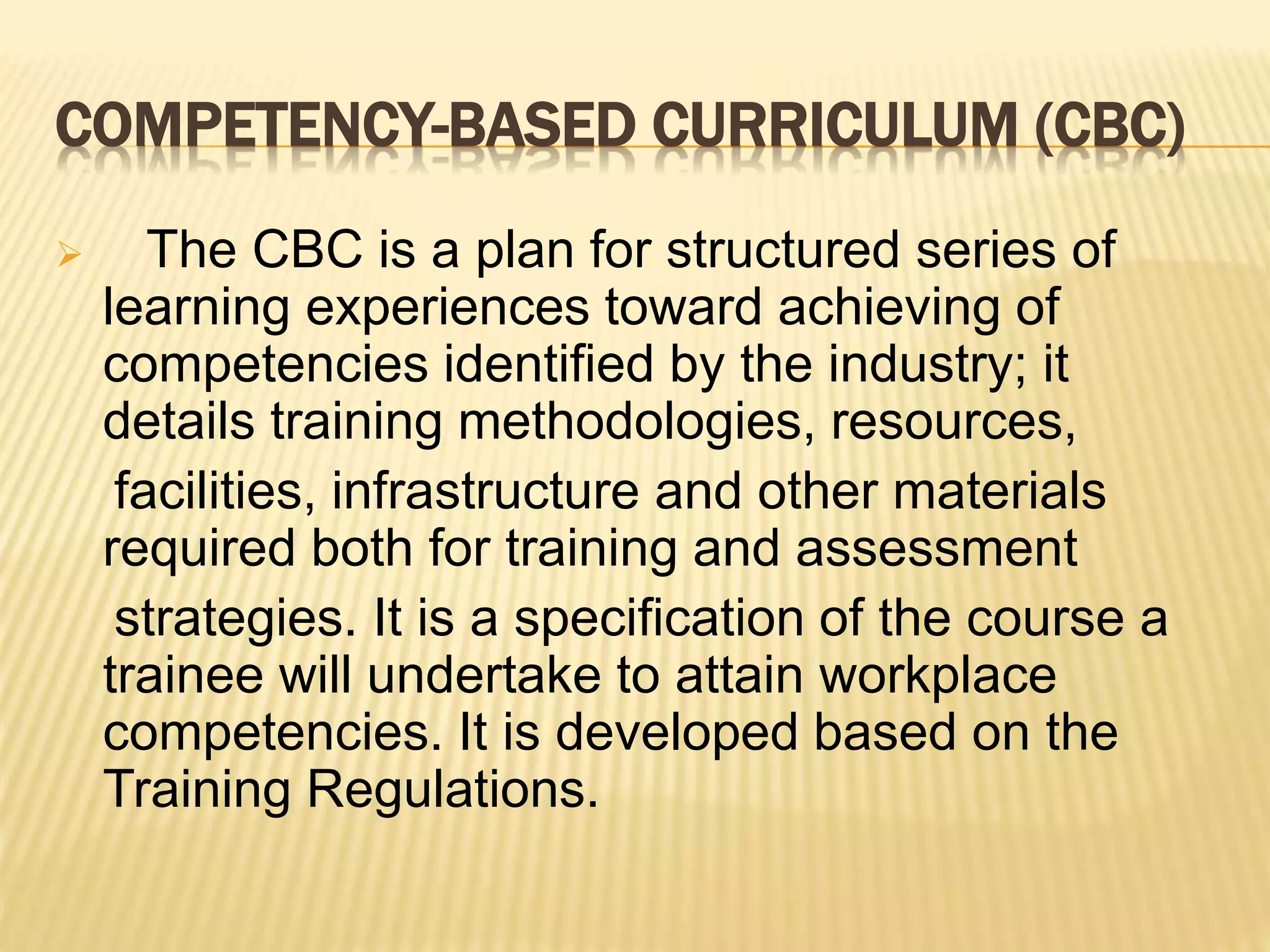
COMPETENCY-BASED CURRICULUM (CBC)
 The CBC is a plan for structured series of
learning experiences toward achieving of
competencies identified by the industry; it
details training methodologies, resources,
facilities, infrastructure and other materials
required both for training and assessment
strategies. It is a specification of the course a
trainee will undertake to attain workplace
competencies. It is developed based on the
Training Regulations.
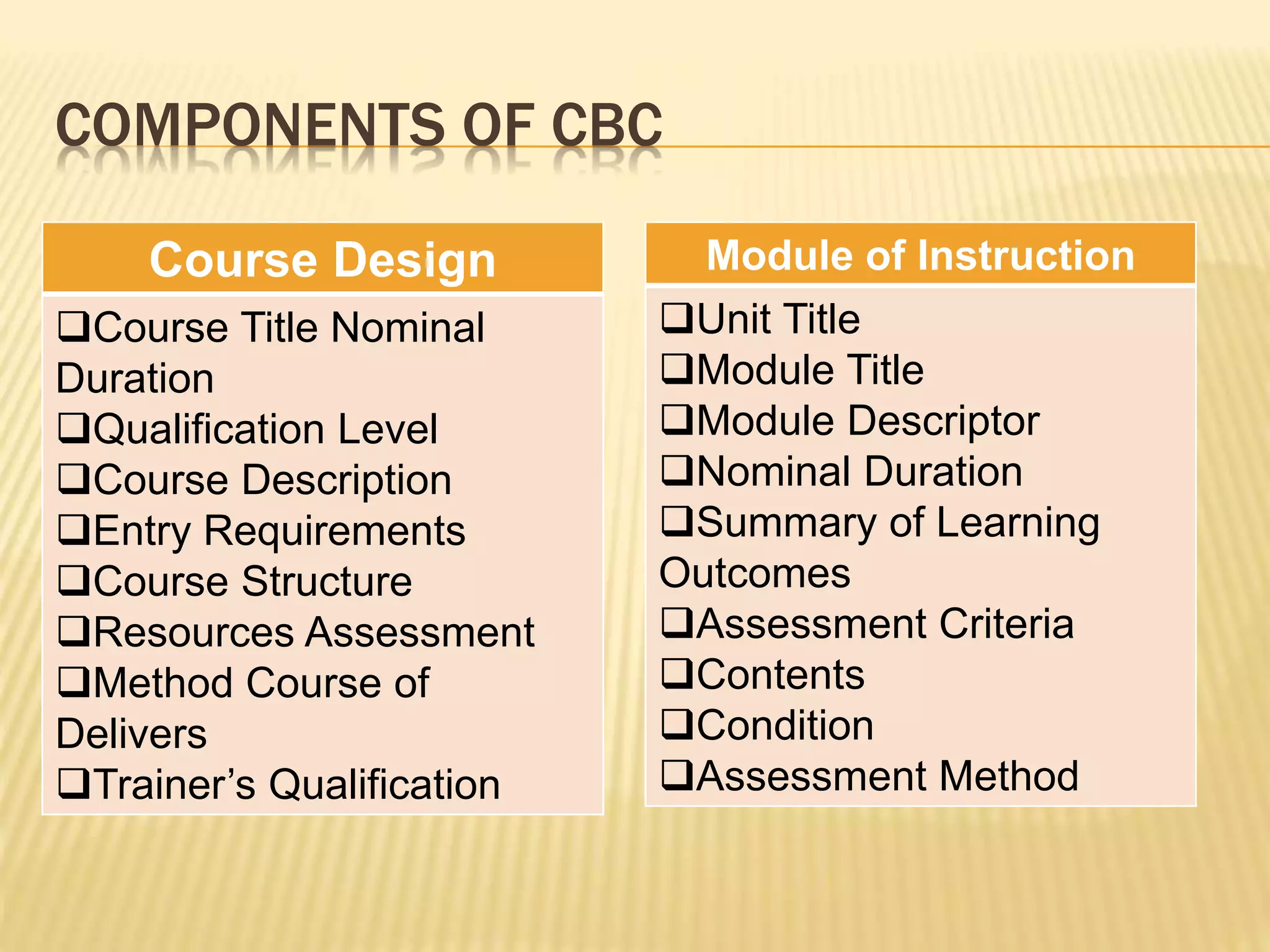
COMPONENTS OF CBC
Course Design
Course Title Nominal
Duration
Qualification Level
Course Description
Entry Requirements
Course Structure
Resources Assessment
Method Course of
Delivers
Trainer’s Qualification
Module of Instruction
Unit Title
Module Title
Module Descriptor
Nominal Duration
Summary of Learning
Outcomes
Assessment Criteria
Contents
Condition
Assessment Method
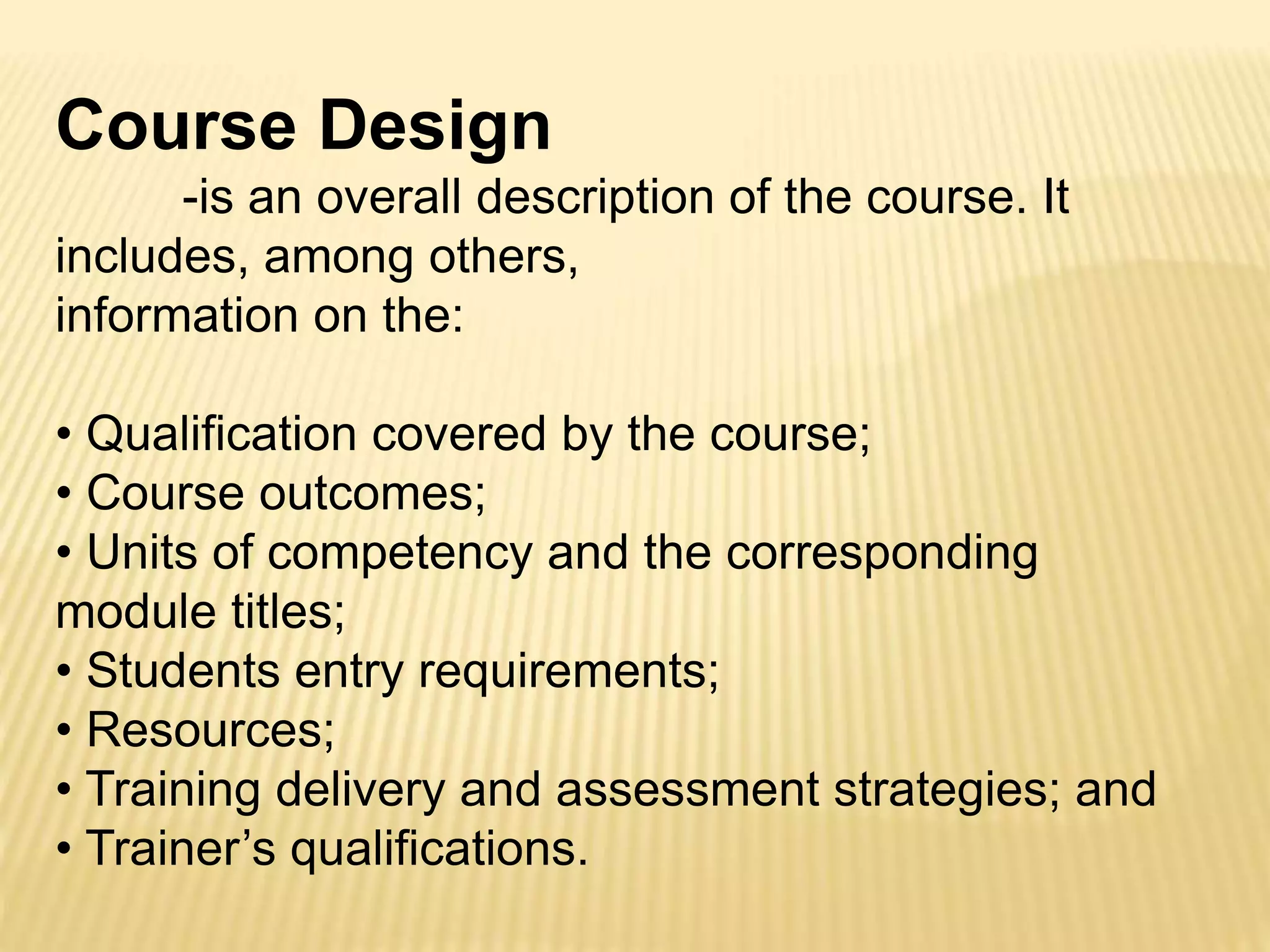
Course Design
-is an overall description of the course. It
includes, among others,
information on the:
• Qualification covered by the course;
• Course outcomes;
• Units of competency and the corresponding
module titles;
• Students entry requirements;
• Resources;
• Training delivery and assessment strategies; and
• Trainer’s qualifications.
COURSE DESIGN FORMAT
1. Course Title/ Qualification Level – a name
rising out of the qualification and NC level in
the PTTQF.
Example: Computer Hardware Servicing NC II
2. Nominal Duration – the approximate length of
time the course will be finished.
Example: 329 hours
3. Course Description – statement on the coverage
of the course, its relevance in the industry sector, and
the possible occupations the trainee will have after
completion.
Example: This course is designed to develop
knowledge, skills, and attitudes of a Computer
Technician in accordance with industry standards. It
covers basic and common competencies such as
installing, maintaining, configuring, and diagnosing
computer systems and
networks.
4. Entry Requirements – qualifications of a trainee
who intend to enter the course. These are stated as
competencies. Any physical traits must also be
stated.
Example: Student/trainee must possess the
following
qualifications:
Able to communicate both oral and written
Physically and mentally fit.
With good moral character.
Can perform basic mathematical and
logical computations.
Analytical and logical thinking.
5. Course Structure – tabulated presentation of
units of competency covered by the course and the
corresponding module title- its learning outcomes
and
nominal duration.
EXAMPLE:
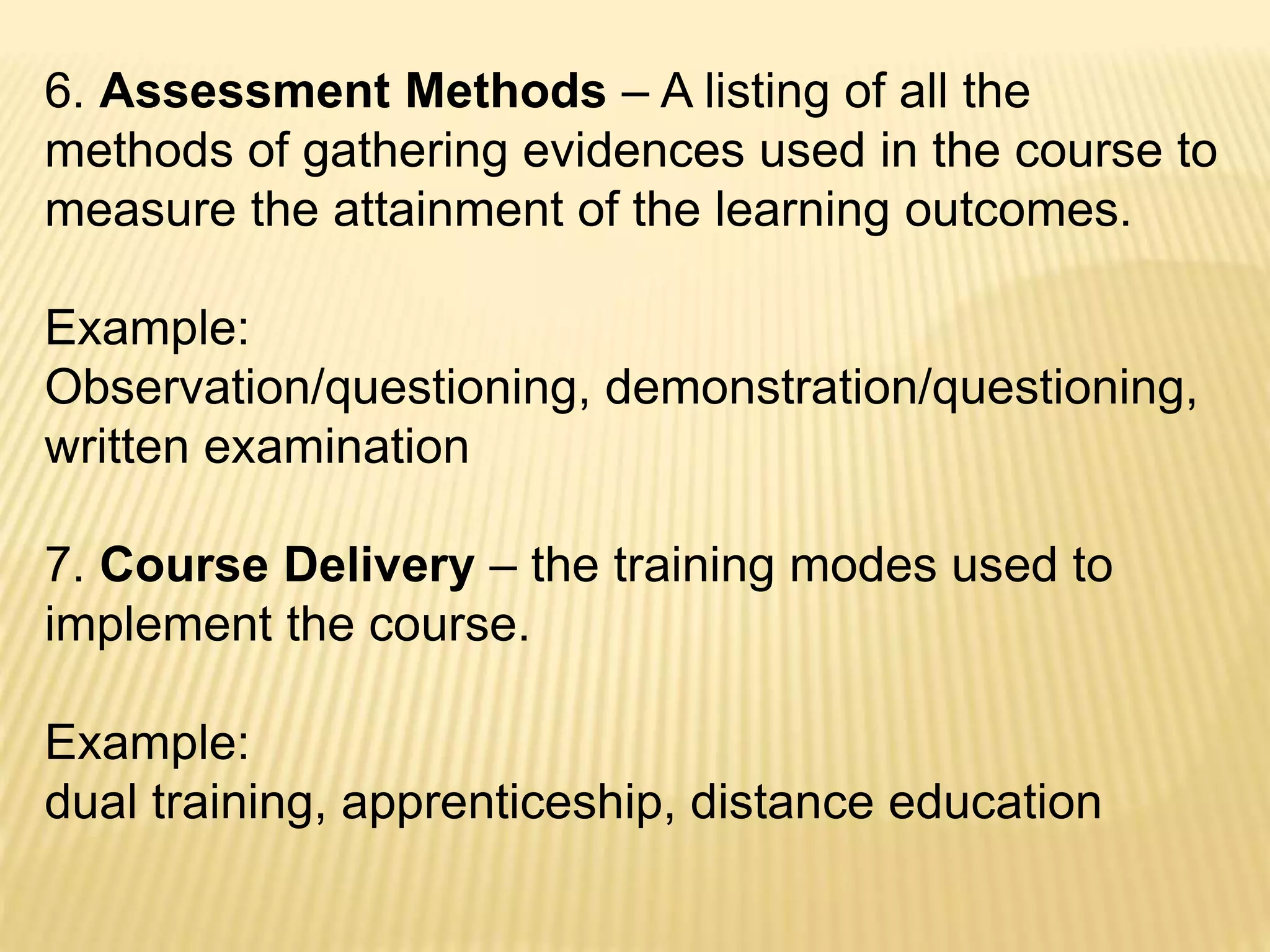
6. Assessment Methods – A listing of all the
methods of gathering evidences used in the course to
measure the attainment of the learning outcomes.
Example:
Observation/questioning, demonstration/questioning,
written examination
7. Course Delivery – the training modes used to
implement the course.
Example:
dual training, apprenticeship, distance education
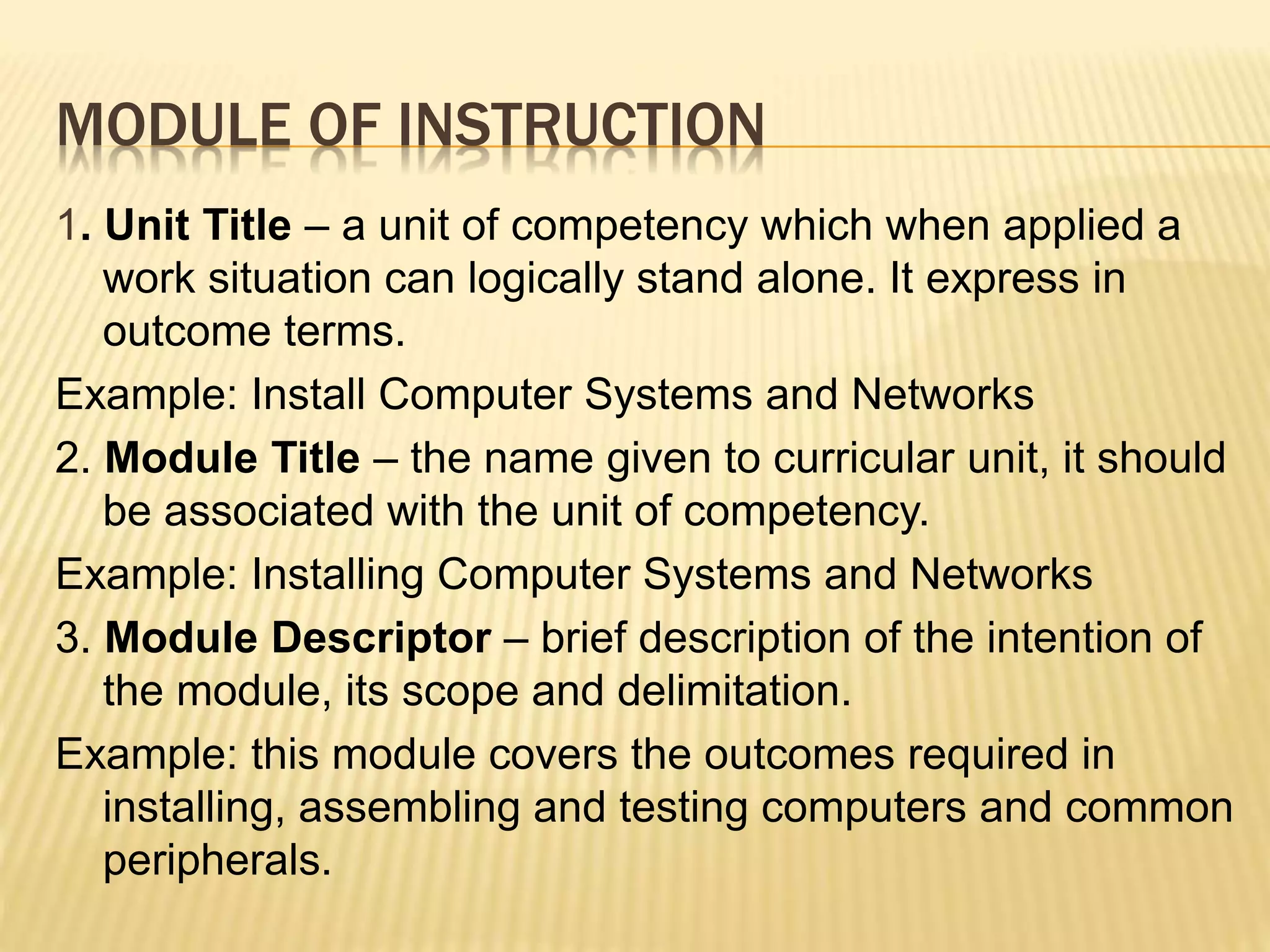
MODULE OF INSTRUCTION
1. Unit Title – a unit of competency which when applied a
work situation can logically stand alone. It express in
outcome terms.
Example: Install Computer Systems and Networks
2. Module Title – the name given to curricular unit, it should
be associated with the unit of competency.
Example: Installing Computer Systems and Networks
3. Module Descriptor – brief description of the intention of
the module, its scope and delimitation.
Example: this module covers the outcomes required in
installing, assembling and testing computers and common
peripherals.
4. Nominal Duration- estimated/suggested number
of training hours per module (time to achieve the
module).
Example: 60 hours
5. Learning Outcome – it is a statement that
specifies what learner will be able to do as result of
the learning process; it should be written in an action
statement, begins with action verb plus the object of
the action.
Example: LO1. Plan and prepare installation LO2.
Install equipment/device system
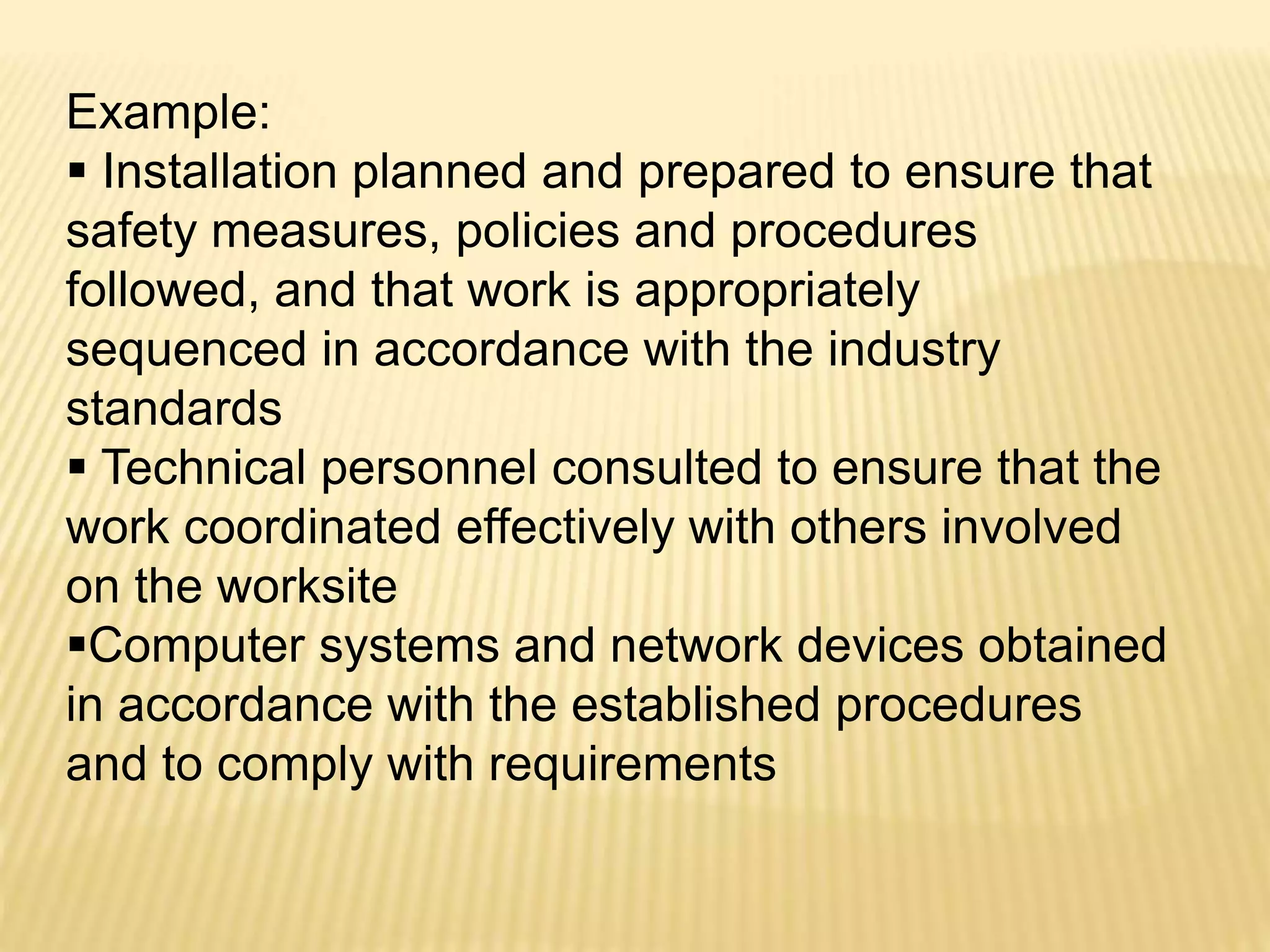
Example:
 Installation planned and prepared to ensure that
safety measures, policies and procedures
followed, and that work is appropriately
sequenced in accordance with the industry
standards
 Technical personnel consulted to ensure that the
work coordinated effectively with others involved
on the worksite
Computer systems and network devices obtained
in accordance with the established procedures
and to comply with requirements
6. Assessment Criteria – list of
criteria by which the achievement of
the learning outcome will be judged
based on evidence; specify the
performance outcome the learner will
be expected to demonstrate at the
conclusion of the learning outcome.
7. Content – list of specific knowledge, skills, attitudes
and safety that are necessary in order to achieve the
specific learning outcomes.
Example:
• Safety procedures
• Basic terms, concepts, functions and characteristics
of PC Hardware components
• Structure of operating systems
• Familiarization with the various computer systems’
Components and peripherals
• system configuration/ settings of computer systems
and Devices
8. Conditions – specifies the context of the training,
this include list of tools and equipment, access to
learning resources and equipment manuals, and
types of facility.
Example: The students/trainees must be provided
with the following:
Personal Protective equipment ( ex. protective
eyewear, anti static wrist wrap)
Electronic laboratory hand tools (assorted pliers,
assorted screw drivers, soldering iron &
desoldering tool)
9. Methodologies – one or combinations of different
learning approaches, methods and techniques to deliver
learning activity/ies which are consistent
with CBT principles.
Example: Lecture-demonstration, self-paced, group
discussion
10. Assessment Method – the methods used to gather
evidences of sufficient quantity on which to make sound
judgment about trainee’s competency; assessment
methods include observation, demonstration/simulation,
questioning and written test
.
Example: Demonstration with questioning, written
examination
SELF CHECK 1.1-4
1. The specifications of a qualification – the
methodologies, resources, facilities, infrastructure and
other materials required both for training and
assessment strategies is the
A. Competency Standards B. Qualification Title
C. Training Regulations D. Competency Based
Curriculum
2. This is a statement of one or combinations of different
learning approaches, methods and techniques to
deliver learning activity/ies for the qualification which
are consistent with CBT principles.
A. Conditions B. contents
C. methodologies D. learning outcomes
3. The statement on the coverage of the course, its
relevance in the industry sector, and the possible
occupations the trainee will have after completion is
written in the
A. Assessment criteria
B. Course content
C. Course descriptor
D. Course title
4. This part of the CBC specifies the performance
outcome the learner will be expected to demonstrate at
the conclusion of the learning outcome.
A. Assessment criteria
B. Course content
C. Learning outcome
D. Performance criteria
5. What part of the CBC specifies the context of the
training, this include list of tools and equipment, access
to learning resources and equipment manuals,
and types of facility?
A. content
B. outline
C. condition
D. descriptor
6. It is a statement that specifies what learner will be
able to do as result of the learning process. It is written
in
A. Assessment criteria
B. Learning outcome
C. Module content
D. Module descriptor
KEY TO CORRECTION
 PRE-TEST
1.
2.
3.
C O U R S E D E S I G N
M O D U L E O F I N S T R U C T I O N
C U R R I C U L U M
B A S E D
C O M P E T E N C Y
 SELF CHECK
1. D
2. C
3. C
4. A
5. C
6. B
KEY TO CORRECTION
COMPETENCY-BASED-CURRICULUM-REPORT (1).pptx

COMPETENCY-BASED-CURRICULUM-REPORT (1).pptx

  • 1.
    COMPETENCY BASED CURRICULUM Technical Educationaland Skills Development Authority TRICIA ANN A. SODSOD MELODY POLON
  • 2.
    Learning Objectives After readingthis information sheet, you must be able to: 1.define competency standard; 2.identify the parts of the Competency Standard; 3.identify the elements and performance criteria of your competency;
  • 3.
    PRE-TEST 1. The processand methodology of creating quality learning environments and experiences for students. 2. An alternative instructional design that uses developed instructional materials which are based on the needs of the students. OUR E E I G M U L O F N S R U T I N
  • 4.
    3. A curriculumthat emphasizes what learners are expected to do rather than mainly focusing on what they are expected to know. In principle, such a curriculum is learner-centred and adaptive to the changing needs of students, teachers, and society. C M E E C Y A E D U R R C U U M
  • 5.
    COMPETENCY-BASED CURRICULUM (CBC) The CBC is a plan for structured series of learning experiences toward achieving of competencies identified by the industry; it details training methodologies, resources, facilities, infrastructure and other materials required both for training and assessment strategies. It is a specification of the course a trainee will undertake to attain workplace competencies. It is developed based on the Training Regulations.
  • 6.
    COMPONENTS OF CBC CourseDesign Course Title Nominal Duration Qualification Level Course Description Entry Requirements Course Structure Resources Assessment Method Course of Delivers Trainer’s Qualification Module of Instruction Unit Title Module Title Module Descriptor Nominal Duration Summary of Learning Outcomes Assessment Criteria Contents Condition Assessment Method
  • 7.
    Course Design -is anoverall description of the course. It includes, among others, information on the: • Qualification covered by the course; • Course outcomes; • Units of competency and the corresponding module titles; • Students entry requirements; • Resources; • Training delivery and assessment strategies; and • Trainer’s qualifications.
  • 8.
    COURSE DESIGN FORMAT 1.Course Title/ Qualification Level – a name rising out of the qualification and NC level in the PTTQF. Example: Computer Hardware Servicing NC II 2. Nominal Duration – the approximate length of time the course will be finished. Example: 329 hours
  • 9.
    3. Course Description– statement on the coverage of the course, its relevance in the industry sector, and the possible occupations the trainee will have after completion. Example: This course is designed to develop knowledge, skills, and attitudes of a Computer Technician in accordance with industry standards. It covers basic and common competencies such as installing, maintaining, configuring, and diagnosing computer systems and networks. 4. Entry Requirements – qualifications of a trainee who intend to enter the course. These are stated as competencies. Any physical traits must also be stated.
  • 10.
    Example: Student/trainee mustpossess the following qualifications: Able to communicate both oral and written Physically and mentally fit. With good moral character. Can perform basic mathematical and logical computations. Analytical and logical thinking. 5. Course Structure – tabulated presentation of units of competency covered by the course and the corresponding module title- its learning outcomes and nominal duration.
  • 11.
  • 12.
    6. Assessment Methods– A listing of all the methods of gathering evidences used in the course to measure the attainment of the learning outcomes. Example: Observation/questioning, demonstration/questioning, written examination 7. Course Delivery – the training modes used to implement the course. Example: dual training, apprenticeship, distance education
  • 13.
    MODULE OF INSTRUCTION 1.Unit Title – a unit of competency which when applied a work situation can logically stand alone. It express in outcome terms. Example: Install Computer Systems and Networks 2. Module Title – the name given to curricular unit, it should be associated with the unit of competency. Example: Installing Computer Systems and Networks 3. Module Descriptor – brief description of the intention of the module, its scope and delimitation. Example: this module covers the outcomes required in installing, assembling and testing computers and common peripherals.
  • 14.
    4. Nominal Duration-estimated/suggested number of training hours per module (time to achieve the module). Example: 60 hours 5. Learning Outcome – it is a statement that specifies what learner will be able to do as result of the learning process; it should be written in an action statement, begins with action verb plus the object of the action. Example: LO1. Plan and prepare installation LO2. Install equipment/device system
  • 15.
    Example:  Installation plannedand prepared to ensure that safety measures, policies and procedures followed, and that work is appropriately sequenced in accordance with the industry standards  Technical personnel consulted to ensure that the work coordinated effectively with others involved on the worksite Computer systems and network devices obtained in accordance with the established procedures and to comply with requirements
  • 16.
    6. Assessment Criteria– list of criteria by which the achievement of the learning outcome will be judged based on evidence; specify the performance outcome the learner will be expected to demonstrate at the conclusion of the learning outcome.
  • 17.
    7. Content –list of specific knowledge, skills, attitudes and safety that are necessary in order to achieve the specific learning outcomes. Example: • Safety procedures • Basic terms, concepts, functions and characteristics of PC Hardware components • Structure of operating systems • Familiarization with the various computer systems’ Components and peripherals • system configuration/ settings of computer systems and Devices
  • 18.
    8. Conditions –specifies the context of the training, this include list of tools and equipment, access to learning resources and equipment manuals, and types of facility. Example: The students/trainees must be provided with the following: Personal Protective equipment ( ex. protective eyewear, anti static wrist wrap) Electronic laboratory hand tools (assorted pliers, assorted screw drivers, soldering iron & desoldering tool)
  • 19.
    9. Methodologies –one or combinations of different learning approaches, methods and techniques to deliver learning activity/ies which are consistent with CBT principles. Example: Lecture-demonstration, self-paced, group discussion 10. Assessment Method – the methods used to gather evidences of sufficient quantity on which to make sound judgment about trainee’s competency; assessment methods include observation, demonstration/simulation, questioning and written test . Example: Demonstration with questioning, written examination
  • 20.
    SELF CHECK 1.1-4 1.The specifications of a qualification – the methodologies, resources, facilities, infrastructure and other materials required both for training and assessment strategies is the A. Competency Standards B. Qualification Title C. Training Regulations D. Competency Based Curriculum 2. This is a statement of one or combinations of different learning approaches, methods and techniques to deliver learning activity/ies for the qualification which are consistent with CBT principles. A. Conditions B. contents C. methodologies D. learning outcomes
  • 21.
    3. The statementon the coverage of the course, its relevance in the industry sector, and the possible occupations the trainee will have after completion is written in the A. Assessment criteria B. Course content C. Course descriptor D. Course title 4. This part of the CBC specifies the performance outcome the learner will be expected to demonstrate at the conclusion of the learning outcome. A. Assessment criteria B. Course content C. Learning outcome D. Performance criteria
  • 22.
    5. What partof the CBC specifies the context of the training, this include list of tools and equipment, access to learning resources and equipment manuals, and types of facility? A. content B. outline C. condition D. descriptor 6. It is a statement that specifies what learner will be able to do as result of the learning process. It is written in A. Assessment criteria B. Learning outcome C. Module content D. Module descriptor
  • 23.
    KEY TO CORRECTION PRE-TEST 1. 2. 3. C O U R S E D E S I G N M O D U L E O F I N S T R U C T I O N C U R R I C U L U M B A S E D C O M P E T E N C Y
  • 24.
     SELF CHECK 1.D 2. C 3. C 4. A 5. C 6. B KEY TO CORRECTION