KMS2014
Design & Management of
 Training Programmes
Objectives:
At the end of this unit, you will be able to:
   do course selection
   develop courses
   define subject and describe aims
   identify course content
   write trainer's guide and student materials
   run pilot course
   identify criteria used to determine course content
Introduction:

   Having established that training is appropriate for the
    identified needs, the next step is to find courses that
    meet the needs
   We have to make choices whether to buy or develop
    courses that meet the needs
   Developing a course from scratch can be both
    expensive and time consuming
   Even purchasing a course that exactly match all the
    requirements is not as easy as it sounds
   Therefore, one has to adopt a systematic approach
    to address the issues in designing a curriculum or
    course to meet the needs of the learners
Training Curriculum and Content
                Development Issues:

   Trainees - entry behaviors, needs and
    characteristics
   Course content - identification, structure,
    sequencing, timing
   Expertise - subject matter and the trainers,
    their roles
   Approaches - methods and media
   Logistics - registration issues etc.
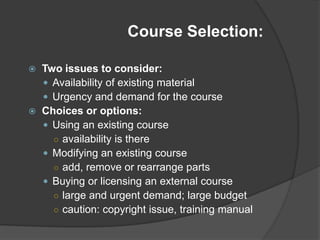
Course Selection:

   Two issues to consider:
     Availability of existing material
     Urgency and demand for the course
   Choices or options:
     Using an existing course
      ○ availability is there
     Modifying an existing course
      ○ add, remove or rearrange parts
     Buying or licensing an external course
      ○ large and urgent demand; large budget
      ○ caution: copyright issue, training manual
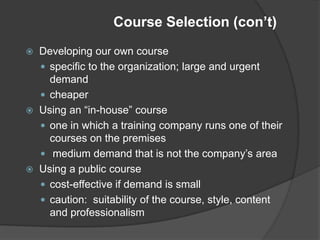
Course Selection (con’t)
   Developing our own course
     specific to the organization; large and urgent
      demand
     cheaper
   Using an “in-house” course
     one in which a training company runs one of their
      courses on the premises
     medium demand that is not the company’s area
   Using a public course
     cost-effective if demand is small
     caution: suitability of the course, style, content
      and professionalism
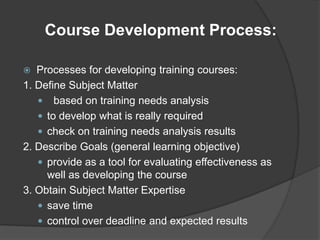
Course Development Process:

  Processes for developing training courses:
1. Define Subject Matter
    based on training needs analysis
    to develop what is really required
    check on training needs analysis results
2. Describe Goals (general learning objective)
    provide as a tool for evaluating effectiveness as
     well as developing the course
3. Obtain Subject Matter Expertise
    save time
    control over deadline and expected results
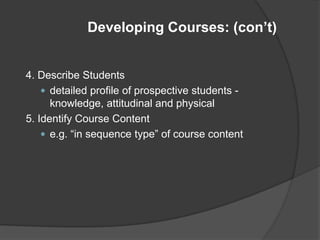
Developing Courses: (con’t)


4. Describe Students
     detailed profile of prospective students -
      knowledge, attitudinal and physical
5. Identify Course Content
     e.g. “in sequence type” of course content
Developing Courses: (con’t)

6. Structure Course Content
 determine structure and timing
A.) Timing
 estimate duration by:
    estimate the duration of individual components and
      add them up
    start a fixed time and see what we can fit in
 be aware of limitations and consequences
 factors to consider:
    student’s current state of knowledge
    training methodology
    content of the course
Developing Courses: (con’t)
B.) Sequence
 Factors to consider:
    dependencies or prerequisites?
    to be learnt now?
    can be learnt at the same time?
 Check for logical sequence/logical flow:
    simple to complex or vice versa
    general to specific or vice versa
    concrete to abstract or vice versa
 Once sequence and flow are decided then we have a
   course agenda
Developing Courses: (con’t)

7. Write Objectives and Tests
   A.) Write Objectives
     ○ Behavior
     ○ Conditions
     ○ Standard
   B.) Writing Tests
     ○ does not need to be an exam
     ○ should be able to observe the desired behavior
     ○ see whether training has been achieved
Developing Courses: (con’t)

8. Choose Methods and Media
    Issues to Consider:
   A.) “Best” training methods
     ○ “trainer led” or “self directed”
     ○ specific to general or vice versa
     ○ case study or a real-life example
   B.) Giving freedom of choice to the trainees
     ○ construct a course map that has alternative
        routes through the course
Developing Courses: (con’t)

C.) The issue of training technologies
     ○ “only way to train”?
     ○ will never be one “best” medium
D.) Focus our attention to the trainees
E.) Which methods and media -
     ○ most suitable for each part of the course?
     ○ best courses have a wide range of media and
       learning experiences
Developing Courses: (con’t)

9. Write trainer’s guide and student materials
A.) Trainer’s Guide
   1. course objectives
   2. course program
   3. course prerequisite
   4. course pre-work
   5. number of training and break-out room required
   6. list of student materials
   7. list of equipment required
Developing Courses: (con’t)

8.  list of audio-visual materials (transparencies,
    posters, prepared flip chart, slides, audiotapes and
    videotapes)
9. room layout
10. preparation notes for each session
11. lessons plans for each session
 The structure of the trainer’s guide is not necessarily
   in this order
Developing Courses: (con’t)

B.) Lesson plans
     ○ detailed timings, structure and activities
10. Preparing Visual Aids
     ○ if necessary?

11. Peer Assignment
     ○ spot the flaws, annoying inconsistencies and
       irritating errors
Developing Courses: (con’t)
12. Run Pilot Course(s)
 are test “flight” for newly developed courses
a.) first test : developmental test to get all the mistakes out
   of the course
b.) second pilot course: should have students who are
   representatives of the target population
 feedback from invited stakeholders
     take note of the difficulties or problems
     get students fill in a written feedback
     discussion
     work with trainers on how to change, amend and
       revise
An Example of Course
                        Development

   Background
     company with full and contract employees
     full time employees have started to immerse into the
      culture and language of TQM
     company realized that contract staff are being
      isolated because they have no understanding of the
      language and processes of TQM
     therefore a one day overview of TQM was decided
Example Course Dev’t (con’t)
1. Defining the Subject
    What Total Quality Management is all about
2. Describing the Aims
    to allow the medium term contractors to participate
     in quality circles
3. Obtaining Subject Matter Expertise
    training analyst who has been training the full
     course for two years
4. Describing the Students
    medium-term contractors with concerns about being
     treated differently from full time staff and whether
     there would be another contract after the current
     one expires
Example Course Dev’t (con’t)

   may not have the same loyalty but they have a
    professional approach
   might be easier to communicate “customer awareness”
   with electric/electronic, software or mechanical
    backgrounds and would not appreciate a “wordy”
    approach or put up with a significant amount of reading
   are in good health with normal hearing and sight (good
    color vision)
   may have done business studies courses at university
    or polytechnic; the subject matter will be new to most of
    them
Example Course Dev’t (con’t)
5. Identify the Course Content
     check for familiar topics and advanced topics
6. Structuring the Content
 Choosing the modules for the course
Example Course Dev’t (con’t)

7. Choosing the Methods and the Media
     ○ trainer presentation and student exercises
     ○ short excerpts from videos
     ○ tape/slide presentation put on to video
Example Course Dev’t (con’t)


8. Writing the Objectives and Tests
 Any idea how the objective should sound like for this
   TQM programme?
 How about the test?
Example Course Dev’t (con’t)

9. Writing the Trainer’s Guide and Student’s Materials
 Student’s guide and student materials:
    E.g. a booklet which had a section for each of the
     module
10. Preparing the Visual Aids
    Trainers should identify the suitable visual aid for the
     TQM training
Example Course Dev’t (con’t)

11. Peer Assessment
    materials were given to a new trainer to review
    colleagues review the course at every stage of its
     development
12. Running the Pilot Course
    e.g. new trainer: made observations of the training
     process and the student’s reactions

Unit 5 updated

  • 1.
    KMS2014 Design & Managementof Training Programmes
  • 2.
    Objectives: At the endof this unit, you will be able to:  do course selection  develop courses  define subject and describe aims  identify course content  write trainer's guide and student materials  run pilot course  identify criteria used to determine course content
  • 3.
    Introduction:  Having established that training is appropriate for the identified needs, the next step is to find courses that meet the needs  We have to make choices whether to buy or develop courses that meet the needs  Developing a course from scratch can be both expensive and time consuming  Even purchasing a course that exactly match all the requirements is not as easy as it sounds  Therefore, one has to adopt a systematic approach to address the issues in designing a curriculum or course to meet the needs of the learners
  • 4.
    Training Curriculum andContent Development Issues:  Trainees - entry behaviors, needs and characteristics  Course content - identification, structure, sequencing, timing  Expertise - subject matter and the trainers, their roles  Approaches - methods and media  Logistics - registration issues etc.
  • 5.
    Course Selection:  Two issues to consider:  Availability of existing material  Urgency and demand for the course  Choices or options:  Using an existing course ○ availability is there  Modifying an existing course ○ add, remove or rearrange parts  Buying or licensing an external course ○ large and urgent demand; large budget ○ caution: copyright issue, training manual
  • 6.
    Course Selection (con’t)  Developing our own course  specific to the organization; large and urgent demand  cheaper  Using an “in-house” course  one in which a training company runs one of their courses on the premises  medium demand that is not the company’s area  Using a public course  cost-effective if demand is small  caution: suitability of the course, style, content and professionalism
  • 7.
    Course Development Process:  Processes for developing training courses: 1. Define Subject Matter  based on training needs analysis  to develop what is really required  check on training needs analysis results 2. Describe Goals (general learning objective)  provide as a tool for evaluating effectiveness as well as developing the course 3. Obtain Subject Matter Expertise  save time  control over deadline and expected results
  • 8.
    Developing Courses: (con’t) 4.Describe Students  detailed profile of prospective students - knowledge, attitudinal and physical 5. Identify Course Content  e.g. “in sequence type” of course content
  • 9.
    Developing Courses: (con’t) 6.Structure Course Content  determine structure and timing A.) Timing  estimate duration by:  estimate the duration of individual components and add them up  start a fixed time and see what we can fit in  be aware of limitations and consequences  factors to consider:  student’s current state of knowledge  training methodology  content of the course
  • 10.
    Developing Courses: (con’t) B.)Sequence  Factors to consider:  dependencies or prerequisites?  to be learnt now?  can be learnt at the same time?  Check for logical sequence/logical flow:  simple to complex or vice versa  general to specific or vice versa  concrete to abstract or vice versa  Once sequence and flow are decided then we have a course agenda
  • 11.
    Developing Courses: (con’t) 7.Write Objectives and Tests A.) Write Objectives ○ Behavior ○ Conditions ○ Standard B.) Writing Tests ○ does not need to be an exam ○ should be able to observe the desired behavior ○ see whether training has been achieved
  • 12.
    Developing Courses: (con’t) 8.Choose Methods and Media  Issues to Consider: A.) “Best” training methods ○ “trainer led” or “self directed” ○ specific to general or vice versa ○ case study or a real-life example B.) Giving freedom of choice to the trainees ○ construct a course map that has alternative routes through the course
  • 13.
    Developing Courses: (con’t) C.)The issue of training technologies ○ “only way to train”? ○ will never be one “best” medium D.) Focus our attention to the trainees E.) Which methods and media - ○ most suitable for each part of the course? ○ best courses have a wide range of media and learning experiences
  • 14.
    Developing Courses: (con’t) 9.Write trainer’s guide and student materials A.) Trainer’s Guide 1. course objectives 2. course program 3. course prerequisite 4. course pre-work 5. number of training and break-out room required 6. list of student materials 7. list of equipment required
  • 15.
    Developing Courses: (con’t) 8. list of audio-visual materials (transparencies, posters, prepared flip chart, slides, audiotapes and videotapes) 9. room layout 10. preparation notes for each session 11. lessons plans for each session  The structure of the trainer’s guide is not necessarily in this order
  • 16.
    Developing Courses: (con’t) B.)Lesson plans ○ detailed timings, structure and activities 10. Preparing Visual Aids ○ if necessary? 11. Peer Assignment ○ spot the flaws, annoying inconsistencies and irritating errors
  • 17.
    Developing Courses: (con’t) 12.Run Pilot Course(s)  are test “flight” for newly developed courses a.) first test : developmental test to get all the mistakes out of the course b.) second pilot course: should have students who are representatives of the target population  feedback from invited stakeholders  take note of the difficulties or problems  get students fill in a written feedback  discussion  work with trainers on how to change, amend and revise
  • 18.
    An Example ofCourse Development  Background  company with full and contract employees  full time employees have started to immerse into the culture and language of TQM  company realized that contract staff are being isolated because they have no understanding of the language and processes of TQM  therefore a one day overview of TQM was decided
  • 19.
    Example Course Dev’t(con’t) 1. Defining the Subject  What Total Quality Management is all about 2. Describing the Aims  to allow the medium term contractors to participate in quality circles 3. Obtaining Subject Matter Expertise  training analyst who has been training the full course for two years 4. Describing the Students  medium-term contractors with concerns about being treated differently from full time staff and whether there would be another contract after the current one expires
  • 20.
    Example Course Dev’t(con’t)  may not have the same loyalty but they have a professional approach  might be easier to communicate “customer awareness”  with electric/electronic, software or mechanical backgrounds and would not appreciate a “wordy” approach or put up with a significant amount of reading  are in good health with normal hearing and sight (good color vision)  may have done business studies courses at university or polytechnic; the subject matter will be new to most of them
  • 21.
    Example Course Dev’t(con’t) 5. Identify the Course Content  check for familiar topics and advanced topics 6. Structuring the Content  Choosing the modules for the course
  • 22.
    Example Course Dev’t(con’t) 7. Choosing the Methods and the Media ○ trainer presentation and student exercises ○ short excerpts from videos ○ tape/slide presentation put on to video
  • 23.
    Example Course Dev’t(con’t) 8. Writing the Objectives and Tests  Any idea how the objective should sound like for this TQM programme?  How about the test?
  • 24.
    Example Course Dev’t(con’t) 9. Writing the Trainer’s Guide and Student’s Materials  Student’s guide and student materials:  E.g. a booklet which had a section for each of the module 10. Preparing the Visual Aids  Trainers should identify the suitable visual aid for the TQM training
  • 25.
    Example Course Dev’t(con’t) 11. Peer Assessment  materials were given to a new trainer to review  colleagues review the course at every stage of its development 12. Running the Pilot Course  e.g. new trainer: made observations of the training process and the student’s reactions