How can we meet the complex learning needs of students in a standards based environment?In brief, how can we achieve standards without becoming standardized?
What Are Power Standards?Prioritized standards that are derived from a systematic and balanced approach to distinguishing which standards are absolutely essential and which ones are simply “nice to know”A subset of the complete list of standards for each grade or subject area and represent the “safety net” curriculum.
Power Standards Are:The standards that each teacher needs to make sure that every student learns prior to leaving the current grade.A brief, straightforward, easy to read document to guide standards based instruction
2 Guiding Questions…1.)  What essential understandings and skills do students need2.)  Which standards can be clustered or incorporated into others
Why Power Standards?Most teachers lack a 400 day school year and students with photographic memories and there are too many standardsPower Standards narrow the focus of academic requirements In striving to cover all standards, we end up superficially “covering” the standards like a wet blanketThe “less is more” theory
Why Power Standards?Power standards do not relieve teachers of the responsibility for teaching all standards and indicators, but does identify which standards are critical for student success and which ones can be given less emphasisIn the absence of Power Standards, teachers will select their own
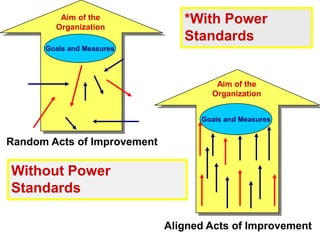
Aim of the OrganizationAim of theOrganizationGoals and MeasuresGoals and MeasuresAligned Acts of Improvement*With Power StandardsRandom Acts of ImprovementWithout Power Standards
A word about assessmentWithout a link to assessment (not one shot state tests, but to the daily practice of classroom assessment, along with feedback, coaching) standards are little more than colorful wall chartsBecause high stakes testing is aligned to standards, standards have become the critical focus for achieving results
Assessments…Meaningful assessments need to be tied to the Power StandardsThese assessments provide the evidence of student attainment of power standardsStudents should be given multiple opportunities to demonstrate proficiency (in a variety of ways; multiple intelligence/learning styles)Resulting data should be systematically collected, examined, reported and used to improve instruction.
Terms:	Standards:  the general statements of what students need to know and be able to doIndicators (also called benchmarks, learning outcomes, proficiencies, sub-skills) are the grade specific learning expectations for studentsPower Standards:  standards and indicators that are critical for student success.  A carefully selected subset of the complete list of standards that students need for success.
A Word About “Unwrapped” Power Standards…Unwrapping standards is “just good teaching”Helps make connections to other areas of studyUtilize higher order thinking skills (blooms taxonomy)Incorporates Enduring UnderstandingsEngages students by setting a purpose and uses Essential QuestionsAssessment using Multiple Intelligences and Learning Styles
Power Standards Identification criteriaEnduranceLeverageReadiness for the next level of learningWhat knowledge and skills must I impart to my students this year so that they will enter next year’s class with confidence and a readiness for success?
ENDURANCEWill the knowledge and skills to which this standard relates be used by students for several years after they use that standard at this grade level?
LEVERAGEWill the knowledge and skills to which this standard help students in other academic areas?

Power standards slideshow

  • 1.
    How can wemeet the complex learning needs of students in a standards based environment?In brief, how can we achieve standards without becoming standardized?
  • 2.
    What Are PowerStandards?Prioritized standards that are derived from a systematic and balanced approach to distinguishing which standards are absolutely essential and which ones are simply “nice to know”A subset of the complete list of standards for each grade or subject area and represent the “safety net” curriculum.
  • 3.
    Power Standards Are:Thestandards that each teacher needs to make sure that every student learns prior to leaving the current grade.A brief, straightforward, easy to read document to guide standards based instruction
  • 4.
    2 Guiding Questions…1.) What essential understandings and skills do students need2.) Which standards can be clustered or incorporated into others
  • 5.
    Why Power Standards?Mostteachers lack a 400 day school year and students with photographic memories and there are too many standardsPower Standards narrow the focus of academic requirements In striving to cover all standards, we end up superficially “covering” the standards like a wet blanketThe “less is more” theory
  • 6.
    Why Power Standards?Powerstandards do not relieve teachers of the responsibility for teaching all standards and indicators, but does identify which standards are critical for student success and which ones can be given less emphasisIn the absence of Power Standards, teachers will select their own
  • 7.
    Aim of theOrganizationAim of theOrganizationGoals and MeasuresGoals and MeasuresAligned Acts of Improvement*With Power StandardsRandom Acts of ImprovementWithout Power Standards
  • 8.
    A word aboutassessmentWithout a link to assessment (not one shot state tests, but to the daily practice of classroom assessment, along with feedback, coaching) standards are little more than colorful wall chartsBecause high stakes testing is aligned to standards, standards have become the critical focus for achieving results
  • 9.
    Assessments…Meaningful assessments needto be tied to the Power StandardsThese assessments provide the evidence of student attainment of power standardsStudents should be given multiple opportunities to demonstrate proficiency (in a variety of ways; multiple intelligence/learning styles)Resulting data should be systematically collected, examined, reported and used to improve instruction.
  • 10.
    Terms: Standards: thegeneral statements of what students need to know and be able to doIndicators (also called benchmarks, learning outcomes, proficiencies, sub-skills) are the grade specific learning expectations for studentsPower Standards: standards and indicators that are critical for student success. A carefully selected subset of the complete list of standards that students need for success.
  • 11.
    A Word About“Unwrapped” Power Standards…Unwrapping standards is “just good teaching”Helps make connections to other areas of studyUtilize higher order thinking skills (blooms taxonomy)Incorporates Enduring UnderstandingsEngages students by setting a purpose and uses Essential QuestionsAssessment using Multiple Intelligences and Learning Styles
  • 12.
    Power Standards IdentificationcriteriaEnduranceLeverageReadiness for the next level of learningWhat knowledge and skills must I impart to my students this year so that they will enter next year’s class with confidence and a readiness for success?
  • 13.
    ENDURANCEWill the knowledgeand skills to which this standard relates be used by students for several years after they use that standard at this grade level?
  • 14.
    LEVERAGEWill the knowledgeand skills to which this standard help students in other academic areas?