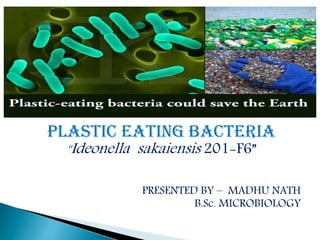
PLASTIC EATING BACTERIa
“Ideonella sakaiensis 201-F6”
PRESENTED BY – MADHU NATH
B.Sc. MICROBIOLOGY
l How do bacteria degrade plastics?
 What is PET and how it affects the environment?
 Application of Ideonella sakaiensis
2
3
4
 Plastics are used in different
sectors of applications like
packaging, building materials,
consumer products and much
more.
 Each year about 100 million tons
of plastics are produced
worldwide.
 Americans generate more than
10.5 million tons of plastic waste
is dumped in the ocean every year
and recycle only 2% of it.
5
 Polyethylene terephthalate-(PET)
used for manufacturing plastic
bottles, makes up one fifth of the
annual production of plastic.
 Lightweight , colourless, and strong.
 PET’s strength and stability under
heat makes it an ideal material for
packaging.
6
MORPHOLOGY
 Gram-negative
 Rod –shaped bacterium
 Aerobic
 Non-spore forming
 Designed strain 201-F6
7
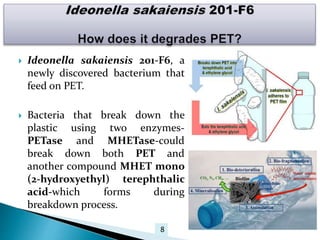
 Ideonella sakaiensis 201-F6, a
newly discovered bacterium that
feed on PET.
 Bacteria that break down the
plastic using two enzymes-
PETase and MHETase-could
break down both PET and
another compound MHET mono
(2-hydroxyethyl) terephthalic
acid-which forms during
breakdown process.
8
Cont.……
 Breakdown products are
Ethylene glycol and
terephthalic acid, used by
the bacteria as an energy
source.
 Completely degrade a thin
film of PET after six weeks
at a temperature of 86
degrees Fahrenheit (30
degrees Celsius).
9
10
11
REFERENCES
• www.sciencealert.com
• science.howstuffworks.com
• arstechnica.com
• www.ncbi.nlm.nih.gov

Plastic eating bacterium

  • 1.
    PLASTIC EATING BACTERIa “Ideonellasakaiensis 201-F6” PRESENTED BY – MADHU NATH B.Sc. MICROBIOLOGY
  • 2.
    l How dobacteria degrade plastics?  What is PET and how it affects the environment?  Application of Ideonella sakaiensis 2
  • 3.
  • 4.
  • 5.
     Plastics areused in different sectors of applications like packaging, building materials, consumer products and much more.  Each year about 100 million tons of plastics are produced worldwide.  Americans generate more than 10.5 million tons of plastic waste is dumped in the ocean every year and recycle only 2% of it. 5
  • 6.
     Polyethylene terephthalate-(PET) usedfor manufacturing plastic bottles, makes up one fifth of the annual production of plastic.  Lightweight , colourless, and strong.  PET’s strength and stability under heat makes it an ideal material for packaging. 6
  • 7.
    MORPHOLOGY  Gram-negative  Rod–shaped bacterium  Aerobic  Non-spore forming  Designed strain 201-F6 7
  • 8.
     Ideonella sakaiensis201-F6, a newly discovered bacterium that feed on PET.  Bacteria that break down the plastic using two enzymes- PETase and MHETase-could break down both PET and another compound MHET mono (2-hydroxyethyl) terephthalic acid-which forms during breakdown process. 8
  • 9.
    Cont.……  Breakdown productsare Ethylene glycol and terephthalic acid, used by the bacteria as an energy source.  Completely degrade a thin film of PET after six weeks at a temperature of 86 degrees Fahrenheit (30 degrees Celsius). 9
  • 10.
  • 11.