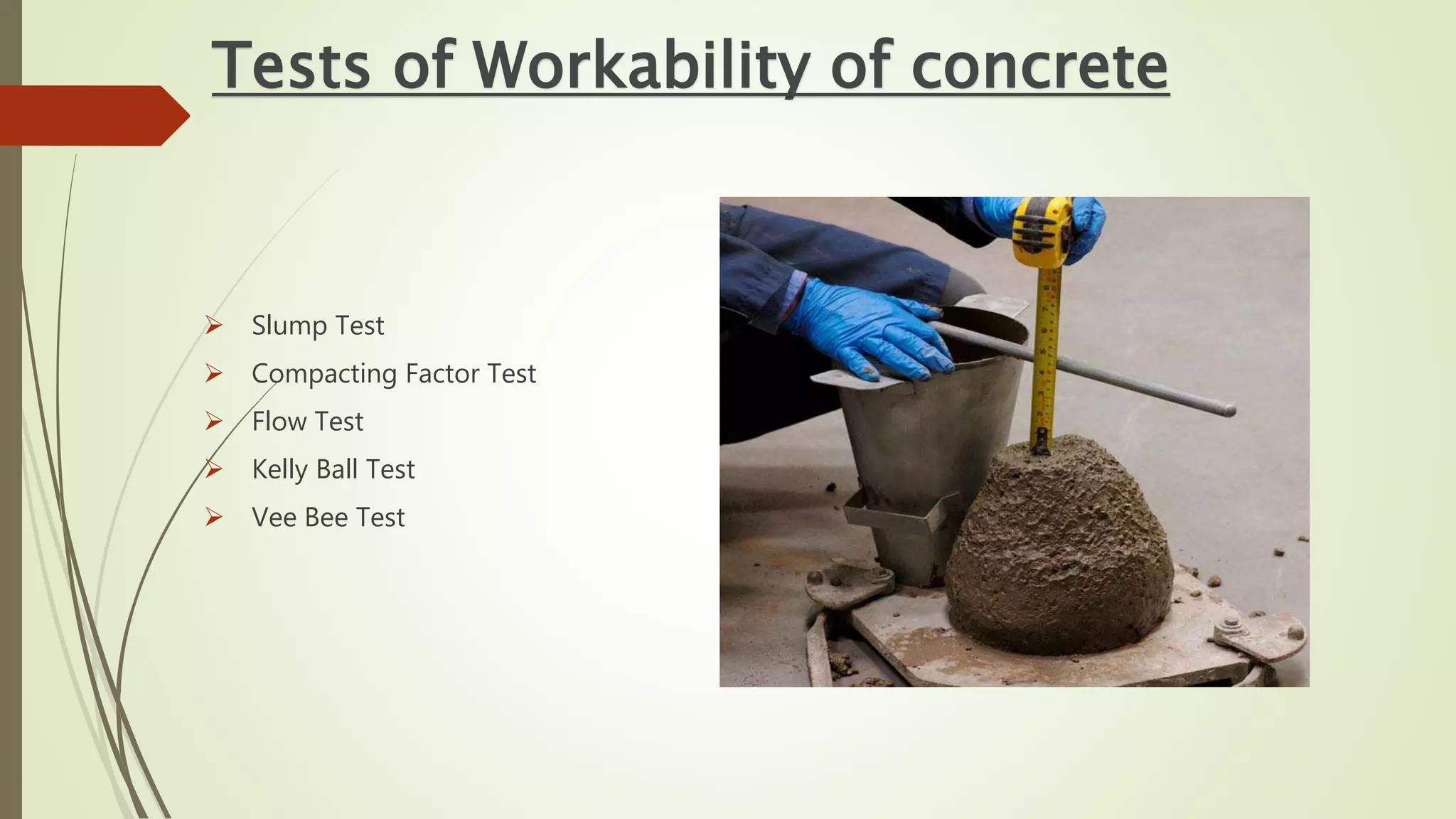
Tests of Workability of concrete
 Slump Test
 Compacting Factor Test
 Flow Test
 Kelly Ball Test
 Vee Bee Test
1) Definition
2) Principle
3) Apparatus
4) Procedure
5) Type of slump
 Definition
A slump test is a method used to determine the consistency of concrete. The consistency, or
stiffness, indicates how much water has been used in the mix. The stiffness of the concrete mix
should be matched to the requirements for the finished product quality
 Slump is a measurement of concrete’s workability, or fluidity.
 It’s an indirect measurement of concrete consistency or stiffness.
 Principle
The slump test result is a measure of the behavior of a compacted inverted cone of concrete under
the action of gravity. It measures the consistency or the wetness of concrete.
 Apparatus
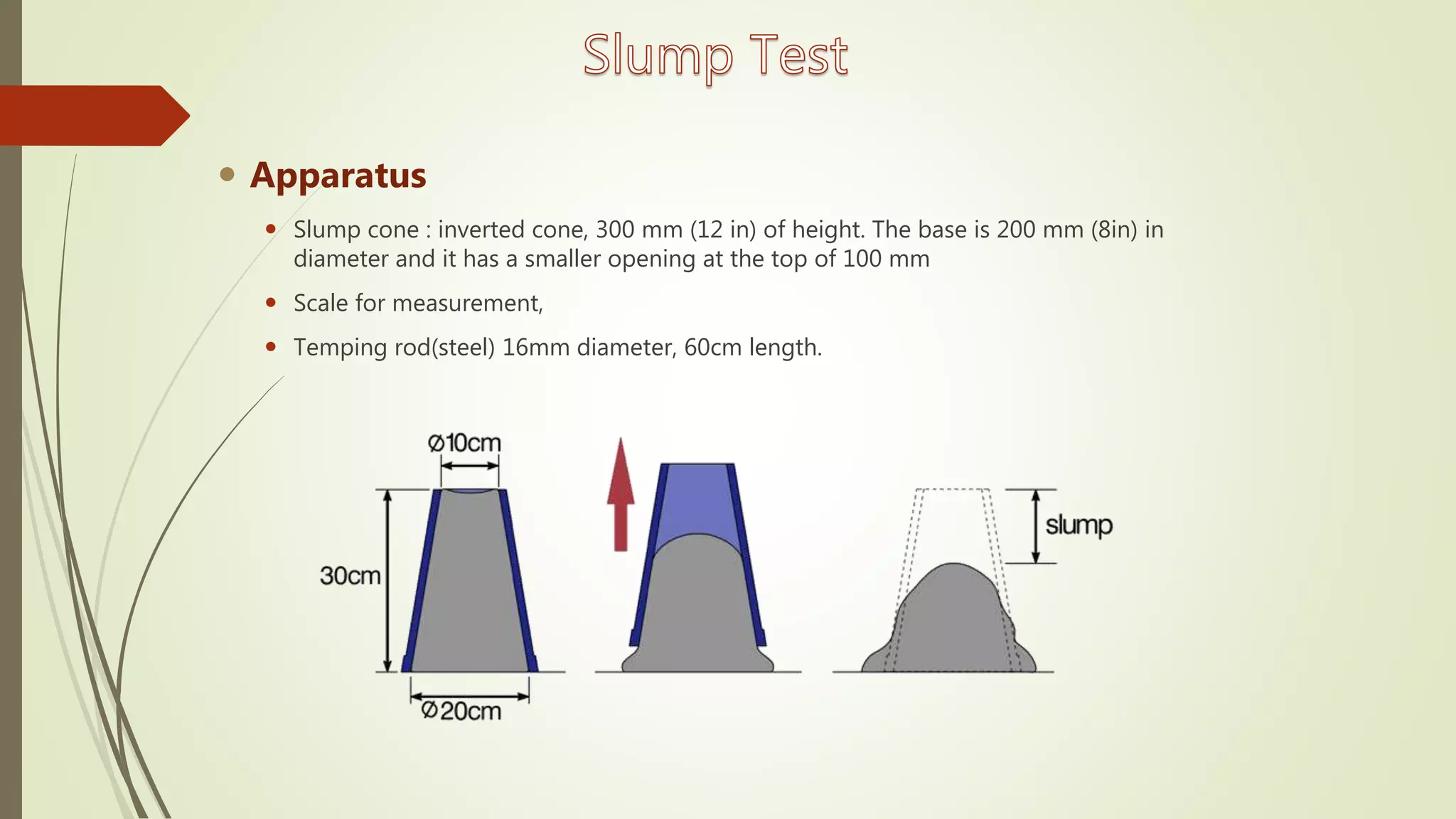
 Slump cone : inverted cone, 300 mm (12 in) of height. The base is 200 mm (8in) in
diameter and it has a smaller opening at the top of 100 mm
 Scale for measurement,
 Temping rod(steel) 16mm diameter, 60cm length.
 Procedure
 The base is placed on a smooth surface and the container is filled with concrete in
three layers, whose workability is to be tested .
 Each layer is temped 25 times with a standard 16 mm (5/8 in) diameter steel rod,
rounded at the end.
 After the top layer has been tamped, the concrete is struck off level with trowel
and tamping rod.
 Then, the mould is removed by lifting it slowly and carefully in a vertical direction.
This allows the concrete to subside. This subsidence is referred as slump concrete.
 The difference in level between the height of the mould and that of the highest
point of the subsided concrete is measured. This difference in height in mm is
taken as slump of concrete.
 Types Of Slump
The slumped concrete takes various shapes, and according to the profile
of slumped concrete, the slump is termed as;
 Collapse Slump
 Shear Slump
 True Slump
 Types Of Slump
 Collapse Slump
In a collapse slump the concrete collapses completely.
 A collapse slump will generally mean that the mix is too wet or that it is a high
workability mix, for which slump test is not appropriate.
 Shear Slump
In a shear slump the top portion of the concrete shears off and slips sideways. OR
If one-half of the cone slides down an inclined plane, the slump is said to be a shear
slump.
 If a shear or collapse slump is achieved, a fresh sample should be taken and the
test is repeated.
 True Slump
If concrete subsides evenly it is called true slump.
Introduction
ProcedureApparatus
 Introduction
 Compacting factor test, developed at the road research laboratory UK
is more precise and sensitive than the slump test. It is primarily
designed for laboratory work but can also be used in the field. It is
particularly useful for concrete mixes of very low workability as are
normally used when concrete is to be compacted by vibration such
concrete may constantly fail to slump.
 For the normal range of concrete the compacting factor lies between
0.8 - 0.92
 Apparatus
 Trowels
 Hand Scoop (15.2 cm long)
 Rod of steel or other suitable material
(1.6 cm diameter, 61 cm long rounded
at one end ).
 Balance.
 Procedure
1) Ensure the apparatus and associated equipment are clean before test and free from
hardened concrete and superfluous water .
2) Weigh the bottom cylinder to nearest 10gm , put it back on the stand and cover it up with
a pair of floats .
3) Gently fill the upper hopper with the sampled concrete to the level of the rim with use of a
scoop .
4) Immediately open the trap door of the upper hopper and allow the sampled concrete to
fall into the middle hopper .
5) Remove the floats on top of the bottom cylinder and open the trap door of the middle
hopper allowing the sampled concrete to fall into the bottom cylinder .
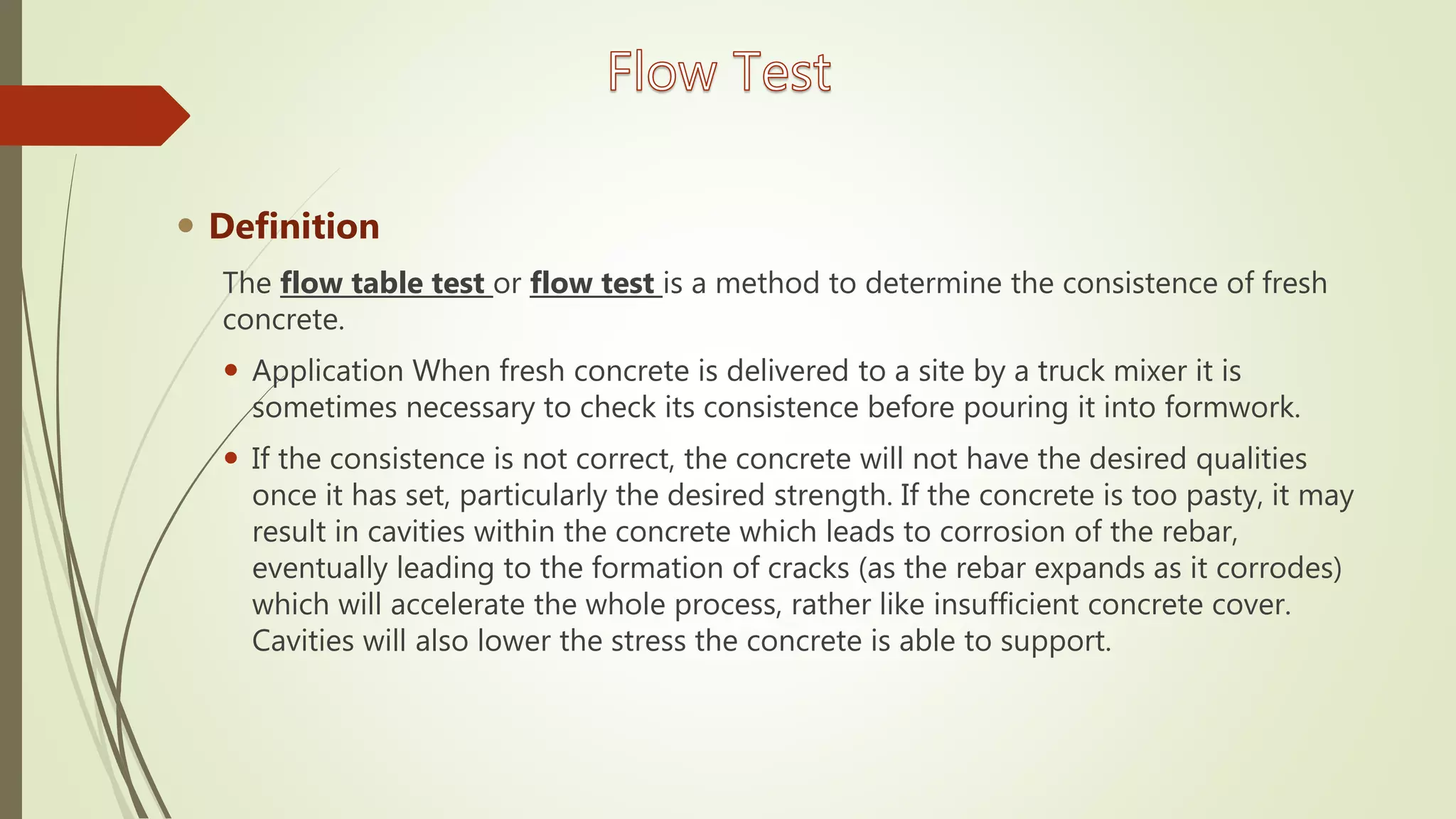
6) Remove the surplus concrete above the top of the bottom cylinder by holding a float in
each hand and move towards each other to cut off the concrete across the top of cylinder
7) Wipe clean the outside of cylinder of concrete and weigh to nearest 10gm .
8) Subtract the weight of empty cylinder from the weight of cylinder plus
concrete to obtain the weight of partially compacted concrete .
9) Remove the concrete from the cylinder and refill with sampled concrete in
layers .
10) Compact each layer thoroughly with the standard Compacting Bar to achieve
full compaction .
11) Float off the surplus concrete to top of cylinder and wipe it clean .
12) Weigh the cylinder to nearest 10gm and subtract the weight of empty cylinder
from the weight of cylinder plus concrete to obtain the weight of fully
compacted concrete .

 Definition
The flow table test or flow test is a method to determine the consistence of fresh
concrete.
 Application When fresh concrete is delivered to a site by a truck mixer it is
sometimes necessary to check its consistence before pouring it into formwork.
 If the consistence is not correct, the concrete will not have the desired qualities
once it has set, particularly the desired strength. If the concrete is too pasty, it may
result in cavities within the concrete which leads to corrosion of the rebar,
eventually leading to the formation of cracks (as the rebar expands as it corrodes)
which will accelerate the whole process, rather like insufficient concrete cover.
Cavities will also lower the stress the concrete is able to support.
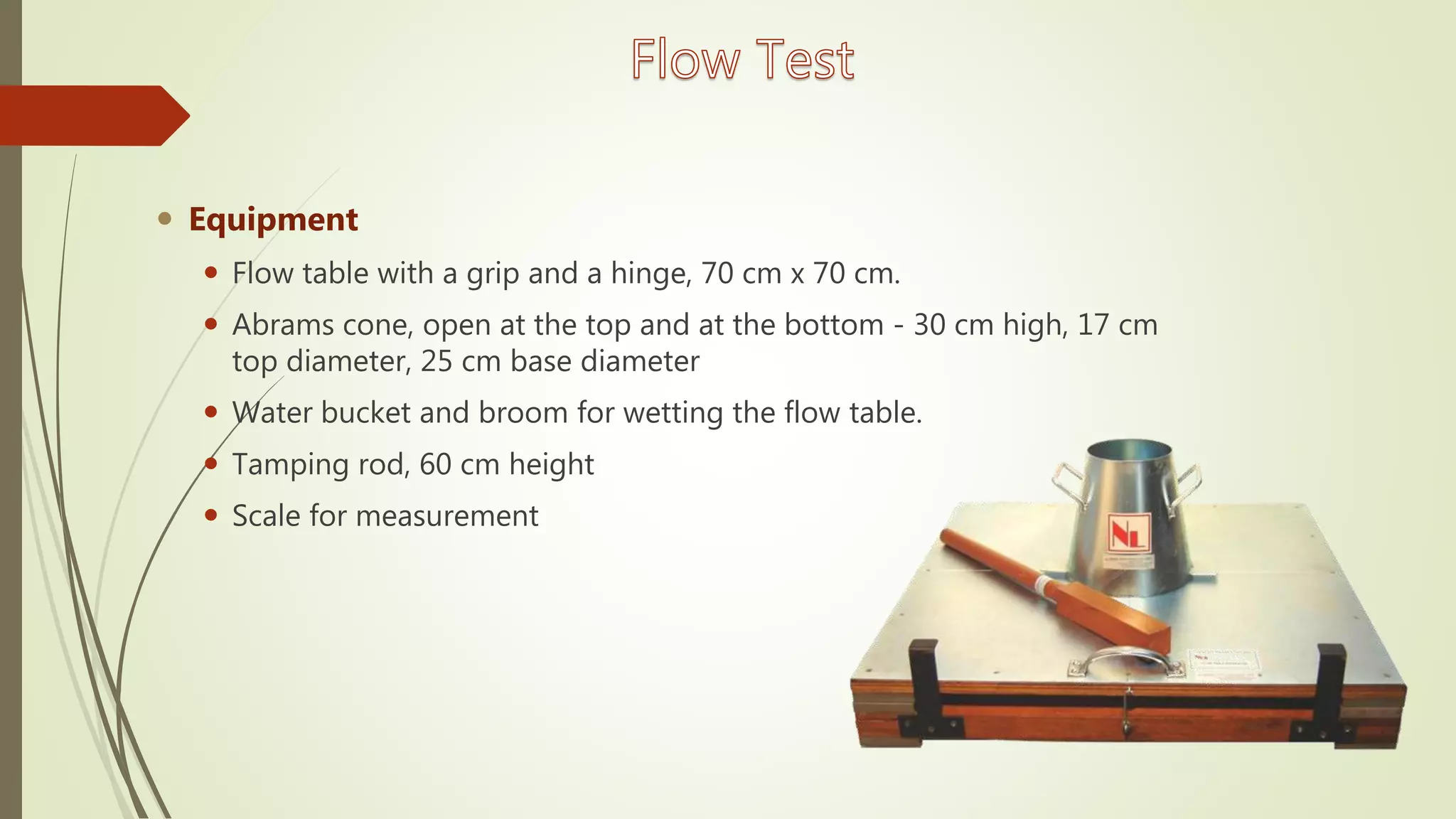
 Equipment
 Flow table with a grip and a hinge, 70 cm x 70 cm.
 Abrams cone, open at the top and at the bottom - 30 cm high, 17 cm
top diameter, 25 cm base diameter
 Water bucket and broom for wetting the flow table.
 Tamping rod, 60 cm height
 Scale for measurement
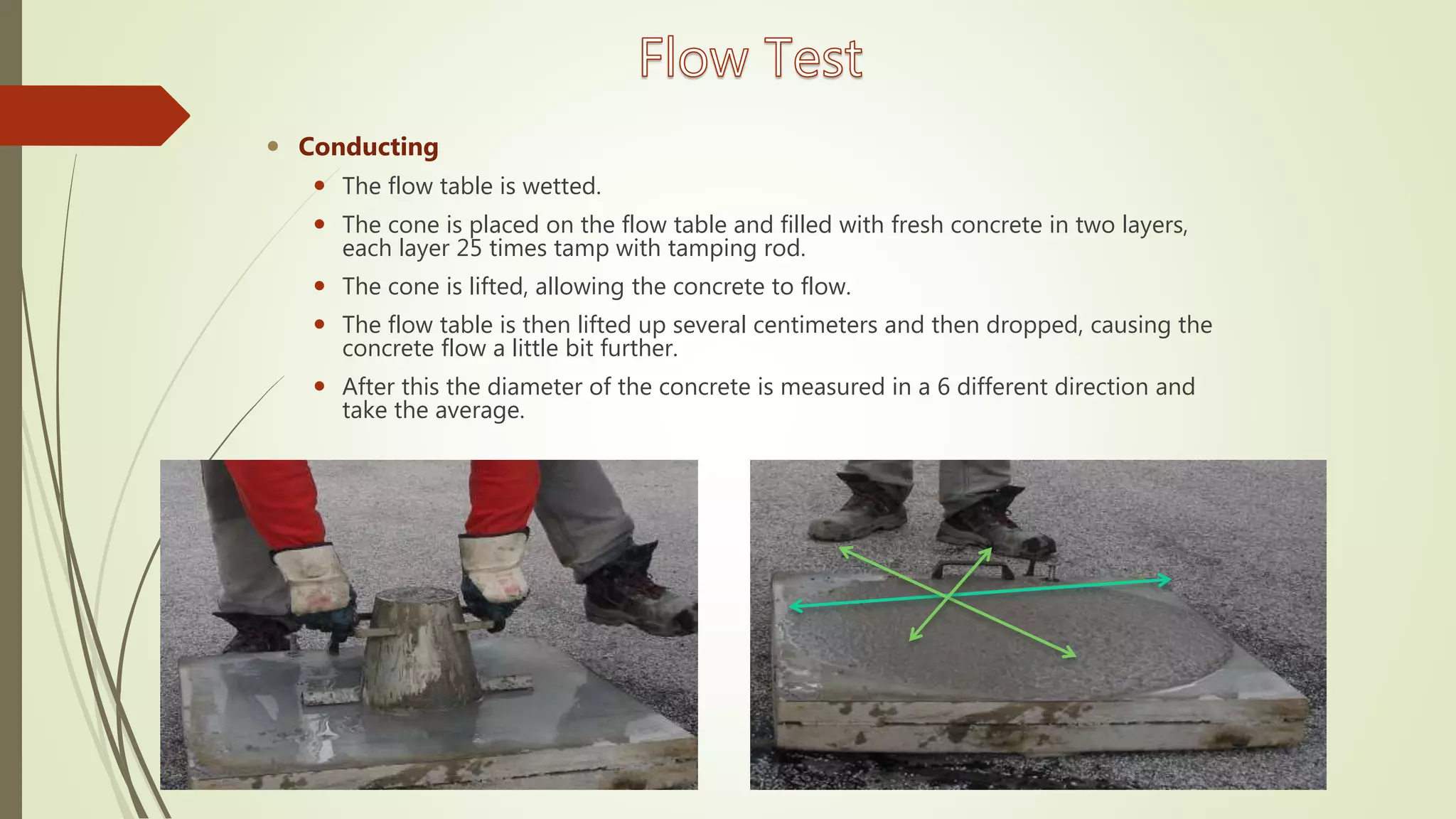
 Conducting
 The flow table is wetted.
 The cone is placed on the flow table and filled with fresh concrete in two layers,
each layer 25 times tamp with tamping rod.
 The cone is lifted, allowing the concrete to flow.
 The flow table is then lifted up several centimeters and then dropped, causing the
concrete flow a little bit further.
 After this the diameter of the concrete is measured in a 6 different direction and
take the average.

 Definition
Another method used in the field and laboratory
to measure the consistency of concrete is the ball
penetration test which is also known as the Kelly
ball test.
 Procedure
 It is performed by measuring the penetration, in
inches, of a 6-in. diameter steel cylinder with a
hemi spherically shaped bottom , weighing 30
lbs.
 Advantages
 One of the advantages of the ball penetration test can be performed on
the concrete in a hopper, buggy, wheelbarrow, or other suitable
container.
 Another advantage of this method is its simplicity and the rapidity with
which the consistency of the concrete can be determined.
 It is also not dependent on a procedure of filling and rodding a container
like the slump test.
 Definition
 It is based on measuring the time (Called VEBE time) needed to transfer the
shape of a concrete mix from a frustum cone to a cylinder (these shapes are
standardized by the apparatus of this test), by vibrating and compacting the
mix. The more VEBE time needed the less workable the mix is. This method is
very useful for stiff mixes.
 Apparatus
 Cylindrical container with diameter = 240 mm, and height = 200 mm
 Mold: the same mold used in the slump test.
 Disc : A transparent horizontal disc attached to a rod which slides vertically
 Vibrating Table : 380*260 mm, supported by four rubber shock absorbers
 Tamping Rod
 Stop watch
 Procedure
1) Slump test as described earlier is performed, placing the slump cone inside the
sheet metal cylindrical pot of the consist meter.
2) The glass disc attached to the swivel arm is turn and place on the top of the
concrete in the pot.
3) The electrical vibrator is then switched on and simultaneously a stop watch started.
4) The vibration is continued till such time as the conical shape of the concrete
disappears and the concrete assume a cylindrical shape.
5) This can be judge by observing the glass disc from the top disappearance of
transparency.
6) Immediately when the concrete fully assume a cylindrical shape, the stop watch is
switched off.
7) The time required for the shape of concrete to change from slump
cone shape to cylindrical shape in second is known as Vibe Degree.
8) This method is very suitable for very dry concrete whose slump value
cannot be measure by slump test, but the vibration is too vigorous
for concrete with slump greater than about 50m.
The test fails if VeBe Time is less than 5 seconds .. And the test must be
created when no collapse or shears slump in concrete
.
Thank you

workability test of concrete

  • 1.
    Tests of Workabilityof concrete  Slump Test  Compacting Factor Test  Flow Test  Kelly Ball Test  Vee Bee Test
  • 2.
    1) Definition 2) Principle 3)Apparatus 4) Procedure 5) Type of slump
  • 3.
     Definition A slumptest is a method used to determine the consistency of concrete. The consistency, or stiffness, indicates how much water has been used in the mix. The stiffness of the concrete mix should be matched to the requirements for the finished product quality  Slump is a measurement of concrete’s workability, or fluidity.  It’s an indirect measurement of concrete consistency or stiffness.  Principle The slump test result is a measure of the behavior of a compacted inverted cone of concrete under the action of gravity. It measures the consistency or the wetness of concrete.
  • 4.
     Apparatus  Slumpcone : inverted cone, 300 mm (12 in) of height. The base is 200 mm (8in) in diameter and it has a smaller opening at the top of 100 mm  Scale for measurement,  Temping rod(steel) 16mm diameter, 60cm length.
  • 5.
     Procedure  Thebase is placed on a smooth surface and the container is filled with concrete in three layers, whose workability is to be tested .  Each layer is temped 25 times with a standard 16 mm (5/8 in) diameter steel rod, rounded at the end.  After the top layer has been tamped, the concrete is struck off level with trowel and tamping rod.  Then, the mould is removed by lifting it slowly and carefully in a vertical direction. This allows the concrete to subside. This subsidence is referred as slump concrete.  The difference in level between the height of the mould and that of the highest point of the subsided concrete is measured. This difference in height in mm is taken as slump of concrete.
  • 6.
     Types OfSlump The slumped concrete takes various shapes, and according to the profile of slumped concrete, the slump is termed as;  Collapse Slump  Shear Slump  True Slump
  • 7.
     Types OfSlump  Collapse Slump In a collapse slump the concrete collapses completely.  A collapse slump will generally mean that the mix is too wet or that it is a high workability mix, for which slump test is not appropriate.  Shear Slump In a shear slump the top portion of the concrete shears off and slips sideways. OR If one-half of the cone slides down an inclined plane, the slump is said to be a shear slump.  If a shear or collapse slump is achieved, a fresh sample should be taken and the test is repeated.  True Slump If concrete subsides evenly it is called true slump.
  • 8.
  • 9.
     Introduction  Compactingfactor test, developed at the road research laboratory UK is more precise and sensitive than the slump test. It is primarily designed for laboratory work but can also be used in the field. It is particularly useful for concrete mixes of very low workability as are normally used when concrete is to be compacted by vibration such concrete may constantly fail to slump.  For the normal range of concrete the compacting factor lies between 0.8 - 0.92
  • 10.
     Apparatus  Trowels Hand Scoop (15.2 cm long)  Rod of steel or other suitable material (1.6 cm diameter, 61 cm long rounded at one end ).  Balance.
  • 11.
     Procedure 1) Ensurethe apparatus and associated equipment are clean before test and free from hardened concrete and superfluous water . 2) Weigh the bottom cylinder to nearest 10gm , put it back on the stand and cover it up with a pair of floats . 3) Gently fill the upper hopper with the sampled concrete to the level of the rim with use of a scoop . 4) Immediately open the trap door of the upper hopper and allow the sampled concrete to fall into the middle hopper . 5) Remove the floats on top of the bottom cylinder and open the trap door of the middle hopper allowing the sampled concrete to fall into the bottom cylinder . 6) Remove the surplus concrete above the top of the bottom cylinder by holding a float in each hand and move towards each other to cut off the concrete across the top of cylinder
  • 12.
    7) Wipe cleanthe outside of cylinder of concrete and weigh to nearest 10gm . 8) Subtract the weight of empty cylinder from the weight of cylinder plus concrete to obtain the weight of partially compacted concrete . 9) Remove the concrete from the cylinder and refill with sampled concrete in layers . 10) Compact each layer thoroughly with the standard Compacting Bar to achieve full compaction . 11) Float off the surplus concrete to top of cylinder and wipe it clean . 12) Weigh the cylinder to nearest 10gm and subtract the weight of empty cylinder from the weight of cylinder plus concrete to obtain the weight of fully compacted concrete .
  • 13.
  • 14.
     Definition The flowtable test or flow test is a method to determine the consistence of fresh concrete.  Application When fresh concrete is delivered to a site by a truck mixer it is sometimes necessary to check its consistence before pouring it into formwork.  If the consistence is not correct, the concrete will not have the desired qualities once it has set, particularly the desired strength. If the concrete is too pasty, it may result in cavities within the concrete which leads to corrosion of the rebar, eventually leading to the formation of cracks (as the rebar expands as it corrodes) which will accelerate the whole process, rather like insufficient concrete cover. Cavities will also lower the stress the concrete is able to support.
  • 15.
     Equipment  Flowtable with a grip and a hinge, 70 cm x 70 cm.  Abrams cone, open at the top and at the bottom - 30 cm high, 17 cm top diameter, 25 cm base diameter  Water bucket and broom for wetting the flow table.  Tamping rod, 60 cm height  Scale for measurement
  • 16.
     Conducting  Theflow table is wetted.  The cone is placed on the flow table and filled with fresh concrete in two layers, each layer 25 times tamp with tamping rod.  The cone is lifted, allowing the concrete to flow.  The flow table is then lifted up several centimeters and then dropped, causing the concrete flow a little bit further.  After this the diameter of the concrete is measured in a 6 different direction and take the average.
  • 17.
  • 18.
     Definition Another methodused in the field and laboratory to measure the consistency of concrete is the ball penetration test which is also known as the Kelly ball test.  Procedure  It is performed by measuring the penetration, in inches, of a 6-in. diameter steel cylinder with a hemi spherically shaped bottom , weighing 30 lbs.
  • 19.
     Advantages  Oneof the advantages of the ball penetration test can be performed on the concrete in a hopper, buggy, wheelbarrow, or other suitable container.  Another advantage of this method is its simplicity and the rapidity with which the consistency of the concrete can be determined.  It is also not dependent on a procedure of filling and rodding a container like the slump test.
  • 20.
     Definition  Itis based on measuring the time (Called VEBE time) needed to transfer the shape of a concrete mix from a frustum cone to a cylinder (these shapes are standardized by the apparatus of this test), by vibrating and compacting the mix. The more VEBE time needed the less workable the mix is. This method is very useful for stiff mixes.  Apparatus  Cylindrical container with diameter = 240 mm, and height = 200 mm  Mold: the same mold used in the slump test.  Disc : A transparent horizontal disc attached to a rod which slides vertically  Vibrating Table : 380*260 mm, supported by four rubber shock absorbers  Tamping Rod  Stop watch
  • 21.
     Procedure 1) Slumptest as described earlier is performed, placing the slump cone inside the sheet metal cylindrical pot of the consist meter. 2) The glass disc attached to the swivel arm is turn and place on the top of the concrete in the pot. 3) The electrical vibrator is then switched on and simultaneously a stop watch started. 4) The vibration is continued till such time as the conical shape of the concrete disappears and the concrete assume a cylindrical shape. 5) This can be judge by observing the glass disc from the top disappearance of transparency. 6) Immediately when the concrete fully assume a cylindrical shape, the stop watch is switched off.
  • 22.
    7) The timerequired for the shape of concrete to change from slump cone shape to cylindrical shape in second is known as Vibe Degree. 8) This method is very suitable for very dry concrete whose slump value cannot be measure by slump test, but the vibration is too vigorous for concrete with slump greater than about 50m. The test fails if VeBe Time is less than 5 seconds .. And the test must be created when no collapse or shears slump in concrete
  • 23.