18/09/2024 CT Unit-2 by Dr.PK 1
Unit-2
Fresh Concrete
18/09/2024 CT Unit-2 by Dr.PK 2
Introduction
Fresh concrete or plastic concrete is a freshly mixed material which can be
moulded into any shape. The relative quantities of cement, aggregate and water mixed
together, control the properties of concrete in the wet state as well as in the hardened
state.
In this chapter one more aspect for deciding the water/cement ratio will be
introduced i.e., the water/cement ratio required from the point of view of workability of
concrete.
18/09/2024 CT Unit-2 by Dr.PK 3
Workability
To enable the concrete to be fully compacted with given efforts, normally a
higher water/ cement ratio than that calculated by theoretical considerations may be
required. That is to say the function of water is also to lubricate the concrete so that the
concrete can be compacted with specified effort forthcoming at the site of work. The
lubrication required for handling concrete without segregation, for placing without loss
of homogeneity, for compacting with the amount of efforts forth-coming and to finish
it sufficiently easily, the presence of a certain quantity of water is of vital importance.
Factors Affecting Workability
(a) Water Content (b) Mix Proportions (c ) Size of Aggregates
(d) Shape of Aggregates (e) Surface Texture of Aggregate (f ) Grading of
Aggregate (g) Use of Admixtures.
18/09/2024 CT Unit-2 by Dr.PK 4
Measurement of Workability
Some of the tests, measure the parameters very close to workability and provide
useful information. The following tests are commonly employed to measure
workability.
(a ) Slump Test
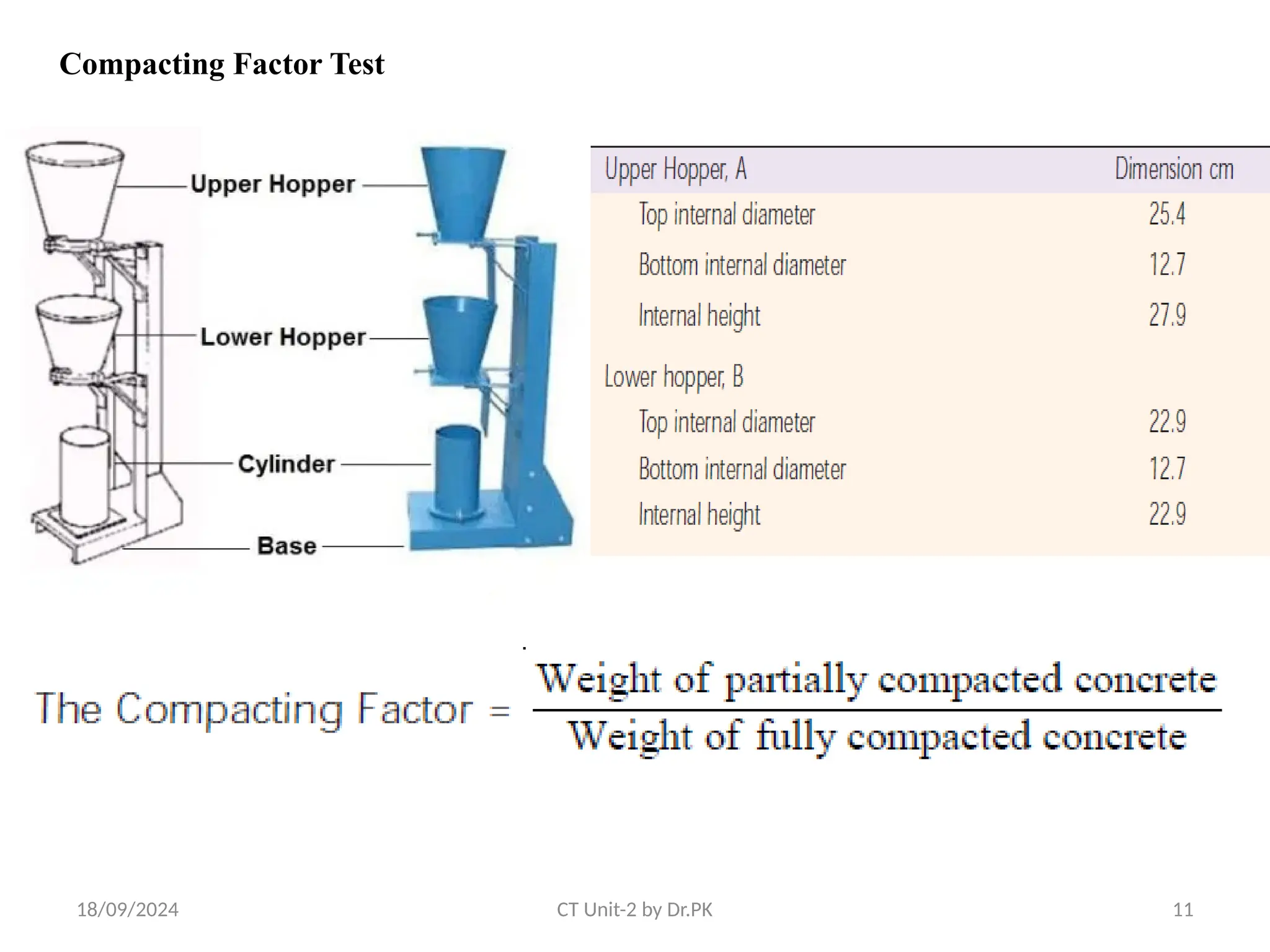
(b) Compacting Factor Test
(c ) Flow Test
(d) Kelly Ball Test
(e ) Vee Bee Consistometer Test.
18/09/2024 CT Unit-2 by Dr.PK 5
Slump Test
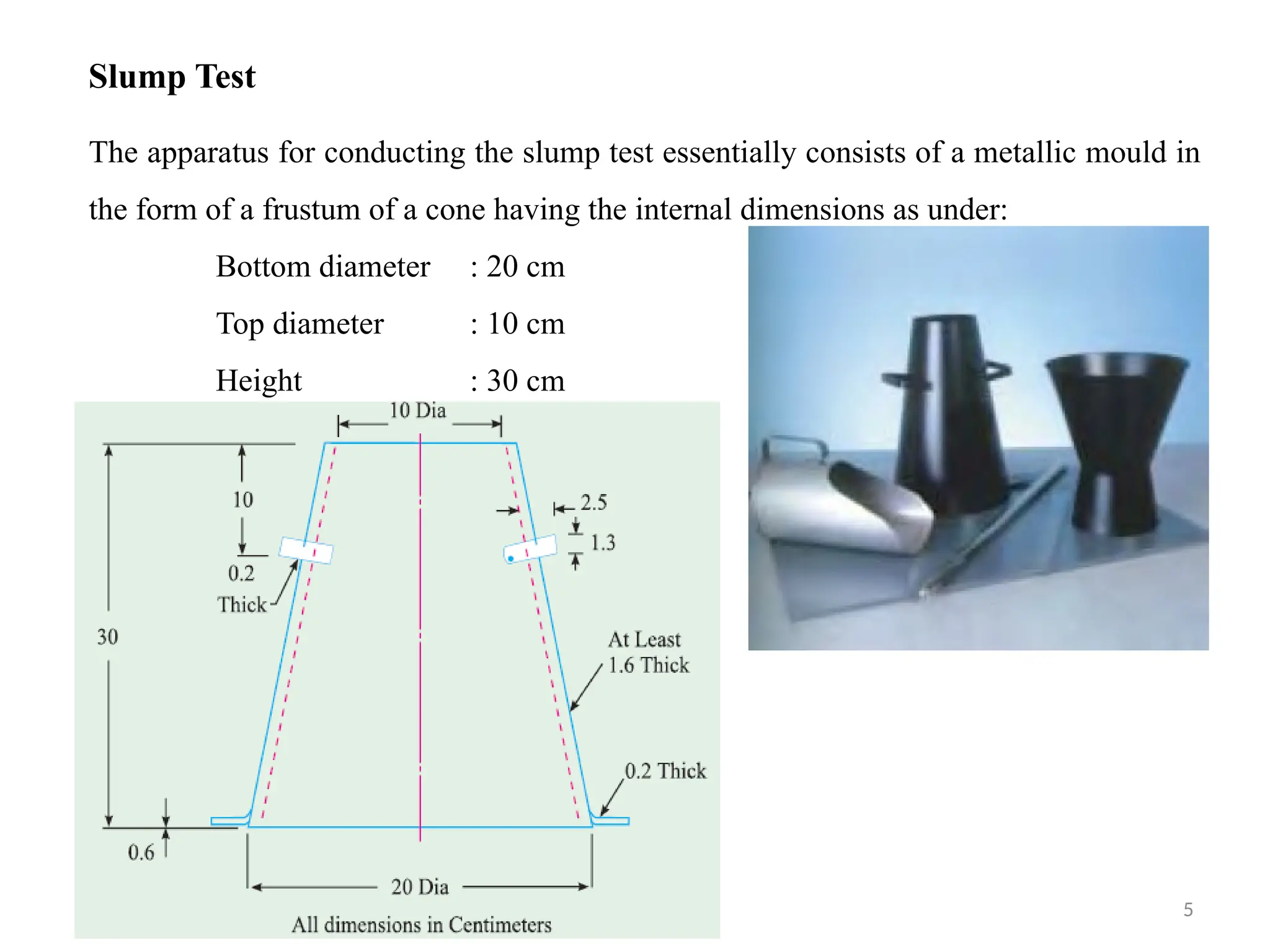
The apparatus for conducting the slump test essentially consists of a metallic mould in
the form of a frustum of a cone having the internal dimensions as under:
Bottom diameter : 20 cm
Top diameter : 10 cm
Height : 30 cm
18/09/2024 CT Unit-2 by Dr.PK 6
18/09/2024 CT Unit-2 by Dr.PK 7
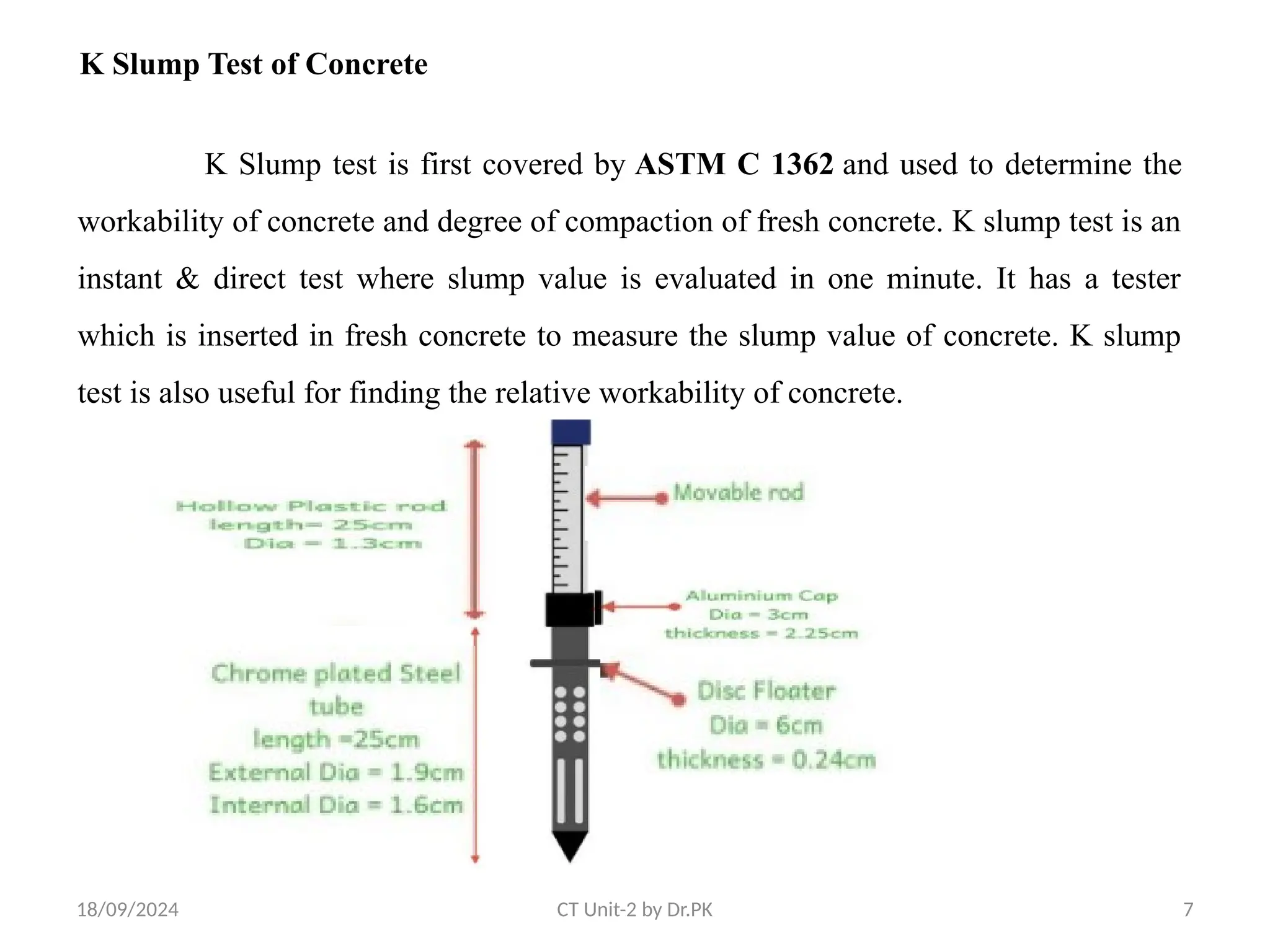
K Slump test is first covered by ASTM C 1362 and used to determine the
workability of concrete and degree of compaction of fresh concrete. K slump test is an
instant & direct test where slump value is evaluated in one minute. It has a tester
which is inserted in fresh concrete to measure the slump value of concrete. K slump
test is also useful for finding the relative workability of concrete.
K Slump Test of Concrete
18/09/2024 CT Unit-2 by Dr.PK 8
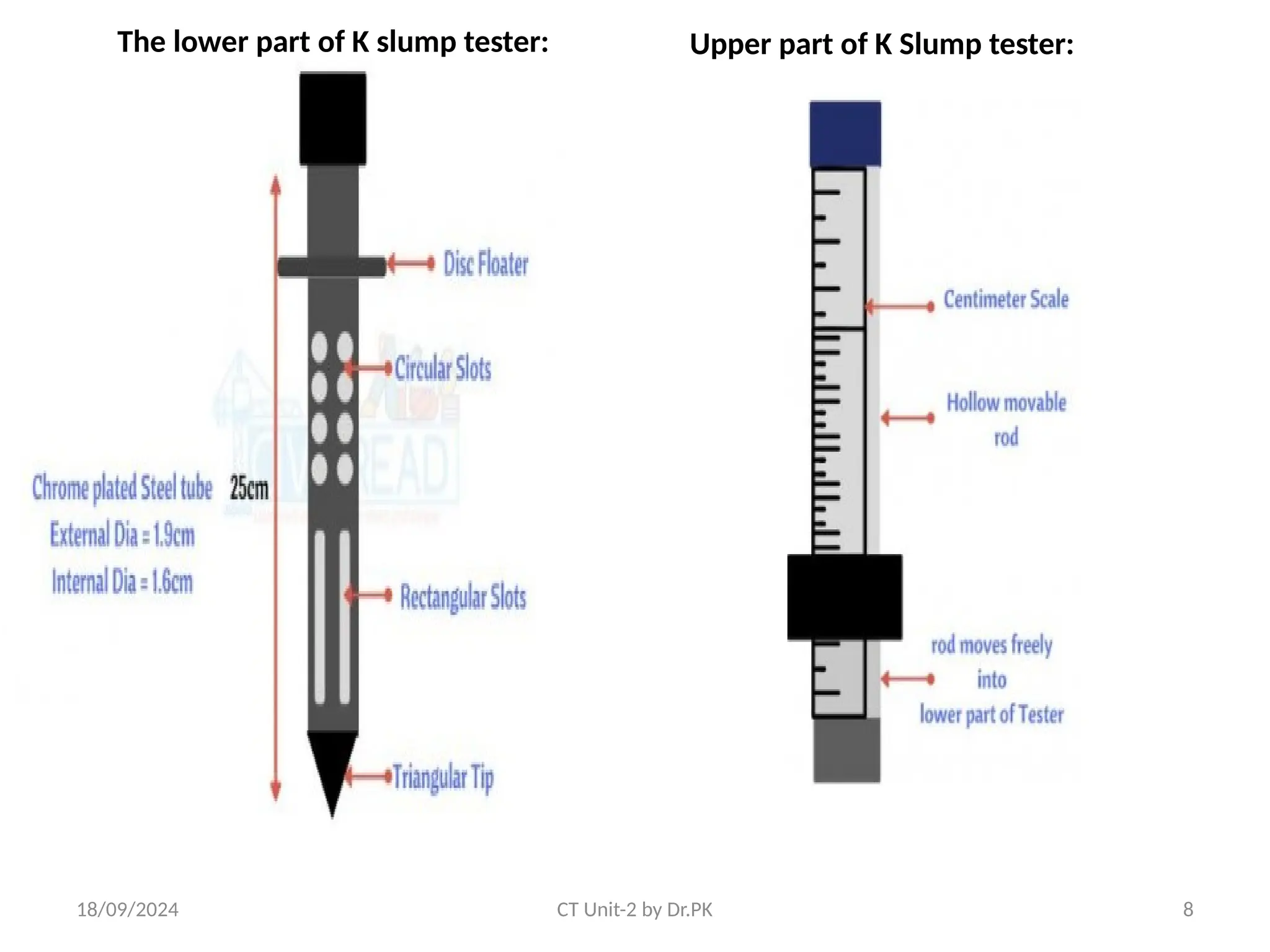
The lower part of K slump tester: Upper part of K Slump tester:
18/09/2024 CT Unit-2 by Dr.PK 9
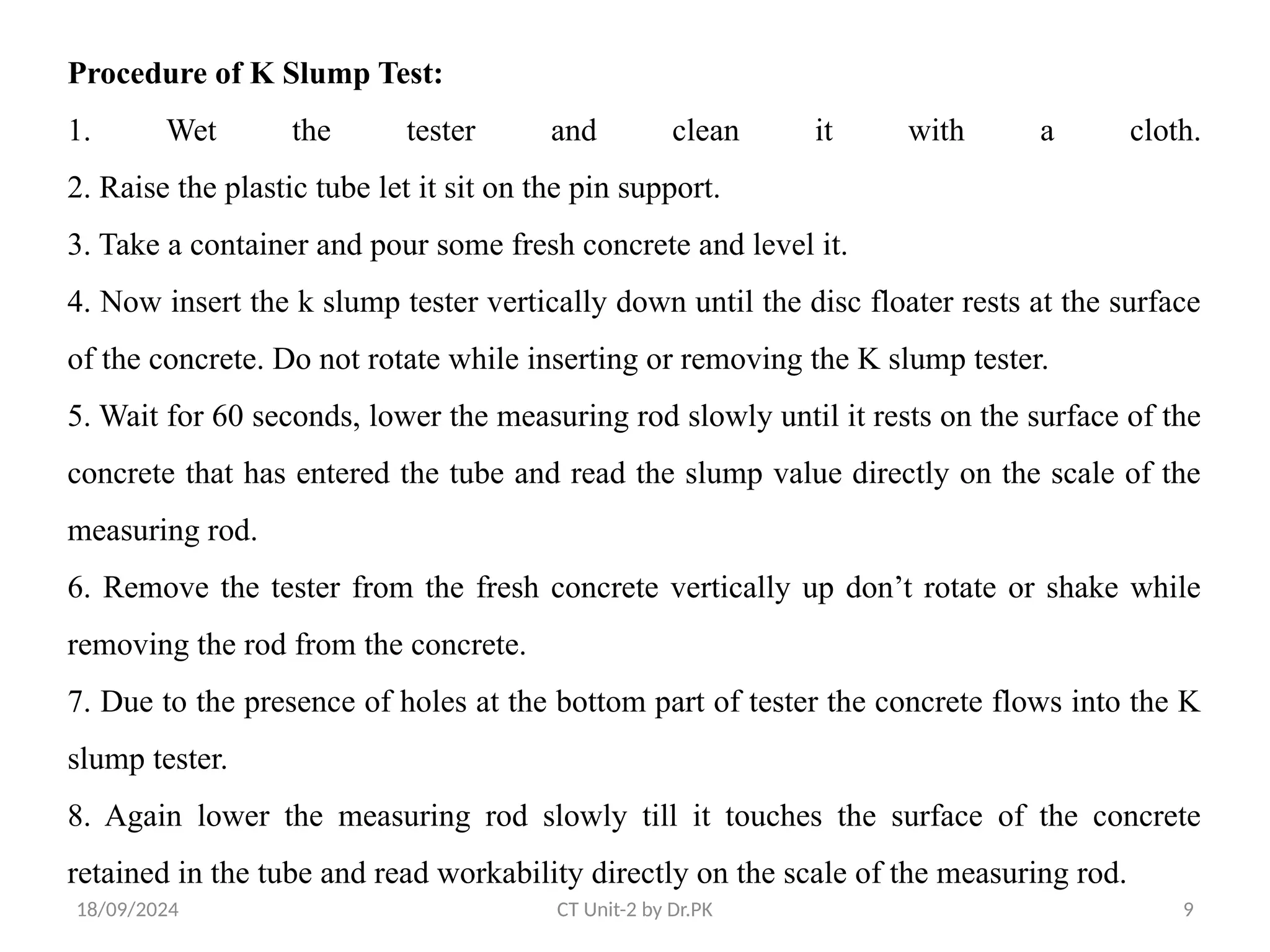
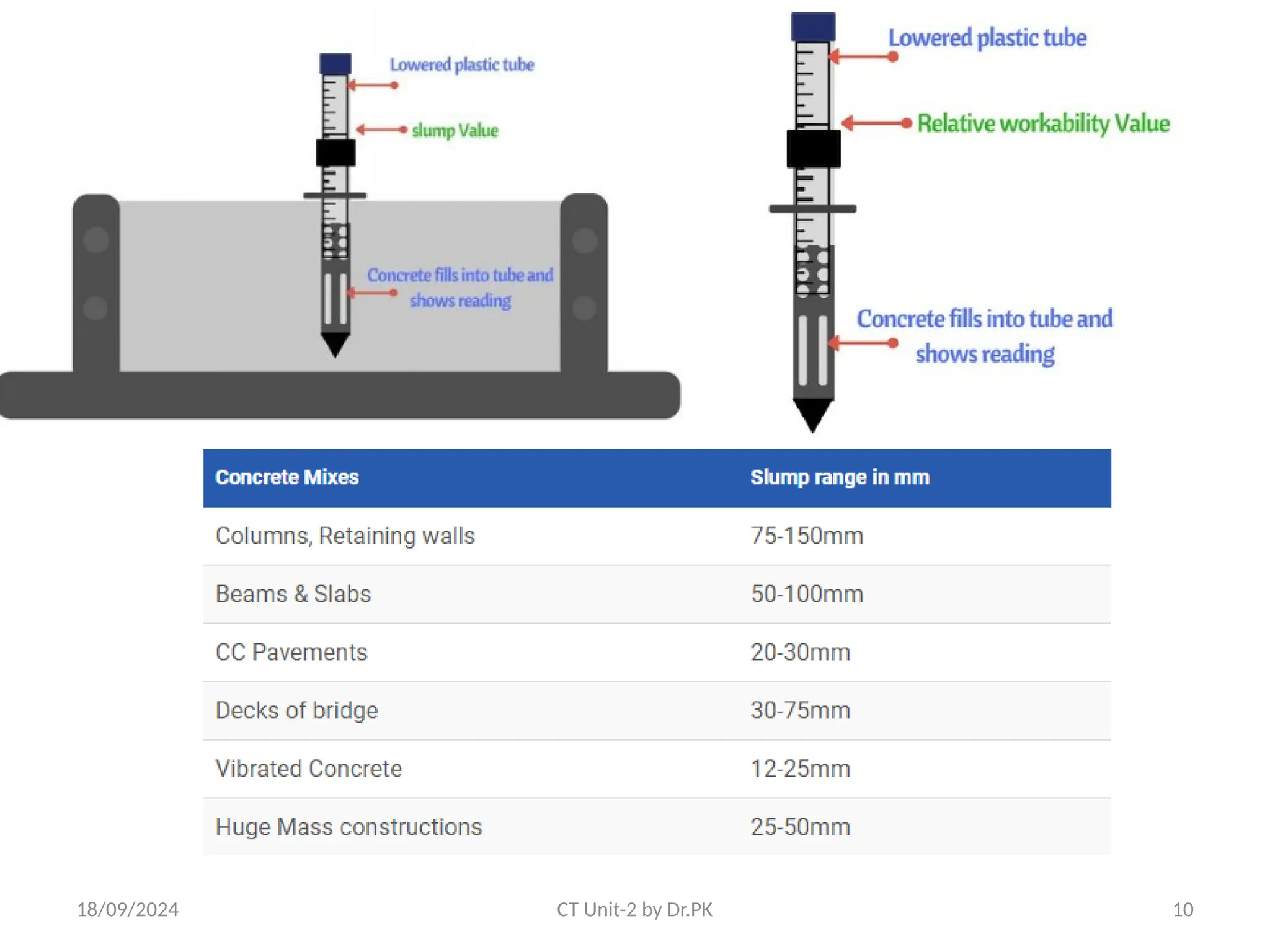
Procedure of K Slump Test:
1. Wet the tester and clean it with a cloth.
2. Raise the plastic tube let it sit on the pin support.
3. Take a container and pour some fresh concrete and level it.
4. Now insert the k slump tester vertically down until the disc floater rests at the surface
of the concrete. Do not rotate while inserting or removing the K slump tester.
5. Wait for 60 seconds, lower the measuring rod slowly until it rests on the surface of the
concrete that has entered the tube and read the slump value directly on the scale of the
measuring rod.
6. Remove the tester from the fresh concrete vertically up don’t rotate or shake while
removing the rod from the concrete.
7. Due to the presence of holes at the bottom part of tester the concrete flows into the K
slump tester.
8. Again lower the measuring rod slowly till it touches the surface of the concrete
retained in the tube and read workability directly on the scale of the measuring rod.
18/09/2024 CT Unit-2 by Dr.PK 10
18/09/2024 CT Unit-2 by Dr.PK 11
Compacting Factor Test
18/09/2024 CT Unit-2 by Dr.PK 12
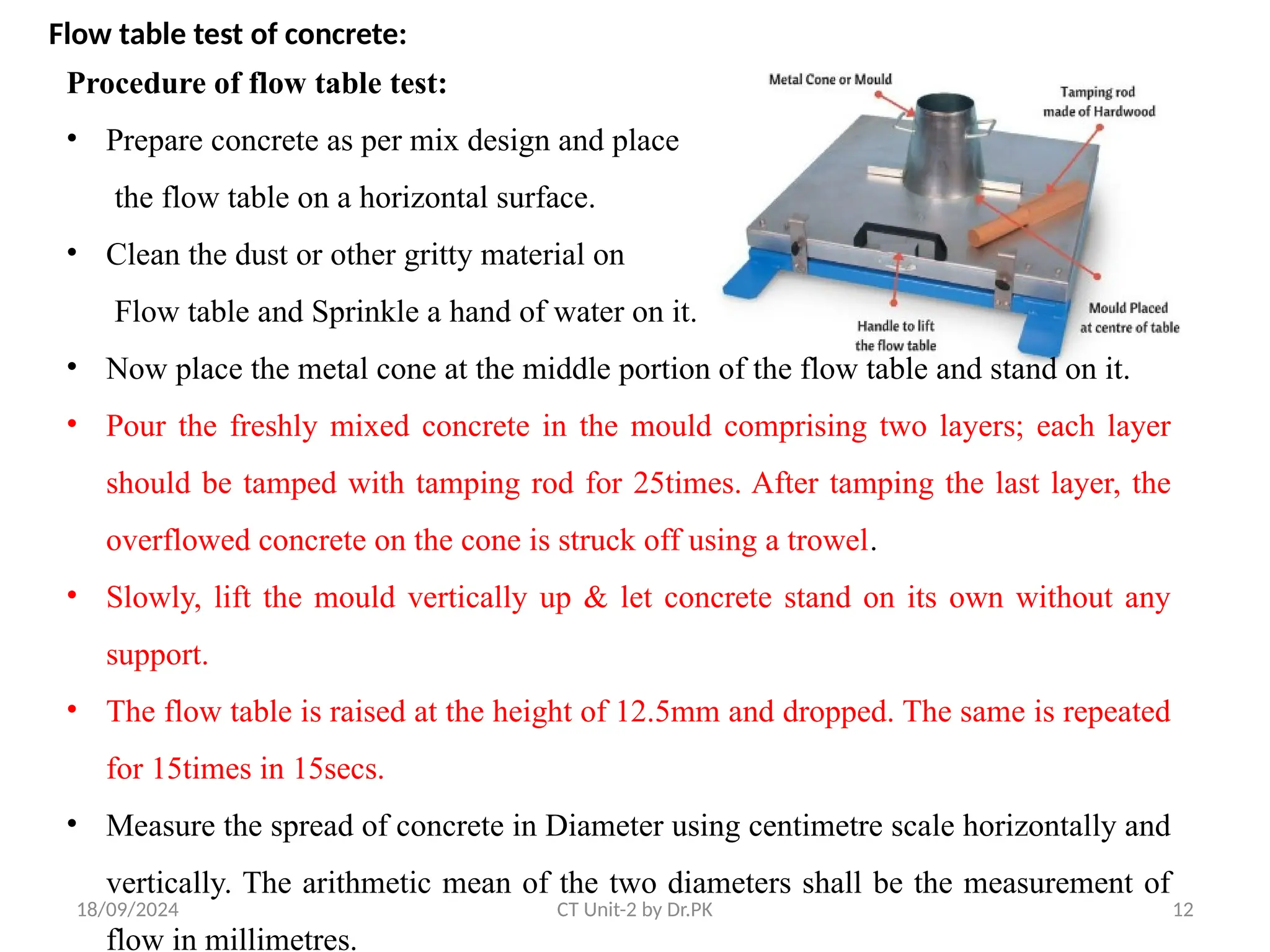
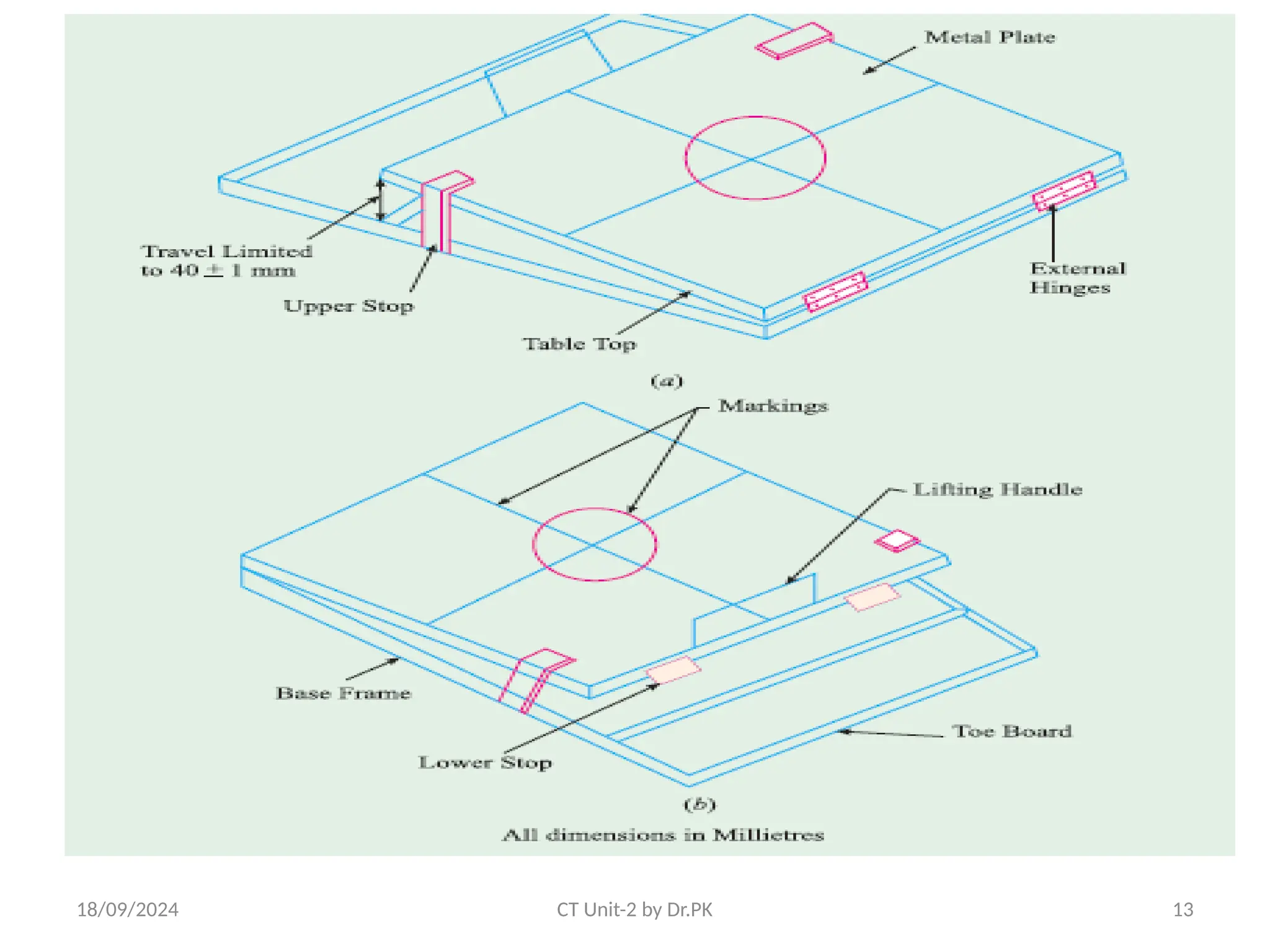
Flow table test of concrete:
Procedure of flow table test:
• Prepare concrete as per mix design and place
the flow table on a horizontal surface.
• Clean the dust or other gritty material on
Flow table and Sprinkle a hand of water on it.
• Now place the metal cone at the middle portion of the flow table and stand on it.
• Pour the freshly mixed concrete in the mould comprising two layers; each layer
should be tamped with tamping rod for 25times. After tamping the last layer, the
overflowed concrete on the cone is struck off using a trowel.
• Slowly, lift the mould vertically up & let concrete stand on its own without any
support.
• The flow table is raised at the height of 12.5mm and dropped. The same is repeated
for 15times in 15secs.
• Measure the spread of concrete in Diameter using centimetre scale horizontally and
vertically. The arithmetic mean of the two diameters shall be the measurement of
flow in millimetres.
18/09/2024 CT Unit-2 by Dr.PK 13
18/09/2024 CT Unit-2 by Dr.PK 14
Kelly Ball Test
Kelly ball test is a simple field test which is very useful in determining workability of
concrete in real-time. It is justified that Kelly ball test performed faster and provided
accurate results with great precision than the slump test. But the only disadvantage with
the Kelly ball test that it requires a large amount of concrete when compared with the
slump test of concrete.
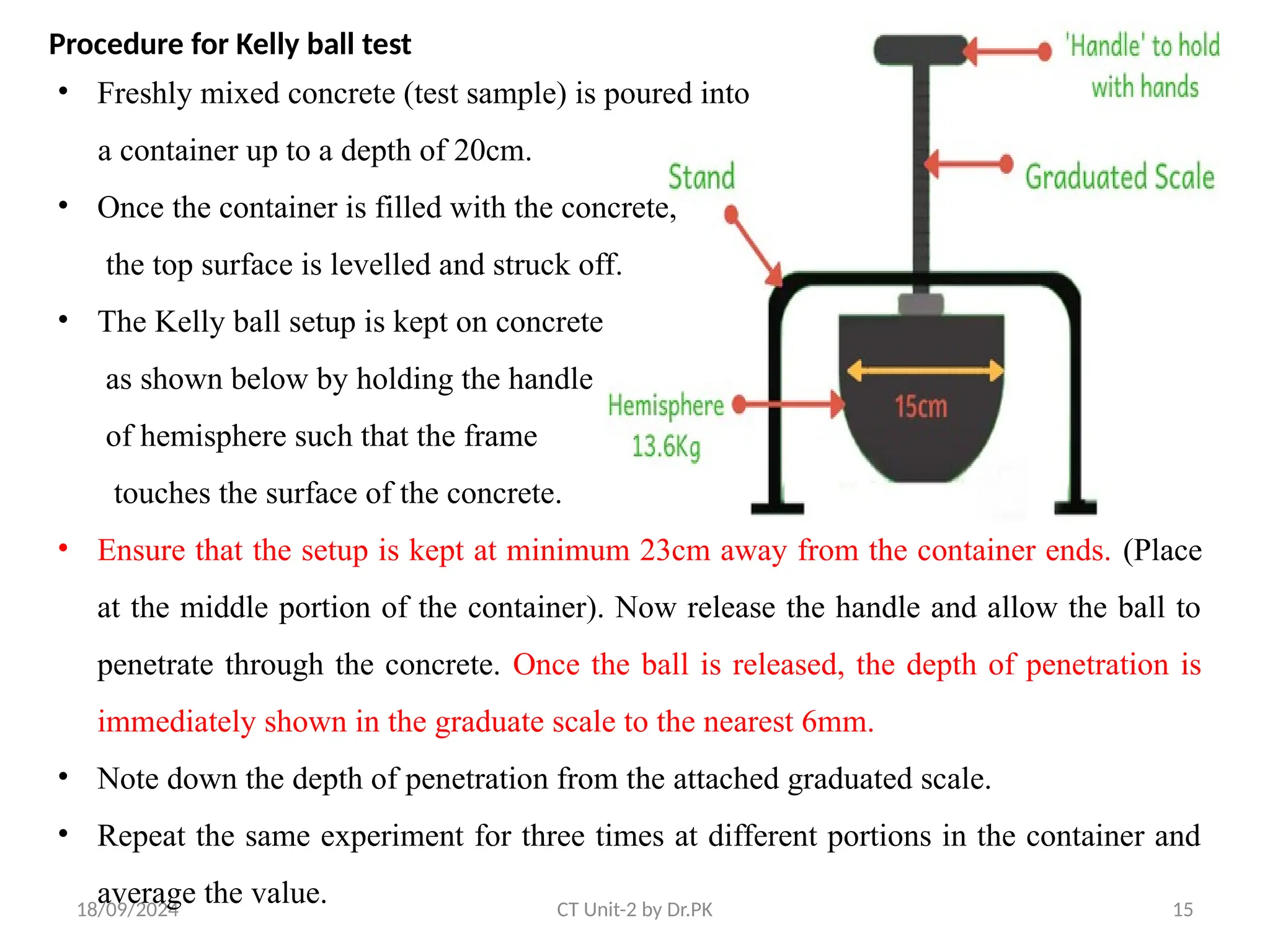
Kelly ball test apparatus consists of a cylinder with one end having a
hemispherical shape of 15cm weighing 13.6kg, and the other end is attached to a
graduated scale and handle. The whole arrangement is secured on a fixed stand.
The results have been specified by measuring the penetration made by the
hemisphere when freely placed on fresh concrete. The impression is measured by a
graduated scale immediately.
18/09/2024 CT Unit-2 by Dr.PK 15
• Freshly mixed concrete (test sample) is poured into
a container up to a depth of 20cm.
• Once the container is filled with the concrete,
the top surface is levelled and struck off.
• The Kelly ball setup is kept on concrete
as shown below by holding the handle
of hemisphere such that the frame
touches the surface of the concrete.
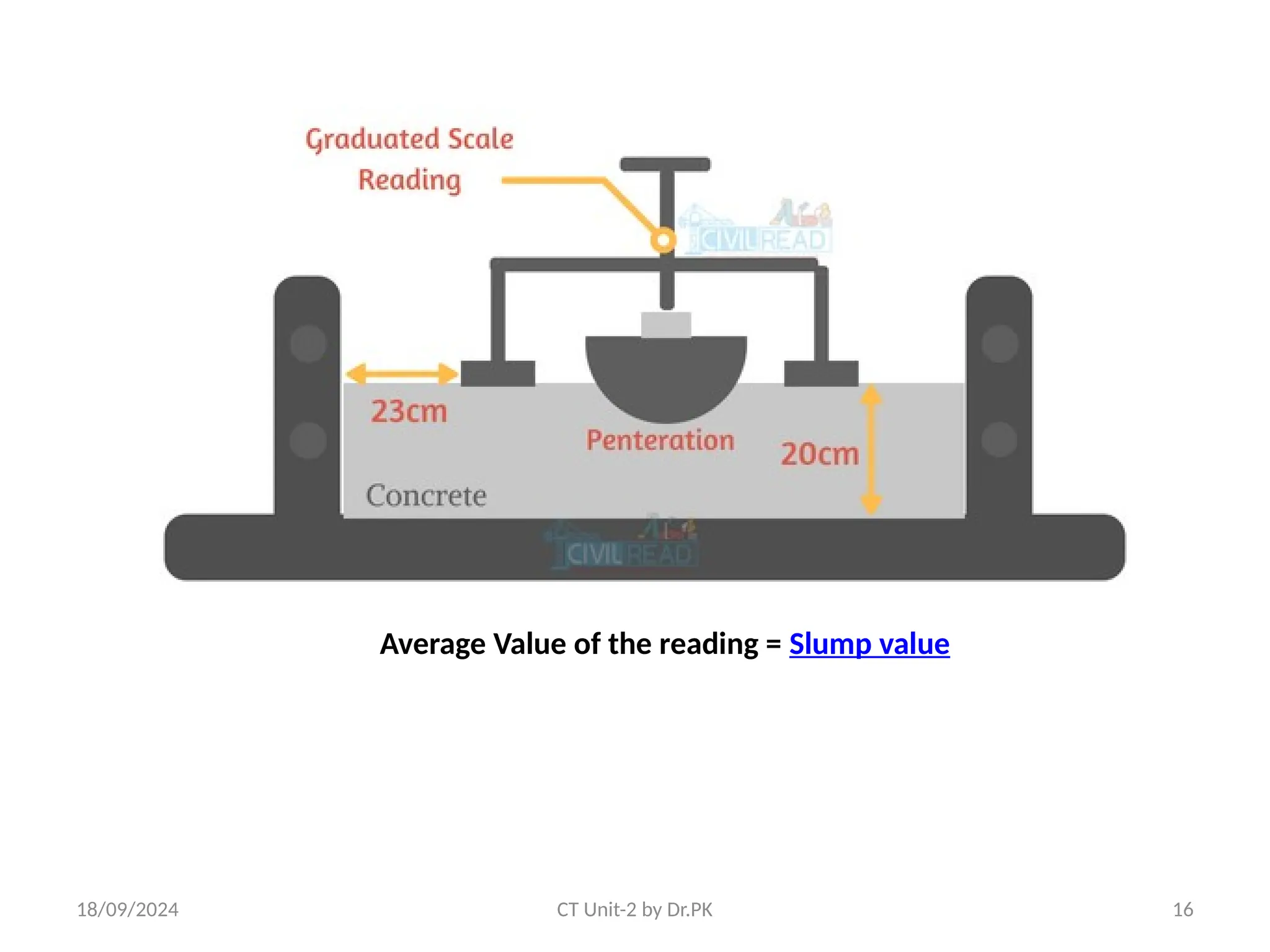
• Ensure that the setup is kept at minimum 23cm away from the container ends. (Place
at the middle portion of the container). Now release the handle and allow the ball to
penetrate through the concrete. Once the ball is released, the depth of penetration is
immediately shown in the graduate scale to the nearest 6mm.
• Note down the depth of penetration from the attached graduated scale.
• Repeat the same experiment for three times at different portions in the container and
average the value.
Procedure for Kelly ball test
18/09/2024 CT Unit-2 by Dr.PK 16
Average Value of the reading = Slump value
18/09/2024 CT Unit-2 by Dr.PK 17
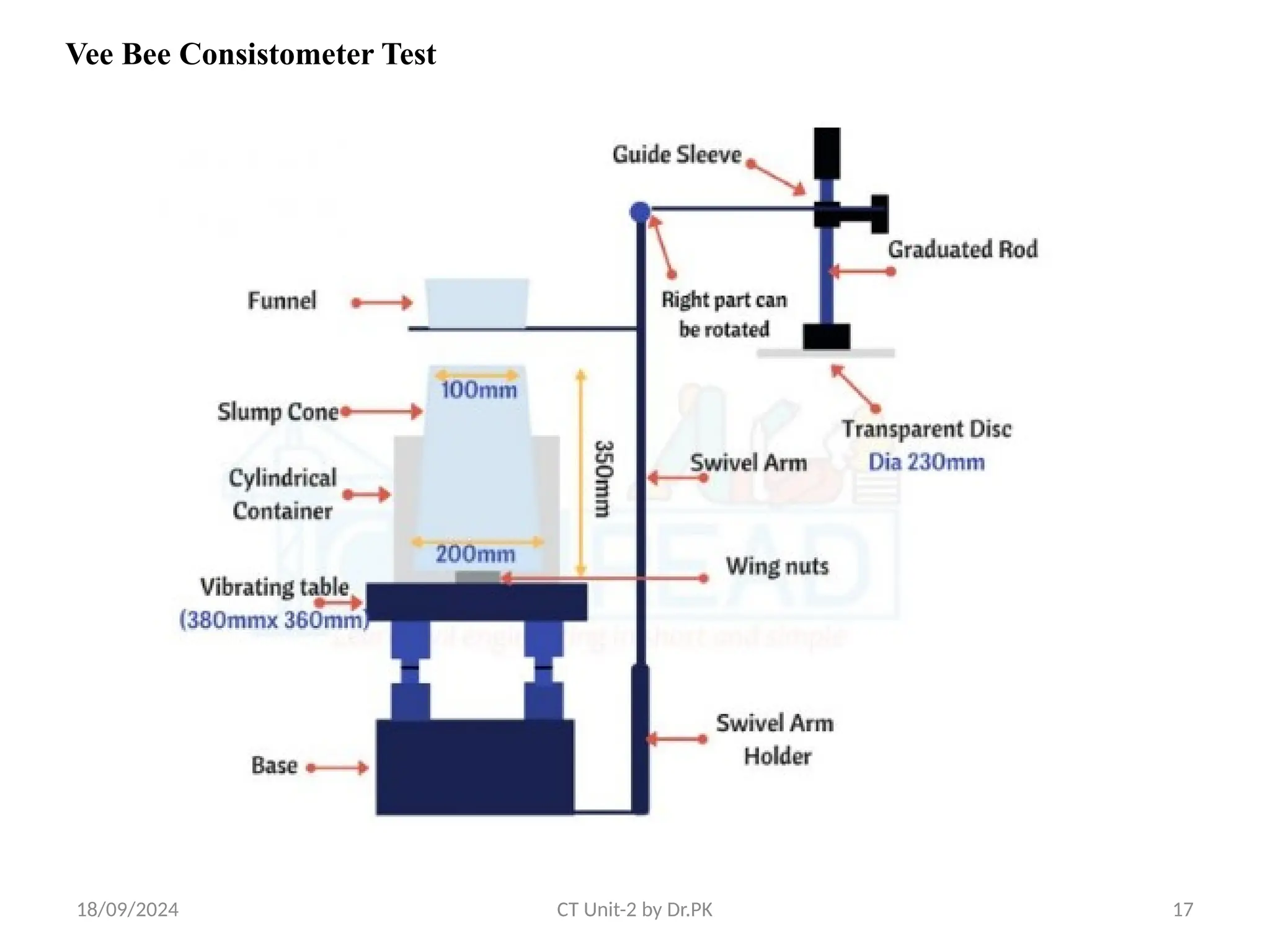
Vee Bee Consistometer Test
18/09/2024 CT Unit-2 by Dr.PK 18
Procedure for Vee bee Consistometer
1. Insert the Slump cone in the attached cylindrical container. Fill the concrete sample in
the cone in four layers; each layer should be one-quarter of the height of slump cone and
tamped with tamping rod for 25 strokes each. After tamping the top layer, struck off the
concrete with a trowel making the cone correctly filled.
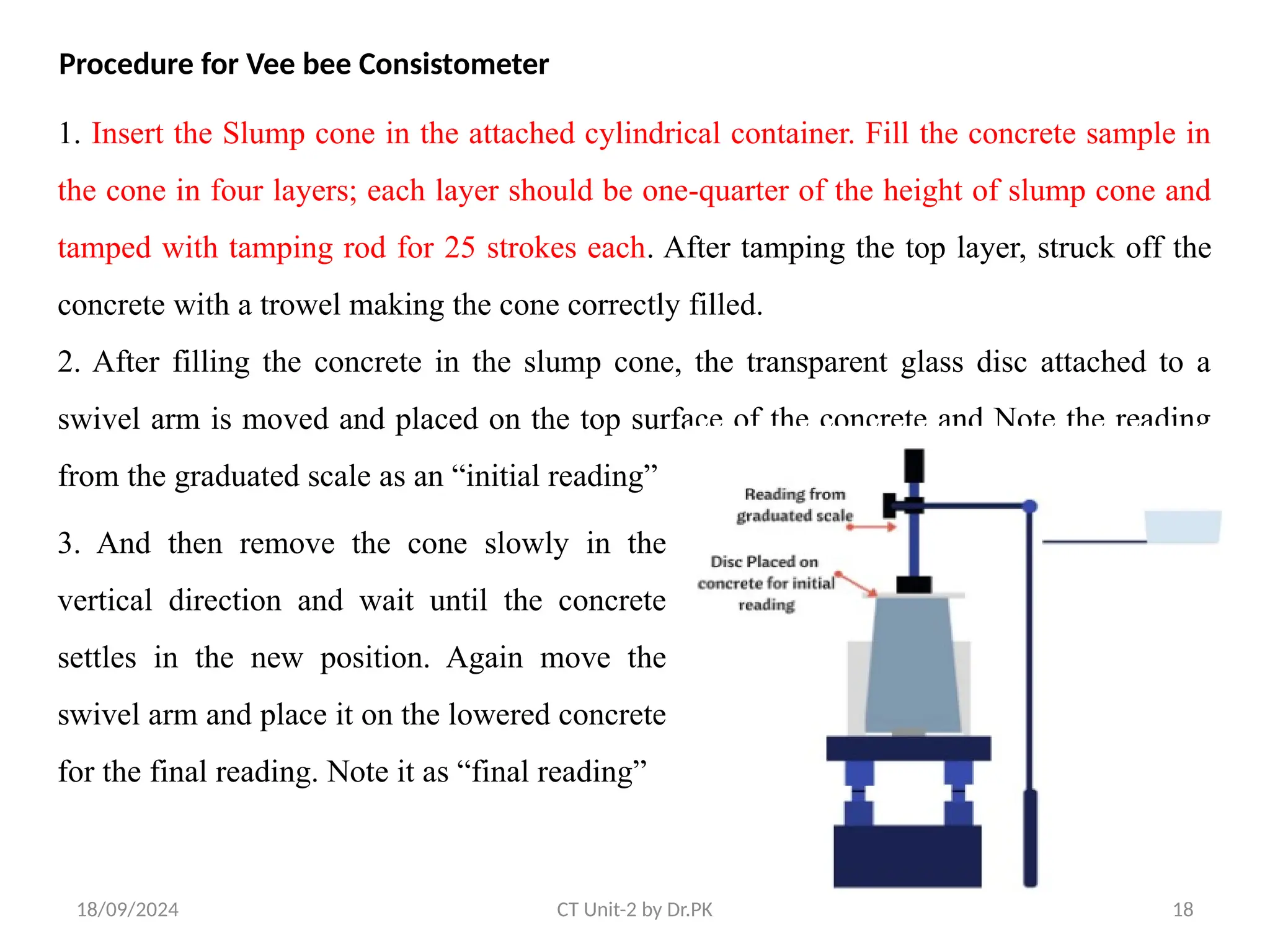
2. After filling the concrete in the slump cone, the transparent glass disc attached to a
swivel arm is moved and placed on the top surface of the concrete and Note the reading
from the graduated scale as an “initial reading”
3. And then remove the cone slowly in the
vertical direction and wait until the concrete
settles in the new position. Again move the
swivel arm and place it on the lowered concrete
for the final reading. Note it as “final reading”
18/09/2024 CT Unit-2 by Dr.PK 19
5. Now, switch on the vibrator and start the stopwatch. The vibrations are continued
until the concrete is wholly remoulded i.e, the surfaces become horizontal and the
whole concrete surface adheres uniformly to the transparent disc. The time required for
complete remoulding in seconds is recorded.
6. Note the time taken by concrete to become horizontal (remoulding) as Vee bee Secs.
The consistency of concrete is measured as Vee bee Secs
18/09/2024 CT Unit-2 by Dr.PK 20
Segregation
Segregation can be defined as the separation of the constituent materials of
concrete. A good concrete is one in which all the ingredients are properly distributed
to make a homogeneous mixture. If a sample of concrete exhibits a tendency for
separation of say, coarse aggregate from the rest of the ingredients, then, that sample
is said to be showing the tendency for segregation. Such concrete is not only going
to be weak; lack of homogeneity is also going to induce all undesirable properties in
the hardened concrete.
There are considerable differences in the sizes and specific gravities of the
constituent ingredients of concrete. Therefore, it is natural that the materials show a
tendency to fall apart. “Segregation may be of three types firstly, the coarse
aggregate separating out or settling down from the rest of the matrix, secondly, the
paste or matrix separating away from coarse aggregate and thirdly, water
separating out from the rest of the material being a material of lowest specific
gravity”.
18/09/2024 CT Unit-2 by Dr.PK 21
Dropping of concrete from heights as in the case of placing concrete in
column concreting will result in segregation. When concrete is discharged from a
badly designed mixer, or from a mixer with worn out blades, concrete shows a
tendency for segregation. Conveyance of concrete by conveyor belts, wheel
barrow, long distance haul by dumper, long lift by skip and hoist are the other
situations promoting segregation of concrete.
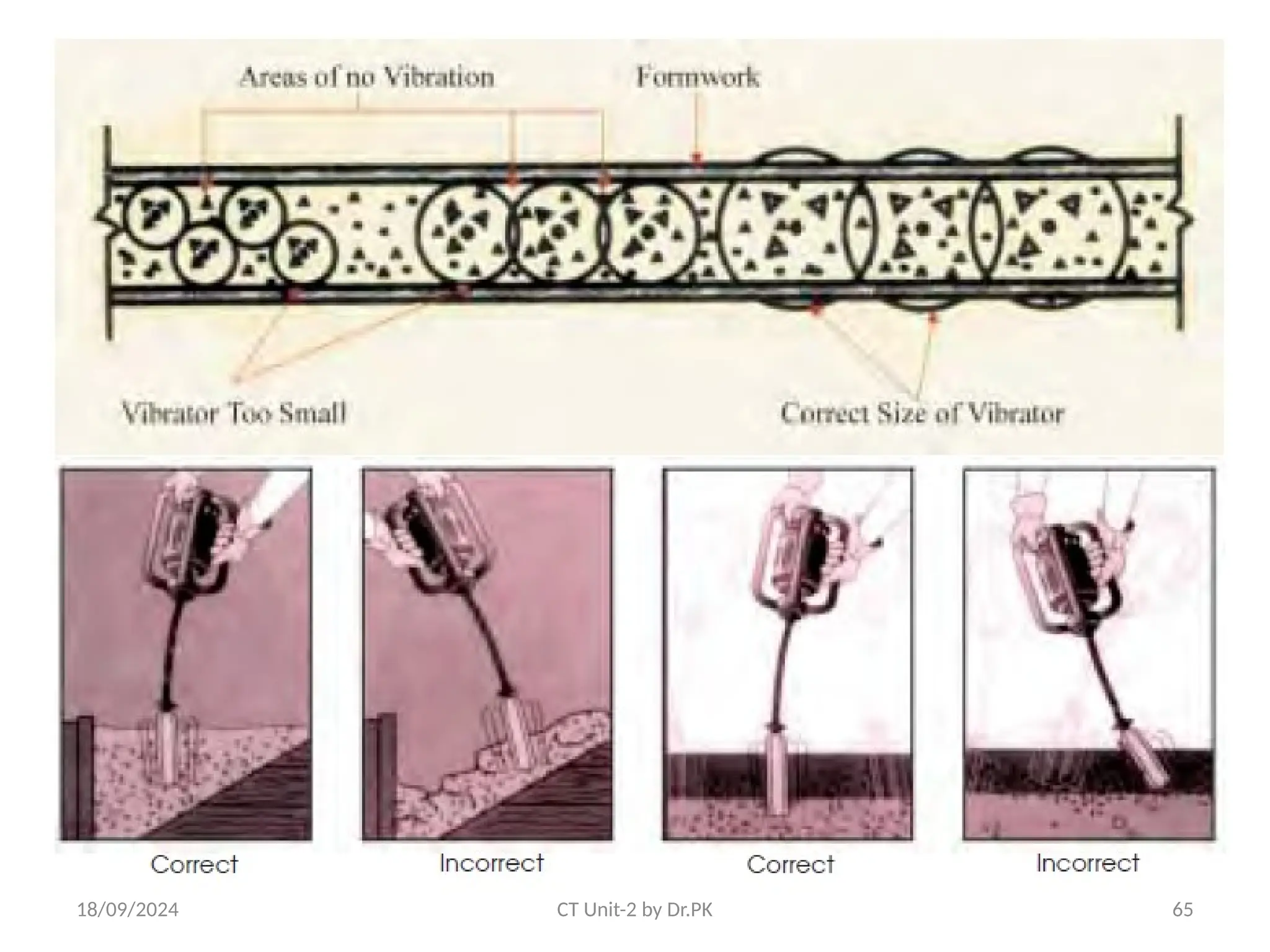
Vibration of concrete is one of the important methods of compaction. It
should be remembered that only comparatively dry mix should be vibrated. If wet
mix is excessively vibrated, it is likely that the concrete gets segregated. It should
also be remembered that vibration is continued just for required time for optimim
results. If the vibration is continued for a long time, particularly, in wet mix, it is
likely to result in segregation of concrete due to settlement of coarse aggregate in
matrix.
18/09/2024 CT Unit-2 by Dr.PK 22
Bleeding
Bleeding is sometimes referred as water gain. It is a particular form of
segregation, in which some of the water from the concrete comes out to the surface of
the concrete, being of the lowest specific gravity among all the ingredients of
concrete. Bleeding is predominantly observed in a highly wet mix, badly proportioned
and insufficiently mixed concrete. In thin members like roof slab or road slabs and
when concrete is placed in sunny weather show excessive bleeding.
Due to bleeding, water comes up and accumulates at the surface.
Sometimes, along with this water, certain quantity of cement also comes to the
surface. When the surface is worked up with the trowel and floats, the aggregate goes
down and the cement and water come up to the top surface. This formation of cement
paste at the surface is known as “Laitance”.
18/09/2024 CT Unit-2 by Dr.PK 23
Bleeding rate increases with time up to about one hour or so and thereafter
the rate decreases but continues more or less till the final setting time of cement.
Bleeding is an inherent phenomenon
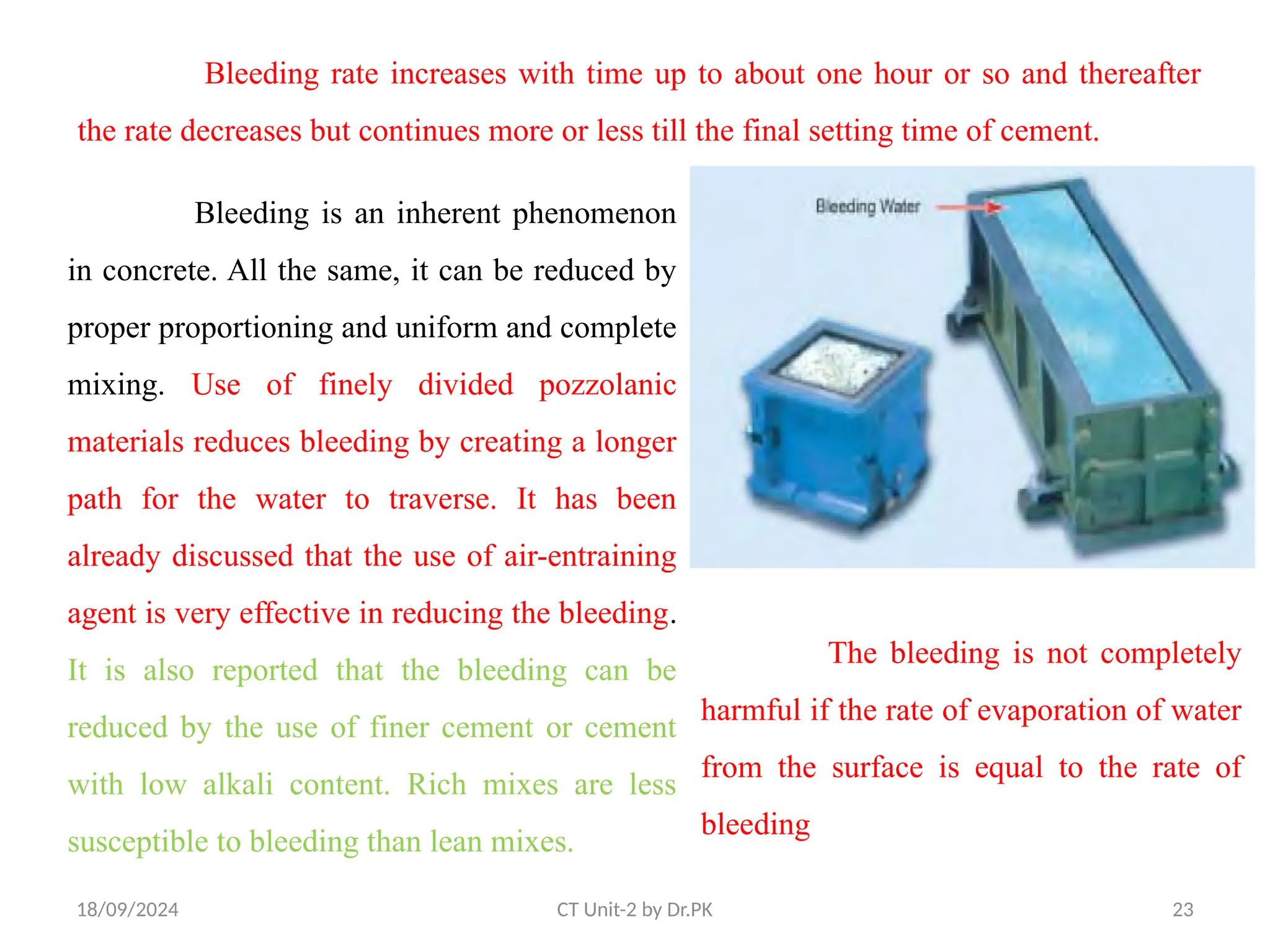
in concrete. All the same, it can be reduced by
proper proportioning and uniform and complete
mixing. Use of finely divided pozzolanic
materials reduces bleeding by creating a longer
path for the water to traverse. It has been
already discussed that the use of air-entraining
agent is very effective in reducing the bleeding.
It is also reported that the bleeding can be
reduced by the use of finer cement or cement
with low alkali content. Rich mixes are less
susceptible to bleeding than lean mixes.
The bleeding is not completely
harmful if the rate of evaporation of water
from the surface is equal to the rate of
bleeding
18/09/2024 CT Unit-2 by Dr.PK 24
Method of Test for Bleeding of Concrete
This method covers determination of relative quantity of mixing water that
will bleed from a sample of freshly mixed concrete.
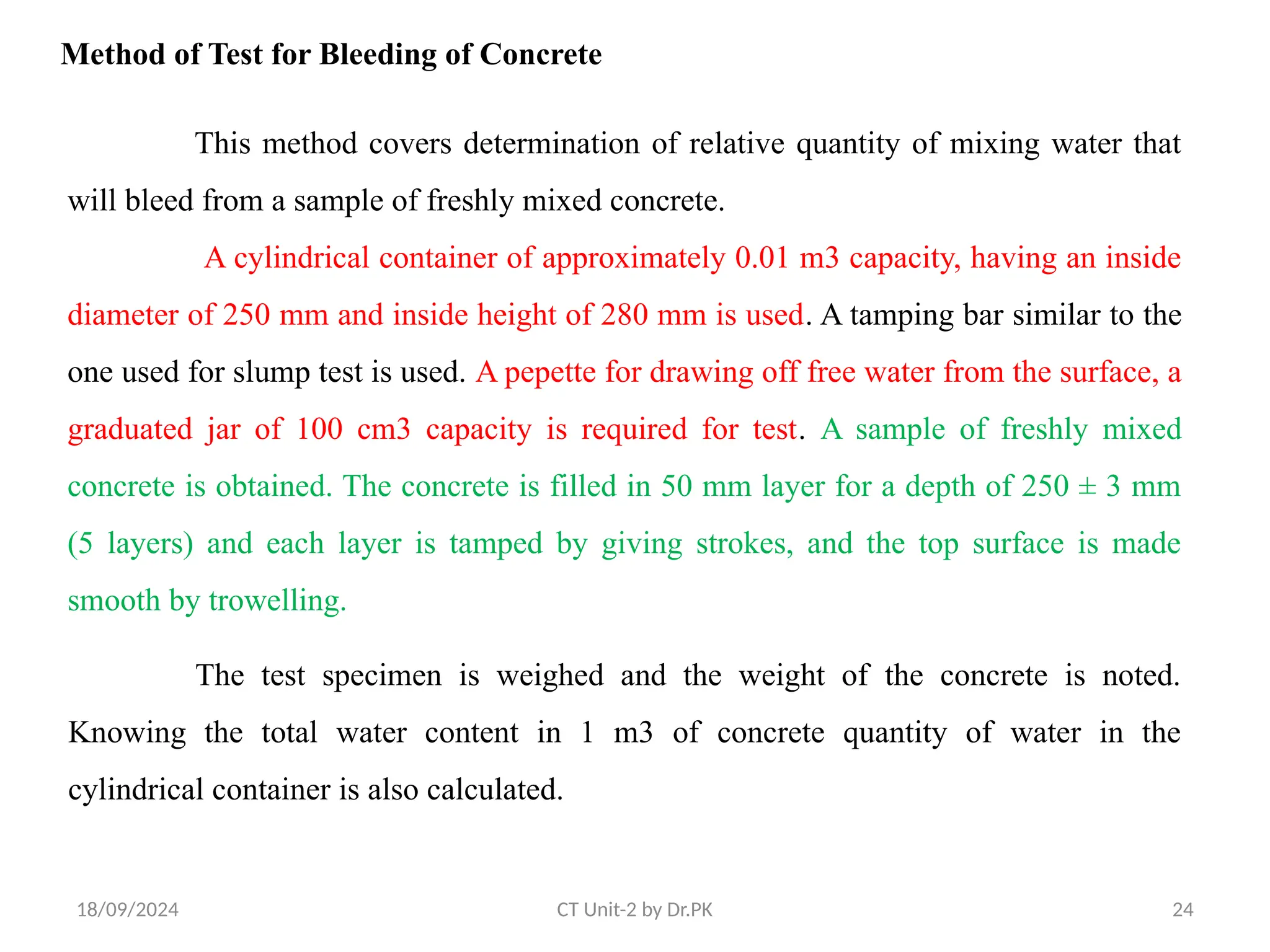
A cylindrical container of approximately 0.01 m3 capacity, having an inside
diameter of 250 mm and inside height of 280 mm is used. A tamping bar similar to the
one used for slump test is used. A pepette for drawing off free water from the surface, a
graduated jar of 100 cm3 capacity is required for test. A sample of freshly mixed
concrete is obtained. The concrete is filled in 50 mm layer for a depth of 250 ± 3 mm
(5 layers) and each layer is tamped by giving strokes, and the top surface is made
smooth by trowelling.
The test specimen is weighed and the weight of the concrete is noted.
Knowing the total water content in 1 m3 of concrete quantity of water in the
cylindrical container is also calculated.
18/09/2024 CT Unit-2 by Dr.PK 25
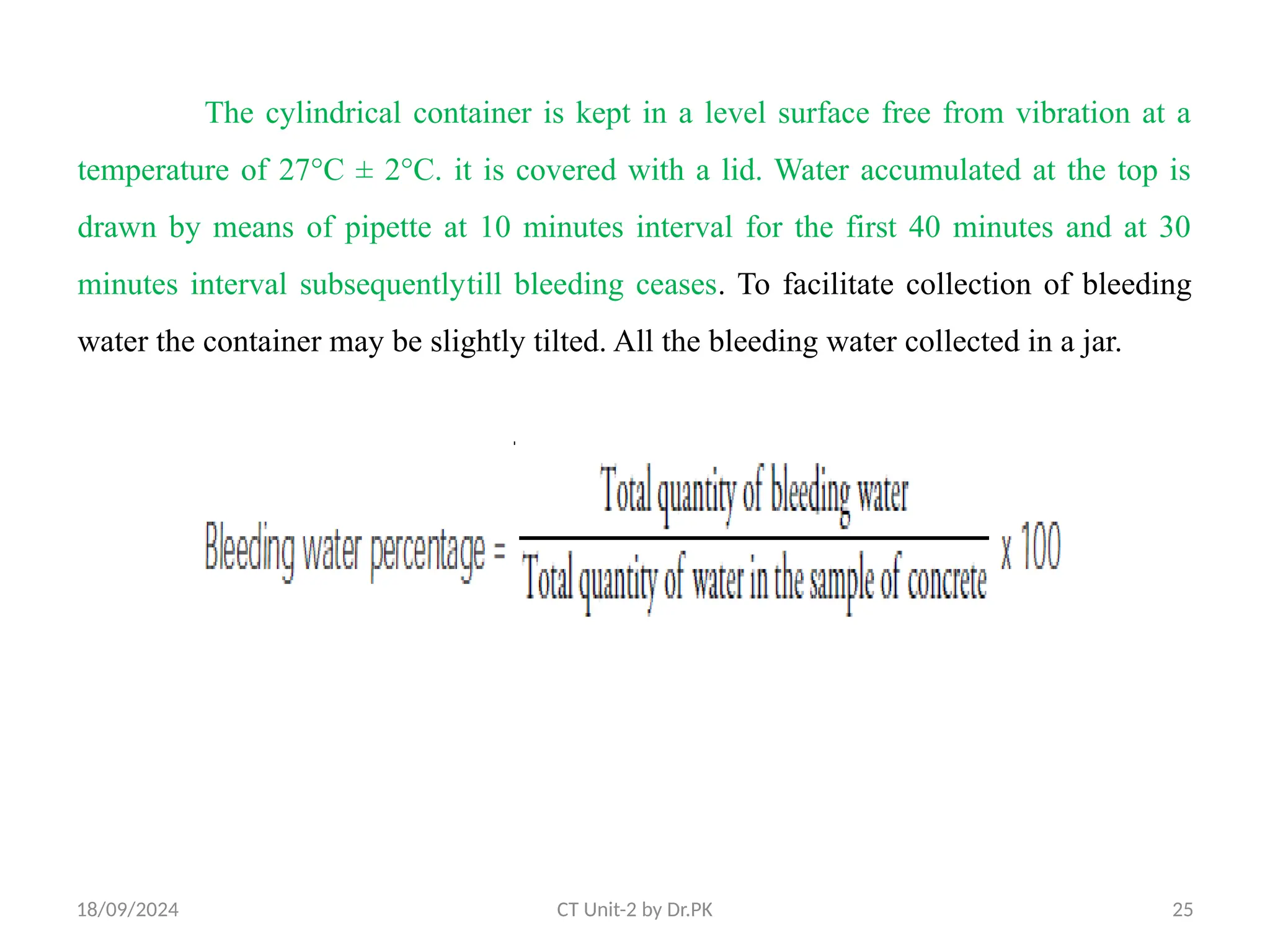
The cylindrical container is kept in a level surface free from vibration at a
temperature of 27°C ± 2°C. it is covered with a lid. Water accumulated at the top is
drawn by means of pipette at 10 minutes interval for the first 40 minutes and at 30
minutes interval subsequentlytill bleeding ceases. To facilitate collection of bleeding
water the container may be slightly tilted. All the bleeding water collected in a jar.
18/09/2024 CT Unit-2 by Dr.PK 26
Setting Time of Concrete
Setting time of concrete differs widely from setting time of
cement. Setting time of concrete does not coincide with the setting time of
cement with which the concrete is made. The setting time of concrete
depends upon the w/c ratio, temperature conditions, type of cement, use
of mineral admixture, use of plasticizers–in particular retarding plasticizer.
The setting parameter of concrete is more of practical significance for site
engineers than setting time of cement. When retarding plasticizers are
used, the increase in setting time, the duration upto which concrete
remains in plastic condition is of special interest
The setting time of concrete is found by pentrometer test. This
method of test is covered by IS 8142 of 1976 and ASTM C – 403. The
procedure given below may also be applied to prepared mortar and
grouts.
The apparatus consist of a container which should have minimum
lateral dimension of 150 mm and minimum depth of 150 mm.
18/09/2024 CT Unit-2 by Dr.PK 27
There are six penetration needles with bearing areas of 645, 323, 161, 65,
32 and 16 mm2. Each needle stem is scribed circumferentially at a distance of 25
mm from the bearing area.
A device is provided to measure the force required to cause penetration of
the needle. The test procedure involves the collection of representative sample of
concrete in sufficient quantity and sieve it through 4.75 mm sieve and the resulting
mortar is filled in the container. Compact the mortar by rodding, tapping, rocking or
by vibrating. Level the surface and keep it covered to prevent the loss of moisture.
Remove bleeding water, if any, by means of pipette. Insert a needle of appropriate
size, depending upon the degree of setting of the mortar in the following manner.
18/09/2024 CT Unit-2 by Dr.PK 28
Bring the bearing surface of needle in contact with the mortar surface.
Gradually and uniformly apply a vertical force downwards on the apparatus until
the needle penetrates to a depth of 25 ± 1.5 mm, as indicated by the scribe mark.
The time taken to penetrate 25 mm depth could be about 10 seconds. Record the
force required to produce 25 mm penetration and the time of inserting from the time
water is added to cement. Calculate the penetration resistance by dividing the
recorded force by the bearing area of the needle. This is the penetration resistance.
For the subsequent penetration avoid the area where the mortar has been disturbed.
The clear distance should be two times the diameter of the bearing area. Needle is
inserted at least 25 mm away from the wall of container.
18/09/2024 CT Unit-2 by Dr.PK 29
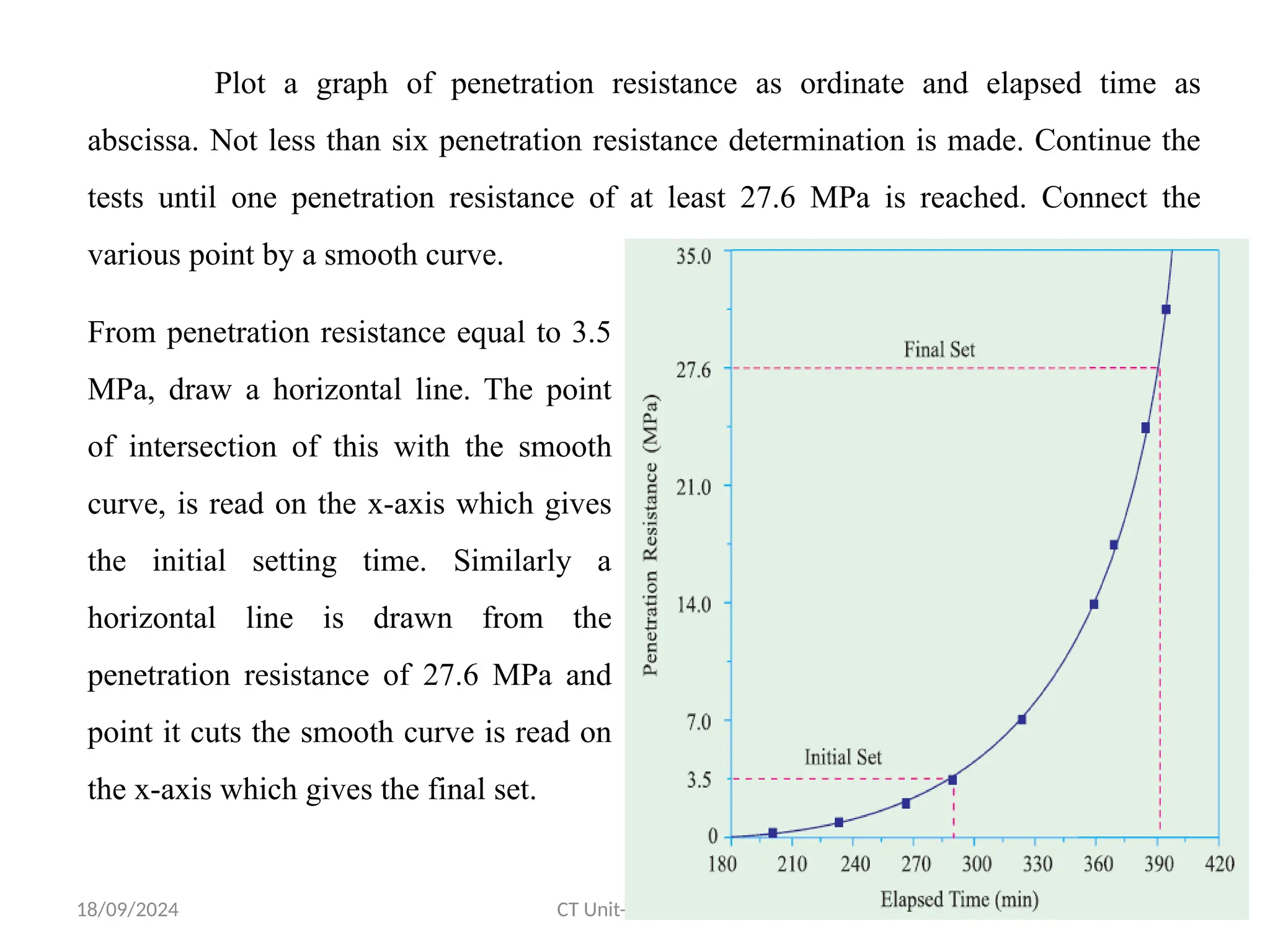
Plot a graph of penetration resistance as ordinate and elapsed time as
abscissa. Not less than six penetration resistance determination is made. Continue the
tests until one penetration resistance of at least 27.6 MPa is reached. Connect the
various point by a smooth curve.
From penetration resistance equal to 3.5
MPa, draw a horizontal line. The point
of intersection of this with the smooth
curve, is read on the x-axis which gives
the initial setting time. Similarly a
horizontal line is drawn from the
penetration resistance of 27.6 MPa and
point it cuts the smooth curve is read on
the x-axis which gives the final set.
18/09/2024 CT Unit-2 by Dr.PK 30
Process of Manufacture of Concrete
Production of quality concrete requires meticulous care exercised at every
stage of manufacture of concrete. It is interesting to note that the ingredients of good
concrete and bad concrete are the same. If meticulous care is not exercised, and good
rules are not observed, the resultant concrete is going to be of bad quality. With the
same material if intense care is taken to exercise control at every stage, it will result in
good concrete. Therefore, it is necessary for us to know what are the good rules to be
followed in each stage of manufacture of concrete for producing good quality concrete.
The various stages of manufacture of concrete are:
(a ) Batching (b) Mixing (c ) Transporting
(d ) Placing (e) Compacting (f ) Curing
(g) Finishing.
18/09/2024 CT Unit-2 by Dr.PK 31
(a) Batching
The measurement of materials for making concrete is known as batching.
There are two methods of batching:
(i ) Volume batching (ii ) Weigh batching
(i) Volume batching:
Volume batching is not a good method for proportioning the material
because of the difficulty it offers to measure granular material in terms of volume.
Volume of moist sand in a loose condition weighs much less than the same volume
of dry compacted sand.
Cement is always measured by weight. It is never measured in volume.
Generally, for each batch mix, one bag of cement is used. The volume of one bag of
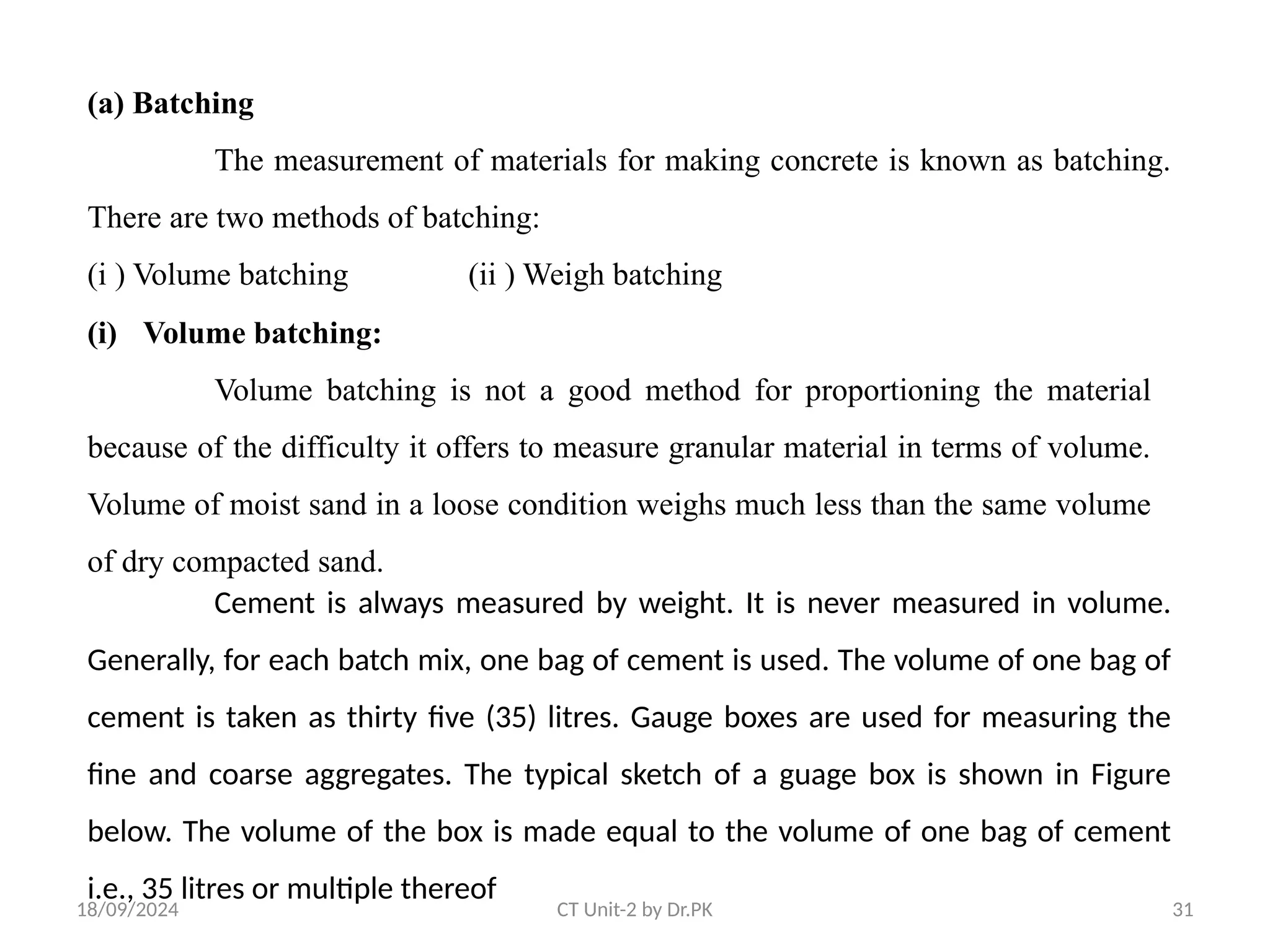
cement is taken as thirty five (35) litres. Gauge boxes are used for measuring the
fine and coarse aggregates. The typical sketch of a guage box is shown in Figure
below. The volume of the box is made equal to the volume of one bag of cement
i.e., 35 litres or multiple thereof
18/09/2024 CT Unit-2 by Dr.PK 32
Gauge boxes are generally called
farmas. They can be made of timber or steel
plates. Often in India volume batching is
adopted even for large concreting operations.
In a major site it is recommended to have the
following gauge boxes at site to cater for
change in Mix Design or bulking of sand. The
volume of each gauge box is clearly marked
with paint on the external surface.
The quantity of water required is a product of water/cement ratio and the weight
of cement; for a example, if the water/cement ratio of 0.5 is specified, the quantity of
mixing water required per bag of cement is 0.5 x 50.00 = 25 kg. or 25 litres. The quantity
is, of coarse, inclusive of any surface moisture present in the aggregate.
18/09/2024 CT Unit-2 by Dr.PK 33
(ii) Weigh Batching:
Strictly speaking, weigh batching is the correct method of measuring the
materials. For important concrete, invariably, weigh batching system should be
adopted. Use of weight system in batching, facilitates accuracy, flexibility and
simplicity. Different types of weigh batchers are available, The particular type to be
used, depends upon the nature of the job. Large weigh batching plants have automatic
weighing equipment. The use of this automatic equipment for batching is one of
sophistication and requires qualified and experienced engineers. In this, further
complication will come to adjust water content to cater for the moisture content in the
aggregate.
18/09/2024 CT Unit-2 by Dr.PK 34
On large work sites, the weigh bucket
type of weighing equipments are used. This fed
from a large overhead storage hopper and it
discharges by gravity, straight into the mixer.
Automatic batching plants are available
in small or large capacity. In this, the operator has
only to press one or two buttons to put into motion
the weighing of all the different materials, the flow
of each being cut off when the correct weight is
reached.
In small jobs, cement is often not weighed; it is added in bags assuming the
weight of the bag as 50 kg. In reality, though the cement bag is made of 50 kg.
18/09/2024 CT Unit-2 by Dr.PK 35
Measurement of Water:
18/09/2024 CT Unit-2 by Dr.PK 36
Mixing
Thorough mixing of the materials is essential for the production of
uniform concrete. The mixing should ensure that the mass becomes homogeneous,
uniform in colour and consistency. There are two methods adopted for mixing
concrete:
(i ) Hand mixing (ii )Machine mixing
(i) Hand Mixing: Hand mixing is practised for small scale unimportant concrete
works. As the mixing cannot be thorough and efficient, it is desirable to add 10 per
cent more cement to cater for the inferior concrete produced by this method.
Hand mixing should be done over an impervious concrete or brick floor of
sufficiently large size to take one bag of cement. Spread out the measured quantity
of coarse aggregate and fine aggregate in alternate layers. Pour the cement on the top
of it, and mix them dry by shovel, turning the mixture over and over again until
uniformity of colour is achieved. This uniform mixture is spread out in thickness of
about 20 cm.
18/09/2024 CT Unit-2 by Dr.PK 37
(ii) Machine Mixing:
Mixing of concrete is almost invariably carried out by machine, for
reinforced concrete work and for medium or large scale mass concrete work.
Machine mixing is not only efficient, but also economical, when the quantity of
concrete to be produced is large.
Many types of mixers are available for mixing concrete. They can be
classified as batch-mixers and continuous mixers. Batch mixers produce concrete,
batch by batch with time interval, whereas continuous mixers produce concrete
continuously without stoppage till such time the plant is working. In this, materials
are fed continuously by screw feeders and the materials are continuously mixed and
continuously discharged. This type of mixers are used in large works such as dams. In
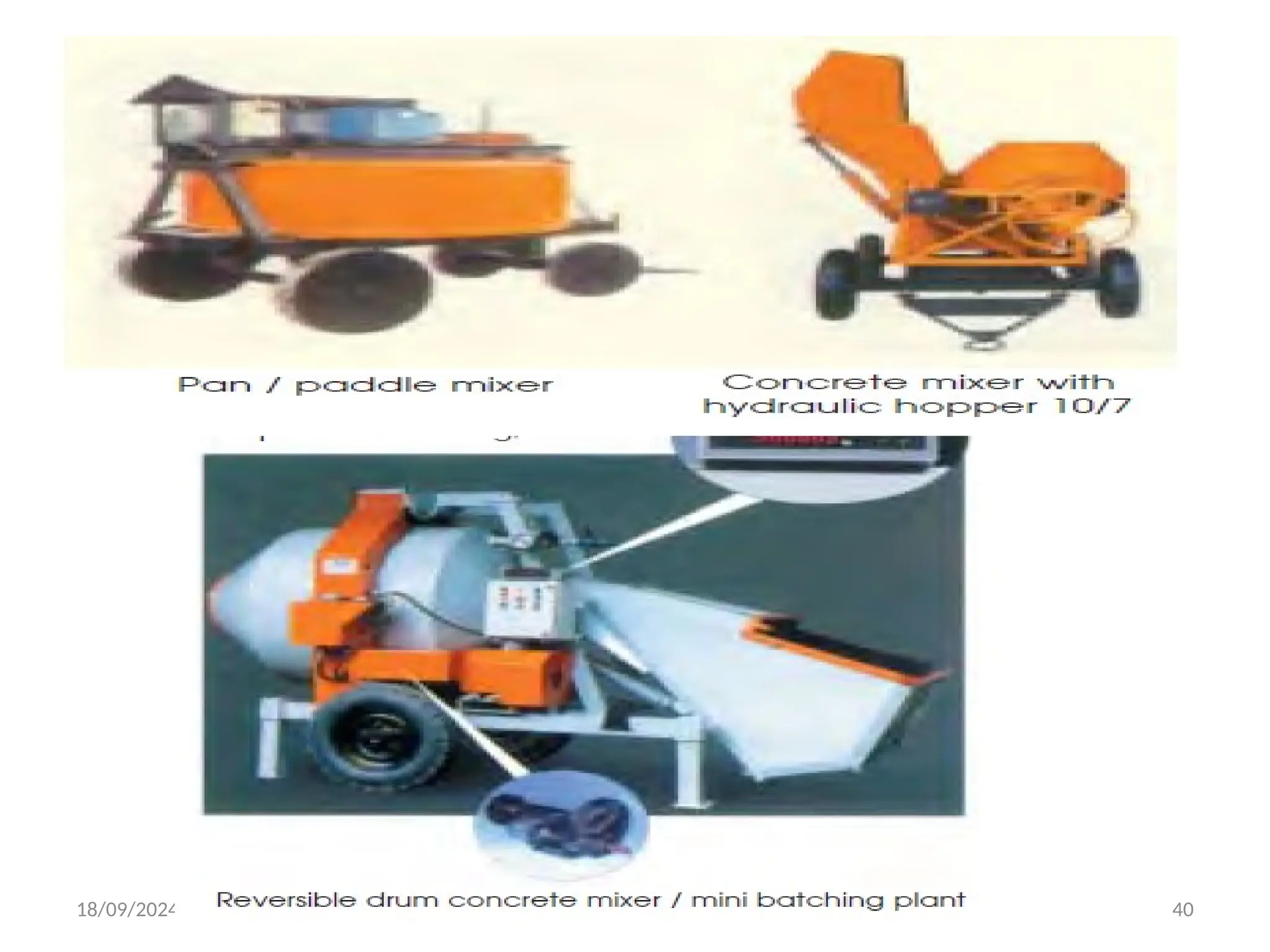
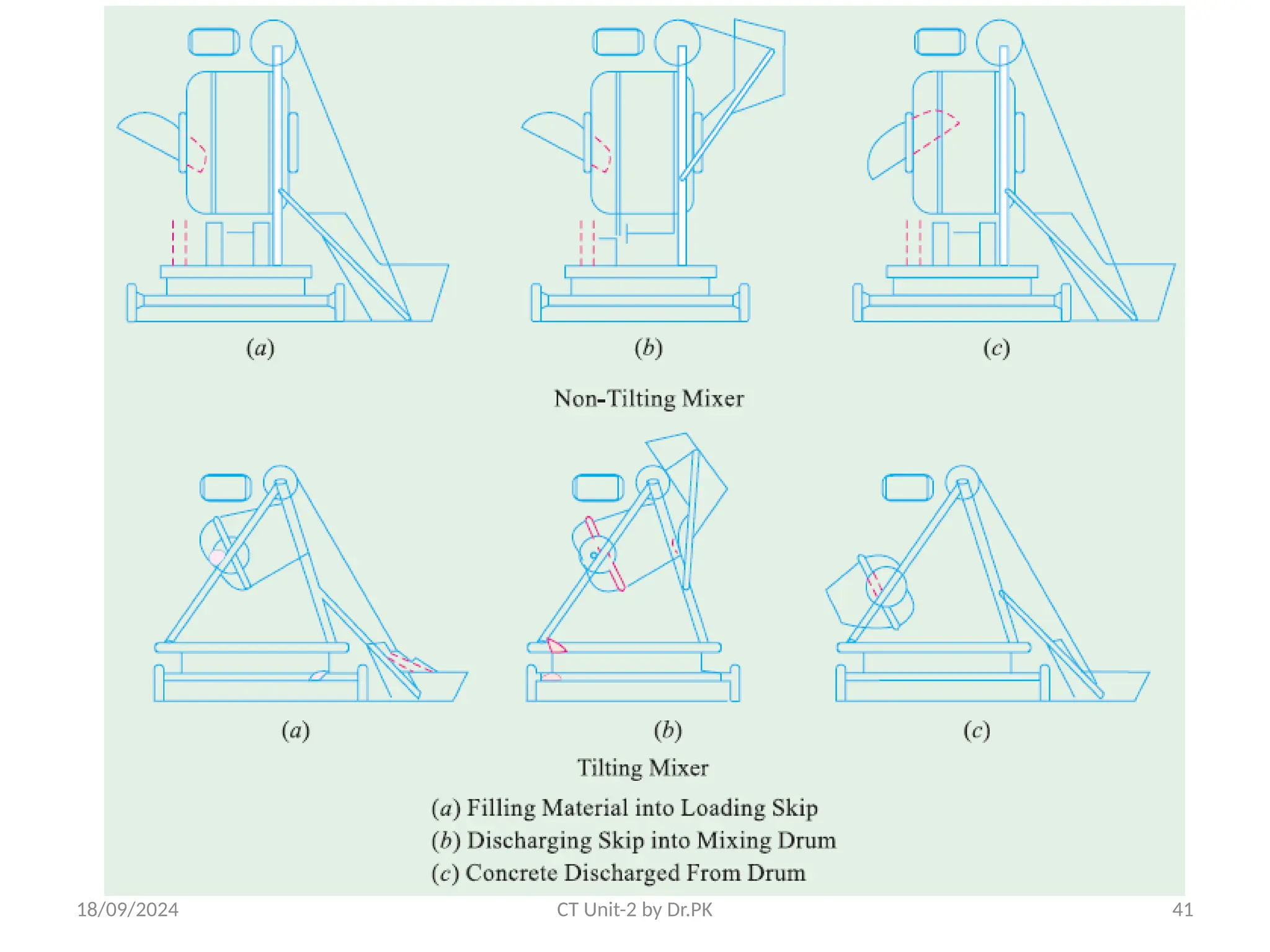
normal concrete work, it is the batch mixers that are used. Batch mixer may be of pan
type or drum type. The drum type may be further classified as tilting, non-tilting,
reversing or forced action type.
18/09/2024 CT Unit-2 by Dr.PK 38
Very little is known about the relative
mixing efficiencies of the various types of
mixers, but some evidences are there to suggest
that pan mixers with a revolving star of blades
are more efficient. They are specially suitable
for stiff and lean mixes, which present
difficulties with most other types of mixers,
mainly due to sticking of mortar in the drum.
The shape of the drum, the angle and size of blades, the angle at which the drum is
held, affect the efficiency of mixer. It is seen that tilting drum to some extent is more
efficient than non-tilting drum. In non-tilting drum for discharging concrete, a chute is
introduced into the drum by operating a lever.
18/09/2024 CT Unit-2 by Dr.PK 39
The concrete which is being mixed in the drum, falls into the inclined chute
and gets discharged out. It is seen that a little more of segregation takes place, when a
non-tilting mixer is used. It is observed in practice that, generally, in any type of mixer,
even after thorough mixing in the drum, while it is discharged, more of coarse aggregate
comes out first and at the end matrix gets discharged. It is necessary that a little bit of re-
mixing is essential, after discharged from mixer, on the platform to off-set the effect of
segregation caused while concrete is discharged from the mixer.
As per I.S. 1791–1985, concrete mixers are designated by a number
representing its nominal mixed batch capacity in litres. The following are the
standardized sizes of three types:
a. Tilting: 85 T, 100 T, 140 T, 200 T
b. Non-Tilting: 200 NT, 280 NT, 375 NT, 500 NT, 1000 NT
c. Reversing: 200 R, 280 R, 375 R, 500 R and 1000 R`
The letters T, NT, R denote tilting, non-tilting and reversing respectively
18/09/2024 CT Unit-2 by Dr.PK 40
18/09/2024 CT Unit-2 by Dr.PK 41
18/09/2024 CT Unit-2 by Dr.PK 42
Mixing Time:
Concrete mixers are generally designed to run at a speed of 15 to 20
revolutions per minute. For proper mixing, it is seen that about 25 to 30 revolutions are
required in a well designed mixer.
Generally mixing time is related to the capacity of mixer. The mixing time
varies between 1½ to 2½ minutes. Bigger the capacity of the drum more is the mixing
time. However, modern high speed pan mixer used in RMC, mixes the concrete in about
15 to 30 secs. One cubic meter capacity high speed Pan Mixer takes only about 2
minutes for batching and mixing. The batching plant takes about 12 minutes to load a
transit mixer of 6 m3 capacity.
18/09/2024 CT Unit-2 by Dr.PK 43
Transporting Concrete
Concrete can be transported by a variety of methods and equipments. The
precaution to be taken while transporting concrete is that the homogeneity obtained at
the time of mixing should be maintained while being transported to the final place of
deposition. The methods adopted for transportation of concrete are:
(a) Mortar Pan (b) Wheel Barrow, Hand Cart
(c) Crane, Bucket and Rope way (d ) Truck Mixer and Dumpers
(e) Belt Conveyors (f ) Chute
(g) Skip and Hoist (h) Tansit Mixer
(i ) Pump and Pipe Line ( j ) Helicoptor.
18/09/2024 CT Unit-2 by Dr.PK 44
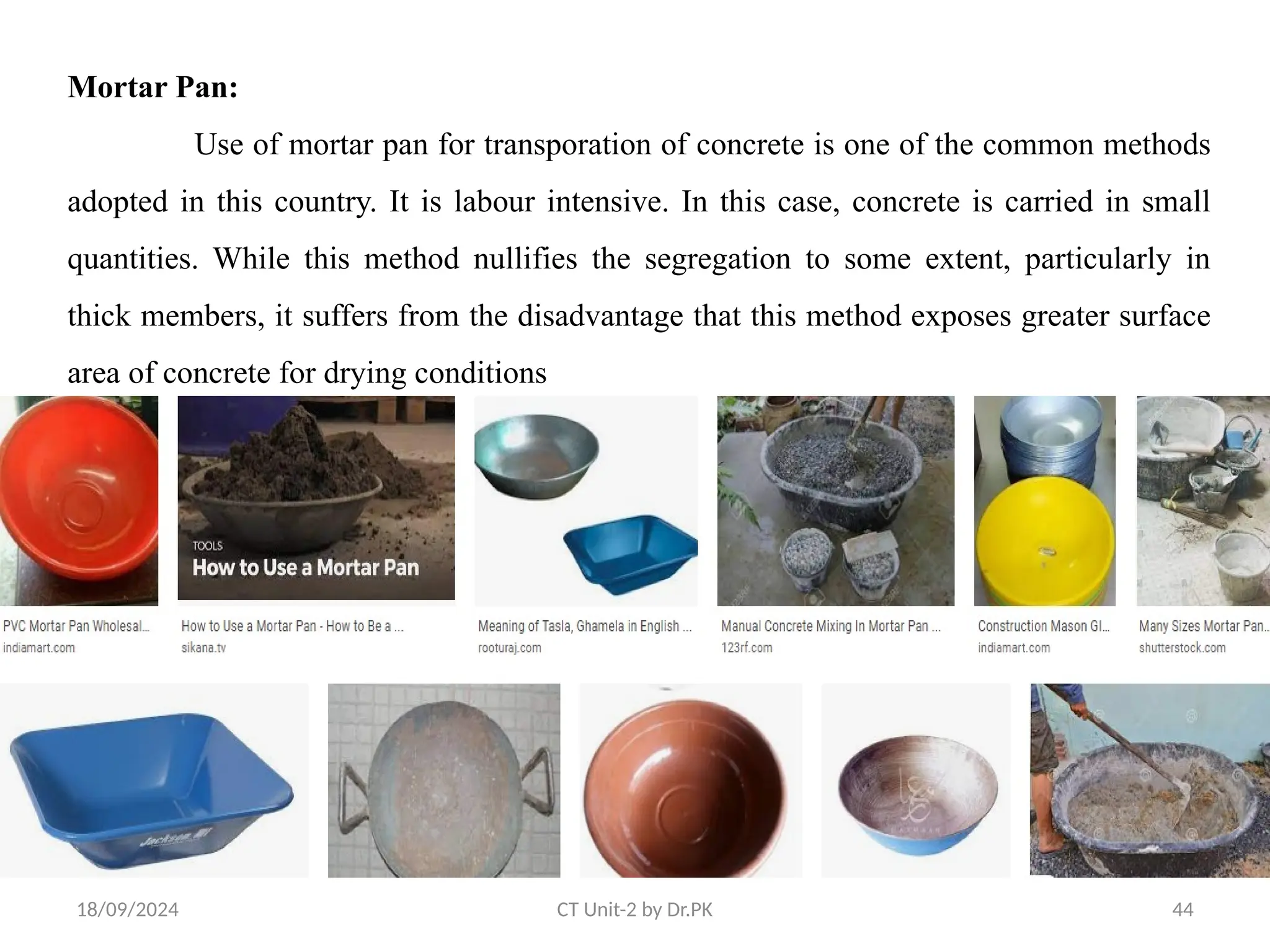
Mortar Pan:
Use of mortar pan for transporation of concrete is one of the common methods
adopted in this country. It is labour intensive. In this case, concrete is carried in small
quantities. While this method nullifies the segregation to some extent, particularly in
thick members, it suffers from the disadvantage that this method exposes greater surface
area of concrete for drying conditions
18/09/2024 CT Unit-2 by Dr.PK 45
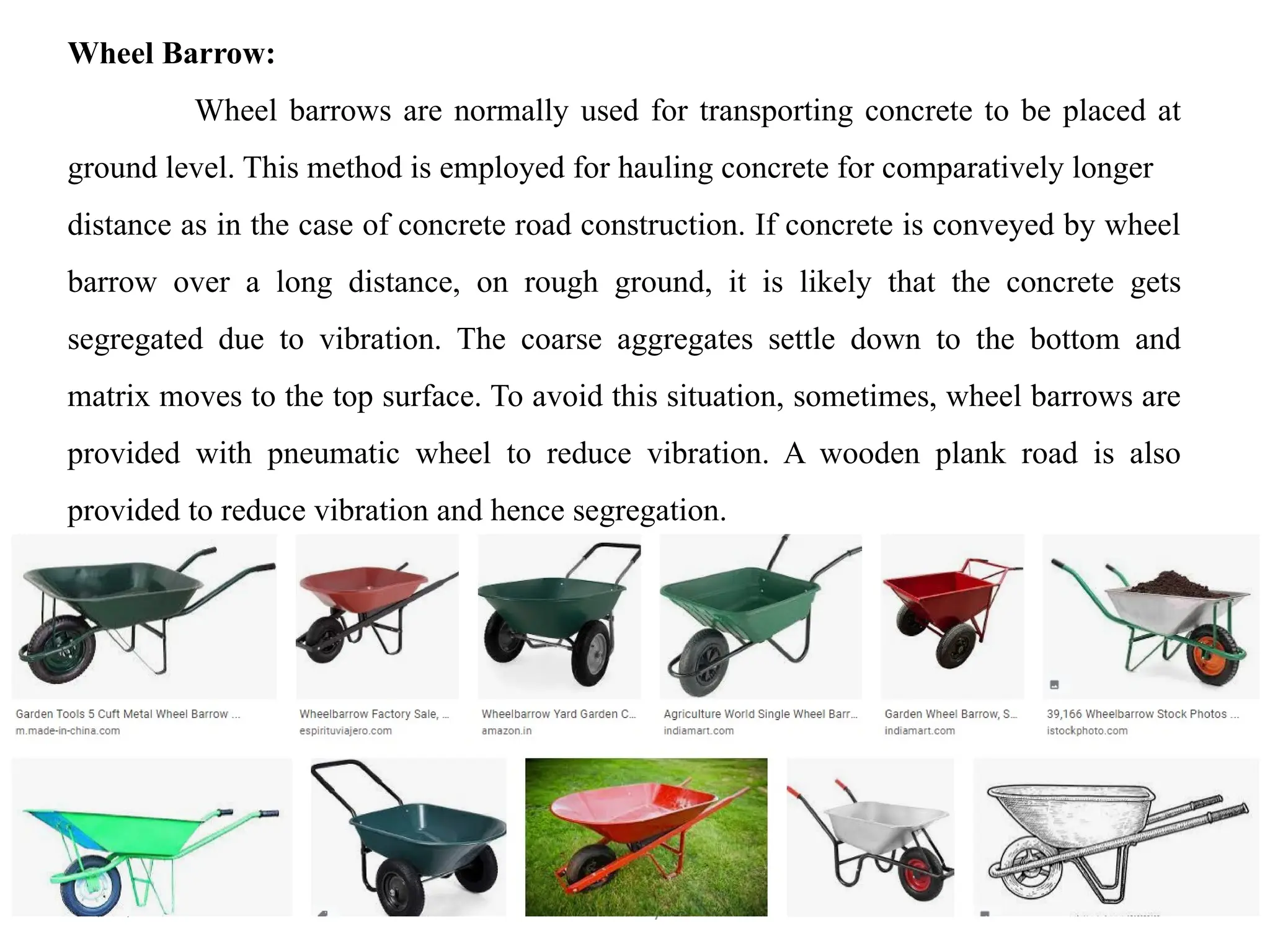
Wheel Barrow:
Wheel barrows are normally used for transporting concrete to be placed at
ground level. This method is employed for hauling concrete for comparatively longer
distance as in the case of concrete road construction. If concrete is conveyed by wheel
barrow over a long distance, on rough ground, it is likely that the concrete gets
segregated due to vibration. The coarse aggregates settle down to the bottom and
matrix moves to the top surface. To avoid this situation, sometimes, wheel barrows are
provided with pneumatic wheel to reduce vibration. A wooden plank road is also
provided to reduce vibration and hence segregation.
18/09/2024 CT Unit-2 by Dr.PK 46
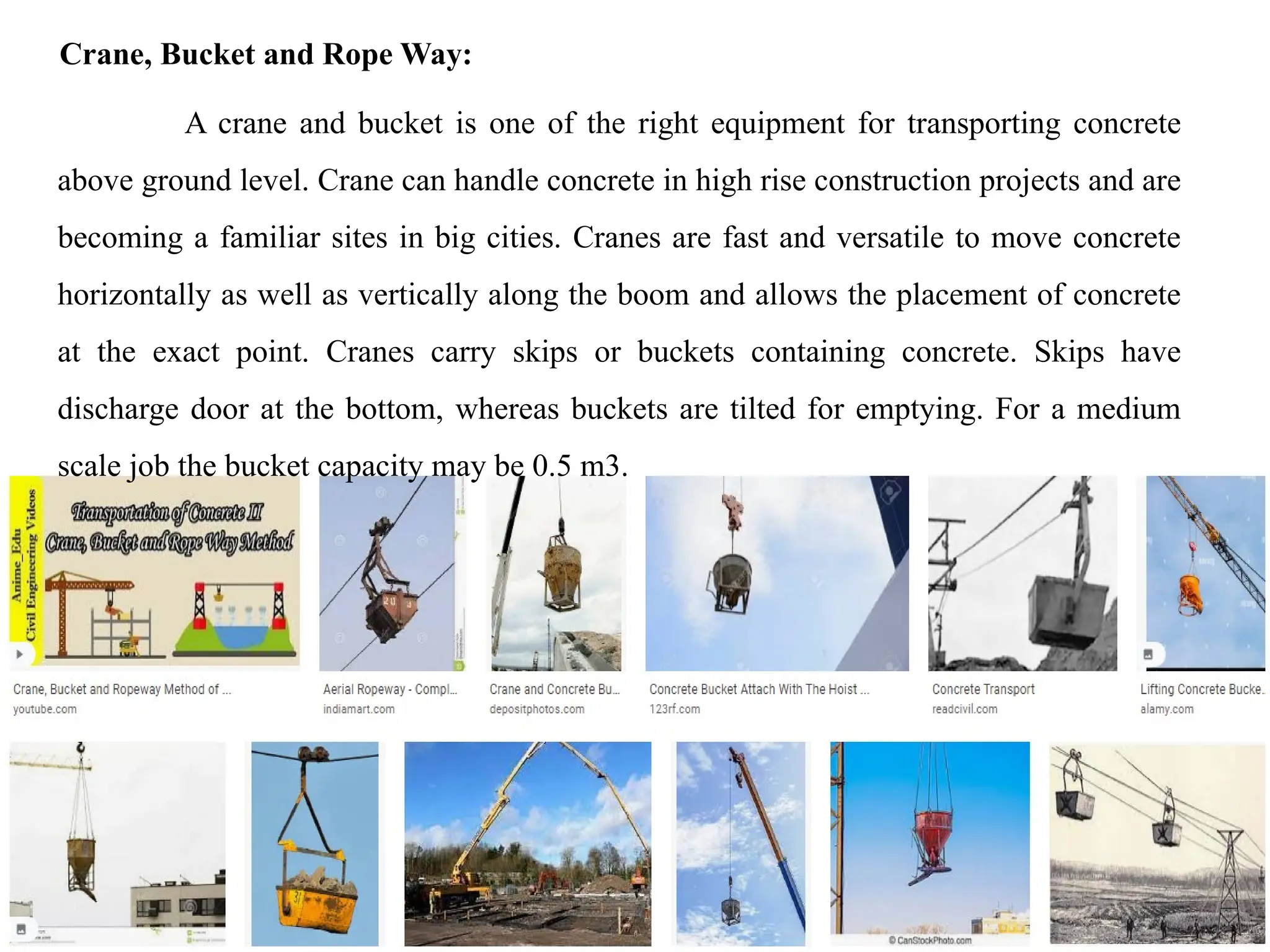
Crane, Bucket and Rope Way:
A crane and bucket is one of the right equipment for transporting concrete
above ground level. Crane can handle concrete in high rise construction projects and are
becoming a familiar sites in big cities. Cranes are fast and versatile to move concrete
horizontally as well as vertically along the boom and allows the placement of concrete
at the exact point. Cranes carry skips or buckets containing concrete. Skips have
discharge door at the bottom, whereas buckets are tilted for emptying. For a medium
scale job the bucket capacity may be 0.5 m3.
18/09/2024 CT Unit-2 by Dr.PK 47
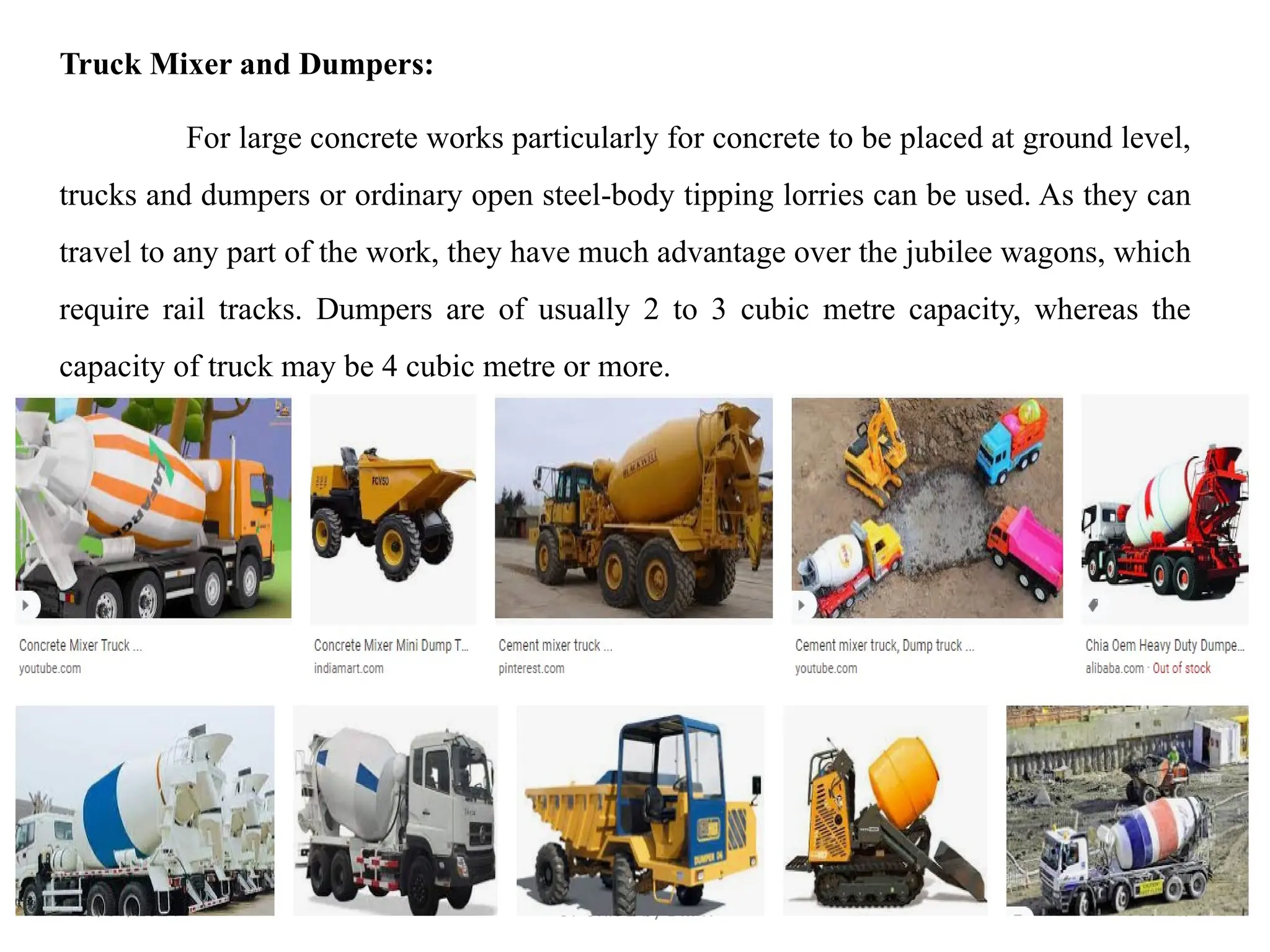
Truck Mixer and Dumpers:
For large concrete works particularly for concrete to be placed at ground level,
trucks and dumpers or ordinary open steel-body tipping lorries can be used. As they can
travel to any part of the work, they have much advantage over the jubilee wagons, which
require rail tracks. Dumpers are of usually 2 to 3 cubic metre capacity, whereas the
capacity of truck may be 4 cubic metre or more.
18/09/2024 CT Unit-2 by Dr.PK 48
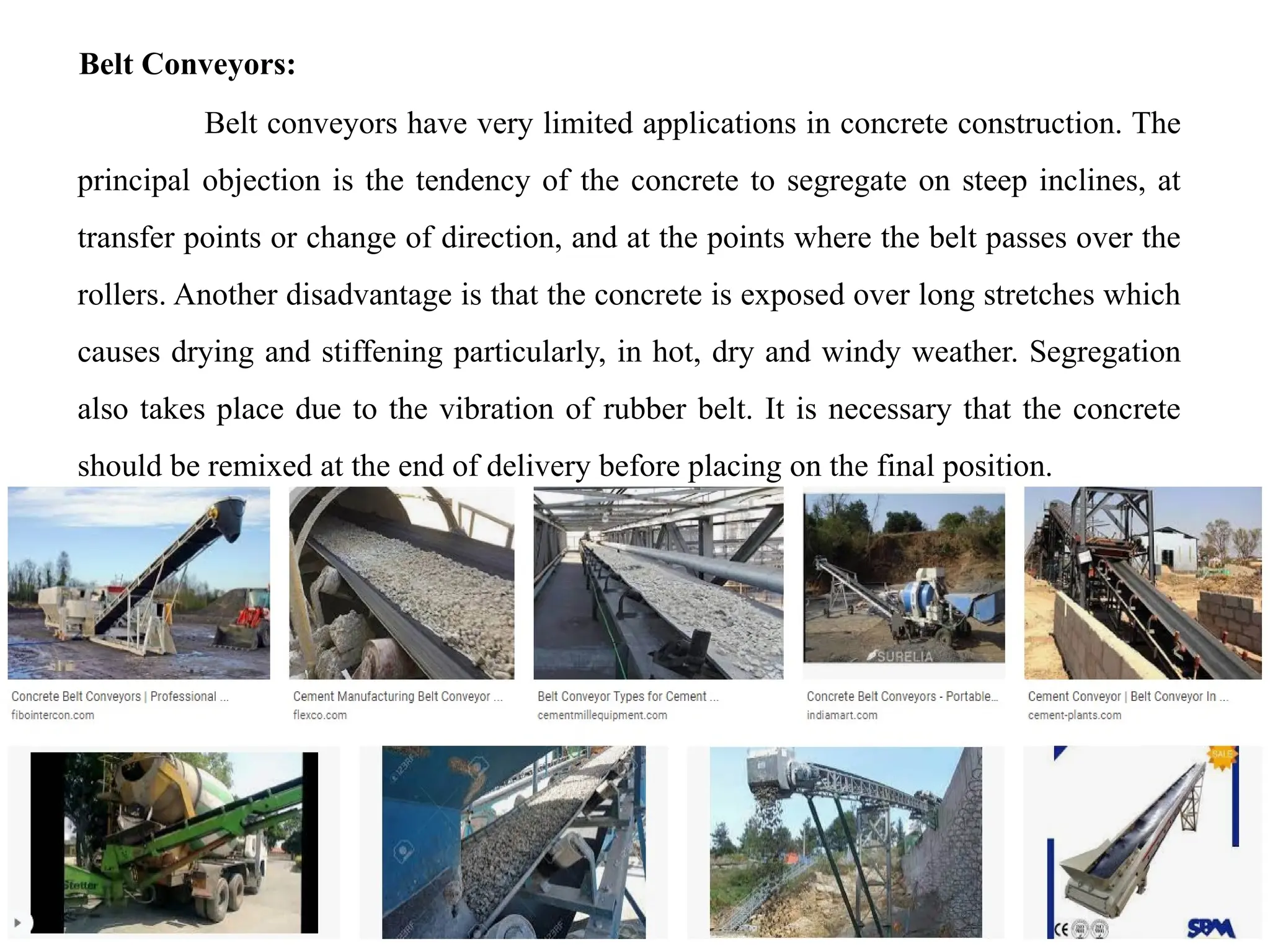
Belt Conveyors:
Belt conveyors have very limited applications in concrete construction. The
principal objection is the tendency of the concrete to segregate on steep inclines, at
transfer points or change of direction, and at the points where the belt passes over the
rollers. Another disadvantage is that the concrete is exposed over long stretches which
causes drying and stiffening particularly, in hot, dry and windy weather. Segregation
also takes place due to the vibration of rubber belt. It is necessary that the concrete
should be remixed at the end of delivery before placing on the final position.
18/09/2024 CT Unit-2 by Dr.PK 49
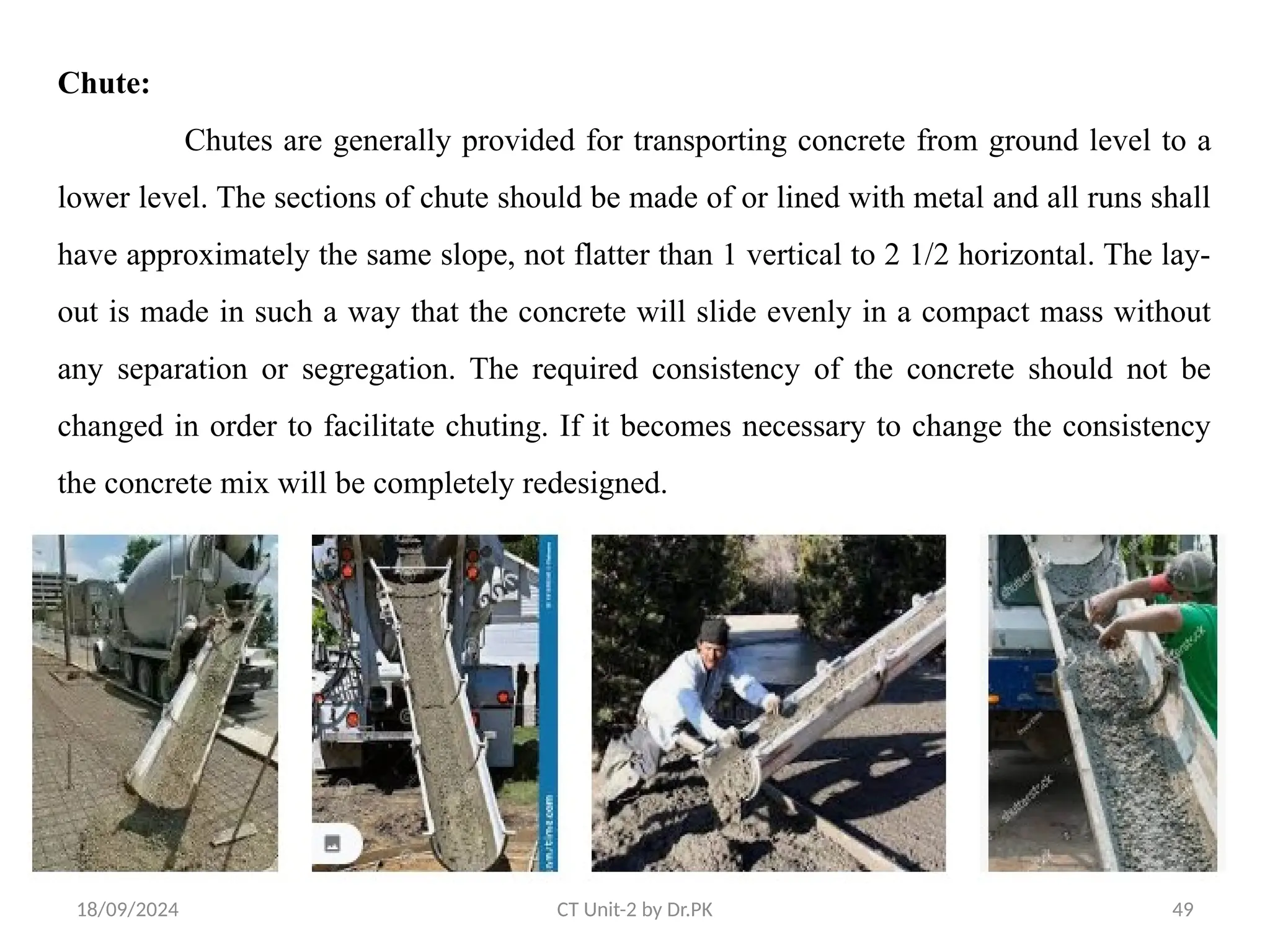
Chute:
Chutes are generally provided for transporting concrete from ground level to a
lower level. The sections of chute should be made of or lined with metal and all runs shall
have approximately the same slope, not flatter than 1 vertical to 2 1/2 horizontal. The lay-
out is made in such a way that the concrete will slide evenly in a compact mass without
any separation or segregation. The required consistency of the concrete should not be
changed in order to facilitate chuting. If it becomes necessary to change the consistency
the concrete mix will be completely redesigned.
18/09/2024 CT Unit-2 by Dr.PK 50
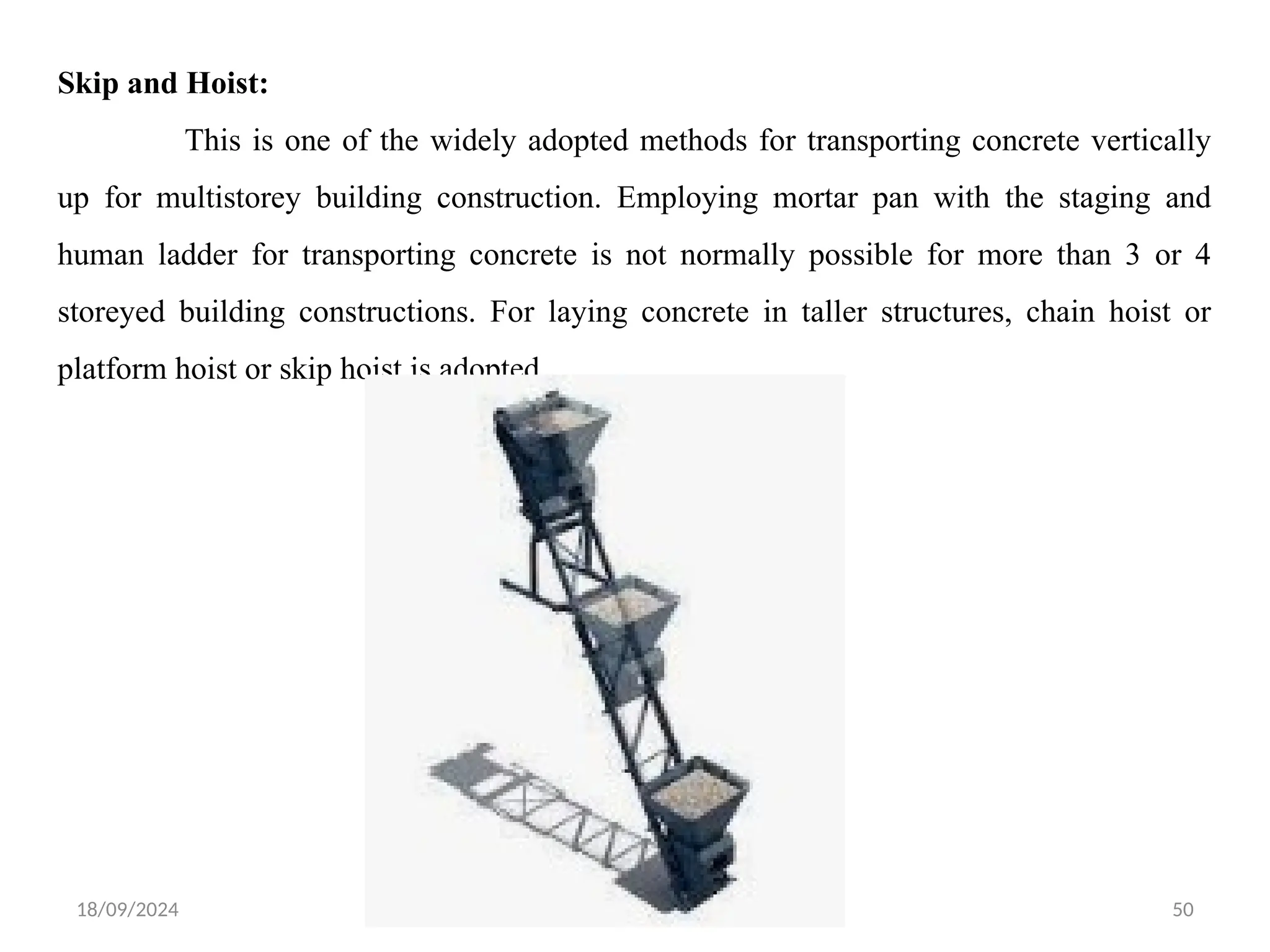
Skip and Hoist:
This is one of the widely adopted methods for transporting concrete vertically
up for multistorey building construction. Employing mortar pan with the staging and
human ladder for transporting concrete is not normally possible for more than 3 or 4
storeyed building constructions. For laying concrete in taller structures, chain hoist or
platform hoist or skip hoist is adopted.
18/09/2024 CT Unit-2 by Dr.PK 51
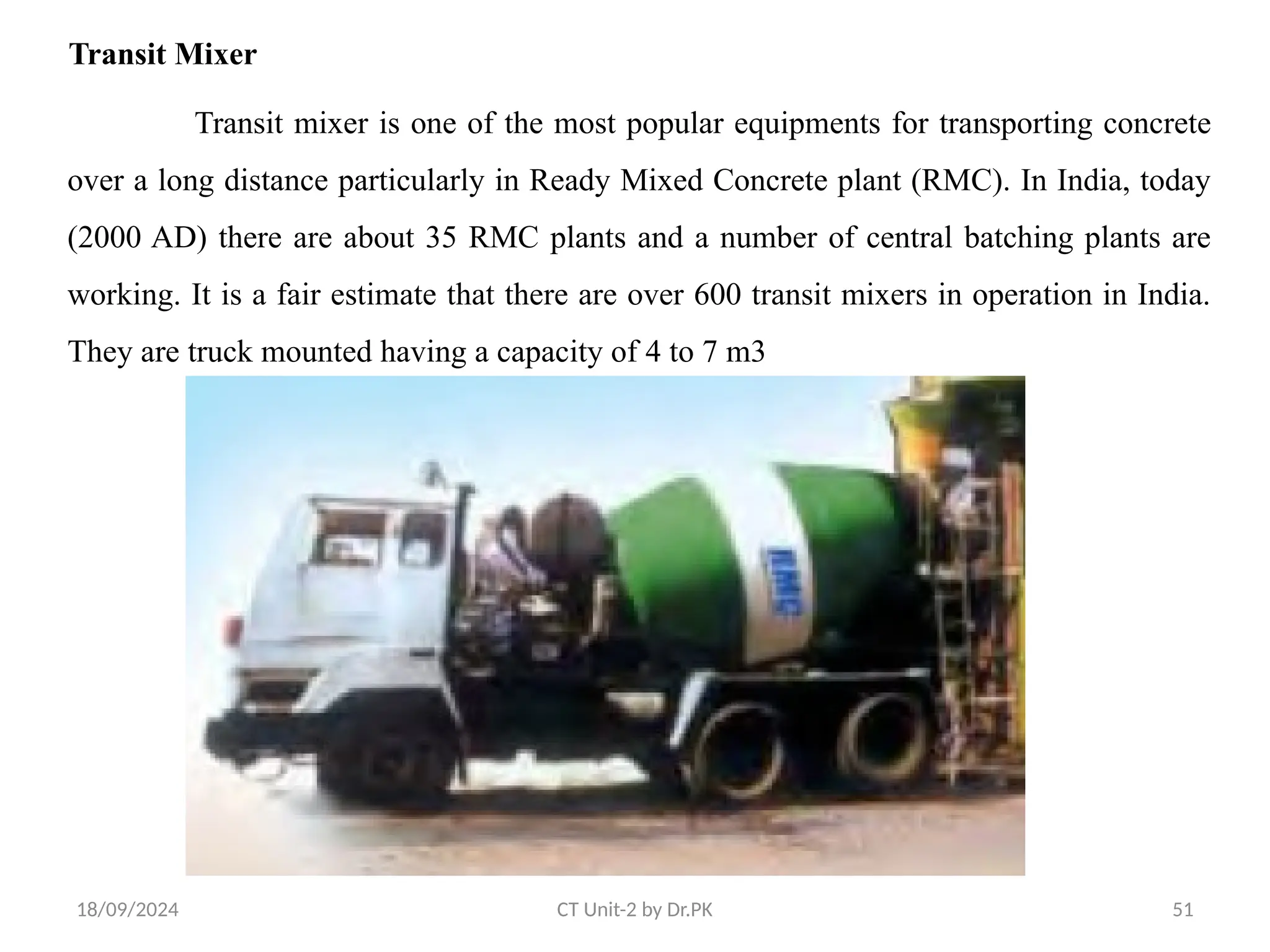
Transit Mixer
Transit mixer is one of the most popular equipments for transporting concrete
over a long distance particularly in Ready Mixed Concrete plant (RMC). In India, today
(2000 AD) there are about 35 RMC plants and a number of central batching plants are
working. It is a fair estimate that there are over 600 transit mixers in operation in India.
They are truck mounted having a capacity of 4 to 7 m3
18/09/2024 CT Unit-2 by Dr.PK 52
Pumps and Pipeline
Pumping of concrete is universally accepted as one of the main methods of
concrete transportation and placing. Adoption of pumping is increasing throughout the
world as pumps become more reliable and also the concrete mixes that enable the
concrete to be pumped are also better understood.
18/09/2024 CT Unit-2 by Dr.PK 53
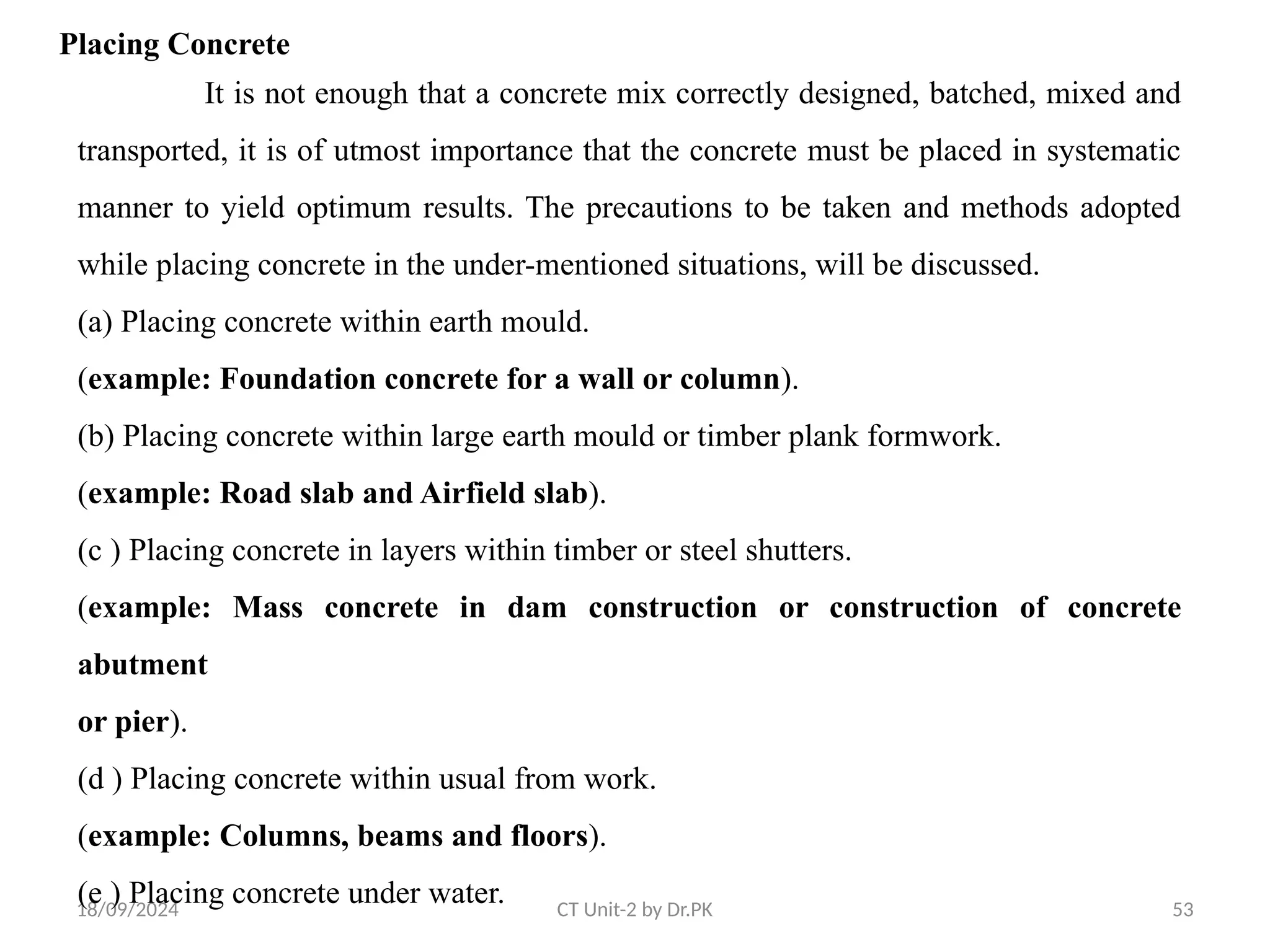
Placing Concrete
It is not enough that a concrete mix correctly designed, batched, mixed and
transported, it is of utmost importance that the concrete must be placed in systematic
manner to yield optimum results. The precautions to be taken and methods adopted
while placing concrete in the under-mentioned situations, will be discussed.
(a) Placing concrete within earth mould.
(example: Foundation concrete for a wall or column).
(b) Placing concrete within large earth mould or timber plank formwork.
(example: Road slab and Airfield slab).
(c ) Placing concrete in layers within timber or steel shutters.
(example: Mass concrete in dam construction or construction of concrete
abutment
or pier).
(d ) Placing concrete within usual from work.
(example: Columns, beams and floors).
(e ) Placing concrete under water.
18/09/2024 CT Unit-2 by Dr.PK 54
18/09/2024 CT Unit-2 by Dr.PK 55
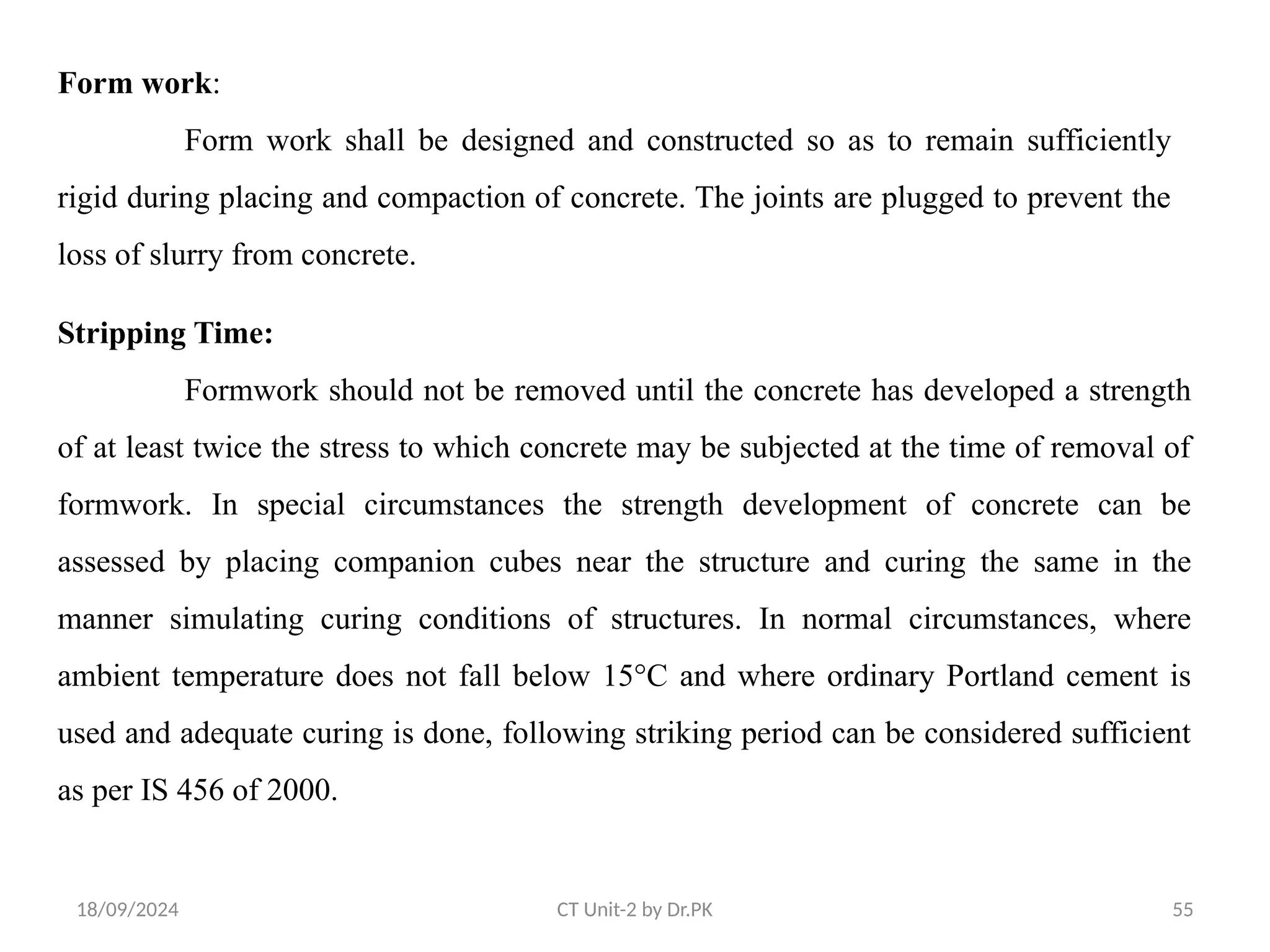
Form work:
Form work shall be designed and constructed so as to remain sufficiently
rigid during placing and compaction of concrete. The joints are plugged to prevent the
loss of slurry from concrete.
Stripping Time:
Formwork should not be removed until the concrete has developed a strength
of at least twice the stress to which concrete may be subjected at the time of removal of
formwork. In special circumstances the strength development of concrete can be
assessed by placing companion cubes near the structure and curing the same in the
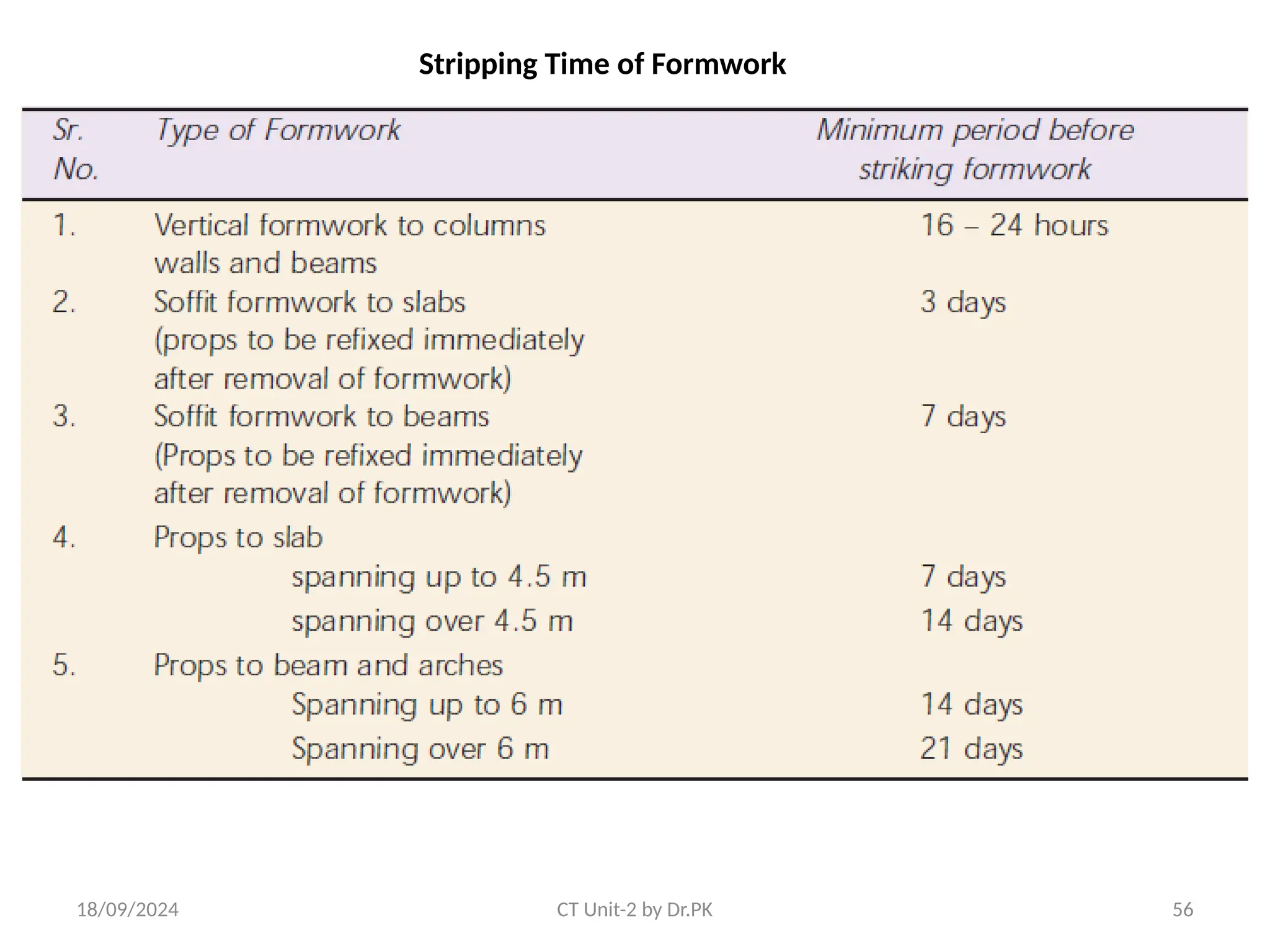
manner simulating curing conditions of structures. In normal circumstances, where
ambient temperature does not fall below 15°C and where ordinary Portland cement is
used and adequate curing is done, following striking period can be considered sufficient
as per IS 456 of 2000.
18/09/2024 CT Unit-2 by Dr.PK 56
Stripping Time of Formwork
18/09/2024 CT Unit-2 by Dr.PK 57
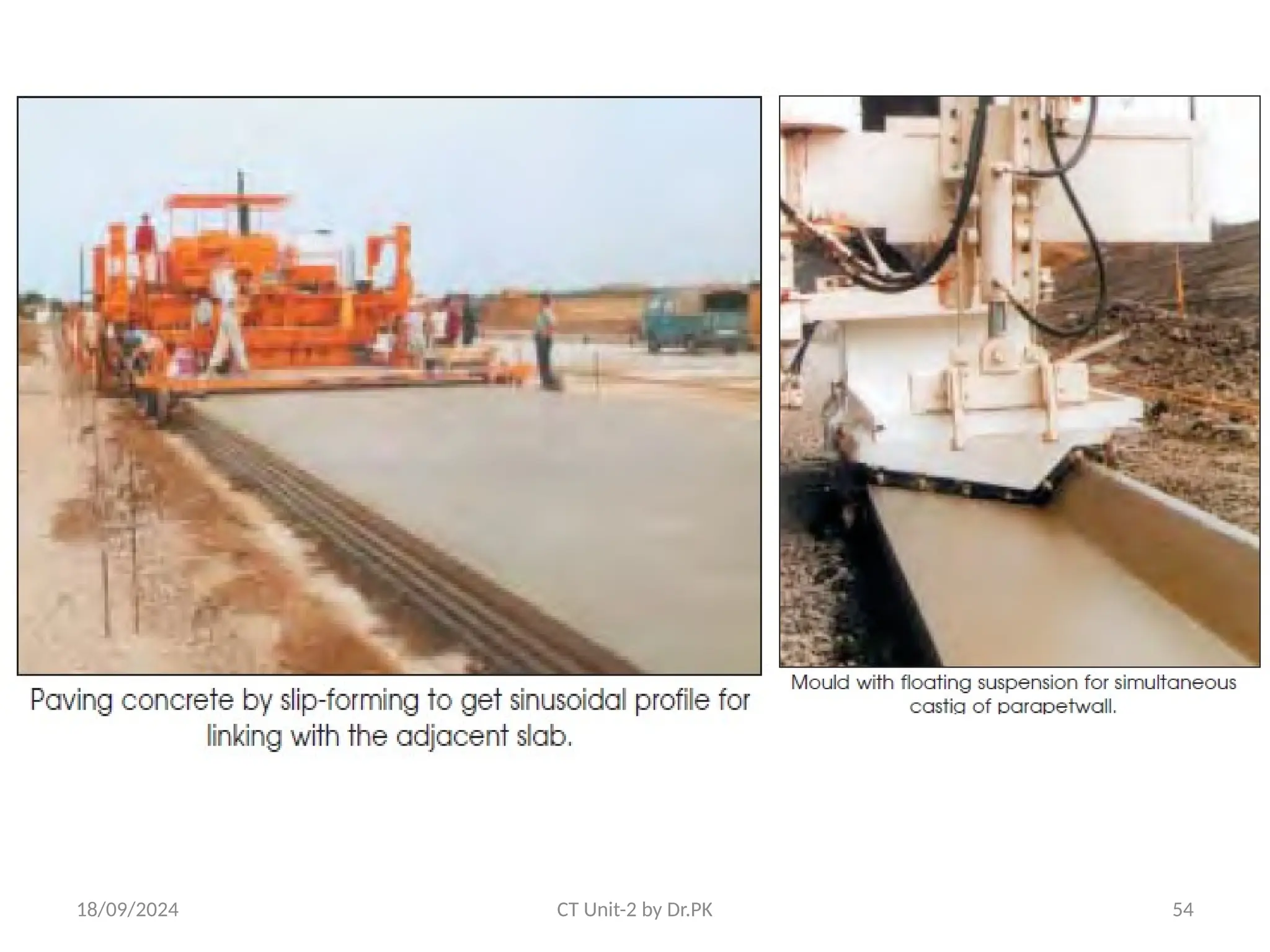
Slip-Form Technique
There are special methods of placement of concrete using slip-form technique.
Slip-forming can be done both for vertical construction or horizontal construction.
Slip-forming of vertical construction is a proven method of concrete construction
generally adopted for tall structures. In this method, concrete is continuously placed,
compacted and formwork is pulled up by number of hydraulic Jacks, giving
reaction, against jack rods or main reinforcements.
The horizontal slip-form construction is rather a new technique in India. It is
adopted for road pavement construction. For the first time the slip-form paving method
was adopted in Delhi-Mathura concrete Road construction during mid 1990’s.
The slip-form pavers were used by many contracting firms in the construction
of Mumbai- Pune six lane express highway. The state-of the art method of slip form
pavement construction has come to India in a big way.
18/09/2024 CT Unit-2 by Dr.PK 58
18/09/2024 CT Unit-2 by Dr.PK 59
Compaction of Concrete
Compaction of concrete is the process adopted for expelling the entrapped
air from the concrete. In the process of mixing, transporting and placing of concrete
air is likely to get entrapped in the concrete. The lower the workability, higher is the
amount of air entrapped. In other words, stiff concrete mix has high percentage of
entrapped air and, therefore , would need higher compacting efforts than high
workable mixes.
If this air is not removed fully, the concrete loses strength considerably.
Below fig shows the relationship between loss of strength and air voids left due to
lack of compaction. It can be seen from the figure that 5% voids reduce the strength
of concrete by about 30% and 10% voids reduce the strength by over 50%.
Therefore, it is imperative that 100% compaction of concrete is one of the most
important aim to be kept in mind in good concrete-making practices
18/09/2024 CT Unit-2 by Dr.PK 60
18/09/2024 CT Unit-2 by Dr.PK 61
It must be borne in mind that 100% compaction is important not only from
the point of view of strength, but also from the point of durability. In recent time,
durability becomes more important than strength.
Insufficient compaction increases the permeability of concrete resulting in
easy entry for aggressive chemicals in solution, which attack concrete and
reinforcement to reduce the durability of concrete. Therefore, 100 per cent compaction
of concrete is of paramount importance.
In order to achieve full compaction and maximum density, with reasonable
compacting efforts available at site, it is necessary to use a mix with adequate
workability. It is also of common knowledge that the mix should not be too wet for
easy compaction which also reduces the strength of concrete. For maximum strength,
driest possible concrete should be compacted 100%. The overall economy demands
100% compaction with a reasonable compacting efforts available in the field.
18/09/2024 CT Unit-2 by Dr.PK 62
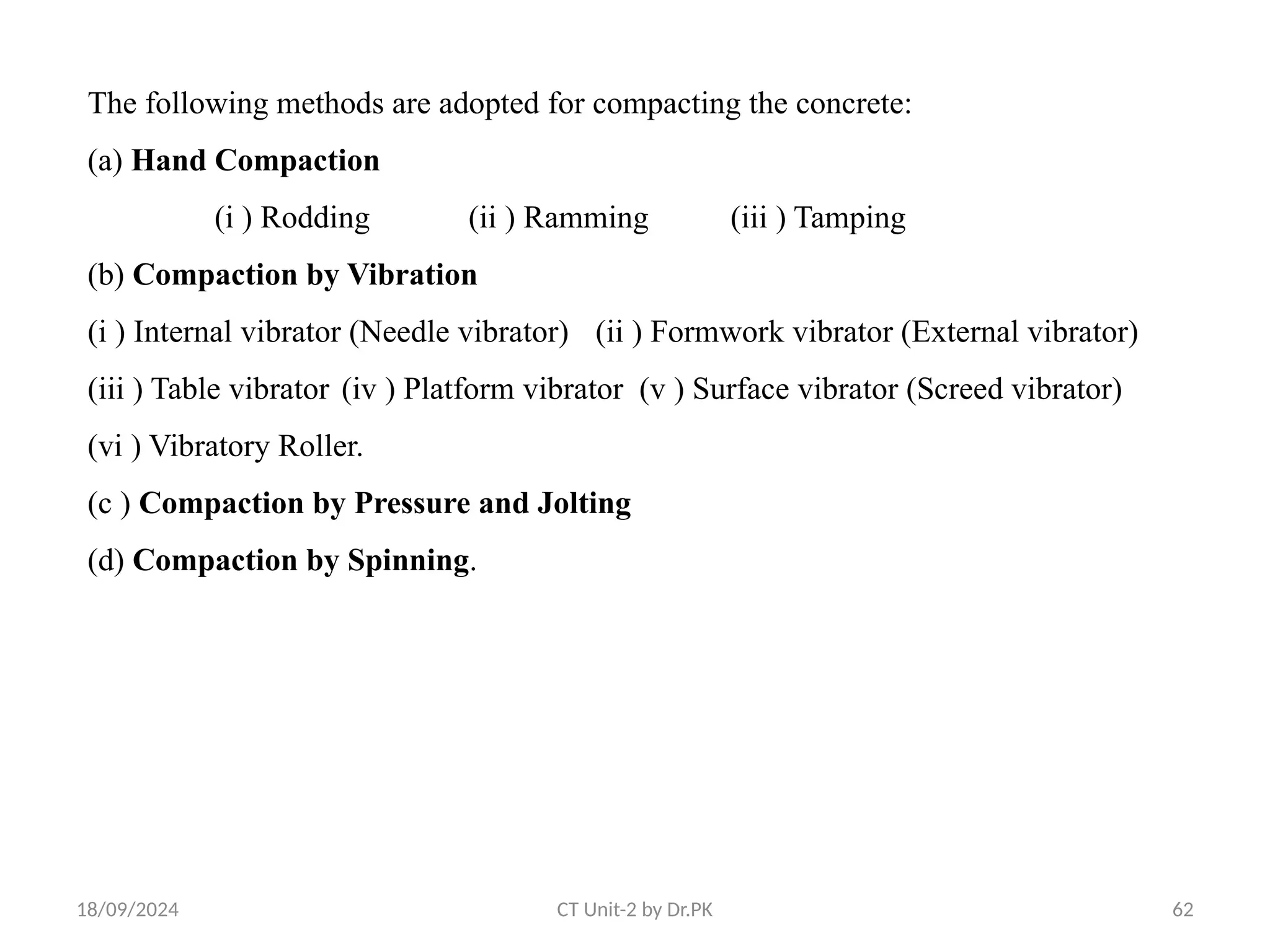
The following methods are adopted for compacting the concrete:
(a) Hand Compaction
(i ) Rodding (ii ) Ramming (iii ) Tamping
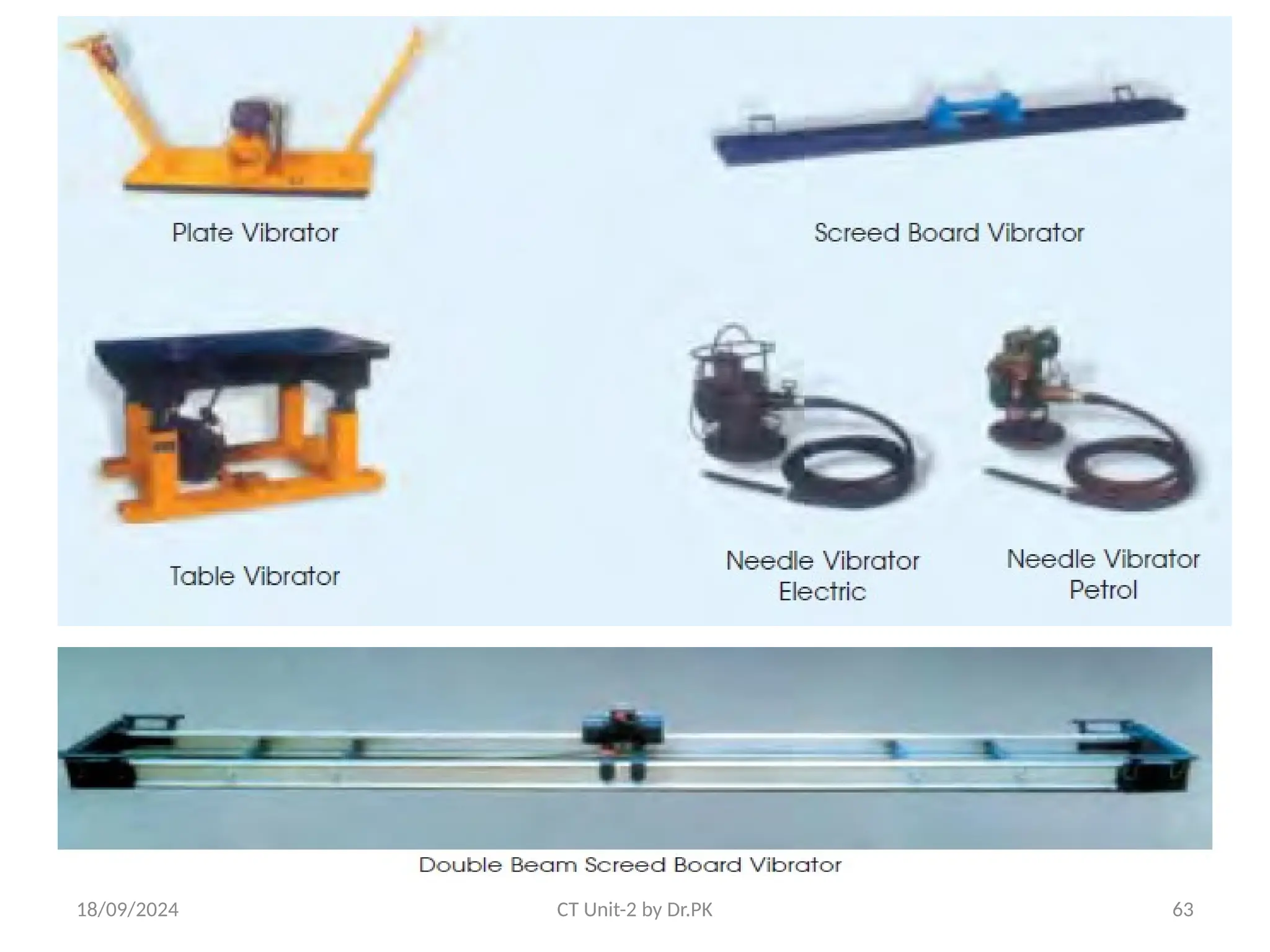
(b) Compaction by Vibration
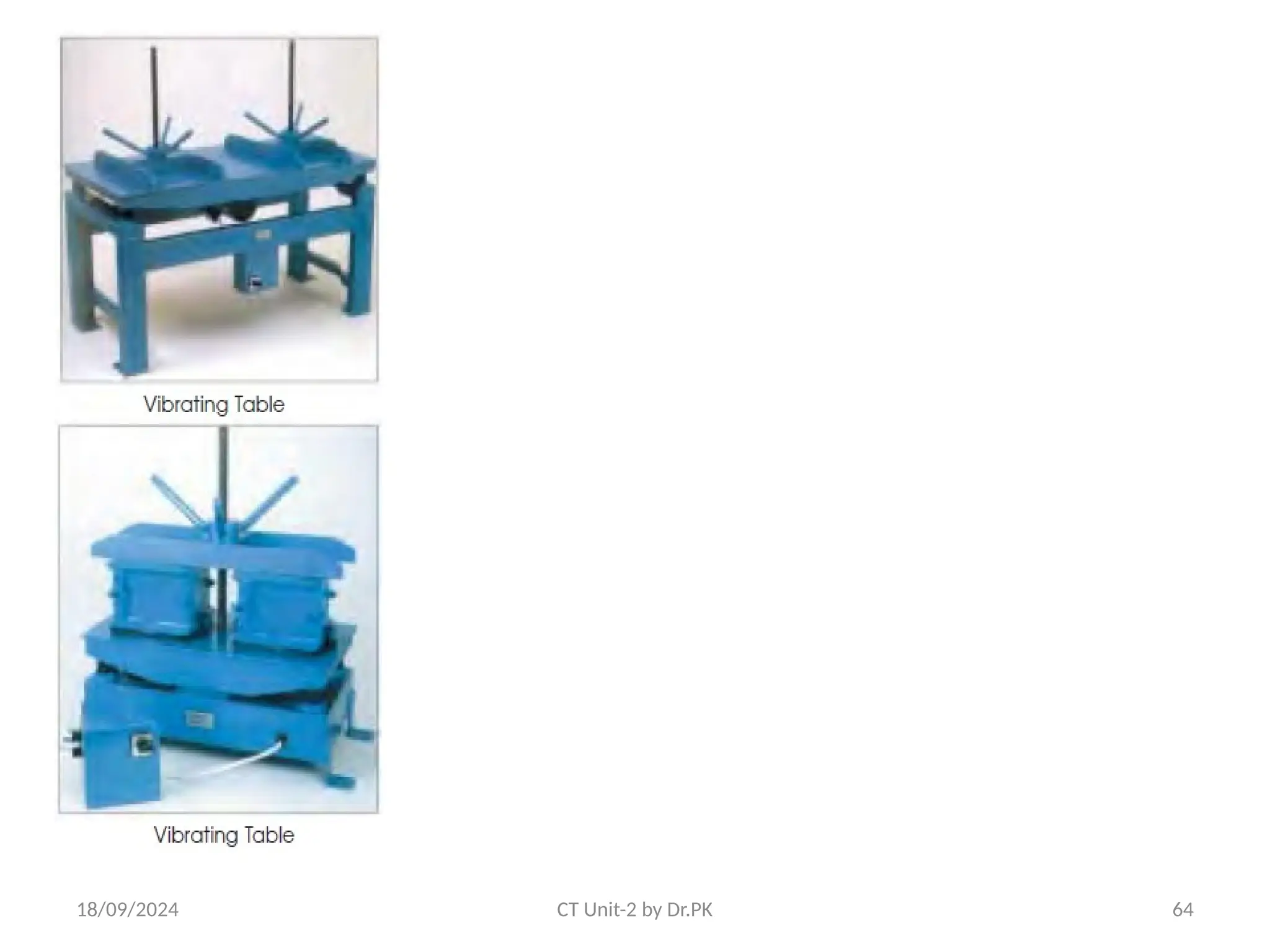
(i ) Internal vibrator (Needle vibrator) (ii ) Formwork vibrator (External vibrator)
(iii ) Table vibrator (iv ) Platform vibrator (v ) Surface vibrator (Screed vibrator)
(vi ) Vibratory Roller.
(c ) Compaction by Pressure and Jolting
(d) Compaction by Spinning.
18/09/2024 CT Unit-2 by Dr.PK 63
18/09/2024 CT Unit-2 by Dr.PK 64
18/09/2024 CT Unit-2 by Dr.PK 65
18/09/2024 CT Unit-2 by Dr.PK 66
Curing of Concrete
We have discussed in module I the hydration aspect of cement. Concrete
derives its strength by the hydration of cement particles. The hydration of cement is not a
momentary action but a process continuing for long time. Of cource, the rate of hydration
is fast to start with, but countinues over a very long time at a decreasing rate. The
quantity of the product of hydration and consequently the amount of gel formed depends
upon the extent of hydration. It has been mentioned earlier that cement requires a
water/cement ratio about 0.23 for hydration and a water/cement ratio of 0.15 for filling
the voids in the gel pores. In other words, a water/cement ratio of about 0.38 would be
required to hydrate all the particles of cement and also to occupy the space in the gel
pores.
In the field and in actual work, it is a different story. Even though a higher
water/cement ratio is used, since the concrete is open to atmosphere, the water used in the
concrete evaporates and the water available in the concrete will not be sufficient for
effective hydration to take place particularly in the top layer.
18/09/2024 CT Unit-2 by Dr.PK 67
Alternatively, some measures must be taken by way of provision of
impervious covering or application of curing compounds to prevent the loss of water
from the surface of the concrete. Therefore, the curing can be considered as creation of
a favourable environment during the early period for uninterrupted hydration. The
desirable conditions are, a suitable temperature and ample moisture.
18/09/2024 CT Unit-2 by Dr.PK 68
Curing can also be described as keeping the concrete moist and warm enough
so that the hydration of cement can continue. More elaborately, it can be described as
the process of maintaining a satisfactory moisture content and a favourable
temperature in concrete during the period immediately following placement, so that
hydration of cement may continue until the desired properties are developed to a
sufficient degree to meet the requirement of service.
Curing is being given a place of increasing importance as the demand for high
quality concrete is increasing. It has been recognized that the quality of concrete shows
all round improvement with efficient uninterrupted curing. If curing is neglected in the
early period of hydration, the quality of concrete will experience a sort of irreparable
loss. An efficient curing in the early period of hydration can be compared to a good and
wholesome feeding given to a new born baby.
18/09/2024 CT Unit-2 by Dr.PK 69
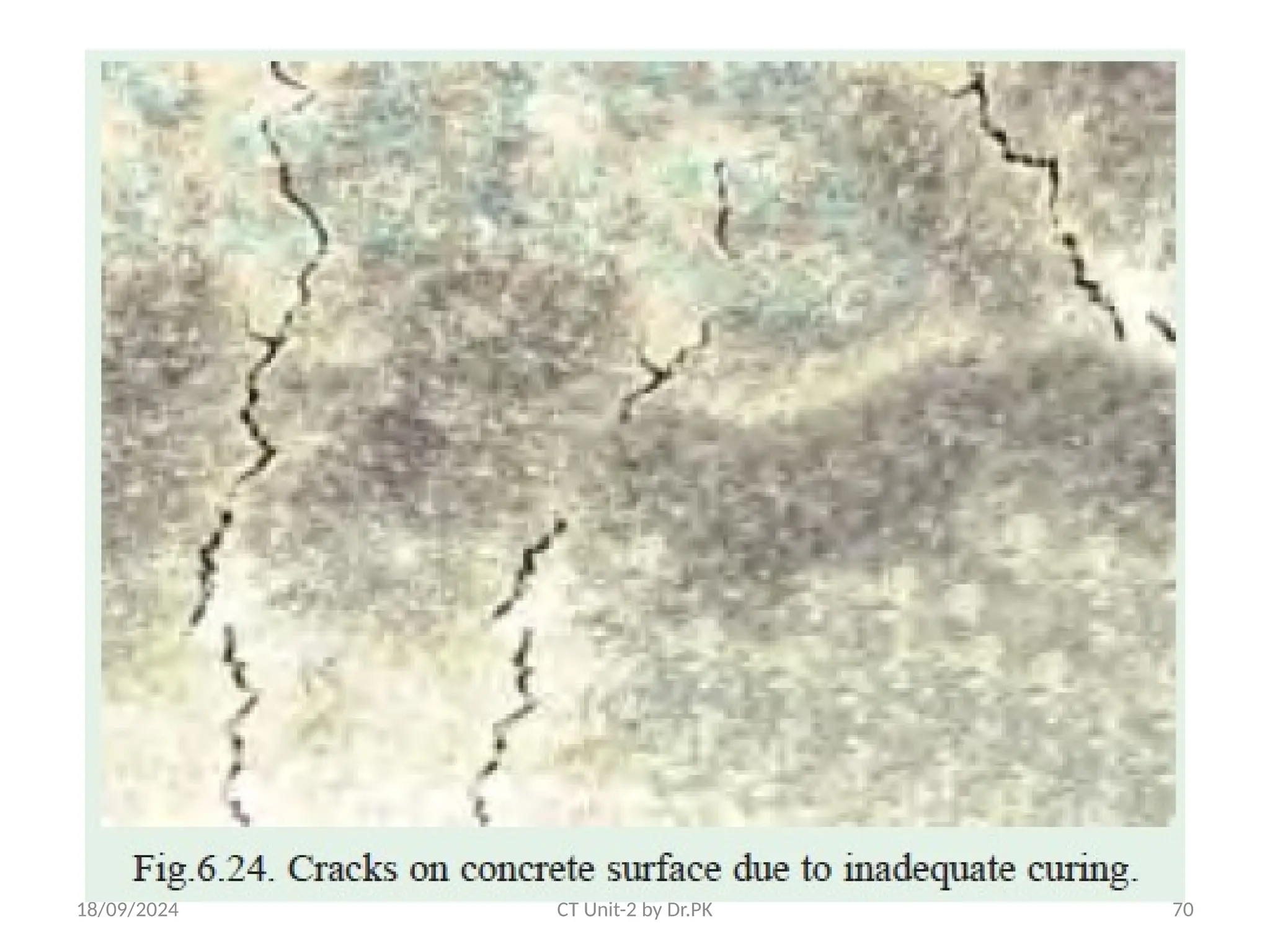
A concrete laid in the afternoon of a hot summer day in a dry climatic region,
is apt to dry out quickly. The surface layer of concrete exposed to acute drying
condition, with the combined effect of hot sun and drying wind is likely to be made up
of poorly hydrated cement with inferior gel structure which does not give the desirable
bond and strength characteristics. In addition, the top surface, particularly that of road
or floor pavement is also subjected to a large magnitude of plastic shrinkage stresses.
The dried concrete naturally being weak, cannot withstand these stresses with the
result that innumerable cracks develop at the surface. Below fig, shows plastic
shrinkage cracks on concrete surface due to quick drying and inadequate early
curing. The top surface of such hardened concrete on account of poor gel structure,
suffers from lack of wearing quality and abrasion resistance. Therefore, such surfaces
create mud in the rainy season and dust in summer.
18/09/2024 CT Unit-2 by Dr.PK 70
18/09/2024 CT Unit-2 by Dr.PK 71
The quick surface drying of concrete results in the movement of moisture from
the interior to the surface. This steep moisture gradient cause high internal stresses which
are also responsible for internal micro cracks in the semi-plastic concrete.
Concrete, while hydrating, releases high heat of hydration. This heat is harmful
from the point of view of volume stability. If the heat generated is removed by some
means, the adverse effect due to the generation of heat can be reduced. This can be done
by a thorough water curing.
Curing Methods
Curing methods may be divided broadly into four categories:
(a) Water curing (b) Membrane curing (c ) Application of heat (d) Miscellaneous
18/09/2024 CT Unit-2 by Dr.PK 72
Water Curing
This is by far the best method of curing as it satisfies all the requirements of
curing, namely, promotion of hydration, elimination of shrinkage and absorption of the
heat of hydration.
Water curing can be done in the following ways:
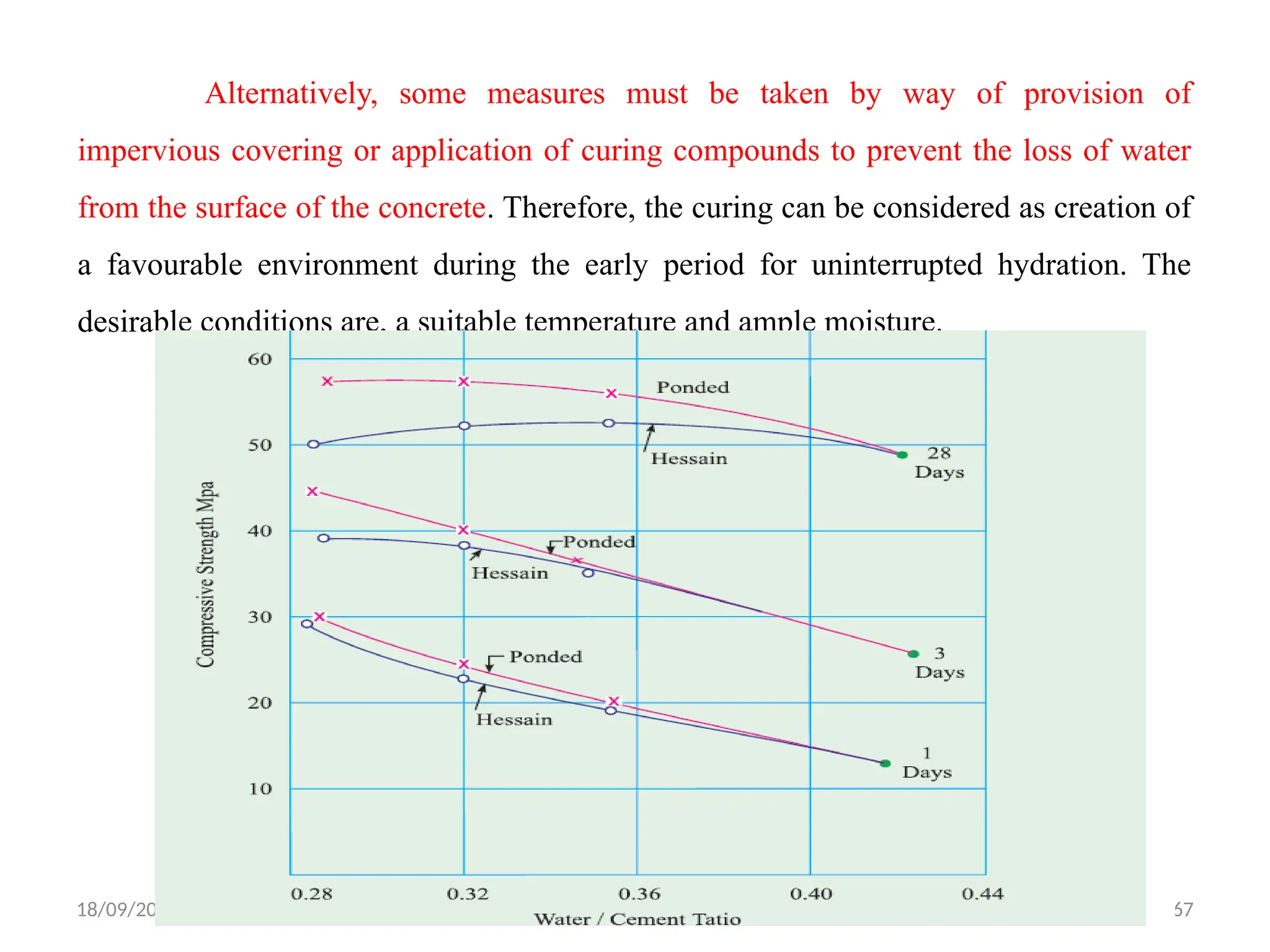
(a ) Immersion (b) Ponding
(c ) Spraying or Fogging (d ) Wet covering
The precast concrete items are normally immersed in curing tanks for a
certain duration. Pavement slabs, roof slab etc. are covered under water by making
small ponds. Vertical retaining wall or plastered surfaces or concrete columns etc. are
cured by spraying water. In some cases, wet coverings such as wet gunny bags, hessian
cloth, jute matting, straw etc., are wrapped to vertical surface for keeping the concrete
wet. For horizontal surfaces saw dust, earth or sand are used as wet covering to keep
the concrete in wet condition for a longer time so that the concrete is not unduly dried
to prevent hydration.
18/09/2024 73
CT Unit-2 by Dr.PK
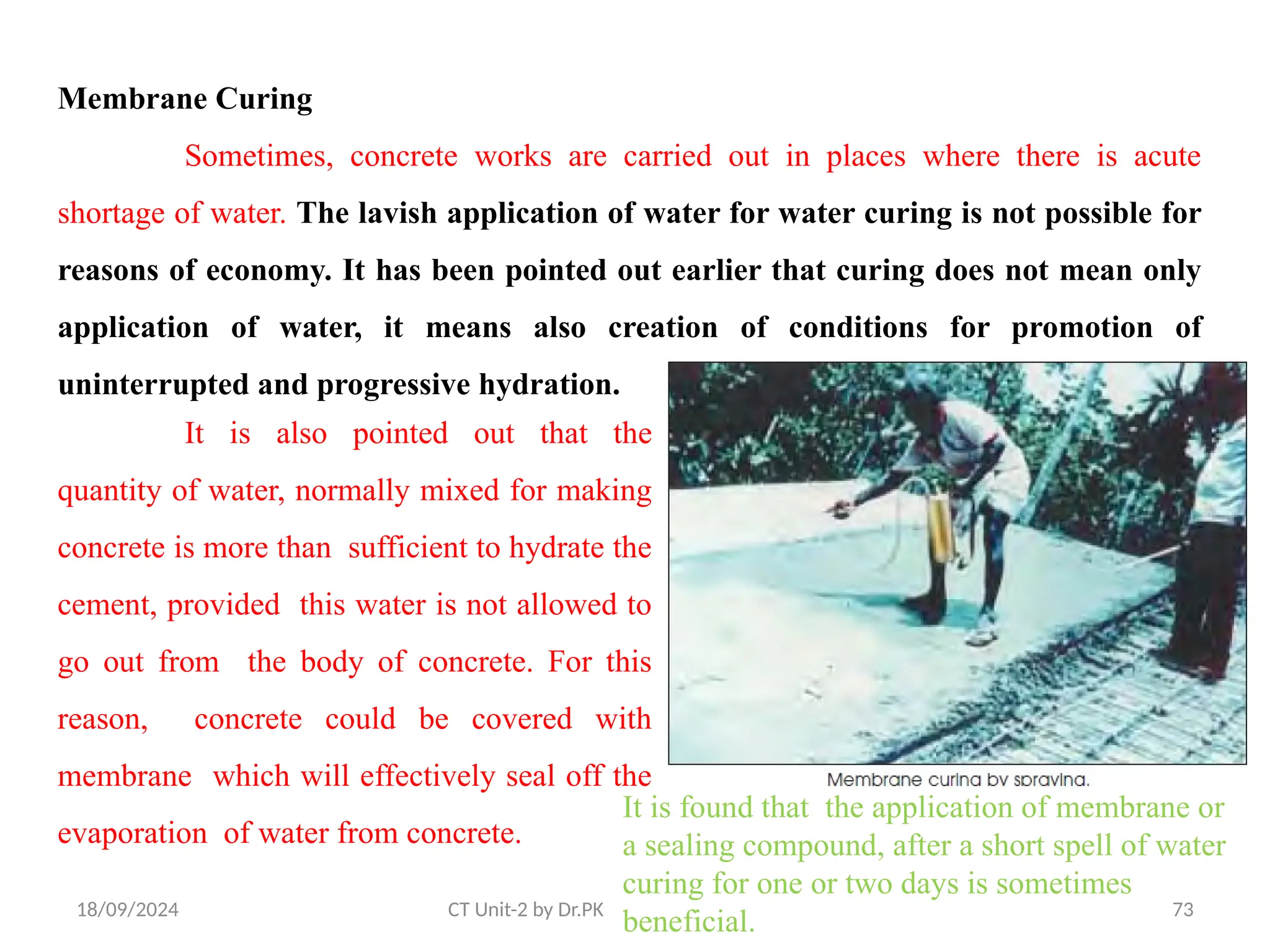
Membrane Curing
Sometimes, concrete works are carried out in places where there is acute
shortage of water. The lavish application of water for water curing is not possible for
reasons of economy. It has been pointed out earlier that curing does not mean only
application of water, it means also creation of conditions for promotion of
uninterrupted and progressive hydration.
It is also pointed out that the
quantity of water, normally mixed for making
concrete is more than sufficient to hydrate the
cement, provided this water is not allowed to
go out from the body of concrete. For this
reason, concrete could be covered with
membrane which will effectively seal off the
evaporation of water from concrete.
It is found that the application of membrane or
a sealing compound, after a short spell of water
curing for one or two days is sometimes
beneficial.
18/09/2024 CT Unit-2 by Dr.PK 74
Sometimes, concrete is placed in some inaccessible, difficult or far off places.
The curing of such concrete cannot be properly supervised. The curing is entirely left to
the workmen, who do not quite understand the importance of regular uninterrupted
curing. In such cases, it is much safer to adopt membrane curing rather than to leave the
responsibility of curing to workers.
Large number of sealing compounds have been developed in recent years. The
idea is to obtain a continuous seal over the concrete surface by means of a firm
impervious film to prevent moisture in concrete from escaping by evaporation.
Sometimes, such films have been used at the interface of the ground and concrete to
prevent the absorption of water by the ground from the concrete. Some of the materials,
that can be used for this purpose are bituminous compounds, polyethylene or polyester
film, waterproof paper, rubber compounds etc.
18/09/2024 CT Unit-2 by Dr.PK 75
Bituminous compound being black in colour, absorbs heat when it is applied
on the top surface of the concrete. This results in the increase of temperature in the
body of concrete which is undesirable. For this purpose, other modified materials
which are not black in colour are in use. Such compounds are known as “Clear
Compounds”. It is also suggested that a lime wash may be given over the black coating
to prevent heat absorption.
18/09/2024 CT Unit-2 by Dr.PK 76
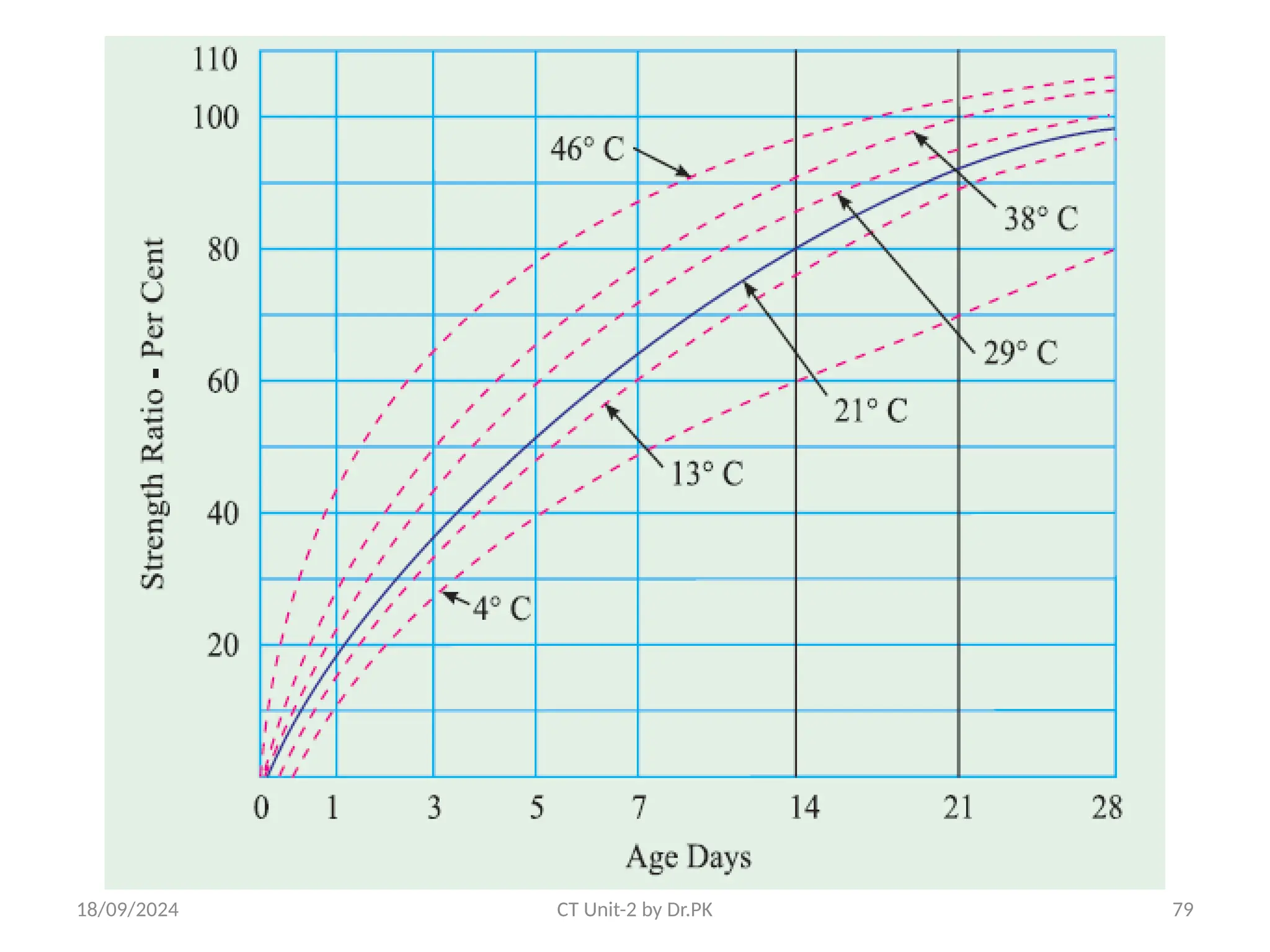
Application of heat
The development of strength of concrete is a function of not only time but
also that of temperature. When concrete is subjected to higher temperature it
accelerates the hydration process resulting in faster development of strength. Concrete
cannot be subjected to dry heat to accelerate the hydration process as the presence of
moisture is also an essential requisite. Therefore, subjecting the concrete to higher
temperature and maintaining the required wetness can be achieved by subjecting the
concrete to steam curing.
A faster attainment of strength will contribute to many other advantages mentioned
below.
(a ) Concrete is vulnerable to damage only for short time.
(b) Concrete member can be handled very quickly.
(c ) Less space will be sufficient in the casting yerd.
(d ) A smaller curing tank will be sufficient.
18/09/2024 CT Unit-2 by Dr.PK 77
(e ) A higher outturn is possible for a given capital outlay.
(f ) The work can be put on to service at a much early time,
(g) A fewer number of formwork will be sufficient or alternatively with the given
number of formwork more outturn will be achieved.
(h) Prestressing bed can be released early for further casting.
From the above mentioned advantages it can be seen that steam curing
will give not only economical advantages, but also technical advantages in the
matter of prefabrication of concrete elements.
The exposure of concrete to higher temperature is done in the following manner:
(a) Steam curing at ordinary pressure.
(b) Steam curing at high pressure.
(c) Curing by Infra-red radiation.
(d) Electrical curing.
18/09/2024 CT Unit-2 by Dr.PK 78
A steam-curving cycle consists of:
• an initial delay prior to steaming,
• a period for increasing the temperature,
• a period for retaining the temperature,
• a period for decreasing the temperature.
High Pressure Steam Curing
(a ) High pressure steam cured concrete develops in one day, or less the strength as
much as the 28 days’ strength of normally cured concrete. The strength developed
does not show retrogression.
(b) High pressure steam cured concrete exhibits higher resistance to sulphate attack,
freezing and thawing action and chemical action. It also shows less efflorescence.
(c ) High pressure steam cured concrete exhibits lower drying shrinkage, and
moisture movement.
For infra-red curing and Electrical curing please refer Concrete Technology Text book
by MS. Shetty
18/09/2024 CT Unit-2 by Dr.PK 79
18/09/2024 CT Unit-2 by Dr.PK 80
Finishing
Finishing operation is the last operation in making concrete. Finishing in real
sence does not apply to all concrete operations. For a beam concreting, finishing may
not be applicable, whereas for the concrete road pavement, airfield pavement or for the
flooring of a domestic building, careful finishing is of great importance. Concrete is often
dubbed as a drab material, incapable of offering pleasant architectural appearance and
finish. This shortcoming of concrete is being rectified and concretes these days are made
to exhibit pleasant surface finishes. Particularly, many types of prefabricated concrete
panels used as floor slab or wall unit are made in such a way as to give very attractive
architectural affect. Even concrete claddings are made to give attractive look.
Surface finishes may be grouped as under:
(a) Formwork Finishes (b) Surface Treatment
(c) Applied Finishes.
18/09/2024 CT Unit-2 by Dr.PK 81
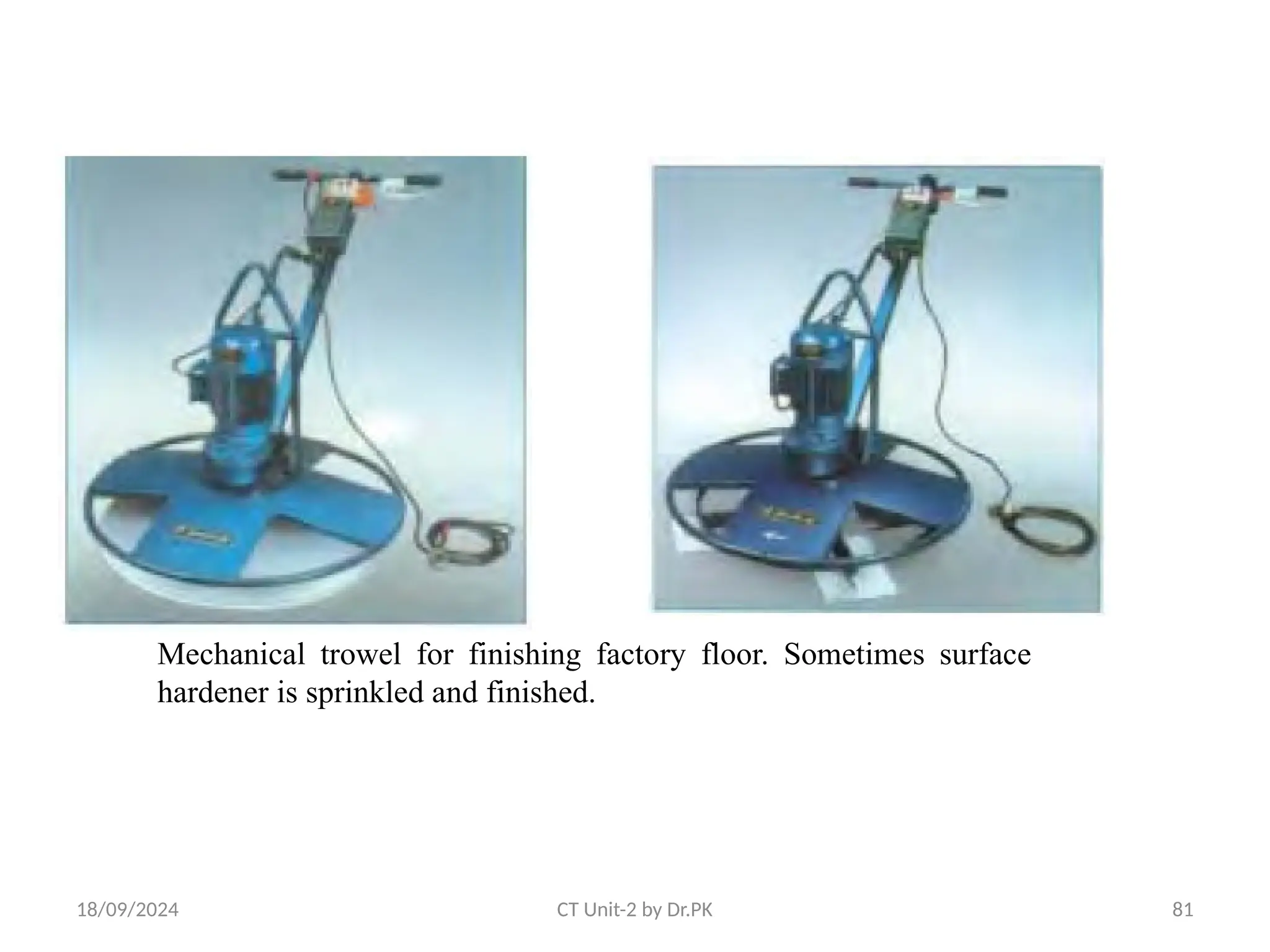
Mechanical trowel for finishing factory floor. Sometimes surface
hardener is sprinkled and finished.
18/09/2024 CT Unit-2 by Dr.PK 82
Thank You

Concrete Technology Complete notes of Unit 2

  • 1.
    18/09/2024 CT Unit-2by Dr.PK 1 Unit-2 Fresh Concrete
  • 2.
    18/09/2024 CT Unit-2by Dr.PK 2 Introduction Fresh concrete or plastic concrete is a freshly mixed material which can be moulded into any shape. The relative quantities of cement, aggregate and water mixed together, control the properties of concrete in the wet state as well as in the hardened state. In this chapter one more aspect for deciding the water/cement ratio will be introduced i.e., the water/cement ratio required from the point of view of workability of concrete.
  • 3.
    18/09/2024 CT Unit-2by Dr.PK 3 Workability To enable the concrete to be fully compacted with given efforts, normally a higher water/ cement ratio than that calculated by theoretical considerations may be required. That is to say the function of water is also to lubricate the concrete so that the concrete can be compacted with specified effort forthcoming at the site of work. The lubrication required for handling concrete without segregation, for placing without loss of homogeneity, for compacting with the amount of efforts forth-coming and to finish it sufficiently easily, the presence of a certain quantity of water is of vital importance. Factors Affecting Workability (a) Water Content (b) Mix Proportions (c ) Size of Aggregates (d) Shape of Aggregates (e) Surface Texture of Aggregate (f ) Grading of Aggregate (g) Use of Admixtures.
  • 4.
    18/09/2024 CT Unit-2by Dr.PK 4 Measurement of Workability Some of the tests, measure the parameters very close to workability and provide useful information. The following tests are commonly employed to measure workability. (a ) Slump Test (b) Compacting Factor Test (c ) Flow Test (d) Kelly Ball Test (e ) Vee Bee Consistometer Test.
  • 5.
    18/09/2024 CT Unit-2by Dr.PK 5 Slump Test The apparatus for conducting the slump test essentially consists of a metallic mould in the form of a frustum of a cone having the internal dimensions as under: Bottom diameter : 20 cm Top diameter : 10 cm Height : 30 cm
  • 6.
  • 7.
    18/09/2024 CT Unit-2by Dr.PK 7 K Slump test is first covered by ASTM C 1362 and used to determine the workability of concrete and degree of compaction of fresh concrete. K slump test is an instant & direct test where slump value is evaluated in one minute. It has a tester which is inserted in fresh concrete to measure the slump value of concrete. K slump test is also useful for finding the relative workability of concrete. K Slump Test of Concrete
  • 8.
    18/09/2024 CT Unit-2by Dr.PK 8 The lower part of K slump tester: Upper part of K Slump tester:
  • 9.
    18/09/2024 CT Unit-2by Dr.PK 9 Procedure of K Slump Test: 1. Wet the tester and clean it with a cloth. 2. Raise the plastic tube let it sit on the pin support. 3. Take a container and pour some fresh concrete and level it. 4. Now insert the k slump tester vertically down until the disc floater rests at the surface of the concrete. Do not rotate while inserting or removing the K slump tester. 5. Wait for 60 seconds, lower the measuring rod slowly until it rests on the surface of the concrete that has entered the tube and read the slump value directly on the scale of the measuring rod. 6. Remove the tester from the fresh concrete vertically up don’t rotate or shake while removing the rod from the concrete. 7. Due to the presence of holes at the bottom part of tester the concrete flows into the K slump tester. 8. Again lower the measuring rod slowly till it touches the surface of the concrete retained in the tube and read workability directly on the scale of the measuring rod.
  • 10.
  • 11.
    18/09/2024 CT Unit-2by Dr.PK 11 Compacting Factor Test
  • 12.
    18/09/2024 CT Unit-2by Dr.PK 12 Flow table test of concrete: Procedure of flow table test: • Prepare concrete as per mix design and place the flow table on a horizontal surface. • Clean the dust or other gritty material on Flow table and Sprinkle a hand of water on it. • Now place the metal cone at the middle portion of the flow table and stand on it. • Pour the freshly mixed concrete in the mould comprising two layers; each layer should be tamped with tamping rod for 25times. After tamping the last layer, the overflowed concrete on the cone is struck off using a trowel. • Slowly, lift the mould vertically up & let concrete stand on its own without any support. • The flow table is raised at the height of 12.5mm and dropped. The same is repeated for 15times in 15secs. • Measure the spread of concrete in Diameter using centimetre scale horizontally and vertically. The arithmetic mean of the two diameters shall be the measurement of flow in millimetres.
  • 13.
  • 14.
    18/09/2024 CT Unit-2by Dr.PK 14 Kelly Ball Test Kelly ball test is a simple field test which is very useful in determining workability of concrete in real-time. It is justified that Kelly ball test performed faster and provided accurate results with great precision than the slump test. But the only disadvantage with the Kelly ball test that it requires a large amount of concrete when compared with the slump test of concrete. Kelly ball test apparatus consists of a cylinder with one end having a hemispherical shape of 15cm weighing 13.6kg, and the other end is attached to a graduated scale and handle. The whole arrangement is secured on a fixed stand. The results have been specified by measuring the penetration made by the hemisphere when freely placed on fresh concrete. The impression is measured by a graduated scale immediately.
  • 15.
    18/09/2024 CT Unit-2by Dr.PK 15 • Freshly mixed concrete (test sample) is poured into a container up to a depth of 20cm. • Once the container is filled with the concrete, the top surface is levelled and struck off. • The Kelly ball setup is kept on concrete as shown below by holding the handle of hemisphere such that the frame touches the surface of the concrete. • Ensure that the setup is kept at minimum 23cm away from the container ends. (Place at the middle portion of the container). Now release the handle and allow the ball to penetrate through the concrete. Once the ball is released, the depth of penetration is immediately shown in the graduate scale to the nearest 6mm. • Note down the depth of penetration from the attached graduated scale. • Repeat the same experiment for three times at different portions in the container and average the value. Procedure for Kelly ball test
  • 16.
    18/09/2024 CT Unit-2by Dr.PK 16 Average Value of the reading = Slump value
  • 17.
    18/09/2024 CT Unit-2by Dr.PK 17 Vee Bee Consistometer Test
  • 18.
    18/09/2024 CT Unit-2by Dr.PK 18 Procedure for Vee bee Consistometer 1. Insert the Slump cone in the attached cylindrical container. Fill the concrete sample in the cone in four layers; each layer should be one-quarter of the height of slump cone and tamped with tamping rod for 25 strokes each. After tamping the top layer, struck off the concrete with a trowel making the cone correctly filled. 2. After filling the concrete in the slump cone, the transparent glass disc attached to a swivel arm is moved and placed on the top surface of the concrete and Note the reading from the graduated scale as an “initial reading” 3. And then remove the cone slowly in the vertical direction and wait until the concrete settles in the new position. Again move the swivel arm and place it on the lowered concrete for the final reading. Note it as “final reading”
  • 19.
    18/09/2024 CT Unit-2by Dr.PK 19 5. Now, switch on the vibrator and start the stopwatch. The vibrations are continued until the concrete is wholly remoulded i.e, the surfaces become horizontal and the whole concrete surface adheres uniformly to the transparent disc. The time required for complete remoulding in seconds is recorded. 6. Note the time taken by concrete to become horizontal (remoulding) as Vee bee Secs. The consistency of concrete is measured as Vee bee Secs
  • 20.
    18/09/2024 CT Unit-2by Dr.PK 20 Segregation Segregation can be defined as the separation of the constituent materials of concrete. A good concrete is one in which all the ingredients are properly distributed to make a homogeneous mixture. If a sample of concrete exhibits a tendency for separation of say, coarse aggregate from the rest of the ingredients, then, that sample is said to be showing the tendency for segregation. Such concrete is not only going to be weak; lack of homogeneity is also going to induce all undesirable properties in the hardened concrete. There are considerable differences in the sizes and specific gravities of the constituent ingredients of concrete. Therefore, it is natural that the materials show a tendency to fall apart. “Segregation may be of three types firstly, the coarse aggregate separating out or settling down from the rest of the matrix, secondly, the paste or matrix separating away from coarse aggregate and thirdly, water separating out from the rest of the material being a material of lowest specific gravity”.
  • 21.
    18/09/2024 CT Unit-2by Dr.PK 21 Dropping of concrete from heights as in the case of placing concrete in column concreting will result in segregation. When concrete is discharged from a badly designed mixer, or from a mixer with worn out blades, concrete shows a tendency for segregation. Conveyance of concrete by conveyor belts, wheel barrow, long distance haul by dumper, long lift by skip and hoist are the other situations promoting segregation of concrete. Vibration of concrete is one of the important methods of compaction. It should be remembered that only comparatively dry mix should be vibrated. If wet mix is excessively vibrated, it is likely that the concrete gets segregated. It should also be remembered that vibration is continued just for required time for optimim results. If the vibration is continued for a long time, particularly, in wet mix, it is likely to result in segregation of concrete due to settlement of coarse aggregate in matrix.
  • 22.
    18/09/2024 CT Unit-2by Dr.PK 22 Bleeding Bleeding is sometimes referred as water gain. It is a particular form of segregation, in which some of the water from the concrete comes out to the surface of the concrete, being of the lowest specific gravity among all the ingredients of concrete. Bleeding is predominantly observed in a highly wet mix, badly proportioned and insufficiently mixed concrete. In thin members like roof slab or road slabs and when concrete is placed in sunny weather show excessive bleeding. Due to bleeding, water comes up and accumulates at the surface. Sometimes, along with this water, certain quantity of cement also comes to the surface. When the surface is worked up with the trowel and floats, the aggregate goes down and the cement and water come up to the top surface. This formation of cement paste at the surface is known as “Laitance”.
  • 23.
    18/09/2024 CT Unit-2by Dr.PK 23 Bleeding rate increases with time up to about one hour or so and thereafter the rate decreases but continues more or less till the final setting time of cement. Bleeding is an inherent phenomenon in concrete. All the same, it can be reduced by proper proportioning and uniform and complete mixing. Use of finely divided pozzolanic materials reduces bleeding by creating a longer path for the water to traverse. It has been already discussed that the use of air-entraining agent is very effective in reducing the bleeding. It is also reported that the bleeding can be reduced by the use of finer cement or cement with low alkali content. Rich mixes are less susceptible to bleeding than lean mixes. The bleeding is not completely harmful if the rate of evaporation of water from the surface is equal to the rate of bleeding
  • 24.
    18/09/2024 CT Unit-2by Dr.PK 24 Method of Test for Bleeding of Concrete This method covers determination of relative quantity of mixing water that will bleed from a sample of freshly mixed concrete. A cylindrical container of approximately 0.01 m3 capacity, having an inside diameter of 250 mm and inside height of 280 mm is used. A tamping bar similar to the one used for slump test is used. A pepette for drawing off free water from the surface, a graduated jar of 100 cm3 capacity is required for test. A sample of freshly mixed concrete is obtained. The concrete is filled in 50 mm layer for a depth of 250 ± 3 mm (5 layers) and each layer is tamped by giving strokes, and the top surface is made smooth by trowelling. The test specimen is weighed and the weight of the concrete is noted. Knowing the total water content in 1 m3 of concrete quantity of water in the cylindrical container is also calculated.
  • 25.
    18/09/2024 CT Unit-2by Dr.PK 25 The cylindrical container is kept in a level surface free from vibration at a temperature of 27°C ± 2°C. it is covered with a lid. Water accumulated at the top is drawn by means of pipette at 10 minutes interval for the first 40 minutes and at 30 minutes interval subsequentlytill bleeding ceases. To facilitate collection of bleeding water the container may be slightly tilted. All the bleeding water collected in a jar.
  • 26.
    18/09/2024 CT Unit-2by Dr.PK 26 Setting Time of Concrete Setting time of concrete differs widely from setting time of cement. Setting time of concrete does not coincide with the setting time of cement with which the concrete is made. The setting time of concrete depends upon the w/c ratio, temperature conditions, type of cement, use of mineral admixture, use of plasticizers–in particular retarding plasticizer. The setting parameter of concrete is more of practical significance for site engineers than setting time of cement. When retarding plasticizers are used, the increase in setting time, the duration upto which concrete remains in plastic condition is of special interest The setting time of concrete is found by pentrometer test. This method of test is covered by IS 8142 of 1976 and ASTM C – 403. The procedure given below may also be applied to prepared mortar and grouts. The apparatus consist of a container which should have minimum lateral dimension of 150 mm and minimum depth of 150 mm.
  • 27.
    18/09/2024 CT Unit-2by Dr.PK 27 There are six penetration needles with bearing areas of 645, 323, 161, 65, 32 and 16 mm2. Each needle stem is scribed circumferentially at a distance of 25 mm from the bearing area. A device is provided to measure the force required to cause penetration of the needle. The test procedure involves the collection of representative sample of concrete in sufficient quantity and sieve it through 4.75 mm sieve and the resulting mortar is filled in the container. Compact the mortar by rodding, tapping, rocking or by vibrating. Level the surface and keep it covered to prevent the loss of moisture. Remove bleeding water, if any, by means of pipette. Insert a needle of appropriate size, depending upon the degree of setting of the mortar in the following manner.
  • 28.
    18/09/2024 CT Unit-2by Dr.PK 28 Bring the bearing surface of needle in contact with the mortar surface. Gradually and uniformly apply a vertical force downwards on the apparatus until the needle penetrates to a depth of 25 ± 1.5 mm, as indicated by the scribe mark. The time taken to penetrate 25 mm depth could be about 10 seconds. Record the force required to produce 25 mm penetration and the time of inserting from the time water is added to cement. Calculate the penetration resistance by dividing the recorded force by the bearing area of the needle. This is the penetration resistance. For the subsequent penetration avoid the area where the mortar has been disturbed. The clear distance should be two times the diameter of the bearing area. Needle is inserted at least 25 mm away from the wall of container.
  • 29.
    18/09/2024 CT Unit-2by Dr.PK 29 Plot a graph of penetration resistance as ordinate and elapsed time as abscissa. Not less than six penetration resistance determination is made. Continue the tests until one penetration resistance of at least 27.6 MPa is reached. Connect the various point by a smooth curve. From penetration resistance equal to 3.5 MPa, draw a horizontal line. The point of intersection of this with the smooth curve, is read on the x-axis which gives the initial setting time. Similarly a horizontal line is drawn from the penetration resistance of 27.6 MPa and point it cuts the smooth curve is read on the x-axis which gives the final set.
  • 30.
    18/09/2024 CT Unit-2by Dr.PK 30 Process of Manufacture of Concrete Production of quality concrete requires meticulous care exercised at every stage of manufacture of concrete. It is interesting to note that the ingredients of good concrete and bad concrete are the same. If meticulous care is not exercised, and good rules are not observed, the resultant concrete is going to be of bad quality. With the same material if intense care is taken to exercise control at every stage, it will result in good concrete. Therefore, it is necessary for us to know what are the good rules to be followed in each stage of manufacture of concrete for producing good quality concrete. The various stages of manufacture of concrete are: (a ) Batching (b) Mixing (c ) Transporting (d ) Placing (e) Compacting (f ) Curing (g) Finishing.
  • 31.
    18/09/2024 CT Unit-2by Dr.PK 31 (a) Batching The measurement of materials for making concrete is known as batching. There are two methods of batching: (i ) Volume batching (ii ) Weigh batching (i) Volume batching: Volume batching is not a good method for proportioning the material because of the difficulty it offers to measure granular material in terms of volume. Volume of moist sand in a loose condition weighs much less than the same volume of dry compacted sand. Cement is always measured by weight. It is never measured in volume. Generally, for each batch mix, one bag of cement is used. The volume of one bag of cement is taken as thirty five (35) litres. Gauge boxes are used for measuring the fine and coarse aggregates. The typical sketch of a guage box is shown in Figure below. The volume of the box is made equal to the volume of one bag of cement i.e., 35 litres or multiple thereof
  • 32.
    18/09/2024 CT Unit-2by Dr.PK 32 Gauge boxes are generally called farmas. They can be made of timber or steel plates. Often in India volume batching is adopted even for large concreting operations. In a major site it is recommended to have the following gauge boxes at site to cater for change in Mix Design or bulking of sand. The volume of each gauge box is clearly marked with paint on the external surface. The quantity of water required is a product of water/cement ratio and the weight of cement; for a example, if the water/cement ratio of 0.5 is specified, the quantity of mixing water required per bag of cement is 0.5 x 50.00 = 25 kg. or 25 litres. The quantity is, of coarse, inclusive of any surface moisture present in the aggregate.
  • 33.
    18/09/2024 CT Unit-2by Dr.PK 33 (ii) Weigh Batching: Strictly speaking, weigh batching is the correct method of measuring the materials. For important concrete, invariably, weigh batching system should be adopted. Use of weight system in batching, facilitates accuracy, flexibility and simplicity. Different types of weigh batchers are available, The particular type to be used, depends upon the nature of the job. Large weigh batching plants have automatic weighing equipment. The use of this automatic equipment for batching is one of sophistication and requires qualified and experienced engineers. In this, further complication will come to adjust water content to cater for the moisture content in the aggregate.
  • 34.
    18/09/2024 CT Unit-2by Dr.PK 34 On large work sites, the weigh bucket type of weighing equipments are used. This fed from a large overhead storage hopper and it discharges by gravity, straight into the mixer. Automatic batching plants are available in small or large capacity. In this, the operator has only to press one or two buttons to put into motion the weighing of all the different materials, the flow of each being cut off when the correct weight is reached. In small jobs, cement is often not weighed; it is added in bags assuming the weight of the bag as 50 kg. In reality, though the cement bag is made of 50 kg.
  • 35.
    18/09/2024 CT Unit-2by Dr.PK 35 Measurement of Water:
  • 36.
    18/09/2024 CT Unit-2by Dr.PK 36 Mixing Thorough mixing of the materials is essential for the production of uniform concrete. The mixing should ensure that the mass becomes homogeneous, uniform in colour and consistency. There are two methods adopted for mixing concrete: (i ) Hand mixing (ii )Machine mixing (i) Hand Mixing: Hand mixing is practised for small scale unimportant concrete works. As the mixing cannot be thorough and efficient, it is desirable to add 10 per cent more cement to cater for the inferior concrete produced by this method. Hand mixing should be done over an impervious concrete or brick floor of sufficiently large size to take one bag of cement. Spread out the measured quantity of coarse aggregate and fine aggregate in alternate layers. Pour the cement on the top of it, and mix them dry by shovel, turning the mixture over and over again until uniformity of colour is achieved. This uniform mixture is spread out in thickness of about 20 cm.
  • 37.
    18/09/2024 CT Unit-2by Dr.PK 37 (ii) Machine Mixing: Mixing of concrete is almost invariably carried out by machine, for reinforced concrete work and for medium or large scale mass concrete work. Machine mixing is not only efficient, but also economical, when the quantity of concrete to be produced is large. Many types of mixers are available for mixing concrete. They can be classified as batch-mixers and continuous mixers. Batch mixers produce concrete, batch by batch with time interval, whereas continuous mixers produce concrete continuously without stoppage till such time the plant is working. In this, materials are fed continuously by screw feeders and the materials are continuously mixed and continuously discharged. This type of mixers are used in large works such as dams. In normal concrete work, it is the batch mixers that are used. Batch mixer may be of pan type or drum type. The drum type may be further classified as tilting, non-tilting, reversing or forced action type.
  • 38.
    18/09/2024 CT Unit-2by Dr.PK 38 Very little is known about the relative mixing efficiencies of the various types of mixers, but some evidences are there to suggest that pan mixers with a revolving star of blades are more efficient. They are specially suitable for stiff and lean mixes, which present difficulties with most other types of mixers, mainly due to sticking of mortar in the drum. The shape of the drum, the angle and size of blades, the angle at which the drum is held, affect the efficiency of mixer. It is seen that tilting drum to some extent is more efficient than non-tilting drum. In non-tilting drum for discharging concrete, a chute is introduced into the drum by operating a lever.
  • 39.
    18/09/2024 CT Unit-2by Dr.PK 39 The concrete which is being mixed in the drum, falls into the inclined chute and gets discharged out. It is seen that a little more of segregation takes place, when a non-tilting mixer is used. It is observed in practice that, generally, in any type of mixer, even after thorough mixing in the drum, while it is discharged, more of coarse aggregate comes out first and at the end matrix gets discharged. It is necessary that a little bit of re- mixing is essential, after discharged from mixer, on the platform to off-set the effect of segregation caused while concrete is discharged from the mixer. As per I.S. 1791–1985, concrete mixers are designated by a number representing its nominal mixed batch capacity in litres. The following are the standardized sizes of three types: a. Tilting: 85 T, 100 T, 140 T, 200 T b. Non-Tilting: 200 NT, 280 NT, 375 NT, 500 NT, 1000 NT c. Reversing: 200 R, 280 R, 375 R, 500 R and 1000 R` The letters T, NT, R denote tilting, non-tilting and reversing respectively
  • 40.
  • 41.
  • 42.
    18/09/2024 CT Unit-2by Dr.PK 42 Mixing Time: Concrete mixers are generally designed to run at a speed of 15 to 20 revolutions per minute. For proper mixing, it is seen that about 25 to 30 revolutions are required in a well designed mixer. Generally mixing time is related to the capacity of mixer. The mixing time varies between 1½ to 2½ minutes. Bigger the capacity of the drum more is the mixing time. However, modern high speed pan mixer used in RMC, mixes the concrete in about 15 to 30 secs. One cubic meter capacity high speed Pan Mixer takes only about 2 minutes for batching and mixing. The batching plant takes about 12 minutes to load a transit mixer of 6 m3 capacity.
  • 43.
    18/09/2024 CT Unit-2by Dr.PK 43 Transporting Concrete Concrete can be transported by a variety of methods and equipments. The precaution to be taken while transporting concrete is that the homogeneity obtained at the time of mixing should be maintained while being transported to the final place of deposition. The methods adopted for transportation of concrete are: (a) Mortar Pan (b) Wheel Barrow, Hand Cart (c) Crane, Bucket and Rope way (d ) Truck Mixer and Dumpers (e) Belt Conveyors (f ) Chute (g) Skip and Hoist (h) Tansit Mixer (i ) Pump and Pipe Line ( j ) Helicoptor.
  • 44.
    18/09/2024 CT Unit-2by Dr.PK 44 Mortar Pan: Use of mortar pan for transporation of concrete is one of the common methods adopted in this country. It is labour intensive. In this case, concrete is carried in small quantities. While this method nullifies the segregation to some extent, particularly in thick members, it suffers from the disadvantage that this method exposes greater surface area of concrete for drying conditions
  • 45.
    18/09/2024 CT Unit-2by Dr.PK 45 Wheel Barrow: Wheel barrows are normally used for transporting concrete to be placed at ground level. This method is employed for hauling concrete for comparatively longer distance as in the case of concrete road construction. If concrete is conveyed by wheel barrow over a long distance, on rough ground, it is likely that the concrete gets segregated due to vibration. The coarse aggregates settle down to the bottom and matrix moves to the top surface. To avoid this situation, sometimes, wheel barrows are provided with pneumatic wheel to reduce vibration. A wooden plank road is also provided to reduce vibration and hence segregation.
  • 46.
    18/09/2024 CT Unit-2by Dr.PK 46 Crane, Bucket and Rope Way: A crane and bucket is one of the right equipment for transporting concrete above ground level. Crane can handle concrete in high rise construction projects and are becoming a familiar sites in big cities. Cranes are fast and versatile to move concrete horizontally as well as vertically along the boom and allows the placement of concrete at the exact point. Cranes carry skips or buckets containing concrete. Skips have discharge door at the bottom, whereas buckets are tilted for emptying. For a medium scale job the bucket capacity may be 0.5 m3.
  • 47.
    18/09/2024 CT Unit-2by Dr.PK 47 Truck Mixer and Dumpers: For large concrete works particularly for concrete to be placed at ground level, trucks and dumpers or ordinary open steel-body tipping lorries can be used. As they can travel to any part of the work, they have much advantage over the jubilee wagons, which require rail tracks. Dumpers are of usually 2 to 3 cubic metre capacity, whereas the capacity of truck may be 4 cubic metre or more.
  • 48.
    18/09/2024 CT Unit-2by Dr.PK 48 Belt Conveyors: Belt conveyors have very limited applications in concrete construction. The principal objection is the tendency of the concrete to segregate on steep inclines, at transfer points or change of direction, and at the points where the belt passes over the rollers. Another disadvantage is that the concrete is exposed over long stretches which causes drying and stiffening particularly, in hot, dry and windy weather. Segregation also takes place due to the vibration of rubber belt. It is necessary that the concrete should be remixed at the end of delivery before placing on the final position.
  • 49.
    18/09/2024 CT Unit-2by Dr.PK 49 Chute: Chutes are generally provided for transporting concrete from ground level to a lower level. The sections of chute should be made of or lined with metal and all runs shall have approximately the same slope, not flatter than 1 vertical to 2 1/2 horizontal. The lay- out is made in such a way that the concrete will slide evenly in a compact mass without any separation or segregation. The required consistency of the concrete should not be changed in order to facilitate chuting. If it becomes necessary to change the consistency the concrete mix will be completely redesigned.
  • 50.
    18/09/2024 CT Unit-2by Dr.PK 50 Skip and Hoist: This is one of the widely adopted methods for transporting concrete vertically up for multistorey building construction. Employing mortar pan with the staging and human ladder for transporting concrete is not normally possible for more than 3 or 4 storeyed building constructions. For laying concrete in taller structures, chain hoist or platform hoist or skip hoist is adopted.
  • 51.
    18/09/2024 CT Unit-2by Dr.PK 51 Transit Mixer Transit mixer is one of the most popular equipments for transporting concrete over a long distance particularly in Ready Mixed Concrete plant (RMC). In India, today (2000 AD) there are about 35 RMC plants and a number of central batching plants are working. It is a fair estimate that there are over 600 transit mixers in operation in India. They are truck mounted having a capacity of 4 to 7 m3
  • 52.
    18/09/2024 CT Unit-2by Dr.PK 52 Pumps and Pipeline Pumping of concrete is universally accepted as one of the main methods of concrete transportation and placing. Adoption of pumping is increasing throughout the world as pumps become more reliable and also the concrete mixes that enable the concrete to be pumped are also better understood.
  • 53.
    18/09/2024 CT Unit-2by Dr.PK 53 Placing Concrete It is not enough that a concrete mix correctly designed, batched, mixed and transported, it is of utmost importance that the concrete must be placed in systematic manner to yield optimum results. The precautions to be taken and methods adopted while placing concrete in the under-mentioned situations, will be discussed. (a) Placing concrete within earth mould. (example: Foundation concrete for a wall or column). (b) Placing concrete within large earth mould or timber plank formwork. (example: Road slab and Airfield slab). (c ) Placing concrete in layers within timber or steel shutters. (example: Mass concrete in dam construction or construction of concrete abutment or pier). (d ) Placing concrete within usual from work. (example: Columns, beams and floors). (e ) Placing concrete under water.
  • 54.
  • 55.
    18/09/2024 CT Unit-2by Dr.PK 55 Form work: Form work shall be designed and constructed so as to remain sufficiently rigid during placing and compaction of concrete. The joints are plugged to prevent the loss of slurry from concrete. Stripping Time: Formwork should not be removed until the concrete has developed a strength of at least twice the stress to which concrete may be subjected at the time of removal of formwork. In special circumstances the strength development of concrete can be assessed by placing companion cubes near the structure and curing the same in the manner simulating curing conditions of structures. In normal circumstances, where ambient temperature does not fall below 15°C and where ordinary Portland cement is used and adequate curing is done, following striking period can be considered sufficient as per IS 456 of 2000.
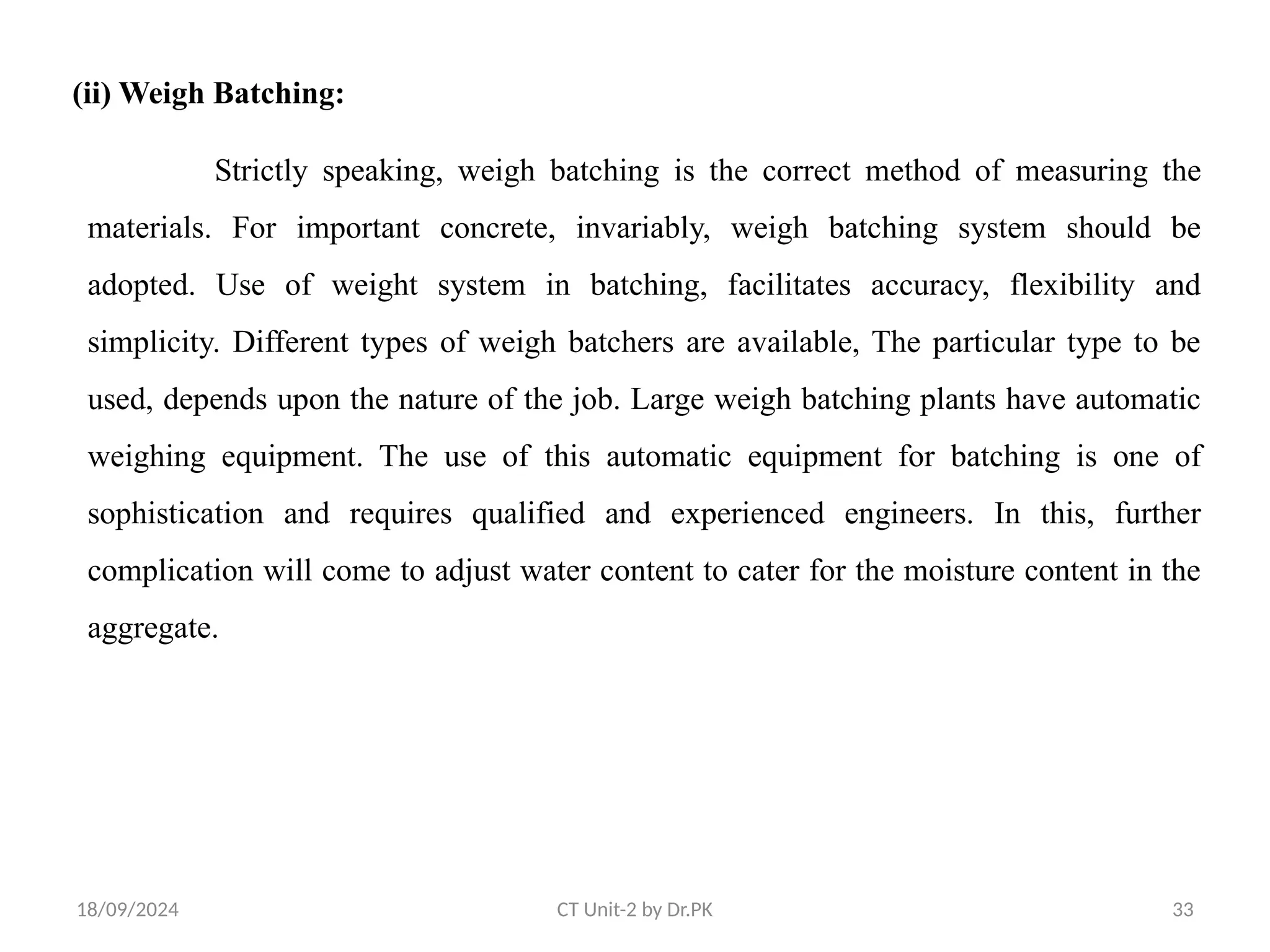
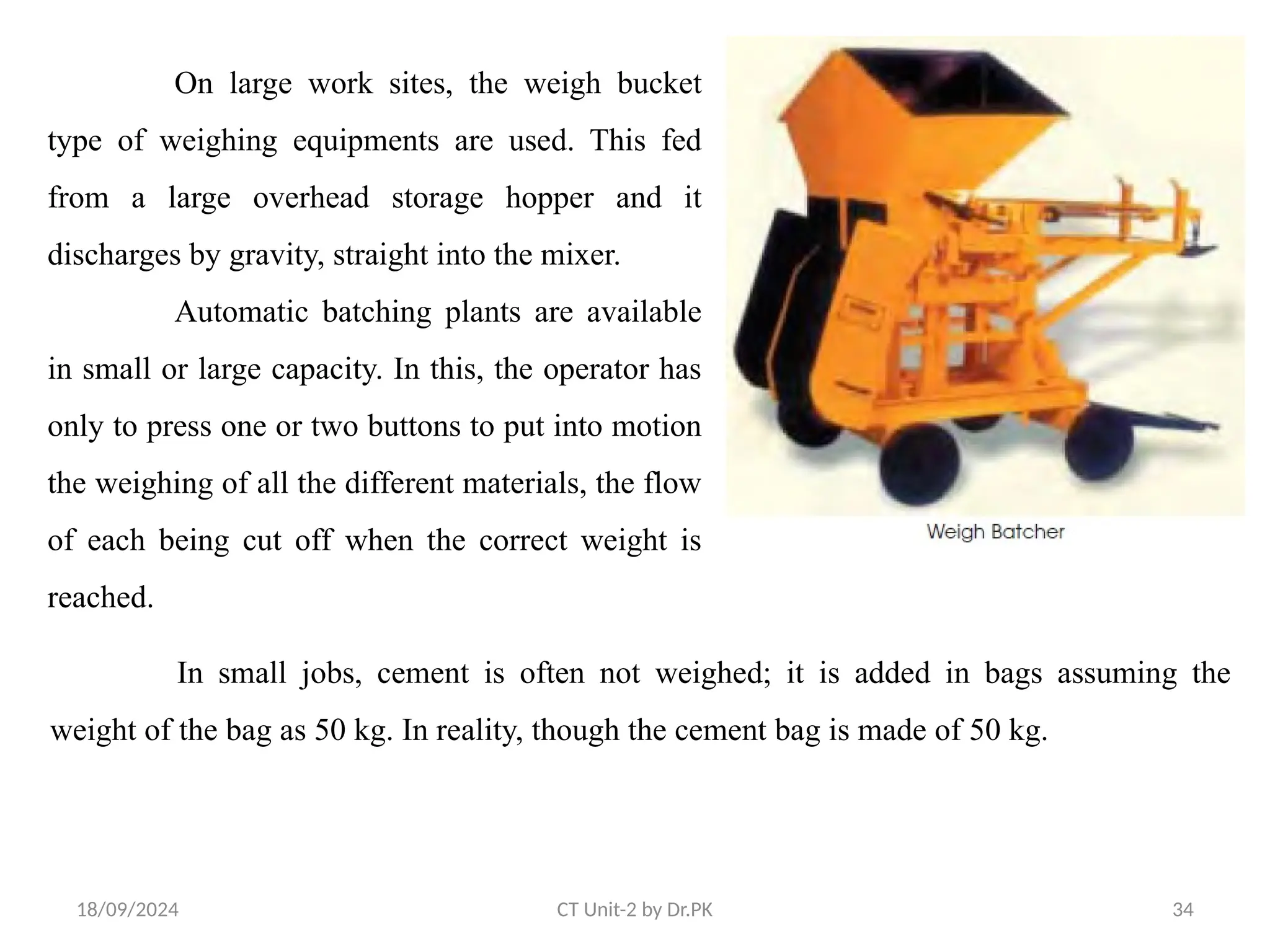
  • 56.
    18/09/2024 CT Unit-2by Dr.PK 56 Stripping Time of Formwork
  • 57.
    18/09/2024 CT Unit-2by Dr.PK 57 Slip-Form Technique There are special methods of placement of concrete using slip-form technique. Slip-forming can be done both for vertical construction or horizontal construction. Slip-forming of vertical construction is a proven method of concrete construction generally adopted for tall structures. In this method, concrete is continuously placed, compacted and formwork is pulled up by number of hydraulic Jacks, giving reaction, against jack rods or main reinforcements. The horizontal slip-form construction is rather a new technique in India. It is adopted for road pavement construction. For the first time the slip-form paving method was adopted in Delhi-Mathura concrete Road construction during mid 1990’s. The slip-form pavers were used by many contracting firms in the construction of Mumbai- Pune six lane express highway. The state-of the art method of slip form pavement construction has come to India in a big way.
  • 58.
  • 59.
    18/09/2024 CT Unit-2by Dr.PK 59 Compaction of Concrete Compaction of concrete is the process adopted for expelling the entrapped air from the concrete. In the process of mixing, transporting and placing of concrete air is likely to get entrapped in the concrete. The lower the workability, higher is the amount of air entrapped. In other words, stiff concrete mix has high percentage of entrapped air and, therefore , would need higher compacting efforts than high workable mixes. If this air is not removed fully, the concrete loses strength considerably. Below fig shows the relationship between loss of strength and air voids left due to lack of compaction. It can be seen from the figure that 5% voids reduce the strength of concrete by about 30% and 10% voids reduce the strength by over 50%. Therefore, it is imperative that 100% compaction of concrete is one of the most important aim to be kept in mind in good concrete-making practices
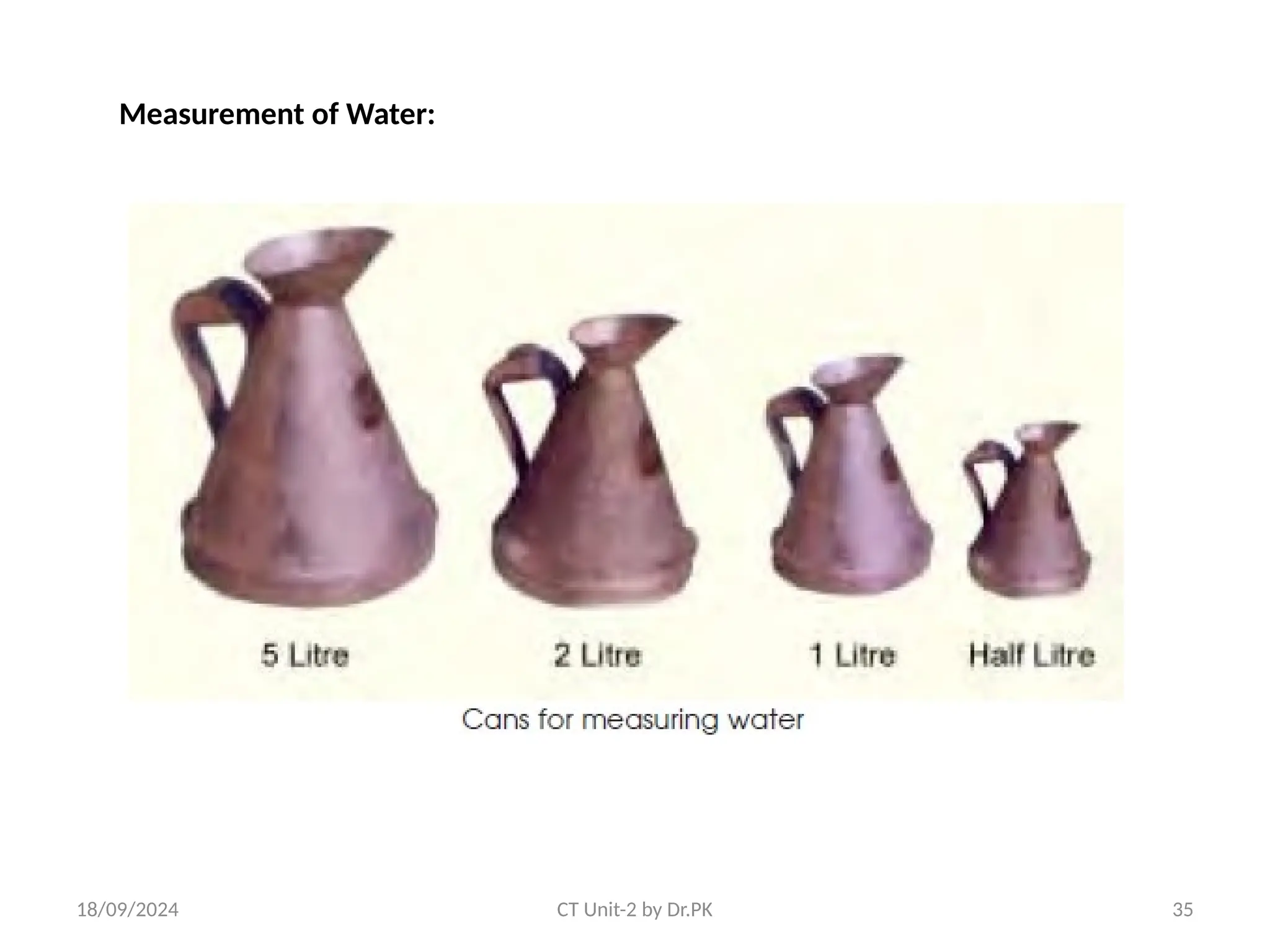
  • 60.
  • 61.
    18/09/2024 CT Unit-2by Dr.PK 61 It must be borne in mind that 100% compaction is important not only from the point of view of strength, but also from the point of durability. In recent time, durability becomes more important than strength. Insufficient compaction increases the permeability of concrete resulting in easy entry for aggressive chemicals in solution, which attack concrete and reinforcement to reduce the durability of concrete. Therefore, 100 per cent compaction of concrete is of paramount importance. In order to achieve full compaction and maximum density, with reasonable compacting efforts available at site, it is necessary to use a mix with adequate workability. It is also of common knowledge that the mix should not be too wet for easy compaction which also reduces the strength of concrete. For maximum strength, driest possible concrete should be compacted 100%. The overall economy demands 100% compaction with a reasonable compacting efforts available in the field.
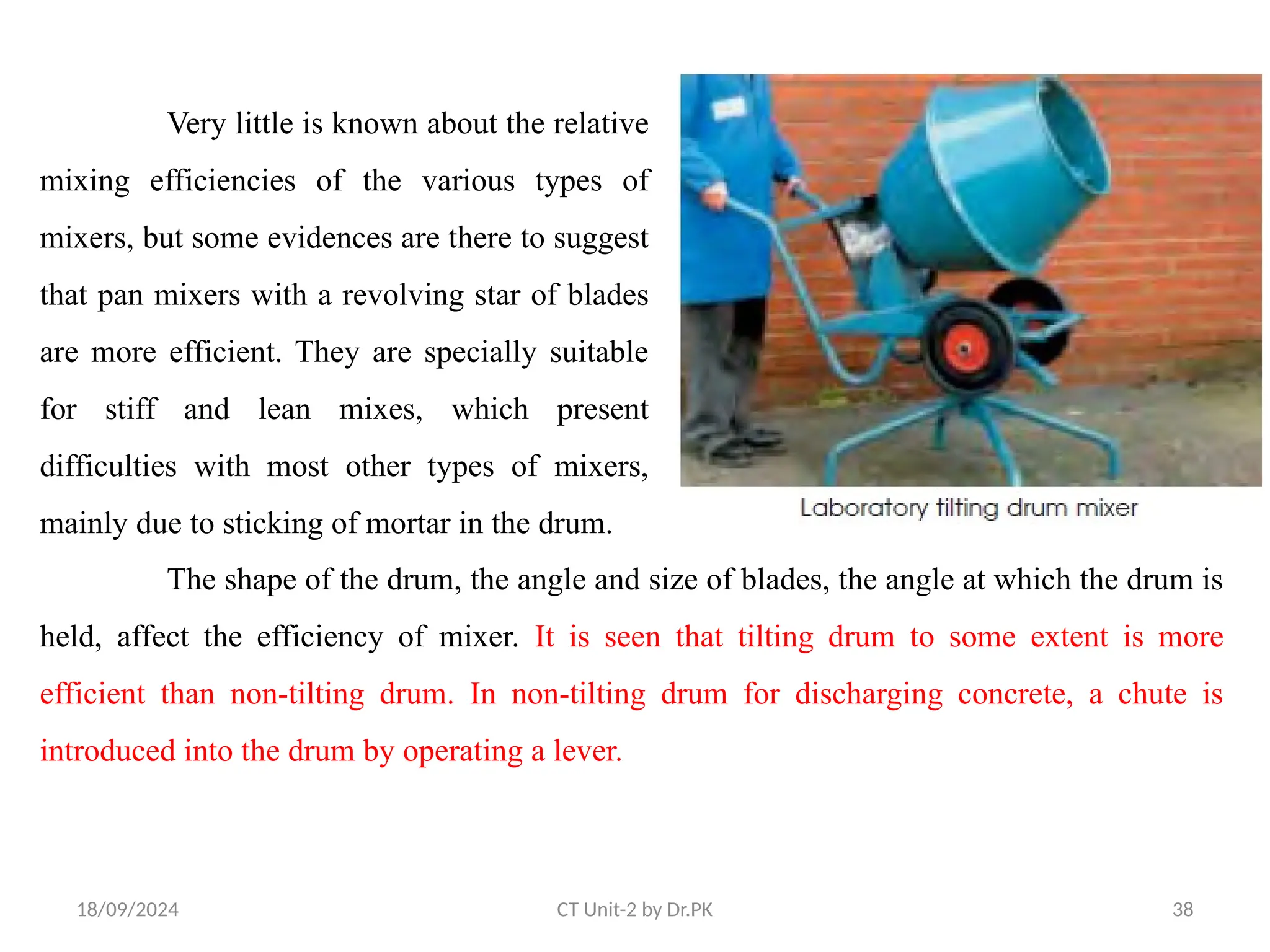
  • 62.
    18/09/2024 CT Unit-2by Dr.PK 62 The following methods are adopted for compacting the concrete: (a) Hand Compaction (i ) Rodding (ii ) Ramming (iii ) Tamping (b) Compaction by Vibration (i ) Internal vibrator (Needle vibrator) (ii ) Formwork vibrator (External vibrator) (iii ) Table vibrator (iv ) Platform vibrator (v ) Surface vibrator (Screed vibrator) (vi ) Vibratory Roller. (c ) Compaction by Pressure and Jolting (d) Compaction by Spinning.
  • 63.
  • 64.
  • 65.
  • 66.
    18/09/2024 CT Unit-2by Dr.PK 66 Curing of Concrete We have discussed in module I the hydration aspect of cement. Concrete derives its strength by the hydration of cement particles. The hydration of cement is not a momentary action but a process continuing for long time. Of cource, the rate of hydration is fast to start with, but countinues over a very long time at a decreasing rate. The quantity of the product of hydration and consequently the amount of gel formed depends upon the extent of hydration. It has been mentioned earlier that cement requires a water/cement ratio about 0.23 for hydration and a water/cement ratio of 0.15 for filling the voids in the gel pores. In other words, a water/cement ratio of about 0.38 would be required to hydrate all the particles of cement and also to occupy the space in the gel pores. In the field and in actual work, it is a different story. Even though a higher water/cement ratio is used, since the concrete is open to atmosphere, the water used in the concrete evaporates and the water available in the concrete will not be sufficient for effective hydration to take place particularly in the top layer.
  • 67.
    18/09/2024 CT Unit-2by Dr.PK 67 Alternatively, some measures must be taken by way of provision of impervious covering or application of curing compounds to prevent the loss of water from the surface of the concrete. Therefore, the curing can be considered as creation of a favourable environment during the early period for uninterrupted hydration. The desirable conditions are, a suitable temperature and ample moisture.
  • 68.
    18/09/2024 CT Unit-2by Dr.PK 68 Curing can also be described as keeping the concrete moist and warm enough so that the hydration of cement can continue. More elaborately, it can be described as the process of maintaining a satisfactory moisture content and a favourable temperature in concrete during the period immediately following placement, so that hydration of cement may continue until the desired properties are developed to a sufficient degree to meet the requirement of service. Curing is being given a place of increasing importance as the demand for high quality concrete is increasing. It has been recognized that the quality of concrete shows all round improvement with efficient uninterrupted curing. If curing is neglected in the early period of hydration, the quality of concrete will experience a sort of irreparable loss. An efficient curing in the early period of hydration can be compared to a good and wholesome feeding given to a new born baby.
  • 69.
    18/09/2024 CT Unit-2by Dr.PK 69 A concrete laid in the afternoon of a hot summer day in a dry climatic region, is apt to dry out quickly. The surface layer of concrete exposed to acute drying condition, with the combined effect of hot sun and drying wind is likely to be made up of poorly hydrated cement with inferior gel structure which does not give the desirable bond and strength characteristics. In addition, the top surface, particularly that of road or floor pavement is also subjected to a large magnitude of plastic shrinkage stresses. The dried concrete naturally being weak, cannot withstand these stresses with the result that innumerable cracks develop at the surface. Below fig, shows plastic shrinkage cracks on concrete surface due to quick drying and inadequate early curing. The top surface of such hardened concrete on account of poor gel structure, suffers from lack of wearing quality and abrasion resistance. Therefore, such surfaces create mud in the rainy season and dust in summer.
  • 70.
  • 71.
    18/09/2024 CT Unit-2by Dr.PK 71 The quick surface drying of concrete results in the movement of moisture from the interior to the surface. This steep moisture gradient cause high internal stresses which are also responsible for internal micro cracks in the semi-plastic concrete. Concrete, while hydrating, releases high heat of hydration. This heat is harmful from the point of view of volume stability. If the heat generated is removed by some means, the adverse effect due to the generation of heat can be reduced. This can be done by a thorough water curing. Curing Methods Curing methods may be divided broadly into four categories: (a) Water curing (b) Membrane curing (c ) Application of heat (d) Miscellaneous
  • 72.
    18/09/2024 CT Unit-2by Dr.PK 72 Water Curing This is by far the best method of curing as it satisfies all the requirements of curing, namely, promotion of hydration, elimination of shrinkage and absorption of the heat of hydration. Water curing can be done in the following ways: (a ) Immersion (b) Ponding (c ) Spraying or Fogging (d ) Wet covering The precast concrete items are normally immersed in curing tanks for a certain duration. Pavement slabs, roof slab etc. are covered under water by making small ponds. Vertical retaining wall or plastered surfaces or concrete columns etc. are cured by spraying water. In some cases, wet coverings such as wet gunny bags, hessian cloth, jute matting, straw etc., are wrapped to vertical surface for keeping the concrete wet. For horizontal surfaces saw dust, earth or sand are used as wet covering to keep the concrete in wet condition for a longer time so that the concrete is not unduly dried to prevent hydration.
  • 73.
    18/09/2024 73 CT Unit-2by Dr.PK Membrane Curing Sometimes, concrete works are carried out in places where there is acute shortage of water. The lavish application of water for water curing is not possible for reasons of economy. It has been pointed out earlier that curing does not mean only application of water, it means also creation of conditions for promotion of uninterrupted and progressive hydration. It is also pointed out that the quantity of water, normally mixed for making concrete is more than sufficient to hydrate the cement, provided this water is not allowed to go out from the body of concrete. For this reason, concrete could be covered with membrane which will effectively seal off the evaporation of water from concrete. It is found that the application of membrane or a sealing compound, after a short spell of water curing for one or two days is sometimes beneficial.
  • 74.
    18/09/2024 CT Unit-2by Dr.PK 74 Sometimes, concrete is placed in some inaccessible, difficult or far off places. The curing of such concrete cannot be properly supervised. The curing is entirely left to the workmen, who do not quite understand the importance of regular uninterrupted curing. In such cases, it is much safer to adopt membrane curing rather than to leave the responsibility of curing to workers. Large number of sealing compounds have been developed in recent years. The idea is to obtain a continuous seal over the concrete surface by means of a firm impervious film to prevent moisture in concrete from escaping by evaporation. Sometimes, such films have been used at the interface of the ground and concrete to prevent the absorption of water by the ground from the concrete. Some of the materials, that can be used for this purpose are bituminous compounds, polyethylene or polyester film, waterproof paper, rubber compounds etc.
  • 75.
    18/09/2024 CT Unit-2by Dr.PK 75 Bituminous compound being black in colour, absorbs heat when it is applied on the top surface of the concrete. This results in the increase of temperature in the body of concrete which is undesirable. For this purpose, other modified materials which are not black in colour are in use. Such compounds are known as “Clear Compounds”. It is also suggested that a lime wash may be given over the black coating to prevent heat absorption.
  • 76.
    18/09/2024 CT Unit-2by Dr.PK 76 Application of heat The development of strength of concrete is a function of not only time but also that of temperature. When concrete is subjected to higher temperature it accelerates the hydration process resulting in faster development of strength. Concrete cannot be subjected to dry heat to accelerate the hydration process as the presence of moisture is also an essential requisite. Therefore, subjecting the concrete to higher temperature and maintaining the required wetness can be achieved by subjecting the concrete to steam curing. A faster attainment of strength will contribute to many other advantages mentioned below. (a ) Concrete is vulnerable to damage only for short time. (b) Concrete member can be handled very quickly. (c ) Less space will be sufficient in the casting yerd. (d ) A smaller curing tank will be sufficient.
  • 77.
    18/09/2024 CT Unit-2by Dr.PK 77 (e ) A higher outturn is possible for a given capital outlay. (f ) The work can be put on to service at a much early time, (g) A fewer number of formwork will be sufficient or alternatively with the given number of formwork more outturn will be achieved. (h) Prestressing bed can be released early for further casting. From the above mentioned advantages it can be seen that steam curing will give not only economical advantages, but also technical advantages in the matter of prefabrication of concrete elements. The exposure of concrete to higher temperature is done in the following manner: (a) Steam curing at ordinary pressure. (b) Steam curing at high pressure. (c) Curing by Infra-red radiation. (d) Electrical curing.
  • 78.
    18/09/2024 CT Unit-2by Dr.PK 78 A steam-curving cycle consists of: • an initial delay prior to steaming, • a period for increasing the temperature, • a period for retaining the temperature, • a period for decreasing the temperature. High Pressure Steam Curing (a ) High pressure steam cured concrete develops in one day, or less the strength as much as the 28 days’ strength of normally cured concrete. The strength developed does not show retrogression. (b) High pressure steam cured concrete exhibits higher resistance to sulphate attack, freezing and thawing action and chemical action. It also shows less efflorescence. (c ) High pressure steam cured concrete exhibits lower drying shrinkage, and moisture movement. For infra-red curing and Electrical curing please refer Concrete Technology Text book by MS. Shetty
  • 79.
  • 80.
    18/09/2024 CT Unit-2by Dr.PK 80 Finishing Finishing operation is the last operation in making concrete. Finishing in real sence does not apply to all concrete operations. For a beam concreting, finishing may not be applicable, whereas for the concrete road pavement, airfield pavement or for the flooring of a domestic building, careful finishing is of great importance. Concrete is often dubbed as a drab material, incapable of offering pleasant architectural appearance and finish. This shortcoming of concrete is being rectified and concretes these days are made to exhibit pleasant surface finishes. Particularly, many types of prefabricated concrete panels used as floor slab or wall unit are made in such a way as to give very attractive architectural affect. Even concrete claddings are made to give attractive look. Surface finishes may be grouped as under: (a) Formwork Finishes (b) Surface Treatment (c) Applied Finishes.
  • 81.
    18/09/2024 CT Unit-2by Dr.PK 81 Mechanical trowel for finishing factory floor. Sometimes surface hardener is sprinkled and finished.
  • 82.
    18/09/2024 CT Unit-2by Dr.PK 82 Thank You