STAMFORD UNIVERSITY BANGLADESH
Department of Civil Engineering
Batch: 68-B
Group-4 (Concrete)
Name Student ID
Aysha Siddika CEN 06810198
Md. Mosharaf Hosen Rakib CEN 06810200
Md. Rabbin Chowdhury CEN 06810205
Md. Mehedi Hasan Hridoy CEN 06810207
Saidul Islam CEN 06810217
Concrete:
Concrete is an artificial kind of stone
manufactured from a mixture of binding
materials and inert materials with water.
Concrete = Binding Materials + Inert Materials +
Water
 Concrete is a mixture of portland cement, water,
aggregates, and in some cases, admixtures.
 The cement and water form a paste that hardens
and bonds the aggregates together.
 Concrete is often looked upon as “man made rock”.
THE NATURE OF CONCRETE
 It is a composite material
 Aggregates are 65% - 80% of the volume
 Fine aggregate: sand
 Coarse aggregate: stone, brick khoa
 Cement: General term & applies to any binder
 Portland cement
 fly ash
 ground slag
 silica fume
 Water
REASONS WHY CONCRETE IS THE MOST
WIDELY USED MATERIAL:
 Concrete is one of
the cheapest and
most readily
available materials
• Concrete can be formed into
a variety of shapes and sizes
• Concrete possesses
excellent resistance to
water
ADVANTAGES OF CONCRETE
 We have the ability to cast desired shapes
 Arches, piers, columns, shells
 Properties can be tailored according to need (strength,
durability, etc.)
 Ability to resist high temperatures
 Will maintain structural integrity far longer than
structural steel
 Does not require protective coatings
 Can be an architectural & structural member at the same time
PROPERTIES OF QUALITY CONCRETE
 Workability (ease of placement; resistance to
segregation; homogenous mass)
 Consistency (ability to flow)
 Durability
 Strength
 Chloride Penetration Resistance
 Abrasion Resistance
 Introduction
 The potential strength and durability of concrete of a given mix proportion is
very dependent on the degree of its compaction.
 It is vital, therefore, that the consistency of the mix be such that the concrete
can be transported, placed, and finished sufficiently early enough to attain
the expected strength and durability.
 Significance
 The first 48 hours are very important for the performance of the concrete
structure.
 It controls the long-term behavior, influence f'c (ultimate strength), Ec (elastic
modulus), creep, and durability.
 Elasticity and Strength of Concrete
 The elastic properties of materials are a measure of their resistance to
deformation under an applied load (but the elastic strain is recovered when
the load is removed).
 Strength usually refers to the maximum stress that a given kind of sample can
carry.
 Understanding these properties and how they are measured is essential for
anyone wishing to use materials.
Names of Test to Find out the Main
Properties of Fresh Concrete
Consistency
• Slump Test
• Flow Test
• Penetration
Test
Workability
• Compacting
Factor Test
• VeBe Time
Test
Segregation
• ---
• ---
Bleeding
• Bleeding
Water Test
Concrete Consistency
• Consistency or fluidity of concrete is an important component
of workability and refers in a way to the wetness of the
concrete.
• However, it must not be assumed that the wetter the mix the
more workable it is. If a mix is too wet, segregation may occur
with resulting honeycomb, excessive bleeding, and sand
streaking on the formed surfaces
THREE WAYS TO DETERMINE CONSISTENCY OF
FRESH CONCRETE
Consistency
Tests
Slump Test
Ball penetration
test
Flow Test
 Definition
A slump test is a method used to determine the consistency of
concrete. The consistency, or stiffness, indicates how much
water has been used in the mix. The stiffness of the concrete
mix should be matched to the requirements for the finished
product quality
 Slump is a measurement of concrete’s workability, or fluidity.
 It’s an indirect measurement of concrete consistency or
stiffness and workability.
 Principle
The slump test result is a measure of the behavior of a
compacted inverted cone of concrete under the action of
gravity. It measures the consistency or the wetness of concrete.
 Apparatus
 Slump cone : frustum of a cone, 300 mm (12 in) of height. The
base is 200 mm (8in) in diameter and it has a smaller opening
at the top of 100 mm
 Scale for measurement,
 Temping rod (steel) 15mm diameter, 60cm length.
 Procedure
 The base is placed on a smooth surface and the container is
filled with concrete in three layers, whose workability is to be
tested .
 Each layer is temped 25 times with a standard 16 mm (5/8 in)
diameter steel rod, rounded at the end.
 When the mold is completely filled with concrete, the top
surface is struck off (leveled with mold top opening) by
means of screening and rolling motion of the temping rod.
 The mold must be firmly held against its base during the
entire operation so that it could not move due to the pouring
of concrete and this can be done by means of handles or foot
– rests brazed to the mold.
 Procedure
 Immediately after filling is completed and the concrete is
leveled, the cone is slowly and carefully lifted vertically, an
unsupported concrete will now slump.
 The decrease in the height of the center of the slumped
concrete is called slump.
 The slump is measured by placing the cone just besides the
slump concrete and the temping rod is placed over the cone
so that it should also come over the area of slumped concrete.
 The decrease in height of concrete to that of mold is noted
with scale. (usually measured to the nearest 5 mm (1/4 in).
 Precautions
 In order to reduce the influence on slump of the variation in
the surface friction, the inside of the mold and its base should
be moistened at the beginning of every test, and prior to
lifting of the mold the area immediately around the base of
the cone should be cleaned from concrete which may have
dropped accidentally.
Slump
Ruler
 Types of Slump
The slumped concrete takes various shapes, and
according to the profile of slumped concrete, the slump is
termed as;
 Collapse Slump
 Shear Slump
 True Slump
 Types Of Slump
 Collapse Slump
In a collapse slump the concrete collapses completely.
 A collapse slump will generally mean that the mix is too
wet or that it is a high workability mix, for which slump
test is not appropriate.
 Shear Slump
In a shear slump the top portion of the concrete shears off
and slips sideways. OR
If one-half of the cone slides down an inclined plane, the
slump is said to be a shear slump.
 If a shear or collapse slump is achieved, a fresh sample
should be taken and the test is repeated.
 If the shear slump persists, as may the case with harsh
mixes, this is an indication of lack of cohesion of the mix.
 Types Of Slump
 True Slump
In a true slump the concrete simply subsides, keeping
more or less to shape
 This is the only slump which is used in various tests.
 Mixes of stiff consistence have a Zero slump, so that
in the rather dry range no variation can be detected
between mixes of different workability.
However , in a lean mix with a tendency to harshness, a
true slump can easily change to the shear slump type or
even to collapse, and widely different values of slump
can be obtained in different samples from the same mix;
thus, the slump test is unreliable for lean mixes.
 Uses
 The slump test is used to ensure uniformity for different
batches of similar concrete under field conditions and to
ascertain the effects of plasticizers on their introduction.
 This test is very useful on site as a check on the day-to-day or
hour- to-hour variation in the materials being fed into the
mixer. An increase in slump may mean, for instance, that the
moisture content of aggregate has unexpectedly increases.
 Other cause would be a change in the grading of the aggregate,
such as a deficiency of sand.
 Too high or too low a slump gives immediate warning and
enables the mixer operator to remedy the situation.
 This application of slump test as well as its simplicity, is
responsible for its widespread use.
Degree of
workability
Slump
(mm)
Compacting
Factor
Use for which concrete is suitable
Very low 0 - 25 0.78
Very dry mixes; used in road making.
Roads vibrated by power operated
machines
Low 25 - 50 0.85
Low workability mixes; used for
foundations with light reinforcement.
Roads vibrated by hand operated
Machines
Medium 50 - 100 0.92
Medium workability mixes; manually
compacted flat slabs using crushed
aggregates. Normal reinforced concrete
manually compacted and heavily
reinforced sections with vibrations
High 100 - 175 0.95
High workability concrete; for sections
with congested reinforcement. Not
normally suitable for vibration
>Table : Workability, Slump and Compacting Factor of concrete with 19 or 38 mm (3/4 or 11/2 in) maximum size of aggregate.
Slump (mm) 0 - 20 20 - 40 40 - 120 120 - 200 200 - 220
Consistency Dry Stiff Plastic Wet Sloppy
>Table : Relation between Consistency and Slump values
Classification according to
consistency:
CONCRETE WORKABILITY
 Definition
 The property of fresh concrete which is indicated by the amount of
useful internal work required to fully compact the concrete without
bleeding or segregation in the finished product.
• Workability is the property that determines the ease with which
freshly mixed concrete can be placed and finished without
segregation.
 Workability is one of the physical parameters of concrete which
affects the strength and durability as well as the cost of labor and
appearance of the finished product.
 Concrete is said to be workable when it is easily placed and
compacted homogeneously i.e without bleeding or Segregation.
Unworkable concrete needs more work or effort to be compacted
in place, also honeycombs &/or pockets may also be visible in
finished concrete.
CONCRETE WORKABILITY
 Factors affecting workability
 Water content in the concrete mix
 Amount of cement & its Properties
 Aggregate Grading (Size Distribution)
 Nature of Aggregate Particles (Shape, Surface Texture,
Porosity etc.)
 Temperature of the concrete mix
 Humidity of the environment
 Mode of compaction
 Method of placement of concrete
 Method of transmission of concrete
CONCRETE WORKABILITY
 How To improve the workability of concrete
 increase water/cement ratio
 increase size of aggregate
 use well-rounded and smooth aggregate instead of
irregular shape
 increase the mixing time
 increase the mixing temperature
 use non-porous and saturated aggregate
 with addition of air-entraining mixtures
An on site simple test for determining workability is the SLUMP
TEST.
COMPACTING FACTOR TEST
Workability Slump (mm) C.F Uses
Very Low 0 - 25 0.78 Roads - Pavements
Low 25 - 50 0.85 Foundations Concrete
Medium 25 - 100 0.92 Reinforced Concrete
High 100 - 175 0.95
Reinforced Concrete (High
Reinforcement)
CONCRETE SEGREGATION
 Definition
 Segregation is when the coarse and fine aggregate, and cement paste, become separated.
Segregation may happen when the concrete is mixed, transported, placed or compacted
 Segregation makes the concrete
 WEAKER,
 LESS DURABLE,
 and will leave A POOR SURFACE FINISH
CONCRETE SEGREGATION
 Basic types of segregation
 Coarse segregation : Occurs when gradation is shifted to include too
much coarse aggregate and not enough fine aggregate. Coarse
segregation is characterized by low asphalt content, low density,
high air voids, rough surface texture, and accelerated rutting and
fatigue failure (Williams et. al., 1996b). Typically, coarse
segregation is considered the most prevalent and damaging type
of segregation; thus segregation research has typically focused on
coarse segregation. The term “segregation” by itself is usually
taken to mean “coarse segregation.”
 Fine segregation : Occurs when gradation is shifted to include too
much fine aggregate and not enough course aggregate. High
asphalt content, low density, smooth surface texture, accelerated
rutting, and better fatigue performance characterize fine
segregation (Williams, Duncan and White, 1996).
CONCRETE SEGREGATION
 To Avoid Segregation
 Check the concrete is not 'too wet' or 'too dry'.
 Make sure the concrete is properly mixed. It is important that the concrete is mixed at
the correct speed in a transit mixer for at least two minutes immediately prior to
discharge.
 The concrete should be placed as soon as possible.
 When transporting the mix, load carefully.
 Always pour new concrete into the face of concrete already in place.
 When compacting with a poker vibrator be sure to use it carefully
CONCRETE SEGREGATION
 To Avoid Segregation
 If placing concrete straight from a truck, pour vertically and never let the concrete fall
more than one-and-a-half meters.
CONCRETE BLEEDING
Concrete Bleeding
 Introduction (Definition)
 This refers to the appearance of water along with cement
particles on the surface of the freshly laid concrete. This
happens when there is excessive quantity of water in the mix or
due to excessive compaction. Bleeding causes the formation of
pores and renders the concrete weak. Bleeding can be avoided
by suitably controlling the quantity of water in the concrete
and using finer grading of aggregates.
 A thorough knowledge of why concrete bleeds and how mix
proportions affect it, is required to preventing the harmful
effects of bleeding. Adoption of right finishing methods also
helps to ensure that the bleeding problems won't ruin a slab
surface.
Concrete Bleeding
 Bleeding Process
 Almost all freshly placed concrete bleeds. As aggregate and
cement particles settle, they force excess mixing water upward.
The process continues until settlement stops, either because of
solids bridging or because the concrete has set.
 The total amount of bleeding or settlement depends on mix
properties, primarily water content and amount of fines
(cement, fly ash, fine sand). Increasing water content increases
bleeding, and increasing the amount of fines reduces bleeding.
Amount of bleeding is also proportional to the depth of
concrete placed. More bleed water rises in deep sections than in
thin ones.
 Channels that reach the surface are open paths for deicing
solutions to penetrate the concrete. This leads to freezing and
thawing damage and rebar corrosion.
Concrete Bleeding
 Effects Of Excessive bleeding in Deep Section
 Sometimes bleedwater can't entirely evaporate because it has
been trapped near the top surface by setting. This raises the
water-cement ratio, increases permeability, and lowers
strength. Excessive bleeding also causes some other problems
in deep sections: heavy laitance accumulation at horizontal
construction joints; bond loss at aggregate and rebar surfaces;
and unsightly sand streaks.
 Bleeding Problems in Flatwork
 Never float or trowel concrete while there's bleedwater on the
surface. That's the cardinal rule of finishing. Finishing before
bleedwater has evaporated can cause dusting, craze cracking,
scaling, and low wear resistance. Working bleed-water into
the surface also increases permeability.
Concrete Bleeding
 How to control bleeding
 Excessive bleeding can be avoided. Don't add too much water to
the concrete. Add additional concrete fines to reduce bleeding.
 Use a more finely ground cement. Concretes made with high
early strength (Type III) cement bleed less because the cement is
ground finer than normal (Type I) cement.
 Use more cement. At the same water content, rich mixes bleed
less than lean mixes.
 Use fly ash or other pozzolans in the concrete.
 If concrete sands don't have much material passing the No. 50
and 100 sieves, blend in a fine blow sand at the batch plant.
 For air- entrained concrete, use the maximum allowable amount
of entrained air. Consider using an air- entraining agent
whenever excessive bleeding is a problem. Entrained air bubbles
act as additional fines. Air entrainment also lowers the amount
of water needed to reach a desired slump.
Water – Cement Ratio
 Water cement ratio controls the strength, durability and
water tightness of hardened concrete.
 Based on Abram’s Law (D.A. Abrams, 1919) “the
compressive strength of concrete is inversely proportional to
the ratio of water to cement”
 Too much water will weaken concrete after curing.
 Little water is dense but causes difficulty in placement and
workability of concrete.
 The Average water-cement ratio is 30 liters per 50 kg. of
cement bag.
 Excessive water causes bleeding and laitance.
Laitance (milky deposit containing cement and fine aggregate on the surface of new
concrete combined with bleeding, overworking of mix or improper finishing).
TESTING OF CONCRETE
 Hardened concrete tests.
 Strength in compression
 Cube test (British Standard1881 : Part 111 :1983)
 Cylinder test (BS 1881 : Part 110 :1983) (ASTM C
192-90a
 Flexural strength test
 Tensile test
Three types of compression test specimens are used: cubes,
cylinders, and prisms.
 Cubes are used in Great Britain, Germany and many other
countries in Europe.
 Cylinders are the standard specimens in the Unites States,
France, Canada, Australia and Newzeland.
 In Scandinavia tests are made on both cubes and cylinders.
 The tendency nowadays, especially in research is to use
cylinders in preference to cubes.
Compression Tests
Factors Affecting Compressive Strength at 28 days
• Aggregate content
• Cement type and fineness
• Water/cement ratio
• Degree of compaction
• Extent of curing
• Temperature
Strength Measurement
• 100mm or 150mm cubes at 7 and 28 days
• 300mm x 150mm cylinders at 7 and 28 days (note ratio 2:1 and
circular in plan)
• Other tests – direct tension, bending and cores
• Non-destructive testing
CUBE MAKING:
 Cube making:
 Prime objectives
 to achieve full compaction
 avoid loss of moisture
 keep at proper temperature when in curing tank
 Use proper tools.
 Advantage of cube shape is ease of making accurate
sides.
CUBE CURING AND CUBE TESTING
Cube Curing:
 De-mould (take the mould out) when stability of
cube allows.
 Prevent loss of moisture before placing in curing
tank.
 Loss in strength due to initial drying out is
unrecoverable.
 No provision for in-situ cubes. Give temperature
matched curing.
COMPRESSIVE STRENGTH TESTING OF
CONCRETE CUBES
CRITERIA FOR CUBE FAILURES
 A strength (the characteristic 28-day strength) is
specified based on design – the concrete Grade
 In compression test, two tested cubes at 28 days
= one result
 Provided difference between individual results
is within 15% of average
 Individual cube result:
 every individual result must be greater than the
characteristic -3MPa
CONCRETE CUBE TEST RESULT
VARIABILITY
 Variability – 28 day cube results have a mean
strength and a standard deviation
 For an expected 5% defective level, the target
mean strength is the specified characteristic
strength plus 1.64 times the standard
deviation
 Ensure actual mean is greater than target
mean strength
FAILURE MODES - NORMAL
• A quality control test based on 7–28 days curing period
to determine the compressive strength of a concrete
specimen.
•The standard cylinder is 150 mm diameter, 300 mm
long and is cast in a mold generally made of steel or cast
iron. The cylinder specimens are made are compacted
either in three layers using a 16 mm diameter rod or in
two layers by means of a vibrator.
•Details of procedure are prescribed in ASTM Standard
C192-76.
Cylinder Test
•After top surface of the cyliner has been finished by means of
trowel, the cube is stored undistributed for 24 hours at a temperature
of 18 to 22 º C and relative humidity of not less than 90 percent. At
the end of this period the mould is stripped and the cylinder is
further cured in a water at 19 to 21º C .
•The test is generally performed at 28 days but it also perform
additional test at 3 and 7 days. In compression test, the cylinder is
placed with the faces in contact with the platens of the testing
machine, i.e. the position of the cube when tested is at right angles
to that as-cast.
•The load on the cylinder should be applied at a constant rate of
stress equal to 0.0250 KN/sq. meter/ sec
Cylinder Compressive Tests
Failure Pattern of Cylinder Test
Consolidation of Concrete:
 The process of eliminating voids other than entrained air
within newly placed concrete and ensuring close contact of
the concrete with form surfaces and embedded steel
reinforcement.
Through : vibration, spading and rodding
 Excessive vibration causes segregation (separation of
coarse aggregate from mortar causing excessive horizontal
movement making a free fall mix)
 Excessive vibration also causes stratification (separation
combined with excessive wetting into horizontal layers where
lighter material migrate towards the top)
Different Process of Mixing Concrete:
 Manual – flat surface with shovels and buggy
 Small Power – a manual mixing rotating drum
 Bagger Mixer – equipped with diesel engine and pump
operated mechanical mixing drum (1 or 2bags) or rotating
mixing drum at the back of a truck.
Method of Transporting Concrete:
 Ready Mixed- concrete mixed at batch plant for delivery by
an agitator to construction site.
Method of Transporting Concrete:
 Shrink Mixed – concrete partially mixed at the batch plant
then mixed completely in a truck mixed en route to
construction site.
 Transit Mixed – concrete dry batch at a batch plant &
mixed at the truck mixer on route to construction site.
Method of Transporting Concrete:
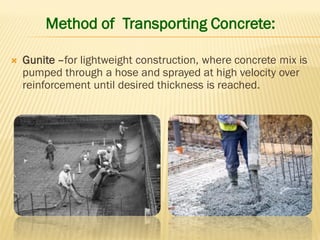
 Gunite –for lightweight construction, where concrete mix is
pumped through a hose and sprayed at high velocity over
reinforcement until desired thickness is reached.
 With proper materials and techniques, concrete can
withstand many acids, milk, manure, fertilizers, water,
fire, and abrasion.
 Concrete can be finished to produce surfaces ranging
from glass-smooth to coarsely textured, and it can be
colored with pigments or painted.
 Concrete has substantial strength in compression, but
is weak in tension.
 Most structural uses, such as beams, slabs, and tanks,
involve reinforced concrete, which depends on
concrete's strength in compression and steel's strength
in tension.
Concrete-Applications
When specifying and ordering concrete, the customer
should be prepared to discuss such things as:
 1. Amount of concrete required,
 2. use of the concrete,
 3. type of cement,
 4. minimum amount of cement per cubic meter
 5. maximum water-cement ratio
 6. any special admixtures,
 7. amount of air entrainment,
 8. desired compressive strength,
 9. amount of slump, and
 10. any special considerations or restrictions
Types of special concrete
1. High Volume Fly Ash Concrete.
2. Silica fume concrete.
3. GGBS, Slag based concrete.
4. Ternary blend concrete.
5. Light weight concrete.
6. Polymer concrete.
7. Self Compacting Concrete.
8. Coloured Concrete.
9. Fibre-reinforced Concrete.
10. Pervious Concrete.
11. Water-proof Concrete.
12. Temperature Controlled Concrete.
Group 4 (concrete)

Group 4 (concrete)

  • 2.
    STAMFORD UNIVERSITY BANGLADESH Departmentof Civil Engineering Batch: 68-B Group-4 (Concrete) Name Student ID Aysha Siddika CEN 06810198 Md. Mosharaf Hosen Rakib CEN 06810200 Md. Rabbin Chowdhury CEN 06810205 Md. Mehedi Hasan Hridoy CEN 06810207 Saidul Islam CEN 06810217
  • 3.
    Concrete: Concrete is anartificial kind of stone manufactured from a mixture of binding materials and inert materials with water. Concrete = Binding Materials + Inert Materials + Water  Concrete is a mixture of portland cement, water, aggregates, and in some cases, admixtures.  The cement and water form a paste that hardens and bonds the aggregates together.  Concrete is often looked upon as “man made rock”.
  • 4.
    THE NATURE OFCONCRETE  It is a composite material  Aggregates are 65% - 80% of the volume  Fine aggregate: sand  Coarse aggregate: stone, brick khoa  Cement: General term & applies to any binder  Portland cement  fly ash  ground slag  silica fume  Water
  • 5.
    REASONS WHY CONCRETEIS THE MOST WIDELY USED MATERIAL:  Concrete is one of the cheapest and most readily available materials • Concrete can be formed into a variety of shapes and sizes • Concrete possesses excellent resistance to water
  • 6.
    ADVANTAGES OF CONCRETE We have the ability to cast desired shapes  Arches, piers, columns, shells  Properties can be tailored according to need (strength, durability, etc.)  Ability to resist high temperatures  Will maintain structural integrity far longer than structural steel  Does not require protective coatings  Can be an architectural & structural member at the same time
  • 7.
    PROPERTIES OF QUALITYCONCRETE  Workability (ease of placement; resistance to segregation; homogenous mass)  Consistency (ability to flow)  Durability  Strength  Chloride Penetration Resistance  Abrasion Resistance
  • 8.
     Introduction  Thepotential strength and durability of concrete of a given mix proportion is very dependent on the degree of its compaction.  It is vital, therefore, that the consistency of the mix be such that the concrete can be transported, placed, and finished sufficiently early enough to attain the expected strength and durability.  Significance  The first 48 hours are very important for the performance of the concrete structure.  It controls the long-term behavior, influence f'c (ultimate strength), Ec (elastic modulus), creep, and durability.
  • 9.
     Elasticity andStrength of Concrete  The elastic properties of materials are a measure of their resistance to deformation under an applied load (but the elastic strain is recovered when the load is removed).  Strength usually refers to the maximum stress that a given kind of sample can carry.  Understanding these properties and how they are measured is essential for anyone wishing to use materials.
  • 10.
    Names of Testto Find out the Main Properties of Fresh Concrete Consistency • Slump Test • Flow Test • Penetration Test Workability • Compacting Factor Test • VeBe Time Test Segregation • --- • --- Bleeding • Bleeding Water Test
  • 11.
    Concrete Consistency • Consistencyor fluidity of concrete is an important component of workability and refers in a way to the wetness of the concrete. • However, it must not be assumed that the wetter the mix the more workable it is. If a mix is too wet, segregation may occur with resulting honeycomb, excessive bleeding, and sand streaking on the formed surfaces
  • 12.
    THREE WAYS TODETERMINE CONSISTENCY OF FRESH CONCRETE Consistency Tests Slump Test Ball penetration test Flow Test
  • 13.
     Definition A slumptest is a method used to determine the consistency of concrete. The consistency, or stiffness, indicates how much water has been used in the mix. The stiffness of the concrete mix should be matched to the requirements for the finished product quality  Slump is a measurement of concrete’s workability, or fluidity.  It’s an indirect measurement of concrete consistency or stiffness and workability.  Principle The slump test result is a measure of the behavior of a compacted inverted cone of concrete under the action of gravity. It measures the consistency or the wetness of concrete.
  • 14.
     Apparatus  Slumpcone : frustum of a cone, 300 mm (12 in) of height. The base is 200 mm (8in) in diameter and it has a smaller opening at the top of 100 mm  Scale for measurement,  Temping rod (steel) 15mm diameter, 60cm length.
  • 15.
     Procedure  Thebase is placed on a smooth surface and the container is filled with concrete in three layers, whose workability is to be tested .  Each layer is temped 25 times with a standard 16 mm (5/8 in) diameter steel rod, rounded at the end.  When the mold is completely filled with concrete, the top surface is struck off (leveled with mold top opening) by means of screening and rolling motion of the temping rod.  The mold must be firmly held against its base during the entire operation so that it could not move due to the pouring of concrete and this can be done by means of handles or foot – rests brazed to the mold.
  • 16.
     Procedure  Immediatelyafter filling is completed and the concrete is leveled, the cone is slowly and carefully lifted vertically, an unsupported concrete will now slump.  The decrease in the height of the center of the slumped concrete is called slump.  The slump is measured by placing the cone just besides the slump concrete and the temping rod is placed over the cone so that it should also come over the area of slumped concrete.  The decrease in height of concrete to that of mold is noted with scale. (usually measured to the nearest 5 mm (1/4 in).
  • 17.
     Precautions  Inorder to reduce the influence on slump of the variation in the surface friction, the inside of the mold and its base should be moistened at the beginning of every test, and prior to lifting of the mold the area immediately around the base of the cone should be cleaned from concrete which may have dropped accidentally.
  • 18.
  • 19.
     Types ofSlump The slumped concrete takes various shapes, and according to the profile of slumped concrete, the slump is termed as;  Collapse Slump  Shear Slump  True Slump
  • 20.
     Types OfSlump  Collapse Slump In a collapse slump the concrete collapses completely.  A collapse slump will generally mean that the mix is too wet or that it is a high workability mix, for which slump test is not appropriate.  Shear Slump In a shear slump the top portion of the concrete shears off and slips sideways. OR If one-half of the cone slides down an inclined plane, the slump is said to be a shear slump.  If a shear or collapse slump is achieved, a fresh sample should be taken and the test is repeated.  If the shear slump persists, as may the case with harsh mixes, this is an indication of lack of cohesion of the mix.
  • 21.
     Types OfSlump  True Slump In a true slump the concrete simply subsides, keeping more or less to shape  This is the only slump which is used in various tests.  Mixes of stiff consistence have a Zero slump, so that in the rather dry range no variation can be detected between mixes of different workability. However , in a lean mix with a tendency to harshness, a true slump can easily change to the shear slump type or even to collapse, and widely different values of slump can be obtained in different samples from the same mix; thus, the slump test is unreliable for lean mixes.
  • 22.
     Uses  Theslump test is used to ensure uniformity for different batches of similar concrete under field conditions and to ascertain the effects of plasticizers on their introduction.  This test is very useful on site as a check on the day-to-day or hour- to-hour variation in the materials being fed into the mixer. An increase in slump may mean, for instance, that the moisture content of aggregate has unexpectedly increases.  Other cause would be a change in the grading of the aggregate, such as a deficiency of sand.  Too high or too low a slump gives immediate warning and enables the mixer operator to remedy the situation.  This application of slump test as well as its simplicity, is responsible for its widespread use.
  • 23.
    Degree of workability Slump (mm) Compacting Factor Use forwhich concrete is suitable Very low 0 - 25 0.78 Very dry mixes; used in road making. Roads vibrated by power operated machines Low 25 - 50 0.85 Low workability mixes; used for foundations with light reinforcement. Roads vibrated by hand operated Machines Medium 50 - 100 0.92 Medium workability mixes; manually compacted flat slabs using crushed aggregates. Normal reinforced concrete manually compacted and heavily reinforced sections with vibrations High 100 - 175 0.95 High workability concrete; for sections with congested reinforcement. Not normally suitable for vibration >Table : Workability, Slump and Compacting Factor of concrete with 19 or 38 mm (3/4 or 11/2 in) maximum size of aggregate.
  • 24.
    Slump (mm) 0- 20 20 - 40 40 - 120 120 - 200 200 - 220 Consistency Dry Stiff Plastic Wet Sloppy >Table : Relation between Consistency and Slump values Classification according to consistency:
  • 25.
    CONCRETE WORKABILITY  Definition The property of fresh concrete which is indicated by the amount of useful internal work required to fully compact the concrete without bleeding or segregation in the finished product. • Workability is the property that determines the ease with which freshly mixed concrete can be placed and finished without segregation.  Workability is one of the physical parameters of concrete which affects the strength and durability as well as the cost of labor and appearance of the finished product.  Concrete is said to be workable when it is easily placed and compacted homogeneously i.e without bleeding or Segregation. Unworkable concrete needs more work or effort to be compacted in place, also honeycombs &/or pockets may also be visible in finished concrete.
  • 26.
    CONCRETE WORKABILITY  Factorsaffecting workability  Water content in the concrete mix  Amount of cement & its Properties  Aggregate Grading (Size Distribution)  Nature of Aggregate Particles (Shape, Surface Texture, Porosity etc.)  Temperature of the concrete mix  Humidity of the environment  Mode of compaction  Method of placement of concrete  Method of transmission of concrete
  • 27.
    CONCRETE WORKABILITY  HowTo improve the workability of concrete  increase water/cement ratio  increase size of aggregate  use well-rounded and smooth aggregate instead of irregular shape  increase the mixing time  increase the mixing temperature  use non-porous and saturated aggregate  with addition of air-entraining mixtures An on site simple test for determining workability is the SLUMP TEST.
  • 28.
    COMPACTING FACTOR TEST WorkabilitySlump (mm) C.F Uses Very Low 0 - 25 0.78 Roads - Pavements Low 25 - 50 0.85 Foundations Concrete Medium 25 - 100 0.92 Reinforced Concrete High 100 - 175 0.95 Reinforced Concrete (High Reinforcement)
  • 29.
    CONCRETE SEGREGATION  Definition Segregation is when the coarse and fine aggregate, and cement paste, become separated. Segregation may happen when the concrete is mixed, transported, placed or compacted  Segregation makes the concrete  WEAKER,  LESS DURABLE,  and will leave A POOR SURFACE FINISH
  • 30.
    CONCRETE SEGREGATION  Basictypes of segregation  Coarse segregation : Occurs when gradation is shifted to include too much coarse aggregate and not enough fine aggregate. Coarse segregation is characterized by low asphalt content, low density, high air voids, rough surface texture, and accelerated rutting and fatigue failure (Williams et. al., 1996b). Typically, coarse segregation is considered the most prevalent and damaging type of segregation; thus segregation research has typically focused on coarse segregation. The term “segregation” by itself is usually taken to mean “coarse segregation.”  Fine segregation : Occurs when gradation is shifted to include too much fine aggregate and not enough course aggregate. High asphalt content, low density, smooth surface texture, accelerated rutting, and better fatigue performance characterize fine segregation (Williams, Duncan and White, 1996).
  • 31.
    CONCRETE SEGREGATION  ToAvoid Segregation  Check the concrete is not 'too wet' or 'too dry'.  Make sure the concrete is properly mixed. It is important that the concrete is mixed at the correct speed in a transit mixer for at least two minutes immediately prior to discharge.  The concrete should be placed as soon as possible.  When transporting the mix, load carefully.  Always pour new concrete into the face of concrete already in place.  When compacting with a poker vibrator be sure to use it carefully
  • 32.
    CONCRETE SEGREGATION  ToAvoid Segregation  If placing concrete straight from a truck, pour vertically and never let the concrete fall more than one-and-a-half meters.
  • 33.
  • 34.
    Concrete Bleeding  Introduction(Definition)  This refers to the appearance of water along with cement particles on the surface of the freshly laid concrete. This happens when there is excessive quantity of water in the mix or due to excessive compaction. Bleeding causes the formation of pores and renders the concrete weak. Bleeding can be avoided by suitably controlling the quantity of water in the concrete and using finer grading of aggregates.  A thorough knowledge of why concrete bleeds and how mix proportions affect it, is required to preventing the harmful effects of bleeding. Adoption of right finishing methods also helps to ensure that the bleeding problems won't ruin a slab surface.
  • 35.
    Concrete Bleeding  BleedingProcess  Almost all freshly placed concrete bleeds. As aggregate and cement particles settle, they force excess mixing water upward. The process continues until settlement stops, either because of solids bridging or because the concrete has set.  The total amount of bleeding or settlement depends on mix properties, primarily water content and amount of fines (cement, fly ash, fine sand). Increasing water content increases bleeding, and increasing the amount of fines reduces bleeding. Amount of bleeding is also proportional to the depth of concrete placed. More bleed water rises in deep sections than in thin ones.  Channels that reach the surface are open paths for deicing solutions to penetrate the concrete. This leads to freezing and thawing damage and rebar corrosion.
  • 36.
    Concrete Bleeding  EffectsOf Excessive bleeding in Deep Section  Sometimes bleedwater can't entirely evaporate because it has been trapped near the top surface by setting. This raises the water-cement ratio, increases permeability, and lowers strength. Excessive bleeding also causes some other problems in deep sections: heavy laitance accumulation at horizontal construction joints; bond loss at aggregate and rebar surfaces; and unsightly sand streaks.  Bleeding Problems in Flatwork  Never float or trowel concrete while there's bleedwater on the surface. That's the cardinal rule of finishing. Finishing before bleedwater has evaporated can cause dusting, craze cracking, scaling, and low wear resistance. Working bleed-water into the surface also increases permeability.
  • 37.
    Concrete Bleeding  Howto control bleeding  Excessive bleeding can be avoided. Don't add too much water to the concrete. Add additional concrete fines to reduce bleeding.  Use a more finely ground cement. Concretes made with high early strength (Type III) cement bleed less because the cement is ground finer than normal (Type I) cement.  Use more cement. At the same water content, rich mixes bleed less than lean mixes.  Use fly ash or other pozzolans in the concrete.  If concrete sands don't have much material passing the No. 50 and 100 sieves, blend in a fine blow sand at the batch plant.  For air- entrained concrete, use the maximum allowable amount of entrained air. Consider using an air- entraining agent whenever excessive bleeding is a problem. Entrained air bubbles act as additional fines. Air entrainment also lowers the amount of water needed to reach a desired slump.
  • 38.
    Water – CementRatio  Water cement ratio controls the strength, durability and water tightness of hardened concrete.  Based on Abram’s Law (D.A. Abrams, 1919) “the compressive strength of concrete is inversely proportional to the ratio of water to cement”  Too much water will weaken concrete after curing.  Little water is dense but causes difficulty in placement and workability of concrete.  The Average water-cement ratio is 30 liters per 50 kg. of cement bag.  Excessive water causes bleeding and laitance. Laitance (milky deposit containing cement and fine aggregate on the surface of new concrete combined with bleeding, overworking of mix or improper finishing).
  • 39.
    TESTING OF CONCRETE Hardened concrete tests.  Strength in compression  Cube test (British Standard1881 : Part 111 :1983)  Cylinder test (BS 1881 : Part 110 :1983) (ASTM C 192-90a  Flexural strength test  Tensile test
  • 40.
    Three types ofcompression test specimens are used: cubes, cylinders, and prisms.  Cubes are used in Great Britain, Germany and many other countries in Europe.  Cylinders are the standard specimens in the Unites States, France, Canada, Australia and Newzeland.  In Scandinavia tests are made on both cubes and cylinders.  The tendency nowadays, especially in research is to use cylinders in preference to cubes. Compression Tests
  • 41.
    Factors Affecting CompressiveStrength at 28 days • Aggregate content • Cement type and fineness • Water/cement ratio • Degree of compaction • Extent of curing • Temperature Strength Measurement • 100mm or 150mm cubes at 7 and 28 days • 300mm x 150mm cylinders at 7 and 28 days (note ratio 2:1 and circular in plan) • Other tests – direct tension, bending and cores • Non-destructive testing
  • 42.
    CUBE MAKING:  Cubemaking:  Prime objectives  to achieve full compaction  avoid loss of moisture  keep at proper temperature when in curing tank  Use proper tools.  Advantage of cube shape is ease of making accurate sides.
  • 43.
    CUBE CURING ANDCUBE TESTING Cube Curing:  De-mould (take the mould out) when stability of cube allows.  Prevent loss of moisture before placing in curing tank.  Loss in strength due to initial drying out is unrecoverable.  No provision for in-situ cubes. Give temperature matched curing.
  • 44.
  • 45.
    CRITERIA FOR CUBEFAILURES  A strength (the characteristic 28-day strength) is specified based on design – the concrete Grade  In compression test, two tested cubes at 28 days = one result  Provided difference between individual results is within 15% of average  Individual cube result:  every individual result must be greater than the characteristic -3MPa
  • 46.
    CONCRETE CUBE TESTRESULT VARIABILITY  Variability – 28 day cube results have a mean strength and a standard deviation  For an expected 5% defective level, the target mean strength is the specified characteristic strength plus 1.64 times the standard deviation  Ensure actual mean is greater than target mean strength
  • 47.
  • 48.
    • A qualitycontrol test based on 7–28 days curing period to determine the compressive strength of a concrete specimen. •The standard cylinder is 150 mm diameter, 300 mm long and is cast in a mold generally made of steel or cast iron. The cylinder specimens are made are compacted either in three layers using a 16 mm diameter rod or in two layers by means of a vibrator. •Details of procedure are prescribed in ASTM Standard C192-76. Cylinder Test
  • 49.
    •After top surfaceof the cyliner has been finished by means of trowel, the cube is stored undistributed for 24 hours at a temperature of 18 to 22 º C and relative humidity of not less than 90 percent. At the end of this period the mould is stripped and the cylinder is further cured in a water at 19 to 21º C . •The test is generally performed at 28 days but it also perform additional test at 3 and 7 days. In compression test, the cylinder is placed with the faces in contact with the platens of the testing machine, i.e. the position of the cube when tested is at right angles to that as-cast. •The load on the cylinder should be applied at a constant rate of stress equal to 0.0250 KN/sq. meter/ sec Cylinder Compressive Tests
  • 51.
    Failure Pattern ofCylinder Test
  • 52.
    Consolidation of Concrete: The process of eliminating voids other than entrained air within newly placed concrete and ensuring close contact of the concrete with form surfaces and embedded steel reinforcement. Through : vibration, spading and rodding  Excessive vibration causes segregation (separation of coarse aggregate from mortar causing excessive horizontal movement making a free fall mix)  Excessive vibration also causes stratification (separation combined with excessive wetting into horizontal layers where lighter material migrate towards the top)
  • 53.
    Different Process ofMixing Concrete:  Manual – flat surface with shovels and buggy  Small Power – a manual mixing rotating drum  Bagger Mixer – equipped with diesel engine and pump operated mechanical mixing drum (1 or 2bags) or rotating mixing drum at the back of a truck.
  • 54.
    Method of TransportingConcrete:  Ready Mixed- concrete mixed at batch plant for delivery by an agitator to construction site.
  • 55.
    Method of TransportingConcrete:  Shrink Mixed – concrete partially mixed at the batch plant then mixed completely in a truck mixed en route to construction site.  Transit Mixed – concrete dry batch at a batch plant & mixed at the truck mixer on route to construction site.
  • 56.
    Method of TransportingConcrete:  Gunite –for lightweight construction, where concrete mix is pumped through a hose and sprayed at high velocity over reinforcement until desired thickness is reached.
  • 57.
     With propermaterials and techniques, concrete can withstand many acids, milk, manure, fertilizers, water, fire, and abrasion.  Concrete can be finished to produce surfaces ranging from glass-smooth to coarsely textured, and it can be colored with pigments or painted.  Concrete has substantial strength in compression, but is weak in tension.  Most structural uses, such as beams, slabs, and tanks, involve reinforced concrete, which depends on concrete's strength in compression and steel's strength in tension. Concrete-Applications
  • 58.
    When specifying andordering concrete, the customer should be prepared to discuss such things as:  1. Amount of concrete required,  2. use of the concrete,  3. type of cement,  4. minimum amount of cement per cubic meter  5. maximum water-cement ratio  6. any special admixtures,  7. amount of air entrainment,  8. desired compressive strength,  9. amount of slump, and  10. any special considerations or restrictions
  • 59.
    Types of specialconcrete 1. High Volume Fly Ash Concrete. 2. Silica fume concrete. 3. GGBS, Slag based concrete. 4. Ternary blend concrete. 5. Light weight concrete. 6. Polymer concrete. 7. Self Compacting Concrete. 8. Coloured Concrete. 9. Fibre-reinforced Concrete. 10. Pervious Concrete. 11. Water-proof Concrete. 12. Temperature Controlled Concrete.