Inertia Inertia is the physical property of all masses to stay at rest unless acted upon by an external force or unbalanced force.  An object in motion tends to stay in motion with the same speed and direction unless acted upon by an unbalanced force.
Example For example;  a soccer ball will remain at rest unless kicked by someone exerting an external force on it.
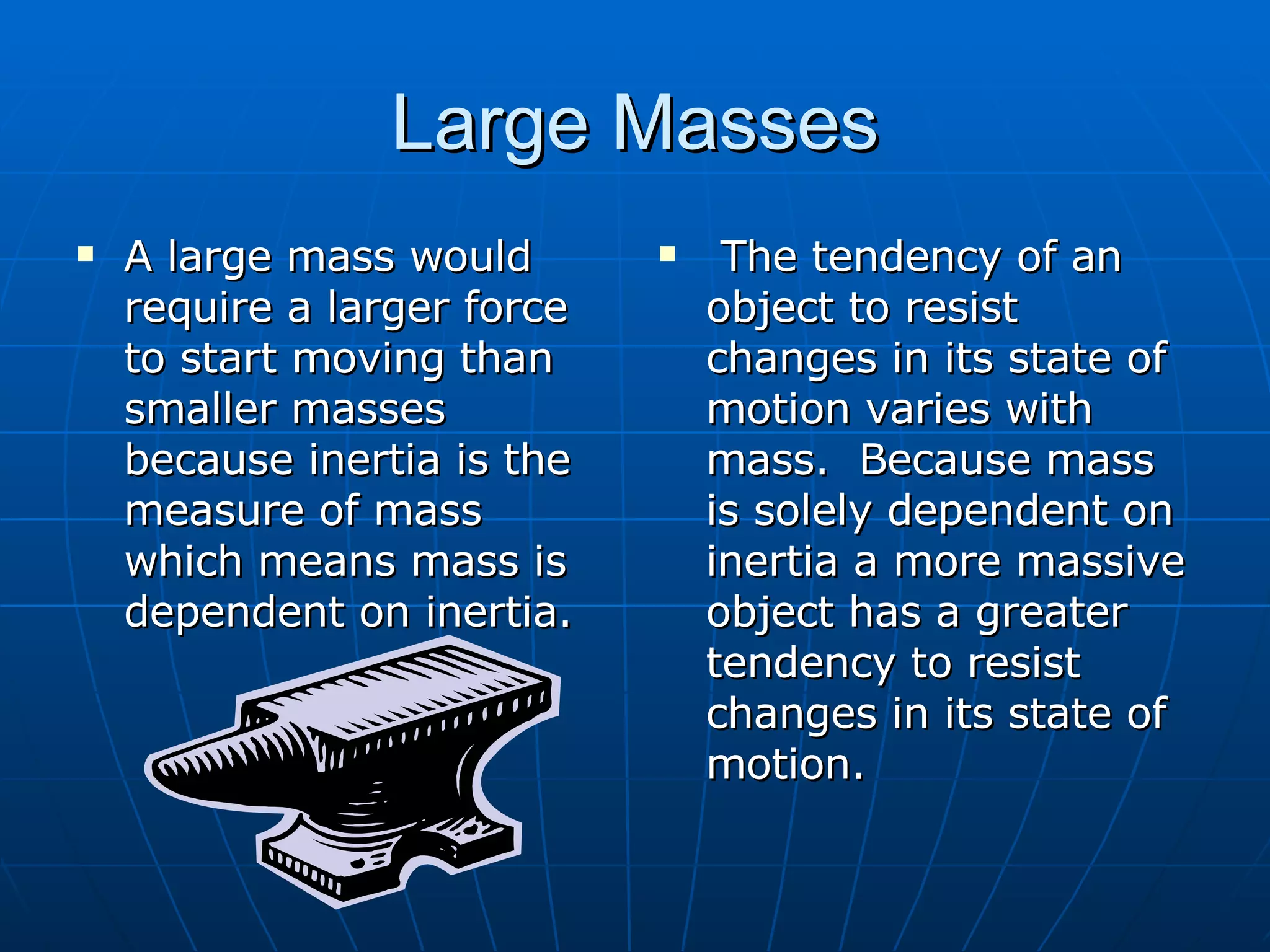
Large Masses A large mass would require a larger force to start moving than smaller masses because inertia is the measure of mass which means mass is dependent on inertia.  The tendency of an object to resist changes in its state of motion varies with mass.  Because mass is solely dependent on inertia a more massive object has a greater tendency to resist changes in its state of motion.
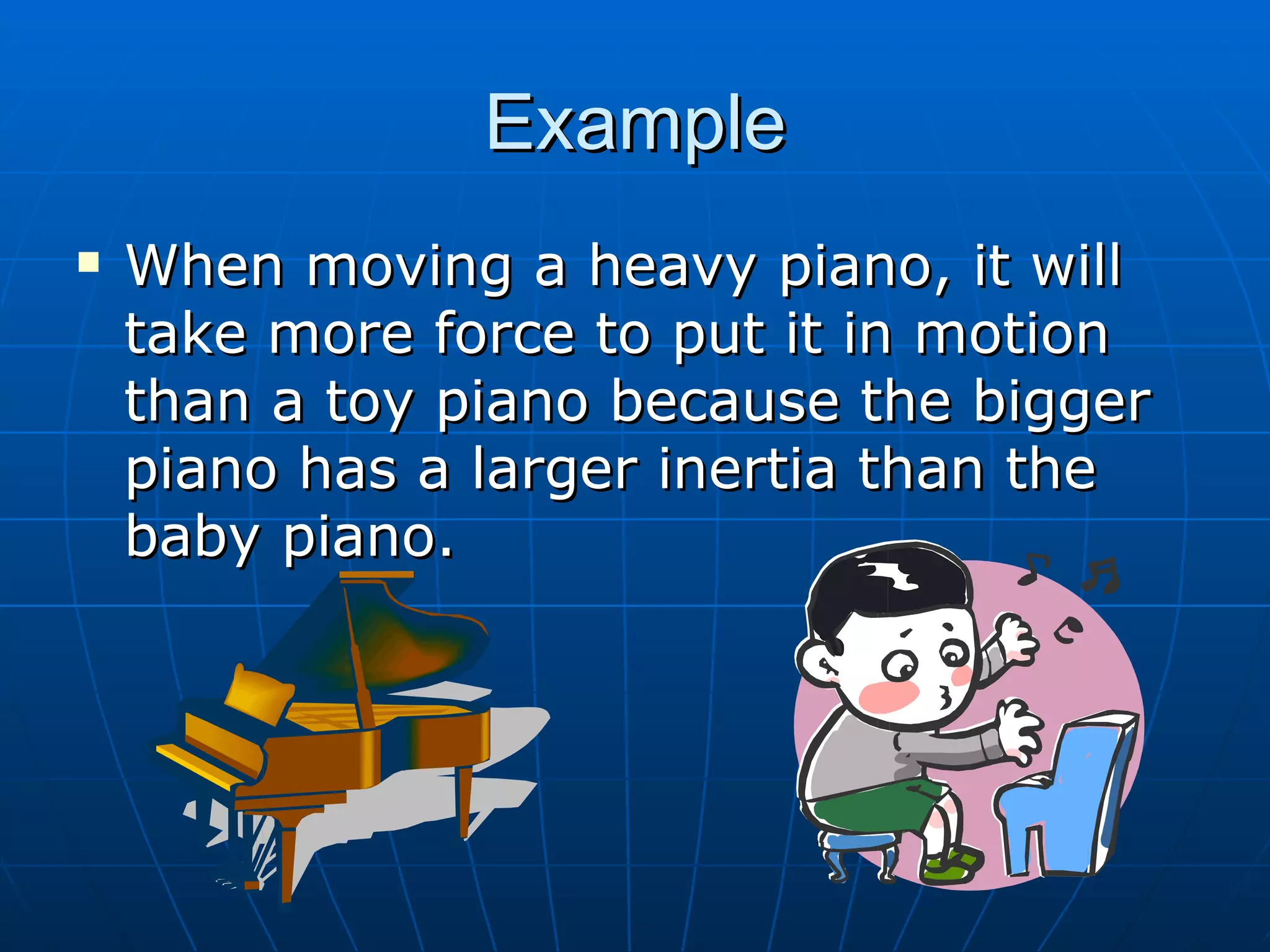
Example When moving a heavy piano, it will take more force to put it in motion than a toy piano because the bigger piano has a larger inertia than the baby piano.
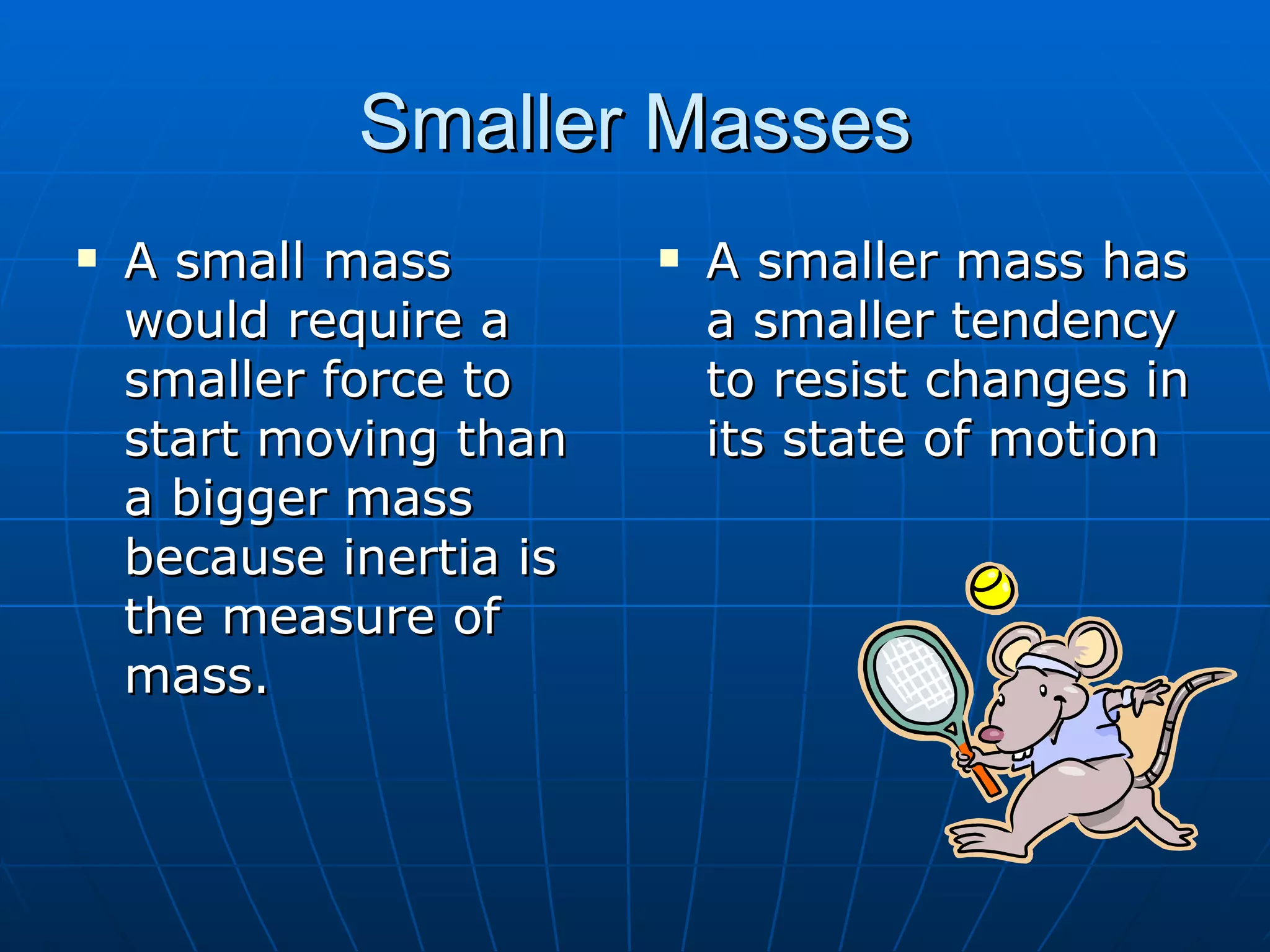
Smaller Masses A small mass would require a smaller force to start moving than a bigger mass because inertia is the measure of mass. A smaller mass has a smaller tendency to resist changes in its state of motion
Friction and Masses Kinetic friction is the force that acts upon objects in motion.  Static friction is the force which acts upon objects going from rest to motion.
Zero Net Force If the forces acting on the object equals zero, this means the object is not accelerating.  Therefore the object is either standing still or moving in a straight path at a constant velocity until interrupted by an unbalanced force.

Inertia 4

  • 1.
    Inertia Inertia isthe physical property of all masses to stay at rest unless acted upon by an external force or unbalanced force. An object in motion tends to stay in motion with the same speed and direction unless acted upon by an unbalanced force.
  • 2.
    Example For example; a soccer ball will remain at rest unless kicked by someone exerting an external force on it.
  • 3.
    Large Masses Alarge mass would require a larger force to start moving than smaller masses because inertia is the measure of mass which means mass is dependent on inertia. The tendency of an object to resist changes in its state of motion varies with mass. Because mass is solely dependent on inertia a more massive object has a greater tendency to resist changes in its state of motion.
  • 4.
    Example When movinga heavy piano, it will take more force to put it in motion than a toy piano because the bigger piano has a larger inertia than the baby piano.
  • 5.
    Smaller Masses Asmall mass would require a smaller force to start moving than a bigger mass because inertia is the measure of mass. A smaller mass has a smaller tendency to resist changes in its state of motion
  • 6.
    Friction and MassesKinetic friction is the force that acts upon objects in motion. Static friction is the force which acts upon objects going from rest to motion.
  • 7.
    Zero Net ForceIf the forces acting on the object equals zero, this means the object is not accelerating. Therefore the object is either standing still or moving in a straight path at a constant velocity until interrupted by an unbalanced force.