The document provides information about commands, requests, and how to report them. It defines commands as sentences that order someone to do something, typically ending with a period or exclamation point. Requests are sentences that ask someone to do something, often containing "please" and ending with a period, question mark, or exclamation point. Examples are given of direct commands and requests, then how to report them using verbs like "tell" and "ask" without changing tense. The document concludes by thanking the reader for their attention.
In this document
Powered by AI
The group presenting consists of Eren Intan, Gerdalia E.K, Miranti Muliasani, Ratih Amalia, and Haris Ichsan.
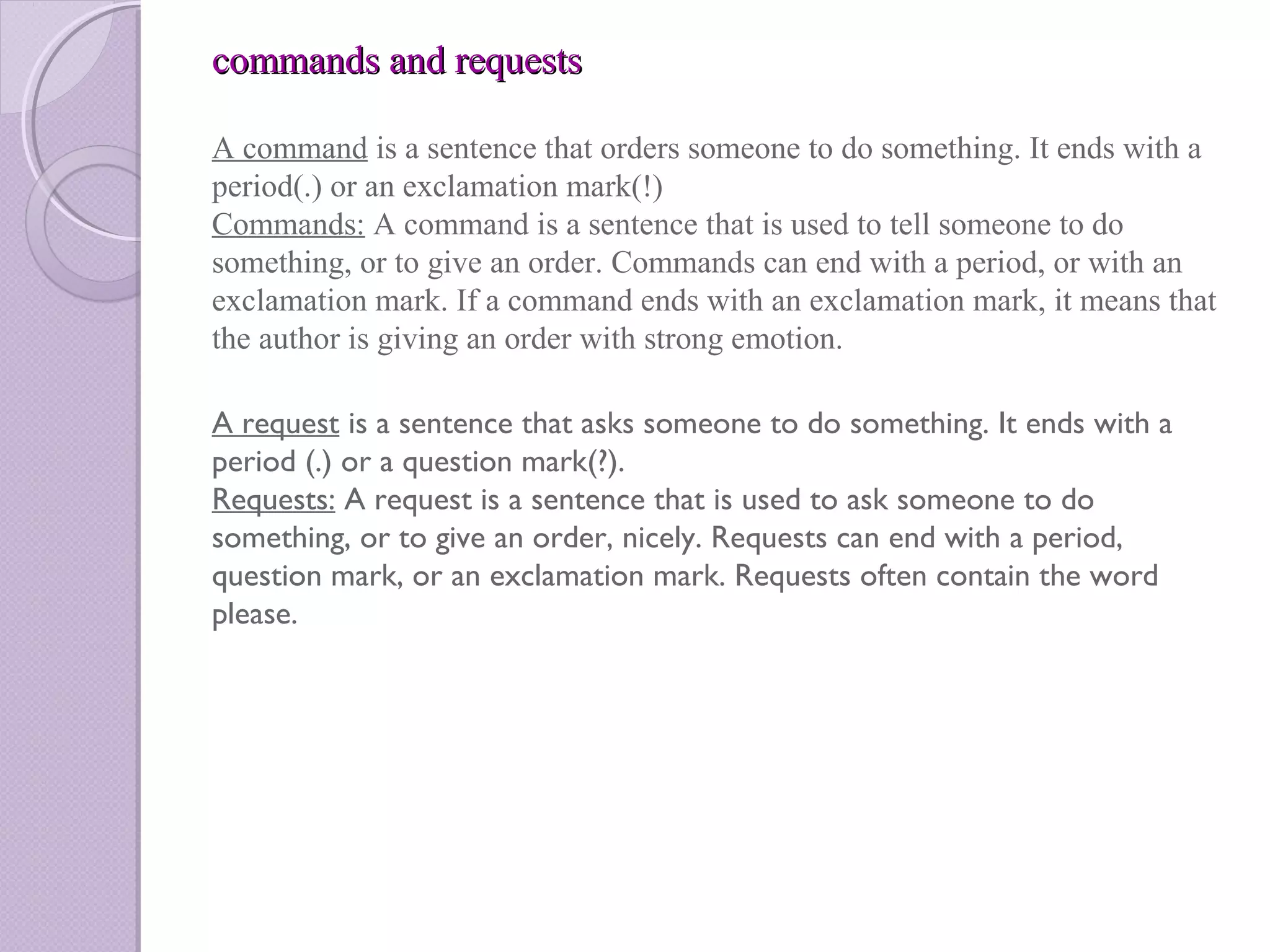
Commands instruct someone to act and can end with a period or exclamation. Requests ask for something politely, ending with a period, question mark, or exclamation.
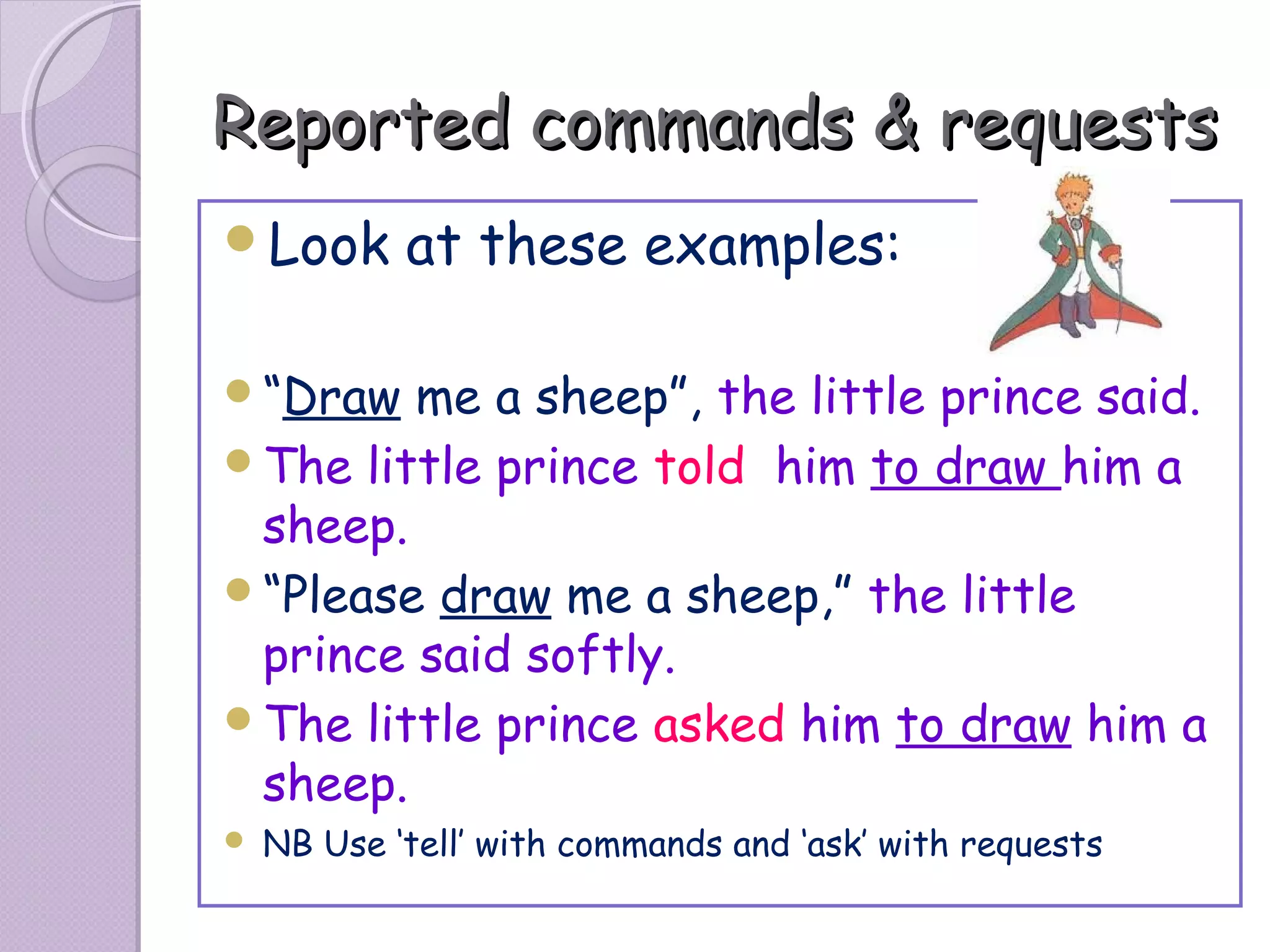
Examples illustrate how to report commands and requests using 'tell' for commands and 'ask' for requests.
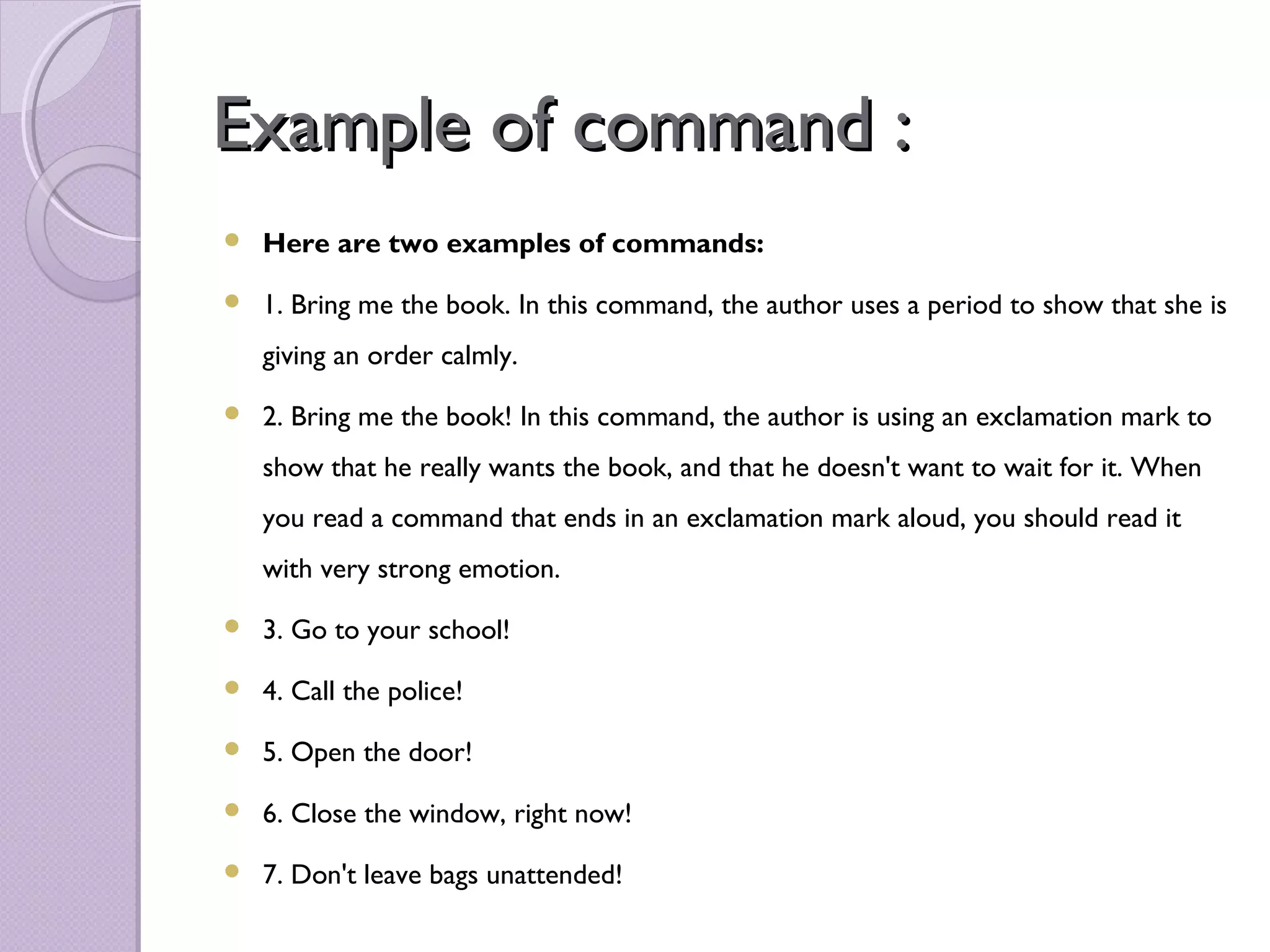
Examples of commands are provided, highlighting the use of periods or exclamations to convey emotion and urgency.
When reporting commands and requests, there is no tense change; verbs shift to the infinitive form.
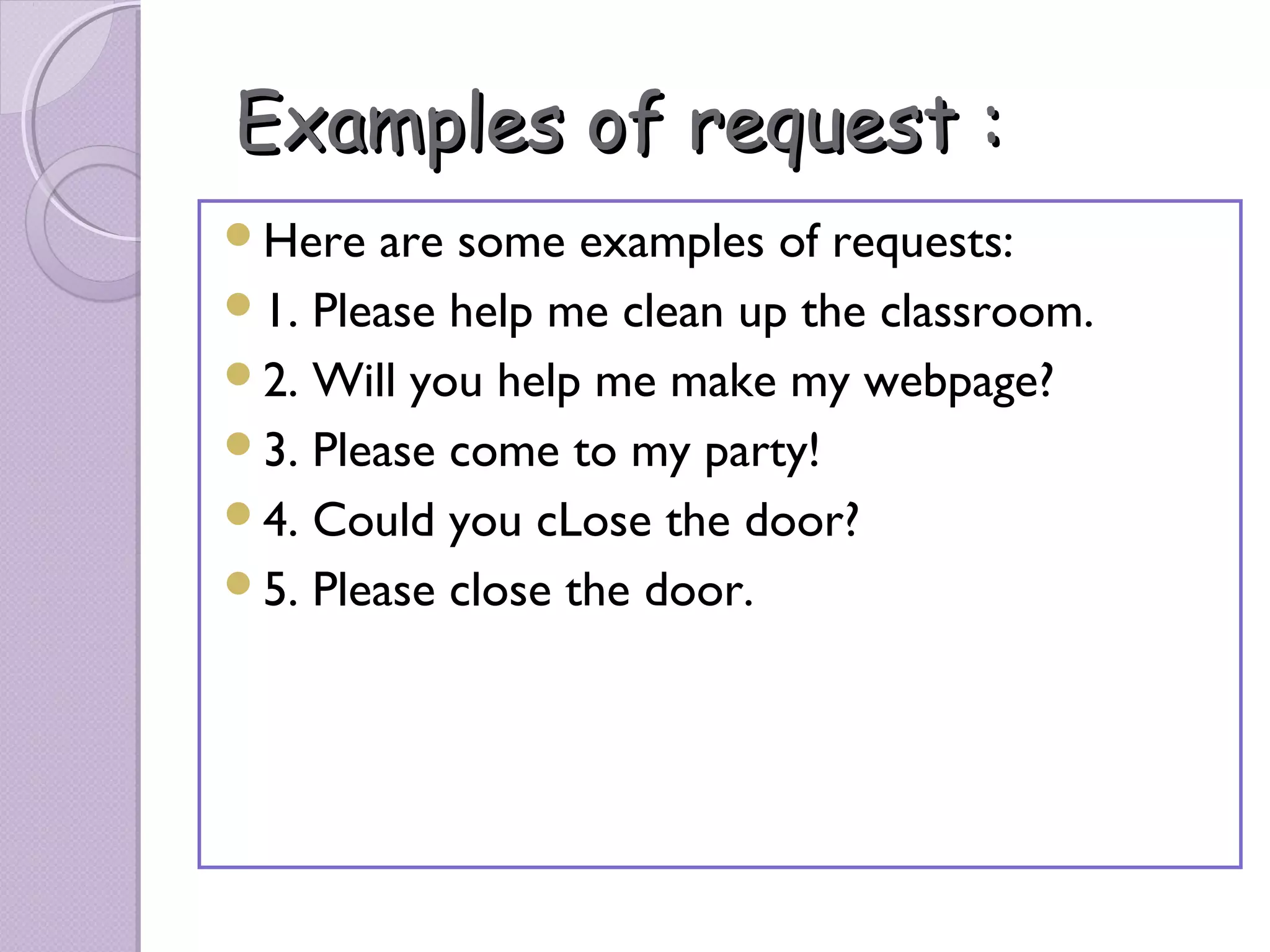
Various examples of requests are shown, emphasizing polite phrasing and the word 'please'.
Thanks for attention; examples were derived from 'The Little Prince' by Antoine de Saint-Exupery.
name of group:
ErenIntan
Gerdalia E.K
Miranti Muliasani
Ratih Amalia
Haris Ichsan
2.
commands and requests
Acommand is a sentence that orders someone to do something. It ends with a
period(.) or an exclamation mark(!)
Commands: A command is a sentence that is used to tell someone to do
something, or to give an order. Commands can end with a period, or with an
exclamation mark. If a command ends with an exclamation mark, it means that
the author is giving an order with strong emotion.
A request is a sentence that asks someone to do something. It ends with a
period (.) or a question mark(?).
Requests: A request is a sentence that is used to ask someone to do
something, or to give an order, nicely. Requests can end with a period,
question mark, or an exclamation mark. Requests often contain the word
please.
3.
Reported commands &requests
Look
at these examples:
“Draw
me a sheep”, the little prince said.
The little prince told him to draw him a
sheep.
“Please draw me a sheep,” the little
prince said softly.
The little prince asked him to draw him a
sheep.
NB Use ‘tell’ with commands and ‘ask’ with requests
4.
Example of command:
Here are two examples of commands:
1. Bring me the book. In this command, the author uses a period to show that she is
giving an order calmly.
2. Bring me the book! In this command, the author is using an exclamation mark to
show that he really wants the book, and that he doesn't want to wait for it. When
you read a command that ends in an exclamation mark aloud, you should read it
with very strong emotion.
3. Go to your school!
4. Call the police!
5. Open the door!
6. Close the window, right now!
7. Don't leave bags unattended!
5.
Changes
As
you can seefrom the previous
examples, there is no tense change when
reporting commands and requests – the
verb changes into the infinitive.
6.
Examples of request:
Here
are some examples of requests:
1. Please help me clean up the classroom.
2. Will you help me make my webpage?
3. Please come to my party!
4. Could you cLose the door?
5. Please close the door.
7.
Thanks for attention
Allused examples in direct speech taken from the book
“The Little Prince” by Antoine de Saint-Exupery,
translated by Irene Testot-Ferry