• Nouns are the words that names a
person ,place ,ideas or things.
• The word “noun” come from the Latin
“nomen” that means name.
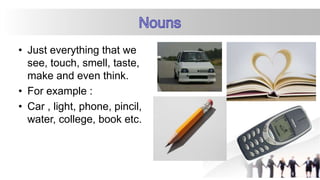
• Just everything that we
see, touch, smell, taste,
make and even think.
• For example :
• Car , light, phone, pincil,
water, college, book etc.
Two of Noun
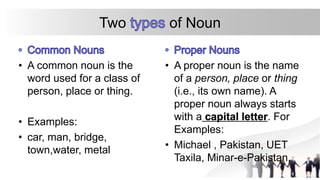
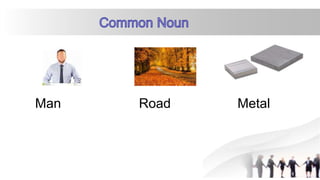
• A common noun is the
word used for a class of
person, place or thing.
• Examples:
• car, man, bridge,
town,water, metal
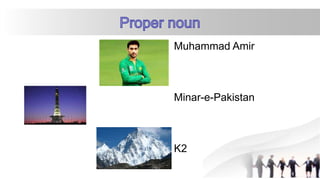
• A proper noun is the name
of a person, place or thing
(i.e., its own name). A
proper noun always starts
with a capital letter. For
Examples:
• Michael , Pakistan, UET
Taxila, Minar-e-Pakistan,
A common noun does not start with a capital letter (unless it
starts a sentence or is part of a title). It is a common mistake
to capitalize a common noun that is an important word in a
sentence.
Common nouns are capitalized only when they start a
sentence.
Man Road Metal
Muhammad Amir
Minar-e-Pakistan
K2
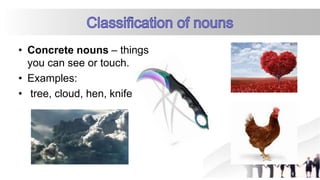
• Concrete nouns – things
you can see or touch.
• Examples:
• tree, cloud, hen, knife
Things you cannot see or touch.
Or
Names something you cannot
perceive with your five senses.
Examples:
Hope, idea, kindness, sadness,
joy
Nouns made up of more than one word.
They are classified in three groups:
• Hyphenated word (self-rule, sister-in-
law, thirty-three)
• Separated word (coffee table, dinning
room)
• Combined word (highschool,
landlord, girlfriend)
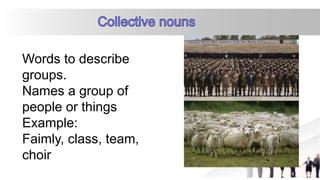
Words to describe
groups.
Names a group of
people or things
Example:
Faimly, class, team,
choir
 Countable nouns are easy to recognize. They
are things that we can count.
 . For example: "pen". We can count pens. We
can have one, two, three or more pens. Here
are some more countable nouns:
 dog, cat, animal, man, person
 bottle, box, litre
 coin, note, dollar
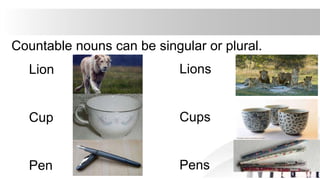
Countable nouns can be singular or plural.
Lion
Cup
Pen
Lions
Cups
Pens
Non-countable nouns (mass nouns):
A mass noun is a noun that names things that in
English cannot usually be counted.
A mass noun (also known as a noncount noun)
is generally used only in the singular.
Examples:
food, music, luck, work, advice
A gender-specific noun refers specifically to a male
or a female.
Examples:
 actress / waitress / sow (gender specific - female)
 Dad / bull / uncle / drake (gender specific - male)
 These are not gender-specific nouns:
soldier / cat / whale / mouse(not gender specific)
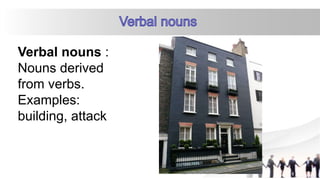
Verbal nouns :
Nouns derived
from verbs.
Examples:
building, attack
A possessive noun shows ownership by adding an
apostrophe, an "s" or both. To make a single noun
possessive, simply add an apostrophe and an "s."
Examples:
Gym’s rules, House’s roof, Sun’s rays, Today’s
newspaper
Noun, its Types and Classification

Noun, its Types and Classification

  • 3.
    • Nouns arethe words that names a person ,place ,ideas or things. • The word “noun” come from the Latin “nomen” that means name.
  • 4.
    • Just everythingthat we see, touch, smell, taste, make and even think. • For example : • Car , light, phone, pincil, water, college, book etc.
  • 5.
    Two of Noun •A common noun is the word used for a class of person, place or thing. • Examples: • car, man, bridge, town,water, metal • A proper noun is the name of a person, place or thing (i.e., its own name). A proper noun always starts with a capital letter. For Examples: • Michael , Pakistan, UET Taxila, Minar-e-Pakistan,
  • 6.
    A common noundoes not start with a capital letter (unless it starts a sentence or is part of a title). It is a common mistake to capitalize a common noun that is an important word in a sentence. Common nouns are capitalized only when they start a sentence.
  • 7.
  • 8.
  • 9.
    • Concrete nouns– things you can see or touch. • Examples: • tree, cloud, hen, knife
  • 10.
    Things you cannotsee or touch. Or Names something you cannot perceive with your five senses. Examples: Hope, idea, kindness, sadness, joy
  • 11.
    Nouns made upof more than one word. They are classified in three groups: • Hyphenated word (self-rule, sister-in- law, thirty-three) • Separated word (coffee table, dinning room) • Combined word (highschool, landlord, girlfriend)
  • 12.
    Words to describe groups. Namesa group of people or things Example: Faimly, class, team, choir
  • 13.
     Countable nounsare easy to recognize. They are things that we can count.  . For example: "pen". We can count pens. We can have one, two, three or more pens. Here are some more countable nouns:  dog, cat, animal, man, person  bottle, box, litre  coin, note, dollar
  • 14.
    Countable nouns canbe singular or plural. Lion Cup Pen Lions Cups Pens
  • 15.
    Non-countable nouns (massnouns): A mass noun is a noun that names things that in English cannot usually be counted. A mass noun (also known as a noncount noun) is generally used only in the singular. Examples: food, music, luck, work, advice
  • 16.
    A gender-specific nounrefers specifically to a male or a female. Examples:  actress / waitress / sow (gender specific - female)  Dad / bull / uncle / drake (gender specific - male)  These are not gender-specific nouns: soldier / cat / whale / mouse(not gender specific)
  • 17.
    Verbal nouns : Nounsderived from verbs. Examples: building, attack
  • 18.
    A possessive nounshows ownership by adding an apostrophe, an "s" or both. To make a single noun possessive, simply add an apostrophe and an "s." Examples: Gym’s rules, House’s roof, Sun’s rays, Today’s newspaper