
Welcome
GUJARAT TECHNOLOGICAL UNIVERSITY
&
Active Learning Video Lecture Communication
at
Bhaskaracharya Institute for
Space Applications and Geo-Informatics
1
Active English
Diploma Engineering Sem I
English (3300002)
GRAMMAR
Prepared by
I M KHAN
(Asst. Prof. in English)
2
What is Adjective?
• A word used to express the quality, number and
to point out the person or thing is regarded as an
adjective.
(Contemporary English Grammar, Jayanthi
Dakshina Murthy, page 33)
• An adjective is a word which adds something in
the meaning of a noun or pronoun.
(English Grammar, Anjani A. Gupta, page 55)
3
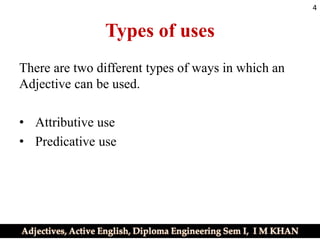
Types of uses
There are two different types of ways in which an
Adjective can be used.
• Attributive use
• Predicative use
4
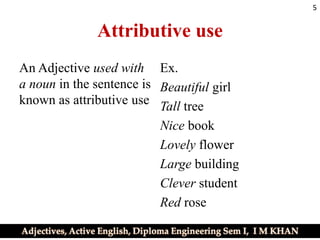
Attributive use
An Adjective used with
a noun in the sentence is
known as attributive use
Ex.
Beautiful girl
Tall tree
Nice book
Lovely flower
Large building
Clever student
Red rose
5
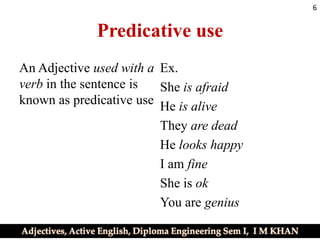
Predicative use
An Adjective used with a
verb in the sentence is
known as predicative use
Ex.
She is afraid
He is alive
They are dead
He looks happy
I am fine
She is ok
You are genius
6
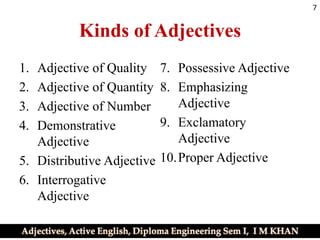
Kinds of Adjectives
1. Adjective of Quality
2. Adjective of Quantity
3. Adjective of Number
4. Demonstrative
Adjective
5. Distributive Adjective
6. Interrogative
Adjective
7. Possessive Adjective
8. Emphasizing
Adjective
9. Exclamatory
Adjective
10.Proper Adjective
7
Adjective of Quality
• An Adjective used to talk about the quality of a
person or thing is known as Adjective of quality.1
(page 33)
• An Adjective of quality describes the quality,
shape, size, color, taste etc. of the nouns that
come after them.2 (page 55)
Ex.
Wealthy, regional, industrial, fundamental,
elementary, primary
8
Adjective of Quality
Adjective of Quality answers the question what kind
of
Ex.
He is a brave person.
(what kind of person? Brave)
She has a beautiful voice.
(what kind voice? Beautiful)
9
Adjective of Quality
This is a red rose.
This is a beautiful rose.
10
Adjective of Quality
This is an old house.
This is a big house.
11
Adjective of Quality
Mumbai is a big city.
There are tall buildings.
There is a heavy traffic.
There is a beautiful sea.
12
Adjective of Quality
These are wealthy people.
These are successful people.
These are
13
Adjective of Quality
Narendra Modi is a visionary leader.
He is a brave leader.
He is an ambitious leader.
He is a clear speaker.
14
Adjective of Quantity
• An Adjective used to talk about the quantity of
things is known as Adjective of Quantity.1
(page 33)
• They tell us how much of a thing is meant.2
(page 56)
Ex.
little, much, enough, no, any, whole, some, all,
great, half, sufficient etc…
15
Adjective of Quantity
Adjective of Quantity answers the question how
much
Ex.
How much water is there in the jug?
There is some water in the jug.
16
Adjective of Quantity
Ex.
There is much water in the jug.
There is little water in the jug. almost none
There is a little water in the jug. at least some
There is no water in the jug. none / zero quantity
There is some water in the jug. neither much not less
There is sufficient water in the jug.
There is enough water in the jug.
17
Adjective of Quantity
Ex.
Is there any water in the jug? (interrogative)
There are few students in the class. (negative)
There are a few students in the class. (positive)
Note: Some Adjective of Quantity can be used only
with countable nouns, some can be with
uncountable and some with both.
18
Adjective of Quantity
19
How much water is there in the jug?
There is much
water in the jug
There is little
water in the jug
little gives
negative
meaning
Adjective of Quantity
20
How much rice is there in the dish?
There is much
rice in the dish
There is a little
rice in the dish
A little
gives
positive
meaning
Adjective of Quantity
21
A glass is half
filled of water
Adjective of Number
• An Adjective used to talk about the number of
things or person is known as Adjective of
Number.1 (page 34)
• They show how many persons or things are
meant, or in what serial order they stand.2
(page 56)
22
Adjective of Number
Adjective of Number answers the question how
many
Ex.
I met her several times.
(how many times? Several)
We have two hands.
(how many hands? Two)
23
Types of Adjective of Number
A) Adjectives of Definite Number
1. Cardinal
one, two, three, four etc…
2. Ordinal
first, second, third, fourth etc…
3. Multiplicative
single, double, once, twice, thrice, triple etc…
24
Types of Adjective of Number
B) Adjectives of Indefinite Number
Adjectives of Indefinite Number resemble Adjective
of Quantity. They too show quantity but since it is
indefinite, these adjectives are called Adjectives of
Indefinite Number
Ex.
All, no, many, few, some, any, certain, several etc…
25
Demonstrative Adjective
• An Adjective used to point out which person or
thing we speak about is known as Demonstrative
Adjective.1 (page 34)
• An Adjective of this kind points out which
person, or thing is meant.2 (page 56)
26
Demonstrative Adjective
Demonstrative Adjective points out a particular
person or thing or answers the question which
Ex.
These mangoes are tasty.
(which mangoes? These)
Those books are very interesting.
(which books? Those)
27
Demonstrative Adjective
This book is very interesting.
These boys are so obedient.
That house is very costly.
Those trees are very long.
28
Singular Plural
This These
That Those
Distributive Adjective
• An Adjective used to refer to each and every
person or thing separately is known as
Distributive Adjective.1 (page 34)
• These Adjectives refer to each one of a number.
Each, every, either, neither etc are Distributive
Adjective.2 (page 57)
• Distributive Adjective refers to each person or
thing.
Ex. Each, every, none, either, neither, any, both etc...
29
Distributive Adjective
Ex.
Each boy in this class has a book.
Every citizen should love his Mother land.
Either of the two is an engineer. (one of the two)
Neither of them is a doctor. (none of them)
None of my friends is unemployed.
Both of you are invited in the birthday party.
Is there any water in the jug?
30
Interrogative Adjective
• An Adjective used to question is known as
Interrogative Adjective.1 (page 34)
Words like what, which, whose are the examples…
Syntax: Interrogative Adjective + Noun + Verb
Note: Interrogative Adjective must have the nouns,
which they qualify, immediately after them.2 (page
57)
Ex. Which state do you belong to?
31
Int. Adj. + Noun + Verb
Interrogative Adjective
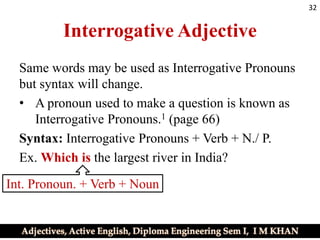
Same words may be used as Interrogative Pronouns
but syntax will change.
• A pronoun used to make a question is known as
Interrogative Pronouns.1 (page 66)
Syntax: Interrogative Pronouns + Verb + N./ P.
Ex. Which is the largest river in India?
32
Int. Pronoun. + Verb + Noun
Interrogative Adjective
Same words may be used as connector or relative
pronoun which connect two clauses.
• This is the book which I wanted. (Relative
Pronoun)
• Which book is this? (Interrogative Adjective)
• Which is this book? (Interrogative Pronoun)
33
Interrogative Adjective
Int. Adjective
Which color do
you like?
Int. Pronoun
Which is this
color?
Relative
Pronoun
This is the color
which I like.
34
Interrogative Adjective
Int. Adjective
What language
do you speak?
Int. Pronoun
What are you
waiting for?
Relative
Pronoun
This is what I
dislike the most.
35
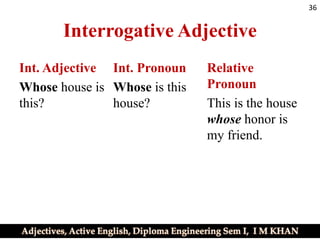
Interrogative Adjective
Int. Adjective
Whose house is
this?
Int. Pronoun
Whose is this
house?
Relative
Pronoun
This is the house
whose honor is
my friend.
36
Possessive Adjective
• An Adjective used to talk about ownership or
possession is known as Possessive Adjective.1
(page34)
my, our, their, your, his, her, its are possessive
adjectives
Syntax: Possessive Adjective + Noun + Verb
Possessive Adjective answers the question whose?
Ex.
My father is a principal. (whose father?)
37
Possessive Adjective
Possessive Adjective are different from Possessive
Pronouns.
Note: words like my, our, their, your, his, her, its are
used before Nouns because they are Possessive
Adjectives and mine, ours, yours, theirs, his, hers,
its are used after Nouns because they are
Possessive Pronouns.1 (page 71)
This is my book (Possessive Adjective)
This book is mine (Possessive Pronouns)
38
REMEMBER THE TABLE
39
Subjective /
Personal
Pronoun
Objective
Case /
Pronoun
Possessive
Adjective
Possessive
Pronoun
Reflexive /
Emphatic
Pronoun
I me my mine myself
We us our ours ourselves
You you your yours yourselves
They them their theirs their selves
He him his his himself
She her her hers herself
It it its its itself
Examples
I am a student. (Personal Pronoun)
Please, give me a glass of water. (Objective Case)
My sister is a teacher. (Possessive Adjective)
The car is mine. (Possessive Pronoun)
I saw myself in the mirror. (Reflexive Pronoun)
I myself drew this picture. (Emphatic Pronoun)
I saw it with my own eyes (Emphasizing Adjective)
40
Emphasizing Adjective
• An Adjective used to emphasize a noun is known
as Emphasizing Adjective.1 (page 35)
• The words ‘own’ and ‘very’ are used as
Emphasizing Adjectives.2 (page 57)
Ex.
I saw it with my own eyes.
That was the very book I was looking for.
Mind your own business.
This is my own house.
41
Exclamatory Adjective
The word ‘what’ is known as an Exclamatory
Adjective.1 (page 35)
Ex.
What an interesting book!
What an idea, sir ji!
What a catch!
What a tragedy!
What an insult!
42
Proper Adjective
An Adjective derived
from a proper name is
known as a Proper
Adjective.1 (page 35)
Ex.
Indian army
American President
English Grammar
Russian Parliament
He is a British soldier.
She is a French lady.
I am an Indian citizen.
43
Works Cited
1. Murthy, Jayanthi Dakshina. Contemporay English
Grammar. New Delhi: Book Palace, 2013.
2. Gupta, Anjani A. English Grammar. New Delhi: O P
Gupta , 2009.
44

Adjective

  • 1.
    Welcome GUJARAT TECHNOLOGICAL UNIVERSITY & ActiveLearning Video Lecture Communication at Bhaskaracharya Institute for Space Applications and Geo-Informatics 1
  • 2.
    Active English Diploma EngineeringSem I English (3300002) GRAMMAR Prepared by I M KHAN (Asst. Prof. in English) 2
  • 3.
    What is Adjective? •A word used to express the quality, number and to point out the person or thing is regarded as an adjective. (Contemporary English Grammar, Jayanthi Dakshina Murthy, page 33) • An adjective is a word which adds something in the meaning of a noun or pronoun. (English Grammar, Anjani A. Gupta, page 55) 3
  • 4.
    Types of uses Thereare two different types of ways in which an Adjective can be used. • Attributive use • Predicative use 4
  • 5.
    Attributive use An Adjectiveused with a noun in the sentence is known as attributive use Ex. Beautiful girl Tall tree Nice book Lovely flower Large building Clever student Red rose 5
  • 6.
    Predicative use An Adjectiveused with a verb in the sentence is known as predicative use Ex. She is afraid He is alive They are dead He looks happy I am fine She is ok You are genius 6
  • 7.
    Kinds of Adjectives 1.Adjective of Quality 2. Adjective of Quantity 3. Adjective of Number 4. Demonstrative Adjective 5. Distributive Adjective 6. Interrogative Adjective 7. Possessive Adjective 8. Emphasizing Adjective 9. Exclamatory Adjective 10.Proper Adjective 7
  • 8.
    Adjective of Quality •An Adjective used to talk about the quality of a person or thing is known as Adjective of quality.1 (page 33) • An Adjective of quality describes the quality, shape, size, color, taste etc. of the nouns that come after them.2 (page 55) Ex. Wealthy, regional, industrial, fundamental, elementary, primary 8
  • 9.
    Adjective of Quality Adjectiveof Quality answers the question what kind of Ex. He is a brave person. (what kind of person? Brave) She has a beautiful voice. (what kind voice? Beautiful) 9
  • 10.
    Adjective of Quality Thisis a red rose. This is a beautiful rose. 10
  • 11.
    Adjective of Quality Thisis an old house. This is a big house. 11
  • 12.
    Adjective of Quality Mumbaiis a big city. There are tall buildings. There is a heavy traffic. There is a beautiful sea. 12
  • 13.
    Adjective of Quality Theseare wealthy people. These are successful people. These are 13
  • 14.
    Adjective of Quality NarendraModi is a visionary leader. He is a brave leader. He is an ambitious leader. He is a clear speaker. 14
  • 15.
    Adjective of Quantity •An Adjective used to talk about the quantity of things is known as Adjective of Quantity.1 (page 33) • They tell us how much of a thing is meant.2 (page 56) Ex. little, much, enough, no, any, whole, some, all, great, half, sufficient etc… 15
  • 16.
    Adjective of Quantity Adjectiveof Quantity answers the question how much Ex. How much water is there in the jug? There is some water in the jug. 16
  • 17.
    Adjective of Quantity Ex. Thereis much water in the jug. There is little water in the jug. almost none There is a little water in the jug. at least some There is no water in the jug. none / zero quantity There is some water in the jug. neither much not less There is sufficient water in the jug. There is enough water in the jug. 17
  • 18.
    Adjective of Quantity Ex. Isthere any water in the jug? (interrogative) There are few students in the class. (negative) There are a few students in the class. (positive) Note: Some Adjective of Quantity can be used only with countable nouns, some can be with uncountable and some with both. 18
  • 19.
    Adjective of Quantity 19 Howmuch water is there in the jug? There is much water in the jug There is little water in the jug little gives negative meaning
  • 20.
    Adjective of Quantity 20 Howmuch rice is there in the dish? There is much rice in the dish There is a little rice in the dish A little gives positive meaning
  • 21.
    Adjective of Quantity 21 Aglass is half filled of water
  • 22.
    Adjective of Number •An Adjective used to talk about the number of things or person is known as Adjective of Number.1 (page 34) • They show how many persons or things are meant, or in what serial order they stand.2 (page 56) 22
  • 23.
    Adjective of Number Adjectiveof Number answers the question how many Ex. I met her several times. (how many times? Several) We have two hands. (how many hands? Two) 23
  • 24.
    Types of Adjectiveof Number A) Adjectives of Definite Number 1. Cardinal one, two, three, four etc… 2. Ordinal first, second, third, fourth etc… 3. Multiplicative single, double, once, twice, thrice, triple etc… 24
  • 25.
    Types of Adjectiveof Number B) Adjectives of Indefinite Number Adjectives of Indefinite Number resemble Adjective of Quantity. They too show quantity but since it is indefinite, these adjectives are called Adjectives of Indefinite Number Ex. All, no, many, few, some, any, certain, several etc… 25
  • 26.
    Demonstrative Adjective • AnAdjective used to point out which person or thing we speak about is known as Demonstrative Adjective.1 (page 34) • An Adjective of this kind points out which person, or thing is meant.2 (page 56) 26
  • 27.
    Demonstrative Adjective Demonstrative Adjectivepoints out a particular person or thing or answers the question which Ex. These mangoes are tasty. (which mangoes? These) Those books are very interesting. (which books? Those) 27
  • 28.
    Demonstrative Adjective This bookis very interesting. These boys are so obedient. That house is very costly. Those trees are very long. 28 Singular Plural This These That Those
  • 29.
    Distributive Adjective • AnAdjective used to refer to each and every person or thing separately is known as Distributive Adjective.1 (page 34) • These Adjectives refer to each one of a number. Each, every, either, neither etc are Distributive Adjective.2 (page 57) • Distributive Adjective refers to each person or thing. Ex. Each, every, none, either, neither, any, both etc... 29
  • 30.
    Distributive Adjective Ex. Each boyin this class has a book. Every citizen should love his Mother land. Either of the two is an engineer. (one of the two) Neither of them is a doctor. (none of them) None of my friends is unemployed. Both of you are invited in the birthday party. Is there any water in the jug? 30
  • 31.
    Interrogative Adjective • AnAdjective used to question is known as Interrogative Adjective.1 (page 34) Words like what, which, whose are the examples… Syntax: Interrogative Adjective + Noun + Verb Note: Interrogative Adjective must have the nouns, which they qualify, immediately after them.2 (page 57) Ex. Which state do you belong to? 31 Int. Adj. + Noun + Verb
  • 32.
    Interrogative Adjective Same wordsmay be used as Interrogative Pronouns but syntax will change. • A pronoun used to make a question is known as Interrogative Pronouns.1 (page 66) Syntax: Interrogative Pronouns + Verb + N./ P. Ex. Which is the largest river in India? 32 Int. Pronoun. + Verb + Noun
  • 33.
    Interrogative Adjective Same wordsmay be used as connector or relative pronoun which connect two clauses. • This is the book which I wanted. (Relative Pronoun) • Which book is this? (Interrogative Adjective) • Which is this book? (Interrogative Pronoun) 33
  • 34.
    Interrogative Adjective Int. Adjective Whichcolor do you like? Int. Pronoun Which is this color? Relative Pronoun This is the color which I like. 34
  • 35.
    Interrogative Adjective Int. Adjective Whatlanguage do you speak? Int. Pronoun What are you waiting for? Relative Pronoun This is what I dislike the most. 35
  • 36.
    Interrogative Adjective Int. Adjective Whosehouse is this? Int. Pronoun Whose is this house? Relative Pronoun This is the house whose honor is my friend. 36
  • 37.
    Possessive Adjective • AnAdjective used to talk about ownership or possession is known as Possessive Adjective.1 (page34) my, our, their, your, his, her, its are possessive adjectives Syntax: Possessive Adjective + Noun + Verb Possessive Adjective answers the question whose? Ex. My father is a principal. (whose father?) 37
  • 38.
    Possessive Adjective Possessive Adjectiveare different from Possessive Pronouns. Note: words like my, our, their, your, his, her, its are used before Nouns because they are Possessive Adjectives and mine, ours, yours, theirs, his, hers, its are used after Nouns because they are Possessive Pronouns.1 (page 71) This is my book (Possessive Adjective) This book is mine (Possessive Pronouns) 38
  • 39.
    REMEMBER THE TABLE 39 Subjective/ Personal Pronoun Objective Case / Pronoun Possessive Adjective Possessive Pronoun Reflexive / Emphatic Pronoun I me my mine myself We us our ours ourselves You you your yours yourselves They them their theirs their selves He him his his himself She her her hers herself It it its its itself
  • 40.
    Examples I am astudent. (Personal Pronoun) Please, give me a glass of water. (Objective Case) My sister is a teacher. (Possessive Adjective) The car is mine. (Possessive Pronoun) I saw myself in the mirror. (Reflexive Pronoun) I myself drew this picture. (Emphatic Pronoun) I saw it with my own eyes (Emphasizing Adjective) 40
  • 41.
    Emphasizing Adjective • AnAdjective used to emphasize a noun is known as Emphasizing Adjective.1 (page 35) • The words ‘own’ and ‘very’ are used as Emphasizing Adjectives.2 (page 57) Ex. I saw it with my own eyes. That was the very book I was looking for. Mind your own business. This is my own house. 41
  • 42.
    Exclamatory Adjective The word‘what’ is known as an Exclamatory Adjective.1 (page 35) Ex. What an interesting book! What an idea, sir ji! What a catch! What a tragedy! What an insult! 42
  • 43.
    Proper Adjective An Adjectivederived from a proper name is known as a Proper Adjective.1 (page 35) Ex. Indian army American President English Grammar Russian Parliament He is a British soldier. She is a French lady. I am an Indian citizen. 43
  • 44.
    Works Cited 1. Murthy,Jayanthi Dakshina. Contemporay English Grammar. New Delhi: Book Palace, 2013. 2. Gupta, Anjani A. English Grammar. New Delhi: O P Gupta , 2009. 44