Calculate with Confidence 5 th  edition   Gray Morris Mosby items and derived items © 2010 by Mosby, Inc., an affiliate of Elsevier Inc.
Dosage Calculation  Using the Dimensional Analysis Method Unit Three: Chapter 16 Mosby items and derived items © 2010 by Mosby, Inc., an affiliate of Elsevier Inc.
Dosage Calculation Using Dimensional Analysis Method: Objectives After reviewing this chapter, you should be  able to: Define dimensional analysis Implement unit cancellation in dimensional analysis Perform conversions using dimensional analysis Use dimensional analysis to calculate dosages
Background: Dimensional Analysis Fancy name—simple technique Used to manipulate units in a calculation Involves cancellation of unwanted units Eliminates need to memorize formulas Also known as the  factor-label method  or the  unit factor method Only one equation is used
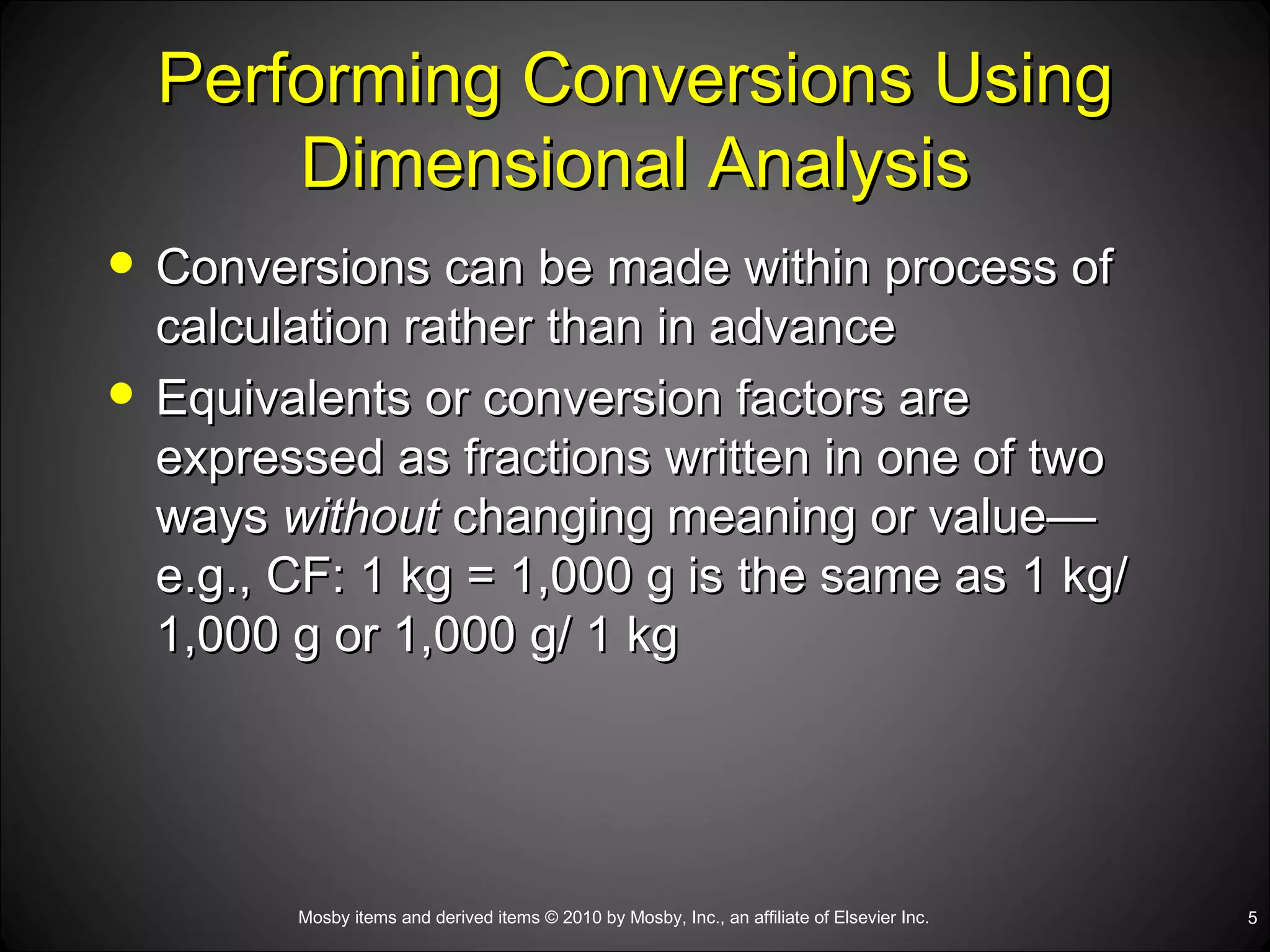
Performing Conversions Using Dimensional Analysis Conversions can be made within process of calculation rather than in advance Equivalents or conversion factors are expressed as fractions written in one of two ways  without  changing meaning or value—e.g., CF: 1 kg = 1,000 g is the same as 1 kg/ 1,000 g or 1,000 g/ 1 kg
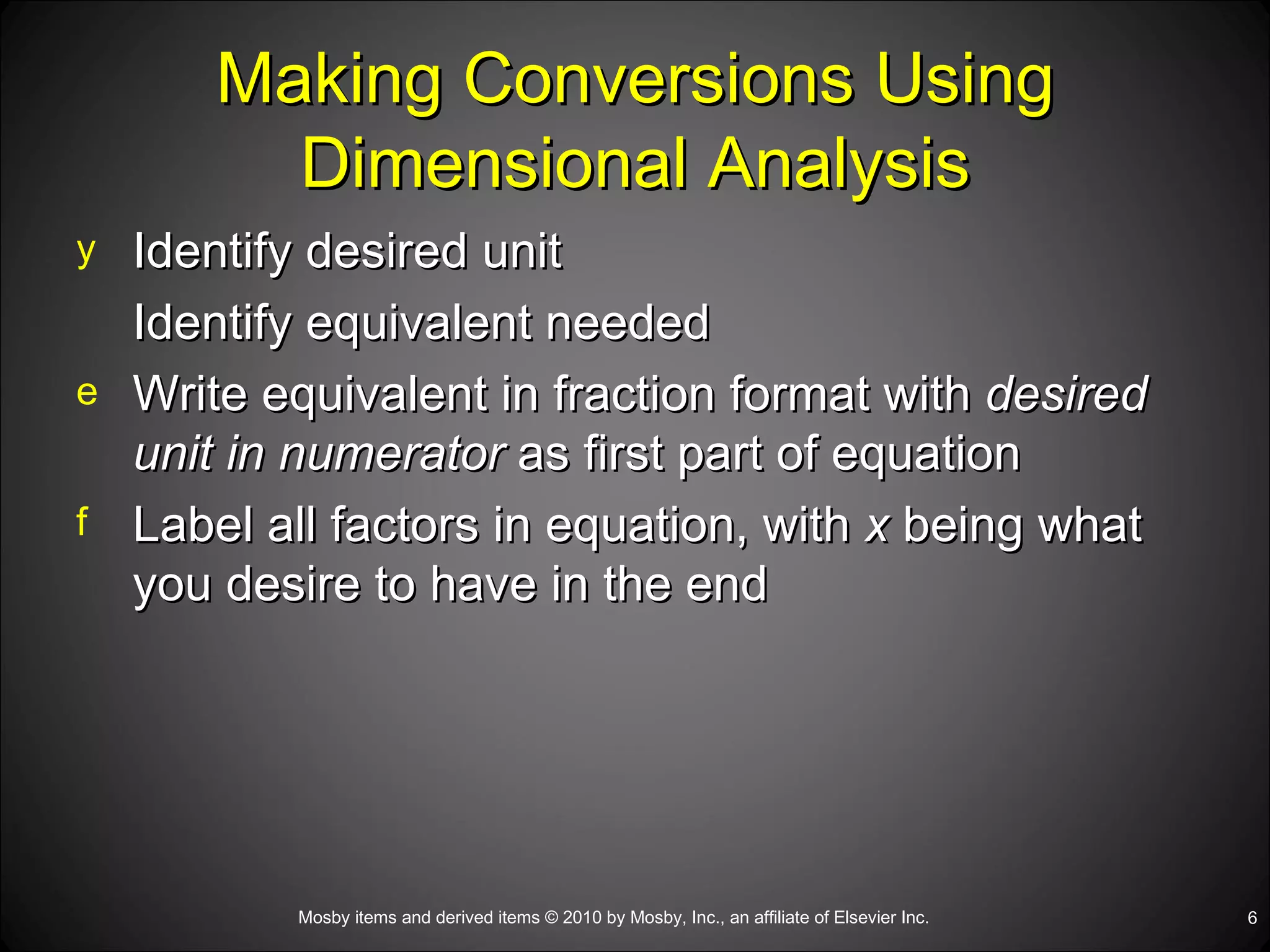
Making Conversions Using Dimensional Analysis Identify desired unit Identify equivalent needed Write equivalent in fraction format with  desired unit in numerator  as first part of equation Label all factors in equation, with  x  being what you desire to have in the end
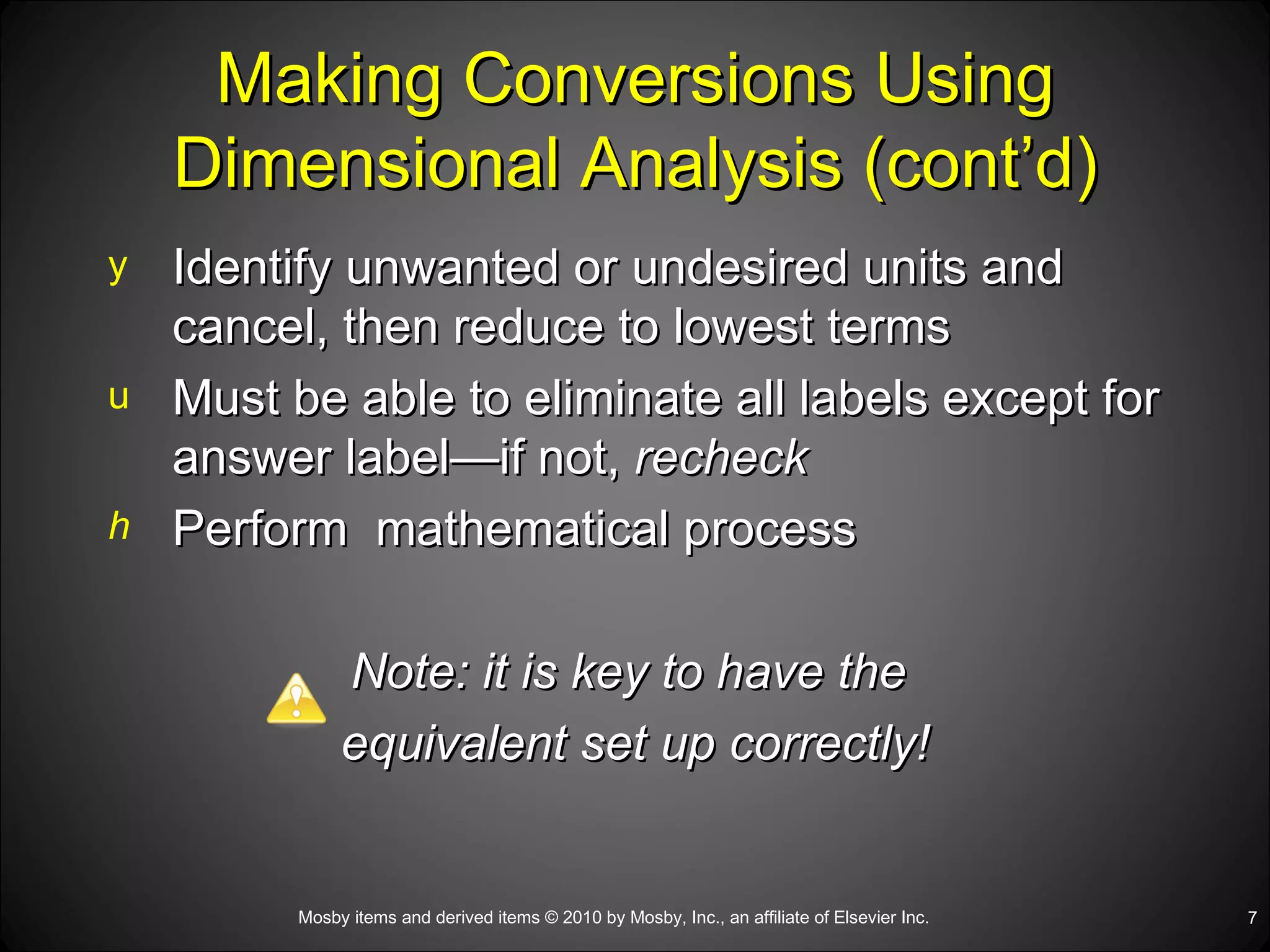
Making Conversions Using Dimensional Analysis (cont’d) Identify unwanted or undesired units and cancel, then reduce to lowest terms Must be able to eliminate all labels except for answer label—if not,  recheck Perform  mathematical process Note: it is key to have the  equivalent set up correctly!
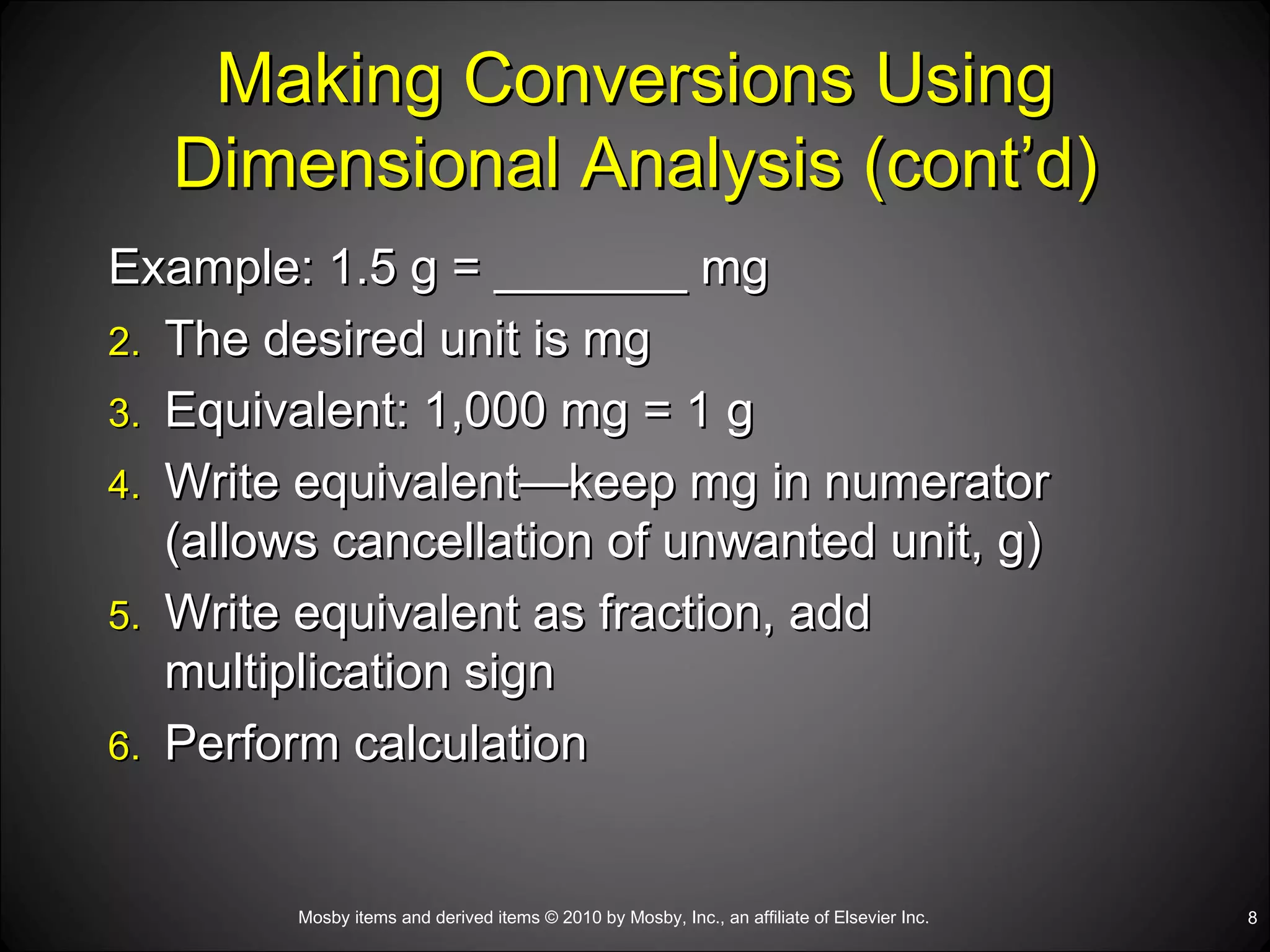
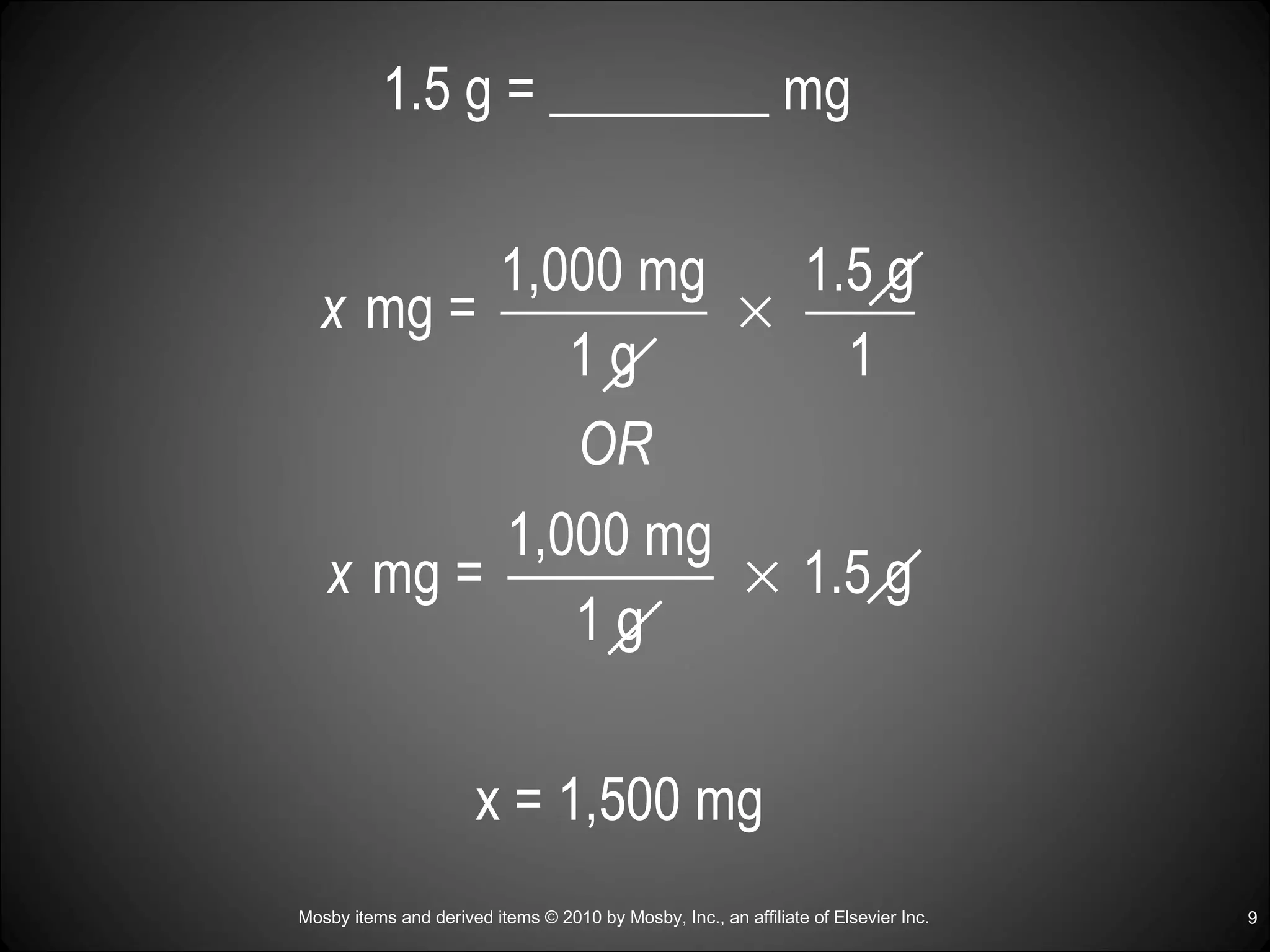
Making Conversions Using Dimensional Analysis (cont’d) Example: 1.5 g = _______ mg The desired unit is mg Equivalent: 1,000 mg = 1 g Write equivalent—keep mg in numerator (allows cancellation of unwanted unit, g) Write equivalent as fraction, add multiplication sign Perform calculation
 
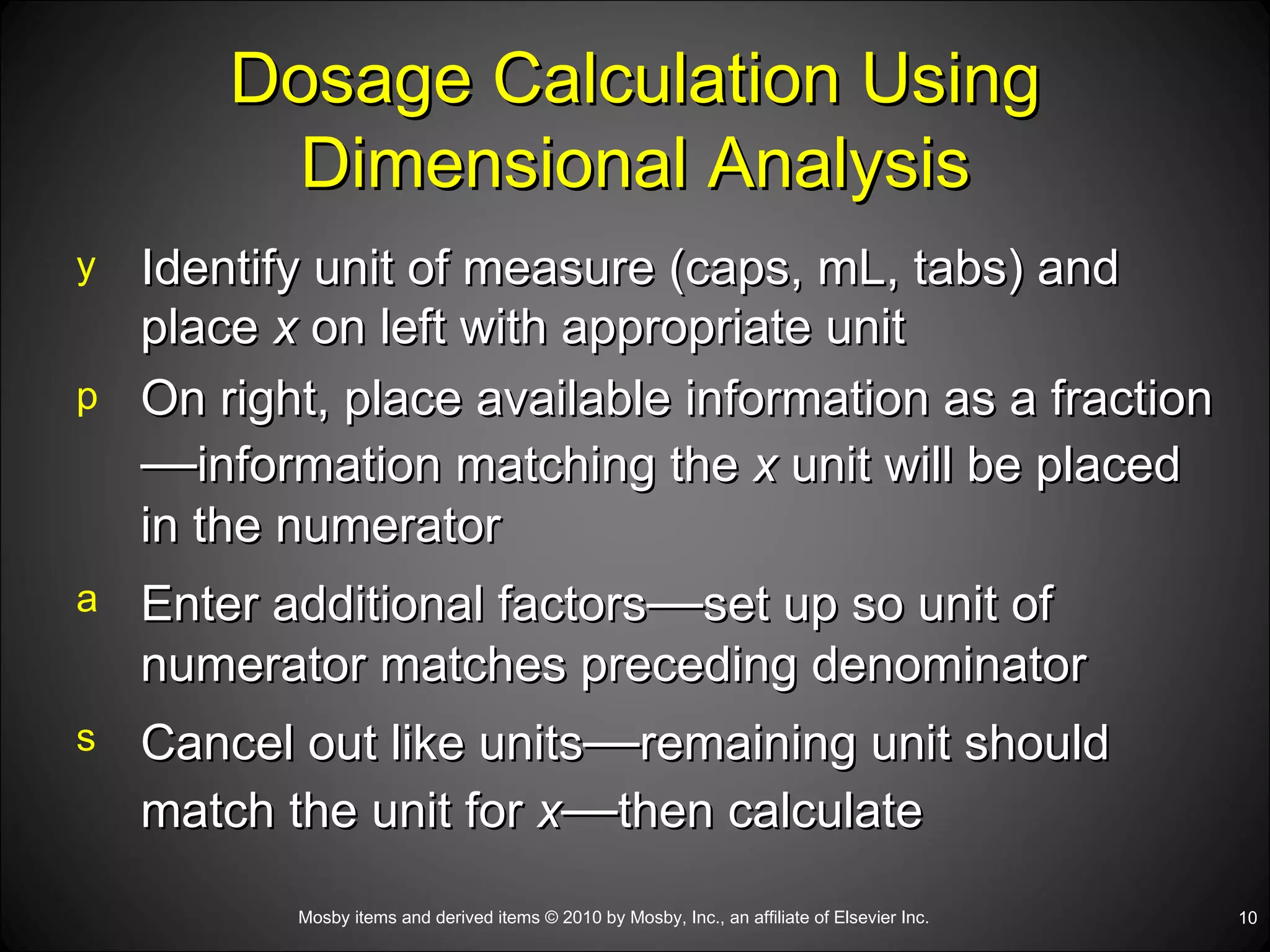
Dosage Calculation Using Dimensional Analysis Identify unit of measure (caps, mL, tabs) and place  x  on left with appropriate unit On right, place available information as a fraction — information matching the  x  unit will be placed in the numerator Enter additional factors — set up so unit of numerator matches preceding denominator Cancel out like units — remaining unit should match the unit for  x — then calculate
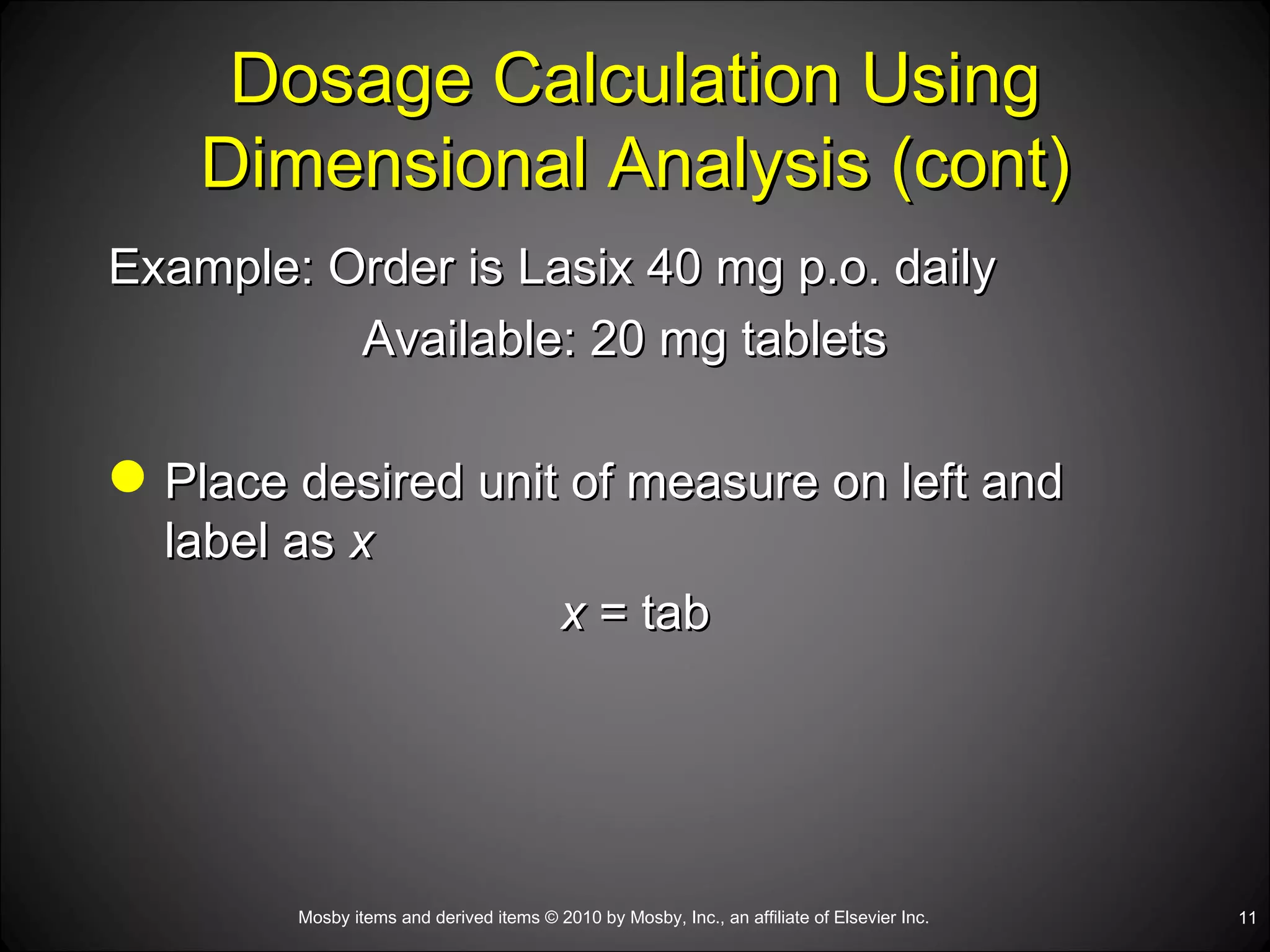
Dosage Calculation Using Dimensional Analysis (cont) Example: Order is Lasix 40 mg p.o. daily Available: 20 mg tablets Place desired unit of measure on left and label as  x x  = tab
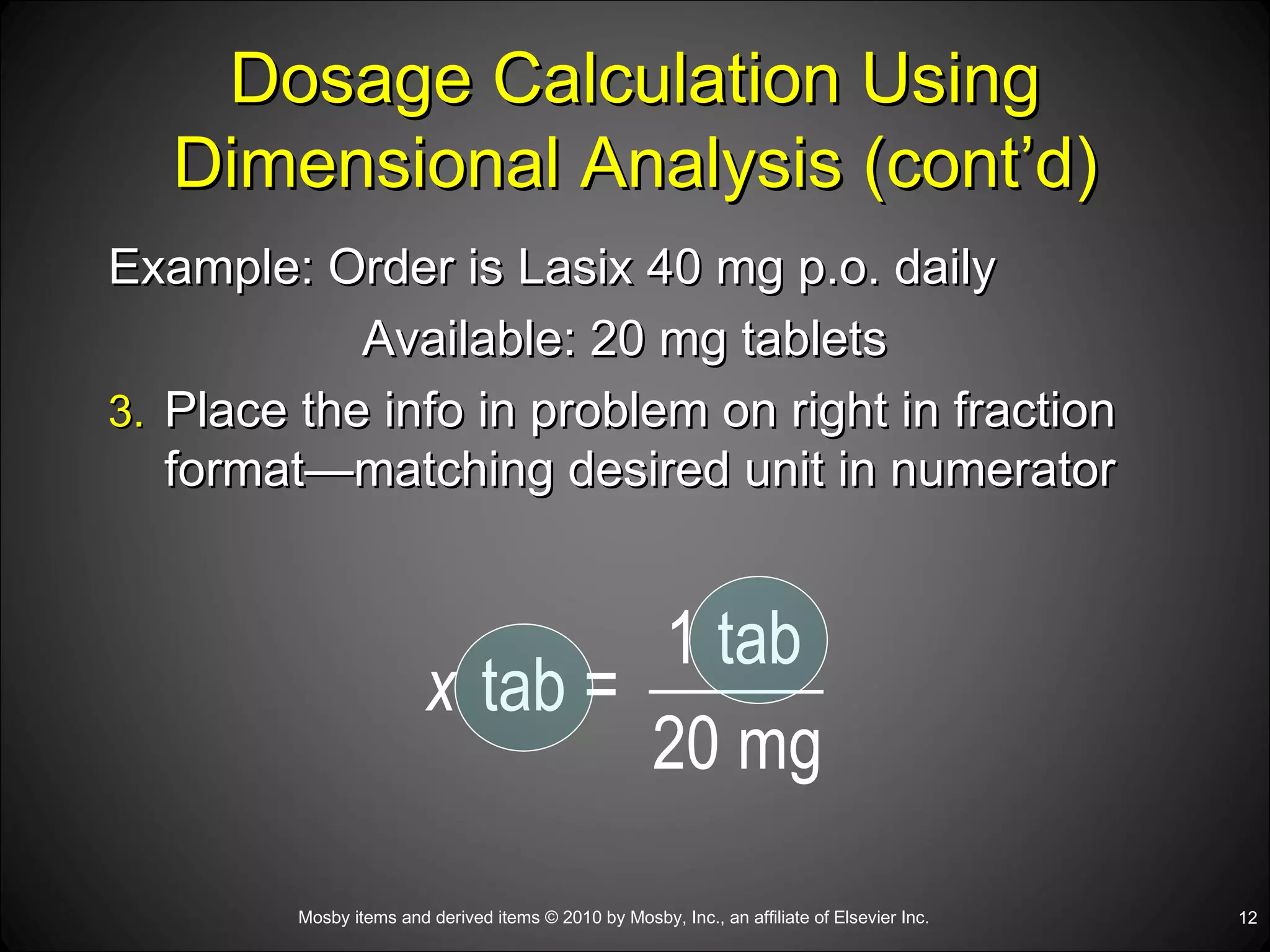
Dosage Calculation Using Dimensional Analysis (cont’d) Example: Order is Lasix 40 mg p.o. daily Available: 20 mg tablets Place the info in problem on right in fraction format—matching desired unit in numerator
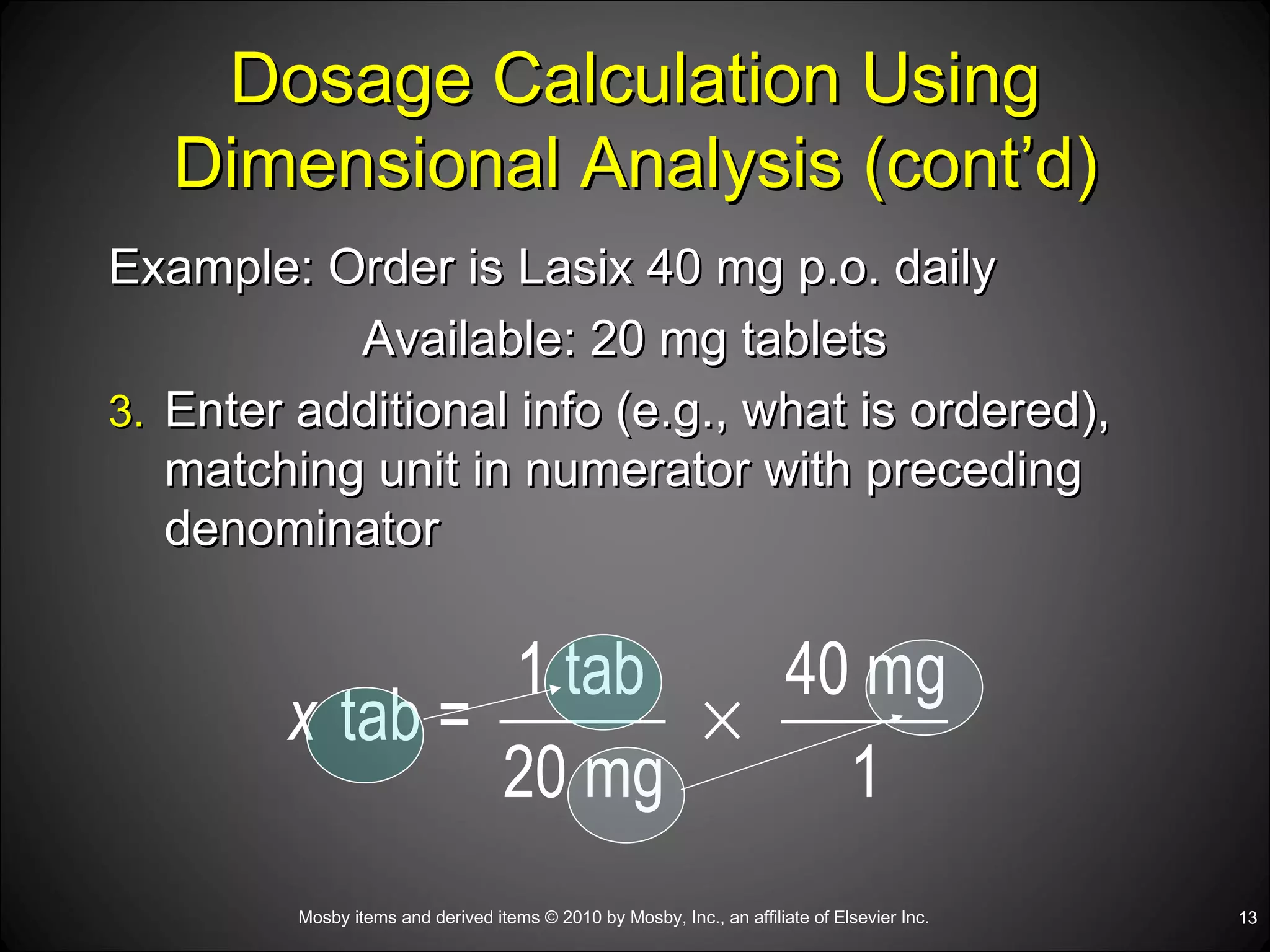
Dosage Calculation Using Dimensional Analysis (cont’d) Example: Order is Lasix 40 mg p.o. daily Available: 20 mg tablets Enter additional info (e.g., what is ordered), matching unit in numerator with preceding denominator
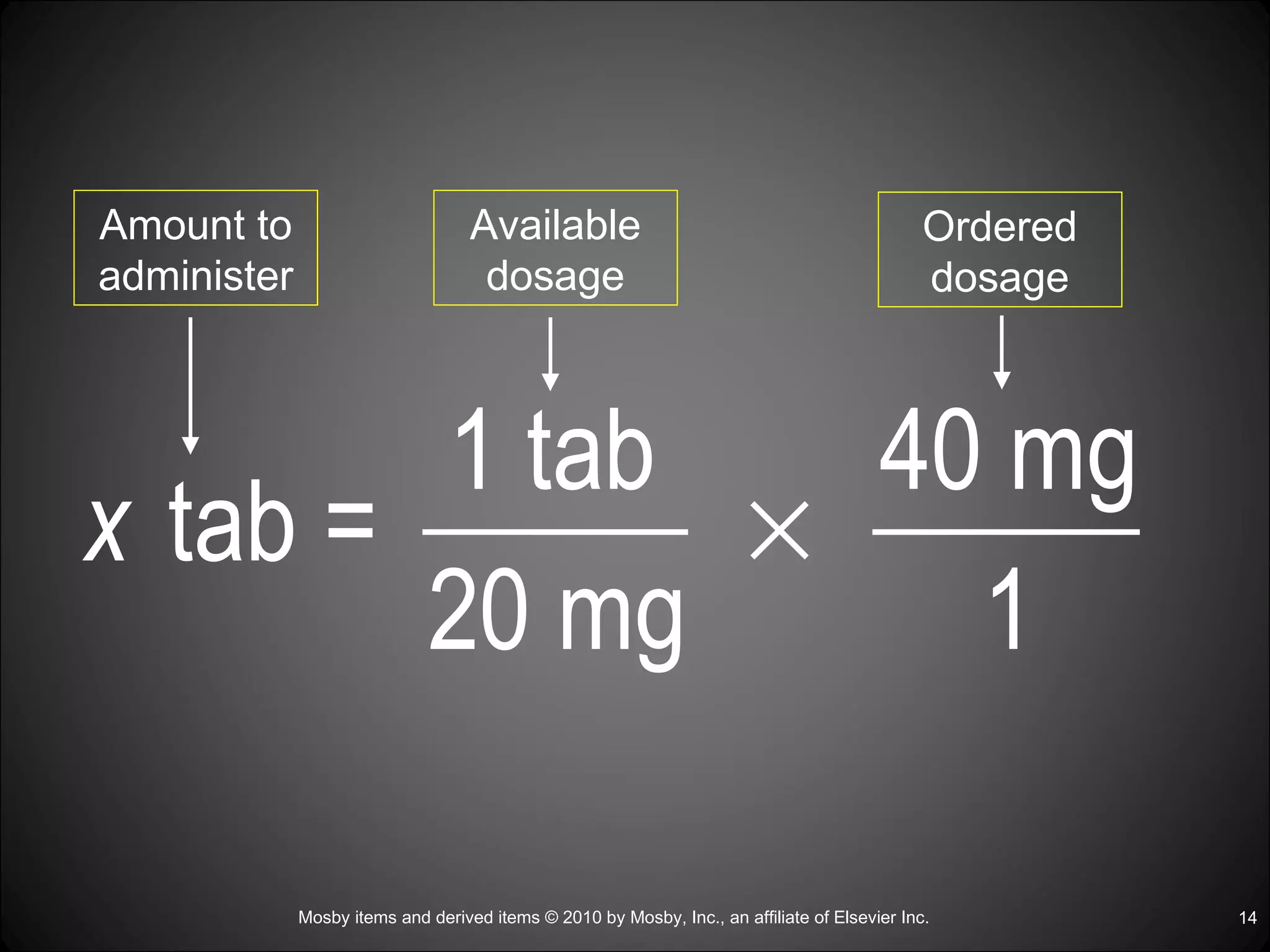
Amount to administer Available dosage Ordered dosage
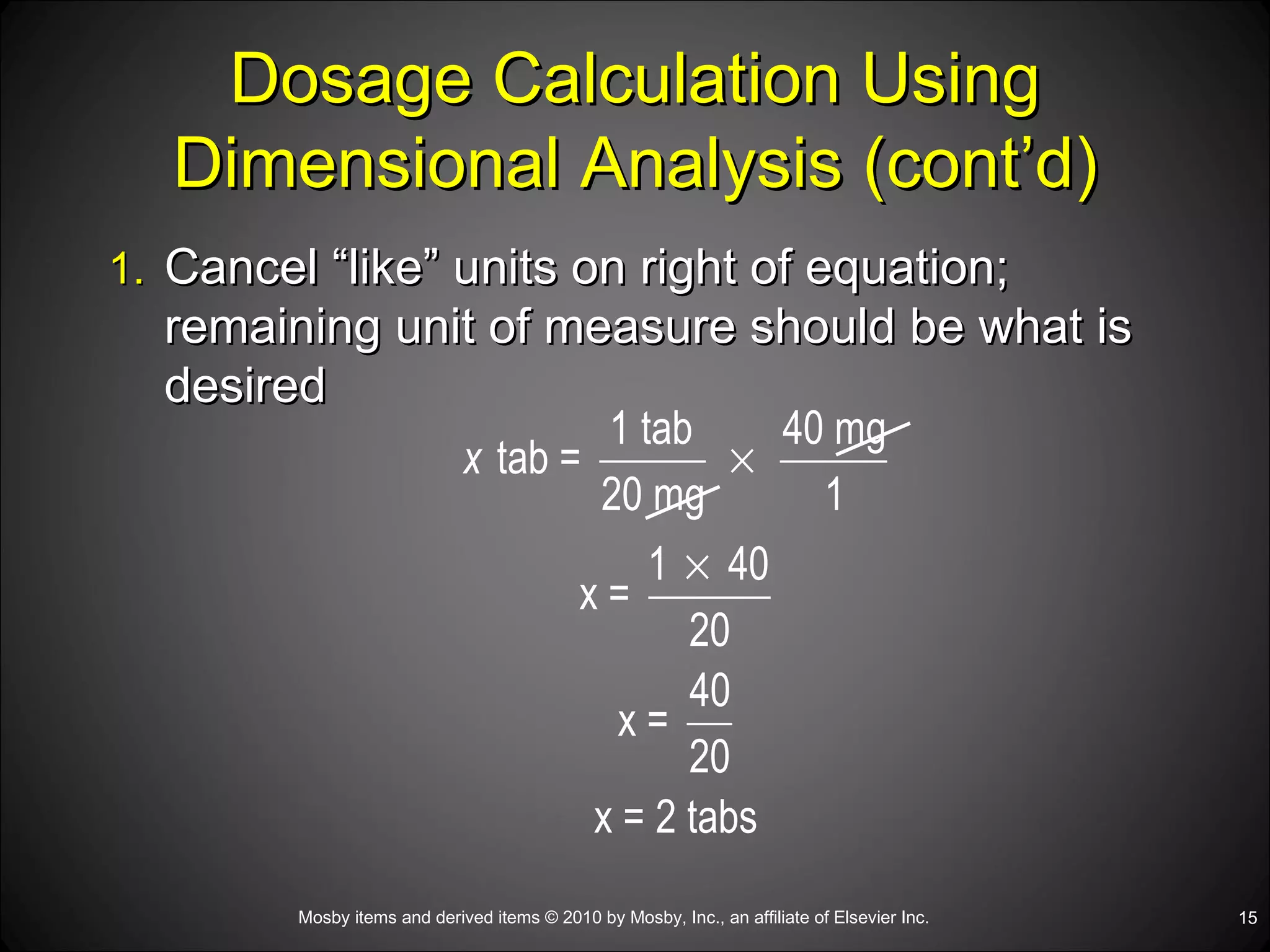
Dosage Calculation Using Dimensional Analysis (cont’d) Cancel “like” units on right of equation; remaining unit of measure should be what is desired
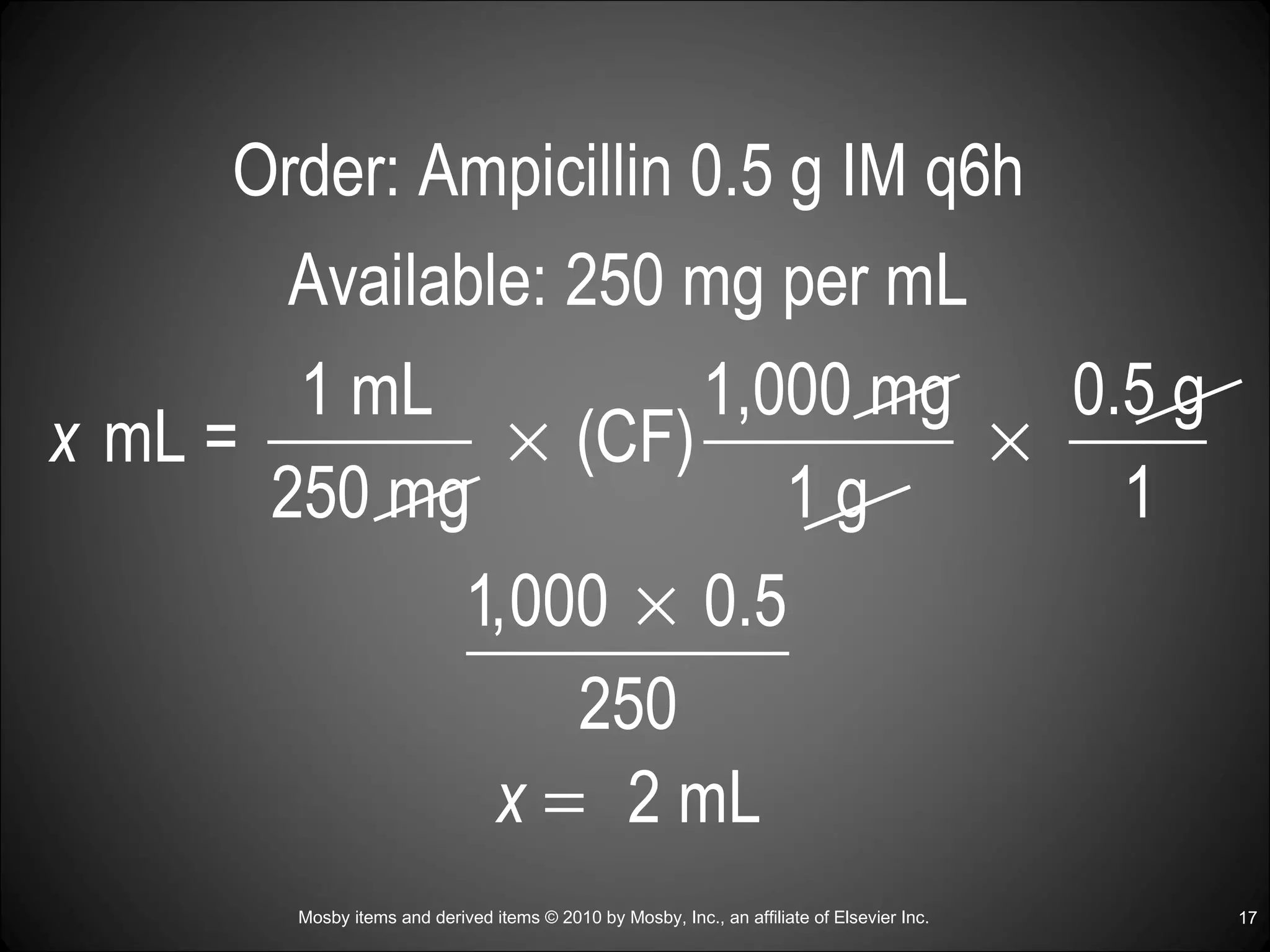
Dimensional Analysis Using Conversion Factor When a conversion factor is needed, the conversion factor is placed as the second fraction inside the equation  Match numerator of conversion factor with denominator of previous fraction
 

Dosage Calculation Using Dimensional Ana

  • 1.
    Calculate with Confidence5 th edition Gray Morris Mosby items and derived items © 2010 by Mosby, Inc., an affiliate of Elsevier Inc.
  • 2.
    Dosage Calculation Using the Dimensional Analysis Method Unit Three: Chapter 16 Mosby items and derived items © 2010 by Mosby, Inc., an affiliate of Elsevier Inc.
  • 3.
    Dosage Calculation UsingDimensional Analysis Method: Objectives After reviewing this chapter, you should be able to: Define dimensional analysis Implement unit cancellation in dimensional analysis Perform conversions using dimensional analysis Use dimensional analysis to calculate dosages
  • 4.
    Background: Dimensional AnalysisFancy name—simple technique Used to manipulate units in a calculation Involves cancellation of unwanted units Eliminates need to memorize formulas Also known as the factor-label method or the unit factor method Only one equation is used
  • 5.
    Performing Conversions UsingDimensional Analysis Conversions can be made within process of calculation rather than in advance Equivalents or conversion factors are expressed as fractions written in one of two ways without changing meaning or value—e.g., CF: 1 kg = 1,000 g is the same as 1 kg/ 1,000 g or 1,000 g/ 1 kg
  • 6.
    Making Conversions UsingDimensional Analysis Identify desired unit Identify equivalent needed Write equivalent in fraction format with desired unit in numerator as first part of equation Label all factors in equation, with x being what you desire to have in the end
  • 7.
    Making Conversions UsingDimensional Analysis (cont’d) Identify unwanted or undesired units and cancel, then reduce to lowest terms Must be able to eliminate all labels except for answer label—if not, recheck Perform mathematical process Note: it is key to have the equivalent set up correctly!
  • 8.
    Making Conversions UsingDimensional Analysis (cont’d) Example: 1.5 g = _______ mg The desired unit is mg Equivalent: 1,000 mg = 1 g Write equivalent—keep mg in numerator (allows cancellation of unwanted unit, g) Write equivalent as fraction, add multiplication sign Perform calculation
  • 9.
  • 10.
    Dosage Calculation UsingDimensional Analysis Identify unit of measure (caps, mL, tabs) and place x on left with appropriate unit On right, place available information as a fraction — information matching the x unit will be placed in the numerator Enter additional factors — set up so unit of numerator matches preceding denominator Cancel out like units — remaining unit should match the unit for x — then calculate
  • 11.
    Dosage Calculation UsingDimensional Analysis (cont) Example: Order is Lasix 40 mg p.o. daily Available: 20 mg tablets Place desired unit of measure on left and label as x x = tab
  • 12.
    Dosage Calculation UsingDimensional Analysis (cont’d) Example: Order is Lasix 40 mg p.o. daily Available: 20 mg tablets Place the info in problem on right in fraction format—matching desired unit in numerator
  • 13.
    Dosage Calculation UsingDimensional Analysis (cont’d) Example: Order is Lasix 40 mg p.o. daily Available: 20 mg tablets Enter additional info (e.g., what is ordered), matching unit in numerator with preceding denominator
  • 14.
    Amount to administerAvailable dosage Ordered dosage
  • 15.
    Dosage Calculation UsingDimensional Analysis (cont’d) Cancel “like” units on right of equation; remaining unit of measure should be what is desired
  • 16.
    Dimensional Analysis UsingConversion Factor When a conversion factor is needed, the conversion factor is placed as the second fraction inside the equation Match numerator of conversion factor with denominator of previous fraction
  • 17.