Introduction to
Med Calculations
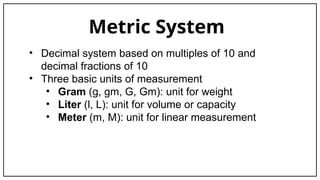
Metric System
• Decimal system based on multiples of 10 and
decimal fractions of 10
• Three basic units of measurement
• Gram (g, gm, G, Gm): unit for weight
• Liter (l, L): unit for volume or capacity
• Meter (m, M): unit for linear measurement
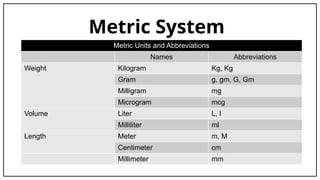
Metric System
Abbreviations
Metric Units and Abbreviations
Names Abbreviations
Weight Kilogram Kg, Kg
Gram g, gm, G, Gm
Milligram mg
Microgram mcg
Volume Liter L, l
Milliliter ml
Length Meter m, M
Centimeter cm
Millimeter mm
Metric System
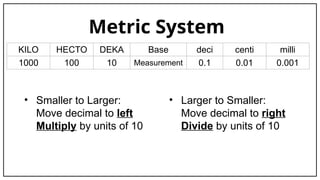
KILO HECTO DEKA Base deci centi milli
1000 100 10 Measurement 0.1 0.01 0.001
• Smaller to Larger:
Move decimal to left
Multiply by units of 10
• Larger to Smaller:
Move decimal to right
Divide by units of 10
Conversion within the
Metric System
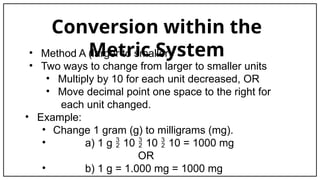
• Method A (larger to smaller)
• Two ways to change from larger to smaller units
• Multiply by 10 for each unit decreased, OR
• Move decimal point one space to the right for
each unit changed.
• Example:
• Change 1 gram (g) to milligrams (mg).
• a) 1 g  10  10  10 = 1000 mg
OR
• b) 1 g = 1.000 mg = 1000 mg
Conversion within the
Metric System
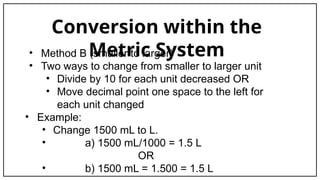
• Method B (smaller to larger)
• Two ways to change from smaller to larger unit
• Divide by 10 for each unit decreased OR
• Move decimal point one space to the left for
each unit changed
• Example:
• Change 1500 mL to L.
• a) 1500 mL/1000 = 1.5 L
OR
• b) 1500 mL = 1.500 = 1.5 L
Review of Decimal Places
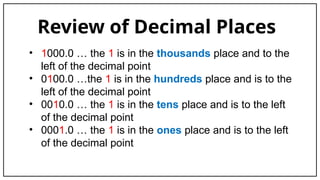
• 1000.0 … the 1 is in the thousands place and to the
left of the decimal point
• 0100.0 …the 1 is in the hundreds place and is to the
left of the decimal point
• 0010.0 … the 1 is in the tens place and is to the left
of the decimal point
• 0001.0 … the 1 is in the ones place and is to the left
of the decimal point
Review of Decimal Places
• 0.10 … the 1 is in the TENTHS place and is to the
right of the decimal point
• 0.01 … the 1 is in the HUNDREDTHS place and is to
the right of the decimal point
• 0.001 … the 1 is in the THOUSANTHS place and is
to the right of the decimal point
Household System
• Lack of standardization of spoons, cups, and glasses
makes the household system less accurate than the
metric system.
• Cups
• Teaspoons
• Tablespoons
• Pints
• Ounces
• Used frequently, so conversions are necessary
• You must memorize and use the conversions on the
sheet provided to you!!
Examples of Common
Conversions
• 1 cup = 240 milliliters (ml) = 8 ounce (oz)
• 1 teaspoon (tsp) = 5 milliliters (ml)
• 1 tablespoon (Tbsp) = 15 milliliters (ml)
• 1 ounce = 30 milliliters (ml)
• 1 gram (g) = 1000 milligrams (mg)
• 1 milligram (mg) = 1000 micrograms (mcg)
• 1 inch = 2.54 cm
• 1 pound = 16 ounces
• 1 kilogram (kg) = 2.2 pounds (lbs)
Drug Calculation Methods
• Dimensional Analysis (this is the most widely
used and what is taught in the School of Nursing)
• Basic
• Ratio and proportion
• Fractional Equations
• Each of the methods above is similar in that you use the same
components, but formulas are set up differently, mathematically.
• You are responsible for knowing dimensional analysis and that
method is used throughout courses in the program
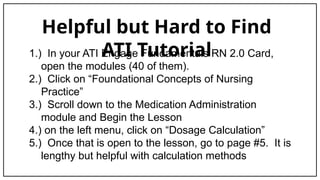
Helpful but Hard to Find
ATI Tutorial
1.) In your ATI Engage Fundamentals RN 2.0 Card,
open the modules (40 of them).
2.) Click on “Foundational Concepts of Nursing
Practice”
3.) Scroll down to the Medication Administration
module and Begin the Lesson
4.) on the left menu, click on “Dosage Calculation”
5.) Once that is open to the lesson, go to page #5. It is
lengthy but helpful with calculation methods
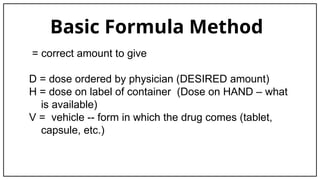
Basic Formula Method
= correct amount to give
D = dose ordered by physician (DESIRED amount)
H = dose on label of container (Dose on HAND – what
is available)
V = vehicle -- form in which the drug comes (tablet,
capsule, etc.)
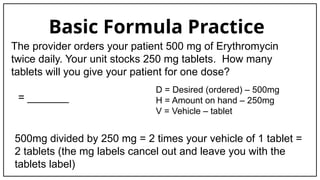
Basic Formula Practice
The provider orders your patient 500 mg of Erythromycin
twice daily. Your unit stocks 250 mg tablets. How many
tablets will you give your patient for one dose?
= _______
D = Desired (ordered) – 500mg
H = Amount on hand – 250mg
V = Vehicle – tablet
500mg divided by 250 mg = 2 times your vehicle of 1 tablet =
2 tablets (the mg labels cancel out and leave you with the
tablets label)
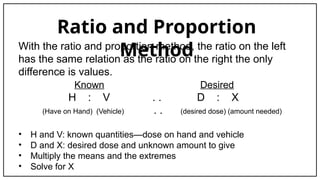
Ratio and Proportion
Method
With the ratio and proportion method, the ratio on the left
has the same relation as the ratio on the right the only
difference is values.
Known Desired
H : V . . D : X
(Have on Hand) (Vehicle) . . (desired dose) (amount needed)
• H and V: known quantities—dose on hand and vehicle
• D and X: desired dose and unknown amount to give
• Multiply the means and the extremes
• Solve for X
Ratio and Proportion
Practice
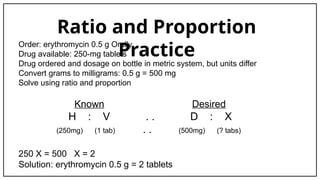
Order: erythromycin 0.5 g Orally
Drug available: 250-mg tablets
Drug ordered and dosage on bottle in metric system, but units differ
Convert grams to milligrams: 0.5 g = 500 mg
Solve using ratio and proportion
Known Desired
H : V . . D : X
(250mg) (1 tab) . . (500mg) (? tabs)
250 X = 500 X = 2
Solution: erythromycin 0.5 g = 2 tablets
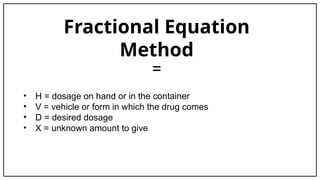
Fractional Equation
Method
=
• H = dosage on hand or in the container
• V = vehicle or form in which the drug comes
• D = desired dosage
• X = unknown amount to give
Fractional Equation
Practice
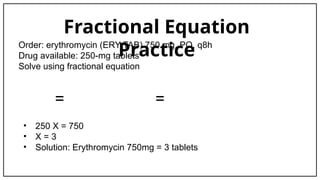
Order: erythromycin (ERY-TAB) 750 mg, PO, q8h
Drug available: 250-mg tablets
Solve using fractional equation
= =
• 250 X = 750
• X = 3
• Solution: Erythromycin 750mg = 3 tablets
Dimensional Analysis
Method
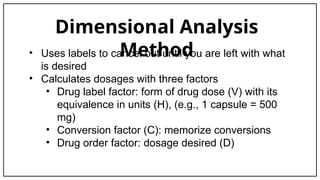
• Uses labels to cancel out until you are left with what
is desired
• Calculates dosages with three factors
• Drug label factor: form of drug dose (V) with its
equivalence in units (H), (e.g., 1 capsule = 500
mg)
• Conversion factor (C): memorize conversions
• Drug order factor: dosage desired (D)
Dimensional Analysis
Method
• V (the form of the drug)
• D (desired dose)
• H (drug on hand)
• [comes from drug label]
• [is drug order]
Dimensional Analysis
Method
• If conversions are needed:
• V (the form of the drug)
• D (desired dose)
• H (drug on hand)
• C (conversion)
•
• [comes from drug label]
• [is drug order]
• [is your conversion]
Dimensional Analysis
Practice
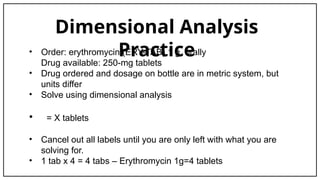
• Order: erythromycin (ERY-TAB) 1 g, orally
Drug available: 250-mg tablets
• Drug ordered and dosage on bottle are in metric system, but
units differ
• Solve using dimensional analysis
• = X tablets
• Cancel out all labels until you are only left with what you are
solving for.
• 1 tab x 4 = 4 tabs – Erythromycin 1g=4 tablets
Practice problems
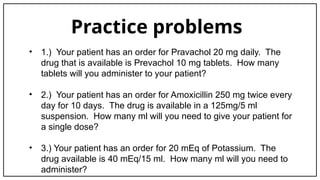
• 1.) Your patient has an order for Pravachol 20 mg daily. The
drug that is available is Prevachol 10 mg tablets. How many
tablets will you administer to your patient?
• 2.) Your patient has an order for Amoxicillin 250 mg twice every
day for 10 days. The drug is available in a 125mg/5 ml
suspension. How many ml will you need to give your patient for
a single dose?
• 3.) Your patient has an order for 20 mEq of Potassium. The
drug available is 40 mEq/15 ml. How many ml will you need to
administer?
Practice problems
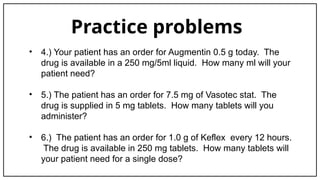
• 4.) Your patient has an order for Augmentin 0.5 g today. The
drug is available in a 250 mg/5ml liquid. How many ml will your
patient need?
• 5.) The patient has an order for 7.5 mg of Vasotec stat. The
drug is supplied in 5 mg tablets. How many tablets will you
administer?
• 6.) The patient has an order for 1.0 g of Keflex every 12 hours.
The drug is available in 250 mg tablets. How many tablets will
your patient need for a single dose?
Practice problems
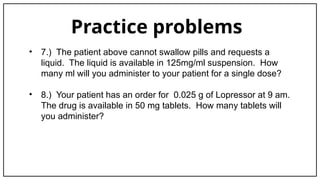
• 7.) The patient above cannot swallow pills and requests a
liquid. The liquid is available in 125mg/ml suspension. How
many ml will you administer to your patient for a single dose?
• 8.) Your patient has an order for 0.025 g of Lopressor at 9 am.
The drug is available in 50 mg tablets. How many tablets will
you administer?
Syringes and Injectable
Meds
• Liquids injected commonly in mg/ml or units/ml
• Calculate amount based on how it is supplied and the
order
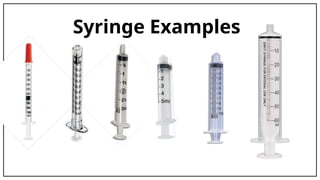
• Commonly used:
• Insulin, TB, 1 ml, 3 ml, 5 ml, 10 ml
• Larger for large amounts of liquids ex: NG or G
tubes
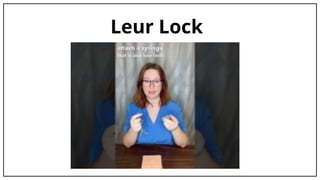
• Needleless/Leurlock systems
Leur Lock
Syringe Examples
Injectable Med Practice
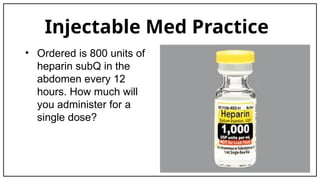
• Ordered is 800 units of
heparin subQ in the
abdomen every 12
hours. How much will
you administer for a
single dose?
Injectable Med Practice
• The provider ordered 50 mg of Morphine to be given to your
patient IM. The medication is available in 100 mg/ml vial. How
much will you give?
• The provider ordered Epogen for your patient. You are to give
15,000 units tonight at bedtime. If the pharmacy sends you a 2
ml vial with a concentration of 20,000 units/2 ml, how much will
you draw up in a syringe and administer?
• Your patient has an order for Naloxone 0.2 mg subQ. The
medication is supplied in 400mcg/ml vials. How much will you
draw up and administer?
Injectable Med Practice
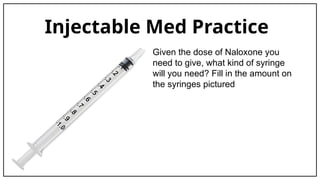
Given the dose of Naloxone you
need to give, what kind of syringe
will you need? Fill in the amount on
the syringes pictured
Intravenous (IV)
Medications
• Medication given directly in a vein. Access obtained
with an IV catheter.
• Set infusion rate on pump based on volume and
concentration of medications ordered
• Continuous/Mainline Fluids
• Intermittent/Scheduled/IVPB medications
• ml per hour ml/hr
• Drops per minute gtt/min
• You will always round to the nearest ml or gtt with
IV calculations
IV Flow Rate Practice
• How many ml/hr should the nurse set the pump to infuse if the
order reads:
• Infuse 2000 ml Normal Saline (NS) over 16 hours
• Infuse 500 ml Normal Saline (NS) over 3 hours. The drop
factor for the tubing you are suing is 15 gtt/min
IV Flow Rate Practice
• The order reads to infuse 1 L Lactated Ringers (LR) over 10 hours.
How many ml per hour will you set the pump to infuse the medication
correctly?
• Order reads infuse 3.75 g of Unasyn over 30 minutes. The medication
will be put into a 100 ml bag of IV fluid. At how many ml/hr will you
need to run the medication?
• Order reads: Infuse 1 liter of fluids over 8 hours. What rate will you set
the pump in ml/hr?
• You have an order to start Gentamycin 2G in 250 ml to run in over 2
hours. What will you set the pump at in ml/hr?
Other Important Info
• In the School of Nursing:
• Read directions on exams carefully
• Most nursing courses will have you round to the nearest tenth
decimal place.
• Remember to use necessary zeros as place holders ex: 0.05 ml
• Do not include trailing zeros – 4 or 4.0 ---- not 4.00000
• Labels – Most often in courses, the label will be provided for you
on exams. Occasionally, you may have to add the appropriate
label, but only if you are asked to do so in the instructions.
• AGAIN, READ THE DIRECTIONS on worksheets or exams!
Tips
• ATI has several practice problems.
• www.registerednursern.com has many videos and access to all kinds
of practice questions!
• I will incorporate practice problems for you to complete throughout the
course.
• Remember that from this point forward, throughout nursing school, you
will have conversion and medication calculation problems on exams
and in practice. This is something to memorize and take very
seriously.
• Medication errors are the most common errors made in nursing and
can cost a patient their well-being or in extreme cases, their lives.

Medication Calculation from Nursing 231 SIUE

  • 1.
  • 2.
    Metric System • Decimalsystem based on multiples of 10 and decimal fractions of 10 • Three basic units of measurement • Gram (g, gm, G, Gm): unit for weight • Liter (l, L): unit for volume or capacity • Meter (m, M): unit for linear measurement
  • 3.
    Metric System Abbreviations Metric Unitsand Abbreviations Names Abbreviations Weight Kilogram Kg, Kg Gram g, gm, G, Gm Milligram mg Microgram mcg Volume Liter L, l Milliliter ml Length Meter m, M Centimeter cm Millimeter mm
  • 4.
    Metric System KILO HECTODEKA Base deci centi milli 1000 100 10 Measurement 0.1 0.01 0.001 • Smaller to Larger: Move decimal to left Multiply by units of 10 • Larger to Smaller: Move decimal to right Divide by units of 10
  • 5.
    Conversion within the MetricSystem • Method A (larger to smaller) • Two ways to change from larger to smaller units • Multiply by 10 for each unit decreased, OR • Move decimal point one space to the right for each unit changed. • Example: • Change 1 gram (g) to milligrams (mg). • a) 1 g  10  10  10 = 1000 mg OR • b) 1 g = 1.000 mg = 1000 mg
  • 6.
    Conversion within the MetricSystem • Method B (smaller to larger) • Two ways to change from smaller to larger unit • Divide by 10 for each unit decreased OR • Move decimal point one space to the left for each unit changed • Example: • Change 1500 mL to L. • a) 1500 mL/1000 = 1.5 L OR • b) 1500 mL = 1.500 = 1.5 L
  • 7.
    Review of DecimalPlaces • 1000.0 … the 1 is in the thousands place and to the left of the decimal point • 0100.0 …the 1 is in the hundreds place and is to the left of the decimal point • 0010.0 … the 1 is in the tens place and is to the left of the decimal point • 0001.0 … the 1 is in the ones place and is to the left of the decimal point
  • 8.
    Review of DecimalPlaces • 0.10 … the 1 is in the TENTHS place and is to the right of the decimal point • 0.01 … the 1 is in the HUNDREDTHS place and is to the right of the decimal point • 0.001 … the 1 is in the THOUSANTHS place and is to the right of the decimal point
  • 9.
    Household System • Lackof standardization of spoons, cups, and glasses makes the household system less accurate than the metric system. • Cups • Teaspoons • Tablespoons • Pints • Ounces • Used frequently, so conversions are necessary • You must memorize and use the conversions on the sheet provided to you!!
  • 10.
    Examples of Common Conversions •1 cup = 240 milliliters (ml) = 8 ounce (oz) • 1 teaspoon (tsp) = 5 milliliters (ml) • 1 tablespoon (Tbsp) = 15 milliliters (ml) • 1 ounce = 30 milliliters (ml) • 1 gram (g) = 1000 milligrams (mg) • 1 milligram (mg) = 1000 micrograms (mcg) • 1 inch = 2.54 cm • 1 pound = 16 ounces • 1 kilogram (kg) = 2.2 pounds (lbs)
  • 11.
    Drug Calculation Methods •Dimensional Analysis (this is the most widely used and what is taught in the School of Nursing) • Basic • Ratio and proportion • Fractional Equations • Each of the methods above is similar in that you use the same components, but formulas are set up differently, mathematically. • You are responsible for knowing dimensional analysis and that method is used throughout courses in the program
  • 12.
    Helpful but Hardto Find ATI Tutorial 1.) In your ATI Engage Fundamentals RN 2.0 Card, open the modules (40 of them). 2.) Click on “Foundational Concepts of Nursing Practice” 3.) Scroll down to the Medication Administration module and Begin the Lesson 4.) on the left menu, click on “Dosage Calculation” 5.) Once that is open to the lesson, go to page #5. It is lengthy but helpful with calculation methods
  • 13.
    Basic Formula Method =correct amount to give D = dose ordered by physician (DESIRED amount) H = dose on label of container (Dose on HAND – what is available) V = vehicle -- form in which the drug comes (tablet, capsule, etc.)
  • 14.
    Basic Formula Practice Theprovider orders your patient 500 mg of Erythromycin twice daily. Your unit stocks 250 mg tablets. How many tablets will you give your patient for one dose? = _______ D = Desired (ordered) – 500mg H = Amount on hand – 250mg V = Vehicle – tablet 500mg divided by 250 mg = 2 times your vehicle of 1 tablet = 2 tablets (the mg labels cancel out and leave you with the tablets label)
  • 15.
    Ratio and Proportion Method Withthe ratio and proportion method, the ratio on the left has the same relation as the ratio on the right the only difference is values. Known Desired H : V . . D : X (Have on Hand) (Vehicle) . . (desired dose) (amount needed) • H and V: known quantities—dose on hand and vehicle • D and X: desired dose and unknown amount to give • Multiply the means and the extremes • Solve for X
  • 16.
    Ratio and Proportion Practice Order:erythromycin 0.5 g Orally Drug available: 250-mg tablets Drug ordered and dosage on bottle in metric system, but units differ Convert grams to milligrams: 0.5 g = 500 mg Solve using ratio and proportion Known Desired H : V . . D : X (250mg) (1 tab) . . (500mg) (? tabs) 250 X = 500 X = 2 Solution: erythromycin 0.5 g = 2 tablets
  • 17.
    Fractional Equation Method = • H= dosage on hand or in the container • V = vehicle or form in which the drug comes • D = desired dosage • X = unknown amount to give
  • 18.
    Fractional Equation Practice Order: erythromycin(ERY-TAB) 750 mg, PO, q8h Drug available: 250-mg tablets Solve using fractional equation = = • 250 X = 750 • X = 3 • Solution: Erythromycin 750mg = 3 tablets
  • 19.
    Dimensional Analysis Method • Useslabels to cancel out until you are left with what is desired • Calculates dosages with three factors • Drug label factor: form of drug dose (V) with its equivalence in units (H), (e.g., 1 capsule = 500 mg) • Conversion factor (C): memorize conversions • Drug order factor: dosage desired (D)
  • 20.
    Dimensional Analysis Method • V(the form of the drug) • D (desired dose) • H (drug on hand) • [comes from drug label] • [is drug order]
  • 21.
    Dimensional Analysis Method • Ifconversions are needed: • V (the form of the drug) • D (desired dose) • H (drug on hand) • C (conversion) • • [comes from drug label] • [is drug order] • [is your conversion]
  • 22.
    Dimensional Analysis Practice • Order:erythromycin (ERY-TAB) 1 g, orally Drug available: 250-mg tablets • Drug ordered and dosage on bottle are in metric system, but units differ • Solve using dimensional analysis • = X tablets • Cancel out all labels until you are only left with what you are solving for. • 1 tab x 4 = 4 tabs – Erythromycin 1g=4 tablets
  • 23.
    Practice problems • 1.)Your patient has an order for Pravachol 20 mg daily. The drug that is available is Prevachol 10 mg tablets. How many tablets will you administer to your patient? • 2.) Your patient has an order for Amoxicillin 250 mg twice every day for 10 days. The drug is available in a 125mg/5 ml suspension. How many ml will you need to give your patient for a single dose? • 3.) Your patient has an order for 20 mEq of Potassium. The drug available is 40 mEq/15 ml. How many ml will you need to administer?
  • 24.
    Practice problems • 4.)Your patient has an order for Augmentin 0.5 g today. The drug is available in a 250 mg/5ml liquid. How many ml will your patient need? • 5.) The patient has an order for 7.5 mg of Vasotec stat. The drug is supplied in 5 mg tablets. How many tablets will you administer? • 6.) The patient has an order for 1.0 g of Keflex every 12 hours. The drug is available in 250 mg tablets. How many tablets will your patient need for a single dose?
  • 25.
    Practice problems • 7.)The patient above cannot swallow pills and requests a liquid. The liquid is available in 125mg/ml suspension. How many ml will you administer to your patient for a single dose? • 8.) Your patient has an order for 0.025 g of Lopressor at 9 am. The drug is available in 50 mg tablets. How many tablets will you administer?
  • 26.
    Syringes and Injectable Meds •Liquids injected commonly in mg/ml or units/ml • Calculate amount based on how it is supplied and the order • Commonly used: • Insulin, TB, 1 ml, 3 ml, 5 ml, 10 ml • Larger for large amounts of liquids ex: NG or G tubes • Needleless/Leurlock systems
  • 27.
  • 28.
  • 29.
    Injectable Med Practice •Ordered is 800 units of heparin subQ in the abdomen every 12 hours. How much will you administer for a single dose?
  • 30.
    Injectable Med Practice •The provider ordered 50 mg of Morphine to be given to your patient IM. The medication is available in 100 mg/ml vial. How much will you give? • The provider ordered Epogen for your patient. You are to give 15,000 units tonight at bedtime. If the pharmacy sends you a 2 ml vial with a concentration of 20,000 units/2 ml, how much will you draw up in a syringe and administer? • Your patient has an order for Naloxone 0.2 mg subQ. The medication is supplied in 400mcg/ml vials. How much will you draw up and administer?
  • 31.
    Injectable Med Practice Giventhe dose of Naloxone you need to give, what kind of syringe will you need? Fill in the amount on the syringes pictured
  • 32.
    Intravenous (IV) Medications • Medicationgiven directly in a vein. Access obtained with an IV catheter. • Set infusion rate on pump based on volume and concentration of medications ordered • Continuous/Mainline Fluids • Intermittent/Scheduled/IVPB medications • ml per hour ml/hr • Drops per minute gtt/min • You will always round to the nearest ml or gtt with IV calculations
  • 33.
    IV Flow RatePractice • How many ml/hr should the nurse set the pump to infuse if the order reads: • Infuse 2000 ml Normal Saline (NS) over 16 hours • Infuse 500 ml Normal Saline (NS) over 3 hours. The drop factor for the tubing you are suing is 15 gtt/min
  • 34.
    IV Flow RatePractice • The order reads to infuse 1 L Lactated Ringers (LR) over 10 hours. How many ml per hour will you set the pump to infuse the medication correctly? • Order reads infuse 3.75 g of Unasyn over 30 minutes. The medication will be put into a 100 ml bag of IV fluid. At how many ml/hr will you need to run the medication? • Order reads: Infuse 1 liter of fluids over 8 hours. What rate will you set the pump in ml/hr? • You have an order to start Gentamycin 2G in 250 ml to run in over 2 hours. What will you set the pump at in ml/hr?
  • 35.
    Other Important Info •In the School of Nursing: • Read directions on exams carefully • Most nursing courses will have you round to the nearest tenth decimal place. • Remember to use necessary zeros as place holders ex: 0.05 ml • Do not include trailing zeros – 4 or 4.0 ---- not 4.00000 • Labels – Most often in courses, the label will be provided for you on exams. Occasionally, you may have to add the appropriate label, but only if you are asked to do so in the instructions. • AGAIN, READ THE DIRECTIONS on worksheets or exams!
  • 36.
    Tips • ATI hasseveral practice problems. • www.registerednursern.com has many videos and access to all kinds of practice questions! • I will incorporate practice problems for you to complete throughout the course. • Remember that from this point forward, throughout nursing school, you will have conversion and medication calculation problems on exams and in practice. This is something to memorize and take very seriously. • Medication errors are the most common errors made in nursing and can cost a patient their well-being or in extreme cases, their lives.

Editor's Notes

  • #7 * Most often on exam questions, you will be instructed to round to the nearest TENTH if you do not have an answer that is a whole number. You will round at the end of the equation – only the final answer.
  • #8 * Most often on exam questions, you will be instructed to round to the nearest TENTH if you do not have an answer that is a whole number. You will round at the end of the equation – only the final answer.
  • #11 (There are also some very good Youtube videos that show calculation methods step by step that you can review)