Math ReviewNUR 283HY
AbbreviationsReview acceptable and non-acceptable abbreviationsPharmacology bookFundamentals bookKee & MarshallInside front coverChapter 3, pg. 68-70
RoundingNOTE: Don’t round until you have completely finished the problemRounding within the problem will 	result in a close answer, 	but not an exact one
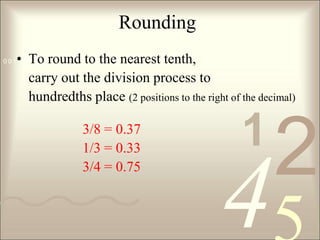
RoundingTo round to the nearest tenth, 	carry out the division process to 	hundredths place (2 positions to the right of the decimal) 3/8 = 0.37	1/3 = 0.33	3/4 = 0.75
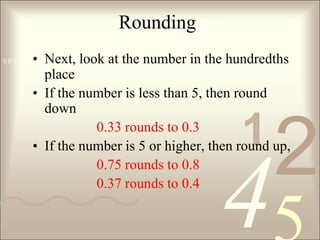
RoundingNext, look at the number in the hundredths place If the number is less than 5, then round down0.33 rounds to 0.3If the number is 5 or higher, then round up, 0.75 rounds to 0.8			0.37 rounds to 0.4
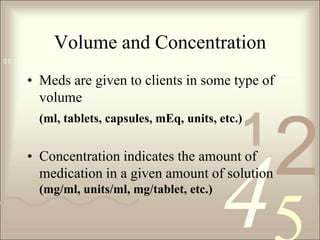
Volume and ConcentrationMeds are given to clients in some type of volume (ml, tablets, capsules, mEq, units, etc.)Concentration indicates the amount of medication in a given amount of solution (mg/ml, units/ml, mg/tablet, etc.)
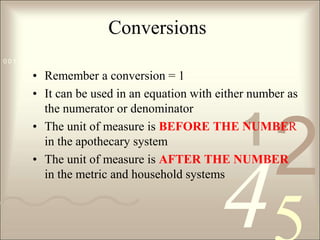
ConversionsRemember a conversion = 1It can be used in an equation with either number as the numerator or denominatorThe unit of measure is BEFORE THE NUMBER in the apothecary systemThe unit of measure is AFTER THE NUMBER in the metric and household systems
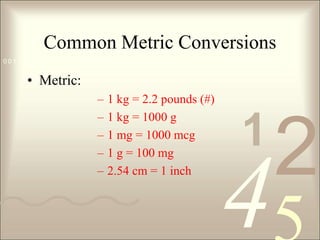
Common Metric ConversionsMetric: 1 kg = 2.2 pounds (#)1 kg = 1000 g1 mg = 1000 mcg1 g = 100 mg2.54 cm = 1 inch
Other Common ConversionsApothecary: 1 grain = 60 mgRemember ss = ½ grainHousehold: 1 teaspoon = 5 ml30 ml = 1 ounce3 teaspoons = 1 tablespoon
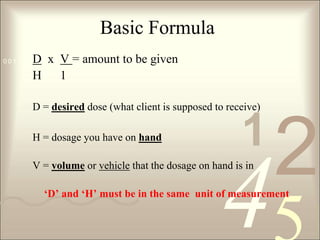
Basic FormulaD  x  V = amount to be givenH      1D = desired dose (what client is supposed to receive)H = dosage you have on handV = volume or vehicle that the dosage on hand is in ‘D’ and ‘H’ must be in the same  unit of measurement
Setting up ProblemsUse the label factoring method (dimensional analysis – DA).  This method uses labels with the numbers to arrive at the correct answer (Kee pg. 92- 104)Determine unit of measurement for answerSet up problem until labels cancel out and you are left with correct label for the answer
Dosages based on WeightDrugs may be ordered based on the weight of the client (amount of mg of the drug per kg of weight)When converting weight in pounds to weight in kilograms, the number is approximately less than ½ of the weight in pounds110 # = 50 kg;  220# = 100 kg; 140# = 63.6 kg
Divided DosesYou may have a problem that asks you to calculate the entire amount of drug that is to be given in a 24 hour periodA problem may give you the amount of drug the client is to receive in 24 hours and ask you to calculate an individual dose
Reconstitution of a DrugA problem might give you a great deal of information about reconstituting a drug – how much diluent, vial size, etc.  (Kee pg. 186)The bottom line is to recognize the final concentrationOrder for 1.5 g of penicillin IM q6h.  The pharmacy sends a vial labeled penicillin 5 g/vial in dry form.  Reconstitute with 5.6 ml of sterile water to yield 1000 mg/ml.  How much should be given?
Hints for Taking QuizzesRead the directions completelyDecide the unit of measure needed for the correct answerRead the problem again after you decide on the answer.  Is the answer logical?Check calculations more than once on calculatorRead the directions again
The EndContinue with reading below16

Nur 283 Hy Math Review

  • 1.
  • 2.
    AbbreviationsReview acceptable andnon-acceptable abbreviationsPharmacology bookFundamentals bookKee & MarshallInside front coverChapter 3, pg. 68-70
  • 3.
    RoundingNOTE: Don’t rounduntil you have completely finished the problemRounding within the problem will result in a close answer, but not an exact one
  • 4.
    RoundingTo round tothe nearest tenth, carry out the division process to hundredths place (2 positions to the right of the decimal) 3/8 = 0.37 1/3 = 0.33 3/4 = 0.75
  • 5.
    RoundingNext, look atthe number in the hundredths place If the number is less than 5, then round down0.33 rounds to 0.3If the number is 5 or higher, then round up, 0.75 rounds to 0.8 0.37 rounds to 0.4
  • 6.
    Volume and ConcentrationMedsare given to clients in some type of volume (ml, tablets, capsules, mEq, units, etc.)Concentration indicates the amount of medication in a given amount of solution (mg/ml, units/ml, mg/tablet, etc.)
  • 7.
    ConversionsRemember a conversion= 1It can be used in an equation with either number as the numerator or denominatorThe unit of measure is BEFORE THE NUMBER in the apothecary systemThe unit of measure is AFTER THE NUMBER in the metric and household systems
  • 8.
    Common Metric ConversionsMetric:1 kg = 2.2 pounds (#)1 kg = 1000 g1 mg = 1000 mcg1 g = 100 mg2.54 cm = 1 inch
  • 9.
    Other Common ConversionsApothecary:1 grain = 60 mgRemember ss = ½ grainHousehold: 1 teaspoon = 5 ml30 ml = 1 ounce3 teaspoons = 1 tablespoon
  • 10.
    Basic FormulaD x V = amount to be givenH 1D = desired dose (what client is supposed to receive)H = dosage you have on handV = volume or vehicle that the dosage on hand is in ‘D’ and ‘H’ must be in the same unit of measurement
  • 11.
    Setting up ProblemsUsethe label factoring method (dimensional analysis – DA). This method uses labels with the numbers to arrive at the correct answer (Kee pg. 92- 104)Determine unit of measurement for answerSet up problem until labels cancel out and you are left with correct label for the answer
  • 12.
    Dosages based onWeightDrugs may be ordered based on the weight of the client (amount of mg of the drug per kg of weight)When converting weight in pounds to weight in kilograms, the number is approximately less than ½ of the weight in pounds110 # = 50 kg; 220# = 100 kg; 140# = 63.6 kg
  • 13.
    Divided DosesYou mayhave a problem that asks you to calculate the entire amount of drug that is to be given in a 24 hour periodA problem may give you the amount of drug the client is to receive in 24 hours and ask you to calculate an individual dose
  • 14.
    Reconstitution of aDrugA problem might give you a great deal of information about reconstituting a drug – how much diluent, vial size, etc. (Kee pg. 186)The bottom line is to recognize the final concentrationOrder for 1.5 g of penicillin IM q6h. The pharmacy sends a vial labeled penicillin 5 g/vial in dry form. Reconstitute with 5.6 ml of sterile water to yield 1000 mg/ml. How much should be given?
  • 15.
    Hints for TakingQuizzesRead the directions completelyDecide the unit of measure needed for the correct answerRead the problem again after you decide on the answer. Is the answer logical?Check calculations more than once on calculatorRead the directions again
  • 16.
    The EndContinue withreading below16