After reviewing this chapter, you should be  able to: Convert a unit of measure to its equivalent within the same system Convert approximate equivalents between the metric, apothecary, and household systems of measure
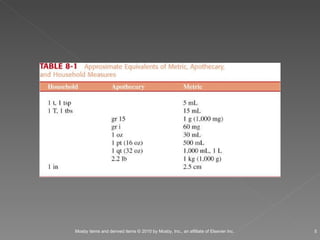
Equivalents are not exact Several tables are available and may vary For example, gr i = 60-65 mg 60 mg is used in most cases, but 65 mg is best for aspirin conversions Memorization of equivalents (Table 8-1) is essential for proficiency and communication with clients about medication administration
 
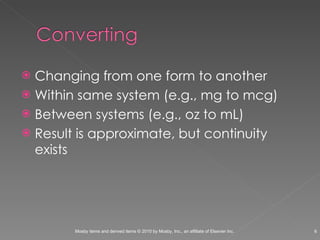
Changing from one form to another Within same system (e.g., mg to mcg) Between systems (e.g., oz to mL) Result is approximate, but continuity exists
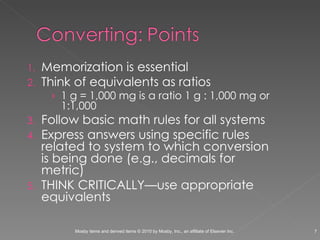
Memorization is essential Think of equivalents as ratios 1 g = 1,000 mg is a ratio 1 g : 1,000 mg or  1:1,000 Follow basic math rules for all systems Express answers using specific rules related to system to which conversion is being done (e.g., decimals for metric) THINK CRITICALLY—use appropriate equivalents
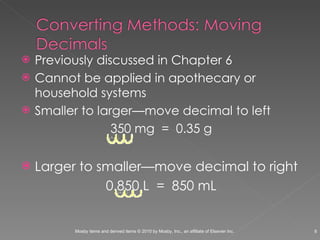
Previously discussed in Chapter 6 Cannot be applied in apothecary or household systems Smaller to larger—move decimal to left 350 mg  =  0.35 g Larger to smaller—move decimal to right 0.850 L  =  850 mL
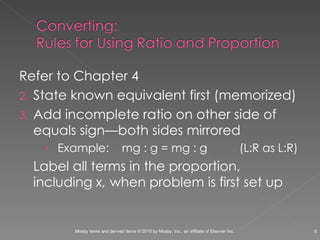
Refer to Chapter 4 State known equivalent first (memorized) Add incomplete ratio on other side of equals sign—both sides mirrored  Example:  mg : g = mg : g  (L:R as L:R) Label all terms in the proportion, including  x,  when problem is first set up
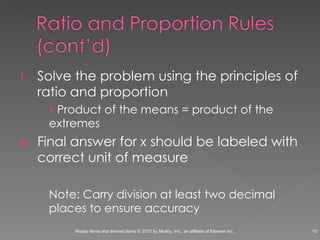
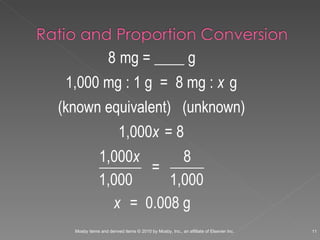
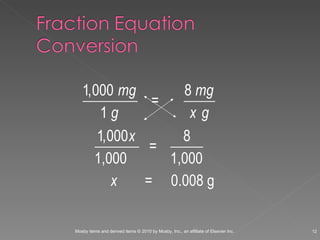
Solve the problem using the principles of ratio and proportion Product of the means = product of the extremes Final answer for  x  should be labeled with correct unit of measure Note: Carry division at least two decimal places to ensure accuracy
 
 
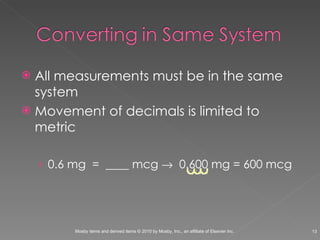
All measurements must be in the same system Movement of decimals is limited to metric 0.6 mg  =  ____ mcg     0.600 mg = 600 mcg
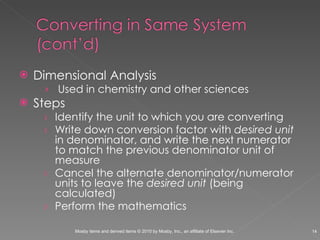
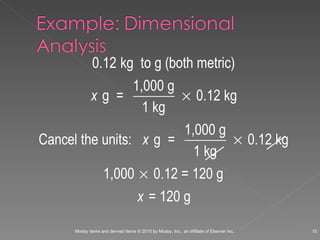
Dimensional Analysis Used in chemistry and other sciences Steps Identify the unit to which you are converting Write down conversion factor with  desired unit  in denominator, and write the next numerator to match the previous denominator unit of measure Cancel the alternate denominator/numerator units to leave the  desired unit  (being calculated) Perform the mathematics
 
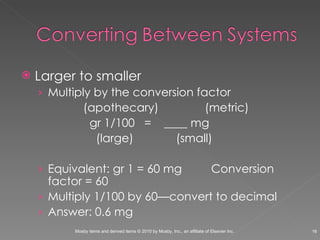
Larger to smaller Multiply by the conversion factor (apothecary)   (metric)   gr 1/100  =  ____ mg   (large)   (small) Equivalent: gr 1 = 60 mg Conversion factor = 60 Multiply 1/100 by 60—convert to decimal Answer: 0.6 mg
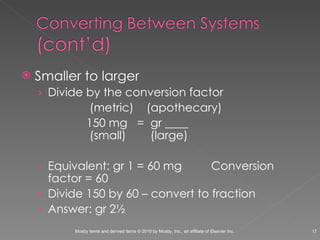
Smaller to larger Divide by the conversion factor   (metric)  (apothecary)   150 mg  =  gr ____        (small)  (large) Equivalent: gr 1 = 60 mg Conversion factor = 60 Divide 150 by 60 – convert to fraction Answer: gr 2½
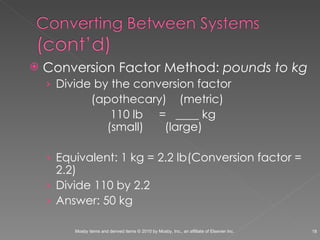
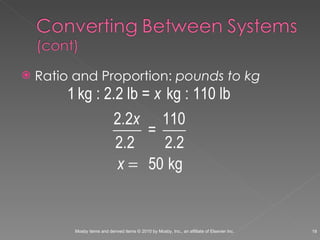
Conversion Factor Method:  pounds to kg Divide by the conversion factor (apothecary)  (metric)   110 lb  =  ____ kg       (small)   (large) Equivalent: 1 kg = 2.2 lb (Conversion factor = 2.2) Divide 110 by 2.2  Answer: 50 kg
Ratio and Proportion:  pounds to kg
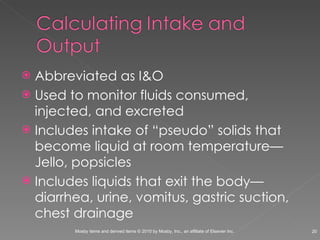
Abbreviated as I&O Used to monitor fluids consumed, injected, and excreted Includes intake of “pseudo” solids that become liquid at room temperature—Jello, popsicles Includes liquids that exit the body—diarrhea, urine, vomitus, gastric suction, chest drainage
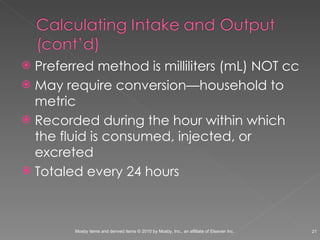
Preferred method is milliliters (mL) NOT cc May require conversion—household to metric Recorded during the hour within which the fluid is consumed, injected, or excreted Totaled every 24 hours
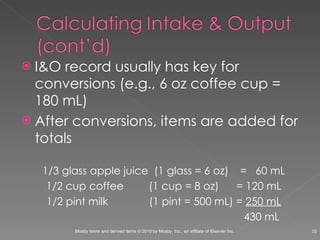
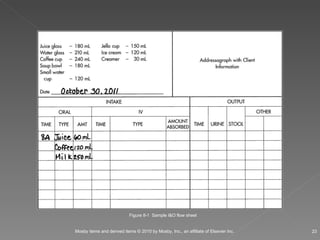
I&O record usually has key for conversions (e.g., 6 oz coffee cup = 180 mL) After conversions, items are added for totals 1/3 glass apple juice  (1 glass = 6 oz)  =  60 mL 1/2 cup coffee    (1 cup = 8 oz)  = 120 mL 1/2 pint milk   (1 pint = 500 mL) =  250 mL   430 mL
Figure 8-1  Sample I&O flow sheet
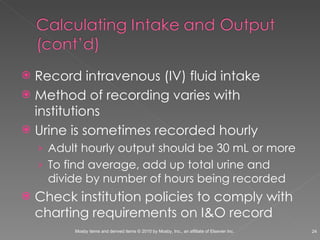
Record intravenous (IV) fluid intake Method of recording varies with institutions Urine is sometimes recorded hourly Adult hourly output should be 30 mL or more To find average, add up total urine and divide by number of hours being recorded Check institution policies to comply with charting requirements on I&O record

Converting Within And Between Systems

  • 1.
  • 2.
  • 3.
    After reviewing thischapter, you should be able to: Convert a unit of measure to its equivalent within the same system Convert approximate equivalents between the metric, apothecary, and household systems of measure
  • 4.
    Equivalents are notexact Several tables are available and may vary For example, gr i = 60-65 mg 60 mg is used in most cases, but 65 mg is best for aspirin conversions Memorization of equivalents (Table 8-1) is essential for proficiency and communication with clients about medication administration
  • 5.
  • 6.
    Changing from oneform to another Within same system (e.g., mg to mcg) Between systems (e.g., oz to mL) Result is approximate, but continuity exists
  • 7.
    Memorization is essentialThink of equivalents as ratios 1 g = 1,000 mg is a ratio 1 g : 1,000 mg or 1:1,000 Follow basic math rules for all systems Express answers using specific rules related to system to which conversion is being done (e.g., decimals for metric) THINK CRITICALLY—use appropriate equivalents
  • 8.
    Previously discussed inChapter 6 Cannot be applied in apothecary or household systems Smaller to larger—move decimal to left 350 mg = 0.35 g Larger to smaller—move decimal to right 0.850 L = 850 mL
  • 9.
    Refer to Chapter4 State known equivalent first (memorized) Add incomplete ratio on other side of equals sign—both sides mirrored Example: mg : g = mg : g (L:R as L:R) Label all terms in the proportion, including x, when problem is first set up
  • 10.
    Solve the problemusing the principles of ratio and proportion Product of the means = product of the extremes Final answer for x should be labeled with correct unit of measure Note: Carry division at least two decimal places to ensure accuracy
  • 11.
  • 12.
  • 13.
    All measurements mustbe in the same system Movement of decimals is limited to metric 0.6 mg = ____ mcg  0.600 mg = 600 mcg
  • 14.
    Dimensional Analysis Usedin chemistry and other sciences Steps Identify the unit to which you are converting Write down conversion factor with desired unit in denominator, and write the next numerator to match the previous denominator unit of measure Cancel the alternate denominator/numerator units to leave the desired unit (being calculated) Perform the mathematics
  • 15.
  • 16.
    Larger to smallerMultiply by the conversion factor (apothecary) (metric) gr 1/100 = ____ mg (large) (small) Equivalent: gr 1 = 60 mg Conversion factor = 60 Multiply 1/100 by 60—convert to decimal Answer: 0.6 mg
  • 17.
    Smaller to largerDivide by the conversion factor (metric) (apothecary) 150 mg = gr ____ (small) (large) Equivalent: gr 1 = 60 mg Conversion factor = 60 Divide 150 by 60 – convert to fraction Answer: gr 2½
  • 18.
    Conversion Factor Method: pounds to kg Divide by the conversion factor (apothecary) (metric) 110 lb = ____ kg (small) (large) Equivalent: 1 kg = 2.2 lb (Conversion factor = 2.2) Divide 110 by 2.2 Answer: 50 kg
  • 19.
    Ratio and Proportion: pounds to kg
  • 20.
    Abbreviated as I&OUsed to monitor fluids consumed, injected, and excreted Includes intake of “pseudo” solids that become liquid at room temperature—Jello, popsicles Includes liquids that exit the body—diarrhea, urine, vomitus, gastric suction, chest drainage
  • 21.
    Preferred method ismilliliters (mL) NOT cc May require conversion—household to metric Recorded during the hour within which the fluid is consumed, injected, or excreted Totaled every 24 hours
  • 22.
    I&O record usuallyhas key for conversions (e.g., 6 oz coffee cup = 180 mL) After conversions, items are added for totals 1/3 glass apple juice (1 glass = 6 oz) = 60 mL 1/2 cup coffee (1 cup = 8 oz) = 120 mL 1/2 pint milk (1 pint = 500 mL) = 250 mL 430 mL
  • 23.
    Figure 8-1  SampleI&O flow sheet
  • 24.
    Record intravenous (IV)fluid intake Method of recording varies with institutions Urine is sometimes recorded hourly Adult hourly output should be 30 mL or more To find average, add up total urine and divide by number of hours being recorded Check institution policies to comply with charting requirements on I&O record