Grade 8 - CAREGIVING
Perform simple
calculations
A glance at numerical relationships
Ratios, fractions, and proportions describe
relationships between numbers.
Ratio is a quick way to compare numbers. It uses a
colon between the numbers in relationship.
Ex.: 3:5 8:12 4:7
Fraction, as we all know, is a part of
a whole or a portion of a certain
number. It uses a slash between
numbers in the relationship.
Ex.: 2/3 4/5 6/8
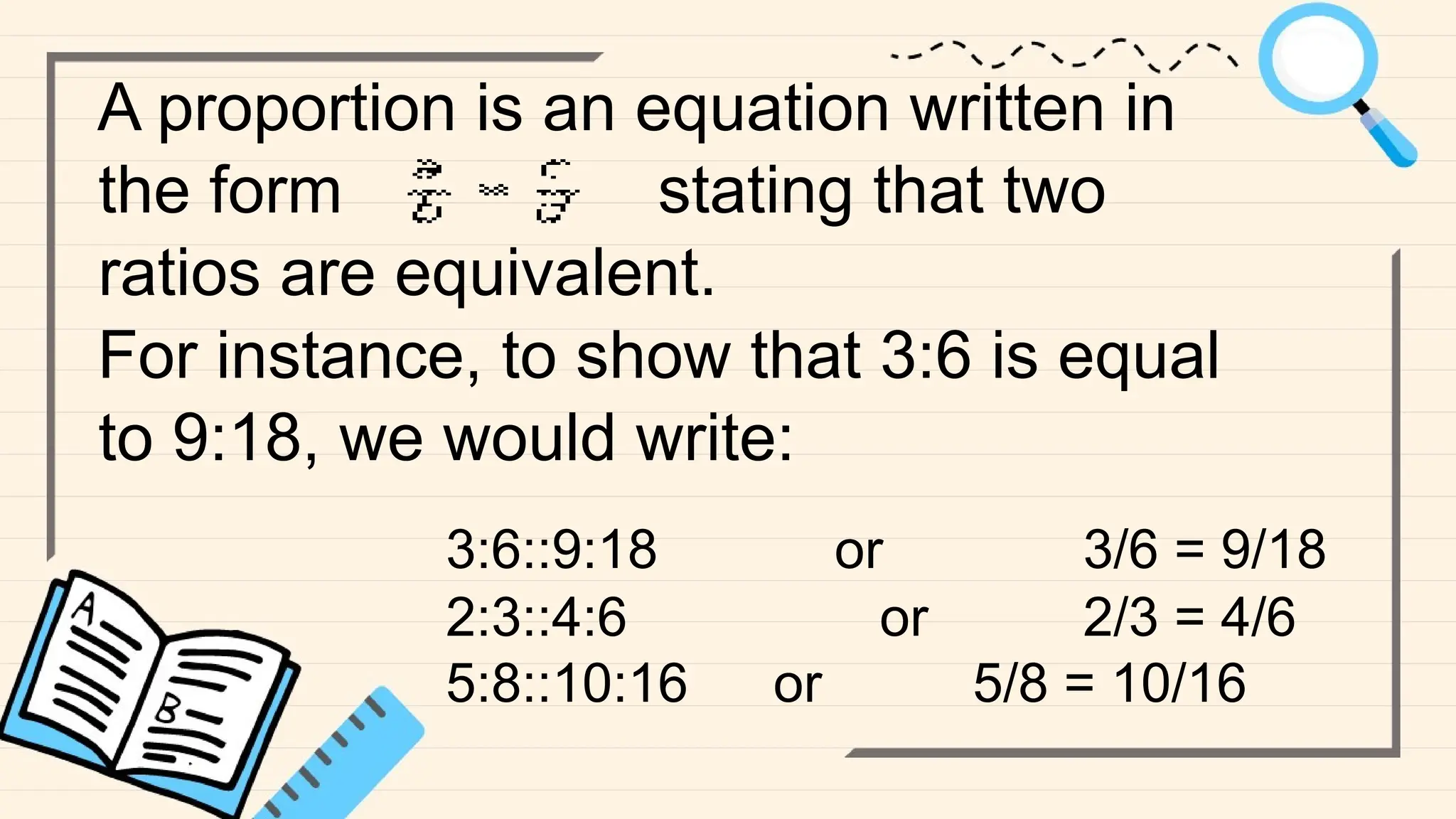
A proportion is an equation written in
the form stating that two
ratios are equivalent.
For instance, to show that 3:6 is equal
to 9:18, we would write:
3:6::9:18 or 3/6 = 9/18
2:3::4:6 or 2/3 = 4/6
5:8::10:16 or 5/8 = 10/16
Major problem solvers
For dosages computation, we use ratios,
fractions, and proportions most of the time. We
will be using them in calculating I.V. infusion
rates, administering medication, converting
weights between systems of measurement, and
in performing many other related tasks.
RATIOS AND FRACTIONS
Ratios and fractions are numerical
ways to compare anything. We can’t
simply ignore them. We use them
every day, whether we realize it or
not.
Bring it on! Do the comparison!
If 1 pad has 20 tablets, then the number
of pads compared to the number of
tablets is 1 to 20.
In ratio, it is written as: 1:20
In fraction, it is written as: 1/20
Want more? Just go on!
If there are 5 nurses for every 35
patients in a hospital, what would be
the ratio? What would be the fraction?
In ratio, it is written as: 5:35
In fraction, it is written as: 5/35 or
1/7
MATH TIP!
The terms of a ratio are the numerator
(always to the left of the colon) and the
denominator (always to the right of the
colon) of a fraction. Like fractions, ratios
should always be in lowest term.
PROPORTIONS
A proportion is an equation of
two ratios which can also be
expressed as two fractions.
Using ratios in proportions
When using ratios in a proportion, a double colon serves
as a separator. Double colon shows equality between
the two ratios.
In the example previously given, the ratio of pads with the
tablets is 1:20, then 2 pads have 40 tablets. In
proportion, it is written as:
1 pad : 20 tablets :: 2 pads : 40 tablets
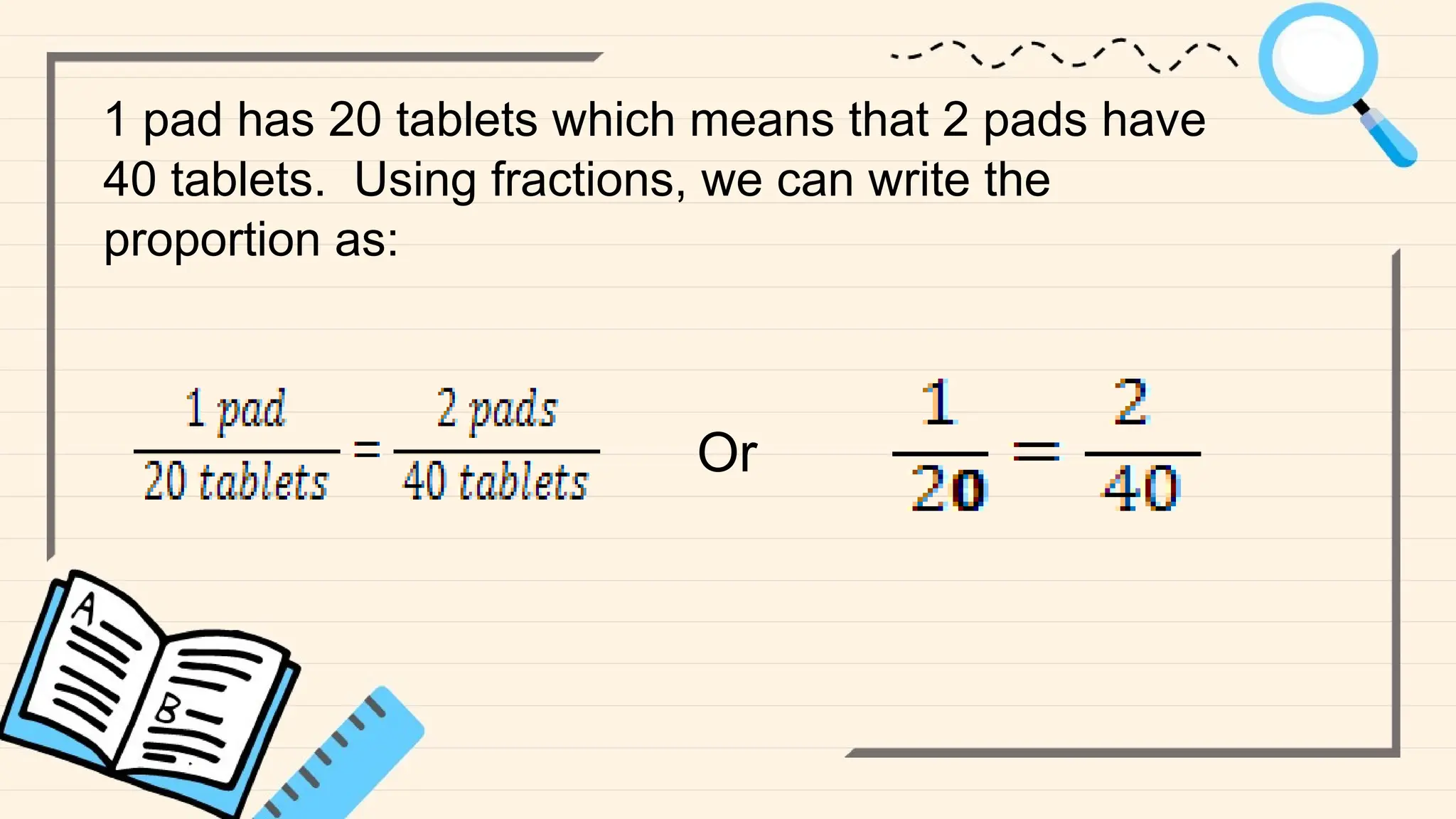
1 pad has 20 tablets which means that 2 pads have
40 tablets. Using fractions, we can write the
proportion as:
Or
Go marathon using ratios in proportions!
On the second example, there are 5 nurses for
every 35 patients and the ratio is 5:35. We can
therefore say that there are 10 nurses for 70
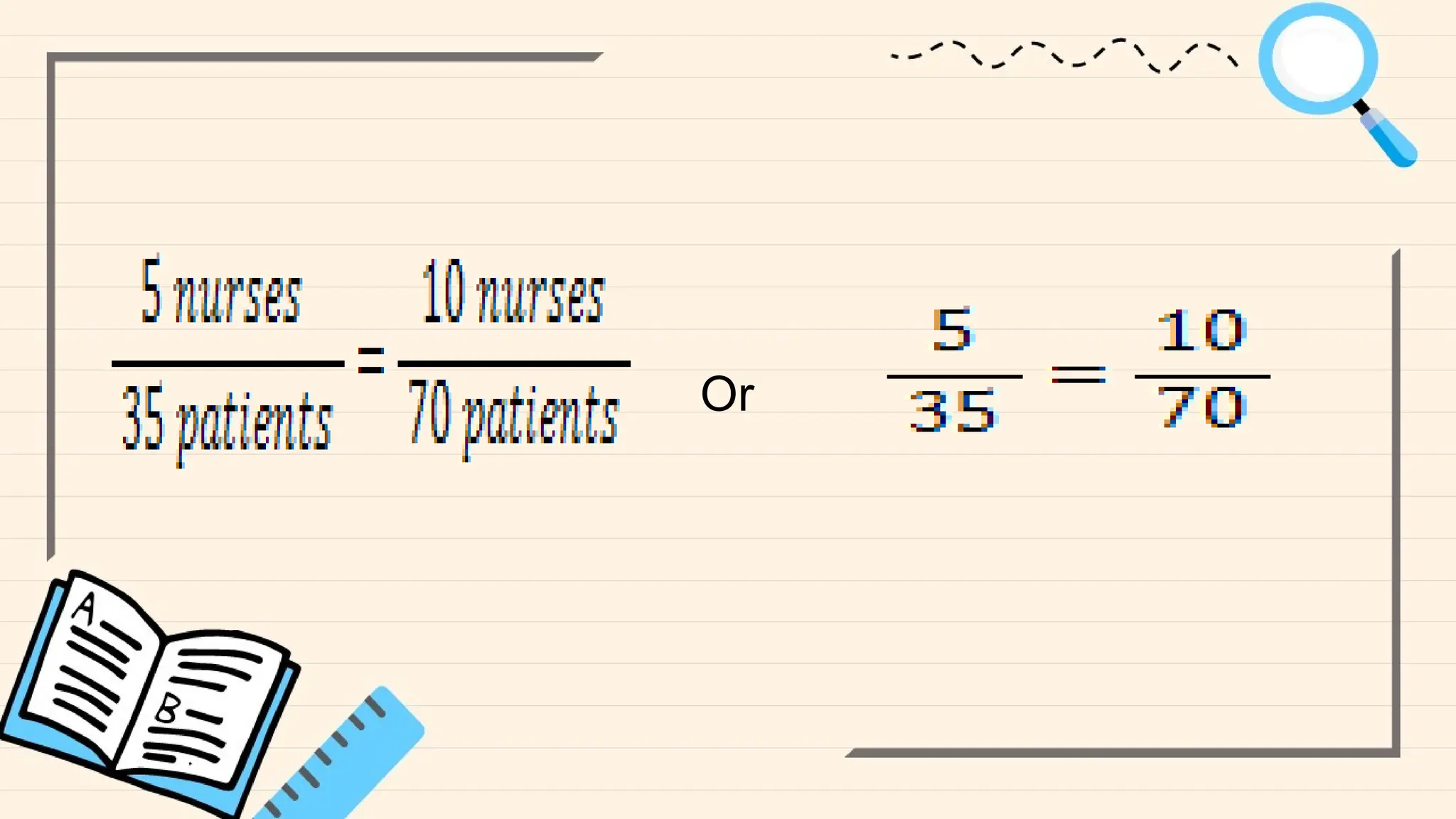
patients. In a proportion, we can express the
comparison as:
5 nurses : 35 patients :: 10 nurses :: 70
patients
Or
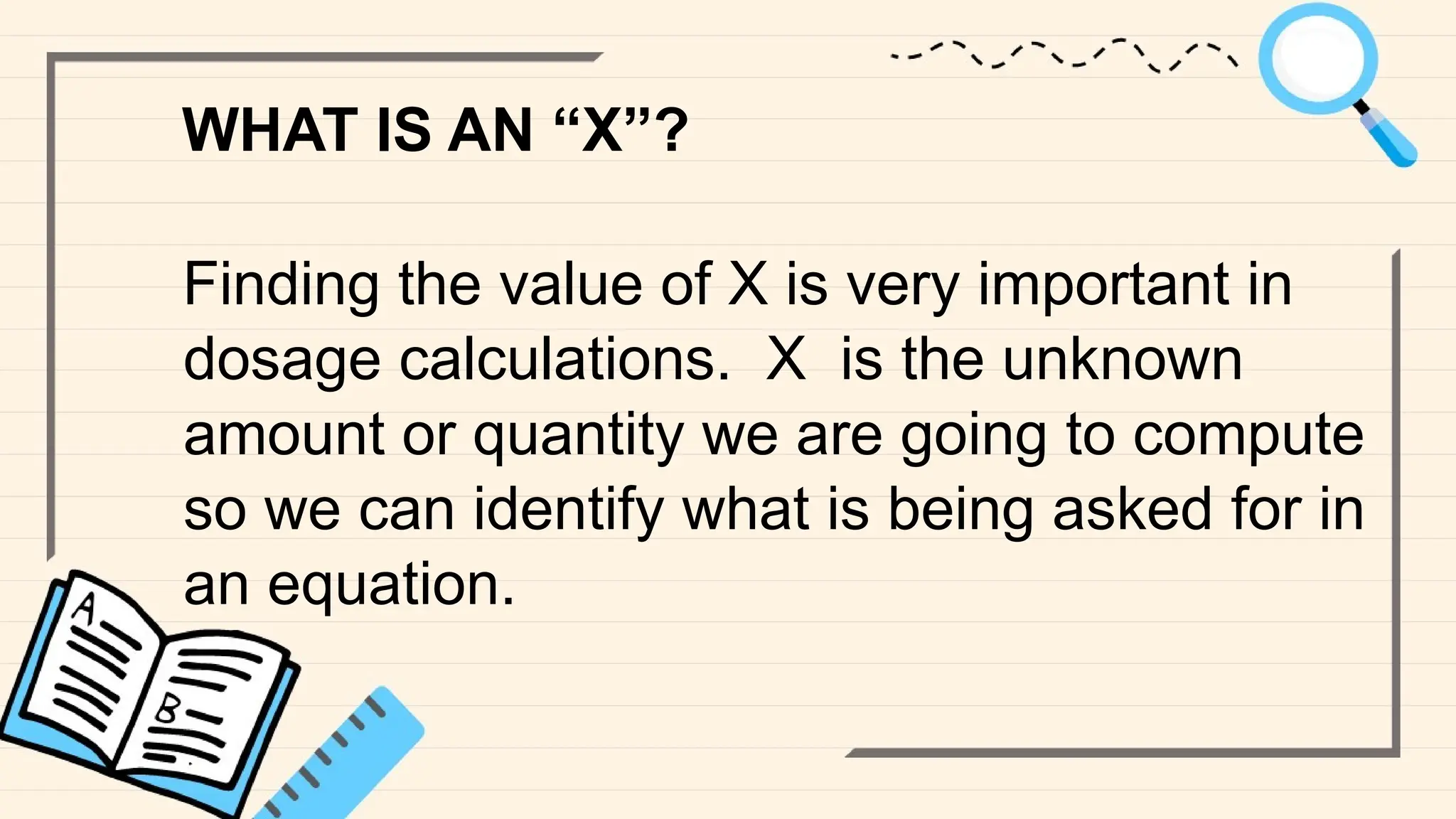
WHAT IS AN “X”?
Finding the value of X is very important in
dosage calculations. X is the unknown
amount or quantity we are going to compute
so we can identify what is being asked for in
an equation.
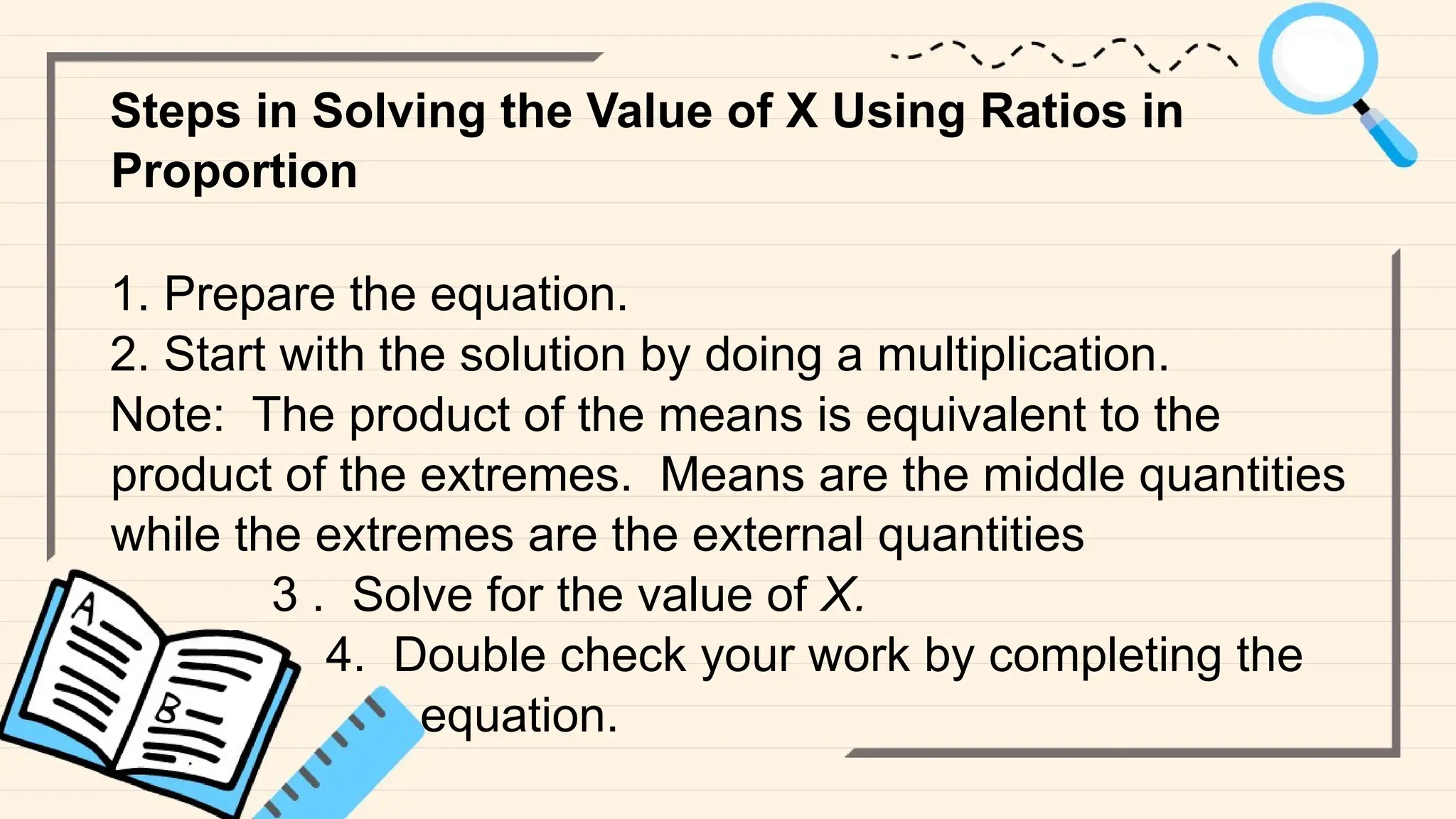
Steps in Solving the Value of X Using Ratios in
Proportion
1. Prepare the equation.
2. Start with the solution by doing a multiplication.
Note: The product of the means is equivalent to the
product of the extremes. Means are the middle quantities
while the extremes are the external quantities
3 . Solve for the value of X.
4. Double check your work by completing the
equation.
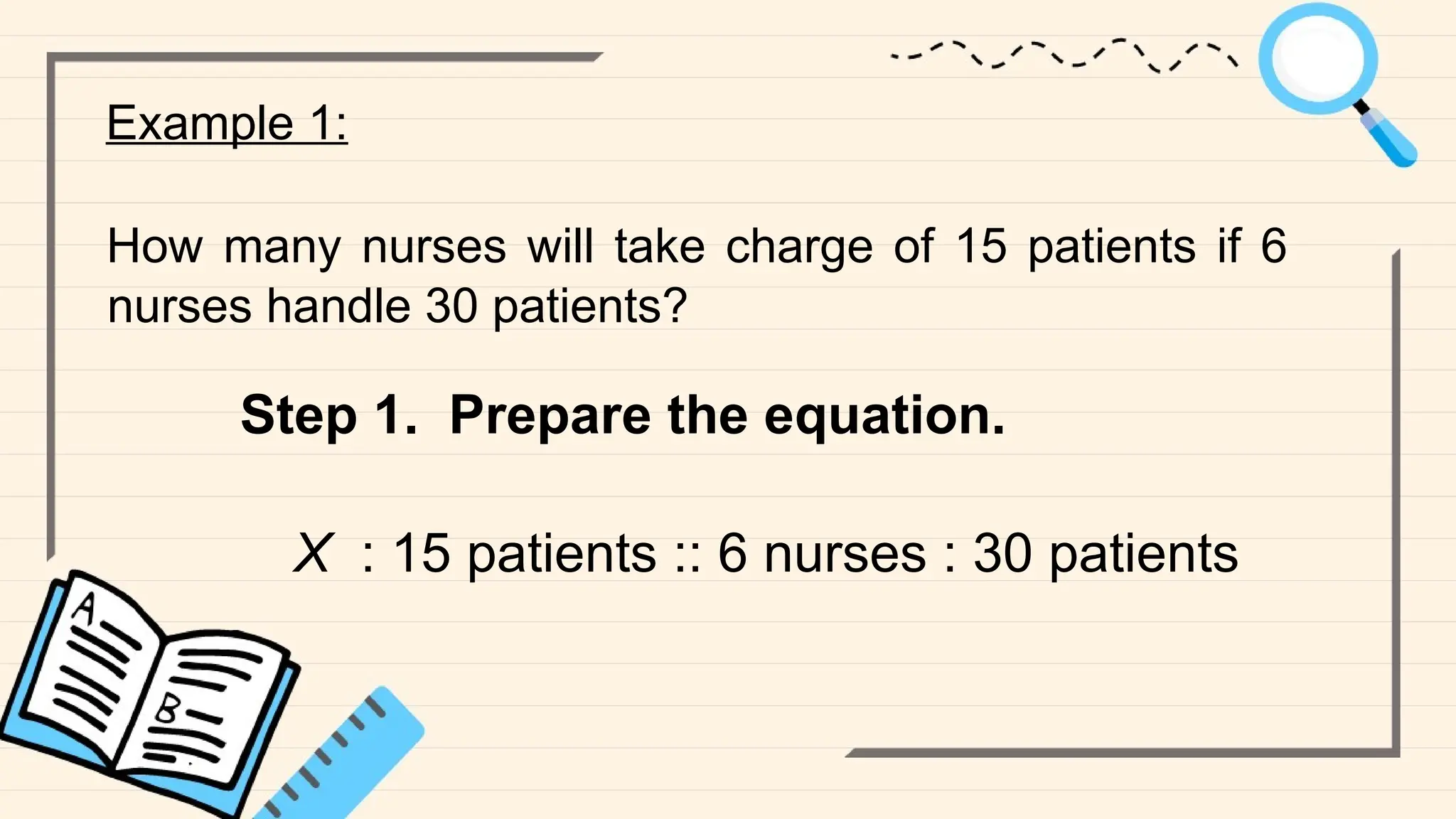
Example 1:
How many nurses will take charge of 15 patients if 6
nurses handle 30 patients?
Step 1. Prepare the equation.
X : 15 patients :: 6 nurses : 30 patients
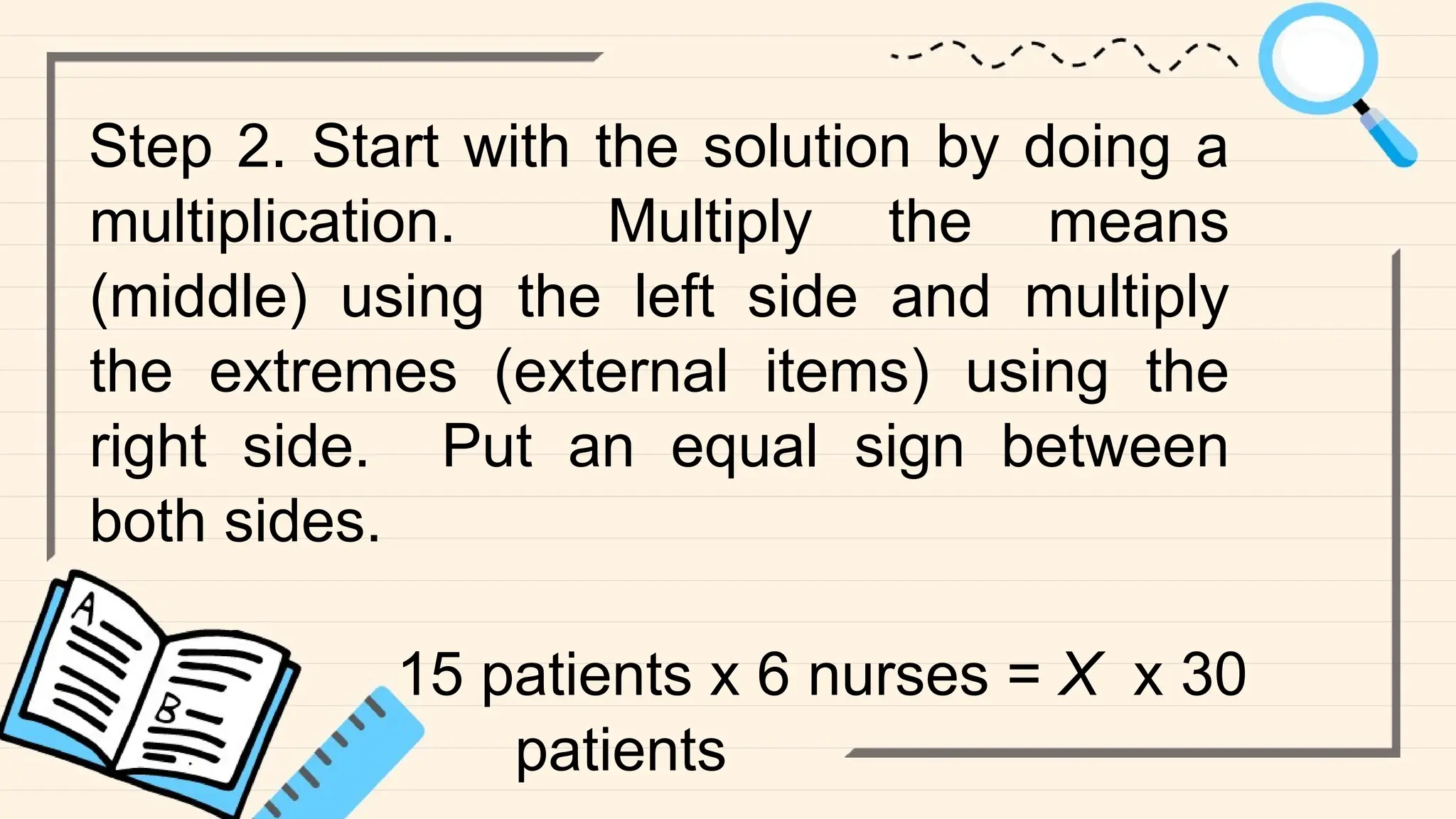
Step 2. Start with the solution by doing a
multiplication. Multiply the means
(middle) using the left side and multiply
the extremes (external items) using the
right side. Put an equal sign between
both sides.
15 patients x 6 nurses = X x 30
patients
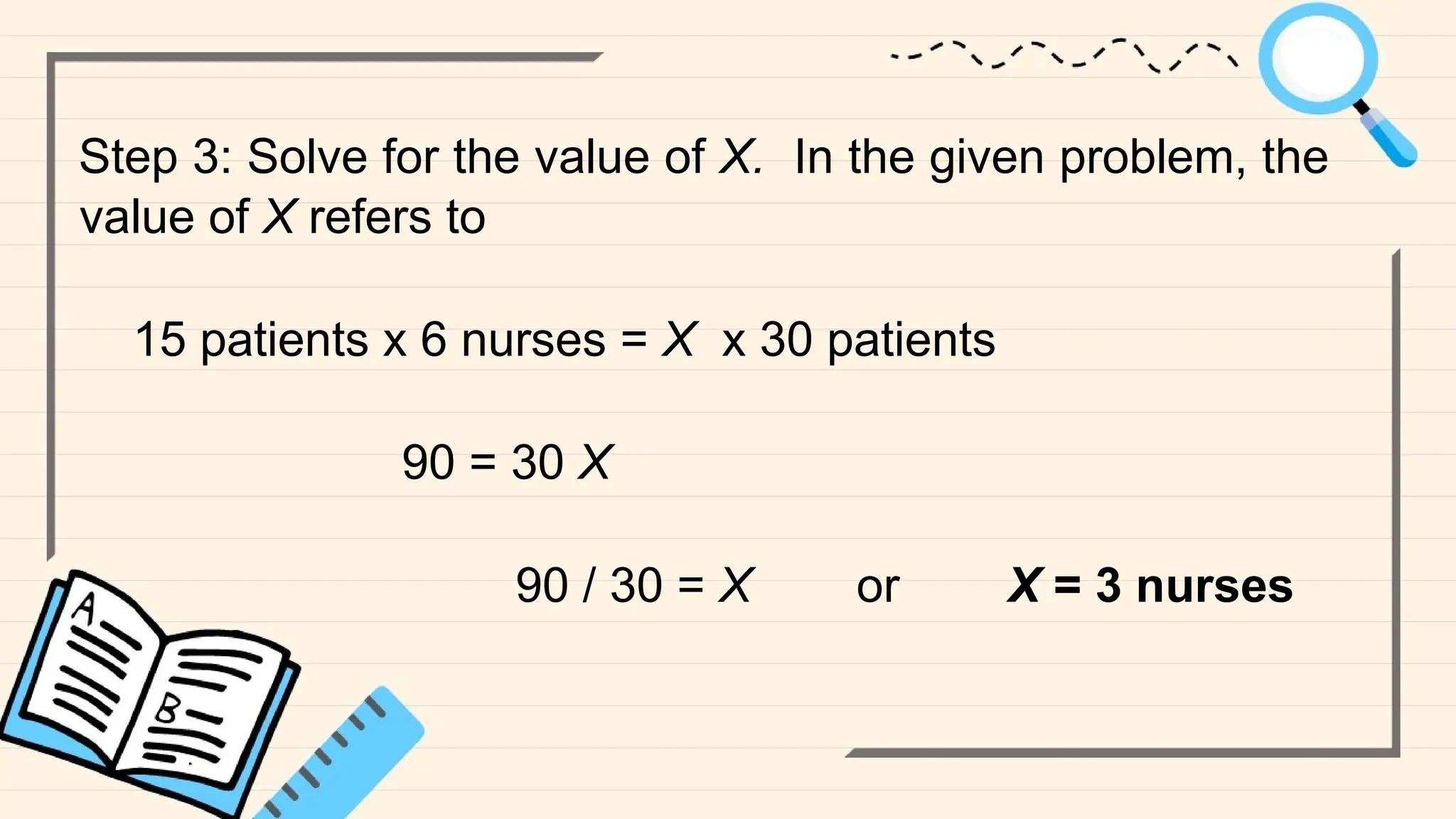
Step 3: Solve for the value of X. In the given problem, the
value of X refers to
15 patients x 6 nurses = X x 30 patients
90 = 30 X
90 / 30 = X or X = 3 nurses
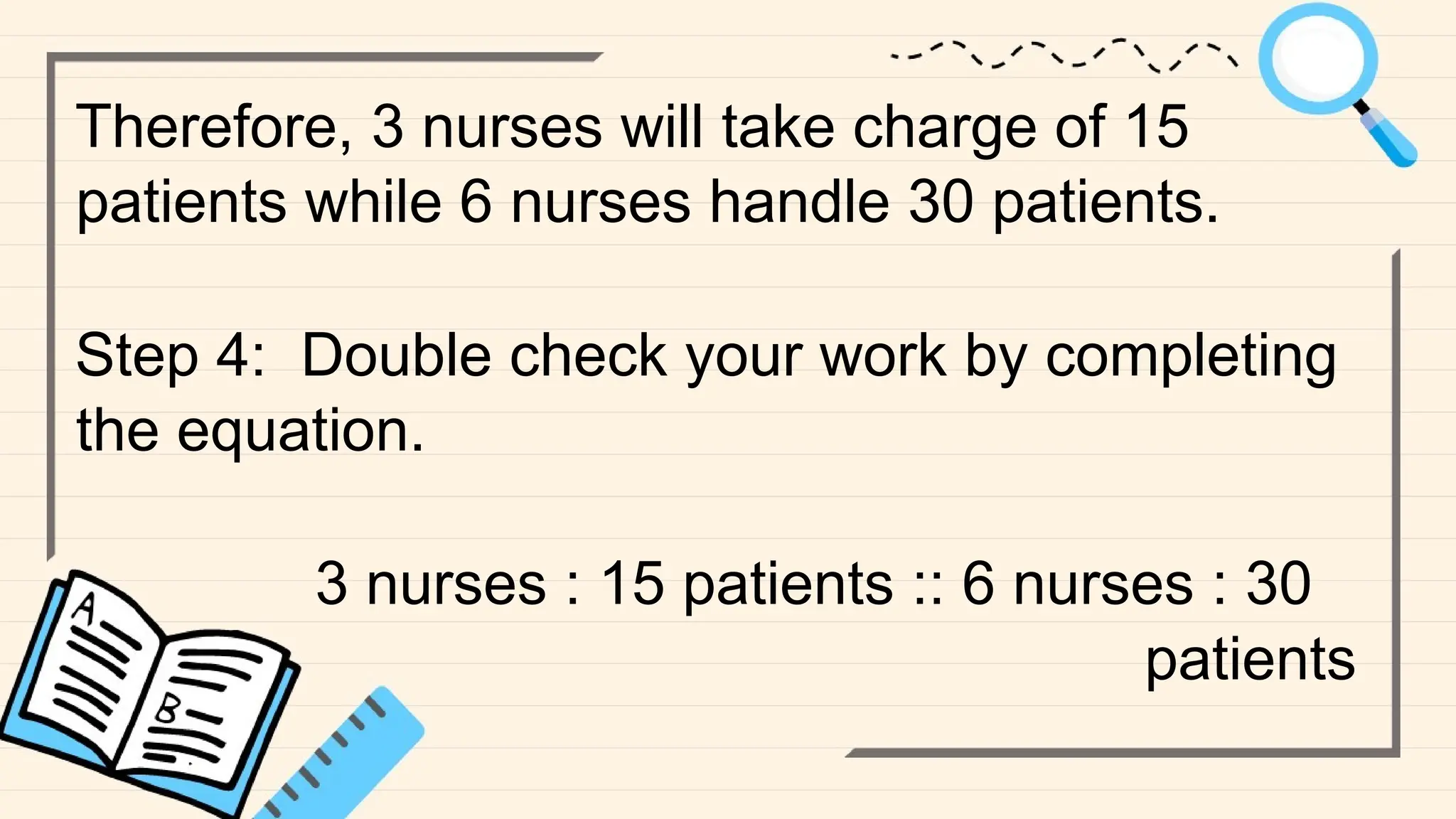
Therefore, 3 nurses will take charge of 15
patients while 6 nurses handle 30 patients.
Step 4: Double check your work by completing
the equation.
3 nurses : 15 patients :: 6 nurses : 30
patients
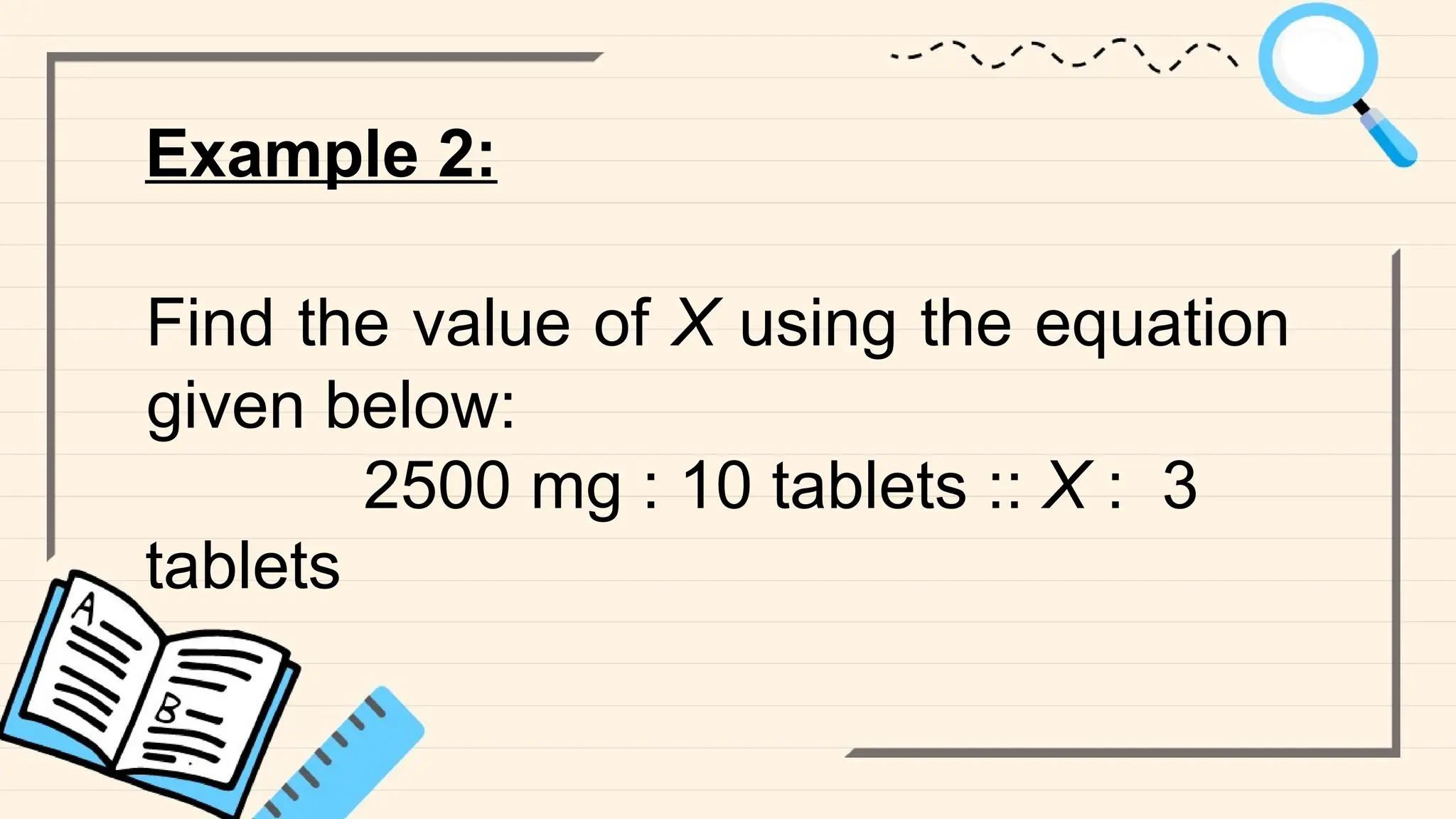
Example 2:
Find the value of X using the equation
given below:
2500 mg : 10 tablets :: X : 3
tablets
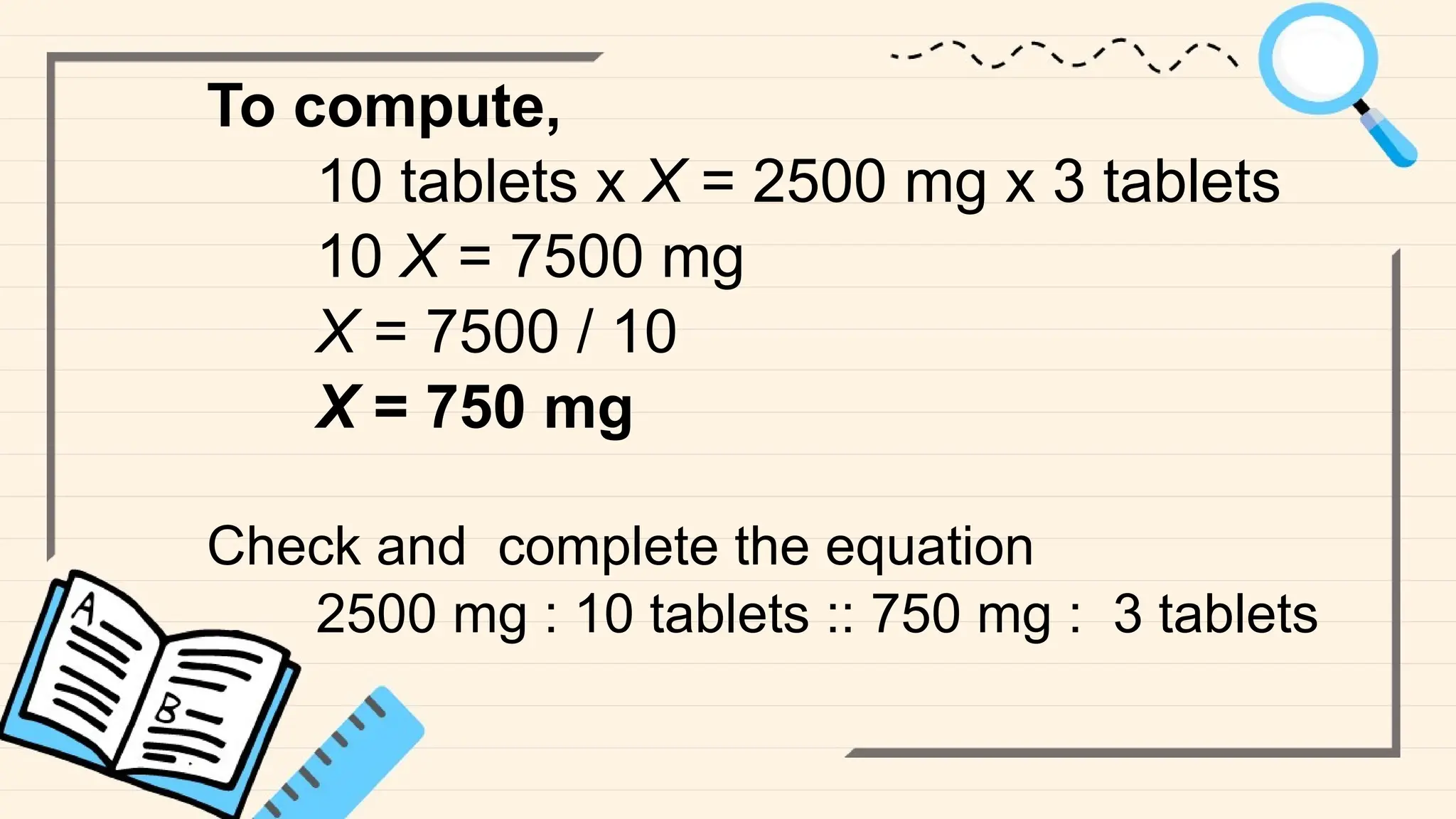
To compute,
10 tablets x X = 2500 mg x 3 tablets
10 X = 7500 mg
X = 7500 / 10
X = 750 mg
Check and complete the equation
2500 mg : 10 tablets :: 750 mg : 3 tablets
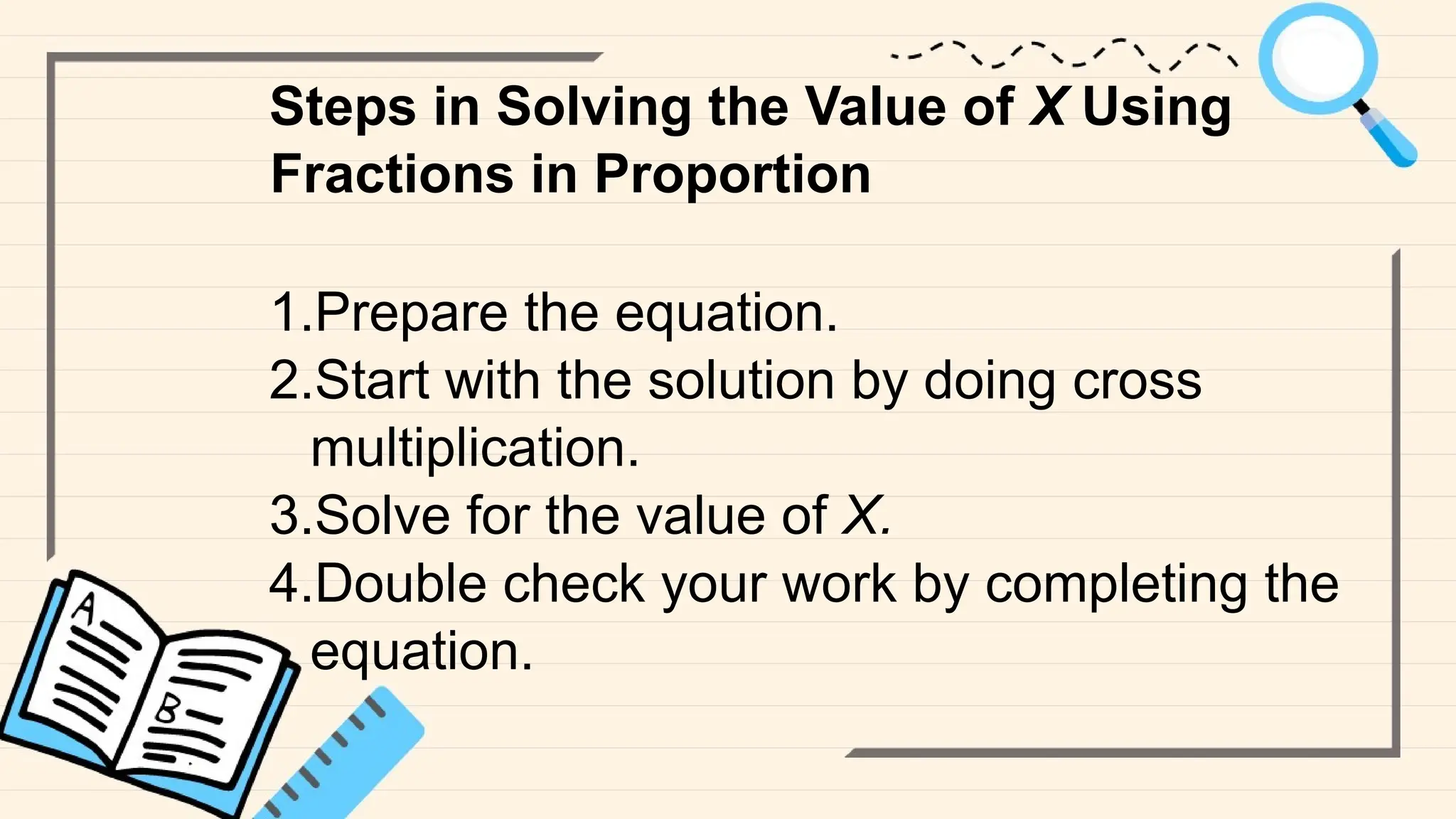
Steps in Solving the Value of X Using
Fractions in Proportion
1.Prepare the equation.
2.Start with the solution by doing cross
multiplication.
3.Solve for the value of X.
4.Double check your work by completing the
equation.
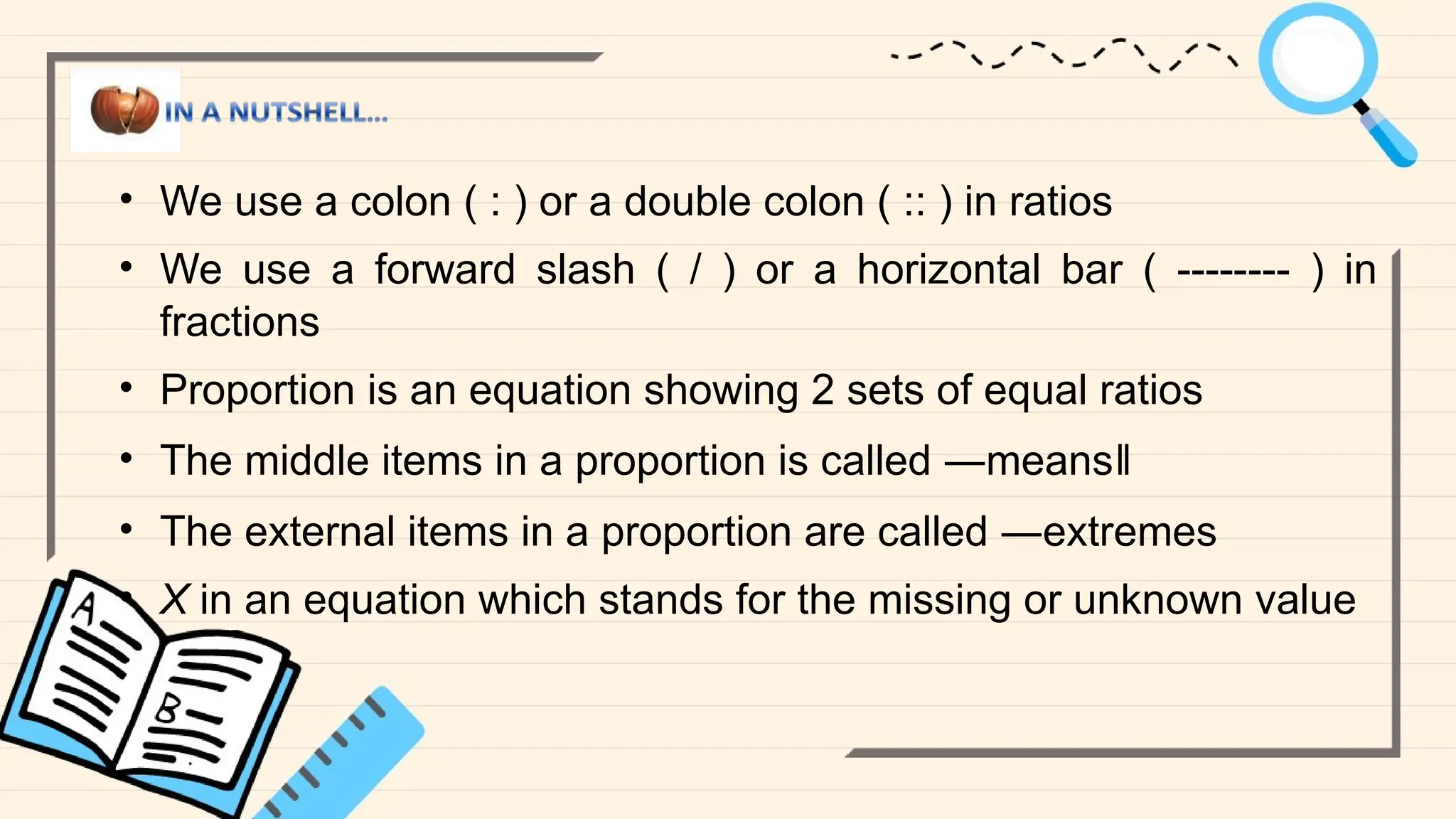
• We use a colon ( : ) or a double colon ( :: ) in ratios
• We use a forward slash ( / ) or a horizontal bar ( -------- ) in
fractions
• Proportion is an equation showing 2 sets of equal ratios
• The middle items in a proportion is called ―means‖
• The external items in a proportion are called ―extremes
• X in an equation which stands for the missing or unknown value
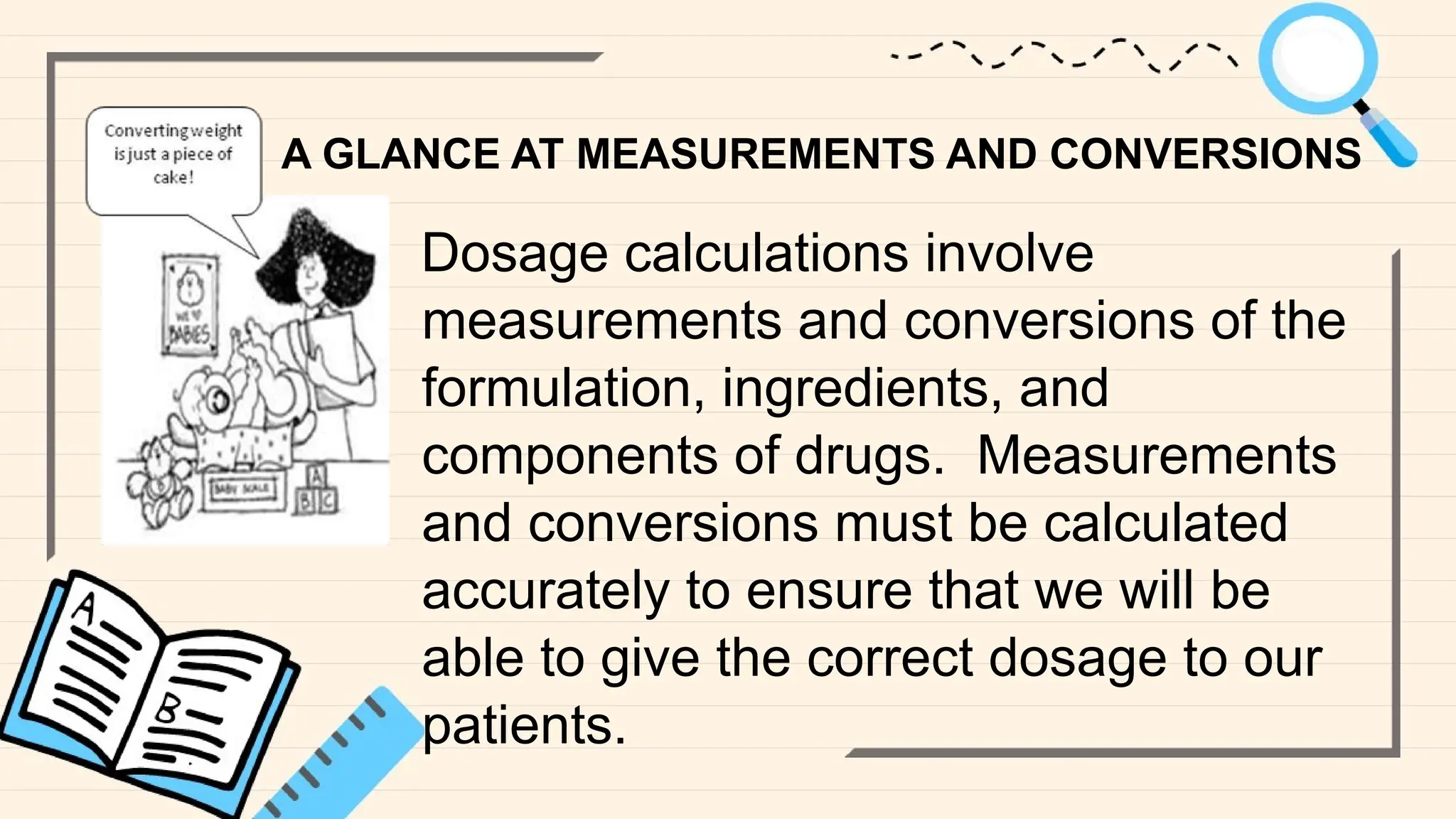
A GLANCE AT MEASUREMENTS AND CONVERSIONS
Dosage calculations involve
measurements and conversions of the
formulation, ingredients, and
components of drugs. Measurements
and conversions must be calculated
accurately to ensure that we will be
able to give the correct dosage to our
patients.
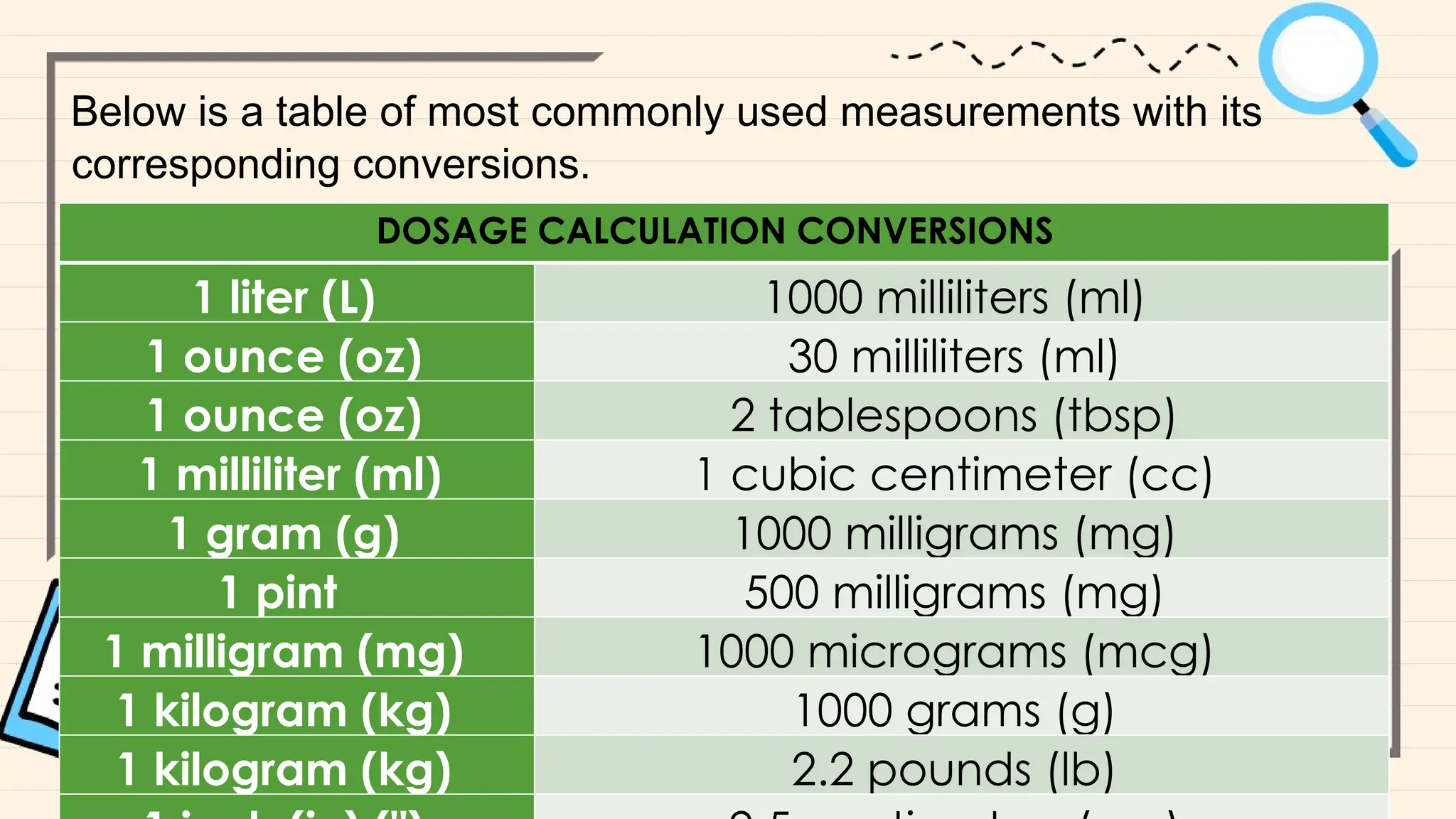
Below is a table of most commonly used measurements with its
corresponding conversions.
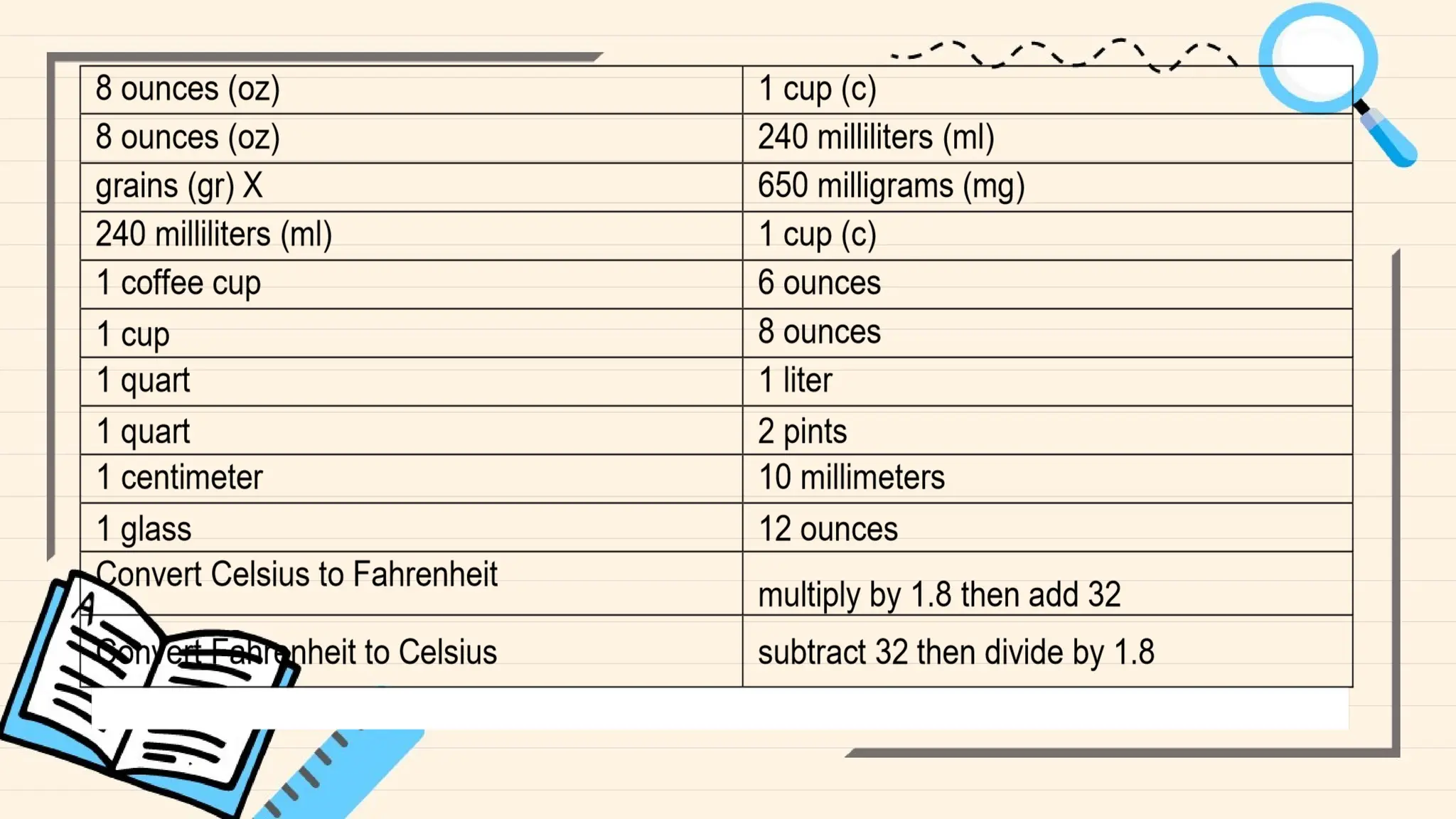
DOSAGE CALCULATION CONVERSIONS
1 liter (L) 1000 milliliters (ml)
1 ounce (oz) 30 milliliters (ml)
1 ounce (oz) 2 tablespoons (tbsp)
1 milliliter (ml) 1 cubic centimeter (cc)
1 gram (g) 1000 milligrams (mg)
1 pint 500 milligrams (mg)
1 milligram (mg) 1000 micrograms (mcg)
1 kilogram (kg) 1000 grams (g)
1 kilogram (kg) 2.2 pounds (lb)
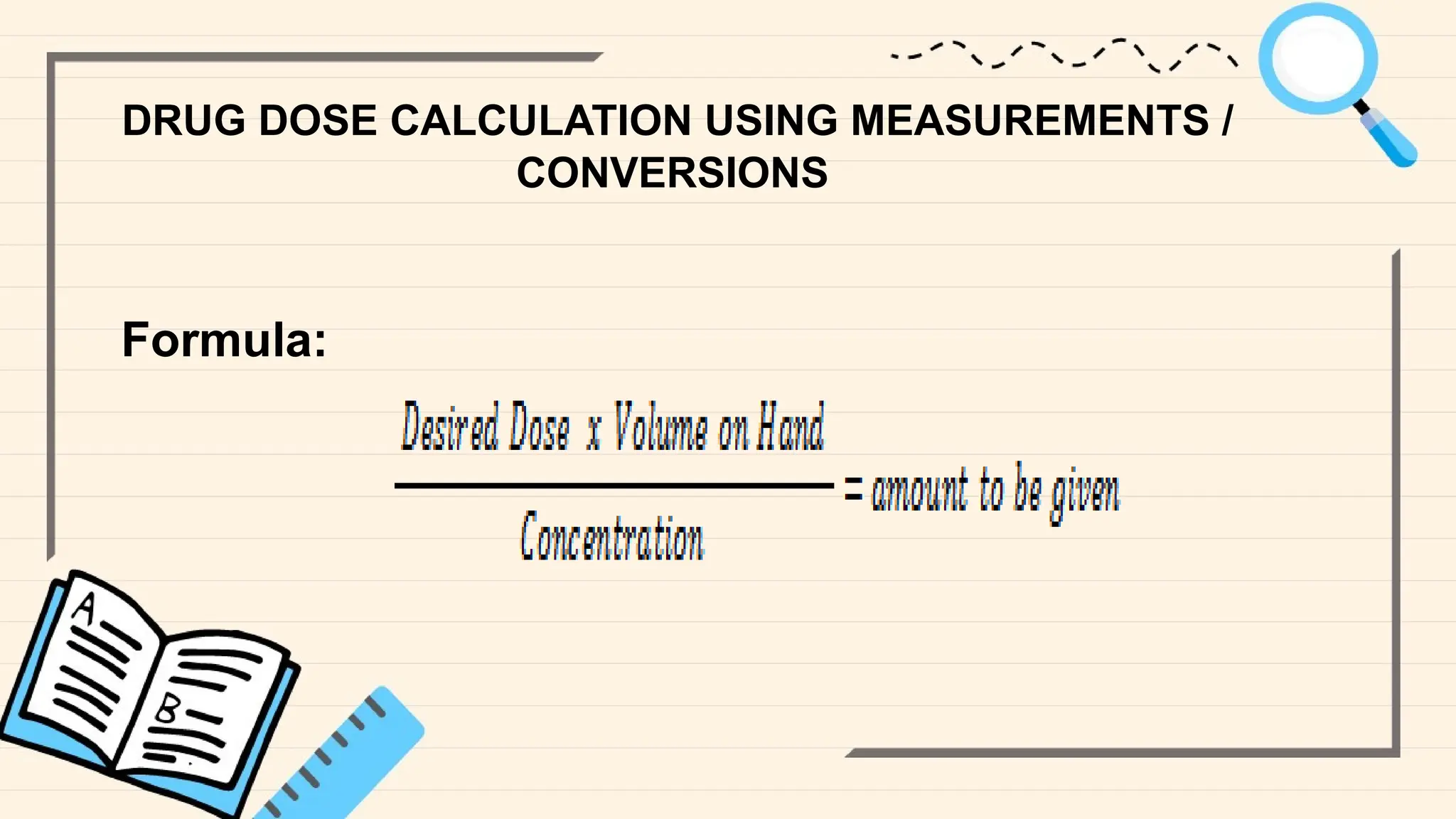
DRUG DOSE CALCULATION USING MEASUREMENTS /
CONVERSIONS
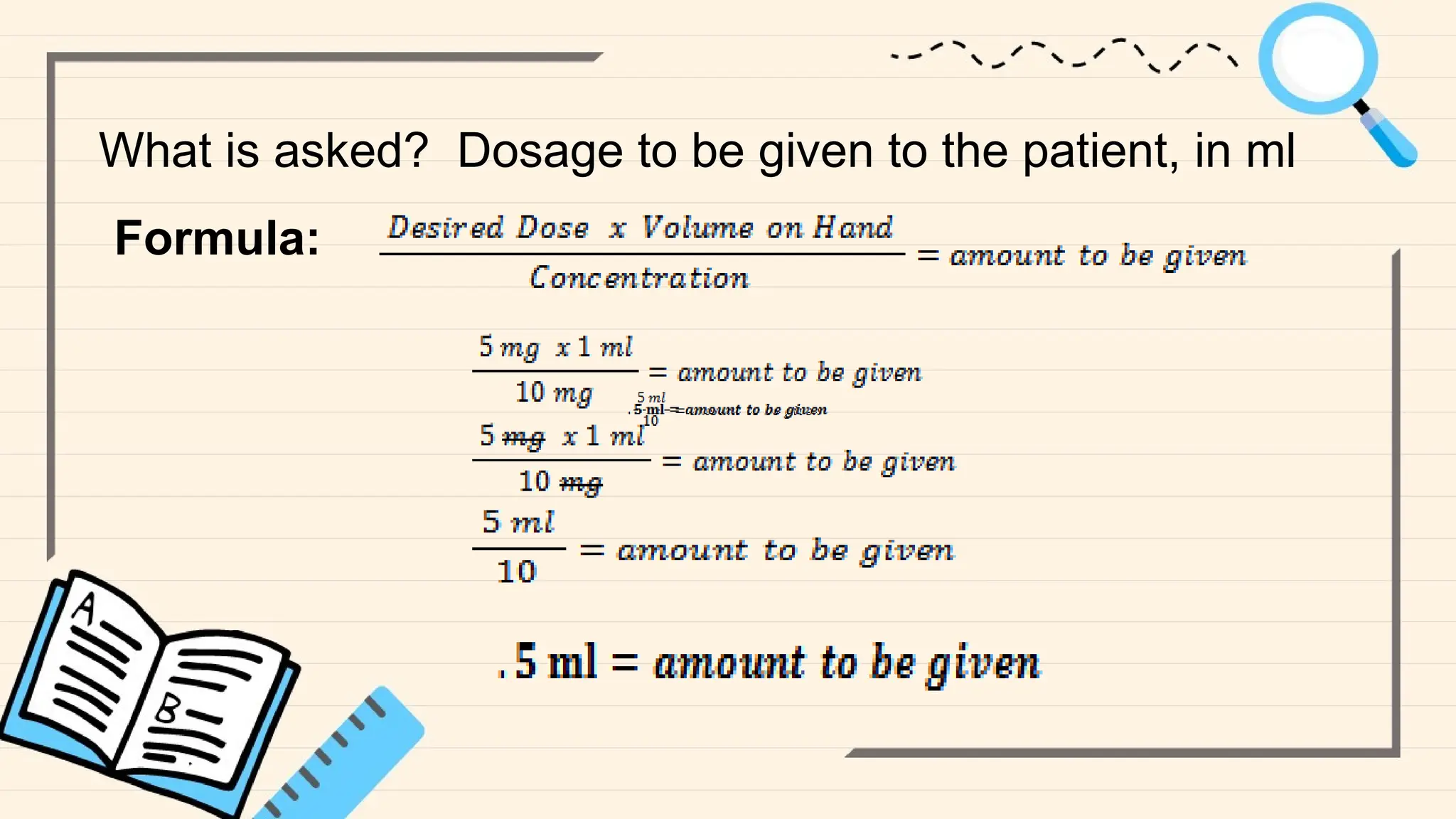
Formula:
Example 1. Doctor orders 5 mg of morphine to be
administered intravenously to a patient with
substernal chest pain. You have 1 ml vial that
contains 10mg of morphine (10 mg/ml). How
many milliliters are you going to have to draw up
into a syringe and push IV into your patient’s IV
line port?
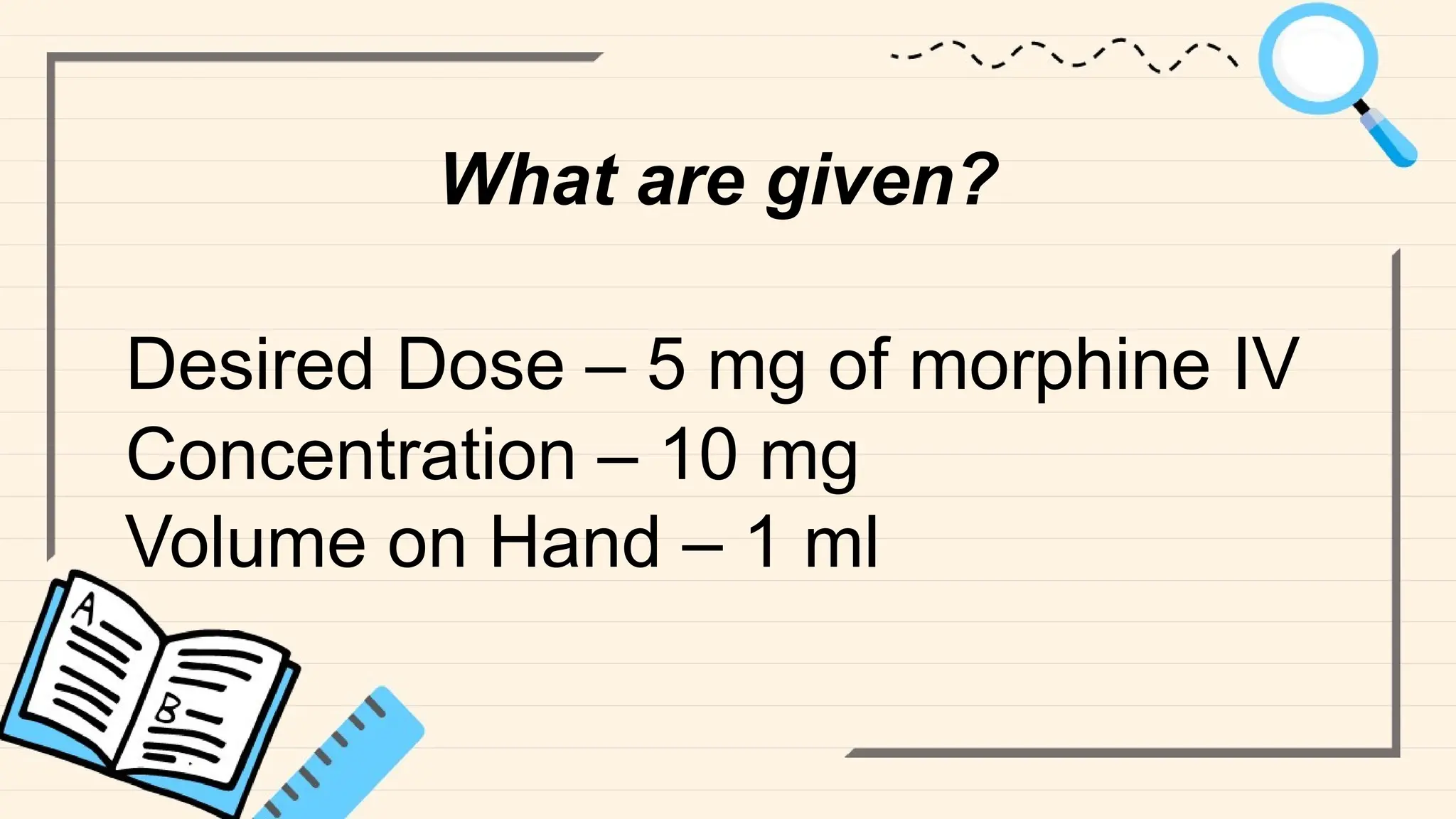
What are given?
Desired Dose – 5 mg of morphine IV
Concentration – 10 mg
Volume on Hand – 1 ml
What is asked? Dosage to be given to the patient, in ml
Formula:
METRIC CONVERSIONS
There are instances when we need to convert a unit of
measurement to another when calculating for drug
dosages.
The metric system of measurements is based on a number
of basic measures or units. Take a quick look at the table
below.
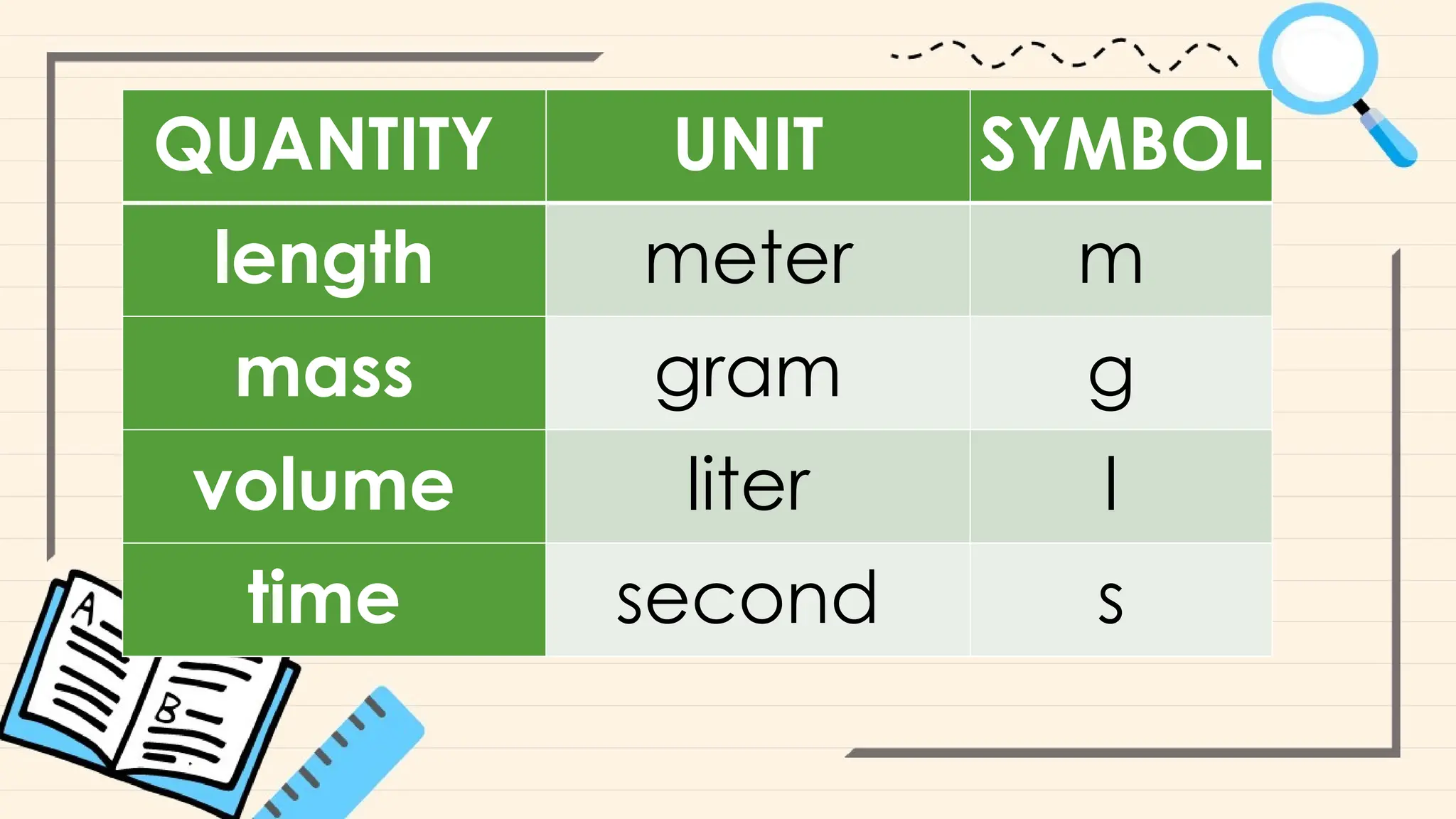
QUANTITY UNIT SYMBOL
length meter m
mass gram g
volume liter l
time second s
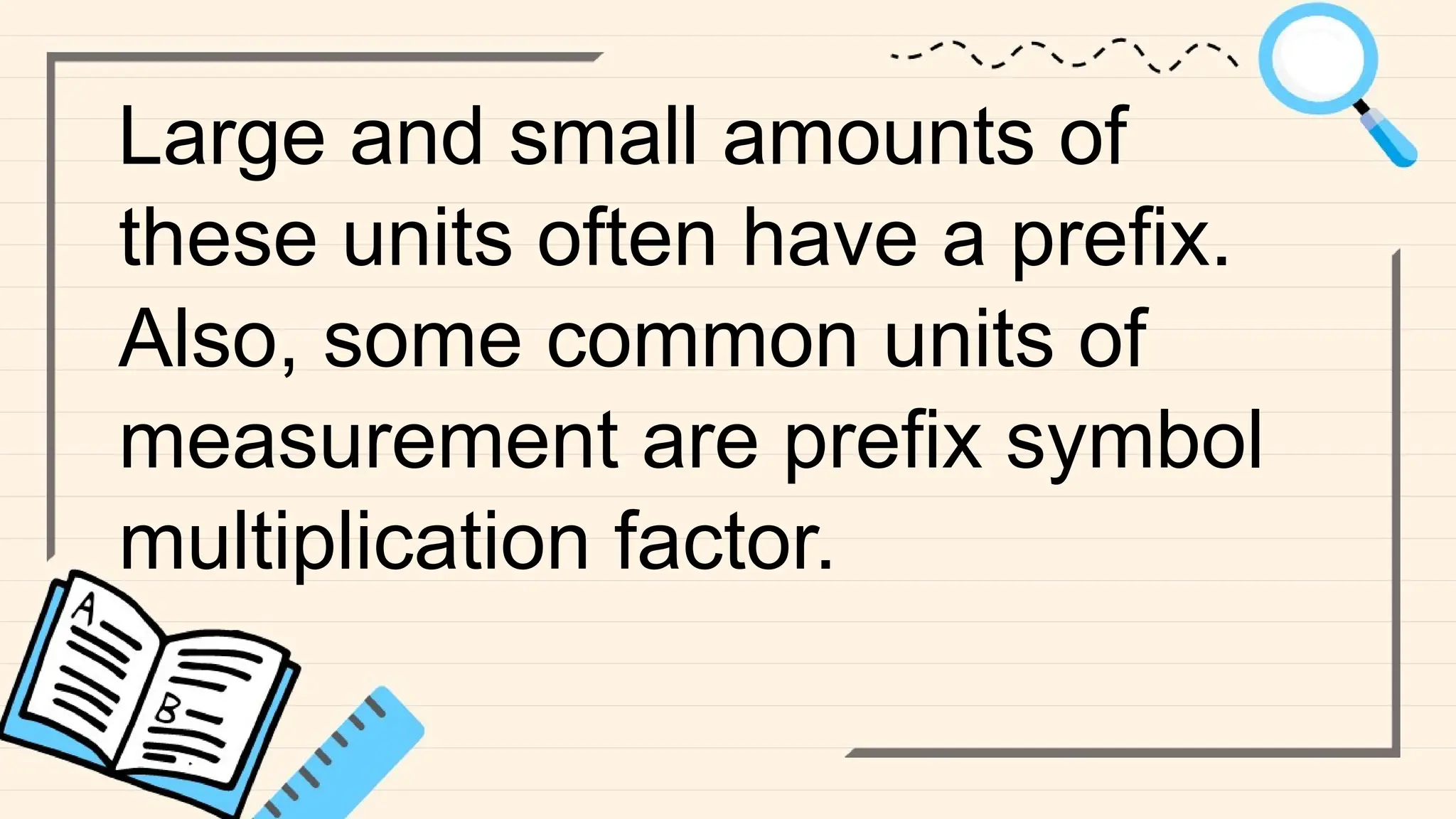
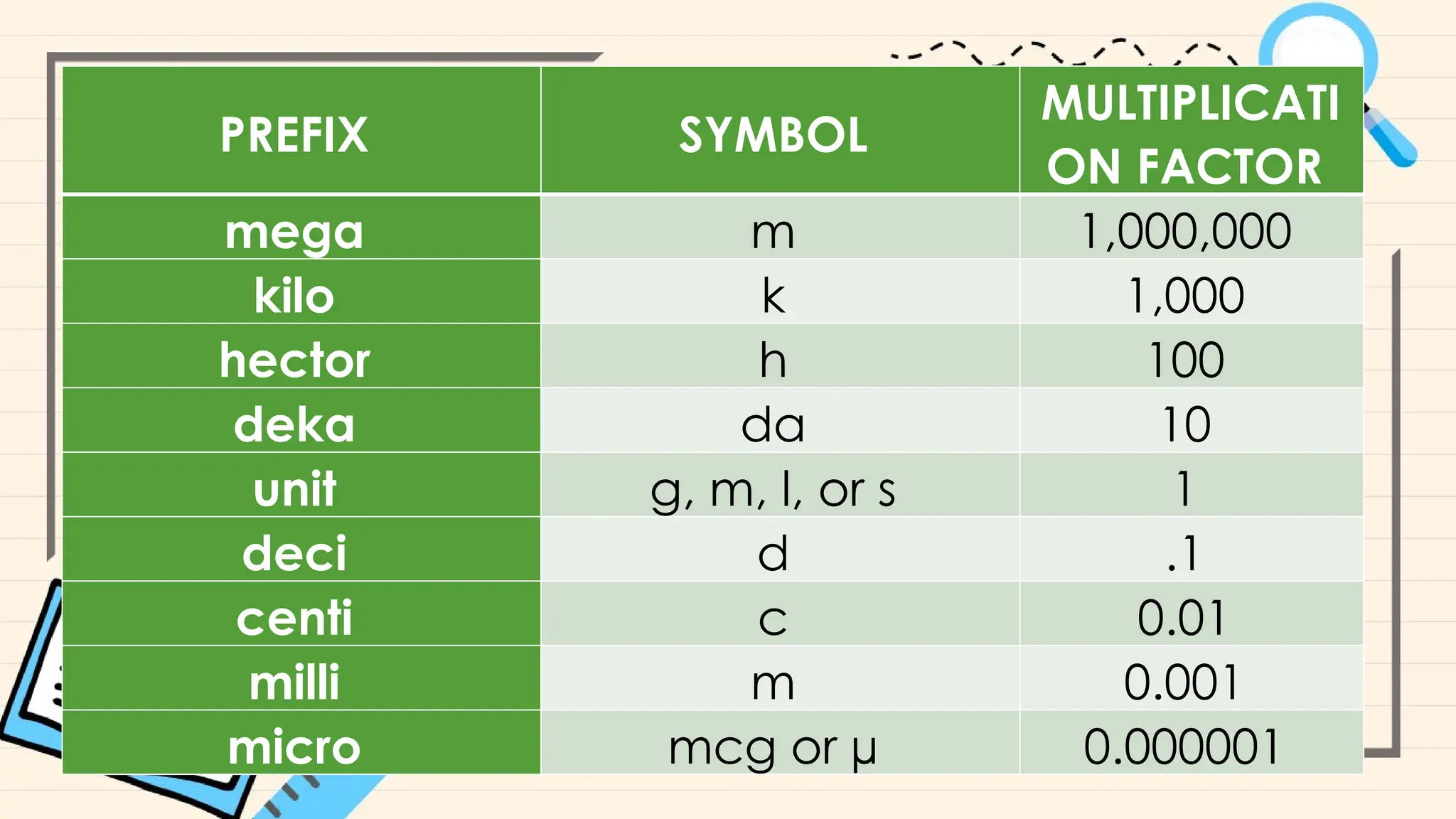
Large and small amounts of
these units often have a prefix.
Also, some common units of
measurement are prefix symbol
multiplication factor.
PREFIX SYMBOL
MULTIPLICATI
ON FACTOR
mega m 1,000,000
kilo k 1,000
hector h 100
deka da 10
unit g, m, l, or s 1
deci d .1
centi c 0.01
milli m 0.001
micro mcg or µ 0.000001
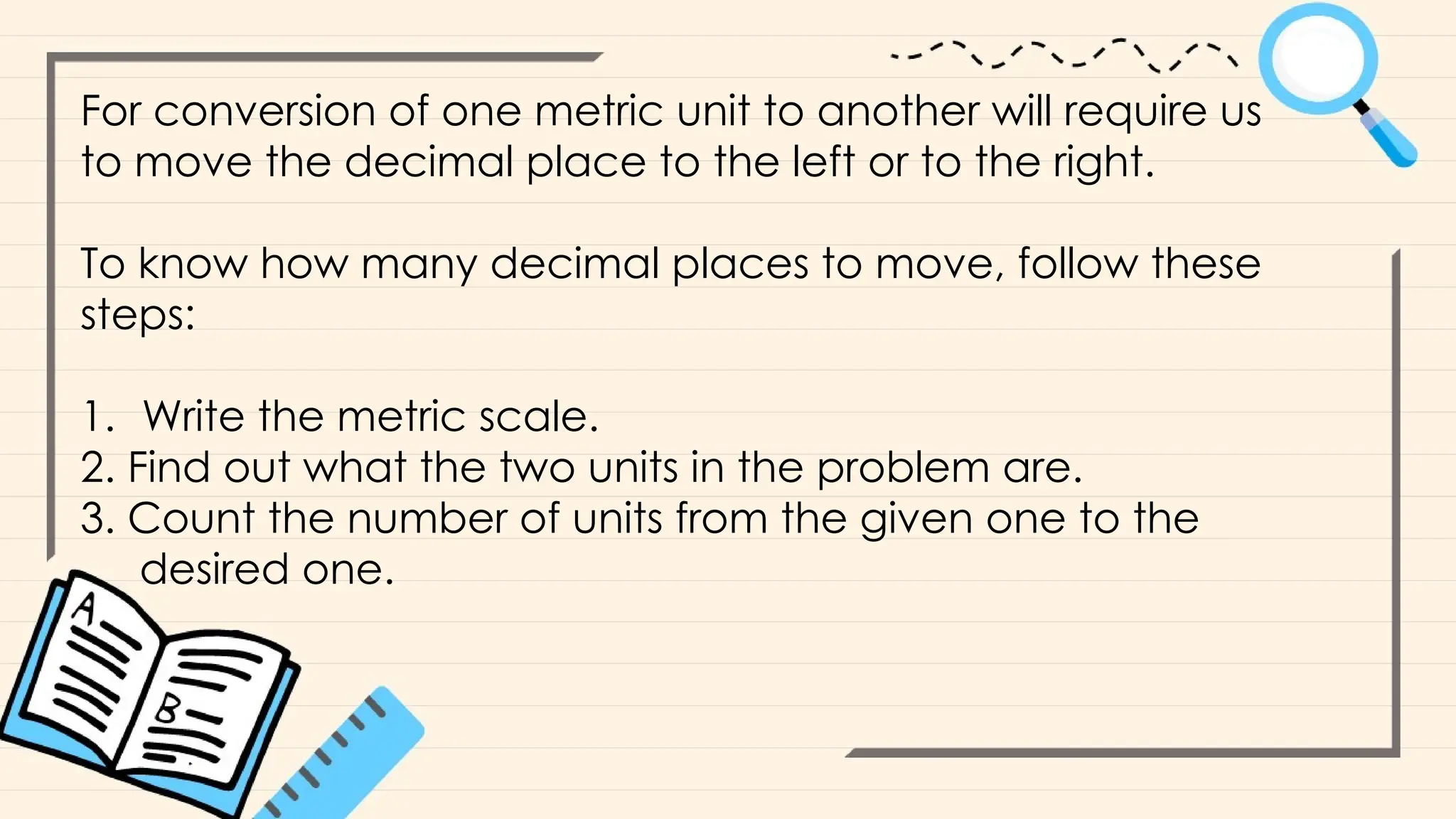
For conversion of one metric unit to another will require us
to move the decimal place to the left or to the right.
To know how many decimal places to move, follow these
steps:
1. Write the metric scale.
2. Find out what the two units in the problem are.
3. Count the number of units from the given one to the
desired one.
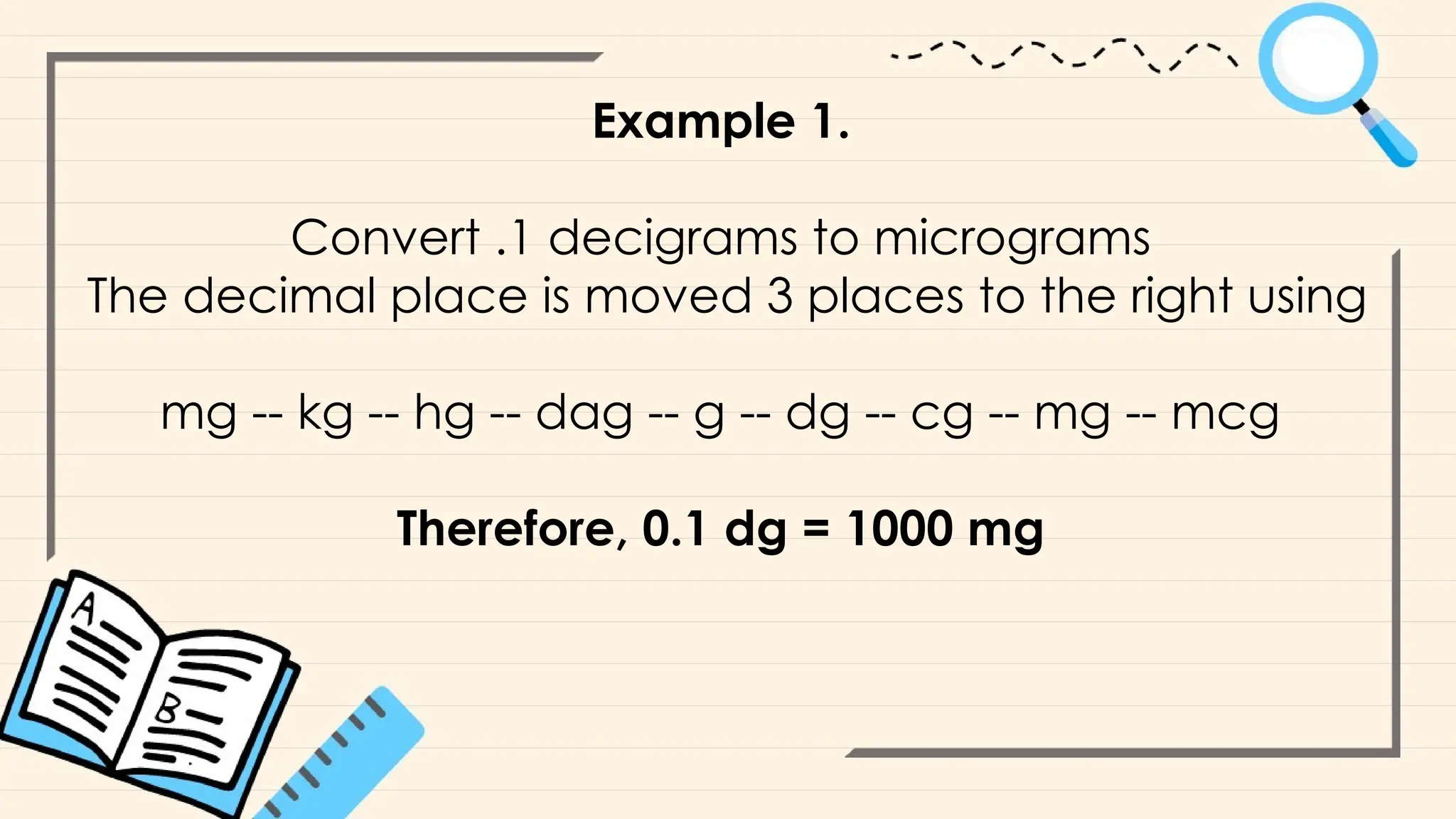
Example 1.
Convert .1 decigrams to micrograms
The decimal place is moved 3 places to the right using
mg -- kg -- hg -- dag -- g -- dg -- cg -- mg -- mcg
Therefore, 0.1 dg = 1000 mg
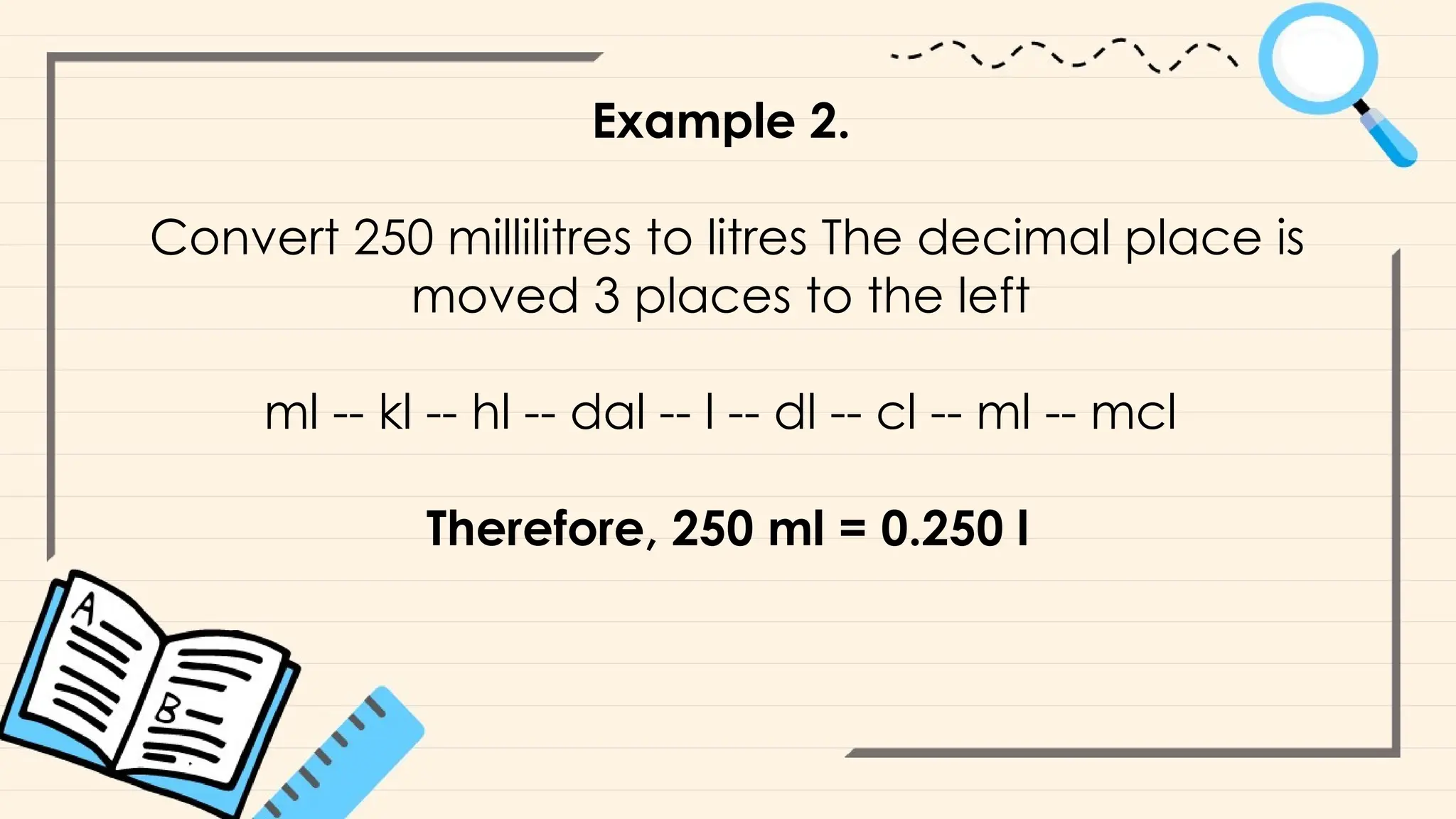
Example 2.
Convert 250 millilitres to litres The decimal place is
moved 3 places to the left
ml -- kl -- hl -- dal -- l -- dl -- cl -- ml -- mcl
Therefore, 250 ml = 0.250 l
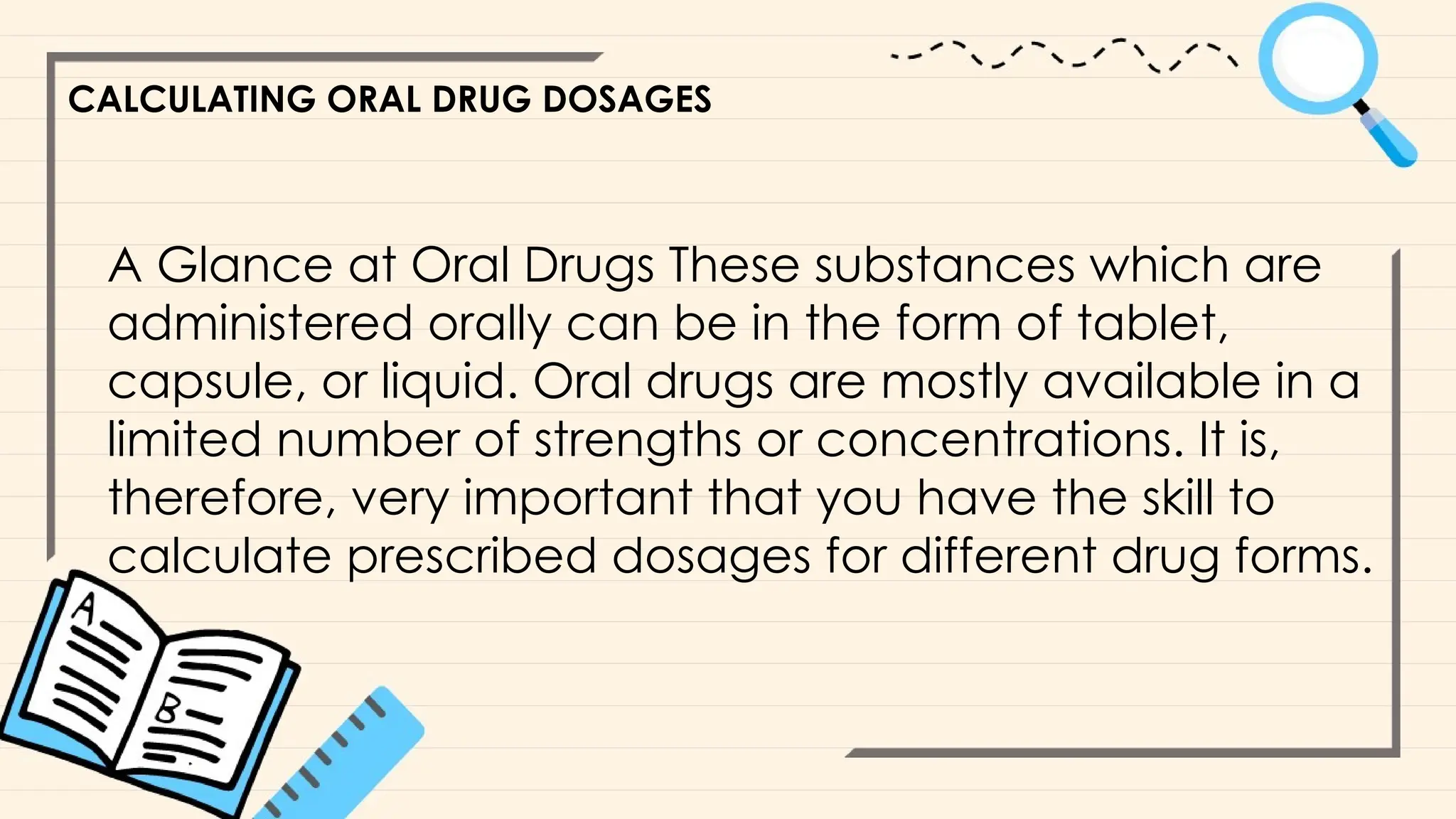
CALCULATING ORAL DRUG DOSAGES
A Glance at Oral Drugs These substances which are
administered orally can be in the form of tablet,
capsule, or liquid. Oral drugs are mostly available in a
limited number of strengths or concentrations. It is,
therefore, very important that you have the skill to
calculate prescribed dosages for different drug forms.
Interpreting Oral Drug Labels
For you to administer an oral drug safely,
you must make sure that it is the correct
drug with the right dosage. Therefore, it is
very vital that you would be able to read
and interpret oral drug labels.
1. Identify the Drug Name
Know the difference between the brand
name and generic name. Verify the
generic name first. If the drug has two
names, the generic name usually
appears in lowercase print and
sometimes in parentheses.
2. See the Dosage Strength
After identifying the drug name, look for the dose
strength on the label.
Important: Pay close attention to the labels of two
same drugs which may look exactly alike aside from
that of the dose strength. One of them might indicate
125mg and the other one is 250mg. Be keen in
checking the dose strength because it forms part
of the dosage calculation.
3. Check the Expiration Date
You also must check the expiry date. It
is a vital information which is sometimes
overlooked. Tip: For best shelf life, store
all medications in a cool, dry place.
Calculating Drug Dosages
Most of the time, you will use ratios in
proportion to compute for drug dosages.
At this point in time, you should already be
familiar in dealing with the equation using
ratios in proportions.
Rules in Calculating Drug Dosages
Remember the rules to accurately
calculate drug dosages and eliminate
errors as well.
1. Use the correct units of measure to
avoid errors in calculating doses.
2. Be careful in placing decimal and zero.
3. Double-check strange answers.
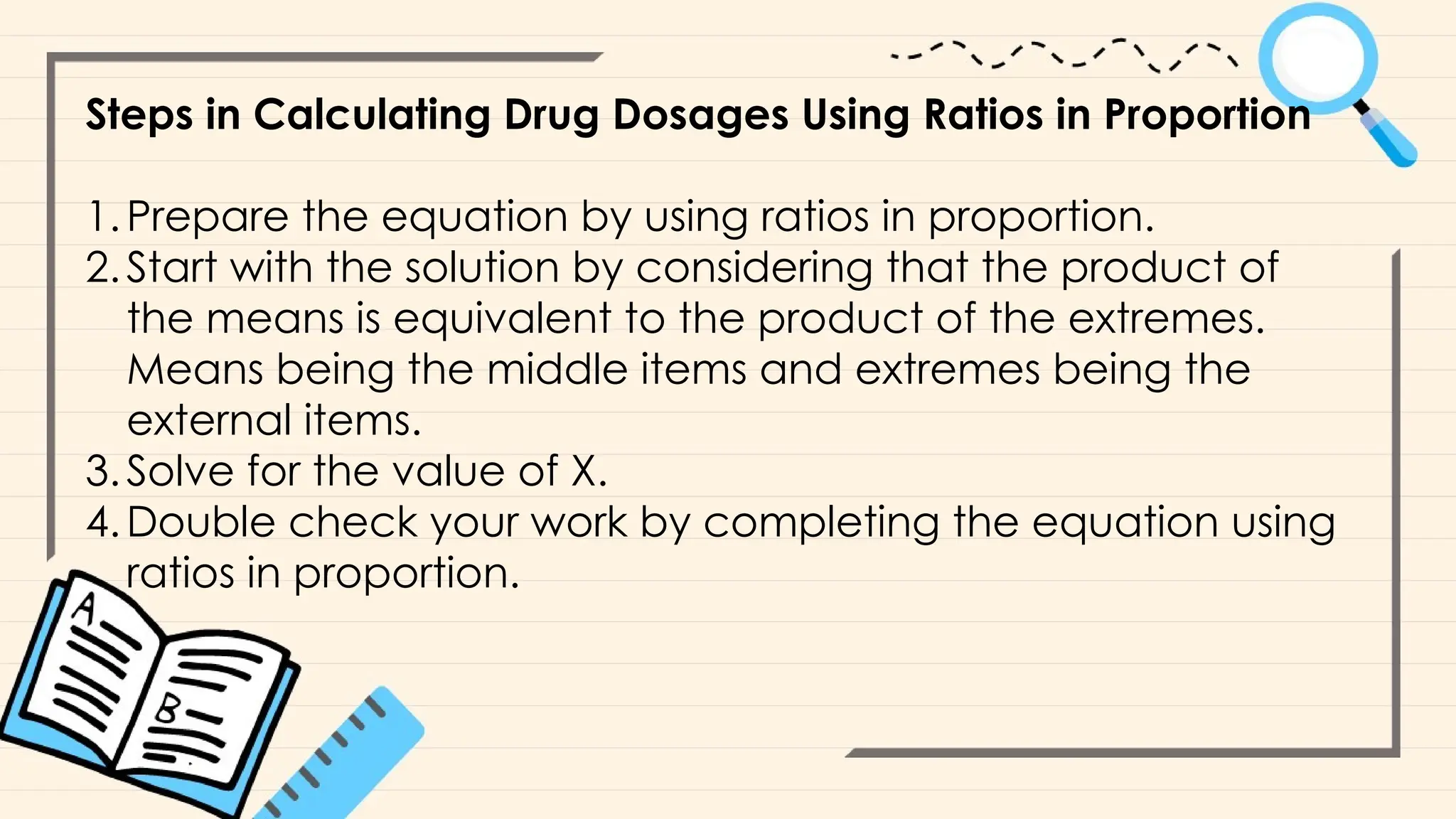
Steps in Calculating Drug Dosages Using Ratios in Proportion
1.Prepare the equation by using ratios in proportion.
2.Start with the solution by considering that the product of
the means is equivalent to the product of the extremes.
Means being the middle items and extremes being the
external items.
3.Solve for the value of X.
4.Double check your work by completing the equation using
ratios in proportion.
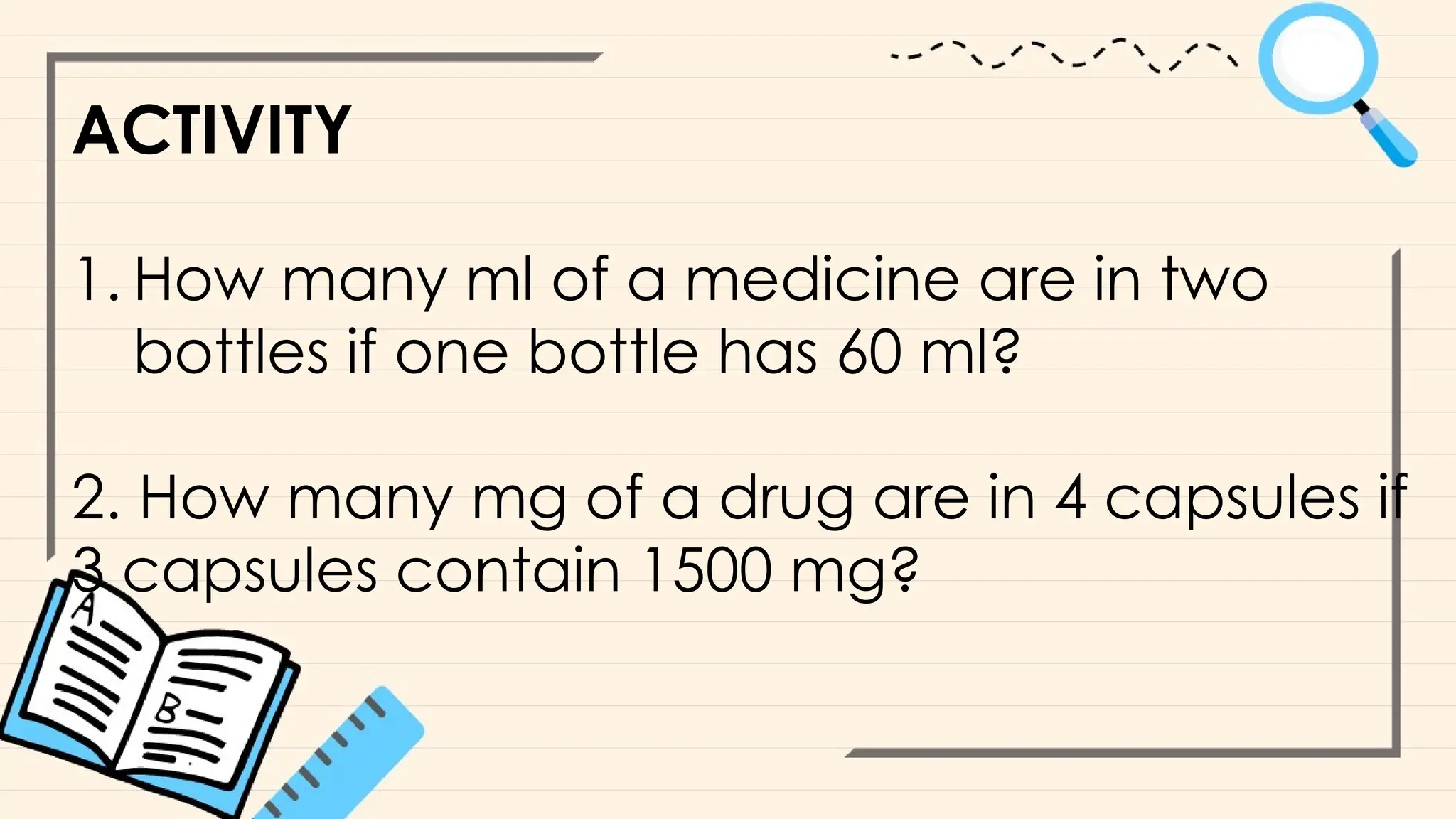
ACTIVITY
1. How many ml of a medicine are in two
bottles if one bottle has 60 ml?
2. How many mg of a drug are in 4 capsules if
3 capsules contain 1500 mg?
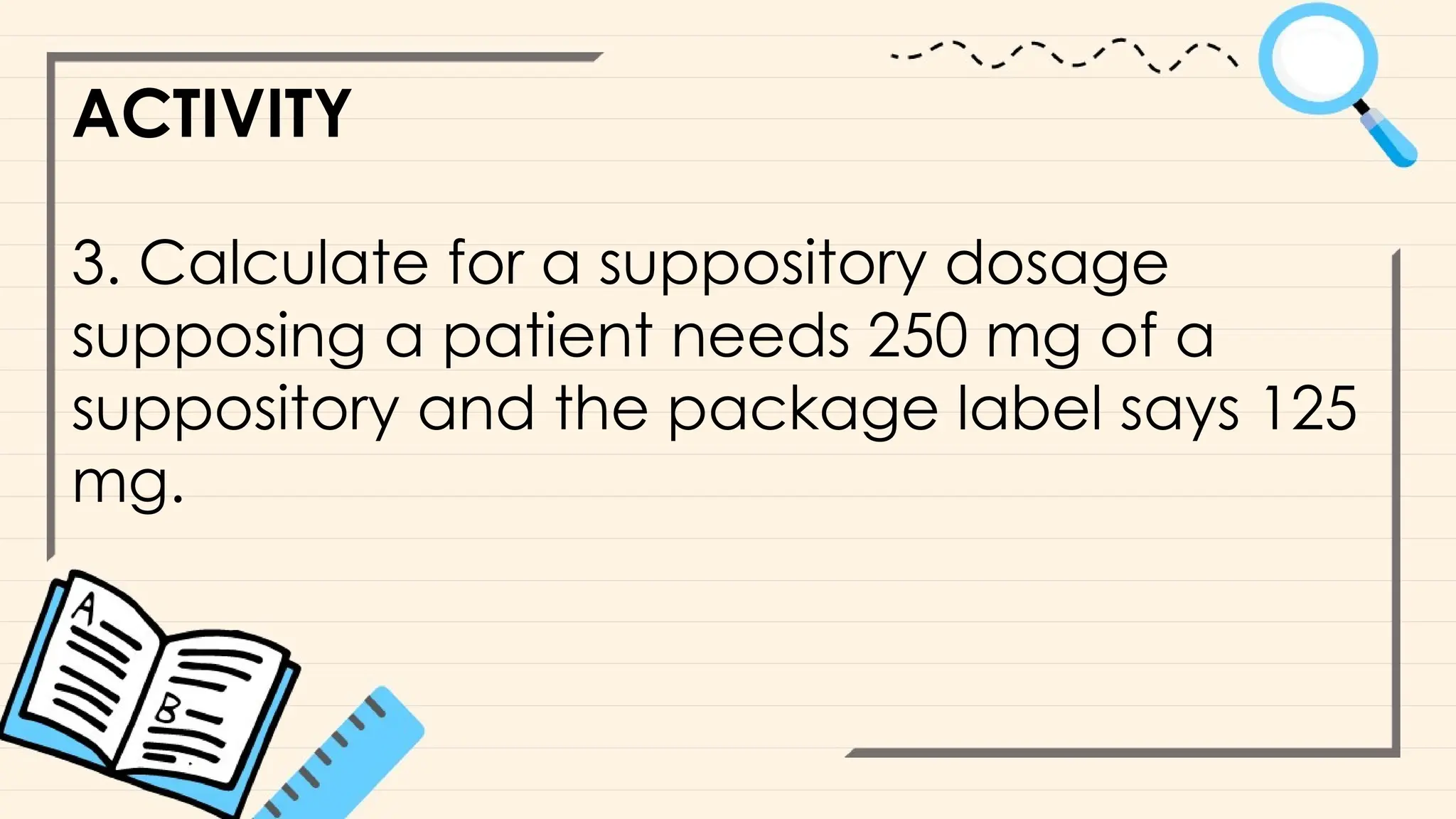
ACTIVITY
3. Calculate for a suppository dosage
supposing a patient needs 250 mg of a
suppository and the package label says 125
mg.
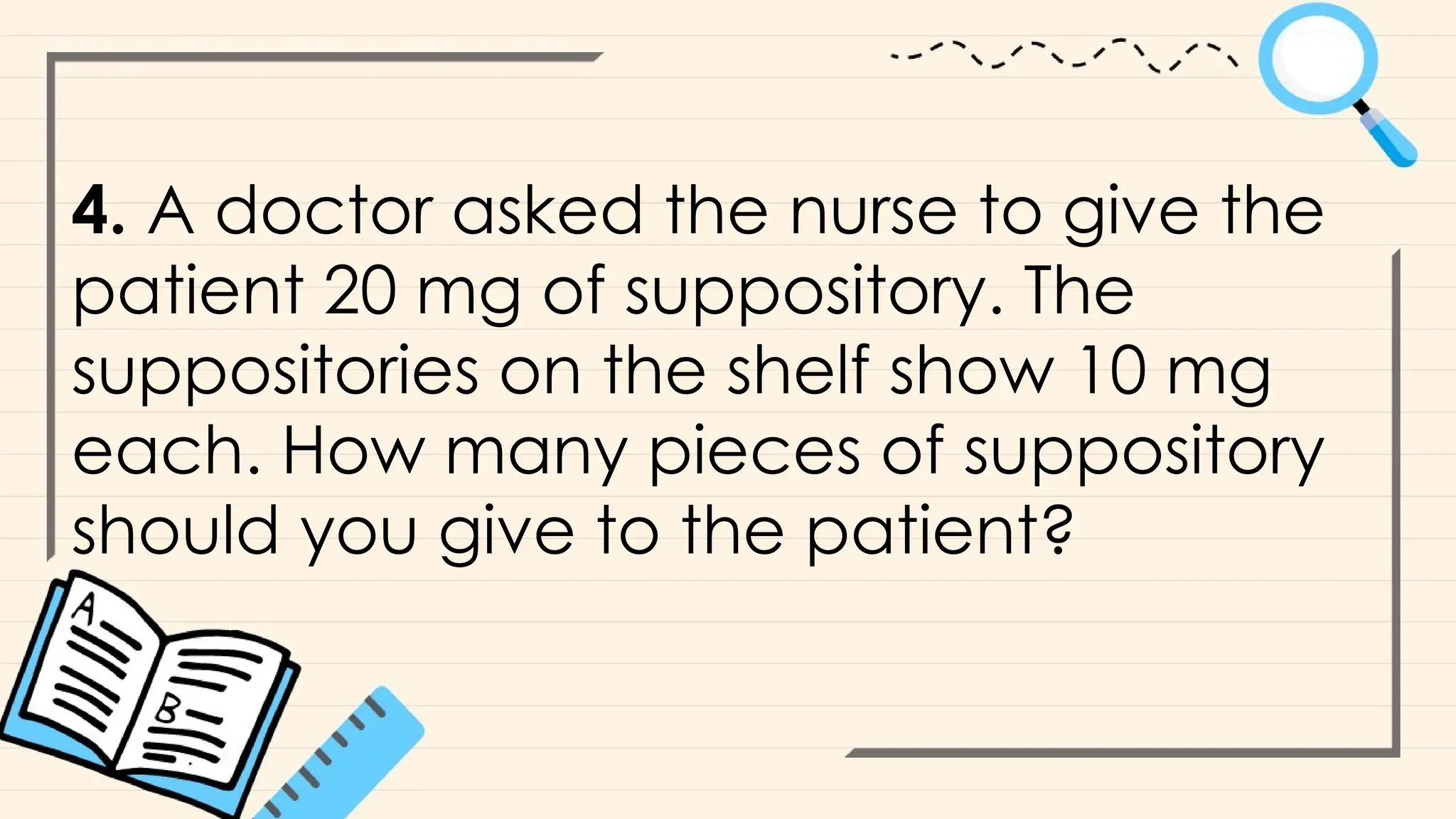
4. A doctor asked the nurse to give the
patient 20 mg of suppository. The
suppositories on the shelf show 10 mg
each. How many pieces of suppository
should you give to the patient?
A GLANCE AT RECTAL DRUGS
Rectal drugs are medications prepared
specifically for insertion into the rectum. They
could be in the form of cream, lotion, or
ointment. Administering the drugs rectally is best
for patients who cannot take drugs orally. Rectal
drugs include enemas and suppositories
Interpret Rectal Drug Labels
As we administer medicines to our patients, it is
vital to read drug labels at all times. Paying
close attention to the drug labels helps us
calculate the dosage we will give to our
patients.
- identify the drug name / generic name
- check for the dose strength
- expiration date
Types of Rectal Drugs
1. Enema - the injection of liquid into the
rectum through the anus for cleansing,
for stimulating evacuation of the bowels,
or for other therapeutic or diagnostic
purposes
Types of Rectal Drugs
2. Suppository - a small piece of
medicated substance, usually conical,
ovoid, or cylindrical, introduced into a
body passage, as the rectum or vagina,
where body heat causes it to melt
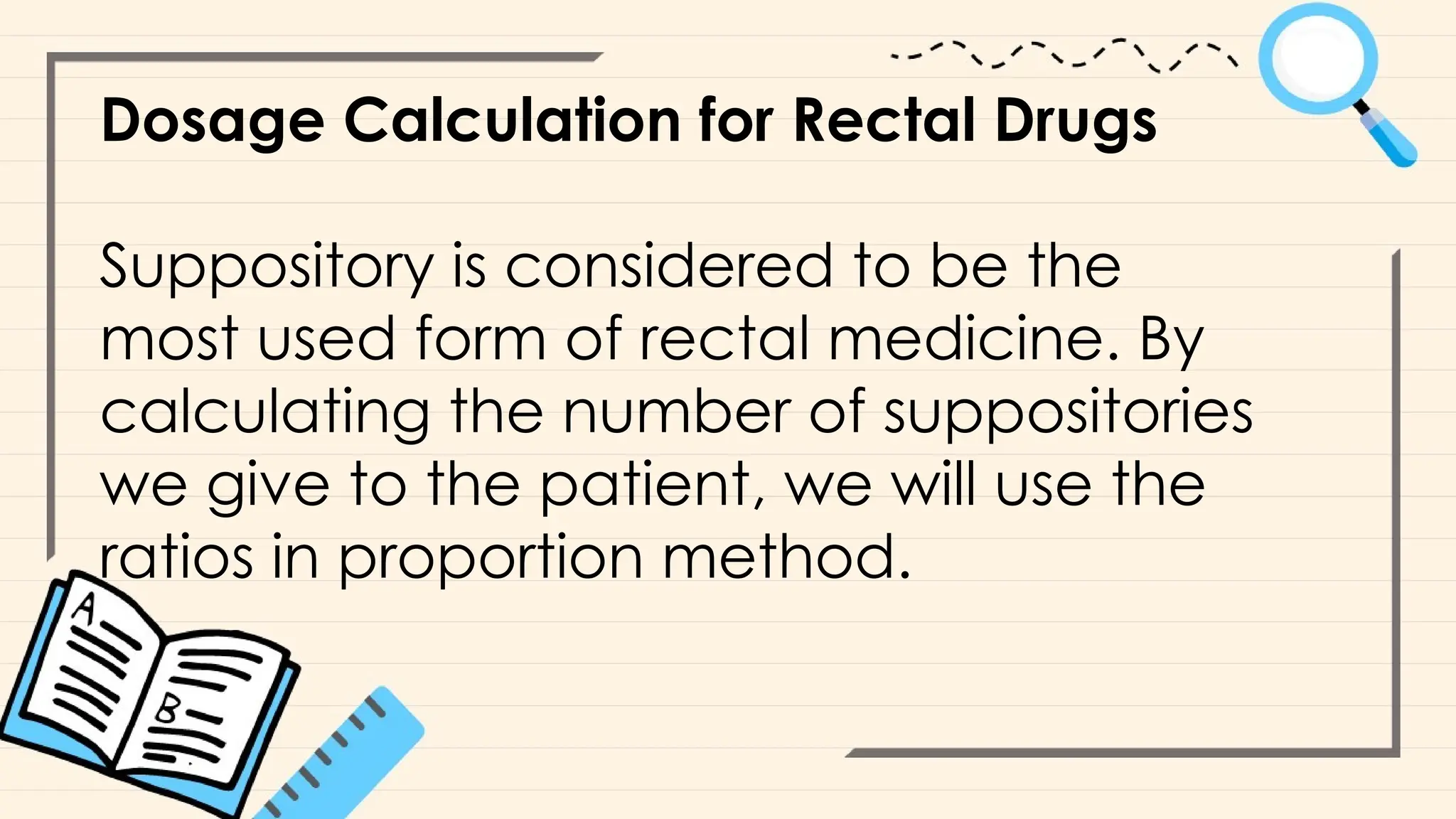
Dosage Calculation for Rectal Drugs
Suppository is considered to be the
most used form of rectal medicine. By
calculating the number of suppositories
we give to the patient, we will use the
ratios in proportion method.
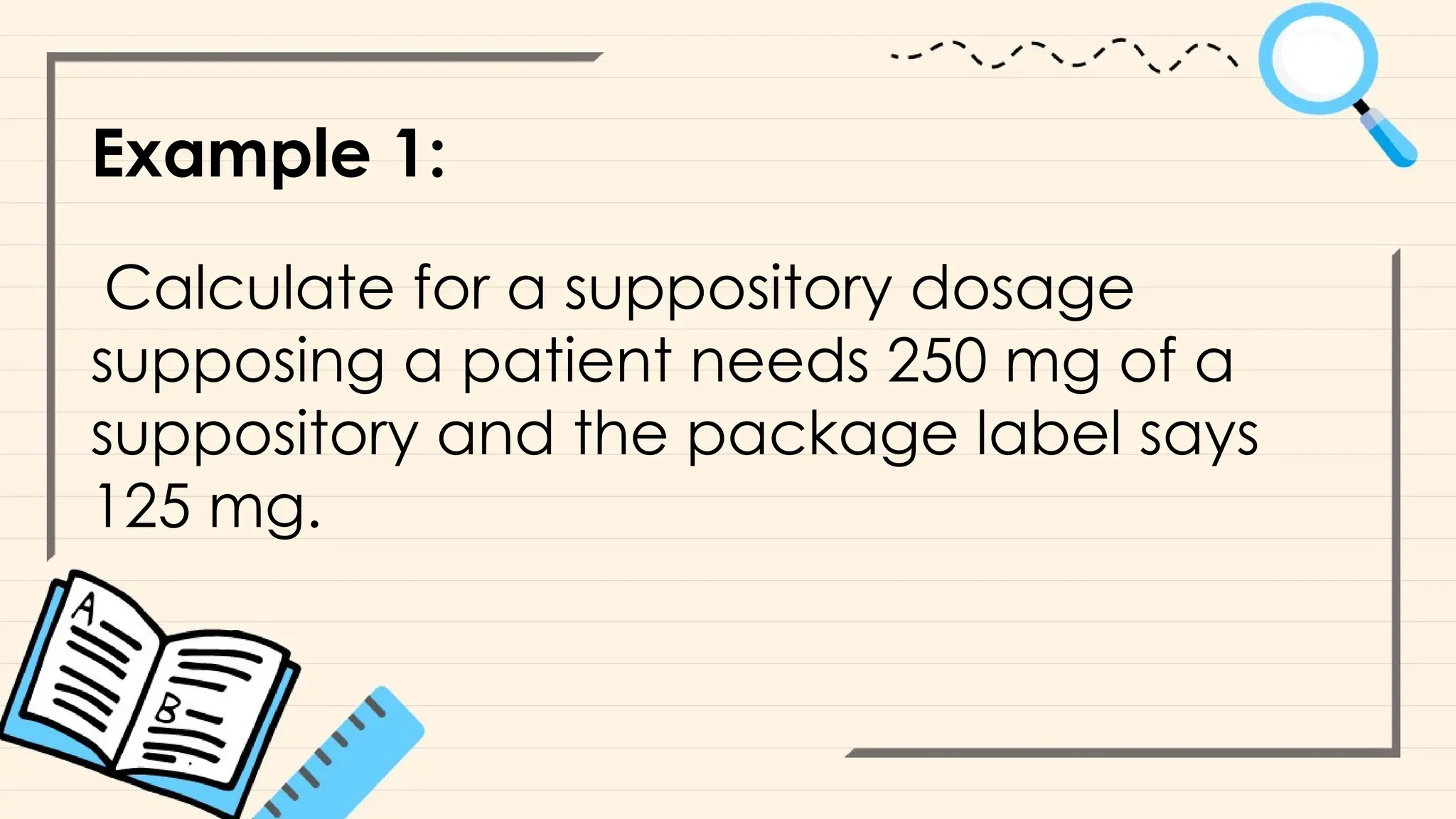
Example 1:
Calculate for a suppository dosage
supposing a patient needs 250 mg of a
suppository and the package label says
125 mg.
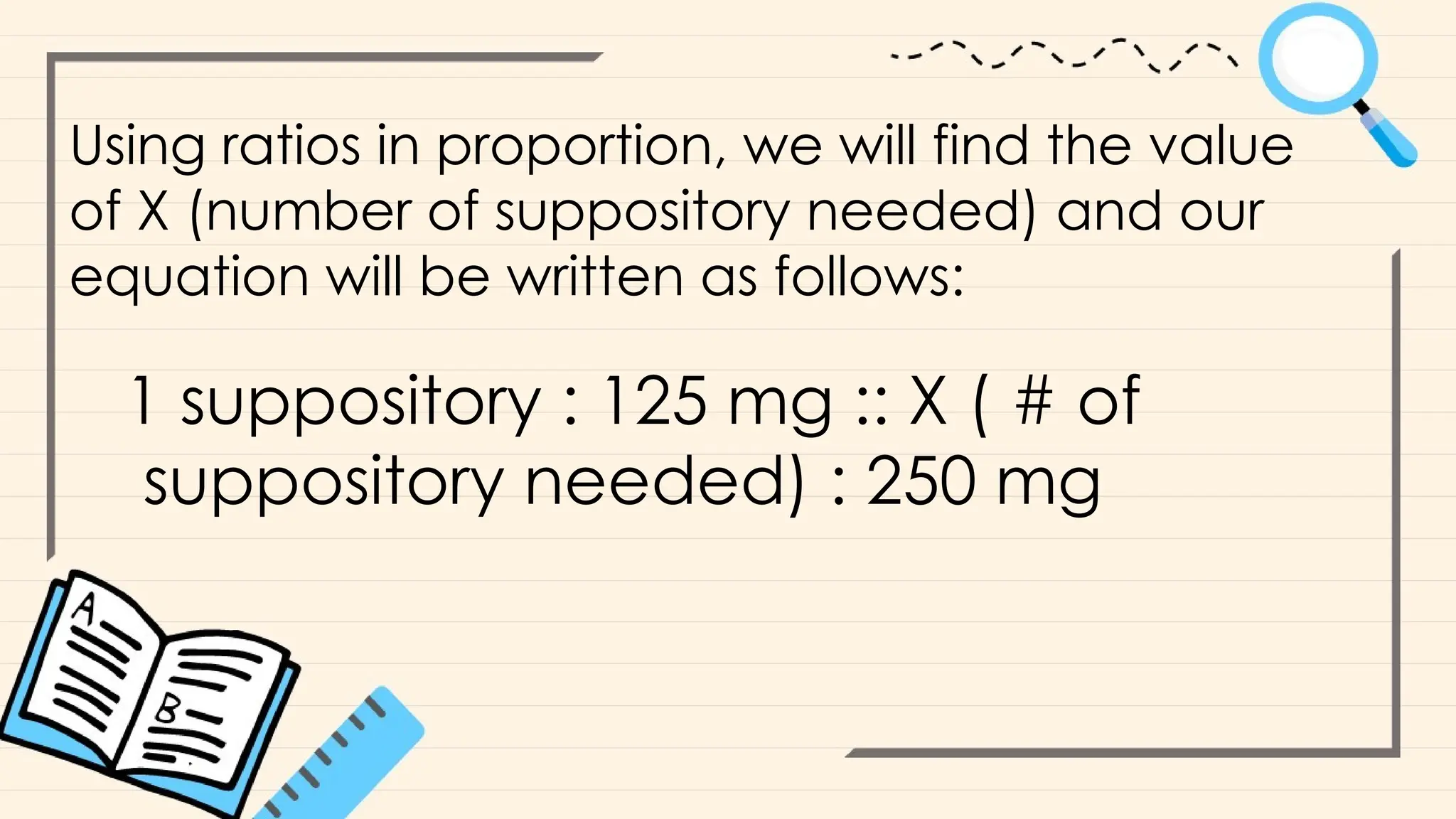
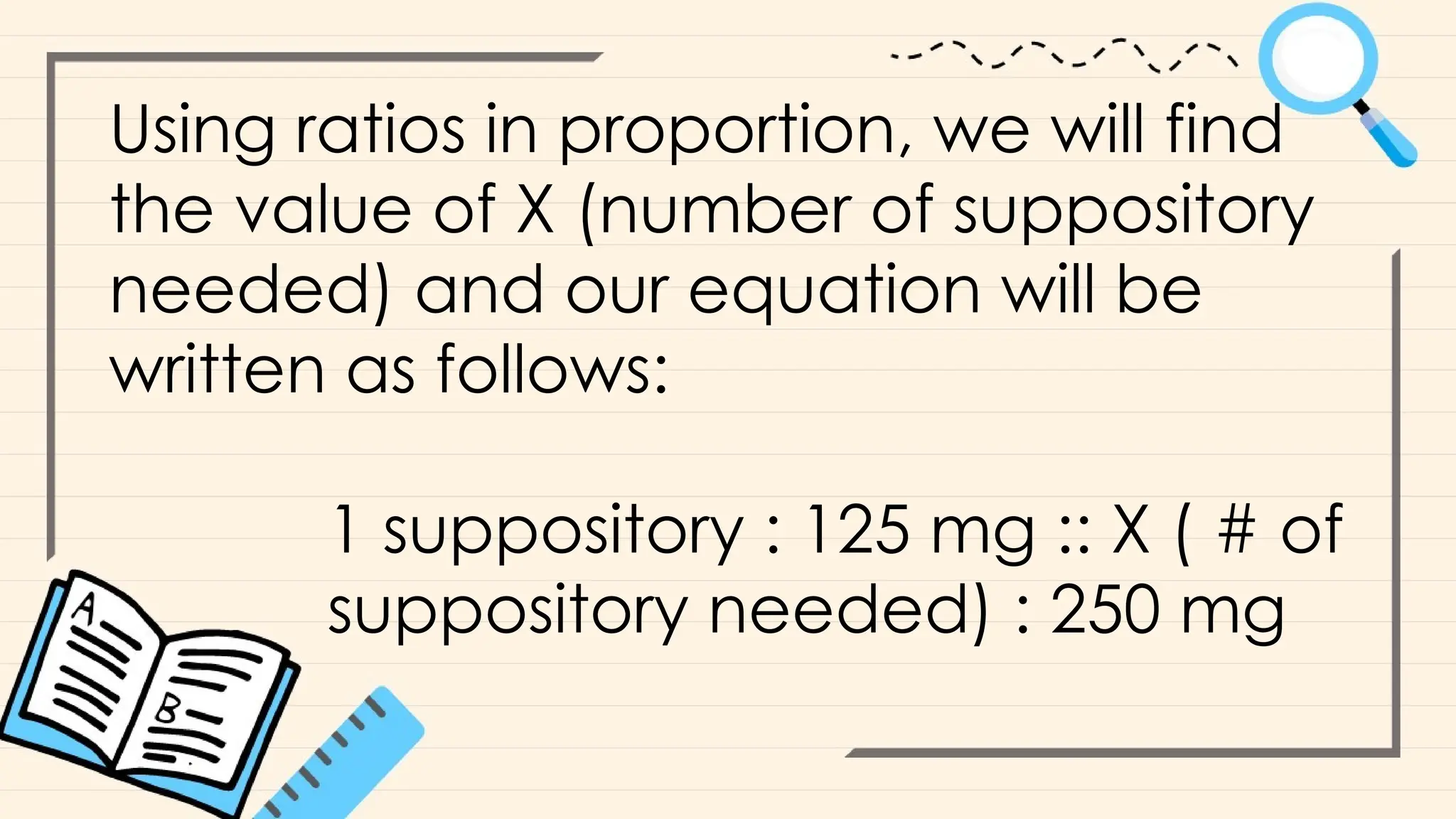
Using ratios in proportion, we will find the value
of X (number of suppository needed) and our
equation will be written as follows:
1 suppository : 125 mg :: X ( # of
suppository needed) : 250 mg
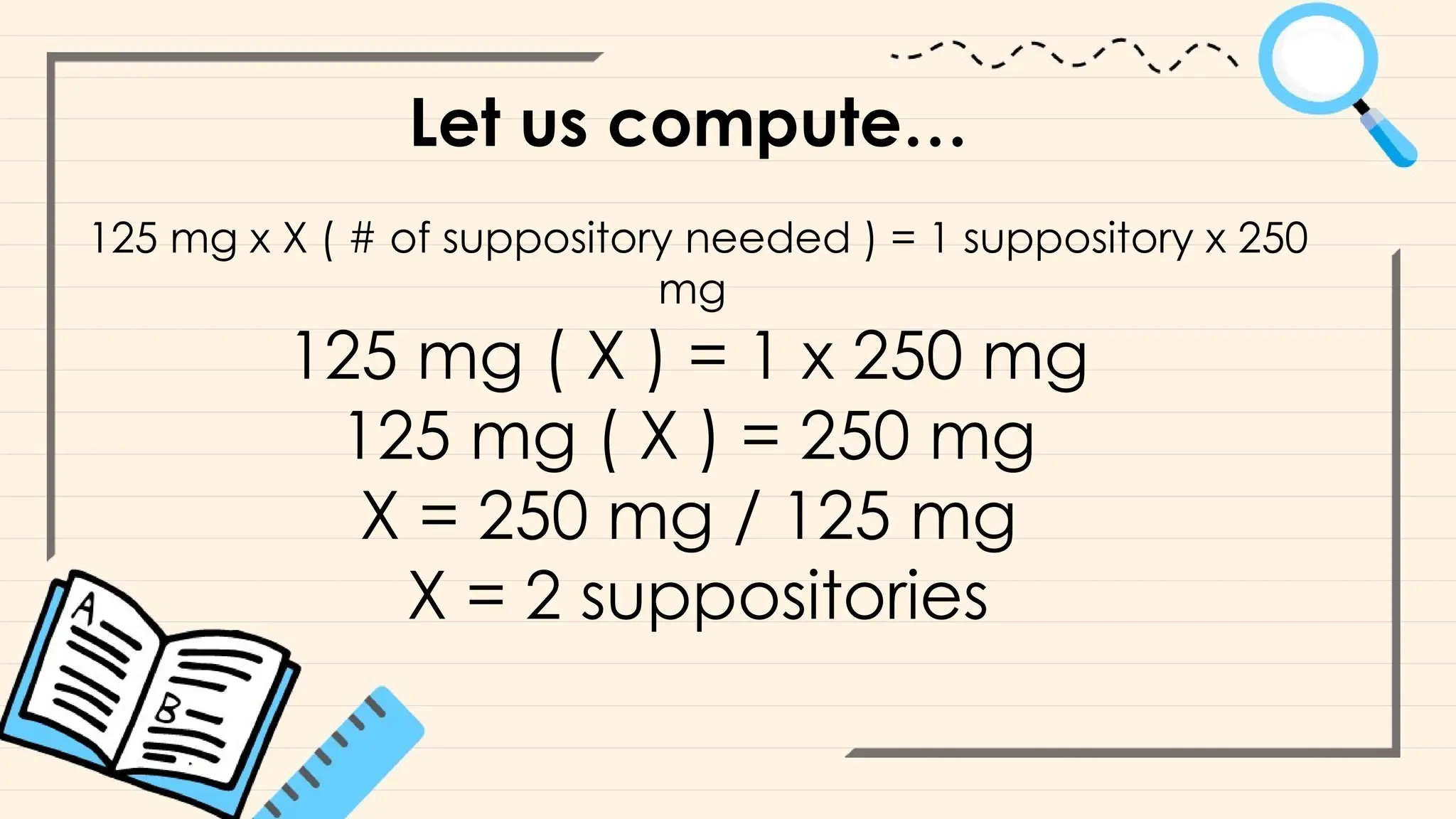
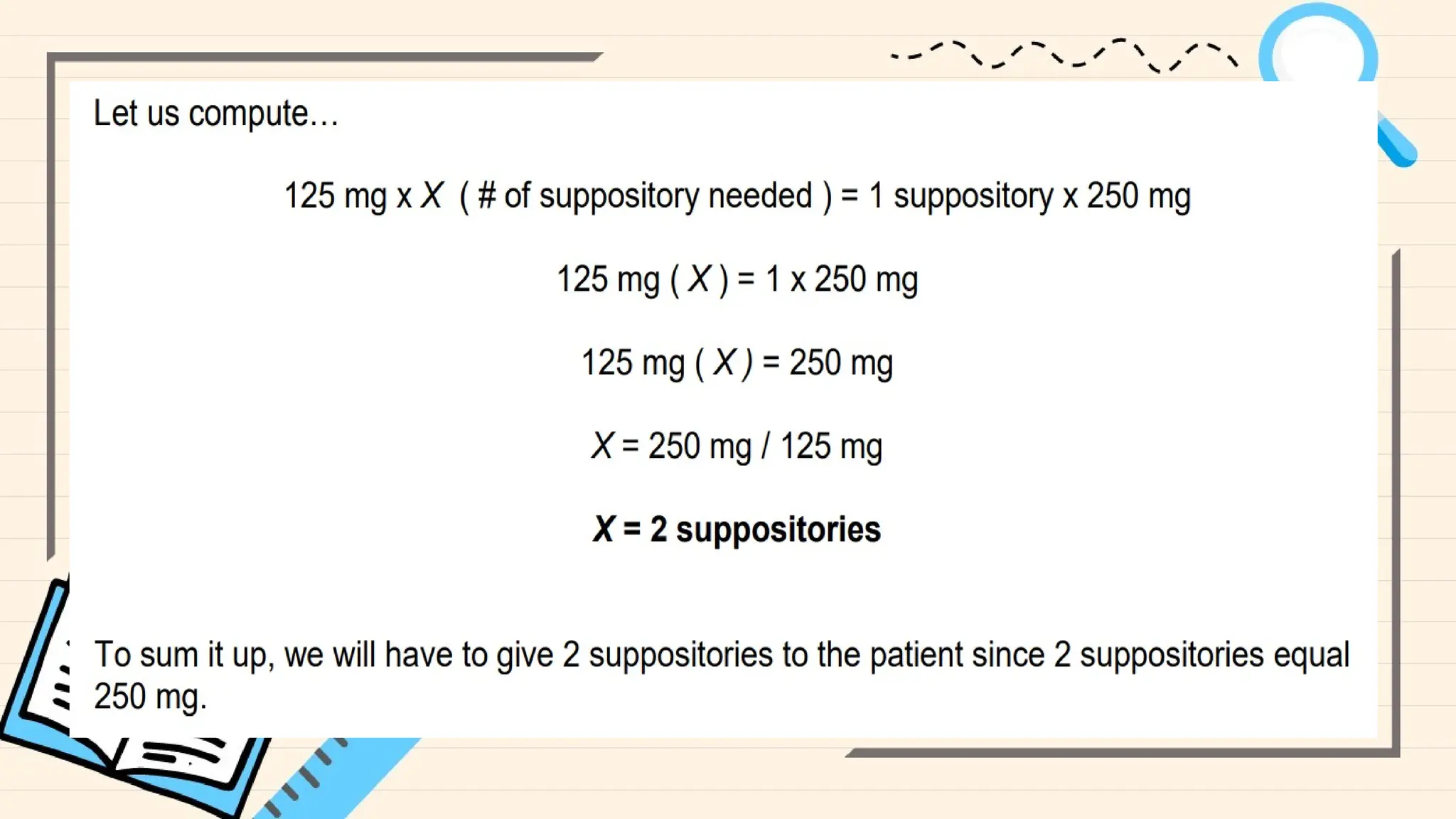
Let us compute…
125 mg x X ( # of suppository needed ) = 1 suppository x 250
mg
125 mg ( X ) = 1 x 250 mg
125 mg ( X ) = 250 mg
X = 250 mg / 125 mg
X = 2 suppositories
A GLANCE AT CALCULATING PEDIATRIC
DOSAGES FOR ORAL DRUGS
In calculating drug dosages for pediatric
patients, we have to bear in mind that children
are completely different from adults. An
inaccurate dosage is more likely to harm a
child than that of an adult.
Administering Pediatric Oral Drugs
Infants and young children who can hardly take
tablets or capsules are given oral drugs in the form of
liquid. In some cases wherein liquid medicines are not
available, you may crush a tablet and mix it with a
little amount of liquid. If the medication is mixed in a
large amount of liquid (full bottle), the child will not
get the entire dose if he is unable to finish the liquid.
Important:
Do not mix crushed tablet with
breast milk and infant formula
because it may lead to feeding
refusal in the future.
Devices Used in Giving Out Pediatric Oral Drugs
 cup - can be used by bigger children
 dropper - usually used for infants
 syringe - usually used for infants
 hollow - handle spoon - usually used
for toddlers
Safety Key Points in Giving Medications to
Children
 Check the child's mouth to ensure that he
has swallowed the oral drugs.
 Carefully mix oral drugs that come in
suspension form.
Tips in Calculating Safe Pediatric Drug Dosages
 Use a calculator in solving equations.
 Ask advice from a formulary or consult a drug
handbook to verify a drug dose. If still in doubt, call a
pharmacist.
 Keep a record of your patient's weight in kilograms
so you do not have to estimate it or weigh him all
the time
Methods Used in Calculating Pediatric Doses
1. Body Surface Area (BSA) Method - also
called the dosage-per-kilogram-of-body-
weight method; considered to be the most
accurate and safest method in calculating
pediatric doses
2. Clark's Rule - uses child's weight to calculate
approximate dosage
Methods Used in Calculating Pediatric Doses
3. Young's Rule - normally used for children
who are two years of age or more
4. Fried's Rule - normally used for children
who are two years of age or less
Body Surface Area (BSA) Method
We will have to use the
nomogram to determine a child's
BSA then setup an equation using
the formula.
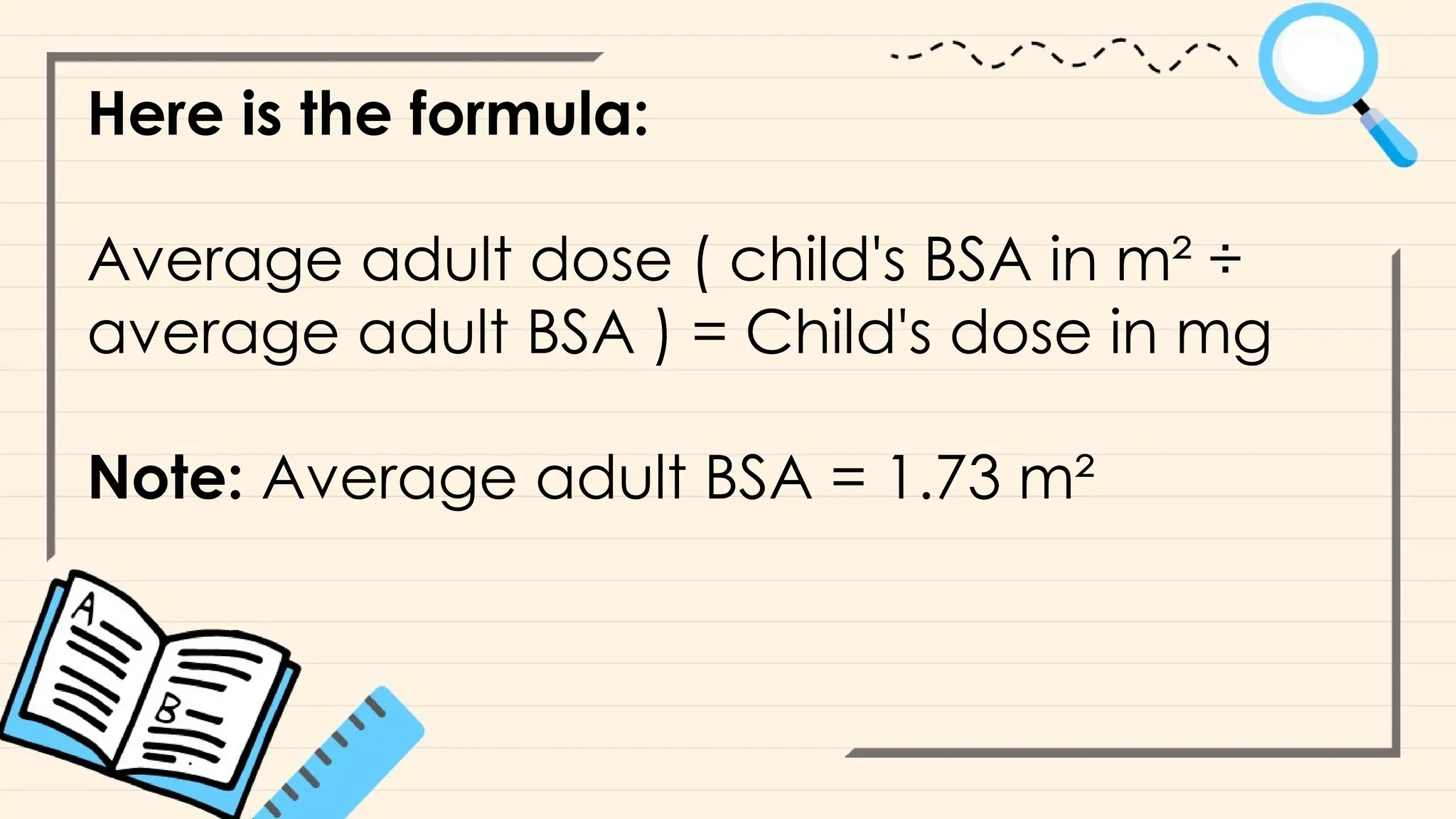
Here is the formula:
Average adult dose ( child's BSA in m² ÷
average adult BSA ) = Child's dose in mg
Note: Average adult BSA = 1.73 m²
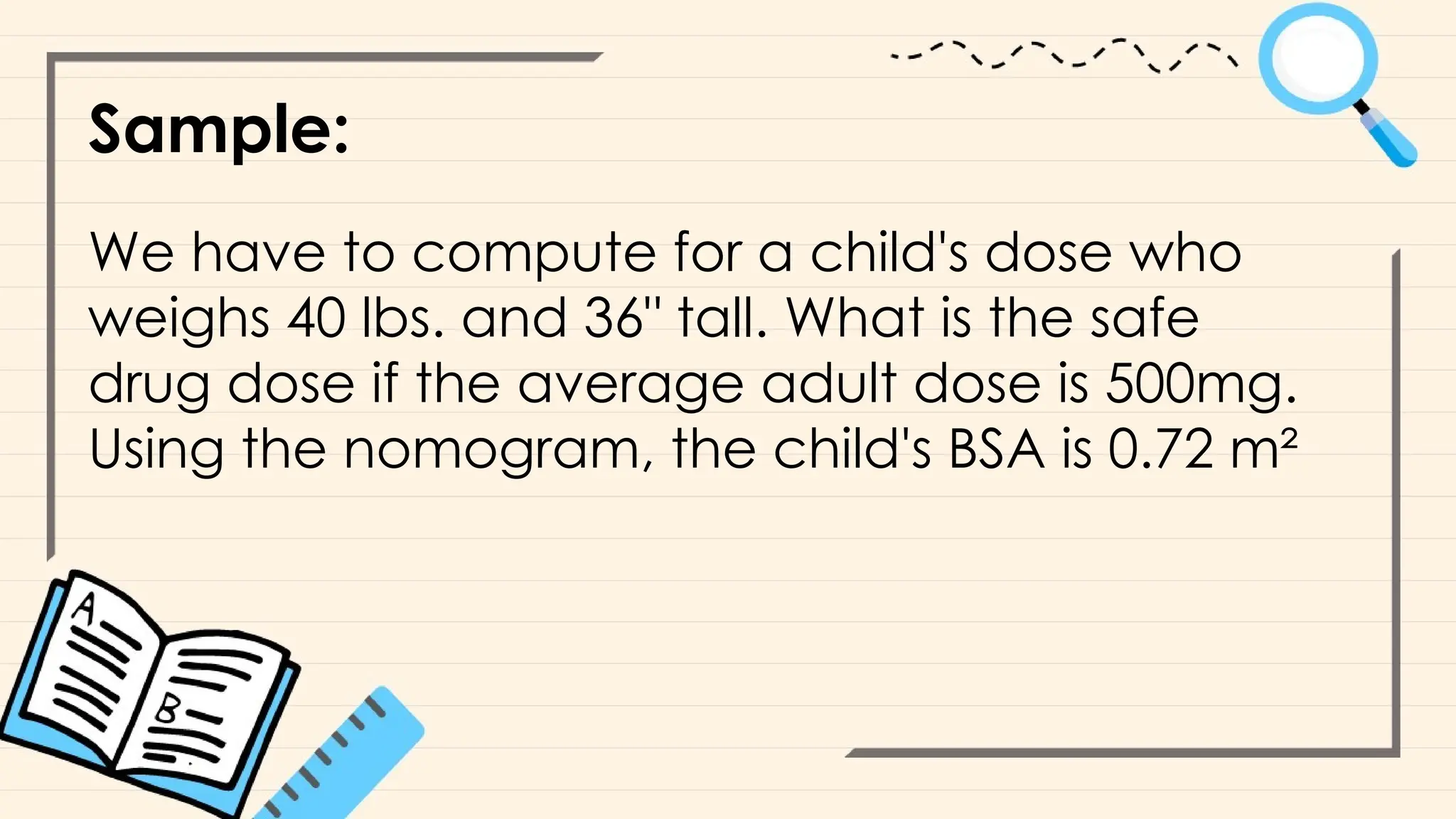
Sample:
We have to compute for a child's dose who
weighs 40 lbs. and 36" tall. What is the safe
drug dose if the average adult dose is 500mg.
Using the nomogram, the child's BSA is 0.72 m²
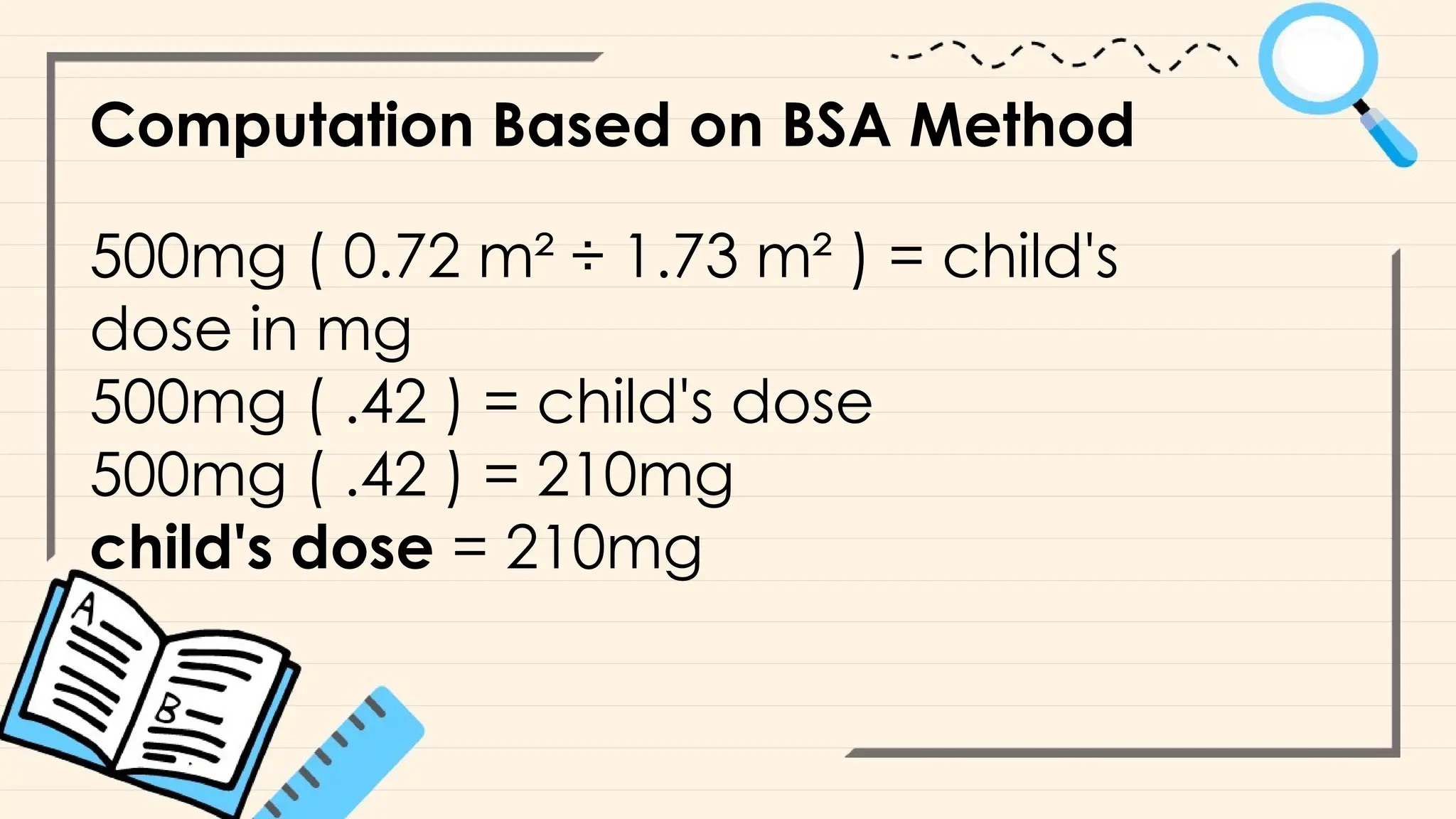
Computation Based on BSA Method
500mg ( 0.72 m² ÷ 1.73 m² ) = child's
dose in mg
500mg ( .42 ) = child's dose
500mg ( .42 ) = 210mg
child's dose = 210mg
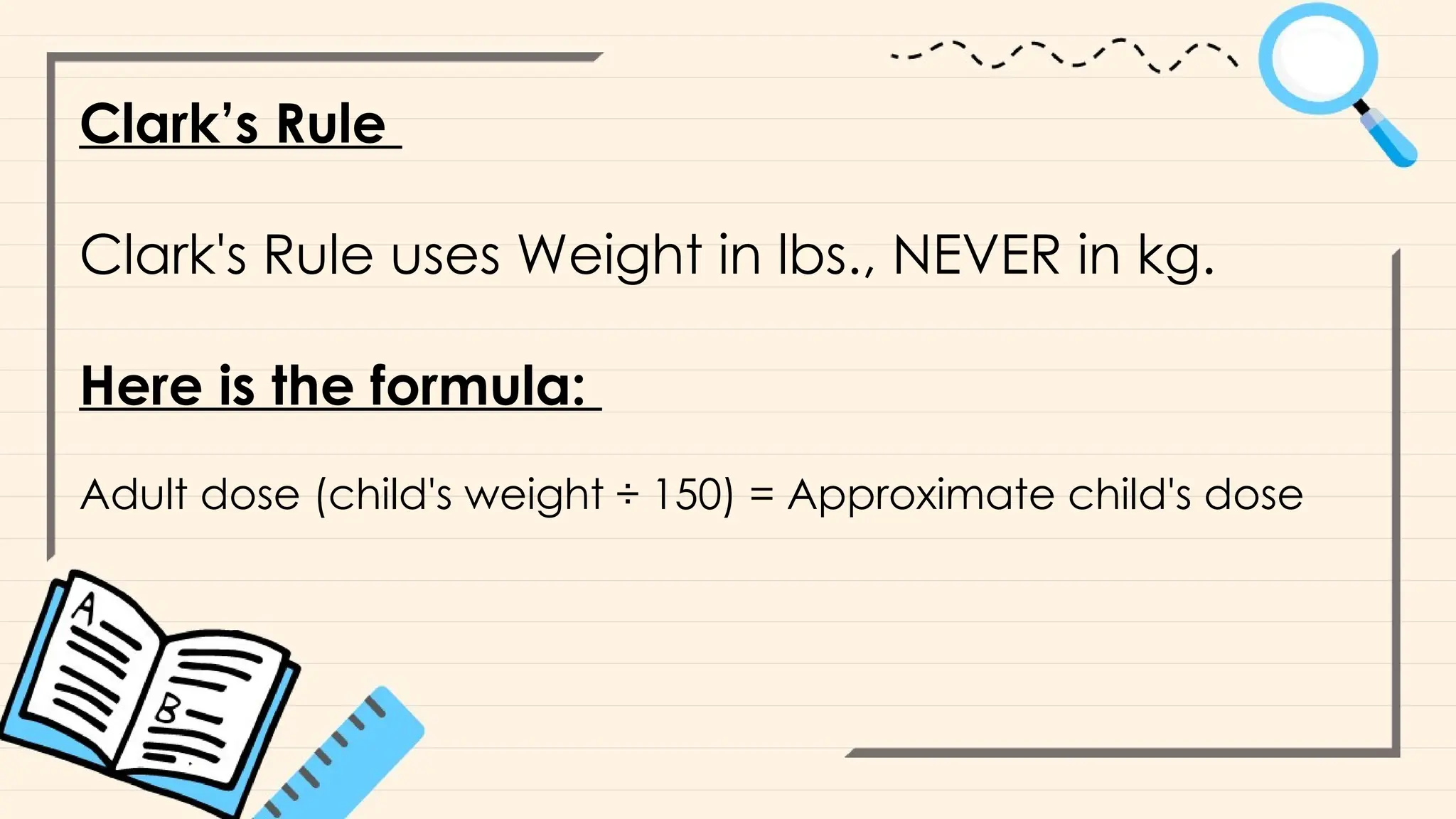
Clark’s Rule
Clark's Rule uses Weight in lbs., NEVER in kg.
Here is the formula:
Adult dose (child's weight ÷ 150) = Approximate child's dose
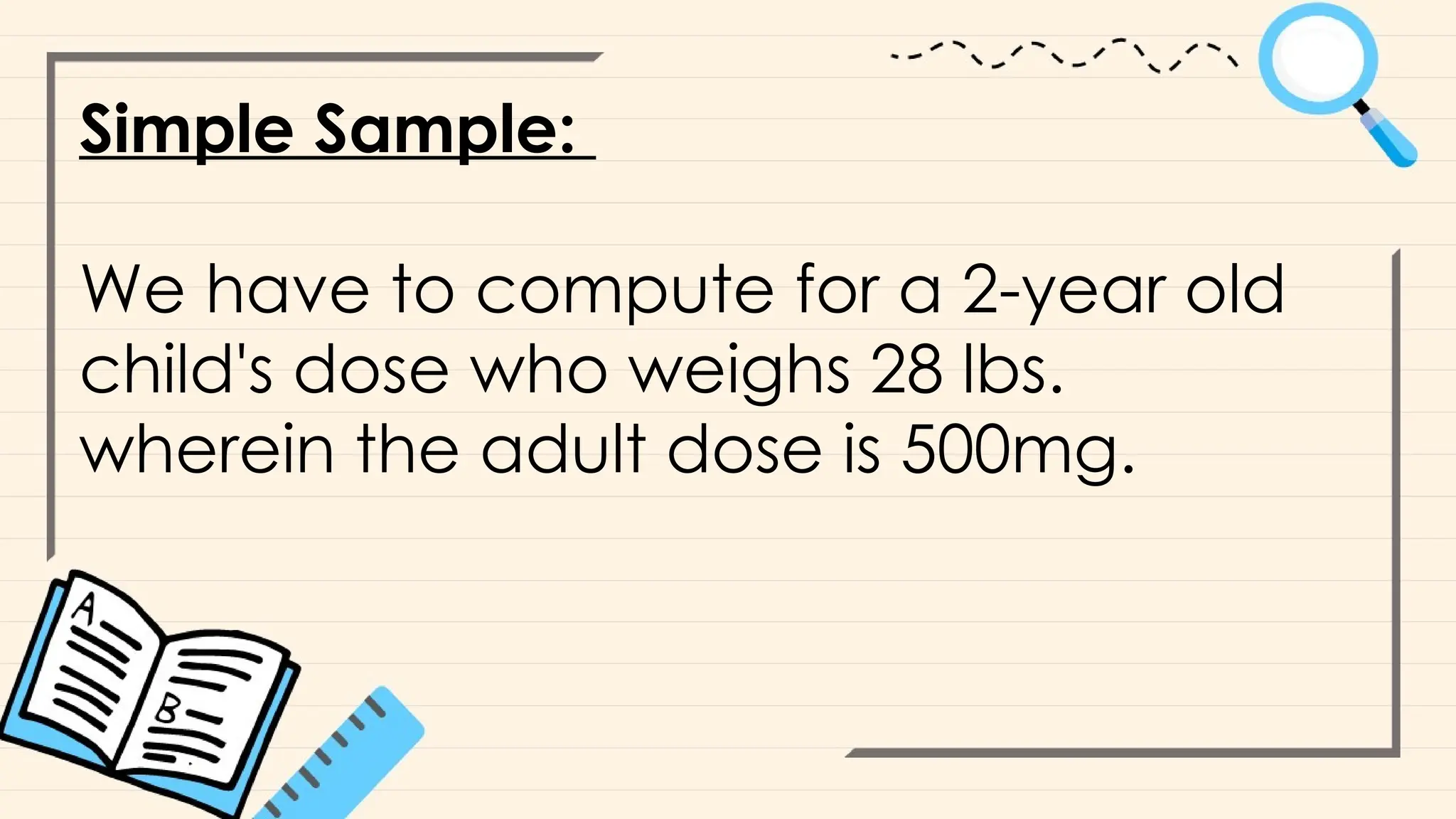
Simple Sample:
We have to compute for a 2-year old
child's dose who weighs 28 lbs.
wherein the adult dose is 500mg.
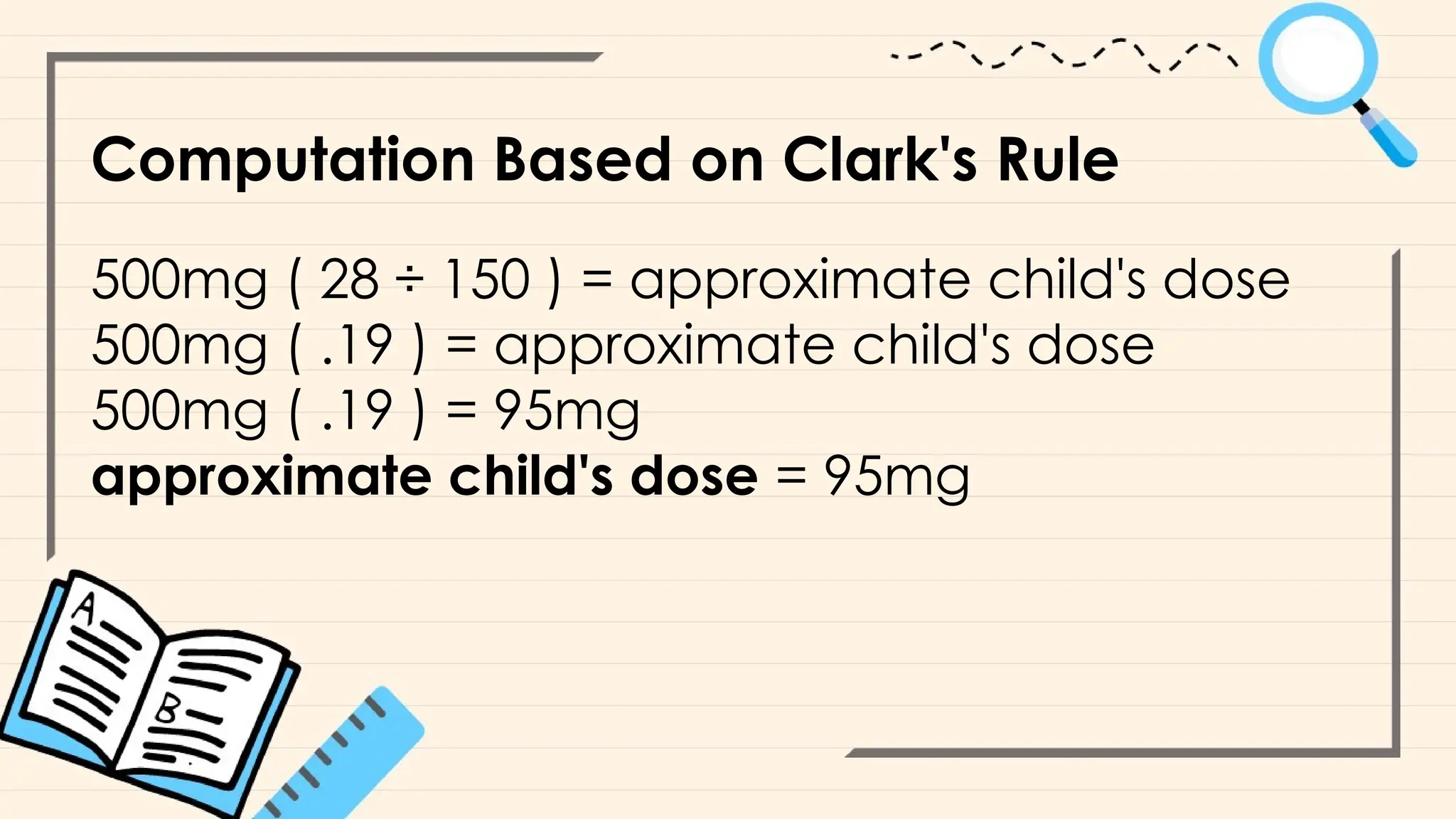
Computation Based on Clark's Rule
500mg ( 28 ÷ 150 ) = approximate child's dose
500mg ( .19 ) = approximate child's dose
500mg ( .19 ) = 95mg
approximate child's dose = 95mg
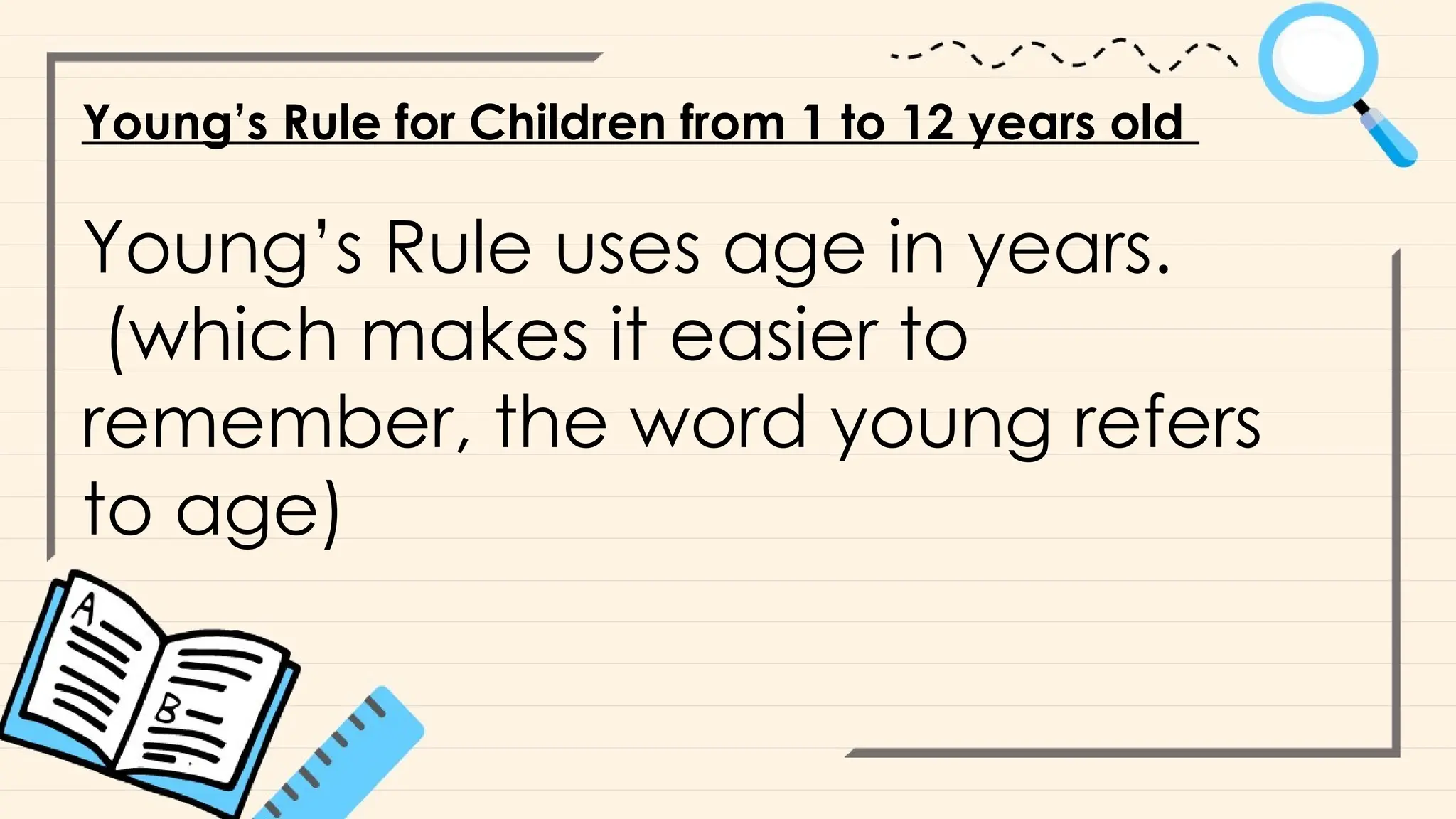
Young’s Rule for Children from 1 to 12 years old
Young’s Rule uses age in years.
(which makes it easier to
remember, the word young refers
to age)
Here is the formula:
Adult dose [ child's age in year ÷ (
child's age in year +12 ) ] =
Approximate child's dose
Same Simple Sample:
We have to compute for a 2-year old
child's dose who weighs 28 lbs.
Wherein the adult dose is 500mg. Note
that the weight has no bearing using
Young's Rule
Computation Based on Young's Rule
500mg [ 2 ÷ ( 2 + 12 ) ] = approximate child's
dose
500mg ( 2 ÷ 14 ) = approximate child's dose
500mg ( .14 ) = approximate child's dose
500mg ( .14 ) = 70 mg
Approximate child's dose = 70 mg
Fried’s Rule for Infants and Children up to 2 years
Fried's Rule uses age in months.
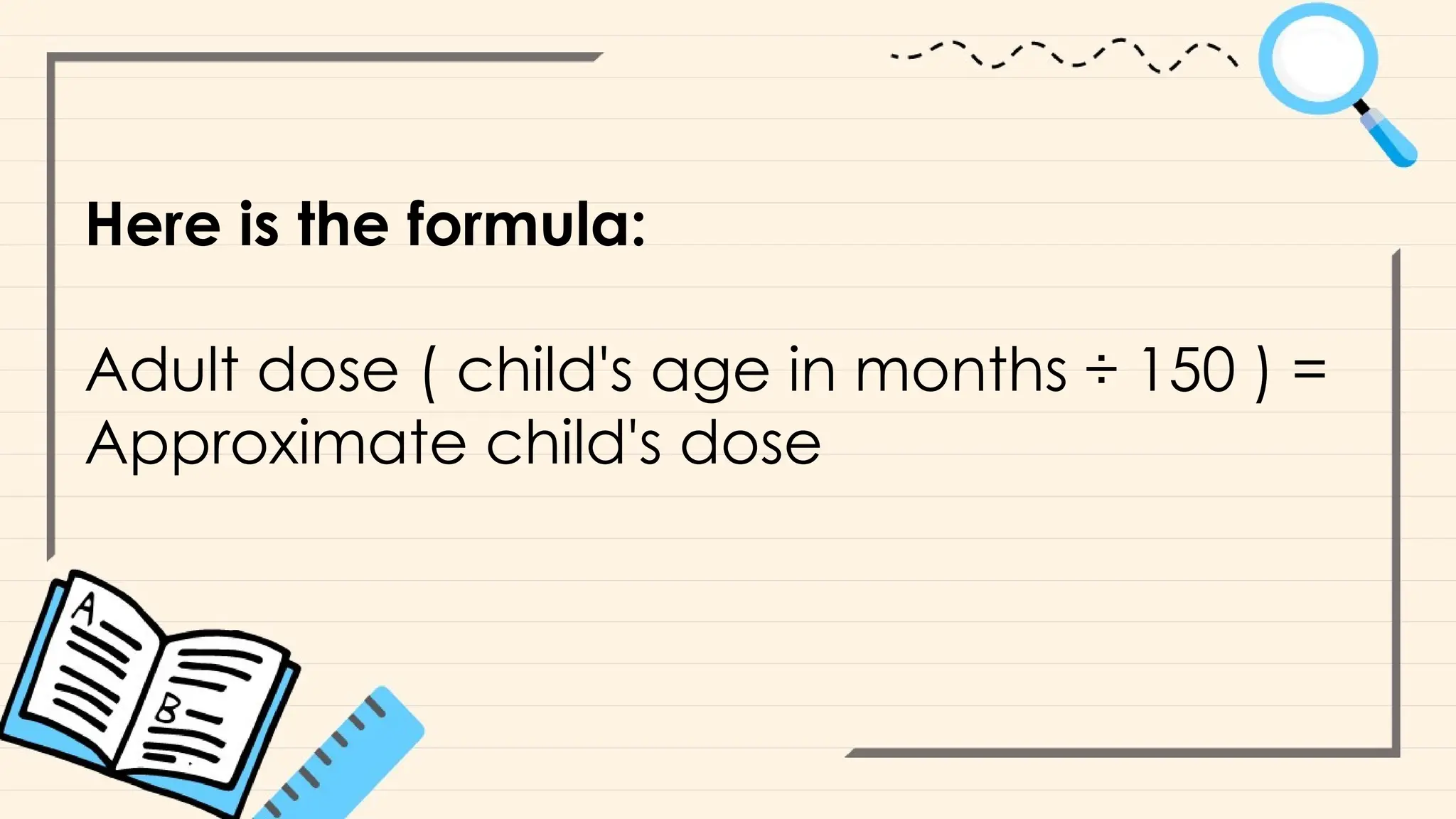
Here is the formula:
Adult dose ( child's age in months ÷ 150 ) =
Approximate child's dose
Still the Same Simple Sample:
We have to compute for a 2-year old child's
dose who weighs 28 lbs. wherein the adult
dose is 500mg. Note that the weight has no
bearing using Fried's Rule.
Computation Based on Fried's Rule
500mg [ ( 2 x 12 months ) ÷ 150 ] = approximate child's dose
500mg ( 24 ÷ 150 ) = approximate child's dose
500mg ( .16 ) = approximate child's dose
500mg ( .16 ) = 80 mg
Approximate child's dose = 80 mg
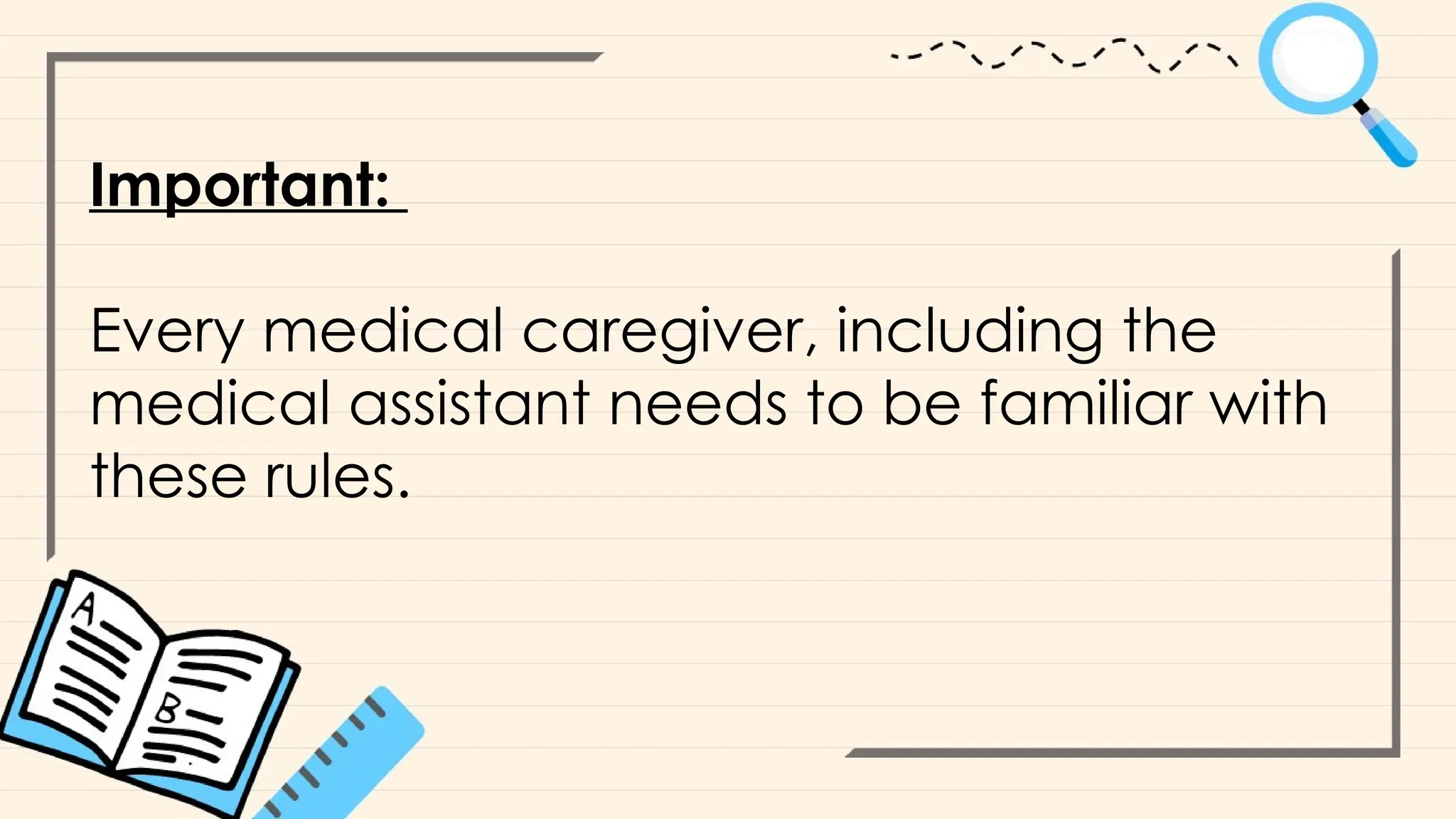
Important:
Every medical caregiver, including the
medical assistant needs to be familiar with
these rules.
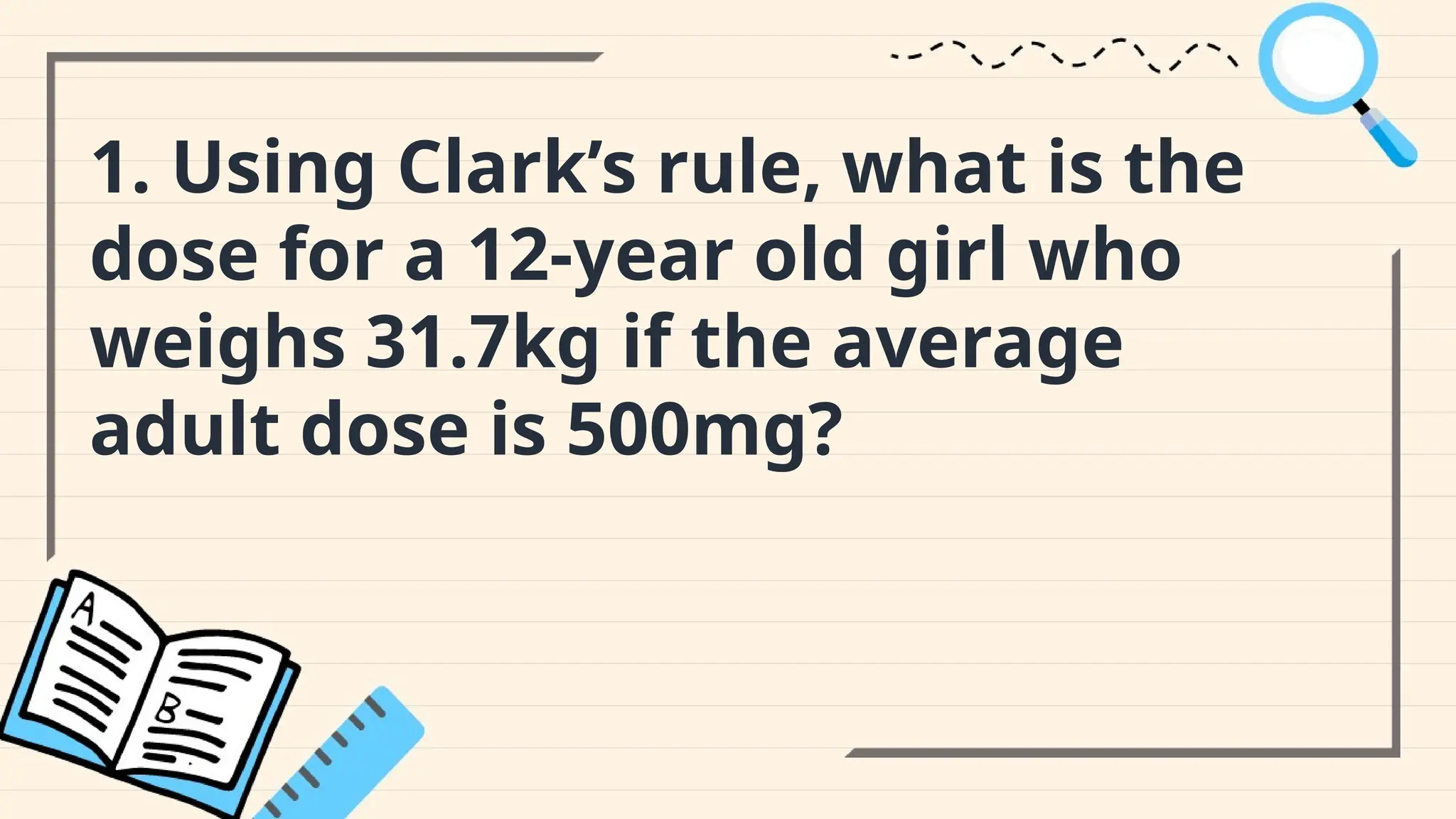
ACTIVITY
1. Using Clark’s rule, what is the
dose for a 12-year old girl who
weighs 31.7kg if the average
adult dose is 500mg?
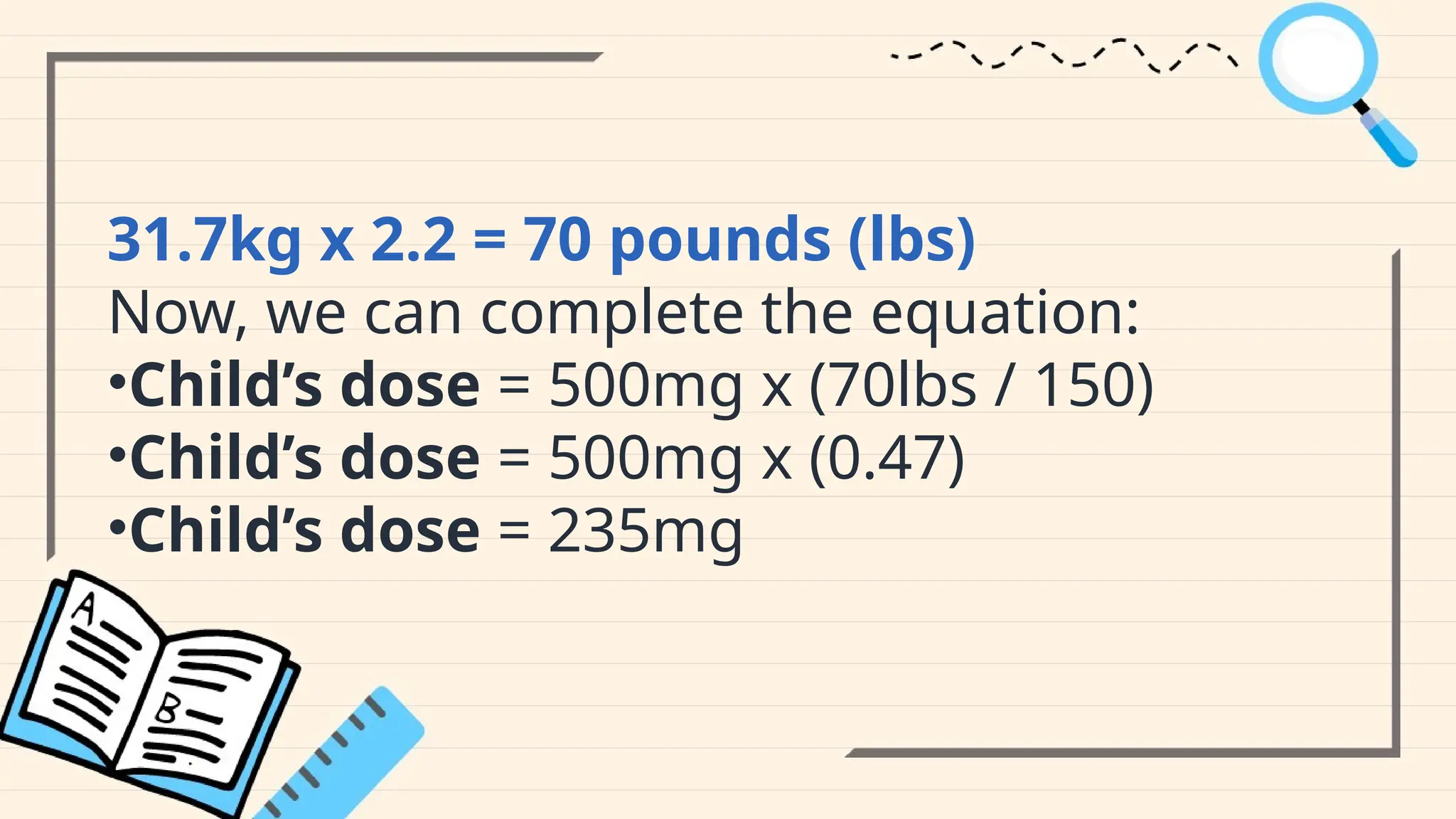
31.7kg x 2.2 = 70 pounds (lbs)
Now, we can complete the equation:
•Child’s dose = 500mg x (70lbs / 150)
•Child’s dose = 500mg x (0.47)
•Child’s dose = 235mg
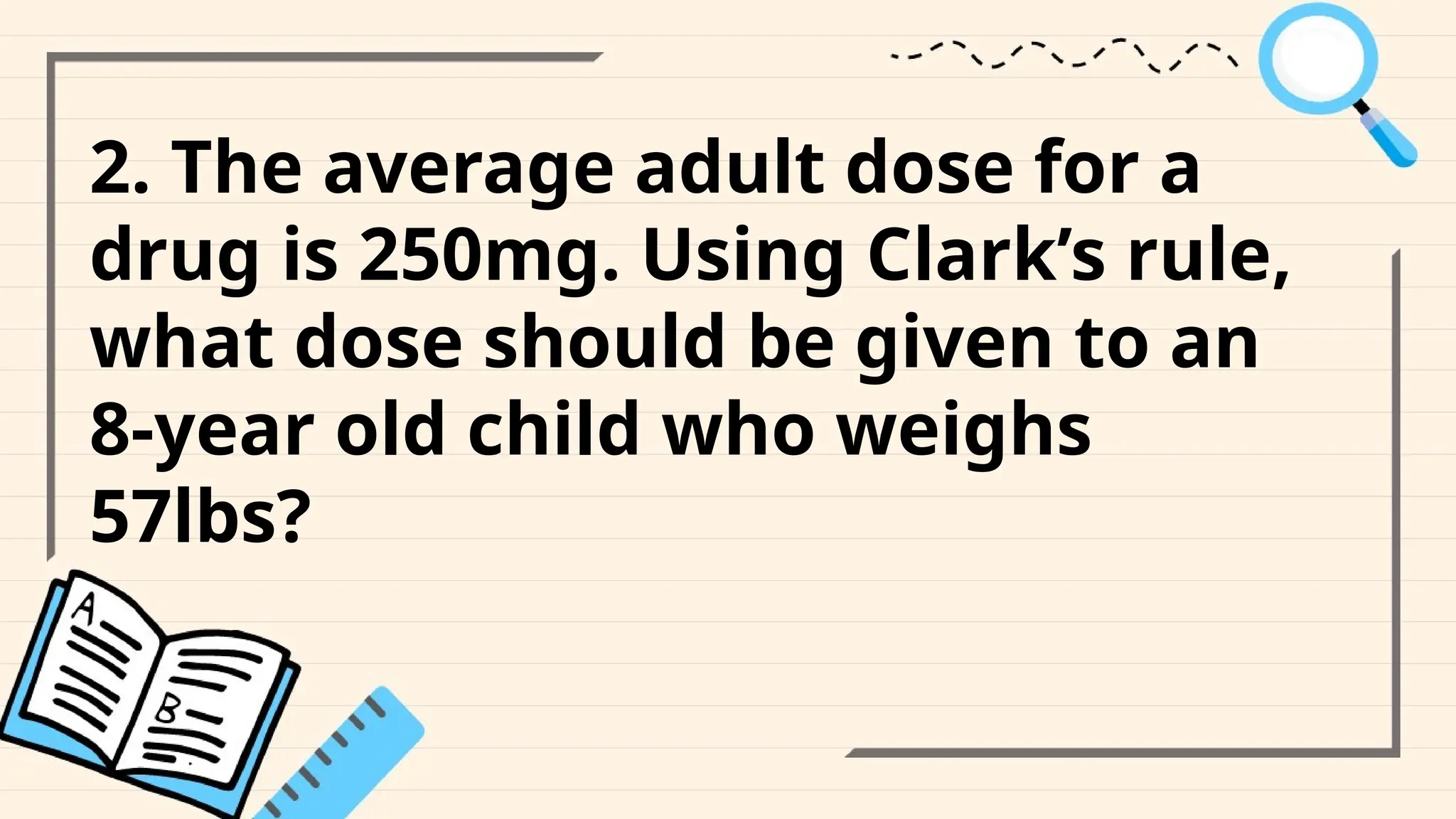
2. The average adult dose for a
drug is 250mg. Using Clark’s rule,
what dose should be given to an
8-year old child who weighs
57lbs?
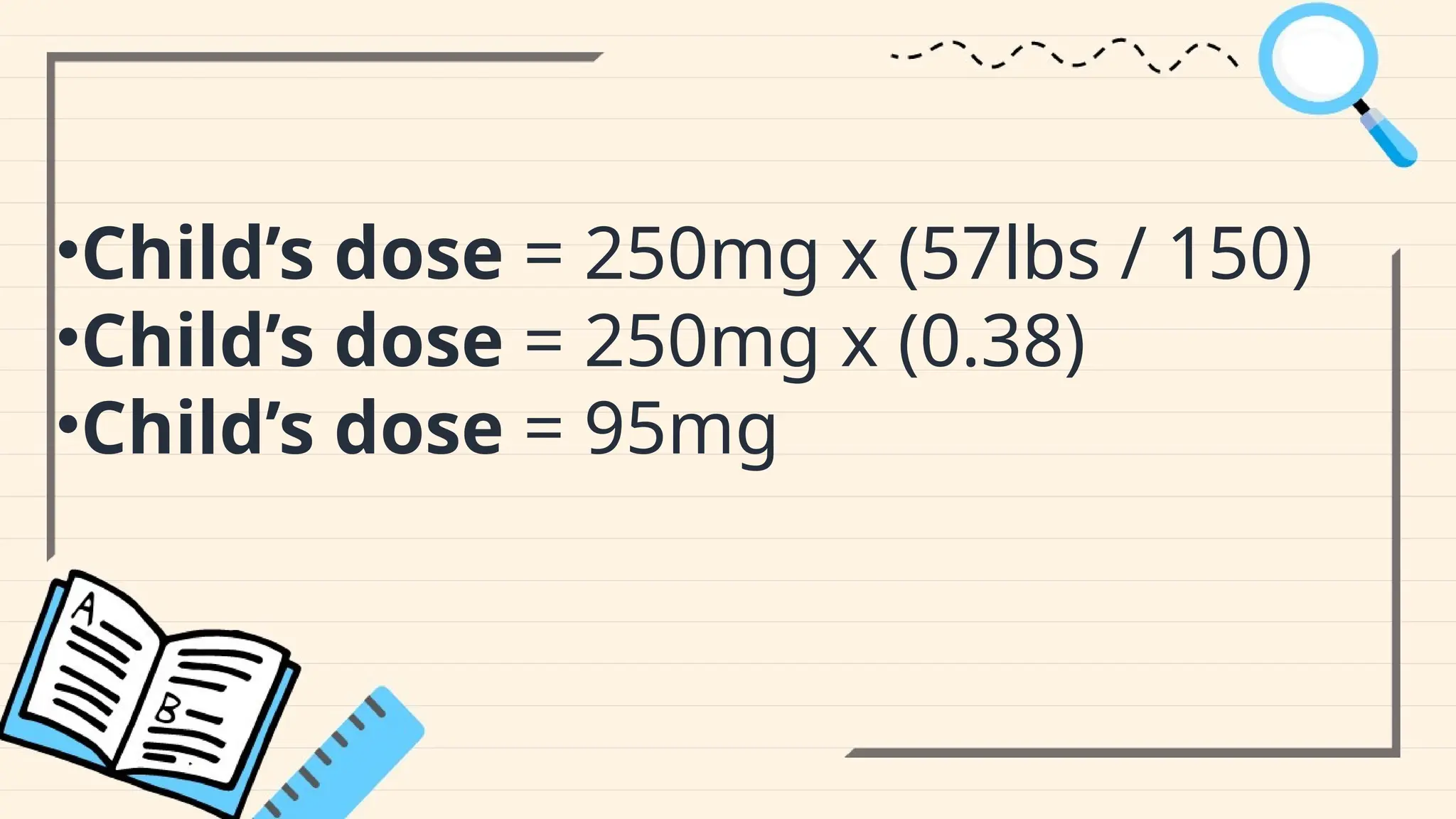
•Child’s dose = 250mg x (57lbs / 150)
•Child’s dose = 250mg x (0.38)
•Child’s dose = 95mg
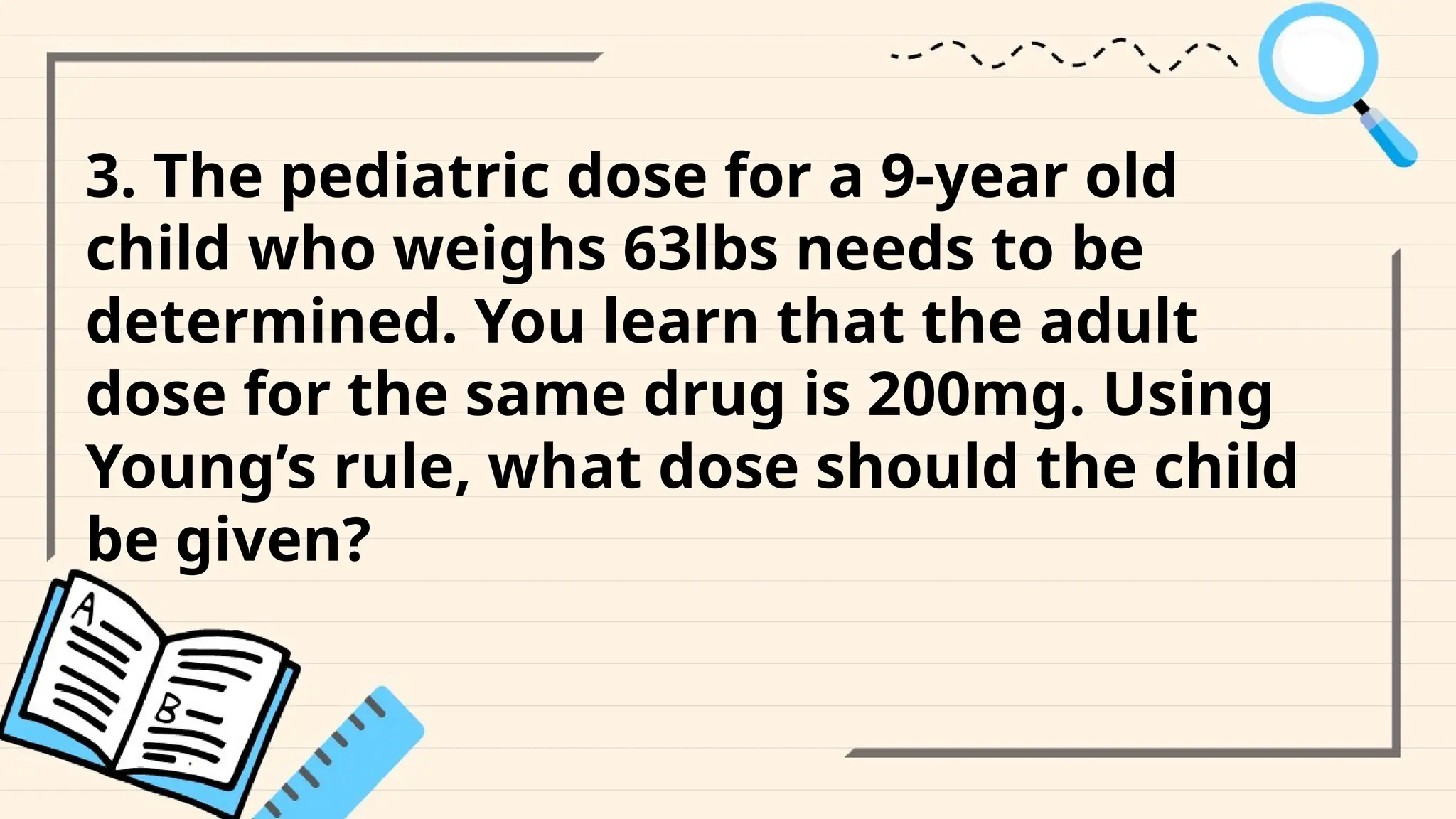
3. The pediatric dose for a 9-year old
child who weighs 63lbs needs to be
determined. You learn that the adult
dose for the same drug is 200mg. Using
Young’s rule, what dose should the child
be given?
We can now plug these values into the equation:
•Child’s dose = 200mg x [9 / (9 + 12)]
•Child’s dose = 200mg x [9 / 21]
•Child’s dose = 200mg x 0.43
•Child’s dose = 86mg
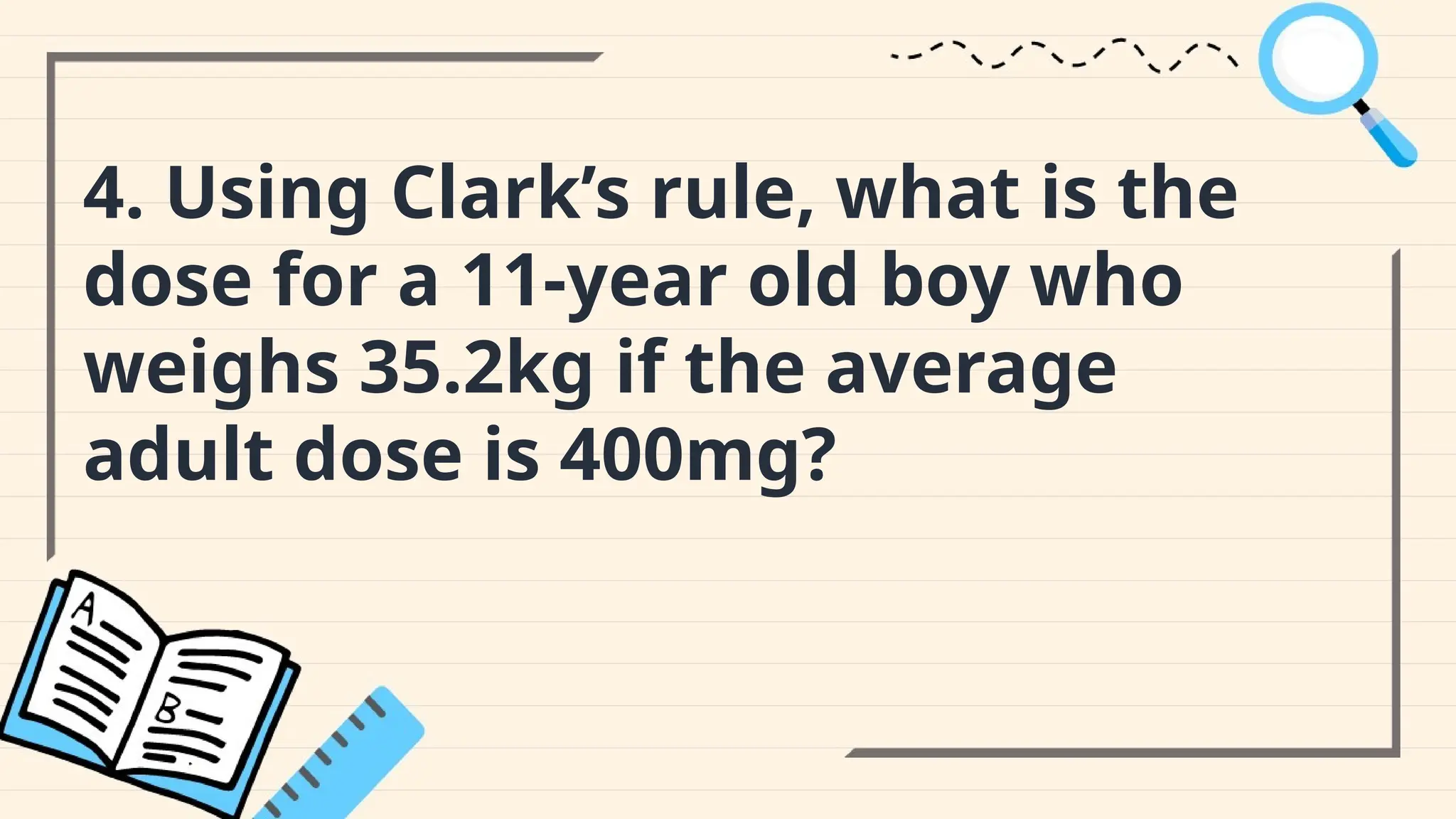
4. Using Clark’s rule, what is the
dose for a 11-year old boy who
weighs 35.2kg if the average
adult dose is 400mg?
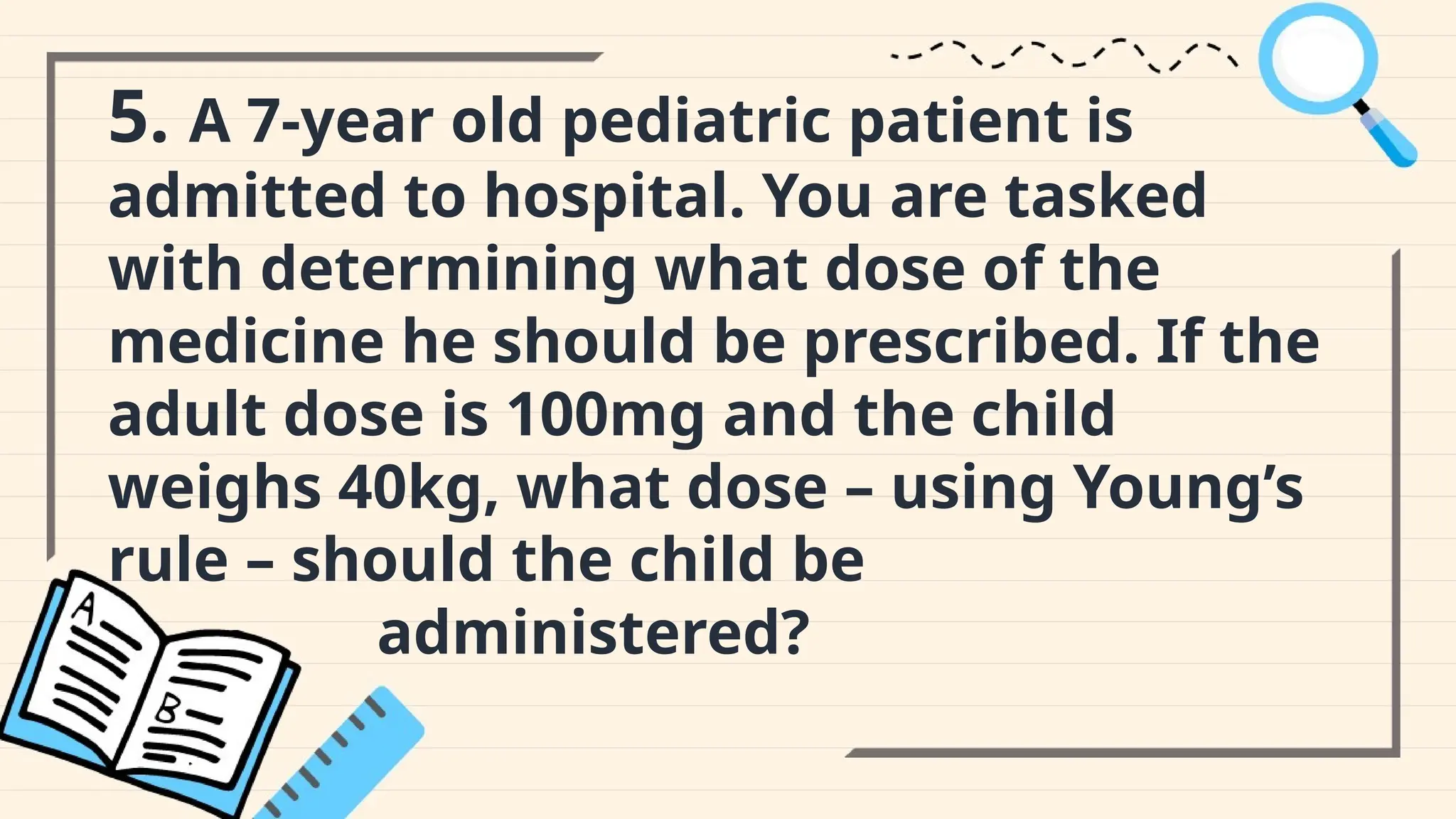
5. A 7-year old pediatric patient is
admitted to hospital. You are tasked
with determining what dose of the
medicine he should be prescribed. If the
adult dose is 100mg and the child
weighs 40kg, what dose – using Young’s
rule – should the child be
administered?
6. The doctor orders an adult dose
of decadron 4mg/day. Calculate
the dose for a child that weighs
16lbs using Clark’s rule.
7. The doctors orders an adult
dose of Ibuprofen 600mg .
Calculate the dose for a child who
is 24 months old using Fried’s
Rule.
8. The doctor orders an adult dose
of Pepcid 20mg/day. Calculate
the dose for a child who is 12
months old.
A GLANCE AT RECTAL DRUGS
Rectal drugs are medications prepared
specifically for insertion into the rectum.
They could be in the form of cream, lotion,
or ointment. Administering the drugs rectally
is best for patients who cannot take drugs
orally. Rectal drugs include enemas and
suppositories.
Interpret Rectal Drug Labels
As we administer medicines to our
patients, it is vital to read drug labels at
all times. Paying close attention to the
drug labels helps us calculate the dosage
we will give to our patients.
- identify the drug name /
generic name
- check for the dose strength
- expiration date
Types of Rectal Drugs
1. Enema - the injection of liquid into
the rectum through the anus for
cleansing, for stimulating
evacuation of the bowels, or for
other therapeutic or diagnostic
purposes
Types of Rectal Drugs
2. Suppository - a small piece of
medicated substance, usually
conical, ovoid, or cylindrical,
introduced into a body passage,
as the rectum or vagina, where
body heat causes it to melt
Dosage Calculation for Rectal Drugs
Suppository is considered to be
the most used form of rectal
medicine. By calculating the
number of suppositories we give
to the patient, we will use the
ratios in proportion method.
Dosage Calculation for Rectal Drugs
Suppository is considered to be the
most used form of rectal medicine.
By calculating the number of
suppositories we give to the patient,
we will use the ratios in proportion
method.
Example 1:
Calculate for a suppository dosage
supposing a patient needs 250 mg of a
suppository and the package label
says 125 mg.
Using ratios in proportion, we will find
the value of X (number of suppository
needed) and our equation will be
written as follows:
1 suppository : 125 mg :: X ( # of
suppository needed) : 250 mg
Example 2:
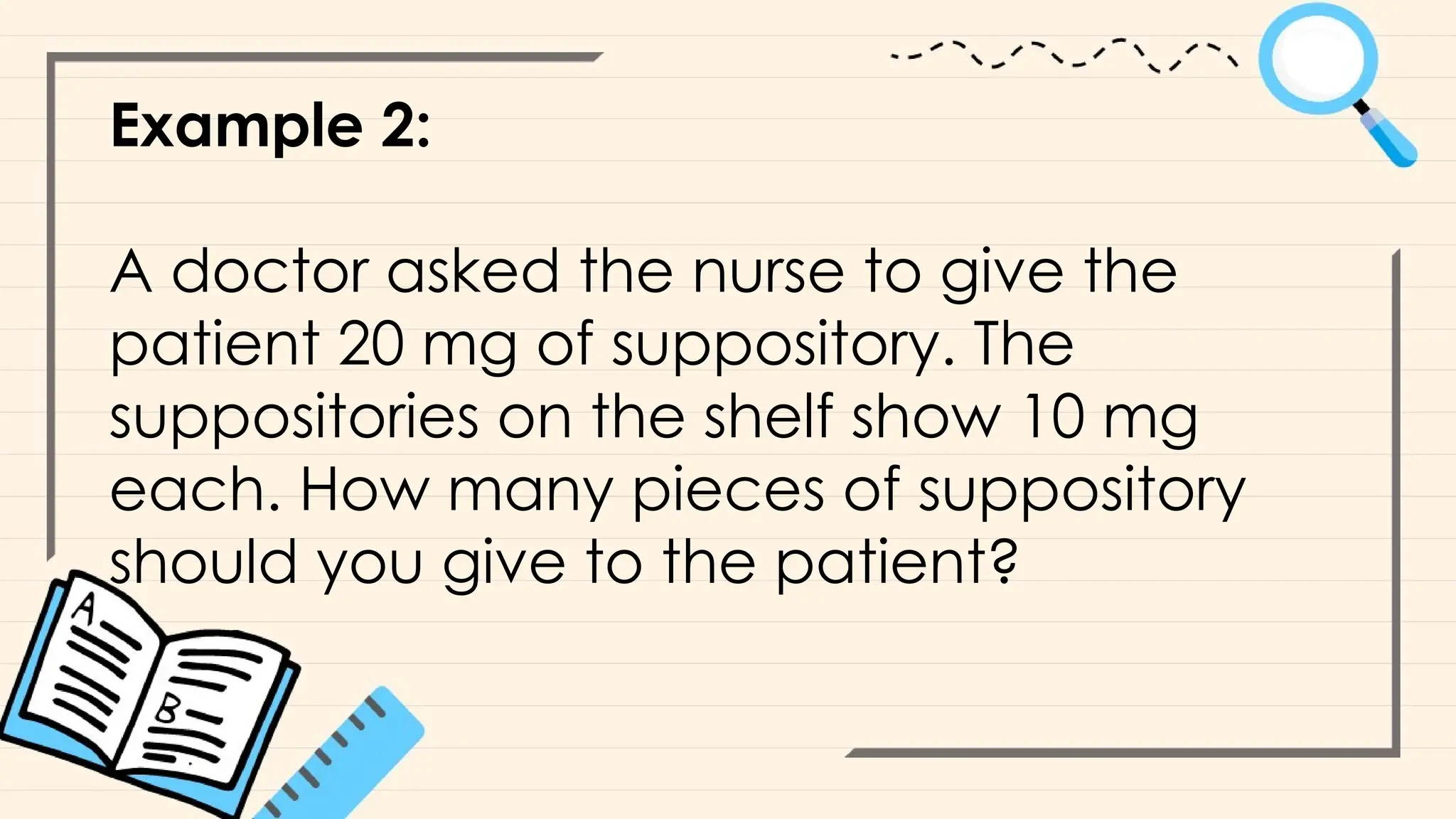
A doctor asked the nurse to give the
patient 20 mg of suppository. The
suppositories on the shelf show 10 mg
each. How many pieces of suppository
should you give to the patient?
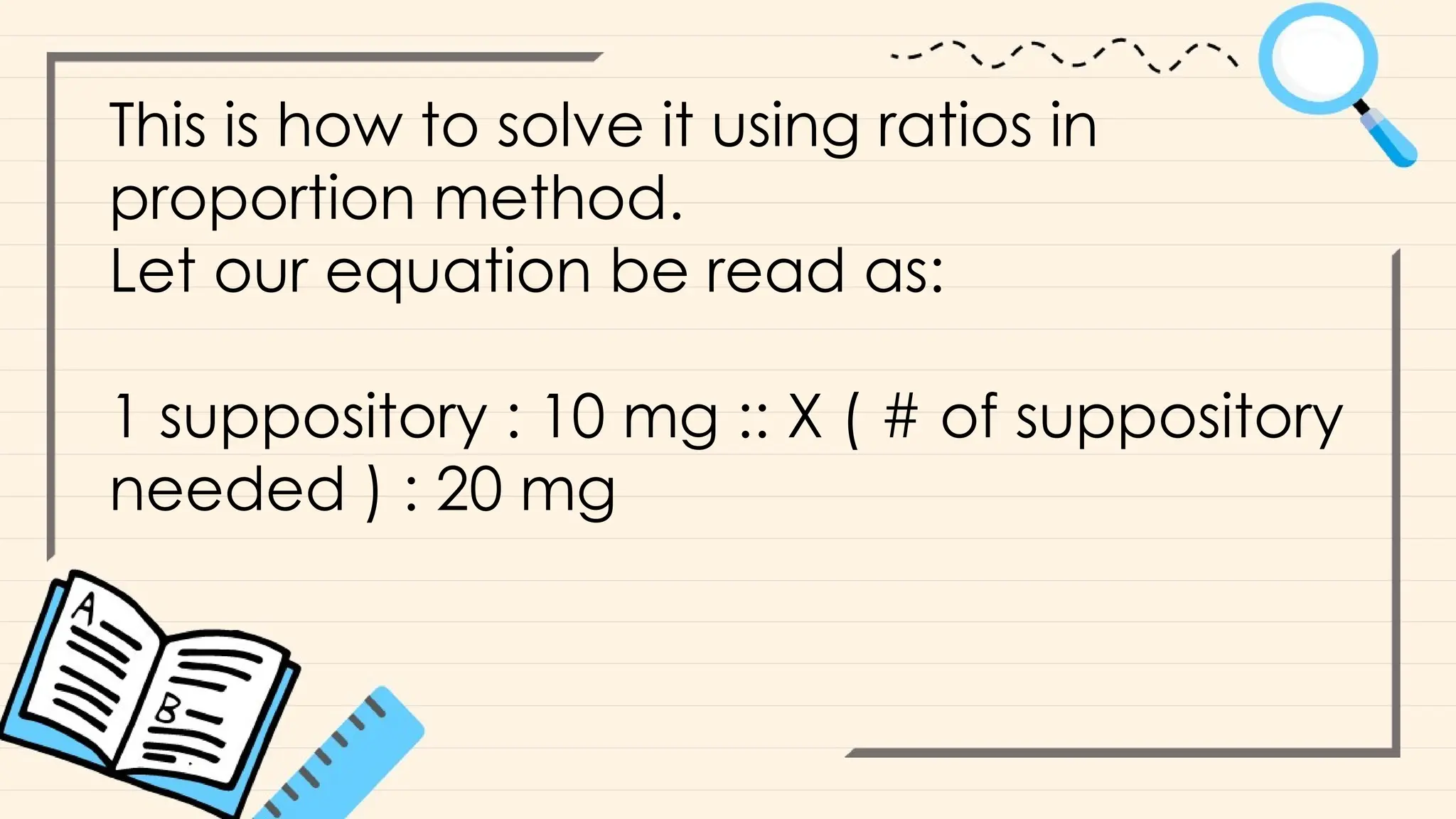
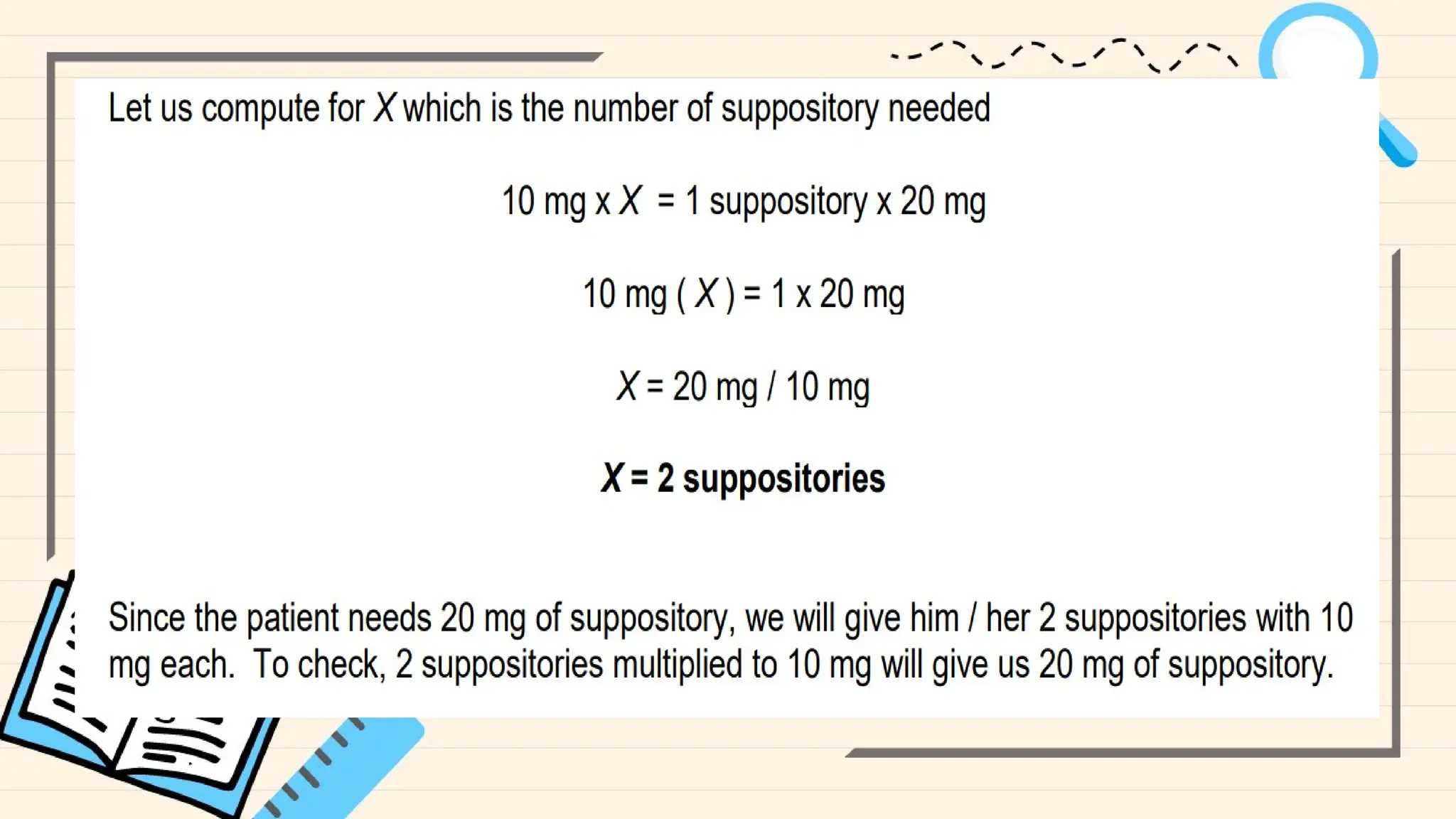
This is how to solve it using ratios in
proportion method.
Let our equation be read as:
1 suppository : 10 mg :: X ( # of suppository
needed ) : 20 mg
COMPUTATION.pptx FOR CAREGIVING TLE GRADE 8

COMPUTATION.pptx FOR CAREGIVING TLE GRADE 8

  • 1.
    Grade 8 -CAREGIVING Perform simple calculations
  • 2.
    A glance atnumerical relationships Ratios, fractions, and proportions describe relationships between numbers. Ratio is a quick way to compare numbers. It uses a colon between the numbers in relationship. Ex.: 3:5 8:12 4:7
  • 3.
    Fraction, as weall know, is a part of a whole or a portion of a certain number. It uses a slash between numbers in the relationship. Ex.: 2/3 4/5 6/8
  • 4.
    A proportion isan equation written in the form stating that two ratios are equivalent. For instance, to show that 3:6 is equal to 9:18, we would write: 3:6::9:18 or 3/6 = 9/18 2:3::4:6 or 2/3 = 4/6 5:8::10:16 or 5/8 = 10/16
  • 5.
    Major problem solvers Fordosages computation, we use ratios, fractions, and proportions most of the time. We will be using them in calculating I.V. infusion rates, administering medication, converting weights between systems of measurement, and in performing many other related tasks.
  • 6.
    RATIOS AND FRACTIONS Ratiosand fractions are numerical ways to compare anything. We can’t simply ignore them. We use them every day, whether we realize it or not.
  • 7.
    Bring it on!Do the comparison! If 1 pad has 20 tablets, then the number of pads compared to the number of tablets is 1 to 20. In ratio, it is written as: 1:20 In fraction, it is written as: 1/20
  • 8.
    Want more? Justgo on! If there are 5 nurses for every 35 patients in a hospital, what would be the ratio? What would be the fraction? In ratio, it is written as: 5:35 In fraction, it is written as: 5/35 or 1/7
  • 9.
    MATH TIP! The termsof a ratio are the numerator (always to the left of the colon) and the denominator (always to the right of the colon) of a fraction. Like fractions, ratios should always be in lowest term.
  • 10.
    PROPORTIONS A proportion isan equation of two ratios which can also be expressed as two fractions.
  • 11.
    Using ratios inproportions When using ratios in a proportion, a double colon serves as a separator. Double colon shows equality between the two ratios. In the example previously given, the ratio of pads with the tablets is 1:20, then 2 pads have 40 tablets. In proportion, it is written as: 1 pad : 20 tablets :: 2 pads : 40 tablets
  • 12.
    1 pad has20 tablets which means that 2 pads have 40 tablets. Using fractions, we can write the proportion as: Or
  • 13.
    Go marathon usingratios in proportions! On the second example, there are 5 nurses for every 35 patients and the ratio is 5:35. We can therefore say that there are 10 nurses for 70 patients. In a proportion, we can express the comparison as: 5 nurses : 35 patients :: 10 nurses :: 70 patients
  • 14.
  • 15.
    WHAT IS AN“X”? Finding the value of X is very important in dosage calculations. X is the unknown amount or quantity we are going to compute so we can identify what is being asked for in an equation.
  • 16.
    Steps in Solvingthe Value of X Using Ratios in Proportion 1. Prepare the equation. 2. Start with the solution by doing a multiplication. Note: The product of the means is equivalent to the product of the extremes. Means are the middle quantities while the extremes are the external quantities 3 . Solve for the value of X. 4. Double check your work by completing the equation.
  • 17.
    Example 1: How manynurses will take charge of 15 patients if 6 nurses handle 30 patients? Step 1. Prepare the equation. X : 15 patients :: 6 nurses : 30 patients
  • 18.
    Step 2. Startwith the solution by doing a multiplication. Multiply the means (middle) using the left side and multiply the extremes (external items) using the right side. Put an equal sign between both sides. 15 patients x 6 nurses = X x 30 patients
  • 19.
    Step 3: Solvefor the value of X. In the given problem, the value of X refers to 15 patients x 6 nurses = X x 30 patients 90 = 30 X 90 / 30 = X or X = 3 nurses
  • 20.
    Therefore, 3 nurseswill take charge of 15 patients while 6 nurses handle 30 patients. Step 4: Double check your work by completing the equation. 3 nurses : 15 patients :: 6 nurses : 30 patients
  • 21.
    Example 2: Find thevalue of X using the equation given below: 2500 mg : 10 tablets :: X : 3 tablets
  • 22.
    To compute, 10 tabletsx X = 2500 mg x 3 tablets 10 X = 7500 mg X = 7500 / 10 X = 750 mg Check and complete the equation 2500 mg : 10 tablets :: 750 mg : 3 tablets
  • 23.
    Steps in Solvingthe Value of X Using Fractions in Proportion 1.Prepare the equation. 2.Start with the solution by doing cross multiplication. 3.Solve for the value of X. 4.Double check your work by completing the equation.
  • 24.
    • We usea colon ( : ) or a double colon ( :: ) in ratios • We use a forward slash ( / ) or a horizontal bar ( -------- ) in fractions • Proportion is an equation showing 2 sets of equal ratios • The middle items in a proportion is called ―means‖ • The external items in a proportion are called ―extremes • X in an equation which stands for the missing or unknown value
  • 25.
    A GLANCE ATMEASUREMENTS AND CONVERSIONS Dosage calculations involve measurements and conversions of the formulation, ingredients, and components of drugs. Measurements and conversions must be calculated accurately to ensure that we will be able to give the correct dosage to our patients.
  • 26.
    Below is atable of most commonly used measurements with its corresponding conversions. DOSAGE CALCULATION CONVERSIONS 1 liter (L) 1000 milliliters (ml) 1 ounce (oz) 30 milliliters (ml) 1 ounce (oz) 2 tablespoons (tbsp) 1 milliliter (ml) 1 cubic centimeter (cc) 1 gram (g) 1000 milligrams (mg) 1 pint 500 milligrams (mg) 1 milligram (mg) 1000 micrograms (mcg) 1 kilogram (kg) 1000 grams (g) 1 kilogram (kg) 2.2 pounds (lb)
  • 28.
    DRUG DOSE CALCULATIONUSING MEASUREMENTS / CONVERSIONS Formula:
  • 29.
    Example 1. Doctororders 5 mg of morphine to be administered intravenously to a patient with substernal chest pain. You have 1 ml vial that contains 10mg of morphine (10 mg/ml). How many milliliters are you going to have to draw up into a syringe and push IV into your patient’s IV line port?
  • 30.
    What are given? DesiredDose – 5 mg of morphine IV Concentration – 10 mg Volume on Hand – 1 ml
  • 31.
    What is asked?Dosage to be given to the patient, in ml Formula:
  • 32.
    METRIC CONVERSIONS There areinstances when we need to convert a unit of measurement to another when calculating for drug dosages. The metric system of measurements is based on a number of basic measures or units. Take a quick look at the table below.
  • 33.
    QUANTITY UNIT SYMBOL lengthmeter m mass gram g volume liter l time second s
  • 34.
    Large and smallamounts of these units often have a prefix. Also, some common units of measurement are prefix symbol multiplication factor.
  • 35.
    PREFIX SYMBOL MULTIPLICATI ON FACTOR megam 1,000,000 kilo k 1,000 hector h 100 deka da 10 unit g, m, l, or s 1 deci d .1 centi c 0.01 milli m 0.001 micro mcg or µ 0.000001
  • 36.
    For conversion ofone metric unit to another will require us to move the decimal place to the left or to the right. To know how many decimal places to move, follow these steps: 1. Write the metric scale. 2. Find out what the two units in the problem are. 3. Count the number of units from the given one to the desired one.
  • 37.
    Example 1. Convert .1decigrams to micrograms The decimal place is moved 3 places to the right using mg -- kg -- hg -- dag -- g -- dg -- cg -- mg -- mcg Therefore, 0.1 dg = 1000 mg
  • 38.
    Example 2. Convert 250millilitres to litres The decimal place is moved 3 places to the left ml -- kl -- hl -- dal -- l -- dl -- cl -- ml -- mcl Therefore, 250 ml = 0.250 l
  • 39.
    CALCULATING ORAL DRUGDOSAGES A Glance at Oral Drugs These substances which are administered orally can be in the form of tablet, capsule, or liquid. Oral drugs are mostly available in a limited number of strengths or concentrations. It is, therefore, very important that you have the skill to calculate prescribed dosages for different drug forms.
  • 40.
    Interpreting Oral DrugLabels For you to administer an oral drug safely, you must make sure that it is the correct drug with the right dosage. Therefore, it is very vital that you would be able to read and interpret oral drug labels.
  • 41.
    1. Identify theDrug Name Know the difference between the brand name and generic name. Verify the generic name first. If the drug has two names, the generic name usually appears in lowercase print and sometimes in parentheses.
  • 42.
    2. See theDosage Strength After identifying the drug name, look for the dose strength on the label. Important: Pay close attention to the labels of two same drugs which may look exactly alike aside from that of the dose strength. One of them might indicate 125mg and the other one is 250mg. Be keen in checking the dose strength because it forms part of the dosage calculation.
  • 43.
    3. Check theExpiration Date You also must check the expiry date. It is a vital information which is sometimes overlooked. Tip: For best shelf life, store all medications in a cool, dry place.
  • 44.
    Calculating Drug Dosages Mostof the time, you will use ratios in proportion to compute for drug dosages. At this point in time, you should already be familiar in dealing with the equation using ratios in proportions.
  • 45.
    Rules in CalculatingDrug Dosages Remember the rules to accurately calculate drug dosages and eliminate errors as well. 1. Use the correct units of measure to avoid errors in calculating doses. 2. Be careful in placing decimal and zero. 3. Double-check strange answers.
  • 46.
    Steps in CalculatingDrug Dosages Using Ratios in Proportion 1.Prepare the equation by using ratios in proportion. 2.Start with the solution by considering that the product of the means is equivalent to the product of the extremes. Means being the middle items and extremes being the external items. 3.Solve for the value of X. 4.Double check your work by completing the equation using ratios in proportion.
  • 47.
    ACTIVITY 1. How manyml of a medicine are in two bottles if one bottle has 60 ml? 2. How many mg of a drug are in 4 capsules if 3 capsules contain 1500 mg?
  • 48.
    ACTIVITY 3. Calculate fora suppository dosage supposing a patient needs 250 mg of a suppository and the package label says 125 mg.
  • 49.
    4. A doctorasked the nurse to give the patient 20 mg of suppository. The suppositories on the shelf show 10 mg each. How many pieces of suppository should you give to the patient?
  • 50.
    A GLANCE ATRECTAL DRUGS Rectal drugs are medications prepared specifically for insertion into the rectum. They could be in the form of cream, lotion, or ointment. Administering the drugs rectally is best for patients who cannot take drugs orally. Rectal drugs include enemas and suppositories
  • 51.
    Interpret Rectal DrugLabels As we administer medicines to our patients, it is vital to read drug labels at all times. Paying close attention to the drug labels helps us calculate the dosage we will give to our patients. - identify the drug name / generic name - check for the dose strength - expiration date
  • 52.
    Types of RectalDrugs 1. Enema - the injection of liquid into the rectum through the anus for cleansing, for stimulating evacuation of the bowels, or for other therapeutic or diagnostic purposes
  • 53.
    Types of RectalDrugs 2. Suppository - a small piece of medicated substance, usually conical, ovoid, or cylindrical, introduced into a body passage, as the rectum or vagina, where body heat causes it to melt
  • 54.
    Dosage Calculation forRectal Drugs Suppository is considered to be the most used form of rectal medicine. By calculating the number of suppositories we give to the patient, we will use the ratios in proportion method.
  • 55.
    Example 1: Calculate fora suppository dosage supposing a patient needs 250 mg of a suppository and the package label says 125 mg.
  • 56.
    Using ratios inproportion, we will find the value of X (number of suppository needed) and our equation will be written as follows: 1 suppository : 125 mg :: X ( # of suppository needed) : 250 mg
  • 57.
    Let us compute… 125mg x X ( # of suppository needed ) = 1 suppository x 250 mg 125 mg ( X ) = 1 x 250 mg 125 mg ( X ) = 250 mg X = 250 mg / 125 mg X = 2 suppositories
  • 58.
    A GLANCE ATCALCULATING PEDIATRIC DOSAGES FOR ORAL DRUGS In calculating drug dosages for pediatric patients, we have to bear in mind that children are completely different from adults. An inaccurate dosage is more likely to harm a child than that of an adult.
  • 59.
    Administering Pediatric OralDrugs Infants and young children who can hardly take tablets or capsules are given oral drugs in the form of liquid. In some cases wherein liquid medicines are not available, you may crush a tablet and mix it with a little amount of liquid. If the medication is mixed in a large amount of liquid (full bottle), the child will not get the entire dose if he is unable to finish the liquid.
  • 60.
    Important: Do not mixcrushed tablet with breast milk and infant formula because it may lead to feeding refusal in the future.
  • 61.
    Devices Used inGiving Out Pediatric Oral Drugs  cup - can be used by bigger children  dropper - usually used for infants  syringe - usually used for infants  hollow - handle spoon - usually used for toddlers
  • 62.
    Safety Key Pointsin Giving Medications to Children  Check the child's mouth to ensure that he has swallowed the oral drugs.  Carefully mix oral drugs that come in suspension form.
  • 63.
    Tips in CalculatingSafe Pediatric Drug Dosages  Use a calculator in solving equations.  Ask advice from a formulary or consult a drug handbook to verify a drug dose. If still in doubt, call a pharmacist.  Keep a record of your patient's weight in kilograms so you do not have to estimate it or weigh him all the time
  • 64.
    Methods Used inCalculating Pediatric Doses 1. Body Surface Area (BSA) Method - also called the dosage-per-kilogram-of-body- weight method; considered to be the most accurate and safest method in calculating pediatric doses 2. Clark's Rule - uses child's weight to calculate approximate dosage
  • 65.
    Methods Used inCalculating Pediatric Doses 3. Young's Rule - normally used for children who are two years of age or more 4. Fried's Rule - normally used for children who are two years of age or less
  • 66.
    Body Surface Area(BSA) Method We will have to use the nomogram to determine a child's BSA then setup an equation using the formula.
  • 67.
    Here is theformula: Average adult dose ( child's BSA in m² ÷ average adult BSA ) = Child's dose in mg Note: Average adult BSA = 1.73 m²
  • 68.
    Sample: We have tocompute for a child's dose who weighs 40 lbs. and 36" tall. What is the safe drug dose if the average adult dose is 500mg. Using the nomogram, the child's BSA is 0.72 m²
  • 69.
    Computation Based onBSA Method 500mg ( 0.72 m² ÷ 1.73 m² ) = child's dose in mg 500mg ( .42 ) = child's dose 500mg ( .42 ) = 210mg child's dose = 210mg
  • 70.
    Clark’s Rule Clark's Ruleuses Weight in lbs., NEVER in kg. Here is the formula: Adult dose (child's weight ÷ 150) = Approximate child's dose
  • 71.
    Simple Sample: We haveto compute for a 2-year old child's dose who weighs 28 lbs. wherein the adult dose is 500mg.
  • 72.
    Computation Based onClark's Rule 500mg ( 28 ÷ 150 ) = approximate child's dose 500mg ( .19 ) = approximate child's dose 500mg ( .19 ) = 95mg approximate child's dose = 95mg
  • 73.
    Young’s Rule forChildren from 1 to 12 years old Young’s Rule uses age in years. (which makes it easier to remember, the word young refers to age)
  • 74.
    Here is theformula: Adult dose [ child's age in year ÷ ( child's age in year +12 ) ] = Approximate child's dose
  • 75.
    Same Simple Sample: Wehave to compute for a 2-year old child's dose who weighs 28 lbs. Wherein the adult dose is 500mg. Note that the weight has no bearing using Young's Rule
  • 76.
    Computation Based onYoung's Rule 500mg [ 2 ÷ ( 2 + 12 ) ] = approximate child's dose 500mg ( 2 ÷ 14 ) = approximate child's dose 500mg ( .14 ) = approximate child's dose 500mg ( .14 ) = 70 mg Approximate child's dose = 70 mg
  • 77.
    Fried’s Rule forInfants and Children up to 2 years Fried's Rule uses age in months.
  • 78.
    Here is theformula: Adult dose ( child's age in months ÷ 150 ) = Approximate child's dose
  • 79.
    Still the SameSimple Sample: We have to compute for a 2-year old child's dose who weighs 28 lbs. wherein the adult dose is 500mg. Note that the weight has no bearing using Fried's Rule.
  • 80.
    Computation Based onFried's Rule 500mg [ ( 2 x 12 months ) ÷ 150 ] = approximate child's dose 500mg ( 24 ÷ 150 ) = approximate child's dose 500mg ( .16 ) = approximate child's dose 500mg ( .16 ) = 80 mg Approximate child's dose = 80 mg
  • 81.
    Important: Every medical caregiver,including the medical assistant needs to be familiar with these rules.
  • 82.
  • 83.
    1. Using Clark’srule, what is the dose for a 12-year old girl who weighs 31.7kg if the average adult dose is 500mg?
  • 84.
    31.7kg x 2.2= 70 pounds (lbs) Now, we can complete the equation: •Child’s dose = 500mg x (70lbs / 150) •Child’s dose = 500mg x (0.47) •Child’s dose = 235mg
  • 85.
    2. The averageadult dose for a drug is 250mg. Using Clark’s rule, what dose should be given to an 8-year old child who weighs 57lbs?
  • 86.
    •Child’s dose =250mg x (57lbs / 150) •Child’s dose = 250mg x (0.38) •Child’s dose = 95mg
  • 87.
    3. The pediatricdose for a 9-year old child who weighs 63lbs needs to be determined. You learn that the adult dose for the same drug is 200mg. Using Young’s rule, what dose should the child be given?
  • 88.
    We can nowplug these values into the equation: •Child’s dose = 200mg x [9 / (9 + 12)] •Child’s dose = 200mg x [9 / 21] •Child’s dose = 200mg x 0.43 •Child’s dose = 86mg
  • 89.
    4. Using Clark’srule, what is the dose for a 11-year old boy who weighs 35.2kg if the average adult dose is 400mg?
  • 90.
    5. A 7-yearold pediatric patient is admitted to hospital. You are tasked with determining what dose of the medicine he should be prescribed. If the adult dose is 100mg and the child weighs 40kg, what dose – using Young’s rule – should the child be administered?
  • 91.
    6. The doctororders an adult dose of decadron 4mg/day. Calculate the dose for a child that weighs 16lbs using Clark’s rule.
  • 92.
    7. The doctorsorders an adult dose of Ibuprofen 600mg . Calculate the dose for a child who is 24 months old using Fried’s Rule.
  • 93.
    8. The doctororders an adult dose of Pepcid 20mg/day. Calculate the dose for a child who is 12 months old.
  • 94.
    A GLANCE ATRECTAL DRUGS Rectal drugs are medications prepared specifically for insertion into the rectum. They could be in the form of cream, lotion, or ointment. Administering the drugs rectally is best for patients who cannot take drugs orally. Rectal drugs include enemas and suppositories.
  • 95.
    Interpret Rectal DrugLabels As we administer medicines to our patients, it is vital to read drug labels at all times. Paying close attention to the drug labels helps us calculate the dosage we will give to our patients.
  • 96.
    - identify thedrug name / generic name - check for the dose strength - expiration date
  • 97.
    Types of RectalDrugs 1. Enema - the injection of liquid into the rectum through the anus for cleansing, for stimulating evacuation of the bowels, or for other therapeutic or diagnostic purposes
  • 98.
    Types of RectalDrugs 2. Suppository - a small piece of medicated substance, usually conical, ovoid, or cylindrical, introduced into a body passage, as the rectum or vagina, where body heat causes it to melt
  • 99.
    Dosage Calculation forRectal Drugs Suppository is considered to be the most used form of rectal medicine. By calculating the number of suppositories we give to the patient, we will use the ratios in proportion method.
  • 100.
    Dosage Calculation forRectal Drugs Suppository is considered to be the most used form of rectal medicine. By calculating the number of suppositories we give to the patient, we will use the ratios in proportion method.
  • 101.
    Example 1: Calculate fora suppository dosage supposing a patient needs 250 mg of a suppository and the package label says 125 mg.
  • 102.
    Using ratios inproportion, we will find the value of X (number of suppository needed) and our equation will be written as follows: 1 suppository : 125 mg :: X ( # of suppository needed) : 250 mg
  • 104.
    Example 2: A doctorasked the nurse to give the patient 20 mg of suppository. The suppositories on the shelf show 10 mg each. How many pieces of suppository should you give to the patient?
  • 105.
    This is howto solve it using ratios in proportion method. Let our equation be read as: 1 suppository : 10 mg :: X ( # of suppository needed ) : 20 mg