Principles of growth and development
Prepared by : Vijaykumar m b
Lecturer, MTIN, Charusat University, Gujarat
Define growth :Growth refers to an increase in physical size of the whole
body or any of its parts. It is simply a quantitative change in the child’s body.
It can be measured in Kg, pounds, meters, inches, ….. etc
Development : Development refers to a progressive increase in skill and
capacity of function. It is a qualitative change in the child’s functioning. It can be measured
through observation.
Principle :-A fundamental, primary or general law or truth from which
others are derived.
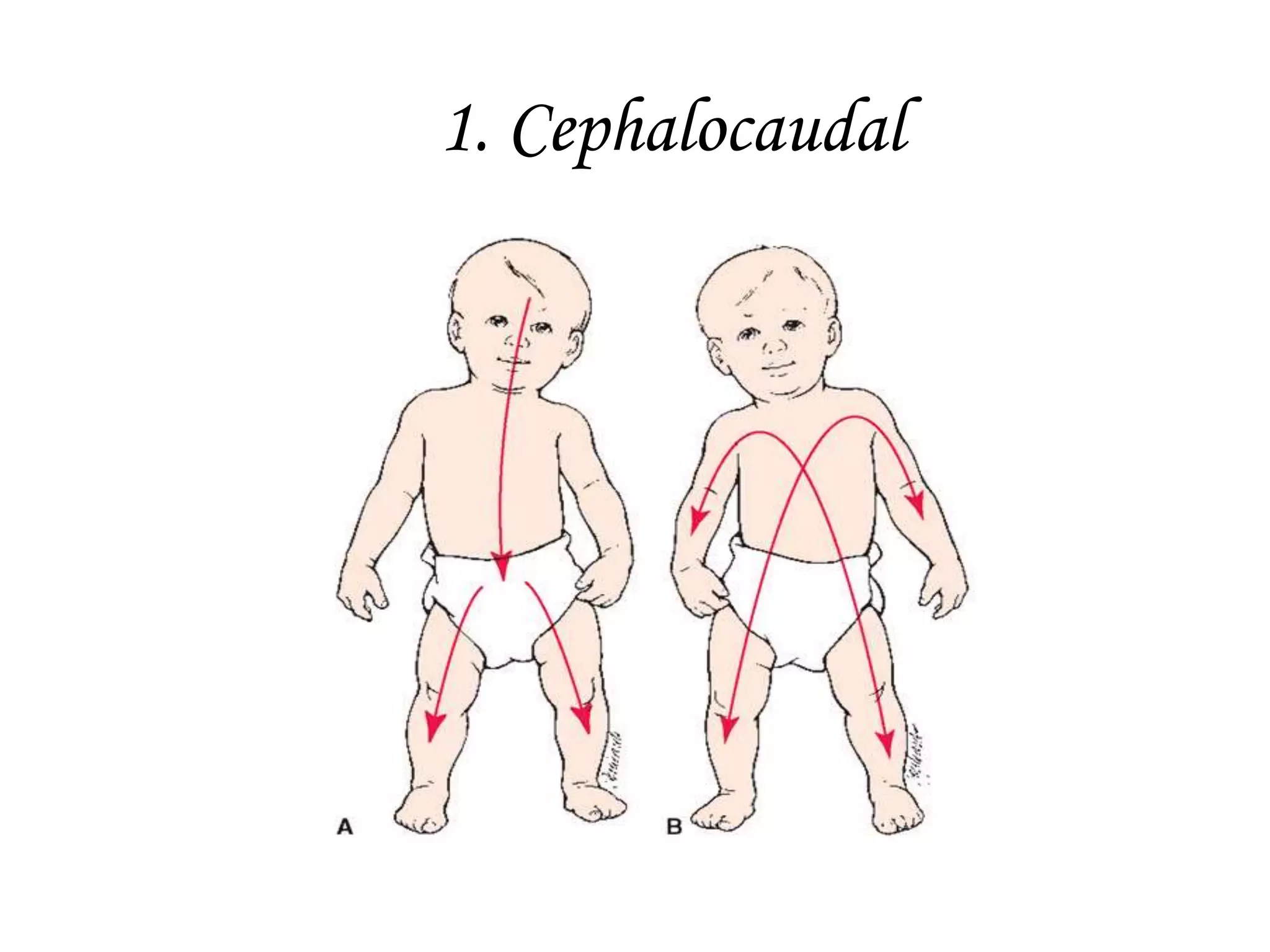
1. Cephalocaudal
CEPHALOCAUDAL
 This principle describes the direction of growth and
development.
 The head region starts growth at first, following by which
other organs starts developing.
 The child gains control of the head first, then the arms and
then the legs.
 Infants develop control of the head and face movements at
first two months. In next few months they are able to lift
themselves up by using their arms. Next gain control over leg
and able to crawl, stand, walk, run, jump, climb, day by day.
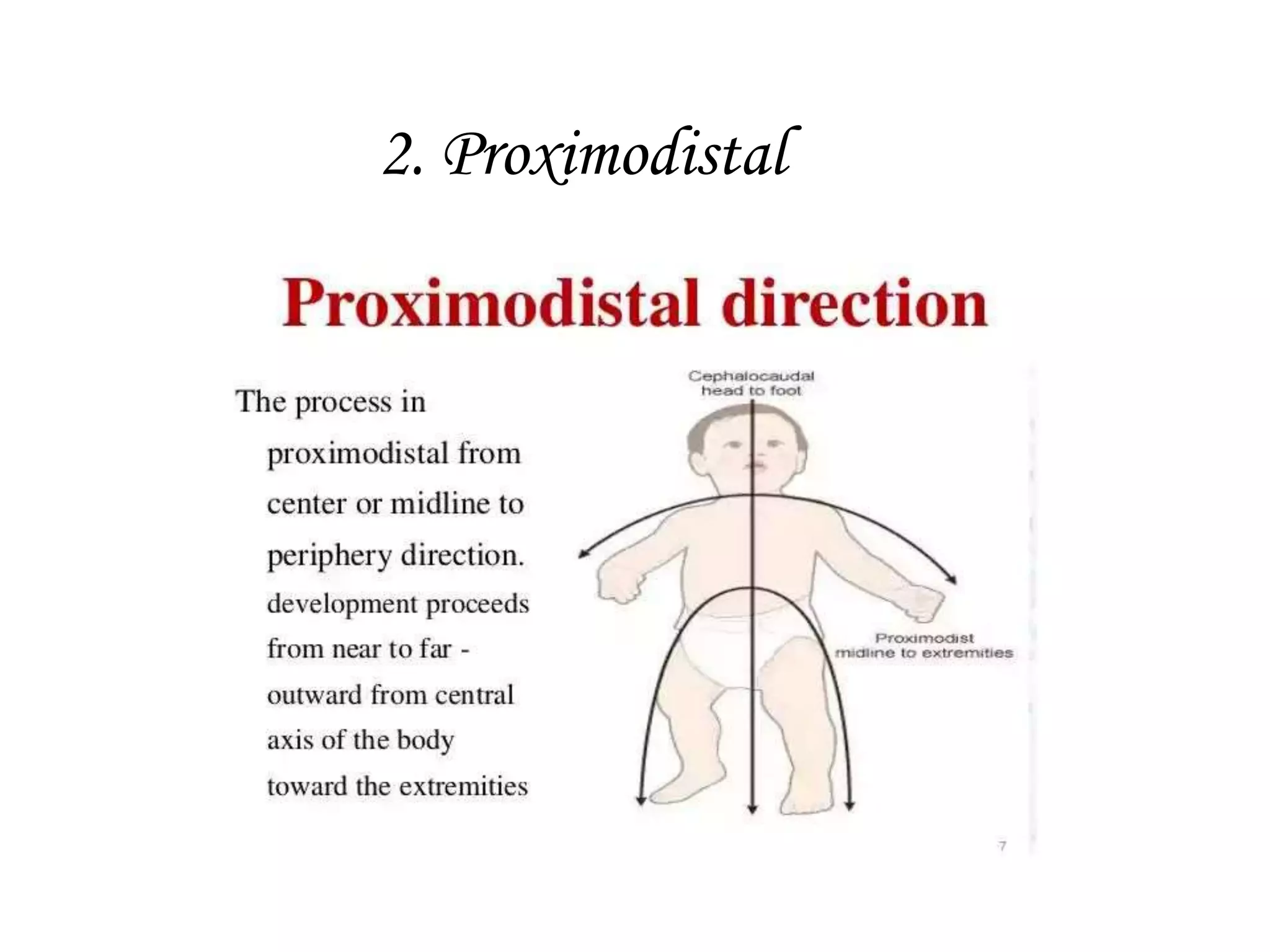
2. Proximodistal
PROXIMODISTAL
 The directional sequence of development during both
prenatal and postnatal stages may either be (i) from head to
foot, or (ii) from the central axis to the extremities of the
body.
 The spinal cord develops before outer parts of the body.
 The child’s arms develops before the hands, the hands and
feet develops before the fingers and toes.
 Fingers and toe muscles are the last to develop in physical
development.
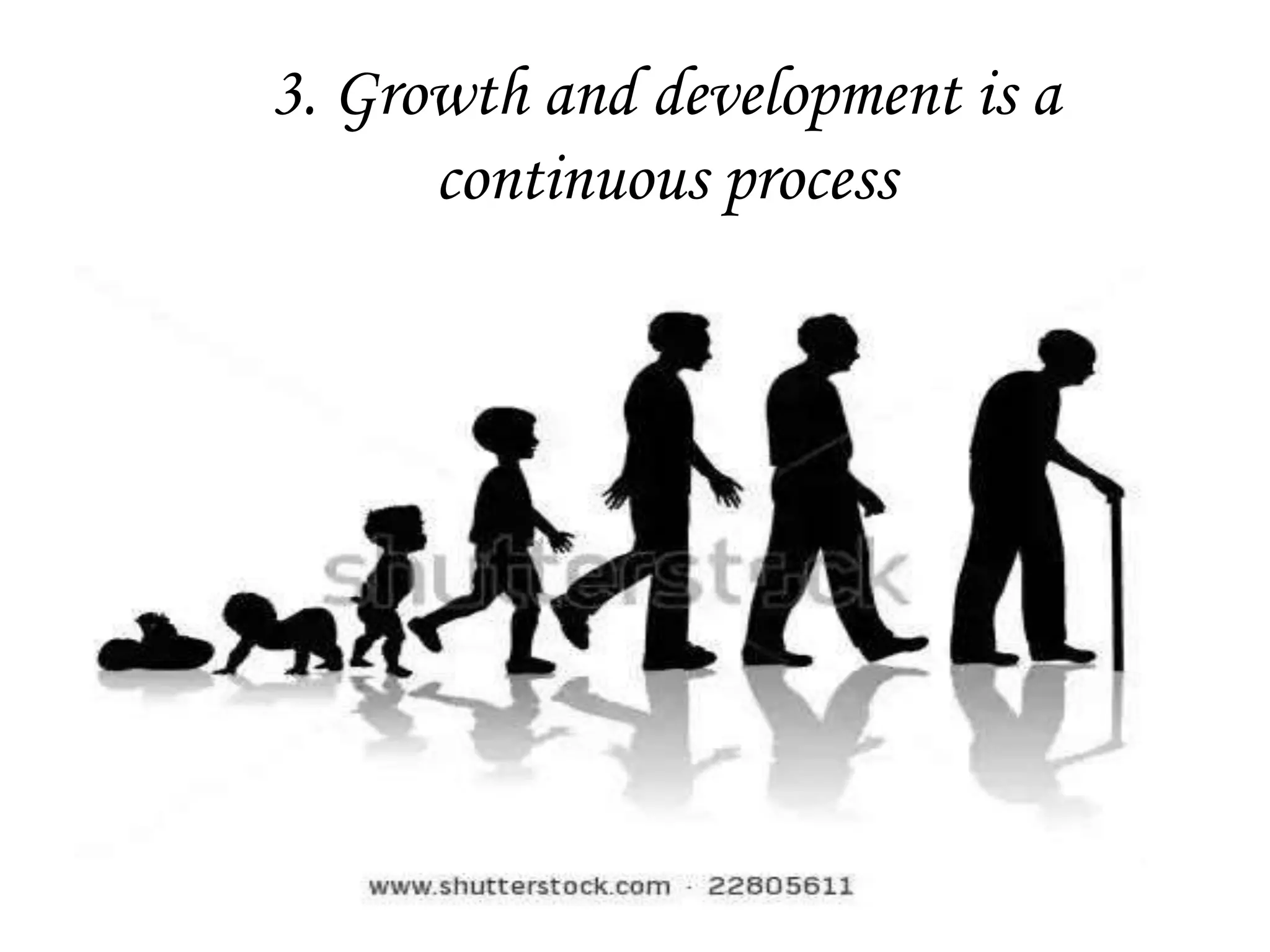
3. Growth and development is a
continuous process
continuous process
 Growth and Development is a continues process from
conception to death.
 In the early years of life, development consists of changes that
lead the child to maturity not only of body size and functioning,
but also of behaviour.
 Even after maturity has been attained, development does not
end. Changes continue which lead to the period of life known as
senescence or old age.
 These changes continue until death ends the life cycle.
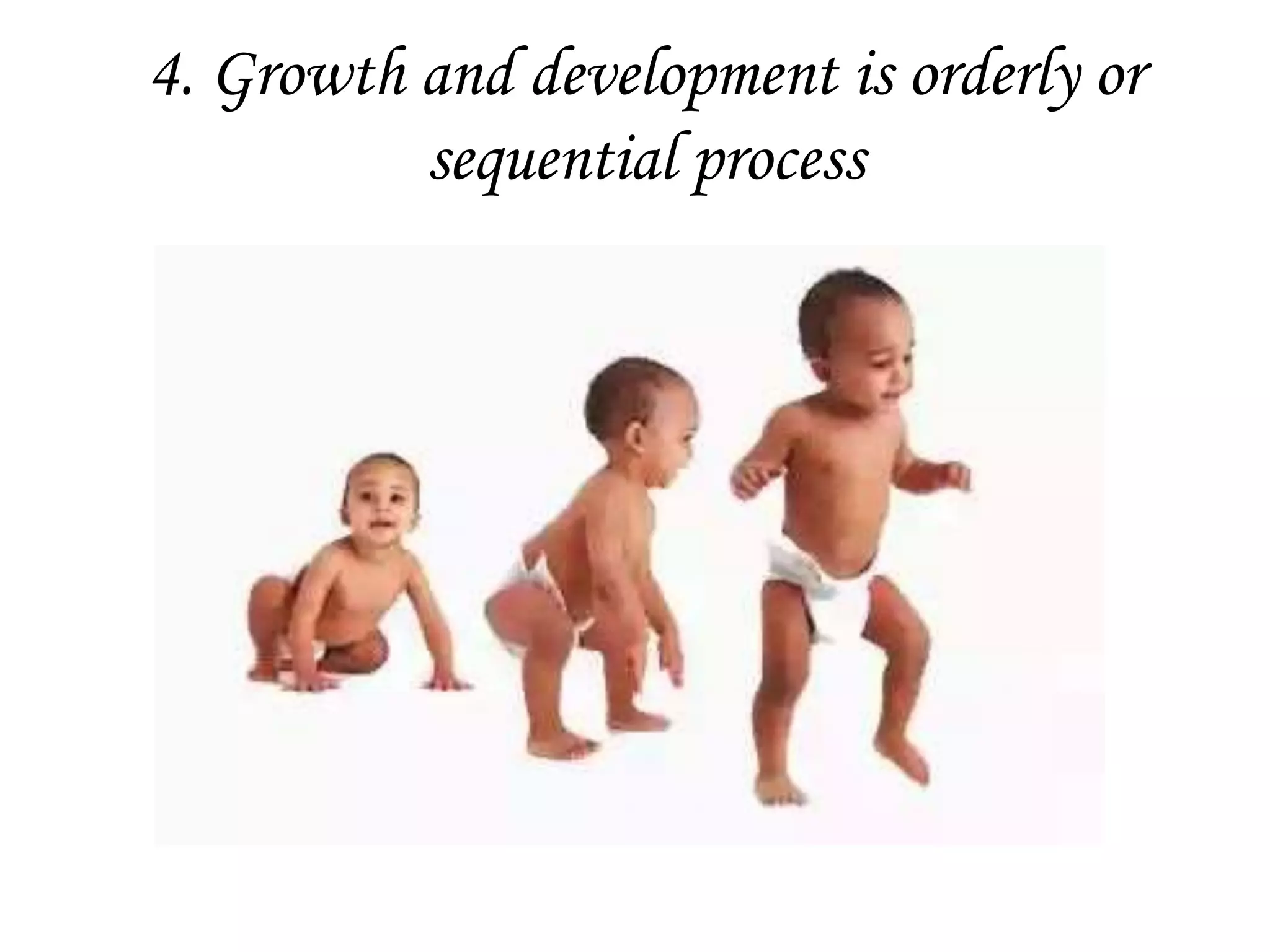
4. Growth and development is orderly or
sequential process
orderly or sequential process
 Every species, whether animal or human, follows a pattern of
development peculiar to it. This pattern in general is the same for
all individuals.
 Social and behavioural scientists increasingly have come to see
development as a relationship between organism and
environment in a transaction or collaboration.
 All children follow a development pattern with one stage leading
to the next.
 Ex - Infants stand Before they walk; draw circles before they
make squares
5.Influenced by environmental and
genetic factor
 Individuals work with and affect
their environment, and in turn the
environment works with and affects
them
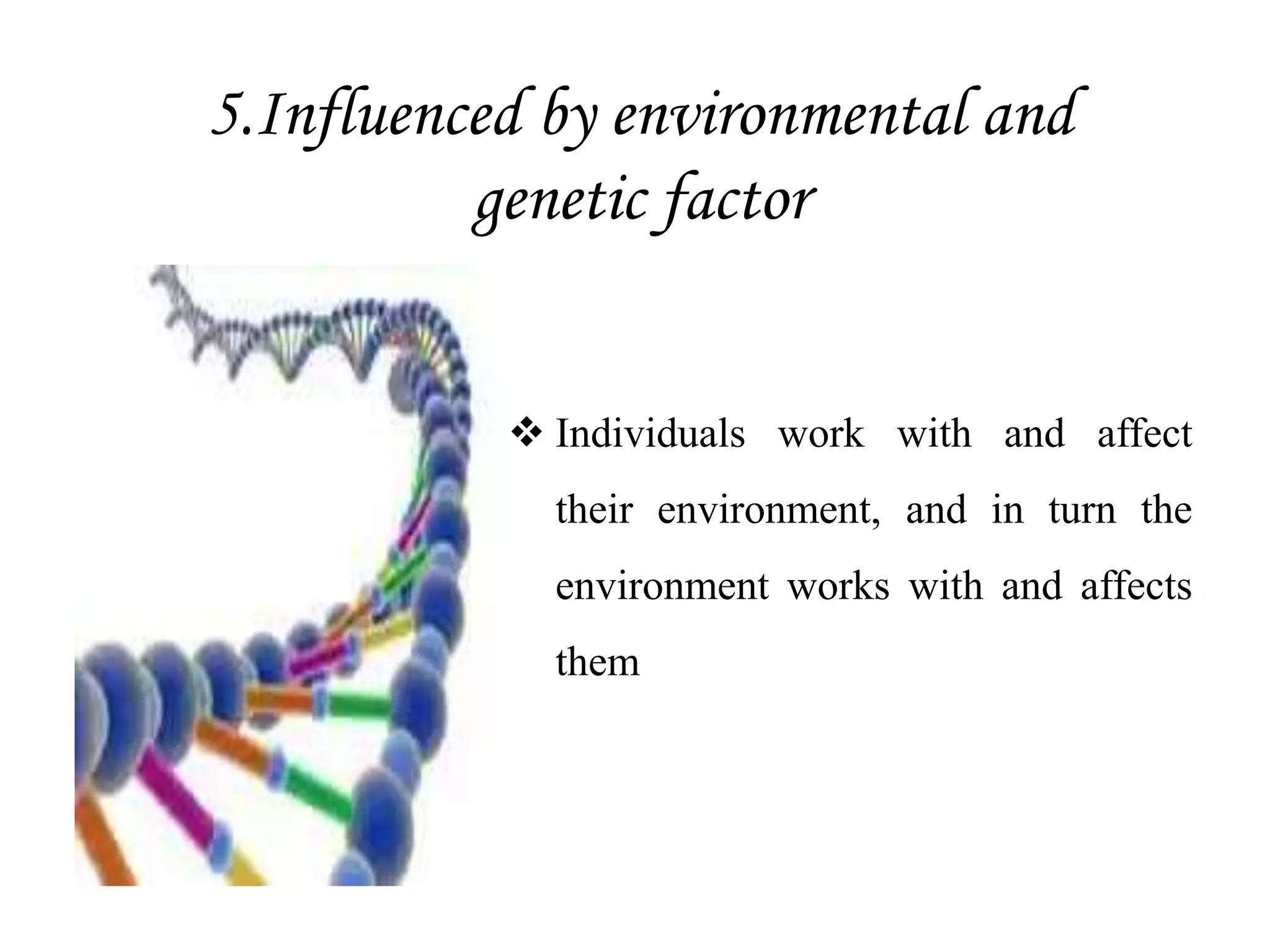
6. Growth and development is predictable
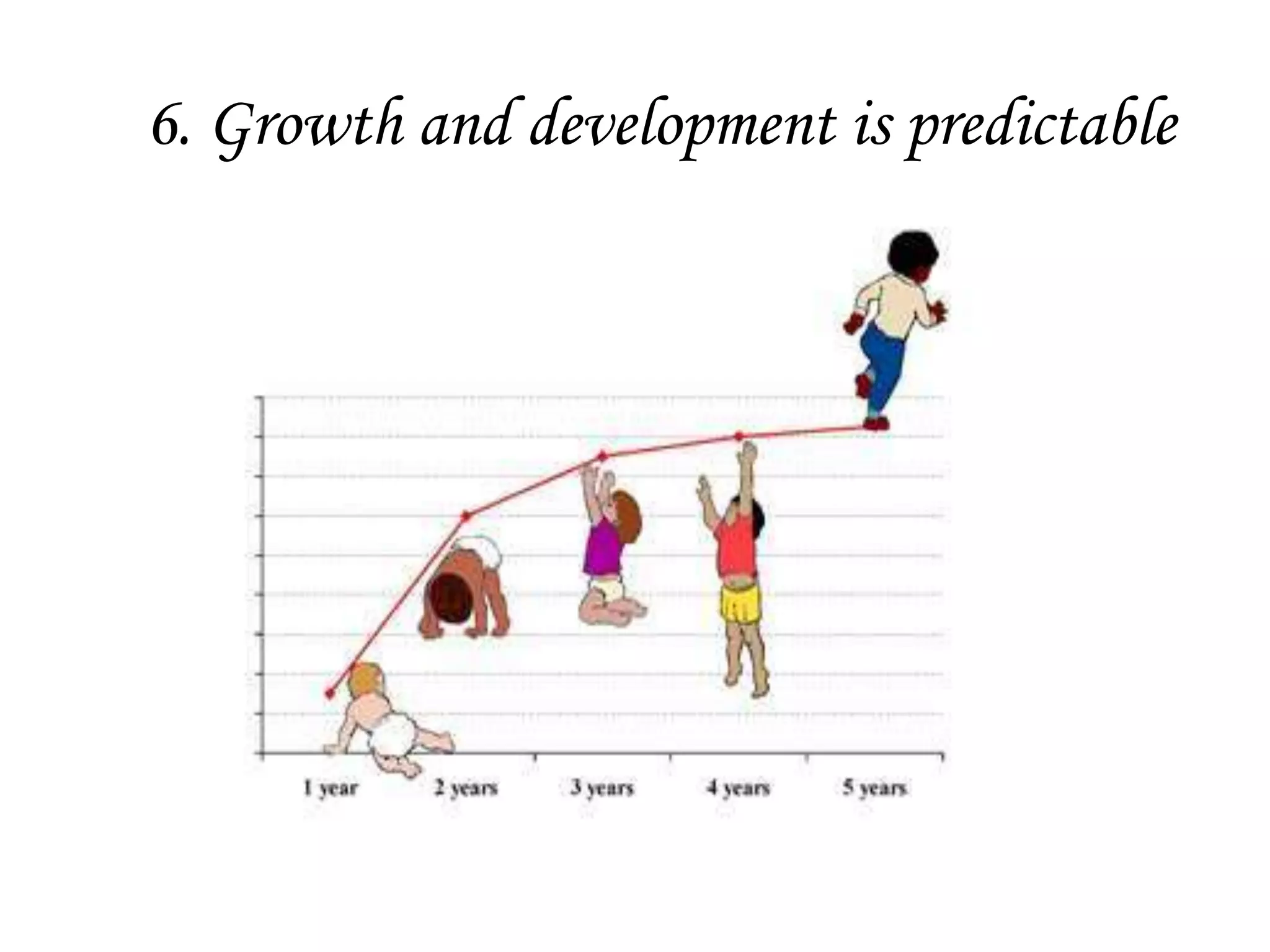
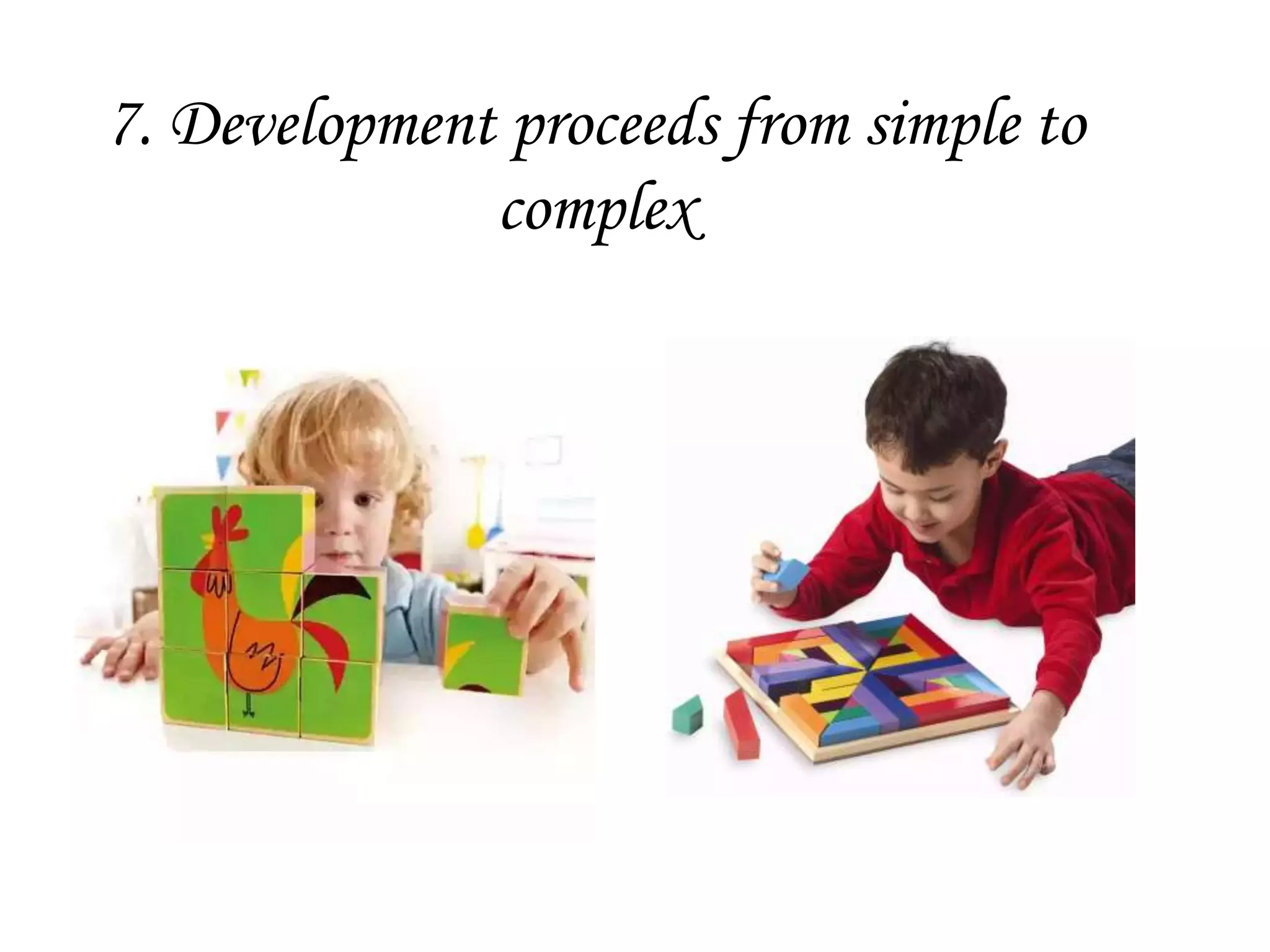
7. Development proceeds from simple to
complex
simple to complex
 Children use their cognitive and language skills to reason and
solve problems.
 Children at first are able hold the big things by using both
arms, In the next part able to hold things in a single hand,
then only able to pick small objects like peas, cereals etc.
 Children when able to hold pencil, first starts draw circles
then squares then only letters after that the words.
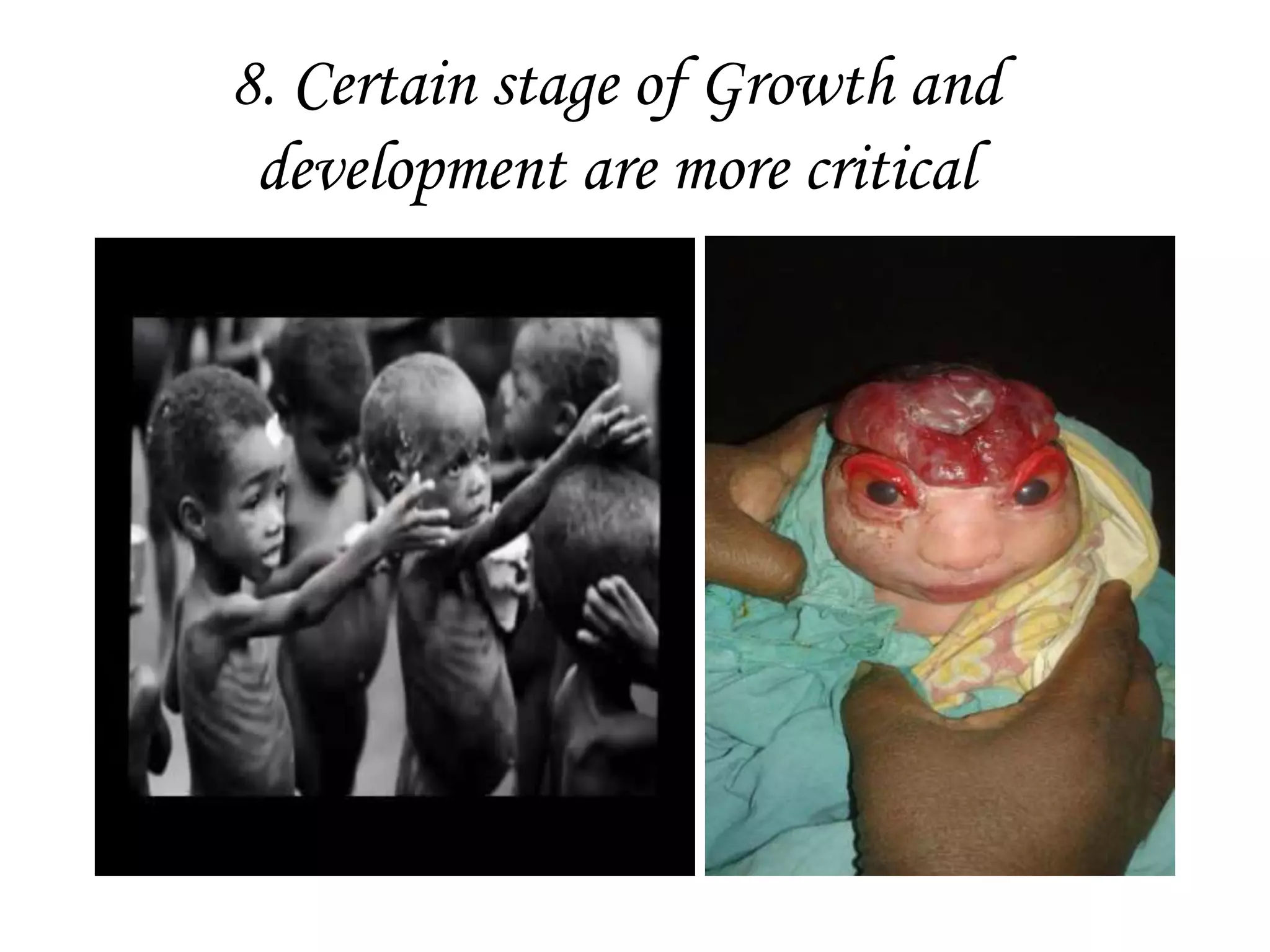
8. Certain stage of Growth and
development are more critical
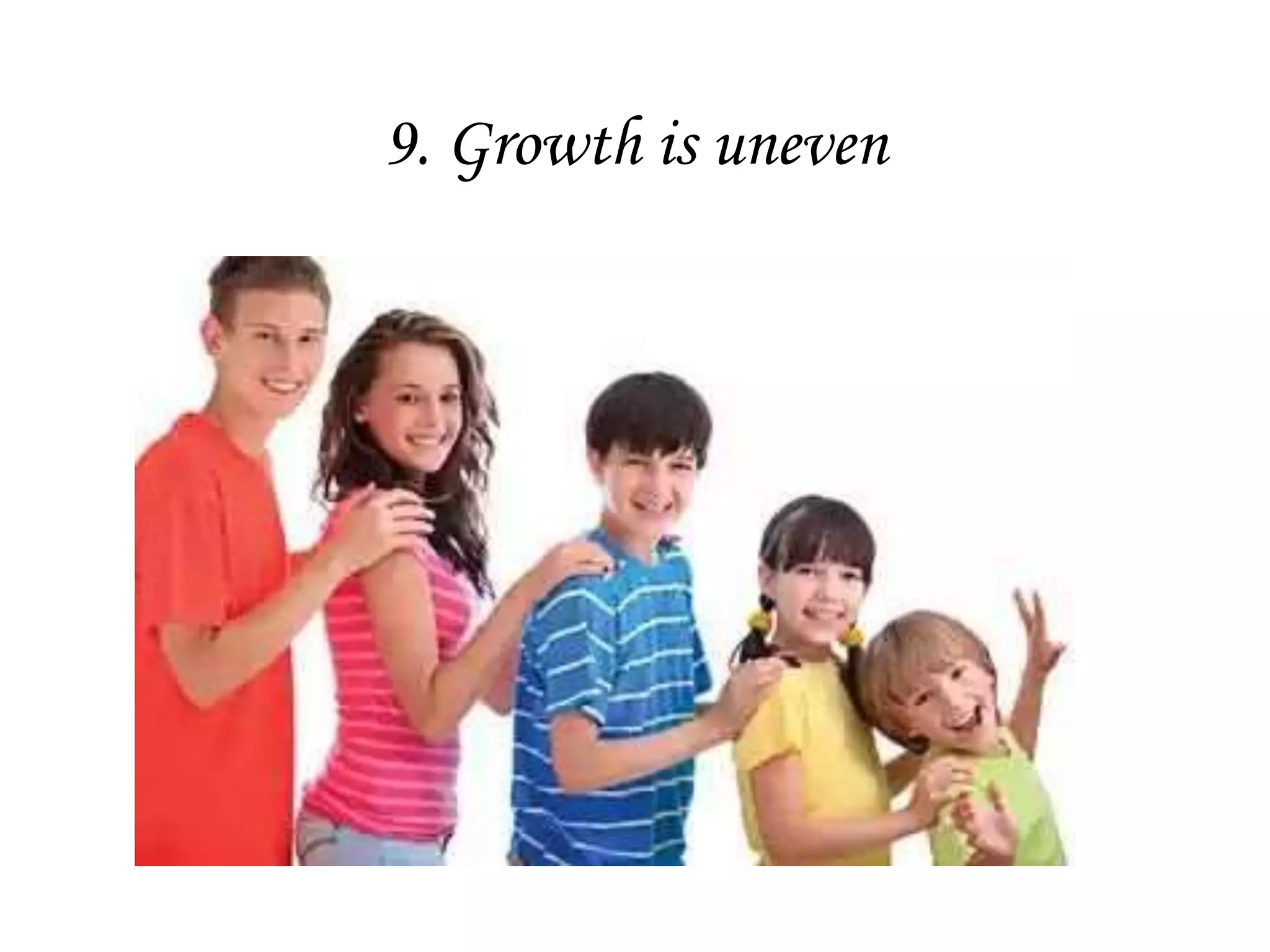
9. Growth is uneven
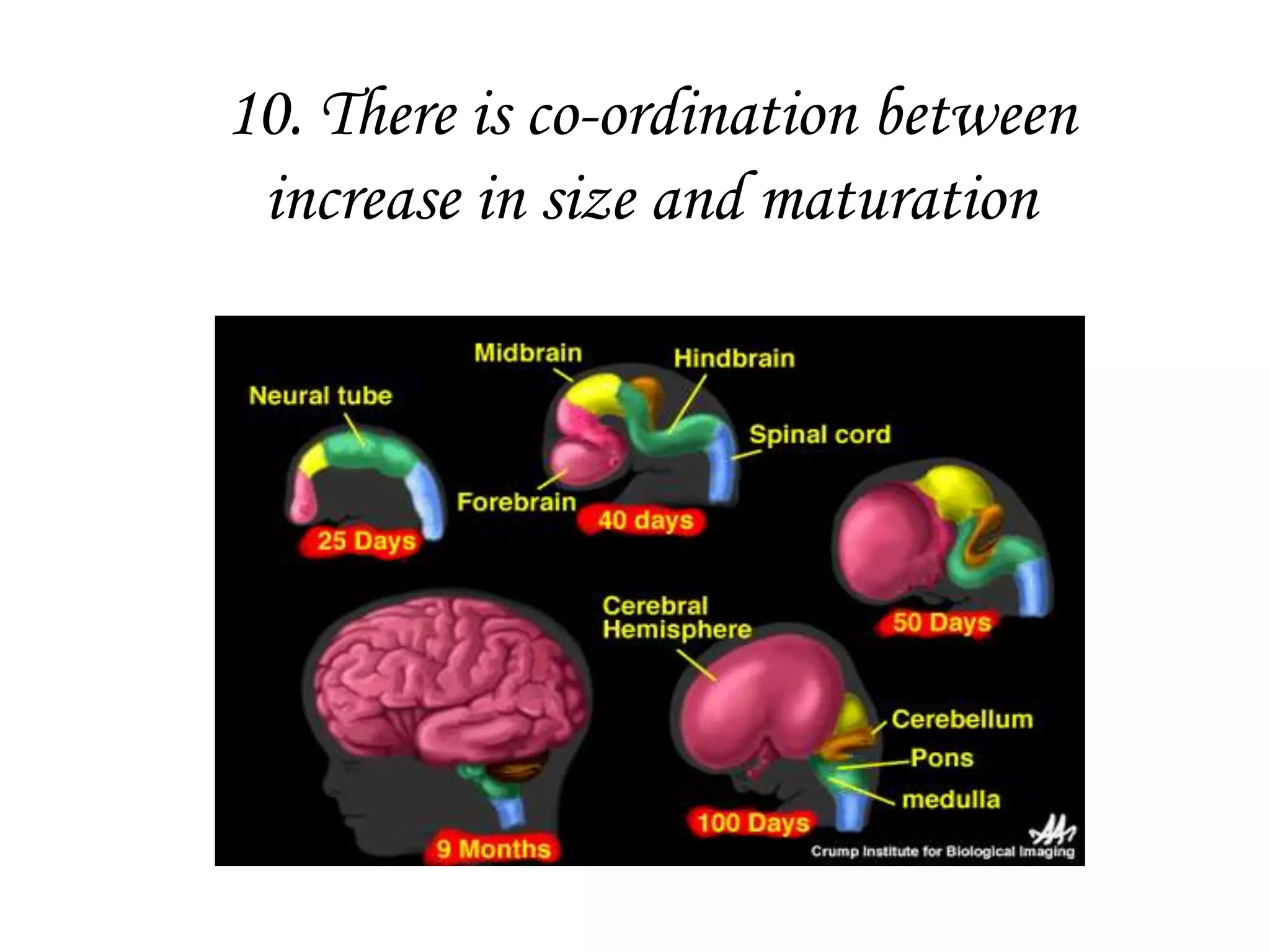
10. There is co-ordination between
increase in size and maturation
co-ordination between increase in size and maturation
 Maturation refers to the sequential characteristic of biological
growth and development.
 The biological changes occur in sequential order and give
children new abilities.
 Changes in the brain and nervous system account largely for
maturation. And help children to improve in thinking and
motor skills.
 Children must mature to a, certain point before they can
progress to new skills.
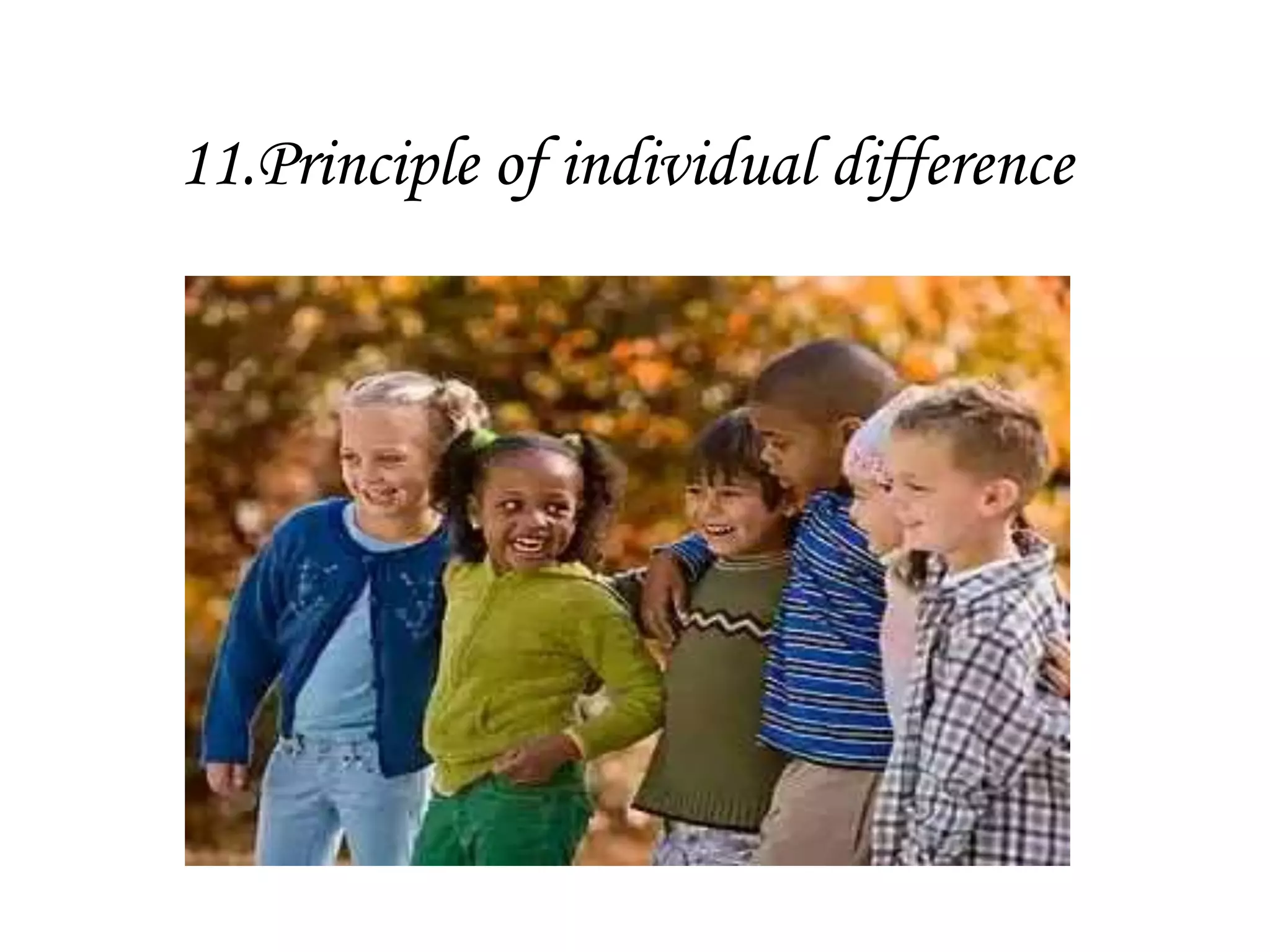
11.Principle of individual difference
individual difference
 The tempo of development is not even. Individuals differ in
the rate of growth and development.
 Boys and girls have different development rates. Each part of
the body has its own particular rate of growth. Development
does not occur at an even pace.
 There are periods of great intensity and equilibrium and there
are periods of imbalance.
 Development achieves a plateau and this may occur at any
level or between levels.
12. Rate of growth and development is
interrelated
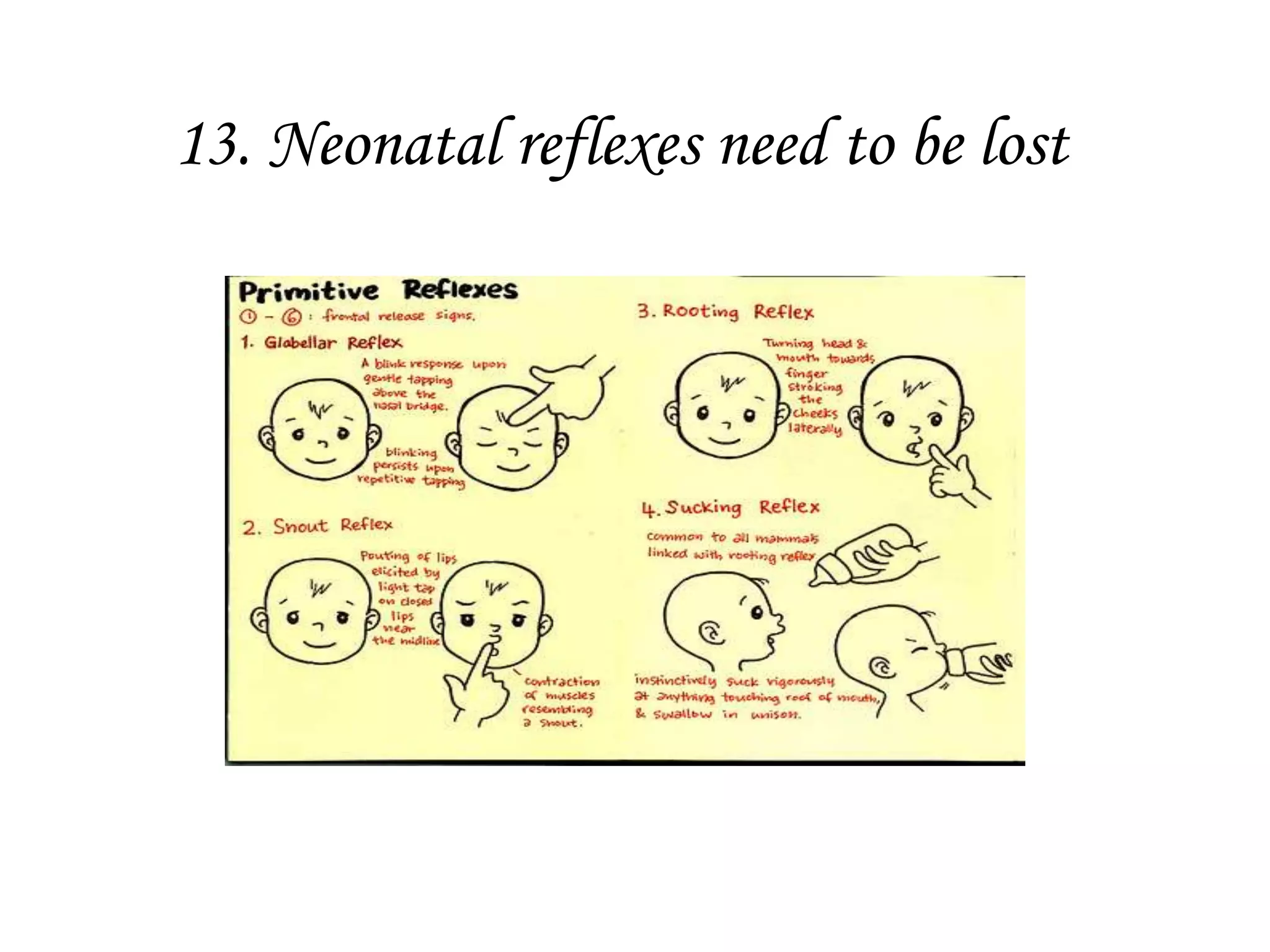
13. Neonatal reflexes need to be lost
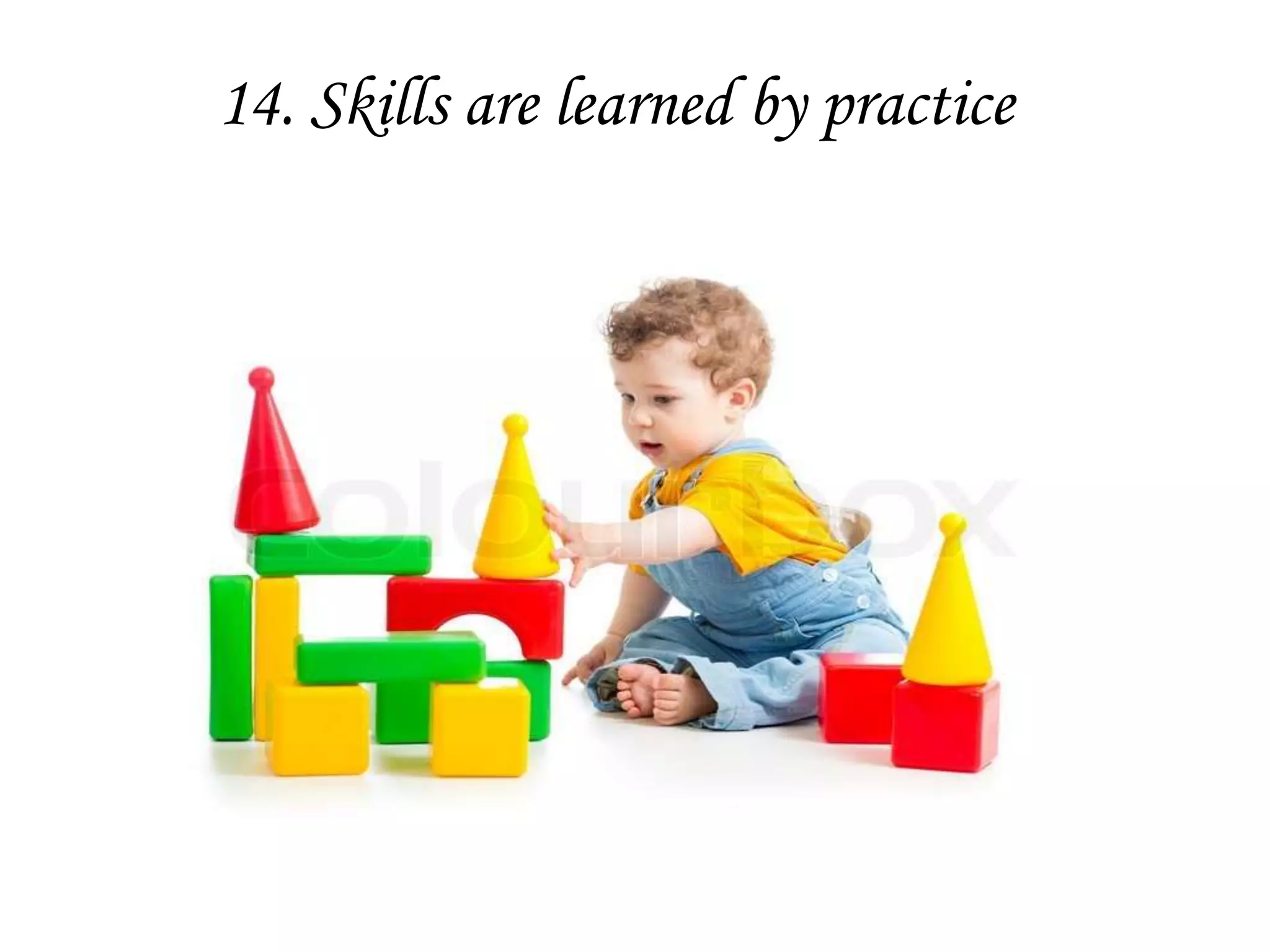
14. Skills are learned by practice
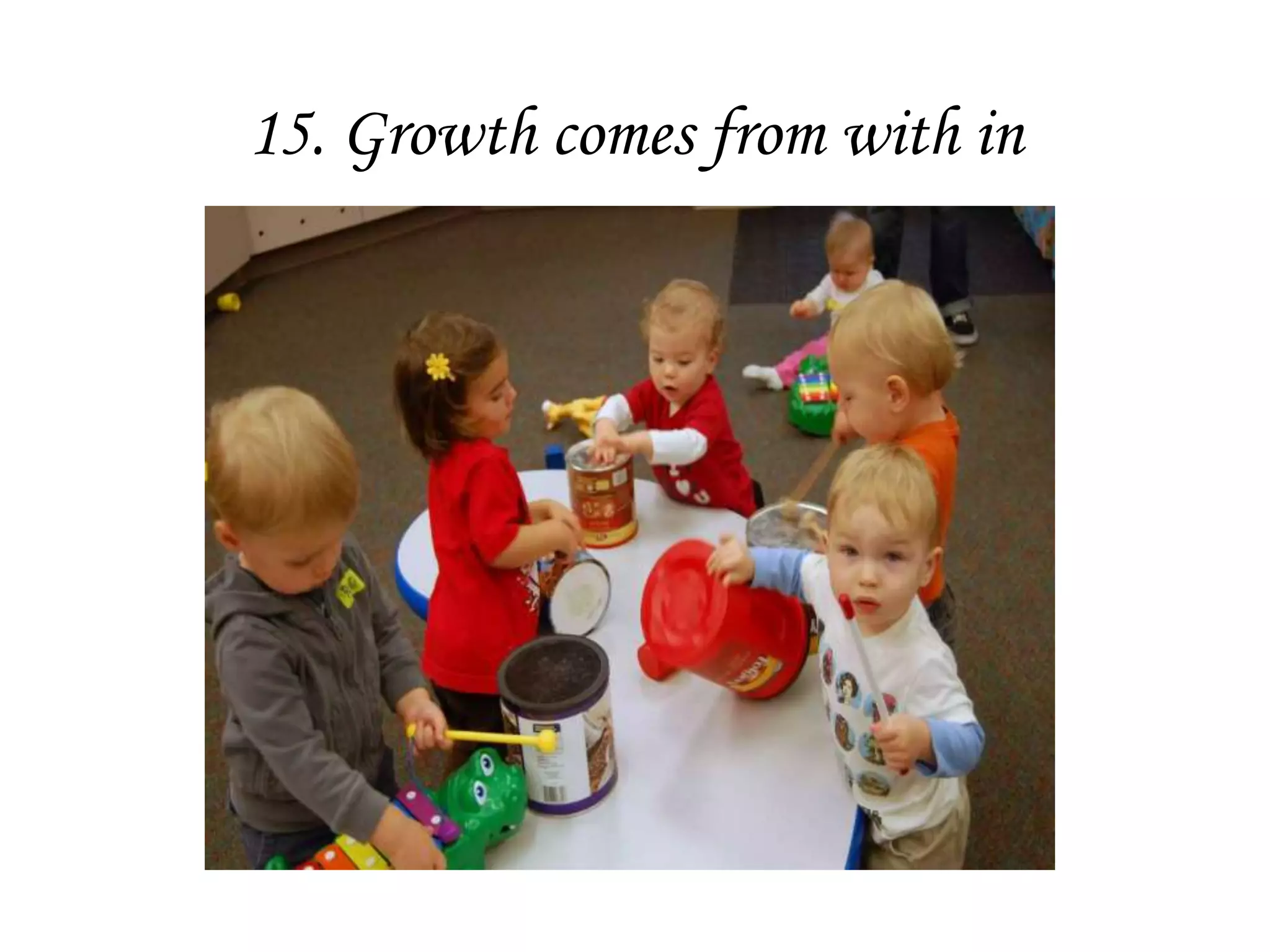
15. Growth comes from with in
Growth comes from with in
 One or surrounding environment can encourage or can hinder
the energy of a child, but the drive force that pushes a child to
grow is carried inside him.
 Parent or teacher job is to clear the track, guide the child with
loving acceptance and then relax and enjoy.
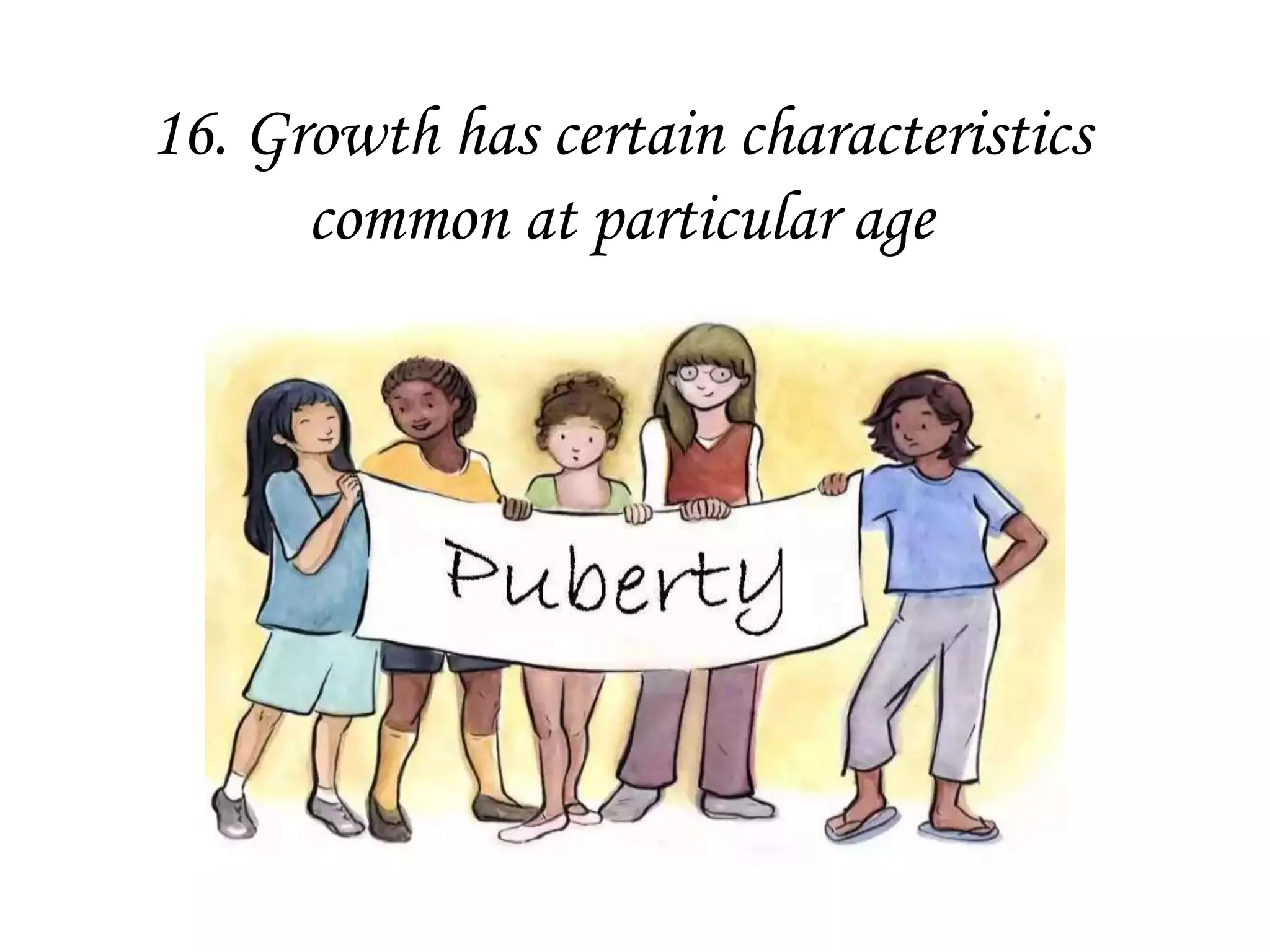
16. Growth has certain characteristics
common at particular age
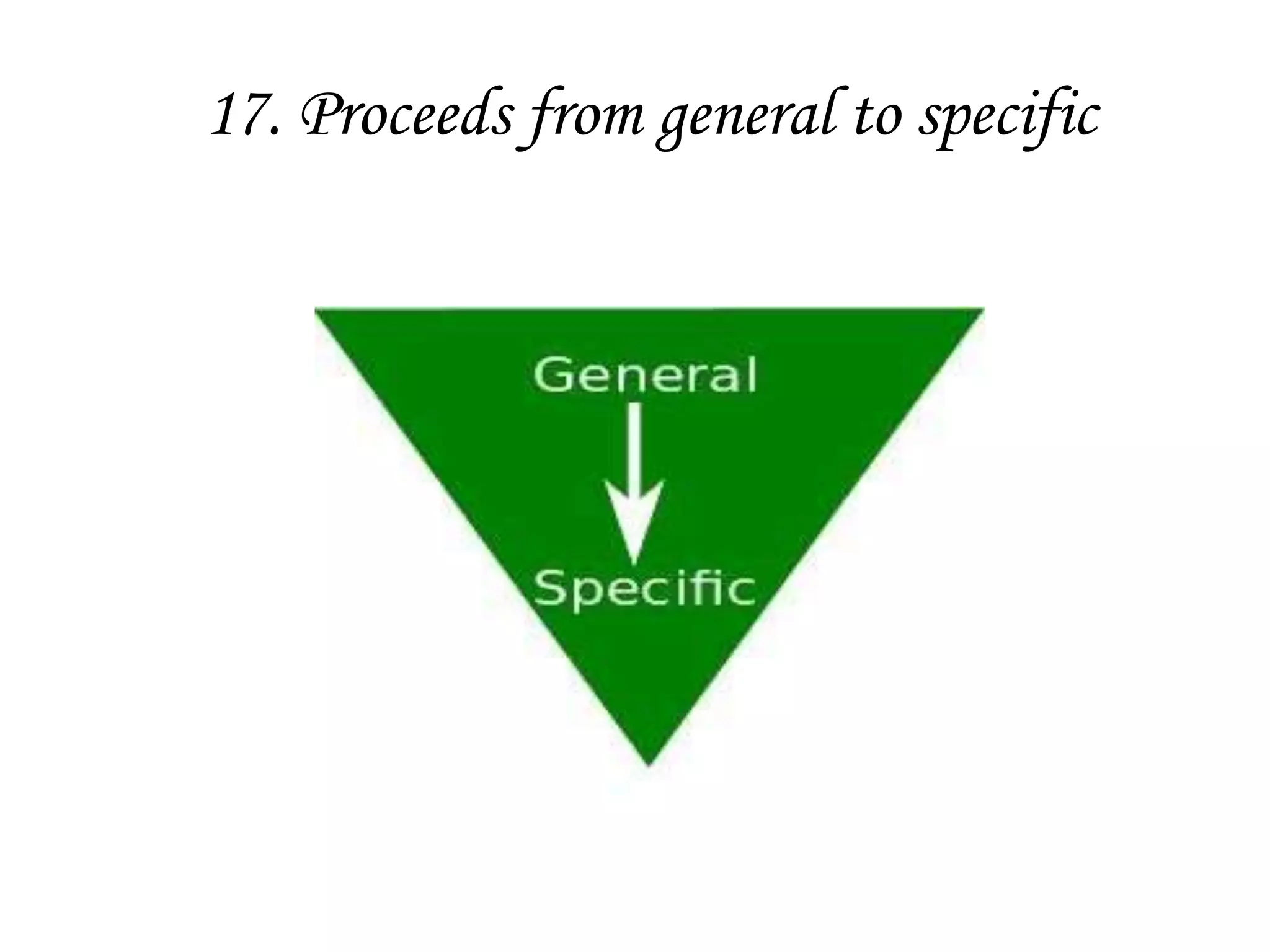
17. Proceeds from general to specific
general to specific
 Development proceeds from general to specific. In all areas of
development, general activities always precedes specific
activity.
For example;
 - The fetus moves its whole body but incapable of making
specific responses
 -Infants wave their arms randomly. They can make such
specific responses as reaching out for an object near them.
thanks

Principles of growth and development

  • 1.
    Principles of growthand development Prepared by : Vijaykumar m b Lecturer, MTIN, Charusat University, Gujarat
  • 2.
    Define growth :Growthrefers to an increase in physical size of the whole body or any of its parts. It is simply a quantitative change in the child’s body. It can be measured in Kg, pounds, meters, inches, ….. etc Development : Development refers to a progressive increase in skill and capacity of function. It is a qualitative change in the child’s functioning. It can be measured through observation. Principle :-A fundamental, primary or general law or truth from which others are derived.
  • 3.
  • 4.
    CEPHALOCAUDAL  This principledescribes the direction of growth and development.  The head region starts growth at first, following by which other organs starts developing.  The child gains control of the head first, then the arms and then the legs.  Infants develop control of the head and face movements at first two months. In next few months they are able to lift themselves up by using their arms. Next gain control over leg and able to crawl, stand, walk, run, jump, climb, day by day.
  • 5.
  • 6.
    PROXIMODISTAL  The directionalsequence of development during both prenatal and postnatal stages may either be (i) from head to foot, or (ii) from the central axis to the extremities of the body.  The spinal cord develops before outer parts of the body.  The child’s arms develops before the hands, the hands and feet develops before the fingers and toes.  Fingers and toe muscles are the last to develop in physical development.
  • 7.
    3. Growth anddevelopment is a continuous process
  • 8.
    continuous process  Growthand Development is a continues process from conception to death.  In the early years of life, development consists of changes that lead the child to maturity not only of body size and functioning, but also of behaviour.  Even after maturity has been attained, development does not end. Changes continue which lead to the period of life known as senescence or old age.  These changes continue until death ends the life cycle.
  • 9.
    4. Growth anddevelopment is orderly or sequential process
  • 10.
    orderly or sequentialprocess  Every species, whether animal or human, follows a pattern of development peculiar to it. This pattern in general is the same for all individuals.  Social and behavioural scientists increasingly have come to see development as a relationship between organism and environment in a transaction or collaboration.  All children follow a development pattern with one stage leading to the next.  Ex - Infants stand Before they walk; draw circles before they make squares
  • 11.
    5.Influenced by environmentaland genetic factor  Individuals work with and affect their environment, and in turn the environment works with and affects them
  • 12.
    6. Growth anddevelopment is predictable
  • 13.
    7. Development proceedsfrom simple to complex
  • 14.
    simple to complex Children use their cognitive and language skills to reason and solve problems.  Children at first are able hold the big things by using both arms, In the next part able to hold things in a single hand, then only able to pick small objects like peas, cereals etc.  Children when able to hold pencil, first starts draw circles then squares then only letters after that the words.
  • 15.
    8. Certain stageof Growth and development are more critical
  • 16.
  • 17.
    10. There isco-ordination between increase in size and maturation
  • 18.
    co-ordination between increasein size and maturation  Maturation refers to the sequential characteristic of biological growth and development.  The biological changes occur in sequential order and give children new abilities.  Changes in the brain and nervous system account largely for maturation. And help children to improve in thinking and motor skills.  Children must mature to a, certain point before they can progress to new skills.
  • 19.
  • 20.
    individual difference  Thetempo of development is not even. Individuals differ in the rate of growth and development.  Boys and girls have different development rates. Each part of the body has its own particular rate of growth. Development does not occur at an even pace.  There are periods of great intensity and equilibrium and there are periods of imbalance.  Development achieves a plateau and this may occur at any level or between levels.
  • 21.
    12. Rate ofgrowth and development is interrelated
  • 22.
    13. Neonatal reflexesneed to be lost
  • 23.
    14. Skills arelearned by practice
  • 24.
    15. Growth comesfrom with in
  • 25.
    Growth comes fromwith in  One or surrounding environment can encourage or can hinder the energy of a child, but the drive force that pushes a child to grow is carried inside him.  Parent or teacher job is to clear the track, guide the child with loving acceptance and then relax and enjoy.
  • 26.
    16. Growth hascertain characteristics common at particular age
  • 27.
    17. Proceeds fromgeneral to specific
  • 28.
    general to specific Development proceeds from general to specific. In all areas of development, general activities always precedes specific activity. For example;  - The fetus moves its whole body but incapable of making specific responses  -Infants wave their arms randomly. They can make such specific responses as reaching out for an object near them.
  • 29.