

Mrs. D. Melba Sahaya Sweety RN,RM
PhD Nursing , MSc Nursing (Pediatric Nursing), BSc Nursing
Associate Professor
Department of Pediatric Nursing
Enam Nursing College, Savar,
Bangladesh.
1
INTRODUCTION
• Continual change is the essence of life. The rapid changes in size
that we call growth, and the rapid changes in form, function and
behaviour that we call development, are the core of paediatrics.
• Growth is a form of motion. Growth means the increase in the size
of the various parts and organs of the body by multiplication of cells
and intercellular components during the period commencing from
fertilization to physical maturity
• Child development refers to the sequence of physical, language,
thought and emotional changes that occur in a child from birth to
the beginning of adulthood. During this process a child progresses
from dependency on their parents/guardians to increasing
independence 2
DEFINITION
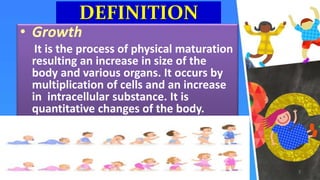
• Growth
It is the process of physical maturation
resulting an increase in size of the
body and various organs. It occurs by
multiplication of cells and an increase
in intracellular substance. It is
quantitative changes of the body.
3
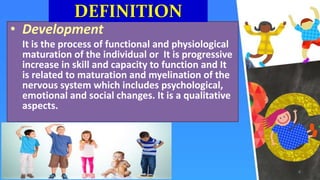
• Development
It is the process of functional and physiological
maturation of the individual or It is progressive
increase in skill and capacity to function and It
is related to maturation and myelination of the
nervous system which includes psychological,
emotional and social changes. It is a qualitative
aspects.
DEFINITION
4
• Maturation
It is a process of an increase in competence
and adaptability; aging; usually used to
describe a qualitative change; a change in the
complexity of a structure that makes it
possible for that structure to begin
functioning; to function at a higher level
DEFINITION
5
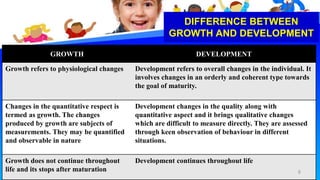
DIFFERENCE BETWEEN
GROWTH AND DEVELOPMENT
GROWTH DEVELOPMENT
Growth refers to physiological changes Development refers to overall changes in the individual. It
involves changes in an orderly and coherent type towards
the goal of maturity.
Changes in the quantitative respect is
termed as growth. The changes
produced by growth are subjects of
measurements. They may be quantified
and observable in nature
Development changes in the quality along with
quantitative aspect and it brings qualitative changes
which are difficult to measure directly. They are assessed
through keen observation of behaviour in different
situations.
Growth does not continue throughout
life and its stops after maturation
Development continues throughout life
6
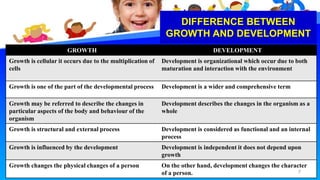
DIFFERENCE BETWEEN
GROWTH AND DEVELOPMENT
GROWTH DEVELOPMENT
Growth is cellular it occurs due to the multiplication of
cells
Development is organizational which occur due to both
maturation and interaction with the environment
Growth is one of the part of the developmental process Development is a wider and comprehensive term
Growth may be referred to describe the changes in
particular aspects of the body and behaviour of the
organism
Development describes the changes in the organism as a
whole
Growth is structural and external process Development is considered as functional and an internal
process
Growth is influenced by the development Development is independent it does not depend upon
growth
Growth changes the physical changes of a person On the other hand, development changes the character
of a person. 7
8
1. Growth and Development proceeds from the head
down to the tail or cephalocaudle direction
• This principle describes the direction of growth and
development. According to this principle, the child gains
control of the head first, then the arms, and then the legs.
Infants develop control of the head and face movements
within the first two months after birth. In the next few
months, they are able to lift themselves up by using their
arms. By 6 to 12 months of age, infants start to gain leg
control and may be able to crawl, stand, or walk.
Coordination of arms always precedes coordination of legs.
9
2. Growth and Development proceeds
from the center of the body towards
peripheral or Proximodistal direction
• In Proximodistal development that also
describes the direction of development. This
means that the spinal cord develops before
outer parts of the body. The child’s arms
develop before the hands and feet develop
before the fingers and toes.
• Finger and toe muscles (used in fine motor
dexterity) are the last to develop in physical
development. 10
3. Growth and development proceed from the general
to specific.
• In motor development, the infant will be able to grasp an
object with the whole hand before using only the thumb
and forefinger. The infant’s first motor movements are very
generalized, undirected, and reflexive, waving arms or
kicking before being able to reach or creep toward an
object. Growth occurs from large muscle movements to
more refined (smaller) muscle movements. 11
4. Growth and development is a
continuous process.
• For example, in motor development, there is a
predictable sequence of developments that occur
before walking. The infant lifts and turns the
head before he or she can turn over. Infants can
move their limbs (arms and legs) before
grasping an object. Mastery of climbing stairs
involves increasing skills from holding on to
walking alone. By the age of four, most children
can walk up and down stairs with alternating
feet. As in maturation, in order for children to
write or draw, they must have developed the
manual (hand) control to hold a pencil and
crayon. 12
5. Development depends on maturation and learning.
• Maturation refers to the sequential characteristic of biological growth and
development. The biological changes occur in sequential order and give children
new abilities. Changes in the brain and nervous system account largely for
maturation. These changes in the brain and nervous system help children to
improve in thinking (cognitive) and motor (physical) skills. Also, children must
mature to a certain point before they can progress to new skills (Readiness). For
example, a four-month-old cannot use language because the infant’s brain has
not matured enough to allow the child to talk. By two years old, the brain has
developed further and with help from others, the child will have the capacity to
say and understand words. Also, a child can’t write or draw until he has
developed the motor control to hold a pencil or crayon. Maturational patterns are
innate, that is, genetically programmed.
13
6. Development proceeds from the simple
(concrete) to the more complex
• Children use their cognitive and language skills to reason and solve
problems. For example, learning relationships between things (how things
are similar), or classification, is an important ability in cognitive
development.
• The first level of thinking about how objects are alike is to give a
description or functional relationship (both concrete thoughts) between the
two objects. “An apple and orange are round” and “An apple and orange
are alike because you eat them” are typical responses of three, four and five
year olds. As children develop further in cognitive skills, they are able to
understand a higher and more complex relationship between objects and
things; that is, that an apple and orange exist in a class called fruit. The
child cognitively is then capable of classification. 14
7.Early Development is more critical
than later Development
• The environment in which children live
during early formative years of life has a
strong impact on their hereditary
potentials. Favorable relationships with
members of the family, liberal child
training methods, a stimulating
environment result in the development of
better adjusted individual in the later life.
15
8. There are individual rates of growth and
development.
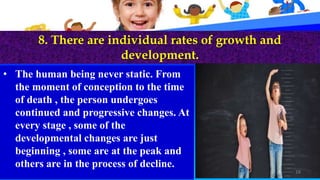
• The human being never static. From
the moment of conception to the time
of death , the person undergoes
continued and progressive changes. At
every stage , some of the
developmental changes are just
beginning , some are at the peak and
others are in the process of decline.
16
9.Development is sequential.
• There is a pattern of order and sequence in
human growth and development. An
individual develops from single cell to a
fetus to an adult/old man or women; to sit
then stand first before walking; to cry, coos,
babbles, before being able to say “Ma-ma-
ma”and “Da-da-da”.
17
10. Development is Predictable
• Development is predictable, which means
that with the help of the uniformity of
pattern and sequence of development. We
can go to a great extent, forecast the general
nature and behaviour of a child in one or
more aspects or dimension at any particular
stage of its growth and development. We
can know the particular age at which
children will learn to walk, speak and so on.
18
11. The child development as a
unified whole
• The child intellect is related to his
physical well-being . Physical well-being
is affected by his emotions and emotions
are affected by his successes and failures
in school and by the environment in the
family . The child who are physically
weak are slow in the development of
mental processes also
19
12 .Each Development takes place in stages
The development of the child takes place in stages Each stage has certain unique
characteristics and in each stage , certain type of behaviour or traits are more
conspicuous than others. The entire period of Development is often break the
lifespan into eight stages:
• Prenatal Development, Infancy and Toddlerhood
• Early Childhood
• Middle Childhood
• Adolescence
• Early Adulthood
• Middle Adulthood 20
13. Each Developmental stage has
certain characteristic trait
• There are some peculiar traits that are
observed in children at a particular
developmental stage and go away after
some time .The child’s behavior should
be understood against the expected
behavior of his age.
21
14 .There are period of accelerated growth and
decelerated growth
• During babyhood and the early pre-school years the
growth is rapid . During the school years , the growth
rate decreases . Growth is again rapid during
adolescence but physical growth tapers off during the
later part of adolescence and by the time , an individual
touches adulthood .
22
15. Development is influenced by
Heredity and Environment
• A child’s genetic inheritance (heredity)
provides the basic foundation for many
physical and personality attributes, but
the influences of social , cultural , and
familial variables (environment) also
contributes to development.
23
16 .Development proceeds at different rates or
different behavior
• Development of mental and physical traits is continuous
but is never uniform for the entire individual.
Development of memory and understand is fast during
childhood while abstract thinking , reasoning and
capability to take decisions is as its peak during
adolescence
24
FACTORS AFFECTING GROWTH AND
DEVELOPMENT
25
Introduction
• Although the terms growth and development are used synonymously, they
have different meanings biologically. Growth refers to the incremental
changes in physical characteristics such as height, weight, size, etc., while
development refers to qualitative changes to growth in an orderly and
meaningful fashion which results in maturity.
• Growth and development contribute to each other, are inseparable, and occur
simultaneously. For example, most babies, by the time they grow up to be 8
months old, can weigh around 8 to 10 kilograms and can sit up.
• Growth and development depend on combination of many interdependent
factors especially by heredity and environment.
26
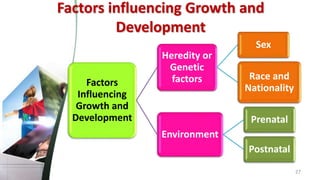
Factors influencing Growth and
Development
Factors
Influencing
Growth and
Development
Heredity or
Genetic
factors
Sex
Race and
Nationality
Environment
Prenatal
Postnatal
27
Genetic Factors
• Each child has a different genetic potential. Genetic predisposition is the
important factors which influences the growth and development of
children. Different characteristics such as height, body structure,color of
skin,eyes and hair etc.., depend upon inherited gene from parents . Thus
tall parents have tall children and parent with high intelligence are more
likely to have children with high level of inherent intelligence.
• Abnormal genes from ancestors may produce different familial diseases
which usually hinders the growth and development e.g. thalassemia,
hemophillia,galactosemia etc.., The process of growth and development is
also affected in children with chromosomal abnormalities , e.g. in Down’s
syndrome, Turner’s syndrome , klinefelter Syndrome
28
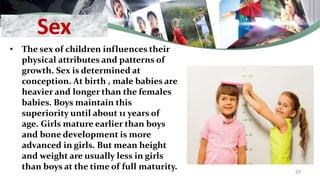
Sex
• The sex of children influences their
physical attributes and patterns of
growth. Sex is determined at
conception. At birth , male babies are
heavier and longer than the females
babies. Boys maintain this
superiority until about 11 years of
age. Girls mature earlier than boys
and bone development is more
advanced in girls. But mean height
and weight are usually less in girls
than boys at the time of full maturity. 29
Race and Nationality
• Growth potential of
different racial groups is
different in varying
extent. Physical
characteristics of different
national groups also vary.
Height and stature of
Americans and Indians
are usually differing
because of the differences
in growth patterns.
30
Environment
• The environment plays a critical role in the development of children
and it represents the sum total of physical and psychological
stimulation the child receives. Where you live also has a great
influence on how your children turn out to be.
• The schools they attend, the neighbourhood they live in, the
opportunities offered by the community and their peer circles are
some of the social factors affecting a child’s development. Living in
an enriching community that has parks, libraries and community
centres for group activities and sports all play a role in developing
the child’s skills, talents, and behaviour. Uninteresting communities
can push some children to not go outside often but play video
games at home instead. Even the weather of a place influences
children in the form of bodily rhythms, allergies and other health
conditions. 31
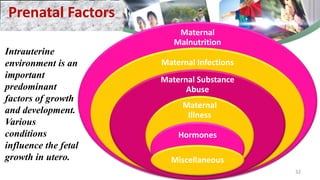
Prenatal Factors
Intrauterine
environment is an
important
predominant
factors of growth
and development.
Various
conditions
influence the fetal
growth in utero.
Maternal
Malnutrition
Maternal Infections
Maternal Substance
Abuse
Maternal
Illness
Hormones
Miscellaneous
32
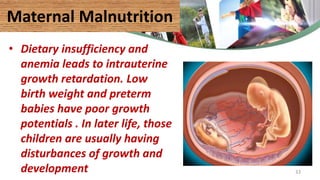
Maternal Malnutrition
• Dietary insufficiency and
anemia leads to intrauterine
growth retardation. Low
birth weight and preterm
babies have poor growth
potentials . In later life, those
children are usually having
disturbances of growth and
development 33
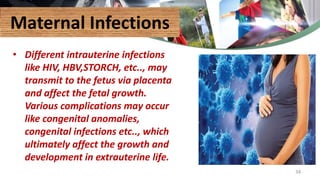
Maternal Infections
• Different intrauterine infections
like HIV, HBV,STORCH, etc.., may
transmit to the fetus via placenta
and affect the fetal growth.
Various complications may occur
like congenital anomalies,
congenital infections etc.., which
ultimately affect the growth and
development in extrauterine life.
34
Maternal Substance
Abuse
• Intake of teratogenic drugs (thalidomide,
phenytoin, etc.,) by the pregnant women in
the first trimester affects the
organogenesis and lead to congenital
malformations which hinder fetal growth.
Presence of congenital anomalies in later
life influence childhood growth and
development. Maternal tobacco intake
(smoking and Chewing) and alcohol abuse
also produce fetal growth restriction. 35
Maternal Illness
• Pregnancy – induced
hypertension, Anemia, Heart
disease, Hypothyroidism,
Diabetes mellitus, chronic renal
failure, Hyperpyrexia , etc., have
adverse effects on fetal growth.
Iodine deficiency of the mother
may leads to mental retardation
of the baby in later life.
36
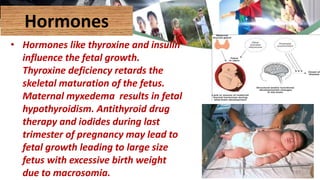
Hormones
• Hormones like thyroxine and insulin
influence the fetal growth.
Thyroxine deficiency retards the
skeletal maturation of the fetus.
Maternal myxedema results in fetal
hypothyroidism. Antithyroid drug
therapy and iodides during last
trimester of pregnancy may lead to
fetal growth leading to large size
fetus with excessive birth weight
due to macrosomia. 37
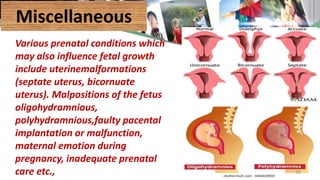
Miscellaneous
Various prenatal conditions which
may also influence fetal growth
include uterinemalformations
(septate uterus, bicornuate
uterus). Malpositions of the fetus
oligohydramnious,
polyhydramnious,faulty pacental
implantation or malfunction,
maternal emotion during
pregnancy, inadequate prenatal
care etc., 38
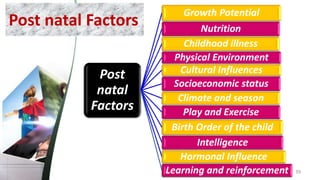
Post natal Factors
Post
natal
Factors
Growth Potential
Nutrition
Childhood illness
Physical Environment
Cultural Influences
Socioeconomic status
Climate and season
Play and Exercise
Birth Order of the child
Intelligence
Hormonal Influence
Learning and reinforcement 39
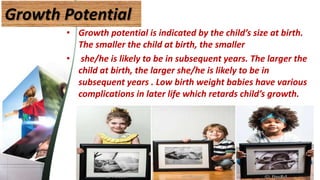
Growth Potential
• Growth potential is indicated by the child’s size at birth.
The smaller the child at birth, the smaller
• she/he is likely to be in subsequent years. The larger the
child at birth, the larger she/he is likely to be in
subsequent years . Low birth weight babies have various
complications in later life which retards child’s growth.
40
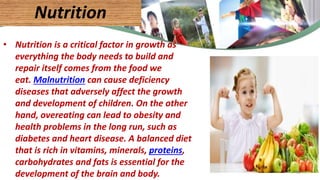
• Nutrition is a critical factor in growth as
everything the body needs to build and
repair itself comes from the food we
eat. Malnutrition can cause deficiency
diseases that adversely affect the growth
and development of children. On the other
hand, overeating can lead to obesity and
health problems in the long run, such as
diabetes and heart disease. A balanced diet
that is rich in vitamins, minerals, proteins,
carbohydrates and fats is essential for the
development of the brain and body.
Nutrition
41
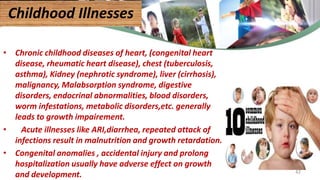
• Chronic childhood diseases of heart, (congenital heart
disease, rheumatic heart disease), chest (tuberculosis,
asthma), Kidney (nephrotic syndrome), liver (cirrhosis),
malignancy, Malabsorption syndrome, digestive
disorders, endocrinal abnormalities, blood disorders,
worm infestations, metabolic disorders,etc. generally
leads to growth impairement.
• Acute illnesses like ARI,diarrhea, repeated attack of
infections result in malnutrition and growth retardation.
• Congenital anomalies , accidental injury and prolong
hospitalization usually have adverse effect on growth
and development.
Childhood Illnesses
42
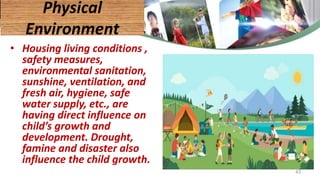
• Housing living conditions ,
safety measures,
environmental sanitation,
sunshine, ventilation, and
fresh air, hygiene, safe
water supply, etc., are
having direct influence on
child’s growth and
development. Drought,
famine and disaster also
influence the child growth.
Physical
Environment
43
Families have the most profound impact in nurturing a child and
determining the ways in which they develop psychologically and
socially. Whether they are raised by their parents, grandparents or
foster care, they need basic love, care and courtesy to develop as
healthy functional individuals. The most positive growth is seen when
families invest time, energy and love in the development of the child
through activities, such as reading to them, playing with them and
having deep meaningful conversations. Families that abuse or neglect
children would affect their positive development. These children may
end up as individuals who have poor social skills and difficulty bonding
with other people as adults. Helicopter parenting also has negative
effects as they render children dependent on the parents even as
young adults and unable to deal with difficulties in life on their own.
Psychological
Environment
44
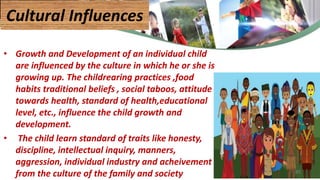
• Growth and Development of an individual child
are influenced by the culture in which he or she is
growing up. The childrearing practices ,food
habits traditional beliefs , social taboos, attitude
towards health, standard of health,educational
level, etc., influence the child growth and
development.
• The child learn standard of traits like honesty,
discipline, intellectual inquiry, manners,
aggression, individual industry and acheivement
from the culture of the family and society
Cultural Influences
45
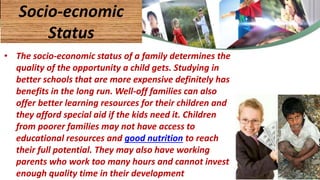
• The socio-economic status of a family determines the
quality of the opportunity a child gets. Studying in
better schools that are more expensive definitely has
benefits in the long run. Well-off families can also
offer better learning resources for their children and
they afford special aid if the kids need it. Children
from poorer families may not have access to
educational resources and good nutrition to reach
their full potential. They may also have working
parents who work too many hours and cannot invest
enough quality time in their development
Socio-ecnomic
Status
46
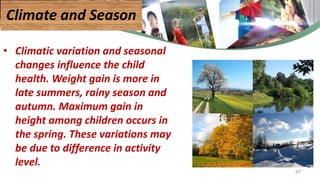
• Climatic variation and seasonal
changes influence the child
health. Weight gain is more in
late summers, rainy season and
autumn. Maximum gain in
height among children occurs in
the spring. These variations may
be due to difference in activity
level.
Climate and Season
47
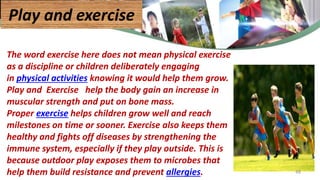
The word exercise here does not mean physical exercise
as a discipline or children deliberately engaging
in physical activities knowing it would help them grow.
Play and Exercise help the body gain an increase in
muscular strength and put on bone mass.
Proper exercise helps children grow well and reach
milestones on time or sooner. Exercise also keeps them
healthy and fights off diseases by strengthening the
immune system, especially if they play outside. This is
because outdoor play exposes them to microbes that
help them build resistance and prevent allergies.
Play and exercise
48
• Birth order does not alone determine intelligence, personality trait or method of coping
but it has a significant influence on all of these.
• The first born child gets full attention until the second born, they learn from adult
,whereas the second born child learn mainly from elder one . Middle born child gets less
attention during rearing
• The first born child is usually intelligent ,achievement oriented, perfectionist and anxious.
The only child is likely to develop rapidly and intellectual with higher self-esteem but may
be more dependent. The middle born is more adaptable , less achievement oriented,less
aggressive towards goal and learn how to compromise.
• The youngest child receives a great deal of love and attention, and tend to develop a good
natured , friendly, warm personality and with higher esteem.
• However ,each child is different and need total attention and care from parents to develop
their personality to the fullest extent possible.
Birth order of the child
49
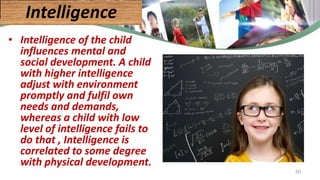
• Intelligence of the child
influences mental and
social development. A child
with higher intelligence
adjust with environment
promptly and fulfil own
needs and demands,
whereas a child with low
level of intelligence fails to
do that , Intelligence is
correlated to some degree
with physical development.
Intelligence
50
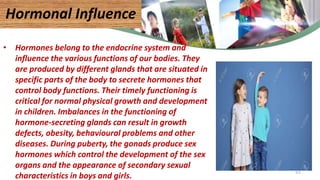
• Hormones belong to the endocrine system and
influence the various functions of our bodies. They
are produced by different glands that are situated in
specific parts of the body to secrete hormones that
control body functions. Their timely functioning is
critical for normal physical growth and development
in children. Imbalances in the functioning of
hormone-secreting glands can result in growth
defects, obesity, behavioural problems and other
diseases. During puberty, the gonads produce sex
hormones which control the development of the sex
organs and the appearance of secondary sexual
characteristics in boys and girls.
Hormonal Influence
51
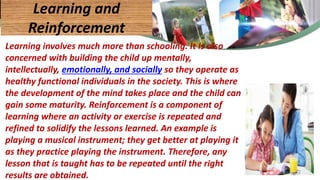
Learning involves much more than schooling. It is also
concerned with building the child up mentally,
intellectually, emotionally, and socially so they operate as
healthy functional individuals in the society. This is where
the development of the mind takes place and the child can
gain some maturity. Reinforcement is a component of
learning where an activity or exercise is repeated and
refined to solidify the lessons learned. An example is
playing a musical instrument; they get better at playing it
as they practice playing the instrument. Therefore, any
lesson that is taught has to be repeated until the right
results are obtained.
Learning and
Reinforcement
52
Conclusion
• Thus growth and development is a
complex process with the influence
of various factors. Favorable
conditions promote growth and
development . whereas unfavorable
factors inhibit the process leading the
growth retardation or growth failure
or developmental delays.
53
54

Introduction to growth and development.pptx

  • 1.
    Mrs. D. MelbaSahaya Sweety RN,RM PhD Nursing , MSc Nursing (Pediatric Nursing), BSc Nursing Associate Professor Department of Pediatric Nursing Enam Nursing College, Savar, Bangladesh. 1
  • 2.
    INTRODUCTION • Continual changeis the essence of life. The rapid changes in size that we call growth, and the rapid changes in form, function and behaviour that we call development, are the core of paediatrics. • Growth is a form of motion. Growth means the increase in the size of the various parts and organs of the body by multiplication of cells and intercellular components during the period commencing from fertilization to physical maturity • Child development refers to the sequence of physical, language, thought and emotional changes that occur in a child from birth to the beginning of adulthood. During this process a child progresses from dependency on their parents/guardians to increasing independence 2
  • 3.
    DEFINITION • Growth It isthe process of physical maturation resulting an increase in size of the body and various organs. It occurs by multiplication of cells and an increase in intracellular substance. It is quantitative changes of the body. 3
  • 4.
    • Development It isthe process of functional and physiological maturation of the individual or It is progressive increase in skill and capacity to function and It is related to maturation and myelination of the nervous system which includes psychological, emotional and social changes. It is a qualitative aspects. DEFINITION 4
  • 5.
    • Maturation It isa process of an increase in competence and adaptability; aging; usually used to describe a qualitative change; a change in the complexity of a structure that makes it possible for that structure to begin functioning; to function at a higher level DEFINITION 5
  • 6.
    DIFFERENCE BETWEEN GROWTH ANDDEVELOPMENT GROWTH DEVELOPMENT Growth refers to physiological changes Development refers to overall changes in the individual. It involves changes in an orderly and coherent type towards the goal of maturity. Changes in the quantitative respect is termed as growth. The changes produced by growth are subjects of measurements. They may be quantified and observable in nature Development changes in the quality along with quantitative aspect and it brings qualitative changes which are difficult to measure directly. They are assessed through keen observation of behaviour in different situations. Growth does not continue throughout life and its stops after maturation Development continues throughout life 6
  • 7.
    DIFFERENCE BETWEEN GROWTH ANDDEVELOPMENT GROWTH DEVELOPMENT Growth is cellular it occurs due to the multiplication of cells Development is organizational which occur due to both maturation and interaction with the environment Growth is one of the part of the developmental process Development is a wider and comprehensive term Growth may be referred to describe the changes in particular aspects of the body and behaviour of the organism Development describes the changes in the organism as a whole Growth is structural and external process Development is considered as functional and an internal process Growth is influenced by the development Development is independent it does not depend upon growth Growth changes the physical changes of a person On the other hand, development changes the character of a person. 7
  • 8.
  • 9.
    1. Growth andDevelopment proceeds from the head down to the tail or cephalocaudle direction • This principle describes the direction of growth and development. According to this principle, the child gains control of the head first, then the arms, and then the legs. Infants develop control of the head and face movements within the first two months after birth. In the next few months, they are able to lift themselves up by using their arms. By 6 to 12 months of age, infants start to gain leg control and may be able to crawl, stand, or walk. Coordination of arms always precedes coordination of legs. 9
  • 10.
    2. Growth andDevelopment proceeds from the center of the body towards peripheral or Proximodistal direction • In Proximodistal development that also describes the direction of development. This means that the spinal cord develops before outer parts of the body. The child’s arms develop before the hands and feet develop before the fingers and toes. • Finger and toe muscles (used in fine motor dexterity) are the last to develop in physical development. 10
  • 11.
    3. Growth anddevelopment proceed from the general to specific. • In motor development, the infant will be able to grasp an object with the whole hand before using only the thumb and forefinger. The infant’s first motor movements are very generalized, undirected, and reflexive, waving arms or kicking before being able to reach or creep toward an object. Growth occurs from large muscle movements to more refined (smaller) muscle movements. 11
  • 12.
    4. Growth anddevelopment is a continuous process. • For example, in motor development, there is a predictable sequence of developments that occur before walking. The infant lifts and turns the head before he or she can turn over. Infants can move their limbs (arms and legs) before grasping an object. Mastery of climbing stairs involves increasing skills from holding on to walking alone. By the age of four, most children can walk up and down stairs with alternating feet. As in maturation, in order for children to write or draw, they must have developed the manual (hand) control to hold a pencil and crayon. 12
  • 13.
    5. Development dependson maturation and learning. • Maturation refers to the sequential characteristic of biological growth and development. The biological changes occur in sequential order and give children new abilities. Changes in the brain and nervous system account largely for maturation. These changes in the brain and nervous system help children to improve in thinking (cognitive) and motor (physical) skills. Also, children must mature to a certain point before they can progress to new skills (Readiness). For example, a four-month-old cannot use language because the infant’s brain has not matured enough to allow the child to talk. By two years old, the brain has developed further and with help from others, the child will have the capacity to say and understand words. Also, a child can’t write or draw until he has developed the motor control to hold a pencil or crayon. Maturational patterns are innate, that is, genetically programmed. 13
  • 14.
    6. Development proceedsfrom the simple (concrete) to the more complex • Children use their cognitive and language skills to reason and solve problems. For example, learning relationships between things (how things are similar), or classification, is an important ability in cognitive development. • The first level of thinking about how objects are alike is to give a description or functional relationship (both concrete thoughts) between the two objects. “An apple and orange are round” and “An apple and orange are alike because you eat them” are typical responses of three, four and five year olds. As children develop further in cognitive skills, they are able to understand a higher and more complex relationship between objects and things; that is, that an apple and orange exist in a class called fruit. The child cognitively is then capable of classification. 14
  • 15.
    7.Early Development ismore critical than later Development • The environment in which children live during early formative years of life has a strong impact on their hereditary potentials. Favorable relationships with members of the family, liberal child training methods, a stimulating environment result in the development of better adjusted individual in the later life. 15
  • 16.
    8. There areindividual rates of growth and development. • The human being never static. From the moment of conception to the time of death , the person undergoes continued and progressive changes. At every stage , some of the developmental changes are just beginning , some are at the peak and others are in the process of decline. 16
  • 17.
    9.Development is sequential. •There is a pattern of order and sequence in human growth and development. An individual develops from single cell to a fetus to an adult/old man or women; to sit then stand first before walking; to cry, coos, babbles, before being able to say “Ma-ma- ma”and “Da-da-da”. 17
  • 18.
    10. Development isPredictable • Development is predictable, which means that with the help of the uniformity of pattern and sequence of development. We can go to a great extent, forecast the general nature and behaviour of a child in one or more aspects or dimension at any particular stage of its growth and development. We can know the particular age at which children will learn to walk, speak and so on. 18
  • 19.
    11. The childdevelopment as a unified whole • The child intellect is related to his physical well-being . Physical well-being is affected by his emotions and emotions are affected by his successes and failures in school and by the environment in the family . The child who are physically weak are slow in the development of mental processes also 19
  • 20.
    12 .Each Developmenttakes place in stages The development of the child takes place in stages Each stage has certain unique characteristics and in each stage , certain type of behaviour or traits are more conspicuous than others. The entire period of Development is often break the lifespan into eight stages: • Prenatal Development, Infancy and Toddlerhood • Early Childhood • Middle Childhood • Adolescence • Early Adulthood • Middle Adulthood 20
  • 21.
    13. Each Developmentalstage has certain characteristic trait • There are some peculiar traits that are observed in children at a particular developmental stage and go away after some time .The child’s behavior should be understood against the expected behavior of his age. 21
  • 22.
    14 .There areperiod of accelerated growth and decelerated growth • During babyhood and the early pre-school years the growth is rapid . During the school years , the growth rate decreases . Growth is again rapid during adolescence but physical growth tapers off during the later part of adolescence and by the time , an individual touches adulthood . 22
  • 23.
    15. Development isinfluenced by Heredity and Environment • A child’s genetic inheritance (heredity) provides the basic foundation for many physical and personality attributes, but the influences of social , cultural , and familial variables (environment) also contributes to development. 23
  • 24.
    16 .Development proceedsat different rates or different behavior • Development of mental and physical traits is continuous but is never uniform for the entire individual. Development of memory and understand is fast during childhood while abstract thinking , reasoning and capability to take decisions is as its peak during adolescence 24
  • 25.
    FACTORS AFFECTING GROWTHAND DEVELOPMENT 25
  • 26.
    Introduction • Although theterms growth and development are used synonymously, they have different meanings biologically. Growth refers to the incremental changes in physical characteristics such as height, weight, size, etc., while development refers to qualitative changes to growth in an orderly and meaningful fashion which results in maturity. • Growth and development contribute to each other, are inseparable, and occur simultaneously. For example, most babies, by the time they grow up to be 8 months old, can weigh around 8 to 10 kilograms and can sit up. • Growth and development depend on combination of many interdependent factors especially by heredity and environment. 26
  • 27.
    Factors influencing Growthand Development Factors Influencing Growth and Development Heredity or Genetic factors Sex Race and Nationality Environment Prenatal Postnatal 27
  • 28.
    Genetic Factors • Eachchild has a different genetic potential. Genetic predisposition is the important factors which influences the growth and development of children. Different characteristics such as height, body structure,color of skin,eyes and hair etc.., depend upon inherited gene from parents . Thus tall parents have tall children and parent with high intelligence are more likely to have children with high level of inherent intelligence. • Abnormal genes from ancestors may produce different familial diseases which usually hinders the growth and development e.g. thalassemia, hemophillia,galactosemia etc.., The process of growth and development is also affected in children with chromosomal abnormalities , e.g. in Down’s syndrome, Turner’s syndrome , klinefelter Syndrome 28
  • 29.
    Sex • The sexof children influences their physical attributes and patterns of growth. Sex is determined at conception. At birth , male babies are heavier and longer than the females babies. Boys maintain this superiority until about 11 years of age. Girls mature earlier than boys and bone development is more advanced in girls. But mean height and weight are usually less in girls than boys at the time of full maturity. 29
  • 30.
    Race and Nationality •Growth potential of different racial groups is different in varying extent. Physical characteristics of different national groups also vary. Height and stature of Americans and Indians are usually differing because of the differences in growth patterns. 30
  • 31.
    Environment • The environmentplays a critical role in the development of children and it represents the sum total of physical and psychological stimulation the child receives. Where you live also has a great influence on how your children turn out to be. • The schools they attend, the neighbourhood they live in, the opportunities offered by the community and their peer circles are some of the social factors affecting a child’s development. Living in an enriching community that has parks, libraries and community centres for group activities and sports all play a role in developing the child’s skills, talents, and behaviour. Uninteresting communities can push some children to not go outside often but play video games at home instead. Even the weather of a place influences children in the form of bodily rhythms, allergies and other health conditions. 31
  • 32.
    Prenatal Factors Intrauterine environment isan important predominant factors of growth and development. Various conditions influence the fetal growth in utero. Maternal Malnutrition Maternal Infections Maternal Substance Abuse Maternal Illness Hormones Miscellaneous 32
  • 33.
    Maternal Malnutrition • Dietaryinsufficiency and anemia leads to intrauterine growth retardation. Low birth weight and preterm babies have poor growth potentials . In later life, those children are usually having disturbances of growth and development 33
  • 34.
    Maternal Infections • Differentintrauterine infections like HIV, HBV,STORCH, etc.., may transmit to the fetus via placenta and affect the fetal growth. Various complications may occur like congenital anomalies, congenital infections etc.., which ultimately affect the growth and development in extrauterine life. 34
  • 35.
    Maternal Substance Abuse • Intakeof teratogenic drugs (thalidomide, phenytoin, etc.,) by the pregnant women in the first trimester affects the organogenesis and lead to congenital malformations which hinder fetal growth. Presence of congenital anomalies in later life influence childhood growth and development. Maternal tobacco intake (smoking and Chewing) and alcohol abuse also produce fetal growth restriction. 35
  • 36.
    Maternal Illness • Pregnancy– induced hypertension, Anemia, Heart disease, Hypothyroidism, Diabetes mellitus, chronic renal failure, Hyperpyrexia , etc., have adverse effects on fetal growth. Iodine deficiency of the mother may leads to mental retardation of the baby in later life. 36
  • 37.
    Hormones • Hormones likethyroxine and insulin influence the fetal growth. Thyroxine deficiency retards the skeletal maturation of the fetus. Maternal myxedema results in fetal hypothyroidism. Antithyroid drug therapy and iodides during last trimester of pregnancy may lead to fetal growth leading to large size fetus with excessive birth weight due to macrosomia. 37
  • 38.
    Miscellaneous Various prenatal conditionswhich may also influence fetal growth include uterinemalformations (septate uterus, bicornuate uterus). Malpositions of the fetus oligohydramnious, polyhydramnious,faulty pacental implantation or malfunction, maternal emotion during pregnancy, inadequate prenatal care etc., 38
  • 39.
    Post natal Factors Post natal Factors GrowthPotential Nutrition Childhood illness Physical Environment Cultural Influences Socioeconomic status Climate and season Play and Exercise Birth Order of the child Intelligence Hormonal Influence Learning and reinforcement 39
  • 40.
    Growth Potential • Growthpotential is indicated by the child’s size at birth. The smaller the child at birth, the smaller • she/he is likely to be in subsequent years. The larger the child at birth, the larger she/he is likely to be in subsequent years . Low birth weight babies have various complications in later life which retards child’s growth. 40
  • 41.
    • Nutrition isa critical factor in growth as everything the body needs to build and repair itself comes from the food we eat. Malnutrition can cause deficiency diseases that adversely affect the growth and development of children. On the other hand, overeating can lead to obesity and health problems in the long run, such as diabetes and heart disease. A balanced diet that is rich in vitamins, minerals, proteins, carbohydrates and fats is essential for the development of the brain and body. Nutrition 41
  • 42.
    • Chronic childhooddiseases of heart, (congenital heart disease, rheumatic heart disease), chest (tuberculosis, asthma), Kidney (nephrotic syndrome), liver (cirrhosis), malignancy, Malabsorption syndrome, digestive disorders, endocrinal abnormalities, blood disorders, worm infestations, metabolic disorders,etc. generally leads to growth impairement. • Acute illnesses like ARI,diarrhea, repeated attack of infections result in malnutrition and growth retardation. • Congenital anomalies , accidental injury and prolong hospitalization usually have adverse effect on growth and development. Childhood Illnesses 42
  • 43.
    • Housing livingconditions , safety measures, environmental sanitation, sunshine, ventilation, and fresh air, hygiene, safe water supply, etc., are having direct influence on child’s growth and development. Drought, famine and disaster also influence the child growth. Physical Environment 43
  • 44.
    Families have themost profound impact in nurturing a child and determining the ways in which they develop psychologically and socially. Whether they are raised by their parents, grandparents or foster care, they need basic love, care and courtesy to develop as healthy functional individuals. The most positive growth is seen when families invest time, energy and love in the development of the child through activities, such as reading to them, playing with them and having deep meaningful conversations. Families that abuse or neglect children would affect their positive development. These children may end up as individuals who have poor social skills and difficulty bonding with other people as adults. Helicopter parenting also has negative effects as they render children dependent on the parents even as young adults and unable to deal with difficulties in life on their own. Psychological Environment 44
  • 45.
    • Growth andDevelopment of an individual child are influenced by the culture in which he or she is growing up. The childrearing practices ,food habits traditional beliefs , social taboos, attitude towards health, standard of health,educational level, etc., influence the child growth and development. • The child learn standard of traits like honesty, discipline, intellectual inquiry, manners, aggression, individual industry and acheivement from the culture of the family and society Cultural Influences 45
  • 46.
    • The socio-economicstatus of a family determines the quality of the opportunity a child gets. Studying in better schools that are more expensive definitely has benefits in the long run. Well-off families can also offer better learning resources for their children and they afford special aid if the kids need it. Children from poorer families may not have access to educational resources and good nutrition to reach their full potential. They may also have working parents who work too many hours and cannot invest enough quality time in their development Socio-ecnomic Status 46
  • 47.
    • Climatic variationand seasonal changes influence the child health. Weight gain is more in late summers, rainy season and autumn. Maximum gain in height among children occurs in the spring. These variations may be due to difference in activity level. Climate and Season 47
  • 48.
    The word exercisehere does not mean physical exercise as a discipline or children deliberately engaging in physical activities knowing it would help them grow. Play and Exercise help the body gain an increase in muscular strength and put on bone mass. Proper exercise helps children grow well and reach milestones on time or sooner. Exercise also keeps them healthy and fights off diseases by strengthening the immune system, especially if they play outside. This is because outdoor play exposes them to microbes that help them build resistance and prevent allergies. Play and exercise 48
  • 49.
    • Birth orderdoes not alone determine intelligence, personality trait or method of coping but it has a significant influence on all of these. • The first born child gets full attention until the second born, they learn from adult ,whereas the second born child learn mainly from elder one . Middle born child gets less attention during rearing • The first born child is usually intelligent ,achievement oriented, perfectionist and anxious. The only child is likely to develop rapidly and intellectual with higher self-esteem but may be more dependent. The middle born is more adaptable , less achievement oriented,less aggressive towards goal and learn how to compromise. • The youngest child receives a great deal of love and attention, and tend to develop a good natured , friendly, warm personality and with higher esteem. • However ,each child is different and need total attention and care from parents to develop their personality to the fullest extent possible. Birth order of the child 49
  • 50.
    • Intelligence ofthe child influences mental and social development. A child with higher intelligence adjust with environment promptly and fulfil own needs and demands, whereas a child with low level of intelligence fails to do that , Intelligence is correlated to some degree with physical development. Intelligence 50
  • 51.
    • Hormones belongto the endocrine system and influence the various functions of our bodies. They are produced by different glands that are situated in specific parts of the body to secrete hormones that control body functions. Their timely functioning is critical for normal physical growth and development in children. Imbalances in the functioning of hormone-secreting glands can result in growth defects, obesity, behavioural problems and other diseases. During puberty, the gonads produce sex hormones which control the development of the sex organs and the appearance of secondary sexual characteristics in boys and girls. Hormonal Influence 51
  • 52.
    Learning involves muchmore than schooling. It is also concerned with building the child up mentally, intellectually, emotionally, and socially so they operate as healthy functional individuals in the society. This is where the development of the mind takes place and the child can gain some maturity. Reinforcement is a component of learning where an activity or exercise is repeated and refined to solidify the lessons learned. An example is playing a musical instrument; they get better at playing it as they practice playing the instrument. Therefore, any lesson that is taught has to be repeated until the right results are obtained. Learning and Reinforcement 52
  • 53.
    Conclusion • Thus growthand development is a complex process with the influence of various factors. Favorable conditions promote growth and development . whereas unfavorable factors inhibit the process leading the growth retardation or growth failure or developmental delays. 53
  • 54.