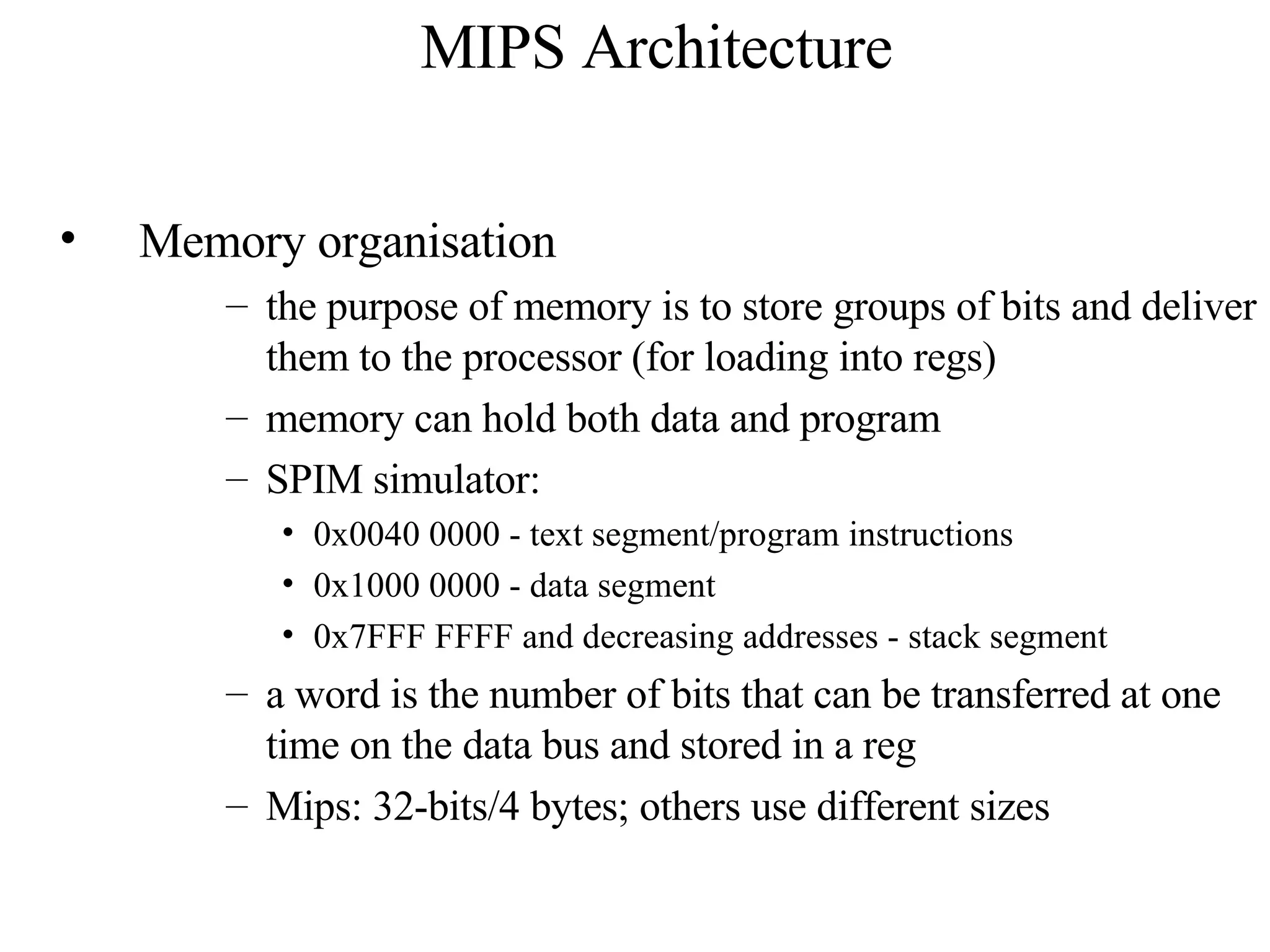
MIPS Architecture Memory organisation the purpose of memory is to store groups of bits and deliver them to the processor (for loading into regs)  memory can hold both data and program SPIM simulator: 0x0040 0000 - text segment/program instructions 0x1000 0000 - data segment 0x7FFF FFFF and decreasing addresses - stack segment a word is the number of bits that can be transferred at one time on the data bus and stored in a reg Mips: 32-bits/4 bytes; others use different sizes
MIPS Architecture storage order of words little-endian - store the little end of the word first processor organisation registers where it stores information what it does in executing instructions MIPS: all registers are 32-bit PC (program counter) holds address of next instruction 32 general purpose registers (can use name or number) instruction set: load & store, operations, jump & branch, others
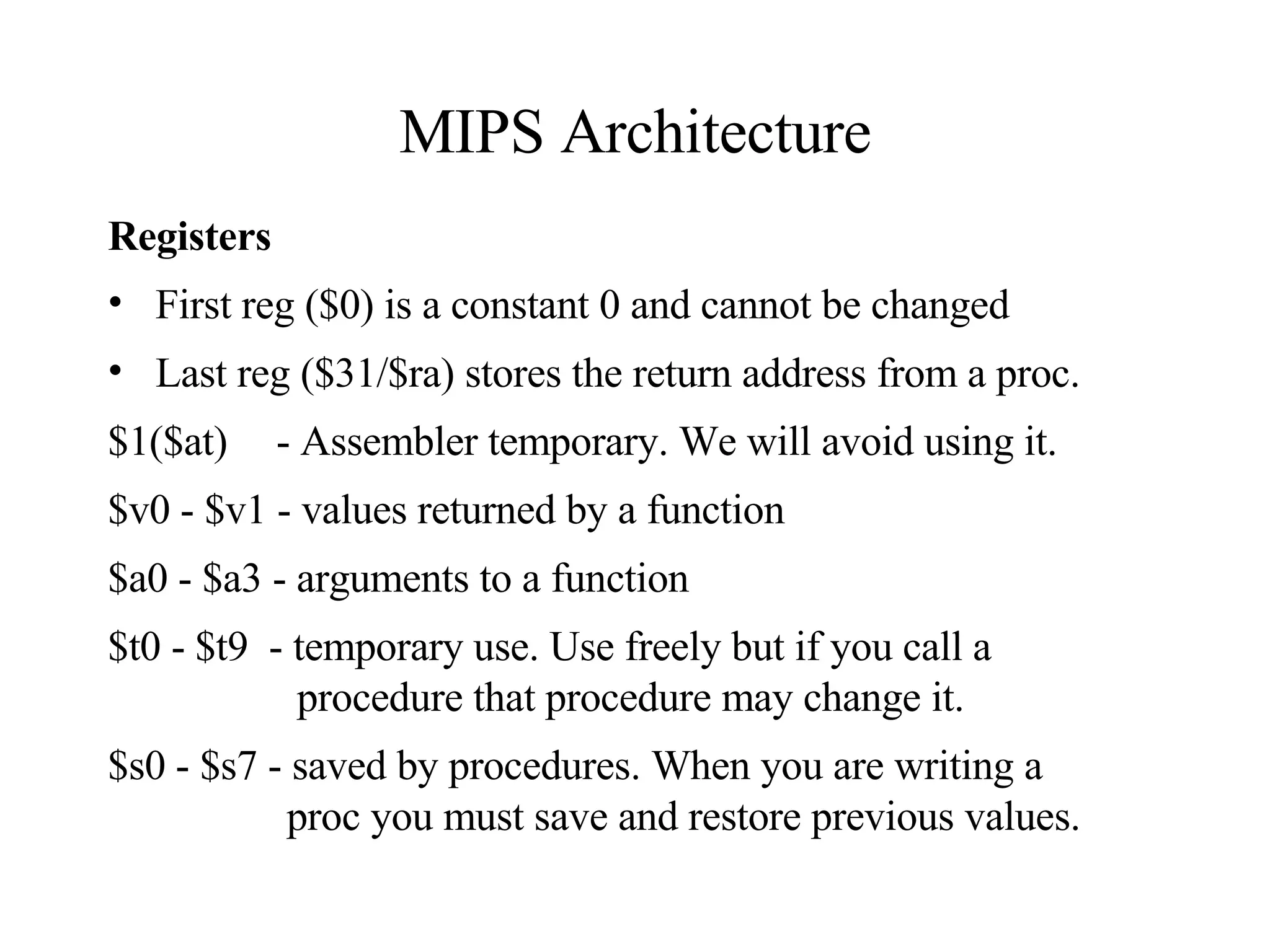
MIPS Architecture Registers First reg ($0) is a constant 0 and cannot be changed Last reg ($31/$ra) stores the return address from a proc. $1($at)   - Assembler temporary. We will avoid using it. $v0 - $v1 - values returned by a function $a0 - $a3 - arguments to a function  $t0 - $t9  - temporary use. Use freely but if you call a    procedure that procedure may change it. $s0 - $s7 - saved by procedures. When you are writing a    proc you must save and restore previous values.
MIPS Architecture Instruction set load and store load data from memory into a reg, or store reg contents in memory lw $t0, num1 #load word in num1 into $t0 sw $t0, num2 # store word in $t0 into num2 li $v0, 4 # load immediate value (constant) 4 into $v0 operations: arithmetic and logic perform the operation on data in 2 regs and store result in 3rd reg add $t0, $t3, $t4 # $t0 = $t3 + $t4 jump and branch alter the PC to control flow of program (if and loop statements) specialised instructions (e.g. floating point instructions)
Basic Assembly Language Instructions Levels binary machine instructions (in hex) symbolic actual machine instructions (regs shown: $31) assembly language instructions RISC (not always 1:1 correspondence) Load and Store instructions move data between memory and the processor always 2 operands, a register and an address register is always first, direction of movement is opposite lw $t0, Num1 # load word, $t0=Num1 sw $t0, Num2 # store word, Num2=$t0 load immediate: li $vo, 4 load address: la $a0, prompt_message (note diff with lw)
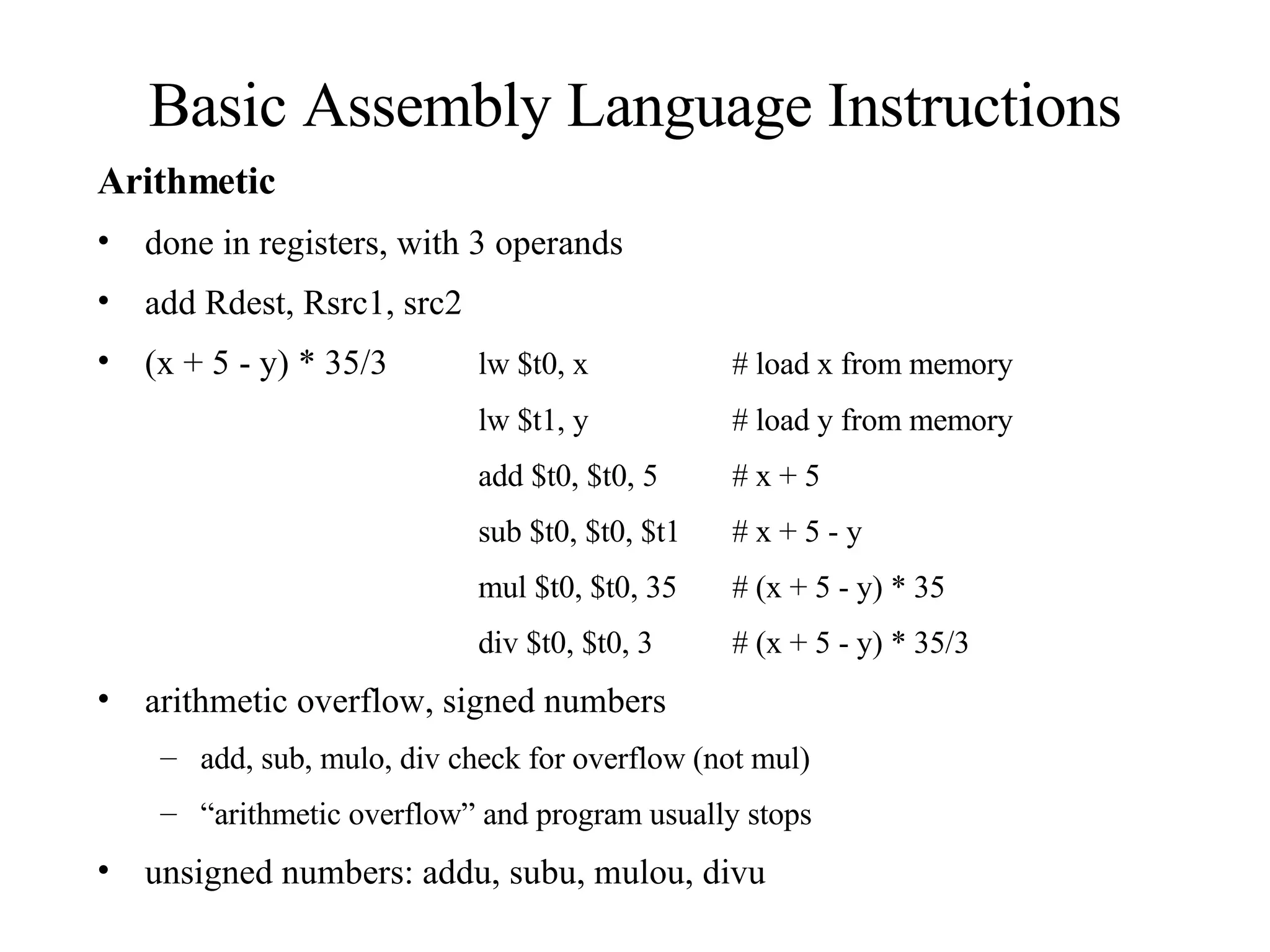
Basic Assembly Language Instructions Arithmetic done in registers, with 3 operands add Rdest, Rsrc1, src2 (x + 5 - y) * 35/3 lw $t0, x # load x from memory lw $t1, y # load y from memory add $t0, $t0, 5 # x + 5 sub $t0, $t0, $t1 # x + 5 - y mul $t0, $t0, 35 # (x + 5 - y) * 35 div $t0, $t0, 3 # (x + 5 - y) * 35/3 arithmetic overflow, signed numbers add, sub, mulo, div check for overflow (not mul) “ arithmetic overflow” and program usually stops unsigned numbers: addu, subu, mulou, divu
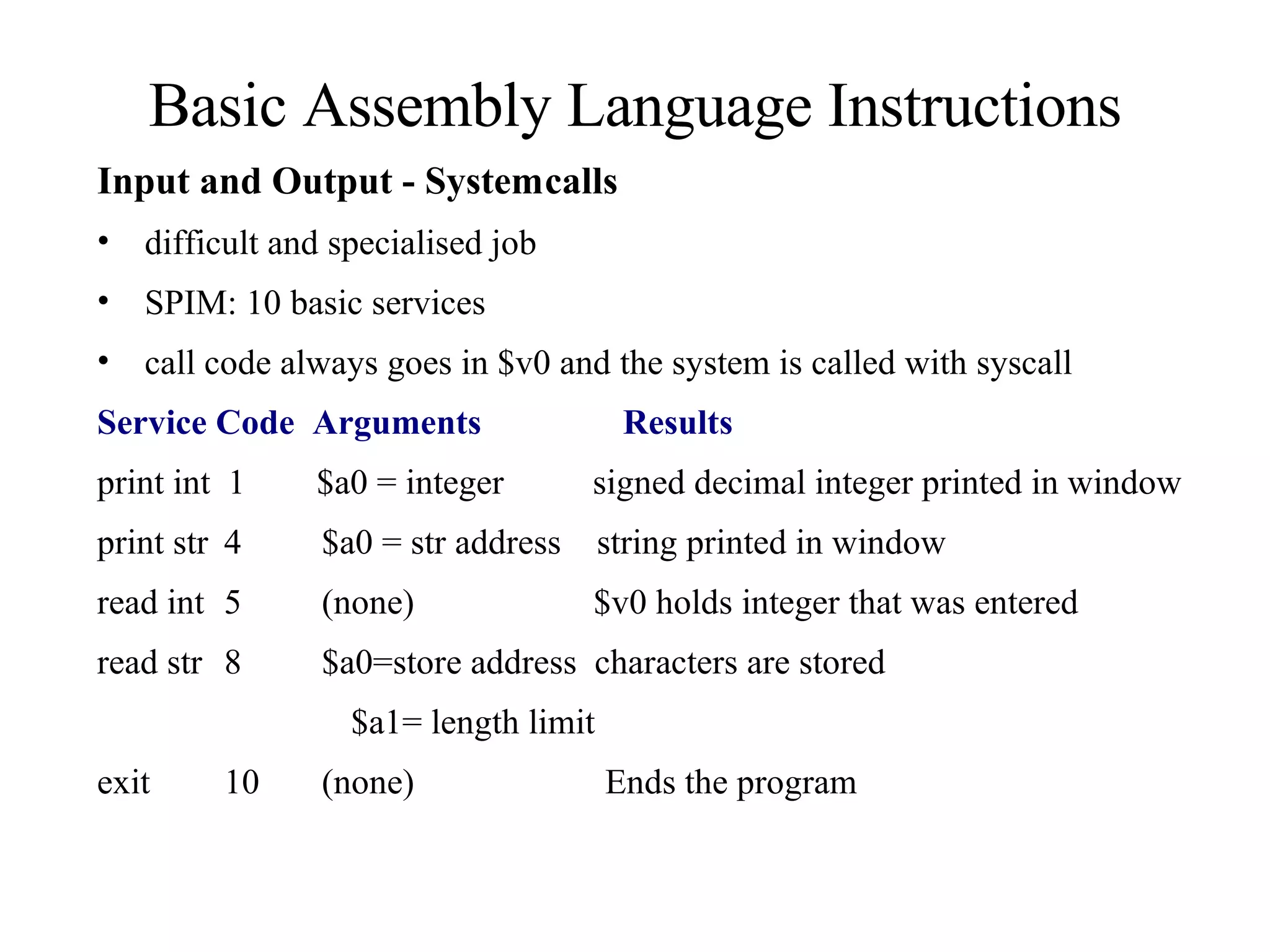
Basic Assembly Language Instructions Input and Output - System calls difficult and specialised job SPIM: 10 basic services call code always goes in $v0 and the system is called with syscall Service   Code   Arguments    Results print int  1  $a0 = integer  signed decimal integer printed in window print str 4  $a0 = str address  string printed in window read int 5  (none)   $v0 holds integer that was entered read str 8  $a0=store address  characters are stored $a1= length limit exit 10  (none) Ends the program
Basic Assembly Language Instructions Control structures if, while, for PC determines order of program execution unconditional jump puts the address of a label in the PC execution continues from that point jar also saves the old PC value as a “return address” in register $ra ($31) Inst Example Meaning j label j do_it_again next instruction is at the label do_it_again: jal label jal my_proc execution of procedure my_proc will start.$ra  holds address of instruction following the jal jr Rsrc  jr $ra Return from procedure call by putting $ra value  back into the PC
Basic Assembly Language Instructions Control structures conditional jump the condition is always a comparison of 2 registers, or a reg and a constant normally use signed numbers (if unsigned, add a ‘u’ to the command) can compare with z using $0 as src2 (or add ‘z’ to command) Instruction   Branch to label if Unsigned beq Rsrc1,Src2,label  Rsrc1 = Src2 bne Rsrc1,Src2,label  Rsrc1 <> Src2 blt Rsrc1,Src2,label  Rsrc1 < Src2 bltu bgt Rsrc1,Src2,label  Rsrc1 > Src2 bgtu ble Rsrc1,Src2,label  Rsrc1 <= Src2 bleu bge Rsrc1,Src2,label  Rsrc1 >= Src2  bgeu
Basic Assembly Language Instructions Control structures IF constructs: choosing alternatives (if, if-then-else) IF num < 0 then num = - num ENDIF  IF temperature >= 25 then activity = “go swimming” else activity = “ride bicycle” endif print (activity) lw $t0, num bgez $t0, endif0 # must be ltz ----- sub $t0, $0, $t0  # 0 - num sw $t0, num endif0: # num is now non-negative lw $t0, temperature blt $t0, 25, else25 la $a0, swim j endif25 else25: la $a0, cycle endif25: li $v0, 4 # print string call code syscall Note: “branch around” and jump ins needed before else
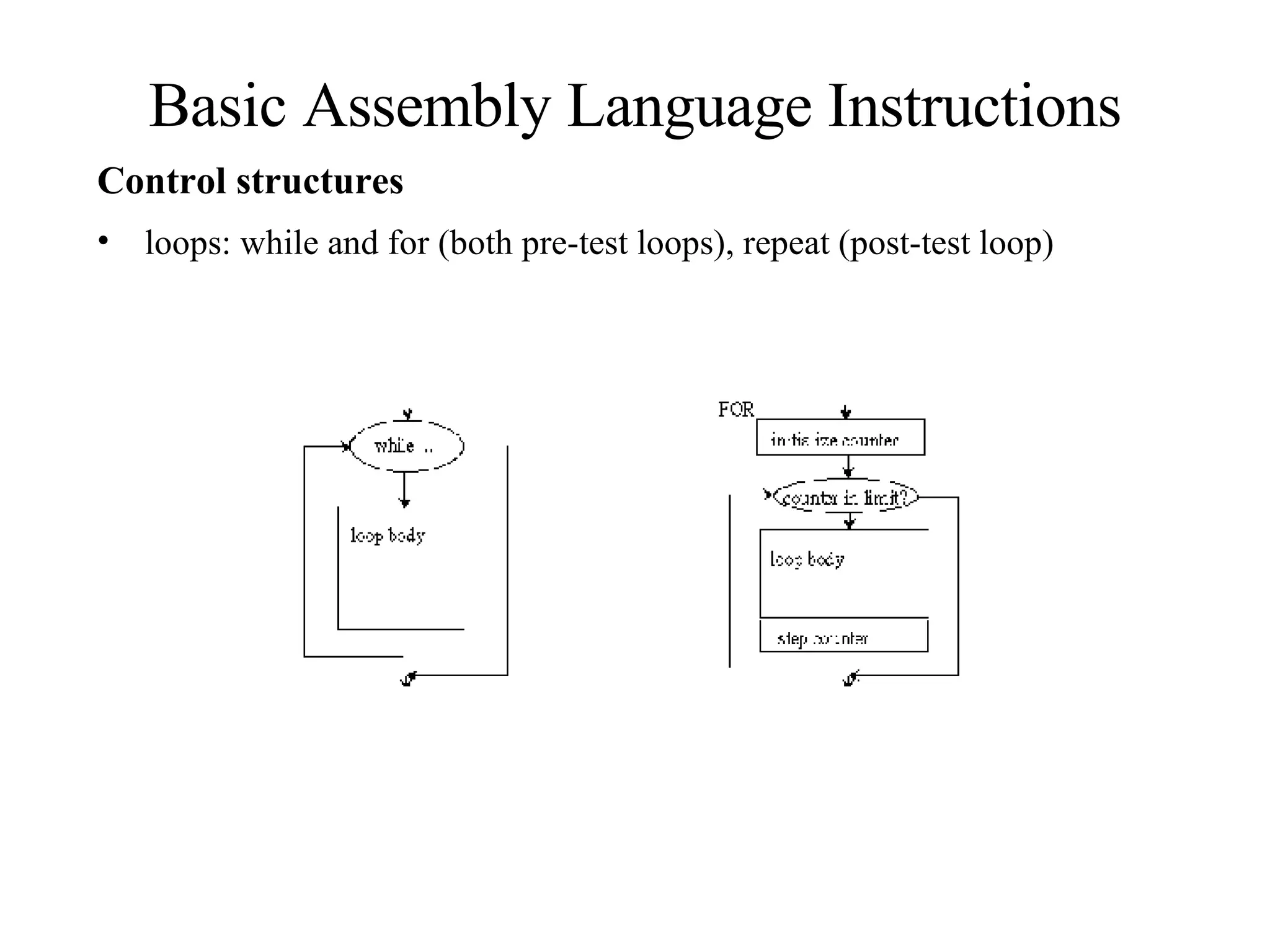
Basic Assembly Language Instructions Control structures loops: while and for (both pre-test loops), repeat (post-test loop)
Basic Assembly Language Instructions Control structures sum = 0 num = 0 WHILE num >= 0 DO sum = sum + num read (num) ENDWHILE (write 10 lines) FOR countdown = 10 downto 1 DO print “Hello again …” ENDFOR mov $t0, $0  # sum = 0 mov $v0, $0 # num = 0 while5: bltz $v0, endwhile5  # $v0 < 0? add $t0, $v0 #$v0 switches role here li $v0, 5   # read int call syscall j while5 endwhile5: # set up print arguments before loop la $a0, hello_again li $v0, 4 # print string call li $t0, 10 # countdown for10: beqz $t0, endfor10 syscall  # print another line sub $t0, 1  # decr countdown j for10  # continue for loop endfor10
Basic Assembly Language Instructions Instruction formats and addressing modes Instruction formats register  immediate  jump  Addressing modes immediate - value built in to the instruction  register - register used for data  Memory referencing - used with load and store instructions label - fixed address built in to the instruction  indirect - register contains the address  Base addressing - field of a record  Indexed addressing - element of an array
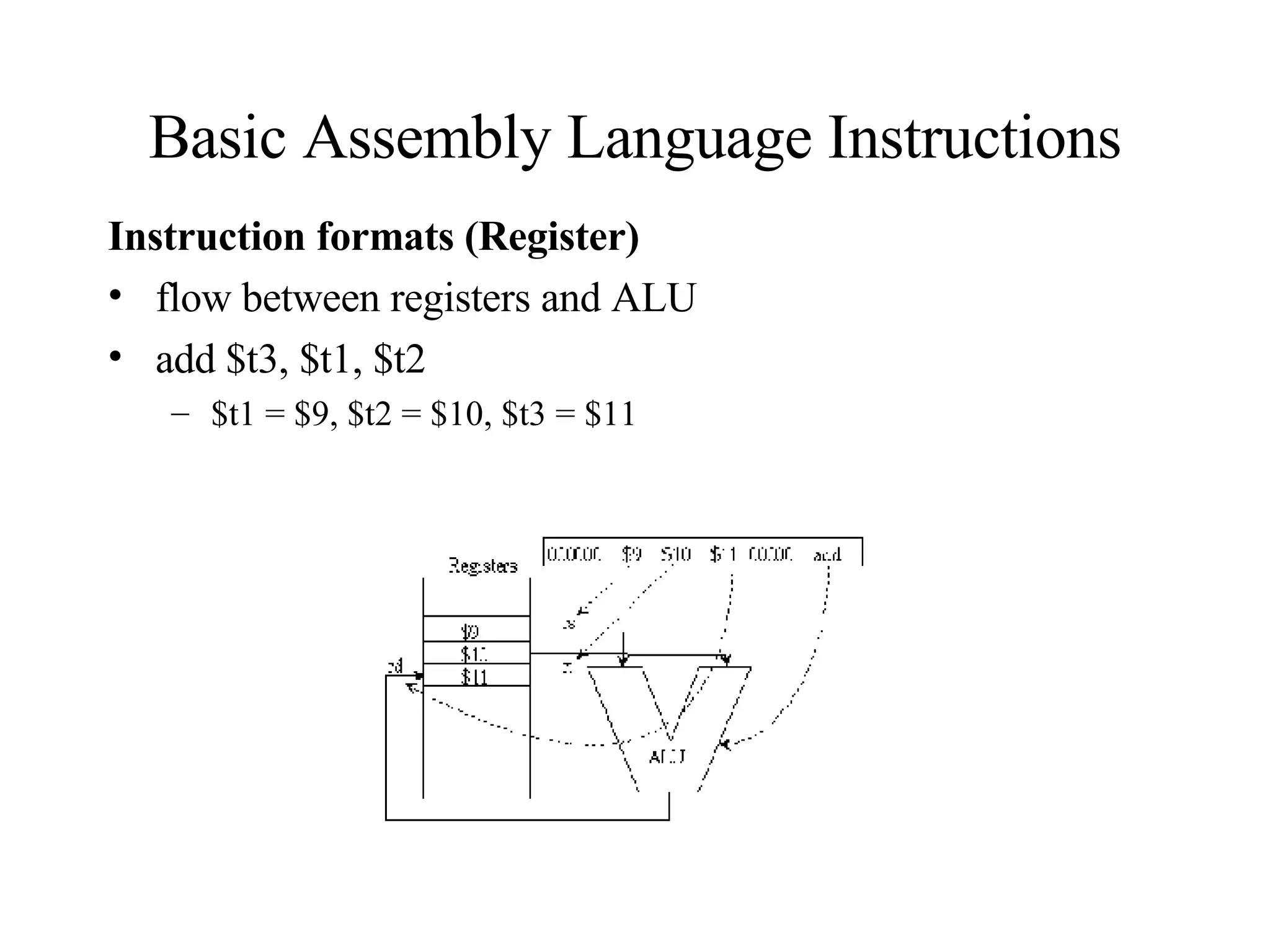
Basic Assembly Language Instructions Instruction formats all instructions fit in 32-bit words decoding starts with the leftmost 6-bits, the op code Register  For operations using only registers as operands, the operation code is 000000  6 bits 5 bits 5 bits   5 bits 5 bits 6 bits 000000 src reg target reg  Dest shift amt function 000000 01010  00111   00101  00000 100010  the last line of the table gives as an example a subtract instruction, sub $5, $10, $7  3 5-bit fields identify the 3 regs: src, target/src, dest (diff from assembly)
Basic Assembly Language Instructions Instruction formats (Register) flow between registers and ALU add $t3, $t1, $t2 $t1 = $9, $t2 = $10, $t3 = $11
Basic Assembly Language Instructions Immediate 16-bit immediate (constant), 6-bit op, 2 regs addi $t1, $t2, 0xfffe (actually adds 0xfffffffe, -2) shorter numbers are sign extended 6 bits 5 bits 5 bits 16 bits op code src reg target reg immediate value 001000 01010 01001 1111 1111 1111 1110
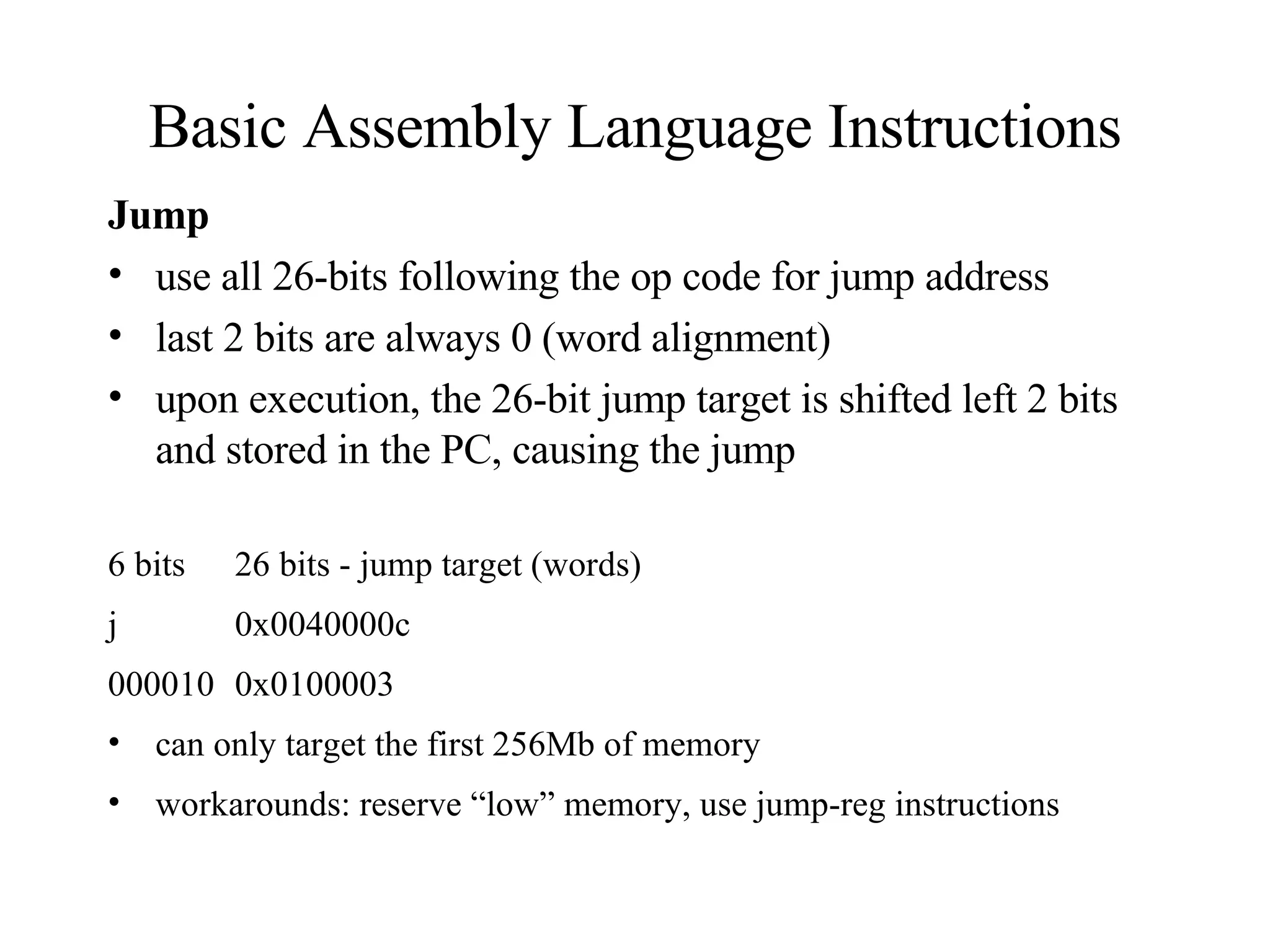
Basic Assembly Language Instructions Jump use all 26-bits following the op code for jump address last 2 bits are always 0 (word alignment)  upon execution, the 26-bit jump target is shifted left 2 bits and stored in the PC, causing the jump 6 bits  26 bits - jump target (words) j 0x0040000c  000010 0x0100003 can only target the first 256Mb of memory workarounds: reserve “low” memory, use jump-reg instructions
Basic Assembly Language Instructions Addressing Modes - Immediate usually use lower 16-bits, uses 2 instructions if > 16-bits PC-relative addressing - offset or displacement used Examples of instructions with immediate data:  addi $t0,t1,65  sub $t0,7  #assembled as: addi $t0, $t0, -7  li $t3, 0x12345678  #assembled as  lui $at, 0x1234  ori $t3, $at, 0x5678  #puts it all together  bgez $t5, 16  #skip 4 instructions ahead if  # $t5 is non-negative  # (4 is encoded in  #immediate field)
Basic Assembly Language Instructions Addressing Modes - Immediate faster than memory some instructions reference registers exclusively 32 regs, only 5 bits to specify a register Examples: addu $t3, $t1, $t2 # add (unsigned) $t3 = $t1 + $t2 sub $t0, $t3 # subtract (signed) $t0 = $t0 - $t3
Basic Assembly Language Instructions Memory Addressing can address up to 4GB (slower access) label - fixed address built into the instruction also known as direct addressing lw $t0, MyNumber # load the word into $t0 sb $t9, firstInitial # store rightmost 8 bits of $t9 in data seg indirect - register contains the address a register can be used as a pointer e.g. stepping through a string one step at a time catStr: .asciiz “cat” la $t0, catStr # load address i.e. put address of catStr into $t0 lb $t1, ($t0) # ‘c’ is now in $t1 addi $t0, 1 # point to next character lb $t2, ($t0) # ‘a’ is now in $t2
Basic Assembly Language Instructions Memory Addressing - indirect addressing (cont.) base addressing useful for referring to fields or a record or input e.g. telephone numbers: area code/prefix/number/extension 4 short ints (16-bit halfwords) the extension starts 6 bytes from the beginning of the record add offset 6 to a register pointing to the record la $t0, MyPhone # $t0 points to a telephone record lh $t1, 6($t0) # $t1 loaded with the extension no. in record
Basic Assembly Language Instructions Memory Addressing - indirect addressing (cont.) indexed addressing useful for indexing arrays e.g. copying a 10 byte string to another string li $t1, 9 # $t0 indexes arrays copyloop: lb $t1, str1($t0) # $t1 used to transfer character sb $t1, str2($t0) # to str2 sub $t10, 1 # decrement array index bgez $t0, copyloop # repeat until $t0 < 0 if moving words, need to decrement by 4 instead of 1 assembler actually uses 3 machine ins for each indexed ins
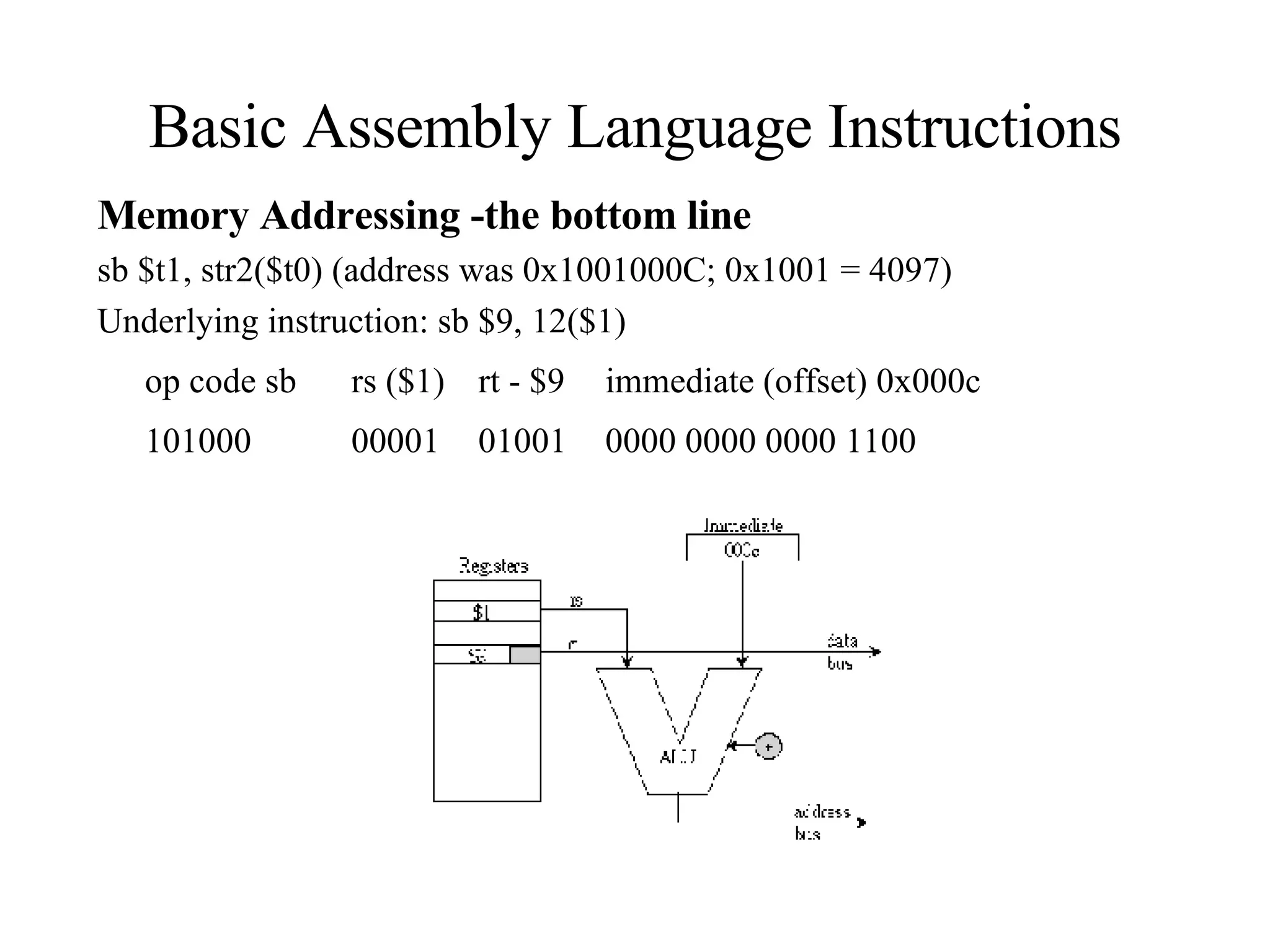
Basic Assembly Language Instructions Memory Addressing -the bottom line sb $t1, str2($t0) (address was 0x1001000C; 0x1001 = 4097) Underlying instruction: sb $9, 12($1) op code sb rs ($1) rt - $9 immediate (offset) 0x000c 101000 00001 01001 0000 0000 0000 1100

Mips

  • 1.
    MIPS Architecture Memoryorganisation the purpose of memory is to store groups of bits and deliver them to the processor (for loading into regs) memory can hold both data and program SPIM simulator: 0x0040 0000 - text segment/program instructions 0x1000 0000 - data segment 0x7FFF FFFF and decreasing addresses - stack segment a word is the number of bits that can be transferred at one time on the data bus and stored in a reg Mips: 32-bits/4 bytes; others use different sizes
  • 2.
    MIPS Architecture storageorder of words little-endian - store the little end of the word first processor organisation registers where it stores information what it does in executing instructions MIPS: all registers are 32-bit PC (program counter) holds address of next instruction 32 general purpose registers (can use name or number) instruction set: load & store, operations, jump & branch, others
  • 3.
    MIPS Architecture RegistersFirst reg ($0) is a constant 0 and cannot be changed Last reg ($31/$ra) stores the return address from a proc. $1($at) - Assembler temporary. We will avoid using it. $v0 - $v1 - values returned by a function $a0 - $a3 - arguments to a function $t0 - $t9 - temporary use. Use freely but if you call a procedure that procedure may change it. $s0 - $s7 - saved by procedures. When you are writing a proc you must save and restore previous values.
  • 4.
    MIPS Architecture Instructionset load and store load data from memory into a reg, or store reg contents in memory lw $t0, num1 #load word in num1 into $t0 sw $t0, num2 # store word in $t0 into num2 li $v0, 4 # load immediate value (constant) 4 into $v0 operations: arithmetic and logic perform the operation on data in 2 regs and store result in 3rd reg add $t0, $t3, $t4 # $t0 = $t3 + $t4 jump and branch alter the PC to control flow of program (if and loop statements) specialised instructions (e.g. floating point instructions)
  • 5.
    Basic Assembly LanguageInstructions Levels binary machine instructions (in hex) symbolic actual machine instructions (regs shown: $31) assembly language instructions RISC (not always 1:1 correspondence) Load and Store instructions move data between memory and the processor always 2 operands, a register and an address register is always first, direction of movement is opposite lw $t0, Num1 # load word, $t0=Num1 sw $t0, Num2 # store word, Num2=$t0 load immediate: li $vo, 4 load address: la $a0, prompt_message (note diff with lw)
  • 6.
    Basic Assembly LanguageInstructions Arithmetic done in registers, with 3 operands add Rdest, Rsrc1, src2 (x + 5 - y) * 35/3 lw $t0, x # load x from memory lw $t1, y # load y from memory add $t0, $t0, 5 # x + 5 sub $t0, $t0, $t1 # x + 5 - y mul $t0, $t0, 35 # (x + 5 - y) * 35 div $t0, $t0, 3 # (x + 5 - y) * 35/3 arithmetic overflow, signed numbers add, sub, mulo, div check for overflow (not mul) “ arithmetic overflow” and program usually stops unsigned numbers: addu, subu, mulou, divu
  • 7.
    Basic Assembly LanguageInstructions Input and Output - System calls difficult and specialised job SPIM: 10 basic services call code always goes in $v0 and the system is called with syscall Service Code Arguments Results print int 1 $a0 = integer signed decimal integer printed in window print str 4 $a0 = str address string printed in window read int 5 (none) $v0 holds integer that was entered read str 8 $a0=store address characters are stored $a1= length limit exit 10 (none) Ends the program
  • 8.
    Basic Assembly LanguageInstructions Control structures if, while, for PC determines order of program execution unconditional jump puts the address of a label in the PC execution continues from that point jar also saves the old PC value as a “return address” in register $ra ($31) Inst Example Meaning j label j do_it_again next instruction is at the label do_it_again: jal label jal my_proc execution of procedure my_proc will start.$ra holds address of instruction following the jal jr Rsrc jr $ra Return from procedure call by putting $ra value back into the PC
  • 9.
    Basic Assembly LanguageInstructions Control structures conditional jump the condition is always a comparison of 2 registers, or a reg and a constant normally use signed numbers (if unsigned, add a ‘u’ to the command) can compare with z using $0 as src2 (or add ‘z’ to command) Instruction Branch to label if Unsigned beq Rsrc1,Src2,label Rsrc1 = Src2 bne Rsrc1,Src2,label Rsrc1 <> Src2 blt Rsrc1,Src2,label Rsrc1 < Src2 bltu bgt Rsrc1,Src2,label Rsrc1 > Src2 bgtu ble Rsrc1,Src2,label Rsrc1 <= Src2 bleu bge Rsrc1,Src2,label Rsrc1 >= Src2 bgeu
  • 10.
    Basic Assembly LanguageInstructions Control structures IF constructs: choosing alternatives (if, if-then-else) IF num < 0 then num = - num ENDIF IF temperature >= 25 then activity = “go swimming” else activity = “ride bicycle” endif print (activity) lw $t0, num bgez $t0, endif0 # must be ltz ----- sub $t0, $0, $t0 # 0 - num sw $t0, num endif0: # num is now non-negative lw $t0, temperature blt $t0, 25, else25 la $a0, swim j endif25 else25: la $a0, cycle endif25: li $v0, 4 # print string call code syscall Note: “branch around” and jump ins needed before else
  • 11.
    Basic Assembly LanguageInstructions Control structures loops: while and for (both pre-test loops), repeat (post-test loop)
  • 12.
    Basic Assembly LanguageInstructions Control structures sum = 0 num = 0 WHILE num >= 0 DO sum = sum + num read (num) ENDWHILE (write 10 lines) FOR countdown = 10 downto 1 DO print “Hello again …” ENDFOR mov $t0, $0 # sum = 0 mov $v0, $0 # num = 0 while5: bltz $v0, endwhile5 # $v0 < 0? add $t0, $v0 #$v0 switches role here li $v0, 5 # read int call syscall j while5 endwhile5: # set up print arguments before loop la $a0, hello_again li $v0, 4 # print string call li $t0, 10 # countdown for10: beqz $t0, endfor10 syscall # print another line sub $t0, 1 # decr countdown j for10 # continue for loop endfor10
  • 13.
    Basic Assembly LanguageInstructions Instruction formats and addressing modes Instruction formats register immediate jump Addressing modes immediate - value built in to the instruction register - register used for data Memory referencing - used with load and store instructions label - fixed address built in to the instruction indirect - register contains the address Base addressing - field of a record Indexed addressing - element of an array
  • 14.
    Basic Assembly LanguageInstructions Instruction formats all instructions fit in 32-bit words decoding starts with the leftmost 6-bits, the op code Register For operations using only registers as operands, the operation code is 000000 6 bits 5 bits 5 bits 5 bits 5 bits 6 bits 000000 src reg target reg Dest shift amt function 000000 01010 00111 00101 00000 100010 the last line of the table gives as an example a subtract instruction, sub $5, $10, $7 3 5-bit fields identify the 3 regs: src, target/src, dest (diff from assembly)
  • 15.
    Basic Assembly LanguageInstructions Instruction formats (Register) flow between registers and ALU add $t3, $t1, $t2 $t1 = $9, $t2 = $10, $t3 = $11
  • 16.
    Basic Assembly LanguageInstructions Immediate 16-bit immediate (constant), 6-bit op, 2 regs addi $t1, $t2, 0xfffe (actually adds 0xfffffffe, -2) shorter numbers are sign extended 6 bits 5 bits 5 bits 16 bits op code src reg target reg immediate value 001000 01010 01001 1111 1111 1111 1110
  • 17.
    Basic Assembly LanguageInstructions Jump use all 26-bits following the op code for jump address last 2 bits are always 0 (word alignment) upon execution, the 26-bit jump target is shifted left 2 bits and stored in the PC, causing the jump 6 bits 26 bits - jump target (words) j 0x0040000c 000010 0x0100003 can only target the first 256Mb of memory workarounds: reserve “low” memory, use jump-reg instructions
  • 18.
    Basic Assembly LanguageInstructions Addressing Modes - Immediate usually use lower 16-bits, uses 2 instructions if > 16-bits PC-relative addressing - offset or displacement used Examples of instructions with immediate data: addi $t0,t1,65 sub $t0,7 #assembled as: addi $t0, $t0, -7 li $t3, 0x12345678 #assembled as lui $at, 0x1234 ori $t3, $at, 0x5678 #puts it all together bgez $t5, 16 #skip 4 instructions ahead if # $t5 is non-negative # (4 is encoded in #immediate field)
  • 19.
    Basic Assembly LanguageInstructions Addressing Modes - Immediate faster than memory some instructions reference registers exclusively 32 regs, only 5 bits to specify a register Examples: addu $t3, $t1, $t2 # add (unsigned) $t3 = $t1 + $t2 sub $t0, $t3 # subtract (signed) $t0 = $t0 - $t3
  • 20.
    Basic Assembly LanguageInstructions Memory Addressing can address up to 4GB (slower access) label - fixed address built into the instruction also known as direct addressing lw $t0, MyNumber # load the word into $t0 sb $t9, firstInitial # store rightmost 8 bits of $t9 in data seg indirect - register contains the address a register can be used as a pointer e.g. stepping through a string one step at a time catStr: .asciiz “cat” la $t0, catStr # load address i.e. put address of catStr into $t0 lb $t1, ($t0) # ‘c’ is now in $t1 addi $t0, 1 # point to next character lb $t2, ($t0) # ‘a’ is now in $t2
  • 21.
    Basic Assembly LanguageInstructions Memory Addressing - indirect addressing (cont.) base addressing useful for referring to fields or a record or input e.g. telephone numbers: area code/prefix/number/extension 4 short ints (16-bit halfwords) the extension starts 6 bytes from the beginning of the record add offset 6 to a register pointing to the record la $t0, MyPhone # $t0 points to a telephone record lh $t1, 6($t0) # $t1 loaded with the extension no. in record
  • 22.
    Basic Assembly LanguageInstructions Memory Addressing - indirect addressing (cont.) indexed addressing useful for indexing arrays e.g. copying a 10 byte string to another string li $t1, 9 # $t0 indexes arrays copyloop: lb $t1, str1($t0) # $t1 used to transfer character sb $t1, str2($t0) # to str2 sub $t10, 1 # decrement array index bgez $t0, copyloop # repeat until $t0 < 0 if moving words, need to decrement by 4 instead of 1 assembler actually uses 3 machine ins for each indexed ins
  • 23.
    Basic Assembly LanguageInstructions Memory Addressing -the bottom line sb $t1, str2($t0) (address was 0x1001000C; 0x1001 = 4097) Underlying instruction: sb $9, 12($1) op code sb rs ($1) rt - $9 immediate (offset) 0x000c 101000 00001 01001 0000 0000 0000 1100