MUSCLE TISSUE
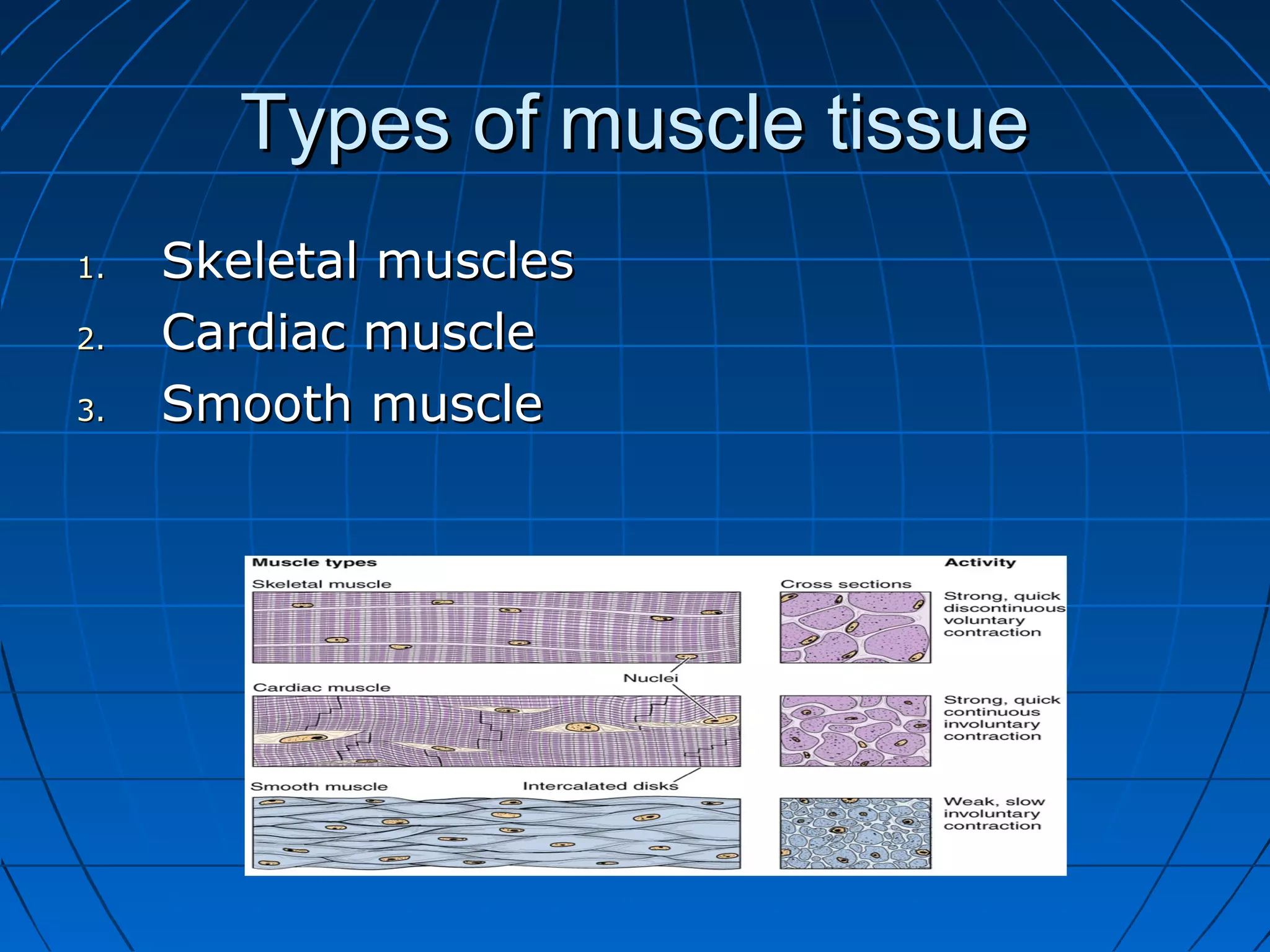
Types of muscle tissue
1.
2.
3.

Skeletal muscles
Cardiac muscle
Smooth muscle
Skeletal muscle





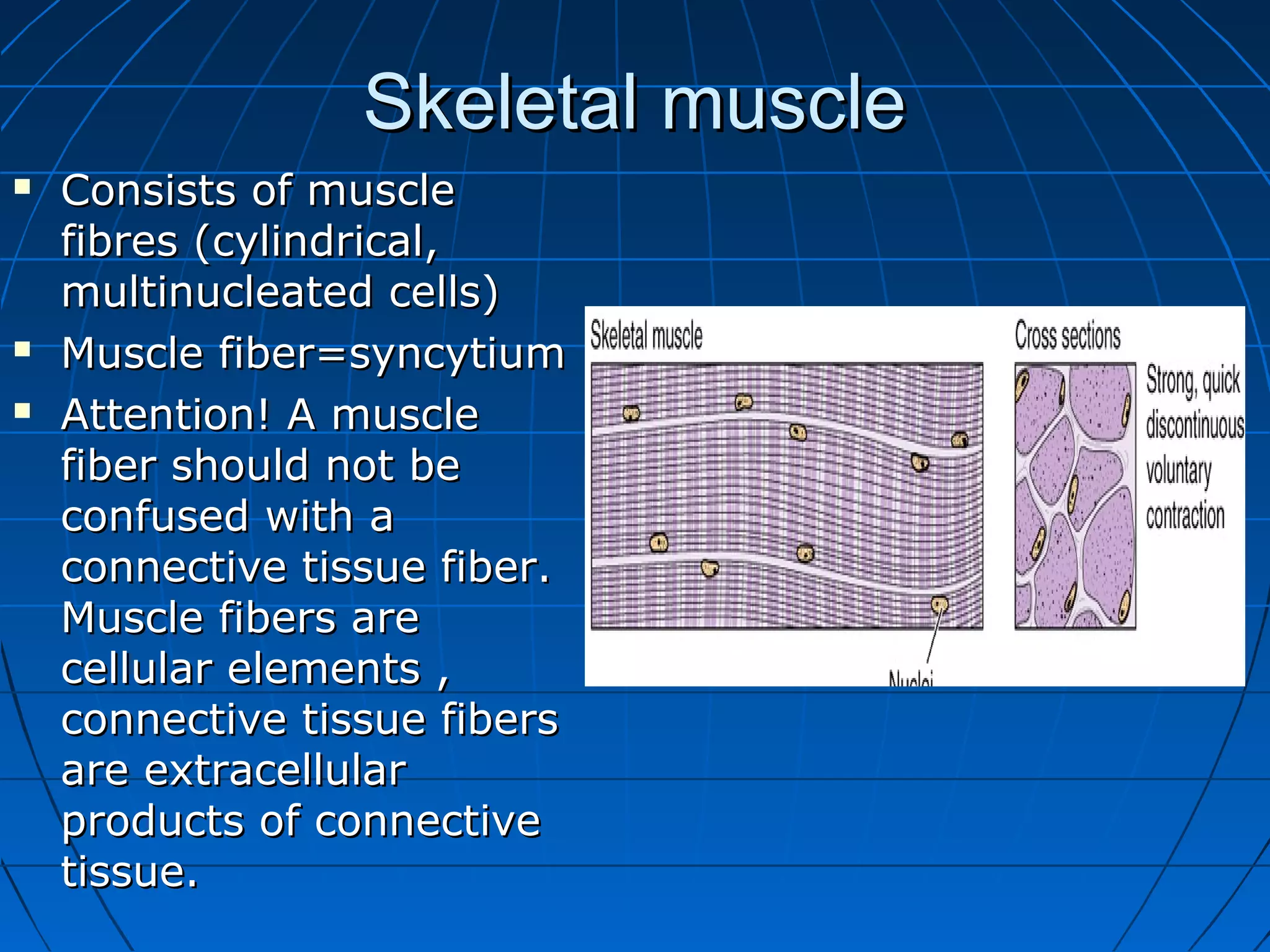
Consists of muscle
fibres (cylindrical,
multinucleated cells)
Muscle fiber=syncytium
Attention! A muscle
fiber should not be
confused with a
connective tissue fiber.
Muscle fibers are
cellular elements ,
connective tissue fibers
are extracellular
products of connective
tissue.




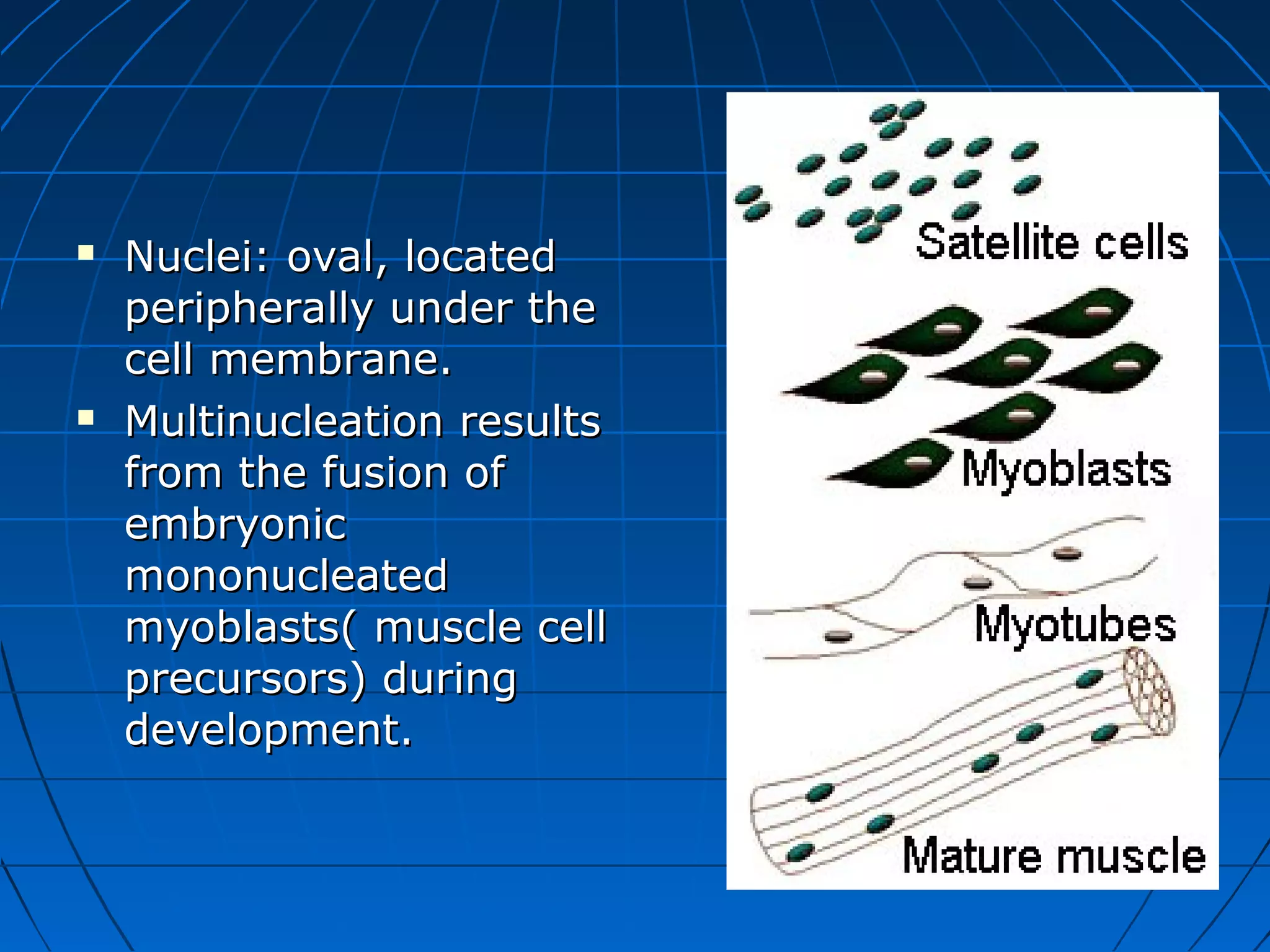
Nuclei: oval, located
peripherally under the
cell membrane.
Multinucleation results
from the fusion of
embryonic
mononucleated
myoblasts( muscle cell
precursors) during
development.
Sarco…


Sarco… - a prefix that means „muscular”.
For example:

Sarcolemma- the plasma membrane of the
muscle fiber
Sarcoplasm = cytoplasm of muscle fiber
Sarcoplasmic reticulum = smooth
endoplasmic reticulum in muscle fibers
SKELETAL MUSCLE


The connective tissue associated with muscle is
given a specific set of names describing its
relationship with the muscle fibers.

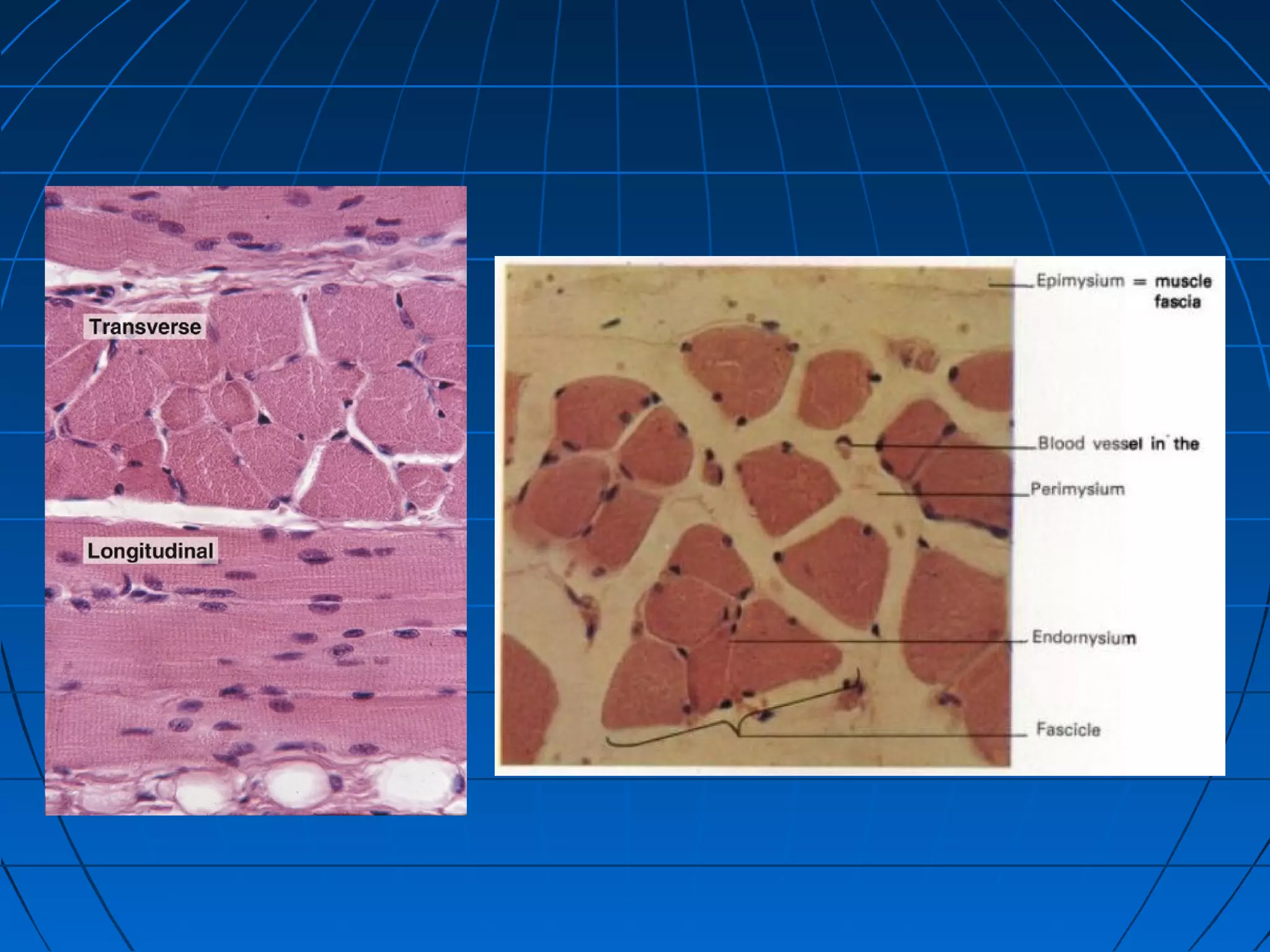
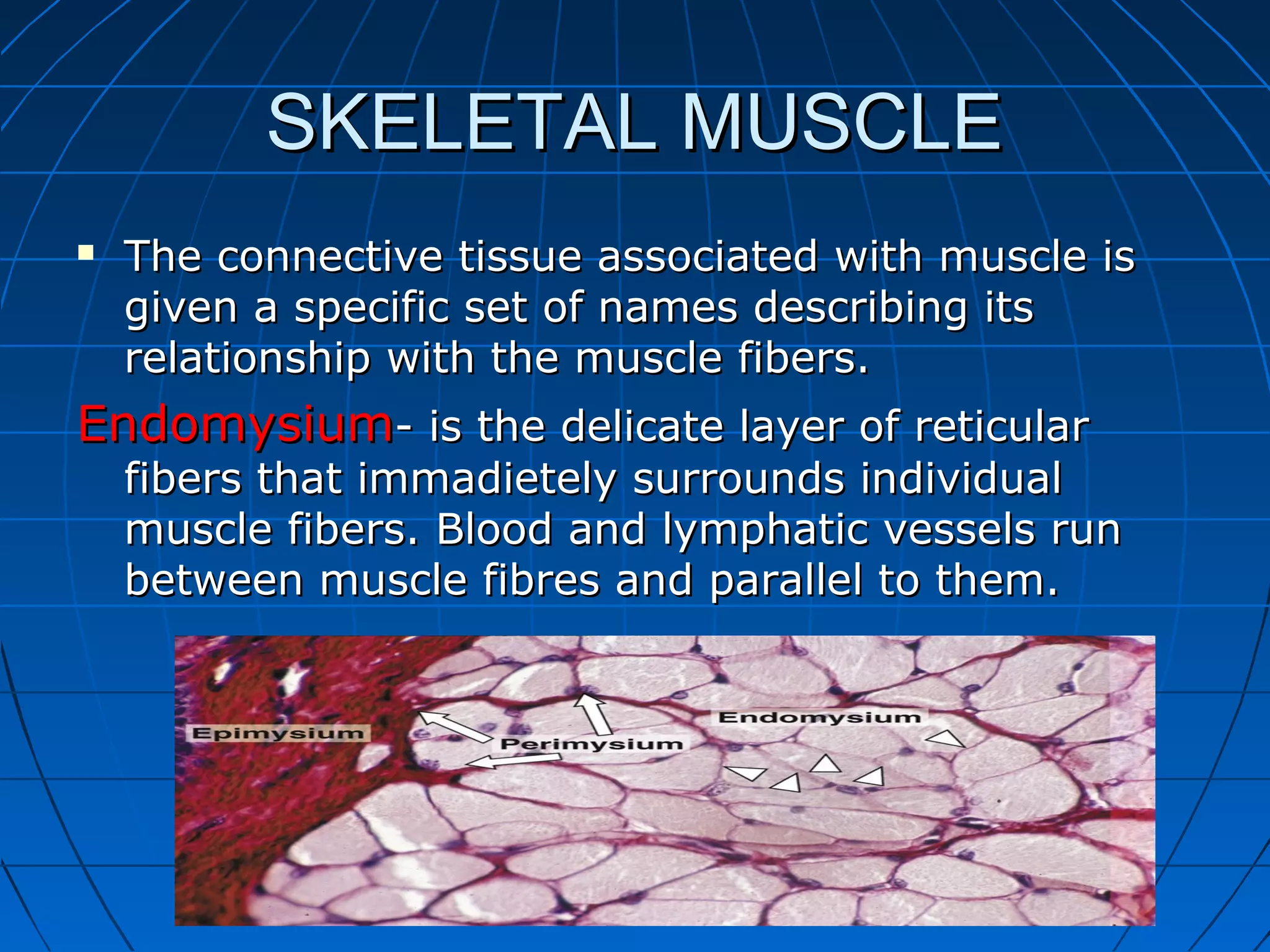
Endomysium- is the delicate layer of reticular

fibers that immadietely surrounds individual
muscle fibers. Blood and lymphatic vessels run
between muscle fibres and parallel to them.
SKELETAL MUSCLE
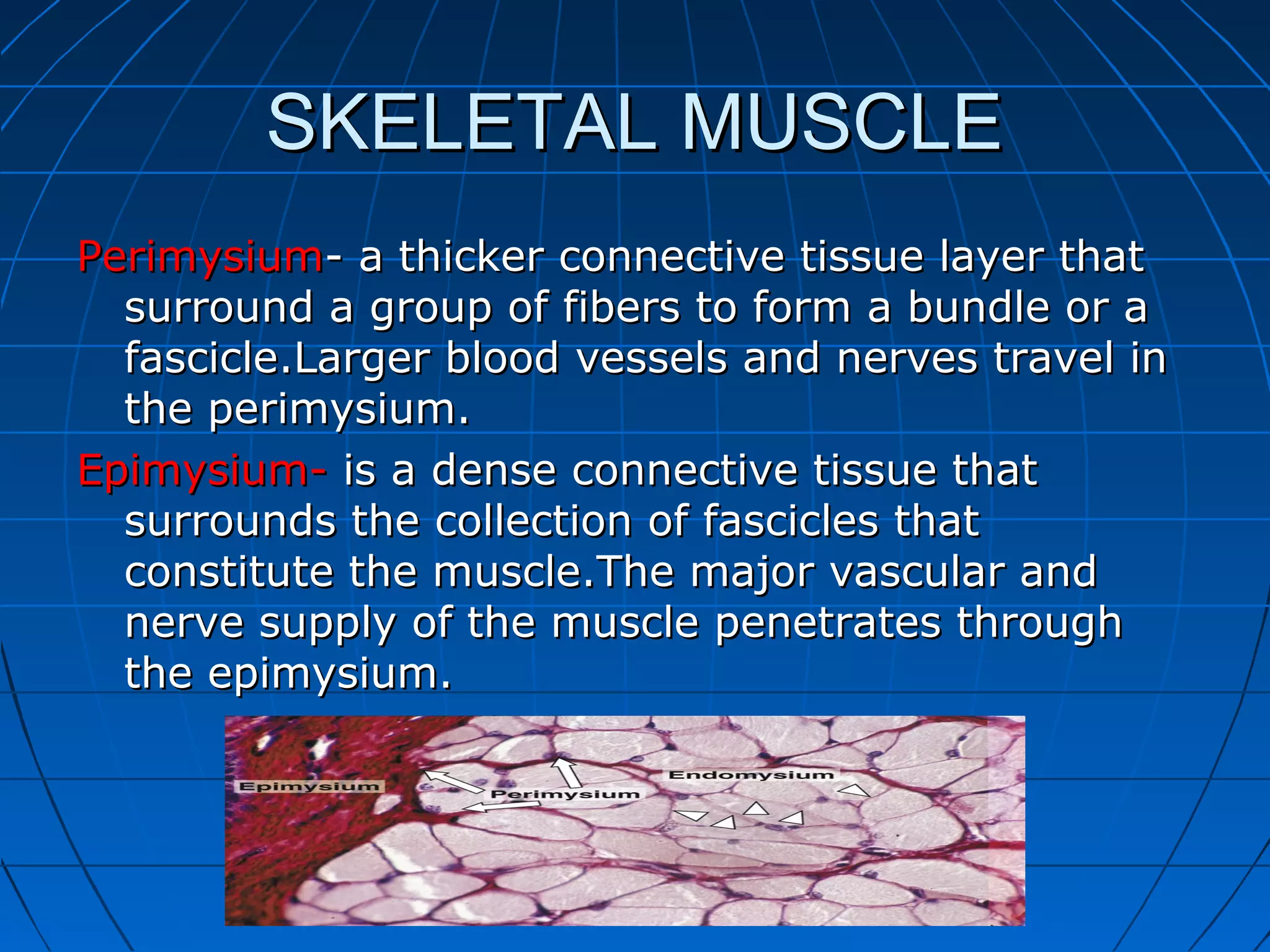
Perimysium- a thicker connective tissue layer that
surround a group of fibers to form a bundle or a
fascicle.Larger blood vessels and nerves travel in
the perimysium.
Epimysium- is a dense connective tissue that
surrounds the collection of fascicles that
constitute the muscle.The major vascular and
nerve supply of the muscle penetrates through
the epimysium.
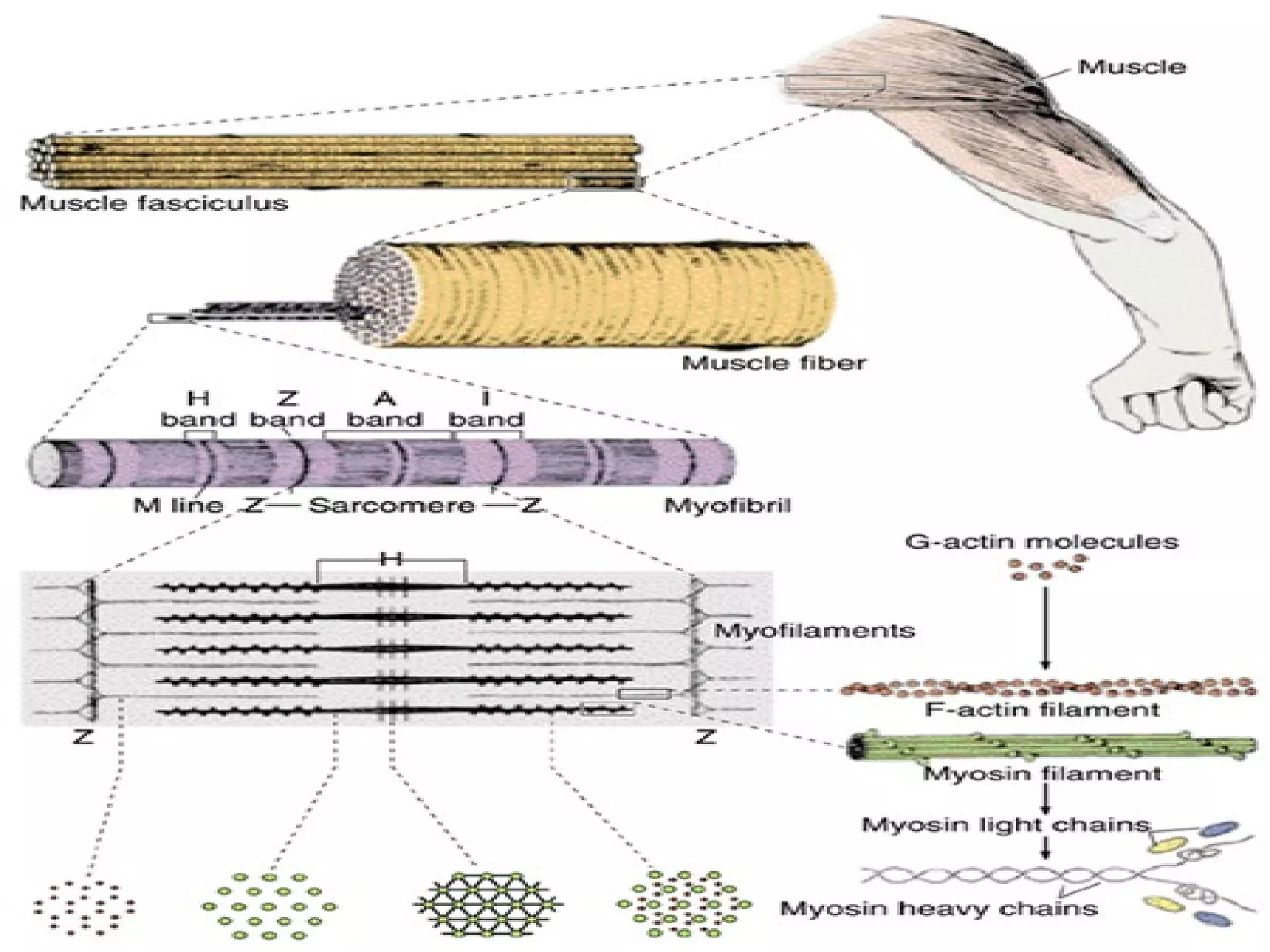
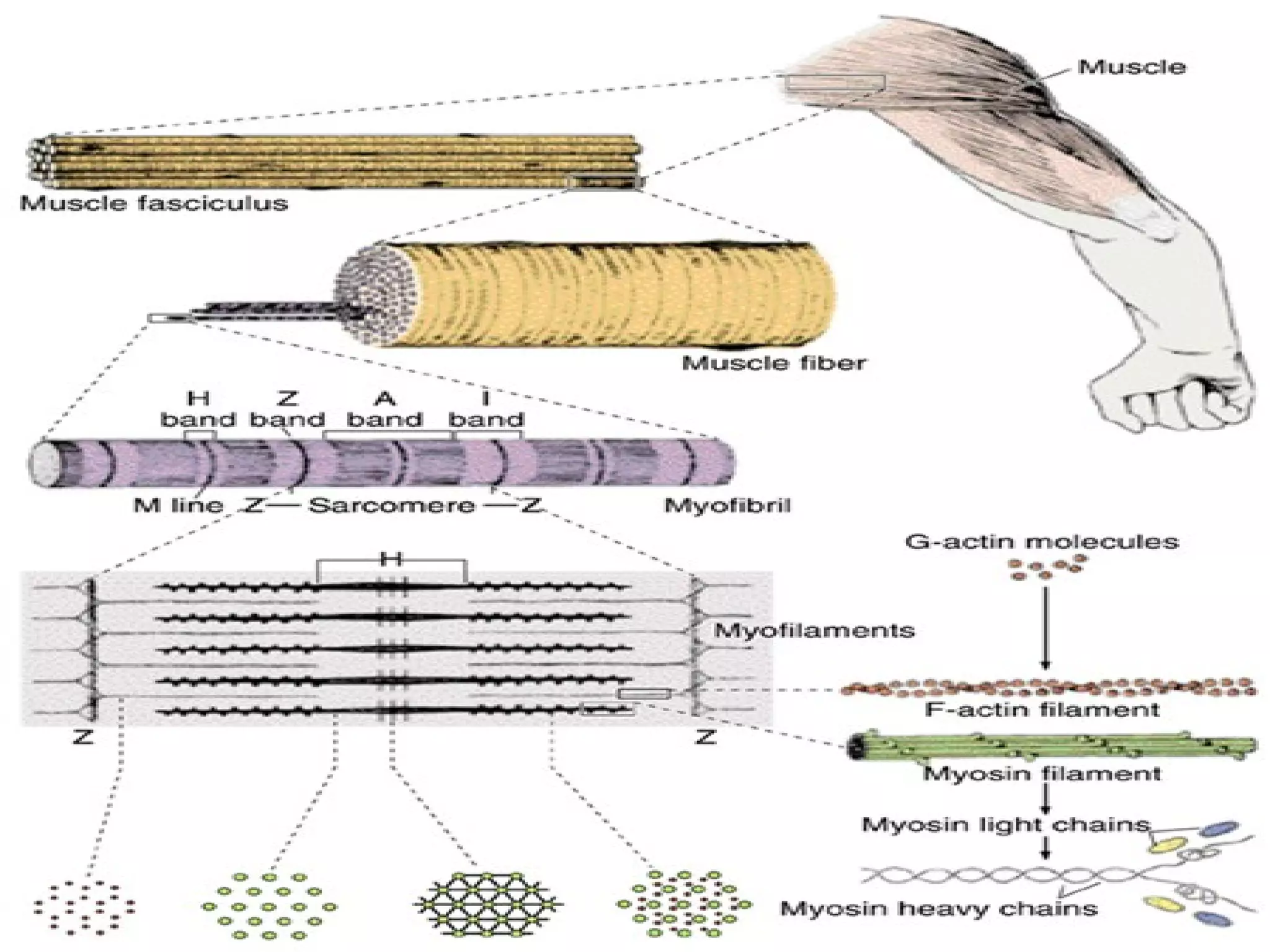
Myofibrils
The strucural and functional subunit of
the muscle fiber is the
myofibril.Muscle fibers are filled with
these longitudinally arrayed
subunits.
Myofibrils are composed of bundles of
myofilaments.
Myofibrils





Long, cylindrical filamentous bundles
Run parallel to the long axis of the
muscle fiber.
Consist of an end to end chainlike
arrangement of sarcomeres.
Myofilaments
Myofilaments are the individual
filamentous polymers of different
proteins.They form a myofibril and
are the acurate contractile elements
of striated muscle.
Two kinds of filaments:
1.
Thick filaments
2.
Thin filaments
The arrangement of thick and thin
filaments gives rise to the
density differences that produce
the cross-striations.
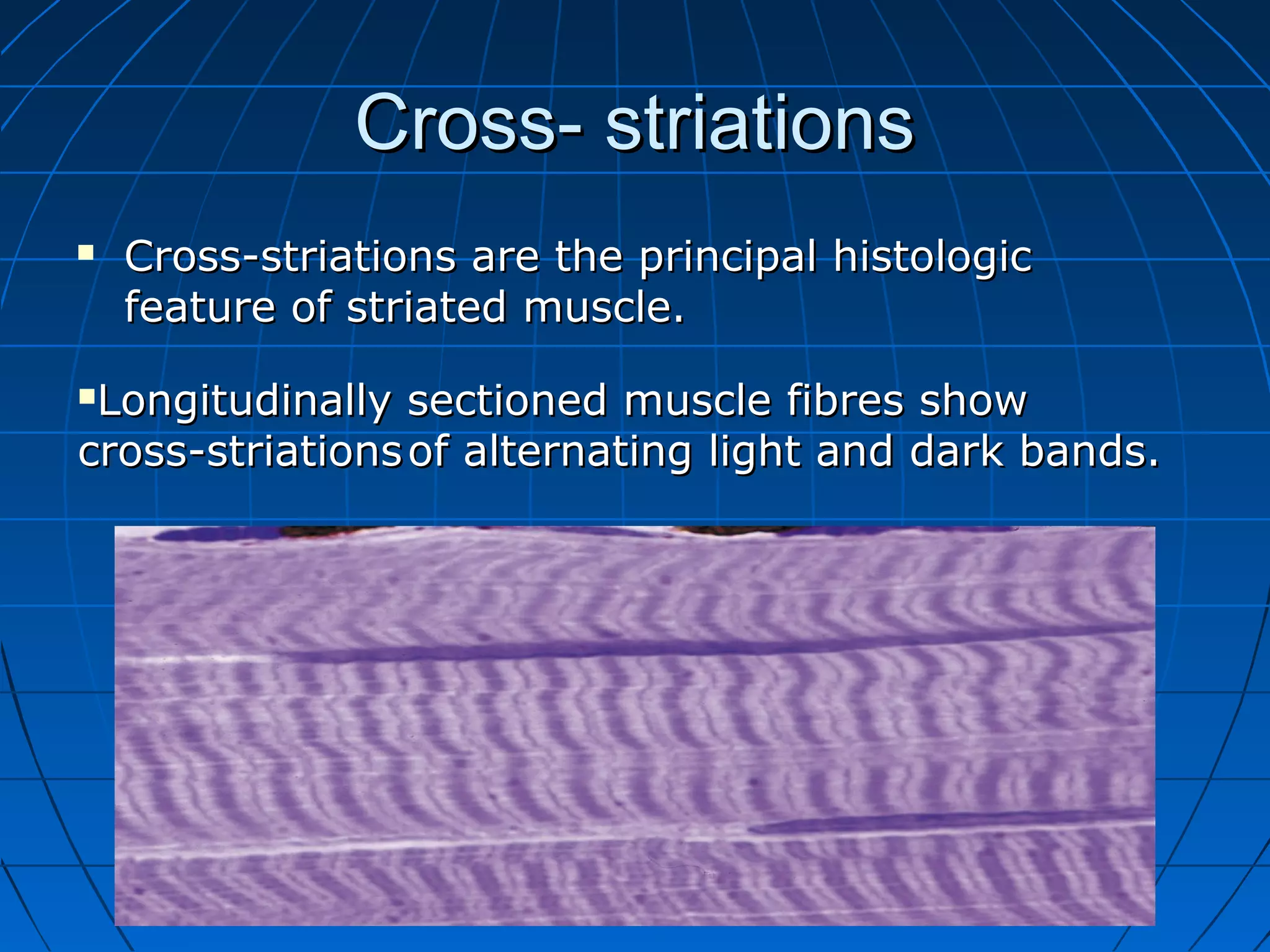
Cross- striations


Cross-striations are the principal histologic
feature of striated muscle.

Longitudinally sectioned muscle fibres show
cross-striations of alternating light and dark bands.

Cross-striations




Cross-striations are evident in
HE( hematoxylin-eosin) stained
preparations of longitudinal sections
of muscle fibers.
The dark and light bands are termed:
the A band, the I band and the Z line
Cross-striations
1.Dark stained bands = A bands=
anisotropic
(are birefringent in polarized light)
2.Light stained bands= I bands=
isotropic
(do not alter polarized light)
The Z line, H zone, M line






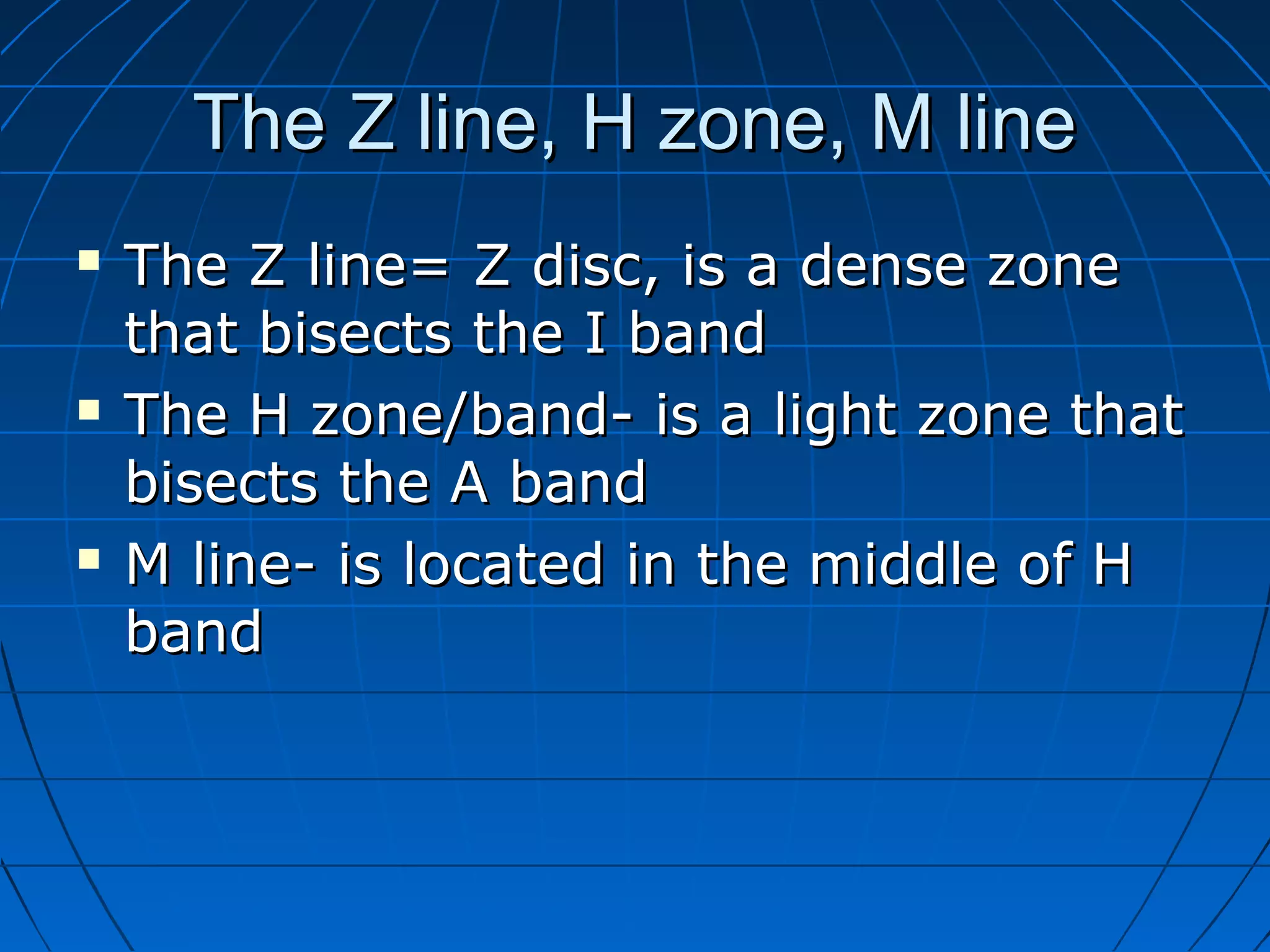
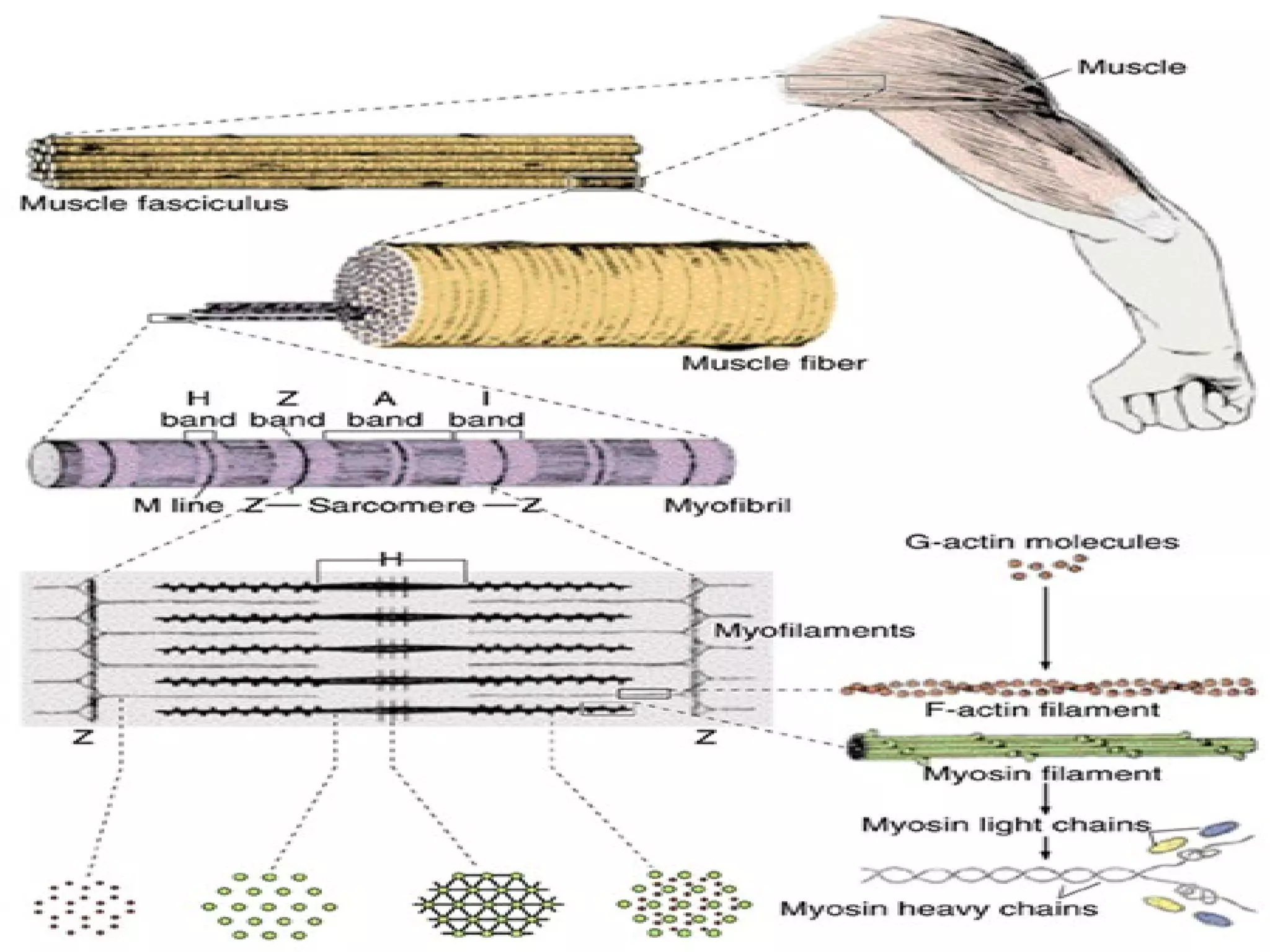
The Z line= Z disc, is a dense zone
that bisects the I band
The H zone/band- is a light zone that
bisects the A band
M line- is located in the middle of H
band
Sarcomere
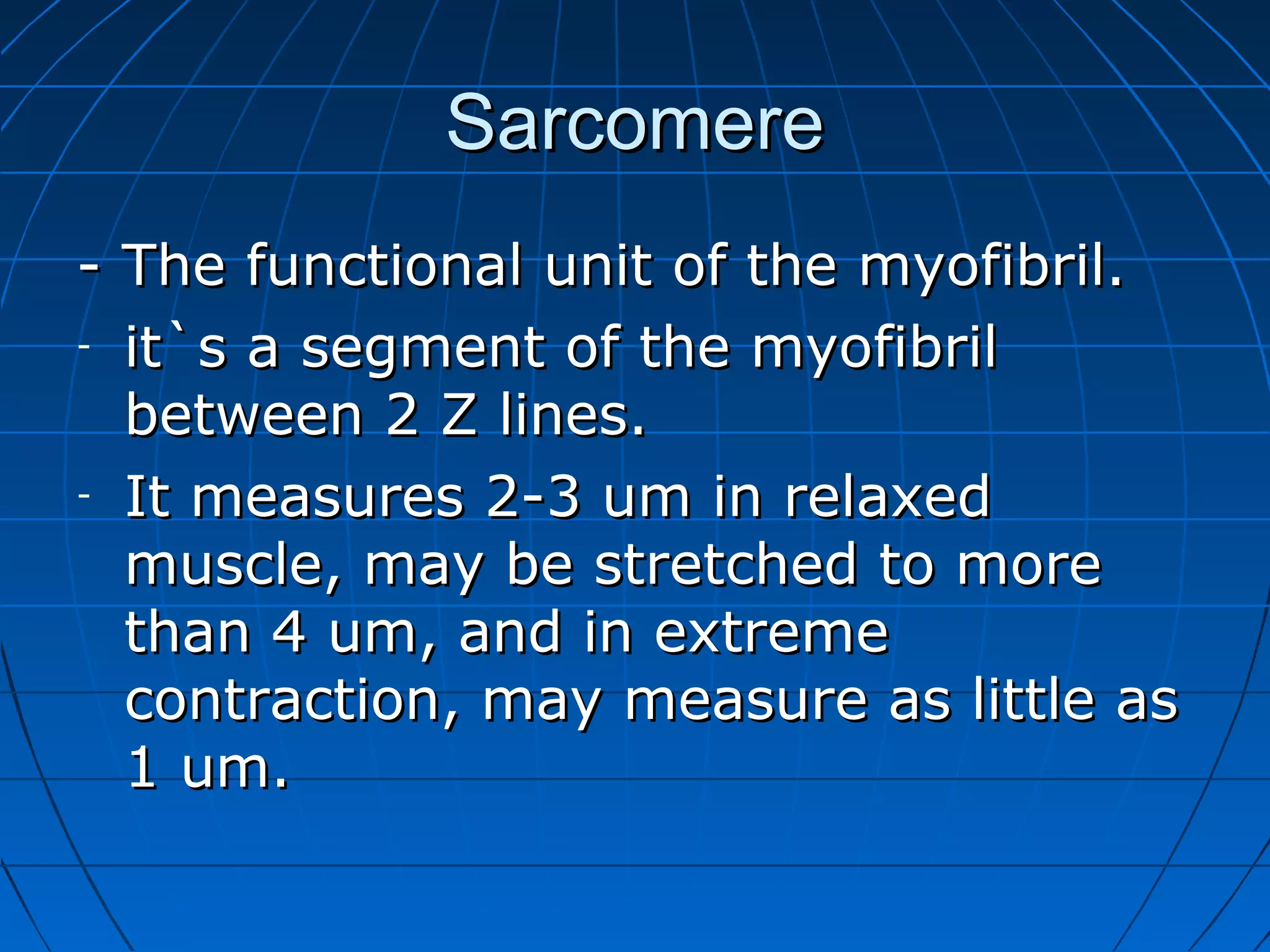
- The functional unit of the myofibril.
- it`s a segment of the myofibril
between 2 Z lines.
- It measures 2-3 um in relaxed
muscle, may be stretched to more
than 4 um, and in extreme
contraction, may measure as little as
1 um.
Sarcomere



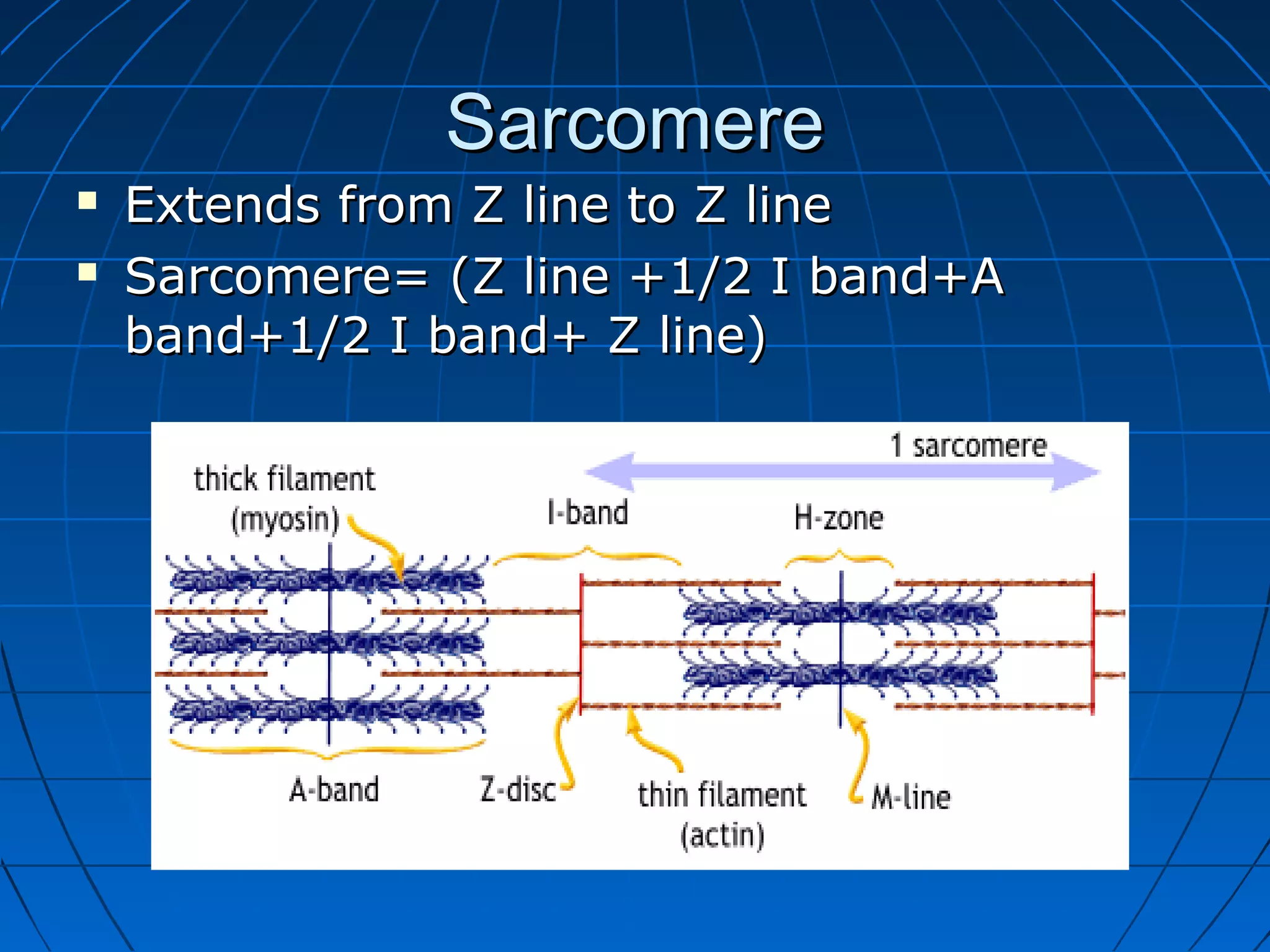
Extends from Z line to Z line
Sarcomere= (Z line +1/2 I band+A
band+1/2 I band+ Z line)
The structure of the sarcomere
1.

2.

3.

4.
5.

6.

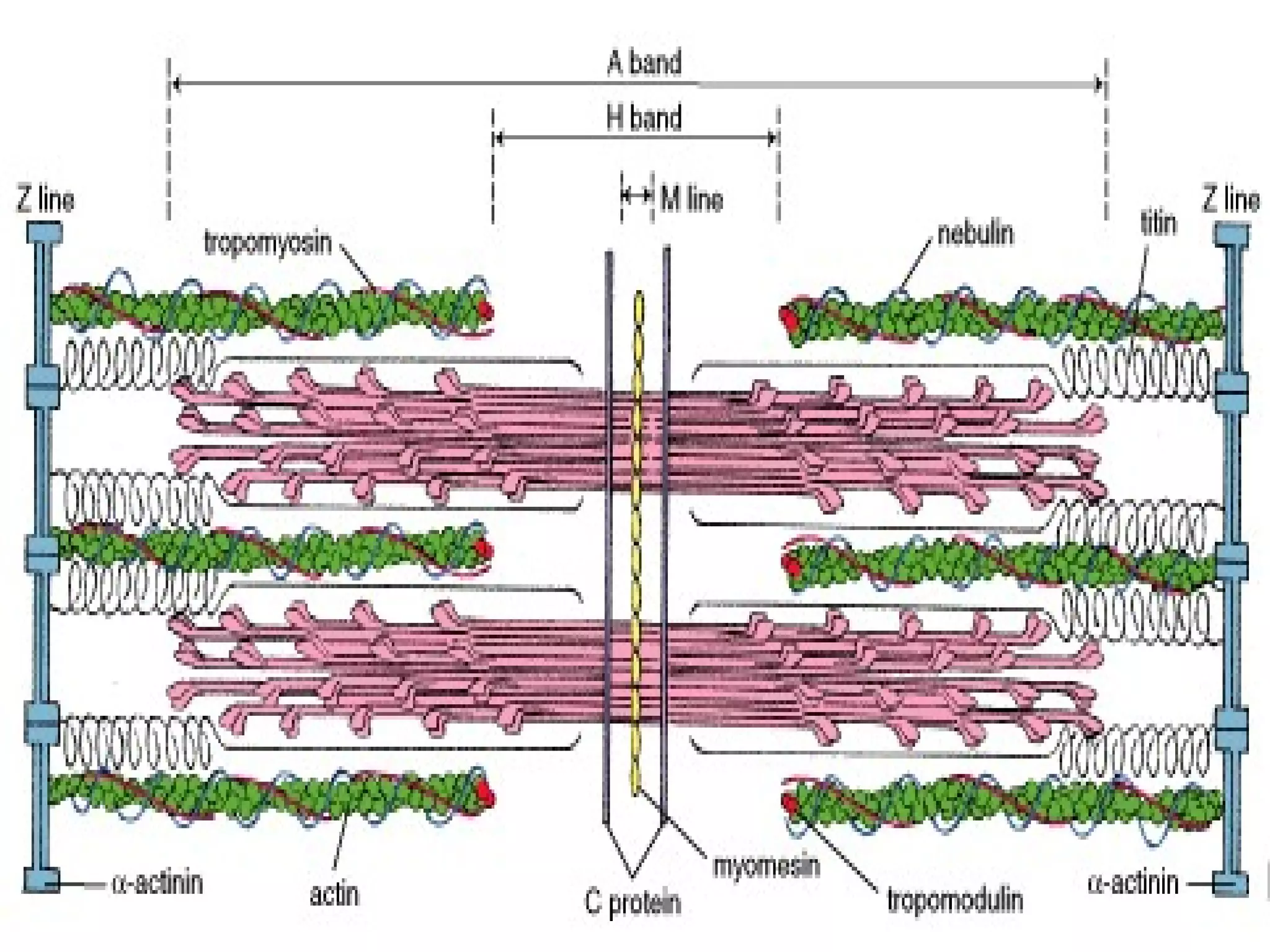
Z line- a borderline of sarcomere.Thin filaments are
attached to it. Main protein- alfa actinin.
Thin filaments- extend from the Z line to the H band.
The thin and thick filaments run between and parallel
to each other.
Thick filaments- occupy the A band, the central
portion of the sarcomere.
I – band- contains thin filaments fixed to Z line.
A -band- consist of two parts: 1. thin filaments
overlapping thick filaments 2. thick filaments (H
band)
M line- a region of a H band, at which lateral
connections are made between adjacent thick
filaments.
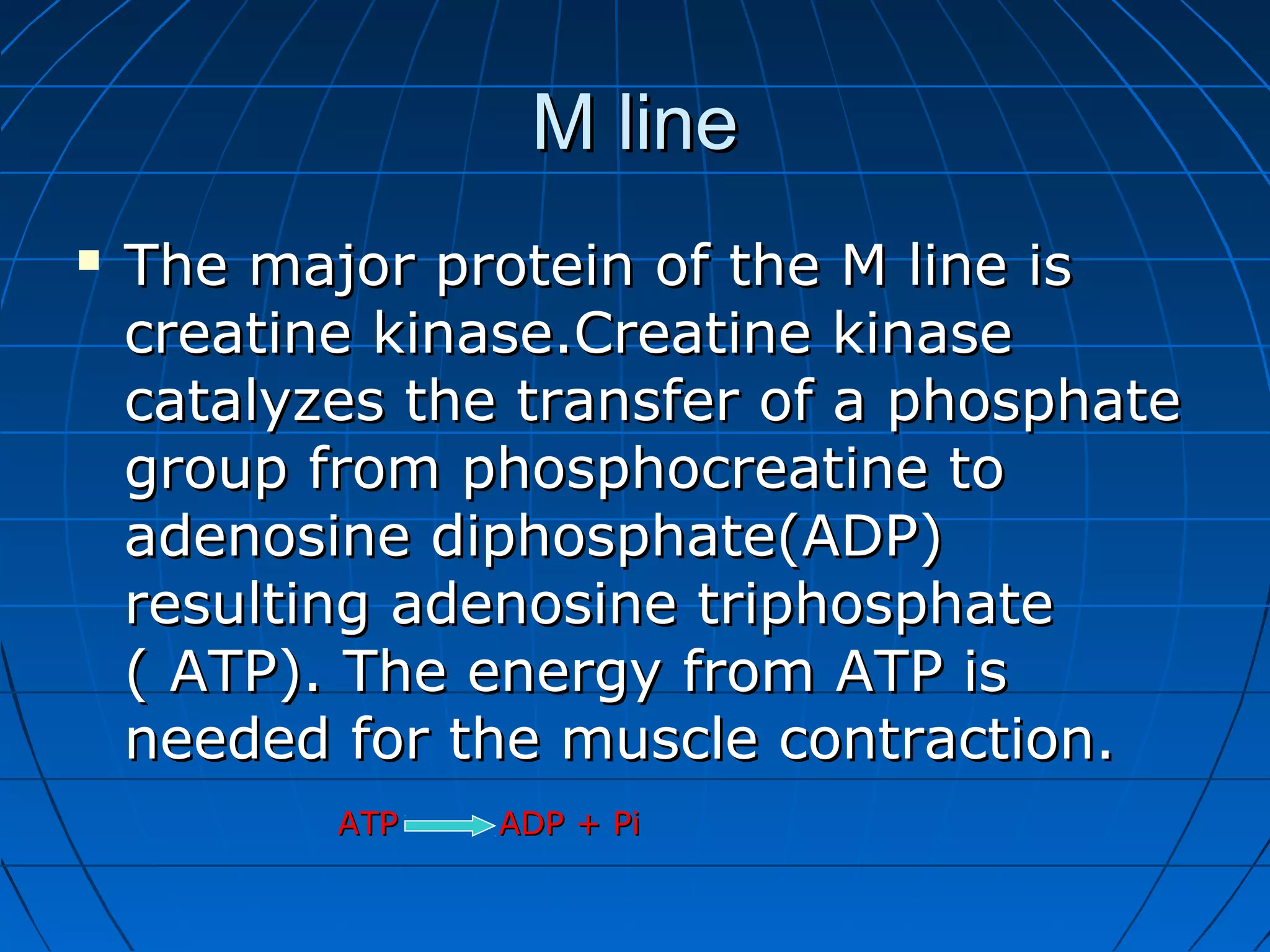
M line


The major protein of the M line is
creatine kinase.Creatine kinase
catalyzes the transfer of a phosphate
group from phosphocreatine to
adenosine diphosphate(ADP)
resulting adenosine triphosphate
( ATP). The energy from ATP is
needed for the muscle contraction.
ATP

ADP + Pi
The structure of thin and thick
myofilaments


A)
B)
C)



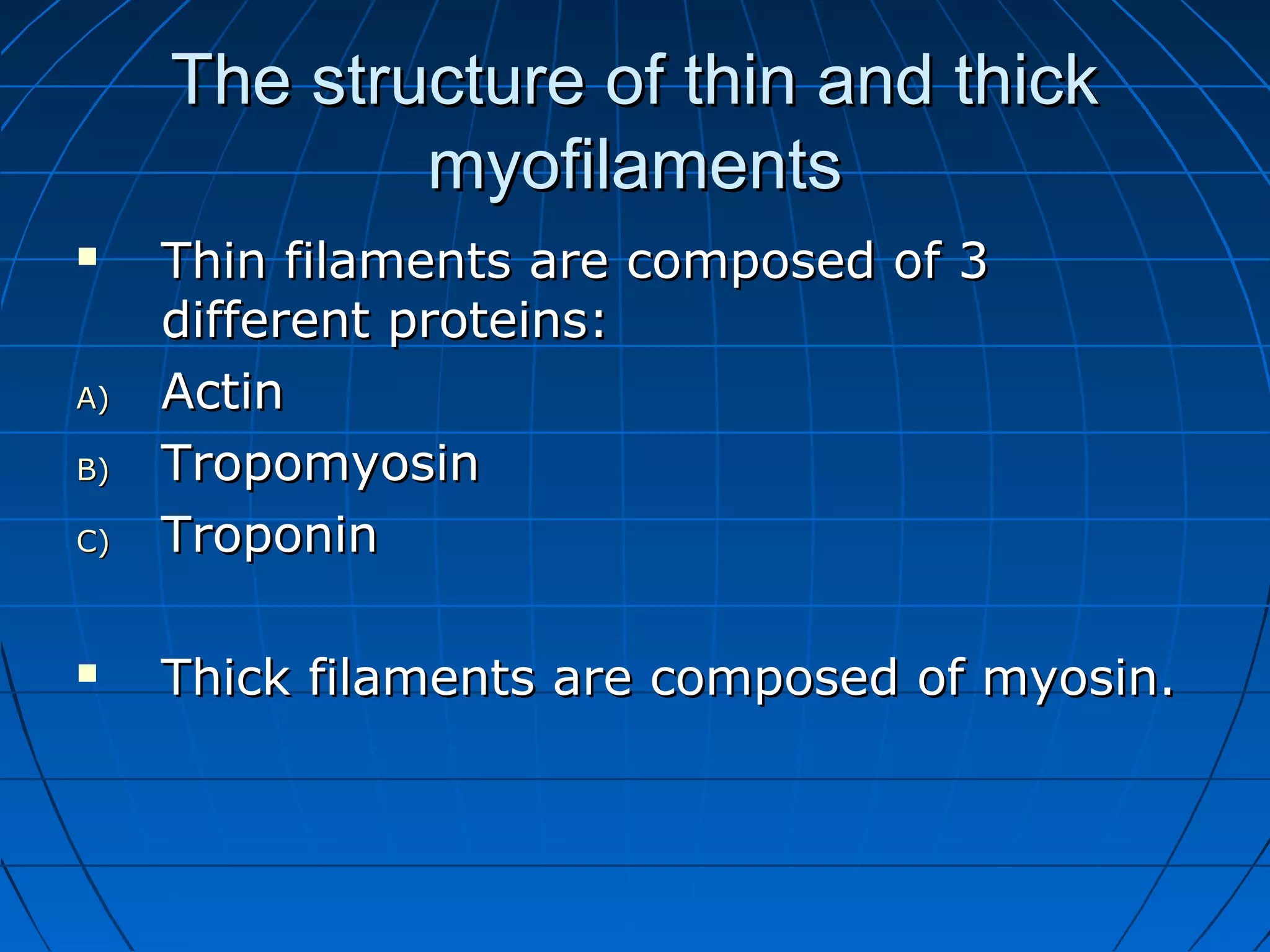
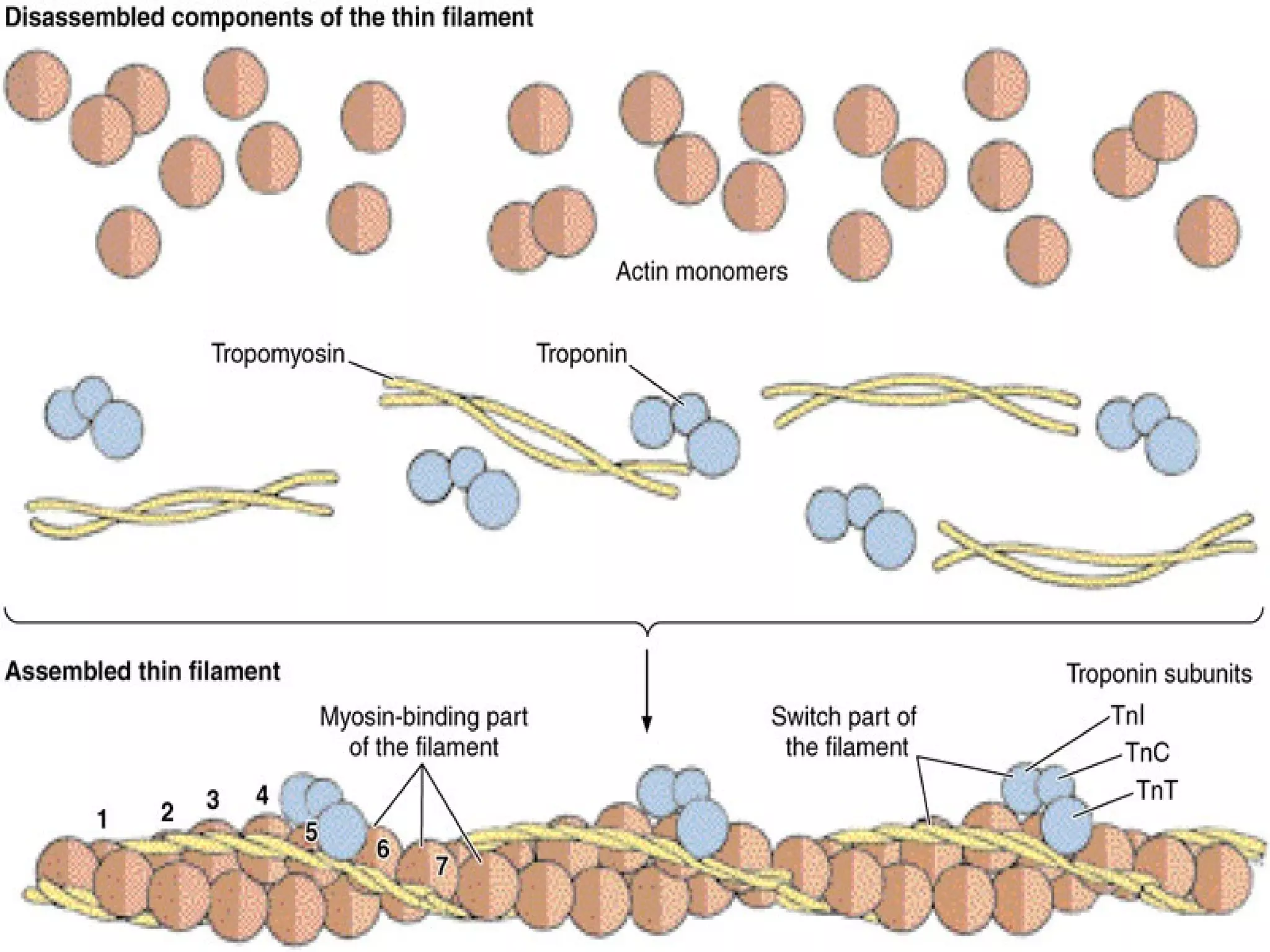
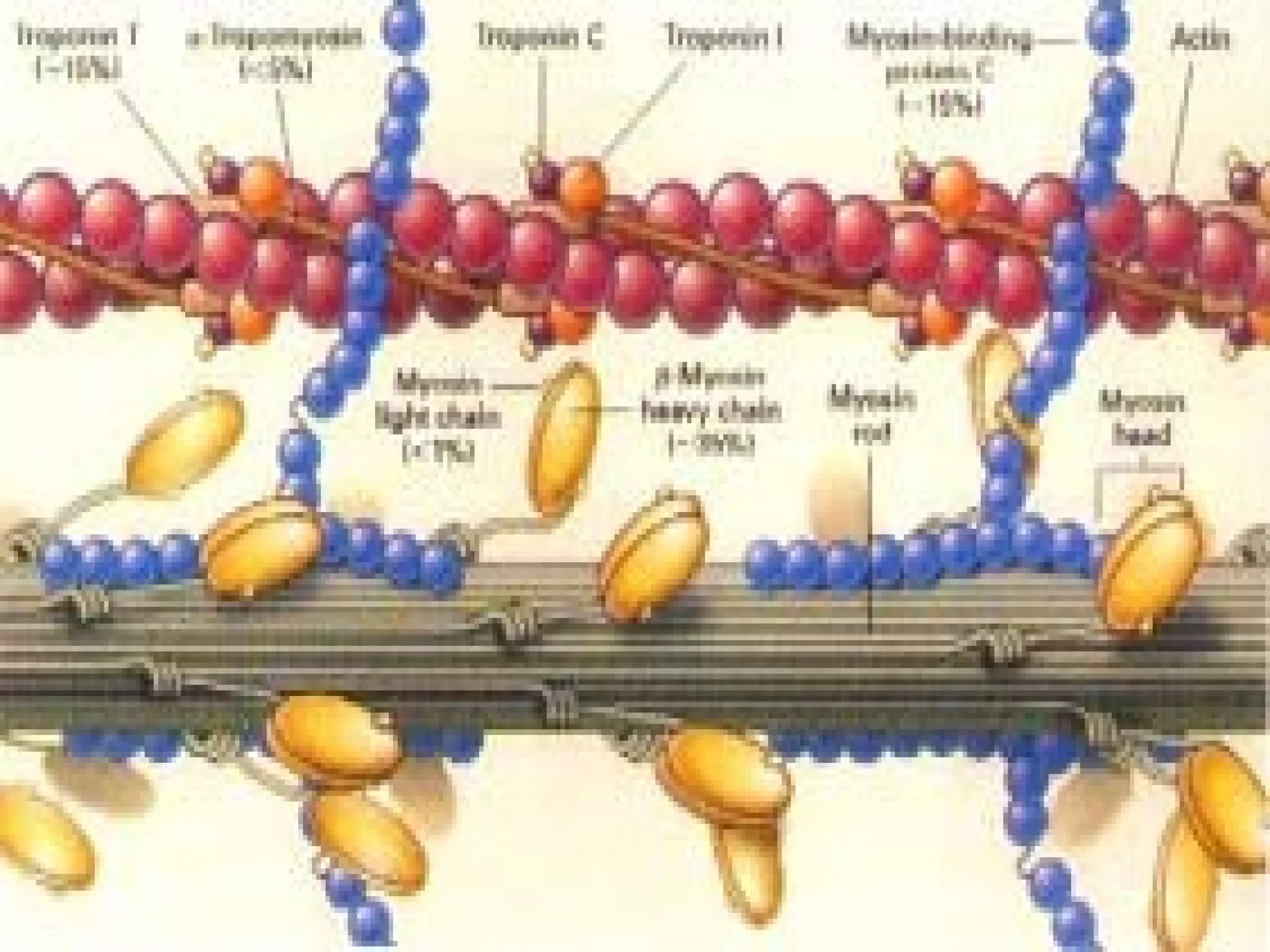
Thin filaments are composed of 3
different proteins:
Actin
Tropomyosin
Troponin
Thick filaments are composed of myosin.
Actin
-

-

-

-

Is present as long filamentous (F-actin) polymers
consisting of 2 strands of globular( G- actin )
monomers.
The polymers are twisted around each other in a
double helical formation.
Each G-actin monomer contains a binding site for
myosin
Actin filaments are fixed to the Z line by a protein
called alfa-actinin.
Tropomyosin
-

-

-

-

long, thin molecule, built up of 2 polypeptide
chains
Molecules are bound head to tail, forming
filaments
Tropomyosin filaments lie along the two twisted
actin strands
Each tropomyosin molecule covers 7 G-actin
molecules and has one troponin- binding place.
Troponin

1.

2.

3.

A complex of 3 subunits:
Troponin T ( TnT)- attached to
tropomyosin
Troponin C ( TnC)- binds calcium
ions
Troponin I ( TnI)- inhibits the actinmyosin interaction
Myosin








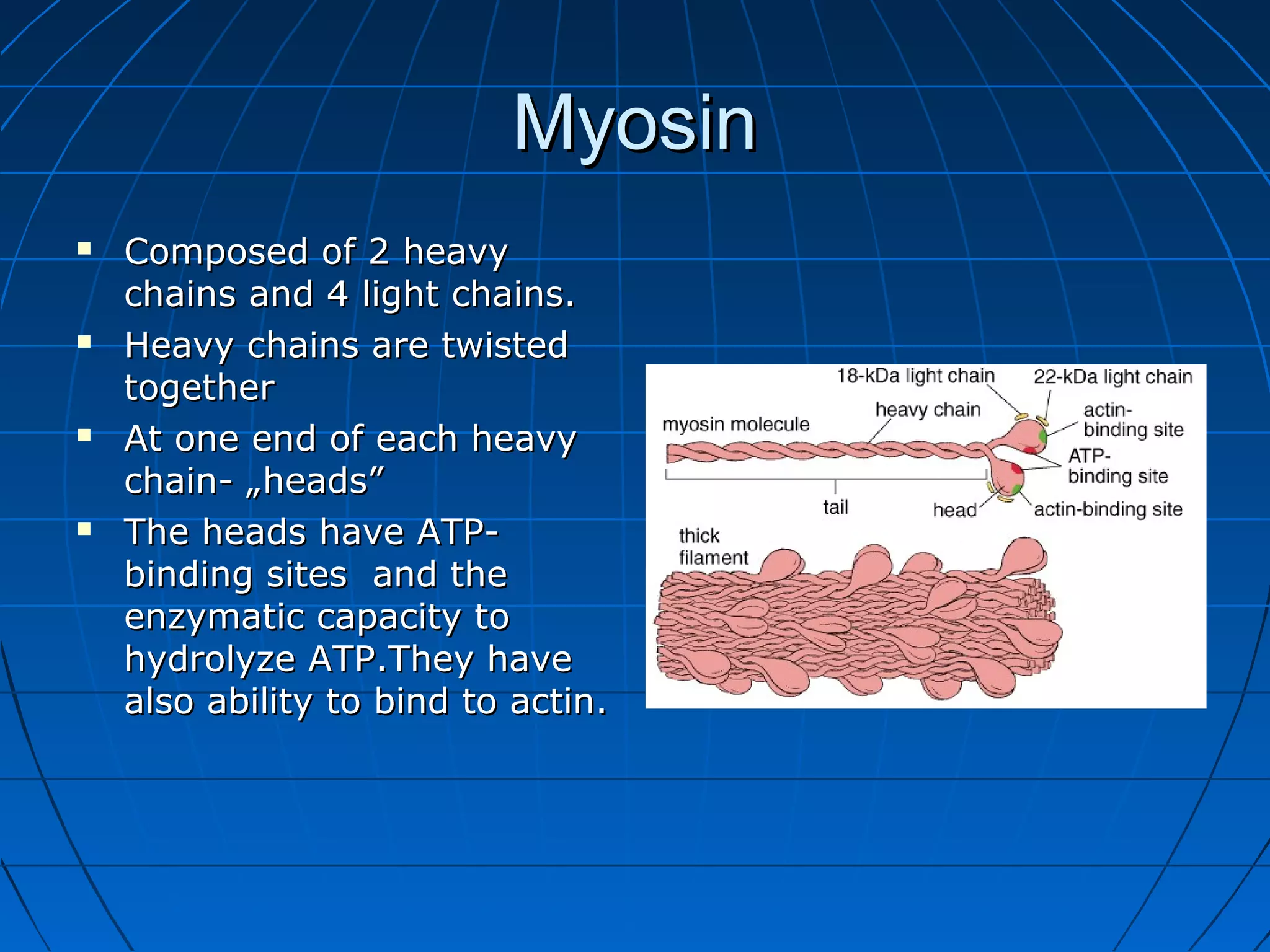
Composed of 2 heavy
chains and 4 light chains.
Heavy chains are twisted
together
At one end of each heavy
chain- „heads”
The heads have ATPbinding sites and the
enzymatic capacity to
hydrolyze ATP.They have
also ability to bind to actin.
The primary proteins ( actin , myosin,
trpomyosin, troponin) constitute
more than 75% of the total protein
of the muscle fiber and are visible as
the thick and thin filaments.The
remaining structural proteins
include:
- Titin
- Nebulin
- Alfa-actinin
- Myomesin
- C protein
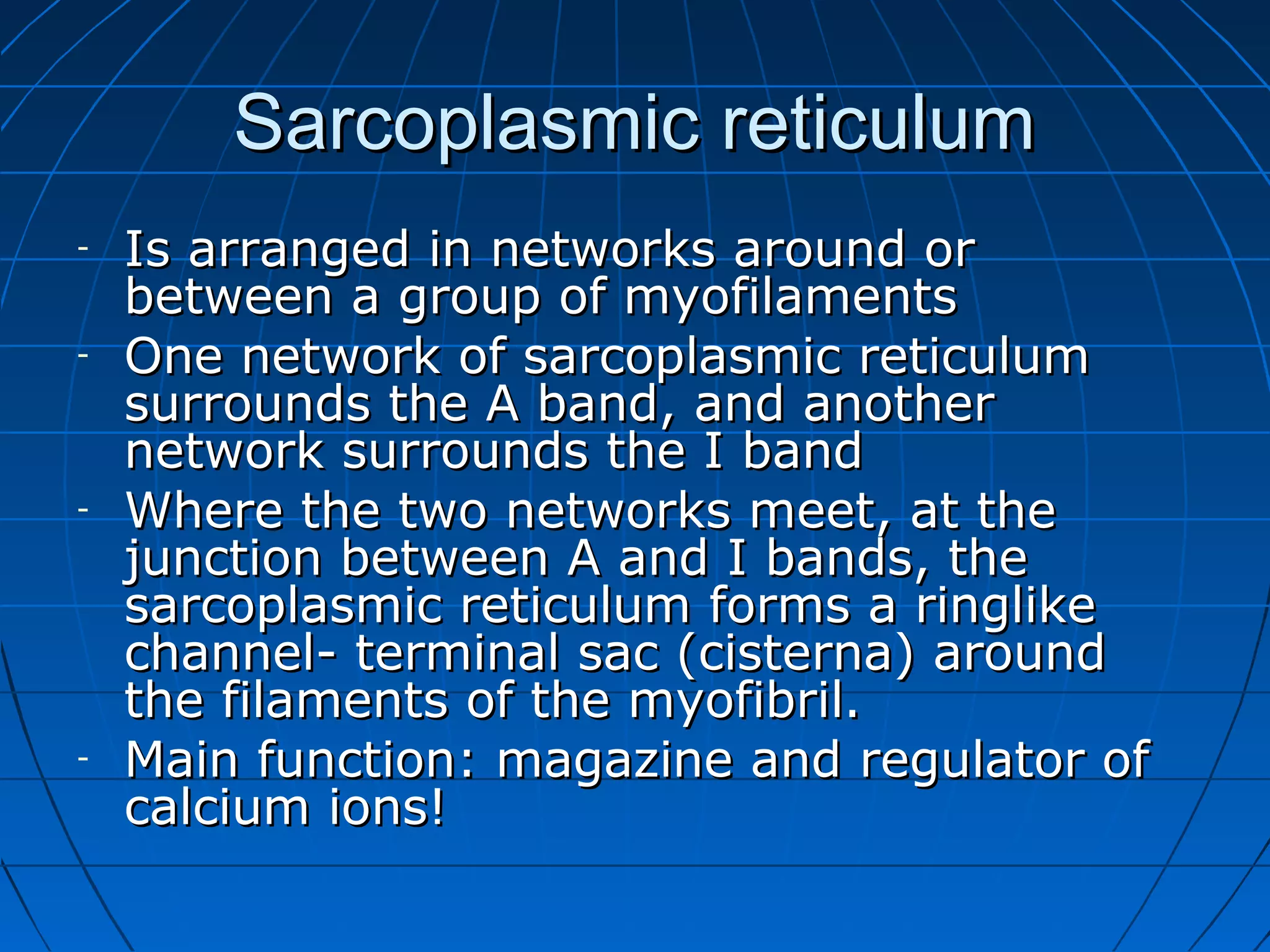
Contractile mechanism-sliding
filament model
When a muscle contracts, each
sarcomere shortens and becomes
thicker , but the myofilaments
remain the same length. It means
that the shortening of the sarcomere
must be due to an increase in the
overlap of thick and thin filaments.
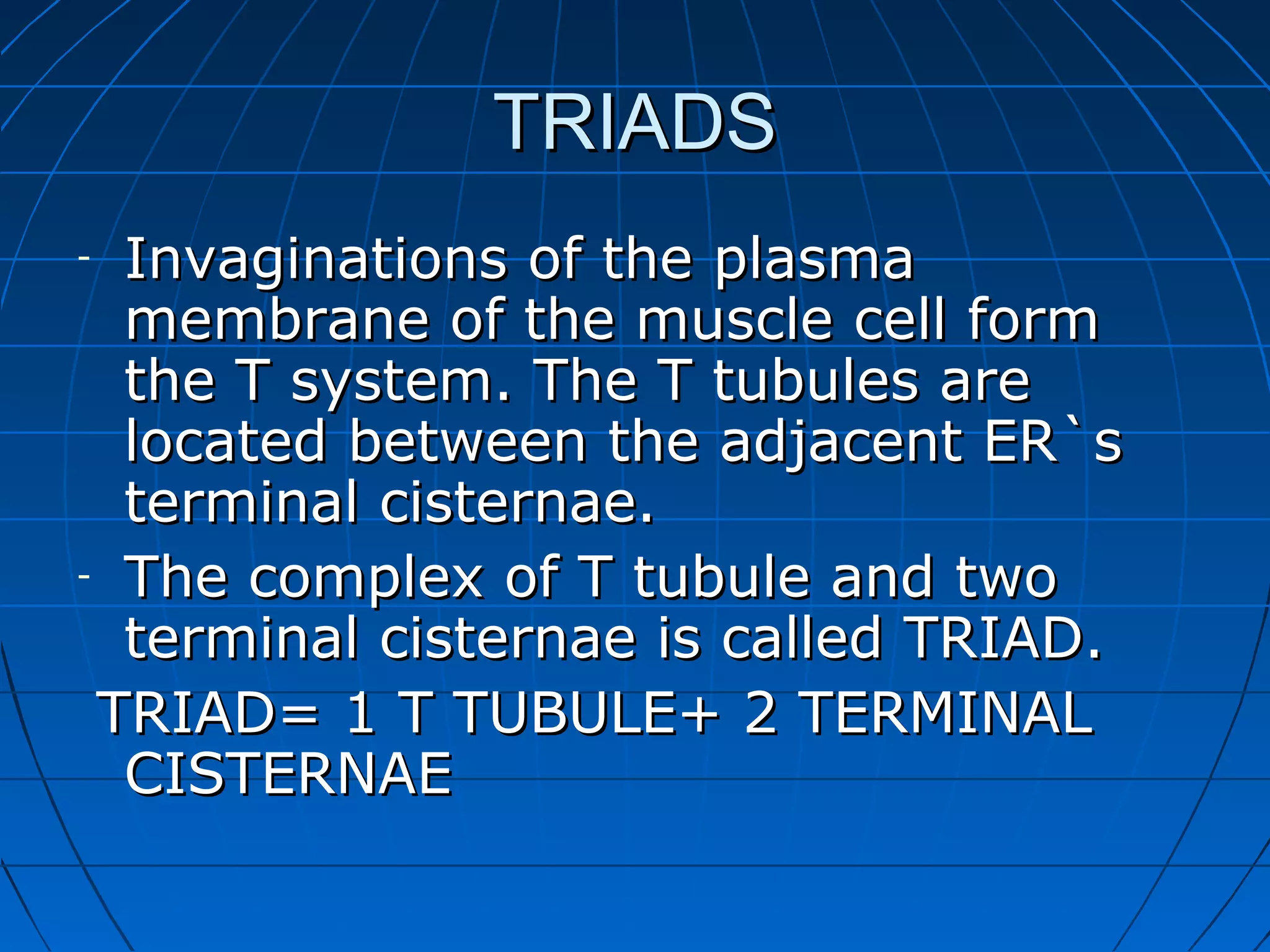
Sarcoplasmic reticulum
-

-

-

Is arranged in networks around or
between a group of myofilaments
One network of sarcoplasmic reticulum
surrounds the A band, and another
network surrounds the I band
Where the two networks meet, at the
junction between A and I bands, the
sarcoplasmic reticulum forms a ringlike
channel- terminal sac (cisterna) around
the filaments of the myofibril.
Main function: magazine and regulator of
calcium ions!
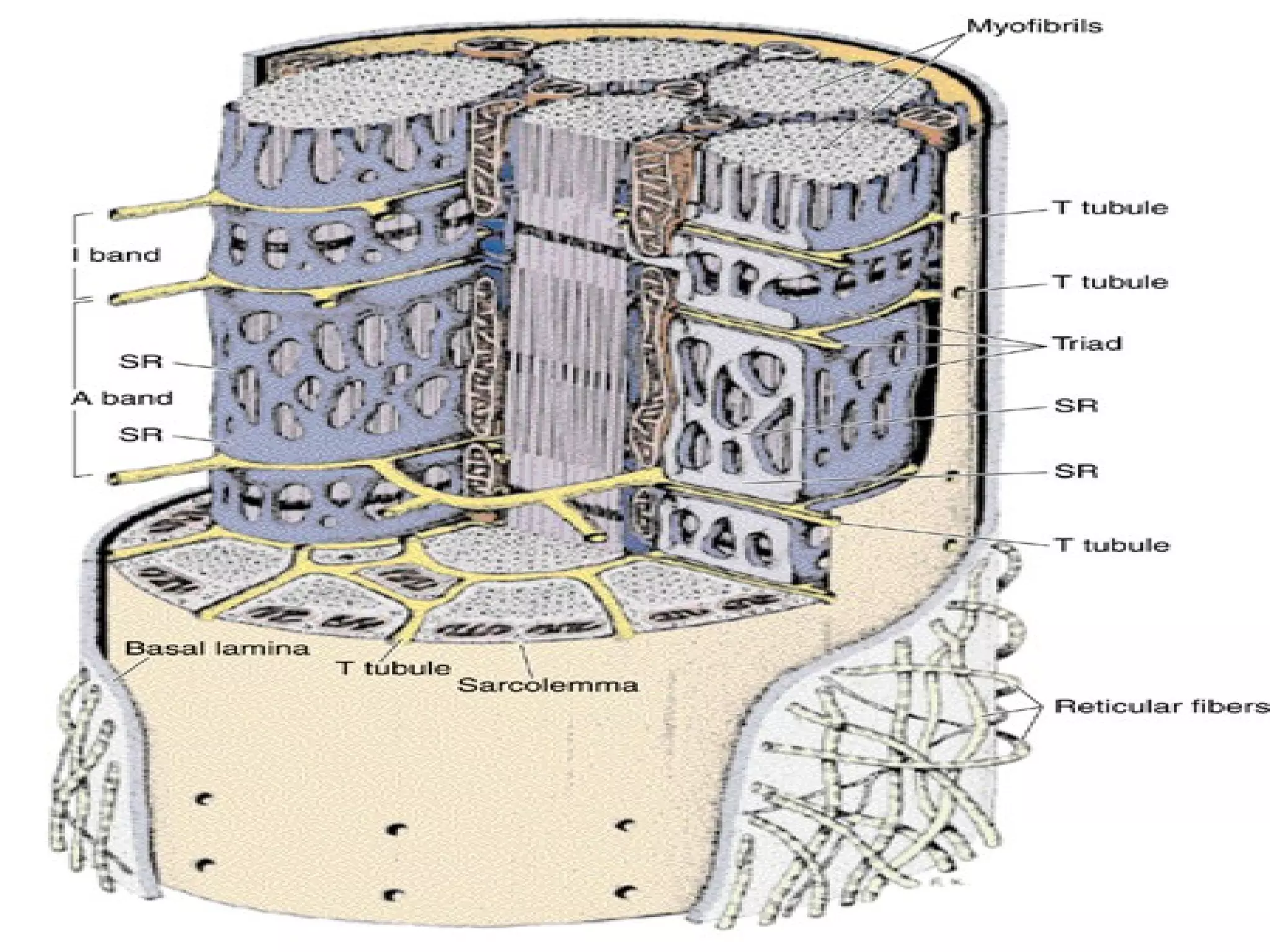
TRIADS
Invaginations of the plasma
membrane of the muscle cell form
the T system. The T tubules are
located between the adjacent ER`s
terminal cisternae.
- The complex of T tubule and two
terminal cisternae is called TRIAD.
TRIAD= 1 T TUBULE+ 2 TERMINAL
CISTERNAE
-
Mechanism of contraction
1.
2.

3.
4.
5.

Depolarization of the sarcoplasm
The depolarization signal is transmitted through
the T tubule to the sarcoplasmic reticulum
membrane.
Calcium ions are released into the vicinity of the
overlapping thick and thin filaments.
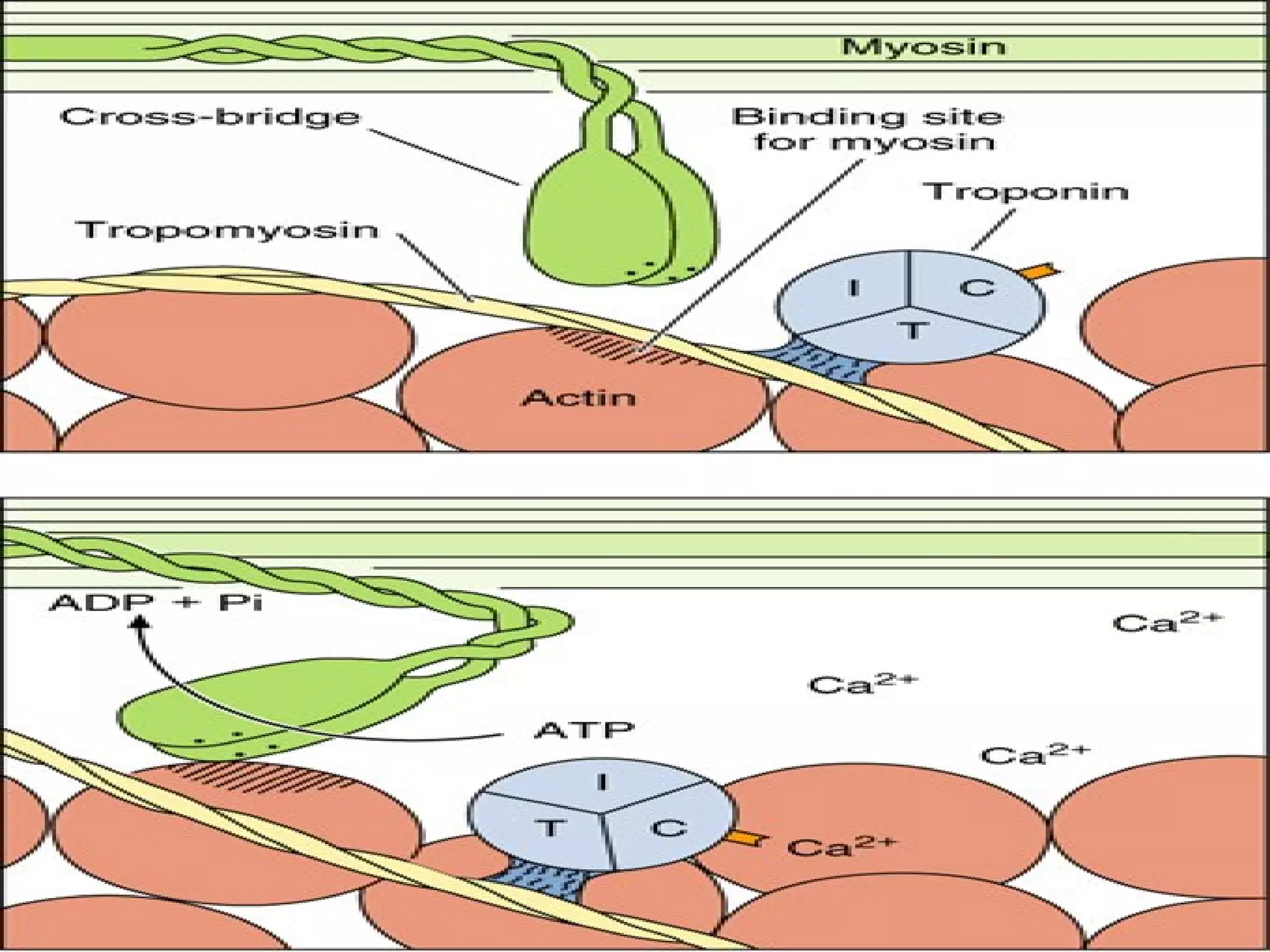
Calcium ions are bined to the TnC subunit of
troponin.
The comlex of troponins changes its structure
and drives the tropomyosin deeper into the
groove of the actin helix. Consequence:
exposition the myosin –binding sites on the
actin
Mechanism of contraction
6. Interaction=bridgening between the myosin head
and actin. Result:
ATP

ADP + Pi

7.Deformation=bending of the myosin head
8. Movement of the myosin heads pulls the actin
past the myosin filament.
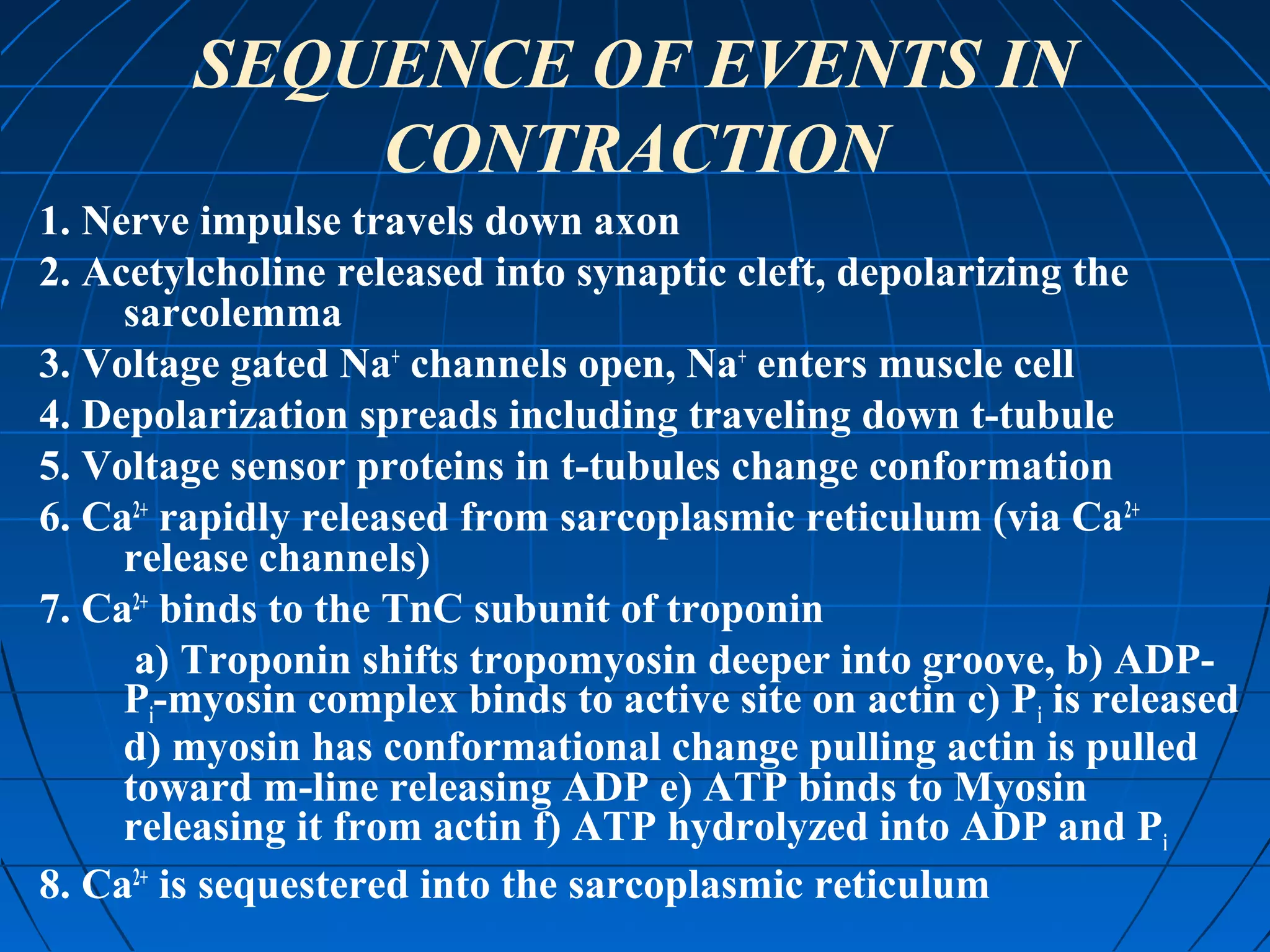
SEQUENCE OF EVENTS IN
CONTRACTION
1. Nerve impulse travels down axon
2. Acetylcholine released into synaptic cleft, depolarizing the
sarcolemma
3. Voltage gated Na+ channels open, Na+ enters muscle cell
4. Depolarization spreads including traveling down t-tubule
5. Voltage sensor proteins in t-tubules change conformation
6. Ca2+ rapidly released from sarcoplasmic reticulum (via Ca2+
release channels)
7. Ca2+ binds to the TnC subunit of troponin
a) Troponin shifts tropomyosin deeper into groove, b) ADPPi-myosin complex binds to active site on actin c) Pi is released
d) myosin has conformational change pulling actin is pulled
toward m-line releasing ADP e) ATP binds to Myosin
releasing it from actin f) ATP hydrolyzed into ADP and Pi
8. Ca2+ is sequestered into the sarcoplasmic reticulum
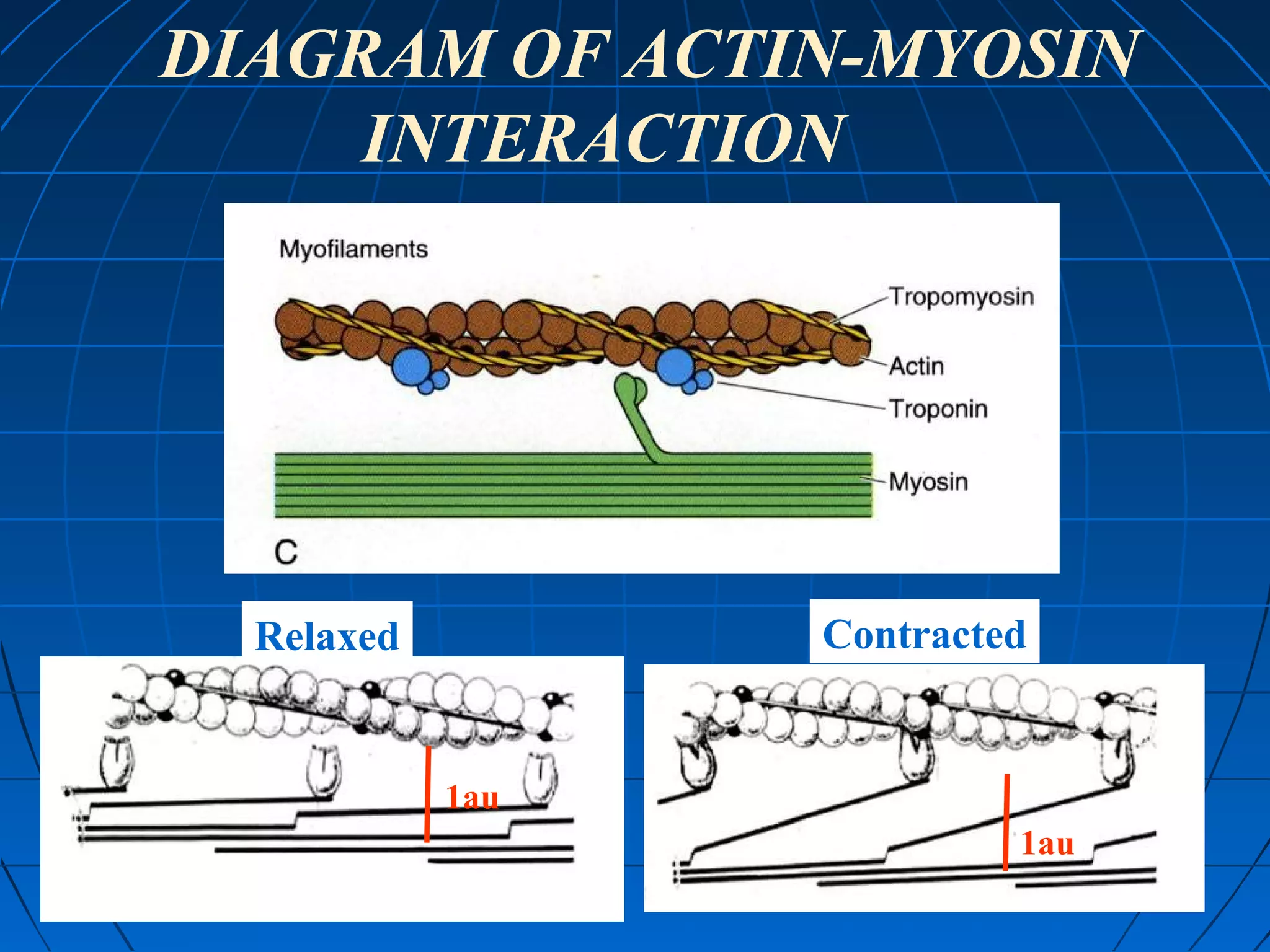
DIAGRAM OF ACTIN-MYOSIN
INTERACTION

Contracted

Relaxed

1au
1au
1au
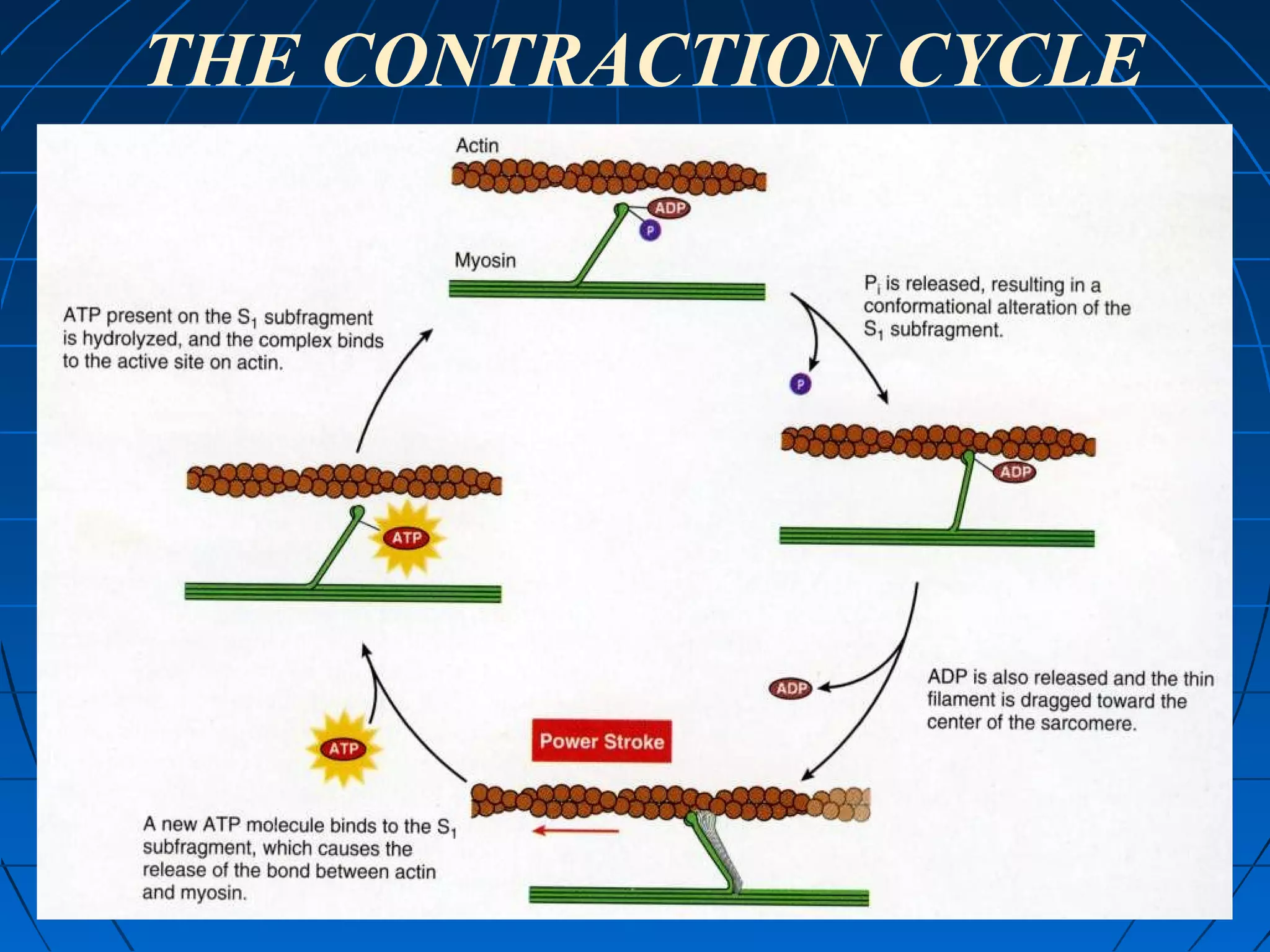
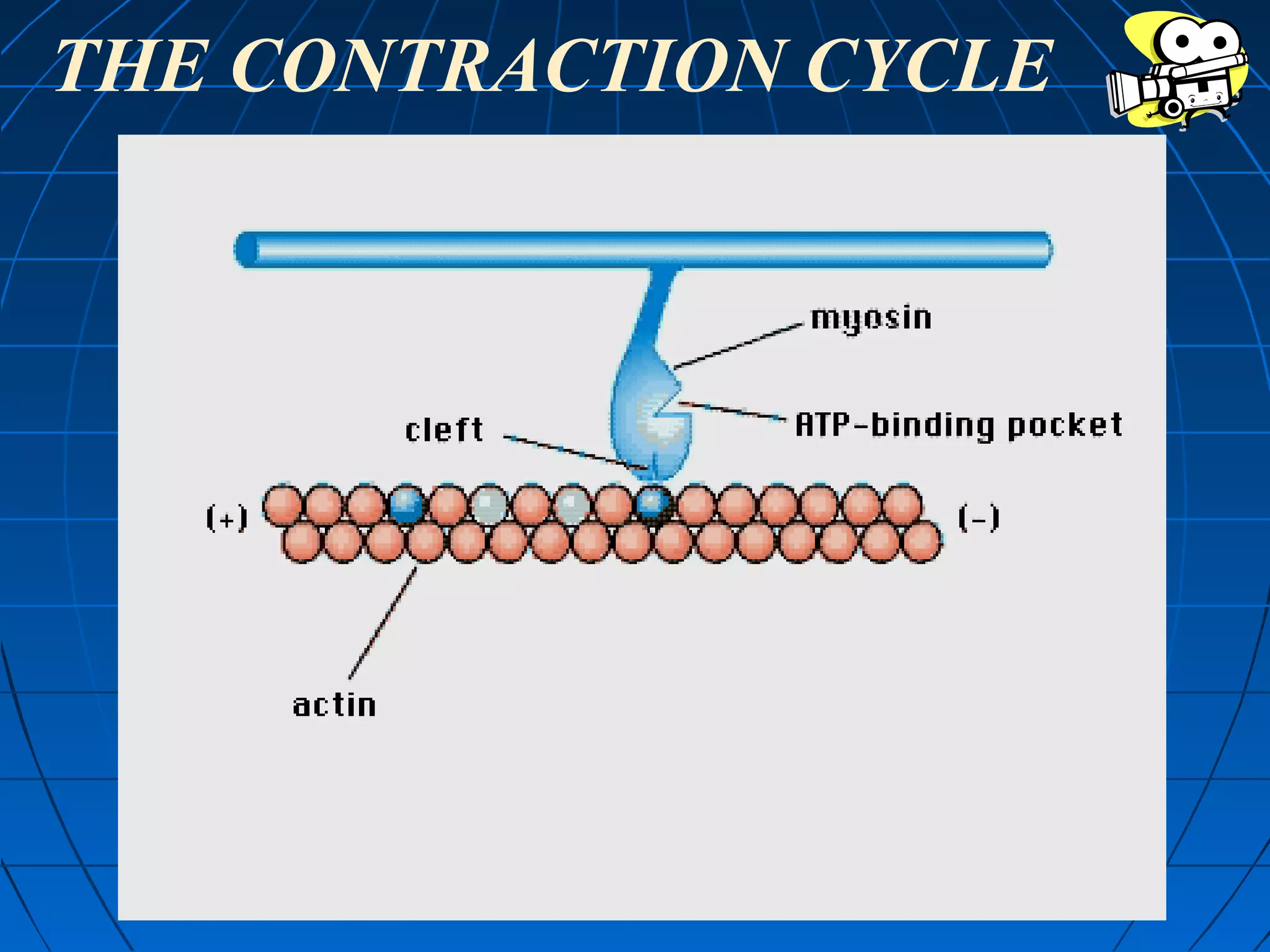
THE CONTRACTION CYCLE
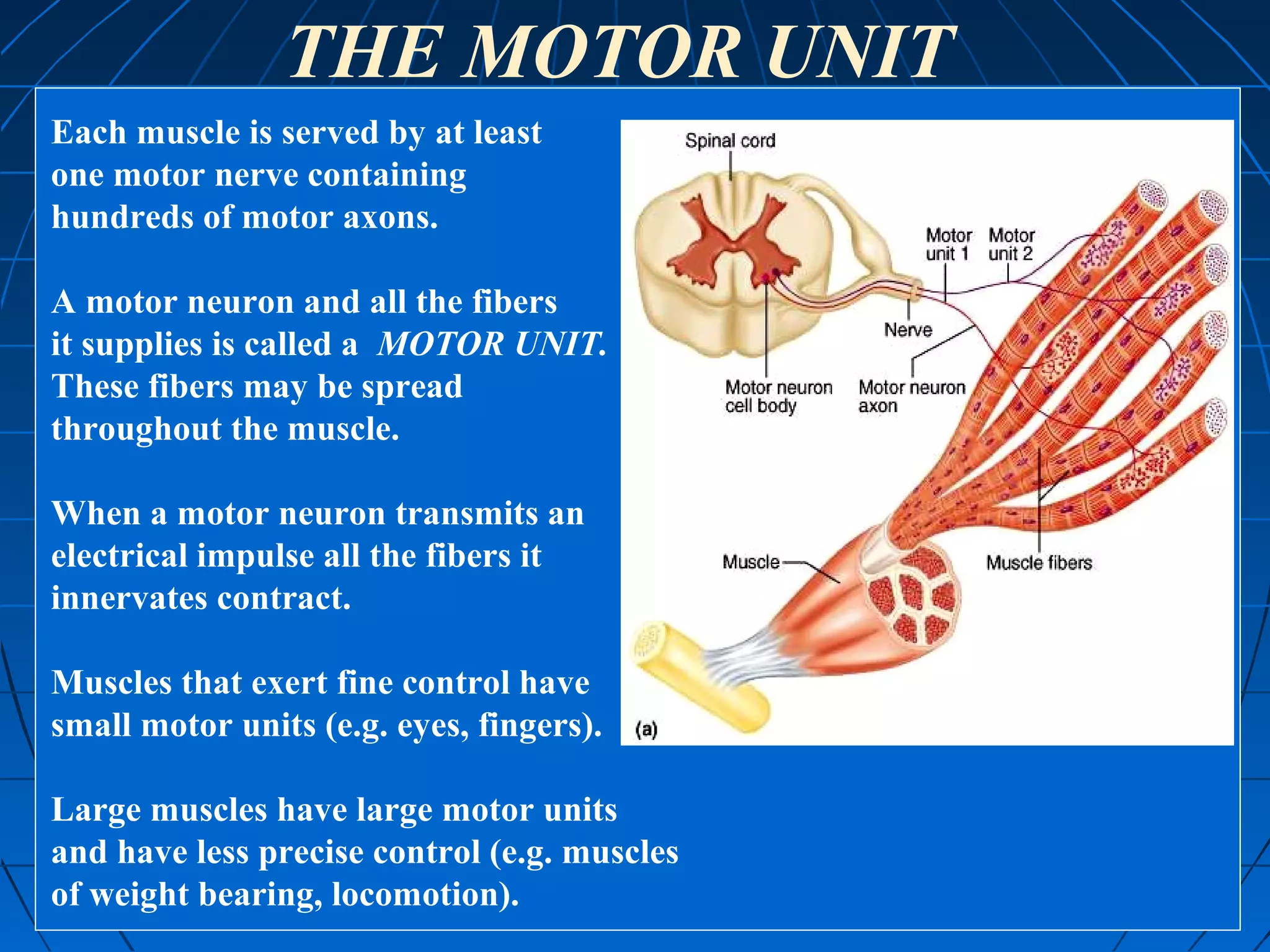
THE MOTOR UNIT
Each muscle is served by at least
one motor nerve containing
hundreds of motor axons.
A motor neuron and all the fibers
it supplies is called a MOTOR UNIT.
These fibers may be spread
throughout the muscle.
When a motor neuron transmits an
electrical impulse all the fibers it
innervates contract.
Muscles that exert fine control have
small motor units (e.g. eyes, fingers).
Large muscles have large motor units
and have less precise control (e.g. muscles
of weight bearing, locomotion).
Motor innervation
Skeletal muscle fibers are richly innervated
by motor neurons that originate in the
spinal cord or brain stem.
The axons of the neurons branch as they
near the muscle, giving rise to twigs that
end on individual muscle fibers.
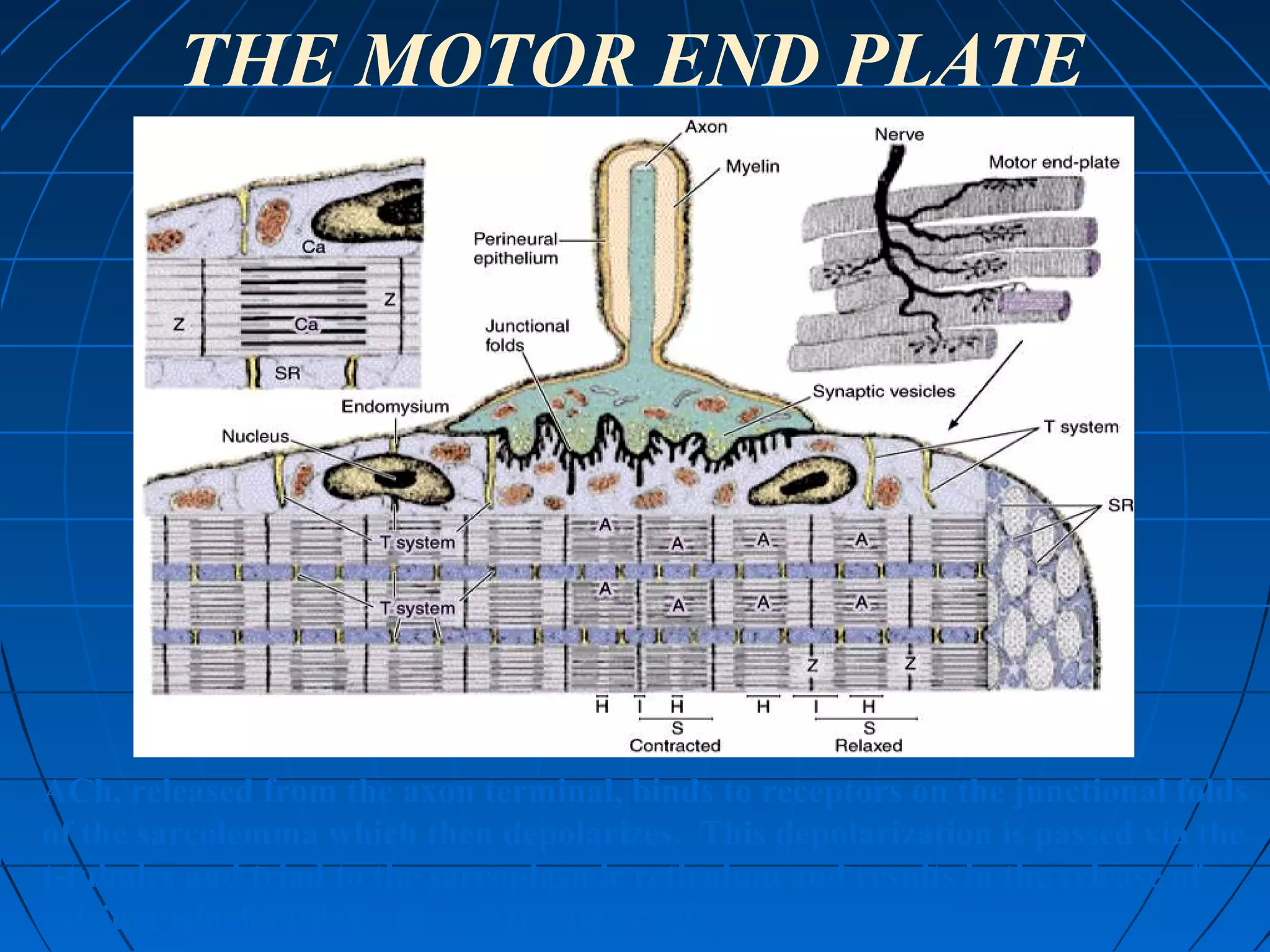
The Motor End Plate is the contact made by
the terminal branches of the axon with the
muscle.
Types of muscle fibres
Type I (slow)

Type II ( quick)

Rich in sarcoplasmmyoglobin- dark red
colour
Related to continous
contraction

Contain less
myoglobin-light red
colour
Related to rapid
contraction
Types: IIA,
IIB(fastest), IIC
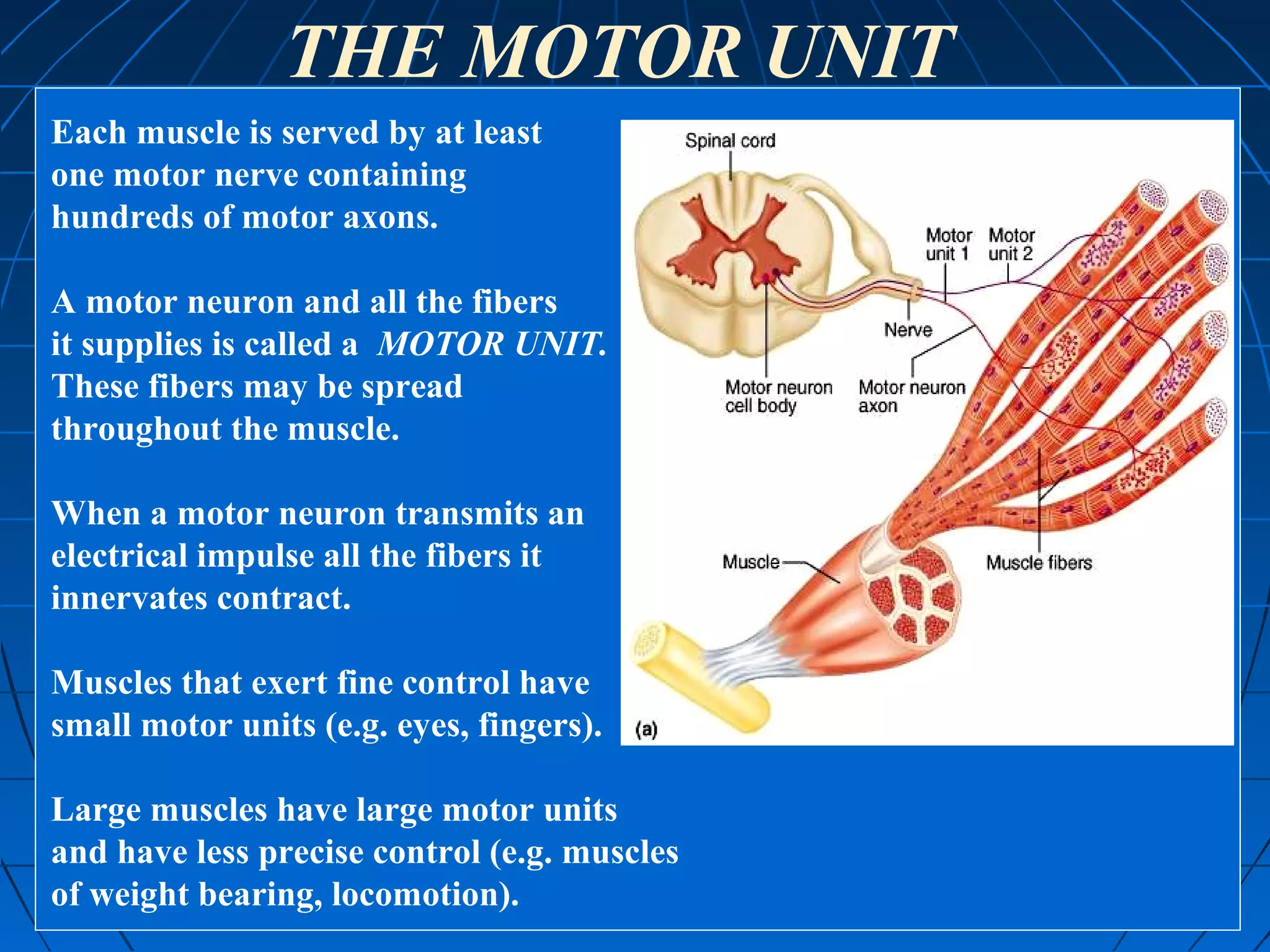
THE MOTOR UNIT
Each muscle is served by at least
one motor nerve containing
hundreds of motor axons.
A motor neuron and all the fibers
it supplies is called a MOTOR UNIT.
These fibers may be spread
throughout the muscle.
When a motor neuron transmits an
electrical impulse all the fibers it
innervates contract.
Muscles that exert fine control have
small motor units (e.g. eyes, fingers).
Large muscles have large motor units
and have less precise control (e.g. muscles
of weight bearing, locomotion).
THE MOTOR END PLATE

ACh, released from the axon terminal, binds to receptors on the junctional folds
of the sarcolemma which then depolarizes. This depolarization is passed via the
t-tubules and triad to the sarcoplasmic reticulum and results in the release of
calcium which initiates the contraction cycle.
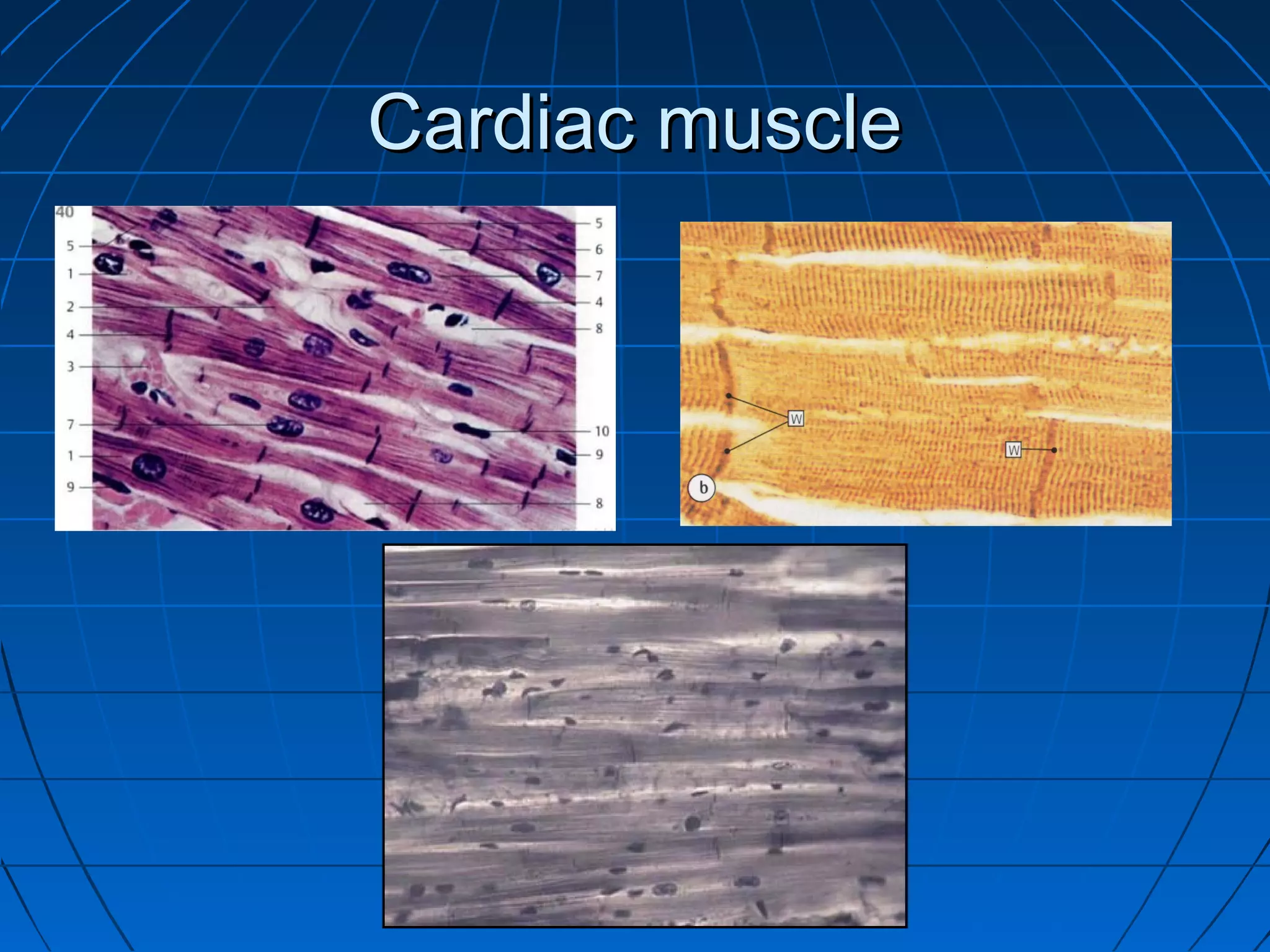
CARDIAC MUSCLE
Cardiac muscle
cross-striated( like skeletal muscle)
- Each cardiac muscle cell posesses 1-2
nuclei( centrally located).
- Muscle cells are surrounded by endomysium
( connective tissue) and blood capillaries.
- Intercalated disks-junctional complexes between
adjacent cardiac muscle cells.(transverse portion,
lateral portion).
- Sructure and mechanism of contractile proteinssimilar to skeletal muscle.
-
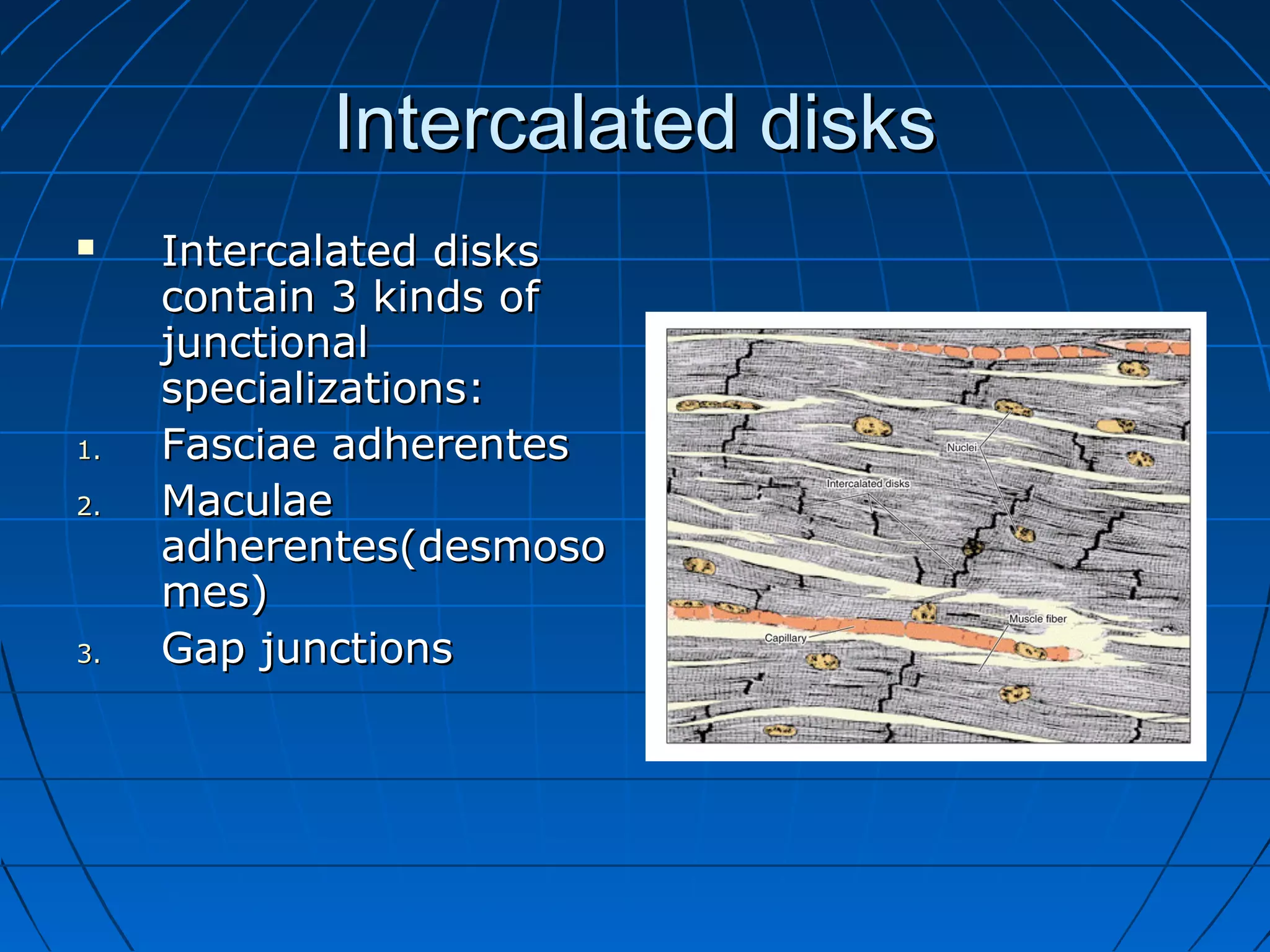
Intercalated disks


1.
2.

3.

Intercalated disks
contain 3 kinds of
junctional
specializations:
Fasciae adherentes
Maculae
adherentes(desmoso
mes)
Gap junctions
Cardiac muscle
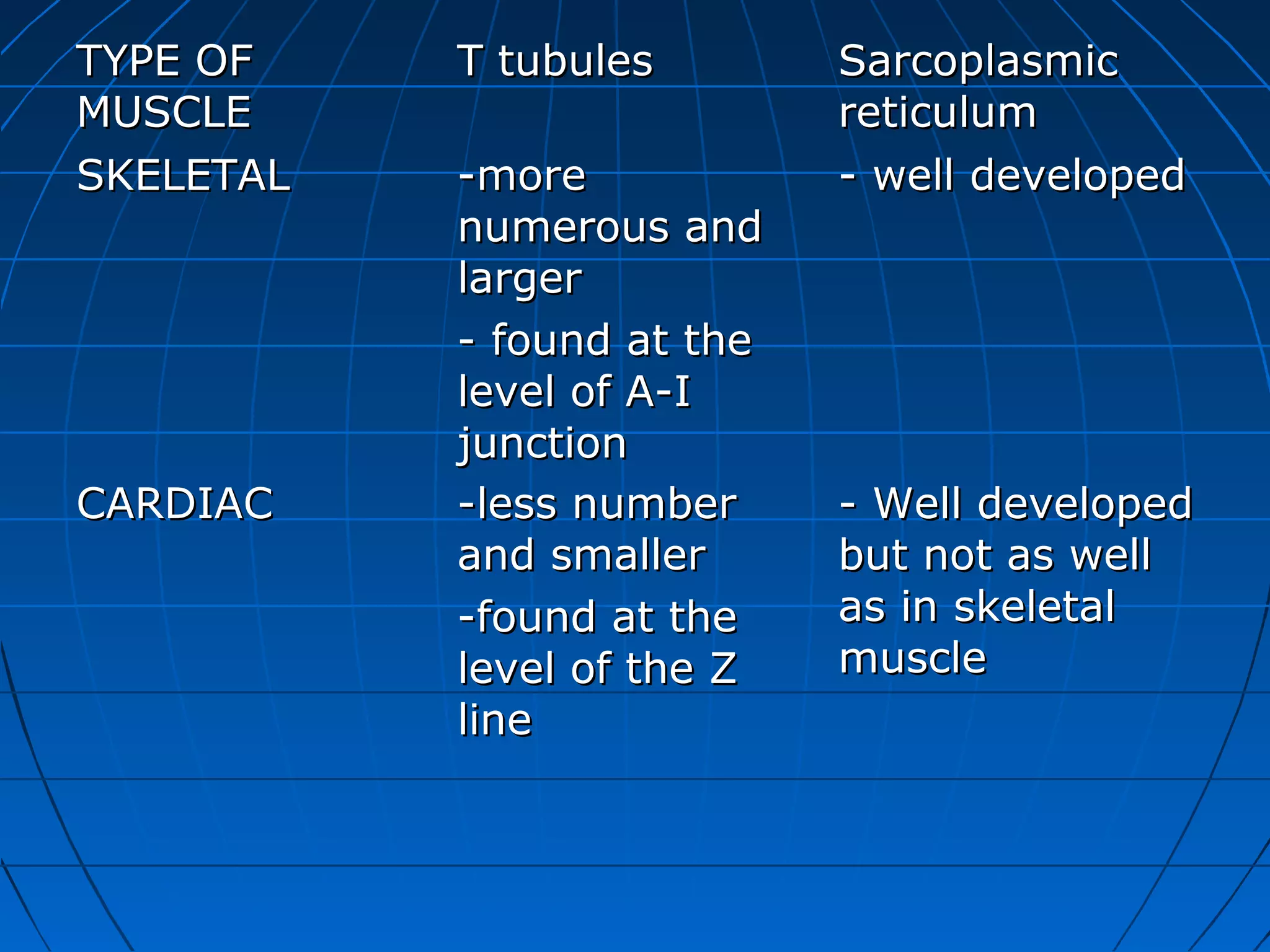
TYPE OF
MUSCLE
SKELETAL

CARDIAC

T tubules
-more
numerous and
larger
- found at the
level of A-I
junction
-less number
and smaller
-found at the
level of the Z
line

Sarcoplasmic
reticulum
- well developed

- Well developed
but not as well
as in skeletal
muscle
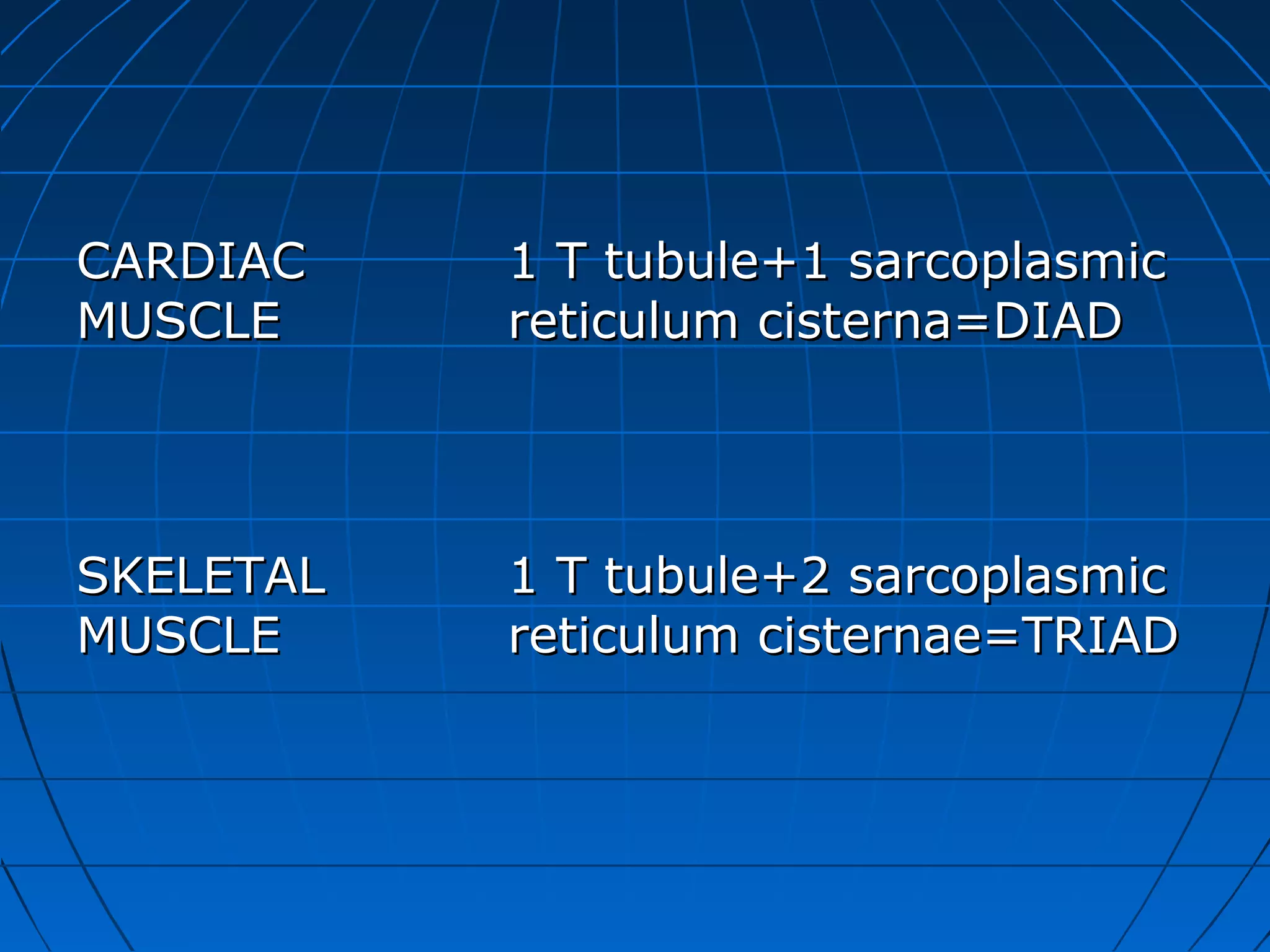
CARDIAC
MUSCLE

1 T tubule+1 sarcoplasmic
reticulum cisterna=DIAD

SKELETAL
MUSCLE

1 T tubule+2 sarcoplasmic
reticulum cisternae=TRIAD
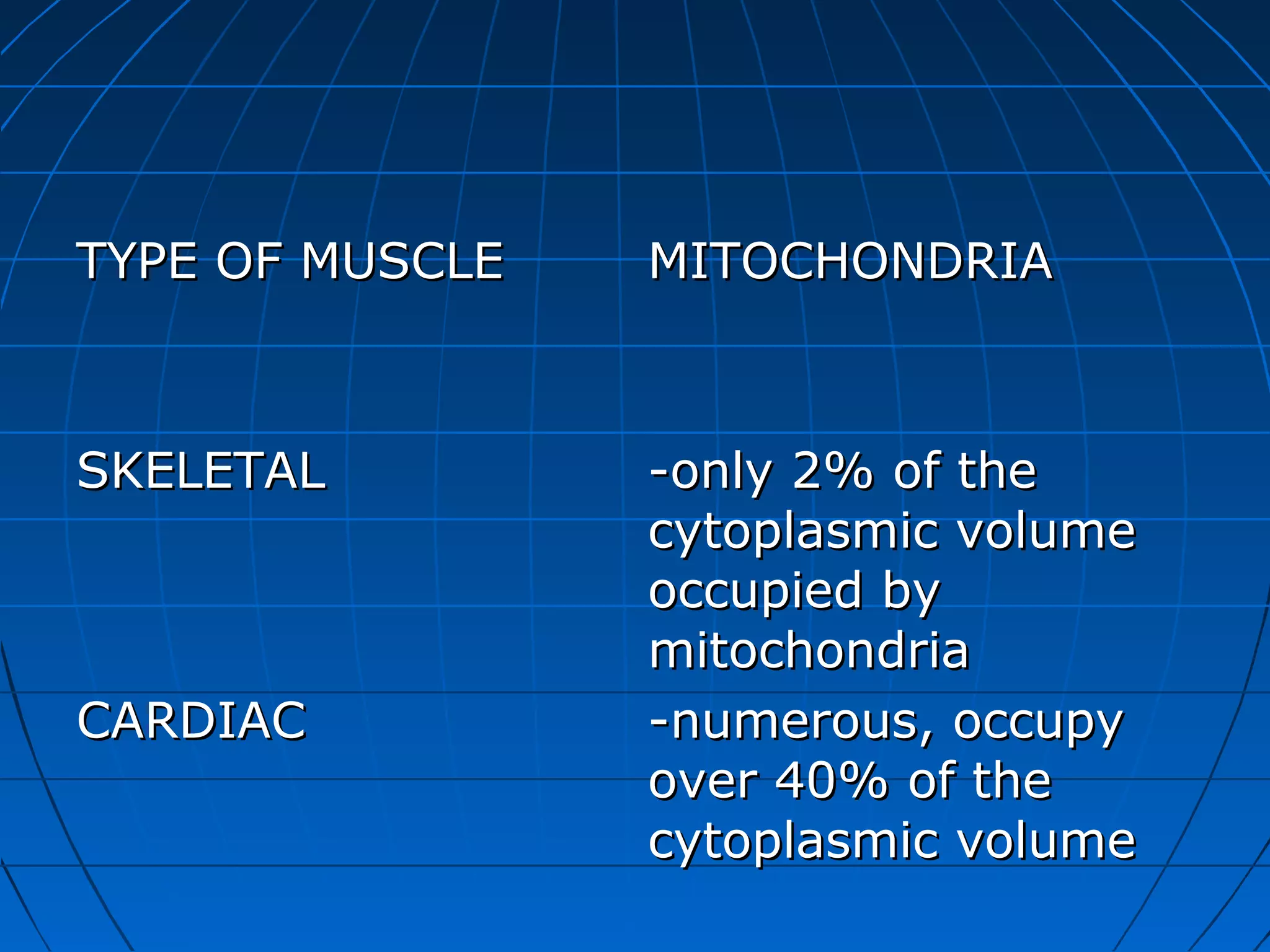
TYPE OF MUSCLE

MITOCHONDRIA

SKELETAL

-only 2% of the
cytoplasmic volume
occupied by
mitochondria
-numerous, occupy
over 40% of the
cytoplasmic volume

CARDIAC
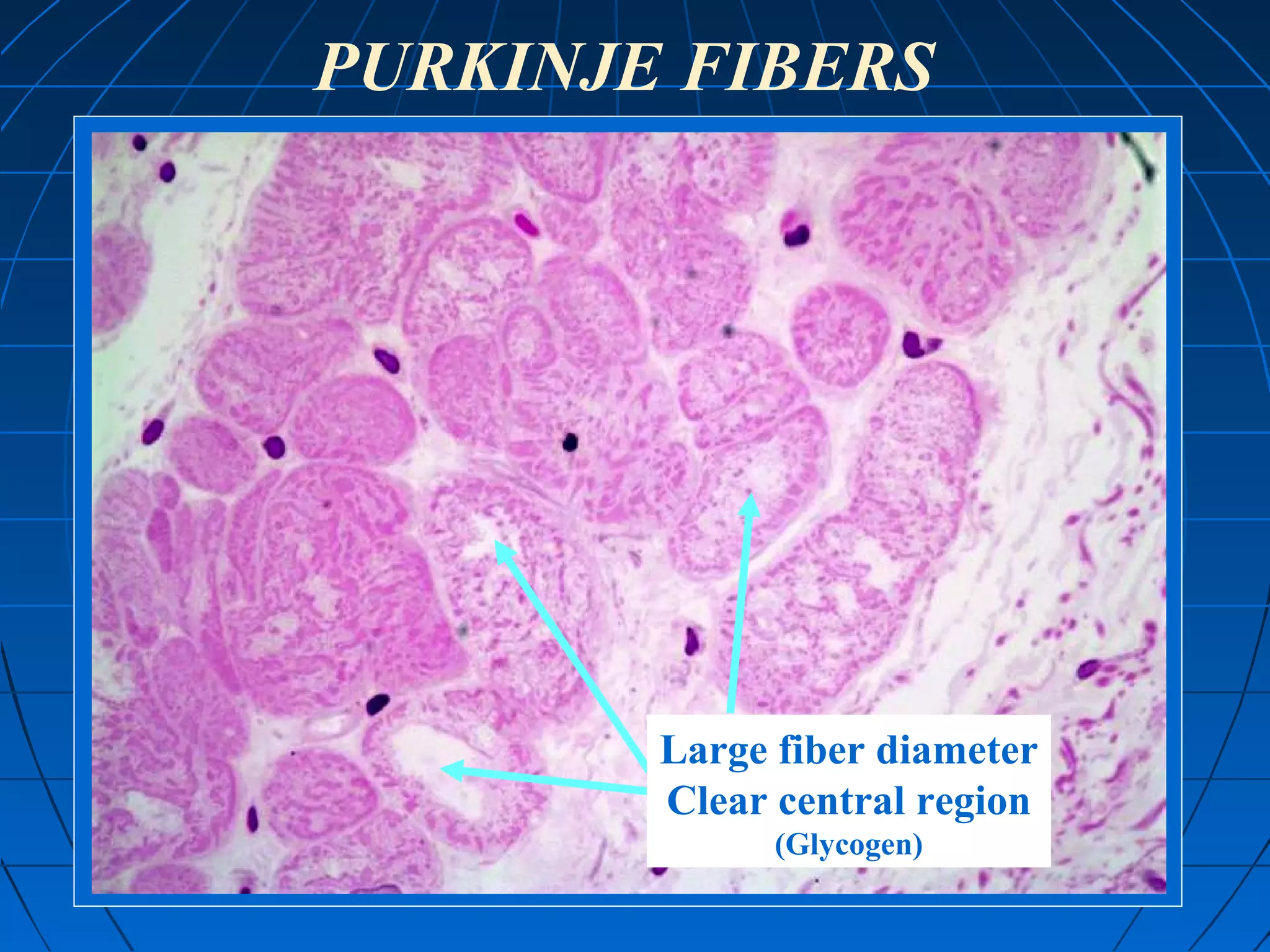
PURKINJE FIBERS

Large fiber diameter
Clear central region
(Glycogen)
SMOOTH MUSCLE
Smooth muscle
Where??
- Alimentary canal
- Genitourinary tract
- Blood vessels
- Respiratory tract
- Other localisations: iris, ciliary body
of the eye, arrector pili muscles
(skin)
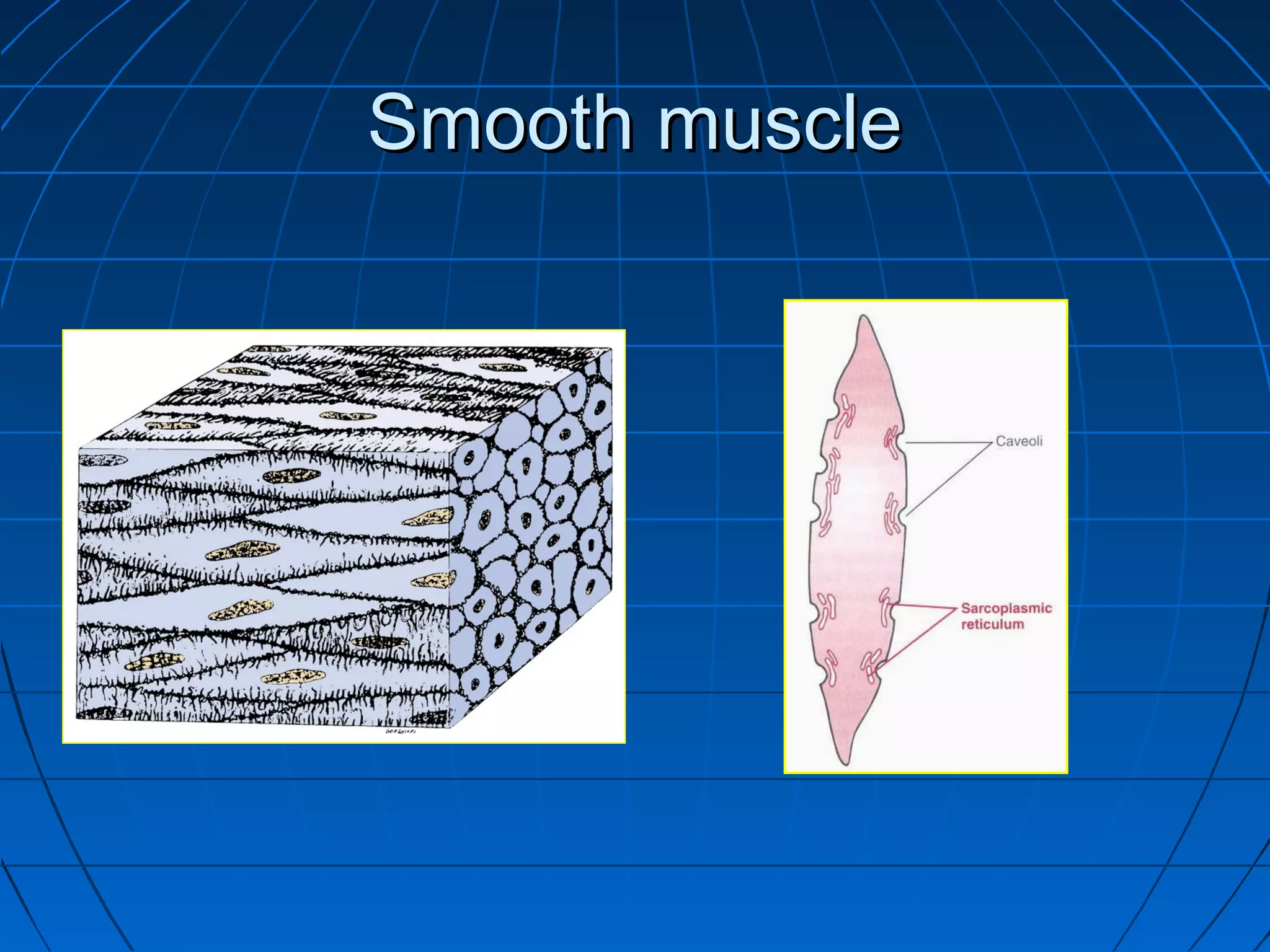
Smooth muscle
-composed of elongated, nonstriated cells
-each cell is enclosed by basal lamina and a
network of reticular fibres.
-the cells are larger at their midpoints and taper
toward the ends.
-single nucleus located in the central part of cell
-cytoplasmic organelles are concentrated at each
end of the nucleus.
-ER well developed
- Absence of T tubules
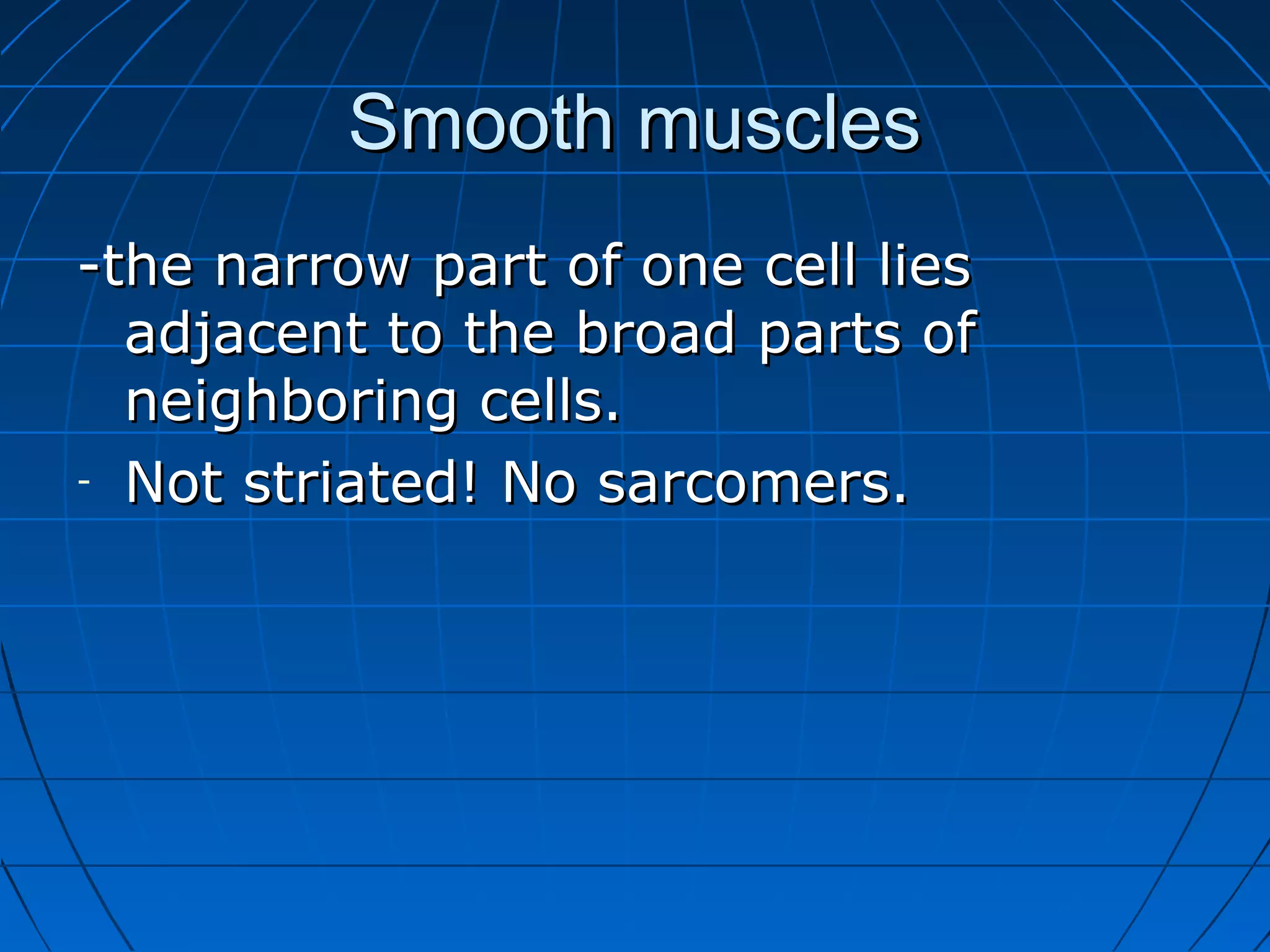
Smooth muscles
-the narrow part of one cell lies
adjacent to the broad parts of
neighboring cells.
- Not striated! No sarcomers.
Smooth muscle
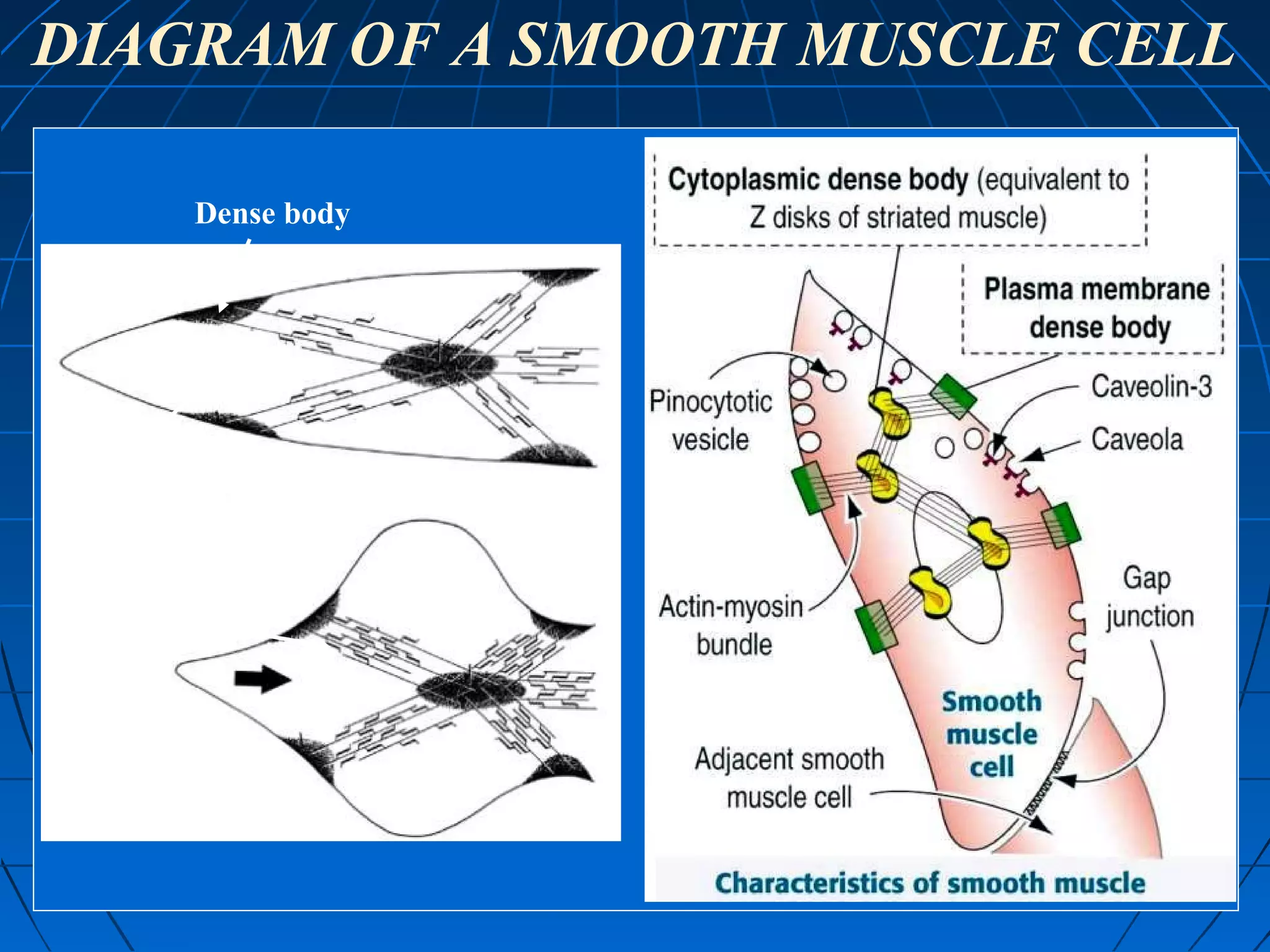
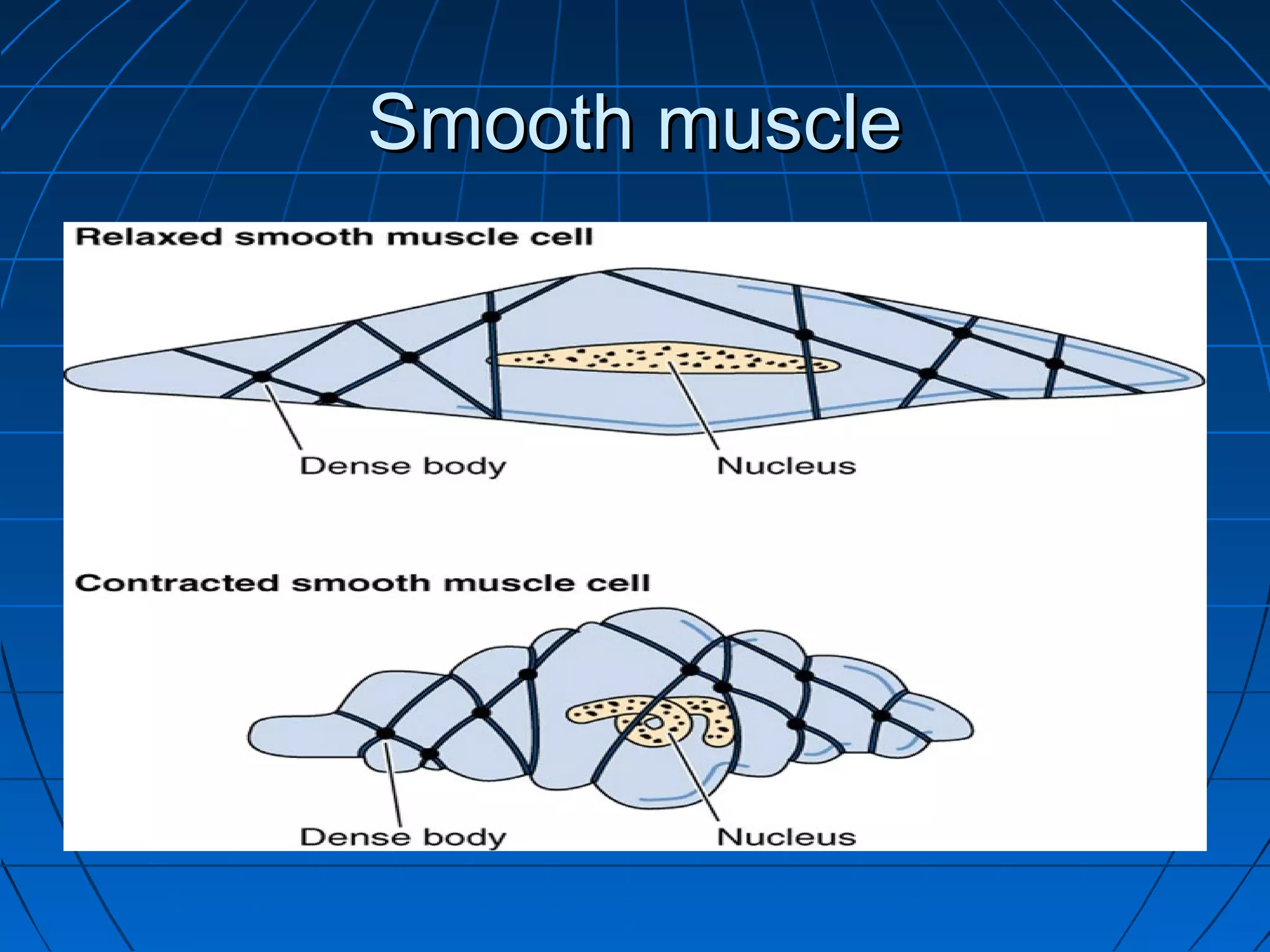
DIAGRAM OF A SMOOTH MUSCLE CELL
Dense body

Actin
filament
Myosin
filament
Mechanism of contraction
In smooth muscles bundles of
myofilaments crisscross obliquely
through the cell, forming a
latticelike network.
Three kinds of filaments:
1.
Thin filaments ( actin, tropomyosin)
2.
Thick filaments( myosin)
3.
Intermediate filaments(desmin,
wimentin)
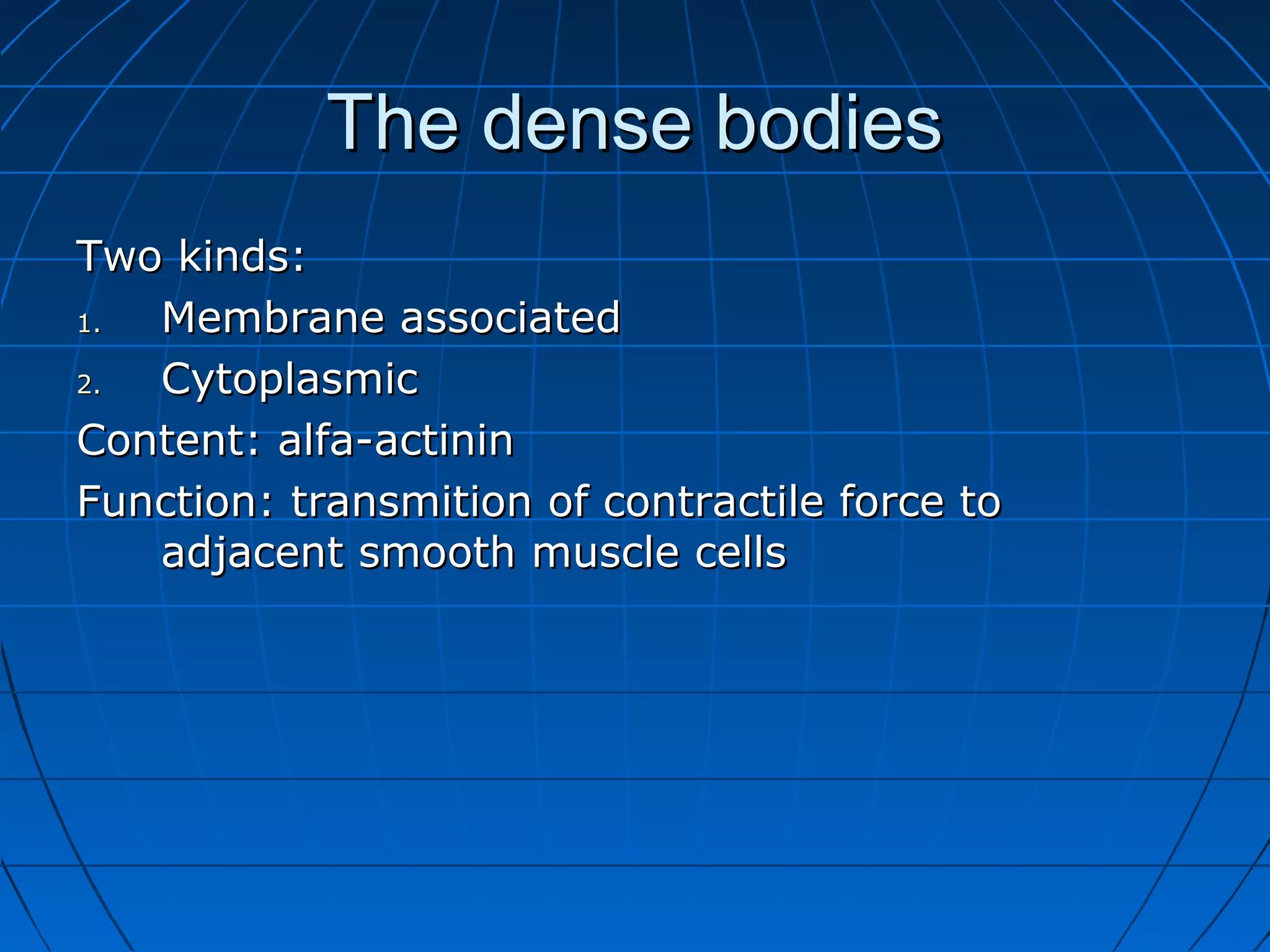
The dense bodies
Two kinds:
1.
Membrane associated
2.
Cytoplasmic
Content: alfa-actinin
Function: transmition of contractile force to
adjacent smooth muscle cells
Smooth muscle
Mechanism of contraction
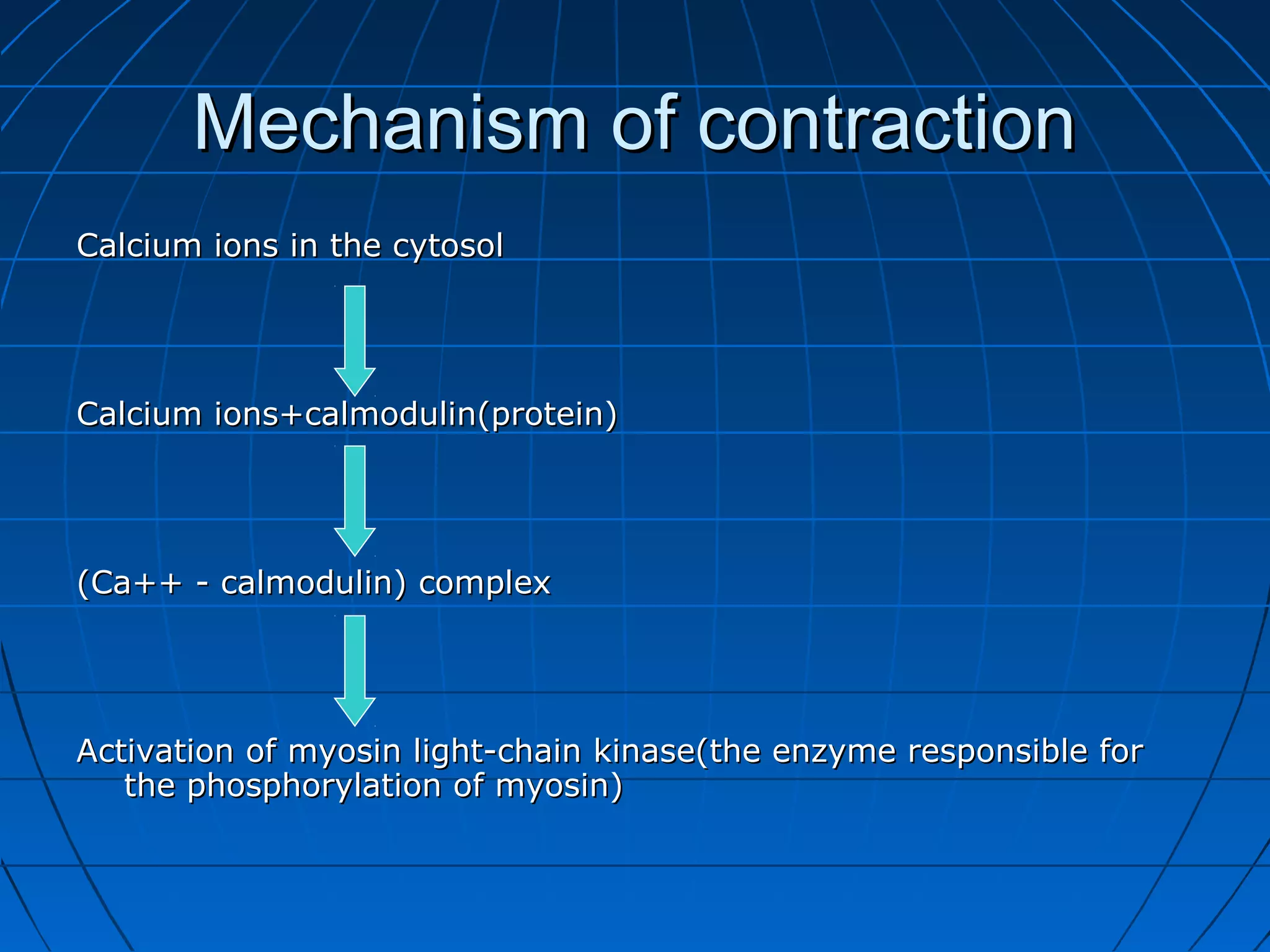
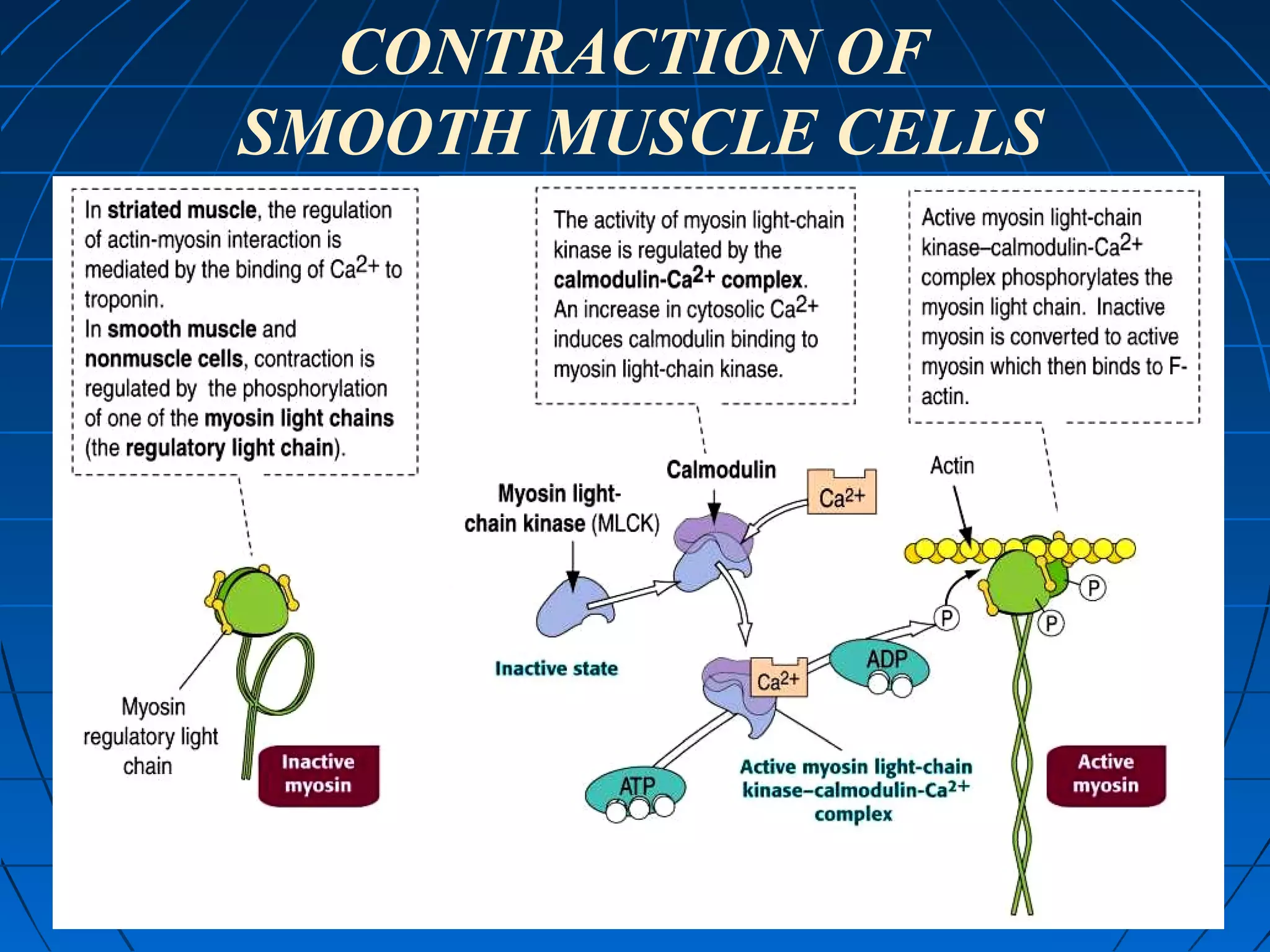
Calcium ions in the cytosol

Calcium ions+calmodulin(protein)

(Ca++ - calmodulin) complex

Activation of myosin light-chain kinase(the enzyme responsible for
the phosphorylation of myosin)
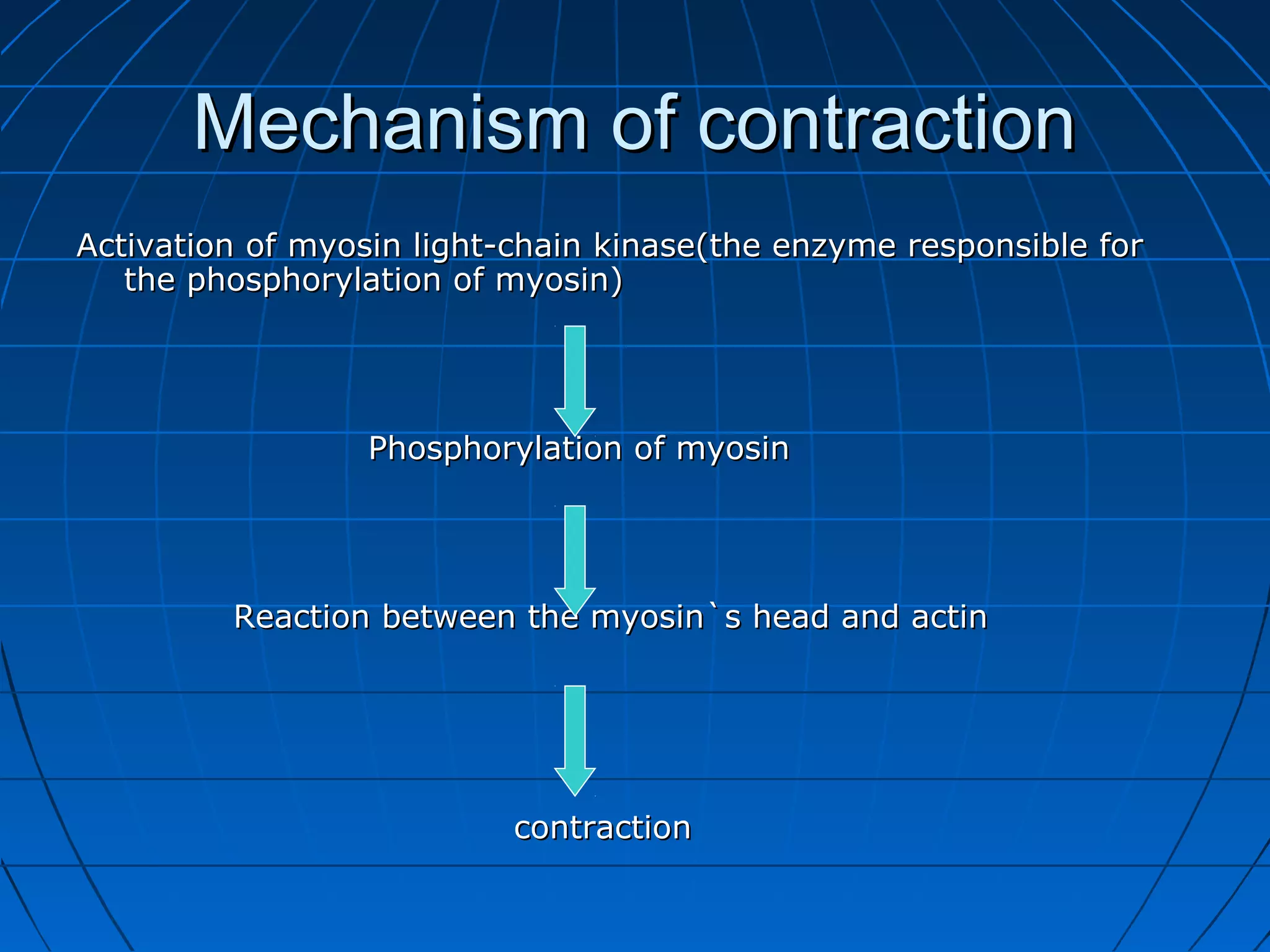
Mechanism of contraction
Activation of myosin light-chain kinase(the enzyme responsible for
the phosphorylation of myosin)

Phosphorylation of myosin

Reaction between the myosin`s head and actin

contraction
CONTRACTION OF
SMOOTH MUSCLE CELLS
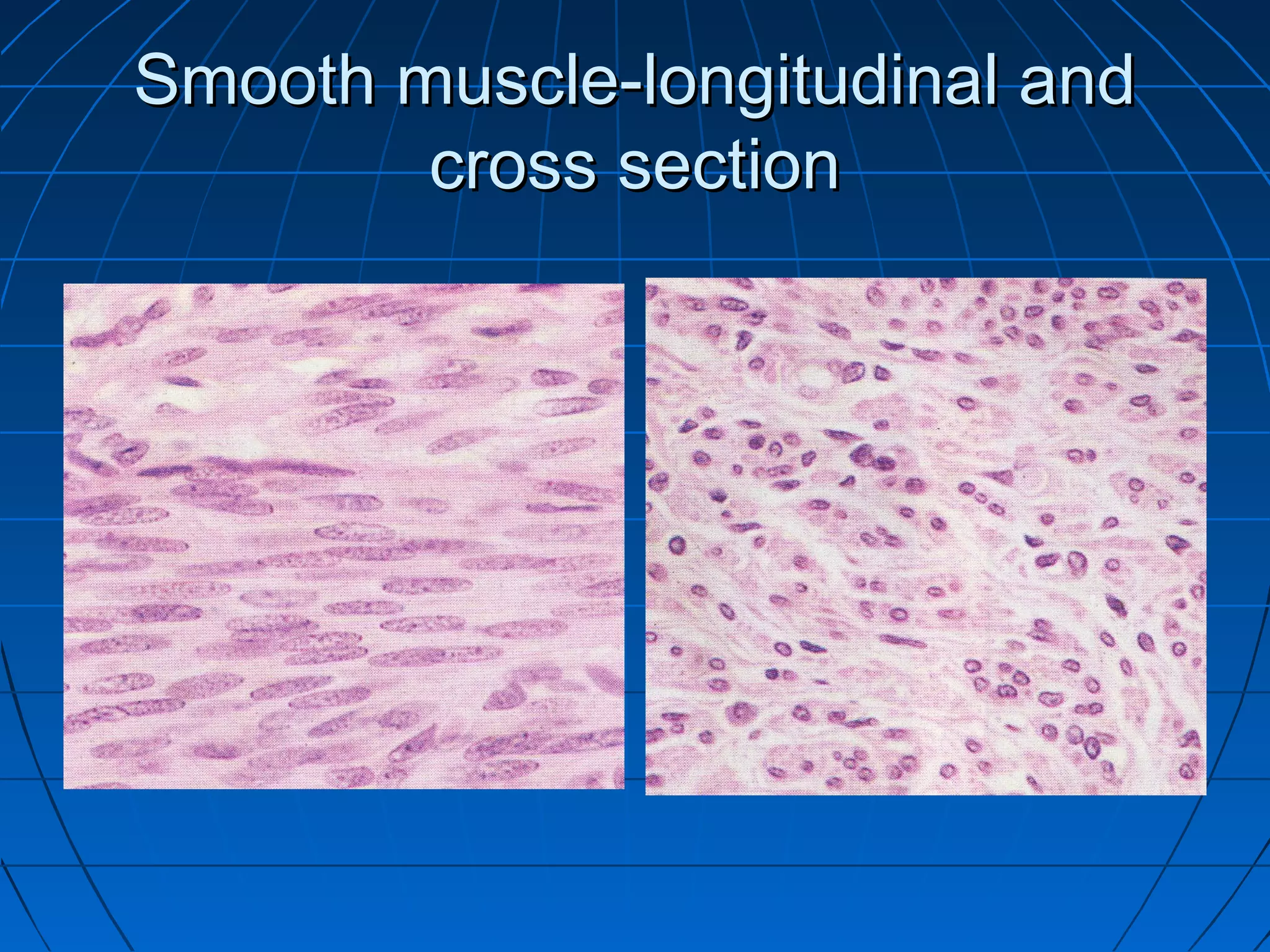
Smooth muscle-longitudinal and
cross section
Innervation of smooth muscle




Autonomic system( sympathetic and
parasympathetic)
Spontaneus activity of the muscle
even without the nervous stimuli
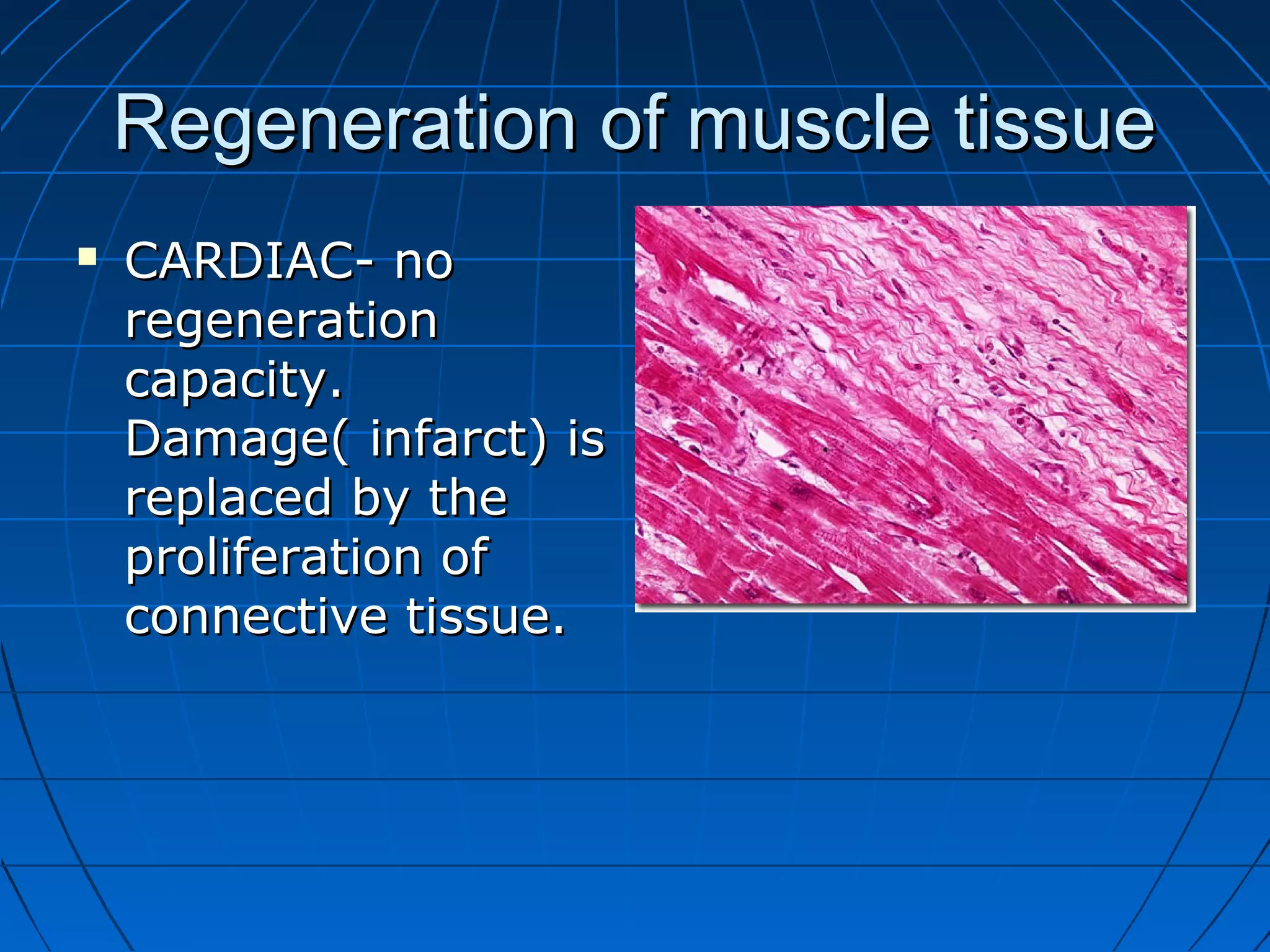
Regeneration of muscle tissue


CARDIAC- no
regeneration
capacity.
Damage( infarct) is
replaced by the
proliferation of
connective tissue.
Regeneration of muscle tissue
SKELETAL-limited regeneration.
Satellite cells= regenerating cells
-population of mononucleated cells, that lies
within the basal lamina surrounding each
mature muscle fiber.After injury become
activated, proliferate and fuse to form a
new skeletal muscle fibers.

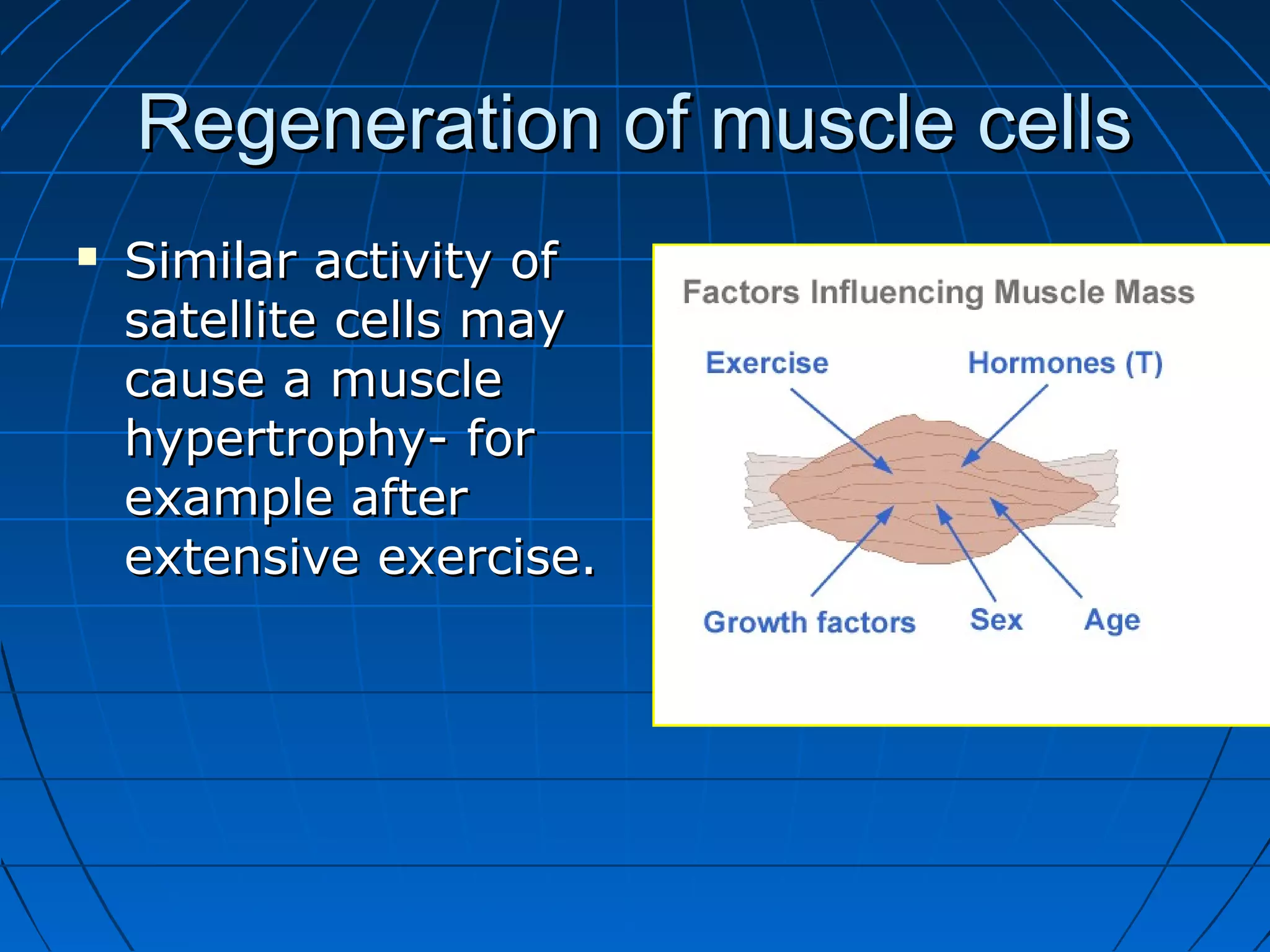
Regeneration of muscle cells


Similar activity of
satellite cells may
cause a muscle
hypertrophy- for
example after
extensive exercise.
Regeneration of muscle tissue


SMOOTH MUSLE- a very good
regenerative capacity

Lecture6 muscle tissue

  • 1.
  • 2.
    Types of muscletissue 1. 2. 3. Skeletal muscles Cardiac muscle Smooth muscle
  • 3.
    Skeletal muscle    Consists ofmuscle fibres (cylindrical, multinucleated cells) Muscle fiber=syncytium Attention! A muscle fiber should not be confused with a connective tissue fiber. Muscle fibers are cellular elements , connective tissue fibers are extracellular products of connective tissue.
  • 4.
      Nuclei: oval, located peripherallyunder the cell membrane. Multinucleation results from the fusion of embryonic mononucleated myoblasts( muscle cell precursors) during development.
  • 6.
    Sarco…  Sarco… - aprefix that means „muscular”. For example: Sarcolemma- the plasma membrane of the muscle fiber Sarcoplasm = cytoplasm of muscle fiber Sarcoplasmic reticulum = smooth endoplasmic reticulum in muscle fibers
  • 7.
    SKELETAL MUSCLE  The connectivetissue associated with muscle is given a specific set of names describing its relationship with the muscle fibers. Endomysium- is the delicate layer of reticular fibers that immadietely surrounds individual muscle fibers. Blood and lymphatic vessels run between muscle fibres and parallel to them.
  • 8.
    SKELETAL MUSCLE Perimysium- athicker connective tissue layer that surround a group of fibers to form a bundle or a fascicle.Larger blood vessels and nerves travel in the perimysium. Epimysium- is a dense connective tissue that surrounds the collection of fascicles that constitute the muscle.The major vascular and nerve supply of the muscle penetrates through the epimysium.
  • 9.
    Myofibrils The strucural andfunctional subunit of the muscle fiber is the myofibril.Muscle fibers are filled with these longitudinally arrayed subunits. Myofibrils are composed of bundles of myofilaments.
  • 10.
    Myofibrils    Long, cylindrical filamentousbundles Run parallel to the long axis of the muscle fiber. Consist of an end to end chainlike arrangement of sarcomeres.
  • 11.
    Myofilaments Myofilaments are theindividual filamentous polymers of different proteins.They form a myofibril and are the acurate contractile elements of striated muscle. Two kinds of filaments: 1. Thick filaments 2. Thin filaments
  • 13.
    The arrangement ofthick and thin filaments gives rise to the density differences that produce the cross-striations.
  • 14.
    Cross- striations  Cross-striations arethe principal histologic feature of striated muscle. Longitudinally sectioned muscle fibres show cross-striations of alternating light and dark bands. 
  • 15.
    Cross-striations   Cross-striations are evidentin HE( hematoxylin-eosin) stained preparations of longitudinal sections of muscle fibers. The dark and light bands are termed: the A band, the I band and the Z line
  • 16.
    Cross-striations 1.Dark stained bands= A bands= anisotropic (are birefringent in polarized light) 2.Light stained bands= I bands= isotropic (do not alter polarized light)
  • 18.
    The Z line,H zone, M line    The Z line= Z disc, is a dense zone that bisects the I band The H zone/band- is a light zone that bisects the A band M line- is located in the middle of H band
  • 19.
    Sarcomere - The functionalunit of the myofibril. - it`s a segment of the myofibril between 2 Z lines. - It measures 2-3 um in relaxed muscle, may be stretched to more than 4 um, and in extreme contraction, may measure as little as 1 um.
  • 20.
    Sarcomere   Extends from Zline to Z line Sarcomere= (Z line +1/2 I band+A band+1/2 I band+ Z line)
  • 21.
    The structure ofthe sarcomere 1. 2. 3. 4. 5. 6. Z line- a borderline of sarcomere.Thin filaments are attached to it. Main protein- alfa actinin. Thin filaments- extend from the Z line to the H band. The thin and thick filaments run between and parallel to each other. Thick filaments- occupy the A band, the central portion of the sarcomere. I – band- contains thin filaments fixed to Z line. A -band- consist of two parts: 1. thin filaments overlapping thick filaments 2. thick filaments (H band) M line- a region of a H band, at which lateral connections are made between adjacent thick filaments.
  • 22.
    M line  The majorprotein of the M line is creatine kinase.Creatine kinase catalyzes the transfer of a phosphate group from phosphocreatine to adenosine diphosphate(ADP) resulting adenosine triphosphate ( ATP). The energy from ATP is needed for the muscle contraction. ATP ADP + Pi
  • 24.
    The structure ofthin and thick myofilaments  A) B) C)  Thin filaments are composed of 3 different proteins: Actin Tropomyosin Troponin Thick filaments are composed of myosin.
  • 25.
    Actin - - - - Is present aslong filamentous (F-actin) polymers consisting of 2 strands of globular( G- actin ) monomers. The polymers are twisted around each other in a double helical formation. Each G-actin monomer contains a binding site for myosin Actin filaments are fixed to the Z line by a protein called alfa-actinin.
  • 26.
    Tropomyosin - - - - long, thin molecule,built up of 2 polypeptide chains Molecules are bound head to tail, forming filaments Tropomyosin filaments lie along the two twisted actin strands Each tropomyosin molecule covers 7 G-actin molecules and has one troponin- binding place.
  • 27.
    Troponin  1. 2. 3. A complex of3 subunits: Troponin T ( TnT)- attached to tropomyosin Troponin C ( TnC)- binds calcium ions Troponin I ( TnI)- inhibits the actinmyosin interaction
  • 29.
    Myosin     Composed of 2heavy chains and 4 light chains. Heavy chains are twisted together At one end of each heavy chain- „heads” The heads have ATPbinding sites and the enzymatic capacity to hydrolyze ATP.They have also ability to bind to actin.
  • 32.
    The primary proteins( actin , myosin, trpomyosin, troponin) constitute more than 75% of the total protein of the muscle fiber and are visible as the thick and thin filaments.The remaining structural proteins include: - Titin - Nebulin - Alfa-actinin - Myomesin - C protein
  • 33.
    Contractile mechanism-sliding filament model Whena muscle contracts, each sarcomere shortens and becomes thicker , but the myofilaments remain the same length. It means that the shortening of the sarcomere must be due to an increase in the overlap of thick and thin filaments.
  • 34.
    Sarcoplasmic reticulum - - - Is arrangedin networks around or between a group of myofilaments One network of sarcoplasmic reticulum surrounds the A band, and another network surrounds the I band Where the two networks meet, at the junction between A and I bands, the sarcoplasmic reticulum forms a ringlike channel- terminal sac (cisterna) around the filaments of the myofibril. Main function: magazine and regulator of calcium ions!
  • 35.
    TRIADS Invaginations of theplasma membrane of the muscle cell form the T system. The T tubules are located between the adjacent ER`s terminal cisternae. - The complex of T tubule and two terminal cisternae is called TRIAD. TRIAD= 1 T TUBULE+ 2 TERMINAL CISTERNAE -
  • 37.
    Mechanism of contraction 1. 2. 3. 4. 5. Depolarizationof the sarcoplasm The depolarization signal is transmitted through the T tubule to the sarcoplasmic reticulum membrane. Calcium ions are released into the vicinity of the overlapping thick and thin filaments. Calcium ions are bined to the TnC subunit of troponin. The comlex of troponins changes its structure and drives the tropomyosin deeper into the groove of the actin helix. Consequence: exposition the myosin –binding sites on the actin
  • 38.
    Mechanism of contraction 6.Interaction=bridgening between the myosin head and actin. Result: ATP ADP + Pi 7.Deformation=bending of the myosin head 8. Movement of the myosin heads pulls the actin past the myosin filament.
  • 40.
    SEQUENCE OF EVENTSIN CONTRACTION 1. Nerve impulse travels down axon 2. Acetylcholine released into synaptic cleft, depolarizing the sarcolemma 3. Voltage gated Na+ channels open, Na+ enters muscle cell 4. Depolarization spreads including traveling down t-tubule 5. Voltage sensor proteins in t-tubules change conformation 6. Ca2+ rapidly released from sarcoplasmic reticulum (via Ca2+ release channels) 7. Ca2+ binds to the TnC subunit of troponin a) Troponin shifts tropomyosin deeper into groove, b) ADPPi-myosin complex binds to active site on actin c) Pi is released d) myosin has conformational change pulling actin is pulled toward m-line releasing ADP e) ATP binds to Myosin releasing it from actin f) ATP hydrolyzed into ADP and Pi 8. Ca2+ is sequestered into the sarcoplasmic reticulum
  • 41.
  • 42.
  • 43.
  • 44.
    THE MOTOR UNIT Eachmuscle is served by at least one motor nerve containing hundreds of motor axons. A motor neuron and all the fibers it supplies is called a MOTOR UNIT. These fibers may be spread throughout the muscle. When a motor neuron transmits an electrical impulse all the fibers it innervates contract. Muscles that exert fine control have small motor units (e.g. eyes, fingers). Large muscles have large motor units and have less precise control (e.g. muscles of weight bearing, locomotion).
  • 45.
    Motor innervation Skeletal musclefibers are richly innervated by motor neurons that originate in the spinal cord or brain stem. The axons of the neurons branch as they near the muscle, giving rise to twigs that end on individual muscle fibers. The Motor End Plate is the contact made by the terminal branches of the axon with the muscle.
  • 46.
    Types of musclefibres Type I (slow) Type II ( quick) Rich in sarcoplasmmyoglobin- dark red colour Related to continous contraction Contain less myoglobin-light red colour Related to rapid contraction Types: IIA, IIB(fastest), IIC
  • 47.
    THE MOTOR UNIT Eachmuscle is served by at least one motor nerve containing hundreds of motor axons. A motor neuron and all the fibers it supplies is called a MOTOR UNIT. These fibers may be spread throughout the muscle. When a motor neuron transmits an electrical impulse all the fibers it innervates contract. Muscles that exert fine control have small motor units (e.g. eyes, fingers). Large muscles have large motor units and have less precise control (e.g. muscles of weight bearing, locomotion).
  • 48.
    THE MOTOR ENDPLATE ACh, released from the axon terminal, binds to receptors on the junctional folds of the sarcolemma which then depolarizes. This depolarization is passed via the t-tubules and triad to the sarcoplasmic reticulum and results in the release of calcium which initiates the contraction cycle.
  • 49.
  • 50.
    Cardiac muscle cross-striated( likeskeletal muscle) - Each cardiac muscle cell posesses 1-2 nuclei( centrally located). - Muscle cells are surrounded by endomysium ( connective tissue) and blood capillaries. - Intercalated disks-junctional complexes between adjacent cardiac muscle cells.(transverse portion, lateral portion). - Sructure and mechanism of contractile proteinssimilar to skeletal muscle. -
  • 51.
    Intercalated disks  1. 2. 3. Intercalated disks contain3 kinds of junctional specializations: Fasciae adherentes Maculae adherentes(desmoso mes) Gap junctions
  • 52.
  • 53.
    TYPE OF MUSCLE SKELETAL CARDIAC T tubules -more numerousand larger - found at the level of A-I junction -less number and smaller -found at the level of the Z line Sarcoplasmic reticulum - well developed - Well developed but not as well as in skeletal muscle
  • 54.
    CARDIAC MUSCLE 1 T tubule+1sarcoplasmic reticulum cisterna=DIAD SKELETAL MUSCLE 1 T tubule+2 sarcoplasmic reticulum cisternae=TRIAD
  • 55.
    TYPE OF MUSCLE MITOCHONDRIA SKELETAL -only2% of the cytoplasmic volume occupied by mitochondria -numerous, occupy over 40% of the cytoplasmic volume CARDIAC
  • 56.
    PURKINJE FIBERS Large fiberdiameter Clear central region (Glycogen)
  • 57.
  • 58.
    Smooth muscle Where?? - Alimentarycanal - Genitourinary tract - Blood vessels - Respiratory tract - Other localisations: iris, ciliary body of the eye, arrector pili muscles (skin)
  • 59.
    Smooth muscle -composed ofelongated, nonstriated cells -each cell is enclosed by basal lamina and a network of reticular fibres. -the cells are larger at their midpoints and taper toward the ends. -single nucleus located in the central part of cell -cytoplasmic organelles are concentrated at each end of the nucleus. -ER well developed - Absence of T tubules
  • 60.
    Smooth muscles -the narrowpart of one cell lies adjacent to the broad parts of neighboring cells. - Not striated! No sarcomers.
  • 61.
  • 62.
    DIAGRAM OF ASMOOTH MUSCLE CELL Dense body Actin filament Myosin filament
  • 63.
    Mechanism of contraction Insmooth muscles bundles of myofilaments crisscross obliquely through the cell, forming a latticelike network. Three kinds of filaments: 1. Thin filaments ( actin, tropomyosin) 2. Thick filaments( myosin) 3. Intermediate filaments(desmin, wimentin)
  • 64.
    The dense bodies Twokinds: 1. Membrane associated 2. Cytoplasmic Content: alfa-actinin Function: transmition of contractile force to adjacent smooth muscle cells
  • 65.
  • 66.
    Mechanism of contraction Calciumions in the cytosol Calcium ions+calmodulin(protein) (Ca++ - calmodulin) complex Activation of myosin light-chain kinase(the enzyme responsible for the phosphorylation of myosin)
  • 67.
    Mechanism of contraction Activationof myosin light-chain kinase(the enzyme responsible for the phosphorylation of myosin) Phosphorylation of myosin Reaction between the myosin`s head and actin contraction
  • 68.
  • 69.
  • 70.
    Innervation of smoothmuscle   Autonomic system( sympathetic and parasympathetic) Spontaneus activity of the muscle even without the nervous stimuli
  • 71.
    Regeneration of muscletissue  CARDIAC- no regeneration capacity. Damage( infarct) is replaced by the proliferation of connective tissue.
  • 72.
    Regeneration of muscletissue SKELETAL-limited regeneration. Satellite cells= regenerating cells -population of mononucleated cells, that lies within the basal lamina surrounding each mature muscle fiber.After injury become activated, proliferate and fuse to form a new skeletal muscle fibers. 
  • 73.
    Regeneration of musclecells  Similar activity of satellite cells may cause a muscle hypertrophy- for example after extensive exercise.
  • 74.
    Regeneration of muscletissue  SMOOTH MUSLE- a very good regenerative capacity