Communicative Language
Teaching (CLT)
Group 6
The members are :
Definition of CLT
Communicative Language Teaching is an
approach to foreign or second language
teaching which emphasises that the goal of
language learning is communicative
competence . According to the same
dictionary, Communicative Language
Teaching the approach which has been
developed by British applied linguists as a
reaction away from grammar-based
approaches .
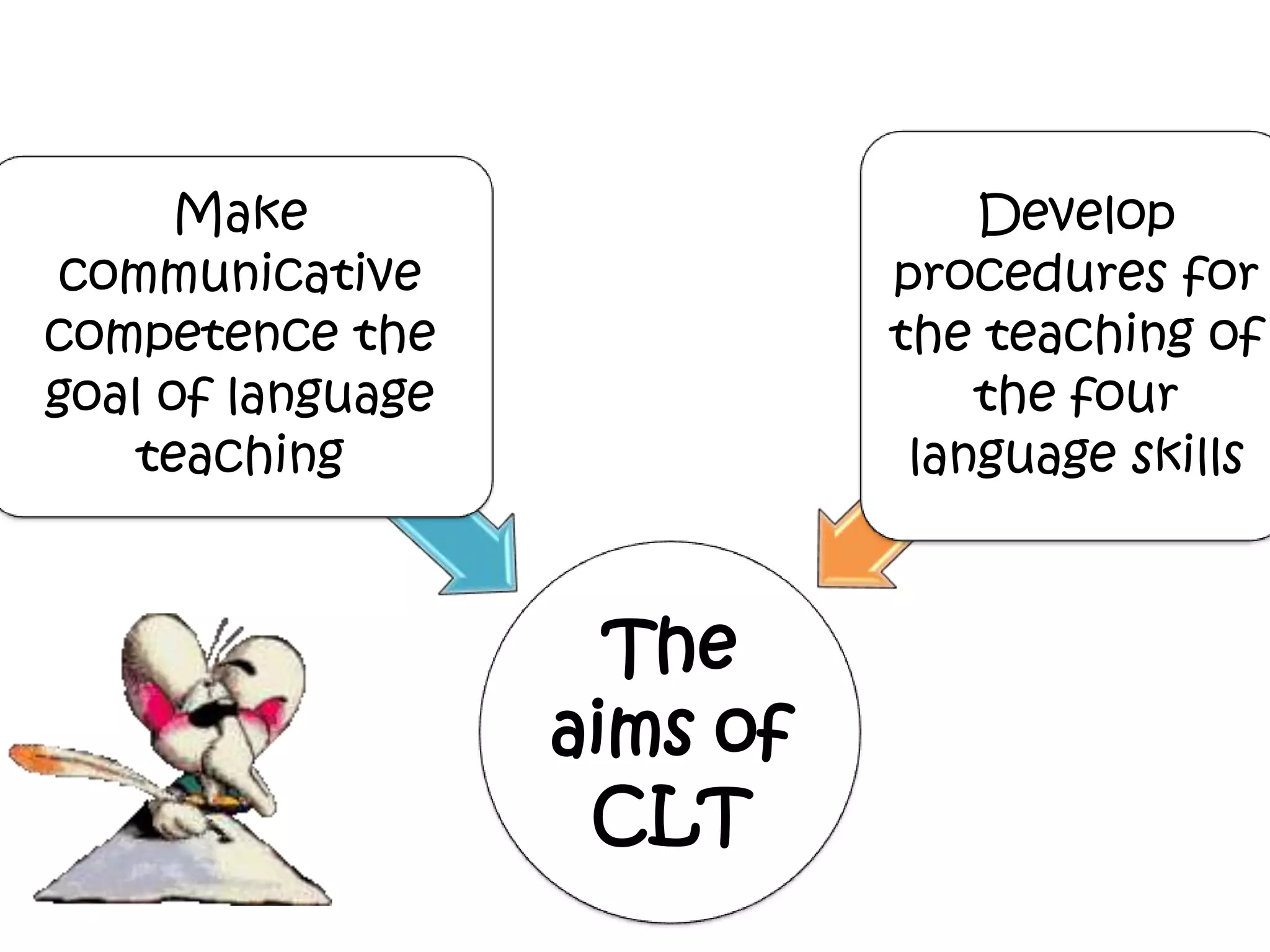
The
aims of
CLT
Make
communicative
competence the
goal of language
teaching
Develop
procedures for
the teaching of
the four
language skills
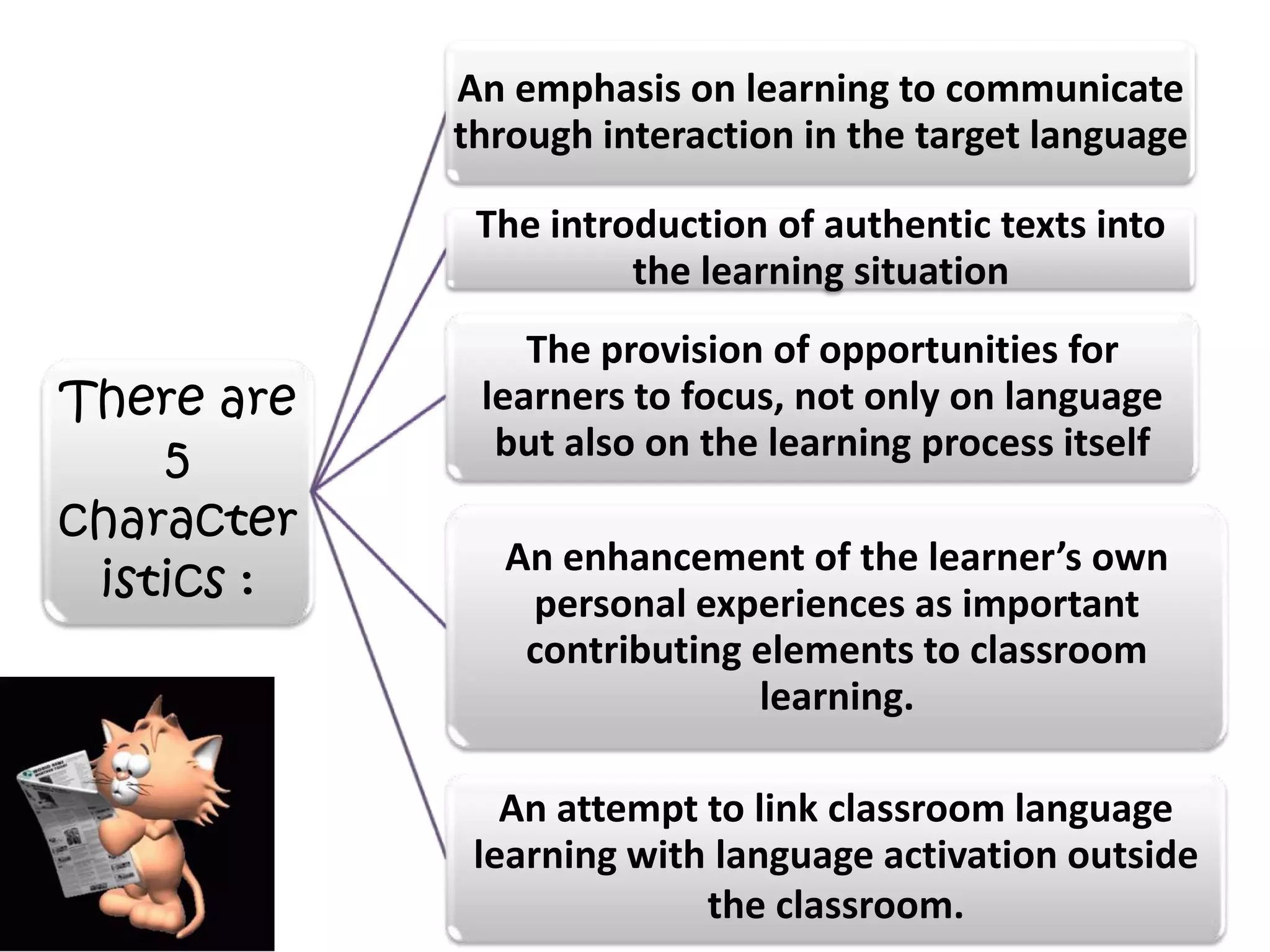
There are
5
character
istics :
An emphasis on learning to communicate
through interaction in the target language
The introduction of authentic texts into
the learning situation
The provision of opportunities for
learners to focus, not only on language
but also on the learning process itself
An enhancement of the learner’s own
personal experiences as important
contributing elements to classroom
learning.
An attempt to link classroom language
learning with language activation outside
the classroom.
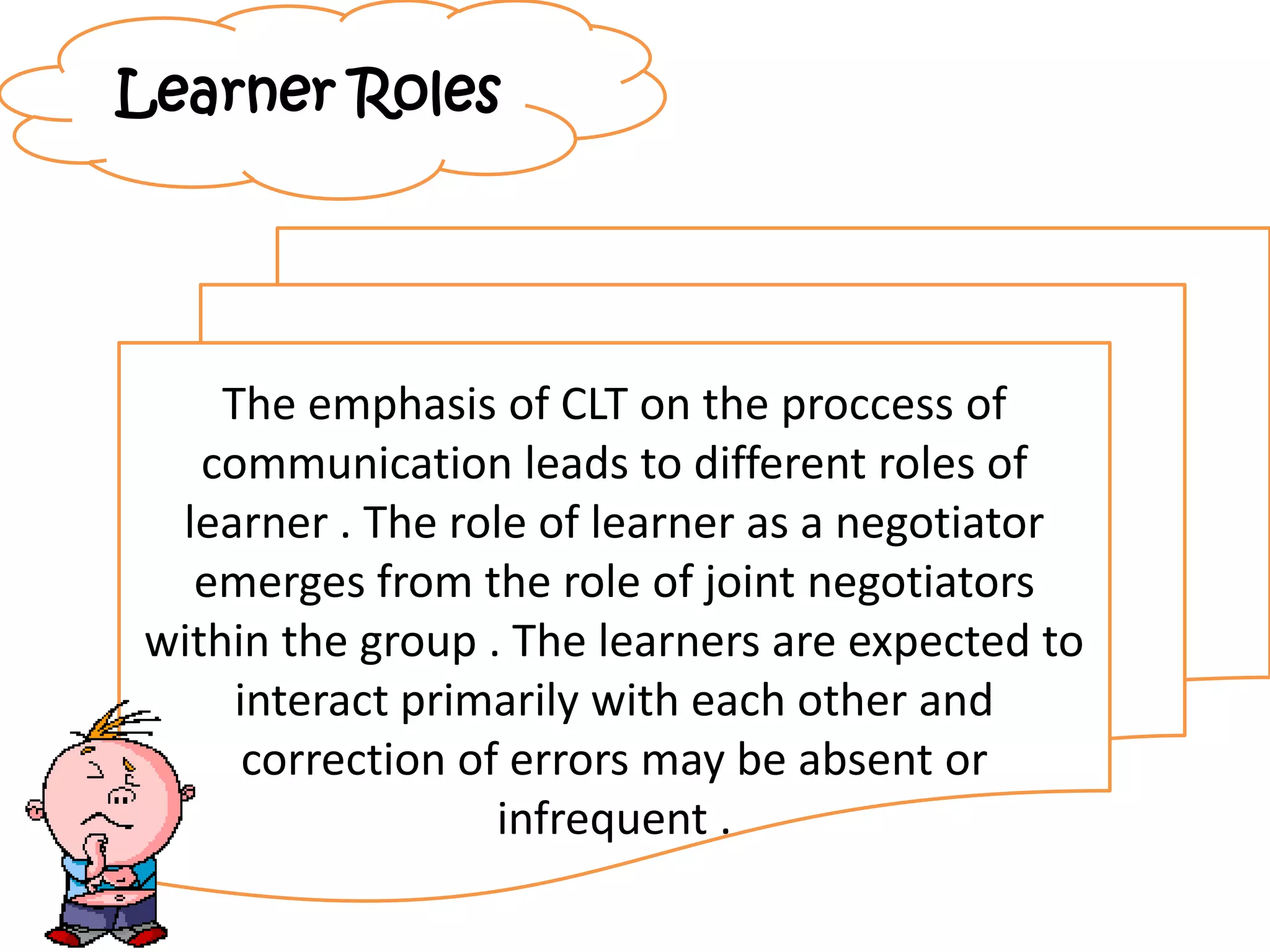
Learner Roles
The emphasis of CLT on the proccess of
communication leads to different roles of
learner . The role of learner as a negotiator
emerges from the role of joint negotiators
within the group . The learners are expected to
interact primarily with each other and
correction of errors may be absent or
infrequent .
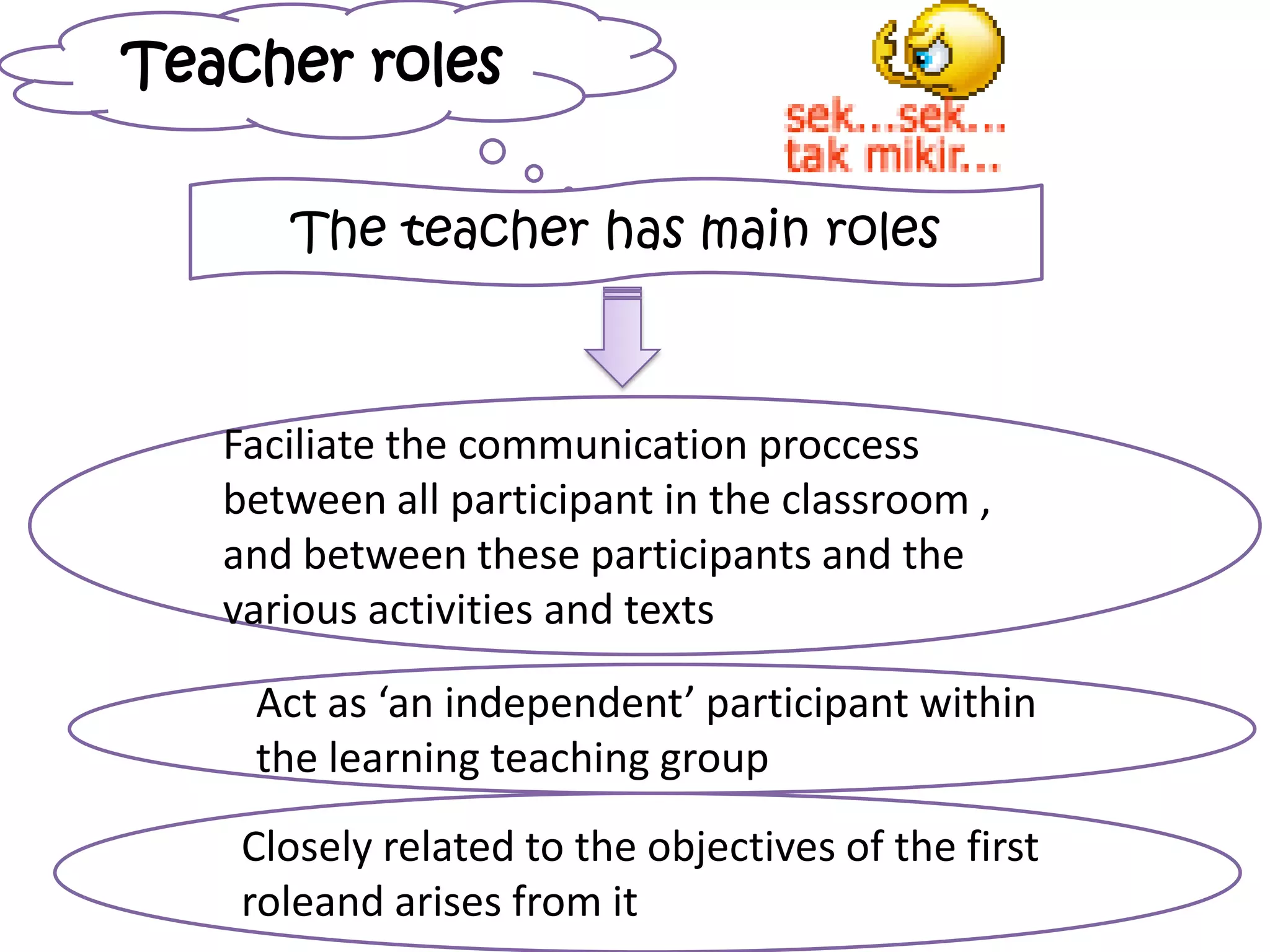
Teacher roles
The teacher has main roles
Faciliate the communication proccess
between all participant in the classroom ,
and between these participants and the
various activities and texts
Closely related to the objectives of the first
roleand arises from it
Act as ‘an independent’ participant within
the learning teaching group
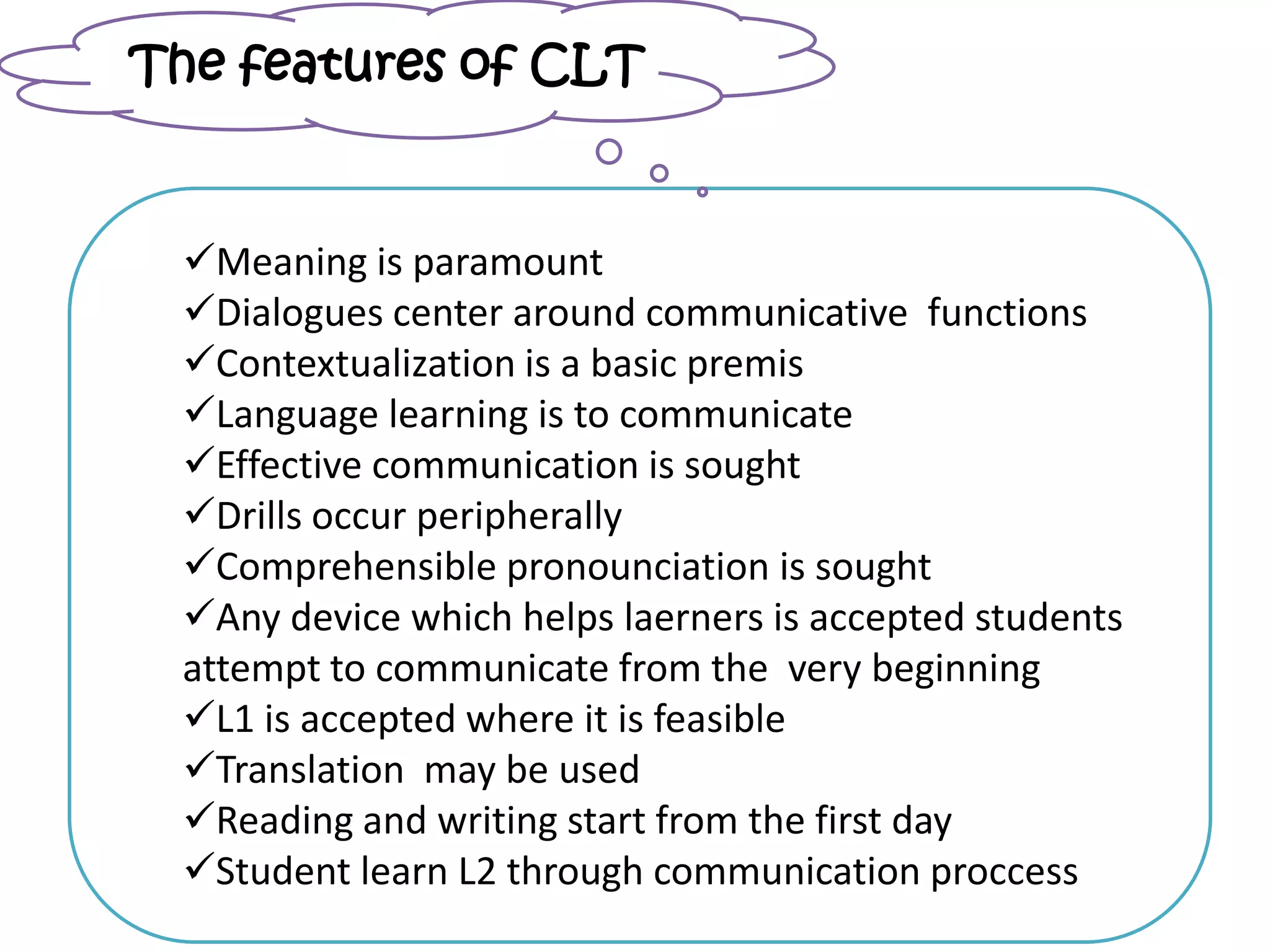
Meaning is paramount
Dialogues center around communicative functions
Contextualization is a basic premis
Language learning is to communicate
Effective communication is sought
Drills occur peripherally
Comprehensible pronounciation is sought
Any device which helps laerners is accepted students
attempt to communicate from the very beginning
L1 is accepted where it is feasible
Translation may be used
Reading and writing start from the first day
Student learn L2 through communication proccess
The features of CLT
Communicative competence is the goal
Linguistic variation is a central concept in materials
and methodology
The sequence is determined by consideration of
content , function , and meaning
The teacher helps learners to motivate them to work
with the language
Language is created through trial and errors
Fluency is the primary goal
Students interact with other people
The teacher can’t know what language the student
will use
The instrinsic motivation will spring from an interest in
what is being communicated
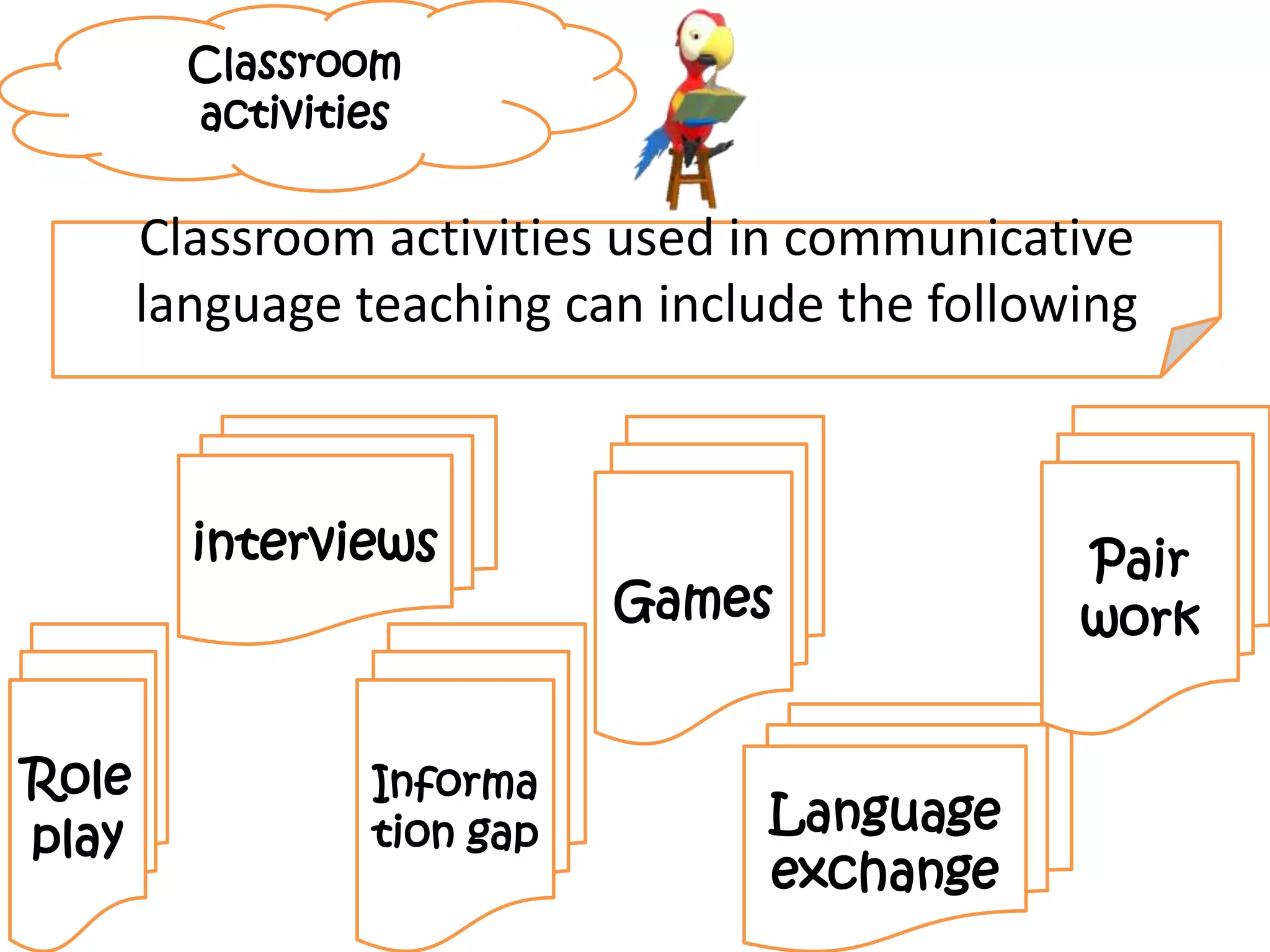
Classroom
activities
Role
play
interviews
Language
exchange
Classroom activities used in communicative
language teaching can include the following
Informa
tion gap
Games
Pair
work
Conclusion
CLT is best considered an approach rather
than a method . It refers to a diverse set of
principles that reflect a communicative view
of language and language learning and that
can be used to support a wide variety of
classroom procedures .

communicative language teaching

  • 1.
  • 2.
    Definition of CLT CommunicativeLanguage Teaching is an approach to foreign or second language teaching which emphasises that the goal of language learning is communicative competence . According to the same dictionary, Communicative Language Teaching the approach which has been developed by British applied linguists as a reaction away from grammar-based approaches .
  • 3.
    The aims of CLT Make communicative competence the goalof language teaching Develop procedures for the teaching of the four language skills
  • 4.
    There are 5 character istics : Anemphasis on learning to communicate through interaction in the target language The introduction of authentic texts into the learning situation The provision of opportunities for learners to focus, not only on language but also on the learning process itself An enhancement of the learner’s own personal experiences as important contributing elements to classroom learning. An attempt to link classroom language learning with language activation outside the classroom.
  • 5.
    Learner Roles The emphasisof CLT on the proccess of communication leads to different roles of learner . The role of learner as a negotiator emerges from the role of joint negotiators within the group . The learners are expected to interact primarily with each other and correction of errors may be absent or infrequent .
  • 6.
    Teacher roles The teacherhas main roles Faciliate the communication proccess between all participant in the classroom , and between these participants and the various activities and texts Closely related to the objectives of the first roleand arises from it Act as ‘an independent’ participant within the learning teaching group
  • 7.
    Meaning is paramount Dialoguescenter around communicative functions Contextualization is a basic premis Language learning is to communicate Effective communication is sought Drills occur peripherally Comprehensible pronounciation is sought Any device which helps laerners is accepted students attempt to communicate from the very beginning L1 is accepted where it is feasible Translation may be used Reading and writing start from the first day Student learn L2 through communication proccess The features of CLT
  • 8.
    Communicative competence isthe goal Linguistic variation is a central concept in materials and methodology The sequence is determined by consideration of content , function , and meaning The teacher helps learners to motivate them to work with the language Language is created through trial and errors Fluency is the primary goal Students interact with other people The teacher can’t know what language the student will use The instrinsic motivation will spring from an interest in what is being communicated
  • 9.
    Classroom activities Role play interviews Language exchange Classroom activities usedin communicative language teaching can include the following Informa tion gap Games Pair work
  • 10.
    Conclusion CLT is bestconsidered an approach rather than a method . It refers to a diverse set of principles that reflect a communicative view of language and language learning and that can be used to support a wide variety of classroom procedures .