Teaching and Learning in Second Life as Part
           of a Blended Approach:
      Reflections and Lessons learned

Sheila Yoshikawa             Sheila Webber, Senior Lecturer, Information School:
                                    the iSchool, University of Sheffield, UK

Ridvan Researcher Ridvan Ata, PhD Candidate, School of Education,
                                             University of Sheffield, UK

                                                                      VWBPE-16 MARCH 2012
Slides copyright Sheila Webber and Ridvan Ata; sources for pictures listed on the final slide
Outline
•   Who we are
•   Ridvan’s research journey
•   Context and basics of the class
•   Approach to teaching & class components
•   SL components of the class
•   Our reflections on teaching the class
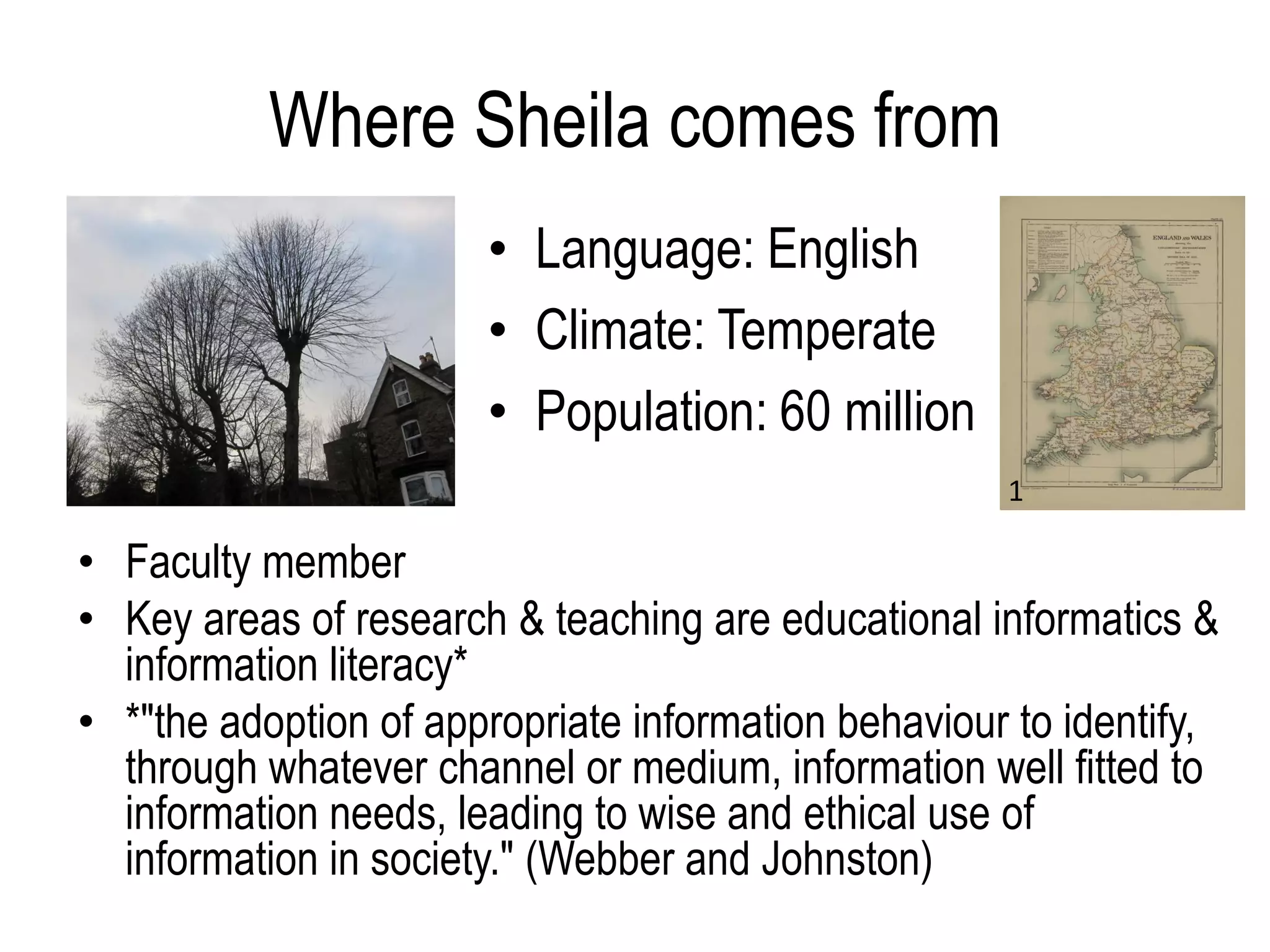
Where Sheila comes from
                       • Language: English
                       • Climate: Temperate
                       • Population: 60 million
                                                     1

• Faculty member
• Key areas of research & teaching are educational informatics &
  information literacy*
• *"the adoption of appropriate information behaviour to identify,
  through whatever channel or medium, information well fitted to
  information needs, leading to wise and ethical use of
  information in society." (Webber and Johnston)
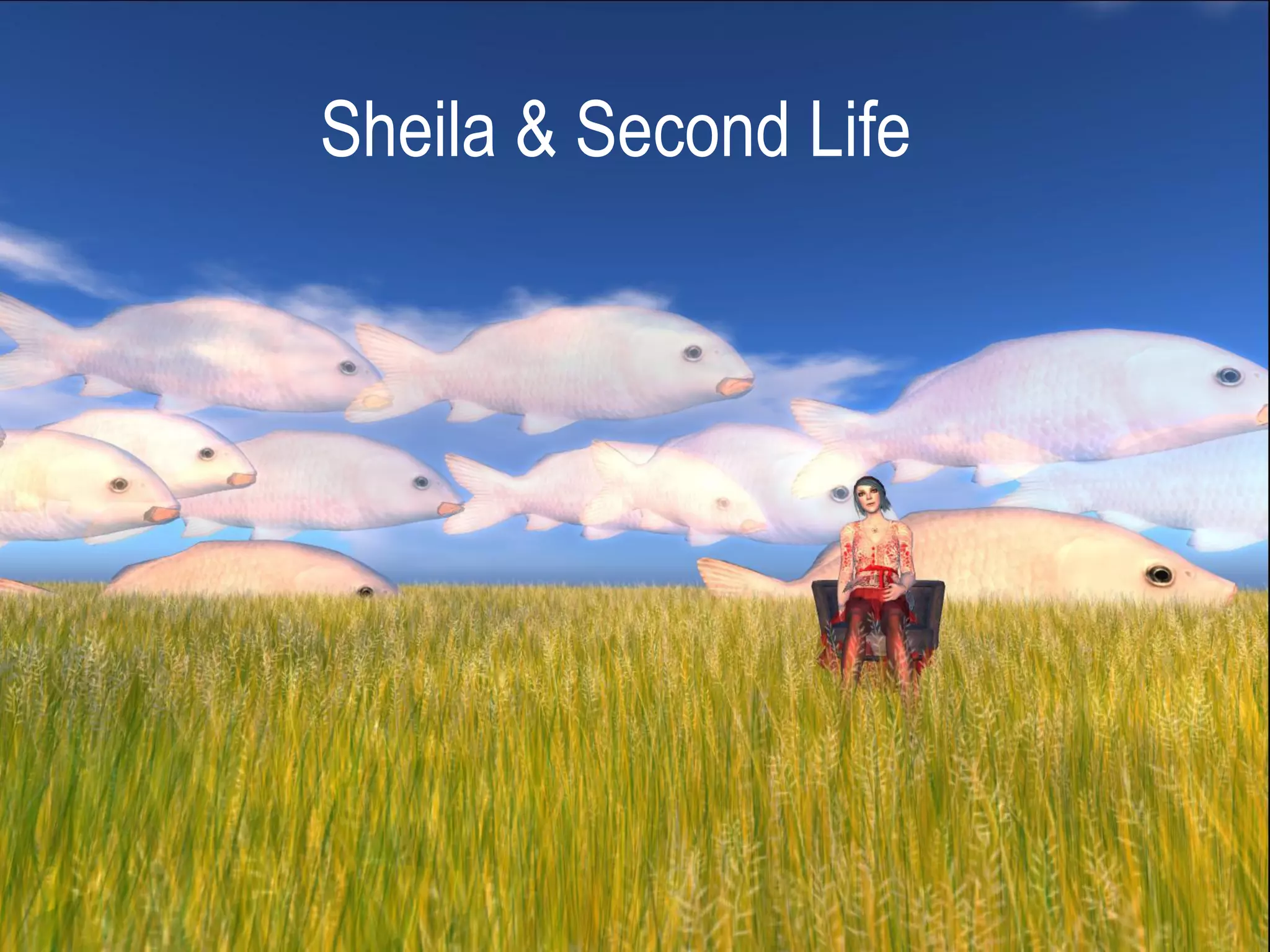
Sheila & Second Life
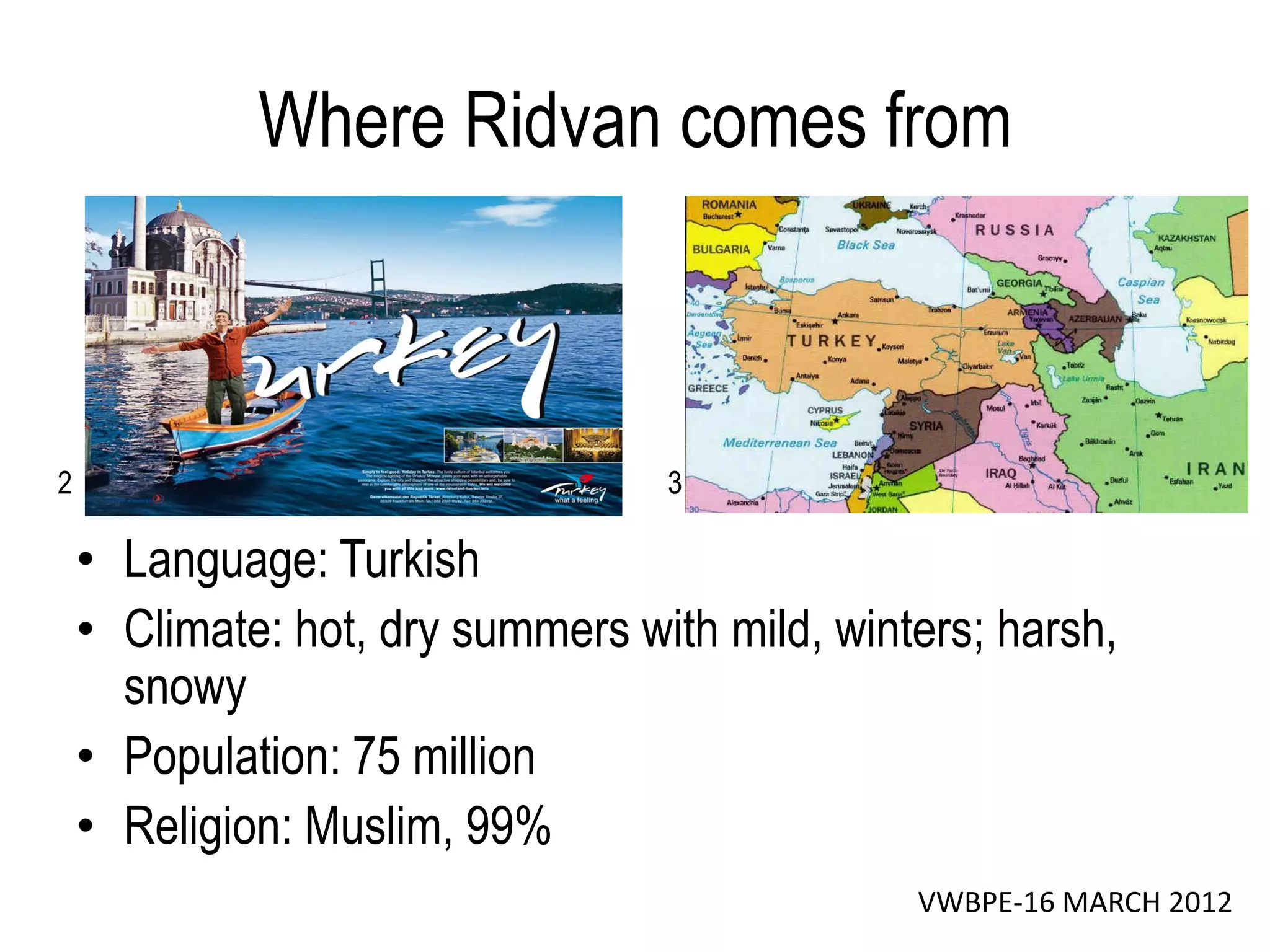
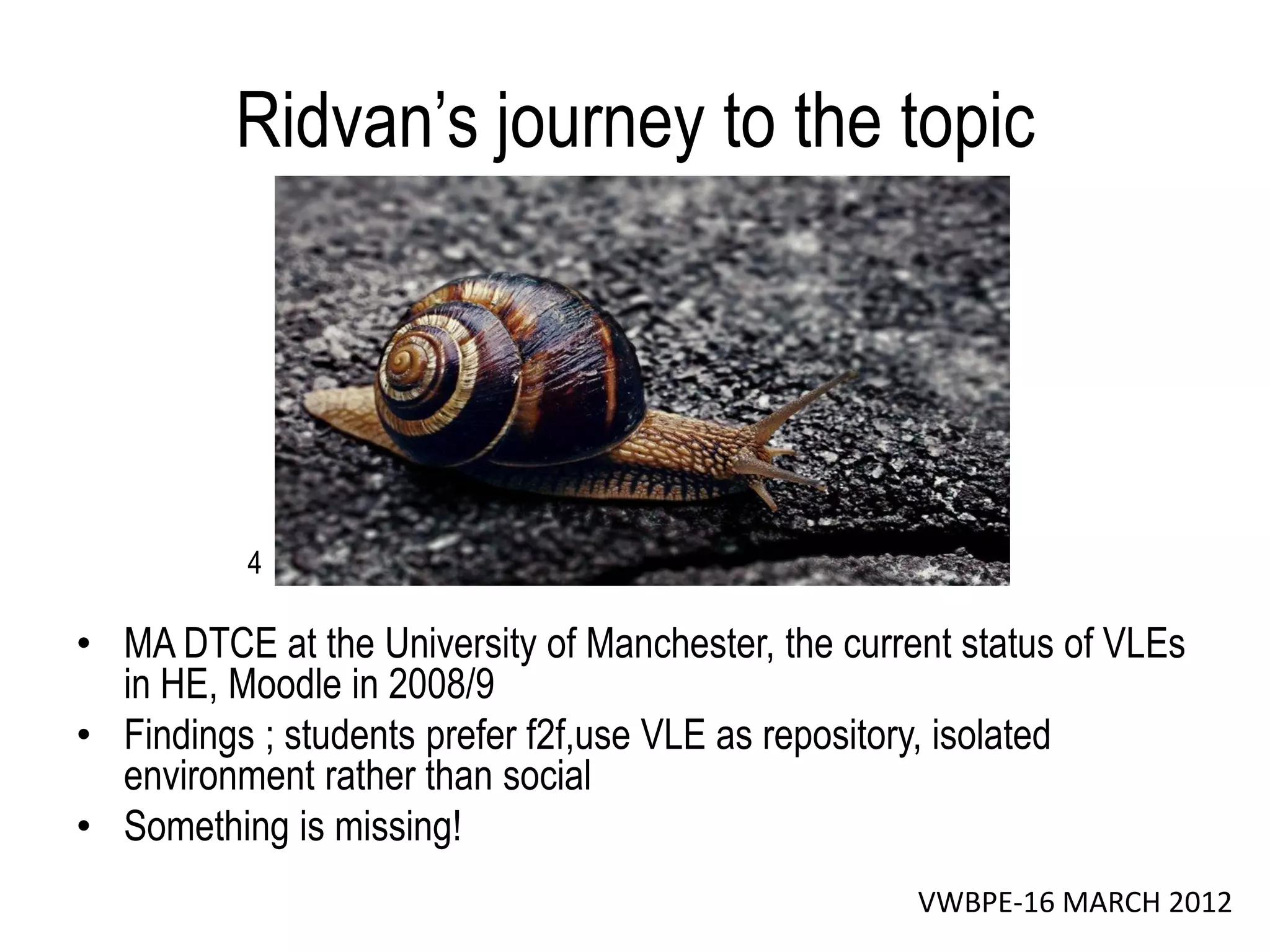
Where Ridvan comes from


2                                 3

    • Language: Turkish
    • Climate: hot, dry summers with mild, winters; harsh,
      snowy
    • Population: 75 million
    • Religion: Muslim, 99%
                                               VWBPE-16 MARCH 2012
Ridvan’s journey to the topic


          4

• MA DTCE at the University of Manchester, the current status of VLEs
  in HE, Moodle in 2008/9
• Findings ; students prefer f2f,use VLE as repository, isolated
  environment rather than social
• Something is missing!
                                                    VWBPE-16 MARCH 2012
Ridvan’s journey into PhD
• In 2009 , The University of Sheffield, UK
• The School of Education under supervision of Julia
  Davies, Education Department, and Sheila Webber,
  Information School.


                                       VWBPE-16 MARCH 2012
Research Questions
Main Question: What pedagogical
framework enables teaching in virtual worlds
and f2f learning situations in HE?
• Implementations of teaching in SL/f2f
   situations
• Impacts of teaching in SL over tutors’ f2f
   pedagogy
• Becoming a SL Tutor
• Motivations of tutors for participating in
   VWs other than the requirement of a class
   activity                                    5


                                                   VWBPE-16 MARCH 2012
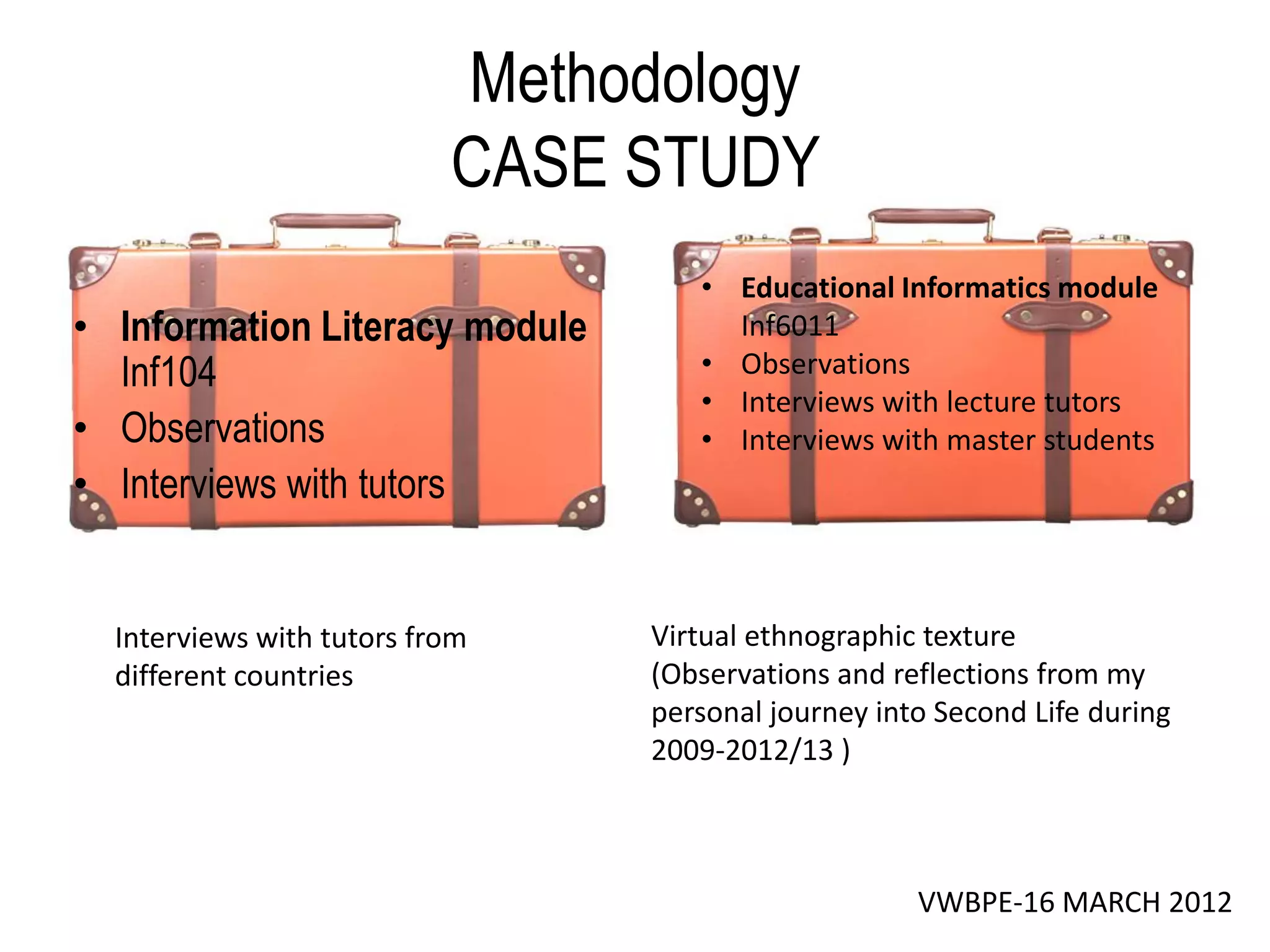
Methodology
                           CASE STUDY
                                   • Educational Informatics module
• Information Literacy module        Inf6011
  Inf104                           • Observations
                                   • Interviews with lecture tutors
• Observations                     • Interviews with master students
• Interviews with tutors


  Interviews with tutors from   Virtual ethnographic texture
  different countries           (Observations and reflections from my
                                personal journey into Second Life during
                                2009-2012/13 )


                                                    VWBPE-16 MARCH 2012
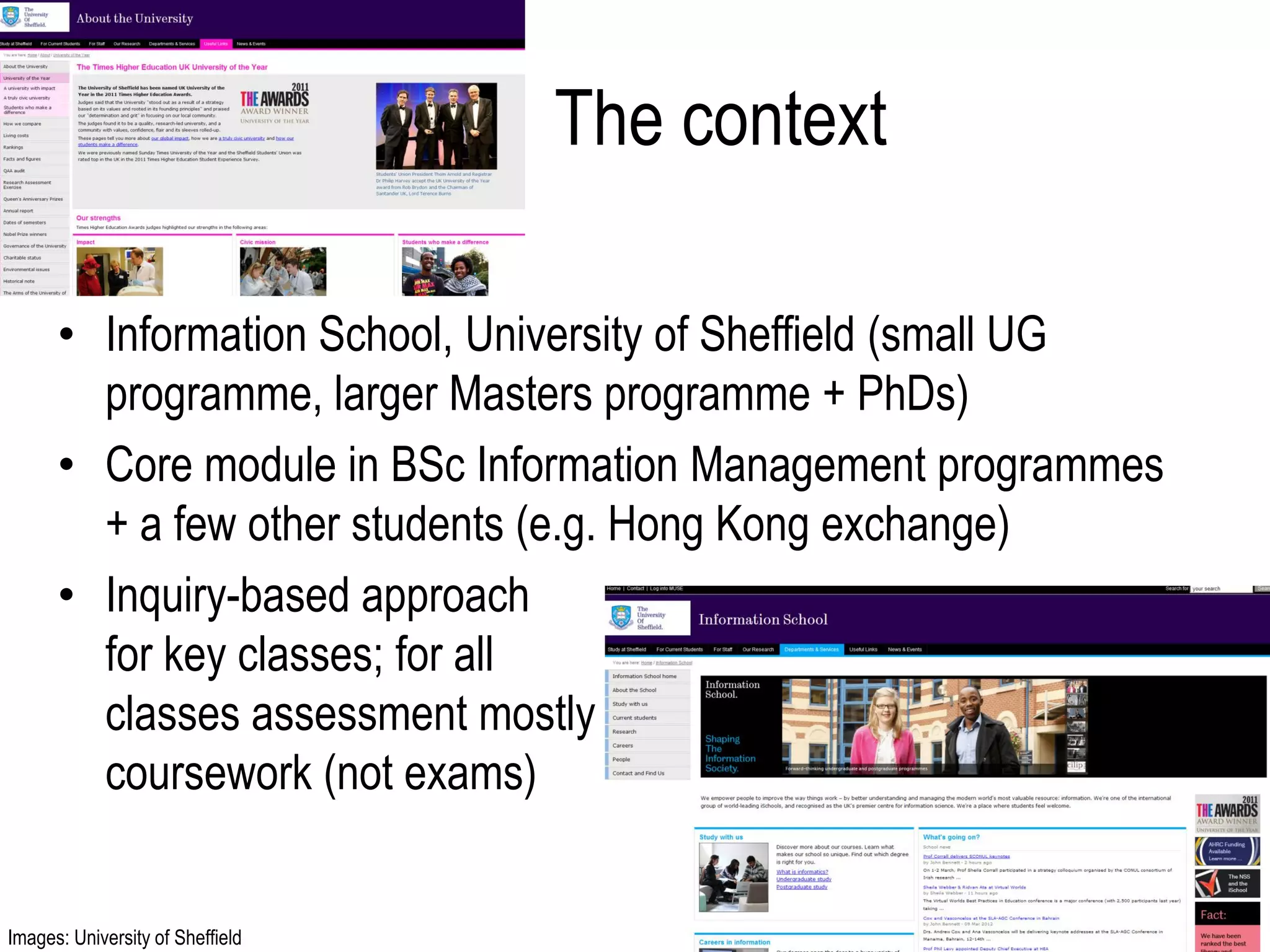
The context

      • Information School, University of Sheffield (small UG
        programme, larger Masters programme + PhDs)
      • Core module in BSc Information Management programmes
        + a few other students (e.g. Hong Kong exchange)
      • Inquiry-based approach
        for key classes; for all
        classes assessment mostly
        coursework (not exams)


Images: University of Sheffield
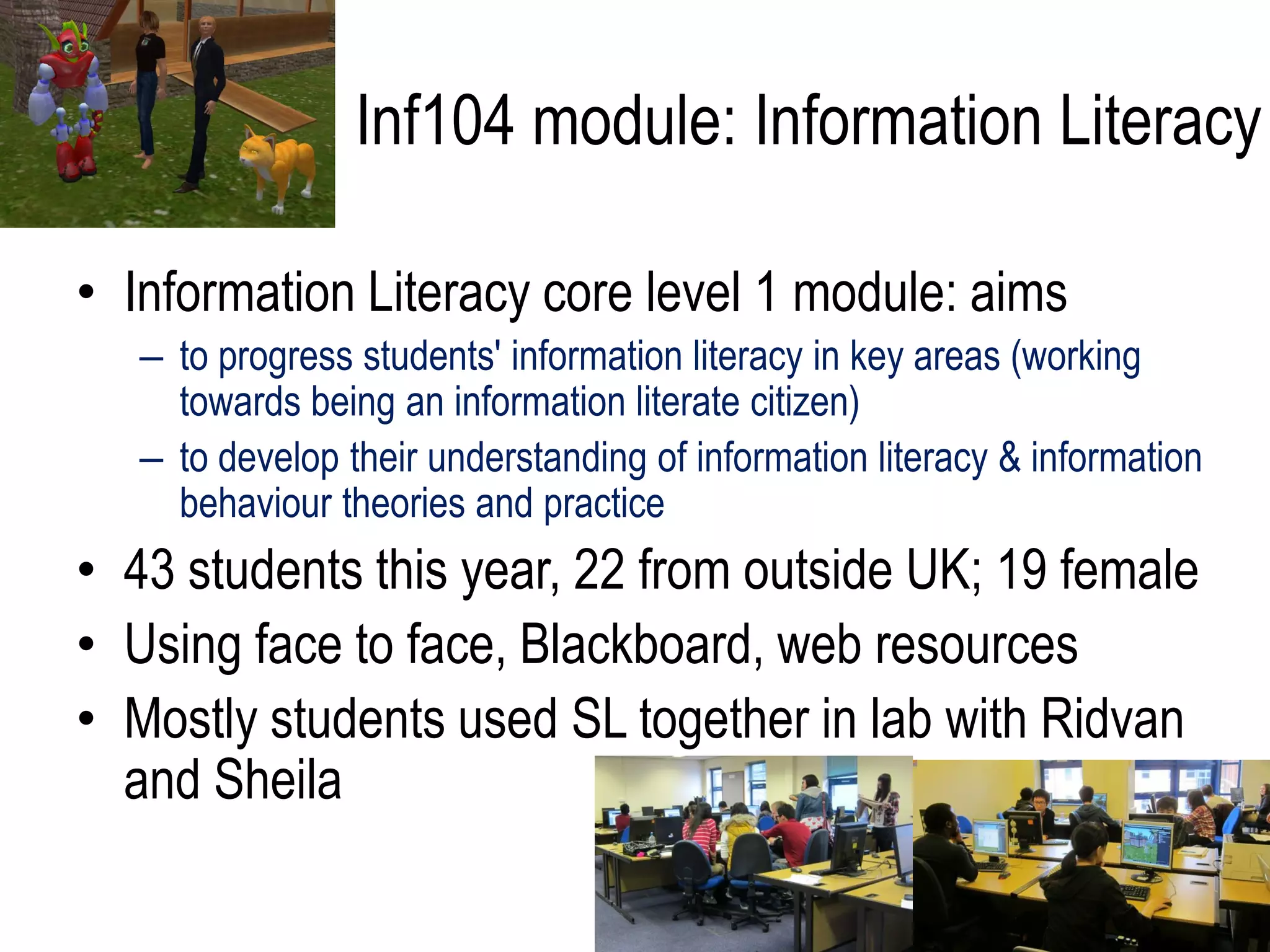
Inf104 module: Information Literacy

• Information Literacy core level 1 module: aims
   – to progress students' information literacy in key areas (working
     towards being an information literate citizen)
   – to develop their understanding of information literacy & information
     behaviour theories and practice
• 43 students this year, 22 from outside UK; 19 female
• Using face to face, Blackboard, web resources
• Mostly students used SL together in lab with Ridvan
  and Sheila
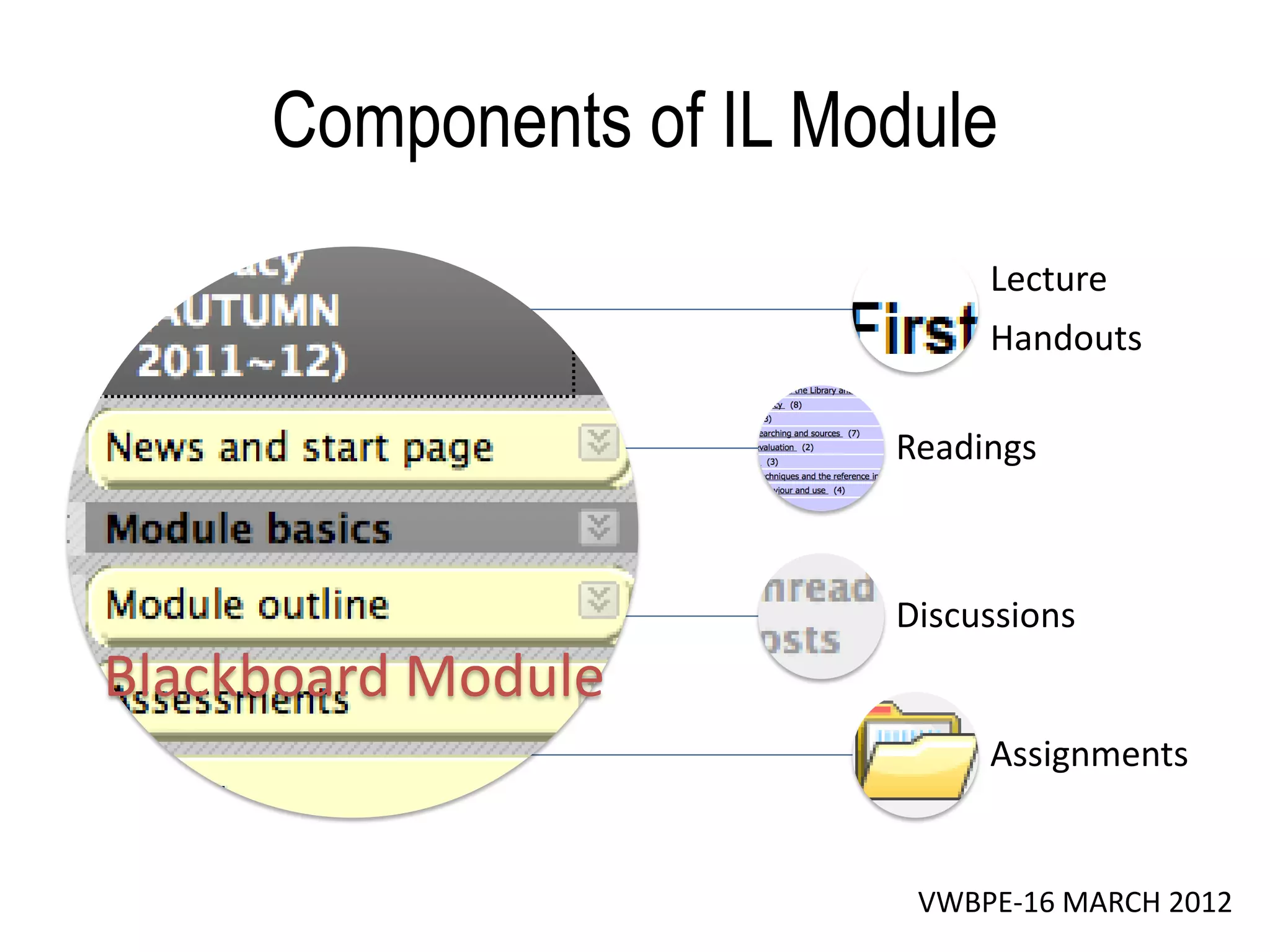
Components of IL Module
                             Lecture
                             Handouts

                        Readings


                        Discussions
Blackboard Module
                             Assignments


                         VWBPE-16 MARCH 2012
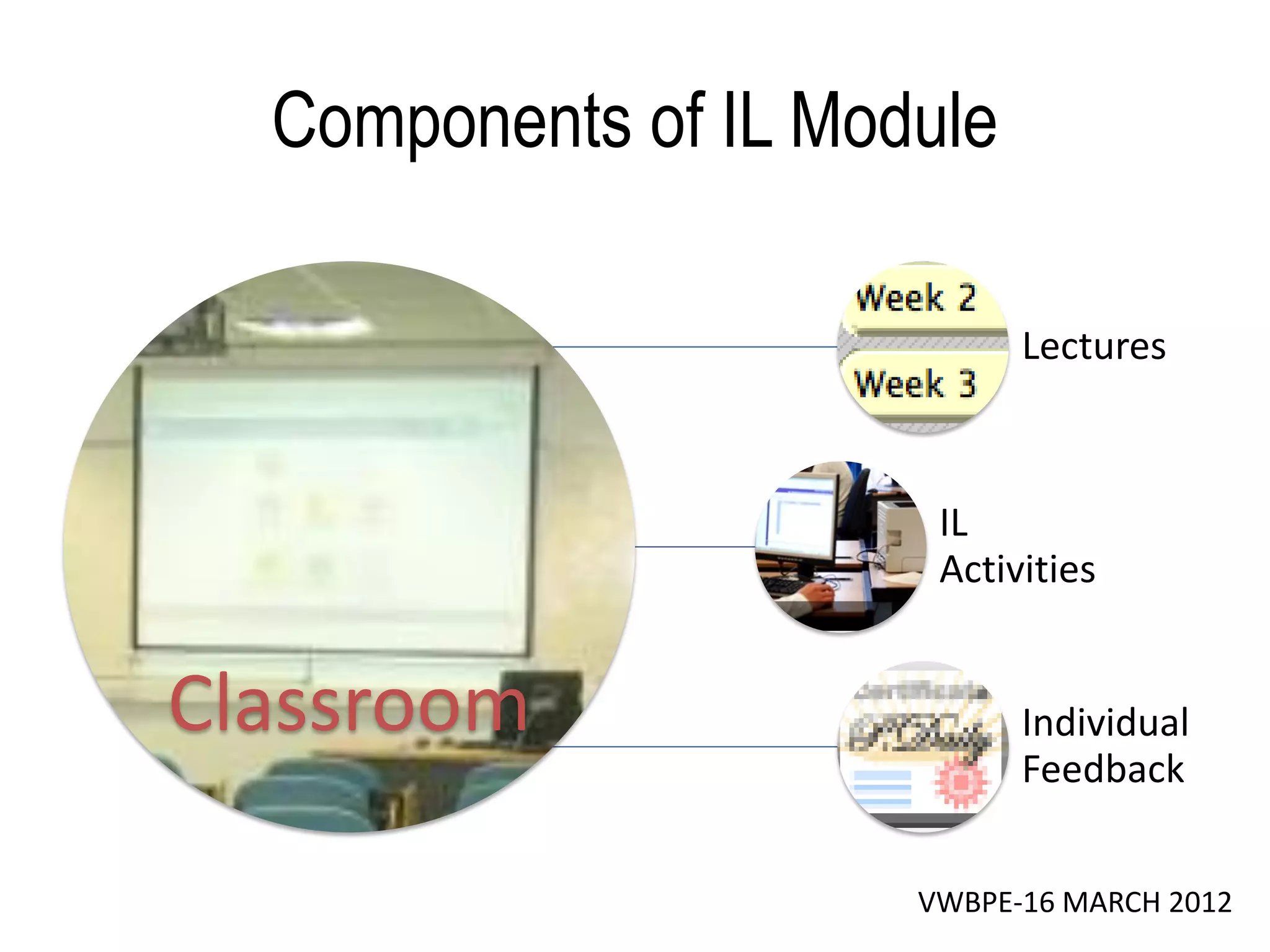
Components of IL Module

                            Lectures


                       IL
                       Activities


Classroom                   Individual
                            Feedback


                      VWBPE-16 MARCH 2012
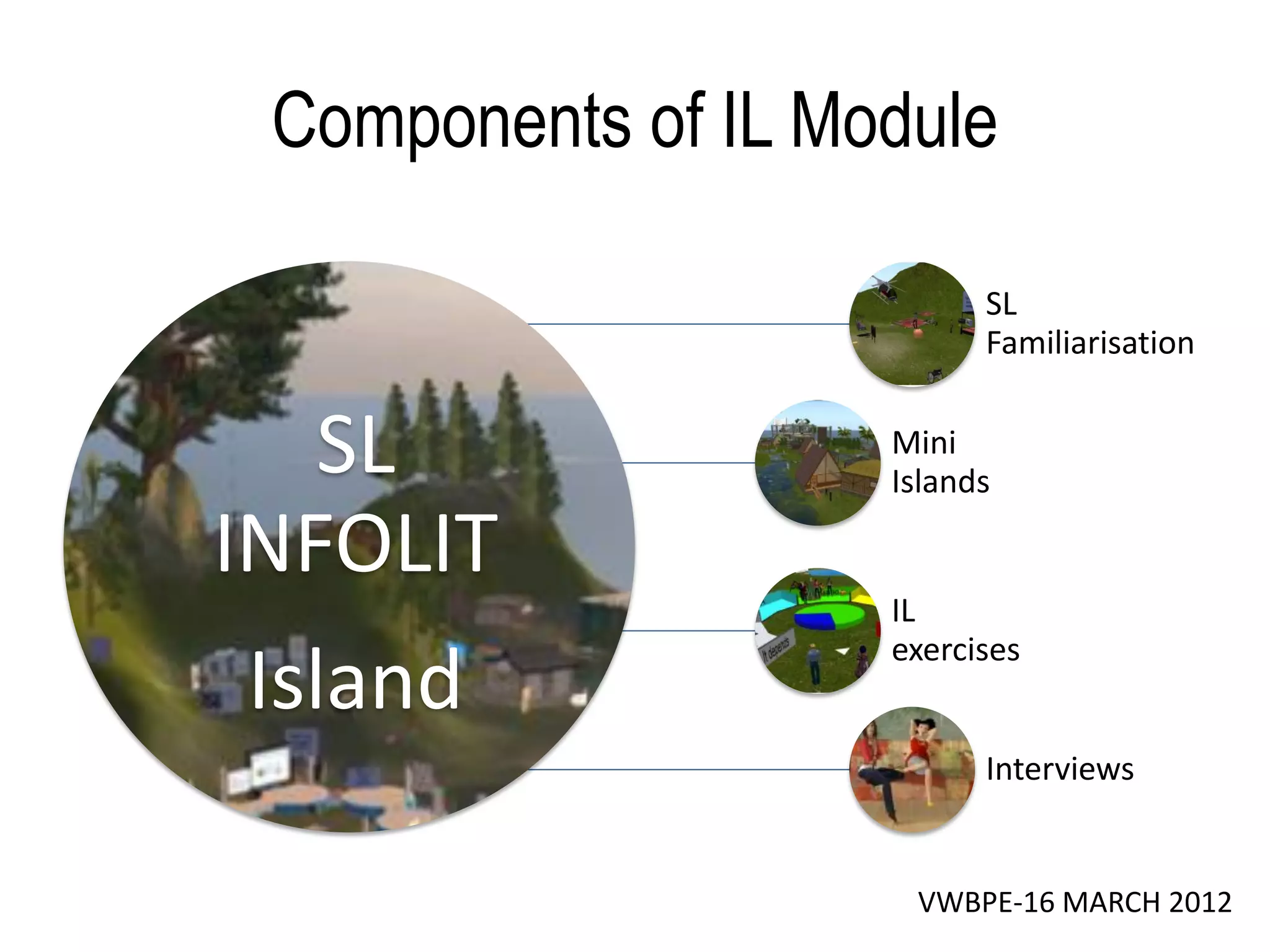
Components of IL Module

                          SL
                          Familiarisation


   SL               Mini
                    Islands

INFOLIT
                    IL
                    exercises
Island
                          Interviews


                     VWBPE-16 MARCH 2012
The Rationale for using SL
• 50% coursework involves students
   – carrying out research interview in SL
   – analysing performance as interviewer
   – analysing transcript in relation to research models
• Access to wider population; internationalisation
• Prompts reflection and comparison with RL
• As information managers, relevant to learn virtual
  world communication skills
5th year Sheila has done this exercise, see…
• Webber, S. (2010) 3D virtual learning case study.
  University of South Australia.
  http://www.unisanet.unisa.edu.au/3DVLE/siteassets
  /docs/3DVirtual_Case_Study_BScIM.pdf
• Webber, S. (2010) “Investigating modes of student
  inquiry in Second Life as part of a blended
  approach.” International Journal of Virtual and
  Personal Learning Environments, 1 (3), 55-70.

• Some tweaks & changes each year
Changes?
• Students
   – more international this year
   – still very little prior use of any virtual worlds
• Overall learning, teaching & assessment approach
   – has not changed much, still problem-based & inquiry focus
• Interventions
   – has varied a little e.g. last year student groups did oral
     presentation of work in f2f class rather than SL exhibit
• Interviewees in assessment-related exercise
   – normally professionals e.g. educators, librarians etc. + a few
     graduate students
   – this year more undergraduate student interviewees
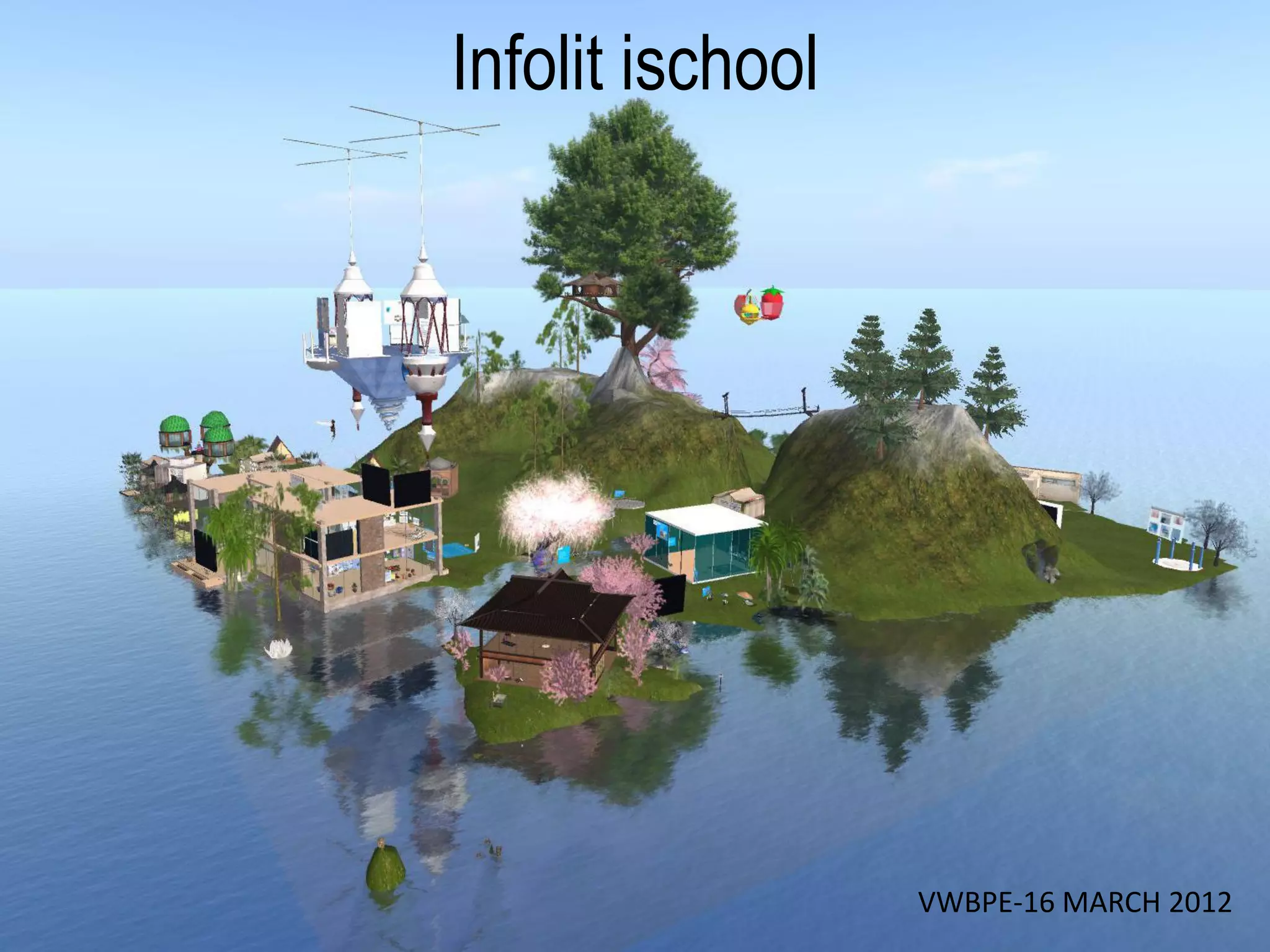
Infolit ischool


                  VWBPE-16 MARCH 2012
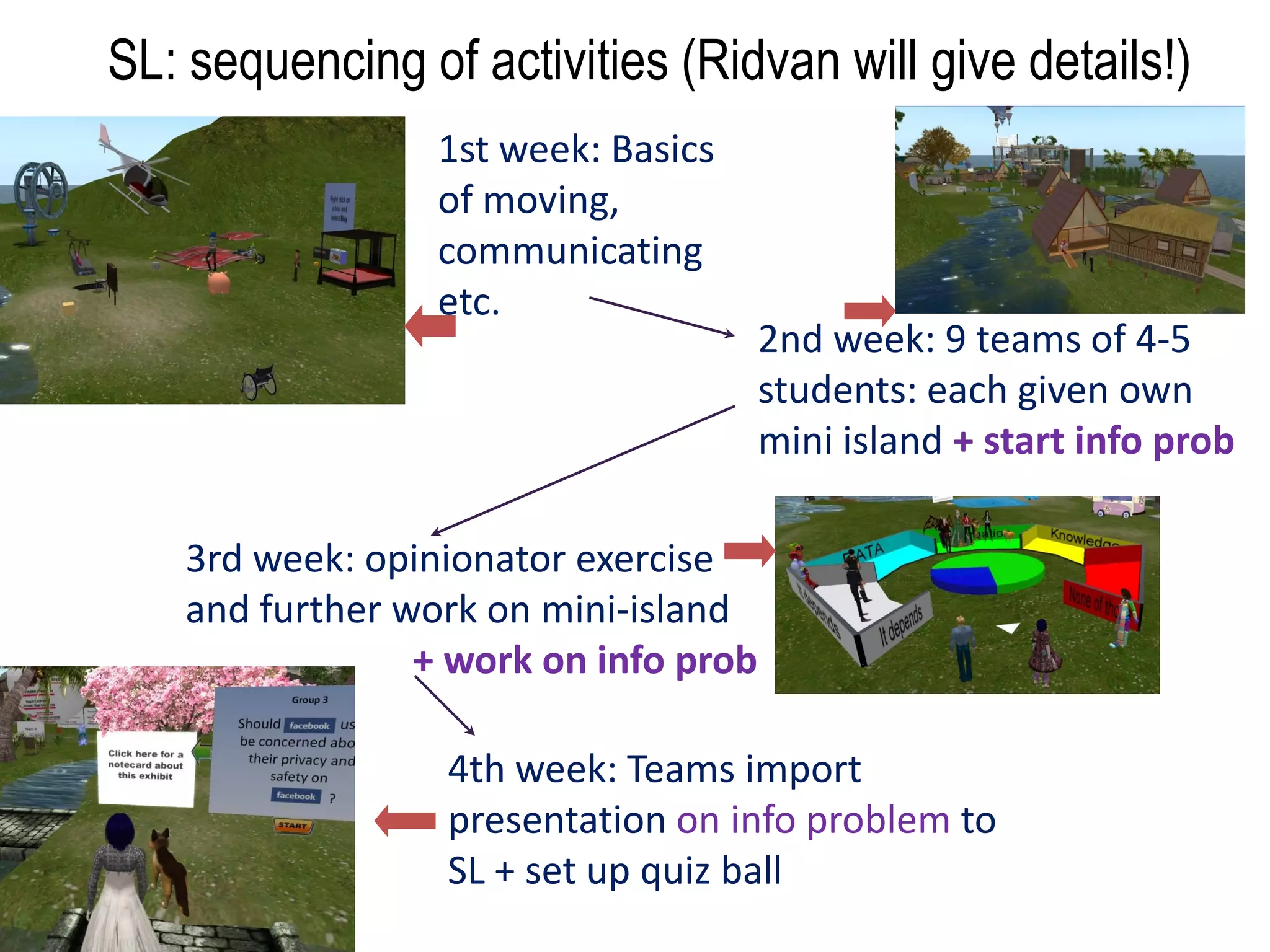
SL: sequencing of activities (Ridvan will give details!)
                  1st week: Basics
                  of moving,
                  communicating
                  etc.
                                       2nd week: 9 teams of 4-5
                                       students: each given own
                                       mini island + start info prob

    3rd week: opinionator exercise
    and further work on mini-island
                 + work on info prob

                  4th week: Teams import
                  presentation on info problem to
                  SL + set up quiz ball
Information problems
• Is the “Google generation” really bad at searching
  for, and evaluating, information?
• How is Wikipedia reliable?
• Should Facebook users be concerned about their
  privacy and safety on Facebook?
• 9 student teams, 3 tackling each problem
• PPT identifies search process and their conclusions
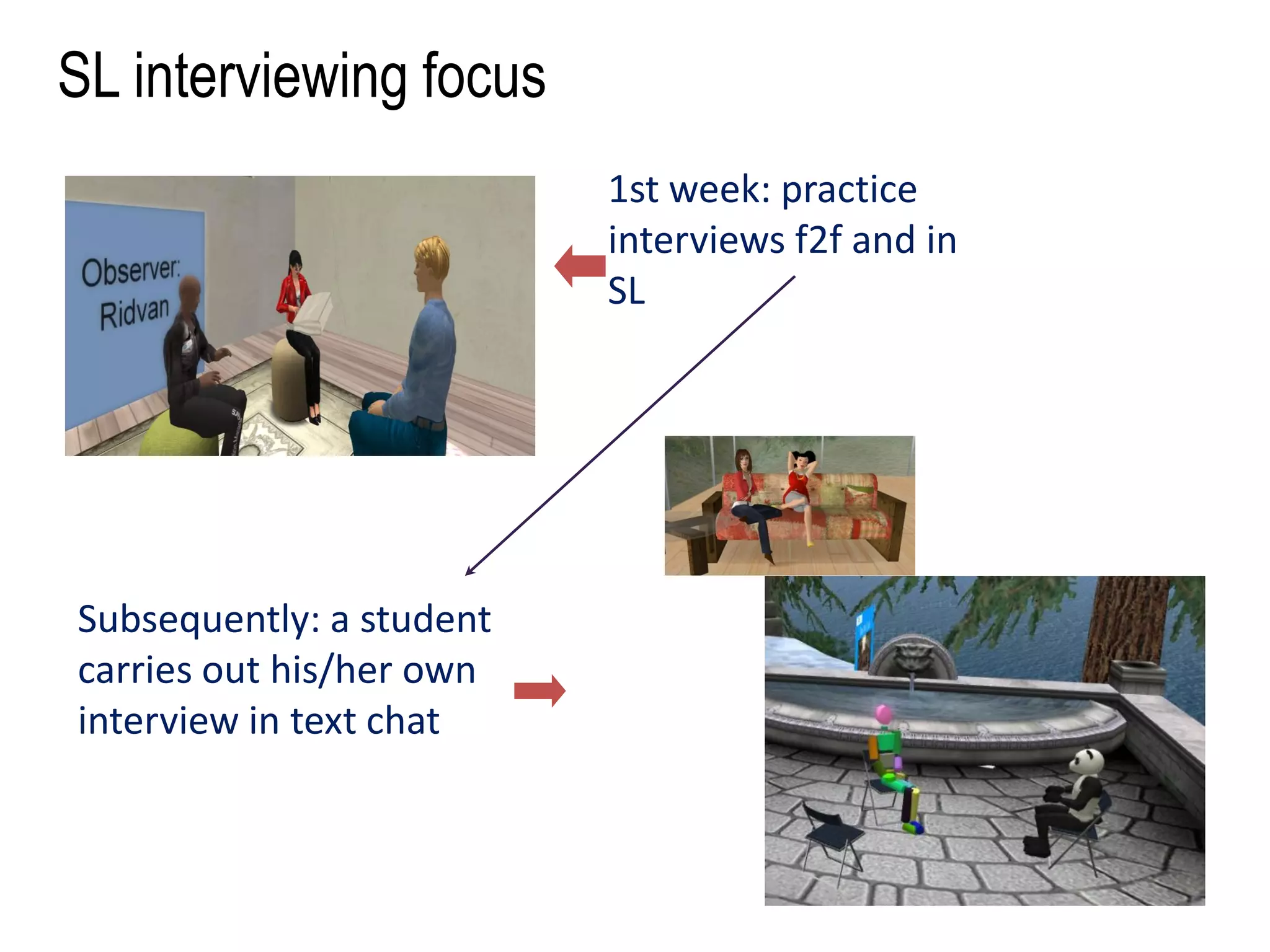
SL interviewing focus
                          1st week: practice
                          interviews f2f and in
                          SL


Subsequently: a student
carries out his/her own
interview in text chat
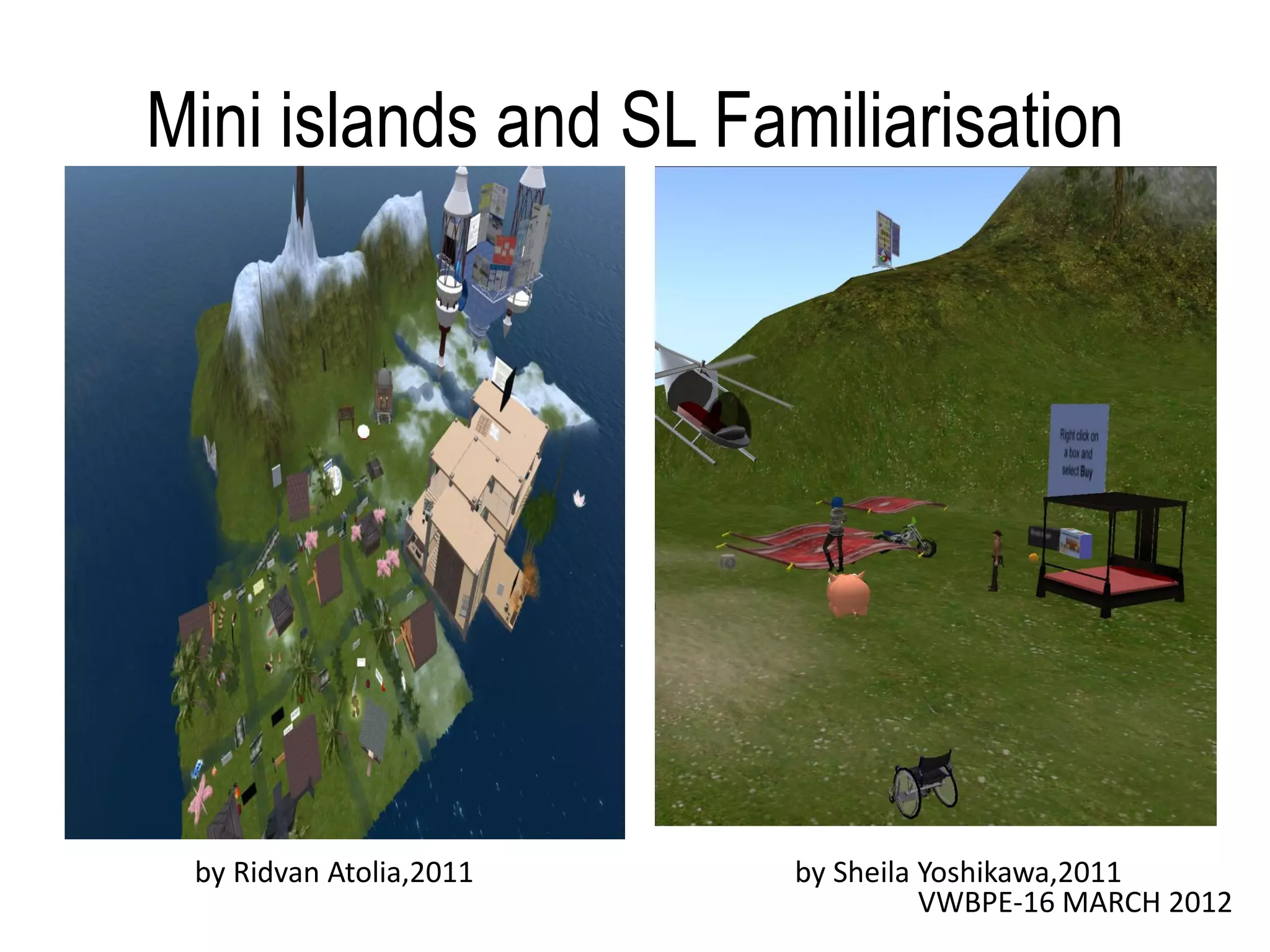
Mini islands and SL Familiarisation


 by Ridvan Atolia,2011   by Sheila Yoshikawa,2011
                                   VWBPE-16 MARCH 2012
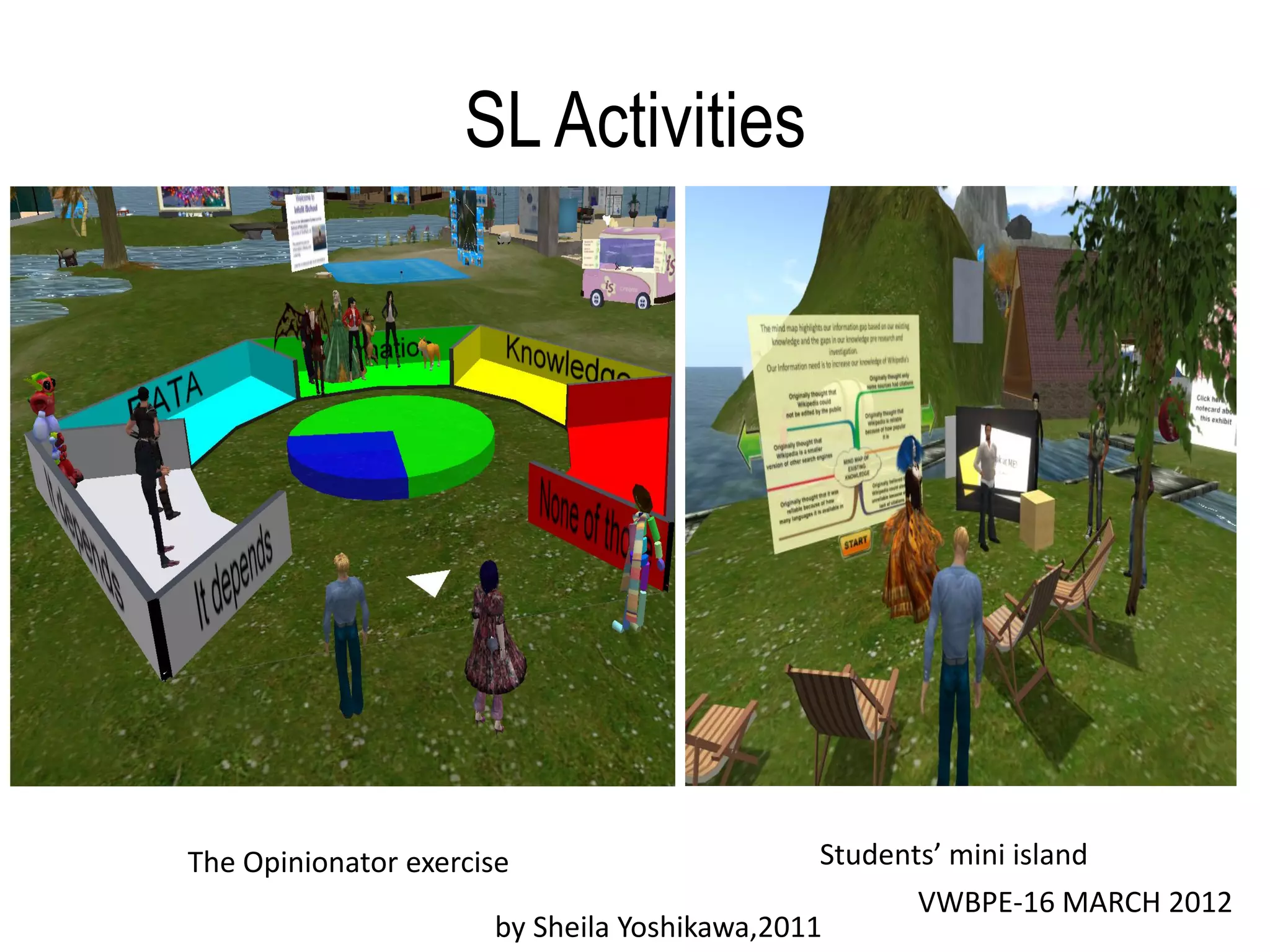
SL Activities


The Opinionator exercise                     Students’ mini island
                                                    VWBPE-16 MARCH 2012
                      by Sheila Yoshikawa,2011
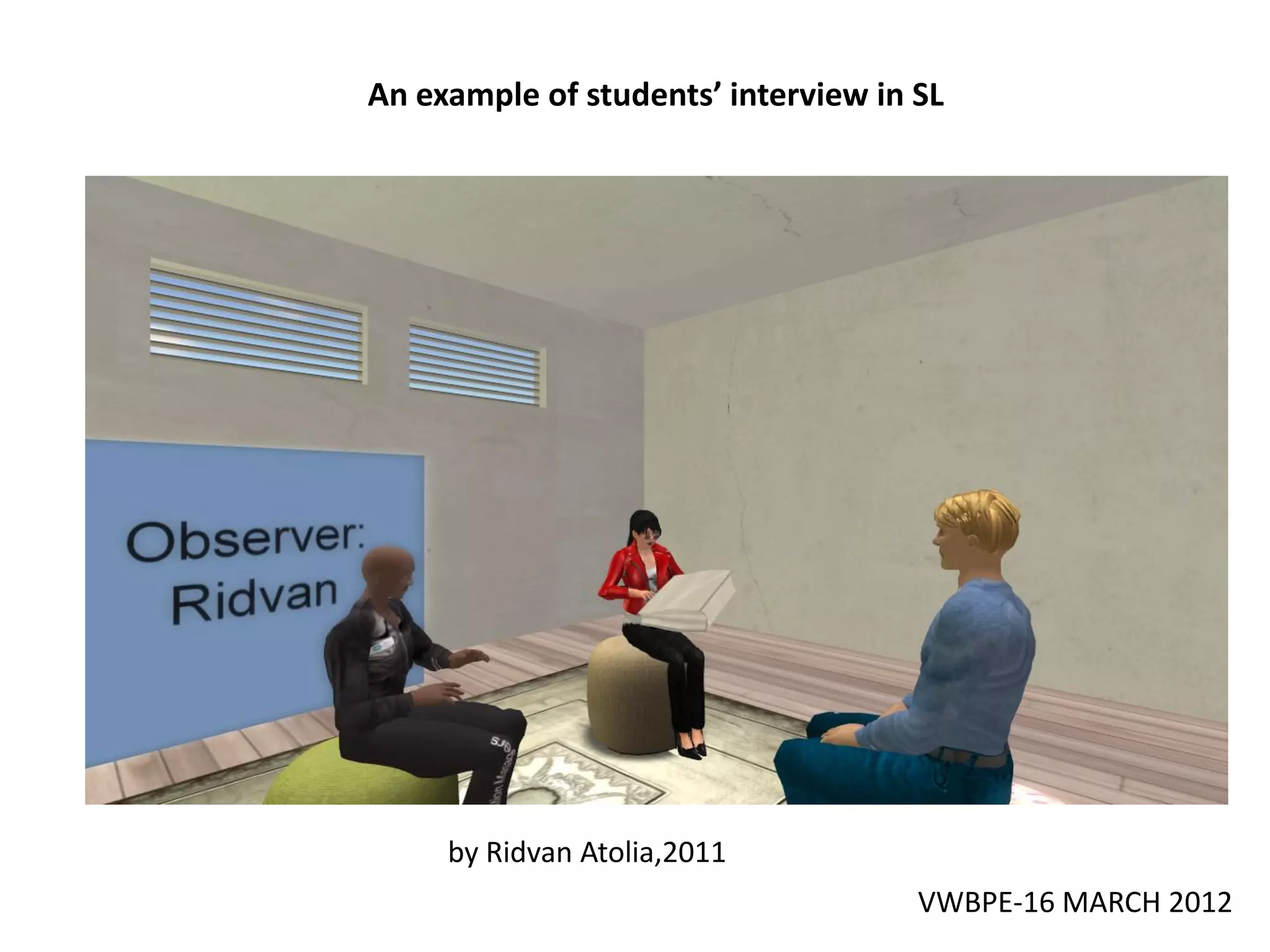
An example of students’ interview in SL


     by Ridvan Atolia,2011
                                     VWBPE-16 MARCH 2012
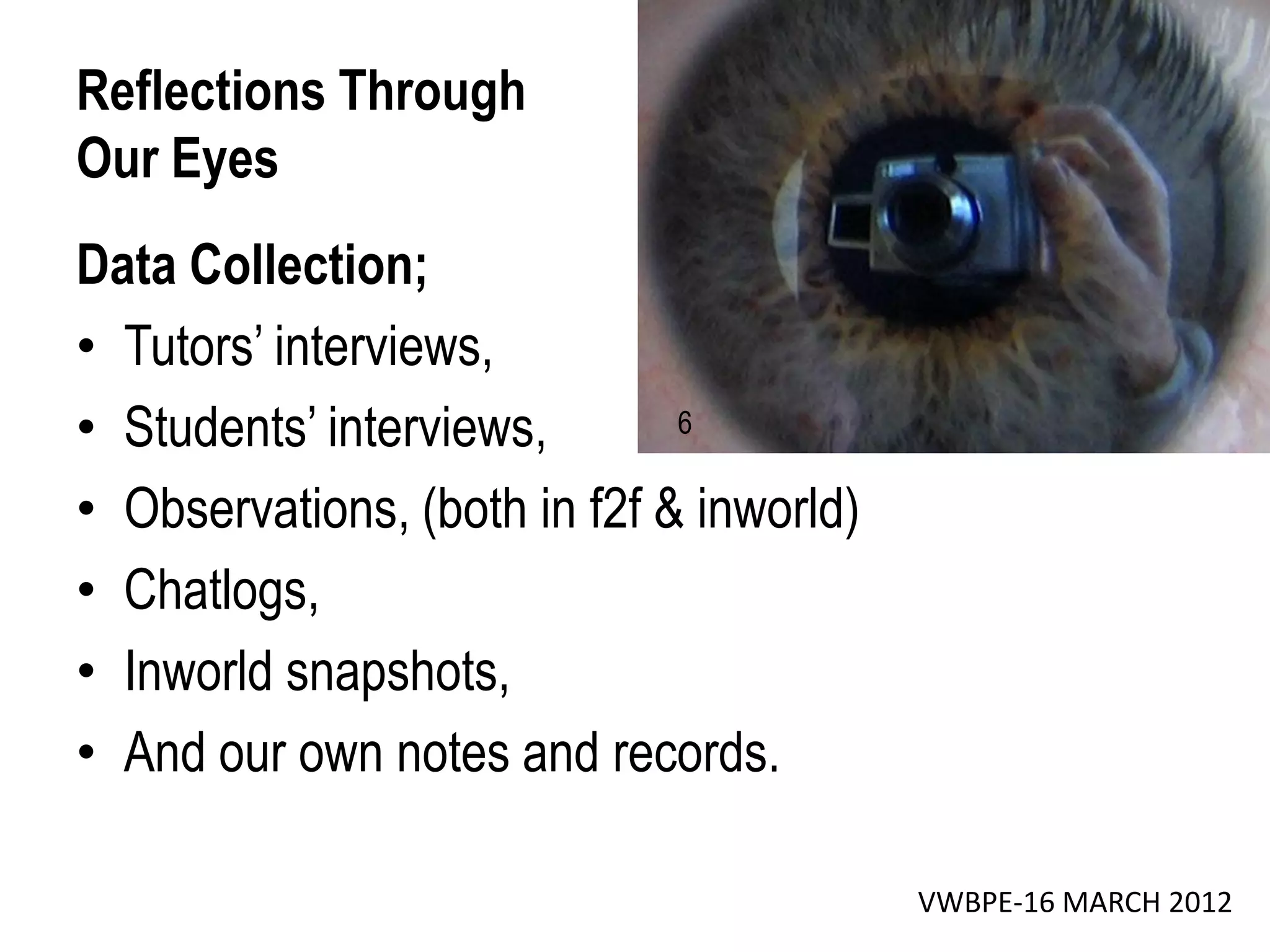
Reflections Through
Our Eyes
Data Collection;
• Tutors’ interviews,
• Students’ interviews,       6

• Observations, (both in f2f & inworld)
• Chatlogs,
• Inworld snapshots,
• And our own notes and records.

                                          VWBPE-16 MARCH 2012
Sheila’s reflection
• Assignment more challenging than ordinary essay:
  some excellent responses to challenge
• Still find that mixture of learning environments
  valuable
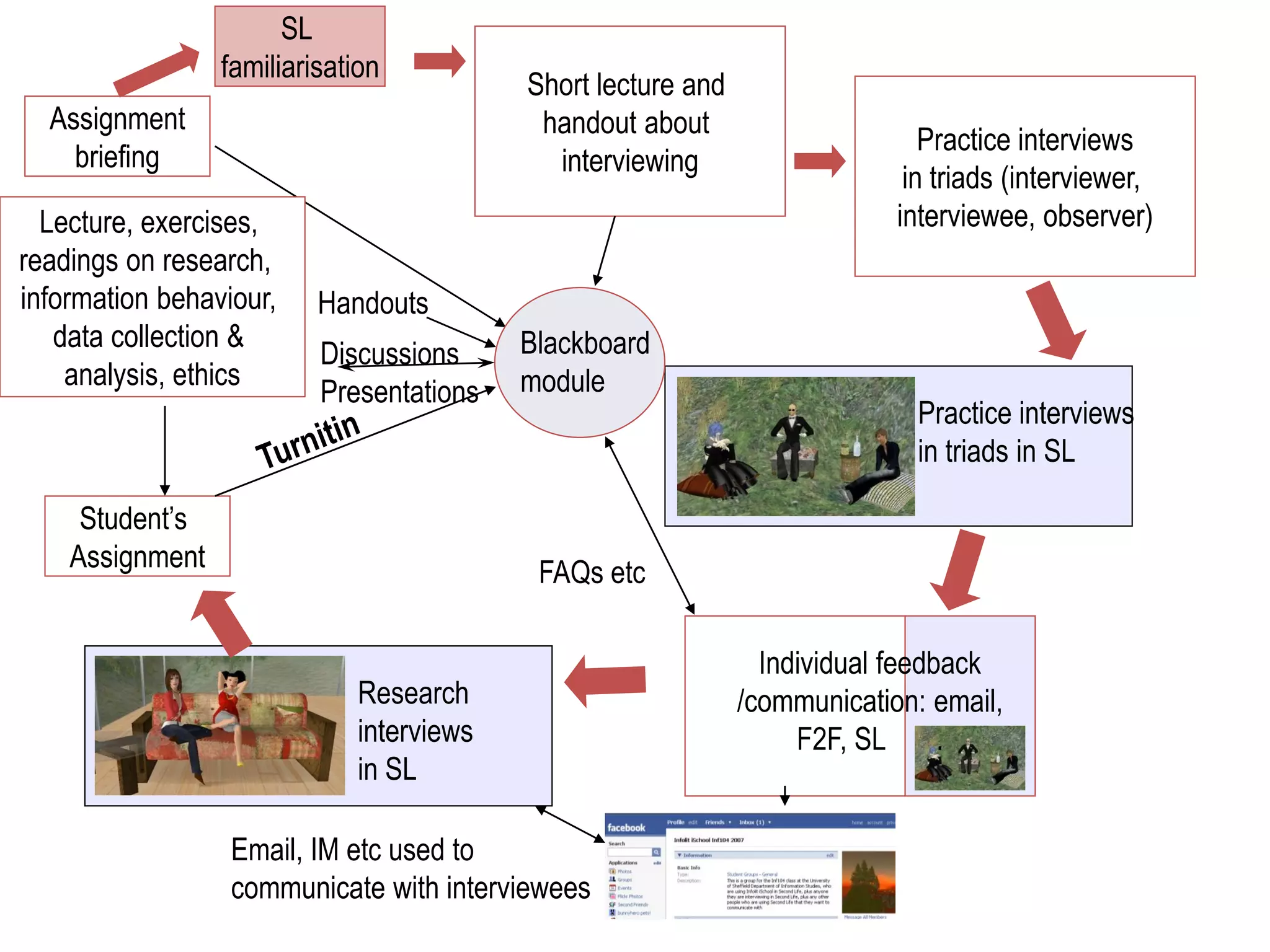
SL
                 familiarisation
                                          Short lecture and
  Assignment                               handout about
                                                                              Practice interviews
    briefing                                interviewing
                                                                            in triads (interviewer,
  Lecture, exercises,                                                      interviewee, observer)
readings on research,
information behaviour,    Handouts
   data collection &                      Blackboard
                          Discussions
    analysis, ethics                      module
                          Presentations
                                                                            Practice interviews
                                                                            in triads in SL

     Student’s
    Assignment                             FAQs etc

                                                                Individual feedback
                             Research                         /communication: email,
                             interviews                            F2F, SL      .
                             in SL

                  Email, IM etc used to
                  communicate with interviewees
Sheila’s reflection, continued …
• Wide variety of responses to SL (& contrast with
  responses from educators!)
• Value of having “experienced” & empathetic
  interviewees
Ridvan’s reflection
• SL was a favorable environment for utilizing IBL
  with constructivist approach in which the students
  collaborated, interacted, and experimented.
• Capable of having a greater presence inworld, one
  student ; if she could die in SL , another student ; if
  I read all the books in my office inworld.


                                           VWBPE-16 MARCH 2012
Ridvan’s reflections continued…
• SL enabled students’ work to be visited by external
  visitors,
• Many occurrences of the interrelationship of SL,
  Blackboard and RL,
• the students benefited from the visual of Seven
  Pillars of Information Model and The Opinionator
  activity
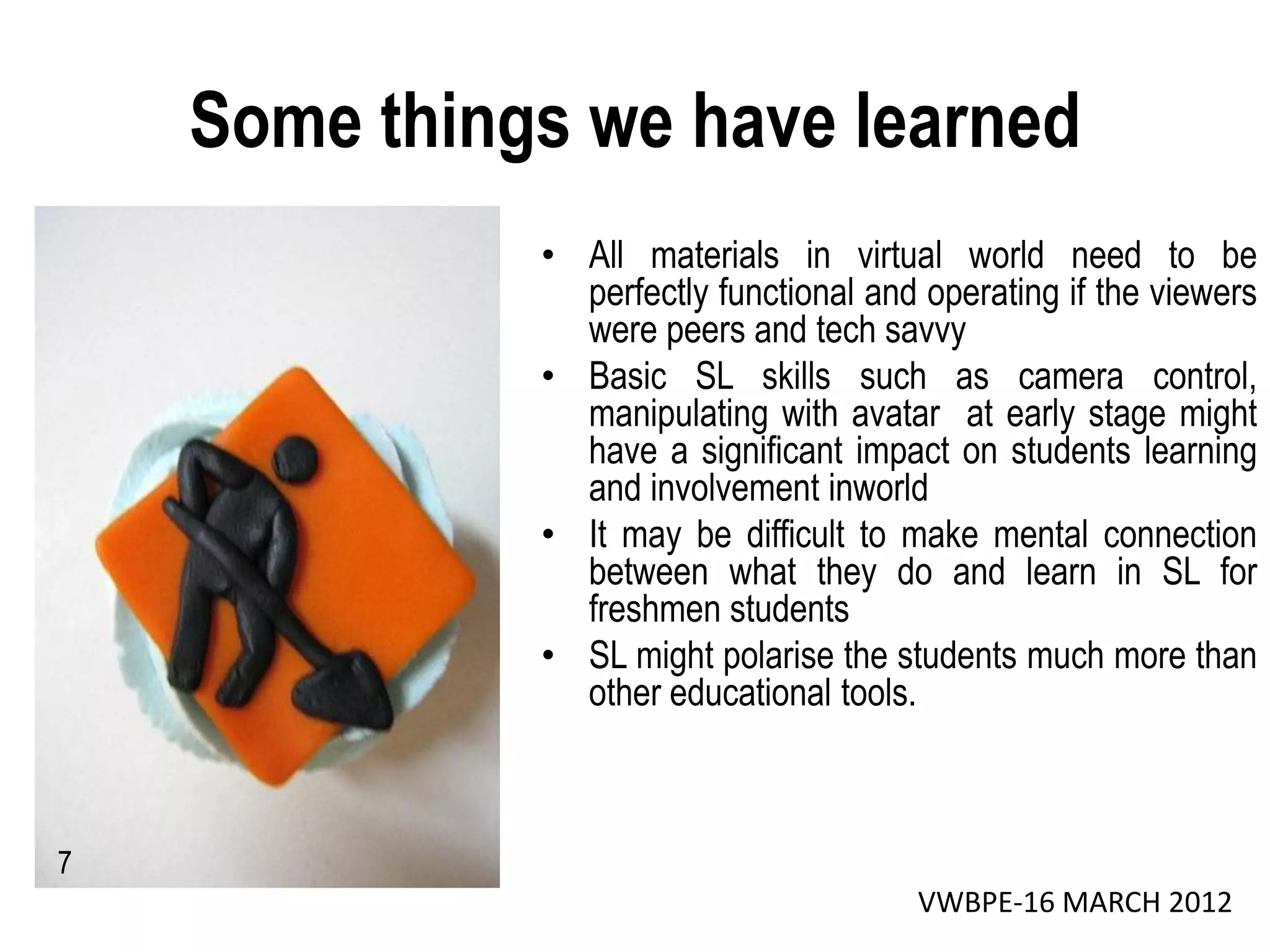
Some things we have learned
              • All materials in virtual world need to be
                perfectly functional and operating if the viewers
                were peers and tech savvy
              • Basic SL skills such as camera control,
                manipulating with avatar at early stage might
                have a significant impact on students learning
                and involvement inworld
              • It may be difficult to make mental connection
                between what they do and learn in SL for
                freshmen students
              • SL might polarise the students much more than
                other educational tools.


7
                                        VWBPE-16 MARCH 2012
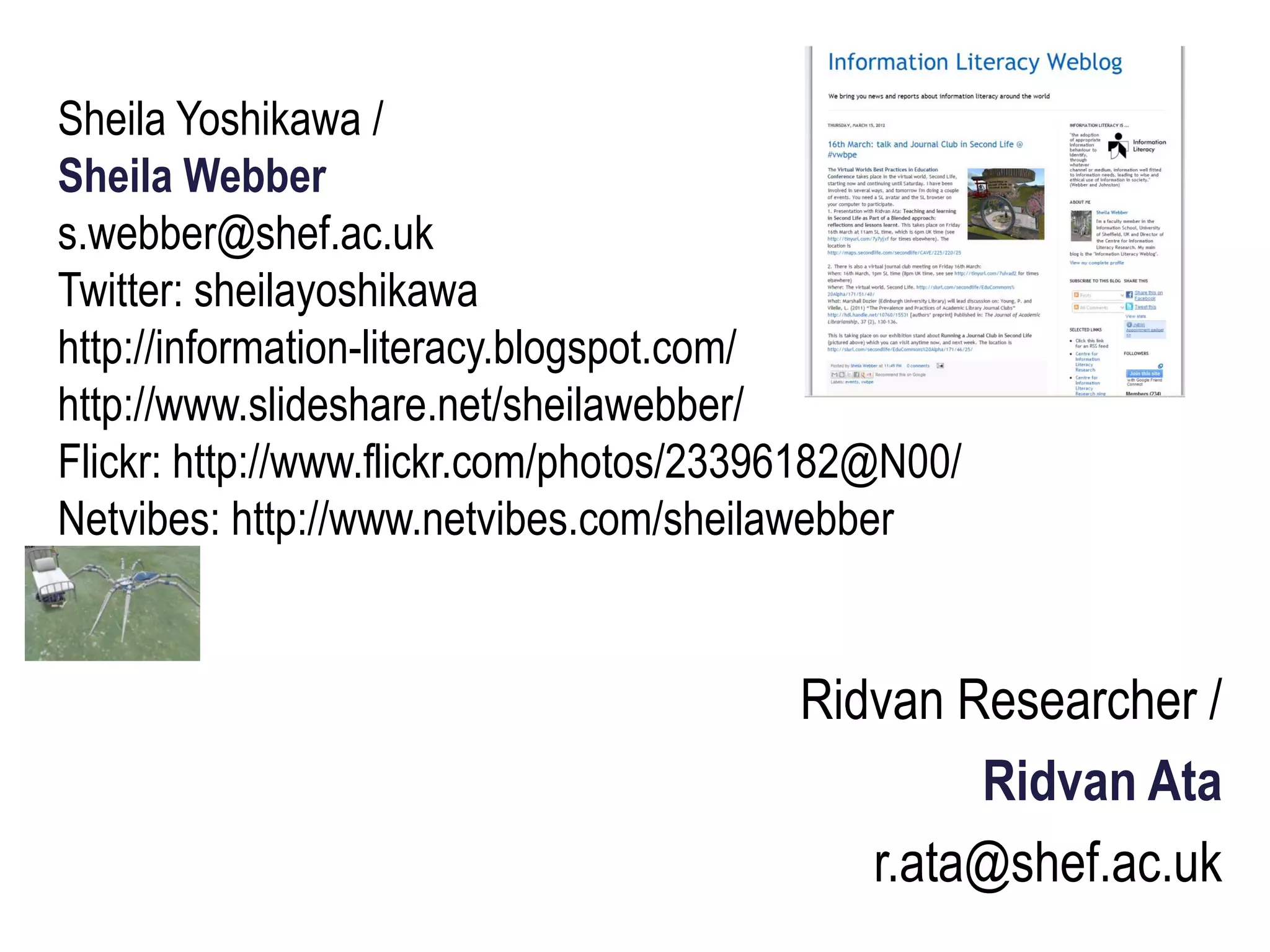
Sheila Yoshikawa /
Sheila Webber
s.webber@shef.ac.uk
Twitter: sheilayoshikawa
http://information-literacy.blogspot.com/
http://www.slideshare.net/sheilawebber/
Flickr: http://www.flickr.com/photos/23396182@N00/
Netvibes: http://www.netvibes.com/sheilawebber


                                         Ridvan Researcher /
                                                 Ridvan Ata
                                            r.ata@shef.ac.uk
Image sources
     Pictures & Photos by Sheila Webber & Ridvan
                Ata except the following
1.    University of Connecticut Libraries’ Map and Geographic Information Center (MAGIC).
      http://www.flickr.com/photos/uconnlibrariesmagic/6732354783/
2.    http://www.virgintoursntravels.com/timeless_turkey
3.    http://www.map-of-turkey.com/
4.    snail. Amanito used under Creative Commons license: http://www.flickr.com/photos/amanito/513566490/
5.    .The Unquiet Librarian used under Creative Commons license:
      http://www.flickr.com/photos/10557450@N04/6632470867/
6.    gregw, used under Creative Commons license: http://www.flickr.com/photos/gregw/4165889/sizes/m/in/photostream/
7.    abakedcreation used under Creative Commons license:
      http://www.flickr.com/photos/abakedcreation/3028287871/sizes/m/in/photostream/
Click here for a
notecard of their
      talk

Teaching and Learning in Second Life as Part of a Blended Approach: Reflections and Lessons learned

  • 1.
    Teaching and Learningin Second Life as Part of a Blended Approach: Reflections and Lessons learned Sheila Yoshikawa Sheila Webber, Senior Lecturer, Information School: the iSchool, University of Sheffield, UK Ridvan Researcher Ridvan Ata, PhD Candidate, School of Education, University of Sheffield, UK VWBPE-16 MARCH 2012 Slides copyright Sheila Webber and Ridvan Ata; sources for pictures listed on the final slide
  • 2.
    Outline • Who we are • Ridvan’s research journey • Context and basics of the class • Approach to teaching & class components • SL components of the class • Our reflections on teaching the class
  • 3.
    Where Sheila comesfrom • Language: English • Climate: Temperate • Population: 60 million 1 • Faculty member • Key areas of research & teaching are educational informatics & information literacy* • *"the adoption of appropriate information behaviour to identify, through whatever channel or medium, information well fitted to information needs, leading to wise and ethical use of information in society." (Webber and Johnston)
  • 4.
  • 5.
    Where Ridvan comesfrom 2 3 • Language: Turkish • Climate: hot, dry summers with mild, winters; harsh, snowy • Population: 75 million • Religion: Muslim, 99% VWBPE-16 MARCH 2012
  • 6.
    Ridvan’s journey tothe topic 4 • MA DTCE at the University of Manchester, the current status of VLEs in HE, Moodle in 2008/9 • Findings ; students prefer f2f,use VLE as repository, isolated environment rather than social • Something is missing! VWBPE-16 MARCH 2012
  • 7.
    Ridvan’s journey intoPhD • In 2009 , The University of Sheffield, UK • The School of Education under supervision of Julia Davies, Education Department, and Sheila Webber, Information School. VWBPE-16 MARCH 2012
  • 8.
    Research Questions Main Question:What pedagogical framework enables teaching in virtual worlds and f2f learning situations in HE? • Implementations of teaching in SL/f2f situations • Impacts of teaching in SL over tutors’ f2f pedagogy • Becoming a SL Tutor • Motivations of tutors for participating in VWs other than the requirement of a class activity 5 VWBPE-16 MARCH 2012
  • 9.
    Methodology CASE STUDY • Educational Informatics module • Information Literacy module Inf6011 Inf104 • Observations • Interviews with lecture tutors • Observations • Interviews with master students • Interviews with tutors Interviews with tutors from Virtual ethnographic texture different countries (Observations and reflections from my personal journey into Second Life during 2009-2012/13 ) VWBPE-16 MARCH 2012
  • 10.
    The context • Information School, University of Sheffield (small UG programme, larger Masters programme + PhDs) • Core module in BSc Information Management programmes + a few other students (e.g. Hong Kong exchange) • Inquiry-based approach for key classes; for all classes assessment mostly coursework (not exams) Images: University of Sheffield
  • 11.
    Inf104 module: InformationLiteracy • Information Literacy core level 1 module: aims – to progress students' information literacy in key areas (working towards being an information literate citizen) – to develop their understanding of information literacy & information behaviour theories and practice • 43 students this year, 22 from outside UK; 19 female • Using face to face, Blackboard, web resources • Mostly students used SL together in lab with Ridvan and Sheila
  • 12.
    Components of ILModule Lecture Handouts Readings Discussions Blackboard Module Assignments VWBPE-16 MARCH 2012
  • 13.
    Components of ILModule Lectures IL Activities Classroom Individual Feedback VWBPE-16 MARCH 2012
  • 14.
    Components of ILModule SL Familiarisation SL Mini Islands INFOLIT IL exercises Island Interviews VWBPE-16 MARCH 2012
  • 15.
    The Rationale forusing SL • 50% coursework involves students – carrying out research interview in SL – analysing performance as interviewer – analysing transcript in relation to research models • Access to wider population; internationalisation • Prompts reflection and comparison with RL • As information managers, relevant to learn virtual world communication skills
  • 16.
    5th year Sheilahas done this exercise, see… • Webber, S. (2010) 3D virtual learning case study. University of South Australia. http://www.unisanet.unisa.edu.au/3DVLE/siteassets /docs/3DVirtual_Case_Study_BScIM.pdf • Webber, S. (2010) “Investigating modes of student inquiry in Second Life as part of a blended approach.” International Journal of Virtual and Personal Learning Environments, 1 (3), 55-70. • Some tweaks & changes each year
  • 17.
    Changes? • Students – more international this year – still very little prior use of any virtual worlds • Overall learning, teaching & assessment approach – has not changed much, still problem-based & inquiry focus • Interventions – has varied a little e.g. last year student groups did oral presentation of work in f2f class rather than SL exhibit • Interviewees in assessment-related exercise – normally professionals e.g. educators, librarians etc. + a few graduate students – this year more undergraduate student interviewees
  • 18.
    Infolit ischool VWBPE-16 MARCH 2012
  • 19.
    SL: sequencing ofactivities (Ridvan will give details!) 1st week: Basics of moving, communicating etc. 2nd week: 9 teams of 4-5 students: each given own mini island + start info prob 3rd week: opinionator exercise and further work on mini-island + work on info prob 4th week: Teams import presentation on info problem to SL + set up quiz ball
  • 20.
    Information problems • Isthe “Google generation” really bad at searching for, and evaluating, information? • How is Wikipedia reliable? • Should Facebook users be concerned about their privacy and safety on Facebook? • 9 student teams, 3 tackling each problem • PPT identifies search process and their conclusions
  • 21.
    SL interviewing focus 1st week: practice interviews f2f and in SL Subsequently: a student carries out his/her own interview in text chat
  • 22.
    Mini islands andSL Familiarisation by Ridvan Atolia,2011 by Sheila Yoshikawa,2011 VWBPE-16 MARCH 2012
  • 23.
    SL Activities The Opinionatorexercise Students’ mini island VWBPE-16 MARCH 2012 by Sheila Yoshikawa,2011
  • 24.
    An example ofstudents’ interview in SL by Ridvan Atolia,2011 VWBPE-16 MARCH 2012
  • 25.
    Reflections Through Our Eyes DataCollection; • Tutors’ interviews, • Students’ interviews, 6 • Observations, (both in f2f & inworld) • Chatlogs, • Inworld snapshots, • And our own notes and records. VWBPE-16 MARCH 2012
  • 26.
    Sheila’s reflection • Assignmentmore challenging than ordinary essay: some excellent responses to challenge • Still find that mixture of learning environments valuable
  • 27.
    SL familiarisation Short lecture and Assignment handout about Practice interviews briefing interviewing in triads (interviewer, Lecture, exercises, interviewee, observer) readings on research, information behaviour, Handouts data collection & Blackboard Discussions analysis, ethics module Presentations Practice interviews in triads in SL Student’s Assignment FAQs etc Individual feedback Research /communication: email, interviews F2F, SL . in SL Email, IM etc used to communicate with interviewees
  • 28.
    Sheila’s reflection, continued… • Wide variety of responses to SL (& contrast with responses from educators!) • Value of having “experienced” & empathetic interviewees
  • 29.
    Ridvan’s reflection • SLwas a favorable environment for utilizing IBL with constructivist approach in which the students collaborated, interacted, and experimented. • Capable of having a greater presence inworld, one student ; if she could die in SL , another student ; if I read all the books in my office inworld. VWBPE-16 MARCH 2012
  • 30.
    Ridvan’s reflections continued… •SL enabled students’ work to be visited by external visitors, • Many occurrences of the interrelationship of SL, Blackboard and RL, • the students benefited from the visual of Seven Pillars of Information Model and The Opinionator activity
  • 31.
    Some things wehave learned • All materials in virtual world need to be perfectly functional and operating if the viewers were peers and tech savvy • Basic SL skills such as camera control, manipulating with avatar at early stage might have a significant impact on students learning and involvement inworld • It may be difficult to make mental connection between what they do and learn in SL for freshmen students • SL might polarise the students much more than other educational tools. 7 VWBPE-16 MARCH 2012
  • 32.
    Sheila Yoshikawa / SheilaWebber s.webber@shef.ac.uk Twitter: sheilayoshikawa http://information-literacy.blogspot.com/ http://www.slideshare.net/sheilawebber/ Flickr: http://www.flickr.com/photos/23396182@N00/ Netvibes: http://www.netvibes.com/sheilawebber Ridvan Researcher / Ridvan Ata r.ata@shef.ac.uk
  • 33.
    Image sources Pictures & Photos by Sheila Webber & Ridvan Ata except the following 1. University of Connecticut Libraries’ Map and Geographic Information Center (MAGIC). http://www.flickr.com/photos/uconnlibrariesmagic/6732354783/ 2. http://www.virgintoursntravels.com/timeless_turkey 3. http://www.map-of-turkey.com/ 4. snail. Amanito used under Creative Commons license: http://www.flickr.com/photos/amanito/513566490/ 5. .The Unquiet Librarian used under Creative Commons license: http://www.flickr.com/photos/10557450@N04/6632470867/ 6. gregw, used under Creative Commons license: http://www.flickr.com/photos/gregw/4165889/sizes/m/in/photostream/ 7. abakedcreation used under Creative Commons license: http://www.flickr.com/photos/abakedcreation/3028287871/sizes/m/in/photostream/
  • 34.
    Click here fora notecard of their talk