Intro Week Induction and Inquiry-based Learning: Varying Approaches L Gray, A Rossiter, J Rowson, M Freeman, M Morley UNIVERSITY OF SHEFFIELD
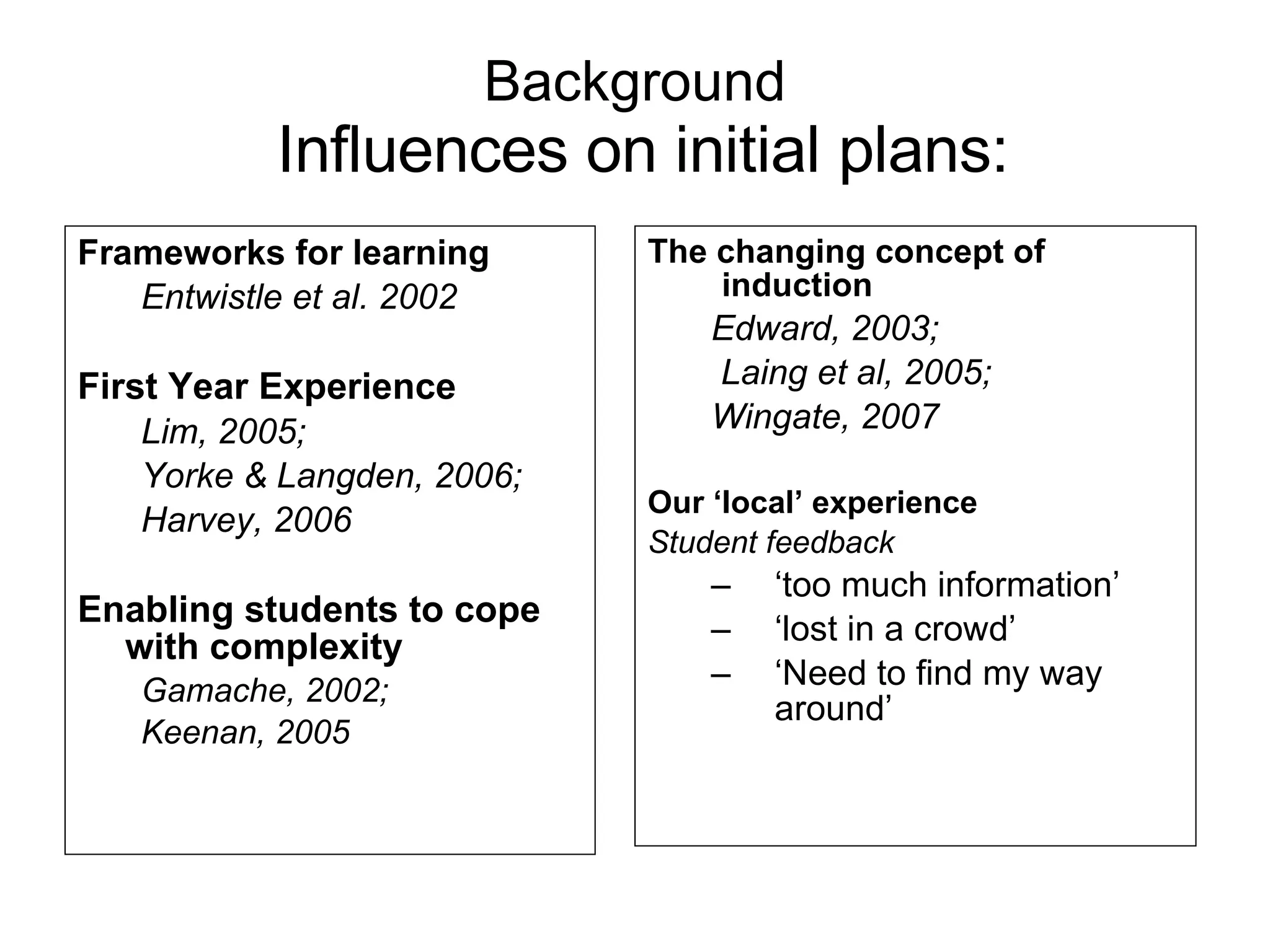
Background   Influences on initial plans: Frameworks for learning  Entwistle et al. 2002 First Year Experience   Lim, 2005;  Yorke & Langden, 2006; Harvey, 2006 Enabling students   to cope with complexity Gamache, 2002; Keenan, 2005 The changing concept of induction  Edward, 2003; Laing et al, 2005; Wingate, 2007 Our ‘local’ experience Student feedback ‘ too much information’ ‘ lost in a crowd’ ‘ Need to find my way around’
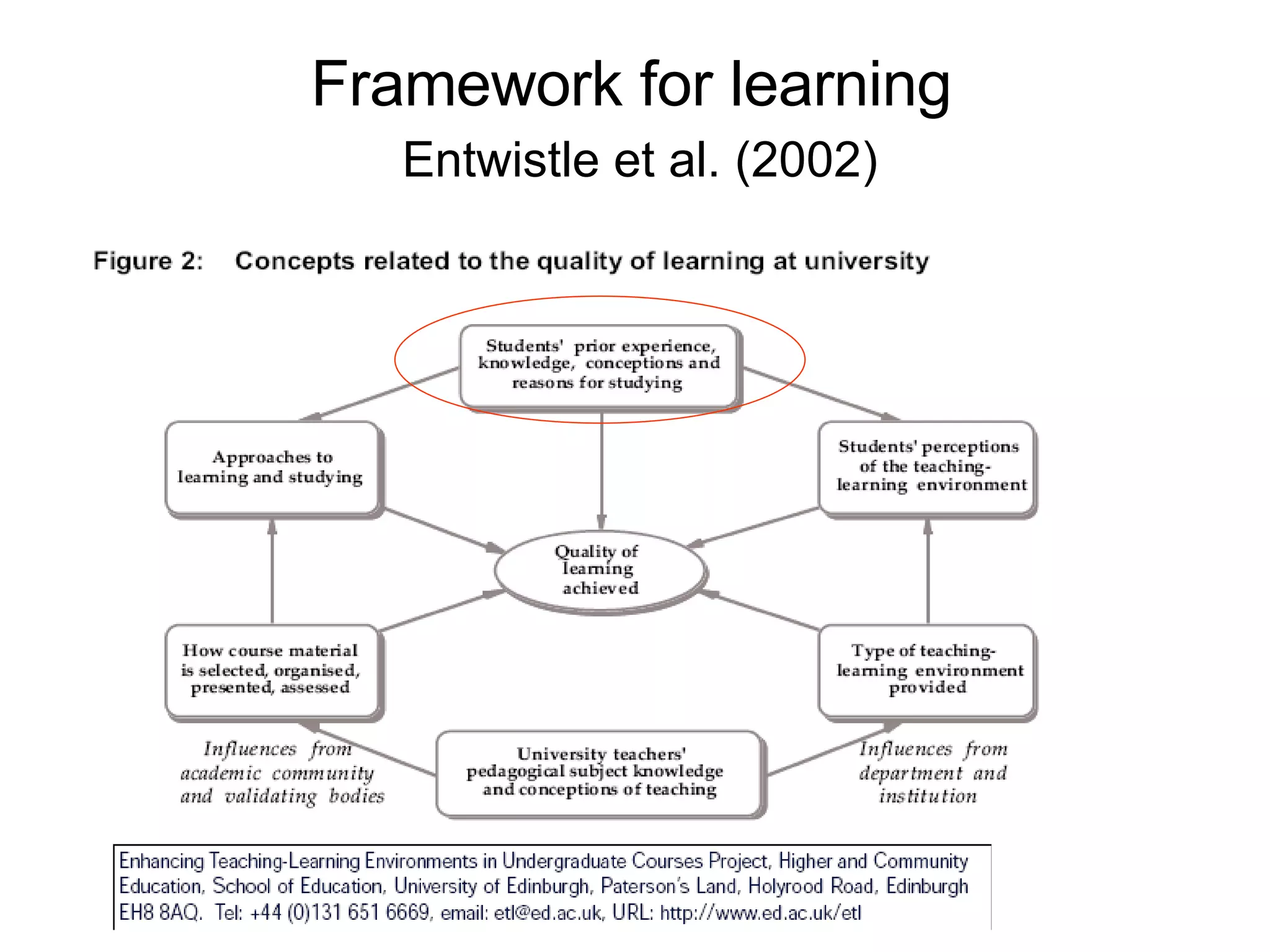
Framework for learning   Entwistle et al. (2002)
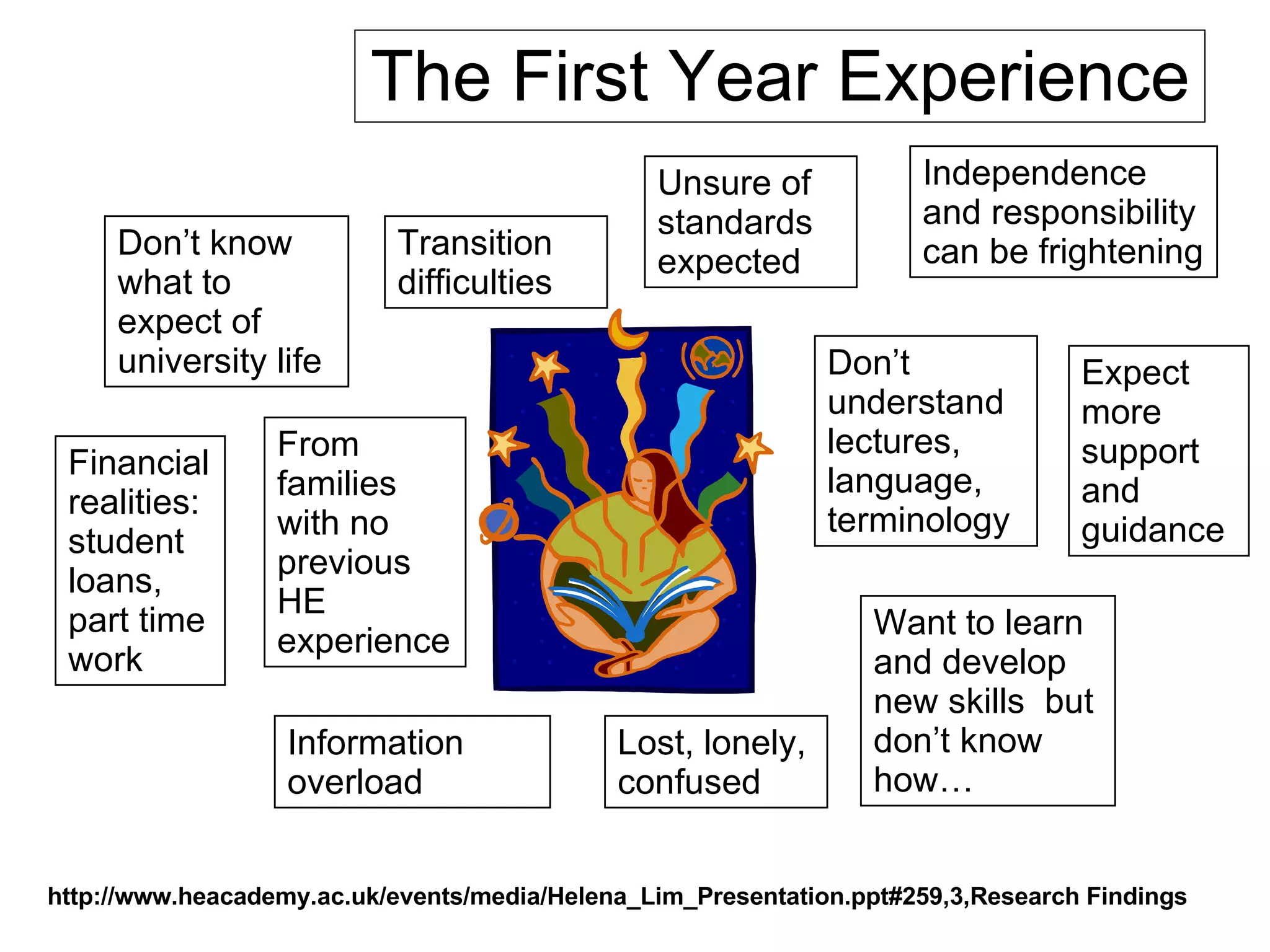
The First Year Experience Lost, lonely, confused Don’t know what to expect of university life Unsure of standards expected Don’t understand lectures, language, terminology Want to learn and develop new skills  but don’t know how… Financial realities: student loans, part time work Transition difficulties From families with no previous HE experience Independence and responsibility can be frightening Expect more support and guidance Information overload http://www.heacademy.ac.uk/events/media/Helena_Lim_Presentation.ppt#259,3,Research Findings
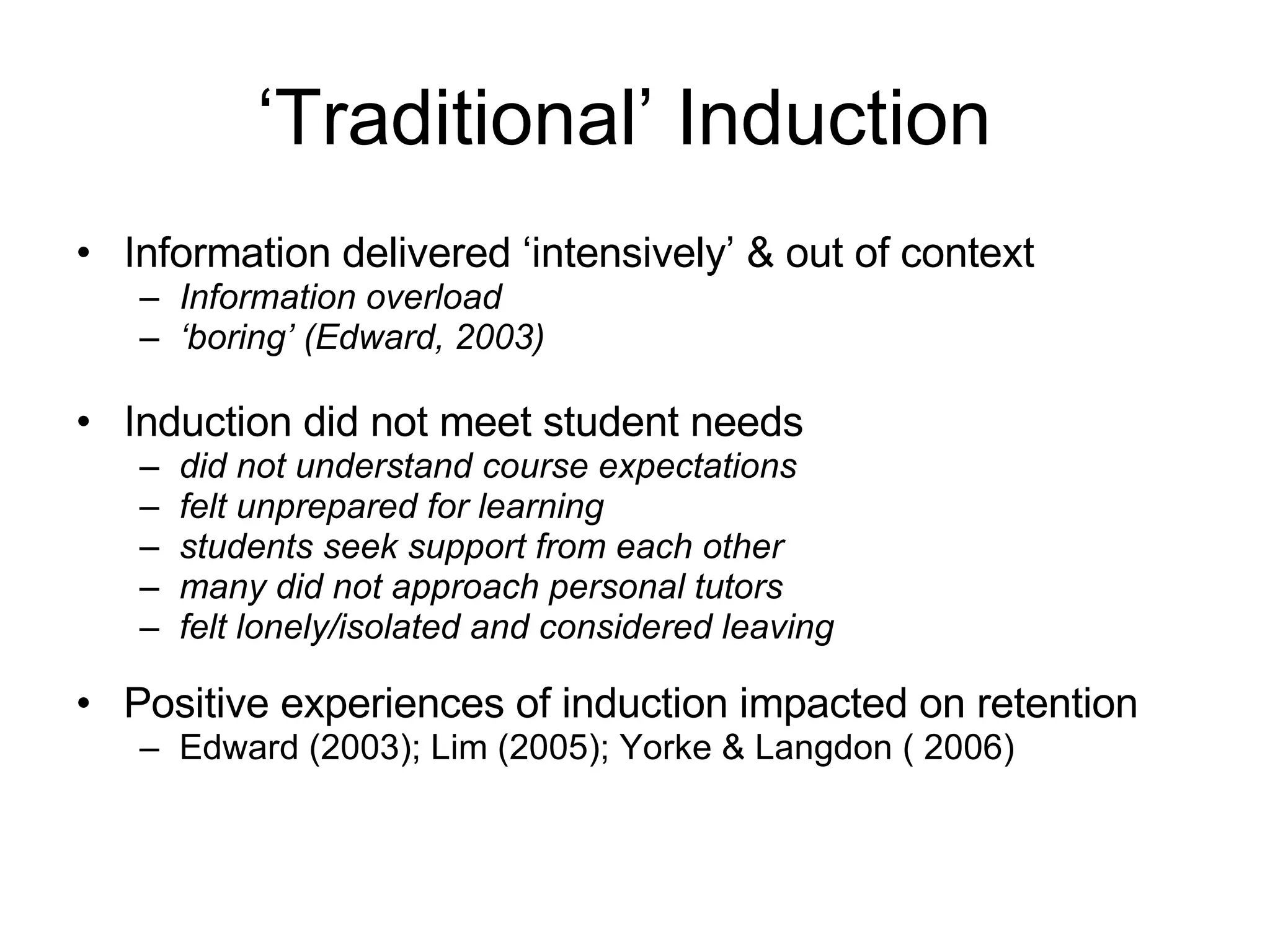
‘ Traditional’ Induction  Information delivered ‘intensively’ & out of context   Information overload ‘ boring’ (Edward, 2003) Induction did not meet student needs did not understand course expectations  felt unprepared for learning students seek support from each other many did not approach personal tutors felt lonely/isolated and considered leaving   Positive experiences of induction impacted on retention Edward (2003); Lim (2005); Yorke & Langdon ( 2006)
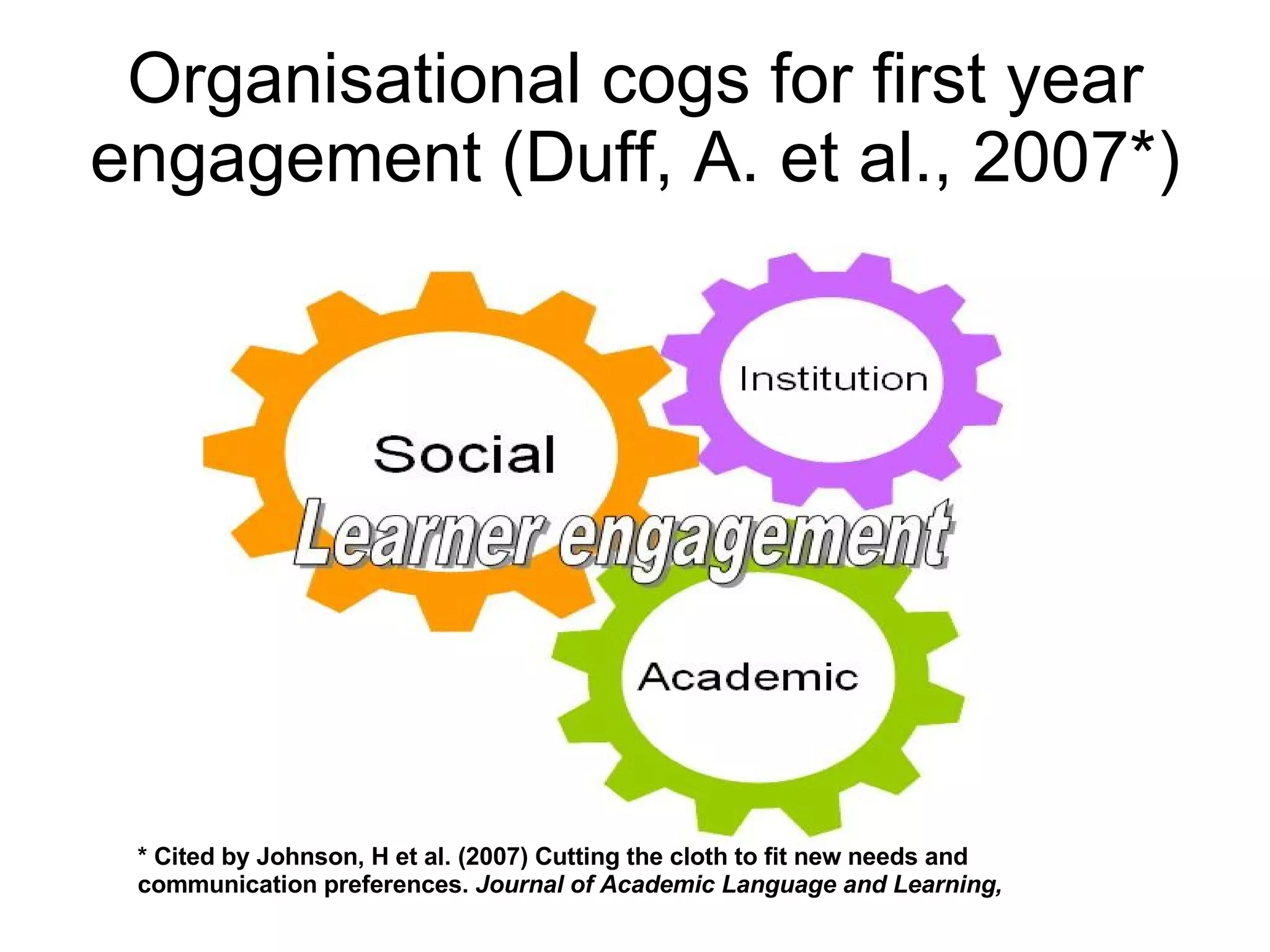
Organisational cogs for first year engagement (Duff, A. et al., 2007*) * Cited by Johnson, H et al. (2007) Cutting the cloth to fit new needs and  communication preferences.  Journal of Academic Language and Learning,
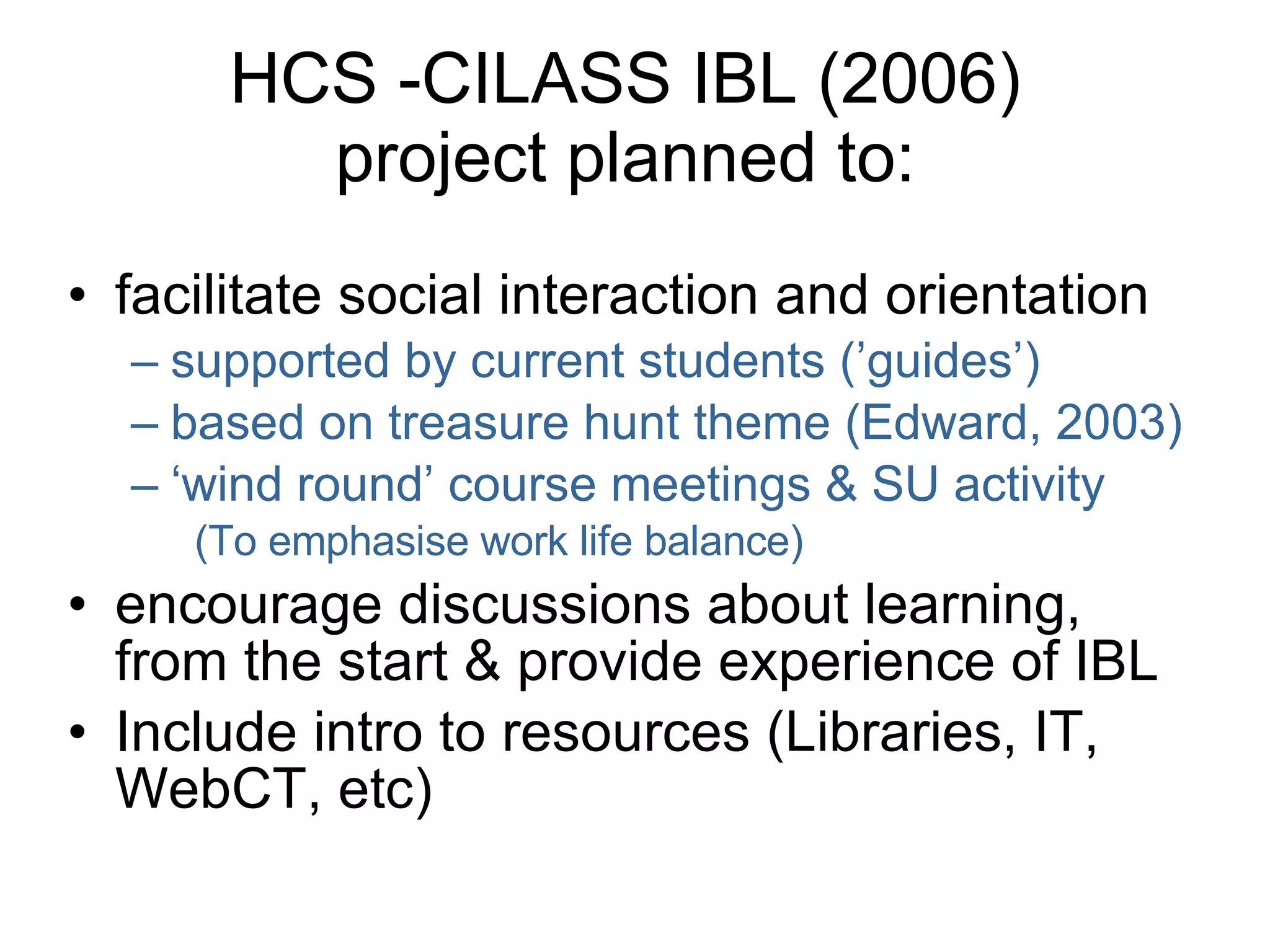
HCS -CILASS IBL (2006)  project planned to:  facilitate social interaction and orientation supported by current students (’guides’) based on treasure hunt theme (Edward, 2003) ‘ wind round’ course meetings & SU activity (To emphasise work life balance) encourage discussions about learning, from the start & provide experience of IBL Include intro to resources (Libraries, IT, WebCT, etc)
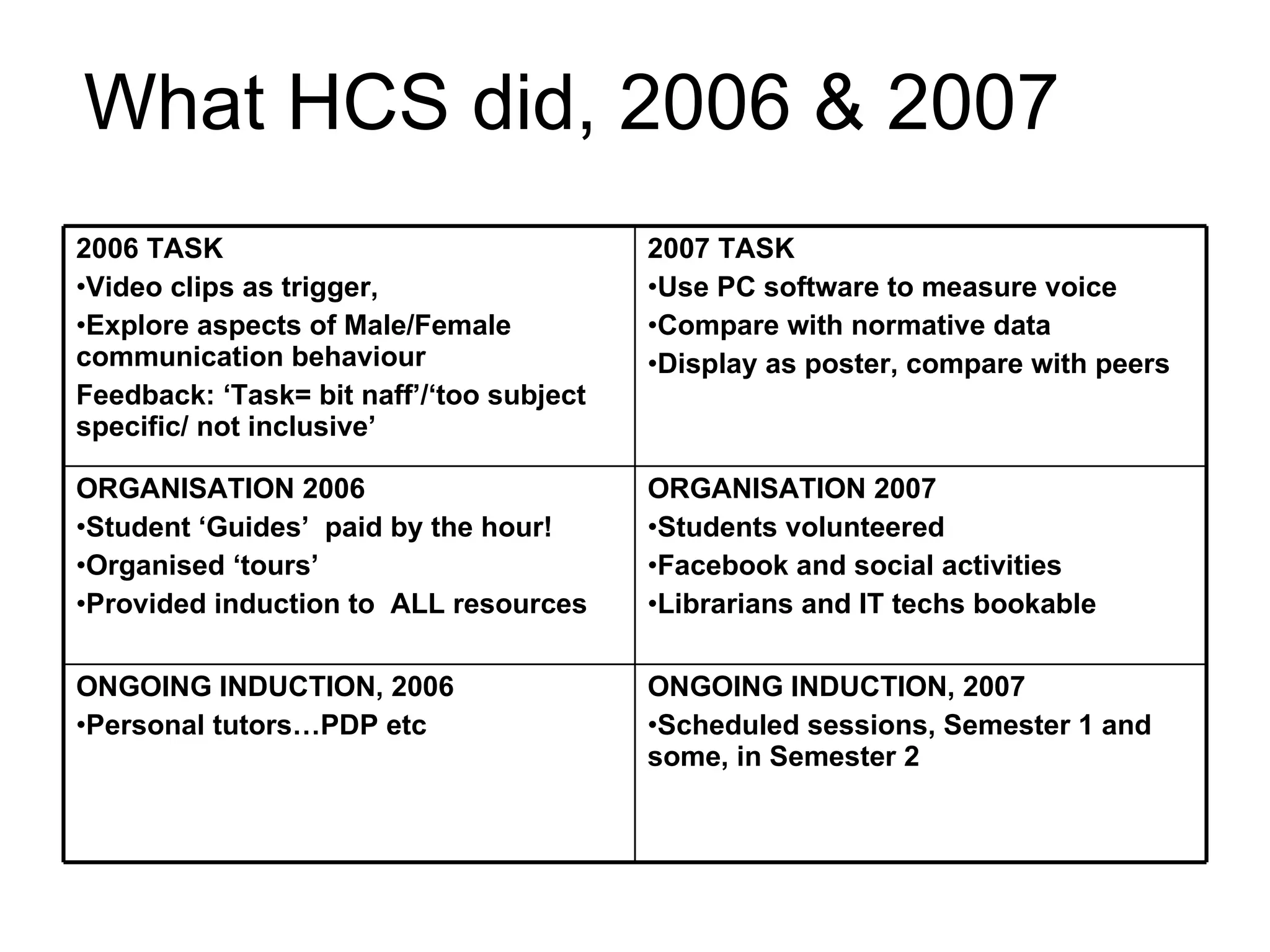
What HCS did, 2006 & 2007 ONGOING INDUCTION, 2007 Scheduled sessions, Semester 1 and some, in Semester 2 ONGOING INDUCTION, 2006 Personal tutors…PDP etc ORGANISATION 2007 Students volunteered Facebook and social activities Librarians and IT techs bookable  ORGANISATION 2006 Student ‘Guides’  paid by the hour! Organised ‘tours’ Provided induction to  ALL resources 2007 TASK Use PC software to measure voice Compare with normative data Display as poster, compare with peers 2006 TASK Video clips as trigger,  Explore aspects of Male/Female communication behaviour Feedback: ‘Task= bit naff’/‘too subject specific/ not inclusive’
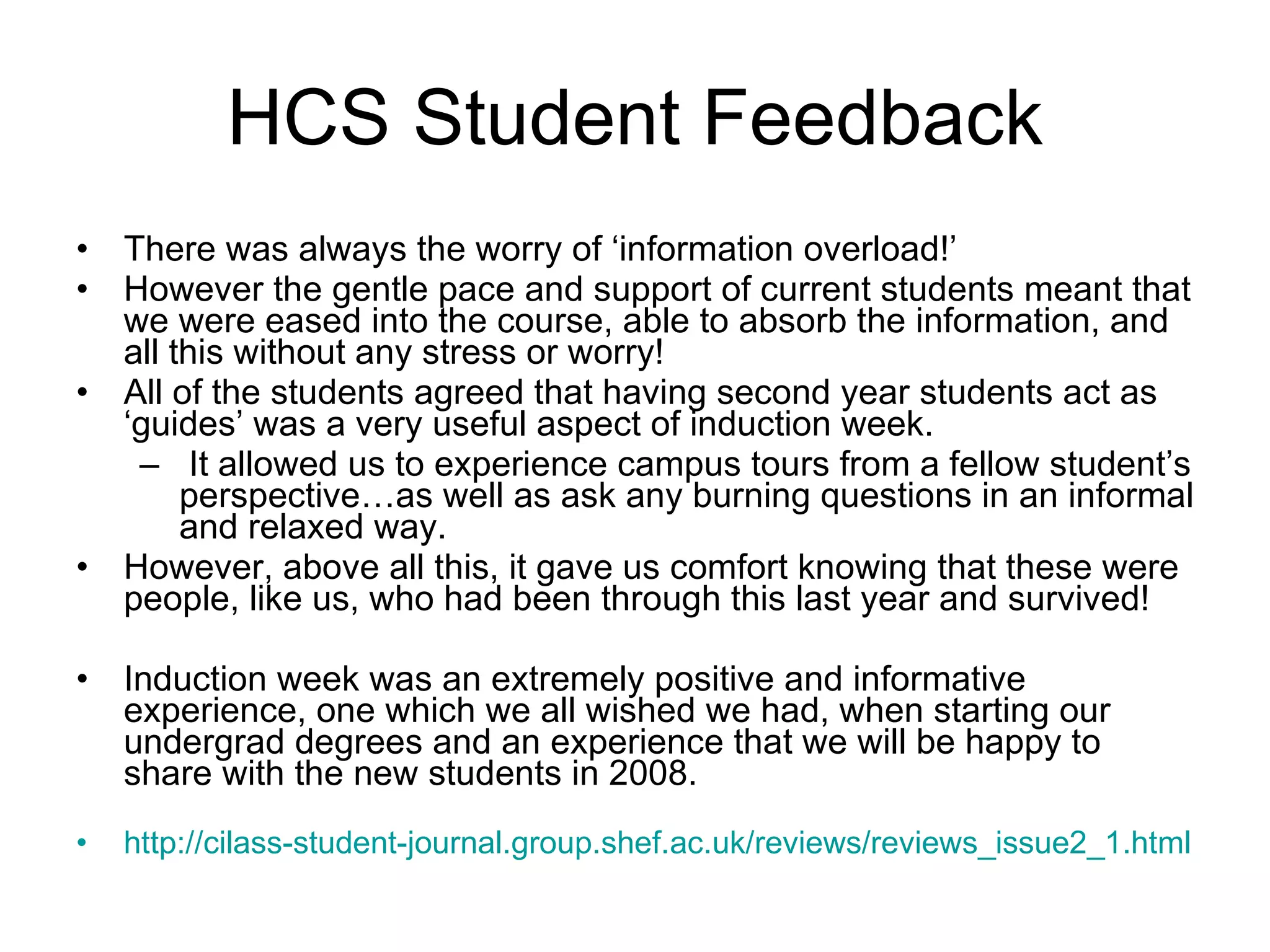
HCS Student Feedback There was always the worry of ‘information overload!’  However the gentle pace and support of current students meant that we were eased into the course, able to absorb the information, and all this without any stress or worry!  All of the students agreed that having second year students act as ‘guides’ was a very useful aspect of induction week. It allowed us to experience campus tours from a fellow student’s perspective…as well as ask any burning questions in an informal and relaxed way.  However, above all this, it gave us comfort knowing that these were people, like us, who had been through this last year and survived!  Induction week was an extremely positive and informative experience, one which we all wished we had, when starting our undergrad degrees and an experience that we will be happy to share with the new students in 2008. http://cilass-student-journal.group.shef.ac.uk/reviews/reviews_issue2_1.html
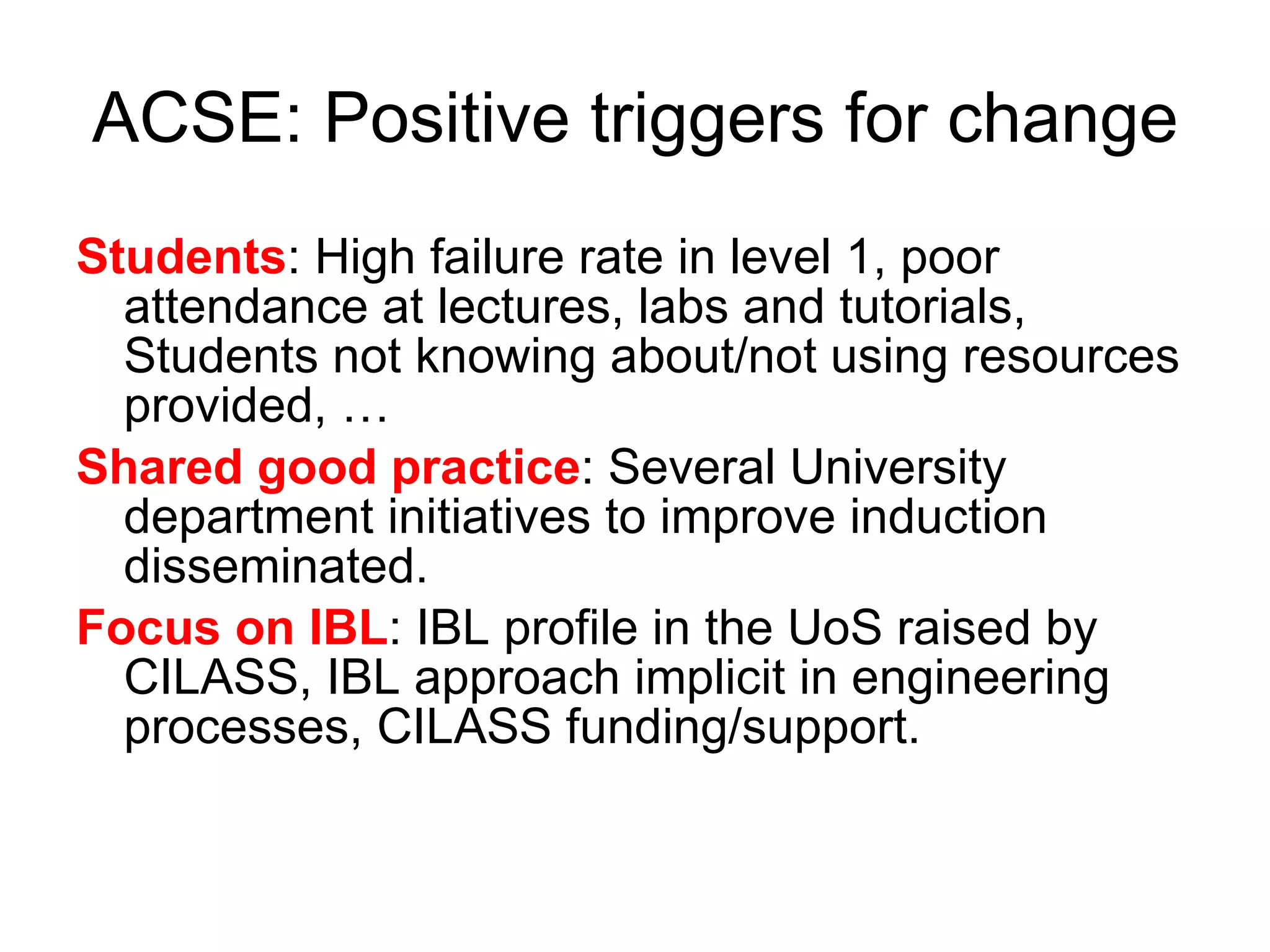
ACSE: Positive triggers for change Students : High failure rate in level 1, poor attendance at lectures, labs and tutorials, Students not knowing about/not using resources provided, … Shared good practice : Several University department initiatives to improve induction disseminated. Focus on IBL : IBL profile in the UoS raised by CILASS, IBL approach implicit in engineering processes, CILASS funding/support.
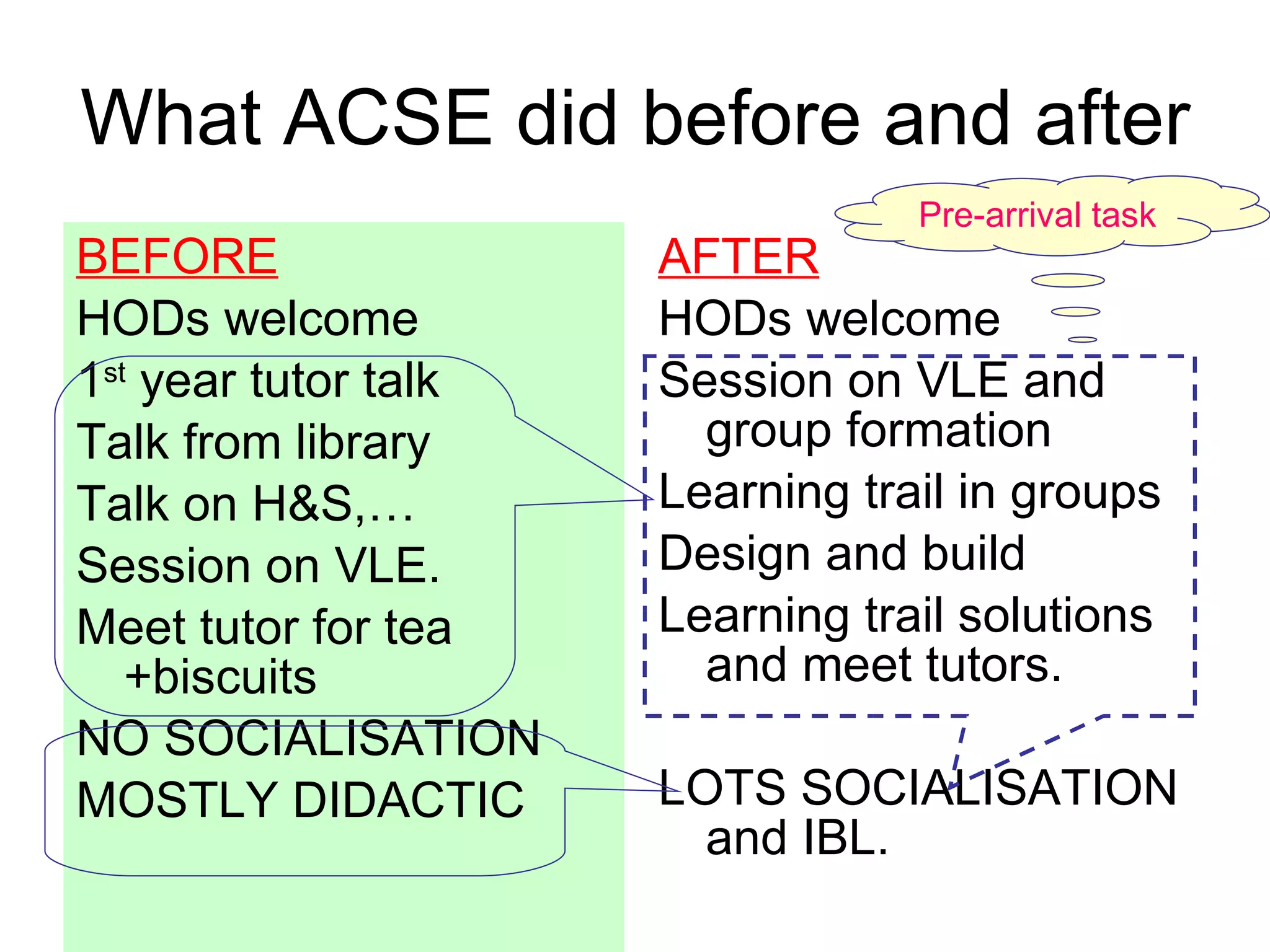
What ACSE did before and after BEFORE HODs welcome 1 st  year tutor talk Talk from library Talk on H&S,… Session on VLE.  Meet tutor for tea+biscuits NO SOCIALISATION MOSTLY DIDACTIC AFTER HODs welcome Session on VLE and group formation Learning trail in groups Design and build Learning trail solutions and meet tutors. LOTS SOCIALISATION and IBL. Pre-arrival task
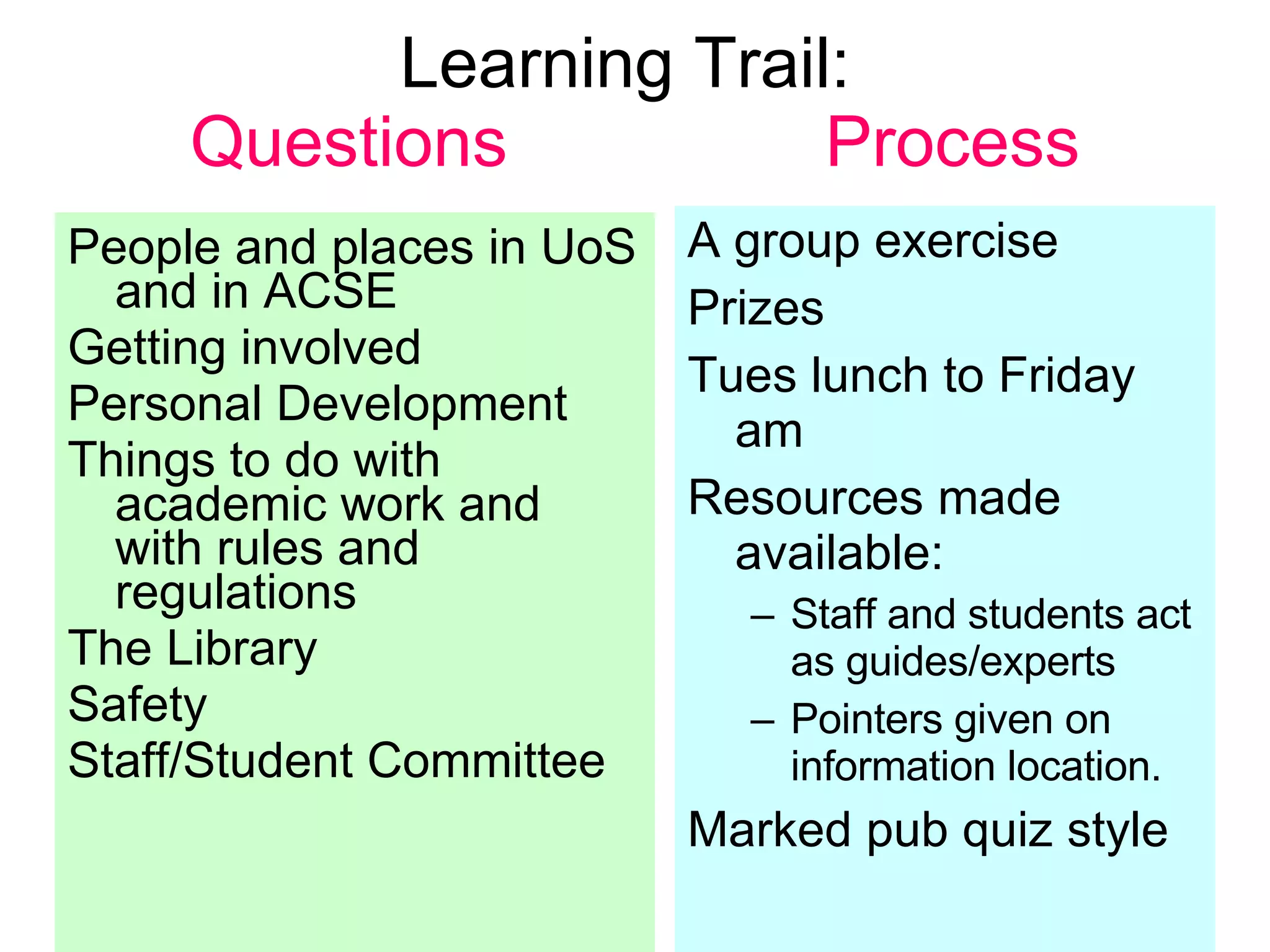
Learning Trail:  Questions   Process People and places in UoS and in ACSE Getting involved Personal Development Things to do with academic work and with rules and regulations The Library Safety Staff/Student Committee A group exercise Prizes Tues lunch to Friday am Resources made available: Staff and students act as guides/experts Pointers given on information location. Marked pub quiz style
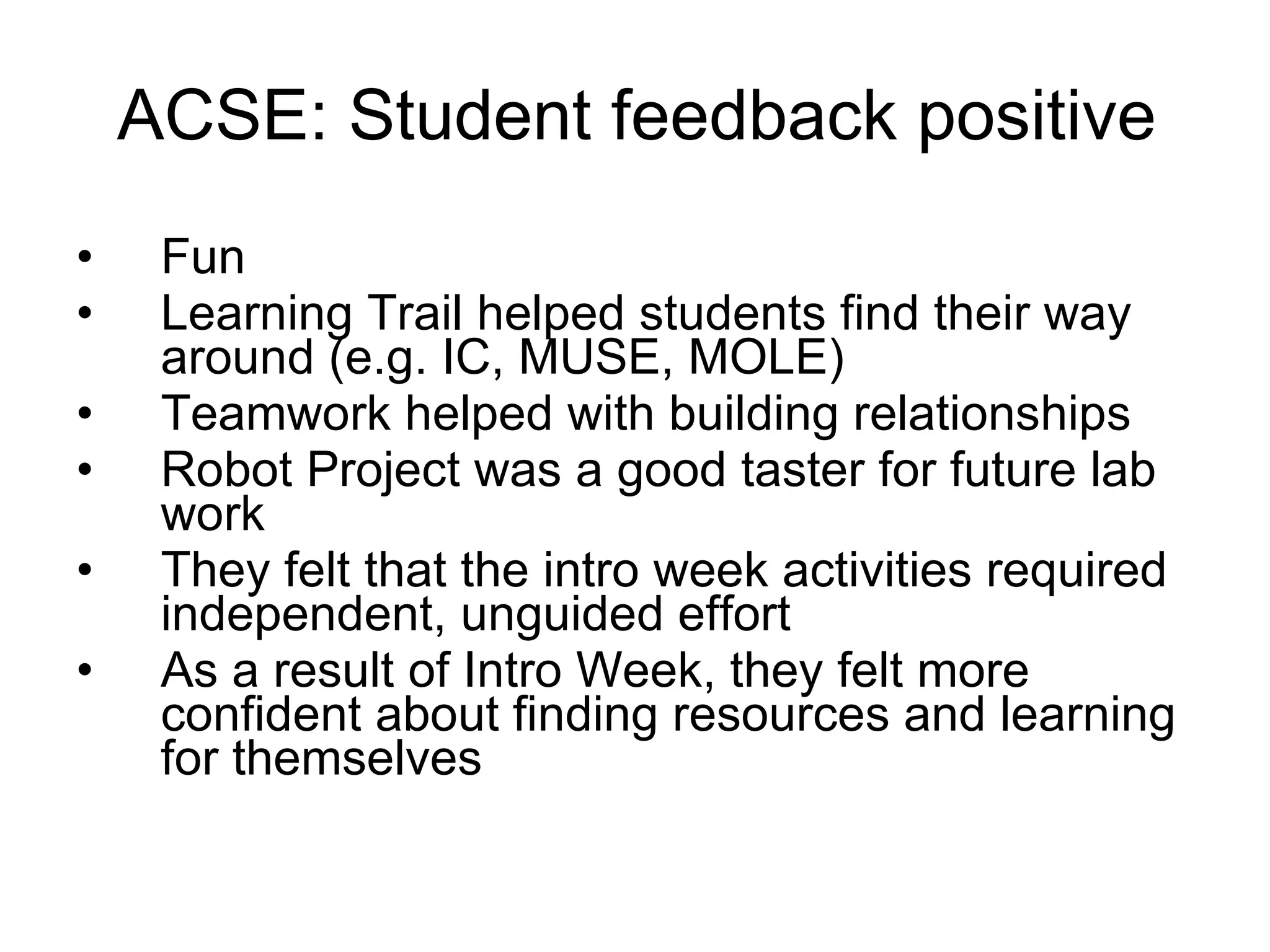
ACSE: Student feedback positive Fun Learning Trail helped students find their way around (e.g. IC, MUSE, MOLE) Teamwork helped with building relationships Robot Project was a good taster for future lab work  They felt that the intro week activities required independent, unguided effort As a result of Intro Week, they felt more confident about finding resources and learning for themselves
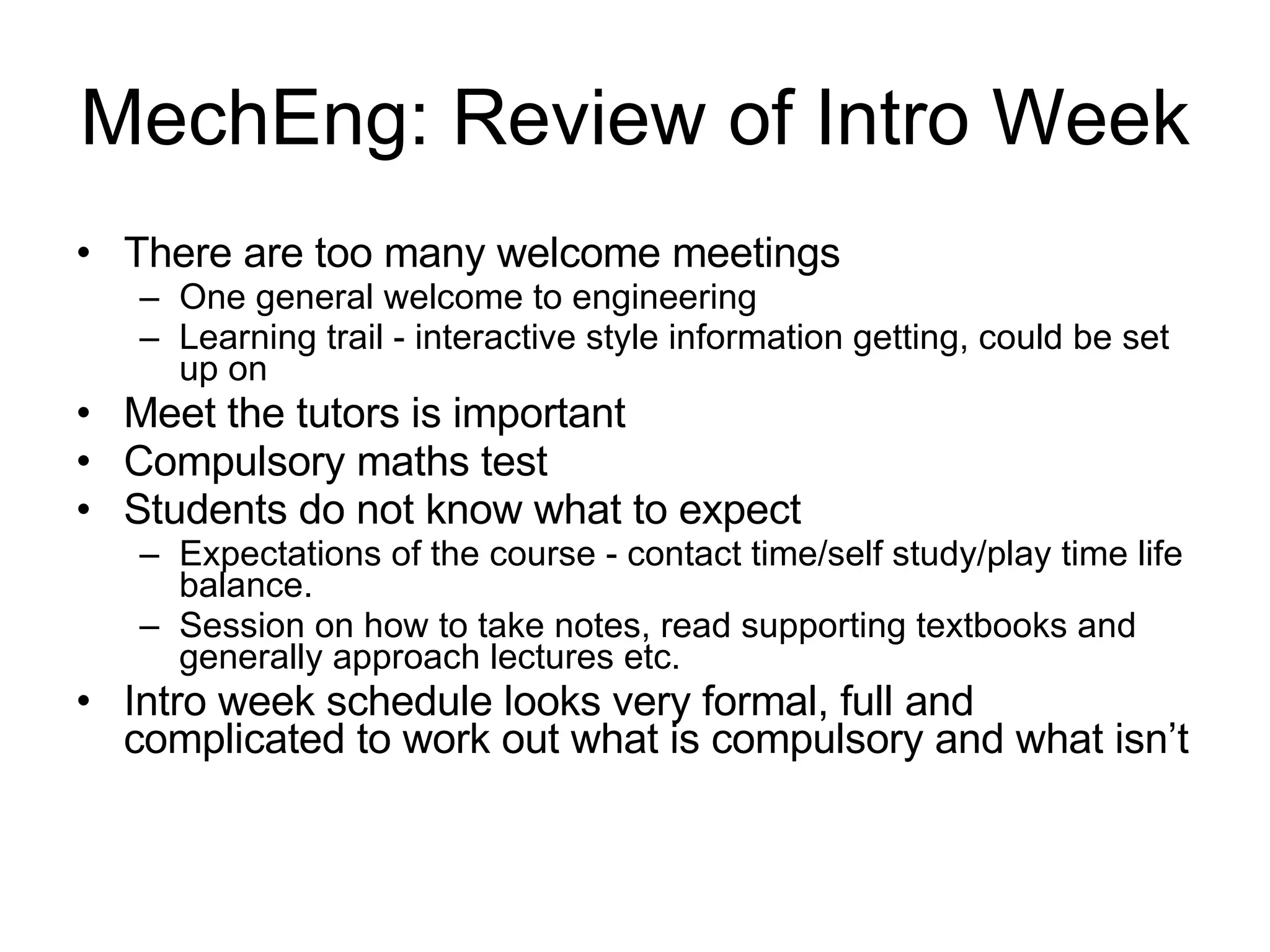
MechEng: Review of Intro Week There are too many welcome meetings One general welcome to engineering Learning trail - interactive style information getting, could be set up on  Meet the tutors is important Compulsory maths test  Students do not know what to expect Expectations of the course - contact time/self study/play time life balance. Session on how to take notes, read supporting textbooks and generally approach lectures etc. Intro week schedule looks very formal, full and complicated to work out what is compulsory and what isn’t
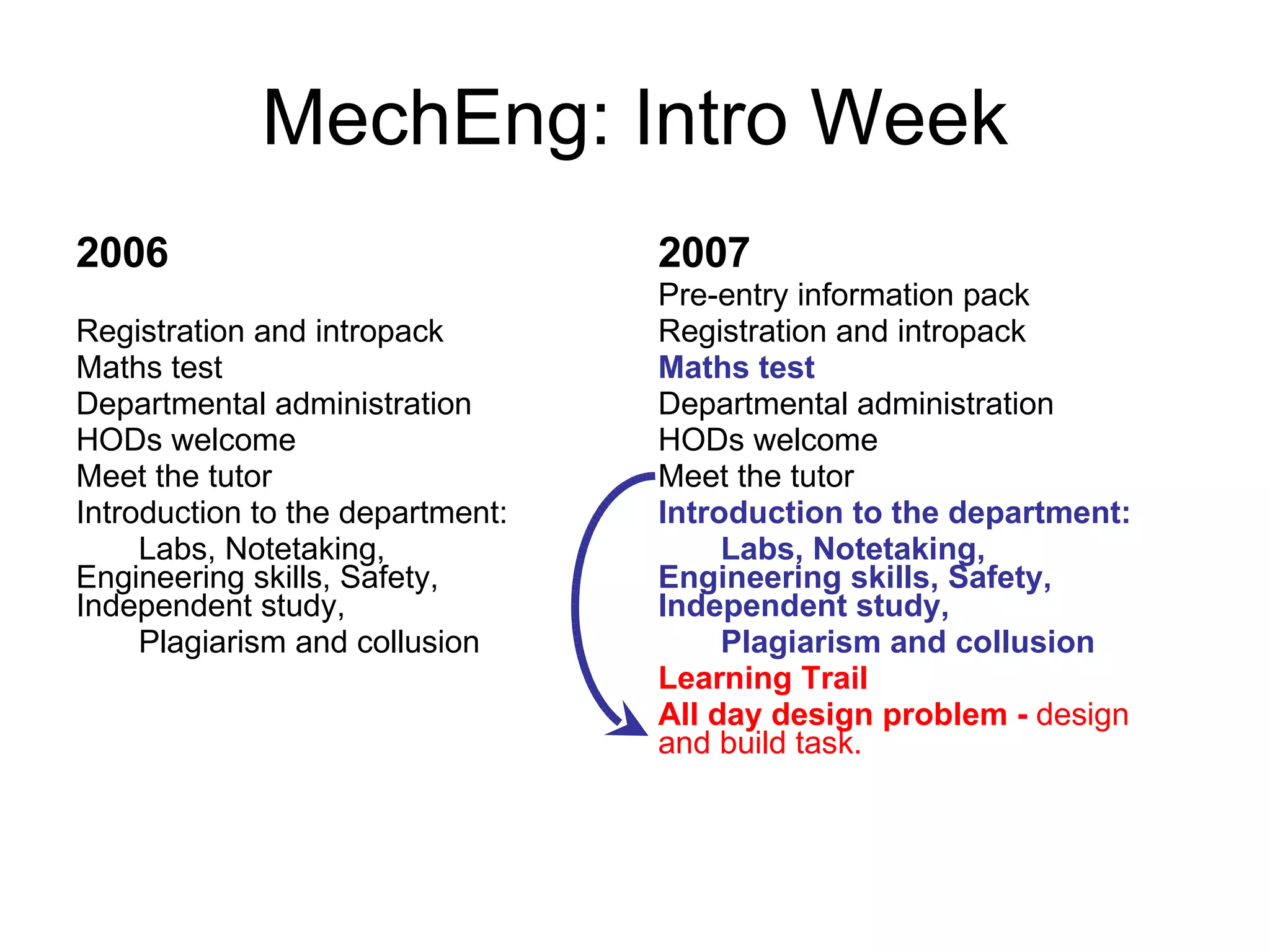
MechEng: Intro Week 2006 Pre-entry information pack Registration and intropack Maths test  Departmental administration  HODs welcome Meet the tutor Introduction to the department:  Labs, Notetaking,  Engineering skills, Safety,  Independent study,  Plagiarism and collusion Learning Trail All day design problem - design and build task. Within task students meet their tutor  2007 Pre-entry information pack Registration and intropack Maths test   Departmental administration  HODs welcome Meet the tutor Introduction to the department:  Labs, Notetaking,  Engineering skills, Safety,  Independent study,  Plagiarism and collusion Learning Trail All day design problem -  design and build task.
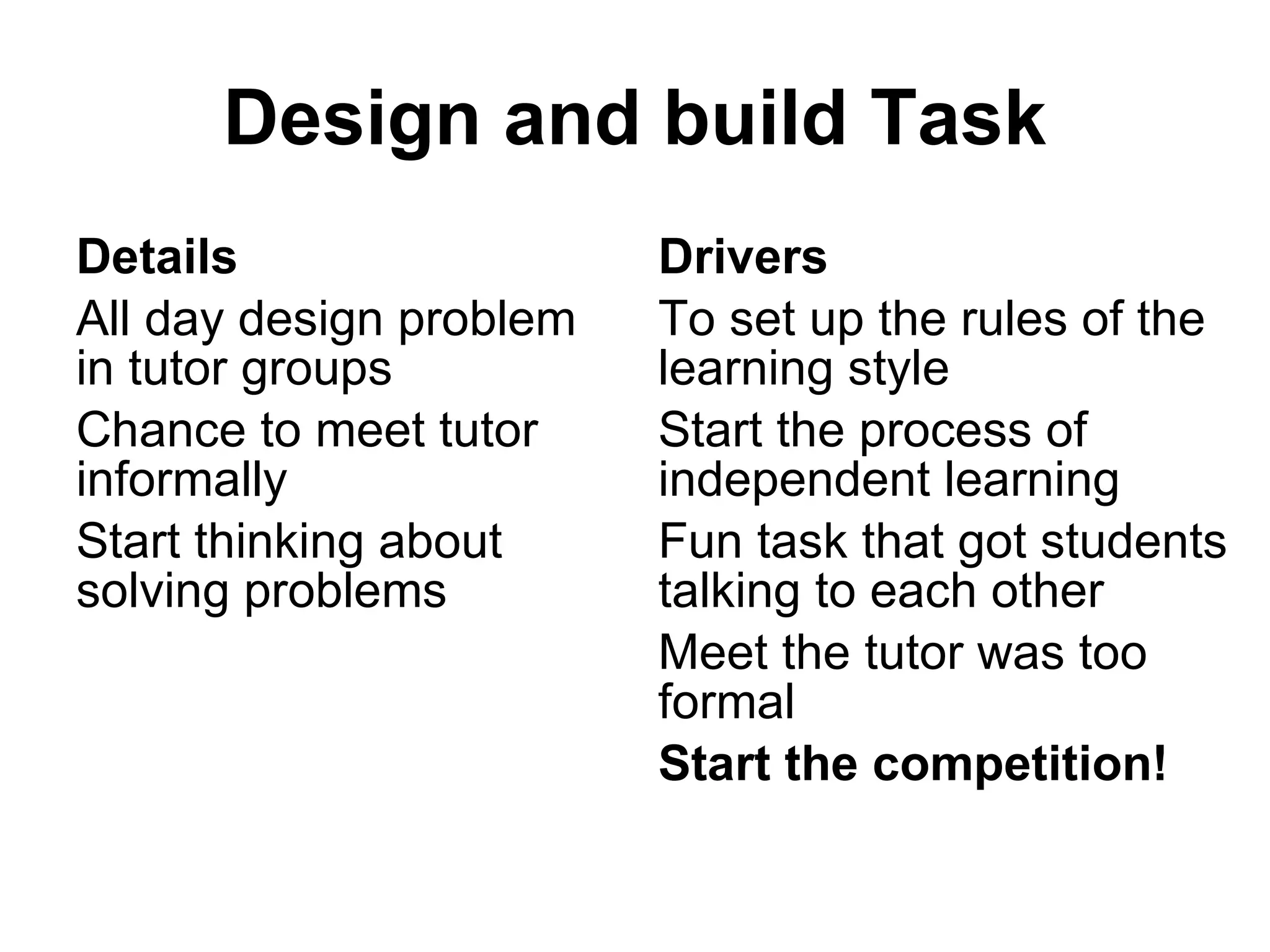
Design and build Task Details All day design problem in tutor groups Chance to meet tutor informally Start thinking about solving problems  Drivers To set up the rules of the learning style  Start the process of independent learning  Fun task that got students talking to each other Meet the tutor was too formal Start the competition!
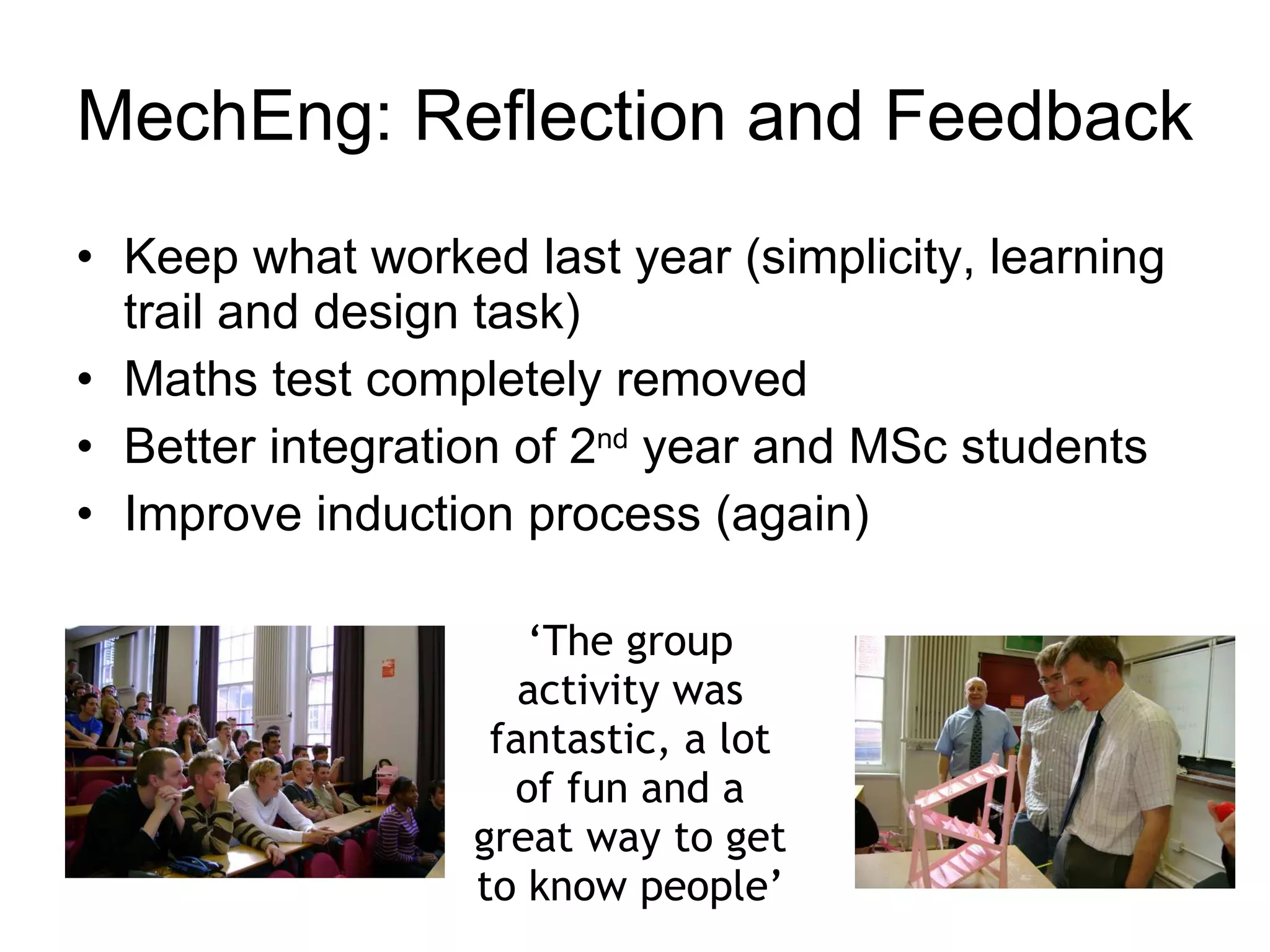
MechEng: Reflection and Feedback Keep what worked last year (simplicity, learning trail and design task) Maths test completely removed Better integration of 2 nd  year and MSc students  Improve induction process (again) ‘ The group activity was fantastic, a lot of fun and a great way to get to know people’
References Edward, N (2003)  “First impressions last: an innovative approach to induction”,  Active Learning in Higher Education , Vol. 4 No. 3, pp. 226-41 Entwistle, N., McCune, V. & Hounsell, J. (2002) Approaches to Studying and Perceptions of University Teaching-Learning Environments: Concepts, Measures and Preliminary Findings. http://www.tlrparchive.org/cgibin/search_oai_all.pl?pn=11&no_menu=1&short_menu=1 Johnson, H et al. (2007) Cutting the cloth to fit new needs and communication preferences.  Journal of Academic Language and Learning (available via Google) Lim. H (2005)  Innovations in the First Year Experience @ SSU http://www.heacademy.ac.uk/events/media/Helena_Lim_Presentation.ppt# Yorke, M., Longdon, B (2007)  The first-year experience in higher education in the UK. HEA Report http://www.heacademy.ac.uk/assets/York/documents/ourwork/research/FYE/web0573_the_first_year_experience.pdf

Intro Week Induction and Inquiry-based Learning: Varying Approaches

  • 1.
    Intro Week Inductionand Inquiry-based Learning: Varying Approaches L Gray, A Rossiter, J Rowson, M Freeman, M Morley UNIVERSITY OF SHEFFIELD
  • 2.
    Background Influences on initial plans: Frameworks for learning Entwistle et al. 2002 First Year Experience Lim, 2005; Yorke & Langden, 2006; Harvey, 2006 Enabling students to cope with complexity Gamache, 2002; Keenan, 2005 The changing concept of induction Edward, 2003; Laing et al, 2005; Wingate, 2007 Our ‘local’ experience Student feedback ‘ too much information’ ‘ lost in a crowd’ ‘ Need to find my way around’
  • 3.
    Framework for learning Entwistle et al. (2002)
  • 4.
    The First YearExperience Lost, lonely, confused Don’t know what to expect of university life Unsure of standards expected Don’t understand lectures, language, terminology Want to learn and develop new skills but don’t know how… Financial realities: student loans, part time work Transition difficulties From families with no previous HE experience Independence and responsibility can be frightening Expect more support and guidance Information overload http://www.heacademy.ac.uk/events/media/Helena_Lim_Presentation.ppt#259,3,Research Findings
  • 5.
    ‘ Traditional’ Induction Information delivered ‘intensively’ & out of context Information overload ‘ boring’ (Edward, 2003) Induction did not meet student needs did not understand course expectations felt unprepared for learning students seek support from each other many did not approach personal tutors felt lonely/isolated and considered leaving Positive experiences of induction impacted on retention Edward (2003); Lim (2005); Yorke & Langdon ( 2006)
  • 6.
    Organisational cogs forfirst year engagement (Duff, A. et al., 2007*) * Cited by Johnson, H et al. (2007) Cutting the cloth to fit new needs and communication preferences. Journal of Academic Language and Learning,
  • 7.
    HCS -CILASS IBL(2006) project planned to: facilitate social interaction and orientation supported by current students (’guides’) based on treasure hunt theme (Edward, 2003) ‘ wind round’ course meetings & SU activity (To emphasise work life balance) encourage discussions about learning, from the start & provide experience of IBL Include intro to resources (Libraries, IT, WebCT, etc)
  • 8.
    What HCS did,2006 & 2007 ONGOING INDUCTION, 2007 Scheduled sessions, Semester 1 and some, in Semester 2 ONGOING INDUCTION, 2006 Personal tutors…PDP etc ORGANISATION 2007 Students volunteered Facebook and social activities Librarians and IT techs bookable ORGANISATION 2006 Student ‘Guides’ paid by the hour! Organised ‘tours’ Provided induction to ALL resources 2007 TASK Use PC software to measure voice Compare with normative data Display as poster, compare with peers 2006 TASK Video clips as trigger, Explore aspects of Male/Female communication behaviour Feedback: ‘Task= bit naff’/‘too subject specific/ not inclusive’
  • 9.
    HCS Student FeedbackThere was always the worry of ‘information overload!’ However the gentle pace and support of current students meant that we were eased into the course, able to absorb the information, and all this without any stress or worry! All of the students agreed that having second year students act as ‘guides’ was a very useful aspect of induction week. It allowed us to experience campus tours from a fellow student’s perspective…as well as ask any burning questions in an informal and relaxed way. However, above all this, it gave us comfort knowing that these were people, like us, who had been through this last year and survived! Induction week was an extremely positive and informative experience, one which we all wished we had, when starting our undergrad degrees and an experience that we will be happy to share with the new students in 2008. http://cilass-student-journal.group.shef.ac.uk/reviews/reviews_issue2_1.html
  • 10.
    ACSE: Positive triggersfor change Students : High failure rate in level 1, poor attendance at lectures, labs and tutorials, Students not knowing about/not using resources provided, … Shared good practice : Several University department initiatives to improve induction disseminated. Focus on IBL : IBL profile in the UoS raised by CILASS, IBL approach implicit in engineering processes, CILASS funding/support.
  • 11.
    What ACSE didbefore and after BEFORE HODs welcome 1 st year tutor talk Talk from library Talk on H&S,… Session on VLE. Meet tutor for tea+biscuits NO SOCIALISATION MOSTLY DIDACTIC AFTER HODs welcome Session on VLE and group formation Learning trail in groups Design and build Learning trail solutions and meet tutors. LOTS SOCIALISATION and IBL. Pre-arrival task
  • 12.
    Learning Trail: Questions Process People and places in UoS and in ACSE Getting involved Personal Development Things to do with academic work and with rules and regulations The Library Safety Staff/Student Committee A group exercise Prizes Tues lunch to Friday am Resources made available: Staff and students act as guides/experts Pointers given on information location. Marked pub quiz style
  • 13.
    ACSE: Student feedbackpositive Fun Learning Trail helped students find their way around (e.g. IC, MUSE, MOLE) Teamwork helped with building relationships Robot Project was a good taster for future lab work They felt that the intro week activities required independent, unguided effort As a result of Intro Week, they felt more confident about finding resources and learning for themselves
  • 14.
    MechEng: Review ofIntro Week There are too many welcome meetings One general welcome to engineering Learning trail - interactive style information getting, could be set up on Meet the tutors is important Compulsory maths test Students do not know what to expect Expectations of the course - contact time/self study/play time life balance. Session on how to take notes, read supporting textbooks and generally approach lectures etc. Intro week schedule looks very formal, full and complicated to work out what is compulsory and what isn’t
  • 15.
    MechEng: Intro Week2006 Pre-entry information pack Registration and intropack Maths test Departmental administration HODs welcome Meet the tutor Introduction to the department: Labs, Notetaking, Engineering skills, Safety, Independent study, Plagiarism and collusion Learning Trail All day design problem - design and build task. Within task students meet their tutor 2007 Pre-entry information pack Registration and intropack Maths test Departmental administration HODs welcome Meet the tutor Introduction to the department: Labs, Notetaking, Engineering skills, Safety, Independent study, Plagiarism and collusion Learning Trail All day design problem - design and build task.
  • 16.
    Design and buildTask Details All day design problem in tutor groups Chance to meet tutor informally Start thinking about solving problems Drivers To set up the rules of the learning style Start the process of independent learning Fun task that got students talking to each other Meet the tutor was too formal Start the competition!
  • 17.
    MechEng: Reflection andFeedback Keep what worked last year (simplicity, learning trail and design task) Maths test completely removed Better integration of 2 nd year and MSc students Improve induction process (again) ‘ The group activity was fantastic, a lot of fun and a great way to get to know people’
  • 18.
    References Edward, N(2003) “First impressions last: an innovative approach to induction”, Active Learning in Higher Education , Vol. 4 No. 3, pp. 226-41 Entwistle, N., McCune, V. & Hounsell, J. (2002) Approaches to Studying and Perceptions of University Teaching-Learning Environments: Concepts, Measures and Preliminary Findings. http://www.tlrparchive.org/cgibin/search_oai_all.pl?pn=11&no_menu=1&short_menu=1 Johnson, H et al. (2007) Cutting the cloth to fit new needs and communication preferences. Journal of Academic Language and Learning (available via Google) Lim. H (2005) Innovations in the First Year Experience @ SSU http://www.heacademy.ac.uk/events/media/Helena_Lim_Presentation.ppt# Yorke, M., Longdon, B (2007) The first-year experience in higher education in the UK. HEA Report http://www.heacademy.ac.uk/assets/York/documents/ourwork/research/FYE/web0573_the_first_year_experience.pdf