Ne Le rningSp c sfo Ne
  w a         ae r w
Mo e o Le rninga
  ds f a        nd
Te c
  a hing
BBSLG Annual Conference
Leeds, 10th July 2008

Philippa Levy

w w
 w .shef.,ac.uk/cilass
• Inquiry-based learning   2

          • Web 2.0
          • Information Com ons
                            m

Ove w
   rvie     and inquiry
            collaboratories
          • Learning partnerships
3


    Inquiry
•   The core of inquiry is the
    QUESTION –generating a
    process of discovery

•   “ action of s e e king , especially
     The
    (nowalw   ays) for truth, know ledge
    or inform ation concerning
    som  ething; search, research,
    investigation, exam   ination”(OED)

•    Student-led exploration,
     investigation, research
    •    Cas e - and pro ble m -bas e d
         le arning
    •    Expe rie ntial le arning
    •    Re s e arc h pro je c ts          ‘
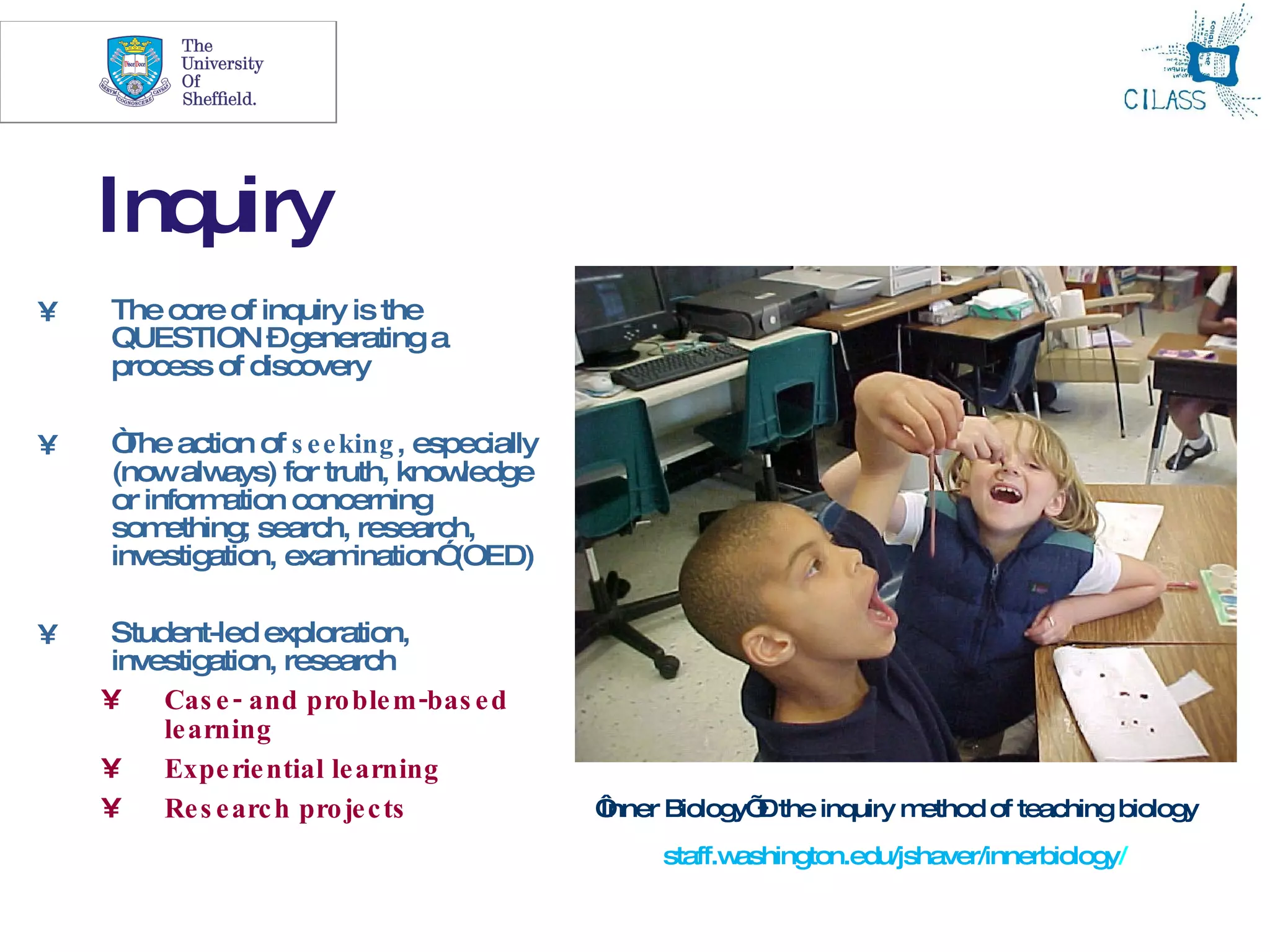
                                           Inner Biology’ the inquiry m
                                                         –             ethod of teaching biology
                                                staff.washington.edu/jshaver/innerbiology/
4
                    IBL invo s
                            lve
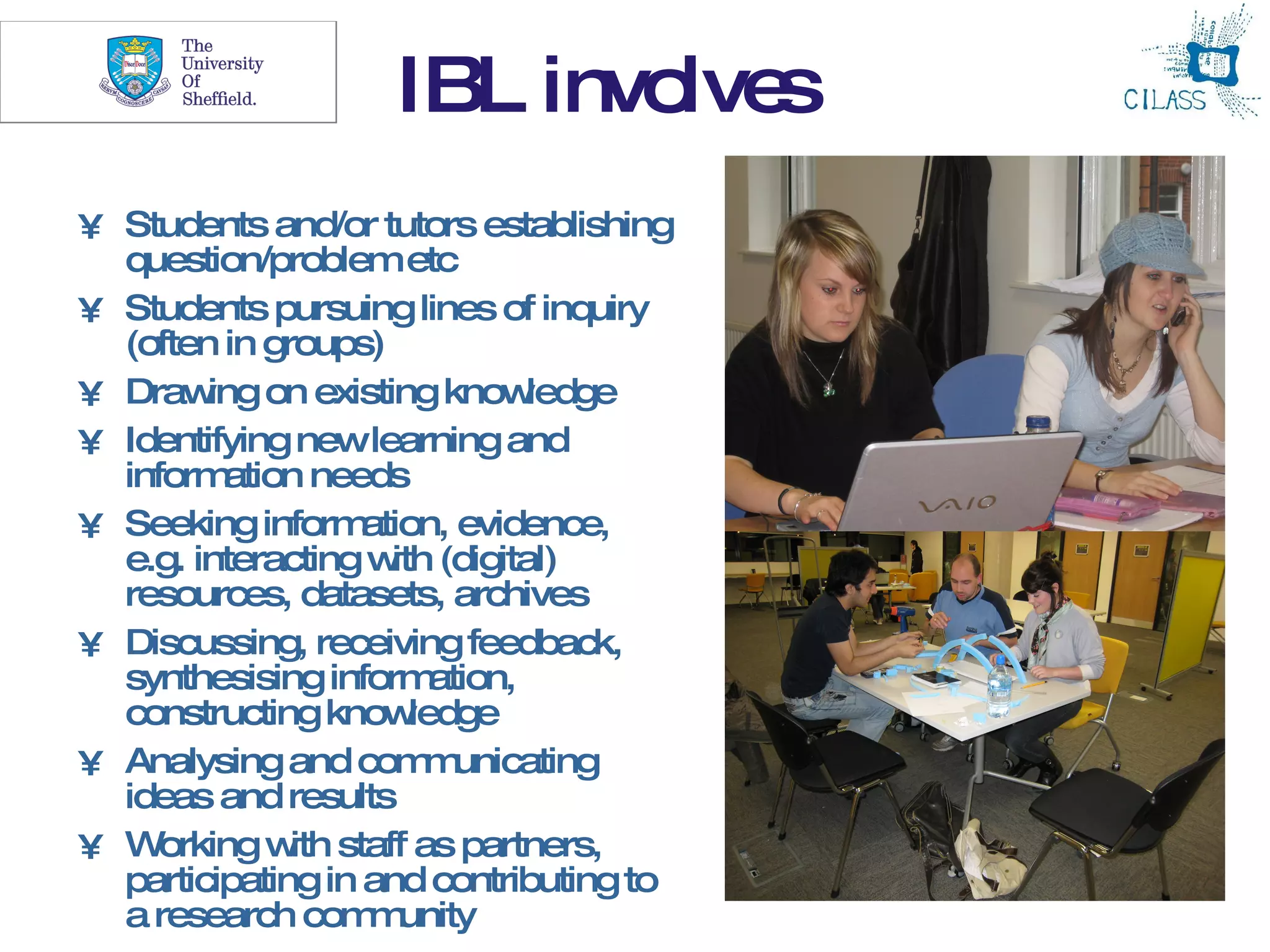
• Students and/or tutors establishing
  question/problem etc
• Students pursuing lines of inquiry
  (often in groups)
• Draw on existing know
        ing                     ledge
• Identifying newlearning and
  inform ation needs
• Seeking inform   ation, evidence,
  e.g. interacting w (digital)
                     ith
  resources, datasets, archives
• Discussing, receiving feedback,
  synthesising inform    ation,
  constructing know    ledge
• Analysing and com unicating
                        m
  ideas and results
• W  orking w staff as partners,
              ith
  participating in and contributing to
  a research com unity
                   m
5


Inq uiring W b2
          , e .0
le rne
  a rs
• Ow  ning and directing their
  experience
• Participating, collaborating,
  social netw  orking
• Producing and co-creating -
  generating, repurposing and
  sharing content
• Accessing m   ultiple sources
• Using a w variety of tools
             ide
  and environm   ents
• Creating personal learning
  netw orks and environm    ents
• Learning 2.0: ‘ passion-based
  learning’ (John Seely Brow   n,
  2008)                             Source: www.deitel.com
6


  W inq
   hy uiry-b s dle rning(IBL)?
            ae a
• Active and deep engagem      ent
  w m
    ith essy, authentic
  questions and problem     s
• Experiencing ‘  supercom   plexity’
  and understanding how
  know  ledge is created
• Social participation,
  em  ploym ent, lifelong learning
• Strengthening the research-
  teaching nexus in universities
• A strategic focus for University
  of Sheffield
7


An inte ra dvis n o HE
       g te    io f
“ purpose of teaching [… ] becom to induct
 The                                  es
students into various form of inquiry so that individuals
                           s
are able to live in a complex, uncertain w orld where
know howto inquire is key to survival. W are looking
     ing                                       e
towards a higher education w   here inquiry can becom e
centre stage for both academ and students”
                               ics               (Brew,
2006)

“ pedagogy of joint discovery”
A                             (Barnett, 2007: 159)
8


• “ hat I liked about [IBL] w that I got to do - I m
   W                              as                        ean I
  w freer in a w
    as                ay. [...] I built m ow argum
                                         y n            ents, and
  that w really, really good for m I re ally e njo ye d
         as                              e.
  that, be c aus e it was fre e [...] I don’think you can do
                                            t
  that to the sam extent in an essay because that m
                     e                                        ode
  often is a set question that you have to have –of course
  you can say if you agree or not agree to w it states,
                                                   hat
  but the question is often based on certain concepts or
  certain theories, w   hile in this [inquiry ] pro je c t we
  c o uld c ho o s e o ur appo ro ac h by o urs e lve s . That was
  re ally g o o d”.

• “think doing som
   I                    ething that, this is your project, do w hat
  you w w it, it’s s c ary but […] it’s my , my thing
        ant ith
  […] I fe e l like a g ro wn -up pe rs o n, going into [the
  research field], I like being able to do your ow thing”
                                                      n       .
                    ‘Discovery’  inquiry projects
9
10


 CILASS IBL fra e o
               m w rk
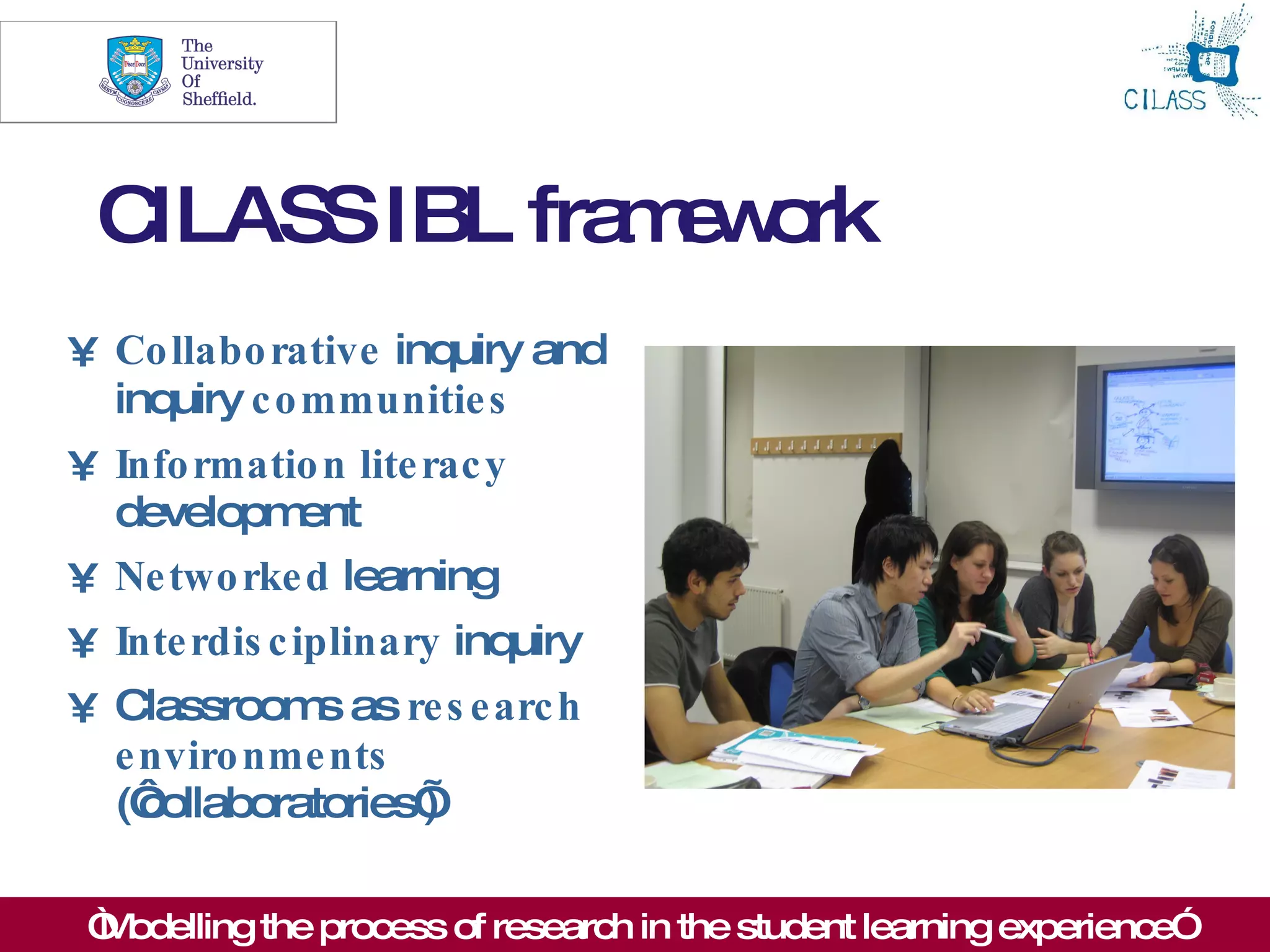
• Co llabo rative inquiry and
  inquiry c o mmunitie s
• Info rmatio n lite rac y
  developm  ent
• Ne two rke d learning
• Inte rdis c iplinary inquiry
• Classroom as re s e arc h
              s
  e nviro nme nts
  (‘collaboratories’
                   )

 “ odelling the process of research in the student learning experience”
 M
11


                   ‘ e ta ingLa ’
                   Und rs nd   w
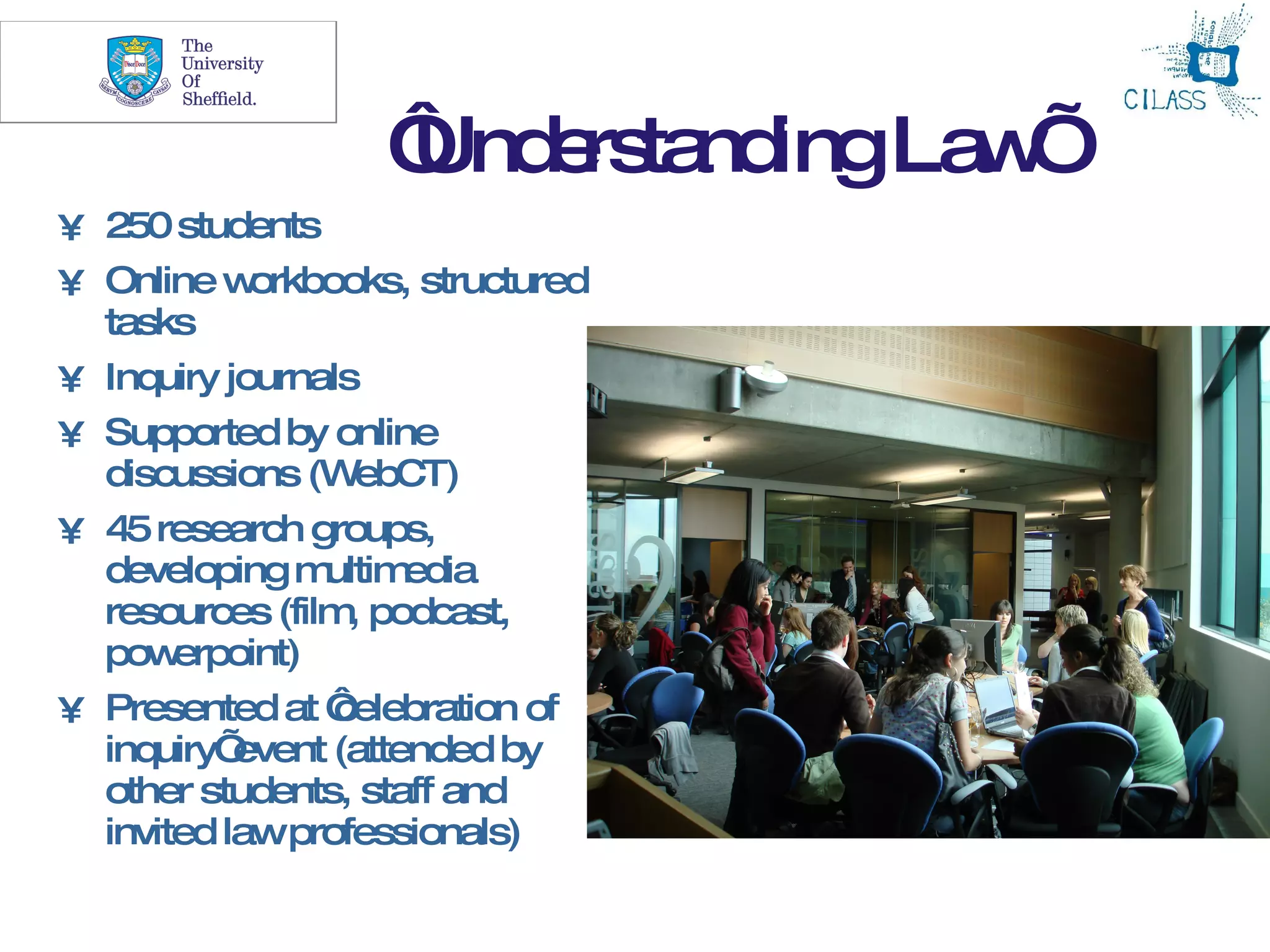
• 250 students
• Online w  orkbooks, structured
  tasks
• Inquiry journals
• Supported by online
  discussions (W  ebCT)
• 45 research groups,
  developing m  ultim edia
  resources (film podcast,
                  ,
  pow  erpoint)
• Presented at ‘ celebration of
  inquiry’ event (attended by
  other students, staff and
  invited lawprofessionals)
12


She W b e De a e o Info a n Stud s Uo
   ila e b r, p rtm nt f rm tio ie , S
13


 Inquiry in Se o Life
              c nd
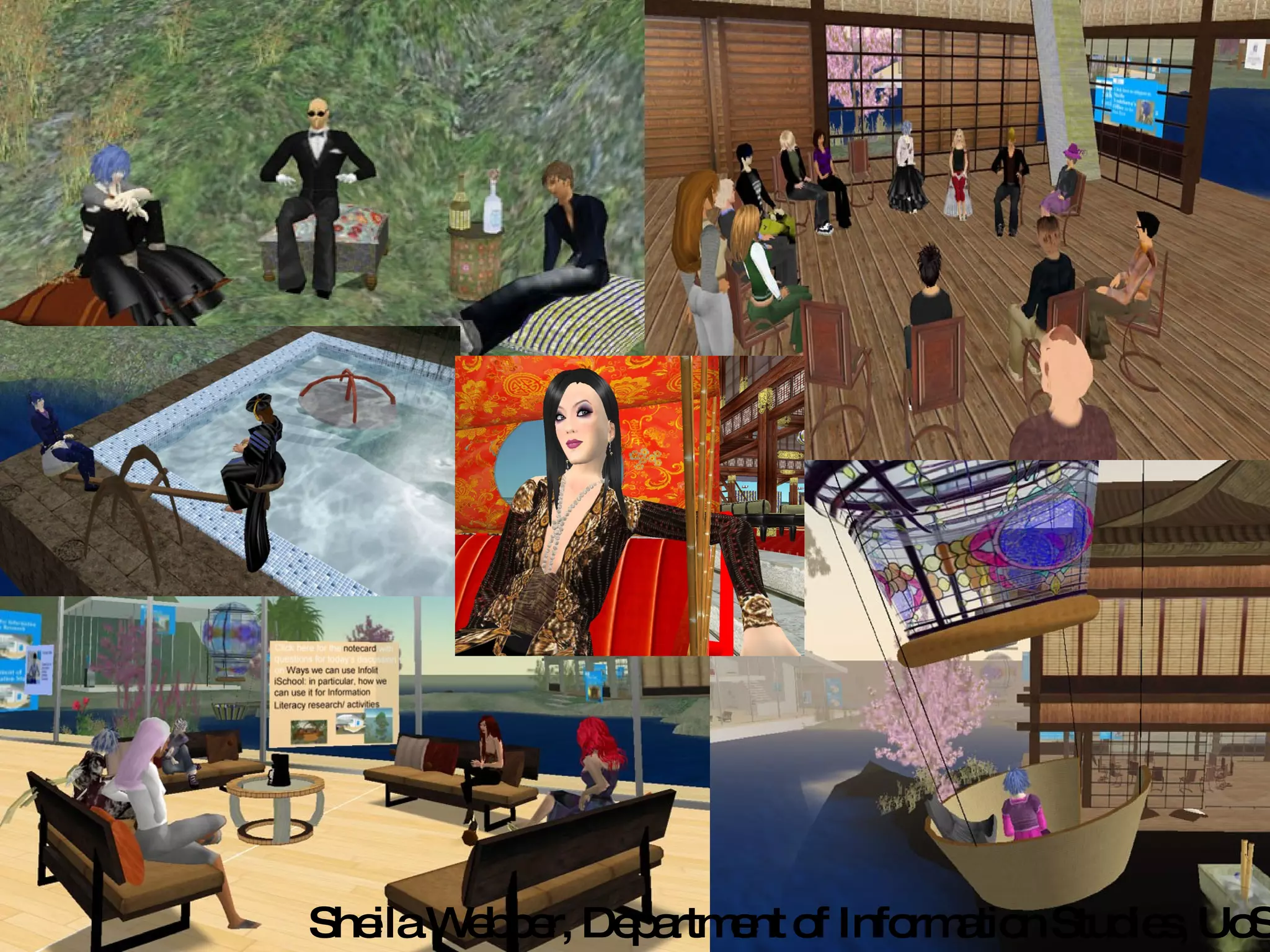
• A learning (and play) space –m like a classroom than a w
                                    ore                             ebsite –
  w newpedagogical possibilities
    ith
• Assessed activity for 1 st year BSc Inform  ation M  anagem students on
                                                               ent
  Inform  ation Literacy m odule
• Part of induction into research: in Sem   ester 2 they undertake their ow n
  sm  all-scale research projects
• Critical incident interview w SL residents (a tim w
                              s ith                      e hen they had an
  inform  ation need relating to a SL activity) in SL itself
• Students analyse transcripts in relation to m    odels of RL information
  behaviour + audit interviewtechnique (for assessm       ent)
• Working w 2 librarians: in Sheffield (Lyn Parker) and St Andrew
              ith                                                        s
  (Vickie Corm   ie)

                                                       S . W e bbe r, Information S tudie s
14


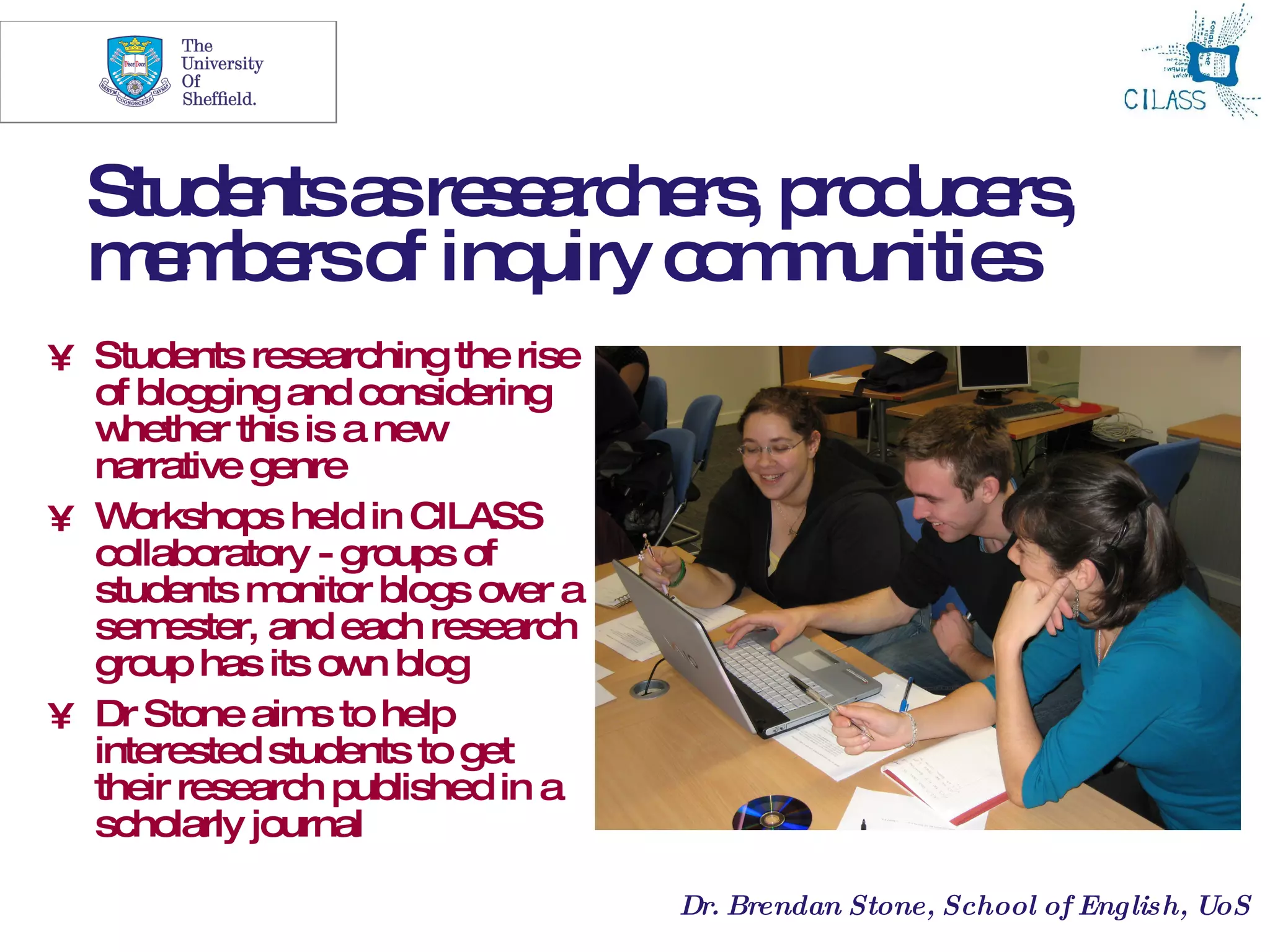
  Stud ntsa re e rc rs p d e ,
      e    s s a he , ro uc rs
  m m e o inq
    e b rs f uiry c m unitie
                    o m     s
• Students researching the rise
  of blogging and considering
  w hether this is a new
  narrative genre
• W  orkshops held in CILASS
  collaboratory - groups of
  students m  onitor blogs over a
  sem  ester, and each research
  group has its ow blog
                    n
• Dr Stone aim to help
                 s
  interested students to get
  their research published in a
  scholarly journal

                                    Dr. Brendan Stone, School of English, UoS
15


 Inquiry-b s dinfo a n lite c
          ae      rm tio   ra y
 d ve p e - P yc lo y
  e lo m nt s ho g
• Students investigate differences in the quality of
  information in psychology ‘  stories’ the popular press
                                       in
  and in the journal articles that provided their source


• Students engage in online searching task to identify
  popular stories and trace the research evidence, using
  new sources and W of Know
      s                 eb         ledge database; they
  then analyse the findings and reflect on their experience


• Supported by the Library’ W of Know
                           s eb            ledge tutorial,
  trained student IL mentors (3rd years) and tutors
16

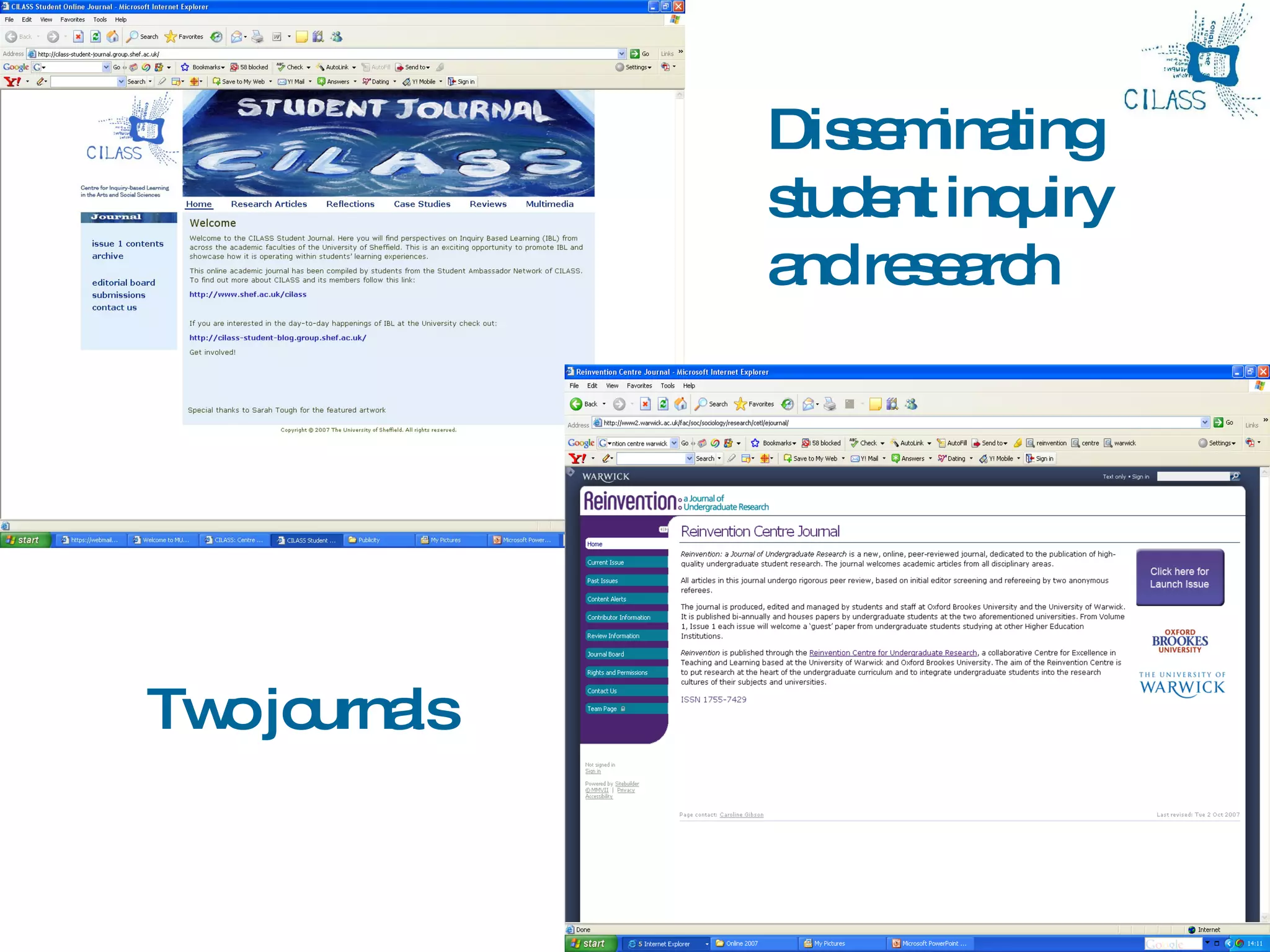
             Dis e ina
                s m ting
             s e inq
              tud nt uiry
             a re e rc
              nd s a h


Tw jo
  o urnals
17


Inquiry in ne s a e
             w pcs
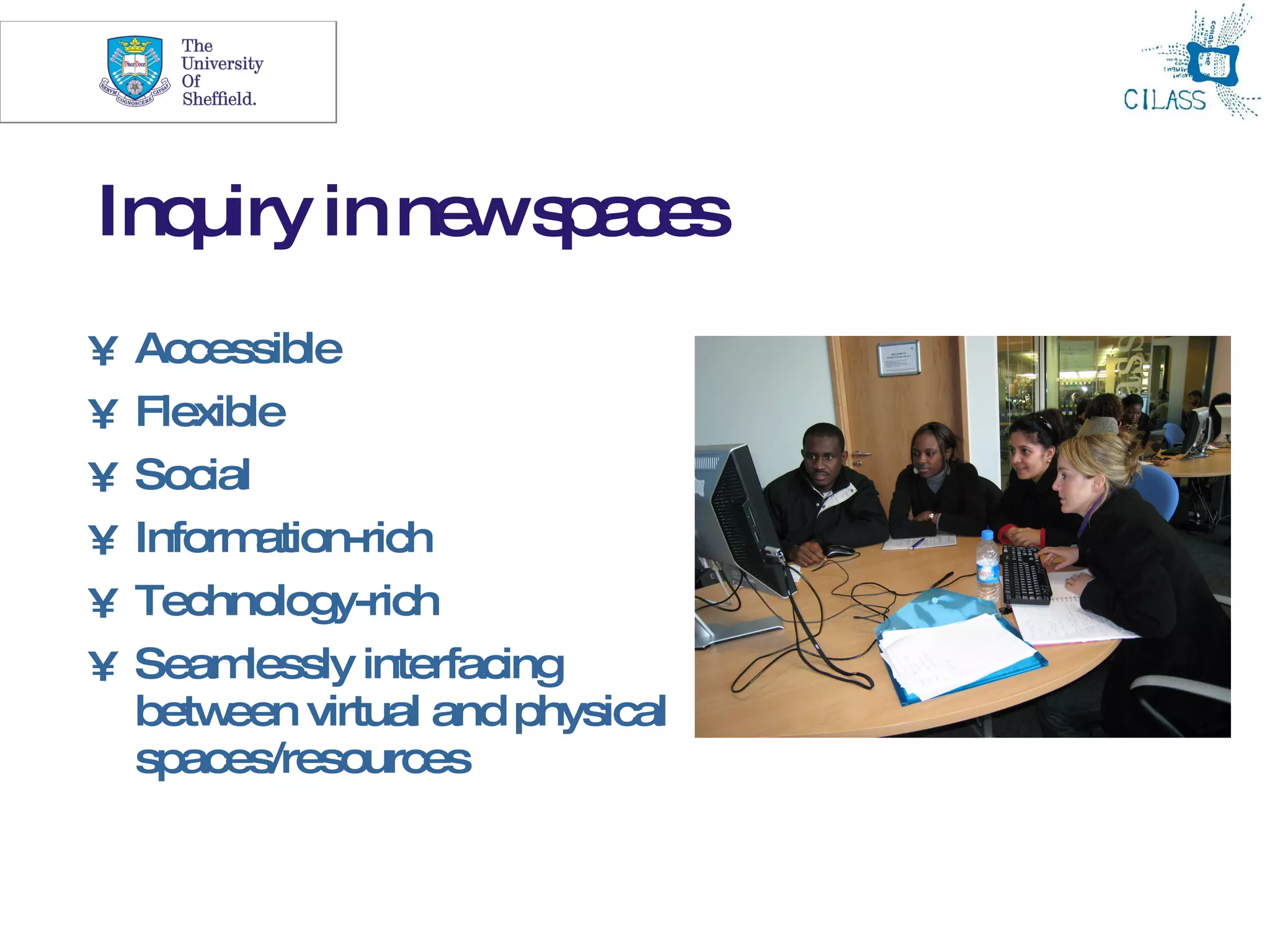
•   Accessible
•   Flexible
•   Social
•   Inform ation-rich
•   Technology-rich
•   Seam  lessly interfacing
    betw een virtual and physical
    spaces/resources
18


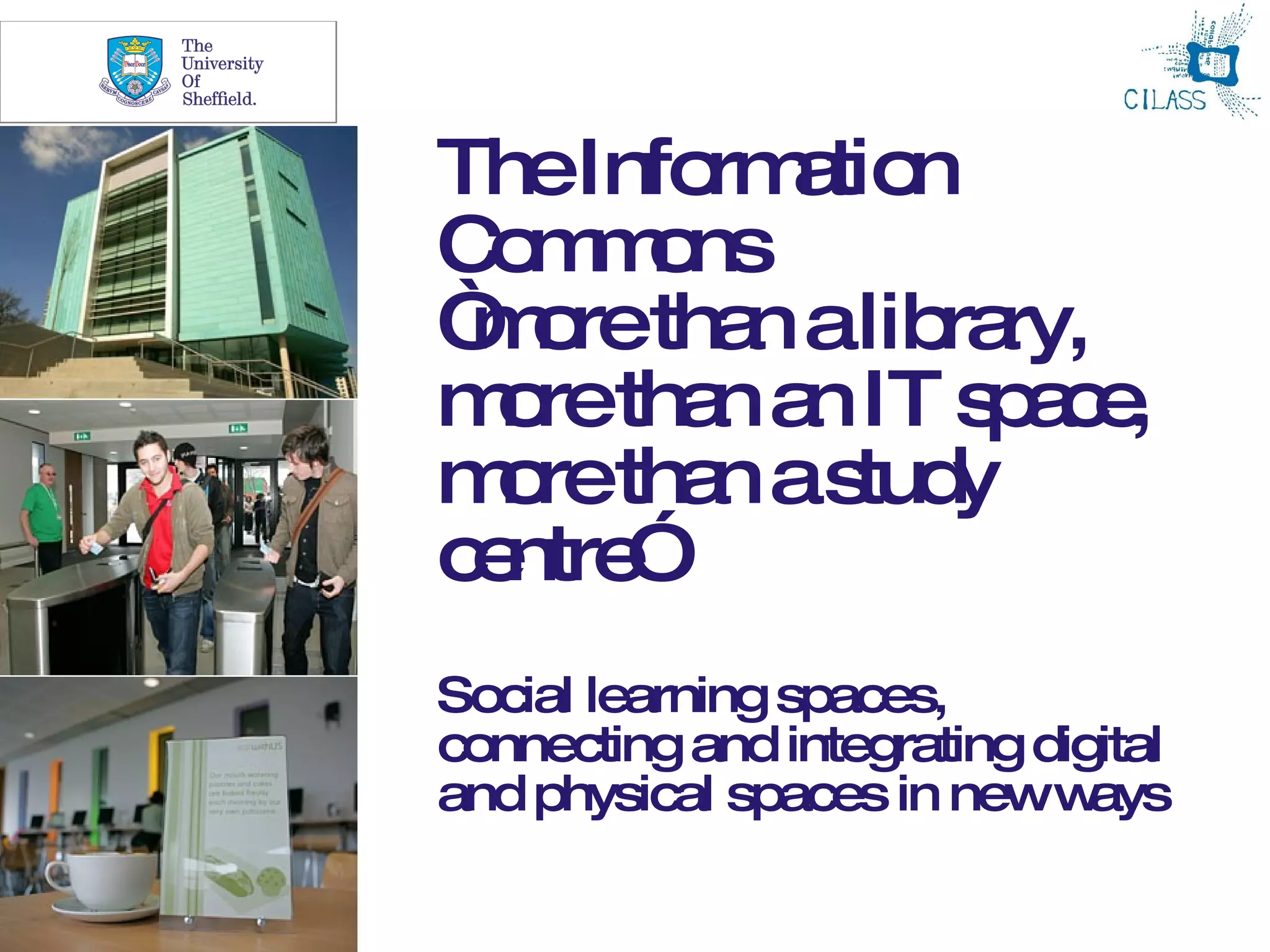
TheInfo a n
       rm tio
Cm o
 o m ns
“ o tha alib ry,
 m re n       ra
m retha a IT s a e
 o     n n     pc,
m retha as y
 o     n tud
c ntre
 e ”
Social learning spaces,
connecting and integrating digital
and physical spaces in neww   ays
19


Uo Info a n C m o
  S    rm tio o m ns
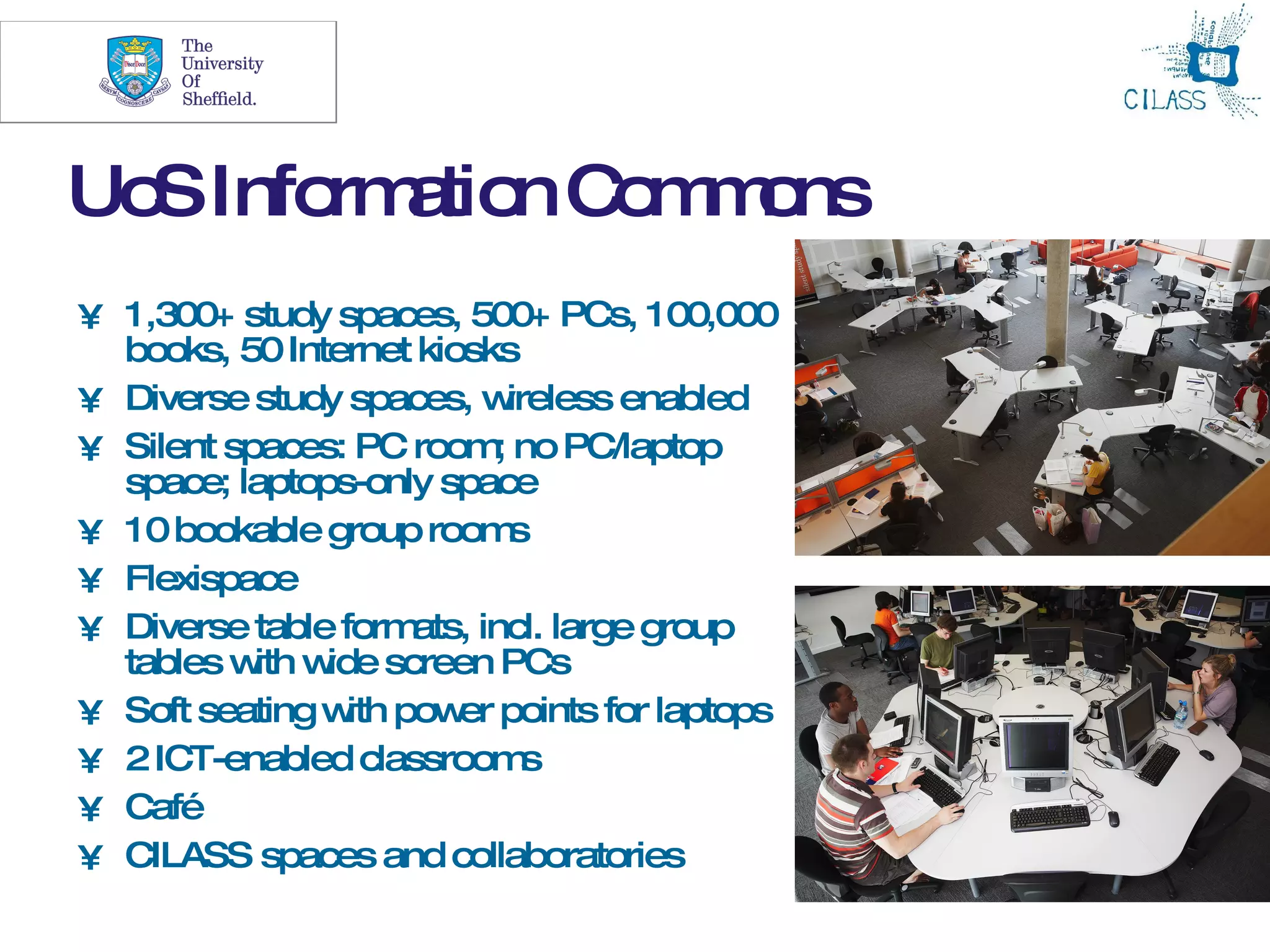
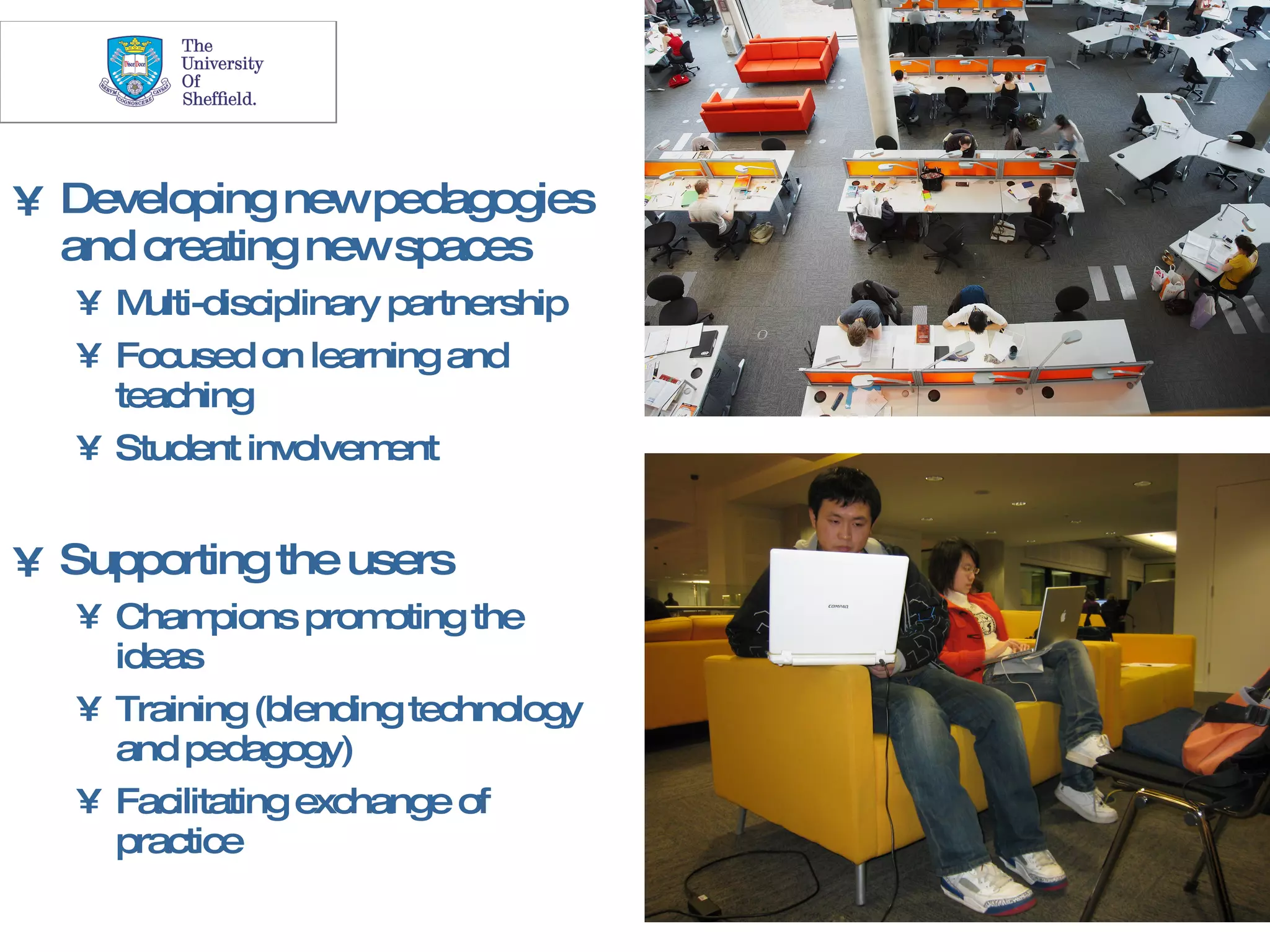
• 1,300+ study spaces, 500+ PCs, 100,000
  books, 50 Internet kiosks
• Diverse study spaces, w    ireless enabled
• Silent spaces: PC room no PC/laptop
                           ;
  space; laptops-only space
• 10 bookable group room     s
• Flexispace
• Diverse table form ats, incl. large group
  tables w w screen PCs
           ith ide
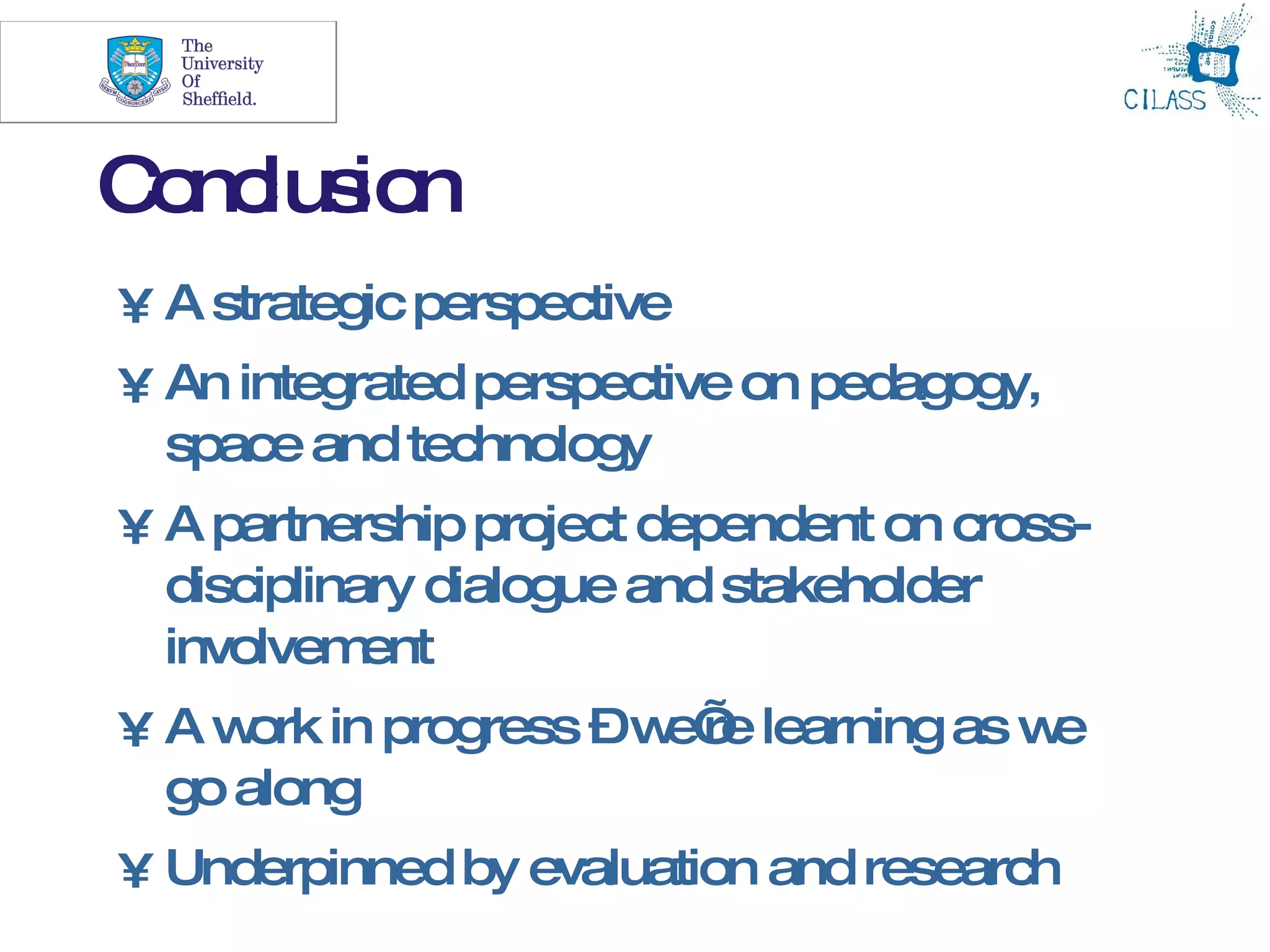
• Soft seating w pow points for laptops
                 ith    er
• 2 ICT-enabled classroom     s
• Café
• CILASS spaces and collaboratories
20


“ g t b o o Fa e o k, c t to
 I e o ks ut, c b o ha
p o le yo kno , c o ab ha a
 ep , u        w hill ut it, ve
c ffe . Ye h, w s m g o e s ys
 o e       a rite o e o d s a ,
tha s rt o thing re lly”
   t o f        , a
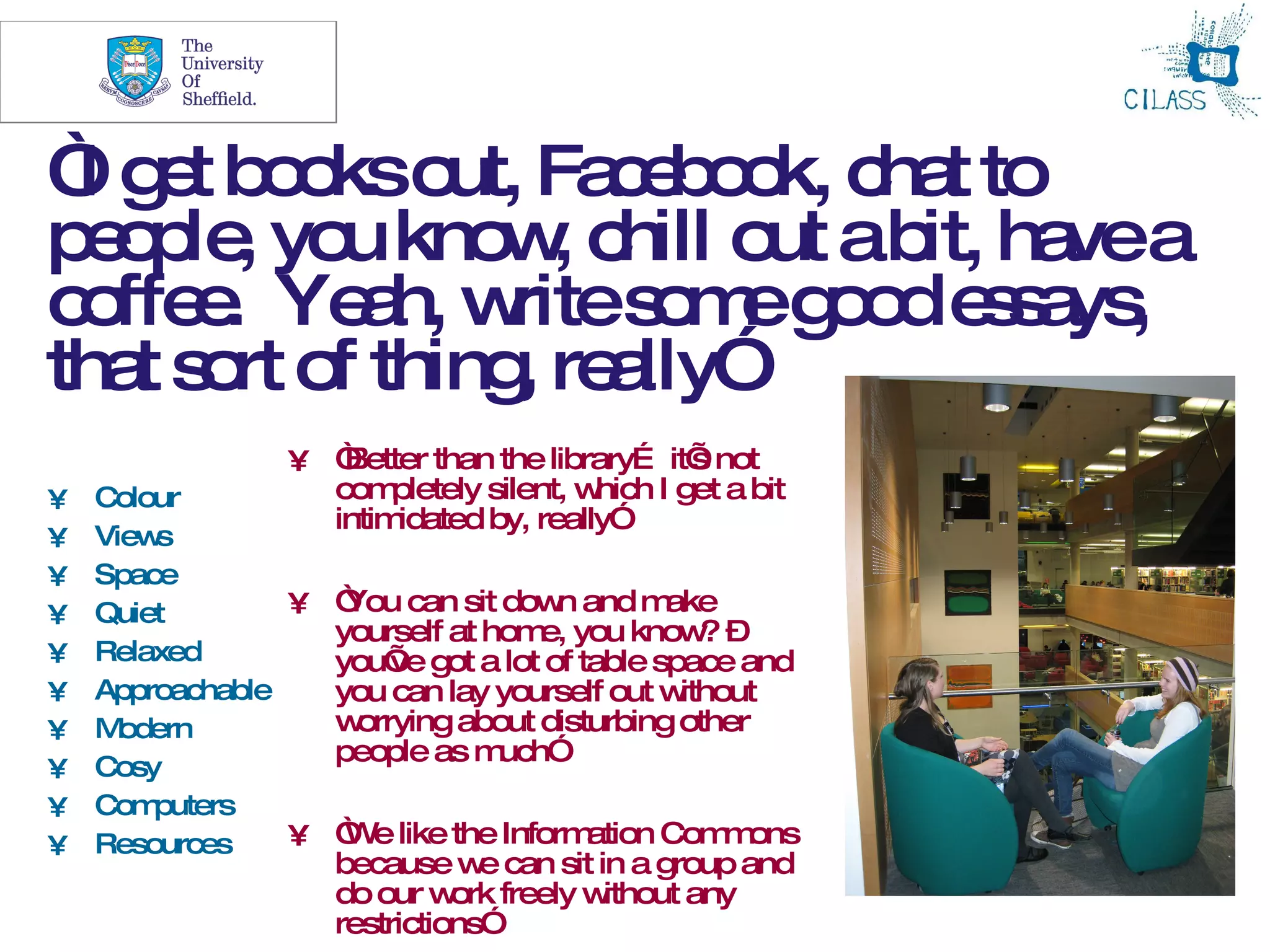
                 • “Better than the library… it’ not
                                                 s
•   Colour         com  pletely silent, which I get a bit
                   intimidated by, really”
•   Views
•   Space
•   Quiet        • “ can sit dow and m
                    You              n       ake
                   yourself at hom you know –
                                   e,           ?
•   Relaxed        you’ got a lot of table space and
                        ve
•   Approachable   you can lay yourself out w ithout
•   M odern        w orrying about disturbing other
                   people as m  uch”
•   Cosy
•   Com puters
•   Resources    • “ e like the Inform
                    W                  ation Com ons
                                                  m
                    because w can sit in a group and
                                e
                    do our w freely w
                              ork      ithout any
                    restrictions”
21


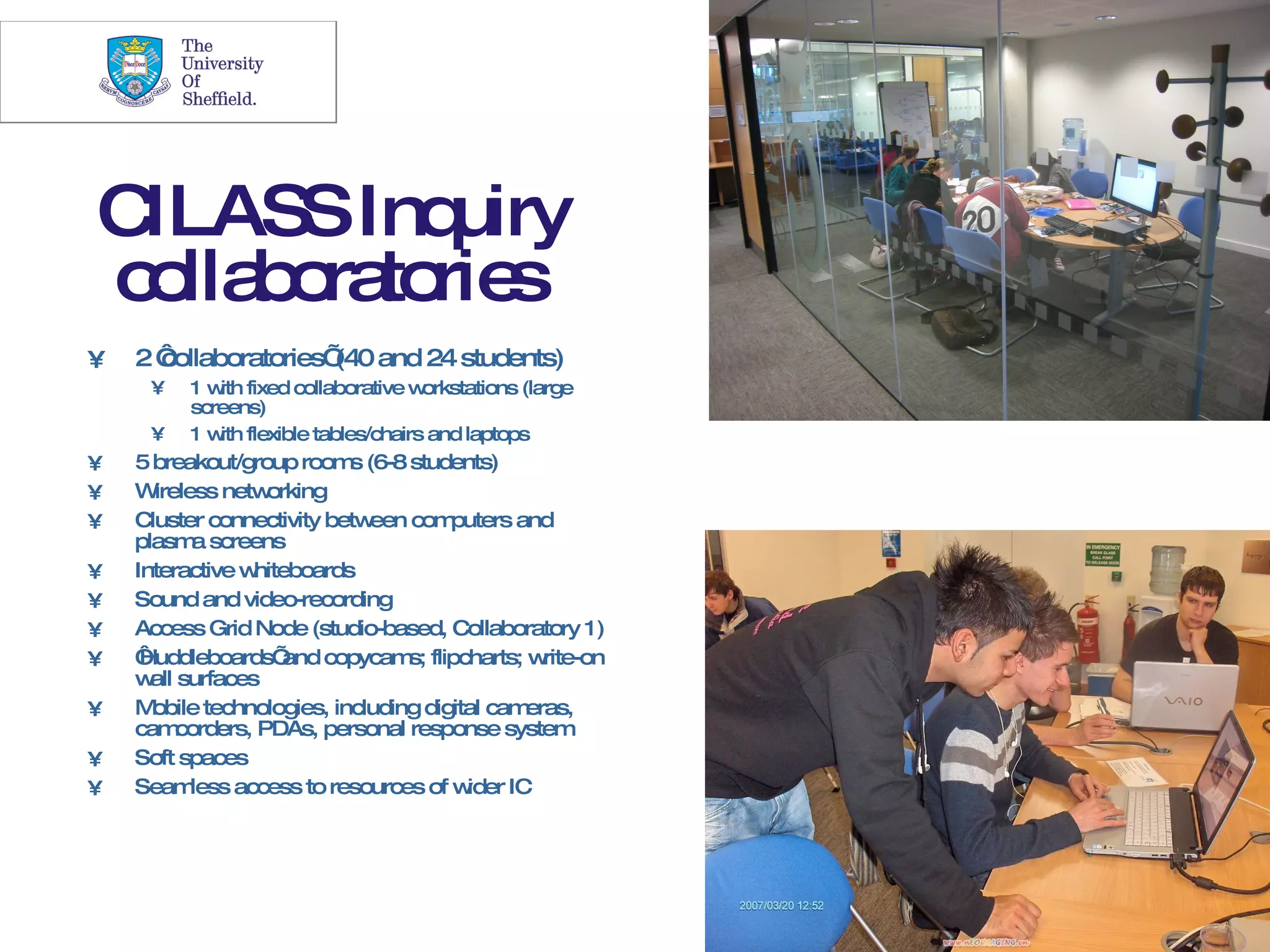
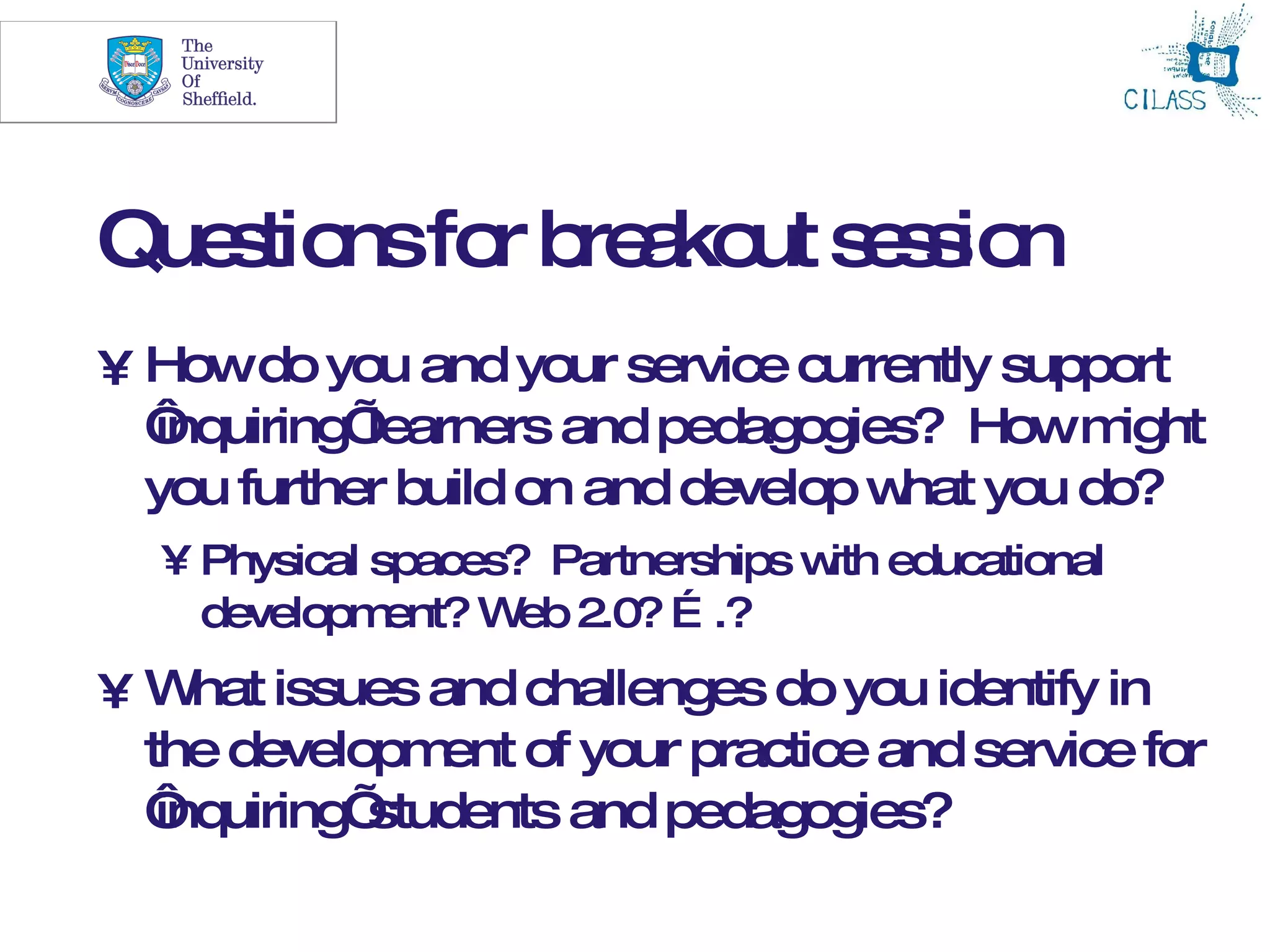
CILASS Inquiry
c lla o to s
 o b ra rie
•   2‘
     collaboratories’ and 24 students)
                     (40
     •    1 w fixed collaborative w
             ith                    orkstations (large
          screens)
     •    1 w flexible tables/chairs and laptops
             ith
•   5 breakout/group room (6-8 students)
                            s
•   W ireless netw  orking
•   Cluster connectivity betw een com  puters and
    plasm screens
           a
•   Interactive w hiteboards
•   Sound and video-recording
•   Access Grid Node (studio-based, Collaboratory 1)
•   ‘Huddleboards’    and copycam flipcharts; w
                                  s;              rite-on
    w surfaces
      all
•   M obile technologies, including digital cam eras,
    cam   corders, PDAs, personal response system
•   Soft spaces
•   Seam   less access to resources of w ider IC
22


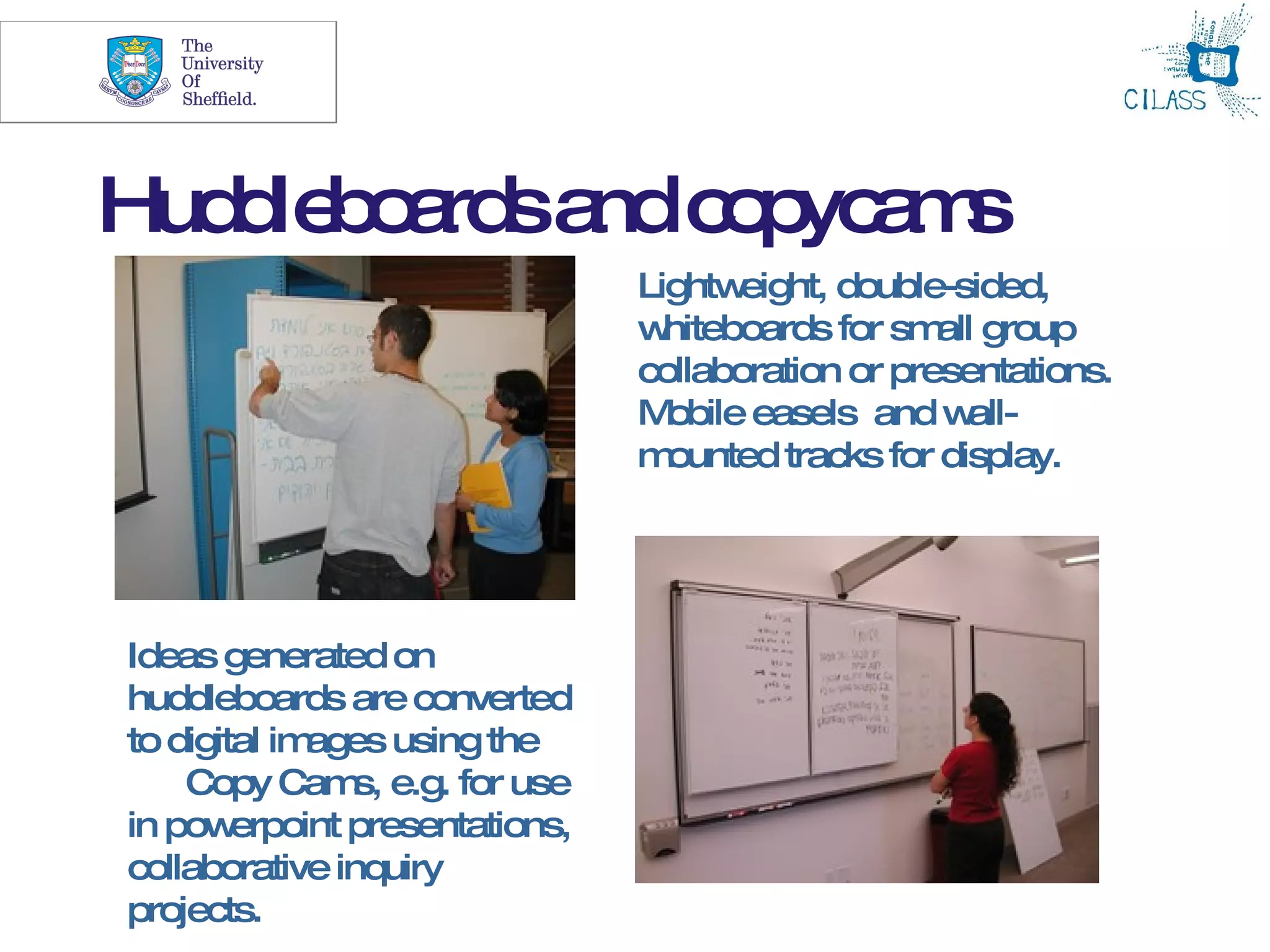
Hud le o rd a c p a s
   d b a s nd o yc m
                                 Lightw eight, double-sided,
                                 w hiteboards for sm group
                                                     all
                                 collaboration or presentations.
                                 M obile easels and w  all-
                                 m ounted tracks for display.


Ideas generated on
huddleboards are converted
to digital images using the
    Copy Cam e.g. for use
                s,
in pow  erpoint presentations,
collaborative inquiry
projects.
23


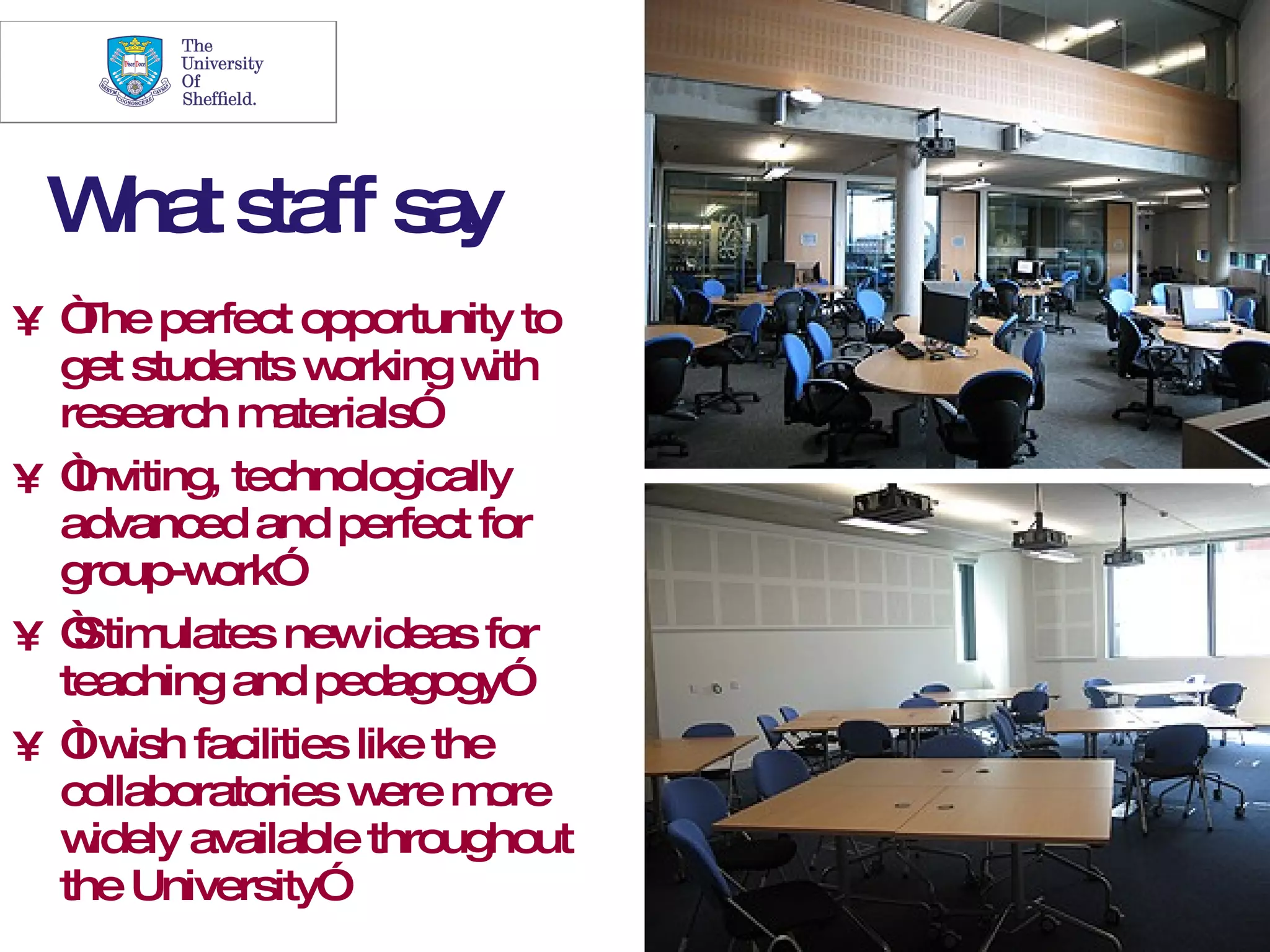
 W t s ff s y
  ha ta a
• “ perfect opportunity to
   The
  get students w  orking w ith
  research m   aterials”
•“ Inviting, technologically
  advanced and perfect for
  group-w  ork”
• “ ulates newideas for
   Stim
  teaching and pedagogy”
• “w facilities like the
   I ish
  collaboratories w mere ore
  w idely available throughout
  the University”
24


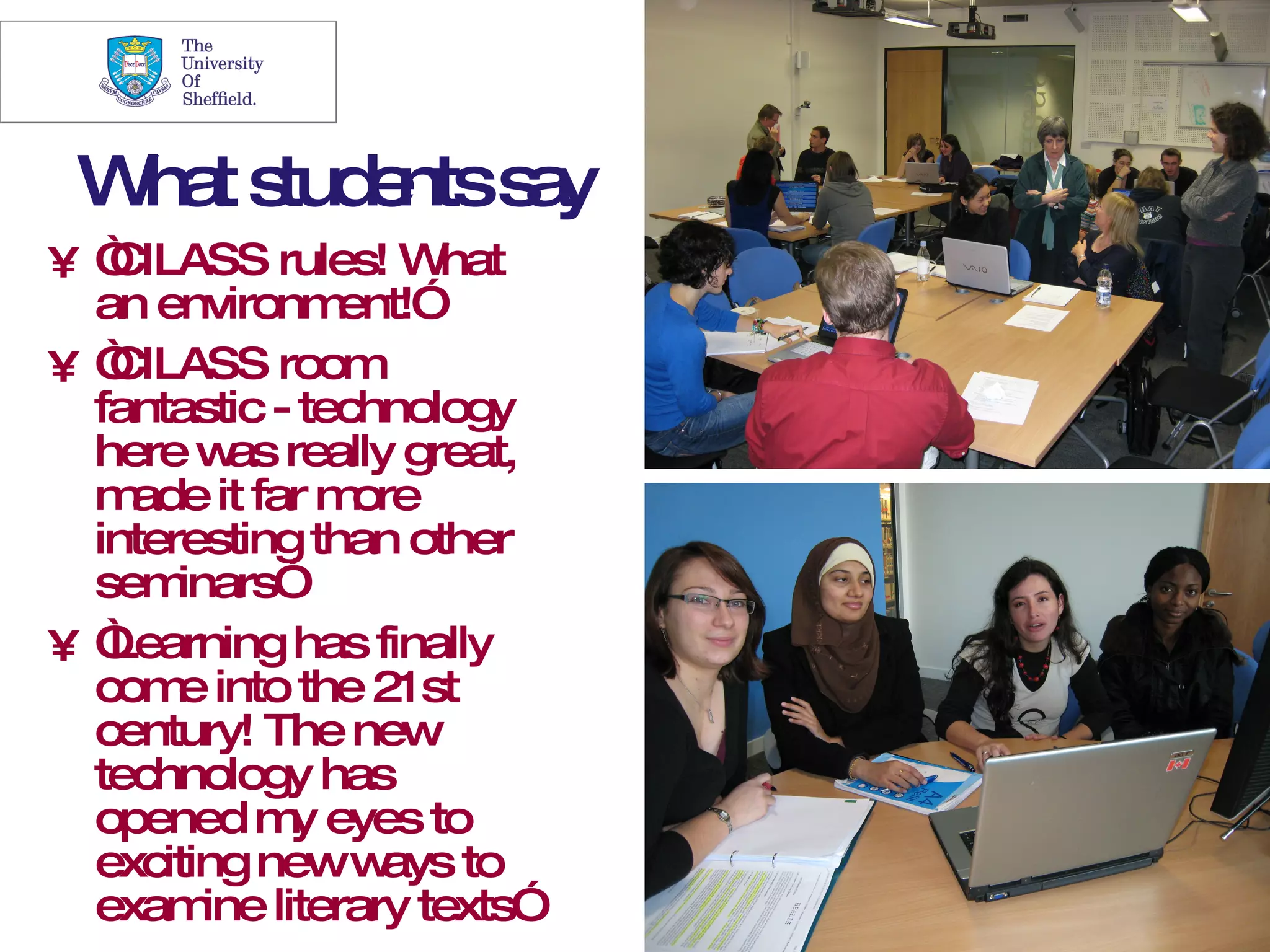
 W ts e s y
  ha tud nts a
•“CILASS rules! W   hat
 an environm   ent!”
•“CILASS room
 fantastic - technology
 here w really great,
          as
 m ade it far m ore
 interesting than other
 sem  inars”
•“Learning has finally
 com into the 21st
      e
 century! The new
 technology has
 opened m eyes to
             y
 exciting neww   ays to
 exam literary texts”
        ine
25


• Developing newpedagogies
  and creating newspaces
   •M  ulti-disciplinary partnership
   • Focused on learning and
     teaching
   • Student involvem    ent


• Supporting the users
   • Cham   pions prom oting the
     ideas
   • Training (blending technology
     and pedagogy)
   • Facilitating exchange of
     practice
26


C nc io
 o lus n
• A strategic perspective
• An integrated perspective on pedagogy,
  space and technology
• A partnership project dependent on cross-
  disciplinary dialogue and stakeholder
  involvem  ent
• A w in progress –w re learning as w
     ork            e’               e
  go along
• Underpinned by evaluation and research
27


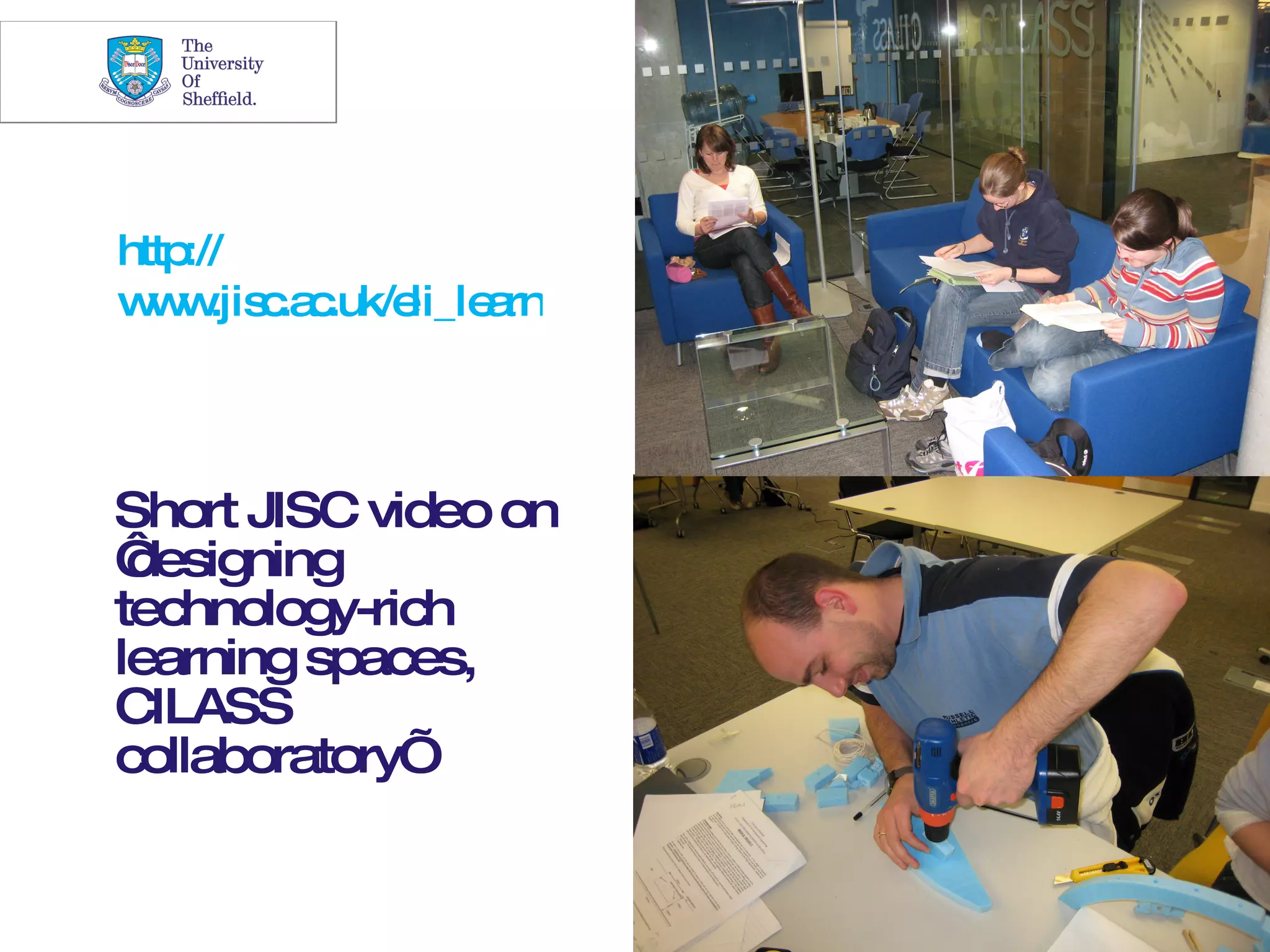
http://
w w c c
  w .jis .a .uk/eli_le rning p c s
                      a     s a e .html


Short JISC video on
‘designing
technology-rich
learning spaces,
CILASS
collaboratory’
28


Que tio fo b a ut s s io
   s ns r re ko e s n
• Howdo you and your service currently support
  ‘
  inquiring’learners and pedagogies? Howm  ight
  you further build on and develop w you do?
                                    hat
  • Physical spaces? Partnerships w educational
                                   ith
    developm  ent? W 2.0? … .?
                    eb
• W issues and challenges do you identify in
     hat
  the developm of your practice and service for
                ent
  ‘inquiring’students and pedagogies?

New Learning Spaces for New Modes of Learning and Teaching

  • 1.
    Ne Le rningSpc sfo Ne w a ae r w Mo e o Le rninga ds f a nd Te c a hing BBSLG Annual Conference Leeds, 10th July 2008 Philippa Levy w w w .shef.,ac.uk/cilass
  • 2.
    • Inquiry-based learning 2 • Web 2.0 • Information Com ons m Ove w rvie and inquiry collaboratories • Learning partnerships
  • 3.
    3 Inquiry • The core of inquiry is the QUESTION –generating a process of discovery • “ action of s e e king , especially The (nowalw ays) for truth, know ledge or inform ation concerning som ething; search, research, investigation, exam ination”(OED) • Student-led exploration, investigation, research • Cas e - and pro ble m -bas e d le arning • Expe rie ntial le arning • Re s e arc h pro je c ts ‘ Inner Biology’ the inquiry m – ethod of teaching biology staff.washington.edu/jshaver/innerbiology/
  • 4.
    4 IBL invo s lve • Students and/or tutors establishing question/problem etc • Students pursuing lines of inquiry (often in groups) • Draw on existing know ing ledge • Identifying newlearning and inform ation needs • Seeking inform ation, evidence, e.g. interacting w (digital) ith resources, datasets, archives • Discussing, receiving feedback, synthesising inform ation, constructing know ledge • Analysing and com unicating m ideas and results • W orking w staff as partners, ith participating in and contributing to a research com unity m
  • 5.
    5 Inq uiring Wb2 , e .0 le rne a rs • Ow ning and directing their experience • Participating, collaborating, social netw orking • Producing and co-creating - generating, repurposing and sharing content • Accessing m ultiple sources • Using a w variety of tools ide and environm ents • Creating personal learning netw orks and environm ents • Learning 2.0: ‘ passion-based learning’ (John Seely Brow n, 2008) Source: www.deitel.com
  • 6.
    6 Winq hy uiry-b s dle rning(IBL)? ae a • Active and deep engagem ent w m ith essy, authentic questions and problem s • Experiencing ‘ supercom plexity’ and understanding how know ledge is created • Social participation, em ploym ent, lifelong learning • Strengthening the research- teaching nexus in universities • A strategic focus for University of Sheffield
  • 7.
    7 An inte radvis n o HE g te io f “ purpose of teaching [… ] becom to induct The es students into various form of inquiry so that individuals s are able to live in a complex, uncertain w orld where know howto inquire is key to survival. W are looking ing e towards a higher education w here inquiry can becom e centre stage for both academ and students” ics (Brew, 2006) “ pedagogy of joint discovery” A (Barnett, 2007: 159)
  • 8.
    8 • “ hatI liked about [IBL] w that I got to do - I m W as ean I w freer in a w as ay. [...] I built m ow argum y n ents, and that w really, really good for m I re ally e njo ye d as e. that, be c aus e it was fre e [...] I don’think you can do t that to the sam extent in an essay because that m e ode often is a set question that you have to have –of course you can say if you agree or not agree to w it states, hat but the question is often based on certain concepts or certain theories, w hile in this [inquiry ] pro je c t we c o uld c ho o s e o ur appo ro ac h by o urs e lve s . That was re ally g o o d”. • “think doing som I ething that, this is your project, do w hat you w w it, it’s s c ary but […] it’s my , my thing ant ith […] I fe e l like a g ro wn -up pe rs o n, going into [the research field], I like being able to do your ow thing” n . ‘Discovery’ inquiry projects
  • 9.
  • 10.
    10 CILASS IBLfra e o m w rk • Co llabo rative inquiry and inquiry c o mmunitie s • Info rmatio n lite rac y developm ent • Ne two rke d learning • Inte rdis c iplinary inquiry • Classroom as re s e arc h s e nviro nme nts (‘collaboratories’ ) “ odelling the process of research in the student learning experience” M
  • 11.
    11 ‘ e ta ingLa ’ Und rs nd w • 250 students • Online w orkbooks, structured tasks • Inquiry journals • Supported by online discussions (W ebCT) • 45 research groups, developing m ultim edia resources (film podcast, , pow erpoint) • Presented at ‘ celebration of inquiry’ event (attended by other students, staff and invited lawprofessionals)
  • 12.
    12 She W be De a e o Info a n Stud s Uo ila e b r, p rtm nt f rm tio ie , S
  • 13.
    13 Inquiry inSe o Life c nd • A learning (and play) space –m like a classroom than a w ore ebsite – w newpedagogical possibilities ith • Assessed activity for 1 st year BSc Inform ation M anagem students on ent Inform ation Literacy m odule • Part of induction into research: in Sem ester 2 they undertake their ow n sm all-scale research projects • Critical incident interview w SL residents (a tim w s ith e hen they had an inform ation need relating to a SL activity) in SL itself • Students analyse transcripts in relation to m odels of RL information behaviour + audit interviewtechnique (for assessm ent) • Working w 2 librarians: in Sheffield (Lyn Parker) and St Andrew ith s (Vickie Corm ie) S . W e bbe r, Information S tudie s
  • 14.
    14 Studntsa re e rc rs p d e , e s s a he , ro uc rs m m e o inq e b rs f uiry c m unitie o m s • Students researching the rise of blogging and considering w hether this is a new narrative genre • W orkshops held in CILASS collaboratory - groups of students m onitor blogs over a sem ester, and each research group has its ow blog n • Dr Stone aim to help s interested students to get their research published in a scholarly journal Dr. Brendan Stone, School of English, UoS
  • 15.
    15 Inquiry-b sdinfo a n lite c ae rm tio ra y d ve p e - P yc lo y e lo m nt s ho g • Students investigate differences in the quality of information in psychology ‘ stories’ the popular press in and in the journal articles that provided their source • Students engage in online searching task to identify popular stories and trace the research evidence, using new sources and W of Know s eb ledge database; they then analyse the findings and reflect on their experience • Supported by the Library’ W of Know s eb ledge tutorial, trained student IL mentors (3rd years) and tutors
  • 16.
    16 Dis e ina s m ting s e inq tud nt uiry a re e rc nd s a h Tw jo o urnals
  • 17.
    17 Inquiry in nes a e w pcs • Accessible • Flexible • Social • Inform ation-rich • Technology-rich • Seam lessly interfacing betw een virtual and physical spaces/resources
  • 18.
    18 TheInfo a n rm tio Cm o o m ns “ o tha alib ry, m re n ra m retha a IT s a e o n n pc, m retha as y o n tud c ntre e ” Social learning spaces, connecting and integrating digital and physical spaces in neww ays
  • 19.
    19 Uo Info an C m o S rm tio o m ns • 1,300+ study spaces, 500+ PCs, 100,000 books, 50 Internet kiosks • Diverse study spaces, w ireless enabled • Silent spaces: PC room no PC/laptop ; space; laptops-only space • 10 bookable group room s • Flexispace • Diverse table form ats, incl. large group tables w w screen PCs ith ide • Soft seating w pow points for laptops ith er • 2 ICT-enabled classroom s • Café • CILASS spaces and collaboratories
  • 20.
    20 “ g tb o o Fa e o k, c t to I e o ks ut, c b o ha p o le yo kno , c o ab ha a ep , u w hill ut it, ve c ffe . Ye h, w s m g o e s ys o e a rite o e o d s a , tha s rt o thing re lly” t o f , a • “Better than the library… it’ not s • Colour com pletely silent, which I get a bit intimidated by, really” • Views • Space • Quiet • “ can sit dow and m You n ake yourself at hom you know – e, ? • Relaxed you’ got a lot of table space and ve • Approachable you can lay yourself out w ithout • M odern w orrying about disturbing other people as m uch” • Cosy • Com puters • Resources • “ e like the Inform W ation Com ons m because w can sit in a group and e do our w freely w ork ithout any restrictions”
  • 21.
    21 CILASS Inquiry c llao to s o b ra rie • 2‘ collaboratories’ and 24 students) (40 • 1 w fixed collaborative w ith orkstations (large screens) • 1 w flexible tables/chairs and laptops ith • 5 breakout/group room (6-8 students) s • W ireless netw orking • Cluster connectivity betw een com puters and plasm screens a • Interactive w hiteboards • Sound and video-recording • Access Grid Node (studio-based, Collaboratory 1) • ‘Huddleboards’ and copycam flipcharts; w s; rite-on w surfaces all • M obile technologies, including digital cam eras, cam corders, PDAs, personal response system • Soft spaces • Seam less access to resources of w ider IC
  • 22.
    22 Hud le ord a c p a s d b a s nd o yc m Lightw eight, double-sided, w hiteboards for sm group all collaboration or presentations. M obile easels and w all- m ounted tracks for display. Ideas generated on huddleboards are converted to digital images using the Copy Cam e.g. for use s, in pow erpoint presentations, collaborative inquiry projects.
  • 23.
    23 W ts ff s y ha ta a • “ perfect opportunity to The get students w orking w ith research m aterials” •“ Inviting, technologically advanced and perfect for group-w ork” • “ ulates newideas for Stim teaching and pedagogy” • “w facilities like the I ish collaboratories w mere ore w idely available throughout the University”
  • 24.
    24 W tse s y ha tud nts a •“CILASS rules! W hat an environm ent!” •“CILASS room fantastic - technology here w really great, as m ade it far m ore interesting than other sem inars” •“Learning has finally com into the 21st e century! The new technology has opened m eyes to y exciting neww ays to exam literary texts” ine
  • 25.
    25 • Developing newpedagogies and creating newspaces •M ulti-disciplinary partnership • Focused on learning and teaching • Student involvem ent • Supporting the users • Cham pions prom oting the ideas • Training (blending technology and pedagogy) • Facilitating exchange of practice
  • 26.
    26 C nc io o lus n • A strategic perspective • An integrated perspective on pedagogy, space and technology • A partnership project dependent on cross- disciplinary dialogue and stakeholder involvem ent • A w in progress –w re learning as w ork e’ e go along • Underpinned by evaluation and research
  • 27.
    27 http:// w w cc w .jis .a .uk/eli_le rning p c s a s a e .html Short JISC video on ‘designing technology-rich learning spaces, CILASS collaboratory’
  • 28.
    28 Que tio fob a ut s s io s ns r re ko e s n • Howdo you and your service currently support ‘ inquiring’learners and pedagogies? Howm ight you further build on and develop w you do? hat • Physical spaces? Partnerships w educational ith developm ent? W 2.0? … .? eb • W issues and challenges do you identify in hat the developm of your practice and service for ent ‘inquiring’students and pedagogies?