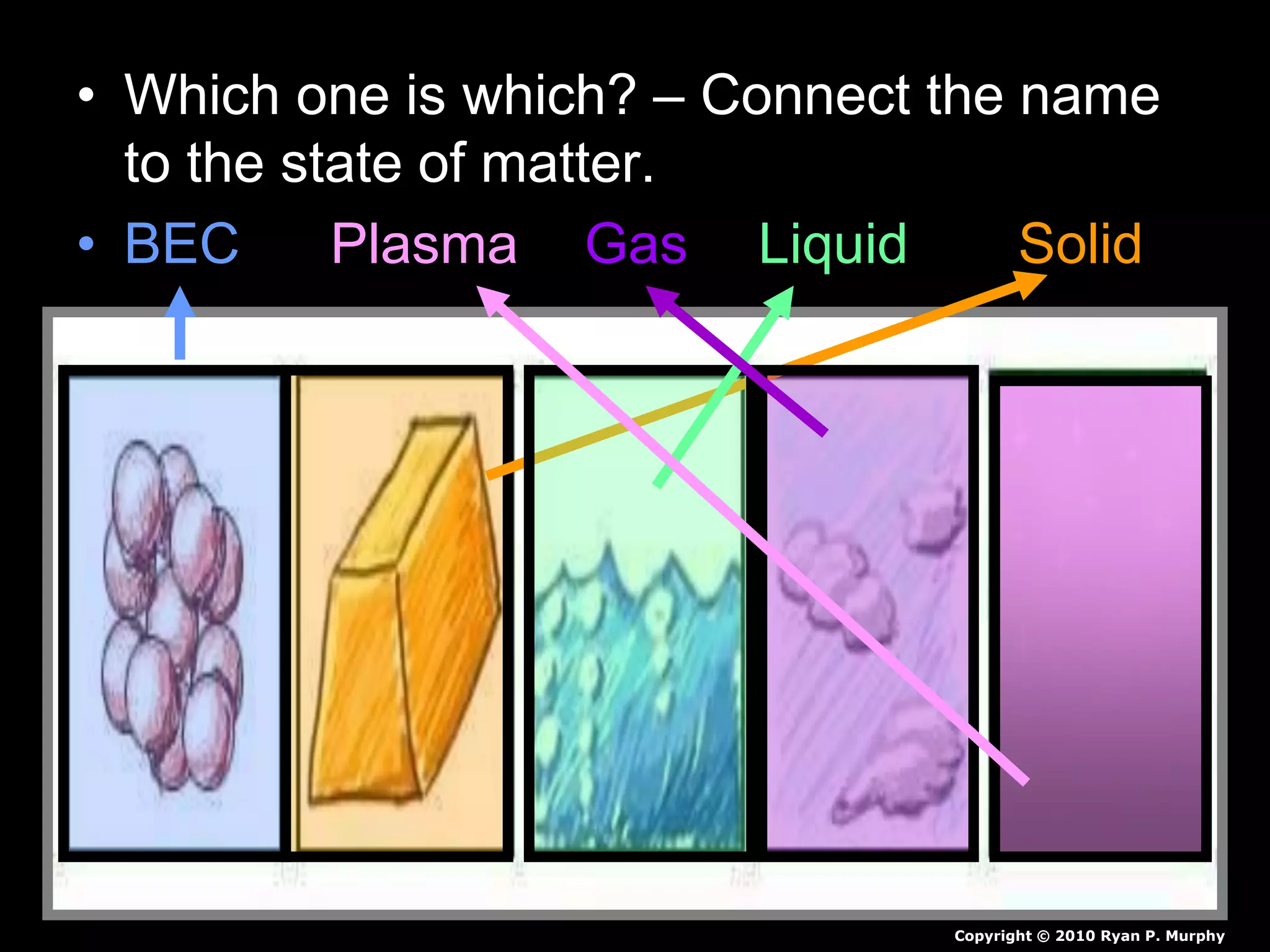



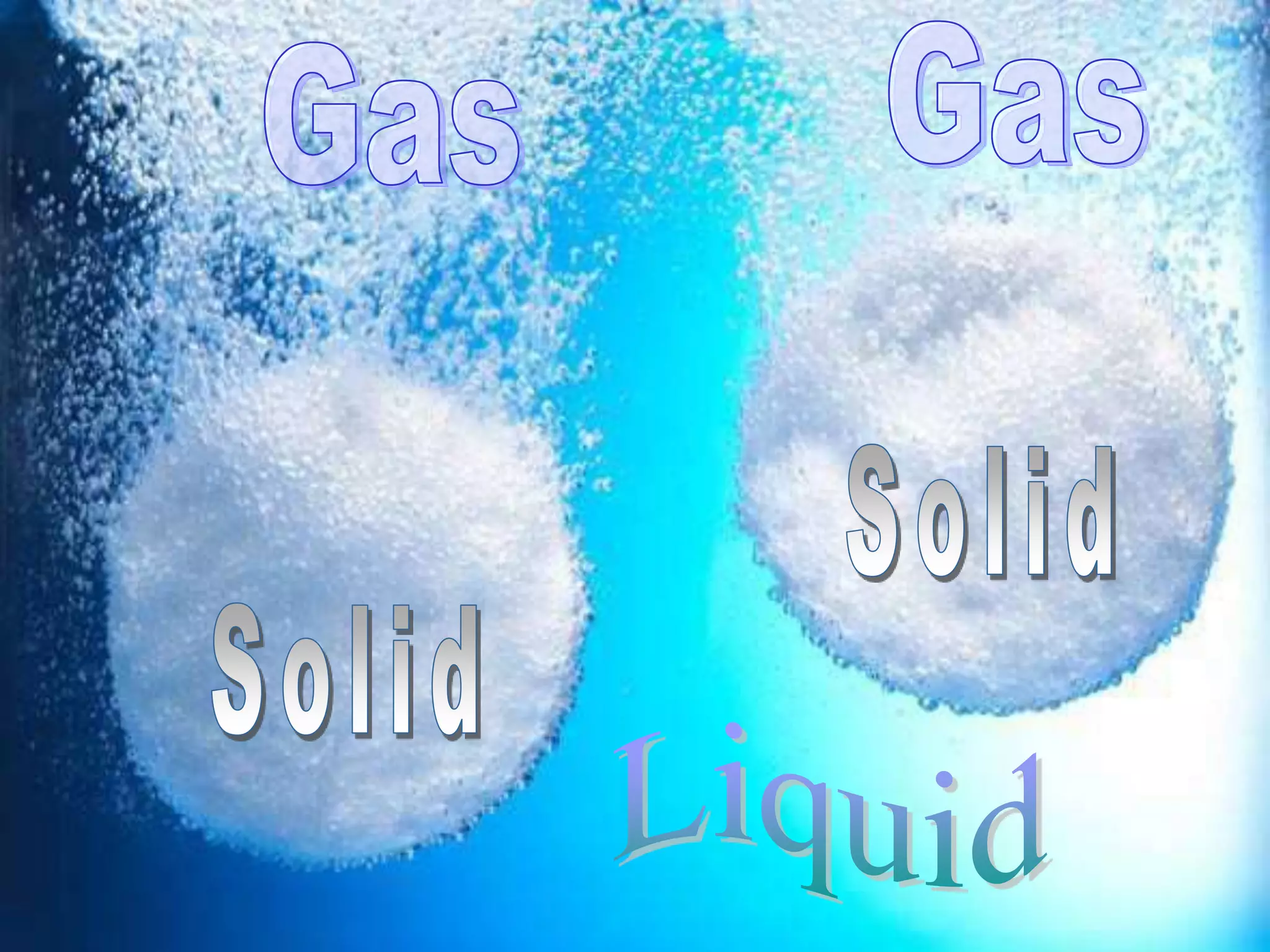

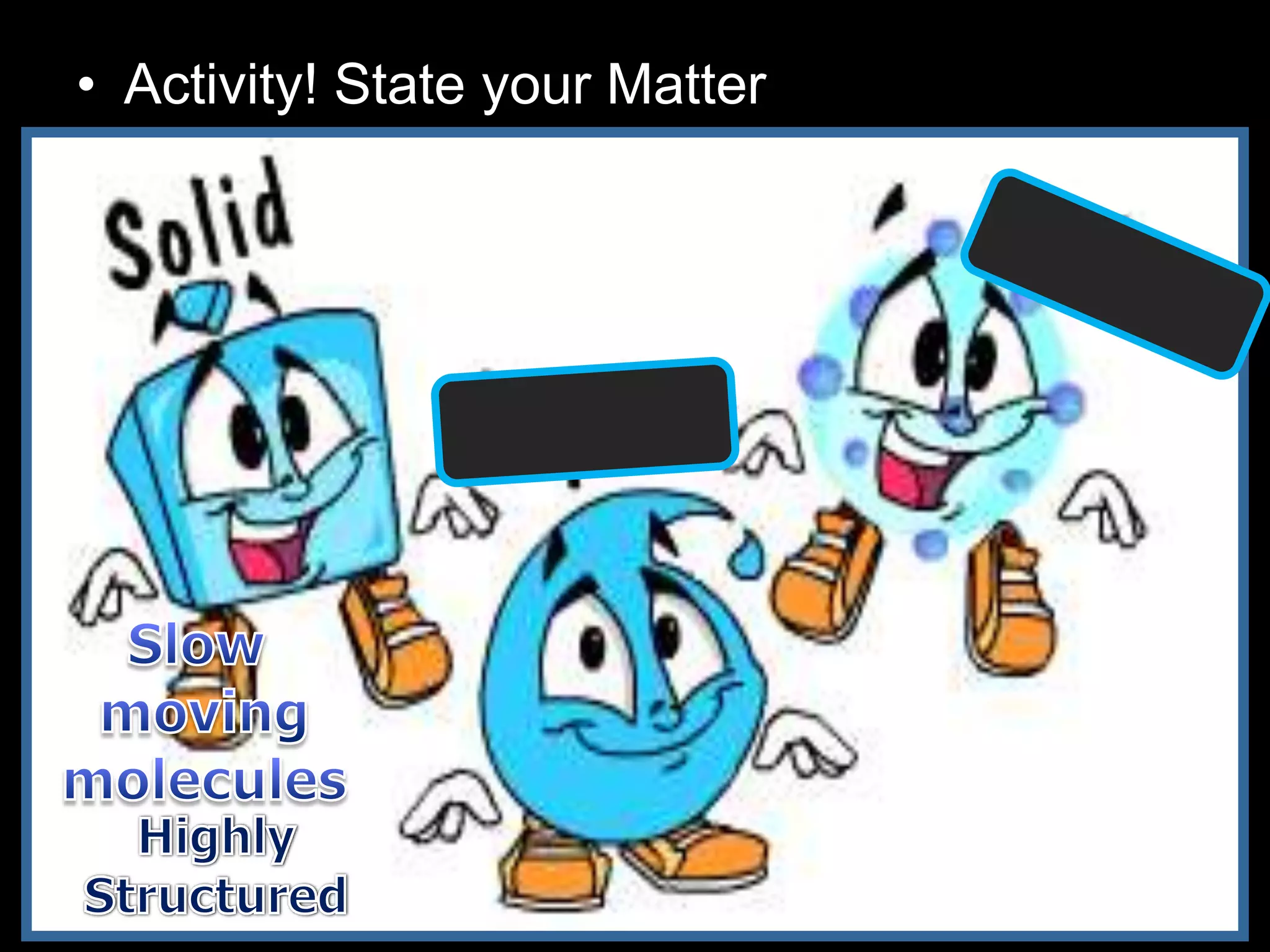
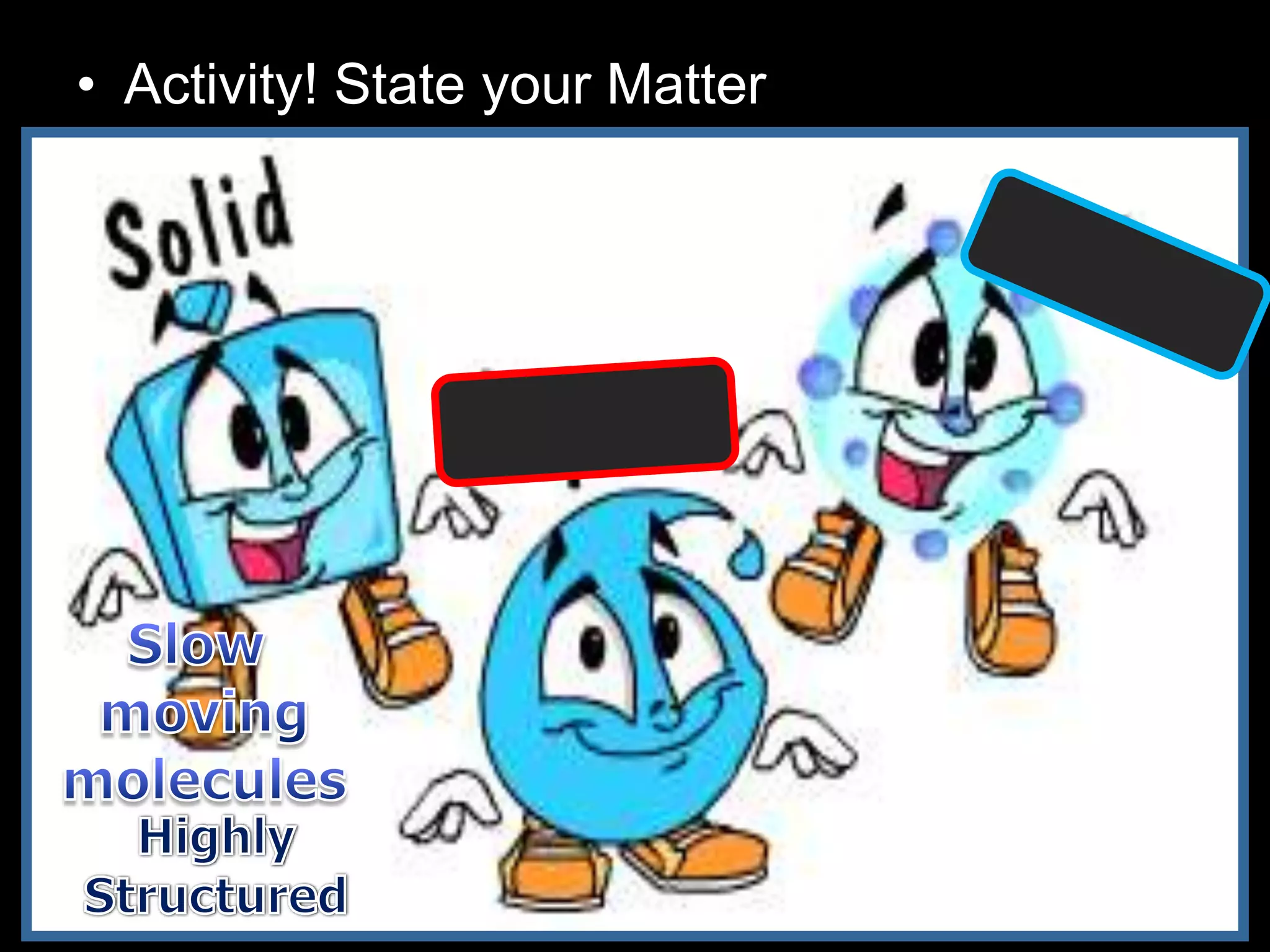
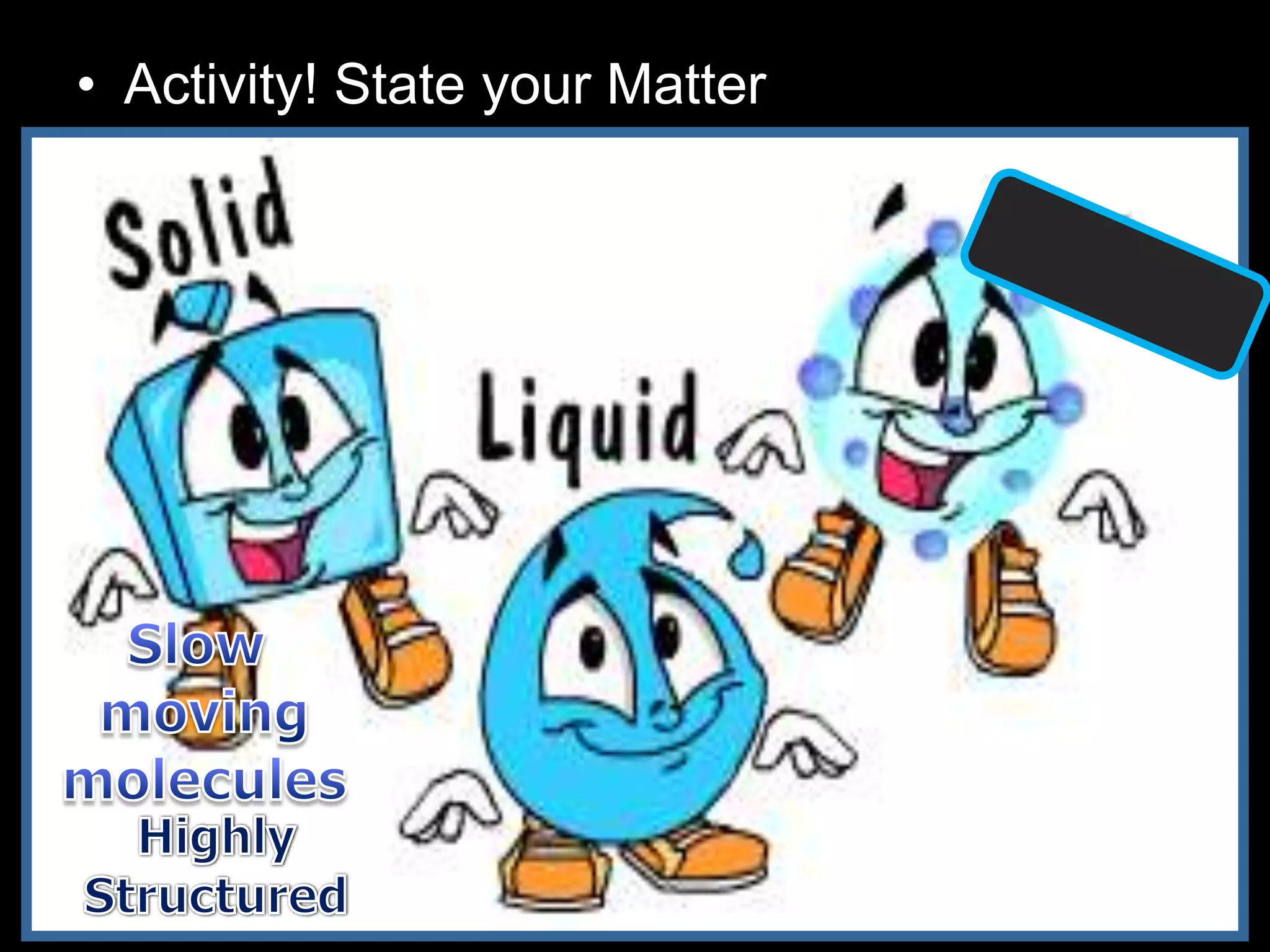
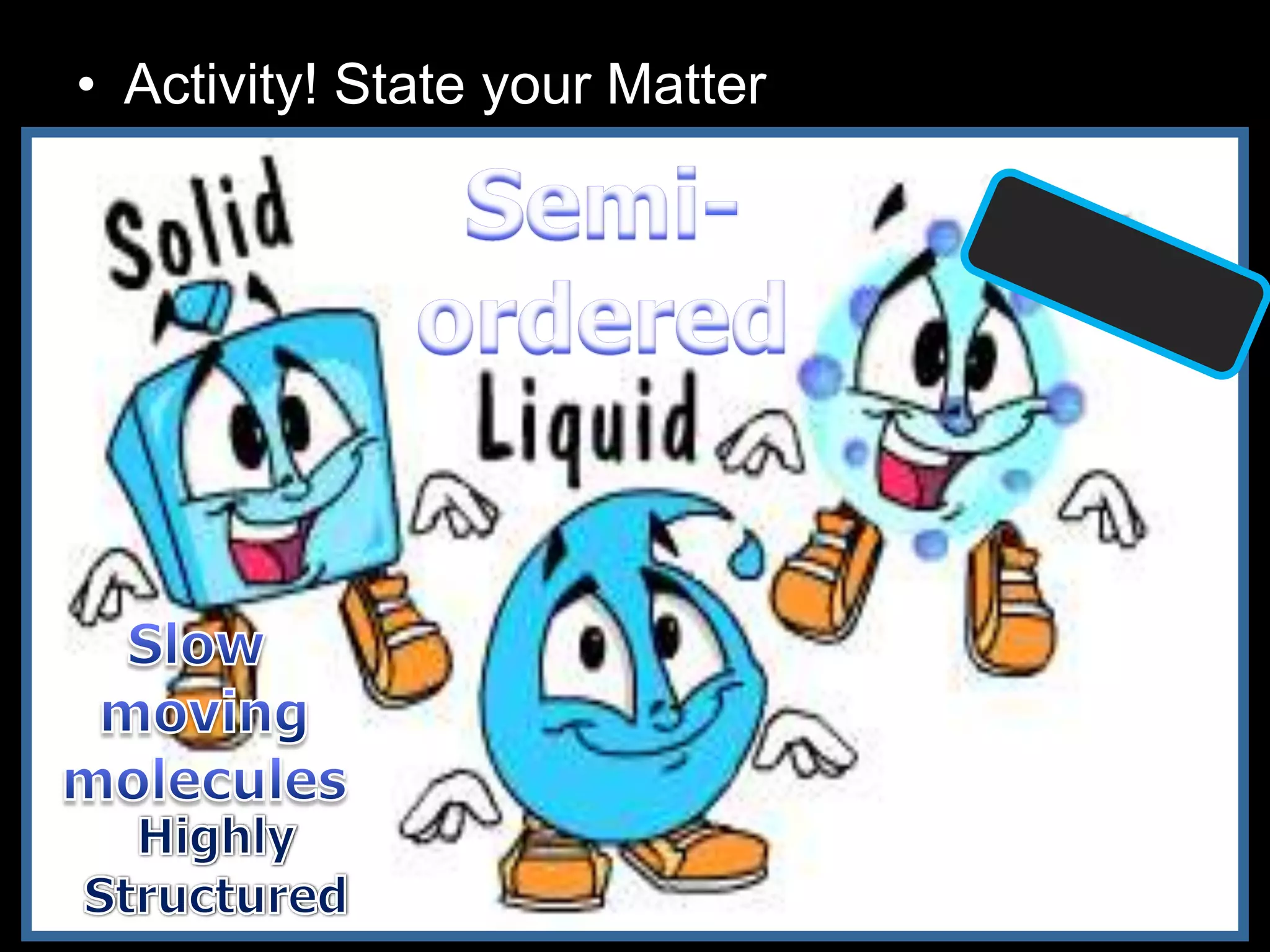
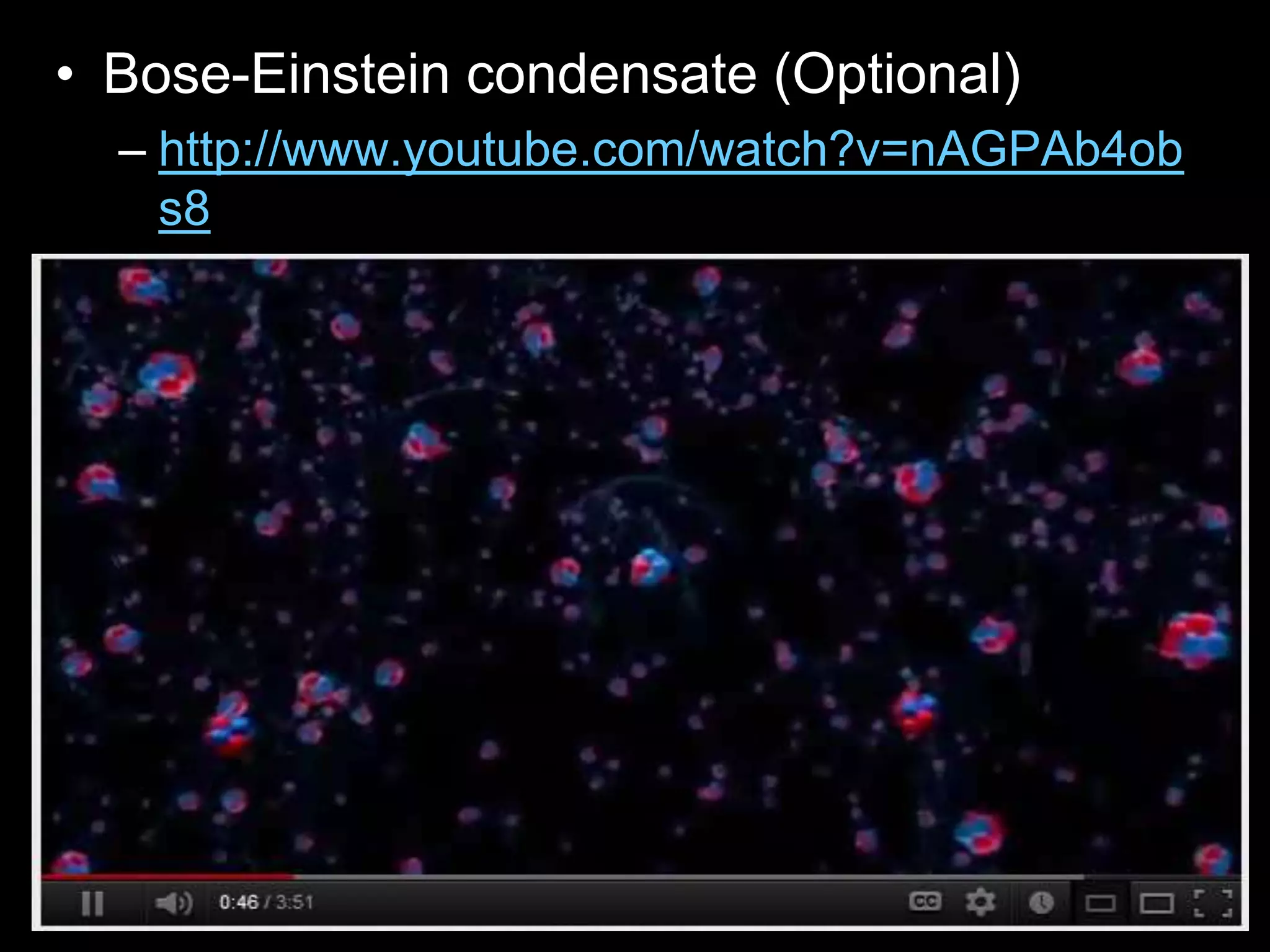
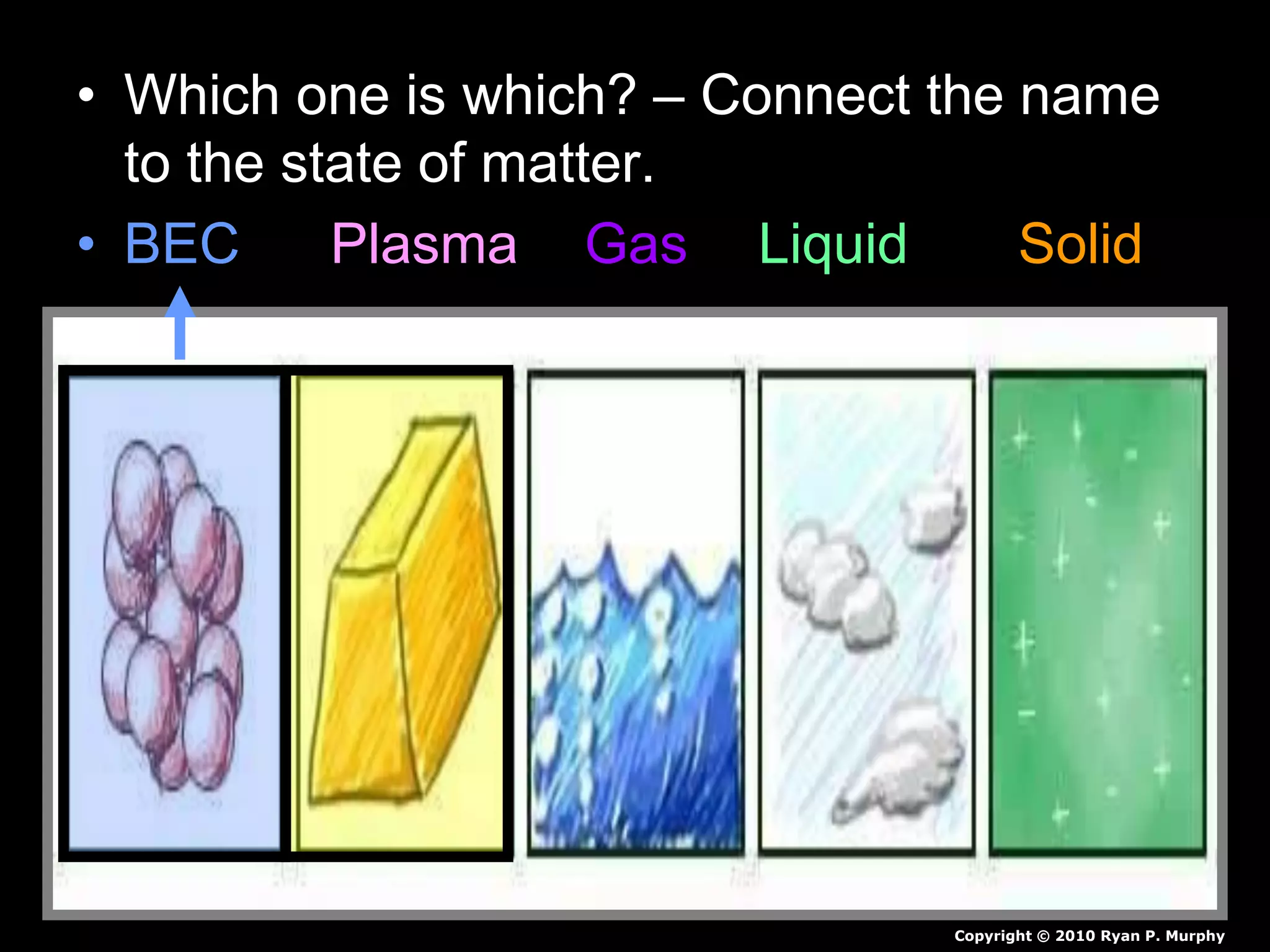
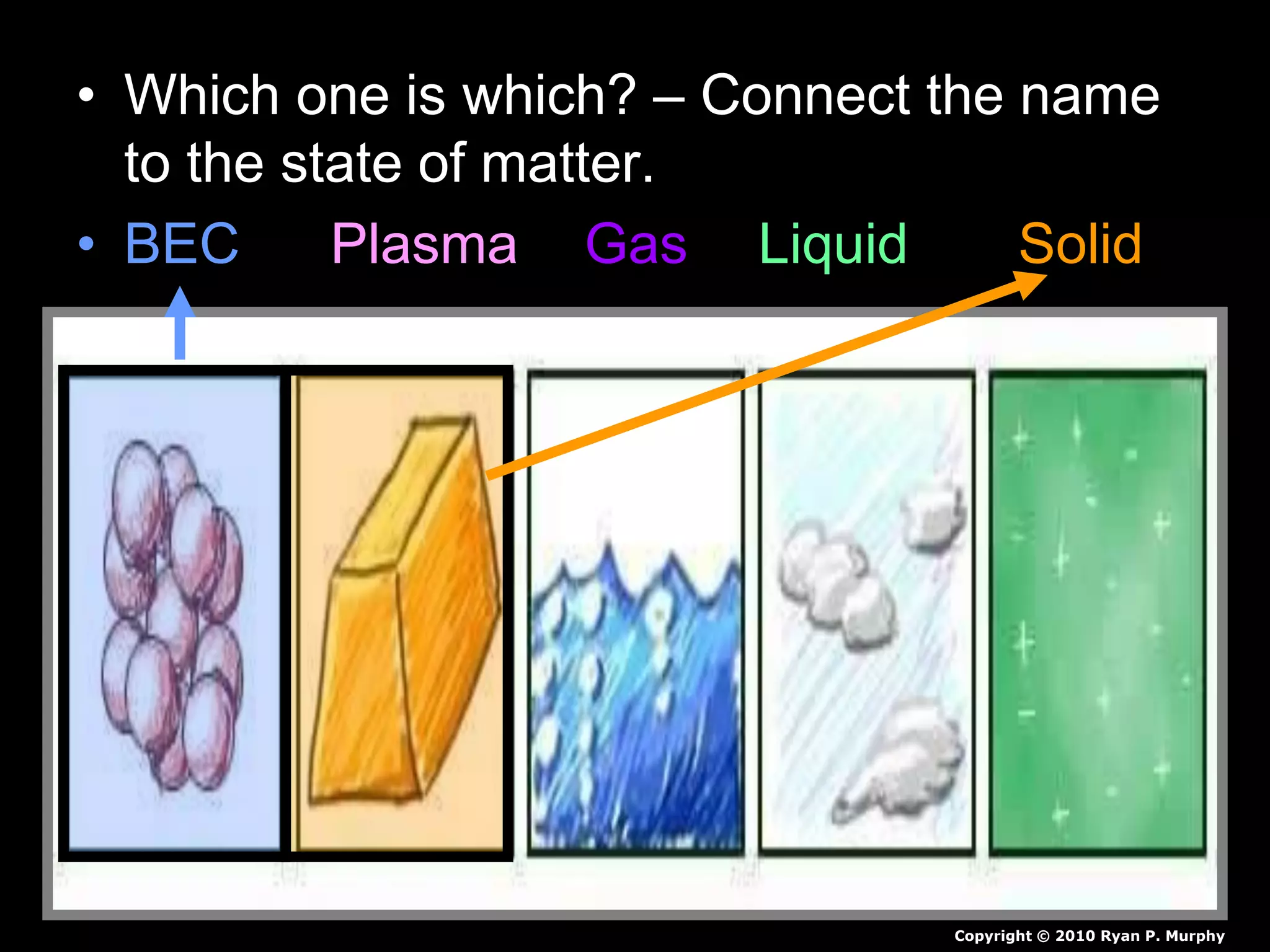
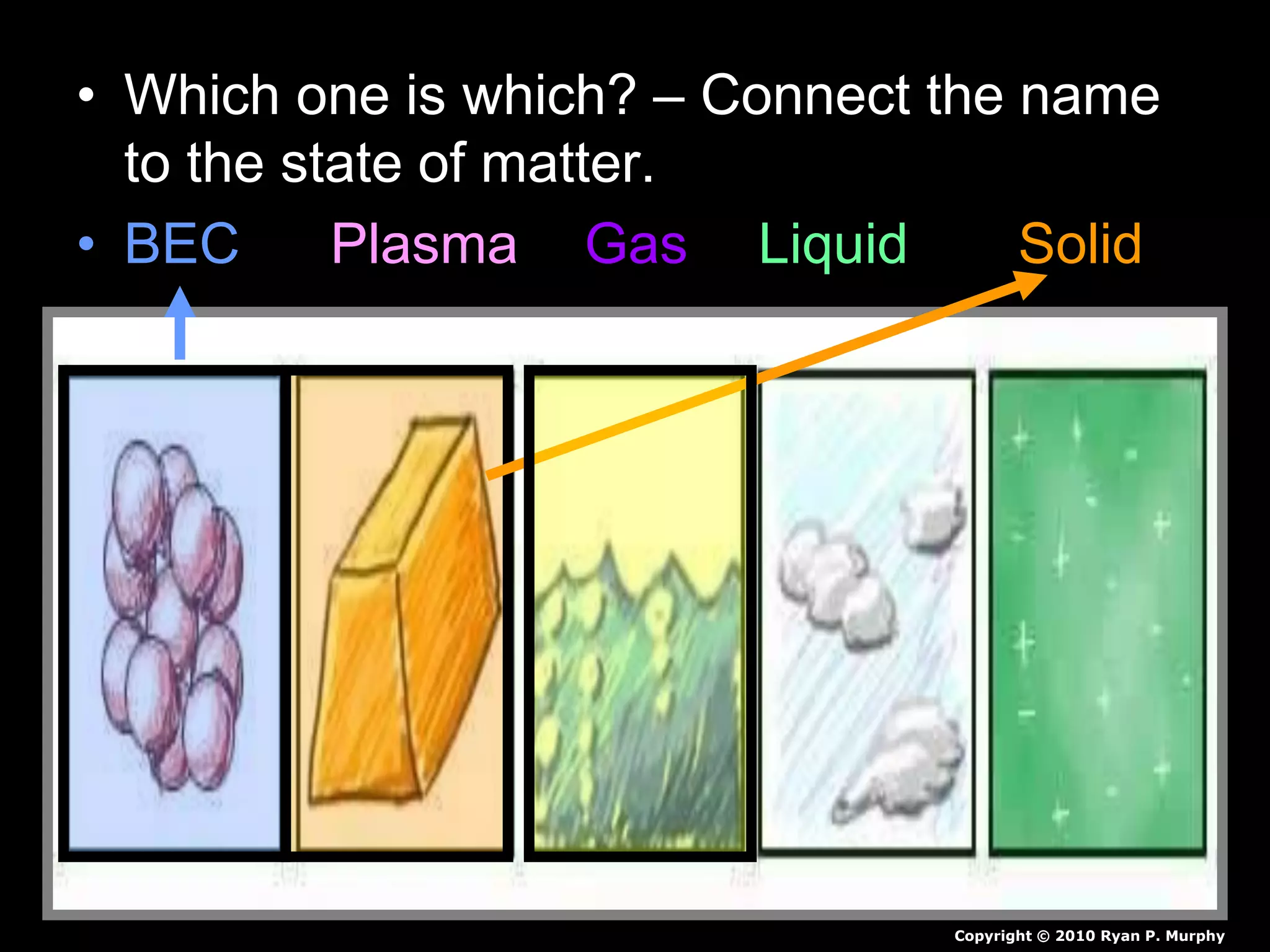
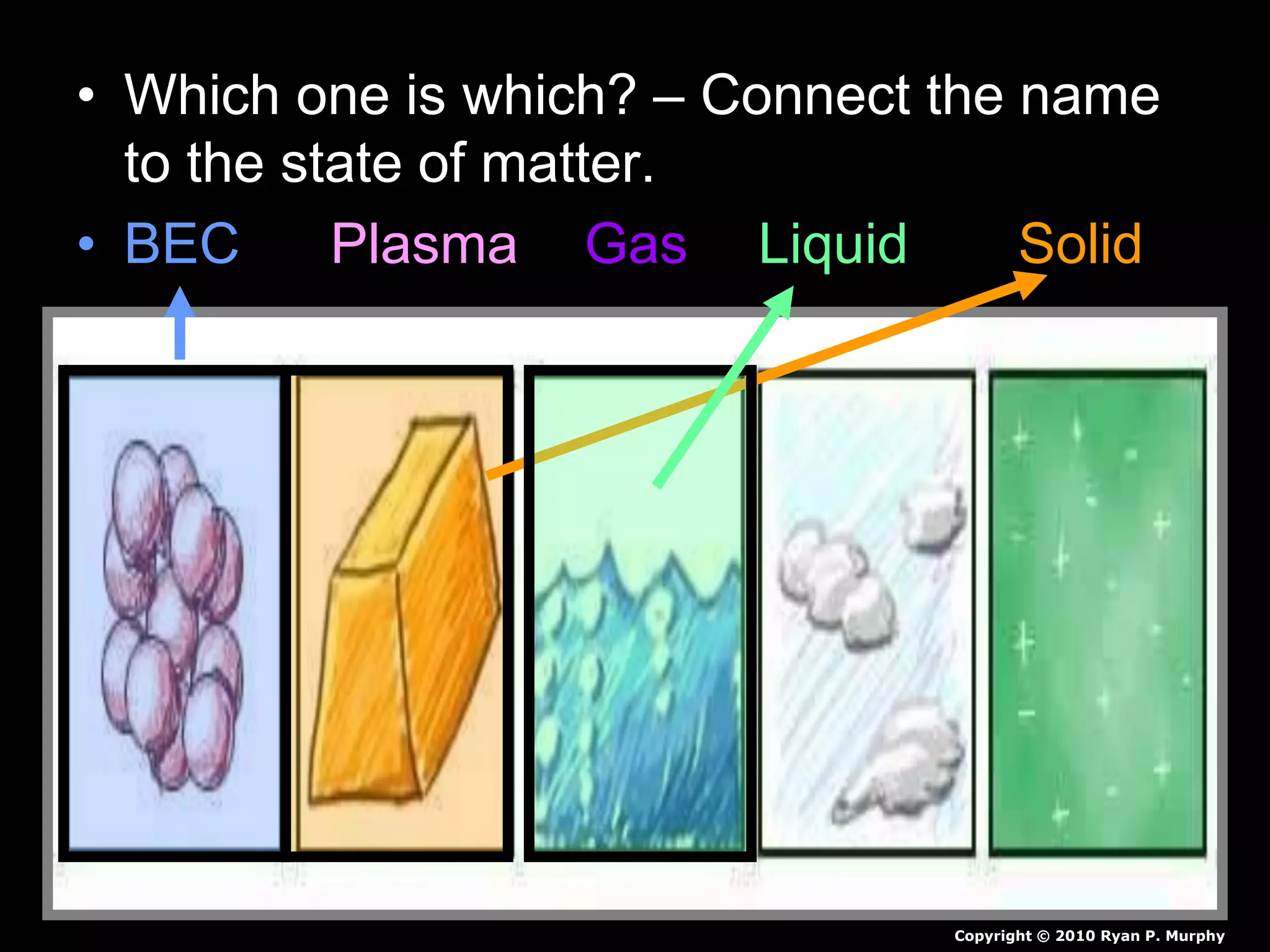
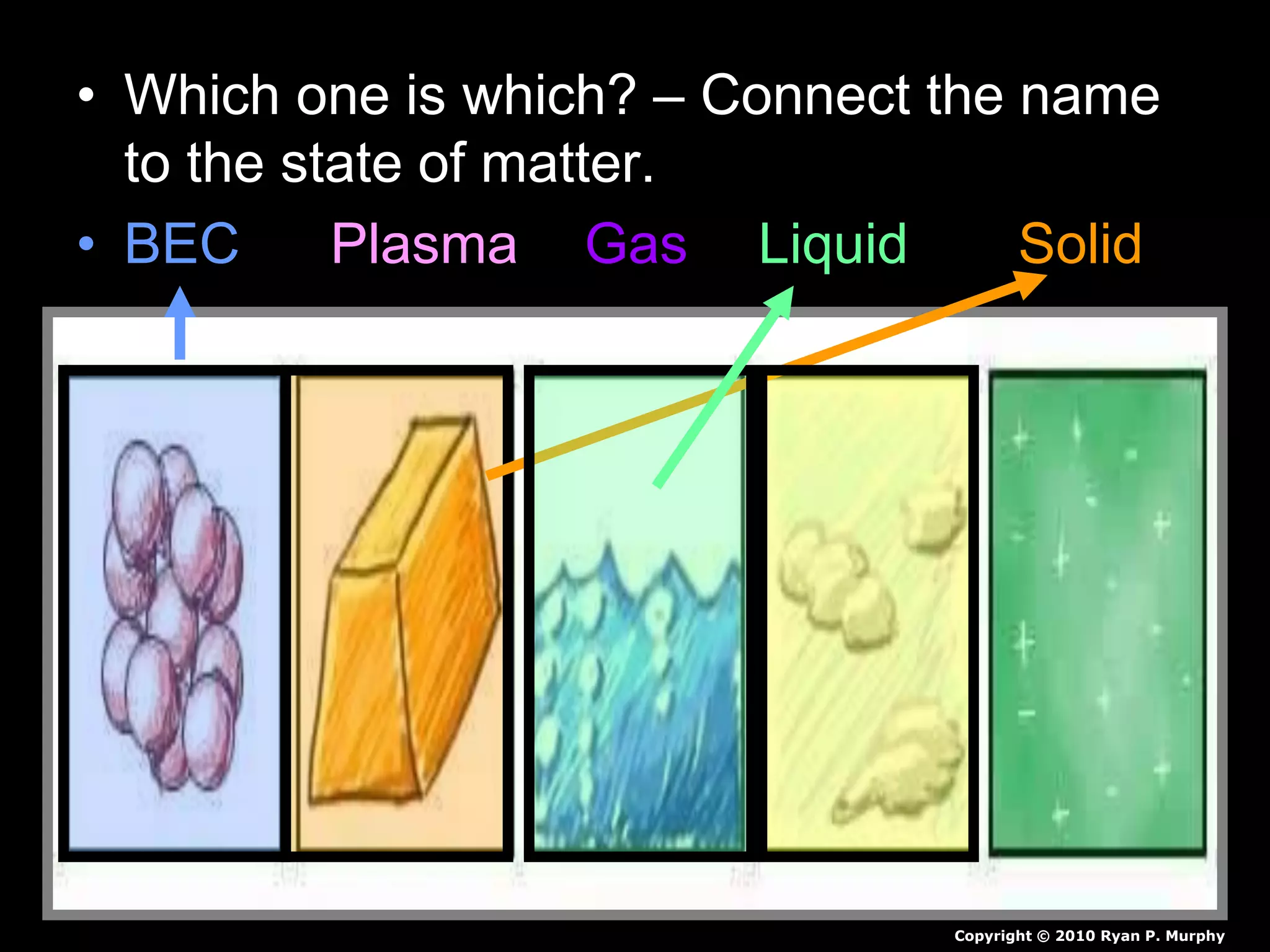
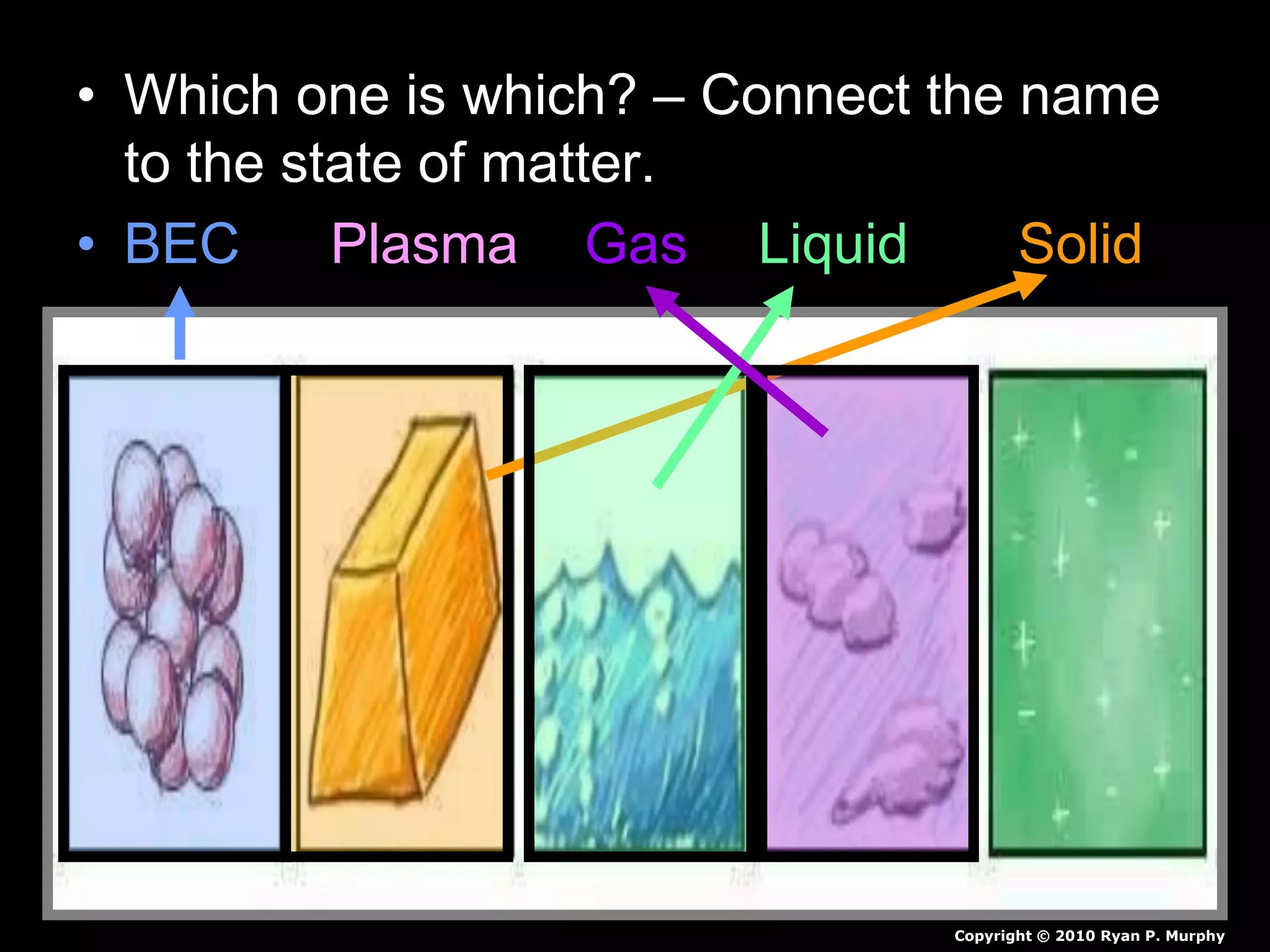
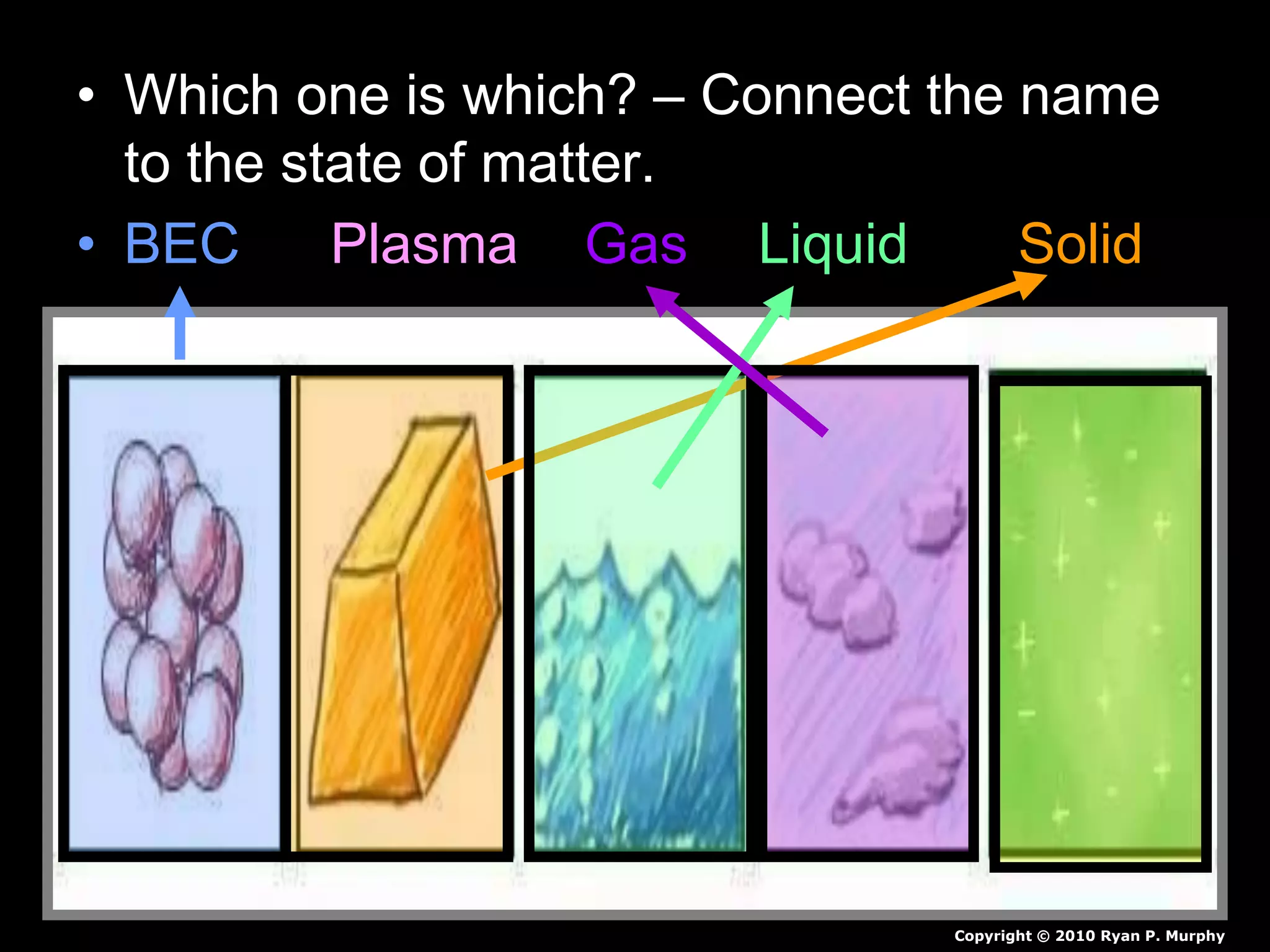
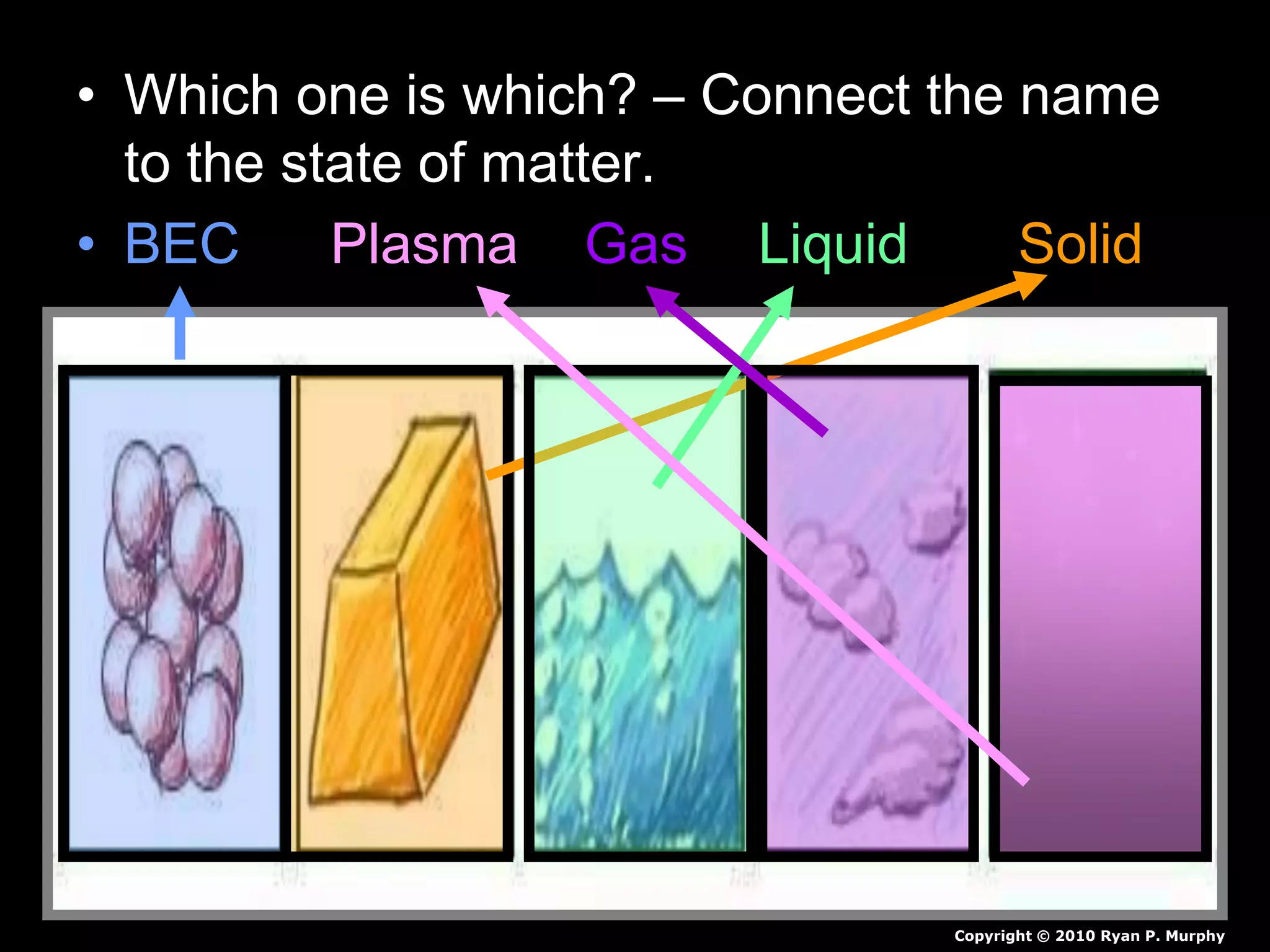
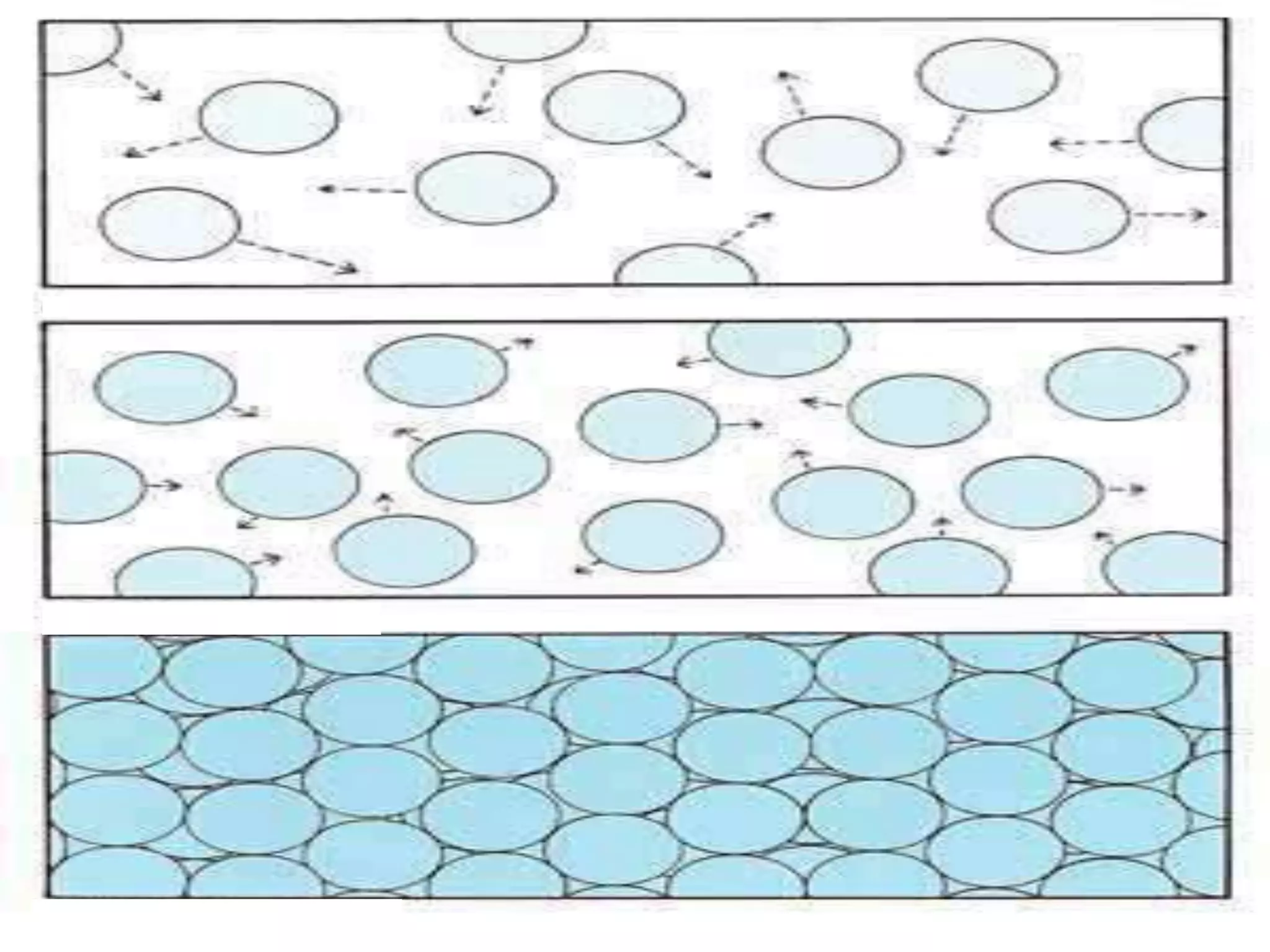
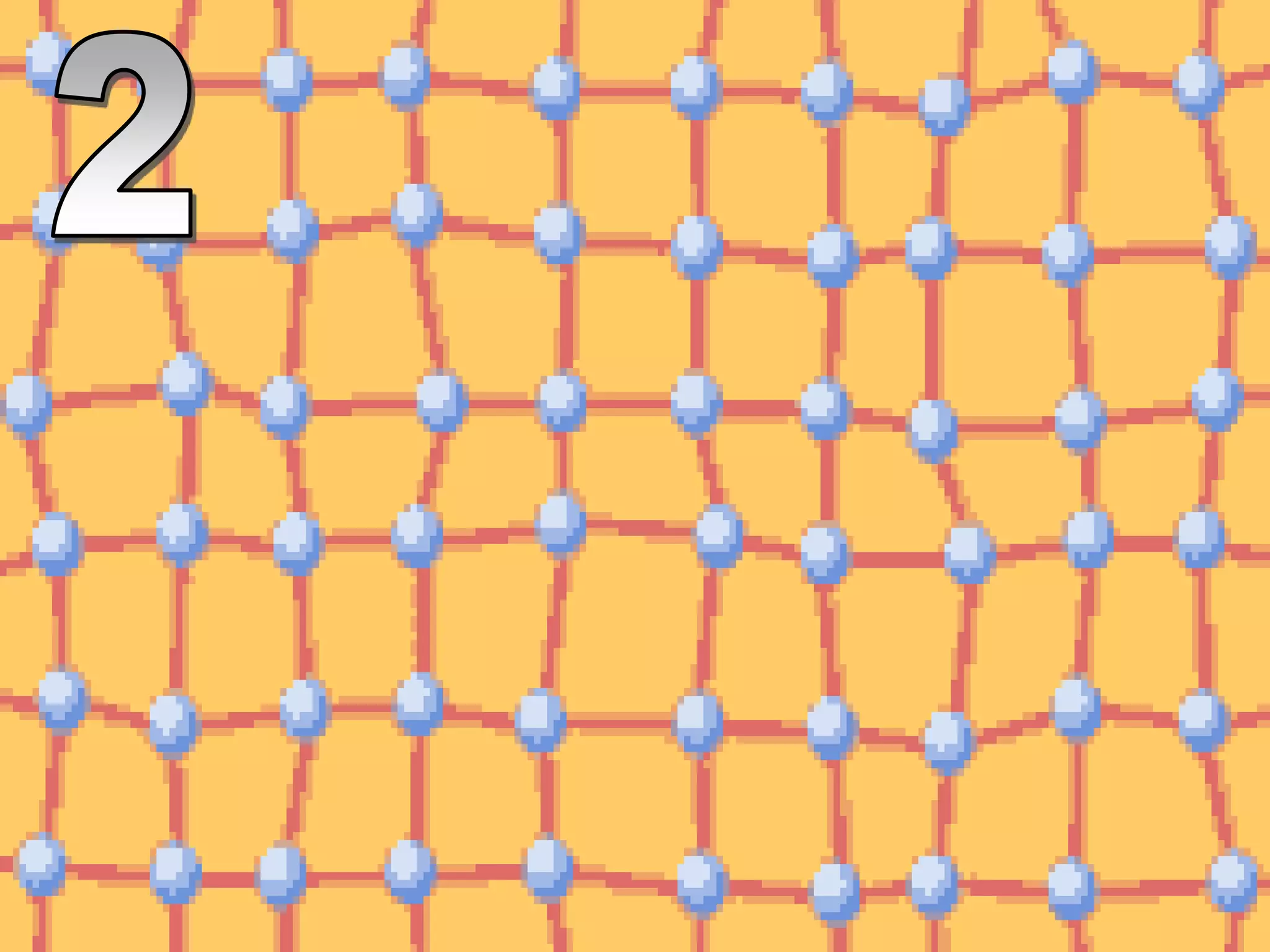
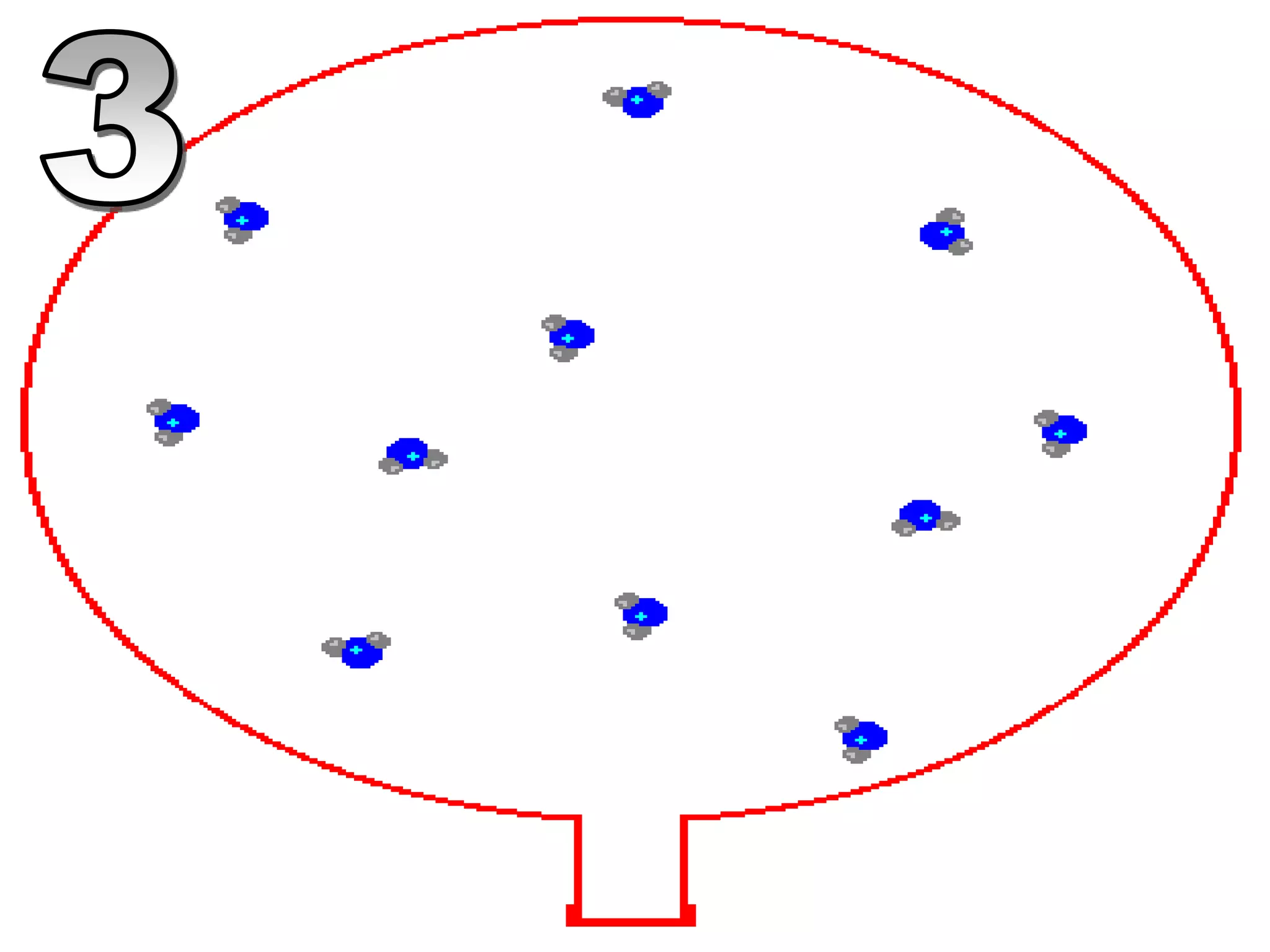
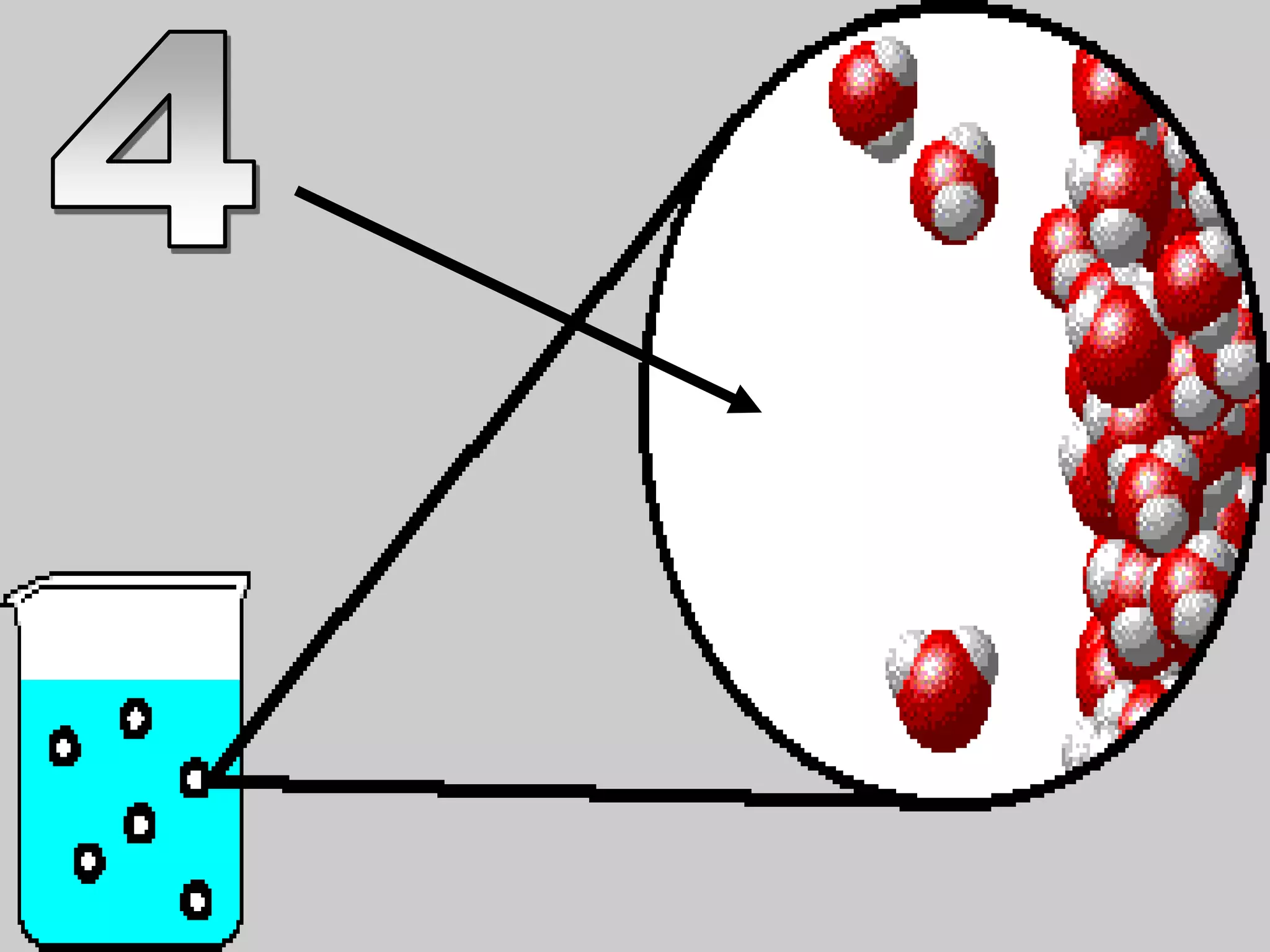
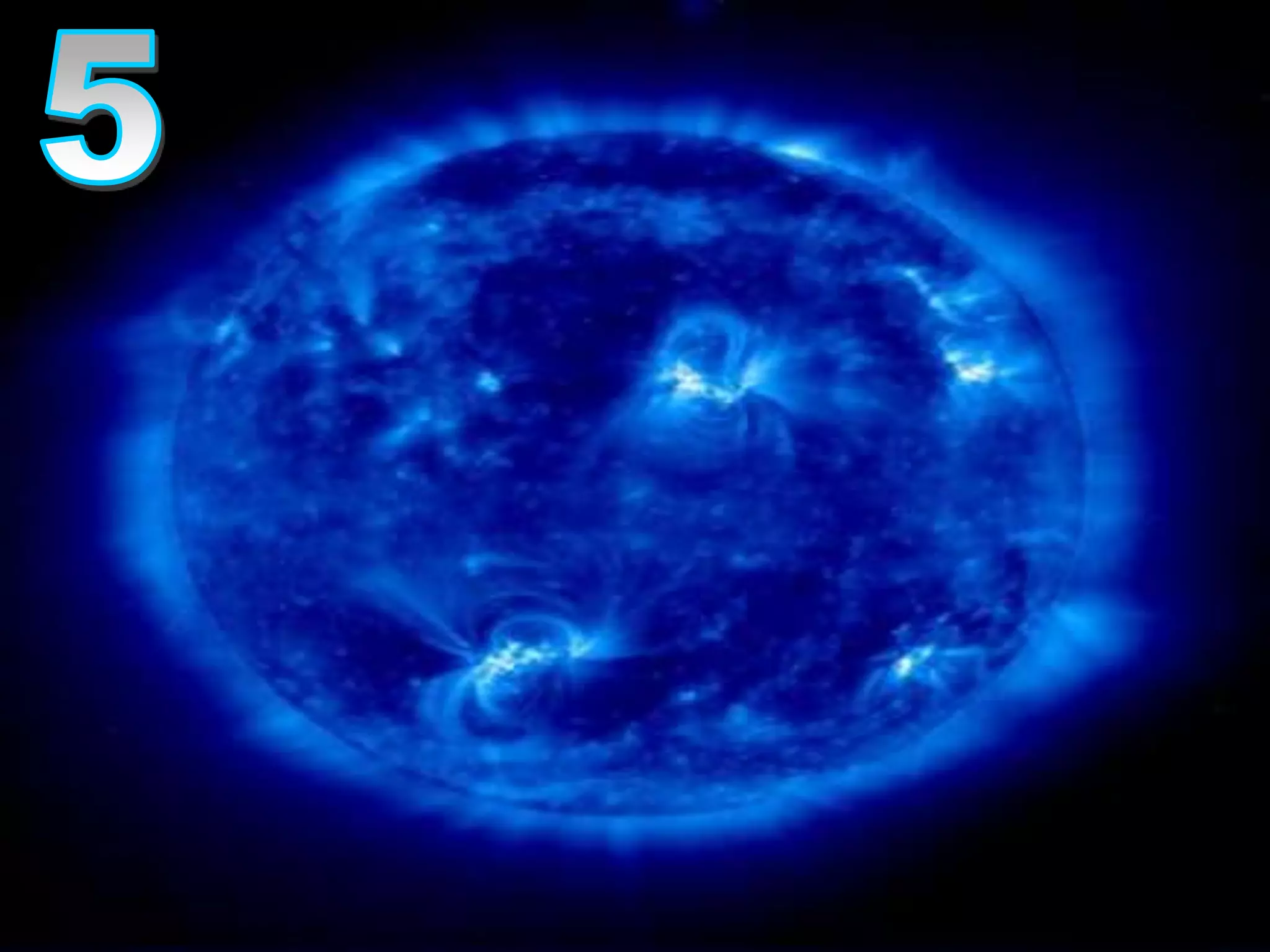
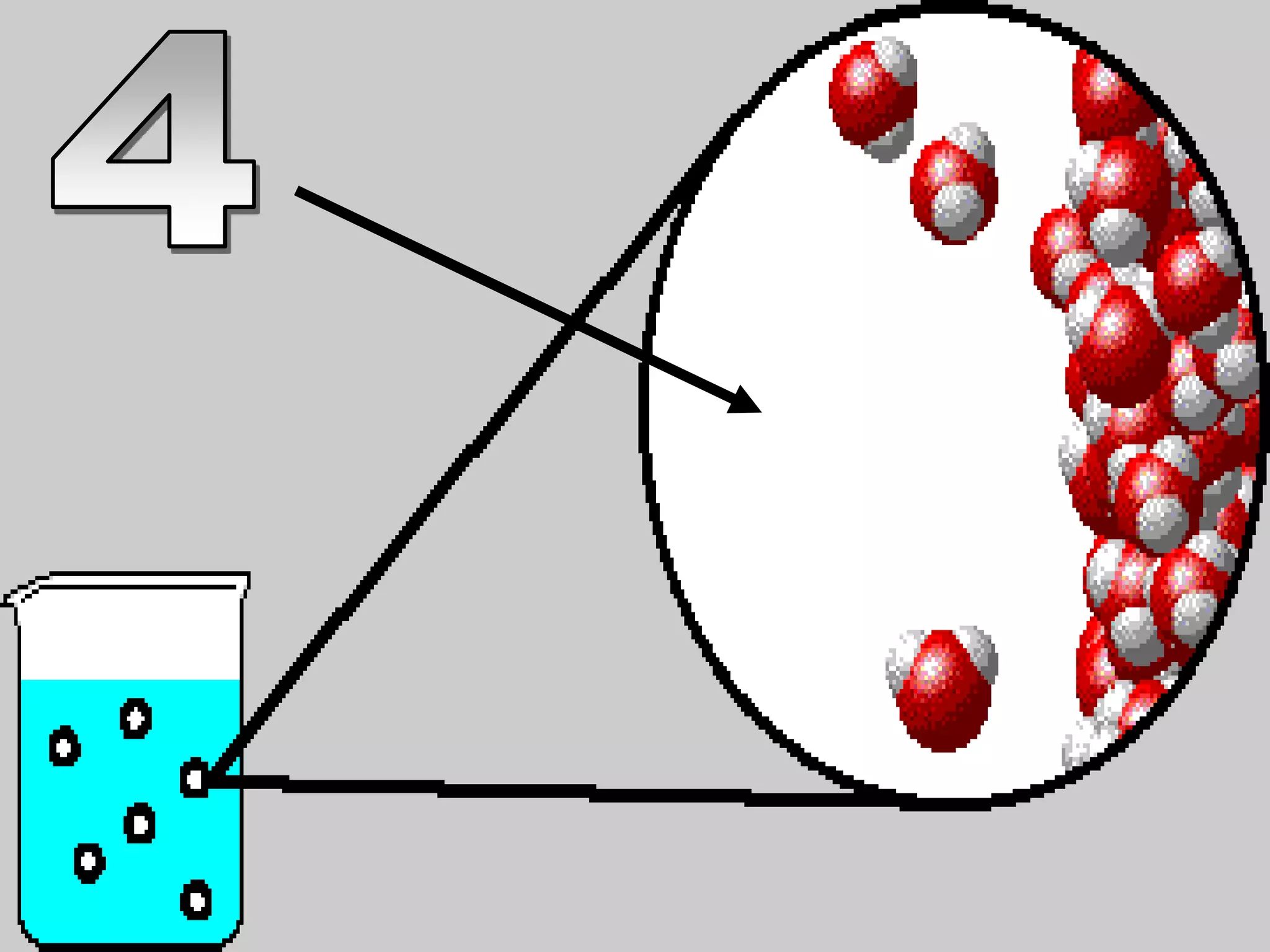
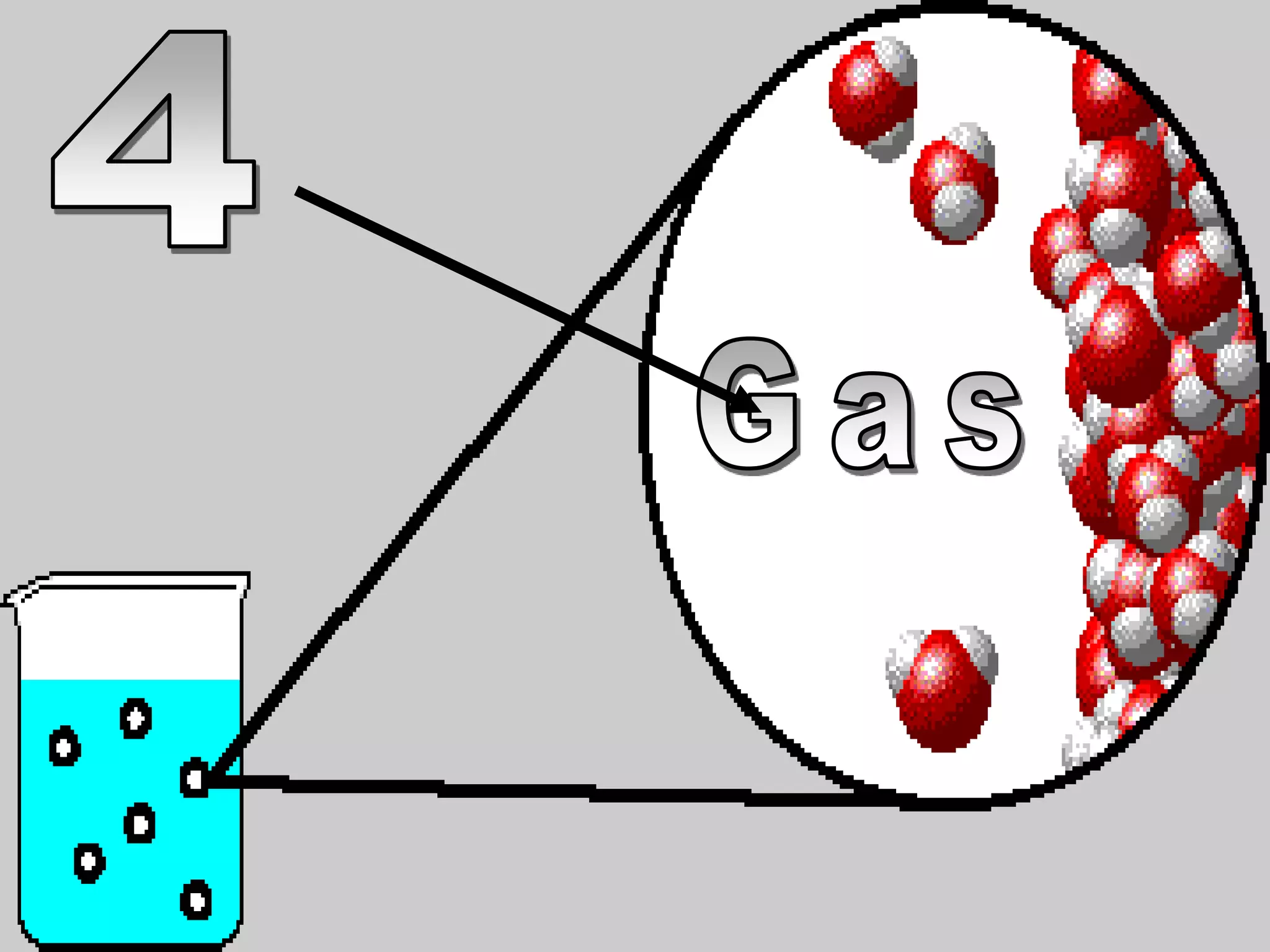
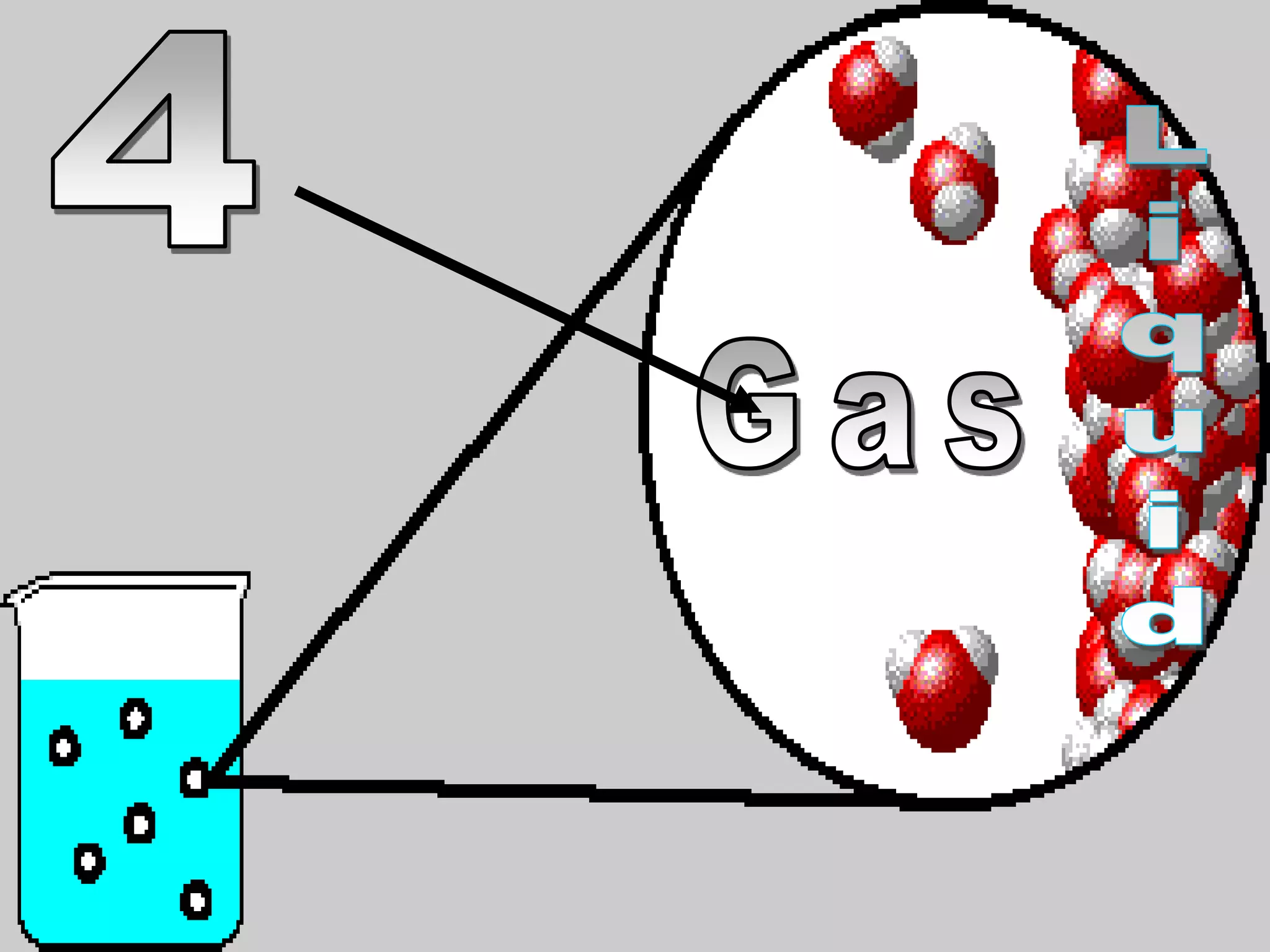
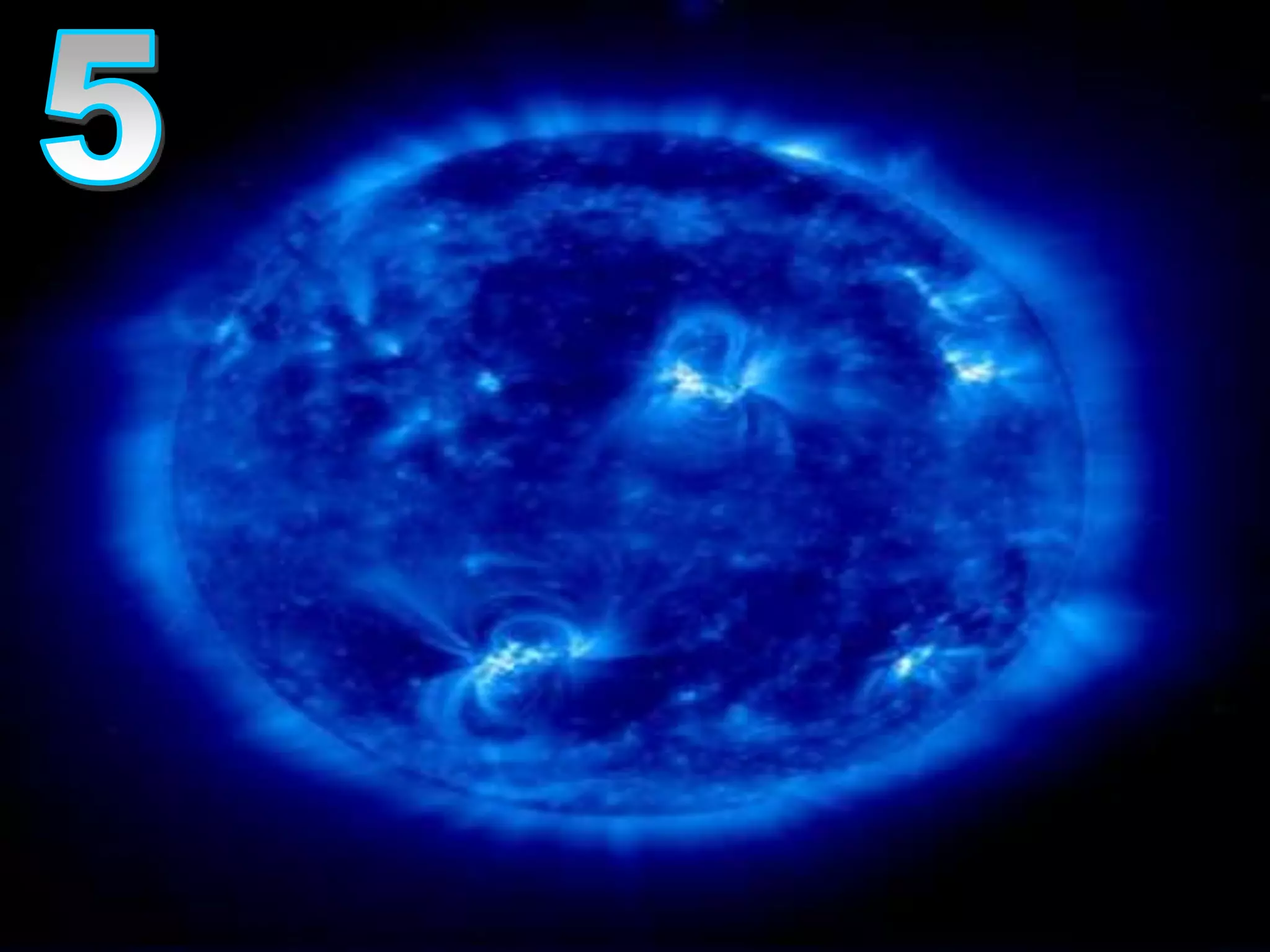
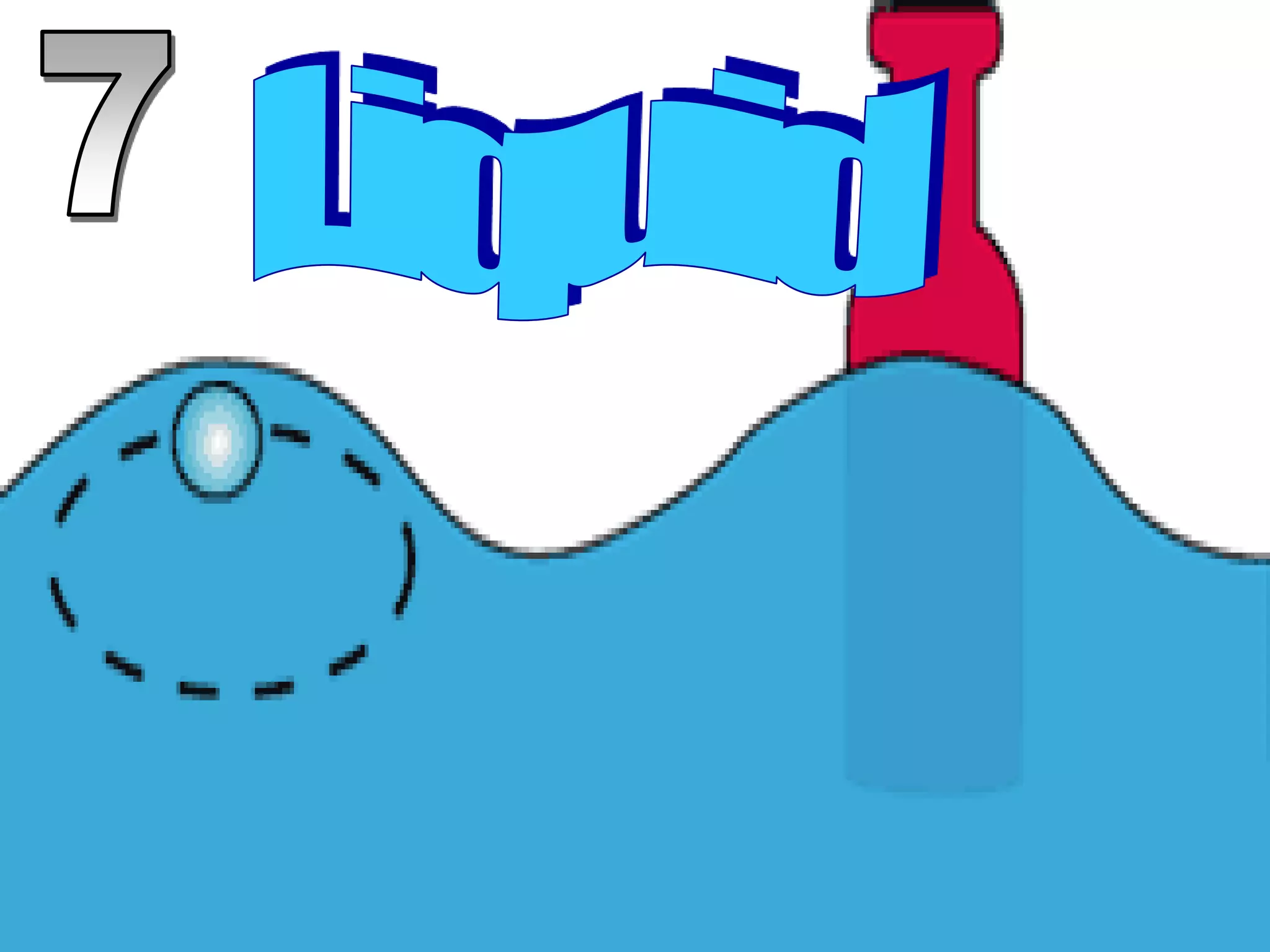
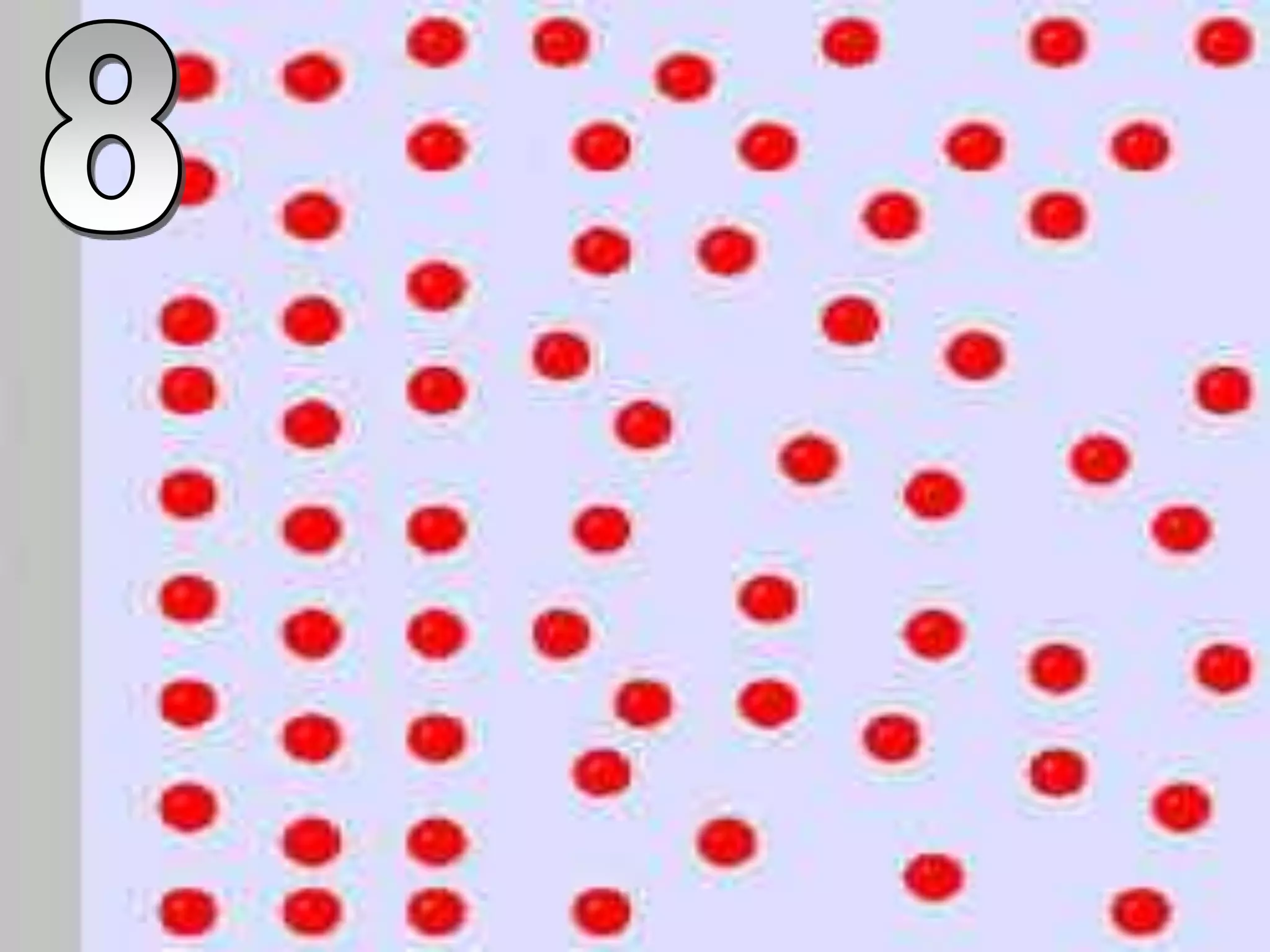
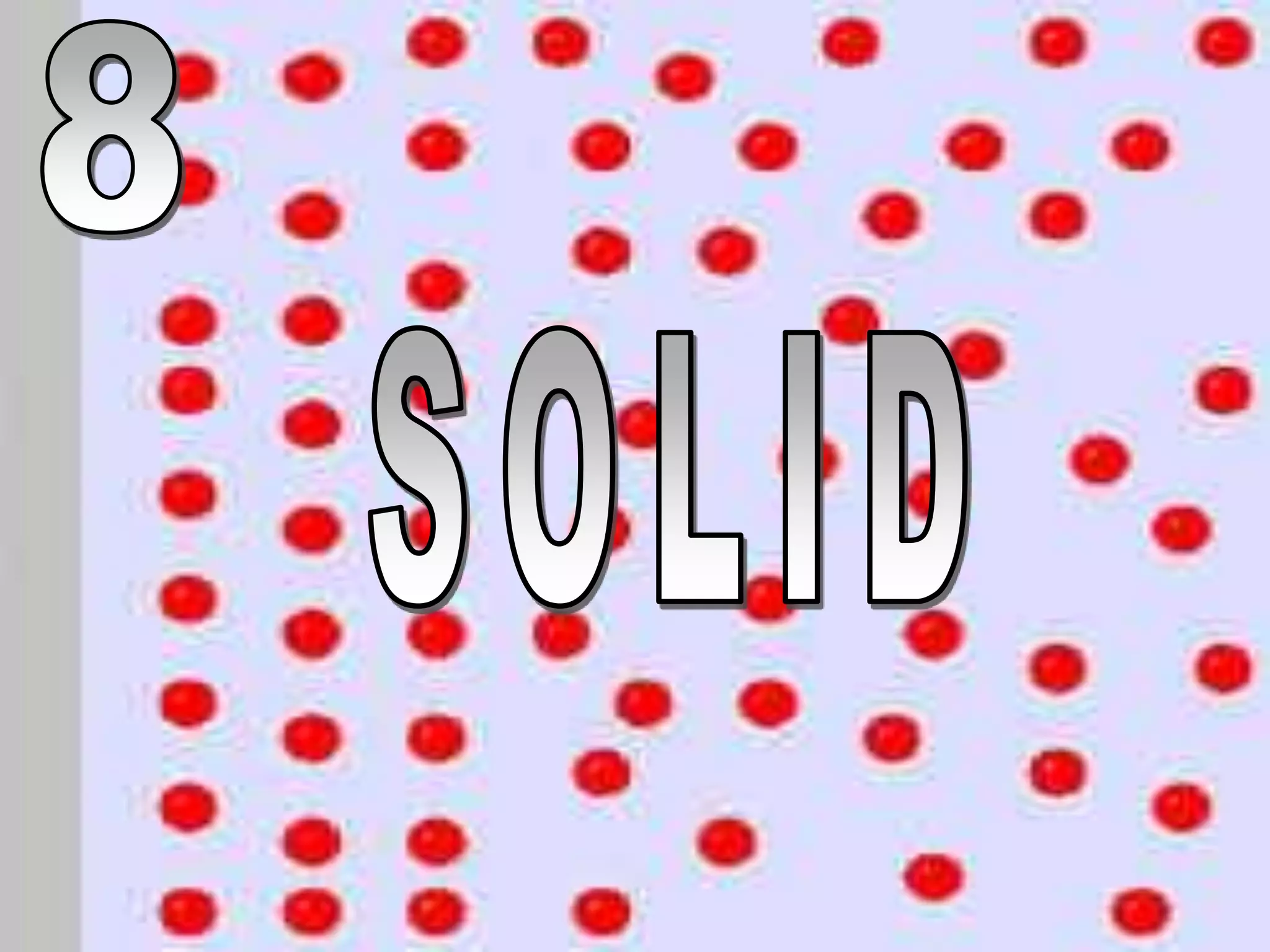
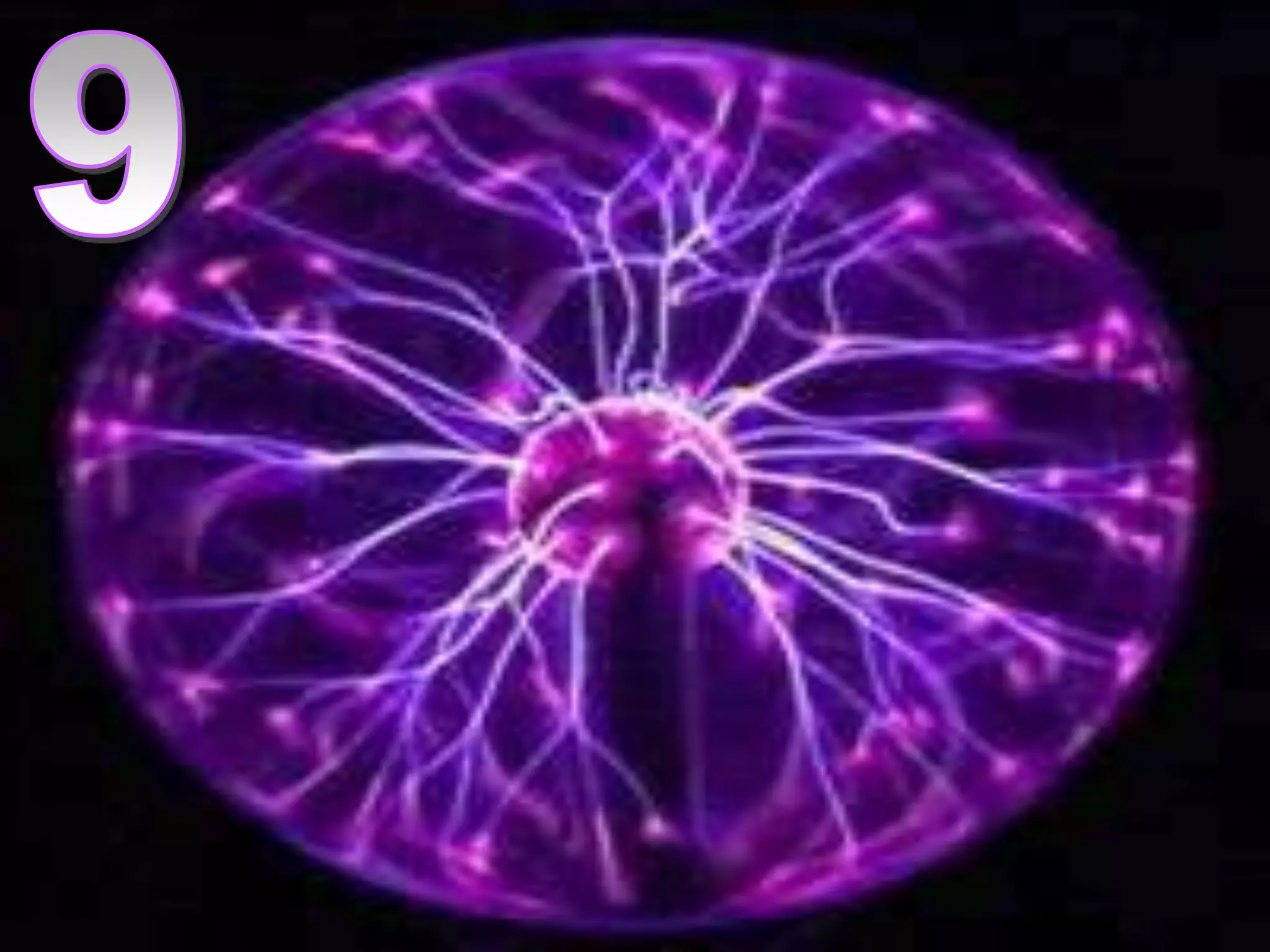
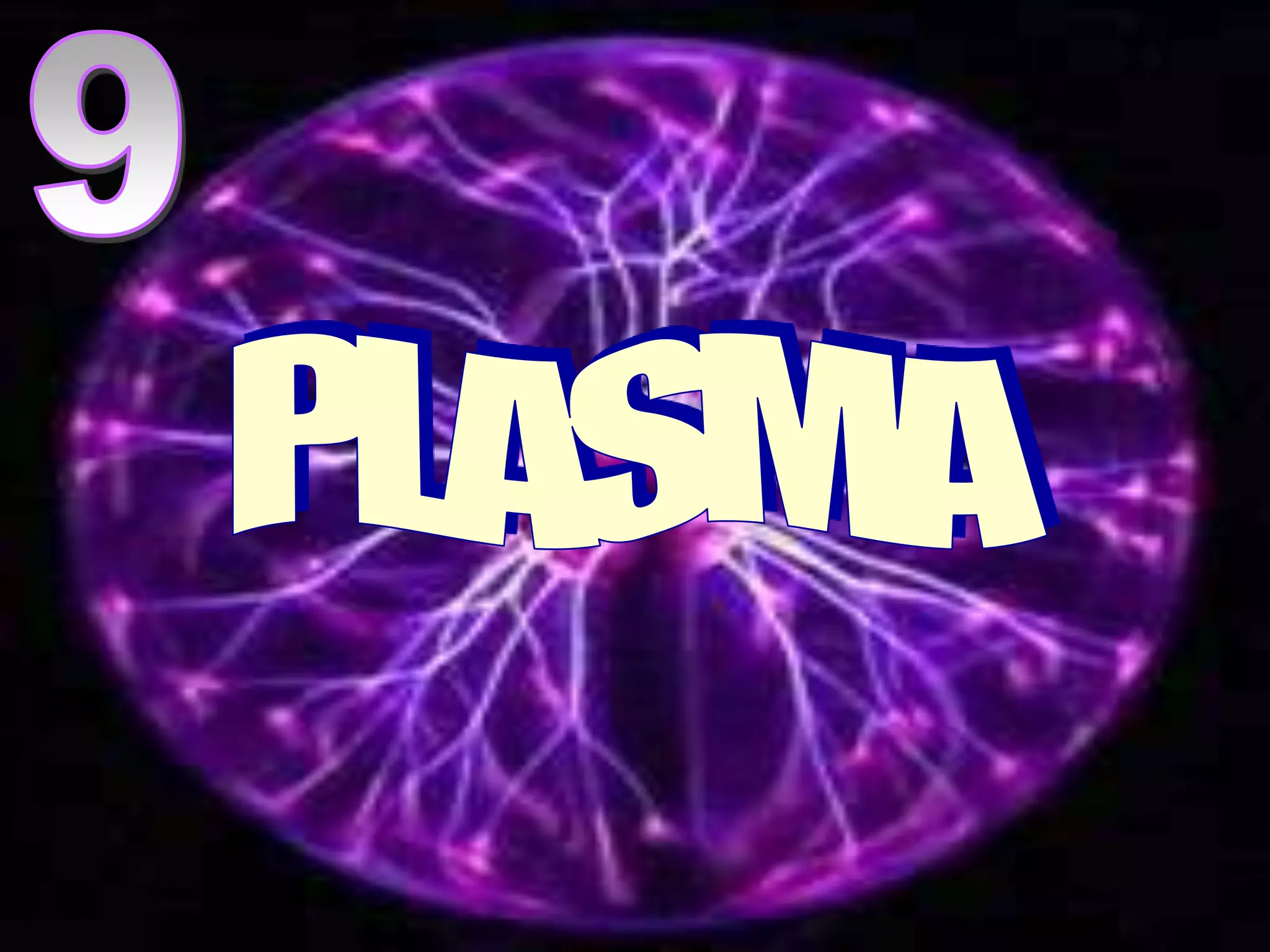



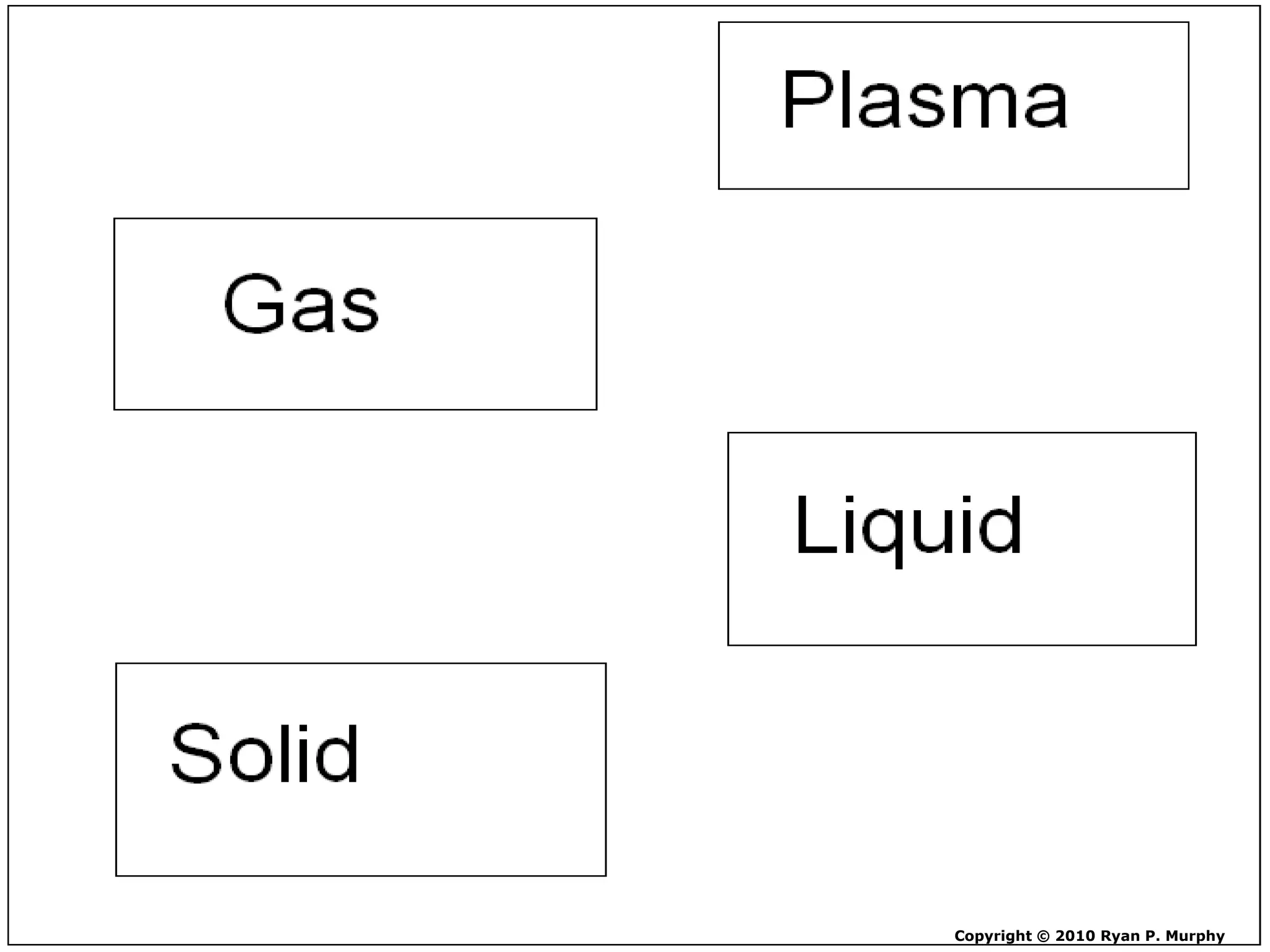
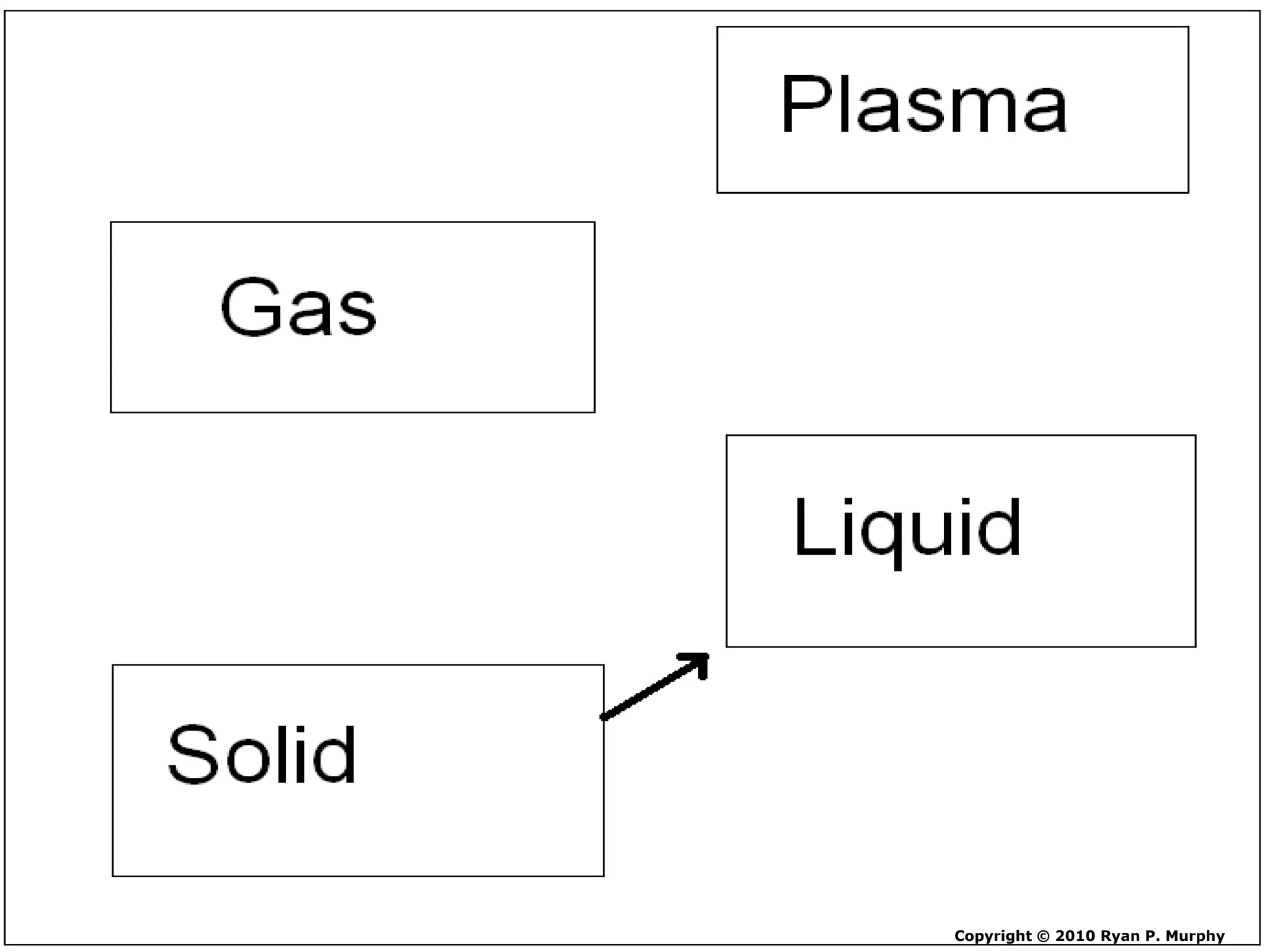
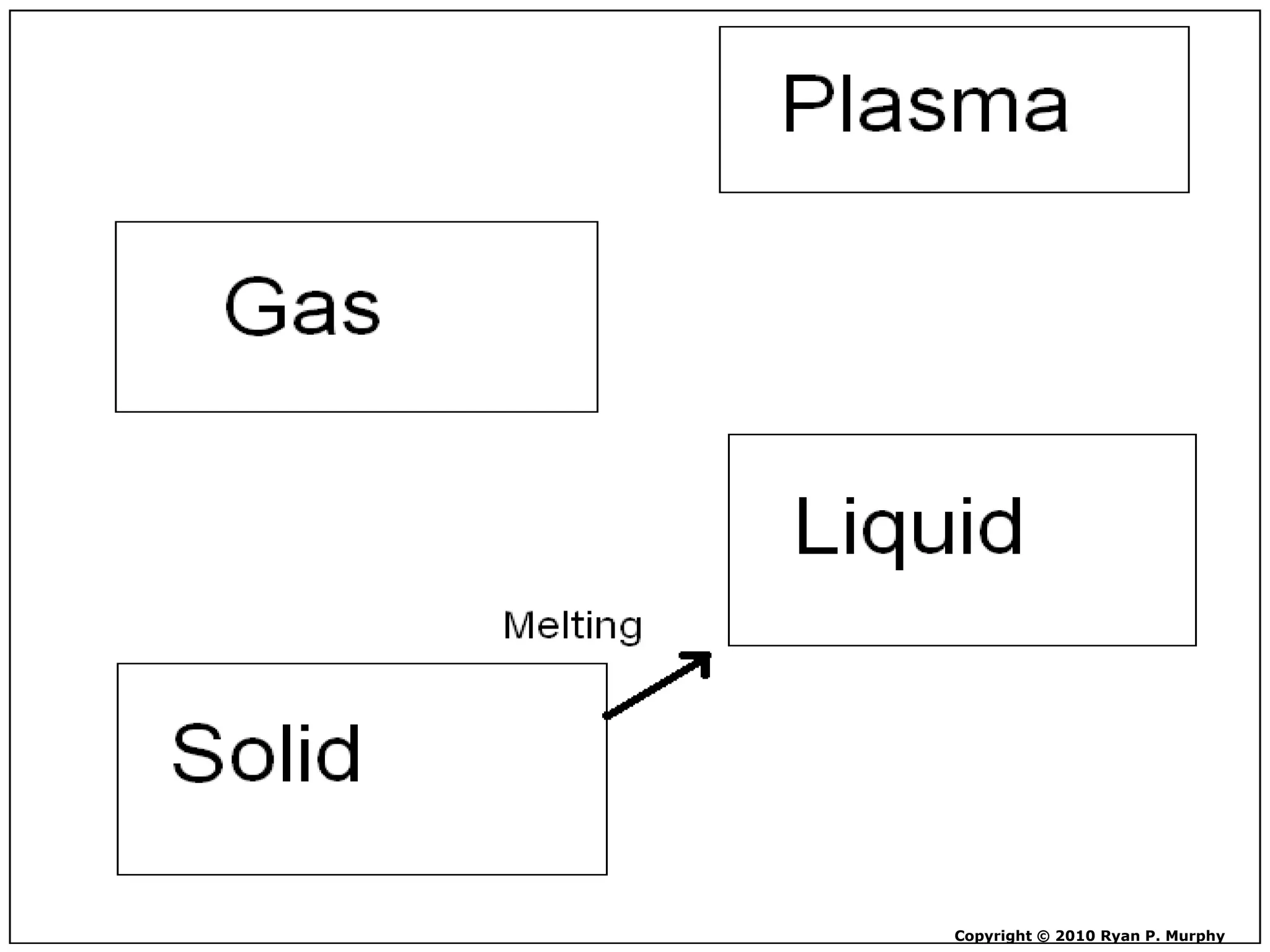
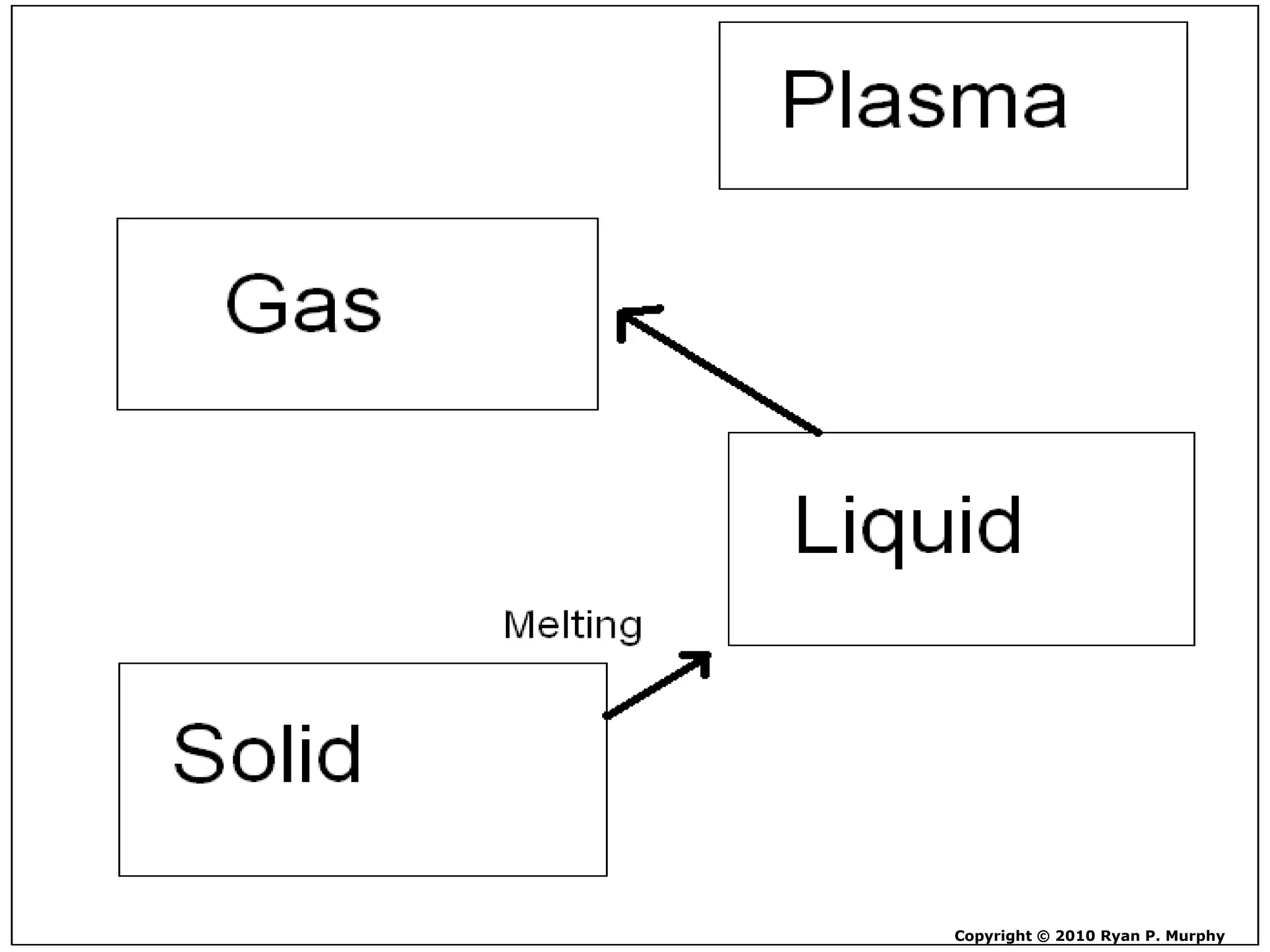
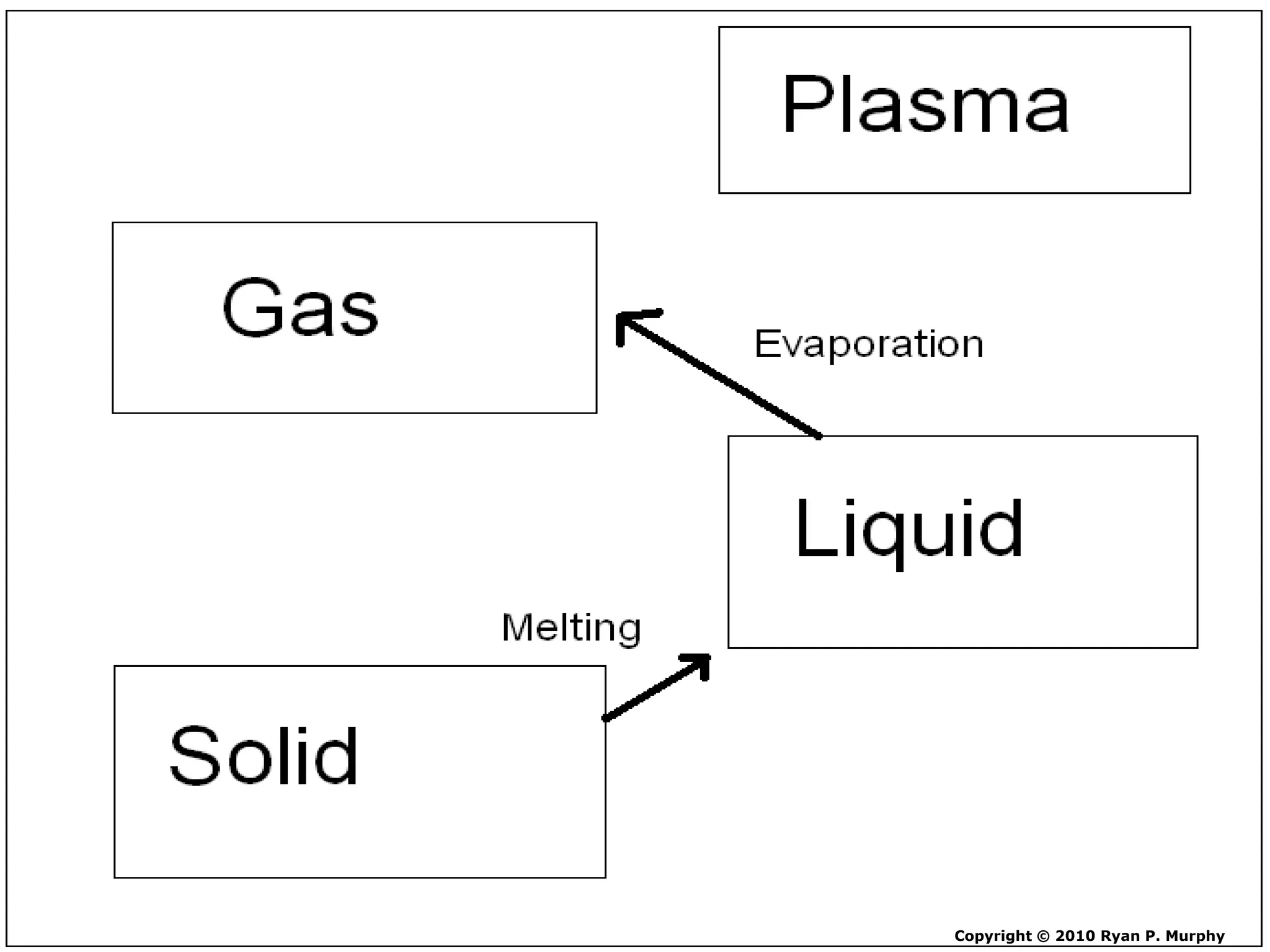
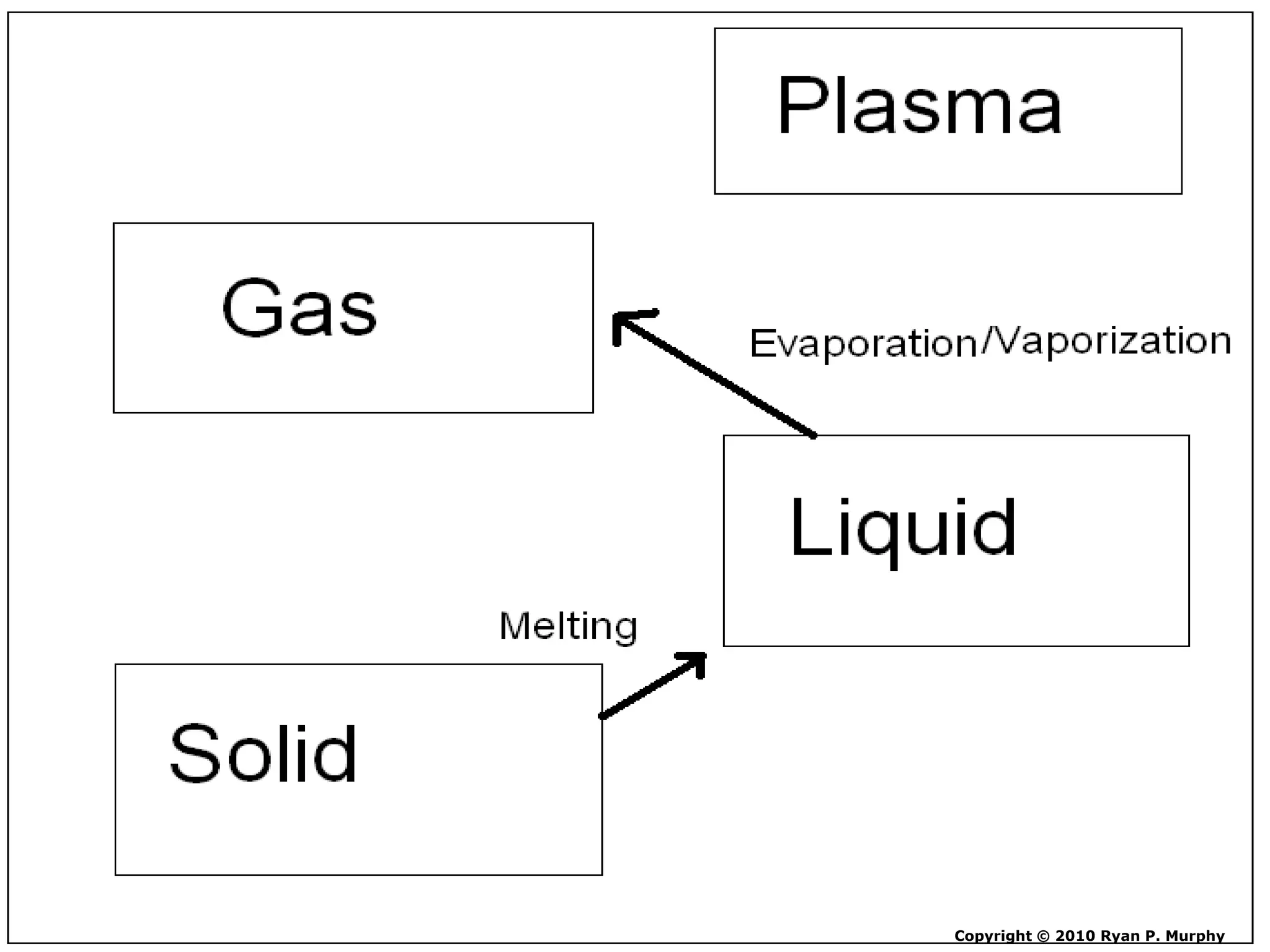
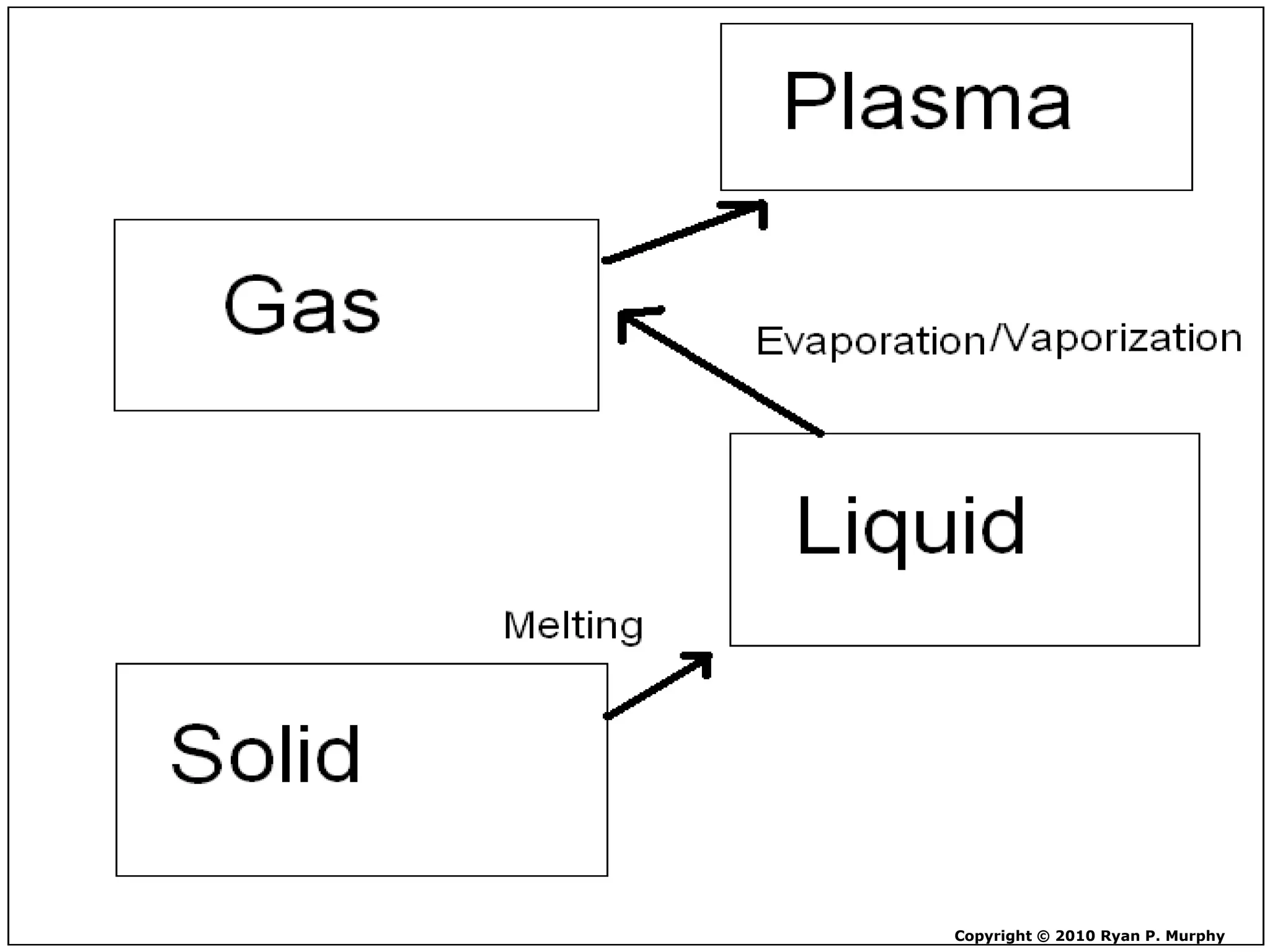
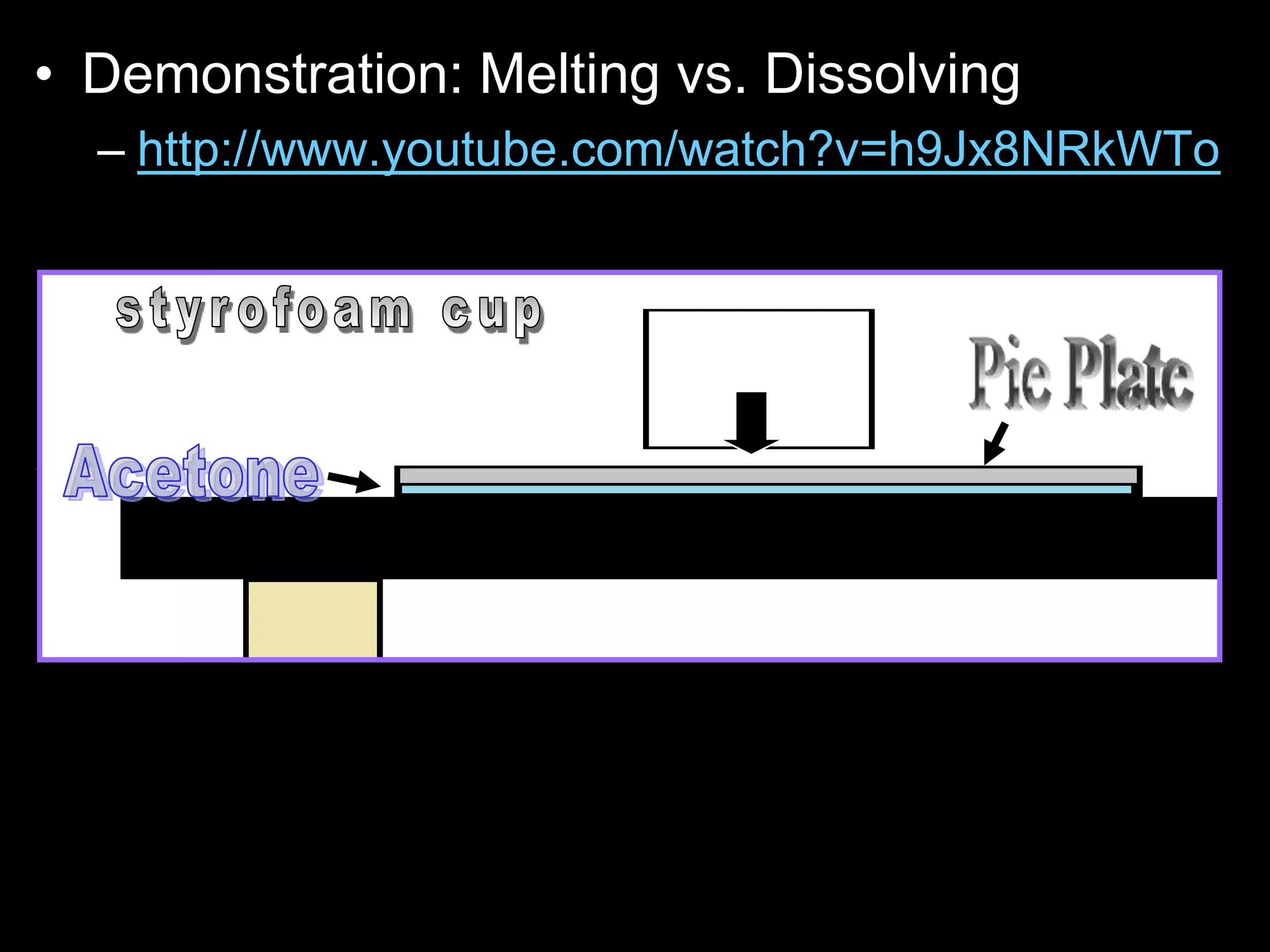
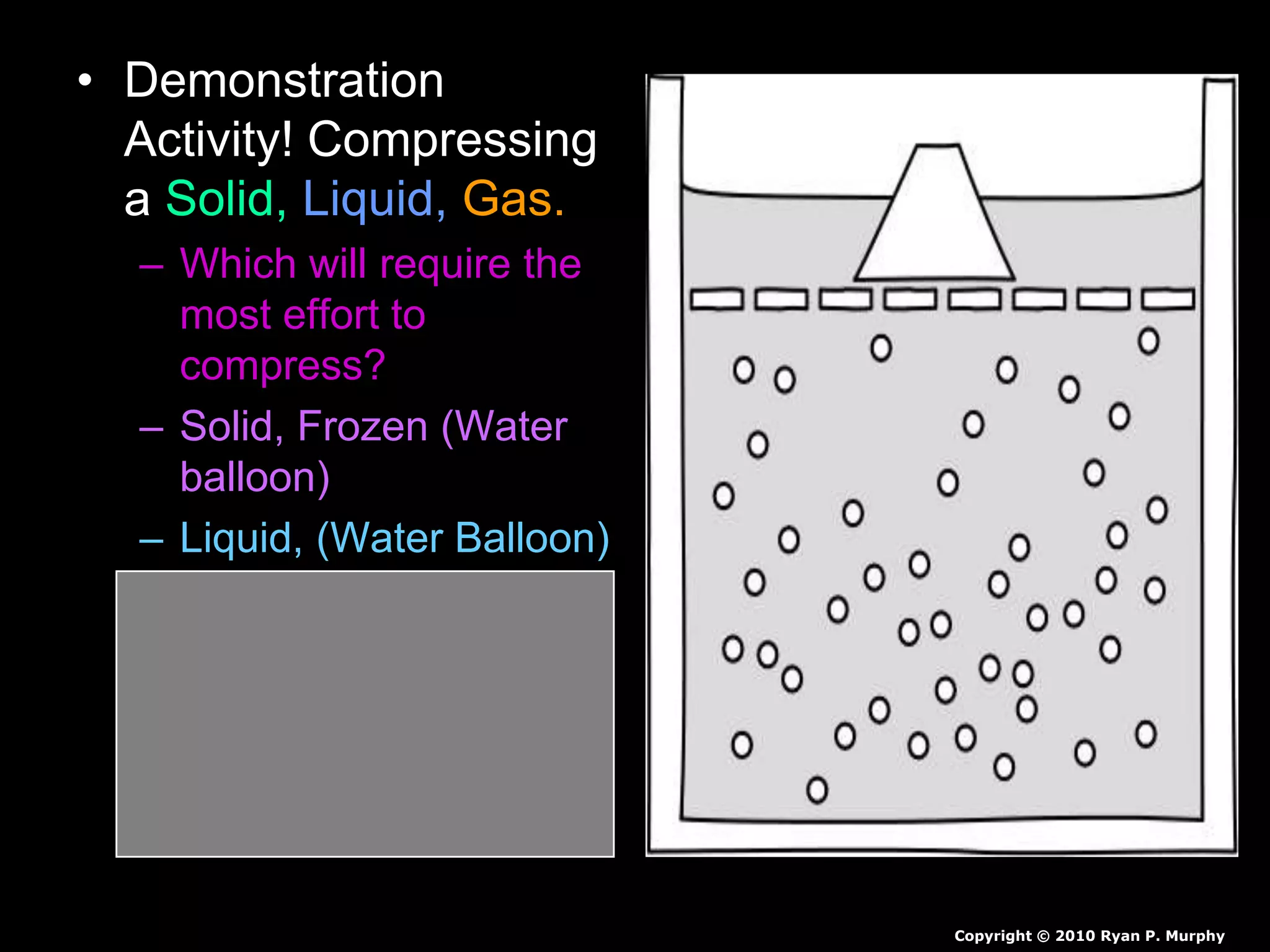
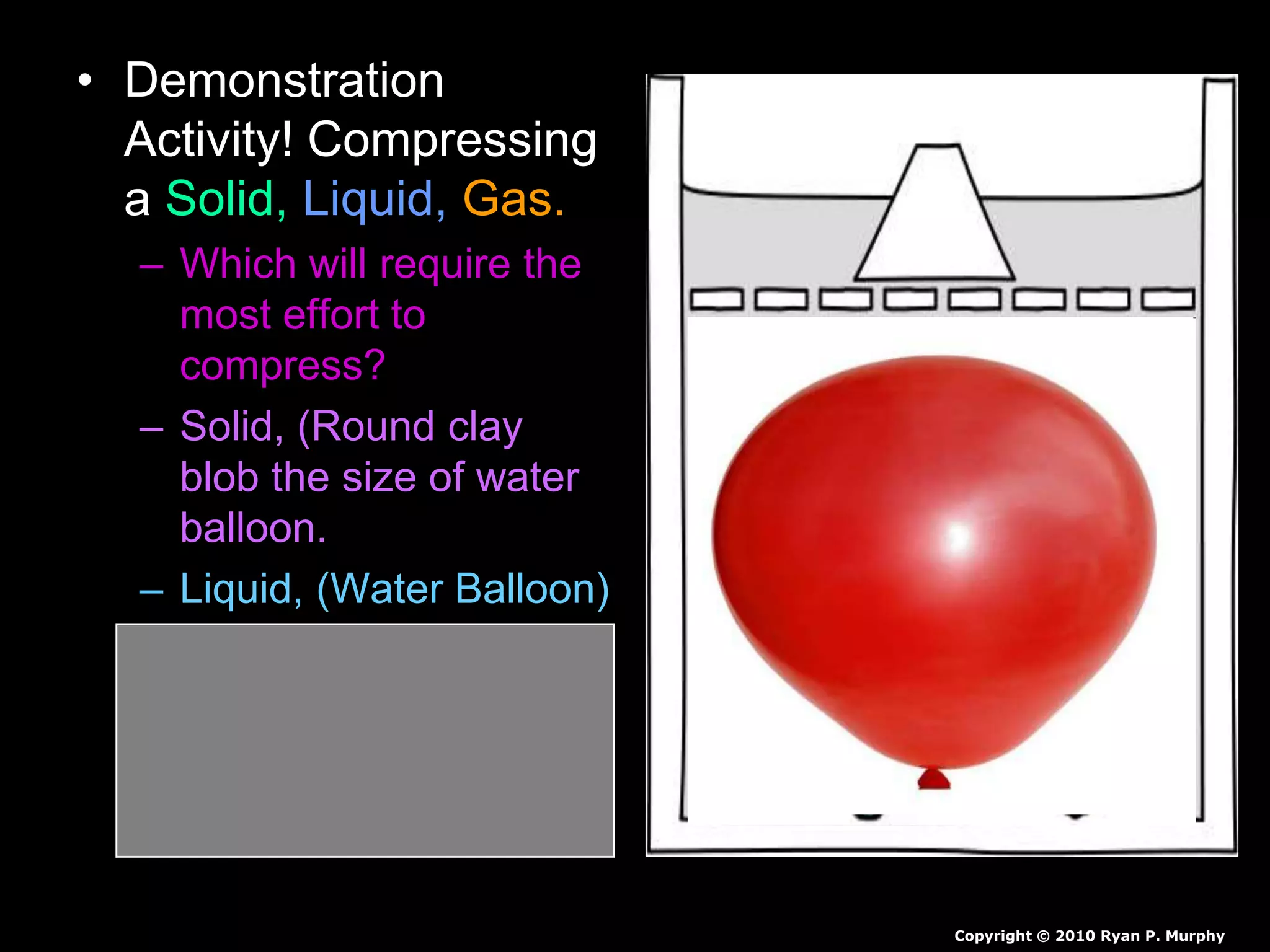
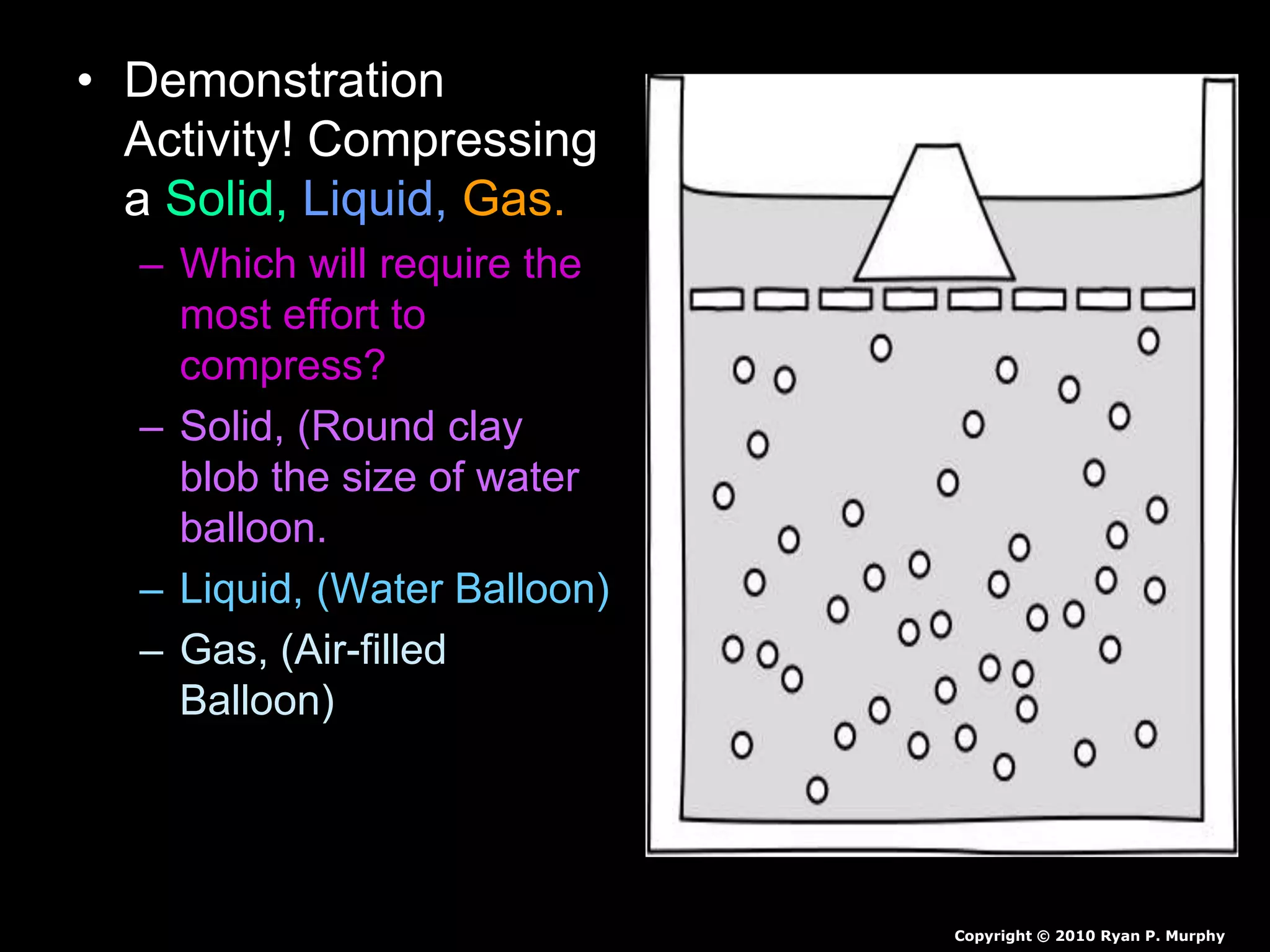















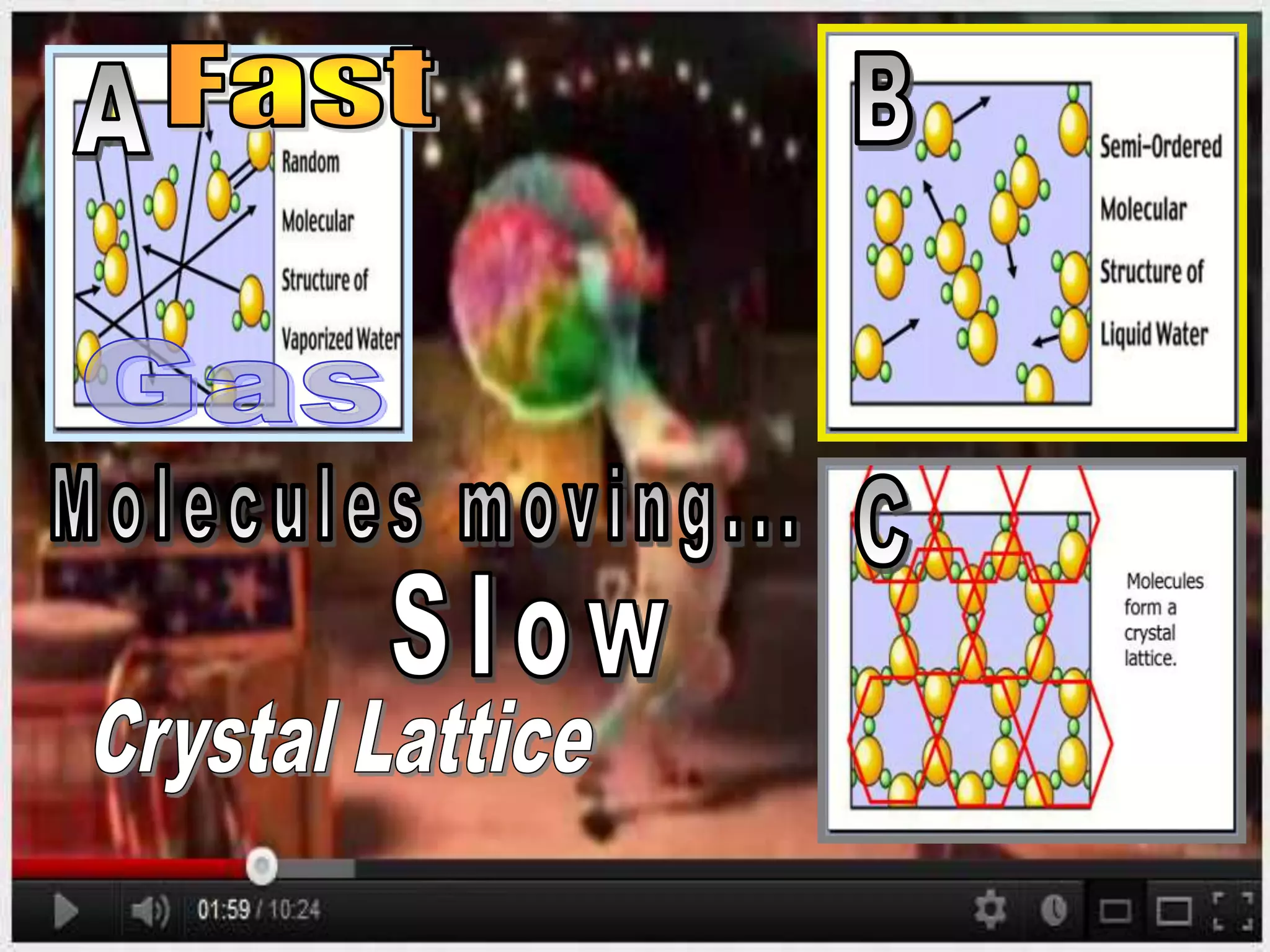
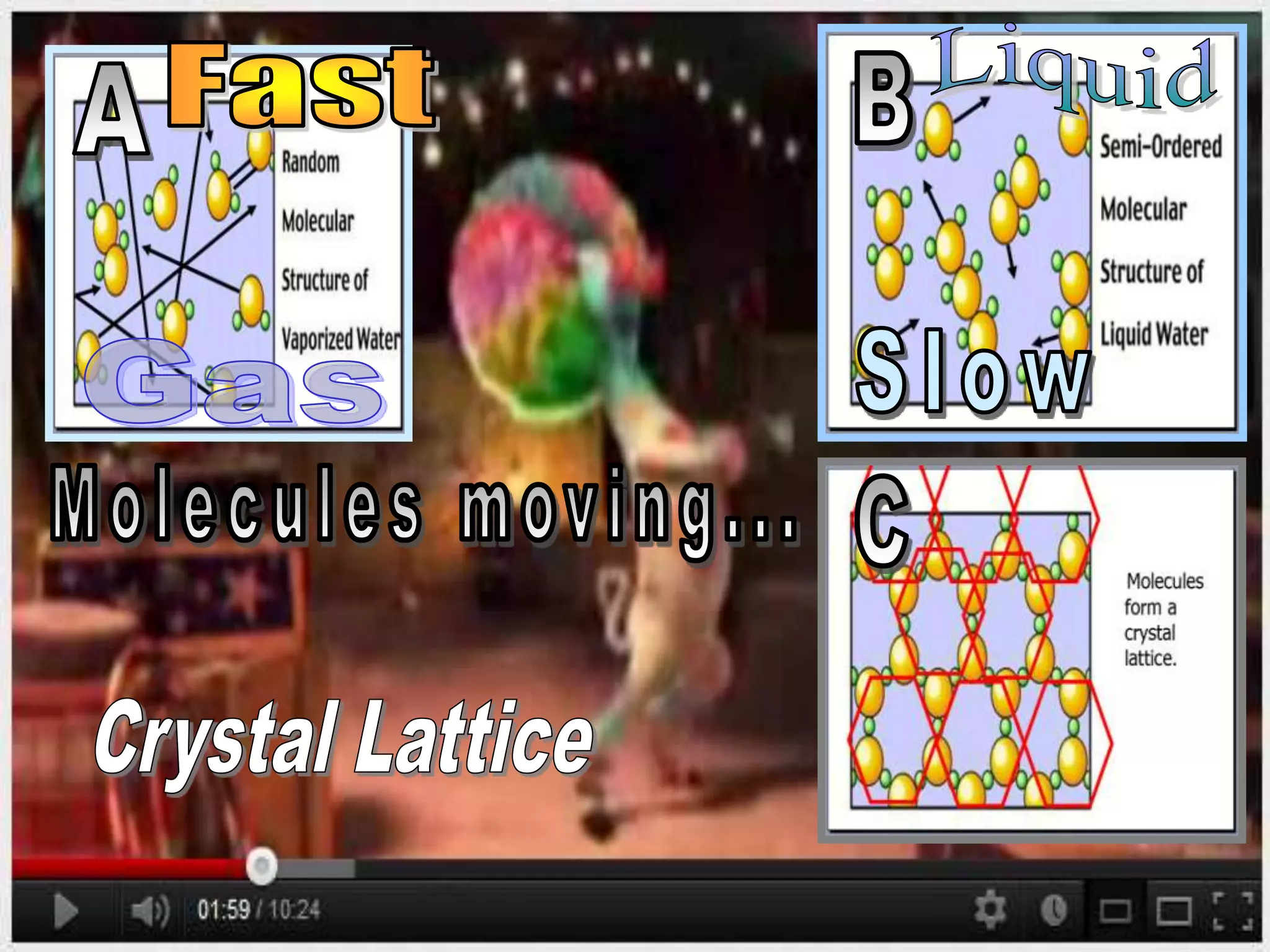
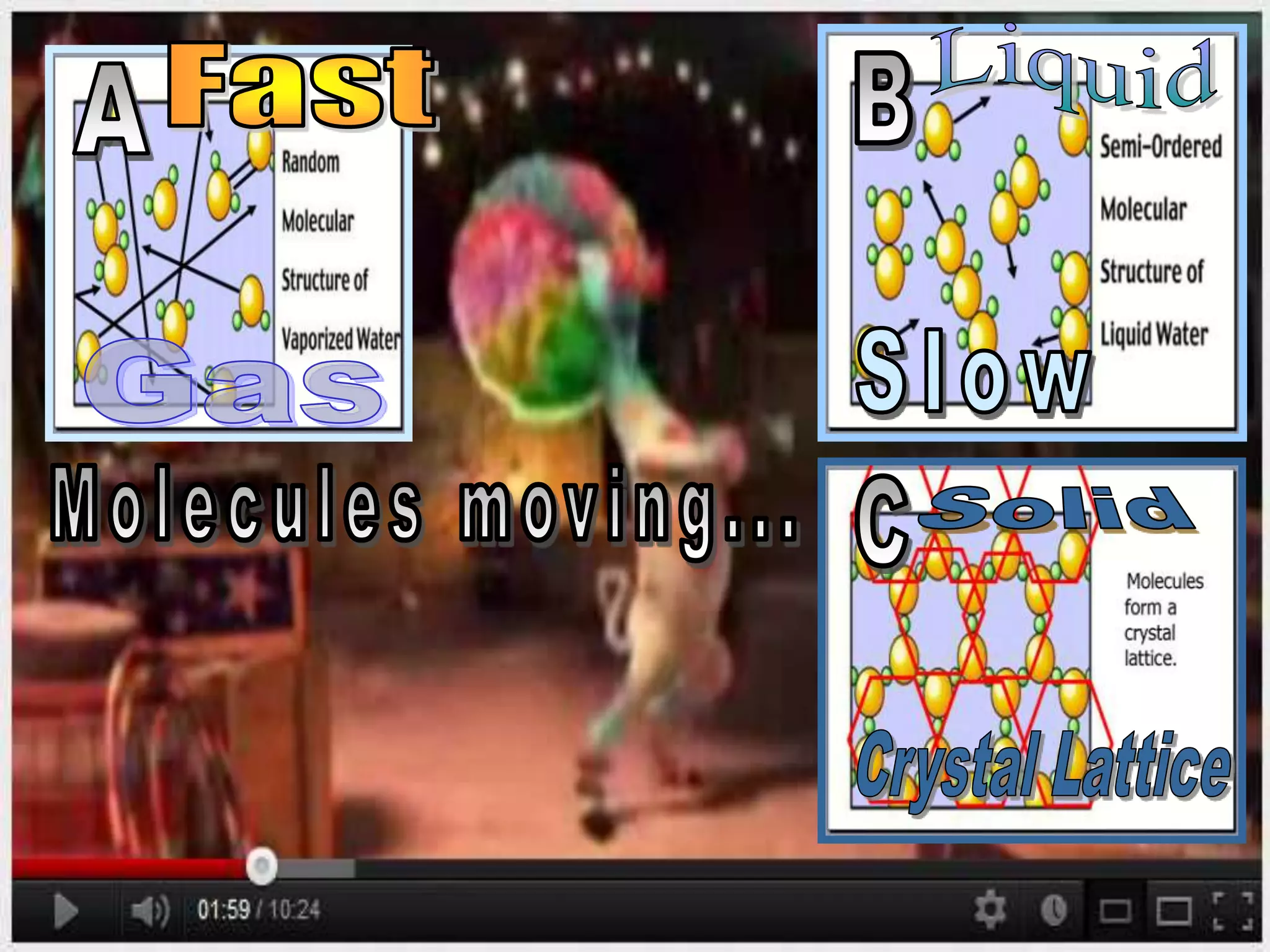
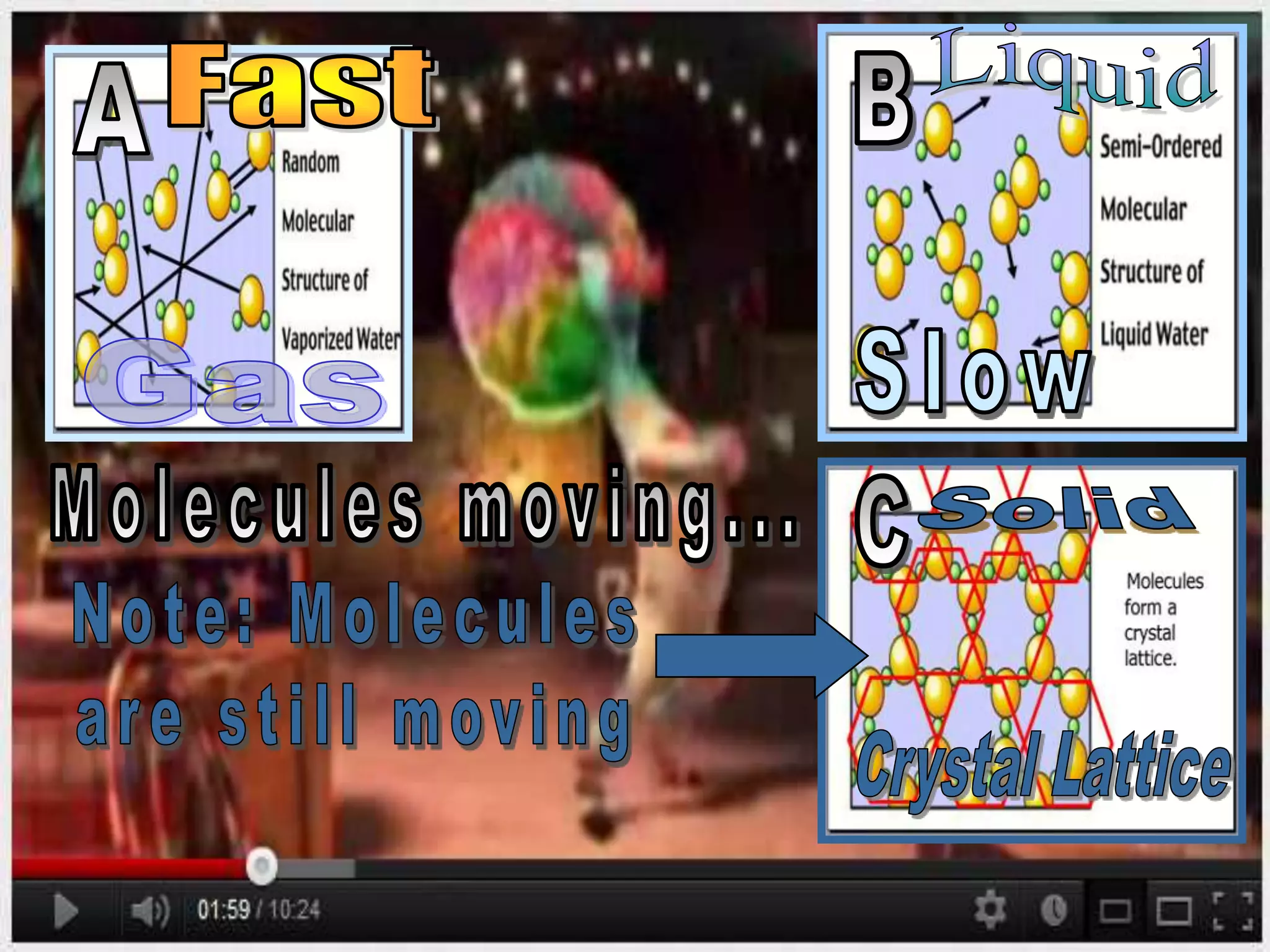
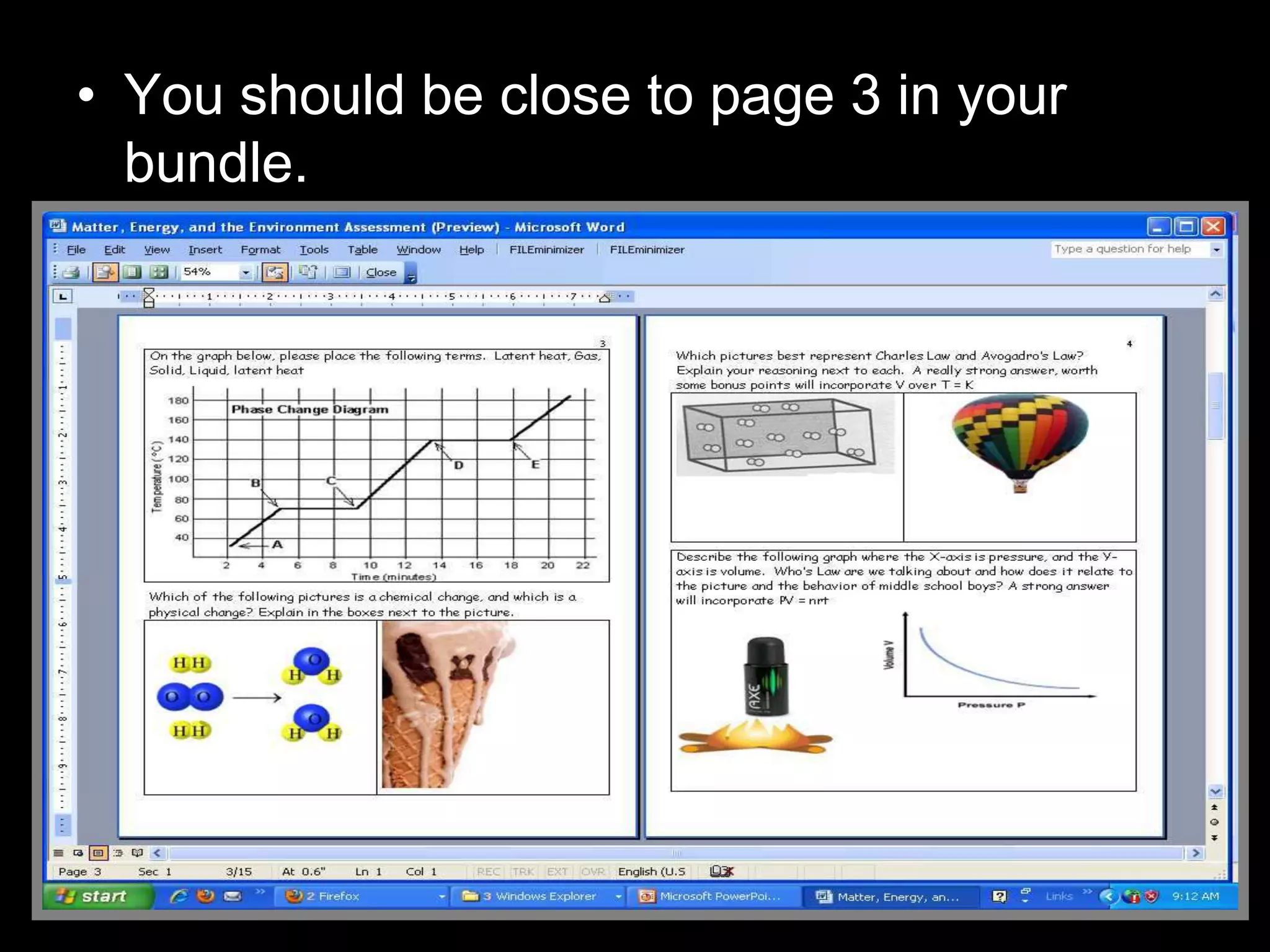
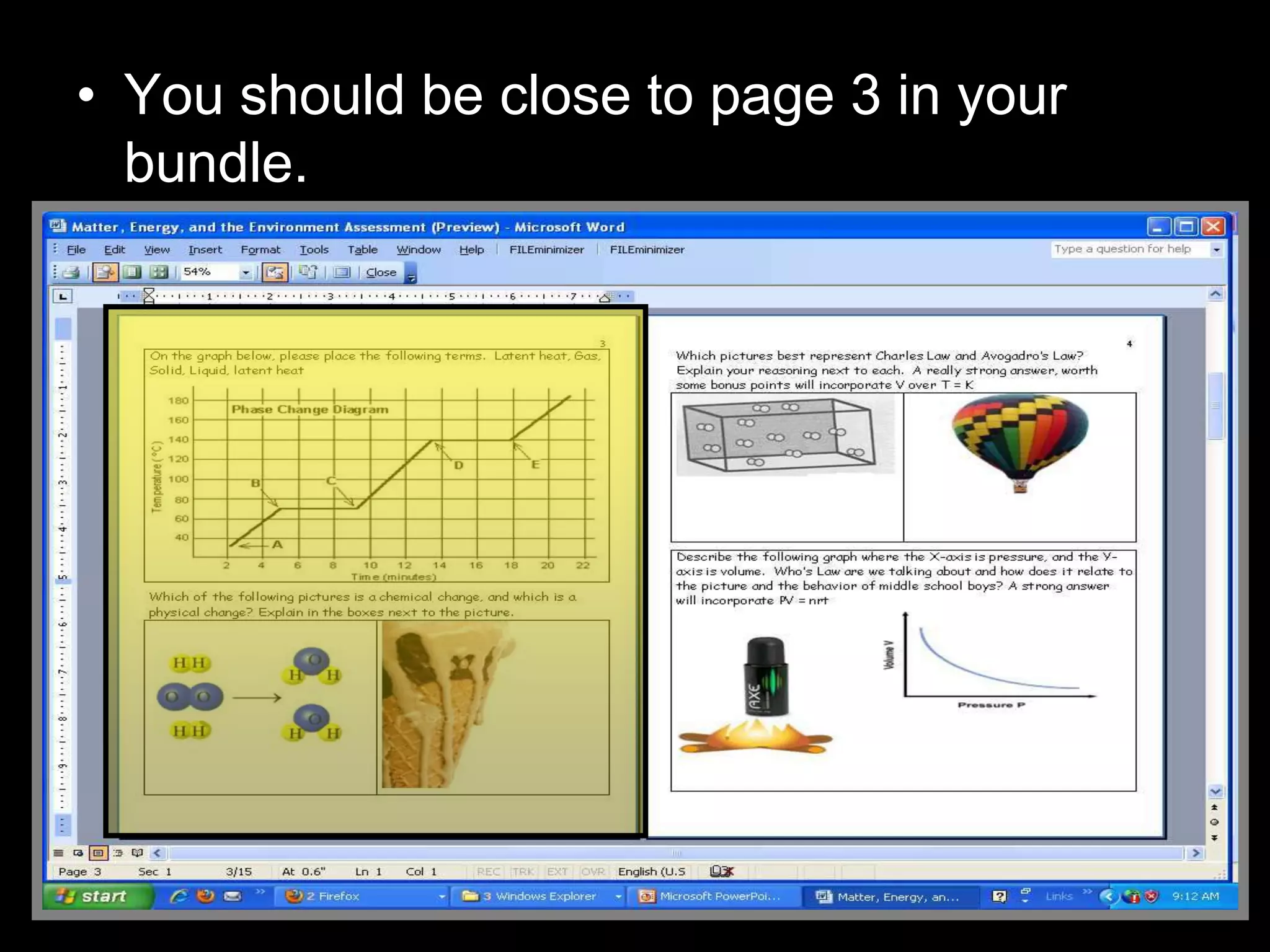
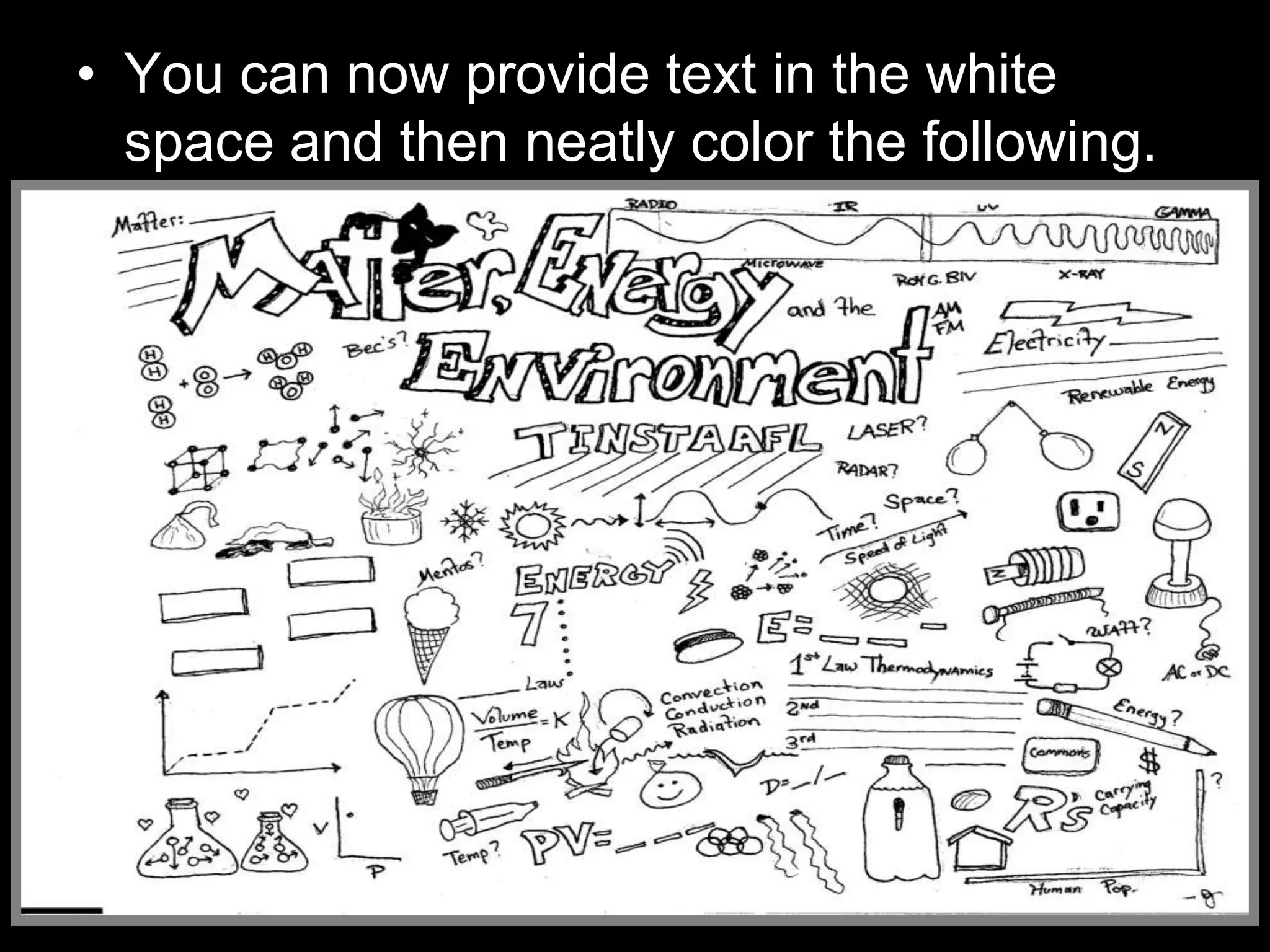
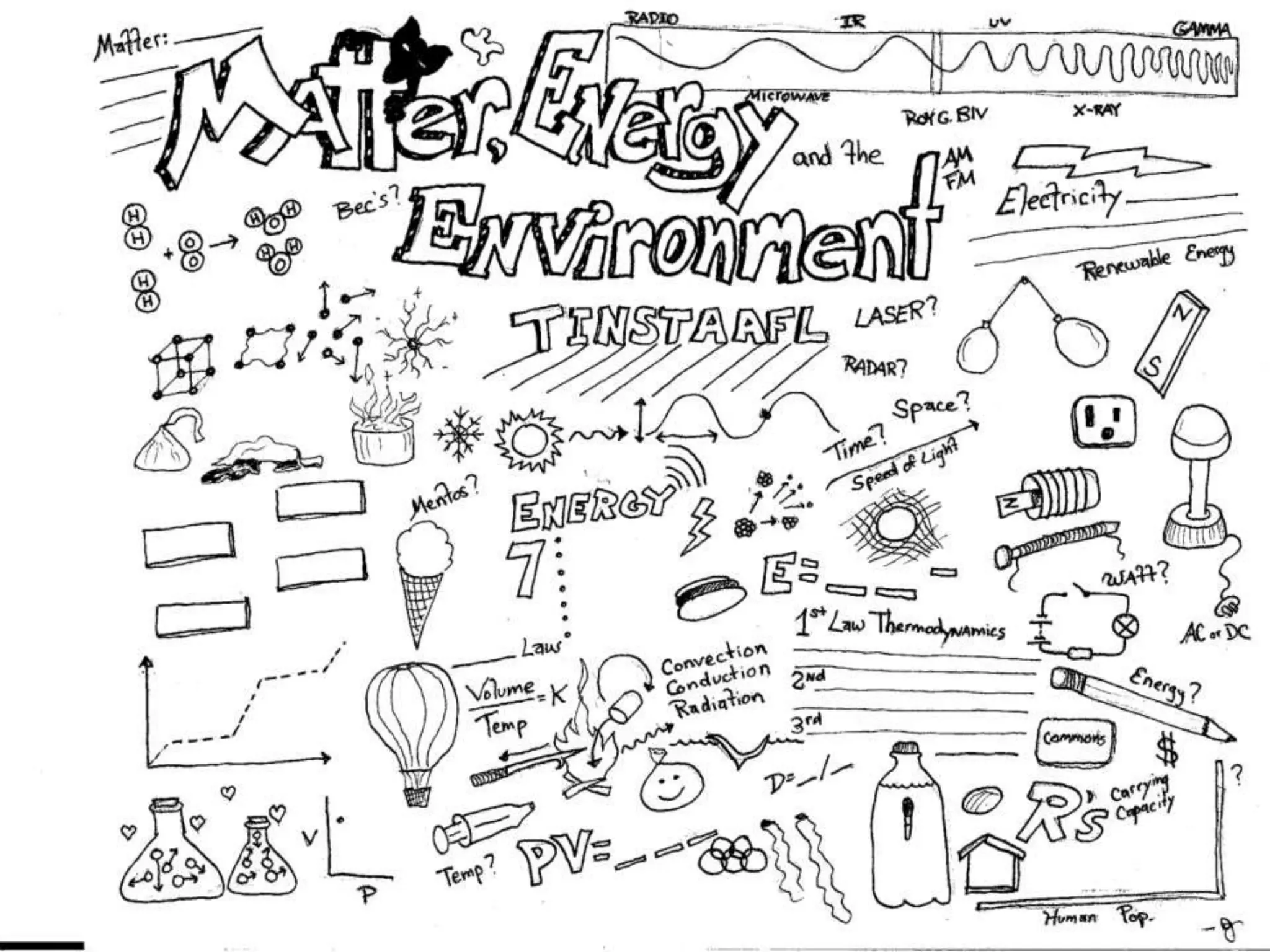
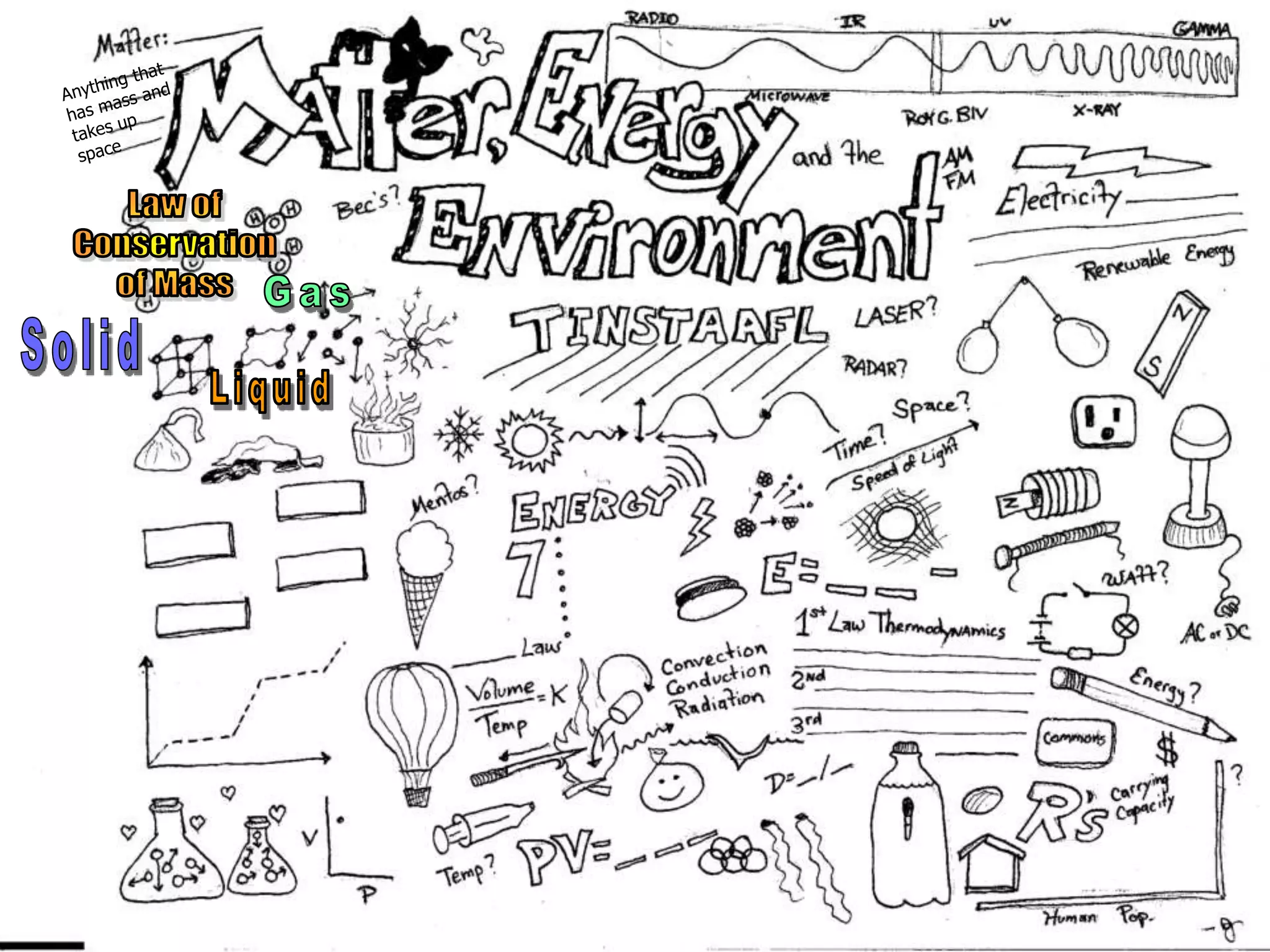
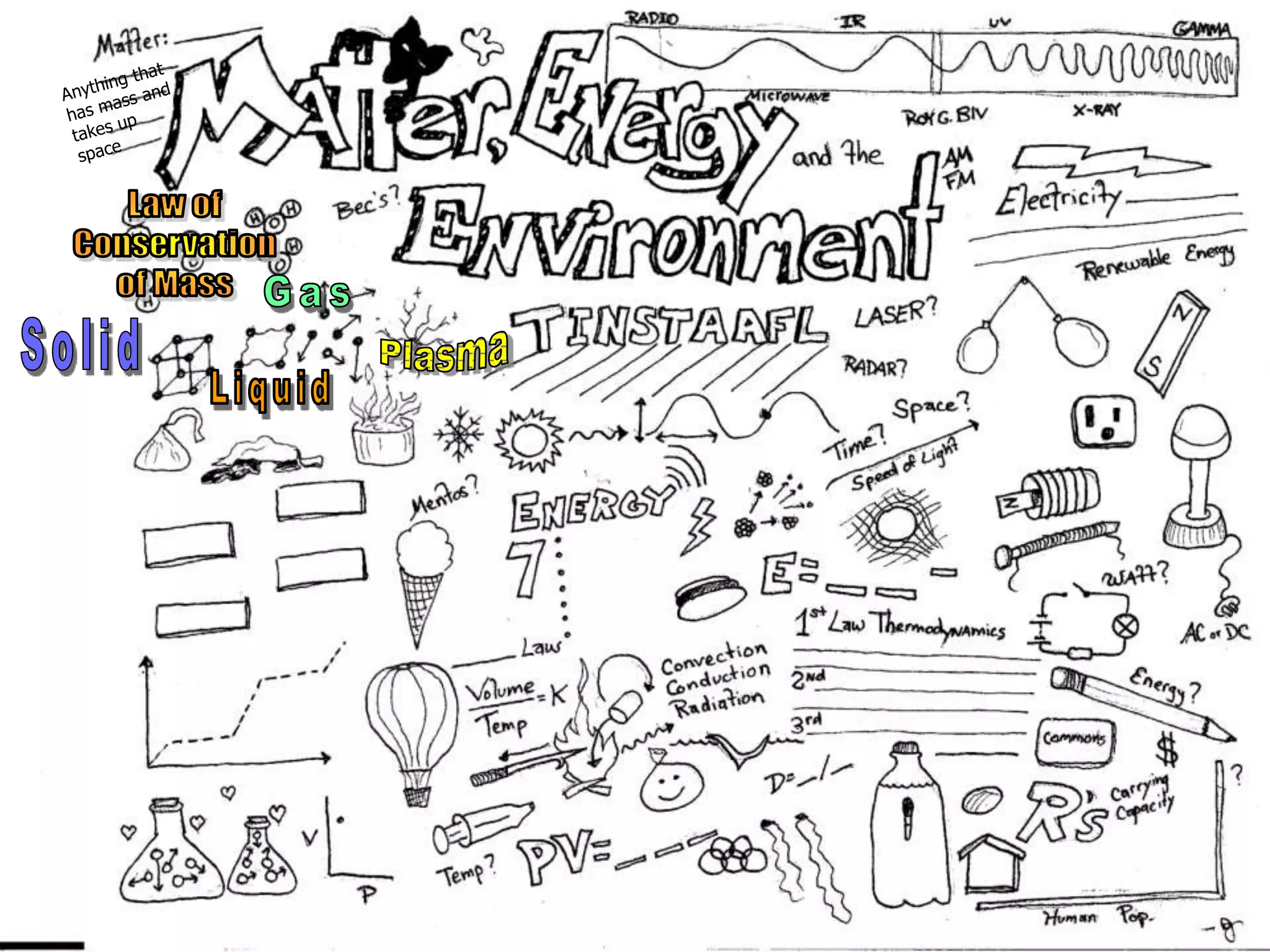
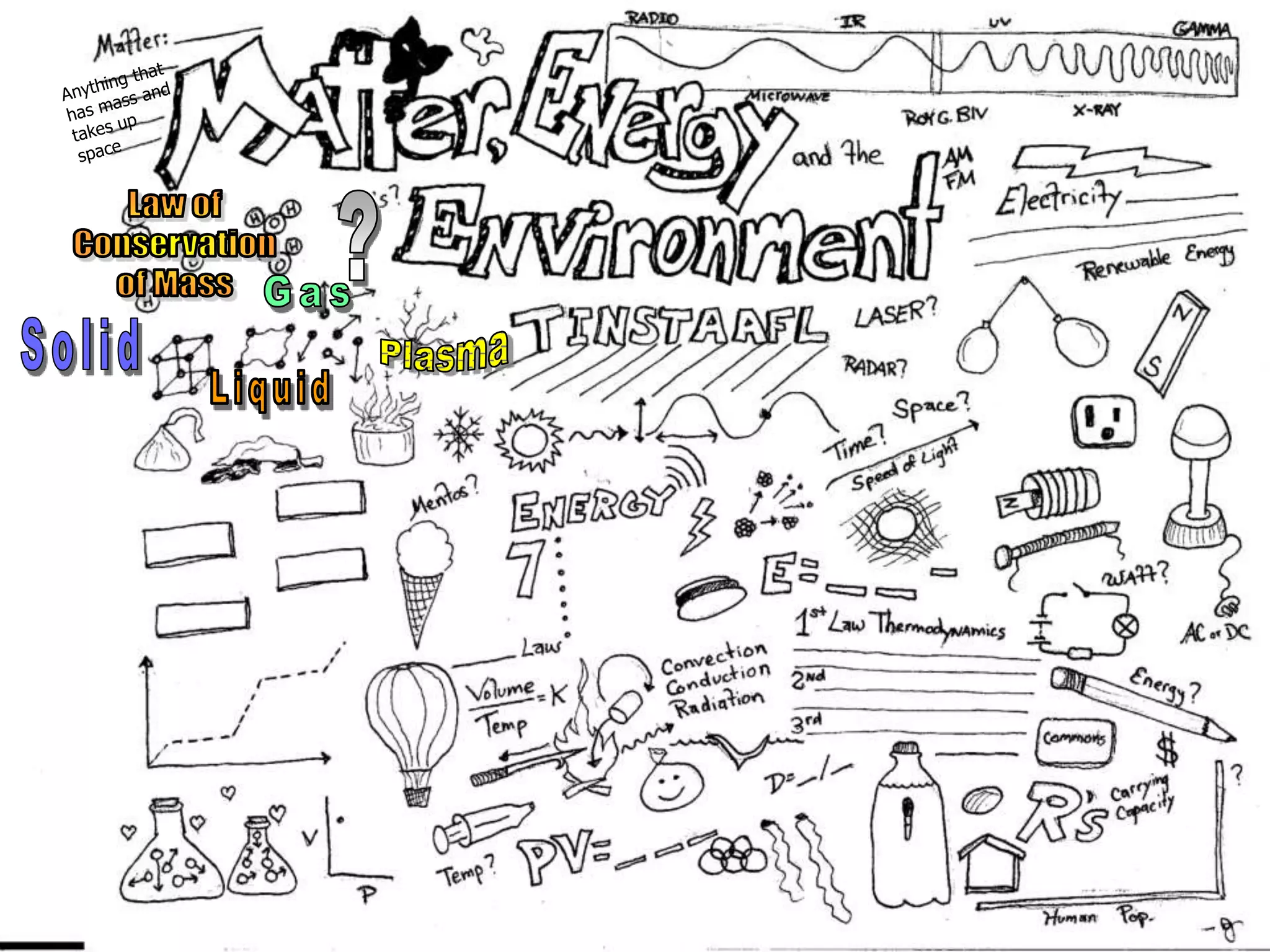
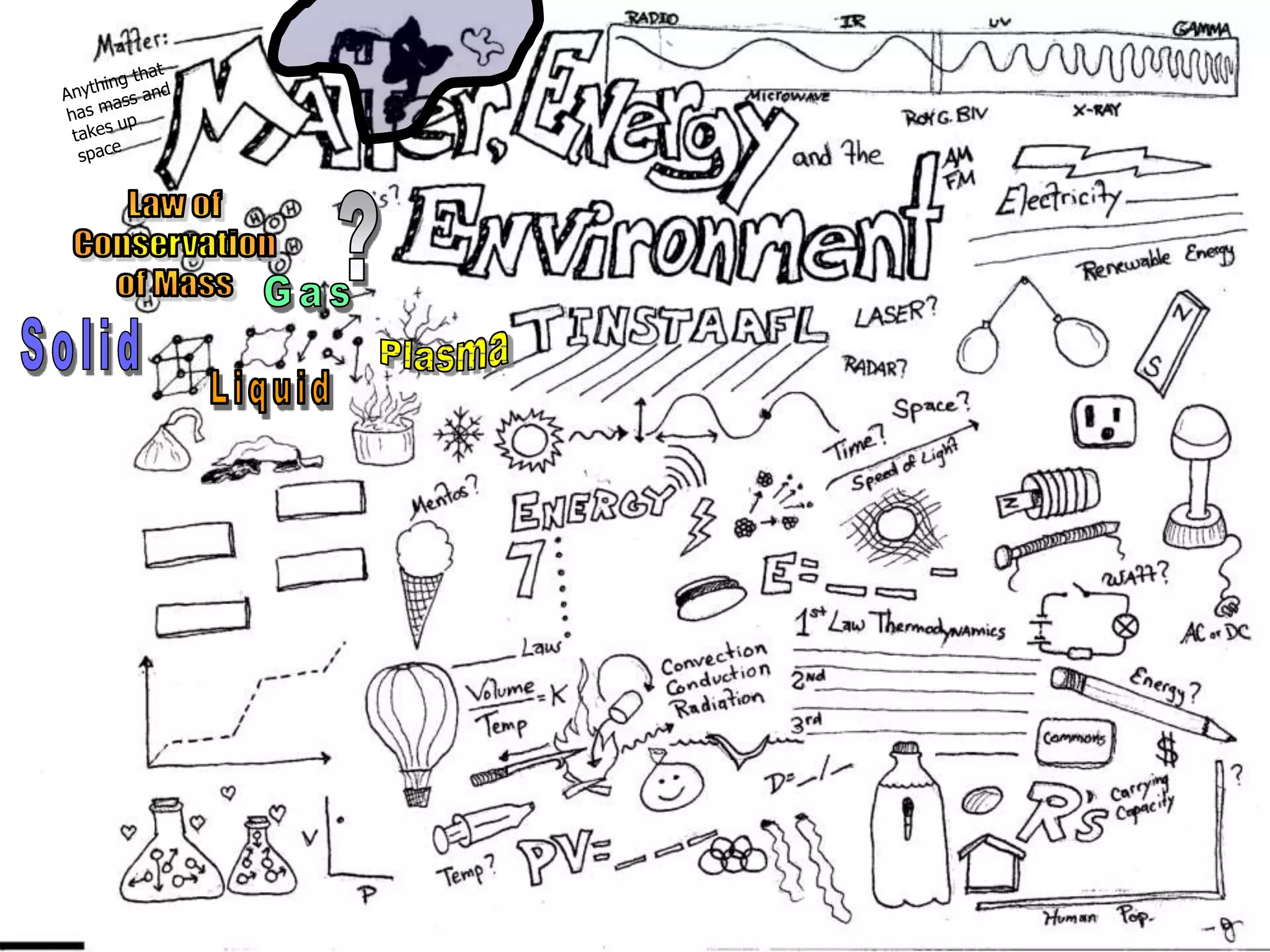
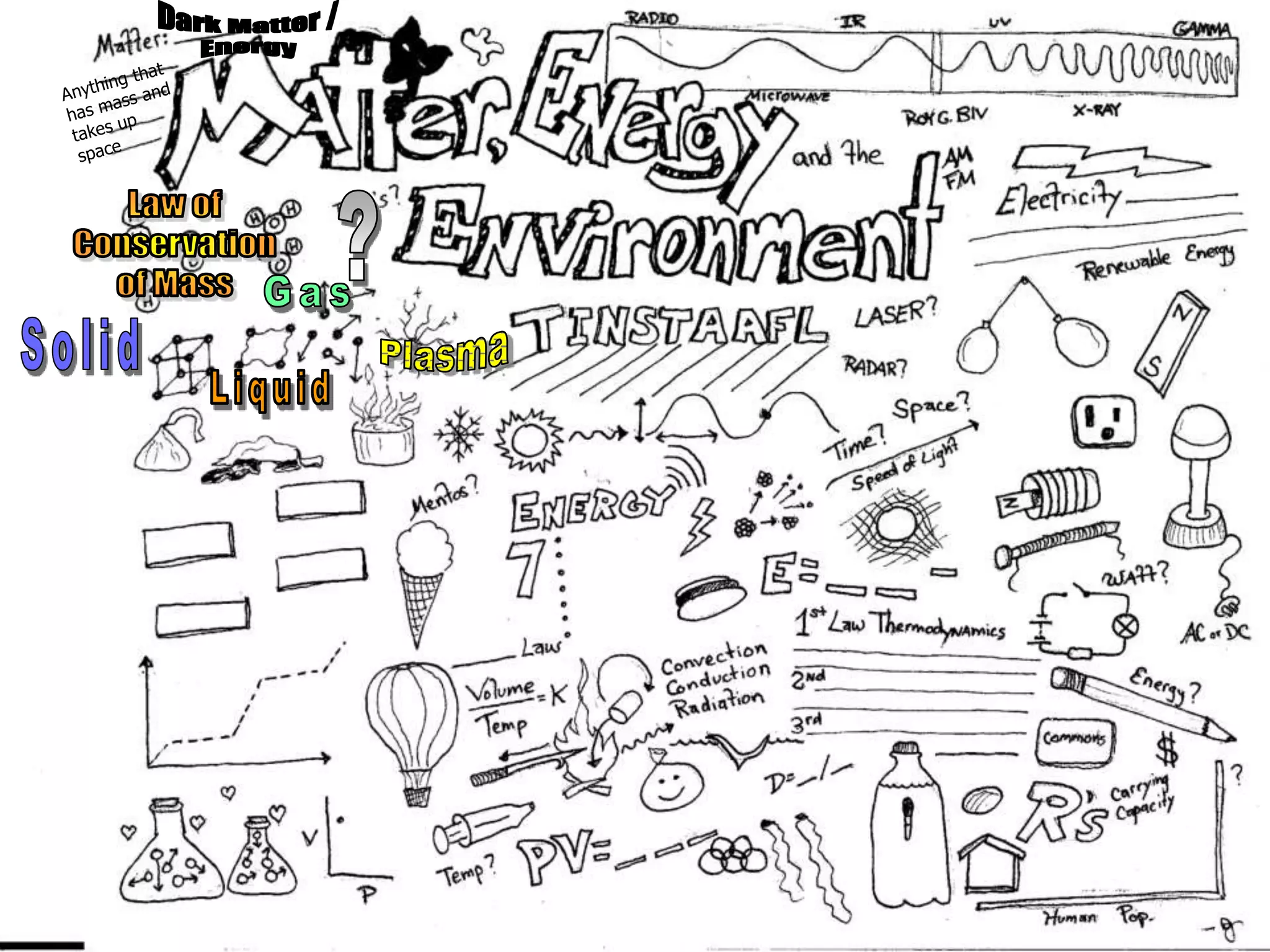
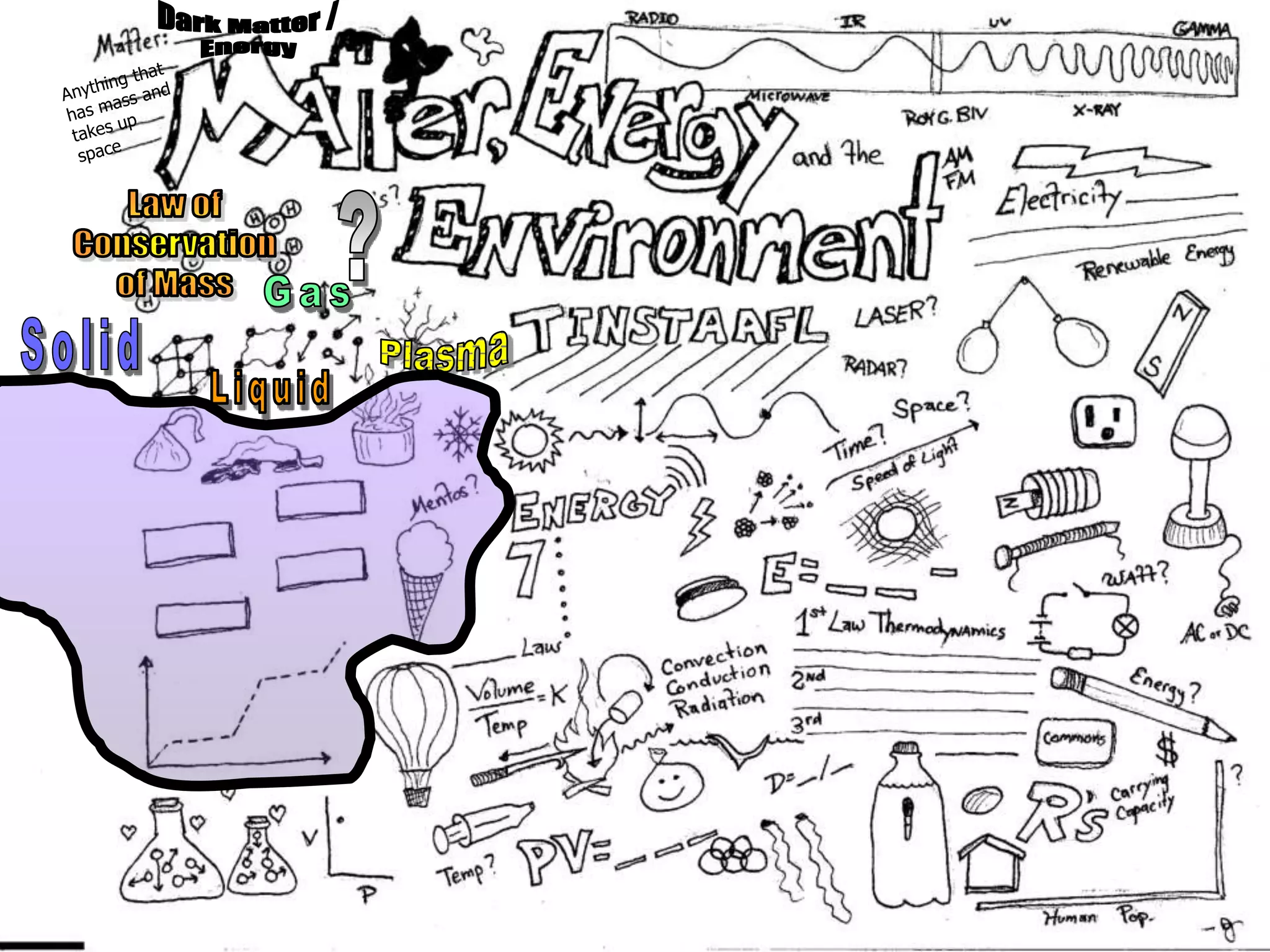
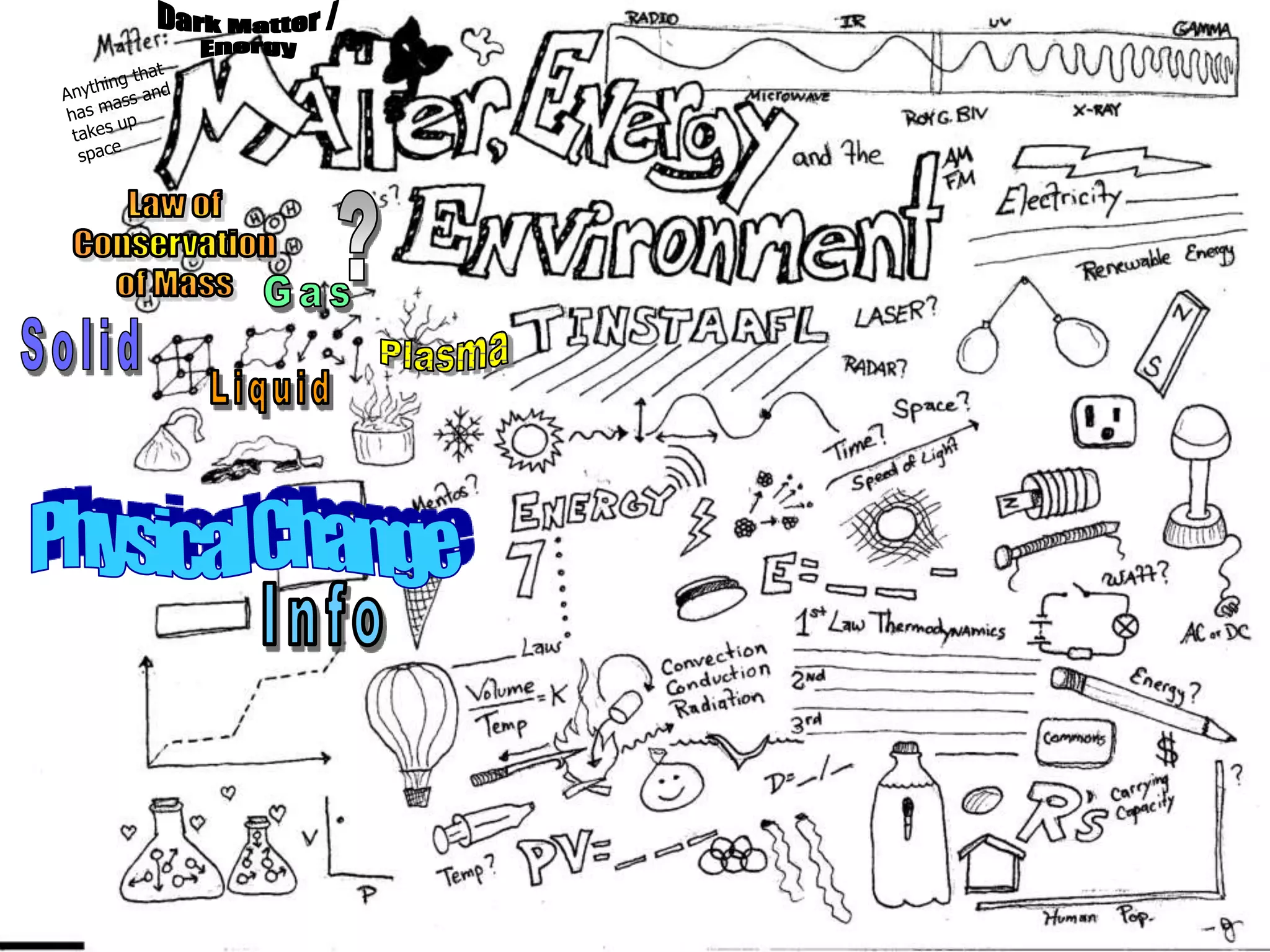
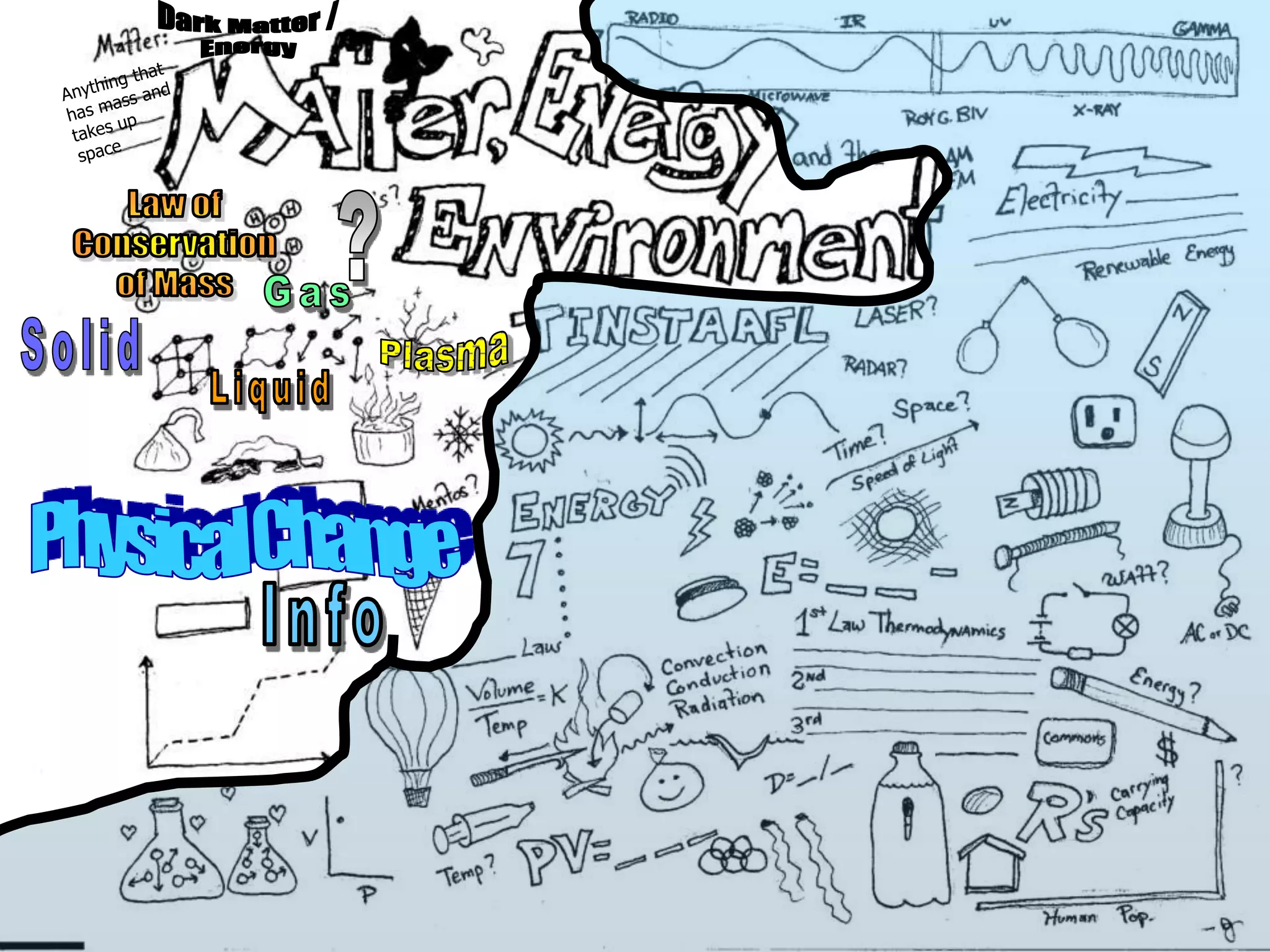



• Which one is which? – Connect the name
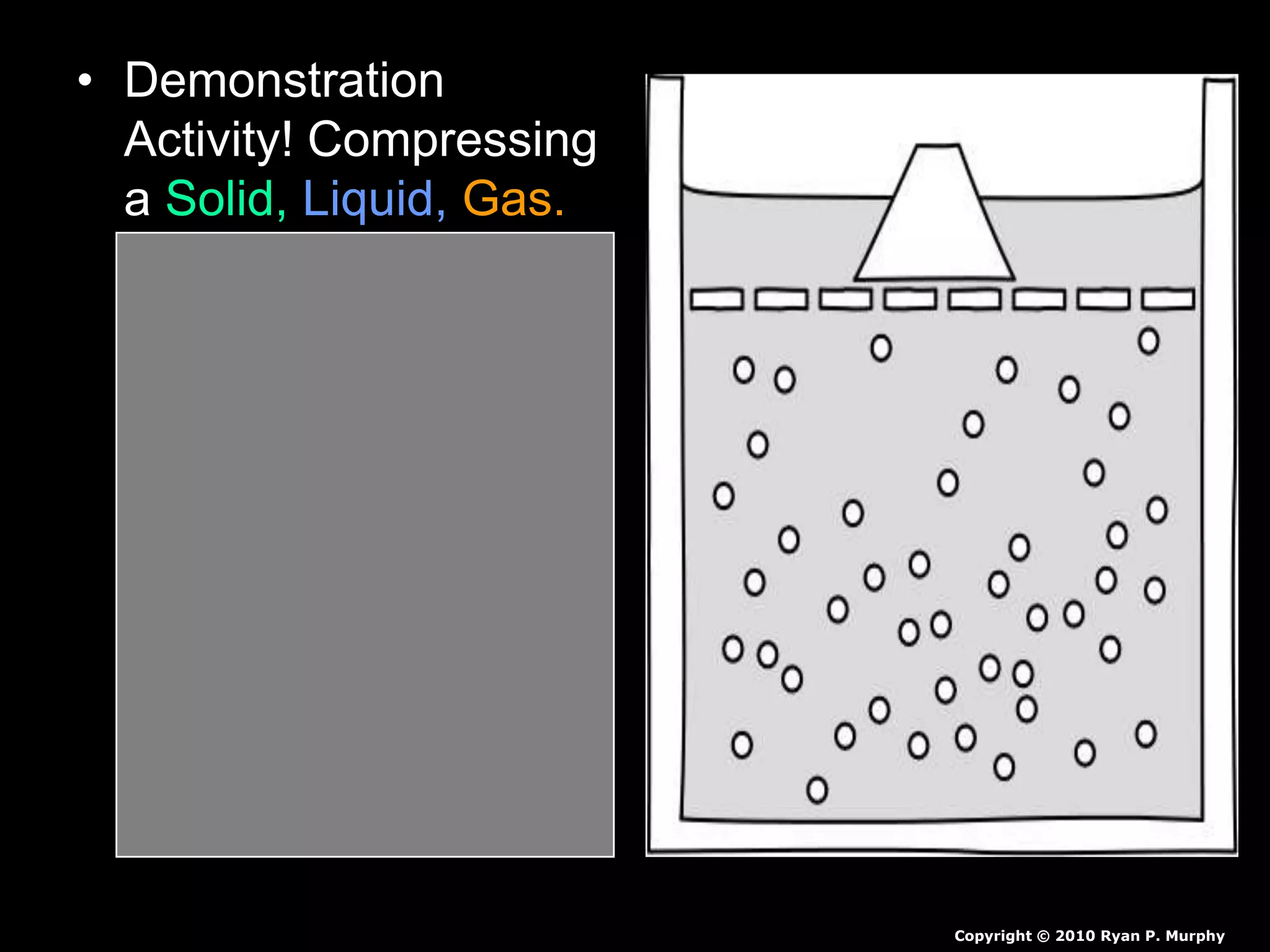
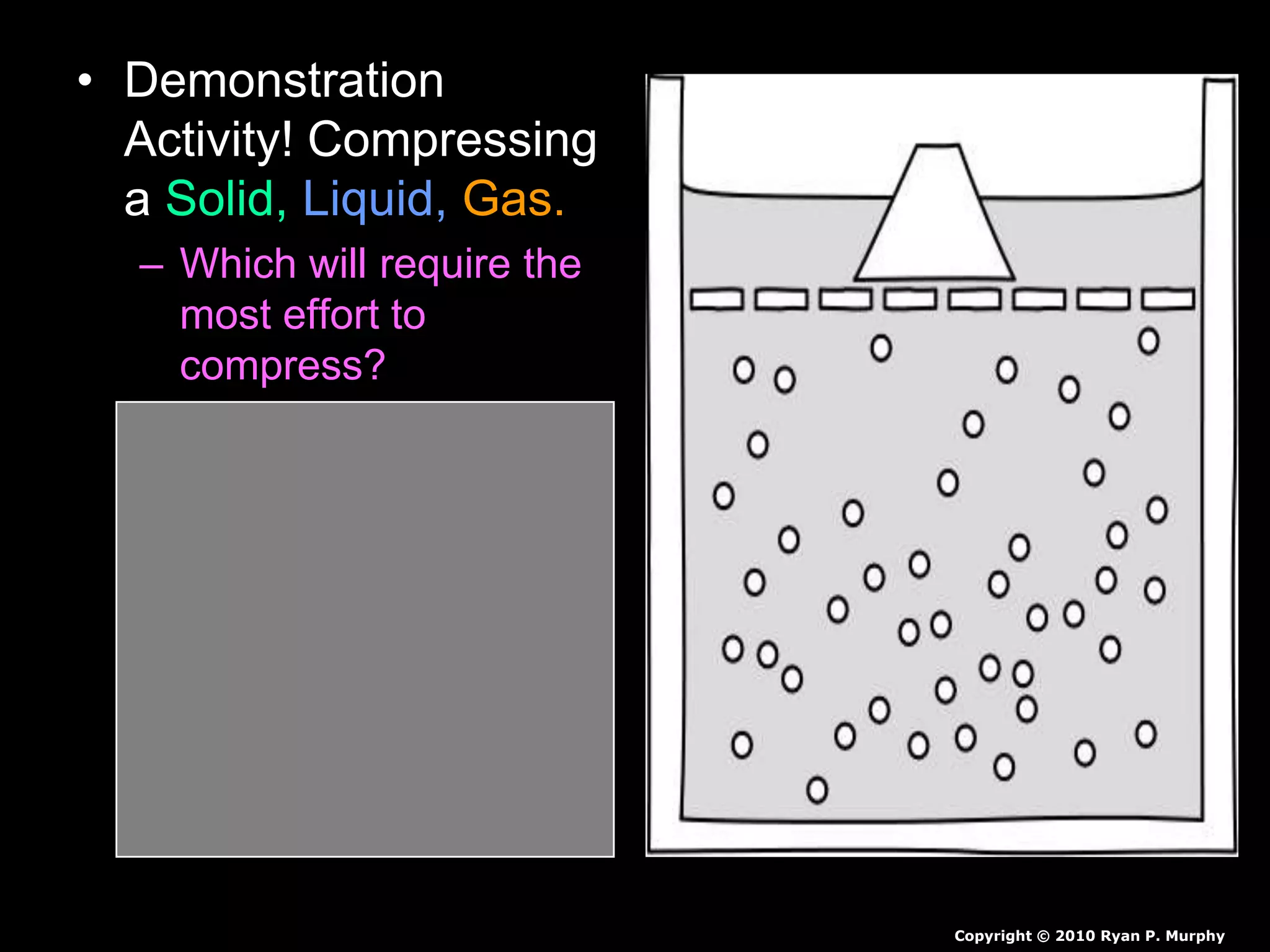
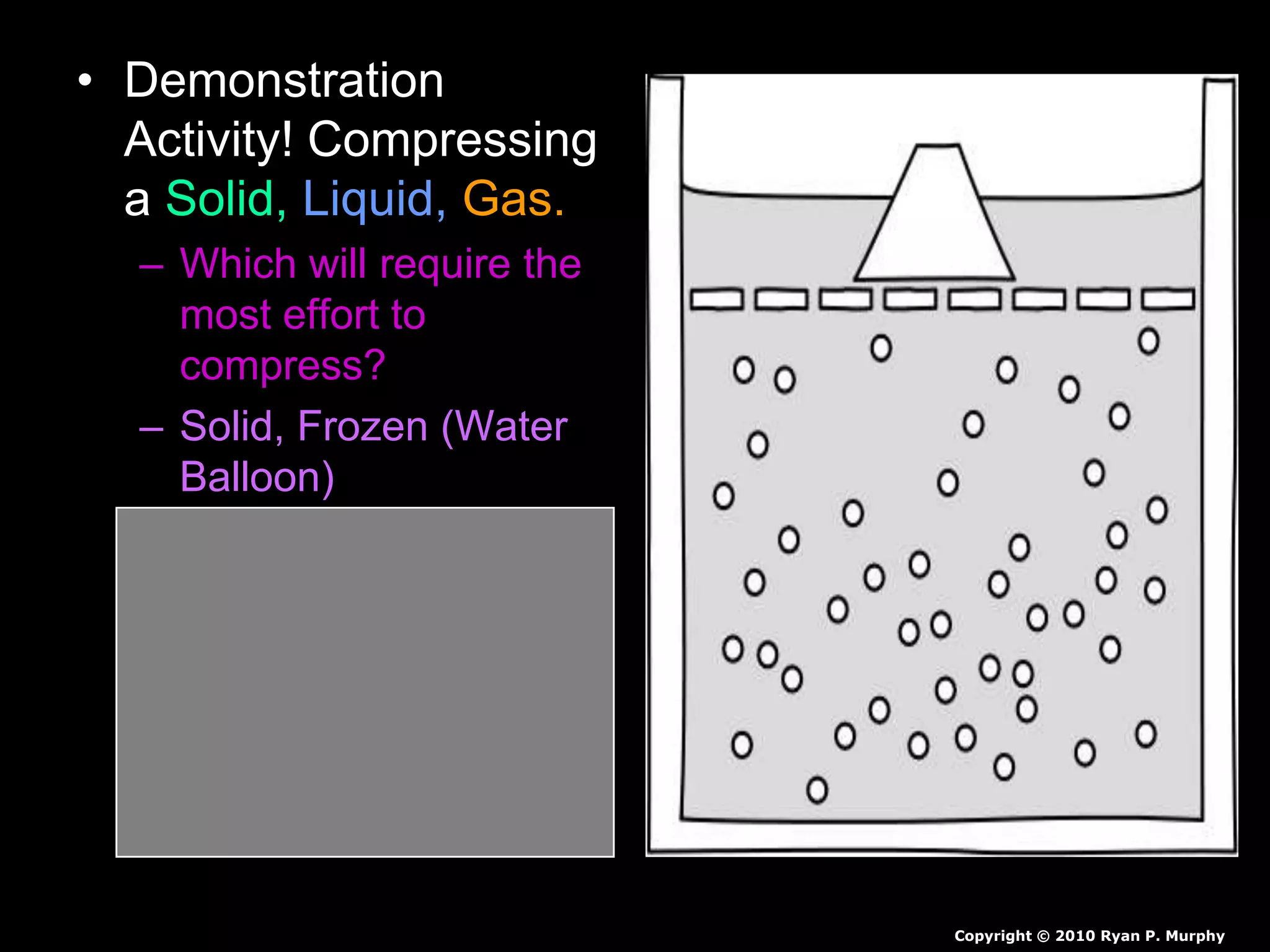
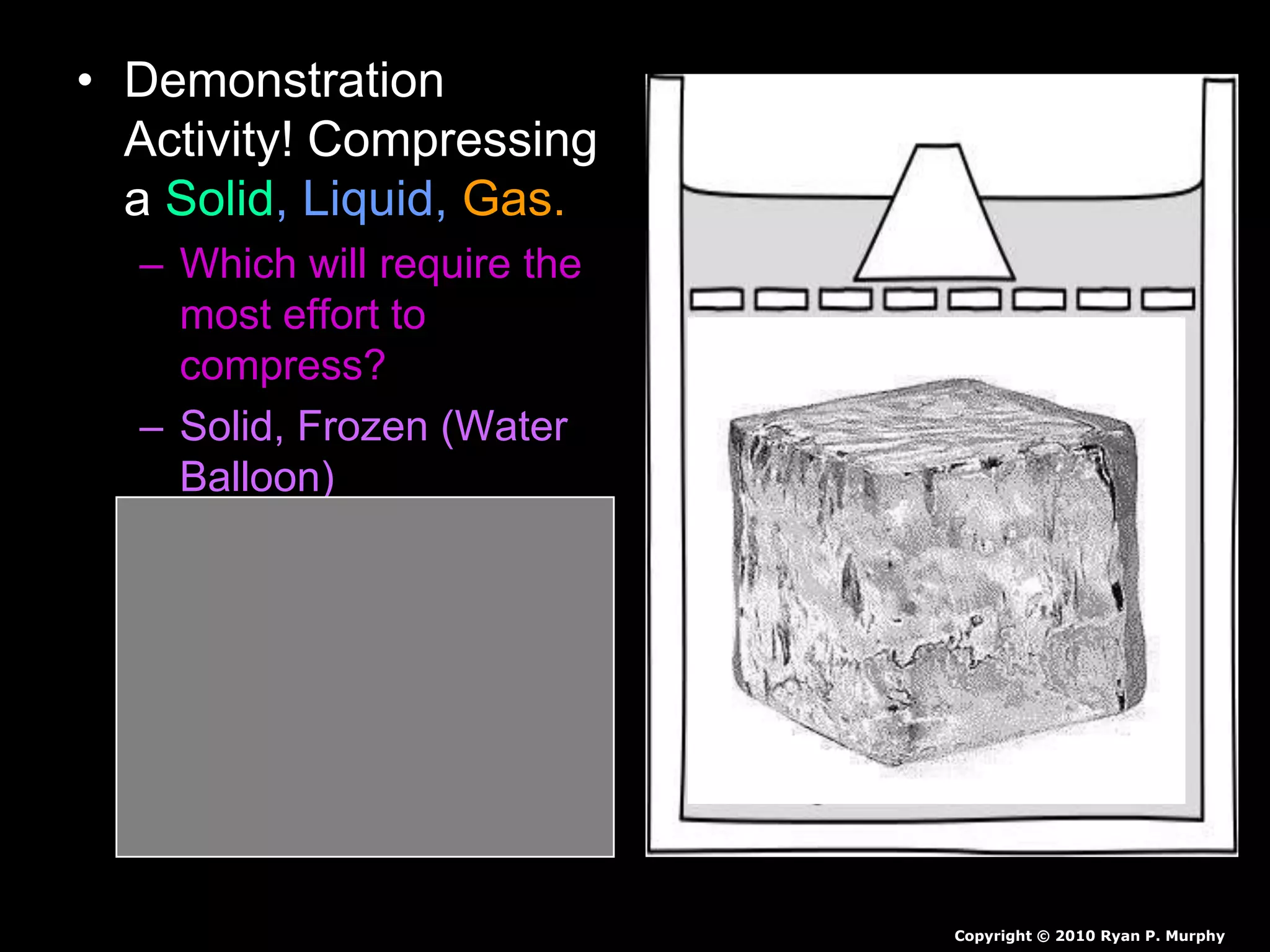
to the state of matter.
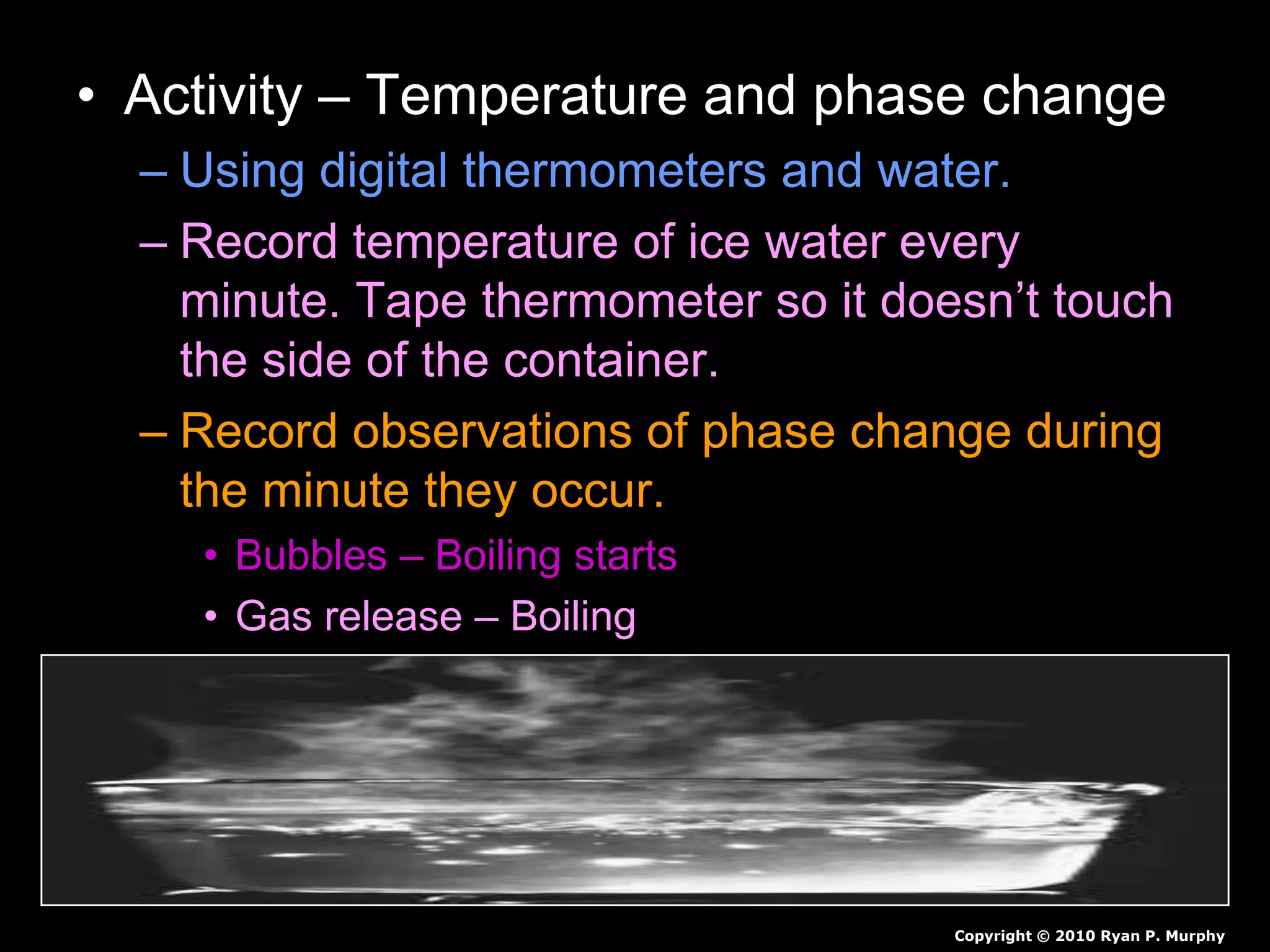
• BEC Plasma Gas Liquid Solid
Copyright © 2010 Ryan P. Murphy
• RED SLIDE: These are notes that are very
important and should be recorded in your
science journal.
Copyright © 2010 Ryan P. Murphy
-Nice neat notes that are legible and use indentations
when appropriate.
-Example of indent.
-Skip a line between topics
-Don’t skip pages
-Make visuals clear and well drawn. Please label.
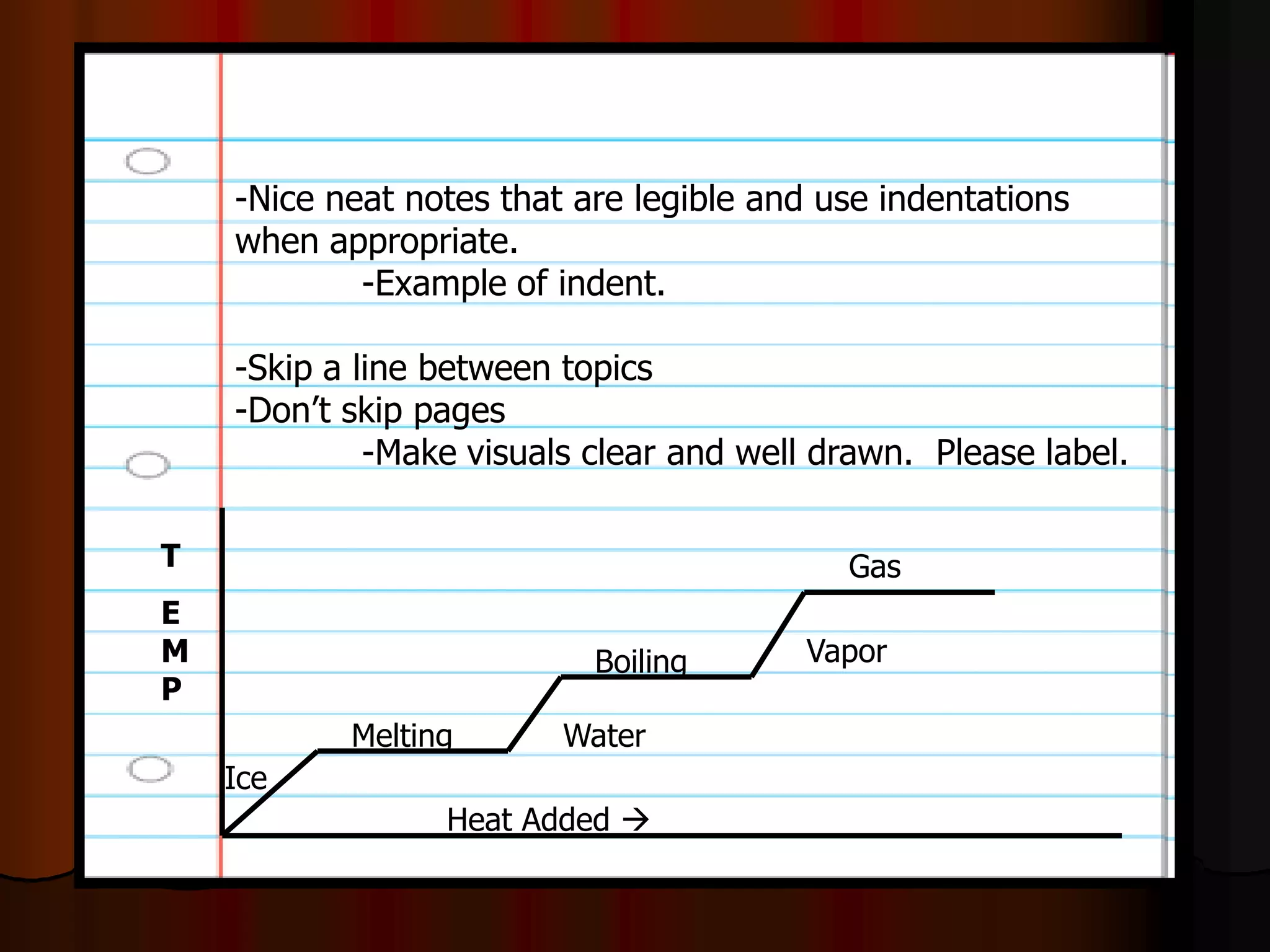
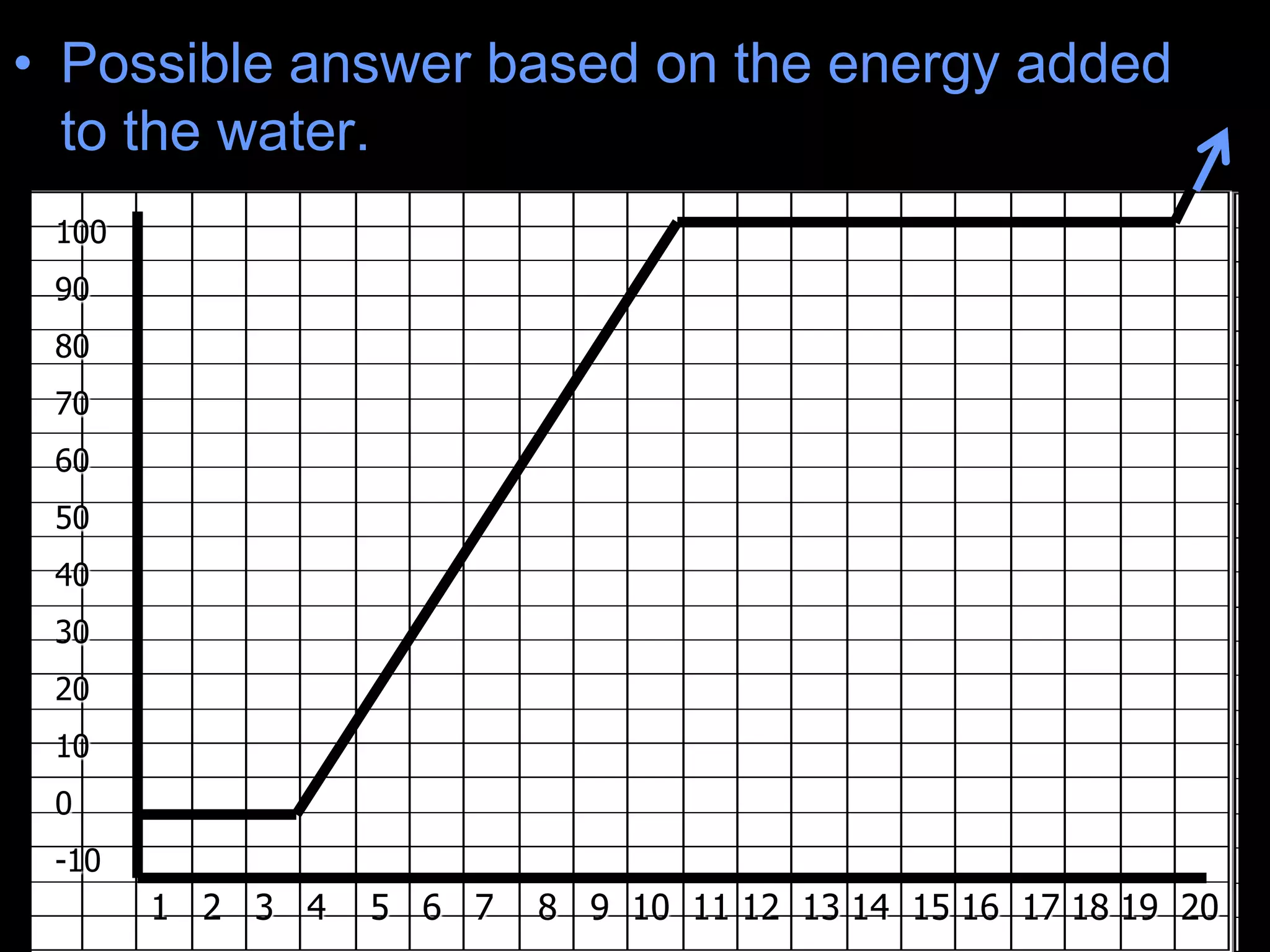
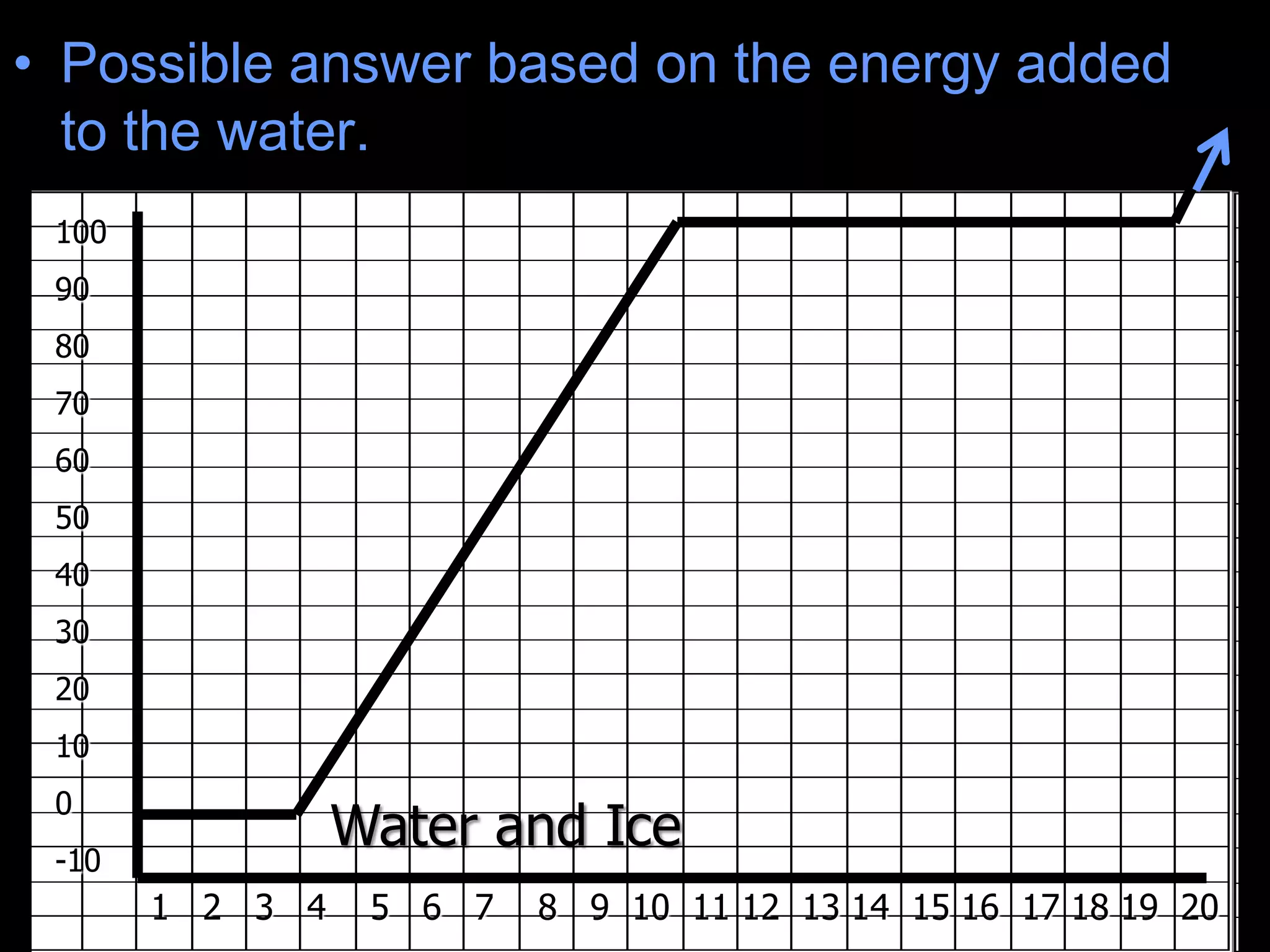
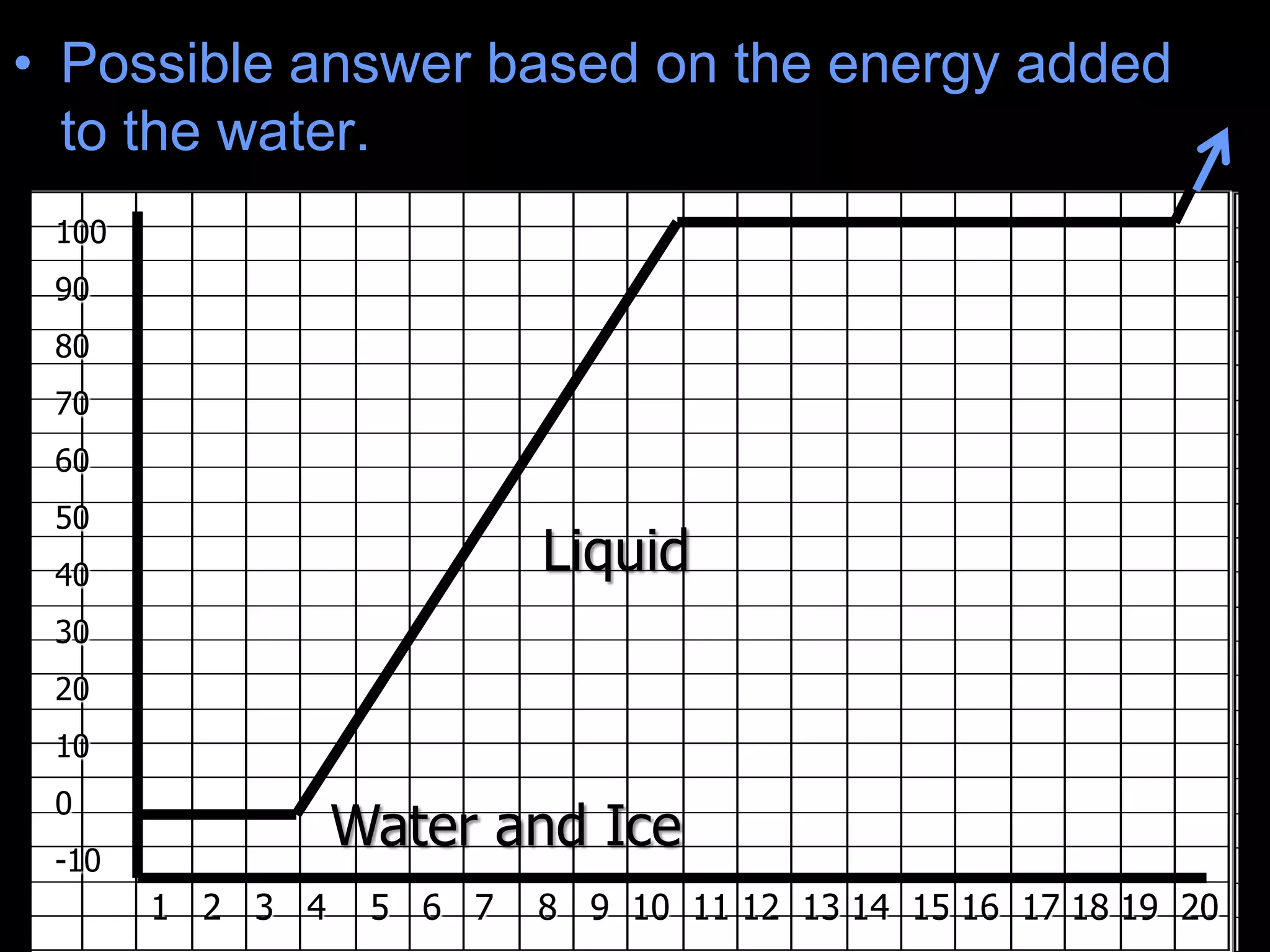
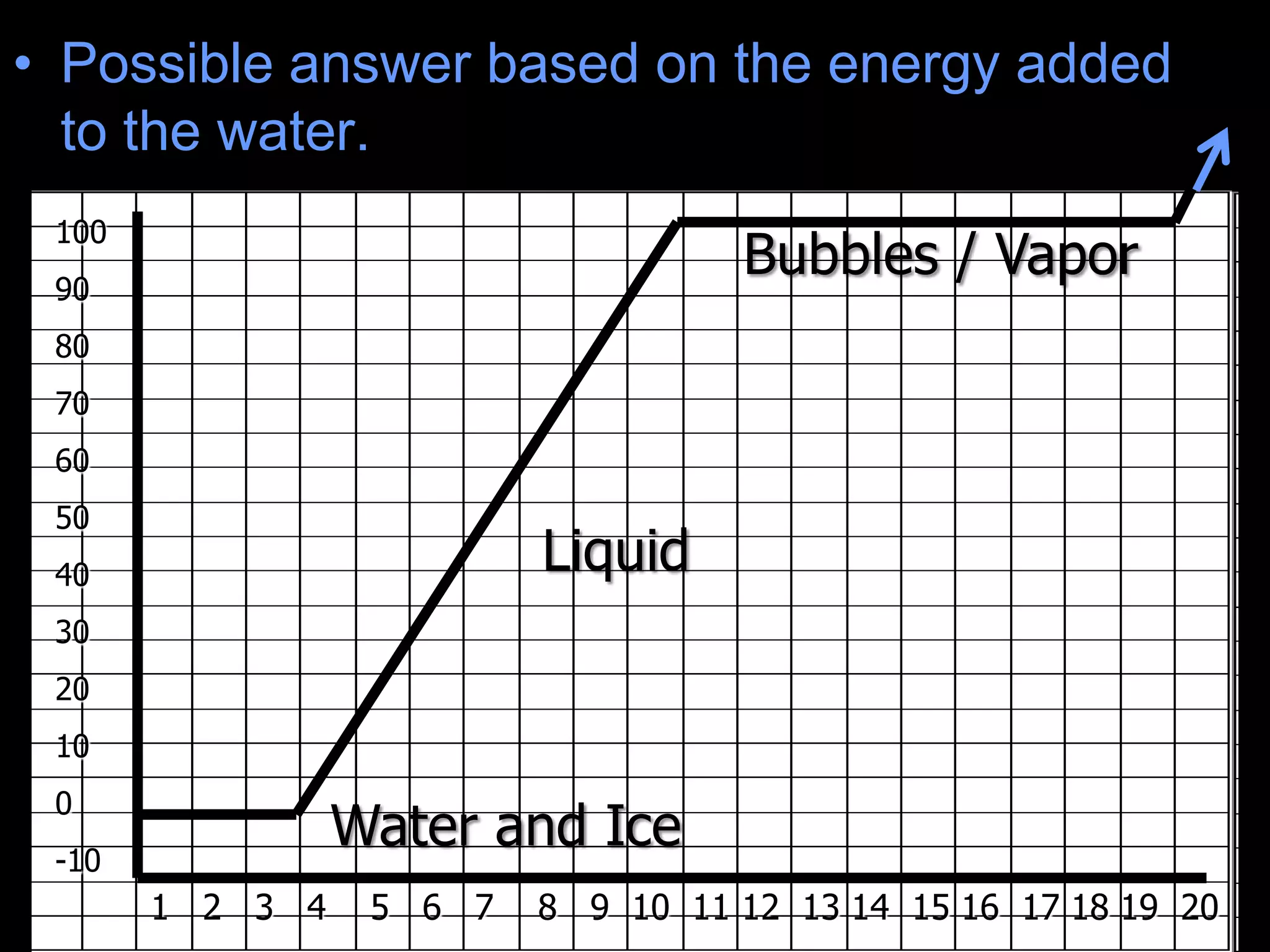
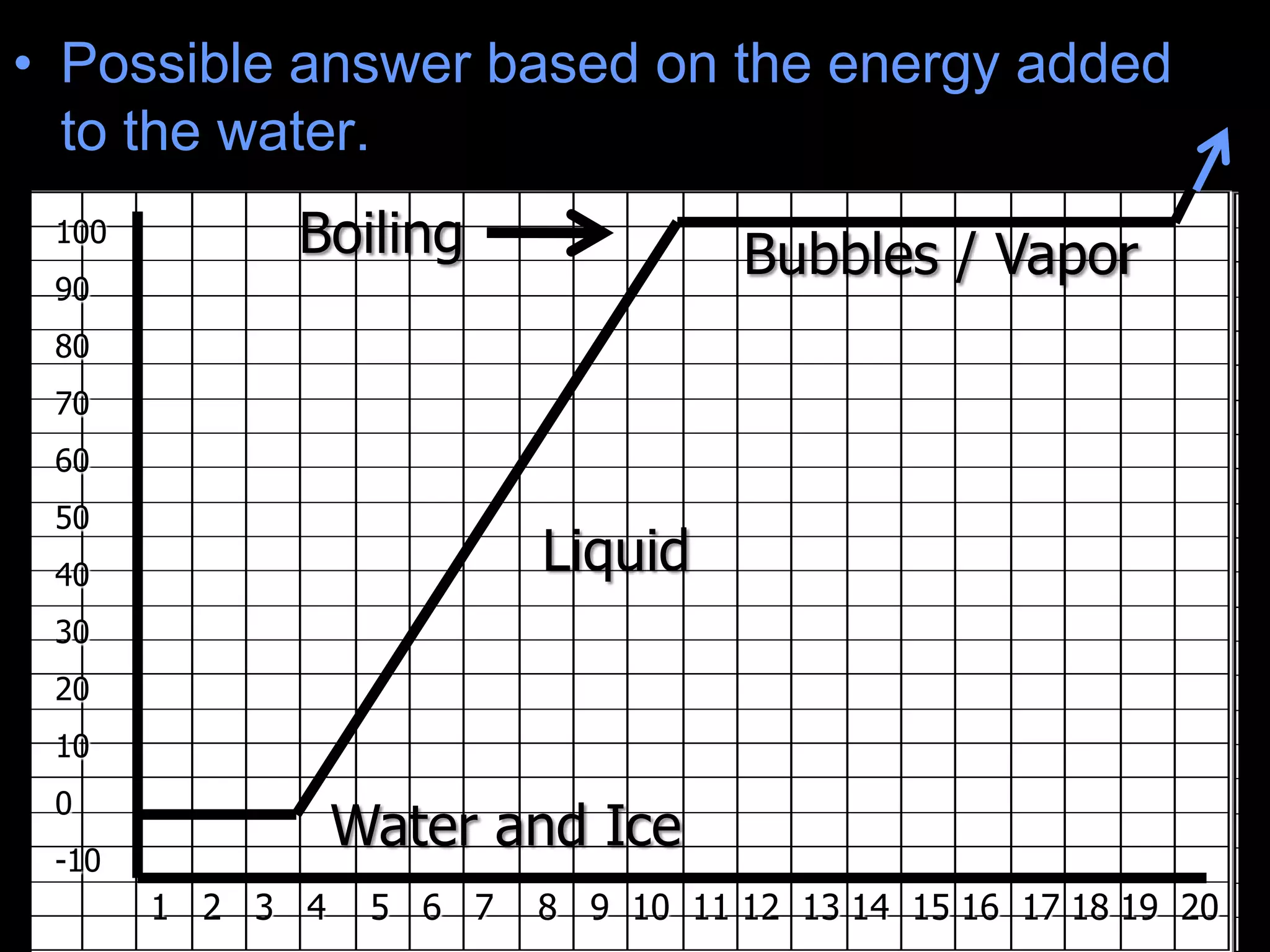
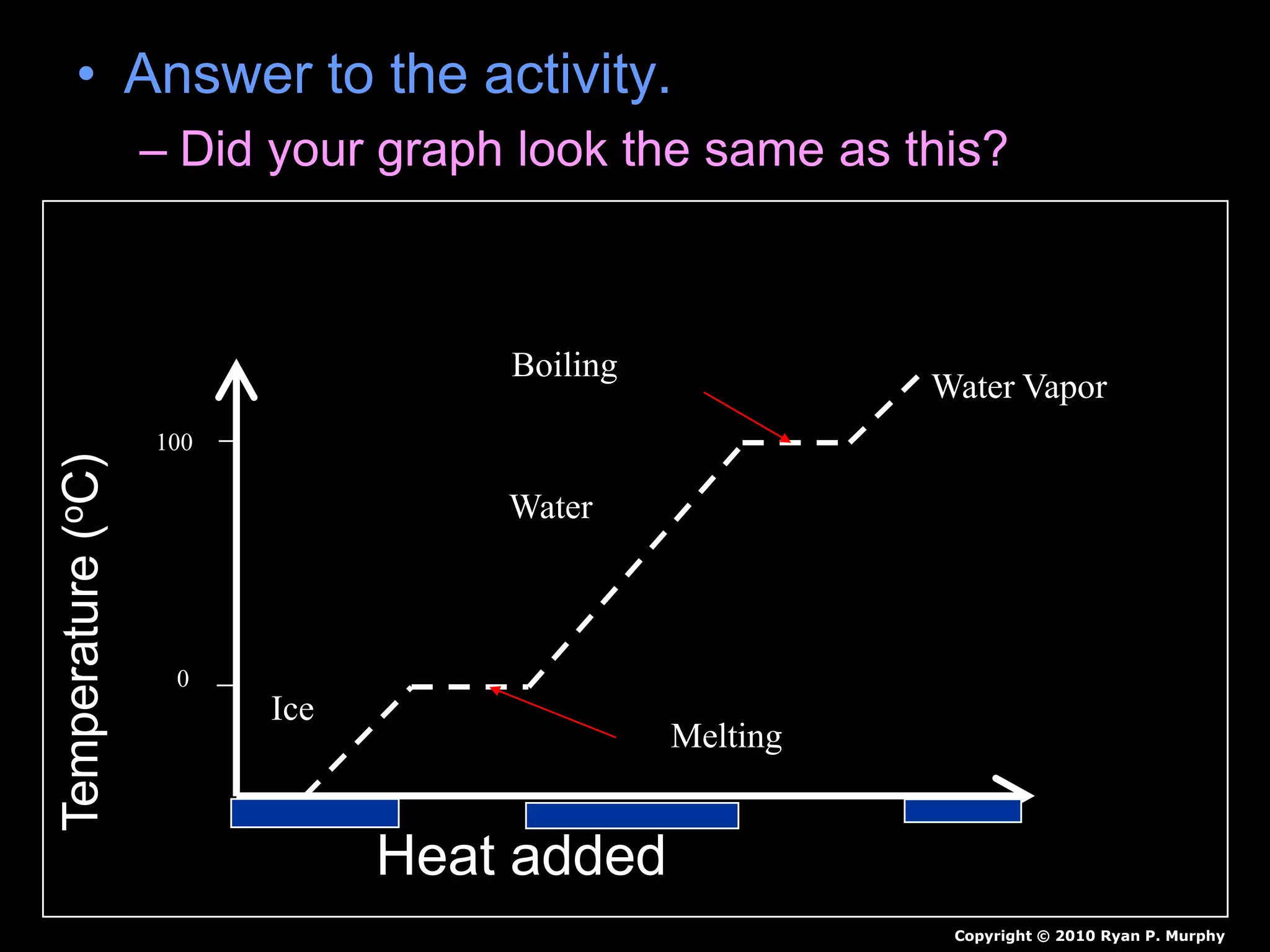
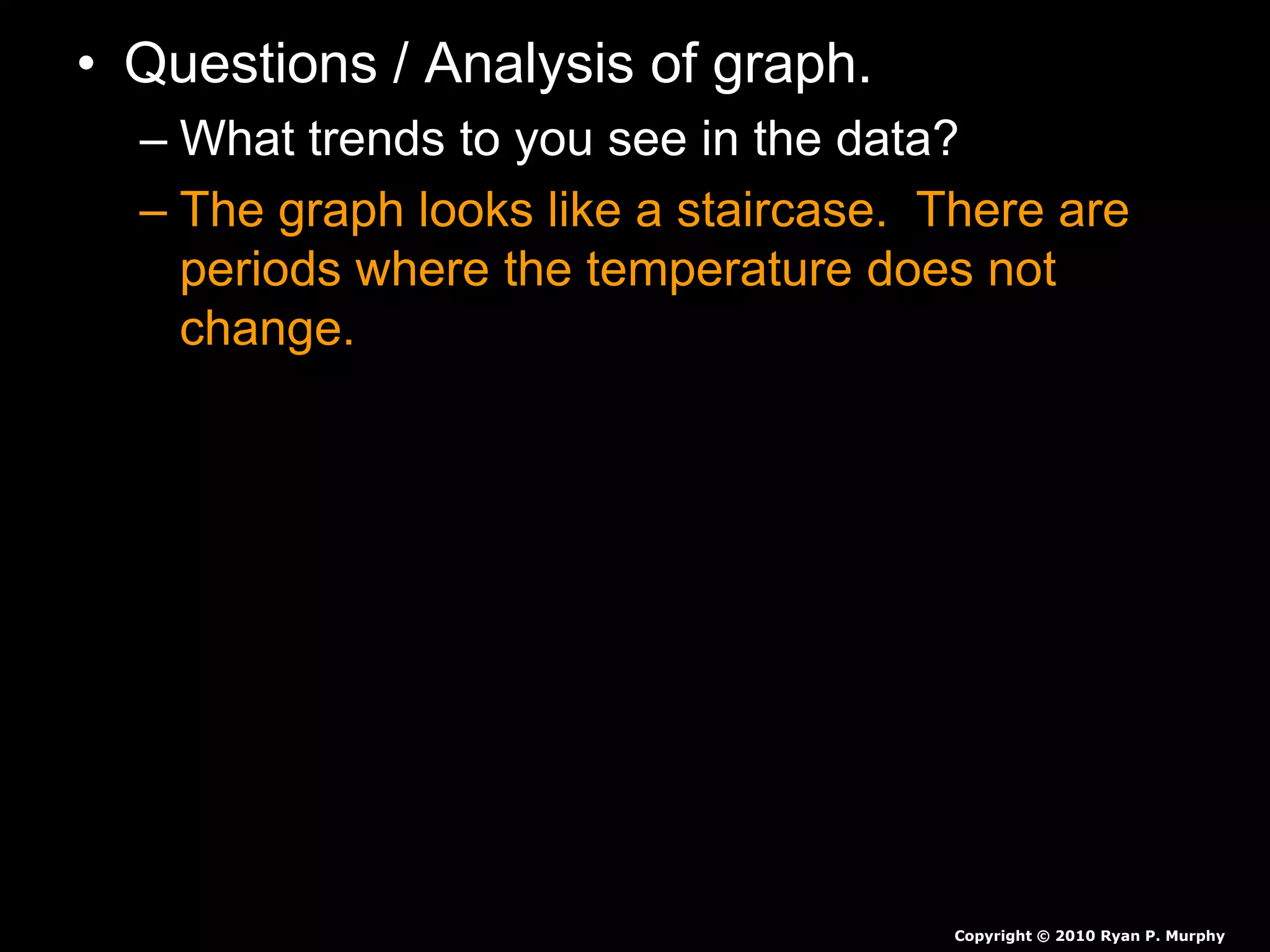
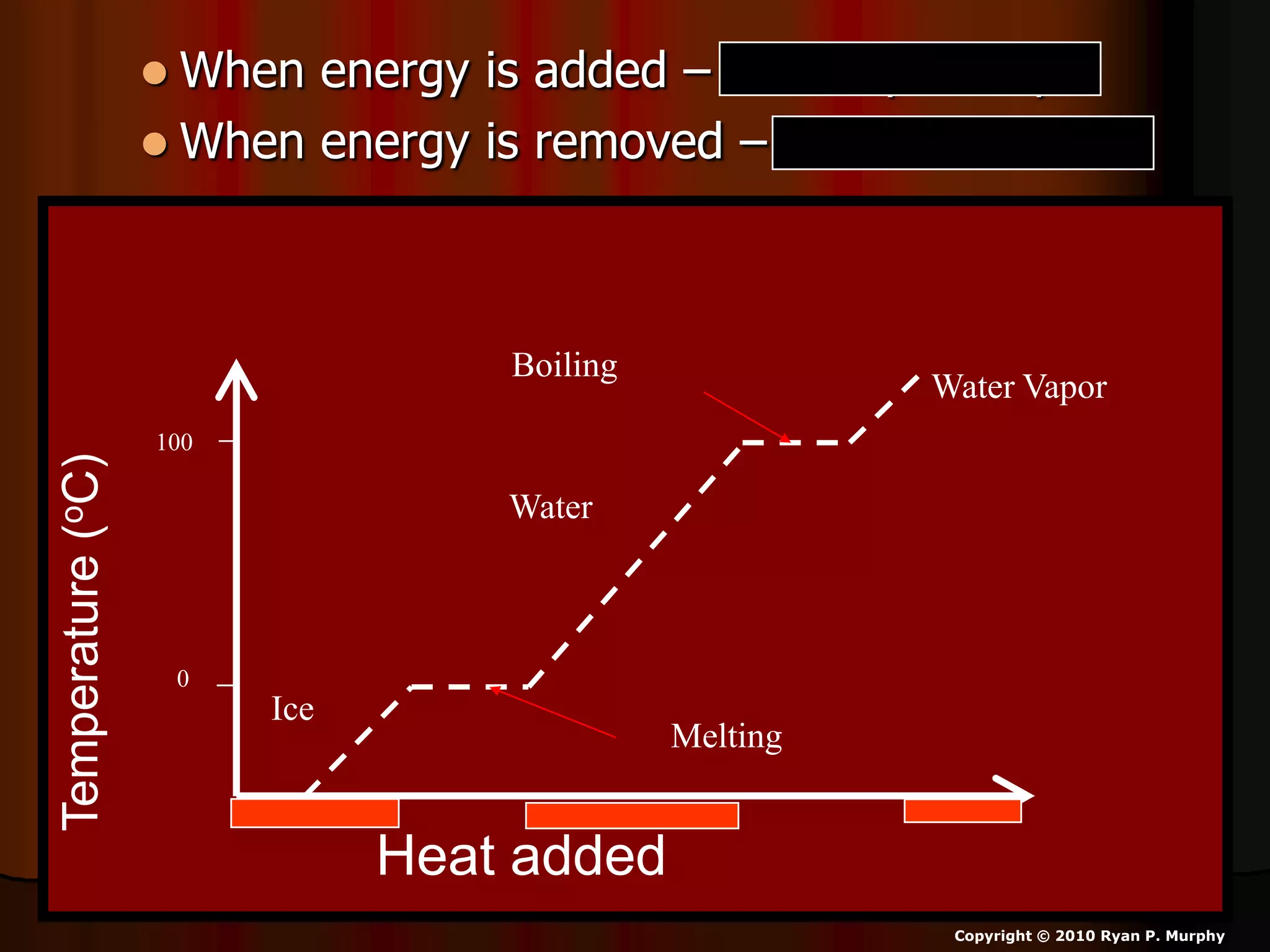
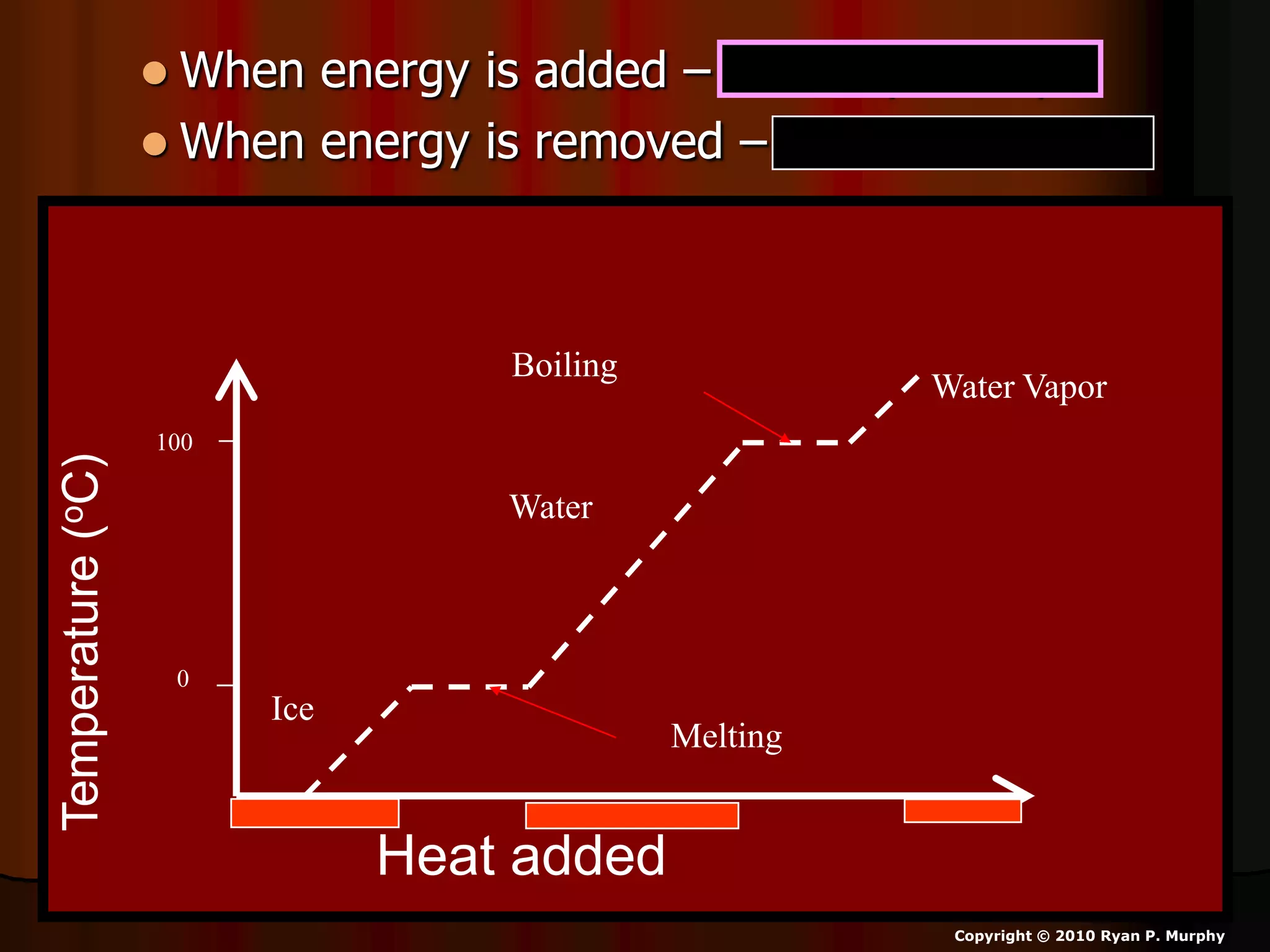
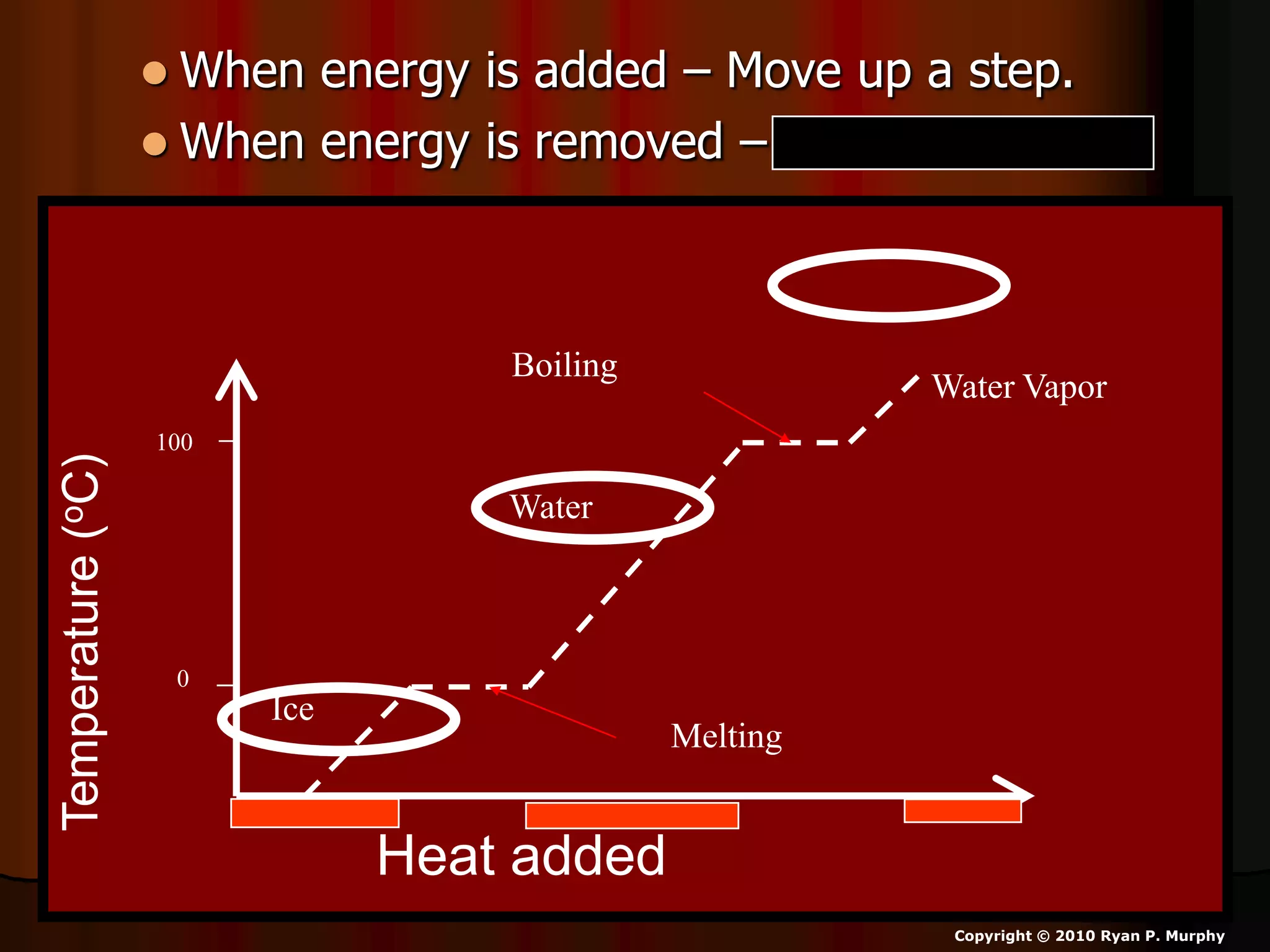
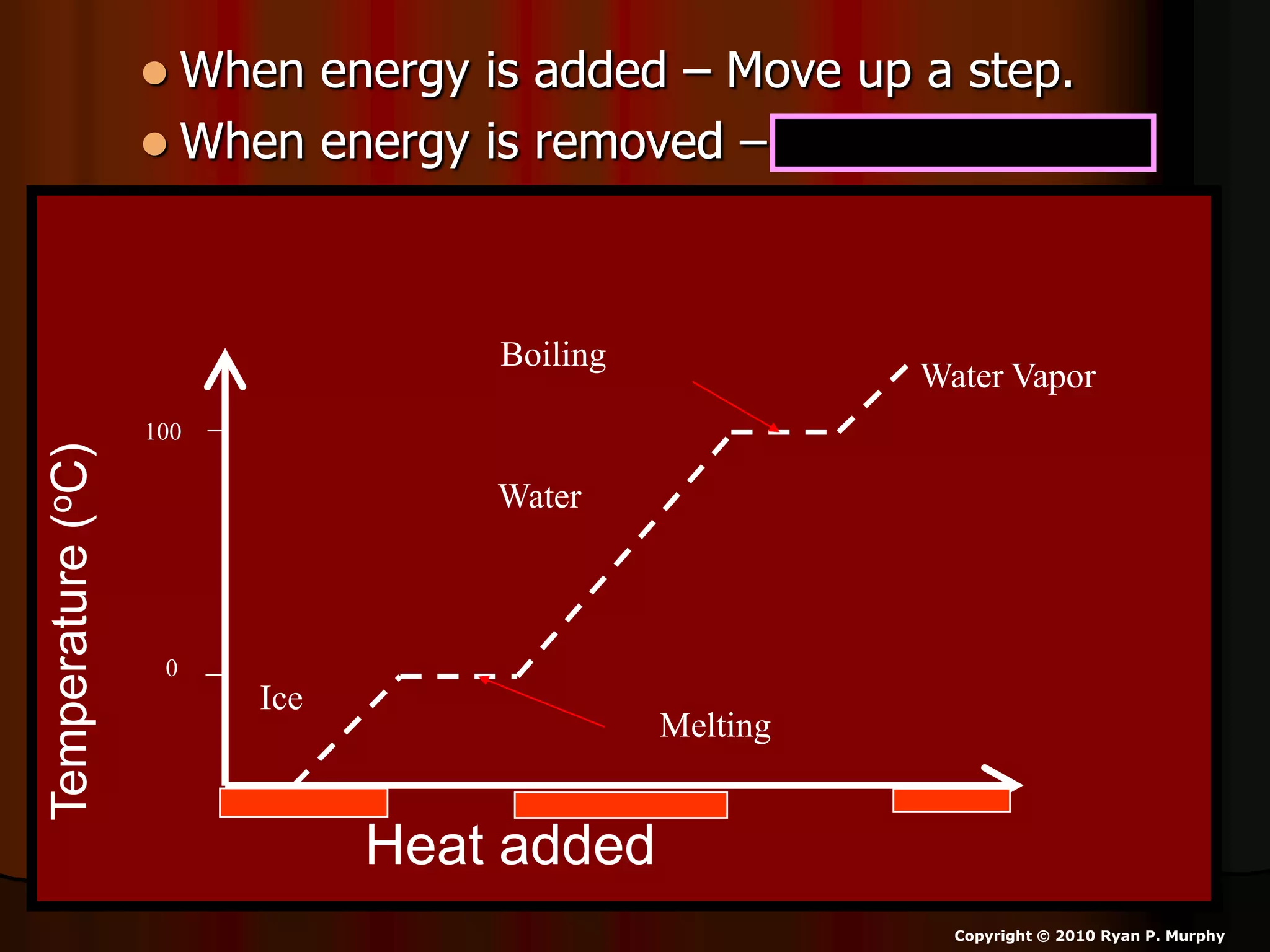
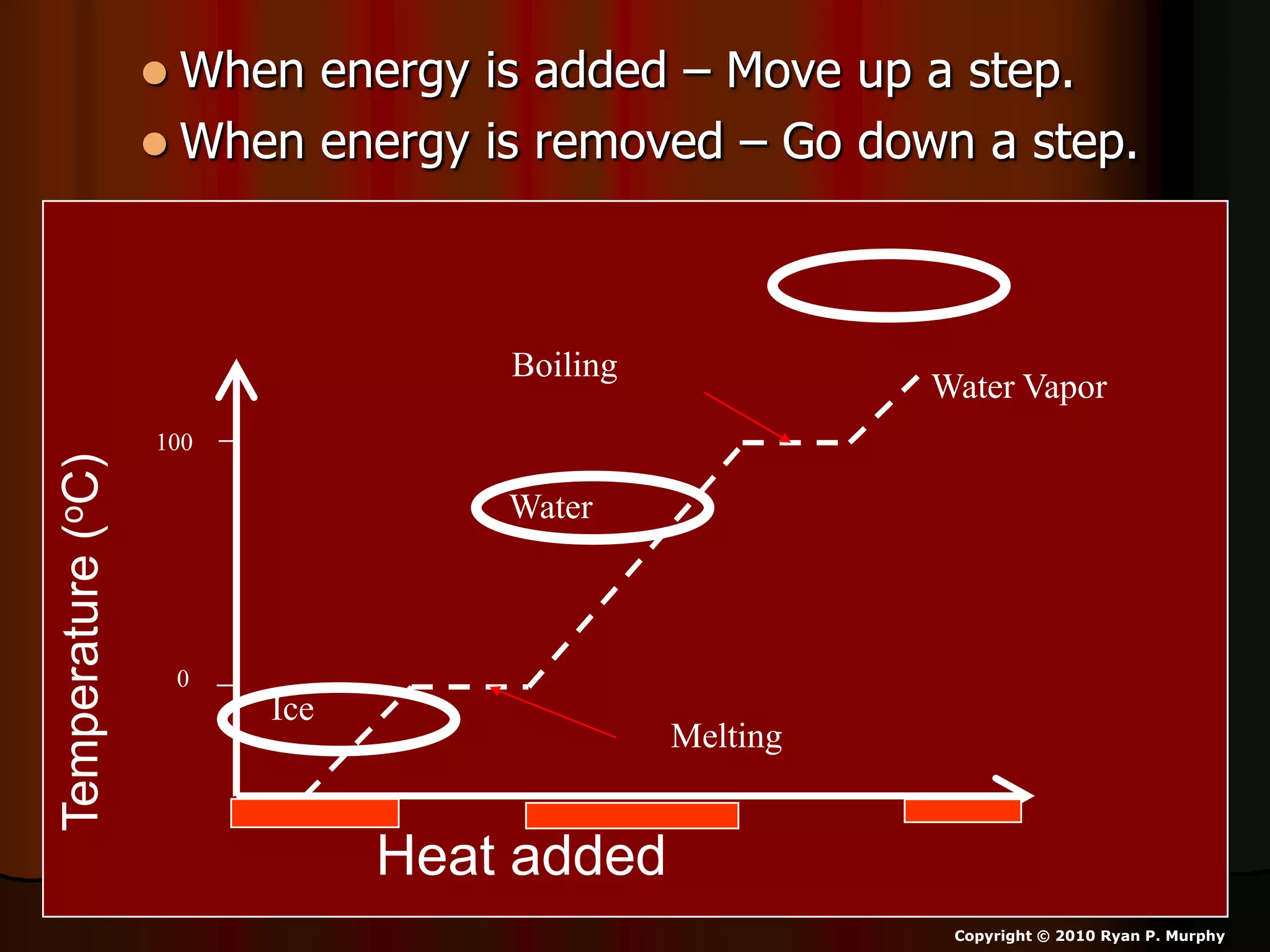
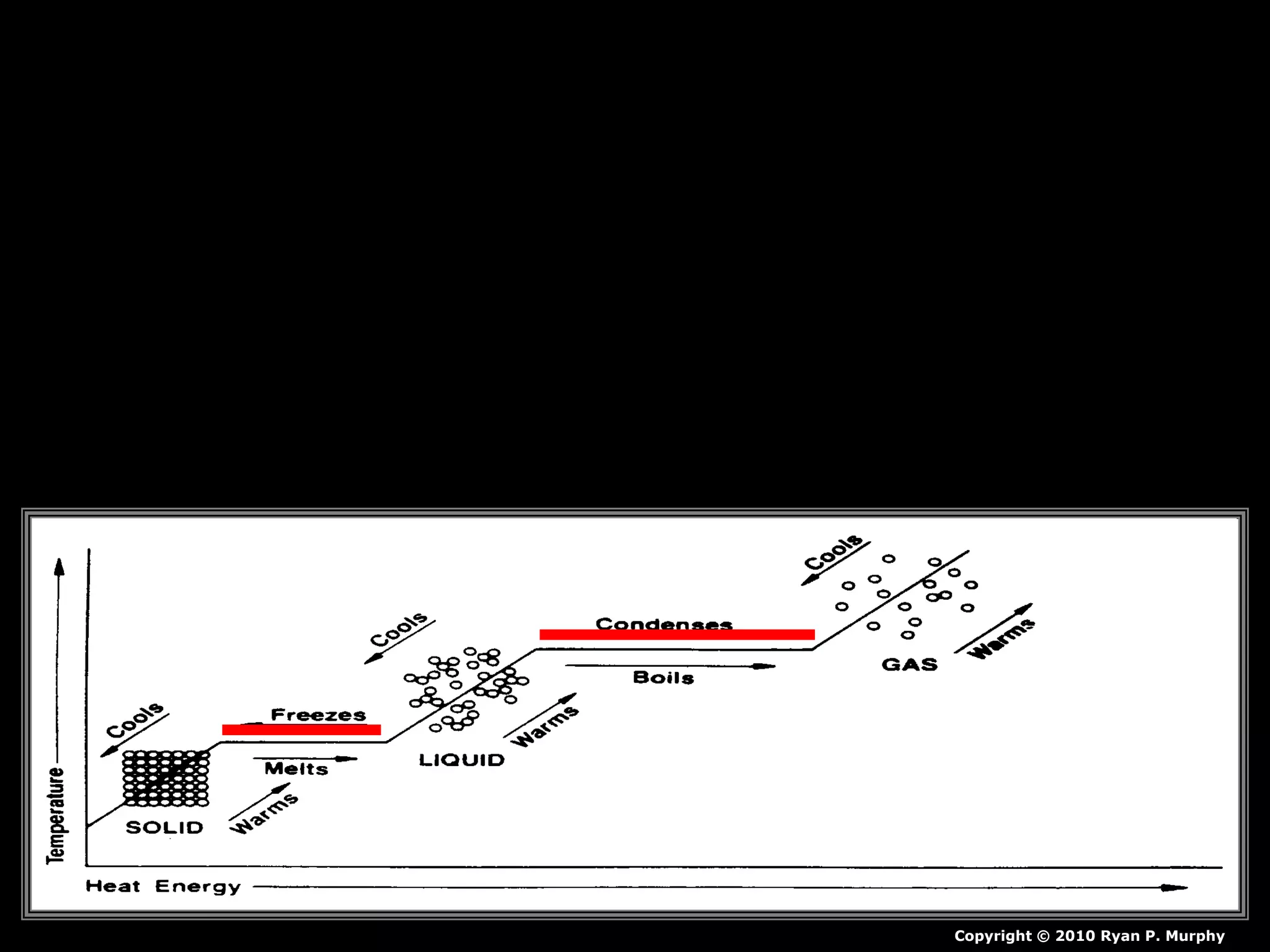
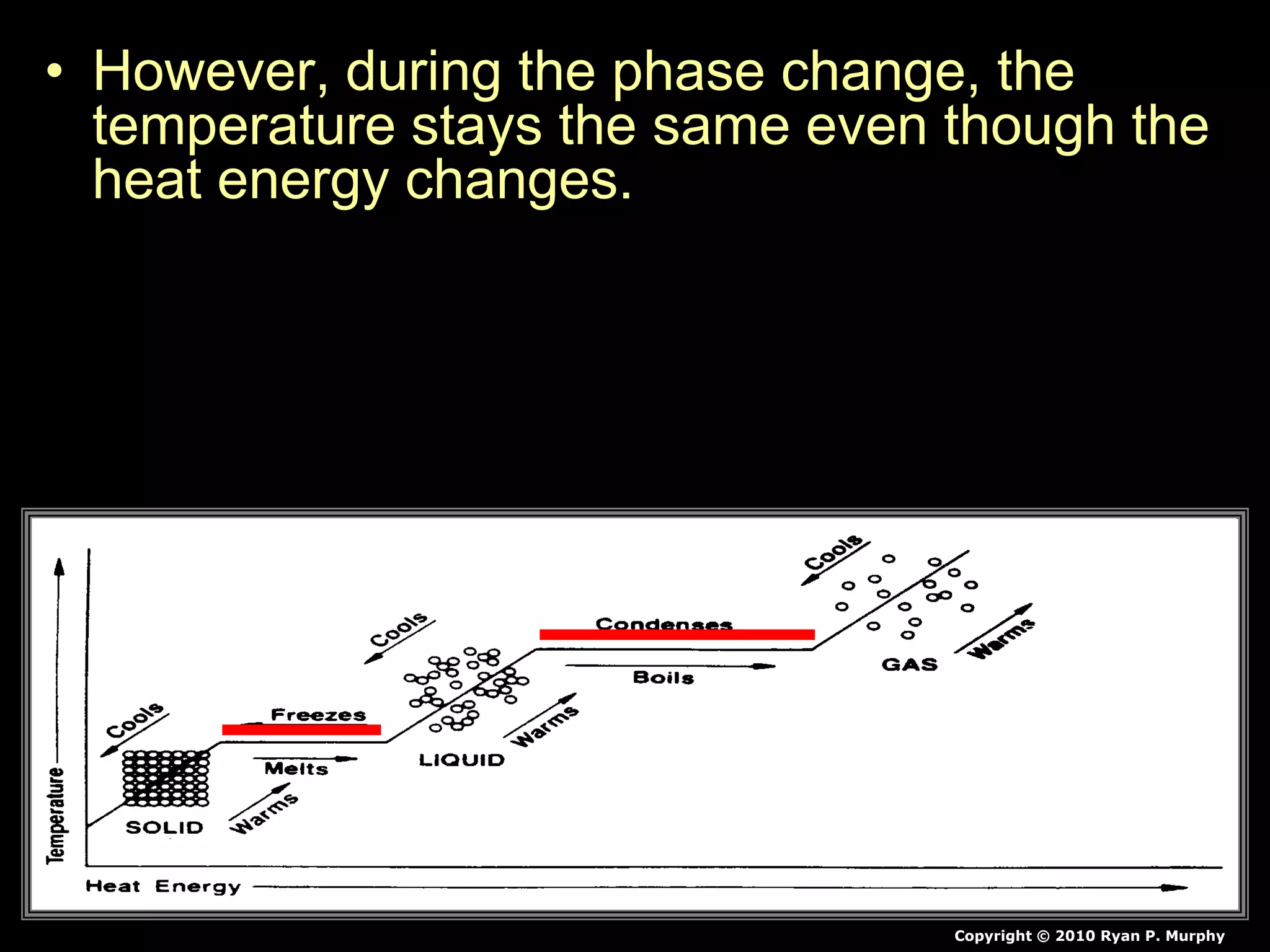
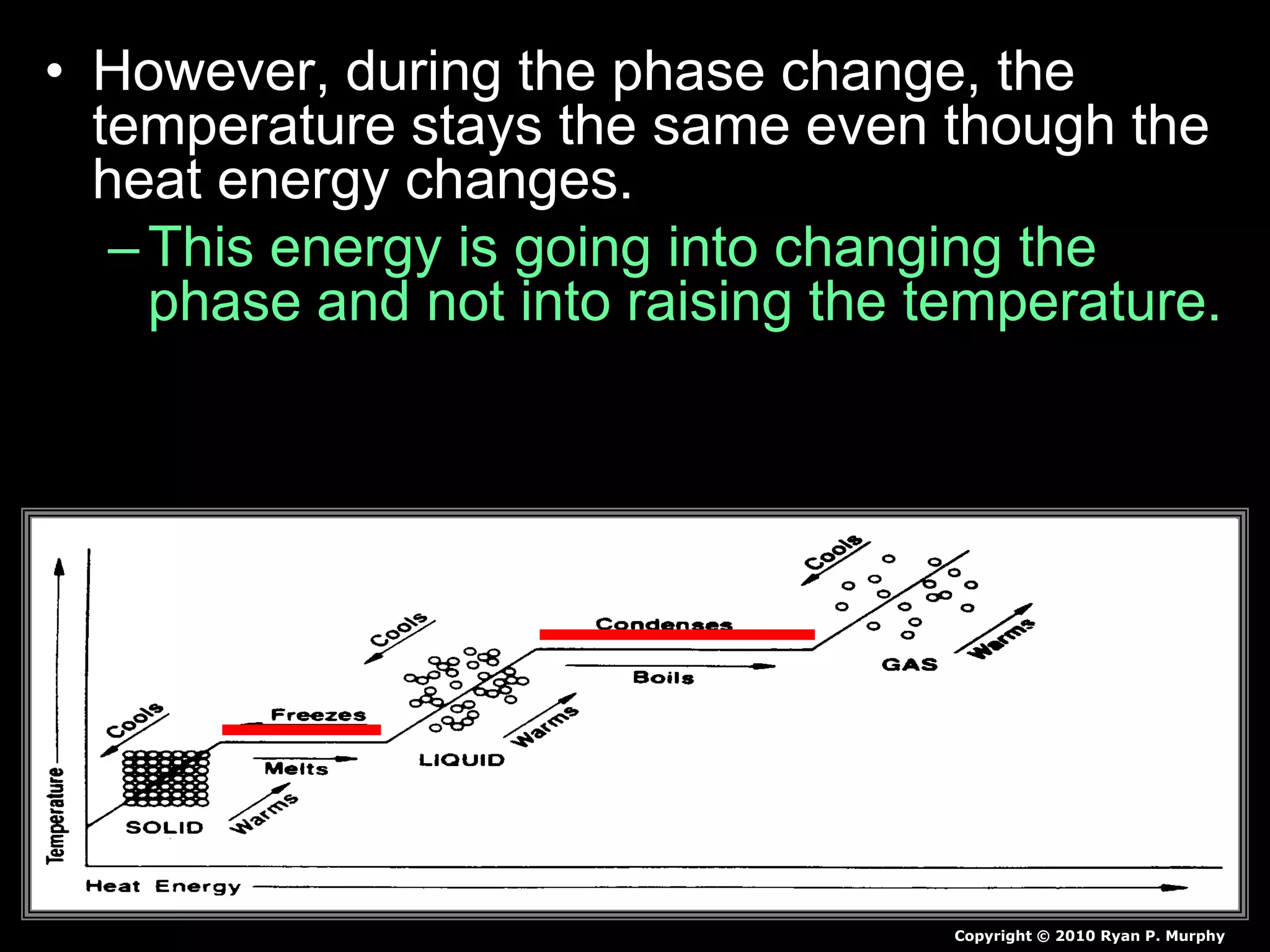
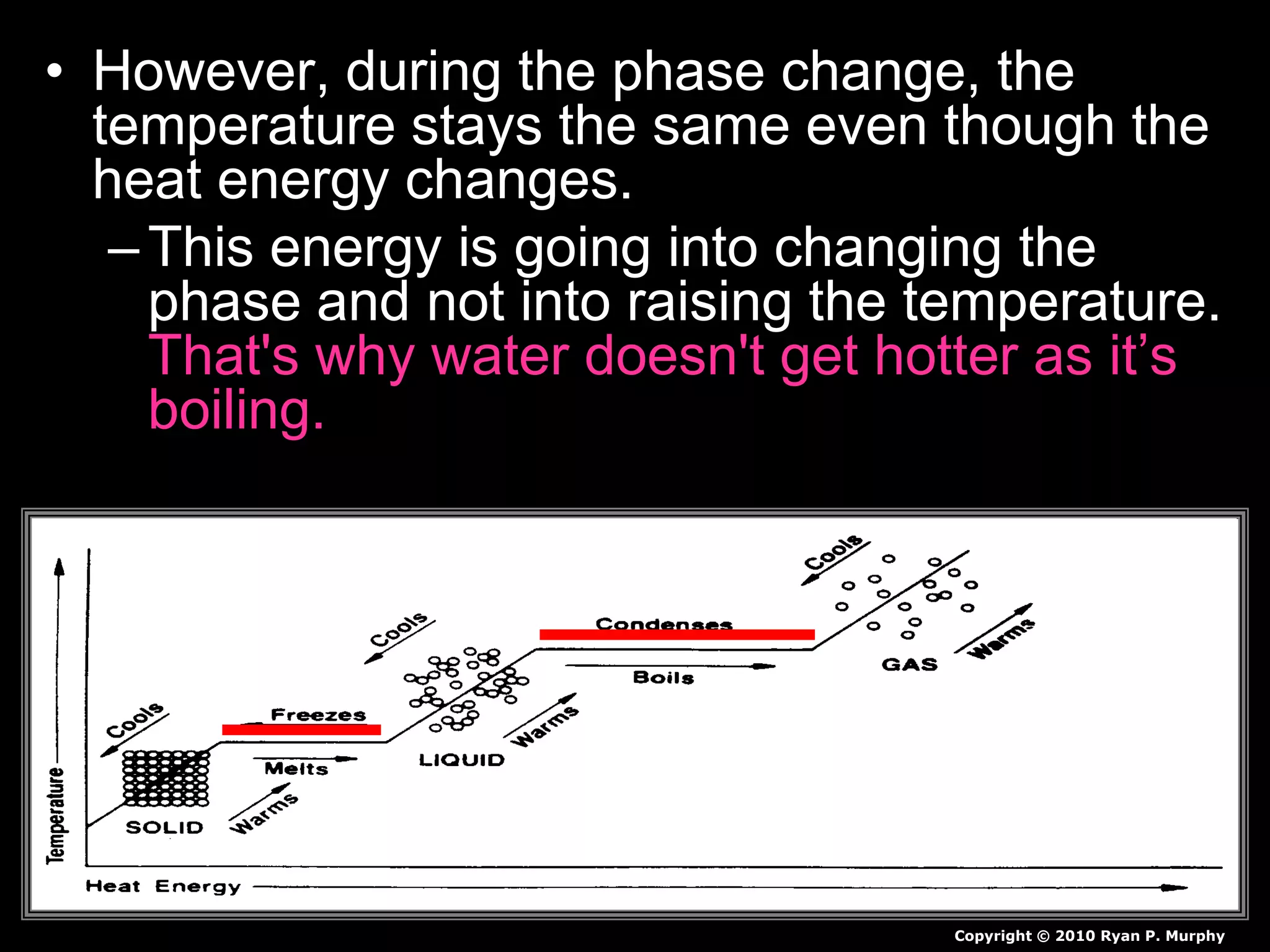
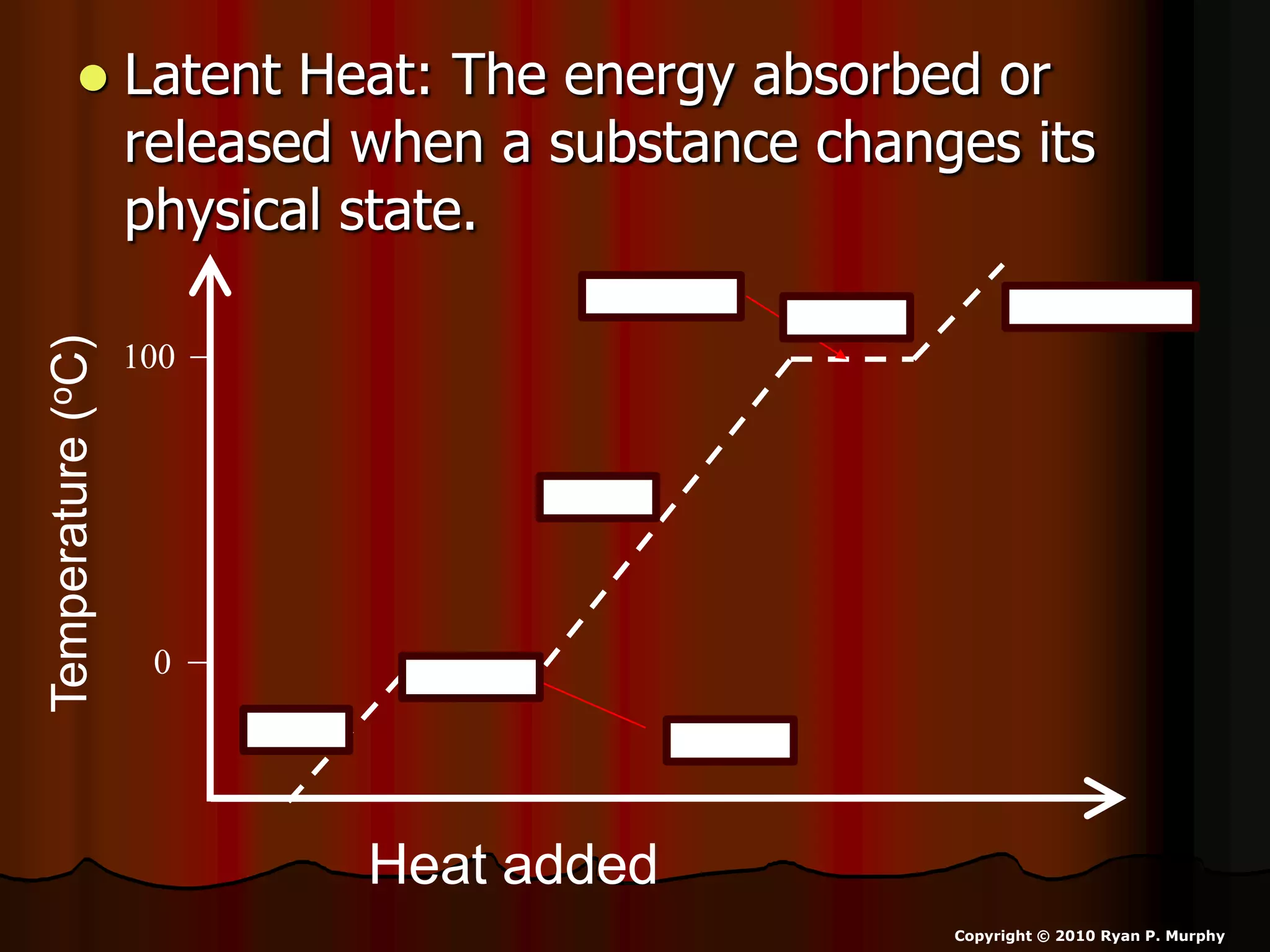
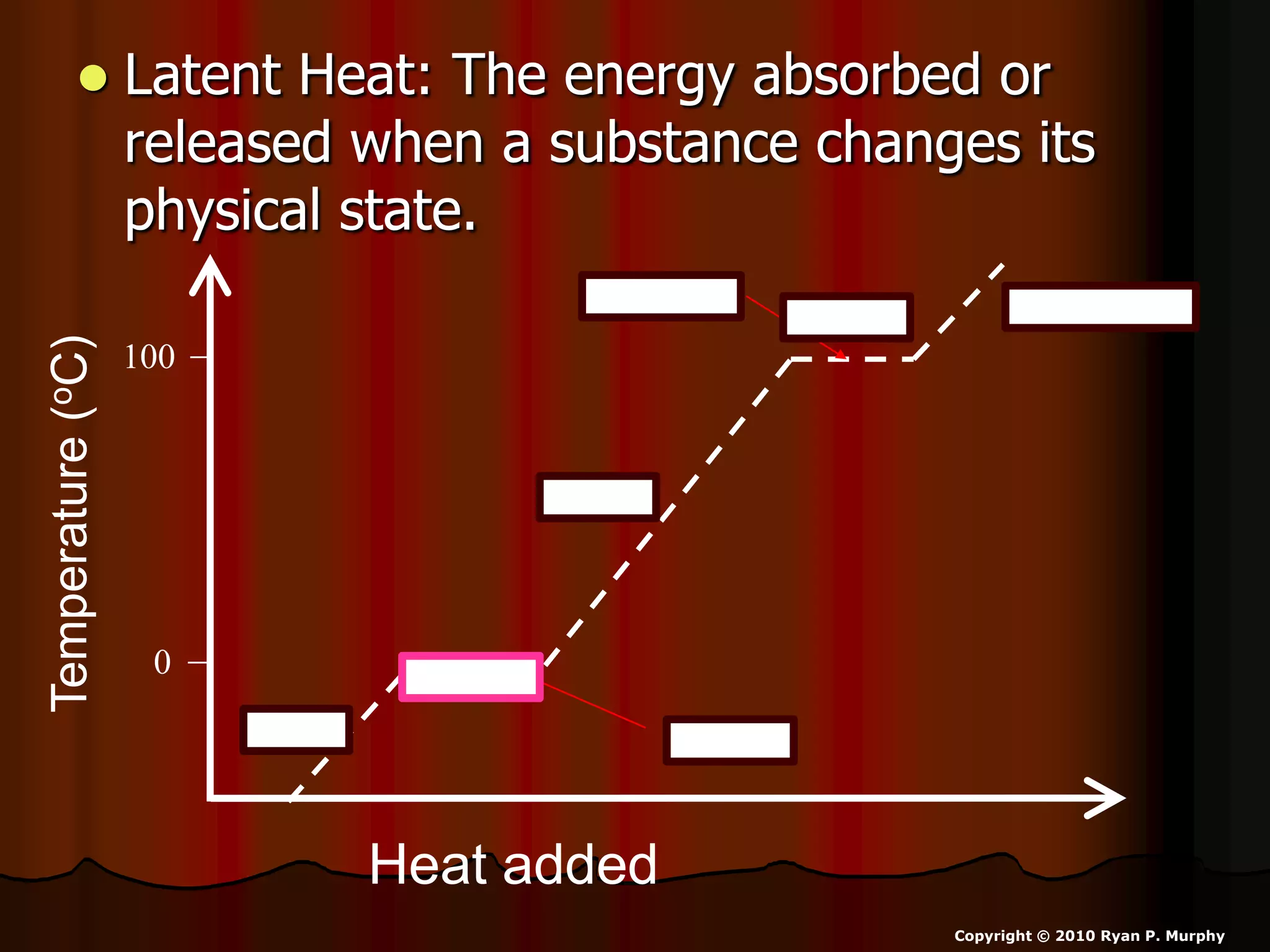
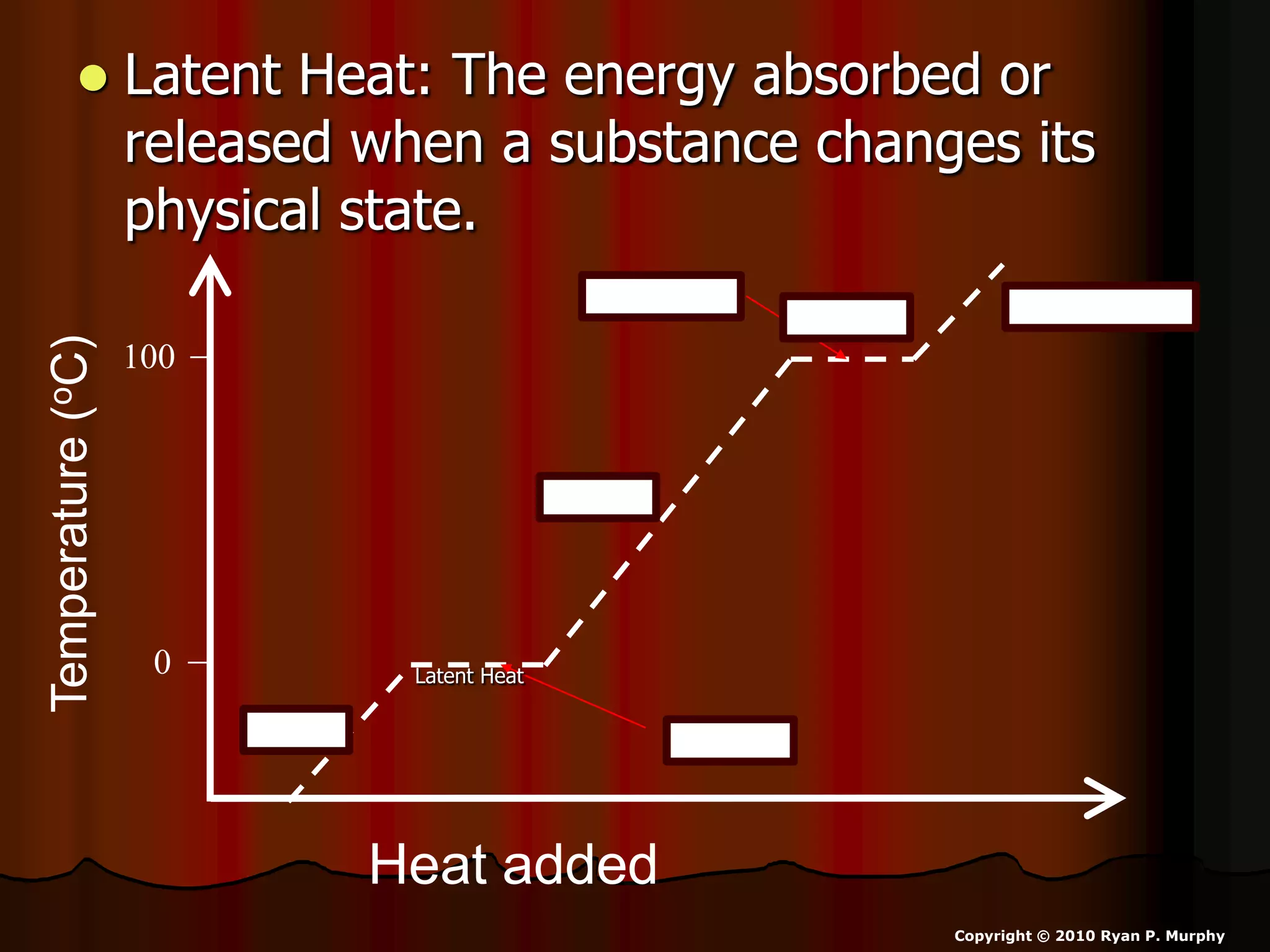
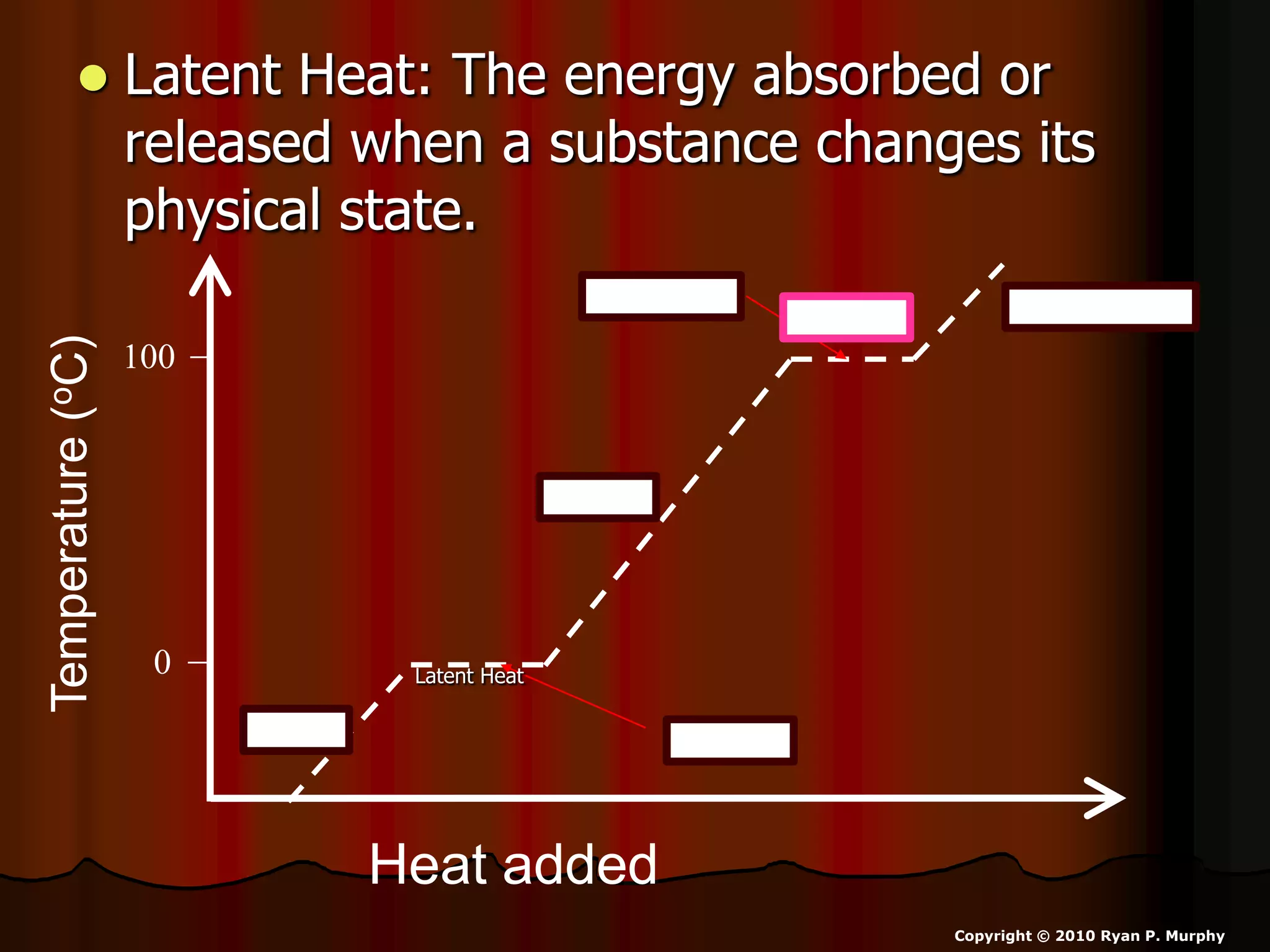
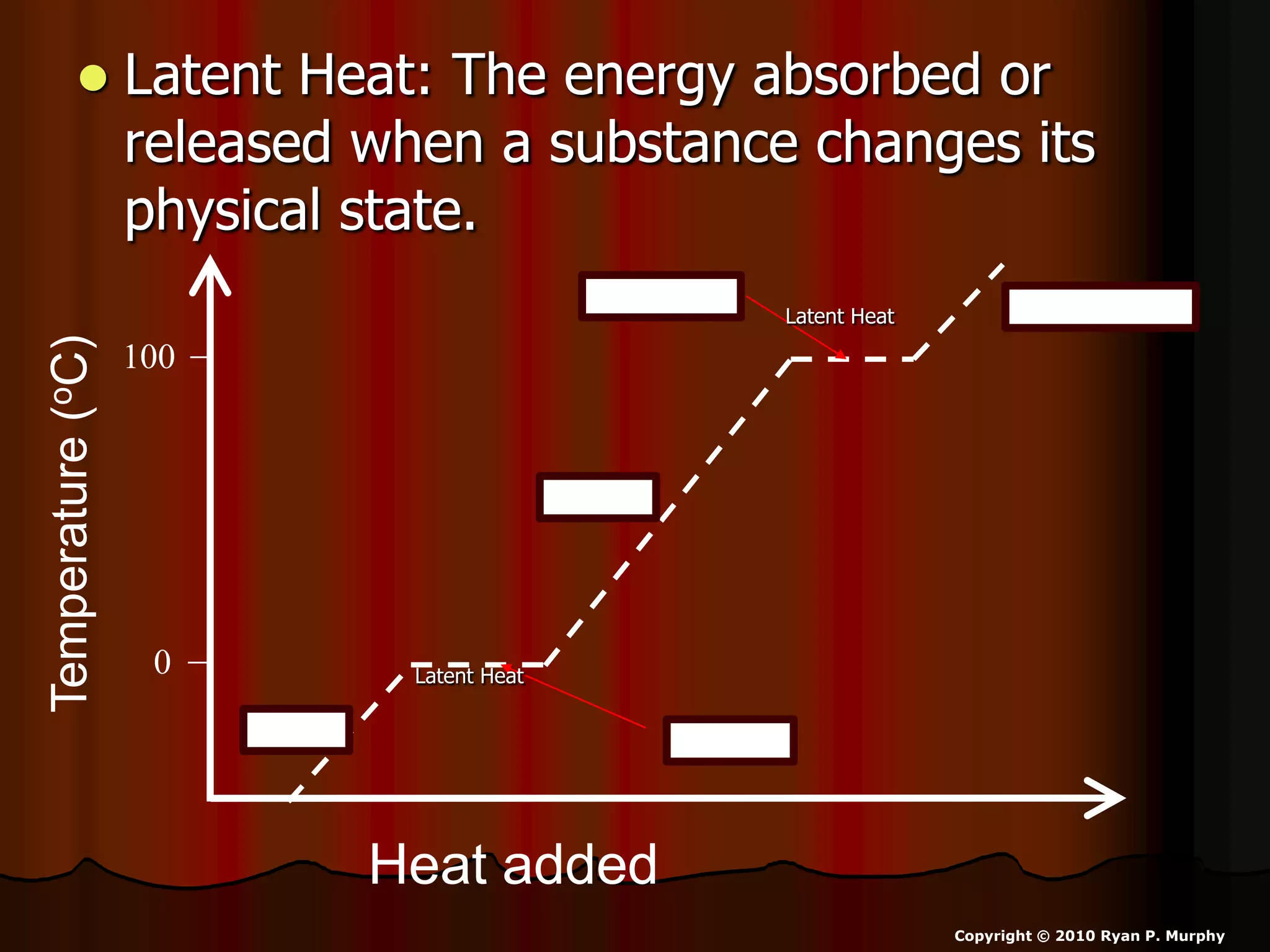
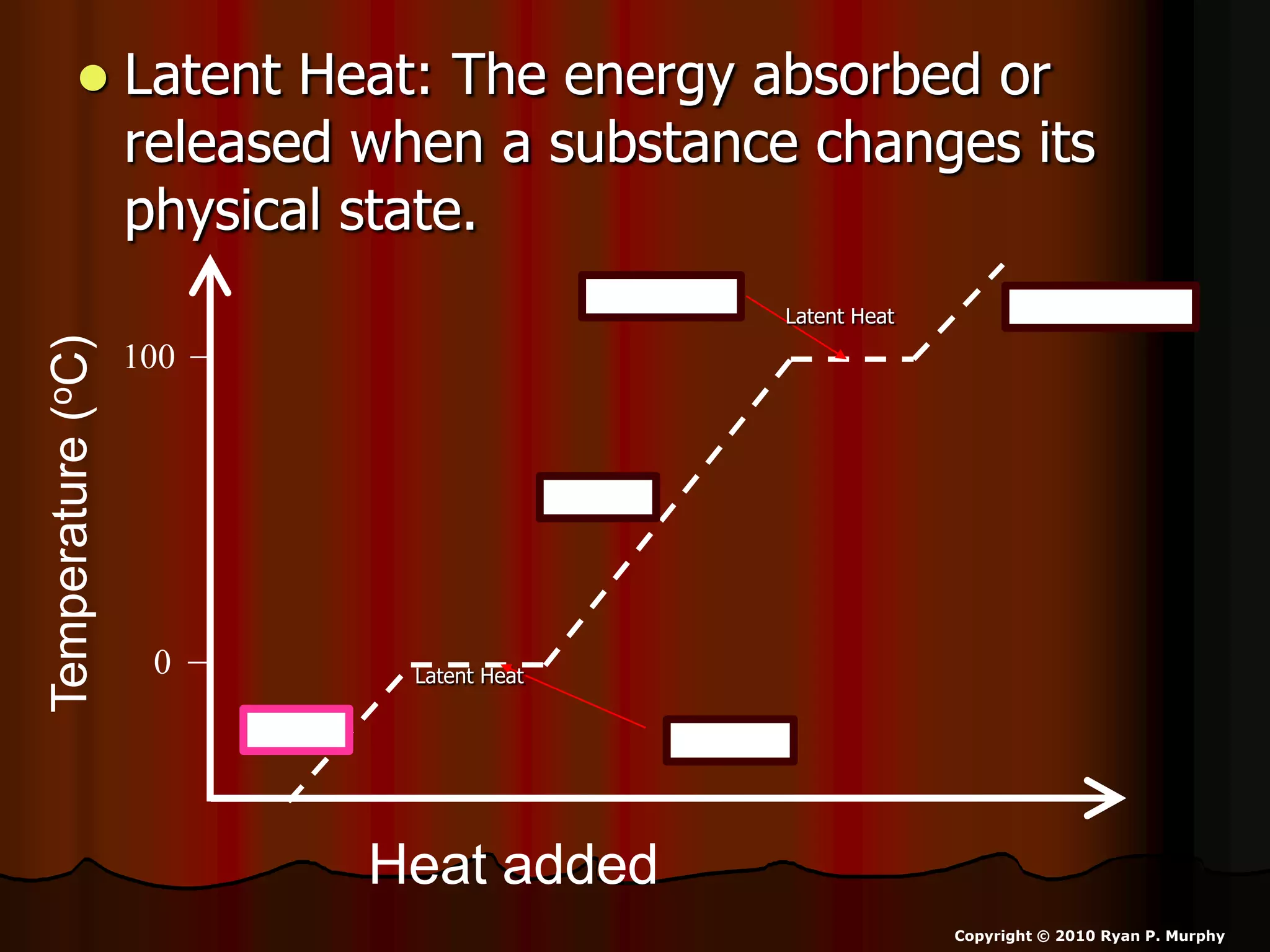
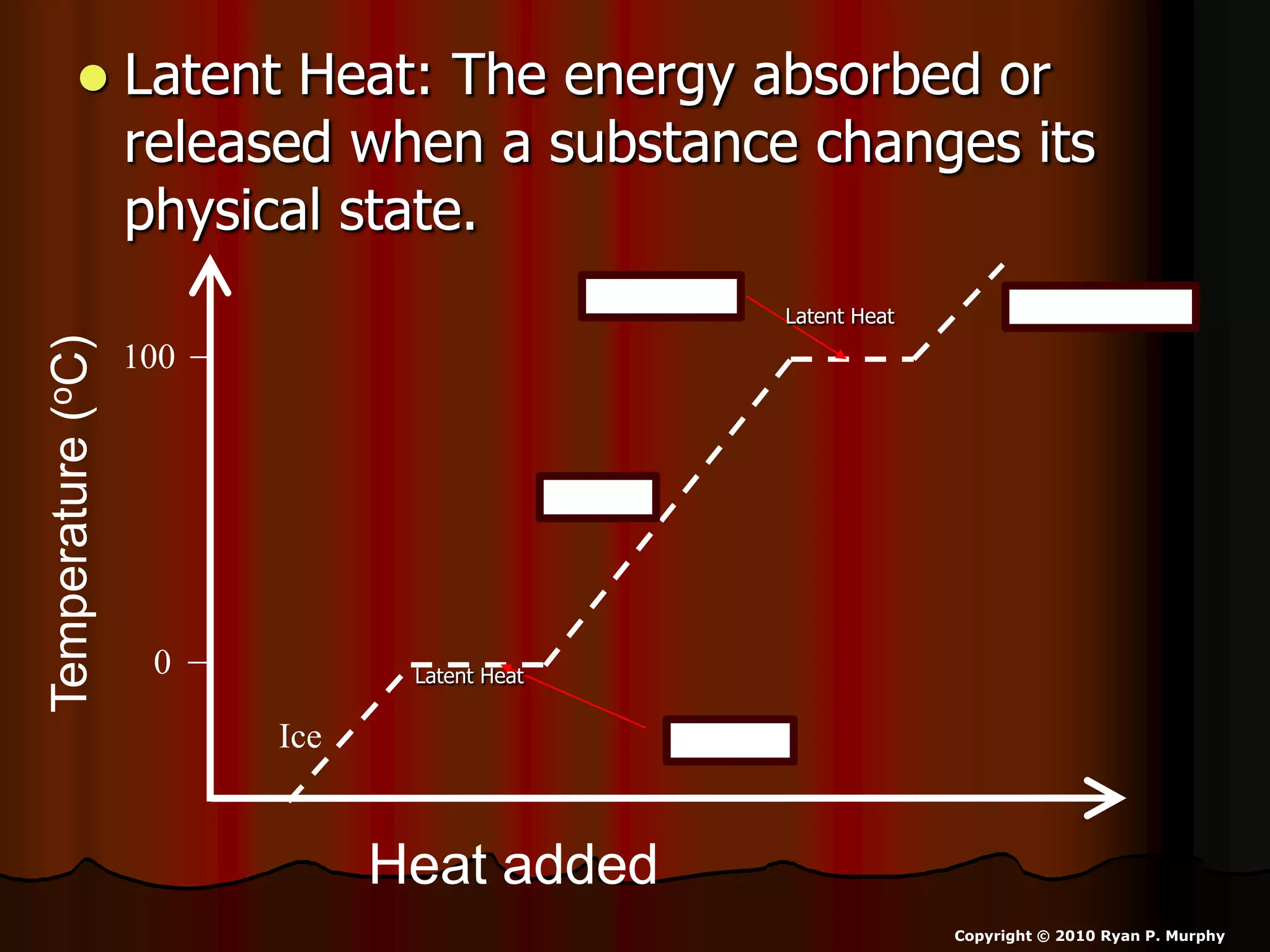
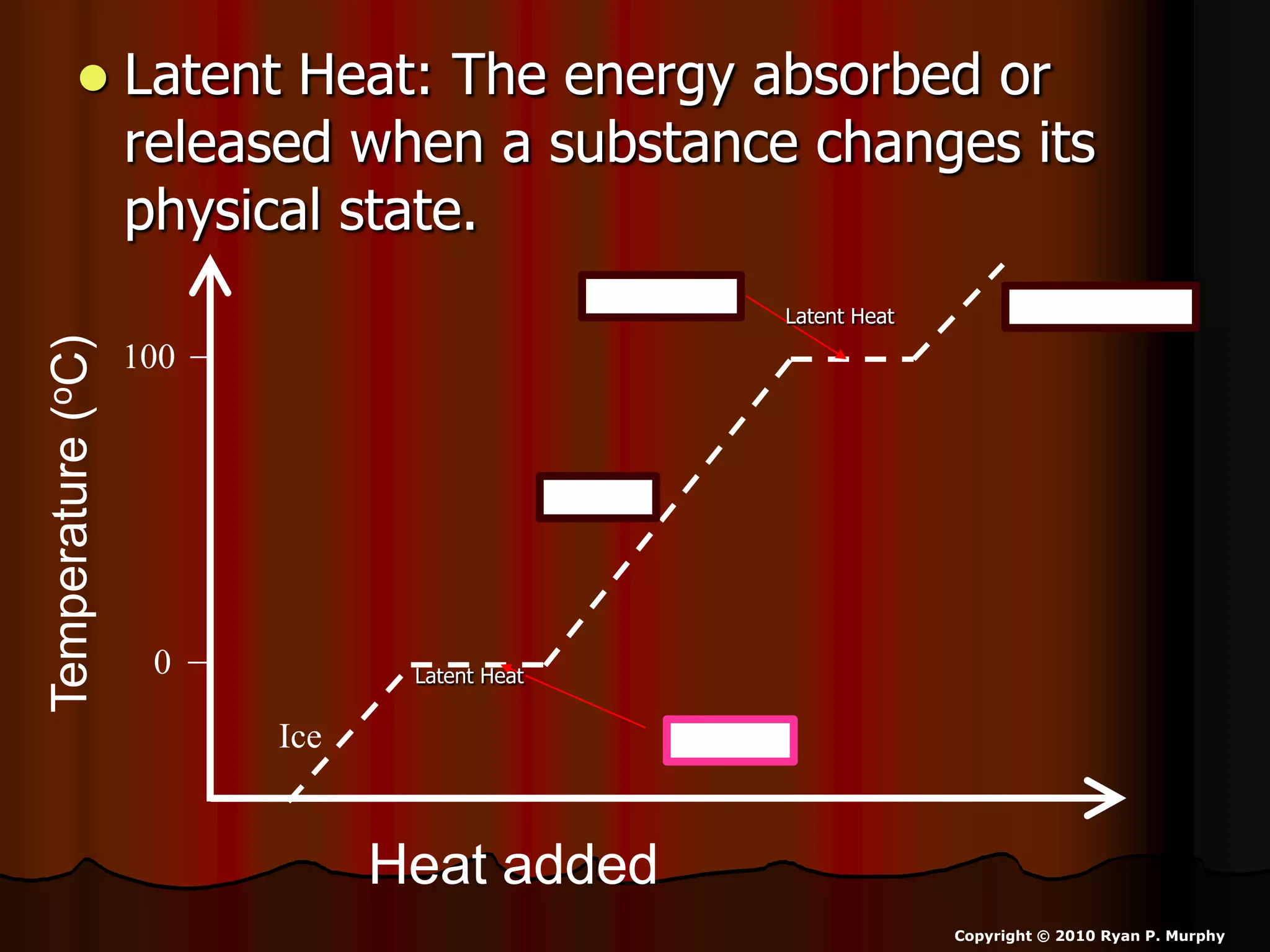
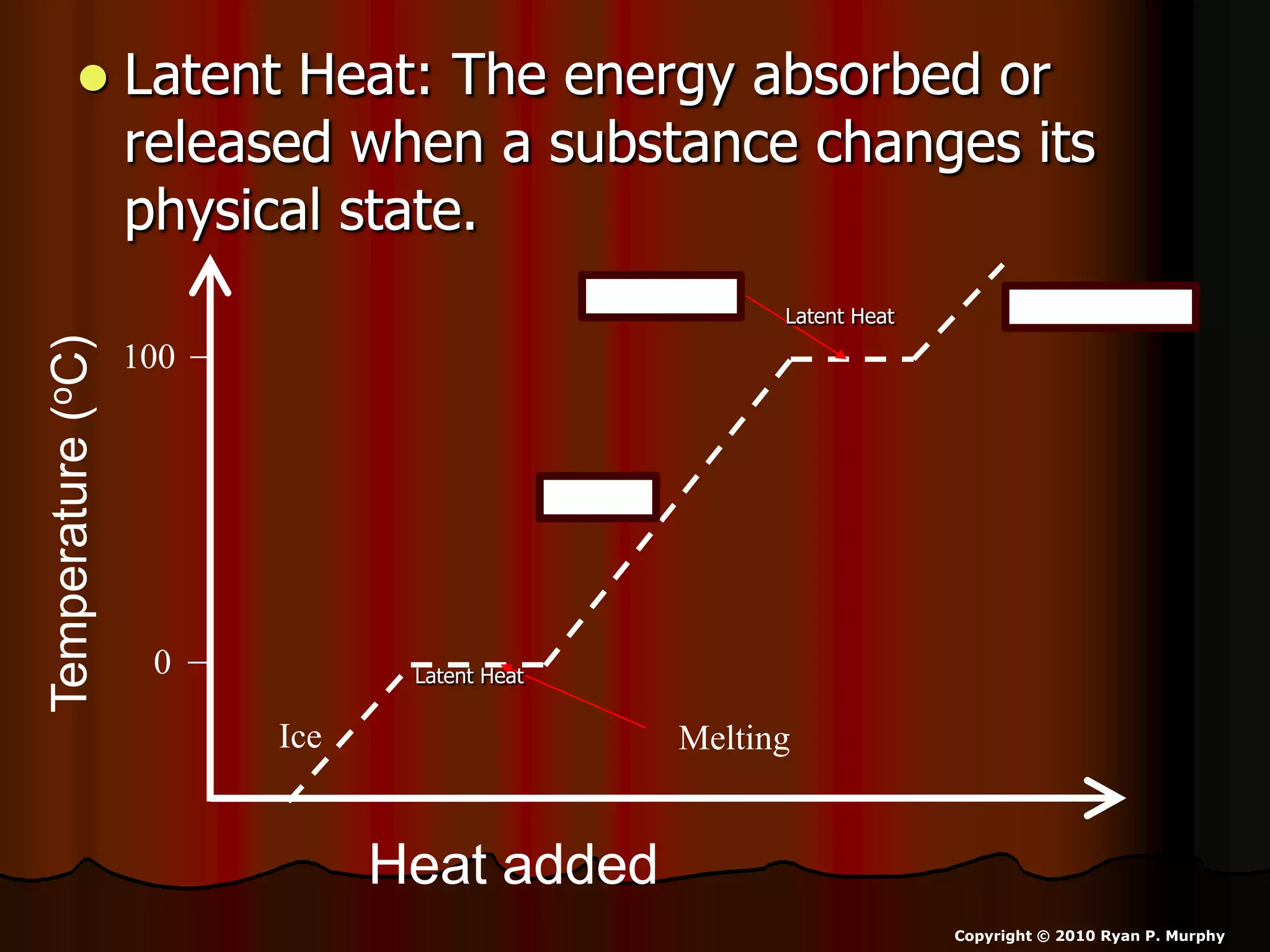
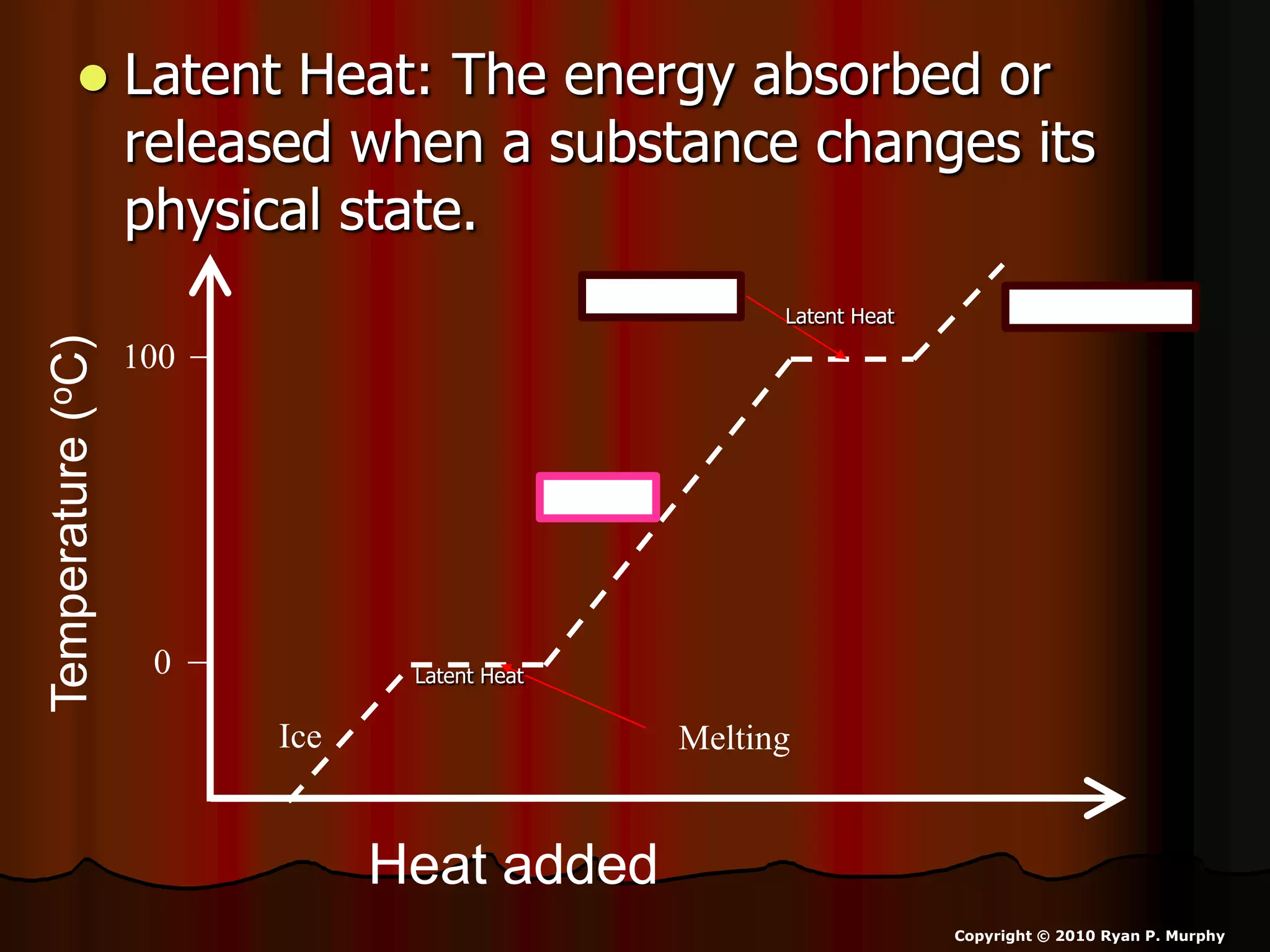
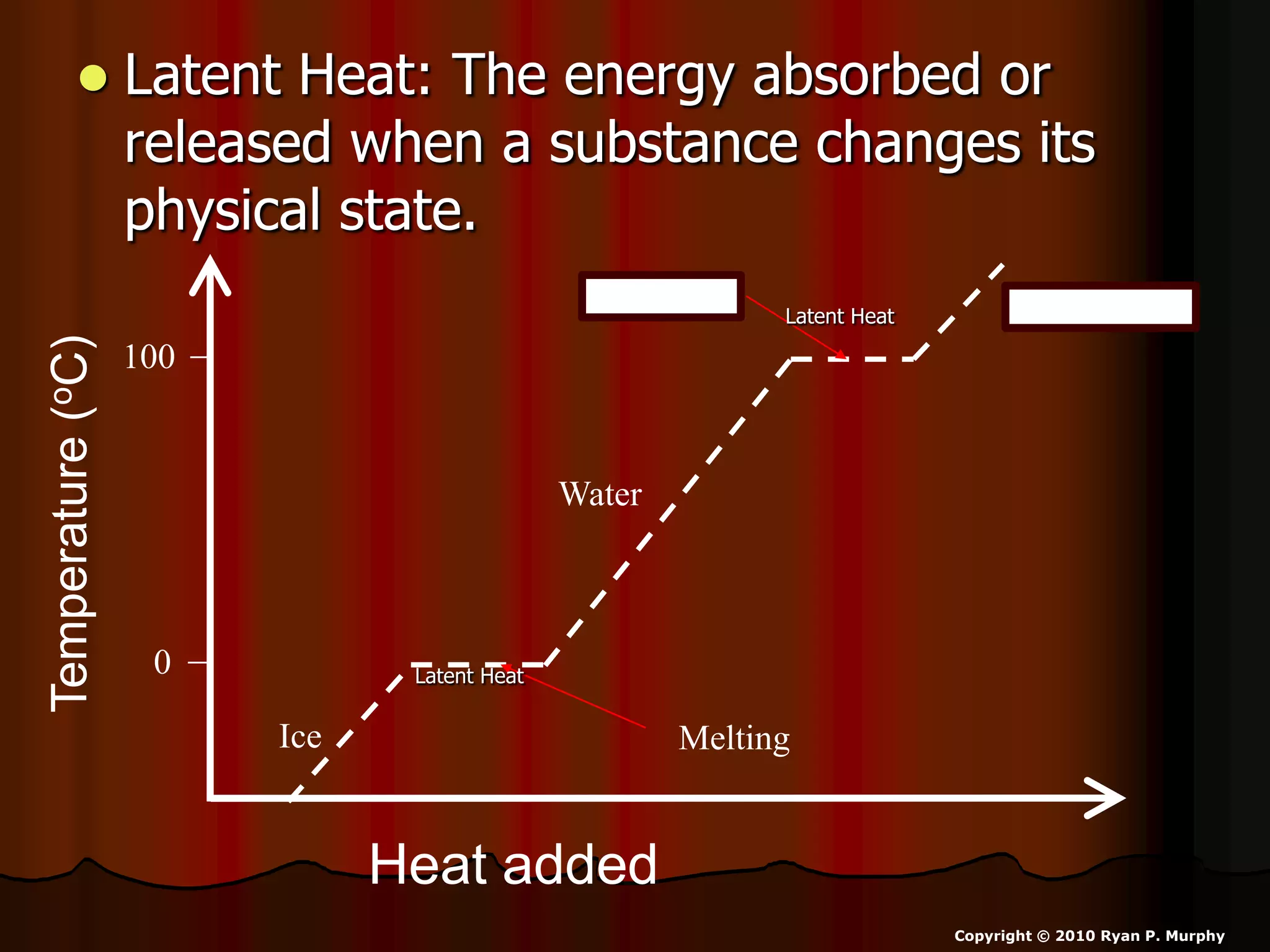
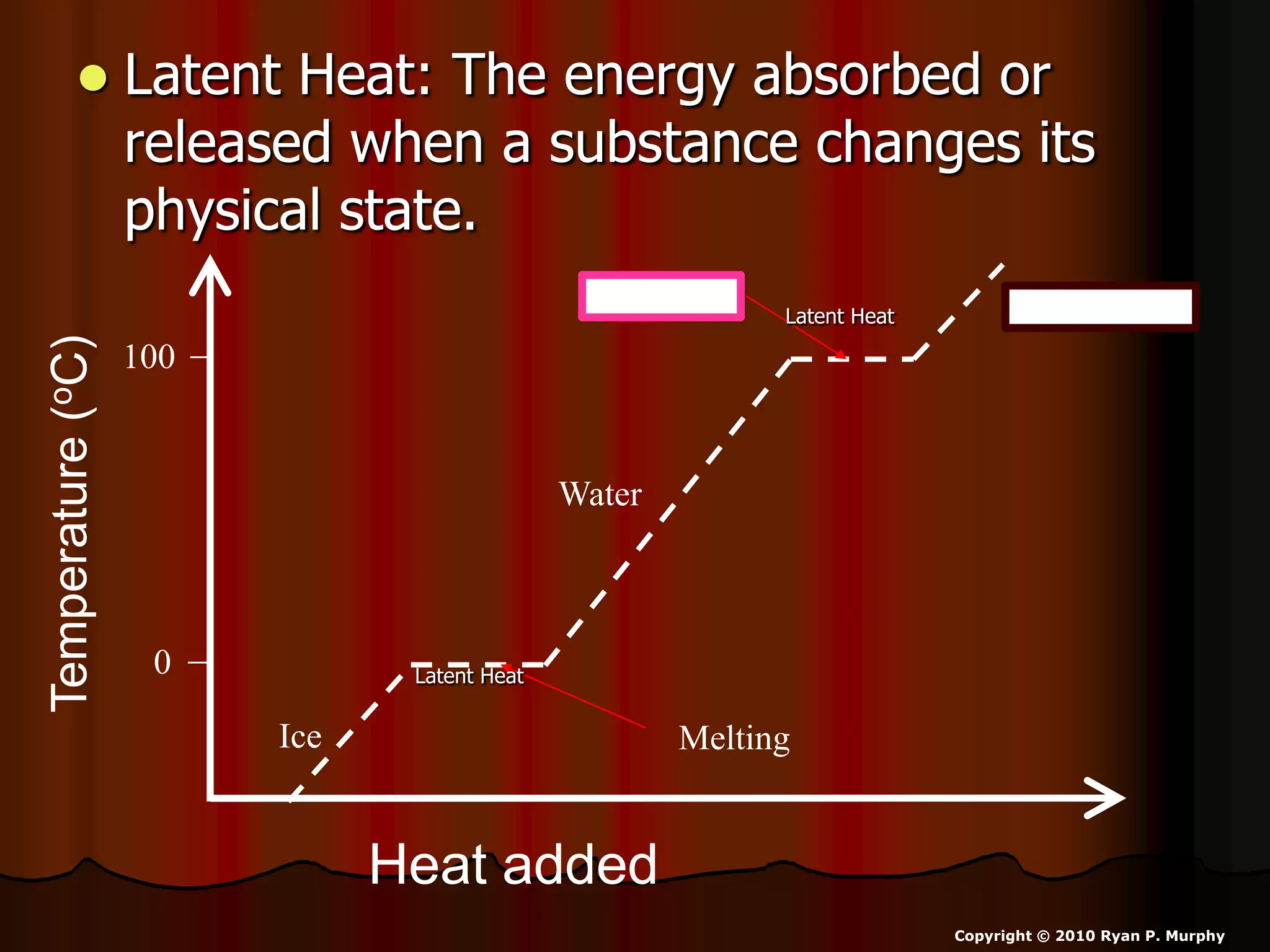
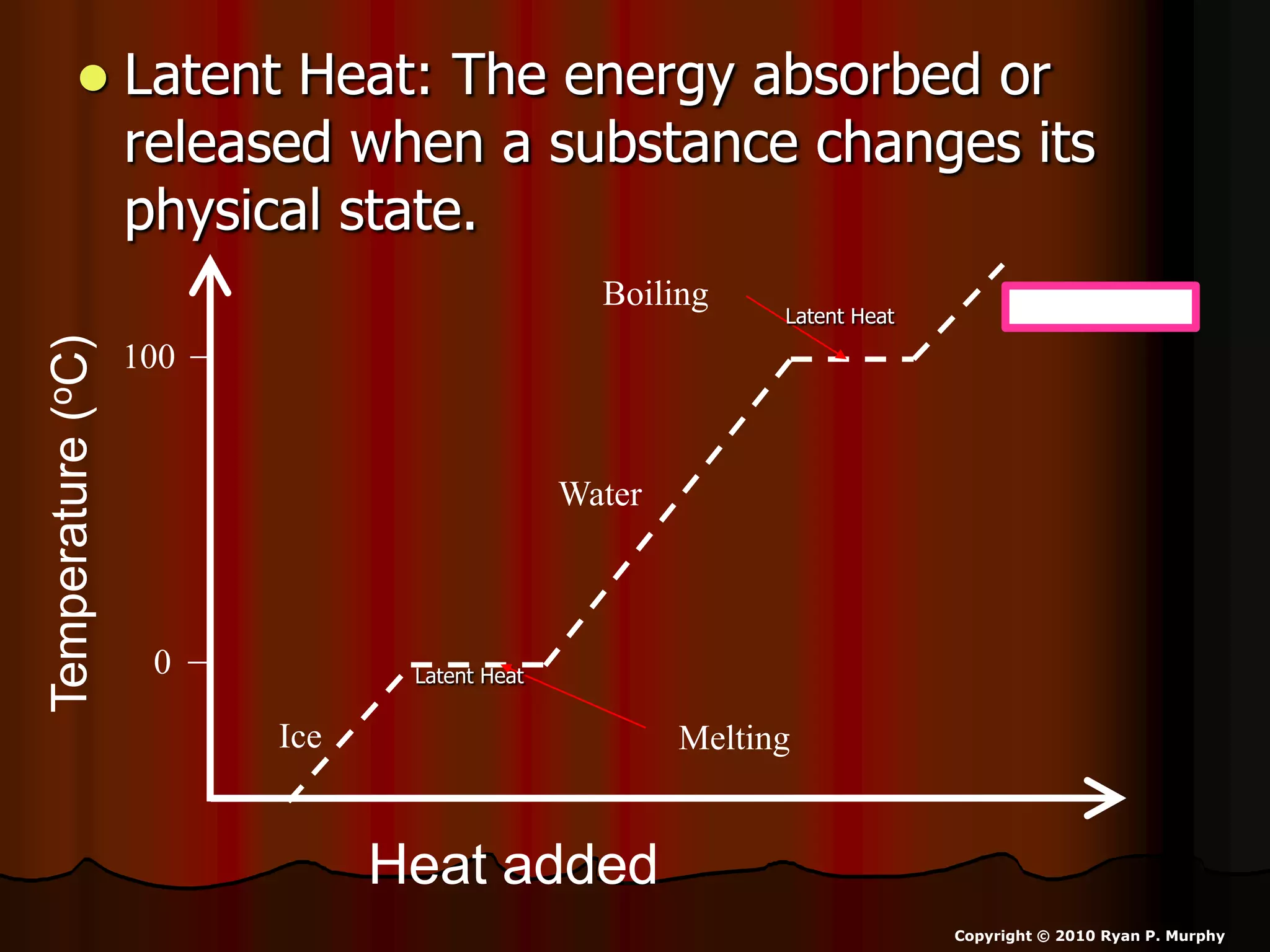
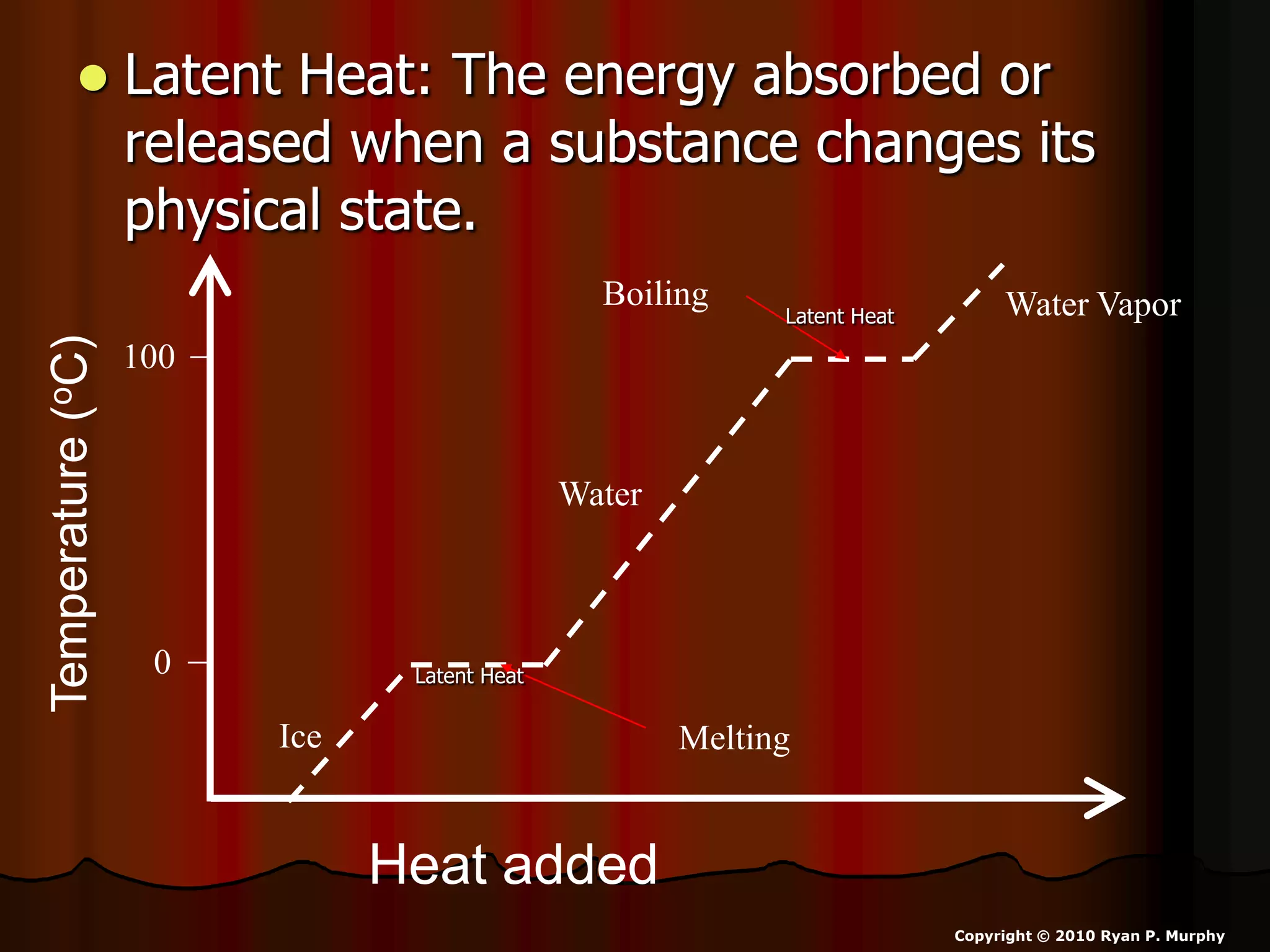
Ice
Melting Water
Boiling Vapor
GasT
E
M
P
Heat Added 
• RED SLIDE: These are notes that are very
important and should be recorded in your
science journal.
• BLACK SLIDE: Pay attention, follow
directions, complete projects as described
and answer required questions neatly.
Copyright © 2010 Ryan P. Murphy
• http://sciencepowerpoint.comWebsite Link:
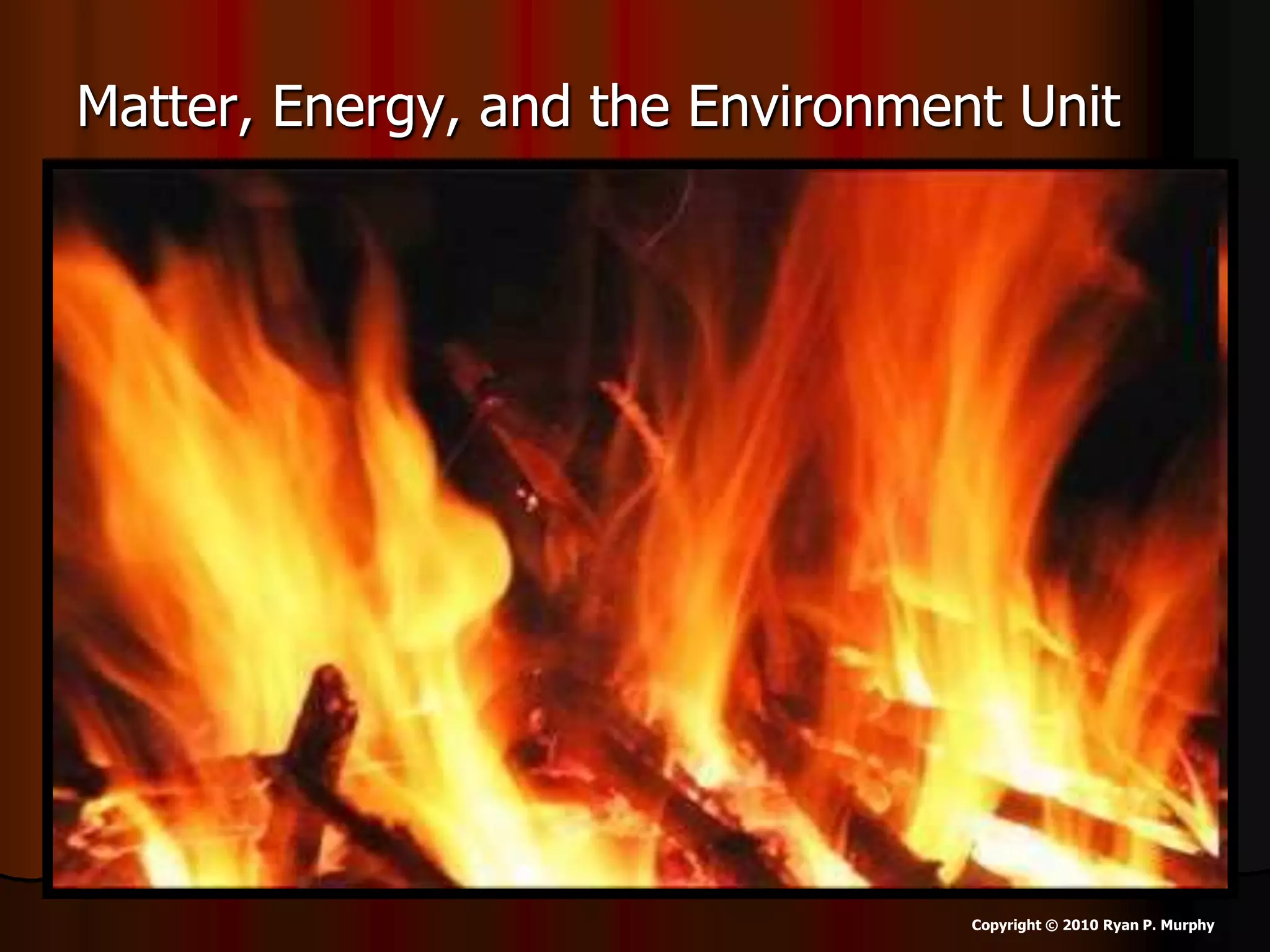
Matter, Energy, and the Environment Unit
Copyright © 2010 Ryan P. Murphy
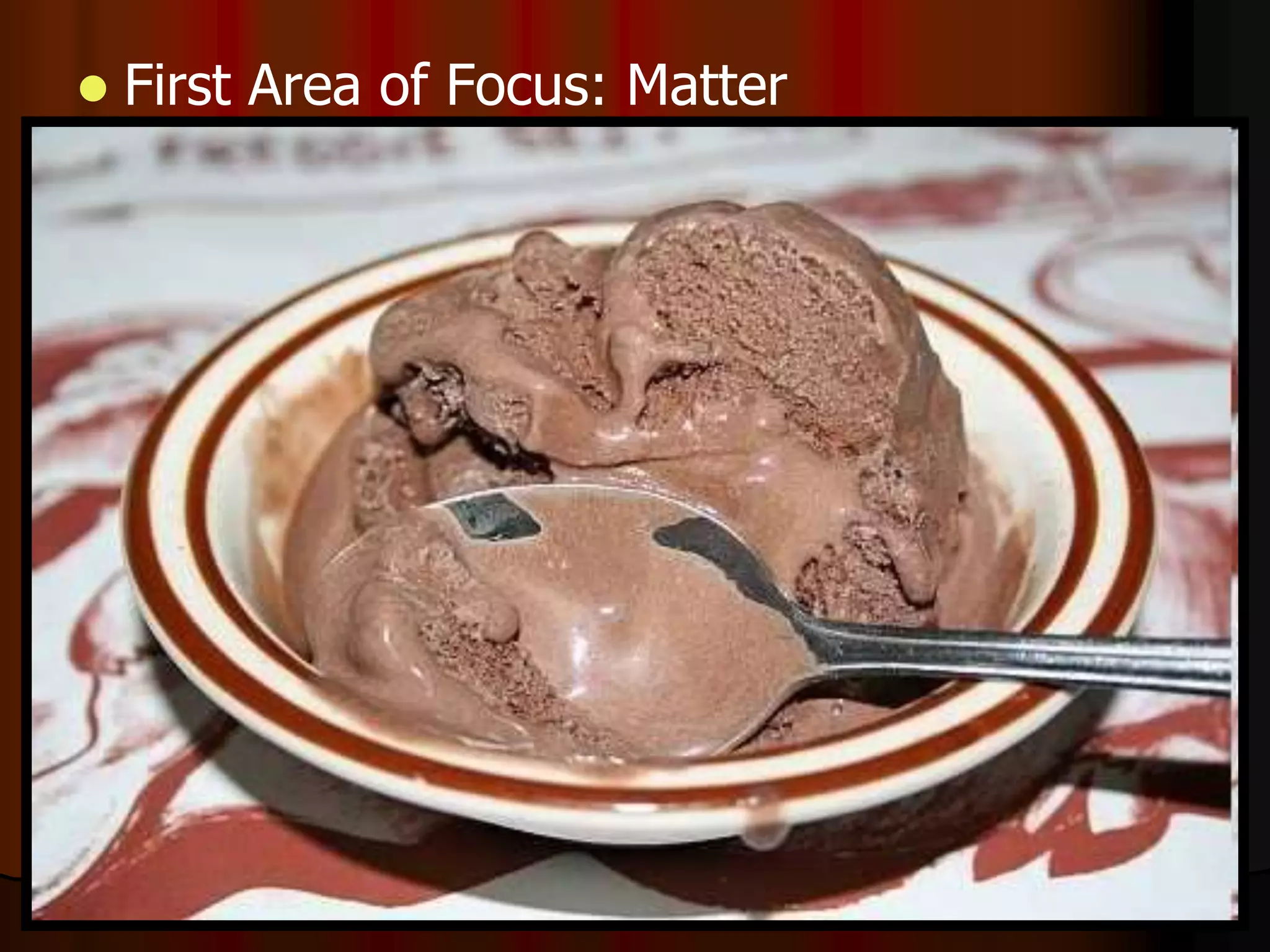
 First Area of Focus: Matter
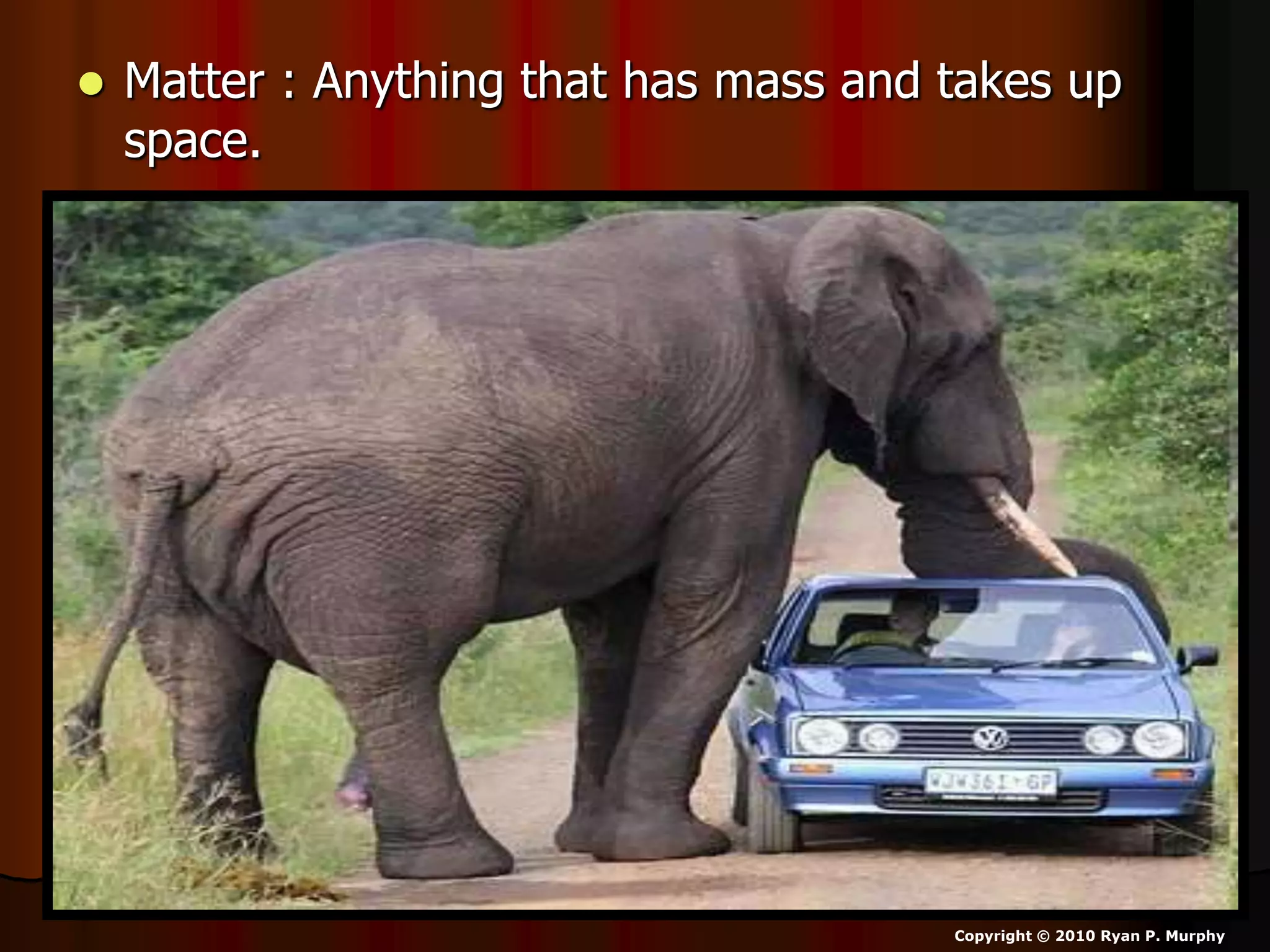
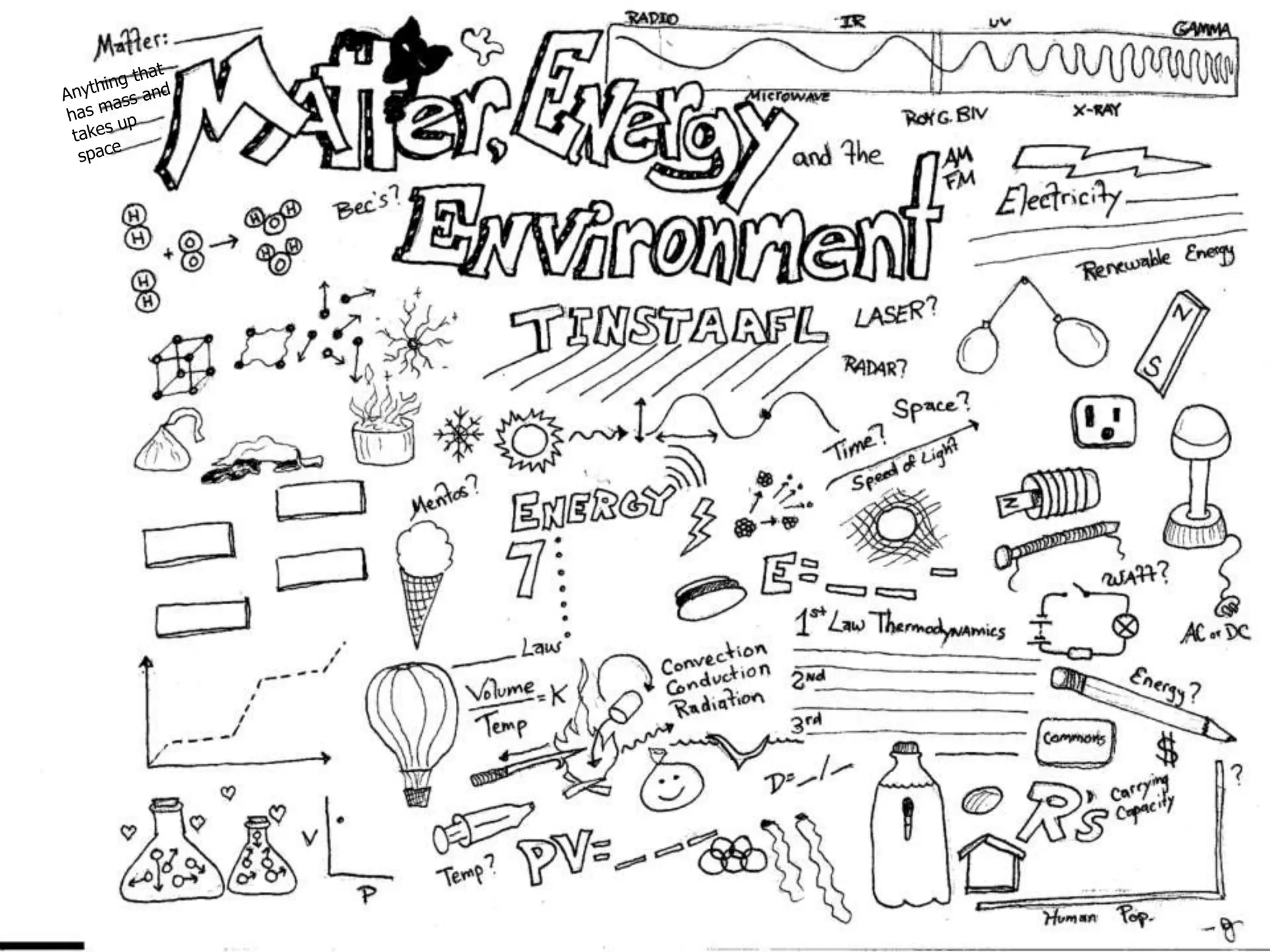
 Matter : Anything that has mass and takes up
space.
Copyright © 2010 Ryan P. Murphy
 Matter : Anything that has mass and takes up
space.
Copyright © 2010 Ryan P. Murphy
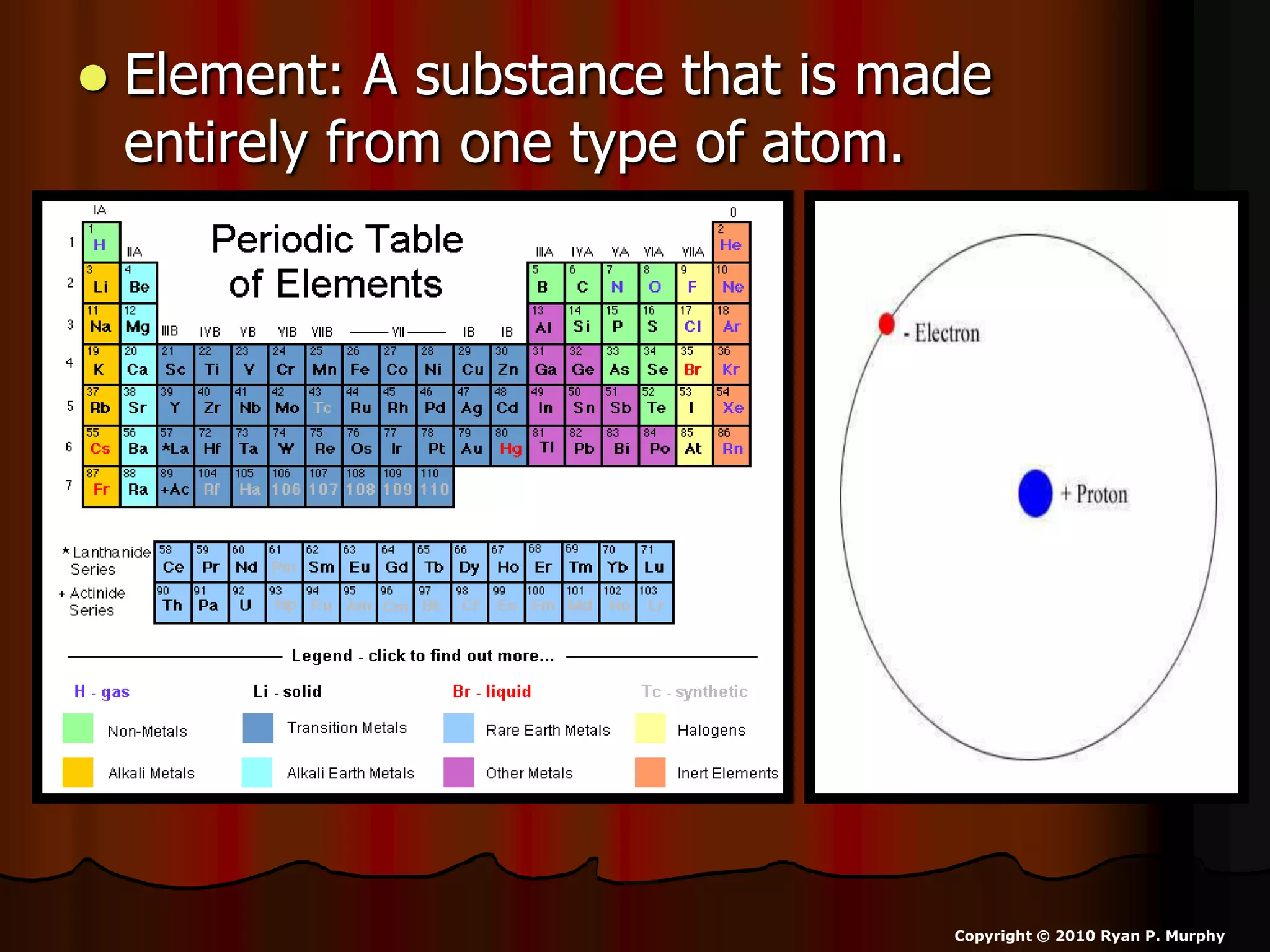
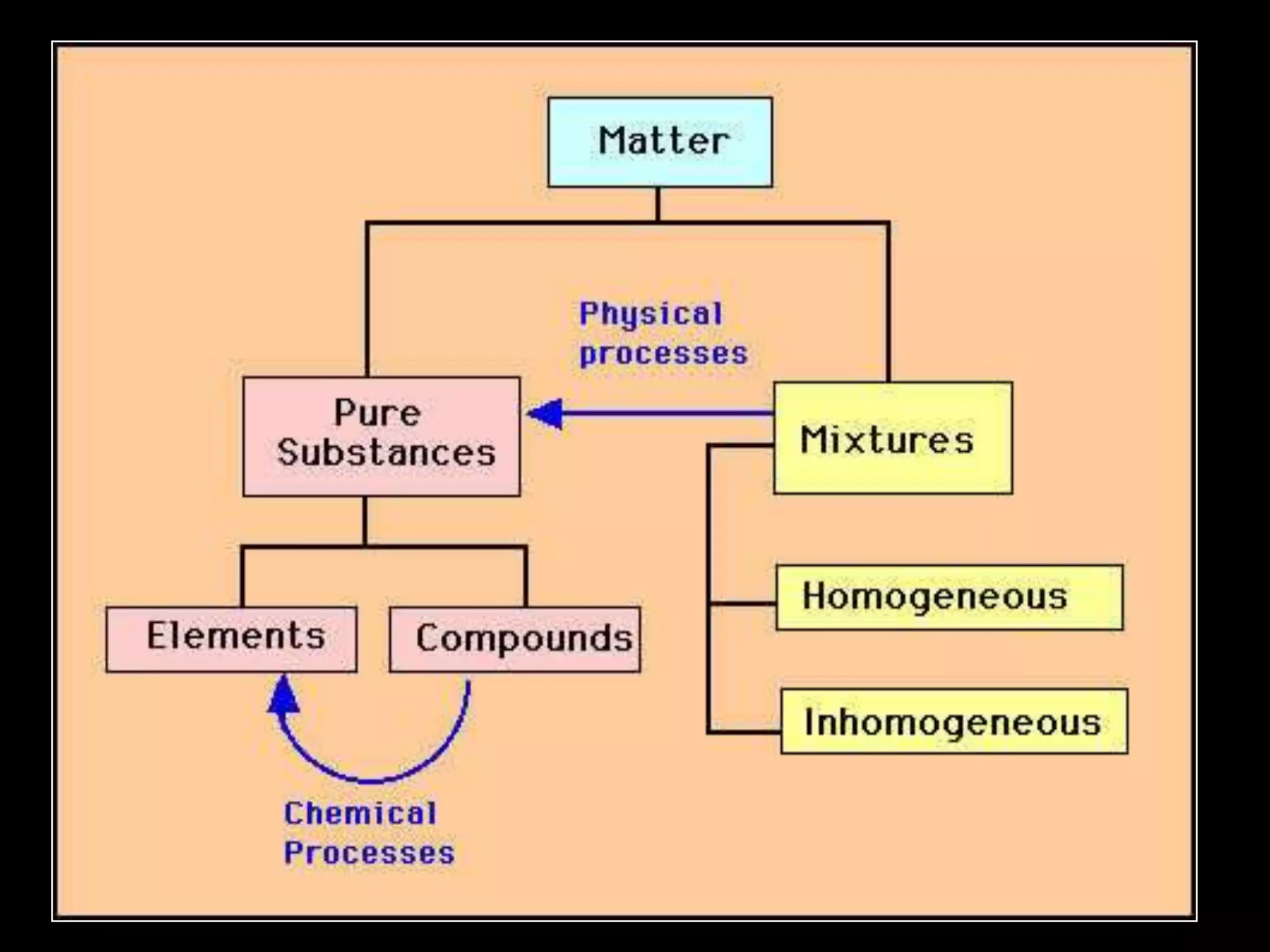
 Element: A substance that is made
entirely from one type of atom.
Copyright © 2010 Ryan P. Murphy
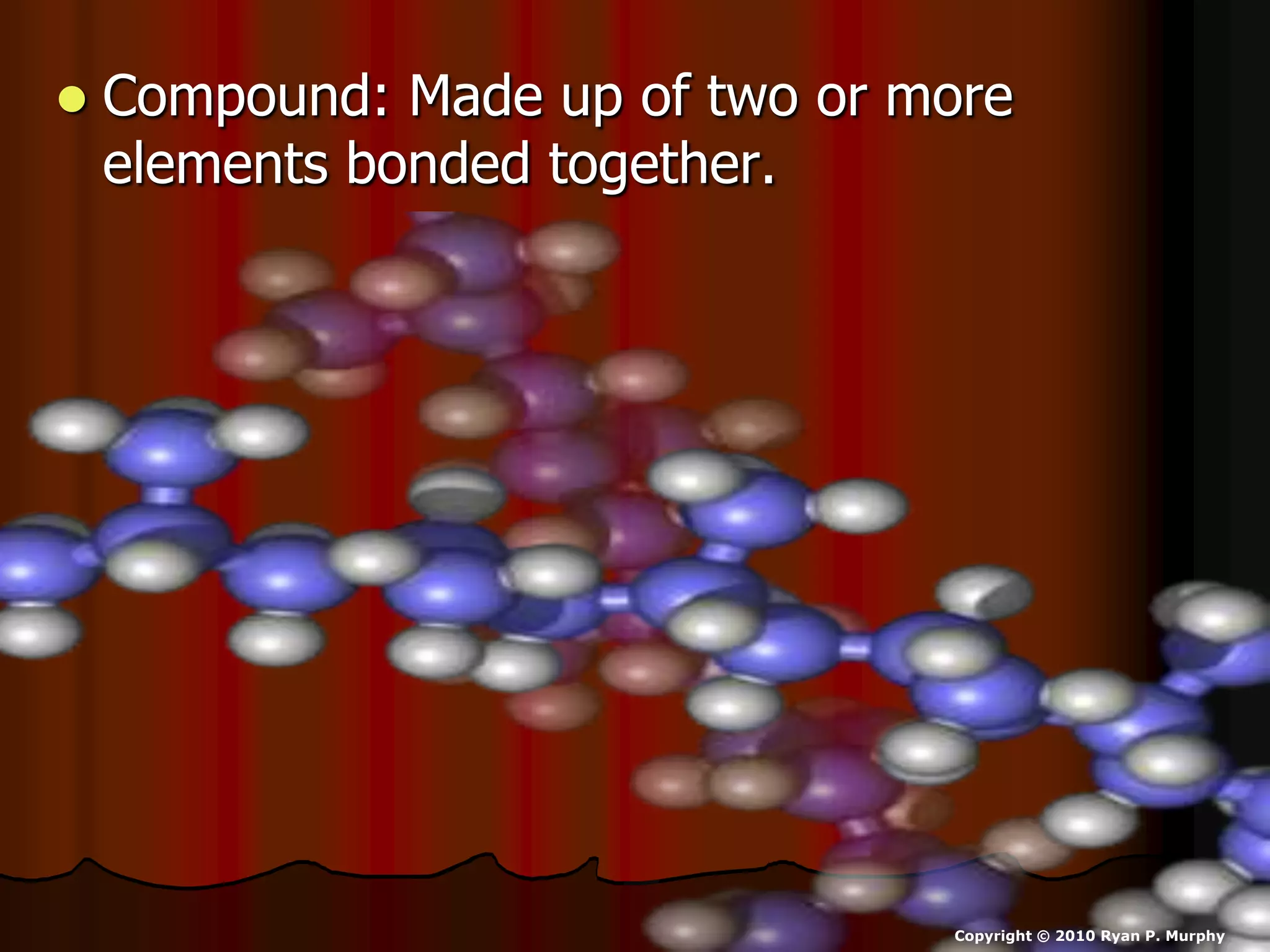
 Compound: Made up of two or more
elements bonded together.
Copyright © 2010 Ryan P. Murphy
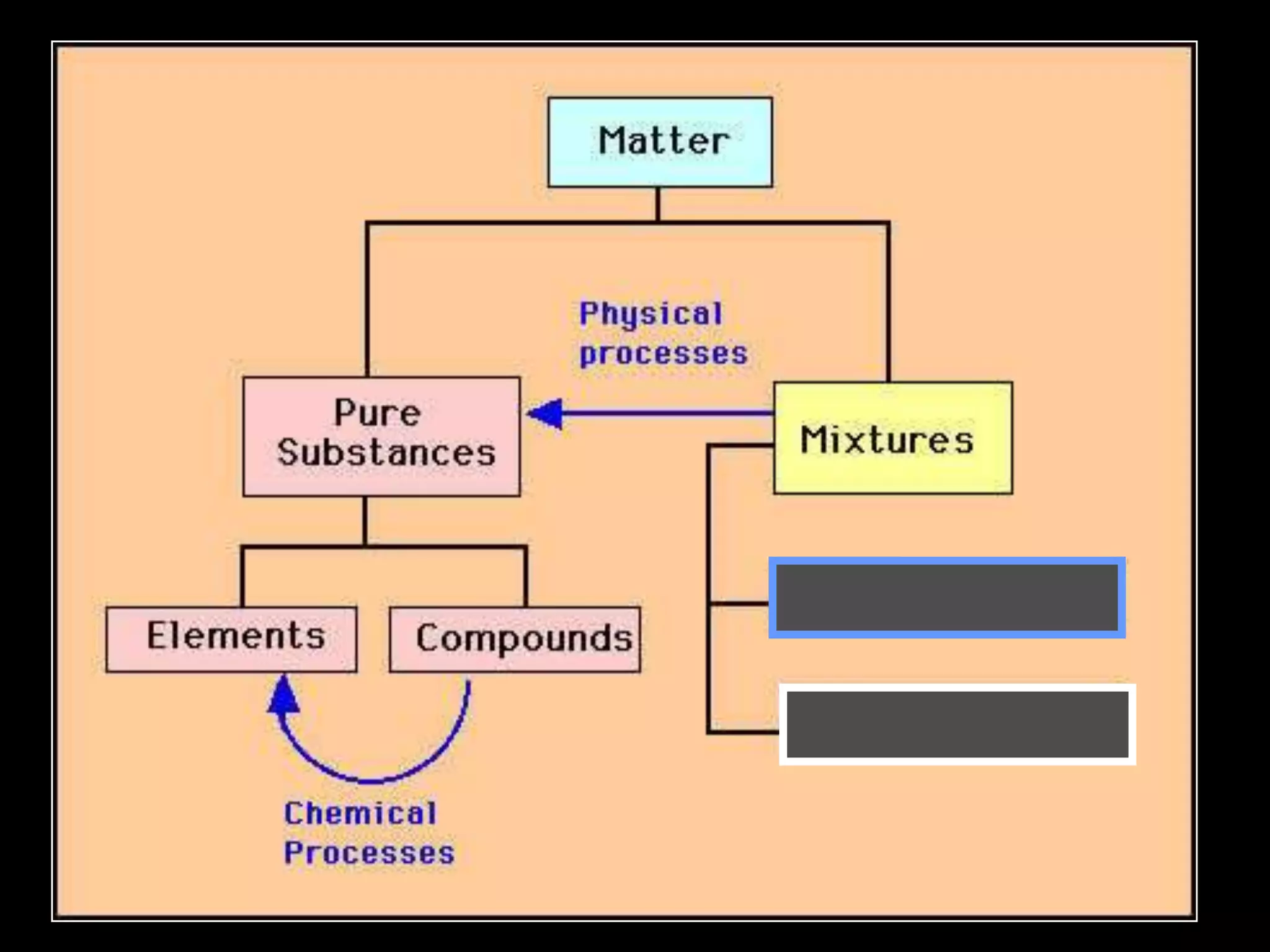
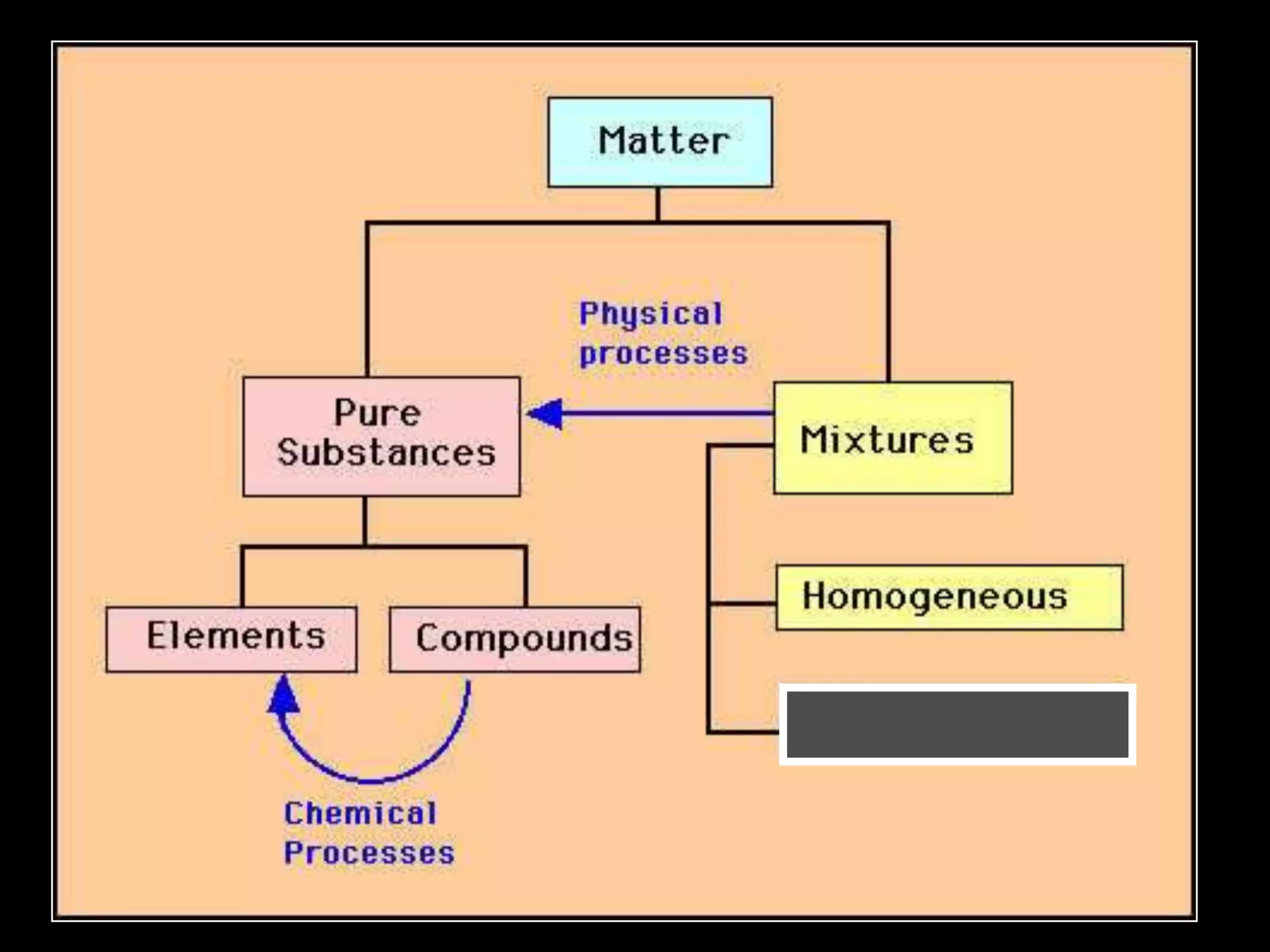
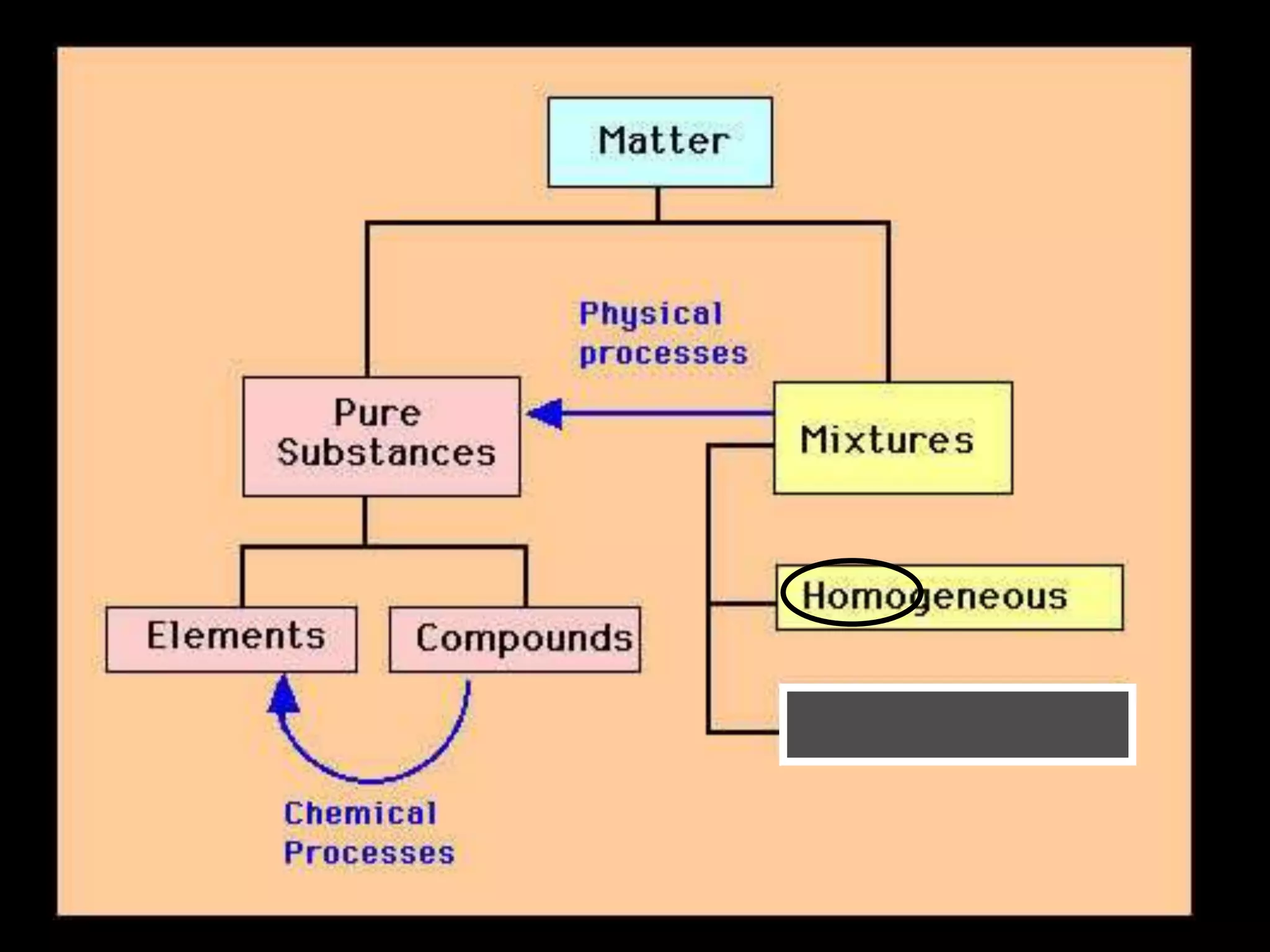
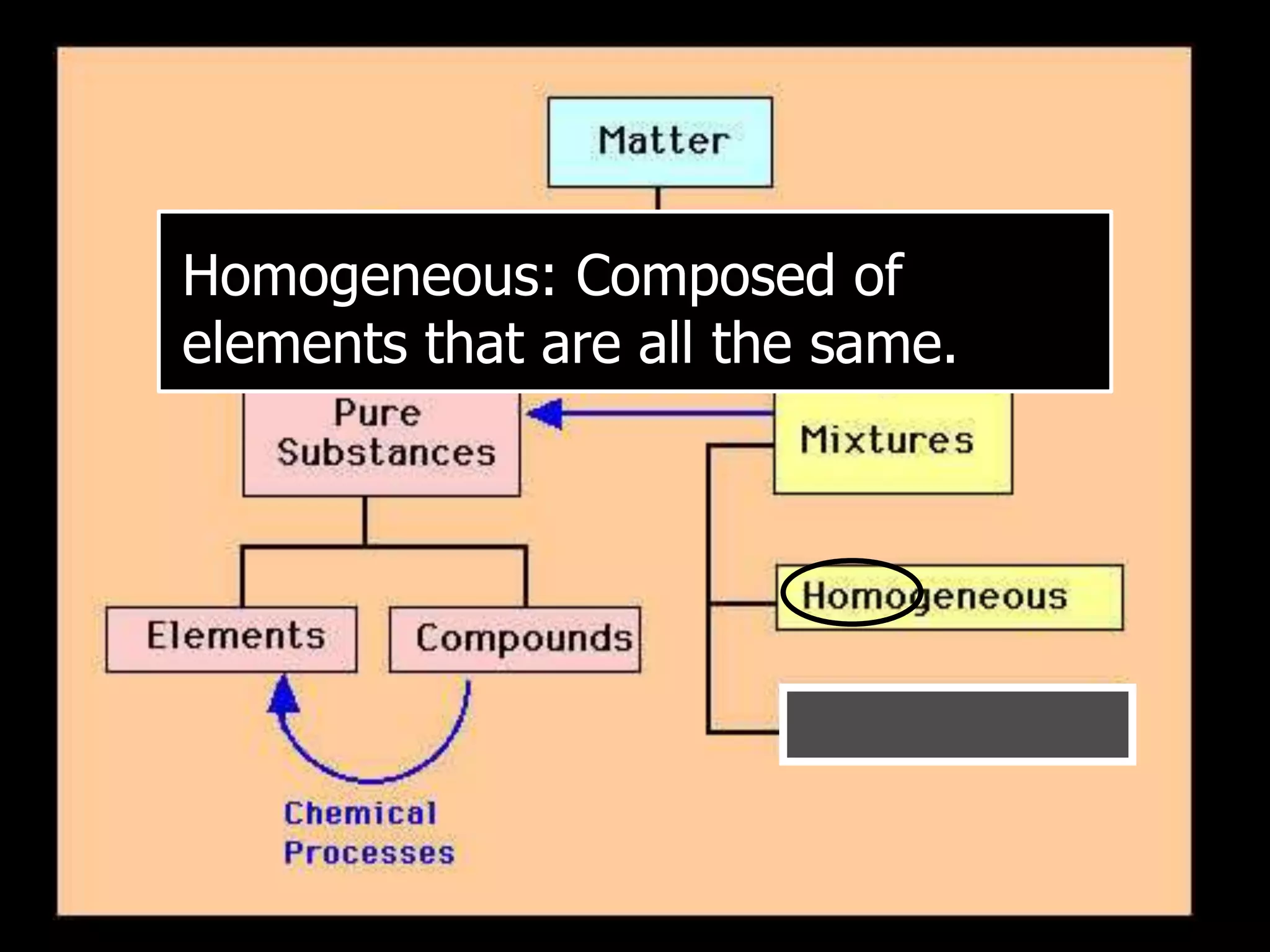
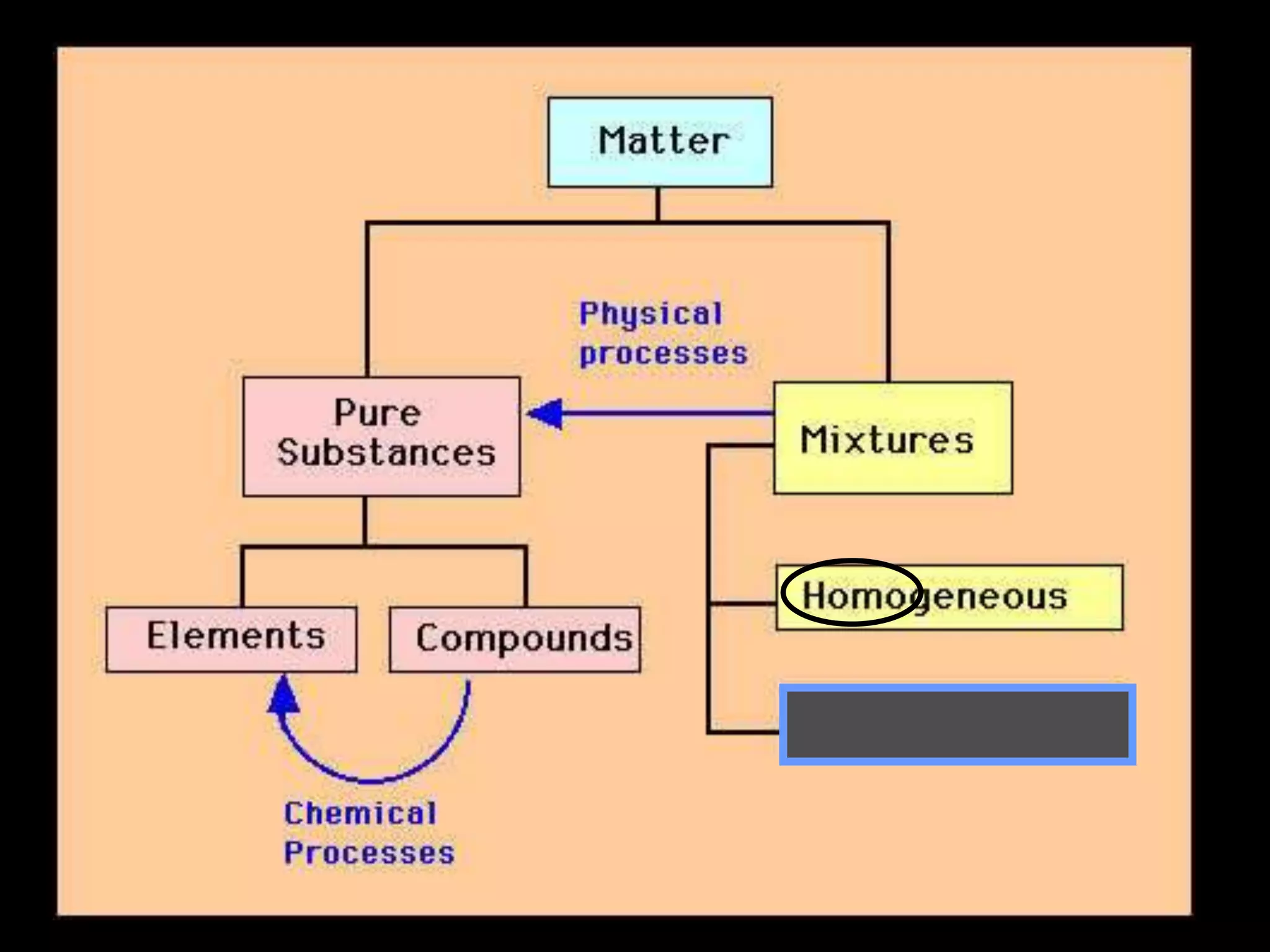
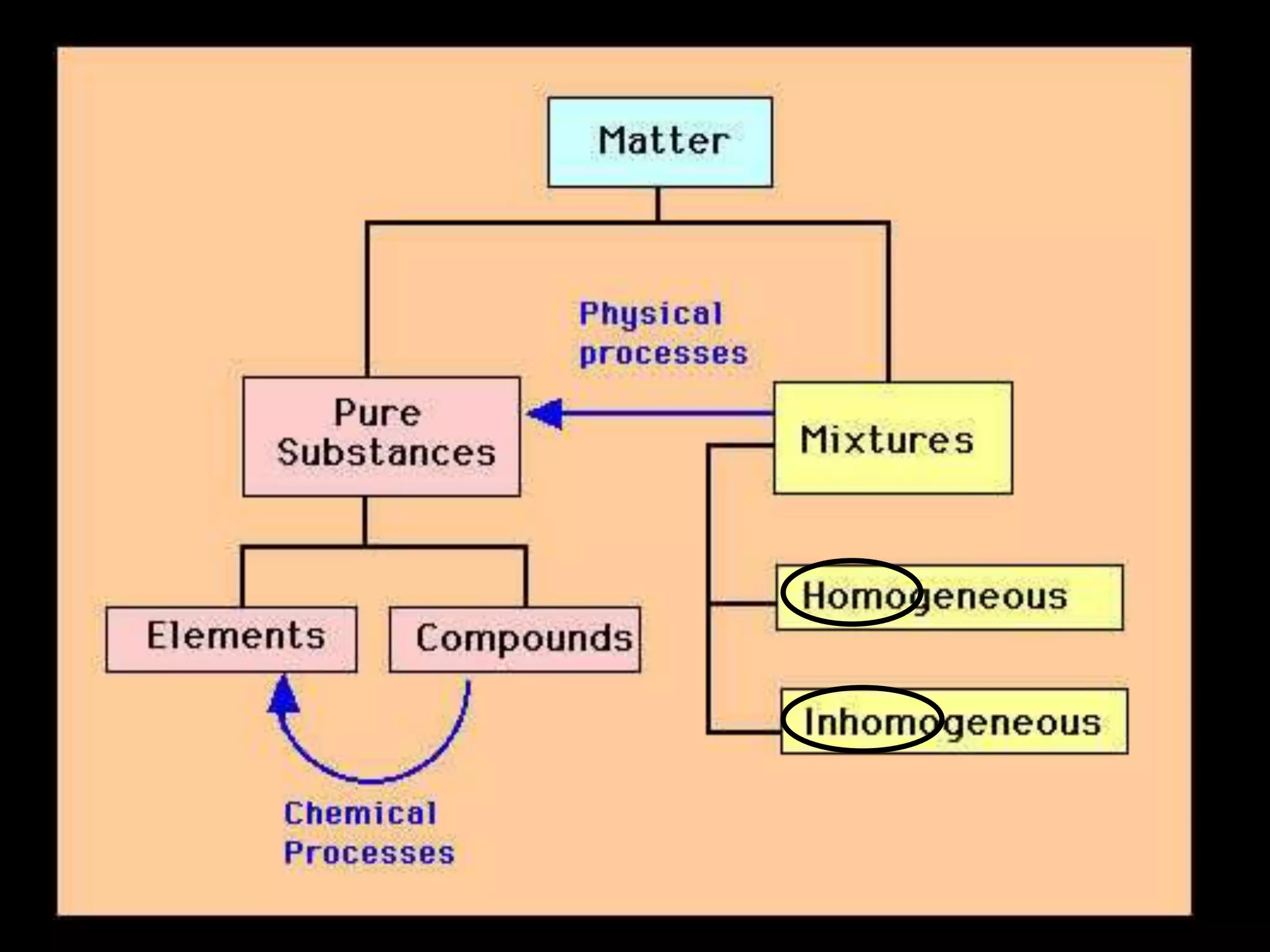
Homogeneous: Composed of
elements that are all the same.
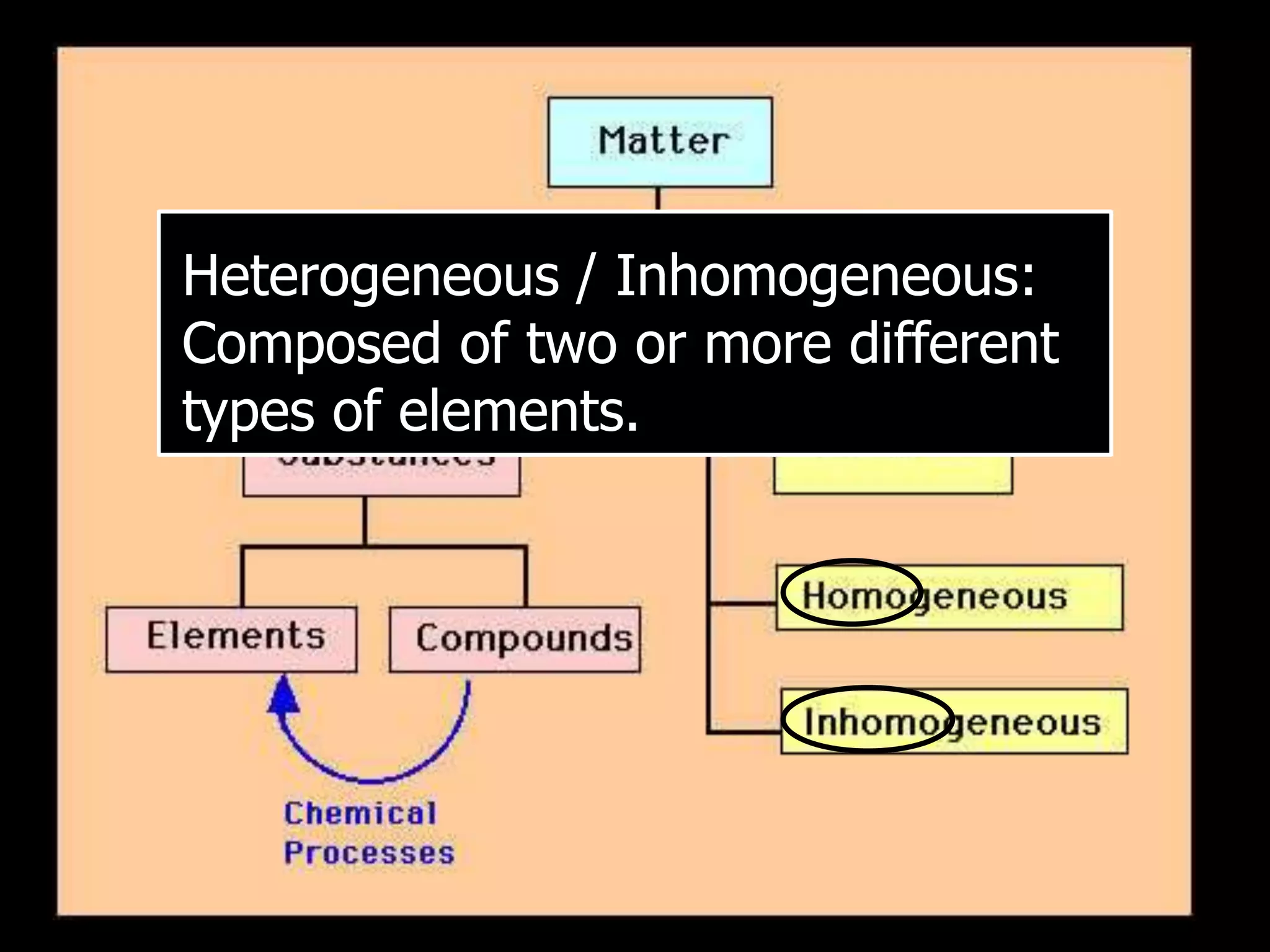
Heterogeneous / Inhomogeneous:
Composed of two or more different
types of elements.
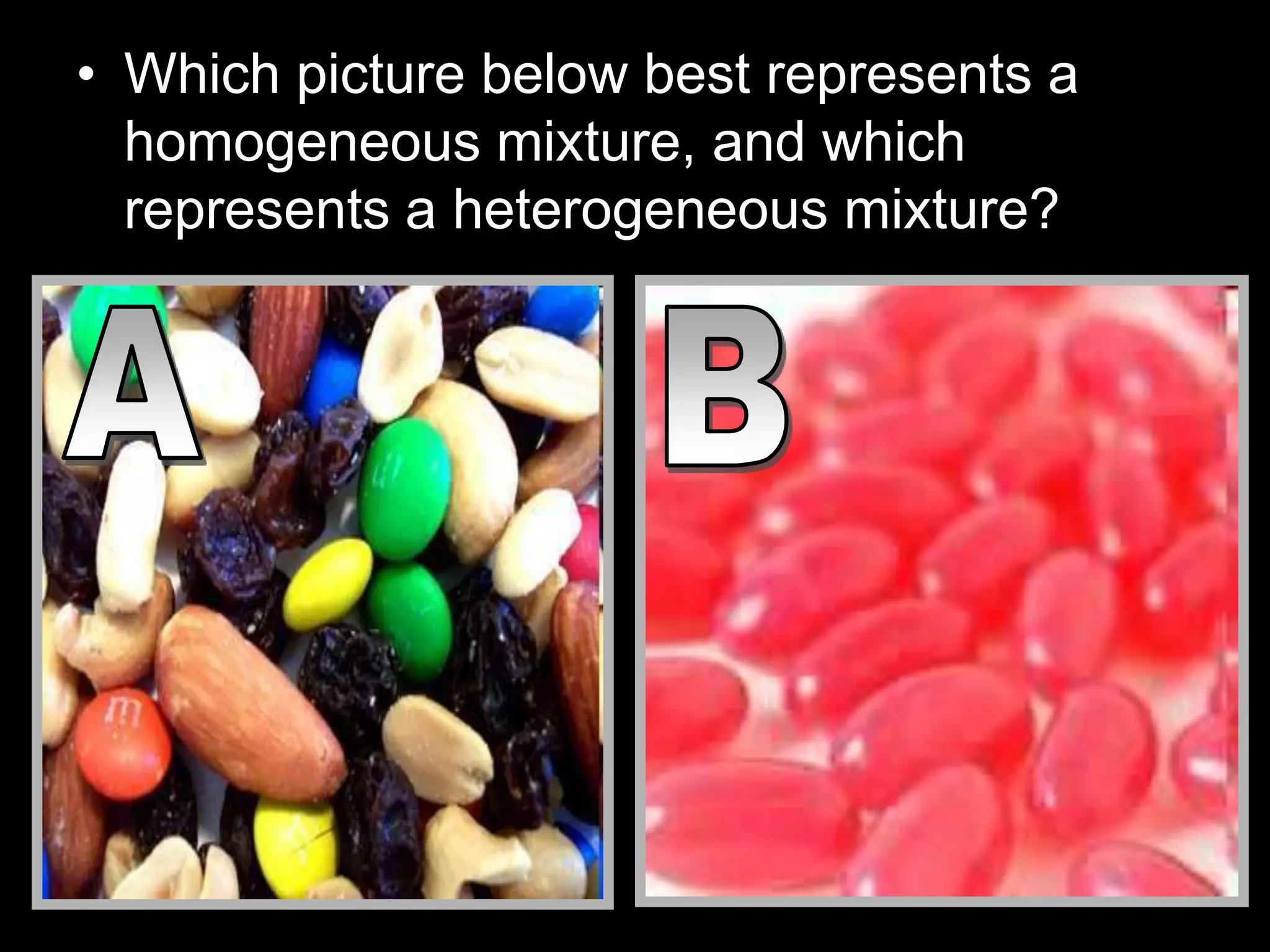
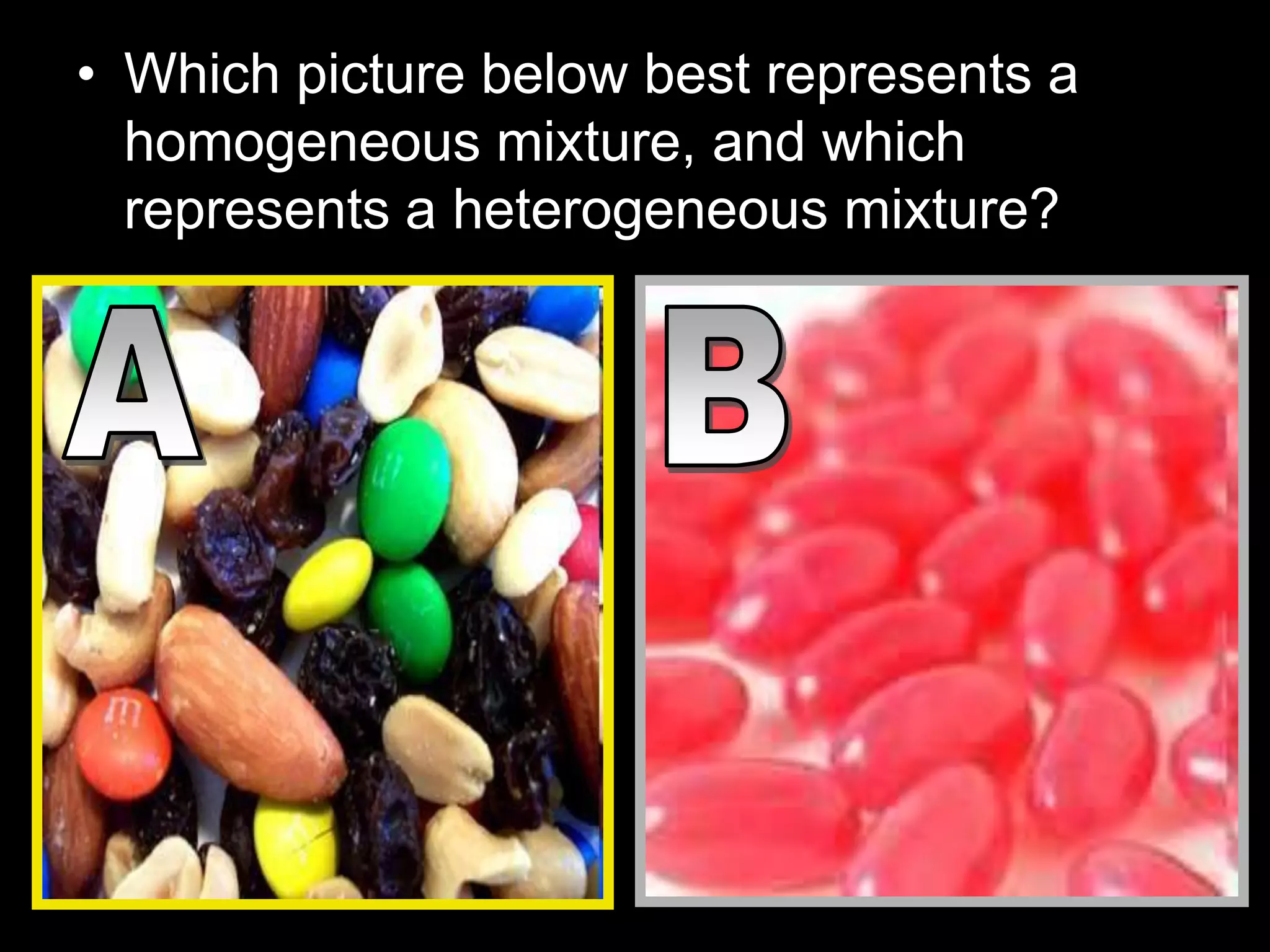
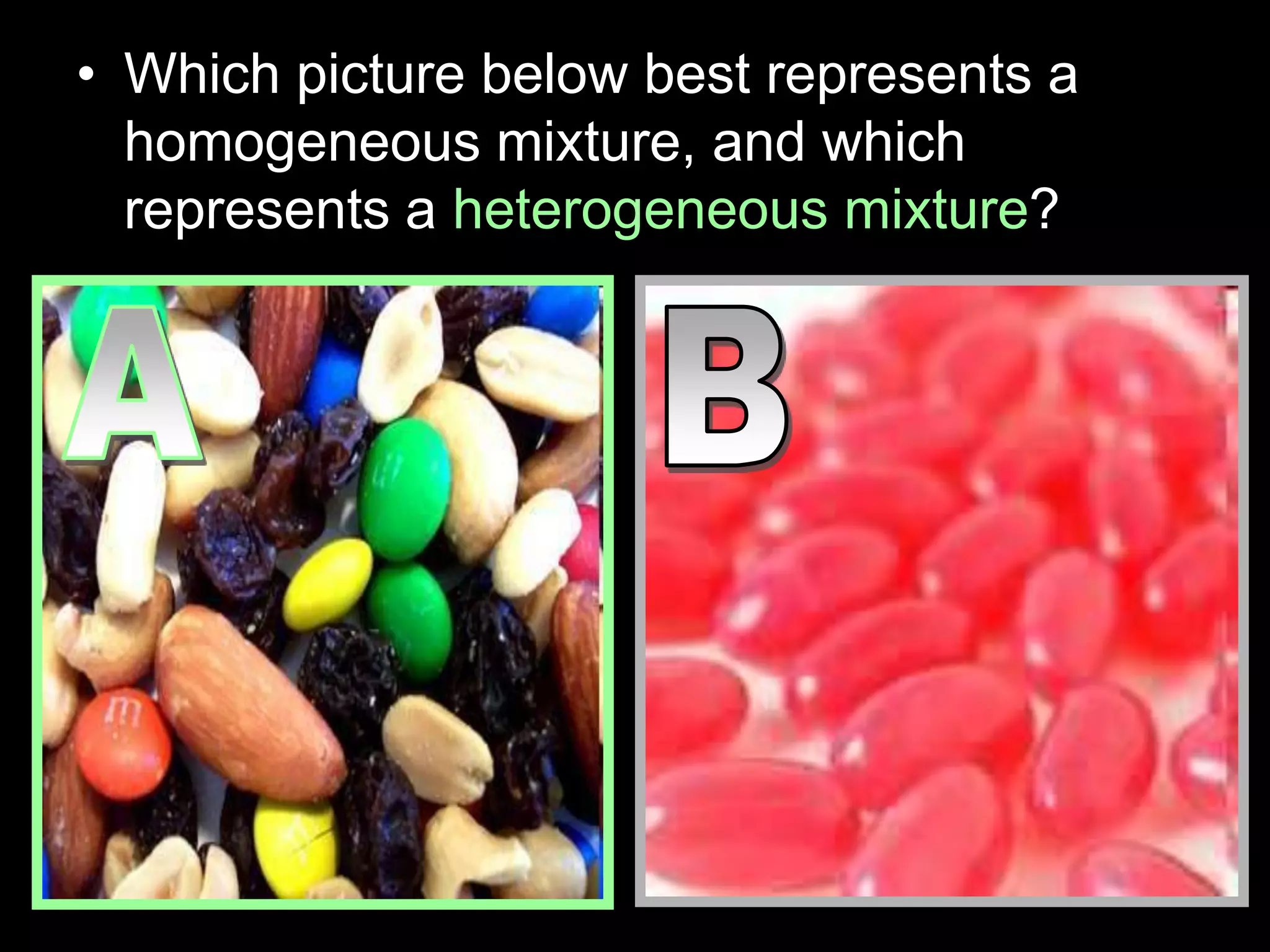
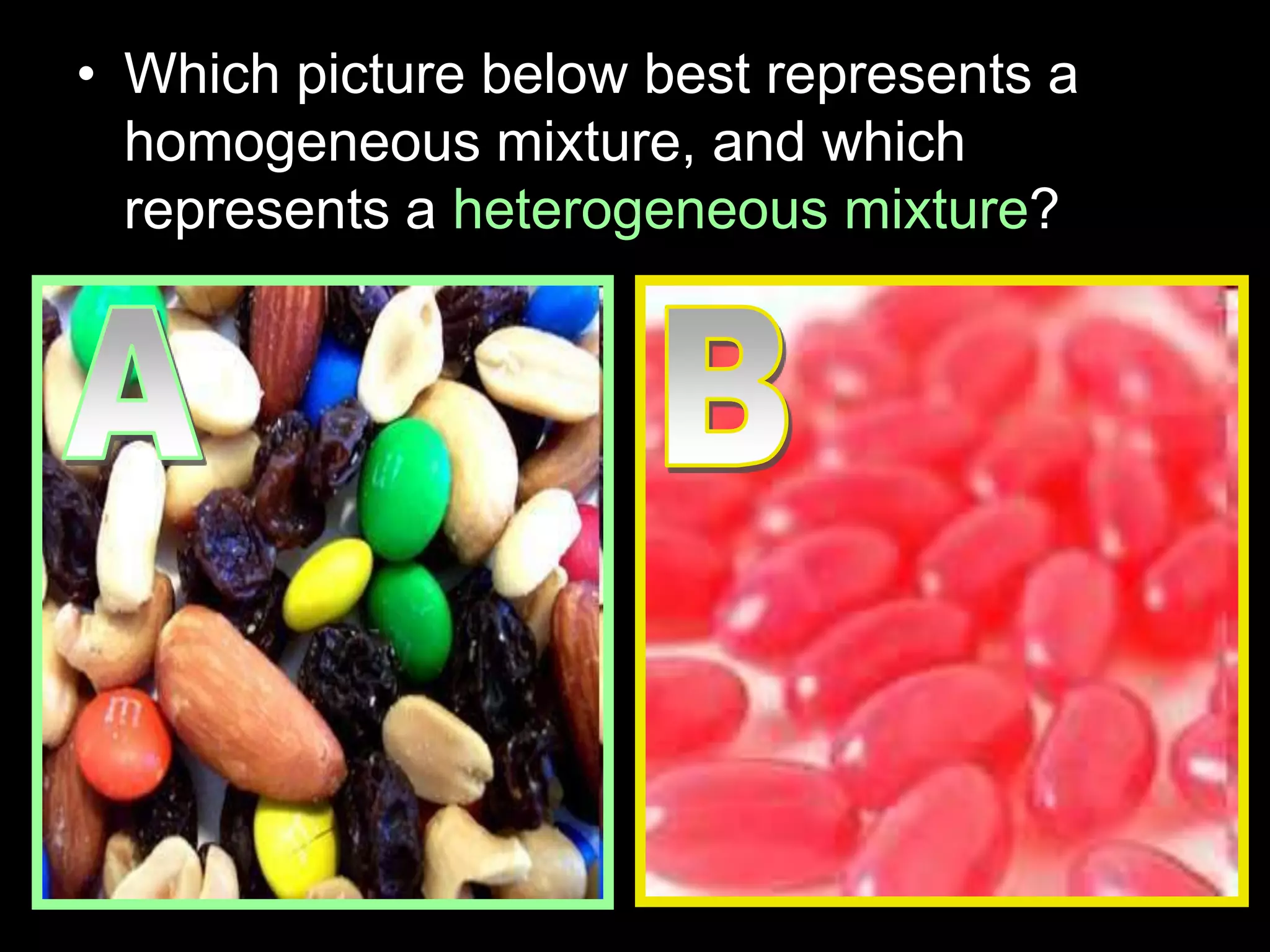
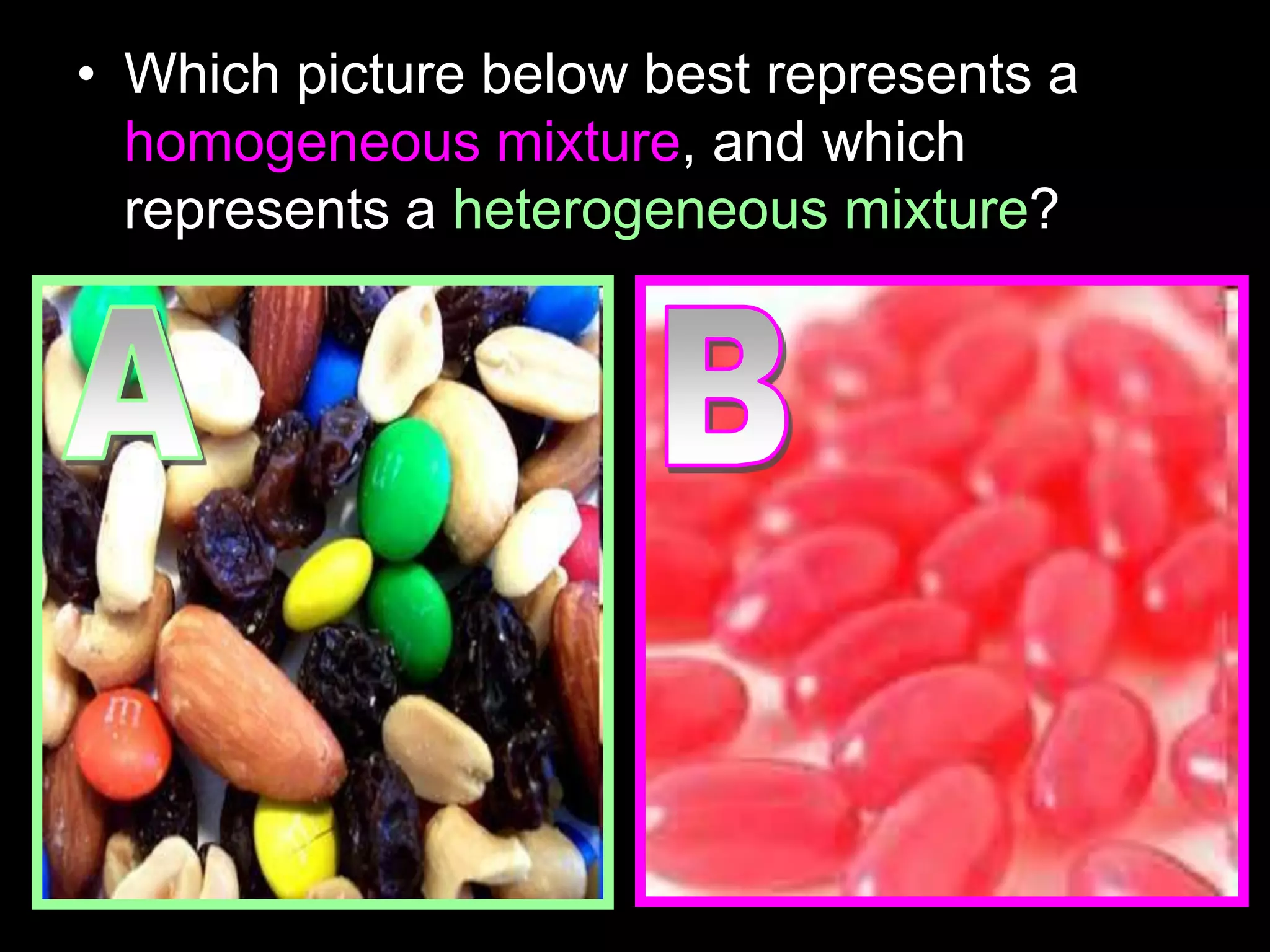
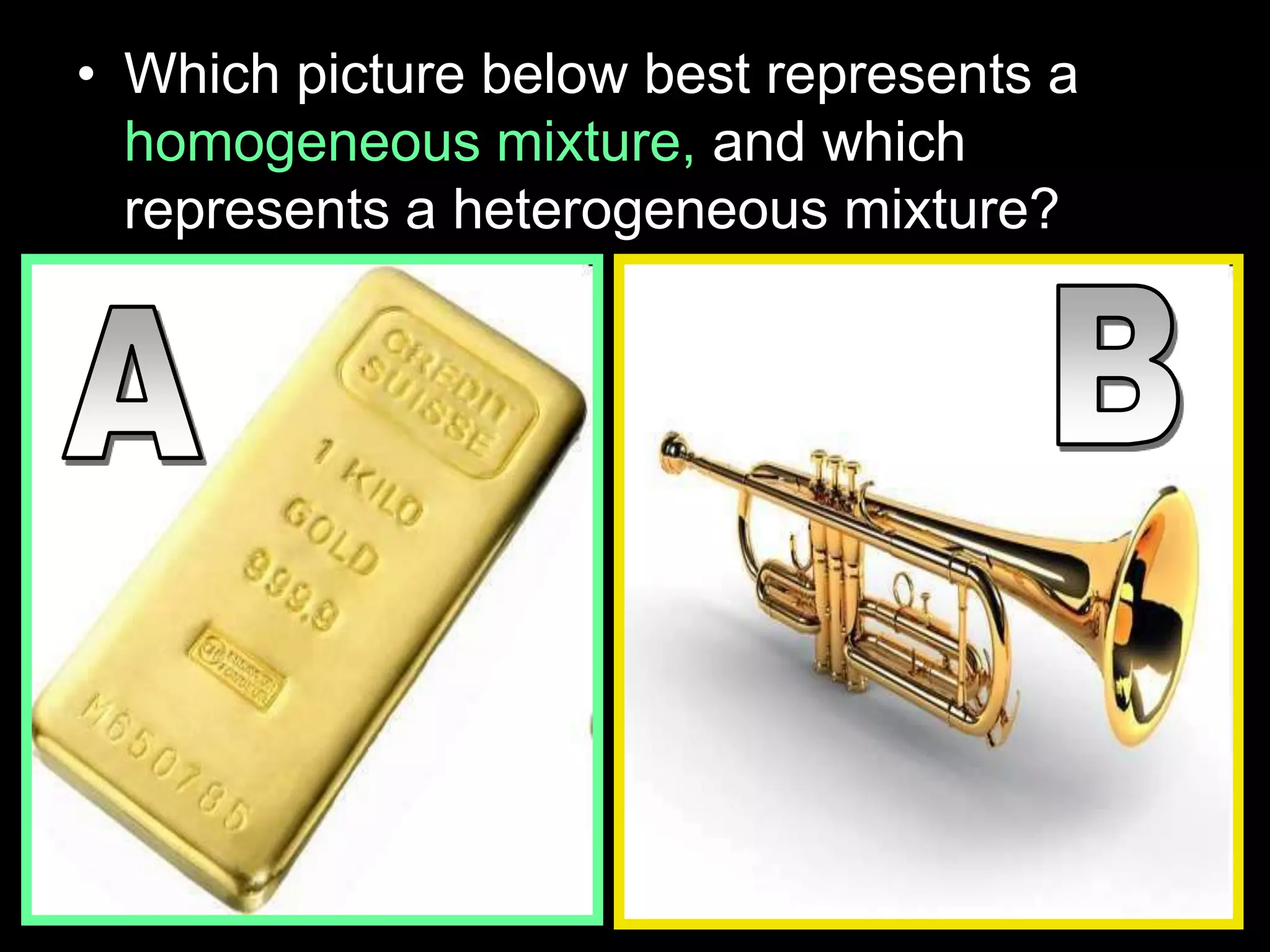
• Which picture below best represents a
homogeneous mixture, and which
represents a heterogeneous mixture?
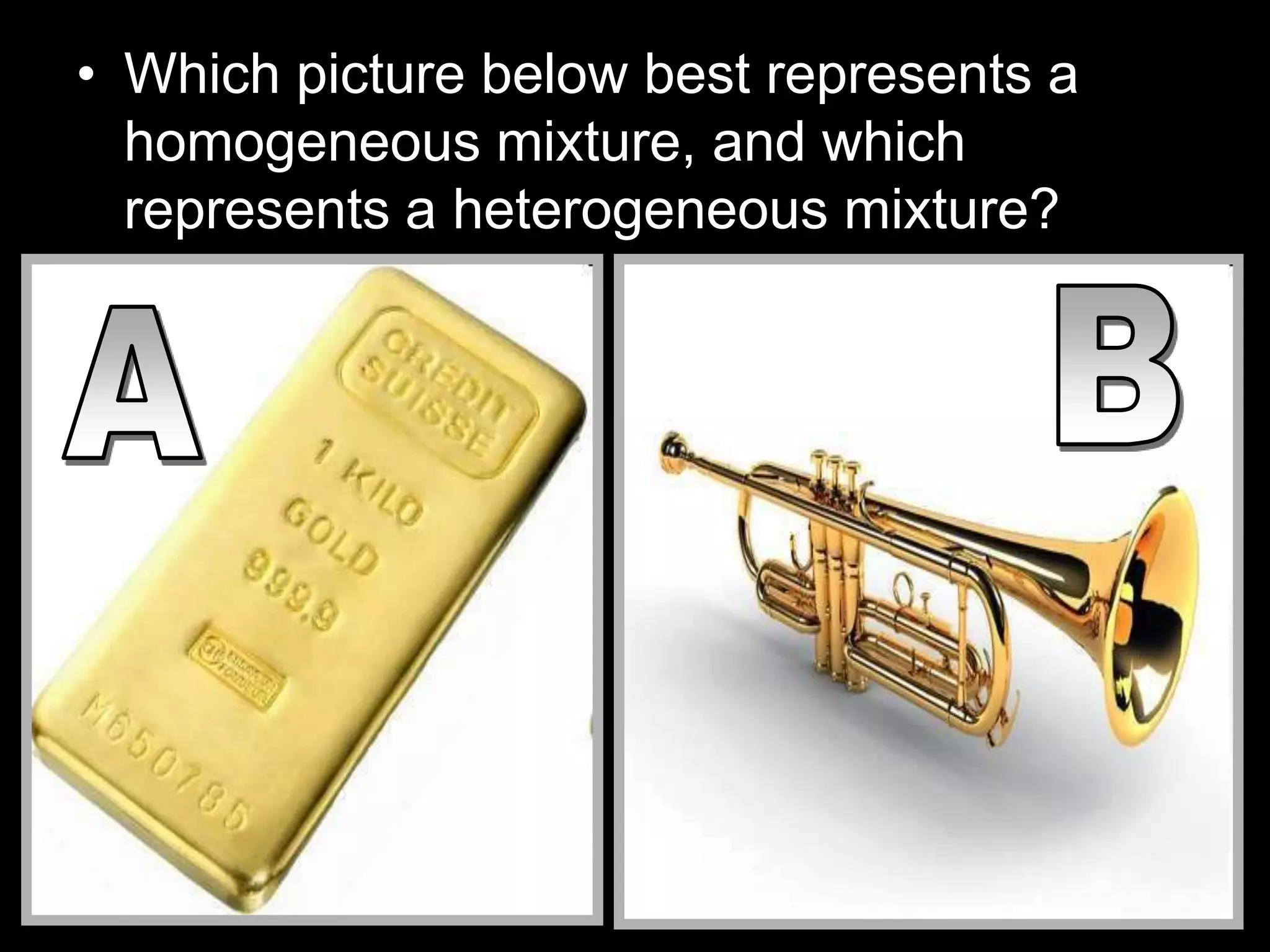
• Which picture below best represents a
homogeneous mixture, and which
represents a heterogeneous mixture?
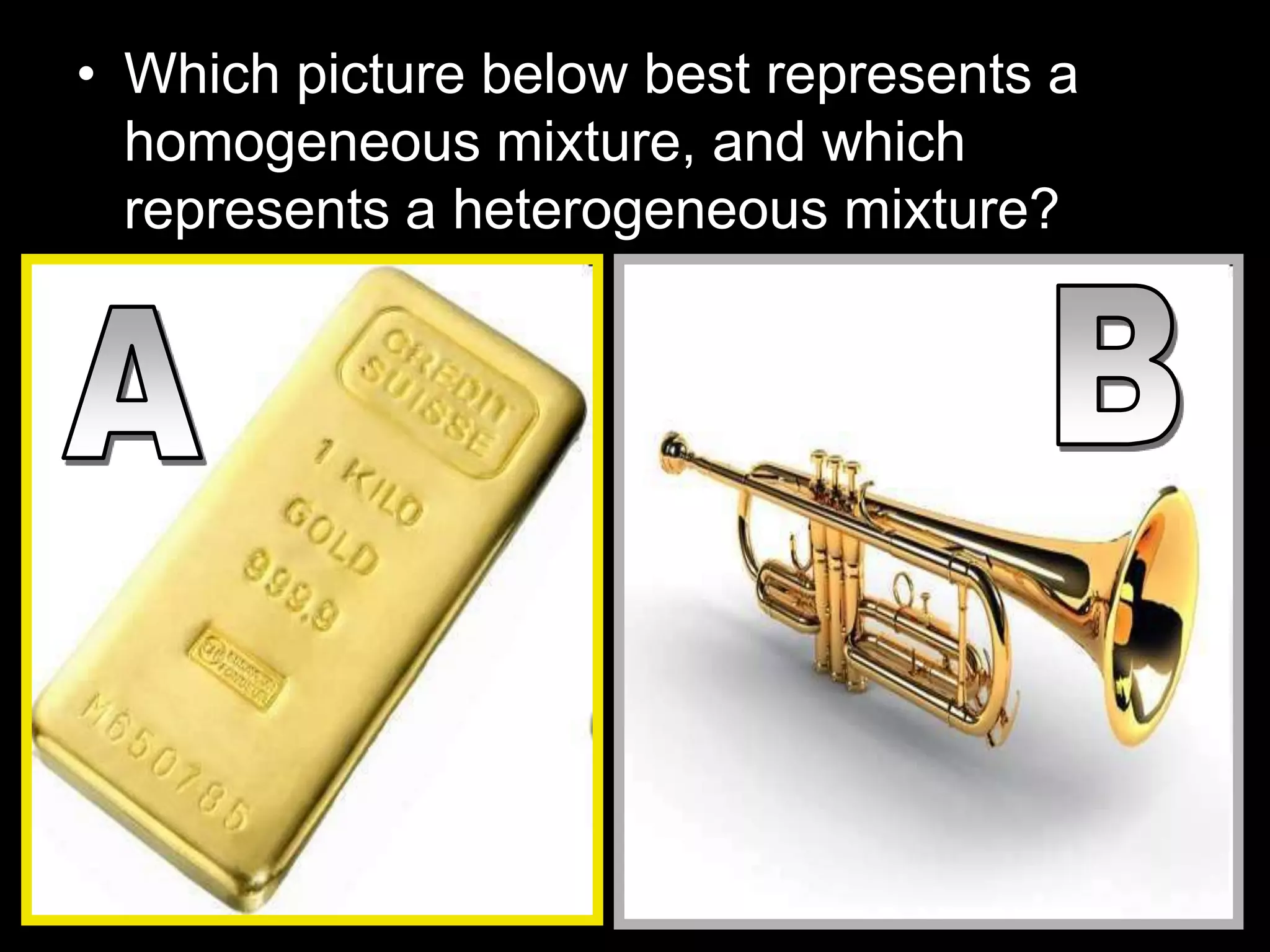
• Which picture below best represents a
homogeneous mixture, and which
represents a heterogeneous mixture?
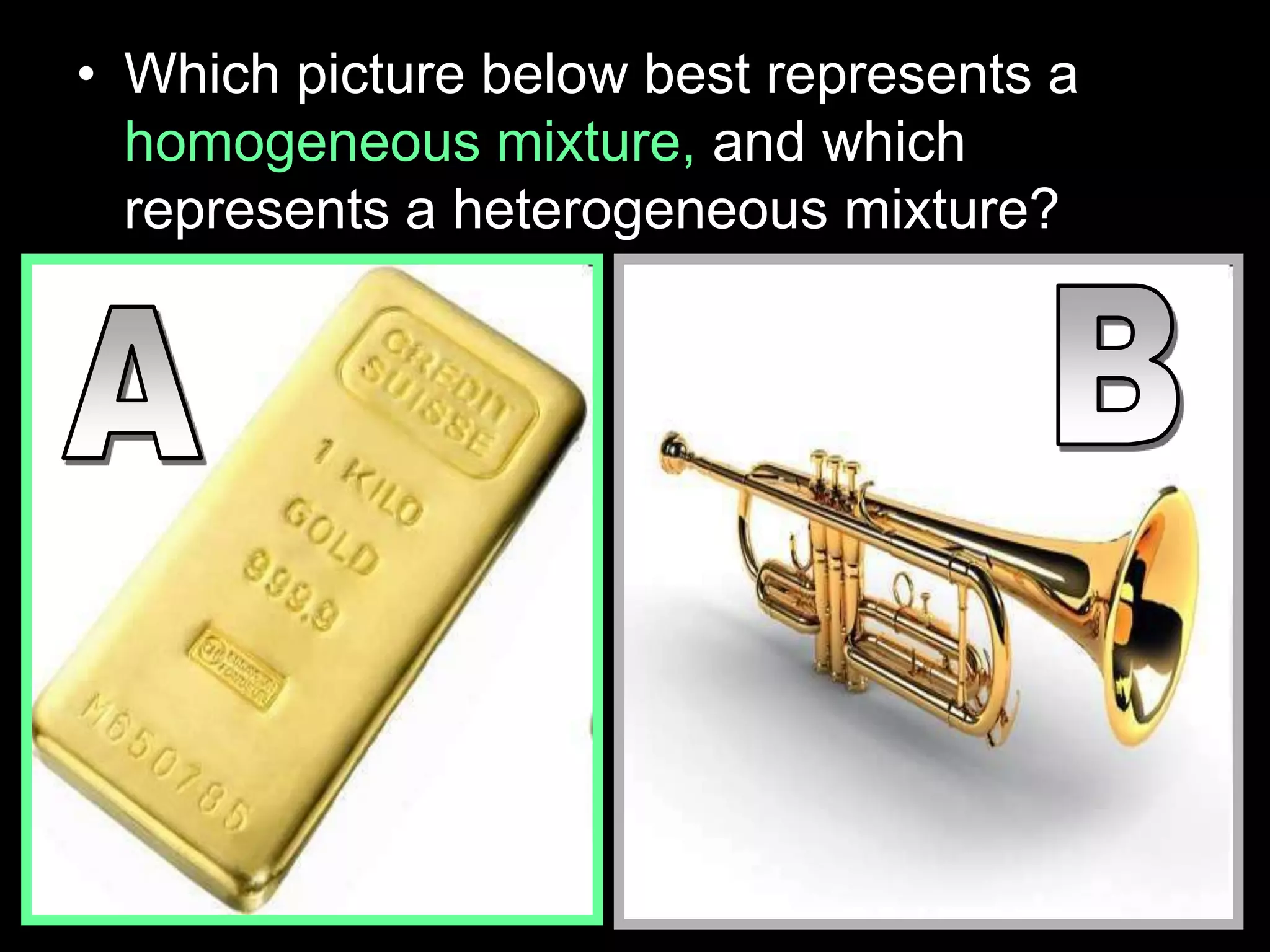
• Which picture below best represents a
homogeneous mixture, and which
represents a heterogeneous mixture?
• Which picture below best represents a
homogeneous mixture, and which
represents a heterogeneous mixture?
• Which picture below best represents a
homogeneous mixture, and which
represents a heterogeneous mixture?
• Which picture below best represents a
homogeneous mixture, and which
represents a heterogeneous mixture?
• Which picture below best represents a
homogeneous mixture, and which
represents a heterogeneous mixture?
• Which picture below best represents a
homogeneous mixture, and which
represents a heterogeneous mixture?
• Which picture below best represents a
homogeneous mixture, and which
represents a heterogeneous mixture?
Learn More about mixtures:
http://www.elmhurst.edu/~chm/vchembook/106Amixture.html
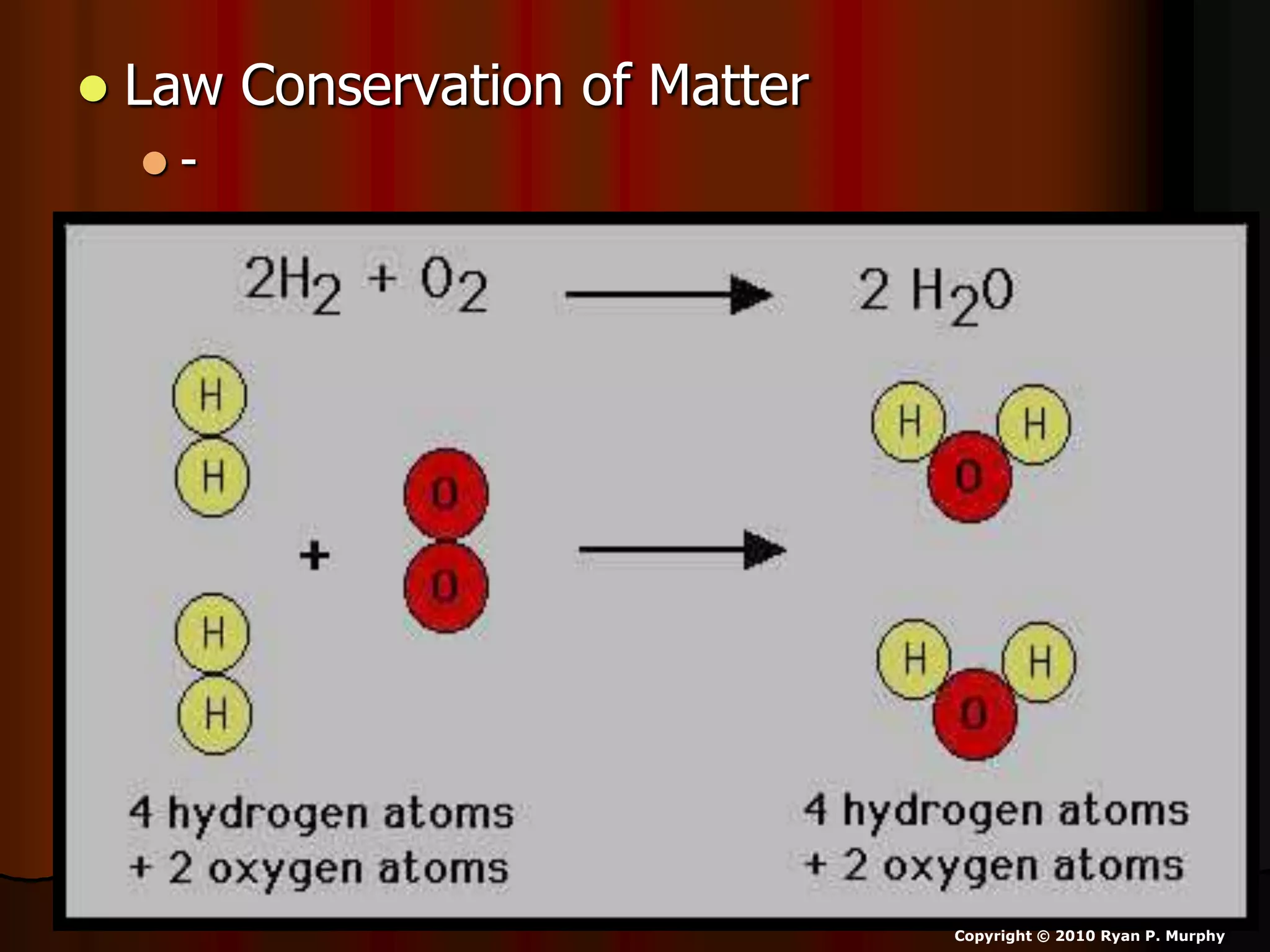
 Law Conservation of Matter
 -
Copyright © 2010 Ryan P. Murphy
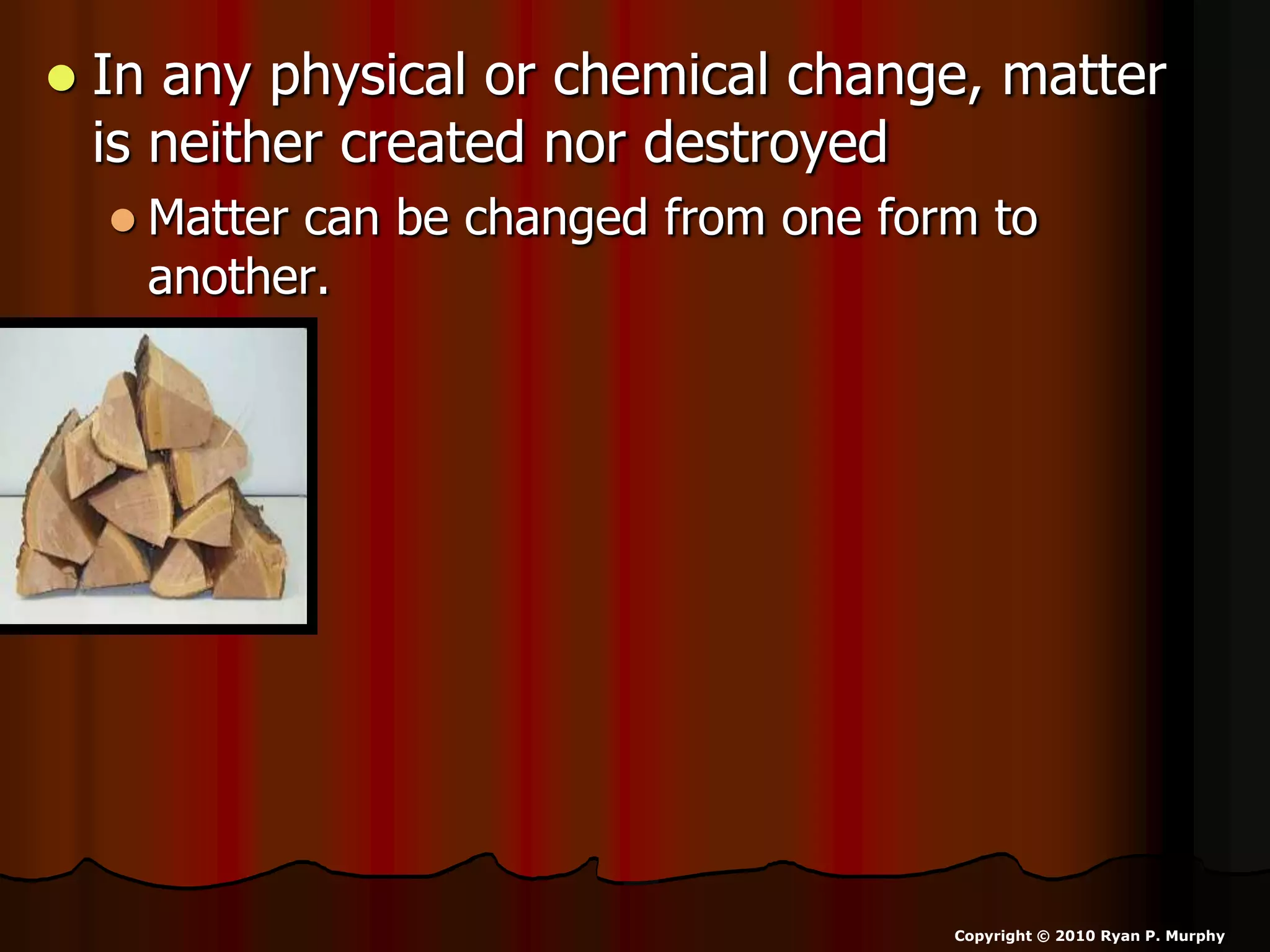
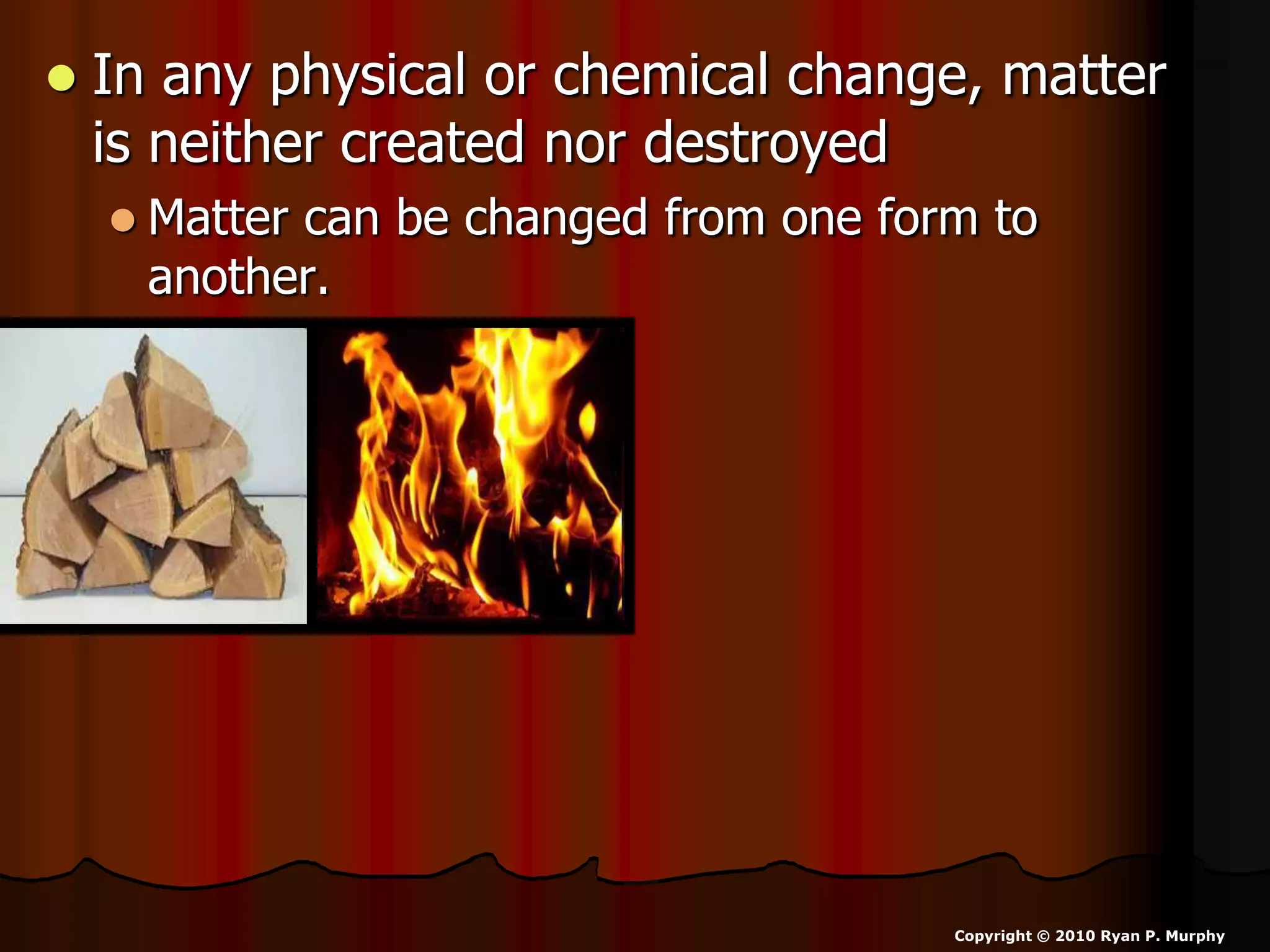
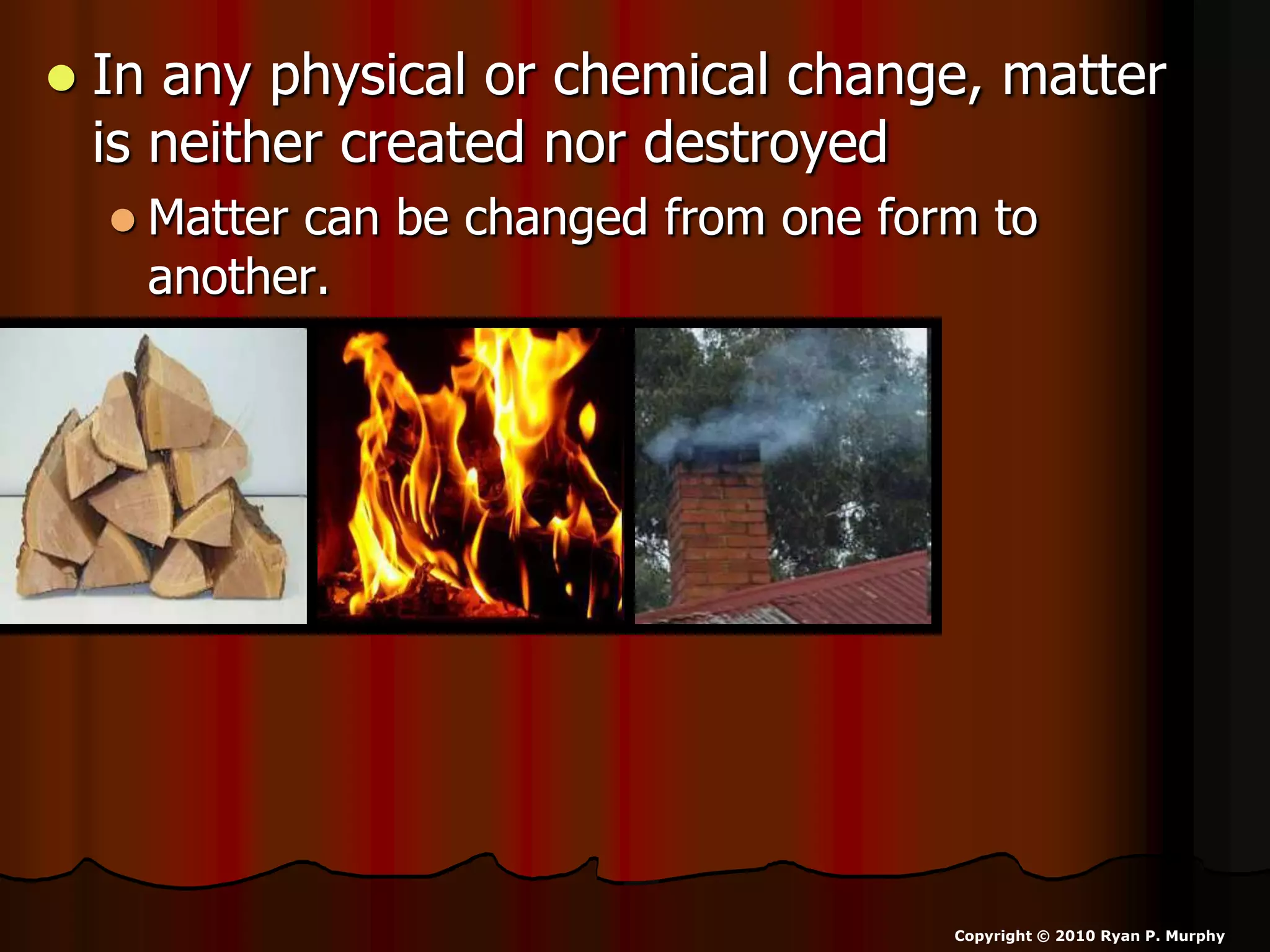
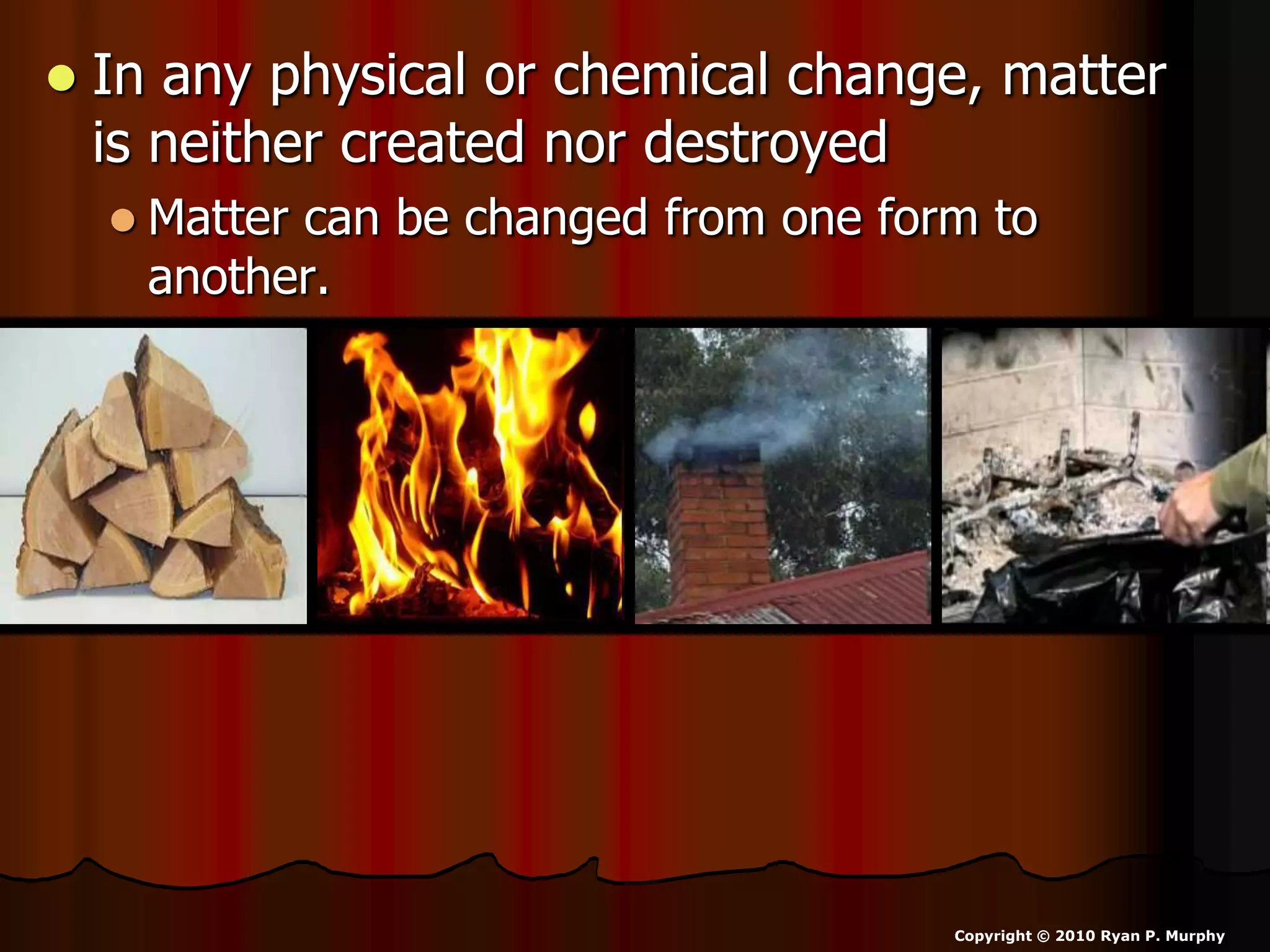
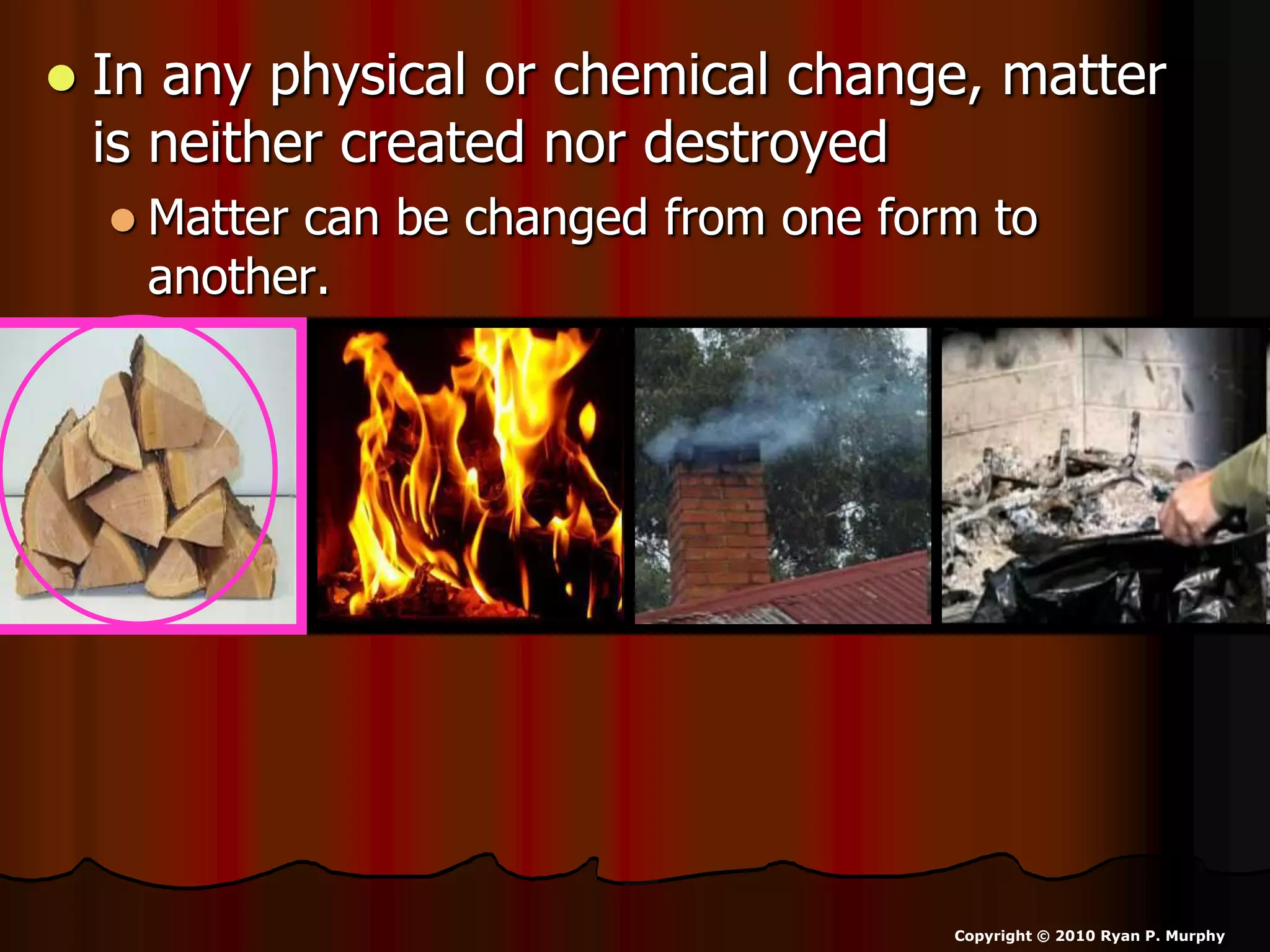
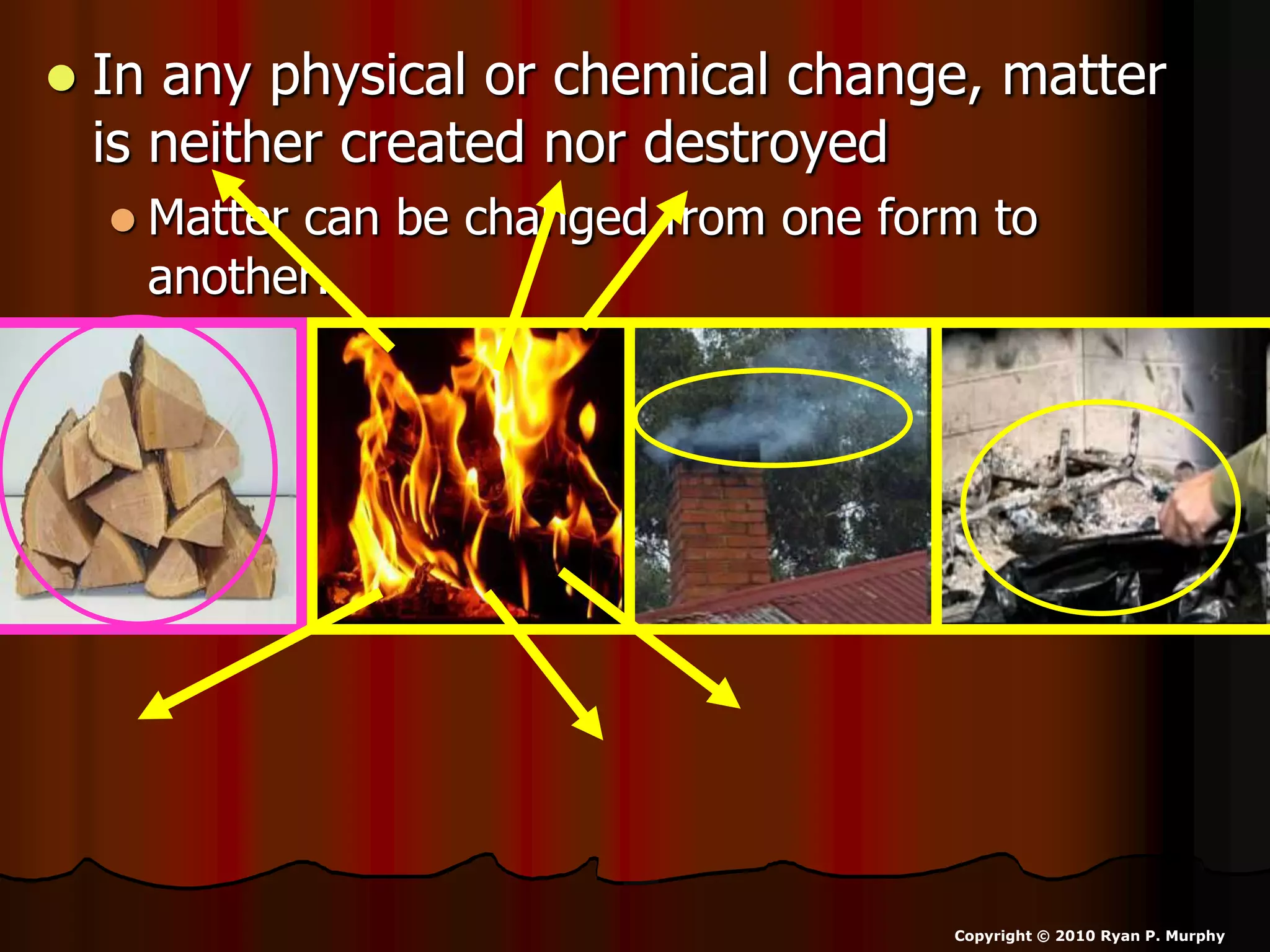
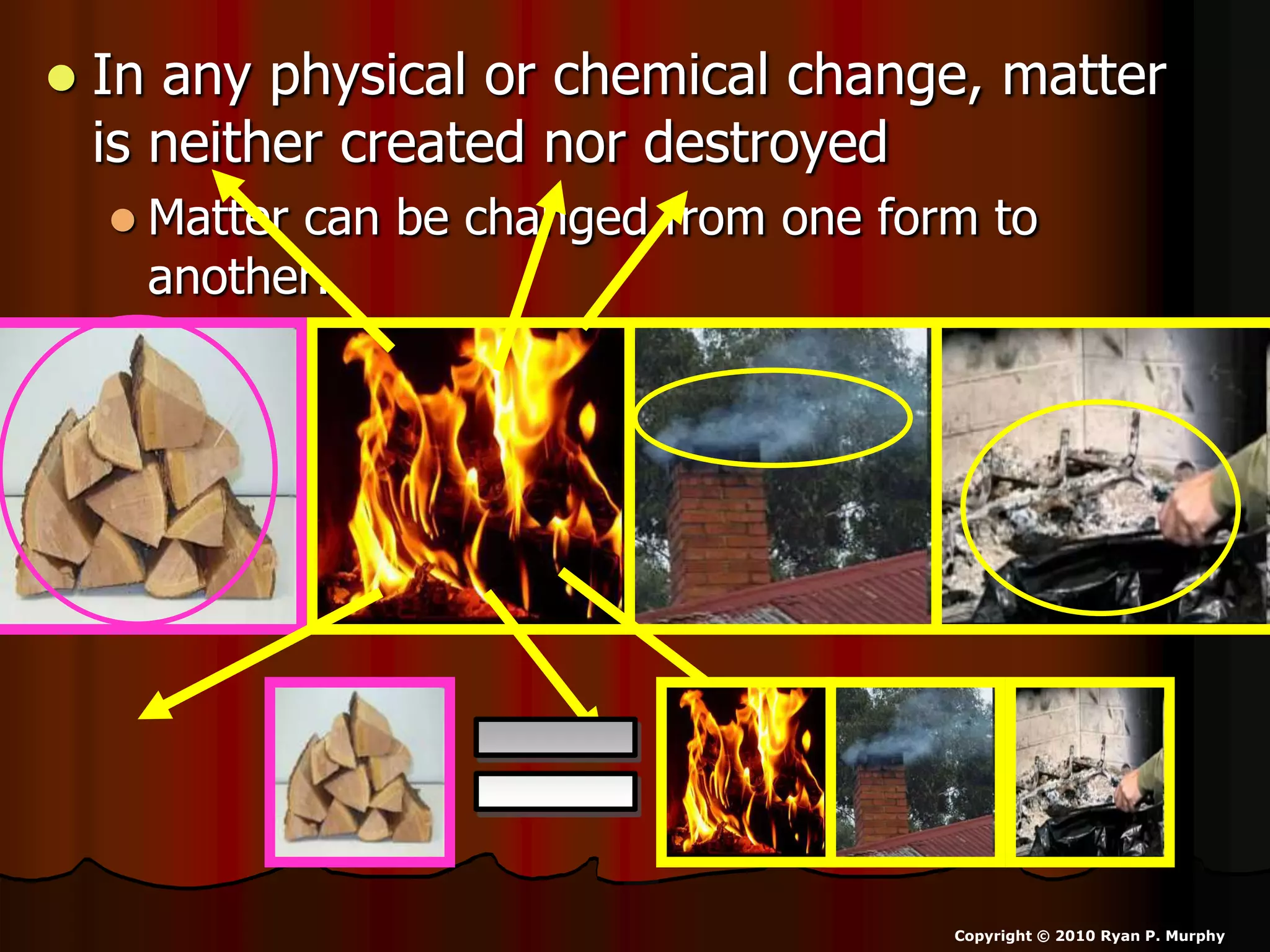
 In any physical or chemical change, matter
is neither created nor destroyed
Copyright © 2010 Ryan P. Murphy
 In any physical or chemical change, matter
is neither created nor destroyed
 Matter can be changed from one form to
another.
Copyright © 2010 Ryan P. Murphy
 In any physical or chemical change, matter
is neither created nor destroyed
 Matter can be changed from one form to
another.
Copyright © 2010 Ryan P. Murphy
 In any physical or chemical change, matter
is neither created nor destroyed
 Matter can be changed from one form to
another.
Copyright © 2010 Ryan P. Murphy
 In any physical or chemical change, matter
is neither created nor destroyed
 Matter can be changed from one form to
another.
Copyright © 2010 Ryan P. Murphy
 In any physical or chemical change, matter
is neither created nor destroyed
 Matter can be changed from one form to
another.
Copyright © 2010 Ryan P. Murphy
 In any physical or chemical change, matter
is neither created nor destroyed
 Matter can be changed from one form to
another.
Copyright © 2010 Ryan P. Murphy
 In any physical or chemical change, matter
is neither created nor destroyed
 Matter can be changed from one form to
another.
Copyright © 2010 Ryan P. Murphy
 In any physical or chemical change, matter
is neither created nor destroyed
 Matter can be changed from one form to
another.
Copyright © 2010 Ryan P. Murphy
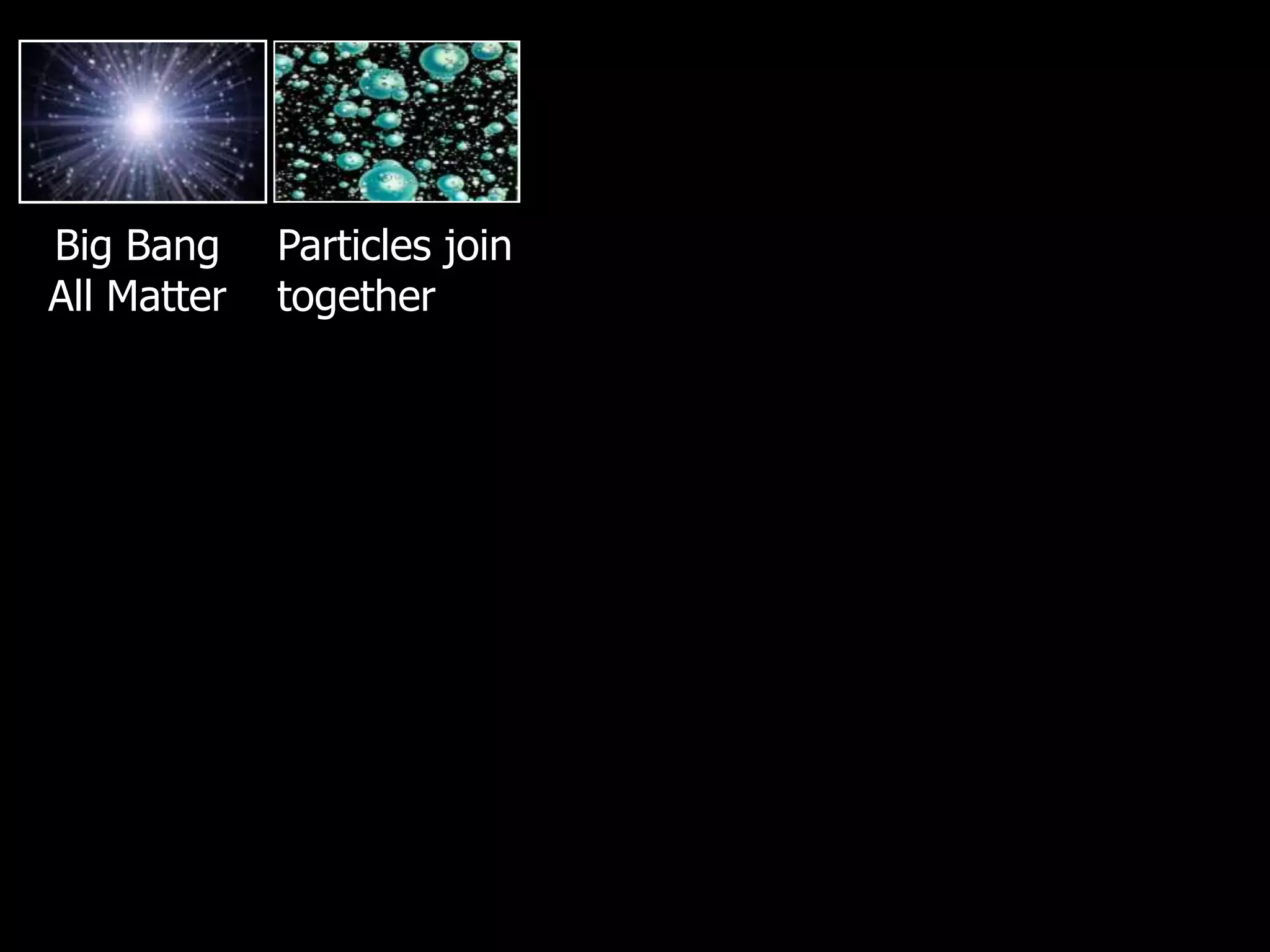
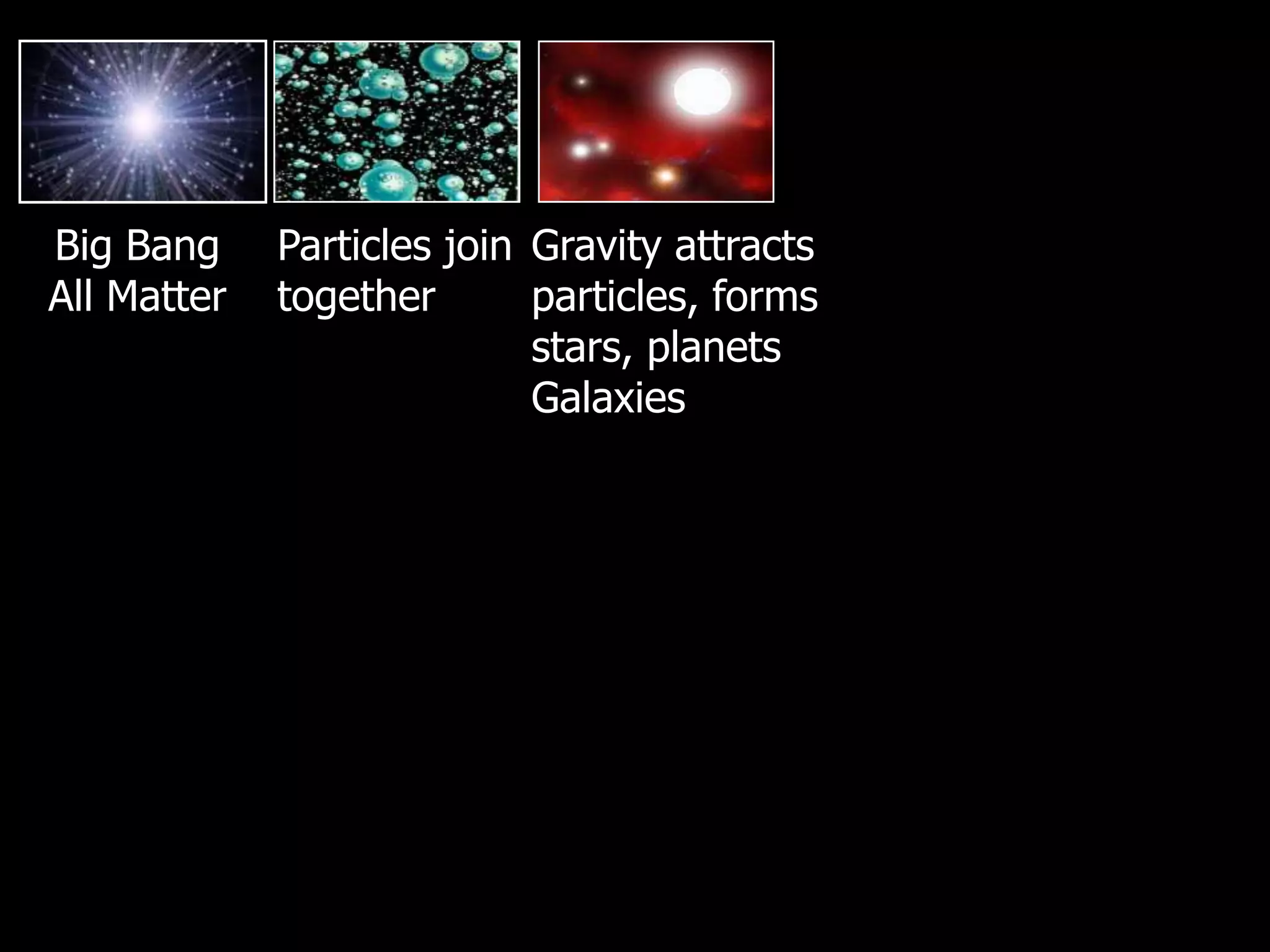
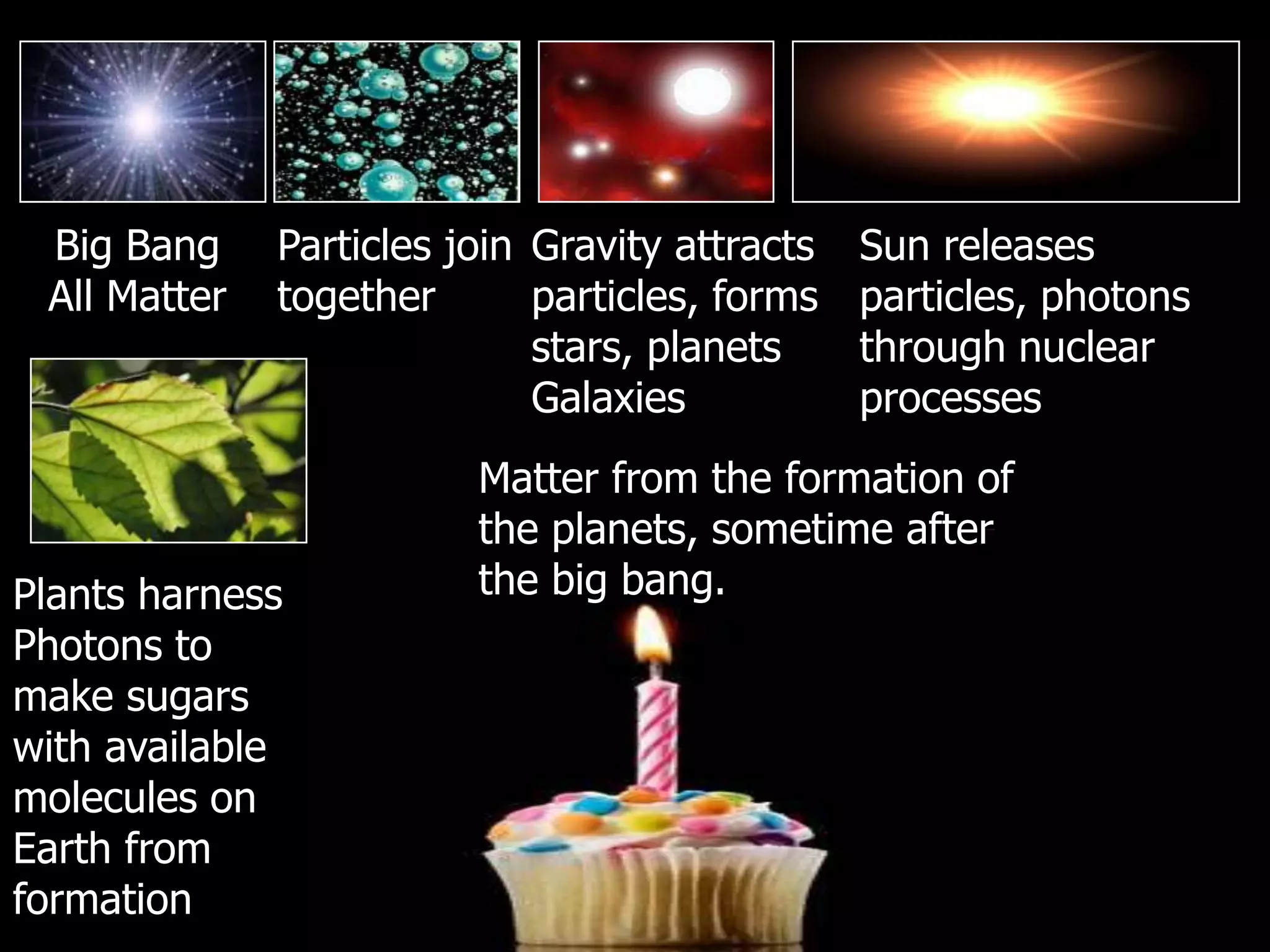
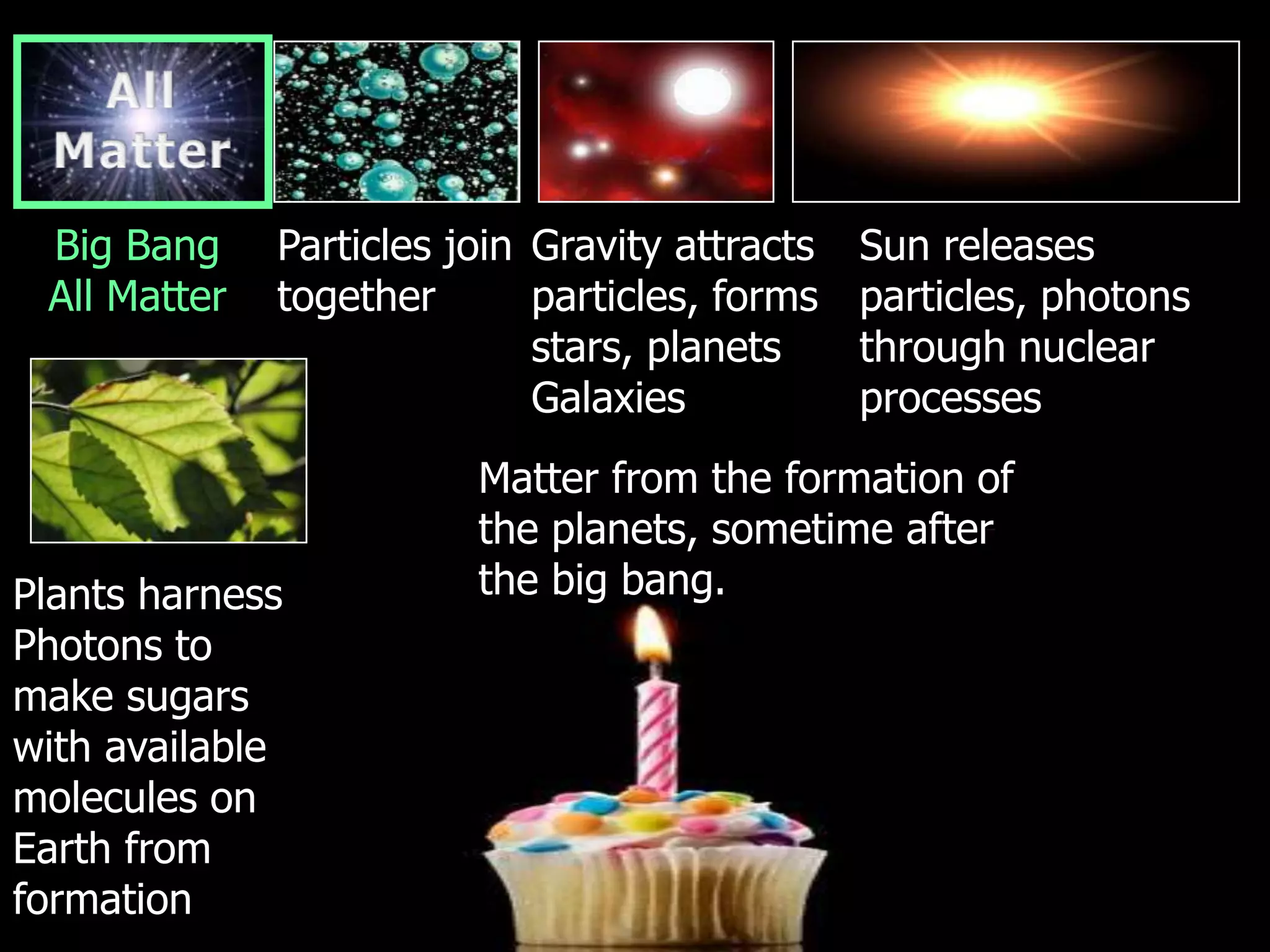
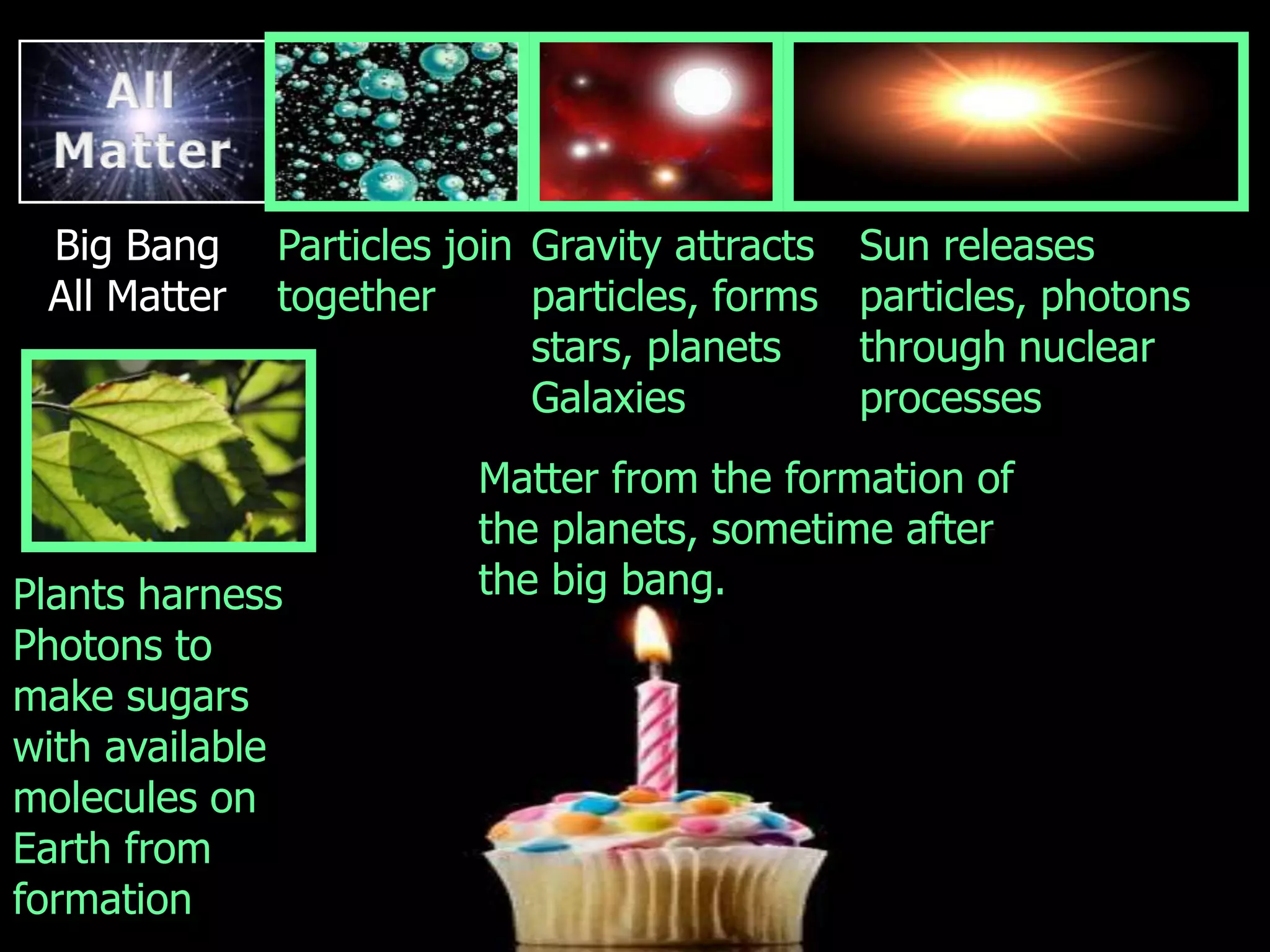
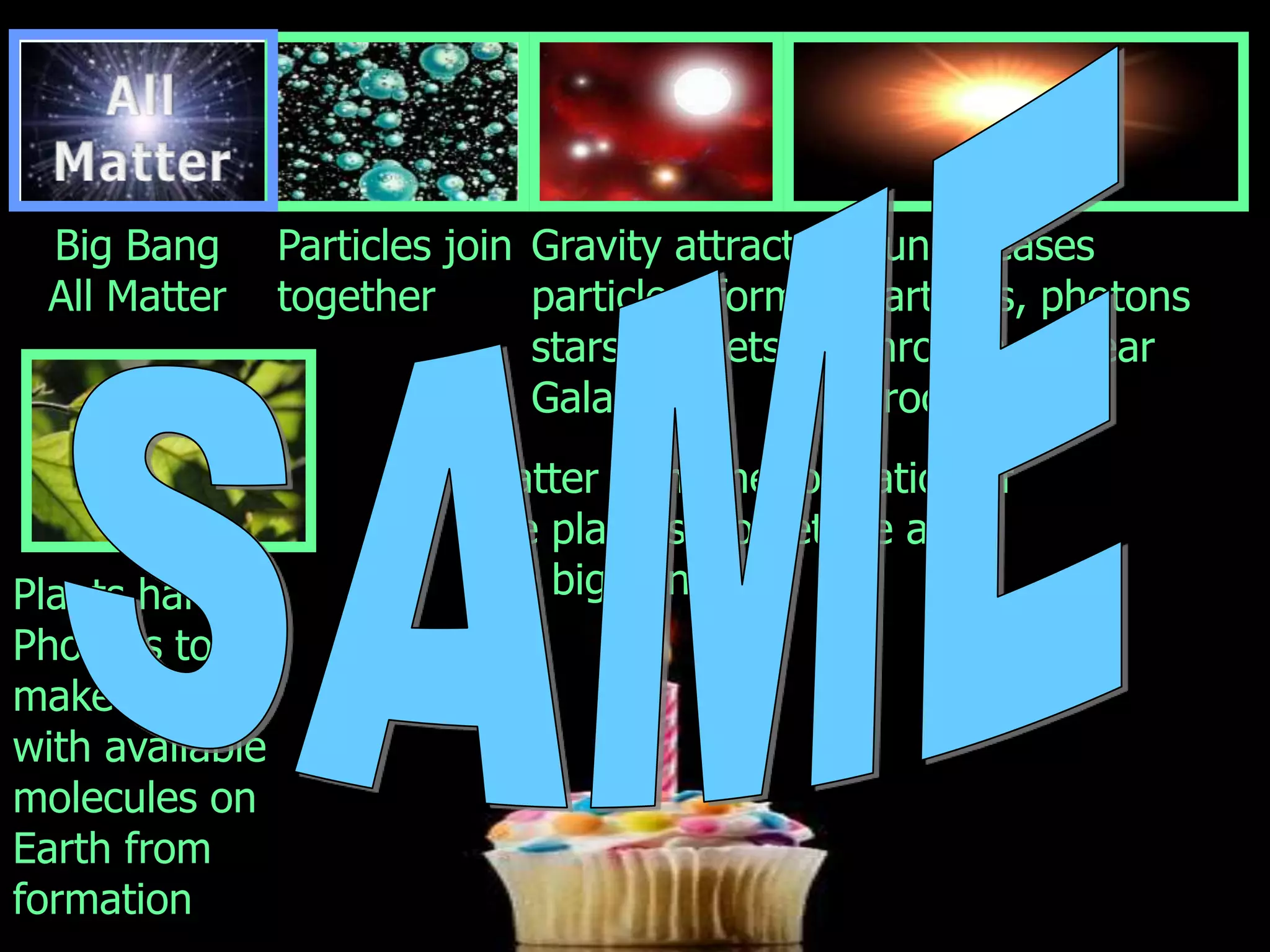
Big Bang
All Matter
Big Bang
All Matter
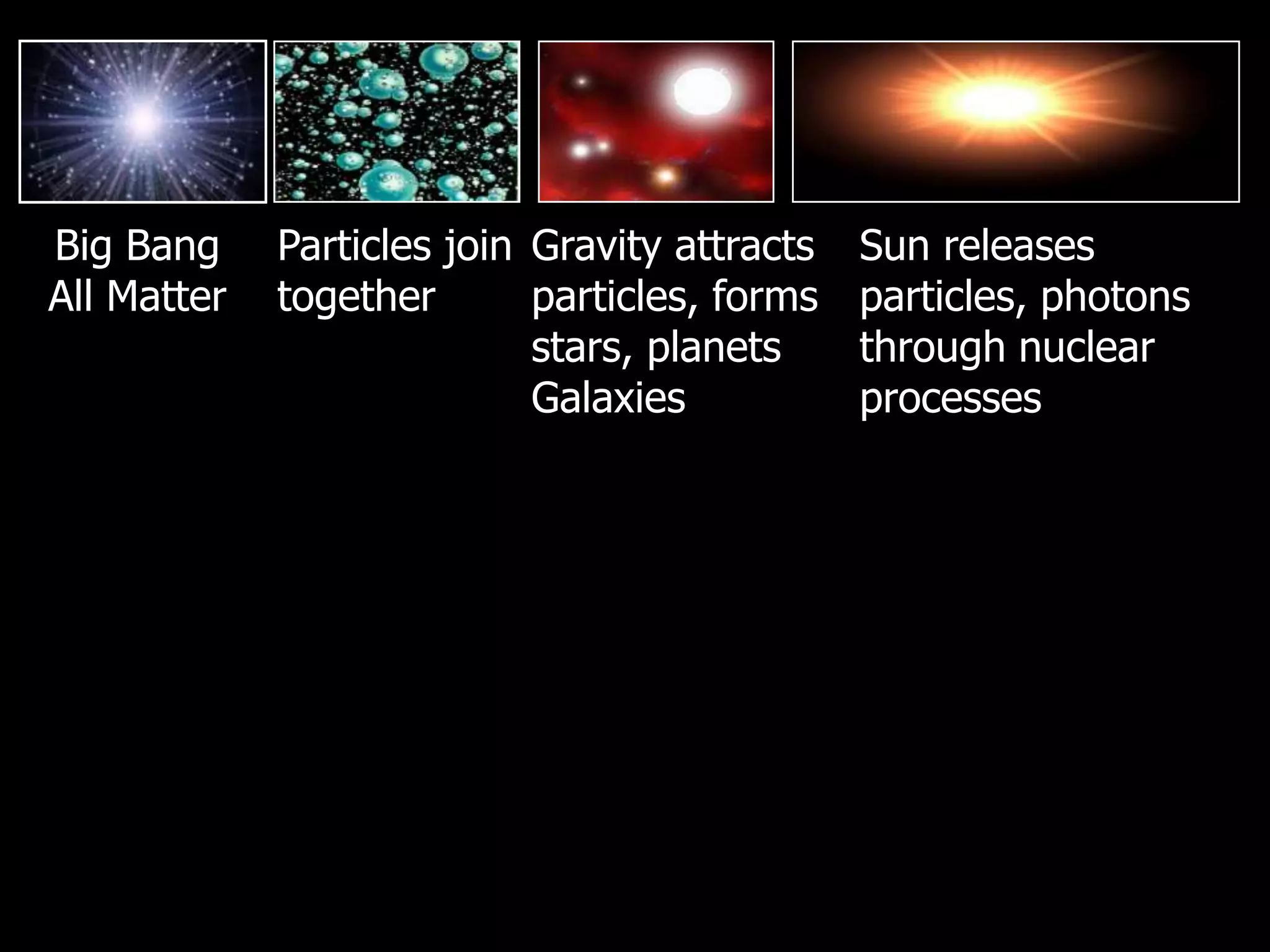
Particles join
together
Big Bang
All Matter
Particles join
together
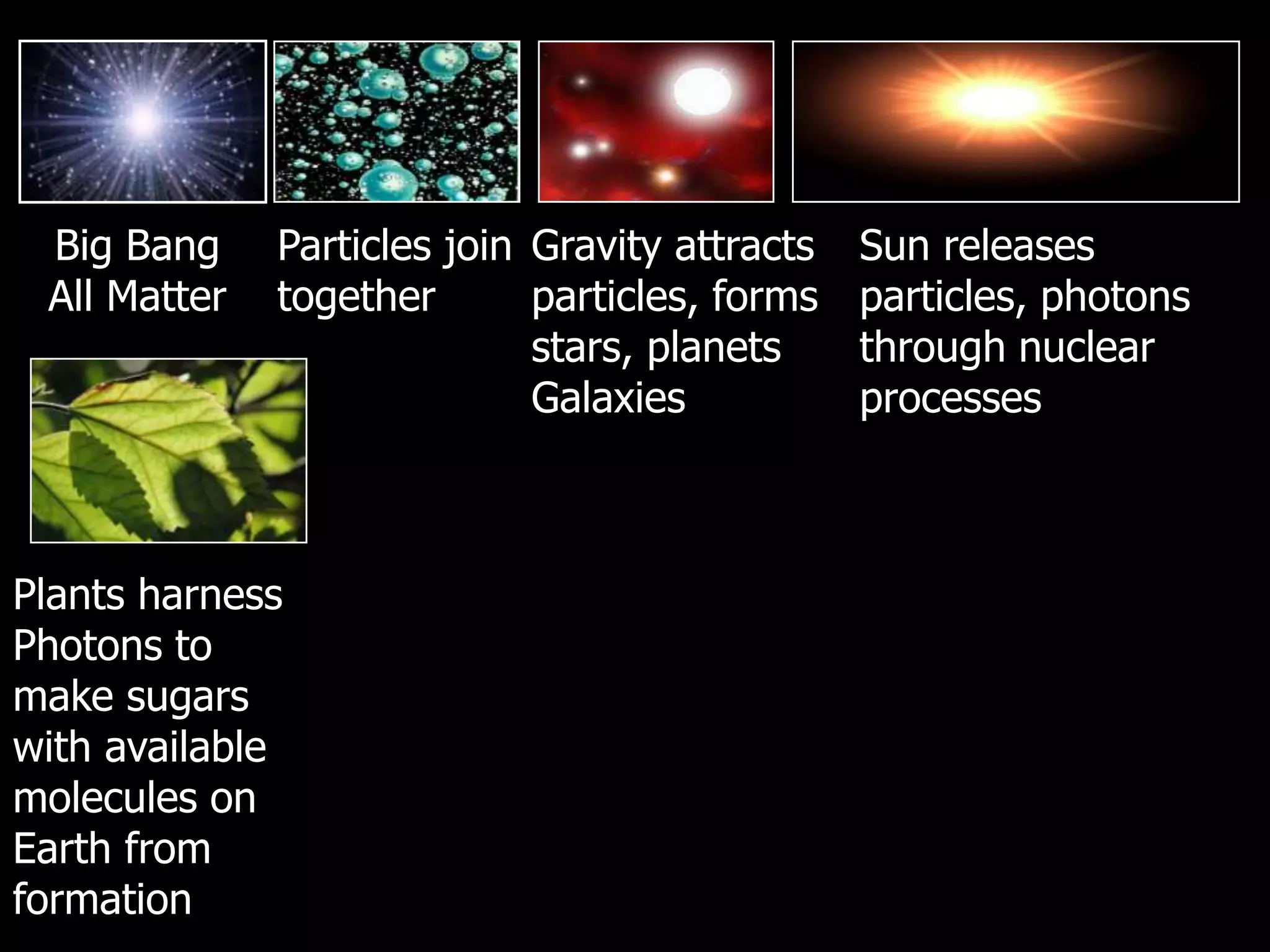
Gravity attracts
particles, forms
stars, planets
Galaxies
Big Bang
All Matter
Particles join
together
Gravity attracts
particles, forms
stars, planets
Galaxies
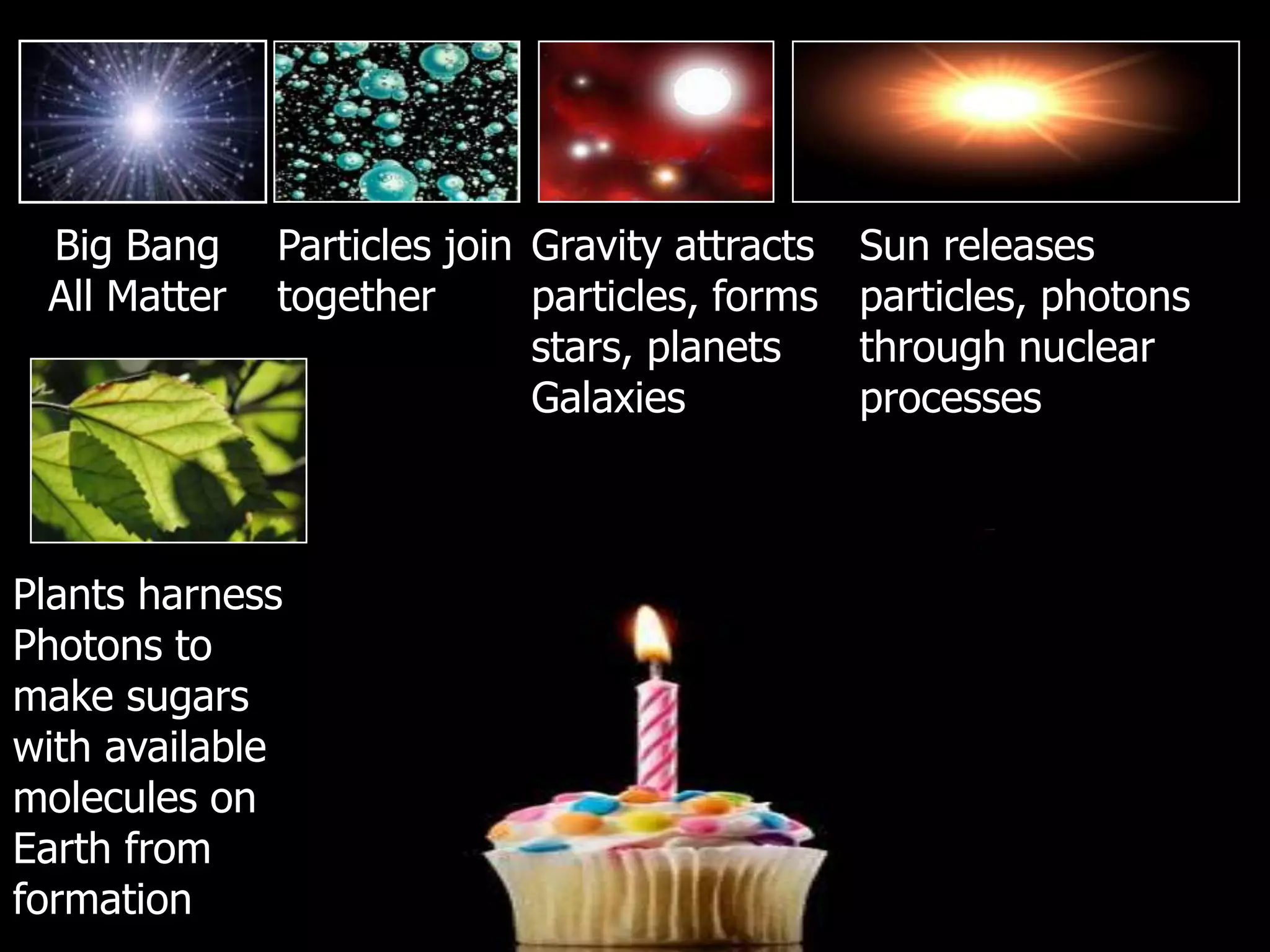
Sun releases
particles, photons
through nuclear
processes
Big Bang
All Matter
Particles join
together
Gravity attracts
particles, forms
stars, planets
Galaxies
Sun releases
particles, photons
through nuclear
processes
Plants harness
Photons to
make sugars
with available
molecules on
Earth from
formation
Big Bang
All Matter
Particles join
together
Gravity attracts
particles, forms
stars, planets
Galaxies
Sun releases
particles, photons
through nuclear
processes
Plants harness
Photons to
make sugars
with available
molecules on
Earth from
formation
Big Bang
All Matter
Particles join
together
Gravity attracts
particles, forms
stars, planets
Galaxies
Sun releases
particles, photons
through nuclear
processes
Plants harness
Photons to
make sugars
with available
molecules on
Earth from
formation
Matter from the formation of
the planets, sometime after
the big bang.
Big Bang
All Matter
Particles join
together
Gravity attracts
particles, forms
stars, planets
Galaxies
Sun releases
particles, photons
through nuclear
processes
Plants harness
Photons to
make sugars
with available
molecules on
Earth from
formation
Matter from the formation of
the planets, sometime after
the big bang.
Big Bang
All Matter
Particles join
together
Gravity attracts
particles, forms
stars, planets
Galaxies
Sun releases
particles, photons
through nuclear
processes
Plants harness
Photons to
make sugars
with available
molecules on
Earth from
formation
Matter from the formation of
the planets, sometime after
the big bang.
Big Bang
All Matter
Particles join
together
Gravity attracts
particles, forms
stars, planets
Galaxies
Sun releases
particles, photons
through nuclear
processes
Plants harness
Photons to
make sugars
with available
molecules on
Earth from
formation
Matter from the formation of
the planets, sometime after
the big bang.
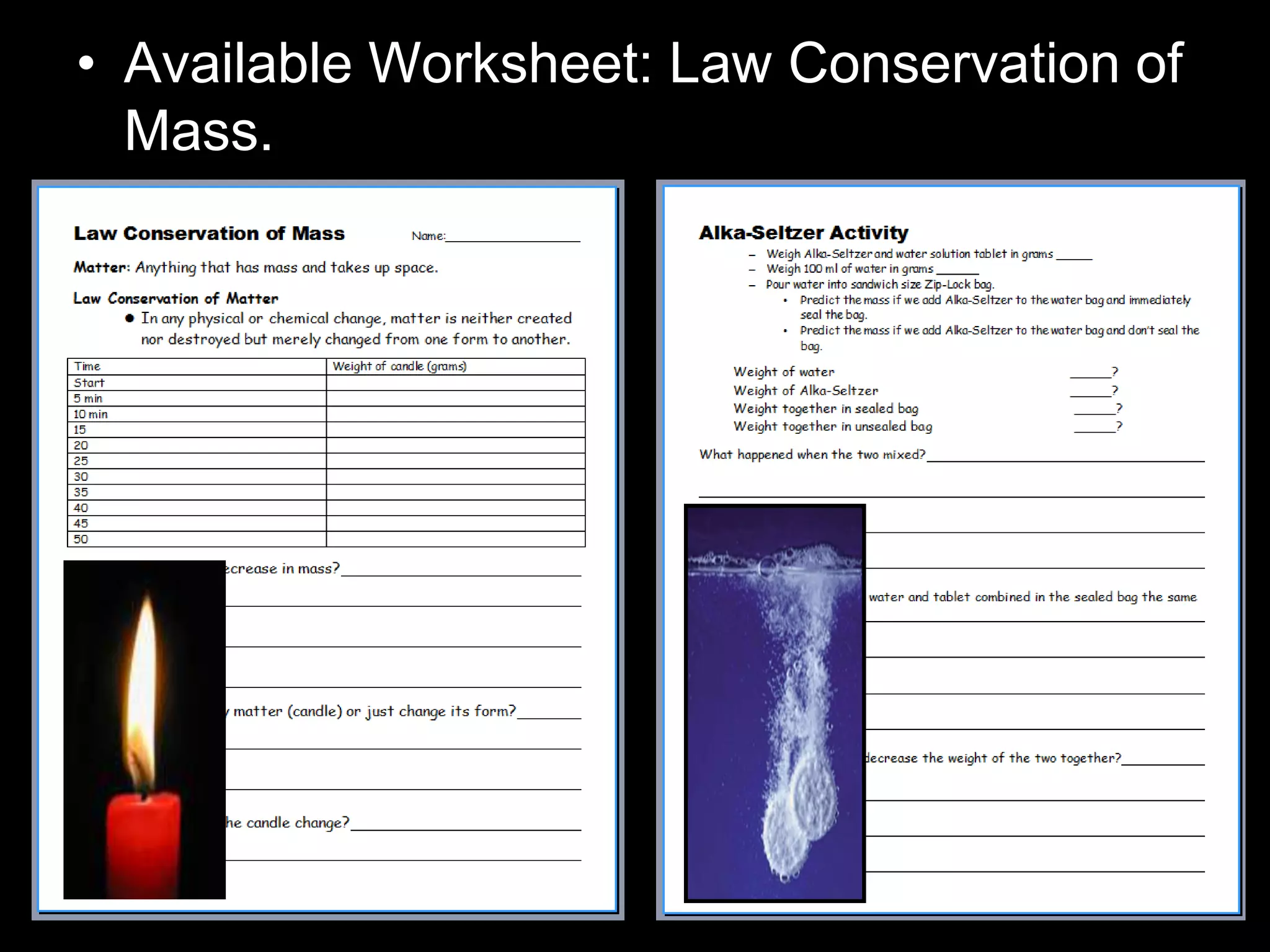
• Available Worksheet: Law Conservation of
Mass.
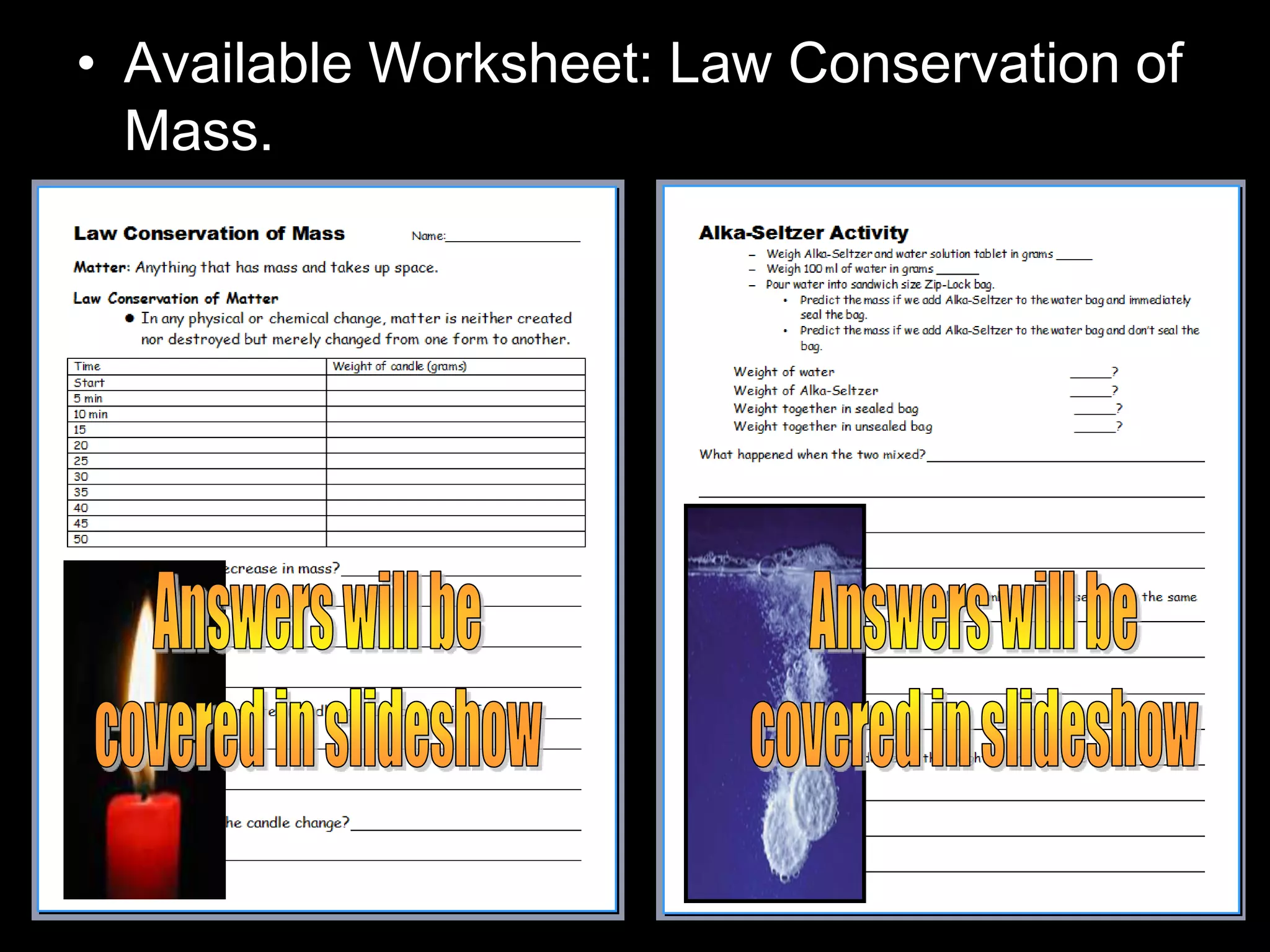
• Available Worksheet: Law Conservation of
Mass.
• Activity! Law Conservation of Mass
– Secure a birthday candle to a Petri-Dish and
weigh all.
– Light candle on a scale and record the weight
of the candle every minute for 10 minutes.
• Light fan can speed combustion / results.
– Spreadsheet on next page.
– Lab questions to be answered at end.
Copyright © 2010 Ryan P. Murphy
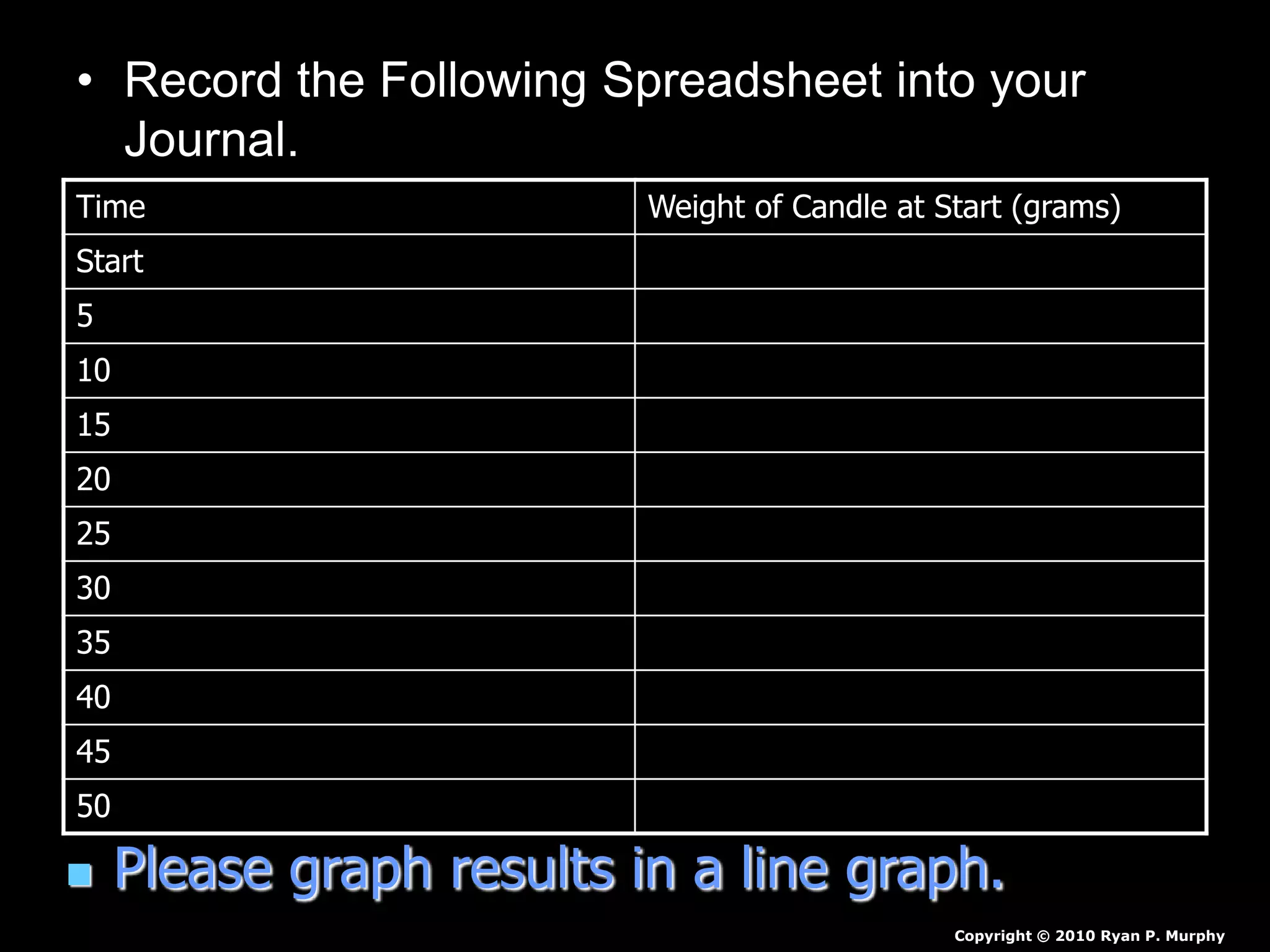
• Record the Following Spreadsheet into your
Journal.
Time Weight of Candle at Start (grams)
Start
5
10
15
20
25
30
35
40
45
50
 Please graph results in a line graph.
Copyright © 2010 Ryan P. Murphy
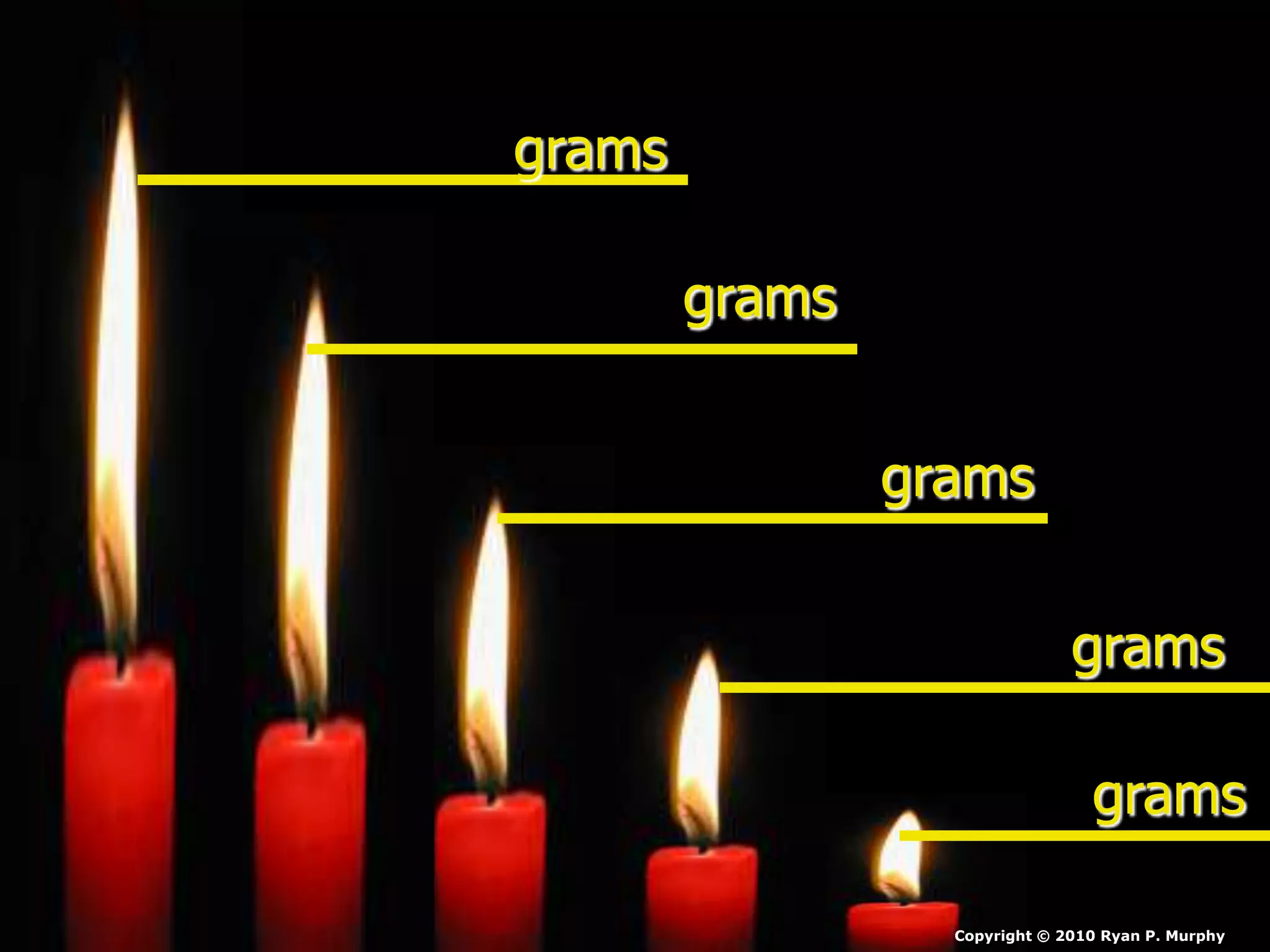
grams
grams
grams
grams
grams
Copyright © 2010 Ryan P. Murphy
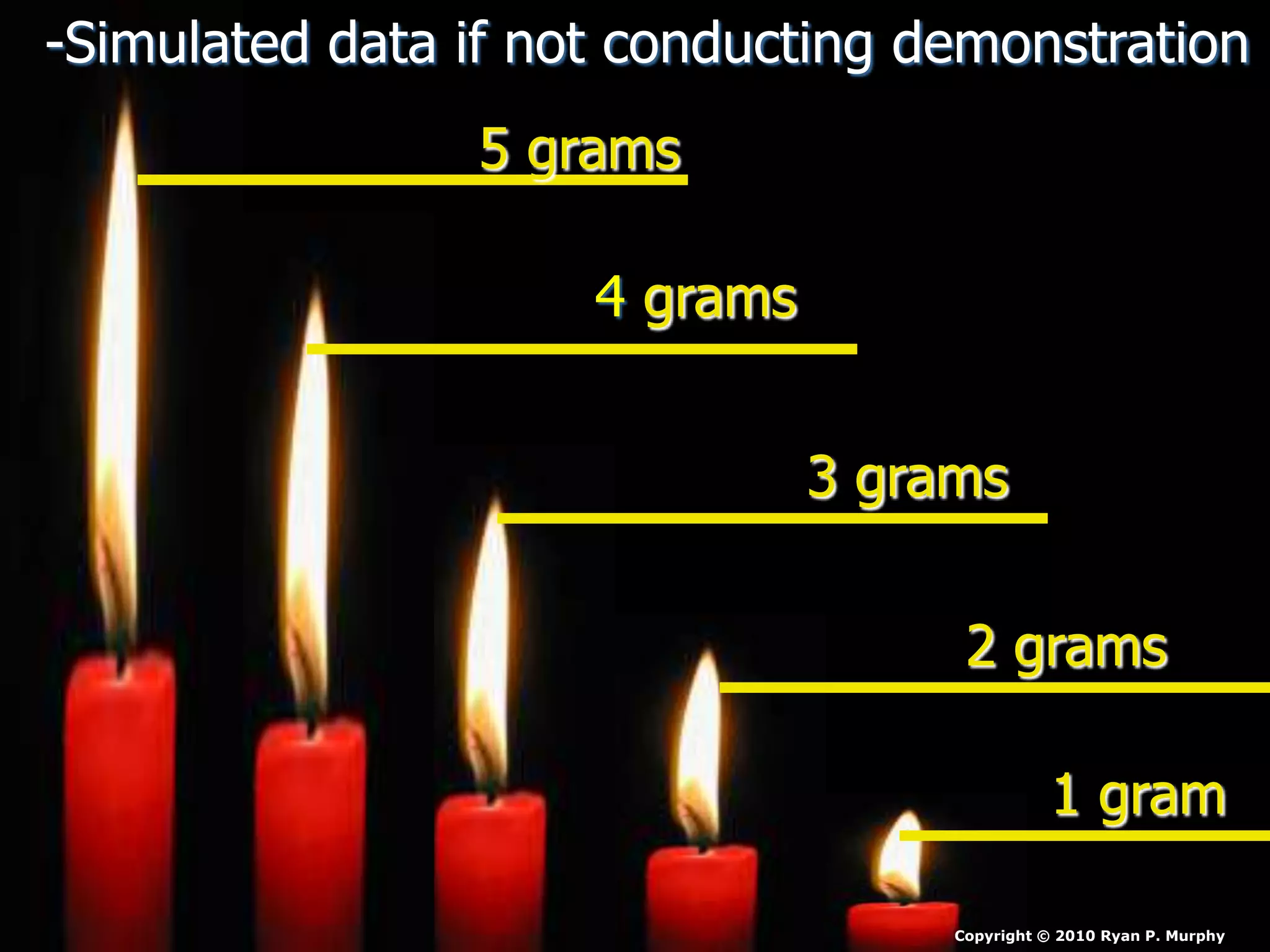
5 grams
4 grams
3 grams
2 grams
1 gram
Copyright © 2010 Ryan P. Murphy
-Simulated data if not conducting demonstration
• Questions!
Copyright © 2010 Ryan P. Murphy
• Questions!
– Why did the candle decrease in mass?
Copyright © 2010 Ryan P. Murphy
• Questions!
– Why did the candle decrease in mass?
– Did the flame destroy matter (candle) or just
change its form?
Copyright © 2010 Ryan P. Murphy
• Questions!
– Why did the candle decrease in mass?
– Did the flame destroy matter (candle) or just
change its form?
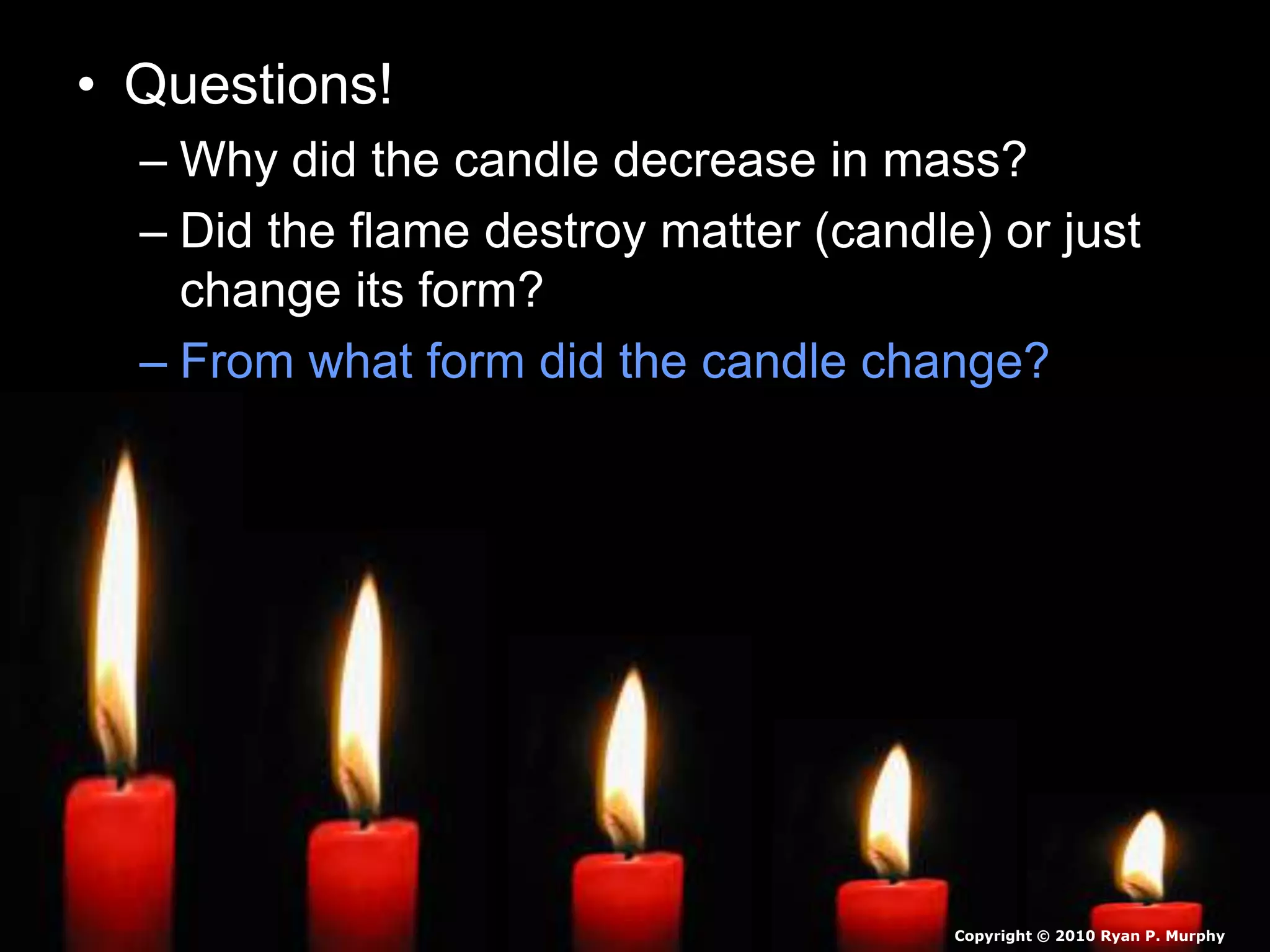
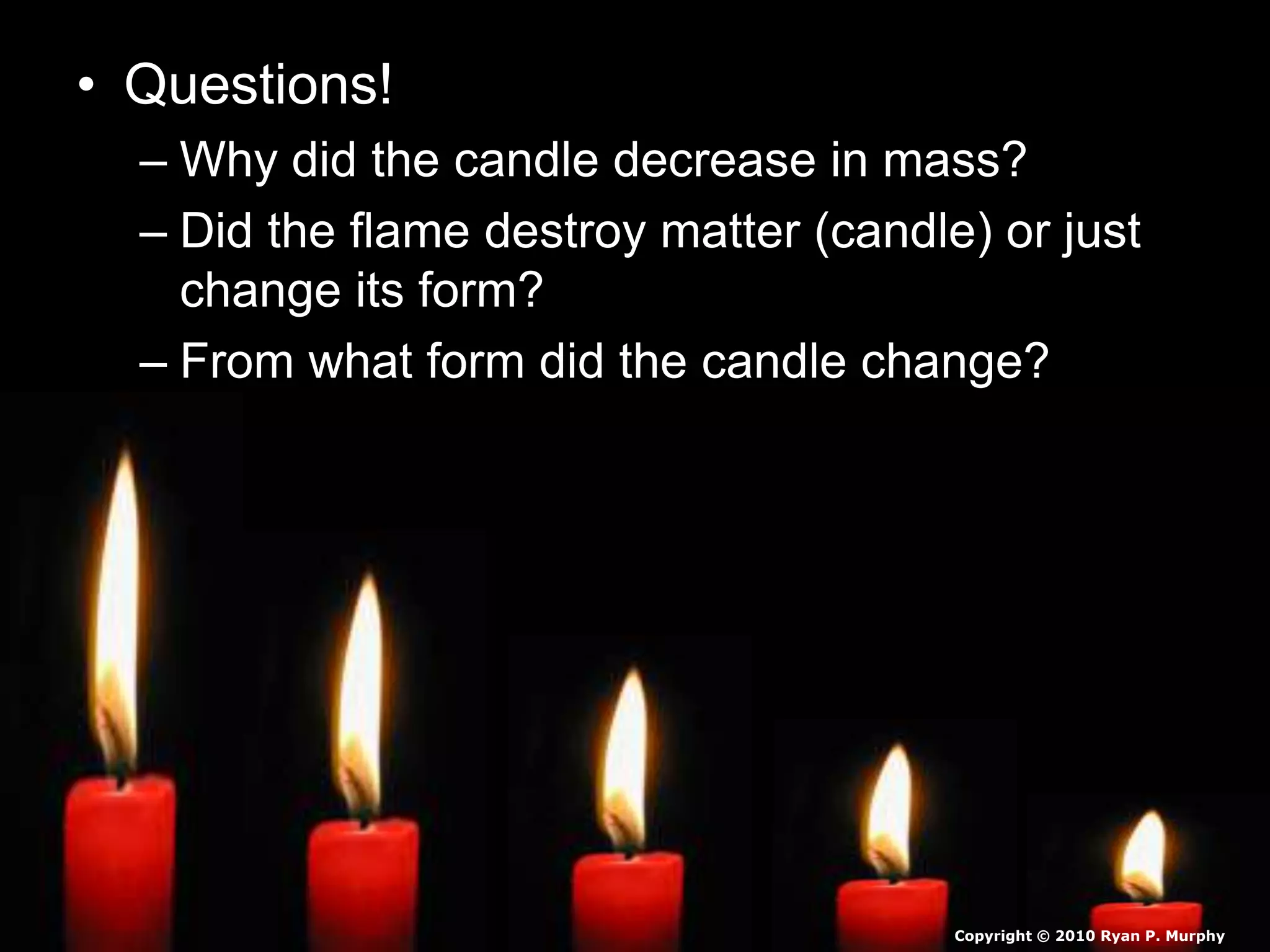
– From what form did the candle change?
Copyright © 2010 Ryan P. Murphy
• Questions!
– Why did the candle decrease in mass?
– Did the flame destroy matter (candle) or just
change its form?
– From what form did the candle change?
Copyright © 2010 Ryan P. Murphy
• Answers to Questions!
Copyright © 2010 Ryan P. Murphy
• Answers to Questions!
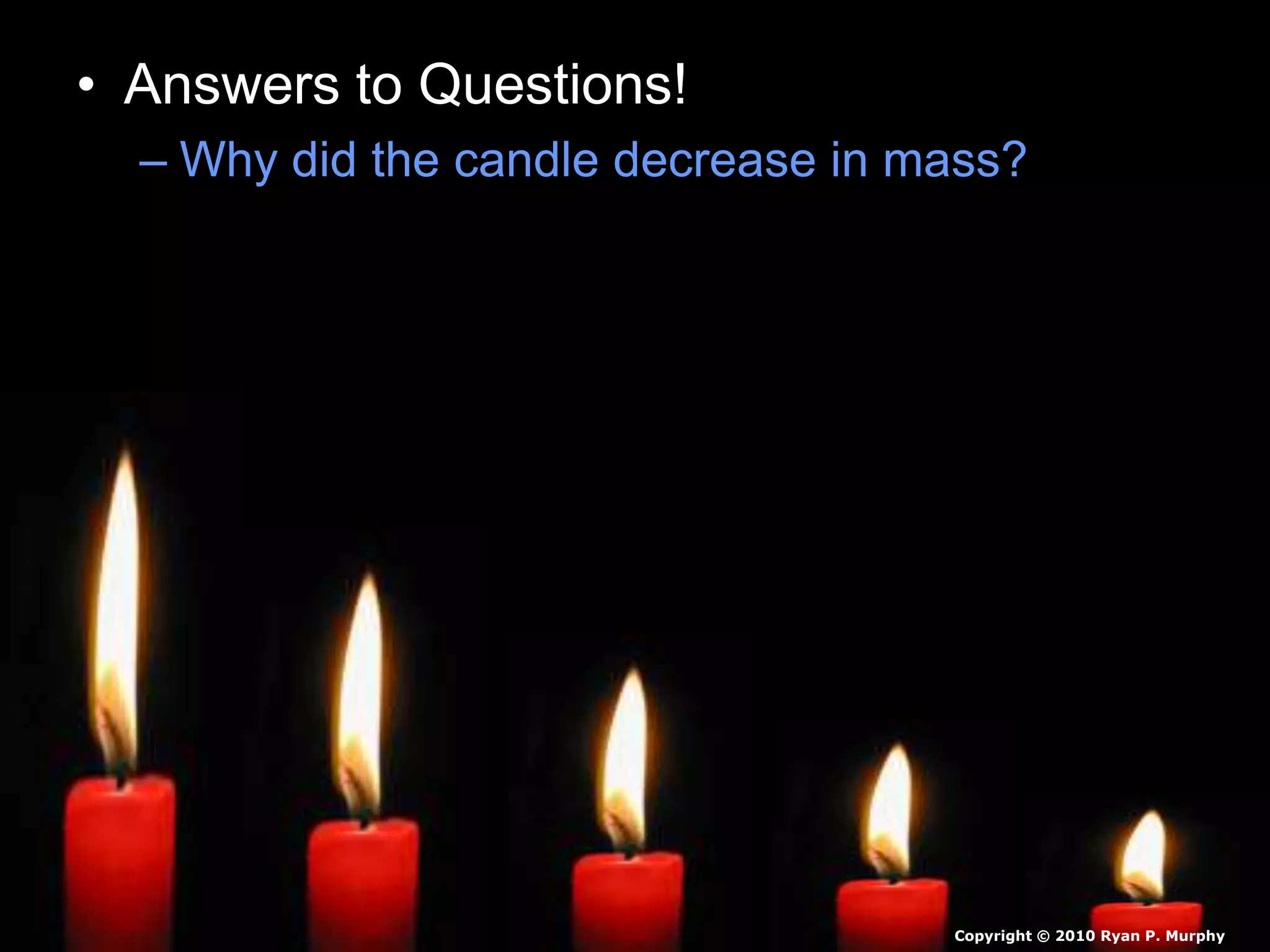
– Why did the candle decrease in mass?
Copyright © 2010 Ryan P. Murphy
• Questions!
– Why did the candle decrease in mass?
– Answer! Because the candle which was a
solid turned into a gas during combustion.
The gas was not collected to be measured.
Copyright © 2010 Ryan P. Murphy
• Questions!
– Did the flame destroy matter (candle) or just
change its form?
Copyright © 2010 Ryan P. Murphy
• Questions!
– Did the flame destroy matter (candle) or just
change its form?
– Answer! No, Matter cannot be created or
destroyed but changed from one form to
another.
• Questions!
– From what form did the candle change?
Copyright © 2010 Ryan P. Murphy
• Questions!
– From what form did the candle change?
– Answer! The candle changed from a solid to a
liquid (melting) and into a gas (evaporation).
Copyright © 2010 Ryan P. Murphy
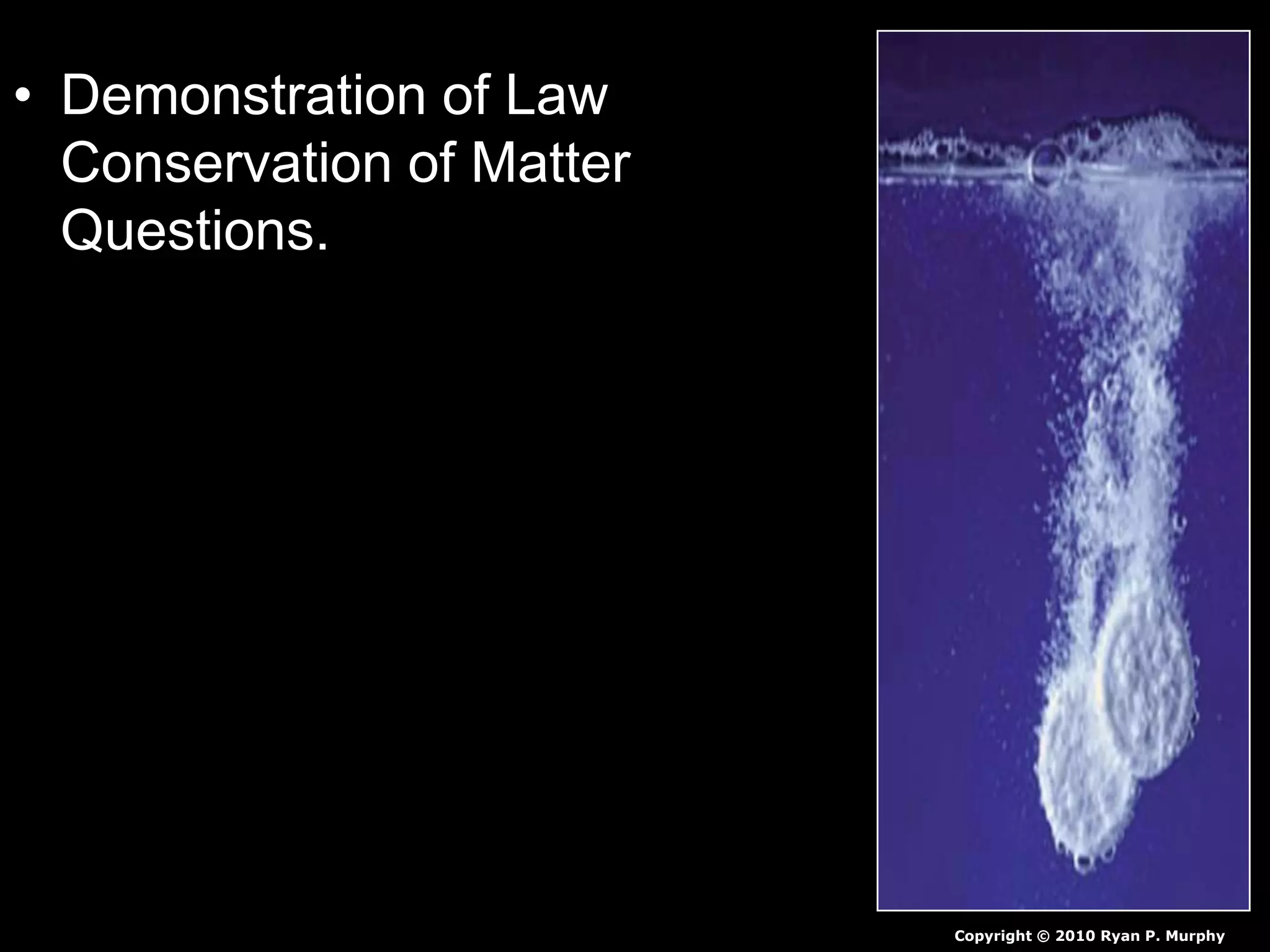
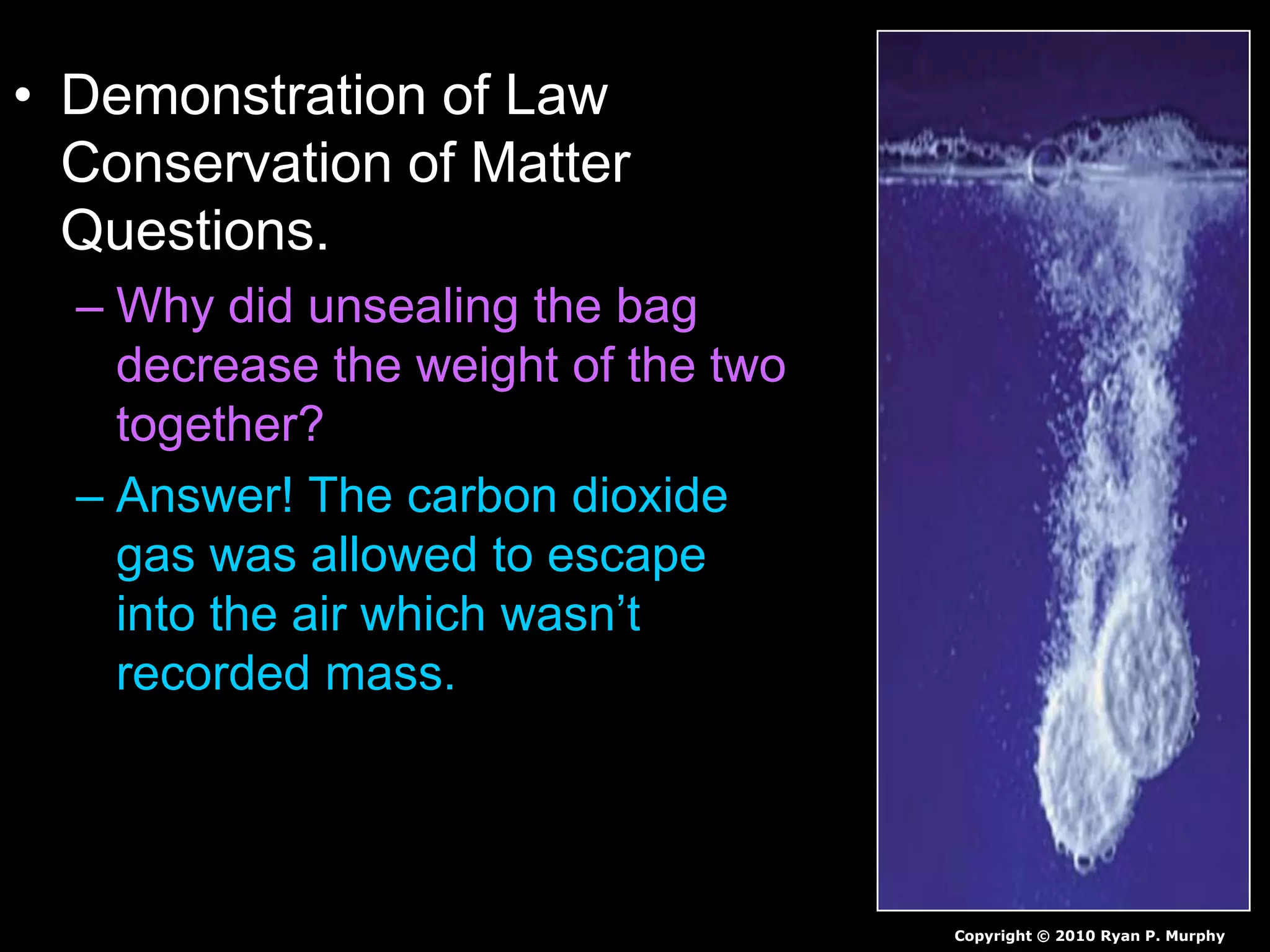
• Demonstration of Law Conservation of
Matter.
– Weigh Alka-Seltzer and water solution tablet in
grams _____
– Weigh 100 ml of water in grams ______
– Pour water into large zip-lock bag.
• Predict the mass if we add Alka-Seltzer to the water
bag and immediately seal the bag.
• Predict the mass if we add Alka-Seltzer to the water
bag and don’t seal the bag.
Copyright © 2010 Ryan P. Murphy
• Demonstration of Law Conservation of
Matter.
– Weigh Alka-Seltzer and water solution tablet in
grams _____
– Weigh 100 ml of water in grams ______
– Pour water into large zip-lock bag.
• Predict the mass if we add Alka-Seltzer to the water
bag and immediately seal the bag.
• Predict the mass if we add Alka-Seltzer to the water
bag and don’t seal the bag.
Copyright © 2010 Ryan P. Murphy
• Demonstration of Law Conservation of
Matter.
– Weigh Alka-Seltzer and water solution tablet in
grams _____
– Weigh 100 ml of water in grams ______
– Pour water into large zip-lock bag.
• Predict the mass if we add Alka-Seltzer to the water
bag and immediately seal the bag.
• Predict the mass if we add Alka-Seltzer to the water
bag and don’t seal the bag.
Copyright © 2010 Ryan P. Murphy
• Demonstration of Law Conservation of
Matter.
– Weigh Alka-Seltzer and water solution tablet in
grams _____
– Weigh 100 ml of water in grams ______
– Pour water into sandwich size Zip-Lock bag.
• Predict the mass if we add Alka-Seltzer to the water
bag and immediately seal the bag.
• Predict the mass if we add Alka-Seltzer to the water
bag and don’t seal the bag.
Copyright © 2010 Ryan P. Murphy
• Demonstration of Law Conservation of
Matter.
– Weigh Alka-Seltzer and water solution tablet in
grams _____
– Weigh 100 ml of water in grams ______
– Pour water into sandwich size Zip-Lock bag.
• Predict the mass if we add Alka-Seltzer to the water
bag and immediately seal the bag.
• Predict the mass if we add Alka-Seltzer to the water
bag and don’t seal the bag.
Copyright © 2010 Ryan P. Murphy
• Demonstration of Law Conservation of
Matter.
– Weigh Alka-Seltzer and water solution tablet in
grams _____
– Weigh 100 ml of water in grams ______
– Pour water into sandwich size Zip-Lock bag.
• Predict the mass if we add Alka-Seltzer to the water
bag and immediately seal the bag.
• Predict the mass if we add Alka-Seltzer to the water
bag and don’t seal the bag.
Copyright © 2010 Ryan P. Murphy
• Demonstration of Law Conservation of
Matter.
– Weight of water _____?
– Weight of Alka-Seltzer _____?
– Weight together in sealed bag _____?
– Weight together in unsealed bag _____?
Copyright © 2010 Ryan P. Murphy
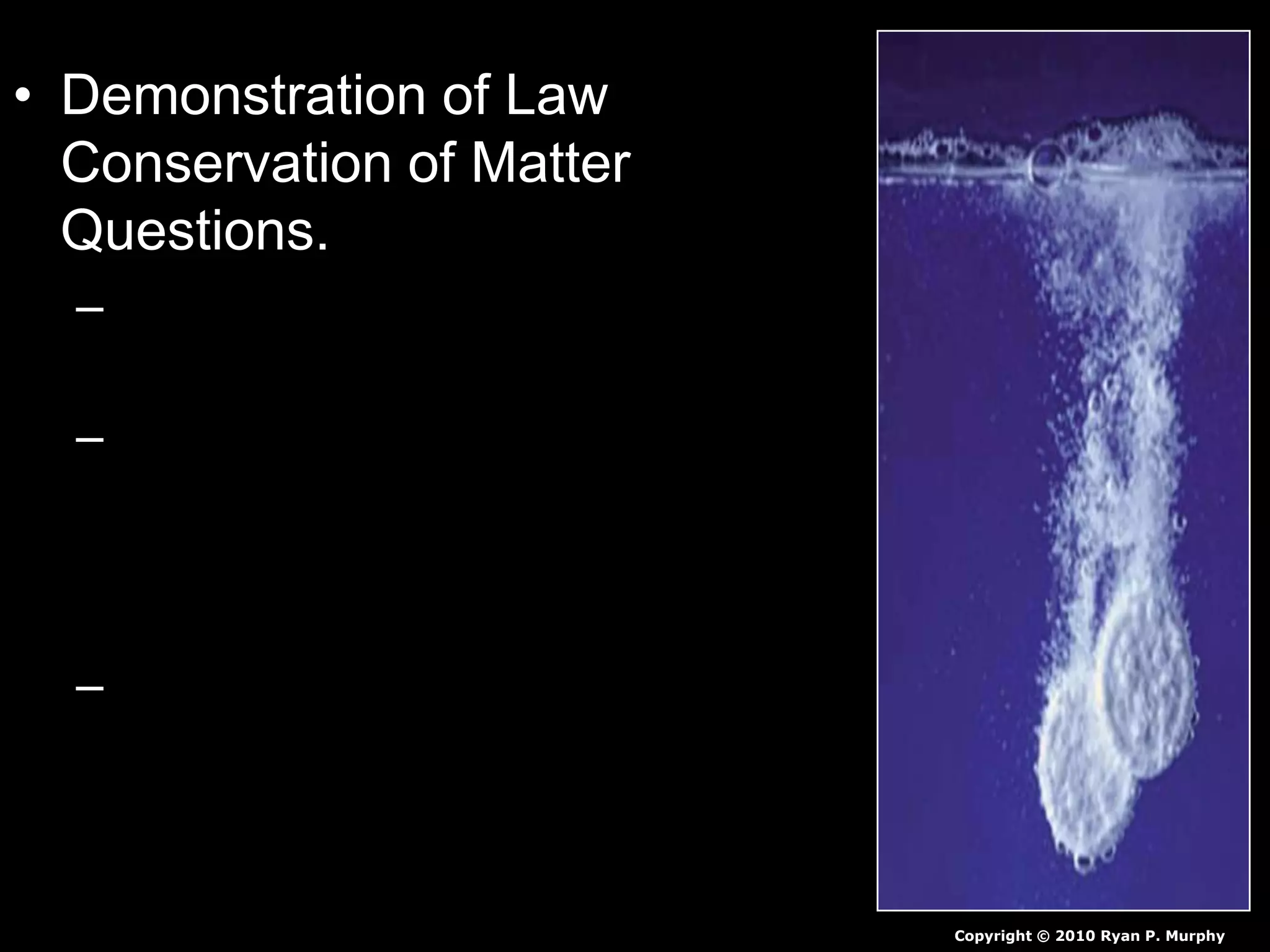
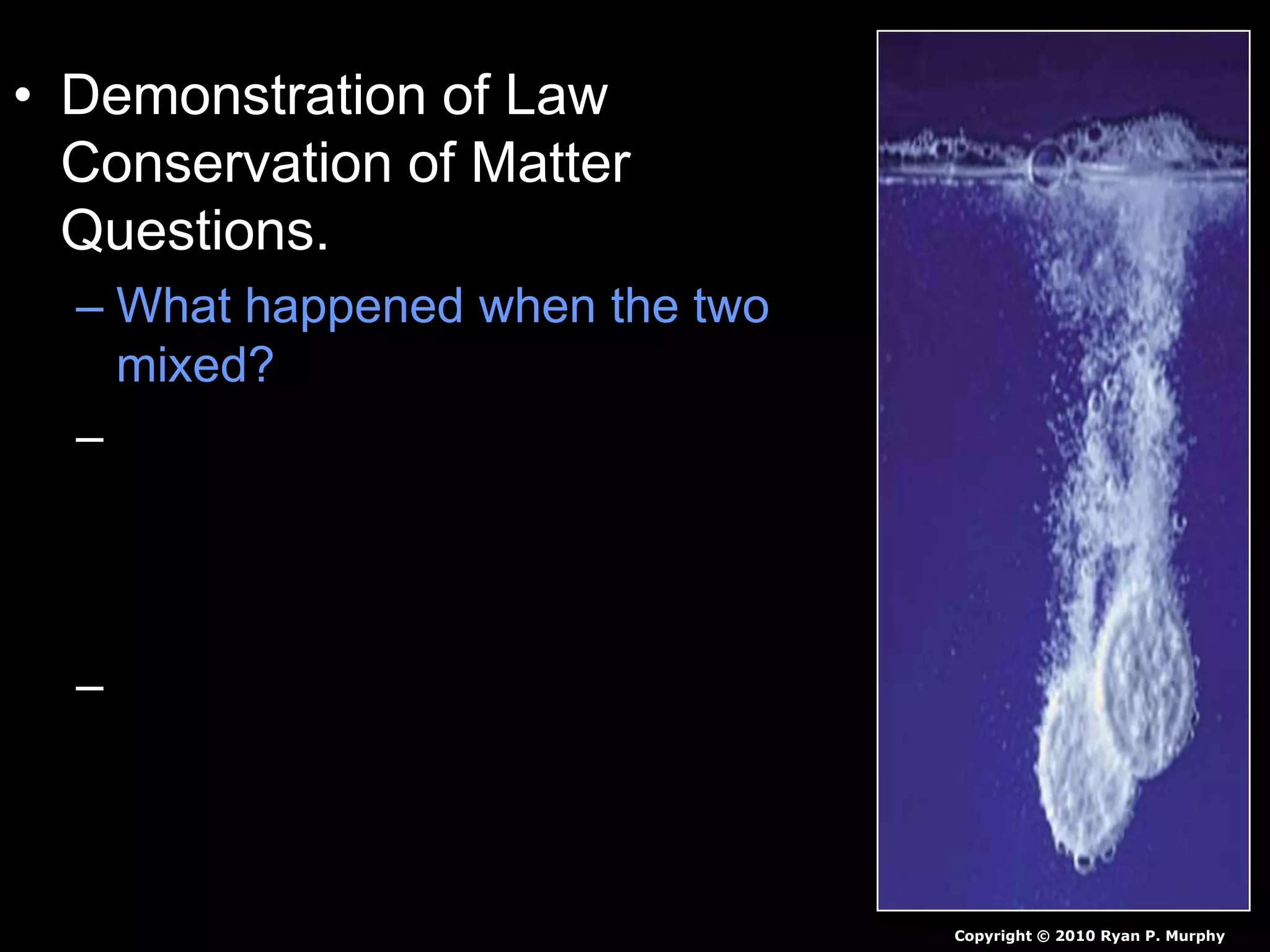
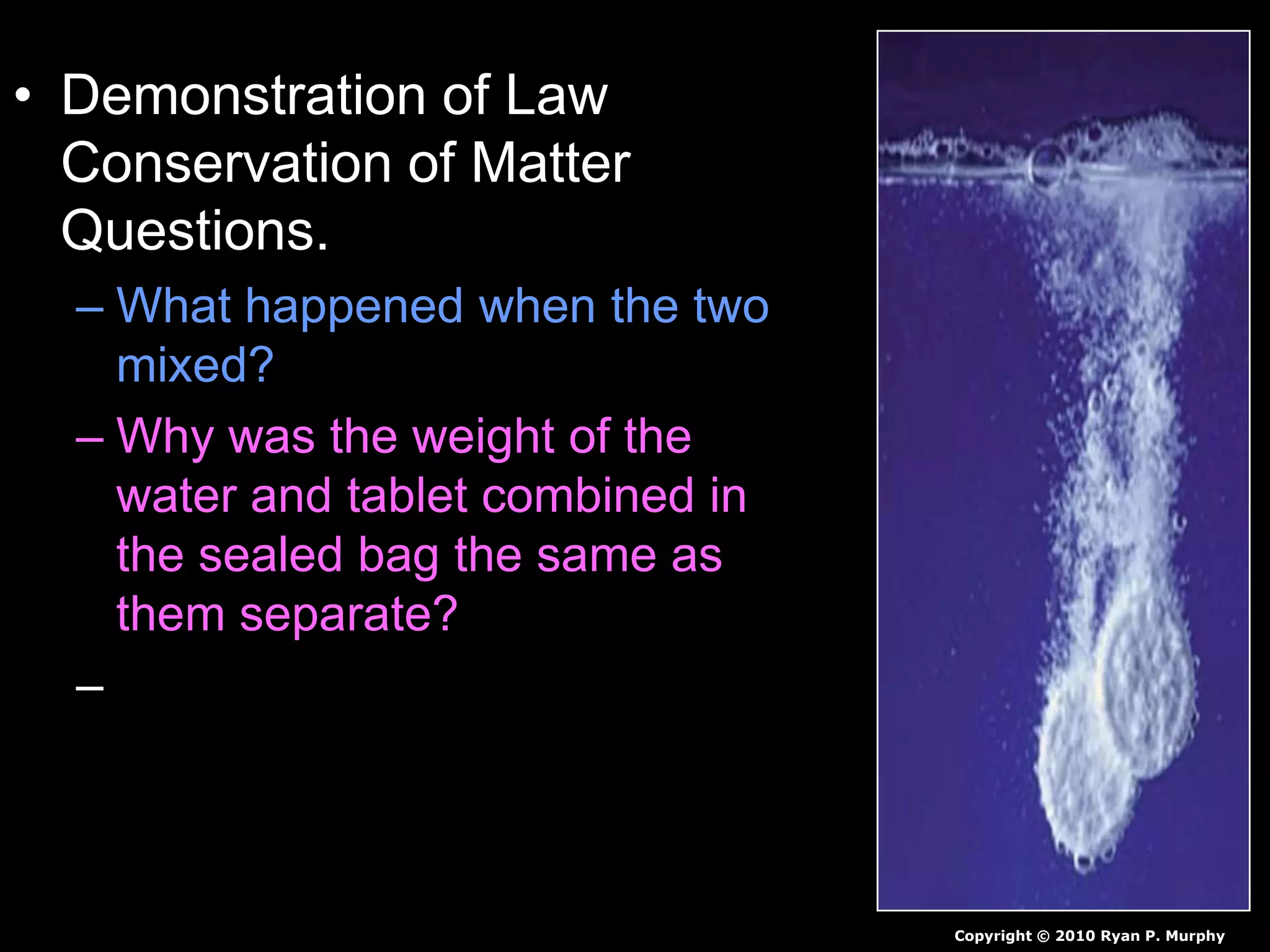
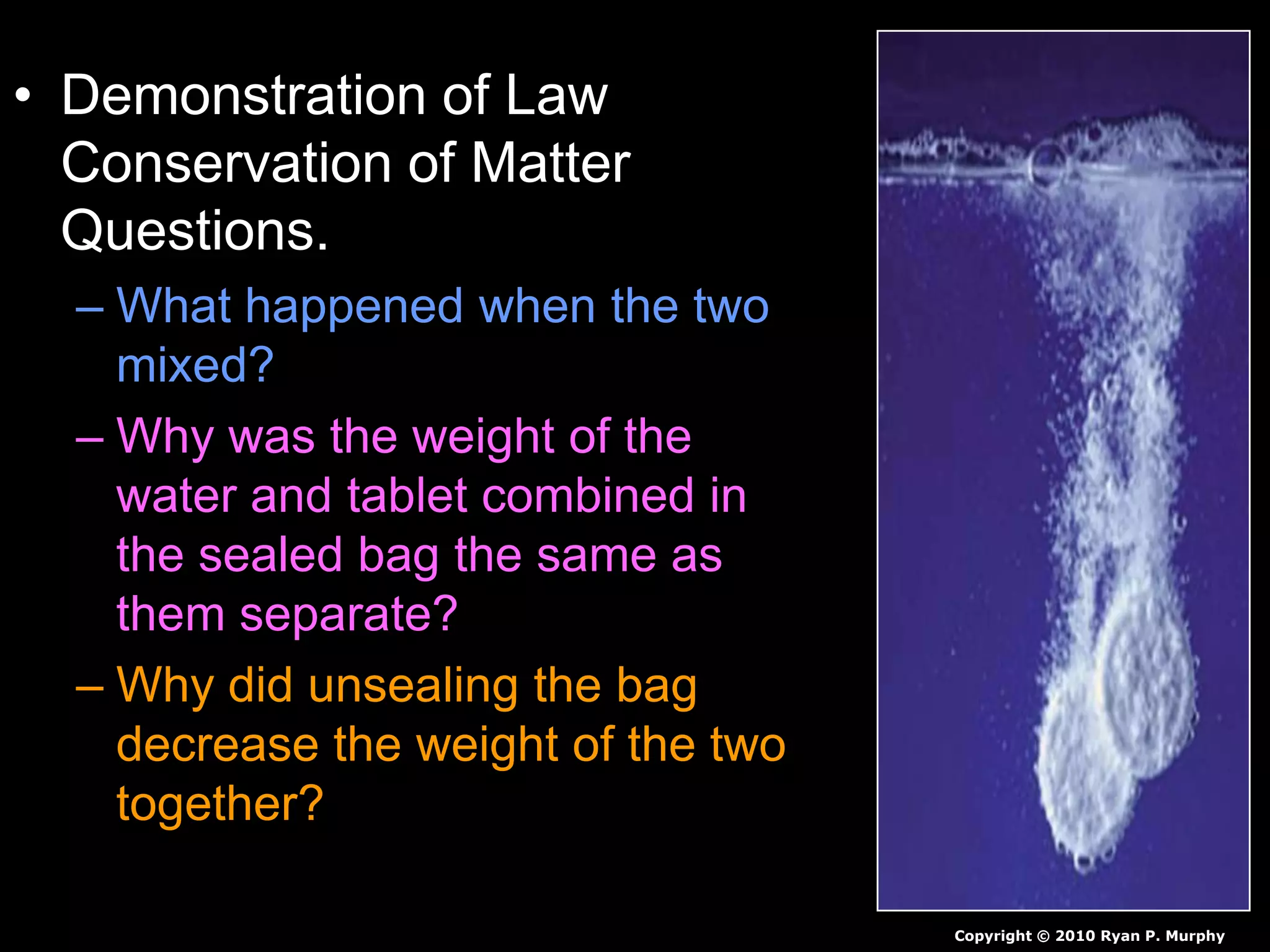
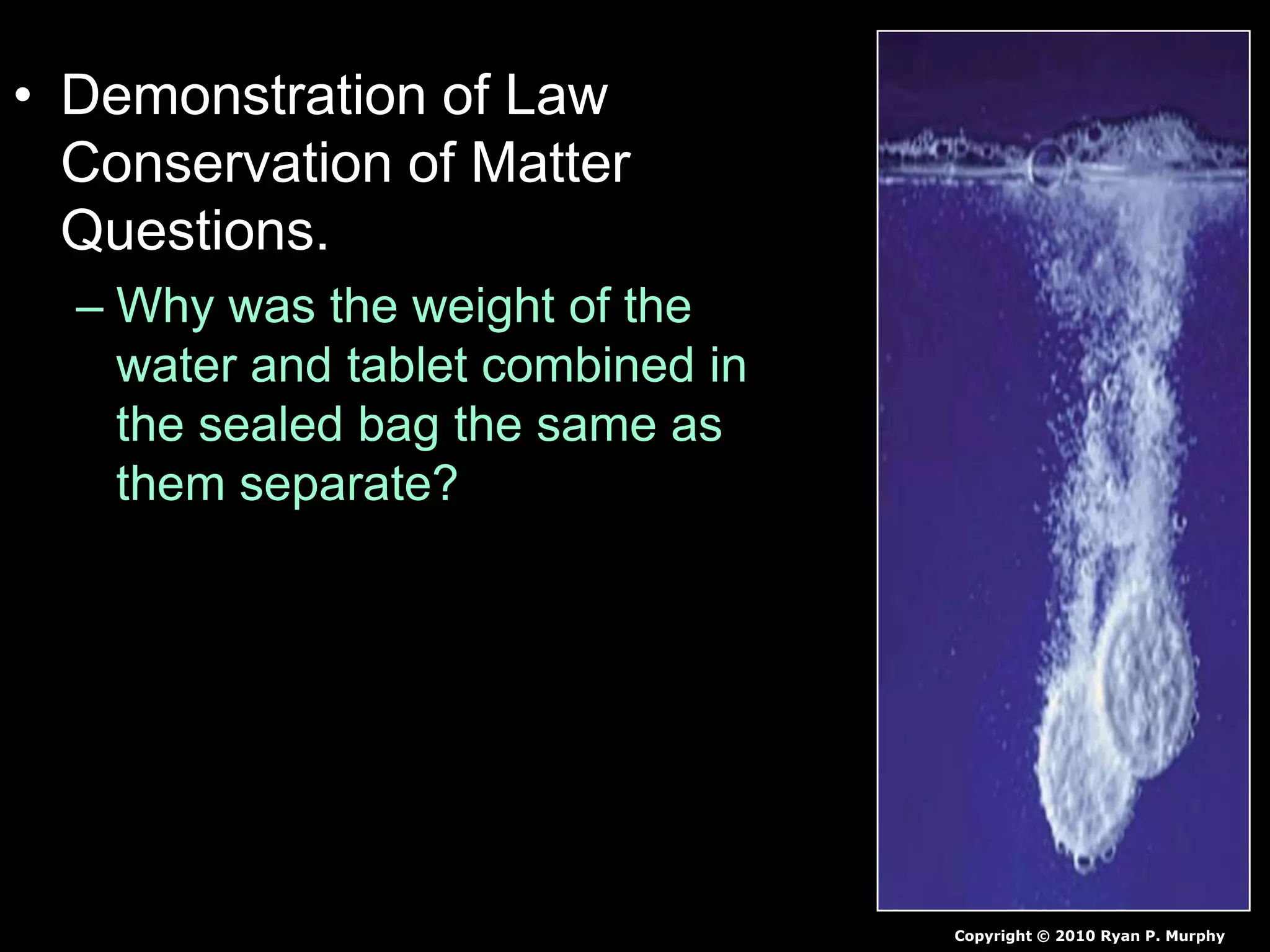
• Demonstration of Law
Conservation of Matter
Questions.
– What happened when the two
mixed?
– Why was the weight of the
water and tablet combined in
the sealed bag the same as
them separate?
– Why did unsealing the bag
decrease the weight of the two
together.
Copyright © 2010 Ryan P. Murphy
• Demonstration of Law
Conservation of Matter
Questions.
– What happened when the two
mixed?
– Why was the weight of the
water and tablet combined in
the sealed bag the same as
them separate?
– Why did unsealing the bag
decrease the weight of the two
together.
Copyright © 2010 Ryan P. Murphy
• Demonstration of Law
Conservation of Matter
Questions.
– What happened when the two
mixed?
– Why was the weight of the
water and tablet combined in
the sealed bag the same as
them separate?
– Why did unsealing the bag
decrease the weight of the two
together.
Copyright © 2010 Ryan P. Murphy
• Demonstration of Law
Conservation of Matter
Questions.
– What happened when the two
mixed?
– Why was the weight of the
water and tablet combined in
the sealed bag the same as
them separate?
– Why did unsealing the bag
decrease the weight of the two
together?
Copyright © 2010 Ryan P. Murphy
• Demonstration of Law
Conservation of Matter
Questions.
Copyright © 2010 Ryan P. Murphy
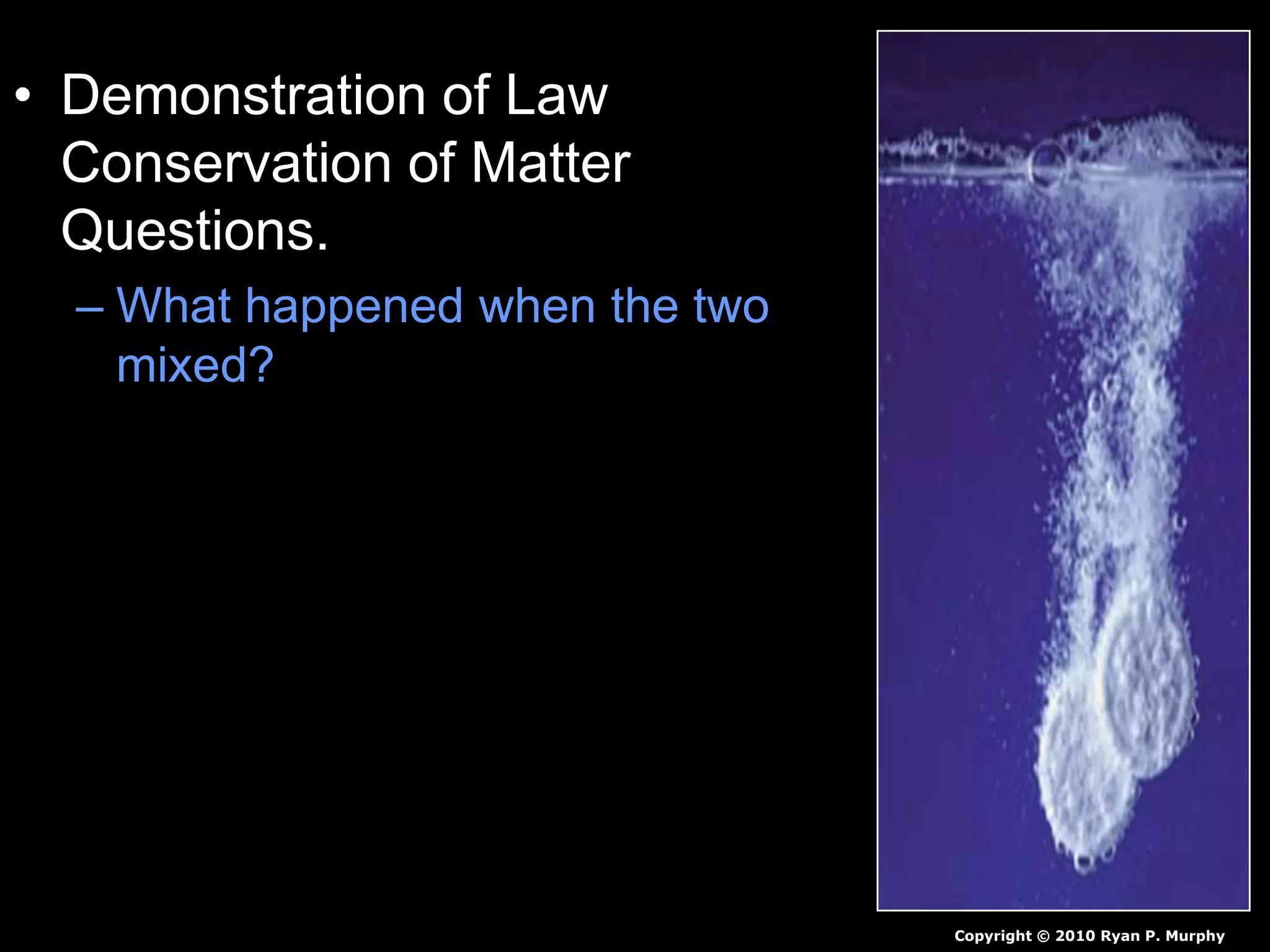
• Demonstration of Law
Conservation of Matter
Questions.
– What happened when the two
mixed?
Copyright © 2010 Ryan P. Murphy
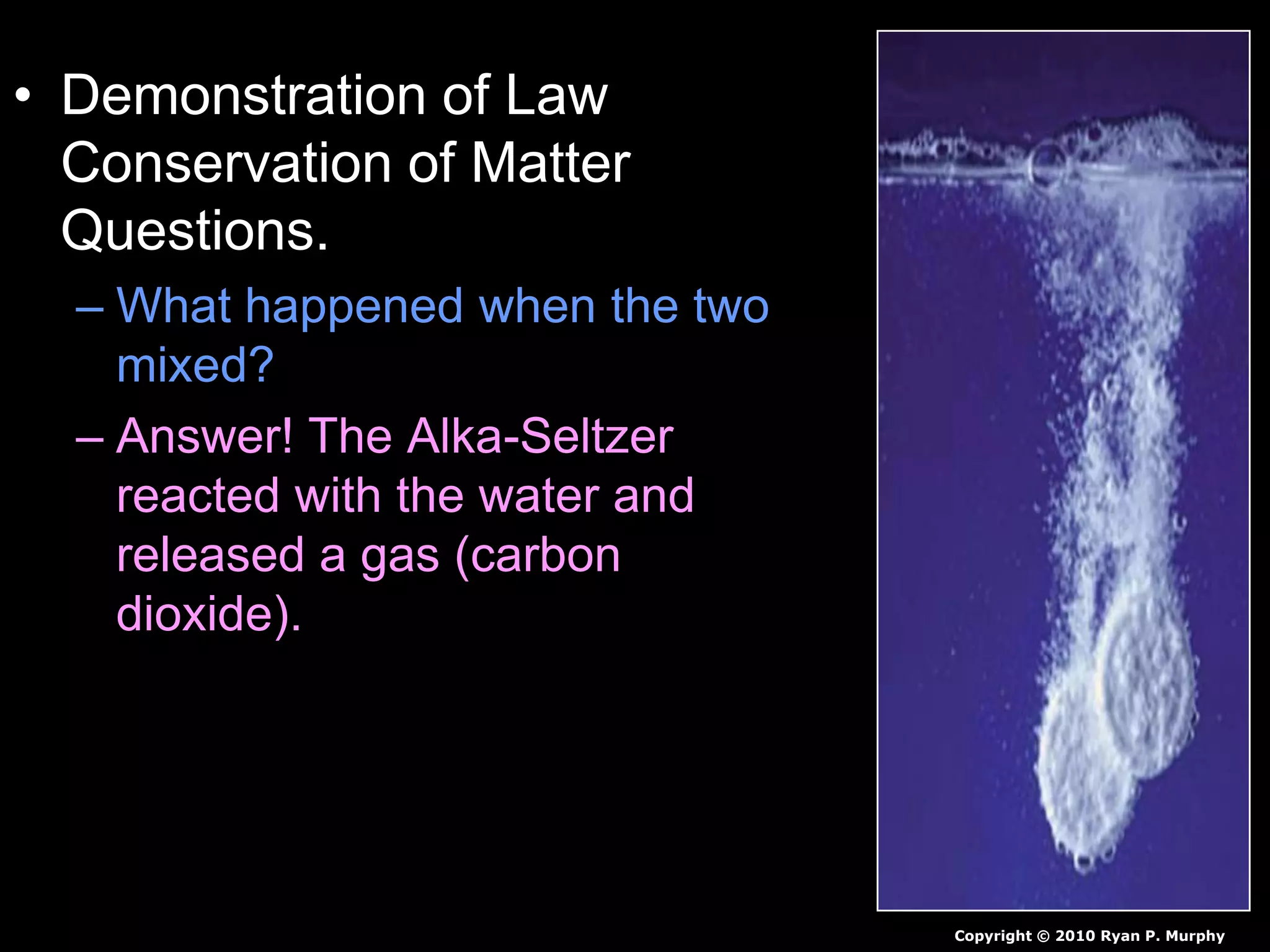
• Demonstration of Law
Conservation of Matter
Questions.
– What happened when the two
mixed?
– Answer! The Alka-Seltzer
reacted with the water and
released a gas (carbon
dioxide).
Copyright © 2010 Ryan P. Murphy
• Demonstration of Law
Conservation of Matter
Questions.
Copyright © 2010 Ryan P. Murphy
• Demonstration of Law
Conservation of Matter
Questions.
– Why was the weight of the
water and tablet combined in
the sealed bag the same as
them separate?
Copyright © 2010 Ryan P. Murphy
• Demonstration of Law
Conservation of Matter
Questions.
– Why was the weight of the
water and tablet combined in
the sealed bag the same as
them separate?
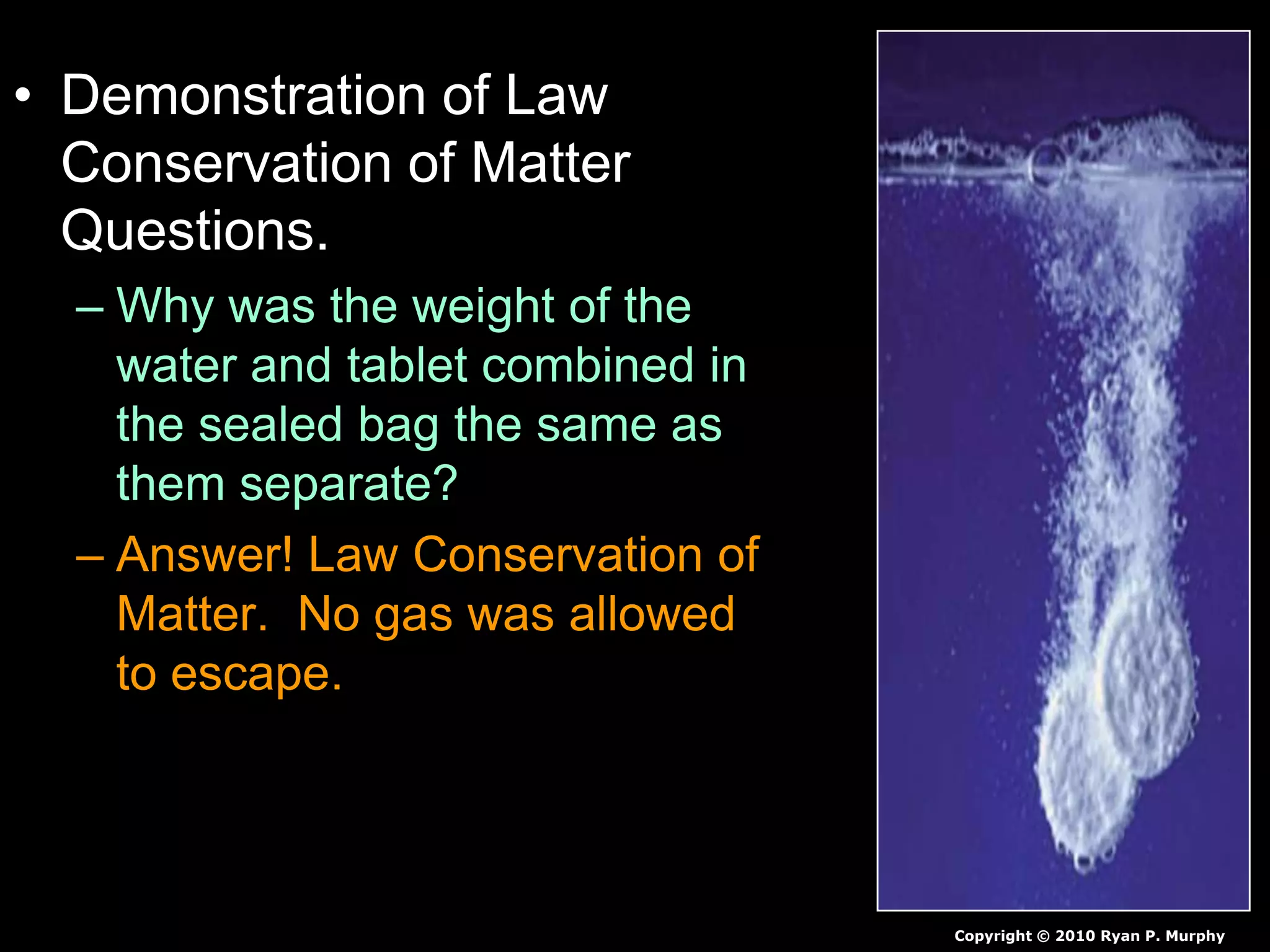
– Answer! Law Conservation of
Matter. No gas was allowed
to escape.
Copyright © 2010 Ryan P. Murphy
• Demonstration of Law
Conservation of Matter
Questions.
Copyright © 2010 Ryan P. Murphy
• Demonstration of Law
Conservation of Matter
Questions.
– Why did unsealing the bag
decrease the weight of the two
together?
Copyright © 2010 Ryan P. Murphy
• Demonstration of Law
Conservation of Matter
Questions.
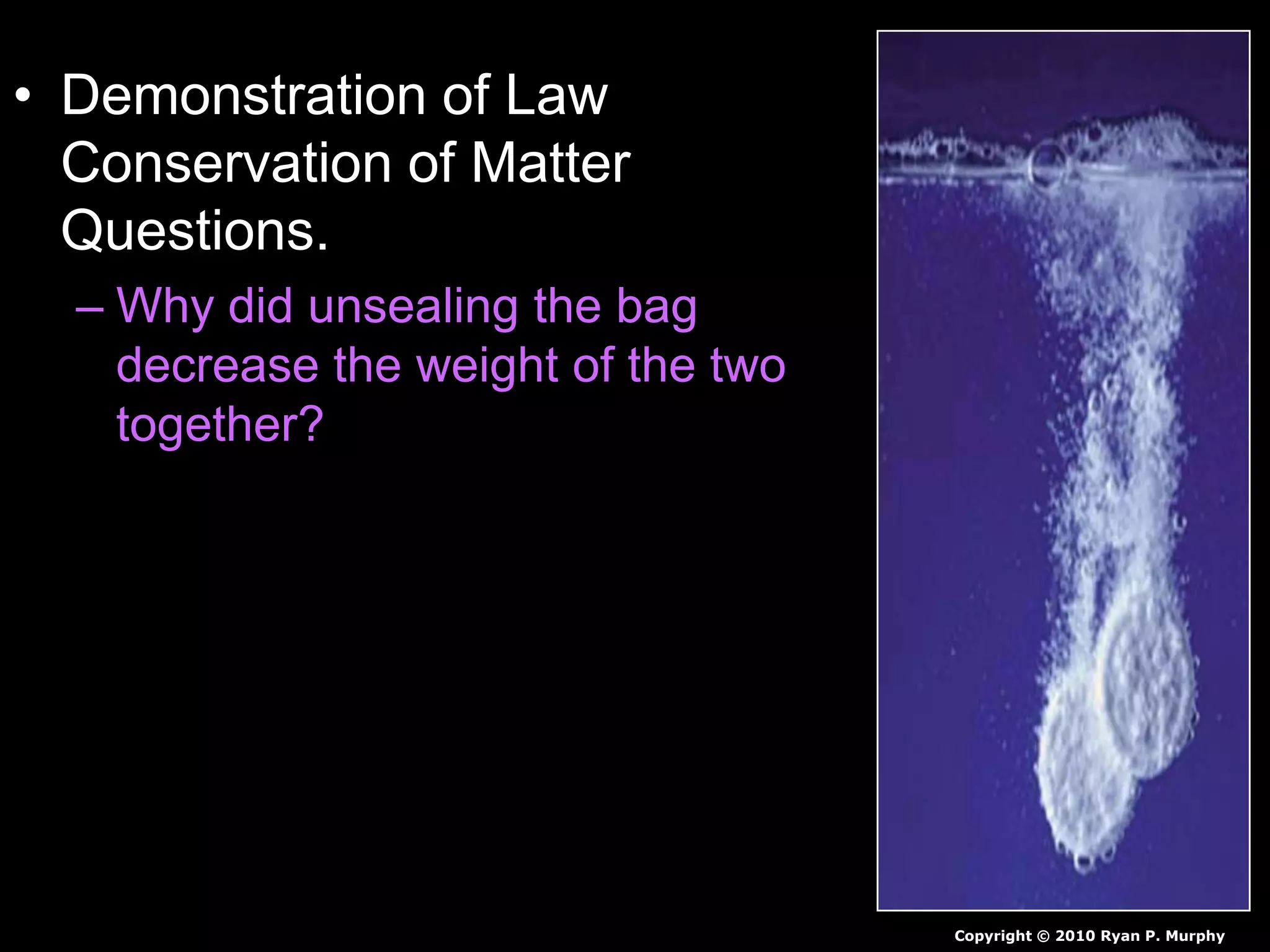
– Why did unsealing the bag
decrease the weight of the two
together?
– Answer! The carbon dioxide
gas was allowed to escape
into the air which wasn’t
recorded mass.
Copyright © 2010 Ryan P. Murphy
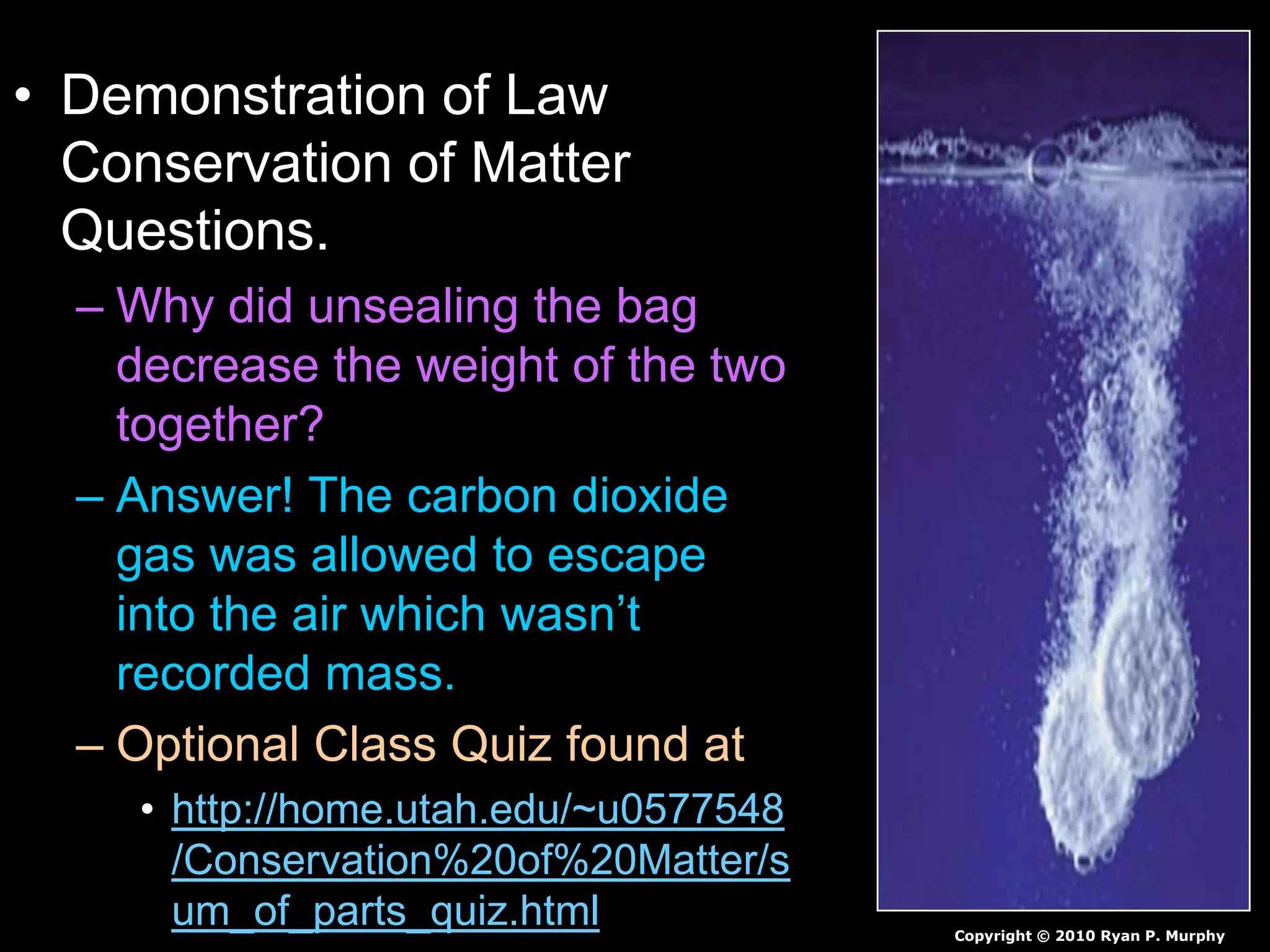
• Demonstration of Law
Conservation of Matter
Questions.
– Why did unsealing the bag
decrease the weight of the two
together?
– Answer! The carbon dioxide
gas was allowed to escape
into the air which wasn’t
recorded mass.
– Optional Class Quiz found at
• http://home.utah.edu/~u0577548
/Conservation%20of%20Matter/s
um_of_parts_quiz.html Copyright © 2010 Ryan P. Murphy
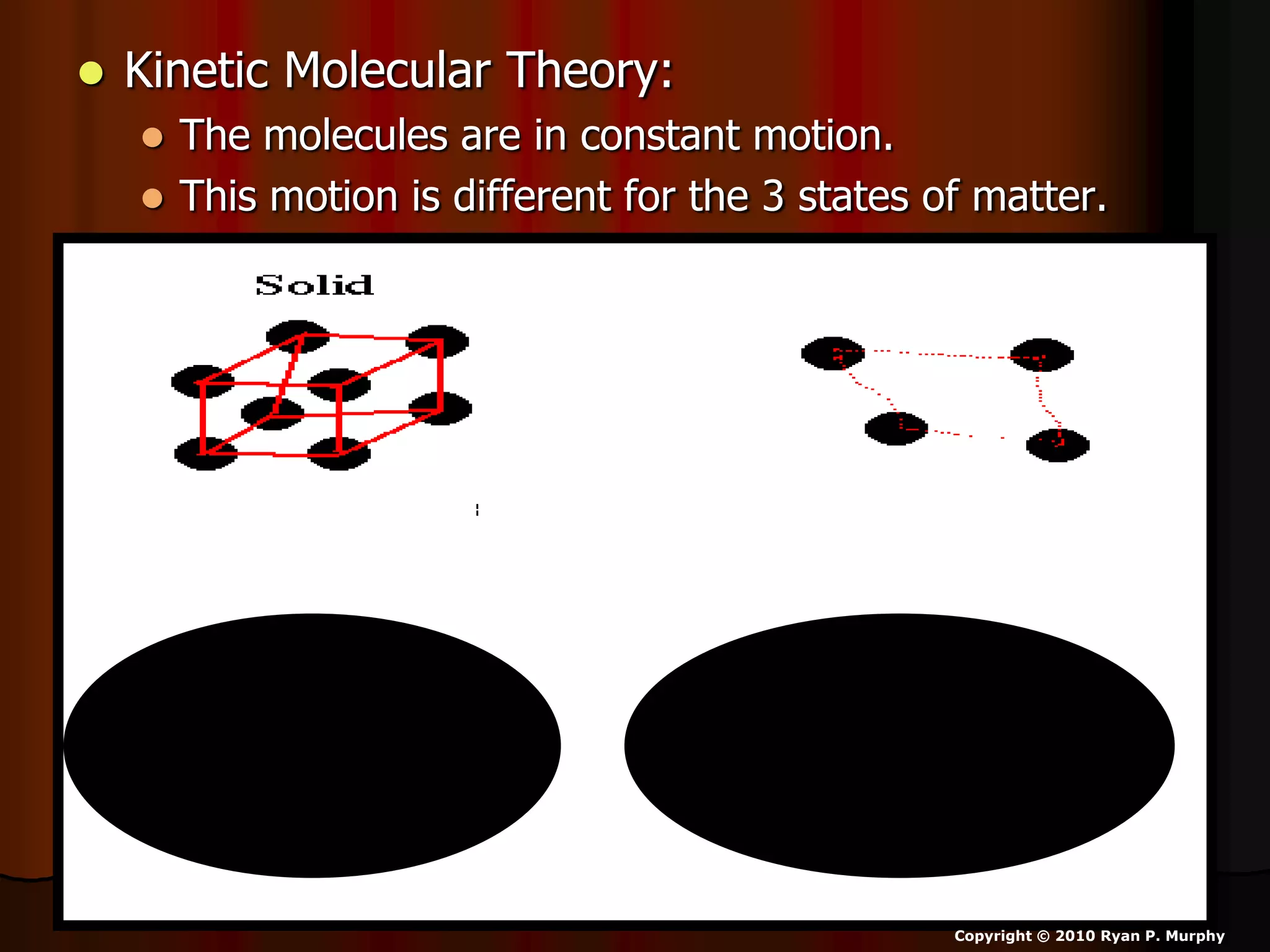
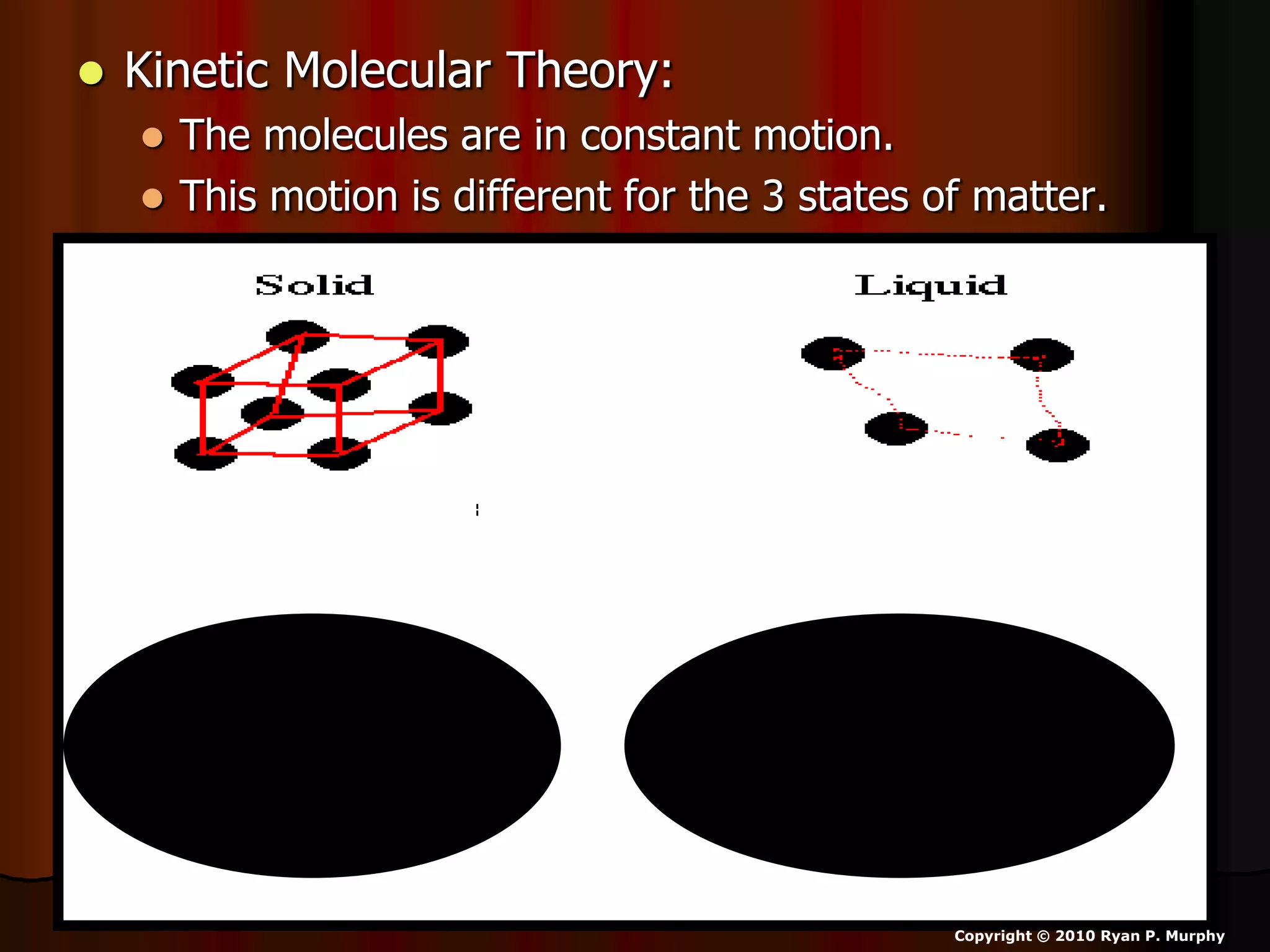
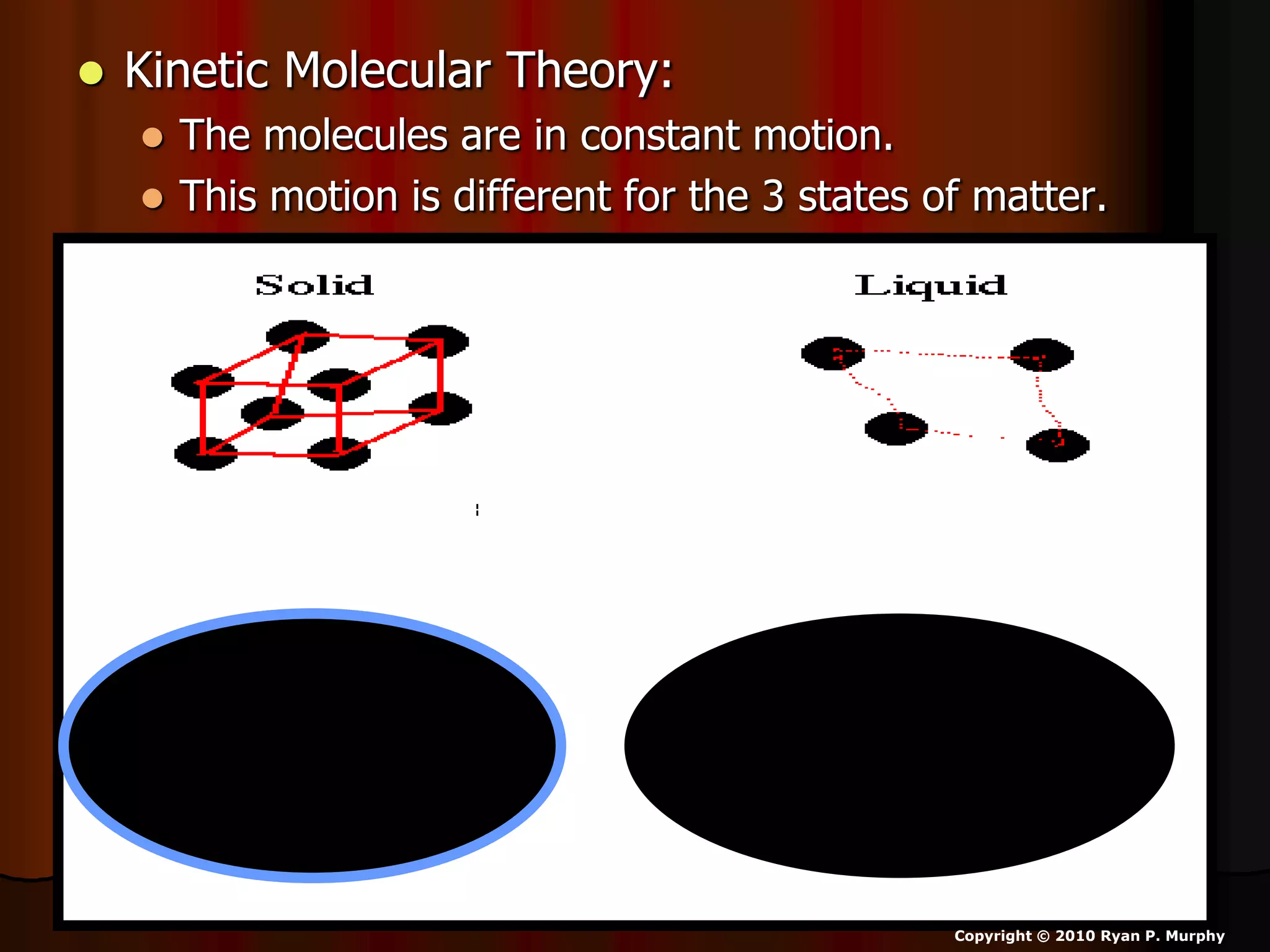
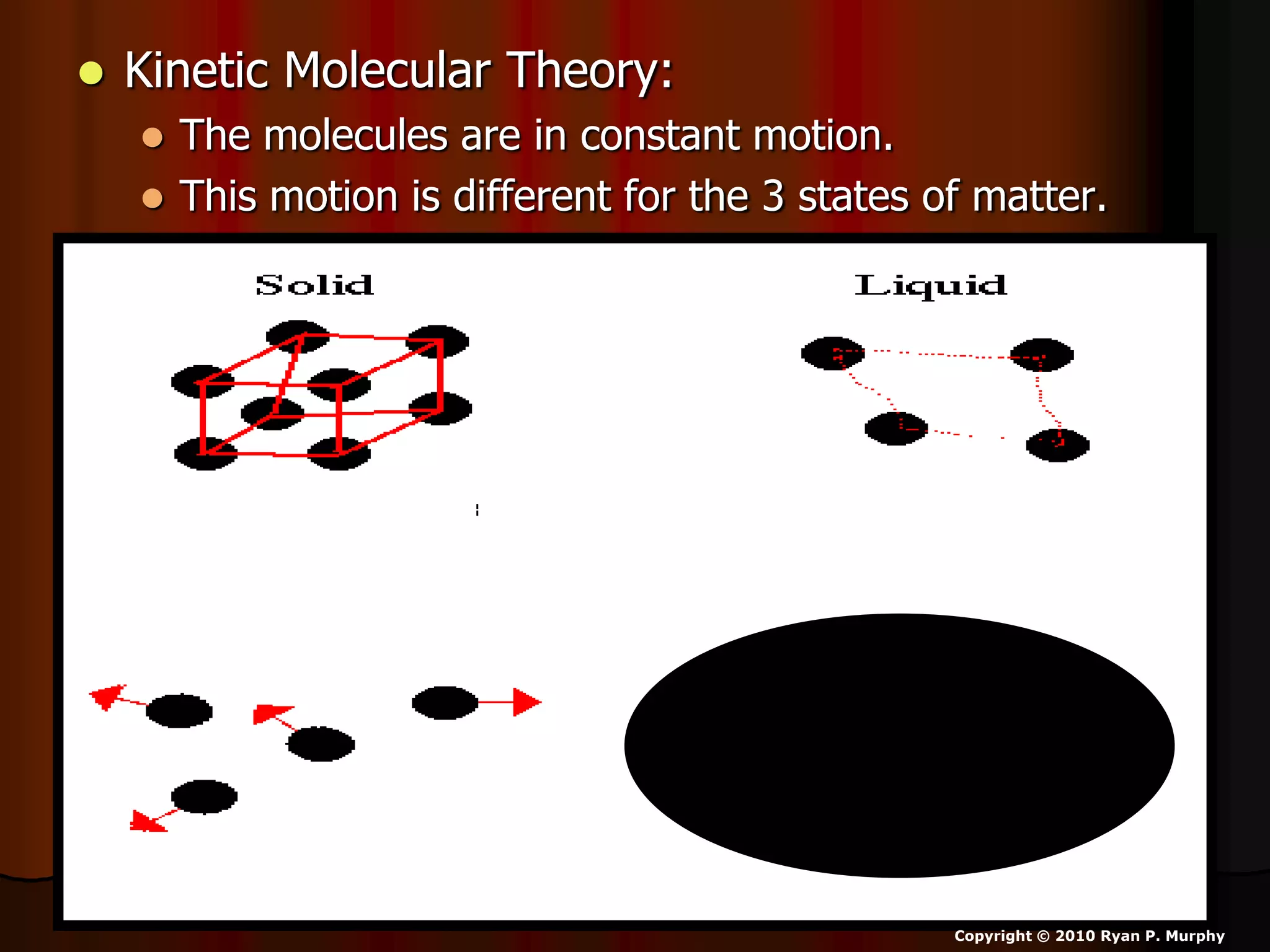
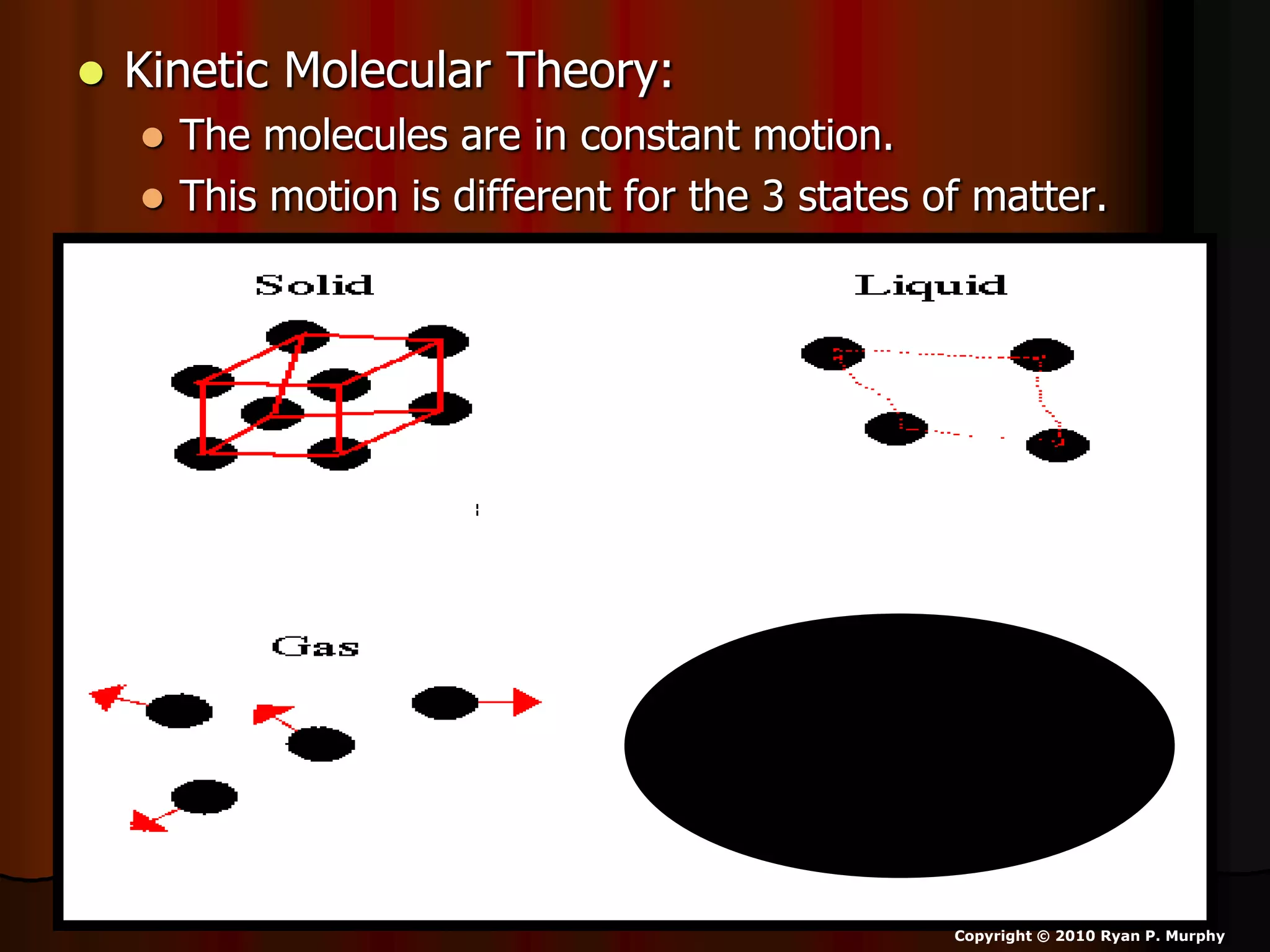
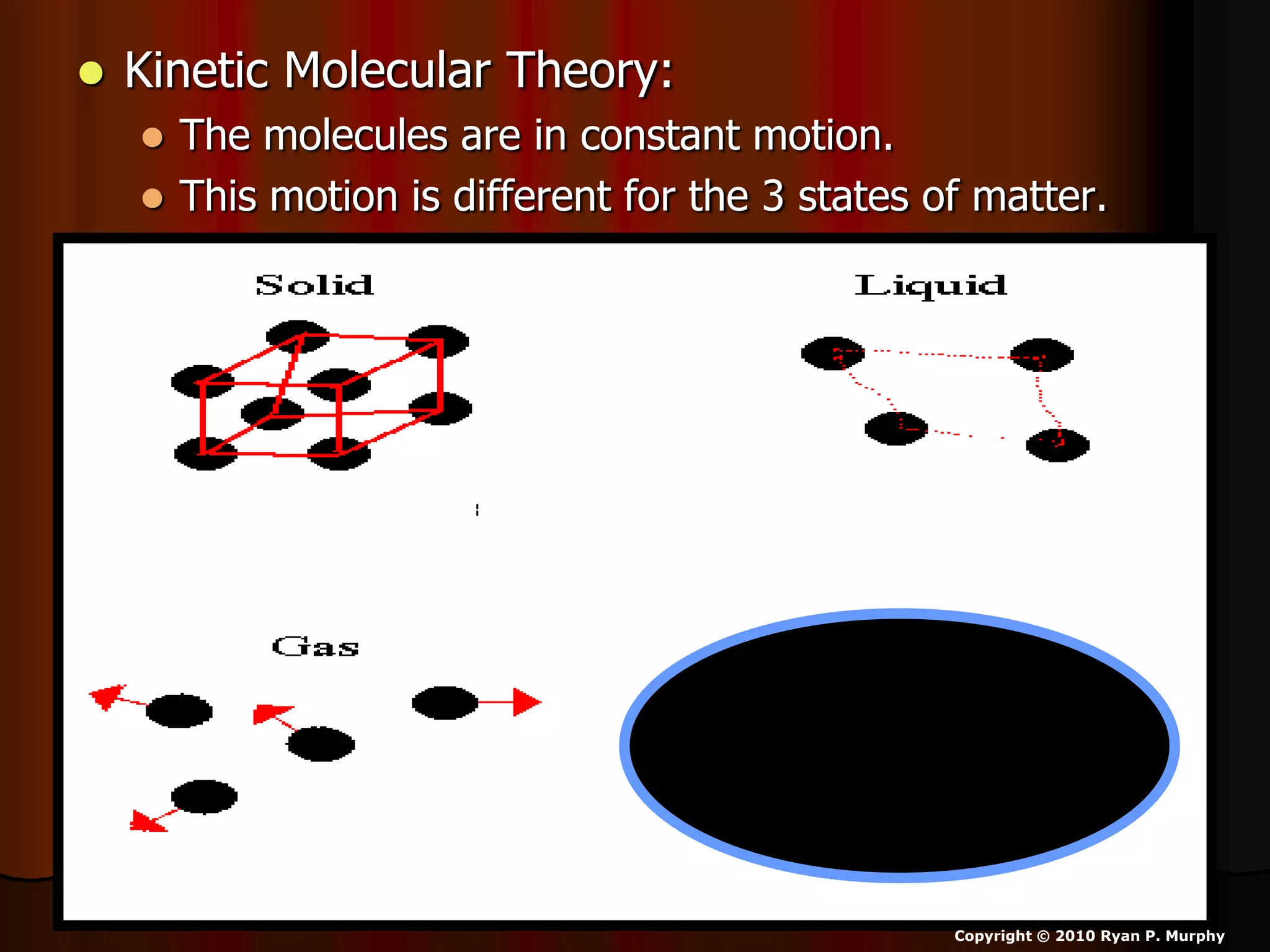
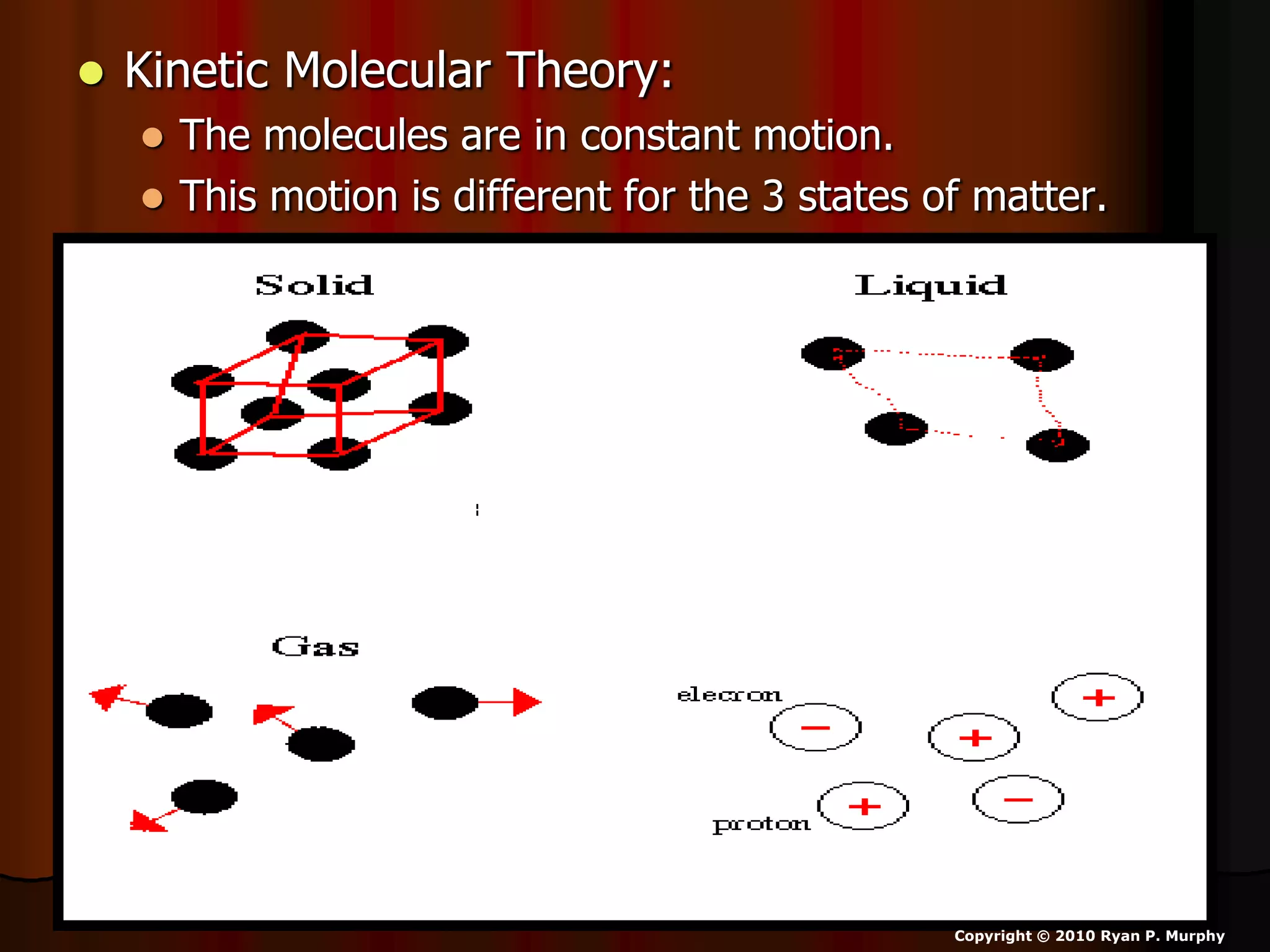
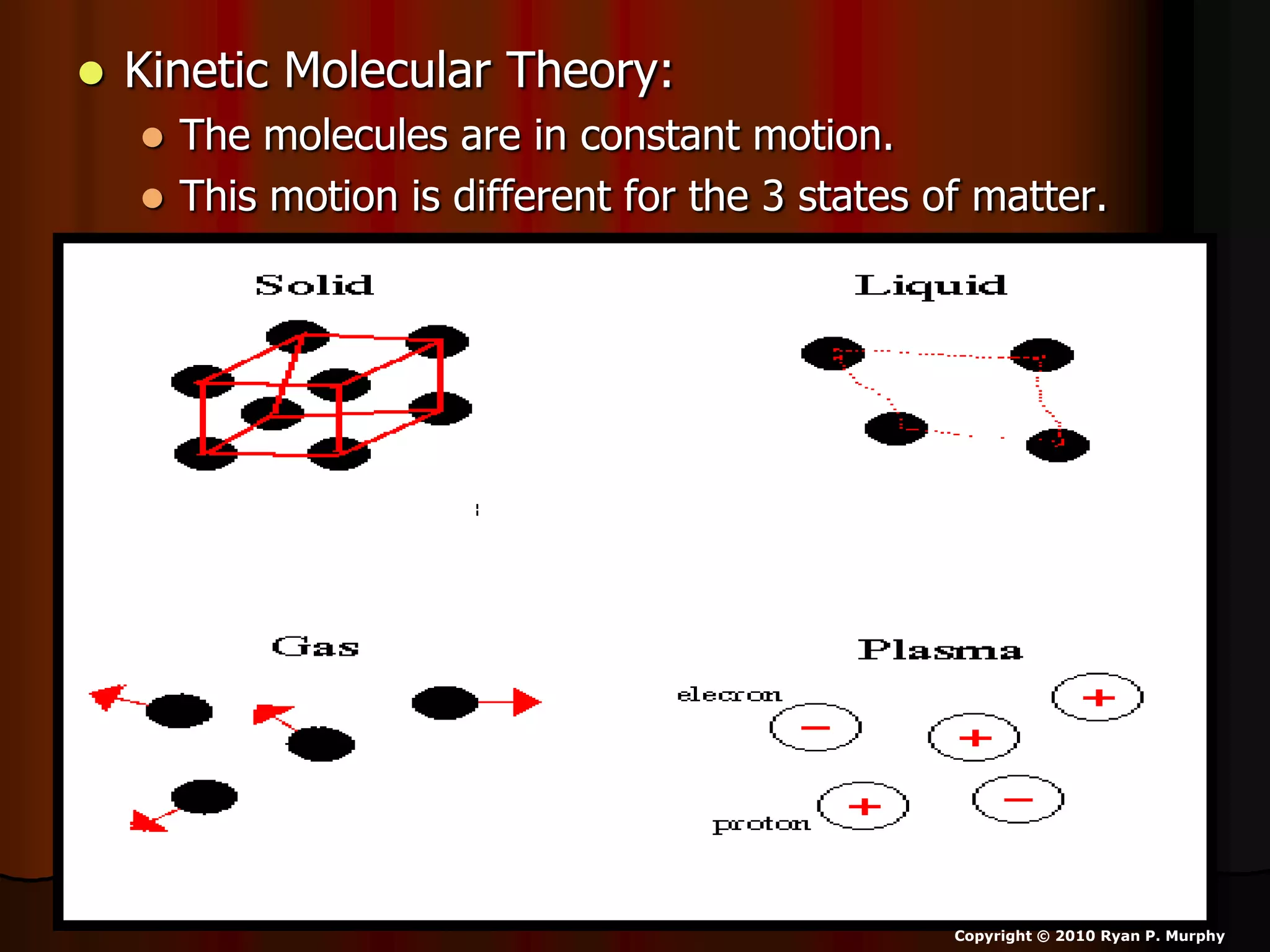
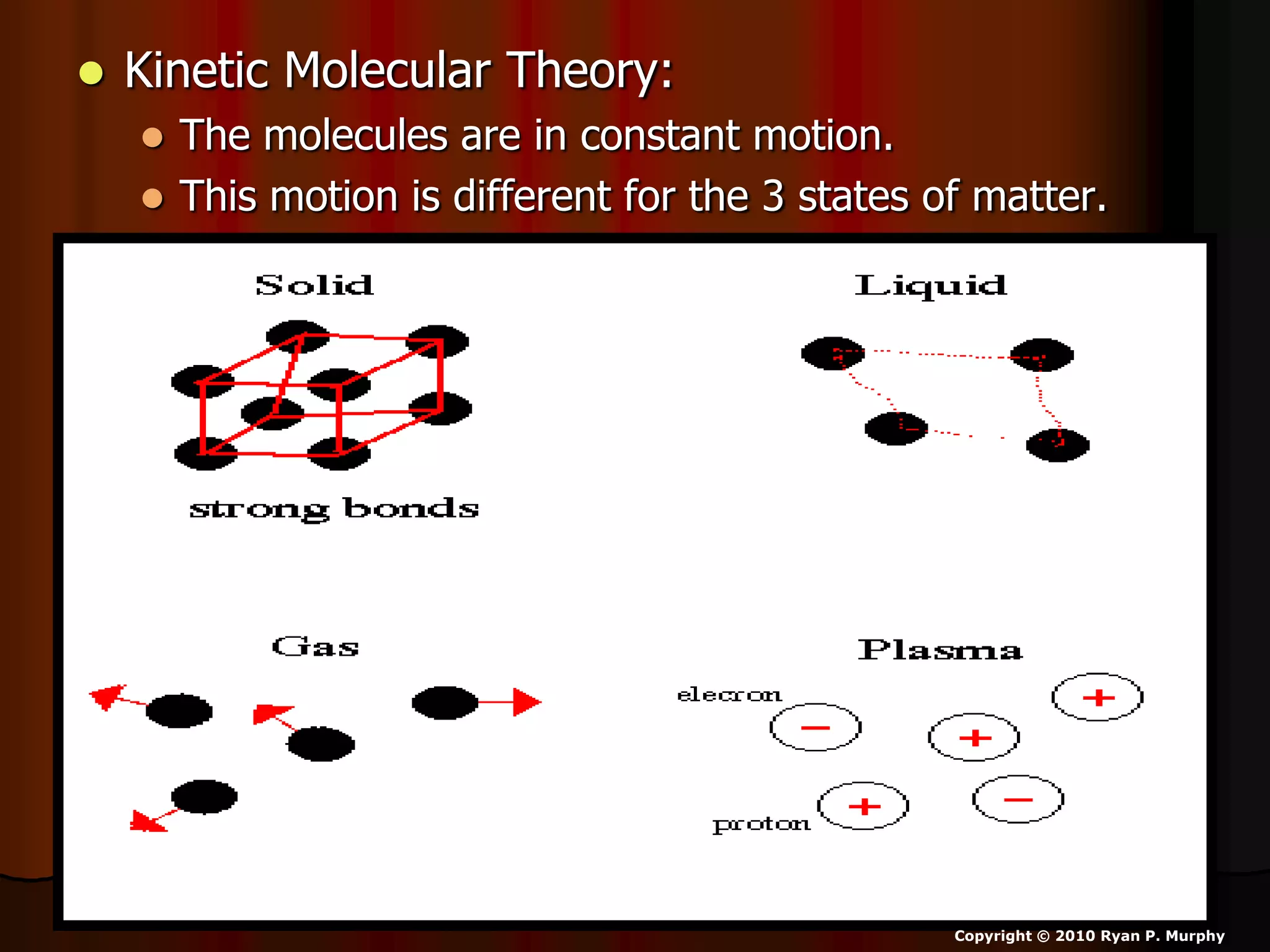
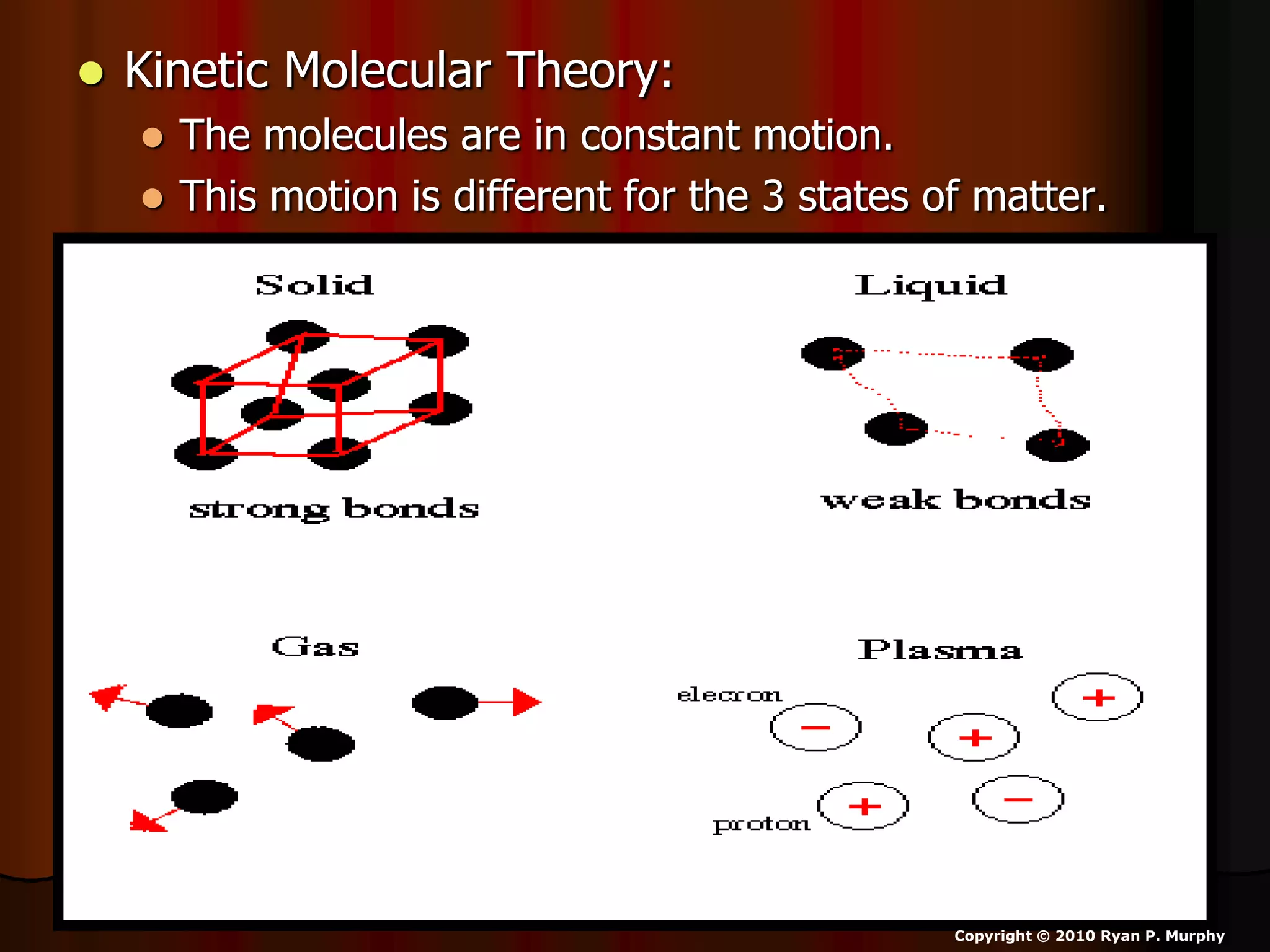
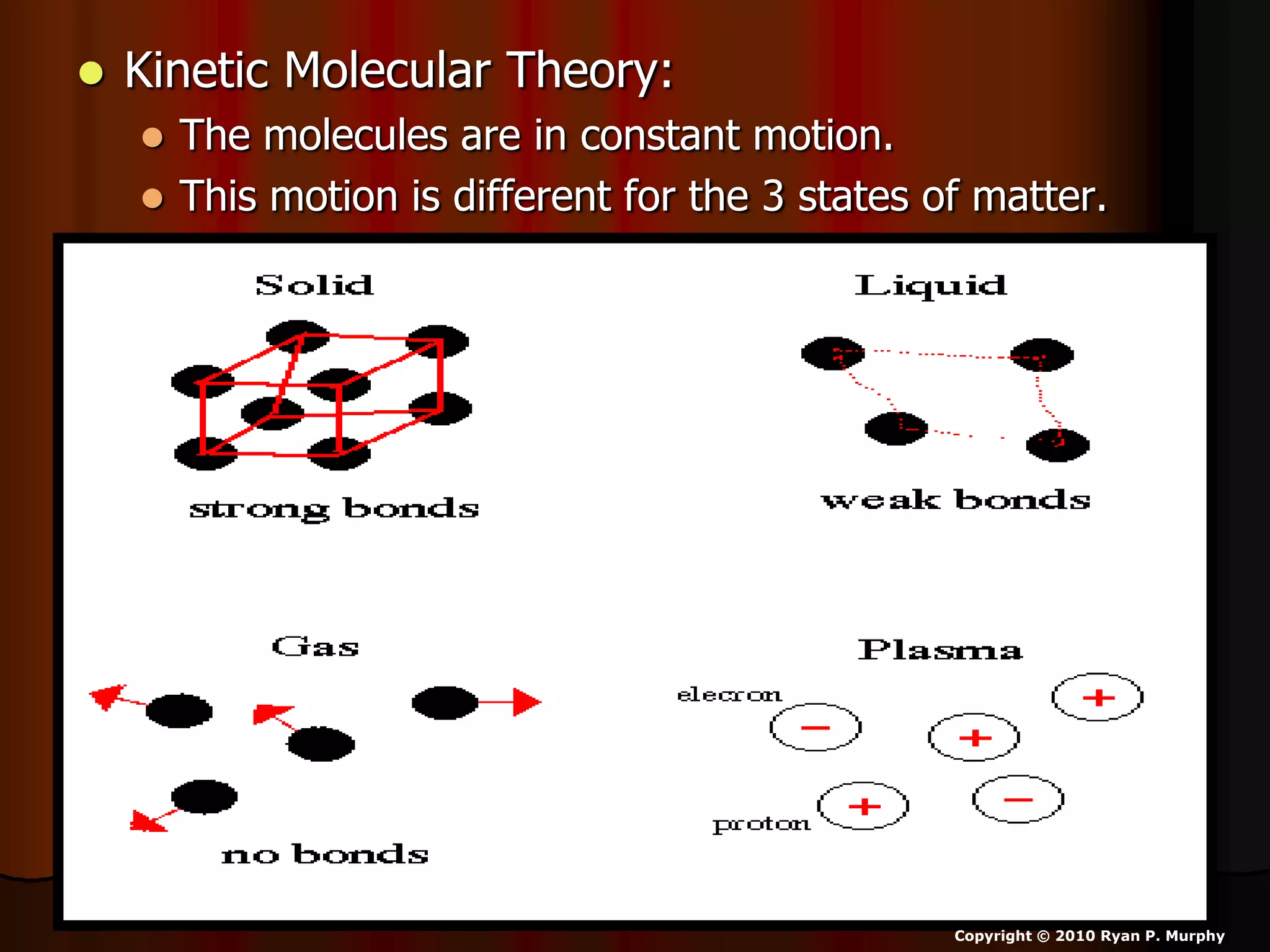
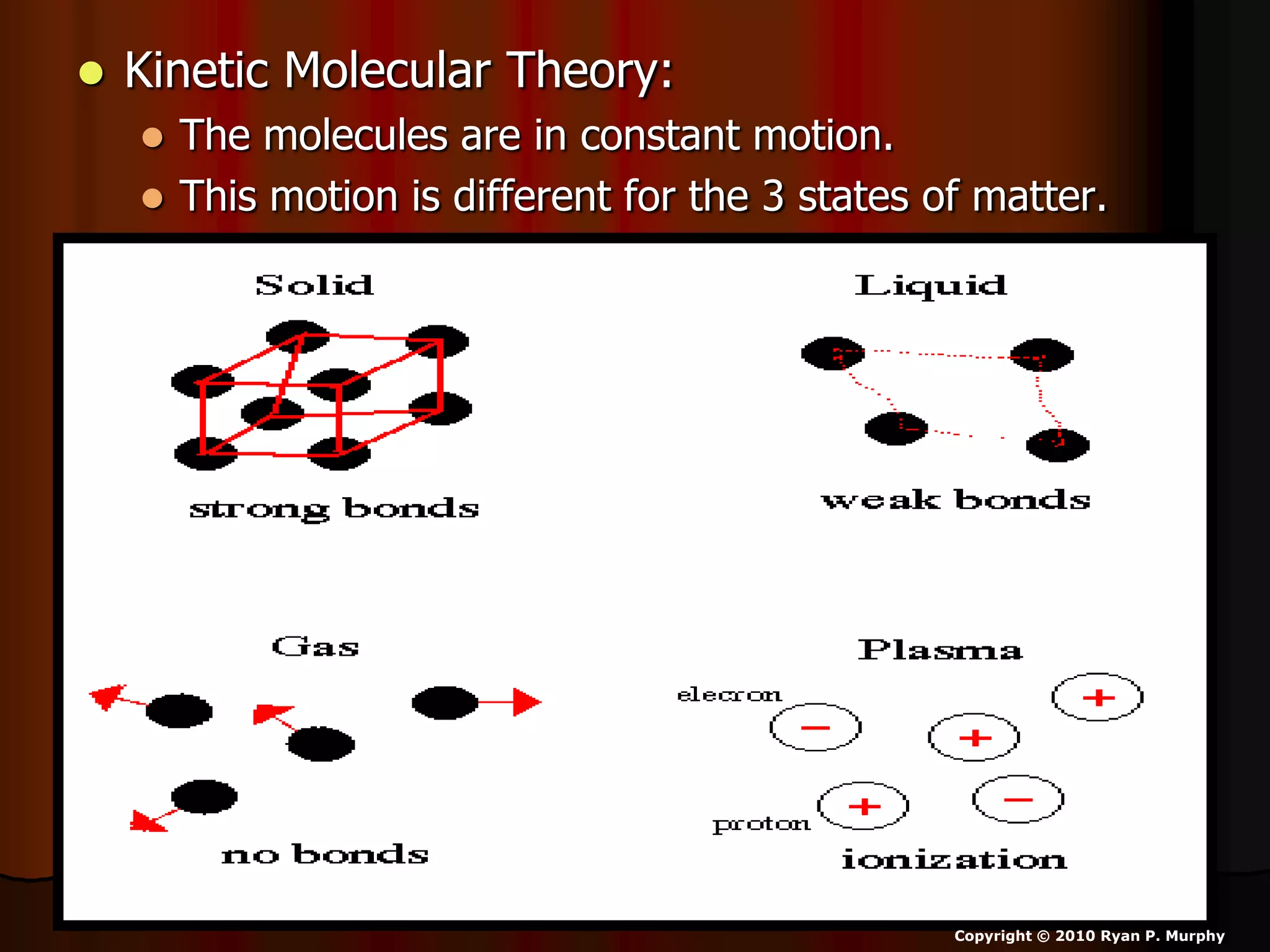
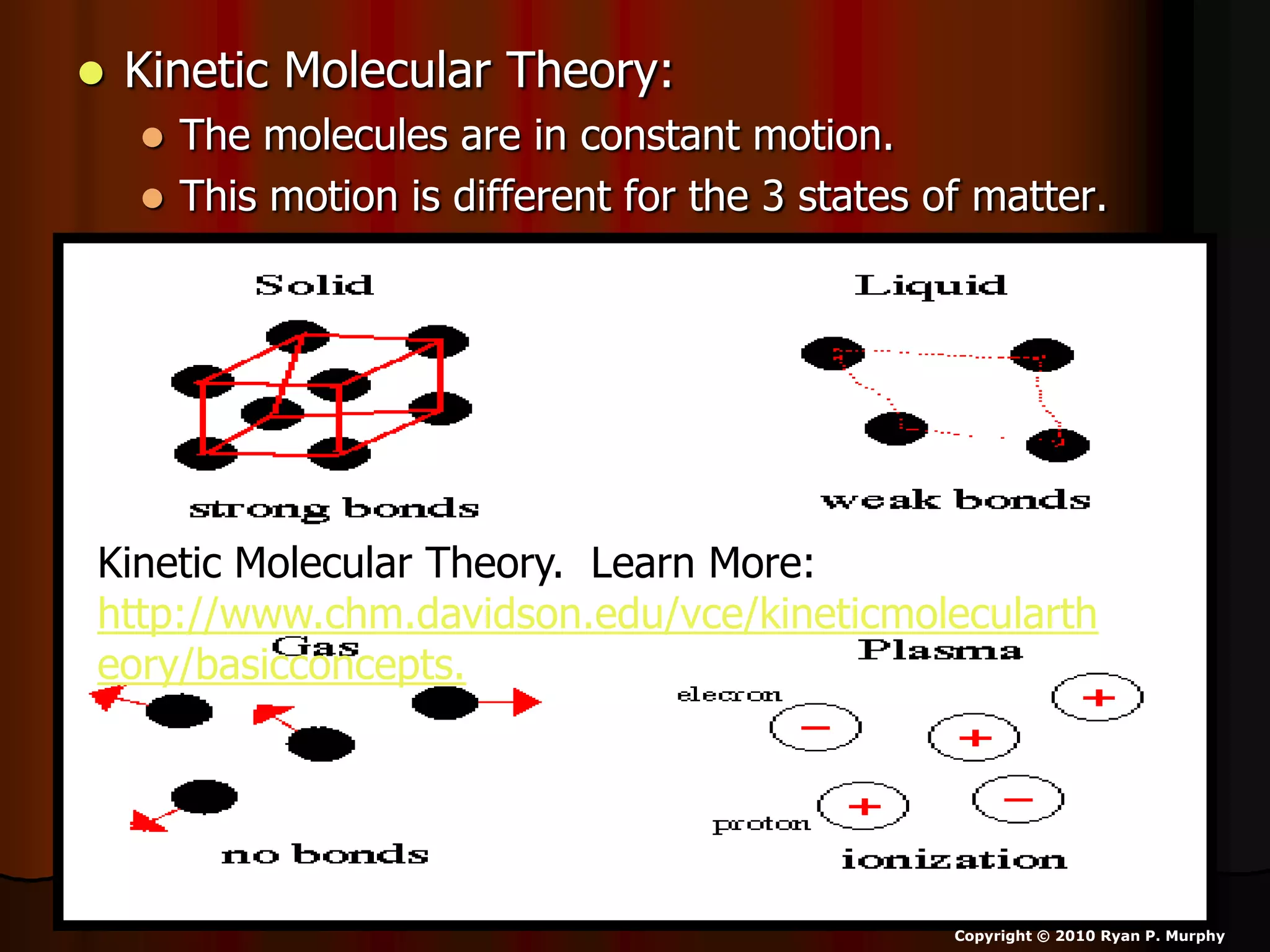
 Kinetic Molecular Theory:
 The molecules are in constant motion.
 This motion is different for the 3 states of matter.
Copyright © 2010 Ryan P. Murphy
 Kinetic Molecular Theory:
 The molecules are in constant motion.
 This motion is different for the 3 states of matter.
Copyright © 2010 Ryan P. Murphy
 Kinetic Molecular Theory:
 The molecules are in constant motion.
 This motion is different for the 3 states of matter.
Copyright © 2010 Ryan P. Murphy
 Kinetic Molecular Theory:
 The molecules are in constant motion.
 This motion is different for the 3 states of matter.
Copyright © 2010 Ryan P. Murphy
What are the
states of
matter?
 Kinetic Molecular Theory:
 The molecules are in constant motion.
 This motion is different for the 3 states of matter.
Copyright © 2010 Ryan P. Murphy
 Kinetic Molecular Theory:
 The molecules are in constant motion.
 This motion is different for the 3 states of matter.
Copyright © 2010 Ryan P. Murphy
 Kinetic Molecular Theory:
 The molecules are in constant motion.
 This motion is different for the 3 states of matter.
Copyright © 2010 Ryan P. Murphy
 Kinetic Molecular Theory:
 The molecules are in constant motion.
 This motion is different for the 3 states of matter.
Copyright © 2010 Ryan P. Murphy
 Kinetic Molecular Theory:
 The molecules are in constant motion.
 This motion is different for the 3 states of matter.
Copyright © 2010 Ryan P. Murphy
 Kinetic Molecular Theory:
 The molecules are in constant motion.
 This motion is different for the 3 states of matter.
Copyright © 2010 Ryan P. Murphy
 Kinetic Molecular Theory:
 The molecules are in constant motion.
 This motion is different for the 3 states of matter.
Copyright © 2010 Ryan P. Murphy
 Kinetic Molecular Theory:
 The molecules are in constant motion.
 This motion is different for the 3 states of matter.
Copyright © 2010 Ryan P. Murphy
 Kinetic Molecular Theory:
 The molecules are in constant motion.
 This motion is different for the 3 states of matter.
Copyright © 2010 Ryan P. Murphy
 Kinetic Molecular Theory:
 The molecules are in constant motion.
 This motion is different for the 3 states of matter.
Copyright © 2010 Ryan P. Murphy
 Kinetic Molecular Theory:
 The molecules are in constant motion.
 This motion is different for the 3 states of matter.
Copyright © 2010 Ryan P. Murphy
 Kinetic Molecular Theory:
 The molecules are in constant motion.
 This motion is different for the 3 states of matter.
Copyright © 2010 Ryan P. Murphy
 Kinetic Molecular Theory:
 The molecules are in constant motion.
 This motion is different for the 3 states of matter.
Copyright © 2010 Ryan P. Murphy
 Kinetic Molecular Theory:
 The molecules are in constant motion.
 This motion is different for the 3 states of matter.
Copyright © 2010 Ryan P. Murphy
 Kinetic Molecular Theory:
 The molecules are in constant motion.
 This motion is different for the 3 states of matter.
Copyright © 2010 Ryan P. Murphy
 Kinetic Molecular Theory:
 The molecules are in constant motion.
 This motion is different for the 3 states of matter.
Copyright © 2010 Ryan P. Murphy
 Kinetic Molecular Theory:
 The molecules are in constant motion.
 This motion is different for the 3 states of matter.
Copyright © 2010 Ryan P. Murphy
Kinetic Molecular Theory. Learn More:
http://www.chm.davidson.edu/vce/kineticmolecularth
eory/basicconcepts.
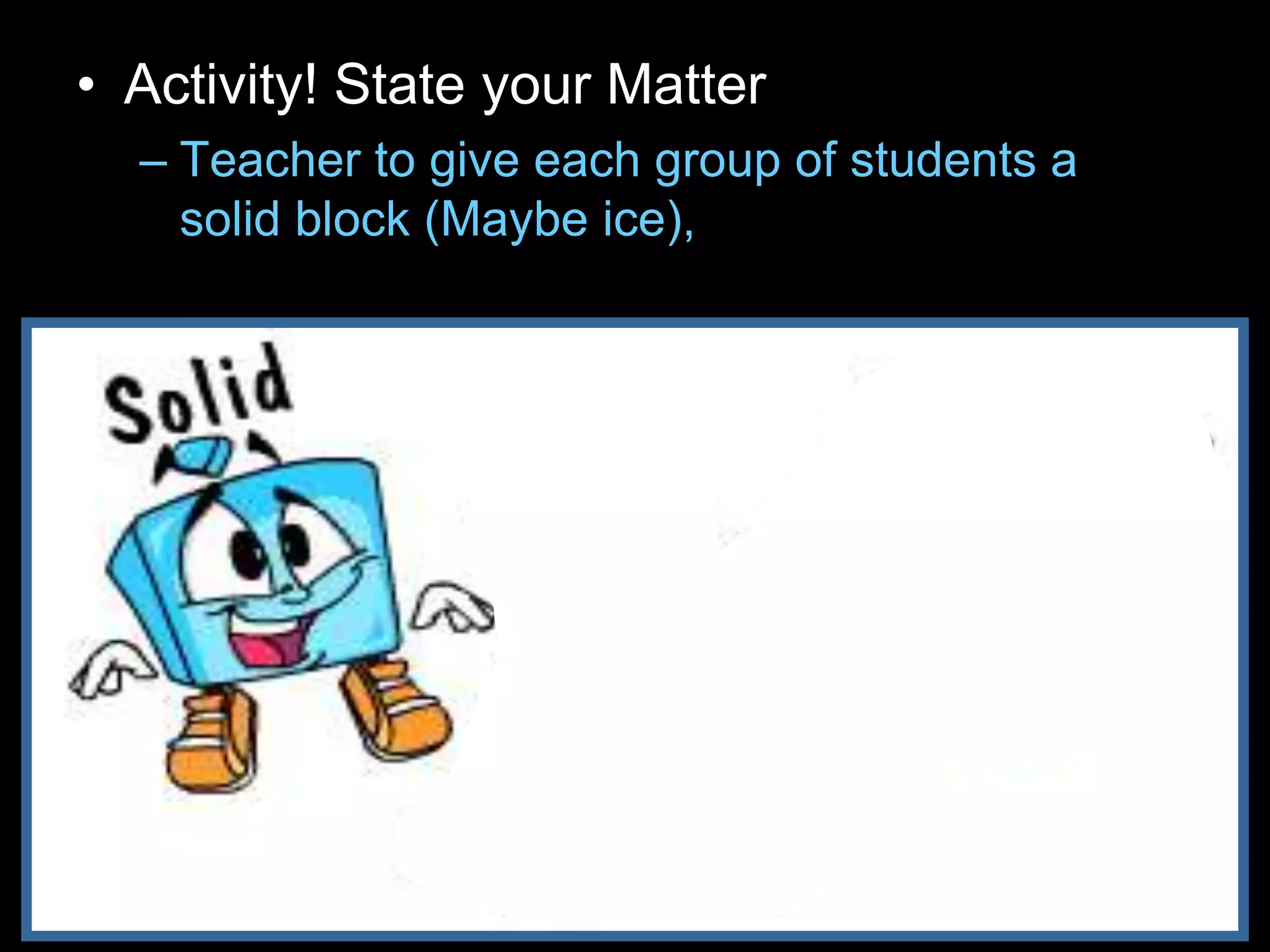
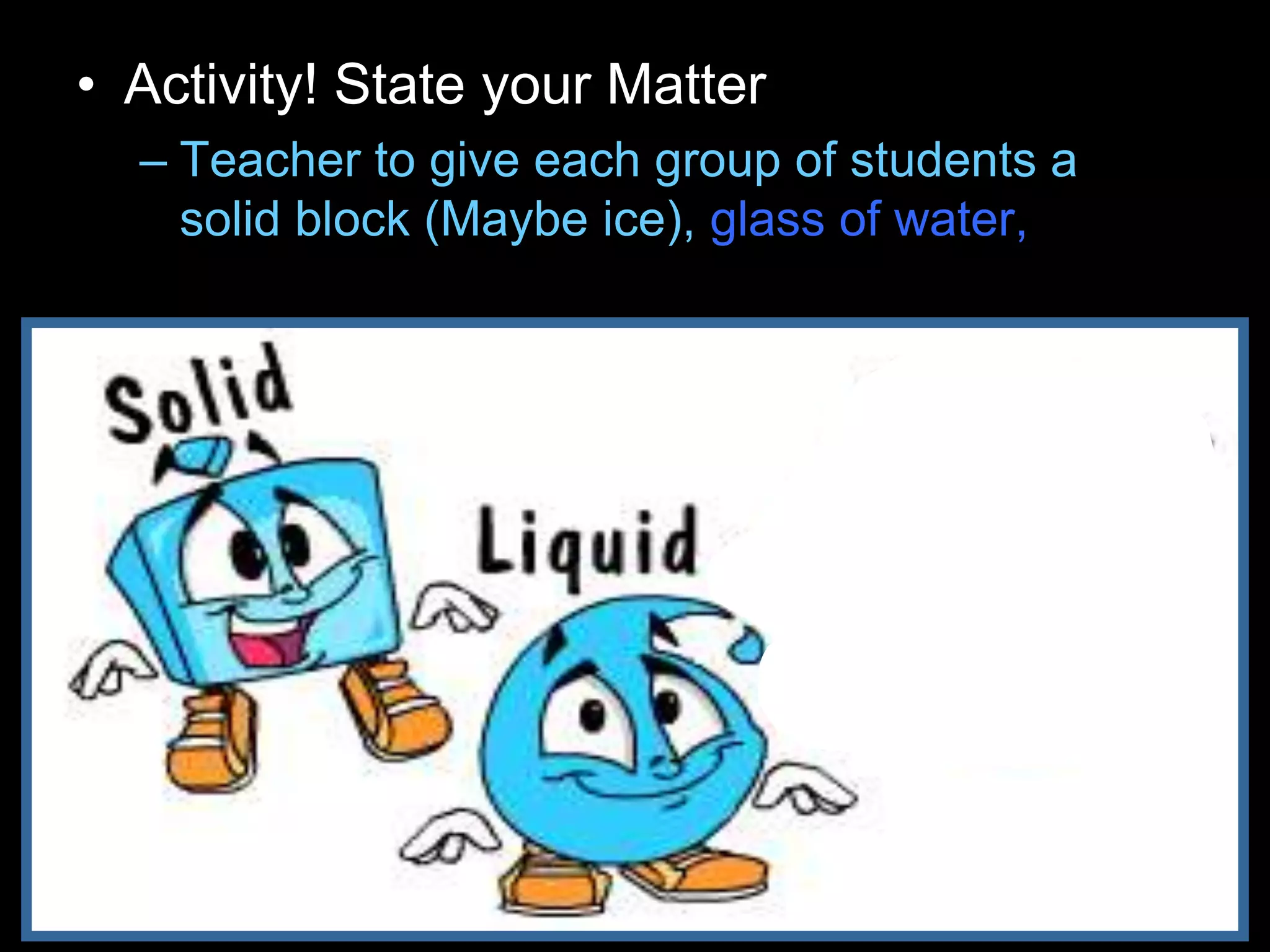
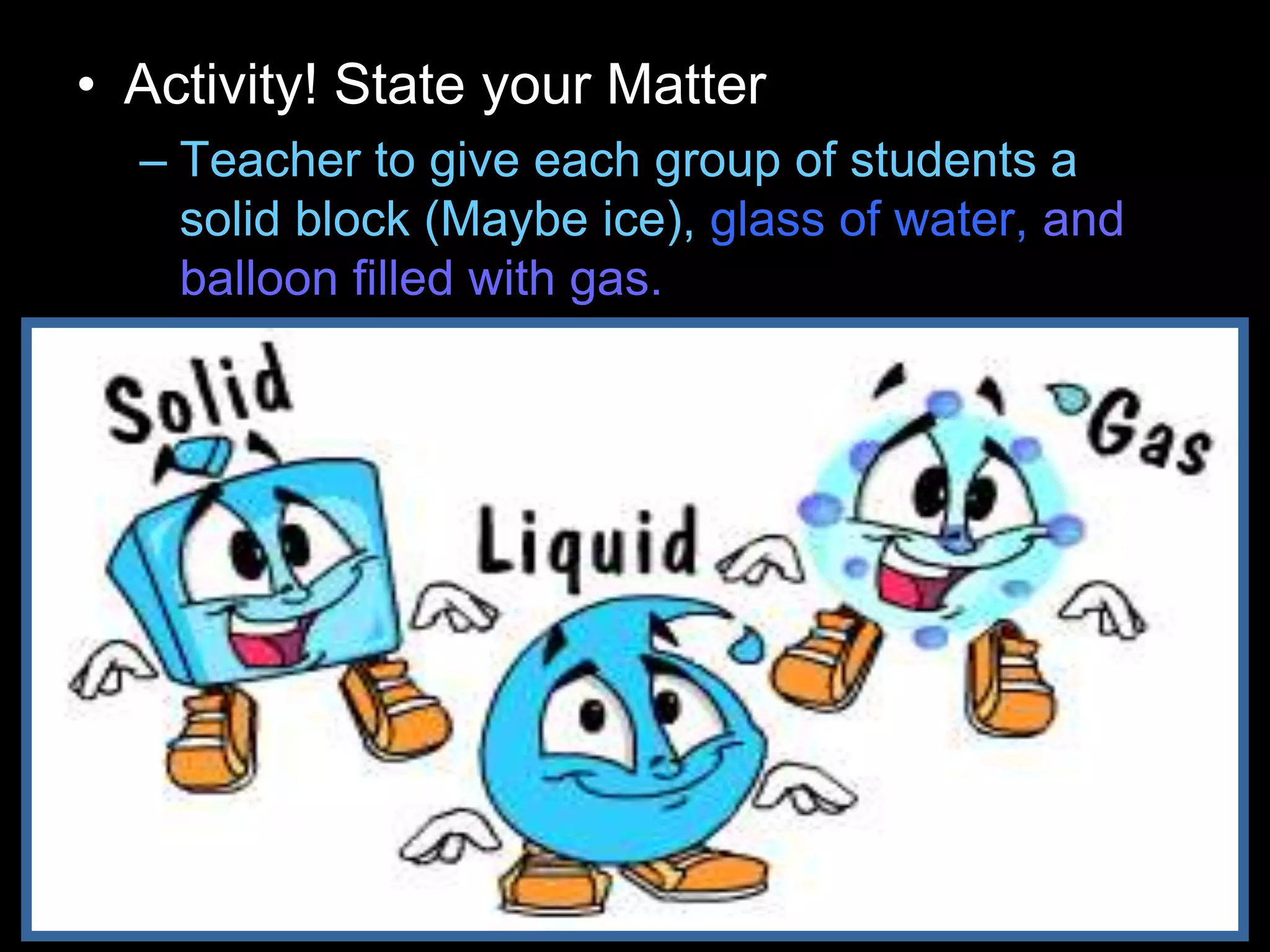
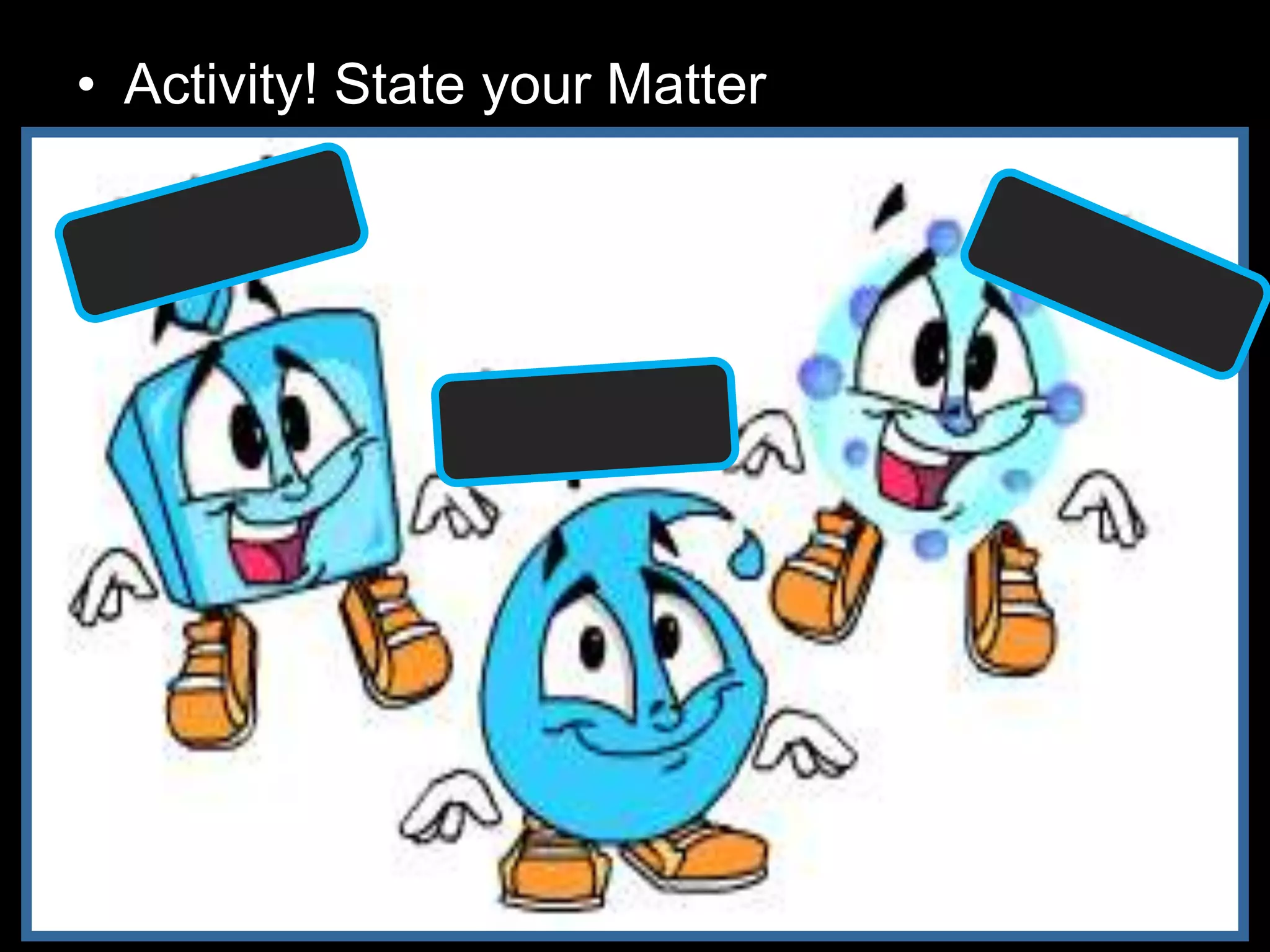
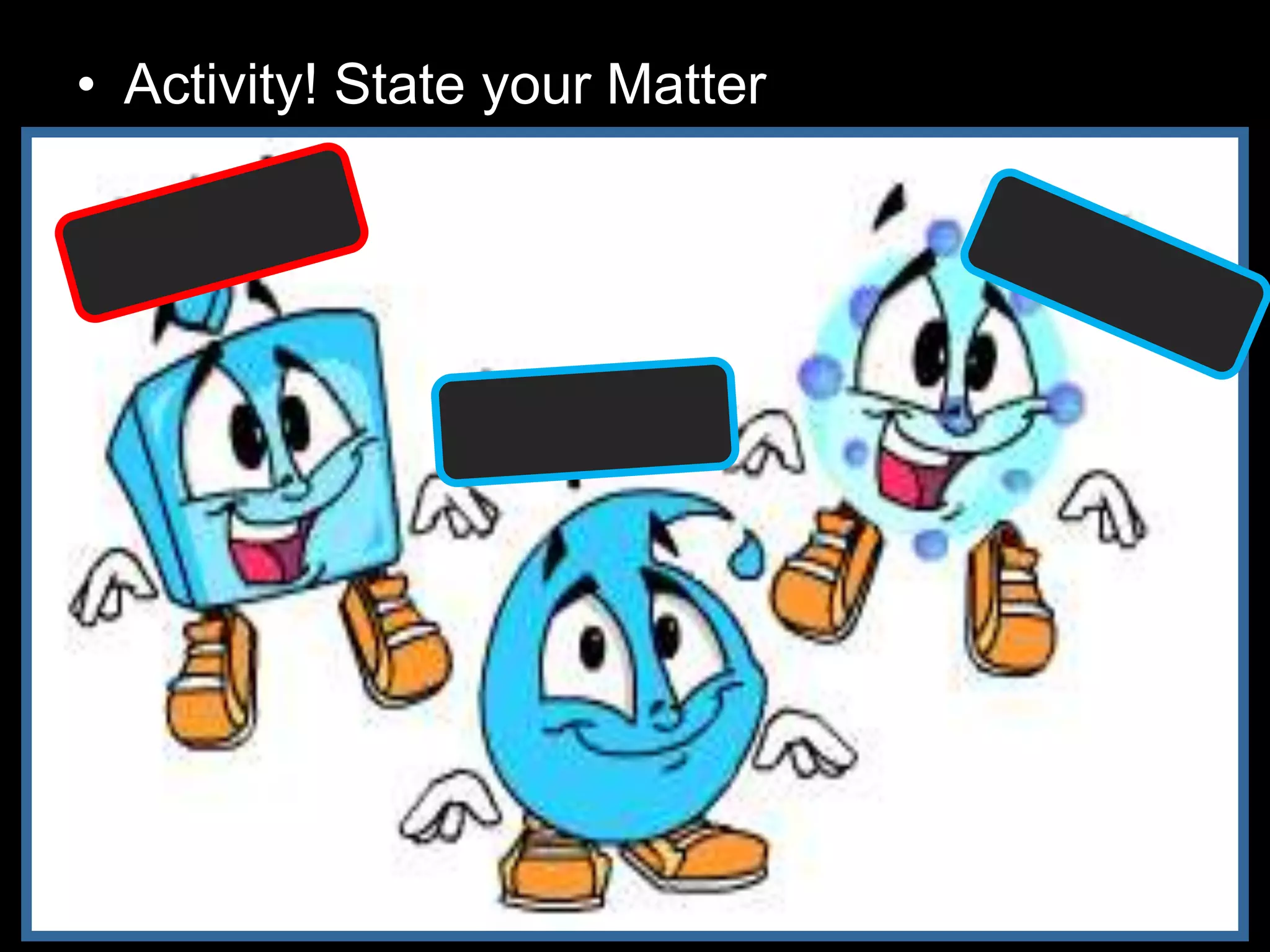
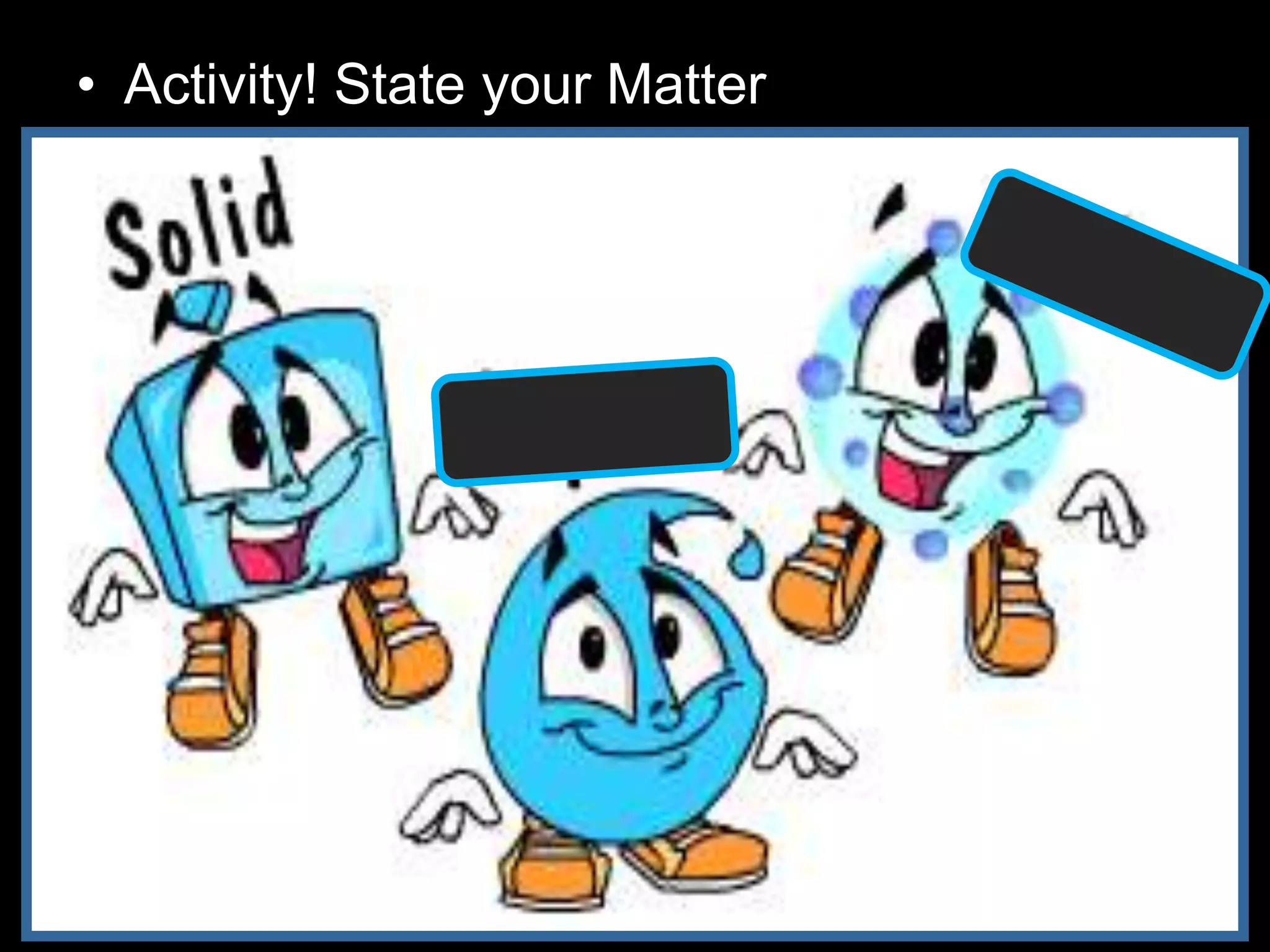
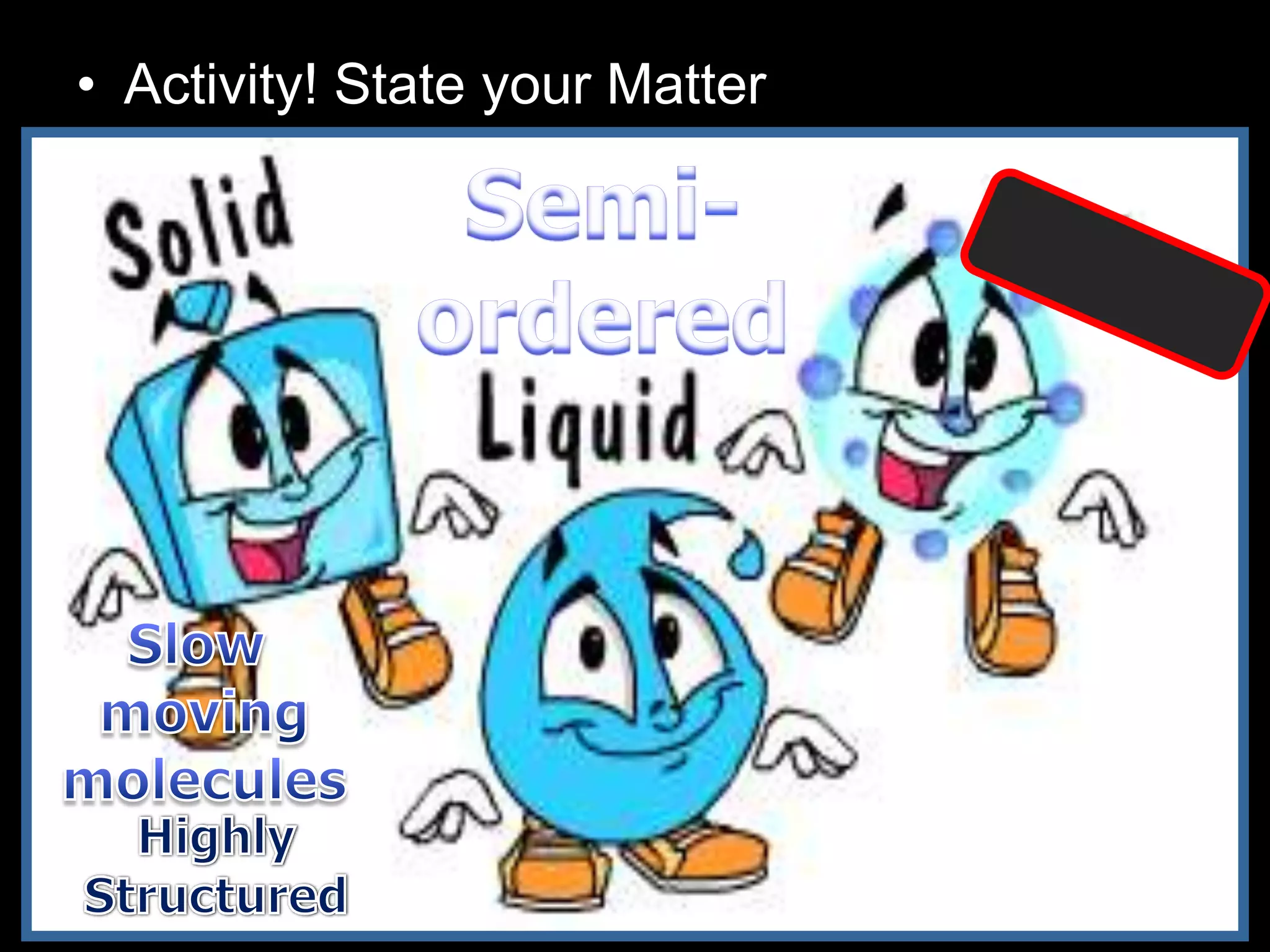
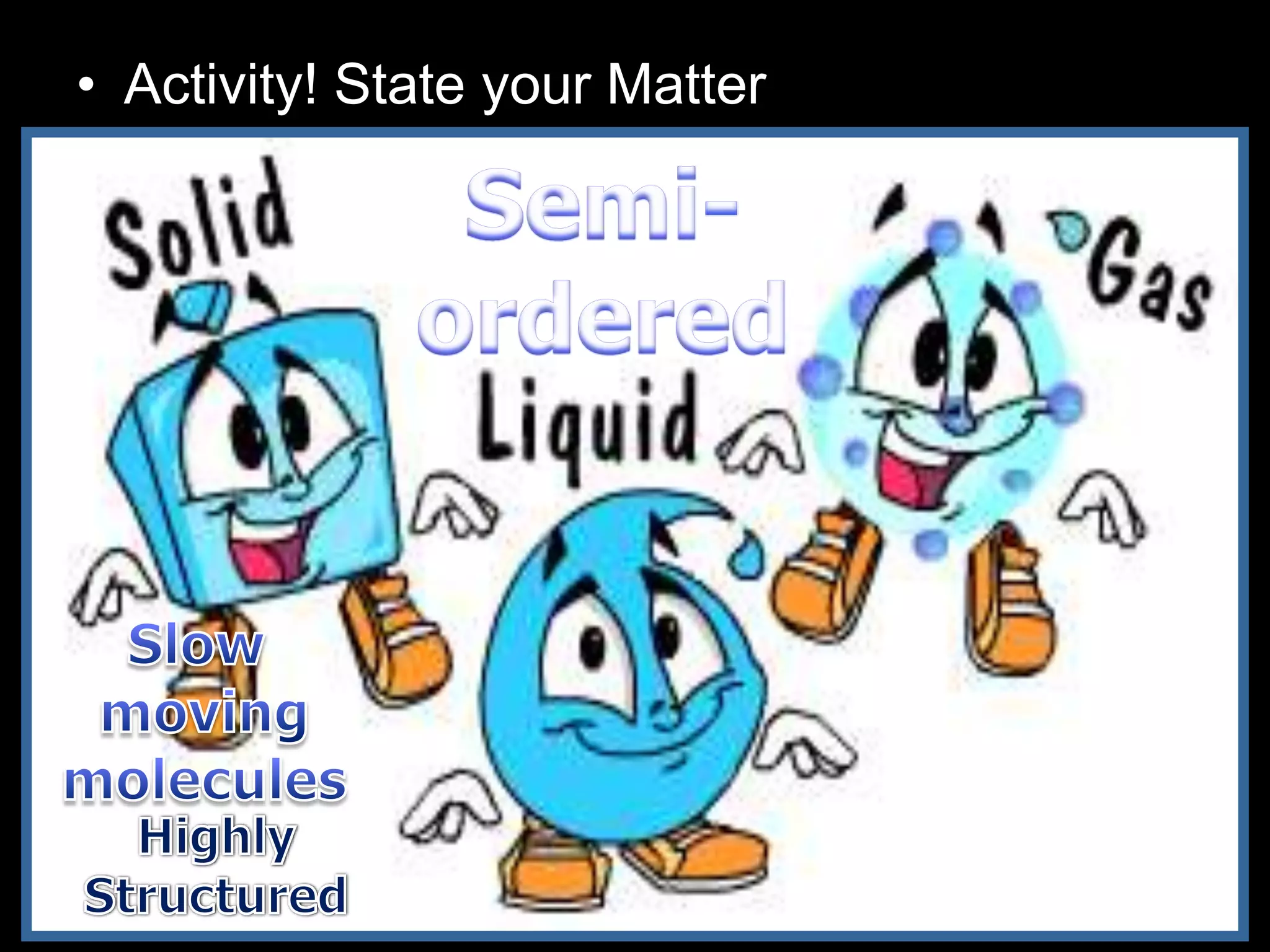
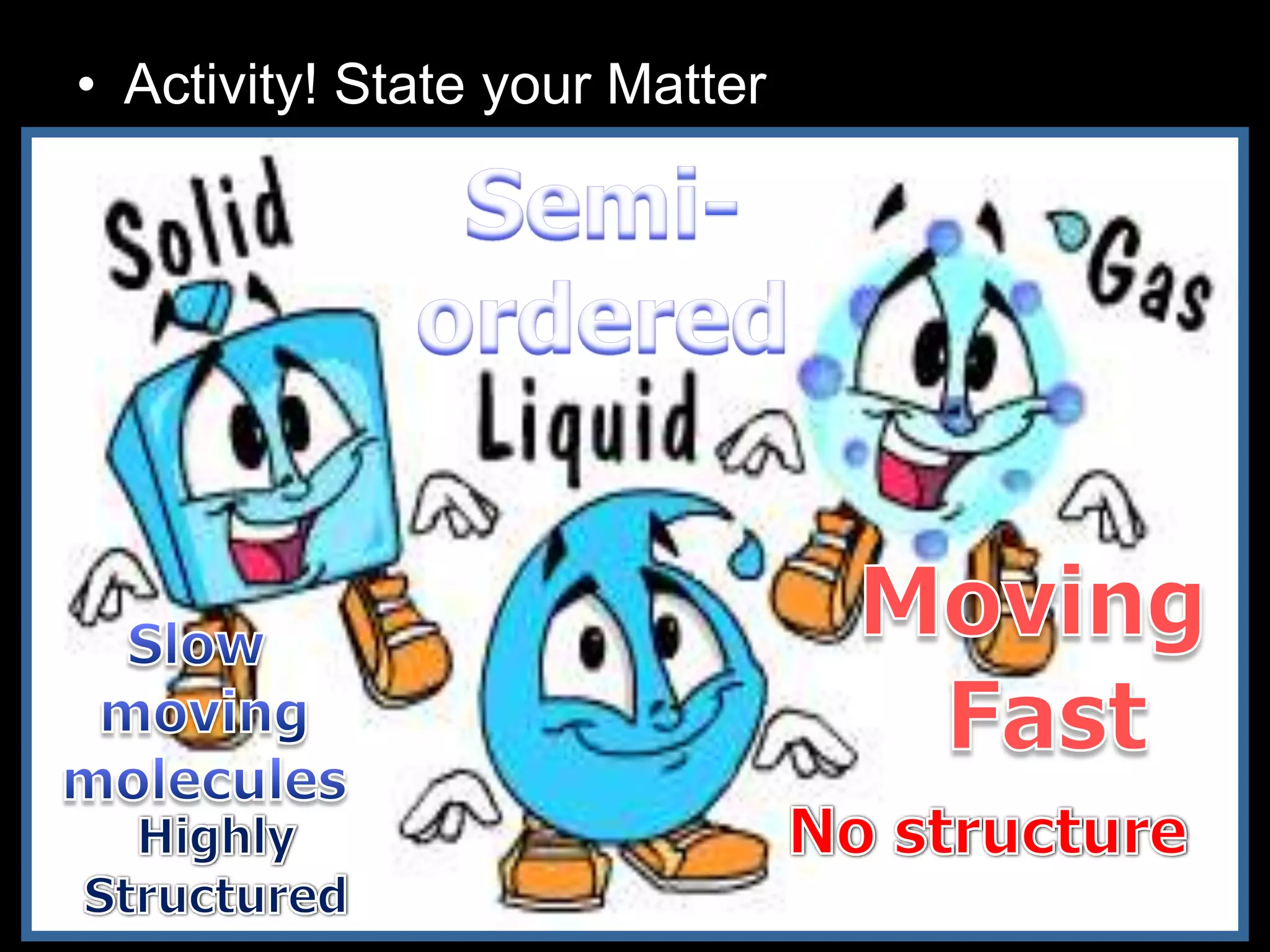
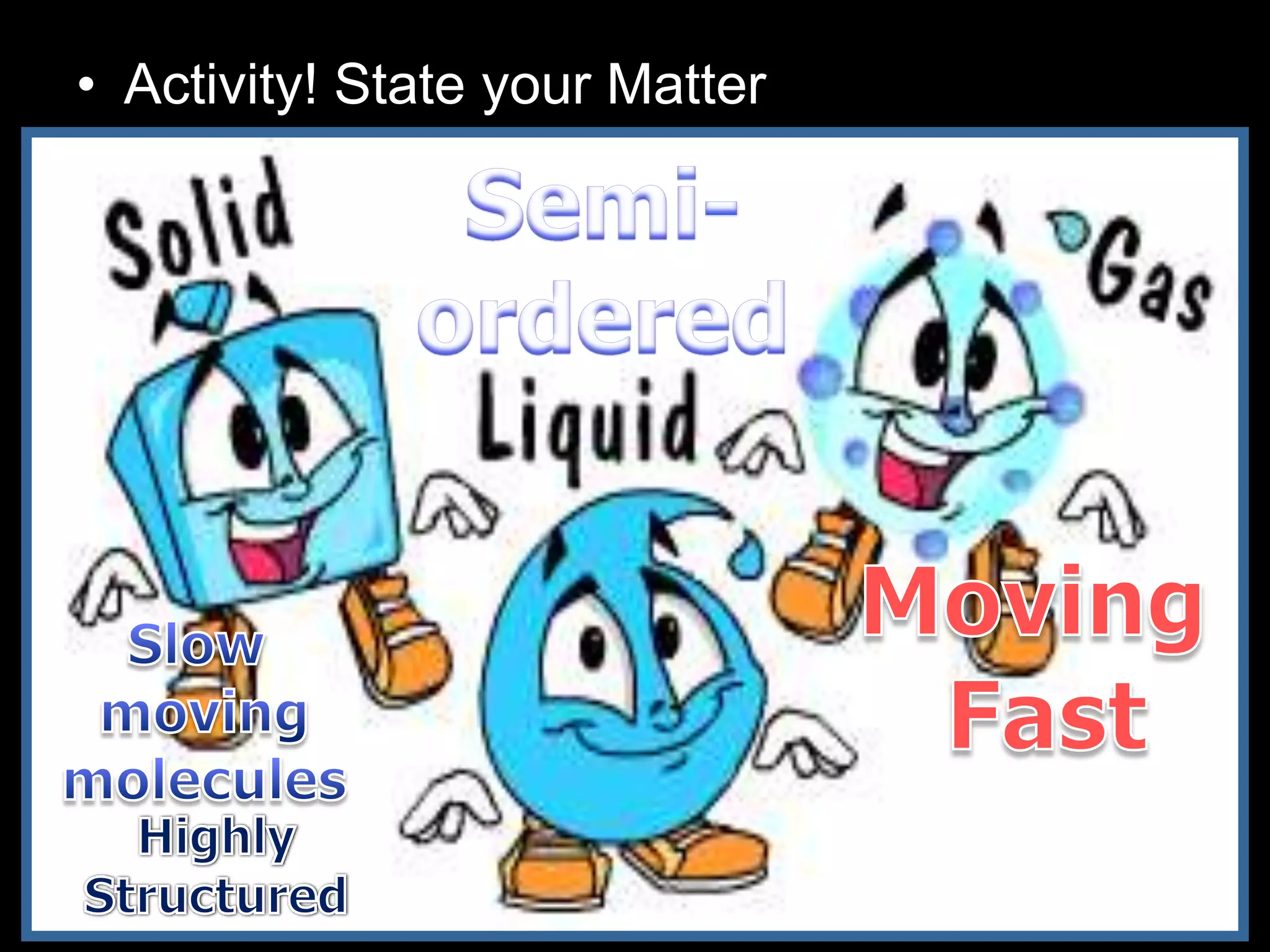
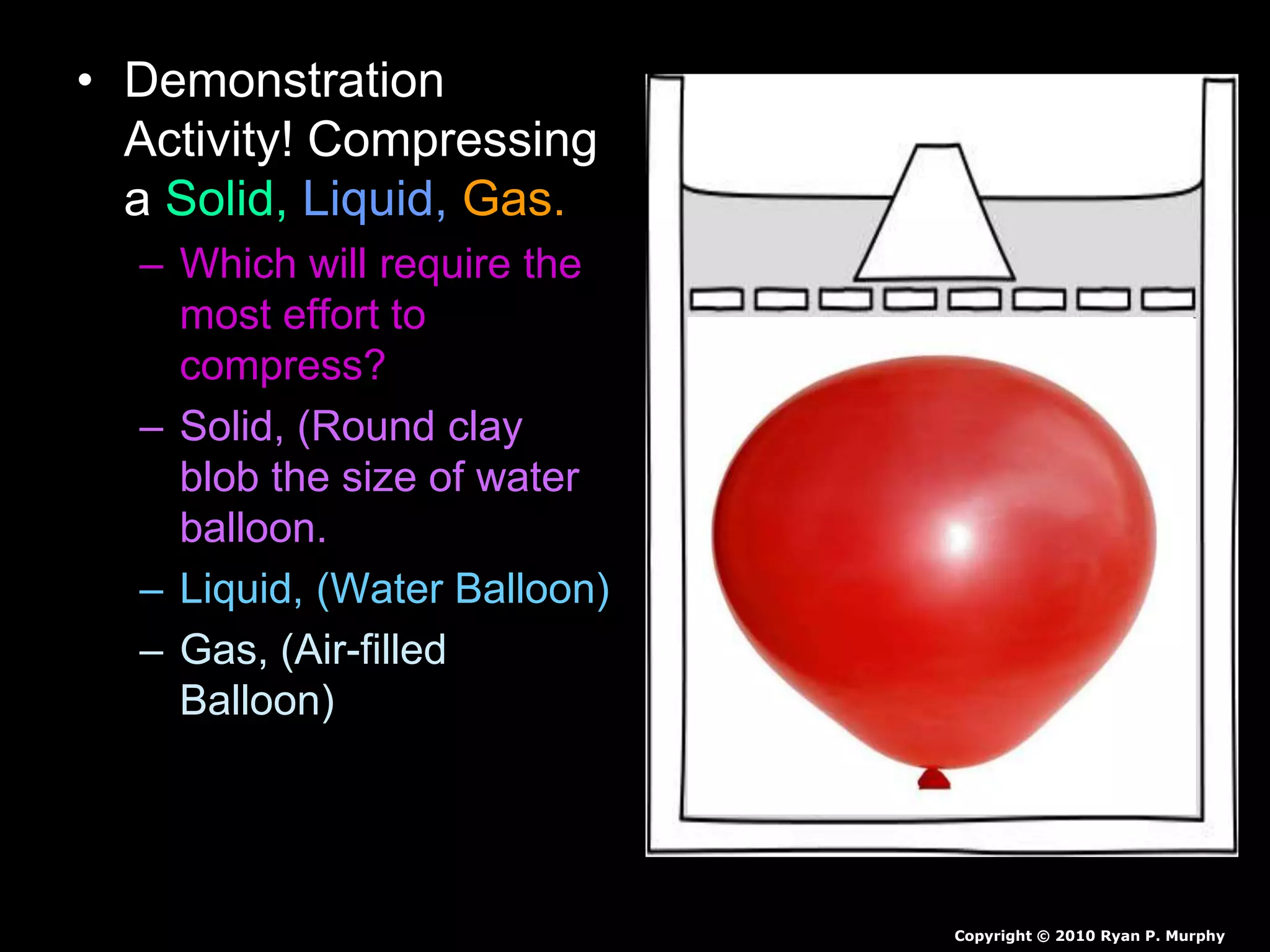
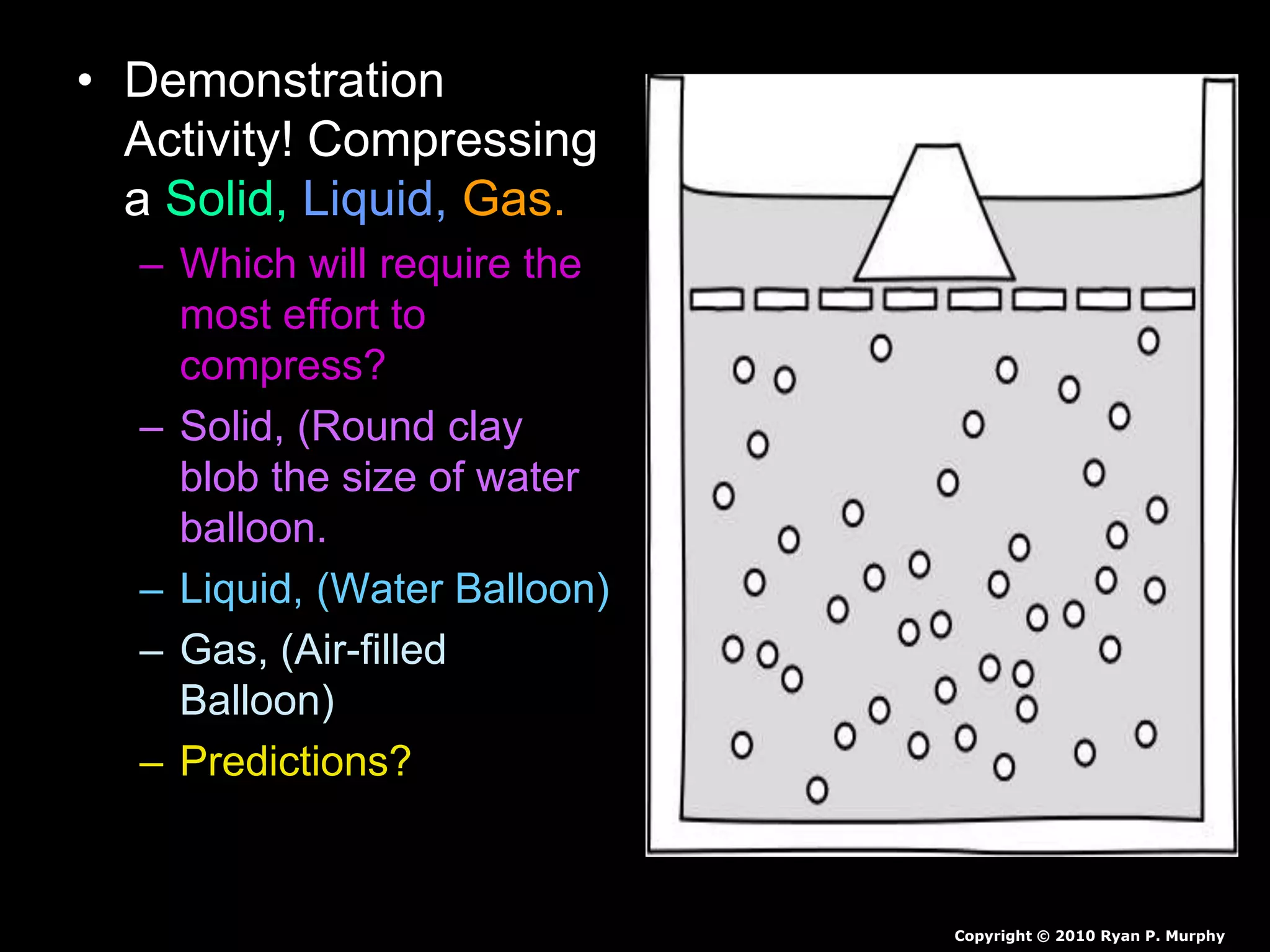
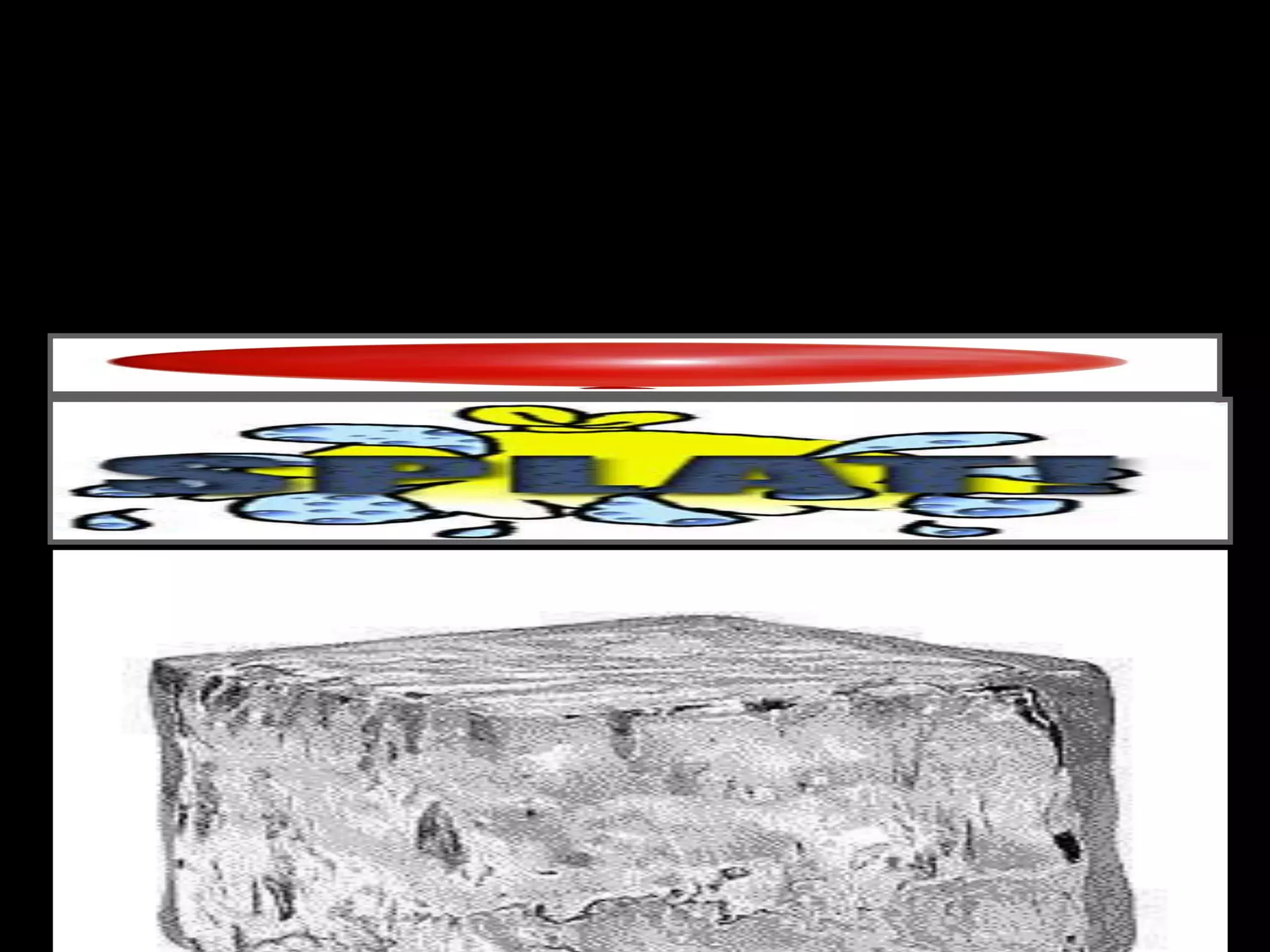
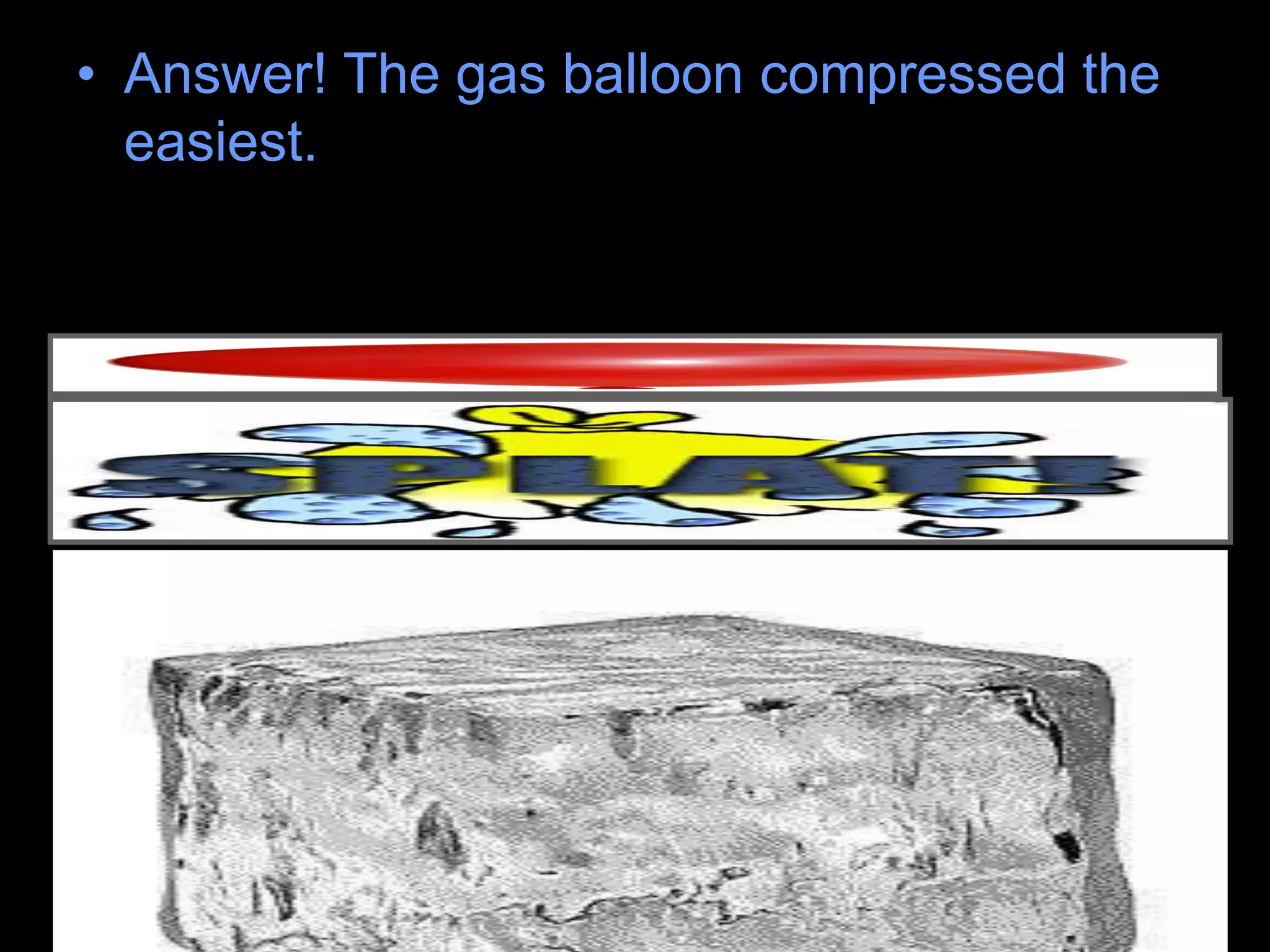
• Activity! State your Matter
– Teacher to give each group of students a
solid block (Maybe ice), glass of water, and
balloon filled with gas.
• Activity! State your Matter
– Teacher to give each group of students a
solid block (Maybe ice), glass of water, and
balloon filled with gas.
• Activity! State your Matter
– Teacher to give each group of students a
solid block (Maybe ice), glass of water, and
balloon filled with gas.
• Activity! State your Matter
– Teacher to give each group of students a
solid block (Maybe ice), glass of water, and
balloon filled with gas.
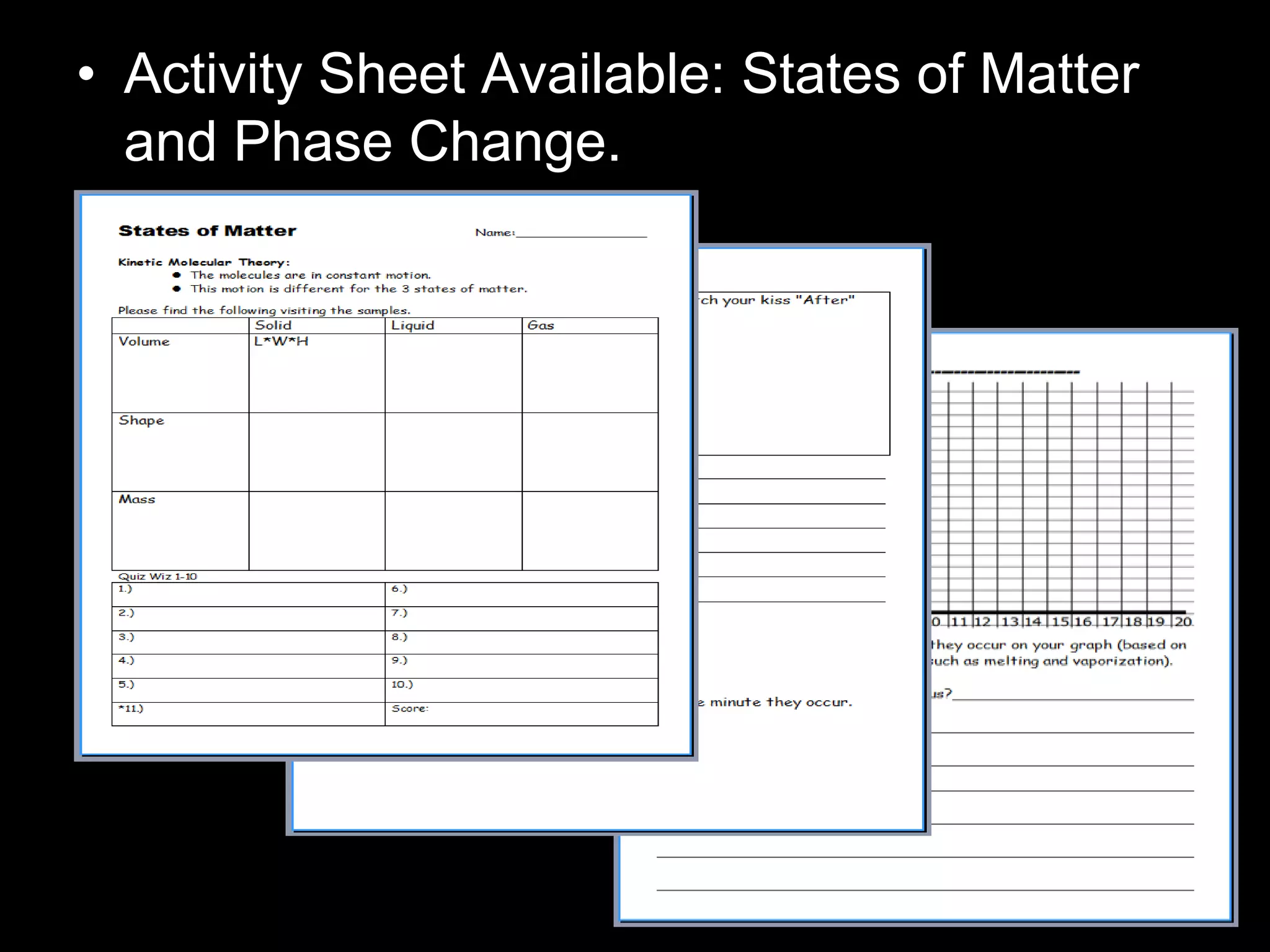
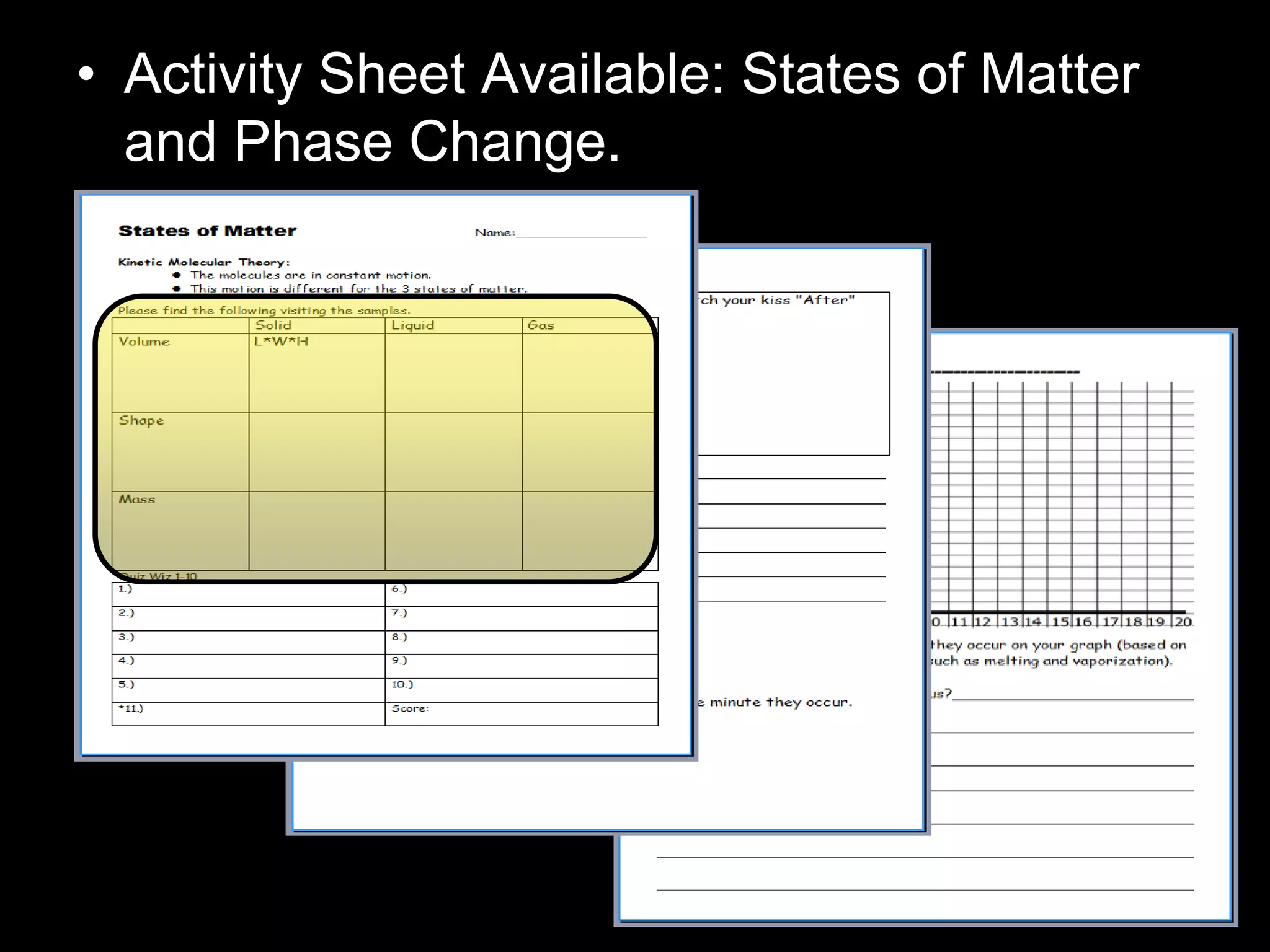
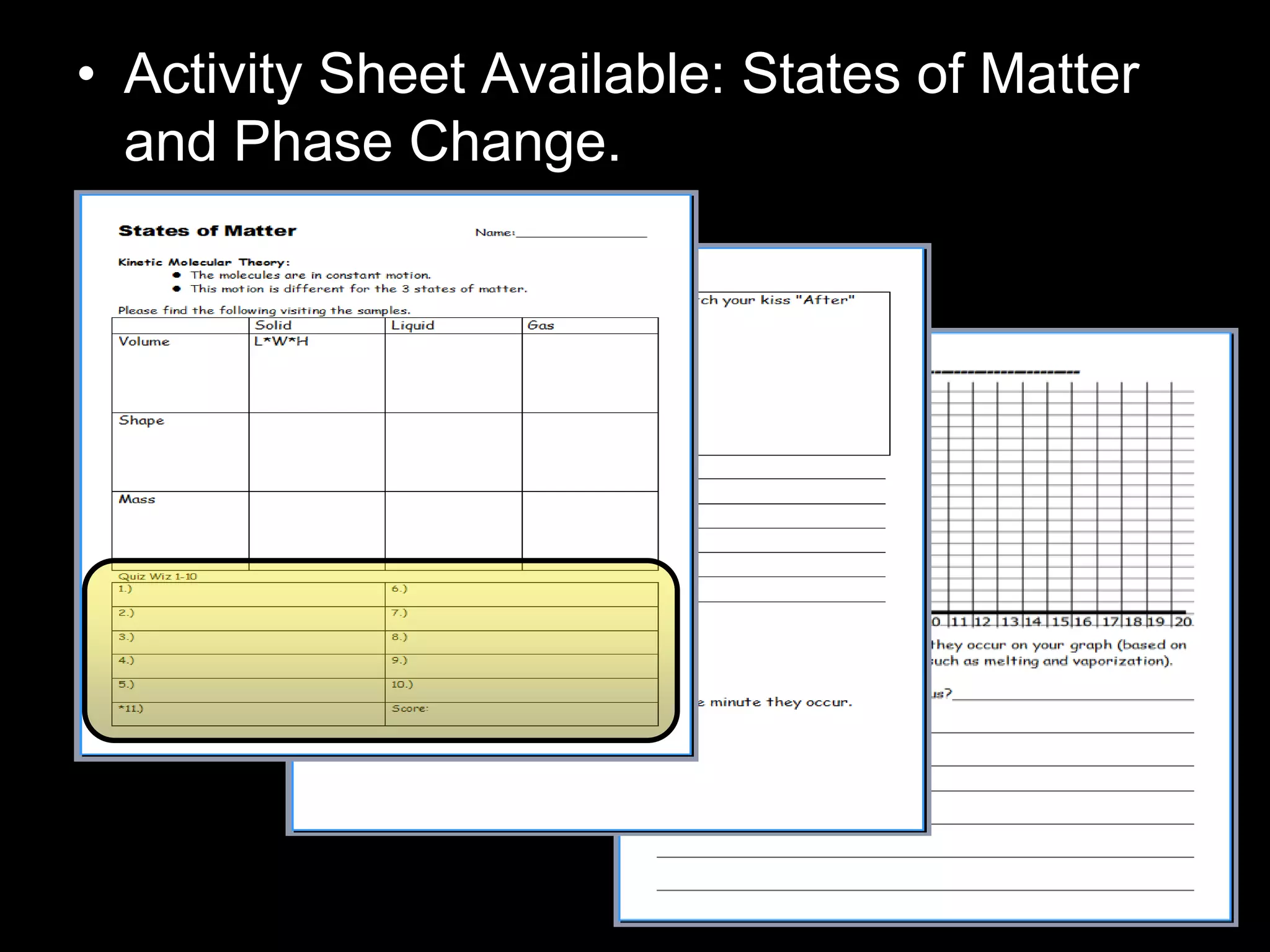
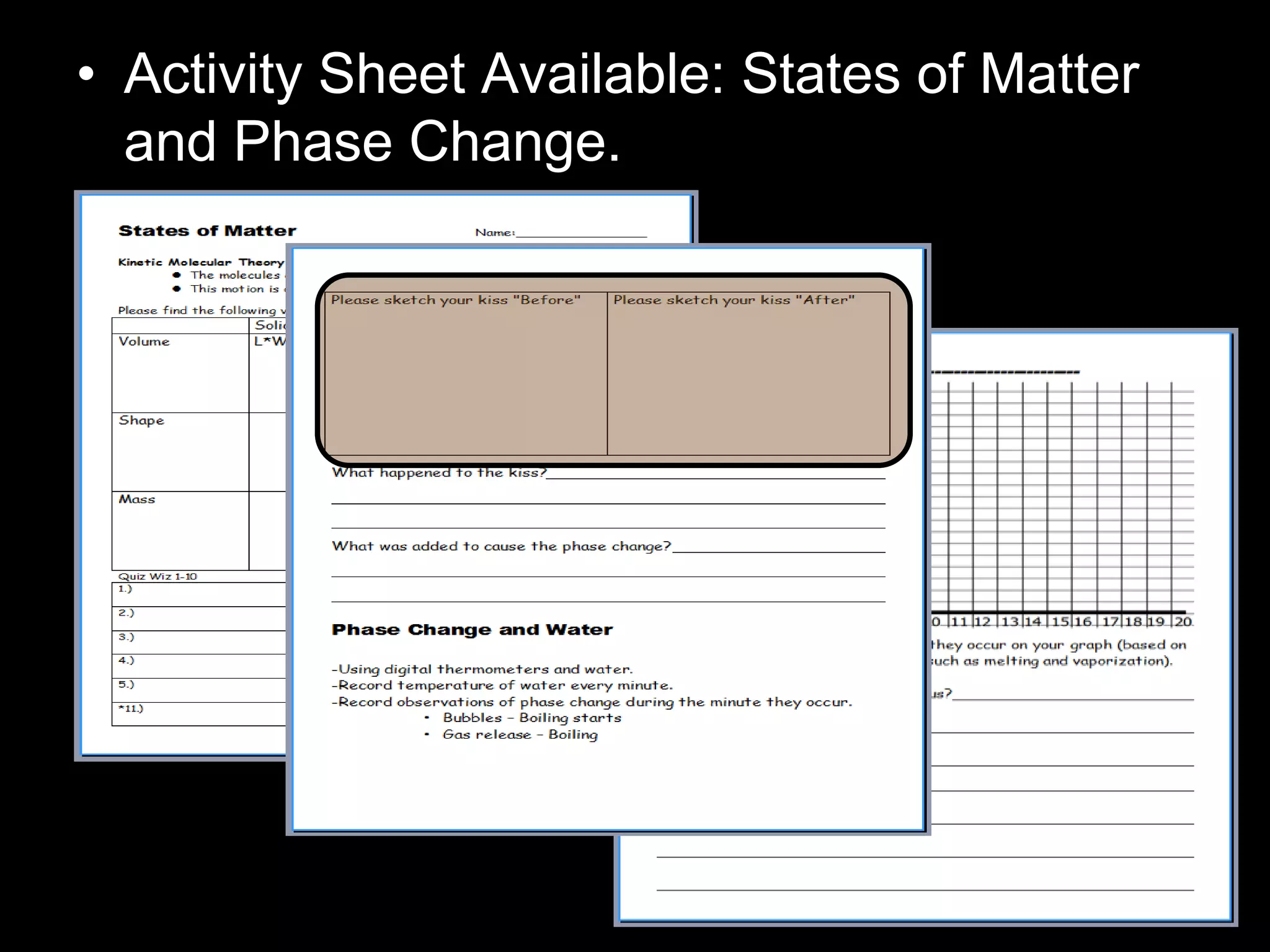
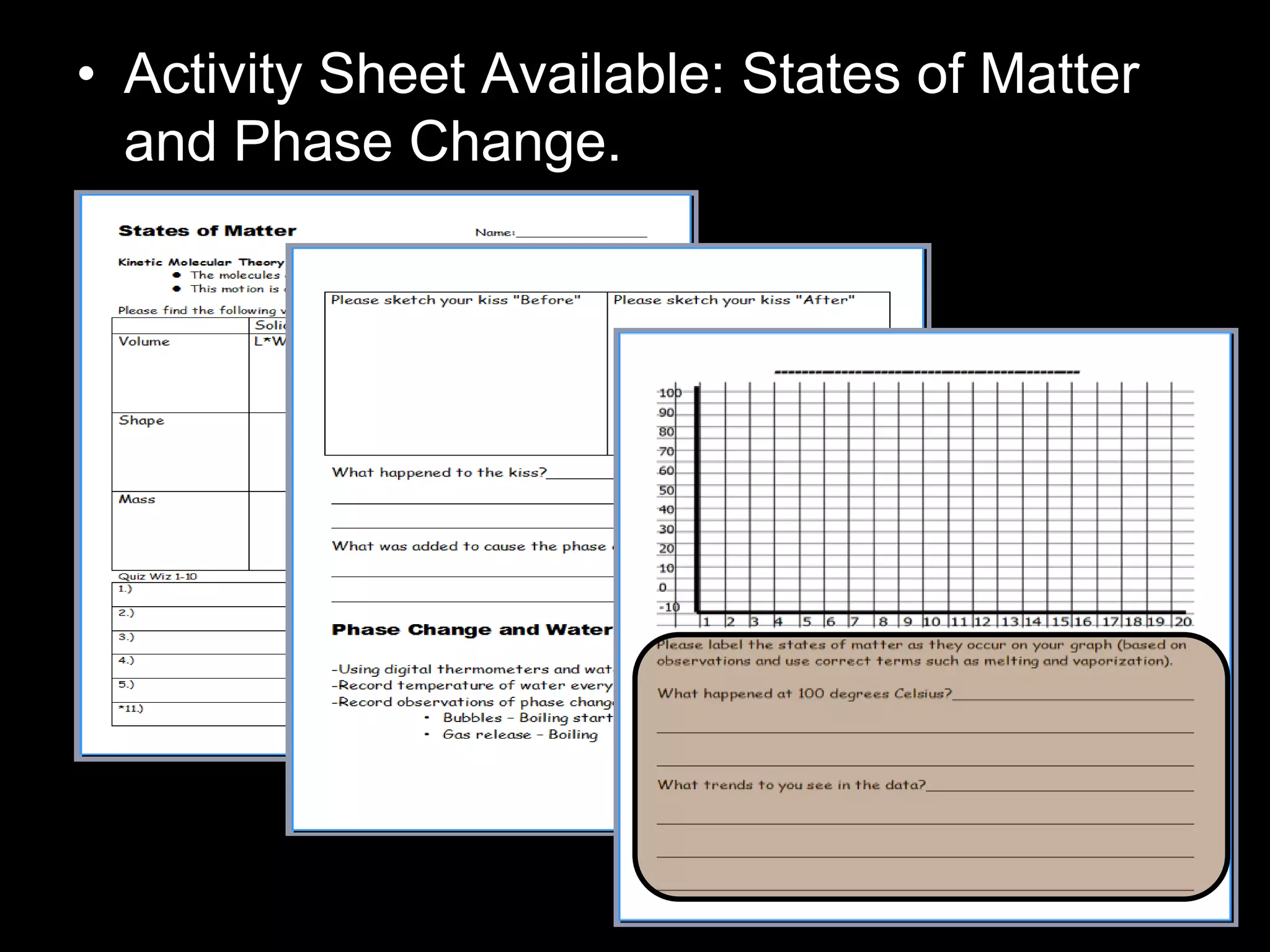
• Activity Sheet Available: States of Matter
and Phase Change.
• Activity Sheet Available: States of Matter
and Phase Change.
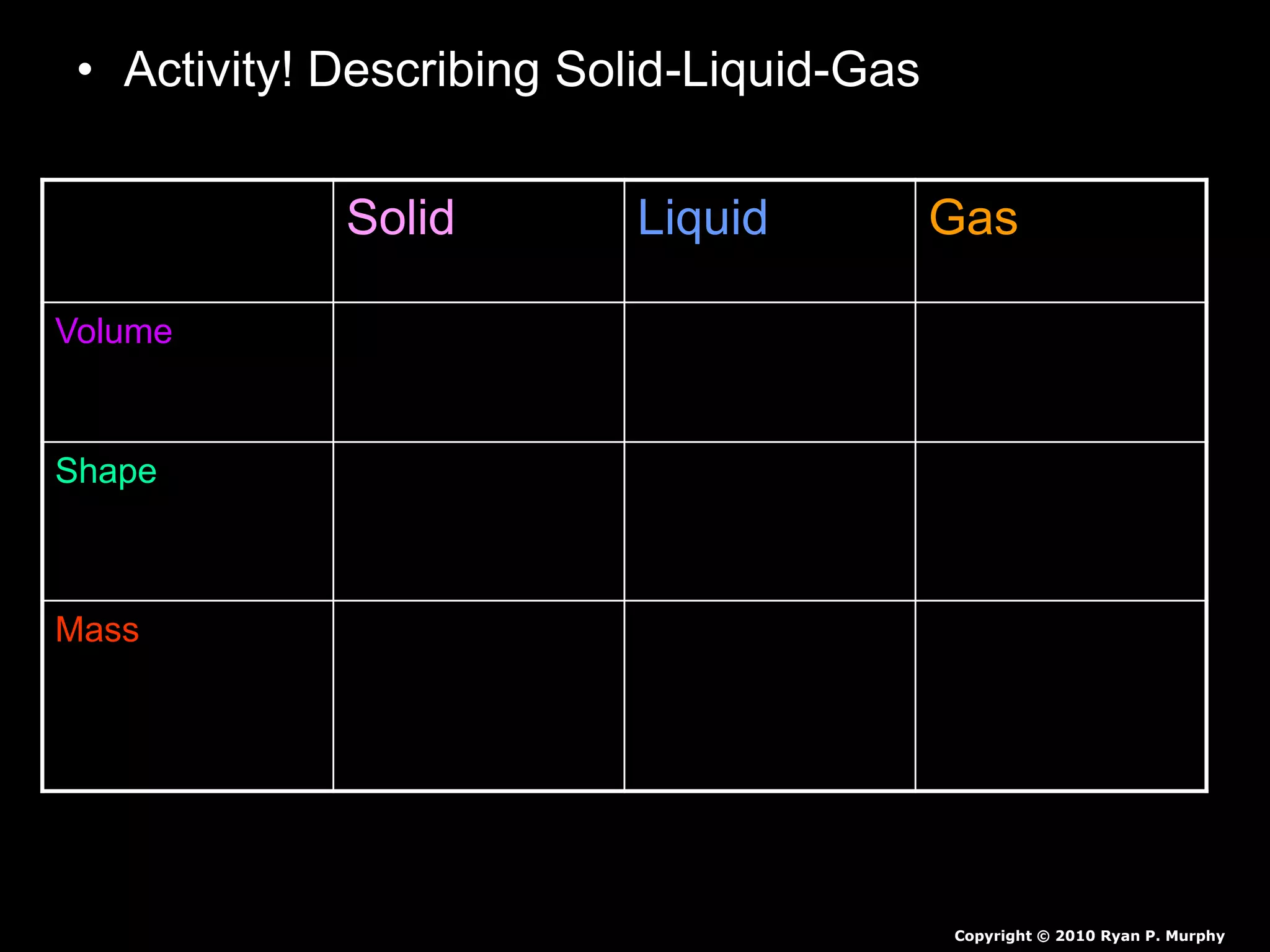
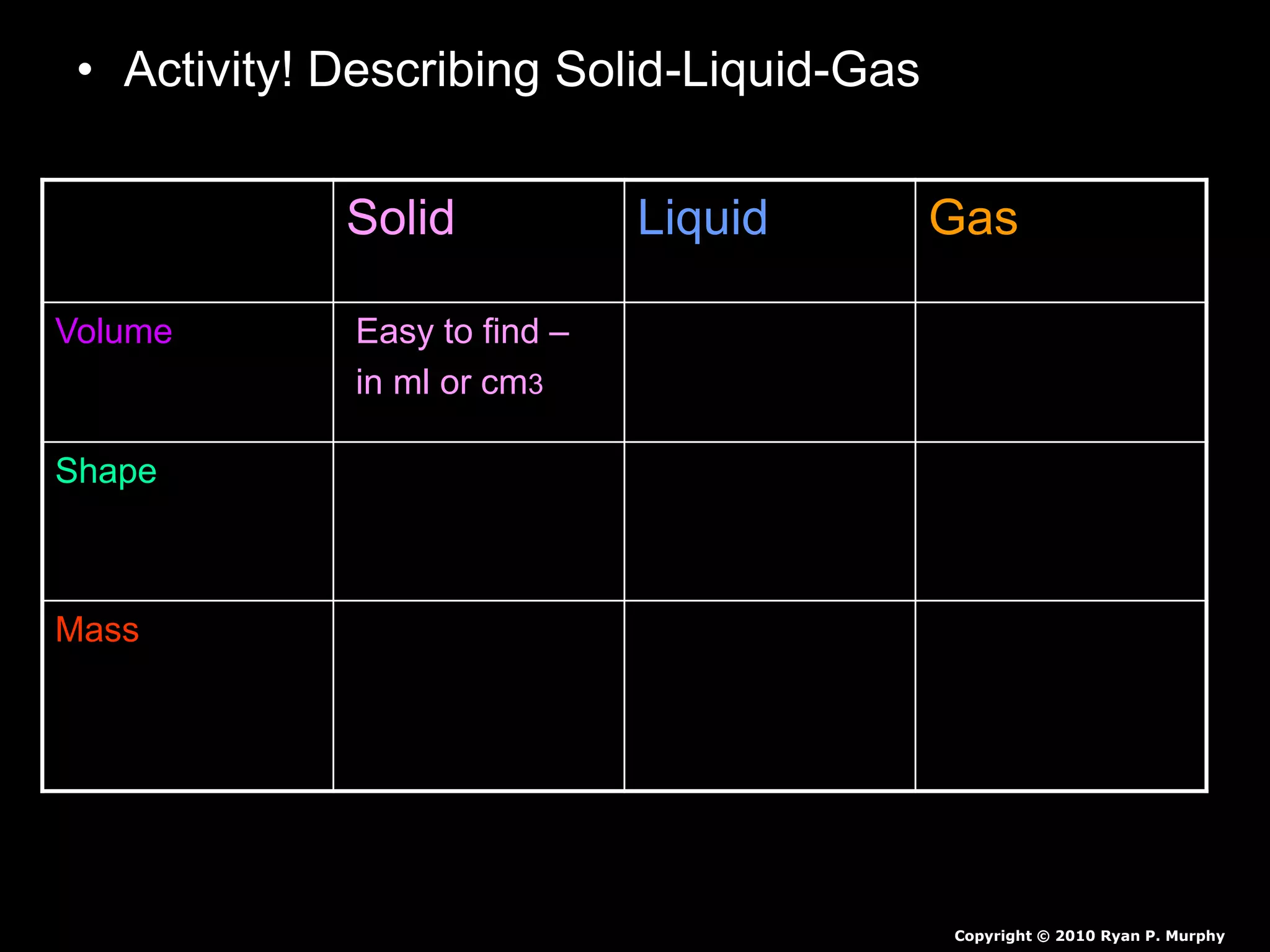
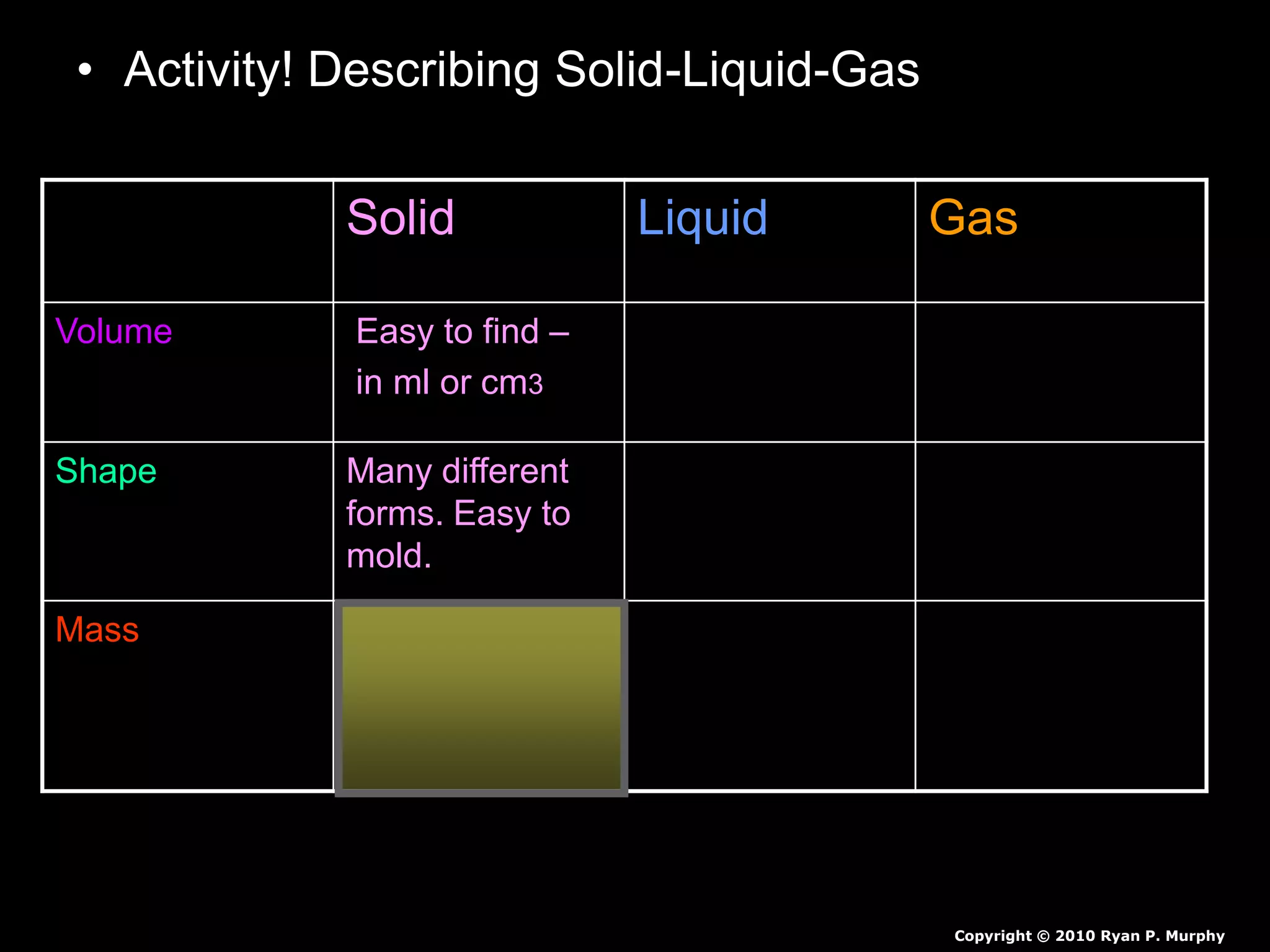
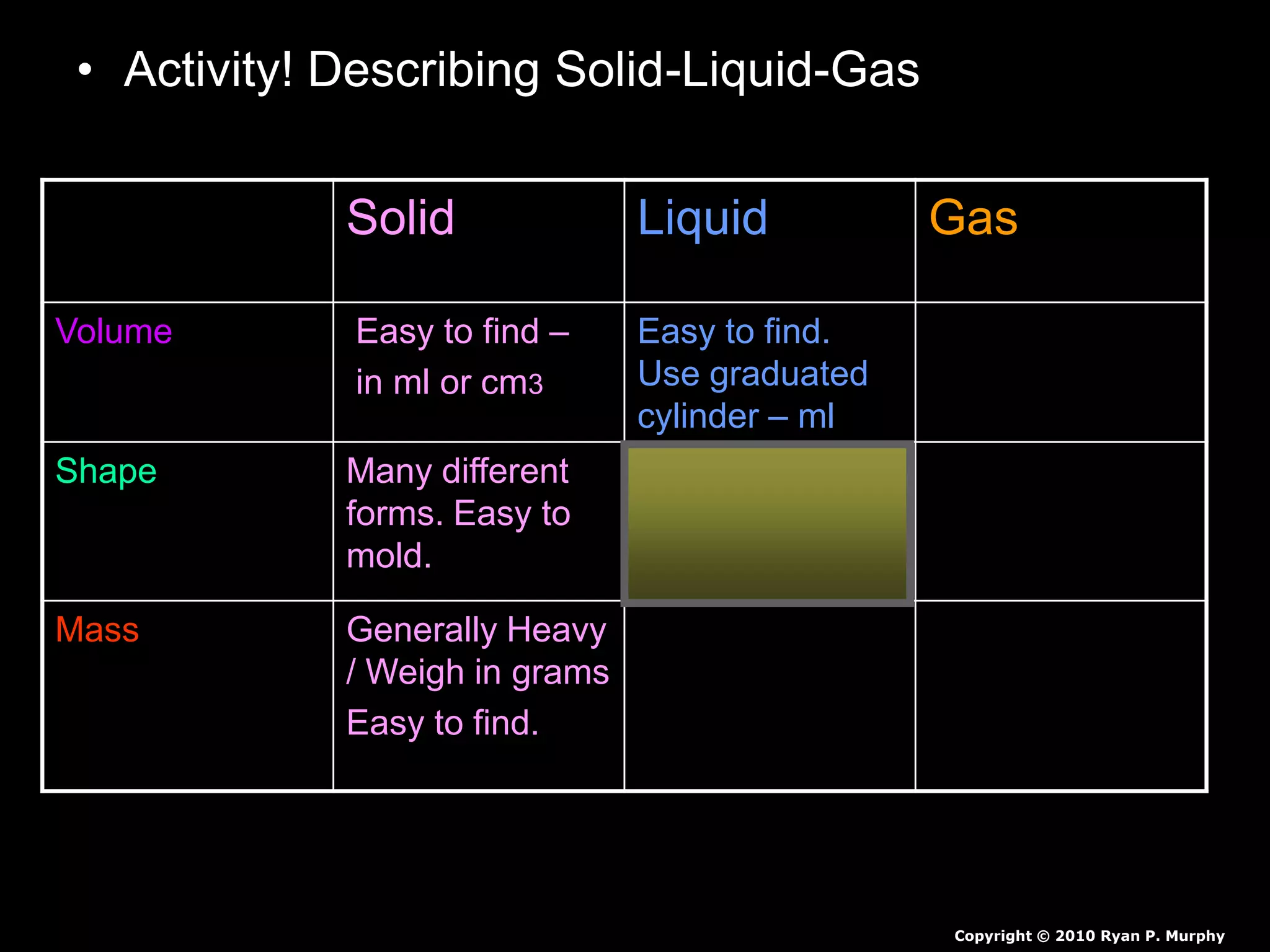
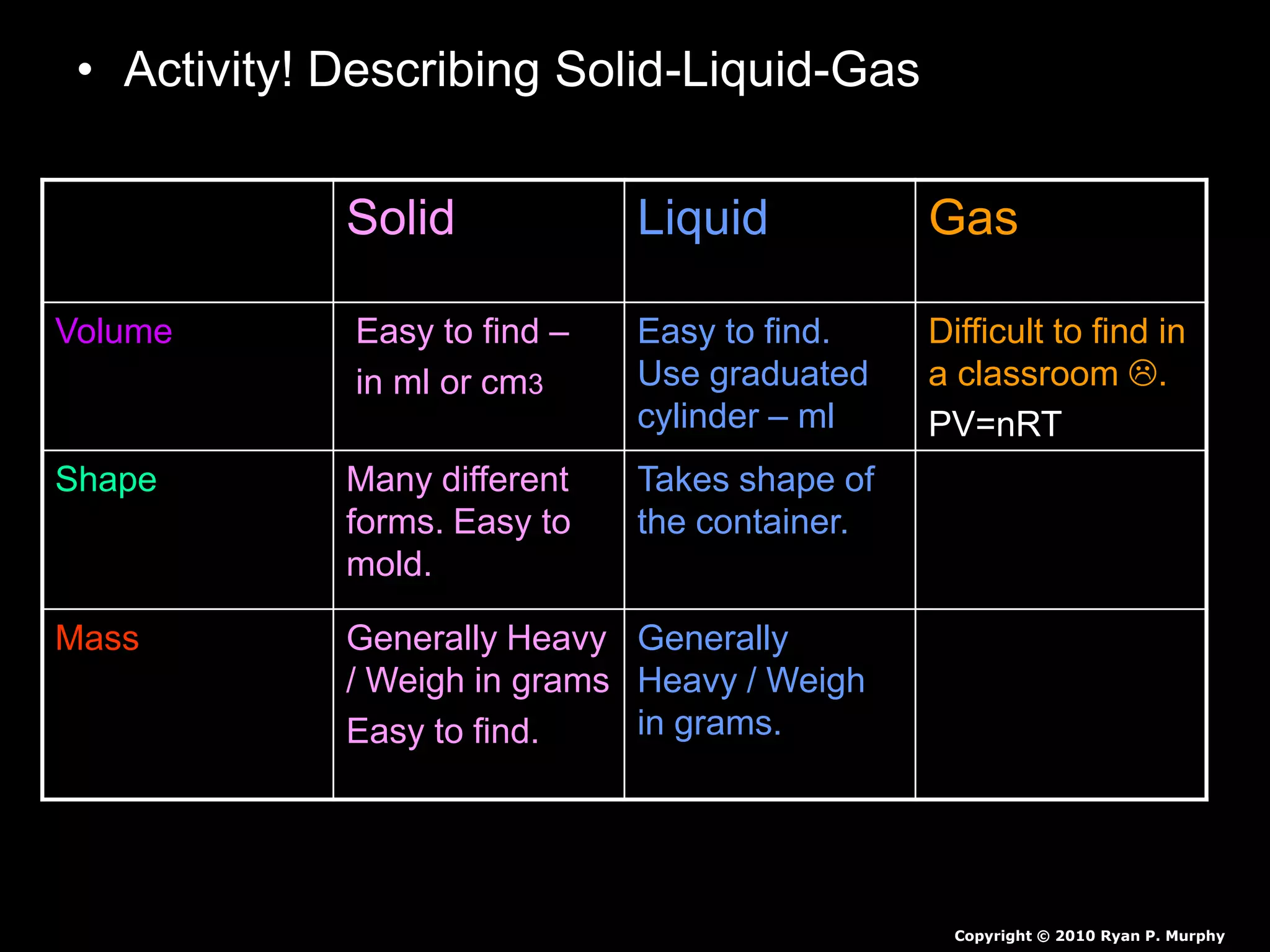
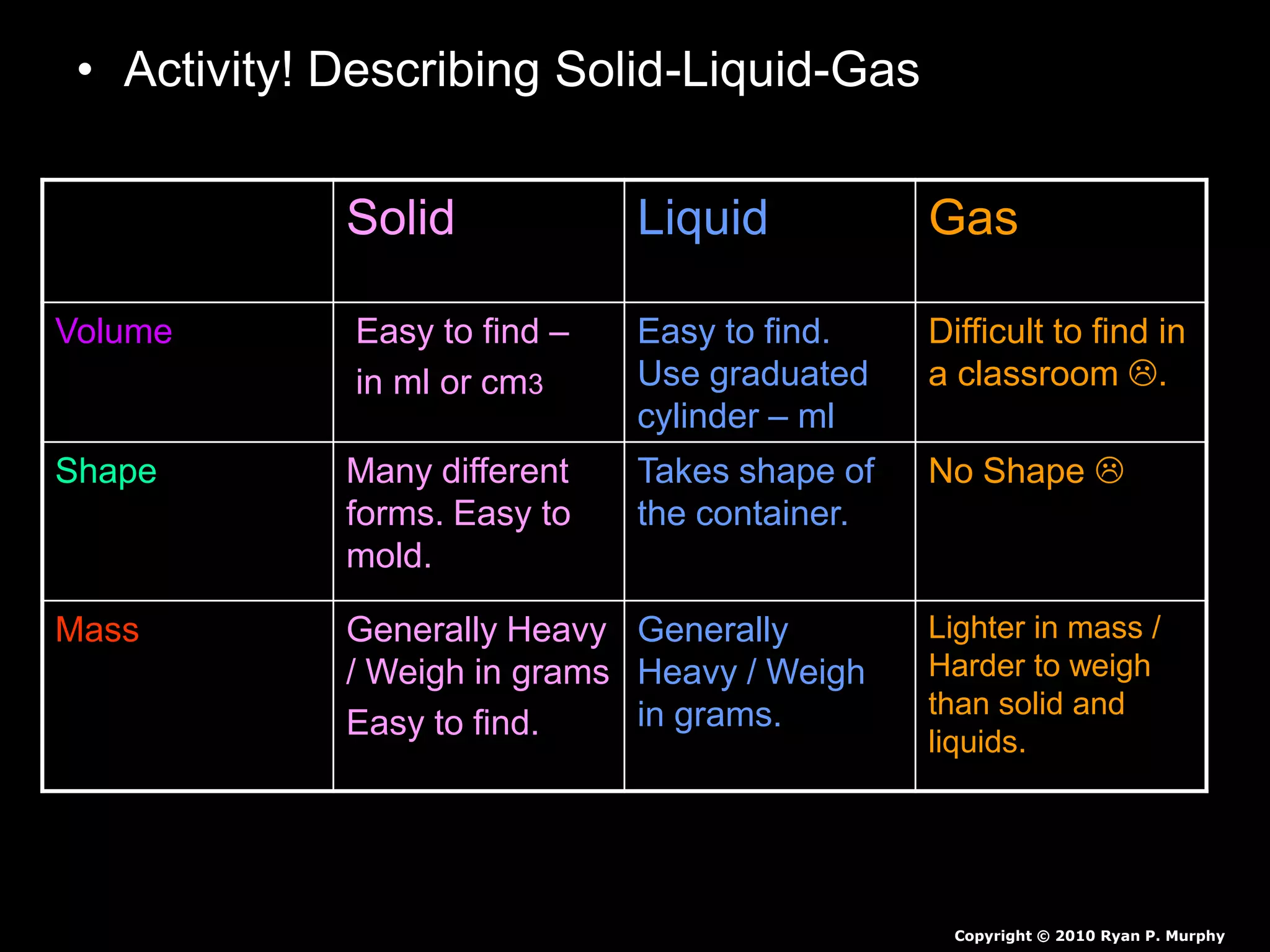
• Activity! Describing Solid-Liquid-Gas
– Please fill out the following spreadsheet and then
collect data.
– Find it or write (?)
Solid Liquid Gas
Volume L*W*H
Shape
Mass
Copyright © 2010 Ryan P. Murphy
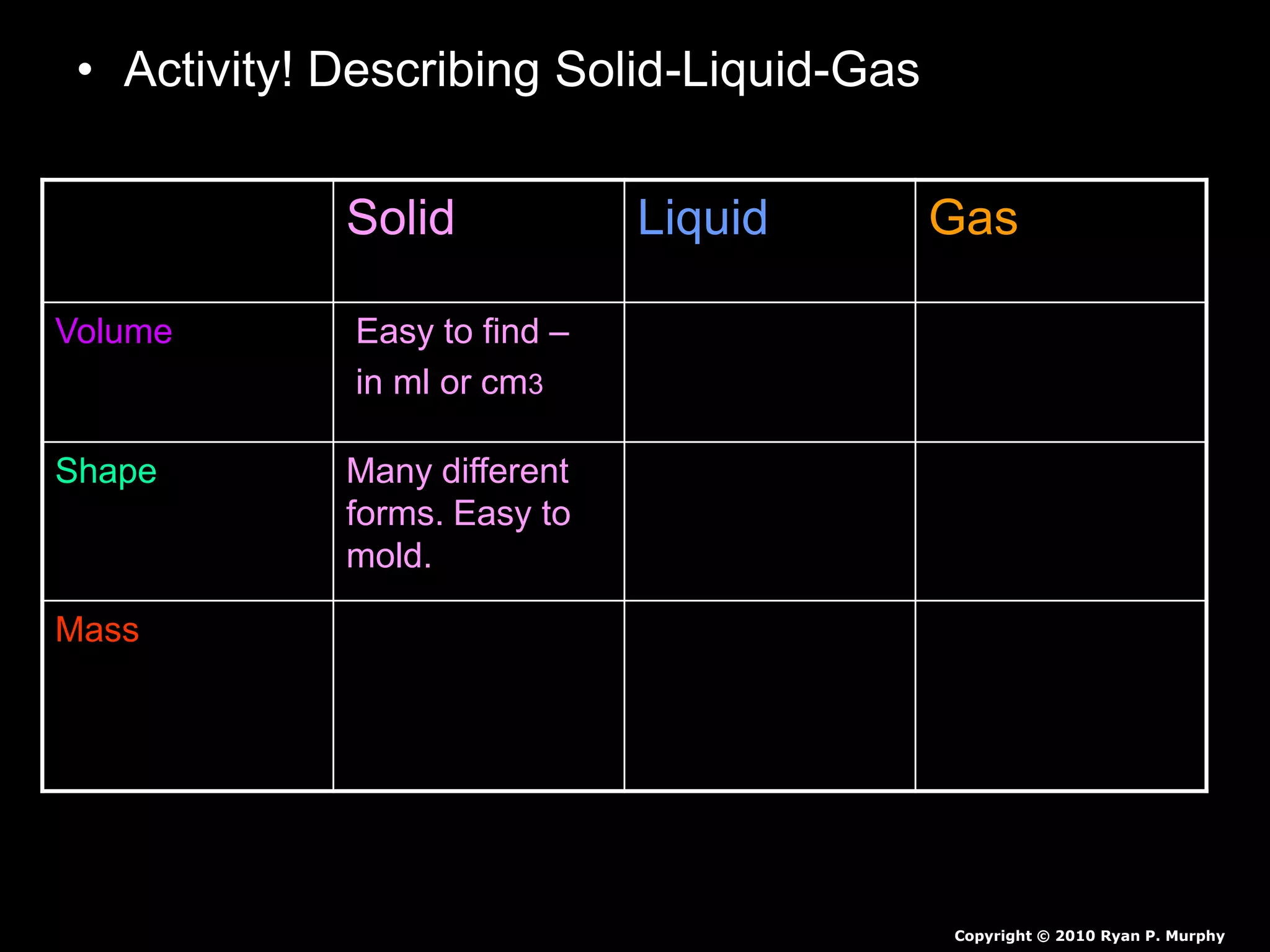
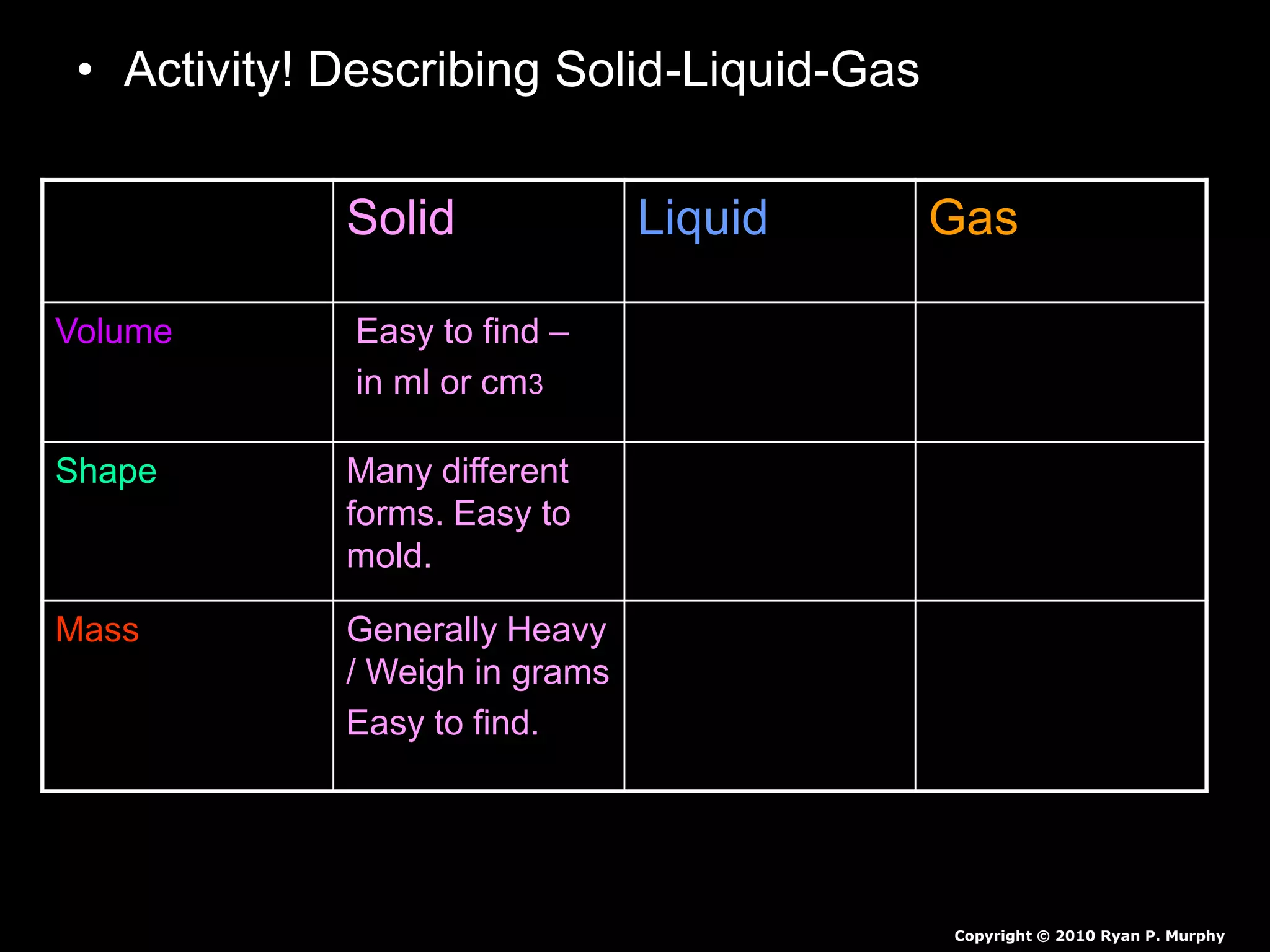
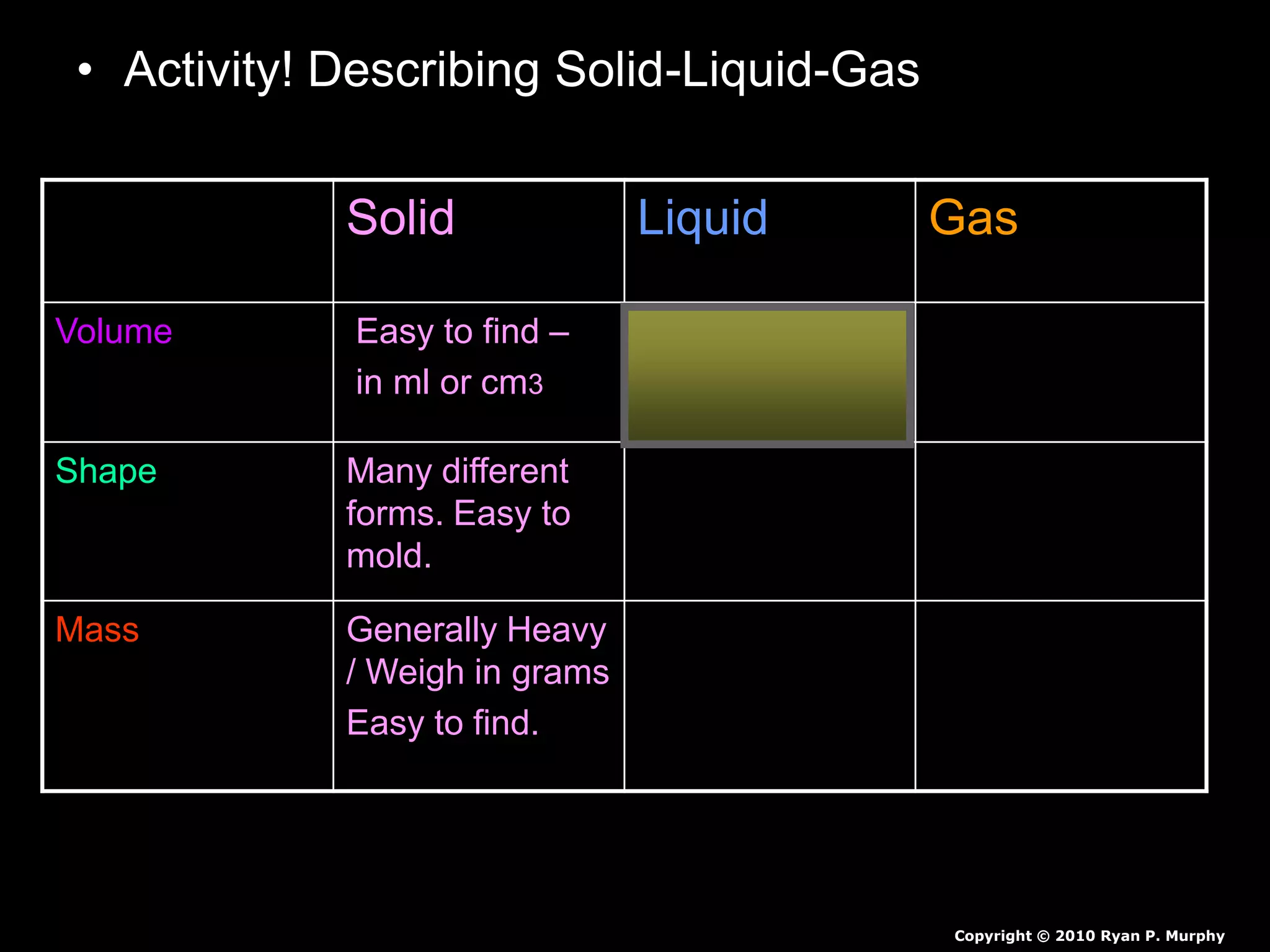
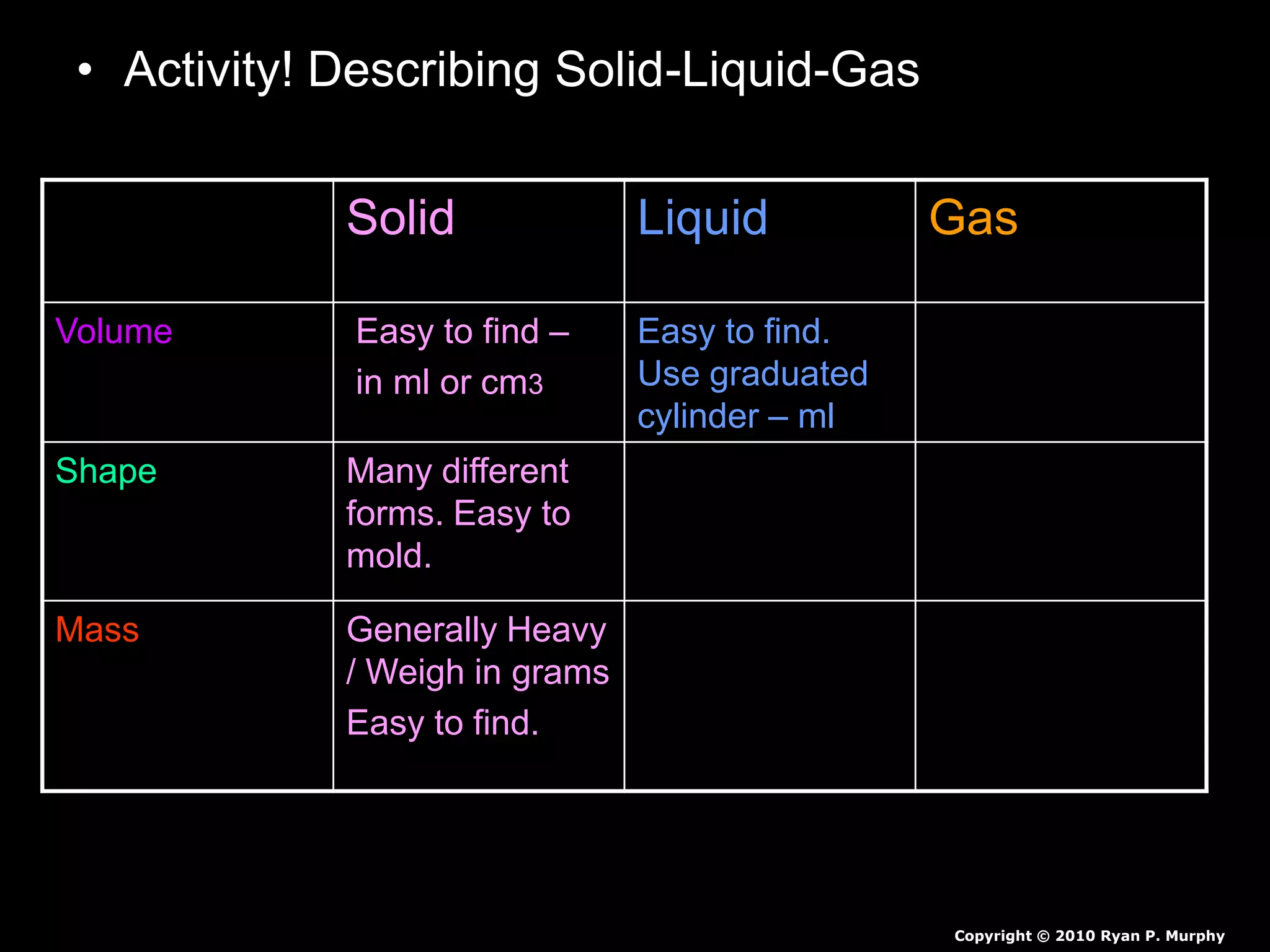
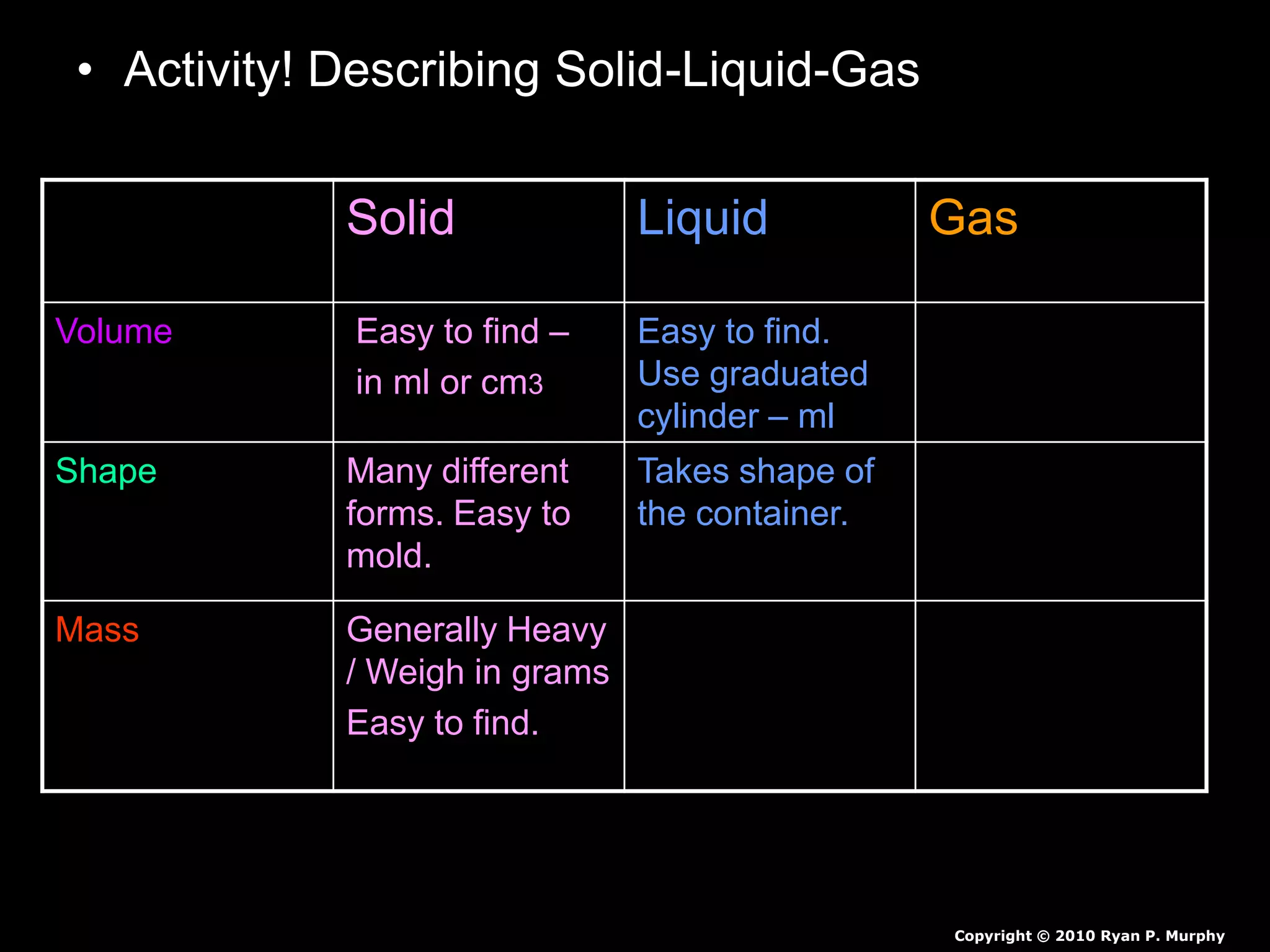
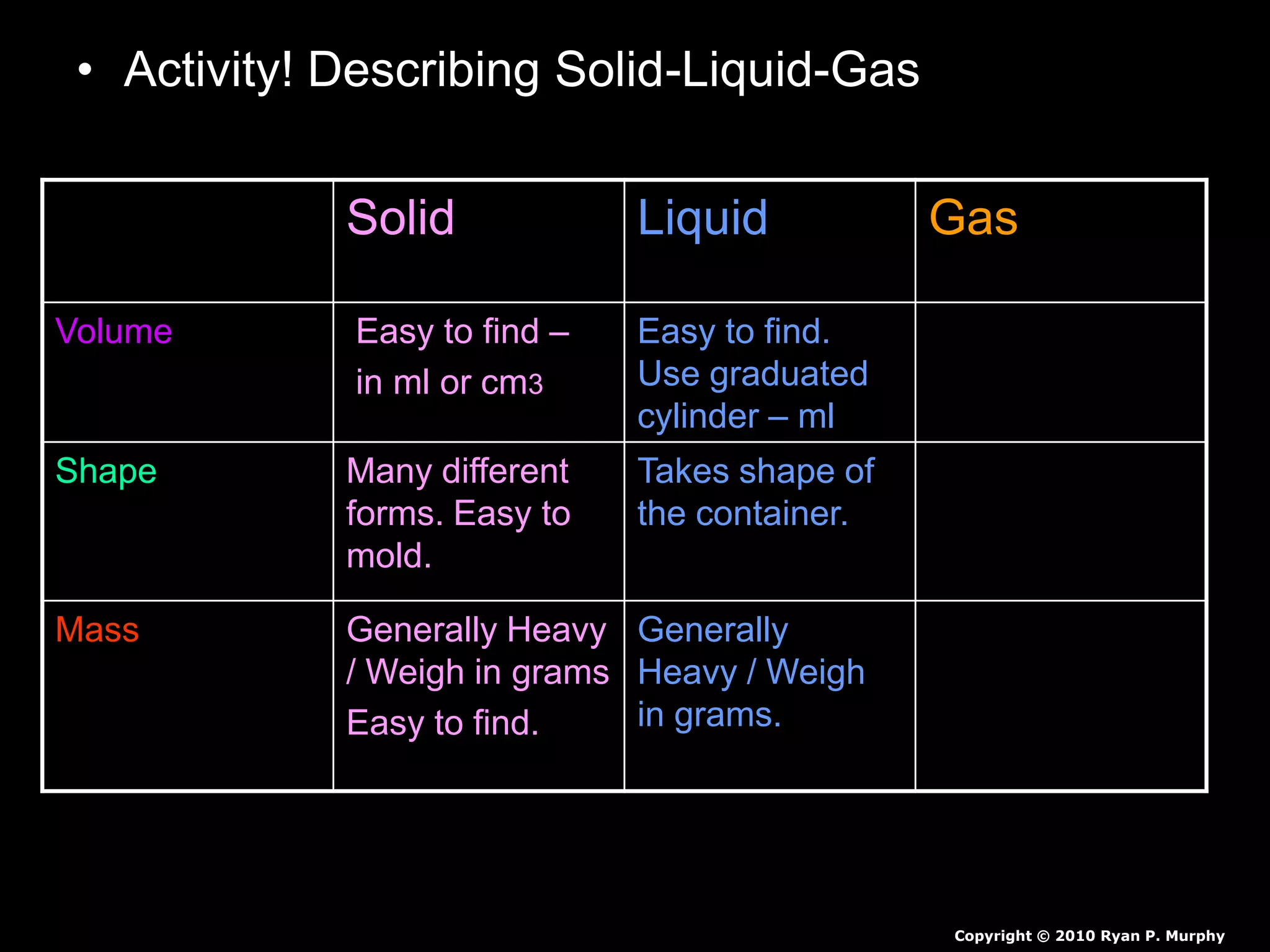
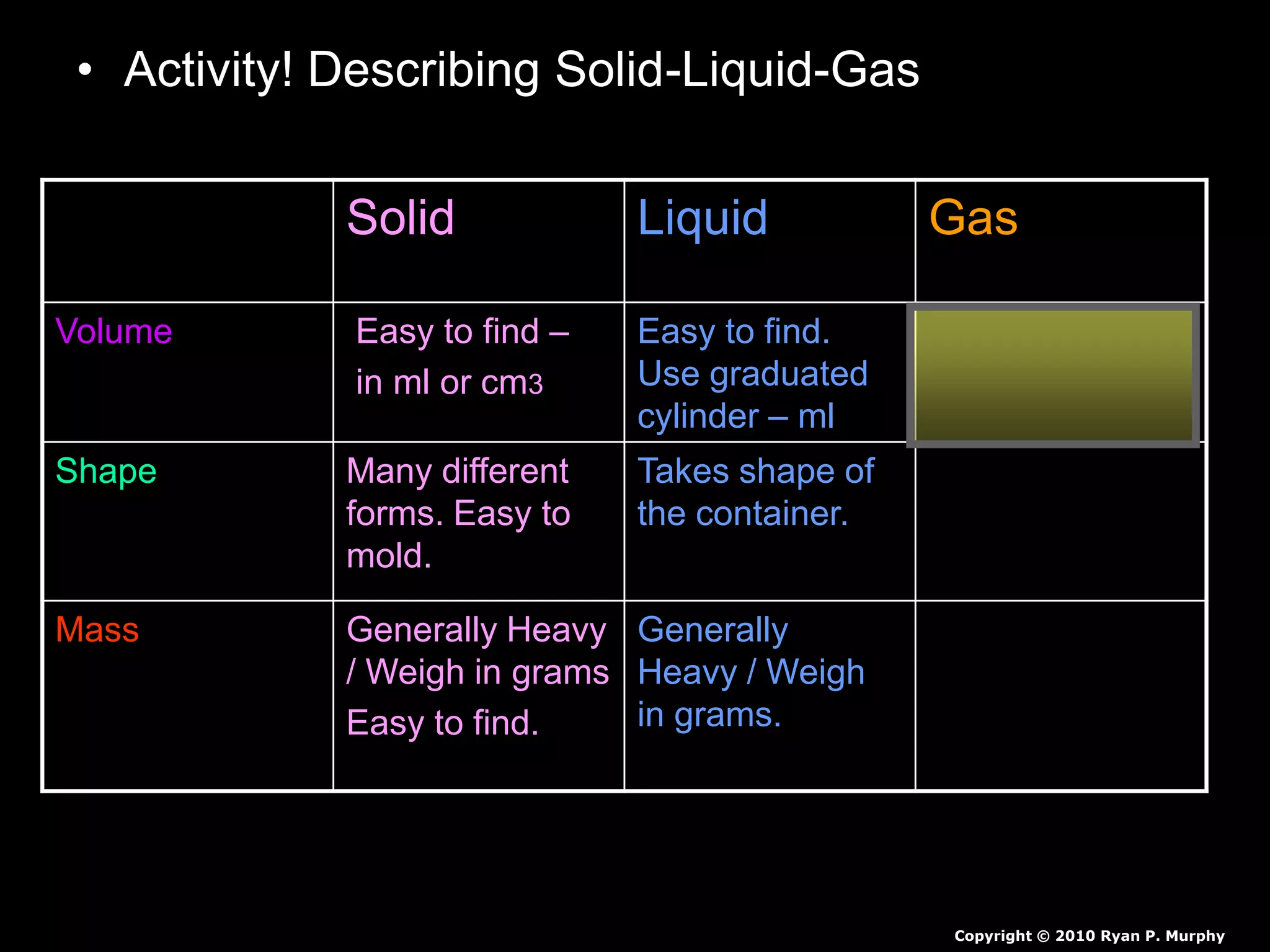
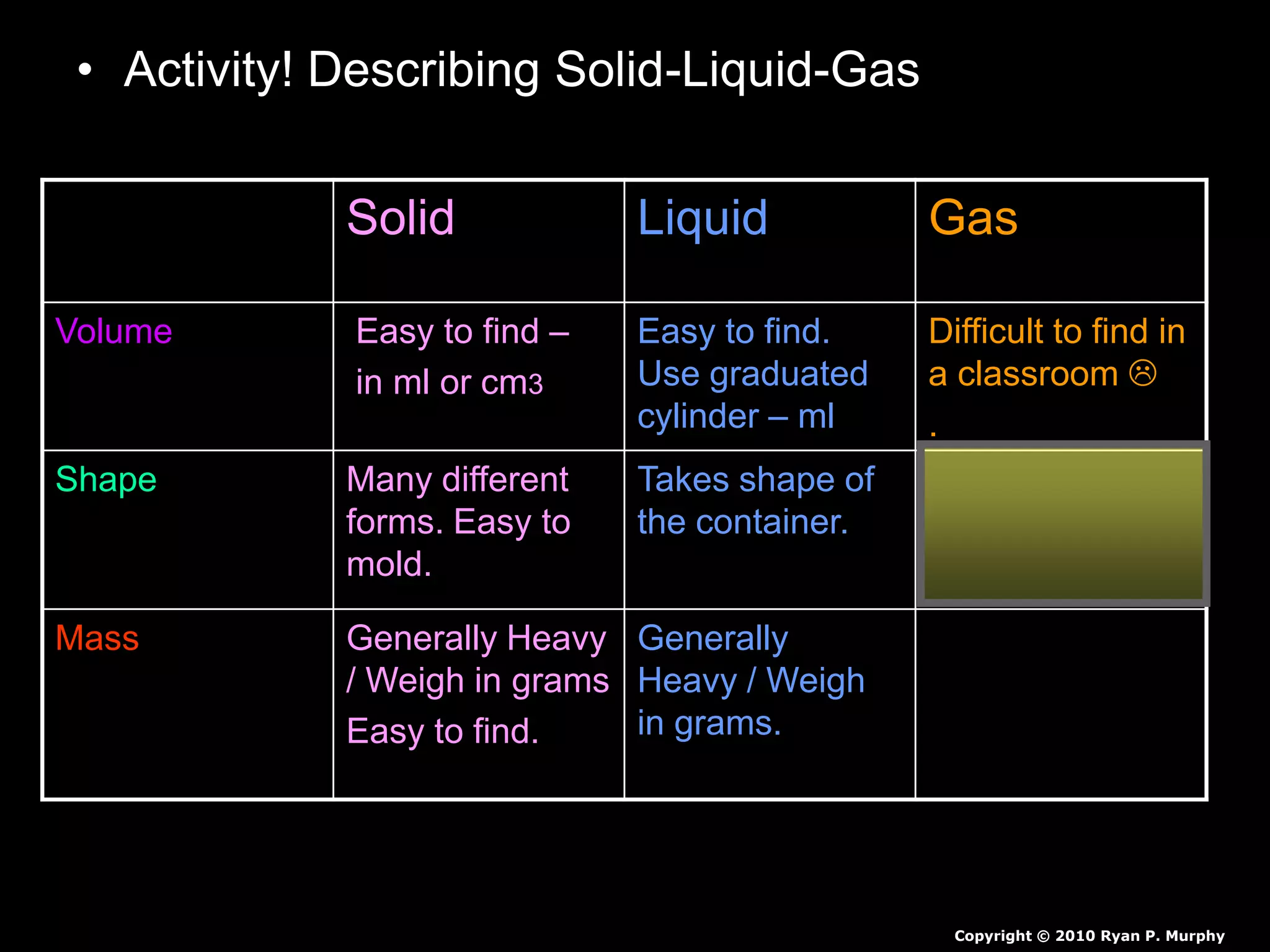
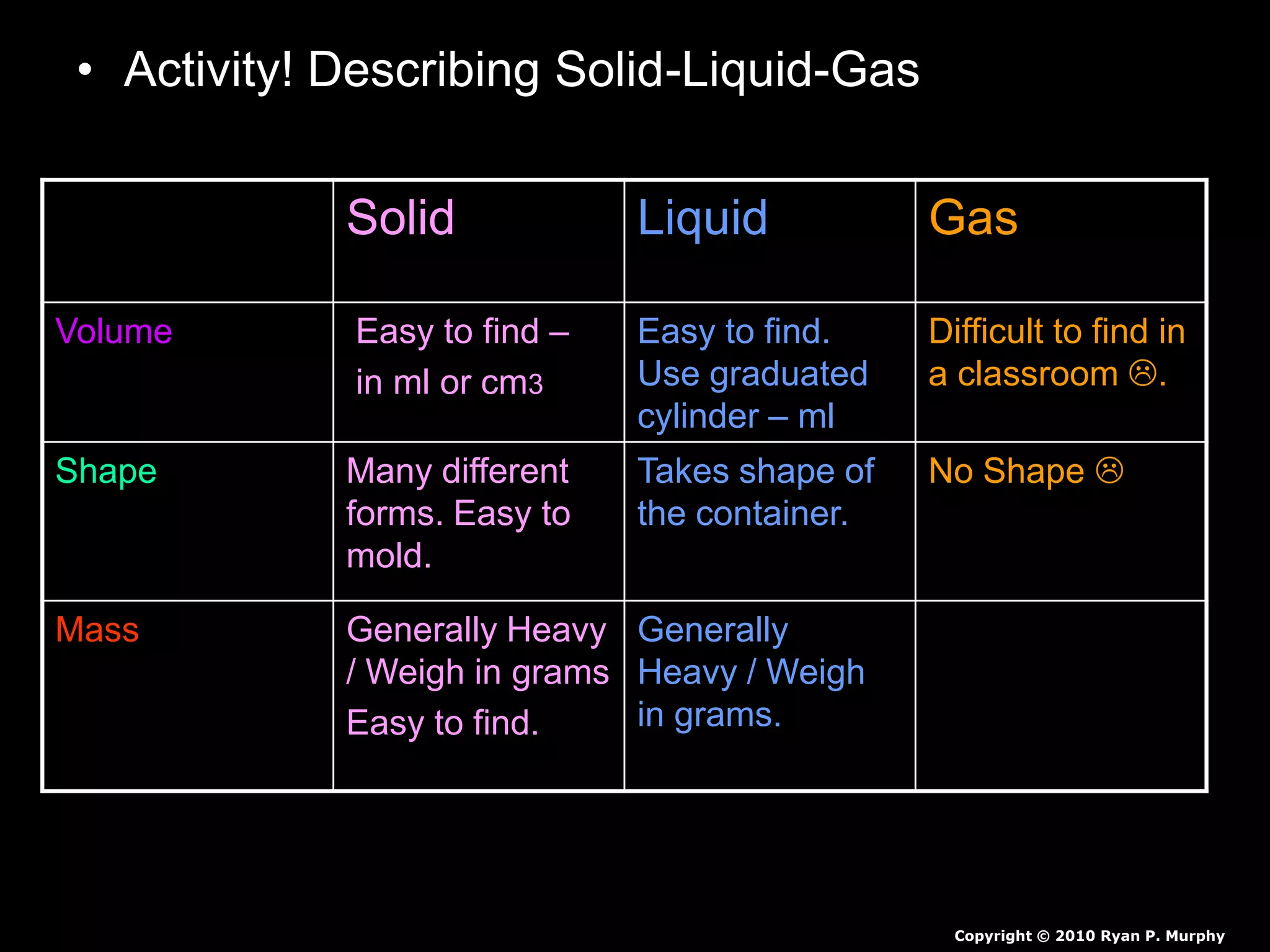
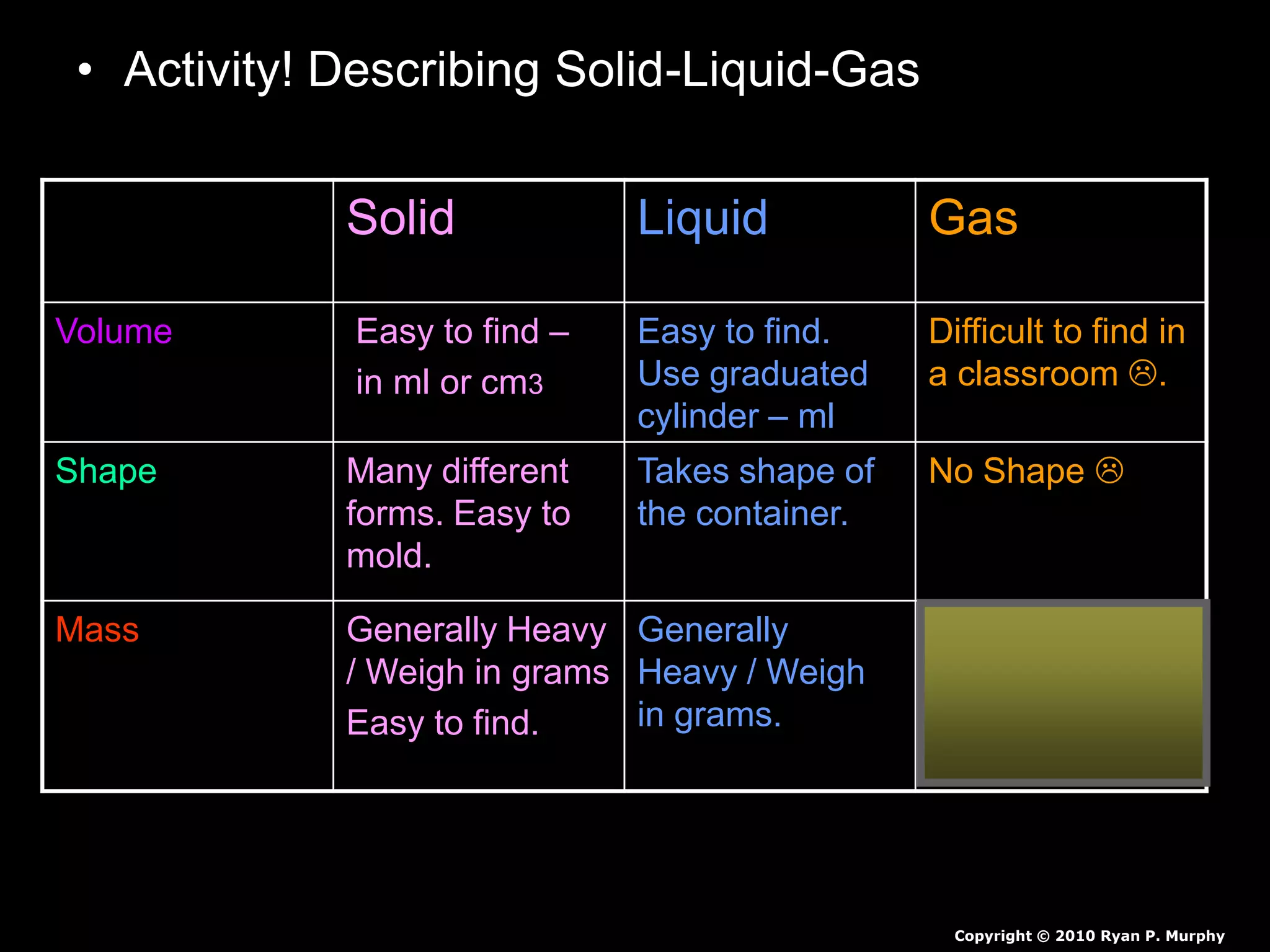
• Activity! Describing Solid-Liquid-Gas
– Possible Answers!
Solid Liquid Gas
Volume Easy to find –
in ml or cm3
Easy to find.
Use graduated
cylinder – ml
Difficult to find in
a classroom .
Shape Many different
forms. Easy to
mold.
Takes shape of
the container.
No Shape 
Mass Generally Heavy
/ Weigh in grams
Easy to find.
Generally
Heavy / Weigh
in grams.
Lighter in mass /
Harder to weigh in
a classroom 
Copyright © 2010 Ryan P. Murphy
• Activity! Describing Solid-Liquid-Gas
– Possible Answers!
Solid Liquid Gas
Volume Easy to find –
in ml or cm3
Easy to find.
Use graduated
cylinder – ml
Difficult to find in
a classroom .
Shape Many different
forms. Easy to
mold.
Takes shape of
the container.
No Shape 
Mass Generally Heavy
/ Weigh in grams
Easy to find.
Generally
Heavy / Weigh
in grams.
Lighter in mass /
Harder to weigh in
a classroom 
Copyright © 2010 Ryan P. Murphy
• Activity! Describing Solid-Liquid-Gas
– Possible Answers!
Solid Liquid Gas
Volume Easy to find –
in ml or cm3
Easy to find.
Use graduated
cylinder – ml
Difficult to find in
a classroom .
Shape Many different
forms. Easy to
mold.
Takes shape of
the container.
No Shape 
Mass Generally Heavy
/ Weigh in grams
Easy to find.
Generally
Heavy / Weigh
in grams.
Lighter in mass /
Harder to weigh in
a classroom 
Copyright © 2010 Ryan P. Murphy
• Activity! Describing Solid-Liquid-Gas
– Possible Answers!
Solid Liquid Gas
Volume Easy to find –
in ml or cm3
Easy to find.
Use graduated
cylinder – ml
Difficult to find in
a classroom .
Shape Many different
forms. Easy to
mold.
Takes shape of
the container.
No Shape 
Mass Generally Heavy
/ Weigh in grams
Easy to find.
Generally
Heavy / Weigh
in grams.
Lighter in mass /
Harder to weigh in
a classroom 
Copyright © 2010 Ryan P. Murphy
• Activity! Describing Solid-Liquid-Gas
– Possible Answers!
Solid Liquid Gas
Volume Easy to find –
in ml or cm3
Easy to find.
Use graduated
cylinder – ml
Difficult to find in
a classroom .
Shape Many different
forms. Easy to
mold.
Takes shape of
the container.
No Shape 
Mass Generally Heavy
/ Weigh in grams
Easy to find.
Generally
Heavy / Weigh
in grams.
Lighter in mass /
Harder to weigh in
a classroom 
Copyright © 2010 Ryan P. Murphy
• Activity! Describing Solid-Liquid-Gas
– Possible Answers!
Solid Liquid Gas
Volume Easy to find –
in ml or cm3
Easy to find.
Use graduated
cylinder – ml
Difficult to find in
a classroom .
Shape Many different
forms. Easy to
mold.
Takes shape of
the container.
No Shape 
Mass Generally Heavy
/ Weigh in grams
Easy to find.
Generally
Heavy / Weigh
in grams.
Lighter in mass /
Harder to weigh in
a classroom 
Copyright © 2010 Ryan P. Murphy
• Activity! Describing Solid-Liquid-Gas
– Possible Answers!
Solid Liquid Gas
Volume Easy to find –
in ml or cm3
Easy to find.
Use graduated
cylinder – ml
Difficult to find in
a classroom .
Shape Many different
forms. Easy to
mold.
Takes shape of
the container.
No Shape 
Mass Generally Heavy
/ Weigh in grams
Easy to find.
Generally
Heavy / Weigh
in grams.
Lighter in mass /
Harder to weigh in
a classroom 
Copyright © 2010 Ryan P. Murphy
• Activity! Describing Solid-Liquid-Gas
– Possible Answers!
Solid Liquid Gas
Volume Easy to find –
in ml or cm3
Easy to find.
Use graduated
cylinder – ml
Difficult to find in
a classroom .
Shape Many different
forms. Easy to
mold.
Takes shape of
the container.
No Shape 
Mass Generally Heavy
/ Weigh in grams
Easy to find.
Generally
Heavy / Weigh
in grams.
Lighter in mass /
Harder to weigh in
a classroom 
Copyright © 2010 Ryan P. Murphy
• Activity! Describing Solid-Liquid-Gas
– Possible Answers!
Solid Liquid Gas
Volume Easy to find –
in ml or cm3
Easy to find.
Use graduated
cylinder – ml
Difficult to find in
a classroom .
Shape Many different
forms. Easy to
mold.
Takes shape of
the container.
No Shape 
Mass Generally Heavy
/ Weigh in grams
Easy to find.
Generally
Heavy / Weigh
in grams.
Lighter in mass /
Harder to weigh in
a classroom 
Copyright © 2010 Ryan P. Murphy
• Activity! Describing Solid-Liquid-Gas
– Possible Answers!
Solid Liquid Gas
Volume Easy to find –
in ml or cm3
Easy to find.
Use graduated
cylinder – ml
Difficult to find in
a classroom .
Shape Many different
forms. Easy to
mold.
Takes shape of
the container.
No Shape 
Mass Generally Heavy
/ Weigh in grams
Easy to find.
Generally
Heavy / Weigh
in grams.
Lighter in mass /
Harder to weigh in
a classroom 
Copyright © 2010 Ryan P. Murphy
• Activity! Describing Solid-Liquid-Gas
– Possible Answers!
Solid Liquid Gas
Volume Easy to find –
in ml or cm3
Easy to find.
Use graduated
cylinder – ml
Difficult to find in
a classroom .
Shape Many different
forms. Easy to
mold.
Takes shape of
the container.
No Shape 
Mass Generally Heavy
/ Weigh in grams
Easy to find.
Generally
Heavy / Weigh
in grams.
Lighter in mass /
Harder to weigh in
a classroom 
Copyright © 2010 Ryan P. Murphy
• Activity! Describing Solid-Liquid-Gas
– Possible Answers!
Solid Liquid Gas
Volume Easy to find –
in ml or cm3
Easy to find.
Use graduated
cylinder – ml
Difficult to find in
a classroom .
Shape Many different
forms. Easy to
mold.
Takes shape of
the container.
No Shape 
Mass Generally Heavy
/ Weigh in grams
Easy to find.
Generally
Heavy / Weigh
in grams.
Lighter in mass /
Harder to weigh in
a classroom 
Copyright © 2010 Ryan P. Murphy
• Activity! Describing Solid-Liquid-Gas
– Possible Answers!
Solid Liquid Gas
Volume Easy to find –
in ml or cm3
Easy to find.
Use graduated
cylinder – ml
Difficult to find in
a classroom .
Shape Many different
forms. Easy to
mold.
Takes shape of
the container.
No Shape 
Mass Generally Heavy
/ Weigh in grams
Easy to find.
Generally
Heavy / Weigh
in grams.
Lighter in mass /
Harder to weigh in
a classroom 
Copyright © 2010 Ryan P. Murphy
• Activity! Describing Solid-Liquid-Gas
– Possible Answers!
Solid Liquid Gas
Volume Easy to find –
in ml or cm3
Easy to find.
Use graduated
cylinder – ml
Difficult to find in
a classroom .
Shape Many different
forms. Easy to
mold.
Takes shape of
the container.
No Shape 
Mass Generally Heavy
/ Weigh in grams
Easy to find.
Generally
Heavy / Weigh
in grams.
Lighter in mass /
Harder to weigh in
a classroom 
Copyright © 2010 Ryan P. Murphy
• Activity! Describing Solid-Liquid-Gas
– Possible Answers!
Solid Liquid Gas
Volume Easy to find –
in ml or cm3
Easy to find.
Use graduated
cylinder – ml
Difficult to find in
a classroom .
PV=nRT
Shape Many different
forms. Easy to
mold.
Takes shape of
the container.
No Shape 
Mass Generally Heavy
/ Weigh in grams
Easy to find.
Generally
Heavy / Weigh
in grams.
Lighter in mass /
Harder to weigh in
a classroom 
Copyright © 2010 Ryan P. Murphy
• Activity! Describing Solid-Liquid-Gas
– Possible Answers!
Solid Liquid Gas
Volume Easy to find –
in ml or cm3
Easy to find.
Use graduated
cylinder – ml
Difficult to find in
a classroom 
.
Shape Many different
forms. Easy to
mold.
Takes shape of
the container.
No Shape 
Mass Generally Heavy
/ Weigh in grams
Easy to find.
Generally
Heavy / Weigh
in grams.
Lighter in mass /
Harder to weigh in
a classroom 
Copyright © 2010 Ryan P. Murphy
• Activity! Describing Solid-Liquid-Gas
– Possible Answers!
Solid Liquid Gas
Volume Easy to find –
in ml or cm3
Easy to find.
Use graduated
cylinder – ml
Difficult to find in
a classroom .
Shape Many different
forms. Easy to
mold.
Takes shape of
the container.
No Shape 
Mass Generally Heavy
/ Weigh in grams
Easy to find.
Generally
Heavy / Weigh
in grams.
Lighter in mass /
Harder to weigh in
a classroom 
Copyright © 2010 Ryan P. Murphy
• Activity! Describing Solid-Liquid-Gas
– Possible Answers!
Solid Liquid Gas
Volume Easy to find –
in ml or cm3
Easy to find.
Use graduated
cylinder – ml
Difficult to find in
a classroom .
Shape Many different
forms. Easy to
mold.
Takes shape of
the container.
No Shape 
Mass Generally Heavy
/ Weigh in grams
Easy to find.
Generally
Heavy / Weigh
in grams.
Lighter in mass /
Harder to weigh in
a classroom 
Copyright © 2010 Ryan P. Murphy
• Activity! Describing Solid-Liquid-Gas
– Possible Answers!
Solid Liquid Gas
Volume Easy to find –
in ml or cm3
Easy to find.
Use graduated
cylinder – ml
Difficult to find in
a classroom .
Shape Many different
forms. Easy to
mold.
Takes shape of
the container.
No Shape 
Mass Generally Heavy
/ Weigh in grams
Easy to find.
Generally
Heavy / Weigh
in grams.
Lighter in mass /
Harder to weigh
than solid and
liquids.
Copyright © 2010 Ryan P. Murphy
• Activity! State your Matter
– Teacher to give each group of students a
solid block (Maybe ice), glass of water, and
balloon filled with gas.
• Activity! State your Matter
– Teacher to give each group of students a
solid block (Maybe ice), glass of water, and
balloon filled with gas.
• Activity! State your Matter
– Teacher to give each group of students a
solid block (Maybe ice), glass of water, and
balloon filled with gas.
• Activity! State your Matter
– Teacher to give each group of students a
solid block (Maybe ice), glass of water, and
balloon filled with gas.
• Activity! State your Matter
– Teacher to give each group of students a
solid block (Maybe ice), glass of water, and
balloon filled with gas.
• Activity! State your Matter
– Teacher to give each group of students a
solid block (Maybe ice), glass of water, and
balloon filled with gas.
• Activity! State your Matter
– Teacher to give each group of students a
solid block (Maybe ice), glass of water, and
balloon filled with gas.
• Activity! State your Matter
– Teacher to give each group of students a
solid block (Maybe ice), glass of water, and
balloon filled with gas.
• Activity! State your Matter
– Teacher to give each group of students a
solid block (Maybe ice), glass of water, and
balloon filled with gas.
• Activity! State your Matter
– Teacher to give each group of students a
solid block (Maybe ice), glass of water, and
balloon filled with gas.
• Activity! State your Matter
– Teacher to give each group of students a
solid block (Maybe ice), glass of water, and
balloon filled with gas.
 States of Matter
 -
 -
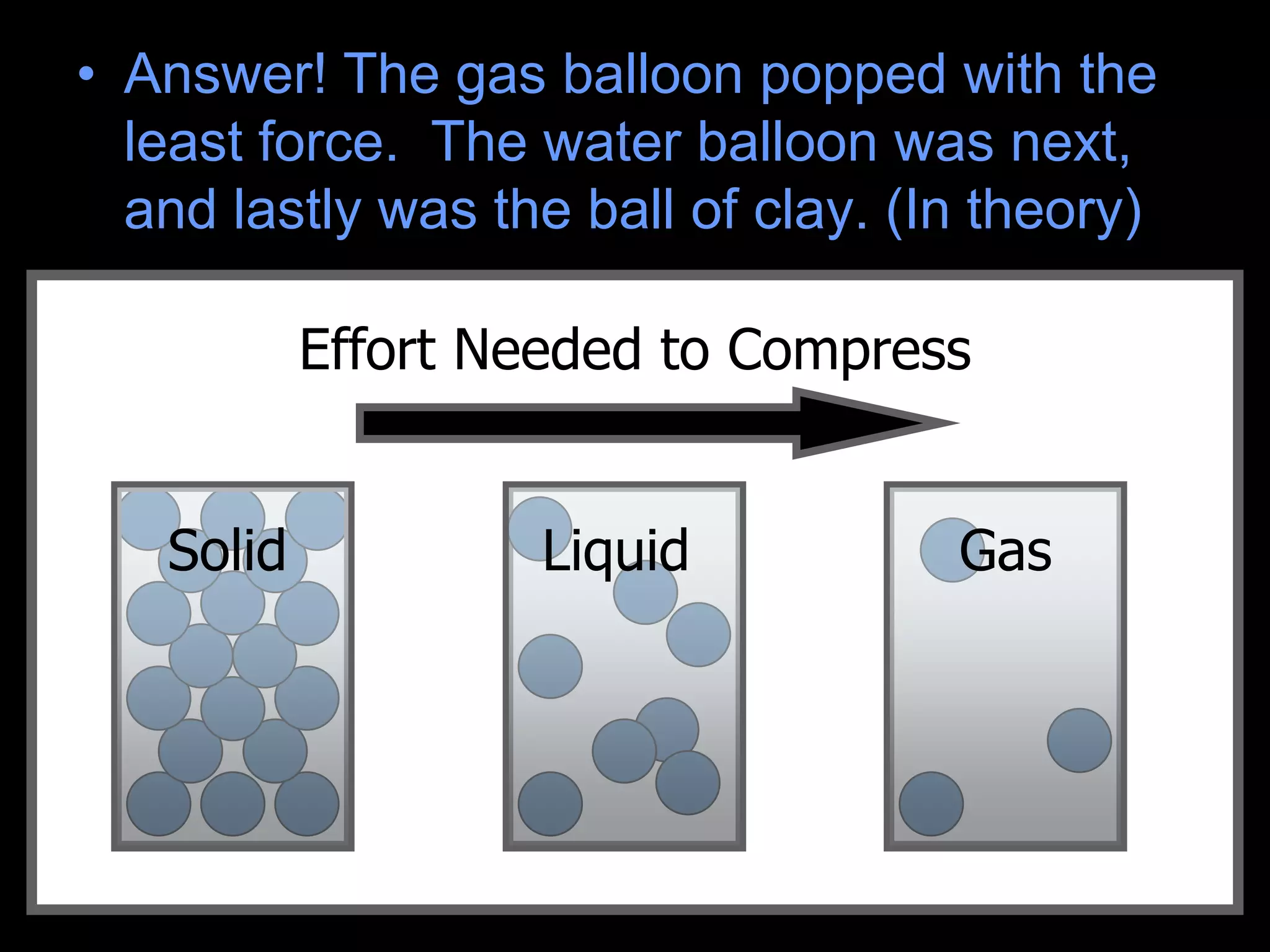
 -
 -
Copyright © 2010 Ryan P. Murphy
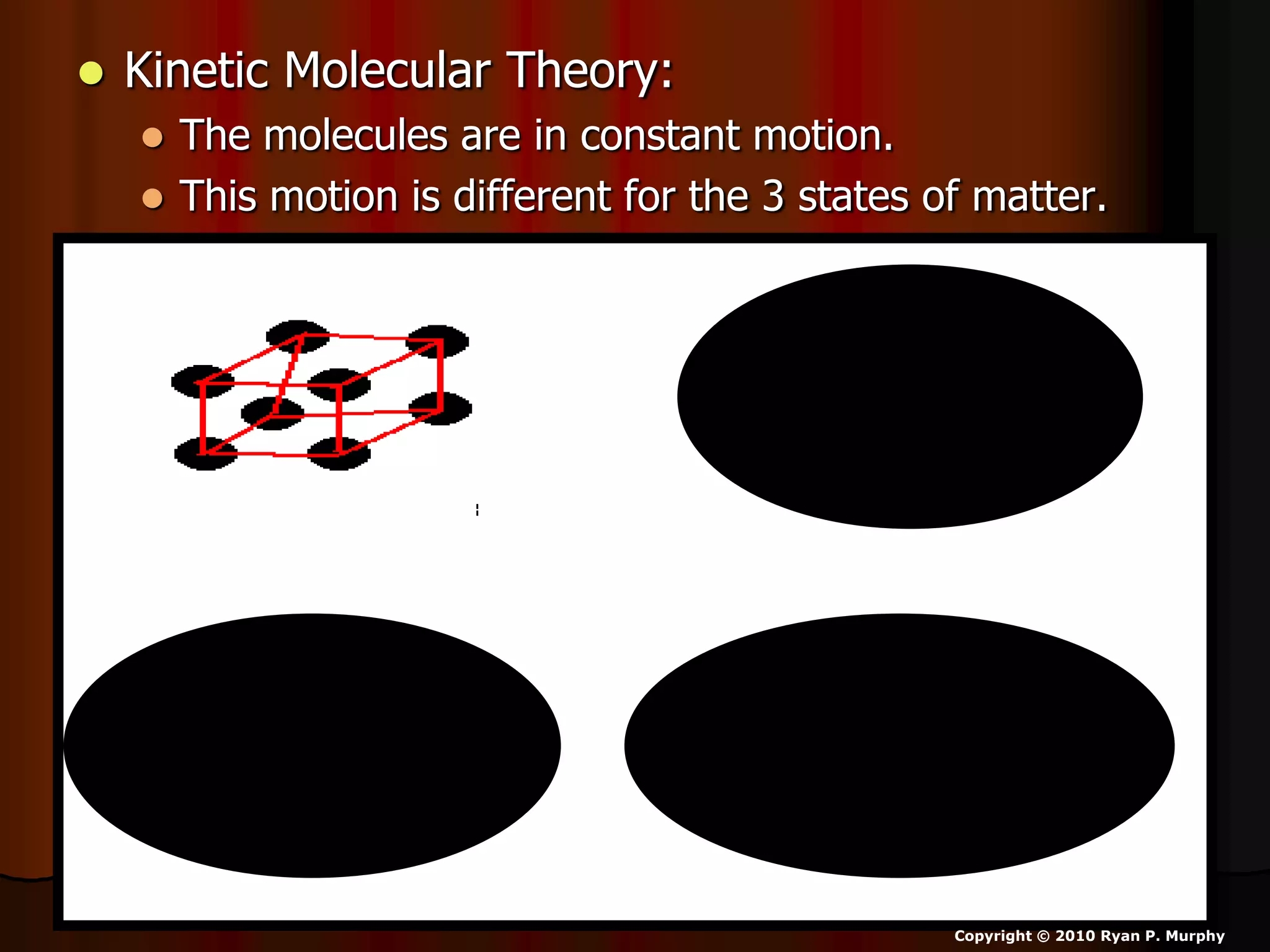
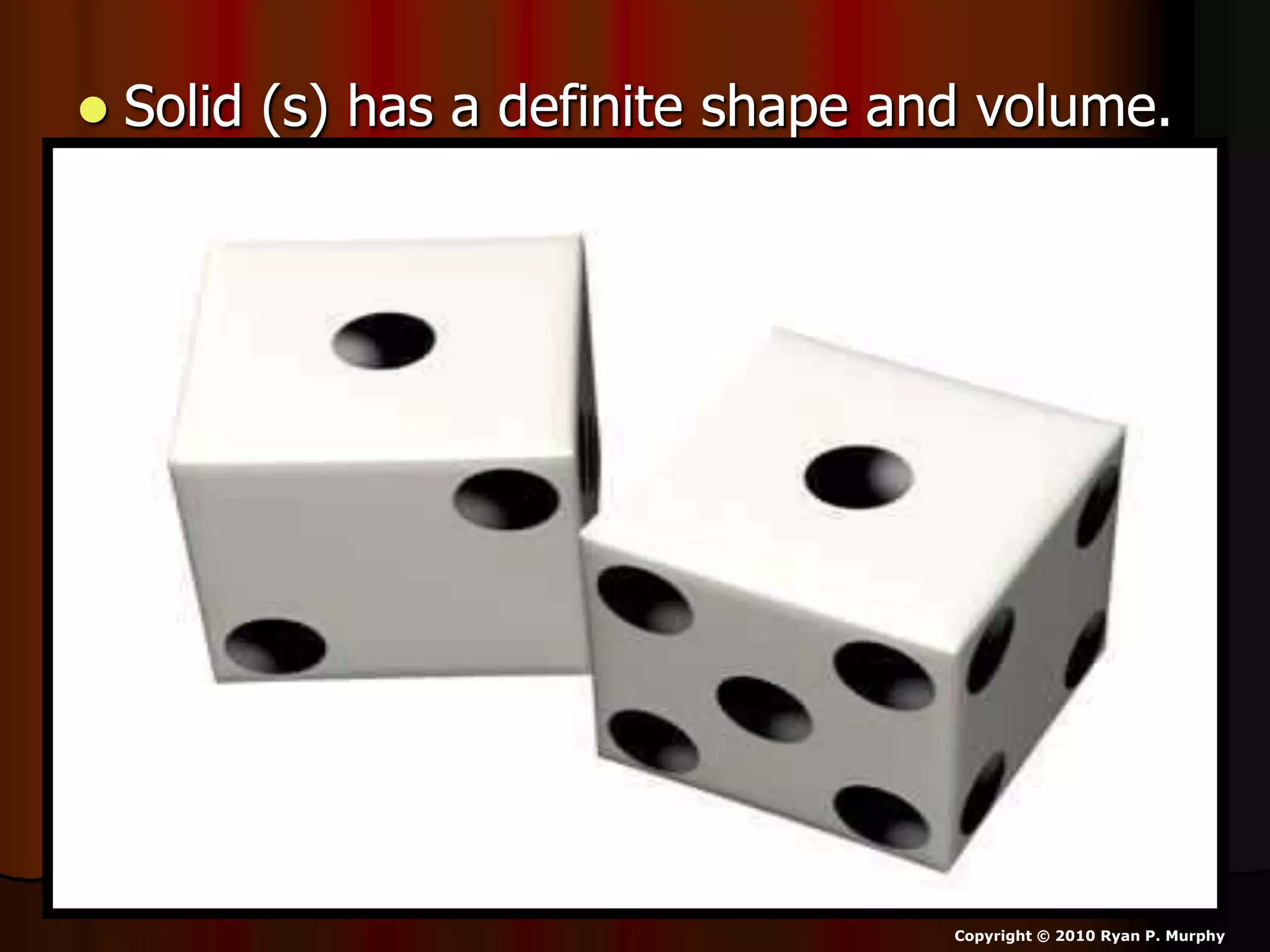
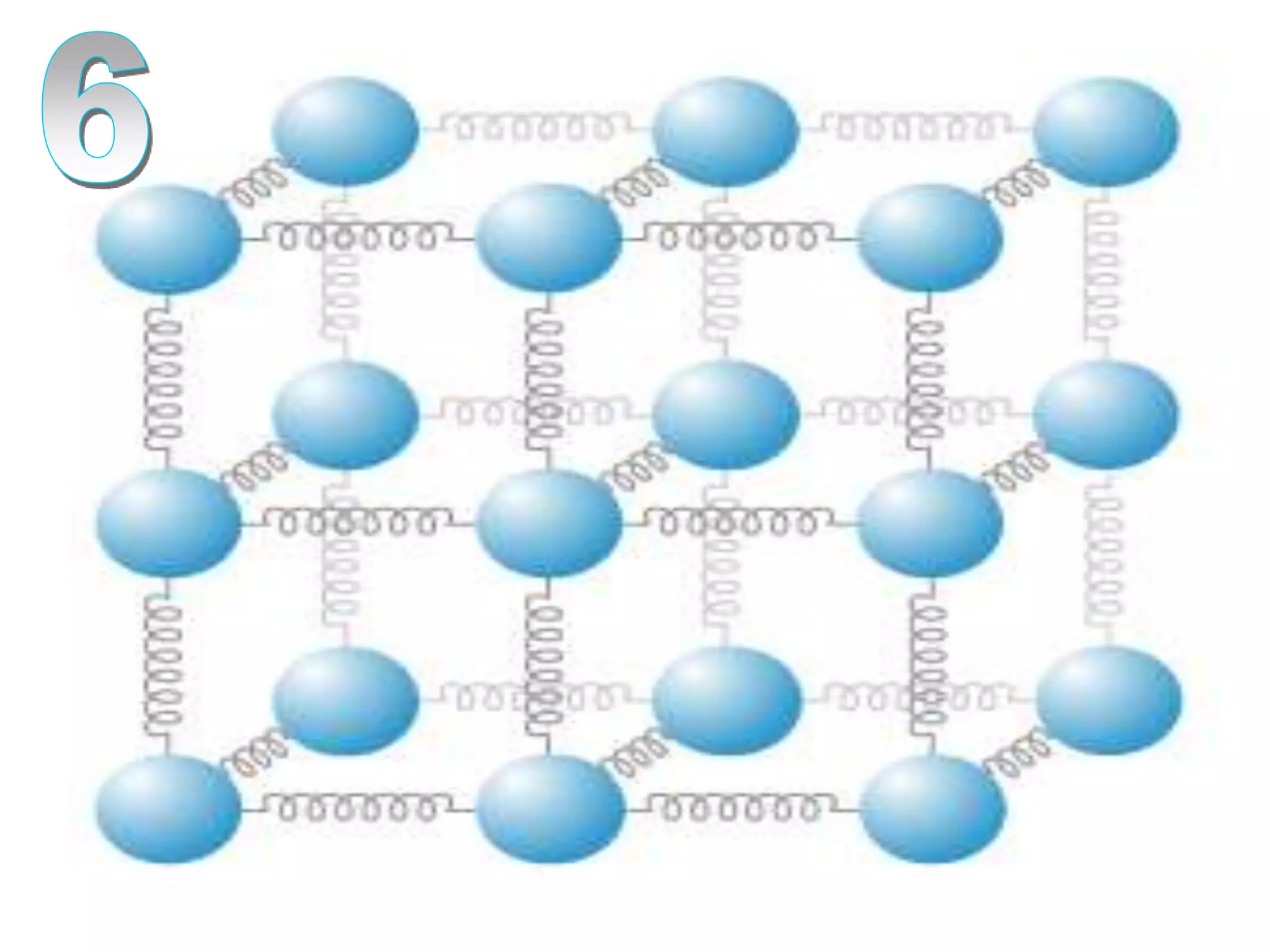
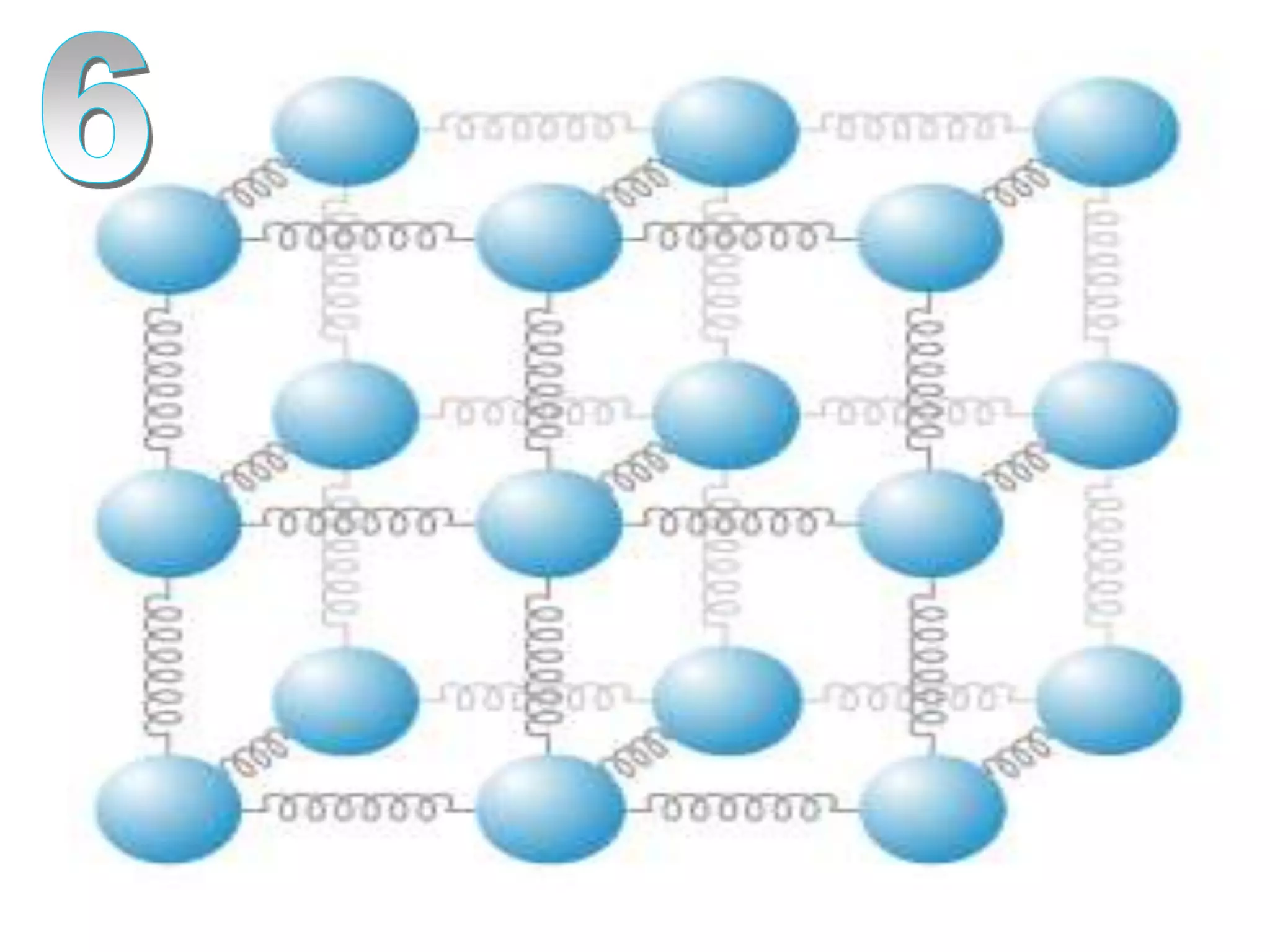
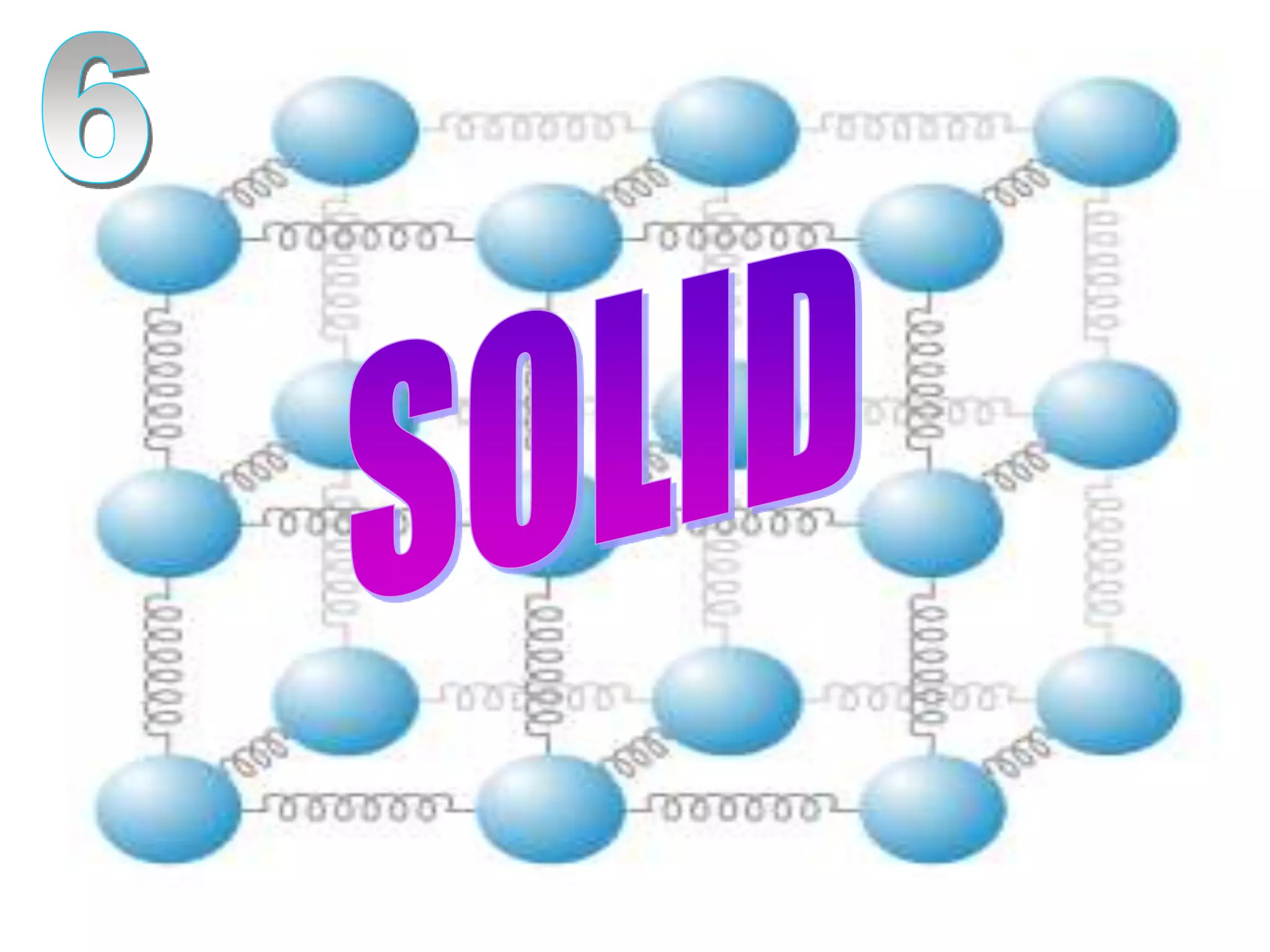
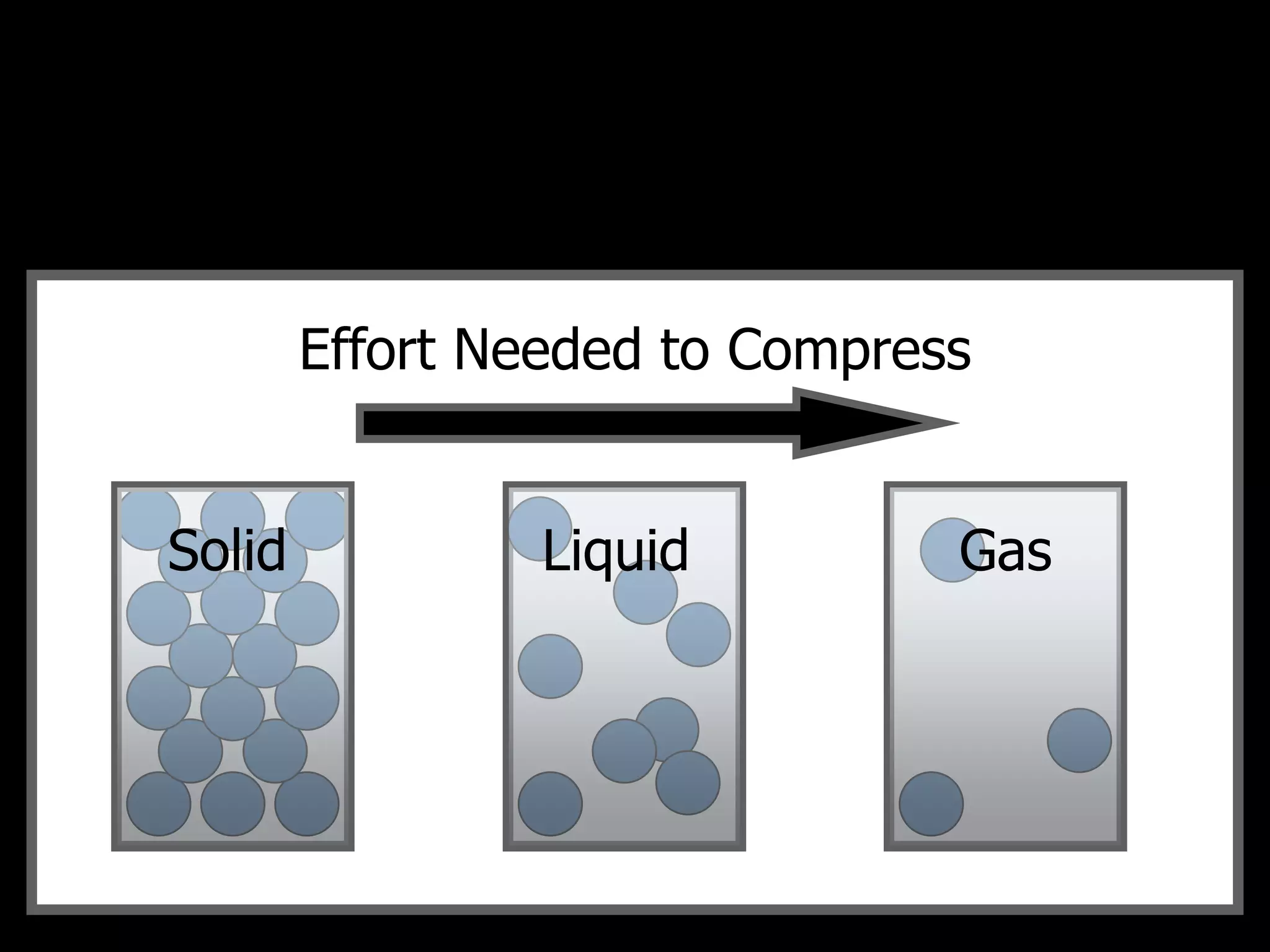
 Solid (s) has a definite shape and volume.
Copyright © 2010 Ryan P. Murphy
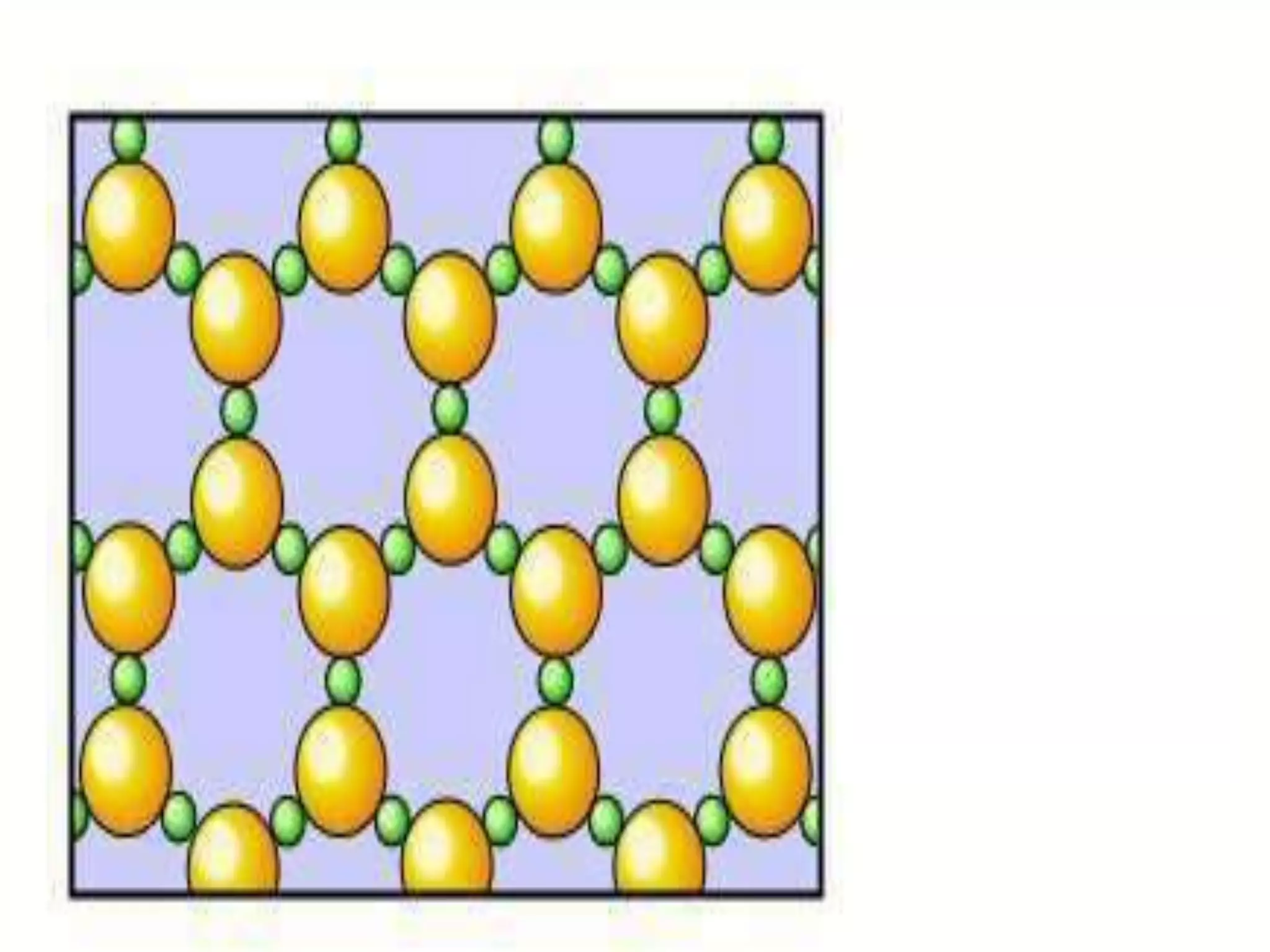
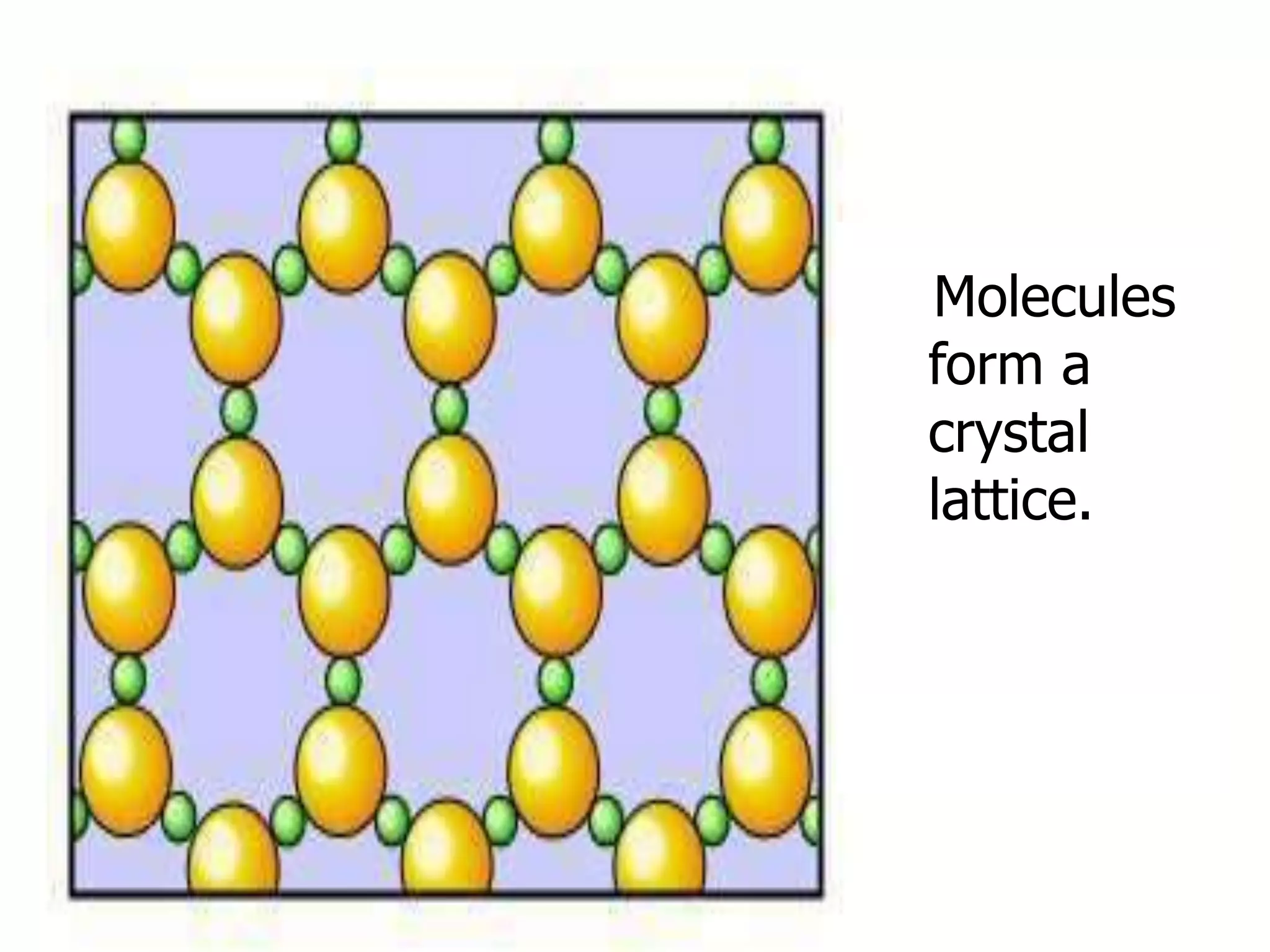
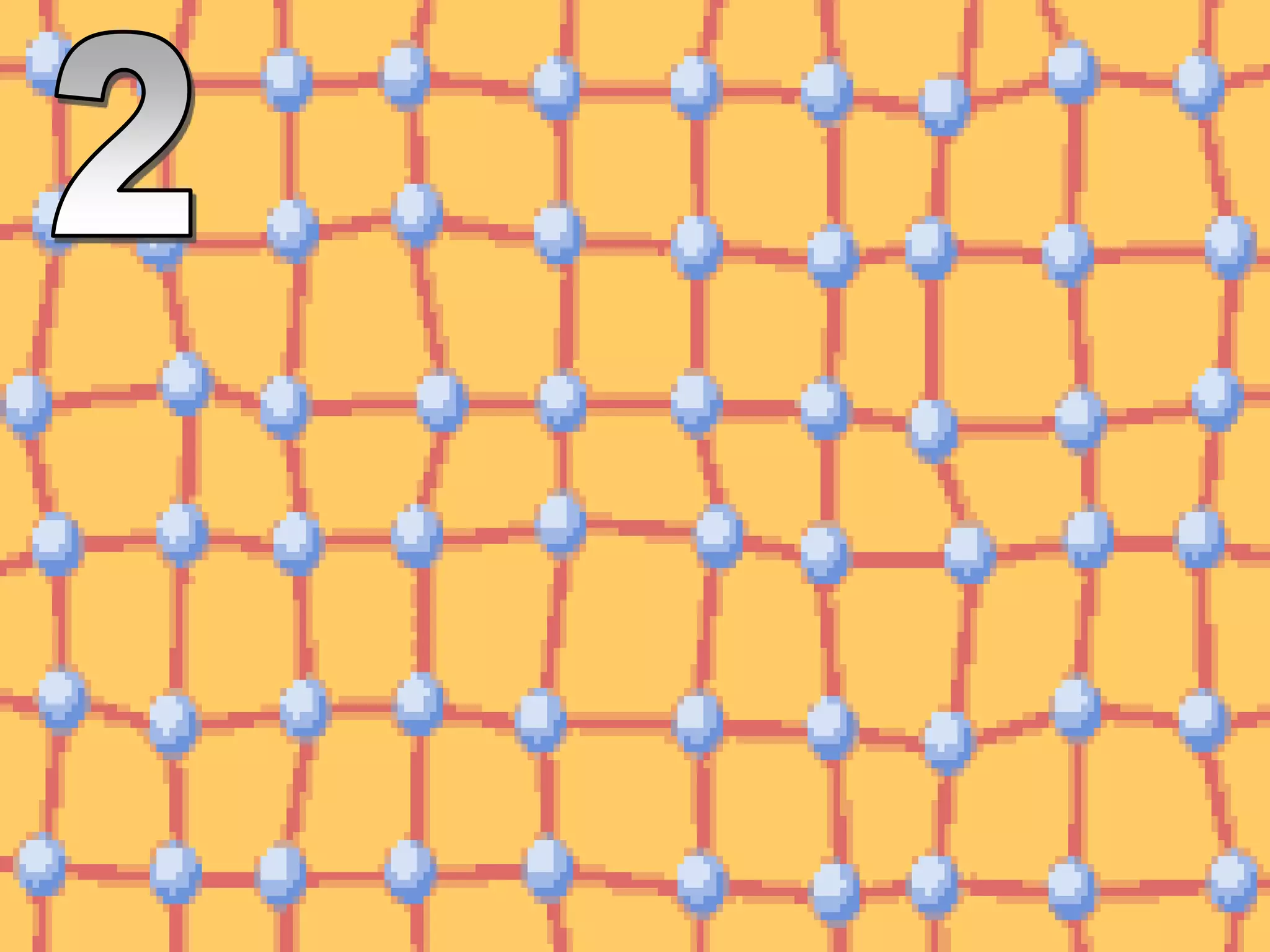
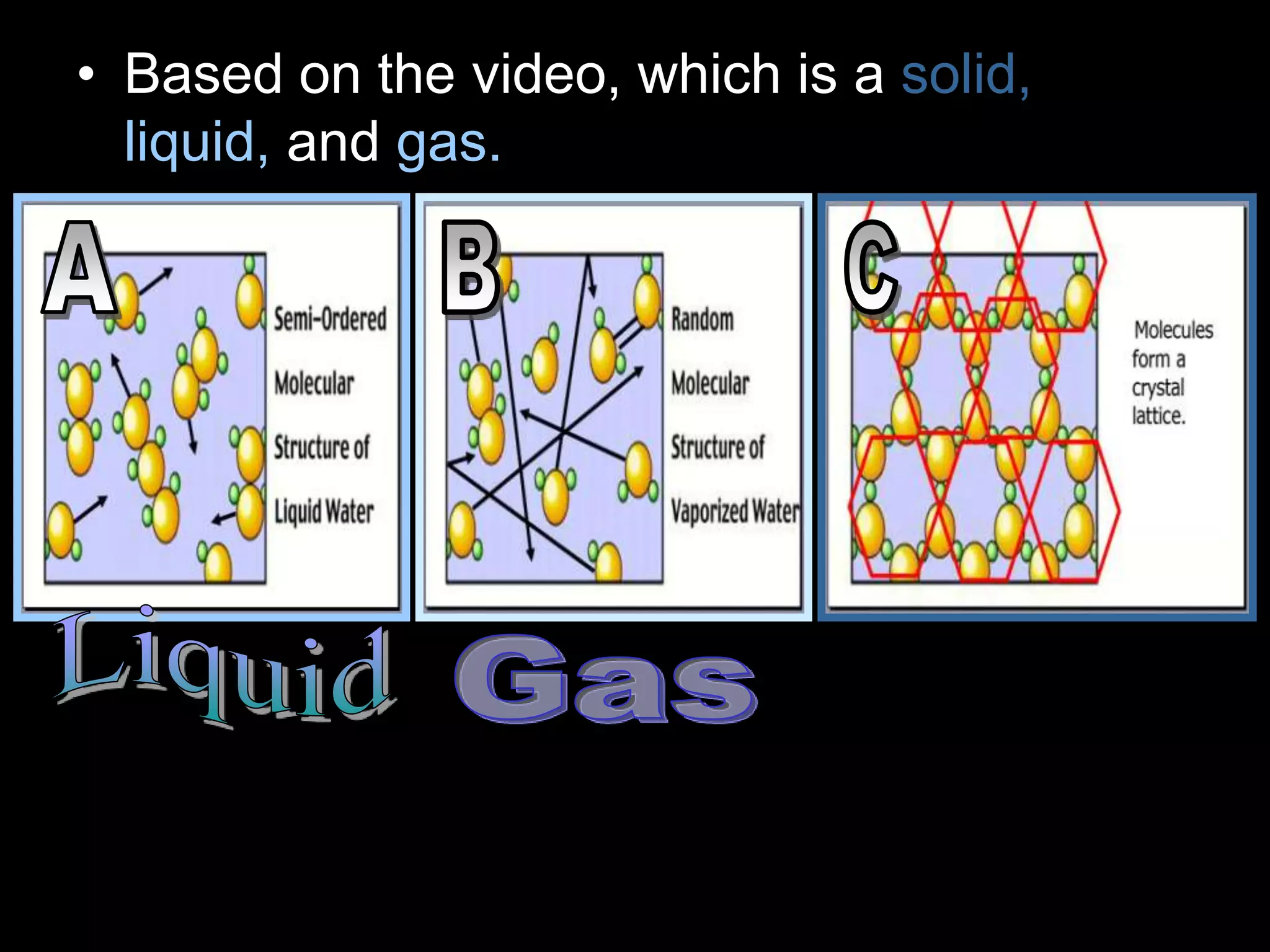
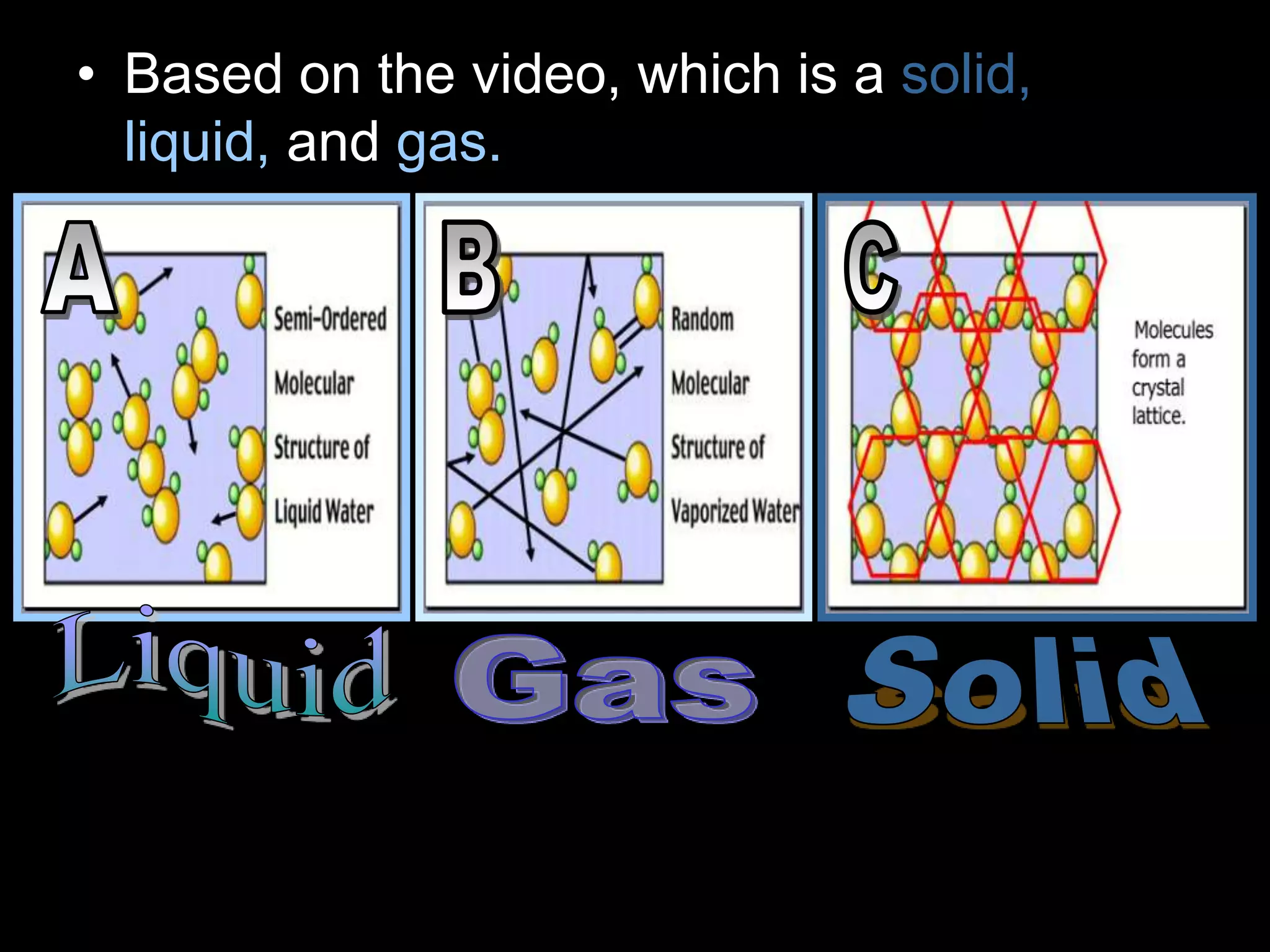
Molecules
form a
crystal
lattice.
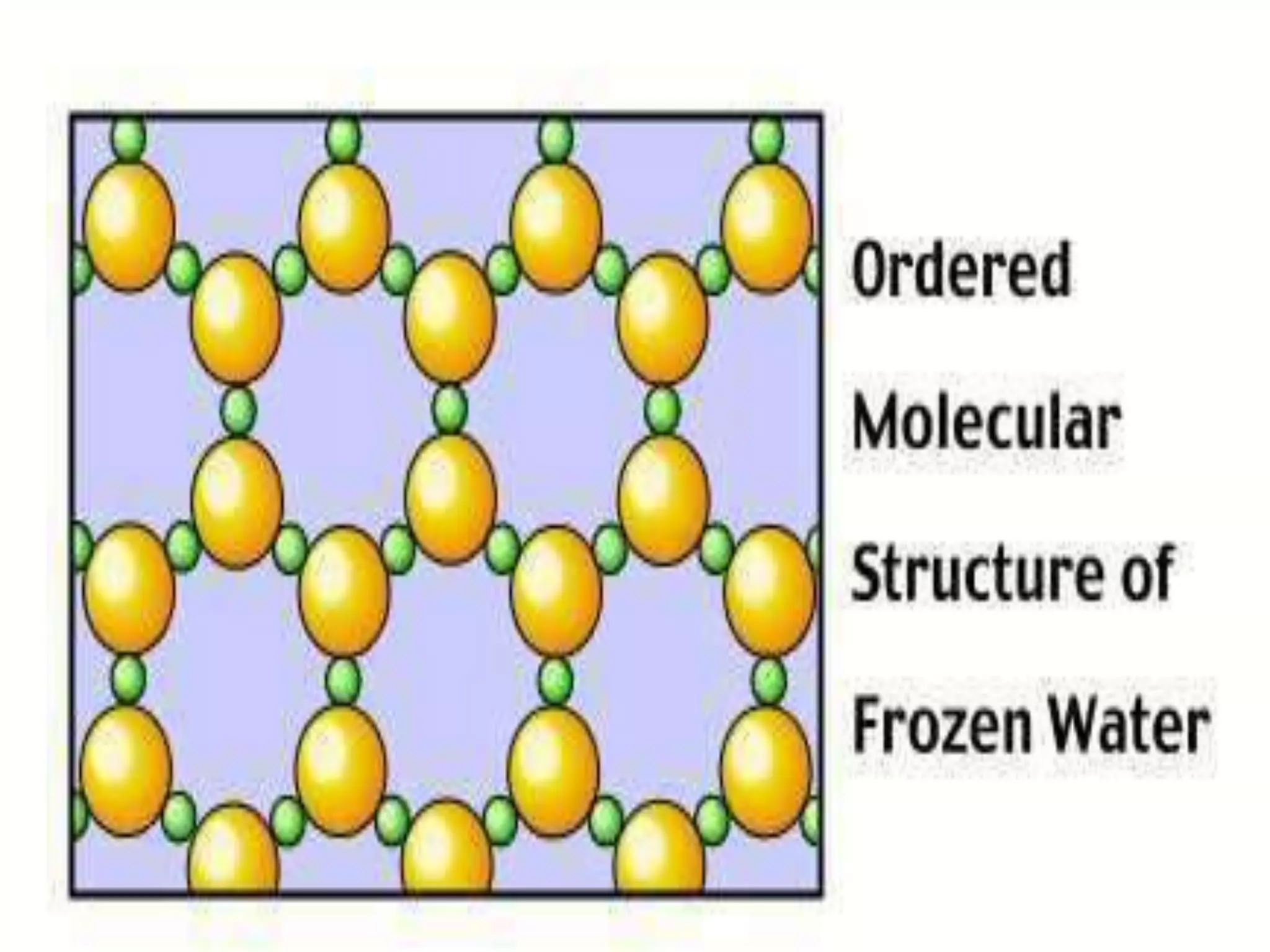
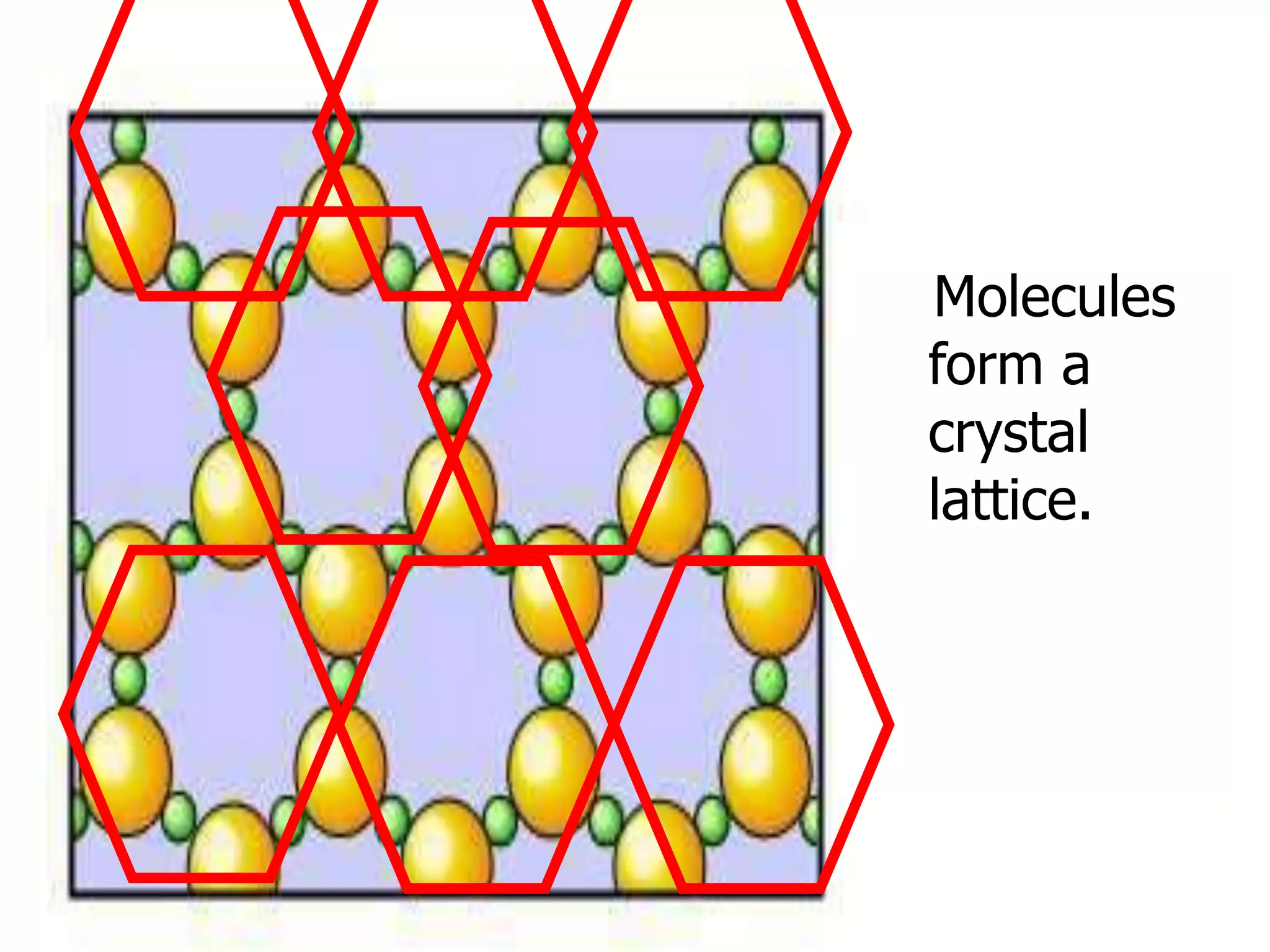
Molecules
form a
crystal
lattice.
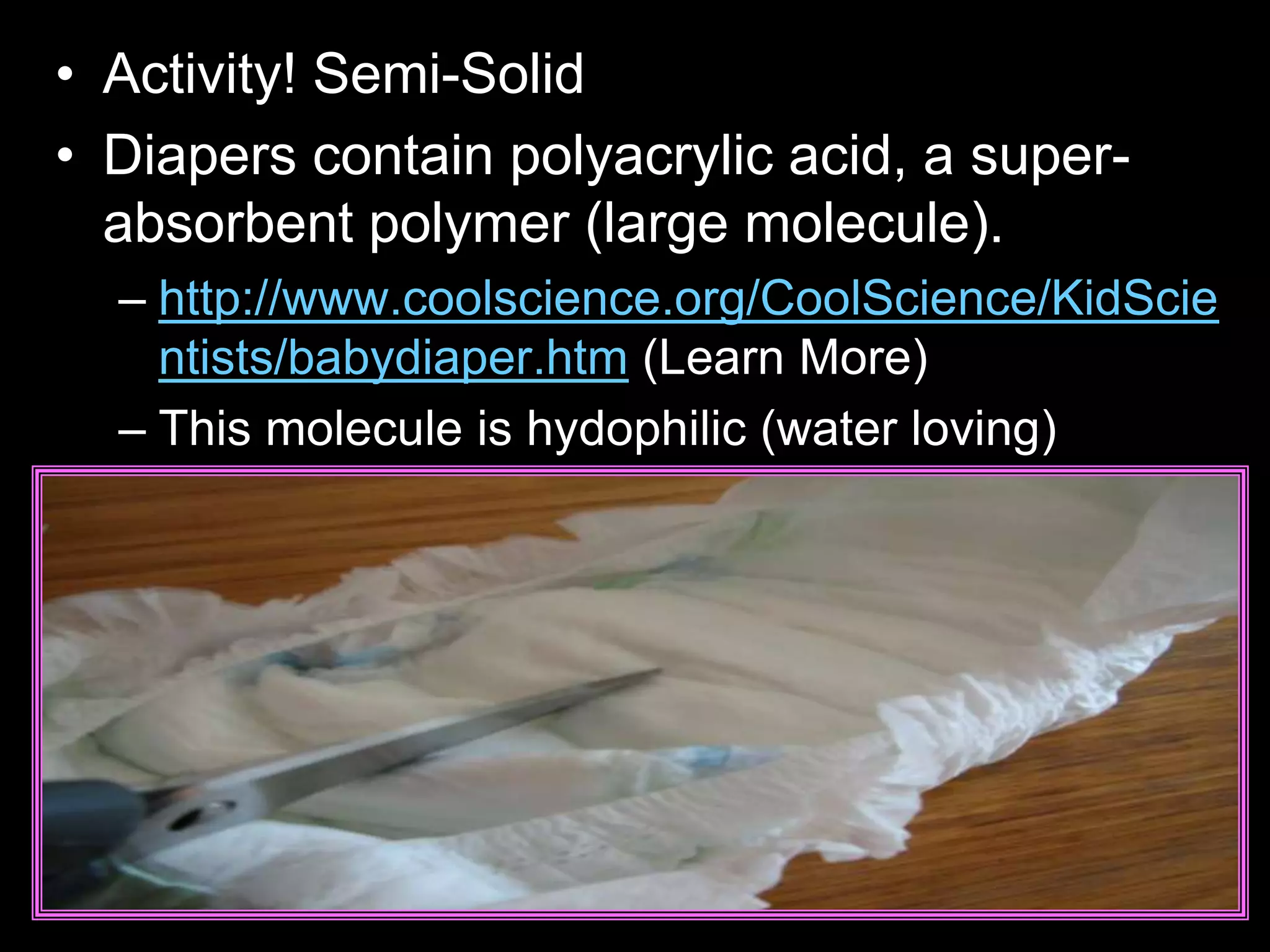
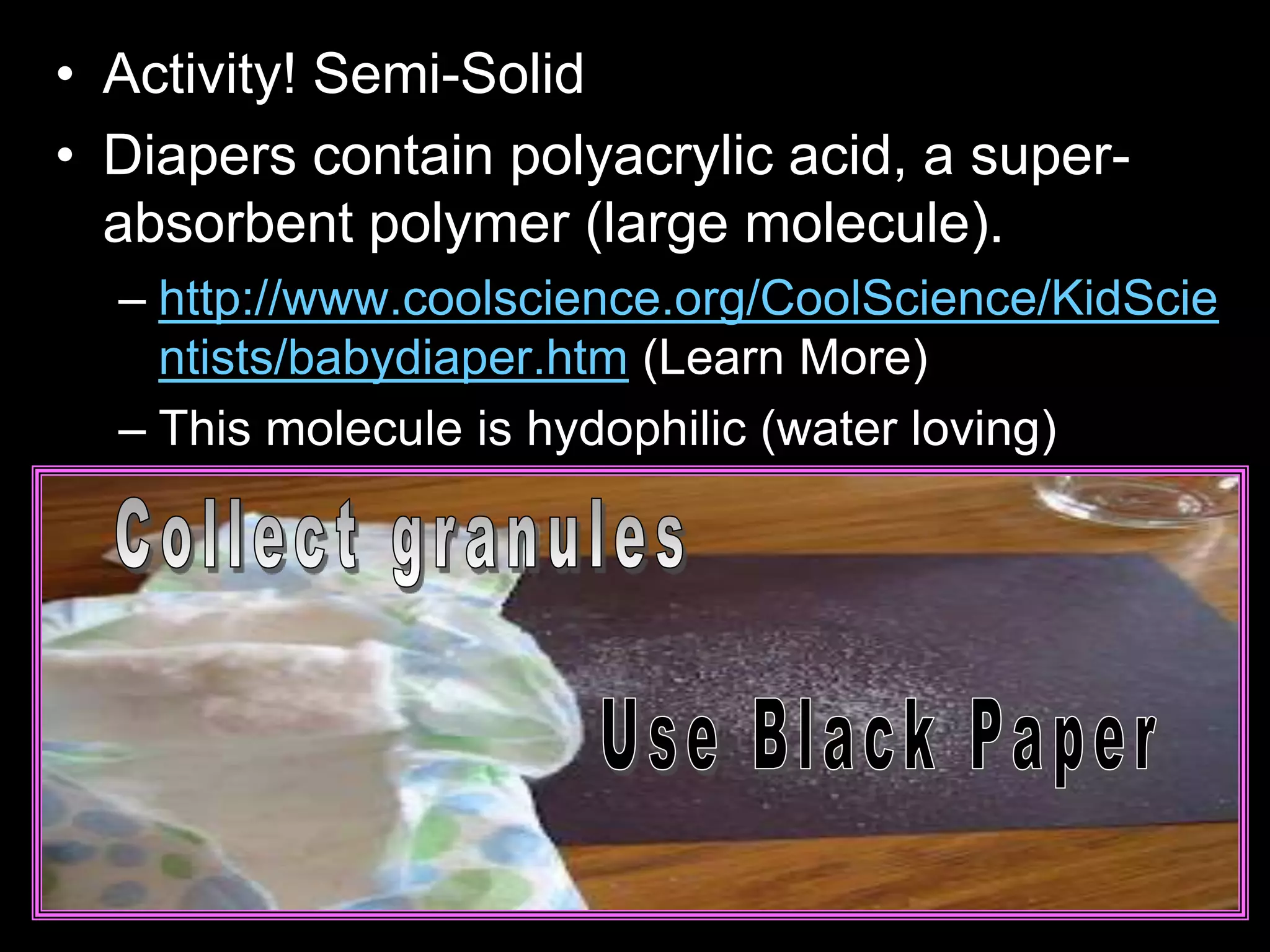
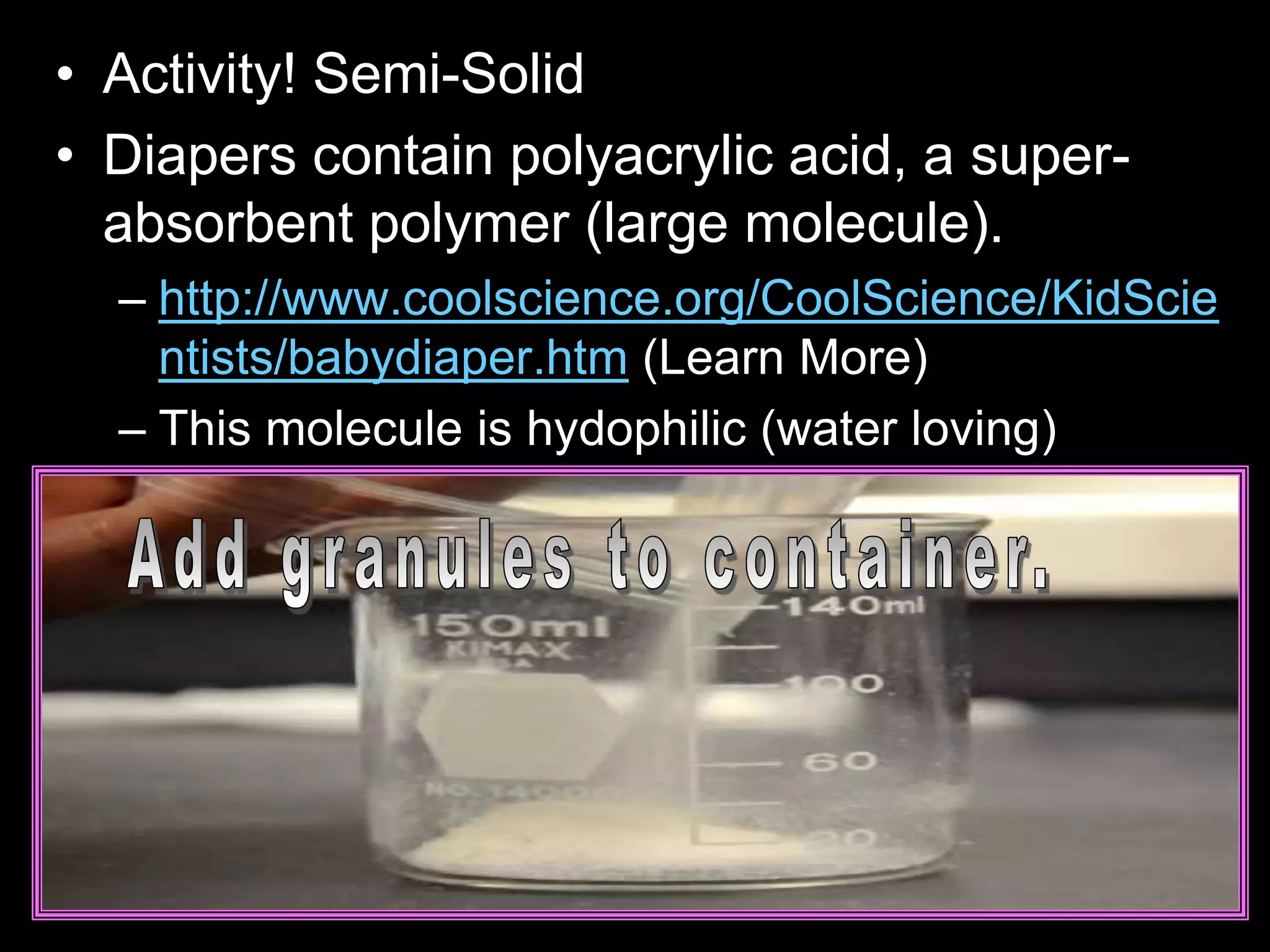
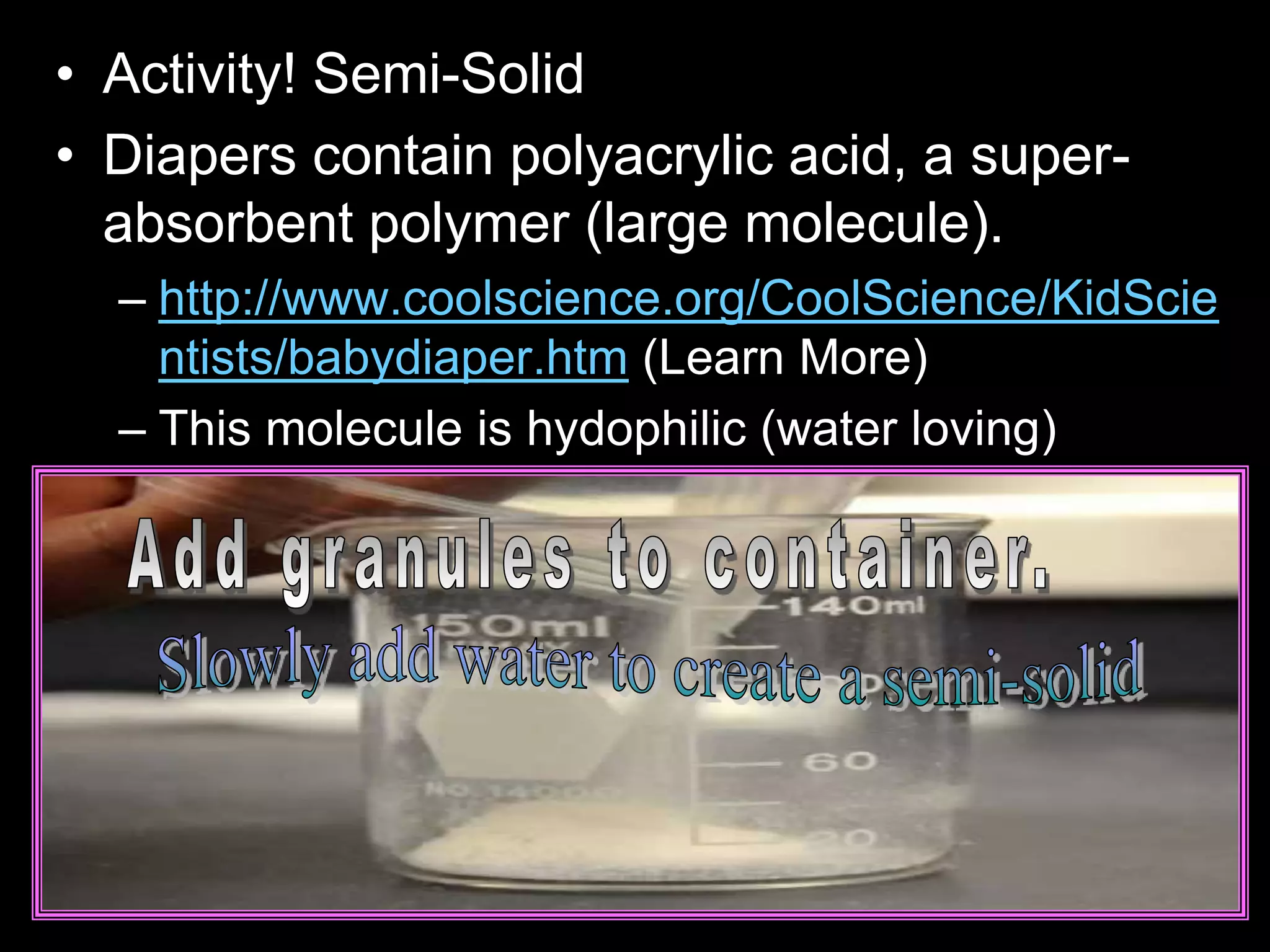
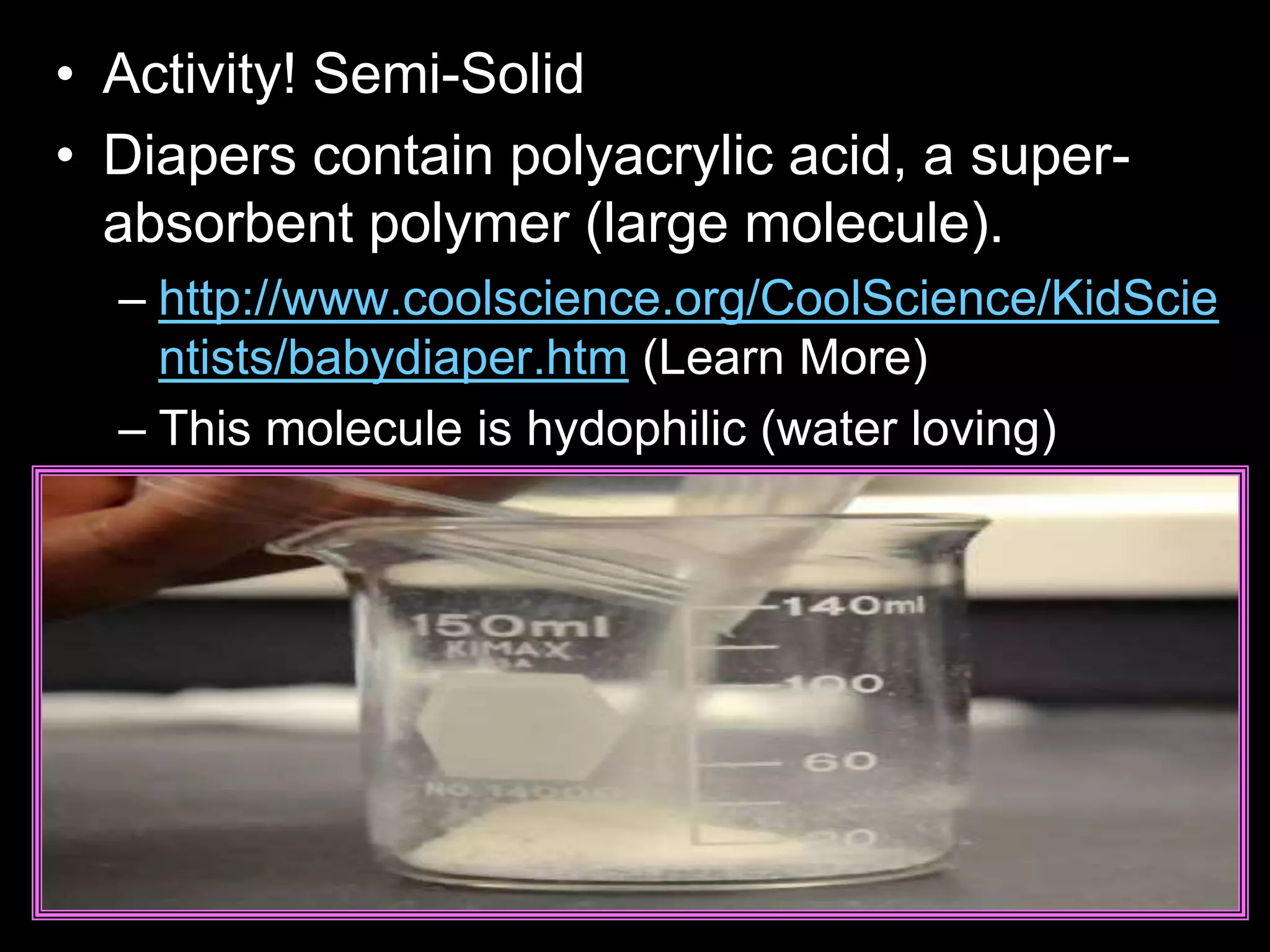
• Activity! Semi-Solid
• Diapers contain polyacrylic acid, a super-
absorbent polymer (large molecule).
– http://www.coolscience.org/CoolScience/KidScie
ntists/babydiaper.htm (Learn More)
– This molecule is hydophilic (water loving)
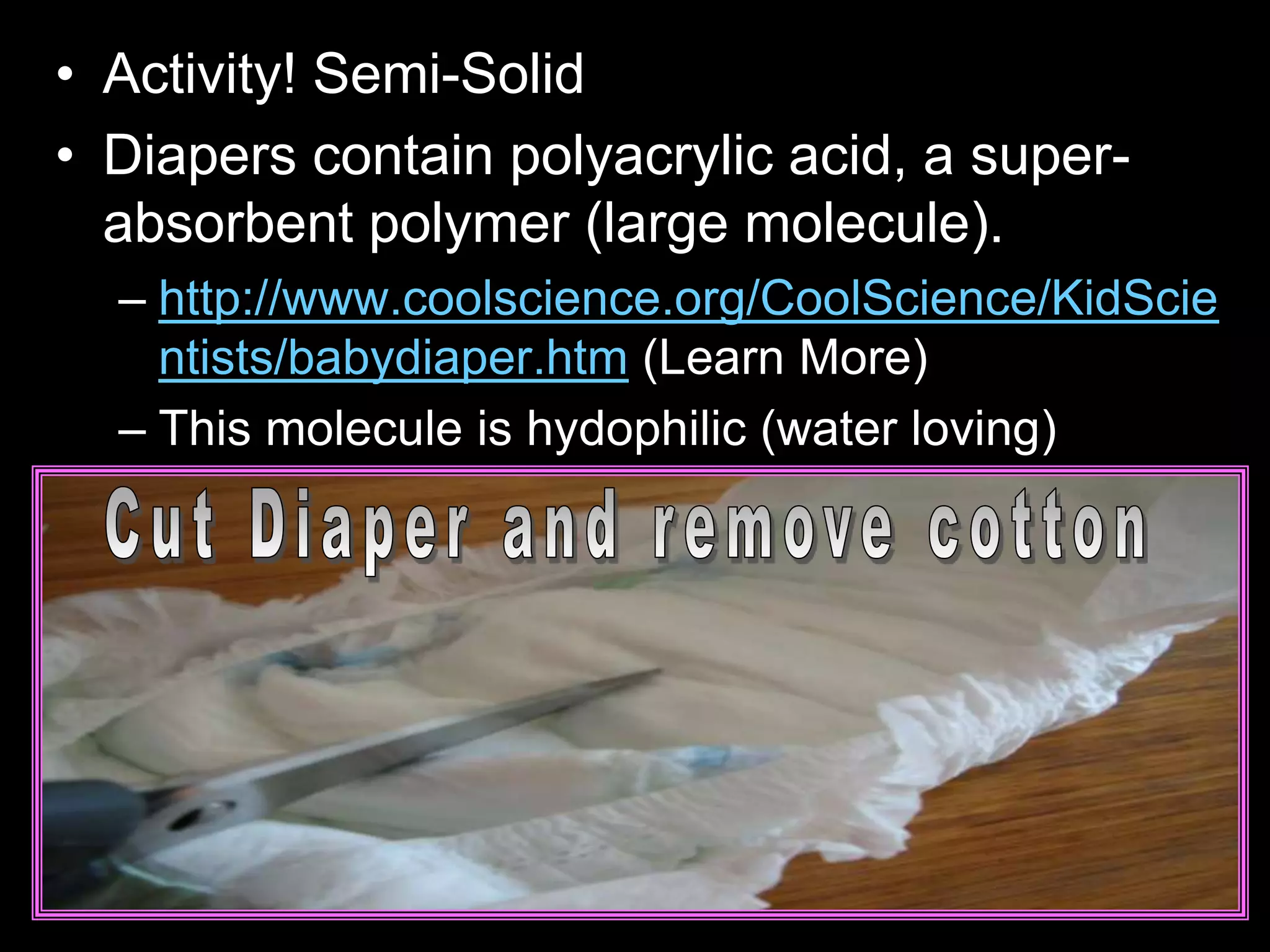
• Activity! Semi-Solid
• Diapers contain polyacrylic acid, a super-
absorbent polymer (large molecule).
– http://www.coolscience.org/CoolScience/KidScie
ntists/babydiaper.htm (Learn More)
– This molecule is hydophilic (water loving)
• Activity! Semi-Solid
• Diapers contain polyacrylic acid, a super-
absorbent polymer (large molecule).
– http://www.coolscience.org/CoolScience/KidScie
ntists/babydiaper.htm (Learn More)
– This molecule is hydophilic (water loving)
• Activity! Semi-Solid
• Diapers contain polyacrylic acid, a super-
absorbent polymer (large molecule).
– http://www.coolscience.org/CoolScience/KidScie
ntists/babydiaper.htm (Learn More)
– This molecule is hydophilic (water loving)
• Activity! Semi-Solid
• Diapers contain polyacrylic acid, a super-
absorbent polymer (large molecule).
– http://www.coolscience.org/CoolScience/KidScie
ntists/babydiaper.htm (Learn More)
– This molecule is hydophilic (water loving)
• Activity! Semi-Solid
• Diapers contain polyacrylic acid, a super-
absorbent polymer (large molecule).
– http://www.coolscience.org/CoolScience/KidScie
ntists/babydiaper.htm (Learn More)
– This molecule is hydophilic (water loving)
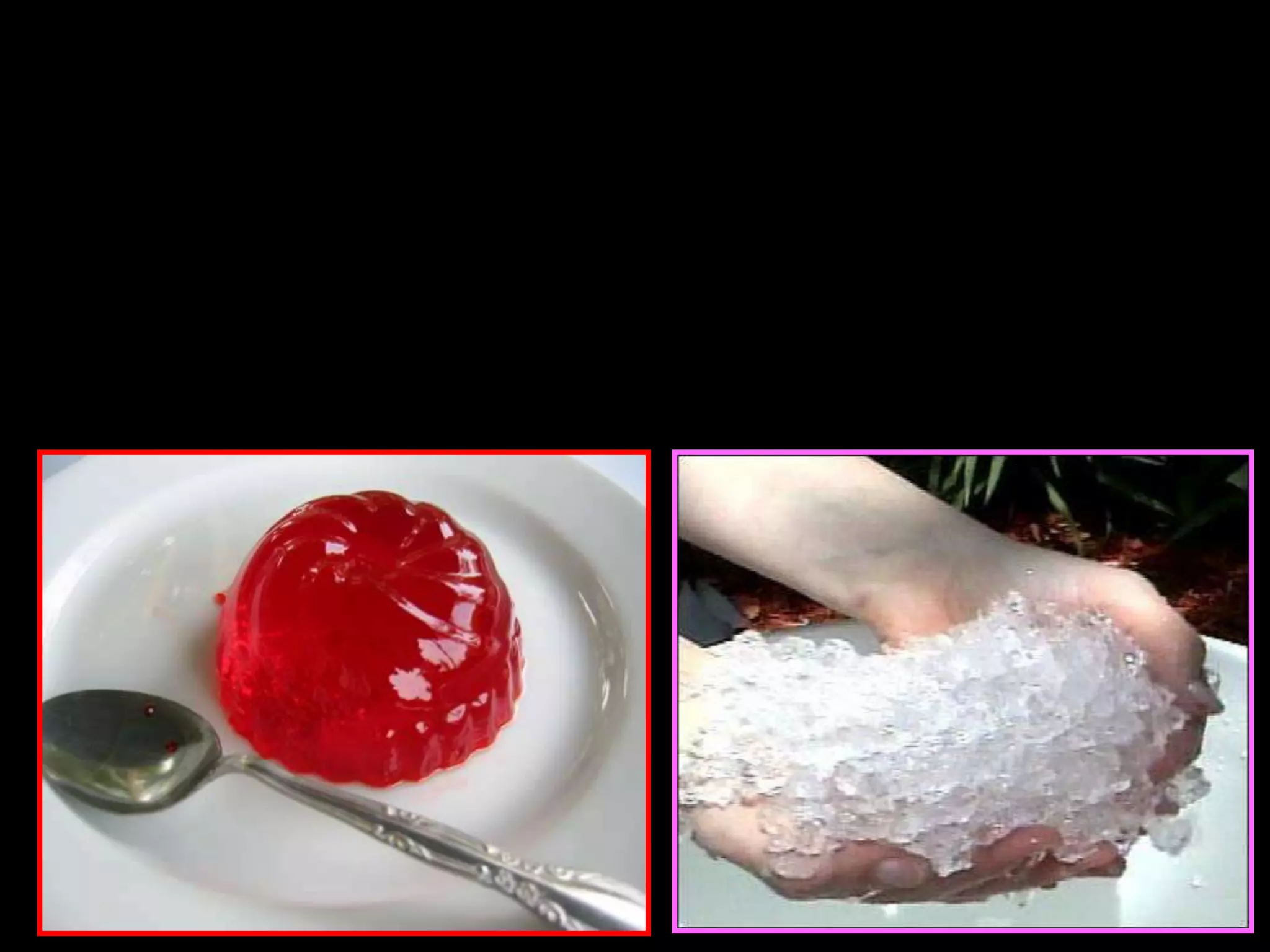
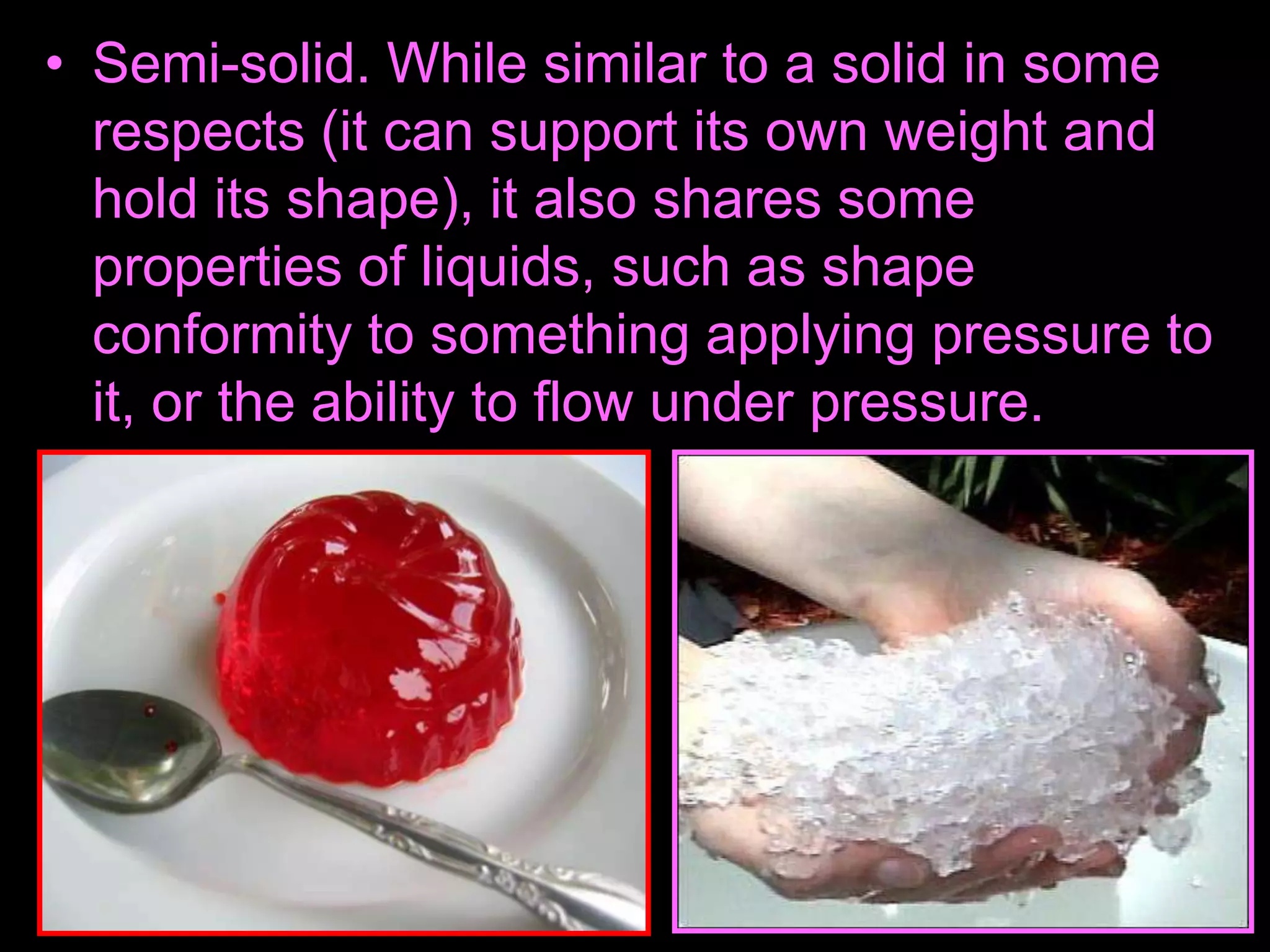
• Semi-solid. While similar to a solid in some
respects (it can support its own weight and
hold its shape), it also shares some
properties of liquids, such as shape
conformity to something applying pressure to
it, or the ability to flow under pressure.
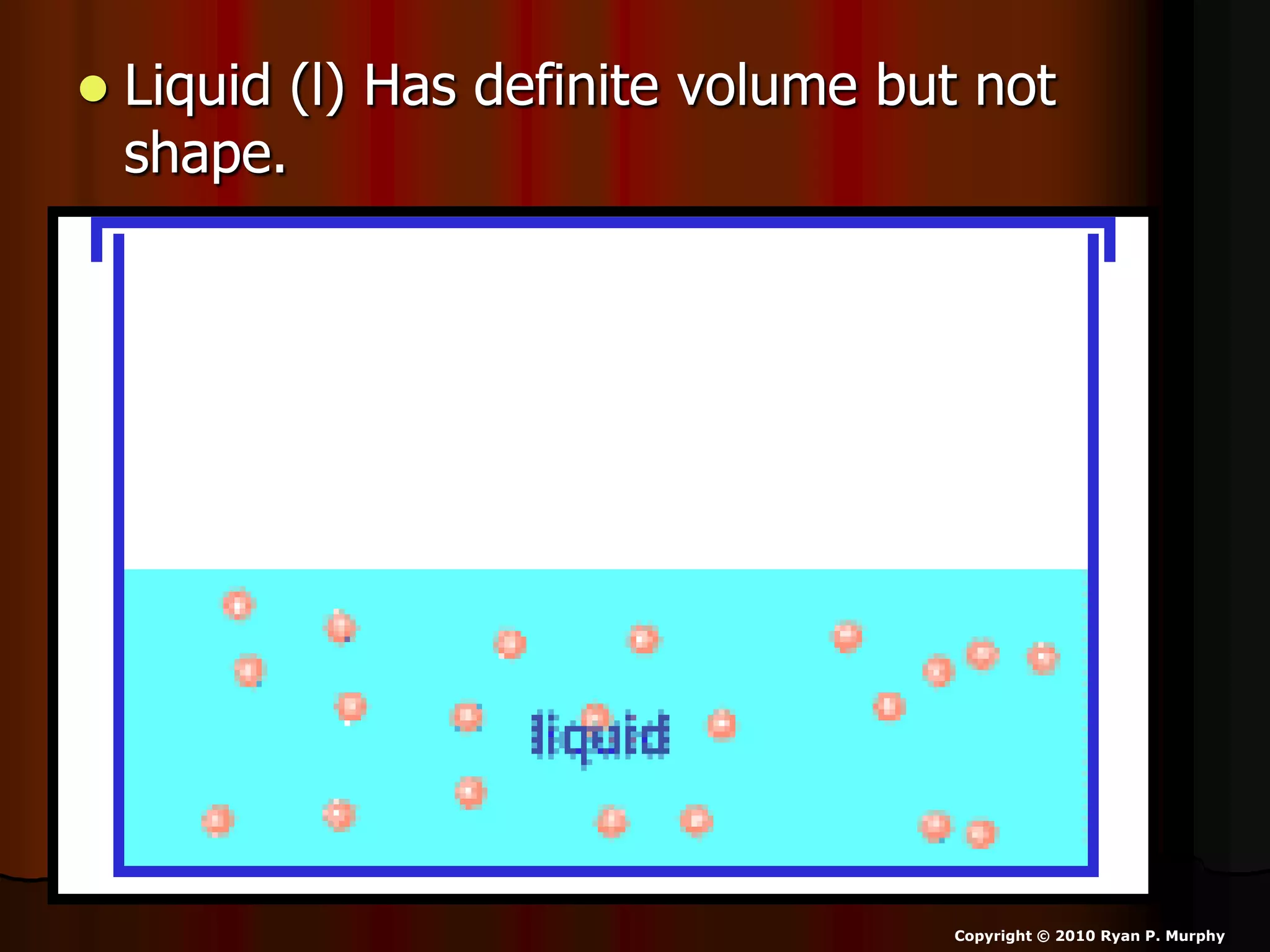
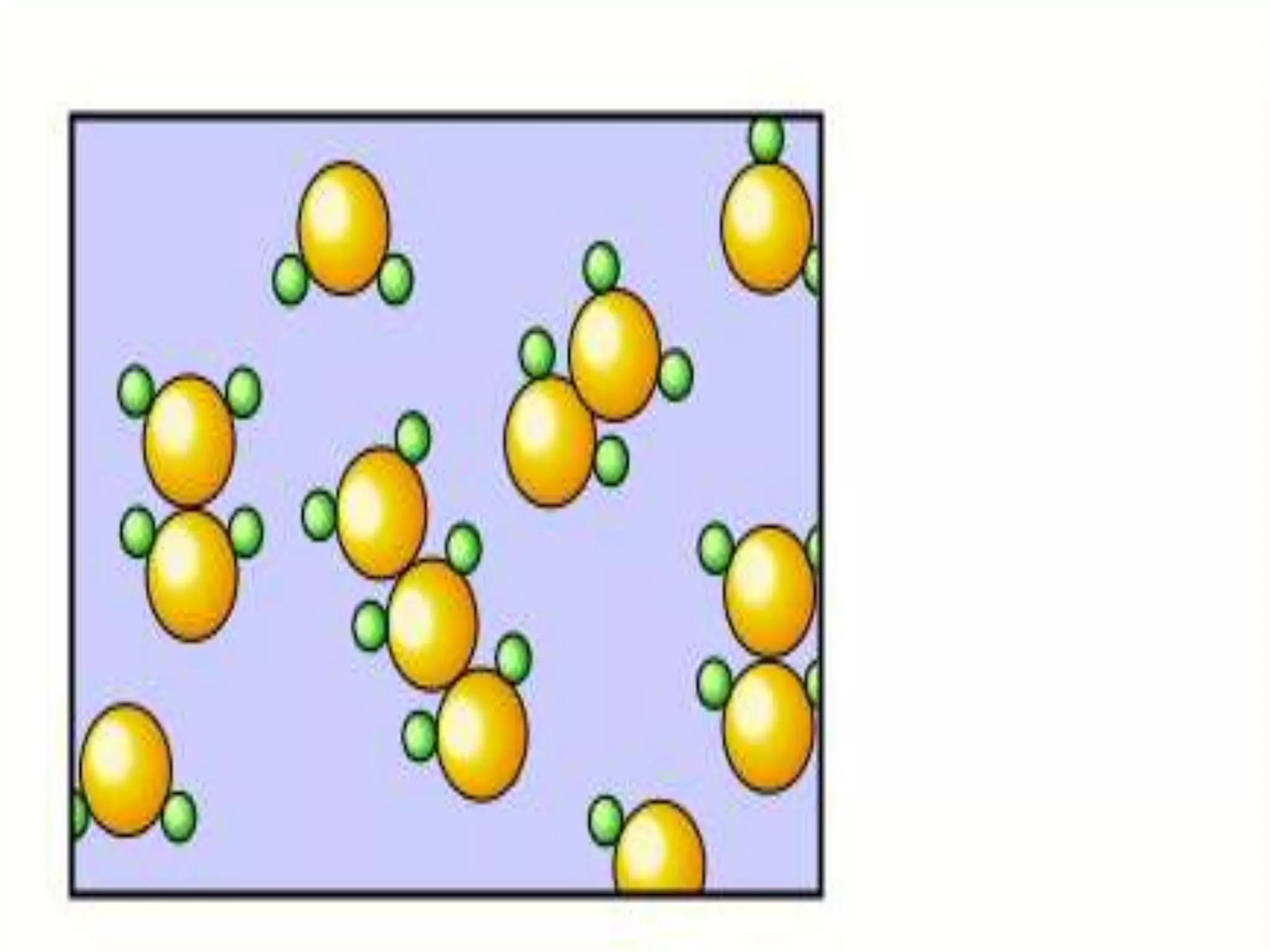
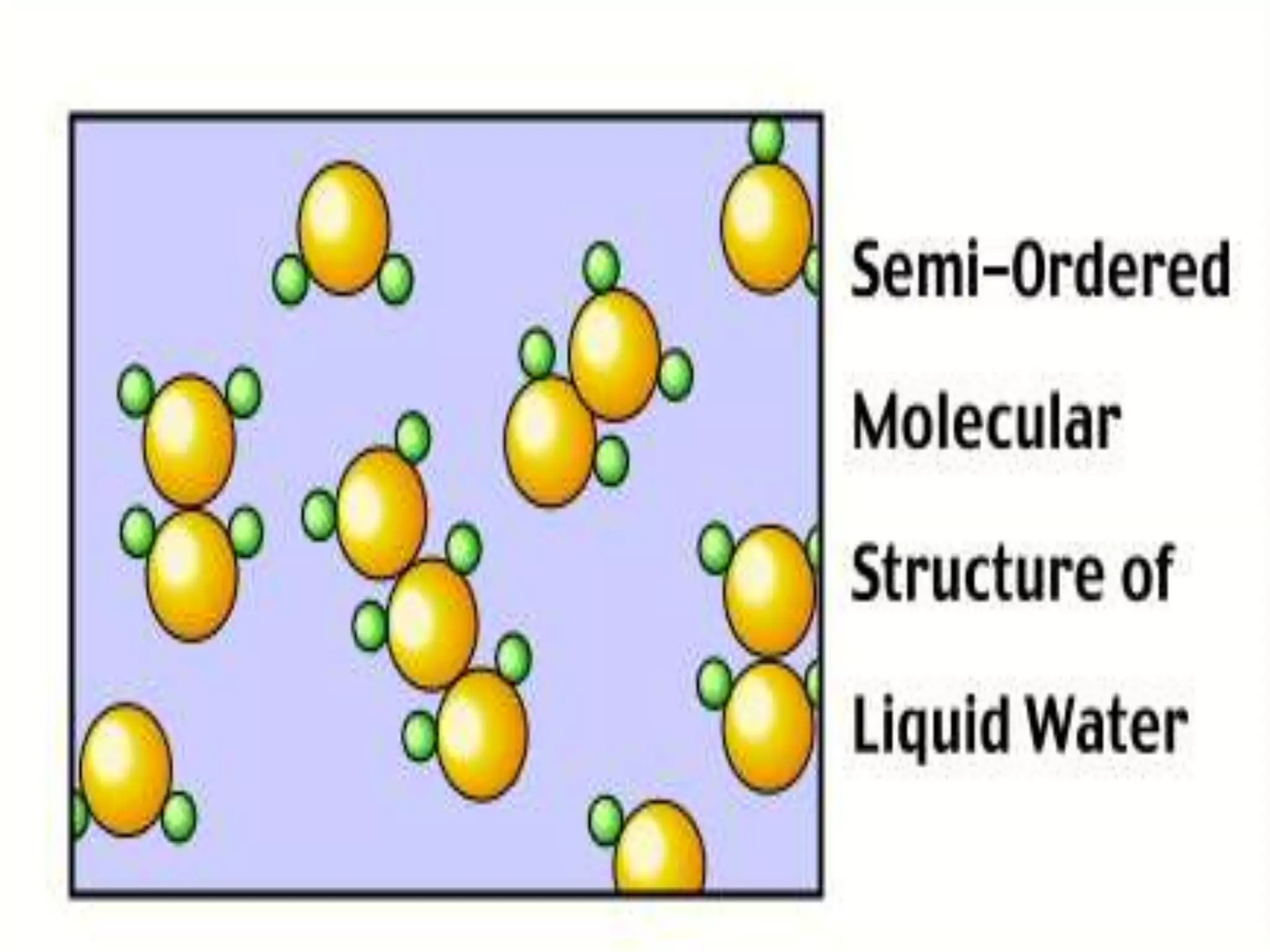
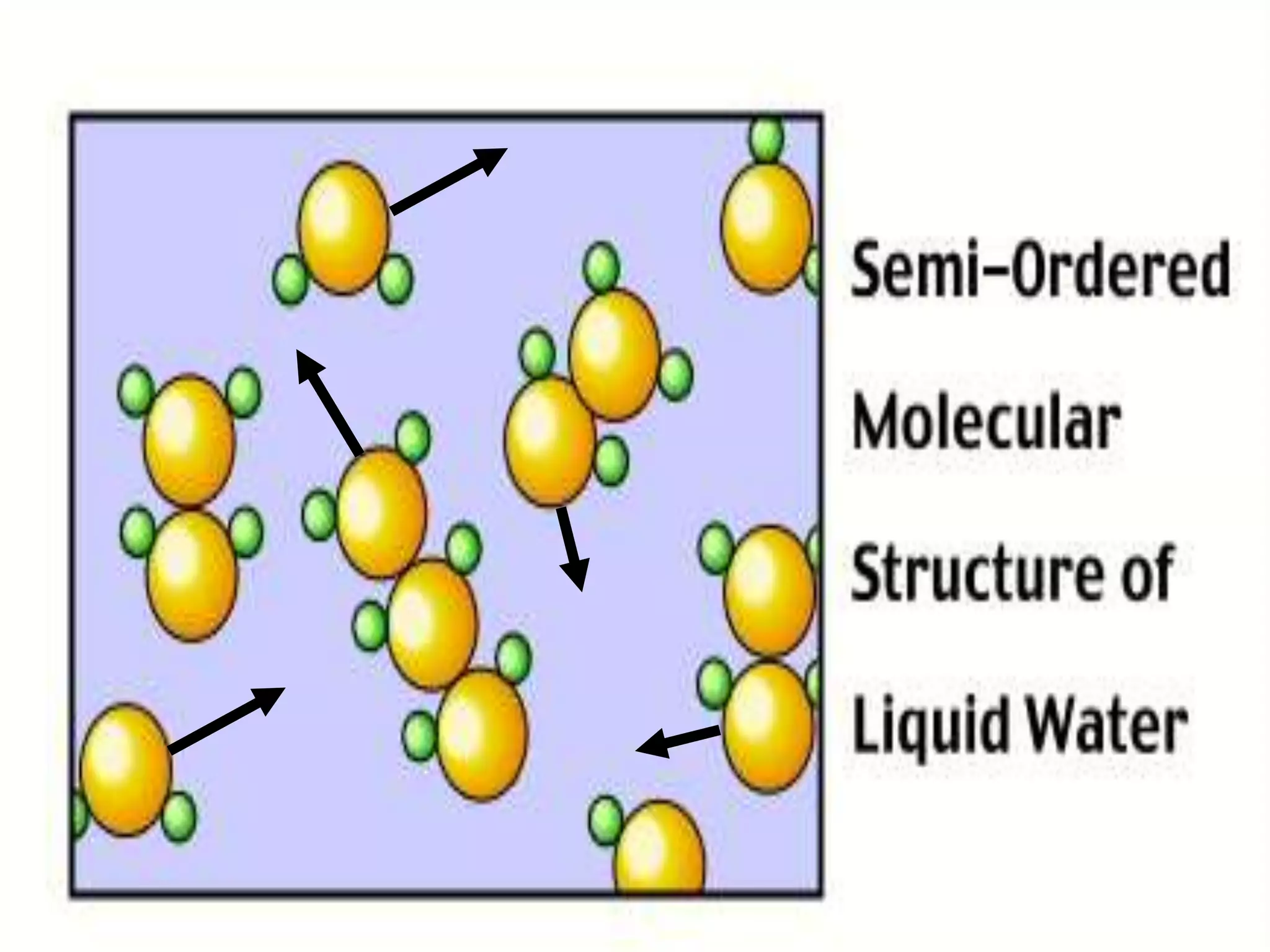
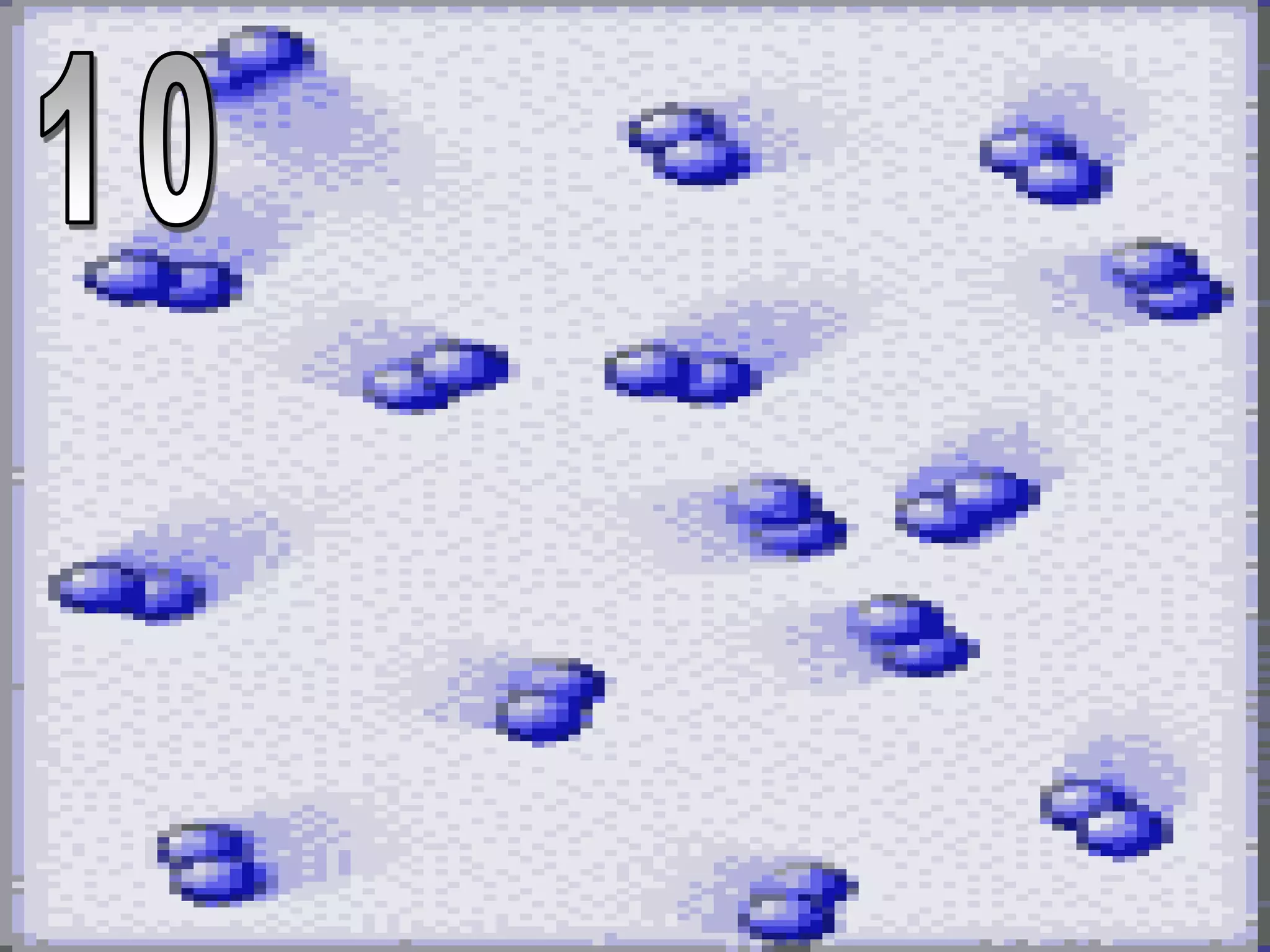
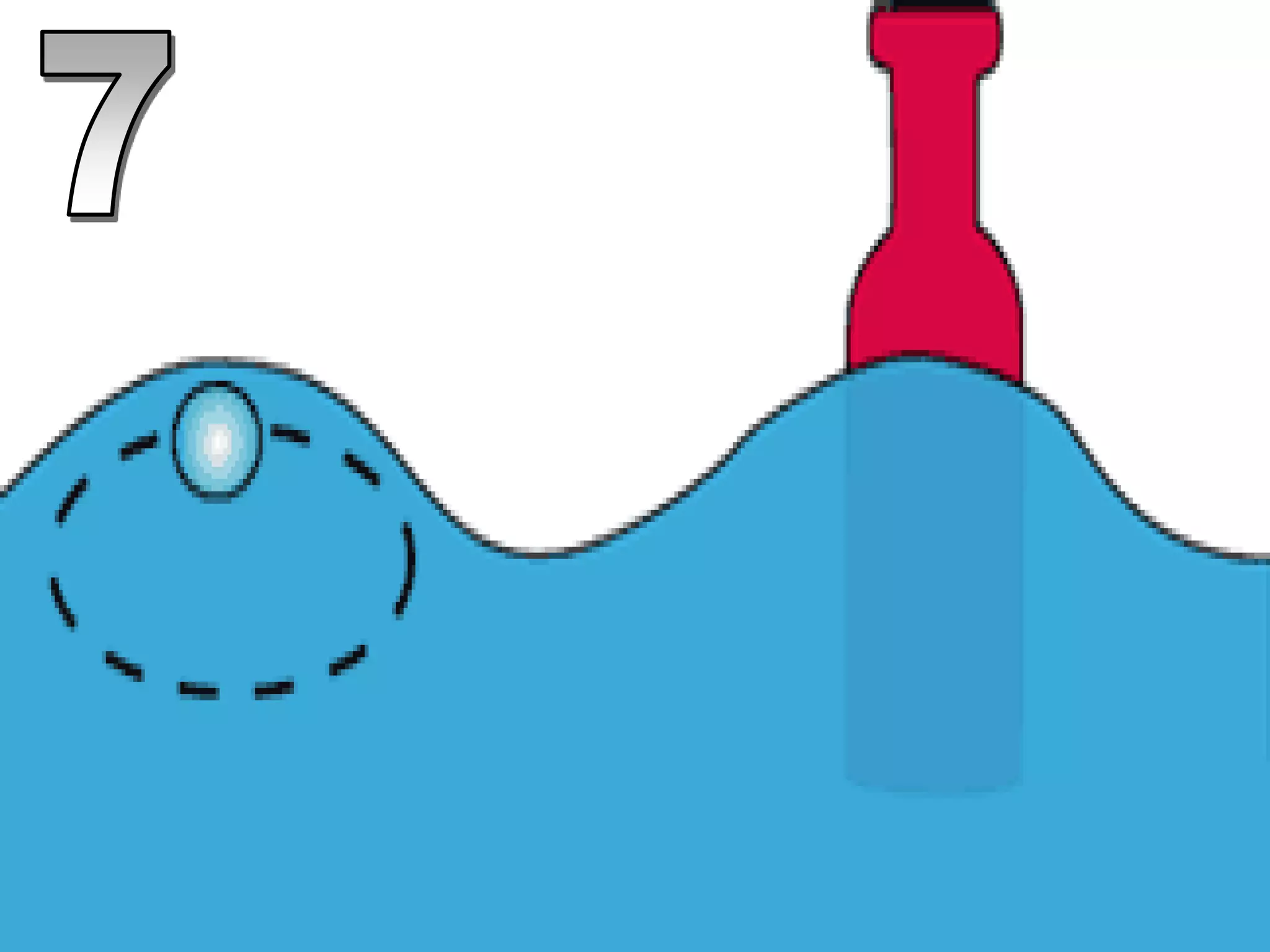
 Liquid (l) Has definite volume but not
shape.
Copyright © 2010 Ryan P. Murphy
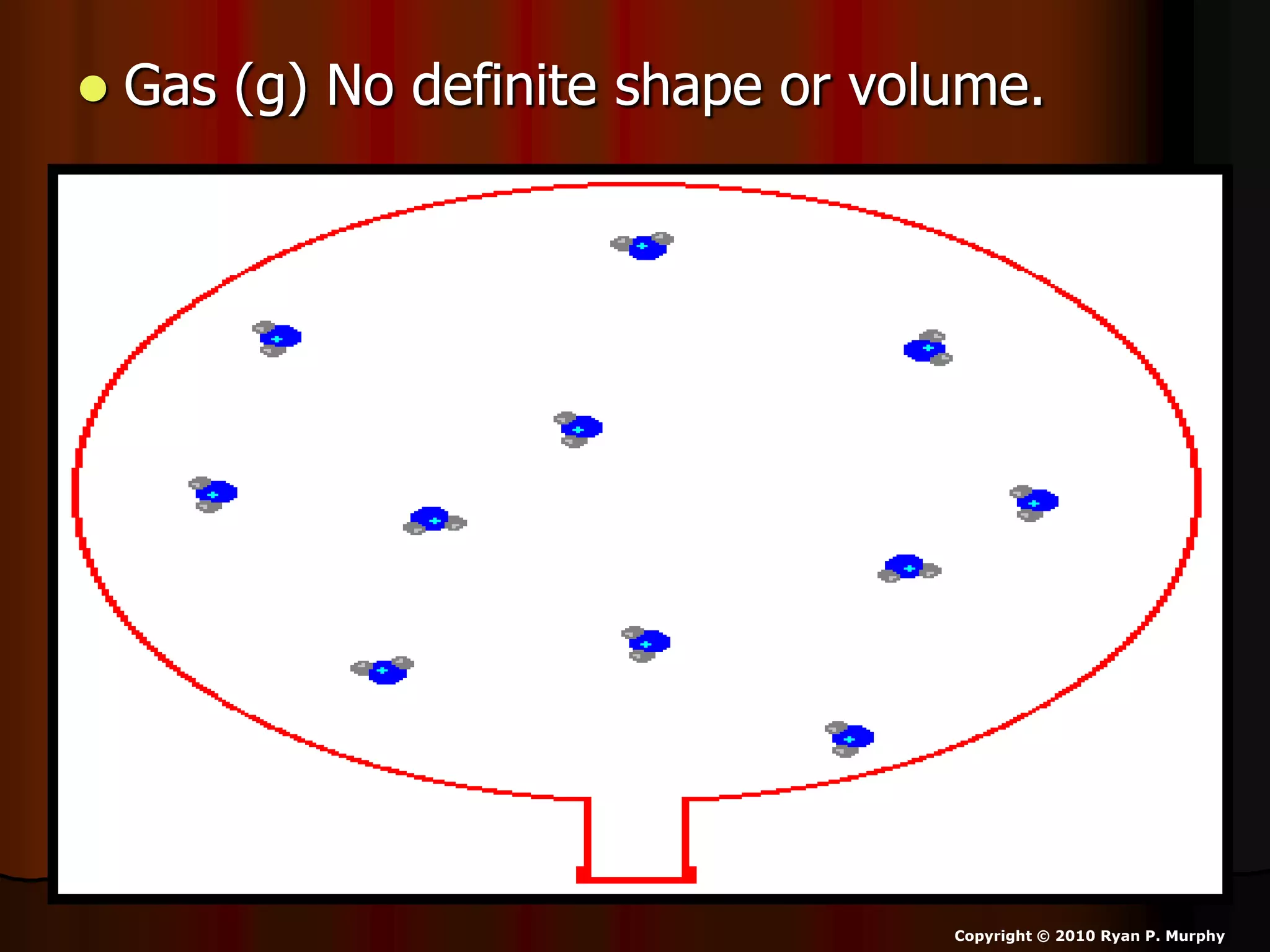
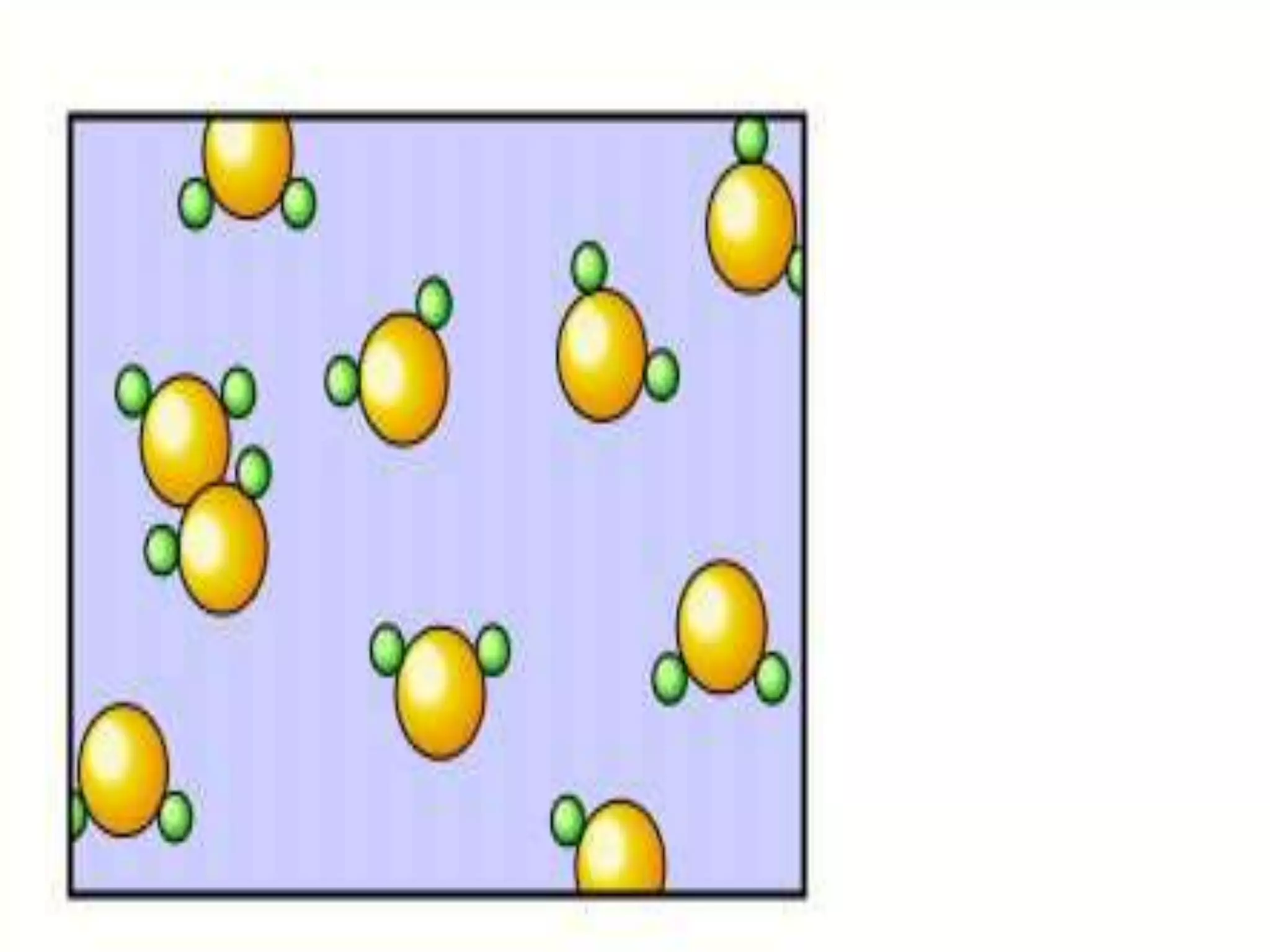
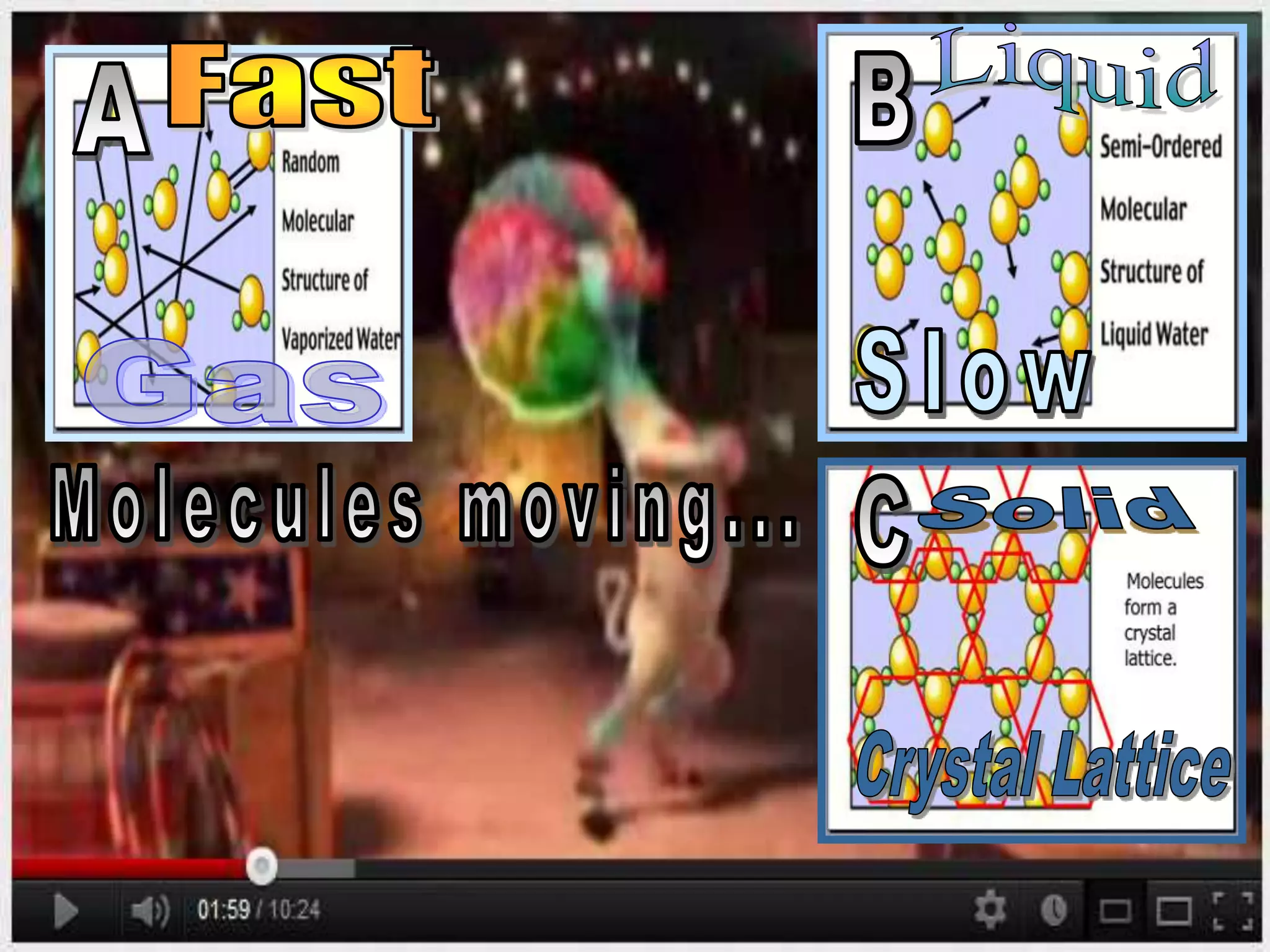
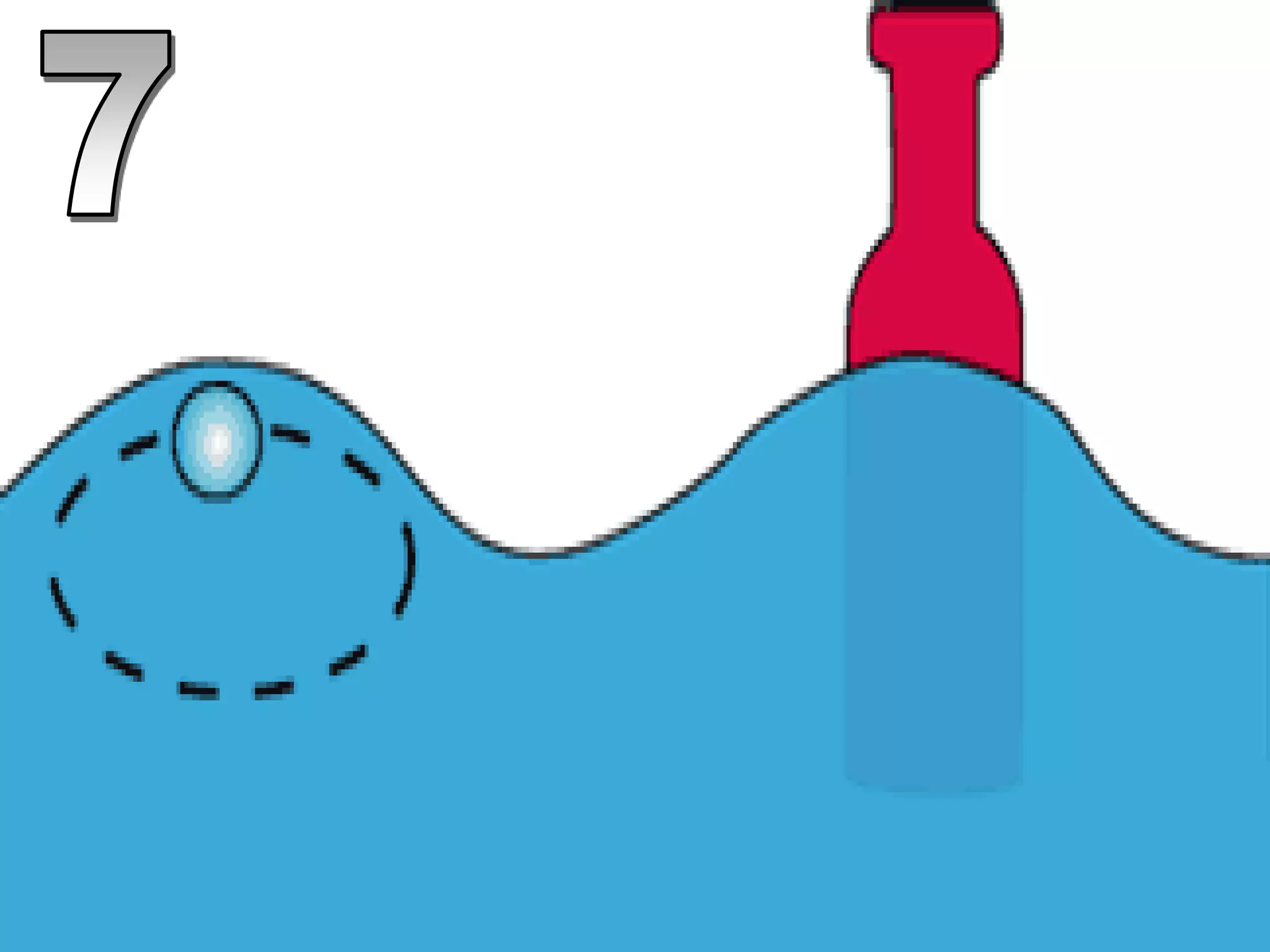
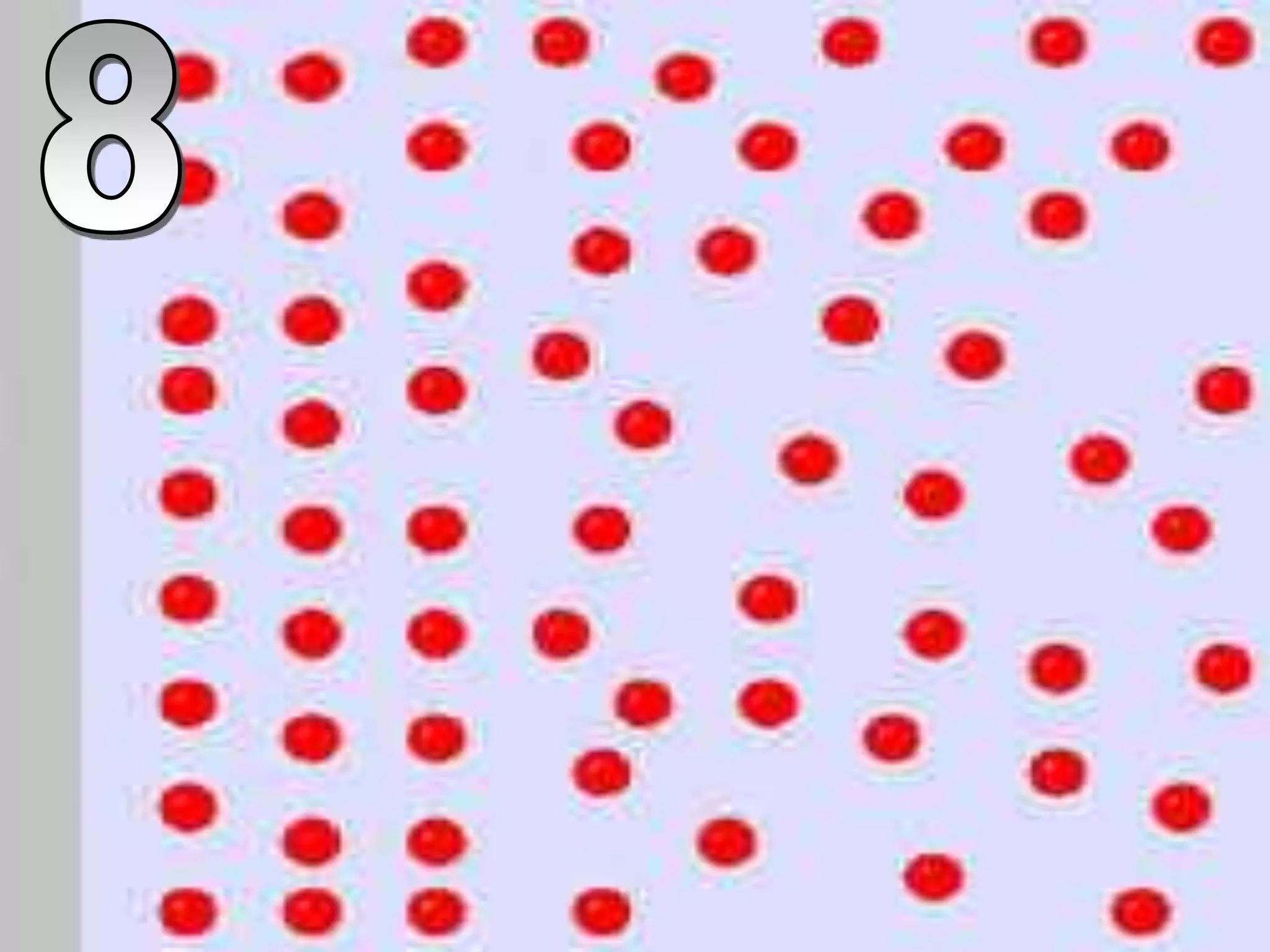
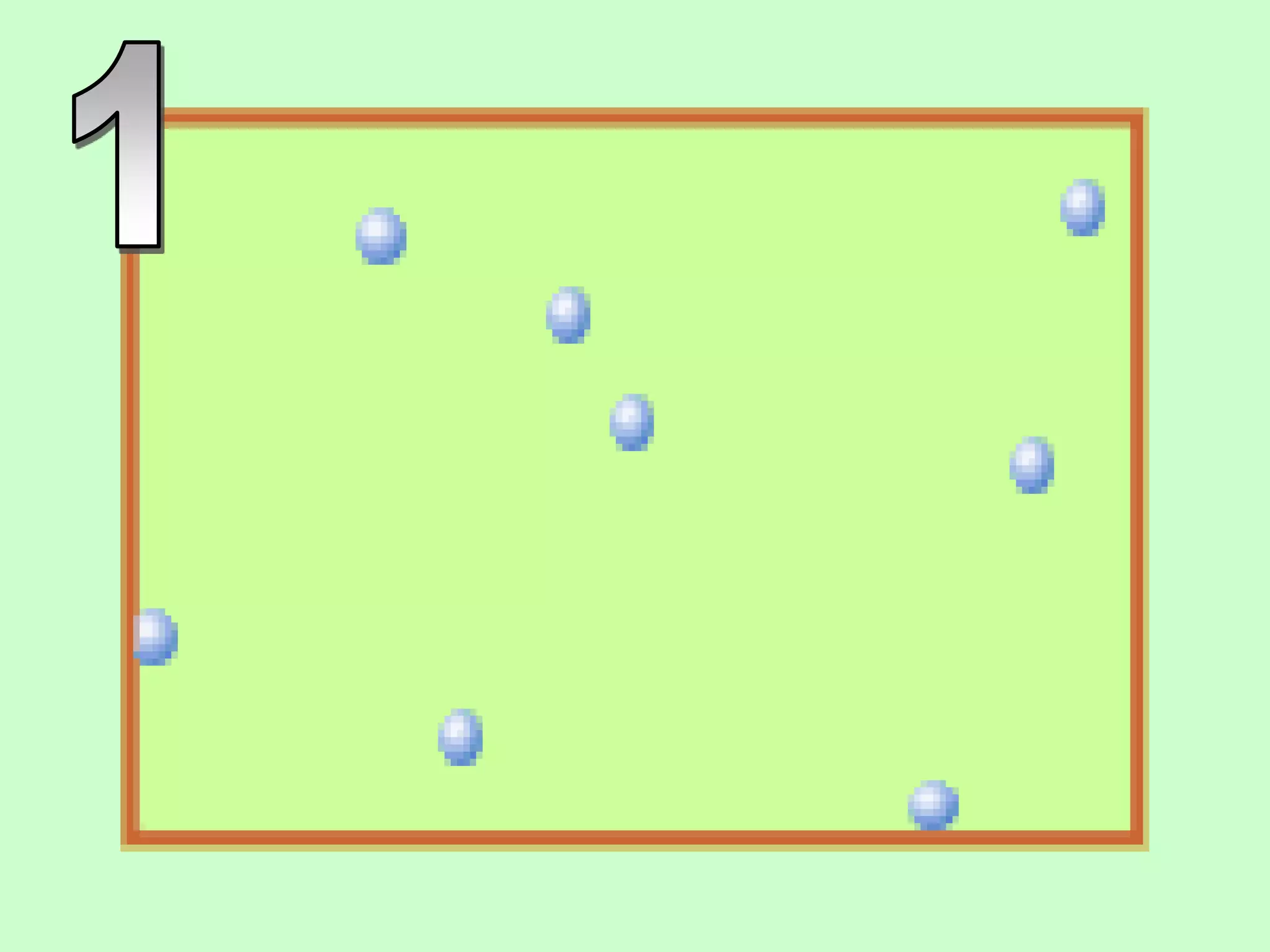
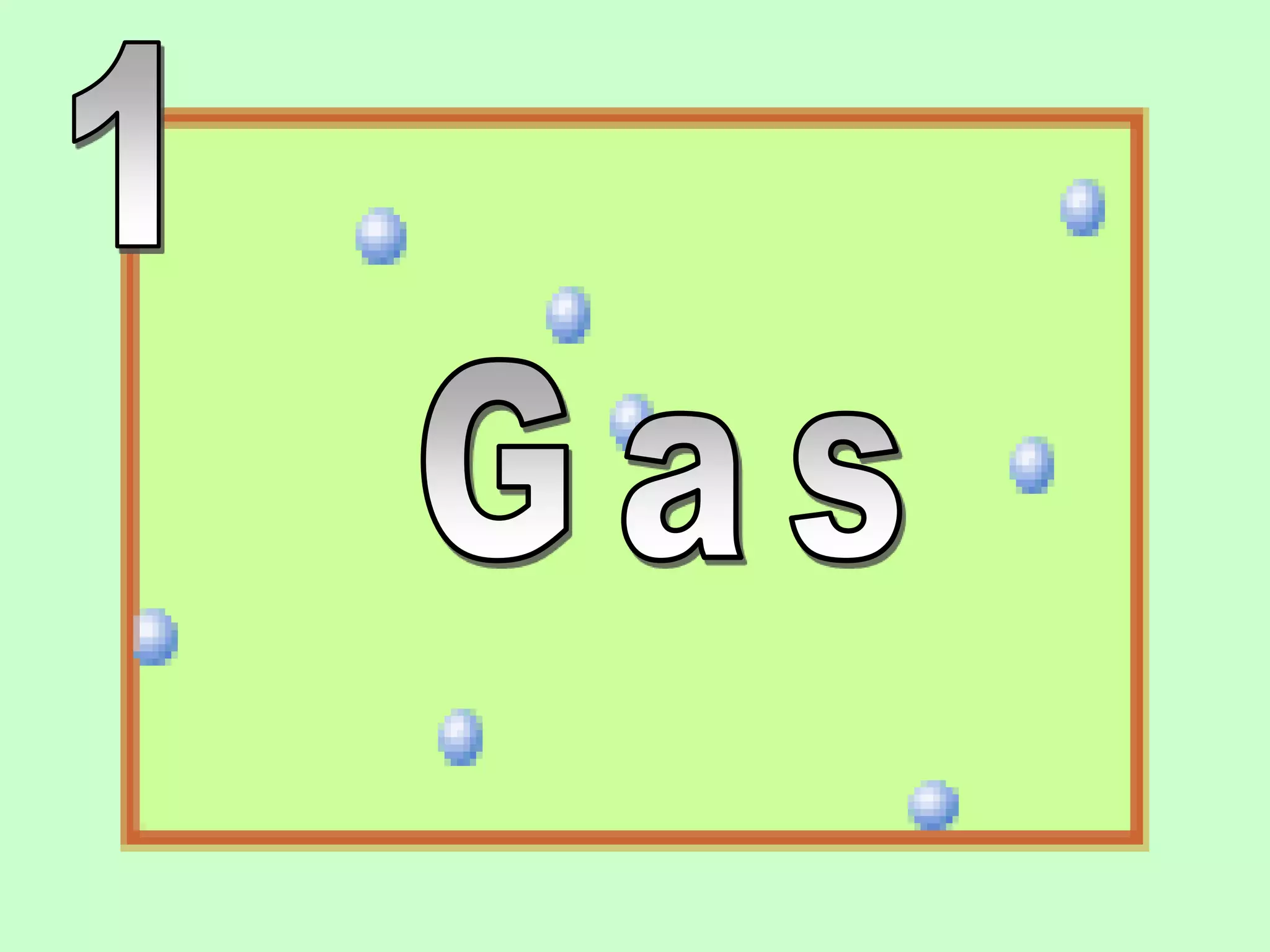
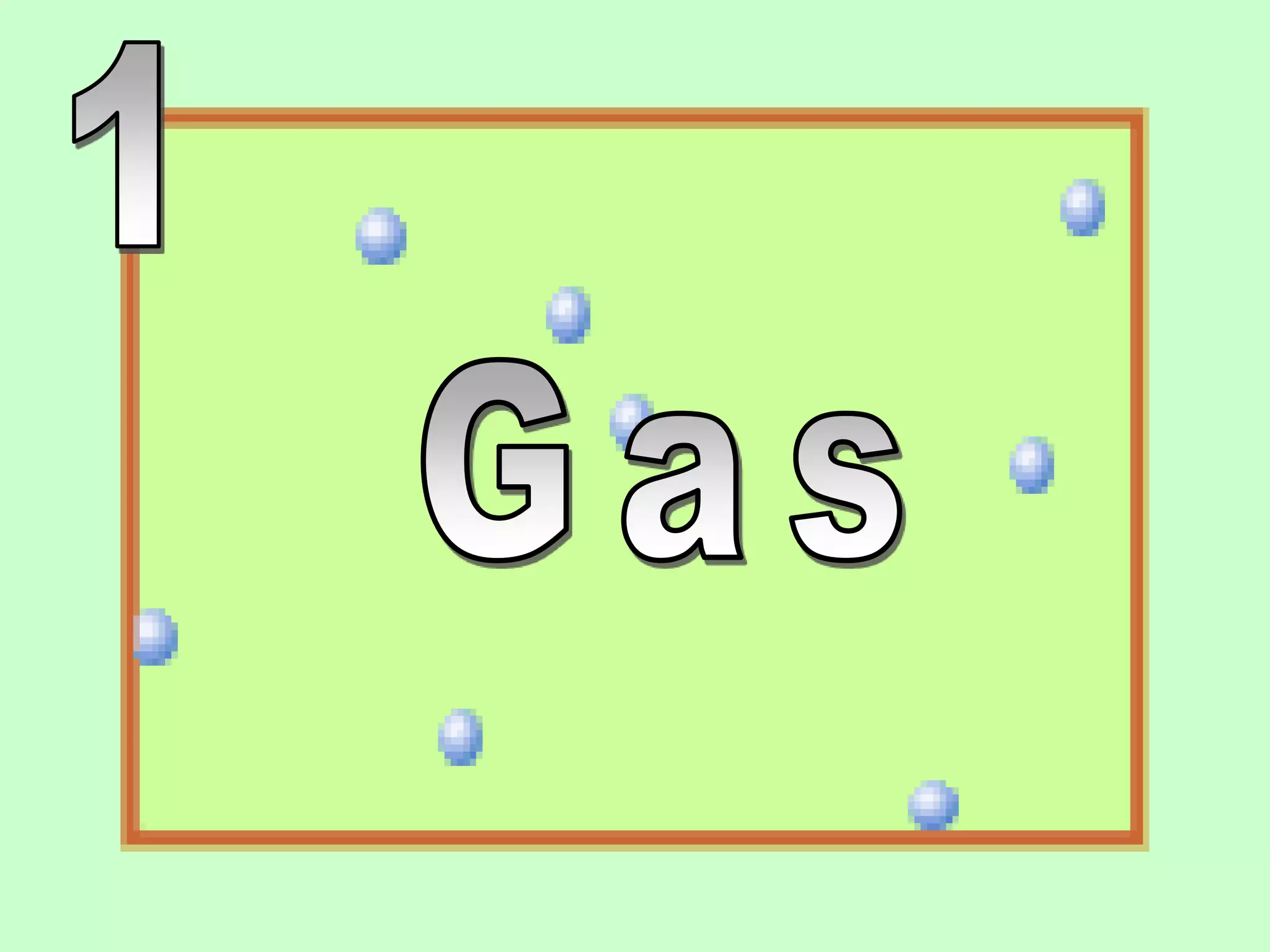
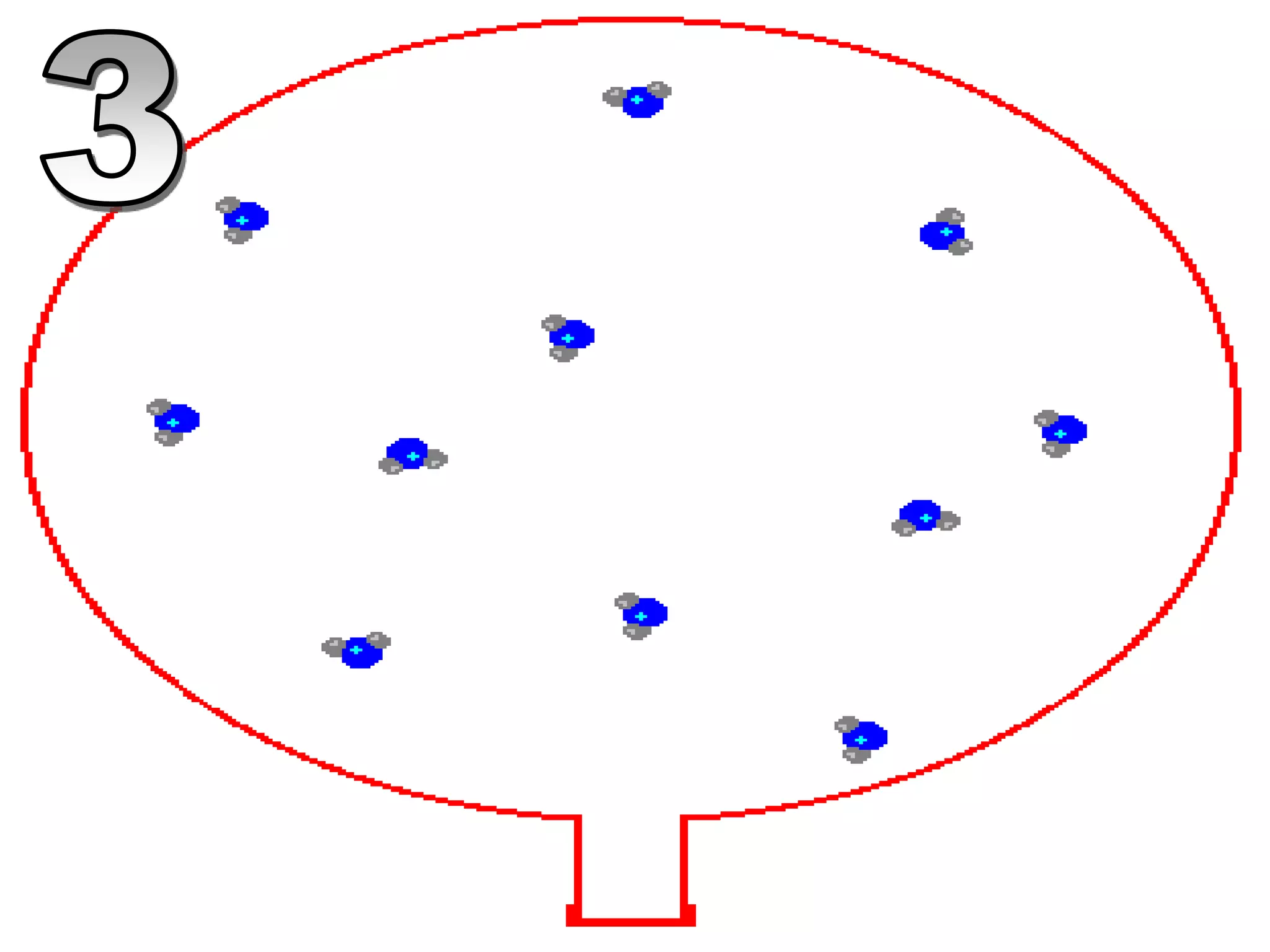
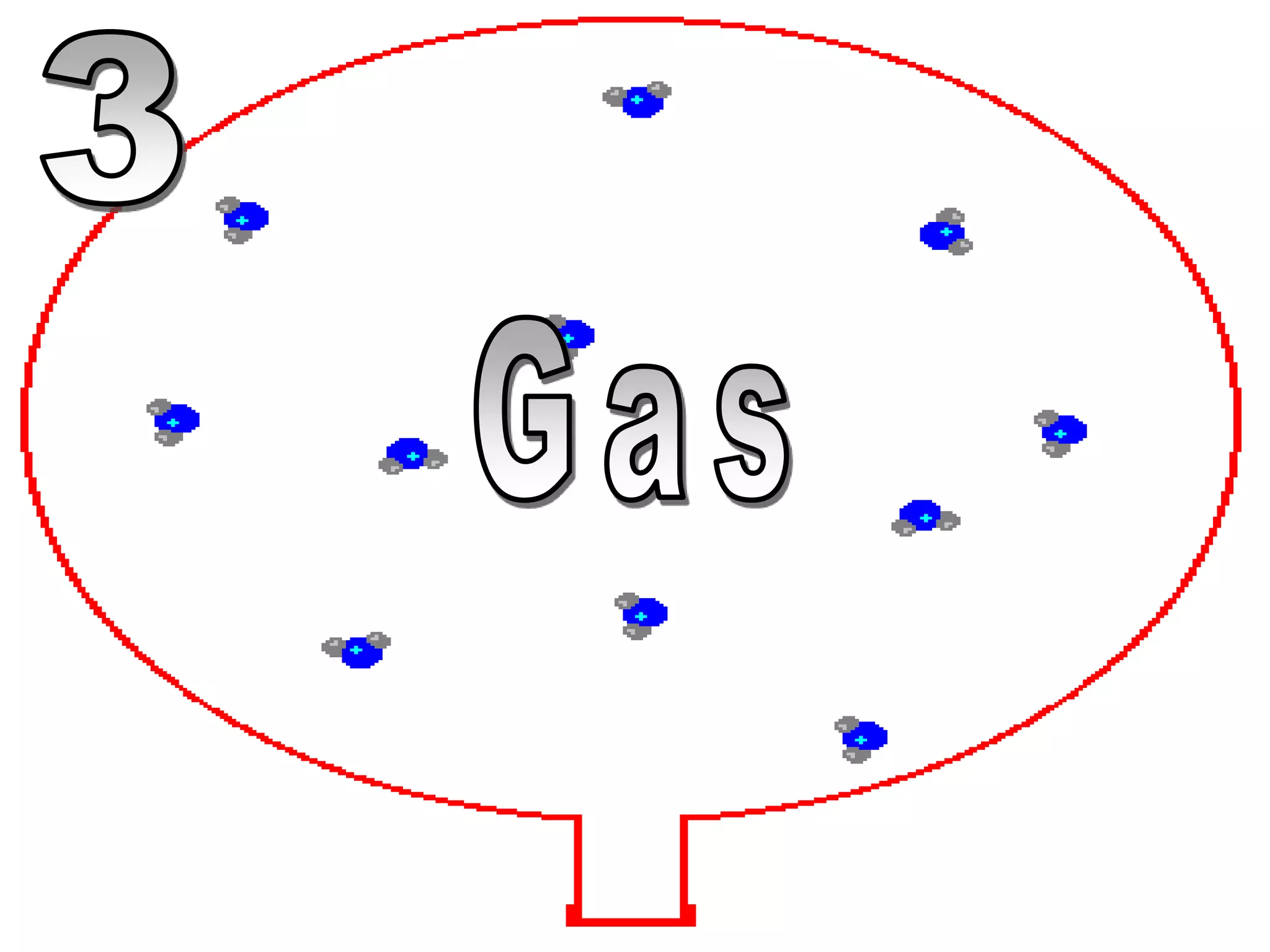
 Gas (g) No definite shape or volume.
Copyright © 2010 Ryan P. Murphy
 Gas (g) No definite shape or volume.
Copyright © 2010 Ryan P. Murphy
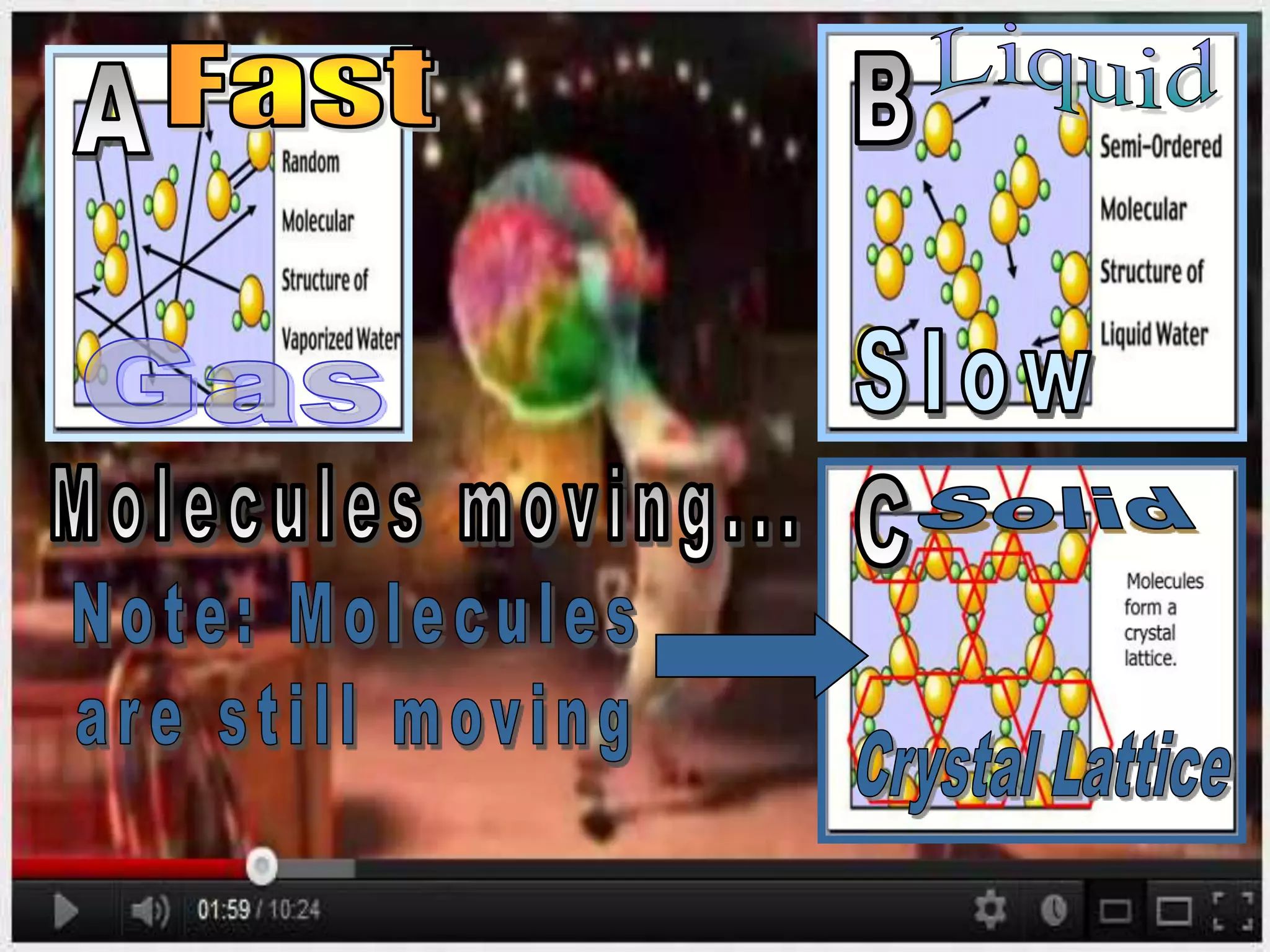
• Activity / video link (Extremely Optional)
– http://www.youtube.com/watch?v=p440QWpHui8
– Assign three students to each hold a poster with
the three states of matter. (Solid, Liquid, Gas)
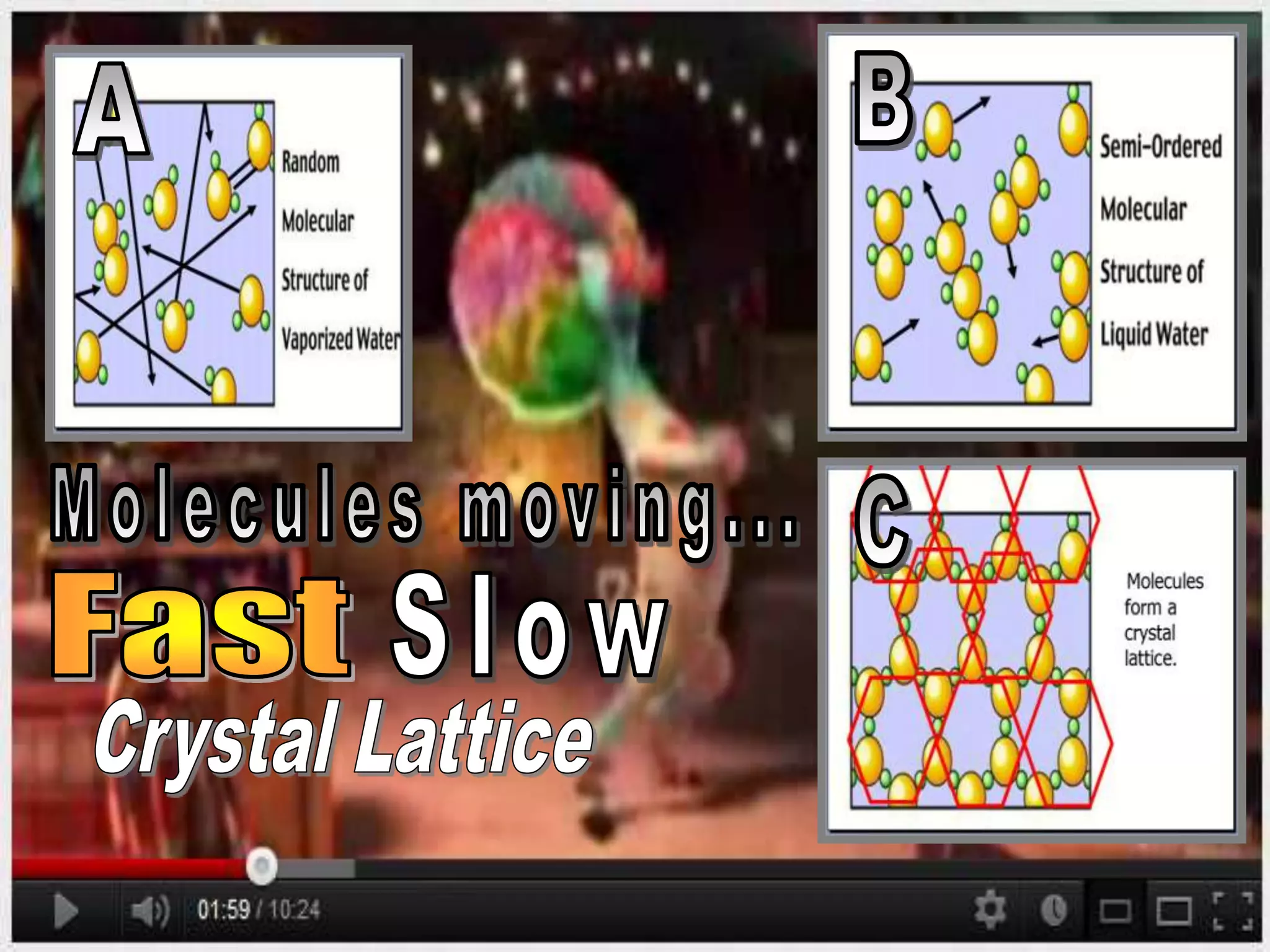
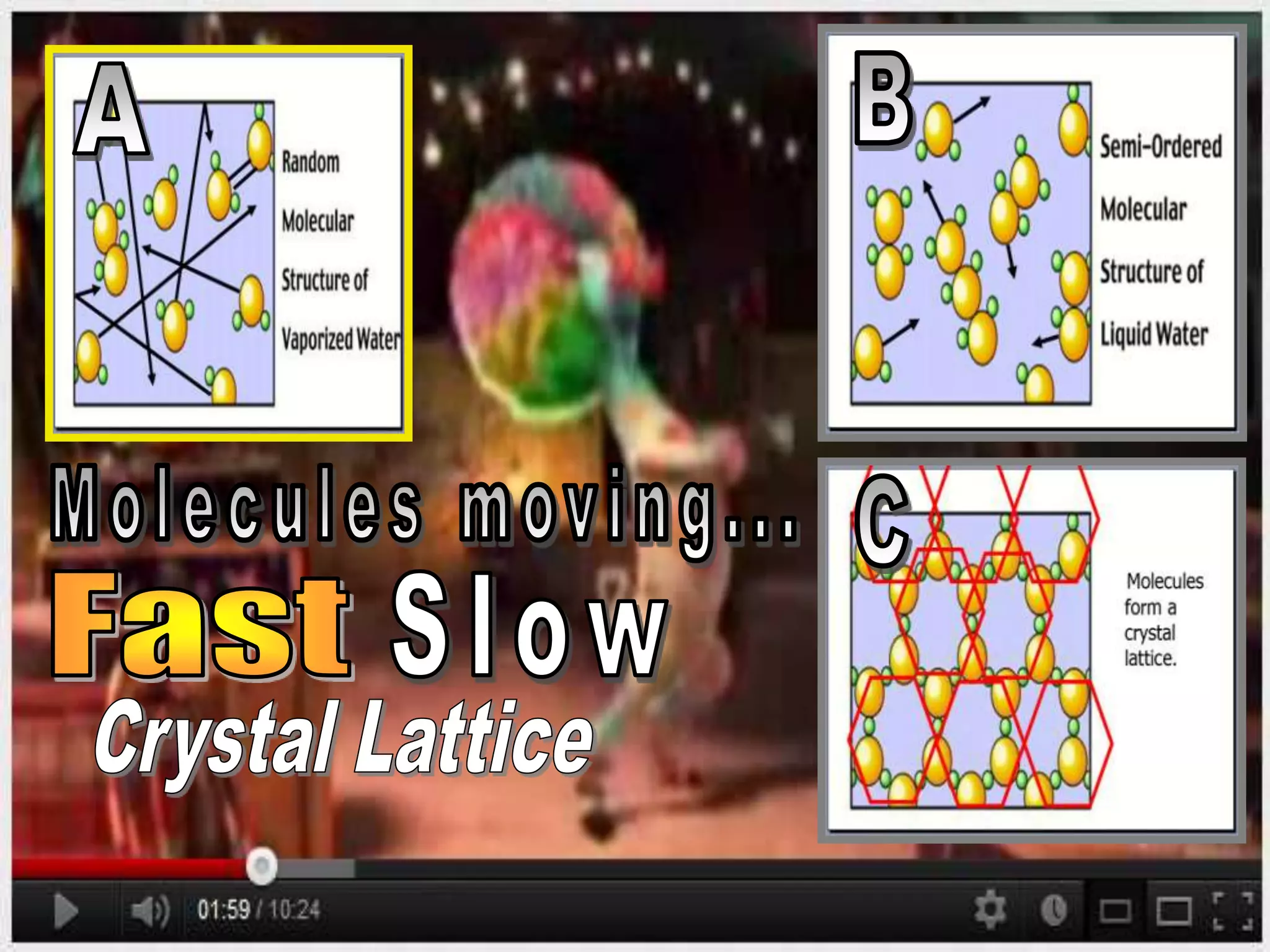
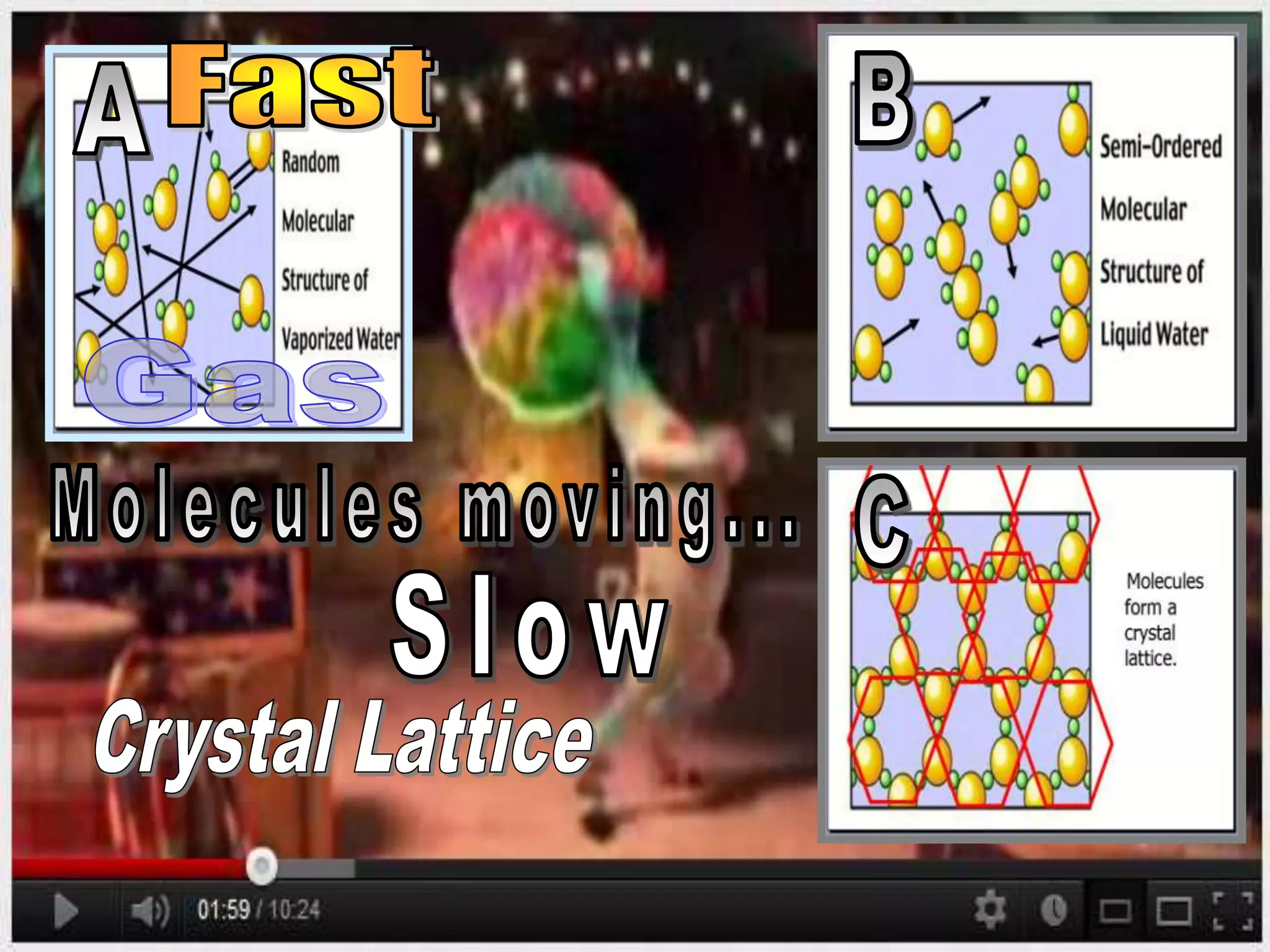
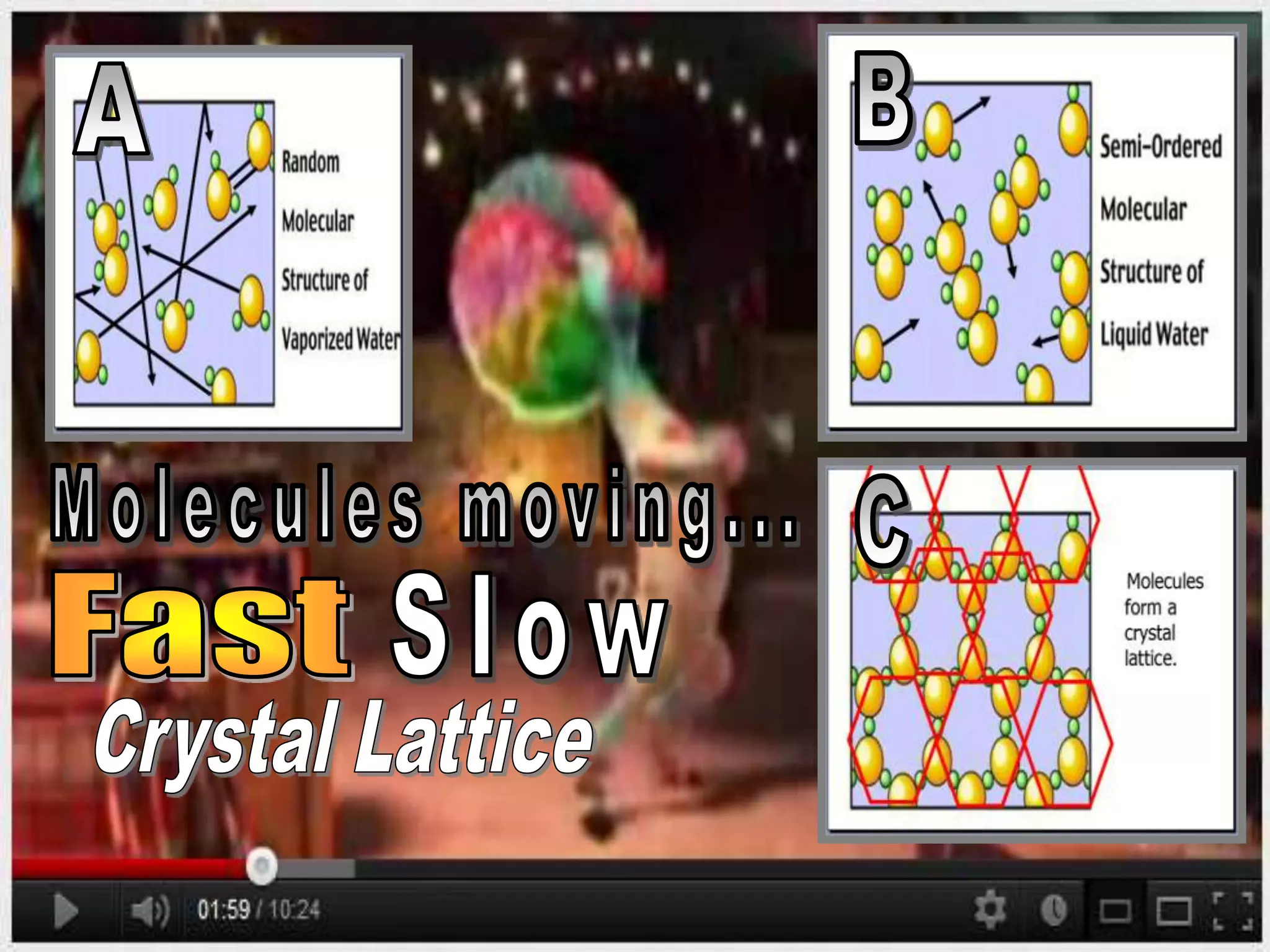
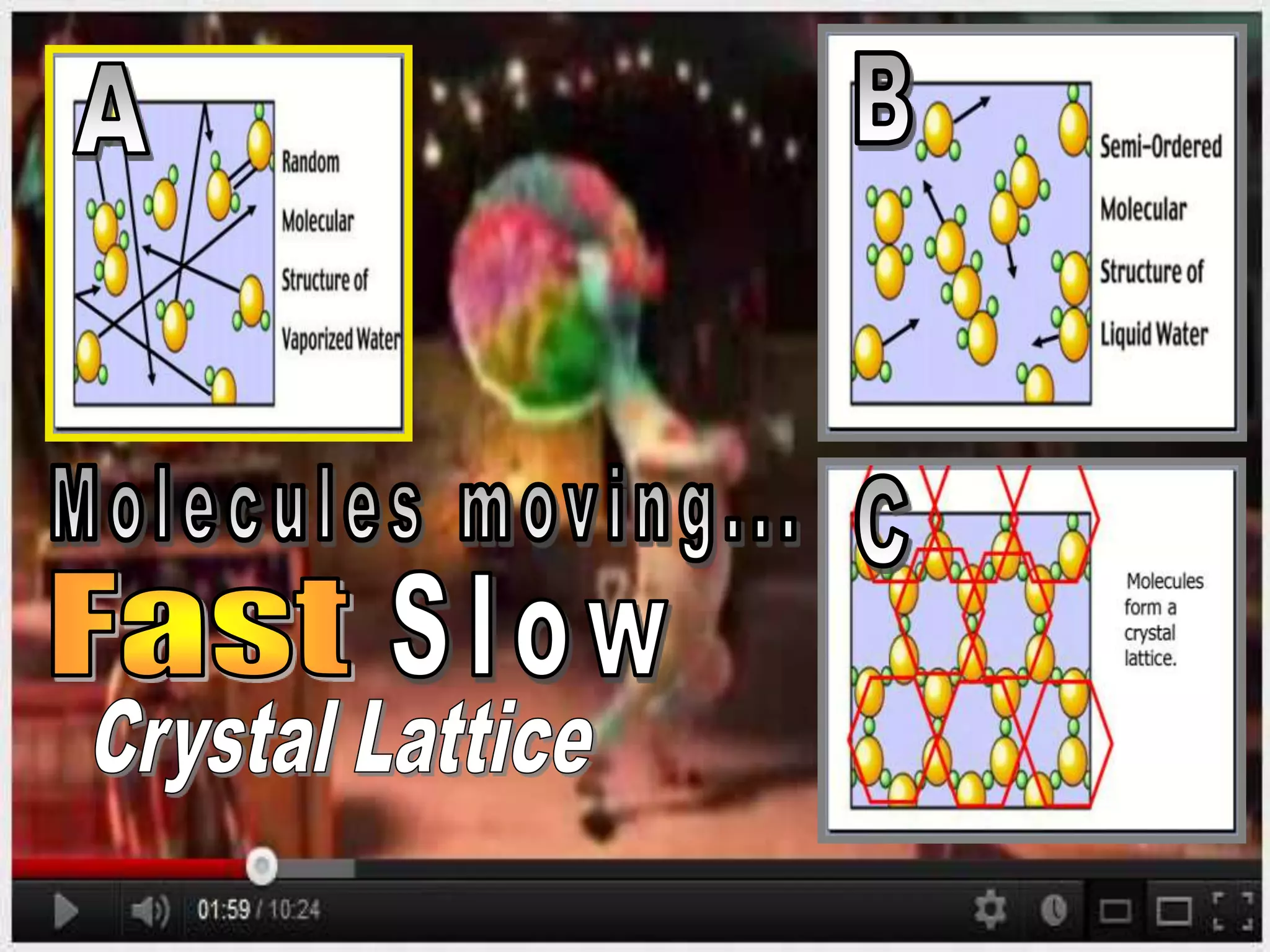
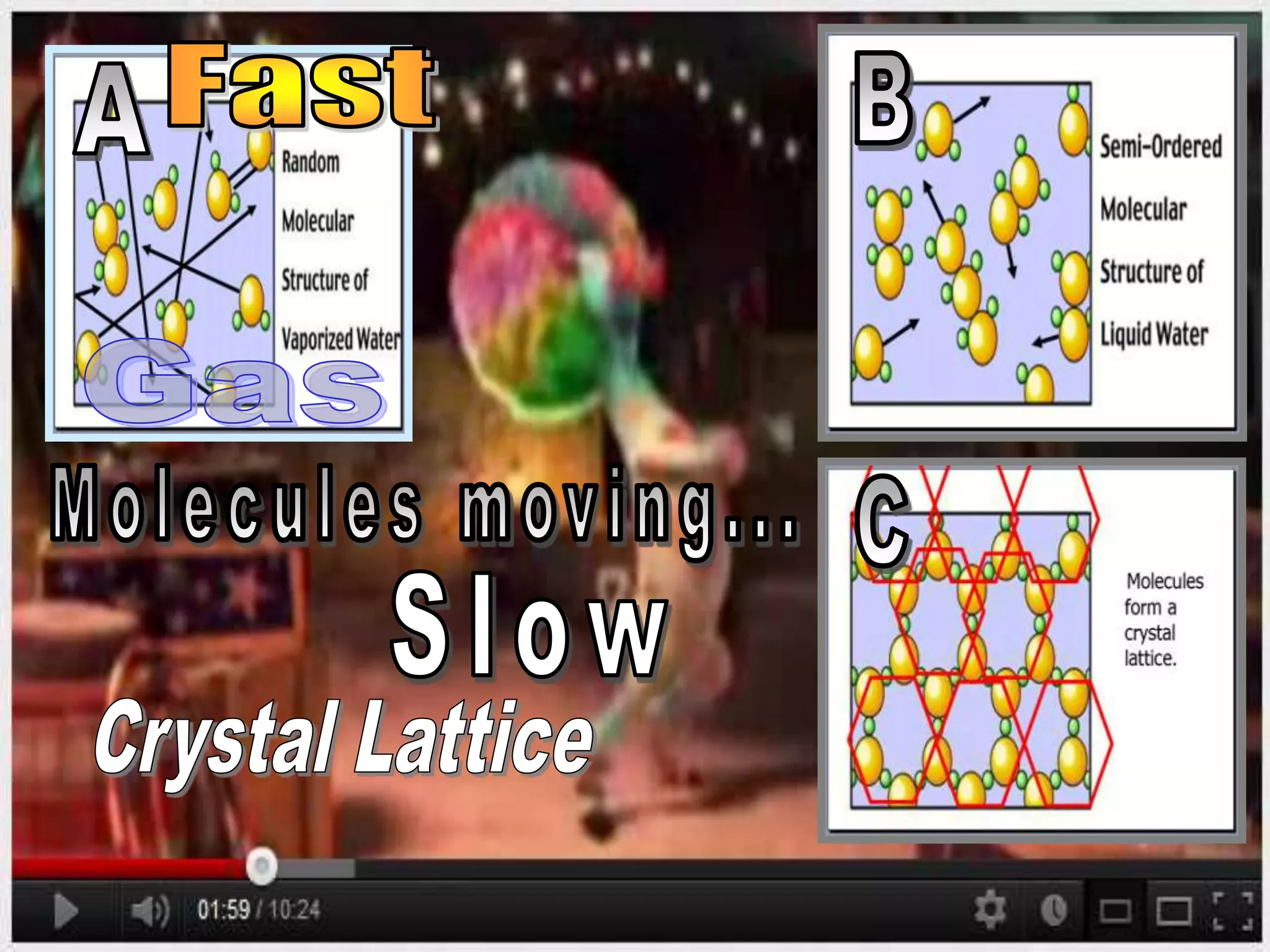
• When Zebra is dancing and singing fast person with
gas poster must wave it around quickly.
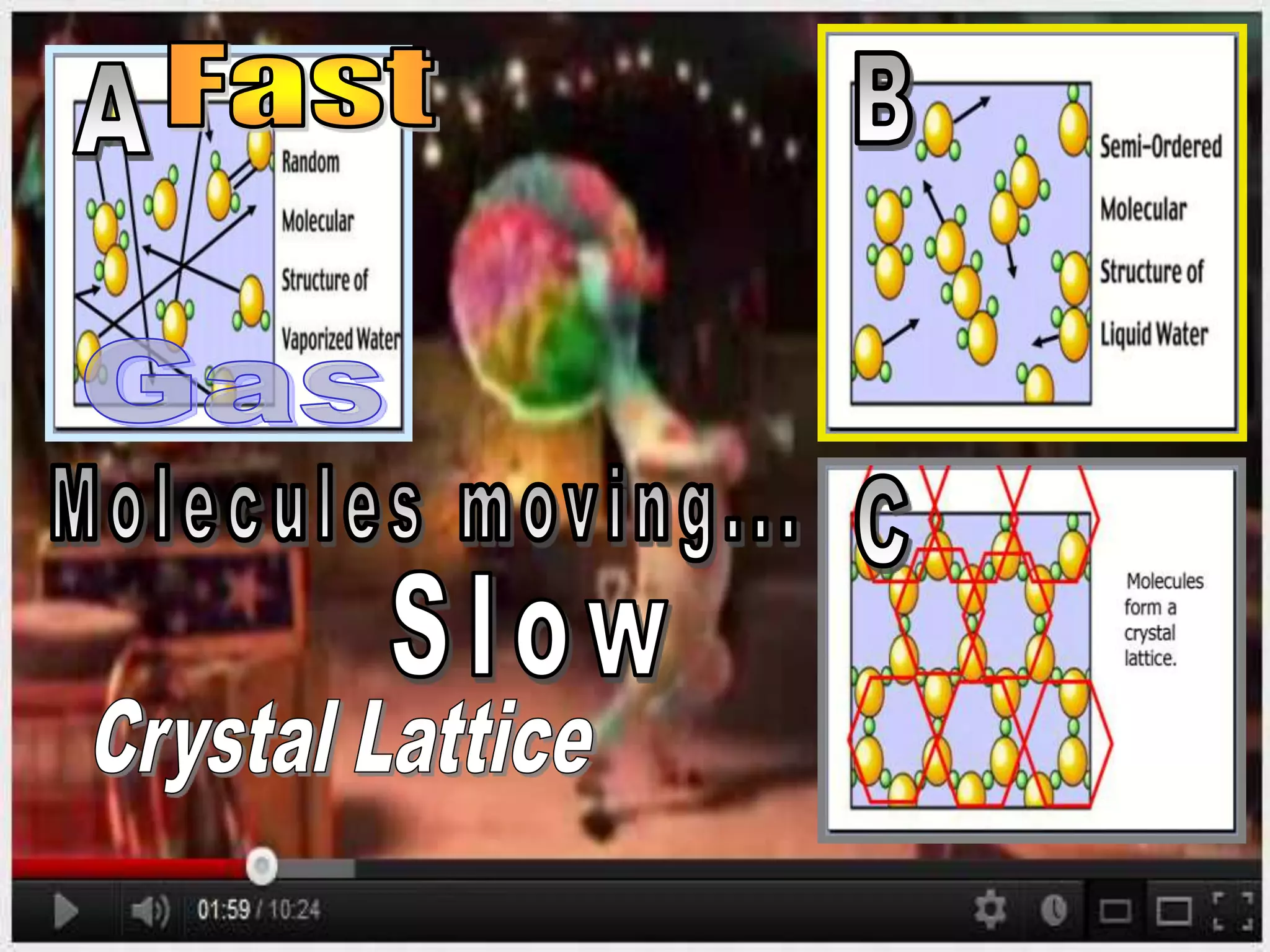
• When zebra is dancing normal wave the liquid poster at
a normal speed.
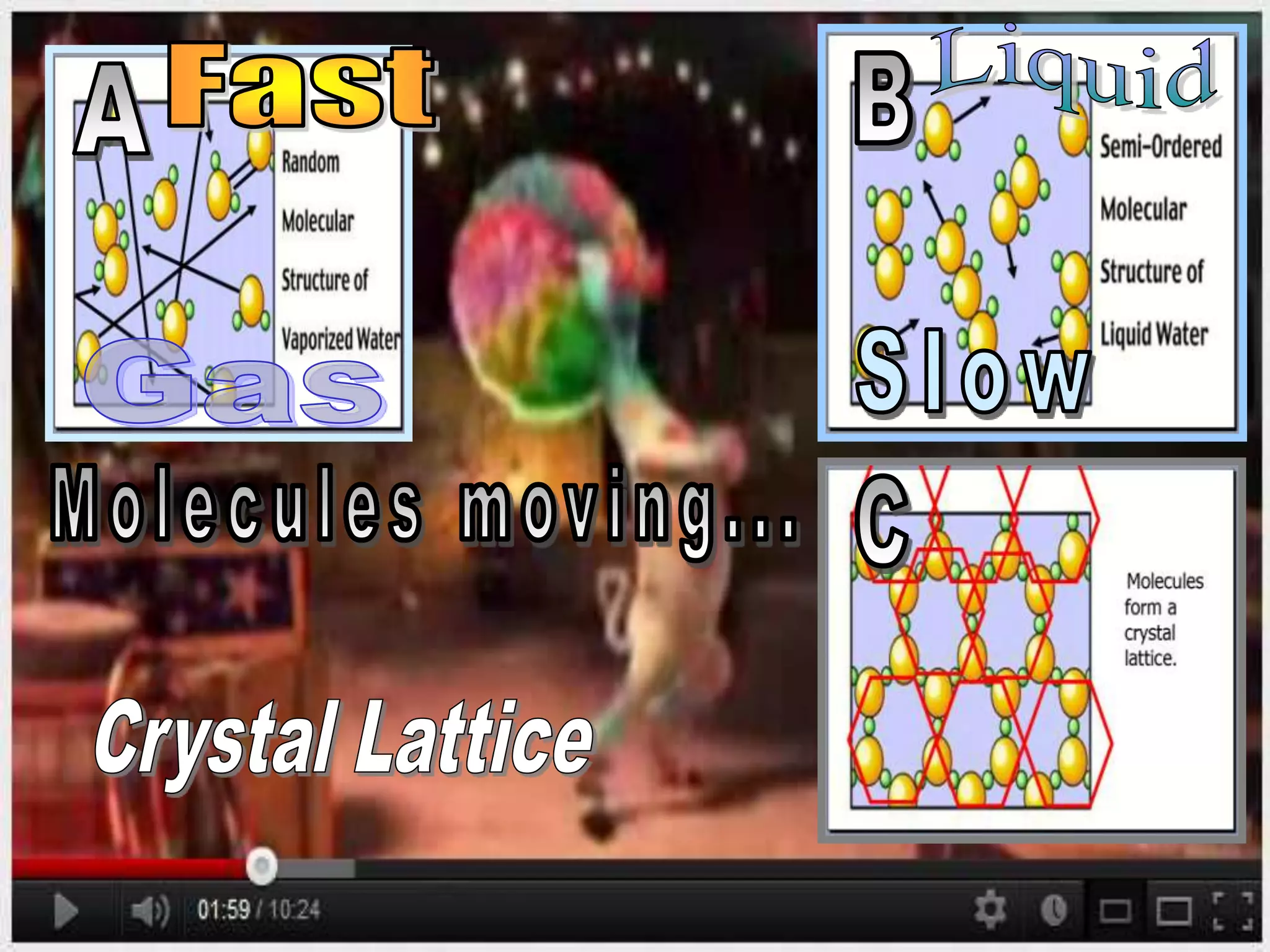
• When zebra is dancing slowly wave the solid poster
extremely slow.
• Activity / video link (Extremely Optional)
– http://www.youtube.com/watch?v=p440QWpHui8
– Assign three students to each hold a poster with
the three states of matter. (Solid, Liquid, Gas)
• When Zebra is dancing at a fast pace the person with
gas poster must wave it around quickly / dance.
• When zebra is dancing normal wave the liquid poster at
a normal speed / slower dance.
• When zebra is dancing slowly wave the solid poster
extremely slow / slow dance.
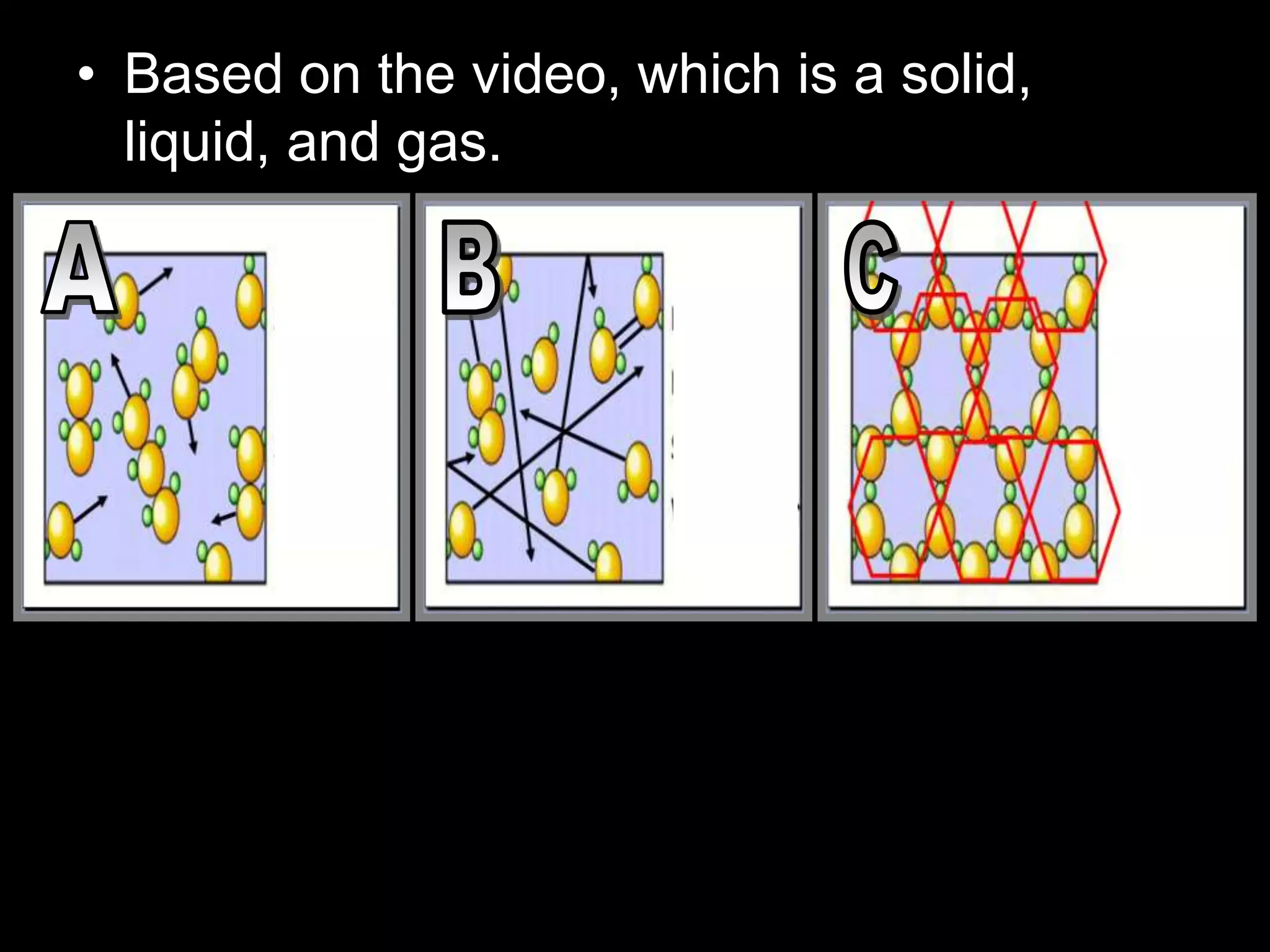
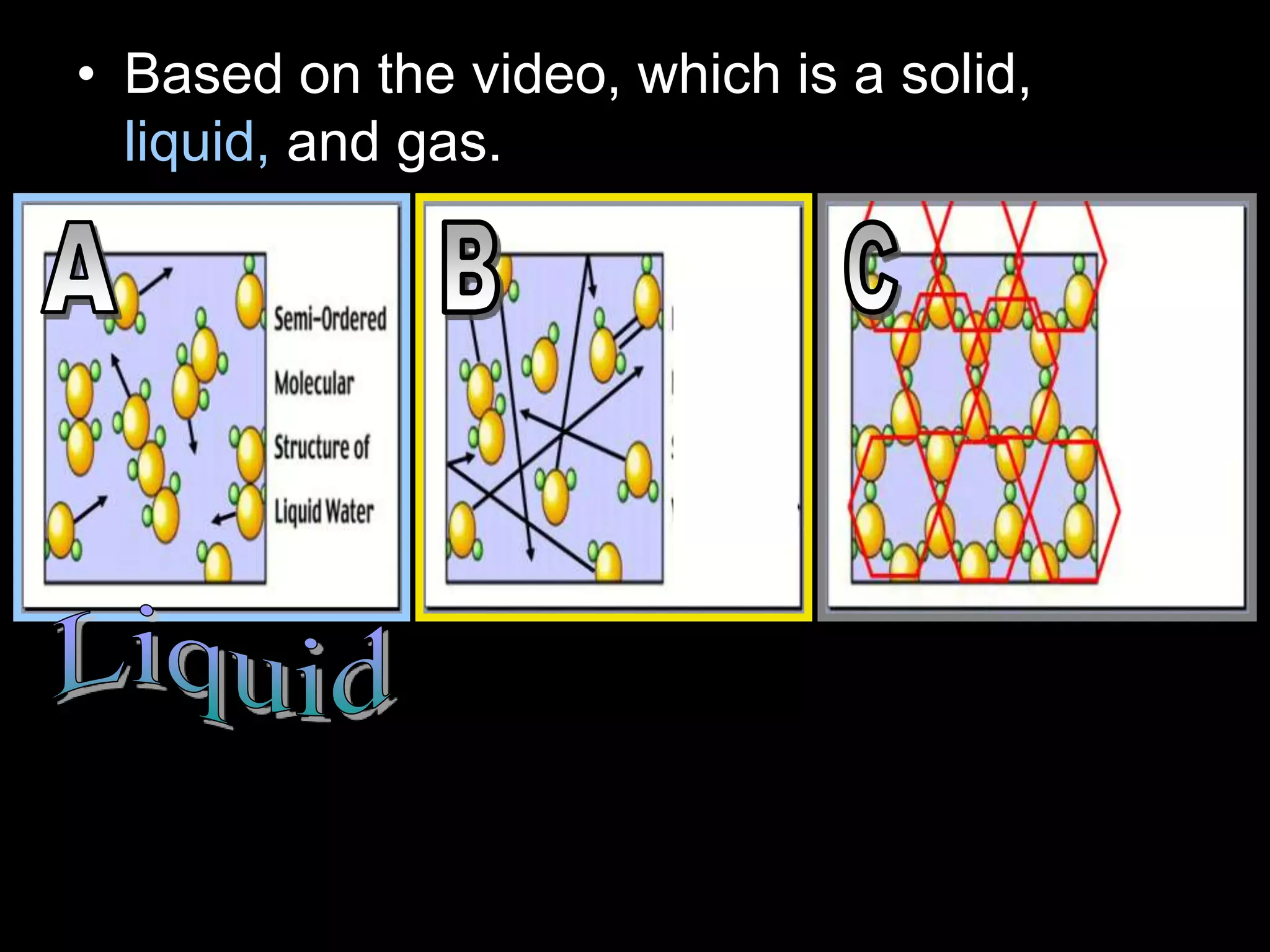
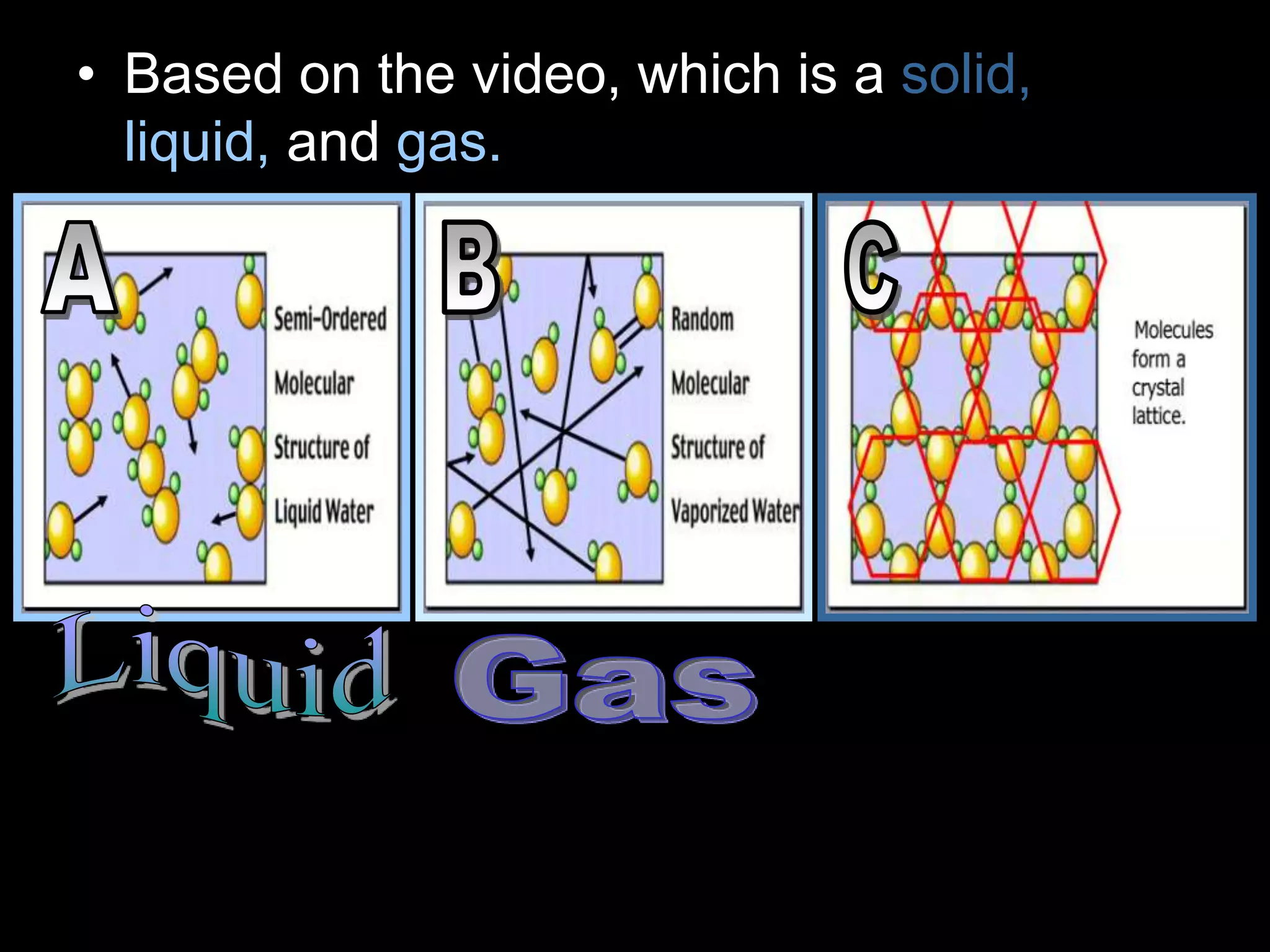
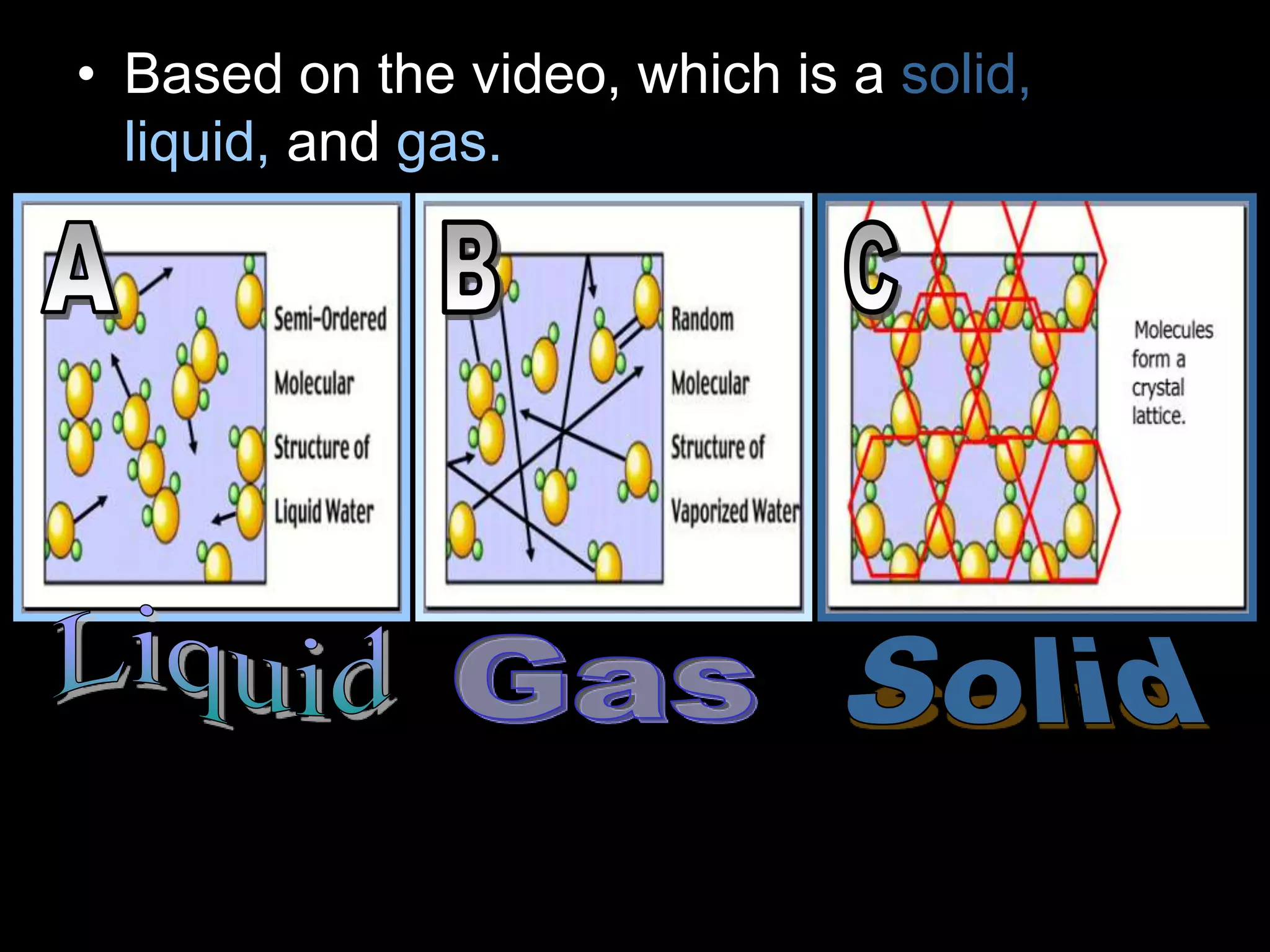
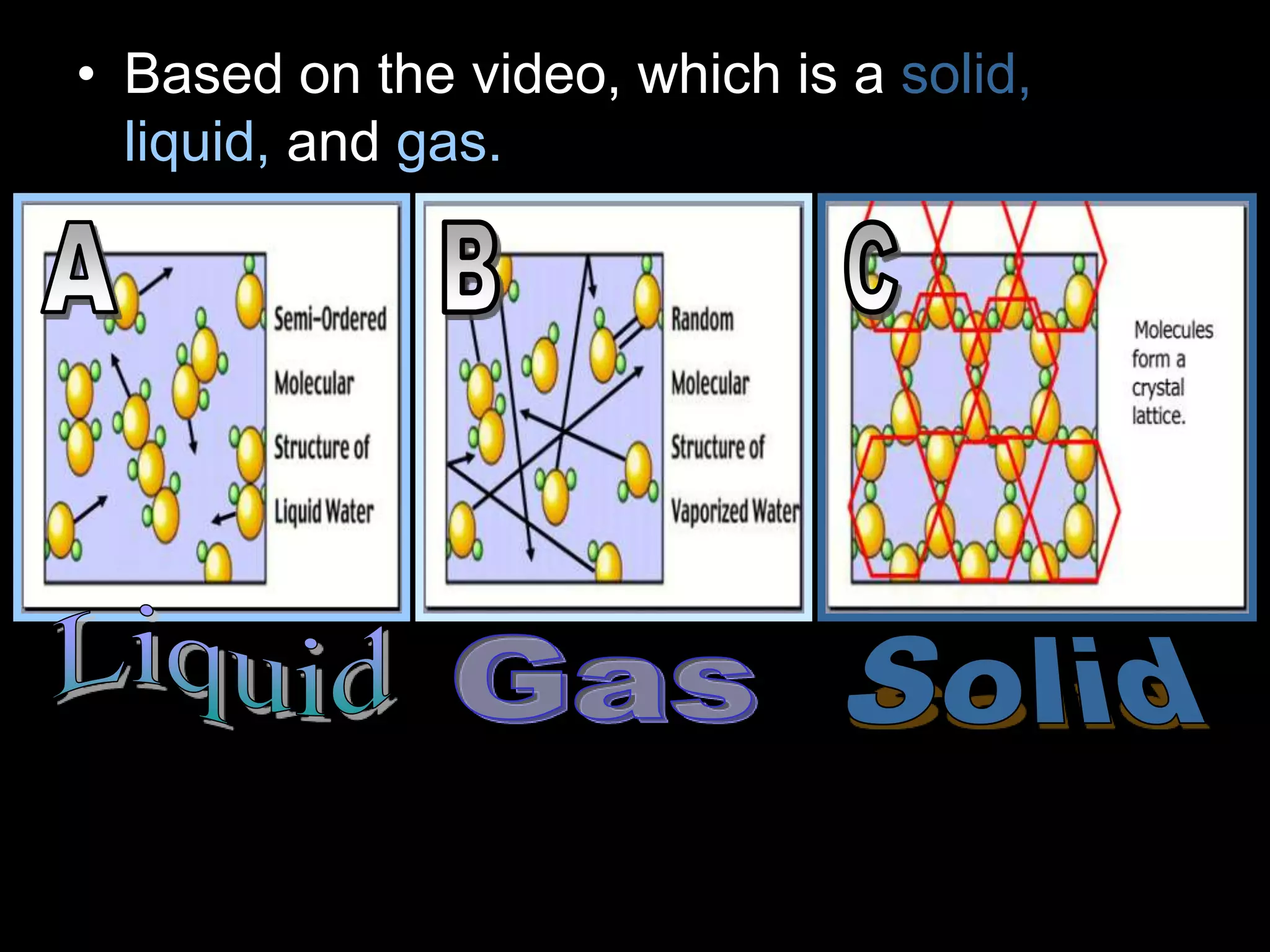
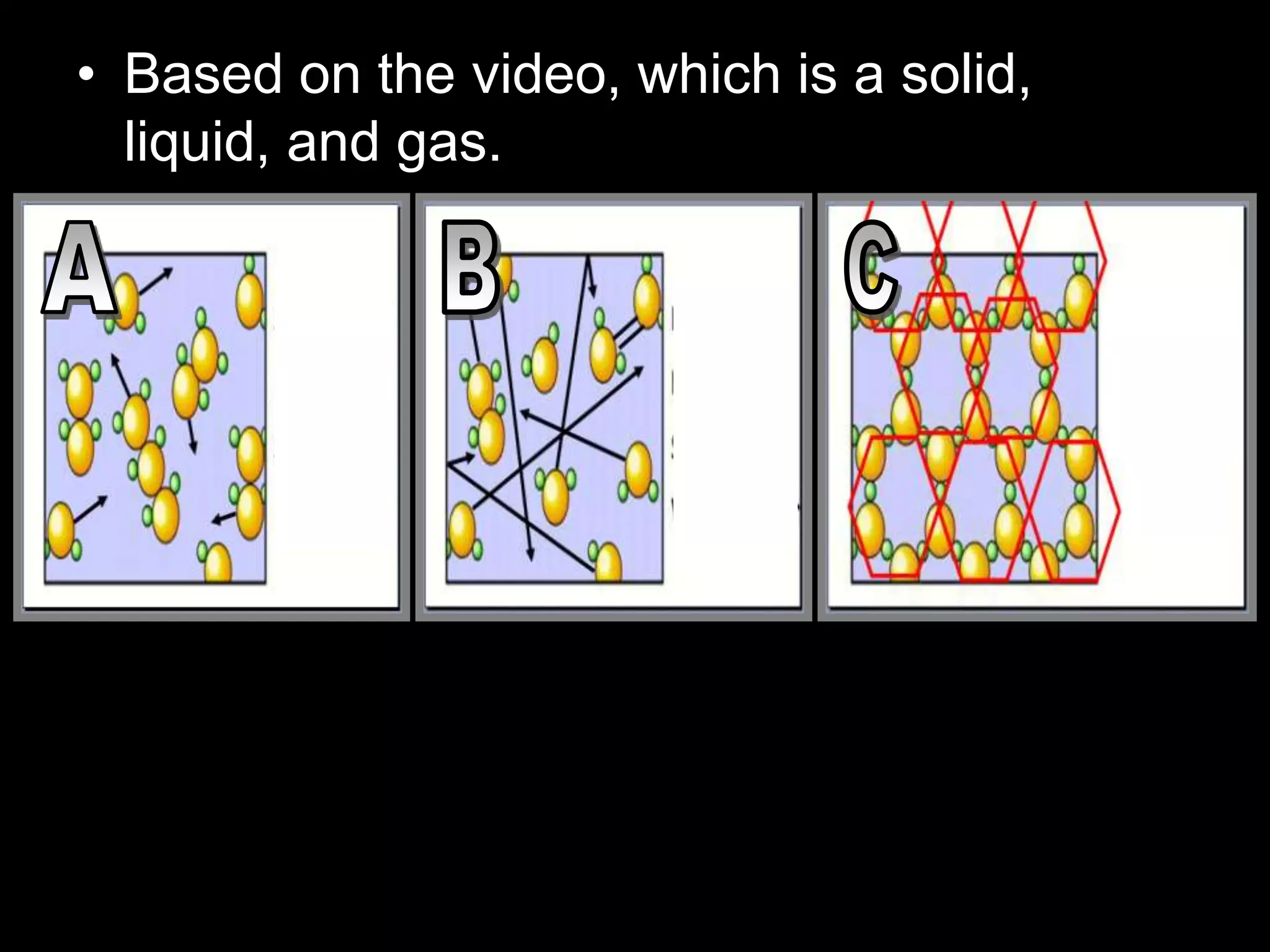
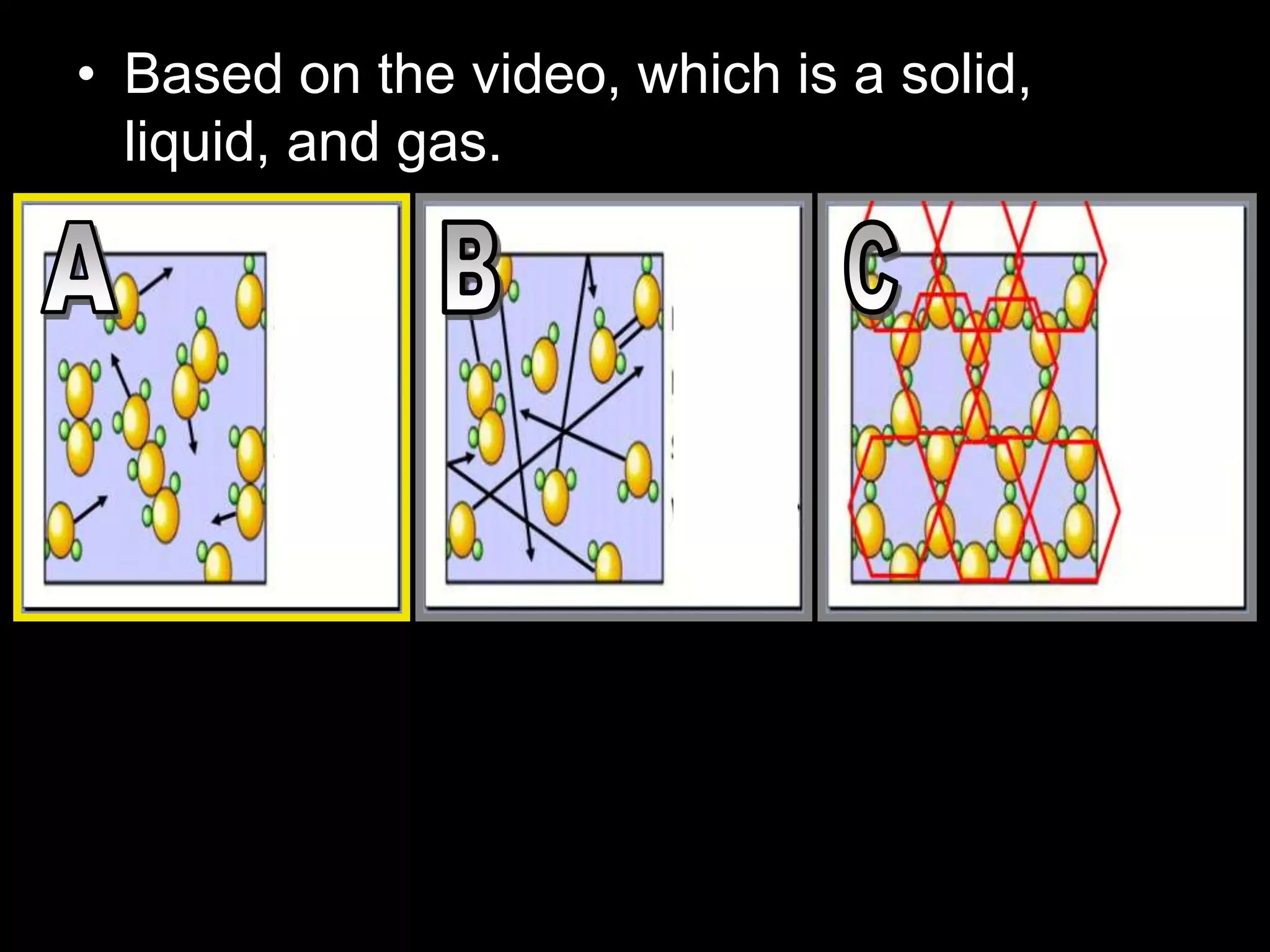
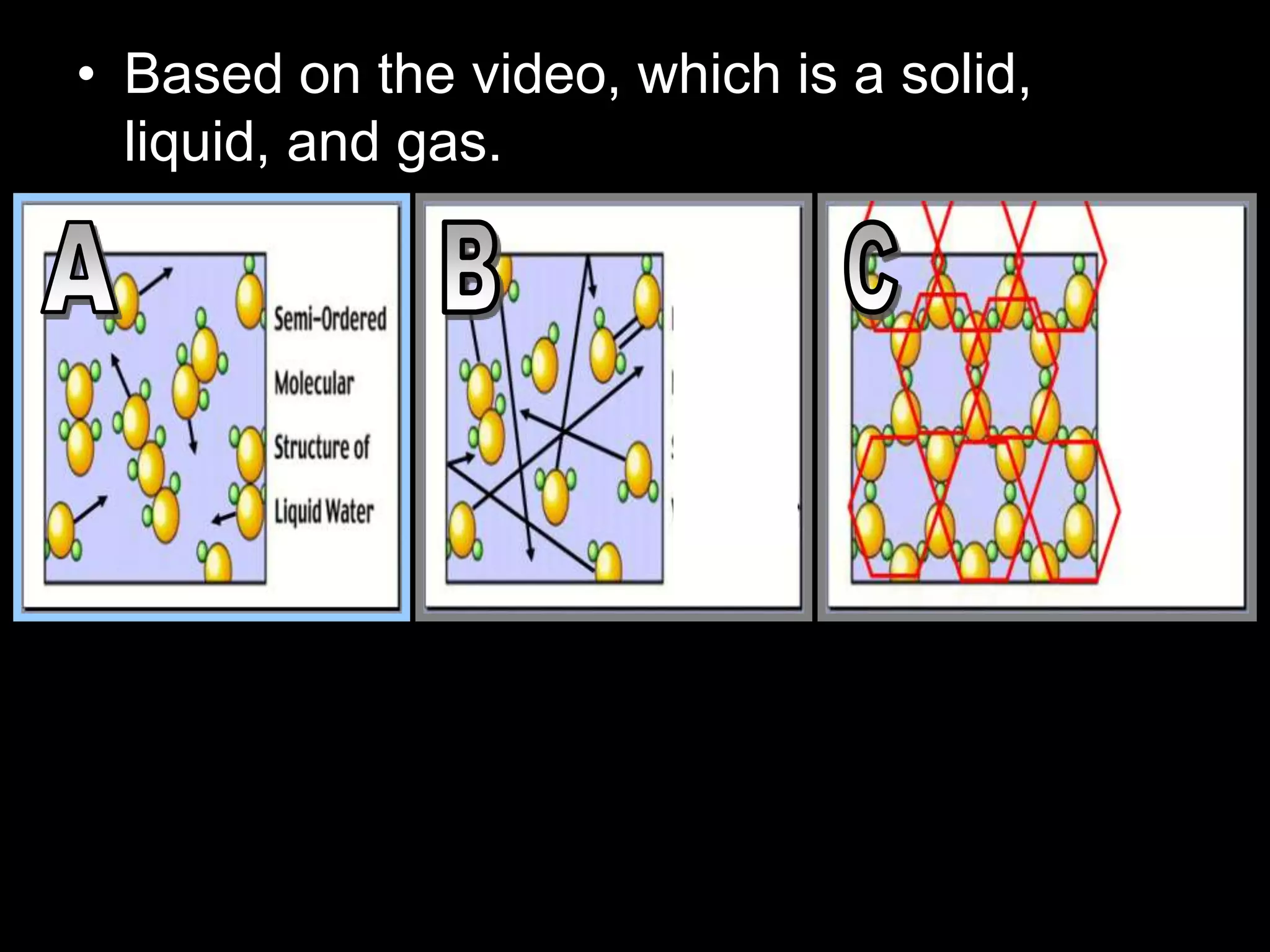
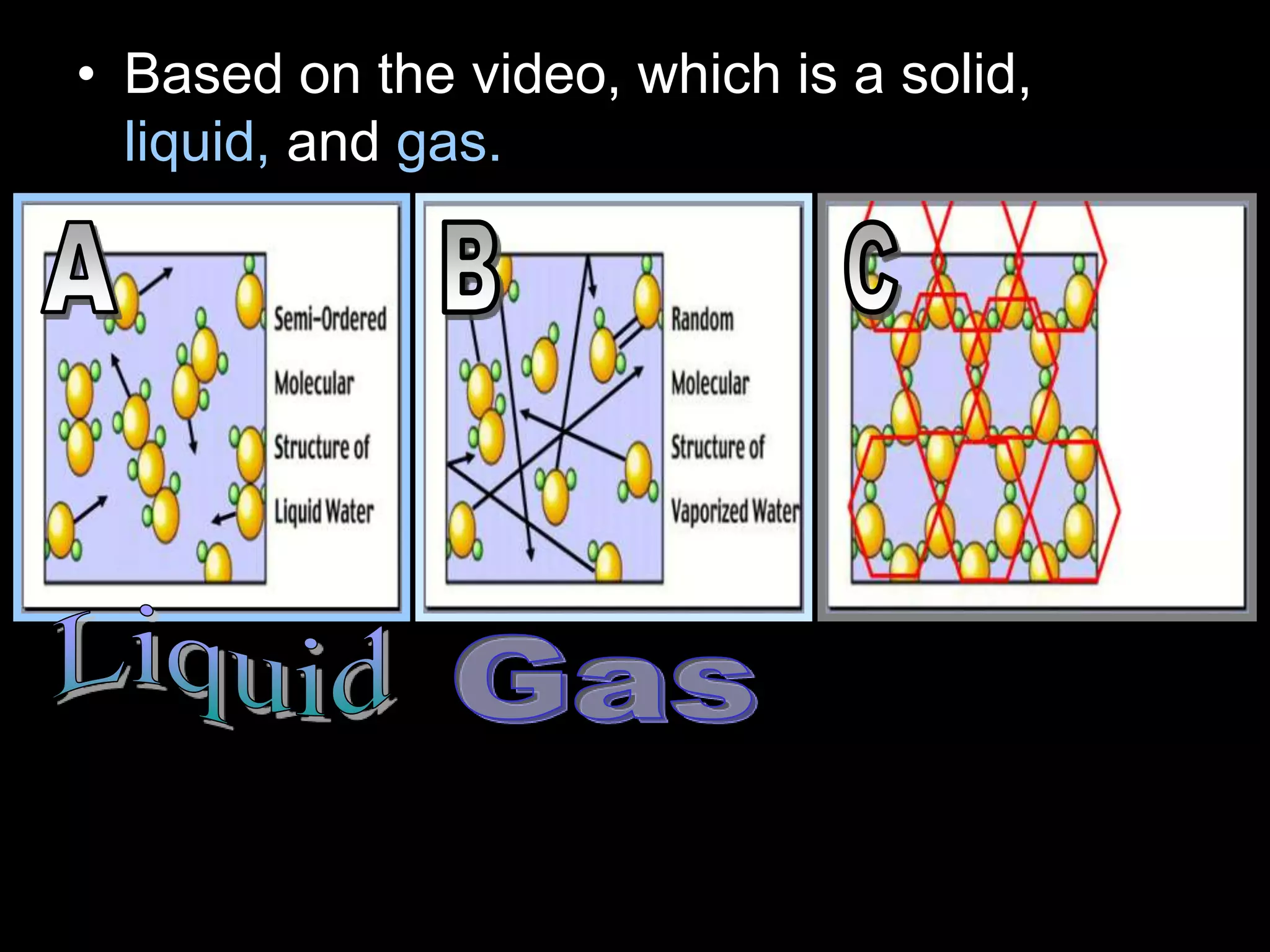
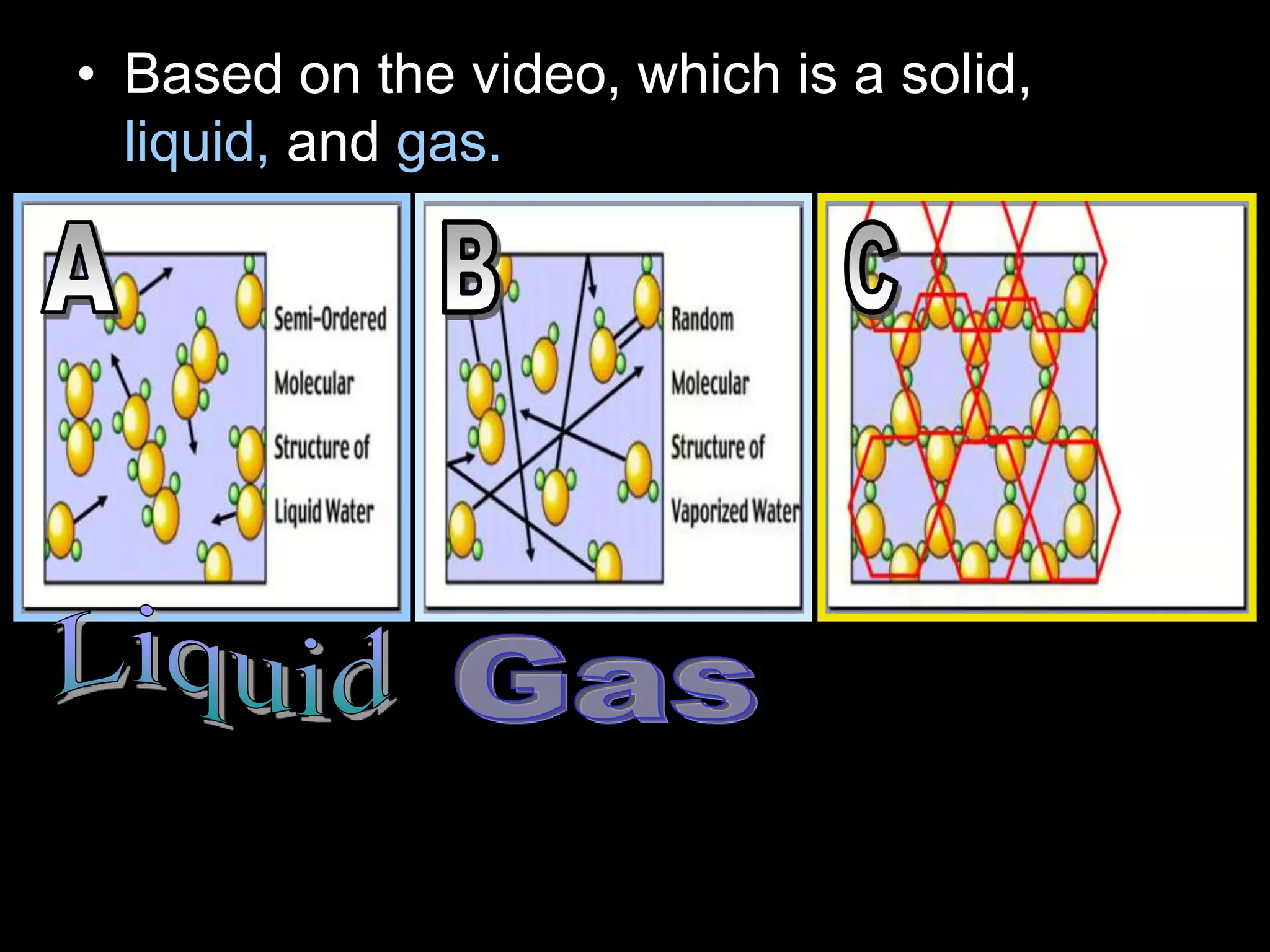
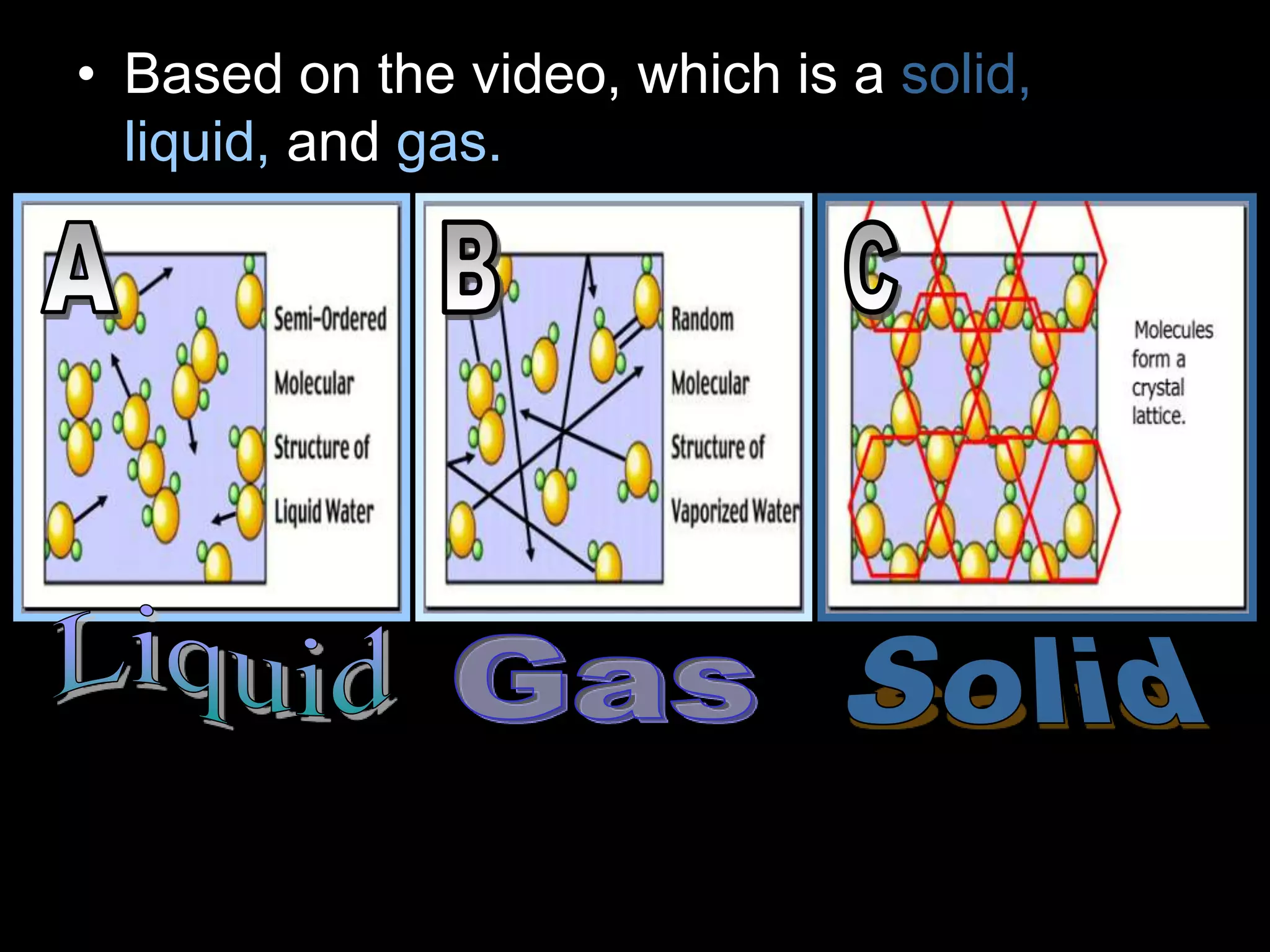
• Based on the video, which is a solid,
liquid, and gas.
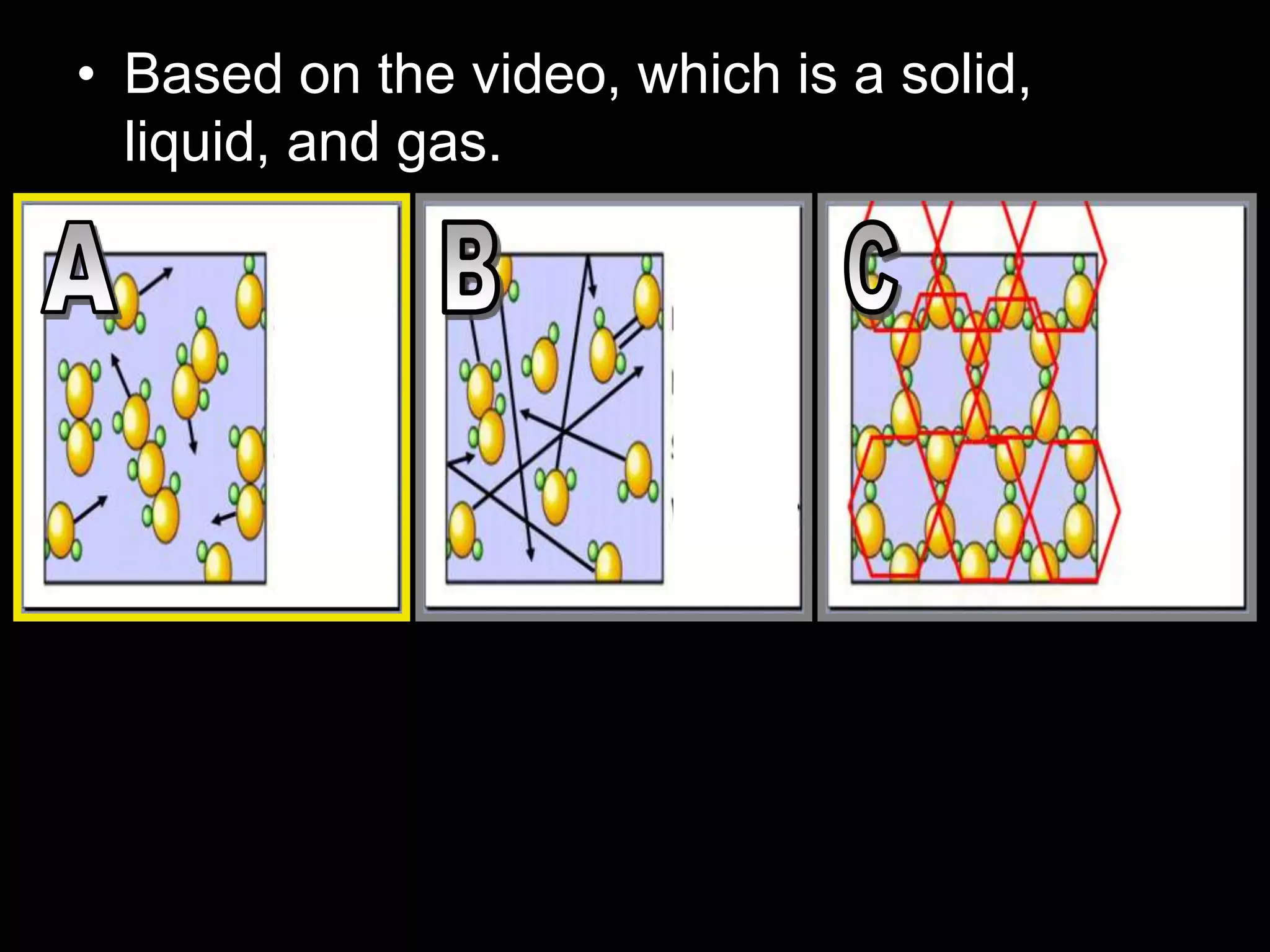
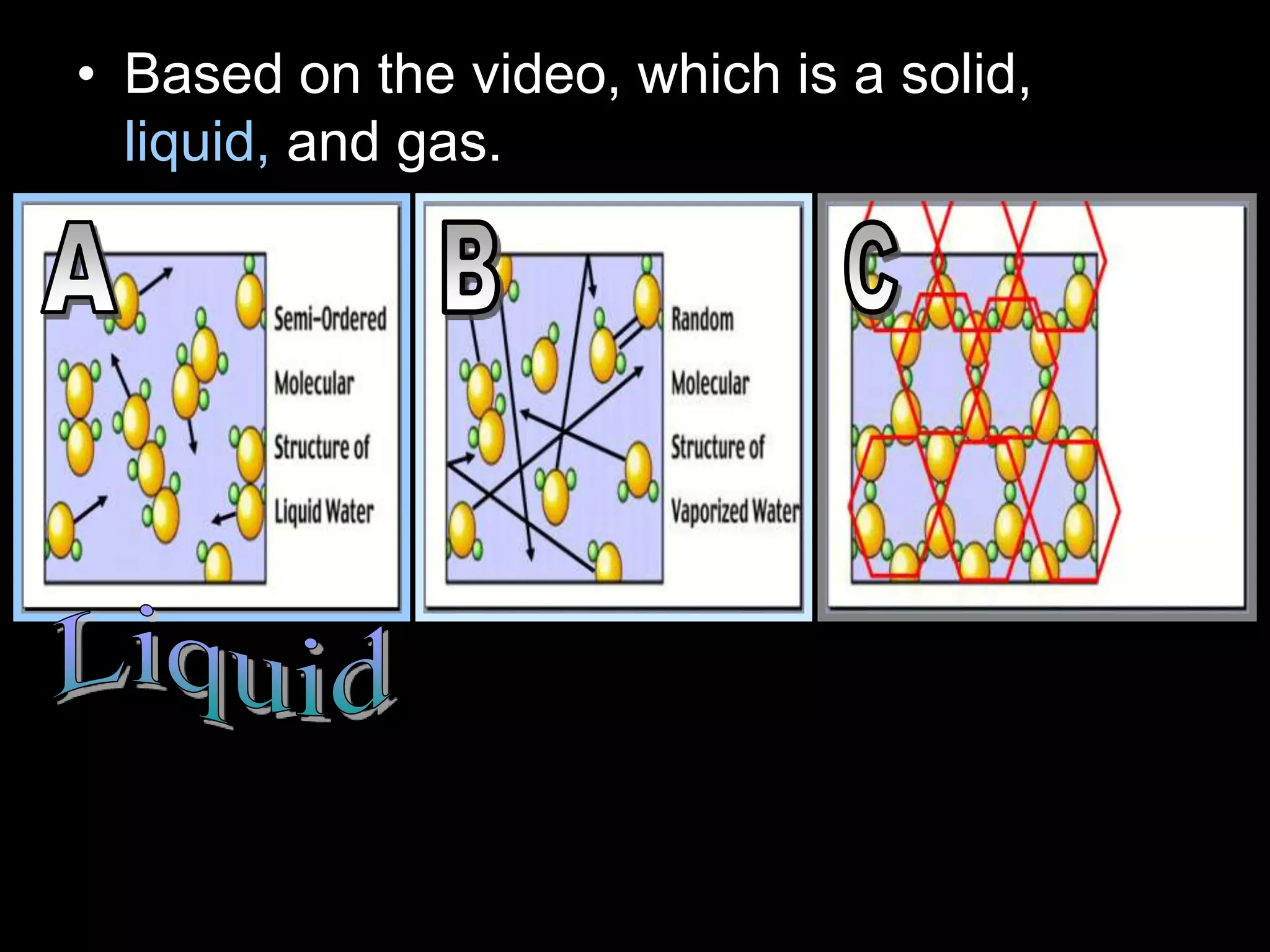
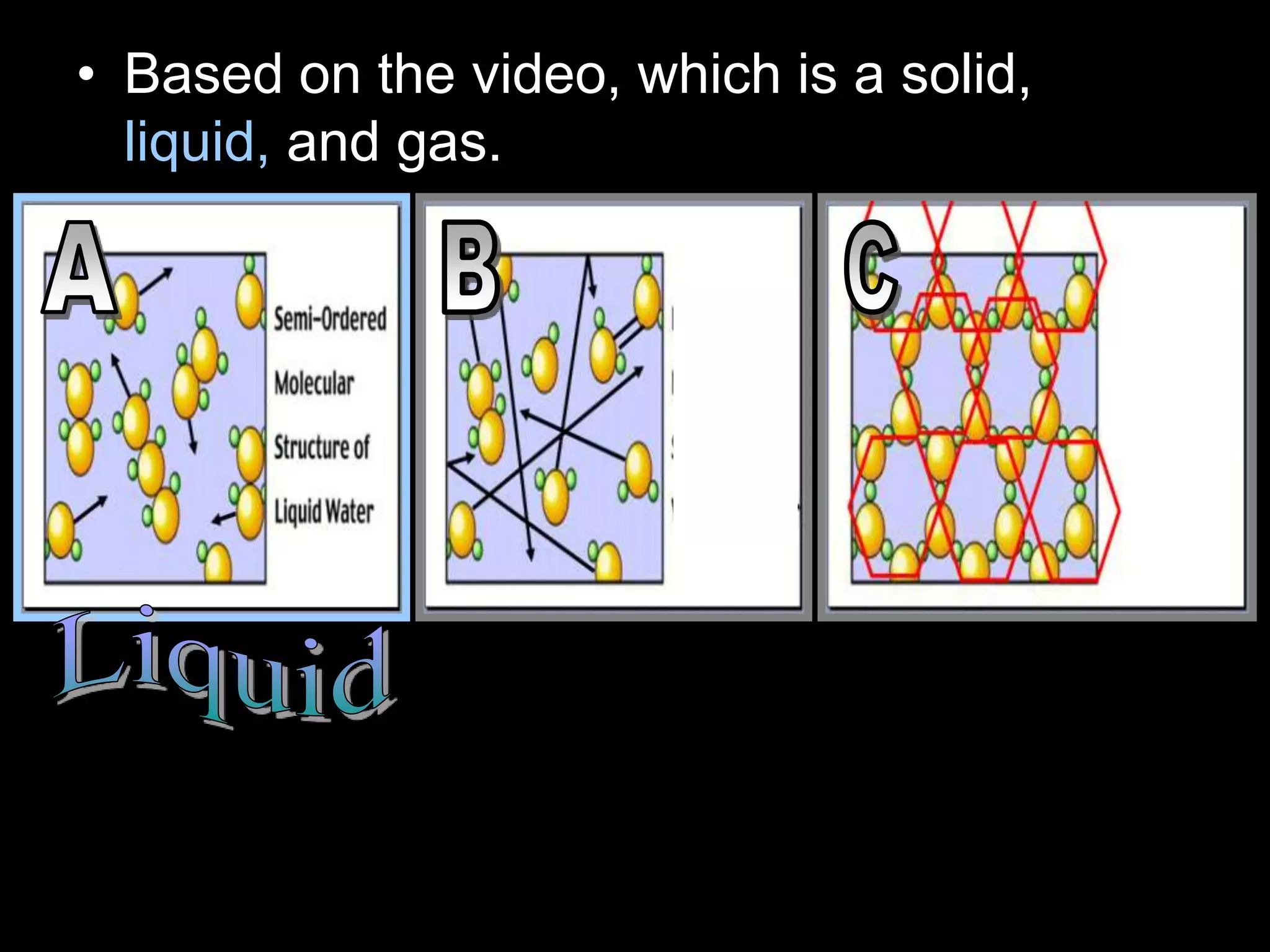
• Based on the video, which is a solid,
liquid, and gas.
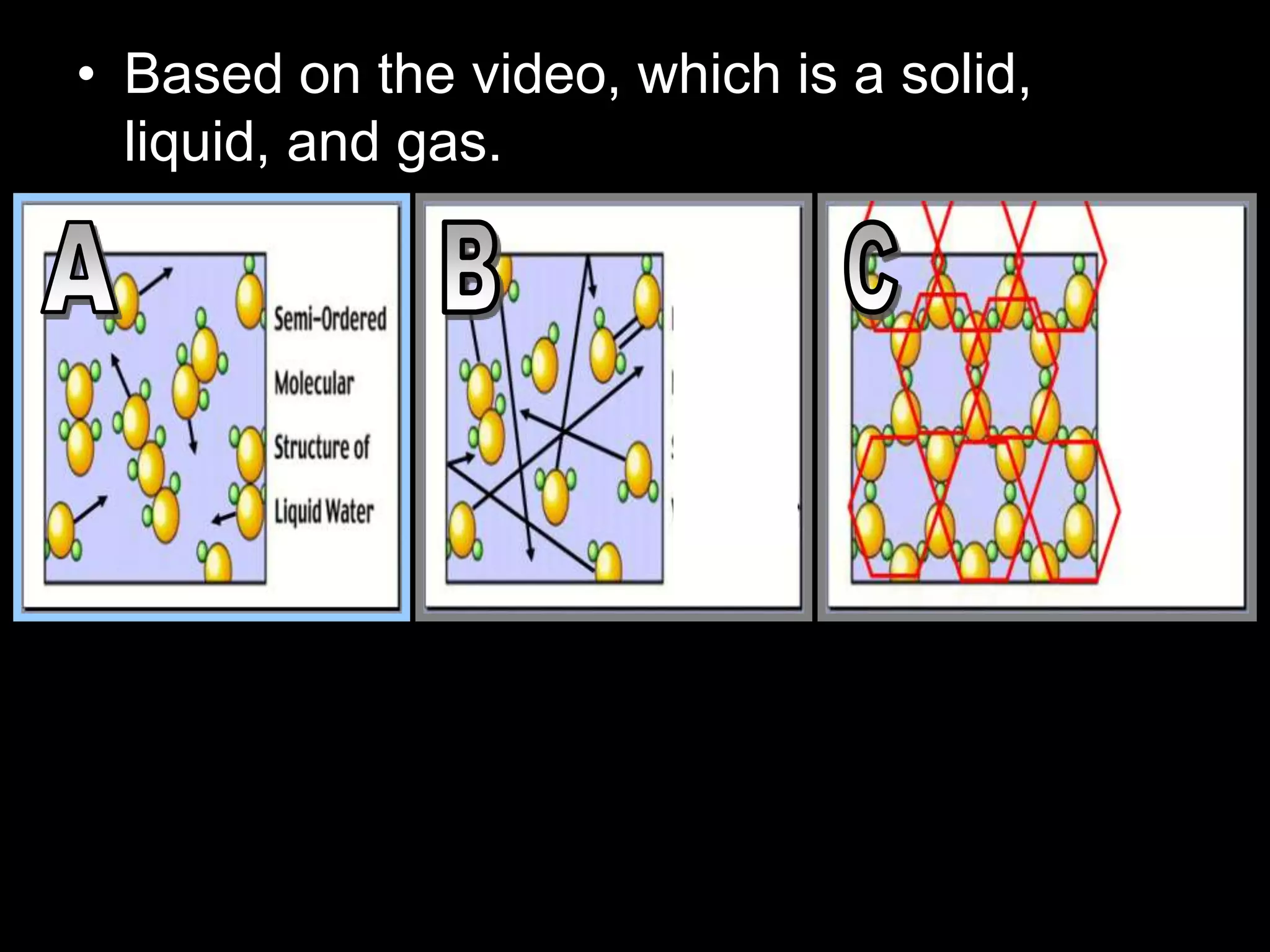
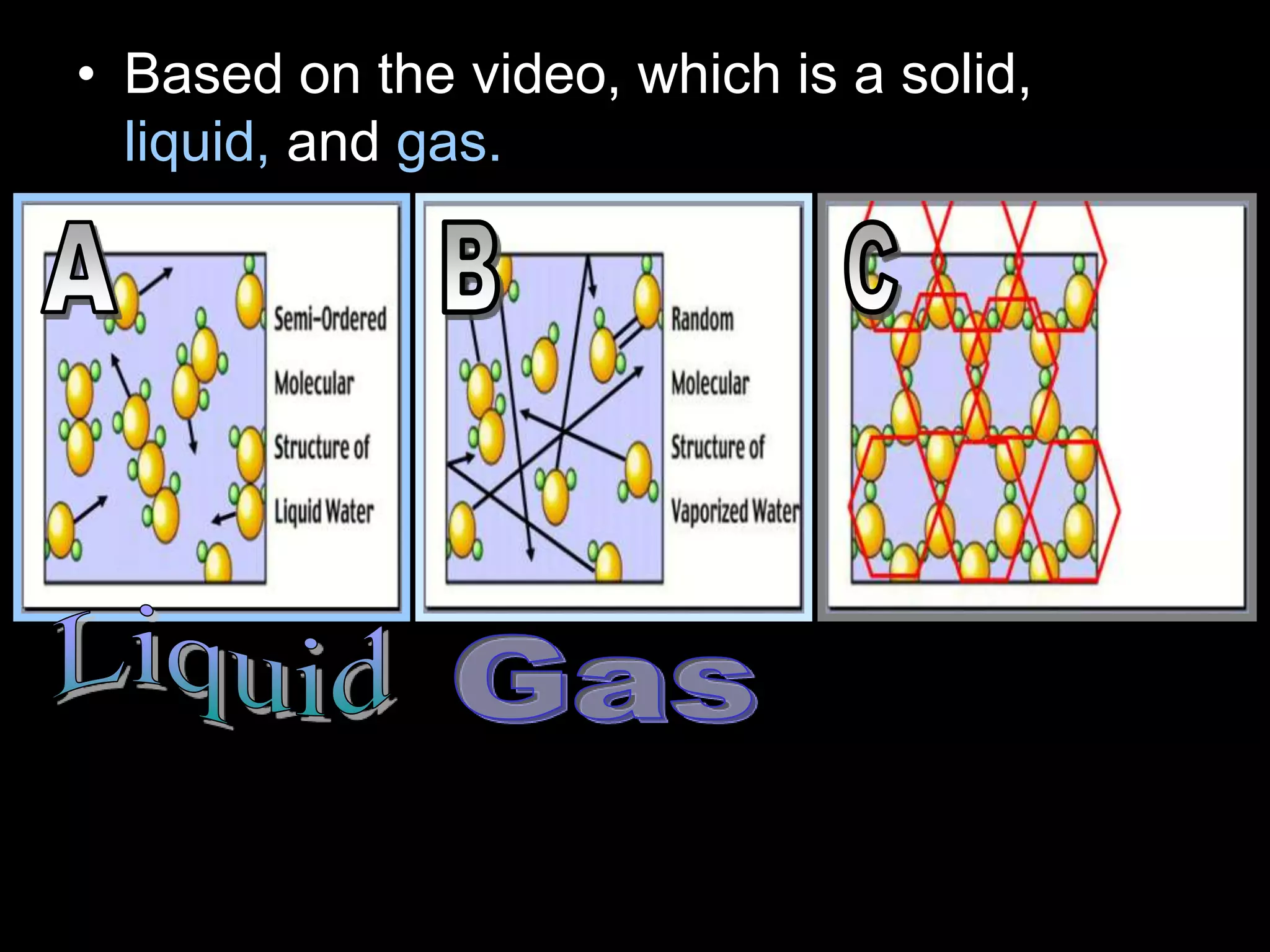
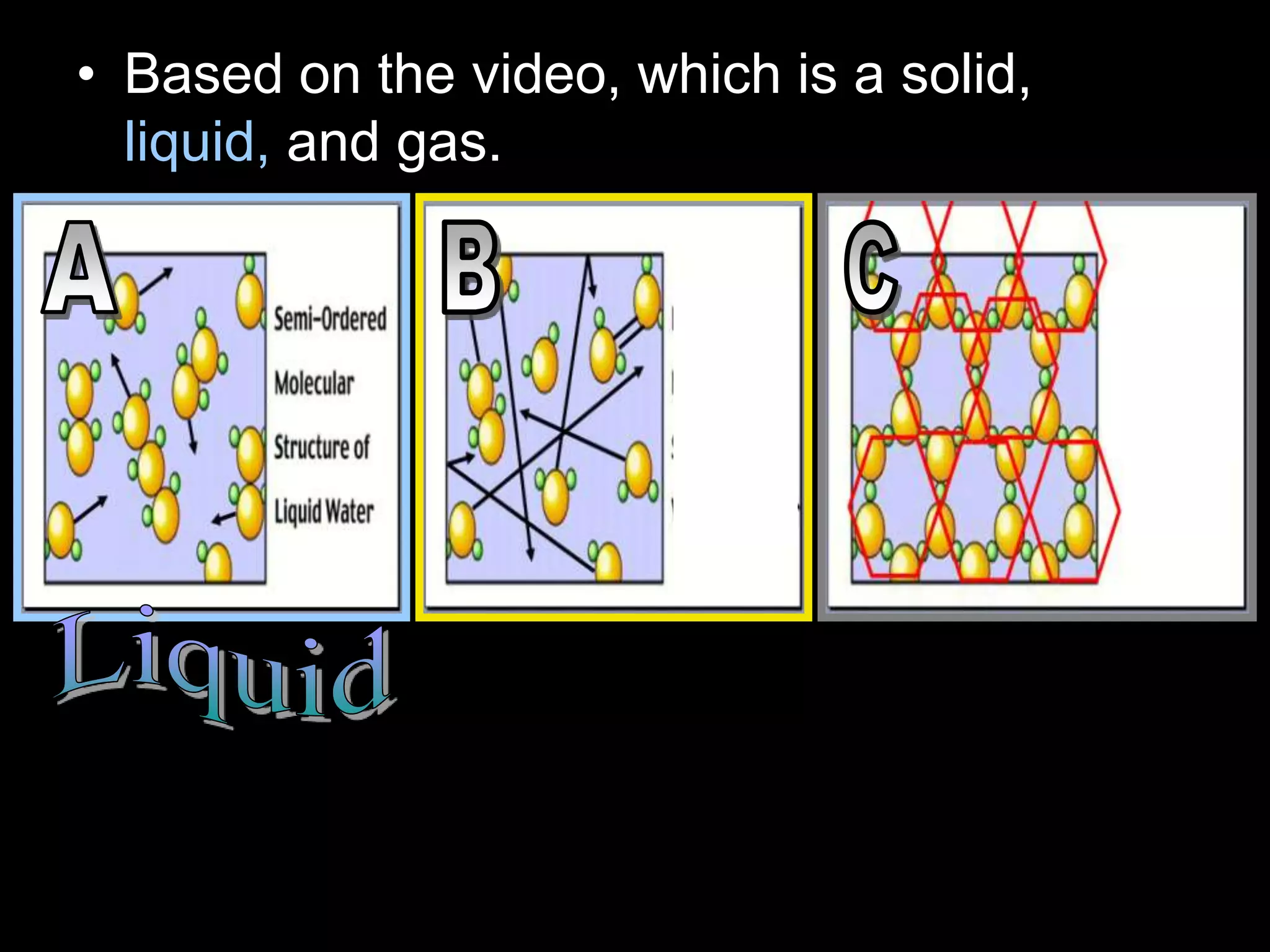
• Based on the video, which is a solid,
liquid, and gas.
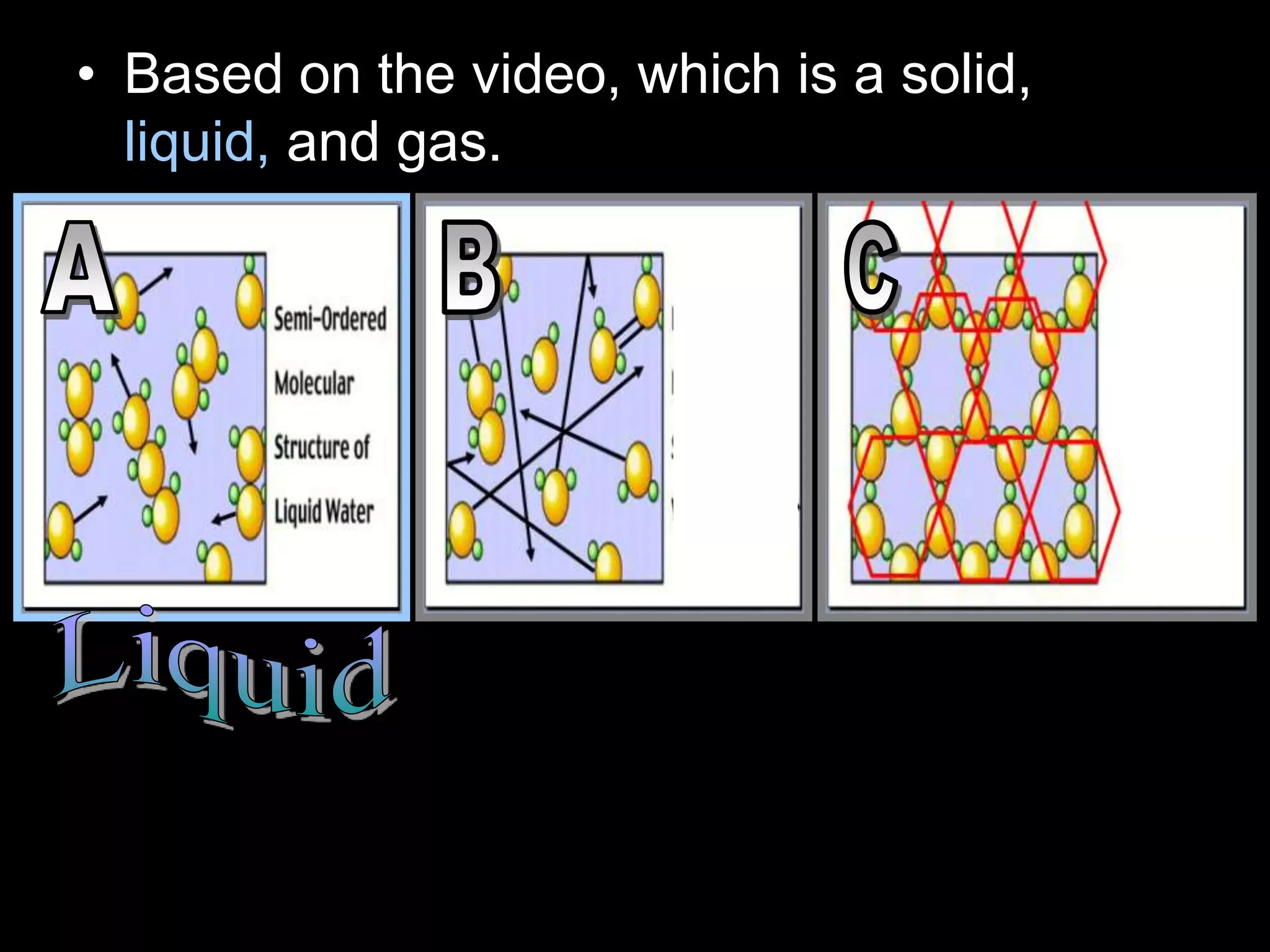
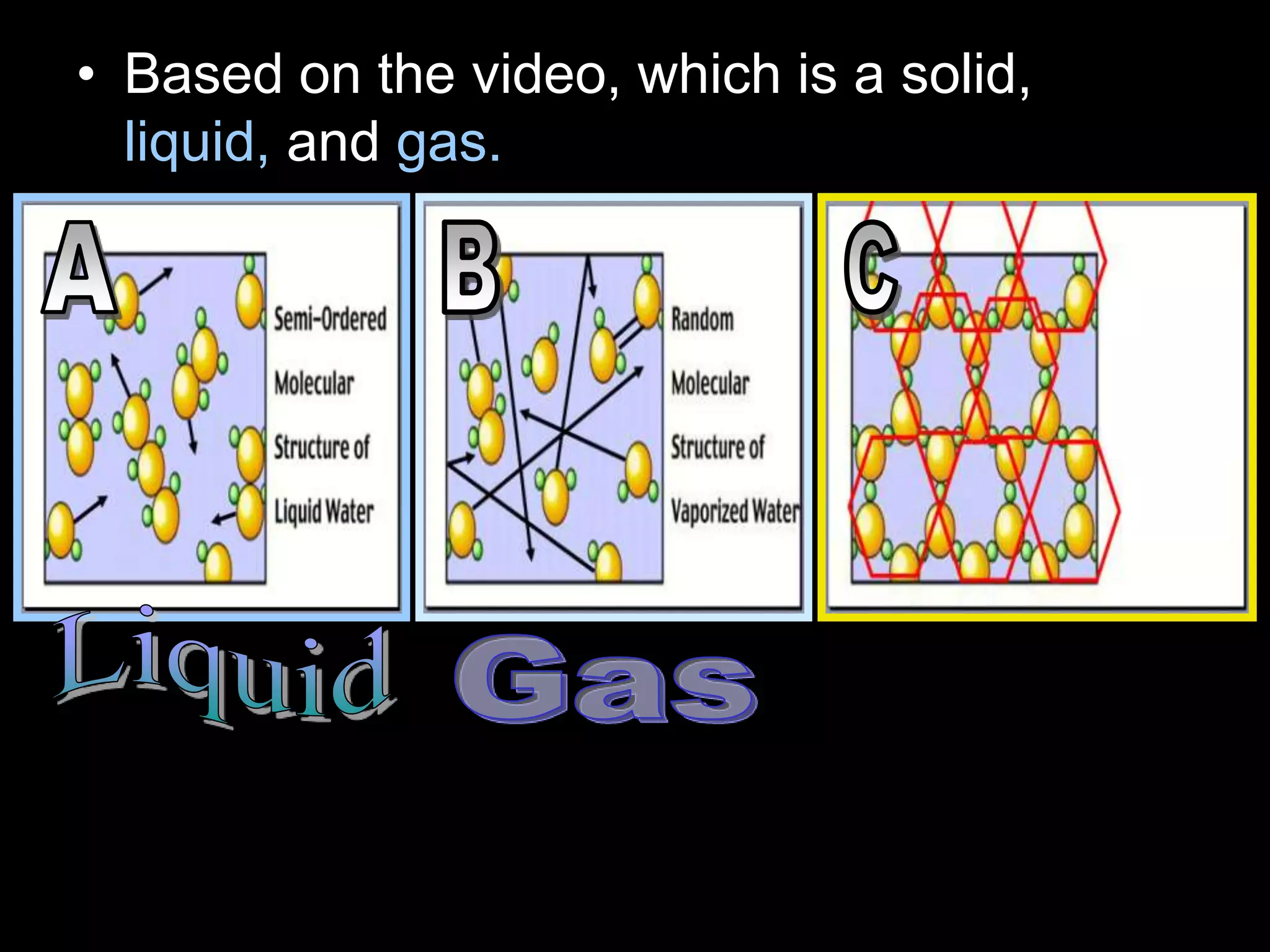
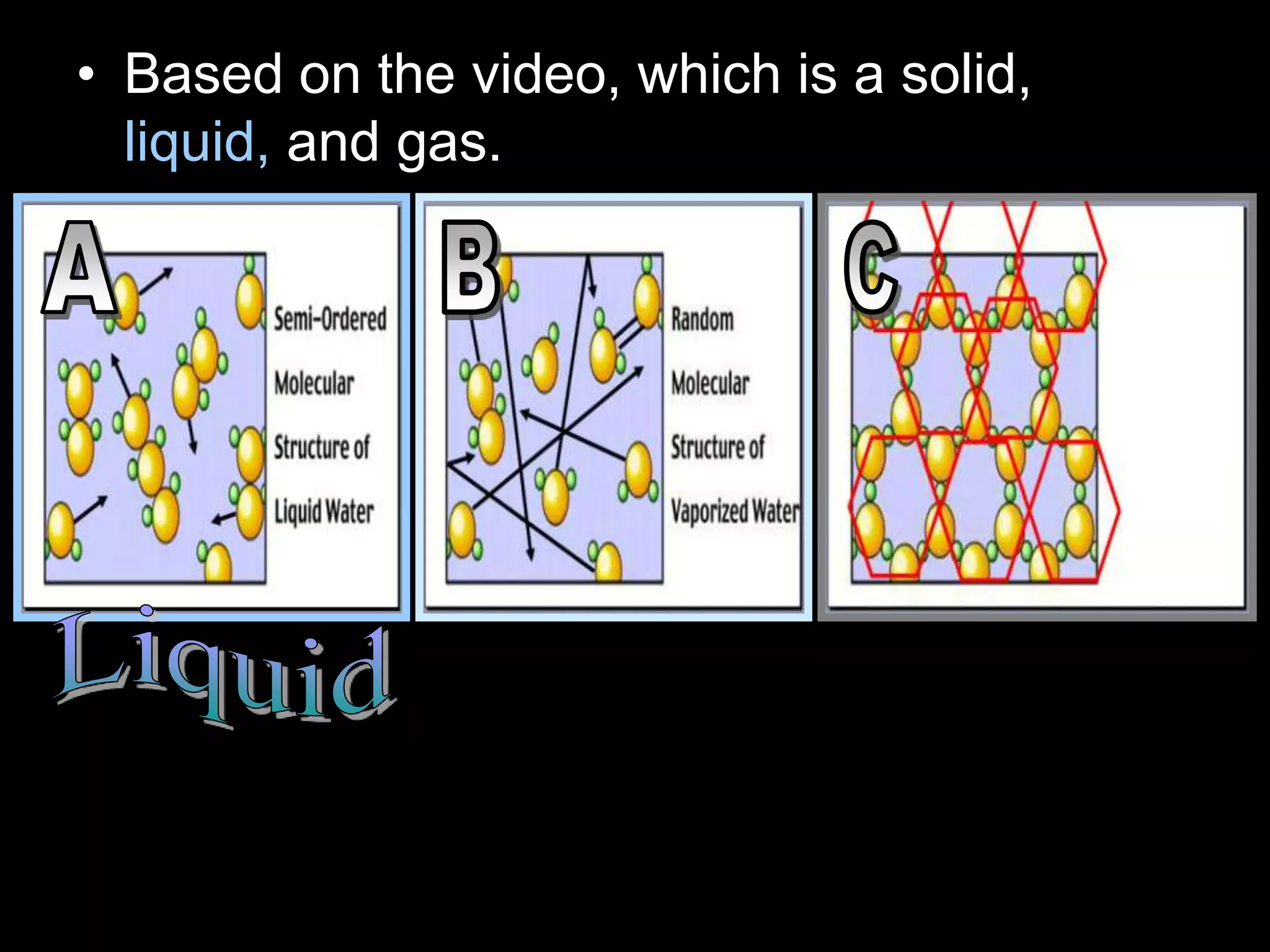
• Based on the video, which is a solid,
liquid, and gas.
• Based on the video, which is a solid,
liquid, and gas.
• Based on the video, which is a solid,
liquid, and gas.
• Based on the video, which is a solid,
liquid, and gas.
• Based on the video, which is a solid,
liquid, and gas.
• Based on the video, which is a solid,
liquid, and gas.
• Based on the video, which is a solid,
liquid, and gas.
• Based on the video, which is a solid,
liquid, and gas.
• Activity / video link (Extremely Optional)
– http://www.youtube.com/watch?v=p440QWpHui8
– Assign three students to each hold a poster with
the three states of matter. (Solid, Liquid, Gas)
• When Zebra is dancing and singing fast person with
gas poster must wave it around quickly.
• When zebra is dancing normal wave the liquid poster at
a normal speed.
• When zebra is dancing slowly wave the solid poster
extremely slow.
• Activity / video link (Extremely Optional)
– http://www.youtube.com/watch?v=p440QWpHui8
– Assign three students to each hold a poster with
the three states of matter. (Solid, Liquid, Gas)
• When Zebra is dancing and singing fast person with
gas poster must wave it around quickly.
• When zebra is dancing normal wave the liquid poster at
a normal speed.
• When zebra is dancing slowly wave the solid poster
extremely slow.
• Activity / video link (Extremely Optional)
– http://www.youtube.com/watch?v=p440QWpHui8
– Assign three students to each hold a poster with
the three states of matter. (Solid, Liquid, Gas)
• When Zebra is dancing and singing fast person with
gas poster must wave it around quickly.
• When zebra is dancing normal wave the liquid poster at
a normal speed.
• When zebra is dancing slowly wave the solid poster
extremely slow.
• Activity / video link (Extremely Optional)
– http://www.youtube.com/watch?v=p440QWpHui8
– Assign three students to each hold a poster with
the three states of matter. (Solid, Liquid, Gas)
• When Zebra is dancing and singing fast person with
gas poster must wave it around quickly.
• When zebra is dancing normal wave the liquid poster at
a normal speed.
• When zebra is dancing slowly wave the solid poster
extremely slow.
• Activity / video link (Extremely Optional)
– http://www.youtube.com/watch?v=p440QWpHui8
– Assign three students to each hold a poster with
the three states of matter. (Solid, Liquid, Gas)
• When Zebra is dancing and singing fast person with
gas poster must wave it around quickly.
• When zebra is dancing normal wave the liquid poster at
a normal speed.
• When zebra is dancing slowly wave the solid poster
extremely slow.
• Activity / video link (Extremely Optional)
– http://www.youtube.com/watch?v=p440QWpHui8
– Assign three students to each hold a poster with
the three states of matter. (Solid, Liquid, Gas)
• When Zebra is dancing and singing fast person with
gas poster must wave it around quickly.
• When zebra is dancing normal wave the liquid poster at
a normal speed.
• When zebra is dancing slowly wave the solid poster
extremely slow.
• Activity / video link (Extremely Optional)
– http://www.youtube.com/watch?v=p440QWpHui8
– Assign three students to each hold a poster with
the three states of matter. (Solid, Liquid, Gas)
• When Zebra is dancing and singing fast person with
gas poster must wave it around quickly.
• When zebra is dancing normal wave the liquid poster at
a normal speed.
• When zebra is dancing slowly wave the solid poster
extremely slow.
• Video Link! (Optional) TMBG
– http://www.youtube.com/watch?v=btGu9FWSPtc
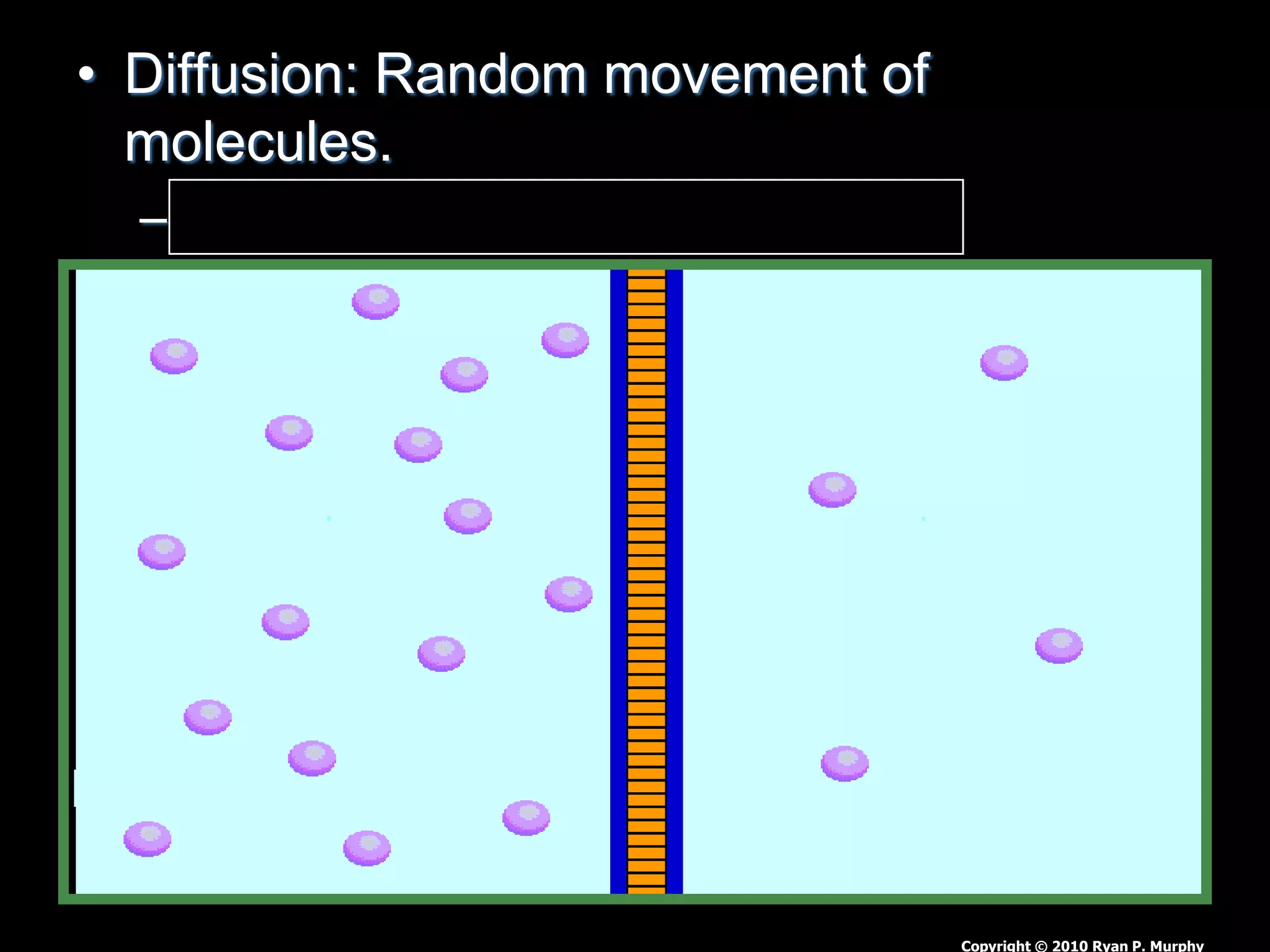
• Diffusion: Random movement of
molecules.
– From high to low concentrations.
Copyright © 2010 Ryan P. Murphy
• Diffusion: Random movement of
molecules.
– From high to low concentrations.
Copyright © 2010 Ryan P. Murphy
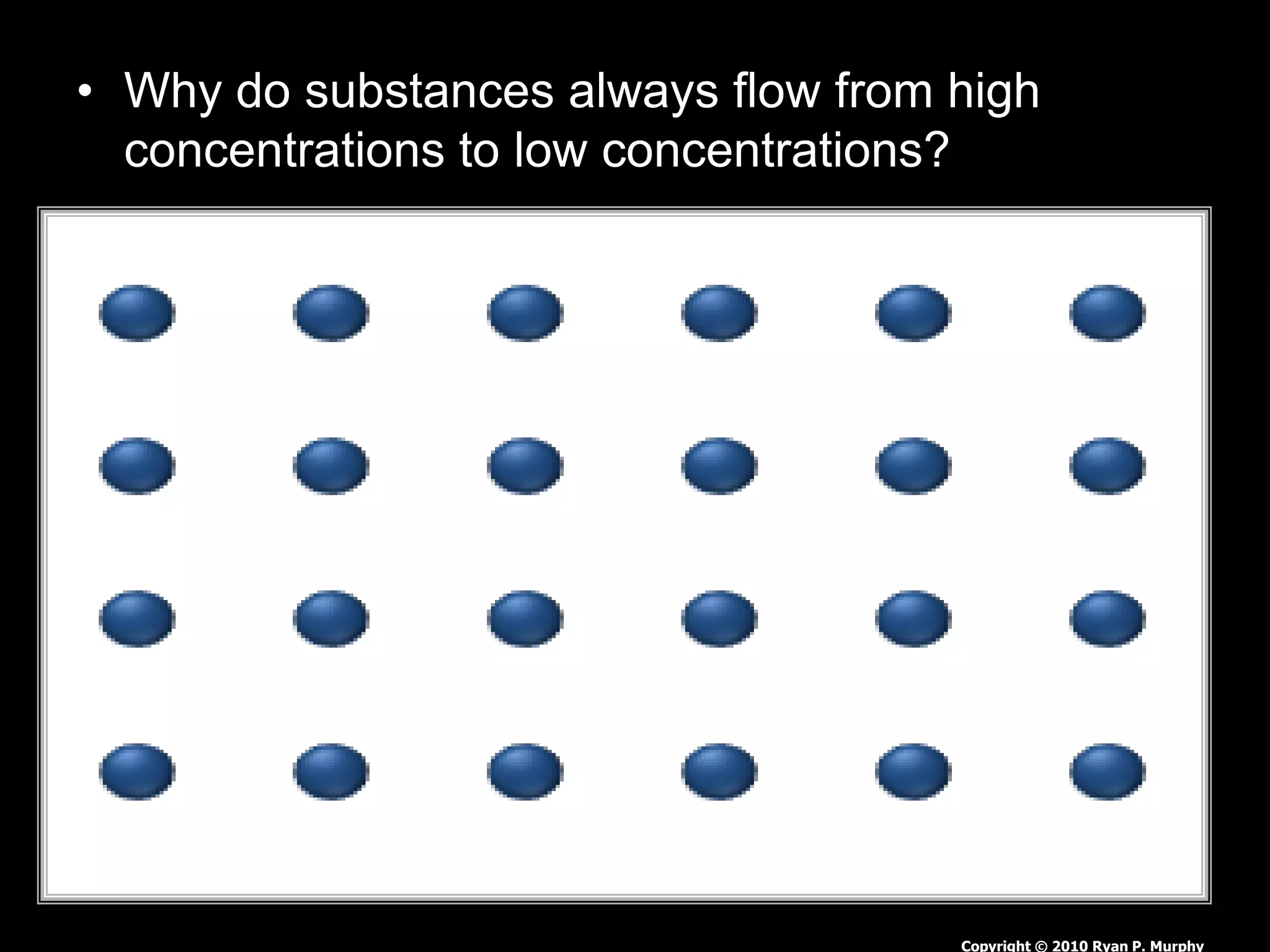
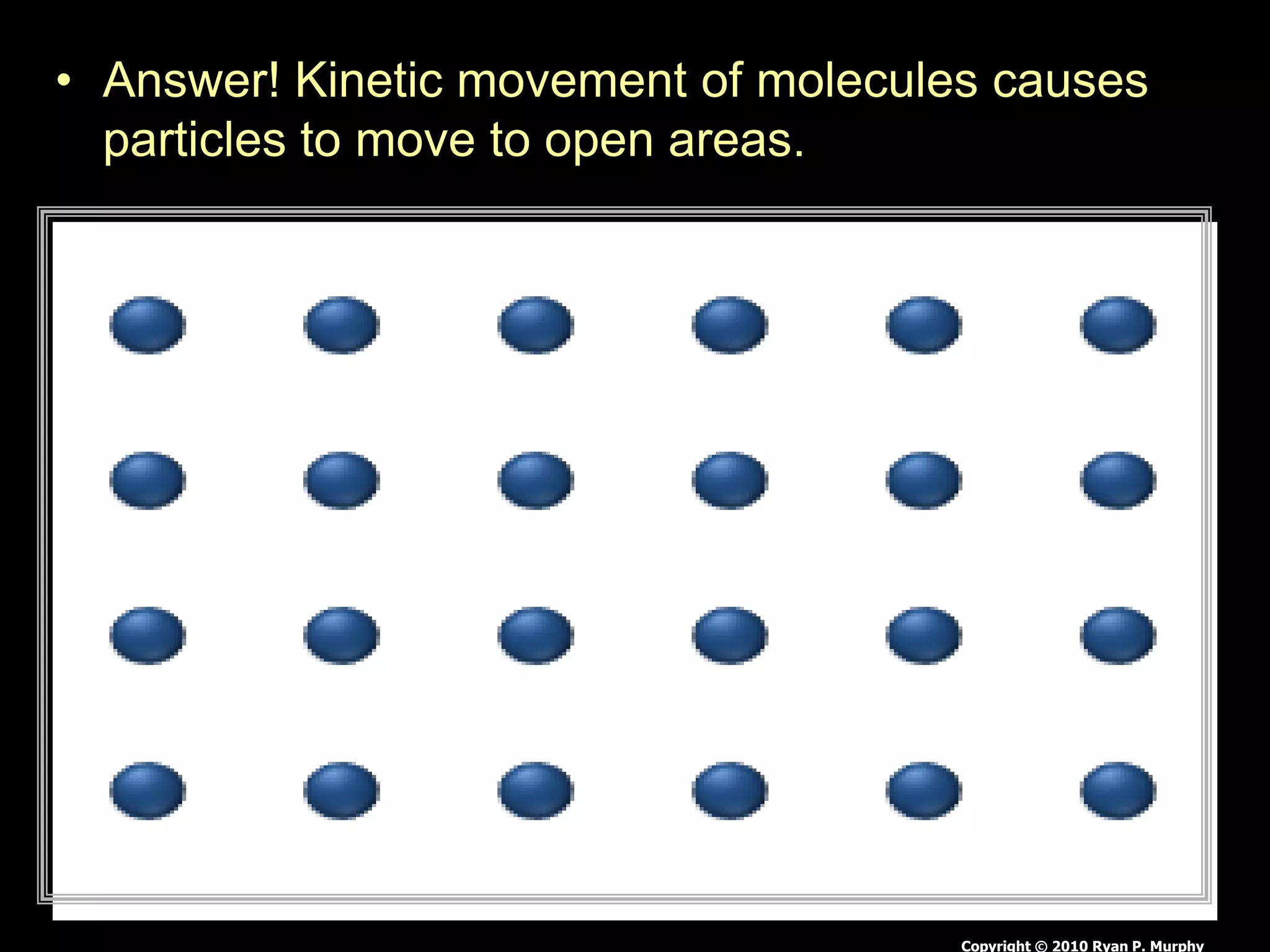
• Why do substances always flow from high
concentrations to low concentrations?
Copyright © 2010 Ryan P. Murphy
• Answer! Kinetic movement of molecules causes
particles to move to open areas.
Copyright © 2010 Ryan P. Murphy
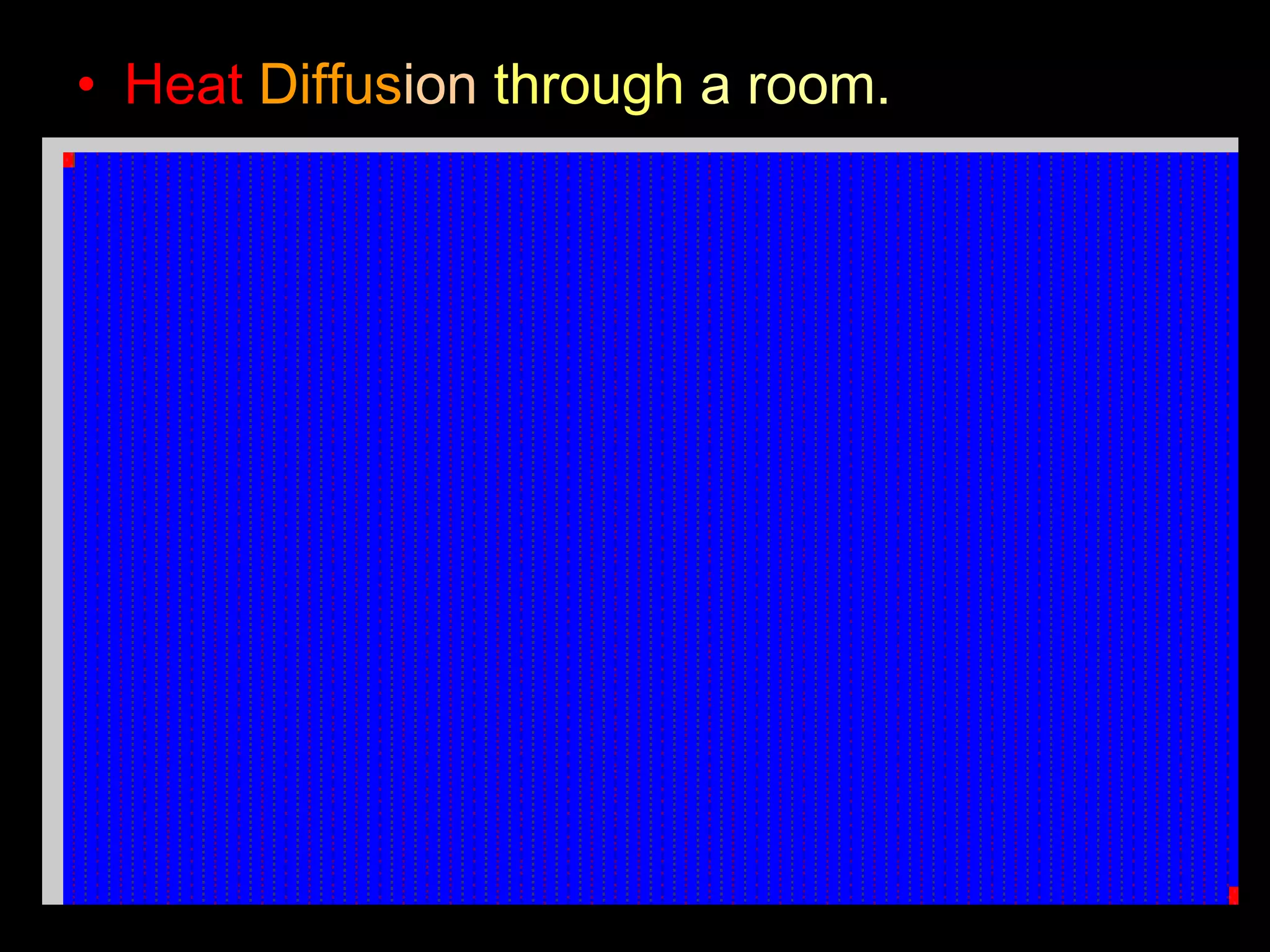
• Heat Diffusion through a room.
• Activity! Making the room smell good.
– Teacher to stand in one place and release
some spray.
– Raise your hand when you smell it.
– What are the molecules doing?
Copyright © 2010 Ryan P. Murphy
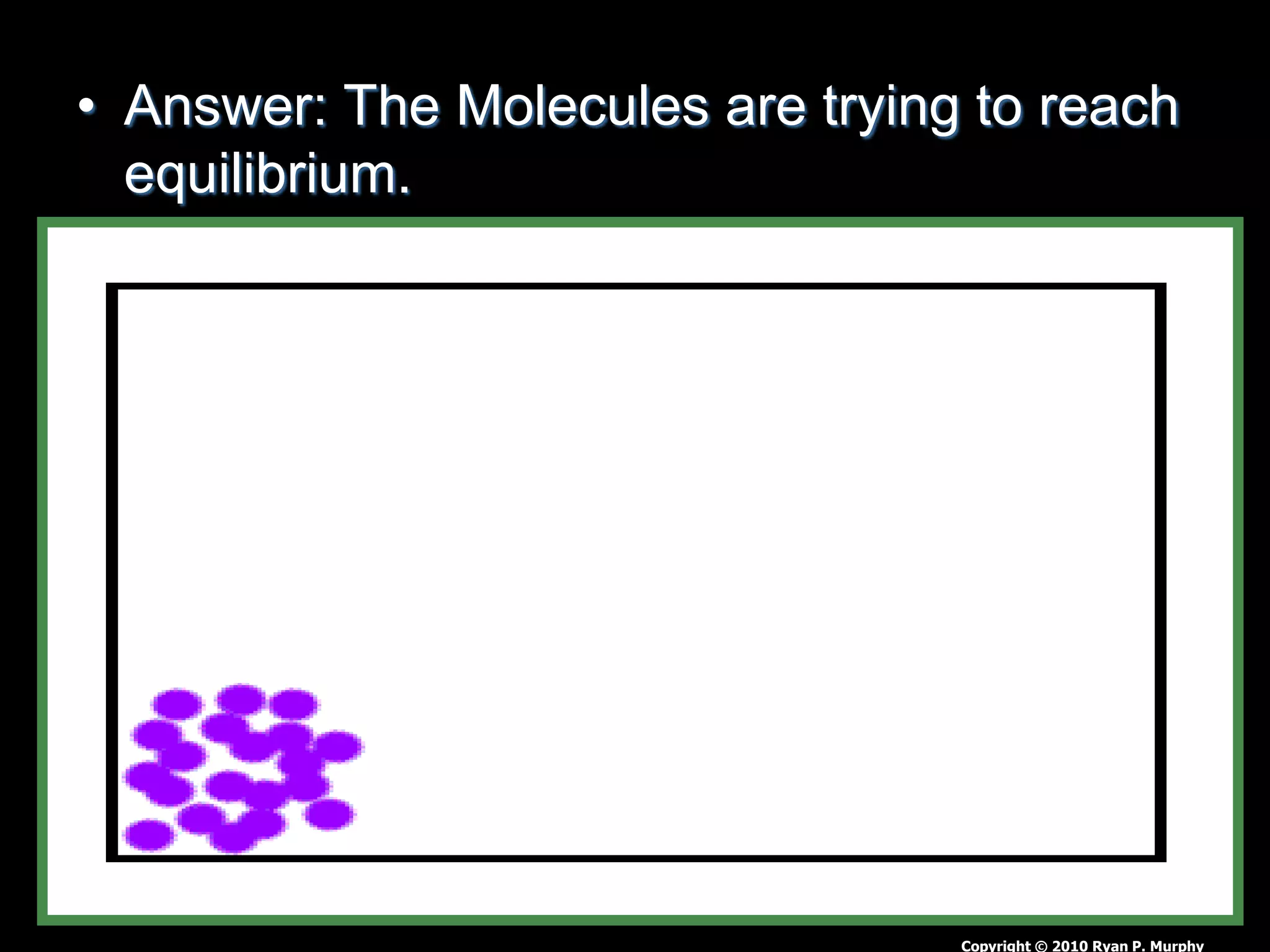
• Answer: The Molecules are trying to reach
equilibrium.
Copyright © 2010 Ryan P. Murphy
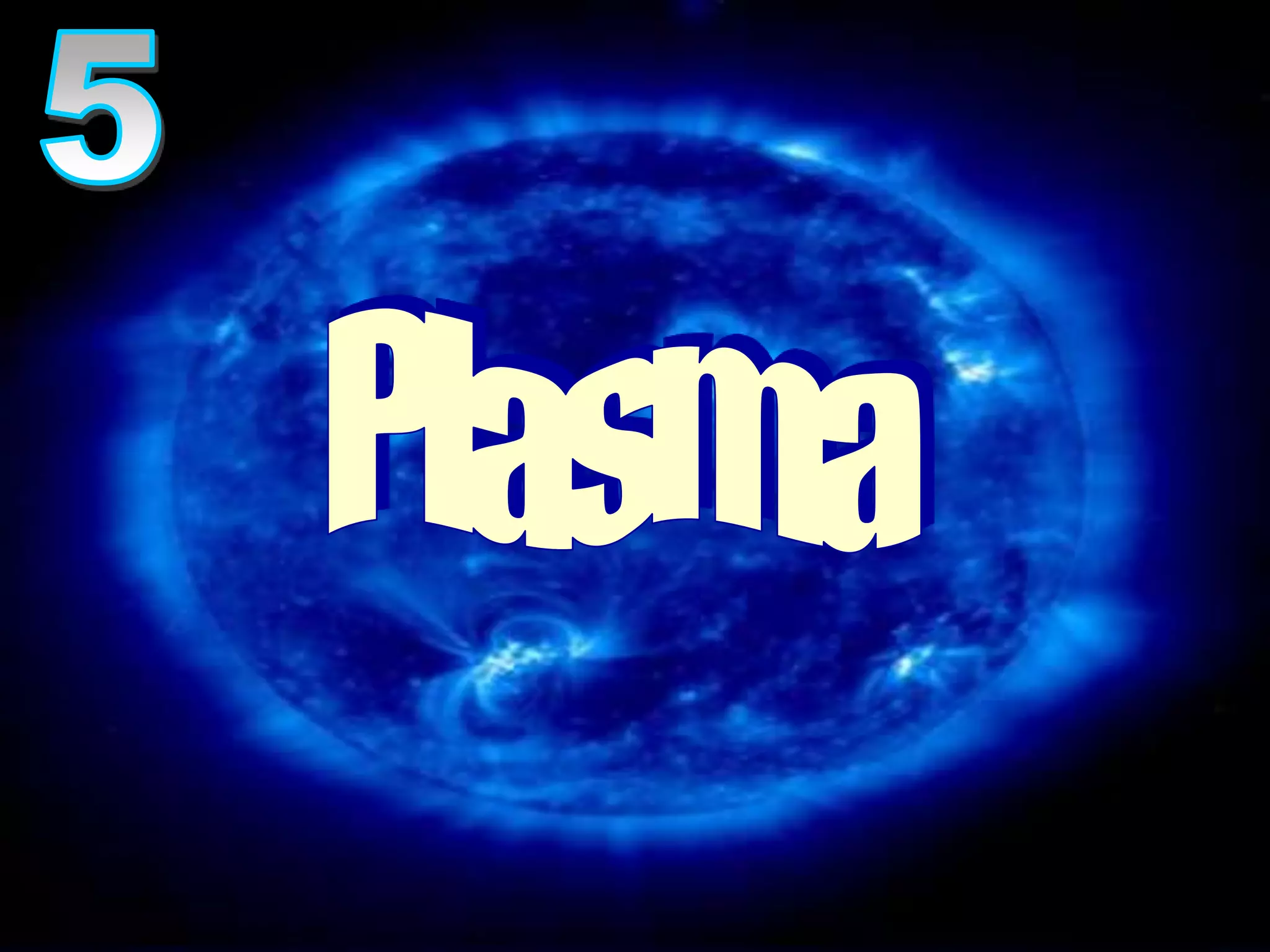
• What is the fourth state of matter?
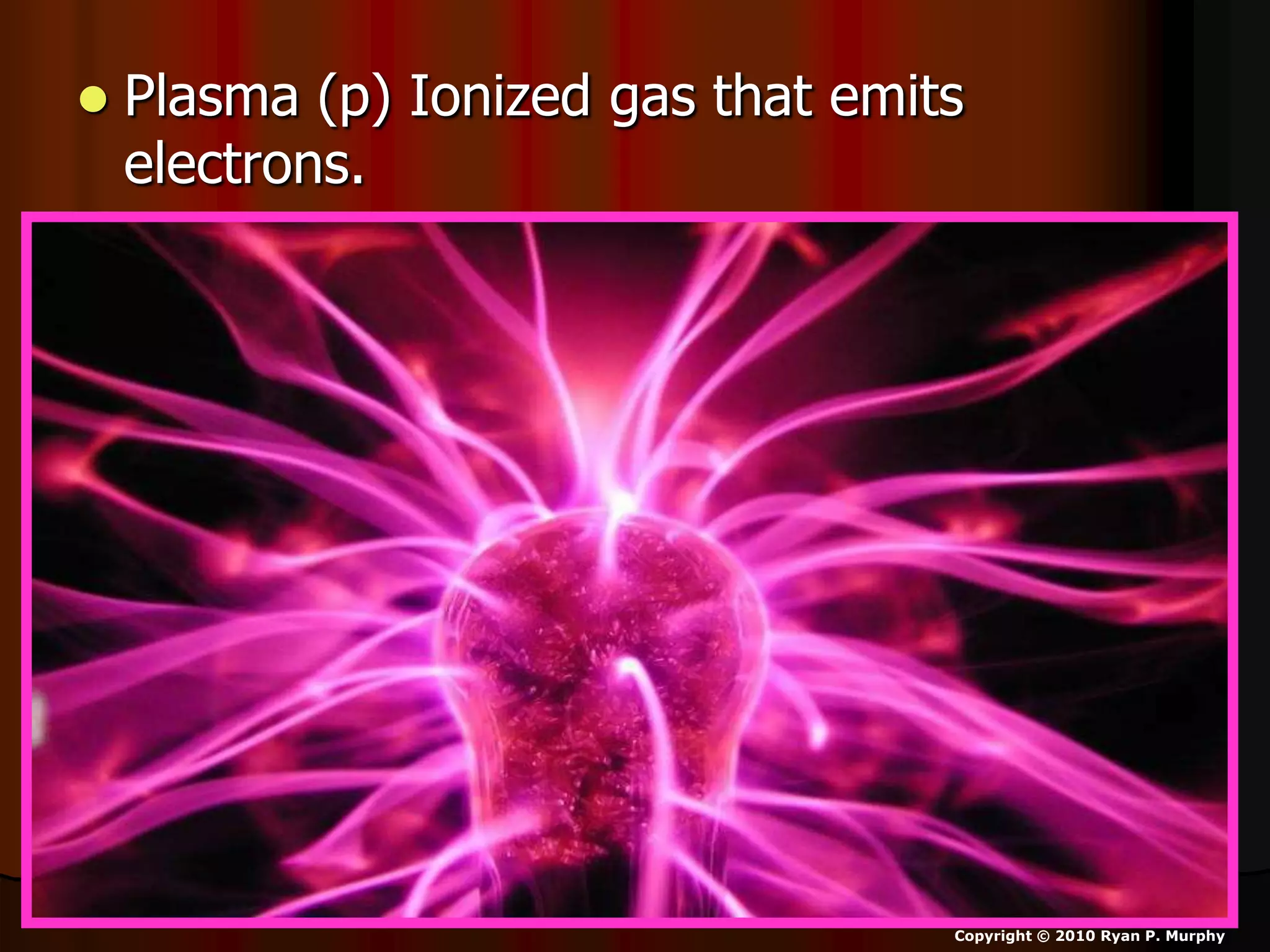
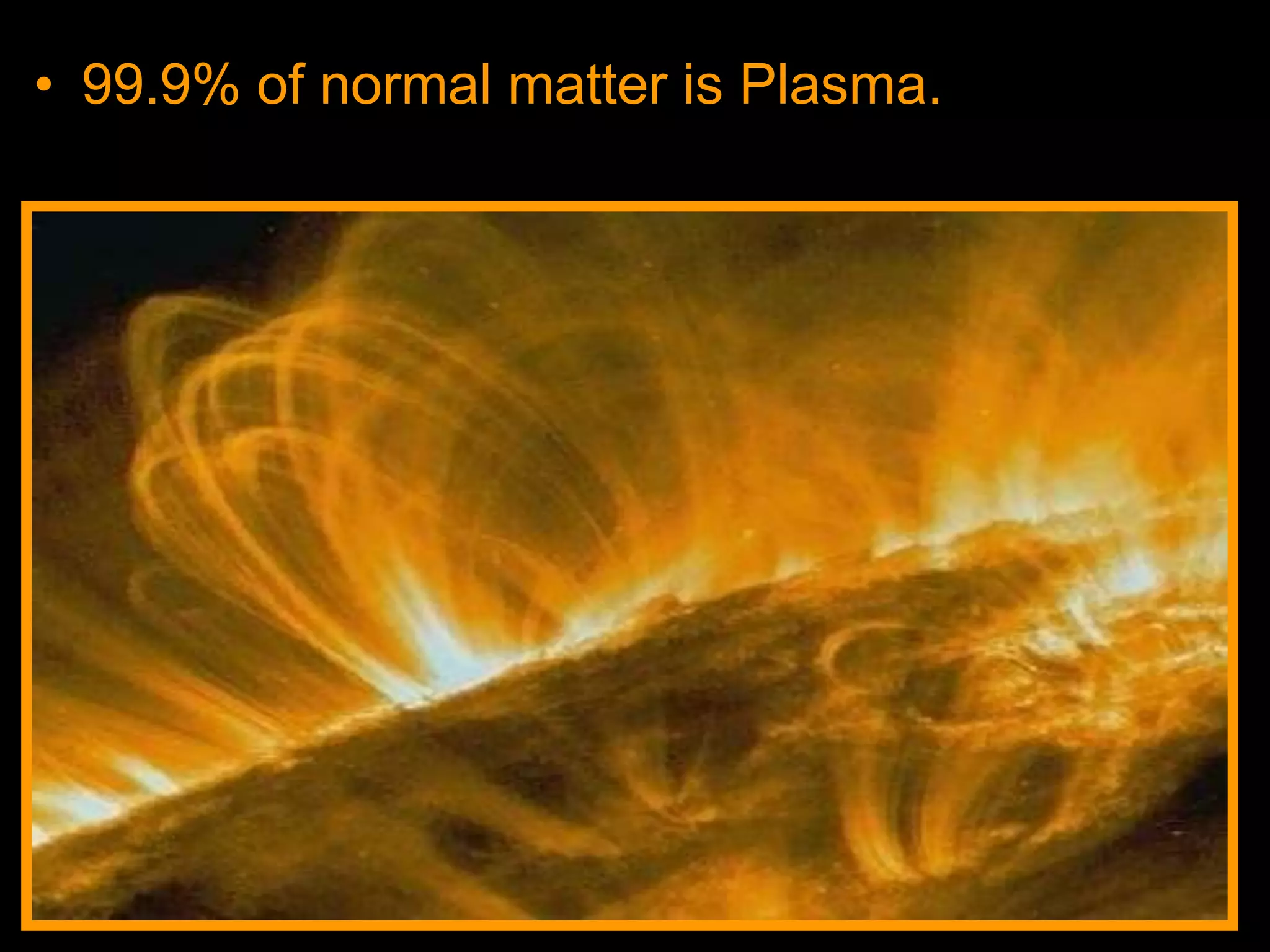
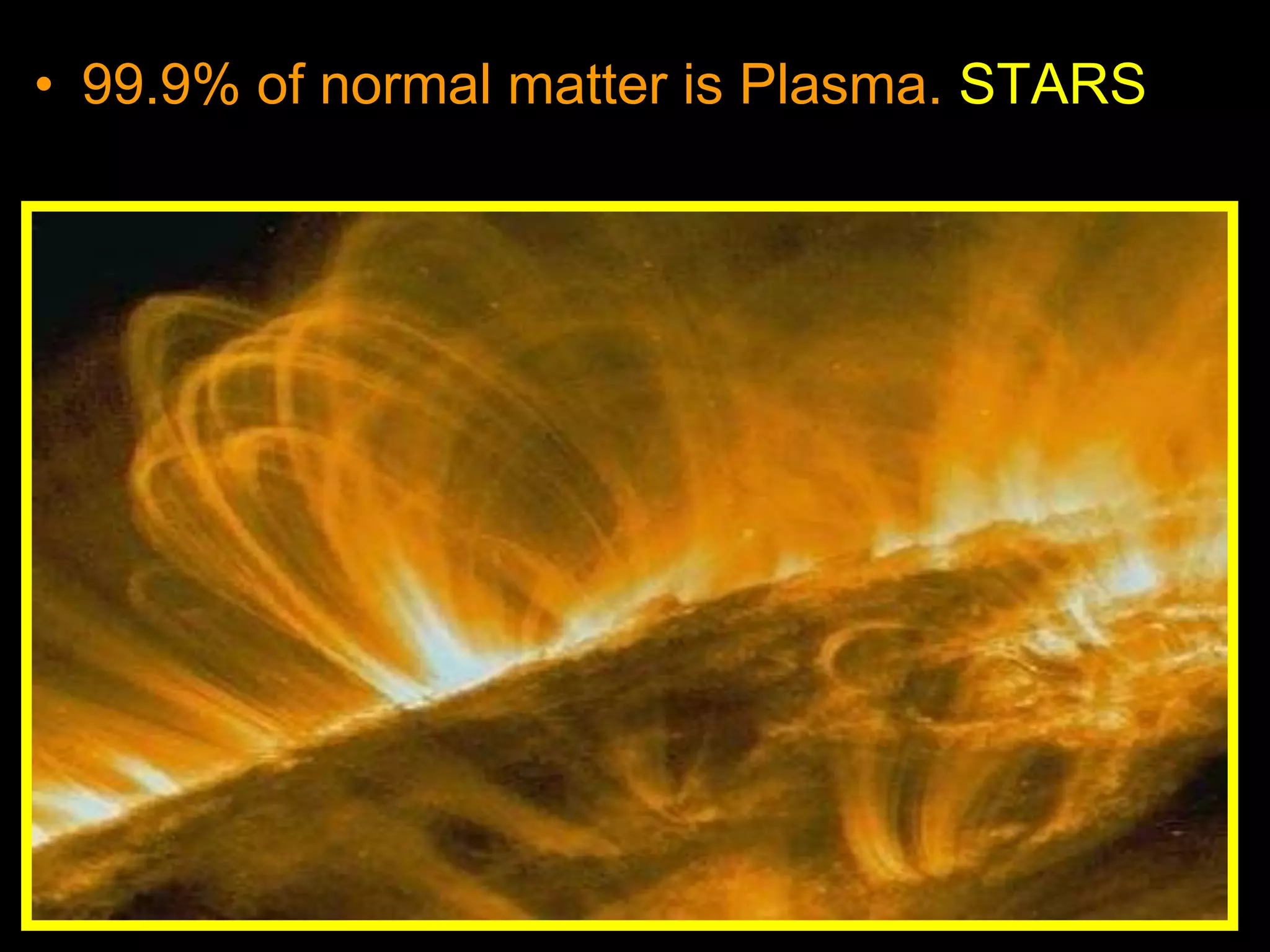
 Plasma (p) Ionized gas that emits
electrons.
Copyright © 2010 Ryan P. Murphy
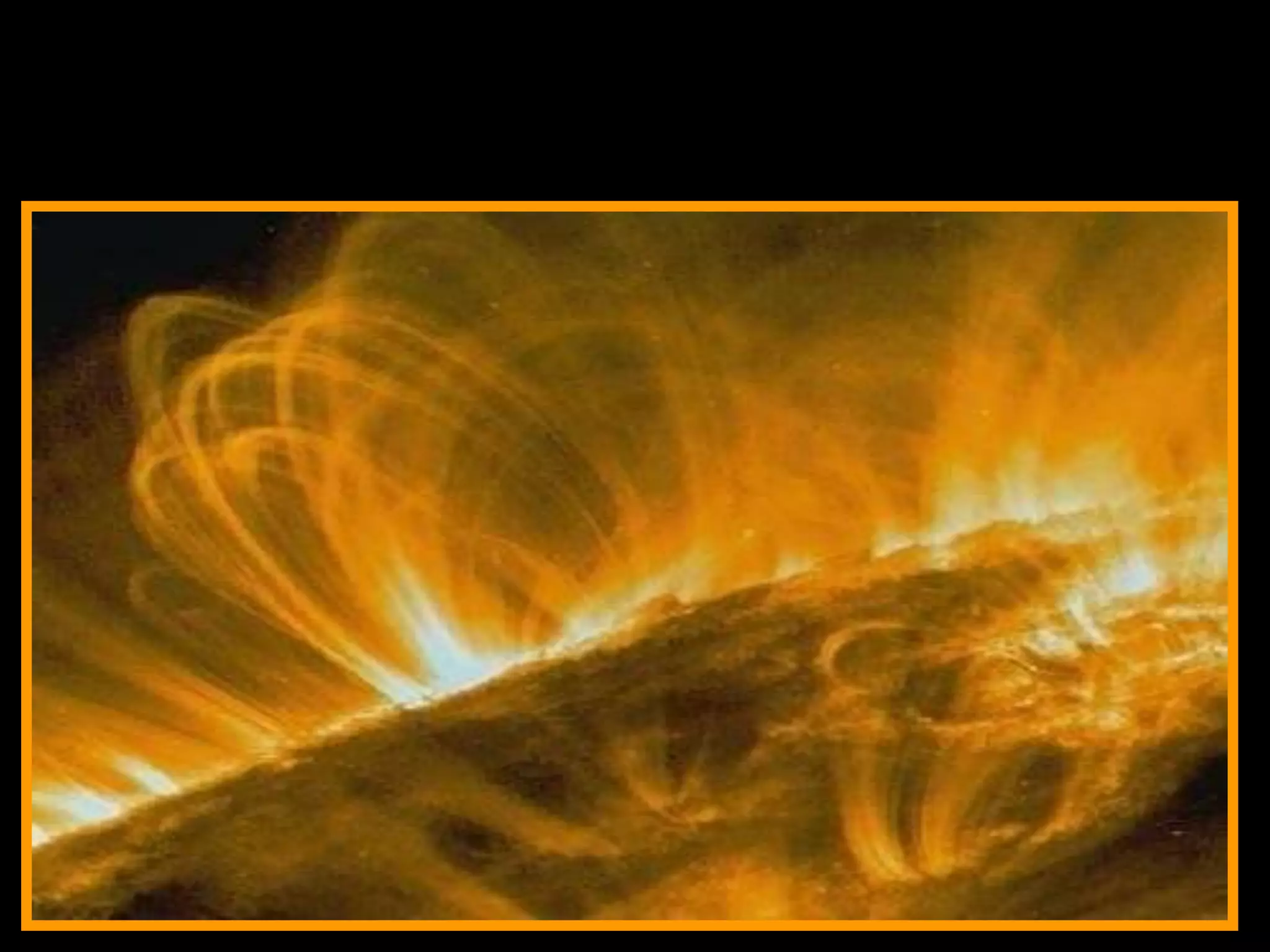
• 99.9% of normal matter is Plasma.
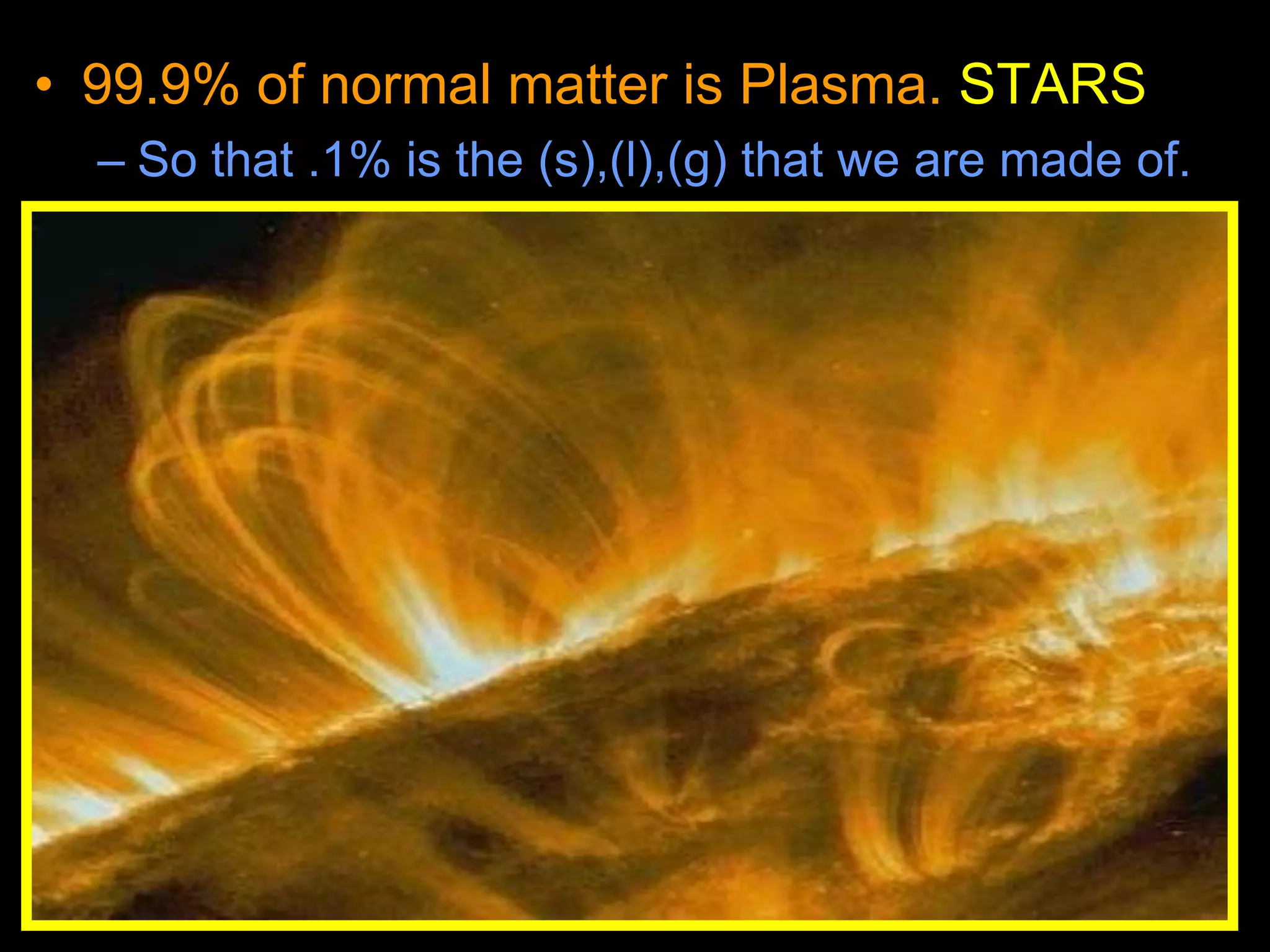
• 99.9% of normal matter is Plasma. STARS
– So that .1% is the (s),(l),(g) that we are made of.
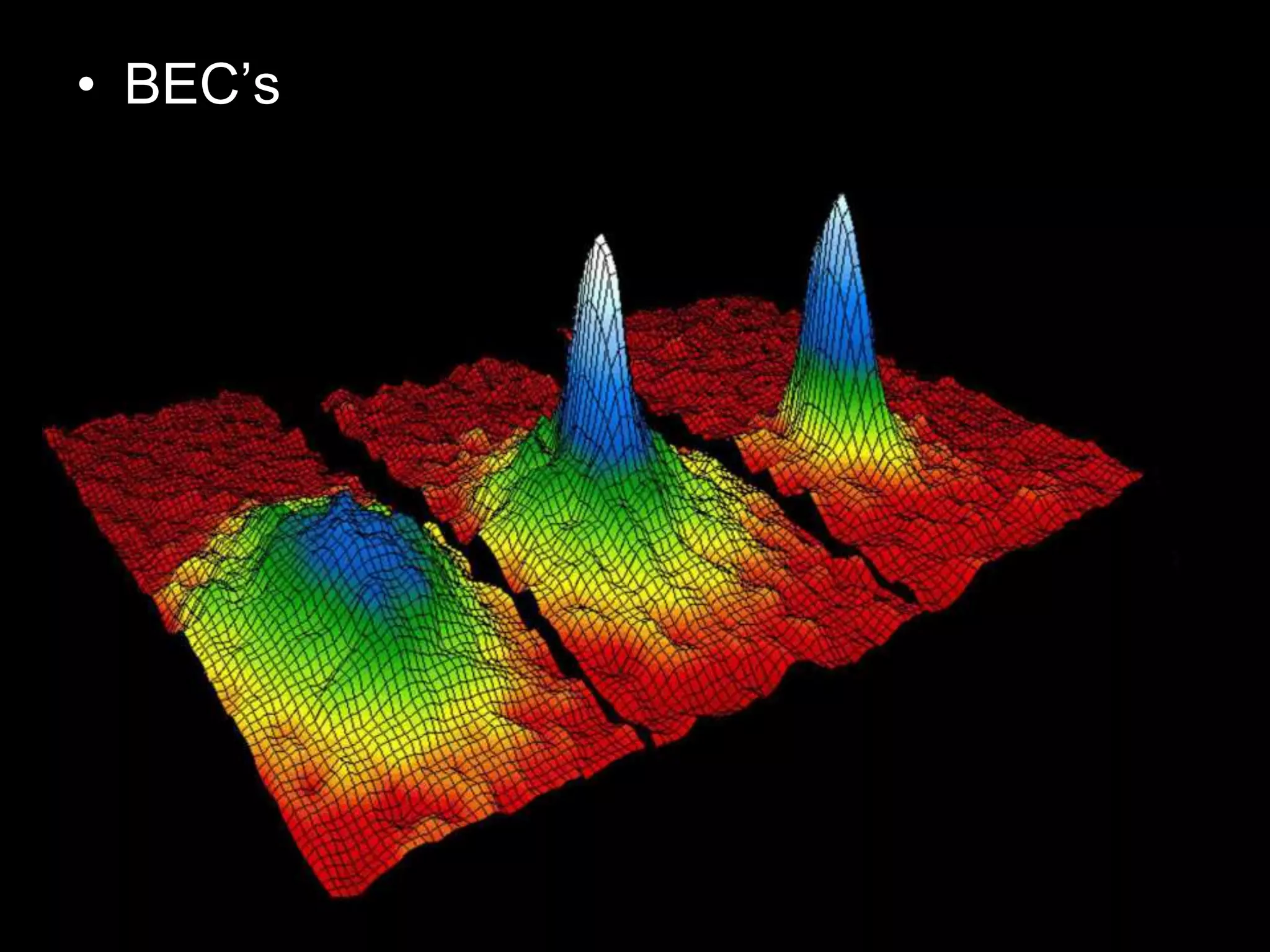
• BEC’s
• A Bose–Einstein condensate (BEC) is a state of
matter formed by a system of bosons confined in an
external potential and cooled to temperatures very
near to absolute zero (0 Kelvin or −273.15 °C).
–Under such supercooled conditions, a large
fraction of the atoms collapse into the lowest
Quantum state of the external potential, at
which point quantum effects become
apparent on a macroscopic scale.
• A Bose–Einstein condensate (BEC) is a state of
matter formed by a system of bosons confined in an
external potential and cooled to temperatures very
near to absolute zero (0 Kelvin or −273.15 °C).
–Under such supercooled conditions, a large
fraction of the atoms collapse into the lowest
Quantum state of the external potential, at
which point quantum effects become
apparent on a macroscopic scale.
First predicted by Satyendra Nath Bose who
wrote paper and sent to Albert Einstein
First predicted by Satyendra Nath Bose who
wrote paper and sent to Albert Einstein
First predicted by Satyendra Nath Bose who
wrote paper and sent to Albert Einstein
First predicted by Satyendra Nath Bose who
wrote paper and sent to Albert Einstein
First predicted by Satyendra Nath Bose who
wrote paper and sent to Albert Einstein
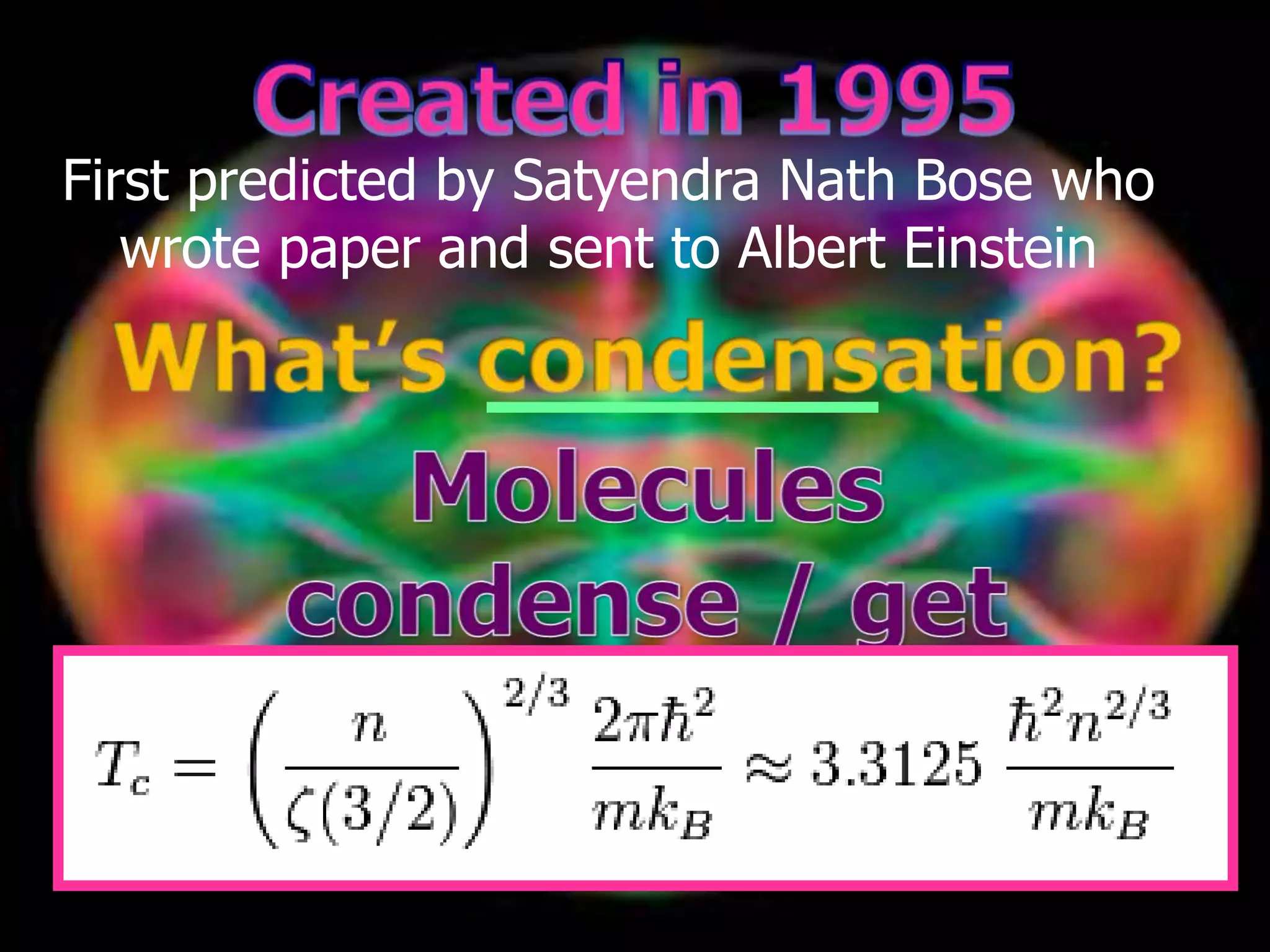
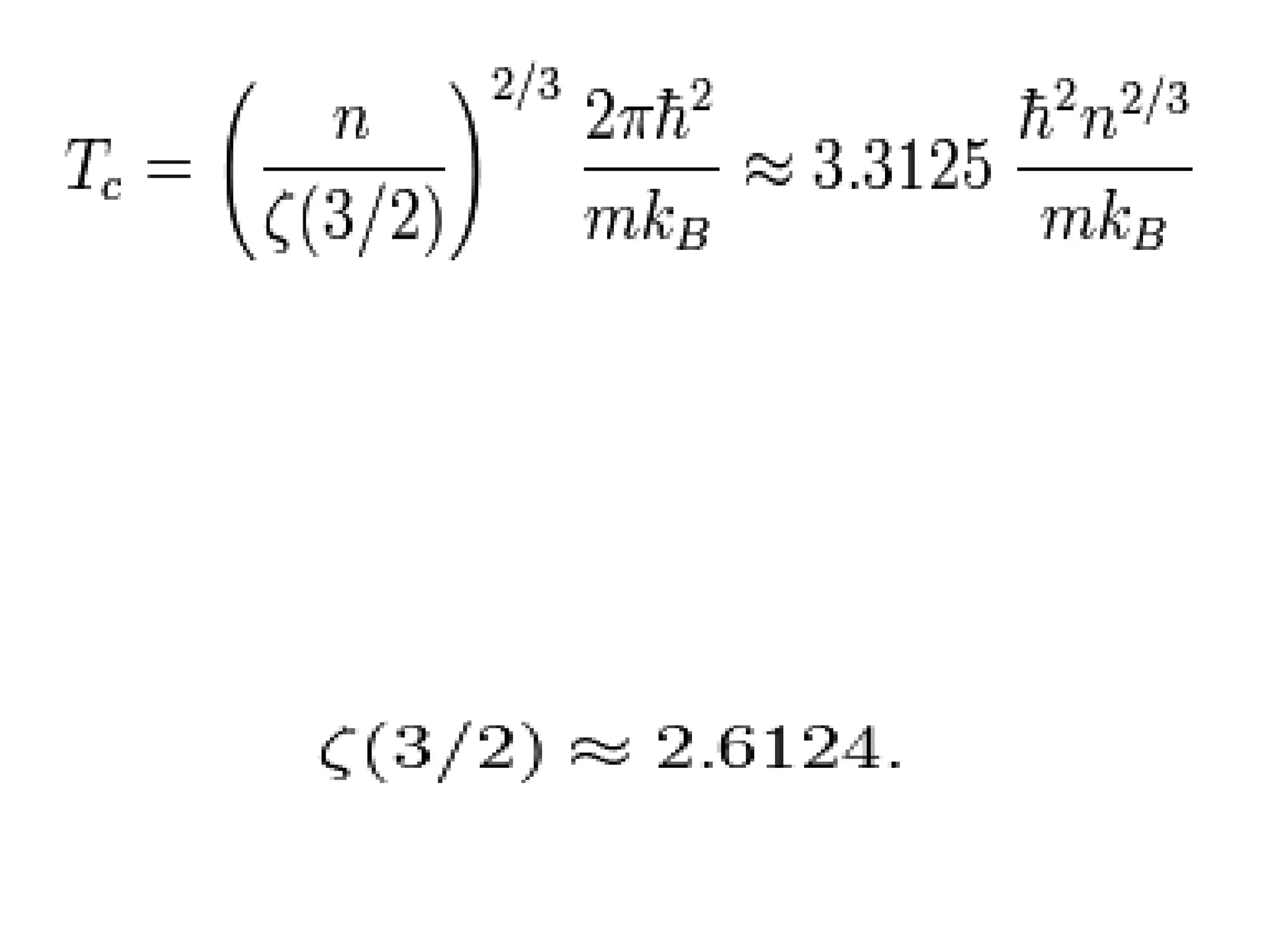
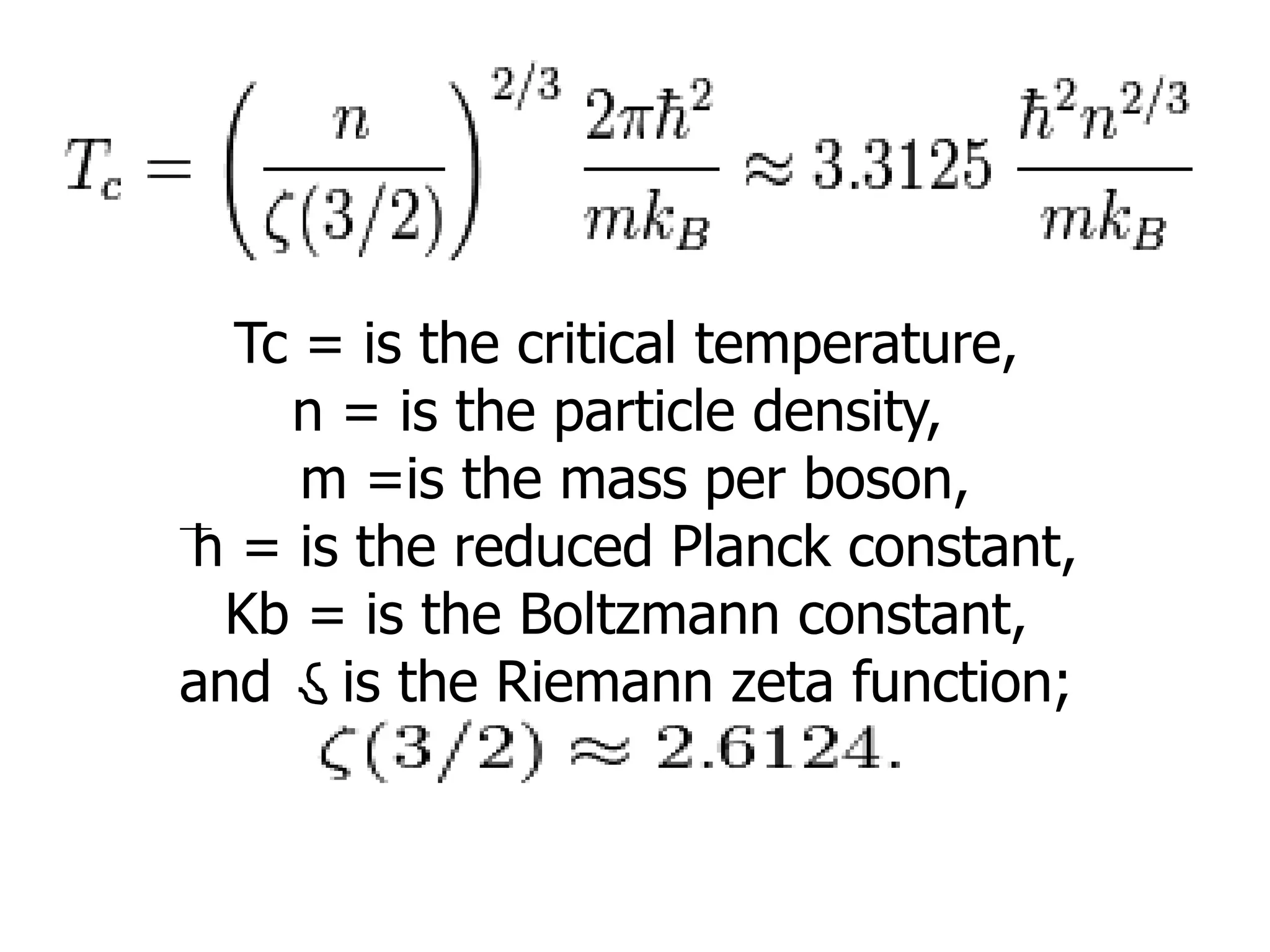
Tc = is the critical temperature,
n = is the particle density,
m =is the mass per boson,
h = is the reduced Planck constant,
Kb = is the Boltzmann constant,
and is the Riemann zeta function;
Tc = is the critical temperature,
n = is the particle density,
m =is the mass per boson,
h = is the reduced Planck constant,
Kb = is the Boltzmann constant,
and is the Riemann zeta function;
Copyright © 2010 Ryan P. Murphy
“WHAT!”
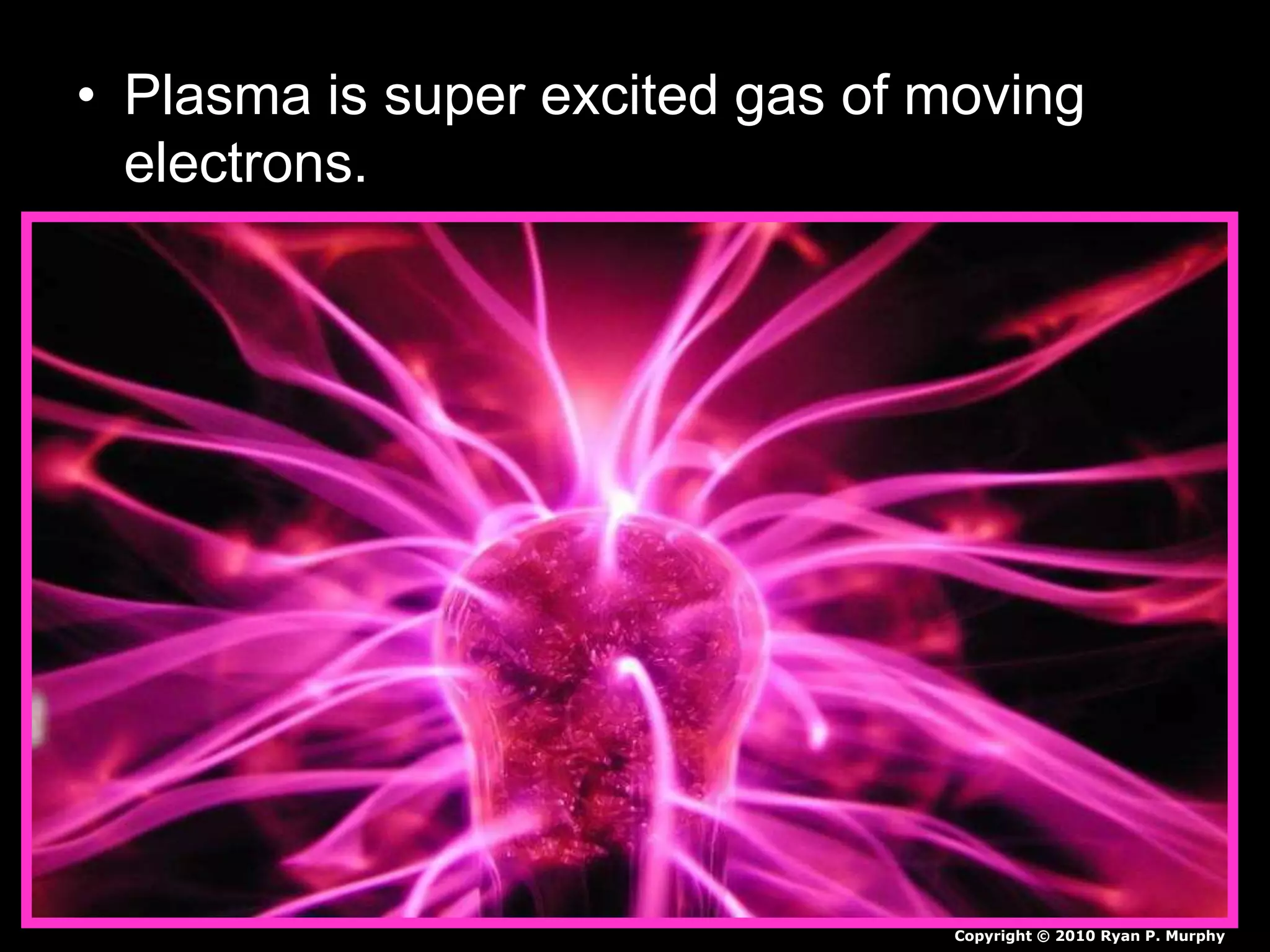
• Plasma is super excited gas of moving
electrons.
Copyright © 2010 Ryan P. Murphy
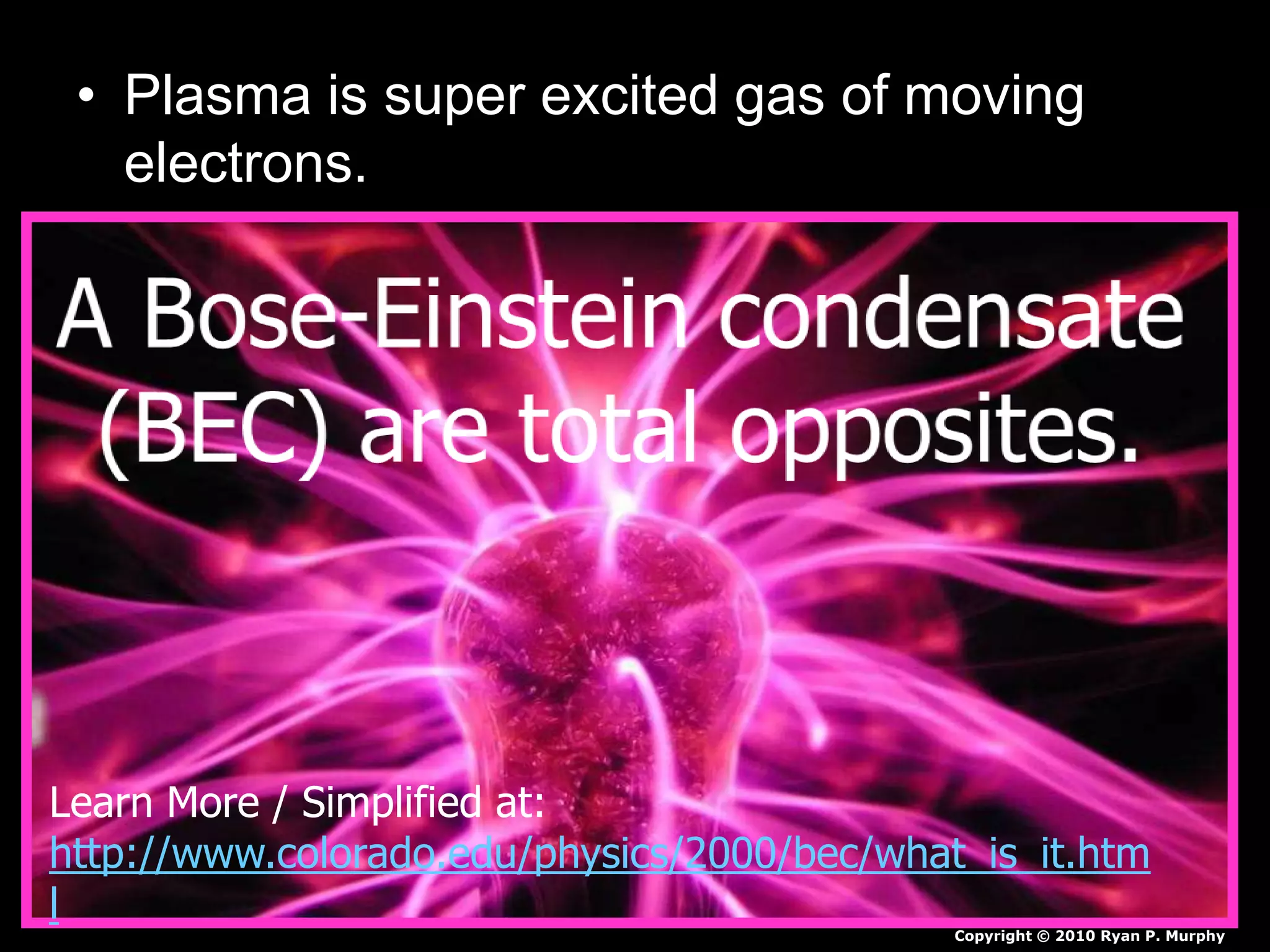
• Plasma is super excited gas of moving
electrons.
Copyright © 2010 Ryan P. Murphy
Learn More / Simplified at:
http://www.colorado.edu/physics/2000/bec/what_is_it.htm
l
• Bose-Einstein condensate (Optional)
– http://www.youtube.com/watch?v=nAGPAb4ob
s8
• Bose-Einstein condensate (Optional)
– http://www.youtube.com/watch?v=nAGPAb4ob
s8
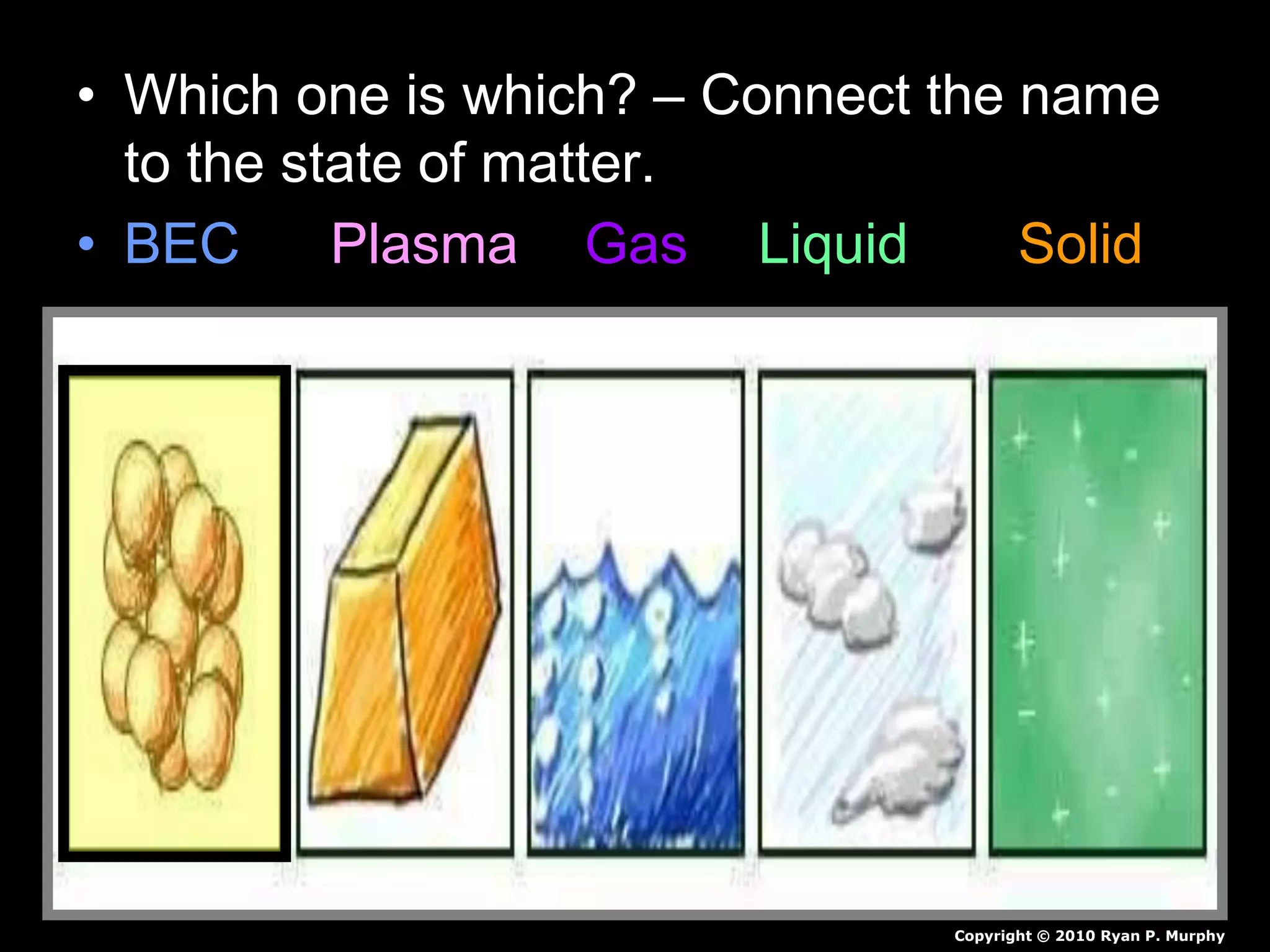
• Which one is which? – Connect the name
to the state of matter.
• BEC Plasma Gas Liquid Solid
Copyright © 2010 Ryan P. Murphy
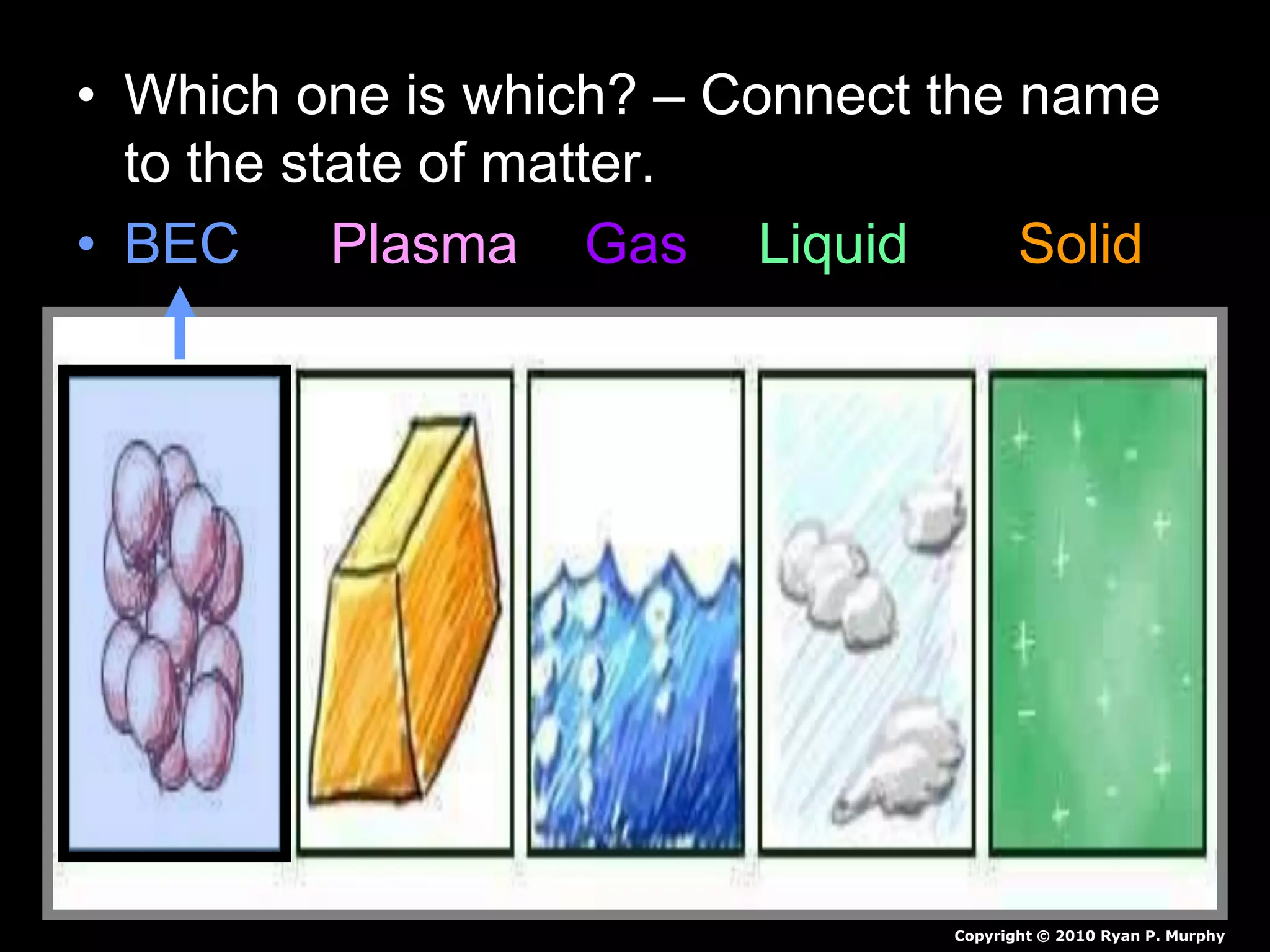
• Which one is which? – Connect the name
to the state of matter.
• BEC Plasma Gas Liquid Solid
Copyright © 2010 Ryan P. Murphy
• Which one is which? – Connect the name
to the state of matter.
• BEC Plasma Gas Liquid Solid
Copyright © 2010 Ryan P. Murphy
• Which one is which? – Connect the name
to the state of matter.
• BEC Plasma Gas Liquid Solid
Copyright © 2010 Ryan P. Murphy
• Which one is which? – Connect the name
to the state of matter.
• BEC Plasma Gas Liquid Solid
Copyright © 2010 Ryan P. Murphy
• Which one is which? – Connect the name
to the state of matter.
• BEC Plasma Gas Liquid Solid
Copyright © 2010 Ryan P. Murphy
• Which one is which? – Connect the name
to the state of matter.
• BEC Plasma Gas Liquid Solid
Copyright © 2010 Ryan P. Murphy
• Which one is which? – Connect the name
to the state of matter.
• BEC Plasma Gas Liquid Solid
Copyright © 2010 Ryan P. Murphy
• Which one is which? – Connect the name
to the state of matter.
• BEC Plasma Gas Liquid Solid
Copyright © 2010 Ryan P. Murphy
• Which one is which? – Connect the name
to the state of matter.
• BEC Plasma Gas Liquid Solid
Copyright © 2010 Ryan P. Murphy
• Which one is which? – Connect the name
to the state of matter.
• BEC Plasma Gas Liquid Solid
Copyright © 2010 Ryan P. Murphy
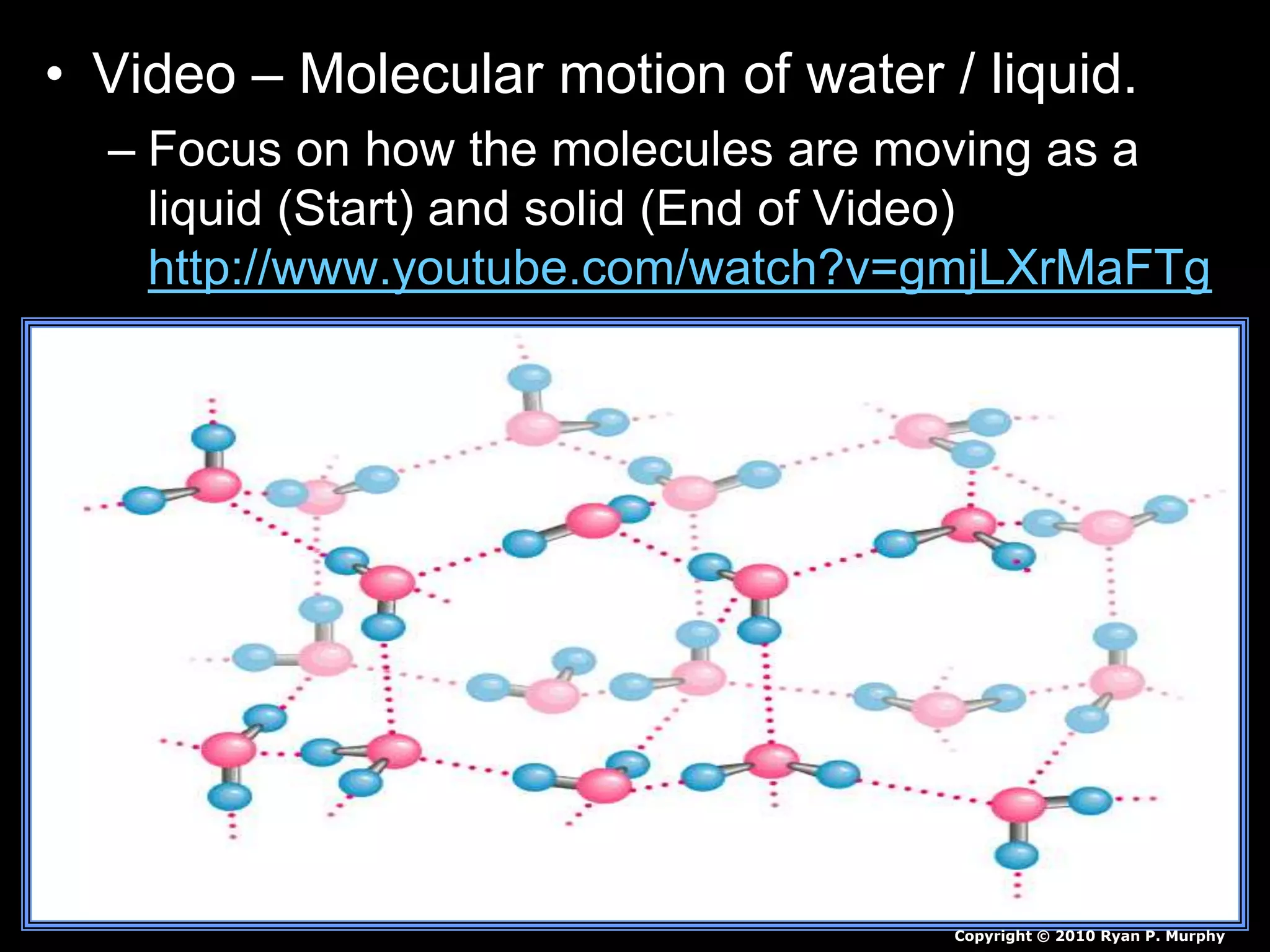
• Video – Molecular motion of water / liquid.
– Focus on how the molecules are moving as a
liquid (Start) and solid (End of Video)
http://www.youtube.com/watch?v=gmjLXrMaFTg
Copyright © 2010 Ryan P. Murphy
Mystery box #1
Mystery Box #2
Mystery Box #3
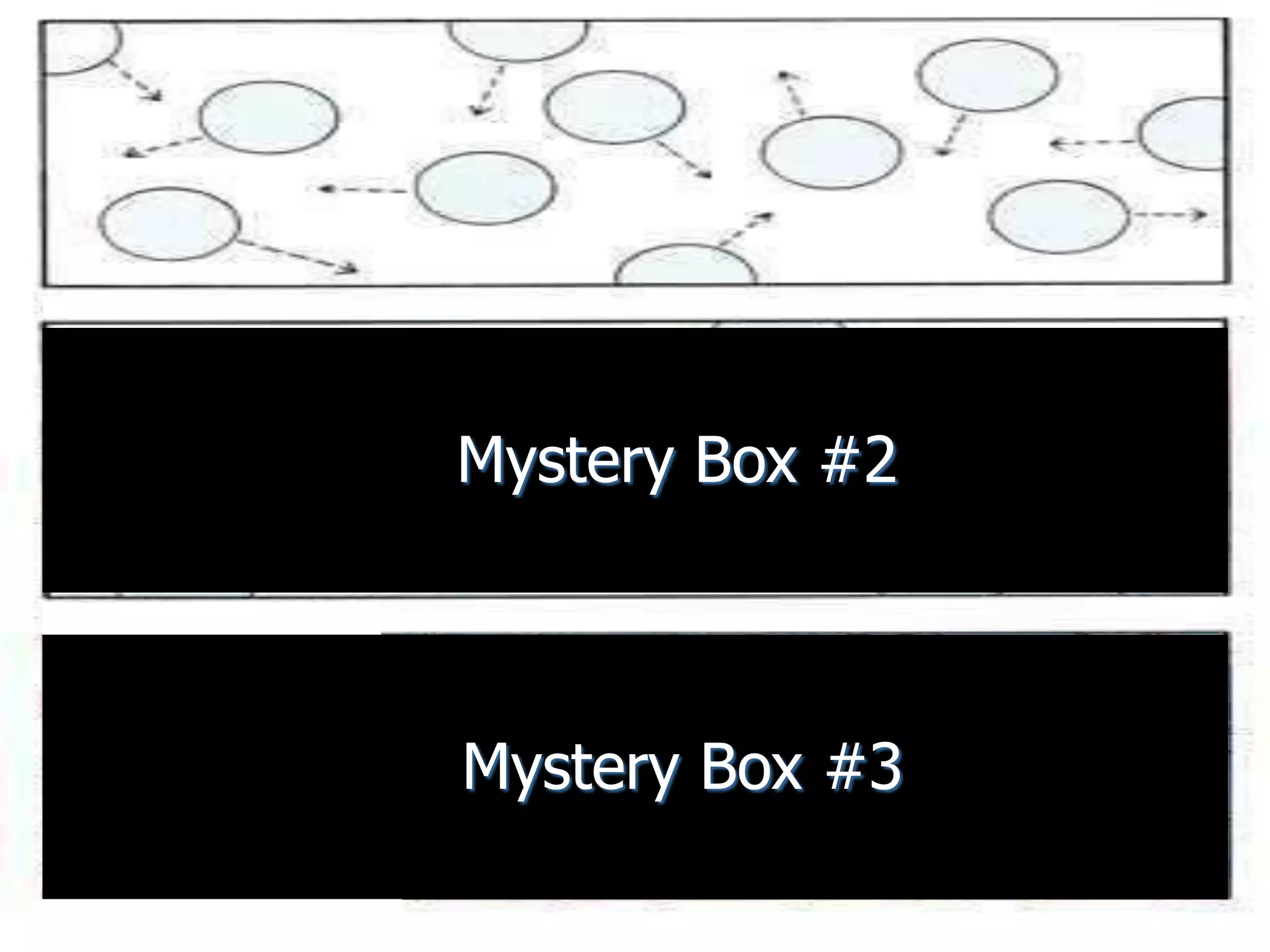
Mystery Box #2
Mystery Box #3
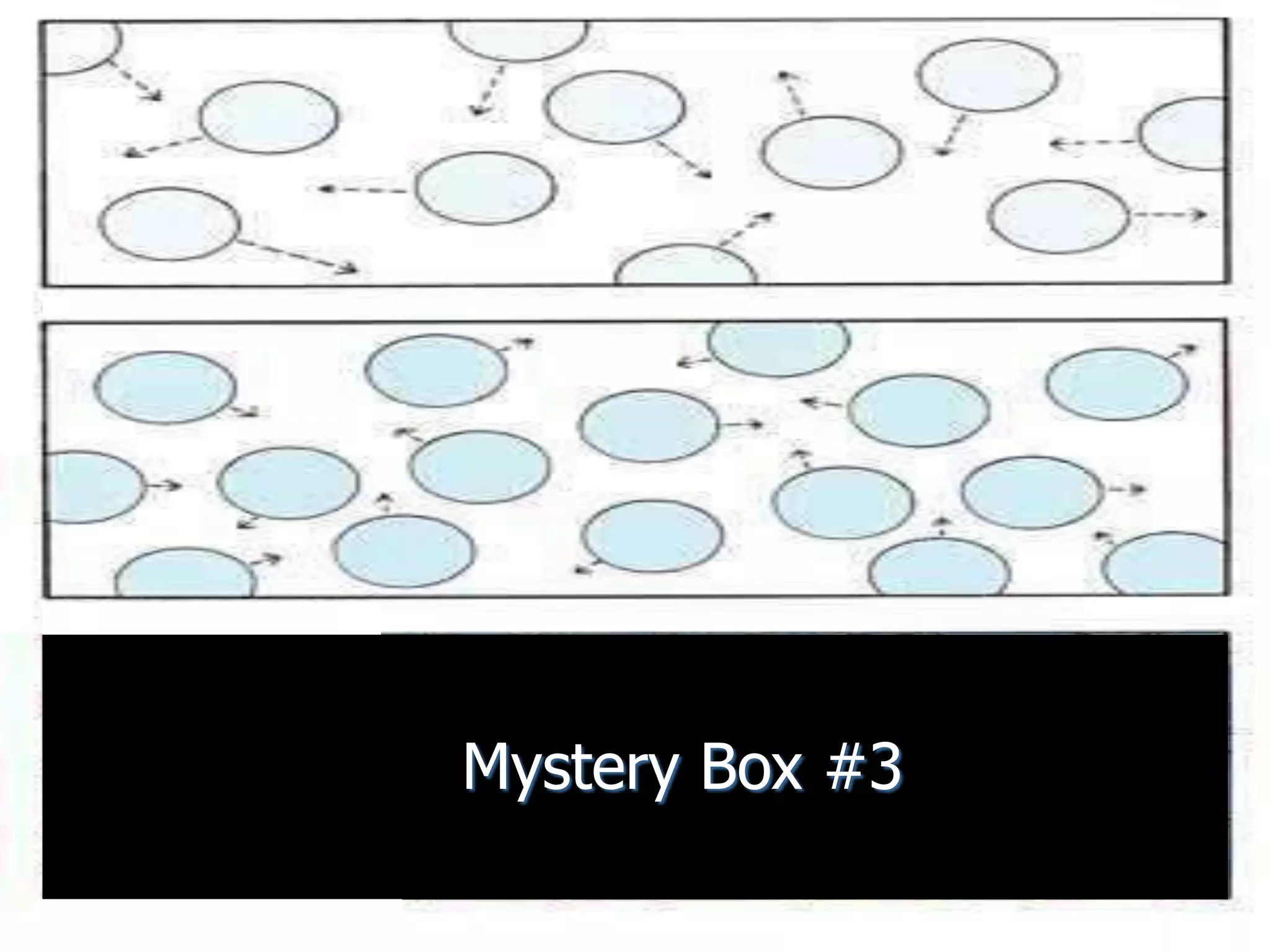
Mystery Box #3
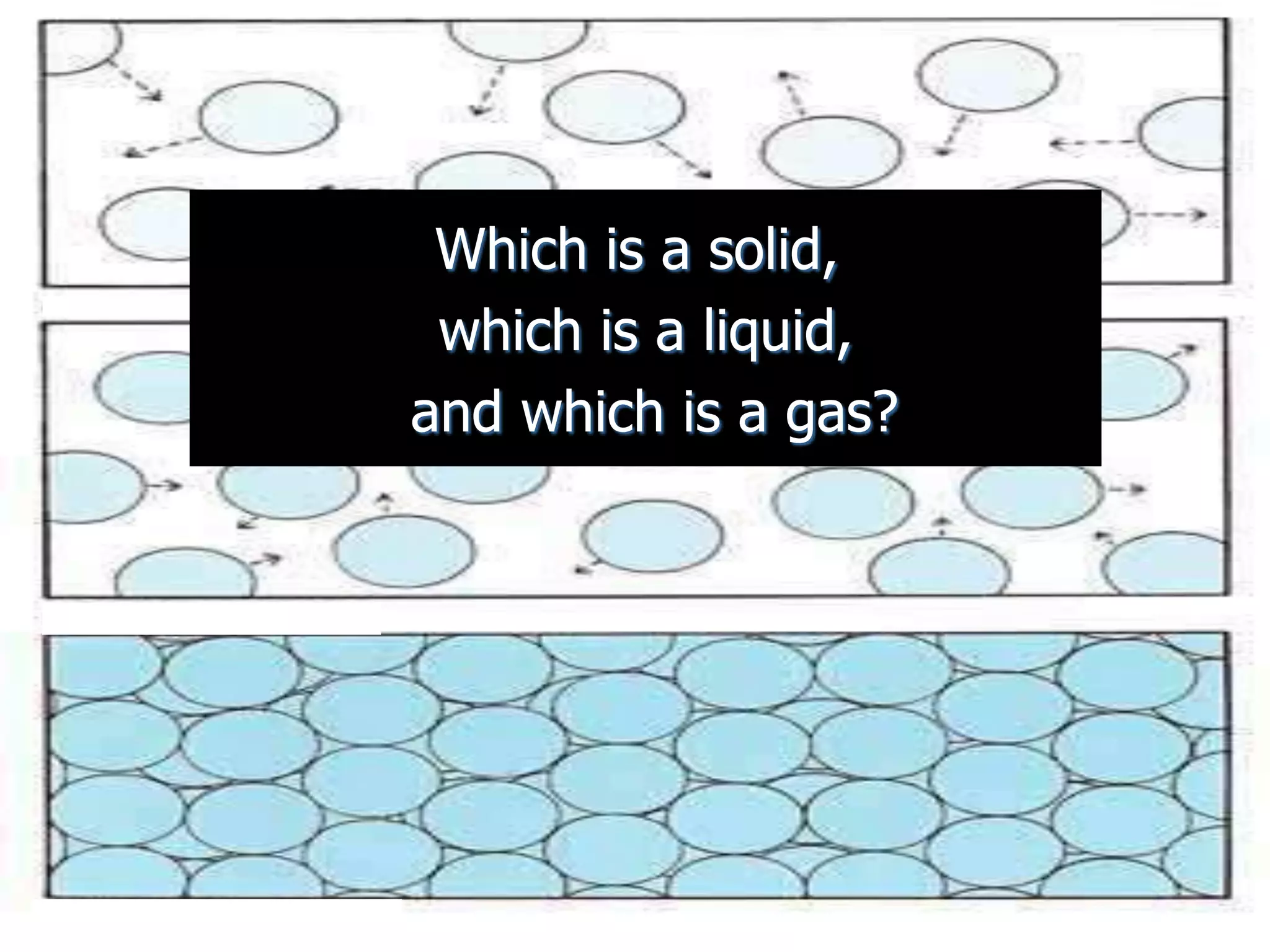
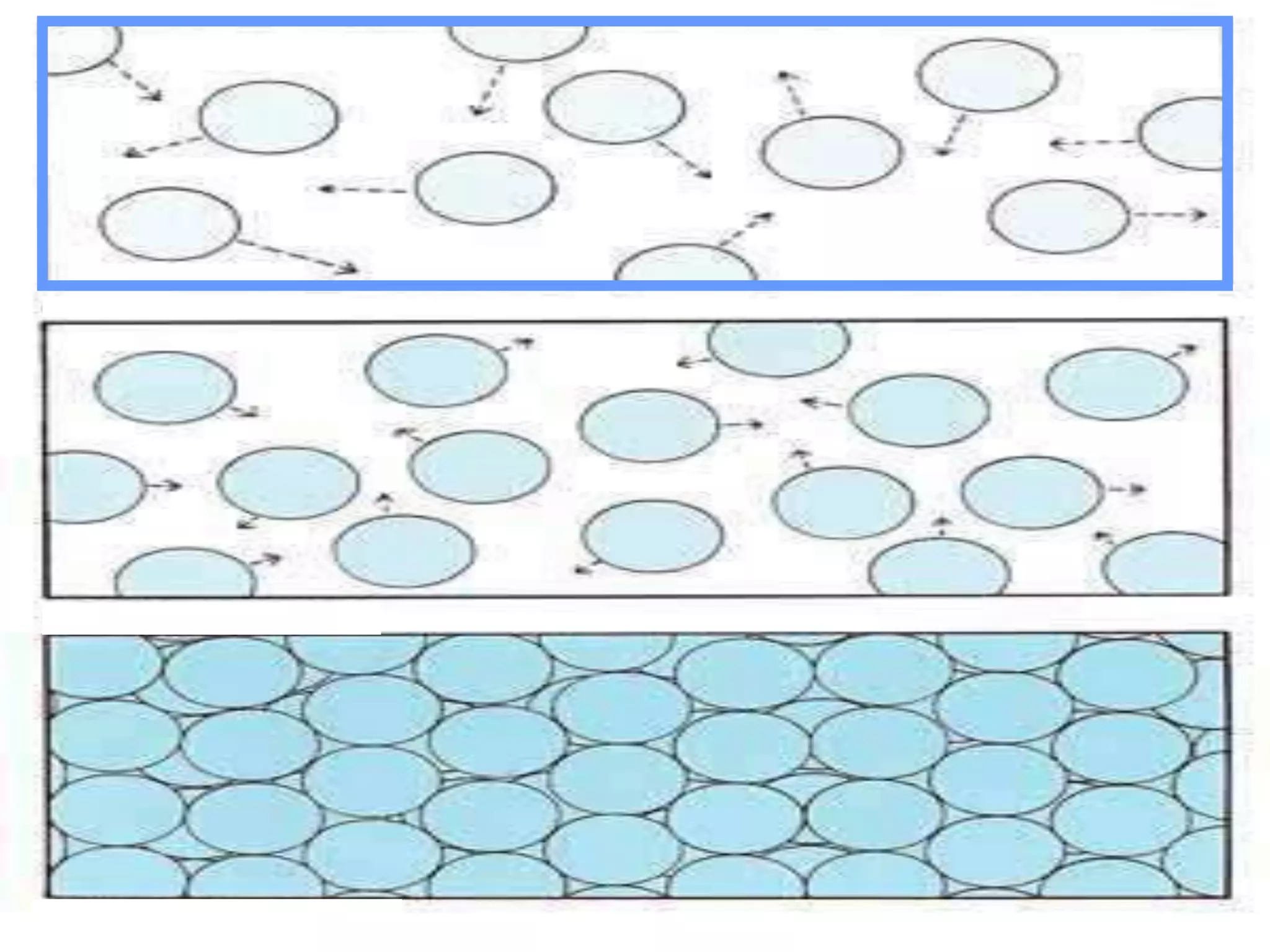
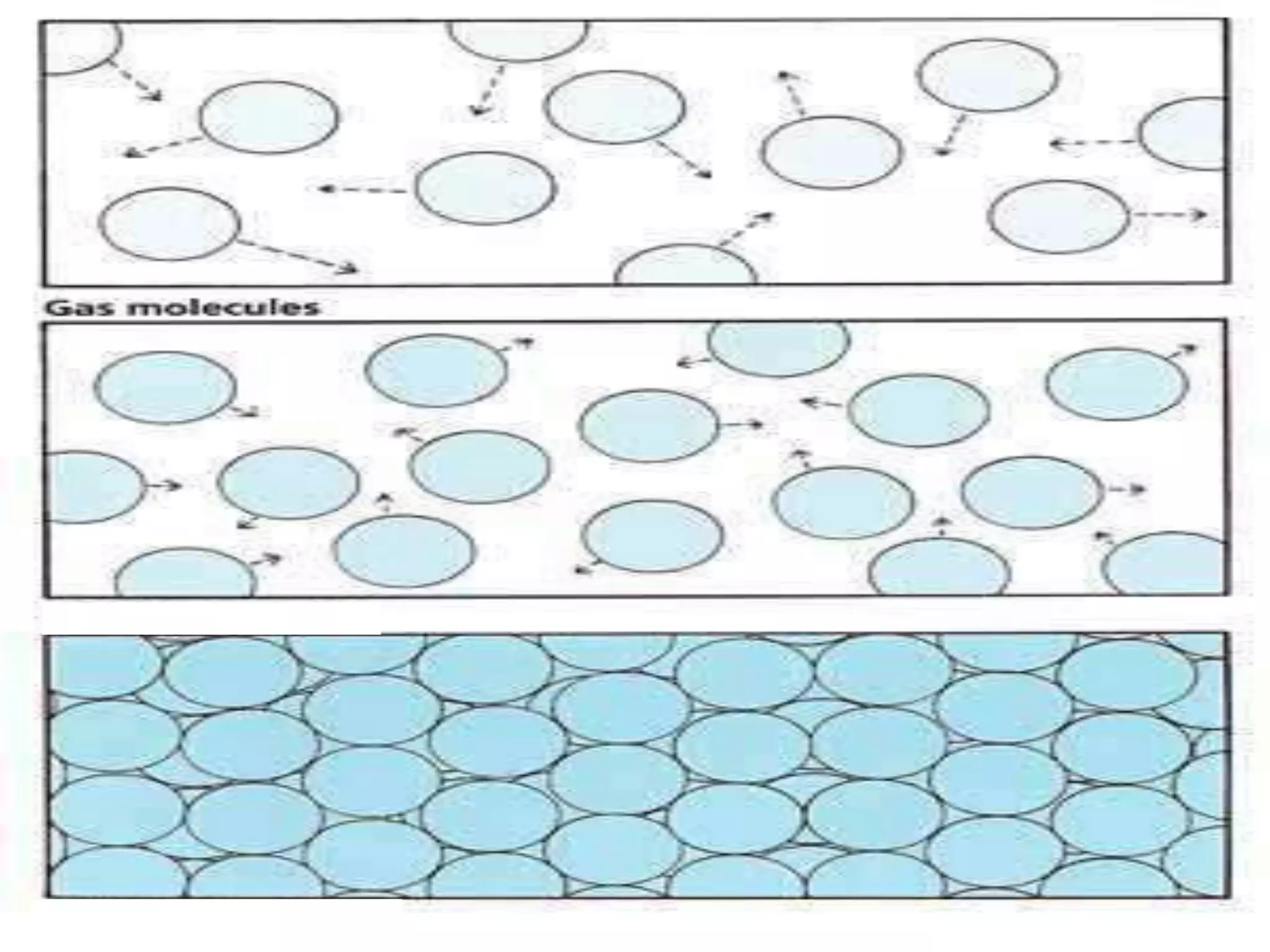
Which is a solid,
which is a liquid,
and which is a gas?
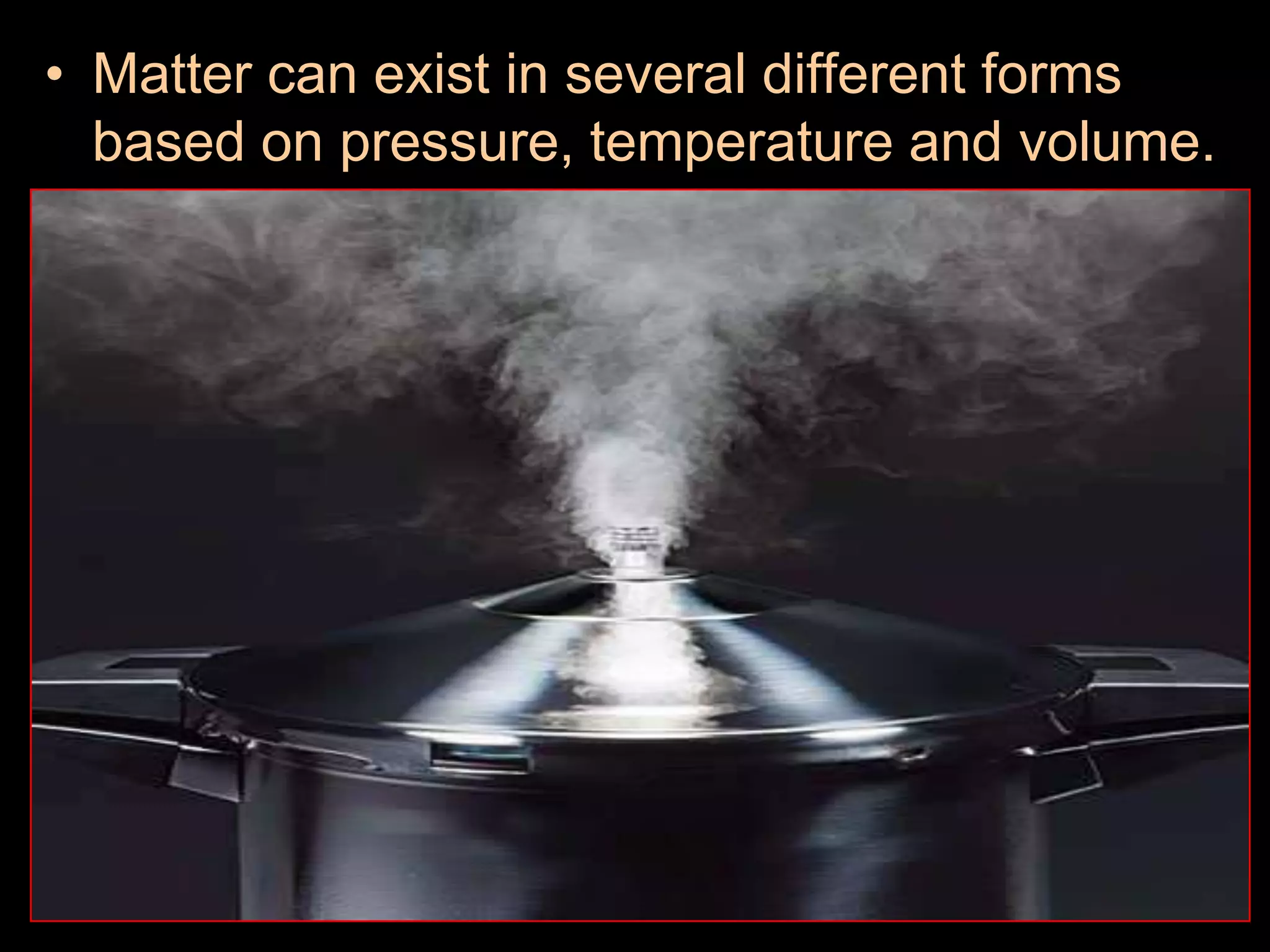
• Matter can exist in several different forms
based on pressure, temperature and volume.
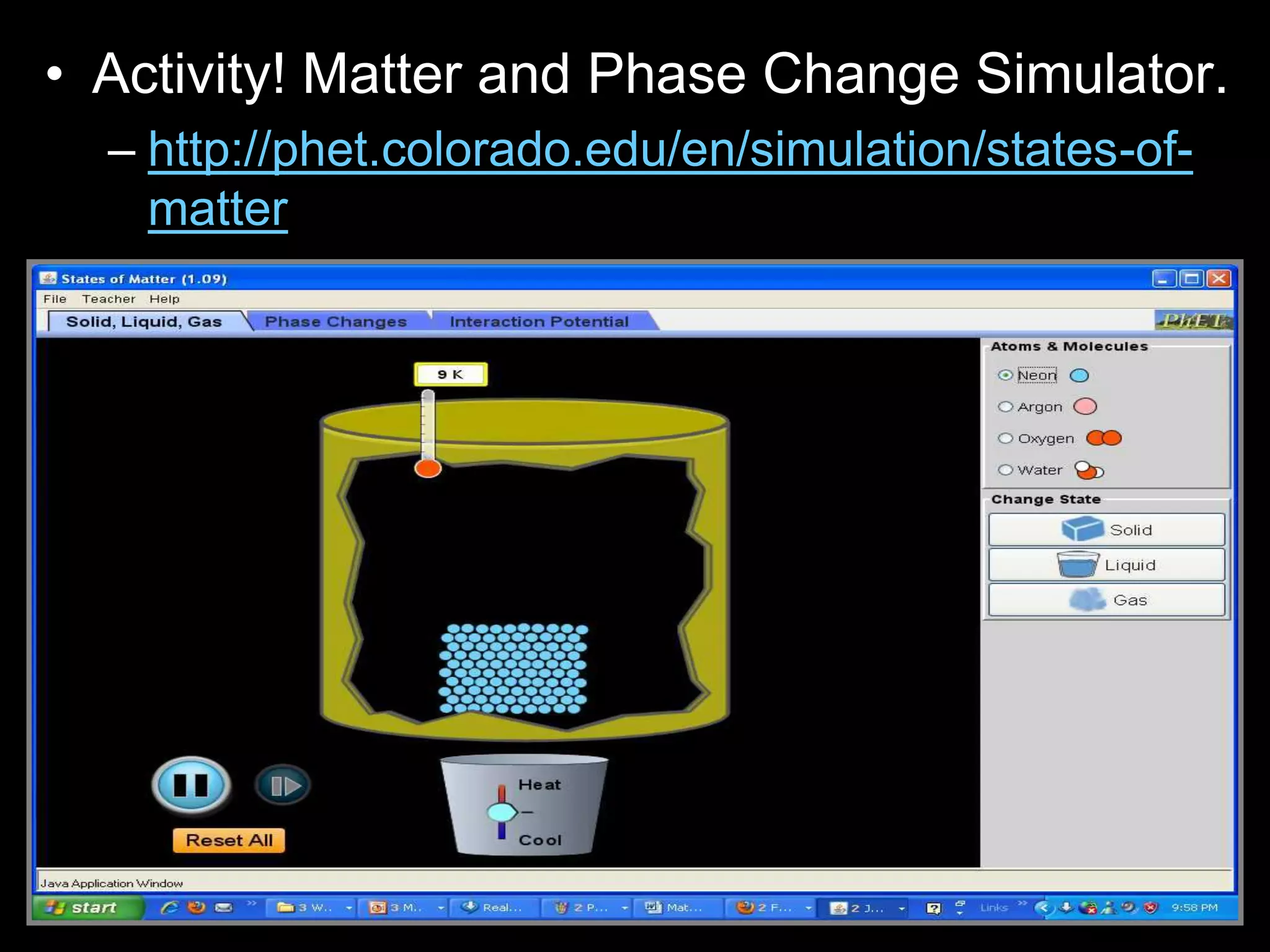
• Activity! Matter and Phase Change Simulator.
– http://phet.colorado.edu/en/simulation/states-of-
matter
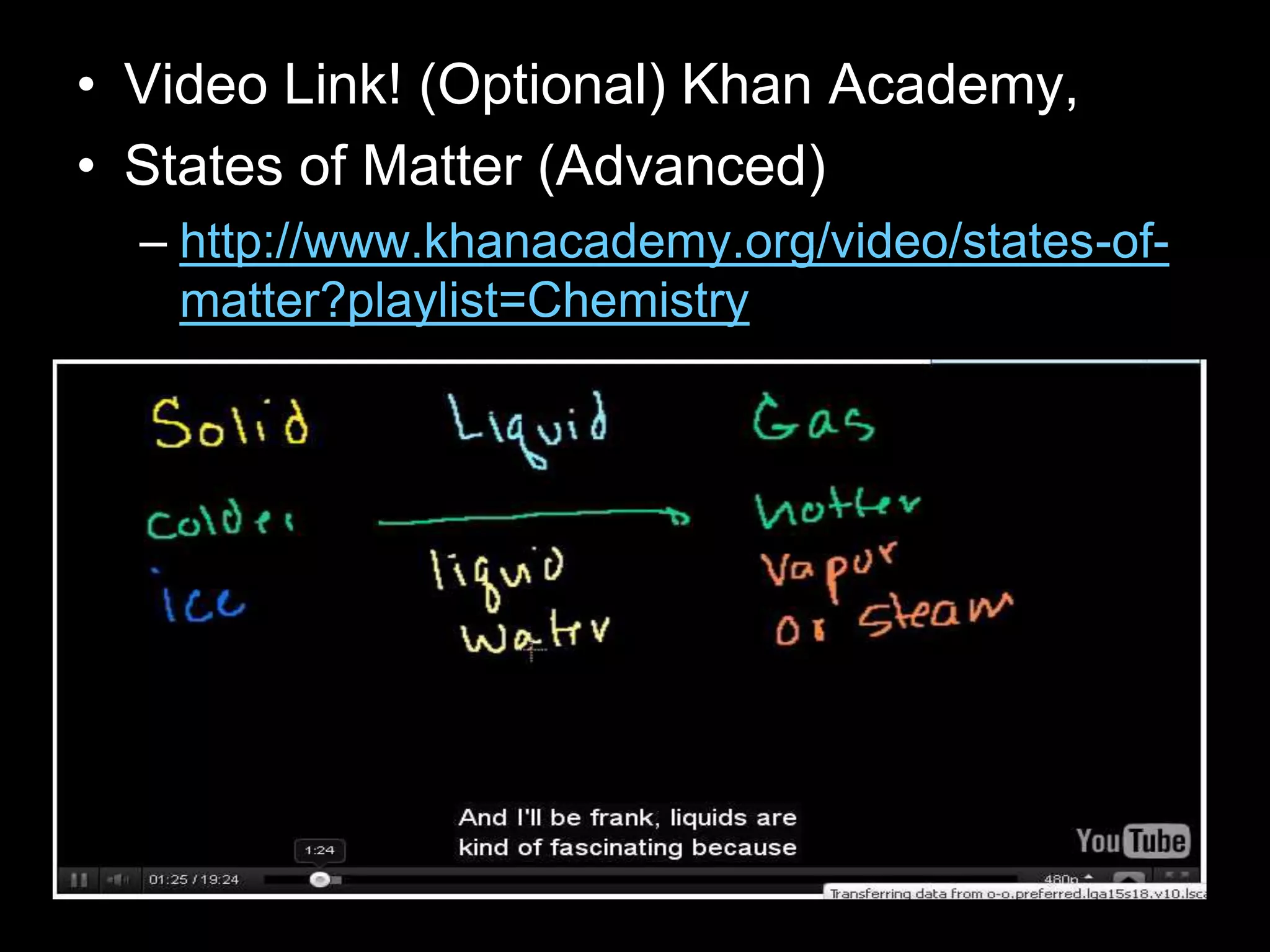
• Video Link! (Optional) Khan Academy,
• States of Matter (Advanced)
– http://www.khanacademy.org/video/states-of-
matter?playlist=Chemistry
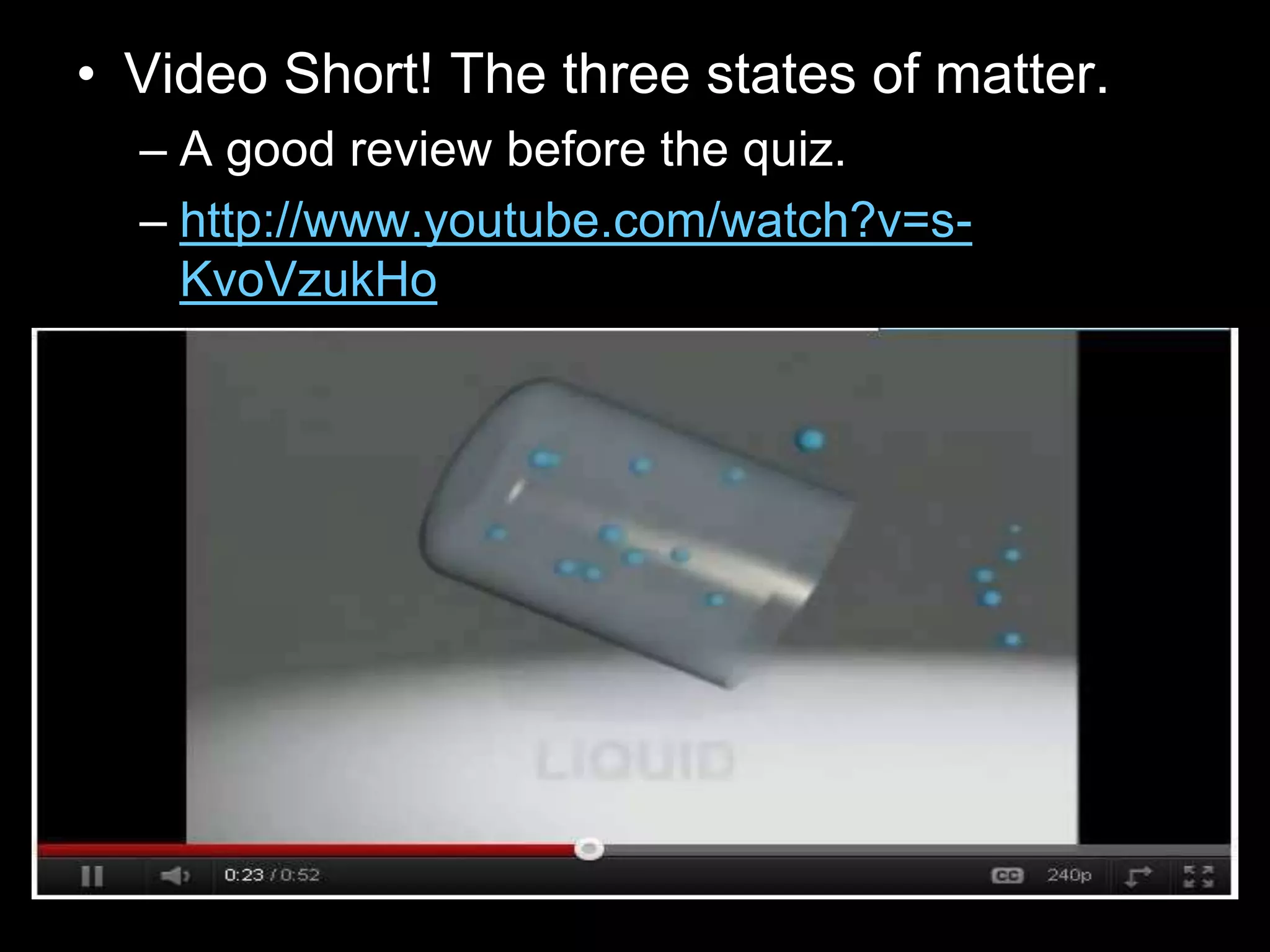
• Video Short! The three states of matter.
– A good review before the quiz.
– http://www.youtube.com/watch?v=s-
KvoVzukHo
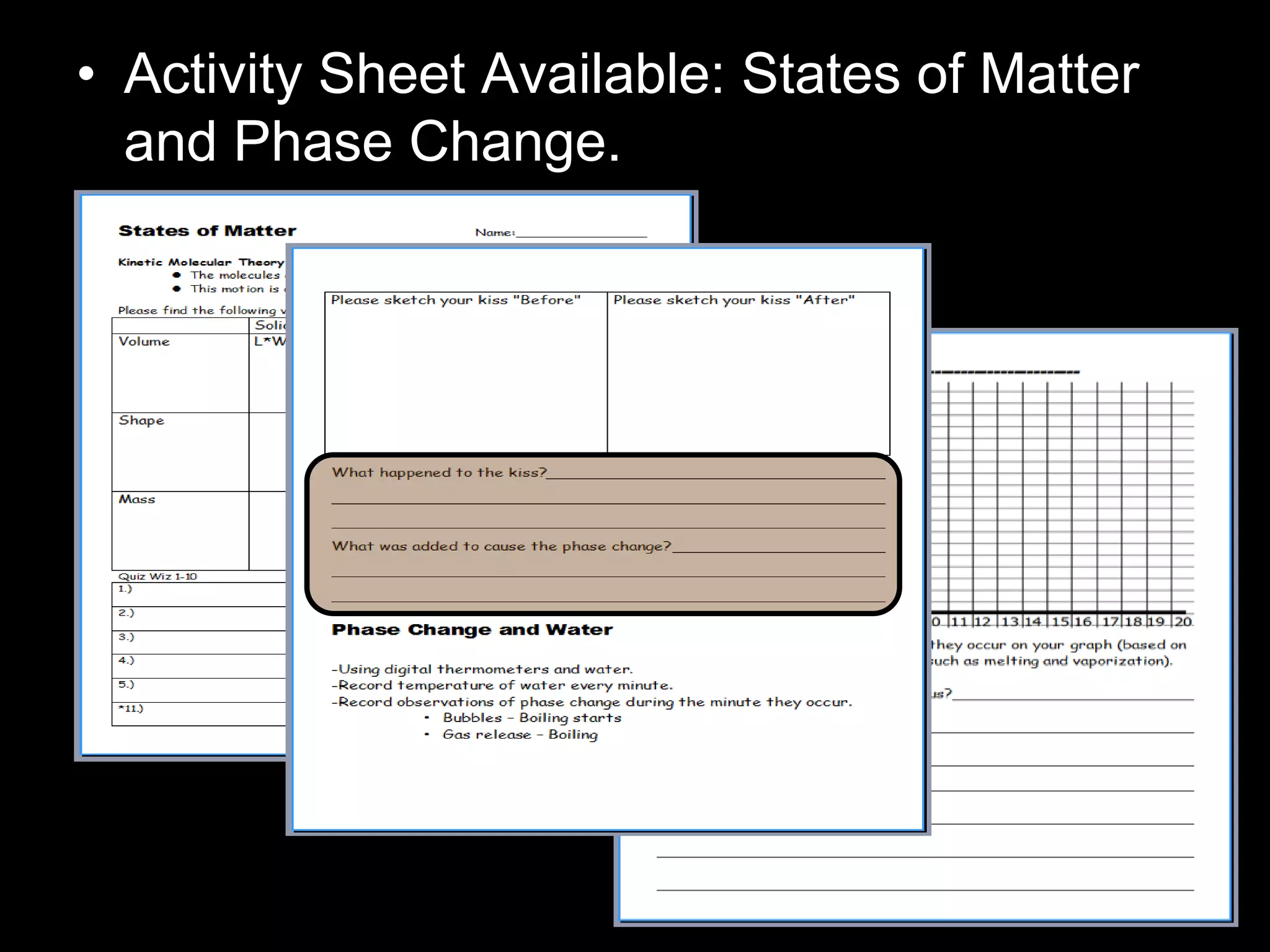
• Activity Sheet Available: States of Matter
and Phase Change.
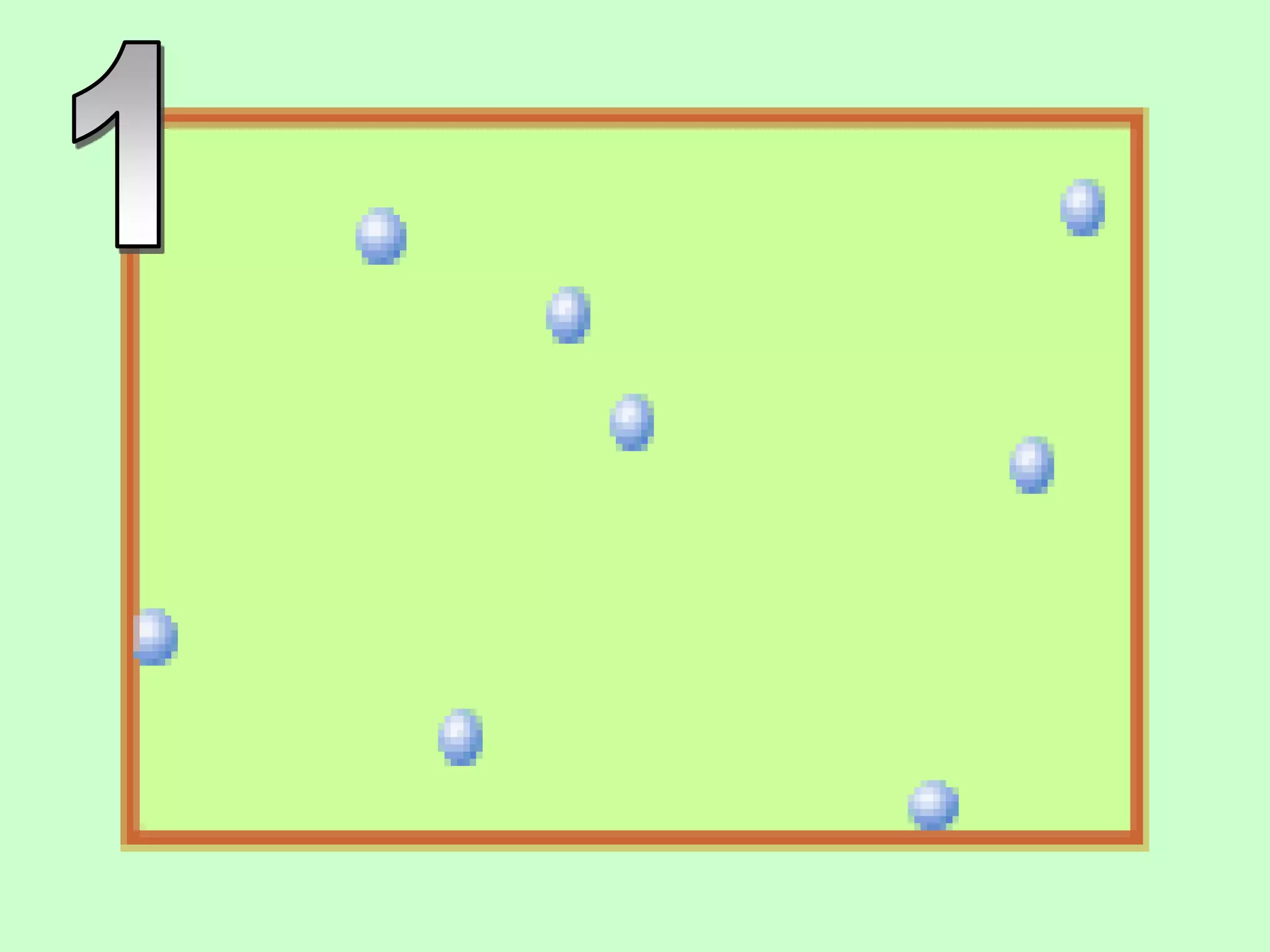
• Quiz 1-10 Solid, Liquid, Gas, Plasma
Copyright © 2010 Ryan P. Murphy
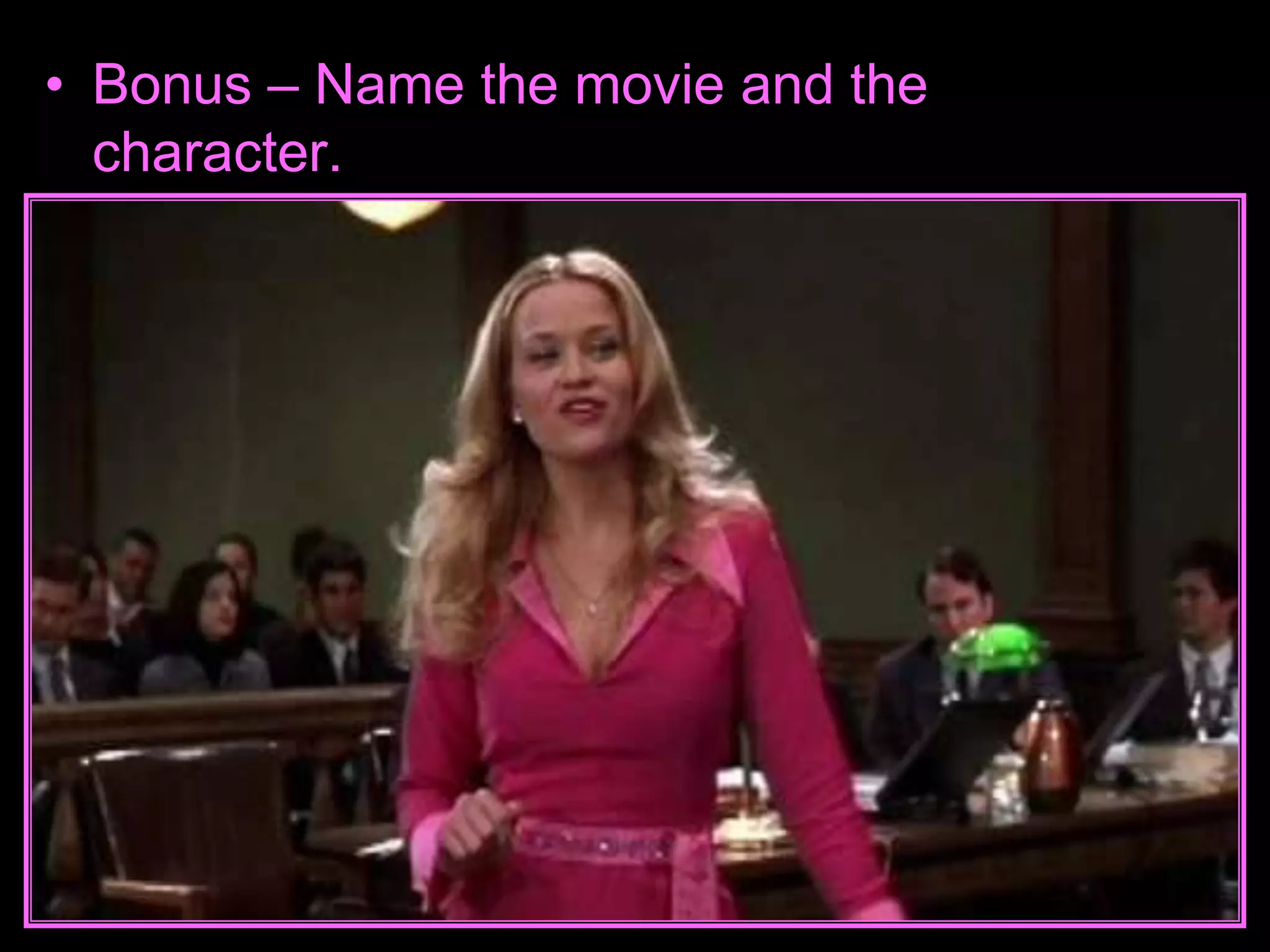
• Bonus – Name the movie and the
character.
• Answers to the Quiz Wiz 1-10 States of Matter
on a molecular level.
• Bonus – Name the movie and the
character.
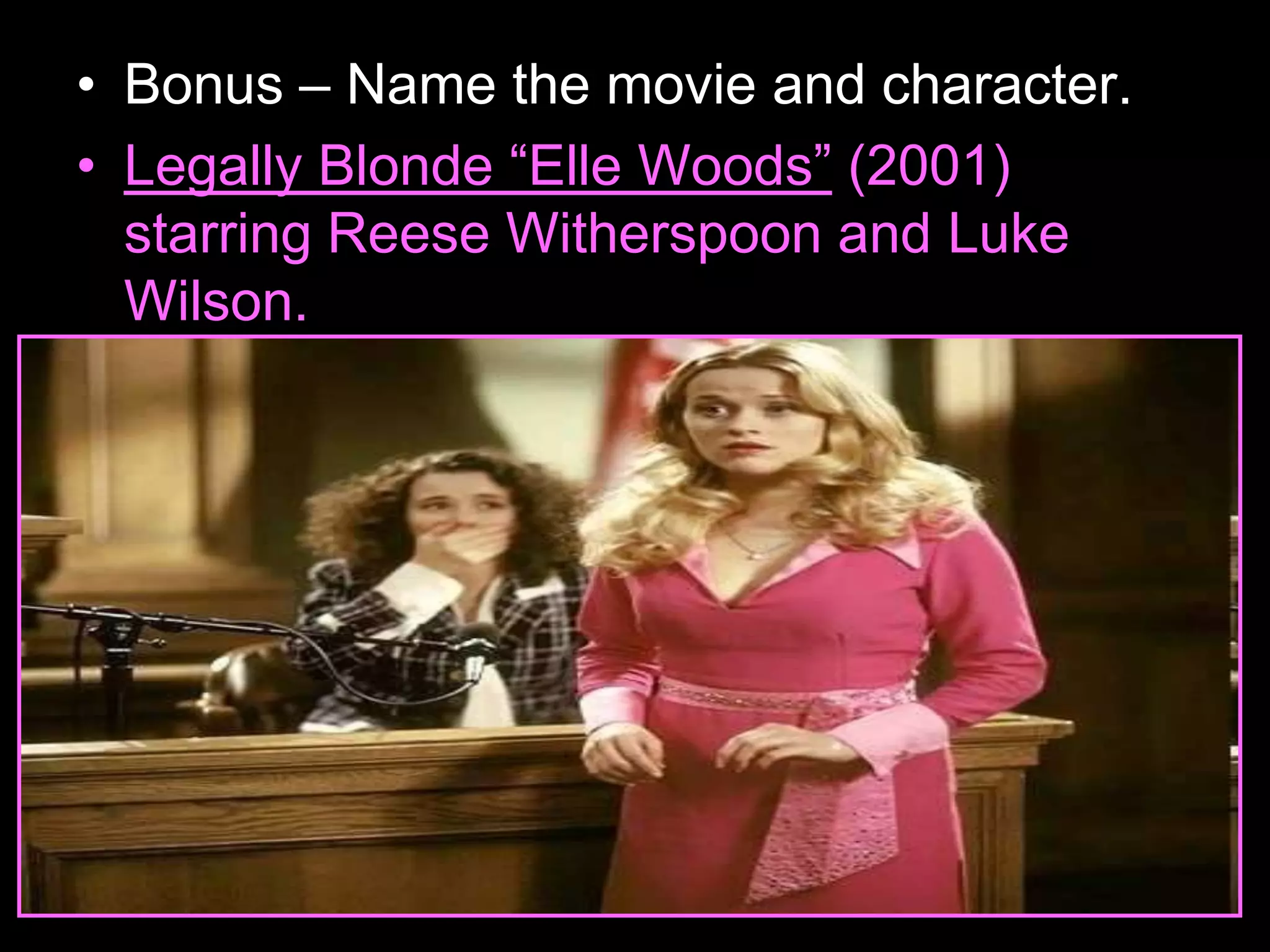
• Bonus – Name the movie and character.
• Legally Blonde “Elle Woods” (2001)
starring Reese Witherspoon and Luke
Wilson.
• Be prepared to have more questions than
answers for the next 100 slides.
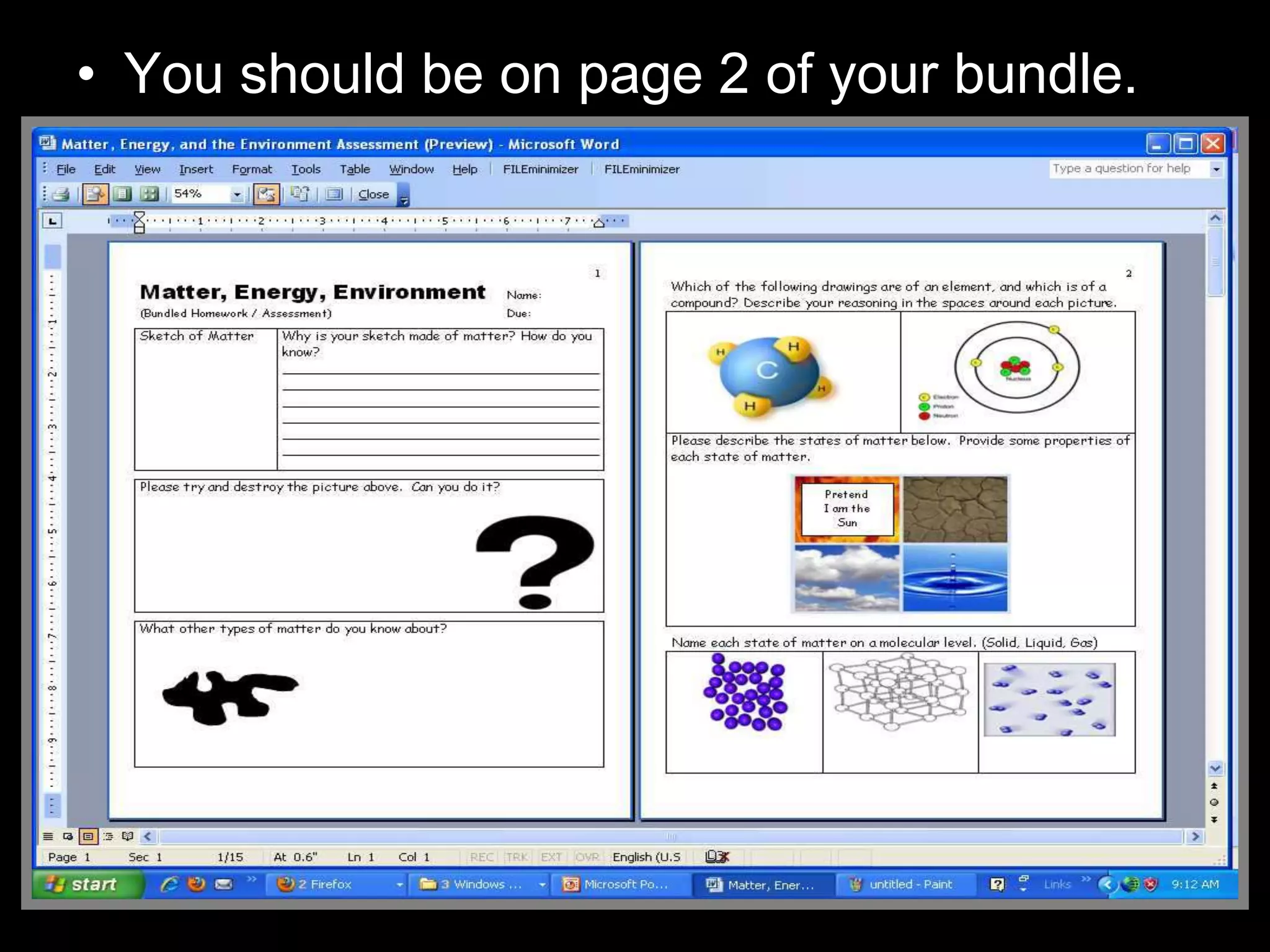
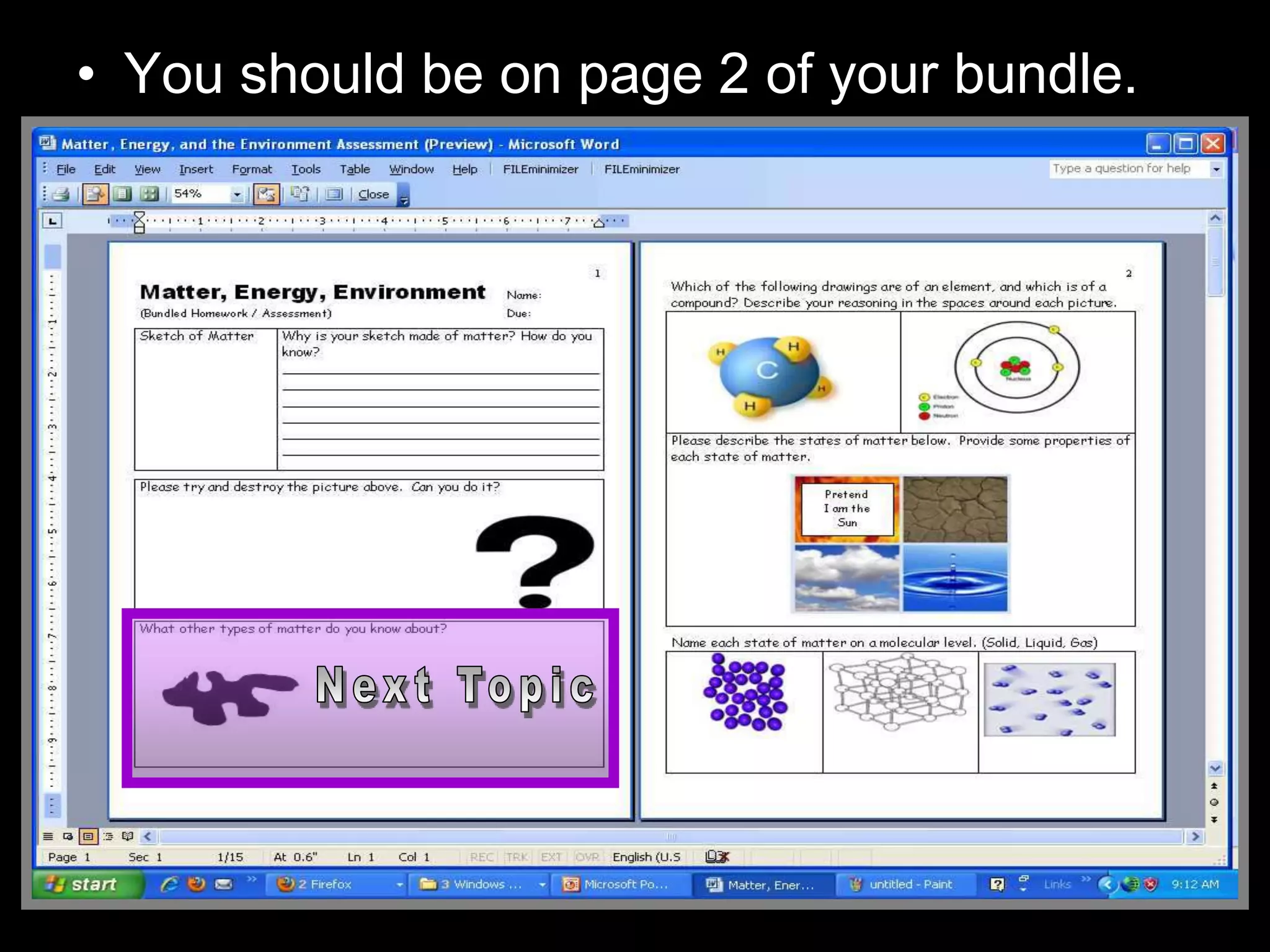
• You should be on page 2 of your bundle.
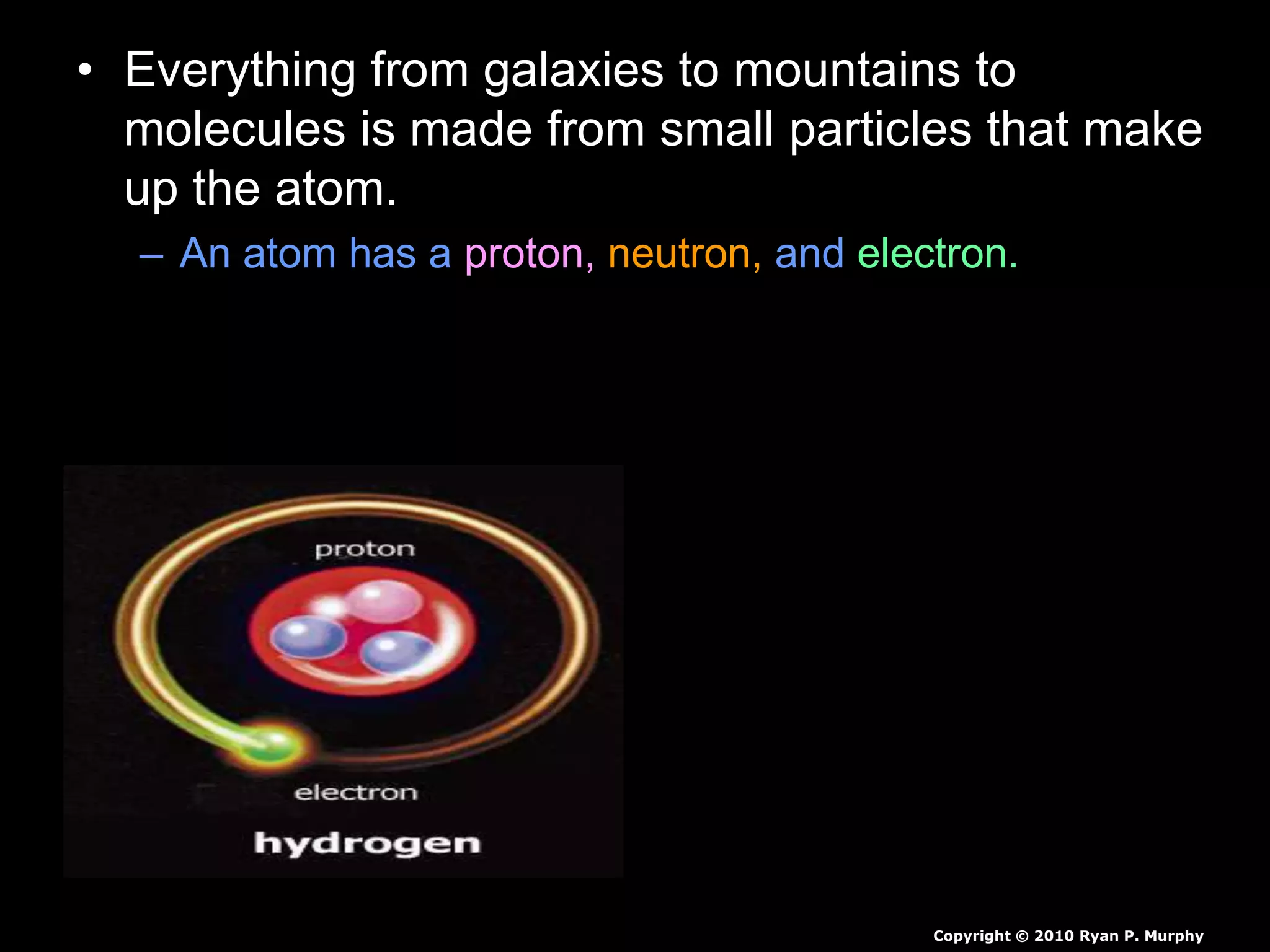
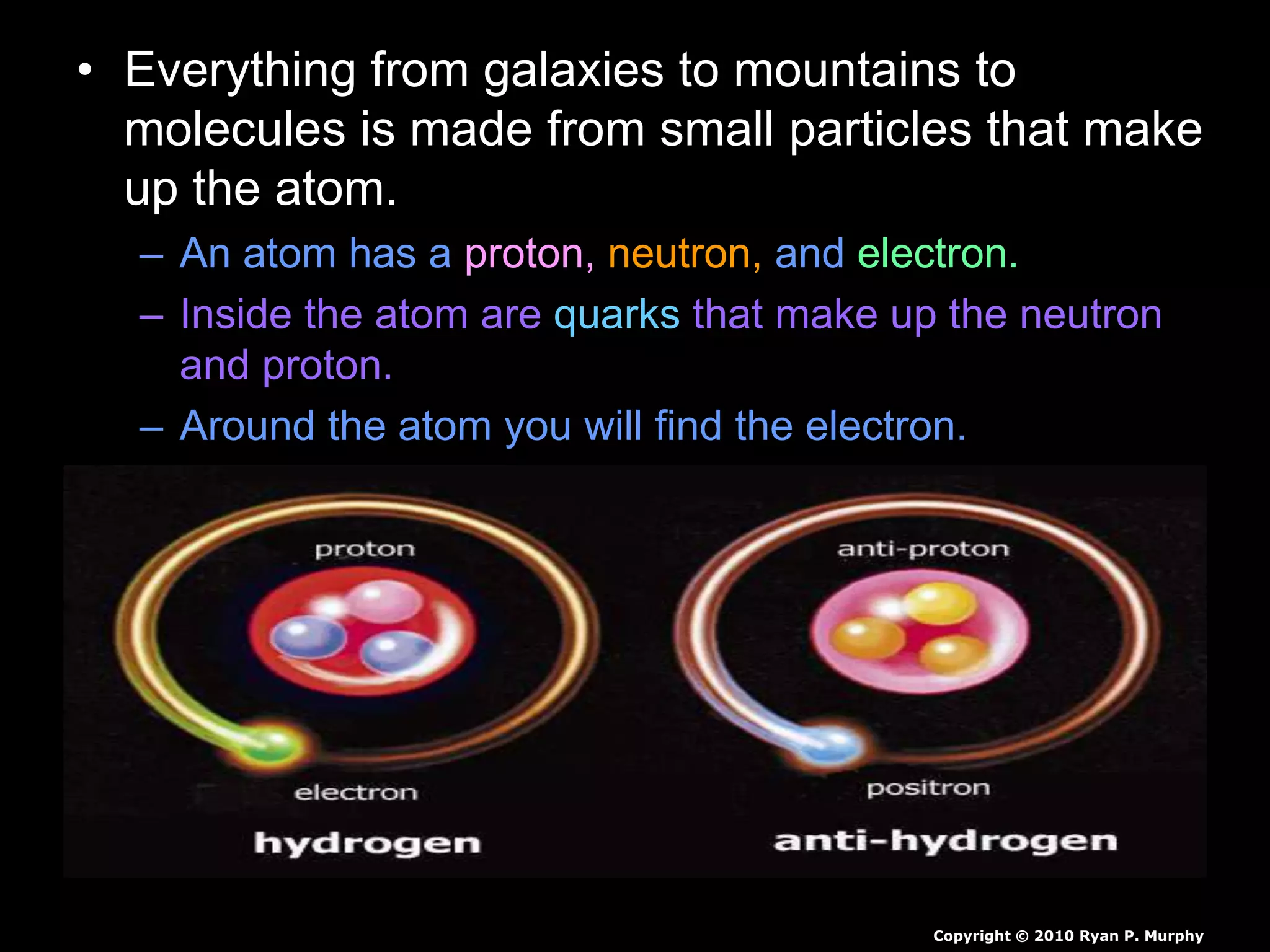
• Everything from galaxies to mountains to
molecules is made from small particles that make
up the atom.
Copyright © 2010 Ryan P. Murphy
• Everything from galaxies to mountains to
molecules is made from small particles that make
up the atom.
– An atom has a proton, neutron, and electron.
Copyright © 2010 Ryan P. Murphy
• Everything from galaxies to mountains to
molecules is made from small particles that make
up the atom.
– An atom has a proton, neutron, and electron.
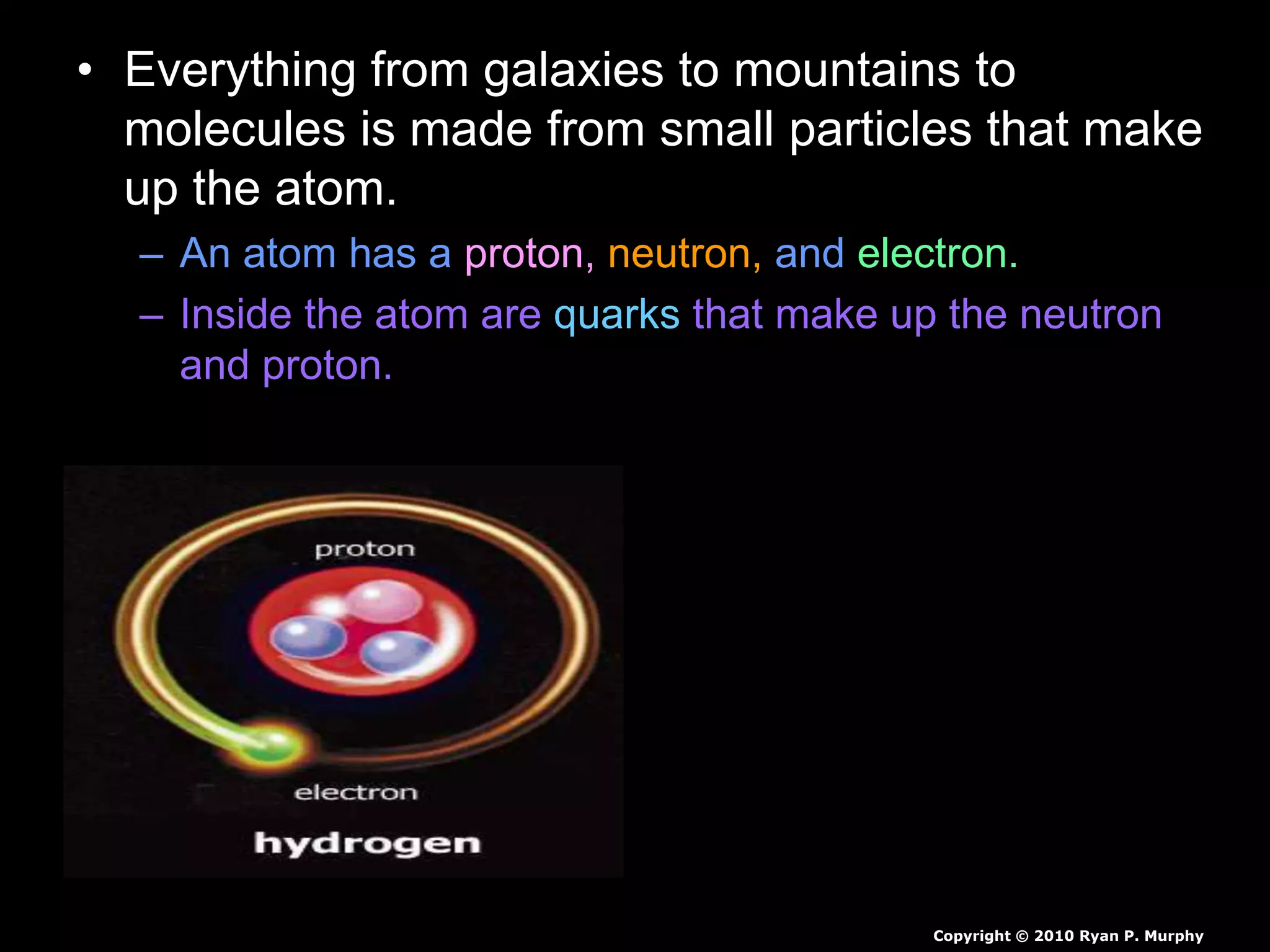
– Inside the atom are quarks that make up the neutron
and proton.
Copyright © 2010 Ryan P. Murphy
• Everything from galaxies to mountains to
molecules is made from small particles that make
up the atom.
– An atom has a proton, neutron, and electron.
– Inside the atom are quarks that make up the neutron
and proton.
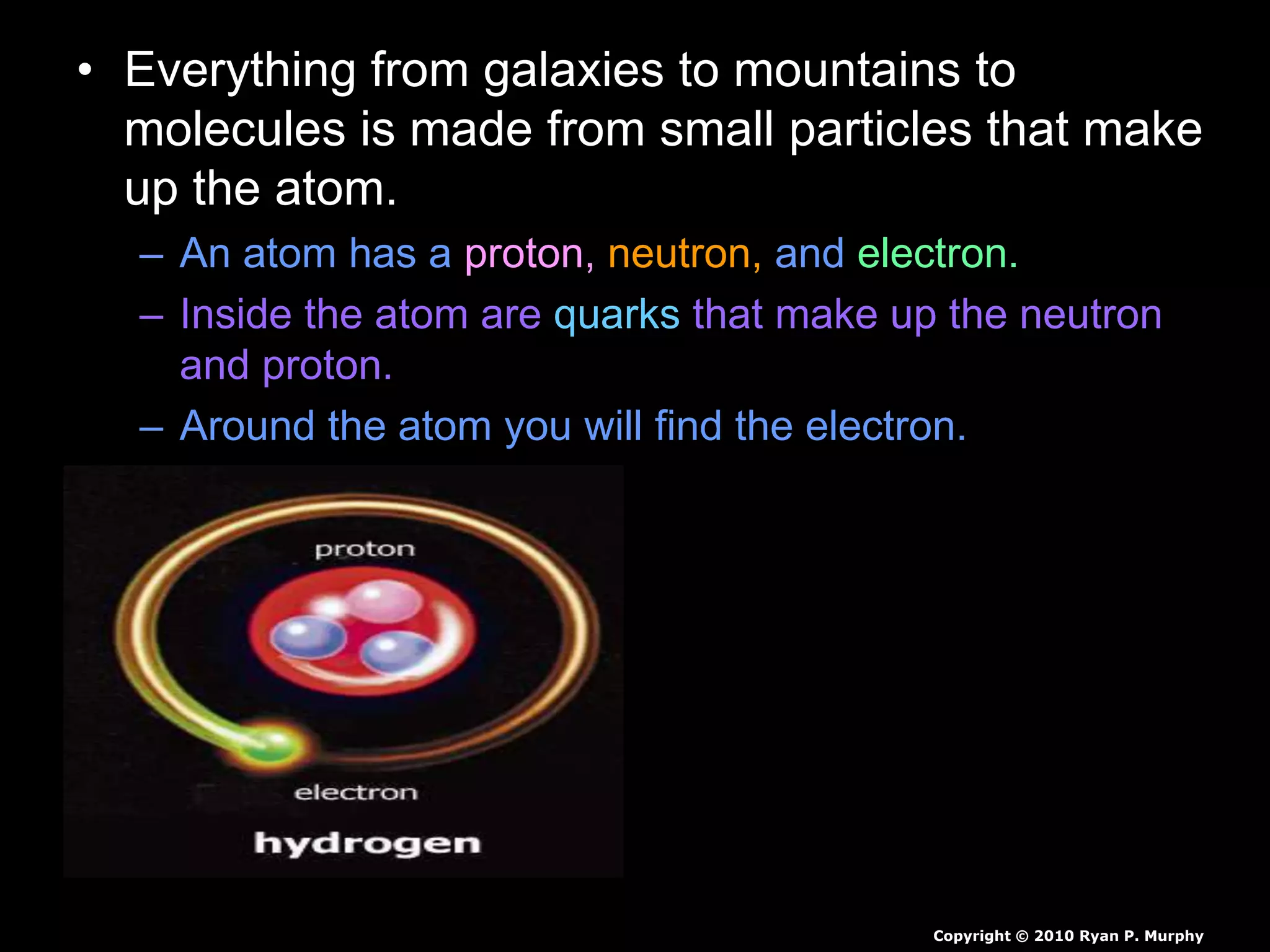
– Around the atom you will find the electron.
Copyright © 2010 Ryan P. Murphy
• Everything from galaxies to mountains to
molecules is made from small particles that make
up the atom.
– An atom has a proton, neutron, and electron.
– Inside the atom are quarks that make up the neutron
and proton.
– Around the atom you will find the electron.
Copyright © 2010 Ryan P. Murphy
• Everything from galaxies to mountains to
molecules is made from small particles that make
up the atom.
– An atom has a proton, neutron, and electron.
– Inside the atom are quarks that make up the neutron
and proton.
– Around the atom you will find the electron.
Copyright © 2010 Ryan P. Murphy
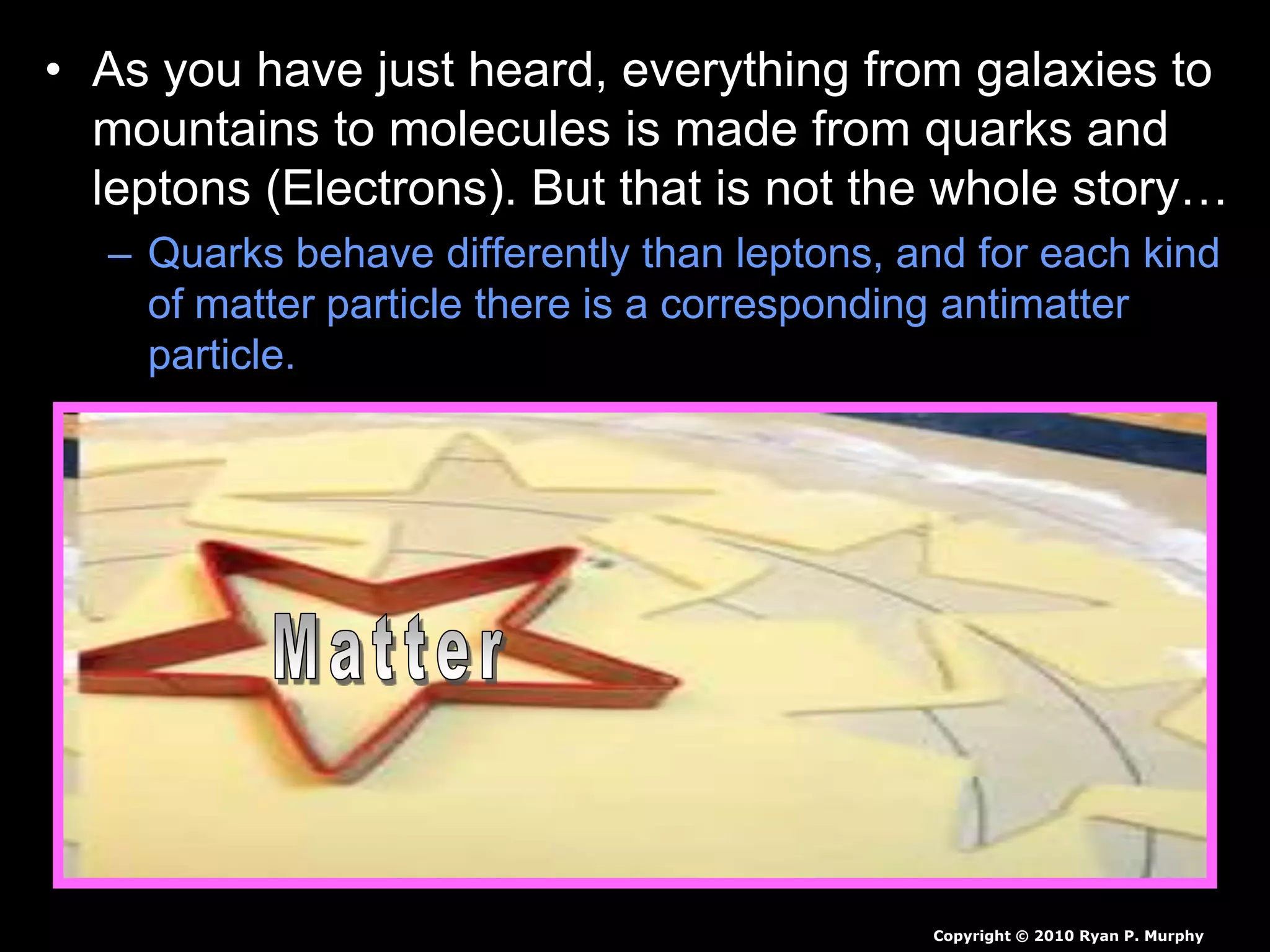
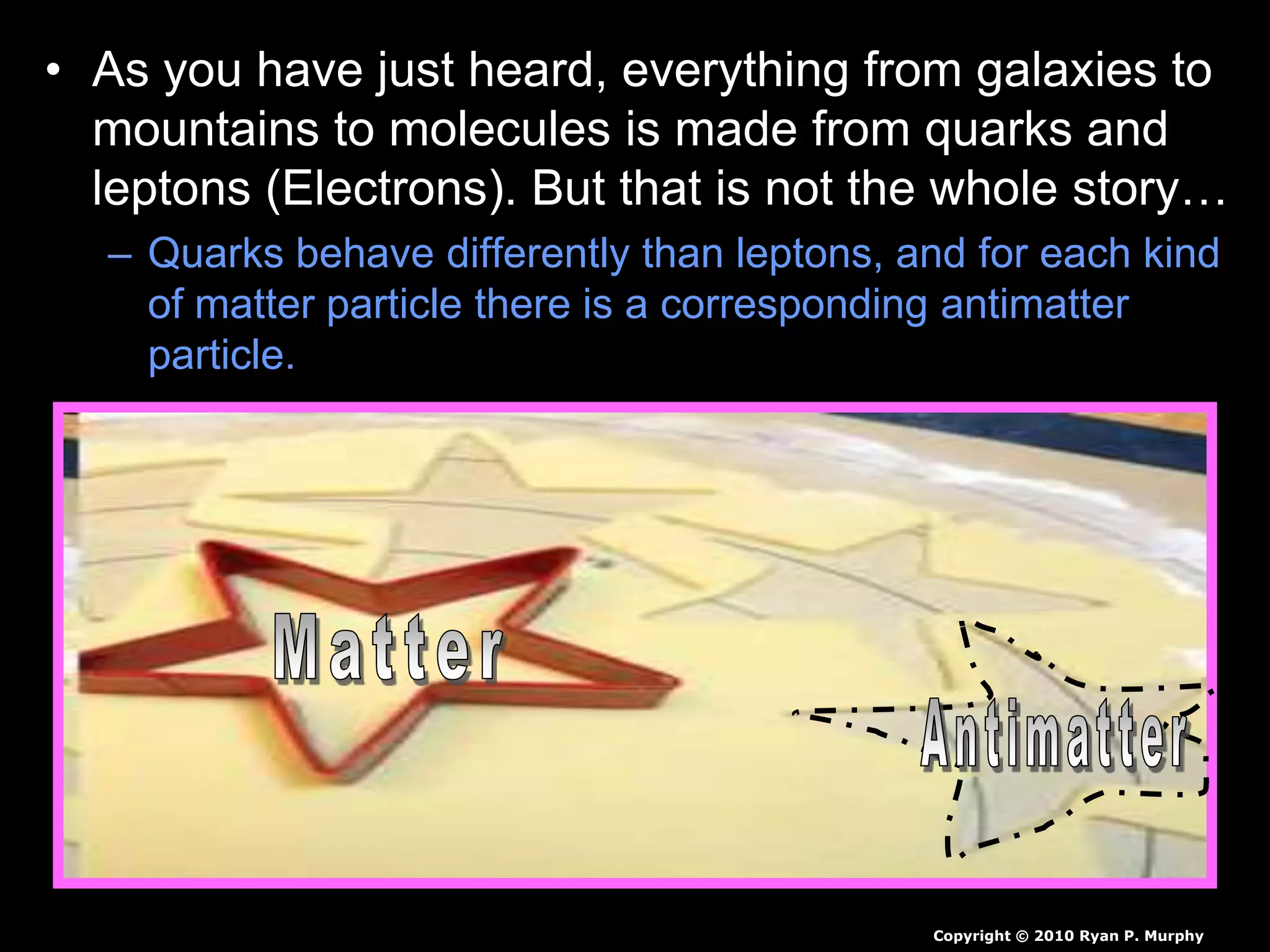
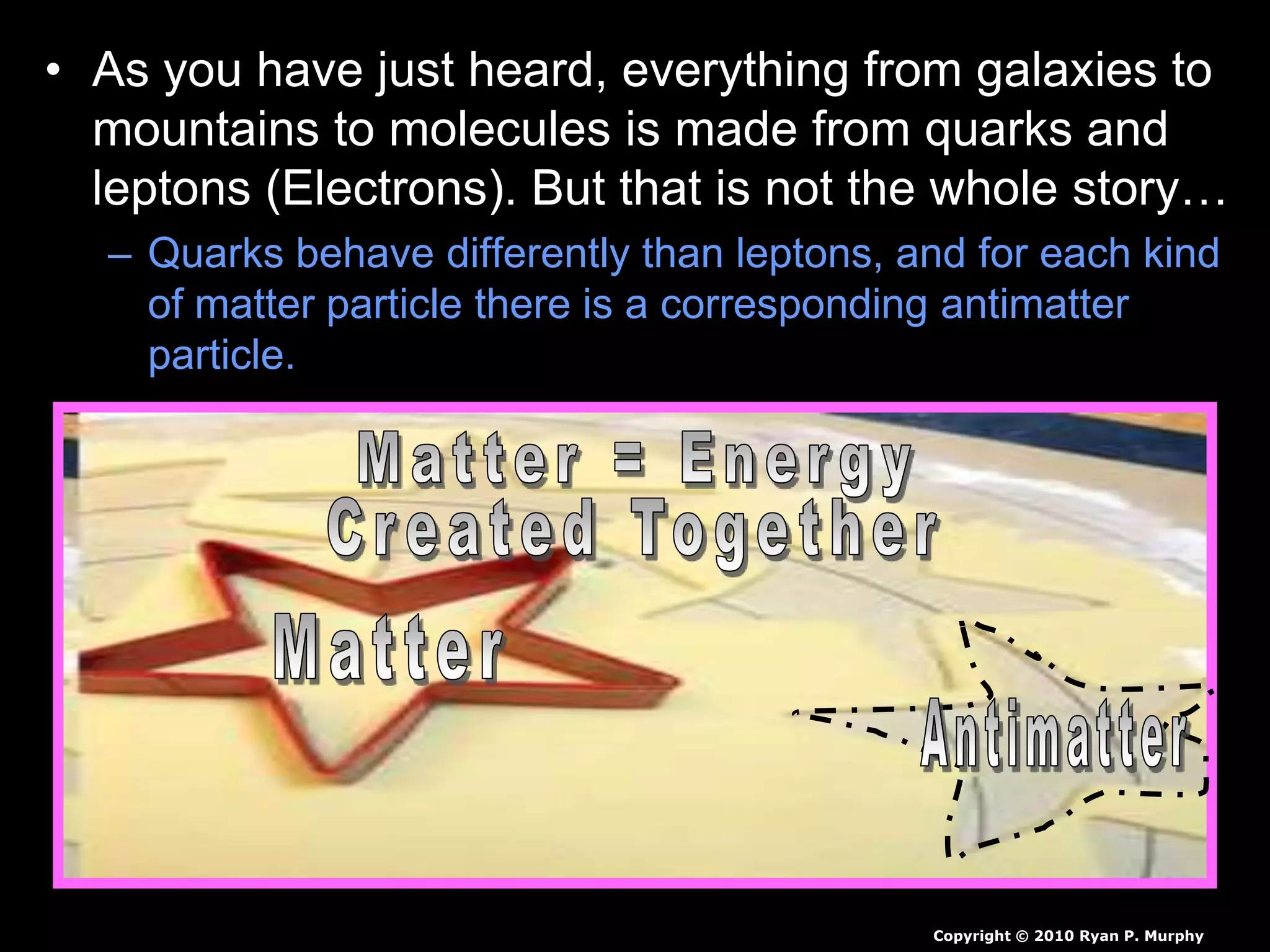
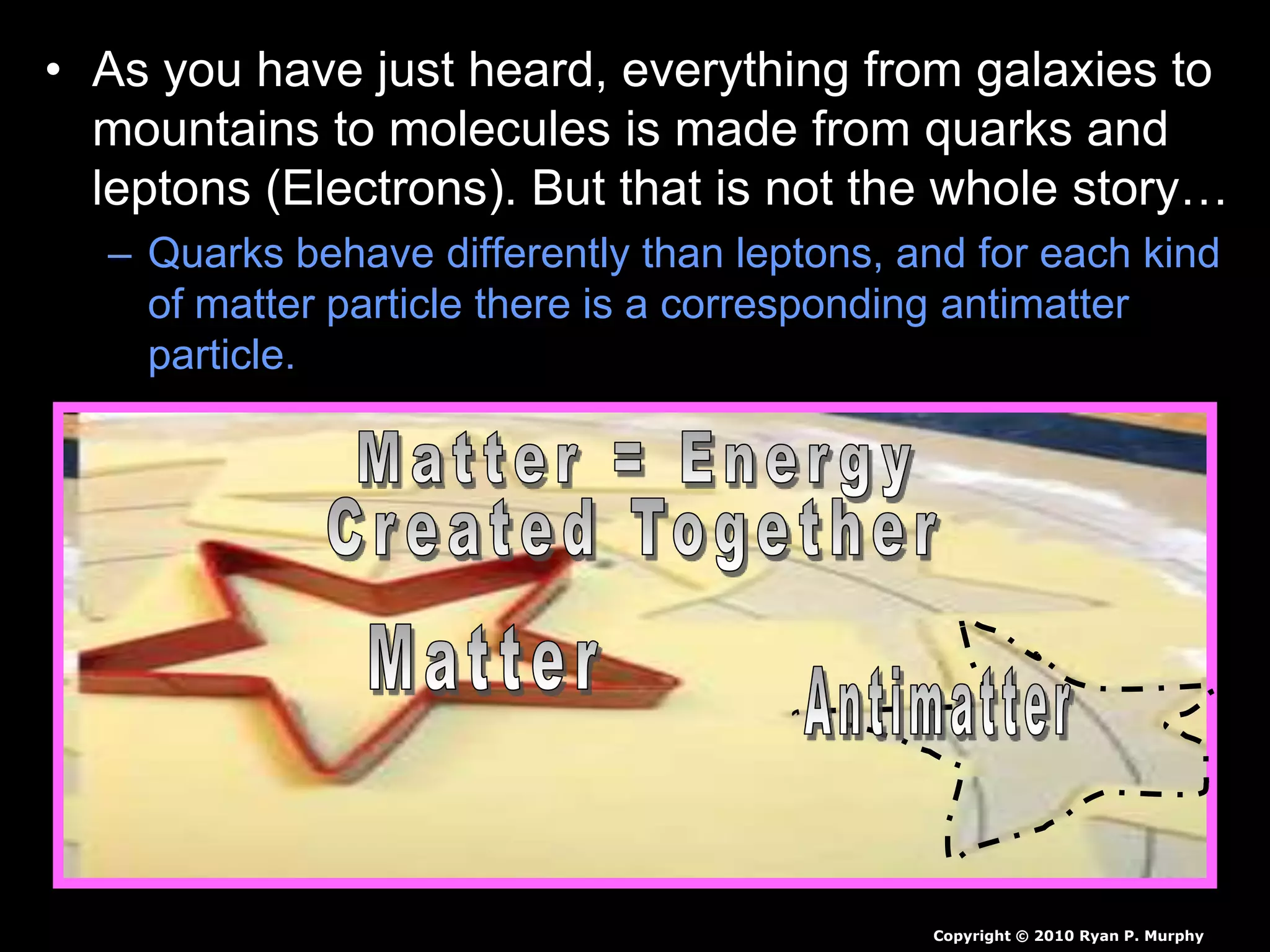
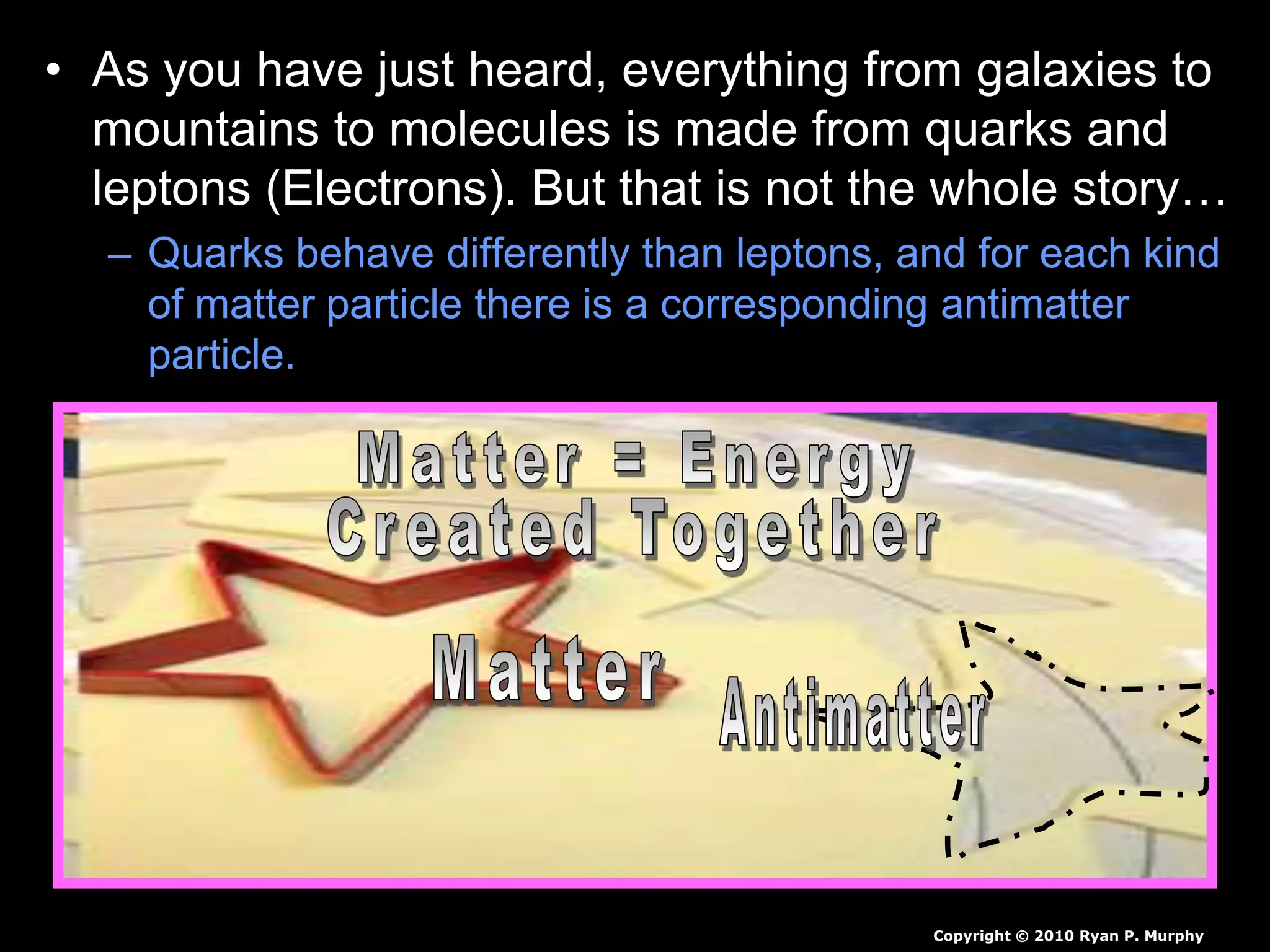
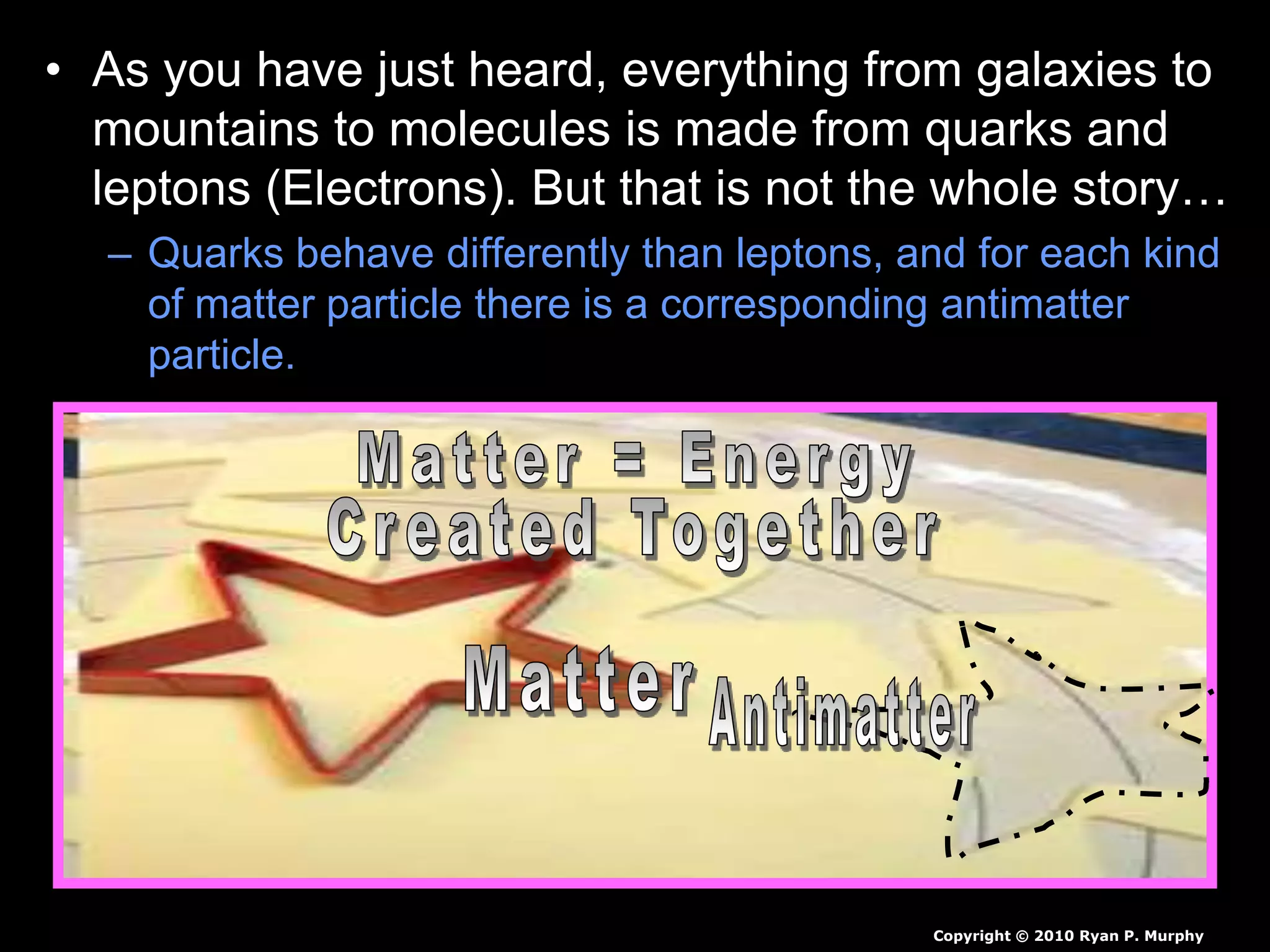
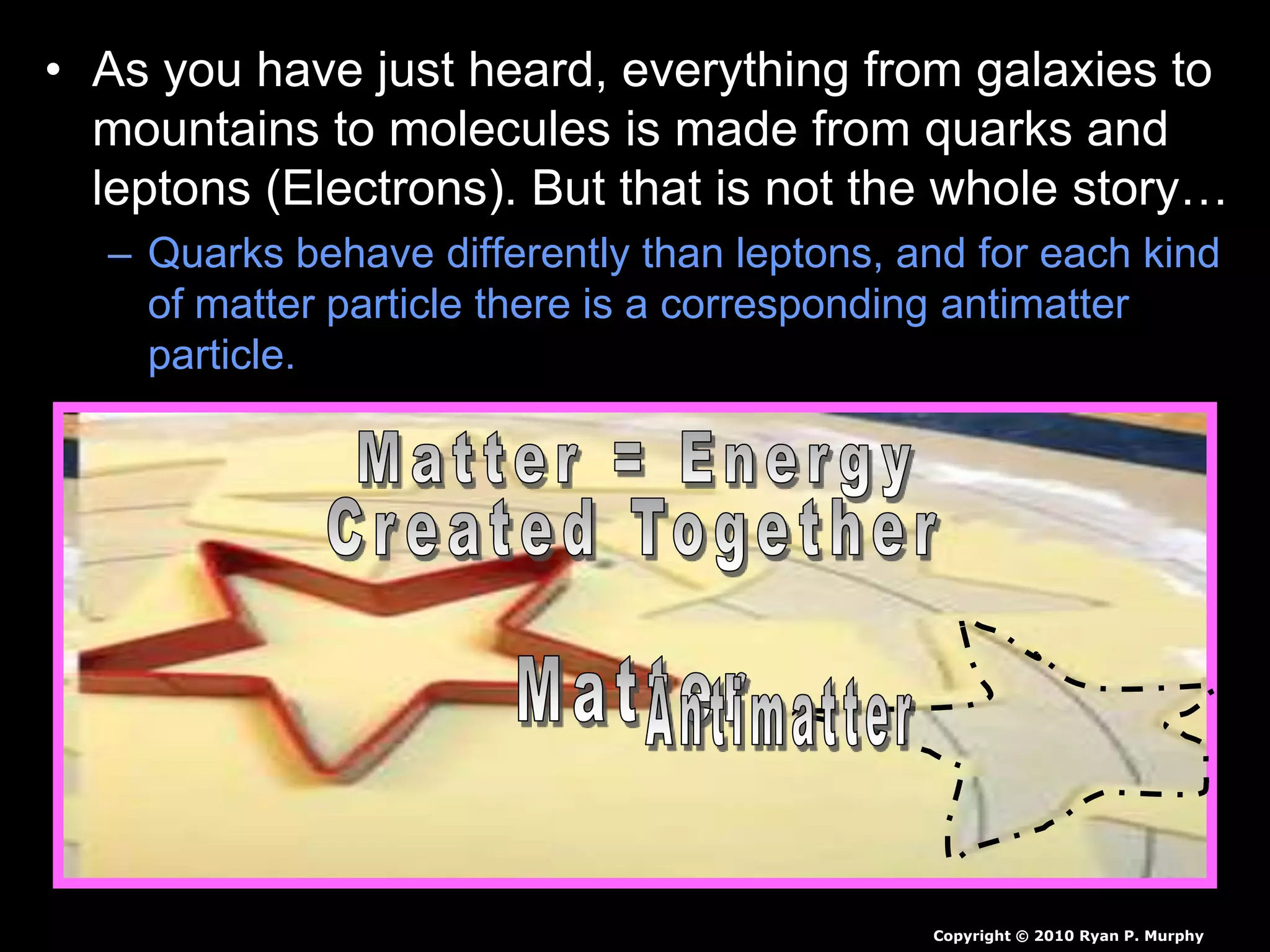
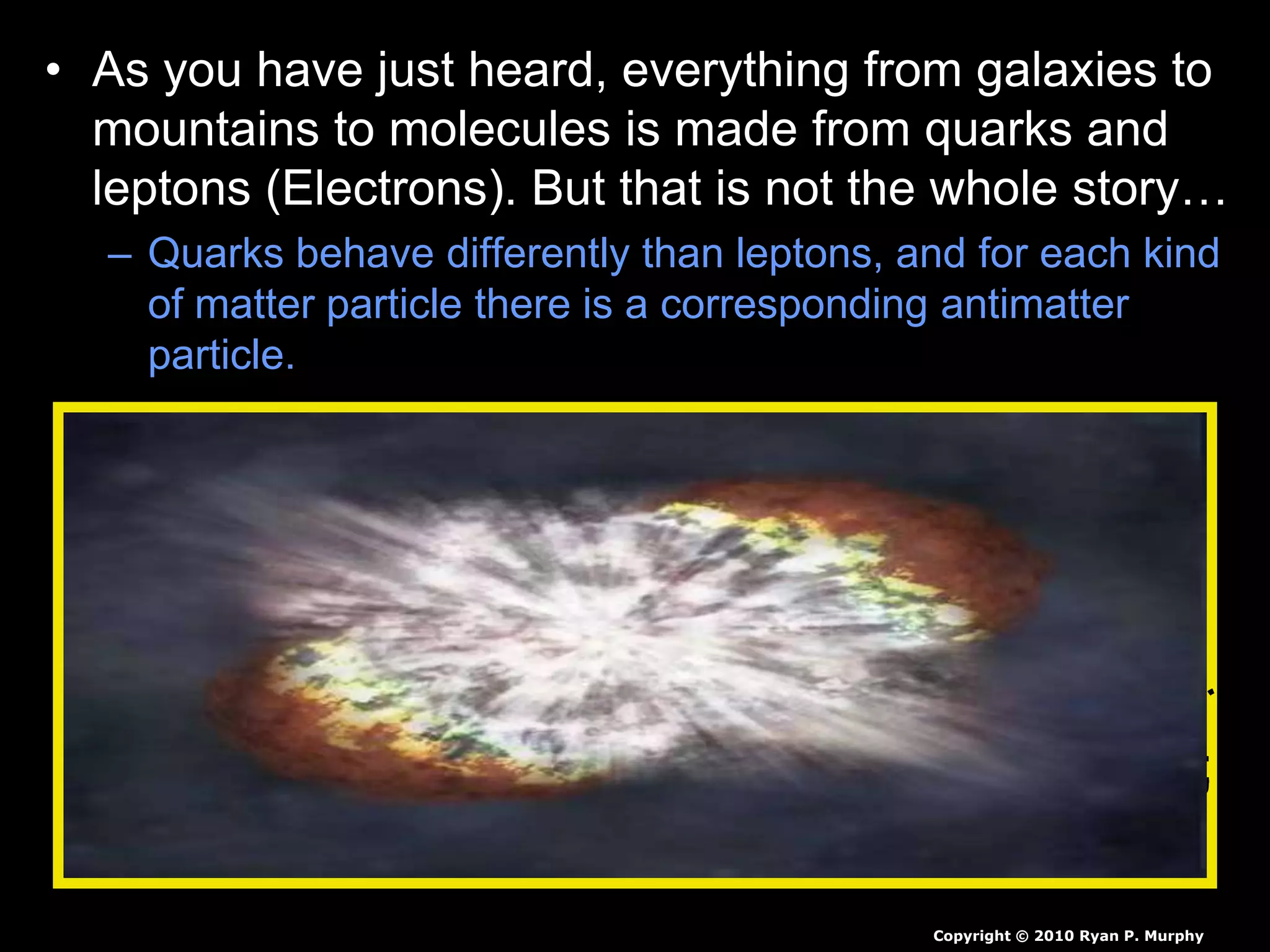
• As you have just heard, everything from galaxies to
mountains to molecules is made from quarks and
leptons (Electrons). But that is not the whole story…
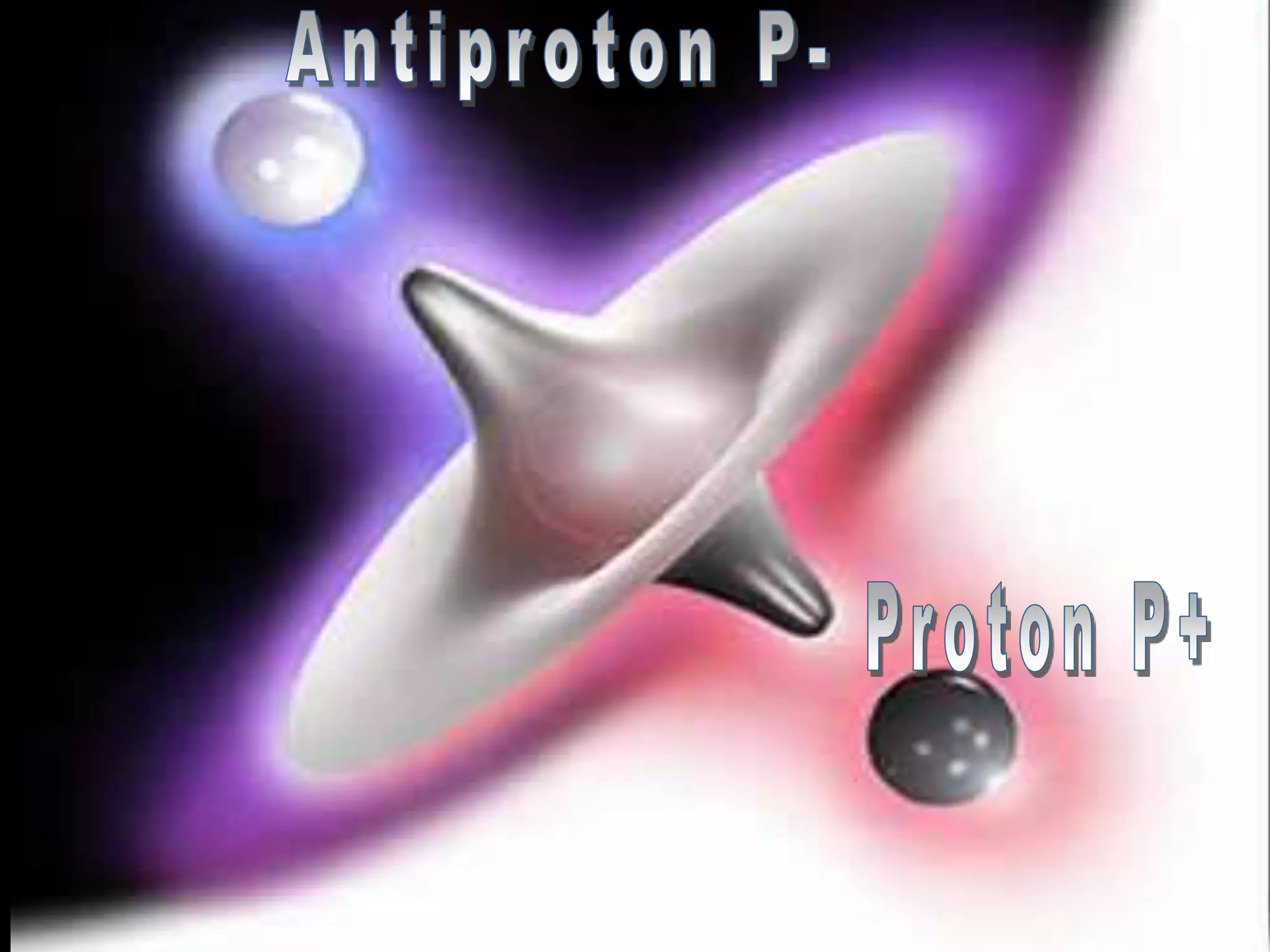
– Quarks behave differently than leptons, and for each kind
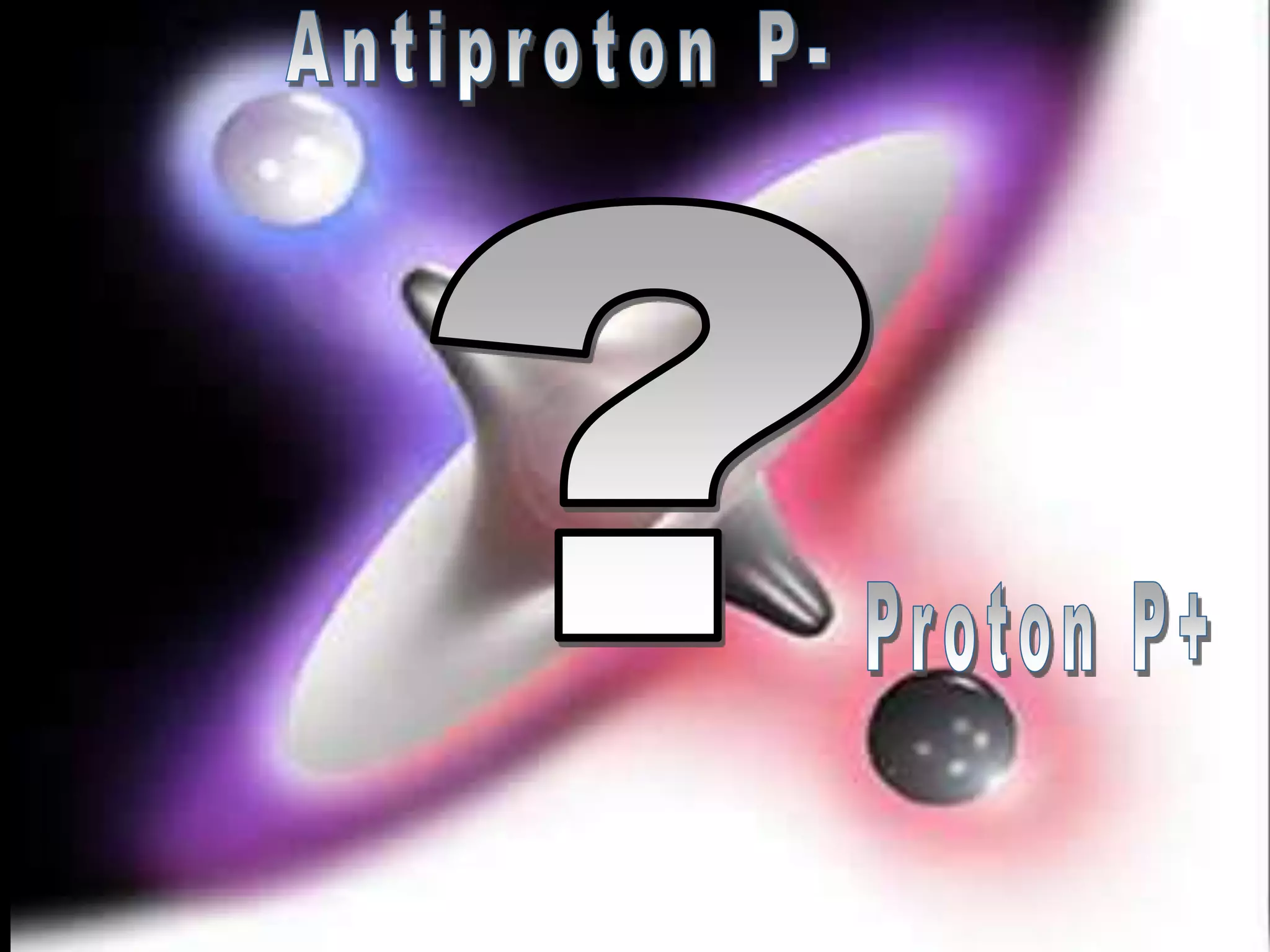
of matter particle there is a corresponding antimatter
particle.
Copyright © 2010 Ryan P. Murphy
• As you have just heard, everything from galaxies to
mountains to molecules is made from quarks and
leptons (Electrons). But that is not the whole story…
– Quarks behave differently than leptons, and for each kind
of matter particle there is a corresponding antimatter
particle.
Copyright © 2010 Ryan P. Murphy
• As you have just heard, everything from galaxies to
mountains to molecules is made from quarks and
leptons (Electrons). But that is not the whole story…
– Quarks behave differently than leptons, and for each kind
of matter particle there is a corresponding antimatter
particle.
Copyright © 2010 Ryan P. Murphy
• As you have just heard, everything from galaxies to
mountains to molecules is made from quarks and
leptons (Electrons). But that is not the whole story…
– Quarks behave differently than leptons, and for each kind
of matter particle there is a corresponding antimatter
particle.
Copyright © 2010 Ryan P. Murphy
• As you have just heard, everything from galaxies to
mountains to molecules is made from quarks and
leptons (Electrons). But that is not the whole story…
– Quarks behave differently than leptons, and for each kind
of matter particle there is a corresponding antimatter
particle.
Copyright © 2010 Ryan P. Murphy
• As you have just heard, everything from galaxies to
mountains to molecules is made from quarks and
leptons (Electrons). But that is not the whole story…
– Quarks behave differently than leptons, and for each kind
of matter particle there is a corresponding antimatter
particle.
Copyright © 2010 Ryan P. Murphy
• As you have just heard, everything from galaxies to
mountains to molecules is made from quarks and
leptons (Electrons). But that is not the whole story…
– Quarks behave differently than leptons, and for each kind
of matter particle there is a corresponding antimatter
particle.
Copyright © 2010 Ryan P. Murphy
• As you have just heard, everything from galaxies to
mountains to molecules is made from quarks and
leptons (Electrons). But that is not the whole story…
– Quarks behave differently than leptons, and for each kind
of matter particle there is a corresponding antimatter
particle.
Copyright © 2010 Ryan P. Murphy
• As you have just heard, everything from galaxies to
mountains to molecules is made from quarks and
leptons (Electrons). But that is not the whole story…
– Quarks behave differently than leptons, and for each kind
of matter particle there is a corresponding antimatter
particle.
Copyright © 2010 Ryan P. Murphy
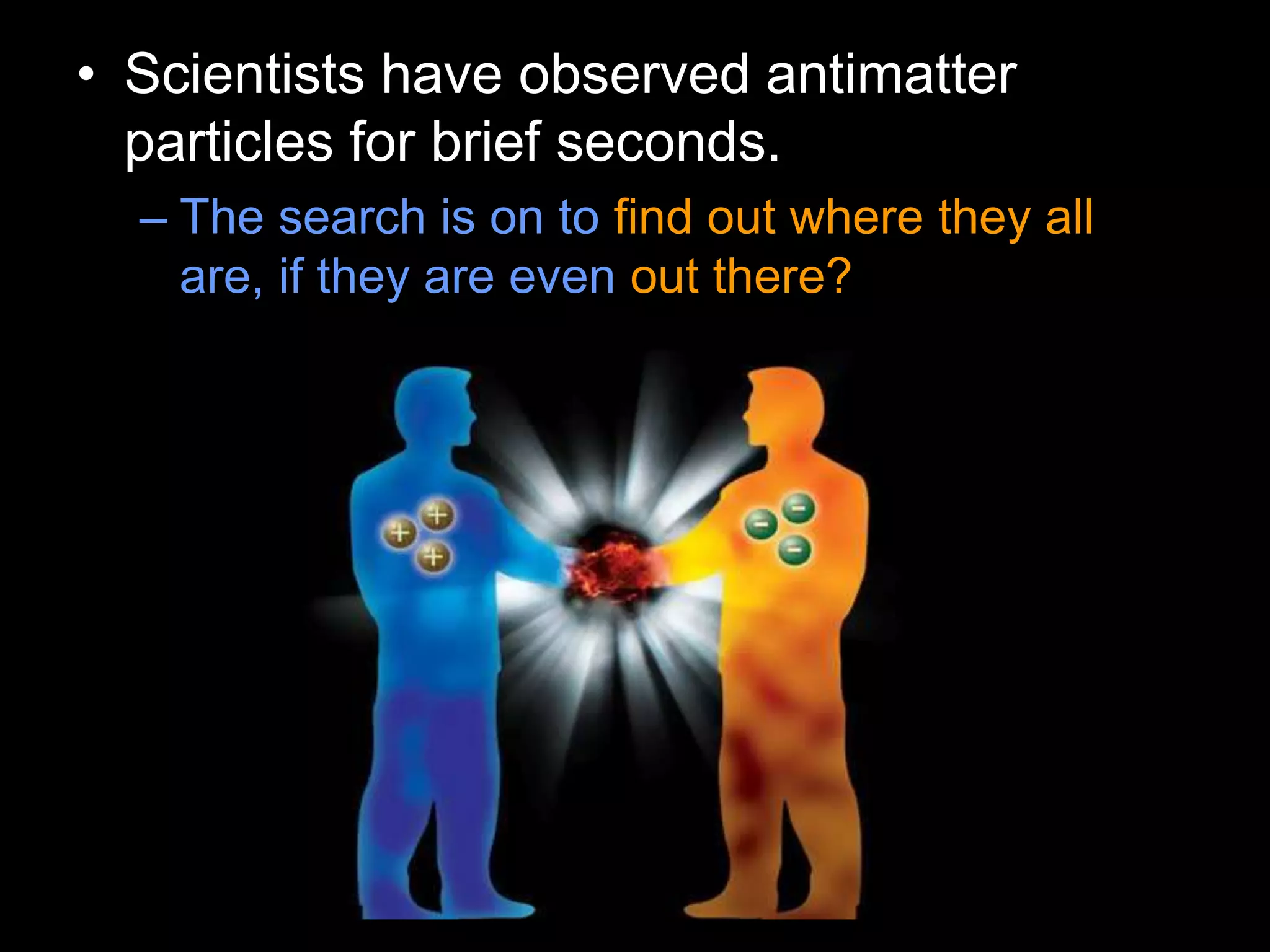
• Scientists have observed antimatter
particles for brief seconds.
• Scientists have observed antimatter
particles for brief seconds.
– The search is on to find out where they all
are, if they are even out there?
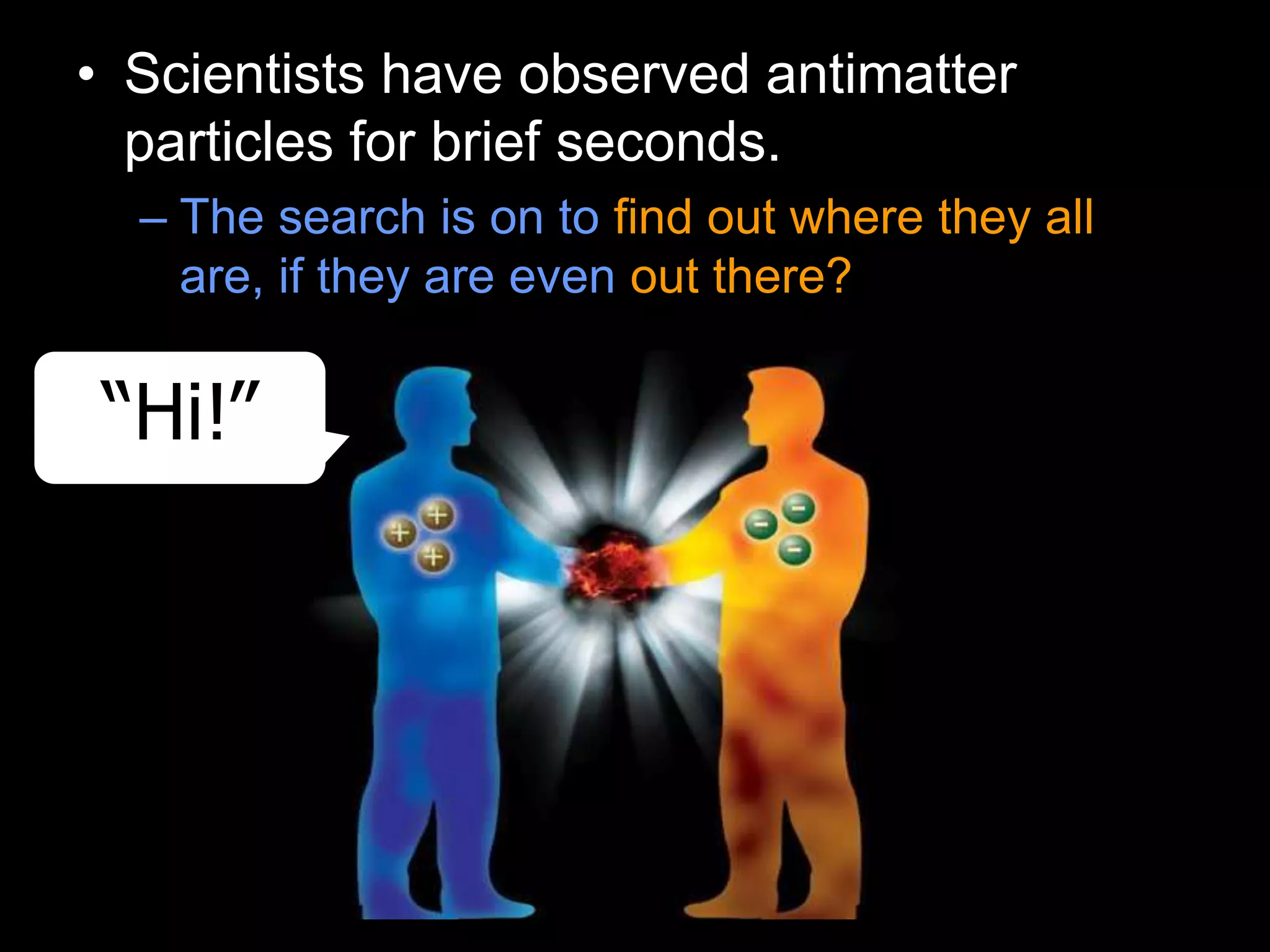
• Scientists have observed antimatter
particles for brief seconds.
– The search is on to find out where they all
are, if they are even out there?
“Hi!”
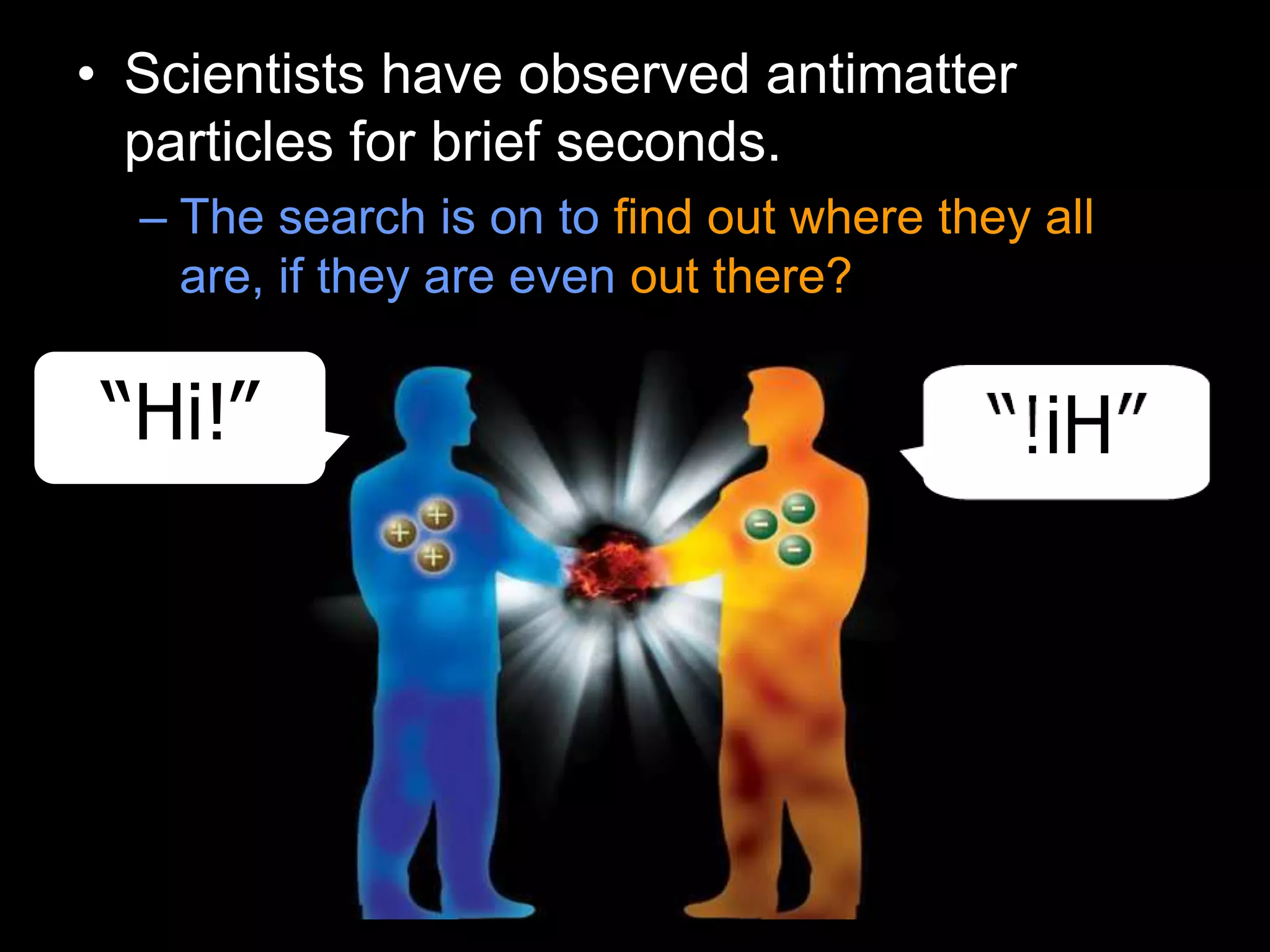
• Scientists have observed antimatter
particles for brief seconds.
– The search is on to find out where they all
are, if they are even out there?
“Hi!”
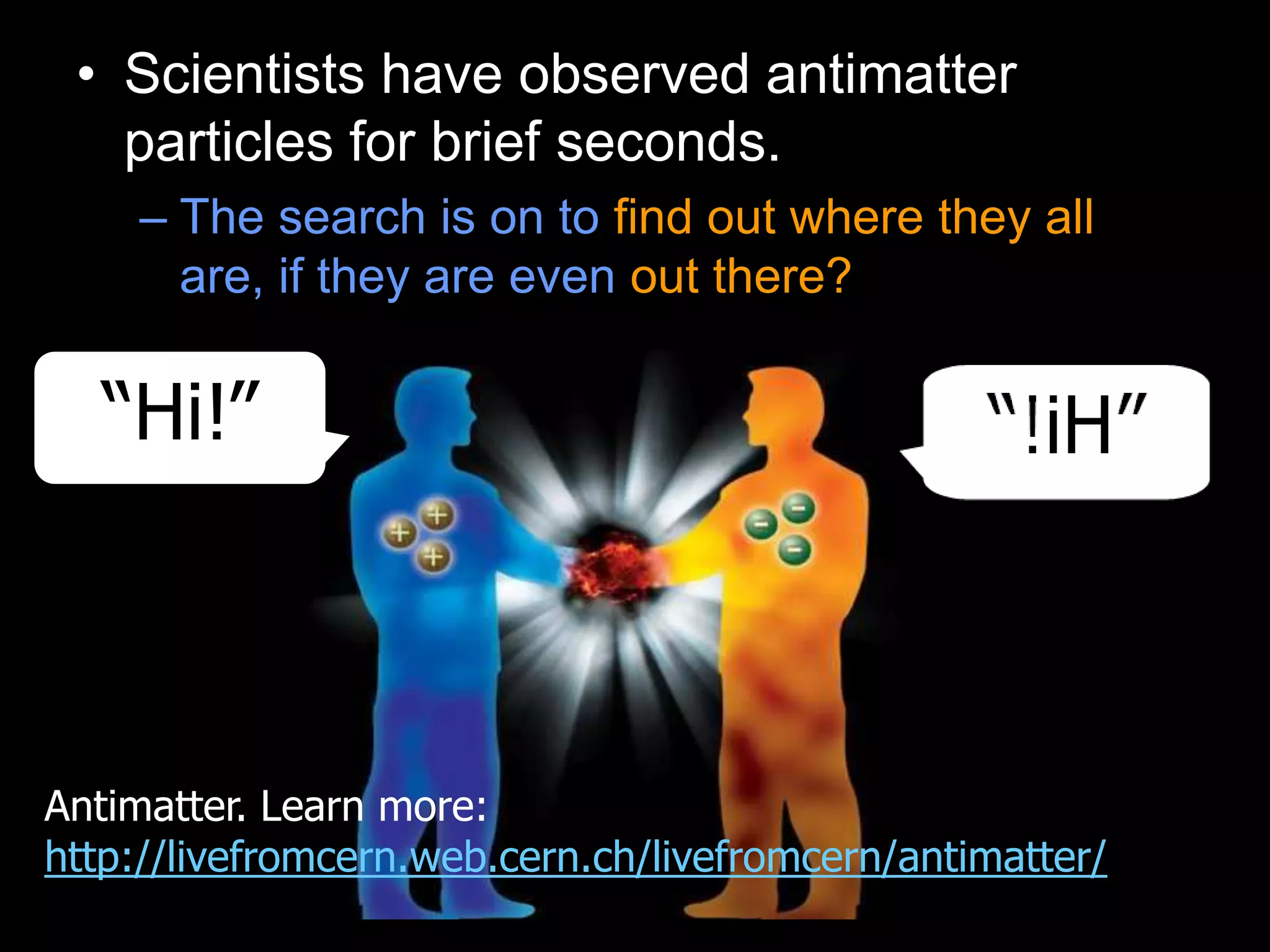
• Scientists have observed antimatter
particles for brief seconds.
– The search is on to find out where they all
are, if they are even out there?
“Hi!”
Antimatter. Learn more:
http://livefromcern.web.cern.ch/livefromcern/antimatter/
• Video Link HD (Optional) The Universe, Big
Bang, and Antimatter -24 minutes
– Sorry for the advertisements.
– http://www.youtube.com/watch?v=Y5oNwJNdMxY
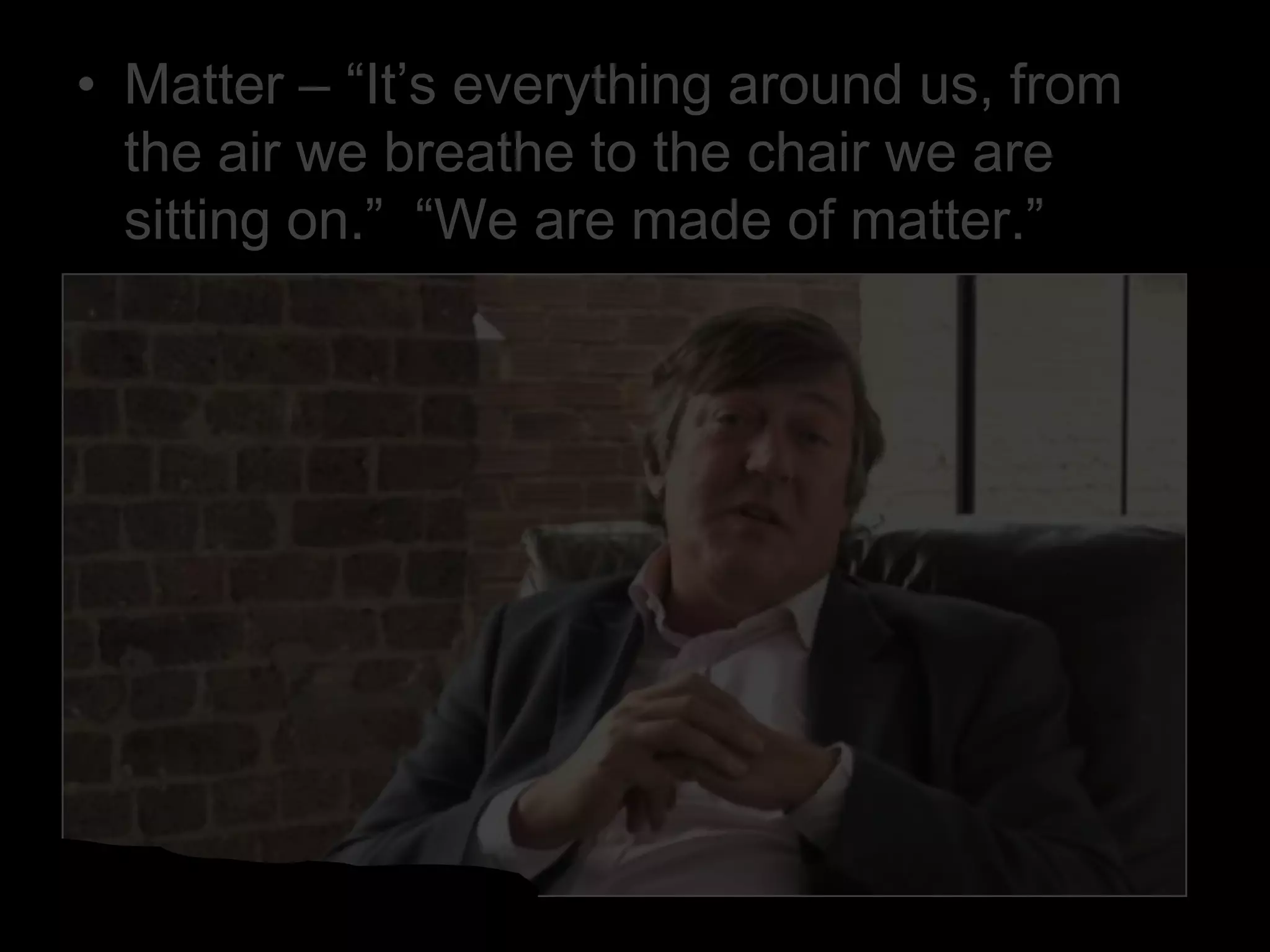
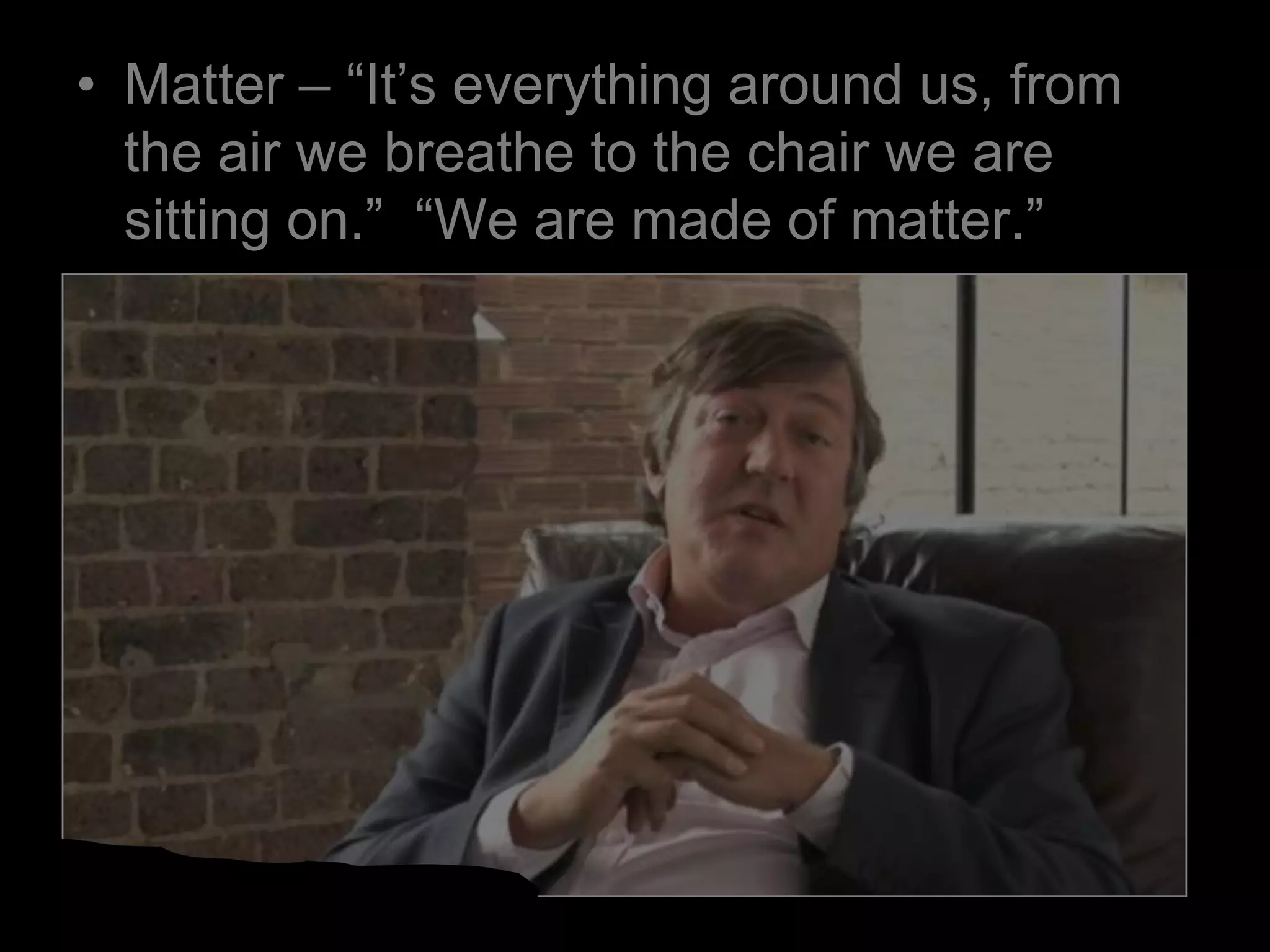
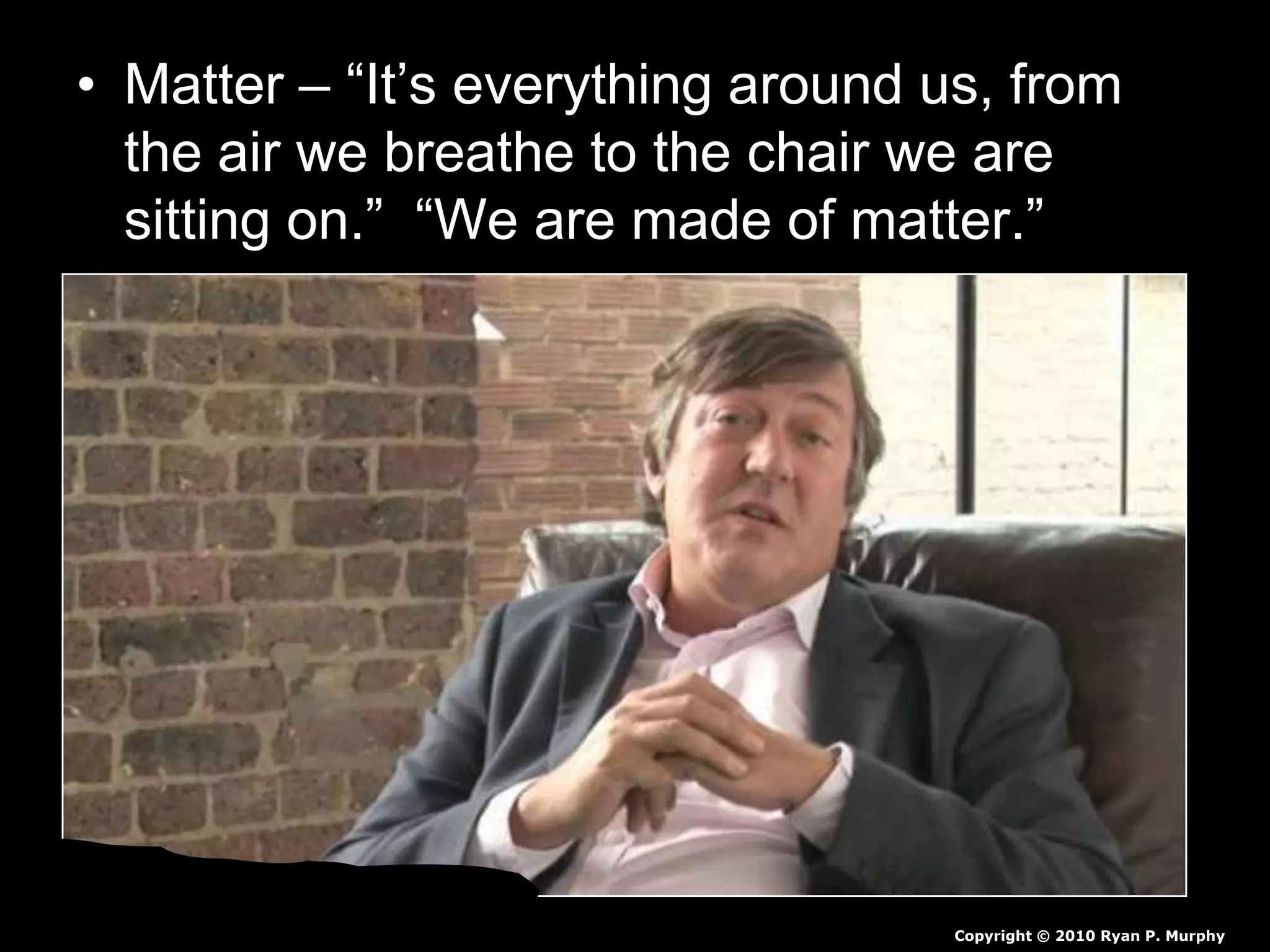
• Matter – “It’s everything around us, from
the air we breathe to the chair we are
sitting on.” “We are made of matter.”
• Matter – “It’s everything around us, from
the air we breathe to the chair we are
sitting on.” “We are made of matter.”
• Matter – “It’s everything around us, from
the air we breathe to the chair we are
sitting on.” “We are made of matter.”
• Matter – “It’s everything around us, from
the air we breathe to the chair we are
sitting on.” “We are made of matter.”
Copyright © 2010 Ryan P. Murphy
• “The matter that we see everyday is made
up of very small particles called atoms.”
Copyright © 2010 Ryan P. Murphy
• “However, Atoms only make up 5% of the
Universe” “The other 95% is made of…”
Copyright © 2010 Ryan P. Murphy
• “Something else.” “It is dark and…”
Copyright © 2010 Ryan P. Murphy
• “Ahh…….”
Copyright © 2010 Ryan P. Murphy
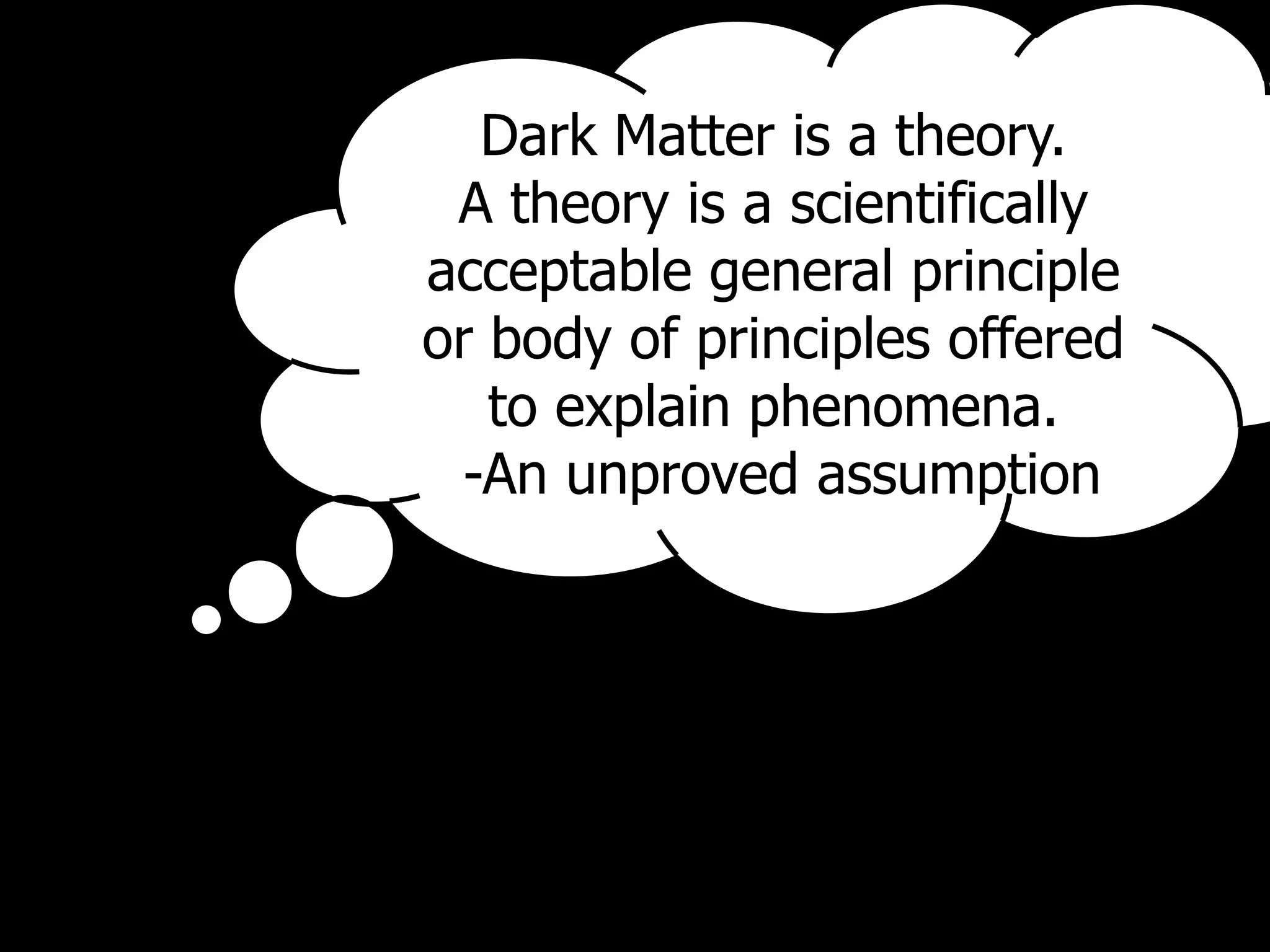
Dark Matter is a theory.
A theory is a scientifically
acceptable general principle
or body of principles offered
to explain phenomena.
-An unproved assumption
• Most of the matter in the universe is not
atoms found on planets or stars.
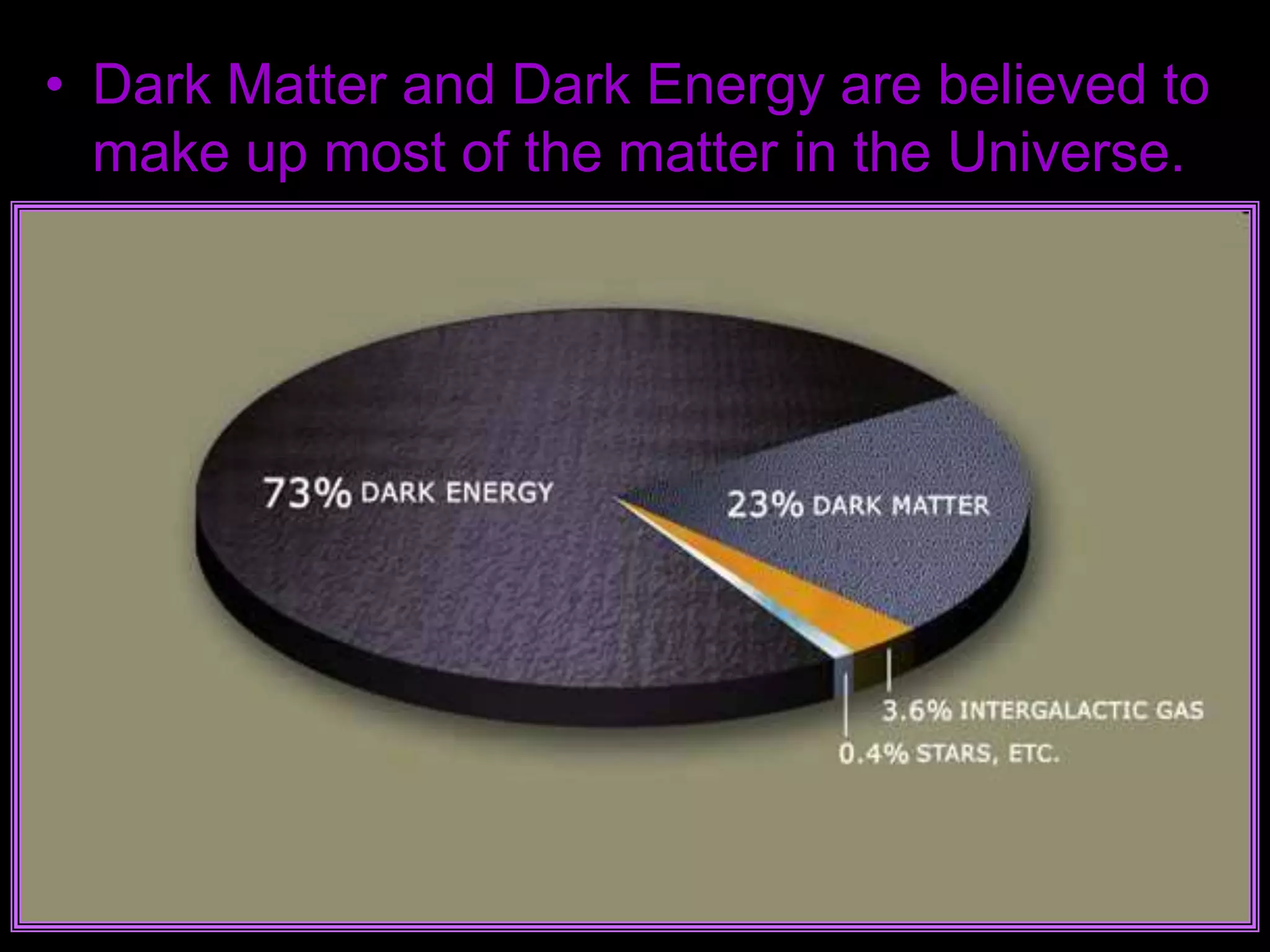
• Dark Matter and Dark Energy are believed to
make up most of the matter in the Universe.
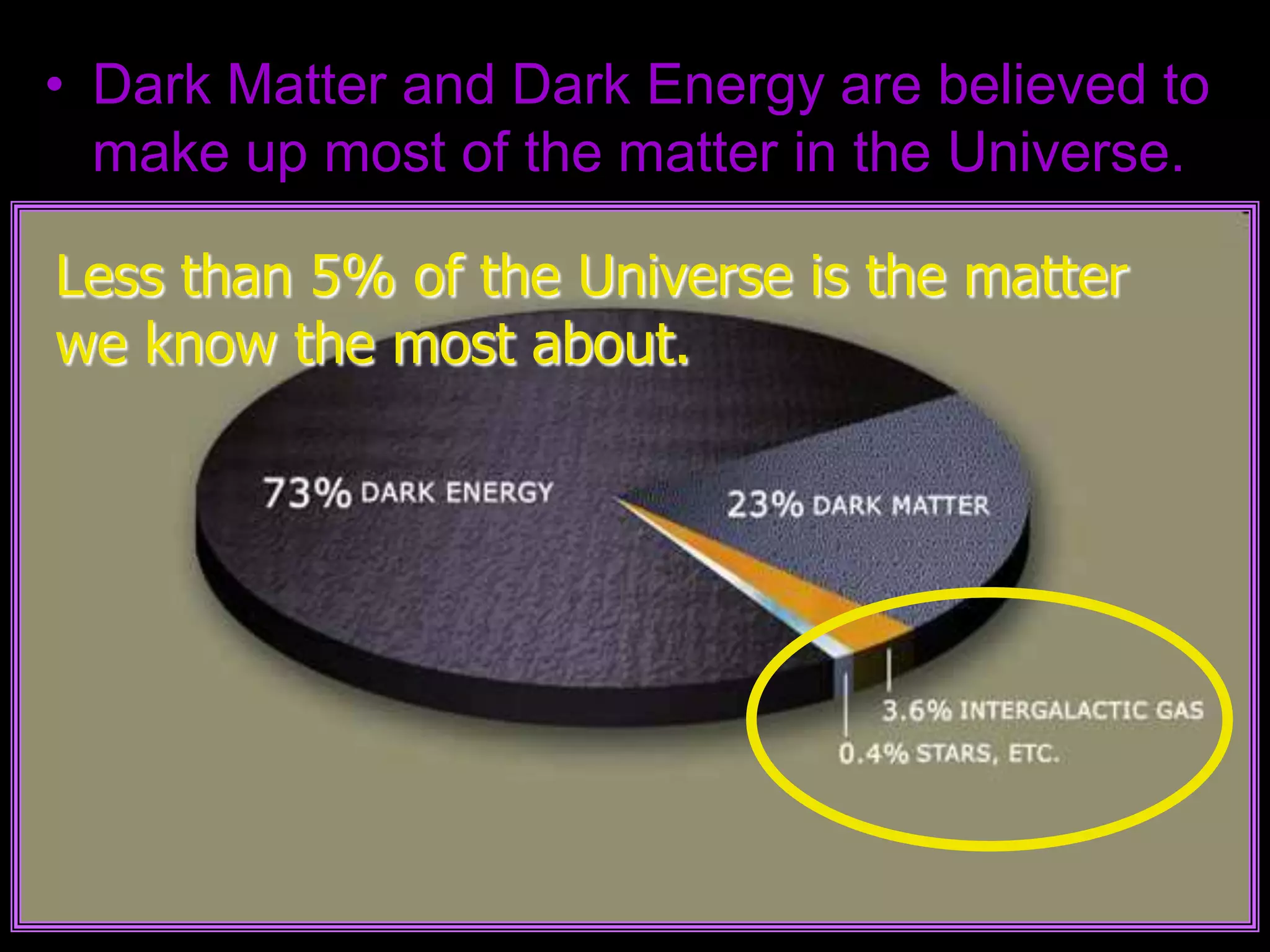
• Dark Matter and Dark Energy are believed to
make up most of the matter in the Universe.
Less than 5% of the Universe is the matter
we know the most about.
“It’s called Dark Matter
and Dark Energy, not
because it’s evil, but
because we still don’t
know a lot about it.”
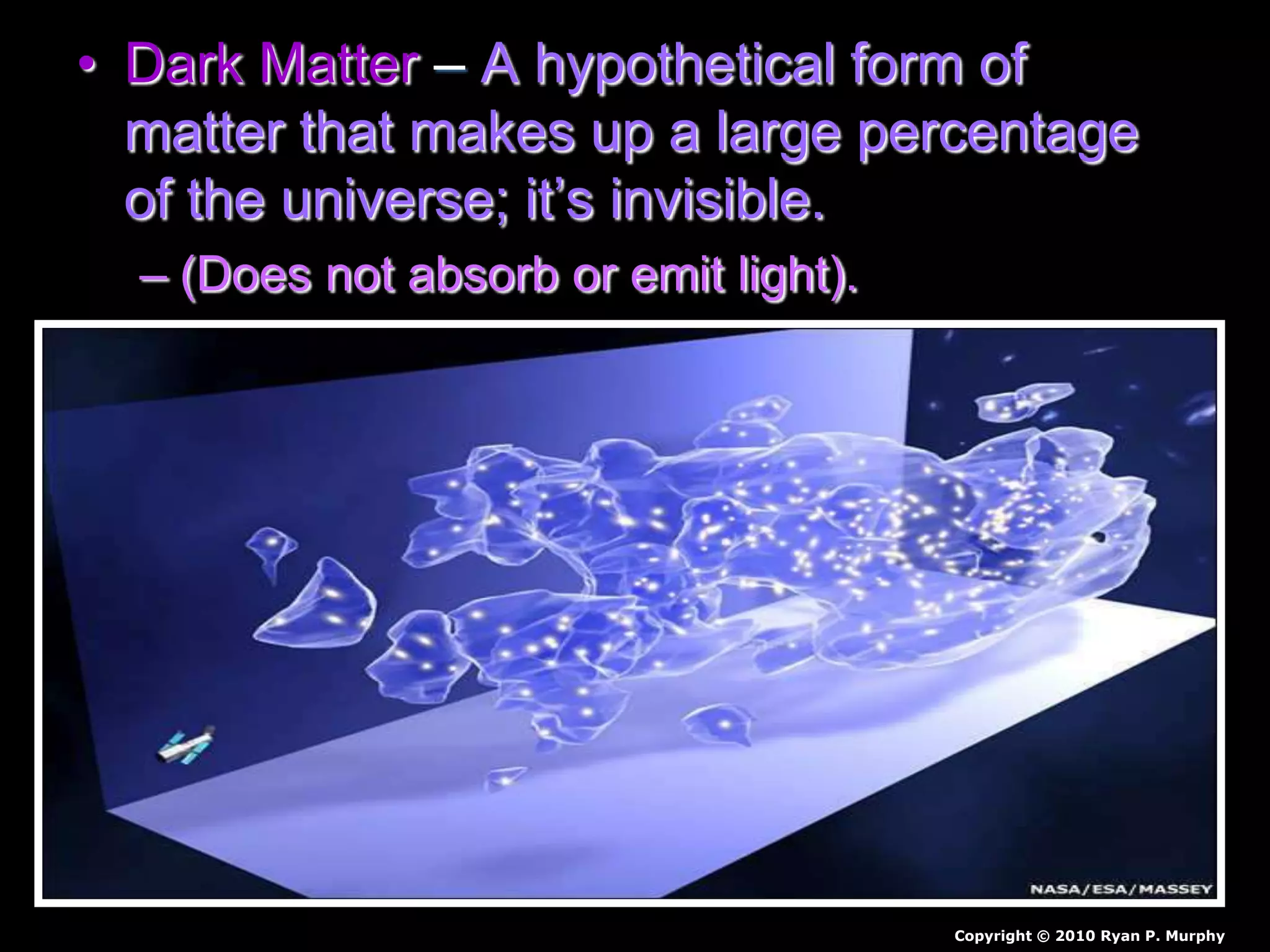
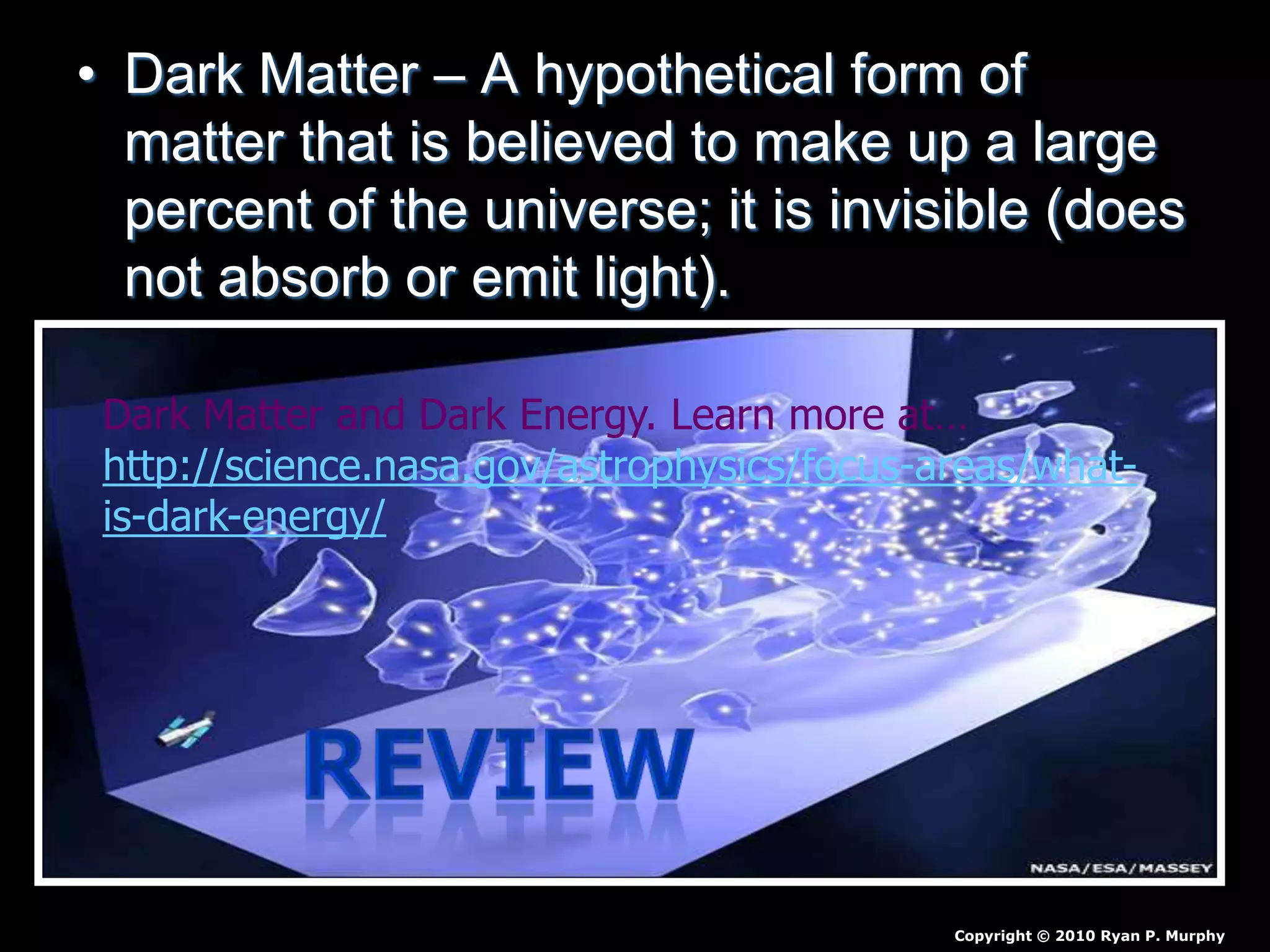
• Dark Matter – A hypothetical form of
matter that makes up a large percentage
of the universe; it’s invisible.
– (Does not absorb or emit light).
Copyright © 2010 Ryan P. Murphy
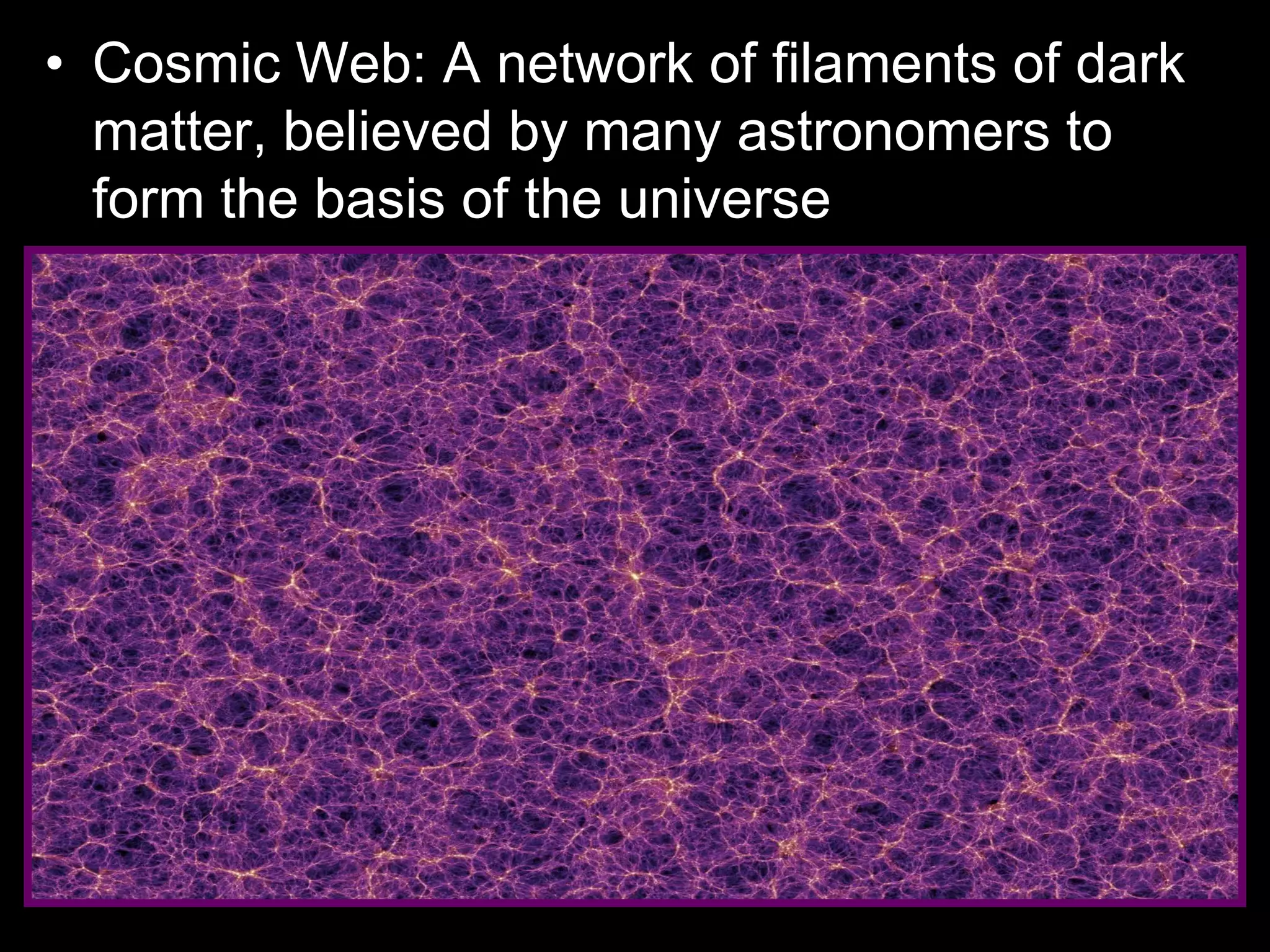
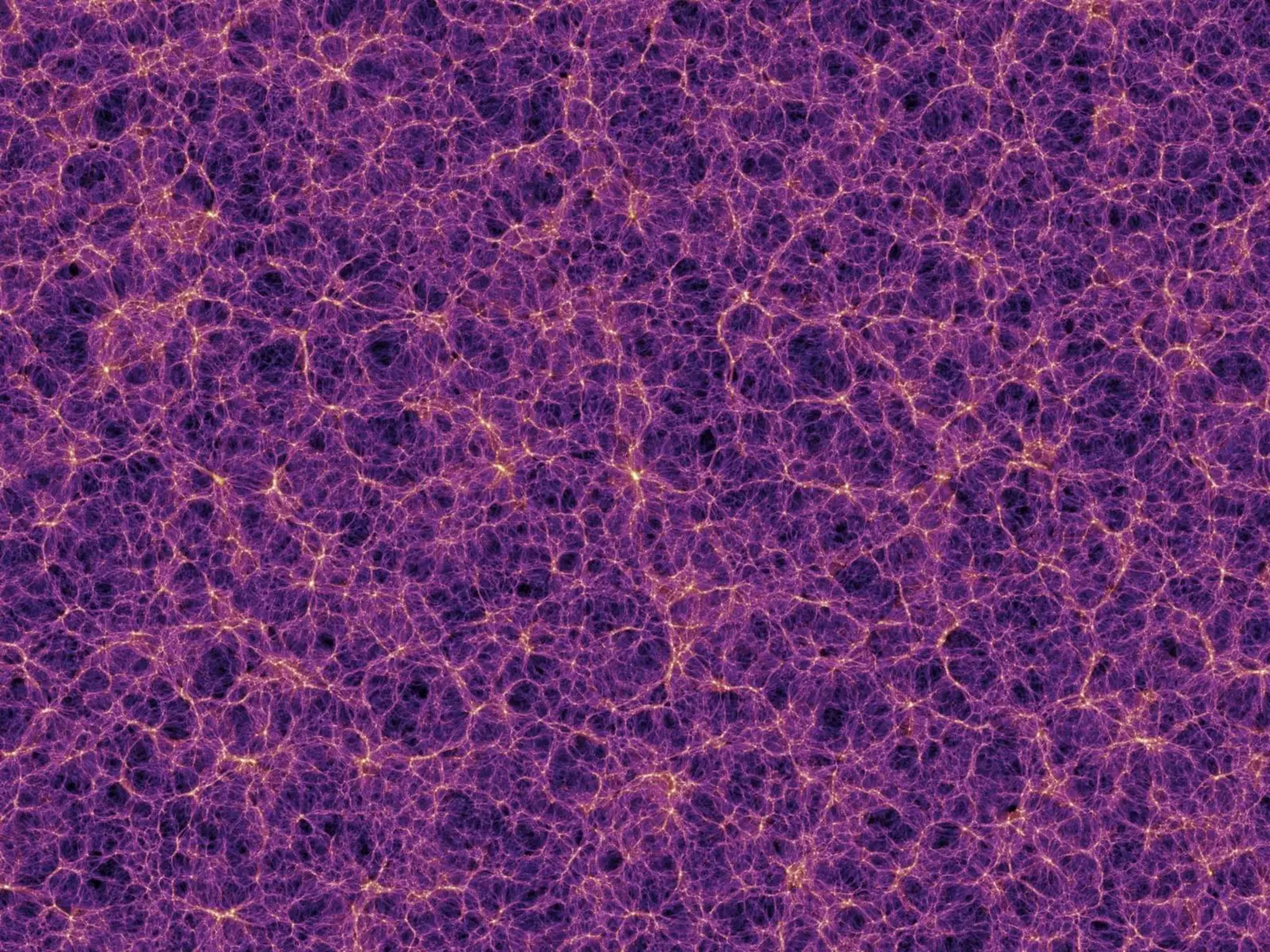
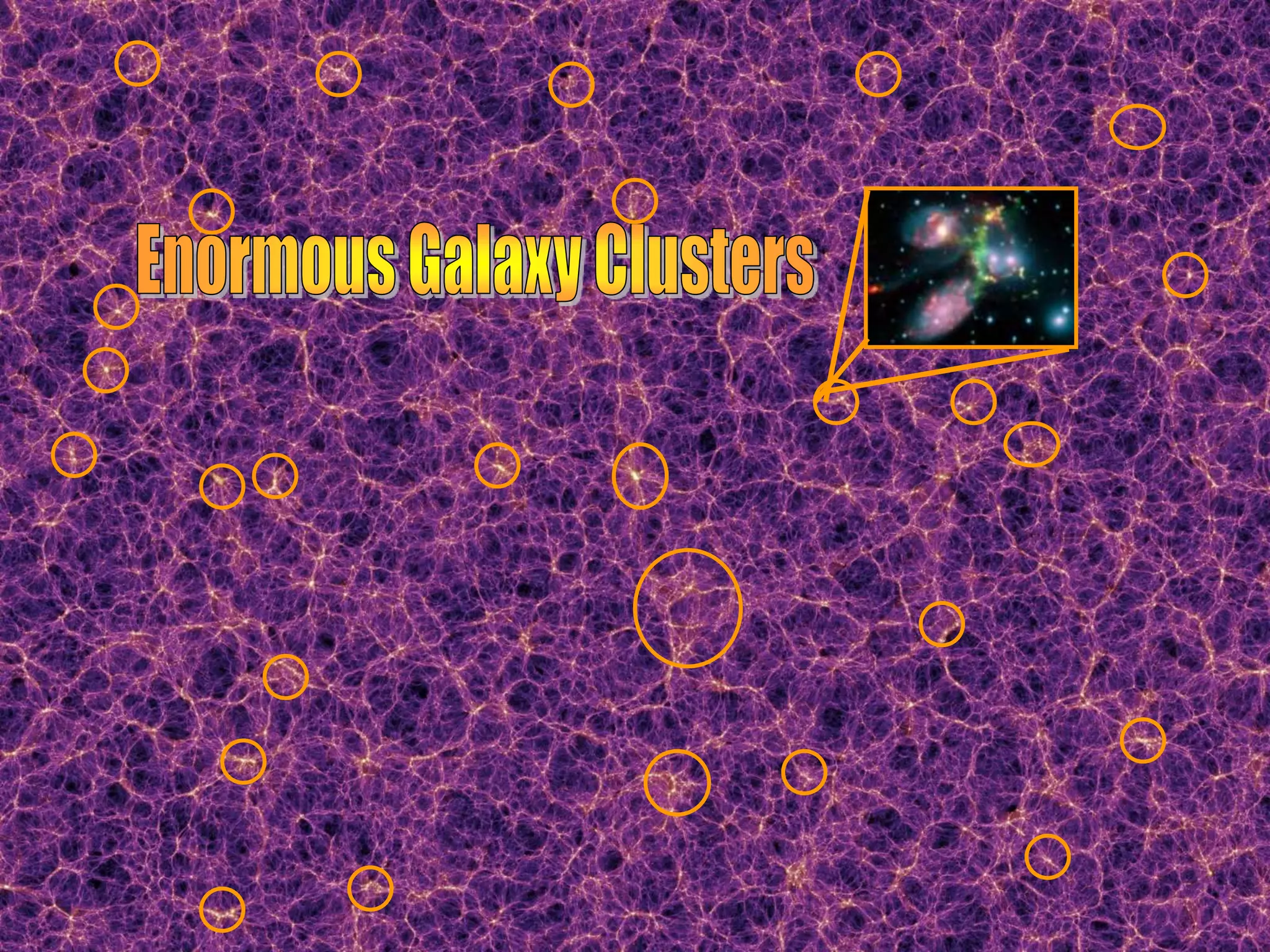
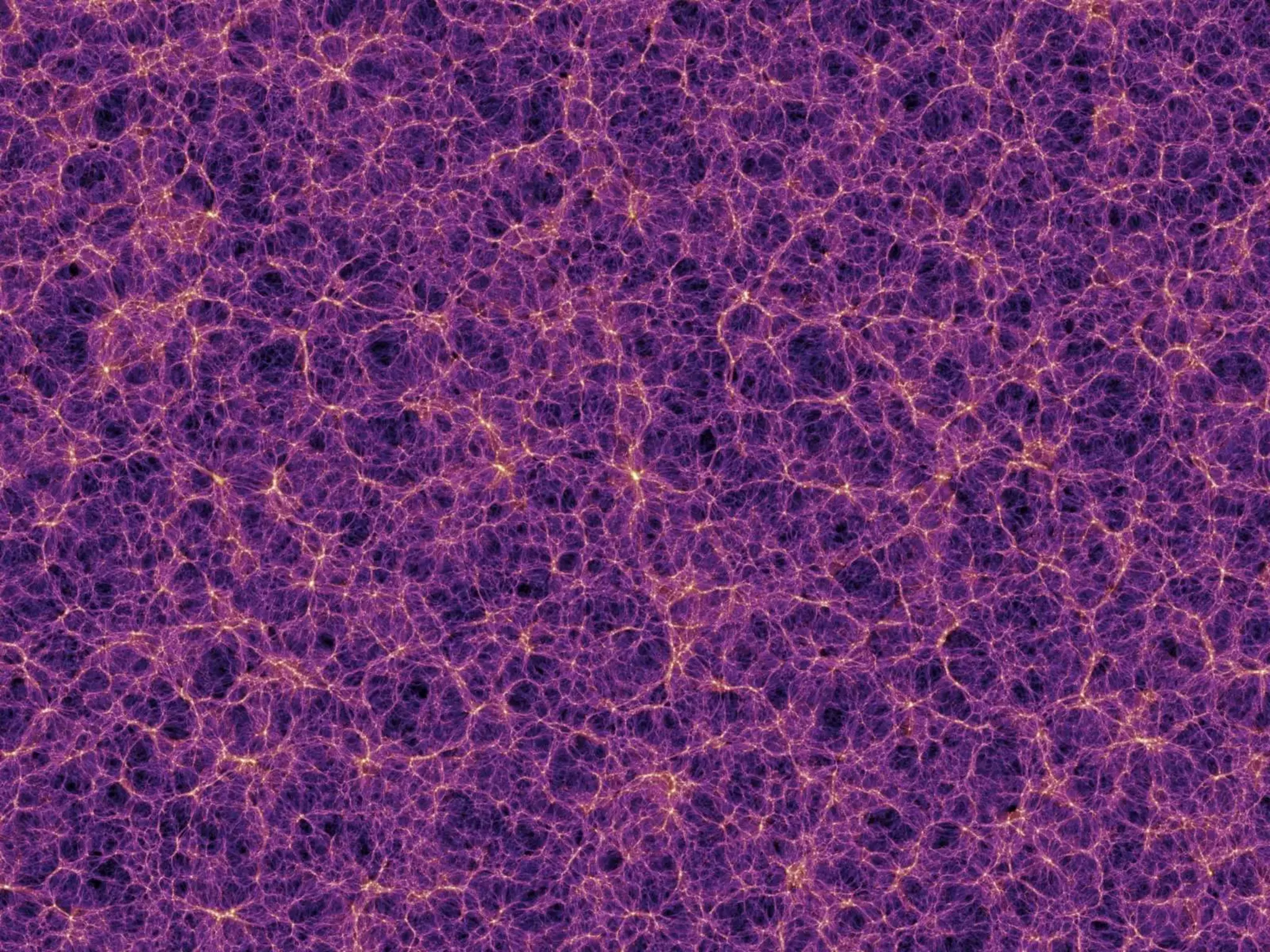
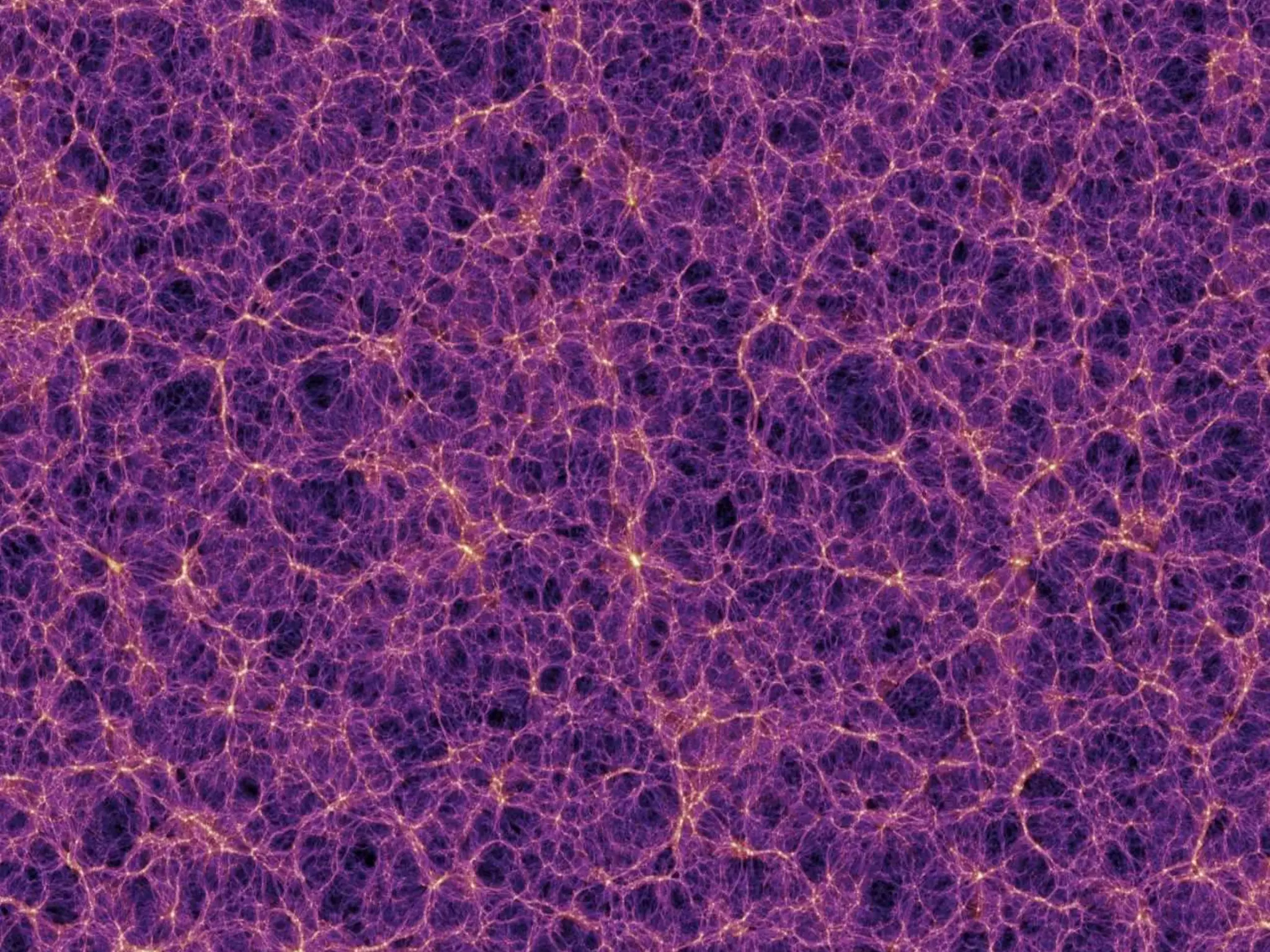
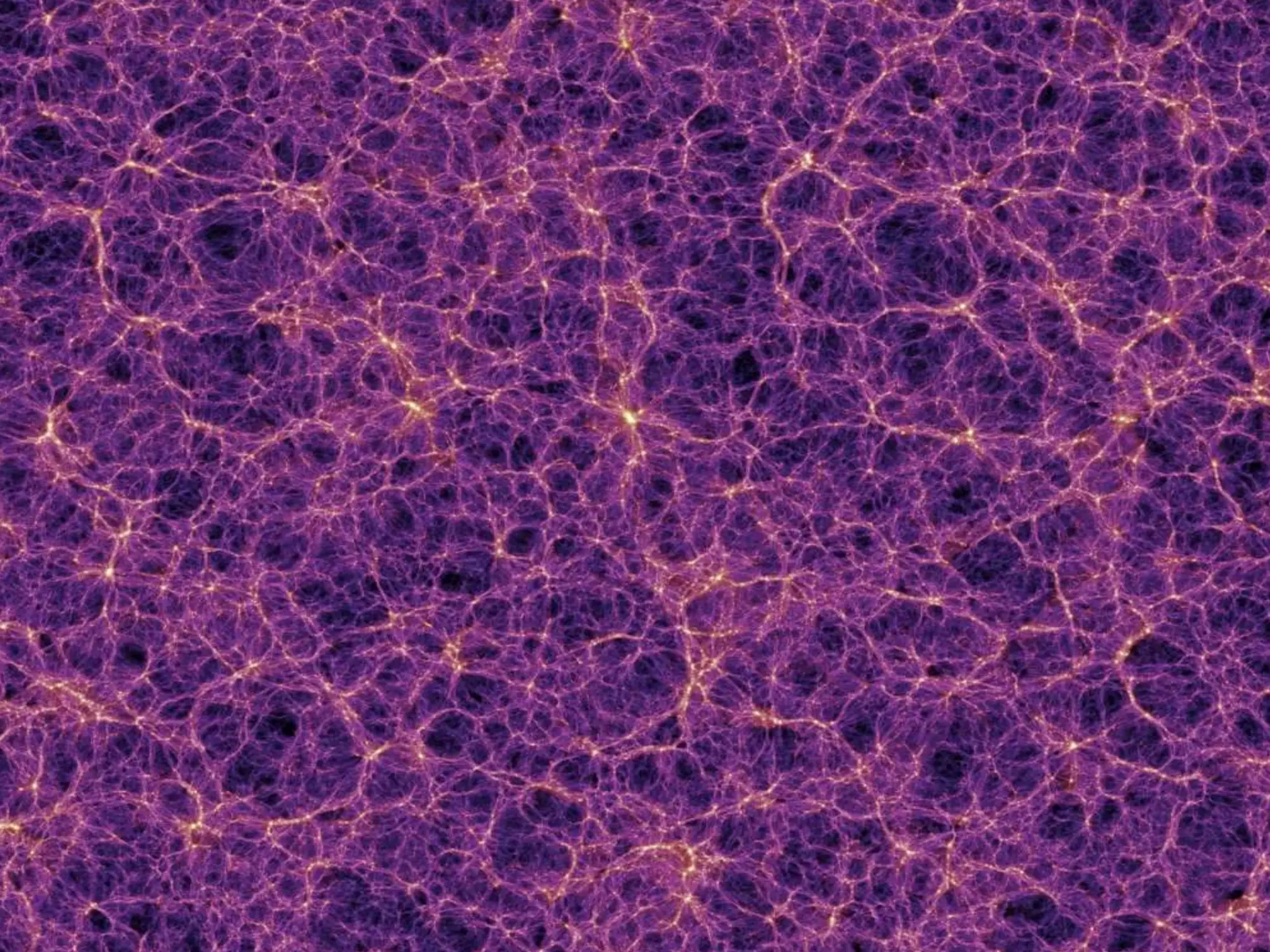
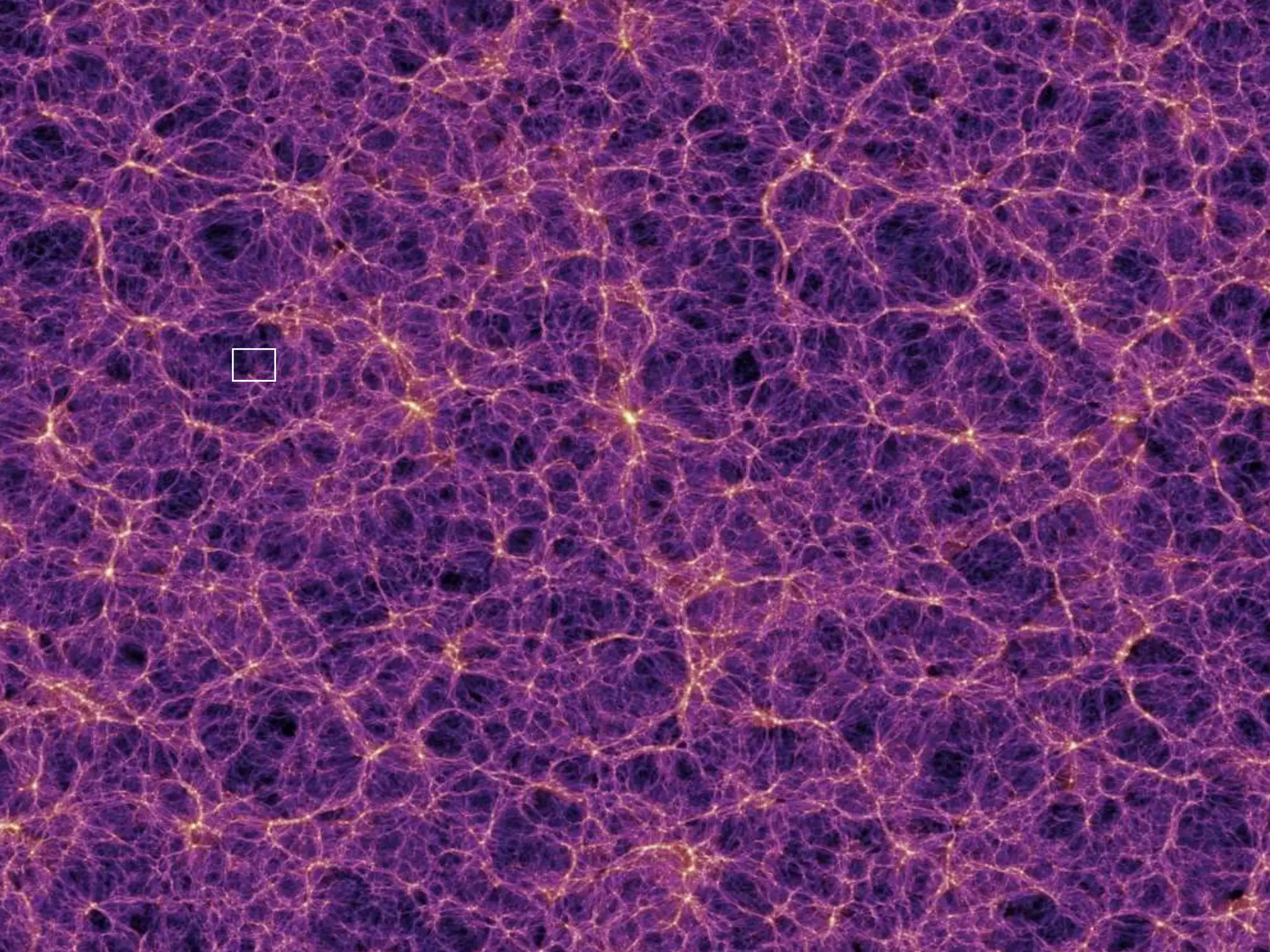
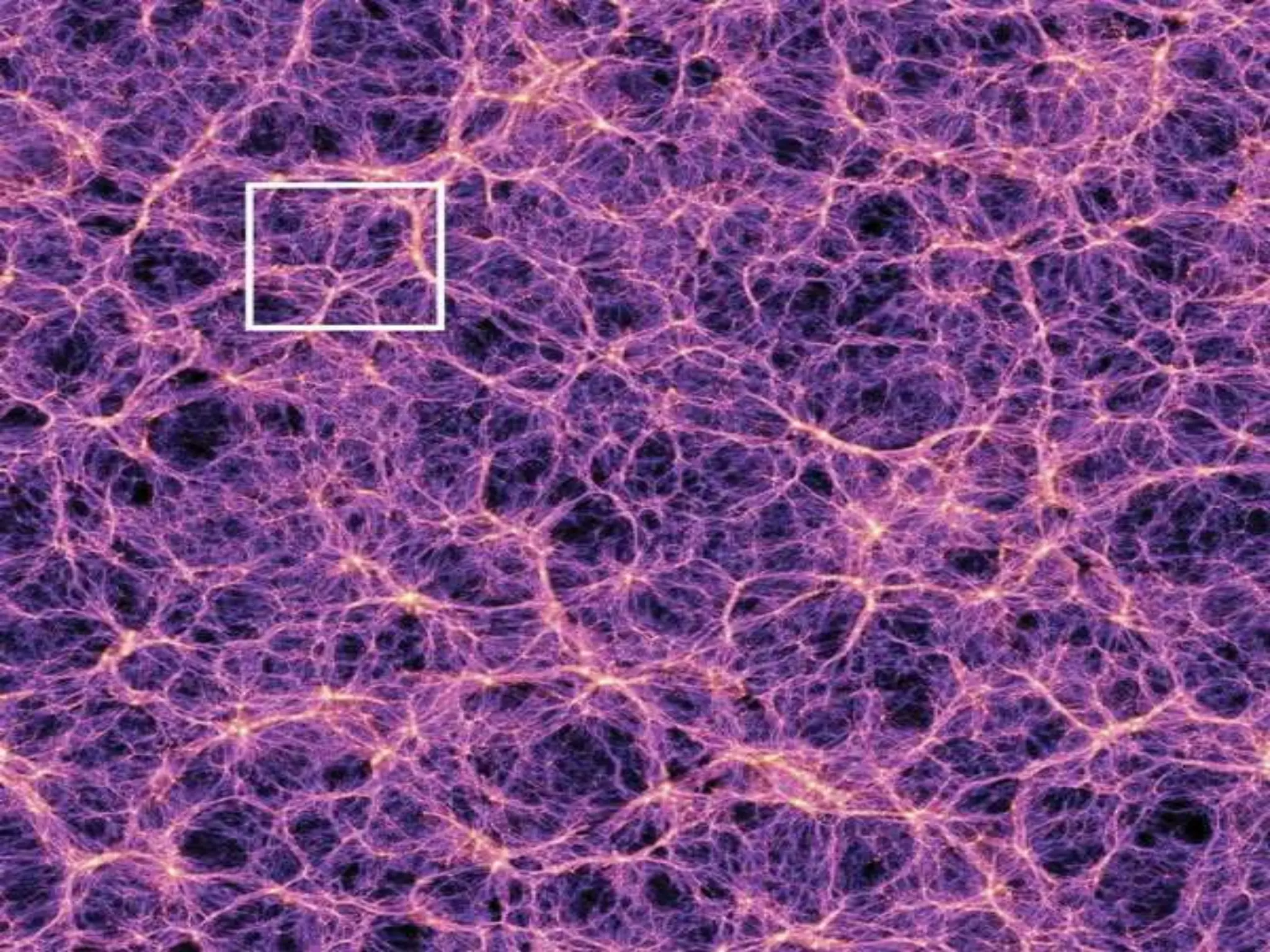
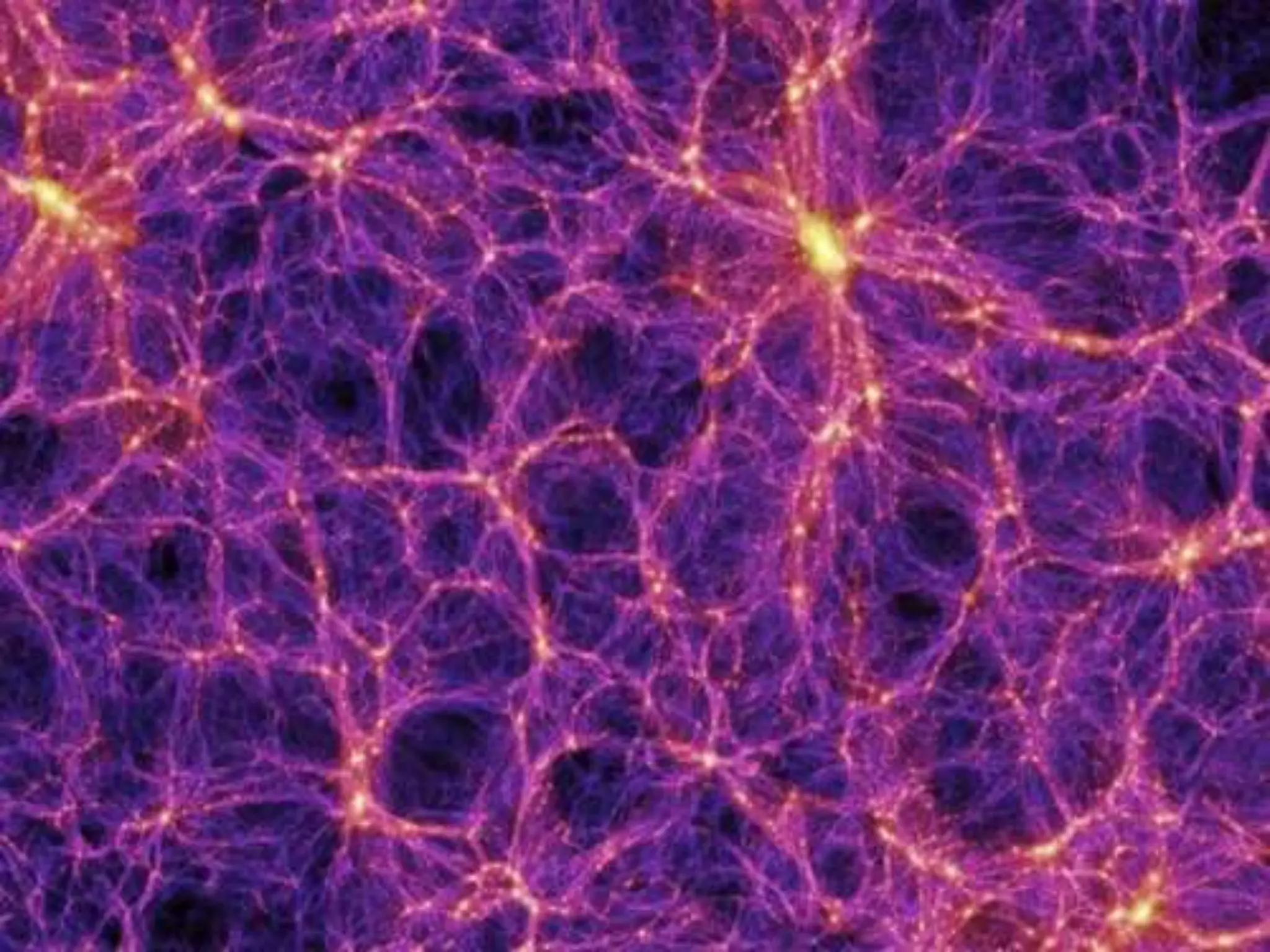
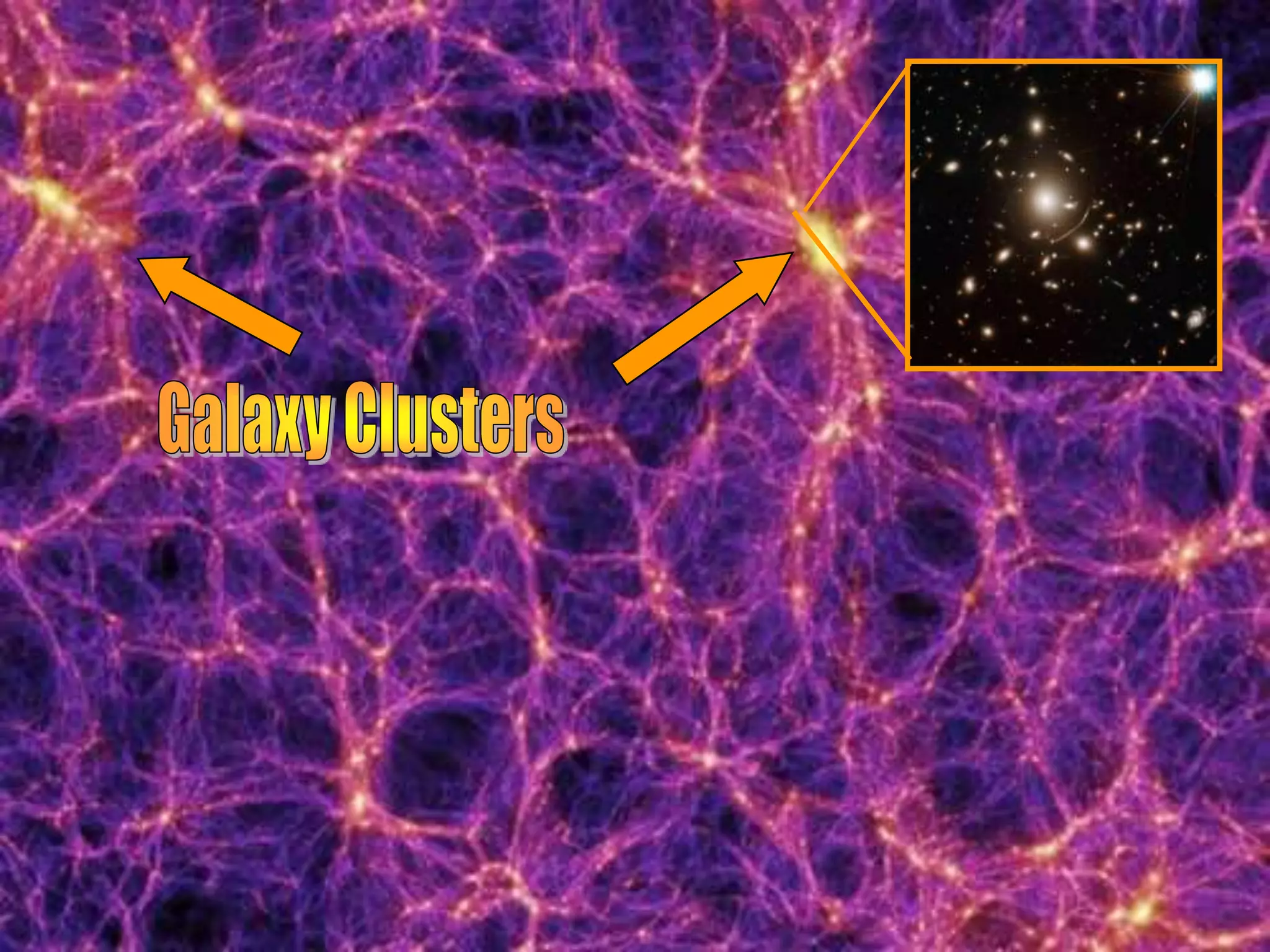
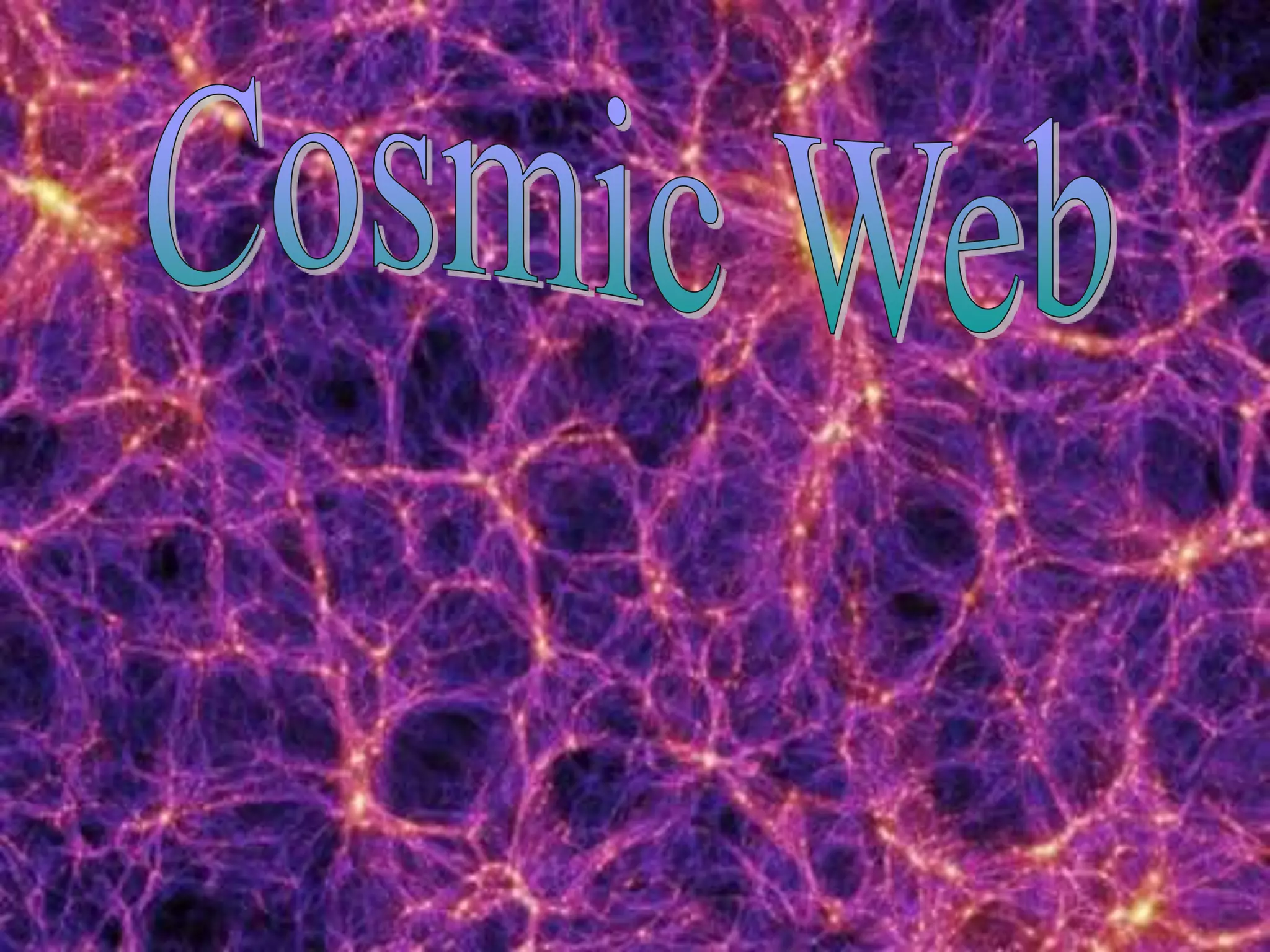
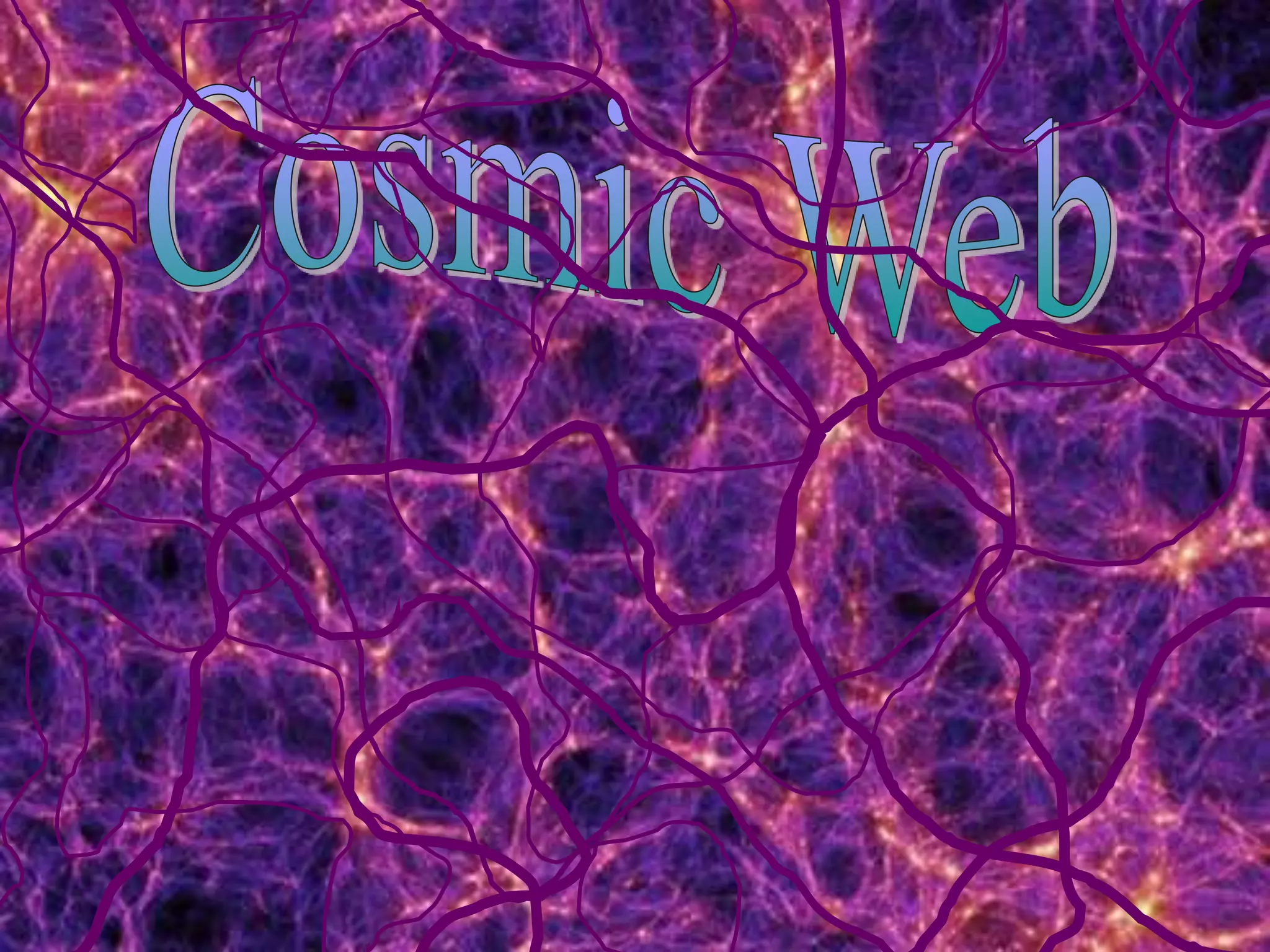
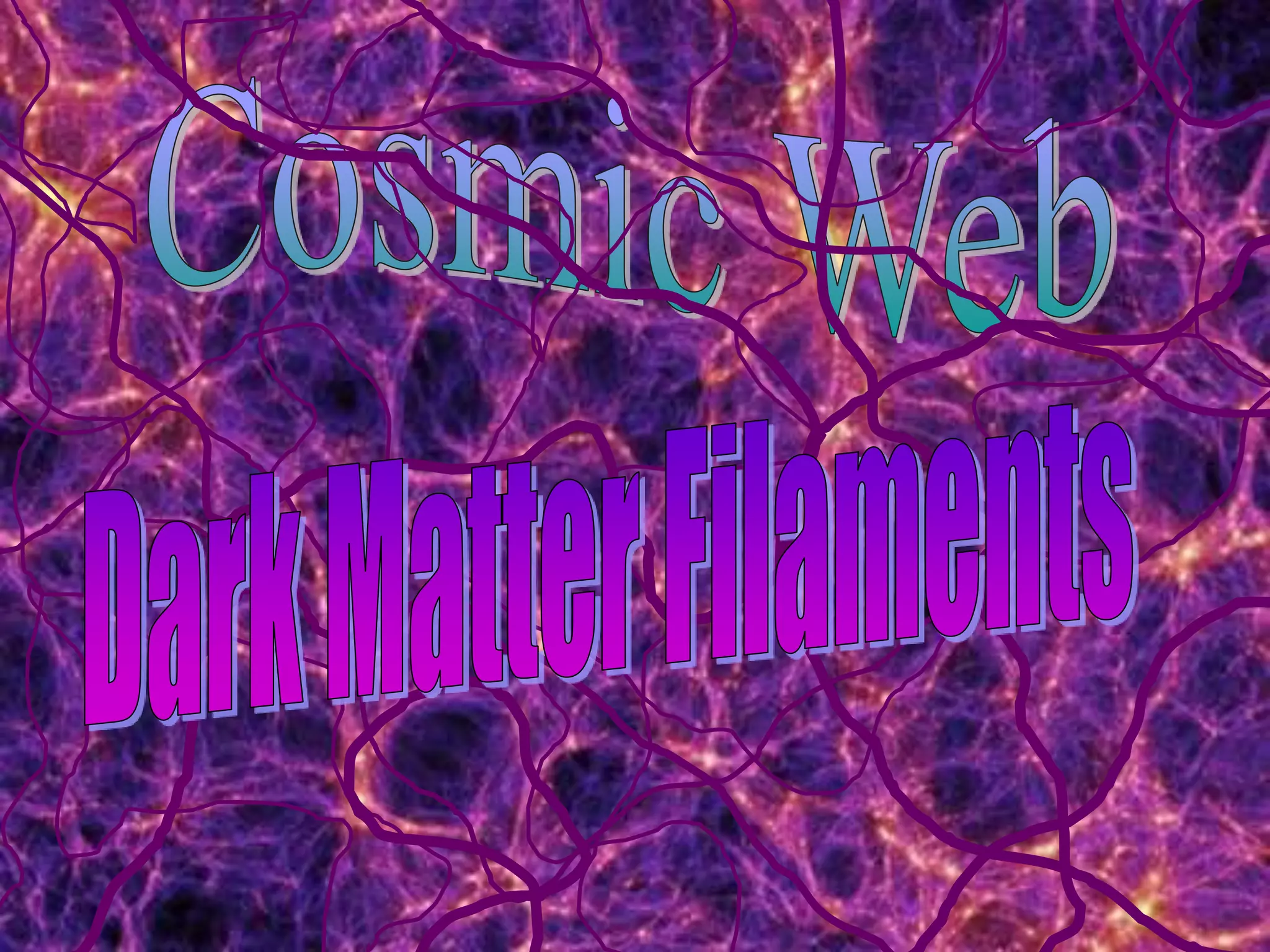
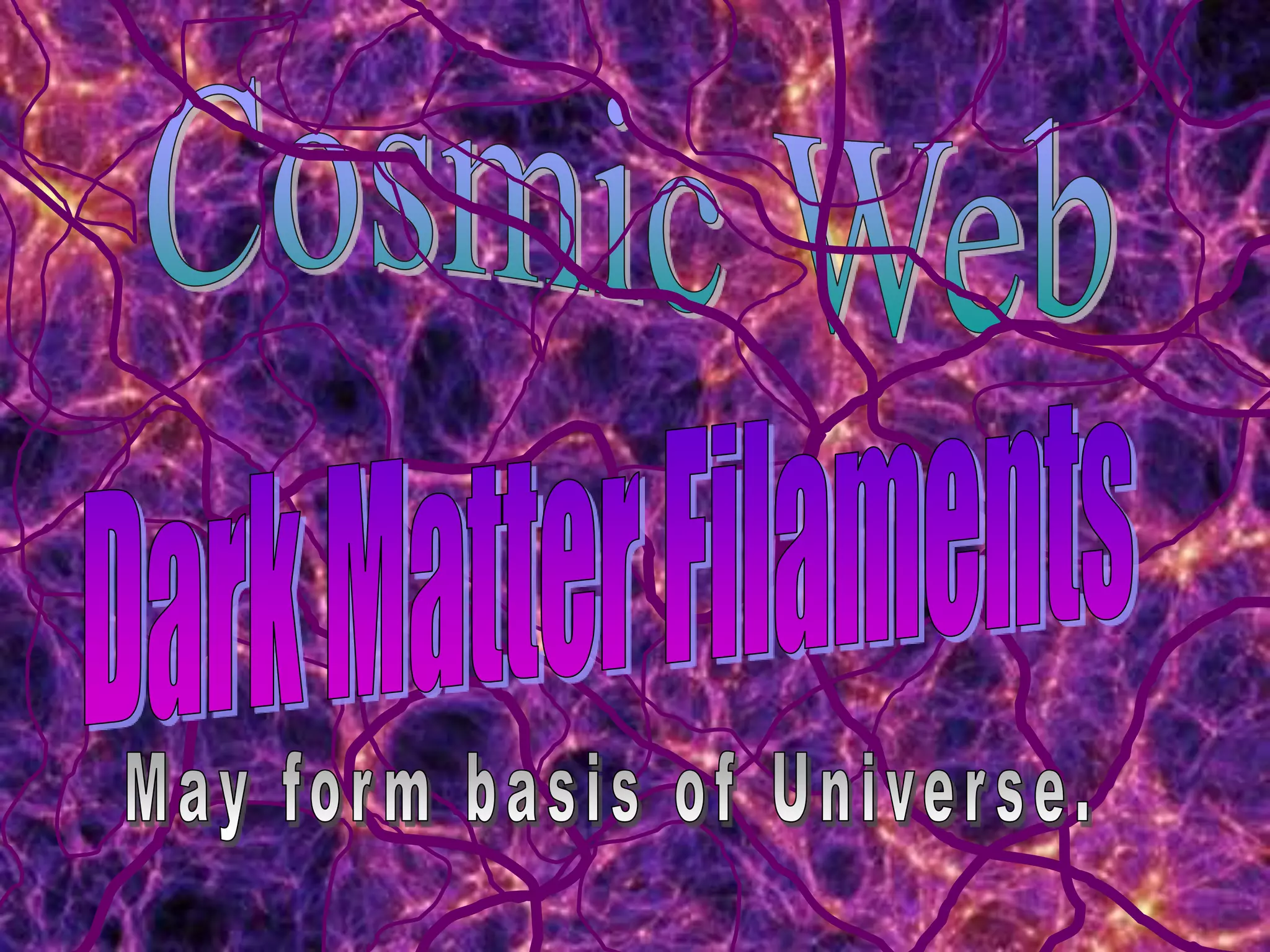
• Cosmic Web: A network of filaments of dark
matter, believed by many astronomers to
form the basis of the universe
Copyright © 2010 Ryan P. Murphy
“We are still in the
dark when it comes
to fully
understanding these
forms of Matter.”
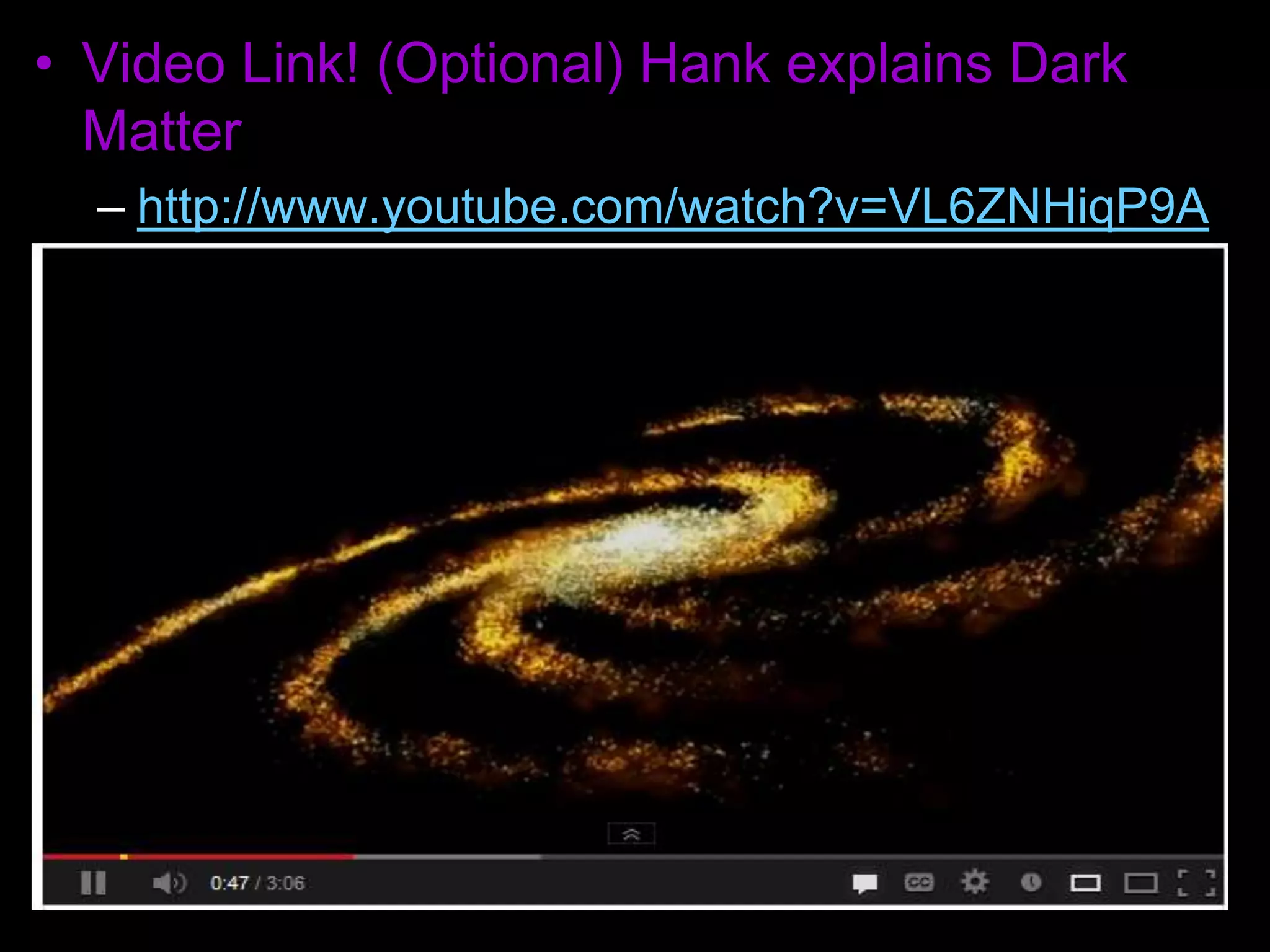
• Video Link! (Optional) Hank explains Dark
Matter
– http://www.youtube.com/watch?v=VL6ZNHiqP9A
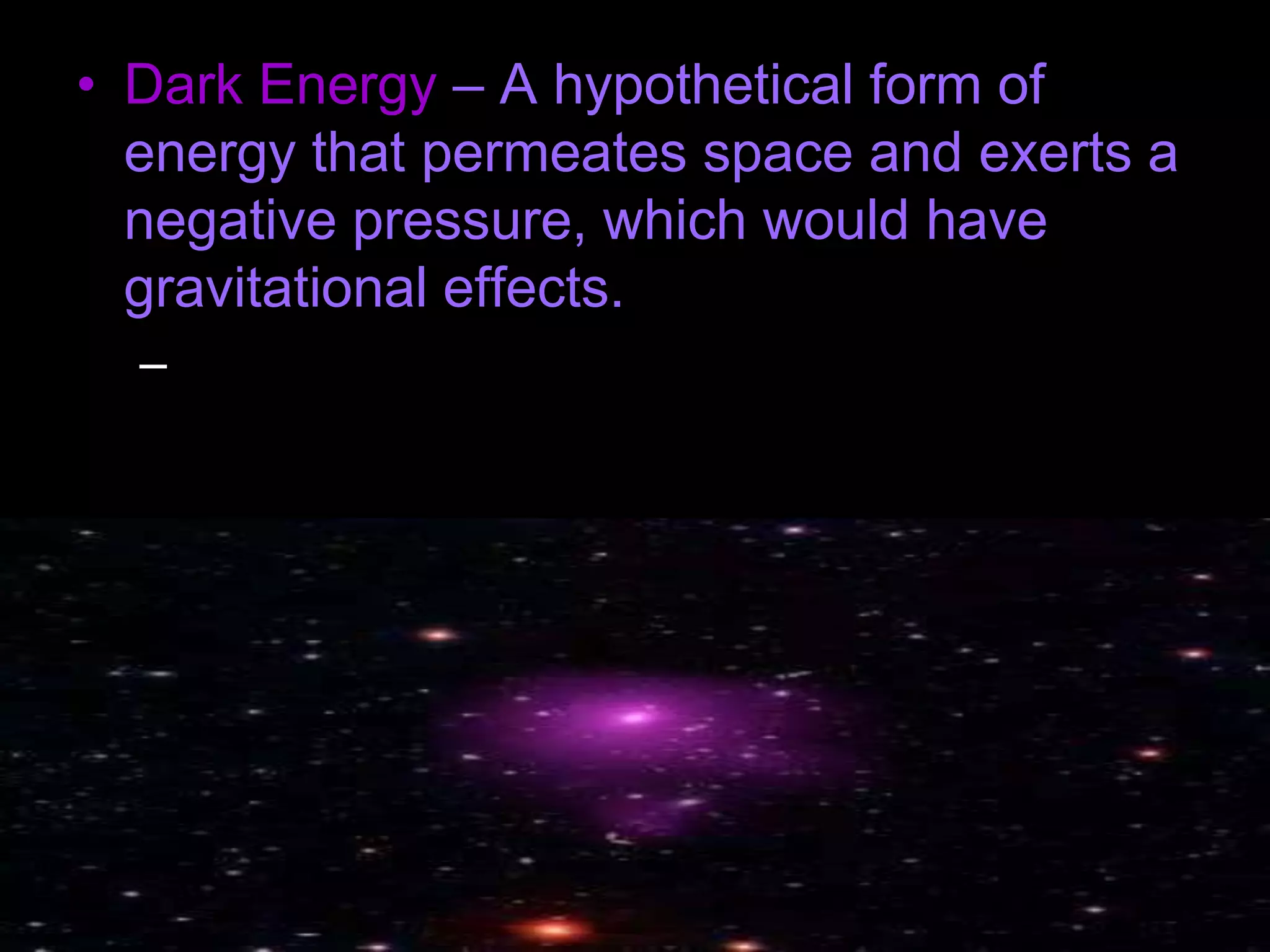
• Dark Energy – A hypothetical form of
energy that permeates space and exerts a
negative pressure, which would have
gravitational effects.
– This account for the differences between the
theoretical and observational results of
gravitational effects on visible matter.
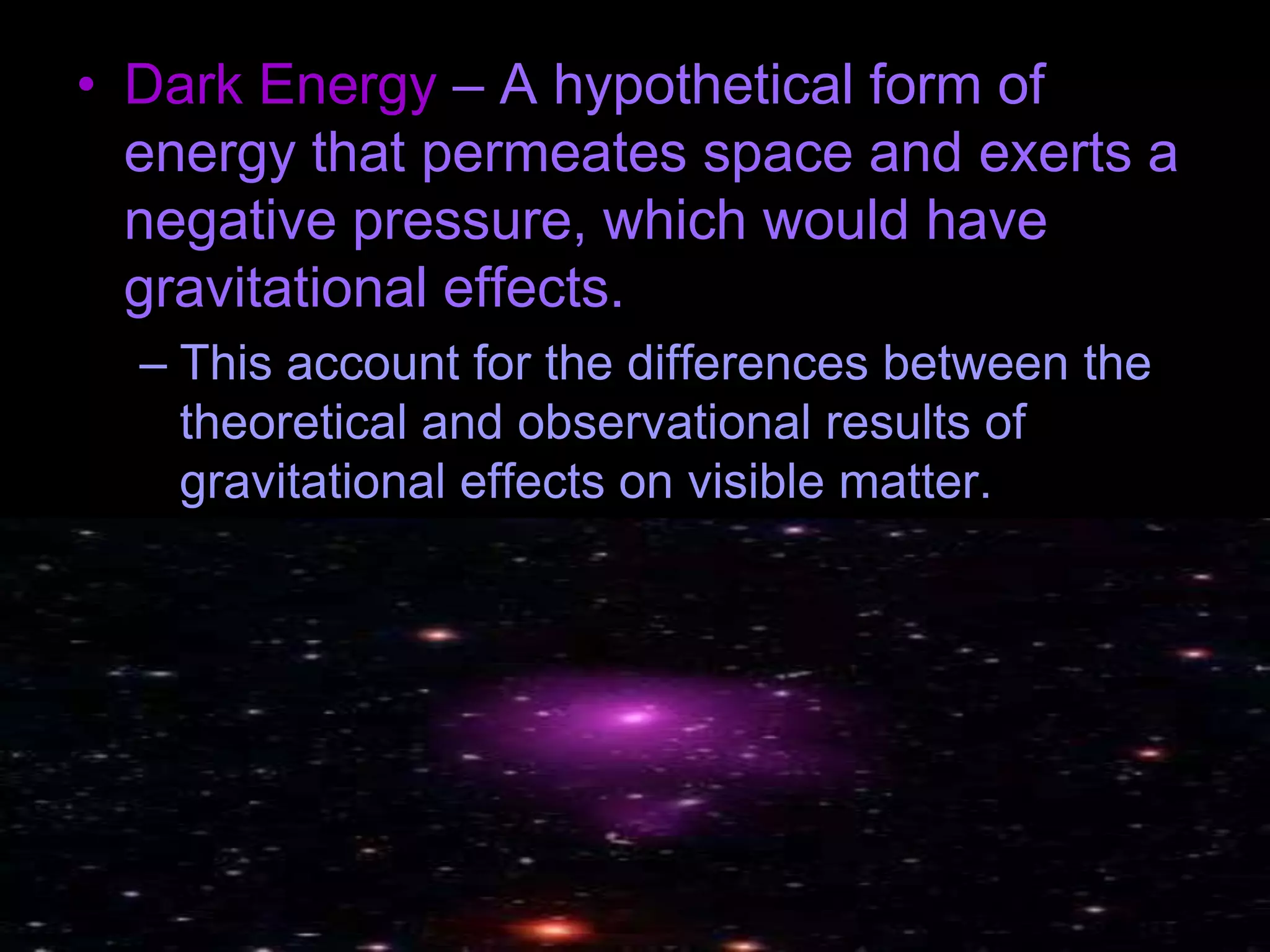
• Dark Energy – A hypothetical form of
energy that permeates space and exerts a
negative pressure, which would have
gravitational effects.
– This account for the differences between the
theoretical and observational results of
gravitational effects on visible matter.
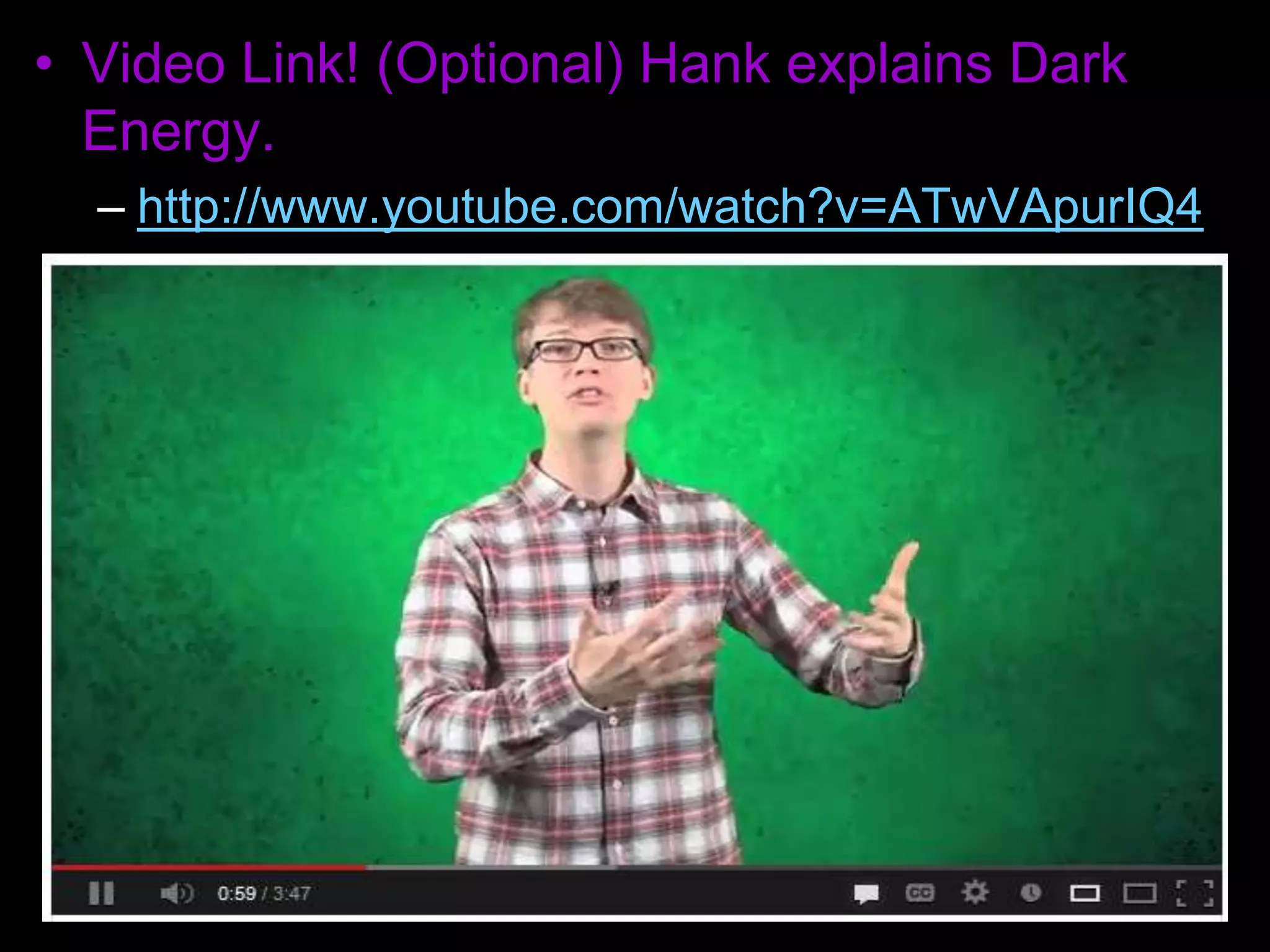
• Video Link! (Optional) Hank explains Dark
Energy.
– http://www.youtube.com/watch?v=ATwVApurIQ4
• Science knows how much Dark Energy
there is because we know how it affects
the Universe's expansion.
• Science knows how much Dark Energy
there is because we know how it affects
the Universe's expansion.
– Other than that, it is still mostly a mystery.
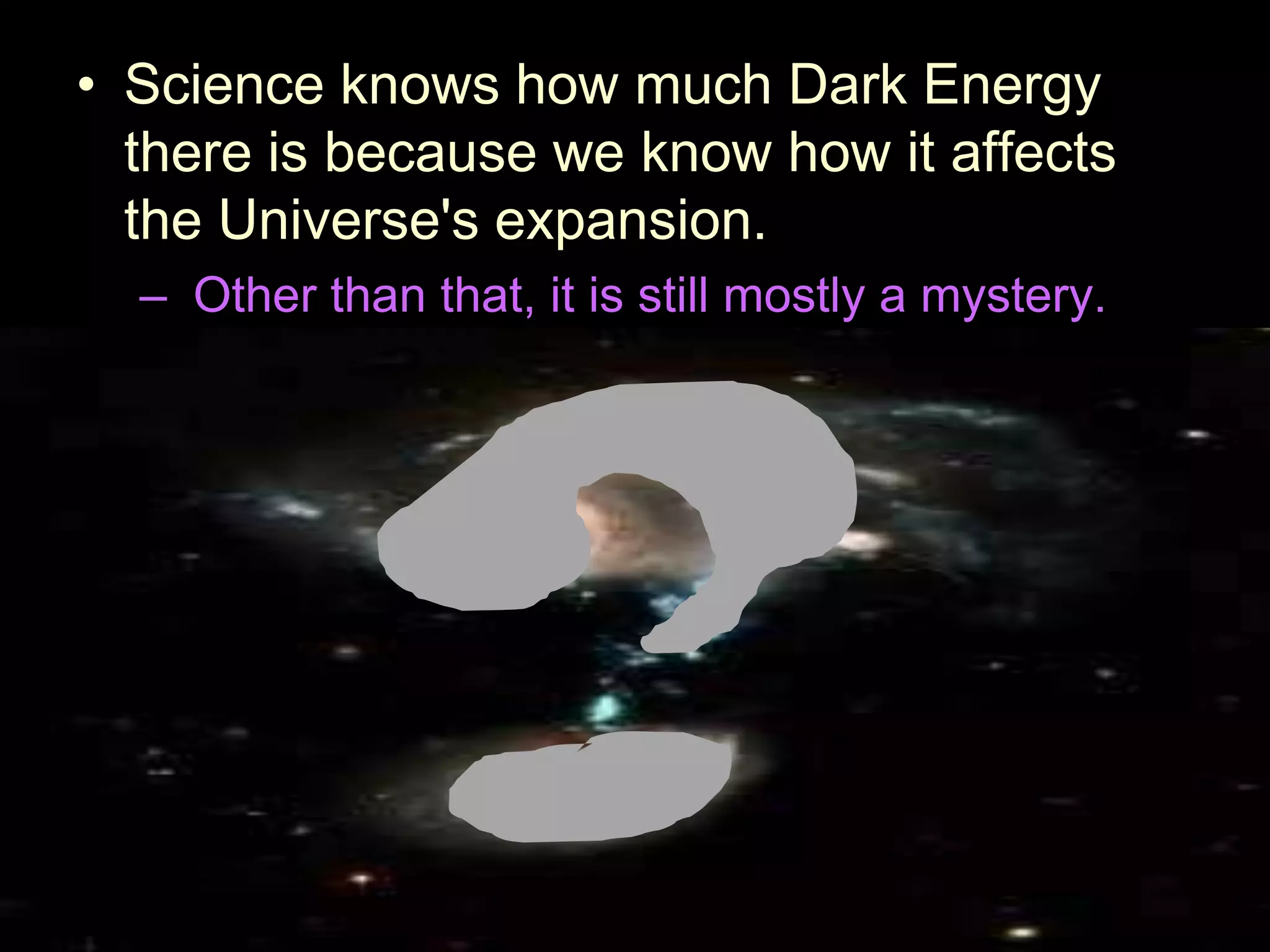
• Science knows how much Dark Energy
there is because we know how it affects
the Universe's expansion.
– Other than that, it is still mostly a mystery.
• To describe Dark Matter in easy form for
you.
• To describe Dark Matter in easy form for
you.
– Dark Matter
• To describe Dark Matter in easy form for
you.
– Dark Matter
• 25% of the Universe
• To describe Dark Matter in easy form for
you.
– Dark Matter
• 25% of the Universe
• Does not absorb or emit light
• To describe Dark Matter in easy form for
you.
– Dark Matter
• 25% of the Universe
• Does not absorb or emit light
• Not normal matter (Stars and Planets)
• To describe Dark Matter in easy form for
you.
– Dark Matter
• 25% of the Universe
• Does not absorb or emit light
• Not normal matter (Stars and Planets)
• Not anti-matter
• To describe Dark Matter in easy form for
you.
– Dark Matter
• 25% of the Universe
• Does not absorb or emit light
• Not normal matter (Stars and Planets)
• Not anti-matter
• Possibilities for Dark Matter include MACHOs, and
WIMPs.
• MACHOs
• (MAssive Compact Halo Objects): Objects
ranging in size from small stars to super
massive black holes. MACHOS are made
of ordinary matter (like protons, neutrons
and electrons). They may be black holes,
neutron stars, or brown dwarfs.
• MACHOs
• (MAssive Compact Halo Objects): Objects
ranging in size from small stars to super
massive black holes.
– MACHOS are made of ordinary matter (like
protons, neutrons and electrons). They may
be black holes, neutron stars, or brown
dwarfs.
• MACHOs
• (MAssive Compact Halo Objects): Objects
ranging in size from small stars to super
massive black holes.
– MACHOS are made of ordinary matter (like
protons, neutrons and electrons). They may
be black holes, neutron stars, or brown
dwarfs.
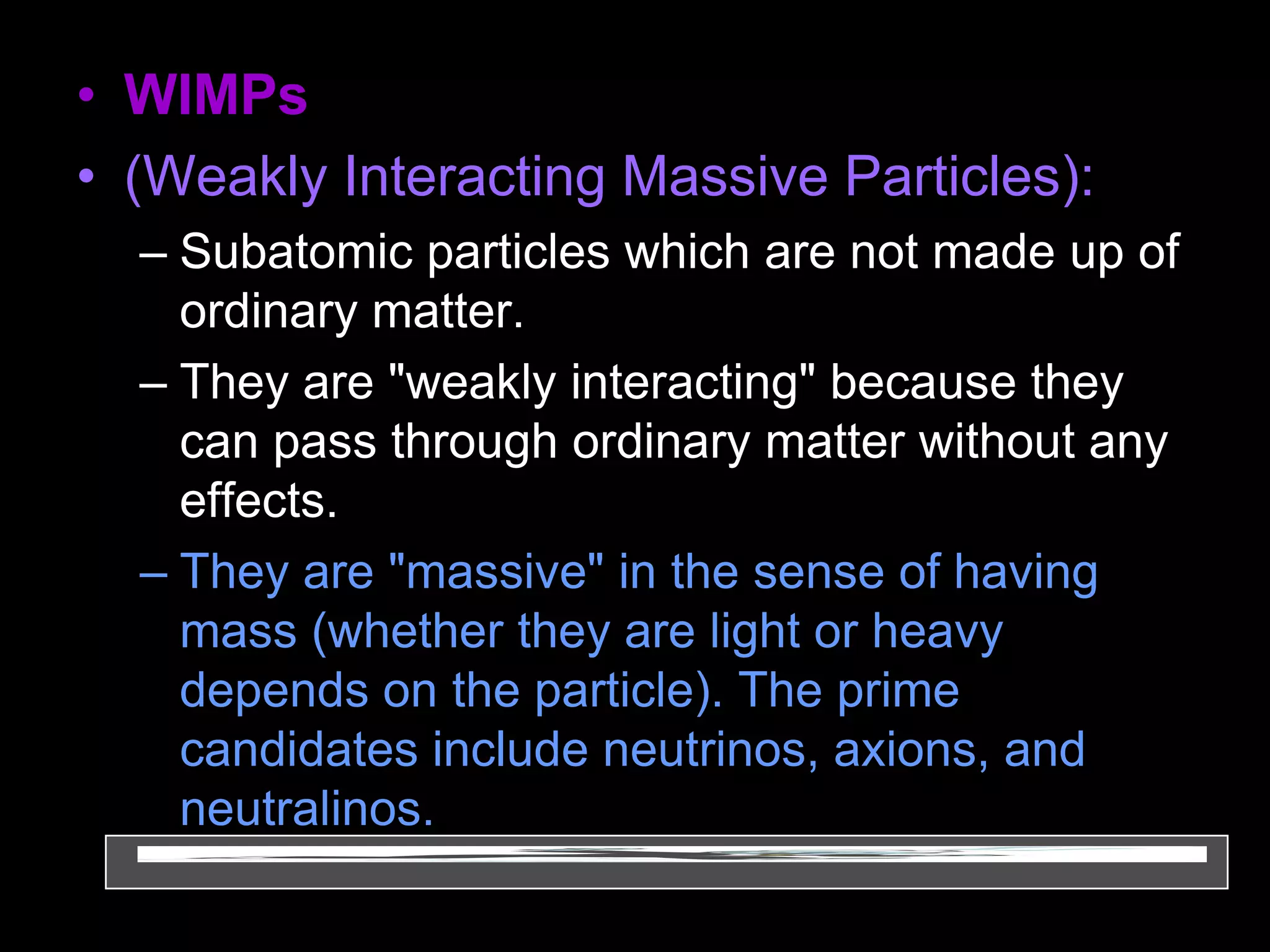
• WIMPs
• (Weakly Interacting Massive Particles):
– Subatomic particles which are not made up of
ordinary matter.
– They are "weakly interacting" because they
can pass through ordinary matter without any
effects.
– They are "massive" in the sense of having
mass (whether they are light or heavy
depends on the particle). The prime
candidates include neutrinos, axions, and
neutralinos.
• WIMPs
• (Weakly Interacting Massive Particles):
– Subatomic particles which are not made up of
ordinary matter.
– They are "weakly interacting" because they
can pass through ordinary matter without any
effects.
– They are "massive" in the sense of having
mass (whether they are light or heavy
depends on the particle). The prime
candidates include neutrinos, axions, and
neutralinos.
• WIMPs
• (Weakly Interacting Massive Particles):
– Subatomic particles which are not made up of
ordinary matter.
– They are "weakly interacting" because they
can pass through ordinary matter without any
effects.
– They are "massive" in the sense of having
mass (whether they are light or heavy
depends on the particle). The prime
candidates include neutrinos, axions, and
neutralinos.
• WIMPs
• (Weakly Interacting Massive Particles):
– Subatomic particles which are not made up of
ordinary matter.
– They are "weakly interacting" because they
can pass through ordinary matter without any
effects.
– They are "massive" in the sense of having
mass (whether they are light or heavy
depends on the particle). The prime
candidates include neutrinos, axions, and
neutralinos.
“Oh-No”
• WIMPs
• (Weakly Interacting Massive Particles):
– Subatomic particles which are not made up of
ordinary matter.
– They are "weakly interacting" because they
can pass through ordinary matter without any
effects.
– They are "massive" in the sense of having
mass (whether they are light or heavy
depends on the particle). The prime
candidates include neutrinos, axions, and
neutralinos.
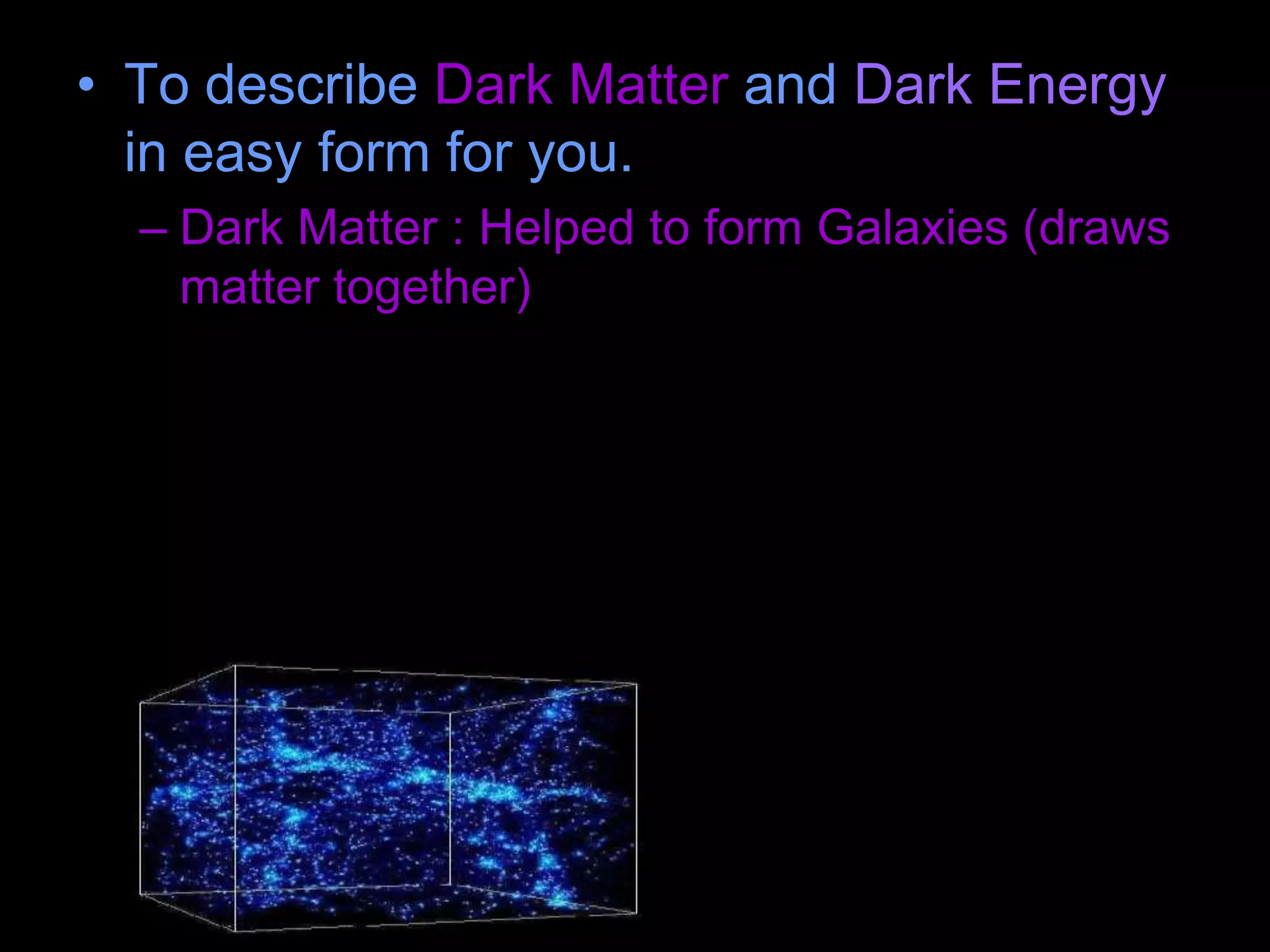
• To describe Dark Matter and Dark Energy
in easy form for you.
• To describe Dark Matter and Dark Energy
in easy form for you.
– Dark Matter : Helped to form Galaxies (draws
matter together)
• To describe Dark Matter and Dark Energy
in easy form for you.
– Dark Matter : Helped to form Galaxies (draws
matter together)
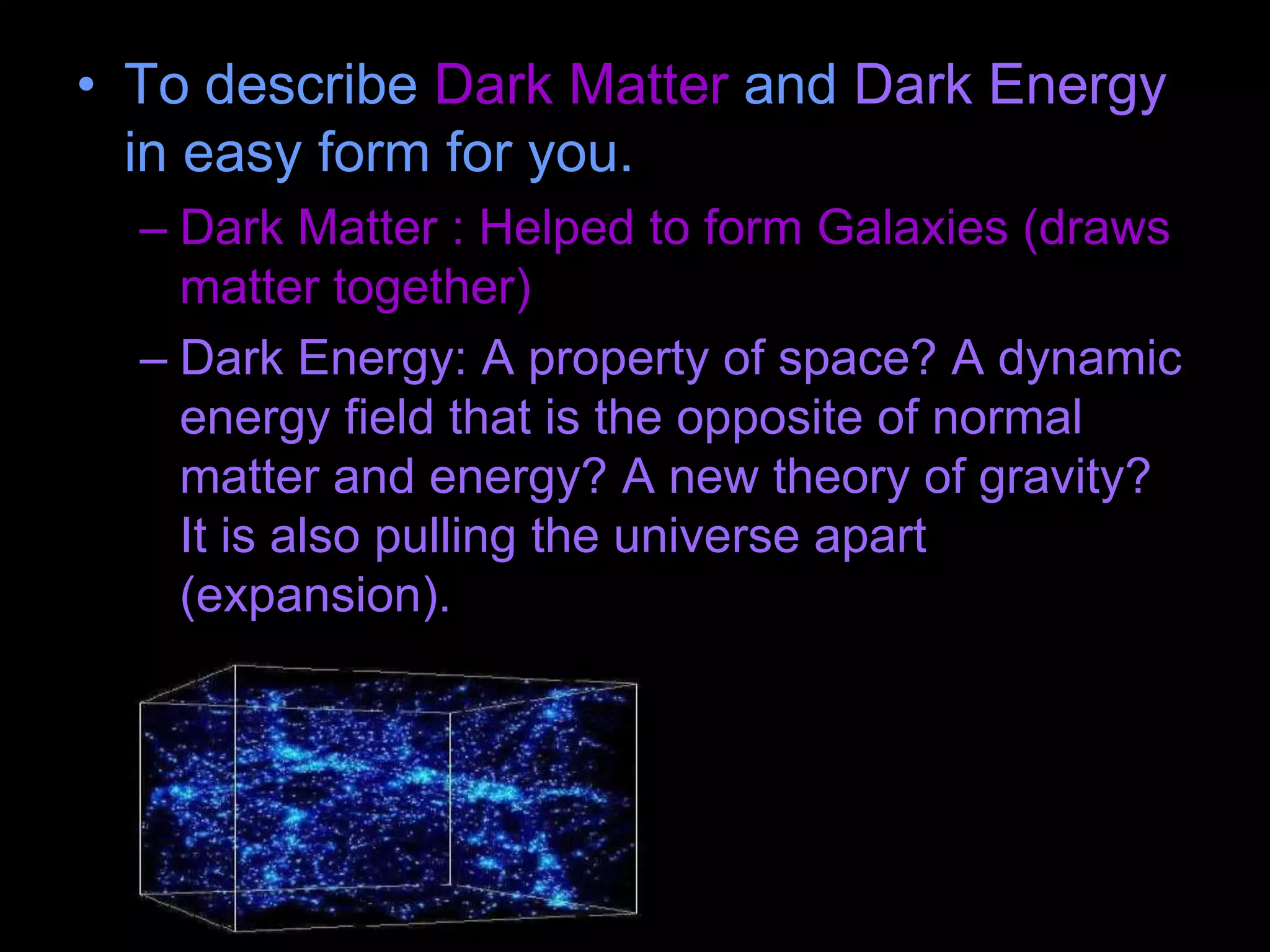
• To describe Dark Matter and Dark Energy
in easy form for you.
– Dark Matter : Helped to form Galaxies (draws
matter together)
– Dark Energy: A property of space? A dynamic
energy field that is the opposite of normal
matter and energy? A new theory of gravity?
It is also pulling the universe apart
(expansion).
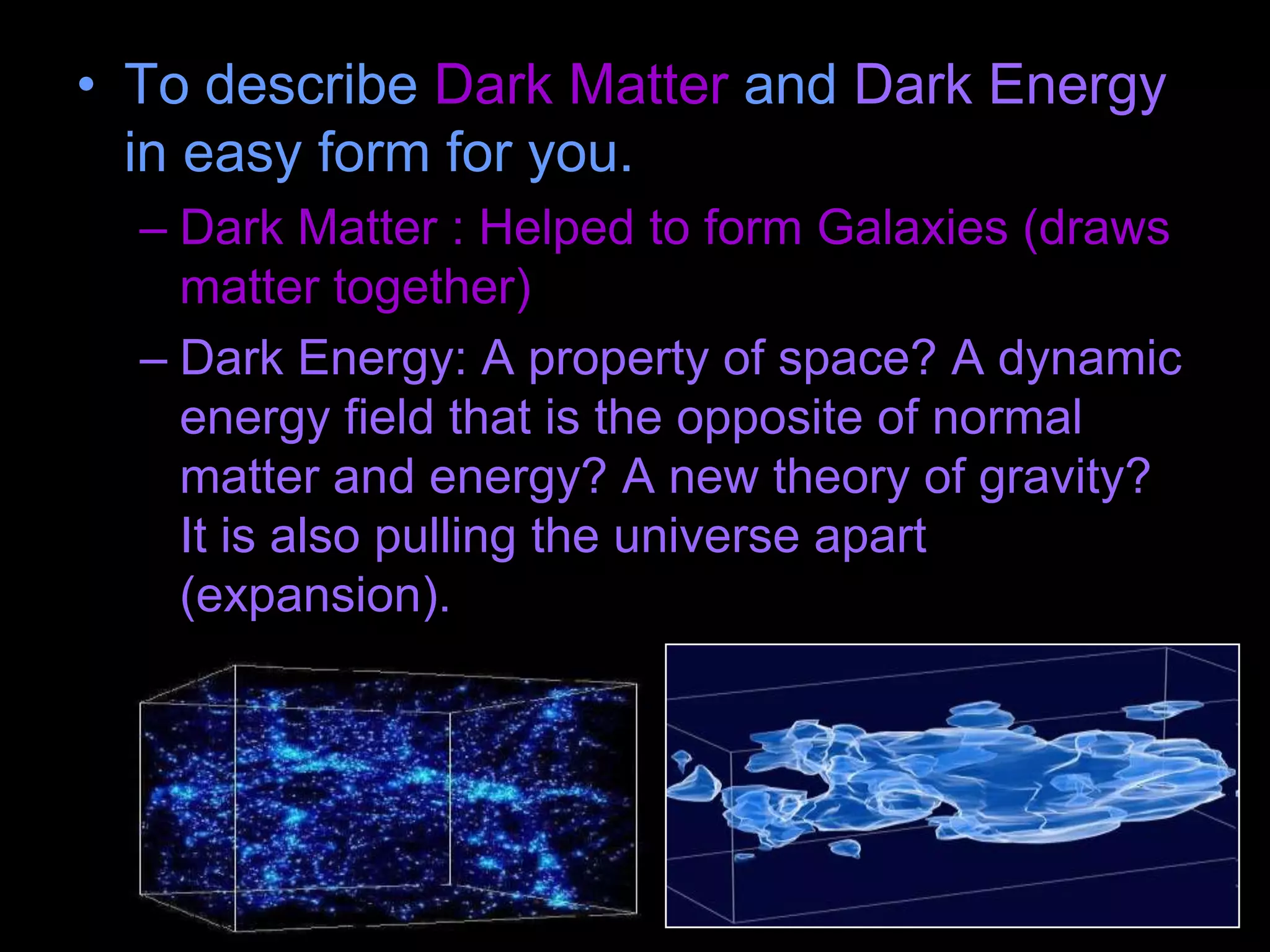
• To describe Dark Matter and Dark Energy
in easy form for you.
– Dark Matter : Helped to form Galaxies (draws
matter together)
– Dark Energy: A property of space? A dynamic
energy field that is the opposite of normal
matter and energy? A new theory of gravity?
It is also pulling the universe apart
(expansion).
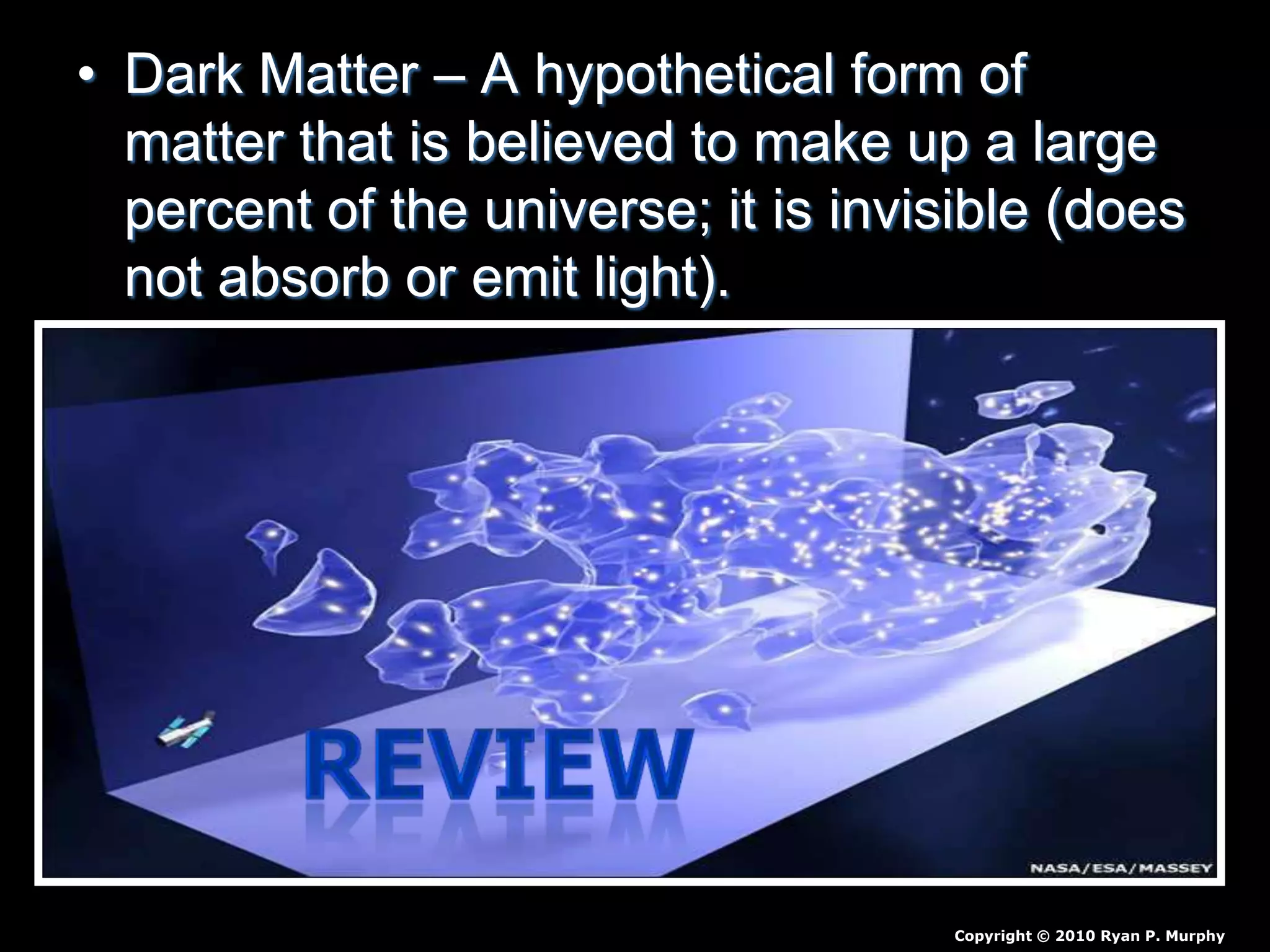
• Dark Matter – A hypothetical form of
matter that is believed to make up a large
percent of the universe; it is invisible (does
not absorb or emit light).
Copyright © 2010 Ryan P. Murphy
• Dark Matter – A hypothetical form of
matter that is believed to make up a large
percent of the universe; it is invisible (does
not absorb or emit light).
Copyright © 2010 Ryan P. Murphy
Dark Matter and Dark Energy. Learn more at…
http://science.nasa.gov/astrophysics/focus-areas/what-
is-dark-energy/
• Video – Dark Matter
• http://www.youtube.com/watch?v=nJN2X3
NrQAE
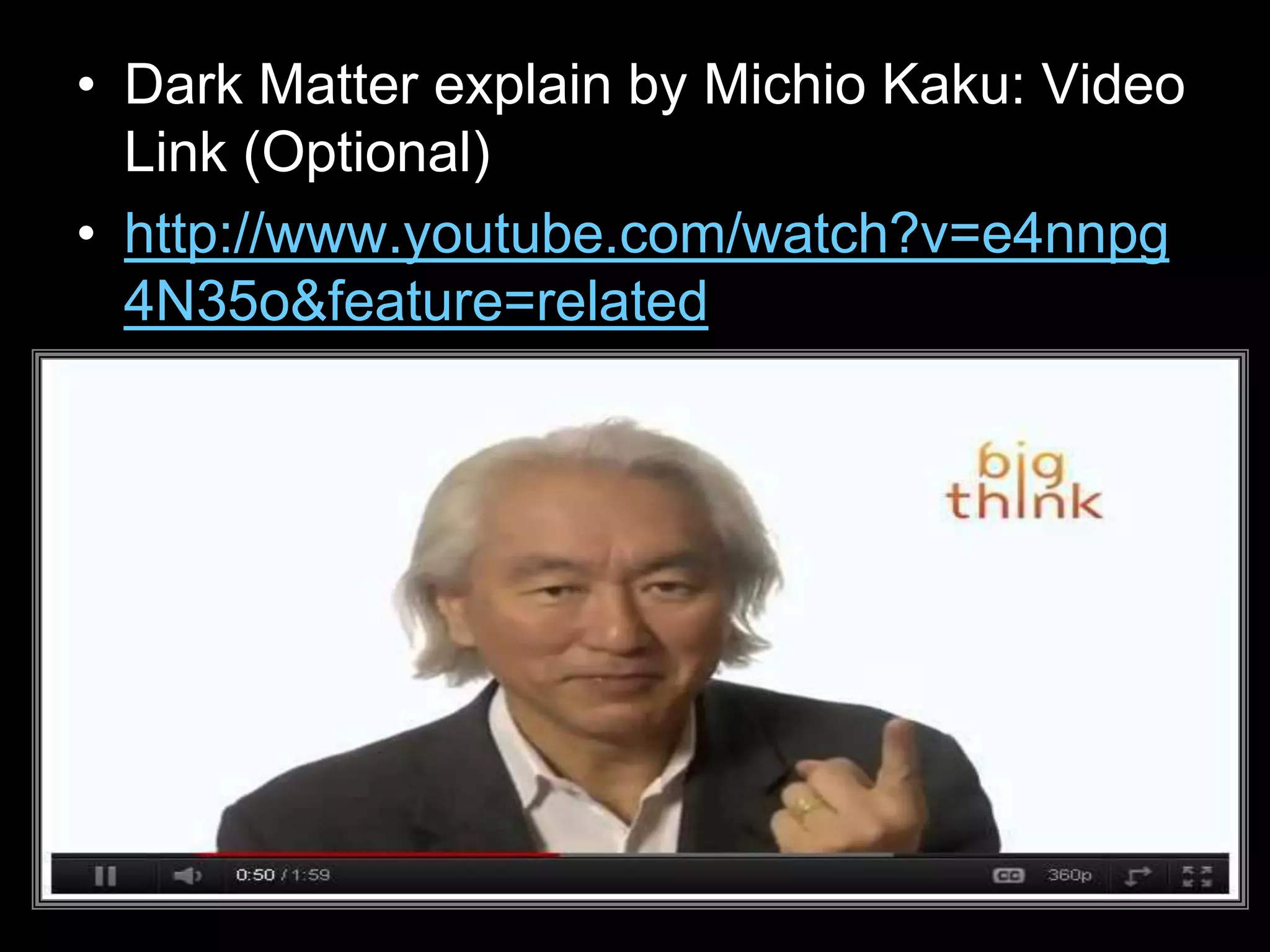
• Dark Matter explain by Michio Kaku: Video
Link (Optional)
• http://www.youtube.com/watch?v=e4nnpg
4N35o&feature=related
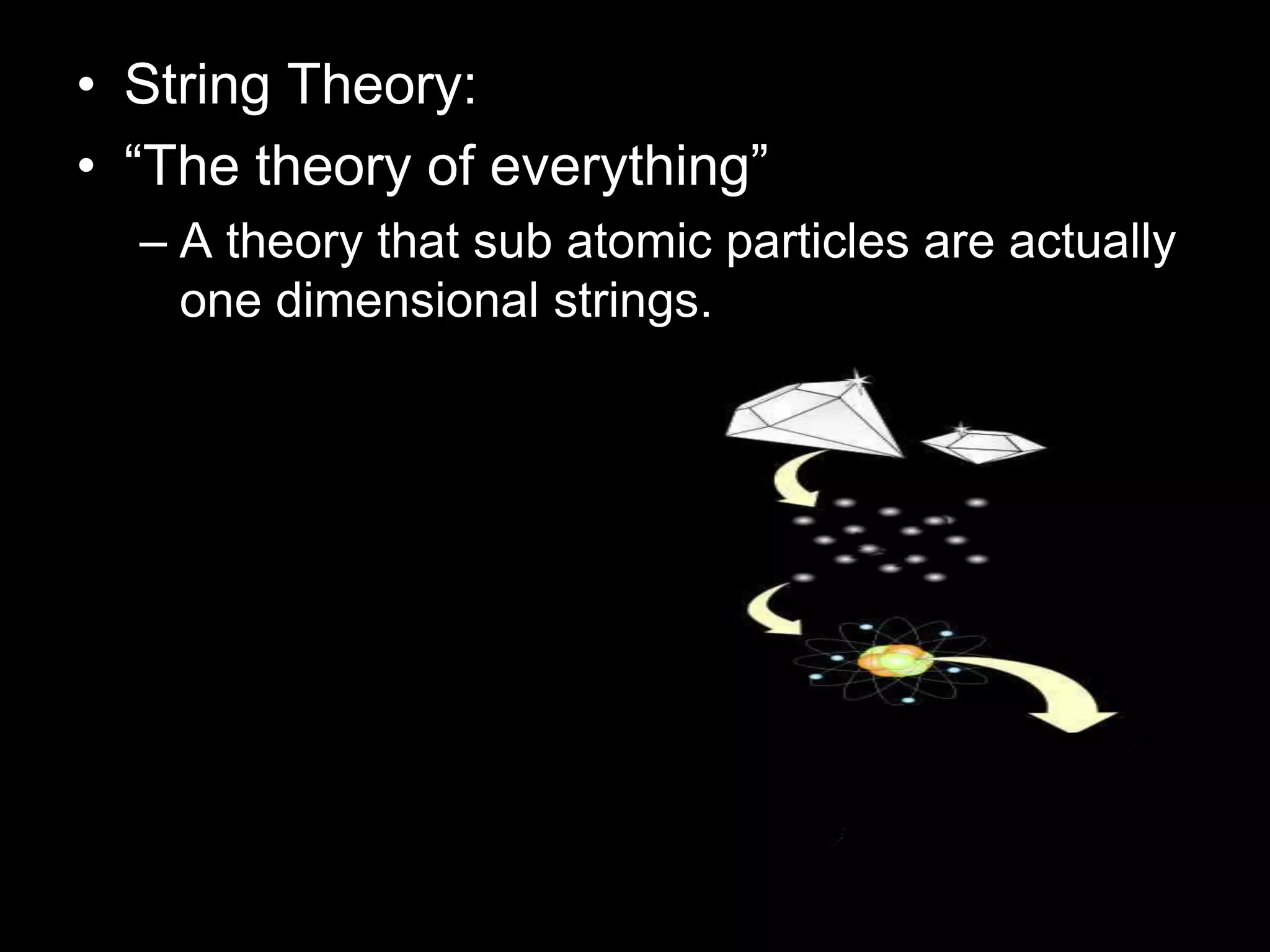
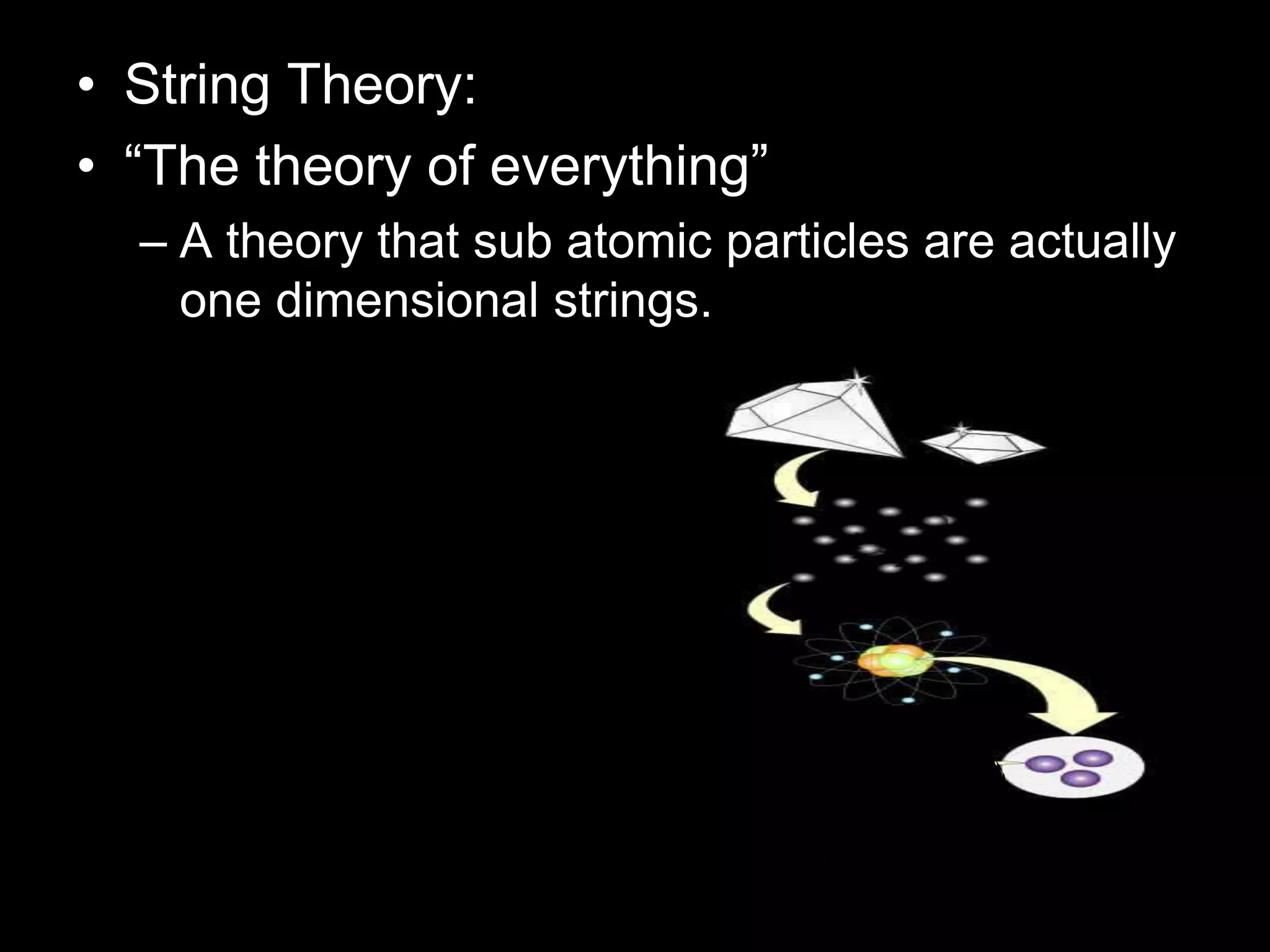
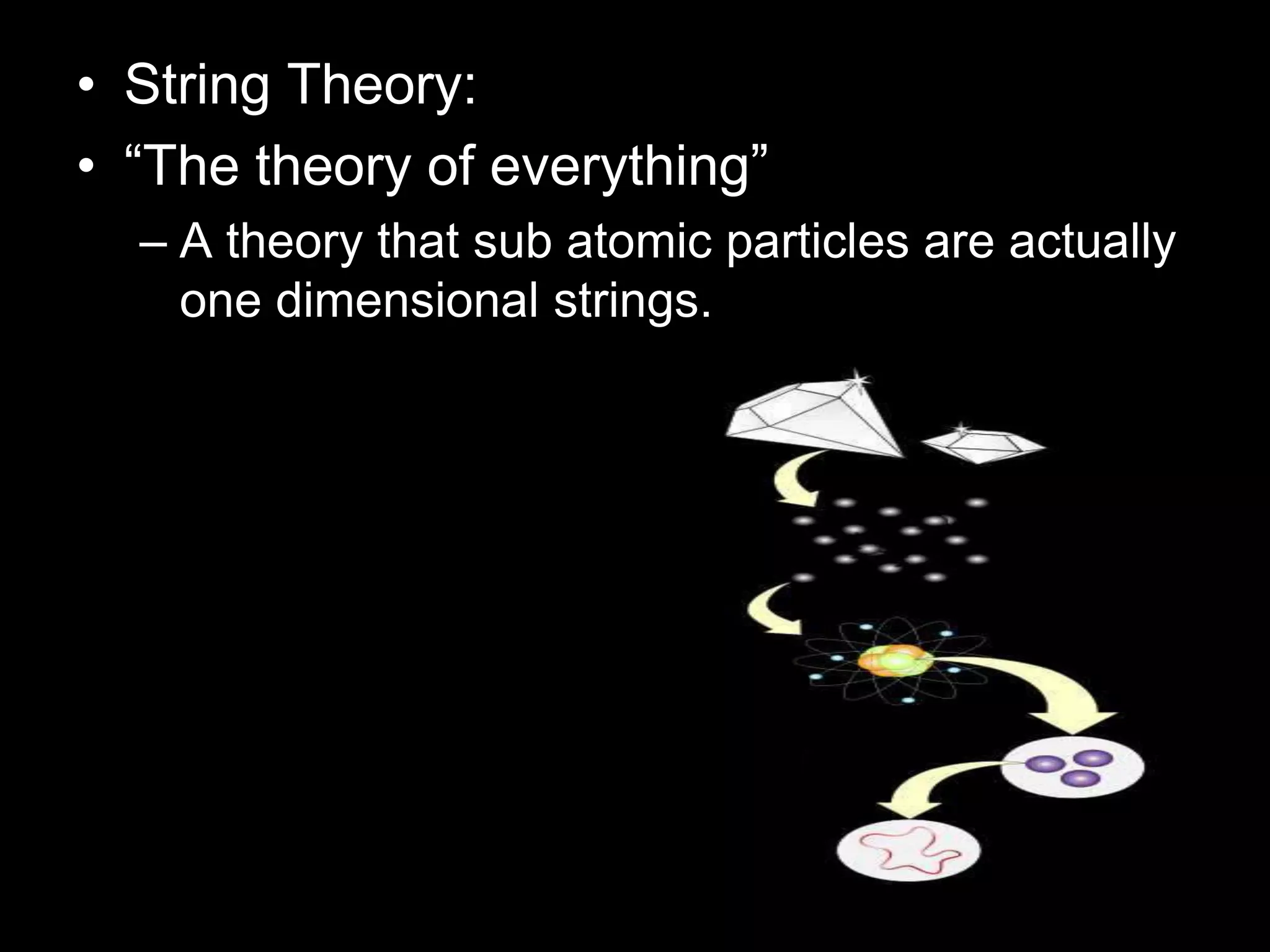
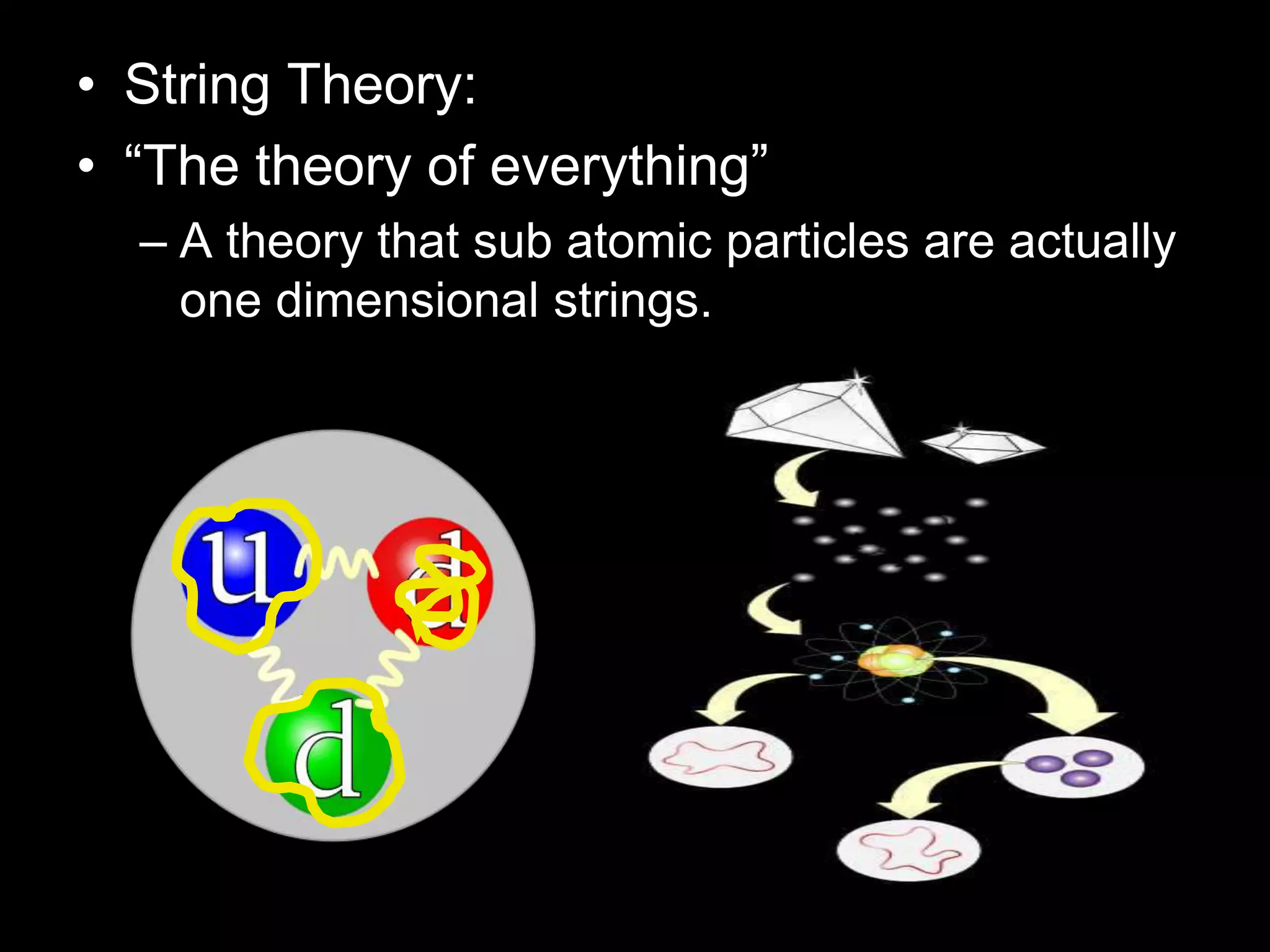
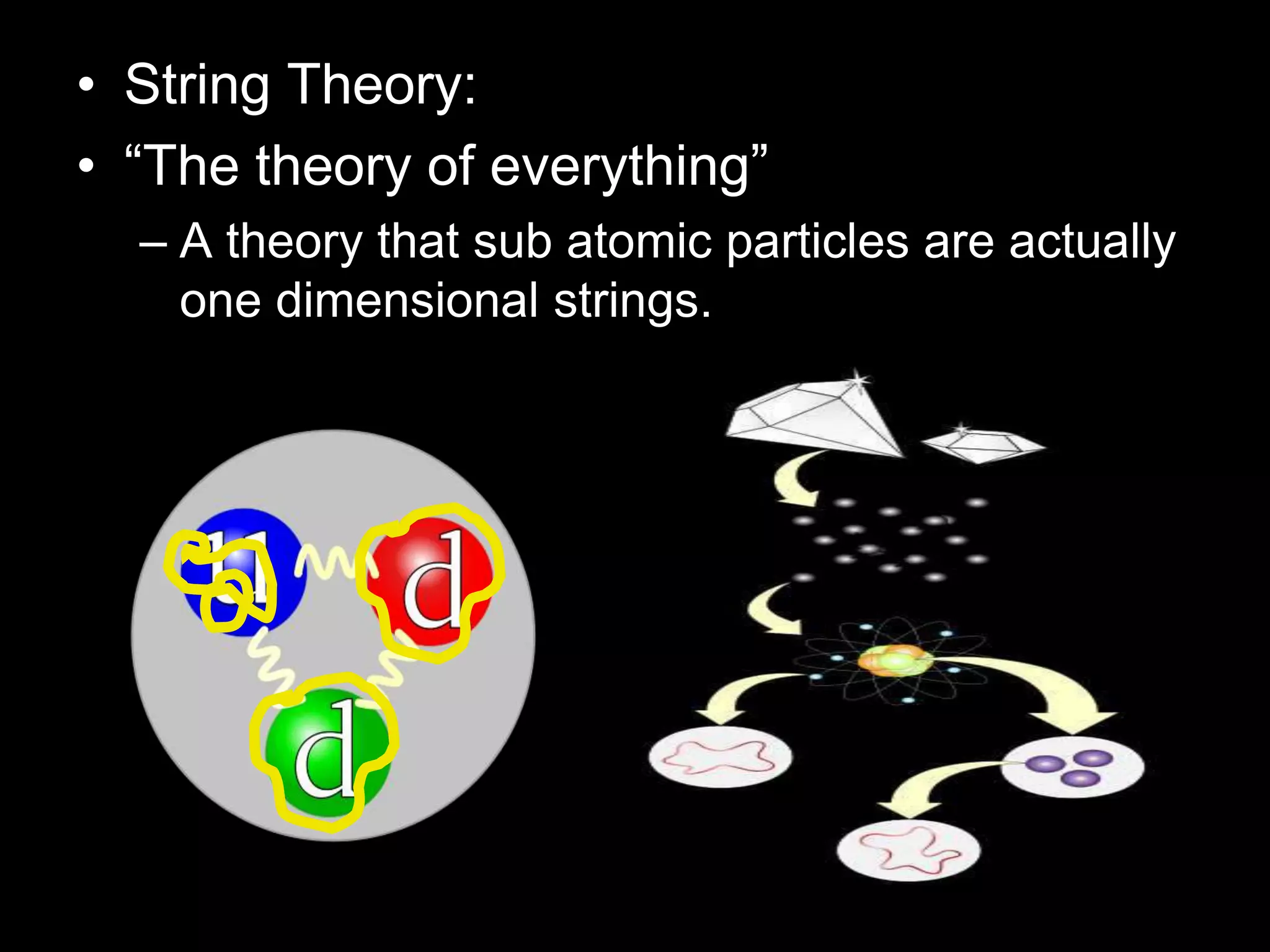
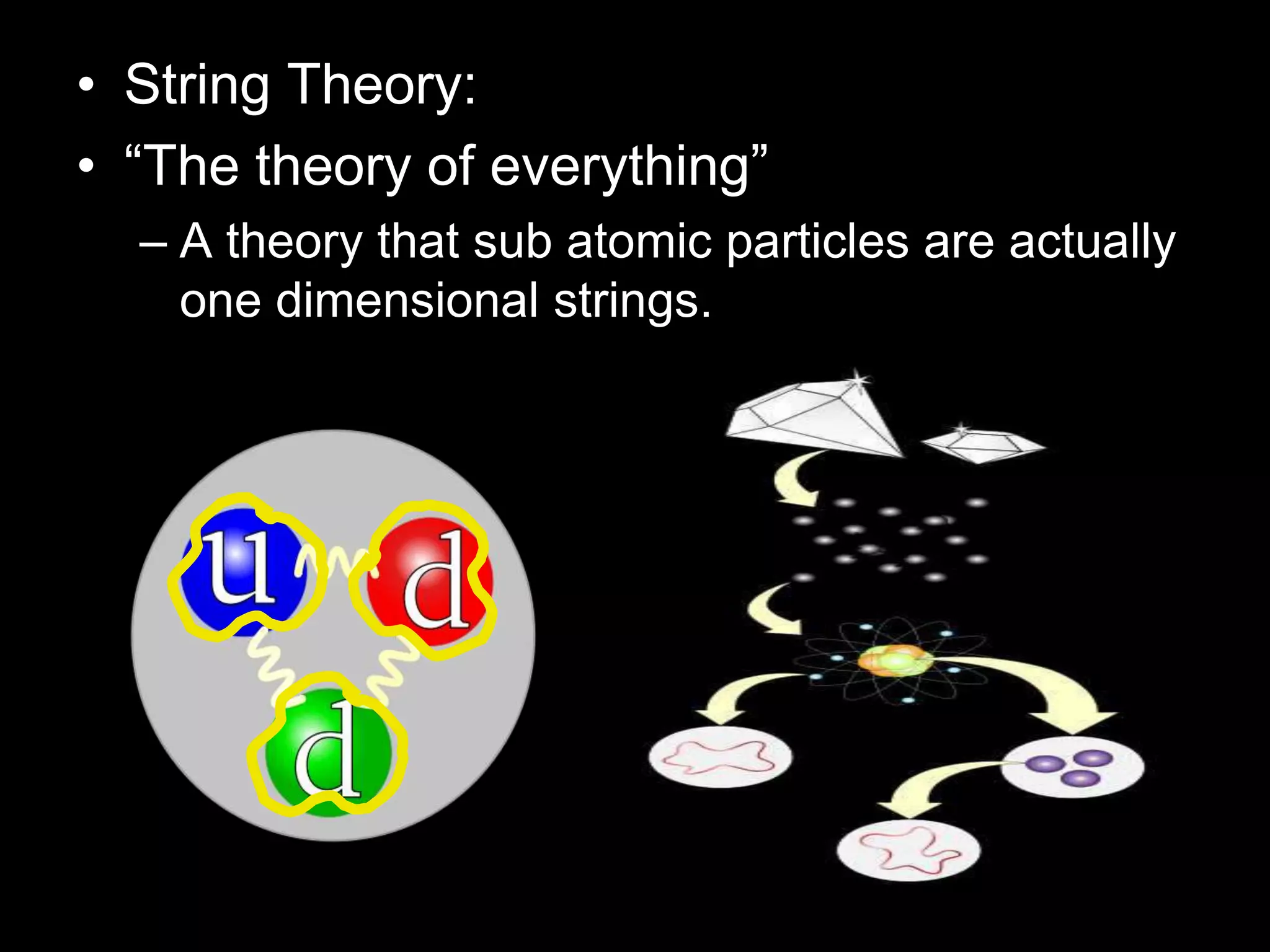
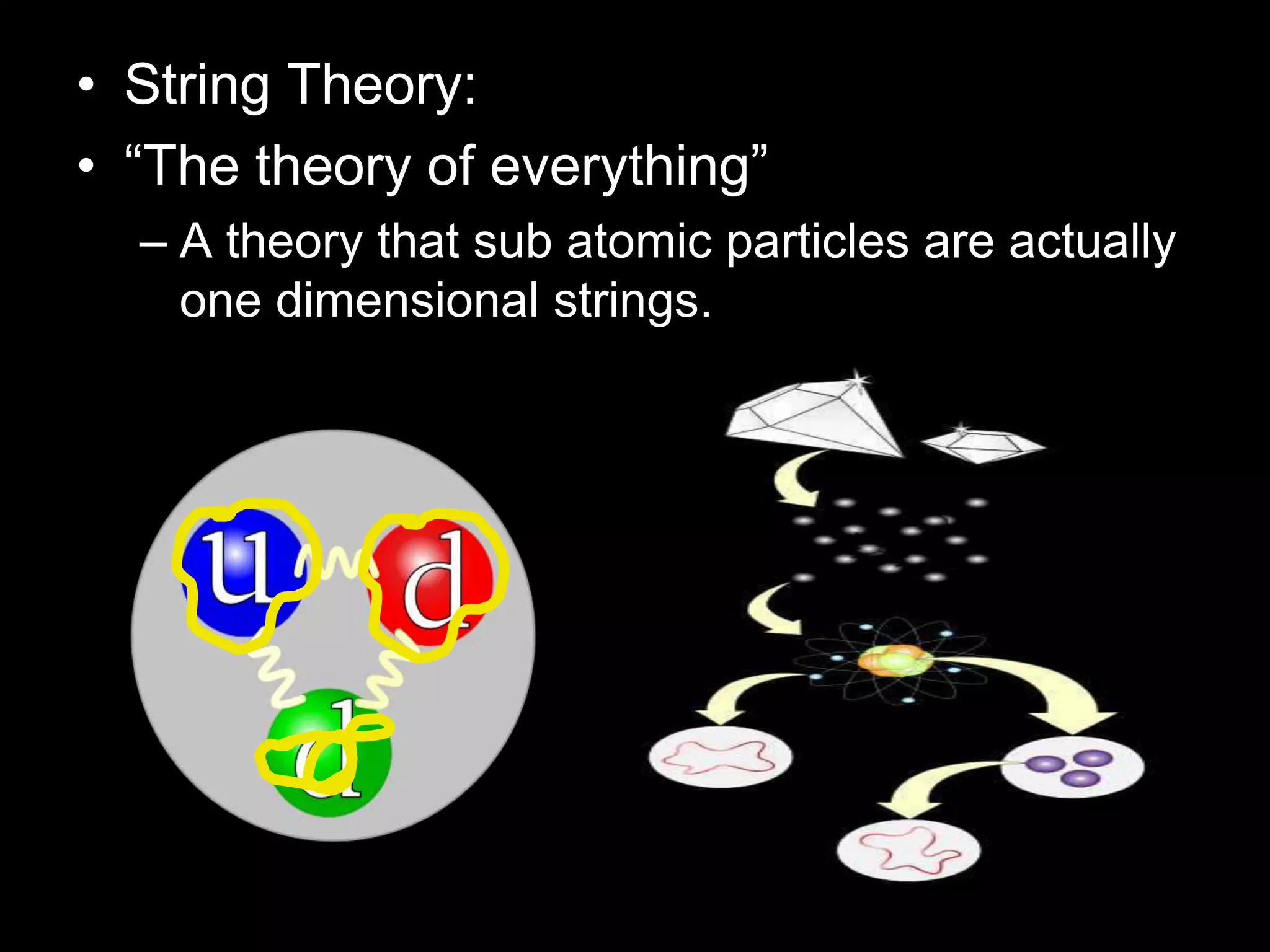
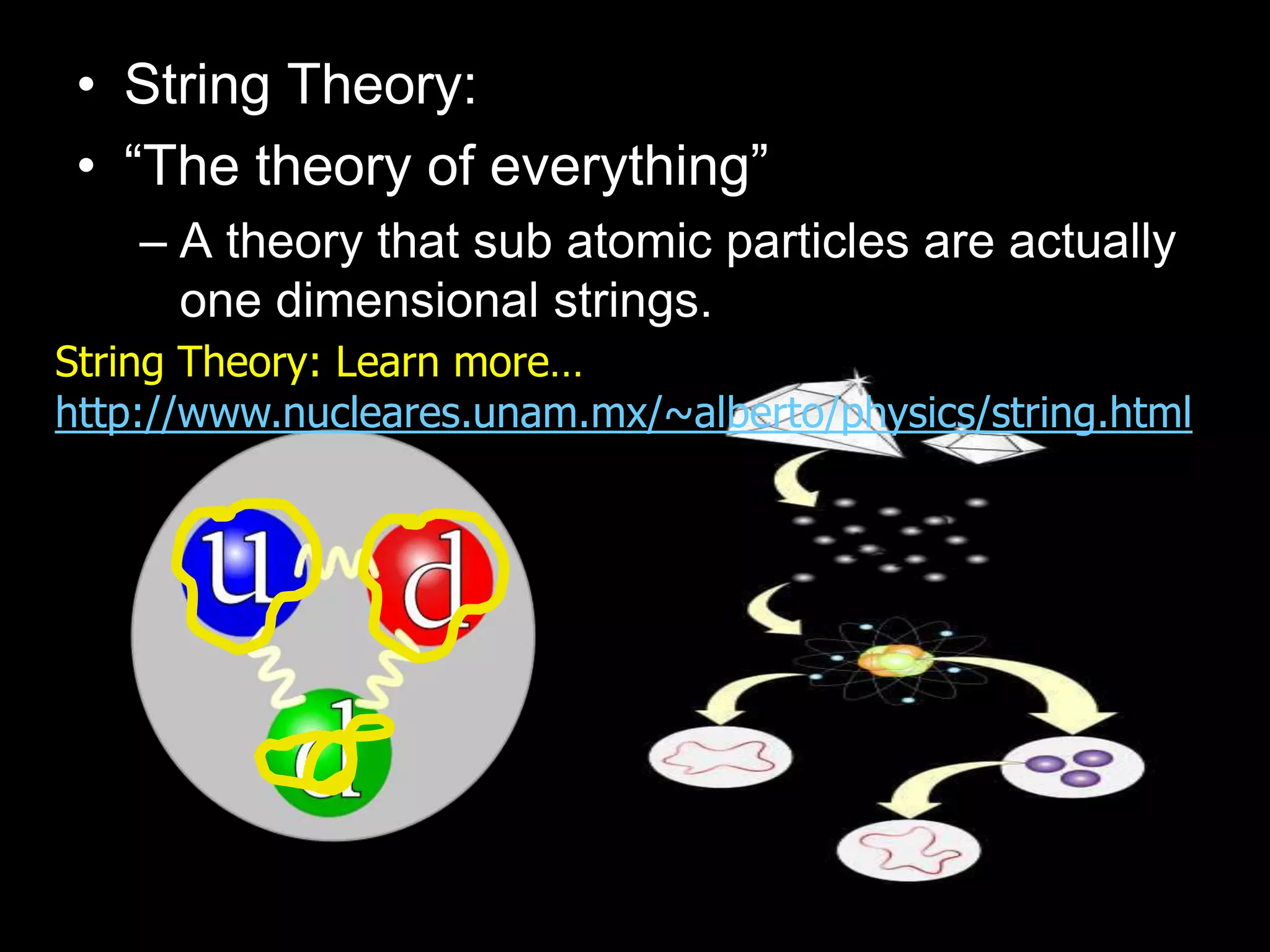
• String Theory:
• String Theory:
• “The theory of everything”
• String Theory:
• “The theory of everything”
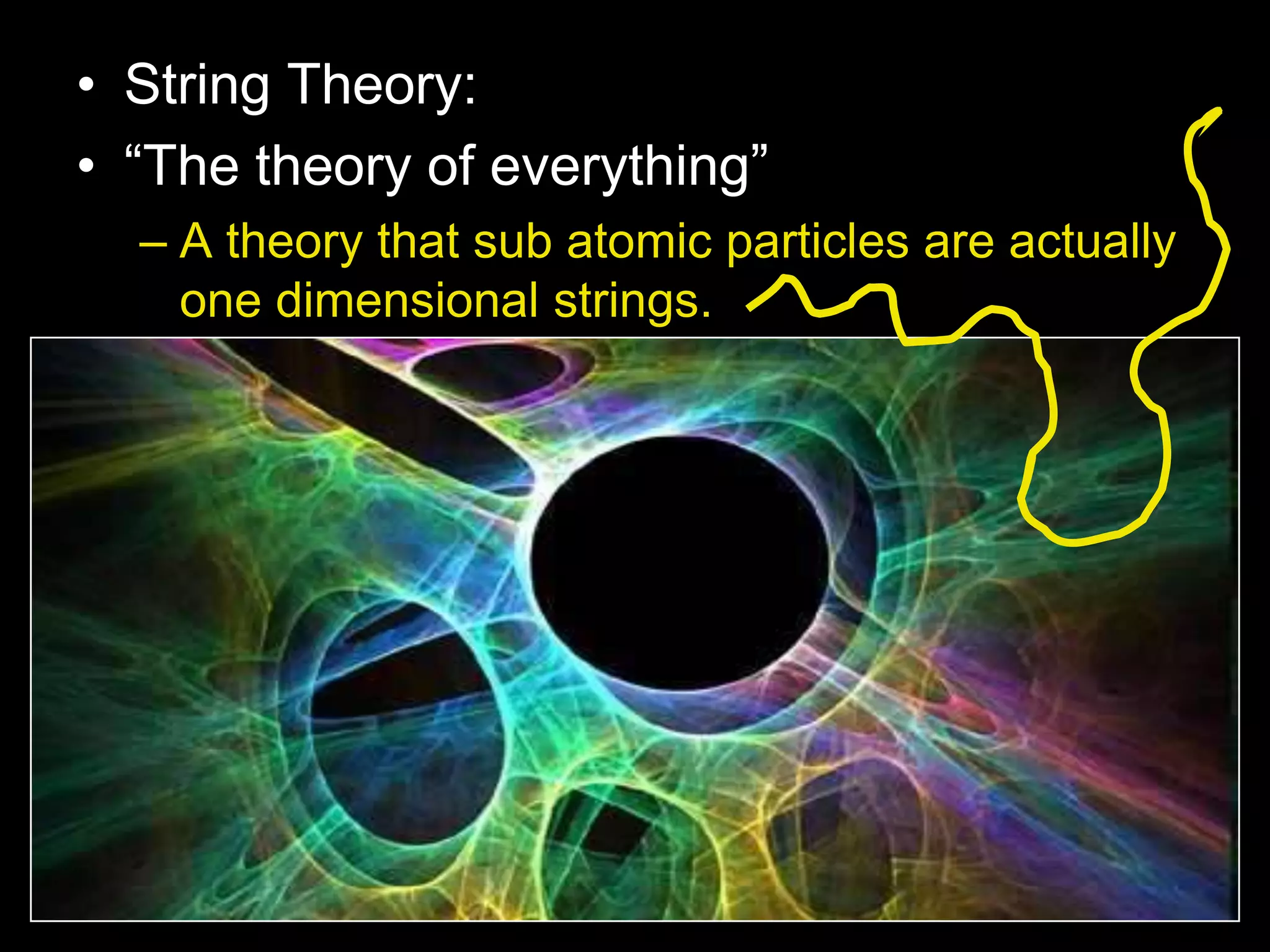
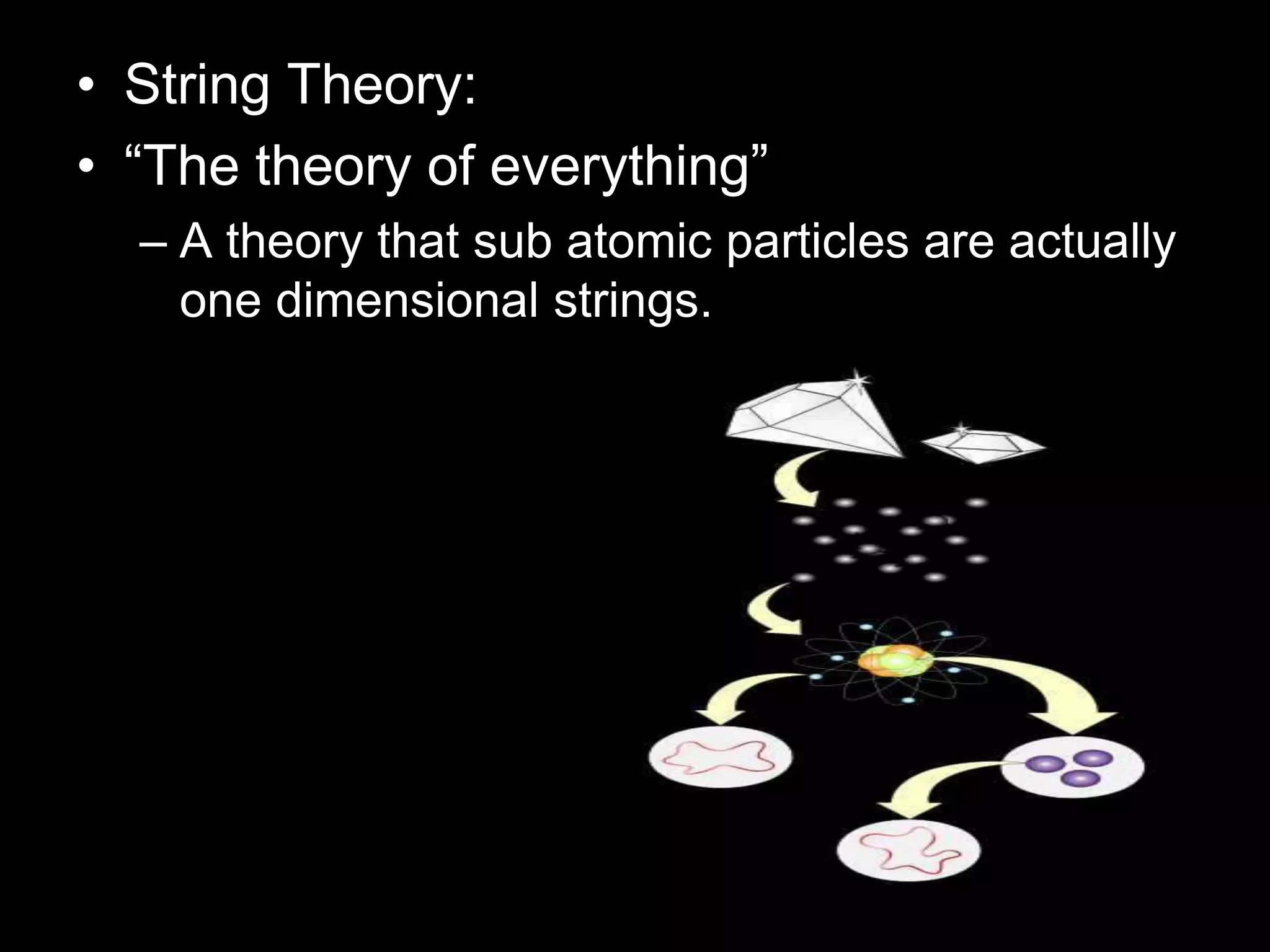
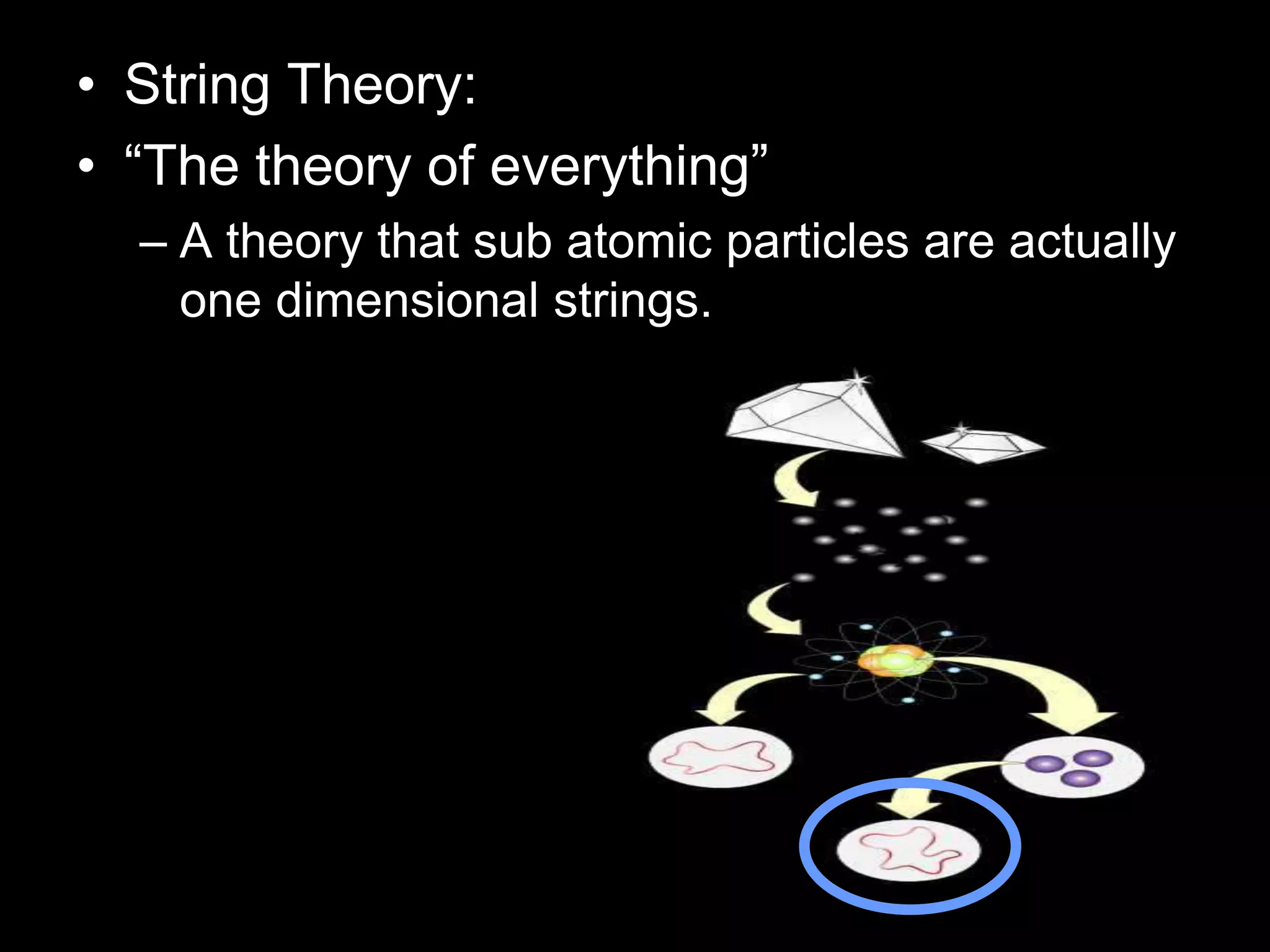
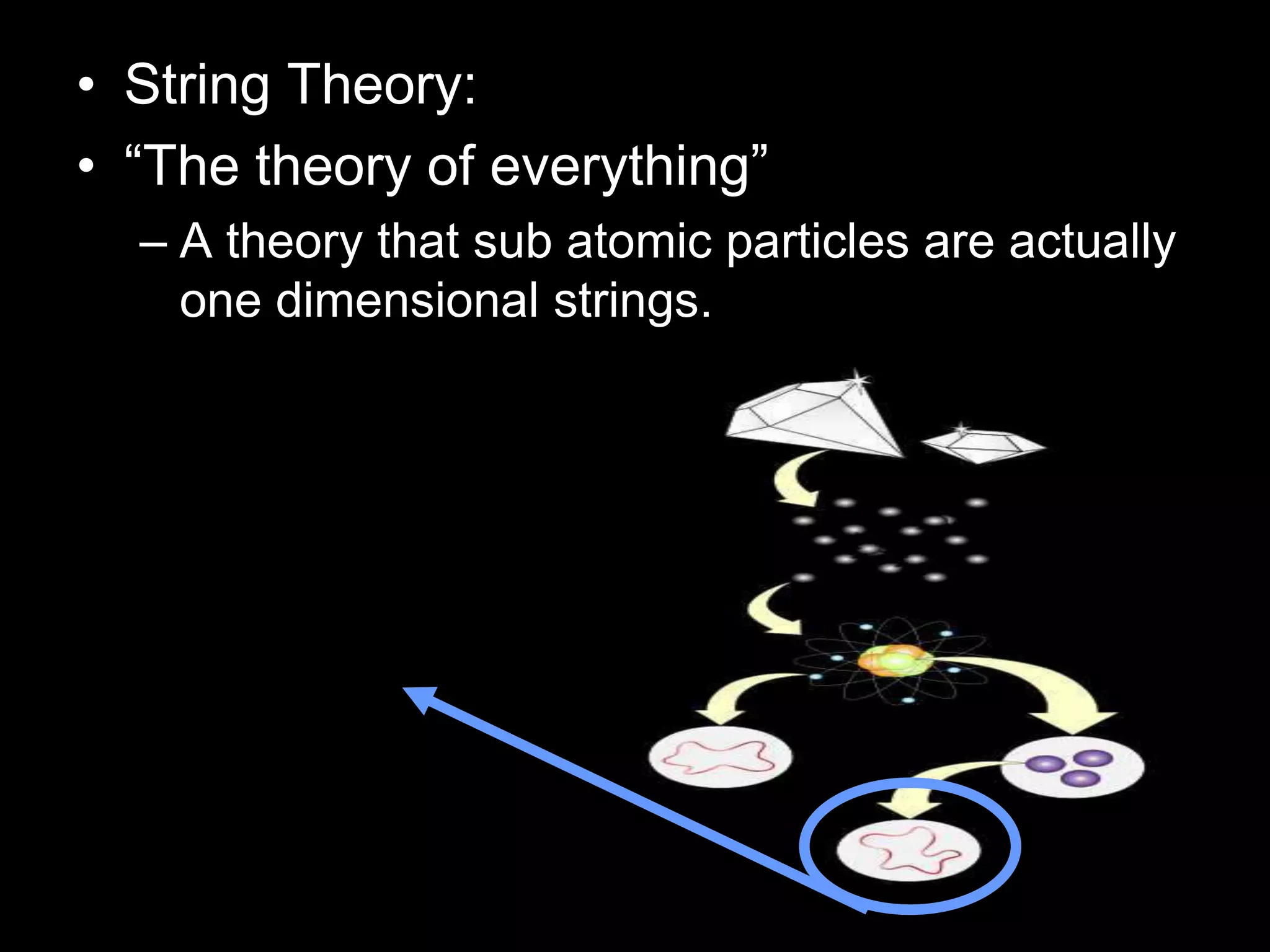
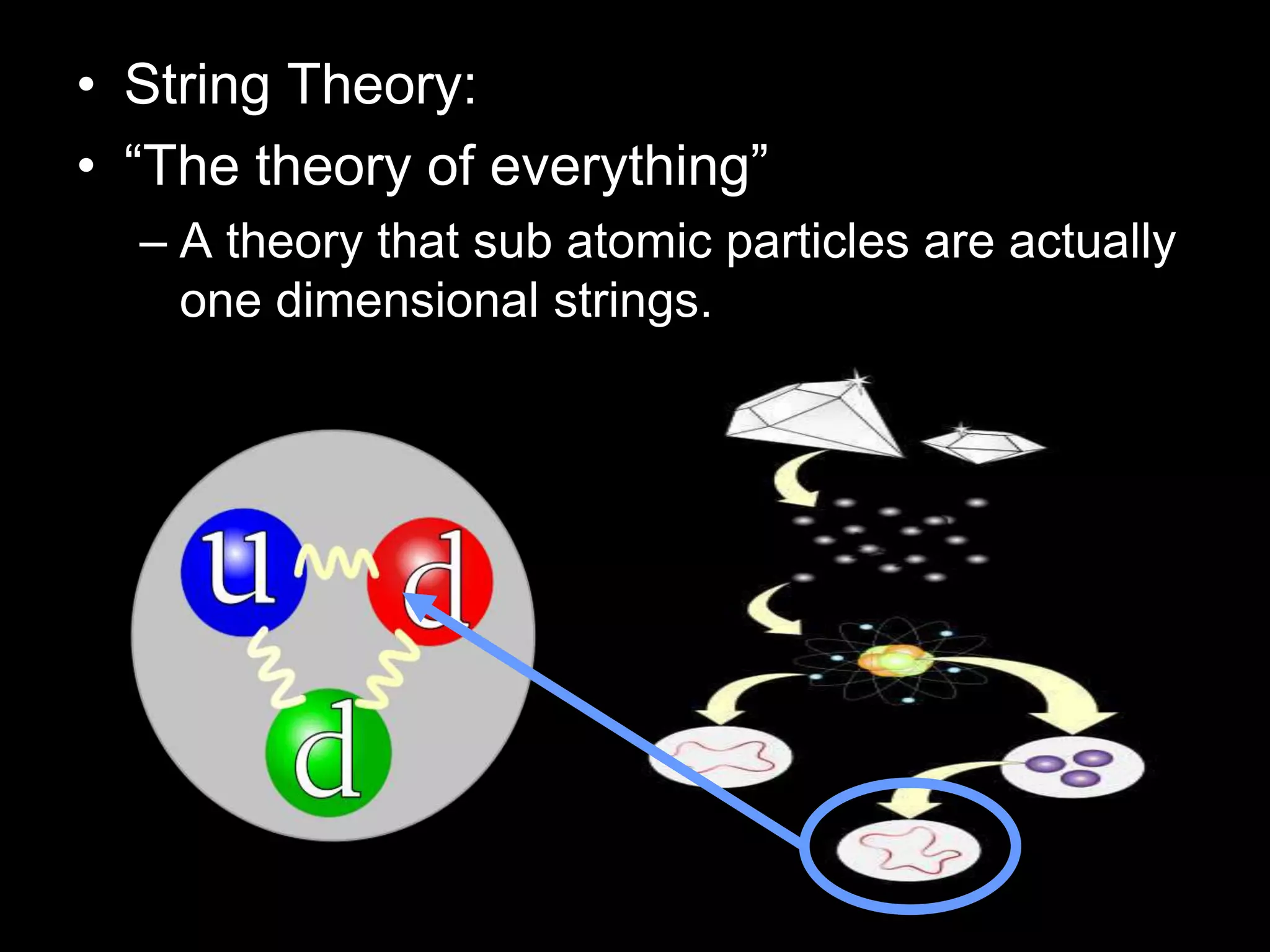
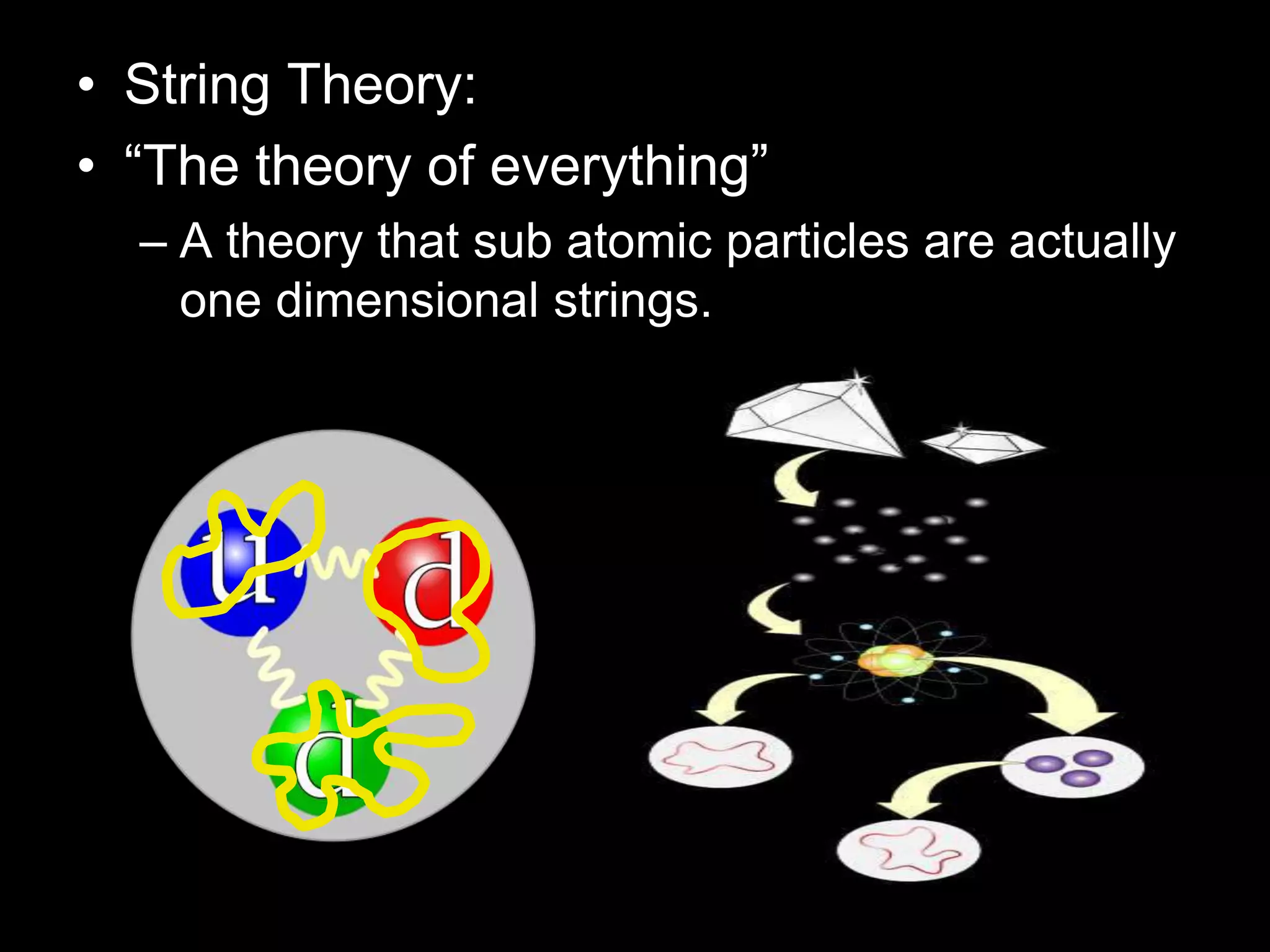
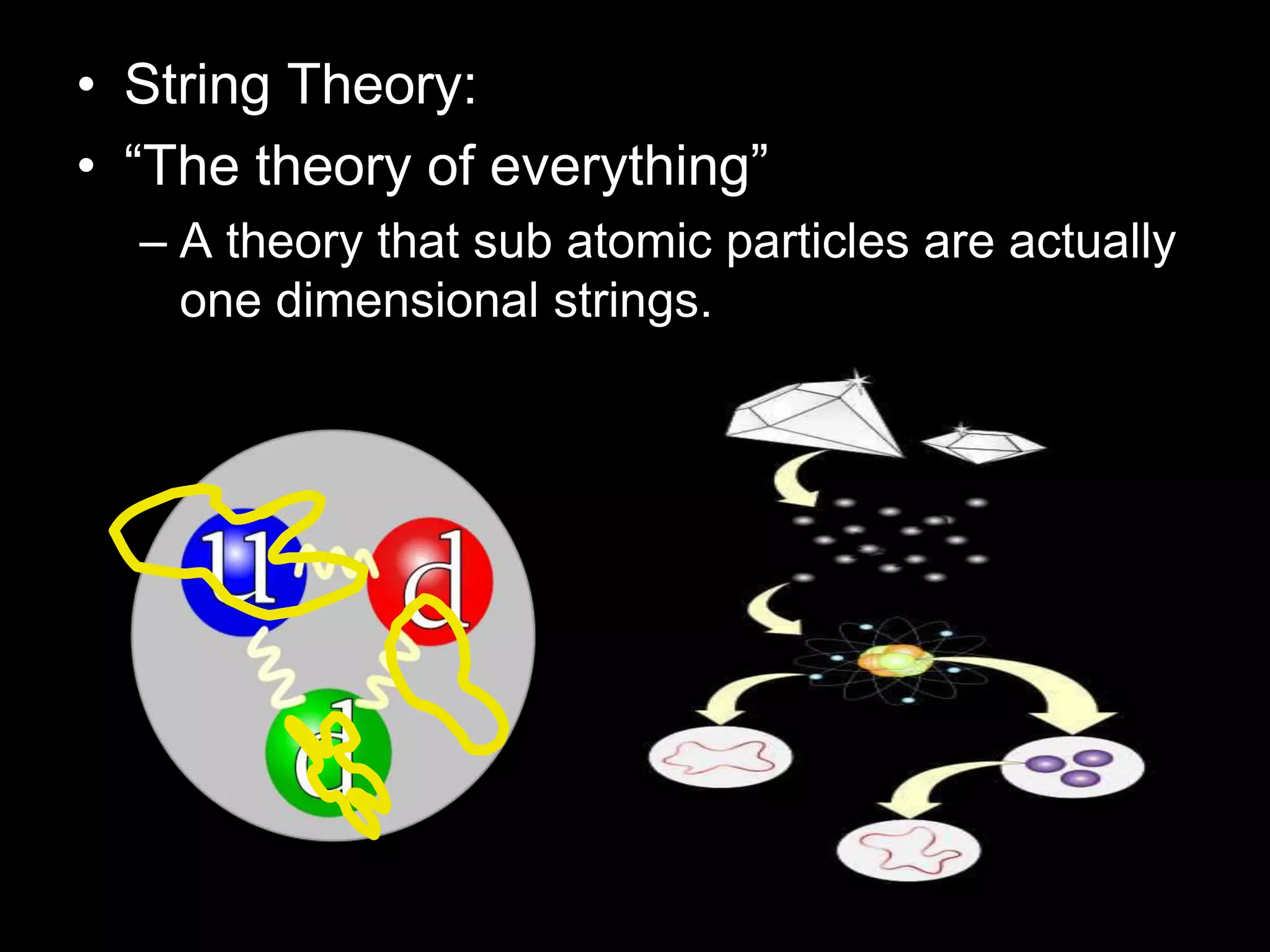
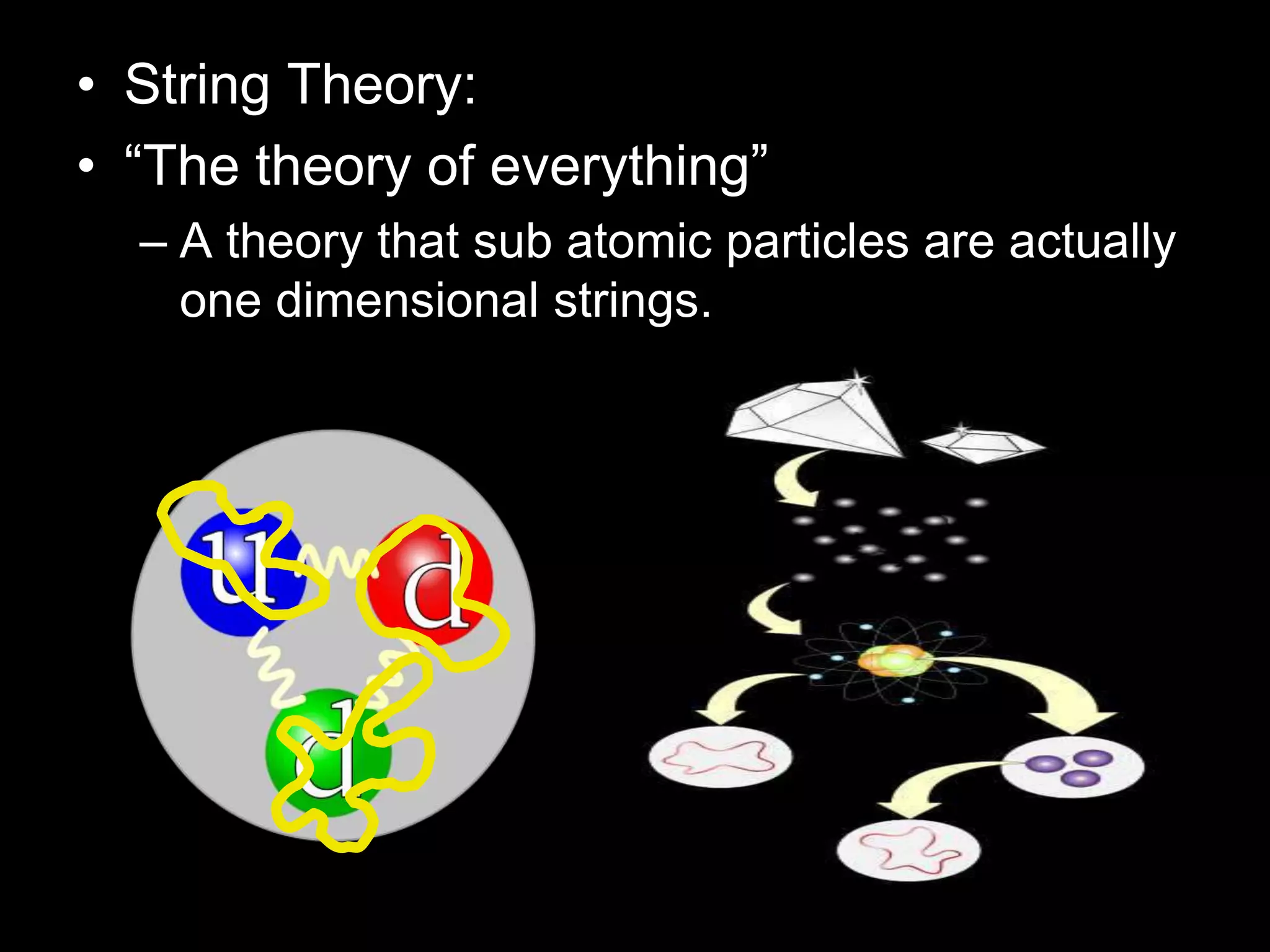
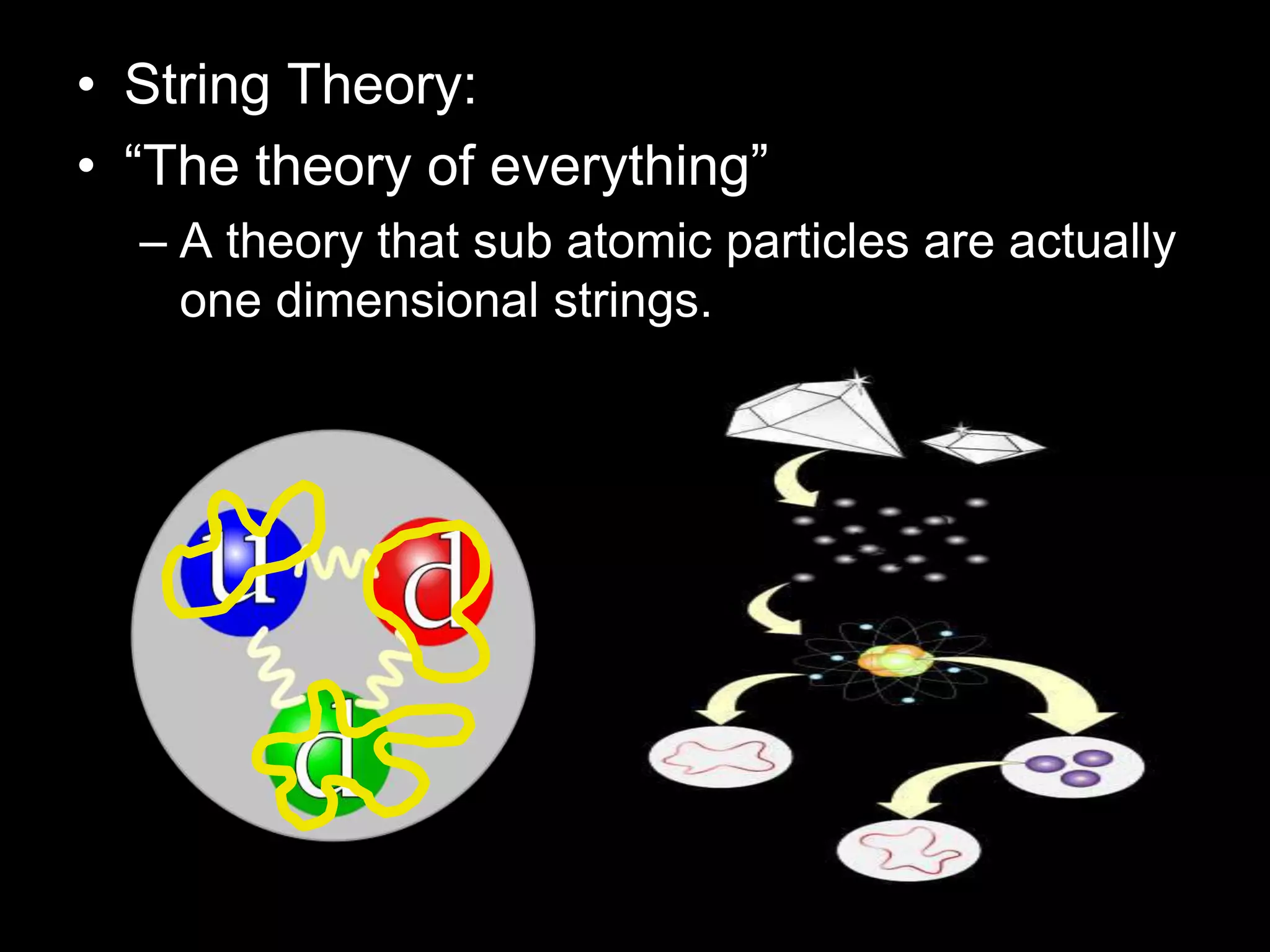
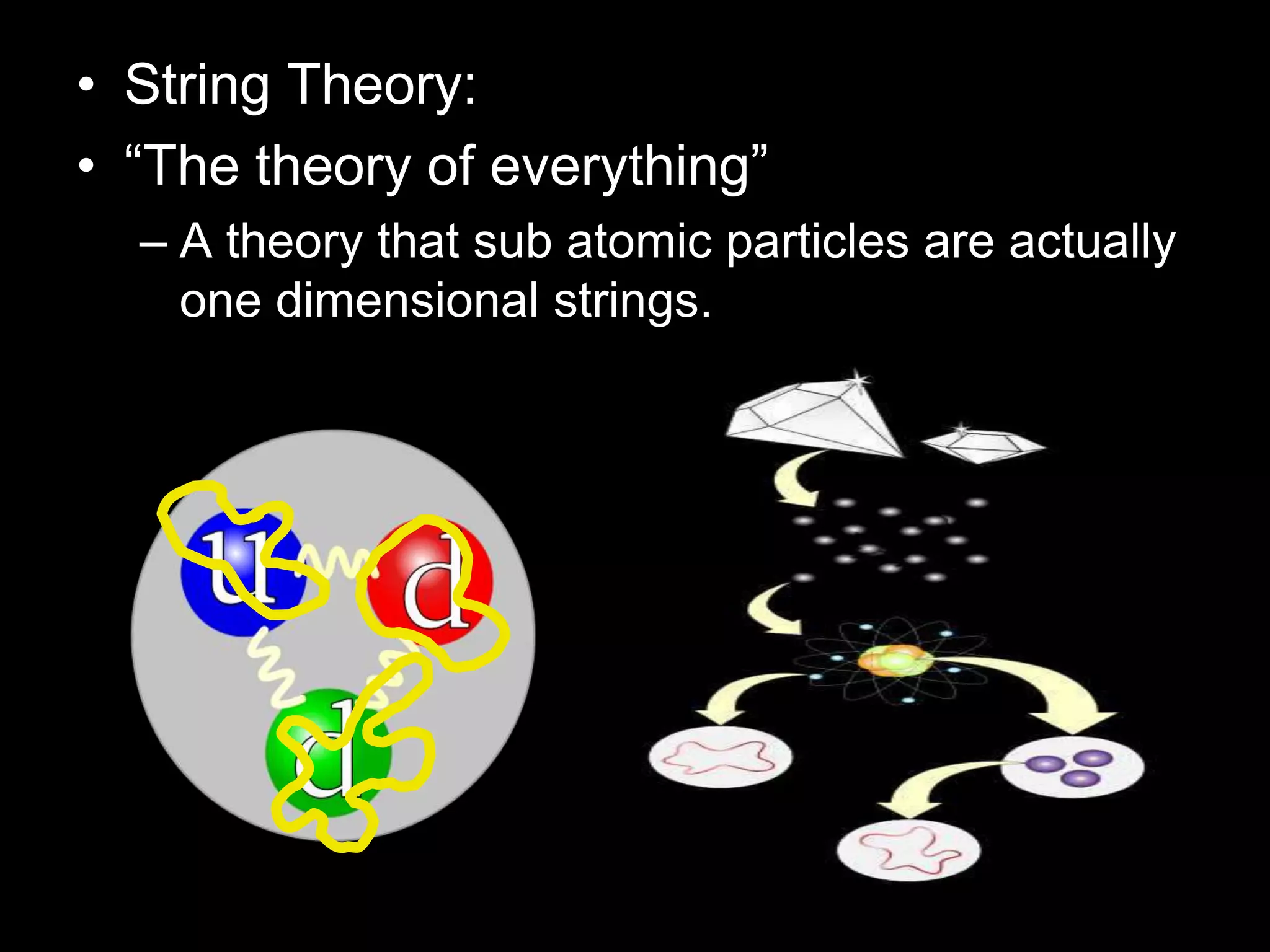
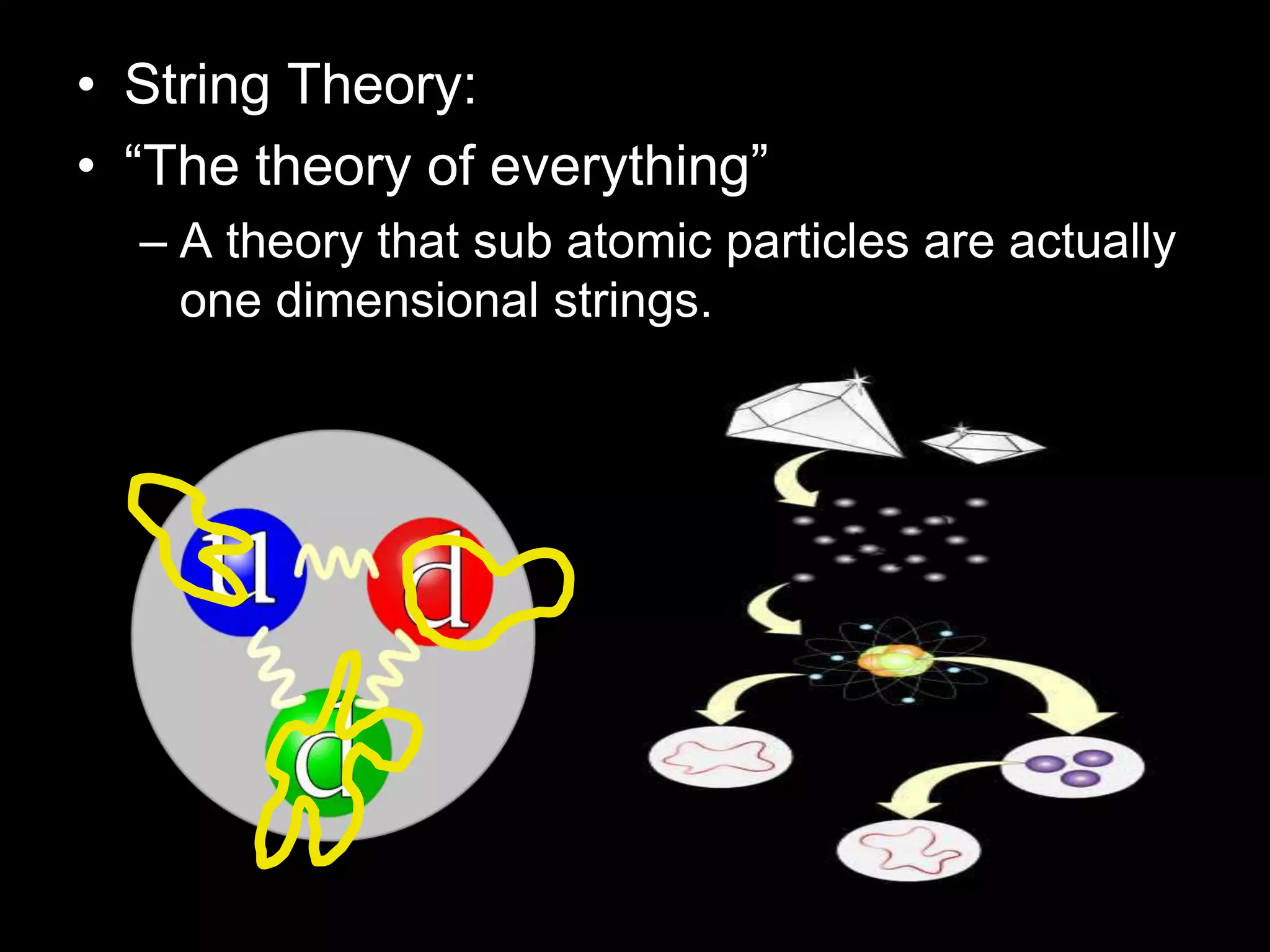
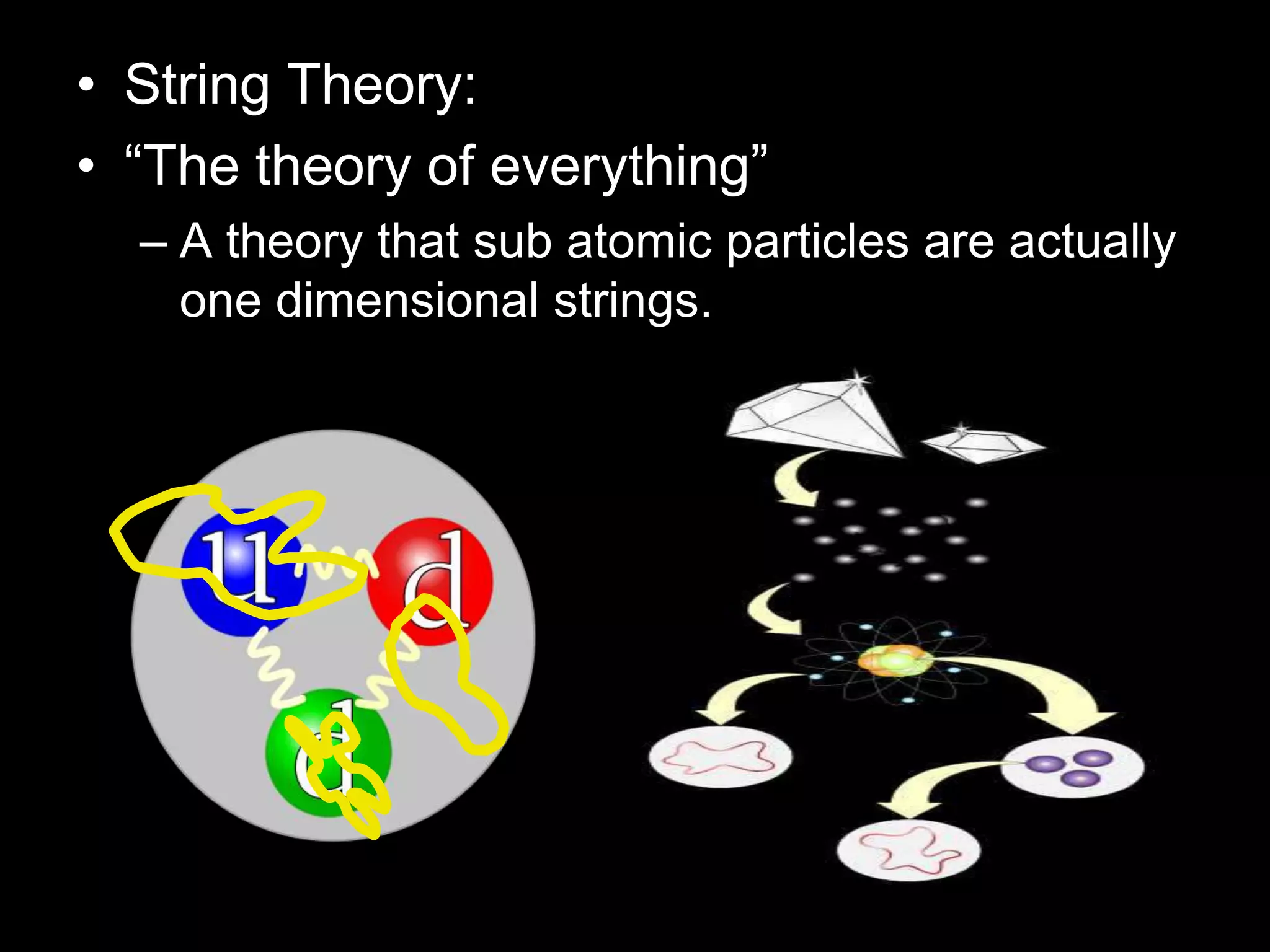
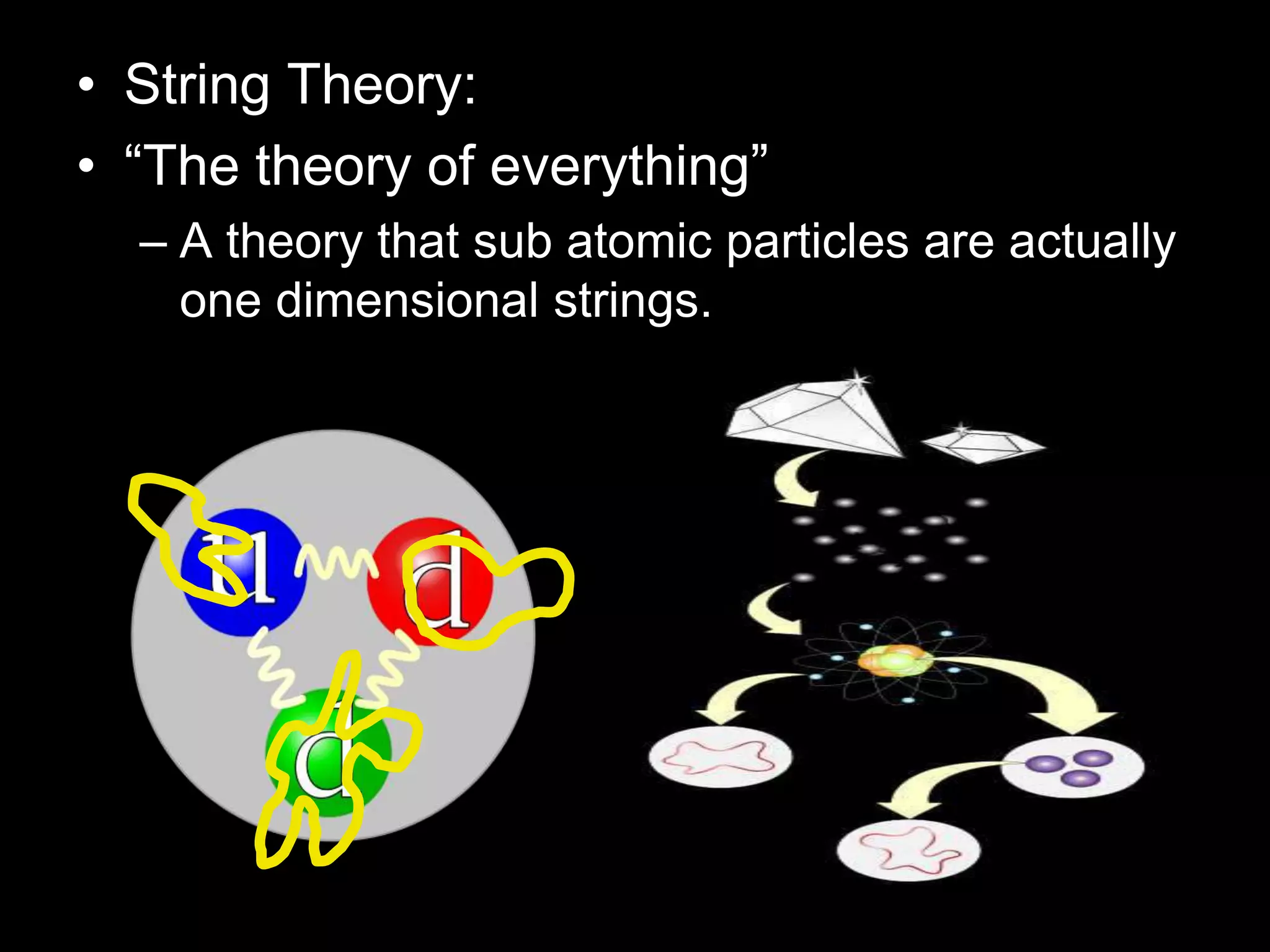
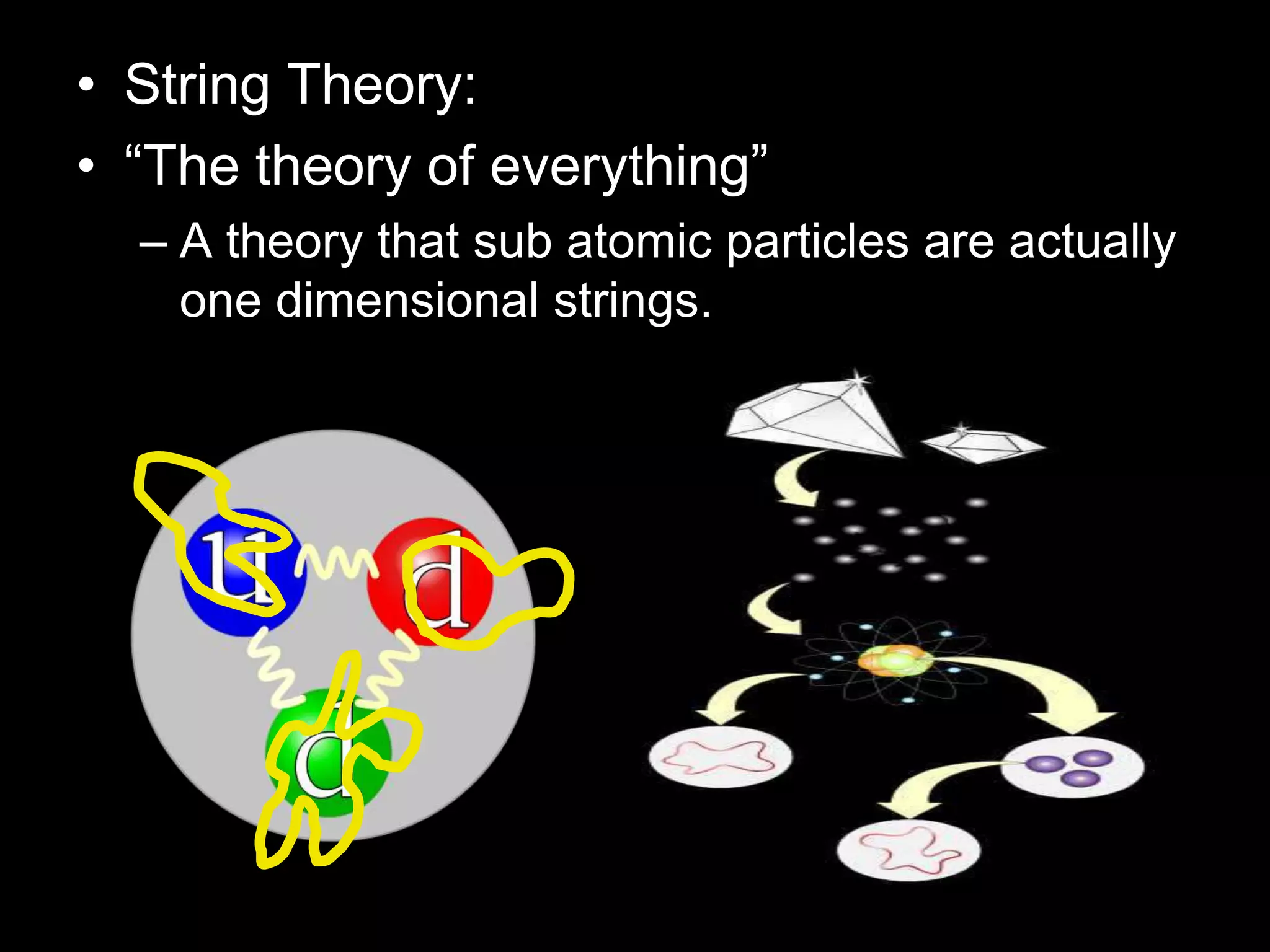
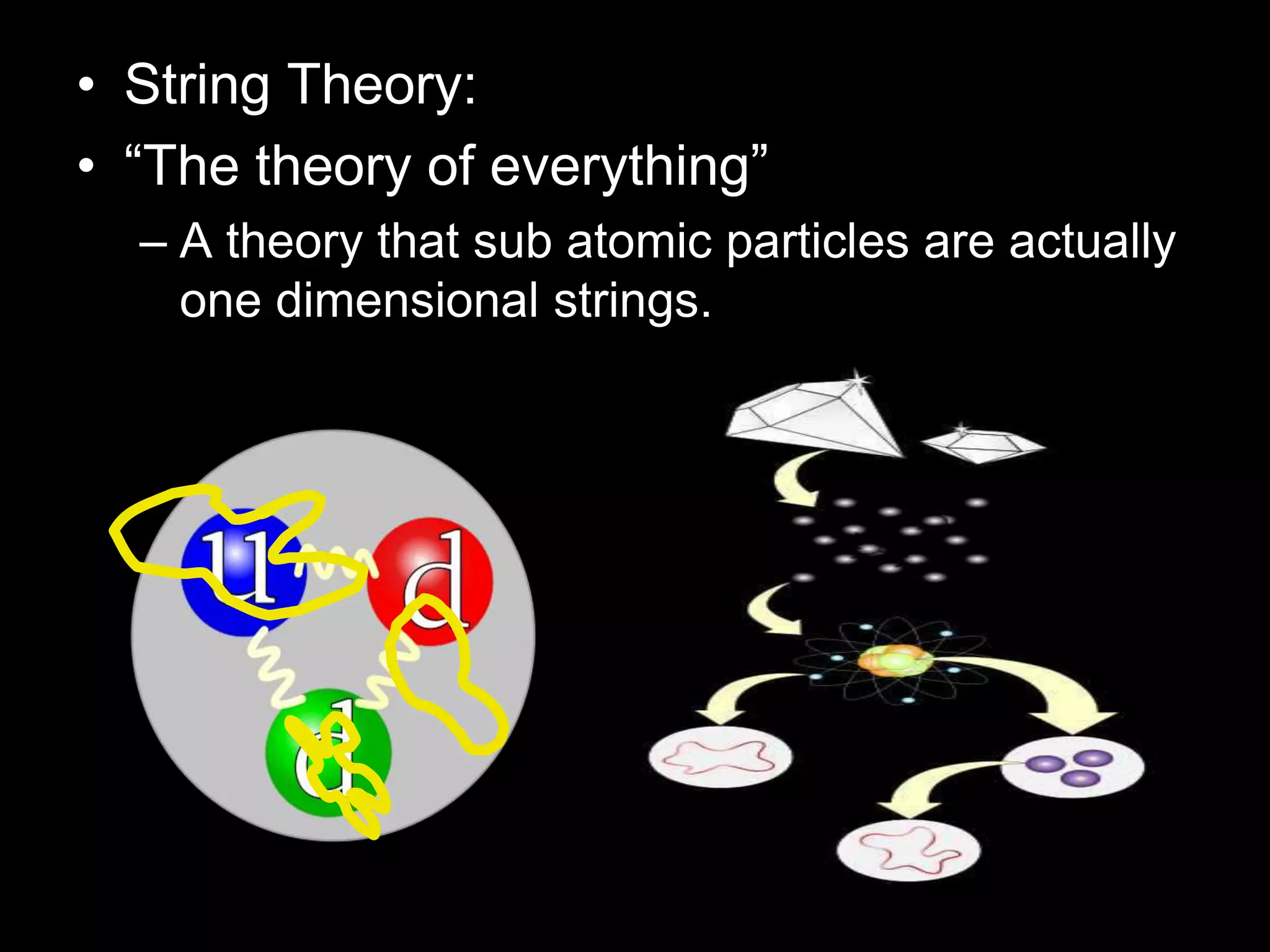
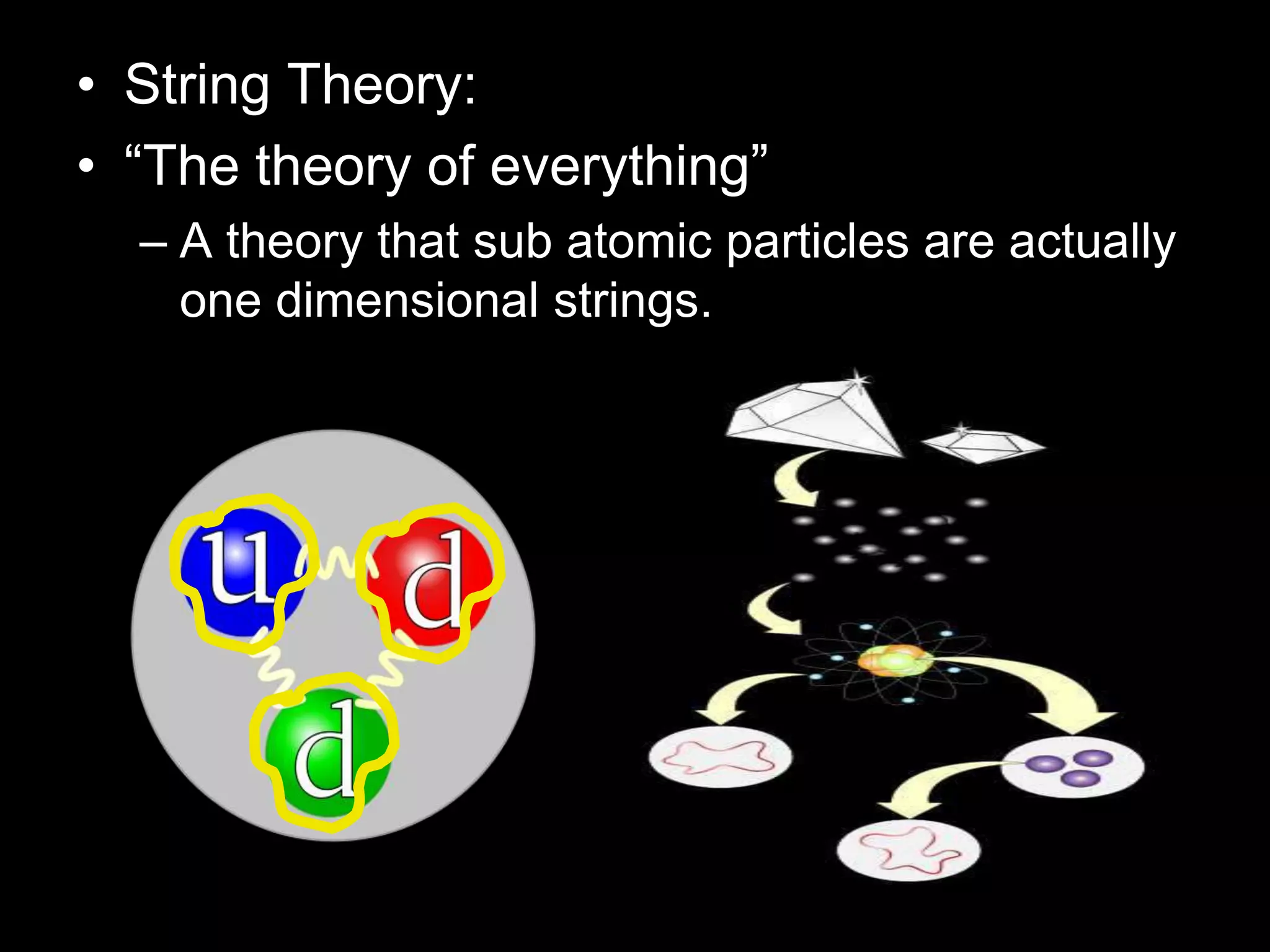
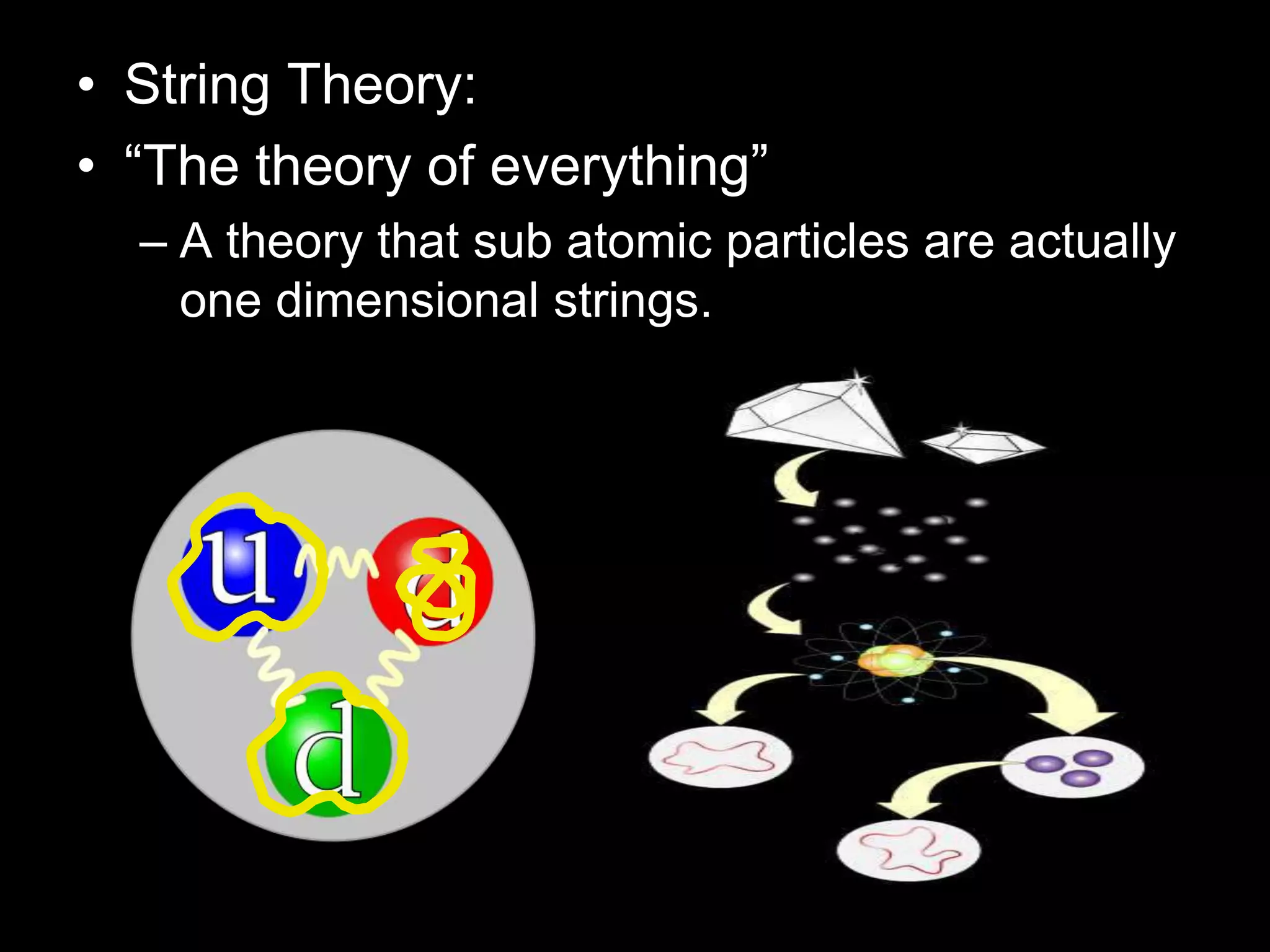
– A theory that sub atomic particles are actually
one dimensional strings.
• String Theory:
• “The theory of everything”
• String Theory:
• “The theory of everything”
– A theory that sub atomic particles are actually
one dimensional strings.
• String Theory:
• “The theory of everything”
– A theory that sub atomic particles are actually
one dimensional strings.
• String Theory:
• “The theory of everything”
– A theory that sub atomic particles are actually
one dimensional strings.
• String Theory:
• “The theory of everything”
– A theory that sub atomic particles are actually
one dimensional strings.
• String Theory:
• “The theory of everything”
– A theory that sub atomic particles are actually
one dimensional strings.
• String Theory:
• “The theory of everything”
– A theory that sub atomic particles are actually
one dimensional strings.
• String Theory:
• “The theory of everything”
– A theory that sub atomic particles are actually
one dimensional strings.
• String Theory:
• “The theory of everything”
– A theory that sub atomic particles are actually
one dimensional strings.
• String Theory:
• “The theory of everything”
– A theory that sub atomic particles are actually
one dimensional strings.
• String Theory:
• “The theory of everything”
– A theory that sub atomic particles are actually
one dimensional strings.
• String Theory:
• “The theory of everything”
– A theory that sub atomic particles are actually
one dimensional strings.
• String Theory:
• “The theory of everything”
– A theory that sub atomic particles are actually
one dimensional strings.
• String Theory:
• “The theory of everything”
– A theory that sub atomic particles are actually
one dimensional strings.
• String Theory:
• “The theory of everything”
– A theory that sub atomic particles are actually
one dimensional strings.
• String Theory:
• “The theory of everything”
– A theory that sub atomic particles are actually
one dimensional strings.
• String Theory:
• “The theory of everything”
– A theory that sub atomic particles are actually
one dimensional strings.
• String Theory:
• “The theory of everything”
– A theory that sub atomic particles are actually
one dimensional strings.
• String Theory:
• “The theory of everything”
– A theory that sub atomic particles are actually
one dimensional strings.
• String Theory:
• “The theory of everything”
– A theory that sub atomic particles are actually
one dimensional strings.
• String Theory:
• “The theory of everything”
– A theory that sub atomic particles are actually
one dimensional strings.
• String Theory:
• “The theory of everything”
– A theory that sub atomic particles are actually
one dimensional strings.
• String Theory:
• “The theory of everything”
– A theory that sub atomic particles are actually
one dimensional strings.
• String Theory:
• “The theory of everything”
– A theory that sub atomic particles are actually
one dimensional strings.
• String Theory:
• “The theory of everything”
– A theory that sub atomic particles are actually
one dimensional strings.
• String Theory:
• “The theory of everything”
– A theory that sub atomic particles are actually
one dimensional strings.
• String Theory:
• “The theory of everything”
– A theory that sub atomic particles are actually
one dimensional strings.
• String Theory:
• “The theory of everything”
– A theory that sub atomic particles are actually
one dimensional strings.
• String Theory:
• “The theory of everything”
– A theory that sub atomic particles are actually
one dimensional strings.
• String Theory:
• “The theory of everything”
– A theory that sub atomic particles are actually
one dimensional strings.
String Theory: Learn more…
http://www.nucleares.unam.mx/~alberto/physics/string.html
“Thank
goodness that
part is over.”
“My brain
hurts.”
• Activity Sheet Available: States of Matter
and Phase Change.
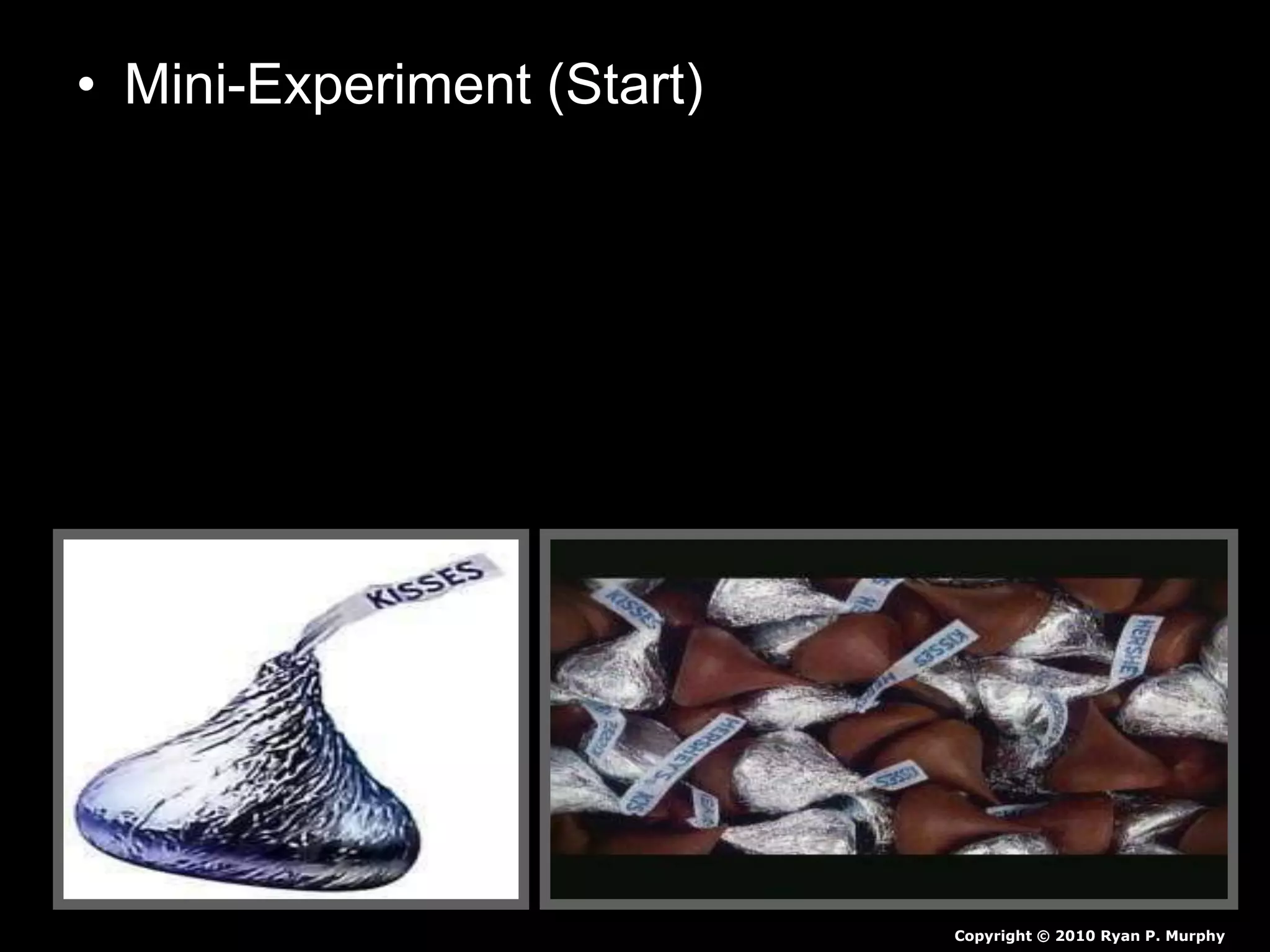
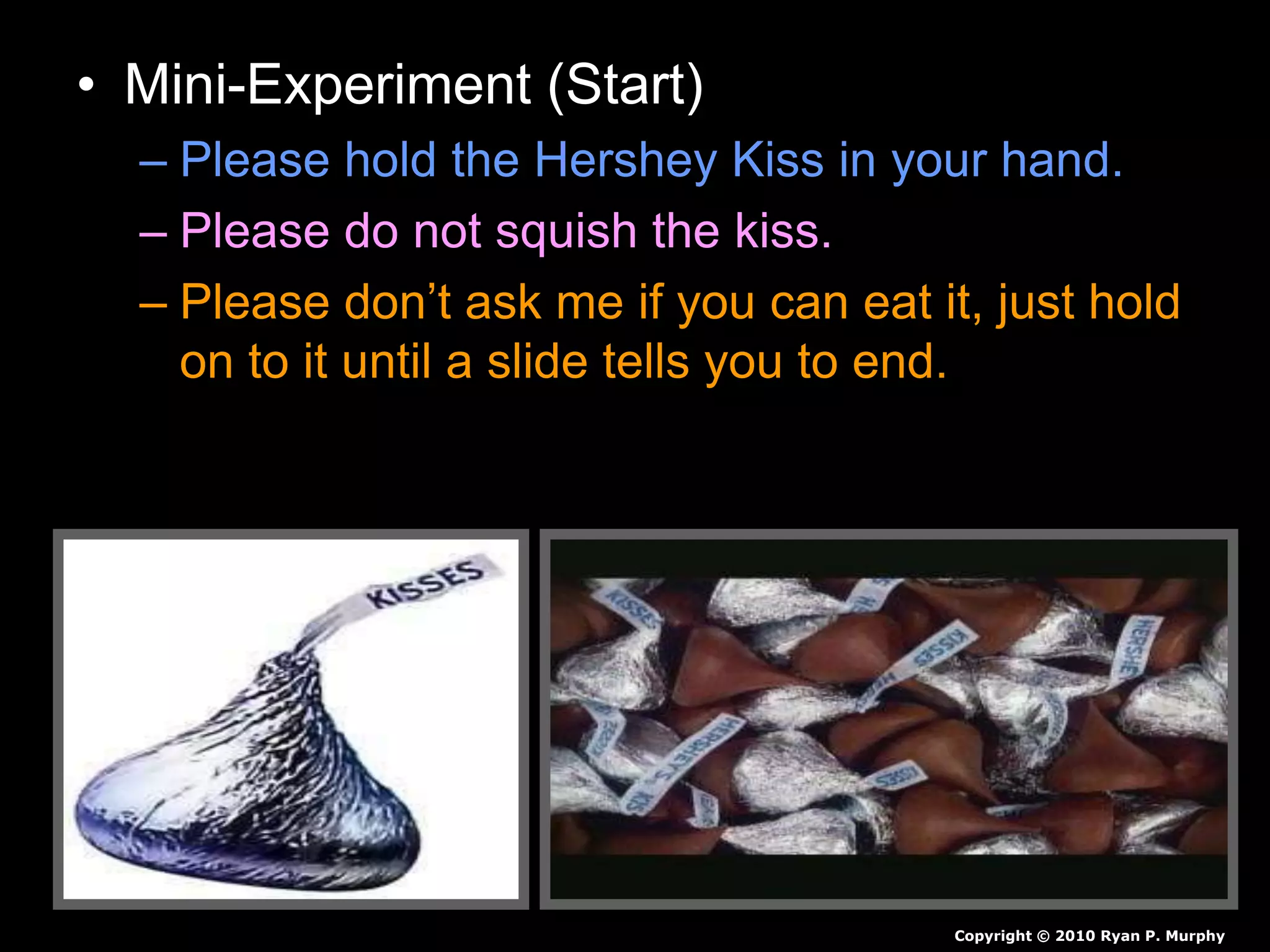
• Mini-Experiment (Start)
Copyright © 2010 Ryan P. Murphy
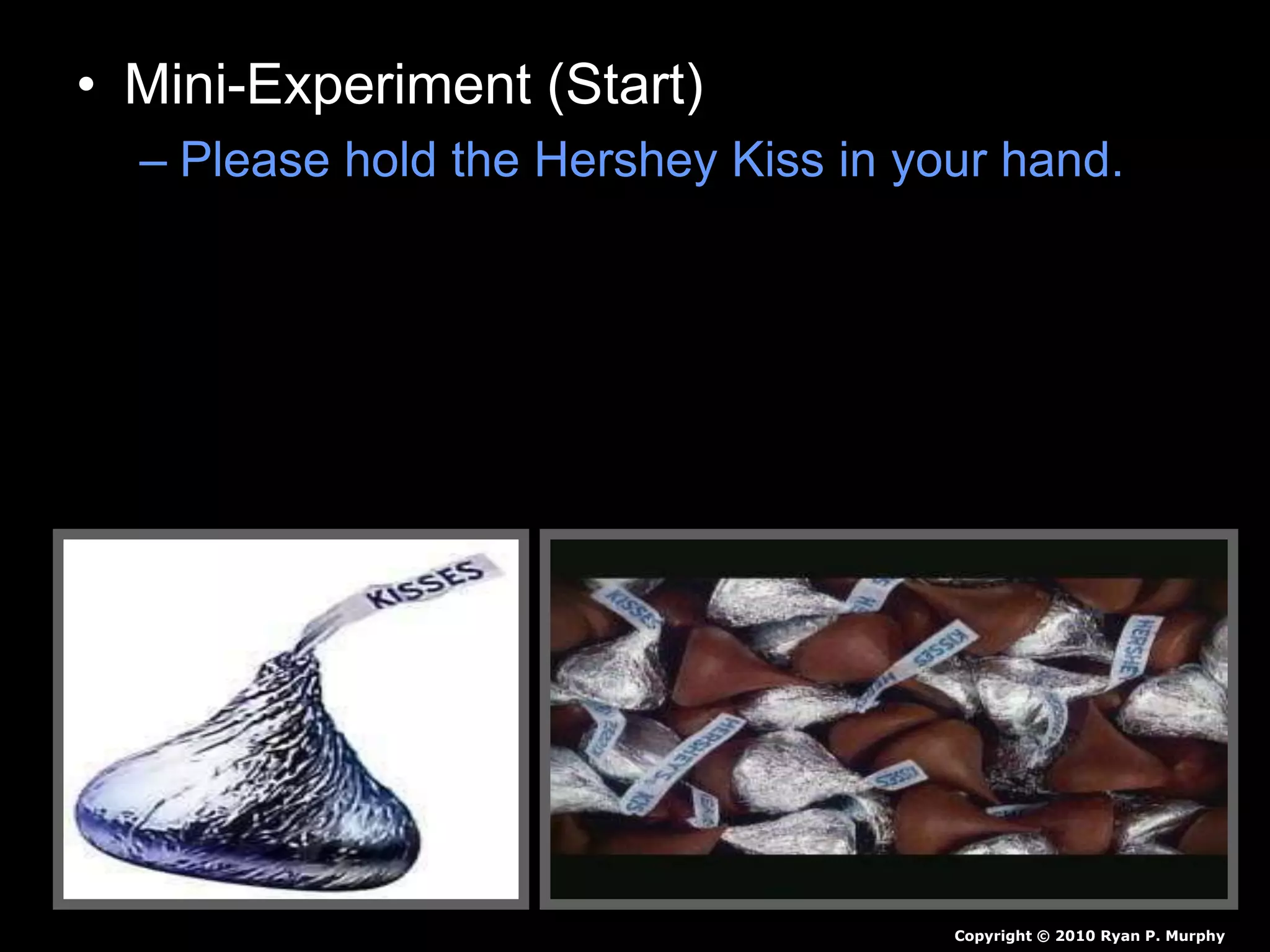
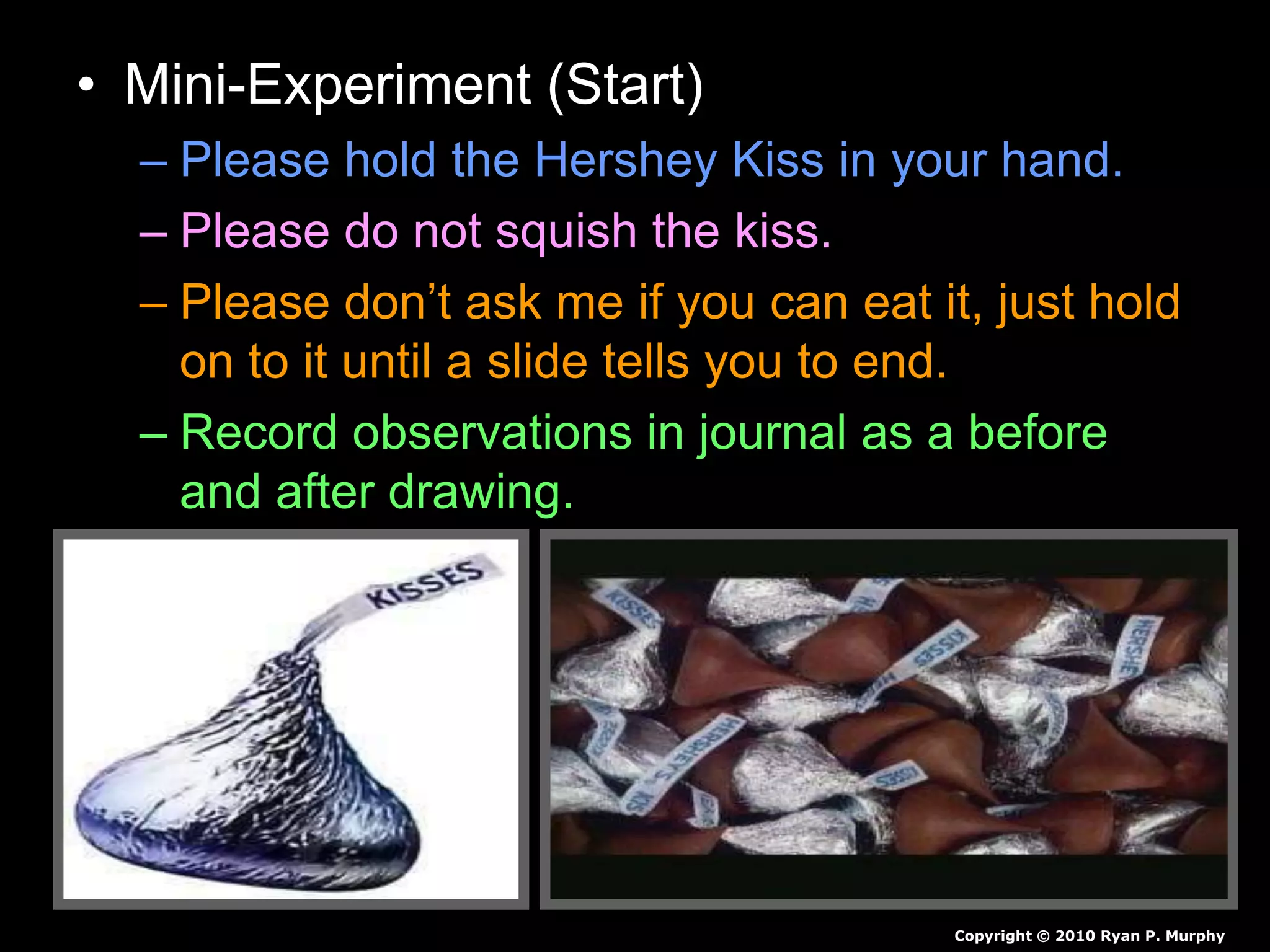
• Mini-Experiment (Start)
– Please hold the Hershey Kiss in your hand.
– Please do not squish the kiss.
– Please don’t ask me if you can eat it, just hold
on to it until a slide tells you to end.
– Record observations in journal as a before
and after drawing.
Copyright © 2010 Ryan P. Murphy
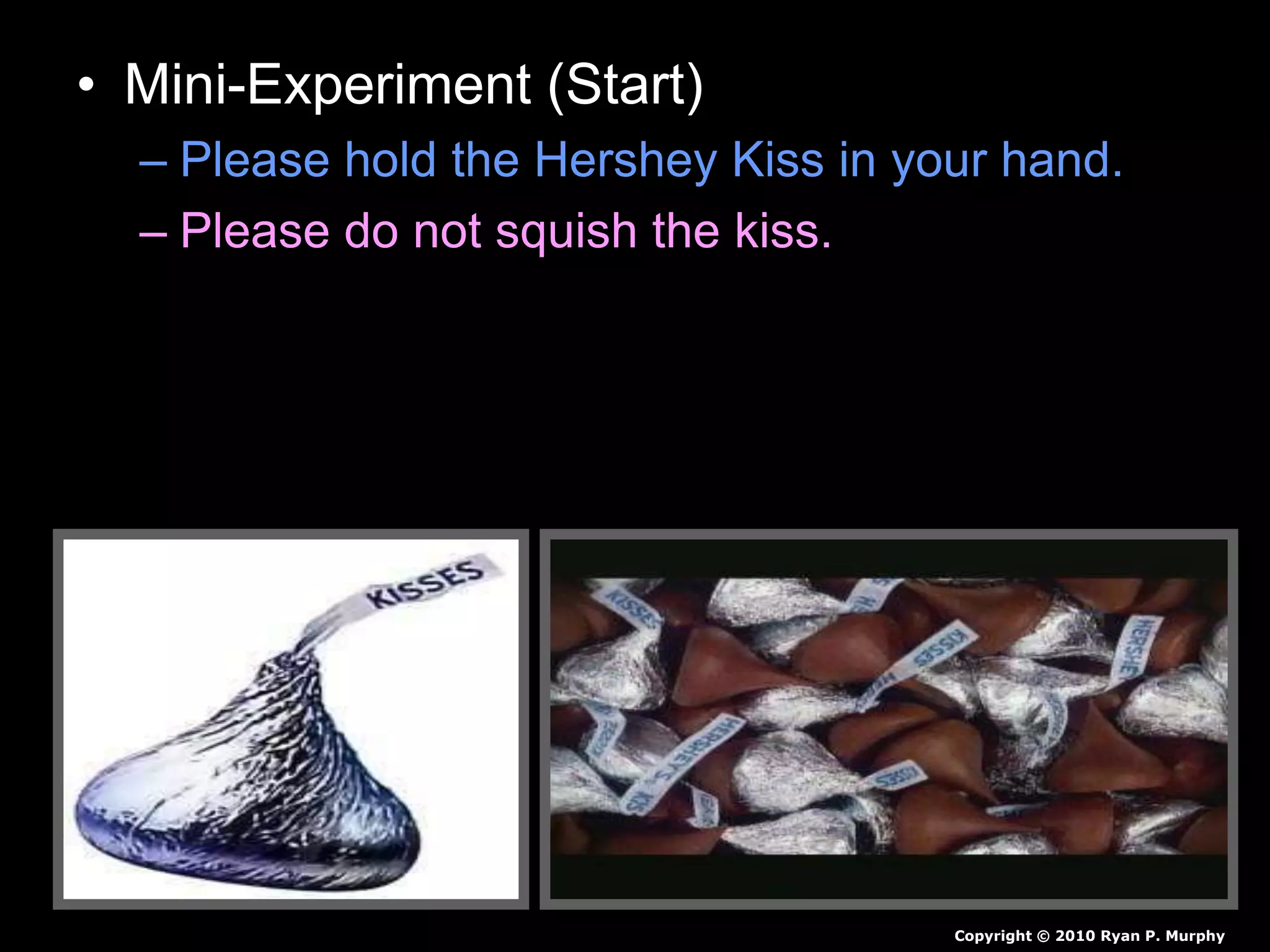
• Mini-Experiment (Start)
– Please hold the Hershey Kiss in your hand.
– Please do not squish the kiss.
– Please don’t ask me if you can eat it, just hold
on to it until a slide tells you to end.
– Record observations in journal as a before
and after drawing.
Copyright © 2010 Ryan P. Murphy
• Mini-Experiment (Start)
– Please hold the Hershey Kiss in your hand.
– Please do not squish the kiss.
– Please don’t ask me if you can eat it, just hold
on to it until a slide tells you to end.
– Record observations in journal as a before
and after drawing.
Copyright © 2010 Ryan P. Murphy
• Mini-Experiment (Start)
– Please hold the Hershey Kiss in your hand.
– Please do not squish the kiss.
– Please don’t ask me if you can eat it, just hold
on to it until a slide tells you to end.
– Record observations in journal as a before
and after drawing.
Copyright © 2010 Ryan P. Murphy
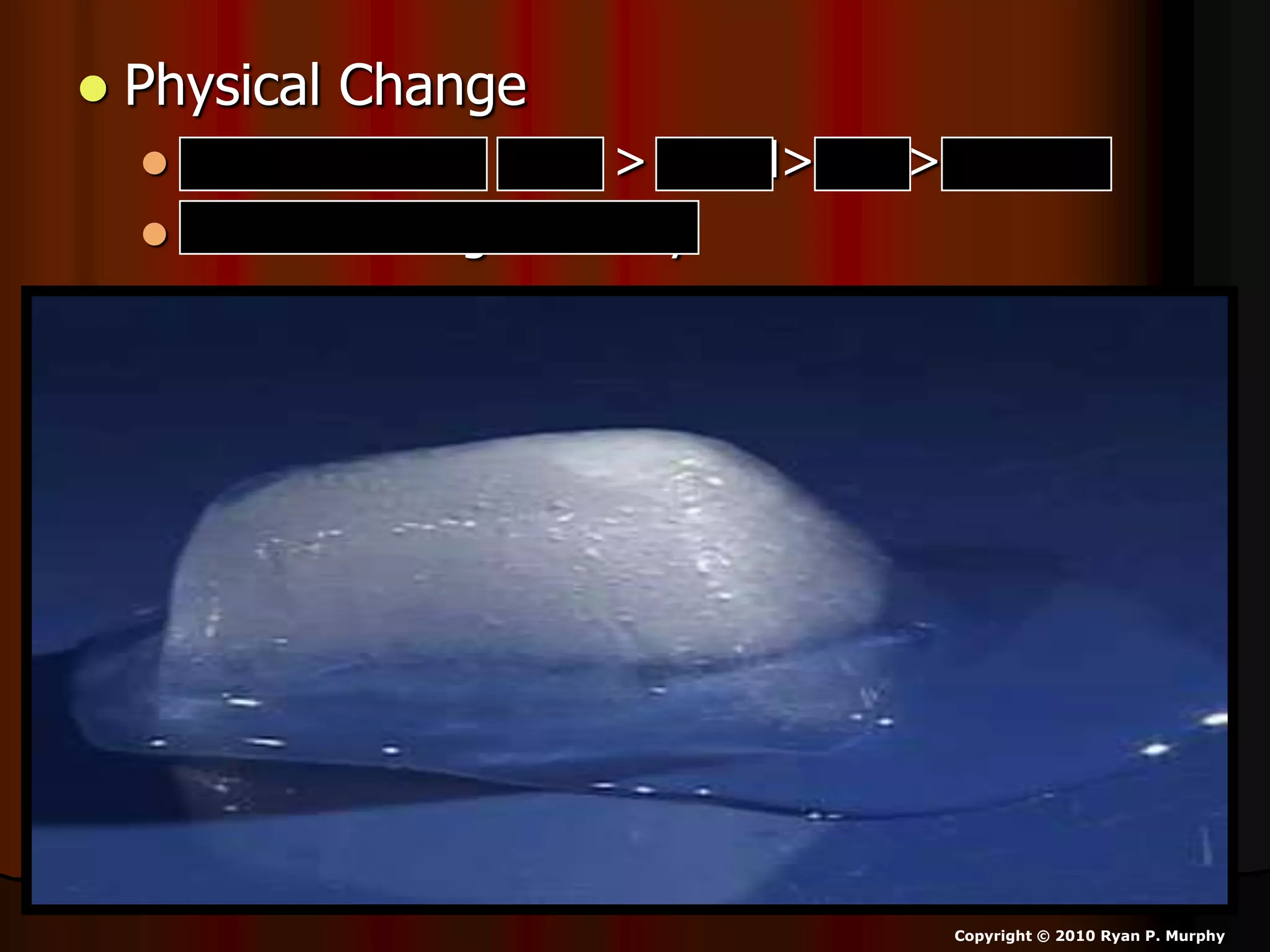
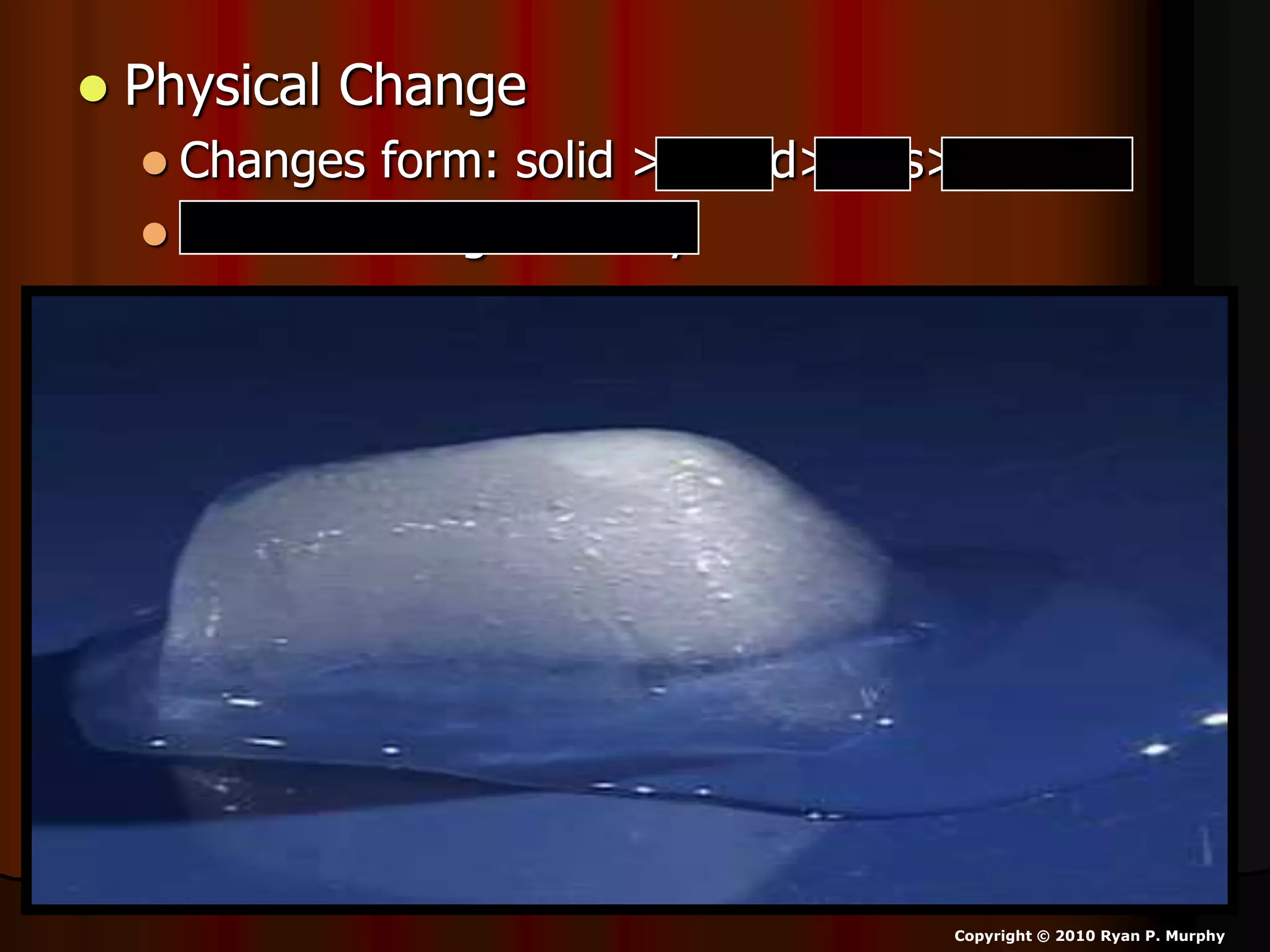
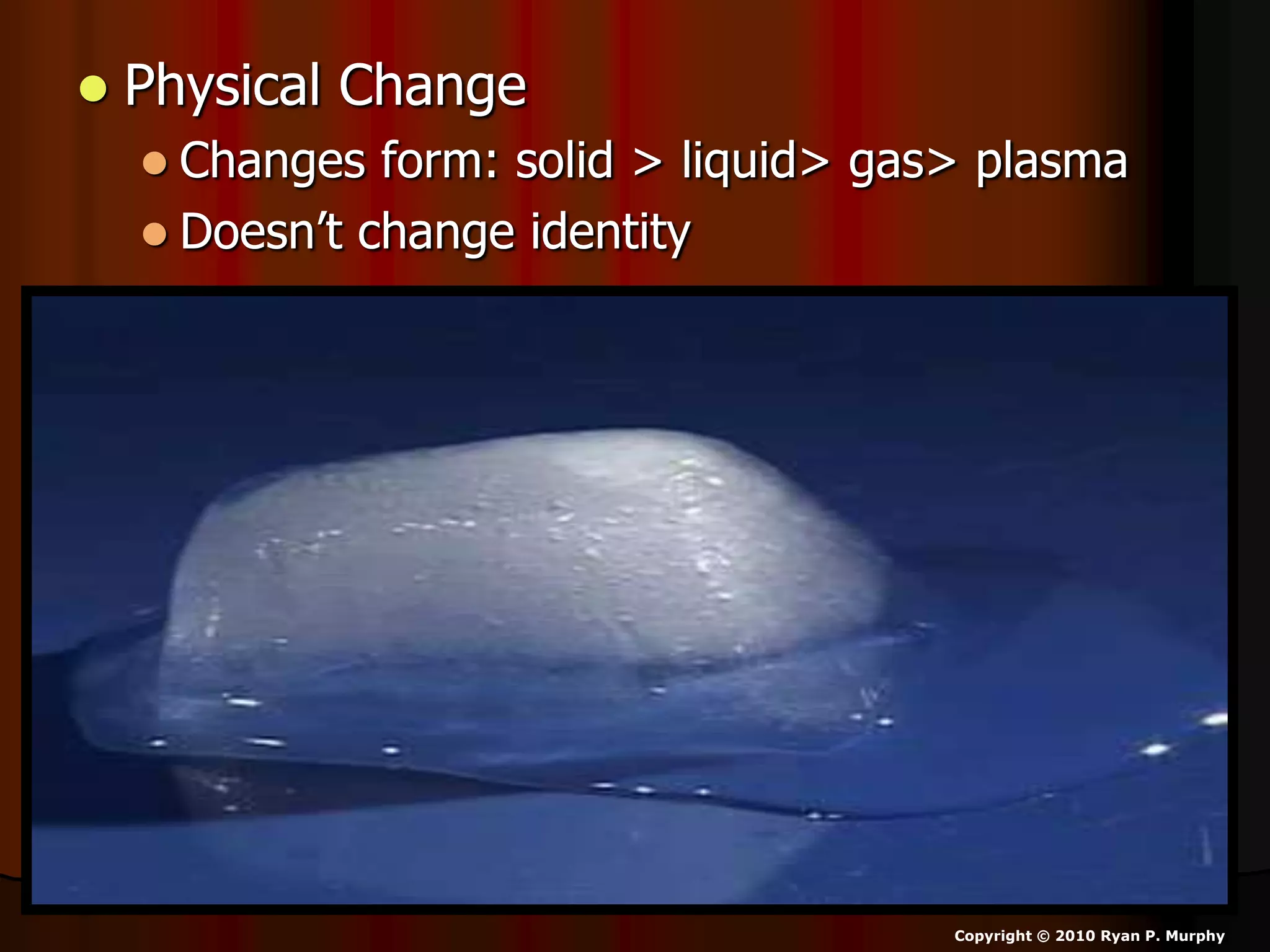
 Physical Change
 Changes form solid > liquid> gas> plasma
 Doesn’t change identity
Copyright © 2010 Ryan P. Murphy
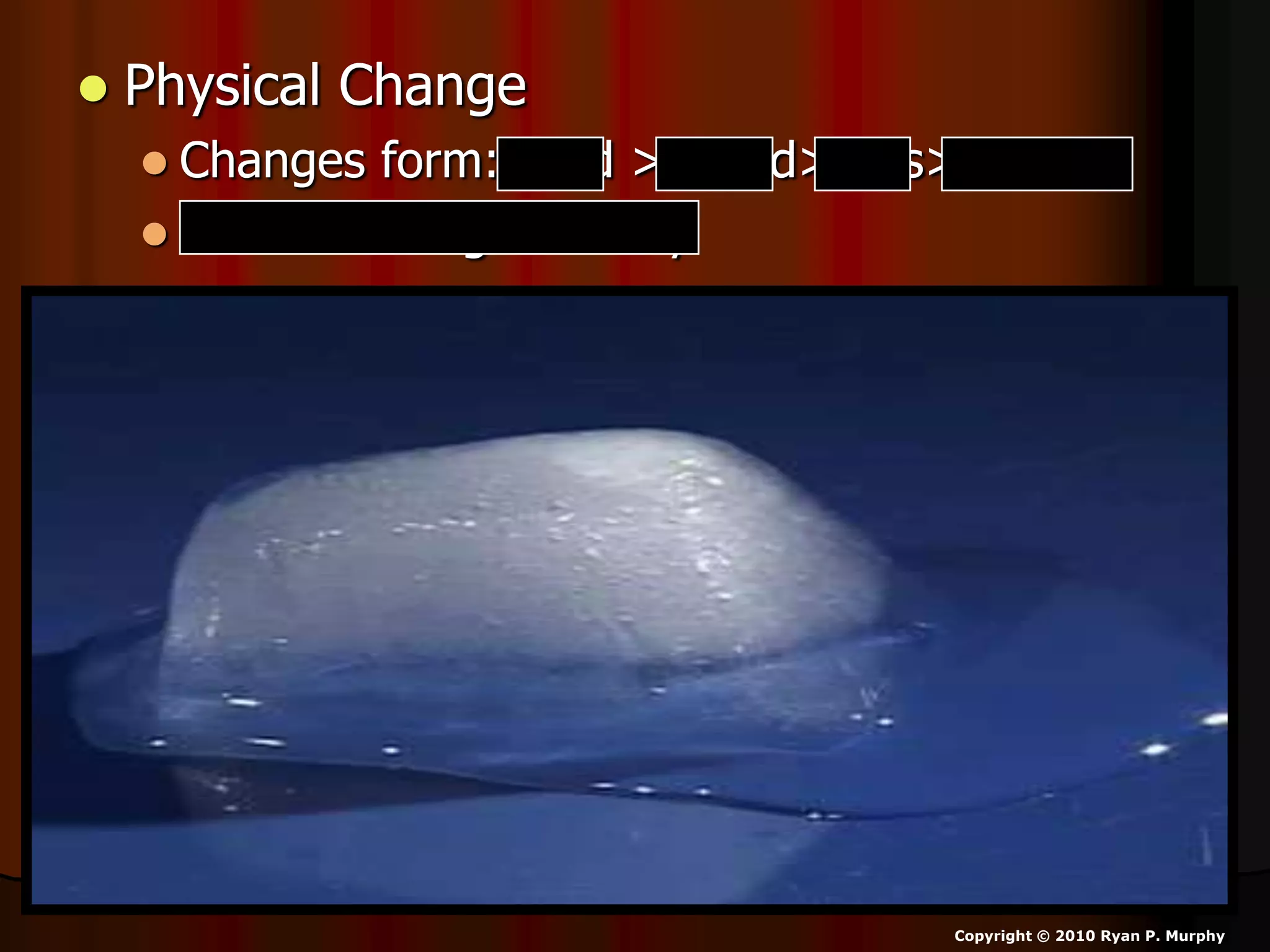
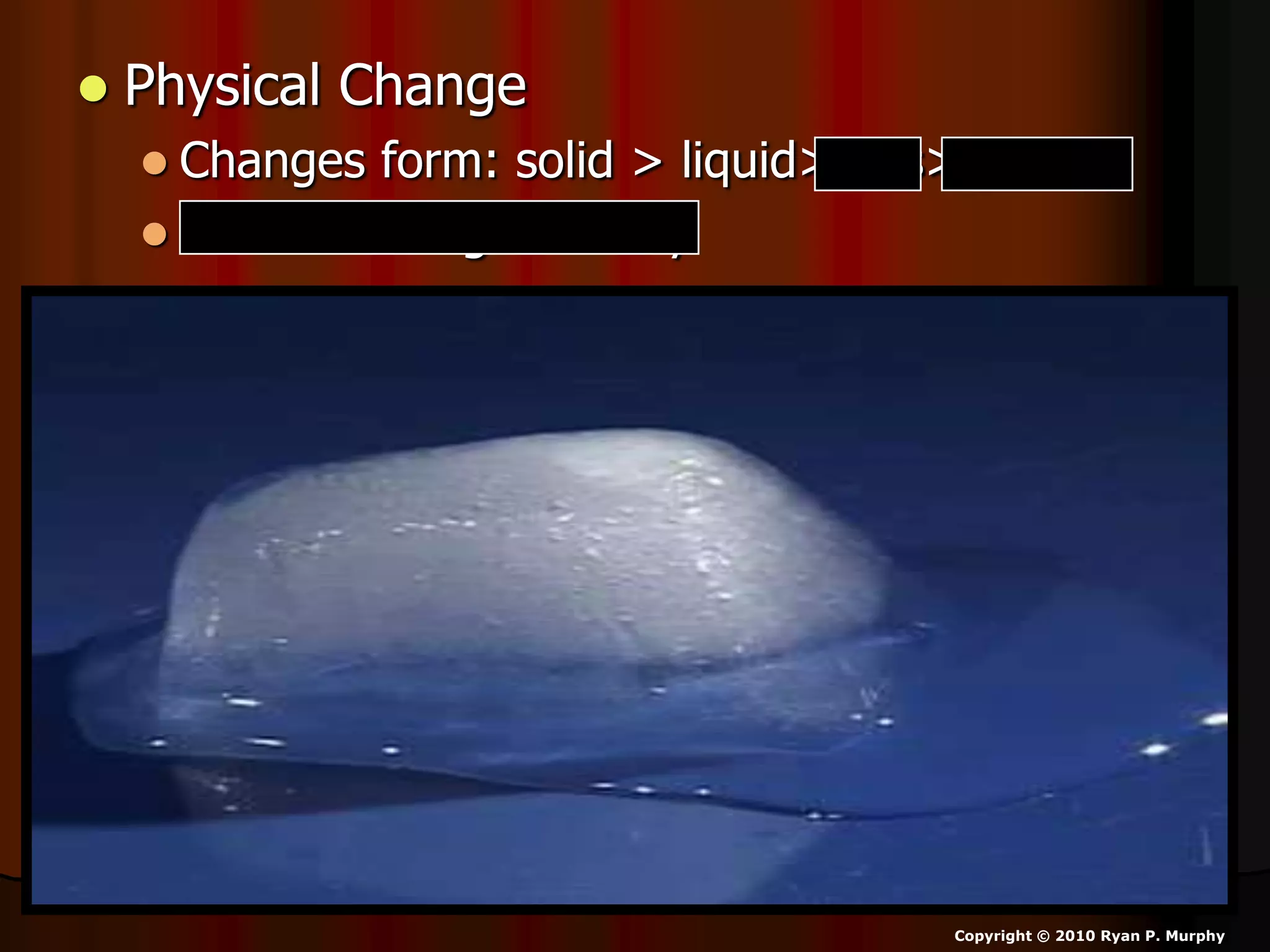
 Physical Change
 Changes form: solid > liquid> gas> plasma
 Doesn’t change identity
Copyright © 2010 Ryan P. Murphy
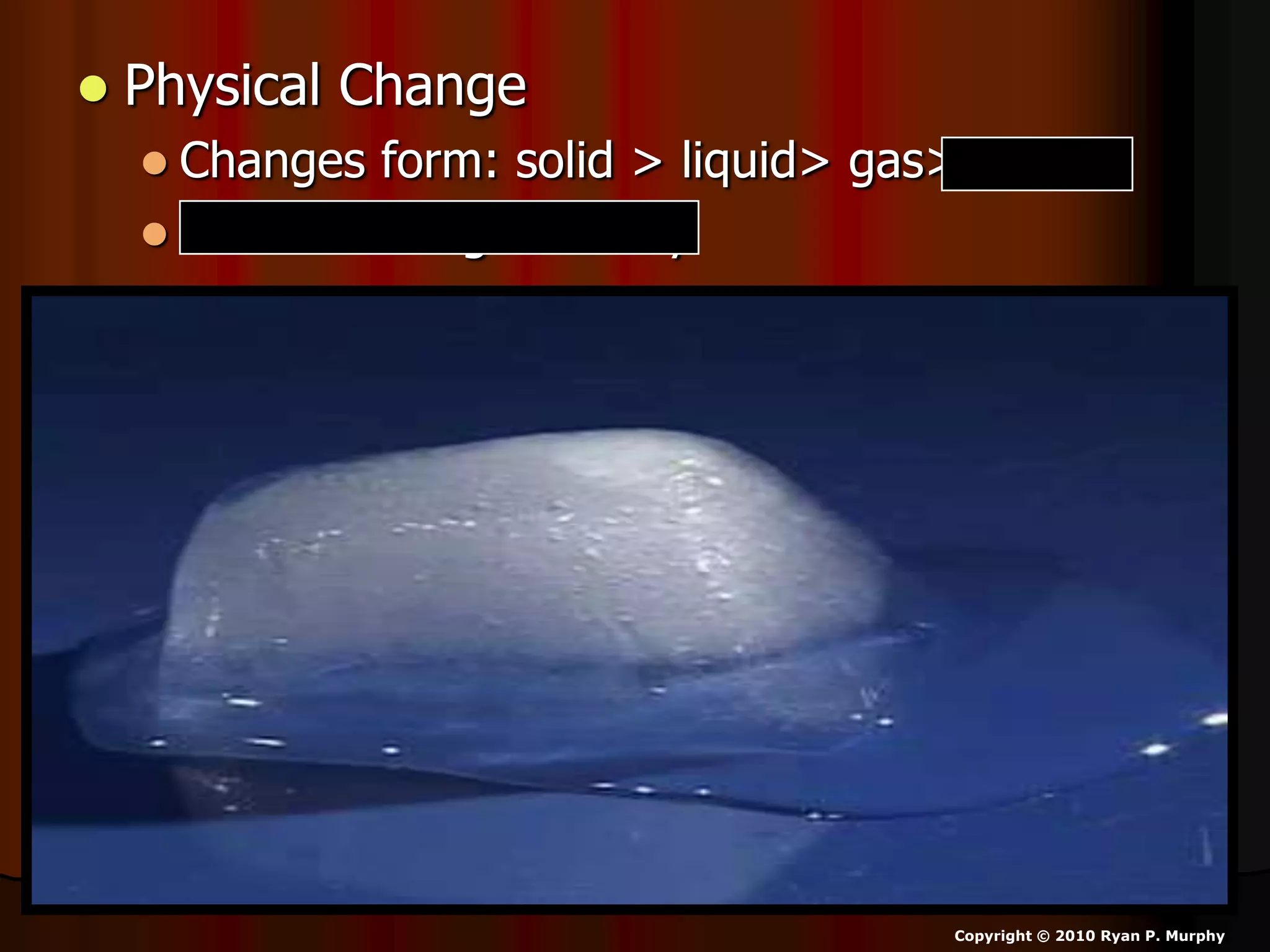
 Physical Change
 Changes form: solid > liquid> gas> plasma
 Doesn’t change identity
Copyright © 2010 Ryan P. Murphy
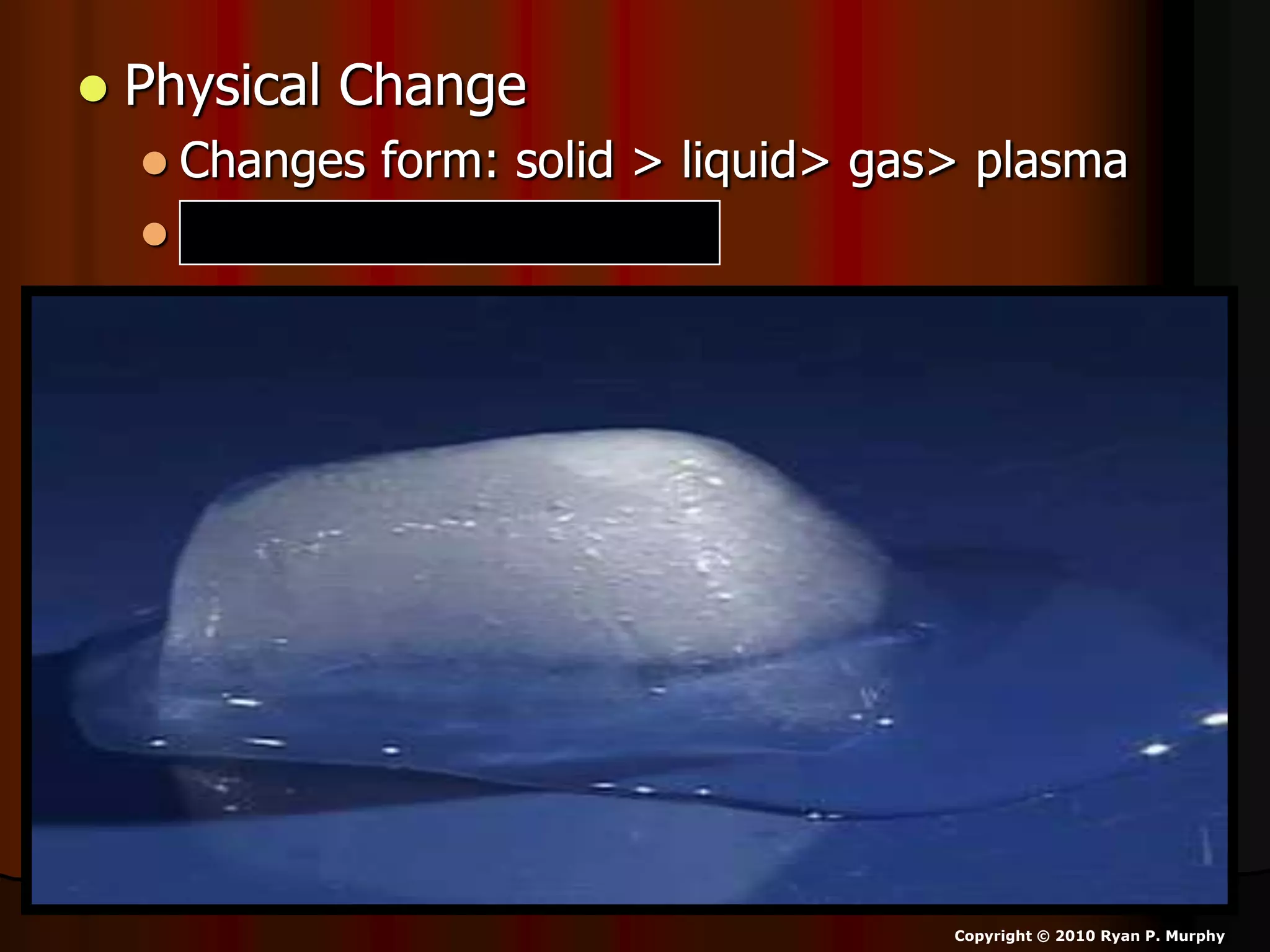
 Physical Change
 Changes form: solid > liquid> gas> plasma
 Doesn’t change identity
Copyright © 2010 Ryan P. Murphy
 Physical Change
 Changes form: solid > liquid> gas> plasma
 Doesn’t change identity
Copyright © 2010 Ryan P. Murphy
 Physical Change
 Changes form: solid > liquid> gas> plasma
 Doesn’t change identity
Copyright © 2010 Ryan P. Murphy
 Physical Change
 Changes form: solid > liquid> gas> plasma
 Doesn’t change identity
Copyright © 2010 Ryan P. Murphy
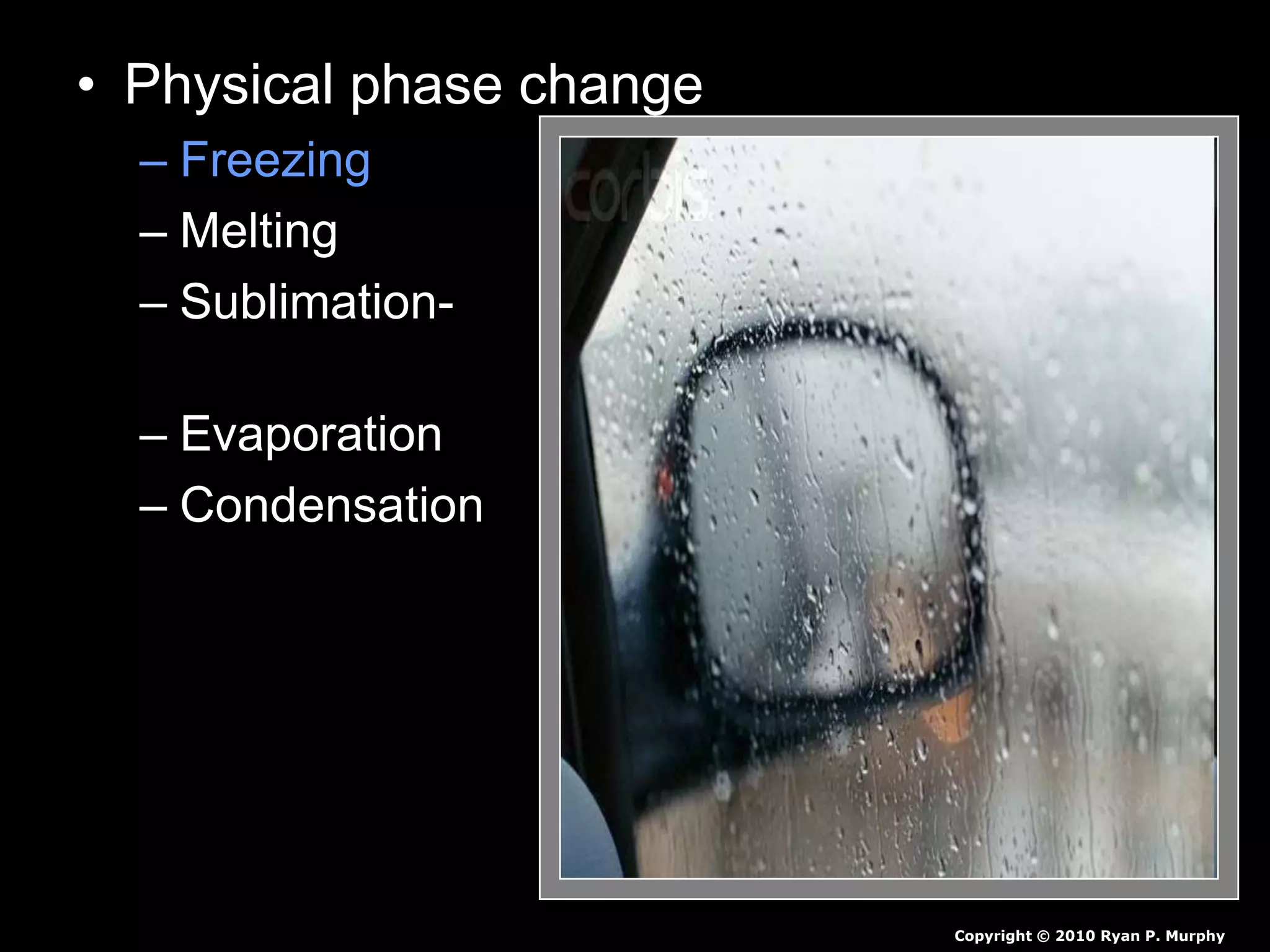
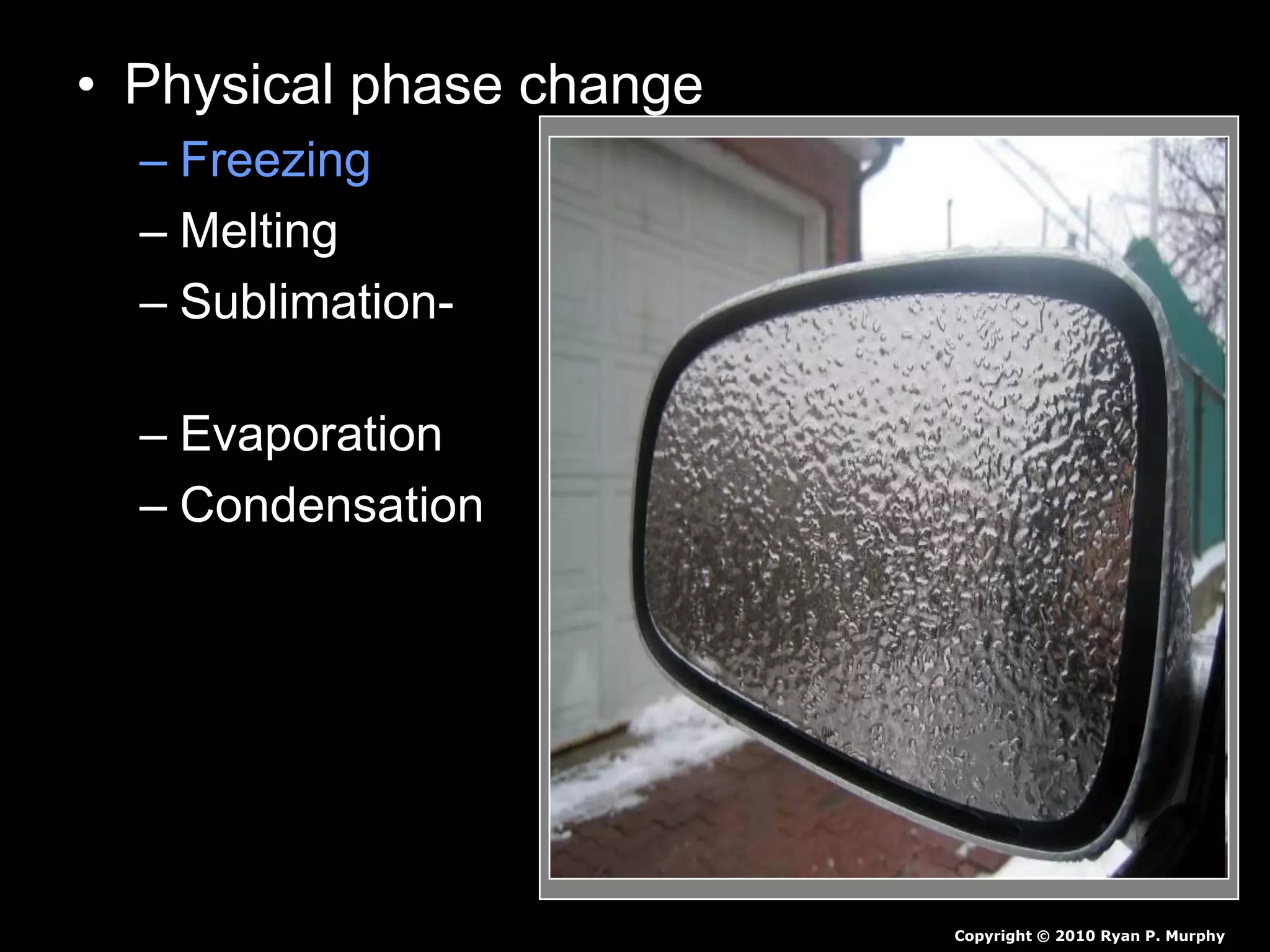
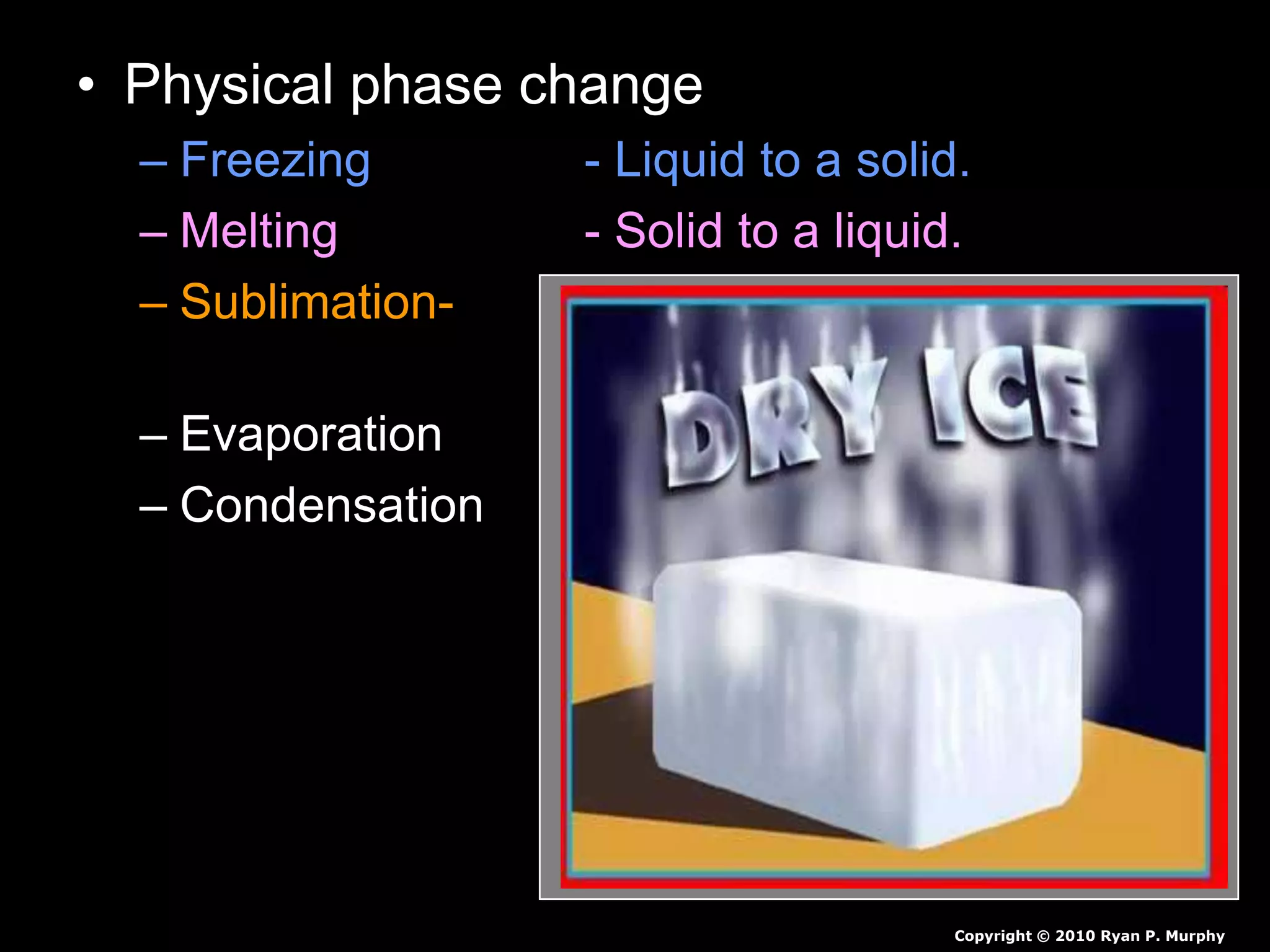
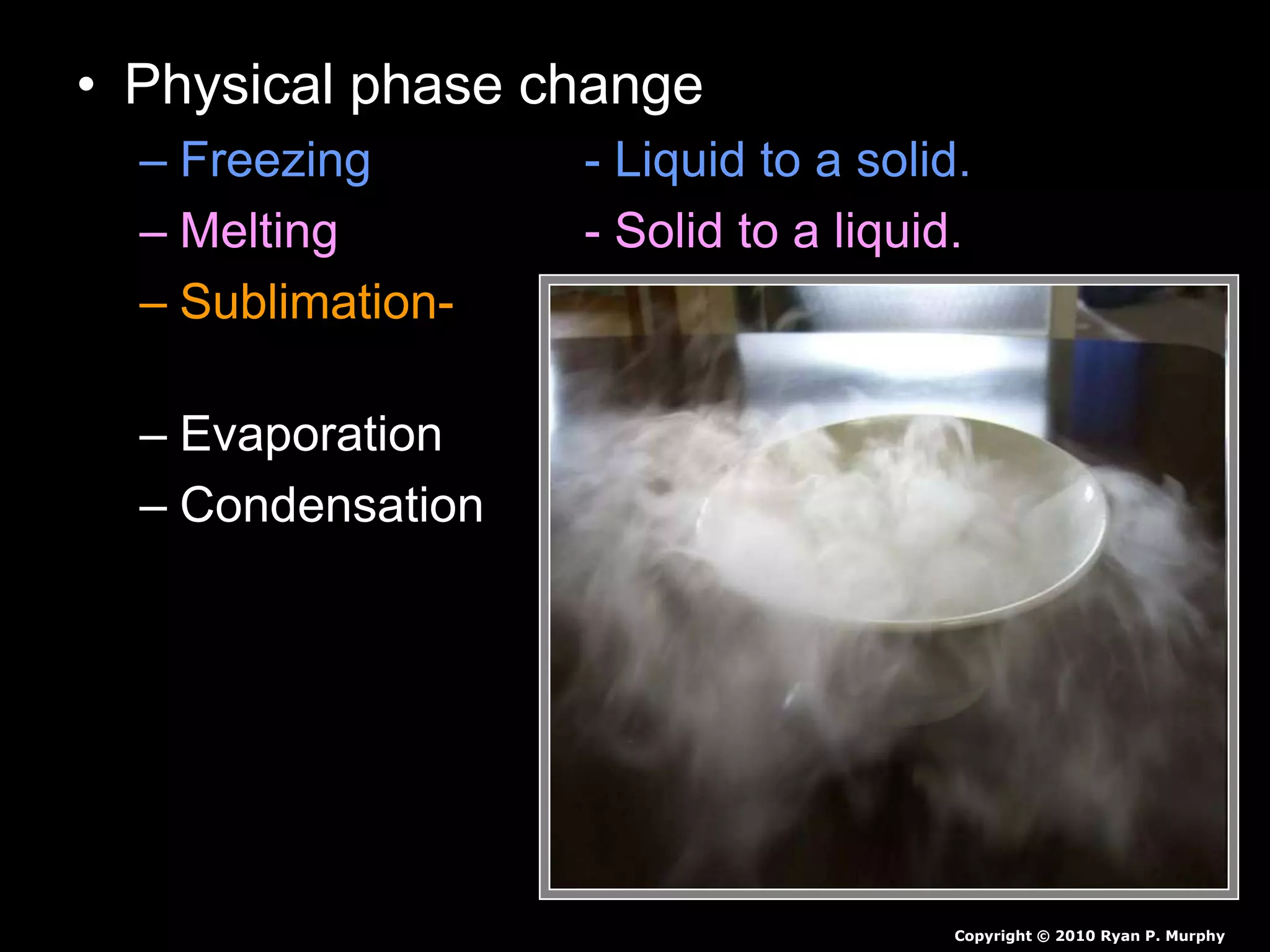
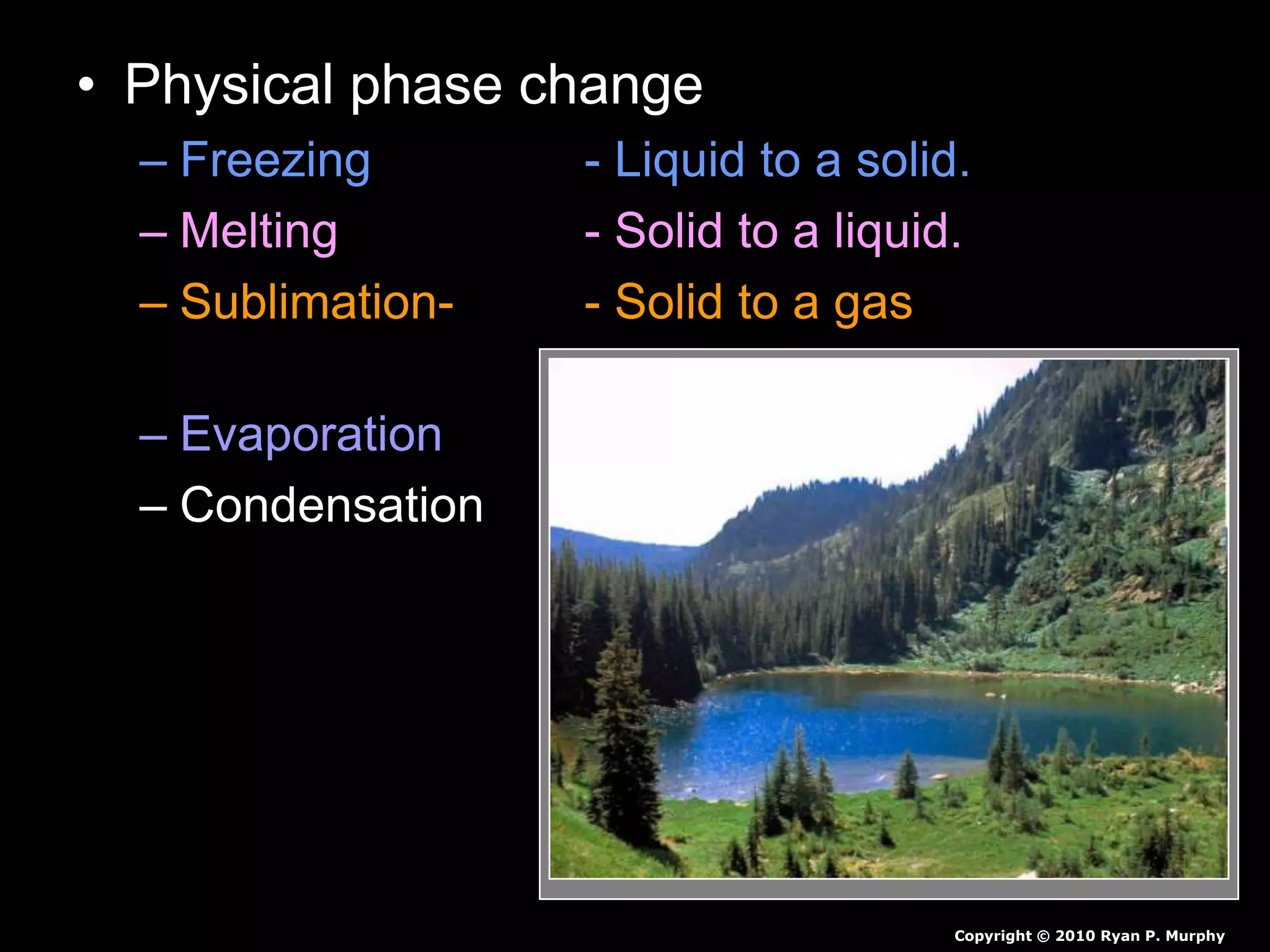
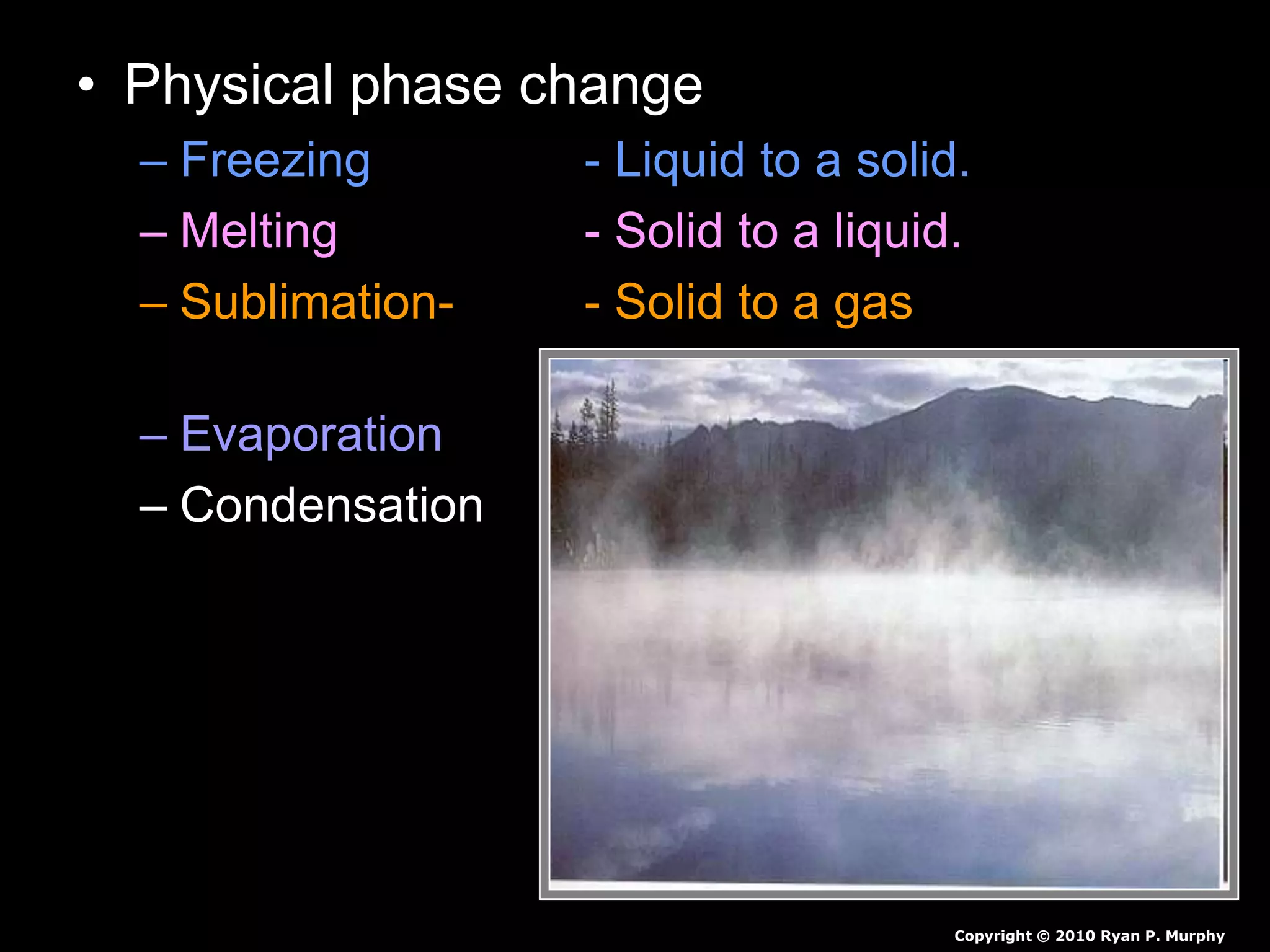
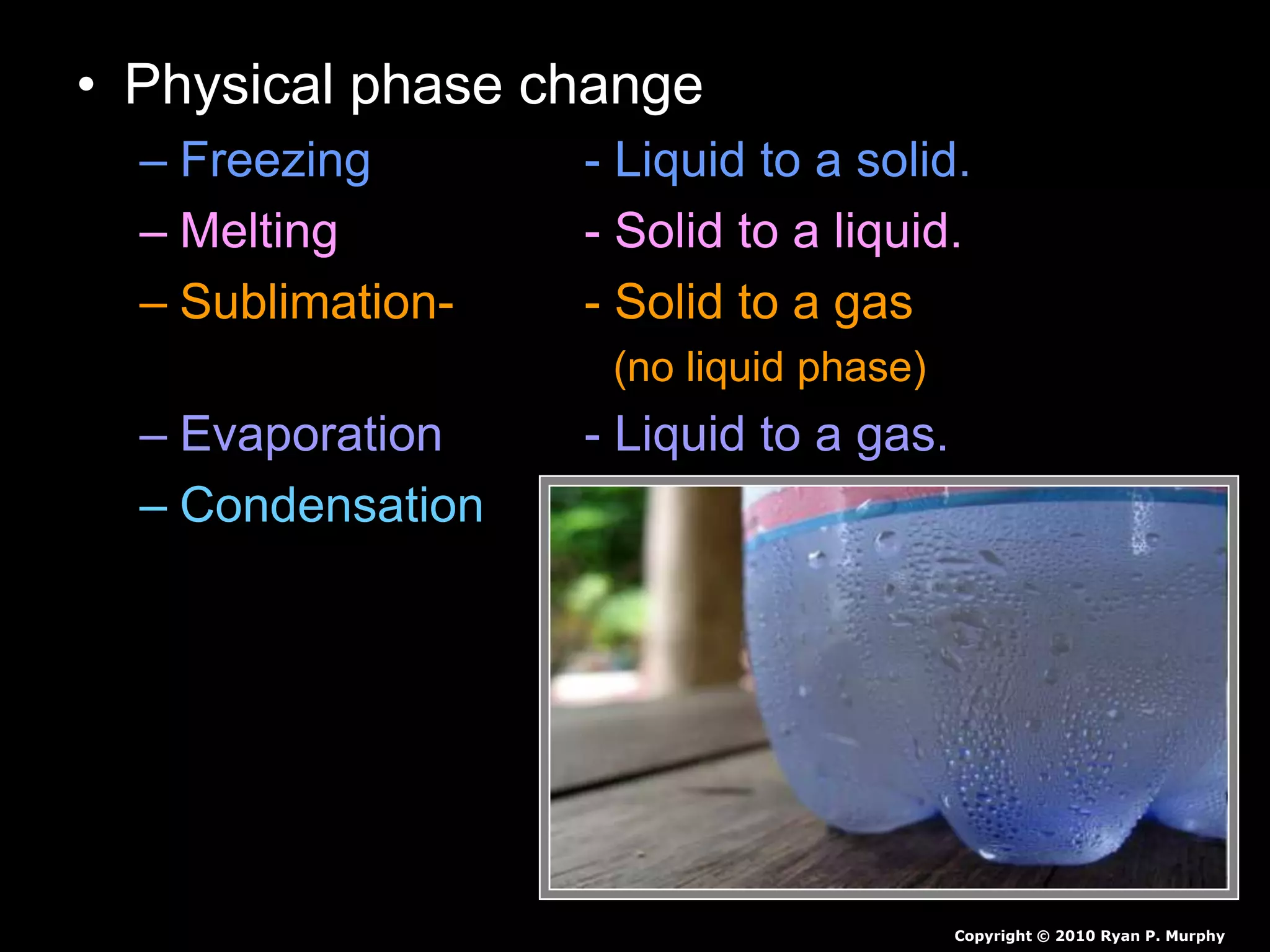
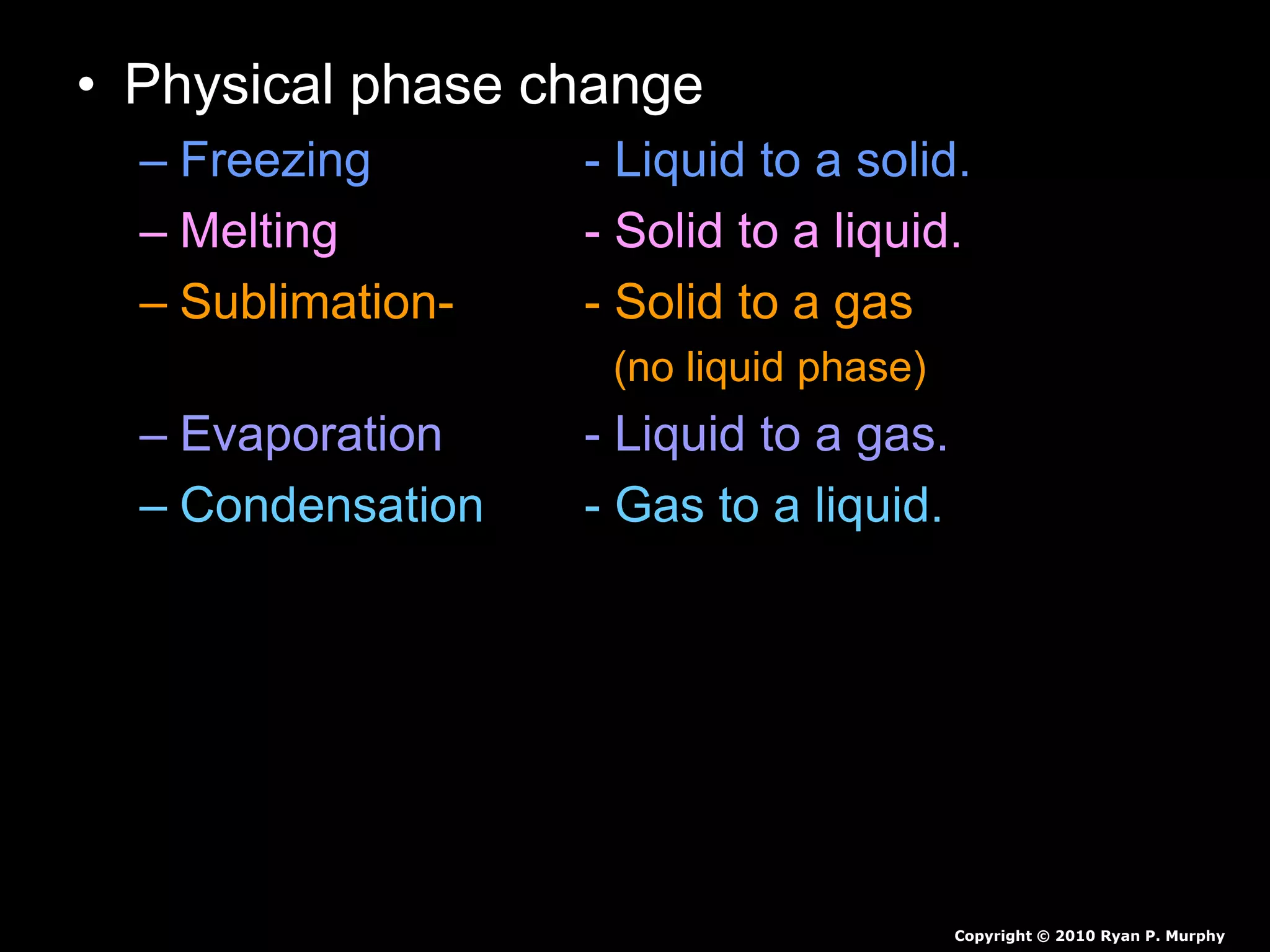
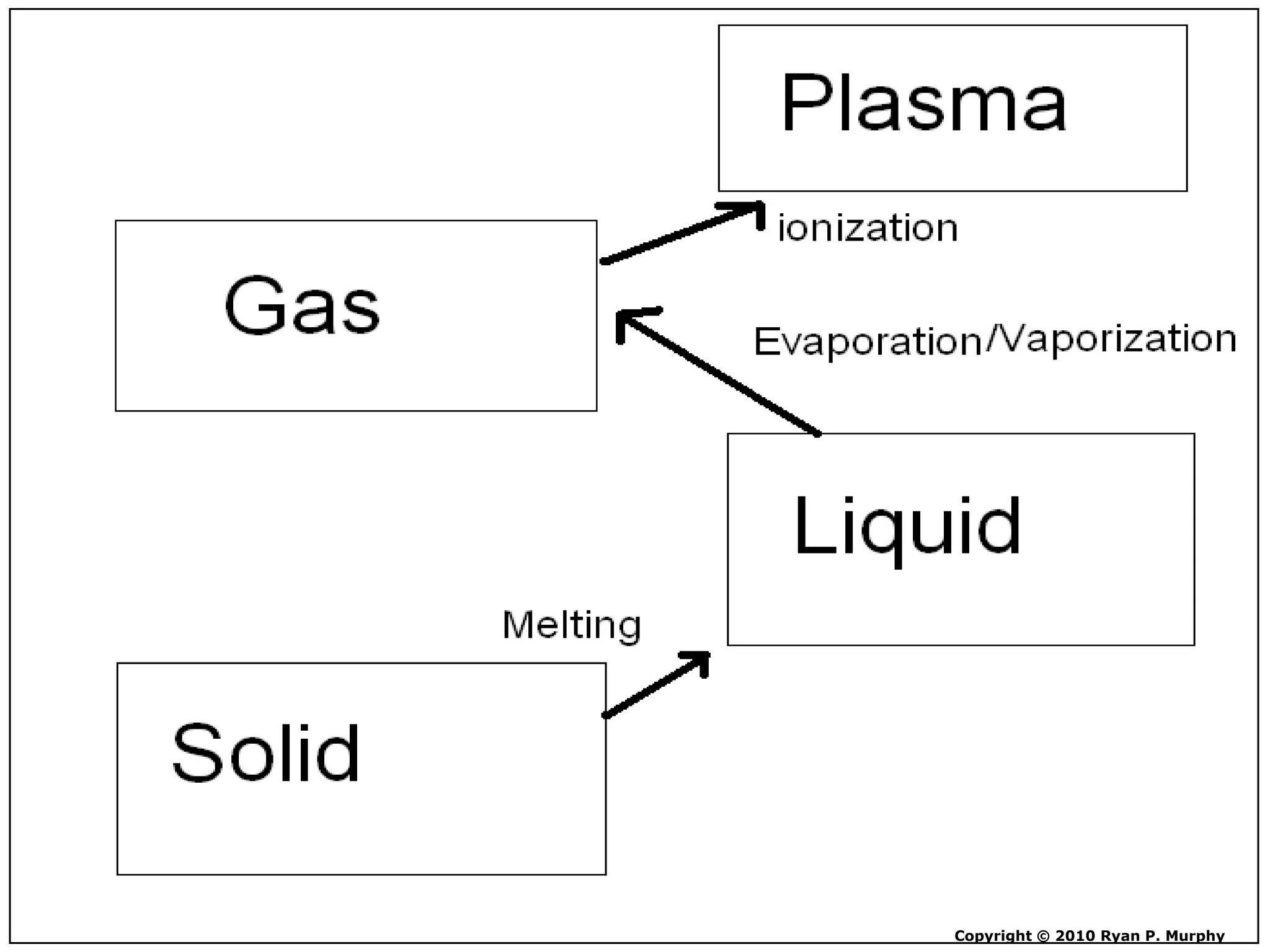
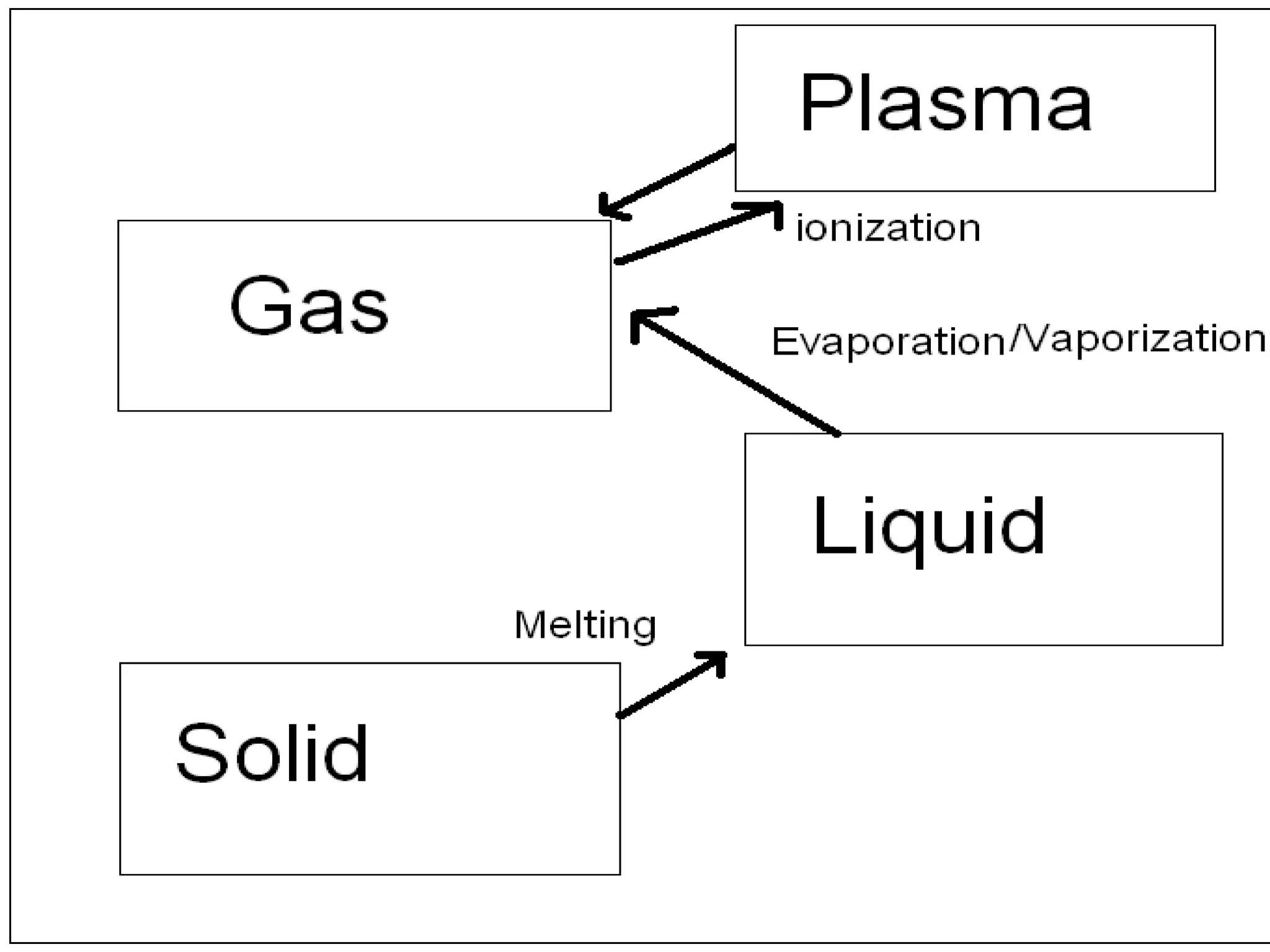
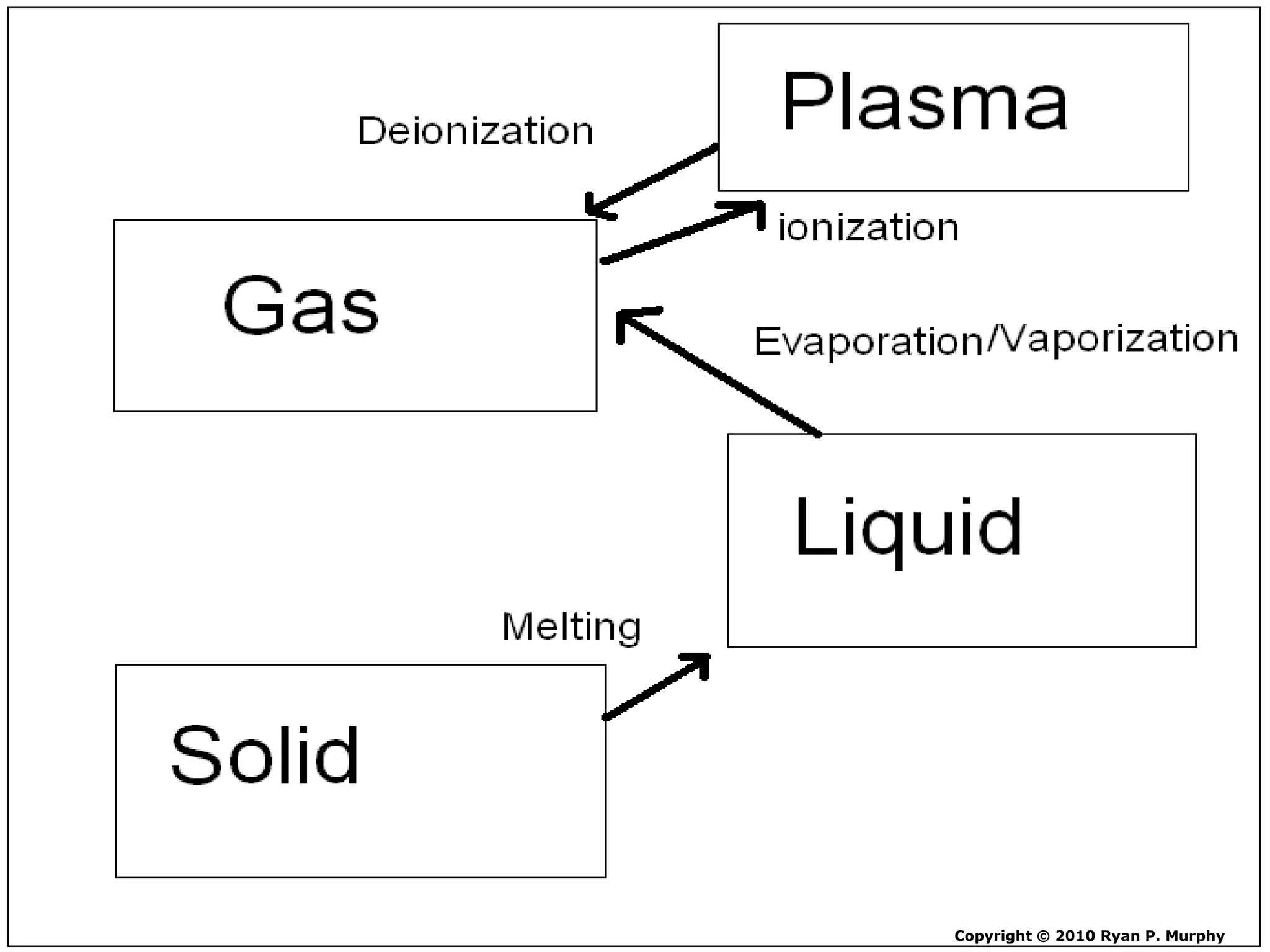
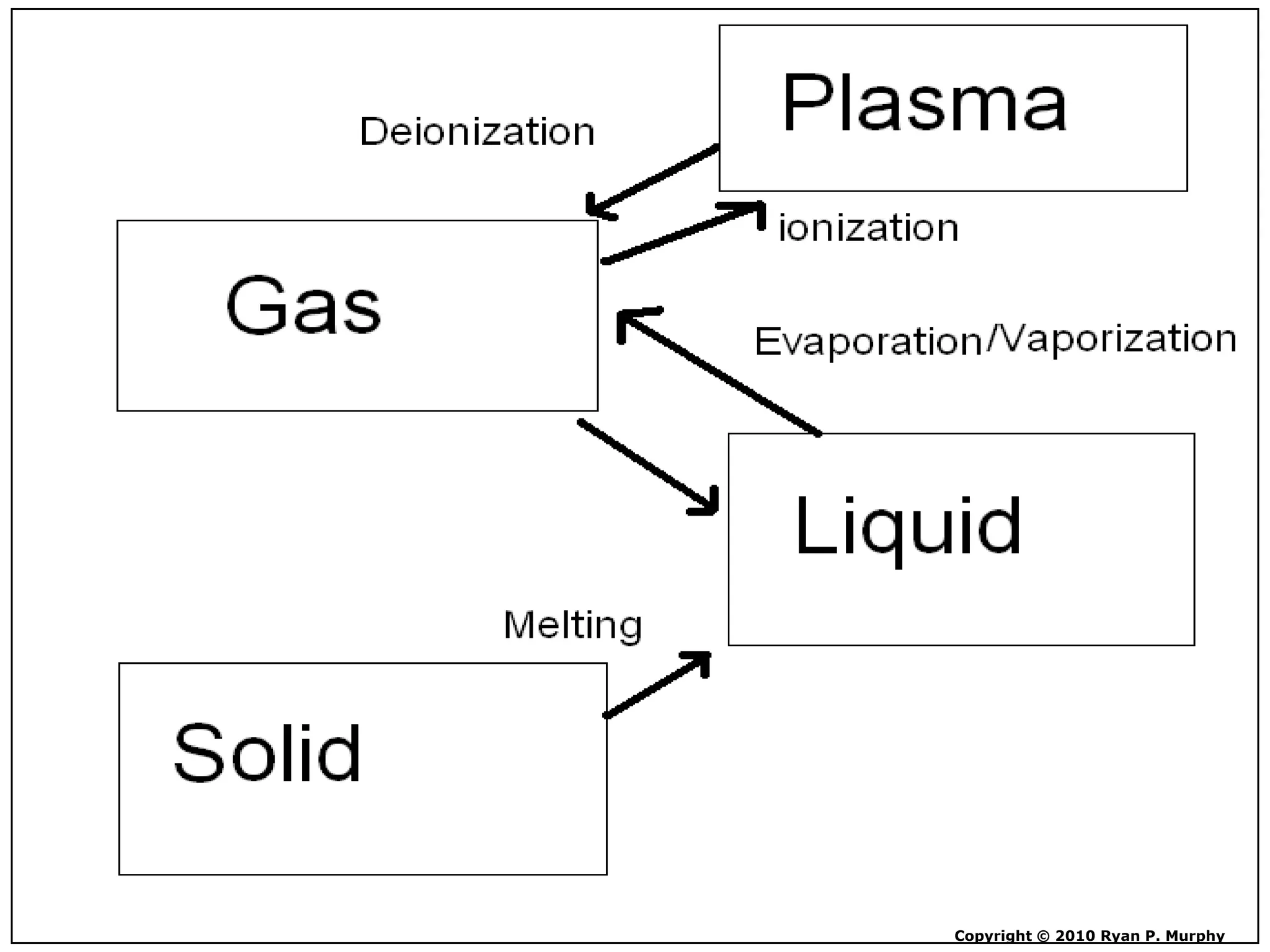
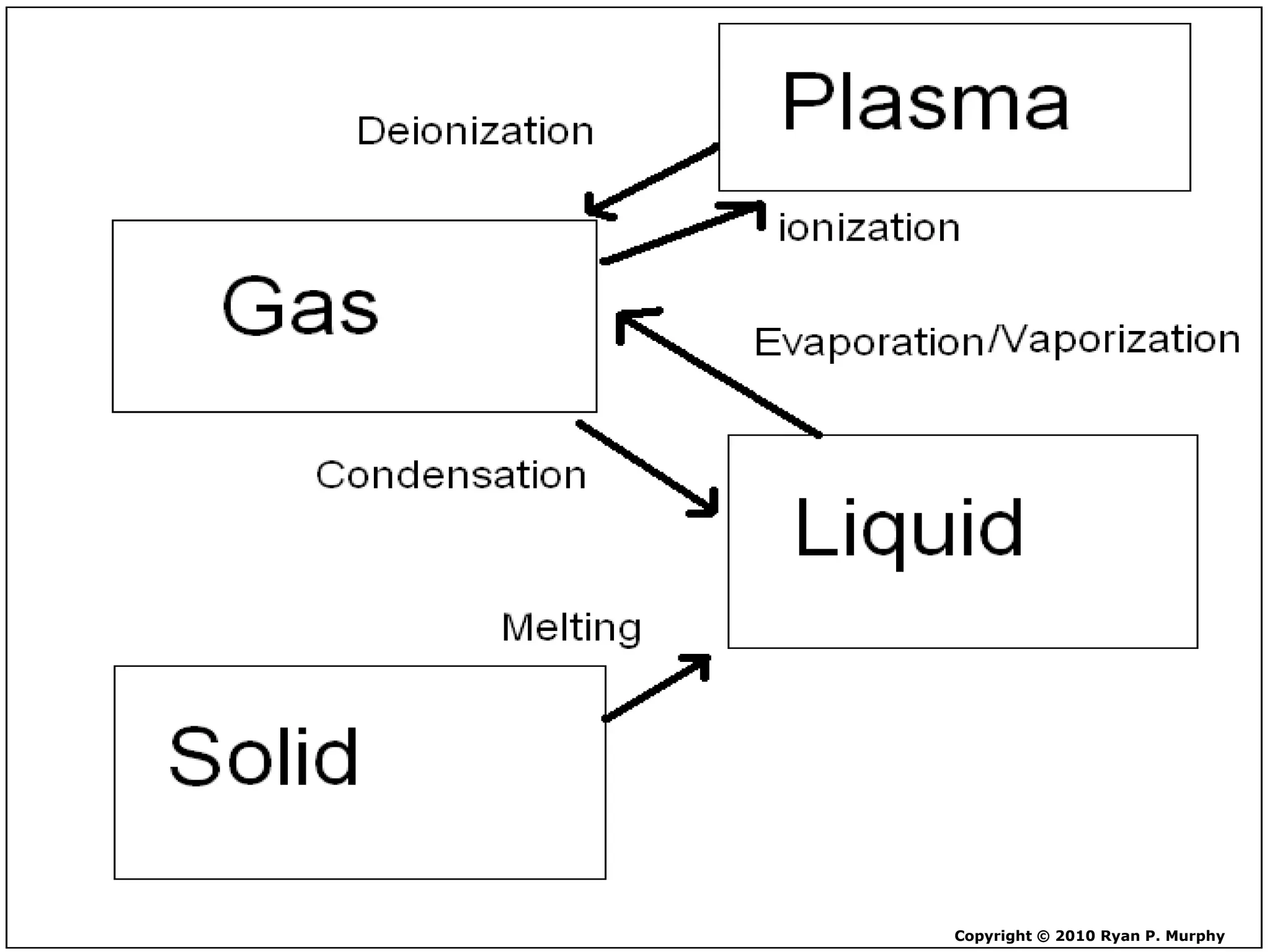
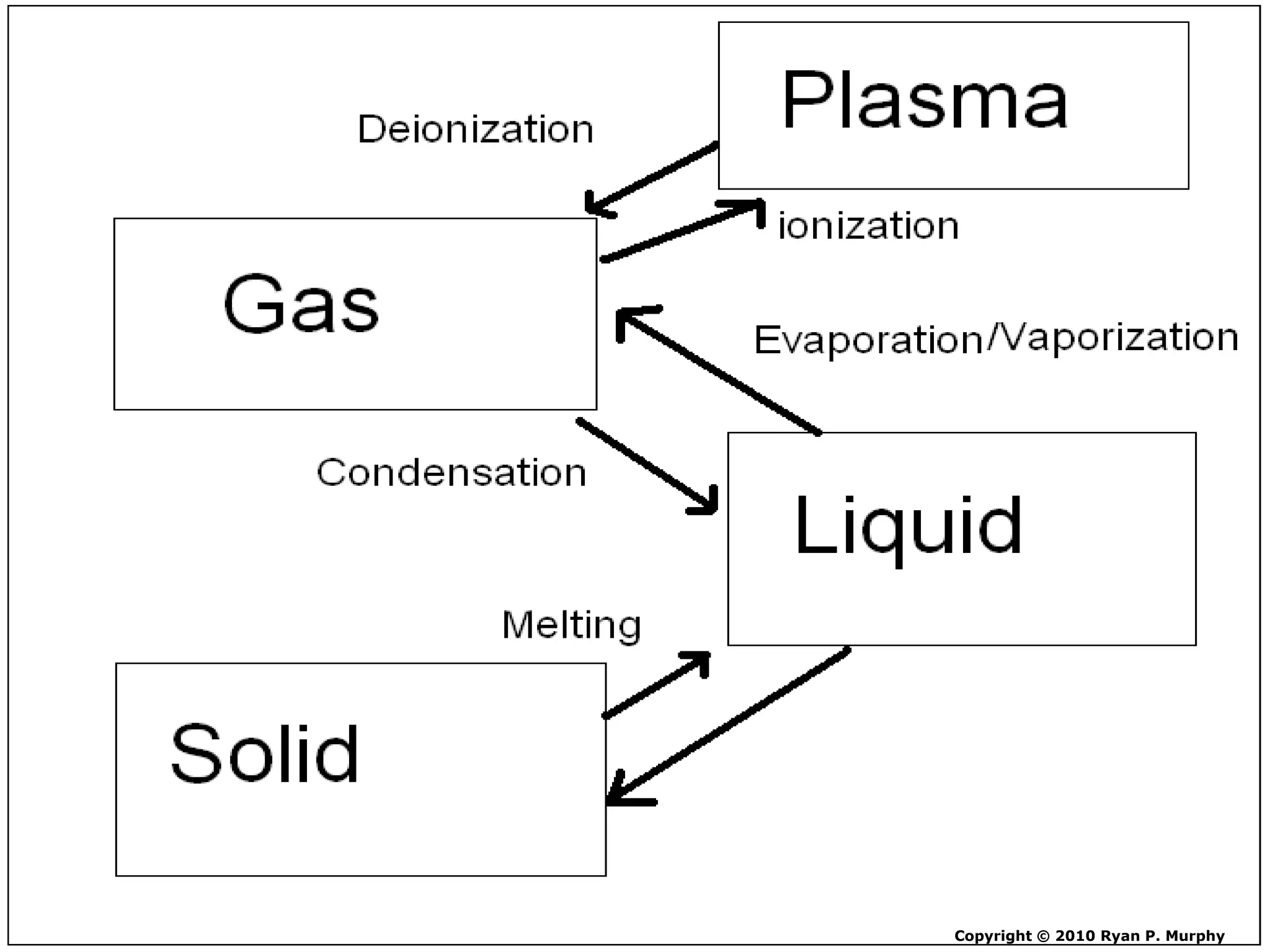
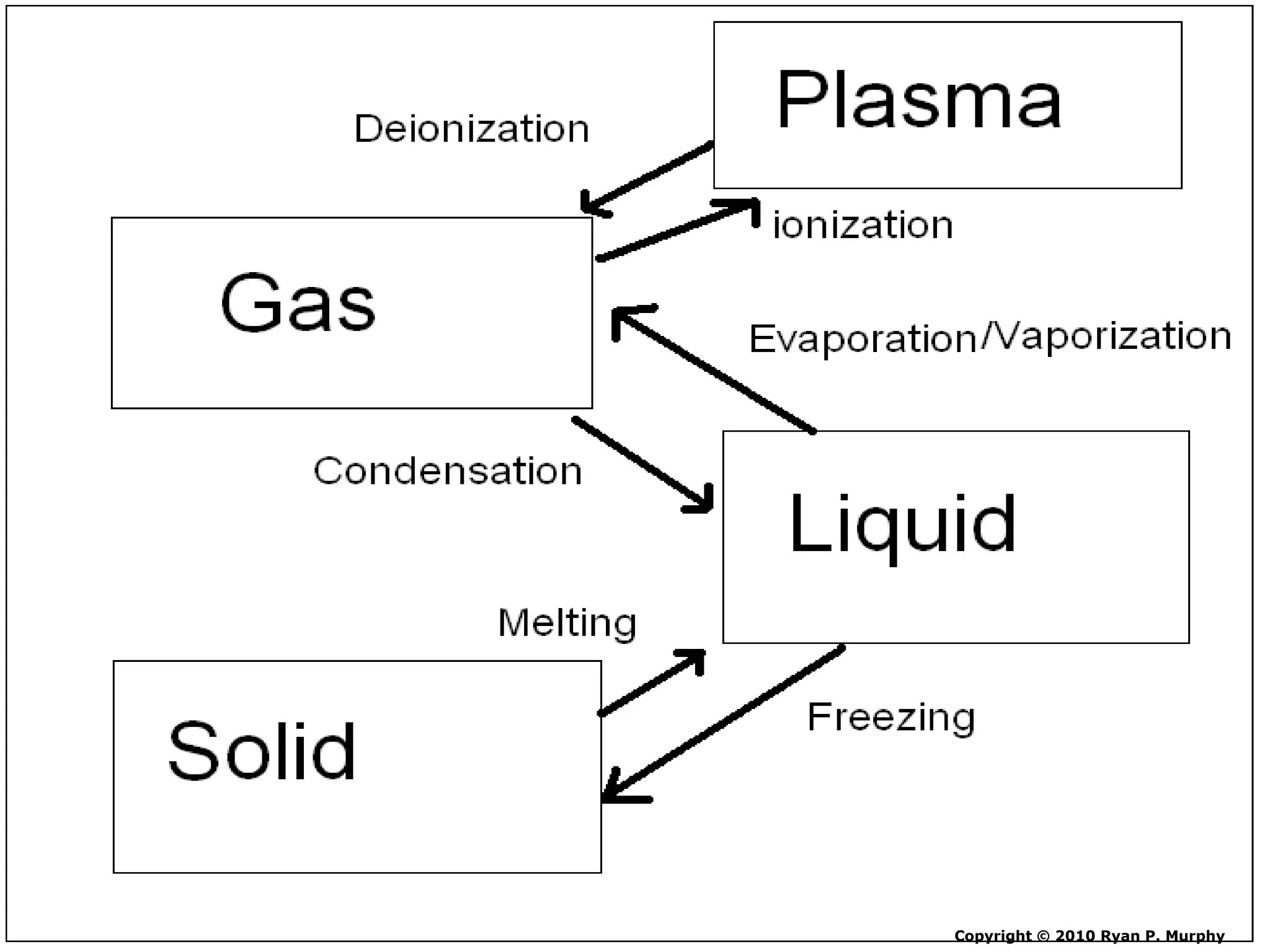
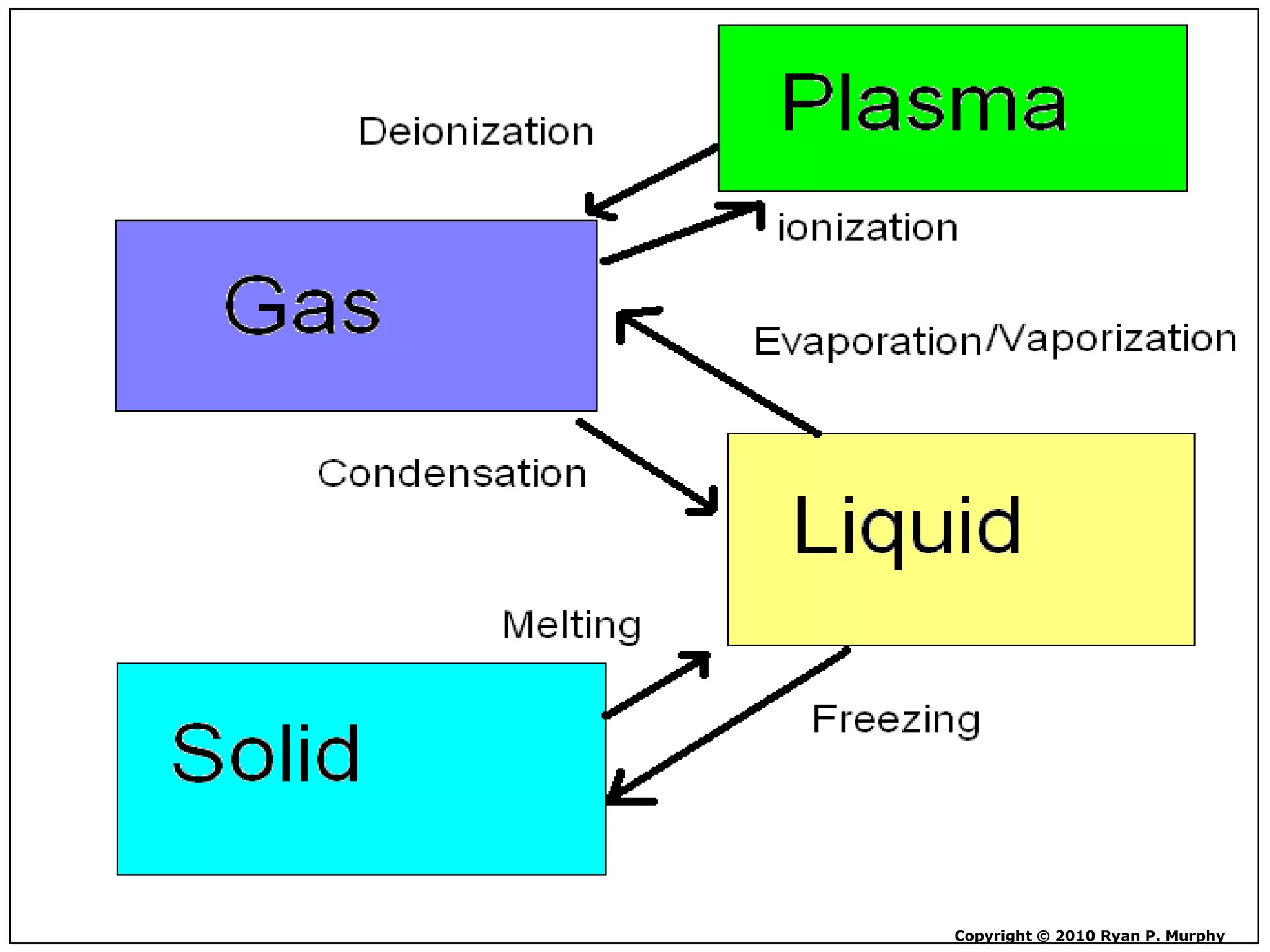
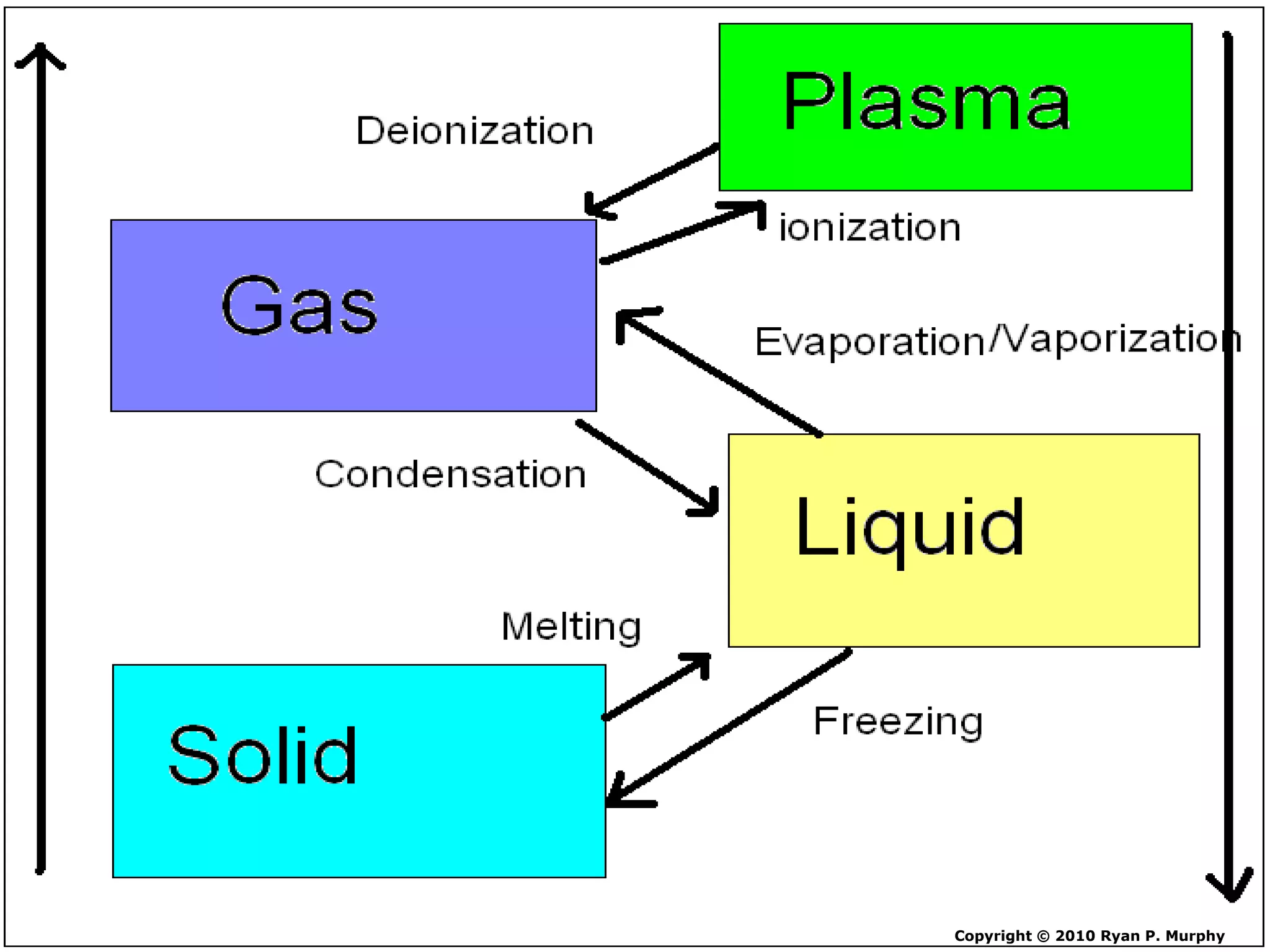
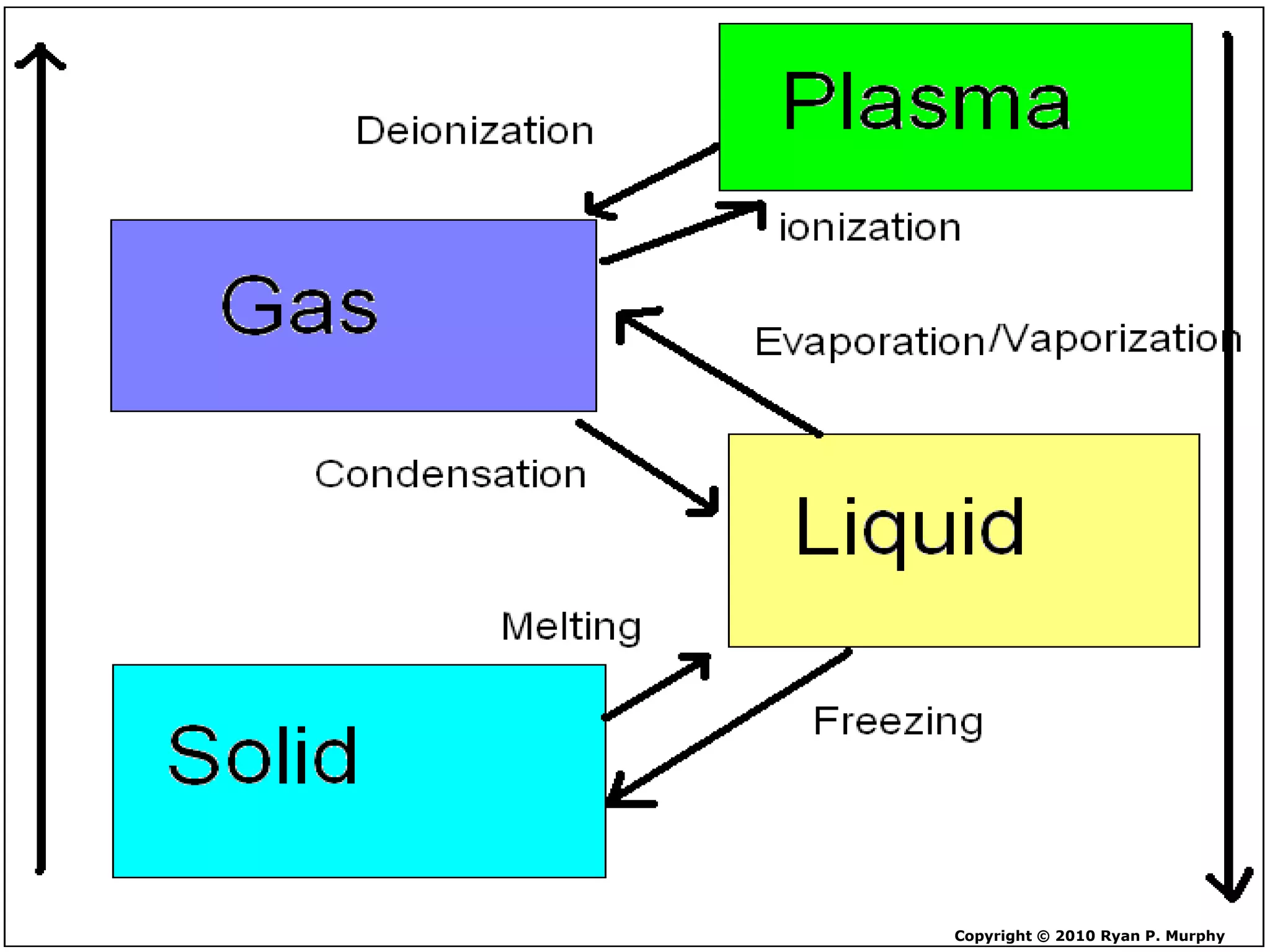
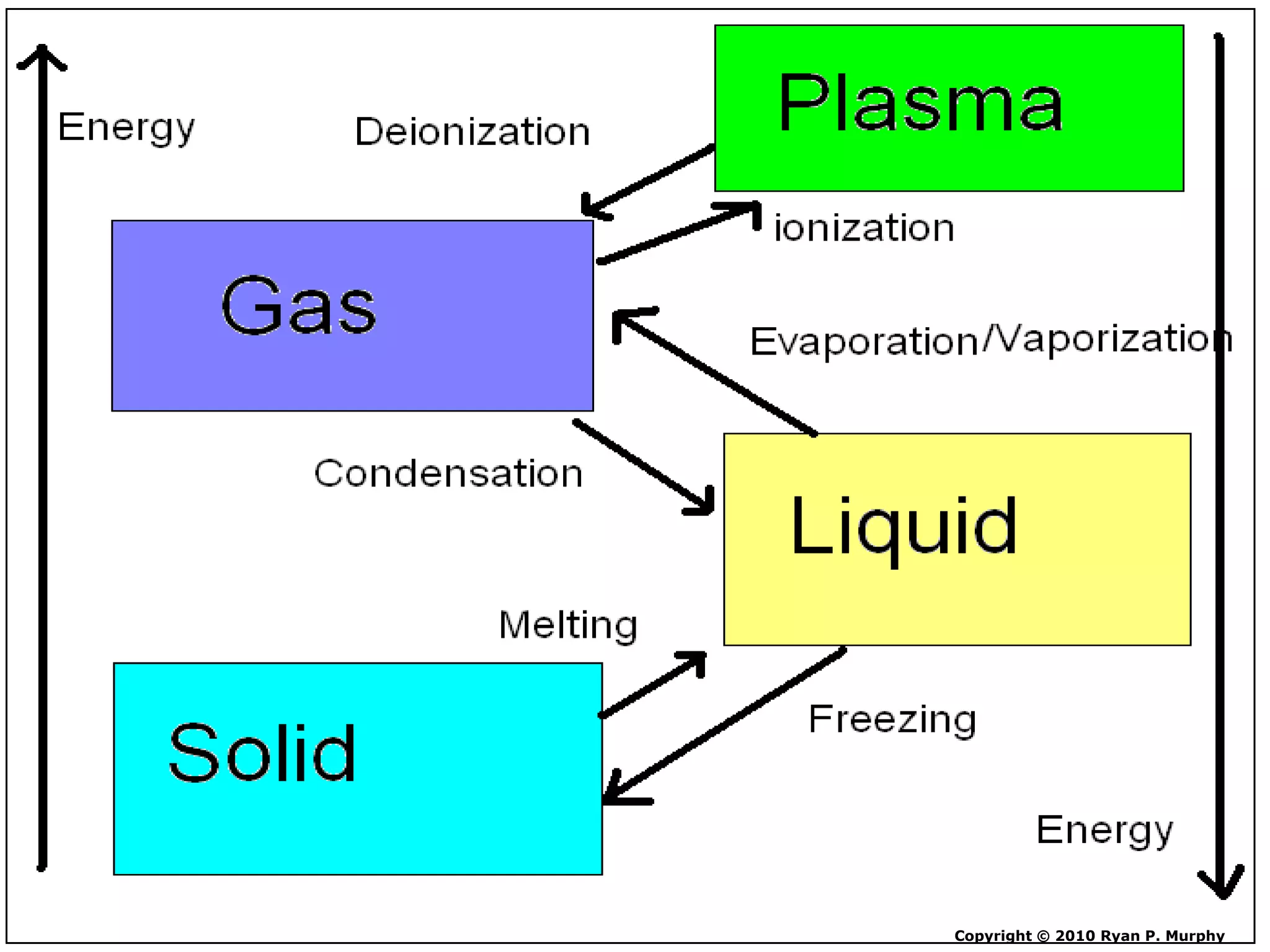
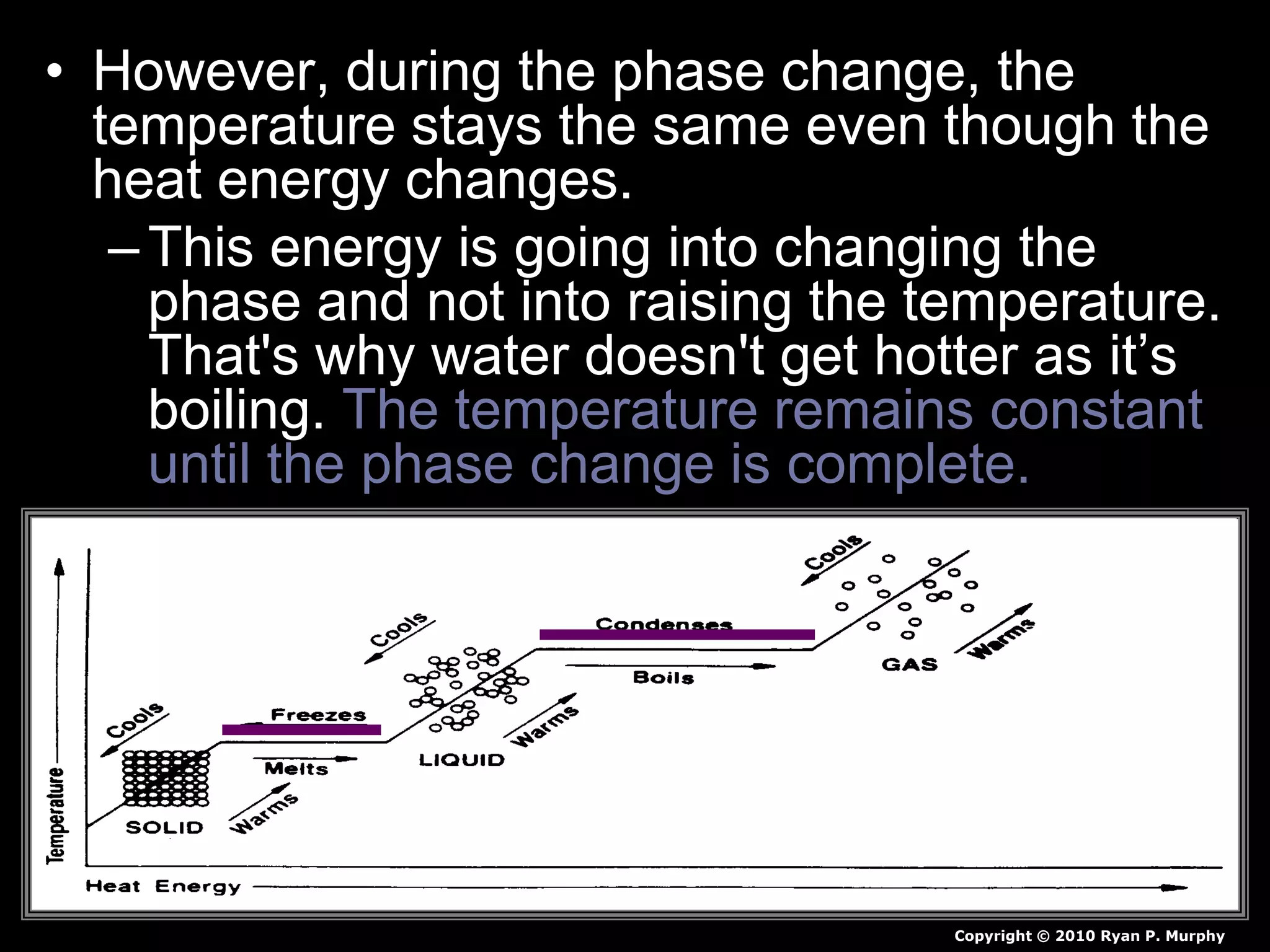
• Physical phase change
– Freezing - Liquid to a solid.
– Melting - Solid to a liquid.
– Sublimation- - Solid to a gas
(no liquid phase)
– Evaporation - Liquid to a gas.
– Condensation - Gas to a liquid.
Copyright © 2010 Ryan P. Murphy
• Physical phase change
– Freezing - Liquid to a solid.
– Melting - Solid to a liquid.
– Sublimation- - Solid to a gas
(no liquid phase)
– Evaporation - Liquid to a gas.
– Condensation - Gas to a liquid.
Copyright © 2010 Ryan P. Murphy
• Physical phase change
– Freezing - Liquid to a solid.
– Melting - Solid to a liquid.
– Sublimation- - Solid to a gas
(no liquid phase)
– Evaporation - Liquid to a gas.
– Condensation - Gas to a liquid.
Copyright © 2010 Ryan P. Murphy
• Physical phase change
– Freezing - Liquid to a solid.
– Melting - Solid to a liquid.
– Sublimation- - Solid to a gas
(no liquid phase)
– Evaporation - Liquid to a gas.
– Condensation - Gas to a liquid.
Copyright © 2010 Ryan P. Murphy
• Physical phase change
– Freezing - Liquid to a solid.
– Melting - Solid to a liquid.
– Sublimation- - Solid to a gas
(no liquid phase)
– Evaporation - Liquid to a gas.
– Condensation - Gas to a liquid.
Copyright © 2010 Ryan P. Murphy
• Physical phase change
– Freezing - Liquid to a solid.
– Melting - Solid to a liquid.
– Sublimation- - Solid to a gas
(no liquid phase)
– Evaporation - Liquid to a gas.
– Condensation - Gas to a liquid.
Copyright © 2010 Ryan P. Murphy
• Physical phase change
– Freezing - Liquid to a solid.
– Melting - Solid to a liquid.
– Sublimation- - Solid to a gas
(no liquid phase)
– Evaporation - Liquid to a gas.
– Condensation - Gas to a liquid.
Copyright © 2010 Ryan P. Murphy
• Physical phase change
– Freezing - Liquid to a solid.
– Melting - Solid to a liquid.
– Sublimation- - Solid to a gas
(no liquid phase)
– Evaporation - Liquid to a gas.
– Condensation - Gas to a liquid.
Copyright © 2010 Ryan P. Murphy
• Physical phase change
– Freezing - Liquid to a solid.
– Melting - Solid to a liquid.
– Sublimation- - Solid to a gas
(no liquid phase)
– Evaporation - Liquid to a gas.
– Condensation - Gas to a liquid.
Copyright © 2010 Ryan P. Murphy
• Physical phase change
– Freezing - Liquid to a solid.
– Melting - Solid to a liquid.
– Sublimation- - Solid to a gas
(no liquid phase)
– Evaporation - Liquid to a gas.
– Condensation - Gas to a liquid.
Copyright © 2010 Ryan P. Murphy
• Physical phase change
– Freezing - Liquid to a solid.
– Melting - Solid to a liquid.
– Sublimation- - Solid to a gas
(no liquid phase)
– Evaporation - Liquid to a gas.
– Condensation - Gas to a liquid.
Copyright © 2010 Ryan P. Murphy
• Physical phase change
– Freezing - Liquid to a solid.
– Melting - Solid to a liquid.
– Sublimation- - Solid to a gas
(no liquid phase)
– Evaporation - Liquid to a gas.
– Condensation - Gas to a liquid.
Copyright © 2010 Ryan P. Murphy
• Physical phase change
– Freezing - Liquid to a solid.
– Melting - Solid to a liquid.
– Sublimation- - Solid to a gas
(no liquid phase)
– Evaporation - Liquid to a gas.
– Condensation - Gas to a liquid.
Copyright © 2010 Ryan P. Murphy
• Physical phase change
– Freezing - Liquid to a solid.
– Melting - Solid to a liquid.
– Sublimation- - Solid to a gas
(no liquid phase)
– Evaporation - Liquid to a gas.
– Condensation - Gas to a liquid.
Copyright © 2010 Ryan P. Murphy
• Physical phase change
– Freezing - Liquid to a solid.
– Melting - Solid to a liquid.
– Sublimation- - Solid to a gas
(no liquid phase)
– Evaporation - Liquid to a gas.
– Condensation - Gas to a liquid.
Copyright © 2010 Ryan P. Murphy
• Physical phase change
– Freezing - Liquid to a solid.
– Melting - Solid to a liquid.
– Sublimation- - Solid to a gas
(no liquid phase)
– Evaporation - Liquid to a gas.
– Condensation - Gas to a liquid.
Copyright © 2010 Ryan P. Murphy
• Physical phase change
– Freezing - Liquid to a solid.
– Melting - Solid to a liquid.
– Sublimation- - Solid to a gas
(no liquid phase)
– Evaporation - Liquid to a gas.
– Condensation - Gas to a liquid.
Copyright © 2010 Ryan P. Murphy
• Physical phase change
– Freezing - Liquid to a solid.
– Melting - Solid to a liquid.
– Sublimation- - Solid to a gas
(no liquid phase)
– Evaporation - Liquid to a gas.
– Condensation - Gas to a liquid.
Copyright © 2010 Ryan P. Murphy
• Physical phase change
– Freezing - Liquid to a solid.
– Melting - Solid to a liquid.
– Sublimation- - Solid to a gas
(no liquid phase)
– Evaporation - Liquid to a gas.
– Condensation - Gas to a liquid.
Copyright © 2010 Ryan P. Murphy
• Physical phase change
– Freezing - Liquid to a solid.
– Melting - Solid to a liquid.
– Sublimation- - Solid to a gas
(no liquid phase)
– Evaporation - Liquid to a gas.
– Condensation - Gas to a liquid.
Copyright © 2010 Ryan P. Murphy
• Please sketch the following into your
science journal (Half Page needed).
Copyright © 2010 Ryan P. Murphy
• Activity Sheet Available: States of Matter
and Phase Change.
• Mini-Experiment (End)
– What happened to the kiss?
– Draw the after picture.
– What was added to cause the phase change?
• Describe this next to your after drawing.
Copyright © 2010 Ryan P. Murphy
• Mini-Experiment (End)
– What happened to the kiss?
– Draw the after picture.
– What was added to cause the phase change?
• Describe this next to your after drawing.
Copyright © 2010 Ryan P. Murphy
• Mini-Experiment (End)
– What happened to the kiss?
– Draw the after picture.
– What was added to cause the phase change?
• Describe this next to your after drawing.
Copyright © 2010 Ryan P. Murphy
• Mini-Experiment (End)
– What happened to the kiss?
– Draw the after picture.
– What was added to cause the phase change?
• Describe this next to your after drawing.
Copyright © 2010 Ryan P. Murphy
• A physical change / reaction can also
occur with with nucleation sites.
Copyright © 2010 Ryan P. Murphy
• Nucleation site: A place that acts as a
nucleus for (starting), in a process of
formation such as crystals, or bubbles.
Copyright © 2010 Ryan P. Murphy
• Activity! I’m going to give you a tablet with
many nucleation sites on it. Drop into the
aqueous solution and record observations.
Copyright © 2010 Ryan P. Murphy
• Diet Coke and Mentos is a physical
reaction not a chemical reaction.
–Occurs because of nucleation sites.
Copyright © 2010 Ryan P. Murphy
• Video: Nucleation Sites.
• http://www.youtube.com/watch?v=9vk4_2x
boOE
Copyright © 2010 Ryan P. Murphy
• Acetone and Styrofoam: The difference
between melting and dissolving.
– Safety Goggles and Gloves Required.
– Learn more at…
• http://www.elmhurst.edu/~chm/demos/Disappearing
Cup.html
• Demonstration: What happened to the cup
when placed on water?
• Demonstration: What happened to the cup
when placed on water?
“Dude, that
was wicked
boring.”
• Demonstration: Melting vs. Dissolving
– http://www.youtube.com/watch?v=h9Jx8NRkWTo
• Precautions: Uses Acetone, requires safety
goggles, ventilated area, and acetone is
flammable.
• Dissolving: To become incorporated into a
liquid so as to form a solution.
• Melting: To be changed from a solid to
a liquid state especially by the application
of heat.
• Dissolving: To become incorporated into a
liquid so as to form a solution.
• Melting: To be changed from a solid to
a liquid state especially by the application
of heat.
• Dissolving: To become incorporated into a
liquid so as to form a solution.
• Melting: To be changed from a solid to
a liquid state especially by the application
of heat.
• Dissolving: To become incorporated into a
liquid so as to form a solution.
• Melting: To be changed from a solid to
a liquid state especially by the application
of heat.
• Dissolving: To become incorporated into a
liquid so as to form a solution.
• Melting: To be changed from a solid to
a liquid state especially by the application
of heat.
• Dissolving: To become incorporated into a
liquid so as to form a solution.
• Melting: To be changed from a solid to
a liquid state especially by the application
of heat.
• Dissolving: To become incorporated into a
liquid so as to form a solution.
• Melting: To be changed from a solid to
a liquid state especially by the application
of heat.
• Demonstration: Melting vs. Dissolving
• Who wants to read the answer aloud to the class?
• When the acetone was poured into the cup, the
cup dissolved. (Avoid saying that the cup melts,
because this is not true). The reason for this
happening is because the acetone and the
Styrofoam cup share the same properties, they
are both non- polar. Likes dissolves likes. Non-
polar things have no charge, and polar things
have positive and negative charges. The
Styrofoam cup didn't dissolve with the water
because, they have different properties, the water
is polar, and the cup is non-polar. Acetone is
actually what girls use to take off their nail polish.
• Demonstration: Melting vs. Dissolving
• Who wants to read the answer aloud to the class?
• When the acetone was poured into the cup, the
cup dissolved. (Avoid saying that the cup melts,
because this is not true). The reason for this
happening is because the acetone and the
Styrofoam cup share the same properties, they
are both non- polar. Likes dissolves likes. Non-
polar things have no charge, and polar things
have positive and negative charges. The
Styrofoam cup didn't dissolve with the water
because, they have different properties, the water
is polar, and the cup is non-polar. Acetone is
actually what girls use to take off their nail polish.
• Demonstration: Melting vs. Dissolving
• Who wants to read the answer aloud to the class?
• When the acetone was poured into the cup, the
cup dissolved. (Avoid saying that the cup melts,
because this is not true). The reason for this
happening is because the acetone and the
Styrofoam cup share the same properties, they
are both non- polar. Likes dissolves likes. Non-
polar things have no charge, and polar things
have positive and negative charges. The
Styrofoam cup didn't dissolve with the water
because, they have different properties, the water
is polar, and the cup is non-polar. Acetone is
actually what girls use to take off their nail polish.
• Demonstration: Melting vs. Dissolving
• Who wants to read the answer aloud to the class?
• When the acetone was poured into the cup, the
cup dissolved. (Avoid saying that the cup melts,
because this is not true). The reason for this
happening is because the acetone and the
Styrofoam cup share the same properties, they
are both non- polar. Likes dissolves likes. Non-
polar things have no charge, and polar things
have positive and negative charges. The
Styrofoam cup didn't dissolve with the water
because, they have different properties, the water
is polar, and the cup is non-polar. Acetone is
actually what girls use to take off their nail polish.
• Demonstration: Melting vs. Dissolving
• Who wants to read the answer aloud to the class?
• When the acetone was poured into the cup, the
cup dissolved. (Avoid saying that the cup melts,
because this is not true). The reason for this
happening is because the acetone and the
Styrofoam cup share the same properties, they
are both non- polar. Likes dissolves likes. Non-
polar things have no charge, and polar things
have positive and negative charges. The
Styrofoam cup didn't dissolve with the water
because, they have different properties, the water
is polar, and the cup is non-polar. Acetone is
actually what girls use to take off their nail polish.
• Demonstration: Melting vs. Dissolving
• Who wants to read the answer aloud to the class?
• When the acetone was poured into the cup, the
cup dissolved. (Avoid saying that the cup melts,
because this is not true). The reason for this
happening is because the acetone and the
Styrofoam cup share the same properties, they
are both non- polar. Likes dissolves likes. Non-
polar things have no charge, and polar things
have positive and negative charges. The
Styrofoam cup didn't dissolve with the water
because, they have different properties, the water
is polar, and the cup is non-polar. Acetone is
actually what girls use to take off their nail polish.
• Demonstration: Melting vs. Dissolving
• Who wants to read the answer aloud to the class?
• When the acetone was poured into the cup, the
cup dissolved. (Avoid saying that the cup melts,
because this is not true). The reason for this
happening is because the acetone and the
Styrofoam cup share the same properties, they
are both non- polar. Likes dissolves likes. Non-
polar things have no charge, and polar things
have positive and negative charges. The
Styrofoam cup didn't dissolve with the water
because, they have different properties, the water
is polar, and the cup is non-polar. Acetone is
actually what girls use to take off their nail polish.
• Demonstration: Melting vs. Dissolving
• Who wants to read the answer aloud to the class?
• When the acetone was poured into the cup, the
cup dissolved. (Avoid saying that the cup melts,
because this is not true). The reason for this
happening is because the acetone and the
Styrofoam cup share the same properties, they
are both non- polar. Likes dissolves likes. Non-
polar things have no charge, and polar things
have positive and negative charges. The
Styrofoam cup didn't dissolve with the water
because they have different properties. the water
is polar, and the cup is non-polar. Acetone is
actually what girls use to take off their nail polish.
• Demonstration: Melting vs. Dissolving
• Who wants to read the answer aloud to the class?
• When the acetone was poured into the cup, the
cup dissolved. (Avoid saying that the cup melts,
because this is not true). The reason for this
happening is because the acetone and the
Styrofoam cup share the same properties, they
are both non- polar. Likes dissolves likes. Non-
polar things have no charge, and polar things
have positive and negative charges. The
Styrofoam cup didn't dissolve with the water
because they have different properties. The water
is polar, and the cup is non-polar. Acetone is
actually what girls use to take off their nail polish.
• Activity – Temperature and phase change
– Using digital thermometers and water.
– Record temperature of water every minute.
– Record observations of phase change during
the minute they occur.
• Bubbles – Boiling starts
• Gas release – Boiling
Copyright © 2010 Ryan P. Murphy
• Activity Sheet Available: States of Matter
and Phase Change.
– State of Matter Lab
• Please sketch the following graph in your
journal.
100
90
80
70
60
50
40
30
20
10
0
-10
1 2 3 4 5 6 7 8 9 10 11 12 13 14 15 16 17 18 19 20
D
E
G
R
E
E
S
C
E
L
S
I
U
S
• Please sketch the following graph in your
journal.
100
90
80
70
60
50
40
30
20
10
0
-10
1 2 3 4 5 6 7 8 9 10 11 12 13 14 15 16 17 18 19 20
Degrees Celsius
• Please sketch the following graph in your
journal.
100
90
80
70
60
50
40
30
20
10
0
-10
1 2 3 4 5 6 7 8 9 10 11 12 13 14 15 16 17 18 19 20
Degrees Celsius
Time / Minutes
• Please sketch the following graph in your
journal.
100
90
80
70
60
50
40
30
20
10
0
-10
1 2 3 4 5 6 7 8 9 10 11 12 13 14 15 16 17 18 19 20
Degrees Celsius
Time / Minutes
• Please sketch the following graph in your
journal.
100
90
80
70
60
50
40
30
20
10
0
-10
1 2 3 4 5 6 7 8 9 10 11 12 13 14 15 16 17 18 19 20
• Activity – Temperature and phase change
– Using digital thermometers and water.
– Record temperature of ice water every
minute. Tape thermometer so it doesn’t touch
the side of the container.
– Record observations of phase change during
the minute they occur.
• Bubbles – Boiling starts
• Gas release – Boiling
Copyright © 2010 Ryan P. Murphy
• Activity Sheet Available: States of Matter
and Phase Change.
• Questions / Analysis of graph.
– Please label the states of matter as they
occur on your graph (based on observations
and use correct terms such as melting and
vaporization).
– What happened at 100 degrees Celsius?
– What trends to you see in the data?
Copyright © 2010 Ryan P. Murphy
• Questions / Analysis of graph.
– Please label the states of matter as they
occur on your graph (based on observations
and use correct terms such as melting and
vaporization).
– What happened at 100 degrees Celsius?
– What trends to you see in the data?
Copyright © 2010 Ryan P. Murphy
• Questions / Analysis of graph.
– Please label the states of matter as they
occur on your graph (based on observations
and use correct terms such as melting and
vaporization).
– What happened at 100 degrees Celsius?
– What trends to you see in the data?
Copyright © 2010 Ryan P. Murphy
• Questions / Analysis of graph.
– Please label the states of matter as they
occur on your graph (based on observations
and use correct terms such as melting and
vaporization).
– What happened at 100 degrees Celsius?
– What trends to you see in the data?
Copyright © 2010 Ryan P. Murphy
• Questions / Analysis of graph.
– Please label the states of matter as they
occur on your graph (based on observations
and use correct terms such as melting and
vaporization).
Copyright © 2010 Ryan P. Murphy
• Possible answer based on the energy added
to the water.
100
90
80
70
60
50
40
30
20
10
0
-10
1 2 3 4 5 6 7 8 9 10 11 12 13 14 15 16 17 18 19 20
• Possible answer based on the energy added
to the water.
100
90
80
70
60
50
40
30
20
10
0
-10
1 2 3 4 5 6 7 8 9 10 11 12 13 14 15 16 17 18 19 20
Water and Ice
• Possible answer based on the energy added
to the water.
100
90
80
70
60
50
40
30
20
10
0
-10
1 2 3 4 5 6 7 8 9 10 11 12 13 14 15 16 17 18 19 20
Water and Ice
Liquid
• Possible answer based on the energy added
to the water.
100
90
80
70
60
50
40
30
20
10
0
-10
1 2 3 4 5 6 7 8 9 10 11 12 13 14 15 16 17 18 19 20
Water and Ice
Liquid
Bubbles / Vapor
• Possible answer based on the energy added
to the water.
100
90
80
70
60
50
40
30
20
10
0
-10
1 2 3 4 5 6 7 8 9 10 11 12 13 14 15 16 17 18 19 20
Water and Ice
Liquid
Bubbles / VaporBoiling
• Answer to the activity.
– Did your graph look the same as this?
Heat added
Temperature(oC)
0
100
Melting
Ice
Water
Water Vapor
Boiling
Copyright © 2010 Ryan P. Murphy
• Questions / Analysis of graph.
– What happened at 100 degrees Celsius?
Copyright © 2010 Ryan P. Murphy
• Questions / Analysis of graph.
– What happened at 100 degrees Celsius?
– The water began to boil turning from a liquid
to a gas.
Copyright © 2010 Ryan P. Murphy
• Questions / Analysis of graph.
– What trends to you see in the data?
Copyright © 2010 Ryan P. Murphy
• Questions / Analysis of graph.
– What trends to you see in the data?
– The graph looks like a staircase. There are
periods where the temperature does not
change.
Copyright © 2010 Ryan P. Murphy
 When energy is added – Move up a step.
 When energy is removed – Go down a step.
Heat added
Temperature(oC)
0
100
Melting
Ice
Water
Water Vapor
Boiling
Copyright © 2010 Ryan P. Murphy
 When energy is added – Move up a step.
 When energy is removed – Go down a step.
Heat added
Temperature(oC)
0
100
Melting
Ice
Water
Water Vapor
Boiling
Copyright © 2010 Ryan P. Murphy
 When energy is added – Move up a step.
 When energy is removed – Go down a step.
Heat added
Temperature(oC)
0
100
Melting
Ice
Water
Water Vapor
Boiling
Copyright © 2010 Ryan P. Murphy
 When energy is added – Move up a step.
 When energy is removed – Go down a step.
Heat added
Temperature(oC)
0
100
Melting
Ice
Water
Water Vapor
Boiling
Copyright © 2010 Ryan P. Murphy
 When energy is added – Move up a step.
 When energy is removed – Go down a step.
Heat added
Temperature(oC)
0
100
Melting
Ice
Water
Water Vapor
Boiling
Copyright © 2010 Ryan P. Murphy
• You may see this diagram on a state test.
– When energy is added – move up a step.
– When energy is removed – go down a step.
Copyright © 2010 Ryan P. Murphy
–That's why water doesn't get hotter as it is
boiling. The temperature remains constant
until the phase change is complete.
Copyright © 2010 Ryan P. Murphy
–That's why water doesn't get hotter as it is
boiling. The temperature remains constant
until the phase change is complete.
Copyright © 2010 Ryan P. Murphy
• However, during the phase change, the
temperature stays the same even though the
heat energy changes.
–That's why water doesn't get hotter as it is
boiling. The temperature remains constant
until the phase change is complete.
Copyright © 2010 Ryan P. Murphy
• However, during the phase change, the
temperature stays the same even though the
heat energy changes.
–This energy is going into changing the
phase and not into raising the temperature.
That's why water doesn't get hotter as it is
boiling. The temperature remains constant
until the phase change is complete.
Copyright © 2010 Ryan P. Murphy
• However, during the phase change, the
temperature stays the same even though the
heat energy changes.
–This energy is going into changing the
phase and not into raising the temperature.
That's why water doesn't get hotter as it’s
boiling. The temperature remains constant
until the phase change is complete.
Copyright © 2010 Ryan P. Murphy
• However, during the phase change, the
temperature stays the same even though the
heat energy changes.
–This energy is going into changing the
phase and not into raising the temperature.
That's why water doesn't get hotter as it’s
boiling. The temperature remains constant
until the phase change is complete.
Copyright © 2010 Ryan P. Murphy
 Latent Heat: The energy absorbed or
released when a substance changes its
physical state.
Heat added
Temperature(oC)
0
100
MeltingIce
Water
Water VaporBoiling
Latent Heat
Latent Heat
Copyright © 2010 Ryan P. Murphy
 Latent Heat: The energy absorbed or
released when a substance changes its
physical state.
Heat added
Temperature(oC)
0
100
MeltingIce
Water
Water VaporBoiling
Latent Heat
Latent Heat
Copyright © 2010 Ryan P. Murphy
 Latent Heat: The energy absorbed or
released when a substance changes its
physical state.
Heat added
Temperature(oC)
0
100
MeltingIce
Water
Water VaporBoiling
Latent Heat
Latent Heat
Copyright © 2010 Ryan P. Murphy
 Latent Heat: The energy absorbed or
released when a substance changes its
physical state.
Heat added
Temperature(oC)
0
100
MeltingIce
Water
Water VaporBoiling
Latent Heat
Latent Heat
Copyright © 2010 Ryan P. Murphy
 Latent Heat: The energy absorbed or
released when a substance changes its
physical state.
Heat added
Temperature(oC)
0
100
MeltingIce
Water
Water VaporBoiling
Latent Heat
Latent Heat
Copyright © 2010 Ryan P. Murphy
 Latent Heat: The energy absorbed or
released when a substance changes its
physical state.
Heat added
Temperature(oC)
0
100
MeltingIce
Water
Water VaporBoiling
Latent Heat
Latent Heat
Copyright © 2010 Ryan P. Murphy
 Latent Heat: The energy absorbed or
released when a substance changes its
physical state.
Heat added
Temperature(oC)
0
100
MeltingIce
Water
Water VaporBoiling
Latent Heat
Latent Heat
Copyright © 2010 Ryan P. Murphy
 Latent Heat: The energy absorbed or
released when a substance changes its
physical state.
Heat added
Temperature(oC)
0
100
MeltingIce
Water
Water VaporBoiling
Latent Heat
Latent Heat
Copyright © 2010 Ryan P. Murphy
 Latent Heat: The energy absorbed or
released when a substance changes its
physical state.
Heat added
Temperature(oC)
0
100
MeltingIce
Water
Water VaporBoiling
Latent Heat
Latent Heat
Copyright © 2010 Ryan P. Murphy
 Latent Heat: The energy absorbed or
released when a substance changes its
physical state.
Heat added
Temperature(oC)
0
100
MeltingIce
Water
Water VaporBoiling
Latent Heat
Latent Heat
Copyright © 2010 Ryan P. Murphy
 Latent Heat: The energy absorbed or
released when a substance changes its
physical state.
Heat added
Temperature(oC)
0
100
MeltingIce
Water
Water VaporBoiling
Latent Heat
Latent Heat
Copyright © 2010 Ryan P. Murphy
 Latent Heat: The energy absorbed or
released when a substance changes its
physical state.
Heat added
Temperature(oC)
0
100
MeltingIce
Water
Water VaporBoiling
Latent Heat
Latent Heat
Copyright © 2010 Ryan P. Murphy
 Latent Heat: The energy absorbed or
released when a substance changes its
physical state.
Heat added
Temperature(oC)
0
100
MeltingIce
Water
Water VaporBoiling
Latent Heat
Latent Heat
Copyright © 2010 Ryan P. Murphy
 Latent Heat: The energy absorbed or
released when a substance changes its
physical state.
Heat added
Temperature(oC)
0
100
MeltingIce
Water
Water VaporBoiling
Latent Heat
Latent Heat
Copyright © 2010 Ryan P. Murphy
 Latent Heat: The energy absorbed or
released when a substance changes its
physical state.
Heat added
Temperature(oC)
0
100
MeltingIce
Water
Water VaporBoiling
Latent Heat
Latent Heat
Copyright © 2010 Ryan P. Murphy
• Activity – Making some ice cream and
learning about phase change.
– Follow the instructions on the recipe exactly.
– Provided Activity Sheet.
Copyright © 2010 Ryan P. Murphy
• Activity – Making some ice cream and
learning about phase change.
– Follow the instructions on the recipe exactly.
– Provided Activity Sheet.
Copyright © 2010 Ryan P. Murphy
• Activity – Making some ice cream and
learning about phase change.
– Follow the instructions on the recipe exactly.
– Provided Activity Sheet.
Copyright © 2010 Ryan P. Murphy
• Available Sheet: Ice Cream Recipe and
Questions.
Activity! Making Ice Cream / Phase Change Recipe
1.) Place a paper towel over your work area. Keep
your work on the paper towel.
2.) Pour 240 mL milk, 45 mL sugar, and 2.5 mL
vanilla or chocolate flavoring into the small zipper
bag.
3.) CAREFULLY seal the bag and shake up the
mixture thoroughly.
4.) Put this small zipper bag inside the much larger
zipper bag.
5.) In the large bag add enough ice to cover the small
bag and add 80 mL of ice cream salt. Take the
temperature of the ice:______ C
6.) CAREFULLY SEAL THE BAG!
7.) Get ready to make a phase change!
8.) Don’t hold bag for more than a few seconds as it
very cold and damage skin cells / cause
frostbite.
9.) Take turns flipping the bag. Hold the bag by its
corners. Keep the bag flipping over and over.
Remember to keep the bag over the towel at all
times. It should take 10 to 15 minutes to freeze.
Take the temperature of the ice/water mixture
again: ________ C
10.) When you have ice cream, take the smaller bag
out and rinse it off with cold water. One partner
needs to take the larger bag and its contents to
the trash barrel.
11.) Dish out the ice cream equally into the
cups, and ENJOY if you want (not
mandatory)! (You may rinse the cup out
and use it for water if you are thirsty.)
12.) Please clean up your area. (Leave it
neater than you found it.)
• Did the ice cream turn out okay?
– Enjoy as you answer these questions in your
journal.
Copyright © 2010 Ryan P. Murphy
• Questions on the back of the recipe
• You may eat your ice cream as you
answer these questions.
– First, clean up space as you eat.
– What was added to the ice to cause it to melt?
– How cold did the bag get?
– Why did the ice cream turn from a liquid to a
solid?
– Why is salt put on the roads to prevent icing?
Copyright © 2010 Ryan P. Murphy
• You may eat your ice cream as you
answer these questions.
– First, clean up space as you eat.
– What was added to the ice to cause it to melt?
– How cold did the bag get?
– Why did the ice cream turn from a liquid to a
solid?
– Why is salt put on the roads to prevent icing?
Copyright © 2010 Ryan P. Murphy
• You may eat your ice cream as you
answer these questions.
– First, clean up space as you eat.
– What was added to the ice to cause it to melt?
– How cold did the bag get?
– Why did the ice cream turn from a liquid to a
solid?
– Why is salt put on the roads to prevent icing?
Copyright © 2010 Ryan P. Murphy
• You may eat your ice cream as you
answer these questions.
– First, clean up space as you eat.
– What was added to the ice to cause it to melt?
– How cold did the bag get?
– Why did the ice cream turn from a liquid to a
solid?
– Why is salt put on the roads to prevent icing?
Copyright © 2010 Ryan P. Murphy
• You may eat your ice cream as you
answer these questions.
– First, clean up space as you eat.
– What was added to the ice to cause it to melt?
– How cold did the bag get?
– Why did the ice cream turn from a liquid to a
solid?
– Why is salt put on the roads to prevent icing?
Copyright © 2010 Ryan P. Murphy
• You may eat your ice cream as you
answer these questions.
– First, clean up space as you eat.
– What was added to the ice to cause it to melt?
– How cold did the bag get?
– Why did the ice cream turn from a liquid to a
solid?
– Why is salt put on the roads to prevent icing?
Copyright © 2010 Ryan P. Murphy
• Why did the bag get really cold?
Copyright © 2010 Ryan P. Murphy
• Why did the bag got really cold?
– For ice to melt, it has to get heat from
something. In our ice cream project, it gets
the heat from the ice cream mixture (and from
your hands, which is why they get cold while
holding the bag). When the ice is melting, it is
at 0 degrees Celsius (32 degrees
Fahrenheit).
– The ice cream freezes because the salt and
the ice mix to make a substance with a lower
freezing point than ice alone. This means that
the ice and salt mixture must get even more
heat from somewhere in order to melt.
Copyright © 2010 Ryan P. Murphy
• Why did the bag got really cold?
– For ice to melt, it has to get heat from
something. In our ice cream project, it gets
the heat from the ice cream mixture (and from
your hands, which is why they get cold while
holding the bag). When the ice is melting, it is
at 0 degrees Celsius (32 degrees
Fahrenheit).
– The ice cream freezes because the salt and
the ice mix to make a substance with a lower
freezing point than ice alone. This means that
the ice and salt mixture must get even more
heat from somewhere in order to melt.
Copyright © 2010 Ryan P. Murphy
• Why did the bag got really cold?
– For ice to melt, it has to get heat from
something. In our ice cream project, it gets
the heat from the ice cream mixture (and from
your hands, which is why they get cold while
holding the bag). When the ice is melting, it is
at 0 degrees Celsius (32 degrees
Fahrenheit).
– The ice cream freezes because the salt and
the ice mix to make a substance with a lower
freezing point than ice alone. This means that
the ice and salt mixture must get even more
heat from somewhere in order to melt.
Copyright © 2010 Ryan P. Murphy
• Why did the bag got really cold?
– For ice to melt, it has to get heat from
something. In our ice cream project, it gets
the heat from the ice cream mixture (and from
your hands, which is why they get cold while
holding the bag). When the ice is melting, it is
at 0 degrees Celsius (32 degrees Fahrenheit).
– The ice cream freezes because the salt and
the ice mix to make a substance with a lower
freezing point than ice alone. This means that
the ice and salt mixture must get even more
heat from somewhere in order to melt.
Copyright © 2010 Ryan P. Murphy
• Why did the bag got really cold?
– For ice to melt, it has to get heat from
something. In our ice cream project, it gets
the heat from the ice cream mixture (and from
your hands, which is why they get cold while
holding the bag). When the ice is melting, it is
at 0 degrees Celsius (32 degrees Fahrenheit).
– The ice cream freezes because the salt and
the ice mix to make a substance with a lower
freezing point than ice alone. This means that
the ice and salt mixture must get even more
heat from somewhere in order to melt.
Copyright © 2010 Ryan P. Murphy
• Why did the bag got really cold?
– For ice to melt, it has to get heat from
something. In our ice cream project, it gets
the heat from the ice cream mixture (and from
your hands, which is why they get cold while
holding the bag). When the ice is melting, it is
at 0 degrees Celsius (32 degrees Fahrenheit).
– The ice cream freezes because the salt and
the ice mix to make a substance with a lower
freezing point than ice alone. This means that
the ice and salt mixture must get even more
heat from somewhere in order to melt.
Copyright © 2010 Ryan P. Murphy
• Why did the salt make the ice melt?
Copyright © 2010 Ryan P. Murphy
• It’s all about the molecules
Copyright © 2010 Ryan P. Murphy
• It’s all about the molecules
– The sodium and chlorine in the salt split apart
into charged ions, and these ions attract water
molecules to form weak chemical bonds.
Copyright © 2010 Ryan P. Murphy
• It’s all about the molecules
– The sodium and chlorine in the salt split apart
into charged ions, and these ions attract water
molecules to form weak chemical bonds.
– The resulting compound has a freezing point
of -21.1 degrees Celsius (-5.98 degrees
Fahrenheit).
Copyright © 2010 Ryan P. Murphy
• It’s all about the molecules
– The sodium and chlorine in the salt split apart
into charged ions, and these ions attract water
molecules to form weak chemical bonds.
– The resulting compound has a freezing point
of -21.1 degrees Celsius (-5.98 degrees
Fahrenheit).
• This is 21.1 degrees colder than ice.
Copyright © 2010 Ryan P. Murphy
• Why did the milk, sugar, and vanilla turn
into a solid?
Copyright © 2010 Ryan P. Murphy
 For the phase change to occur, the heat is
removed from the milk, sugar, and vanilla
when the salt melts the ice.
 For the phase change to occur, the heat is
removed from the milk, sugar, and vanilla
when the salt melts the ice.
 This results in the phase change from a liquid
to a solid.
 For the phase change to occur, the heat is
removed from the milk, sugar, and vanilla
when the salt melts the ice.
 This results in the phase change from a liquid
to a solid.
• Why do we put salt on the roads in the
winter?
Copyright © 2010 Ryan P. Murphy
• When people put salt on an icy sidewalk or
road,
Copyright © 2010 Ryan P. Murphy
• When people put salt on an icy sidewalk or
road, the ice mixes with the salt,
Copyright © 2010 Ryan P. Murphy
• When people put salt on an icy sidewalk or
road, the ice mixes with the salt, and the
mixture of the two solids (ice and salt)
produces a liquid,
Copyright © 2010 Ryan P. Murphy
• When people put salt on an icy sidewalk or
road, the ice mixes with the salt, and the
mixture of the two solids (ice and salt)
produces a liquid, but the sidewalk actually
gets colder than it was before.
Copyright © 2010 Ryan P. Murphy
• When people put salt on an icy sidewalk or
road, the ice mixes with the salt, and the
mixture of the two solids (ice and salt)
produces a liquid, but the sidewalk actually
gets colder than it was before.
Copyright © 2010 Ryan P. Murphy
• When people put salt on an icy sidewalk or
road, the ice mixes with the salt, and the
mixture of the two solids (ice and salt)
produces a liquid, but the sidewalk actually
gets colder than it was before.
Copyright © 2010 Ryan P. Murphy
• Demonstration
Activity! Compressing
a Solid, Liquid, Gas.
– Which will require the
most effort to
compress?
– Solid, (Round clay
blob the size of water
balloon.
– Liquid, (Water Balloon)
– Gas, (Air-filled
Balloon)
Copyright © 2010 Ryan P. Murphy
• Demonstration
Activity! Compressing
a Solid, Liquid, Gas.
– Which will require the
most effort to
compress?
– Solid, (Round clay
blob the size of water
balloon.
– Liquid, (Water Balloon)
– Gas, (Air-filled
Balloon)
Copyright © 2010 Ryan P. Murphy
• Demonstration
Activity! Compressing
a Solid, Liquid, Gas.
– Which will require the
most effort to
compress?
– Solid, Frozen (Water
Balloon)
– Gas, (Air-filled
Balloon)
Copyright © 2010 Ryan P. Murphy
• Demonstration
Activity! Compressing
a Solid, Liquid, Gas.
– Which will require the
most effort to
compress?
– Solid, Frozen (Water
Balloon)
– Gas, (Air-filled
Balloon)
Copyright © 2010 Ryan P. Murphy
• Demonstration
Activity! Compressing
a Solid, Liquid, Gas.
– Which will require the
most effort to
compress?
– Solid, Frozen (Water
balloon)
– Liquid, (Water Balloon)
– Gas, (Air-filled
Balloon)
Copyright © 2010 Ryan P. Murphy
• Demonstration
Activity! Compressing
a Solid, Liquid, Gas.
– Which will require the
most effort to
compress?
– Solid, (Round clay
blob the size of water
balloon.
– Liquid, (Water Balloon)
– Gas, (Air-filled
Balloon)
Copyright © 2010 Ryan P. Murphy
• Demonstration
Activity! Compressing
a Solid, Liquid, Gas.
– Which will require the
most effort to
compress?
– Solid, (Round clay
blob the size of water
balloon.
– Liquid, (Water Balloon)
– Gas, (Air-filled
Balloon)
Copyright © 2010 Ryan P. Murphy
• Demonstration
Activity! Compressing
a Solid, Liquid, Gas.
– Which will require the
most effort to
compress?
– Solid, (Round clay
blob the size of water
balloon.
– Liquid, (Water Balloon)
– Gas, (Air-filled
Balloon)
Copyright © 2010 Ryan P. Murphy
• Demonstration
Activity! Compressing
a Solid, Liquid, Gas.
– Which will require the
most effort to
compress?
– Solid, (Round clay
blob the size of water
balloon.
– Liquid, (Water Balloon)
– Gas, (Air-filled
Balloon)
Copyright © 2010 Ryan P. Murphy
• Demonstration
Activity! Compressing
a Solid, Liquid, Gas.
– Which will require the
most effort to
compress?
– Solid, (Round clay
blob the size of water
balloon.
– Liquid, (Water Balloon)
– Gas, (Air-filled
Balloon)
– Predictions?
Copyright © 2010 Ryan P. Murphy
• Answer! The gas balloon compressed the
easiest.
• Answer! The gas balloon compressed the
easiest. The water balloon was next, and
last was the ice balloon which required a
significant amount of force to compress.
Effort Needed to Compress
Solid Liquid Gas
Effort Needed to Compress
Solid Liquid Gas
Effort Needed to Compress
Solid Liquid Gas
Effort Needed to Compress
Solid Liquid Gas
Effort Needed to Compress
Solid Liquid Gas
Effort Needed to Compress
Solid Liquid Gas
Effort Needed to Compress
Solid Liquid Gas
• Answer! The gas balloon popped with the
least force. The water balloon was next,
and lastly was the ball of clay. (In theory)
Effort Needed to Compress
Solid Liquid Gas
 Chemical Change: The change of
substances into other substances through
a reorganization of the atoms.
Copyright © 2010 Ryan P. Murphy
• What happens when we mix Red Bull
with milk in a clear glass container?
– Observe for 5 minutes.
– Is it a physical or chemical reaction?
• Answer! Nasty
– Red Bull acidic. The acid attaches to one
end of the milk protein. This forms in milk a
salt (a bicarbonate). This alters the structure
of the protein causing it to drop out of
suspension into a curdled mass on top.
• Answer! Nasty (Chemical Reaction)
– Red Bull acidic. The acid attaches to one
end of the milk protein. This forms in milk a
salt (a bicarbonate). This alters the structure
of the protein causing it to drop out of
suspension into a curdled mass on top.
• Answer! Nasty (Chemical Reaction)
– Red Bull acidic. The acid attaches to one
end of the milk protein. This forms salt (a
bicarbonate). This alters the structure of the
protein causing it to drop out of the
suspension into a curdled mass on top.
• Check out this awesome chemical reaction
• Let’s see another because chemical
change on a molecular level is cool.
• Demonstrations of chemical change.
• Demonstration – Chemical Change with
baking soda and vinegar.
Copyright © 2010 Ryan P. Murphy
• Demonstration
– Fill bottle with screw
top with vinegar.
– Fill balloon with baking
soda using funnel.
– Attach bottom of
balloon to top of bottle
making sure that no
baking soda enters
bottle.
– Turn balloon upright
so contents fall into
bottle and observe.
Copyright © 2010 Ryan P. Murphy
• The baking soda (NaHCO3) mixes with the
vinegar (HC2H3O2)
–HC2H3O2 + NaHCO3 ===> NaC2H3O2 +
H2CO3
–The H2CO3 quickly breaks down
• H2CO3 ===> H2O + CO2
• Carbon dioxide can be used to put out
fire.
Copyright © 2010 Ryan P. Murphy
• The baking soda (NaHCO3) mixes with the
vinegar (HC2H3O2)
–HC2H3O2 + NaHCO3 ===> NaC2H3O2 +
H2CO3
–The H2CO3 quickly breaks down
• H2CO3 ===> H2O + CO2
• Carbon dioxide can be used to put out
fire.
Copyright © 2010 Ryan P. Murphy
• The baking soda (NaHCO3) mixes with the
vinegar (HC2H3O2)
–HC2H3O2 + NaHCO3 ===> NaC2H3O2 +
H2CO3
–The H2CO3 quickly breaks down
• H2CO3 ===> H2O + CO2
• Carbon dioxide can be used to put out
fire.
Copyright © 2010 Ryan P. Murphy
• The baking soda (NaHCO3) mixes with the
vinegar (HC2H3O2)
–HC2H3O2 + NaHCO3 ===> NaC2H3O2 +
H2CO3
–The H2CO3 quickly breaks down
• H2CO3 ===> H2O + CO2
• Carbon dioxide can be used to put out
fire.
Copyright © 2010 Ryan P. Murphy
• The baking soda (NaHCO3) mixes with the
vinegar (HC2H3O2)
–HC2H3O2 + NaHCO3 ===> NaC2H3O2 +
H2CO3
–The H2CO3 quickly breaks down
• H2CO3 ===> H2O + CO2
• Carbon dioxide can be used to put out
fire.
Copyright © 2010 Ryan P. Murphy
• Hydrochloric Acid can induce chemical change.
• Zn + 2HCl -----> ZnCl2 + H2 (gas)
Copyright © 2010 Ryan P. Murphy
• Activity Demonstration – Electrolysis.
– What is happening in the beaker? Can you guess the
chemical change?
Copyright © 2010 Ryan P. Murphy
• Activity Demonstration – Electrolysis.
– What is happening in the beaker? Can you guess the
chemical change?
Copyright © 2010 Ryan P. Murphy
Please set-up the following.
Dissolve about a spoonful of salt into
warm water.
• Activity Demonstration – Electrolysis.
– What is happening in the beaker? Can you guess the
chemical change?
Copyright © 2010 Ryan P. Murphy
Please set-up the following.
Dissolve about a spoonful of salt into
warm water.
Connect one end on the positive side
of the battery and the other to the tip
of the pencil.
• Activity Demonstration – Electrolysis.
– What is happening in the beaker? Can you guess the
chemical change?
Copyright © 2010 Ryan P. Murphy
Please set-up the following.
Dissolve about a spoonful of salt into
warm water.
Connect one end on the positive side
of the battery and the other to the tip
of the pencil.
Do the same for the negative side
connecting it to the second pencil top.
Place the other two ends of the pencil
into the salt water.
• Activity Demonstration – Electrolysis.
– What is happening in the beaker? Can you guess the
chemical change?
Copyright © 2010 Ryan P. Murphy
Please set-up the following.
Dissolve about a spoonful of salt into
warm water.
Connect one end on the positive side
of the battery and the other to the tip
of the pencil.
Do the same for the negative side
connecting it to the second pencil top.
Place the other two ends of the pencil
into the salt water.
Observe Bubbles that form at the
bottom of the pencil in the water.
• Activity Demonstration – Electrolysis.
– What is happening in the beaker? Can you guess the
chemical change?
Copyright © 2010 Ryan P. Murphy
Please set-up the following.
Dissolve about a spoonful of salt into
warm water.
Connect one end on the positive side
of the battery and the other to the tip
of the pencil.
Do the same for the negative side
connecting it to the second pencil top.
Place the other two ends of the pencil
into the salt water.
Observe Bubbles that form at the
bottom of the pencil in the water.
This is hydrogen gas.
• Electrolysis of water is the decomposition of
water (H2O) into oxygen (O2) and hydrogen (H).
• Water and hydrogen could be the answer to
finding a clean renewable source of energy.
• In the event of a fire drill, we…
– We travel out the door single file and go down
the hall toward the nearest exit.
– We are absolutely silent.
– Remain silent as attendance is taken.
• Try and shut windows and lights off when we leave.
• In the event of a fire drill, we…
– We travel out the door single file and go down
the hall toward the nearest exit.
– We are absolutely silent.
– Remain silent as attendance is taken.
• Try and shut windows and lights off when we leave.
• In the event of a fire drill, we…
– We travel out the door single file and go down
the hall toward the nearest exit.
– We are absolutely silent.
– Remain silent as attendance is taken.
• Try and shut windows and lights off when we leave.
• In the event of a fire drill, we…
– We travel out the door single file and go down
the hall toward the nearest exit.
– We are absolutely silent.
– Remain silent as attendance is taken.
• Try and shut windows and lights off when we leave.
• In the event of a fire drill, we…
– We travel out the door single file and go down
the hall toward the nearest exit.
– We are absolutely silent.
– Remain silent as attendance is taken.
• Try and shut the windows, doors, and turn off the
lights when we leave.
• Why do we shut the windows and doors?
• In the event of a fire drill, we…
– We travel out the door single file and go down
the hall toward the nearest exit.
– We are absolutely silent.
– Remain silent as attendance is taken.
• Try and shut the windows, doors, and turn off the
lights when we leave. Why?
• Answer: Because fire requires oxygen to
burn during combustion.
• Answer: Because fire requires oxygen to
burn during combustion.
– Shutting the windows prevents oxygen from
flowing through the building.
Shutting the windows and fire doors
limits oxygen flow to the fire.
• Combustion can create a chemical
change.
Copyright © 2010 Ryan P. Murphy
• Combustion can create a chemical
change.
–Requires oxygen which then mixes
with the substance being burned.
Copyright © 2010 Ryan P. Murphy
• Combustion: A process in which a substance
reacts with oxygen to give heat and light.
Copyright © 2010 Ryan P. Murphy
• What goes in? What comes out?
Copyright © 2010 Ryan P. Murphy
• Answer!
Copyright © 2010 Ryan P. Murphy
• Answer! Gas and Oxygen in
Copyright © 2010 Ryan P. Murphy
• Answer! Gas and Oxygen in  Combustion
(heat and gases released)
Copyright © 2010 Ryan P. Murphy
• Answer! Gas and Oxygen in  Combustion
(heat and gases released)
Copyright © 2010 Ryan P. Murphy
Physical and Chemical Change: Learn more at…
http://www.learner.org/courses/essential/physicalsci/se
ssion4/closer1.html
• Try and be the first to figure out the hidden
picture beneath the boxes.
– Raise your hand when you think you know, you
only get one guess.
Copyright © 2010 Ryan P. Murphy
“I’m changing
states.” “I’m
going from a
solid to a
liquid.”
“I’m melting.”
“I’m melting.”
• Try and be the first to figure out the hidden
picture beneath the boxes.
– Raise your hand when you think you know,
you only get one guess.
Copyright © 2010 Ryan P. Murphy
• Try and be the first to figure out the hidden
picture beneath the boxes.
– Raise your hand when you think you know, you
only get one guess.
Copyright © 2010 Ryan P. Murphy
• Try and be the first to figure out the hidden
picture beneath the boxes.
– Raise your hand when you think you know, you
only get one guess.
Copyright © 2010 Ryan P. Murphy
http://www.youtube.com/watch?v=p440
QWpHui8
• Based on the video, which is a solid,
liquid, and gas.
• Based on the video, which is a solid,
liquid, and gas.
• Based on the video, which is a solid,
liquid, and gas.
• Based on the video, which is a solid,
liquid, and gas.
• Based on the video, which is a solid,
liquid, and gas.
• Based on the video, which is a solid,
liquid, and gas.
• Based on the video, which is a solid,
liquid, and gas.
• Based on the video, which is a solid,
liquid, and gas.
• Based on the video, which is a solid,
liquid, and gas.
• Based on the video, which is a solid,
liquid, and gas.
• Based on the video, which is a solid,
liquid, and gas.
• Activity / video link (Extremely Optional)
– http://www.youtube.com/watch?v=p440QWpHui8
– Assign three students to each hold a poster with
the three states of matter. (Solid, Liquid, Gas)
• When Zebra is dancing and singing fast person with
gas poster must wave it around quickly.
• When zebra is dancing normal wave the liquid poster at
a normal speed.
• When zebra is dancing slowly wave the solid poster
extremely slow.
• Activity / video link (Extremely Optional)
– http://www.youtube.com/watch?v=p440QWpHui8
– Assign three students to each hold a poster with
the three states of matter. (Solid, Liquid, Gas)
• When Zebra is dancing and singing fast person with
gas poster must wave it around quickly.
• When zebra is dancing normal wave the liquid poster at
a normal speed.
• When zebra is dancing slowly wave the solid poster
extremely slow.
• Activity / video link (Extremely Optional)
– http://www.youtube.com/watch?v=p440QWpHui8
– Assign three students to each hold a poster with
the three states of matter. (Solid, Liquid, Gas)
• When Zebra is dancing and singing fast person with
gas poster must wave it around quickly.
• When zebra is dancing normal wave the liquid poster at
a normal speed.
• When zebra is dancing slowly wave the solid poster
extremely slow.
• Activity / video link (Extremely Optional)
– http://www.youtube.com/watch?v=p440QWpHui8
– Assign three students to each hold a poster with
the three states of matter. (Solid, Liquid, Gas)
• When Zebra is dancing and singing fast person with
gas poster must wave it around quickly.
• When zebra is dancing normal wave the liquid poster at
a normal speed.
• When zebra is dancing slowly wave the solid poster
extremely slow.
• Activity / video link (Extremely Optional)
– http://www.youtube.com/watch?v=p440QWpHui8
– Assign three students to each hold a poster with
the three states of matter. (Solid, Liquid, Gas)
• When Zebra is dancing and singing fast person with
gas poster must wave it around quickly.
• When zebra is dancing normal wave the liquid poster at
a normal speed.
• When zebra is dancing slowly wave the solid poster
extremely slow.
• Activity / video link (Extremely Optional)
– http://www.youtube.com/watch?v=p440QWpHui8
– Assign three students to each hold a poster with
the three states of matter. (Solid, Liquid, Gas)
• When Zebra is dancing and singing fast person with
gas poster must wave it around quickly.
• When zebra is dancing normal wave the liquid poster at
a normal speed.
• When zebra is dancing slowly wave the solid poster
extremely slow.
• Activity / video link (Extremely Optional)
– http://www.youtube.com/watch?v=p440QWpHui8
– Assign three students to each hold a poster with
the three states of matter. (Solid, Liquid, Gas)
• When Zebra is dancing and singing fast person with
gas poster must wave it around quickly.
• When zebra is dancing normal wave the liquid poster at
a normal speed.
• When zebra is dancing slowly wave the solid poster
extremely slow.
• You should be close to page 3 in your
bundle.
• You should be close to page 3 in your
bundle.
• You can now provide text in the white
space and then neatly color the following.
• Activity! Matter and Phase Change
PowerPoint Review Game.
Copyright © 2010 Ryan P. Murphy
• “AYE” Advance Your Exploration ELA and
Literacy Opportunity Worksheet
– Visit some of the many provided links or..
– Articles can be found at (w/ membership to
NABT and NSTA)
• http://www.nabt.org/websites/institution/index.php?p=
1
• http://learningcenter.nsta.org/browse_journals.aspx?j
ournal=tst
Please visit at least one of the
“learn more” educational links
provided in this unit and complete
this worksheet
• “AYE” Advance Your Exploration ELA and
Literacy Opportunity Worksheet
– Visit some of the many provided links or..
– Articles can be found at (w/ membership to and
NSTA)
• http://www.sciencedaily.com/
• http://www.sciencemag.org/
• http://learningcenter.nsta.org/browse_journals.aspx?jo
urnal=tst
• http://sciencepowerpoint.comWebsite Link:
http://sciencepowerpoint.com/Energy_Topics_Unit.html
Areas of Focus within The Matter, Energy, and the Environment Unit.
There is no such thing as a free lunch, Matter, Dark Matter, Elements and
Compounds, States of Matter, Solids, Liquids, Gases, Plasma, Law Conservation of
Matter, Physical Change, Chemical Change, Gas Laws, Charles Law, Avogadro’s
Law, Ideal Gas Law, Pascal’s Law, Viscosity, Archimedes Principle, Buoyancy,
Seven Forms of Energy, Nuclear Energy, Electromagnet Spectrum, Waves /
Wavelengths, Light (Visible Light), Refraction, Diffraction, Lens, Convex / Concave,
Radiation, Electricity, Lightning, Static Electricity, Magnetism, Coulomb’s Law,
Conductors, Insulators, Semi-conductors, AC and DC current, Amps, Watts,
Resistance, Magnetism, Faraday’s Law, Compass, Relativity, Einstein, and E=MC2,
Energy, First Law of Thermodynamics, Second Law of Thermodynamics, Third Law
of Thermodynamics, Industrial Processes, Environmental Studies, The 4 R’s,
Sustainability, Human Population Growth, Carrying Capacity, Green Design,
Renewable Forms of Energy.
• Please visit the links below to learn more
about each of the units in this curriculum
– These units take me about four years to complete
with my students in grades 5-10.
Earth Science Units Extended Tour Link and Curriculum Guide
Geology Topics Unit http://sciencepowerpoint.com/Geology_Unit.html
Astronomy Topics Unit http://sciencepowerpoint.com/Astronomy_Unit.html
Weather and Climate Unit http://sciencepowerpoint.com/Weather_Climate_Unit.html
Soil Science, Weathering, More http://sciencepowerpoint.com/Soil_and_Glaciers_Unit.html
Water Unit http://sciencepowerpoint.com/Water_Molecule_Unit.html
Rivers Unit http://sciencepowerpoint.com/River_and_Water_Quality_Unit.html
= Easier = More Difficult = Most Difficult
5th – 7th grade 6th – 8th grade 8th – 10th grade
Physical Science Units Extended Tour Link and Curriculum Guide
Science Skills Unit http://sciencepowerpoint.com/Science_Introduction_Lab_Safety_Metric_Methods.
html
Motion and Machines Unit http://sciencepowerpoint.com/Newtons_Laws_Motion_Machines_Unit.html
Matter, Energy, Envs. Unit http://sciencepowerpoint.com/Energy_Topics_Unit.html
Atoms and Periodic Table Unit http://sciencepowerpoint.com/Atoms_Periodic_Table_of_Elements_Unit.html
Life Science Units Extended Tour Link and Curriculum Guide
Human Body / Health Topics
http://sciencepowerpoint.com/Human_Body_Systems_and_Health_Topics_Unit.html
DNA and Genetics Unit http://sciencepowerpoint.com/DNA_Genetics_Unit.html
Cell Biology Unit http://sciencepowerpoint.com/Cellular_Biology_Unit.html
Infectious Diseases Unit http://sciencepowerpoint.com/Infectious_Diseases_Unit.html
Taxonomy and Classification Unit http://sciencepowerpoint.com/Taxonomy_Classification_Unit.html
Evolution / Natural Selection Unit http://sciencepowerpoint.com/Evolution_Natural_Selection_Unit.html
Botany Topics Unit http://sciencepowerpoint.com/Plant_Botany_Unit.html
Ecology Feeding Levels Unit http://sciencepowerpoint.com/Ecology_Feeding_Levels_Unit.htm
Ecology Interactions Unit http://sciencepowerpoint.com/Ecology_Interactions_Unit.html
Ecology Abiotic Factors Unit http://sciencepowerpoint.com/Ecology_Abiotic_Factors_Unit.html
• The entire four year curriculum can be found at...
http://sciencepowerpoint.com/ Please feel free to
contact me with any questions you may have.
Thank you for your interest in this curriculum.
Sincerely,
Ryan Murphy M.Ed
www.sciencepowerpoint@gmail.com
• http://sciencepowerpoint.comWebsite Link:

States of Matter and Phase Change, Physical Science Lesson PowerPoint

  • 1.
    • Which oneis which? – Connect the name to the state of matter. • BEC Plasma Gas Liquid Solid Copyright © 2010 Ryan P. Murphy
  • 3.
    • RED SLIDE:These are notes that are very important and should be recorded in your science journal. Copyright © 2010 Ryan P. Murphy
  • 4.
    -Nice neat notesthat are legible and use indentations when appropriate. -Example of indent. -Skip a line between topics -Don’t skip pages -Make visuals clear and well drawn. Please label. Ice Melting Water Boiling Vapor GasT E M P Heat Added 
  • 5.
    • RED SLIDE:These are notes that are very important and should be recorded in your science journal. • BLACK SLIDE: Pay attention, follow directions, complete projects as described and answer required questions neatly. Copyright © 2010 Ryan P. Murphy
  • 6.
  • 7.
    Matter, Energy, andthe Environment Unit Copyright © 2010 Ryan P. Murphy
  • 8.
     First Areaof Focus: Matter
  • 9.
     Matter :Anything that has mass and takes up space. Copyright © 2010 Ryan P. Murphy
  • 10.
     Matter :Anything that has mass and takes up space. Copyright © 2010 Ryan P. Murphy
  • 11.
     Element: Asubstance that is made entirely from one type of atom. Copyright © 2010 Ryan P. Murphy
  • 12.
     Compound: Madeup of two or more elements bonded together. Copyright © 2010 Ryan P. Murphy
  • 21.
    Homogeneous: Composed of elementsthat are all the same.
  • 24.
    Heterogeneous / Inhomogeneous: Composedof two or more different types of elements.
  • 26.
    • Which picturebelow best represents a homogeneous mixture, and which represents a heterogeneous mixture?
  • 27.
    • Which picturebelow best represents a homogeneous mixture, and which represents a heterogeneous mixture?
  • 28.
    • Which picturebelow best represents a homogeneous mixture, and which represents a heterogeneous mixture?
  • 29.
    • Which picturebelow best represents a homogeneous mixture, and which represents a heterogeneous mixture?
  • 30.
    • Which picturebelow best represents a homogeneous mixture, and which represents a heterogeneous mixture?
  • 31.
    • Which picturebelow best represents a homogeneous mixture, and which represents a heterogeneous mixture?
  • 32.
    • Which picturebelow best represents a homogeneous mixture, and which represents a heterogeneous mixture?
  • 33.
    • Which picturebelow best represents a homogeneous mixture, and which represents a heterogeneous mixture?
  • 34.
    • Which picturebelow best represents a homogeneous mixture, and which represents a heterogeneous mixture?
  • 35.
    • Which picturebelow best represents a homogeneous mixture, and which represents a heterogeneous mixture? Learn More about mixtures: http://www.elmhurst.edu/~chm/vchembook/106Amixture.html
  • 36.
     Law Conservationof Matter  - Copyright © 2010 Ryan P. Murphy
  • 37.
     In anyphysical or chemical change, matter is neither created nor destroyed Copyright © 2010 Ryan P. Murphy
  • 38.
     In anyphysical or chemical change, matter is neither created nor destroyed  Matter can be changed from one form to another. Copyright © 2010 Ryan P. Murphy
  • 39.
     In anyphysical or chemical change, matter is neither created nor destroyed  Matter can be changed from one form to another. Copyright © 2010 Ryan P. Murphy
  • 40.
     In anyphysical or chemical change, matter is neither created nor destroyed  Matter can be changed from one form to another. Copyright © 2010 Ryan P. Murphy
  • 41.
     In anyphysical or chemical change, matter is neither created nor destroyed  Matter can be changed from one form to another. Copyright © 2010 Ryan P. Murphy
  • 42.
     In anyphysical or chemical change, matter is neither created nor destroyed  Matter can be changed from one form to another. Copyright © 2010 Ryan P. Murphy
  • 43.
     In anyphysical or chemical change, matter is neither created nor destroyed  Matter can be changed from one form to another. Copyright © 2010 Ryan P. Murphy
  • 44.
     In anyphysical or chemical change, matter is neither created nor destroyed  Matter can be changed from one form to another. Copyright © 2010 Ryan P. Murphy
  • 45.
     In anyphysical or chemical change, matter is neither created nor destroyed  Matter can be changed from one form to another. Copyright © 2010 Ryan P. Murphy
  • 46.
  • 47.
  • 48.
    Big Bang All Matter Particlesjoin together Gravity attracts particles, forms stars, planets Galaxies
  • 49.
    Big Bang All Matter Particlesjoin together Gravity attracts particles, forms stars, planets Galaxies Sun releases particles, photons through nuclear processes
  • 50.
    Big Bang All Matter Particlesjoin together Gravity attracts particles, forms stars, planets Galaxies Sun releases particles, photons through nuclear processes Plants harness Photons to make sugars with available molecules on Earth from formation
  • 51.
    Big Bang All Matter Particlesjoin together Gravity attracts particles, forms stars, planets Galaxies Sun releases particles, photons through nuclear processes Plants harness Photons to make sugars with available molecules on Earth from formation
  • 52.
    Big Bang All Matter Particlesjoin together Gravity attracts particles, forms stars, planets Galaxies Sun releases particles, photons through nuclear processes Plants harness Photons to make sugars with available molecules on Earth from formation Matter from the formation of the planets, sometime after the big bang.
  • 53.
    Big Bang All Matter Particlesjoin together Gravity attracts particles, forms stars, planets Galaxies Sun releases particles, photons through nuclear processes Plants harness Photons to make sugars with available molecules on Earth from formation Matter from the formation of the planets, sometime after the big bang.
  • 54.
    Big Bang All Matter Particlesjoin together Gravity attracts particles, forms stars, planets Galaxies Sun releases particles, photons through nuclear processes Plants harness Photons to make sugars with available molecules on Earth from formation Matter from the formation of the planets, sometime after the big bang.
  • 55.
    Big Bang All Matter Particlesjoin together Gravity attracts particles, forms stars, planets Galaxies Sun releases particles, photons through nuclear processes Plants harness Photons to make sugars with available molecules on Earth from formation Matter from the formation of the planets, sometime after the big bang.
  • 56.
    • Available Worksheet:Law Conservation of Mass.
  • 57.
    • Available Worksheet:Law Conservation of Mass.
  • 58.
    • Activity! LawConservation of Mass – Secure a birthday candle to a Petri-Dish and weigh all. – Light candle on a scale and record the weight of the candle every minute for 10 minutes. • Light fan can speed combustion / results. – Spreadsheet on next page. – Lab questions to be answered at end. Copyright © 2010 Ryan P. Murphy
  • 59.
    • Record theFollowing Spreadsheet into your Journal. Time Weight of Candle at Start (grams) Start 5 10 15 20 25 30 35 40 45 50  Please graph results in a line graph. Copyright © 2010 Ryan P. Murphy
  • 60.
  • 61.
    5 grams 4 grams 3grams 2 grams 1 gram Copyright © 2010 Ryan P. Murphy -Simulated data if not conducting demonstration
  • 62.
    • Questions! Copyright ©2010 Ryan P. Murphy
  • 63.
    • Questions! – Whydid the candle decrease in mass? Copyright © 2010 Ryan P. Murphy
  • 64.
    • Questions! – Whydid the candle decrease in mass? – Did the flame destroy matter (candle) or just change its form? Copyright © 2010 Ryan P. Murphy
  • 65.
    • Questions! – Whydid the candle decrease in mass? – Did the flame destroy matter (candle) or just change its form? – From what form did the candle change? Copyright © 2010 Ryan P. Murphy
  • 66.
    • Questions! – Whydid the candle decrease in mass? – Did the flame destroy matter (candle) or just change its form? – From what form did the candle change? Copyright © 2010 Ryan P. Murphy
  • 67.
    • Answers toQuestions! Copyright © 2010 Ryan P. Murphy
  • 68.
    • Answers toQuestions! – Why did the candle decrease in mass? Copyright © 2010 Ryan P. Murphy
  • 69.
    • Questions! – Whydid the candle decrease in mass? – Answer! Because the candle which was a solid turned into a gas during combustion. The gas was not collected to be measured. Copyright © 2010 Ryan P. Murphy
  • 70.
    • Questions! – Didthe flame destroy matter (candle) or just change its form? Copyright © 2010 Ryan P. Murphy
  • 71.
    • Questions! – Didthe flame destroy matter (candle) or just change its form? – Answer! No, Matter cannot be created or destroyed but changed from one form to another.
  • 72.
    • Questions! – Fromwhat form did the candle change? Copyright © 2010 Ryan P. Murphy
  • 73.
    • Questions! – Fromwhat form did the candle change? – Answer! The candle changed from a solid to a liquid (melting) and into a gas (evaporation). Copyright © 2010 Ryan P. Murphy
  • 78.
    • Demonstration ofLaw Conservation of Matter. – Weigh Alka-Seltzer and water solution tablet in grams _____ – Weigh 100 ml of water in grams ______ – Pour water into large zip-lock bag. • Predict the mass if we add Alka-Seltzer to the water bag and immediately seal the bag. • Predict the mass if we add Alka-Seltzer to the water bag and don’t seal the bag. Copyright © 2010 Ryan P. Murphy
  • 79.
    • Demonstration ofLaw Conservation of Matter. – Weigh Alka-Seltzer and water solution tablet in grams _____ – Weigh 100 ml of water in grams ______ – Pour water into large zip-lock bag. • Predict the mass if we add Alka-Seltzer to the water bag and immediately seal the bag. • Predict the mass if we add Alka-Seltzer to the water bag and don’t seal the bag. Copyright © 2010 Ryan P. Murphy
  • 80.
    • Demonstration ofLaw Conservation of Matter. – Weigh Alka-Seltzer and water solution tablet in grams _____ – Weigh 100 ml of water in grams ______ – Pour water into large zip-lock bag. • Predict the mass if we add Alka-Seltzer to the water bag and immediately seal the bag. • Predict the mass if we add Alka-Seltzer to the water bag and don’t seal the bag. Copyright © 2010 Ryan P. Murphy
  • 81.
    • Demonstration ofLaw Conservation of Matter. – Weigh Alka-Seltzer and water solution tablet in grams _____ – Weigh 100 ml of water in grams ______ – Pour water into sandwich size Zip-Lock bag. • Predict the mass if we add Alka-Seltzer to the water bag and immediately seal the bag. • Predict the mass if we add Alka-Seltzer to the water bag and don’t seal the bag. Copyright © 2010 Ryan P. Murphy
  • 82.
    • Demonstration ofLaw Conservation of Matter. – Weigh Alka-Seltzer and water solution tablet in grams _____ – Weigh 100 ml of water in grams ______ – Pour water into sandwich size Zip-Lock bag. • Predict the mass if we add Alka-Seltzer to the water bag and immediately seal the bag. • Predict the mass if we add Alka-Seltzer to the water bag and don’t seal the bag. Copyright © 2010 Ryan P. Murphy
  • 83.
    • Demonstration ofLaw Conservation of Matter. – Weigh Alka-Seltzer and water solution tablet in grams _____ – Weigh 100 ml of water in grams ______ – Pour water into sandwich size Zip-Lock bag. • Predict the mass if we add Alka-Seltzer to the water bag and immediately seal the bag. • Predict the mass if we add Alka-Seltzer to the water bag and don’t seal the bag. Copyright © 2010 Ryan P. Murphy
  • 84.
    • Demonstration ofLaw Conservation of Matter. – Weight of water _____? – Weight of Alka-Seltzer _____? – Weight together in sealed bag _____? – Weight together in unsealed bag _____? Copyright © 2010 Ryan P. Murphy
  • 85.
    • Demonstration ofLaw Conservation of Matter Questions. – What happened when the two mixed? – Why was the weight of the water and tablet combined in the sealed bag the same as them separate? – Why did unsealing the bag decrease the weight of the two together. Copyright © 2010 Ryan P. Murphy
  • 86.
    • Demonstration ofLaw Conservation of Matter Questions. – What happened when the two mixed? – Why was the weight of the water and tablet combined in the sealed bag the same as them separate? – Why did unsealing the bag decrease the weight of the two together. Copyright © 2010 Ryan P. Murphy
  • 87.
    • Demonstration ofLaw Conservation of Matter Questions. – What happened when the two mixed? – Why was the weight of the water and tablet combined in the sealed bag the same as them separate? – Why did unsealing the bag decrease the weight of the two together. Copyright © 2010 Ryan P. Murphy
  • 88.
    • Demonstration ofLaw Conservation of Matter Questions. – What happened when the two mixed? – Why was the weight of the water and tablet combined in the sealed bag the same as them separate? – Why did unsealing the bag decrease the weight of the two together? Copyright © 2010 Ryan P. Murphy
  • 89.
    • Demonstration ofLaw Conservation of Matter Questions. Copyright © 2010 Ryan P. Murphy
  • 90.
    • Demonstration ofLaw Conservation of Matter Questions. – What happened when the two mixed? Copyright © 2010 Ryan P. Murphy
  • 91.
    • Demonstration ofLaw Conservation of Matter Questions. – What happened when the two mixed? – Answer! The Alka-Seltzer reacted with the water and released a gas (carbon dioxide). Copyright © 2010 Ryan P. Murphy
  • 92.
    • Demonstration ofLaw Conservation of Matter Questions. Copyright © 2010 Ryan P. Murphy
  • 93.
    • Demonstration ofLaw Conservation of Matter Questions. – Why was the weight of the water and tablet combined in the sealed bag the same as them separate? Copyright © 2010 Ryan P. Murphy
  • 94.
    • Demonstration ofLaw Conservation of Matter Questions. – Why was the weight of the water and tablet combined in the sealed bag the same as them separate? – Answer! Law Conservation of Matter. No gas was allowed to escape. Copyright © 2010 Ryan P. Murphy
  • 95.
    • Demonstration ofLaw Conservation of Matter Questions. Copyright © 2010 Ryan P. Murphy
  • 96.
    • Demonstration ofLaw Conservation of Matter Questions. – Why did unsealing the bag decrease the weight of the two together? Copyright © 2010 Ryan P. Murphy
  • 97.
    • Demonstration ofLaw Conservation of Matter Questions. – Why did unsealing the bag decrease the weight of the two together? – Answer! The carbon dioxide gas was allowed to escape into the air which wasn’t recorded mass. Copyright © 2010 Ryan P. Murphy
  • 98.
    • Demonstration ofLaw Conservation of Matter Questions. – Why did unsealing the bag decrease the weight of the two together? – Answer! The carbon dioxide gas was allowed to escape into the air which wasn’t recorded mass. – Optional Class Quiz found at • http://home.utah.edu/~u0577548 /Conservation%20of%20Matter/s um_of_parts_quiz.html Copyright © 2010 Ryan P. Murphy
  • 99.
     Kinetic MolecularTheory:  The molecules are in constant motion.  This motion is different for the 3 states of matter. Copyright © 2010 Ryan P. Murphy
  • 100.
     Kinetic MolecularTheory:  The molecules are in constant motion.  This motion is different for the 3 states of matter. Copyright © 2010 Ryan P. Murphy
  • 101.
     Kinetic MolecularTheory:  The molecules are in constant motion.  This motion is different for the 3 states of matter. Copyright © 2010 Ryan P. Murphy
  • 102.
     Kinetic MolecularTheory:  The molecules are in constant motion.  This motion is different for the 3 states of matter. Copyright © 2010 Ryan P. Murphy What are the states of matter?
  • 103.
     Kinetic MolecularTheory:  The molecules are in constant motion.  This motion is different for the 3 states of matter. Copyright © 2010 Ryan P. Murphy
  • 104.
     Kinetic MolecularTheory:  The molecules are in constant motion.  This motion is different for the 3 states of matter. Copyright © 2010 Ryan P. Murphy
  • 105.
     Kinetic MolecularTheory:  The molecules are in constant motion.  This motion is different for the 3 states of matter. Copyright © 2010 Ryan P. Murphy
  • 106.
     Kinetic MolecularTheory:  The molecules are in constant motion.  This motion is different for the 3 states of matter. Copyright © 2010 Ryan P. Murphy
  • 107.
     Kinetic MolecularTheory:  The molecules are in constant motion.  This motion is different for the 3 states of matter. Copyright © 2010 Ryan P. Murphy
  • 108.
     Kinetic MolecularTheory:  The molecules are in constant motion.  This motion is different for the 3 states of matter. Copyright © 2010 Ryan P. Murphy
  • 109.
     Kinetic MolecularTheory:  The molecules are in constant motion.  This motion is different for the 3 states of matter. Copyright © 2010 Ryan P. Murphy
  • 110.
     Kinetic MolecularTheory:  The molecules are in constant motion.  This motion is different for the 3 states of matter. Copyright © 2010 Ryan P. Murphy
  • 111.
     Kinetic MolecularTheory:  The molecules are in constant motion.  This motion is different for the 3 states of matter. Copyright © 2010 Ryan P. Murphy
  • 112.
     Kinetic MolecularTheory:  The molecules are in constant motion.  This motion is different for the 3 states of matter. Copyright © 2010 Ryan P. Murphy
  • 113.
     Kinetic MolecularTheory:  The molecules are in constant motion.  This motion is different for the 3 states of matter. Copyright © 2010 Ryan P. Murphy
  • 114.
     Kinetic MolecularTheory:  The molecules are in constant motion.  This motion is different for the 3 states of matter. Copyright © 2010 Ryan P. Murphy
  • 115.
     Kinetic MolecularTheory:  The molecules are in constant motion.  This motion is different for the 3 states of matter. Copyright © 2010 Ryan P. Murphy
  • 116.
     Kinetic MolecularTheory:  The molecules are in constant motion.  This motion is different for the 3 states of matter. Copyright © 2010 Ryan P. Murphy
  • 117.
     Kinetic MolecularTheory:  The molecules are in constant motion.  This motion is different for the 3 states of matter. Copyright © 2010 Ryan P. Murphy
  • 118.
     Kinetic MolecularTheory:  The molecules are in constant motion.  This motion is different for the 3 states of matter. Copyright © 2010 Ryan P. Murphy
  • 119.
     Kinetic MolecularTheory:  The molecules are in constant motion.  This motion is different for the 3 states of matter. Copyright © 2010 Ryan P. Murphy Kinetic Molecular Theory. Learn More: http://www.chm.davidson.edu/vce/kineticmolecularth eory/basicconcepts.
  • 120.
    • Activity! Stateyour Matter – Teacher to give each group of students a solid block (Maybe ice), glass of water, and balloon filled with gas.
  • 121.
    • Activity! Stateyour Matter – Teacher to give each group of students a solid block (Maybe ice), glass of water, and balloon filled with gas.
  • 122.
    • Activity! Stateyour Matter – Teacher to give each group of students a solid block (Maybe ice), glass of water, and balloon filled with gas.
  • 123.
    • Activity! Stateyour Matter – Teacher to give each group of students a solid block (Maybe ice), glass of water, and balloon filled with gas.
  • 124.
    • Activity SheetAvailable: States of Matter and Phase Change.
  • 125.
    • Activity SheetAvailable: States of Matter and Phase Change.
  • 126.
    • Activity! DescribingSolid-Liquid-Gas – Please fill out the following spreadsheet and then collect data. – Find it or write (?) Solid Liquid Gas Volume L*W*H Shape Mass Copyright © 2010 Ryan P. Murphy
  • 127.
    • Activity! DescribingSolid-Liquid-Gas – Possible Answers! Solid Liquid Gas Volume Easy to find – in ml or cm3 Easy to find. Use graduated cylinder – ml Difficult to find in a classroom . Shape Many different forms. Easy to mold. Takes shape of the container. No Shape  Mass Generally Heavy / Weigh in grams Easy to find. Generally Heavy / Weigh in grams. Lighter in mass / Harder to weigh in a classroom  Copyright © 2010 Ryan P. Murphy
  • 128.
    • Activity! DescribingSolid-Liquid-Gas – Possible Answers! Solid Liquid Gas Volume Easy to find – in ml or cm3 Easy to find. Use graduated cylinder – ml Difficult to find in a classroom . Shape Many different forms. Easy to mold. Takes shape of the container. No Shape  Mass Generally Heavy / Weigh in grams Easy to find. Generally Heavy / Weigh in grams. Lighter in mass / Harder to weigh in a classroom  Copyright © 2010 Ryan P. Murphy
  • 129.
    • Activity! DescribingSolid-Liquid-Gas – Possible Answers! Solid Liquid Gas Volume Easy to find – in ml or cm3 Easy to find. Use graduated cylinder – ml Difficult to find in a classroom . Shape Many different forms. Easy to mold. Takes shape of the container. No Shape  Mass Generally Heavy / Weigh in grams Easy to find. Generally Heavy / Weigh in grams. Lighter in mass / Harder to weigh in a classroom  Copyright © 2010 Ryan P. Murphy
  • 130.
    • Activity! DescribingSolid-Liquid-Gas – Possible Answers! Solid Liquid Gas Volume Easy to find – in ml or cm3 Easy to find. Use graduated cylinder – ml Difficult to find in a classroom . Shape Many different forms. Easy to mold. Takes shape of the container. No Shape  Mass Generally Heavy / Weigh in grams Easy to find. Generally Heavy / Weigh in grams. Lighter in mass / Harder to weigh in a classroom  Copyright © 2010 Ryan P. Murphy
  • 131.
    • Activity! DescribingSolid-Liquid-Gas – Possible Answers! Solid Liquid Gas Volume Easy to find – in ml or cm3 Easy to find. Use graduated cylinder – ml Difficult to find in a classroom . Shape Many different forms. Easy to mold. Takes shape of the container. No Shape  Mass Generally Heavy / Weigh in grams Easy to find. Generally Heavy / Weigh in grams. Lighter in mass / Harder to weigh in a classroom  Copyright © 2010 Ryan P. Murphy
  • 132.
    • Activity! DescribingSolid-Liquid-Gas – Possible Answers! Solid Liquid Gas Volume Easy to find – in ml or cm3 Easy to find. Use graduated cylinder – ml Difficult to find in a classroom . Shape Many different forms. Easy to mold. Takes shape of the container. No Shape  Mass Generally Heavy / Weigh in grams Easy to find. Generally Heavy / Weigh in grams. Lighter in mass / Harder to weigh in a classroom  Copyright © 2010 Ryan P. Murphy
  • 133.
    • Activity! DescribingSolid-Liquid-Gas – Possible Answers! Solid Liquid Gas Volume Easy to find – in ml or cm3 Easy to find. Use graduated cylinder – ml Difficult to find in a classroom . Shape Many different forms. Easy to mold. Takes shape of the container. No Shape  Mass Generally Heavy / Weigh in grams Easy to find. Generally Heavy / Weigh in grams. Lighter in mass / Harder to weigh in a classroom  Copyright © 2010 Ryan P. Murphy
  • 134.
    • Activity! DescribingSolid-Liquid-Gas – Possible Answers! Solid Liquid Gas Volume Easy to find – in ml or cm3 Easy to find. Use graduated cylinder – ml Difficult to find in a classroom . Shape Many different forms. Easy to mold. Takes shape of the container. No Shape  Mass Generally Heavy / Weigh in grams Easy to find. Generally Heavy / Weigh in grams. Lighter in mass / Harder to weigh in a classroom  Copyright © 2010 Ryan P. Murphy
  • 135.
    • Activity! DescribingSolid-Liquid-Gas – Possible Answers! Solid Liquid Gas Volume Easy to find – in ml or cm3 Easy to find. Use graduated cylinder – ml Difficult to find in a classroom . Shape Many different forms. Easy to mold. Takes shape of the container. No Shape  Mass Generally Heavy / Weigh in grams Easy to find. Generally Heavy / Weigh in grams. Lighter in mass / Harder to weigh in a classroom  Copyright © 2010 Ryan P. Murphy
  • 136.
    • Activity! DescribingSolid-Liquid-Gas – Possible Answers! Solid Liquid Gas Volume Easy to find – in ml or cm3 Easy to find. Use graduated cylinder – ml Difficult to find in a classroom . Shape Many different forms. Easy to mold. Takes shape of the container. No Shape  Mass Generally Heavy / Weigh in grams Easy to find. Generally Heavy / Weigh in grams. Lighter in mass / Harder to weigh in a classroom  Copyright © 2010 Ryan P. Murphy
  • 137.
    • Activity! DescribingSolid-Liquid-Gas – Possible Answers! Solid Liquid Gas Volume Easy to find – in ml or cm3 Easy to find. Use graduated cylinder – ml Difficult to find in a classroom . Shape Many different forms. Easy to mold. Takes shape of the container. No Shape  Mass Generally Heavy / Weigh in grams Easy to find. Generally Heavy / Weigh in grams. Lighter in mass / Harder to weigh in a classroom  Copyright © 2010 Ryan P. Murphy
  • 138.
    • Activity! DescribingSolid-Liquid-Gas – Possible Answers! Solid Liquid Gas Volume Easy to find – in ml or cm3 Easy to find. Use graduated cylinder – ml Difficult to find in a classroom . Shape Many different forms. Easy to mold. Takes shape of the container. No Shape  Mass Generally Heavy / Weigh in grams Easy to find. Generally Heavy / Weigh in grams. Lighter in mass / Harder to weigh in a classroom  Copyright © 2010 Ryan P. Murphy
  • 139.
    • Activity! DescribingSolid-Liquid-Gas – Possible Answers! Solid Liquid Gas Volume Easy to find – in ml or cm3 Easy to find. Use graduated cylinder – ml Difficult to find in a classroom . Shape Many different forms. Easy to mold. Takes shape of the container. No Shape  Mass Generally Heavy / Weigh in grams Easy to find. Generally Heavy / Weigh in grams. Lighter in mass / Harder to weigh in a classroom  Copyright © 2010 Ryan P. Murphy
  • 140.
    • Activity! DescribingSolid-Liquid-Gas – Possible Answers! Solid Liquid Gas Volume Easy to find – in ml or cm3 Easy to find. Use graduated cylinder – ml Difficult to find in a classroom . Shape Many different forms. Easy to mold. Takes shape of the container. No Shape  Mass Generally Heavy / Weigh in grams Easy to find. Generally Heavy / Weigh in grams. Lighter in mass / Harder to weigh in a classroom  Copyright © 2010 Ryan P. Murphy
  • 141.
    • Activity! DescribingSolid-Liquid-Gas – Possible Answers! Solid Liquid Gas Volume Easy to find – in ml or cm3 Easy to find. Use graduated cylinder – ml Difficult to find in a classroom . PV=nRT Shape Many different forms. Easy to mold. Takes shape of the container. No Shape  Mass Generally Heavy / Weigh in grams Easy to find. Generally Heavy / Weigh in grams. Lighter in mass / Harder to weigh in a classroom  Copyright © 2010 Ryan P. Murphy
  • 142.
    • Activity! DescribingSolid-Liquid-Gas – Possible Answers! Solid Liquid Gas Volume Easy to find – in ml or cm3 Easy to find. Use graduated cylinder – ml Difficult to find in a classroom  . Shape Many different forms. Easy to mold. Takes shape of the container. No Shape  Mass Generally Heavy / Weigh in grams Easy to find. Generally Heavy / Weigh in grams. Lighter in mass / Harder to weigh in a classroom  Copyright © 2010 Ryan P. Murphy
  • 143.
    • Activity! DescribingSolid-Liquid-Gas – Possible Answers! Solid Liquid Gas Volume Easy to find – in ml or cm3 Easy to find. Use graduated cylinder – ml Difficult to find in a classroom . Shape Many different forms. Easy to mold. Takes shape of the container. No Shape  Mass Generally Heavy / Weigh in grams Easy to find. Generally Heavy / Weigh in grams. Lighter in mass / Harder to weigh in a classroom  Copyright © 2010 Ryan P. Murphy
  • 144.
    • Activity! DescribingSolid-Liquid-Gas – Possible Answers! Solid Liquid Gas Volume Easy to find – in ml or cm3 Easy to find. Use graduated cylinder – ml Difficult to find in a classroom . Shape Many different forms. Easy to mold. Takes shape of the container. No Shape  Mass Generally Heavy / Weigh in grams Easy to find. Generally Heavy / Weigh in grams. Lighter in mass / Harder to weigh in a classroom  Copyright © 2010 Ryan P. Murphy
  • 145.
    • Activity! DescribingSolid-Liquid-Gas – Possible Answers! Solid Liquid Gas Volume Easy to find – in ml or cm3 Easy to find. Use graduated cylinder – ml Difficult to find in a classroom . Shape Many different forms. Easy to mold. Takes shape of the container. No Shape  Mass Generally Heavy / Weigh in grams Easy to find. Generally Heavy / Weigh in grams. Lighter in mass / Harder to weigh than solid and liquids. Copyright © 2010 Ryan P. Murphy
  • 146.
    • Activity! Stateyour Matter – Teacher to give each group of students a solid block (Maybe ice), glass of water, and balloon filled with gas.
  • 147.
    • Activity! Stateyour Matter – Teacher to give each group of students a solid block (Maybe ice), glass of water, and balloon filled with gas.
  • 148.
    • Activity! Stateyour Matter – Teacher to give each group of students a solid block (Maybe ice), glass of water, and balloon filled with gas.
  • 149.
    • Activity! Stateyour Matter – Teacher to give each group of students a solid block (Maybe ice), glass of water, and balloon filled with gas.
  • 150.
    • Activity! Stateyour Matter – Teacher to give each group of students a solid block (Maybe ice), glass of water, and balloon filled with gas.
  • 151.
    • Activity! Stateyour Matter – Teacher to give each group of students a solid block (Maybe ice), glass of water, and balloon filled with gas.
  • 152.
    • Activity! Stateyour Matter – Teacher to give each group of students a solid block (Maybe ice), glass of water, and balloon filled with gas.
  • 153.
    • Activity! Stateyour Matter – Teacher to give each group of students a solid block (Maybe ice), glass of water, and balloon filled with gas.
  • 154.
    • Activity! Stateyour Matter – Teacher to give each group of students a solid block (Maybe ice), glass of water, and balloon filled with gas.
  • 155.
    • Activity! Stateyour Matter – Teacher to give each group of students a solid block (Maybe ice), glass of water, and balloon filled with gas.
  • 156.
    • Activity! Stateyour Matter – Teacher to give each group of students a solid block (Maybe ice), glass of water, and balloon filled with gas.
  • 157.
     States ofMatter  -  -  -  - Copyright © 2010 Ryan P. Murphy
  • 158.
     Solid (s)has a definite shape and volume. Copyright © 2010 Ryan P. Murphy
  • 161.
  • 162.
  • 163.
    • Activity! Semi-Solid •Diapers contain polyacrylic acid, a super- absorbent polymer (large molecule). – http://www.coolscience.org/CoolScience/KidScie ntists/babydiaper.htm (Learn More) – This molecule is hydophilic (water loving)
  • 164.
    • Activity! Semi-Solid •Diapers contain polyacrylic acid, a super- absorbent polymer (large molecule). – http://www.coolscience.org/CoolScience/KidScie ntists/babydiaper.htm (Learn More) – This molecule is hydophilic (water loving)
  • 165.
    • Activity! Semi-Solid •Diapers contain polyacrylic acid, a super- absorbent polymer (large molecule). – http://www.coolscience.org/CoolScience/KidScie ntists/babydiaper.htm (Learn More) – This molecule is hydophilic (water loving)
  • 166.
    • Activity! Semi-Solid •Diapers contain polyacrylic acid, a super- absorbent polymer (large molecule). – http://www.coolscience.org/CoolScience/KidScie ntists/babydiaper.htm (Learn More) – This molecule is hydophilic (water loving)
  • 167.
    • Activity! Semi-Solid •Diapers contain polyacrylic acid, a super- absorbent polymer (large molecule). – http://www.coolscience.org/CoolScience/KidScie ntists/babydiaper.htm (Learn More) – This molecule is hydophilic (water loving)
  • 168.
    • Activity! Semi-Solid •Diapers contain polyacrylic acid, a super- absorbent polymer (large molecule). – http://www.coolscience.org/CoolScience/KidScie ntists/babydiaper.htm (Learn More) – This molecule is hydophilic (water loving)
  • 170.
    • Semi-solid. Whilesimilar to a solid in some respects (it can support its own weight and hold its shape), it also shares some properties of liquids, such as shape conformity to something applying pressure to it, or the ability to flow under pressure.
  • 171.
     Liquid (l)Has definite volume but not shape. Copyright © 2010 Ryan P. Murphy
  • 175.
     Gas (g)No definite shape or volume. Copyright © 2010 Ryan P. Murphy
  • 176.
     Gas (g)No definite shape or volume. Copyright © 2010 Ryan P. Murphy
  • 180.
    • Activity /video link (Extremely Optional) – http://www.youtube.com/watch?v=p440QWpHui8 – Assign three students to each hold a poster with the three states of matter. (Solid, Liquid, Gas) • When Zebra is dancing and singing fast person with gas poster must wave it around quickly. • When zebra is dancing normal wave the liquid poster at a normal speed. • When zebra is dancing slowly wave the solid poster extremely slow.
  • 181.
    • Activity /video link (Extremely Optional) – http://www.youtube.com/watch?v=p440QWpHui8 – Assign three students to each hold a poster with the three states of matter. (Solid, Liquid, Gas) • When Zebra is dancing at a fast pace the person with gas poster must wave it around quickly / dance. • When zebra is dancing normal wave the liquid poster at a normal speed / slower dance. • When zebra is dancing slowly wave the solid poster extremely slow / slow dance.
  • 182.
    • Based onthe video, which is a solid, liquid, and gas.
  • 183.
    • Based onthe video, which is a solid, liquid, and gas.
  • 184.
    • Based onthe video, which is a solid, liquid, and gas.
  • 185.
    • Based onthe video, which is a solid, liquid, and gas.
  • 186.
    • Based onthe video, which is a solid, liquid, and gas.
  • 187.
    • Based onthe video, which is a solid, liquid, and gas.
  • 188.
    • Based onthe video, which is a solid, liquid, and gas.
  • 189.
    • Based onthe video, which is a solid, liquid, and gas.
  • 190.
    • Based onthe video, which is a solid, liquid, and gas.
  • 191.
    • Based onthe video, which is a solid, liquid, and gas.
  • 192.
    • Based onthe video, which is a solid, liquid, and gas.
  • 193.
    • Activity /video link (Extremely Optional) – http://www.youtube.com/watch?v=p440QWpHui8 – Assign three students to each hold a poster with the three states of matter. (Solid, Liquid, Gas) • When Zebra is dancing and singing fast person with gas poster must wave it around quickly. • When zebra is dancing normal wave the liquid poster at a normal speed. • When zebra is dancing slowly wave the solid poster extremely slow.
  • 194.
    • Activity /video link (Extremely Optional) – http://www.youtube.com/watch?v=p440QWpHui8 – Assign three students to each hold a poster with the three states of matter. (Solid, Liquid, Gas) • When Zebra is dancing and singing fast person with gas poster must wave it around quickly. • When zebra is dancing normal wave the liquid poster at a normal speed. • When zebra is dancing slowly wave the solid poster extremely slow.
  • 195.
    • Activity /video link (Extremely Optional) – http://www.youtube.com/watch?v=p440QWpHui8 – Assign three students to each hold a poster with the three states of matter. (Solid, Liquid, Gas) • When Zebra is dancing and singing fast person with gas poster must wave it around quickly. • When zebra is dancing normal wave the liquid poster at a normal speed. • When zebra is dancing slowly wave the solid poster extremely slow.
  • 196.
    • Activity /video link (Extremely Optional) – http://www.youtube.com/watch?v=p440QWpHui8 – Assign three students to each hold a poster with the three states of matter. (Solid, Liquid, Gas) • When Zebra is dancing and singing fast person with gas poster must wave it around quickly. • When zebra is dancing normal wave the liquid poster at a normal speed. • When zebra is dancing slowly wave the solid poster extremely slow.
  • 197.
    • Activity /video link (Extremely Optional) – http://www.youtube.com/watch?v=p440QWpHui8 – Assign three students to each hold a poster with the three states of matter. (Solid, Liquid, Gas) • When Zebra is dancing and singing fast person with gas poster must wave it around quickly. • When zebra is dancing normal wave the liquid poster at a normal speed. • When zebra is dancing slowly wave the solid poster extremely slow.
  • 198.
    • Activity /video link (Extremely Optional) – http://www.youtube.com/watch?v=p440QWpHui8 – Assign three students to each hold a poster with the three states of matter. (Solid, Liquid, Gas) • When Zebra is dancing and singing fast person with gas poster must wave it around quickly. • When zebra is dancing normal wave the liquid poster at a normal speed. • When zebra is dancing slowly wave the solid poster extremely slow.
  • 199.
    • Activity /video link (Extremely Optional) – http://www.youtube.com/watch?v=p440QWpHui8 – Assign three students to each hold a poster with the three states of matter. (Solid, Liquid, Gas) • When Zebra is dancing and singing fast person with gas poster must wave it around quickly. • When zebra is dancing normal wave the liquid poster at a normal speed. • When zebra is dancing slowly wave the solid poster extremely slow.
  • 200.
    • Video Link!(Optional) TMBG – http://www.youtube.com/watch?v=btGu9FWSPtc
  • 201.
    • Diffusion: Randommovement of molecules. – From high to low concentrations. Copyright © 2010 Ryan P. Murphy
  • 202.
    • Diffusion: Randommovement of molecules. – From high to low concentrations. Copyright © 2010 Ryan P. Murphy
  • 203.
    • Why dosubstances always flow from high concentrations to low concentrations? Copyright © 2010 Ryan P. Murphy
  • 204.
    • Answer! Kineticmovement of molecules causes particles to move to open areas. Copyright © 2010 Ryan P. Murphy
  • 205.
    Copyright © 2010Ryan P. Murphy
  • 206.
    • Heat Diffusionthrough a room.
  • 207.
    • Activity! Makingthe room smell good. – Teacher to stand in one place and release some spray. – Raise your hand when you smell it. – What are the molecules doing? Copyright © 2010 Ryan P. Murphy
  • 208.
    • Answer: TheMolecules are trying to reach equilibrium. Copyright © 2010 Ryan P. Murphy
  • 209.
    • What isthe fourth state of matter?
  • 210.
     Plasma (p)Ionized gas that emits electrons. Copyright © 2010 Ryan P. Murphy
  • 212.
    • 99.9% ofnormal matter is Plasma.
  • 213.
    • 99.9% ofnormal matter is Plasma. STARS
  • 214.
    • 99.9% ofnormal matter is Plasma. STARS – So that .1% is the (s),(l),(g) that we are made of.
  • 215.
  • 216.
    • A Bose–Einsteincondensate (BEC) is a state of matter formed by a system of bosons confined in an external potential and cooled to temperatures very near to absolute zero (0 Kelvin or −273.15 °C). –Under such supercooled conditions, a large fraction of the atoms collapse into the lowest Quantum state of the external potential, at which point quantum effects become apparent on a macroscopic scale.
  • 217.
    • A Bose–Einsteincondensate (BEC) is a state of matter formed by a system of bosons confined in an external potential and cooled to temperatures very near to absolute zero (0 Kelvin or −273.15 °C). –Under such supercooled conditions, a large fraction of the atoms collapse into the lowest Quantum state of the external potential, at which point quantum effects become apparent on a macroscopic scale.
  • 218.
    First predicted bySatyendra Nath Bose who wrote paper and sent to Albert Einstein
  • 219.
    First predicted bySatyendra Nath Bose who wrote paper and sent to Albert Einstein
  • 220.
    First predicted bySatyendra Nath Bose who wrote paper and sent to Albert Einstein
  • 221.
    First predicted bySatyendra Nath Bose who wrote paper and sent to Albert Einstein
  • 222.
    First predicted bySatyendra Nath Bose who wrote paper and sent to Albert Einstein
  • 223.
    Tc = isthe critical temperature, n = is the particle density, m =is the mass per boson, h = is the reduced Planck constant, Kb = is the Boltzmann constant, and is the Riemann zeta function;
  • 224.
    Tc = isthe critical temperature, n = is the particle density, m =is the mass per boson, h = is the reduced Planck constant, Kb = is the Boltzmann constant, and is the Riemann zeta function;
  • 225.
    Copyright © 2010Ryan P. Murphy “WHAT!”
  • 226.
    • Plasma issuper excited gas of moving electrons. Copyright © 2010 Ryan P. Murphy
  • 227.
    • Plasma issuper excited gas of moving electrons. Copyright © 2010 Ryan P. Murphy Learn More / Simplified at: http://www.colorado.edu/physics/2000/bec/what_is_it.htm l
  • 228.
    • Bose-Einstein condensate(Optional) – http://www.youtube.com/watch?v=nAGPAb4ob s8
  • 229.
    • Bose-Einstein condensate(Optional) – http://www.youtube.com/watch?v=nAGPAb4ob s8
  • 230.
    • Which oneis which? – Connect the name to the state of matter. • BEC Plasma Gas Liquid Solid Copyright © 2010 Ryan P. Murphy
  • 231.
    • Which oneis which? – Connect the name to the state of matter. • BEC Plasma Gas Liquid Solid Copyright © 2010 Ryan P. Murphy
  • 232.
    • Which oneis which? – Connect the name to the state of matter. • BEC Plasma Gas Liquid Solid Copyright © 2010 Ryan P. Murphy
  • 233.
    • Which oneis which? – Connect the name to the state of matter. • BEC Plasma Gas Liquid Solid Copyright © 2010 Ryan P. Murphy
  • 234.
    • Which oneis which? – Connect the name to the state of matter. • BEC Plasma Gas Liquid Solid Copyright © 2010 Ryan P. Murphy
  • 235.
    • Which oneis which? – Connect the name to the state of matter. • BEC Plasma Gas Liquid Solid Copyright © 2010 Ryan P. Murphy
  • 236.
    • Which oneis which? – Connect the name to the state of matter. • BEC Plasma Gas Liquid Solid Copyright © 2010 Ryan P. Murphy
  • 237.
    • Which oneis which? – Connect the name to the state of matter. • BEC Plasma Gas Liquid Solid Copyright © 2010 Ryan P. Murphy
  • 238.
    • Which oneis which? – Connect the name to the state of matter. • BEC Plasma Gas Liquid Solid Copyright © 2010 Ryan P. Murphy
  • 239.
    • Which oneis which? – Connect the name to the state of matter. • BEC Plasma Gas Liquid Solid Copyright © 2010 Ryan P. Murphy
  • 240.
    • Which oneis which? – Connect the name to the state of matter. • BEC Plasma Gas Liquid Solid Copyright © 2010 Ryan P. Murphy
  • 241.
    • Video –Molecular motion of water / liquid. – Focus on how the molecules are moving as a liquid (Start) and solid (End of Video) http://www.youtube.com/watch?v=gmjLXrMaFTg Copyright © 2010 Ryan P. Murphy
  • 242.
    Mystery box #1 MysteryBox #2 Mystery Box #3
  • 243.
  • 244.
  • 246.
    Which is asolid, which is a liquid, and which is a gas?
  • 253.
    • Matter canexist in several different forms based on pressure, temperature and volume.
  • 260.
    • Activity! Matterand Phase Change Simulator. – http://phet.colorado.edu/en/simulation/states-of- matter
  • 261.
    • Video Link!(Optional) Khan Academy, • States of Matter (Advanced) – http://www.khanacademy.org/video/states-of- matter?playlist=Chemistry
  • 262.
    • Video Short!The three states of matter. – A good review before the quiz. – http://www.youtube.com/watch?v=s- KvoVzukHo
  • 263.
    • Activity SheetAvailable: States of Matter and Phase Change.
  • 264.
    • Quiz 1-10Solid, Liquid, Gas, Plasma Copyright © 2010 Ryan P. Murphy
  • 275.
    • Bonus –Name the movie and the character.
  • 276.
    • Answers tothe Quiz Wiz 1-10 States of Matter on a molecular level.
  • 299.
    • Bonus –Name the movie and the character.
  • 300.
    • Bonus –Name the movie and character. • Legally Blonde “Elle Woods” (2001) starring Reese Witherspoon and Luke Wilson.
  • 302.
    • Be preparedto have more questions than answers for the next 100 slides.
  • 303.
    • You shouldbe on page 2 of your bundle.
  • 304.
    • You shouldbe on page 2 of your bundle.
  • 309.
    • Everything fromgalaxies to mountains to molecules is made from small particles that make up the atom. Copyright © 2010 Ryan P. Murphy
  • 310.
    • Everything fromgalaxies to mountains to molecules is made from small particles that make up the atom. – An atom has a proton, neutron, and electron. Copyright © 2010 Ryan P. Murphy
  • 311.
    • Everything fromgalaxies to mountains to molecules is made from small particles that make up the atom. – An atom has a proton, neutron, and electron. – Inside the atom are quarks that make up the neutron and proton. Copyright © 2010 Ryan P. Murphy
  • 312.
    • Everything fromgalaxies to mountains to molecules is made from small particles that make up the atom. – An atom has a proton, neutron, and electron. – Inside the atom are quarks that make up the neutron and proton. – Around the atom you will find the electron. Copyright © 2010 Ryan P. Murphy
  • 313.
    • Everything fromgalaxies to mountains to molecules is made from small particles that make up the atom. – An atom has a proton, neutron, and electron. – Inside the atom are quarks that make up the neutron and proton. – Around the atom you will find the electron. Copyright © 2010 Ryan P. Murphy
  • 314.
    • Everything fromgalaxies to mountains to molecules is made from small particles that make up the atom. – An atom has a proton, neutron, and electron. – Inside the atom are quarks that make up the neutron and proton. – Around the atom you will find the electron. Copyright © 2010 Ryan P. Murphy
  • 317.
    • As youhave just heard, everything from galaxies to mountains to molecules is made from quarks and leptons (Electrons). But that is not the whole story… – Quarks behave differently than leptons, and for each kind of matter particle there is a corresponding antimatter particle. Copyright © 2010 Ryan P. Murphy
  • 318.
    • As youhave just heard, everything from galaxies to mountains to molecules is made from quarks and leptons (Electrons). But that is not the whole story… – Quarks behave differently than leptons, and for each kind of matter particle there is a corresponding antimatter particle. Copyright © 2010 Ryan P. Murphy
  • 319.
    • As youhave just heard, everything from galaxies to mountains to molecules is made from quarks and leptons (Electrons). But that is not the whole story… – Quarks behave differently than leptons, and for each kind of matter particle there is a corresponding antimatter particle. Copyright © 2010 Ryan P. Murphy
  • 320.
    • As youhave just heard, everything from galaxies to mountains to molecules is made from quarks and leptons (Electrons). But that is not the whole story… – Quarks behave differently than leptons, and for each kind of matter particle there is a corresponding antimatter particle. Copyright © 2010 Ryan P. Murphy
  • 321.
    • As youhave just heard, everything from galaxies to mountains to molecules is made from quarks and leptons (Electrons). But that is not the whole story… – Quarks behave differently than leptons, and for each kind of matter particle there is a corresponding antimatter particle. Copyright © 2010 Ryan P. Murphy
  • 322.
    • As youhave just heard, everything from galaxies to mountains to molecules is made from quarks and leptons (Electrons). But that is not the whole story… – Quarks behave differently than leptons, and for each kind of matter particle there is a corresponding antimatter particle. Copyright © 2010 Ryan P. Murphy
  • 323.
    • As youhave just heard, everything from galaxies to mountains to molecules is made from quarks and leptons (Electrons). But that is not the whole story… – Quarks behave differently than leptons, and for each kind of matter particle there is a corresponding antimatter particle. Copyright © 2010 Ryan P. Murphy
  • 324.
    • As youhave just heard, everything from galaxies to mountains to molecules is made from quarks and leptons (Electrons). But that is not the whole story… – Quarks behave differently than leptons, and for each kind of matter particle there is a corresponding antimatter particle. Copyright © 2010 Ryan P. Murphy
  • 325.
    • As youhave just heard, everything from galaxies to mountains to molecules is made from quarks and leptons (Electrons). But that is not the whole story… – Quarks behave differently than leptons, and for each kind of matter particle there is a corresponding antimatter particle. Copyright © 2010 Ryan P. Murphy
  • 326.
    • Scientists haveobserved antimatter particles for brief seconds.
  • 327.
    • Scientists haveobserved antimatter particles for brief seconds. – The search is on to find out where they all are, if they are even out there?
  • 328.
    • Scientists haveobserved antimatter particles for brief seconds. – The search is on to find out where they all are, if they are even out there? “Hi!”
  • 329.
    • Scientists haveobserved antimatter particles for brief seconds. – The search is on to find out where they all are, if they are even out there? “Hi!”
  • 330.
    • Scientists haveobserved antimatter particles for brief seconds. – The search is on to find out where they all are, if they are even out there? “Hi!” Antimatter. Learn more: http://livefromcern.web.cern.ch/livefromcern/antimatter/
  • 331.
    • Video LinkHD (Optional) The Universe, Big Bang, and Antimatter -24 minutes – Sorry for the advertisements. – http://www.youtube.com/watch?v=Y5oNwJNdMxY
  • 332.
    • Matter –“It’s everything around us, from the air we breathe to the chair we are sitting on.” “We are made of matter.”
  • 333.
    • Matter –“It’s everything around us, from the air we breathe to the chair we are sitting on.” “We are made of matter.”
  • 334.
    • Matter –“It’s everything around us, from the air we breathe to the chair we are sitting on.” “We are made of matter.”
  • 335.
    • Matter –“It’s everything around us, from the air we breathe to the chair we are sitting on.” “We are made of matter.” Copyright © 2010 Ryan P. Murphy
  • 336.
    • “The matterthat we see everyday is made up of very small particles called atoms.” Copyright © 2010 Ryan P. Murphy
  • 337.
    • “However, Atomsonly make up 5% of the Universe” “The other 95% is made of…” Copyright © 2010 Ryan P. Murphy
  • 338.
    • “Something else.”“It is dark and…” Copyright © 2010 Ryan P. Murphy
  • 339.
  • 340.
    Copyright © 2010Ryan P. Murphy
  • 341.
    Copyright © 2010Ryan P. Murphy
  • 343.
    Dark Matter isa theory. A theory is a scientifically acceptable general principle or body of principles offered to explain phenomena. -An unproved assumption
  • 344.
    • Most ofthe matter in the universe is not atoms found on planets or stars.
  • 345.
    • Dark Matterand Dark Energy are believed to make up most of the matter in the Universe.
  • 346.
    • Dark Matterand Dark Energy are believed to make up most of the matter in the Universe. Less than 5% of the Universe is the matter we know the most about.
  • 348.
    “It’s called DarkMatter and Dark Energy, not because it’s evil, but because we still don’t know a lot about it.”
  • 349.
    • Dark Matter– A hypothetical form of matter that makes up a large percentage of the universe; it’s invisible. – (Does not absorb or emit light). Copyright © 2010 Ryan P. Murphy
  • 350.
    • Cosmic Web:A network of filaments of dark matter, believed by many astronomers to form the basis of the universe
  • 364.
    Copyright © 2010Ryan P. Murphy
  • 365.
    Copyright © 2010Ryan P. Murphy “We are still in the dark when it comes to fully understanding these forms of Matter.”
  • 366.
    • Video Link!(Optional) Hank explains Dark Matter – http://www.youtube.com/watch?v=VL6ZNHiqP9A
  • 367.
    • Dark Energy– A hypothetical form of energy that permeates space and exerts a negative pressure, which would have gravitational effects. – This account for the differences between the theoretical and observational results of gravitational effects on visible matter.
  • 368.
    • Dark Energy– A hypothetical form of energy that permeates space and exerts a negative pressure, which would have gravitational effects. – This account for the differences between the theoretical and observational results of gravitational effects on visible matter.
  • 369.
    • Video Link!(Optional) Hank explains Dark Energy. – http://www.youtube.com/watch?v=ATwVApurIQ4
  • 370.
    • Science knowshow much Dark Energy there is because we know how it affects the Universe's expansion.
  • 371.
    • Science knowshow much Dark Energy there is because we know how it affects the Universe's expansion. – Other than that, it is still mostly a mystery.
  • 372.
    • Science knowshow much Dark Energy there is because we know how it affects the Universe's expansion. – Other than that, it is still mostly a mystery.
  • 373.
    • To describeDark Matter in easy form for you.
  • 374.
    • To describeDark Matter in easy form for you. – Dark Matter
  • 375.
    • To describeDark Matter in easy form for you. – Dark Matter • 25% of the Universe
  • 376.
    • To describeDark Matter in easy form for you. – Dark Matter • 25% of the Universe • Does not absorb or emit light
  • 377.
    • To describeDark Matter in easy form for you. – Dark Matter • 25% of the Universe • Does not absorb or emit light • Not normal matter (Stars and Planets)
  • 378.
    • To describeDark Matter in easy form for you. – Dark Matter • 25% of the Universe • Does not absorb or emit light • Not normal matter (Stars and Planets) • Not anti-matter
  • 379.
    • To describeDark Matter in easy form for you. – Dark Matter • 25% of the Universe • Does not absorb or emit light • Not normal matter (Stars and Planets) • Not anti-matter • Possibilities for Dark Matter include MACHOs, and WIMPs.
  • 380.
    • MACHOs • (MAssiveCompact Halo Objects): Objects ranging in size from small stars to super massive black holes. MACHOS are made of ordinary matter (like protons, neutrons and electrons). They may be black holes, neutron stars, or brown dwarfs.
  • 381.
    • MACHOs • (MAssiveCompact Halo Objects): Objects ranging in size from small stars to super massive black holes. – MACHOS are made of ordinary matter (like protons, neutrons and electrons). They may be black holes, neutron stars, or brown dwarfs.
  • 382.
    • MACHOs • (MAssiveCompact Halo Objects): Objects ranging in size from small stars to super massive black holes. – MACHOS are made of ordinary matter (like protons, neutrons and electrons). They may be black holes, neutron stars, or brown dwarfs.
  • 383.
    • WIMPs • (WeaklyInteracting Massive Particles): – Subatomic particles which are not made up of ordinary matter. – They are "weakly interacting" because they can pass through ordinary matter without any effects. – They are "massive" in the sense of having mass (whether they are light or heavy depends on the particle). The prime candidates include neutrinos, axions, and neutralinos.
  • 384.
    • WIMPs • (WeaklyInteracting Massive Particles): – Subatomic particles which are not made up of ordinary matter. – They are "weakly interacting" because they can pass through ordinary matter without any effects. – They are "massive" in the sense of having mass (whether they are light or heavy depends on the particle). The prime candidates include neutrinos, axions, and neutralinos.
  • 385.
    • WIMPs • (WeaklyInteracting Massive Particles): – Subatomic particles which are not made up of ordinary matter. – They are "weakly interacting" because they can pass through ordinary matter without any effects. – They are "massive" in the sense of having mass (whether they are light or heavy depends on the particle). The prime candidates include neutrinos, axions, and neutralinos.
  • 386.
    • WIMPs • (WeaklyInteracting Massive Particles): – Subatomic particles which are not made up of ordinary matter. – They are "weakly interacting" because they can pass through ordinary matter without any effects. – They are "massive" in the sense of having mass (whether they are light or heavy depends on the particle). The prime candidates include neutrinos, axions, and neutralinos. “Oh-No”
  • 387.
    • WIMPs • (WeaklyInteracting Massive Particles): – Subatomic particles which are not made up of ordinary matter. – They are "weakly interacting" because they can pass through ordinary matter without any effects. – They are "massive" in the sense of having mass (whether they are light or heavy depends on the particle). The prime candidates include neutrinos, axions, and neutralinos.
  • 388.
    • To describeDark Matter and Dark Energy in easy form for you.
  • 389.
    • To describeDark Matter and Dark Energy in easy form for you. – Dark Matter : Helped to form Galaxies (draws matter together)
  • 390.
    • To describeDark Matter and Dark Energy in easy form for you. – Dark Matter : Helped to form Galaxies (draws matter together)
  • 391.
    • To describeDark Matter and Dark Energy in easy form for you. – Dark Matter : Helped to form Galaxies (draws matter together) – Dark Energy: A property of space? A dynamic energy field that is the opposite of normal matter and energy? A new theory of gravity? It is also pulling the universe apart (expansion).
  • 392.
    • To describeDark Matter and Dark Energy in easy form for you. – Dark Matter : Helped to form Galaxies (draws matter together) – Dark Energy: A property of space? A dynamic energy field that is the opposite of normal matter and energy? A new theory of gravity? It is also pulling the universe apart (expansion).
  • 393.
    • Dark Matter– A hypothetical form of matter that is believed to make up a large percent of the universe; it is invisible (does not absorb or emit light). Copyright © 2010 Ryan P. Murphy
  • 394.
    • Dark Matter– A hypothetical form of matter that is believed to make up a large percent of the universe; it is invisible (does not absorb or emit light). Copyright © 2010 Ryan P. Murphy Dark Matter and Dark Energy. Learn more at… http://science.nasa.gov/astrophysics/focus-areas/what- is-dark-energy/
  • 395.
    • Video –Dark Matter • http://www.youtube.com/watch?v=nJN2X3 NrQAE
  • 396.
    • Dark Matterexplain by Michio Kaku: Video Link (Optional) • http://www.youtube.com/watch?v=e4nnpg 4N35o&feature=related
  • 398.
  • 399.
    • String Theory: •“The theory of everything”
  • 400.
    • String Theory: •“The theory of everything” – A theory that sub atomic particles are actually one dimensional strings.
  • 401.
    • String Theory: •“The theory of everything”
  • 402.
    • String Theory: •“The theory of everything” – A theory that sub atomic particles are actually one dimensional strings.
  • 403.
    • String Theory: •“The theory of everything” – A theory that sub atomic particles are actually one dimensional strings.
  • 404.
    • String Theory: •“The theory of everything” – A theory that sub atomic particles are actually one dimensional strings.
  • 405.
    • String Theory: •“The theory of everything” – A theory that sub atomic particles are actually one dimensional strings.
  • 406.
    • String Theory: •“The theory of everything” – A theory that sub atomic particles are actually one dimensional strings.
  • 407.
    • String Theory: •“The theory of everything” – A theory that sub atomic particles are actually one dimensional strings.
  • 408.
    • String Theory: •“The theory of everything” – A theory that sub atomic particles are actually one dimensional strings.
  • 409.
    • String Theory: •“The theory of everything” – A theory that sub atomic particles are actually one dimensional strings.
  • 410.
    • String Theory: •“The theory of everything” – A theory that sub atomic particles are actually one dimensional strings.
  • 411.
    • String Theory: •“The theory of everything” – A theory that sub atomic particles are actually one dimensional strings.
  • 412.
    • String Theory: •“The theory of everything” – A theory that sub atomic particles are actually one dimensional strings.
  • 413.
    • String Theory: •“The theory of everything” – A theory that sub atomic particles are actually one dimensional strings.
  • 414.
    • String Theory: •“The theory of everything” – A theory that sub atomic particles are actually one dimensional strings.
  • 415.
    • String Theory: •“The theory of everything” – A theory that sub atomic particles are actually one dimensional strings.
  • 416.
    • String Theory: •“The theory of everything” – A theory that sub atomic particles are actually one dimensional strings.
  • 417.
    • String Theory: •“The theory of everything” – A theory that sub atomic particles are actually one dimensional strings.
  • 418.
    • String Theory: •“The theory of everything” – A theory that sub atomic particles are actually one dimensional strings.
  • 419.
    • String Theory: •“The theory of everything” – A theory that sub atomic particles are actually one dimensional strings.
  • 420.
    • String Theory: •“The theory of everything” – A theory that sub atomic particles are actually one dimensional strings.
  • 421.
    • String Theory: •“The theory of everything” – A theory that sub atomic particles are actually one dimensional strings.
  • 422.
    • String Theory: •“The theory of everything” – A theory that sub atomic particles are actually one dimensional strings.
  • 423.
    • String Theory: •“The theory of everything” – A theory that sub atomic particles are actually one dimensional strings.
  • 424.
    • String Theory: •“The theory of everything” – A theory that sub atomic particles are actually one dimensional strings.
  • 425.
    • String Theory: •“The theory of everything” – A theory that sub atomic particles are actually one dimensional strings.
  • 426.
    • String Theory: •“The theory of everything” – A theory that sub atomic particles are actually one dimensional strings.
  • 427.
    • String Theory: •“The theory of everything” – A theory that sub atomic particles are actually one dimensional strings.
  • 428.
    • String Theory: •“The theory of everything” – A theory that sub atomic particles are actually one dimensional strings.
  • 429.
    • String Theory: •“The theory of everything” – A theory that sub atomic particles are actually one dimensional strings.
  • 430.
    • String Theory: •“The theory of everything” – A theory that sub atomic particles are actually one dimensional strings. String Theory: Learn more… http://www.nucleares.unam.mx/~alberto/physics/string.html
  • 432.
    “Thank goodness that part isover.” “My brain hurts.”
  • 434.
    • Activity SheetAvailable: States of Matter and Phase Change.
  • 435.
  • 436.
    • Mini-Experiment (Start) –Please hold the Hershey Kiss in your hand. – Please do not squish the kiss. – Please don’t ask me if you can eat it, just hold on to it until a slide tells you to end. – Record observations in journal as a before and after drawing. Copyright © 2010 Ryan P. Murphy
  • 437.
    • Mini-Experiment (Start) –Please hold the Hershey Kiss in your hand. – Please do not squish the kiss. – Please don’t ask me if you can eat it, just hold on to it until a slide tells you to end. – Record observations in journal as a before and after drawing. Copyright © 2010 Ryan P. Murphy
  • 438.
    • Mini-Experiment (Start) –Please hold the Hershey Kiss in your hand. – Please do not squish the kiss. – Please don’t ask me if you can eat it, just hold on to it until a slide tells you to end. – Record observations in journal as a before and after drawing. Copyright © 2010 Ryan P. Murphy
  • 439.
    • Mini-Experiment (Start) –Please hold the Hershey Kiss in your hand. – Please do not squish the kiss. – Please don’t ask me if you can eat it, just hold on to it until a slide tells you to end. – Record observations in journal as a before and after drawing. Copyright © 2010 Ryan P. Murphy
  • 440.
     Physical Change Changes form solid > liquid> gas> plasma  Doesn’t change identity Copyright © 2010 Ryan P. Murphy
  • 441.
     Physical Change Changes form: solid > liquid> gas> plasma  Doesn’t change identity Copyright © 2010 Ryan P. Murphy
  • 442.
     Physical Change Changes form: solid > liquid> gas> plasma  Doesn’t change identity Copyright © 2010 Ryan P. Murphy
  • 443.
     Physical Change Changes form: solid > liquid> gas> plasma  Doesn’t change identity Copyright © 2010 Ryan P. Murphy
  • 444.
     Physical Change Changes form: solid > liquid> gas> plasma  Doesn’t change identity Copyright © 2010 Ryan P. Murphy
  • 445.
     Physical Change Changes form: solid > liquid> gas> plasma  Doesn’t change identity Copyright © 2010 Ryan P. Murphy
  • 446.
     Physical Change Changes form: solid > liquid> gas> plasma  Doesn’t change identity Copyright © 2010 Ryan P. Murphy
  • 447.
    • Physical phasechange – Freezing - Liquid to a solid. – Melting - Solid to a liquid. – Sublimation- - Solid to a gas (no liquid phase) – Evaporation - Liquid to a gas. – Condensation - Gas to a liquid. Copyright © 2010 Ryan P. Murphy
  • 448.
    • Physical phasechange – Freezing - Liquid to a solid. – Melting - Solid to a liquid. – Sublimation- - Solid to a gas (no liquid phase) – Evaporation - Liquid to a gas. – Condensation - Gas to a liquid. Copyright © 2010 Ryan P. Murphy
  • 449.
    • Physical phasechange – Freezing - Liquid to a solid. – Melting - Solid to a liquid. – Sublimation- - Solid to a gas (no liquid phase) – Evaporation - Liquid to a gas. – Condensation - Gas to a liquid. Copyright © 2010 Ryan P. Murphy
  • 450.
    • Physical phasechange – Freezing - Liquid to a solid. – Melting - Solid to a liquid. – Sublimation- - Solid to a gas (no liquid phase) – Evaporation - Liquid to a gas. – Condensation - Gas to a liquid. Copyright © 2010 Ryan P. Murphy
  • 451.
    • Physical phasechange – Freezing - Liquid to a solid. – Melting - Solid to a liquid. – Sublimation- - Solid to a gas (no liquid phase) – Evaporation - Liquid to a gas. – Condensation - Gas to a liquid. Copyright © 2010 Ryan P. Murphy
  • 452.
    • Physical phasechange – Freezing - Liquid to a solid. – Melting - Solid to a liquid. – Sublimation- - Solid to a gas (no liquid phase) – Evaporation - Liquid to a gas. – Condensation - Gas to a liquid. Copyright © 2010 Ryan P. Murphy
  • 453.
    • Physical phasechange – Freezing - Liquid to a solid. – Melting - Solid to a liquid. – Sublimation- - Solid to a gas (no liquid phase) – Evaporation - Liquid to a gas. – Condensation - Gas to a liquid. Copyright © 2010 Ryan P. Murphy
  • 454.
    • Physical phasechange – Freezing - Liquid to a solid. – Melting - Solid to a liquid. – Sublimation- - Solid to a gas (no liquid phase) – Evaporation - Liquid to a gas. – Condensation - Gas to a liquid. Copyright © 2010 Ryan P. Murphy
  • 455.
    • Physical phasechange – Freezing - Liquid to a solid. – Melting - Solid to a liquid. – Sublimation- - Solid to a gas (no liquid phase) – Evaporation - Liquid to a gas. – Condensation - Gas to a liquid. Copyright © 2010 Ryan P. Murphy
  • 456.
    • Physical phasechange – Freezing - Liquid to a solid. – Melting - Solid to a liquid. – Sublimation- - Solid to a gas (no liquid phase) – Evaporation - Liquid to a gas. – Condensation - Gas to a liquid. Copyright © 2010 Ryan P. Murphy
  • 457.
    • Physical phasechange – Freezing - Liquid to a solid. – Melting - Solid to a liquid. – Sublimation- - Solid to a gas (no liquid phase) – Evaporation - Liquid to a gas. – Condensation - Gas to a liquid. Copyright © 2010 Ryan P. Murphy
  • 458.
    • Physical phasechange – Freezing - Liquid to a solid. – Melting - Solid to a liquid. – Sublimation- - Solid to a gas (no liquid phase) – Evaporation - Liquid to a gas. – Condensation - Gas to a liquid. Copyright © 2010 Ryan P. Murphy
  • 459.
    • Physical phasechange – Freezing - Liquid to a solid. – Melting - Solid to a liquid. – Sublimation- - Solid to a gas (no liquid phase) – Evaporation - Liquid to a gas. – Condensation - Gas to a liquid. Copyright © 2010 Ryan P. Murphy
  • 460.
    • Physical phasechange – Freezing - Liquid to a solid. – Melting - Solid to a liquid. – Sublimation- - Solid to a gas (no liquid phase) – Evaporation - Liquid to a gas. – Condensation - Gas to a liquid. Copyright © 2010 Ryan P. Murphy
  • 461.
    • Physical phasechange – Freezing - Liquid to a solid. – Melting - Solid to a liquid. – Sublimation- - Solid to a gas (no liquid phase) – Evaporation - Liquid to a gas. – Condensation - Gas to a liquid. Copyright © 2010 Ryan P. Murphy
  • 462.
    • Physical phasechange – Freezing - Liquid to a solid. – Melting - Solid to a liquid. – Sublimation- - Solid to a gas (no liquid phase) – Evaporation - Liquid to a gas. – Condensation - Gas to a liquid. Copyright © 2010 Ryan P. Murphy
  • 463.
    • Physical phasechange – Freezing - Liquid to a solid. – Melting - Solid to a liquid. – Sublimation- - Solid to a gas (no liquid phase) – Evaporation - Liquid to a gas. – Condensation - Gas to a liquid. Copyright © 2010 Ryan P. Murphy
  • 464.
    • Physical phasechange – Freezing - Liquid to a solid. – Melting - Solid to a liquid. – Sublimation- - Solid to a gas (no liquid phase) – Evaporation - Liquid to a gas. – Condensation - Gas to a liquid. Copyright © 2010 Ryan P. Murphy
  • 465.
    • Physical phasechange – Freezing - Liquid to a solid. – Melting - Solid to a liquid. – Sublimation- - Solid to a gas (no liquid phase) – Evaporation - Liquid to a gas. – Condensation - Gas to a liquid. Copyright © 2010 Ryan P. Murphy
  • 466.
    • Physical phasechange – Freezing - Liquid to a solid. – Melting - Solid to a liquid. – Sublimation- - Solid to a gas (no liquid phase) – Evaporation - Liquid to a gas. – Condensation - Gas to a liquid. Copyright © 2010 Ryan P. Murphy
  • 467.
    • Please sketchthe following into your science journal (Half Page needed). Copyright © 2010 Ryan P. Murphy
  • 468.
    Copyright © 2010Ryan P. Murphy
  • 469.
    Copyright © 2010Ryan P. Murphy
  • 470.
    Copyright © 2010Ryan P. Murphy
  • 471.
    Copyright © 2010Ryan P. Murphy
  • 472.
    Copyright © 2010Ryan P. Murphy
  • 473.
    Copyright © 2010Ryan P. Murphy
  • 474.
    Copyright © 2010Ryan P. Murphy
  • 475.
    Copyright © 2010Ryan P. Murphy
  • 476.
    Copyright © 2010Ryan P. Murphy
  • 477.
    Copyright © 2010Ryan P. Murphy
  • 478.
    Copyright © 2010Ryan P. Murphy
  • 479.
    Copyright © 2010Ryan P. Murphy
  • 481.
    Copyright © 2010Ryan P. Murphy
  • 482.
    Copyright © 2010Ryan P. Murphy
  • 483.
    Copyright © 2010Ryan P. Murphy
  • 484.
    Copyright © 2010Ryan P. Murphy
  • 485.
    Copyright © 2010Ryan P. Murphy
  • 486.
    Copyright © 2010Ryan P. Murphy
  • 487.
    Copyright © 2010Ryan P. Murphy
  • 488.
    Copyright © 2010Ryan P. Murphy
  • 489.
    Copyright © 2010Ryan P. Murphy
  • 490.
    • Activity SheetAvailable: States of Matter and Phase Change.
  • 491.
    • Mini-Experiment (End) –What happened to the kiss? – Draw the after picture. – What was added to cause the phase change? • Describe this next to your after drawing. Copyright © 2010 Ryan P. Murphy
  • 492.
    • Mini-Experiment (End) –What happened to the kiss? – Draw the after picture. – What was added to cause the phase change? • Describe this next to your after drawing. Copyright © 2010 Ryan P. Murphy
  • 493.
    • Mini-Experiment (End) –What happened to the kiss? – Draw the after picture. – What was added to cause the phase change? • Describe this next to your after drawing. Copyright © 2010 Ryan P. Murphy
  • 494.
    • Mini-Experiment (End) –What happened to the kiss? – Draw the after picture. – What was added to cause the phase change? • Describe this next to your after drawing. Copyright © 2010 Ryan P. Murphy
  • 495.
    • A physicalchange / reaction can also occur with with nucleation sites. Copyright © 2010 Ryan P. Murphy
  • 496.
    • Nucleation site:A place that acts as a nucleus for (starting), in a process of formation such as crystals, or bubbles. Copyright © 2010 Ryan P. Murphy
  • 497.
    • Activity! I’mgoing to give you a tablet with many nucleation sites on it. Drop into the aqueous solution and record observations. Copyright © 2010 Ryan P. Murphy
  • 498.
    • Diet Cokeand Mentos is a physical reaction not a chemical reaction. –Occurs because of nucleation sites. Copyright © 2010 Ryan P. Murphy
  • 499.
    • Video: NucleationSites. • http://www.youtube.com/watch?v=9vk4_2x boOE Copyright © 2010 Ryan P. Murphy
  • 500.
    • Acetone andStyrofoam: The difference between melting and dissolving. – Safety Goggles and Gloves Required. – Learn more at… • http://www.elmhurst.edu/~chm/demos/Disappearing Cup.html
  • 501.
    • Demonstration: Whathappened to the cup when placed on water?
  • 502.
    • Demonstration: Whathappened to the cup when placed on water? “Dude, that was wicked boring.”
  • 503.
    • Demonstration: Meltingvs. Dissolving – http://www.youtube.com/watch?v=h9Jx8NRkWTo • Precautions: Uses Acetone, requires safety goggles, ventilated area, and acetone is flammable.
  • 504.
    • Dissolving: Tobecome incorporated into a liquid so as to form a solution. • Melting: To be changed from a solid to a liquid state especially by the application of heat.
  • 505.
    • Dissolving: Tobecome incorporated into a liquid so as to form a solution. • Melting: To be changed from a solid to a liquid state especially by the application of heat.
  • 506.
    • Dissolving: Tobecome incorporated into a liquid so as to form a solution. • Melting: To be changed from a solid to a liquid state especially by the application of heat.
  • 507.
    • Dissolving: Tobecome incorporated into a liquid so as to form a solution. • Melting: To be changed from a solid to a liquid state especially by the application of heat.
  • 508.
    • Dissolving: Tobecome incorporated into a liquid so as to form a solution. • Melting: To be changed from a solid to a liquid state especially by the application of heat.
  • 509.
    • Dissolving: Tobecome incorporated into a liquid so as to form a solution. • Melting: To be changed from a solid to a liquid state especially by the application of heat.
  • 510.
    • Dissolving: Tobecome incorporated into a liquid so as to form a solution. • Melting: To be changed from a solid to a liquid state especially by the application of heat.
  • 511.
    • Demonstration: Meltingvs. Dissolving • Who wants to read the answer aloud to the class? • When the acetone was poured into the cup, the cup dissolved. (Avoid saying that the cup melts, because this is not true). The reason for this happening is because the acetone and the Styrofoam cup share the same properties, they are both non- polar. Likes dissolves likes. Non- polar things have no charge, and polar things have positive and negative charges. The Styrofoam cup didn't dissolve with the water because, they have different properties, the water is polar, and the cup is non-polar. Acetone is actually what girls use to take off their nail polish.
  • 512.
    • Demonstration: Meltingvs. Dissolving • Who wants to read the answer aloud to the class? • When the acetone was poured into the cup, the cup dissolved. (Avoid saying that the cup melts, because this is not true). The reason for this happening is because the acetone and the Styrofoam cup share the same properties, they are both non- polar. Likes dissolves likes. Non- polar things have no charge, and polar things have positive and negative charges. The Styrofoam cup didn't dissolve with the water because, they have different properties, the water is polar, and the cup is non-polar. Acetone is actually what girls use to take off their nail polish.
  • 513.
    • Demonstration: Meltingvs. Dissolving • Who wants to read the answer aloud to the class? • When the acetone was poured into the cup, the cup dissolved. (Avoid saying that the cup melts, because this is not true). The reason for this happening is because the acetone and the Styrofoam cup share the same properties, they are both non- polar. Likes dissolves likes. Non- polar things have no charge, and polar things have positive and negative charges. The Styrofoam cup didn't dissolve with the water because, they have different properties, the water is polar, and the cup is non-polar. Acetone is actually what girls use to take off their nail polish.
  • 514.
    • Demonstration: Meltingvs. Dissolving • Who wants to read the answer aloud to the class? • When the acetone was poured into the cup, the cup dissolved. (Avoid saying that the cup melts, because this is not true). The reason for this happening is because the acetone and the Styrofoam cup share the same properties, they are both non- polar. Likes dissolves likes. Non- polar things have no charge, and polar things have positive and negative charges. The Styrofoam cup didn't dissolve with the water because, they have different properties, the water is polar, and the cup is non-polar. Acetone is actually what girls use to take off their nail polish.
  • 515.
    • Demonstration: Meltingvs. Dissolving • Who wants to read the answer aloud to the class? • When the acetone was poured into the cup, the cup dissolved. (Avoid saying that the cup melts, because this is not true). The reason for this happening is because the acetone and the Styrofoam cup share the same properties, they are both non- polar. Likes dissolves likes. Non- polar things have no charge, and polar things have positive and negative charges. The Styrofoam cup didn't dissolve with the water because, they have different properties, the water is polar, and the cup is non-polar. Acetone is actually what girls use to take off their nail polish.
  • 516.
    • Demonstration: Meltingvs. Dissolving • Who wants to read the answer aloud to the class? • When the acetone was poured into the cup, the cup dissolved. (Avoid saying that the cup melts, because this is not true). The reason for this happening is because the acetone and the Styrofoam cup share the same properties, they are both non- polar. Likes dissolves likes. Non- polar things have no charge, and polar things have positive and negative charges. The Styrofoam cup didn't dissolve with the water because, they have different properties, the water is polar, and the cup is non-polar. Acetone is actually what girls use to take off their nail polish.
  • 517.
    • Demonstration: Meltingvs. Dissolving • Who wants to read the answer aloud to the class? • When the acetone was poured into the cup, the cup dissolved. (Avoid saying that the cup melts, because this is not true). The reason for this happening is because the acetone and the Styrofoam cup share the same properties, they are both non- polar. Likes dissolves likes. Non- polar things have no charge, and polar things have positive and negative charges. The Styrofoam cup didn't dissolve with the water because, they have different properties, the water is polar, and the cup is non-polar. Acetone is actually what girls use to take off their nail polish.
  • 518.
    • Demonstration: Meltingvs. Dissolving • Who wants to read the answer aloud to the class? • When the acetone was poured into the cup, the cup dissolved. (Avoid saying that the cup melts, because this is not true). The reason for this happening is because the acetone and the Styrofoam cup share the same properties, they are both non- polar. Likes dissolves likes. Non- polar things have no charge, and polar things have positive and negative charges. The Styrofoam cup didn't dissolve with the water because they have different properties. the water is polar, and the cup is non-polar. Acetone is actually what girls use to take off their nail polish.
  • 519.
    • Demonstration: Meltingvs. Dissolving • Who wants to read the answer aloud to the class? • When the acetone was poured into the cup, the cup dissolved. (Avoid saying that the cup melts, because this is not true). The reason for this happening is because the acetone and the Styrofoam cup share the same properties, they are both non- polar. Likes dissolves likes. Non- polar things have no charge, and polar things have positive and negative charges. The Styrofoam cup didn't dissolve with the water because they have different properties. The water is polar, and the cup is non-polar. Acetone is actually what girls use to take off their nail polish.
  • 520.
    • Activity –Temperature and phase change – Using digital thermometers and water. – Record temperature of water every minute. – Record observations of phase change during the minute they occur. • Bubbles – Boiling starts • Gas release – Boiling Copyright © 2010 Ryan P. Murphy
  • 521.
    • Activity SheetAvailable: States of Matter and Phase Change. – State of Matter Lab
  • 522.
    • Please sketchthe following graph in your journal. 100 90 80 70 60 50 40 30 20 10 0 -10 1 2 3 4 5 6 7 8 9 10 11 12 13 14 15 16 17 18 19 20 D E G R E E S C E L S I U S
  • 523.
    • Please sketchthe following graph in your journal. 100 90 80 70 60 50 40 30 20 10 0 -10 1 2 3 4 5 6 7 8 9 10 11 12 13 14 15 16 17 18 19 20 Degrees Celsius
  • 524.
    • Please sketchthe following graph in your journal. 100 90 80 70 60 50 40 30 20 10 0 -10 1 2 3 4 5 6 7 8 9 10 11 12 13 14 15 16 17 18 19 20 Degrees Celsius Time / Minutes
  • 525.
    • Please sketchthe following graph in your journal. 100 90 80 70 60 50 40 30 20 10 0 -10 1 2 3 4 5 6 7 8 9 10 11 12 13 14 15 16 17 18 19 20 Degrees Celsius Time / Minutes
  • 526.
    • Please sketchthe following graph in your journal. 100 90 80 70 60 50 40 30 20 10 0 -10 1 2 3 4 5 6 7 8 9 10 11 12 13 14 15 16 17 18 19 20
  • 527.
    • Activity –Temperature and phase change – Using digital thermometers and water. – Record temperature of ice water every minute. Tape thermometer so it doesn’t touch the side of the container. – Record observations of phase change during the minute they occur. • Bubbles – Boiling starts • Gas release – Boiling Copyright © 2010 Ryan P. Murphy
  • 528.
    • Activity SheetAvailable: States of Matter and Phase Change.
  • 529.
    • Questions /Analysis of graph. – Please label the states of matter as they occur on your graph (based on observations and use correct terms such as melting and vaporization). – What happened at 100 degrees Celsius? – What trends to you see in the data? Copyright © 2010 Ryan P. Murphy
  • 530.
    • Questions /Analysis of graph. – Please label the states of matter as they occur on your graph (based on observations and use correct terms such as melting and vaporization). – What happened at 100 degrees Celsius? – What trends to you see in the data? Copyright © 2010 Ryan P. Murphy
  • 531.
    • Questions /Analysis of graph. – Please label the states of matter as they occur on your graph (based on observations and use correct terms such as melting and vaporization). – What happened at 100 degrees Celsius? – What trends to you see in the data? Copyright © 2010 Ryan P. Murphy
  • 532.
    • Questions /Analysis of graph. – Please label the states of matter as they occur on your graph (based on observations and use correct terms such as melting and vaporization). – What happened at 100 degrees Celsius? – What trends to you see in the data? Copyright © 2010 Ryan P. Murphy
  • 533.
    • Questions /Analysis of graph. – Please label the states of matter as they occur on your graph (based on observations and use correct terms such as melting and vaporization). Copyright © 2010 Ryan P. Murphy
  • 534.
    • Possible answerbased on the energy added to the water. 100 90 80 70 60 50 40 30 20 10 0 -10 1 2 3 4 5 6 7 8 9 10 11 12 13 14 15 16 17 18 19 20
  • 535.
    • Possible answerbased on the energy added to the water. 100 90 80 70 60 50 40 30 20 10 0 -10 1 2 3 4 5 6 7 8 9 10 11 12 13 14 15 16 17 18 19 20 Water and Ice
  • 536.
    • Possible answerbased on the energy added to the water. 100 90 80 70 60 50 40 30 20 10 0 -10 1 2 3 4 5 6 7 8 9 10 11 12 13 14 15 16 17 18 19 20 Water and Ice Liquid
  • 537.
    • Possible answerbased on the energy added to the water. 100 90 80 70 60 50 40 30 20 10 0 -10 1 2 3 4 5 6 7 8 9 10 11 12 13 14 15 16 17 18 19 20 Water and Ice Liquid Bubbles / Vapor
  • 538.
    • Possible answerbased on the energy added to the water. 100 90 80 70 60 50 40 30 20 10 0 -10 1 2 3 4 5 6 7 8 9 10 11 12 13 14 15 16 17 18 19 20 Water and Ice Liquid Bubbles / VaporBoiling
  • 539.
    • Answer tothe activity. – Did your graph look the same as this? Heat added Temperature(oC) 0 100 Melting Ice Water Water Vapor Boiling Copyright © 2010 Ryan P. Murphy
  • 540.
    • Questions /Analysis of graph. – What happened at 100 degrees Celsius? Copyright © 2010 Ryan P. Murphy
  • 541.
    • Questions /Analysis of graph. – What happened at 100 degrees Celsius? – The water began to boil turning from a liquid to a gas. Copyright © 2010 Ryan P. Murphy
  • 542.
    • Questions /Analysis of graph. – What trends to you see in the data? Copyright © 2010 Ryan P. Murphy
  • 543.
    • Questions /Analysis of graph. – What trends to you see in the data? – The graph looks like a staircase. There are periods where the temperature does not change. Copyright © 2010 Ryan P. Murphy
  • 544.
     When energyis added – Move up a step.  When energy is removed – Go down a step. Heat added Temperature(oC) 0 100 Melting Ice Water Water Vapor Boiling Copyright © 2010 Ryan P. Murphy
  • 545.
     When energyis added – Move up a step.  When energy is removed – Go down a step. Heat added Temperature(oC) 0 100 Melting Ice Water Water Vapor Boiling Copyright © 2010 Ryan P. Murphy
  • 546.
     When energyis added – Move up a step.  When energy is removed – Go down a step. Heat added Temperature(oC) 0 100 Melting Ice Water Water Vapor Boiling Copyright © 2010 Ryan P. Murphy
  • 547.
     When energyis added – Move up a step.  When energy is removed – Go down a step. Heat added Temperature(oC) 0 100 Melting Ice Water Water Vapor Boiling Copyright © 2010 Ryan P. Murphy
  • 548.
     When energyis added – Move up a step.  When energy is removed – Go down a step. Heat added Temperature(oC) 0 100 Melting Ice Water Water Vapor Boiling Copyright © 2010 Ryan P. Murphy
  • 549.
    • You maysee this diagram on a state test. – When energy is added – move up a step. – When energy is removed – go down a step. Copyright © 2010 Ryan P. Murphy
  • 550.
    –That's why waterdoesn't get hotter as it is boiling. The temperature remains constant until the phase change is complete. Copyright © 2010 Ryan P. Murphy
  • 551.
    –That's why waterdoesn't get hotter as it is boiling. The temperature remains constant until the phase change is complete. Copyright © 2010 Ryan P. Murphy
  • 552.
    • However, duringthe phase change, the temperature stays the same even though the heat energy changes. –That's why water doesn't get hotter as it is boiling. The temperature remains constant until the phase change is complete. Copyright © 2010 Ryan P. Murphy
  • 553.
    • However, duringthe phase change, the temperature stays the same even though the heat energy changes. –This energy is going into changing the phase and not into raising the temperature. That's why water doesn't get hotter as it is boiling. The temperature remains constant until the phase change is complete. Copyright © 2010 Ryan P. Murphy
  • 554.
    • However, duringthe phase change, the temperature stays the same even though the heat energy changes. –This energy is going into changing the phase and not into raising the temperature. That's why water doesn't get hotter as it’s boiling. The temperature remains constant until the phase change is complete. Copyright © 2010 Ryan P. Murphy
  • 555.
    • However, duringthe phase change, the temperature stays the same even though the heat energy changes. –This energy is going into changing the phase and not into raising the temperature. That's why water doesn't get hotter as it’s boiling. The temperature remains constant until the phase change is complete. Copyright © 2010 Ryan P. Murphy
  • 556.
     Latent Heat:The energy absorbed or released when a substance changes its physical state. Heat added Temperature(oC) 0 100 MeltingIce Water Water VaporBoiling Latent Heat Latent Heat Copyright © 2010 Ryan P. Murphy
  • 557.
     Latent Heat:The energy absorbed or released when a substance changes its physical state. Heat added Temperature(oC) 0 100 MeltingIce Water Water VaporBoiling Latent Heat Latent Heat Copyright © 2010 Ryan P. Murphy
  • 558.
     Latent Heat:The energy absorbed or released when a substance changes its physical state. Heat added Temperature(oC) 0 100 MeltingIce Water Water VaporBoiling Latent Heat Latent Heat Copyright © 2010 Ryan P. Murphy
  • 559.
     Latent Heat:The energy absorbed or released when a substance changes its physical state. Heat added Temperature(oC) 0 100 MeltingIce Water Water VaporBoiling Latent Heat Latent Heat Copyright © 2010 Ryan P. Murphy
  • 560.
     Latent Heat:The energy absorbed or released when a substance changes its physical state. Heat added Temperature(oC) 0 100 MeltingIce Water Water VaporBoiling Latent Heat Latent Heat Copyright © 2010 Ryan P. Murphy
  • 561.
     Latent Heat:The energy absorbed or released when a substance changes its physical state. Heat added Temperature(oC) 0 100 MeltingIce Water Water VaporBoiling Latent Heat Latent Heat Copyright © 2010 Ryan P. Murphy
  • 562.
     Latent Heat:The energy absorbed or released when a substance changes its physical state. Heat added Temperature(oC) 0 100 MeltingIce Water Water VaporBoiling Latent Heat Latent Heat Copyright © 2010 Ryan P. Murphy
  • 563.
     Latent Heat:The energy absorbed or released when a substance changes its physical state. Heat added Temperature(oC) 0 100 MeltingIce Water Water VaporBoiling Latent Heat Latent Heat Copyright © 2010 Ryan P. Murphy
  • 564.
     Latent Heat:The energy absorbed or released when a substance changes its physical state. Heat added Temperature(oC) 0 100 MeltingIce Water Water VaporBoiling Latent Heat Latent Heat Copyright © 2010 Ryan P. Murphy
  • 565.
     Latent Heat:The energy absorbed or released when a substance changes its physical state. Heat added Temperature(oC) 0 100 MeltingIce Water Water VaporBoiling Latent Heat Latent Heat Copyright © 2010 Ryan P. Murphy
  • 566.
     Latent Heat:The energy absorbed or released when a substance changes its physical state. Heat added Temperature(oC) 0 100 MeltingIce Water Water VaporBoiling Latent Heat Latent Heat Copyright © 2010 Ryan P. Murphy
  • 567.
     Latent Heat:The energy absorbed or released when a substance changes its physical state. Heat added Temperature(oC) 0 100 MeltingIce Water Water VaporBoiling Latent Heat Latent Heat Copyright © 2010 Ryan P. Murphy
  • 568.
     Latent Heat:The energy absorbed or released when a substance changes its physical state. Heat added Temperature(oC) 0 100 MeltingIce Water Water VaporBoiling Latent Heat Latent Heat Copyright © 2010 Ryan P. Murphy
  • 569.
     Latent Heat:The energy absorbed or released when a substance changes its physical state. Heat added Temperature(oC) 0 100 MeltingIce Water Water VaporBoiling Latent Heat Latent Heat Copyright © 2010 Ryan P. Murphy
  • 570.
     Latent Heat:The energy absorbed or released when a substance changes its physical state. Heat added Temperature(oC) 0 100 MeltingIce Water Water VaporBoiling Latent Heat Latent Heat Copyright © 2010 Ryan P. Murphy
  • 571.
    • Activity –Making some ice cream and learning about phase change. – Follow the instructions on the recipe exactly. – Provided Activity Sheet. Copyright © 2010 Ryan P. Murphy
  • 572.
    • Activity –Making some ice cream and learning about phase change. – Follow the instructions on the recipe exactly. – Provided Activity Sheet. Copyright © 2010 Ryan P. Murphy
  • 573.
    • Activity –Making some ice cream and learning about phase change. – Follow the instructions on the recipe exactly. – Provided Activity Sheet. Copyright © 2010 Ryan P. Murphy
  • 574.
    • Available Sheet:Ice Cream Recipe and Questions.
  • 575.
    Activity! Making IceCream / Phase Change Recipe 1.) Place a paper towel over your work area. Keep your work on the paper towel. 2.) Pour 240 mL milk, 45 mL sugar, and 2.5 mL vanilla or chocolate flavoring into the small zipper bag. 3.) CAREFULLY seal the bag and shake up the mixture thoroughly. 4.) Put this small zipper bag inside the much larger zipper bag. 5.) In the large bag add enough ice to cover the small bag and add 80 mL of ice cream salt. Take the temperature of the ice:______ C 6.) CAREFULLY SEAL THE BAG!
  • 576.
    7.) Get readyto make a phase change! 8.) Don’t hold bag for more than a few seconds as it very cold and damage skin cells / cause frostbite. 9.) Take turns flipping the bag. Hold the bag by its corners. Keep the bag flipping over and over. Remember to keep the bag over the towel at all times. It should take 10 to 15 minutes to freeze. Take the temperature of the ice/water mixture again: ________ C 10.) When you have ice cream, take the smaller bag out and rinse it off with cold water. One partner needs to take the larger bag and its contents to the trash barrel.
  • 577.
    11.) Dish outthe ice cream equally into the cups, and ENJOY if you want (not mandatory)! (You may rinse the cup out and use it for water if you are thirsty.) 12.) Please clean up your area. (Leave it neater than you found it.)
  • 579.
    • Did theice cream turn out okay? – Enjoy as you answer these questions in your journal. Copyright © 2010 Ryan P. Murphy
  • 580.
    • Questions onthe back of the recipe
  • 581.
    • You mayeat your ice cream as you answer these questions. – First, clean up space as you eat. – What was added to the ice to cause it to melt? – How cold did the bag get? – Why did the ice cream turn from a liquid to a solid? – Why is salt put on the roads to prevent icing? Copyright © 2010 Ryan P. Murphy
  • 582.
    • You mayeat your ice cream as you answer these questions. – First, clean up space as you eat. – What was added to the ice to cause it to melt? – How cold did the bag get? – Why did the ice cream turn from a liquid to a solid? – Why is salt put on the roads to prevent icing? Copyright © 2010 Ryan P. Murphy
  • 583.
    • You mayeat your ice cream as you answer these questions. – First, clean up space as you eat. – What was added to the ice to cause it to melt? – How cold did the bag get? – Why did the ice cream turn from a liquid to a solid? – Why is salt put on the roads to prevent icing? Copyright © 2010 Ryan P. Murphy
  • 584.
    • You mayeat your ice cream as you answer these questions. – First, clean up space as you eat. – What was added to the ice to cause it to melt? – How cold did the bag get? – Why did the ice cream turn from a liquid to a solid? – Why is salt put on the roads to prevent icing? Copyright © 2010 Ryan P. Murphy
  • 585.
    • You mayeat your ice cream as you answer these questions. – First, clean up space as you eat. – What was added to the ice to cause it to melt? – How cold did the bag get? – Why did the ice cream turn from a liquid to a solid? – Why is salt put on the roads to prevent icing? Copyright © 2010 Ryan P. Murphy
  • 586.
    • You mayeat your ice cream as you answer these questions. – First, clean up space as you eat. – What was added to the ice to cause it to melt? – How cold did the bag get? – Why did the ice cream turn from a liquid to a solid? – Why is salt put on the roads to prevent icing? Copyright © 2010 Ryan P. Murphy
  • 587.
    • Why didthe bag get really cold? Copyright © 2010 Ryan P. Murphy
  • 588.
    • Why didthe bag got really cold? – For ice to melt, it has to get heat from something. In our ice cream project, it gets the heat from the ice cream mixture (and from your hands, which is why they get cold while holding the bag). When the ice is melting, it is at 0 degrees Celsius (32 degrees Fahrenheit). – The ice cream freezes because the salt and the ice mix to make a substance with a lower freezing point than ice alone. This means that the ice and salt mixture must get even more heat from somewhere in order to melt. Copyright © 2010 Ryan P. Murphy
  • 589.
    • Why didthe bag got really cold? – For ice to melt, it has to get heat from something. In our ice cream project, it gets the heat from the ice cream mixture (and from your hands, which is why they get cold while holding the bag). When the ice is melting, it is at 0 degrees Celsius (32 degrees Fahrenheit). – The ice cream freezes because the salt and the ice mix to make a substance with a lower freezing point than ice alone. This means that the ice and salt mixture must get even more heat from somewhere in order to melt. Copyright © 2010 Ryan P. Murphy
  • 590.
    • Why didthe bag got really cold? – For ice to melt, it has to get heat from something. In our ice cream project, it gets the heat from the ice cream mixture (and from your hands, which is why they get cold while holding the bag). When the ice is melting, it is at 0 degrees Celsius (32 degrees Fahrenheit). – The ice cream freezes because the salt and the ice mix to make a substance with a lower freezing point than ice alone. This means that the ice and salt mixture must get even more heat from somewhere in order to melt. Copyright © 2010 Ryan P. Murphy
  • 591.
    • Why didthe bag got really cold? – For ice to melt, it has to get heat from something. In our ice cream project, it gets the heat from the ice cream mixture (and from your hands, which is why they get cold while holding the bag). When the ice is melting, it is at 0 degrees Celsius (32 degrees Fahrenheit). – The ice cream freezes because the salt and the ice mix to make a substance with a lower freezing point than ice alone. This means that the ice and salt mixture must get even more heat from somewhere in order to melt. Copyright © 2010 Ryan P. Murphy
  • 592.
    • Why didthe bag got really cold? – For ice to melt, it has to get heat from something. In our ice cream project, it gets the heat from the ice cream mixture (and from your hands, which is why they get cold while holding the bag). When the ice is melting, it is at 0 degrees Celsius (32 degrees Fahrenheit). – The ice cream freezes because the salt and the ice mix to make a substance with a lower freezing point than ice alone. This means that the ice and salt mixture must get even more heat from somewhere in order to melt. Copyright © 2010 Ryan P. Murphy
  • 593.
    • Why didthe bag got really cold? – For ice to melt, it has to get heat from something. In our ice cream project, it gets the heat from the ice cream mixture (and from your hands, which is why they get cold while holding the bag). When the ice is melting, it is at 0 degrees Celsius (32 degrees Fahrenheit). – The ice cream freezes because the salt and the ice mix to make a substance with a lower freezing point than ice alone. This means that the ice and salt mixture must get even more heat from somewhere in order to melt. Copyright © 2010 Ryan P. Murphy
  • 594.
    • Why didthe salt make the ice melt? Copyright © 2010 Ryan P. Murphy
  • 595.
    • It’s allabout the molecules Copyright © 2010 Ryan P. Murphy
  • 596.
    • It’s allabout the molecules – The sodium and chlorine in the salt split apart into charged ions, and these ions attract water molecules to form weak chemical bonds. Copyright © 2010 Ryan P. Murphy
  • 597.
    • It’s allabout the molecules – The sodium and chlorine in the salt split apart into charged ions, and these ions attract water molecules to form weak chemical bonds. – The resulting compound has a freezing point of -21.1 degrees Celsius (-5.98 degrees Fahrenheit). Copyright © 2010 Ryan P. Murphy
  • 598.
    • It’s allabout the molecules – The sodium and chlorine in the salt split apart into charged ions, and these ions attract water molecules to form weak chemical bonds. – The resulting compound has a freezing point of -21.1 degrees Celsius (-5.98 degrees Fahrenheit). • This is 21.1 degrees colder than ice. Copyright © 2010 Ryan P. Murphy
  • 599.
    • Why didthe milk, sugar, and vanilla turn into a solid? Copyright © 2010 Ryan P. Murphy
  • 600.
     For thephase change to occur, the heat is removed from the milk, sugar, and vanilla when the salt melts the ice.
  • 601.
     For thephase change to occur, the heat is removed from the milk, sugar, and vanilla when the salt melts the ice.  This results in the phase change from a liquid to a solid.
  • 602.
     For thephase change to occur, the heat is removed from the milk, sugar, and vanilla when the salt melts the ice.  This results in the phase change from a liquid to a solid.
  • 603.
    • Why dowe put salt on the roads in the winter? Copyright © 2010 Ryan P. Murphy
  • 604.
    Copyright © 2010Ryan P. Murphy
  • 605.
    Copyright © 2010Ryan P. Murphy
  • 606.
    • When peopleput salt on an icy sidewalk or road, Copyright © 2010 Ryan P. Murphy
  • 607.
    • When peopleput salt on an icy sidewalk or road, the ice mixes with the salt, Copyright © 2010 Ryan P. Murphy
  • 608.
    • When peopleput salt on an icy sidewalk or road, the ice mixes with the salt, and the mixture of the two solids (ice and salt) produces a liquid, Copyright © 2010 Ryan P. Murphy
  • 609.
    • When peopleput salt on an icy sidewalk or road, the ice mixes with the salt, and the mixture of the two solids (ice and salt) produces a liquid, but the sidewalk actually gets colder than it was before. Copyright © 2010 Ryan P. Murphy
  • 610.
    • When peopleput salt on an icy sidewalk or road, the ice mixes with the salt, and the mixture of the two solids (ice and salt) produces a liquid, but the sidewalk actually gets colder than it was before. Copyright © 2010 Ryan P. Murphy
  • 611.
    • When peopleput salt on an icy sidewalk or road, the ice mixes with the salt, and the mixture of the two solids (ice and salt) produces a liquid, but the sidewalk actually gets colder than it was before. Copyright © 2010 Ryan P. Murphy
  • 612.
    • Demonstration Activity! Compressing aSolid, Liquid, Gas. – Which will require the most effort to compress? – Solid, (Round clay blob the size of water balloon. – Liquid, (Water Balloon) – Gas, (Air-filled Balloon) Copyright © 2010 Ryan P. Murphy
  • 613.
    • Demonstration Activity! Compressing aSolid, Liquid, Gas. – Which will require the most effort to compress? – Solid, (Round clay blob the size of water balloon. – Liquid, (Water Balloon) – Gas, (Air-filled Balloon) Copyright © 2010 Ryan P. Murphy
  • 614.
    • Demonstration Activity! Compressing aSolid, Liquid, Gas. – Which will require the most effort to compress? – Solid, Frozen (Water Balloon) – Gas, (Air-filled Balloon) Copyright © 2010 Ryan P. Murphy
  • 615.
    • Demonstration Activity! Compressing aSolid, Liquid, Gas. – Which will require the most effort to compress? – Solid, Frozen (Water Balloon) – Gas, (Air-filled Balloon) Copyright © 2010 Ryan P. Murphy
  • 616.
    • Demonstration Activity! Compressing aSolid, Liquid, Gas. – Which will require the most effort to compress? – Solid, Frozen (Water balloon) – Liquid, (Water Balloon) – Gas, (Air-filled Balloon) Copyright © 2010 Ryan P. Murphy
  • 617.
    • Demonstration Activity! Compressing aSolid, Liquid, Gas. – Which will require the most effort to compress? – Solid, (Round clay blob the size of water balloon. – Liquid, (Water Balloon) – Gas, (Air-filled Balloon) Copyright © 2010 Ryan P. Murphy
  • 618.
    • Demonstration Activity! Compressing aSolid, Liquid, Gas. – Which will require the most effort to compress? – Solid, (Round clay blob the size of water balloon. – Liquid, (Water Balloon) – Gas, (Air-filled Balloon) Copyright © 2010 Ryan P. Murphy
  • 619.
    • Demonstration Activity! Compressing aSolid, Liquid, Gas. – Which will require the most effort to compress? – Solid, (Round clay blob the size of water balloon. – Liquid, (Water Balloon) – Gas, (Air-filled Balloon) Copyright © 2010 Ryan P. Murphy
  • 620.
    • Demonstration Activity! Compressing aSolid, Liquid, Gas. – Which will require the most effort to compress? – Solid, (Round clay blob the size of water balloon. – Liquid, (Water Balloon) – Gas, (Air-filled Balloon) Copyright © 2010 Ryan P. Murphy
  • 621.
    • Demonstration Activity! Compressing aSolid, Liquid, Gas. – Which will require the most effort to compress? – Solid, (Round clay blob the size of water balloon. – Liquid, (Water Balloon) – Gas, (Air-filled Balloon) – Predictions? Copyright © 2010 Ryan P. Murphy
  • 623.
    • Answer! Thegas balloon compressed the easiest.
  • 624.
    • Answer! Thegas balloon compressed the easiest. The water balloon was next, and last was the ice balloon which required a significant amount of force to compress.
  • 625.
    Effort Needed toCompress Solid Liquid Gas
  • 626.
    Effort Needed toCompress Solid Liquid Gas
  • 627.
    Effort Needed toCompress Solid Liquid Gas
  • 628.
    Effort Needed toCompress Solid Liquid Gas
  • 629.
    Effort Needed toCompress Solid Liquid Gas
  • 630.
    Effort Needed toCompress Solid Liquid Gas
  • 631.
    Effort Needed toCompress Solid Liquid Gas
  • 632.
    • Answer! Thegas balloon popped with the least force. The water balloon was next, and lastly was the ball of clay. (In theory) Effort Needed to Compress Solid Liquid Gas
  • 633.
     Chemical Change:The change of substances into other substances through a reorganization of the atoms. Copyright © 2010 Ryan P. Murphy
  • 634.
    • What happenswhen we mix Red Bull with milk in a clear glass container? – Observe for 5 minutes. – Is it a physical or chemical reaction?
  • 635.
    • Answer! Nasty –Red Bull acidic. The acid attaches to one end of the milk protein. This forms in milk a salt (a bicarbonate). This alters the structure of the protein causing it to drop out of suspension into a curdled mass on top.
  • 636.
    • Answer! Nasty(Chemical Reaction) – Red Bull acidic. The acid attaches to one end of the milk protein. This forms in milk a salt (a bicarbonate). This alters the structure of the protein causing it to drop out of suspension into a curdled mass on top.
  • 637.
    • Answer! Nasty(Chemical Reaction) – Red Bull acidic. The acid attaches to one end of the milk protein. This forms salt (a bicarbonate). This alters the structure of the protein causing it to drop out of the suspension into a curdled mass on top.
  • 638.
    • Check outthis awesome chemical reaction
  • 640.
    • Let’s seeanother because chemical change on a molecular level is cool.
  • 641.
    • Demonstrations ofchemical change.
  • 642.
    • Demonstration –Chemical Change with baking soda and vinegar. Copyright © 2010 Ryan P. Murphy
  • 643.
    • Demonstration – Fillbottle with screw top with vinegar. – Fill balloon with baking soda using funnel. – Attach bottom of balloon to top of bottle making sure that no baking soda enters bottle. – Turn balloon upright so contents fall into bottle and observe. Copyright © 2010 Ryan P. Murphy
  • 644.
    • The bakingsoda (NaHCO3) mixes with the vinegar (HC2H3O2) –HC2H3O2 + NaHCO3 ===> NaC2H3O2 + H2CO3 –The H2CO3 quickly breaks down • H2CO3 ===> H2O + CO2 • Carbon dioxide can be used to put out fire. Copyright © 2010 Ryan P. Murphy
  • 645.
    • The bakingsoda (NaHCO3) mixes with the vinegar (HC2H3O2) –HC2H3O2 + NaHCO3 ===> NaC2H3O2 + H2CO3 –The H2CO3 quickly breaks down • H2CO3 ===> H2O + CO2 • Carbon dioxide can be used to put out fire. Copyright © 2010 Ryan P. Murphy
  • 646.
    • The bakingsoda (NaHCO3) mixes with the vinegar (HC2H3O2) –HC2H3O2 + NaHCO3 ===> NaC2H3O2 + H2CO3 –The H2CO3 quickly breaks down • H2CO3 ===> H2O + CO2 • Carbon dioxide can be used to put out fire. Copyright © 2010 Ryan P. Murphy
  • 647.
    • The bakingsoda (NaHCO3) mixes with the vinegar (HC2H3O2) –HC2H3O2 + NaHCO3 ===> NaC2H3O2 + H2CO3 –The H2CO3 quickly breaks down • H2CO3 ===> H2O + CO2 • Carbon dioxide can be used to put out fire. Copyright © 2010 Ryan P. Murphy
  • 648.
    • The bakingsoda (NaHCO3) mixes with the vinegar (HC2H3O2) –HC2H3O2 + NaHCO3 ===> NaC2H3O2 + H2CO3 –The H2CO3 quickly breaks down • H2CO3 ===> H2O + CO2 • Carbon dioxide can be used to put out fire. Copyright © 2010 Ryan P. Murphy
  • 649.
    • Hydrochloric Acidcan induce chemical change. • Zn + 2HCl -----> ZnCl2 + H2 (gas) Copyright © 2010 Ryan P. Murphy
  • 650.
    • Activity Demonstration– Electrolysis. – What is happening in the beaker? Can you guess the chemical change? Copyright © 2010 Ryan P. Murphy
  • 651.
    • Activity Demonstration– Electrolysis. – What is happening in the beaker? Can you guess the chemical change? Copyright © 2010 Ryan P. Murphy Please set-up the following. Dissolve about a spoonful of salt into warm water.
  • 652.
    • Activity Demonstration– Electrolysis. – What is happening in the beaker? Can you guess the chemical change? Copyright © 2010 Ryan P. Murphy Please set-up the following. Dissolve about a spoonful of salt into warm water. Connect one end on the positive side of the battery and the other to the tip of the pencil.
  • 653.
    • Activity Demonstration– Electrolysis. – What is happening in the beaker? Can you guess the chemical change? Copyright © 2010 Ryan P. Murphy Please set-up the following. Dissolve about a spoonful of salt into warm water. Connect one end on the positive side of the battery and the other to the tip of the pencil. Do the same for the negative side connecting it to the second pencil top. Place the other two ends of the pencil into the salt water.
  • 654.
    • Activity Demonstration– Electrolysis. – What is happening in the beaker? Can you guess the chemical change? Copyright © 2010 Ryan P. Murphy Please set-up the following. Dissolve about a spoonful of salt into warm water. Connect one end on the positive side of the battery and the other to the tip of the pencil. Do the same for the negative side connecting it to the second pencil top. Place the other two ends of the pencil into the salt water. Observe Bubbles that form at the bottom of the pencil in the water.
  • 655.
    • Activity Demonstration– Electrolysis. – What is happening in the beaker? Can you guess the chemical change? Copyright © 2010 Ryan P. Murphy Please set-up the following. Dissolve about a spoonful of salt into warm water. Connect one end on the positive side of the battery and the other to the tip of the pencil. Do the same for the negative side connecting it to the second pencil top. Place the other two ends of the pencil into the salt water. Observe Bubbles that form at the bottom of the pencil in the water. This is hydrogen gas.
  • 656.
    • Electrolysis ofwater is the decomposition of water (H2O) into oxygen (O2) and hydrogen (H).
  • 657.
    • Water andhydrogen could be the answer to finding a clean renewable source of energy.
  • 658.
    • In theevent of a fire drill, we… – We travel out the door single file and go down the hall toward the nearest exit. – We are absolutely silent. – Remain silent as attendance is taken. • Try and shut windows and lights off when we leave.
  • 659.
    • In theevent of a fire drill, we… – We travel out the door single file and go down the hall toward the nearest exit. – We are absolutely silent. – Remain silent as attendance is taken. • Try and shut windows and lights off when we leave.
  • 660.
    • In theevent of a fire drill, we… – We travel out the door single file and go down the hall toward the nearest exit. – We are absolutely silent. – Remain silent as attendance is taken. • Try and shut windows and lights off when we leave.
  • 661.
    • In theevent of a fire drill, we… – We travel out the door single file and go down the hall toward the nearest exit. – We are absolutely silent. – Remain silent as attendance is taken. • Try and shut windows and lights off when we leave.
  • 662.
    • In theevent of a fire drill, we… – We travel out the door single file and go down the hall toward the nearest exit. – We are absolutely silent. – Remain silent as attendance is taken. • Try and shut the windows, doors, and turn off the lights when we leave. • Why do we shut the windows and doors?
  • 663.
    • In theevent of a fire drill, we… – We travel out the door single file and go down the hall toward the nearest exit. – We are absolutely silent. – Remain silent as attendance is taken. • Try and shut the windows, doors, and turn off the lights when we leave. Why?
  • 664.
    • Answer: Becausefire requires oxygen to burn during combustion.
  • 665.
    • Answer: Becausefire requires oxygen to burn during combustion. – Shutting the windows prevents oxygen from flowing through the building.
  • 669.
    Shutting the windowsand fire doors limits oxygen flow to the fire.
  • 675.
    • Combustion cancreate a chemical change. Copyright © 2010 Ryan P. Murphy
  • 676.
    • Combustion cancreate a chemical change. –Requires oxygen which then mixes with the substance being burned. Copyright © 2010 Ryan P. Murphy
  • 677.
    • Combustion: Aprocess in which a substance reacts with oxygen to give heat and light. Copyright © 2010 Ryan P. Murphy
  • 678.
    • What goesin? What comes out? Copyright © 2010 Ryan P. Murphy
  • 679.
    • Answer! Copyright ©2010 Ryan P. Murphy
  • 680.
    • Answer! Gasand Oxygen in Copyright © 2010 Ryan P. Murphy
  • 681.
    • Answer! Gasand Oxygen in  Combustion (heat and gases released) Copyright © 2010 Ryan P. Murphy
  • 682.
    • Answer! Gasand Oxygen in  Combustion (heat and gases released) Copyright © 2010 Ryan P. Murphy Physical and Chemical Change: Learn more at… http://www.learner.org/courses/essential/physicalsci/se ssion4/closer1.html
  • 683.
    • Try andbe the first to figure out the hidden picture beneath the boxes. – Raise your hand when you think you know, you only get one guess. Copyright © 2010 Ryan P. Murphy
  • 691.
    “I’m changing states.” “I’m goingfrom a solid to a liquid.”
  • 692.
  • 693.
    • Try andbe the first to figure out the hidden picture beneath the boxes. – Raise your hand when you think you know, you only get one guess. Copyright © 2010 Ryan P. Murphy
  • 703.
    • Try andbe the first to figure out the hidden picture beneath the boxes. – Raise your hand when you think you know, you only get one guess. Copyright © 2010 Ryan P. Murphy
  • 716.
    • Try andbe the first to figure out the hidden picture beneath the boxes. – Raise your hand when you think you know, you only get one guess. Copyright © 2010 Ryan P. Murphy
  • 726.
  • 727.
    • Based onthe video, which is a solid, liquid, and gas.
  • 728.
    • Based onthe video, which is a solid, liquid, and gas.
  • 729.
    • Based onthe video, which is a solid, liquid, and gas.
  • 730.
    • Based onthe video, which is a solid, liquid, and gas.
  • 731.
    • Based onthe video, which is a solid, liquid, and gas.
  • 732.
    • Based onthe video, which is a solid, liquid, and gas.
  • 733.
    • Based onthe video, which is a solid, liquid, and gas.
  • 734.
    • Based onthe video, which is a solid, liquid, and gas.
  • 735.
    • Based onthe video, which is a solid, liquid, and gas.
  • 736.
    • Based onthe video, which is a solid, liquid, and gas.
  • 737.
    • Based onthe video, which is a solid, liquid, and gas.
  • 738.
    • Activity /video link (Extremely Optional) – http://www.youtube.com/watch?v=p440QWpHui8 – Assign three students to each hold a poster with the three states of matter. (Solid, Liquid, Gas) • When Zebra is dancing and singing fast person with gas poster must wave it around quickly. • When zebra is dancing normal wave the liquid poster at a normal speed. • When zebra is dancing slowly wave the solid poster extremely slow.
  • 739.
    • Activity /video link (Extremely Optional) – http://www.youtube.com/watch?v=p440QWpHui8 – Assign three students to each hold a poster with the three states of matter. (Solid, Liquid, Gas) • When Zebra is dancing and singing fast person with gas poster must wave it around quickly. • When zebra is dancing normal wave the liquid poster at a normal speed. • When zebra is dancing slowly wave the solid poster extremely slow.
  • 740.
    • Activity /video link (Extremely Optional) – http://www.youtube.com/watch?v=p440QWpHui8 – Assign three students to each hold a poster with the three states of matter. (Solid, Liquid, Gas) • When Zebra is dancing and singing fast person with gas poster must wave it around quickly. • When zebra is dancing normal wave the liquid poster at a normal speed. • When zebra is dancing slowly wave the solid poster extremely slow.
  • 741.
    • Activity /video link (Extremely Optional) – http://www.youtube.com/watch?v=p440QWpHui8 – Assign three students to each hold a poster with the three states of matter. (Solid, Liquid, Gas) • When Zebra is dancing and singing fast person with gas poster must wave it around quickly. • When zebra is dancing normal wave the liquid poster at a normal speed. • When zebra is dancing slowly wave the solid poster extremely slow.
  • 742.
    • Activity /video link (Extremely Optional) – http://www.youtube.com/watch?v=p440QWpHui8 – Assign three students to each hold a poster with the three states of matter. (Solid, Liquid, Gas) • When Zebra is dancing and singing fast person with gas poster must wave it around quickly. • When zebra is dancing normal wave the liquid poster at a normal speed. • When zebra is dancing slowly wave the solid poster extremely slow.
  • 743.
    • Activity /video link (Extremely Optional) – http://www.youtube.com/watch?v=p440QWpHui8 – Assign three students to each hold a poster with the three states of matter. (Solid, Liquid, Gas) • When Zebra is dancing and singing fast person with gas poster must wave it around quickly. • When zebra is dancing normal wave the liquid poster at a normal speed. • When zebra is dancing slowly wave the solid poster extremely slow.
  • 744.
    • Activity /video link (Extremely Optional) – http://www.youtube.com/watch?v=p440QWpHui8 – Assign three students to each hold a poster with the three states of matter. (Solid, Liquid, Gas) • When Zebra is dancing and singing fast person with gas poster must wave it around quickly. • When zebra is dancing normal wave the liquid poster at a normal speed. • When zebra is dancing slowly wave the solid poster extremely slow.
  • 745.
    • You shouldbe close to page 3 in your bundle.
  • 746.
    • You shouldbe close to page 3 in your bundle.
  • 747.
    • You cannow provide text in the white space and then neatly color the following.
  • 766.
    • Activity! Matterand Phase Change PowerPoint Review Game. Copyright © 2010 Ryan P. Murphy
  • 767.
    • “AYE” AdvanceYour Exploration ELA and Literacy Opportunity Worksheet – Visit some of the many provided links or.. – Articles can be found at (w/ membership to NABT and NSTA) • http://www.nabt.org/websites/institution/index.php?p= 1 • http://learningcenter.nsta.org/browse_journals.aspx?j ournal=tst Please visit at least one of the “learn more” educational links provided in this unit and complete this worksheet
  • 768.
    • “AYE” AdvanceYour Exploration ELA and Literacy Opportunity Worksheet – Visit some of the many provided links or.. – Articles can be found at (w/ membership to and NSTA) • http://www.sciencedaily.com/ • http://www.sciencemag.org/ • http://learningcenter.nsta.org/browse_journals.aspx?jo urnal=tst
  • 770.
  • 772.
    http://sciencepowerpoint.com/Energy_Topics_Unit.html Areas of Focuswithin The Matter, Energy, and the Environment Unit. There is no such thing as a free lunch, Matter, Dark Matter, Elements and Compounds, States of Matter, Solids, Liquids, Gases, Plasma, Law Conservation of Matter, Physical Change, Chemical Change, Gas Laws, Charles Law, Avogadro’s Law, Ideal Gas Law, Pascal’s Law, Viscosity, Archimedes Principle, Buoyancy, Seven Forms of Energy, Nuclear Energy, Electromagnet Spectrum, Waves / Wavelengths, Light (Visible Light), Refraction, Diffraction, Lens, Convex / Concave, Radiation, Electricity, Lightning, Static Electricity, Magnetism, Coulomb’s Law, Conductors, Insulators, Semi-conductors, AC and DC current, Amps, Watts, Resistance, Magnetism, Faraday’s Law, Compass, Relativity, Einstein, and E=MC2, Energy, First Law of Thermodynamics, Second Law of Thermodynamics, Third Law of Thermodynamics, Industrial Processes, Environmental Studies, The 4 R’s, Sustainability, Human Population Growth, Carrying Capacity, Green Design, Renewable Forms of Energy.
  • 782.
    • Please visitthe links below to learn more about each of the units in this curriculum – These units take me about four years to complete with my students in grades 5-10. Earth Science Units Extended Tour Link and Curriculum Guide Geology Topics Unit http://sciencepowerpoint.com/Geology_Unit.html Astronomy Topics Unit http://sciencepowerpoint.com/Astronomy_Unit.html Weather and Climate Unit http://sciencepowerpoint.com/Weather_Climate_Unit.html Soil Science, Weathering, More http://sciencepowerpoint.com/Soil_and_Glaciers_Unit.html Water Unit http://sciencepowerpoint.com/Water_Molecule_Unit.html Rivers Unit http://sciencepowerpoint.com/River_and_Water_Quality_Unit.html = Easier = More Difficult = Most Difficult 5th – 7th grade 6th – 8th grade 8th – 10th grade
  • 783.
    Physical Science UnitsExtended Tour Link and Curriculum Guide Science Skills Unit http://sciencepowerpoint.com/Science_Introduction_Lab_Safety_Metric_Methods. html Motion and Machines Unit http://sciencepowerpoint.com/Newtons_Laws_Motion_Machines_Unit.html Matter, Energy, Envs. Unit http://sciencepowerpoint.com/Energy_Topics_Unit.html Atoms and Periodic Table Unit http://sciencepowerpoint.com/Atoms_Periodic_Table_of_Elements_Unit.html Life Science Units Extended Tour Link and Curriculum Guide Human Body / Health Topics http://sciencepowerpoint.com/Human_Body_Systems_and_Health_Topics_Unit.html DNA and Genetics Unit http://sciencepowerpoint.com/DNA_Genetics_Unit.html Cell Biology Unit http://sciencepowerpoint.com/Cellular_Biology_Unit.html Infectious Diseases Unit http://sciencepowerpoint.com/Infectious_Diseases_Unit.html Taxonomy and Classification Unit http://sciencepowerpoint.com/Taxonomy_Classification_Unit.html Evolution / Natural Selection Unit http://sciencepowerpoint.com/Evolution_Natural_Selection_Unit.html Botany Topics Unit http://sciencepowerpoint.com/Plant_Botany_Unit.html Ecology Feeding Levels Unit http://sciencepowerpoint.com/Ecology_Feeding_Levels_Unit.htm Ecology Interactions Unit http://sciencepowerpoint.com/Ecology_Interactions_Unit.html Ecology Abiotic Factors Unit http://sciencepowerpoint.com/Ecology_Abiotic_Factors_Unit.html
  • 784.
    • The entirefour year curriculum can be found at... http://sciencepowerpoint.com/ Please feel free to contact me with any questions you may have. Thank you for your interest in this curriculum. Sincerely, Ryan Murphy M.Ed www.sciencepowerpoint@gmail.com
  • 785.