Machine Design & Industrial Drafting (2141907)
Mechanical Department
Sem.: 4th
D (D2)
Guided By: Pro. Ashish Majithiya
Prepared By: Gohel Sajan P. (160123119010)
What is key ?????
 A key is a machine element used to
connect a rotating machine element to
a shaft.
It is always inserted parallel to the
exist of the shaft.
A keyway is a slot in a shaft and hub
of the pulley to accommodate a key.
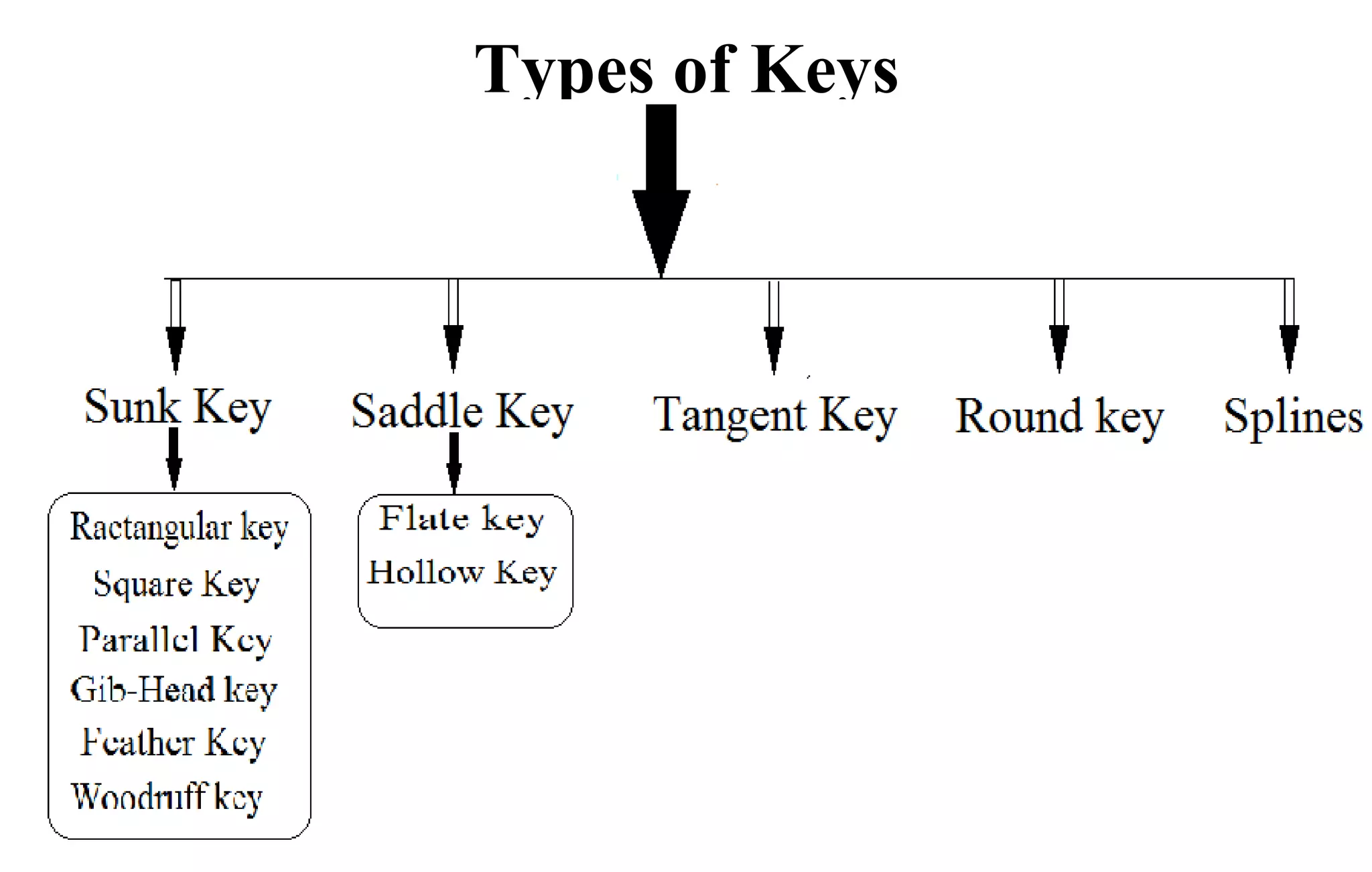
Types of Keys
Sunk key
• The sunk key are provided half in the keyway of the shaft and half in the
keyway of the hub .
• The sunk key are of the following types:
1. Rectangular key
2. Square key
3. Parallel key
4. Gib-Head key
5. Feather key
6. Woodruff Key
1. Rectangular Key
• A key is a piece of mild steel inserted between the shaft and hub of the
pulley to connect these together in order to prevent relative motion
between them.
The key has taper 1 in 100 on the top side only.
2. Square Key
• The only difference between a rectangular sunk key and a square sunk
key is that its width and thickness are equal.
i.e , W=t=d/4
3. Parallel key
• The parallel sunk key may be of rectangular or square section uniform in
width and thickness throughout.
• It may be noted that a parallel key is a taperless and is used where the
pulley, gear or other mating piece is required to solid along the shaft.
4. Gib-Head Key
• It is a rectangular sunk key with a head at one end known as Gib-Head
Key.
• It is usually provided to facilitate and removal of key.
5. Feather key
• A key attached to one member of a pair and
which permits relative axial movement is
known as feather key.
• It is a special type of parallel key which
transmits a turning movement and also
permits axial movement.
6. Woodruff Key
• The woodruff key is an easily adjustable key.
• It is piece from a cylindrical disc having
segmental cross-section in front view of figure.
• This key is largely used in machine tool and
automobile construction.
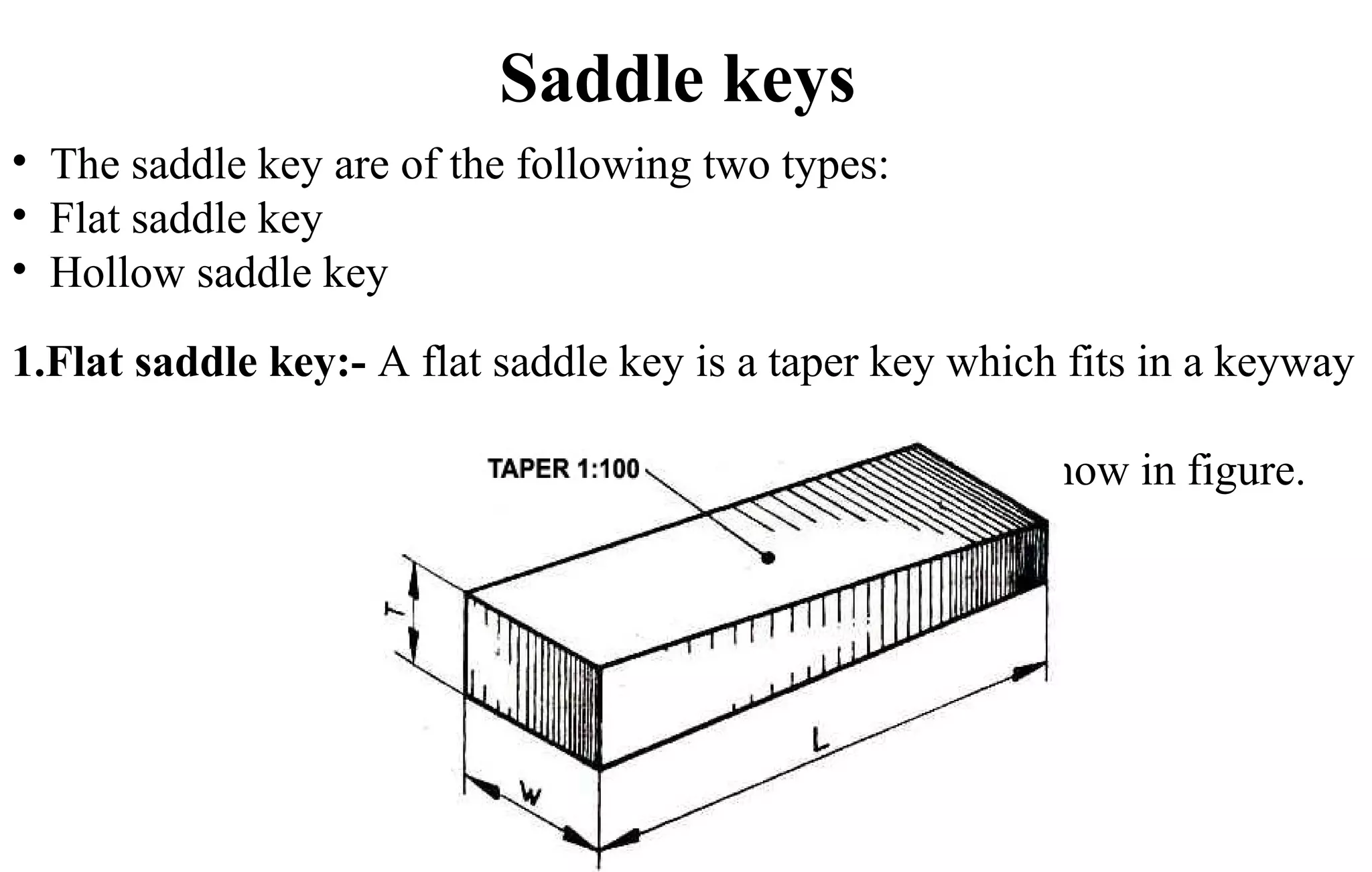
Saddle keys
• The saddle key are of the following two types:
• Flat saddle key
• Hollow saddle key
1.Flat saddle key:- A flat saddle key is a taper key which fits in a keyway
in the hub and is flat on the shaft as show in figure.
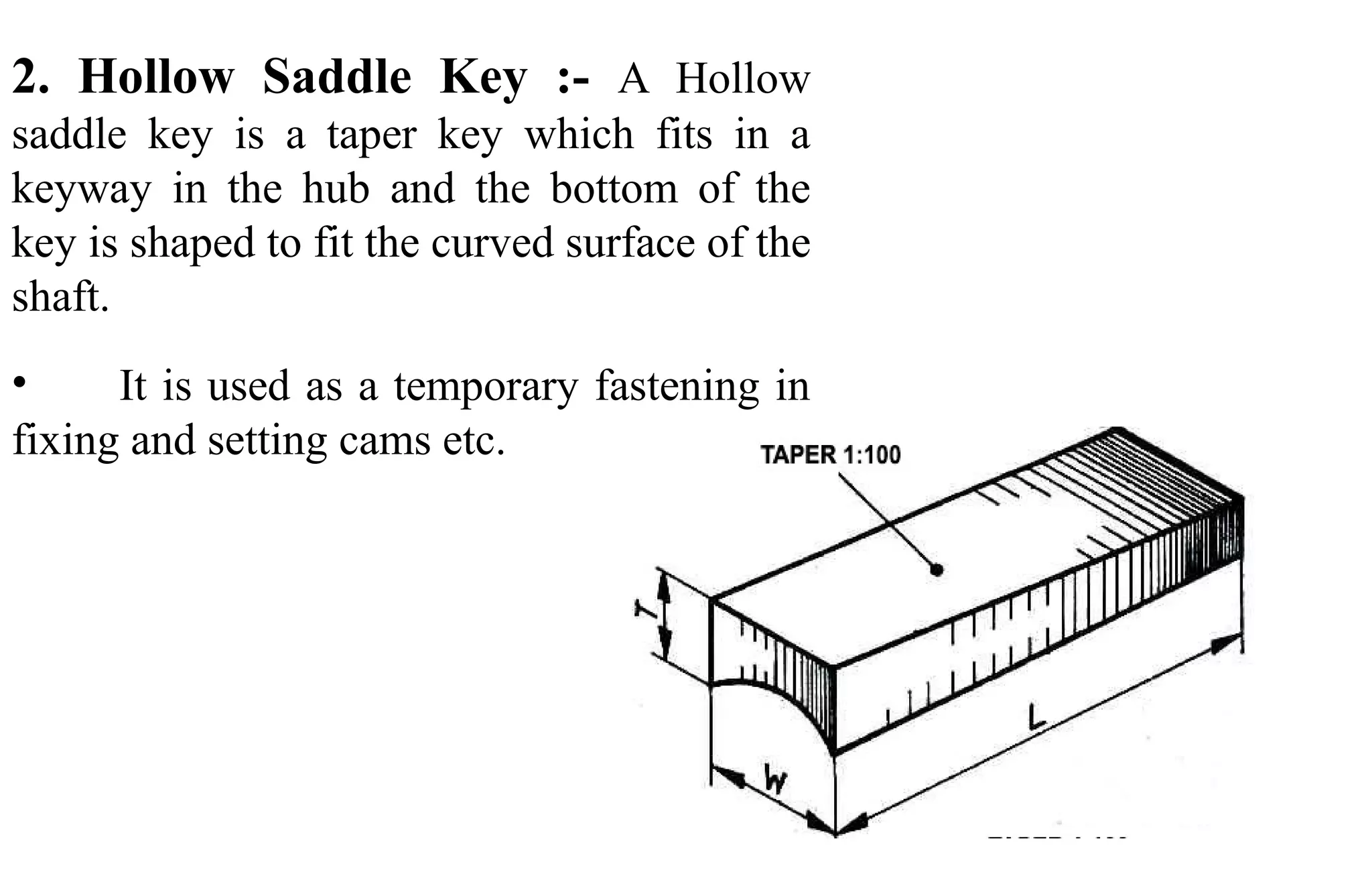
2. Hollow Saddle Key :- A Hollow
saddle key is a taper key which fits in a
keyway in the hub and the bottom of the
key is shaped to fit the curved surface of the
shaft.
• It is used as a temporary fastening in
fixing and setting cams etc.
Tangent Keys
• The tangent key are fitted in a pair at right
angles.
• Each key is to withatand torsion in one
direction only.
• sThey are used in large heavy duty shaft.
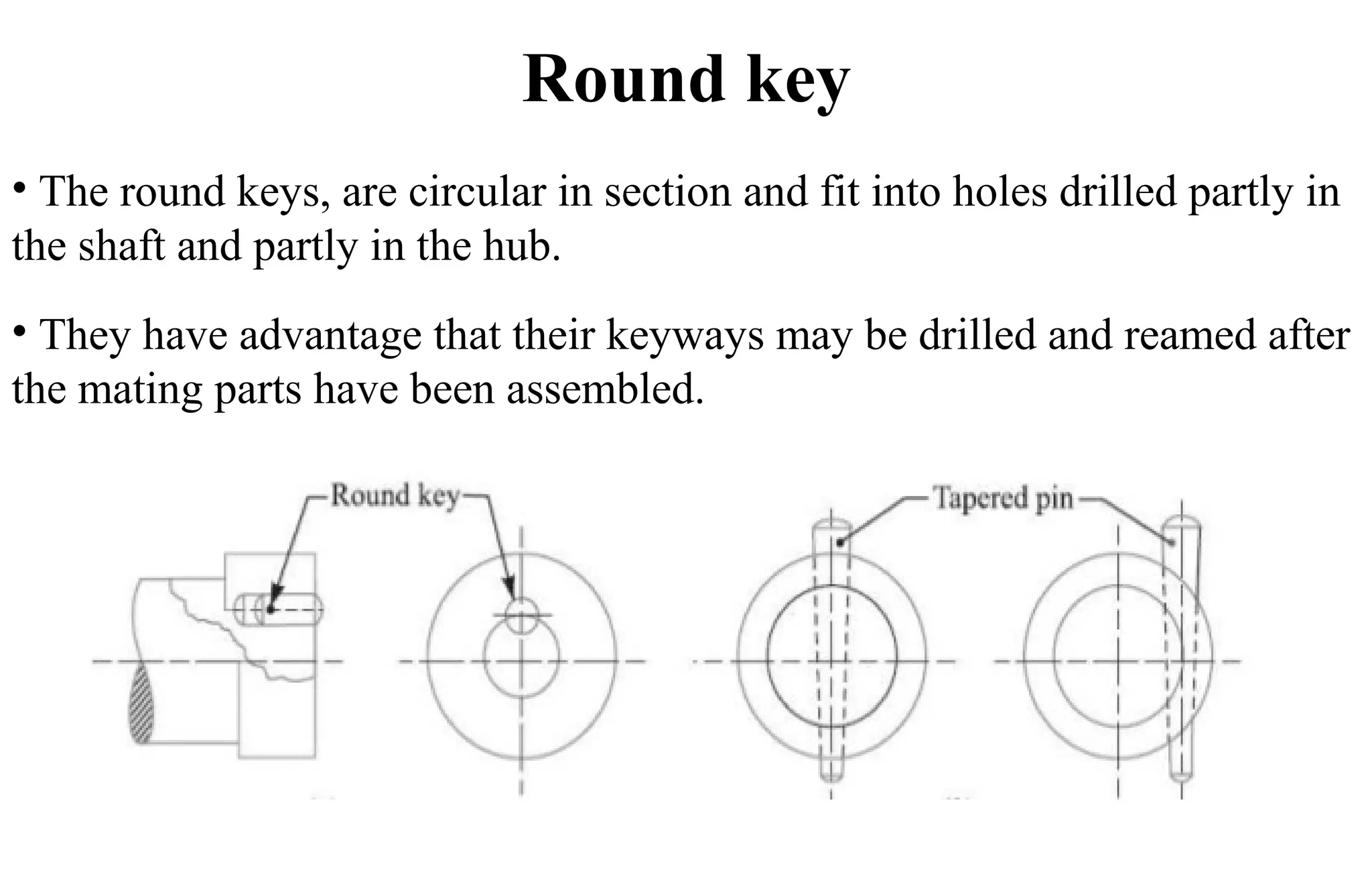
Round key
• The round keys, are circular in section and fit into holes drilled partly in
the shaft and partly in the hub.
• They have advantage that their keyways may be drilled and reamed after
the mating parts have been assembled.
Splines
• Sometimes, keys are made integral with the shaft which fit in the
keyways broached in the hub. Such shafts are known as splined shafts.
• The Splined shaft are used when the forces to be transmitted is large in
proportional to the size of the shaft.
Thank You

Types of Keys

  • 1.
    Machine Design &Industrial Drafting (2141907) Mechanical Department Sem.: 4th D (D2) Guided By: Pro. Ashish Majithiya Prepared By: Gohel Sajan P. (160123119010)
  • 2.
    What is key?????  A key is a machine element used to connect a rotating machine element to a shaft. It is always inserted parallel to the exist of the shaft. A keyway is a slot in a shaft and hub of the pulley to accommodate a key.
  • 3.
  • 4.
    Sunk key • Thesunk key are provided half in the keyway of the shaft and half in the keyway of the hub . • The sunk key are of the following types: 1. Rectangular key 2. Square key 3. Parallel key 4. Gib-Head key 5. Feather key 6. Woodruff Key
  • 5.
    1. Rectangular Key •A key is a piece of mild steel inserted between the shaft and hub of the pulley to connect these together in order to prevent relative motion between them. The key has taper 1 in 100 on the top side only.
  • 6.
    2. Square Key •The only difference between a rectangular sunk key and a square sunk key is that its width and thickness are equal. i.e , W=t=d/4
  • 7.
    3. Parallel key •The parallel sunk key may be of rectangular or square section uniform in width and thickness throughout. • It may be noted that a parallel key is a taperless and is used where the pulley, gear or other mating piece is required to solid along the shaft.
  • 8.
    4. Gib-Head Key •It is a rectangular sunk key with a head at one end known as Gib-Head Key. • It is usually provided to facilitate and removal of key.
  • 9.
    5. Feather key •A key attached to one member of a pair and which permits relative axial movement is known as feather key. • It is a special type of parallel key which transmits a turning movement and also permits axial movement.
  • 10.
    6. Woodruff Key •The woodruff key is an easily adjustable key. • It is piece from a cylindrical disc having segmental cross-section in front view of figure. • This key is largely used in machine tool and automobile construction.
  • 11.
    Saddle keys • Thesaddle key are of the following two types: • Flat saddle key • Hollow saddle key 1.Flat saddle key:- A flat saddle key is a taper key which fits in a keyway in the hub and is flat on the shaft as show in figure.
  • 12.
    2. Hollow SaddleKey :- A Hollow saddle key is a taper key which fits in a keyway in the hub and the bottom of the key is shaped to fit the curved surface of the shaft. • It is used as a temporary fastening in fixing and setting cams etc.
  • 13.
    Tangent Keys • Thetangent key are fitted in a pair at right angles. • Each key is to withatand torsion in one direction only. • sThey are used in large heavy duty shaft.
  • 14.
    Round key • Theround keys, are circular in section and fit into holes drilled partly in the shaft and partly in the hub. • They have advantage that their keyways may be drilled and reamed after the mating parts have been assembled.
  • 15.
    Splines • Sometimes, keysare made integral with the shaft which fit in the keyways broached in the hub. Such shafts are known as splined shafts. • The Splined shaft are used when the forces to be transmitted is large in proportional to the size of the shaft.
  • 16.