08/01/12


   Chapter 2
   Basic Laws


DKS1113 Electric Circuits
Introduction
   Fundament laws that govern electric circuits:
     Ohm’s Law.

     Kirchoff’s Law.


   These laws form the foundation upon which electric
    circuit analysis is built.

   Common techniques in circuit analysis and design:
     Combining resistors in series and parallel.
     Voltage and current divisions.

     Wye to delta and delta to wye transformations.


   These techniques are restricted to resistive circuits.


08/01/12        DKS1113 Electric Circuits                    2/43
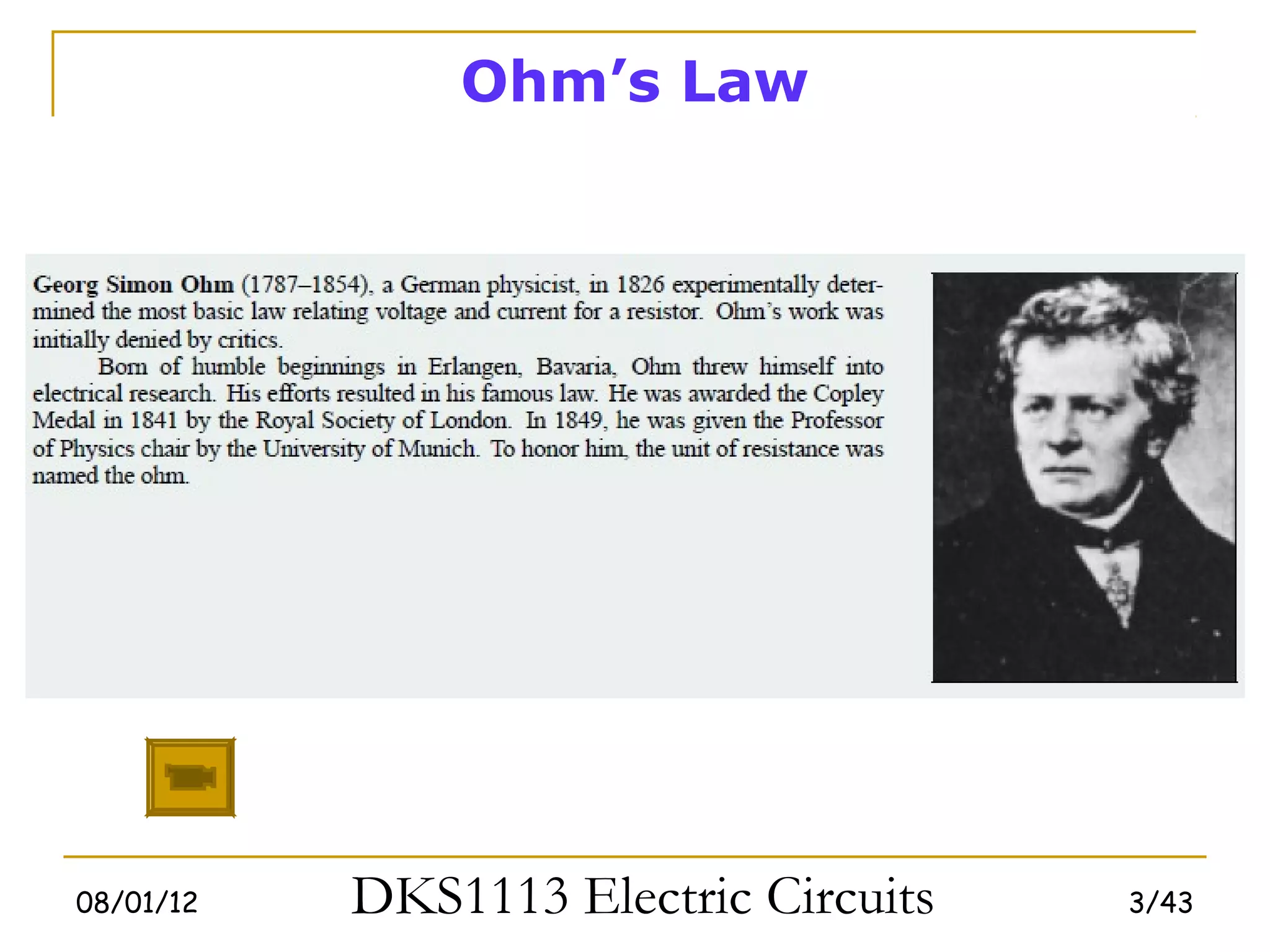
Ohm’s Law


08/01/12   DKS1113 Electric Circuits   3/43
Ohm’s Law

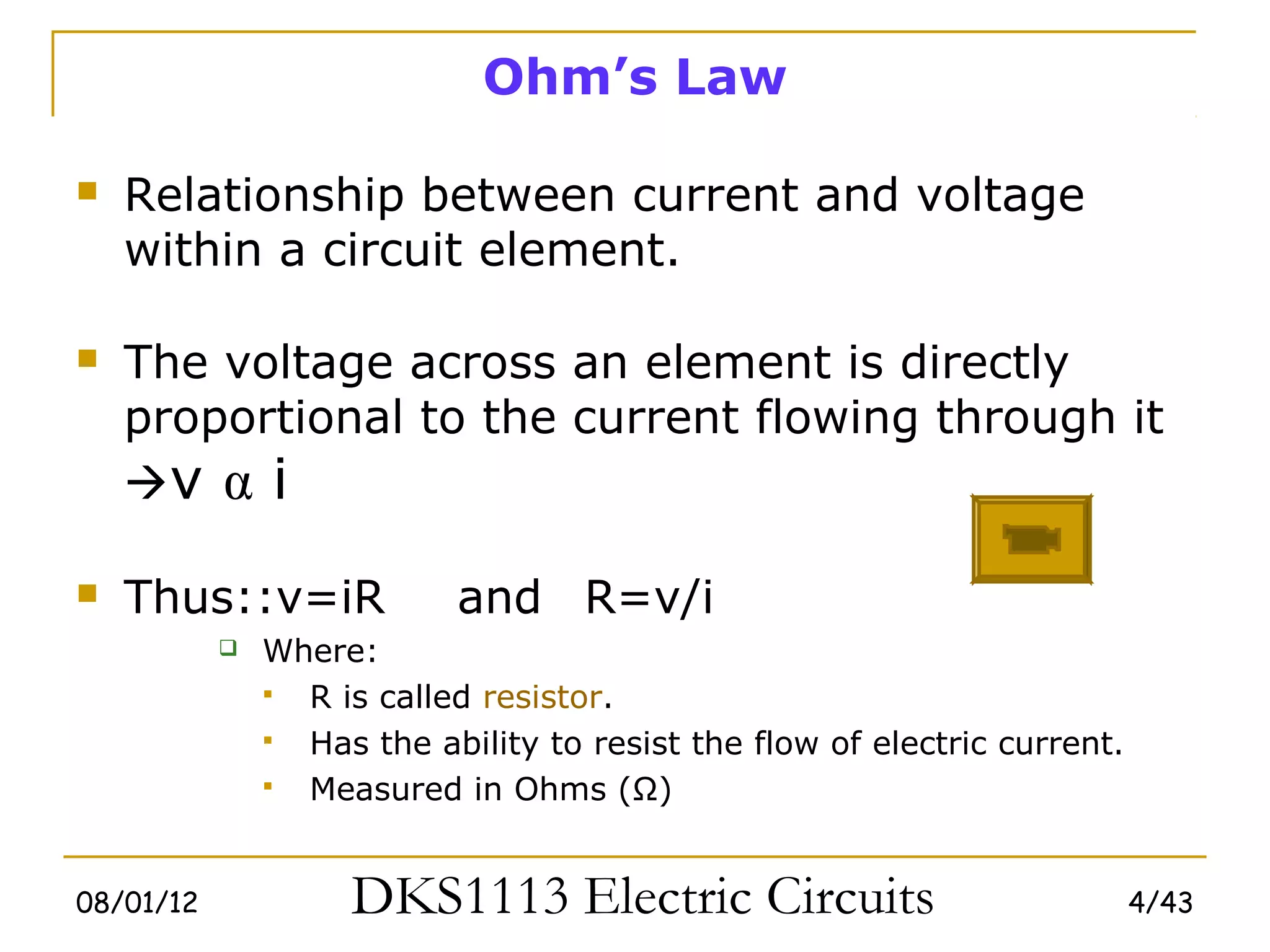
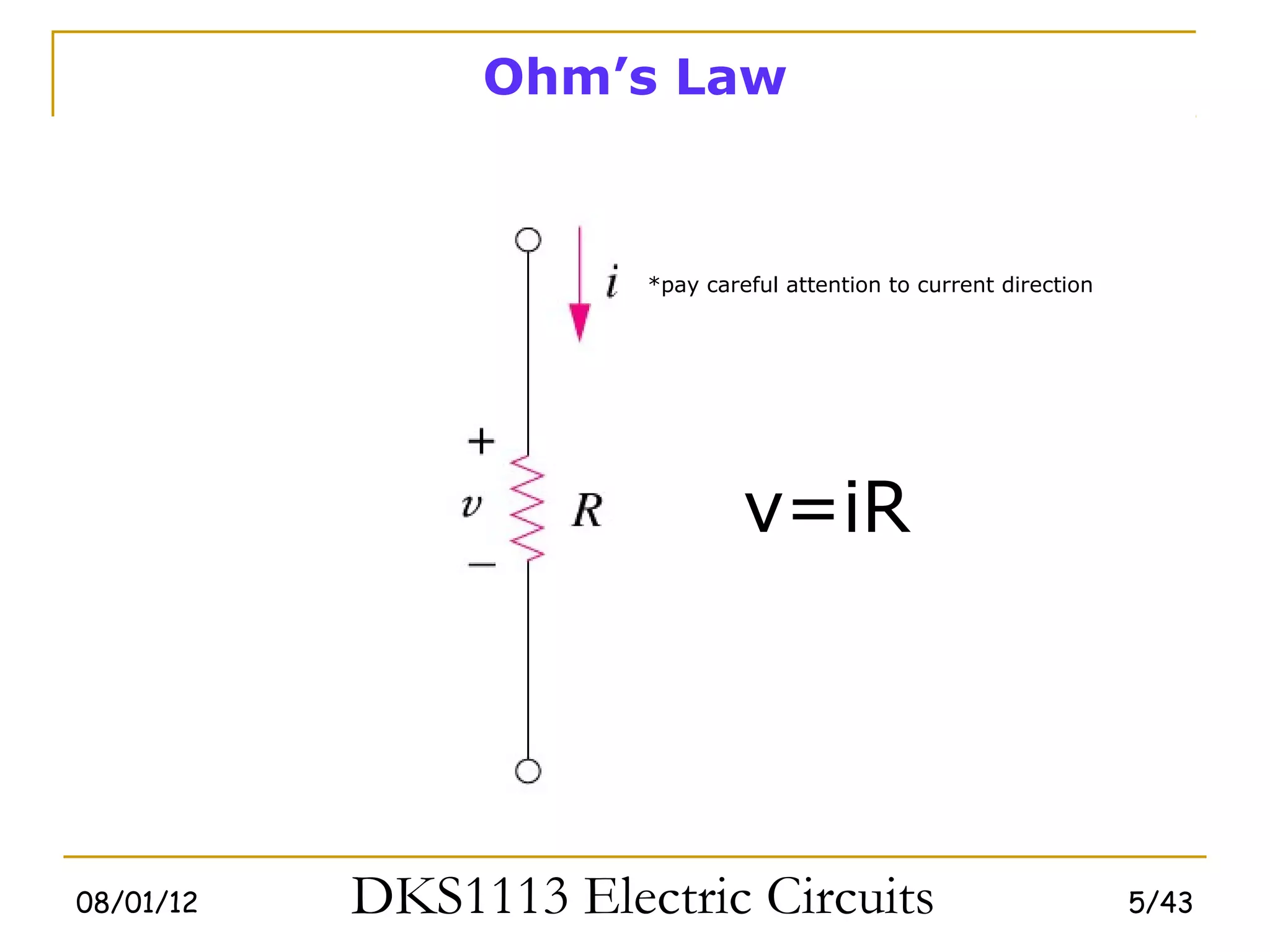
   Relationship between current and voltage
    within a circuit element.

   The voltage across an element is directly
    proportional to the current flowing through it
    v α i

   Thus::v=iR             and R=v/i
              Where:
                R is called resistor.
                Has the ability to resist the flow of electric current.
                Measured in Ohms (Ω)


08/01/12            DKS1113 Electric Circuits                              4/43
Ohm’s Law


                       *pay careful attention to current direction


                                v=iR


08/01/12   DKS1113 Electric Circuits                                 5/43
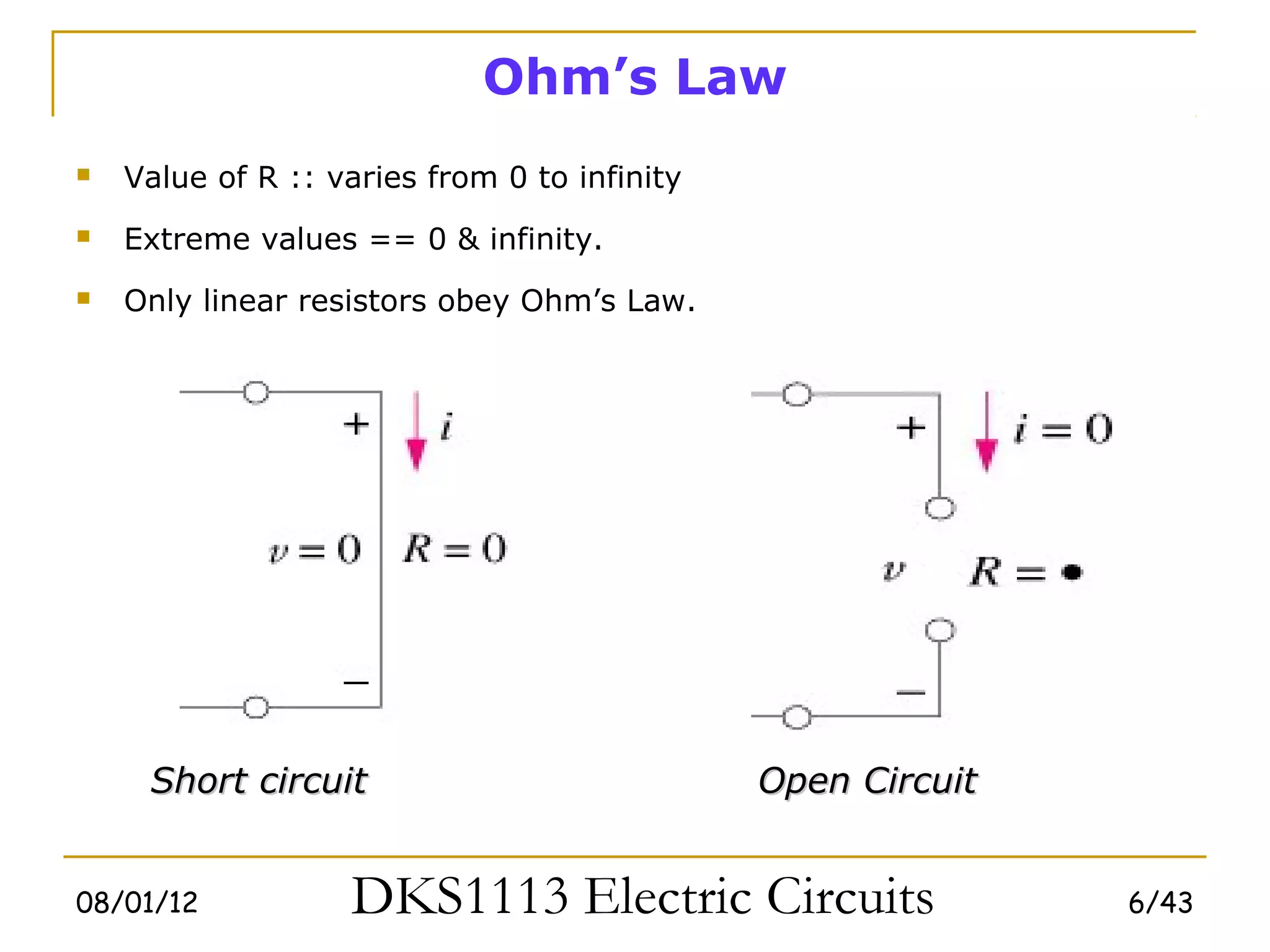
Ohm’s Law
   Value of R :: varies from 0 to infinity
   Extreme values == 0 & infinity.
   Only linear resistors obey Ohm’s Law.


     Short circuit                            Open Circuit


08/01/12           DKS1113 Electric Circuits                 6/43
Ohm’s Law

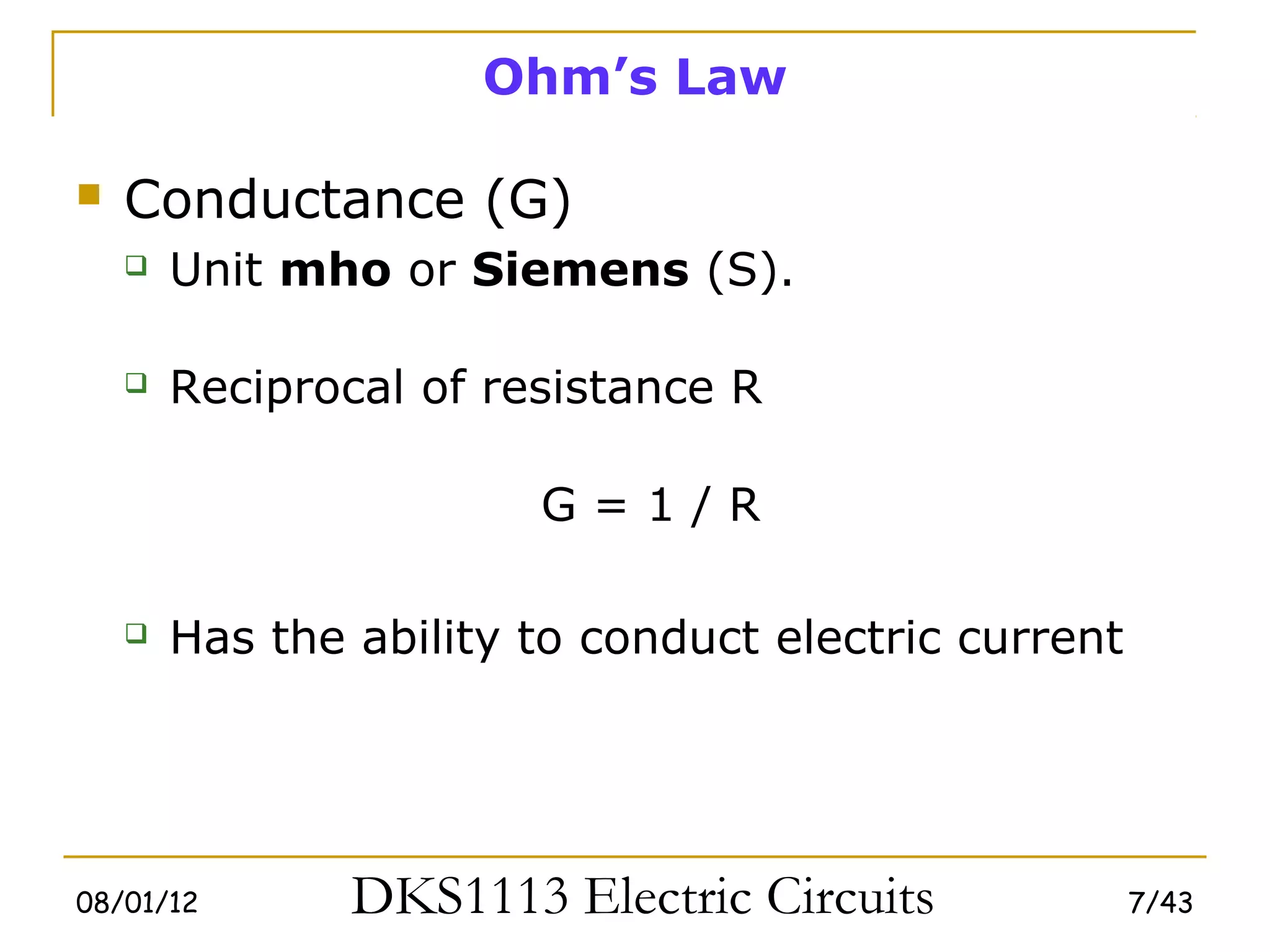
   Conductance (G)
       Unit mho or Siemens (S).

       Reciprocal of resistance R

                        G=1/R

       Has the ability to conduct electric current


08/01/12        DKS1113 Electric Circuits             7/43
Ohm’s Law

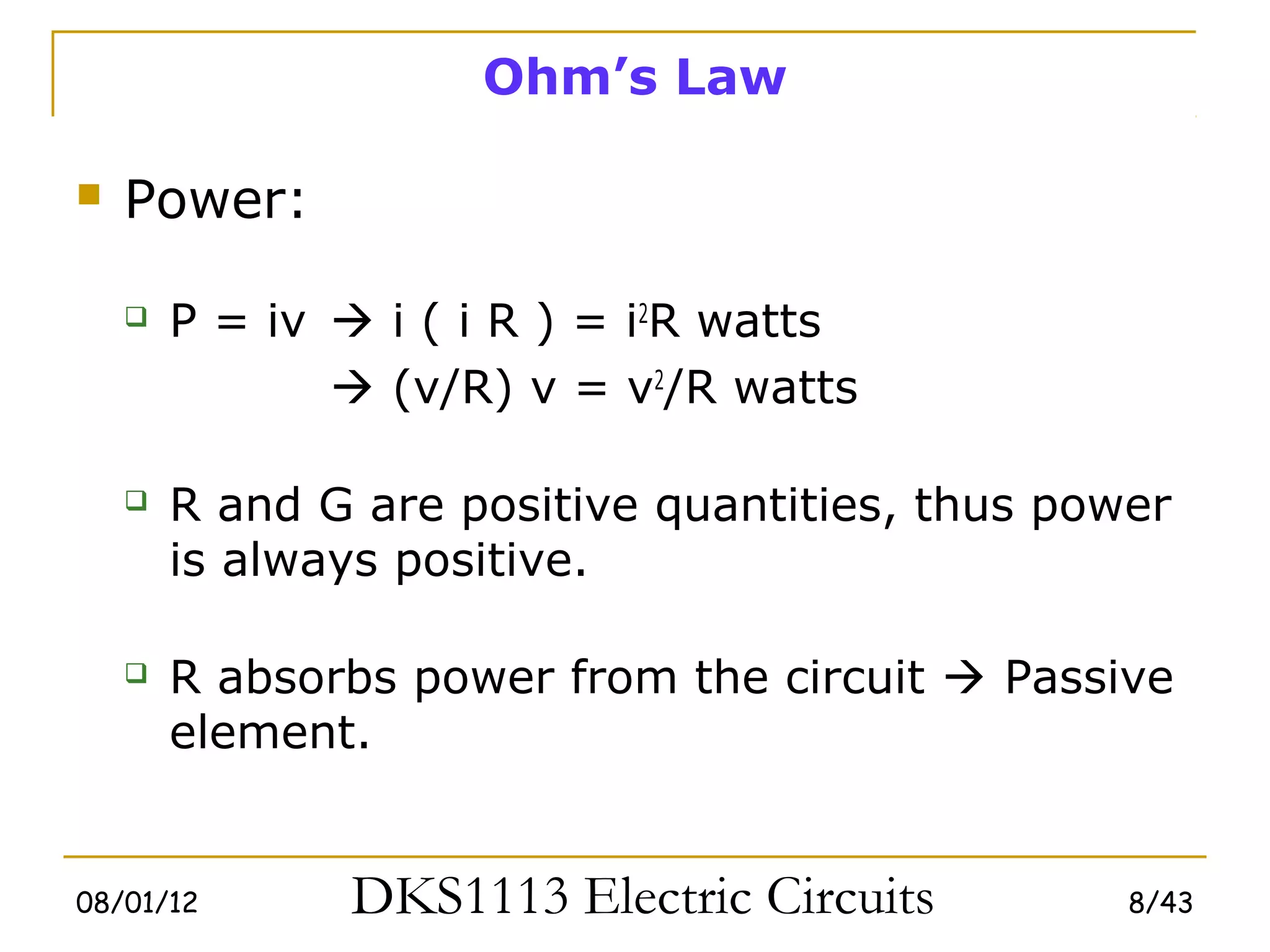
   Power:

       P = iv  i ( i R ) = i2R watts
                (v/R) v = v2/R watts

       R and G are positive quantities, thus power
        is always positive.

       R absorbs power from the circuit  Passive
        element.


08/01/12       DKS1113 Electric Circuits         8/43
Ohm’s Law

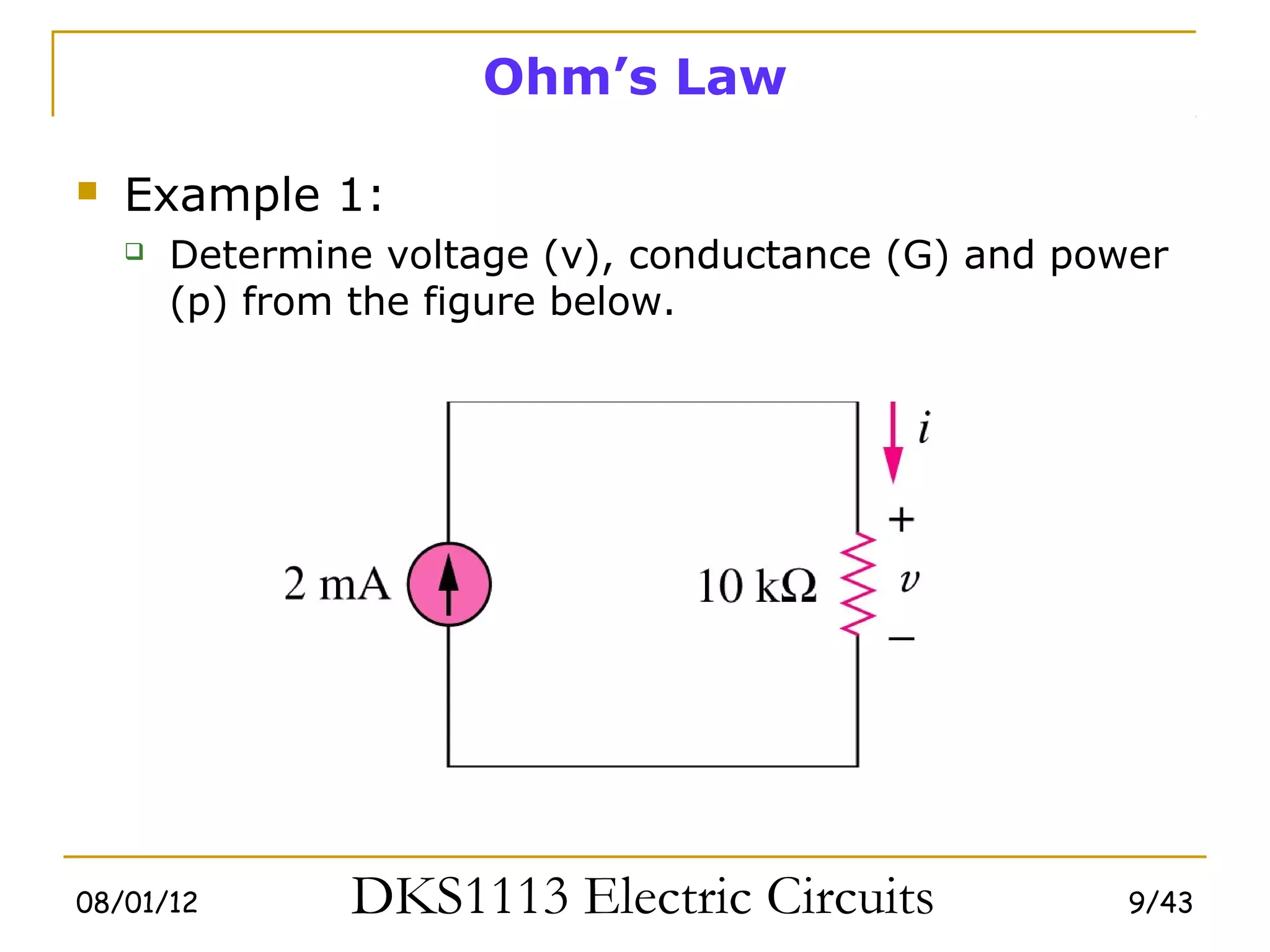
   Example 1:
       Determine voltage (v), conductance (G) and power
        (p) from the figure below.


08/01/12        DKS1113 Electric Circuits             9/43
Ohm’s Law

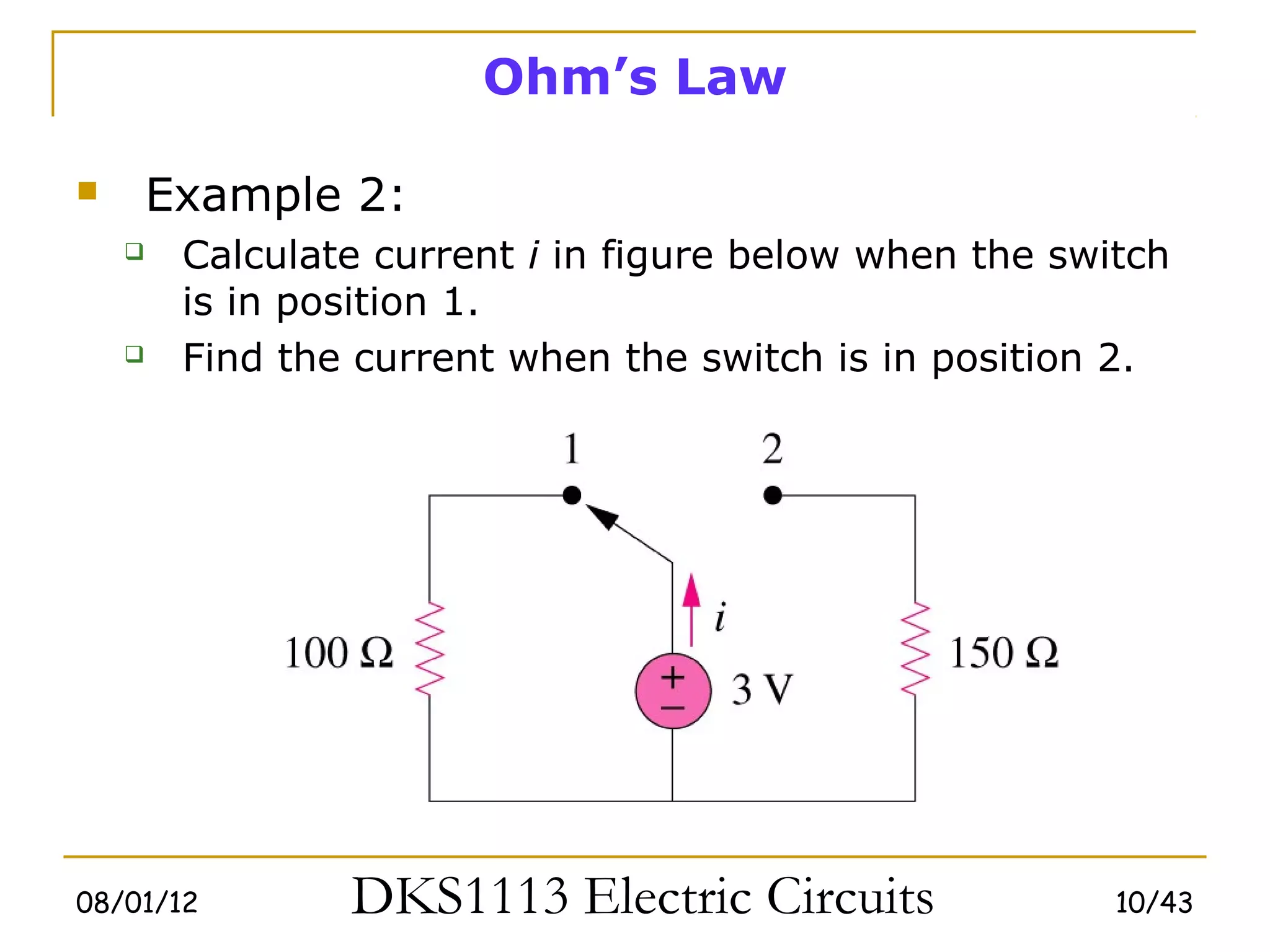
       Example 2:
        Calculate current i in figure below when the switch
         is in position 1.
        Find the current when the switch is in position 2.


08/01/12         DKS1113 Electric Circuits               10/43
Nodes, Branches & Loops

   Elements of electric circuits can be
    interconnected in several way.

   Need to understand some basic concepts of
    network topology.

   Branch: Represents a single element
            (i.e. voltage, resistor & etc)

   Node:    The meeting point between two
             or more branches.

   Loop:    Any closed path in a circuit.

08/01/12      DKS1113 Electric Circuits      11/43
Nodes, Branches & Loops

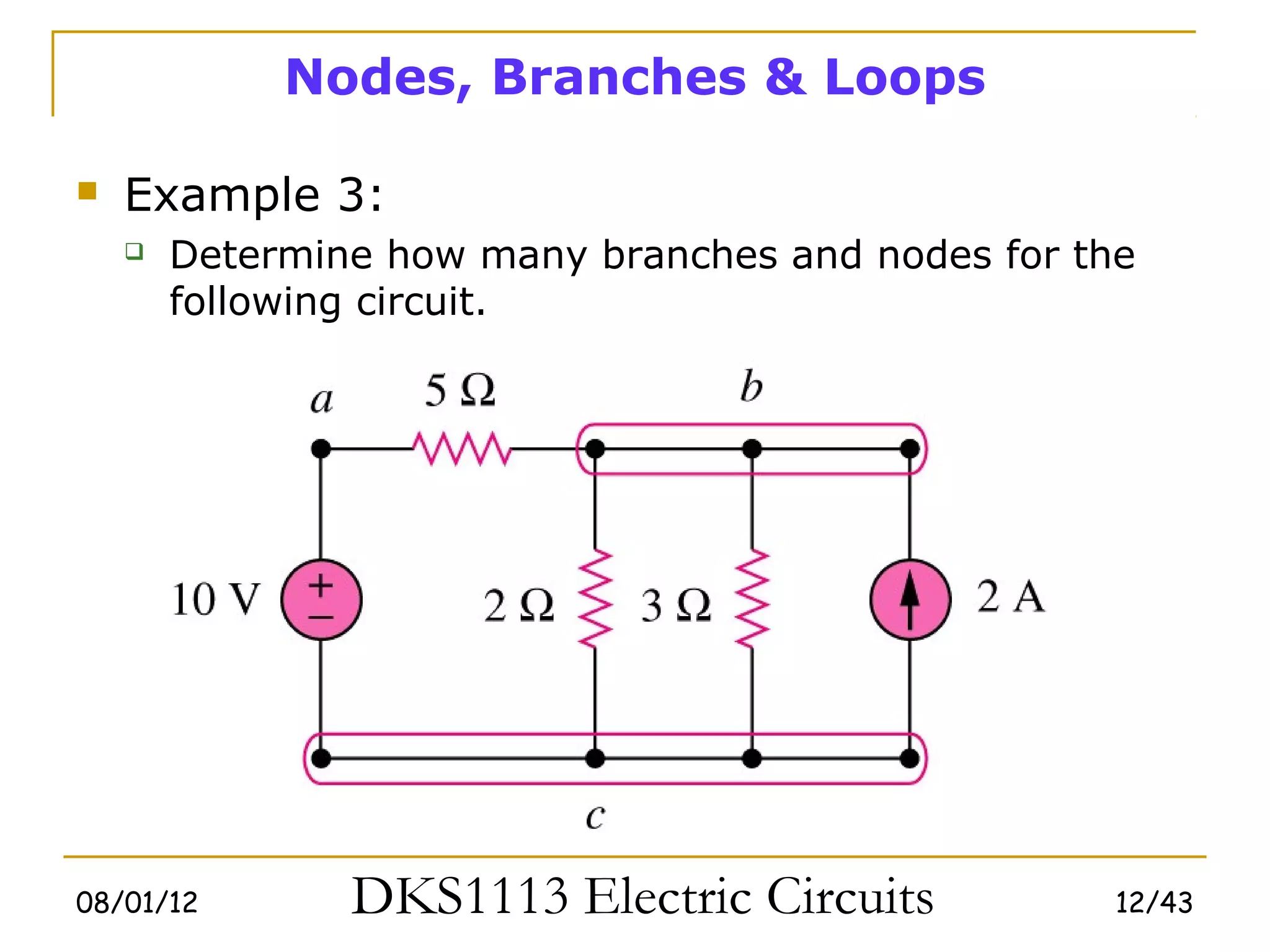
   Example 3:
       Determine how many branches and nodes for the
        following circuit.


08/01/12        DKS1113 Electric Circuits           12/43
Nodes, Branches & Loops
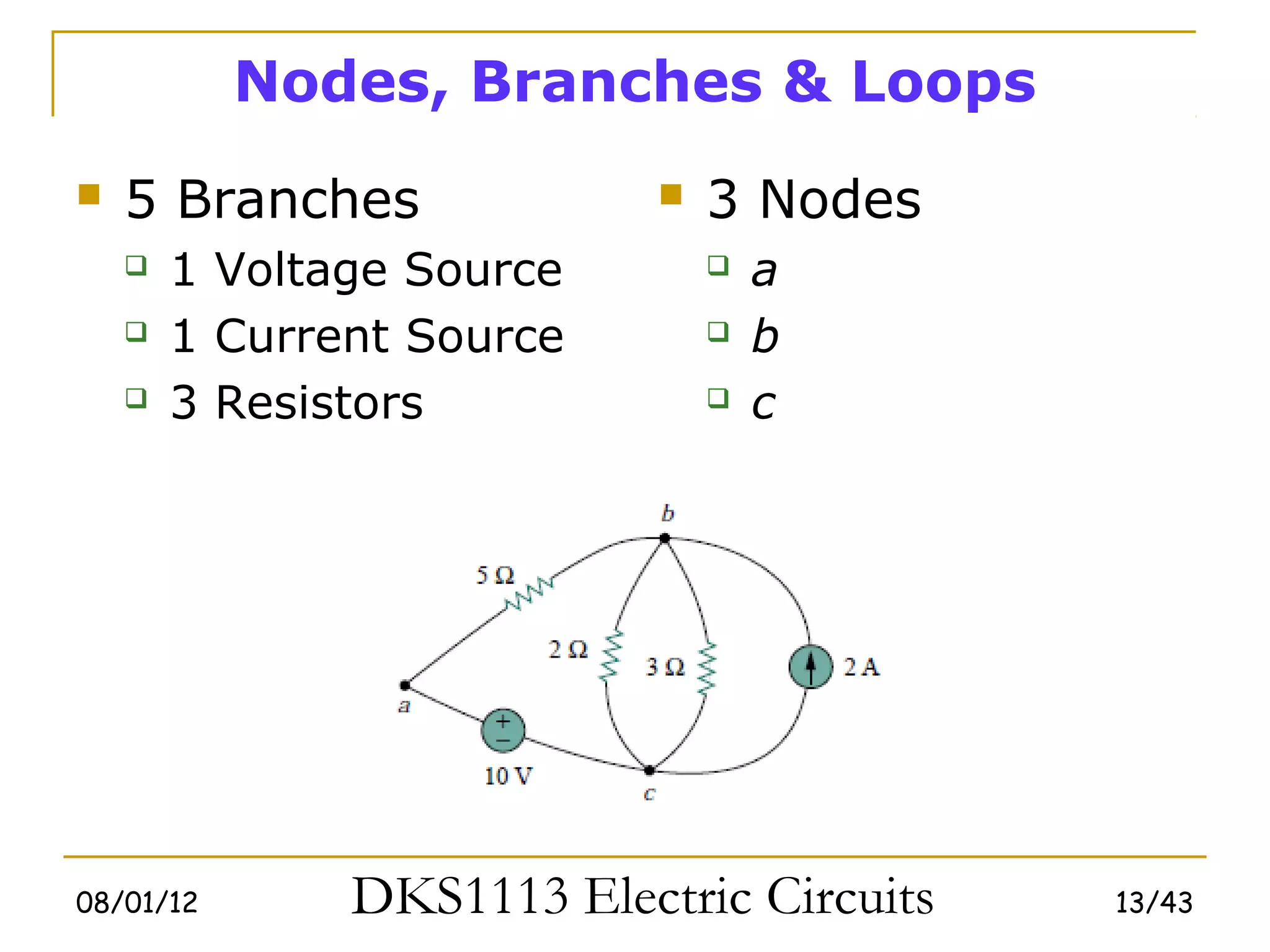
   5 Branches                 3 Nodes
       1 Voltage Source           a
       1 Current Source           b
       3 Resistors                c


08/01/12       DKS1113 Electric Circuits   13/43
Nodes, Branches & Loops

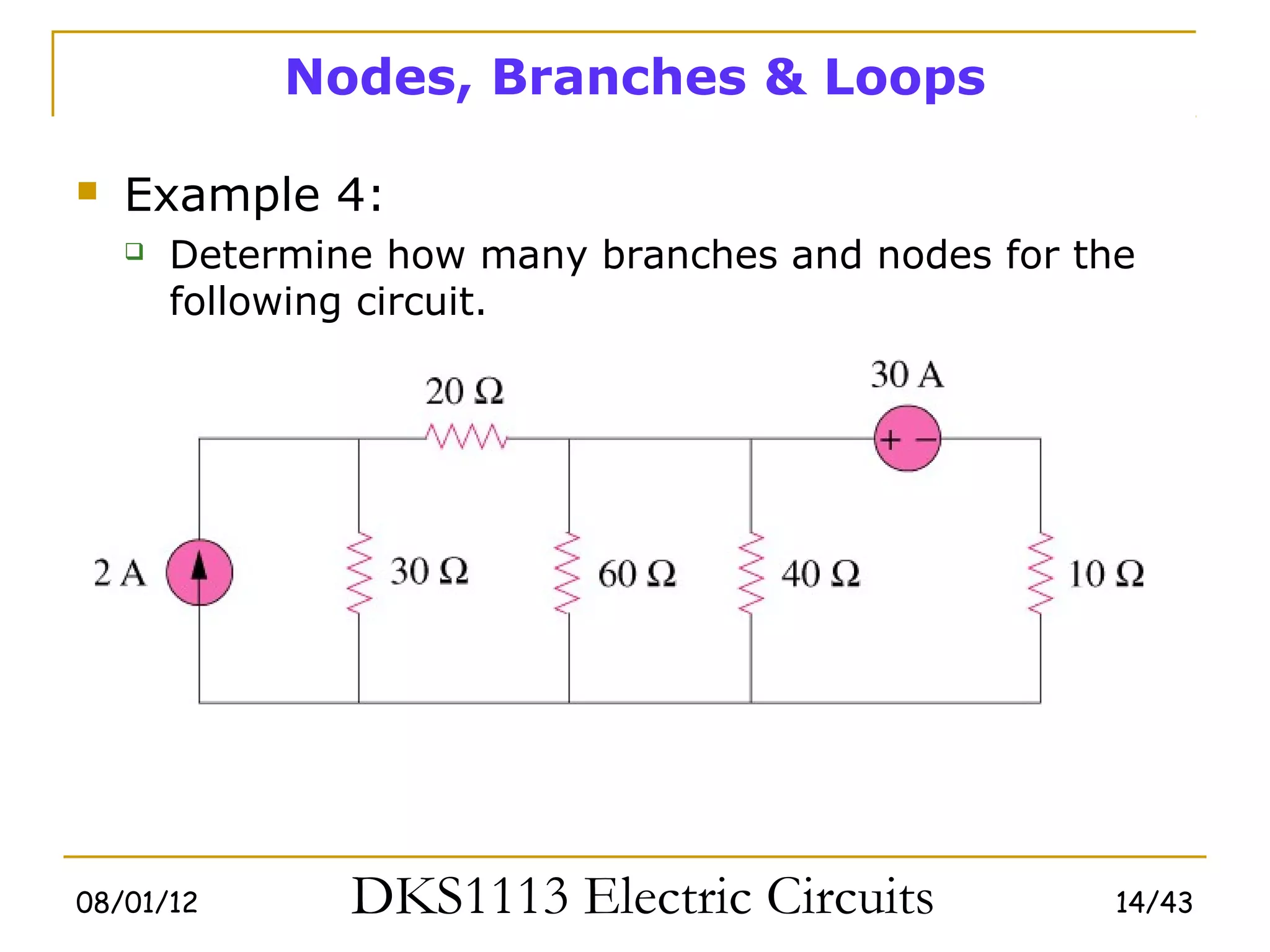
   Example 4:
       Determine how many branches and nodes for the
        following circuit.


08/01/12        DKS1113 Electric Circuits           14/43
Kirchoff’s Laws


08/01/12   DKS1113 Electric Circuits   15/43
Kirchoff’s Laws

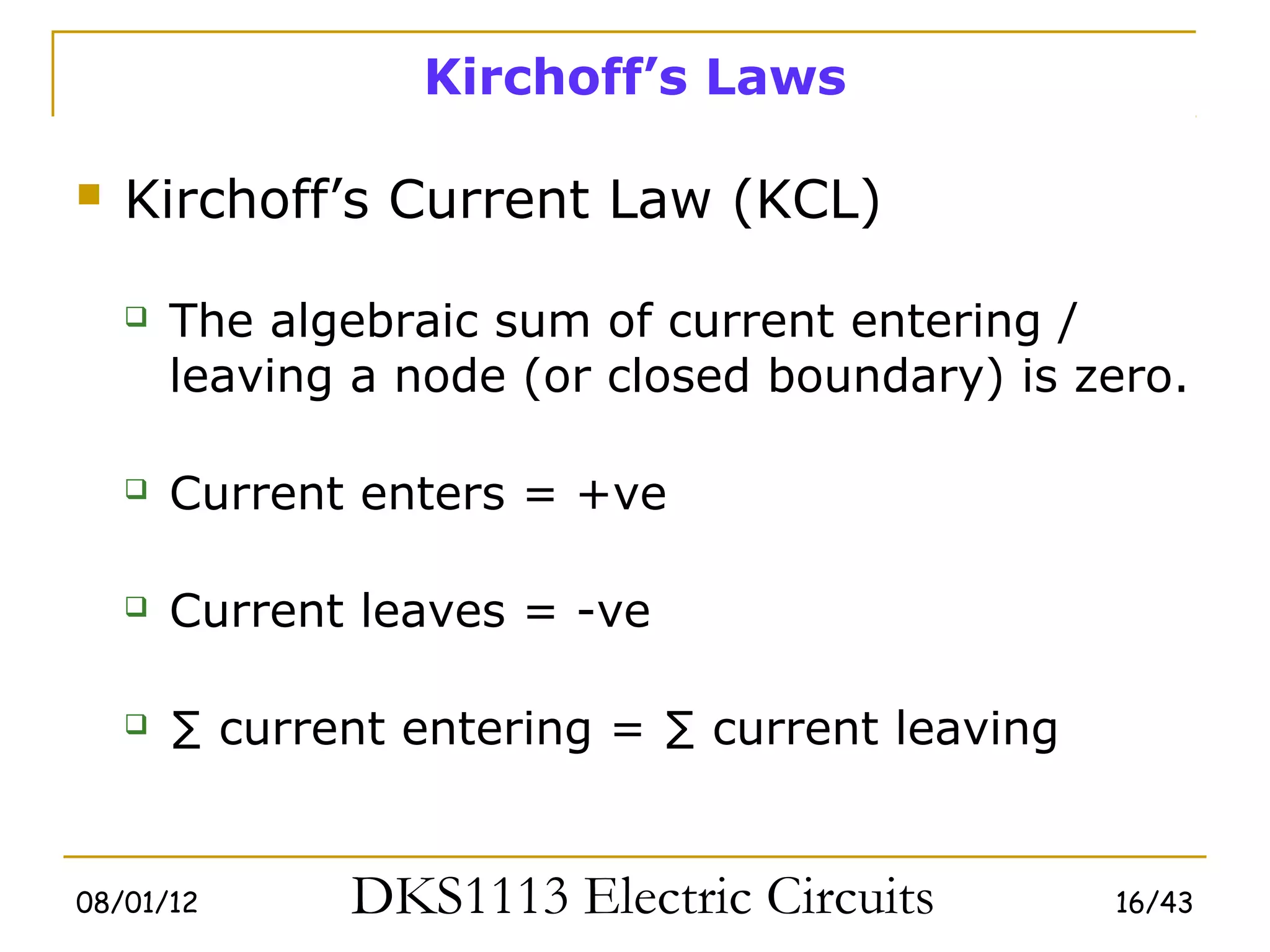
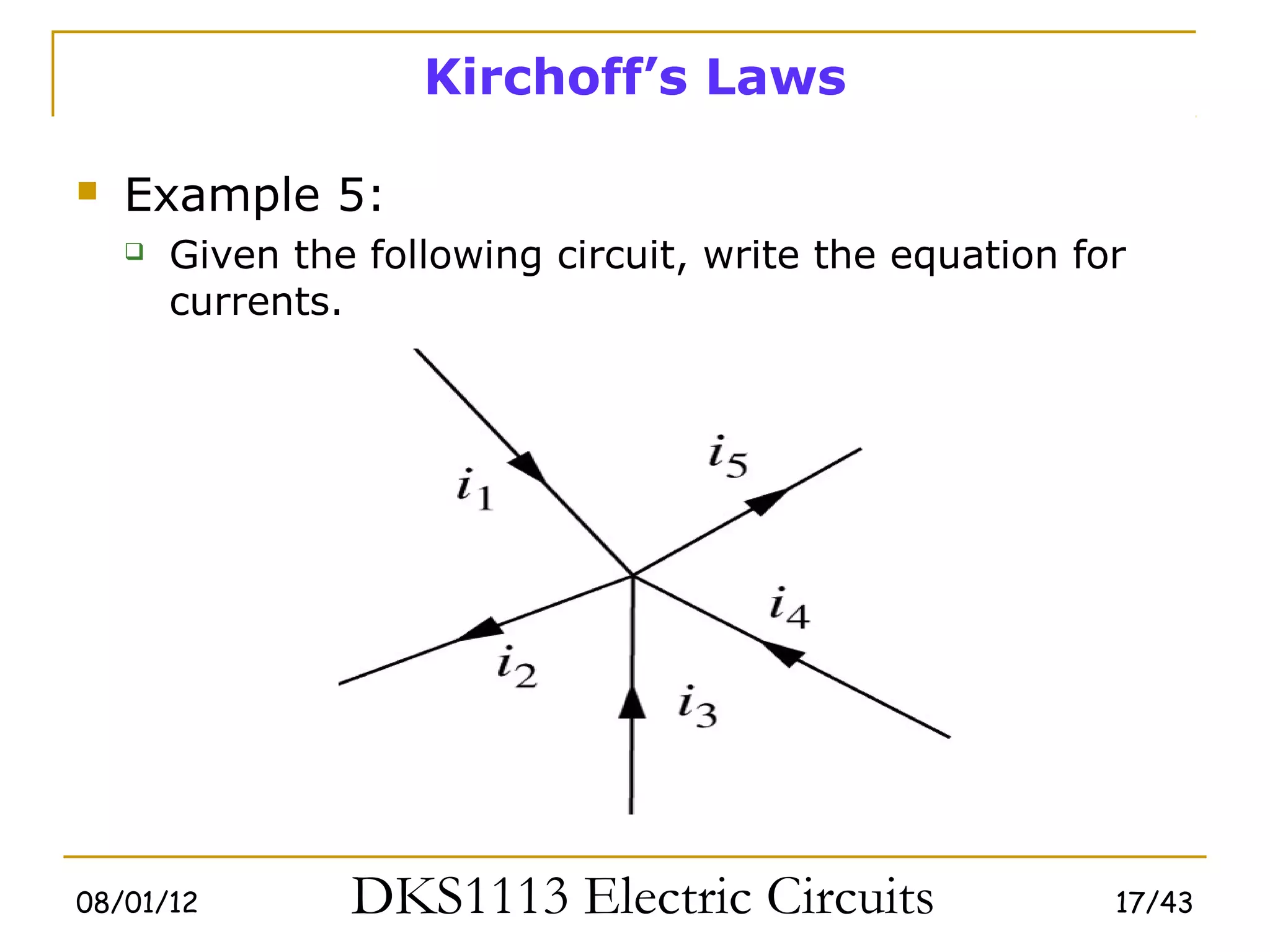
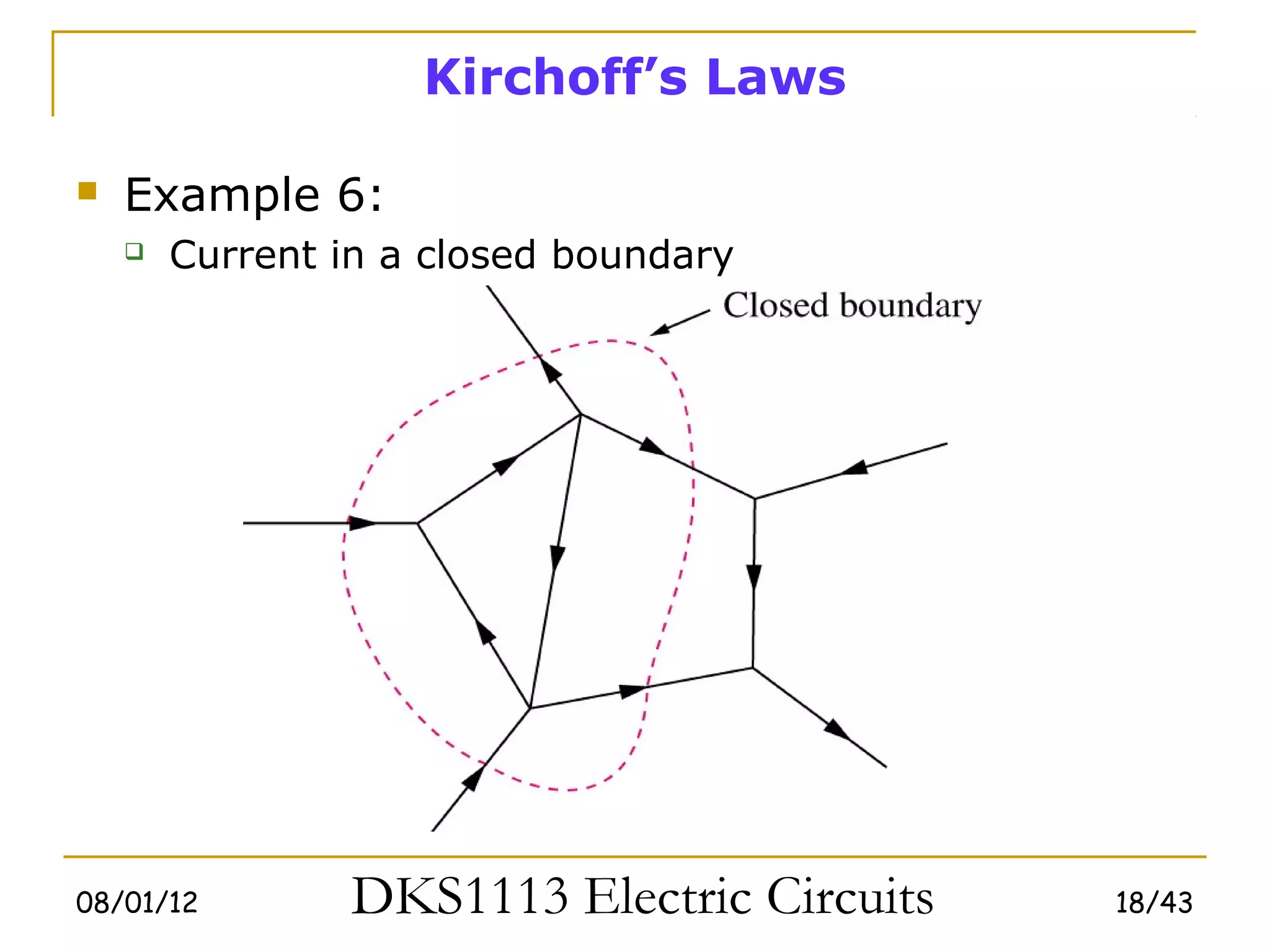
   Kirchoff’s Current Law (KCL)

       The algebraic sum of current entering /
        leaving a node (or closed boundary) is zero.

       Current enters = +ve

       Current leaves = -ve

       ∑ current entering = ∑ current leaving


08/01/12       DKS1113 Electric Circuits         16/43
Kirchoff’s Laws

   Example 5:
       Given the following circuit, write the equation for
        currents.


08/01/12         DKS1113 Electric Circuits                17/43
Kirchoff’s Laws

   Example 6:
       Current in a closed boundary


08/01/12         DKS1113 Electric Circuits   18/43
Kirchoff’s Laws

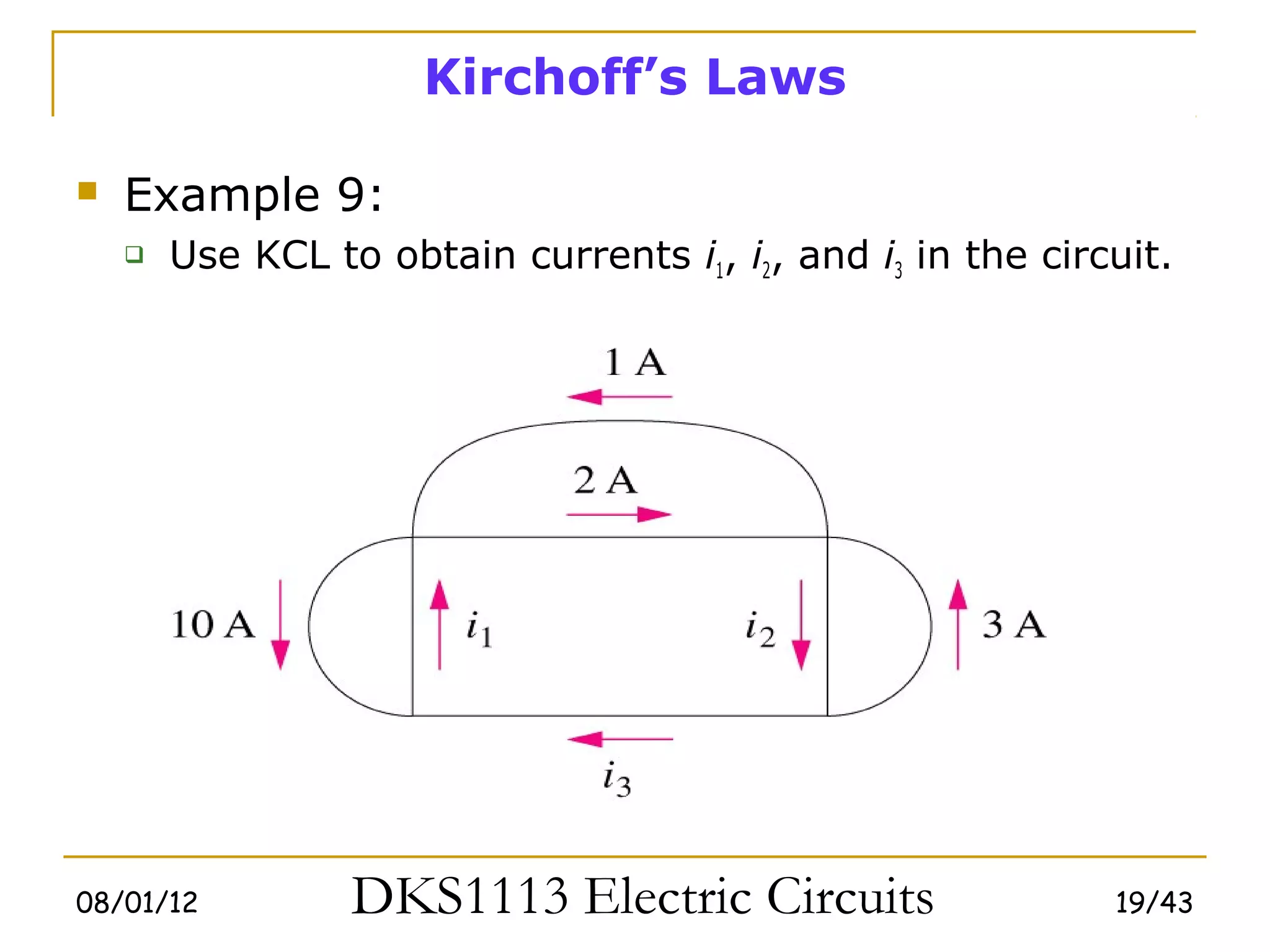
   Example 9:
       Use KCL to obtain currents i1, i2, and i3 in the circuit.


08/01/12          DKS1113 Electric Circuits                  19/43
Kirchoff’s Laws
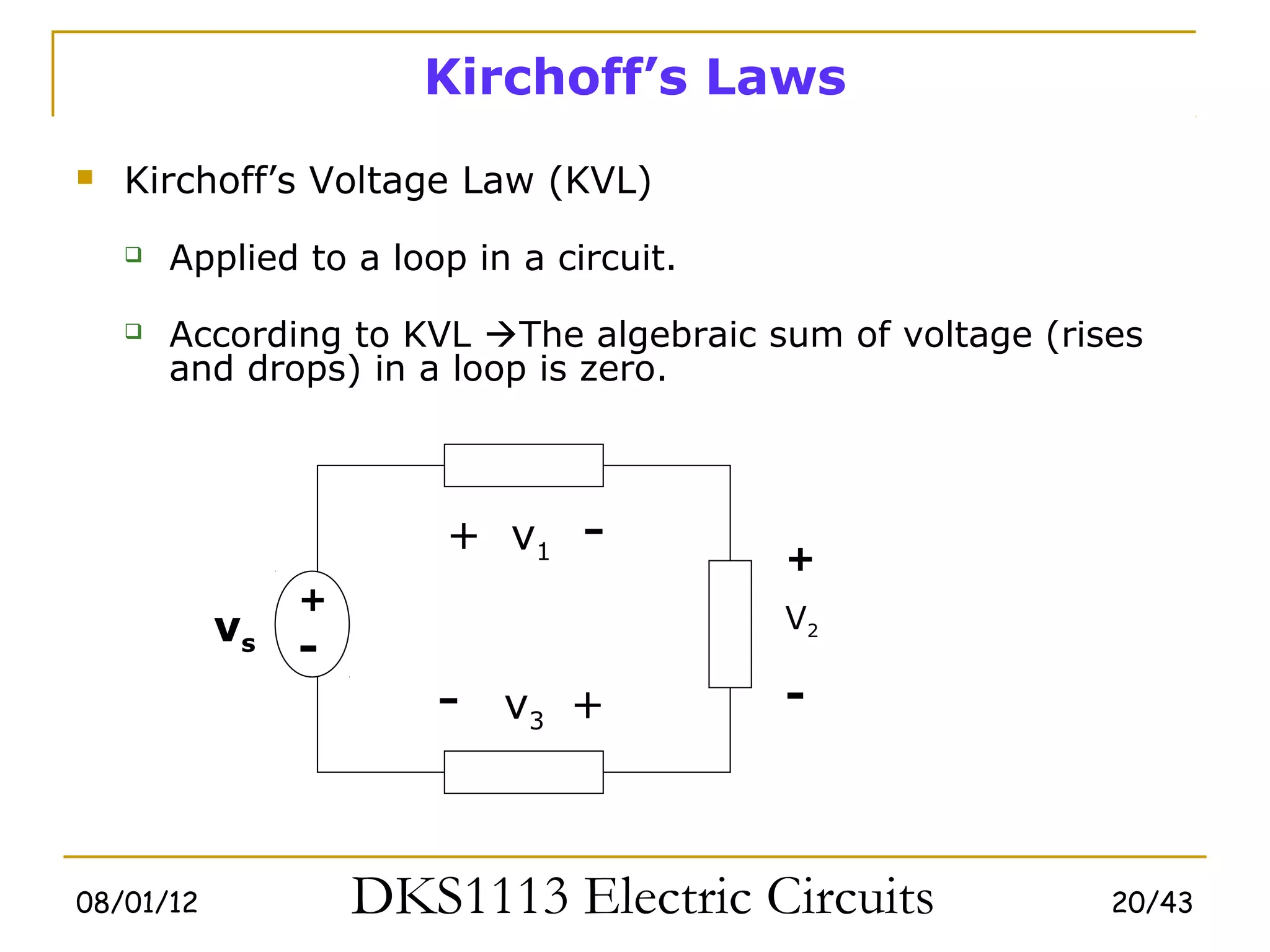
   Kirchoff’s Voltage Law (KVL)
       Applied to a loop in a circuit.
       According to KVL The algebraic sum of voltage (rises
        and drops) in a loop is zero.


                        + v1     -        +
                +
           vs                             V2
                -
                        -   v3 +          -


08/01/12            DKS1113 Electric Circuits              20/43
Kirchoff’s Laws

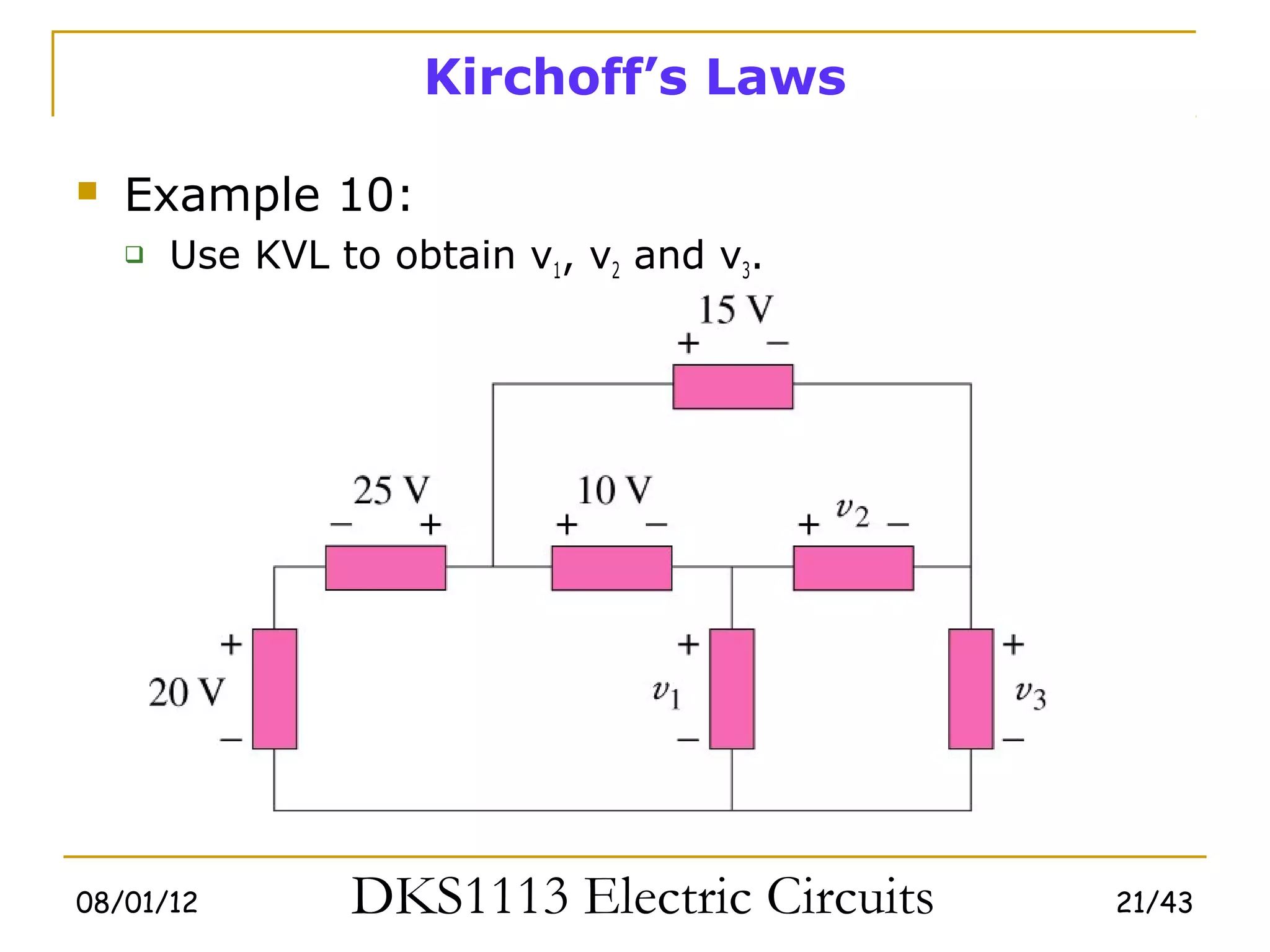
   Example 10:
       Use KVL to obtain v1, v2 and v3.


08/01/12         DKS1113 Electric Circuits   21/43
Kirchoff’s Laws

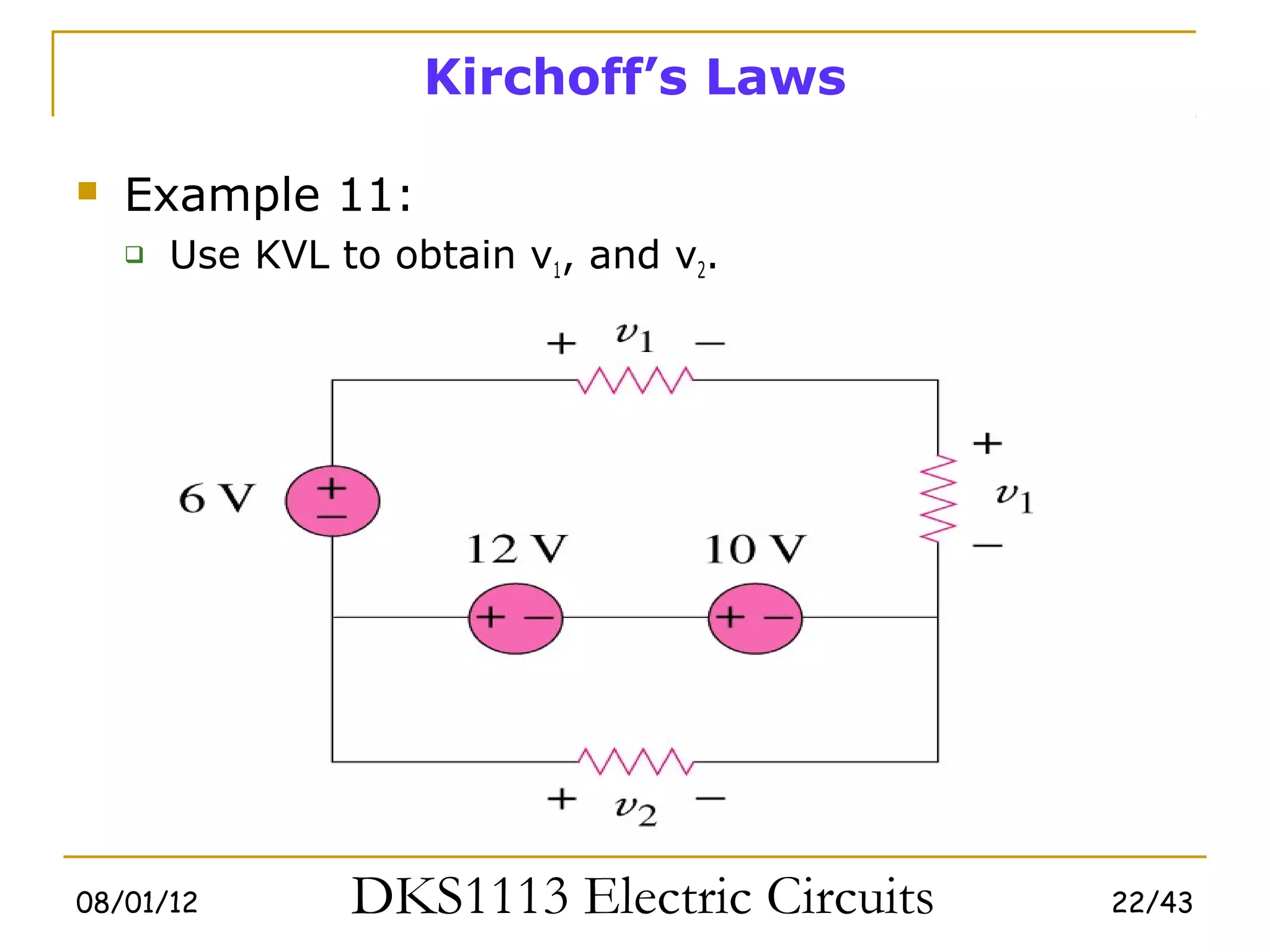
   Example 11:
       Use KVL to obtain v1, and v2.


08/01/12         DKS1113 Electric Circuits   22/43
Kirchoff’s Laws
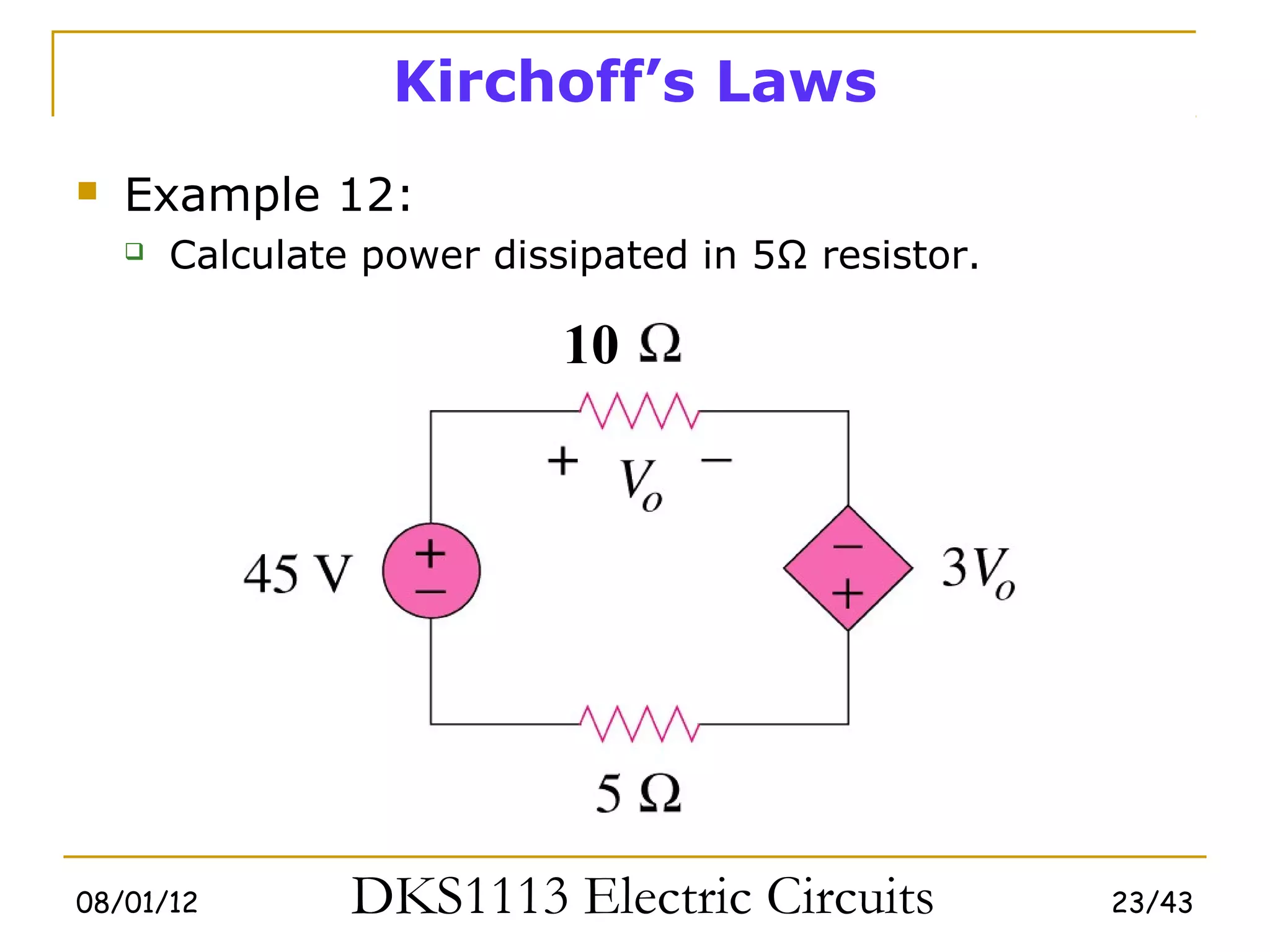
   Example 12:
       Calculate power dissipated in 5Ω resistor.

                            10


08/01/12         DKS1113 Electric Circuits           23/43
Series Resistors & Voltage Division

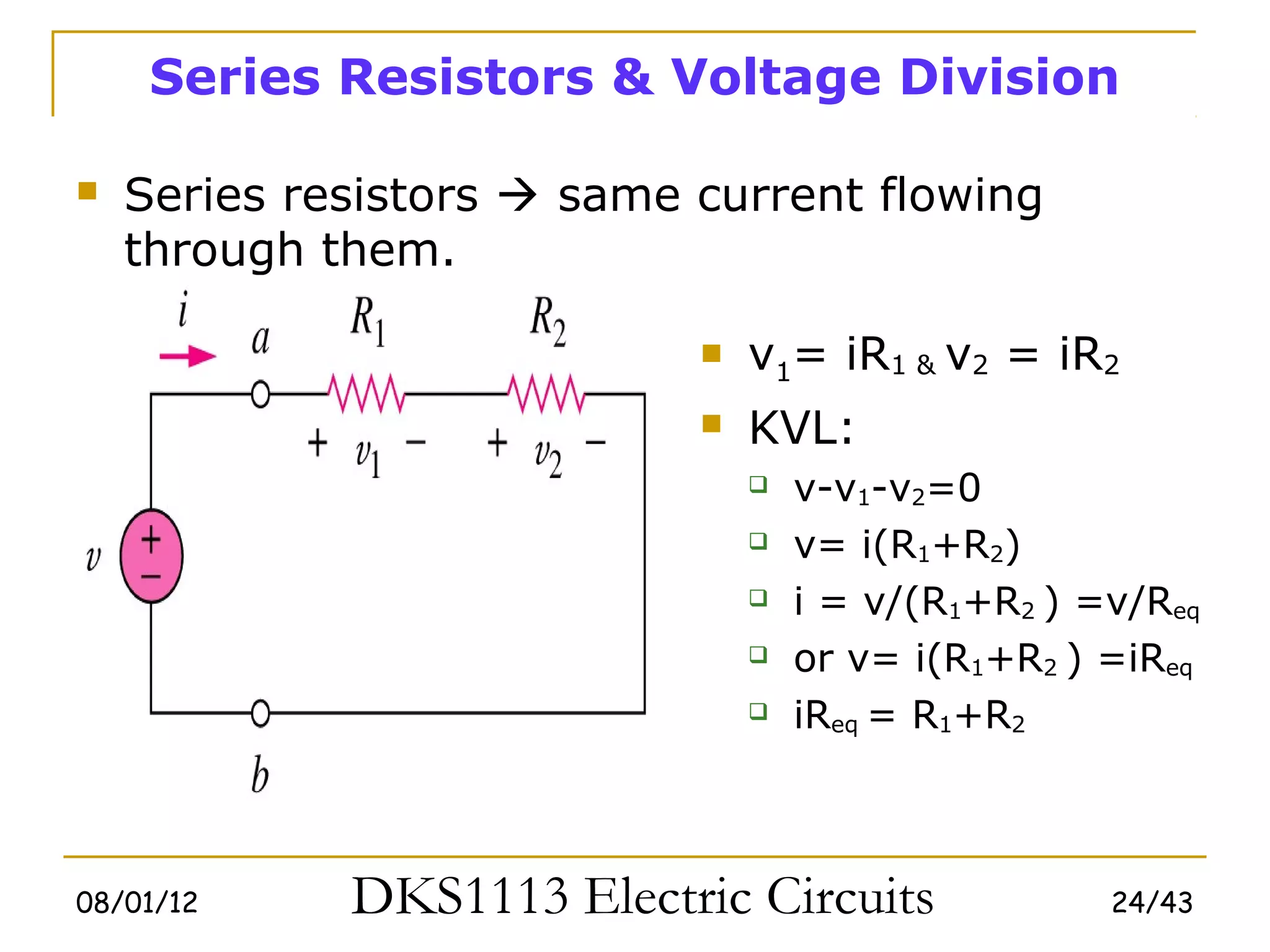
   Series resistors  same current flowing
    through them.

                               v1= iR1 & v2 = iR2
                               KVL:
                                   v-v1-v2=0
                                   v= i(R1+R2)
                                   i = v/(R1+R2 ) =v/Req
                                   or v= i(R1+R2 ) =iReq
                                   iReq = R1+R2


08/01/12     DKS1113 Electric Circuits              24/43
Series Resistors & Voltage Division

   Voltage Division:

       Previously:
           v1 = iR1         &   v2 = iR2
           i = v/(R1+R2 )

       Thus:
           v1=vR1/(R1+R2)
           v2=vR2/(R1+R2)


08/01/12               DKS1113 Electric Circuits   25/43
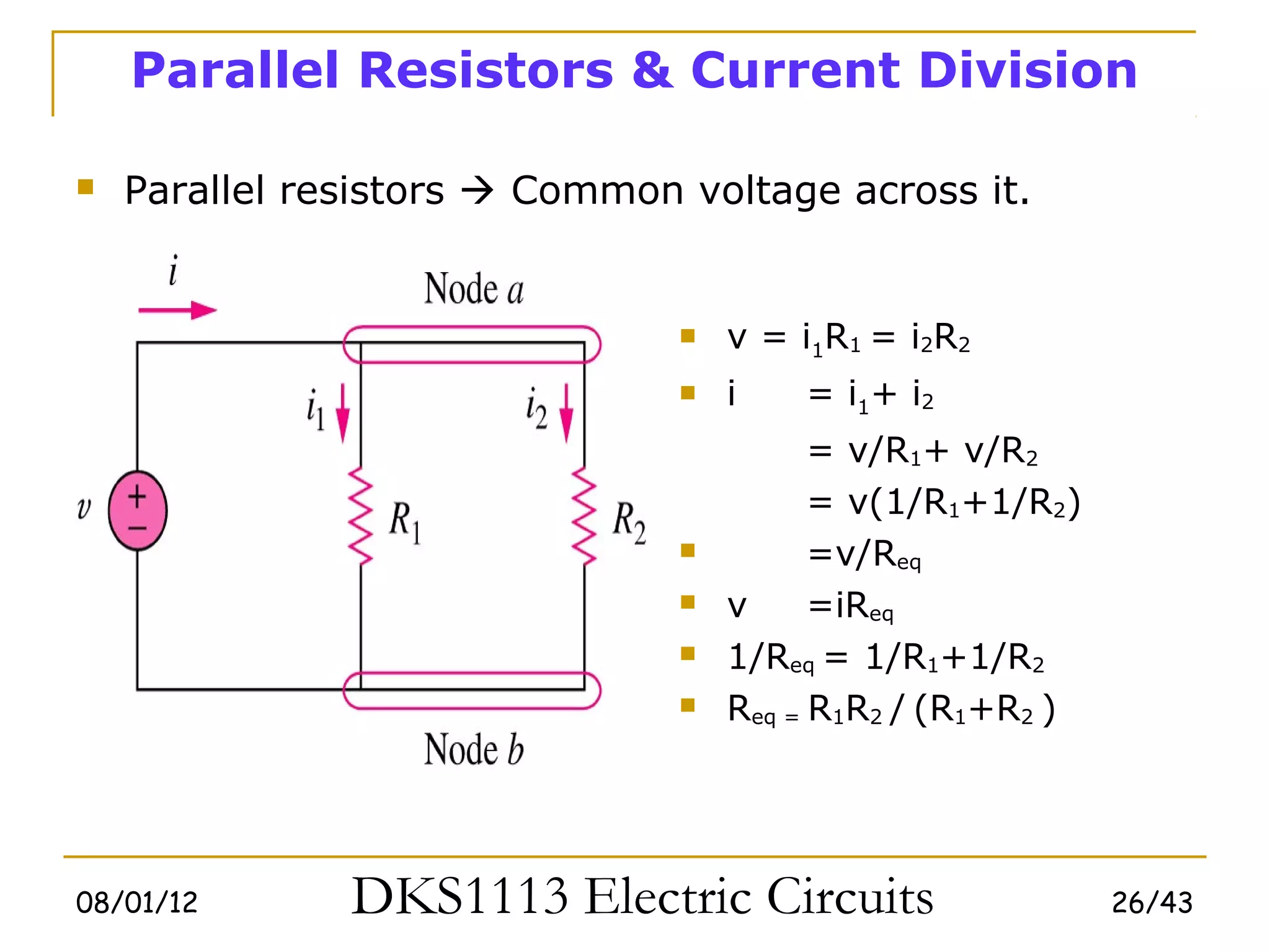
Parallel Resistors & Current Division

   Parallel resistors  Common voltage across it.


                                   v = i1R1 = i2R2
                                   i   = i1+ i2
                                          = v/R1+ v/R2
                                          = v(1/R1+1/R2)
                                         =v/Req
                                   v     =iReq
                                   1/Req = 1/R1+1/R2
                                   Req = R1R2 / (R1+R2 )


08/01/12       DKS1113 Electric Circuits                    26/43
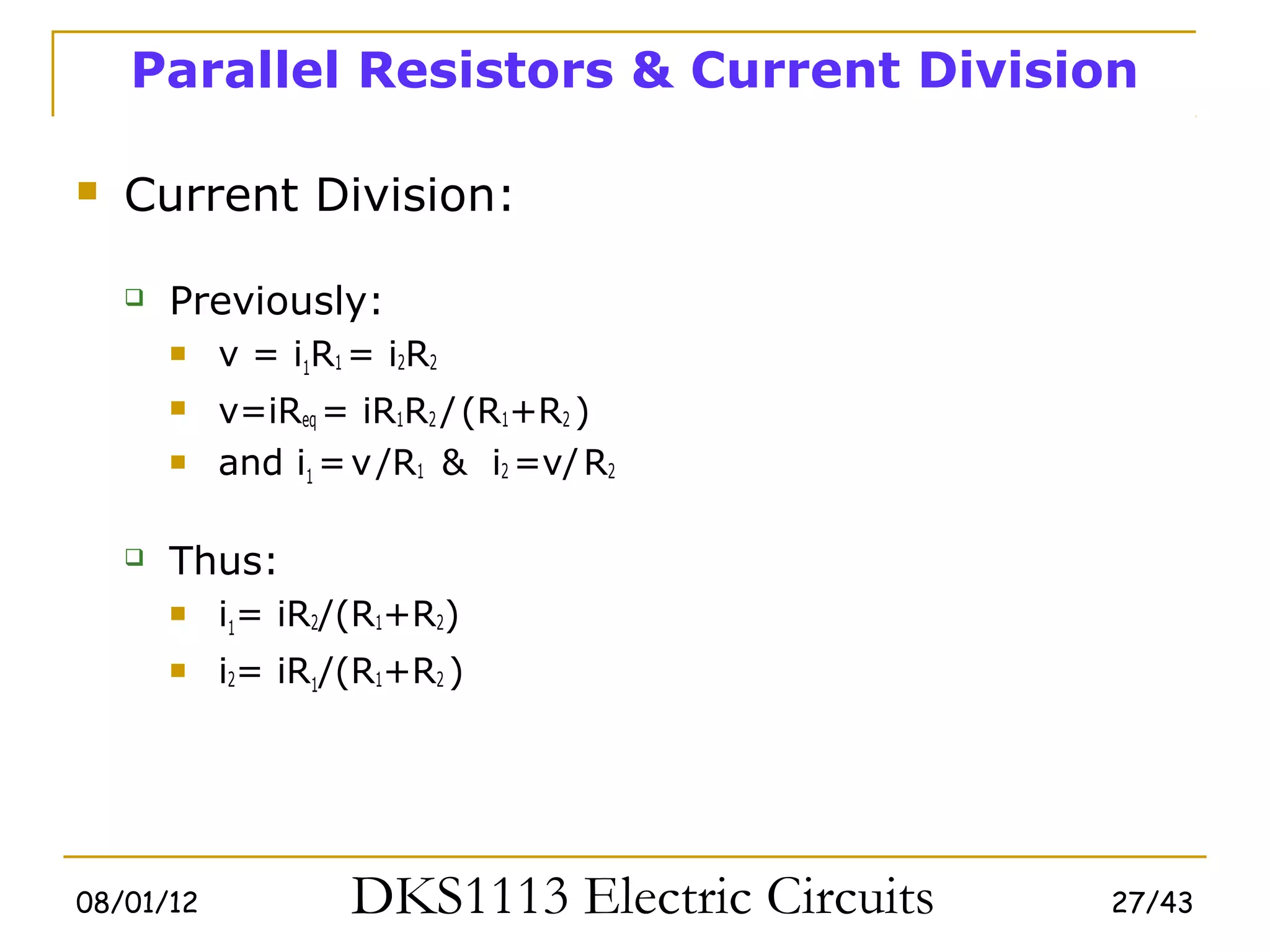
Parallel Resistors & Current Division

   Current Division:

       Previously:
           v = i1R1 = i2R2
           v=iReq = iR1R2 / (R1+R2 )
           and i1 = v /R1 & i2 =v/ R2

       Thus:
           i1= iR2/(R1+R2)
           i2= iR1/(R1+R2 )


08/01/12             DKS1113 Electric Circuits   27/43
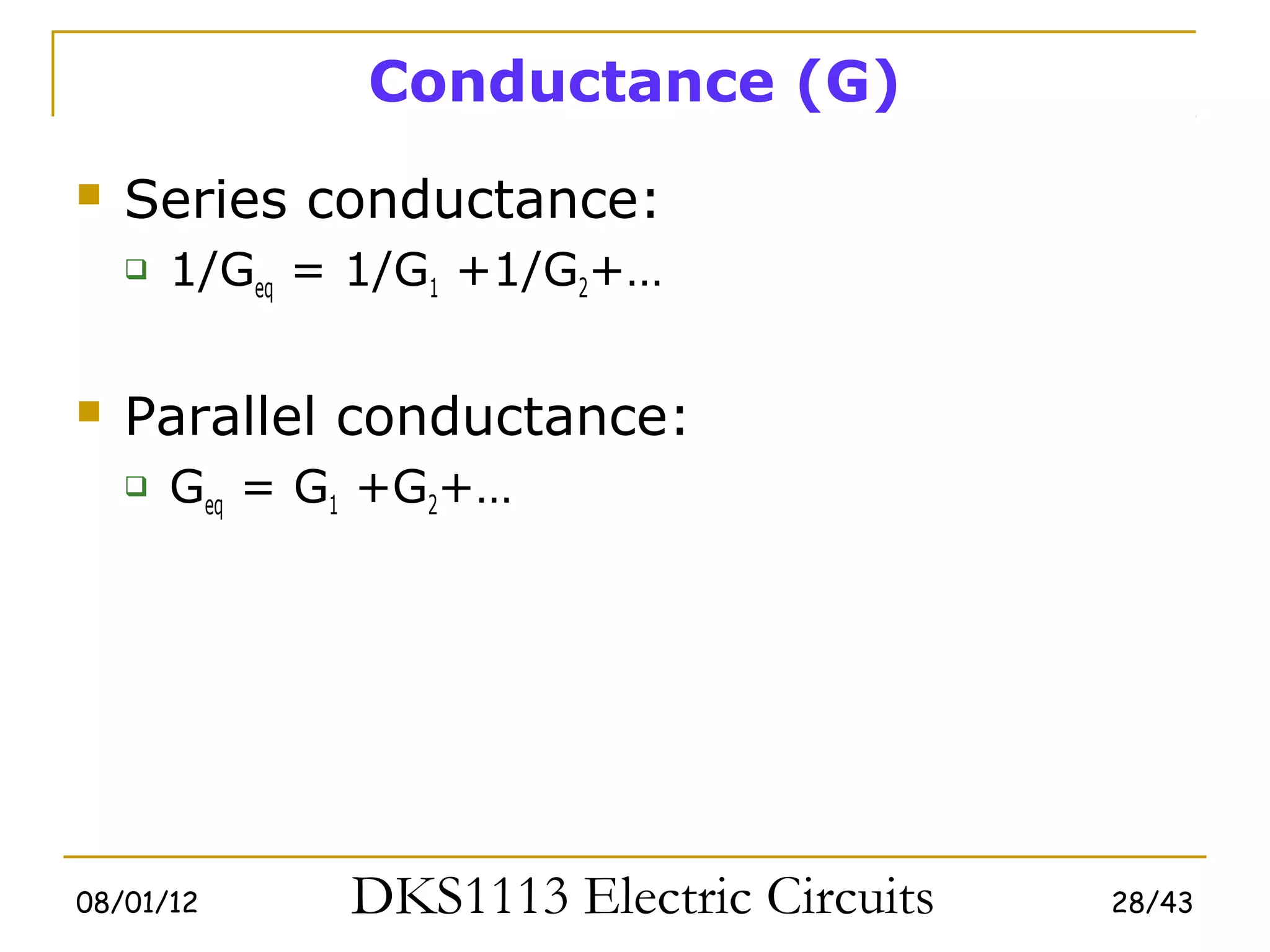
Conductance (G)
   Series conductance:
       1/Geq = 1/G1 +1/G2+…


   Parallel conductance:
       Geq = G1 +G2+…


08/01/12       DKS1113 Electric Circuits   28/43
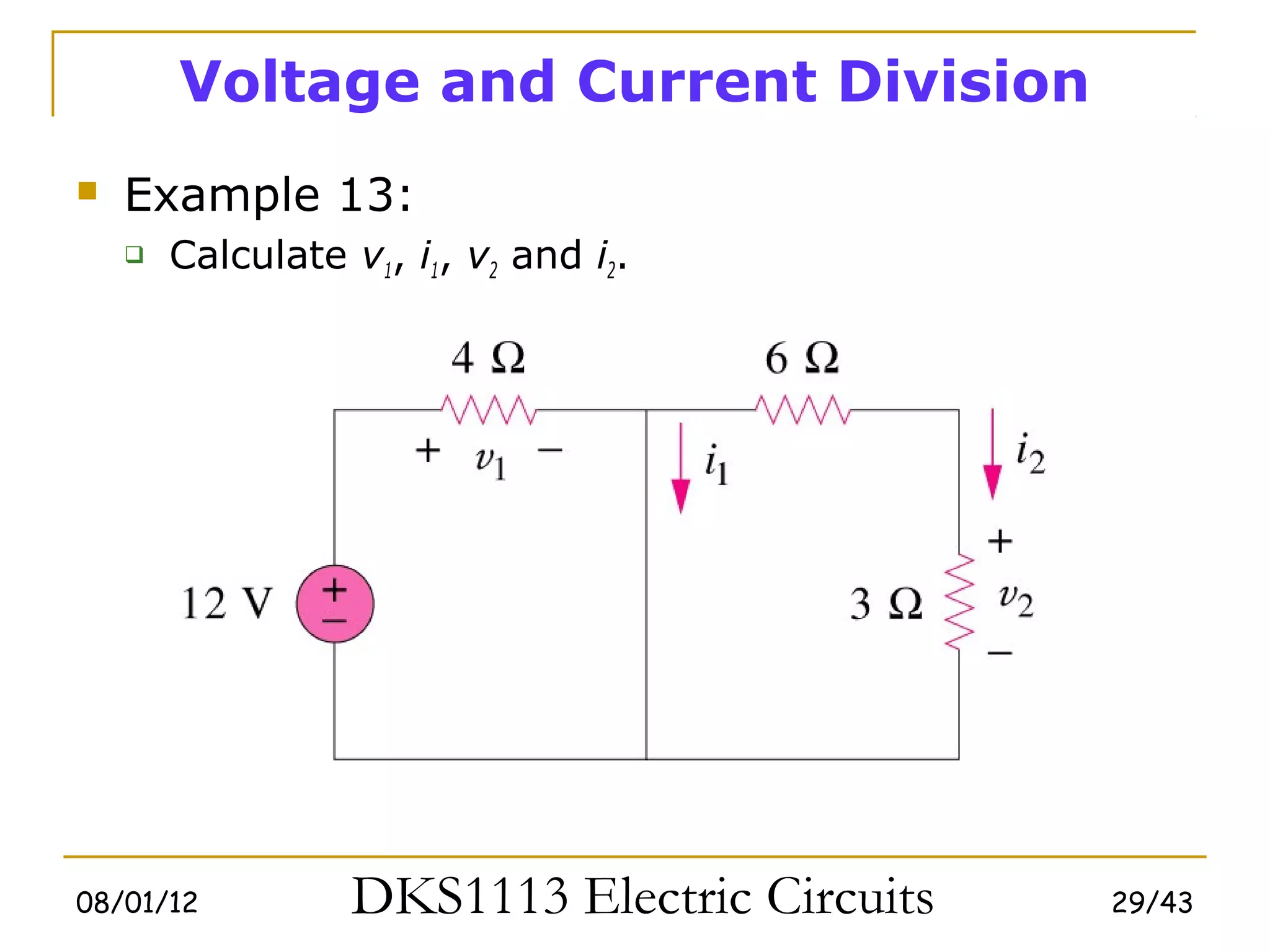
Voltage and Current Division
   Example 13:
       Calculate v1, i1, v2 and i2.


08/01/12           DKS1113 Electric Circuits   29/43
Voltage and Current Division
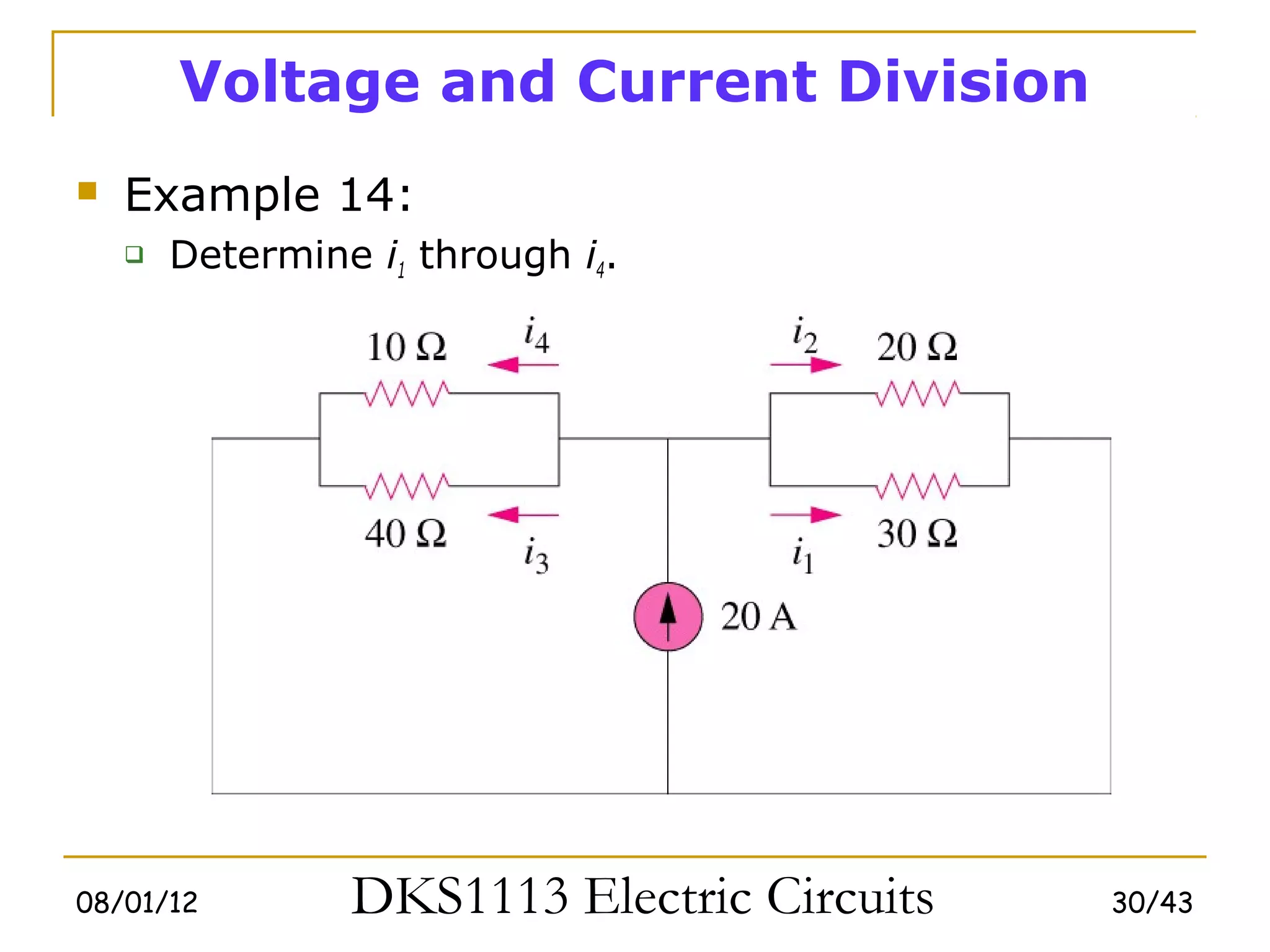
   Example 14:
       Determine i1 through i4.


08/01/12         DKS1113 Electric Circuits   30/43
Voltage and Current Division
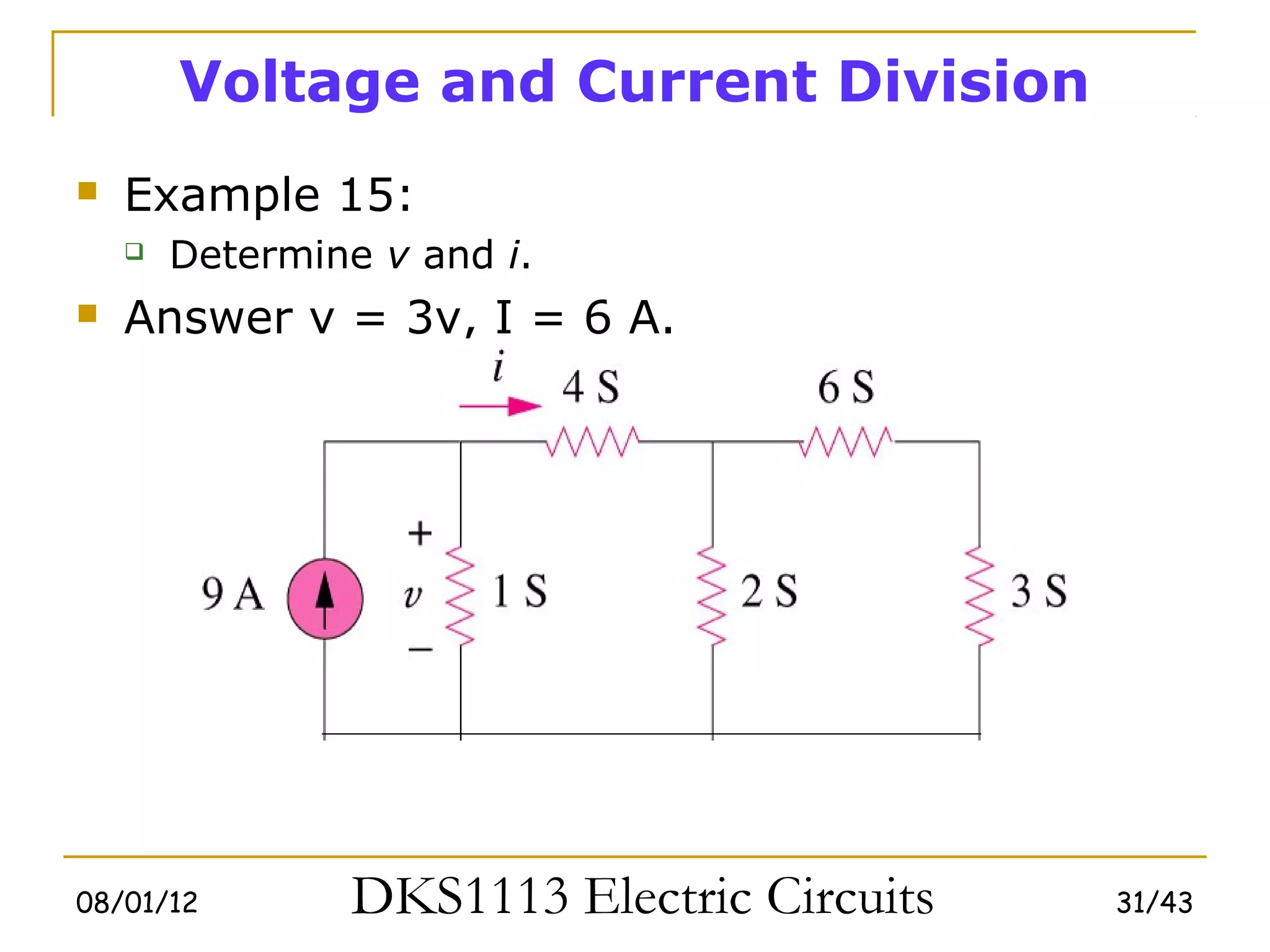
   Example 15:
       Determine v and i.
   Answer v = 3v, I = 6 A.


08/01/12         DKS1113 Electric Circuits   31/43
Voltage and Current Division
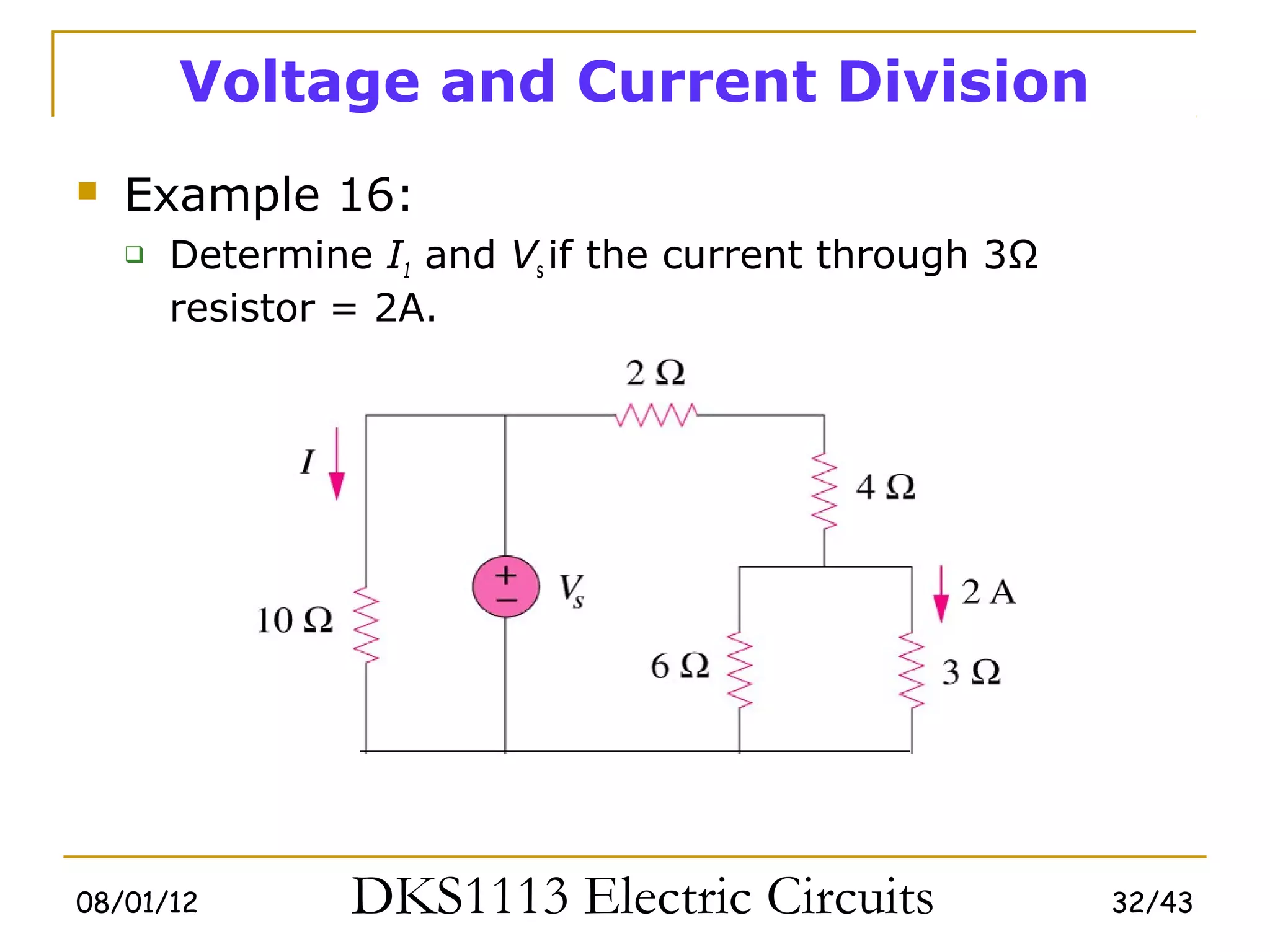
   Example 16:
       Determine I1 and Vs if the current through 3Ω
        resistor = 2A.


08/01/12         DKS1113 Electric Circuits              32/43
Voltage and Current Division
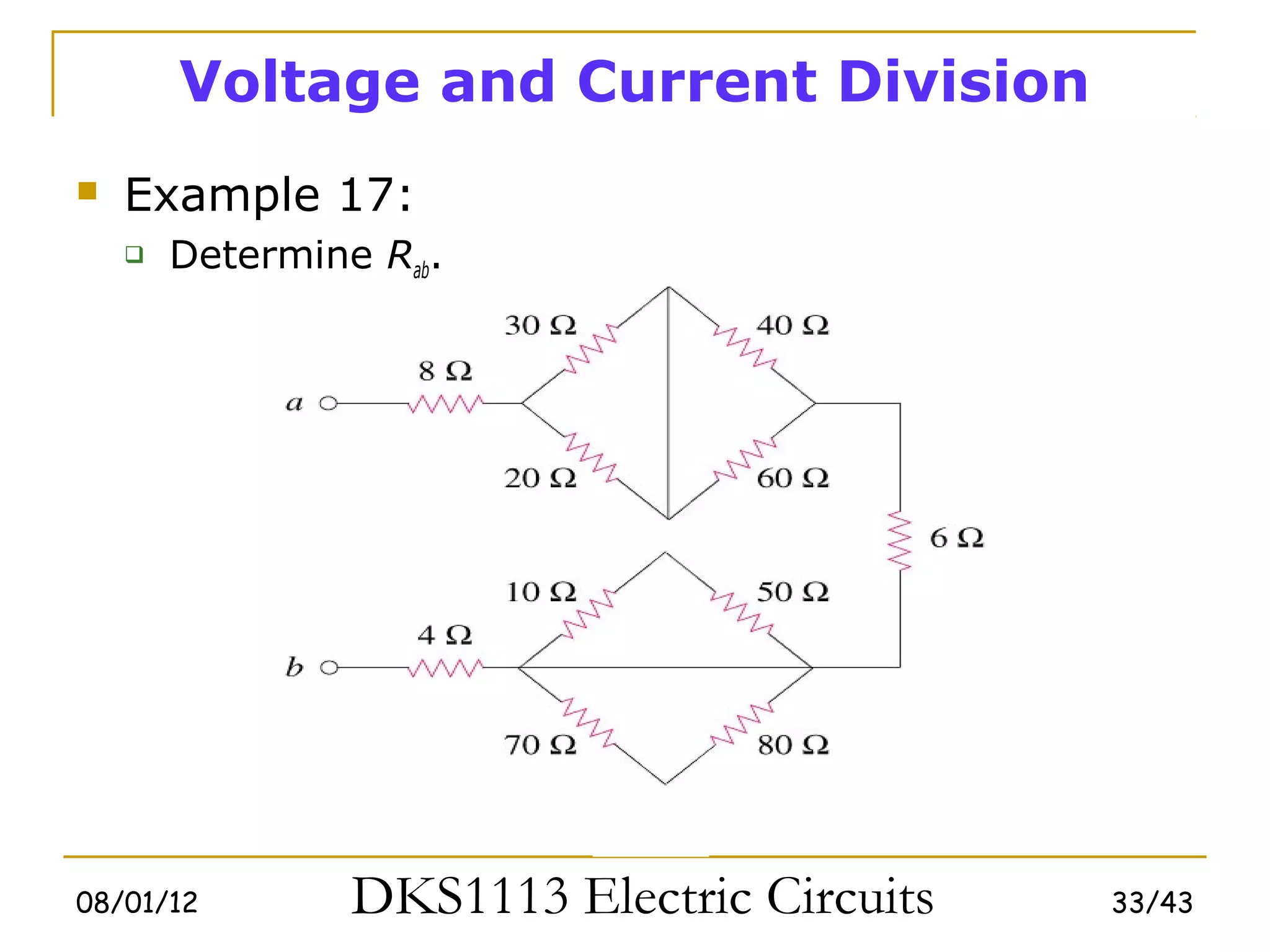
   Example 17:
       Determine Rab.


08/01/12         DKS1113 Electric Circuits   33/43
Voltage and Current Division
   Example 18:
       Determine vx and power absorbed by the 12Ω
        resistor.
       Answer v = 2v, p = 1.92w.


08/01/12        DKS1113 Electric Circuits            34/43
Wye-Delta Transformations
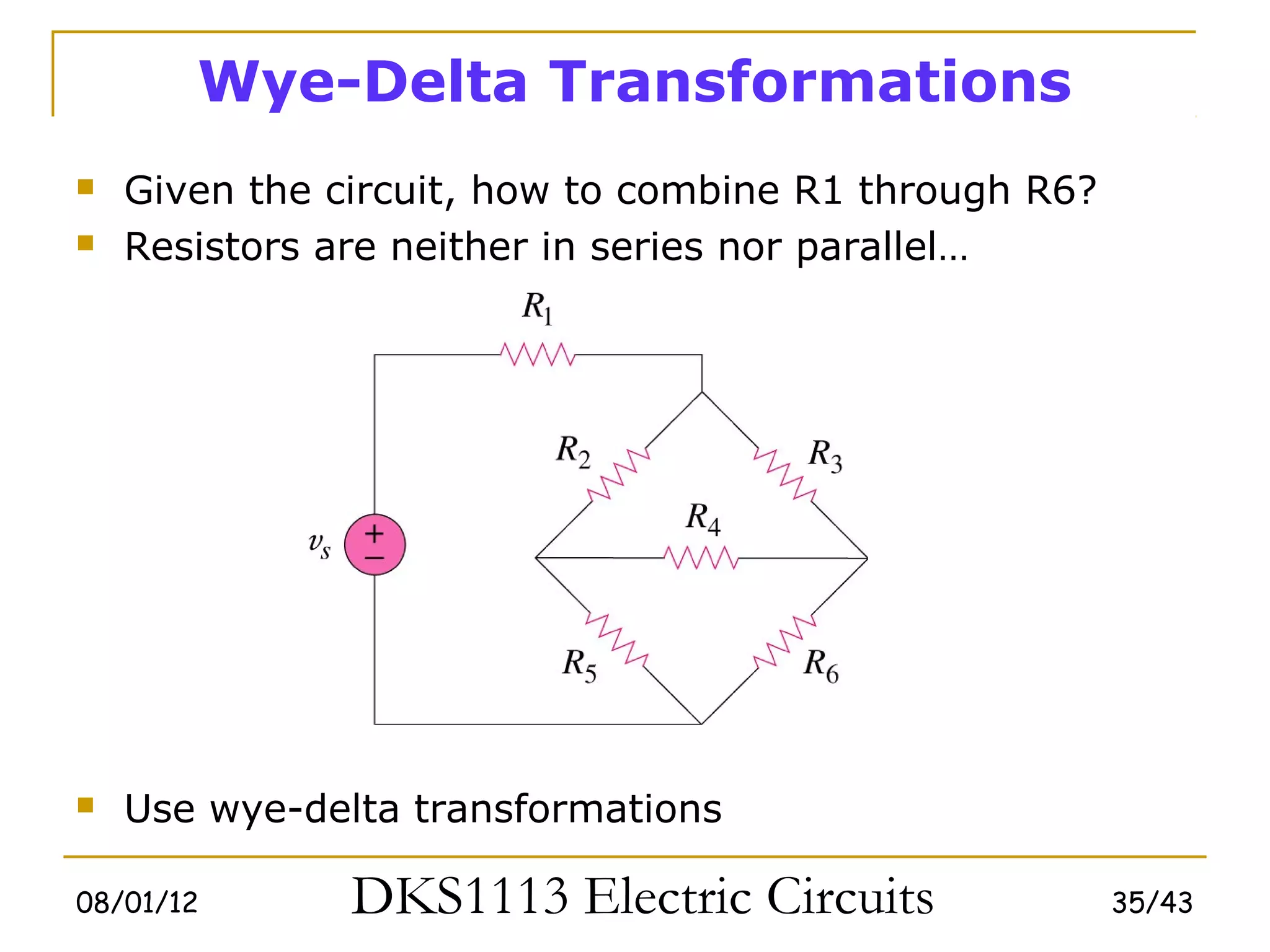
   Given the circuit, how to combine R1 through R6?
   Resistors are neither in series nor parallel…


   Use wye-delta transformations

08/01/12       DKS1113 Electric Circuits               35/43
Wye-Delta Transformations


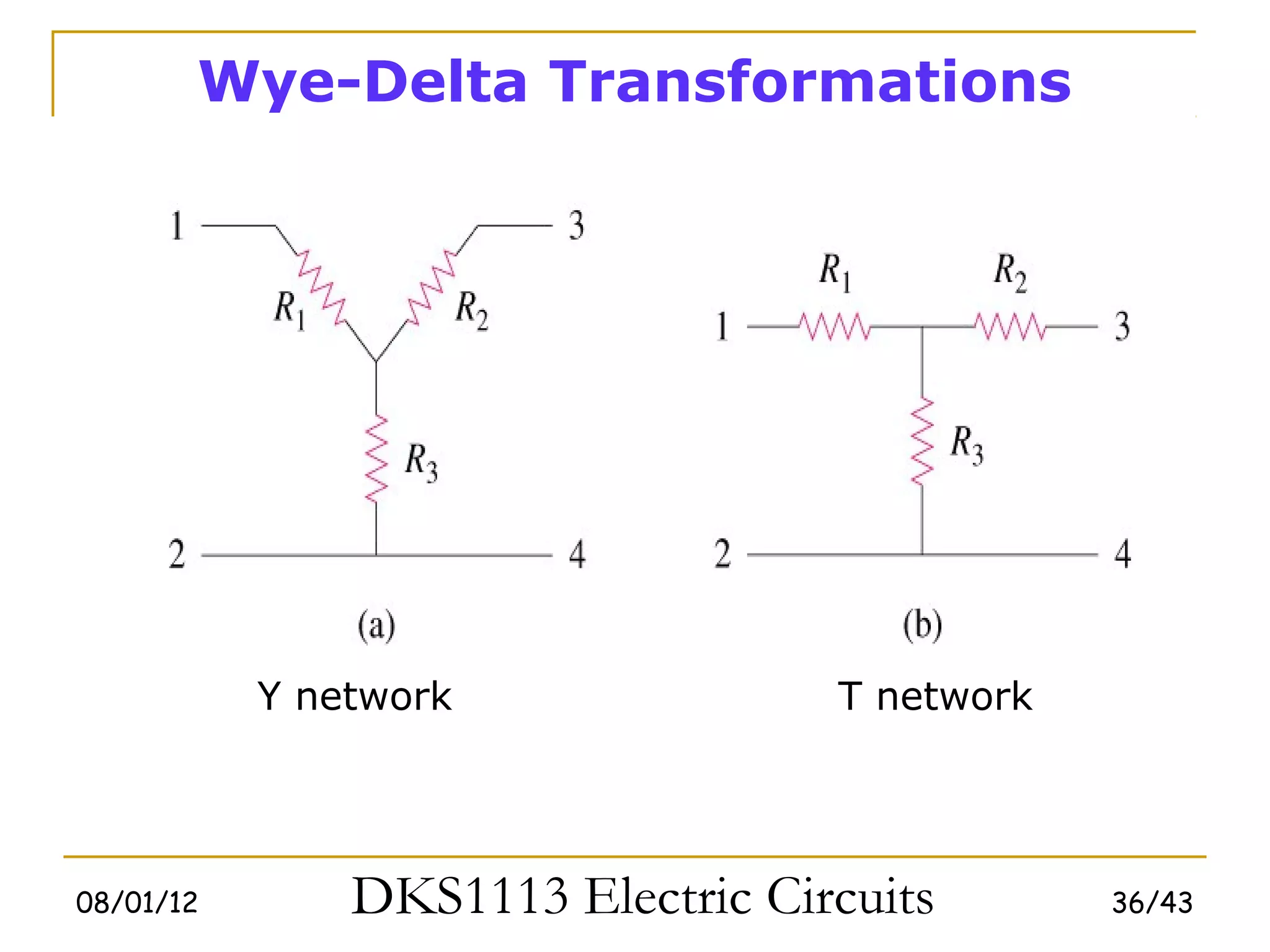
           Y network               T network


08/01/12       DKS1113 Electric Circuits       36/43
Wye-Delta Transformations


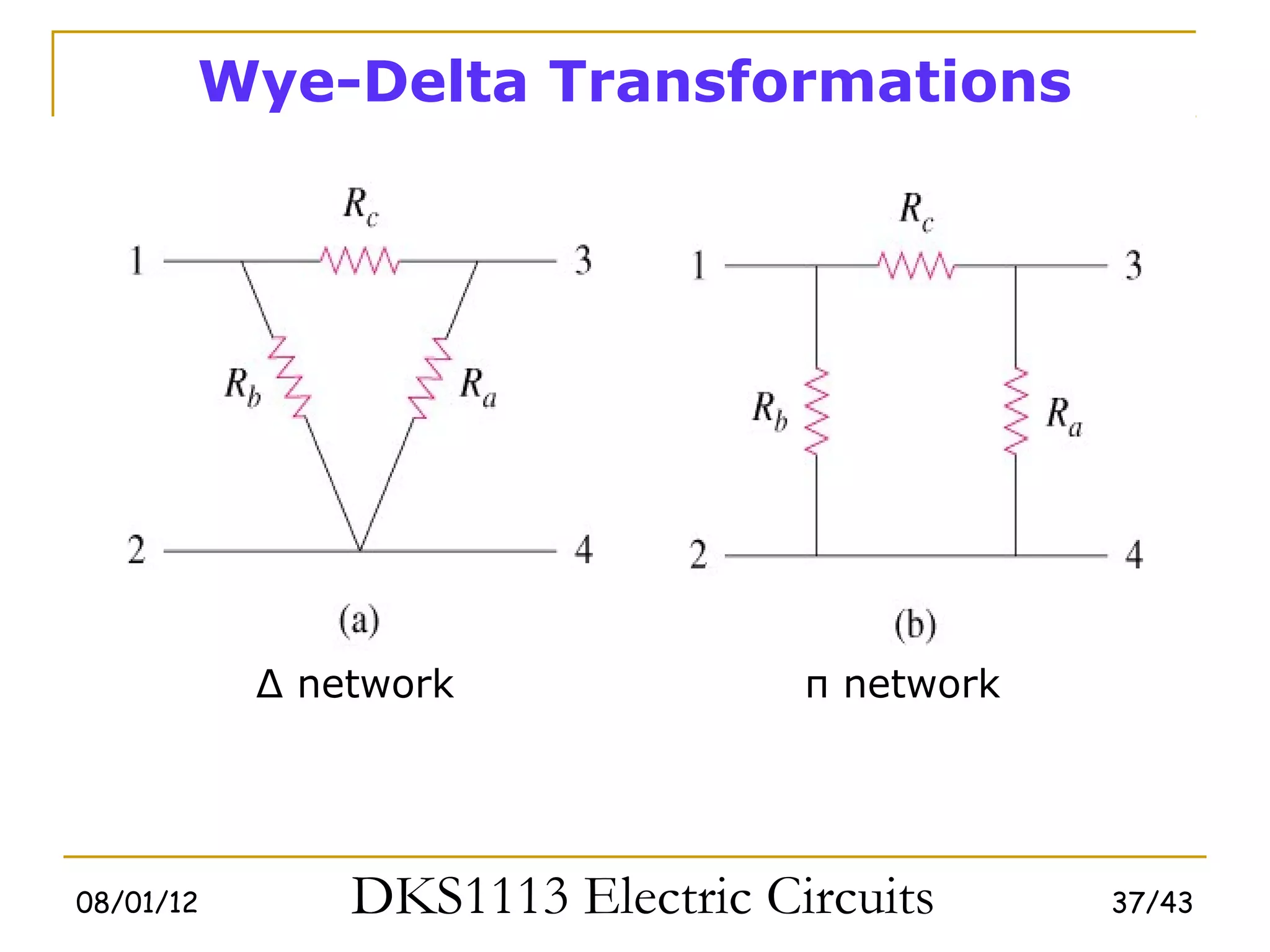
           Δ network              π network


08/01/12       DKS1113 Electric Circuits      37/43
Wye-Delta Transformations
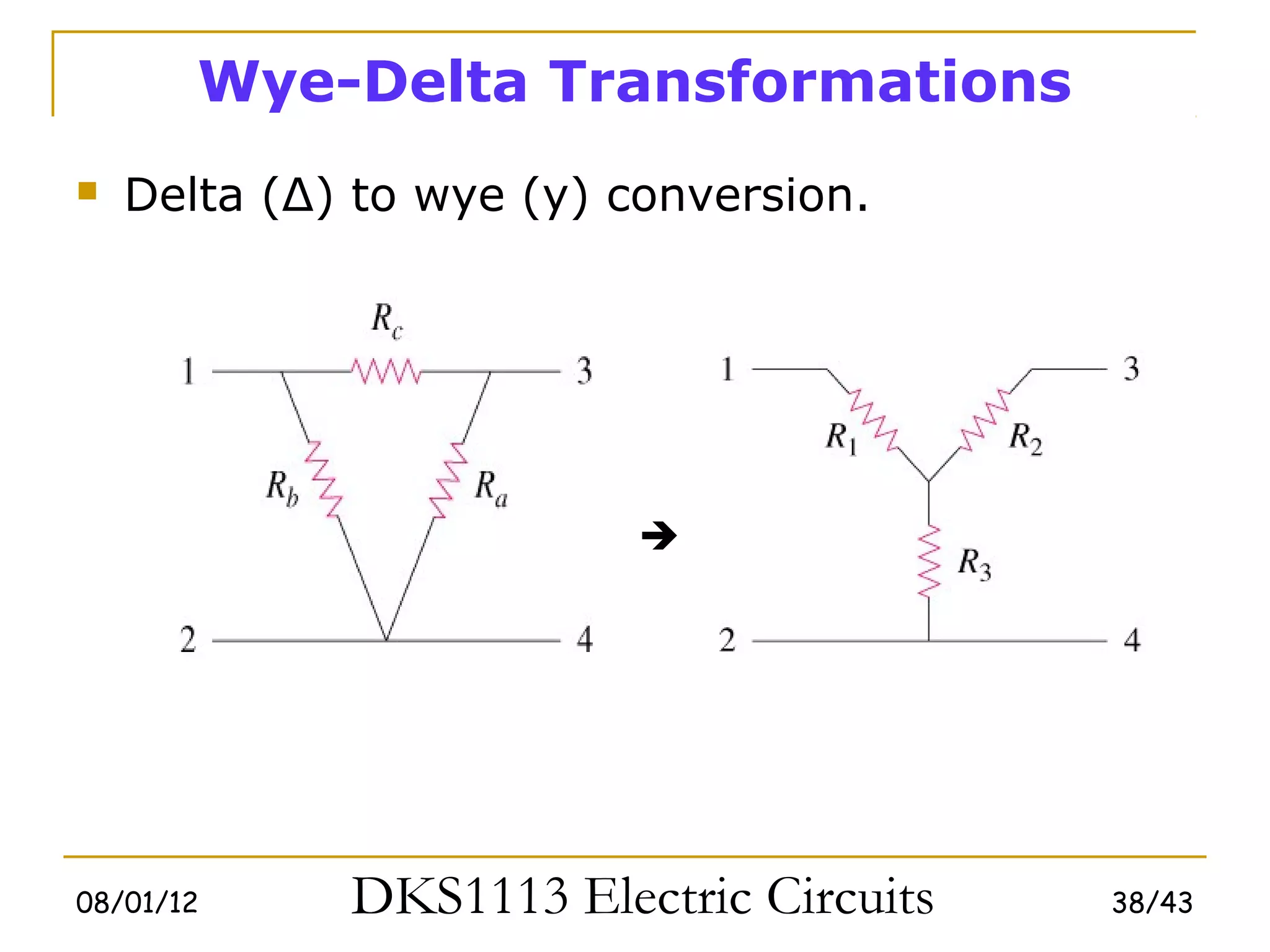
   Delta (Δ) to wye (y) conversion.


                          


08/01/12     DKS1113 Electric Circuits   38/43
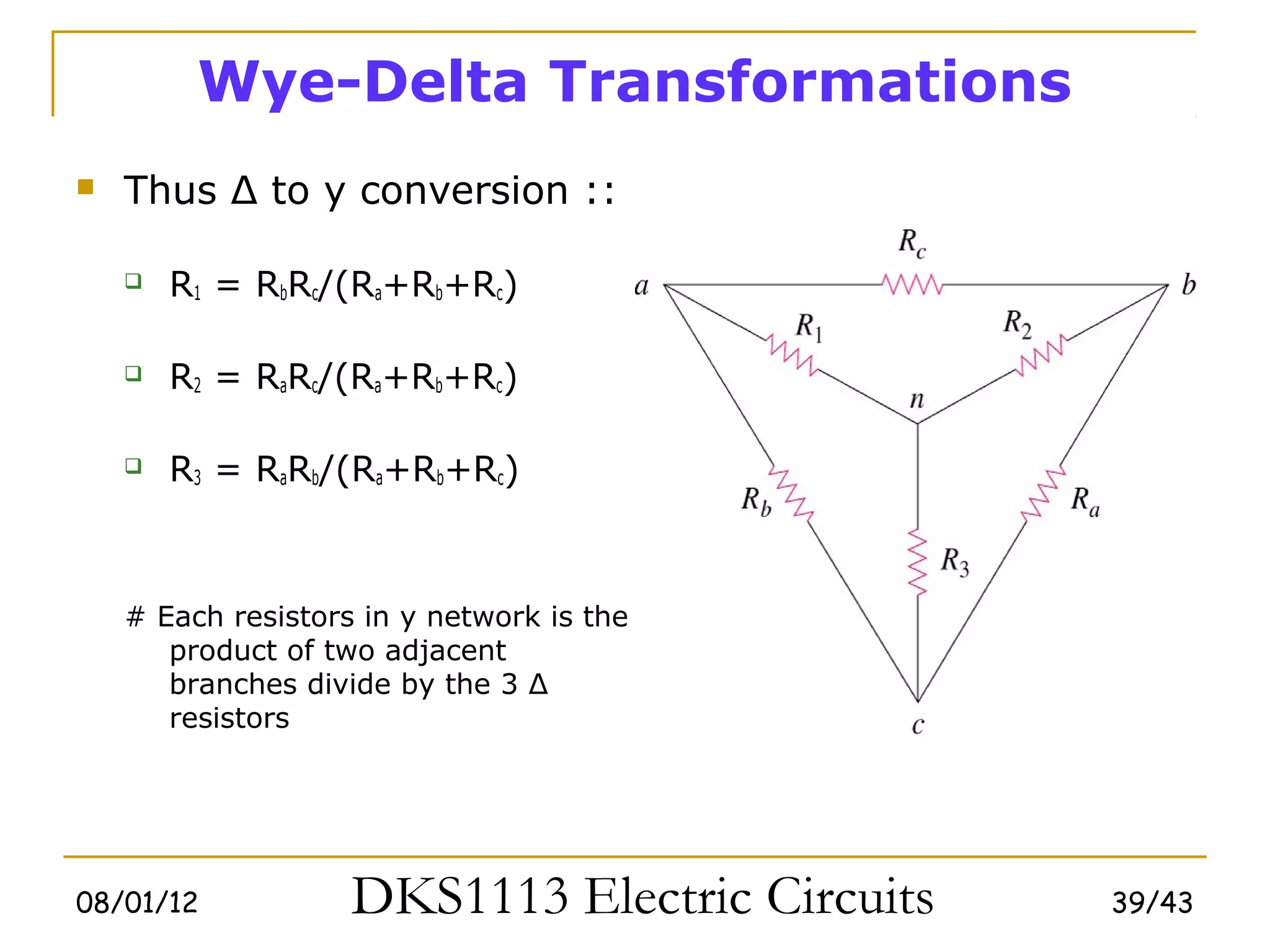
Wye-Delta Transformations
   Thus Δ to y conversion ::

       R1 = RbRc/(Ra+Rb+Rc)

       R2 = RaRc/(Ra+Rb+Rc)

       R3 = RaRb/(Ra+Rb+Rc)


    # Each resistors in y network is the
       product of two adjacent
       branches divide by the 3 Δ
       resistors


08/01/12            DKS1113 Electric Circuits   39/43
Wye-Delta Transformations
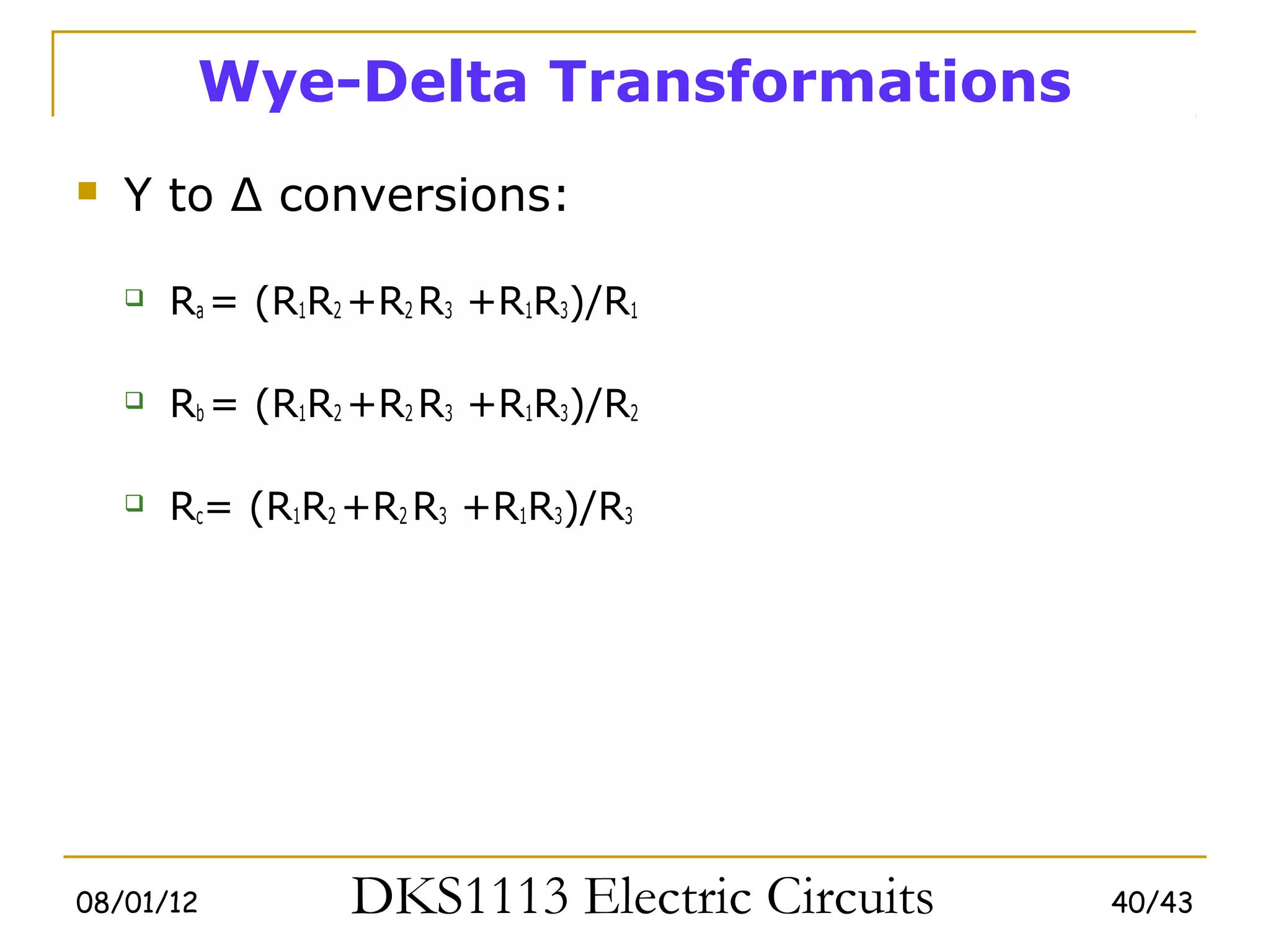
   Y to Δ conversions:

       Ra = (R1R2 +R2 R3 +R1R3)/R1

       Rb = (R1R2 +R2 R3 +R1R3)/R2

       Rc= (R1R2 +R2 R3 +R1R3)/R3


08/01/12          DKS1113 Electric Circuits   40/43
Wye-Delta Transformations
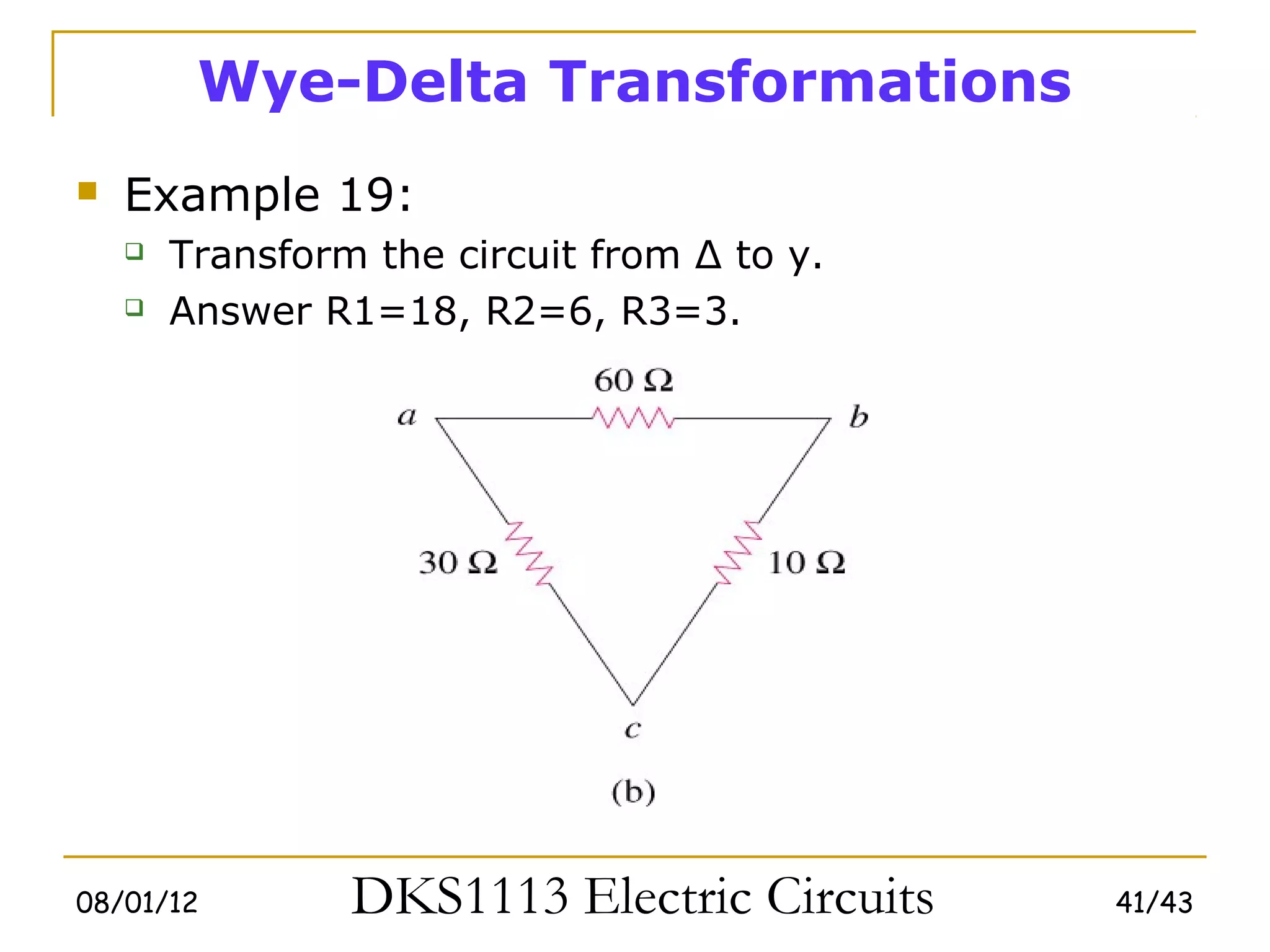
   Example 19:
       Transform the circuit from Δ to y.
       Answer R1=18, R2=6, R3=3.


08/01/12         DKS1113 Electric Circuits   41/43
Wye-Delta Transformations
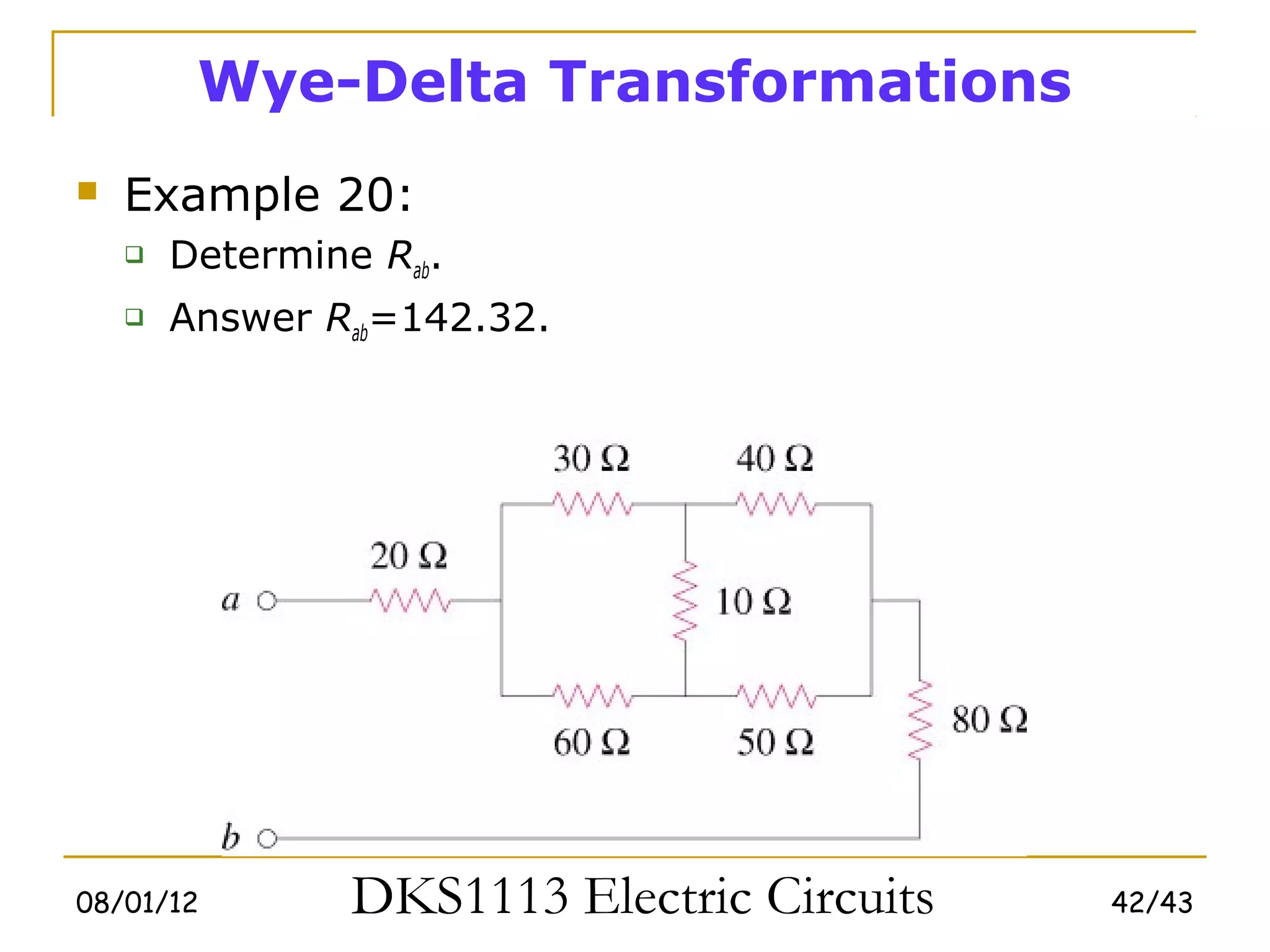
   Example 20:
       Determine Rab.
       Answer Rab=142.32.


08/01/12         DKS1113 Electric Circuits   42/43
Wye-Delta Transformations
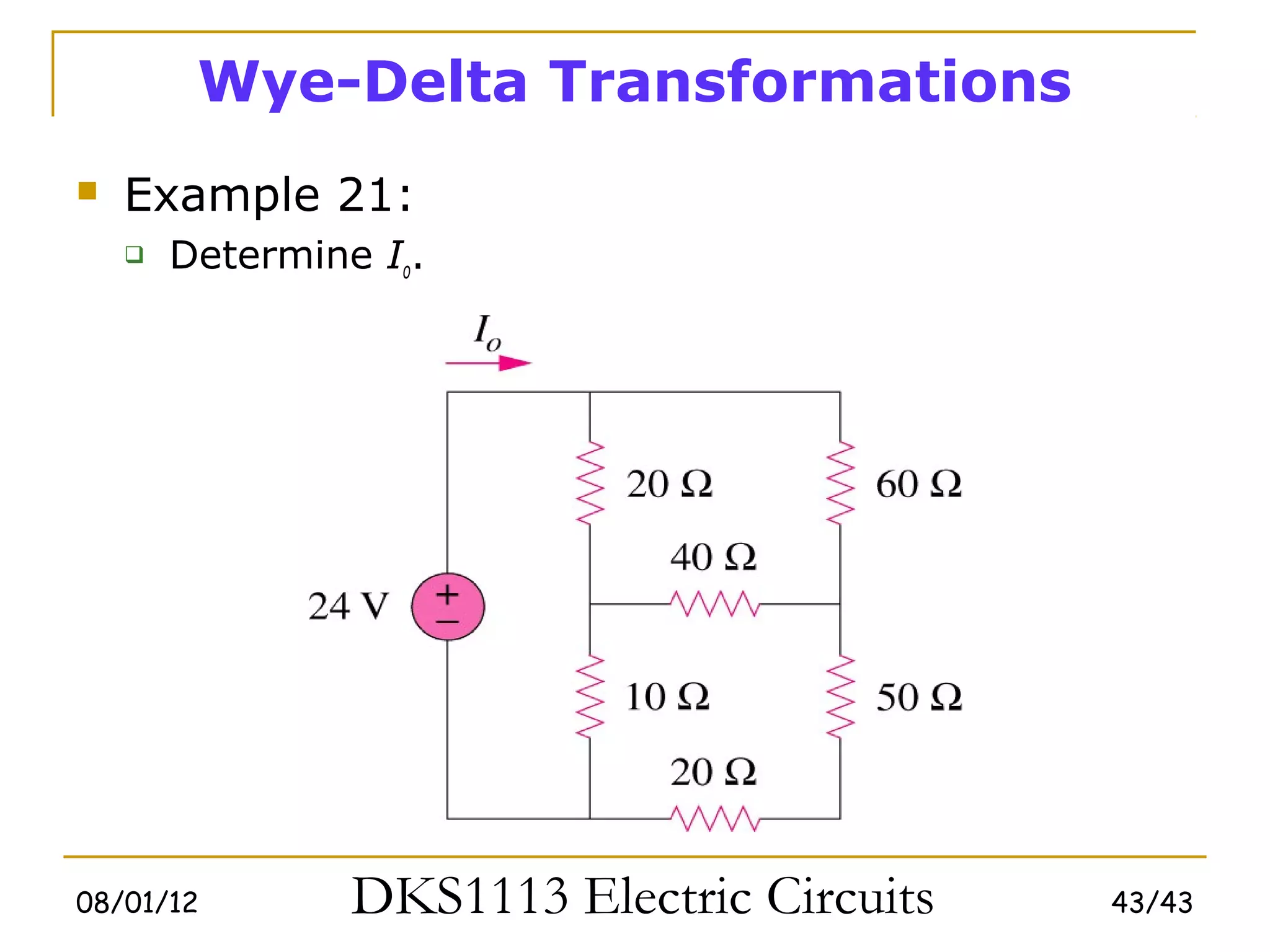
   Example 21:
       Determine Io.


08/01/12         DKS1113 Electric Circuits   43/43

Electric circuits-chapter-2 Basic Laws

  • 1.
    08/01/12 Chapter 2 Basic Laws DKS1113 Electric Circuits
  • 2.
    Introduction  Fundament laws that govern electric circuits:  Ohm’s Law.  Kirchoff’s Law.  These laws form the foundation upon which electric circuit analysis is built.  Common techniques in circuit analysis and design:  Combining resistors in series and parallel.  Voltage and current divisions.  Wye to delta and delta to wye transformations.  These techniques are restricted to resistive circuits. 08/01/12 DKS1113 Electric Circuits 2/43
  • 3.
    Ohm’s Law 08/01/12 DKS1113 Electric Circuits 3/43
  • 4.
    Ohm’s Law  Relationship between current and voltage within a circuit element.  The voltage across an element is directly proportional to the current flowing through it v α i  Thus::v=iR and R=v/i  Where:  R is called resistor.  Has the ability to resist the flow of electric current.  Measured in Ohms (Ω) 08/01/12 DKS1113 Electric Circuits 4/43
  • 5.
    Ohm’s Law *pay careful attention to current direction v=iR 08/01/12 DKS1113 Electric Circuits 5/43
  • 6.
    Ohm’s Law  Value of R :: varies from 0 to infinity  Extreme values == 0 & infinity.  Only linear resistors obey Ohm’s Law. Short circuit Open Circuit 08/01/12 DKS1113 Electric Circuits 6/43
  • 7.
    Ohm’s Law  Conductance (G)  Unit mho or Siemens (S).  Reciprocal of resistance R G=1/R  Has the ability to conduct electric current 08/01/12 DKS1113 Electric Circuits 7/43
  • 8.
    Ohm’s Law  Power:  P = iv  i ( i R ) = i2R watts  (v/R) v = v2/R watts  R and G are positive quantities, thus power is always positive.  R absorbs power from the circuit  Passive element. 08/01/12 DKS1113 Electric Circuits 8/43
  • 9.
    Ohm’s Law  Example 1:  Determine voltage (v), conductance (G) and power (p) from the figure below. 08/01/12 DKS1113 Electric Circuits 9/43
  • 10.
    Ohm’s Law  Example 2:  Calculate current i in figure below when the switch is in position 1.  Find the current when the switch is in position 2. 08/01/12 DKS1113 Electric Circuits 10/43
  • 11.
    Nodes, Branches &Loops  Elements of electric circuits can be interconnected in several way.  Need to understand some basic concepts of network topology.  Branch: Represents a single element (i.e. voltage, resistor & etc)  Node: The meeting point between two or more branches.  Loop: Any closed path in a circuit. 08/01/12 DKS1113 Electric Circuits 11/43
  • 12.
    Nodes, Branches &Loops  Example 3:  Determine how many branches and nodes for the following circuit. 08/01/12 DKS1113 Electric Circuits 12/43
  • 13.
    Nodes, Branches &Loops  5 Branches  3 Nodes  1 Voltage Source  a  1 Current Source  b  3 Resistors  c 08/01/12 DKS1113 Electric Circuits 13/43
  • 14.
    Nodes, Branches &Loops  Example 4:  Determine how many branches and nodes for the following circuit. 08/01/12 DKS1113 Electric Circuits 14/43
  • 15.
    Kirchoff’s Laws 08/01/12 DKS1113 Electric Circuits 15/43
  • 16.
    Kirchoff’s Laws  Kirchoff’s Current Law (KCL)  The algebraic sum of current entering / leaving a node (or closed boundary) is zero.  Current enters = +ve  Current leaves = -ve  ∑ current entering = ∑ current leaving 08/01/12 DKS1113 Electric Circuits 16/43
  • 17.
    Kirchoff’s Laws  Example 5:  Given the following circuit, write the equation for currents. 08/01/12 DKS1113 Electric Circuits 17/43
  • 18.
    Kirchoff’s Laws  Example 6:  Current in a closed boundary 08/01/12 DKS1113 Electric Circuits 18/43
  • 19.
    Kirchoff’s Laws  Example 9:  Use KCL to obtain currents i1, i2, and i3 in the circuit. 08/01/12 DKS1113 Electric Circuits 19/43
  • 20.
    Kirchoff’s Laws  Kirchoff’s Voltage Law (KVL)  Applied to a loop in a circuit.  According to KVL The algebraic sum of voltage (rises and drops) in a loop is zero. + v1 - + + vs V2 - - v3 + - 08/01/12 DKS1113 Electric Circuits 20/43
  • 21.
    Kirchoff’s Laws  Example 10:  Use KVL to obtain v1, v2 and v3. 08/01/12 DKS1113 Electric Circuits 21/43
  • 22.
    Kirchoff’s Laws  Example 11:  Use KVL to obtain v1, and v2. 08/01/12 DKS1113 Electric Circuits 22/43
  • 23.
    Kirchoff’s Laws  Example 12:  Calculate power dissipated in 5Ω resistor. 10 08/01/12 DKS1113 Electric Circuits 23/43
  • 24.
    Series Resistors &Voltage Division  Series resistors  same current flowing through them.  v1= iR1 & v2 = iR2  KVL:  v-v1-v2=0  v= i(R1+R2)  i = v/(R1+R2 ) =v/Req  or v= i(R1+R2 ) =iReq  iReq = R1+R2 08/01/12 DKS1113 Electric Circuits 24/43
  • 25.
    Series Resistors &Voltage Division  Voltage Division:  Previously:  v1 = iR1 & v2 = iR2  i = v/(R1+R2 )  Thus:  v1=vR1/(R1+R2)  v2=vR2/(R1+R2) 08/01/12 DKS1113 Electric Circuits 25/43
  • 26.
    Parallel Resistors &Current Division  Parallel resistors  Common voltage across it.  v = i1R1 = i2R2  i = i1+ i2 = v/R1+ v/R2 = v(1/R1+1/R2)  =v/Req  v =iReq  1/Req = 1/R1+1/R2  Req = R1R2 / (R1+R2 ) 08/01/12 DKS1113 Electric Circuits 26/43
  • 27.
    Parallel Resistors &Current Division  Current Division:  Previously:  v = i1R1 = i2R2  v=iReq = iR1R2 / (R1+R2 )  and i1 = v /R1 & i2 =v/ R2  Thus:  i1= iR2/(R1+R2)  i2= iR1/(R1+R2 ) 08/01/12 DKS1113 Electric Circuits 27/43
  • 28.
    Conductance (G)  Series conductance:  1/Geq = 1/G1 +1/G2+…  Parallel conductance:  Geq = G1 +G2+… 08/01/12 DKS1113 Electric Circuits 28/43
  • 29.
    Voltage and CurrentDivision  Example 13:  Calculate v1, i1, v2 and i2. 08/01/12 DKS1113 Electric Circuits 29/43
  • 30.
    Voltage and CurrentDivision  Example 14:  Determine i1 through i4. 08/01/12 DKS1113 Electric Circuits 30/43
  • 31.
    Voltage and CurrentDivision  Example 15:  Determine v and i.  Answer v = 3v, I = 6 A. 08/01/12 DKS1113 Electric Circuits 31/43
  • 32.
    Voltage and CurrentDivision  Example 16:  Determine I1 and Vs if the current through 3Ω resistor = 2A. 08/01/12 DKS1113 Electric Circuits 32/43
  • 33.
    Voltage and CurrentDivision  Example 17:  Determine Rab. 08/01/12 DKS1113 Electric Circuits 33/43
  • 34.
    Voltage and CurrentDivision  Example 18:  Determine vx and power absorbed by the 12Ω resistor.  Answer v = 2v, p = 1.92w. 08/01/12 DKS1113 Electric Circuits 34/43
  • 35.
    Wye-Delta Transformations  Given the circuit, how to combine R1 through R6?  Resistors are neither in series nor parallel…  Use wye-delta transformations 08/01/12 DKS1113 Electric Circuits 35/43
  • 36.
    Wye-Delta Transformations Y network T network 08/01/12 DKS1113 Electric Circuits 36/43
  • 37.
    Wye-Delta Transformations Δ network π network 08/01/12 DKS1113 Electric Circuits 37/43
  • 38.
    Wye-Delta Transformations  Delta (Δ) to wye (y) conversion.  08/01/12 DKS1113 Electric Circuits 38/43
  • 39.
    Wye-Delta Transformations  Thus Δ to y conversion ::  R1 = RbRc/(Ra+Rb+Rc)  R2 = RaRc/(Ra+Rb+Rc)  R3 = RaRb/(Ra+Rb+Rc) # Each resistors in y network is the product of two adjacent branches divide by the 3 Δ resistors 08/01/12 DKS1113 Electric Circuits 39/43
  • 40.
    Wye-Delta Transformations  Y to Δ conversions:  Ra = (R1R2 +R2 R3 +R1R3)/R1  Rb = (R1R2 +R2 R3 +R1R3)/R2  Rc= (R1R2 +R2 R3 +R1R3)/R3 08/01/12 DKS1113 Electric Circuits 40/43
  • 41.
    Wye-Delta Transformations  Example 19:  Transform the circuit from Δ to y.  Answer R1=18, R2=6, R3=3. 08/01/12 DKS1113 Electric Circuits 41/43
  • 42.
    Wye-Delta Transformations  Example 20:  Determine Rab.  Answer Rab=142.32. 08/01/12 DKS1113 Electric Circuits 42/43
  • 43.
    Wye-Delta Transformations  Example 21:  Determine Io. 08/01/12 DKS1113 Electric Circuits 43/43