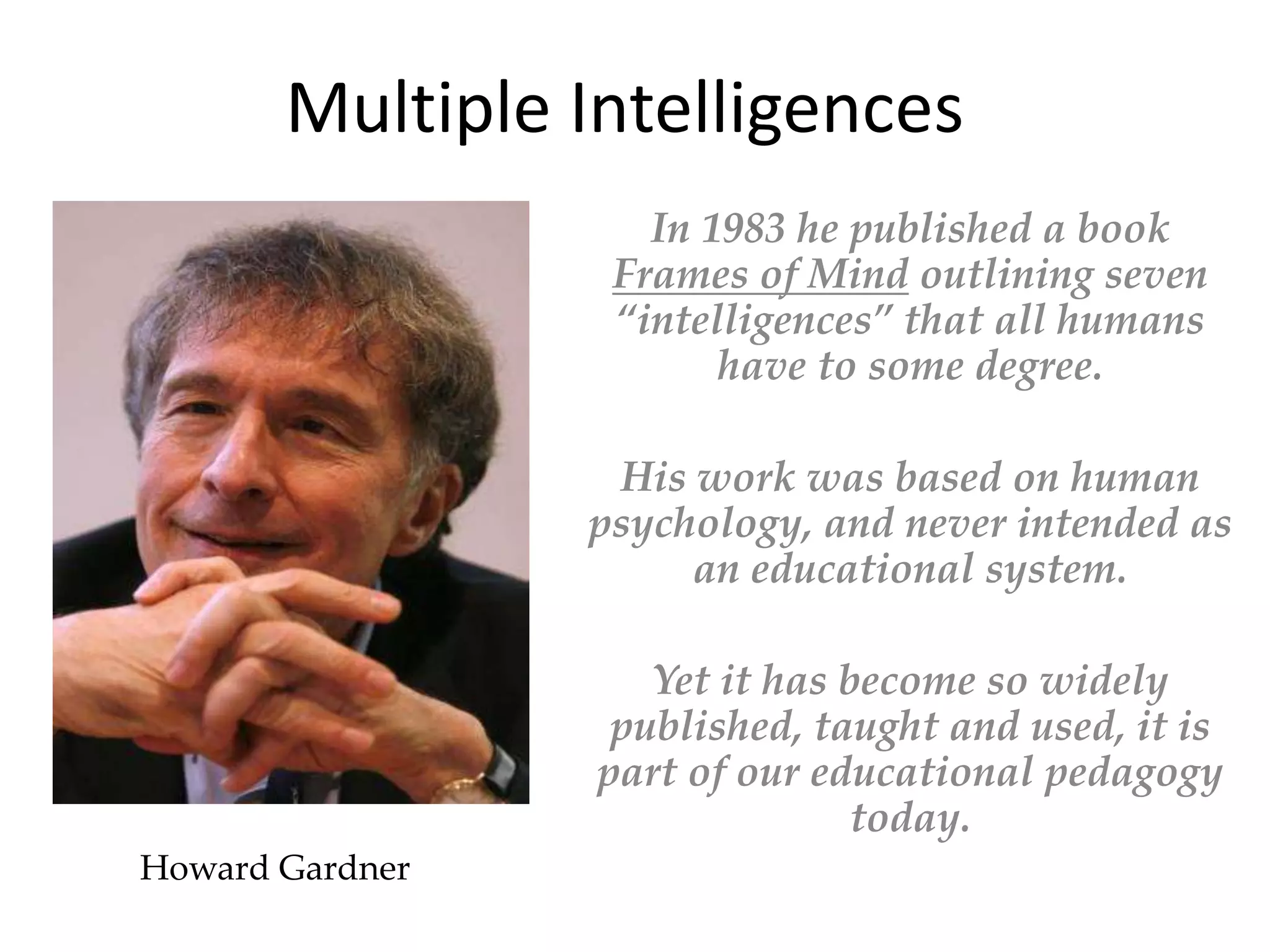
Howard Gardner
In 1983 he published a book
Frames of Mind outlining seven
“intelligences” that all humans
have to some degree.
His work was based on human
psychology, and never intended as
an educational system.
Yet it has become so widely
published, taught and used, it is
part of our educational pedagogy
today.
Multiple Intelligences
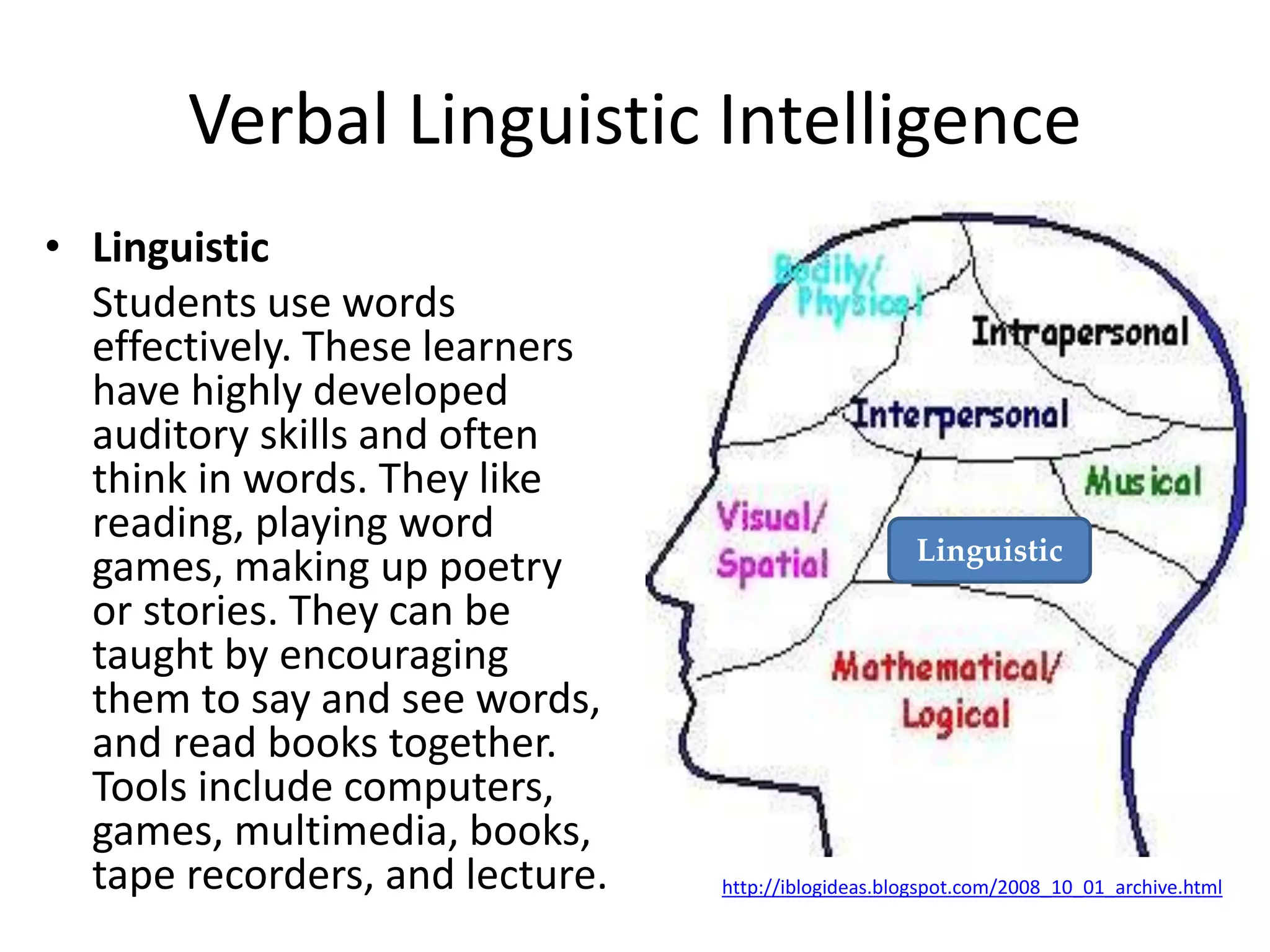
Verbal Linguistic Intelligence
• Linguistic
Students use words
effectively. These learners
have highly developed
auditory skills and often
think in words. They like
reading, playing word
games, making up poetry
or stories. They can be
taught by encouraging
them to say and see words,
and read books together.
Tools include computers,
games, multimedia, books,
tape recorders, and lecture. http://iblogideas.blogspot.com/2008_10_01_archive.html
Linguistic
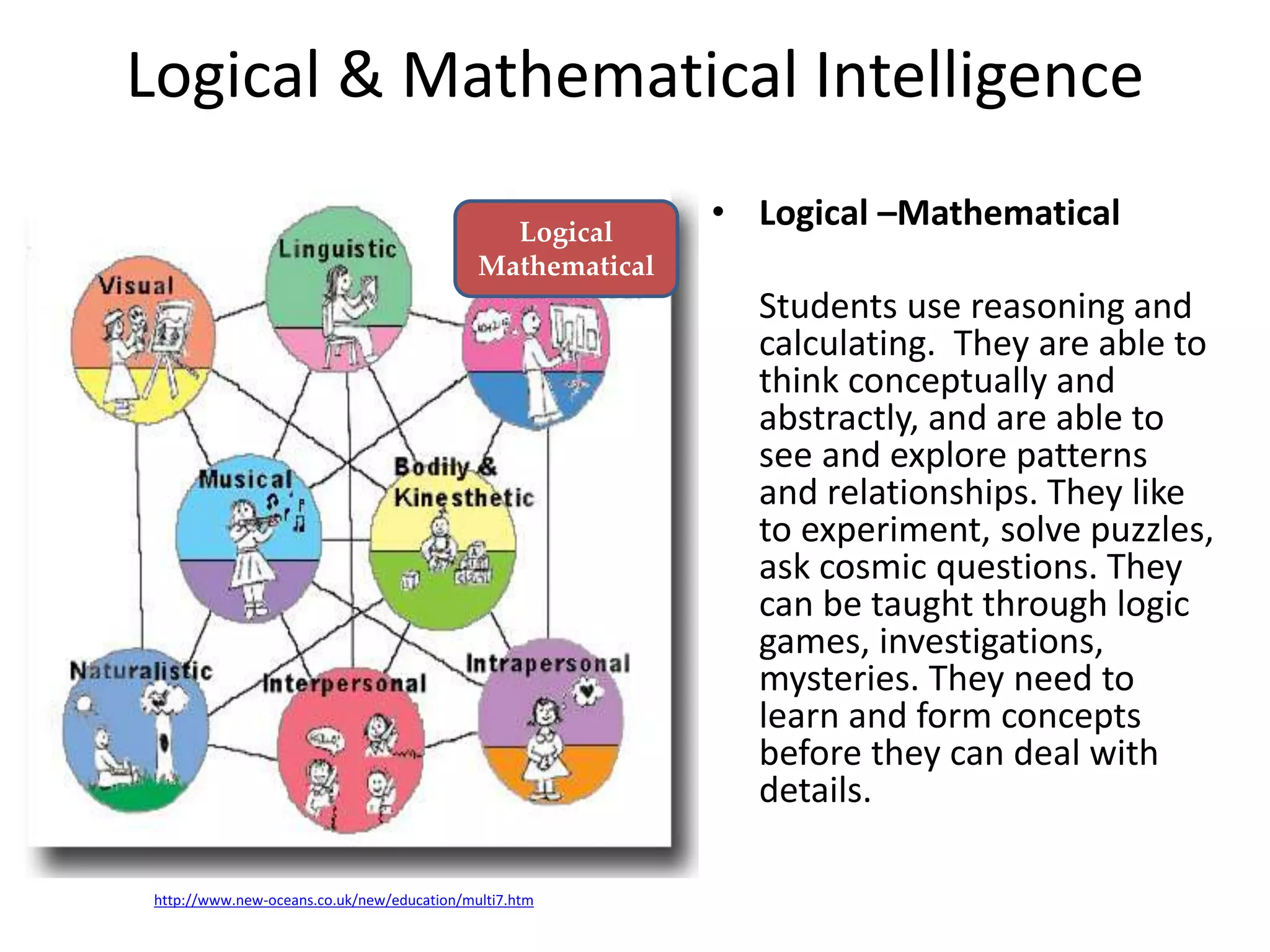
Logical & Mathematical Intelligence
• Logical –Mathematical
Students use reasoning and
calculating. They are able to
think conceptually and
abstractly, and are able to
see and explore patterns
and relationships. They like
to experiment, solve puzzles,
ask cosmic questions. They
can be taught through logic
games, investigations,
mysteries. They need to
learn and form concepts
before they can deal with
details.
http://www.new-oceans.co.uk/new/education/multi7.htm
Logical
Mathematical
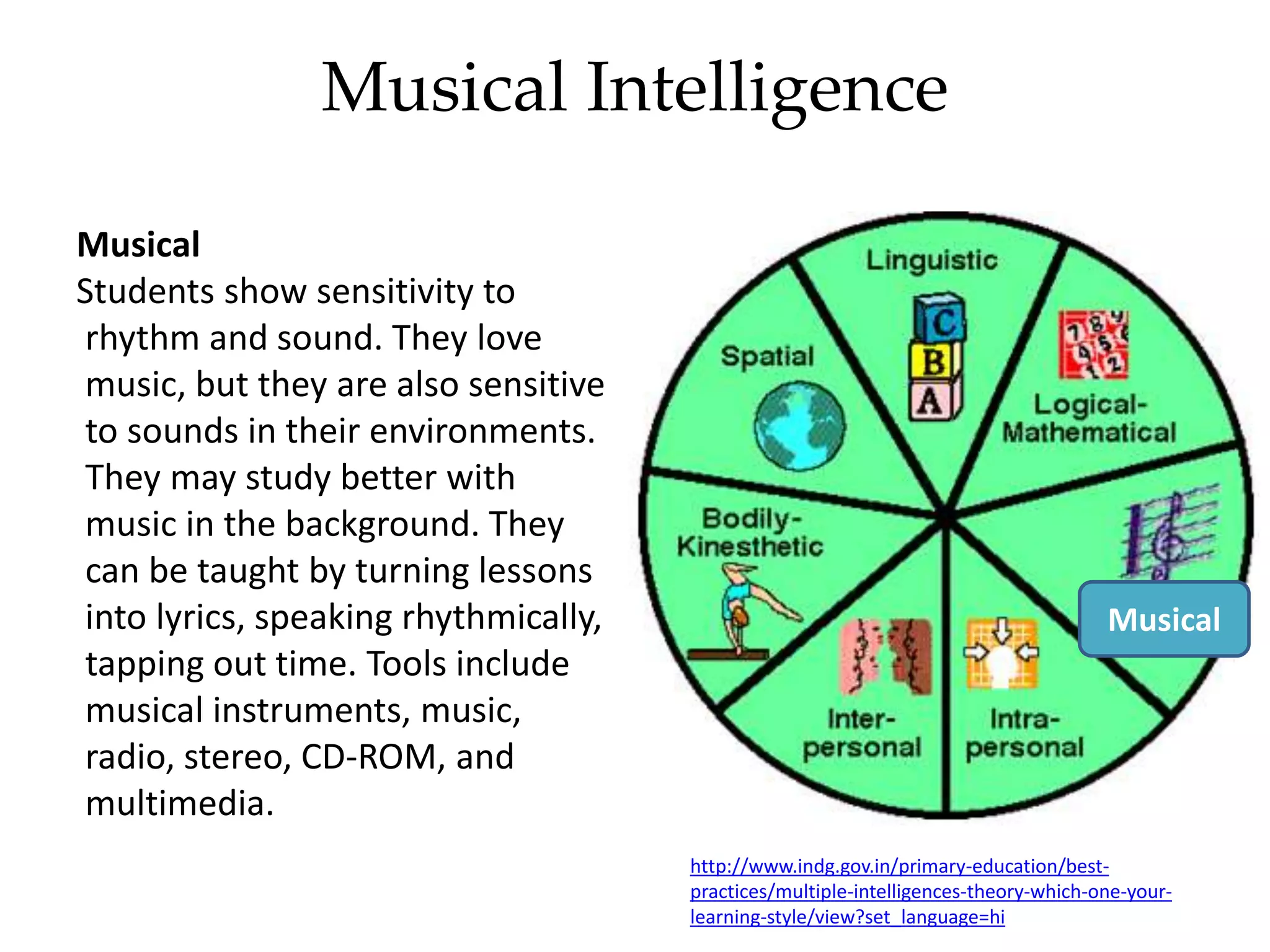
Musical Intelligence
Musical
Students show sensitivity to
rhythm and sound. They love
music, but they are also sensitive
to sounds in their environments.
They may study better with
music in the background. They
can be taught by turning lessons
into lyrics, speaking rhythmically,
tapping out time. Tools include
musical instruments, music,
radio, stereo, CD-ROM, and
multimedia.
http://www.indg.gov.in/primary-education/best-
practices/multiple-intelligences-theory-which-one-your-
learning-style/view?set_language=hi
Musical
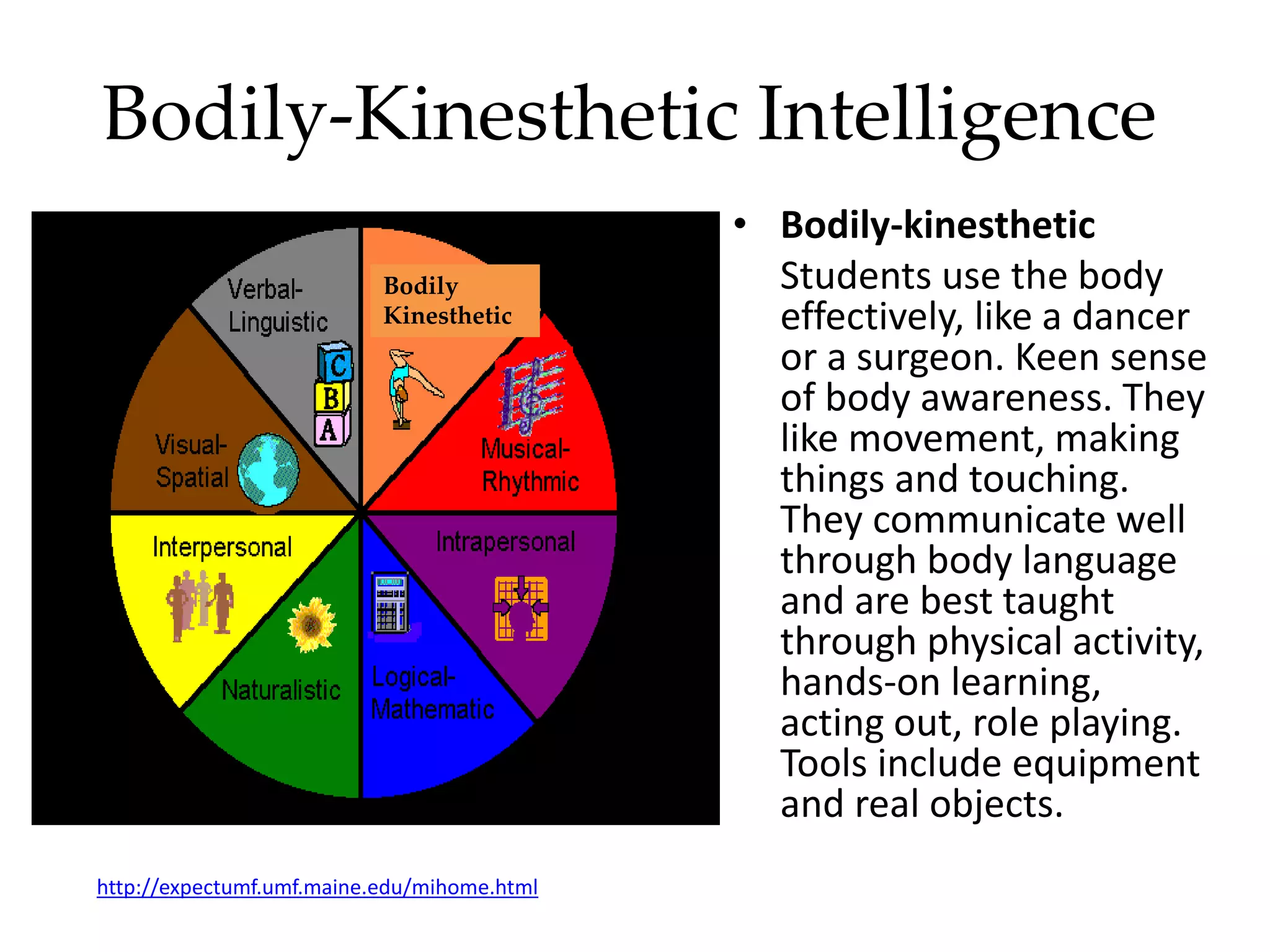
Bodily-Kinesthetic Intelligence
• Bodily-kinesthetic
Students use the body
effectively, like a dancer
or a surgeon. Keen sense
of body awareness. They
like movement, making
things and touching.
They communicate well
through body language
and are best taught
through physical activity,
hands-on learning,
acting out, role playing.
Tools include equipment
and real objects.
http://expectumf.umf.maine.edu/mihome.html
Bodily
Kinesthetic
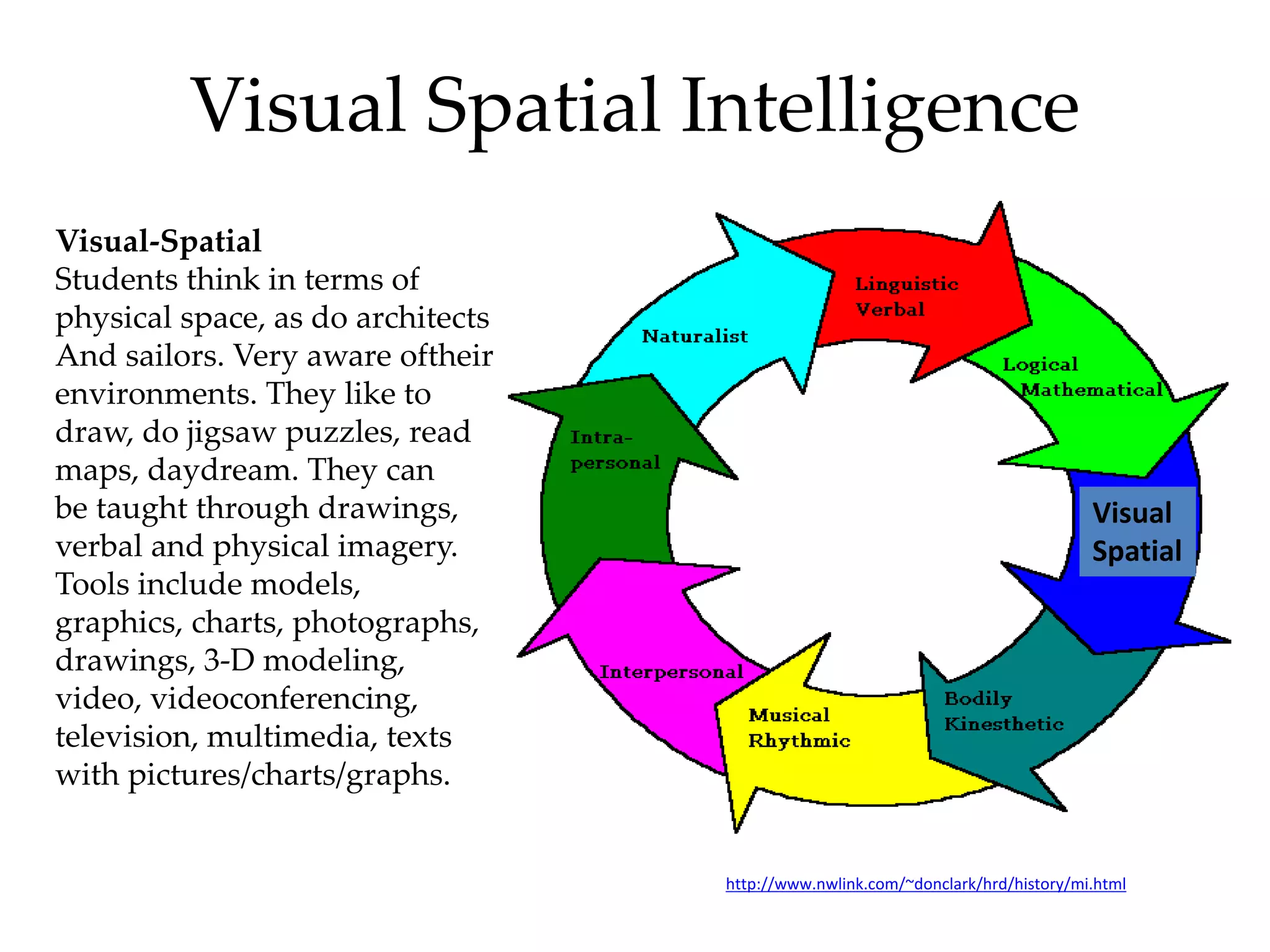
Visual Spatial Intelligence
Visual-Spatial
Students think in terms of
physical space, as do architects
And sailors. Very aware oftheir
environments. They like to
draw, do jigsaw puzzles, read
maps, daydream. They can
be taught through drawings,
verbal and physical imagery.
Tools include models,
graphics, charts, photographs,
drawings, 3-D modeling,
video, videoconferencing,
television, multimedia, texts
with pictures/charts/graphs.
http://www.nwlink.com/~donclark/hrd/history/mi.html
Visual
Spatial
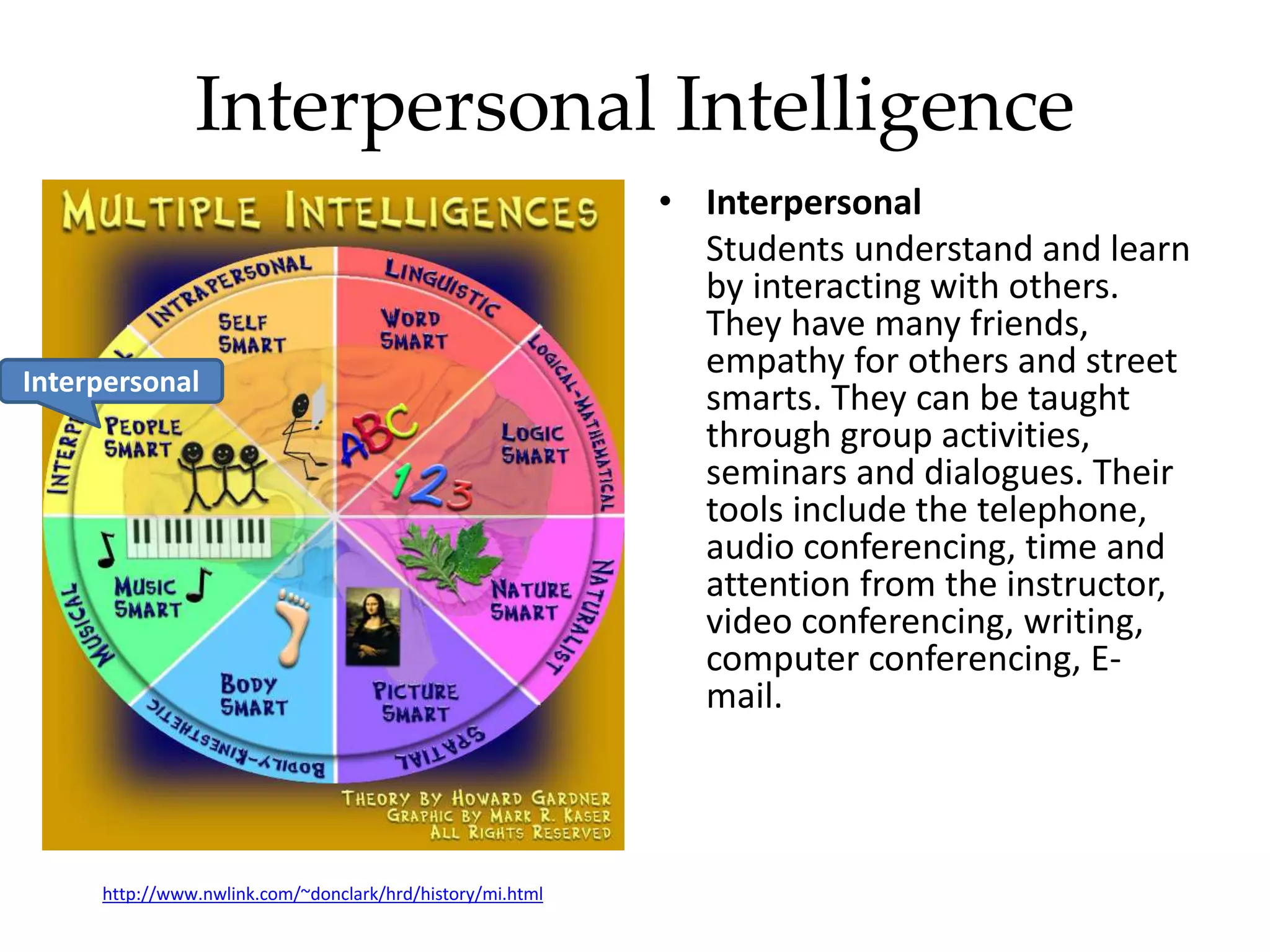
Interpersonal Intelligence
• Interpersonal
Students understand and learn
by interacting with others.
They have many friends,
empathy for others and street
smarts. They can be taught
through group activities,
seminars and dialogues. Their
tools include the telephone,
audio conferencing, time and
attention from the instructor,
video conferencing, writing,
computer conferencing, E-
mail.
http://www.nwlink.com/~donclark/hrd/history/mi.html
Interpersonal
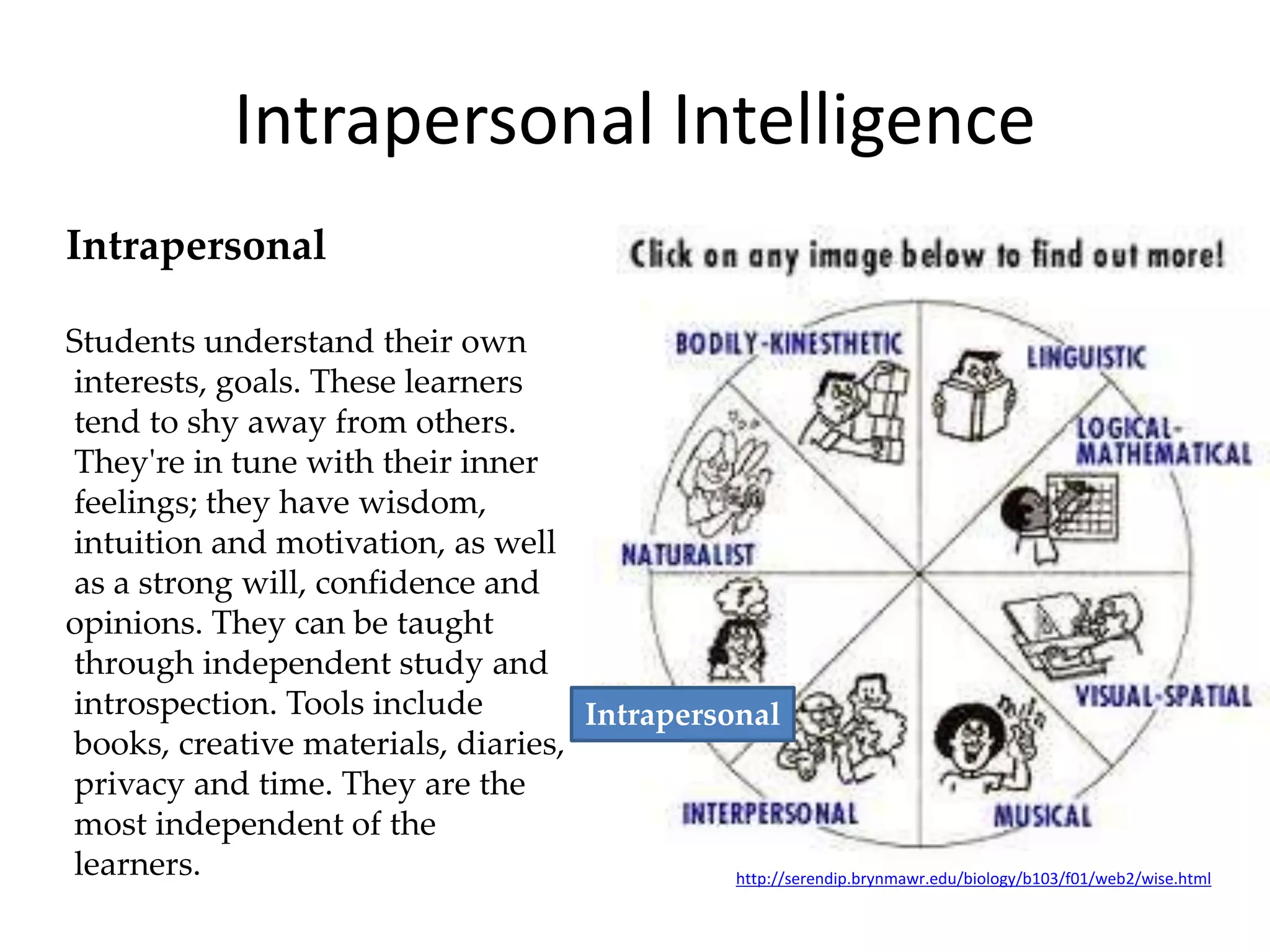
Intrapersonal
Students understand their own
interests, goals. These learners
tend to shy away from others.
They're in tune with their inner
feelings; they have wisdom,
intuition and motivation, as well
as a strong will, confidence and
opinions. They can be taught
through independent study and
introspection. Tools include
books, creative materials, diaries,
privacy and time. They are the
most independent of the
learners. http://serendip.brynmawr.edu/biology/b103/f01/web2/wise.html
Intrapersonal Intelligence
Intrapersonal
http://integral-
options.blogspot.com/2007_02_25_archive.html
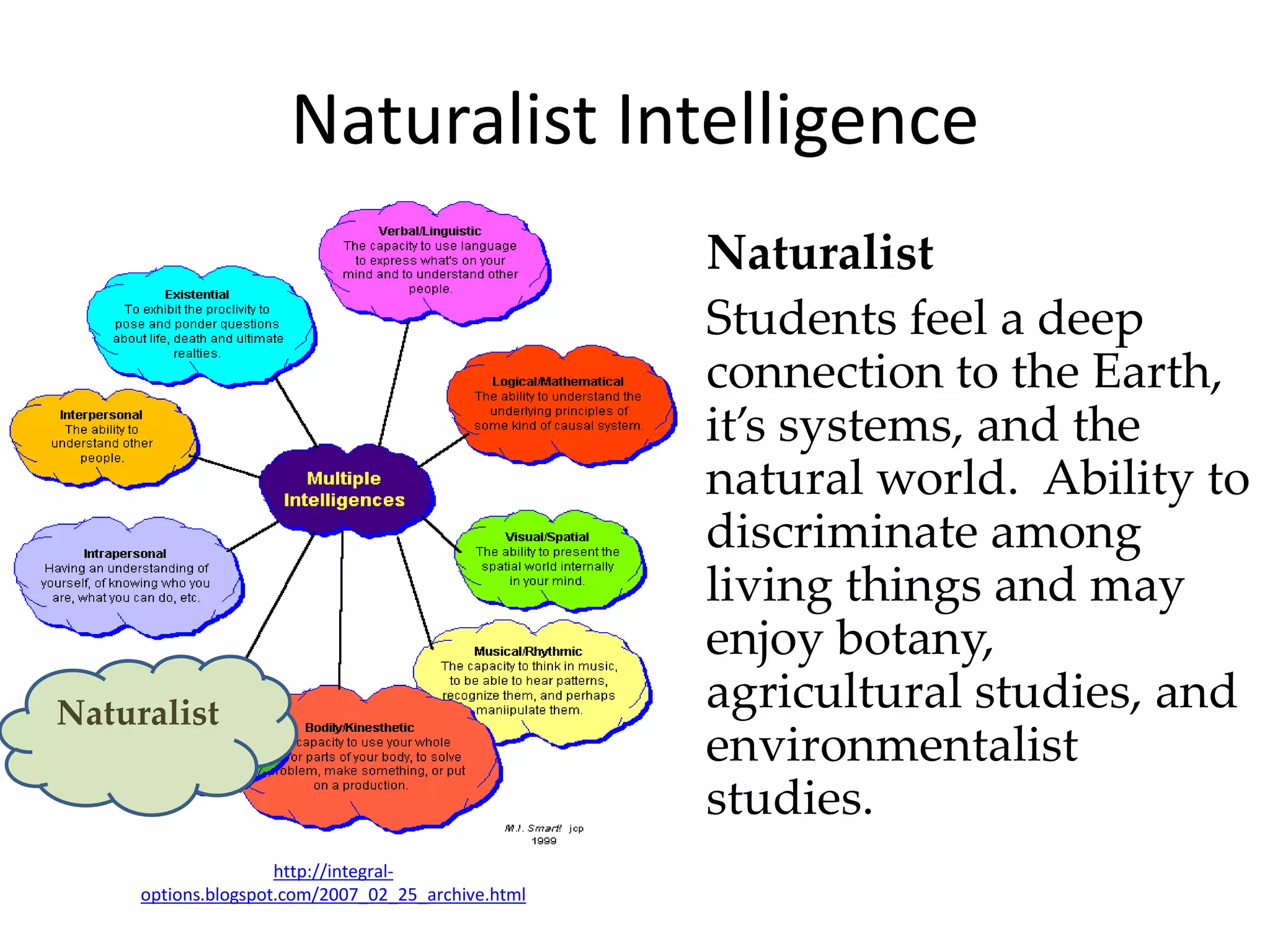
• Naturalist
Students feel a deep
connection to the Earth,
it’s systems, and the
natural world. Ability to
discriminate among
living things and may
enjoy botany,
agricultural studies, and
environmentalist
studies.
Naturalist Intelligence
Naturalist
Existentialist Intelligence
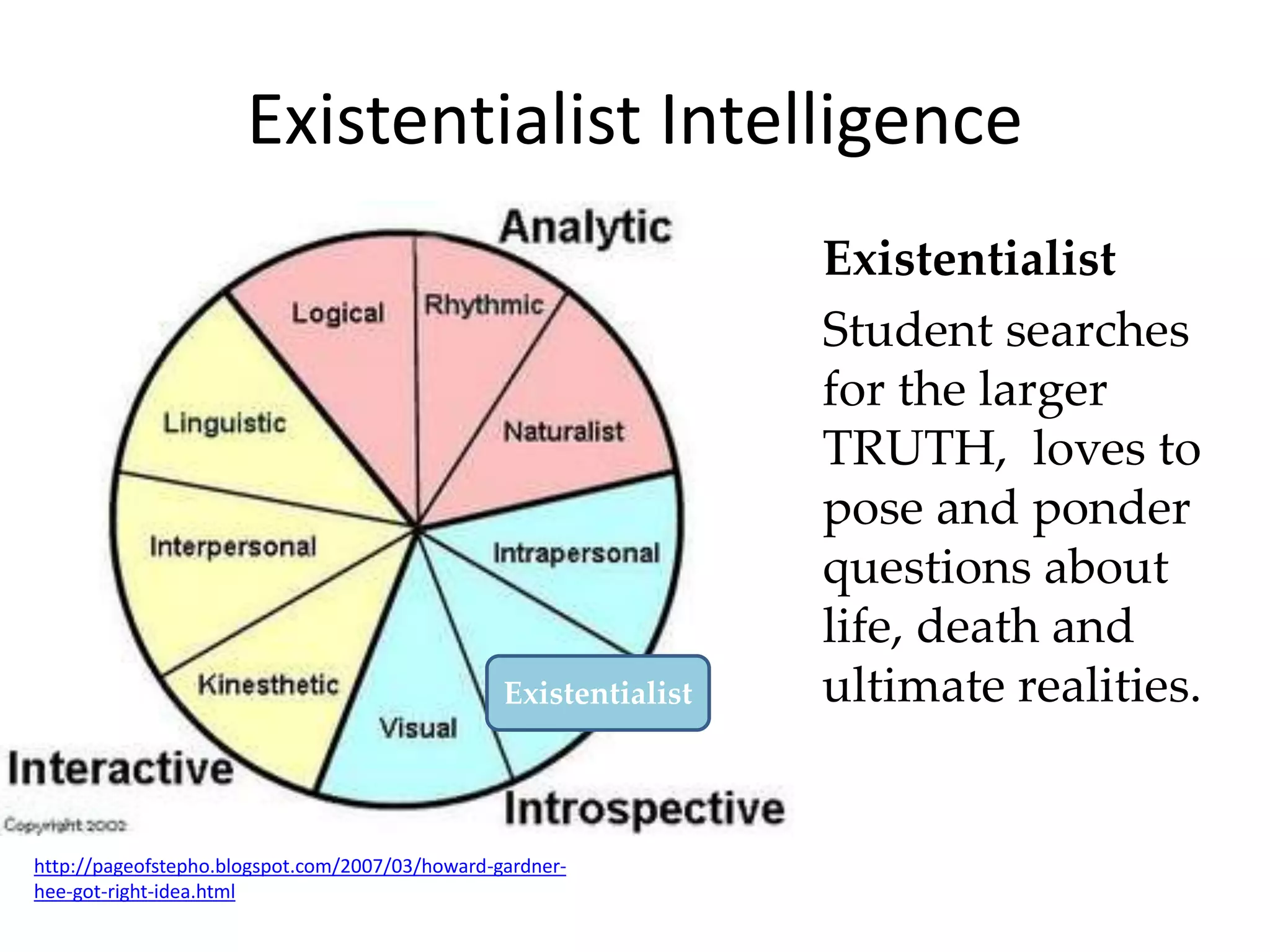
• Existentialist
Student searches
for the larger
TRUTH, loves to
pose and ponder
questions about
life, death and
ultimate realities.
http://pageofstepho.blogspot.com/2007/03/howard-gardner-
hee-got-right-idea.html
Existentialist

Multiple intelligences slide show

  • 1.
    Howard Gardner In 1983he published a book Frames of Mind outlining seven “intelligences” that all humans have to some degree. His work was based on human psychology, and never intended as an educational system. Yet it has become so widely published, taught and used, it is part of our educational pedagogy today. Multiple Intelligences
  • 2.
    Verbal Linguistic Intelligence •Linguistic Students use words effectively. These learners have highly developed auditory skills and often think in words. They like reading, playing word games, making up poetry or stories. They can be taught by encouraging them to say and see words, and read books together. Tools include computers, games, multimedia, books, tape recorders, and lecture. http://iblogideas.blogspot.com/2008_10_01_archive.html Linguistic
  • 3.
    Logical & MathematicalIntelligence • Logical –Mathematical Students use reasoning and calculating. They are able to think conceptually and abstractly, and are able to see and explore patterns and relationships. They like to experiment, solve puzzles, ask cosmic questions. They can be taught through logic games, investigations, mysteries. They need to learn and form concepts before they can deal with details. http://www.new-oceans.co.uk/new/education/multi7.htm Logical Mathematical
  • 4.
    Musical Intelligence Musical Students showsensitivity to rhythm and sound. They love music, but they are also sensitive to sounds in their environments. They may study better with music in the background. They can be taught by turning lessons into lyrics, speaking rhythmically, tapping out time. Tools include musical instruments, music, radio, stereo, CD-ROM, and multimedia. http://www.indg.gov.in/primary-education/best- practices/multiple-intelligences-theory-which-one-your- learning-style/view?set_language=hi Musical
  • 5.
    Bodily-Kinesthetic Intelligence • Bodily-kinesthetic Studentsuse the body effectively, like a dancer or a surgeon. Keen sense of body awareness. They like movement, making things and touching. They communicate well through body language and are best taught through physical activity, hands-on learning, acting out, role playing. Tools include equipment and real objects. http://expectumf.umf.maine.edu/mihome.html Bodily Kinesthetic
  • 6.
    Visual Spatial Intelligence Visual-Spatial Studentsthink in terms of physical space, as do architects And sailors. Very aware oftheir environments. They like to draw, do jigsaw puzzles, read maps, daydream. They can be taught through drawings, verbal and physical imagery. Tools include models, graphics, charts, photographs, drawings, 3-D modeling, video, videoconferencing, television, multimedia, texts with pictures/charts/graphs. http://www.nwlink.com/~donclark/hrd/history/mi.html Visual Spatial
  • 7.
    Interpersonal Intelligence • Interpersonal Studentsunderstand and learn by interacting with others. They have many friends, empathy for others and street smarts. They can be taught through group activities, seminars and dialogues. Their tools include the telephone, audio conferencing, time and attention from the instructor, video conferencing, writing, computer conferencing, E- mail. http://www.nwlink.com/~donclark/hrd/history/mi.html Interpersonal
  • 8.
    Intrapersonal Students understand theirown interests, goals. These learners tend to shy away from others. They're in tune with their inner feelings; they have wisdom, intuition and motivation, as well as a strong will, confidence and opinions. They can be taught through independent study and introspection. Tools include books, creative materials, diaries, privacy and time. They are the most independent of the learners. http://serendip.brynmawr.edu/biology/b103/f01/web2/wise.html Intrapersonal Intelligence Intrapersonal
  • 9.
    http://integral- options.blogspot.com/2007_02_25_archive.html • Naturalist Students feela deep connection to the Earth, it’s systems, and the natural world. Ability to discriminate among living things and may enjoy botany, agricultural studies, and environmentalist studies. Naturalist Intelligence Naturalist
  • 10.
    Existentialist Intelligence • Existentialist Studentsearches for the larger TRUTH, loves to pose and ponder questions about life, death and ultimate realities. http://pageofstepho.blogspot.com/2007/03/howard-gardner- hee-got-right-idea.html Existentialist