Juan Cuevas
Multiple Intelligences
PreNap
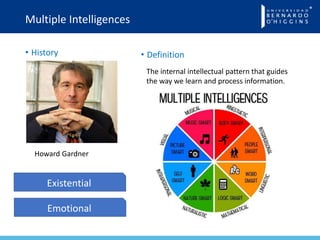
Multiple Intelligences
• History
Howard Gardner
The internal intellectual pattern that guides
the way we learn and process information.
• Definition
Existential
Emotional
Multiple Intelligences
• Intelligence?
Verbal-Linguistic Intelligence (Word Smart)
Students love words and use them as a primary way of thinking and solving
problems. They are good writers, speakers, or both. They use words to
persuade, argue, entertain, and/or teach.
LEARNING ACTIVITIES
• Completing crossword puzzles with vocabulary words
• Playing games like Scrabble, Scrabble Junior, or Boggle
• Writing short stories for a classroom newsletter
• Writing feature articles for the school newspaper
• Writing to state representatives about local issues
• Creating poems for a class poetry book
• Listening to a storyteller
• Telling a story to the class
• Participating in debates
Multiple Intelligences
• Intelligence?
Logical-Mathematical Intelligence (Math Smart)
Students enjoy working with numbers. They can easily interpret data and analyze
abstract patterns. They have a well-developed ability to reason and are good at
chess and computer programming. They think in terms of cause and effect.
LEARNING ACTIVITIES
• Playing math games like dominoes, chess, checkers, and Monopoly.
• Searching for patterns in the classroom, school, outdoors, and home
• Conducting experiments to demonstrate science concepts
• Using math and science software
• Using science tool kits for science programs
• Designing alphabetic and numeric codes
• Making up analogies
Multiple Intelligences
• Intelligence?
Spatial Intelligence (Picture Smart)
Students strong in spatial intelligence think and process information in pictures and
images. They have excellent visual receptive skills and excellent fine motor skills.
Students with this intelligence use their eyes and hands to make artistic or creatively
designed projects. They can build with Legos, read maps, and put together puzzles.
LEARNING ACTIVITIES
• Taking photographs for assignments and classroom newsletters
• Using clay or play dough to make objects or represent concepts from
content-area lessons
• Using pictorial models such as flow charts, visual maps, Venn
diagrams, and timelines to connect new information
• Taking notes using concept mapping, mind mapping, and clustering
• Using maps to study geographical locations discussed in class
• Illustrating poems for the class poetry book by drawing or using
computer software
• Using virtual-reality system software
Multiple Intelligences
• Intelligence?
Musical Intelligence (Music Smart)
Students think, feel, and process information primarily through sound. They have a
superior ability to perceive, compose, and/or perform music. Musically smart people
constantly hear musical notes in their head.
LEARNING ACTIVITIES
• Writing their own songs and music about content-area topics
• Putting original poems to music, and then performing them for the
class
• Listening to music from different historical periods
• Using rhythm and clapping to memorize math facts and other
content-area information
• Listening to CDs that teach concepts like the alphabet, parts of
speech, and states and capitals
Multiple Intelligences
• Intelligence?
Bodily-Kinesthetic Intelligence (Body Smart)
Students are highly aware of the world through touch and movement. There is a
special harmony between their bodies and their minds. They can control their
bodies with grace, expertise, and athleticism.
LEARNING ACTIVITIES
• Performing skits or acting out scenes from books or key historical
events
• Playing games like Twister and Simon Says
• Using charades to act out characters in a book, vocabulary words,
animals, or other content-area topics
• Participating in scavenger hunts, searching for items related to a
theme or unit
• Building objects using blocks, cubes, or Legos to represent concepts
from content-area lessons
• Using electronic motion-simulation games and hands-on
construction kits that interface with computers
Multiple Intelligences
• Intelligence?
Interpersonal Intelligence (People Smart)
Students strong in interpersonal intelligence have a natural ability to interact with,
relate to, and get along with others effectively. They are good leaders. They use their
insights about others to negotiate, persuade, and obtain information. They like to
interact with others and usually have lots of friends.
LEARNING ACTIVITIES
• Working in cooperative groups to design and complete projects
• Working in pairs to learn math facts
• Interviewing people with knowledge about content-area topics
• Tutoring younger students or classmates
• Using puppets to put on a puppet show
Multiple Intelligences
• Intelligence?
Intrapersonal Intelligence (Self Smart)
Students have a deep awareness of their feelings, ideas, and goals. Students with
this intelligence usually need time alone to process and create.
LEARNING ACTIVITIES
• Writing reflective papers on content-area topics
• Writing a literary autobiography, reflecting on their reading life
• Writing goals for the future and planning ways to achieve them
• Using software that allows them to work alone
• Keeping journals or logs throughout the year
• Making a scrapbook for their poems, papers, and reflections
Multiple Intelligences
• Intelligence?
Naturalistic Intelligence (Nature Smart)
This intelligence refers to a person's natural interest in the environment. These
people enjoy being in nature and want to protect it from pollution. Students with
strong naturalistic intelligence easily recognize and categorize plants, animals, and
rocks.
LEARNING ACTIVITIES
• Caring for classroom plants
• Caring for classroom pets
• Sorting and classifying natural objects, such as leaves and rocks
• Researching animal habitats
• Observing natural surroundings
• Organizing or participating in park/playground clean-ups, recycling
drives, and beautification projects
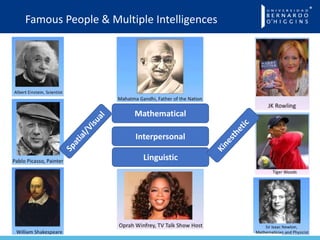
Famous People & Multiple Intelligences
Mathematical
Interpersonal
Linguistic
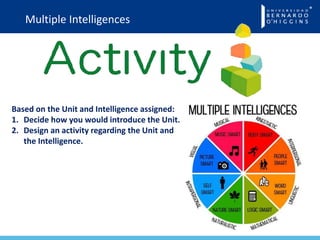
Multiple Intelligences
Based on the Unit and Intelligence assigned:
1. Decide how you would introduce the Unit.
2. Design an activity regarding the Unit and
the Intelligence.

Multiple intelligences

  • 1.
  • 2.
    Multiple Intelligences • History HowardGardner The internal intellectual pattern that guides the way we learn and process information. • Definition Existential Emotional
  • 3.
    Multiple Intelligences • Intelligence? Verbal-LinguisticIntelligence (Word Smart) Students love words and use them as a primary way of thinking and solving problems. They are good writers, speakers, or both. They use words to persuade, argue, entertain, and/or teach. LEARNING ACTIVITIES • Completing crossword puzzles with vocabulary words • Playing games like Scrabble, Scrabble Junior, or Boggle • Writing short stories for a classroom newsletter • Writing feature articles for the school newspaper • Writing to state representatives about local issues • Creating poems for a class poetry book • Listening to a storyteller • Telling a story to the class • Participating in debates
  • 4.
    Multiple Intelligences • Intelligence? Logical-MathematicalIntelligence (Math Smart) Students enjoy working with numbers. They can easily interpret data and analyze abstract patterns. They have a well-developed ability to reason and are good at chess and computer programming. They think in terms of cause and effect. LEARNING ACTIVITIES • Playing math games like dominoes, chess, checkers, and Monopoly. • Searching for patterns in the classroom, school, outdoors, and home • Conducting experiments to demonstrate science concepts • Using math and science software • Using science tool kits for science programs • Designing alphabetic and numeric codes • Making up analogies
  • 5.
    Multiple Intelligences • Intelligence? SpatialIntelligence (Picture Smart) Students strong in spatial intelligence think and process information in pictures and images. They have excellent visual receptive skills and excellent fine motor skills. Students with this intelligence use their eyes and hands to make artistic or creatively designed projects. They can build with Legos, read maps, and put together puzzles. LEARNING ACTIVITIES • Taking photographs for assignments and classroom newsletters • Using clay or play dough to make objects or represent concepts from content-area lessons • Using pictorial models such as flow charts, visual maps, Venn diagrams, and timelines to connect new information • Taking notes using concept mapping, mind mapping, and clustering • Using maps to study geographical locations discussed in class • Illustrating poems for the class poetry book by drawing or using computer software • Using virtual-reality system software
  • 6.
    Multiple Intelligences • Intelligence? MusicalIntelligence (Music Smart) Students think, feel, and process information primarily through sound. They have a superior ability to perceive, compose, and/or perform music. Musically smart people constantly hear musical notes in their head. LEARNING ACTIVITIES • Writing their own songs and music about content-area topics • Putting original poems to music, and then performing them for the class • Listening to music from different historical periods • Using rhythm and clapping to memorize math facts and other content-area information • Listening to CDs that teach concepts like the alphabet, parts of speech, and states and capitals
  • 7.
    Multiple Intelligences • Intelligence? Bodily-KinestheticIntelligence (Body Smart) Students are highly aware of the world through touch and movement. There is a special harmony between their bodies and their minds. They can control their bodies with grace, expertise, and athleticism. LEARNING ACTIVITIES • Performing skits or acting out scenes from books or key historical events • Playing games like Twister and Simon Says • Using charades to act out characters in a book, vocabulary words, animals, or other content-area topics • Participating in scavenger hunts, searching for items related to a theme or unit • Building objects using blocks, cubes, or Legos to represent concepts from content-area lessons • Using electronic motion-simulation games and hands-on construction kits that interface with computers
  • 8.
    Multiple Intelligences • Intelligence? InterpersonalIntelligence (People Smart) Students strong in interpersonal intelligence have a natural ability to interact with, relate to, and get along with others effectively. They are good leaders. They use their insights about others to negotiate, persuade, and obtain information. They like to interact with others and usually have lots of friends. LEARNING ACTIVITIES • Working in cooperative groups to design and complete projects • Working in pairs to learn math facts • Interviewing people with knowledge about content-area topics • Tutoring younger students or classmates • Using puppets to put on a puppet show
  • 9.
    Multiple Intelligences • Intelligence? IntrapersonalIntelligence (Self Smart) Students have a deep awareness of their feelings, ideas, and goals. Students with this intelligence usually need time alone to process and create. LEARNING ACTIVITIES • Writing reflective papers on content-area topics • Writing a literary autobiography, reflecting on their reading life • Writing goals for the future and planning ways to achieve them • Using software that allows them to work alone • Keeping journals or logs throughout the year • Making a scrapbook for their poems, papers, and reflections
  • 10.
    Multiple Intelligences • Intelligence? NaturalisticIntelligence (Nature Smart) This intelligence refers to a person's natural interest in the environment. These people enjoy being in nature and want to protect it from pollution. Students with strong naturalistic intelligence easily recognize and categorize plants, animals, and rocks. LEARNING ACTIVITIES • Caring for classroom plants • Caring for classroom pets • Sorting and classifying natural objects, such as leaves and rocks • Researching animal habitats • Observing natural surroundings • Organizing or participating in park/playground clean-ups, recycling drives, and beautification projects
  • 11.
    Famous People &Multiple Intelligences Mathematical Interpersonal Linguistic
  • 12.
    Multiple Intelligences Based onthe Unit and Intelligence assigned: 1. Decide how you would introduce the Unit. 2. Design an activity regarding the Unit and the Intelligence.