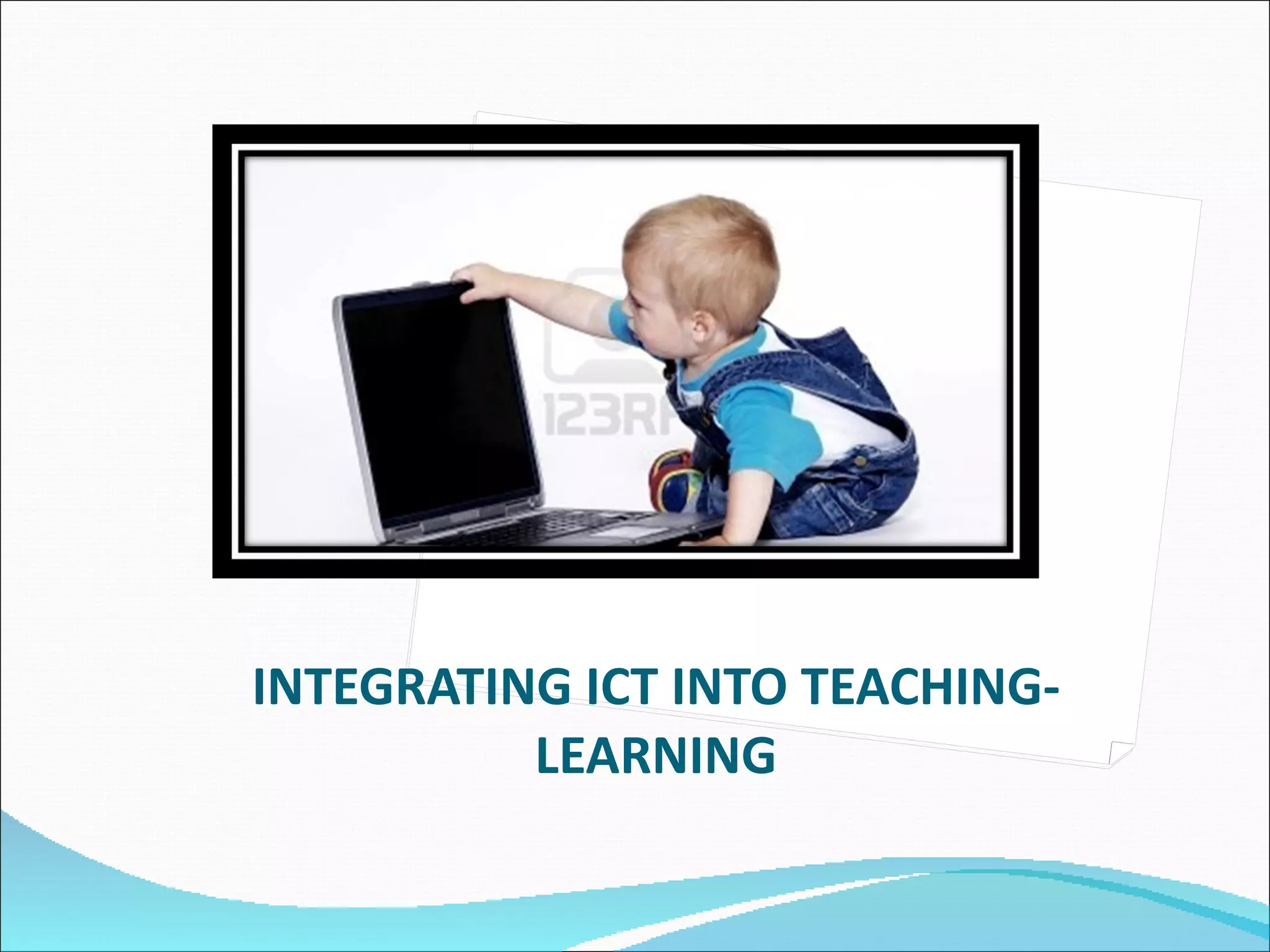
INTEGRATING ICT INTO TEACHING-LEARNING
Objectives WHY? Teachers should create leaders of 21 st  century? HOW? A Framework for ICTs in Teacher Education Integrating ICT in teaching-learning
“ Our teens leave school equipped to work only in the kinds of jobs that are fast disappearing from the economy.” “ Why even our best schools don’t teach the new survival skills our children need – and what we can do about it.” -Tony Wagner, 2008
What should teachers do to create leaders of 21 st  century? Knowledge  (goes beyond the boundaries of academics) Life skills  Media Literacy (ability to use and analyze  the  media to find information) Self-Management (to foster self-reliance and independence in learners) Meta-cognition (skill of knowing how we learn and our peculiar style of learning)
Traditional View of Learning  Learning is a process of information transfer and reception. Learning is facilitated by breaking content into isolated units. Learning is a linear process.
New theories of learning New theories of learning are based on the assumption that learners are active agents, purposefully seeking and constructing knowledge within a meaningful context. Constructivism theory
Instruction for 21st Century Skills Relevant to student outside the classroom Student is highly engaged Student has a choice and voice in his/her learning Student takes ownership for own learning Includes higher order thinking - creativity and innovation
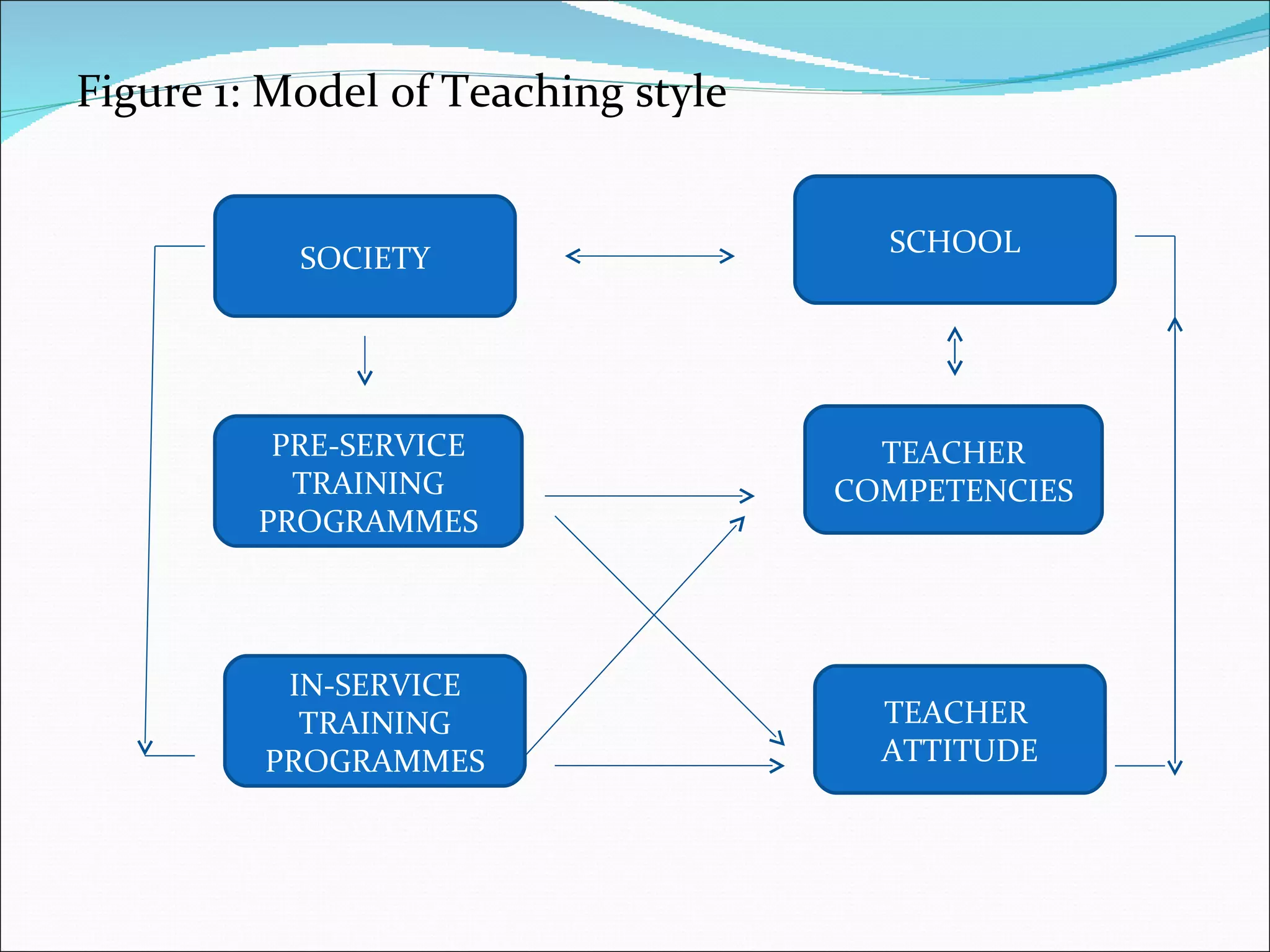
Figure 1: Model of Teaching style  SOCIETY SCHOOL TEACHER COMPETENCIES TEACHER  ATTITUDE PRE-SERVICE TRAINING PROGRAMMES IN-SERVICE TRAINING PROGRAMMES
Figure 1 shows the model of teaching styles which is the outcome of the interaction between society & school, teaching attitude & competencies.  Society and school are interdependent. Society influences teacher education (Pre & in-service) where attitude & competencies are developed which further influences the school and is influenced by the school culture.
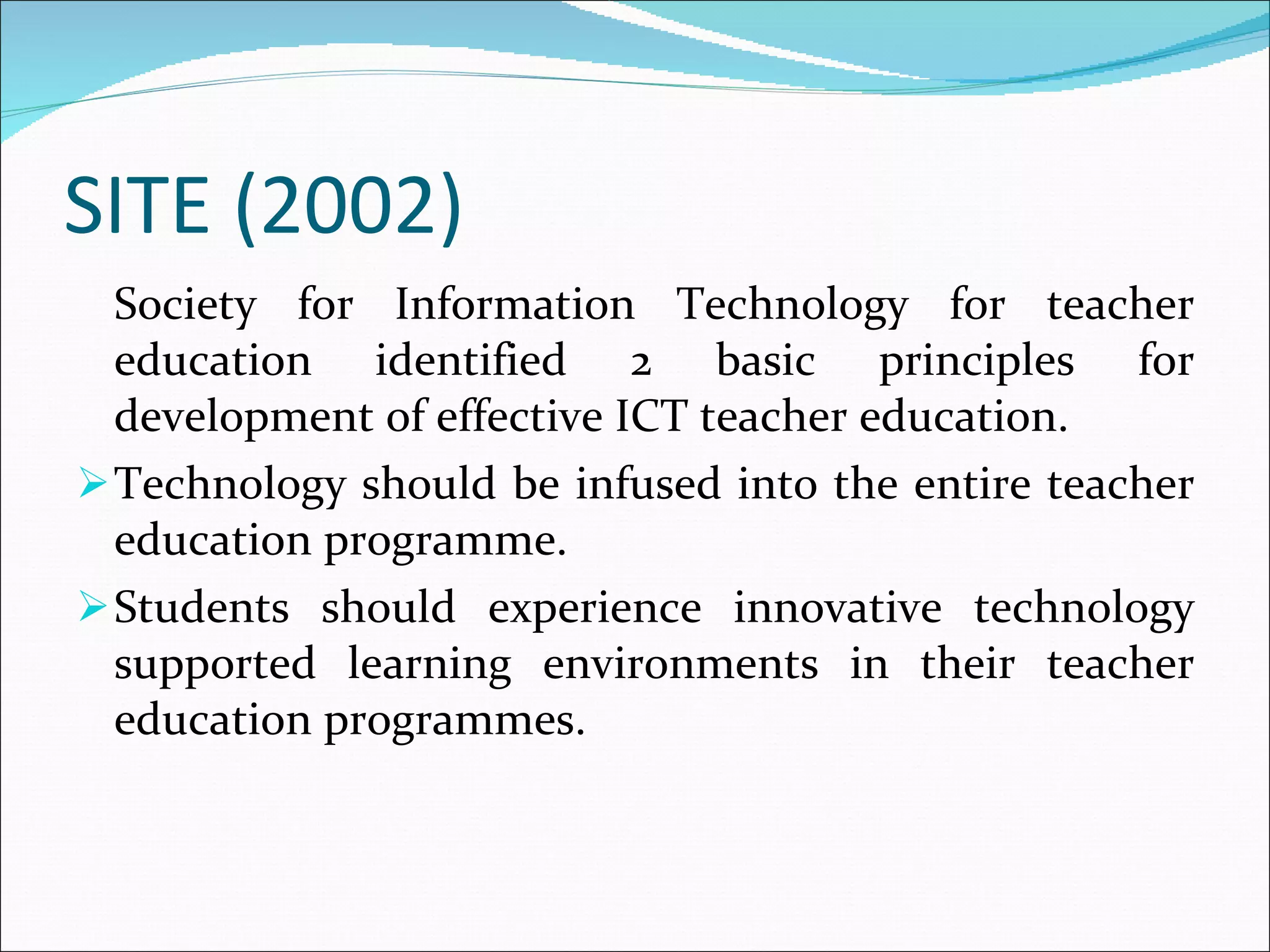
SITE (2002)  Society for Information Technology for teacher education identified 2 basic principles for development of effective ICT teacher education. Technology should be infused into the entire teacher education programme. Students should experience innovative technology supported learning environments in their teacher education programmes.
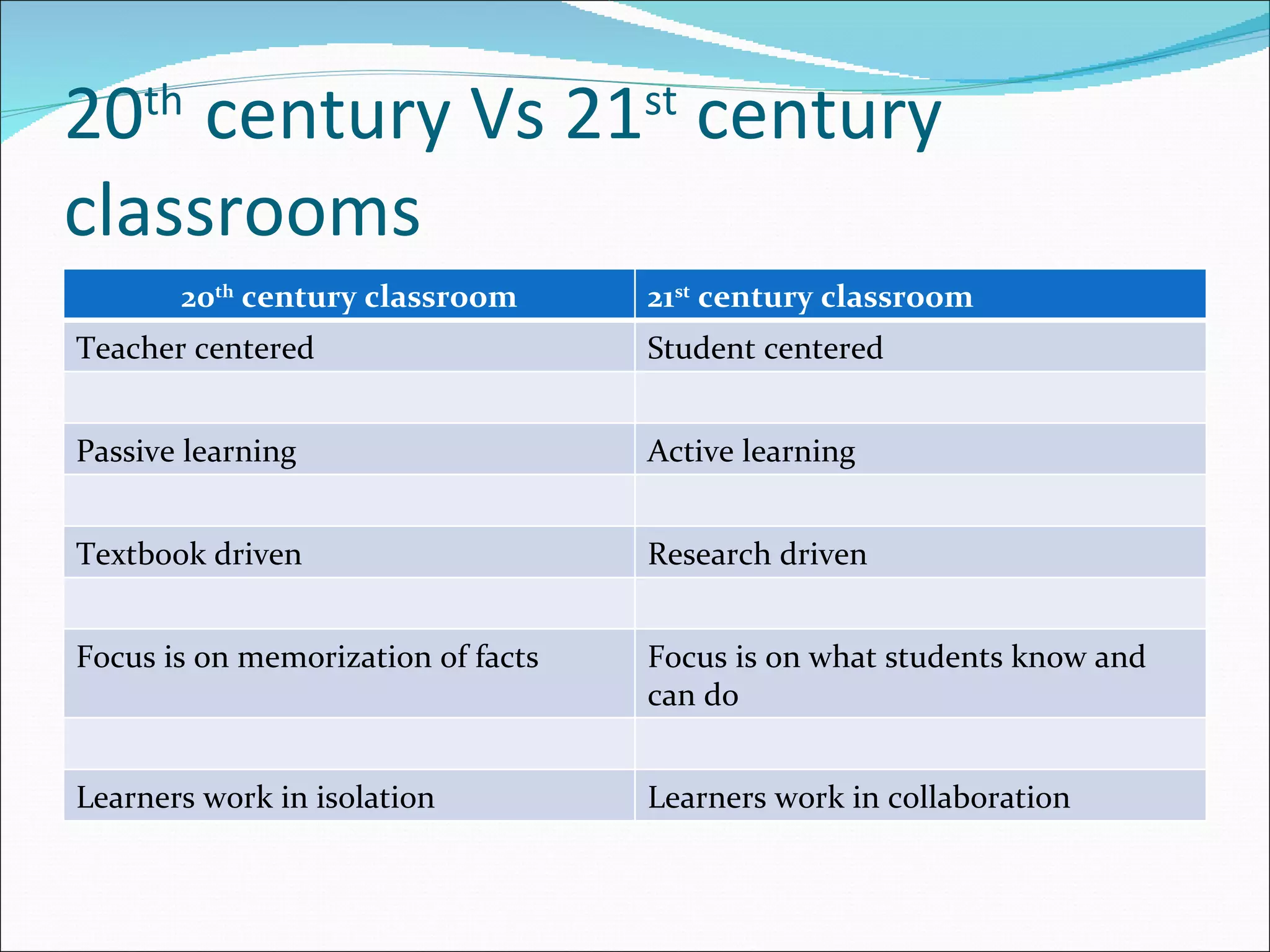
20 th  century Vs 21 st  century classrooms 20 th  century classroom 21 st  century classroom Teacher centered Student centered Passive learning Active learning Textbook driven  Research driven Focus is on memorization of facts Focus is on what students know and can do Learners work in isolation Learners work in collaboration
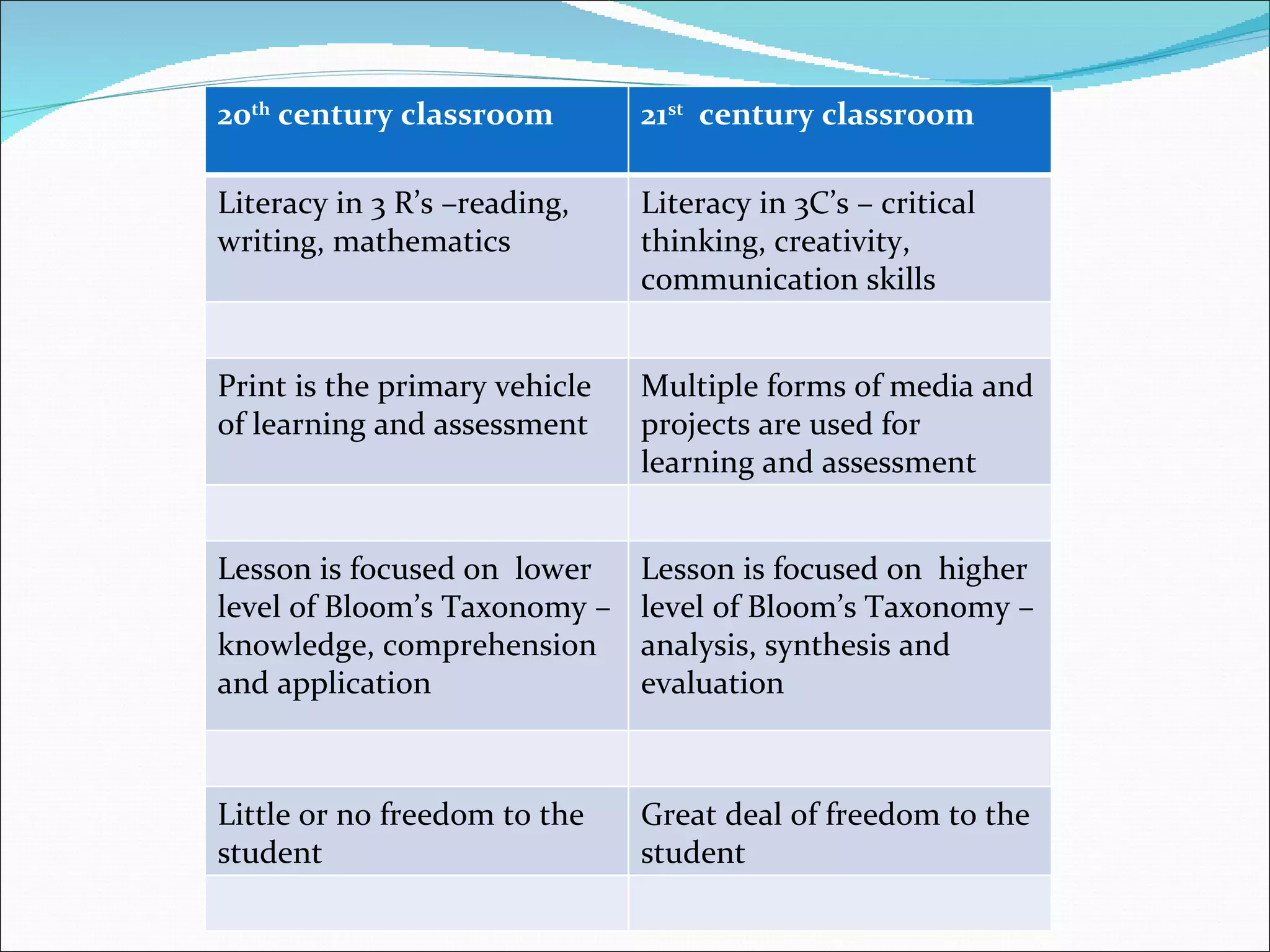
20 th  century classroom 21 st   century classroom Literacy in 3 R’s –reading, writing, mathematics Literacy in 3C’s – critical thinking, creativity, communication skills Print is the primary vehicle of learning and assessment Multiple forms of media and projects are used for learning and assessment Lesson is focused on  lower level of Bloom’s Taxonomy – knowledge, comprehension and application Lesson is focused on  higher level of Bloom’s Taxonomy – analysis, synthesis and evaluation Little or no freedom to the student Great deal of freedom to the student
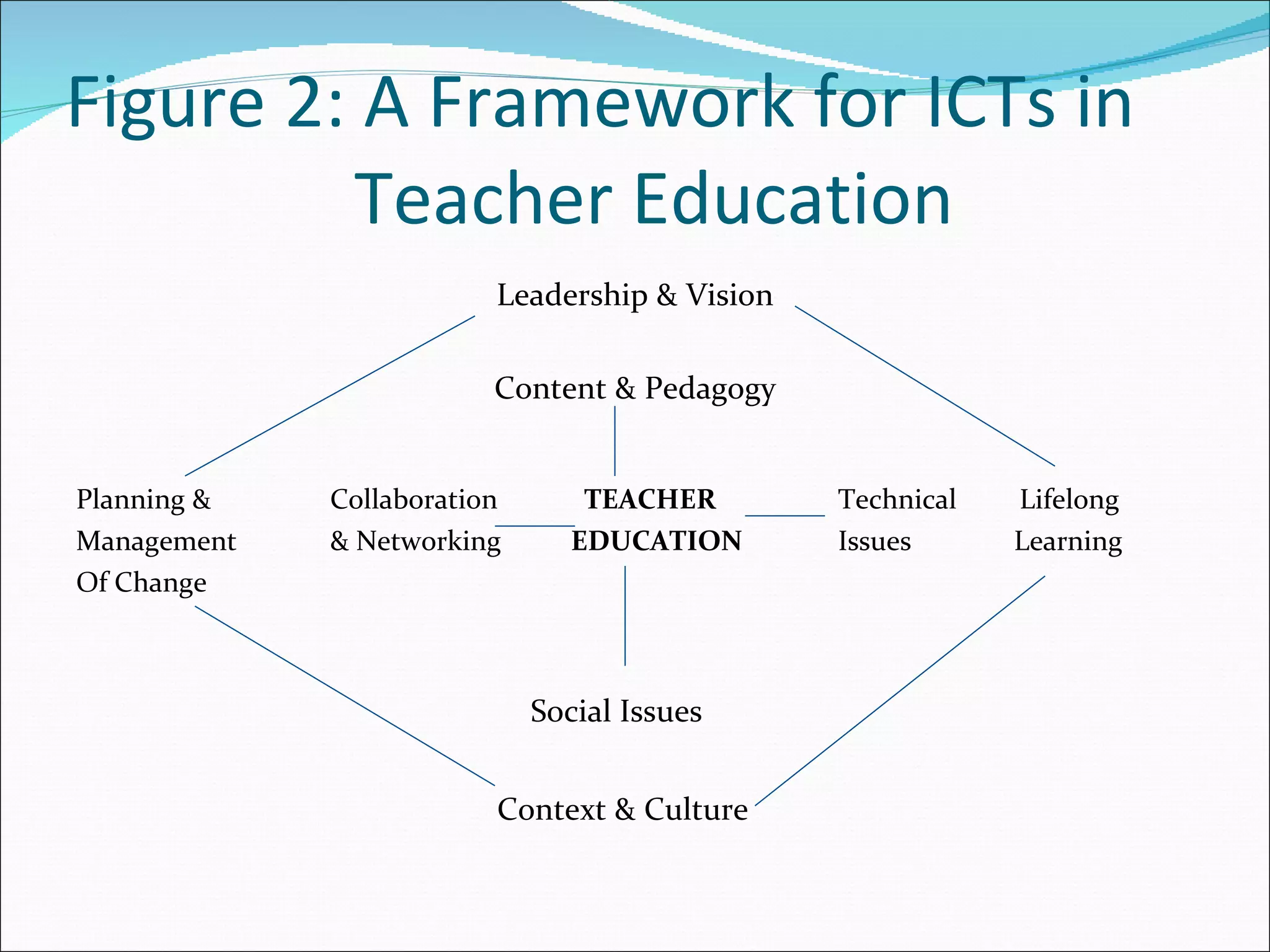
Figure 2: A Framework for ICTs in    Teacher Education Leadership & Vision Content & Pedagogy Planning &  Collaboration TEACHER  Technical  Lifelong Management  & Networking  EDUCATION  Issues   Learning Of Change   Social Issues   Context & Culture
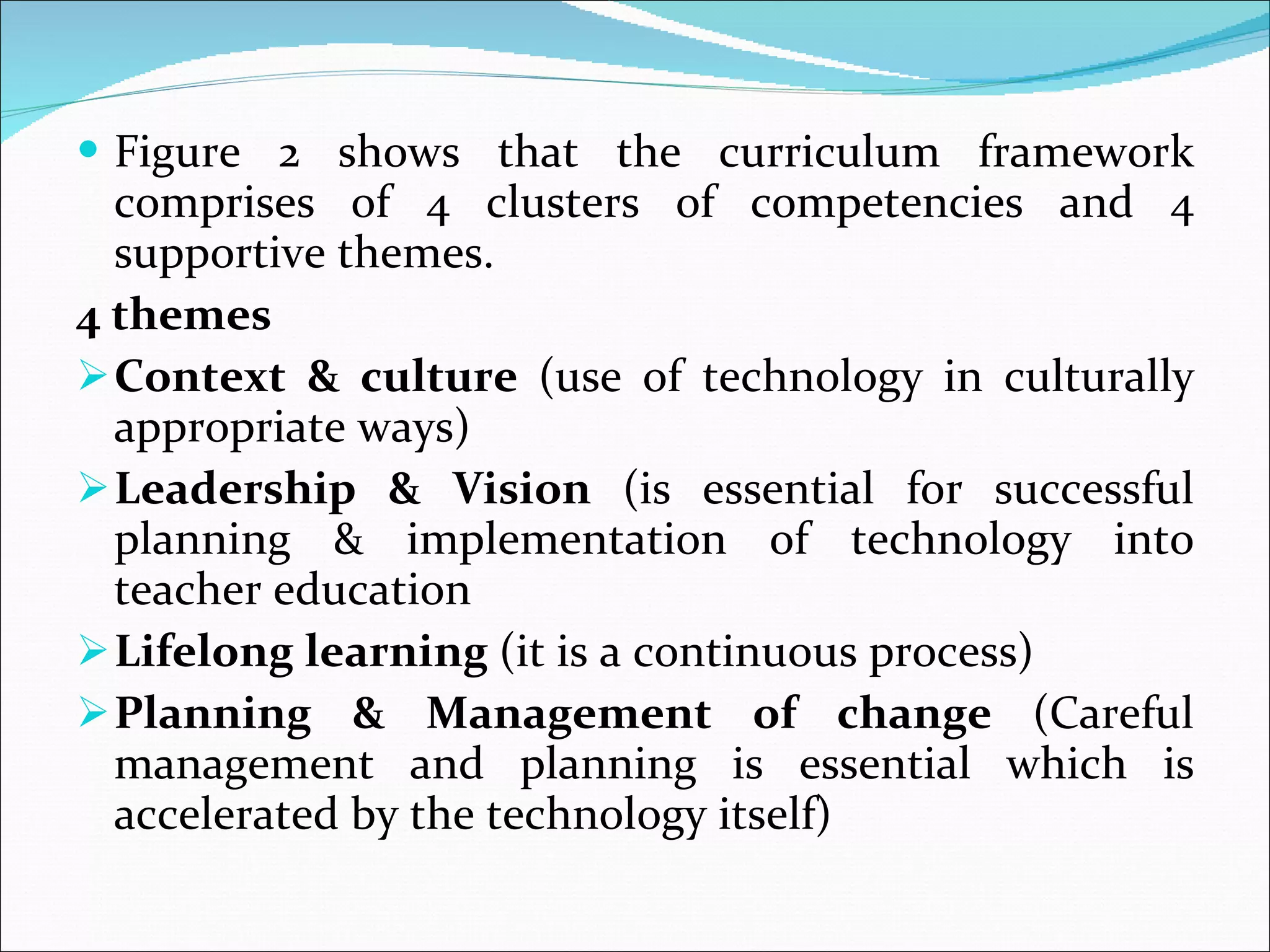
Figure 2 shows that the curriculum framework comprises of 4 clusters of competencies and 4 supportive themes. 4 themes Context & culture  (use of technology in culturally appropriate ways) Leadership & Vision  (is essential for successful planning & implementation of technology into teacher education Lifelong learning  (it is a continuous process) Planning & Management of change  (Careful management and planning is essential which is accelerated by the technology itself)
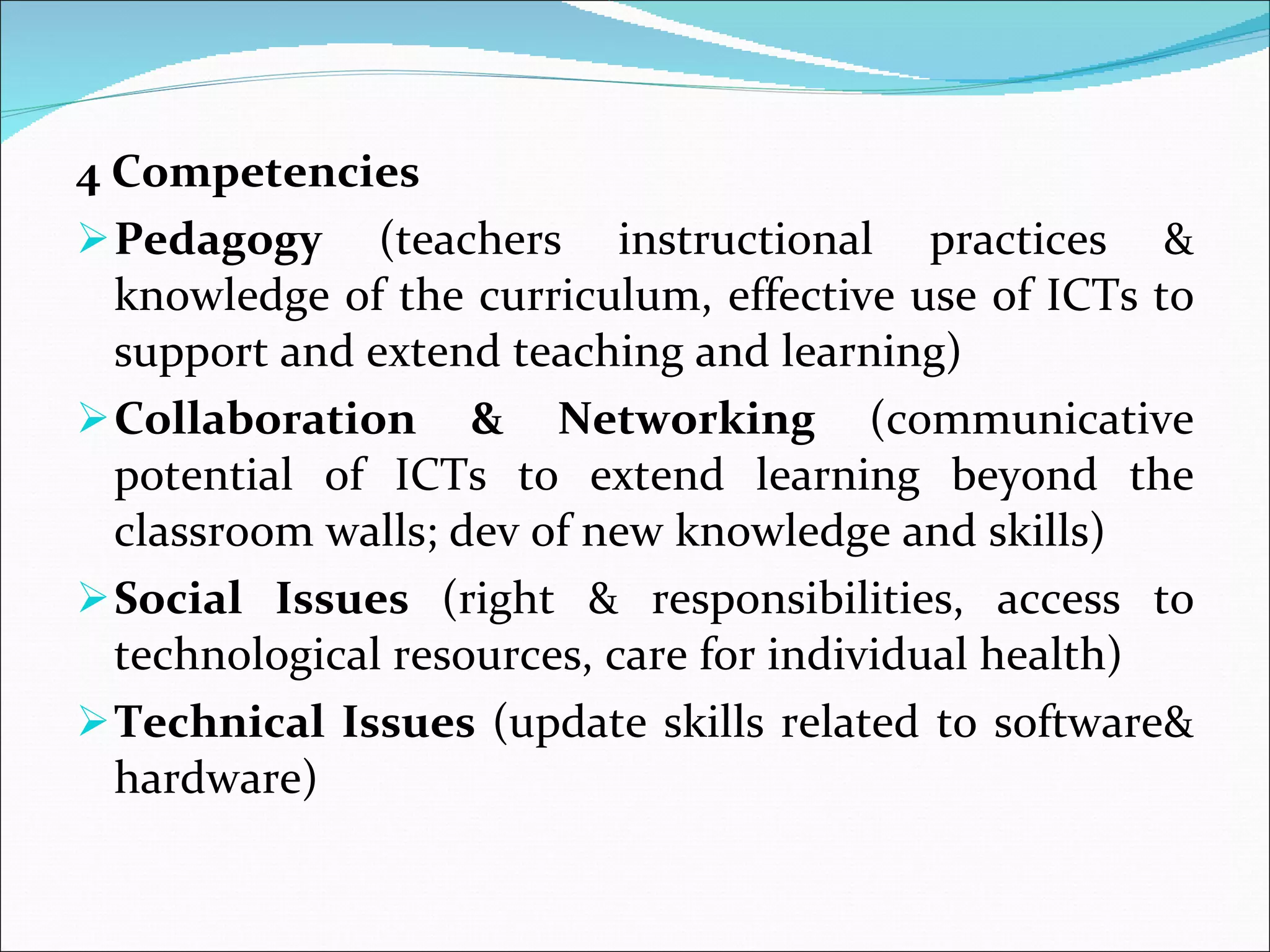
4 Competencies Pedagogy  (teachers instructional practices & knowledge of the curriculum, effective use of ICTs to support and extend teaching and learning) Collaboration & Networking  (communicative potential of ICTs to extend learning beyond the classroom walls; dev of new knowledge and skills) Social Issues  (right & responsibilities, access to technological resources, care for individual health) Technical Issues  (update skills related to software& hardware)
Integrating ICT in teaching-learning The ICT integration in education in general and teacher education in particular is the need of the day. The teacher today has to meet the multiplicity of challenges of the modern society. He / She is expected to be traditional yet use modern technology to maintain his/ his dynamism in the teaching process. ICT is not only a tool for teachers but also offers opportunities for professional development.
Barriers in the use of ICT in classrooms Lack of funding (Starr, 2001) Lack of motivation to adopt ICT as teaching tools. Lack of confidence in teachers Attitude of teachers (Rai, 2010) Developing countries (Kenya, India) it is related to computer literacy. (Muriithi, 2005)
RECOMMENDATIONS
Recommendations Students and teachers must have sufficient access to digital technologies and internet in their classrooms, schools and teacher education institutions. Teachers must have the knowledge and skills to use the new digital tools and resources to help all students achieve high academic stands
“ Integrating 21st century skills into teaching and assessment, then, is not only an economic imperative, driven by changes in the workforce, but a vital aspect of improving student learning.”   - Silva

Integrating ICT into Teaching Learning

  • 1.
    INTEGRATING ICT INTOTEACHING-LEARNING
  • 2.
    Objectives WHY? Teachersshould create leaders of 21 st century? HOW? A Framework for ICTs in Teacher Education Integrating ICT in teaching-learning
  • 3.
    “ Our teensleave school equipped to work only in the kinds of jobs that are fast disappearing from the economy.” “ Why even our best schools don’t teach the new survival skills our children need – and what we can do about it.” -Tony Wagner, 2008
  • 4.
    What should teachersdo to create leaders of 21 st century? Knowledge (goes beyond the boundaries of academics) Life skills Media Literacy (ability to use and analyze the media to find information) Self-Management (to foster self-reliance and independence in learners) Meta-cognition (skill of knowing how we learn and our peculiar style of learning)
  • 5.
    Traditional View ofLearning Learning is a process of information transfer and reception. Learning is facilitated by breaking content into isolated units. Learning is a linear process.
  • 6.
    New theories oflearning New theories of learning are based on the assumption that learners are active agents, purposefully seeking and constructing knowledge within a meaningful context. Constructivism theory
  • 7.
    Instruction for 21stCentury Skills Relevant to student outside the classroom Student is highly engaged Student has a choice and voice in his/her learning Student takes ownership for own learning Includes higher order thinking - creativity and innovation
  • 8.
    Figure 1: Modelof Teaching style SOCIETY SCHOOL TEACHER COMPETENCIES TEACHER ATTITUDE PRE-SERVICE TRAINING PROGRAMMES IN-SERVICE TRAINING PROGRAMMES
  • 9.
    Figure 1 showsthe model of teaching styles which is the outcome of the interaction between society & school, teaching attitude & competencies. Society and school are interdependent. Society influences teacher education (Pre & in-service) where attitude & competencies are developed which further influences the school and is influenced by the school culture.
  • 10.
    SITE (2002) Society for Information Technology for teacher education identified 2 basic principles for development of effective ICT teacher education. Technology should be infused into the entire teacher education programme. Students should experience innovative technology supported learning environments in their teacher education programmes.
  • 11.
    20 th century Vs 21 st century classrooms 20 th century classroom 21 st century classroom Teacher centered Student centered Passive learning Active learning Textbook driven Research driven Focus is on memorization of facts Focus is on what students know and can do Learners work in isolation Learners work in collaboration
  • 12.
    20 th century classroom 21 st century classroom Literacy in 3 R’s –reading, writing, mathematics Literacy in 3C’s – critical thinking, creativity, communication skills Print is the primary vehicle of learning and assessment Multiple forms of media and projects are used for learning and assessment Lesson is focused on lower level of Bloom’s Taxonomy – knowledge, comprehension and application Lesson is focused on higher level of Bloom’s Taxonomy – analysis, synthesis and evaluation Little or no freedom to the student Great deal of freedom to the student
  • 13.
    Figure 2: AFramework for ICTs in Teacher Education Leadership & Vision Content & Pedagogy Planning & Collaboration TEACHER Technical Lifelong Management & Networking EDUCATION Issues Learning Of Change Social Issues Context & Culture
  • 14.
    Figure 2 showsthat the curriculum framework comprises of 4 clusters of competencies and 4 supportive themes. 4 themes Context & culture (use of technology in culturally appropriate ways) Leadership & Vision (is essential for successful planning & implementation of technology into teacher education Lifelong learning (it is a continuous process) Planning & Management of change (Careful management and planning is essential which is accelerated by the technology itself)
  • 15.
    4 Competencies Pedagogy (teachers instructional practices & knowledge of the curriculum, effective use of ICTs to support and extend teaching and learning) Collaboration & Networking (communicative potential of ICTs to extend learning beyond the classroom walls; dev of new knowledge and skills) Social Issues (right & responsibilities, access to technological resources, care for individual health) Technical Issues (update skills related to software& hardware)
  • 16.
    Integrating ICT inteaching-learning The ICT integration in education in general and teacher education in particular is the need of the day. The teacher today has to meet the multiplicity of challenges of the modern society. He / She is expected to be traditional yet use modern technology to maintain his/ his dynamism in the teaching process. ICT is not only a tool for teachers but also offers opportunities for professional development.
  • 17.
    Barriers in theuse of ICT in classrooms Lack of funding (Starr, 2001) Lack of motivation to adopt ICT as teaching tools. Lack of confidence in teachers Attitude of teachers (Rai, 2010) Developing countries (Kenya, India) it is related to computer literacy. (Muriithi, 2005)
  • 18.
  • 19.
    Recommendations Students andteachers must have sufficient access to digital technologies and internet in their classrooms, schools and teacher education institutions. Teachers must have the knowledge and skills to use the new digital tools and resources to help all students achieve high academic stands
  • 20.
    “ Integrating 21stcentury skills into teaching and assessment, then, is not only an economic imperative, driven by changes in the workforce, but a vital aspect of improving student learning.” - Silva