Компьютерт өгөгдөл дүрслэх

                     Лекц 2
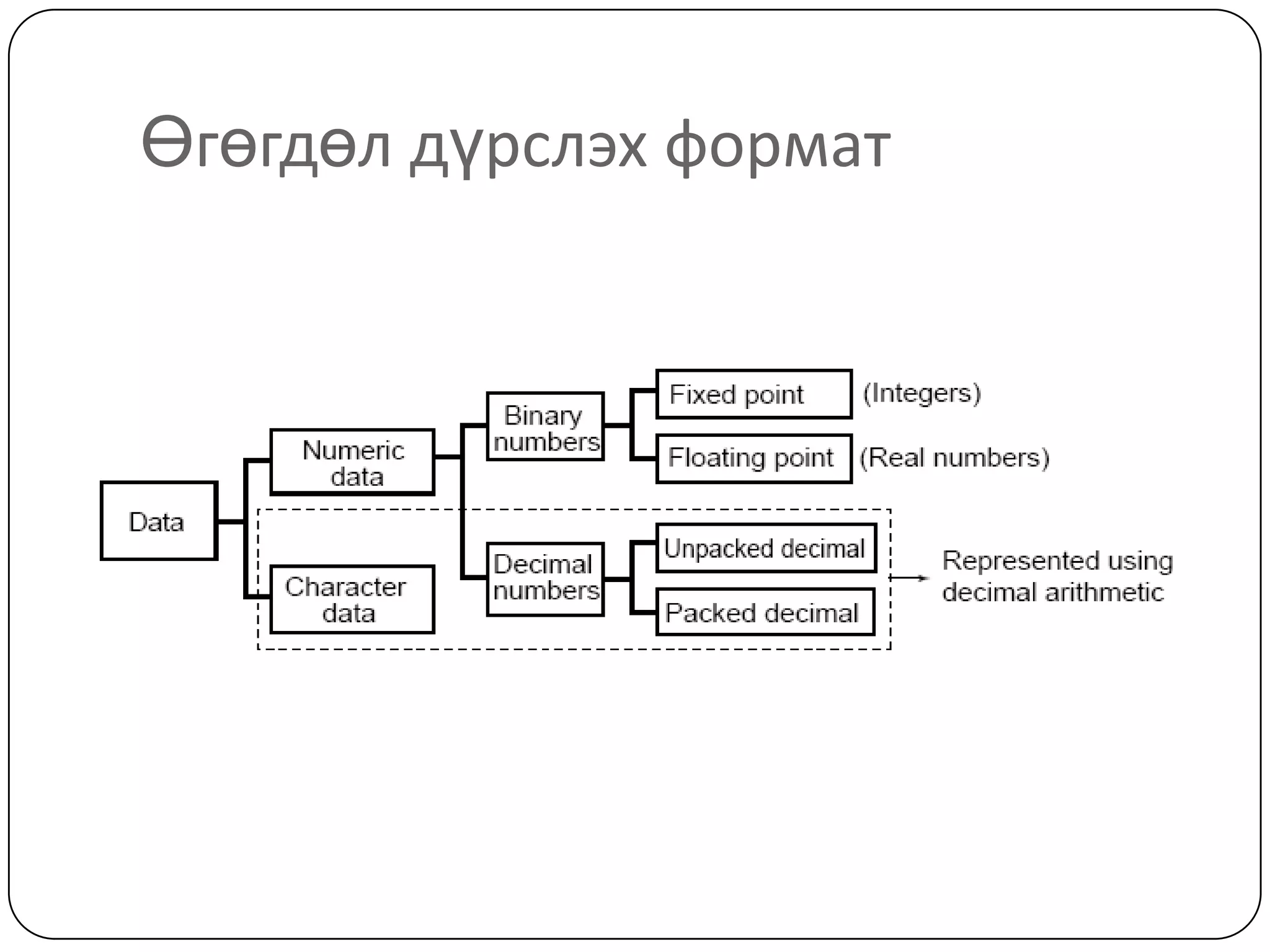
Өгөгдөл дүрслэх формат
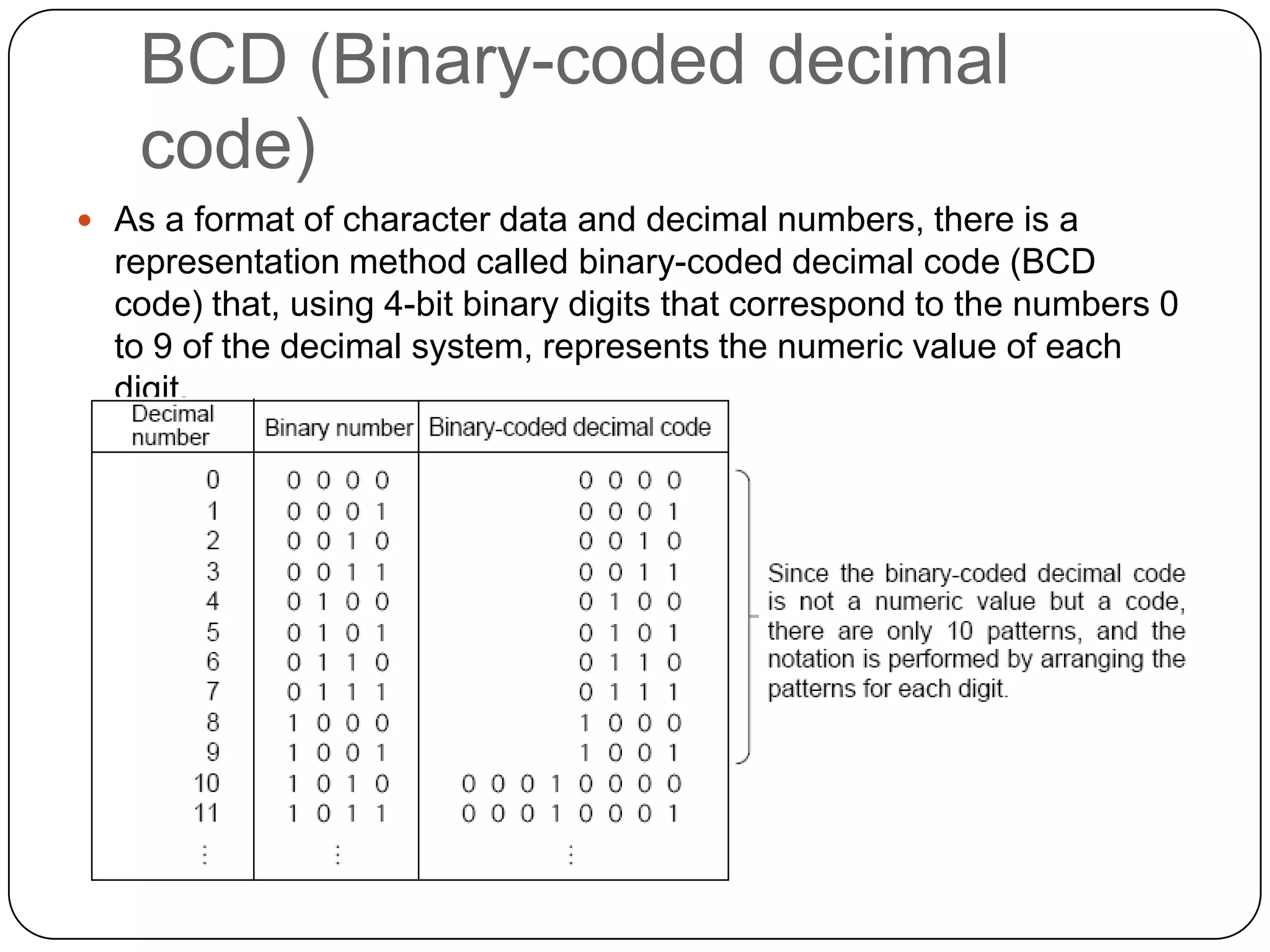
BCD (Binary-coded decimal
   code)
 As a format of character data and decimal numbers, there is a
  representation method called binary-coded decimal code (BCD
  code) that, using 4-bit binary digits that correspond to the numbers 0
  to 9 of the decimal system, represents the numeric value of each
  digit.
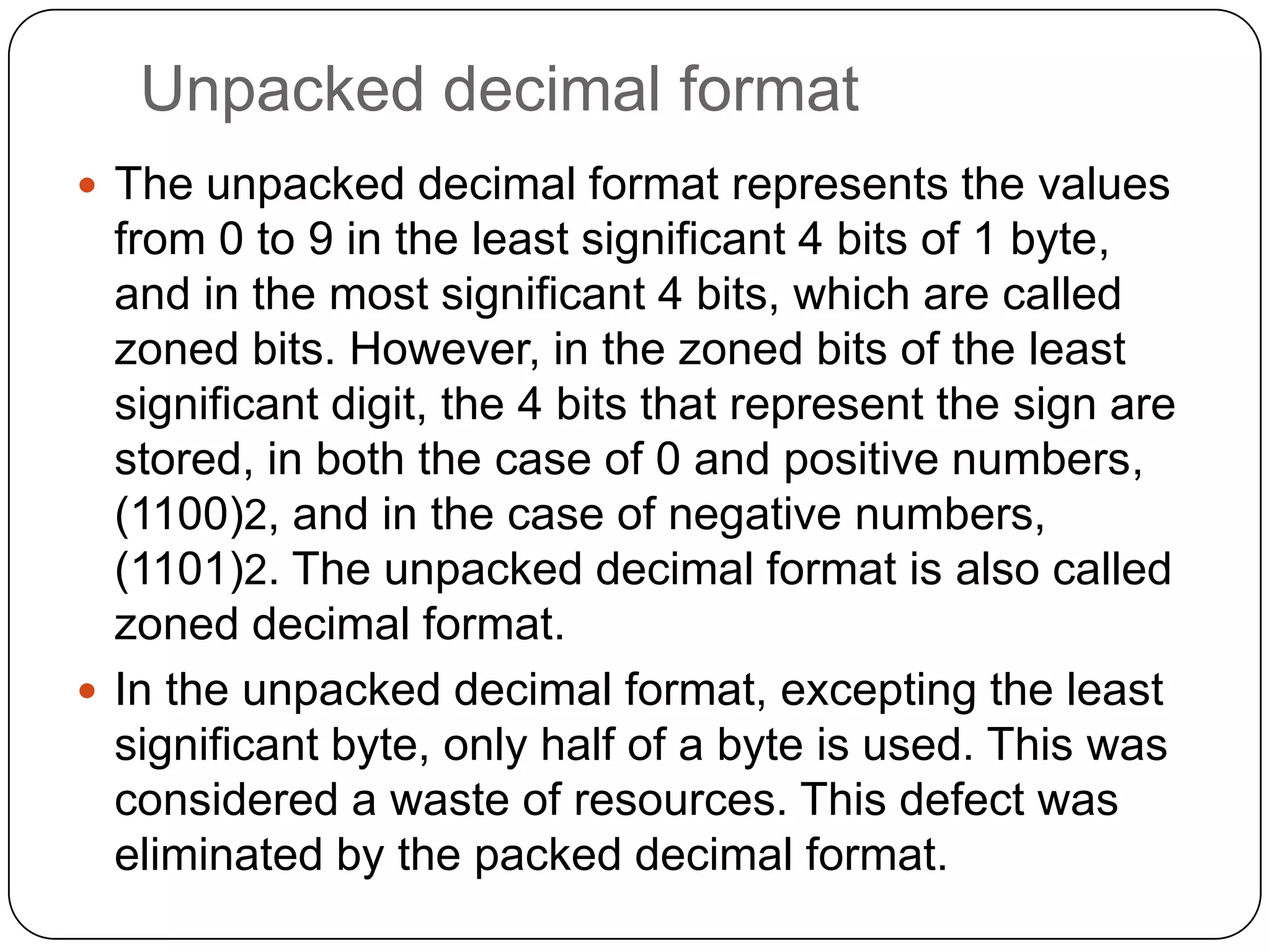
Unpacked decimal format
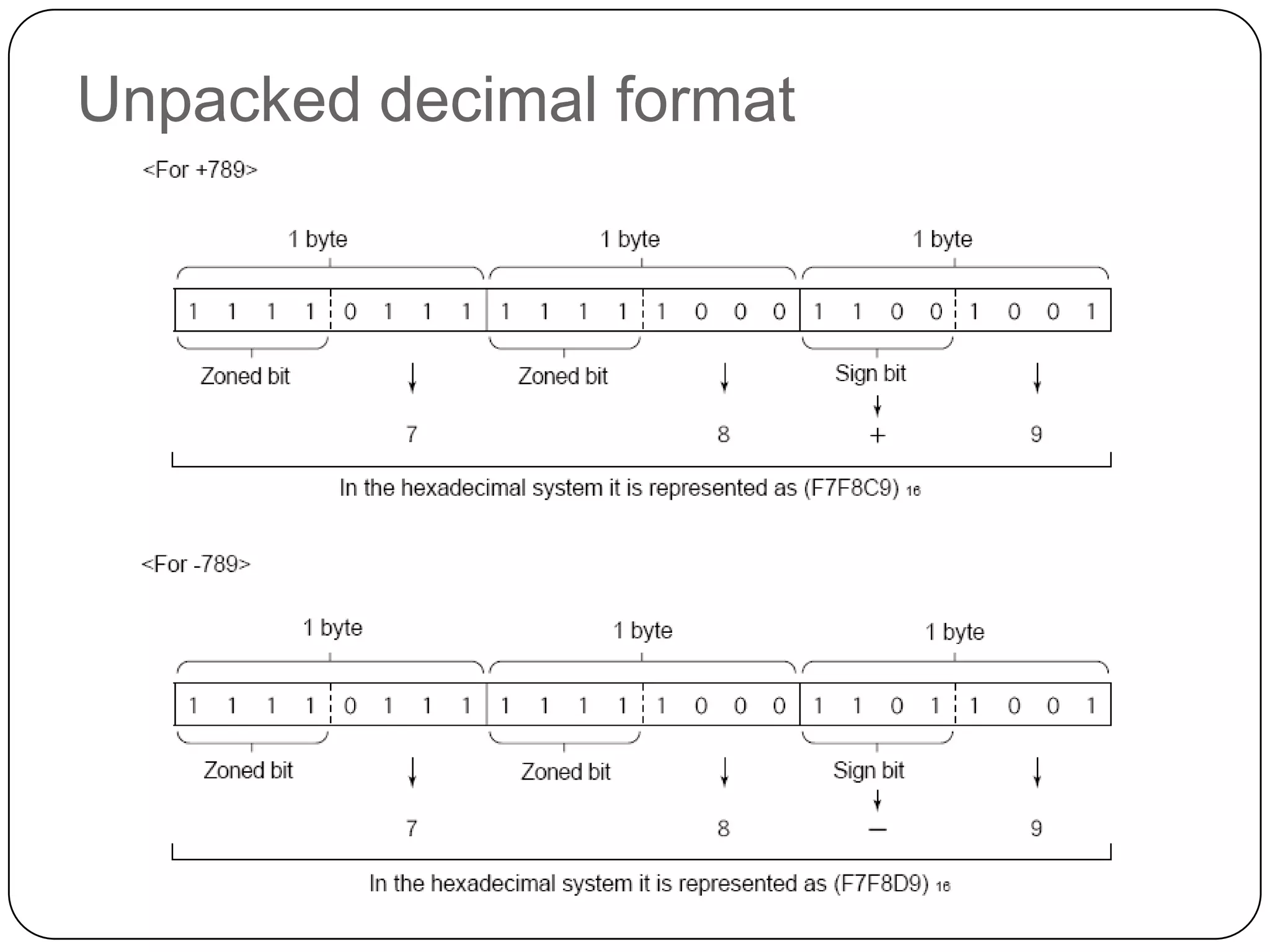
 The unpacked decimal format represents the values
  from 0 to 9 in the least significant 4 bits of 1 byte,
  and in the most significant 4 bits, which are called
  zoned bits. However, in the zoned bits of the least
  significant digit, the 4 bits that represent the sign are
  stored, in both the case of 0 and positive numbers,
  (1100)2, and in the case of negative numbers,
  (1101)2. The unpacked decimal format is also called
  zoned decimal format.
 In the unpacked decimal format, excepting the least
  significant byte, only half of a byte is used. This was
  considered a waste of resources. This defect was
  eliminated by the packed decimal format.
Unpacked decimal format
Packed decimal format
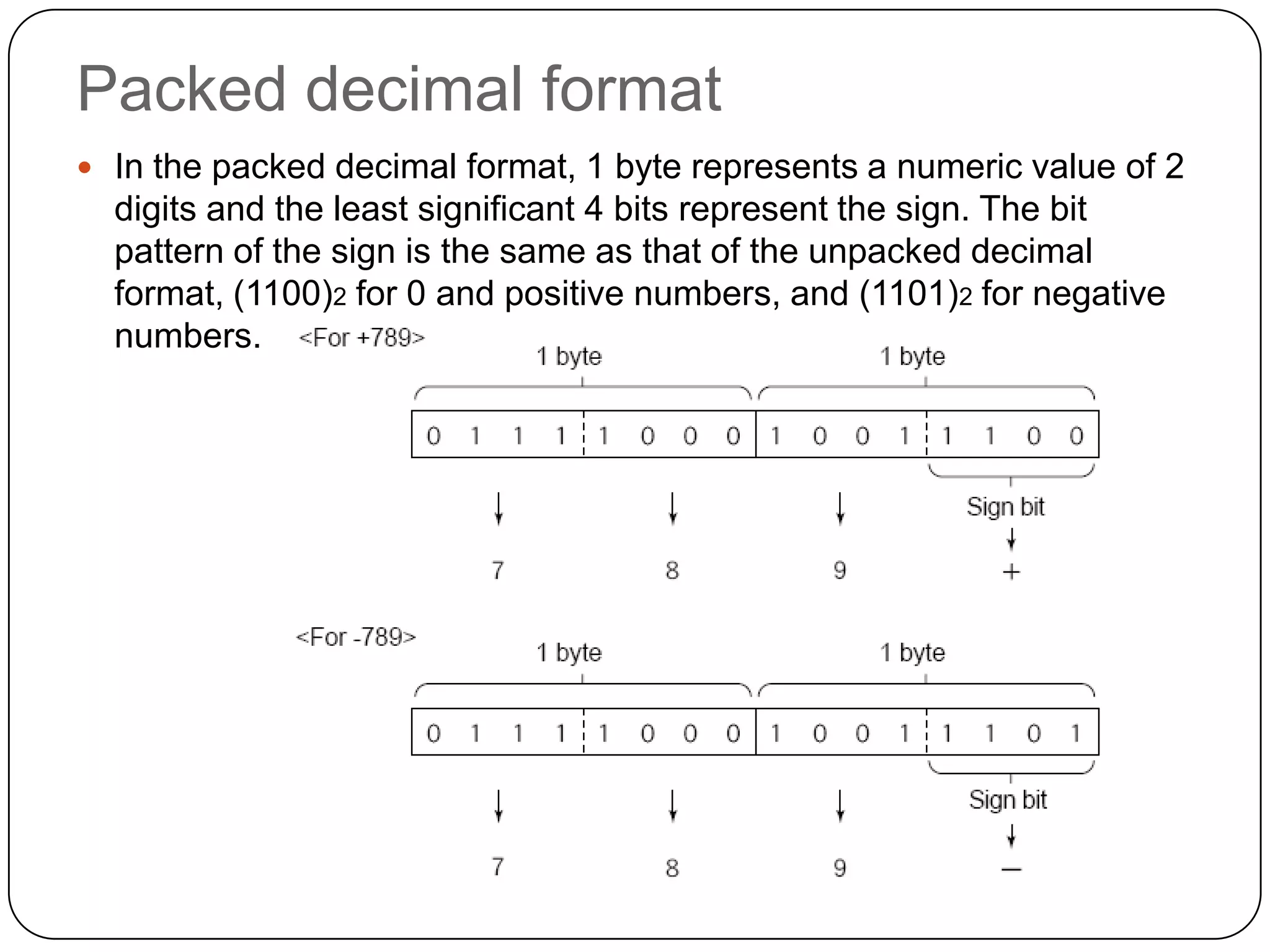
 In the packed decimal format, 1 byte represents a numeric value of 2
  digits and the least significant 4 bits represent the sign. The bit
  pattern of the sign is the same as that of the unpacked decimal
  format, (1100)2 for 0 and positive numbers, and (1101)2 for negative
  numbers.
Хоёртын системд өгөгдөл дүрслэх
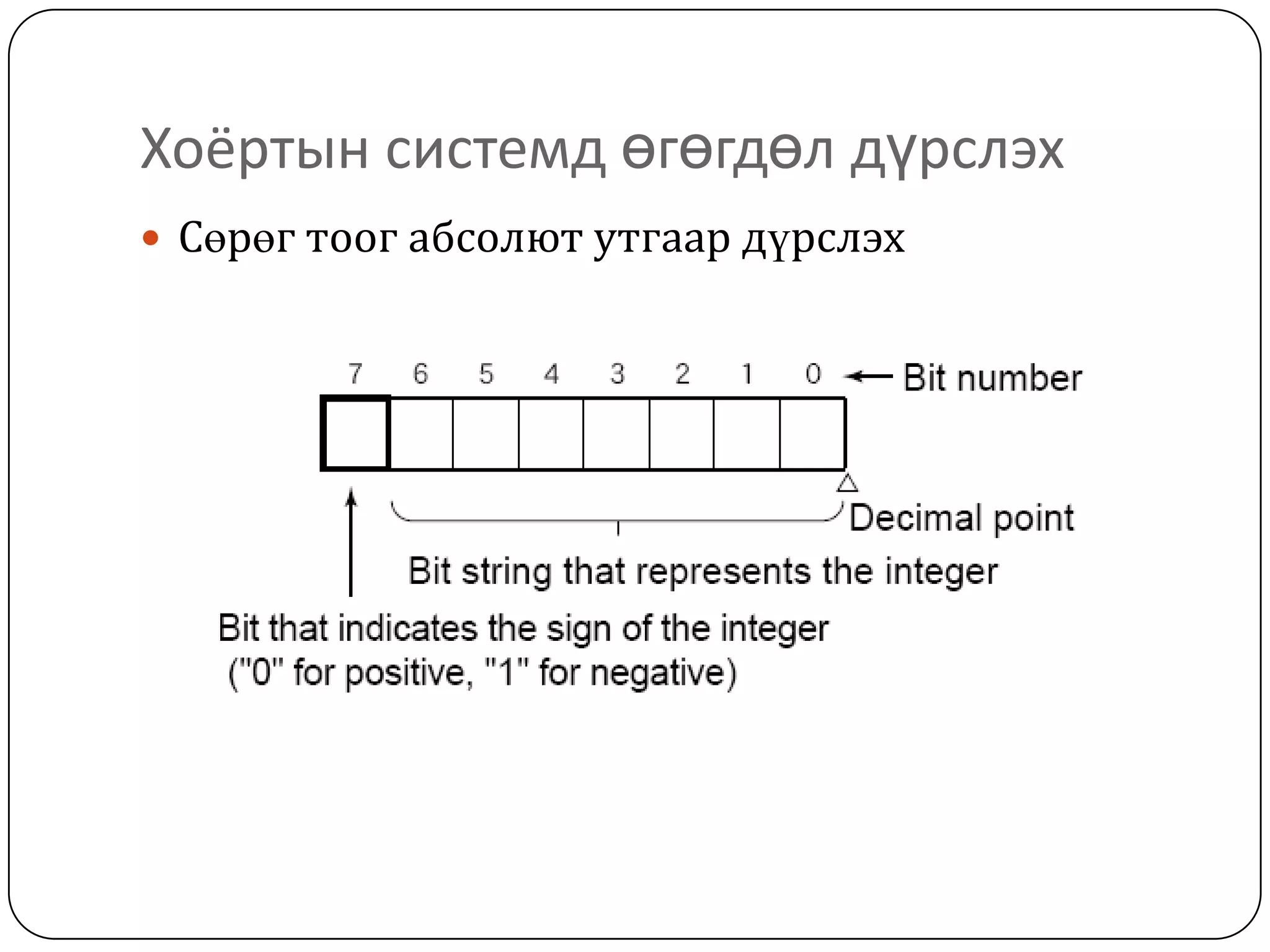
 Сөрөг тоог абсолют утгаар дүрслэх
Сөрөг тоог дүрслэх
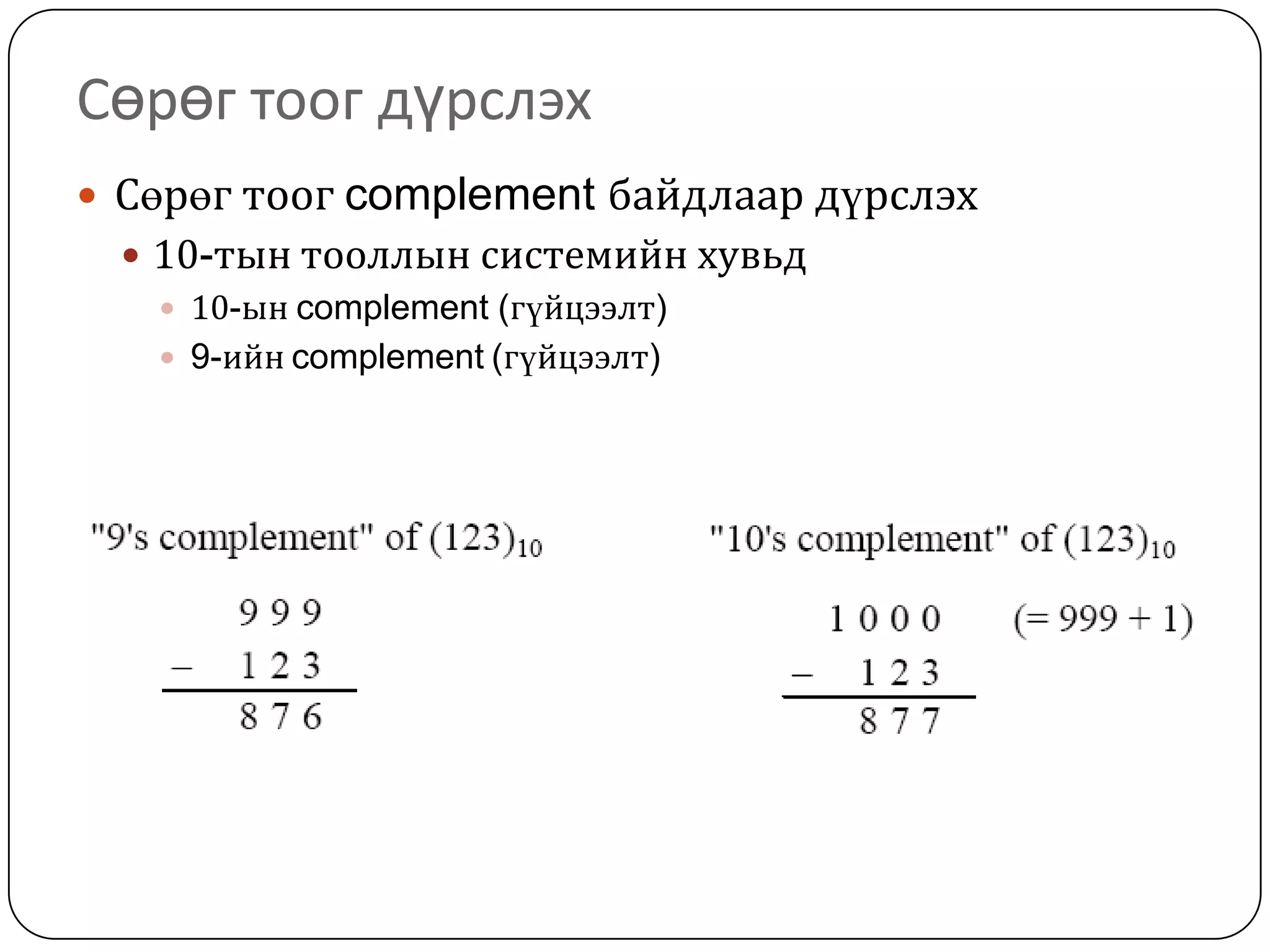
 Сөрөг тоог complement байдлаар дүрслэх
  10-тын тооллын системийн хувьд
    10-ын complement (гүйцээлт)
    9-ийн complement (гүйцээлт)
Сөрөг тоог дүрслэх
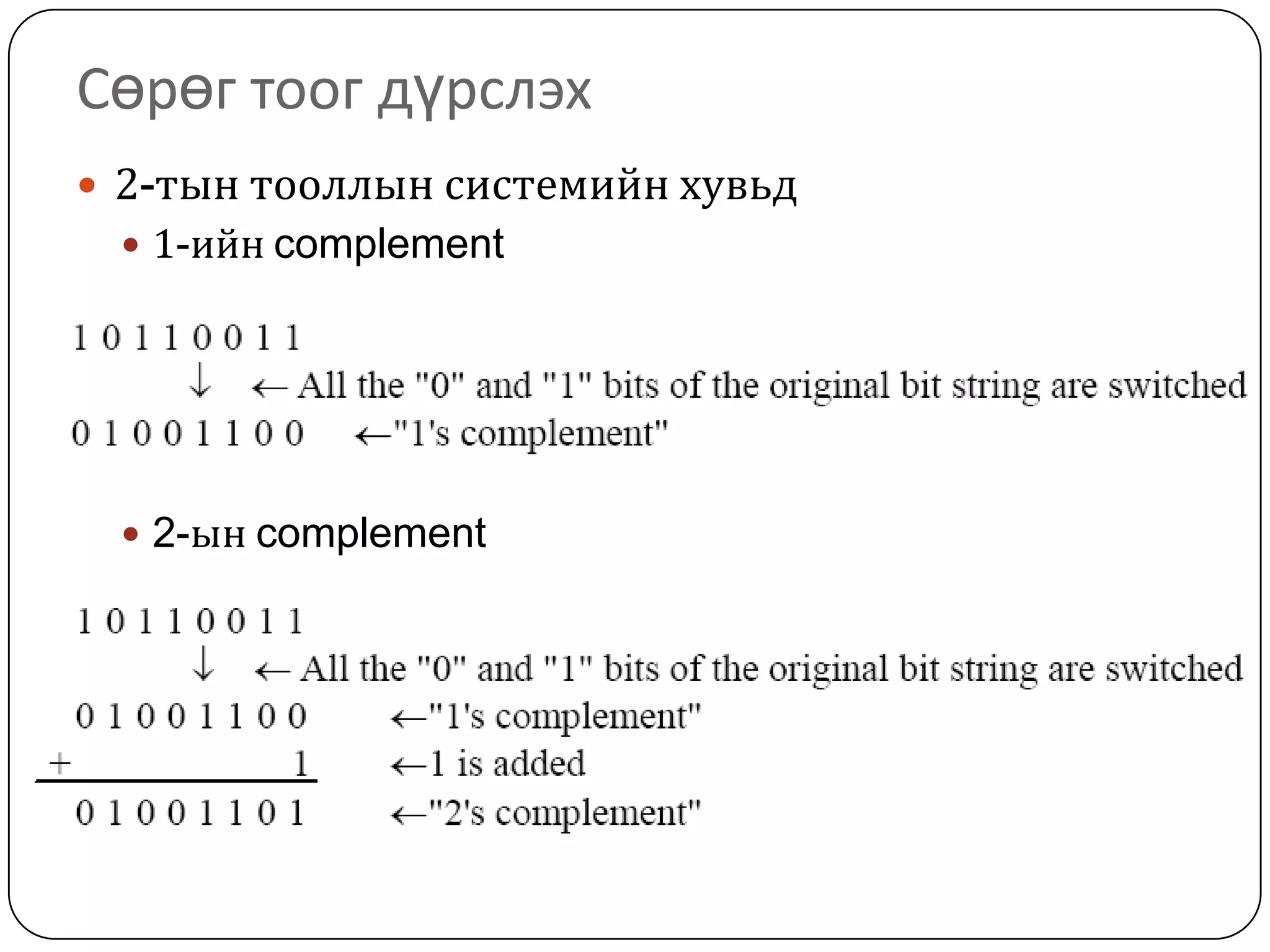
 2-тын тооллын системийн хувьд
  1-ийн complement


  2-ын complement
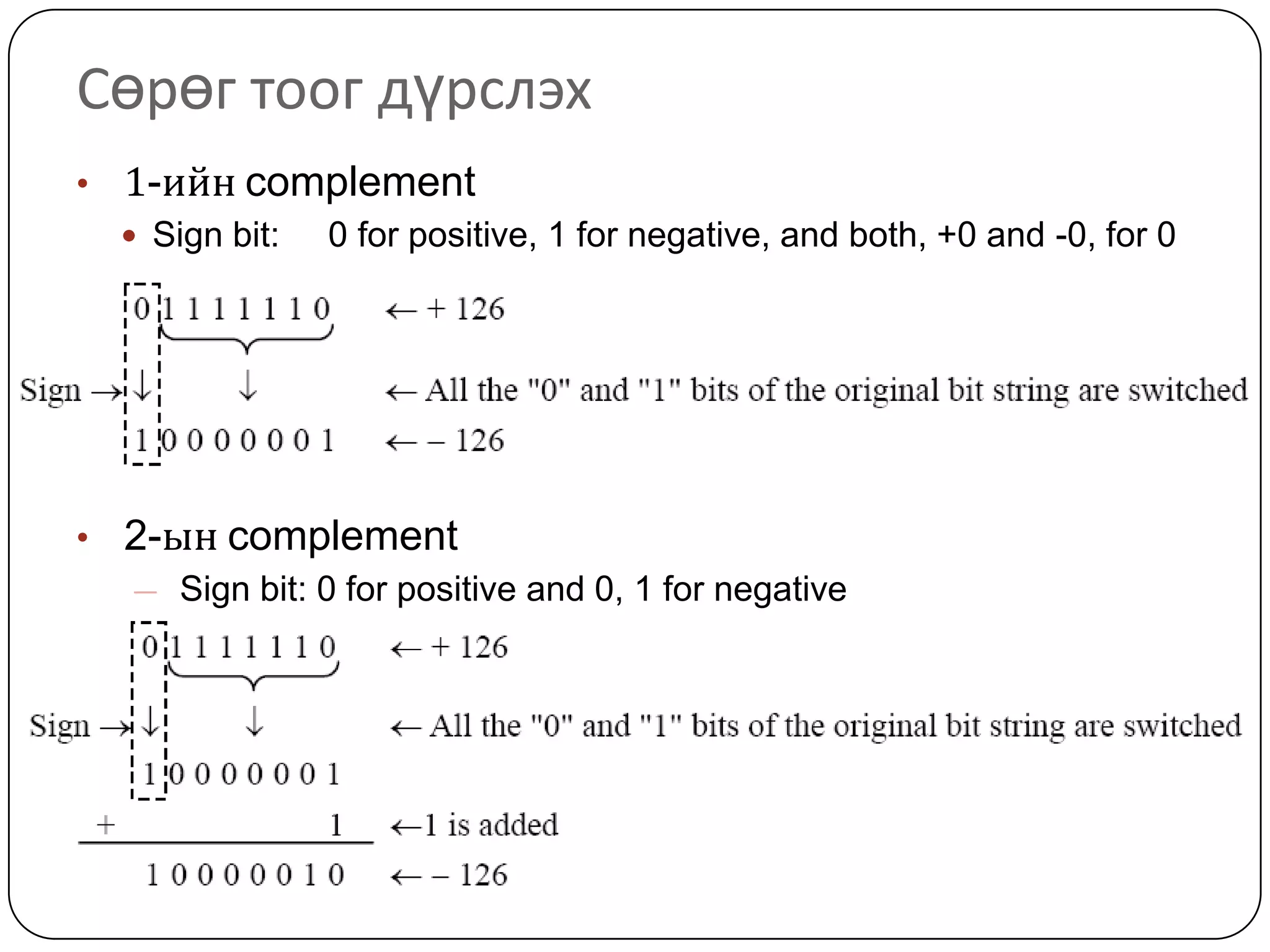
Сөрөг тоог дүрслэх
• 1-ийн complement
   Sign bit: 0 for positive, 1 for negative, and both, +0 and -0, for 0


• 2-ын complement
  — Sign bit: 0 for positive and 0, 1 for negative
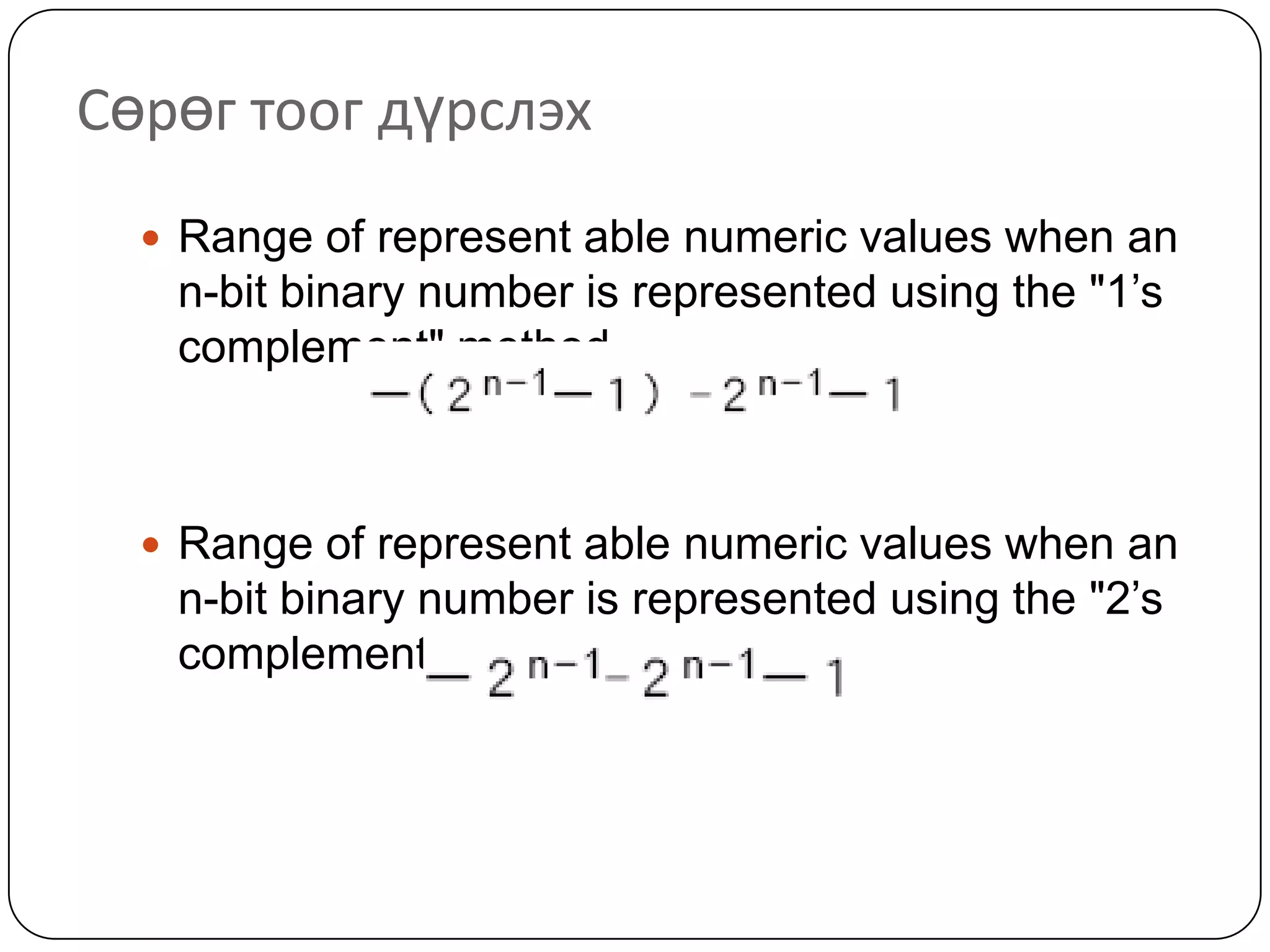
Сөрөг тоог дүрслэх
   Range of represent able numeric values when an
   n-bit binary number is represented using the "1’s
   complement" method


   Range of represent able numeric values when an
   n-bit binary number is represented using the "2’s
   complement" method
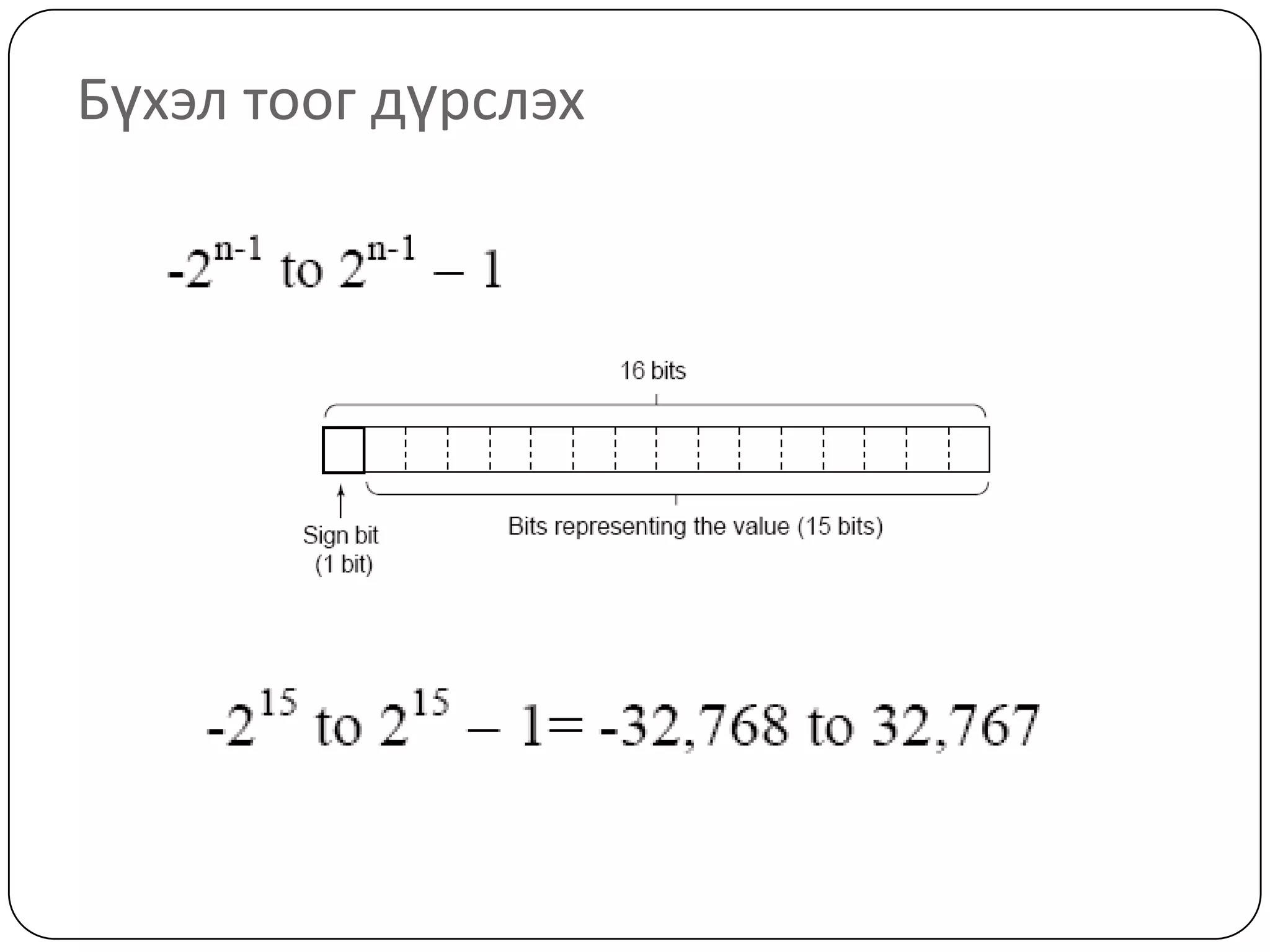
Бүхэл тоог дүрслэх
Бутархай тоог дүрслэх
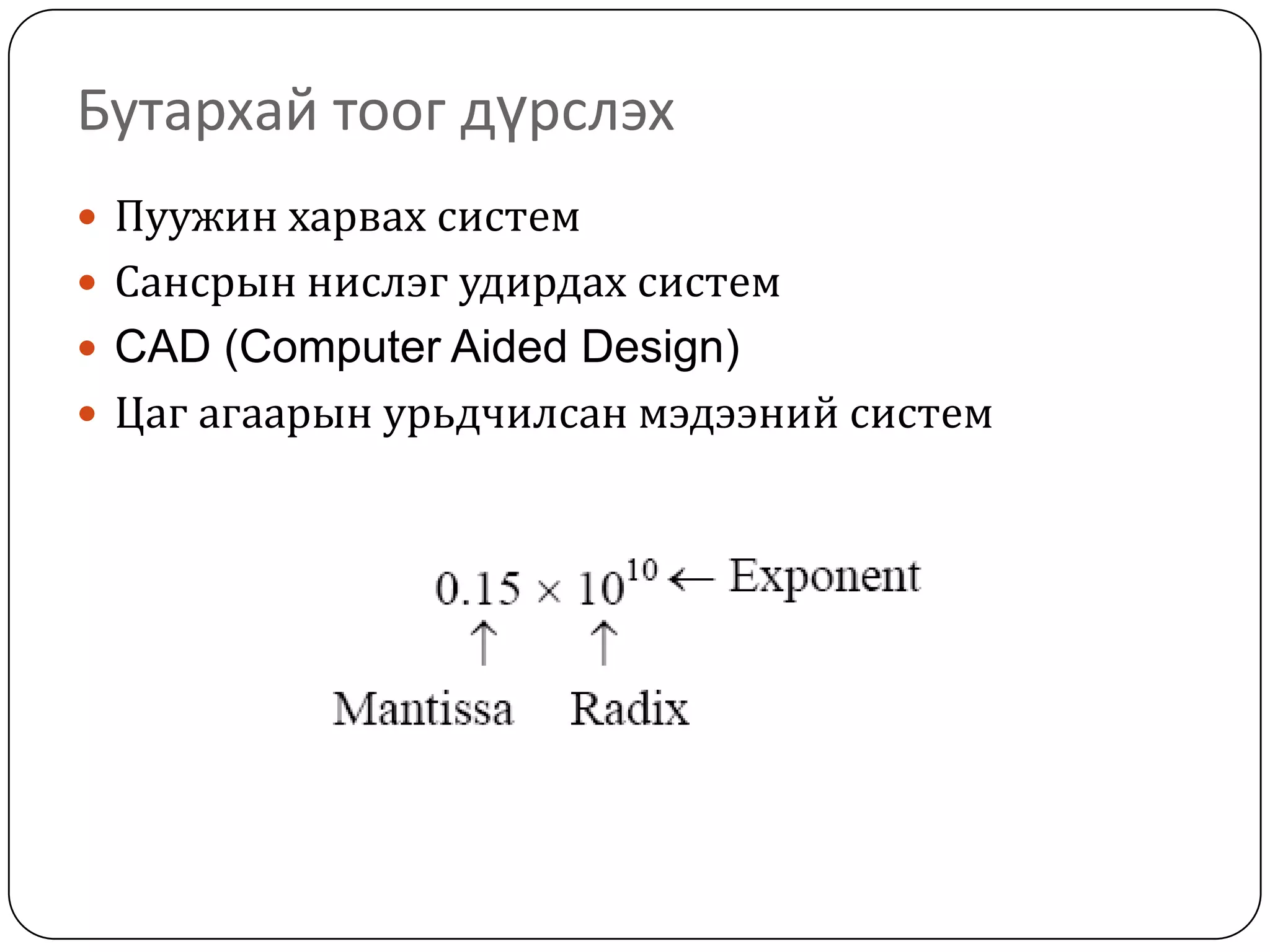
 Пуужин харвах систем
 Сансрын нислэг удирдах систем
 CAD (Computer Aided Design)
 Цаг агаарын урьдчилсан мэдээний систем
Бутархай тоог дүрслэх
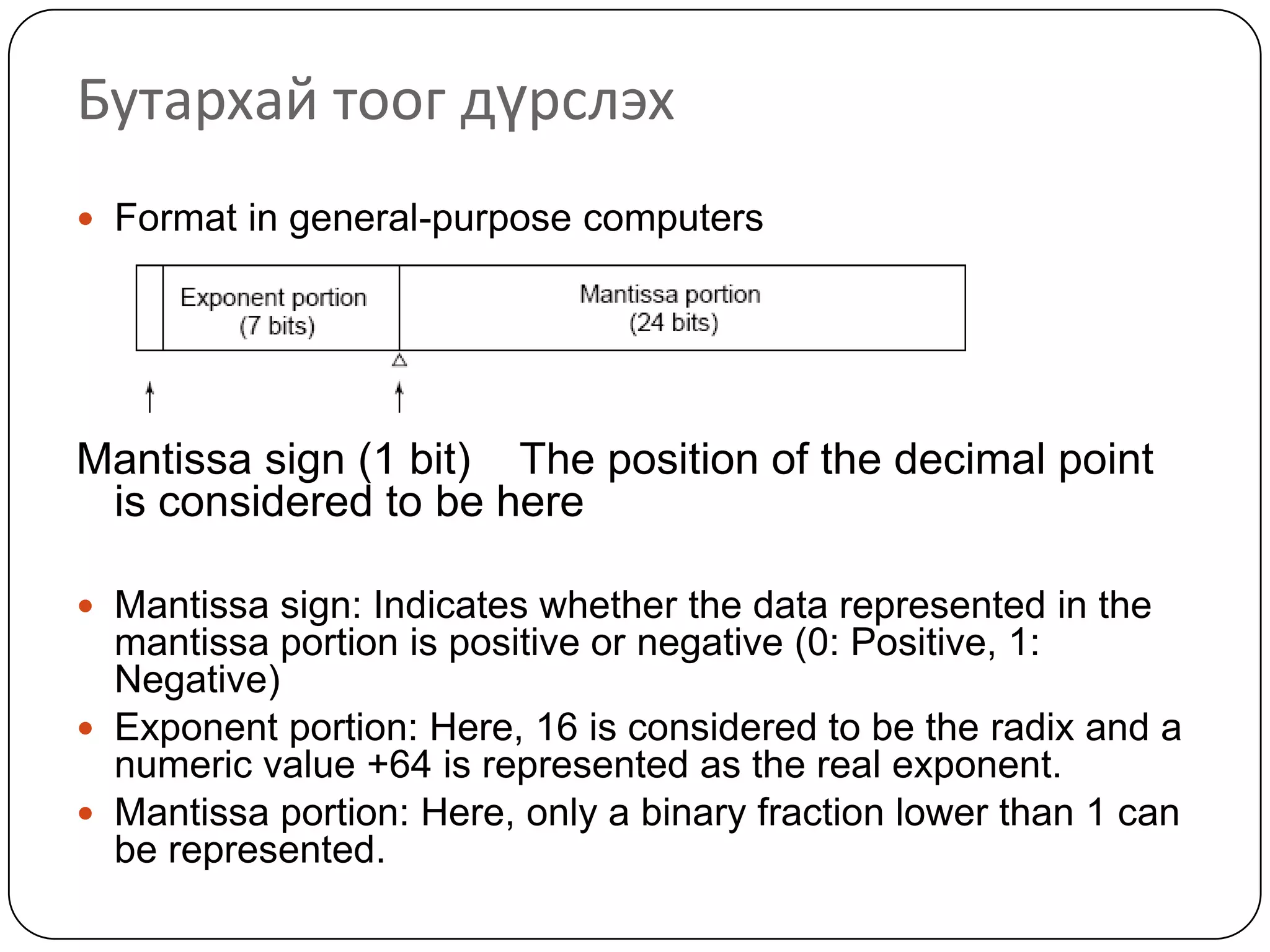
 Format in general-purpose computers


Mantissa sign (1 bit) The position of the decimal point
 is considered to be here

 Mantissa sign: Indicates whether the data represented in the
  mantissa portion is positive or negative (0: Positive, 1:
  Negative)
 Exponent portion: Here, 16 is considered to be the radix and a
  numeric value +64 is represented as the real exponent.
 Mantissa portion: Here, only a binary fraction lower than 1 can
  be represented.
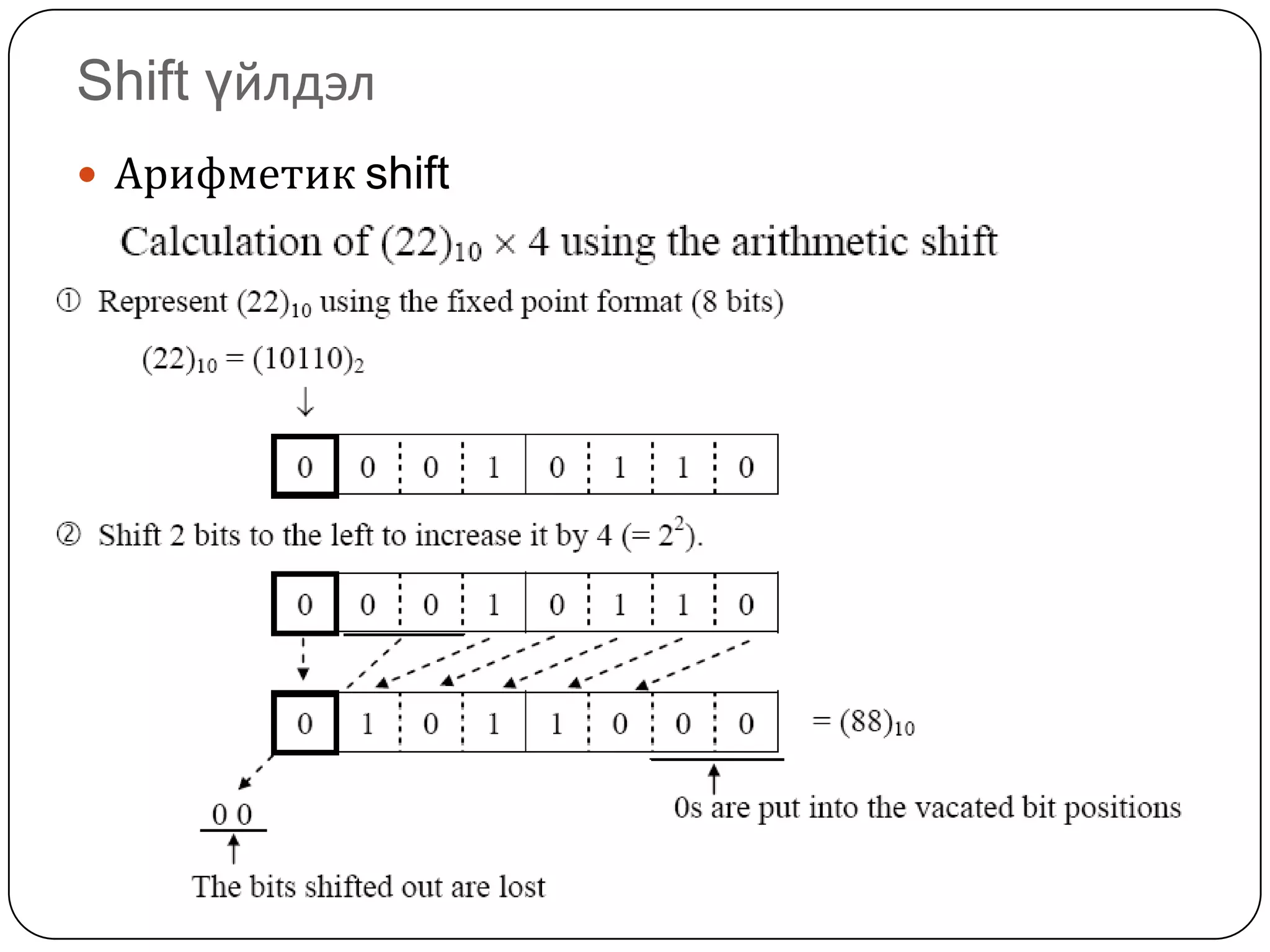
Shift үйлдэл
 Арифметик shift
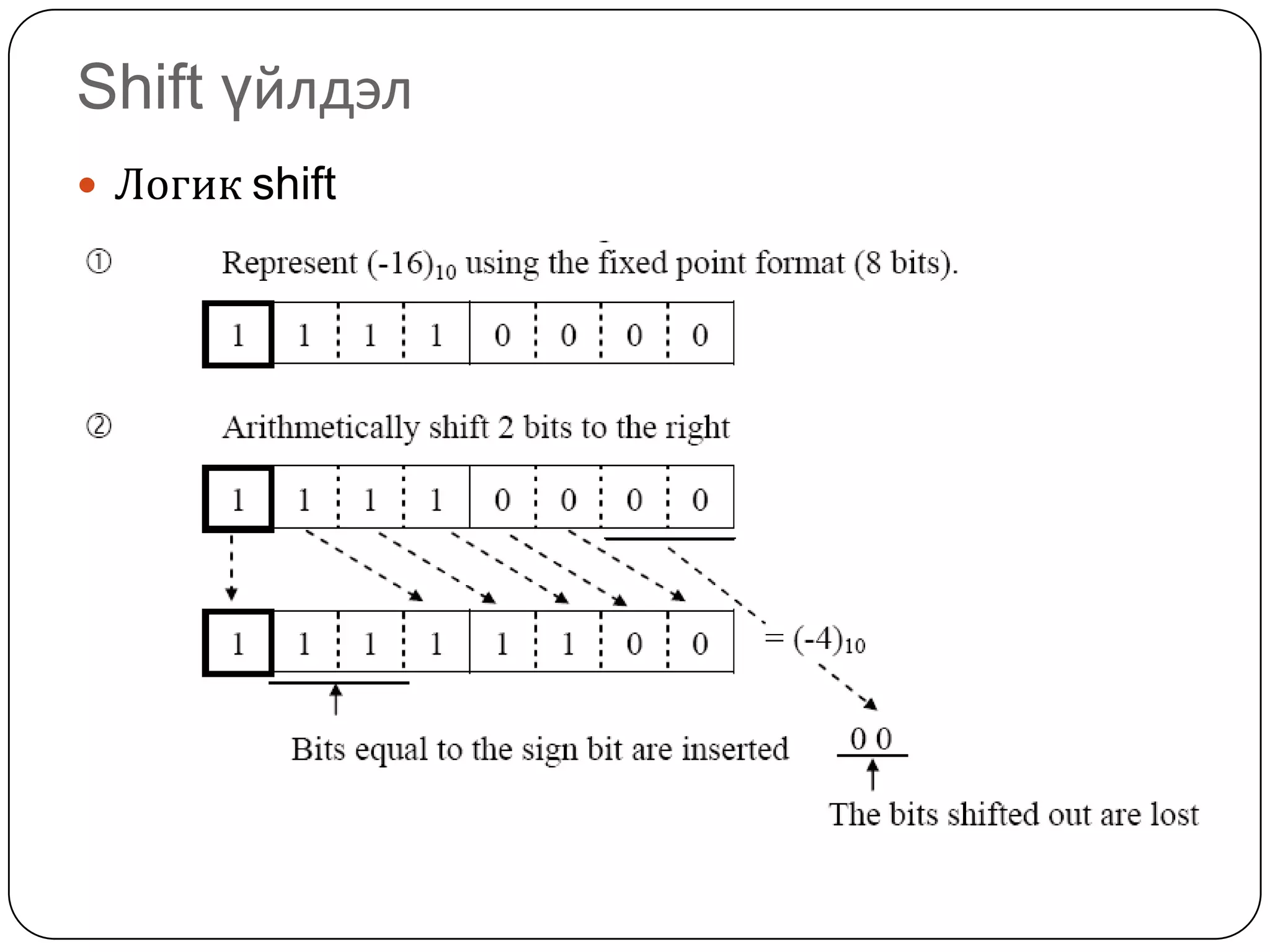
Shift үйлдэл
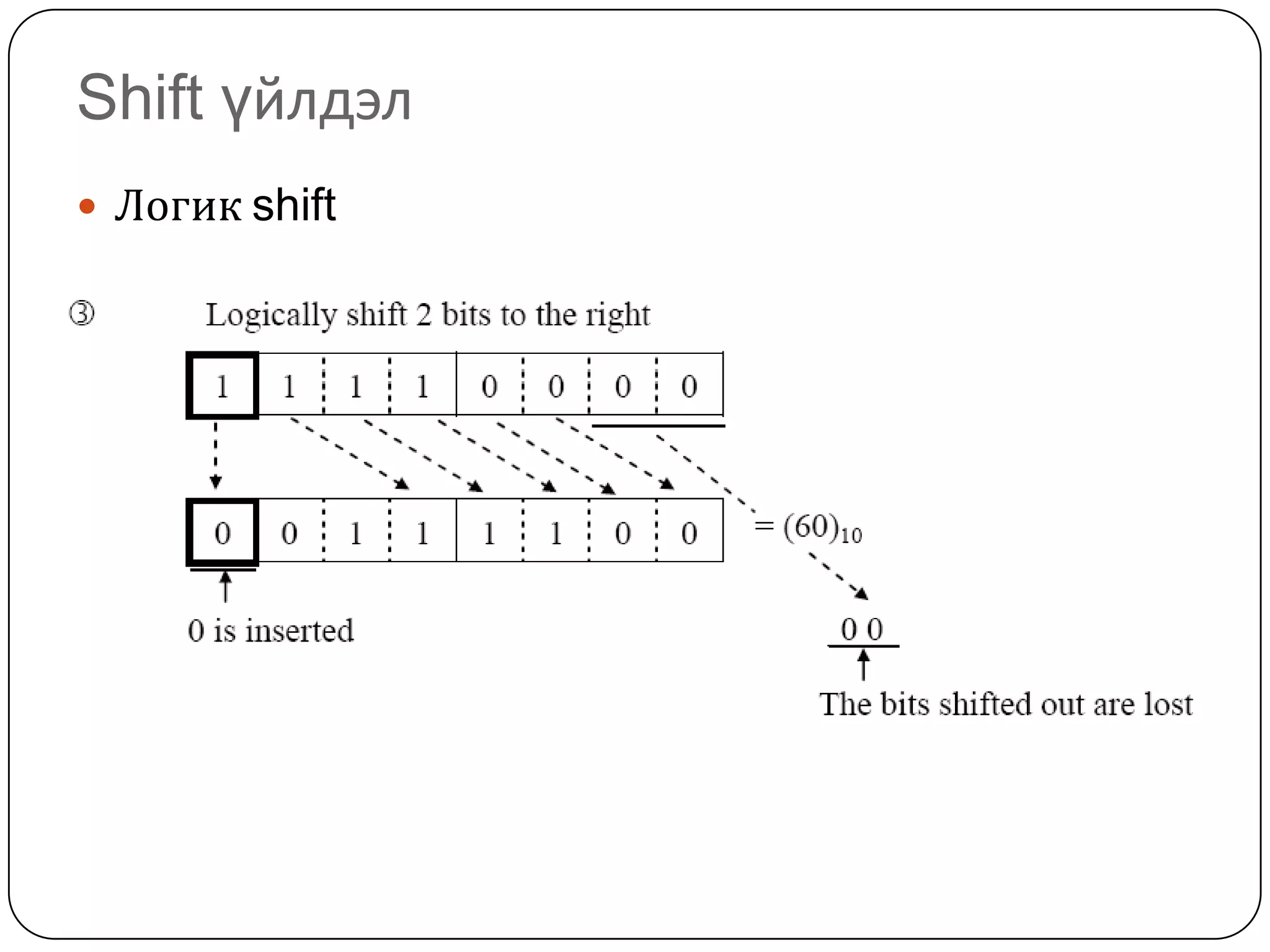
 Логик shift
Shift үйлдэл
 Логик shift
Тэмдэгтийн кодууд
 ASCII (American Standard Code for Information
  Interchange) code
  The ASCII code was established by the U.S. standards
  institution, ANSI (American National Standards Institute) in
  1962. Character code of 8 bits composed by the code bit
  representing the alphabet, numeric characters, etc. (7 bits)
  and the parity bit used to detect errors. It is used in personal
  computers and in data transmission.
 ISO (International Organization for Standardization) code
  The ISO code is a 7-bit character code that was established
  by the International Organization for Standardization (ISO) in
  1967 based on the ASCII code. It is the base of the character
  codes used in all countries of the world.
 JIS (Japanese Industrial Standards) code
  The JIS code was established as JIS X 0201 by adding the
  Romaji, hiragana and other characters peculiar to the
  Japanese language to the ISO code. The "JIS 7-bit code" used
  to represent Romaji and the "JIS 8-bit code" used to represent
  katakana as well as the "JIS kanji code," that represents 1
Тэмдэгтийн кодууд
 EBCDIC (Extended Binary Coded Decimal Interchange
  Code)
  The EBCDIC is a character code developed by IBM.
  Compared to the above-mentioned character codes, which
  were established to be used as standards, the EBCDIC code
  was developed for IBM computers. Since IBM held the
  greatest share of the computer market when the third
  generation computers, in which this code was developed, were
  launched, other companies developed their computers
  according to this character code, and as a result it became a
  standard character code. Standards like this, resulting from the
  existence of a large number of users, are called de facto
  standards.
 Shift JIS code
  As was mentioned above, to represent kanji, the JIS kanji
  code represents 1 word with 2 bytes.
 Unicode
  The unicode is a 2-byte code system unified to all the
  countries, which was proposed and designed by Apple
  Computer, IBM, Microsoft, and other U.S. companies in order
Бусад өгөгдлүүдийг дүрслэх
 Аудио


 Зураг
   1 өнгө –RBG=8 бит *3=24 бит =16000000

Lecture 2

  • 1.
  • 2.
  • 3.
    BCD (Binary-coded decimal code)  As a format of character data and decimal numbers, there is a representation method called binary-coded decimal code (BCD code) that, using 4-bit binary digits that correspond to the numbers 0 to 9 of the decimal system, represents the numeric value of each digit.
  • 4.
    Unpacked decimal format The unpacked decimal format represents the values from 0 to 9 in the least significant 4 bits of 1 byte, and in the most significant 4 bits, which are called zoned bits. However, in the zoned bits of the least significant digit, the 4 bits that represent the sign are stored, in both the case of 0 and positive numbers, (1100)2, and in the case of negative numbers, (1101)2. The unpacked decimal format is also called zoned decimal format.  In the unpacked decimal format, excepting the least significant byte, only half of a byte is used. This was considered a waste of resources. This defect was eliminated by the packed decimal format.
  • 5.
  • 6.
    Packed decimal format In the packed decimal format, 1 byte represents a numeric value of 2 digits and the least significant 4 bits represent the sign. The bit pattern of the sign is the same as that of the unpacked decimal format, (1100)2 for 0 and positive numbers, and (1101)2 for negative numbers.
  • 7.
    Хоёртын системд өгөгдөлдүрслэх  Сөрөг тоог абсолют утгаар дүрслэх
  • 8.
    Сөрөг тоог дүрслэх Сөрөг тоог complement байдлаар дүрслэх  10-тын тооллын системийн хувьд  10-ын complement (гүйцээлт)  9-ийн complement (гүйцээлт)
  • 9.
    Сөрөг тоог дүрслэх 2-тын тооллын системийн хувьд  1-ийн complement  2-ын complement
  • 10.
    Сөрөг тоог дүрслэх •1-ийн complement  Sign bit: 0 for positive, 1 for negative, and both, +0 and -0, for 0 • 2-ын complement — Sign bit: 0 for positive and 0, 1 for negative
  • 11.
    Сөрөг тоог дүрслэх  Range of represent able numeric values when an n-bit binary number is represented using the "1’s complement" method  Range of represent able numeric values when an n-bit binary number is represented using the "2’s complement" method
  • 12.
  • 13.
    Бутархай тоог дүрслэх Пуужин харвах систем  Сансрын нислэг удирдах систем  CAD (Computer Aided Design)  Цаг агаарын урьдчилсан мэдээний систем
  • 14.
    Бутархай тоог дүрслэх Format in general-purpose computers Mantissa sign (1 bit) The position of the decimal point is considered to be here  Mantissa sign: Indicates whether the data represented in the mantissa portion is positive or negative (0: Positive, 1: Negative)  Exponent portion: Here, 16 is considered to be the radix and a numeric value +64 is represented as the real exponent.  Mantissa portion: Here, only a binary fraction lower than 1 can be represented.
  • 15.
  • 16.
  • 17.
  • 18.
    Тэмдэгтийн кодууд  ASCII(American Standard Code for Information Interchange) code The ASCII code was established by the U.S. standards institution, ANSI (American National Standards Institute) in 1962. Character code of 8 bits composed by the code bit representing the alphabet, numeric characters, etc. (7 bits) and the parity bit used to detect errors. It is used in personal computers and in data transmission.  ISO (International Organization for Standardization) code The ISO code is a 7-bit character code that was established by the International Organization for Standardization (ISO) in 1967 based on the ASCII code. It is the base of the character codes used in all countries of the world.  JIS (Japanese Industrial Standards) code The JIS code was established as JIS X 0201 by adding the Romaji, hiragana and other characters peculiar to the Japanese language to the ISO code. The "JIS 7-bit code" used to represent Romaji and the "JIS 8-bit code" used to represent katakana as well as the "JIS kanji code," that represents 1
  • 19.
    Тэмдэгтийн кодууд  EBCDIC(Extended Binary Coded Decimal Interchange Code) The EBCDIC is a character code developed by IBM. Compared to the above-mentioned character codes, which were established to be used as standards, the EBCDIC code was developed for IBM computers. Since IBM held the greatest share of the computer market when the third generation computers, in which this code was developed, were launched, other companies developed their computers according to this character code, and as a result it became a standard character code. Standards like this, resulting from the existence of a large number of users, are called de facto standards.  Shift JIS code As was mentioned above, to represent kanji, the JIS kanji code represents 1 word with 2 bytes.  Unicode The unicode is a 2-byte code system unified to all the countries, which was proposed and designed by Apple Computer, IBM, Microsoft, and other U.S. companies in order
  • 20.
    Бусад өгөгдлүүдийг дүрслэх Аудио  Зураг  1 өнгө –RBG=8 бит *3=24 бит =16000000