KINETICS and EQUILIBRIUM Factors that Affect the Rate of Reaction (5) Heat of Reaction,  ∆ H Spontaneous Reactions Equilibrium Chapter 7 KINETICS  refers to the rate and mechanism of reactions.
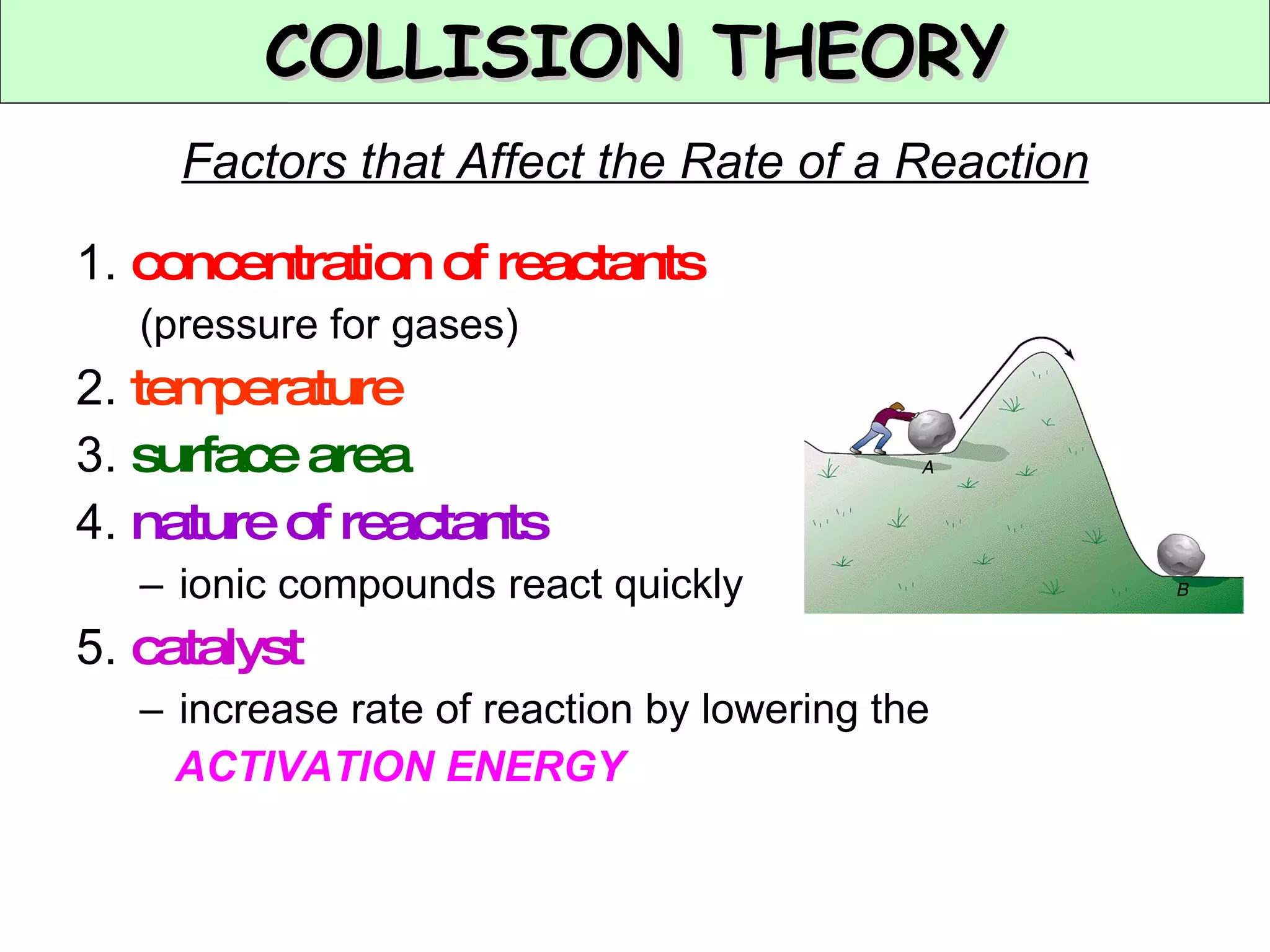
COLLISION THEORY Factors that Affect the Rate of a Reaction 1.  concentration of reactants (pressure for gases) 2.  temperature 3.  surface area 4.  nature of reactants ionic compounds react quickly 5.  catalyst increase rate of reaction by lowering the ACTIVATION ENERGY
Every substance has potential energy/ heat content. ∆ H, the  heat of reaction , is the amount of heat released or absorbed in a chemical reaction. ∆ H = H products  – H reactants EXOTHERMIC REACTION heat is released; products have less P.E. (heat) than reactants  ∆ H is NEGATIVE; feels HOT/WARM ENDOTHERMIC REACTION heat is absorbed, products have more P.E. (heat) than reactants ∆ H is POSITIVE; feels COLD HEAT OF REACTION, ∆H reactants    products
Given the reaction at 25 °C: Zn (s) + 2HCl (aq)    ZnCl 2  (aq) + H 2  (aq)  The rate of this reaction can be increased by using 5.0 grams of powdered zinc instead of a 5.0-gram strip of zinc because powdered zinc has A catalyst increases the rate of a chemical reaction by DO NOW   Explain your answers!   (d) more zinc atoms (b) lower concentration (c) more surface area (a) lower kinetic energy raising the concentration of the reactants (d) raising the temperature of the reactants (c) lowering the potential energy of the products (b) lowering the activation energy of the reaction  (a)
 
 
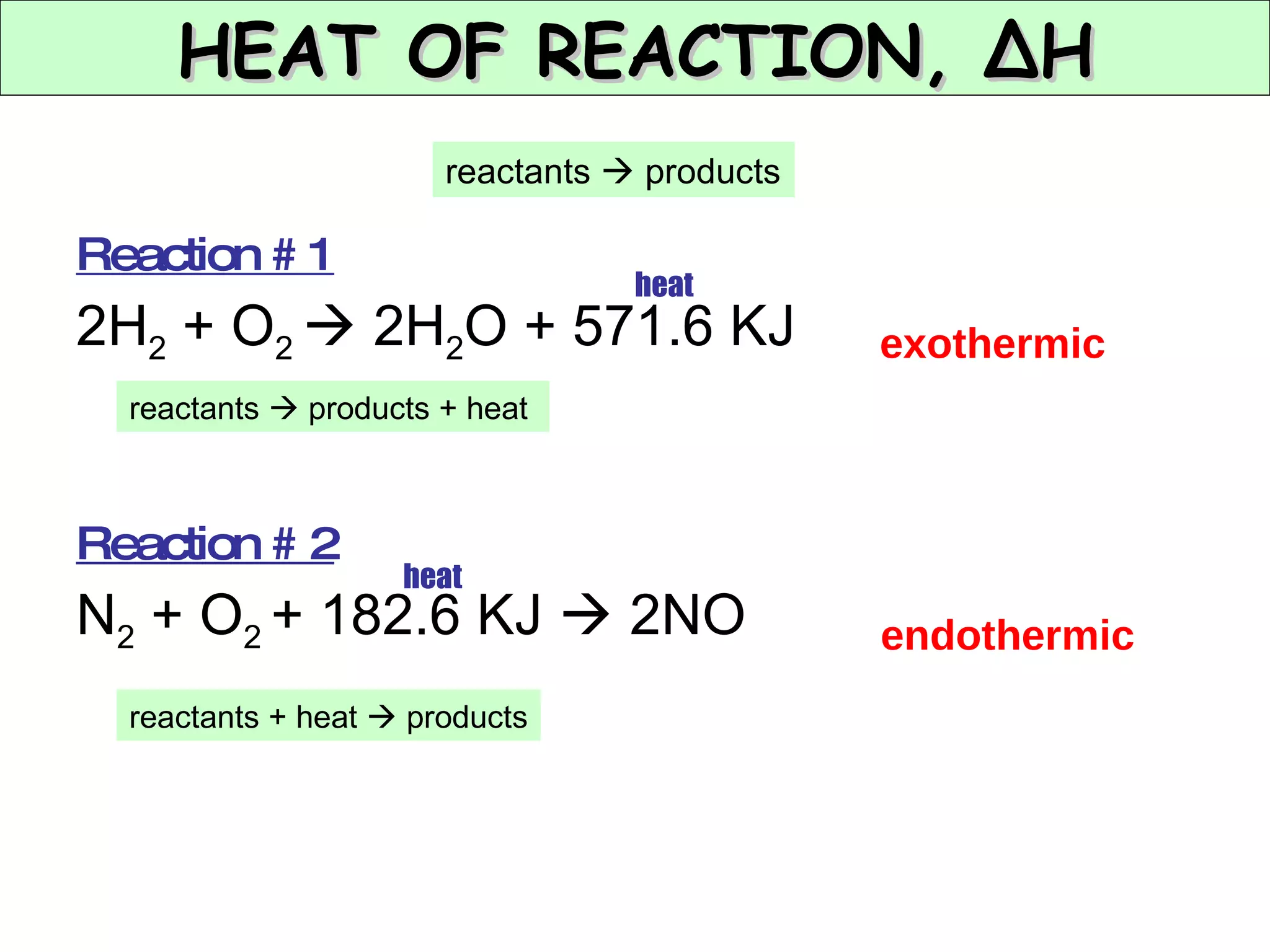
Reaction # 1 2H 2  + O 2    2H 2 O + 571.6 KJ  Reaction # 2 N 2  + O 2  + 182.6 KJ    2NO HEAT OF REACTION, ∆H reactants    products heat heat reactants    products + heat  reactants + heat    products exothermic endothermic
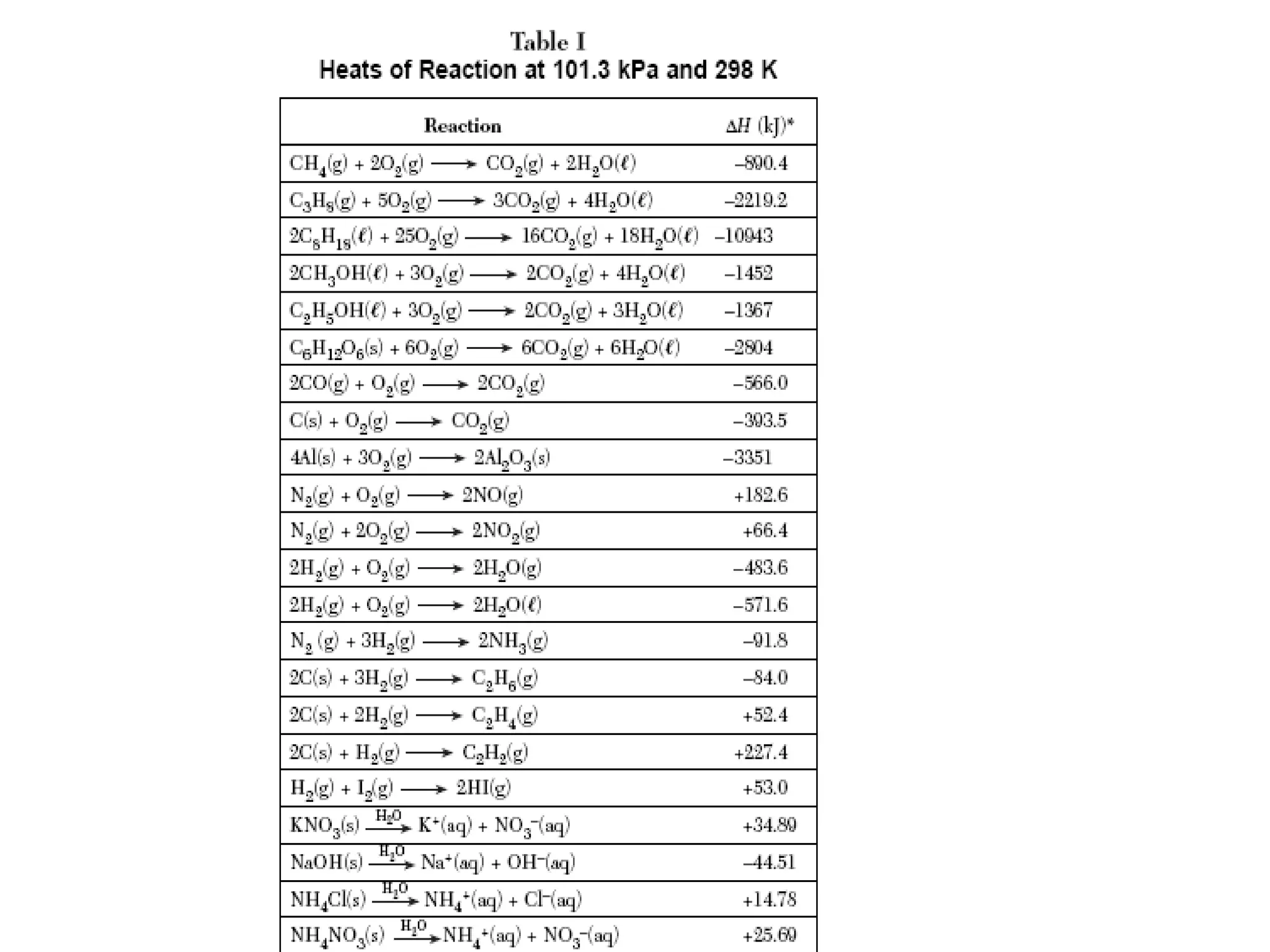
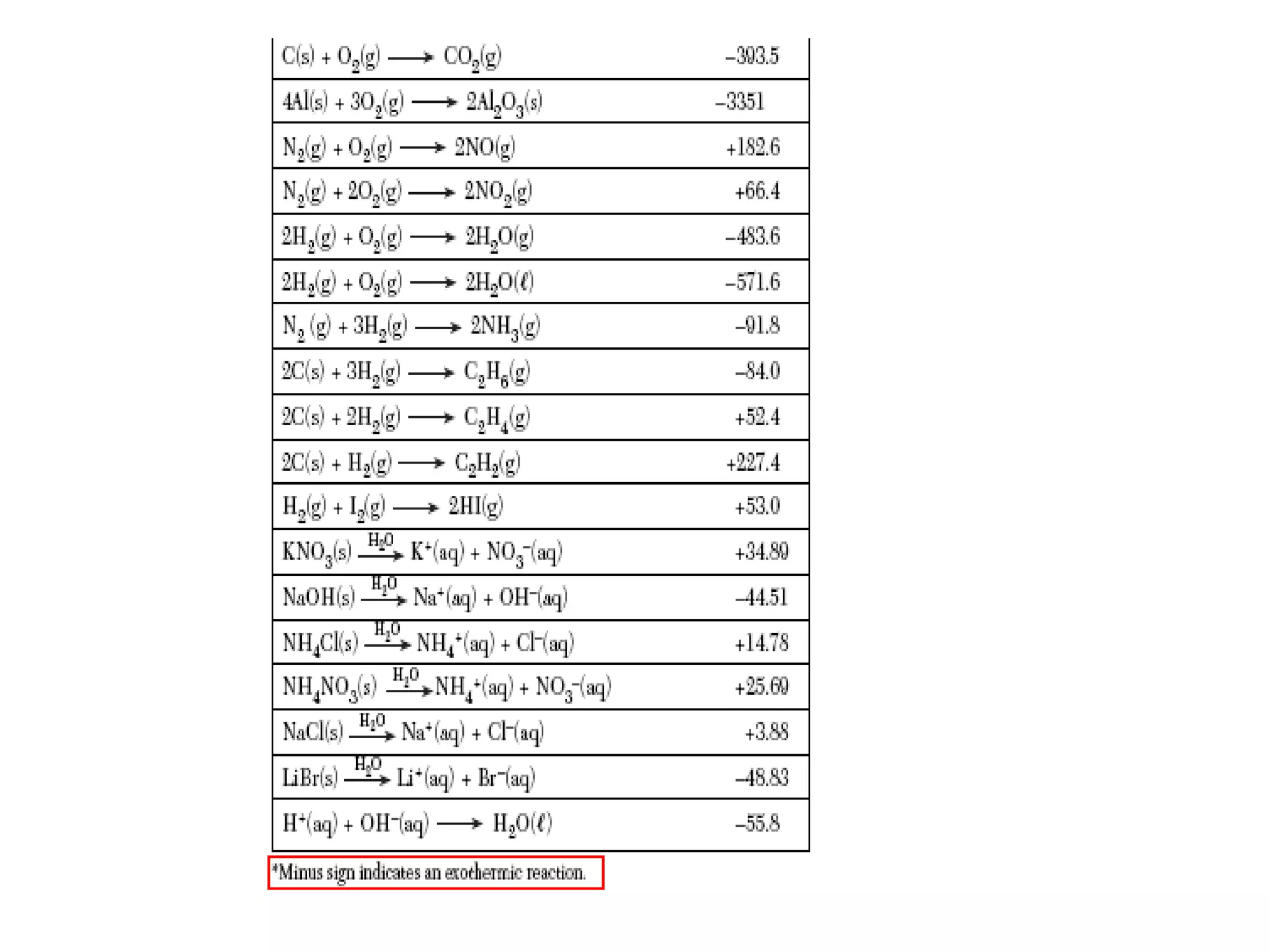
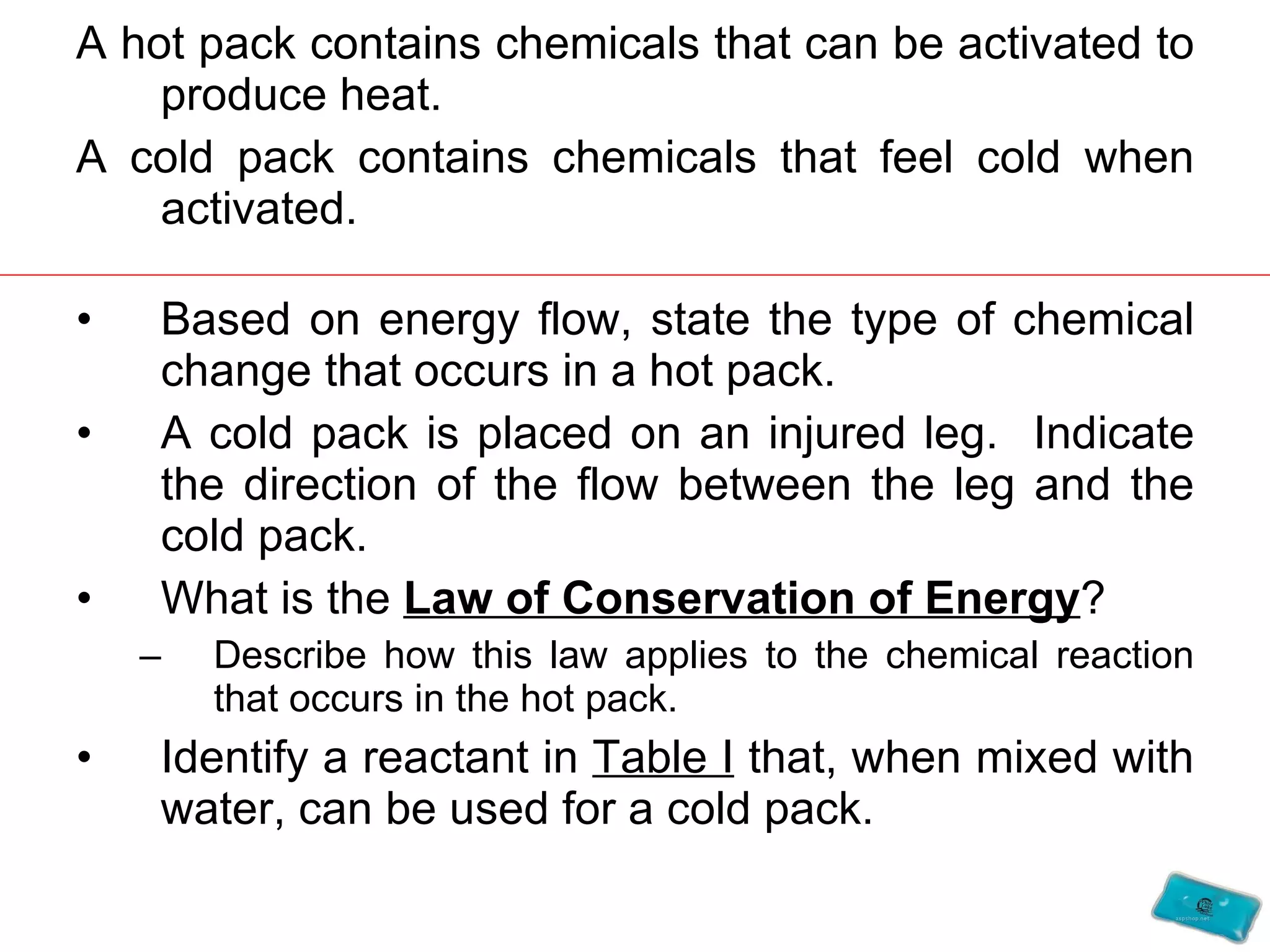
A hot pack contains chemicals that can be activated to produce heat. A cold pack contains chemicals that feel cold when activated. Based on energy flow, state the type of chemical change that occurs in a hot pack. A cold pack is placed on an injured leg.  Indicate the direction of the flow between the leg and the cold pack. What is the  Law of Conservation of Energy ?  Describe how this law applies to the chemical reaction that occurs in the hot pack. Identify a reactant in  Table I  that, when mixed with water, can be used for a cold pack.
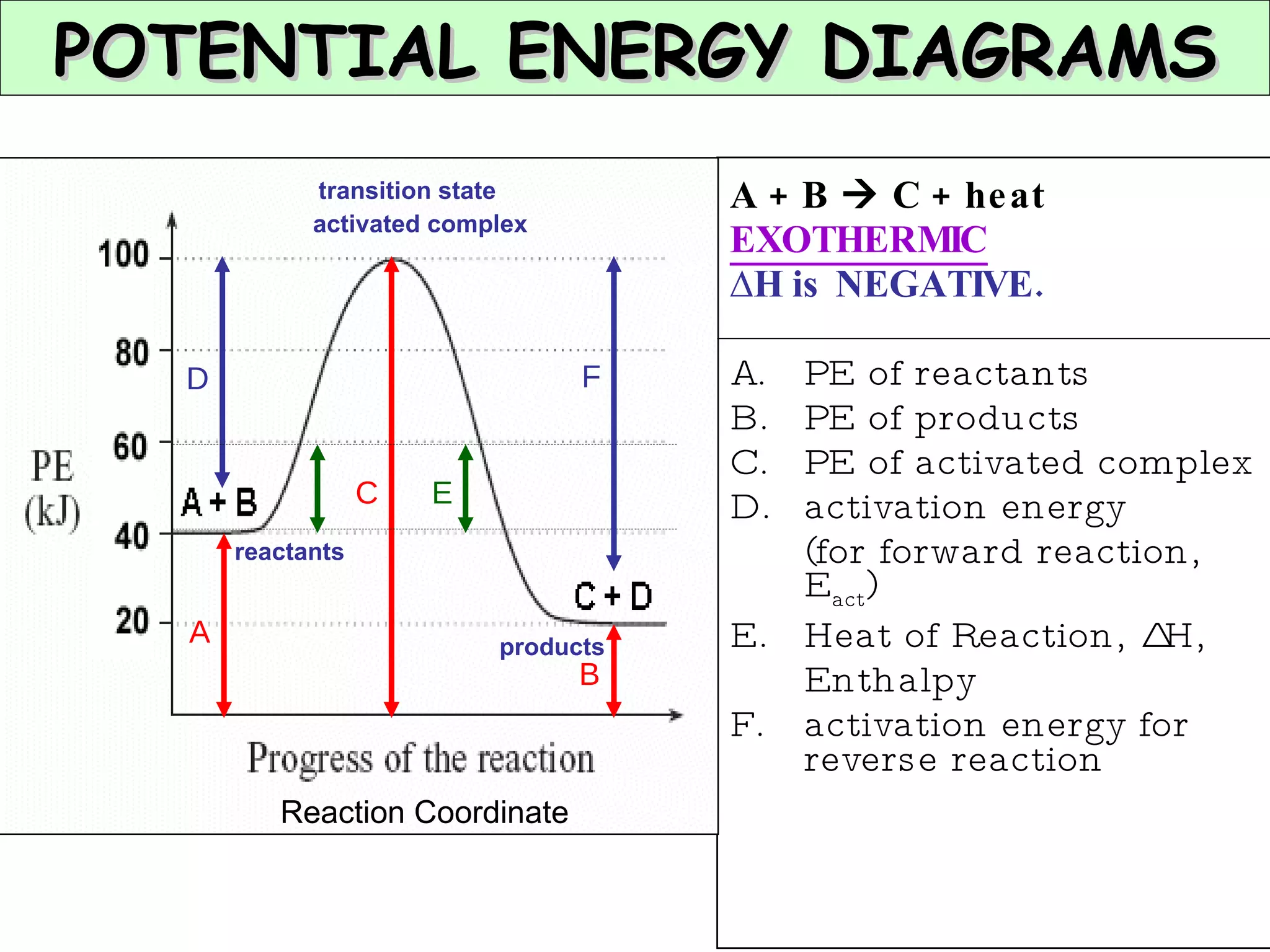
A + B    C + heat EXOTHERMIC ∆ H is NEGATIVE. A. PE of reactants B. PE of products C.  PE of activated complex D.  activation energy  (for forward reaction, E act ) E.  Heat of Reaction, ∆H,  Enthalpy F.  activation energy for reverse reaction POTENTIAL ENERGY DIAGRAMS Reaction Coordinate reactants products A B C D E F transition state activated complex
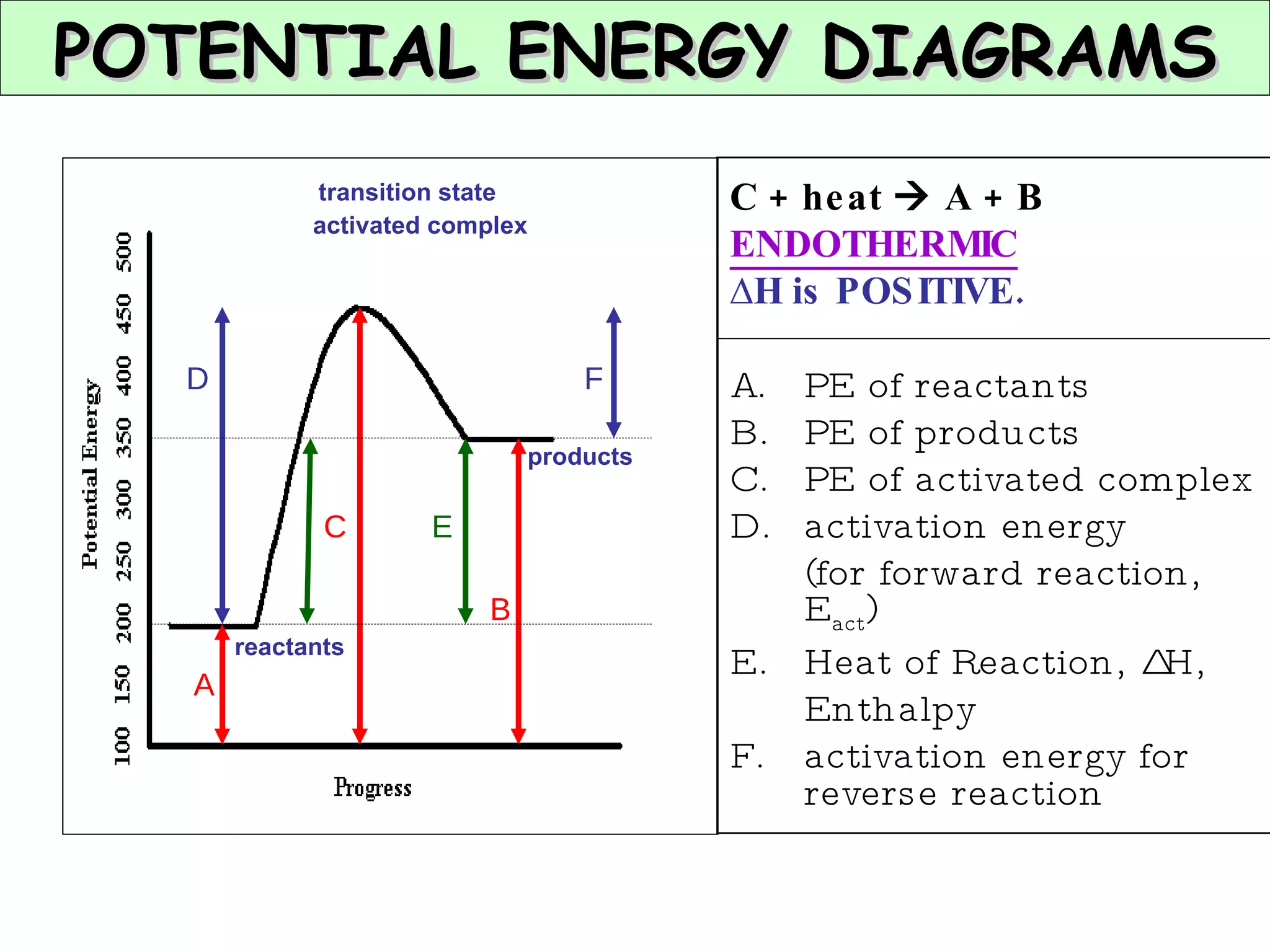
POTENTIAL ENERGY DIAGRAMS A C + heat    A + B ENDOTHERMIC ∆ H is POSITIVE. A. PE of reactants B. PE of products C.  PE of activated complex D.  activation energy  (for forward reaction, E act ) E.  Heat of Reaction, ∆H,  Enthalpy F.  activation energy for reverse reaction B C D reactants products transition state activated complex E F
 
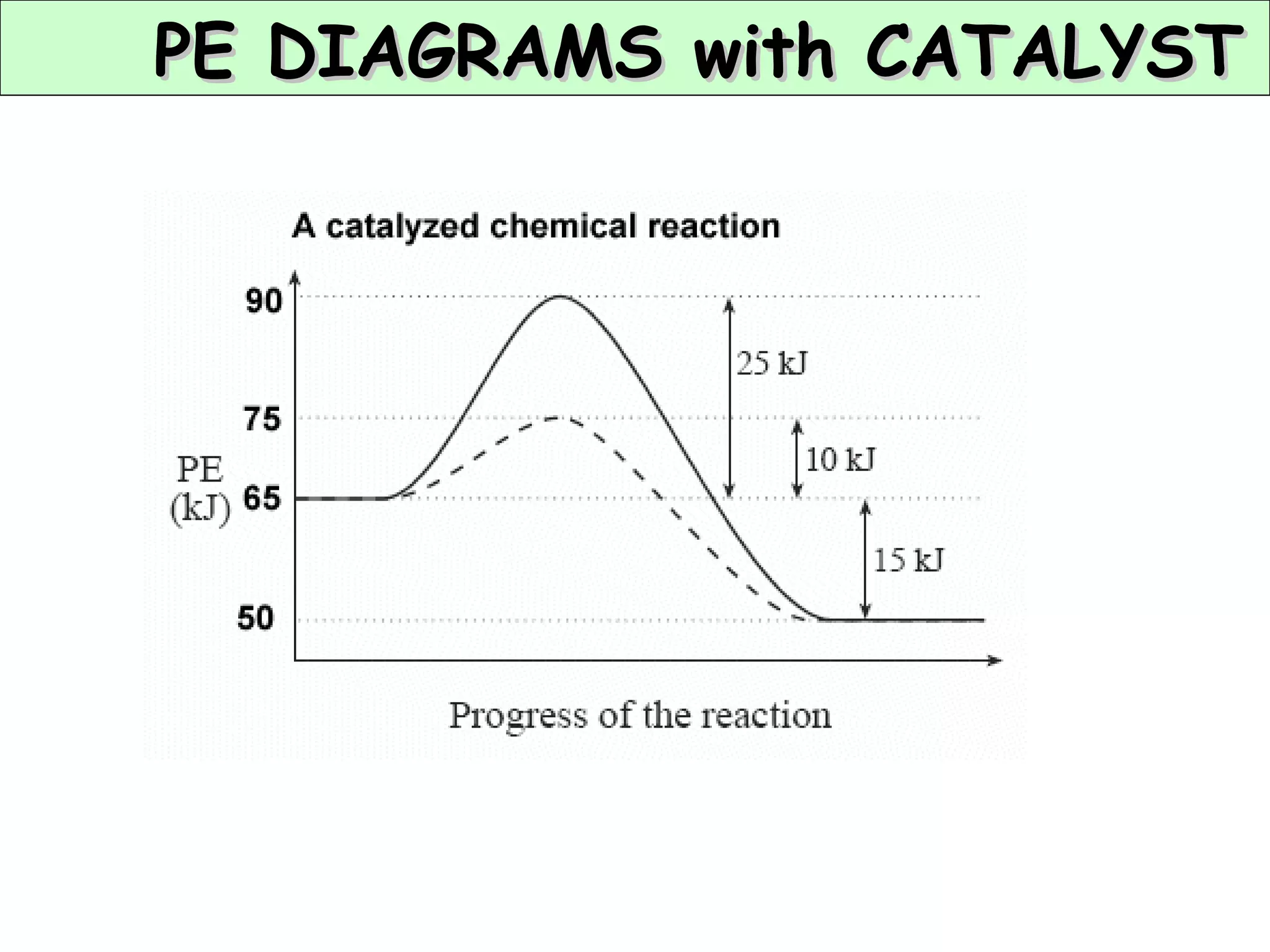
PE DIAGRAMS with CATALYST
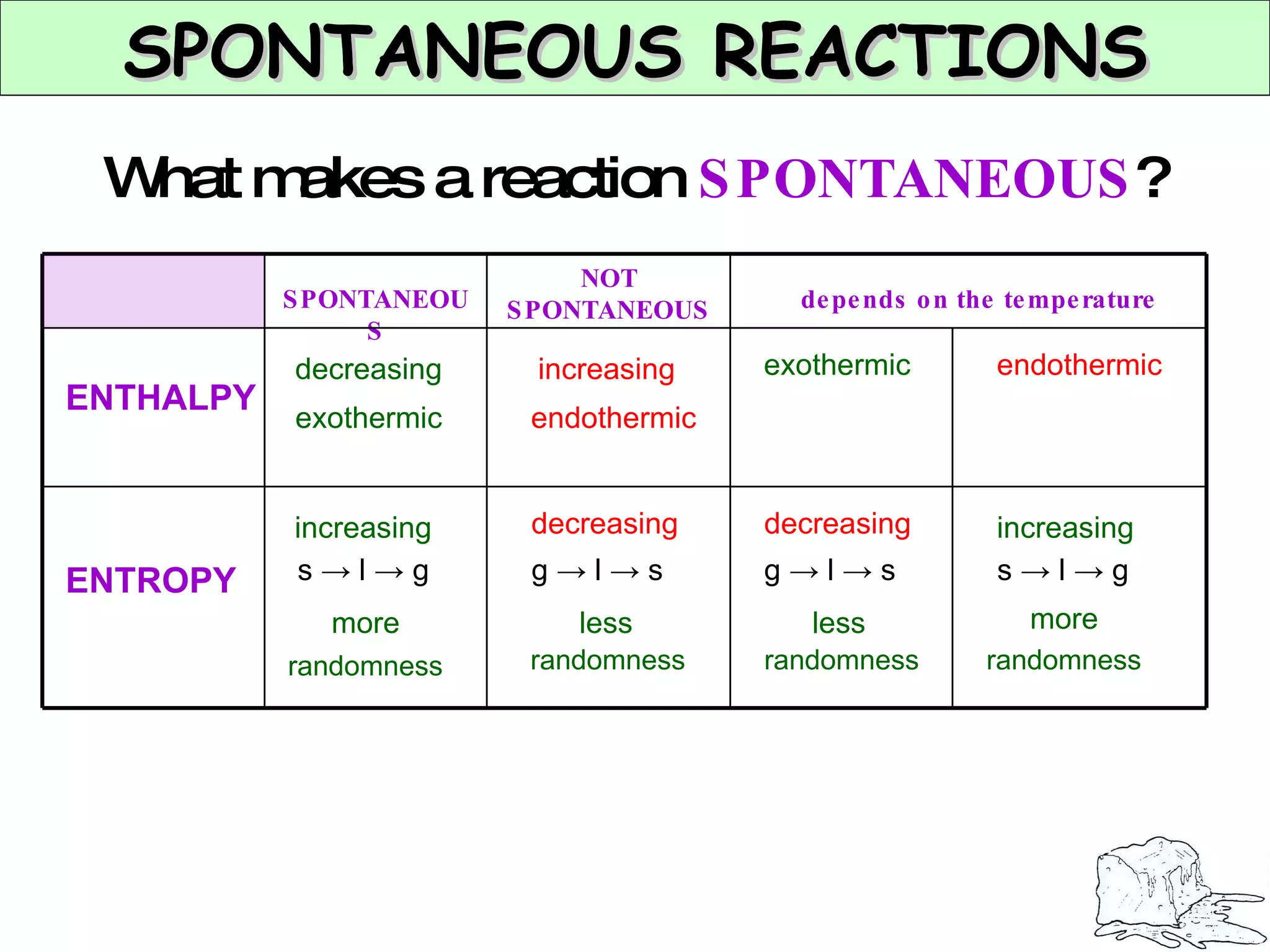
SPONTANEOUS REACTIONS What makes a reaction  SPONTANEOUS ? decreasing exothermic increasing s  -> l  -> g more randomness increasing endothermic decreasing g  -> l  -> s less randomness endothermic decreasing g  -> l  -> s less randomness exothermic increasing s  -> l  -> g more randomness NOT SPONTANEOUS ENTROPY ENTHALPY depends on the temperature SPONTANEOUS
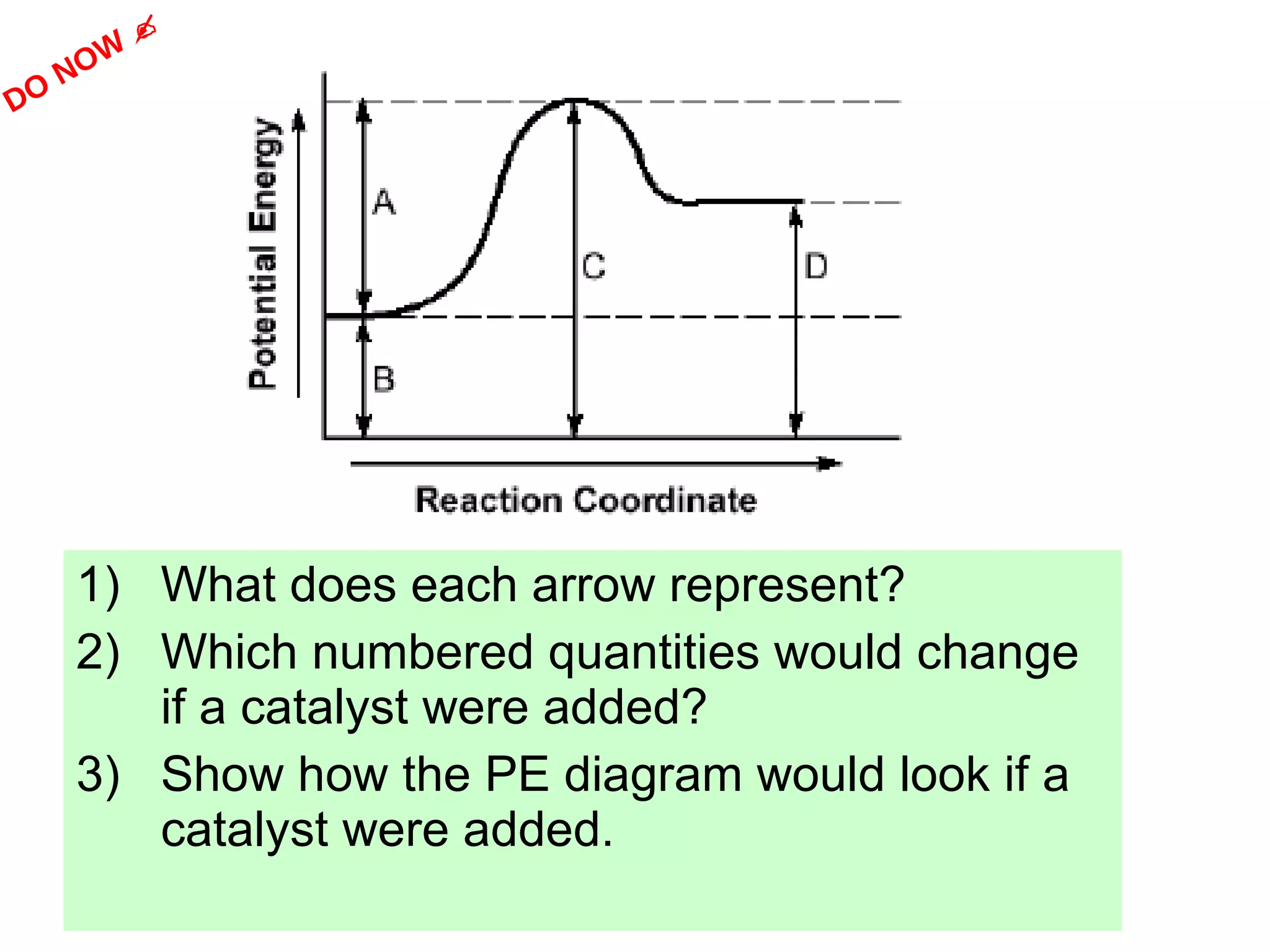
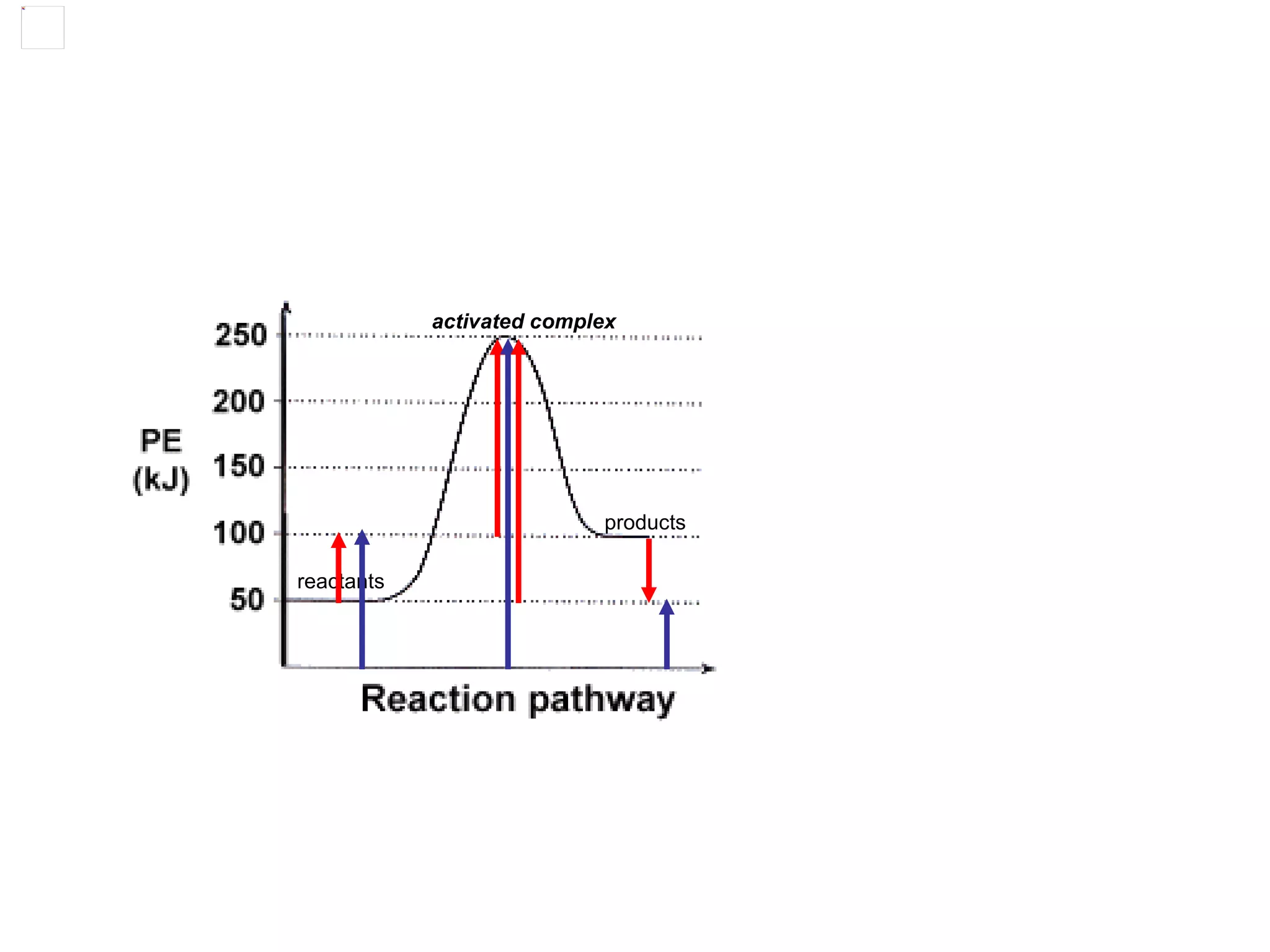
What does each arrow represent? Which numbered quantities would change if a catalyst were added? Show how the PE diagram would look if a catalyst were added.  DO NOW  
Given the following equation, which statement is true? N 2(g)  + 3H 2(g)     2NH 3(g)  – 91.8 kJ The sign of  ∆ H is negative, and the reaction is endothermic. (d) The sign of  ∆ H is negative, and the reaction is exothermic. (c) The sign of  ∆ H is positive, and the reaction is endothermic. (b) The sign of  ∆ H is positive, and the reaction is exothermic. (a)
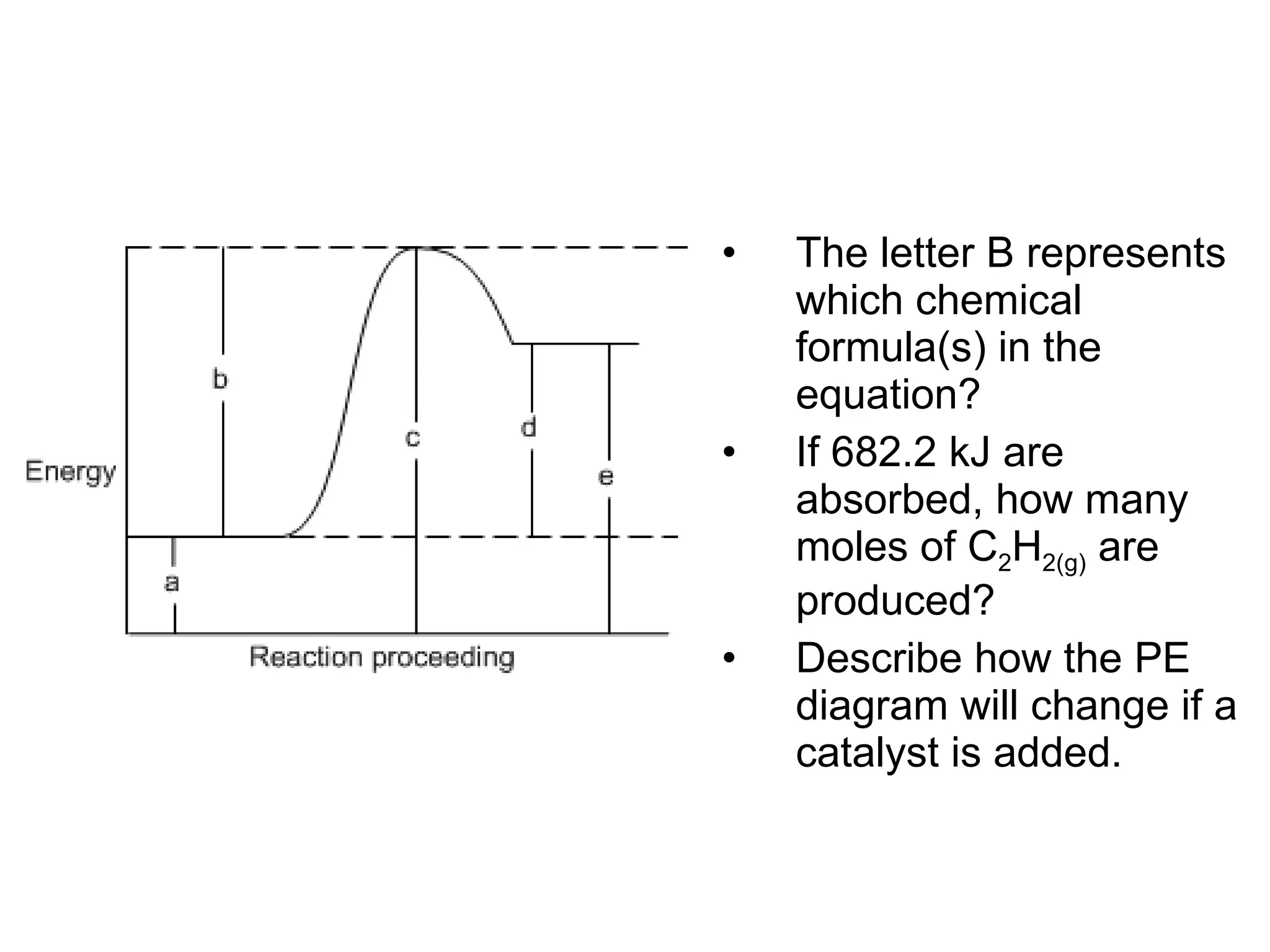
The letter B represents which chemical formula(s) in the equation? If 682.2 kJ are absorbed, how many moles of C 2 H 2(g)  are produced? Describe how the PE diagram will change if a catalyst is added.
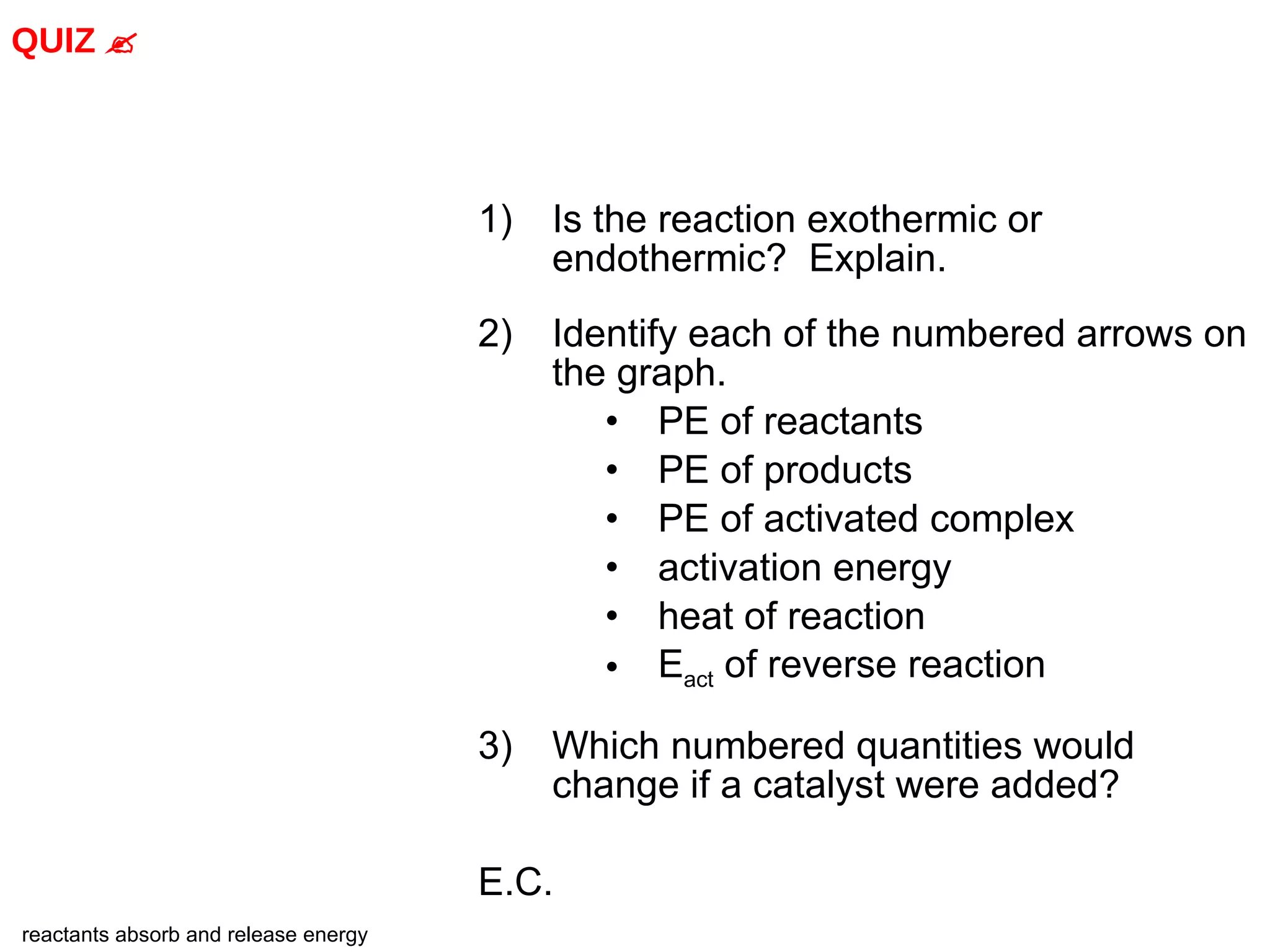
Is the reaction exothermic or endothermic?  Explain. 2) Identify each of the numbered arrows on the graph. PE of reactants PE of products PE of activated complex activation energy heat of reaction E act  of reverse reaction 3) Which numbered quantities would change if a catalyst were added? E.C. QUIZ   reactants absorb and release energy
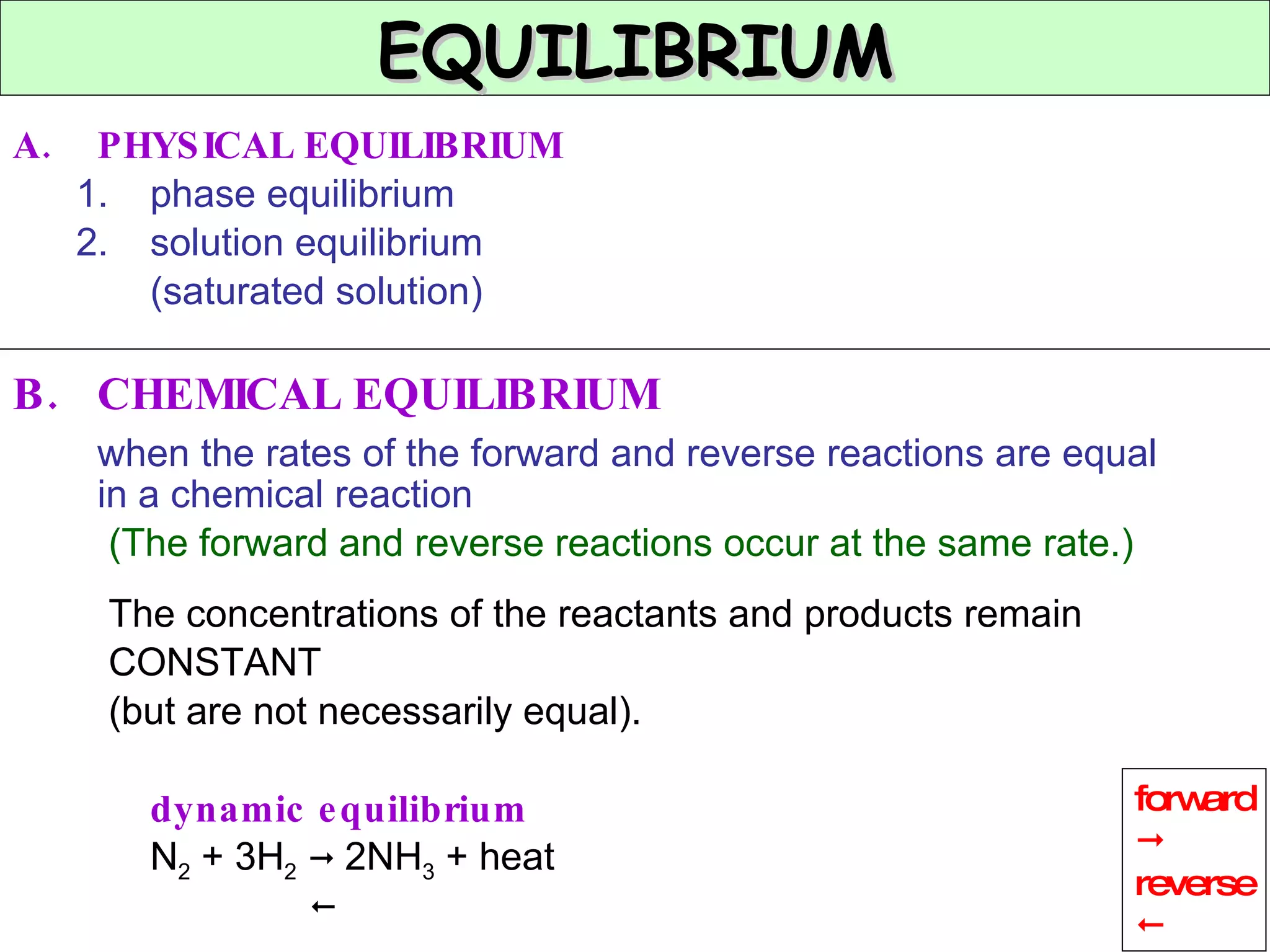
PHYSICAL EQUILIBRIUM phase equilibrium solution equilibrium (saturated solution) B. CHEMICAL EQUILIBRIUM when the rates of the forward and reverse reactions are equal in a chemical reaction (The forward and reverse reactions occur at the same rate.) The concentrations of the reactants and products remain CONSTANT (but are not necessarily equal). dynamic equilibrium N 2  + 3H 2      2NH 3  + heat  EQUILIBRIUM  forward  reverse 
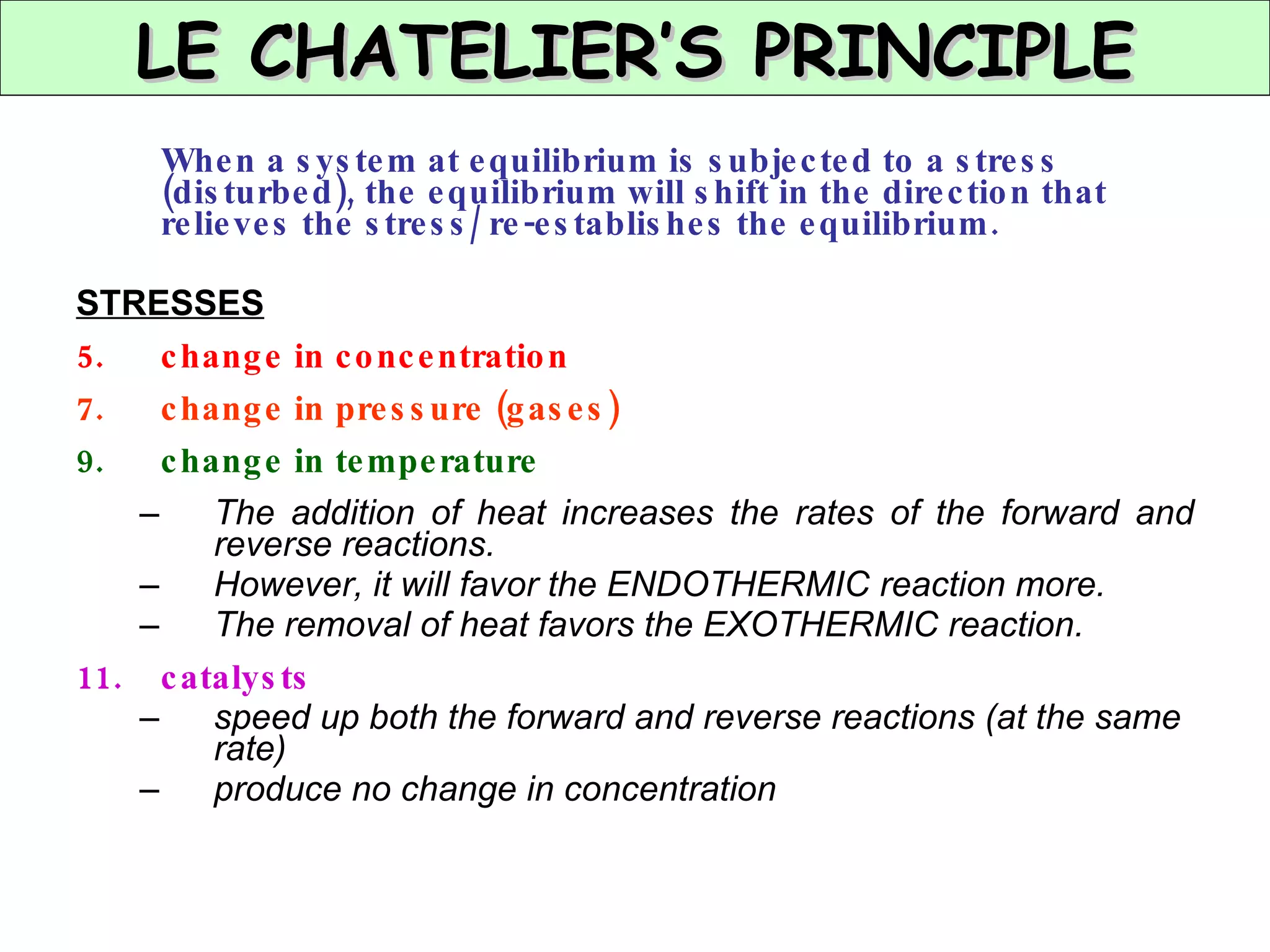
When a system at equilibrium is subjected to a stress (disturbed), the equilibrium will shift in the direction that relieves the stress/ re-establishes the equilibrium. STRESSES change in concentration change in pressure (gases) change in temperature The addition of heat increases the rates of the forward and reverse reactions. However, it will favor the ENDOTHERMIC reaction more. The removal of heat favors the EXOTHERMIC reaction. catalysts speed up both the forward and reverse reactions (at the same rate) produce no change in concentration LE CHATELIER’S PRINCIPLE
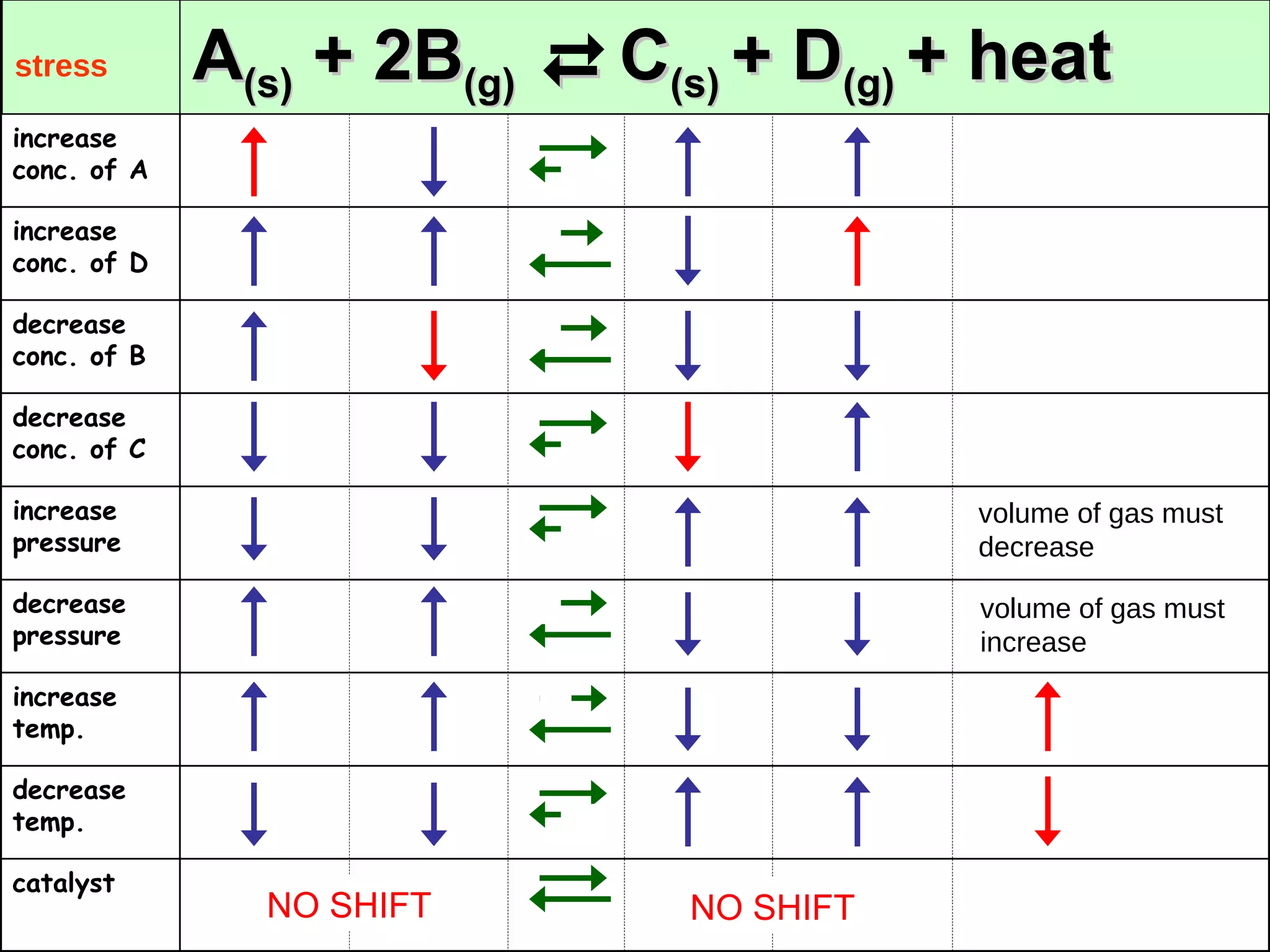
A (s)  + 2B (g)   C (s)  + D (g)  + heat     stress volume of gas must  decrease volume of gas must  increase NO SHIFT NO SHIFT catalyst  decrease temp. increase temp. decrease pressure increase pressure decrease conc. of C decrease conc. of B increase conc. of D increase conc. of A
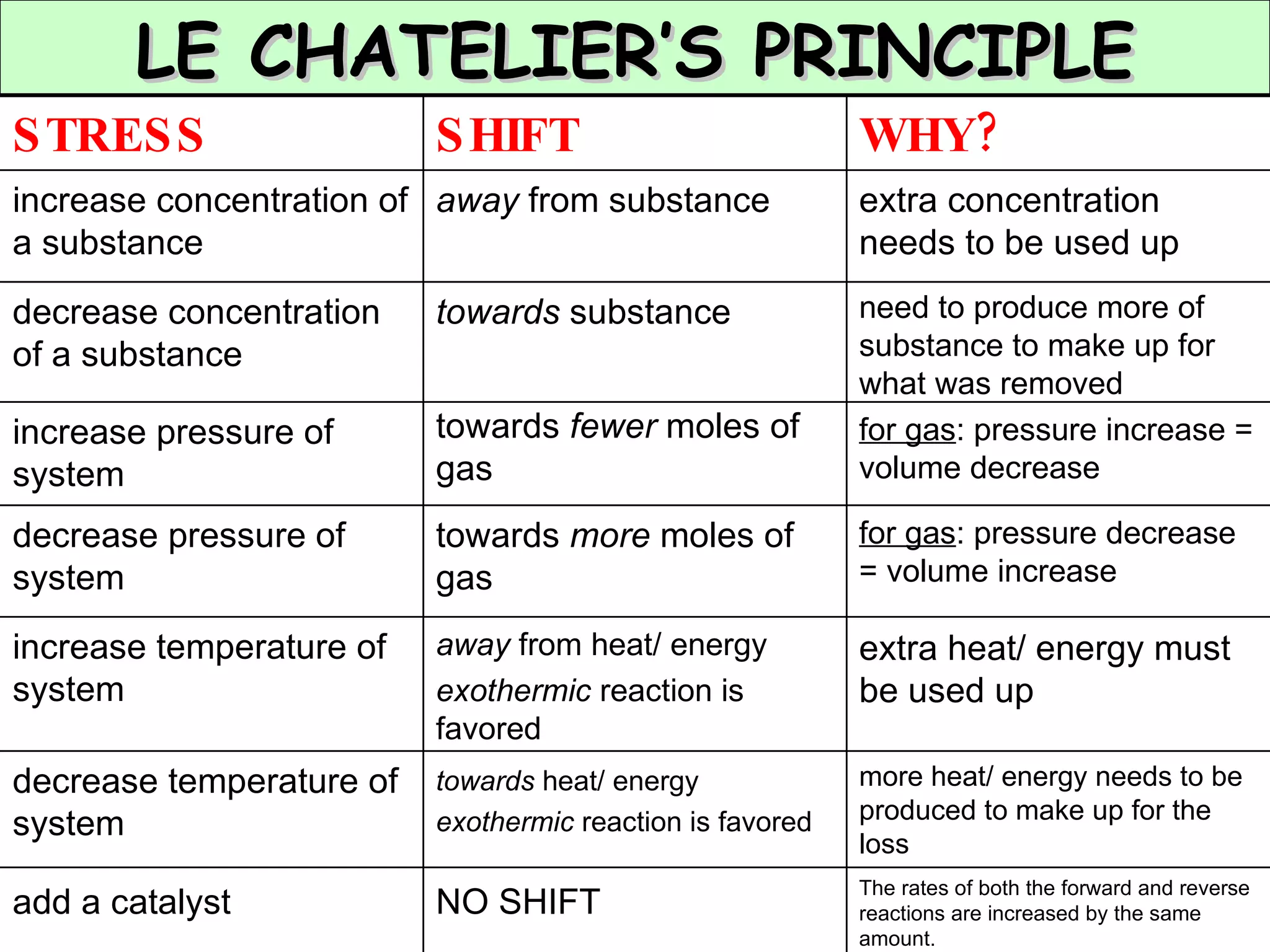
LE CHATELIER’S PRINCIPLE The rates of both the forward and reverse reactions are increased by the same amount.  NO SHIFT add a catalyst more heat/ energy needs to be produced to make up for the loss towards  heat/ energy exothermic  reaction is favored decrease temperature of system extra heat/ energy must be used up away  from heat/ energy exothermic  reaction is favored increase temperature of system for gas : pressure decrease = volume increase towards  more  moles of gas decrease pressure of system for gas : pressure increase = volume decrease towards  fewer  moles of gas increase pressure of system need to produce more of substance to make up for what was removed towards  substance decrease concentration of a substance extra concentration needs to be used up away  from substance increase concentration of a substance WHY? SHIFT STRESS
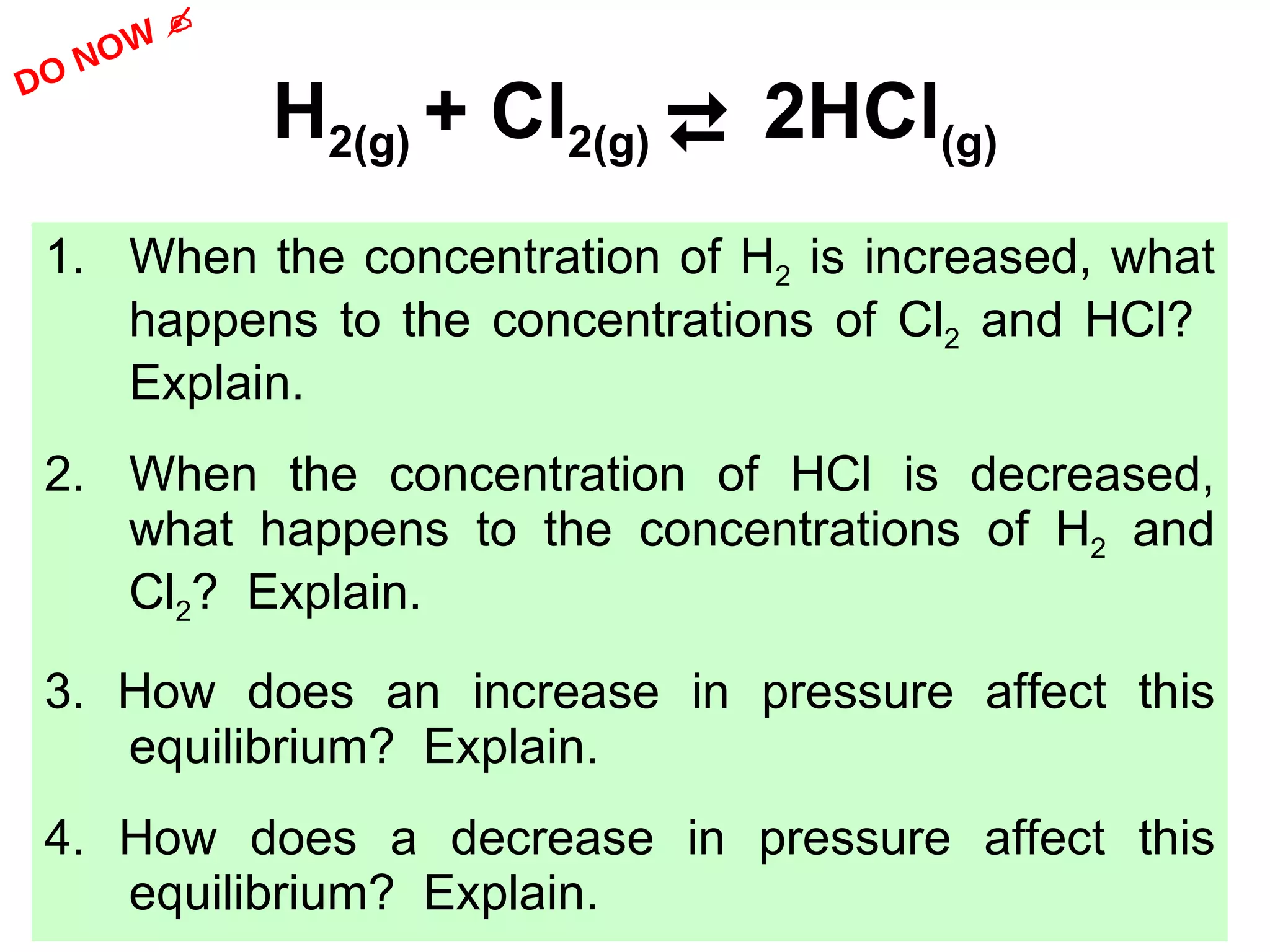
H 2(g)  + Cl 2(g)     2HCl (g) 1. When the concentration of H 2  is increased, what happens to the concentrations of Cl 2  and HCl?  Explain. 2. When the concentration of HCl is decreased, what happens to the concentrations of H 2  and Cl 2 ?  Explain. 3. How does an increase in pressure affect this equilibrium?  Explain. 4. How does a decrease in pressure affect this equilibrium?  Explain. DO NOW   
activated complex reactants products
N 2(g)  + 3H 2(g)    2NH 3(g)  + 22.0 kcal  10. Decrease press. 9. Increase  press. 8. Decrease temp 7. Increase temp 6. Remove NH 3 5. Remove H 2 4. Remove N 2 3. Add NH 3 2. Add H 2 1. Add N 2 [NH 3 ] [H 2 ] [N 2 ] Shift Stress
N 2(g)  + 3H 2(g)    2NH 3(g)  + 22.0 kcal  _____ _____ _____ _____ _____ _____ 10. Decrease press. 9. Increase  press. 8. Decrease temp 7. Increase temp 6. Remove NH 3 5. Remove H 2 4. Remove N 2 3. Add NH 3 2. Add H 2 1. Add N 2 [NH 3 ] [H 2 ] [N 2 ] Shift Stress
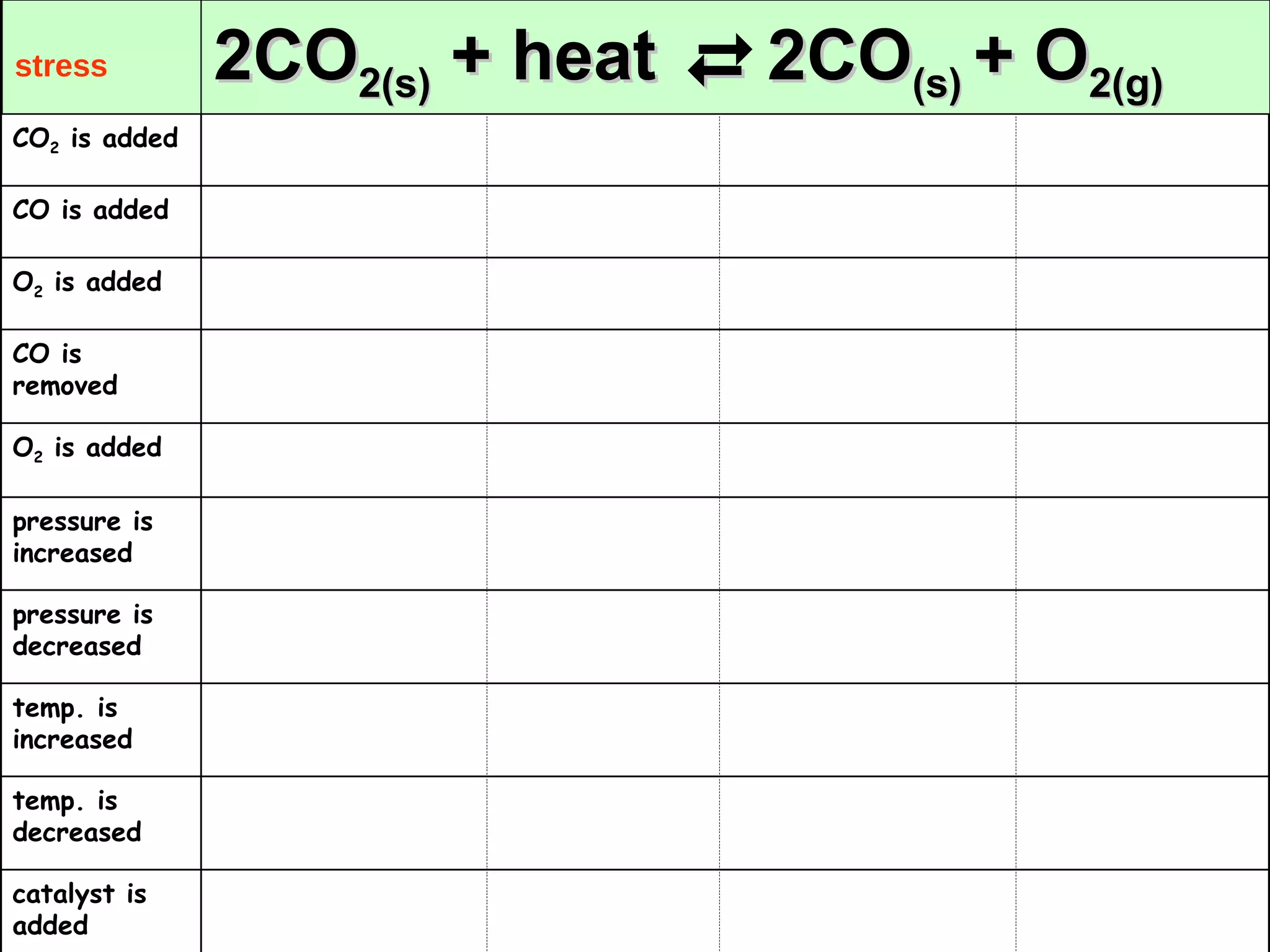
2CO 2(s)  + heat   2CO (s)  + O 2(g)   stress catalyst is added temp. is decreased temp. is increased pressure is decreased pressure is increased O 2  is added CO is removed O 2  is added CO is added CO 2  is added
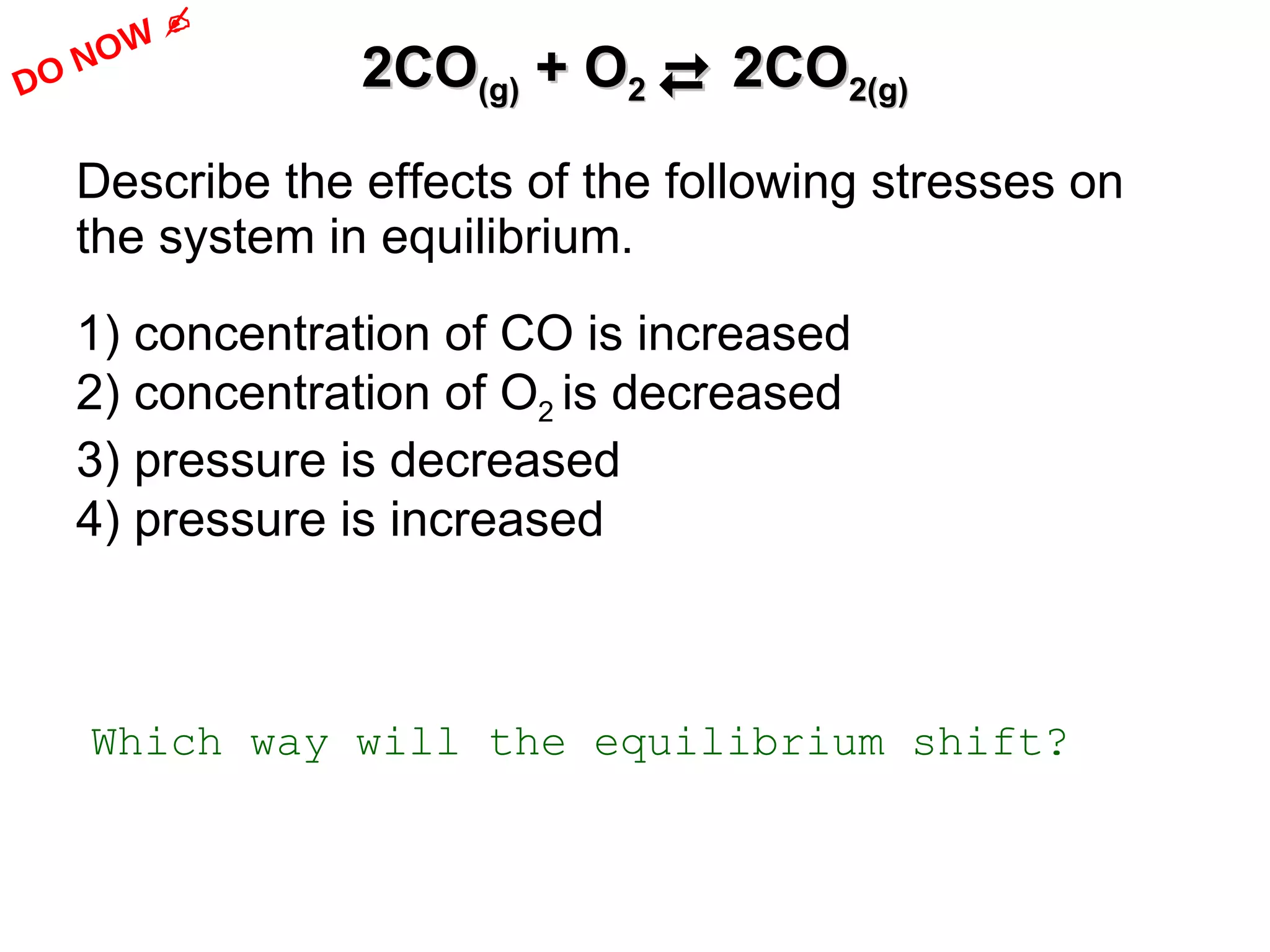
2CO (g)  + O 2     2CO 2(g) Describe the effects of the following stresses on the system in equilibrium.  1) concentration of CO is increased 2) concentration of O 2  is decreased 3) pressure is decreased 4) pressure is increased Which way will the equilibrium shift? DO NOW  
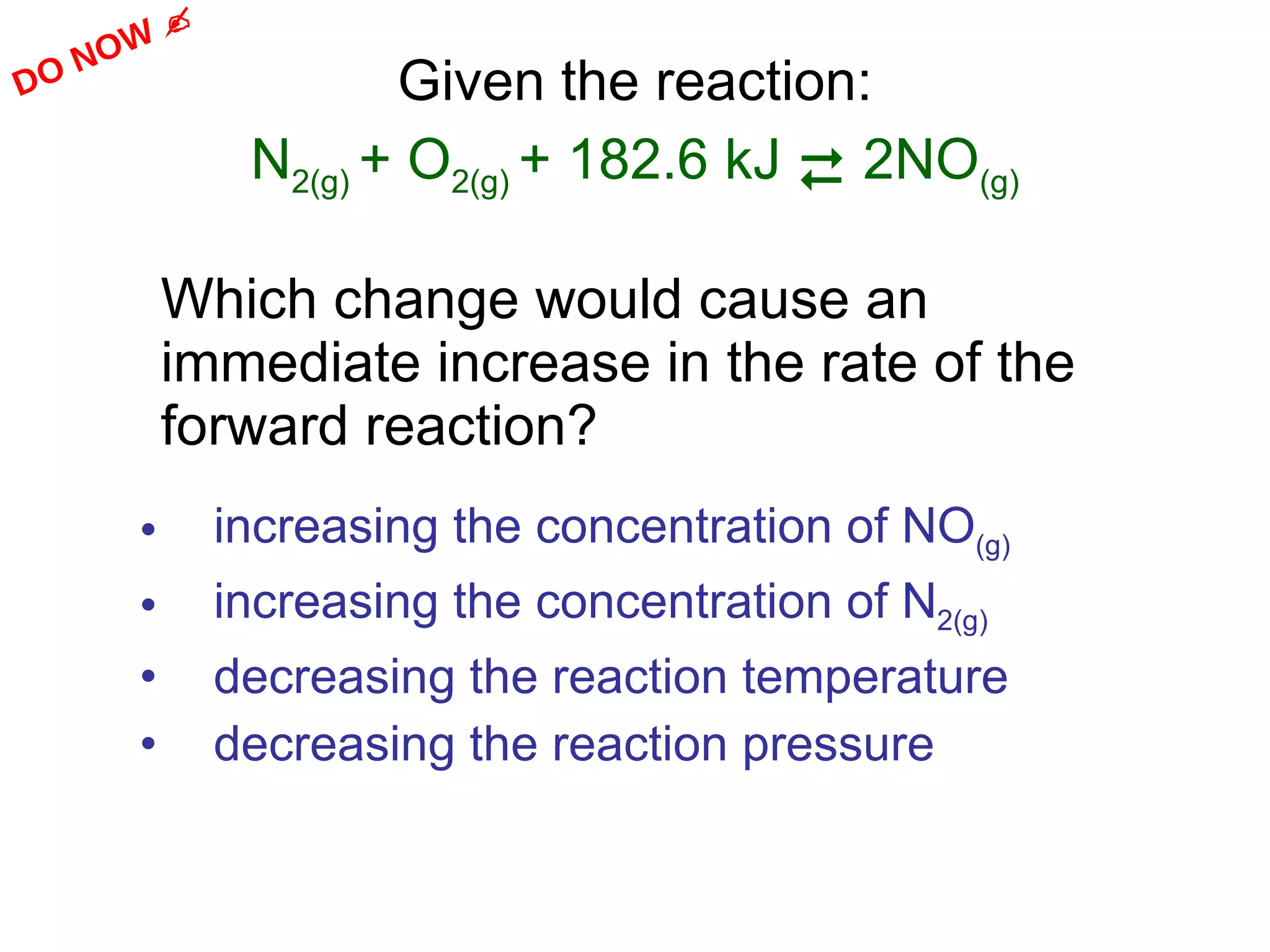
Given the reaction: N 2(g)  + O 2(g)  + 182.6 kJ    2NO (g) Which change would cause an immediate increase in the rate of the forward reaction? increasing the concentration of NO (g) increasing the concentration of N 2(g) decreasing the reaction temperature decreasing the reaction pressure  DO NOW  
2POCl 3(g)  + energy    2PCl 3(g)  + O 2(g) Which changes occur when O 2(g)  is added to the system?  1) The equilibrium shifts right and [PCl 3 ] increases. 2) The equilibrium shifts right and [PCl 3 ] decreases. 3) The equilibrium shifts left and [PCl 3 ] increases. 4) The equilibrium shifts left and [PCl 3 ] decreases DO NOW  
12.6 kcal + H 2(g)  + I 2(g)    2HI  10. Decrease press. 9. Increase  press. 8. Decrease temp 7. Increase temp 6. Remove HI 5. Remove I 2 4. Remove H 2 3. Add HI 2. Add I 2 1. Add H 2 [HI] [I 2 ] [H 2 ] Shift Stress
12.6 kcal + H 2(g)  + I 2(g)    2HI  _____ _____ _____ _____ _____ _____ = = NO CHANGE  REMAINS THE SAME 10. Decrease press. 9. Increase  press. 8. Decrease temp 7. Increase temp 6. Remove HI 5. Remove I 2 4. Remove H 2 3. Add HI 2. Add I 2 1. Add H 2 [HI] [I 2 ] [H 2 ] Shift Stress
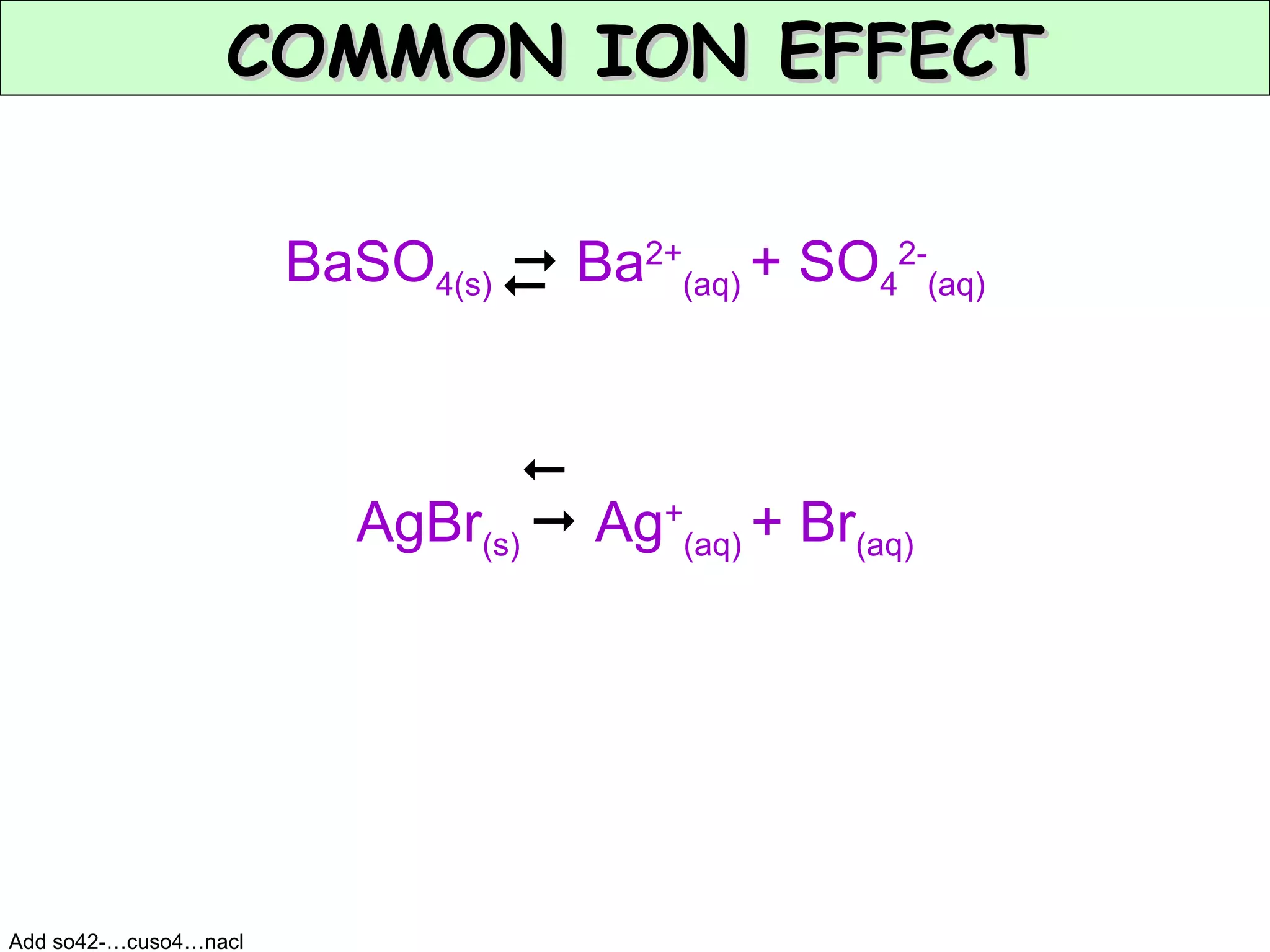
BaSO 4(s)    Ba 2+ (aq)  + SO 4 2- (aq) AgBr (s)    Ag + (aq)  + Br (aq) COMMON ION EFFECT   Add so42-…cuso4…nacl
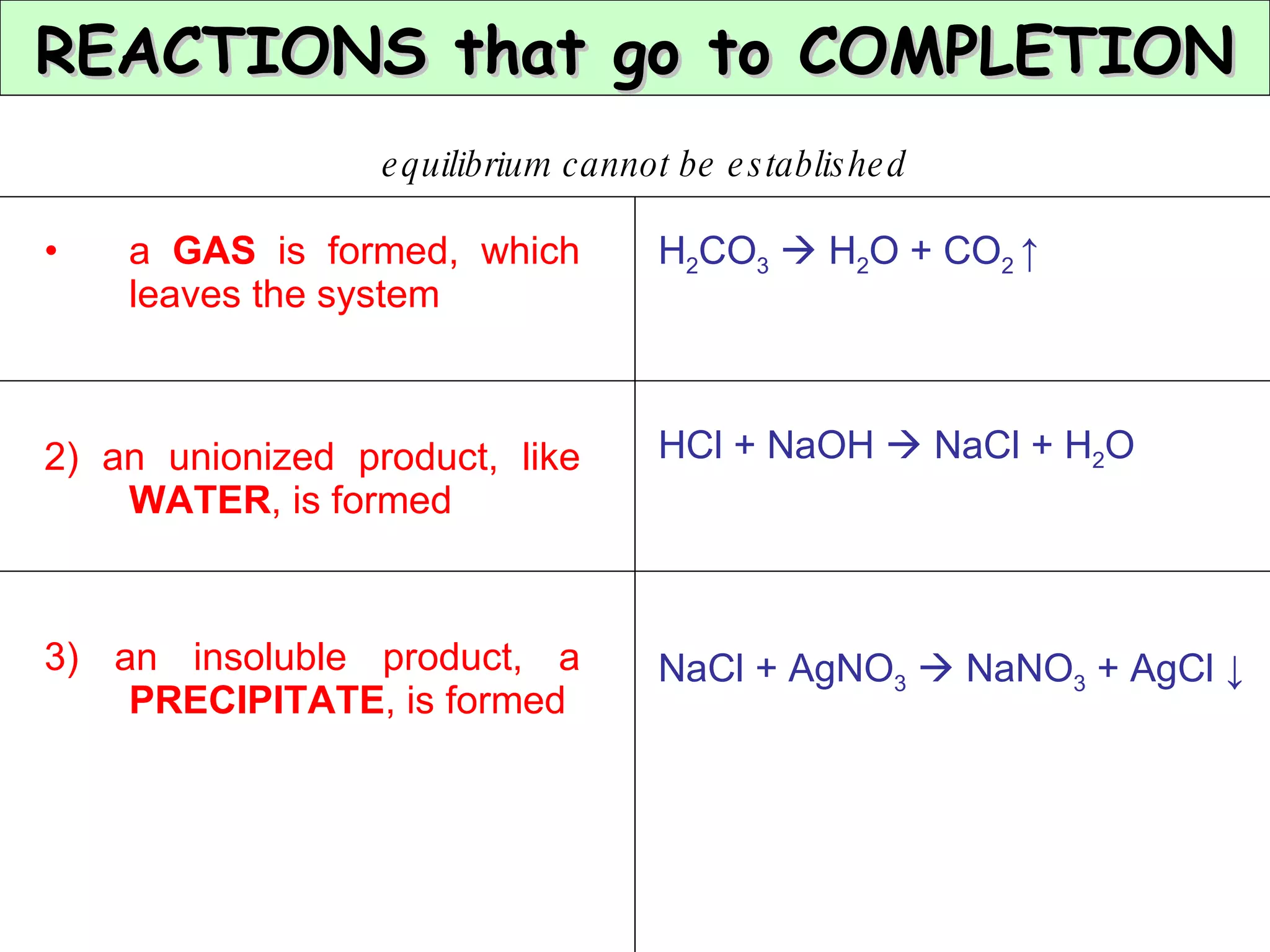
equilibrium cannot be established a  GAS  is formed, which leaves the system 2) an unionized product, like  WATER , is formed 3) an insoluble product, a  PRECIPITATE , is formed H 2 CO 3     H 2 O + CO 2  ↑ HCl + NaOH    NaCl + H 2 O NaCl + AgNO 3     NaNO 3  + AgCl  ↓ REACTIONS that go to COMPLETION
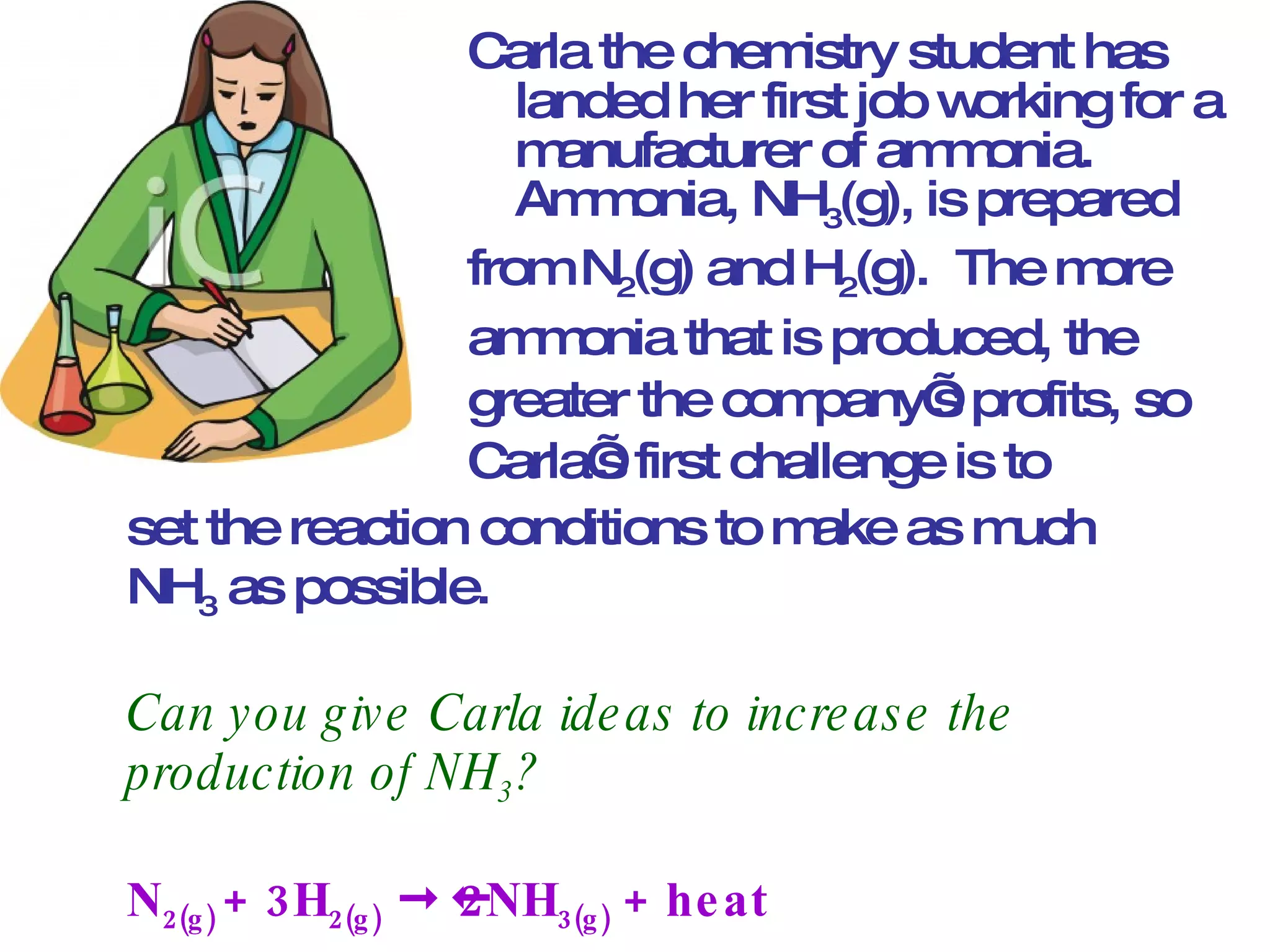
Carla the chemistry student has landed her first job working for a manufacturer of ammonia.  Ammonia, NH 3 (g), is prepared  from N 2 (g) and H 2 (g).  The more  ammonia that is produced, the  greater the company’s profits, so  Carla’s first challenge is to  set the reaction conditions to make as much NH 3  as possible. Can you give Carla ideas to increase the production of NH 3 ? N 2(g)  + 3H 2(g)    2NH 3(g)  + heat 
QUIZ  
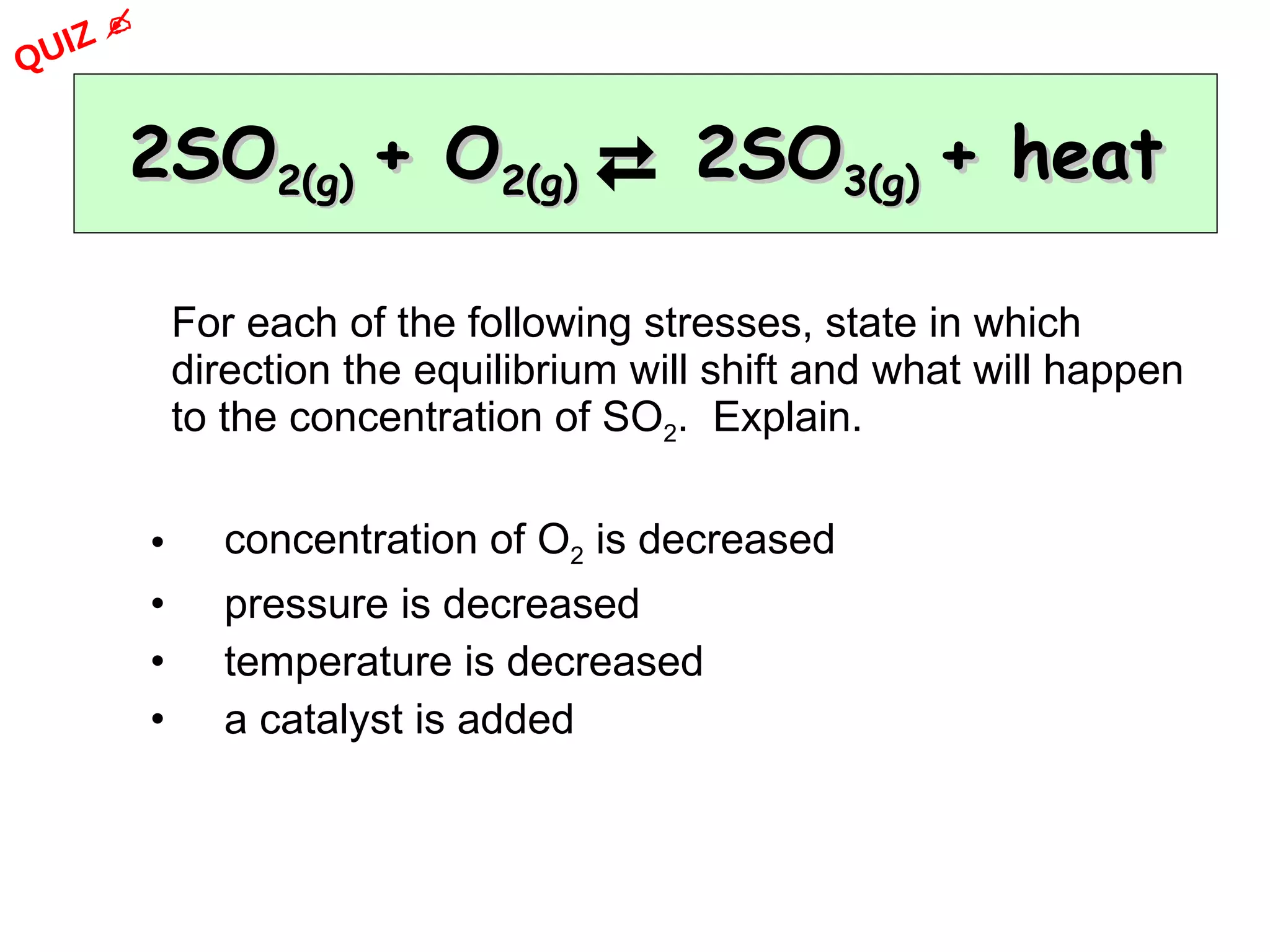
2SO 2(g)  + O 2(g)    2SO 3(g)  + heat For each of the following stresses, state in which direction the equilibrium will shift and what will happen to the concentration of SO 2 .  Explain. concentration of O 2  is decreased pressure is decreased temperature is decreased a catalyst is added QUIZ   
NaOH (s)    Na + (aq)  + OH - (aq)  + 10.6 kcal  8. Decrease press 7. Increase press 6. Decrease temp 5. Increase temp 4. Add H +  (removes OH + ) 3. Add KOH  (adds OH - ) 2. Add NaCl  (adds Na + ) 1. Add NaOH [OH - ] [Na + ] NaOH (s) Shift Stress
NaOH (s)    Na + (aq)  + OH - (aq)  + 10.6 kcal  _____ _____ _____ _____ NO EFFECT …………………… REMAINS THE SAME 8. Decrease press 7. Increase press 6. Decrease temp 5. Increase temp 4. Add H +  (removes OH + ) 3. Add KOH  (adds OH - ) 2. Add NaCl  (adds Na + ) 1. Add NaOH [OH - ] [Na + ] NaOH (s) Shift Stress
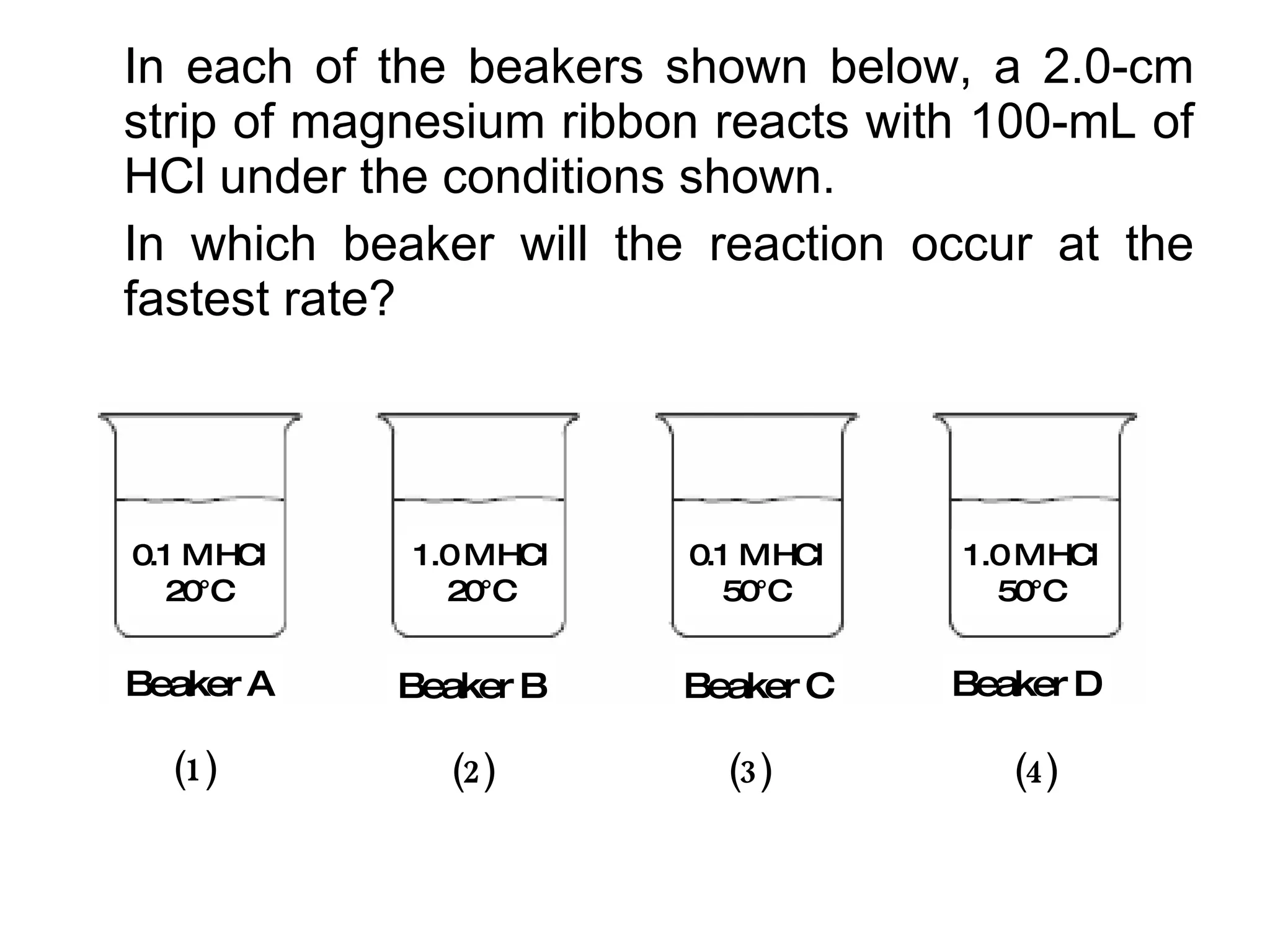
In each of the beakers shown below, a 2.0-cm strip of magnesium ribbon reacts with 100-mL of HCl under the conditions shown. In which beaker will the reaction occur at the fastest rate? 0.1 M HCl 20°C 1.0 M HCl 20°C 0.1 M HCl 50°C 1.0 M HCl 50°C Beaker A Beaker B Beaker C Beaker D (1) (2) (3) (4)
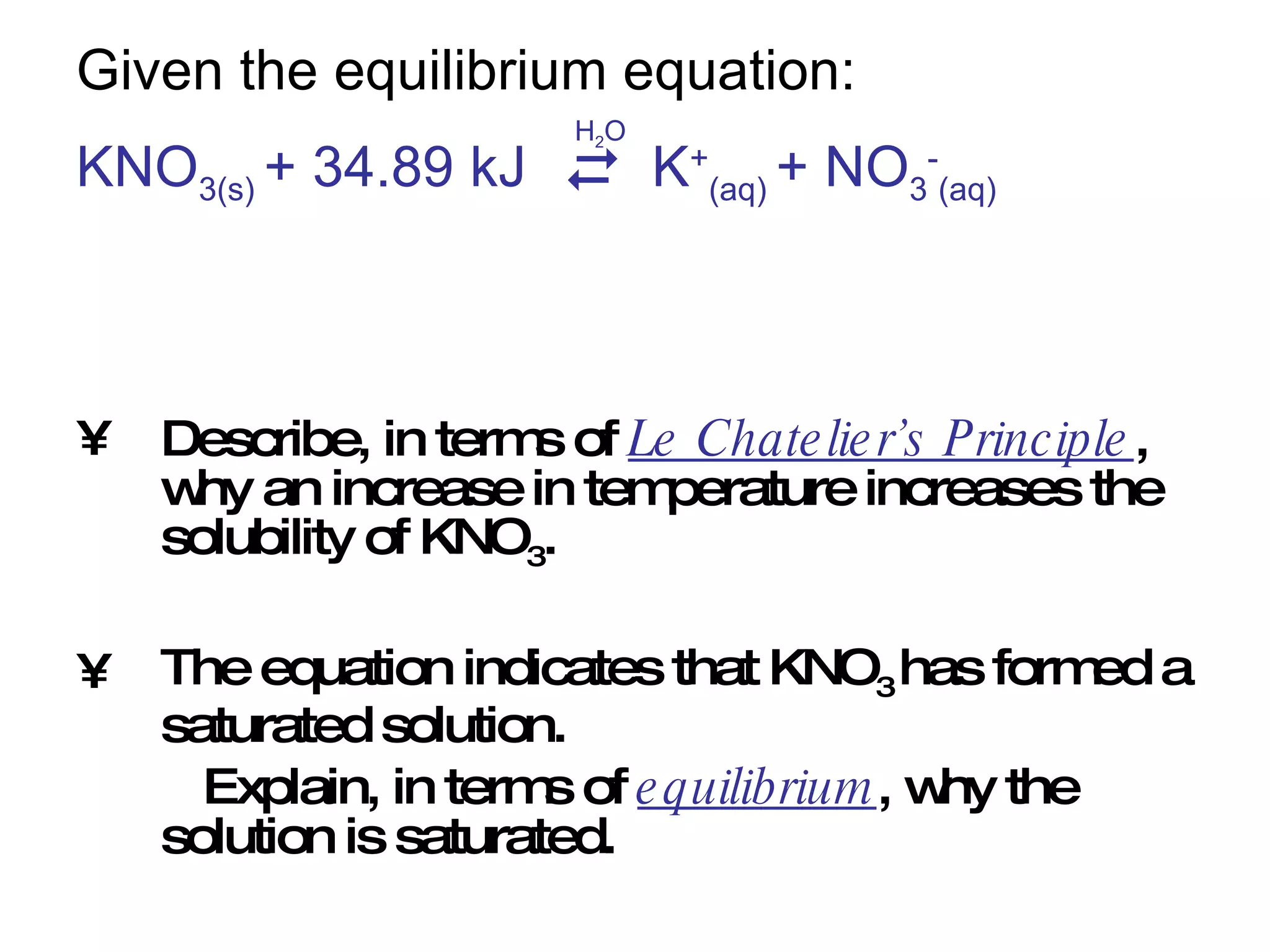
Given the equilibrium equation: KNO 3(s)  + 34.89 kJ  K + (aq)  + NO 3 - (aq) Describe, in terms of  Le Chatelier’s Principle , why an increase in temperature increases the solubility of KNO 3 . The equation indicates that KNO 3  has formed a saturated solution. Explain, in terms of  equilibrium , why the solution is saturated.    H 2 O
 
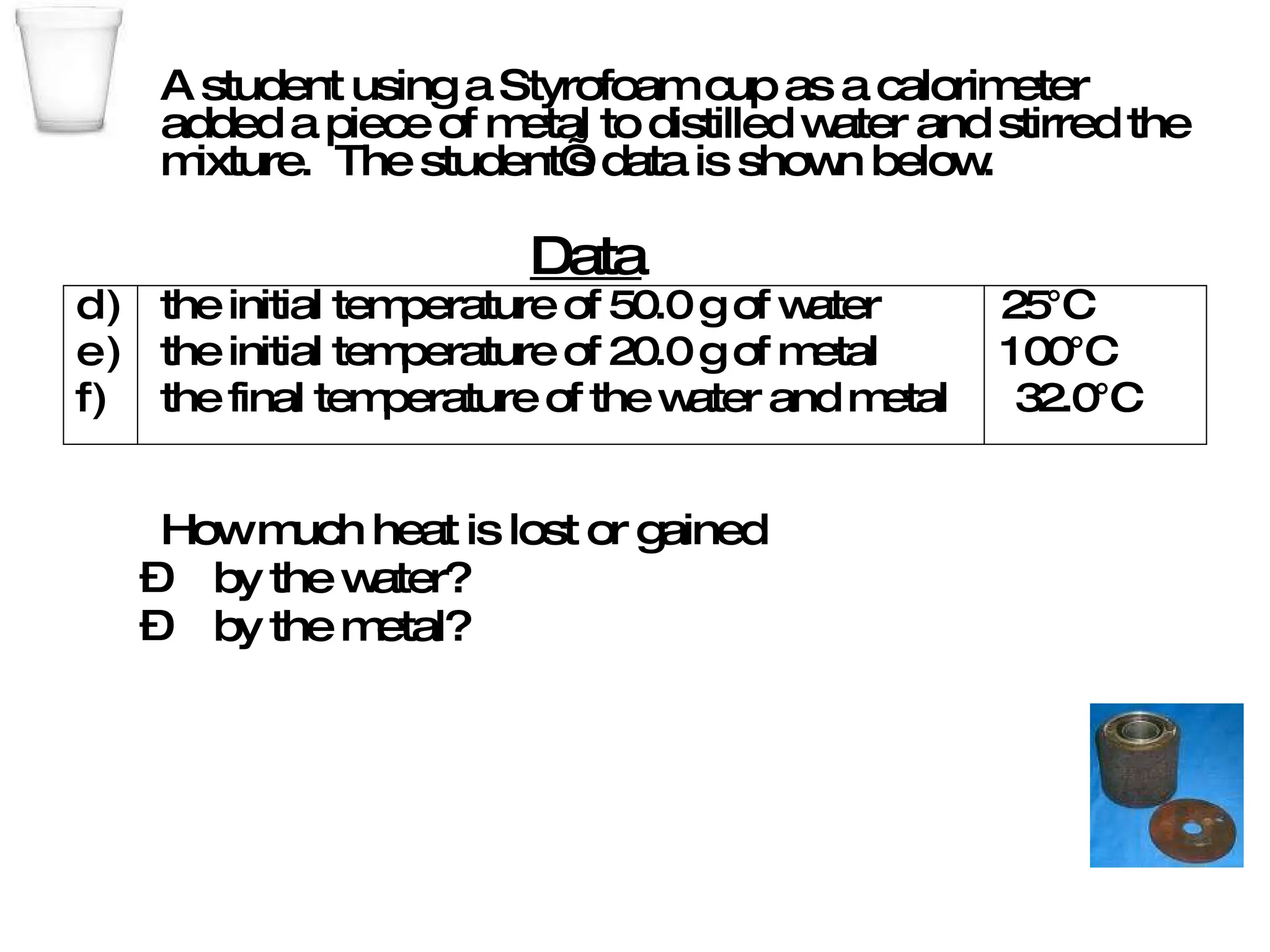
A student using a Styrofoam cup as a calorimeter  added a piece of metal to distilled water and stirred the mixture.  The student’s data is shown below. the initial temperature of 50.0 g of water  25°C the initial temperature of 20.0 g of metal  100°C the final temperature of the water and metal  32.0°C How much heat is lost or gained by the water? by the metal? Data
The water gained 350 calories of heat and the metal lost 350 calories of heat.
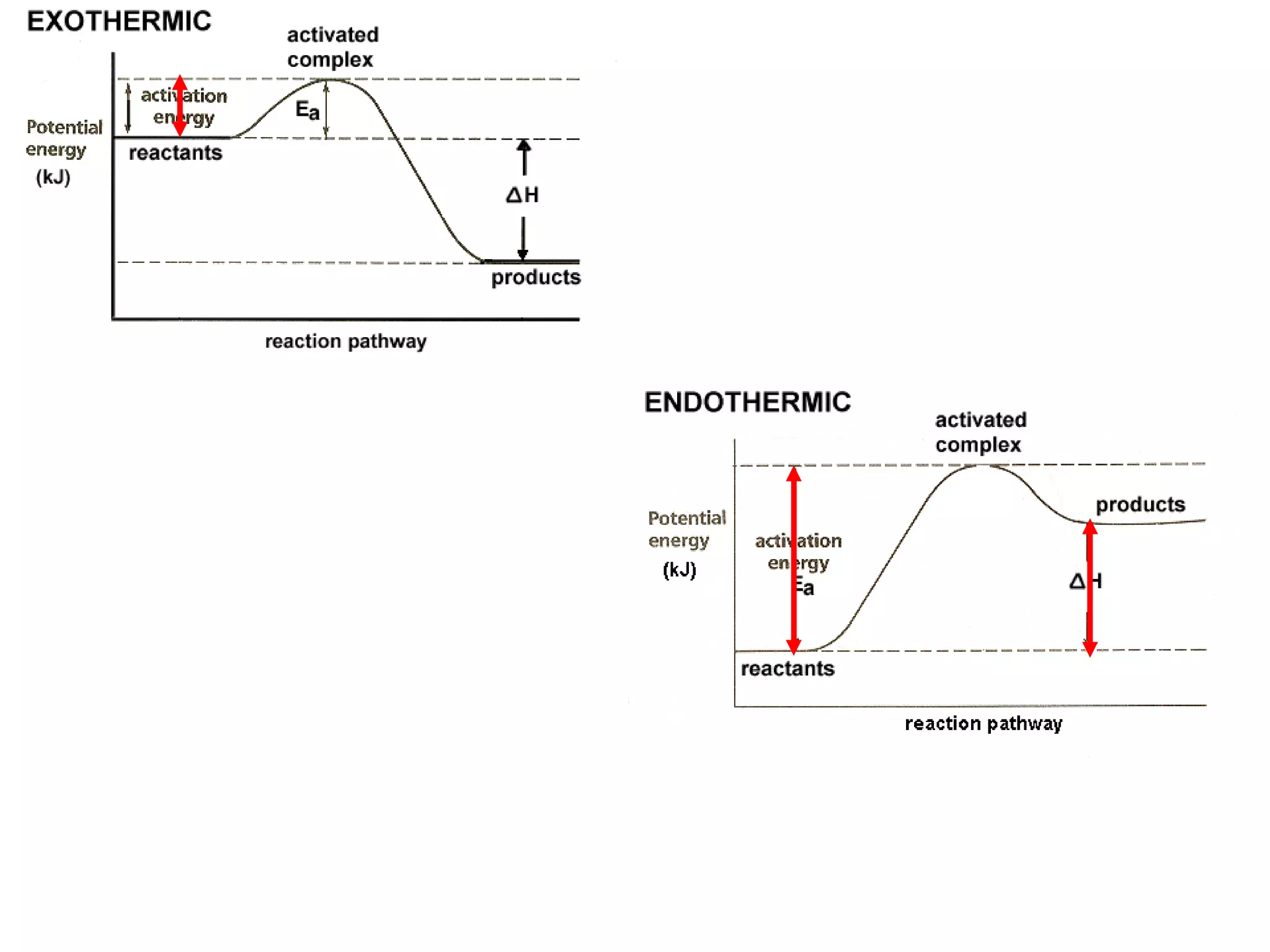
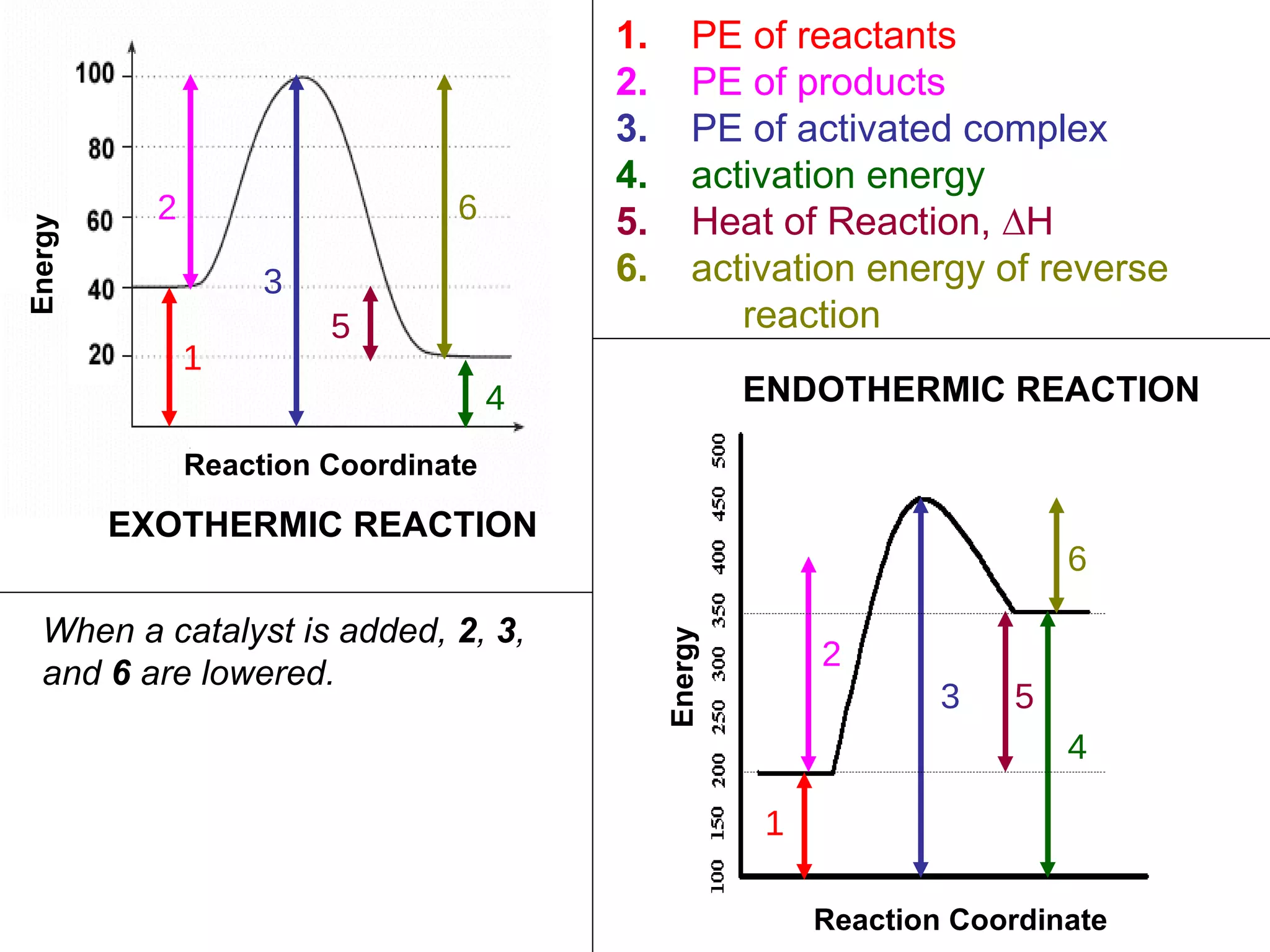
1.  PE of reactants 2.  PE of products 3.   PE of activated complex 4.   activation energy  5.   Heat of Reaction, ∆H 6.   activation energy of reverse  reaction EXOTHERMIC REACTION ENDOTHERMIC REACTION 1 Reaction Coordinate Energy 2 3 4 5 6 1 2 3 4 5 6 Reaction Coordinate Energy When a catalyst is added,  2 ,  3 ,  and  6  are lowered.
 

(Chapter 7) Kinetics And Equilibrium

  • 1.
    KINETICS and EQUILIBRIUMFactors that Affect the Rate of Reaction (5) Heat of Reaction, ∆ H Spontaneous Reactions Equilibrium Chapter 7 KINETICS refers to the rate and mechanism of reactions.
  • 2.
    COLLISION THEORY Factorsthat Affect the Rate of a Reaction 1. concentration of reactants (pressure for gases) 2. temperature 3. surface area 4. nature of reactants ionic compounds react quickly 5. catalyst increase rate of reaction by lowering the ACTIVATION ENERGY
  • 3.
    Every substance haspotential energy/ heat content. ∆ H, the heat of reaction , is the amount of heat released or absorbed in a chemical reaction. ∆ H = H products – H reactants EXOTHERMIC REACTION heat is released; products have less P.E. (heat) than reactants ∆ H is NEGATIVE; feels HOT/WARM ENDOTHERMIC REACTION heat is absorbed, products have more P.E. (heat) than reactants ∆ H is POSITIVE; feels COLD HEAT OF REACTION, ∆H reactants  products
  • 4.
    Given the reactionat 25 °C: Zn (s) + 2HCl (aq)  ZnCl 2 (aq) + H 2 (aq) The rate of this reaction can be increased by using 5.0 grams of powdered zinc instead of a 5.0-gram strip of zinc because powdered zinc has A catalyst increases the rate of a chemical reaction by DO NOW  Explain your answers!   (d) more zinc atoms (b) lower concentration (c) more surface area (a) lower kinetic energy raising the concentration of the reactants (d) raising the temperature of the reactants (c) lowering the potential energy of the products (b) lowering the activation energy of the reaction (a)
  • 5.
  • 6.
  • 7.
    Reaction # 12H 2 + O 2  2H 2 O + 571.6 KJ Reaction # 2 N 2 + O 2 + 182.6 KJ  2NO HEAT OF REACTION, ∆H reactants  products heat heat reactants  products + heat reactants + heat  products exothermic endothermic
  • 8.
    A hot packcontains chemicals that can be activated to produce heat. A cold pack contains chemicals that feel cold when activated. Based on energy flow, state the type of chemical change that occurs in a hot pack. A cold pack is placed on an injured leg. Indicate the direction of the flow between the leg and the cold pack. What is the Law of Conservation of Energy ? Describe how this law applies to the chemical reaction that occurs in the hot pack. Identify a reactant in Table I that, when mixed with water, can be used for a cold pack.
  • 9.
    A + B  C + heat EXOTHERMIC ∆ H is NEGATIVE. A. PE of reactants B. PE of products C. PE of activated complex D. activation energy (for forward reaction, E act ) E. Heat of Reaction, ∆H, Enthalpy F. activation energy for reverse reaction POTENTIAL ENERGY DIAGRAMS Reaction Coordinate reactants products A B C D E F transition state activated complex
  • 10.
    POTENTIAL ENERGY DIAGRAMSA C + heat  A + B ENDOTHERMIC ∆ H is POSITIVE. A. PE of reactants B. PE of products C. PE of activated complex D. activation energy (for forward reaction, E act ) E. Heat of Reaction, ∆H, Enthalpy F. activation energy for reverse reaction B C D reactants products transition state activated complex E F
  • 11.
  • 12.
  • 13.
    SPONTANEOUS REACTIONS Whatmakes a reaction SPONTANEOUS ? decreasing exothermic increasing s -> l -> g more randomness increasing endothermic decreasing g -> l -> s less randomness endothermic decreasing g -> l -> s less randomness exothermic increasing s -> l -> g more randomness NOT SPONTANEOUS ENTROPY ENTHALPY depends on the temperature SPONTANEOUS
  • 14.
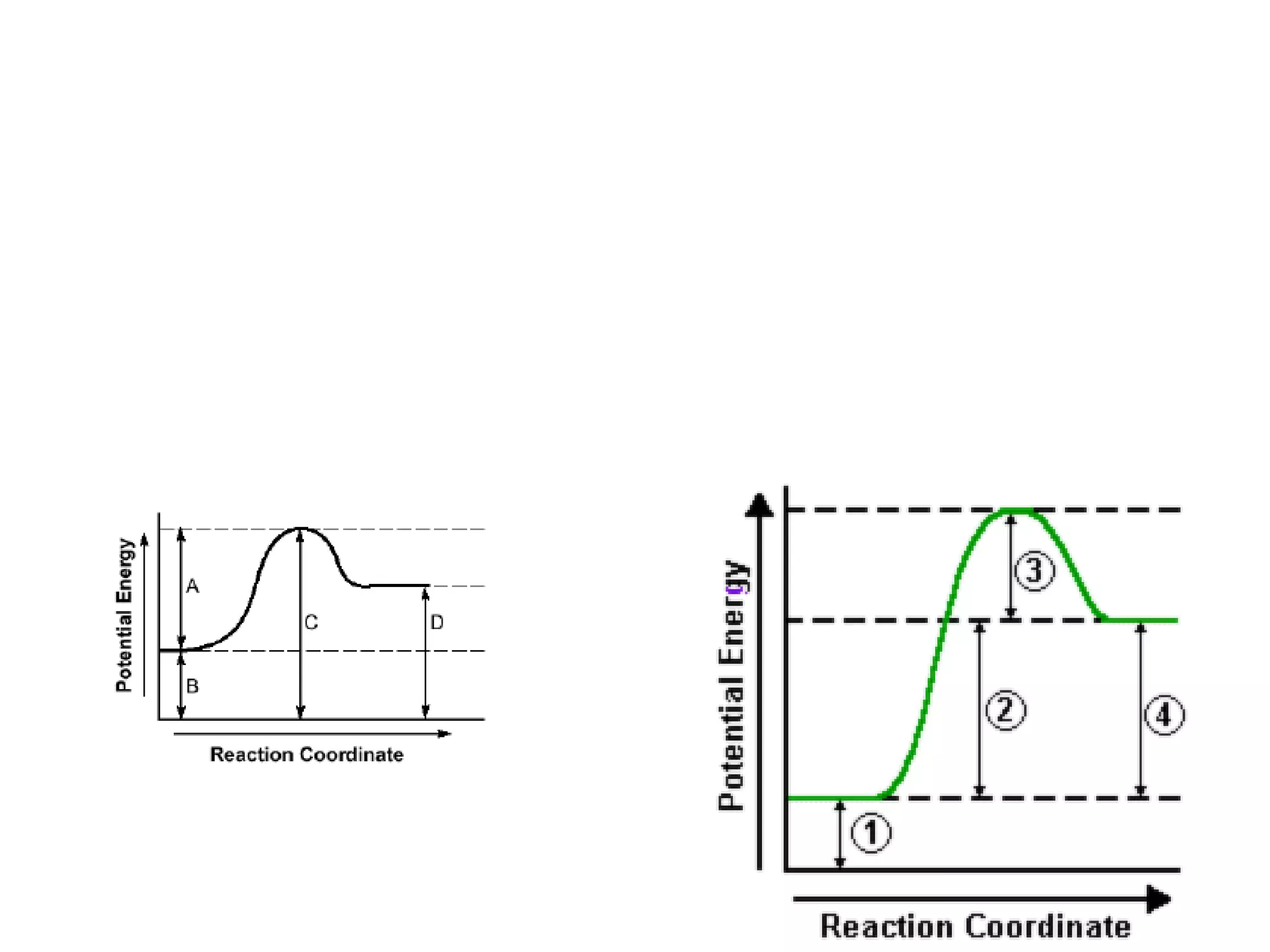
    What does eacharrow represent? Which numbered quantities would change if a catalyst were added? Show how the PE diagram would look if a catalyst were added. DO NOW 
  • 15.
    Given the followingequation, which statement is true? N 2(g) + 3H 2(g)  2NH 3(g) – 91.8 kJ The sign of ∆ H is negative, and the reaction is endothermic. (d) The sign of ∆ H is negative, and the reaction is exothermic. (c) The sign of ∆ H is positive, and the reaction is endothermic. (b) The sign of ∆ H is positive, and the reaction is exothermic. (a)
  • 16.
    The letter Brepresents which chemical formula(s) in the equation? If 682.2 kJ are absorbed, how many moles of C 2 H 2(g) are produced? Describe how the PE diagram will change if a catalyst is added.
  • 17.
    Is the reactionexothermic or endothermic? Explain. 2) Identify each of the numbered arrows on the graph. PE of reactants PE of products PE of activated complex activation energy heat of reaction E act of reverse reaction 3) Which numbered quantities would change if a catalyst were added? E.C. QUIZ  reactants absorb and release energy
  • 18.
    PHYSICAL EQUILIBRIUM phaseequilibrium solution equilibrium (saturated solution) B. CHEMICAL EQUILIBRIUM when the rates of the forward and reverse reactions are equal in a chemical reaction (The forward and reverse reactions occur at the same rate.) The concentrations of the reactants and products remain CONSTANT (but are not necessarily equal). dynamic equilibrium N 2 + 3H 2  2NH 3 + heat EQUILIBRIUM  forward  reverse 
  • 19.
    When a systemat equilibrium is subjected to a stress (disturbed), the equilibrium will shift in the direction that relieves the stress/ re-establishes the equilibrium. STRESSES change in concentration change in pressure (gases) change in temperature The addition of heat increases the rates of the forward and reverse reactions. However, it will favor the ENDOTHERMIC reaction more. The removal of heat favors the EXOTHERMIC reaction. catalysts speed up both the forward and reverse reactions (at the same rate) produce no change in concentration LE CHATELIER’S PRINCIPLE
  • 20.
    A (s) + 2B (g) C (s) + D (g) + heat   stress volume of gas must decrease volume of gas must increase NO SHIFT NO SHIFT catalyst decrease temp. increase temp. decrease pressure increase pressure decrease conc. of C decrease conc. of B increase conc. of D increase conc. of A
  • 21.
    LE CHATELIER’S PRINCIPLEThe rates of both the forward and reverse reactions are increased by the same amount. NO SHIFT add a catalyst more heat/ energy needs to be produced to make up for the loss towards heat/ energy exothermic reaction is favored decrease temperature of system extra heat/ energy must be used up away from heat/ energy exothermic reaction is favored increase temperature of system for gas : pressure decrease = volume increase towards more moles of gas decrease pressure of system for gas : pressure increase = volume decrease towards fewer moles of gas increase pressure of system need to produce more of substance to make up for what was removed towards substance decrease concentration of a substance extra concentration needs to be used up away from substance increase concentration of a substance WHY? SHIFT STRESS
  • 22.
    H 2(g) + Cl 2(g)  2HCl (g) 1. When the concentration of H 2 is increased, what happens to the concentrations of Cl 2 and HCl? Explain. 2. When the concentration of HCl is decreased, what happens to the concentrations of H 2 and Cl 2 ? Explain. 3. How does an increase in pressure affect this equilibrium? Explain. 4. How does a decrease in pressure affect this equilibrium? Explain. DO NOW  
  • 23.
  • 24.
    N 2(g) + 3H 2(g)  2NH 3(g) + 22.0 kcal  10. Decrease press. 9. Increase press. 8. Decrease temp 7. Increase temp 6. Remove NH 3 5. Remove H 2 4. Remove N 2 3. Add NH 3 2. Add H 2 1. Add N 2 [NH 3 ] [H 2 ] [N 2 ] Shift Stress
  • 25.
    N 2(g) + 3H 2(g)  2NH 3(g) + 22.0 kcal  _____ _____ _____ _____ _____ _____ 10. Decrease press. 9. Increase press. 8. Decrease temp 7. Increase temp 6. Remove NH 3 5. Remove H 2 4. Remove N 2 3. Add NH 3 2. Add H 2 1. Add N 2 [NH 3 ] [H 2 ] [N 2 ] Shift Stress
  • 26.
    2CO 2(s) + heat 2CO (s) + O 2(g)   stress catalyst is added temp. is decreased temp. is increased pressure is decreased pressure is increased O 2 is added CO is removed O 2 is added CO is added CO 2 is added
  • 27.
    2CO (g) + O 2  2CO 2(g) Describe the effects of the following stresses on the system in equilibrium.  1) concentration of CO is increased 2) concentration of O 2 is decreased 3) pressure is decreased 4) pressure is increased Which way will the equilibrium shift? DO NOW 
  • 28.
    Given the reaction:N 2(g) + O 2(g) + 182.6 kJ  2NO (g) Which change would cause an immediate increase in the rate of the forward reaction? increasing the concentration of NO (g) increasing the concentration of N 2(g) decreasing the reaction temperature decreasing the reaction pressure  DO NOW 
  • 29.
    2POCl 3(g) + energy  2PCl 3(g) + O 2(g) Which changes occur when O 2(g) is added to the system?  1) The equilibrium shifts right and [PCl 3 ] increases. 2) The equilibrium shifts right and [PCl 3 ] decreases. 3) The equilibrium shifts left and [PCl 3 ] increases. 4) The equilibrium shifts left and [PCl 3 ] decreases DO NOW 
  • 30.
    12.6 kcal +H 2(g) + I 2(g)  2HI  10. Decrease press. 9. Increase press. 8. Decrease temp 7. Increase temp 6. Remove HI 5. Remove I 2 4. Remove H 2 3. Add HI 2. Add I 2 1. Add H 2 [HI] [I 2 ] [H 2 ] Shift Stress
  • 31.
    12.6 kcal +H 2(g) + I 2(g)  2HI  _____ _____ _____ _____ _____ _____ = = NO CHANGE REMAINS THE SAME 10. Decrease press. 9. Increase press. 8. Decrease temp 7. Increase temp 6. Remove HI 5. Remove I 2 4. Remove H 2 3. Add HI 2. Add I 2 1. Add H 2 [HI] [I 2 ] [H 2 ] Shift Stress
  • 32.
    BaSO 4(s)  Ba 2+ (aq) + SO 4 2- (aq) AgBr (s)  Ag + (aq) + Br (aq) COMMON ION EFFECT   Add so42-…cuso4…nacl
  • 33.
    equilibrium cannot beestablished a GAS is formed, which leaves the system 2) an unionized product, like WATER , is formed 3) an insoluble product, a PRECIPITATE , is formed H 2 CO 3  H 2 O + CO 2 ↑ HCl + NaOH  NaCl + H 2 O NaCl + AgNO 3  NaNO 3 + AgCl ↓ REACTIONS that go to COMPLETION
  • 34.
    Carla the chemistrystudent has landed her first job working for a manufacturer of ammonia. Ammonia, NH 3 (g), is prepared from N 2 (g) and H 2 (g). The more ammonia that is produced, the greater the company’s profits, so Carla’s first challenge is to set the reaction conditions to make as much NH 3 as possible. Can you give Carla ideas to increase the production of NH 3 ? N 2(g) + 3H 2(g)  2NH 3(g) + heat 
  • 35.
  • 36.
    2SO 2(g) + O 2(g)  2SO 3(g) + heat For each of the following stresses, state in which direction the equilibrium will shift and what will happen to the concentration of SO 2 . Explain. concentration of O 2 is decreased pressure is decreased temperature is decreased a catalyst is added QUIZ  
  • 37.
    NaOH (s)  Na + (aq) + OH - (aq) + 10.6 kcal  8. Decrease press 7. Increase press 6. Decrease temp 5. Increase temp 4. Add H + (removes OH + ) 3. Add KOH (adds OH - ) 2. Add NaCl (adds Na + ) 1. Add NaOH [OH - ] [Na + ] NaOH (s) Shift Stress
  • 38.
    NaOH (s)  Na + (aq) + OH - (aq) + 10.6 kcal  _____ _____ _____ _____ NO EFFECT …………………… REMAINS THE SAME 8. Decrease press 7. Increase press 6. Decrease temp 5. Increase temp 4. Add H + (removes OH + ) 3. Add KOH (adds OH - ) 2. Add NaCl (adds Na + ) 1. Add NaOH [OH - ] [Na + ] NaOH (s) Shift Stress
  • 39.
    In each ofthe beakers shown below, a 2.0-cm strip of magnesium ribbon reacts with 100-mL of HCl under the conditions shown. In which beaker will the reaction occur at the fastest rate? 0.1 M HCl 20°C 1.0 M HCl 20°C 0.1 M HCl 50°C 1.0 M HCl 50°C Beaker A Beaker B Beaker C Beaker D (1) (2) (3) (4)
  • 40.
    Given the equilibriumequation: KNO 3(s) + 34.89 kJ K + (aq) + NO 3 - (aq) Describe, in terms of Le Chatelier’s Principle , why an increase in temperature increases the solubility of KNO 3 . The equation indicates that KNO 3 has formed a saturated solution. Explain, in terms of equilibrium , why the solution is saturated.   H 2 O
  • 41.
  • 42.
    A student usinga Styrofoam cup as a calorimeter added a piece of metal to distilled water and stirred the mixture. The student’s data is shown below. the initial temperature of 50.0 g of water 25°C the initial temperature of 20.0 g of metal 100°C the final temperature of the water and metal 32.0°C How much heat is lost or gained by the water? by the metal? Data
  • 43.
    The water gained350 calories of heat and the metal lost 350 calories of heat.
  • 44.
    1. PEof reactants 2. PE of products 3. PE of activated complex 4. activation energy 5. Heat of Reaction, ∆H 6. activation energy of reverse reaction EXOTHERMIC REACTION ENDOTHERMIC REACTION 1 Reaction Coordinate Energy 2 3 4 5 6 1 2 3 4 5 6 Reaction Coordinate Energy When a catalyst is added, 2 , 3 , and 6 are lowered.
  • 45.

Editor's Notes