Teaching on a Web 2.0 Environment

Loading...

Flash Player 9 (or above) is needed to view presentations.
We have detected that you do not have it on your computer. To install it, go here.

0 comments

Post a comment

    Post a comment
    Embed Video
    Edit your comment Cancel

    1 Favorite & 1 Group

    Teaching on a Web 2.0 Environment - Presentation Transcript

    1. Teaching on a Web 2.0 Environment Luís Simões, PhD Student (UFP) Luís Borges Gouveia, Associate Professor (UFP)
    2. The Challenge How to teach and to learn In a “knowledge society” where there are tools that allow for collaborative networked and personalized interactions
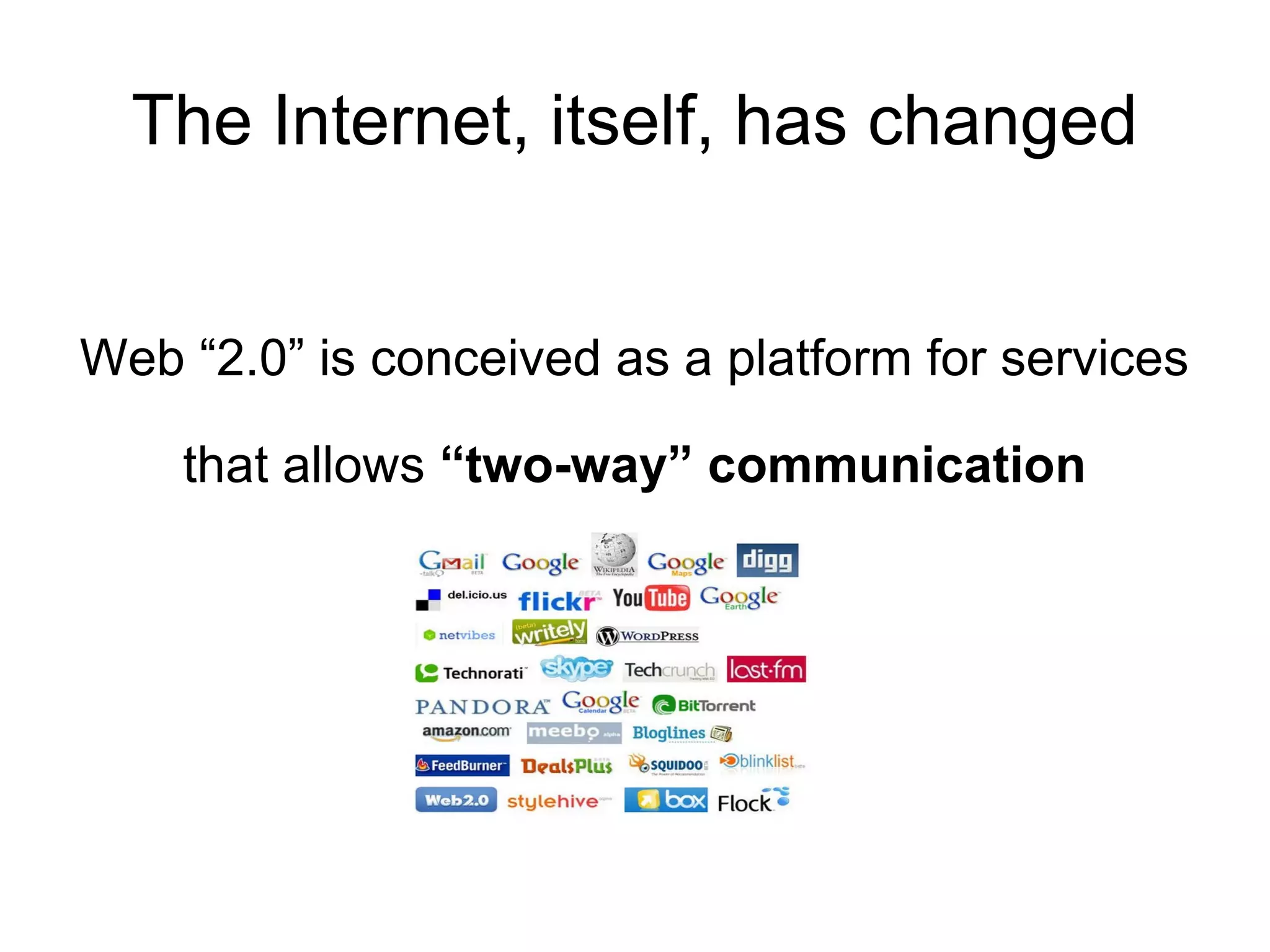
    3. The Internet, itself, has changed Web “2.0” is conceived as a platform for services that allows “two-way” communication
    4. Web 2.0 and Social Software Not all Web 2.0 tools are focused on meeting social needs
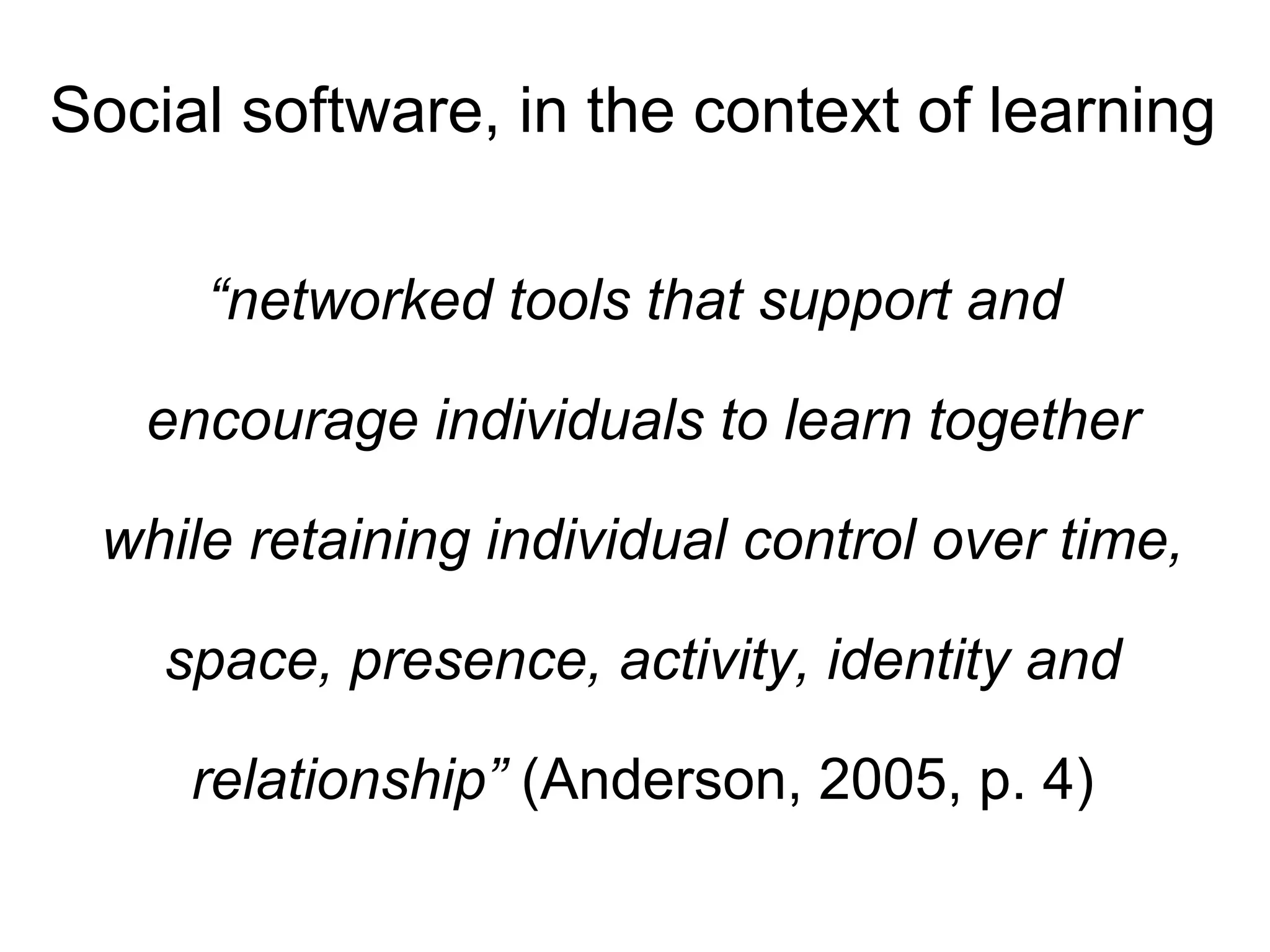
    5. Social software, in the context of learning “ networked tools that support and encourage individuals to learn together while retaining individual control over time, space, presence, activity, identity and relationship” (Anderson, 2005, p. 4)
    6. Teachers, Students and Web 2.0 Most powerful driver for the use of Web 2.0: Student engagement and motivation (The base of the educational process)
    7. Challenges for the Teacher Skills used in face-to-face communication not directly applicable online Teacher has to: - learn new interaction methods - unlearn some previous ones...
    8. Important strategy for effective teaching Try the role of the learner - understand the experience the student has - develops same motivation that students have
    9. Social software changes the classroom dynamics
    10. The context becomes wider and conversations' audience extends
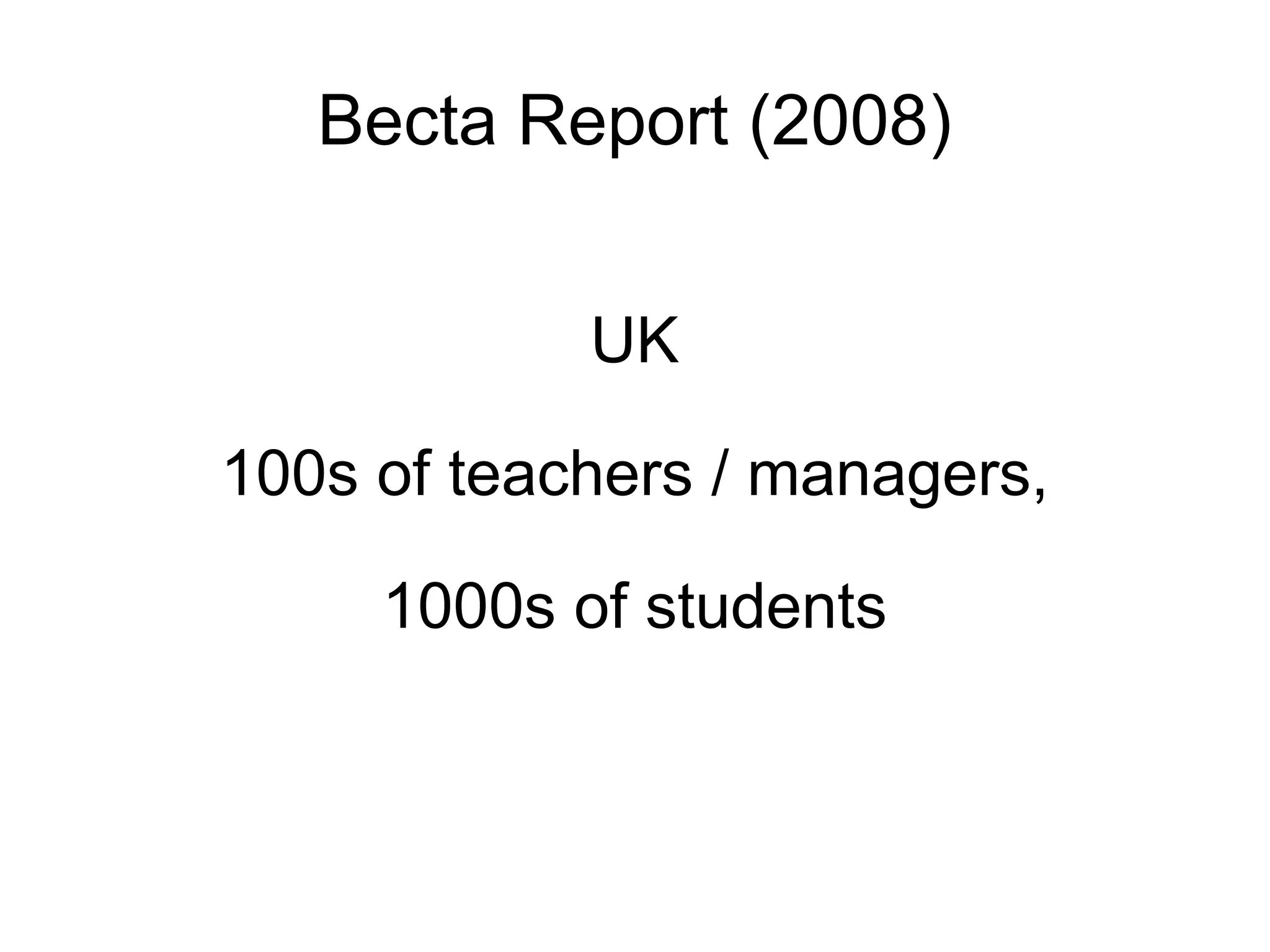
    11. Becta Report (2008) UK 100s of teachers / managers, 1000s of students
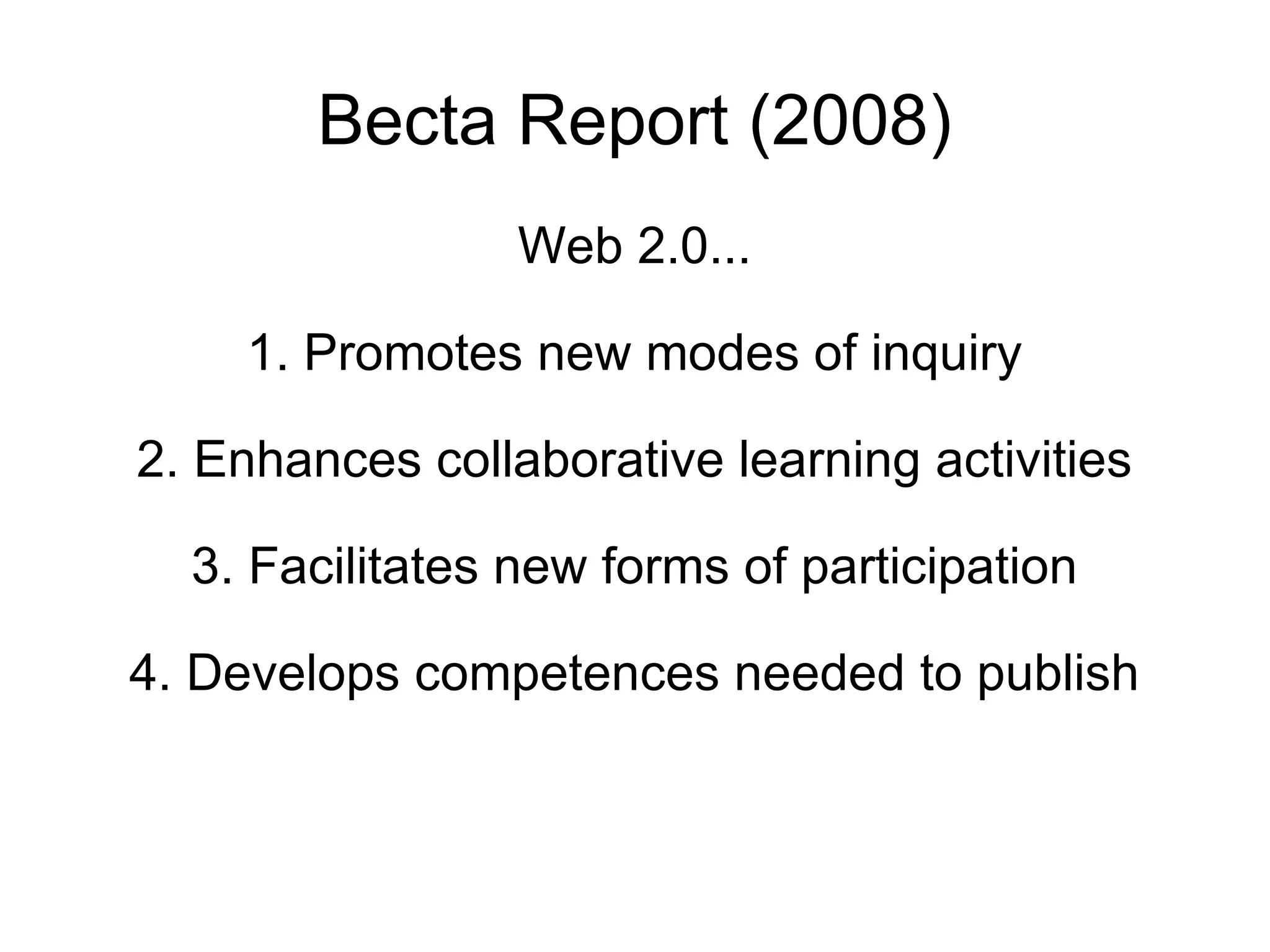
    12. Becta Report (2008) Web 2.0... 1. Promotes new modes of inquiry 2. Enhances collaborative learning activities 3. Facilitates new forms of participation 4. Develops competences needed to publish
    13. Observatory on Borderless HE (2008) Blogs and other social software technologies enhance authenticity Also, can be catalysts of student commitment and responsibility
    14. Why Education has to include Web 2.0 Web 2.0 tools are widespread in society Using them is clearly an advantage (in professional, cultural and social terms)
    15. Major Risk Using Blogs, Wikis and Podcasts traditionally... (e.g. inside “controled” LMS's like Moodle)
    16. Traditional ICT-mediated learning Three actors... 1. The teacher 2. The learner 3. Content (Dron, 2006)
    17. Next Generation of Online Learning Not teacher-centered Not content-centered But... Learner-centered
    18. The generational gap between teachers and students is not problematic but...
    19. Educators must understand the digital culture where students are immersed
    20. Significant adjustments required: 1- emphasis in collaboration 2- quality assurance in integrating external inputs
    21. Collaborative vs Cooperative Learning Cooperative learning emphasizes the product Collaborative learning emphasizes the process Gaspar (2007)
    22. Also, in cooperation: control by the teacher whereas, in collaboration: the whole class is responsible
    23. Social Software Systems: The group is a Gestalt The individual: 1- Guides his/her own learning, 2- Is guided by the environment
    24. Knowledge Not finite Not detachable from social context Not possessed by the teacher
    25. Giving Away of Control Current generation of students require: 1- Greater autonomy 2- Greater connectivity (McLoughlin & Lee, 2007)
    26. Giving Away of Control “ Traditional” LMS's (e.g. Moodle): - do enable the expression of personal viewpoints - but, still close to the classroom model
    27. Pedagogy and Social Software Web 2.0 can enhance application of constructivist principles Allows teachers and students to engage in more: authentic, flexible, open ways
    28. Pedagogy and Social Software Blogs, Wikis, Podcasts, Tagging, etc can be used in “scaffolding” but are open, by their own nature
    29. Example: in the context of a Wiki... Scaffolding is... 1- structuring the entry, or 2- entering some main themes to be developed
    30. Two ways of using Web 2.0... 1- as a repository of resources (e.g. “guided-tour”, by the teacher) 2- as a complete educational platform (where learners produce content) Any of these ways lead to the mixture of formal and informal elements in learning
    31. Two important concepts 1- “Personal publishing” 2- Syndication of learning contents (Downes, 2005)
    32. The question of Quality Assurance web 2.0 is less prone to “centralized authority” but.. students have a fine-tuned ability to evaluate individual contribution in the work of a group (Franklin & Van Harmelen 2007)
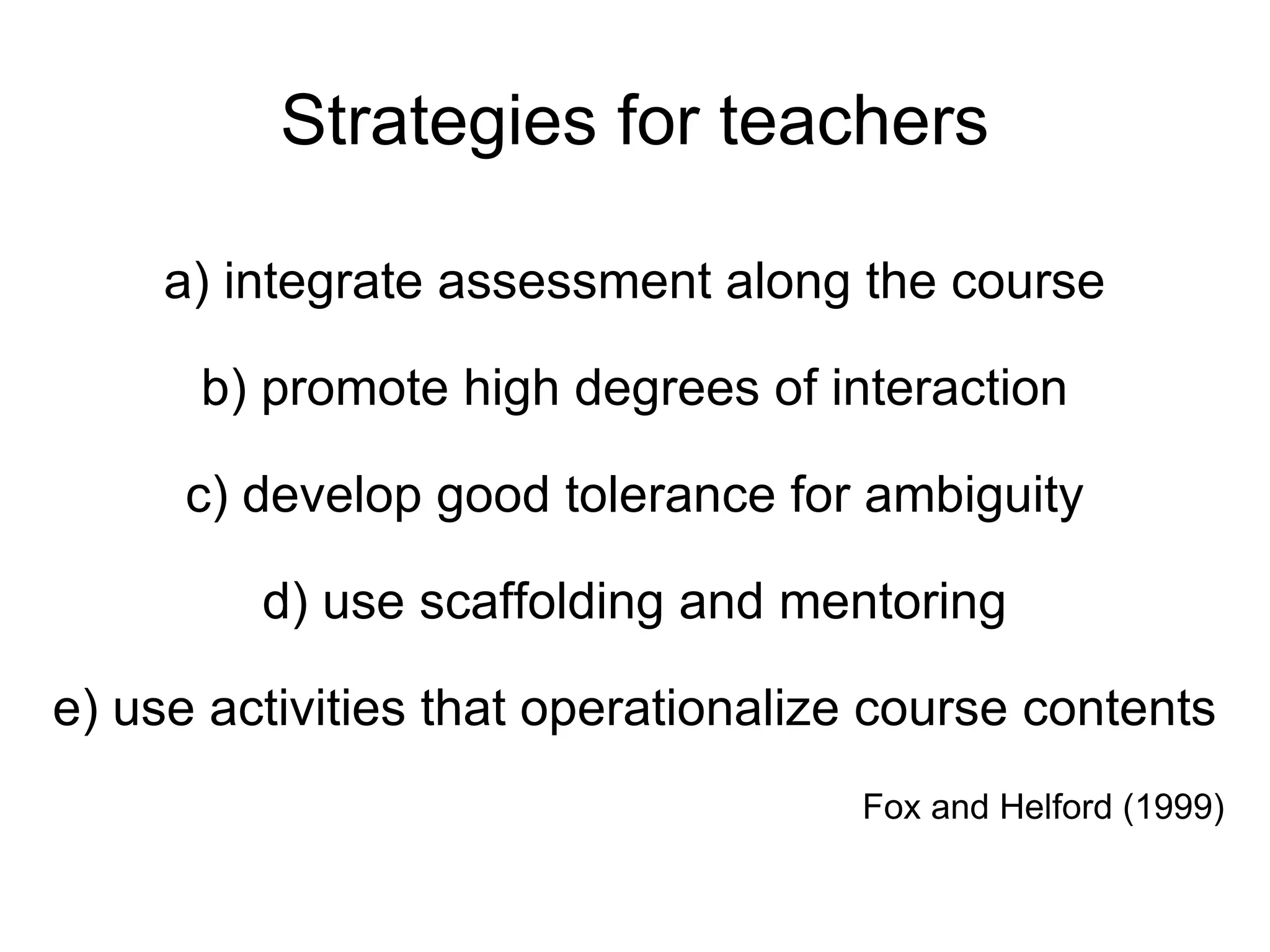
    33. Strategies for teachers a) integrate assessment along the course b) promote high degrees of interaction c) develop good tolerance for ambiguity d) use scaffolding and mentoring e) use activities that operationalize course contents Fox and Helford (1999)
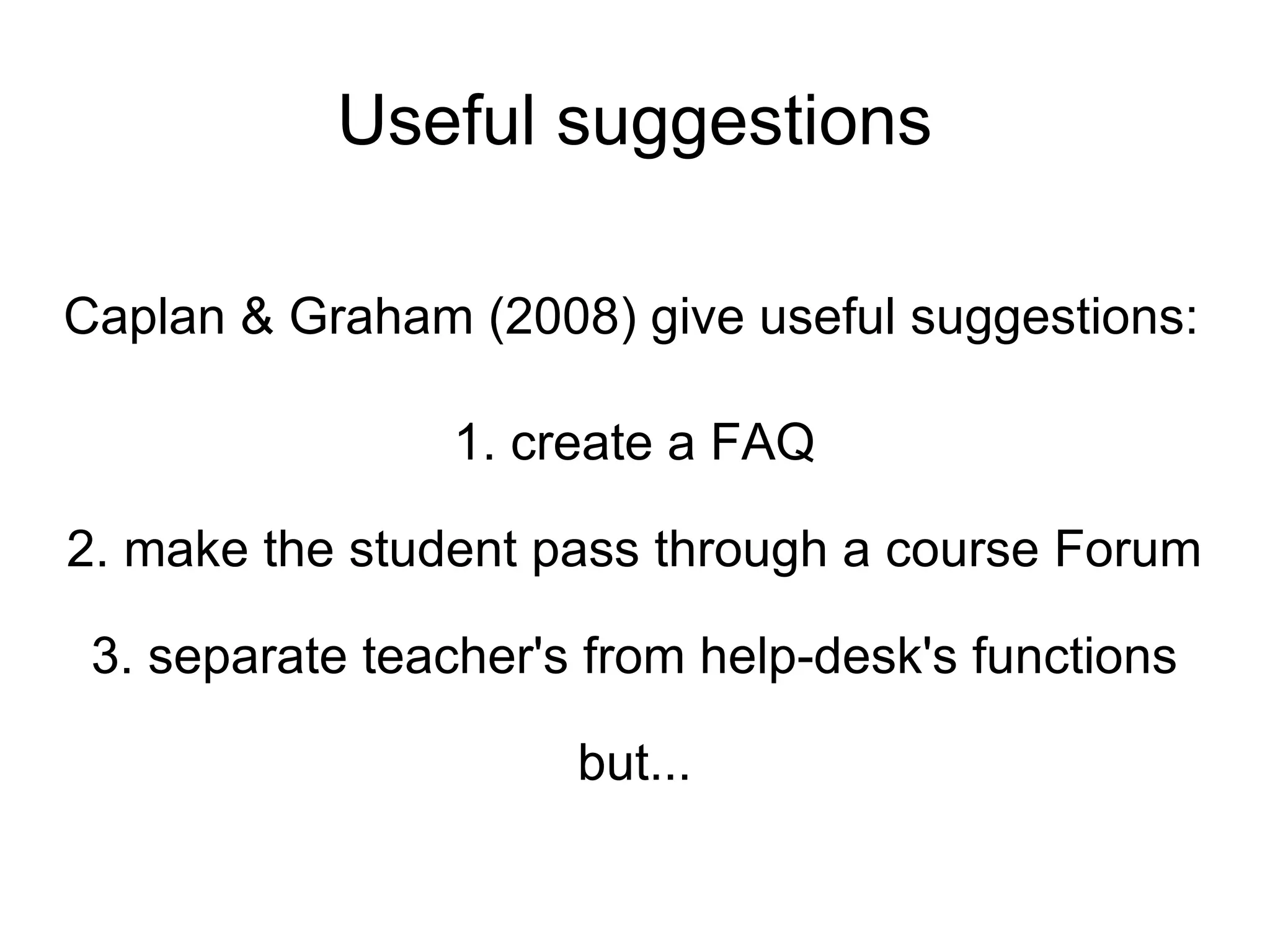
    34. Useful suggestions Caplan & Graham (2008) give useful suggestions: 1. create a FAQ 2. make the student pass through a course Forum 3. separate teacher's from help-desk's functions but...
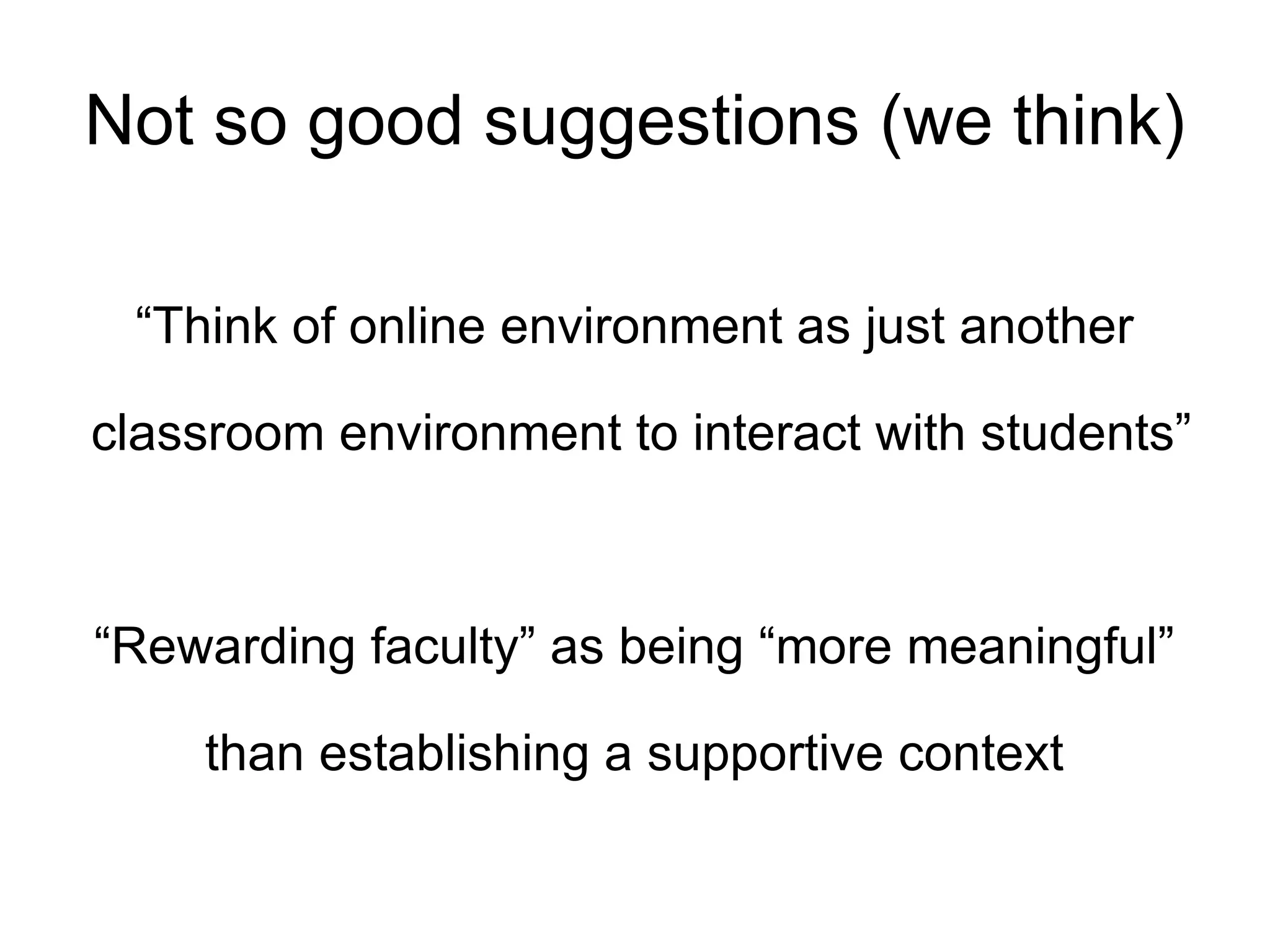
    35. Not so good suggestions (we think) “ Think of online environment as just another classroom environment to interact with students” “ Rewarding faculty” as being “more meaningful” than establishing a supportive context
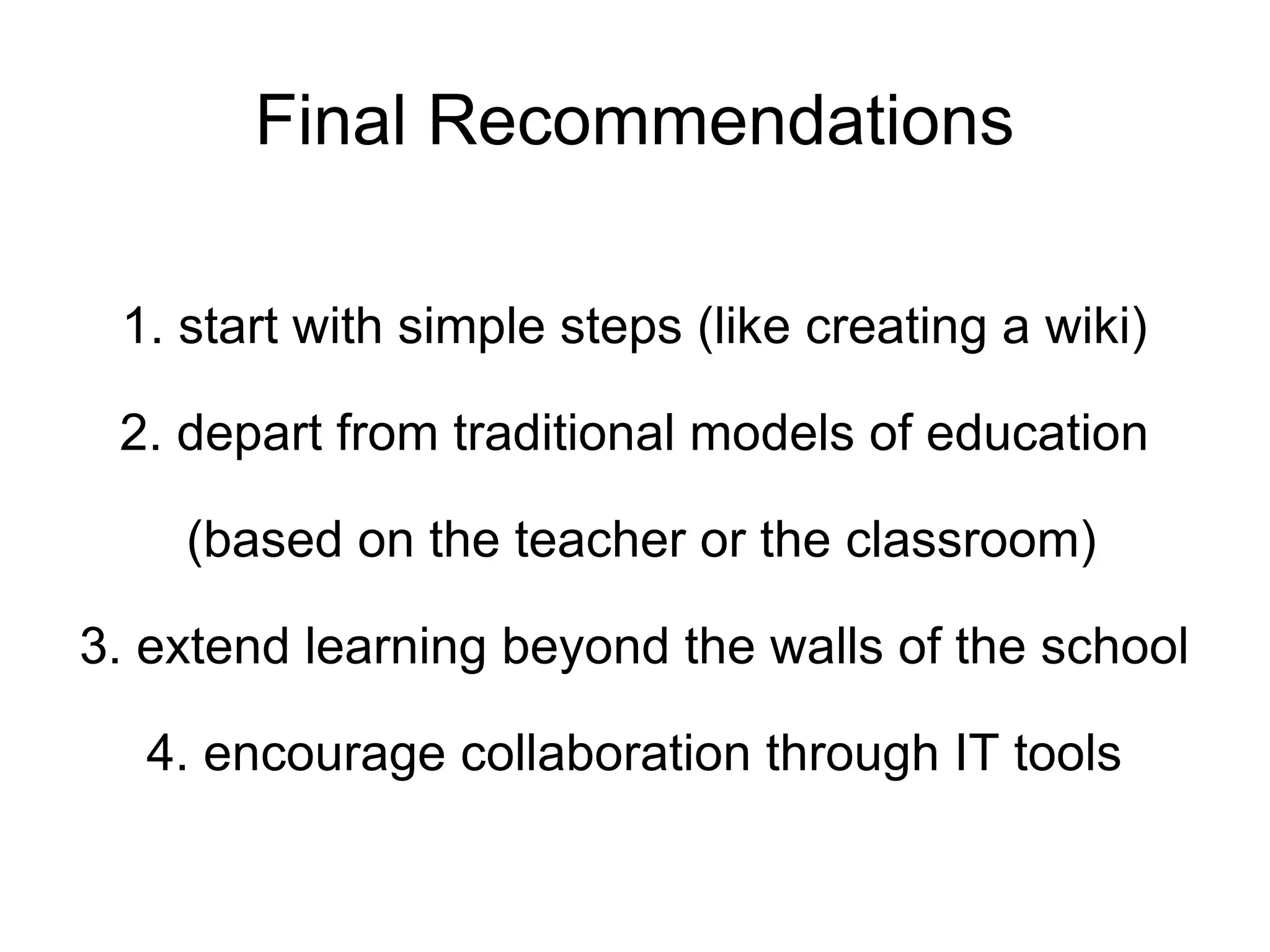
    36. Final Recommendations 1. start with simple steps (like creating a wiki) 2. depart from traditional models of education (based on the teacher or the classroom) 3. extend learning beyond the walls of the school 4. encourage collaboration through IT tools
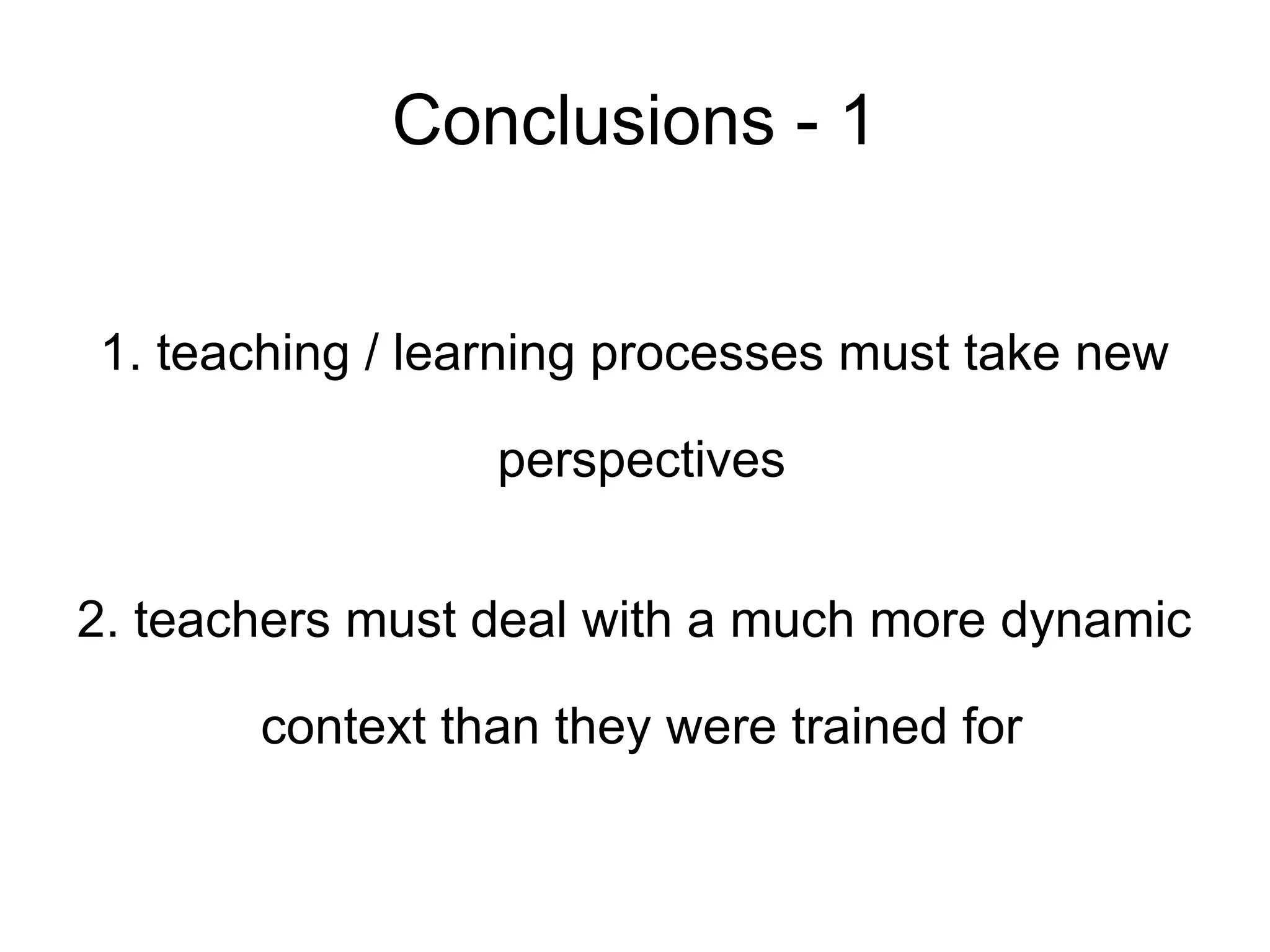
    37. Conclusions - 1 1. teaching / learning processes must take new perspectives 2. teachers must deal with a much more dynamic context than they were trained for
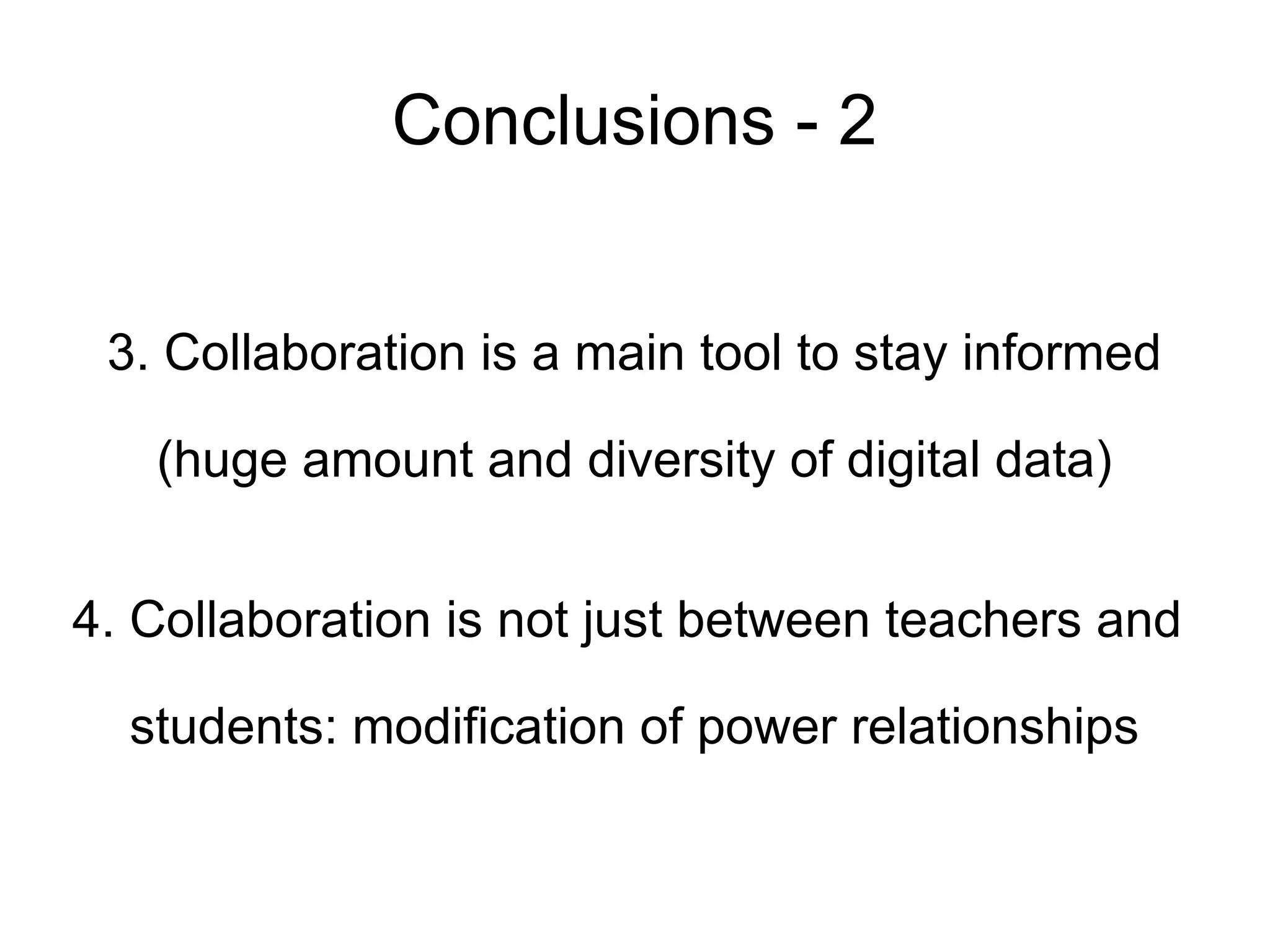
    38. Conclusions - 2 3. Collaboration is a main tool to stay informed (huge amount and diversity of digital data) 4. Collaboration is not just between teachers and students: modification of power relationships
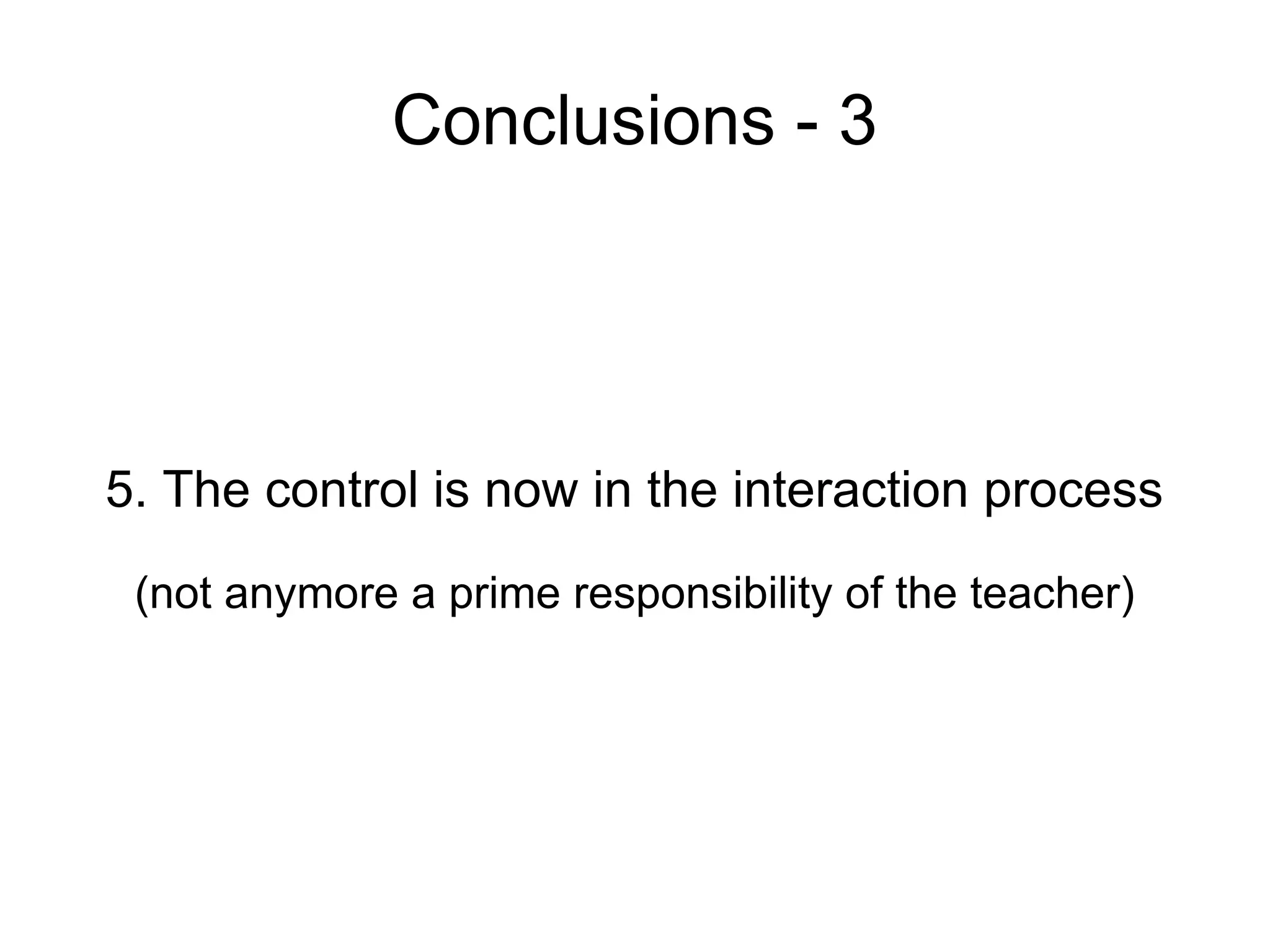
    39. Conclusions - 3 5. The control is now in the interaction process (not anymore a prime responsibility of the teacher)

    + Luis Borges GouveiaLuis Borges Gouveia, 5 months ago

    custom

    278 views, 1 favs, 1 embeds more stats

    Challenges 2009 Paper, UMinho, May 2009

    More info about this document

    © All Rights Reserved

    Go to text version

    • Total Views 278
      • 275 on SlideShare
      • 3 from embeds
    • Comments 0
    • Favorites 1
    • Downloads 0
    Most viewed embeds
    • 3 views on http://fulldream.blogspot.com

    more

    All embeds
    • 3 views on http://fulldream.blogspot.com

    less

    Flagged as inappropriate Flag as inappropriate
    Flag as inappropriate

    Select your reason for flagging this presentation as inappropriate. If needed, use the feedback form to let us know more details.

    Cancel
    File a copyright complaint
    Having problems? Go to our helpdesk?

    Categories