Time Response of First Order
System
22 February 20151
Madhuri Bayya
What is the time response of a control system?
22 February 2015 2
Time response:
The time solution to
differential equation.
What is the time response of a control system?
22 February 2015 3
Time response consists of:
1.Natural response
2.Forced response
What is the time response of a control system?
22 February 2015 4
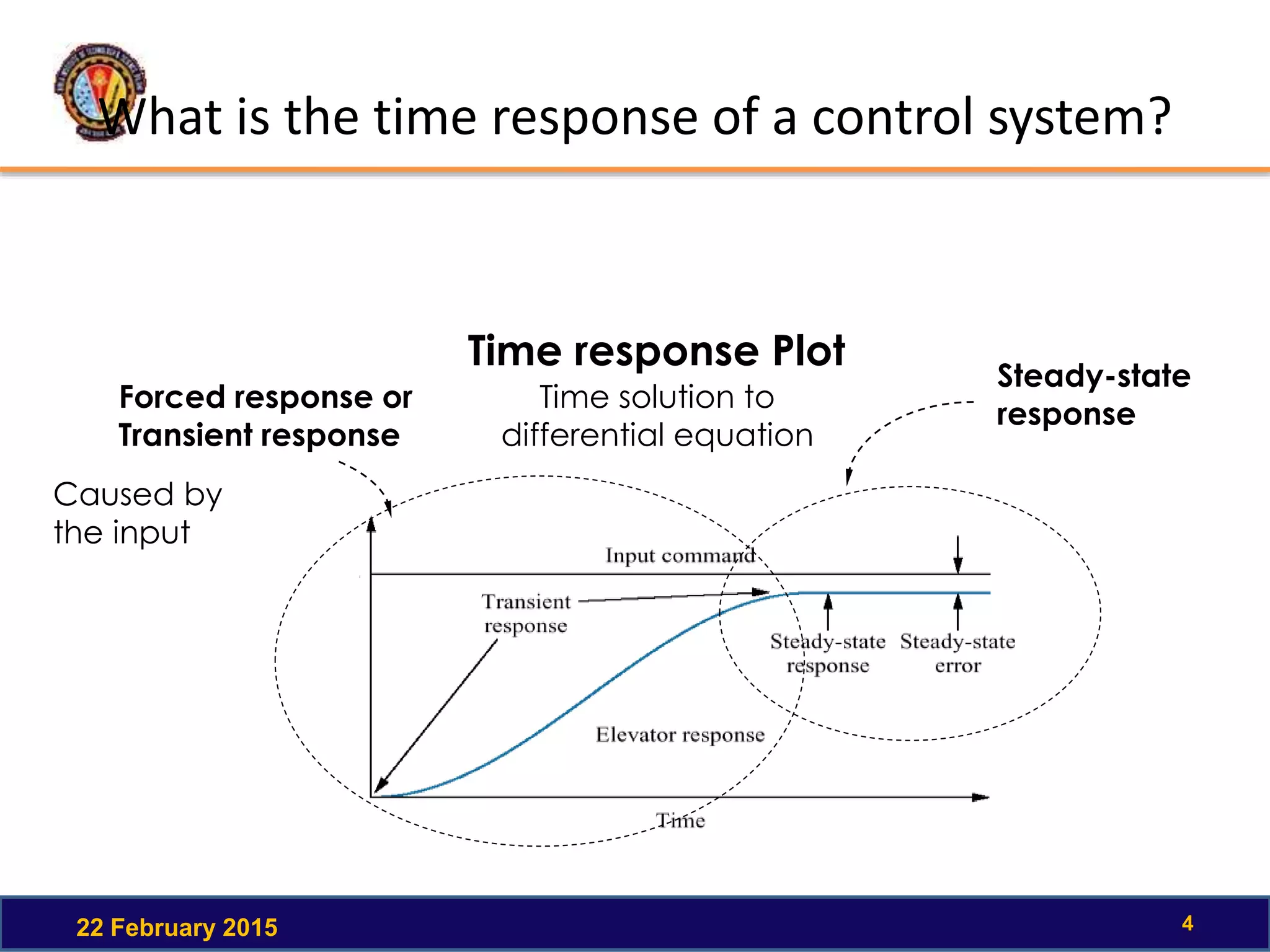
Time response Plot
Forced response or
Transient response
Steady-state
response
Time solution to
differential equation
Caused by
the input
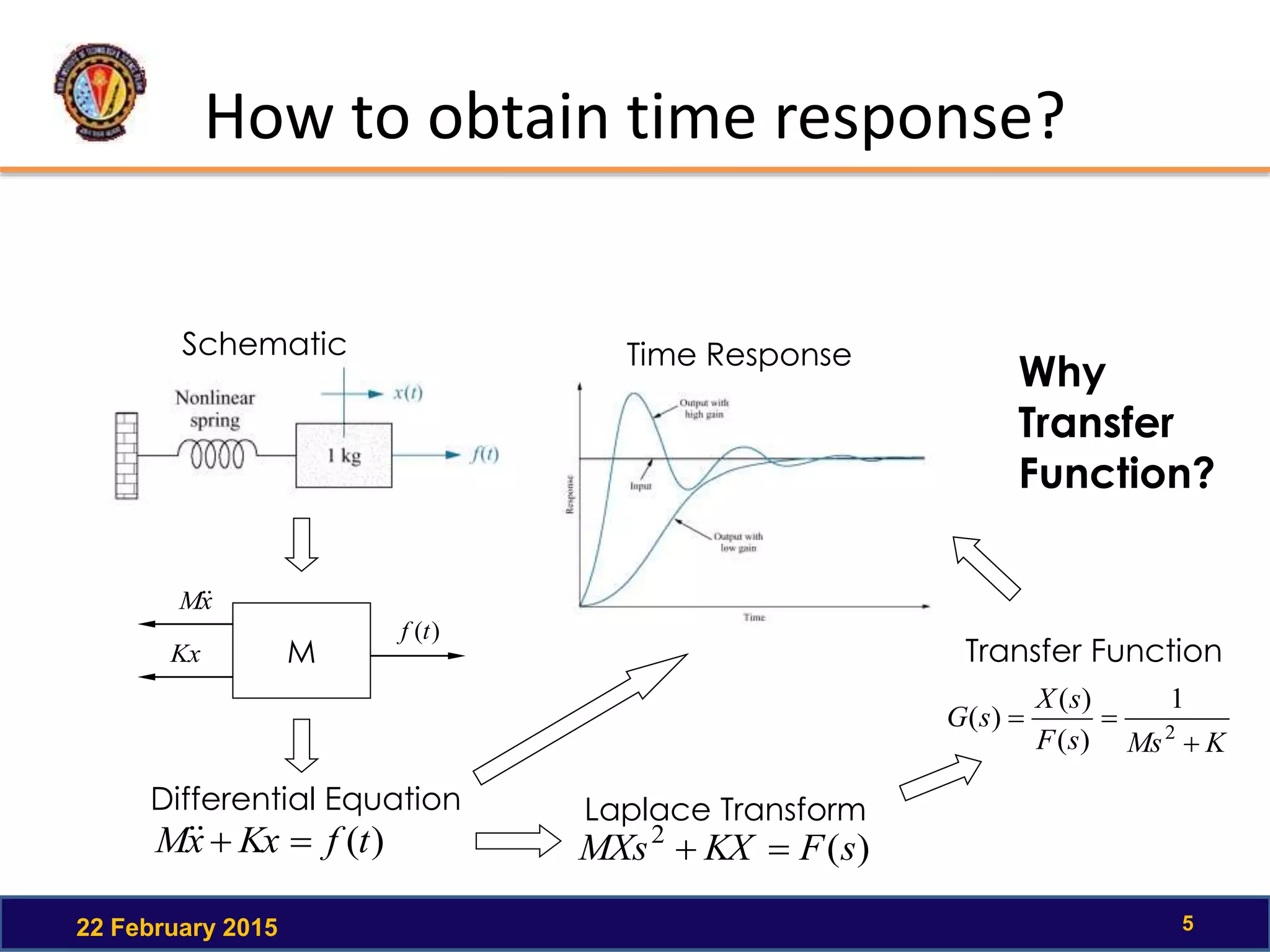
How to obtain time response?
22 February 2015 5
Schematic
M
)(tf
xM
Kx
)(tfKxxM 
Differential Equation
)(2
sFKXMXs 
Laplace Transform
Time Response
Why
Transfer
Function?
Transfer Function
KMssF
sX
sG

 2
1
)(
)(
)(
How to obtain time response?
22 February 2015 6
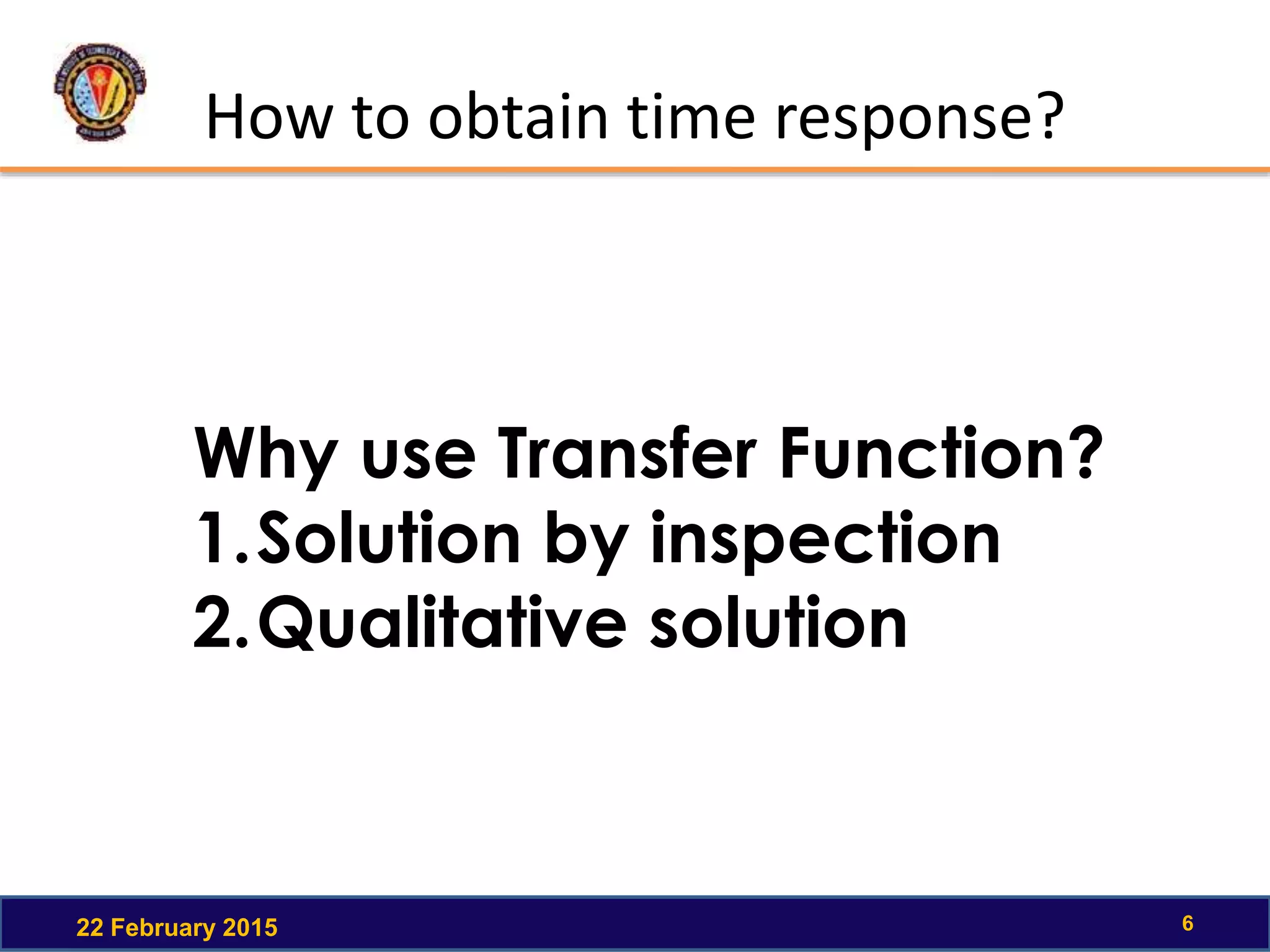
Why use Transfer Function?
1.Solution by inspection
2.Qualitative solution
How to obtain time response from transfer
function?
22 February 2015 7
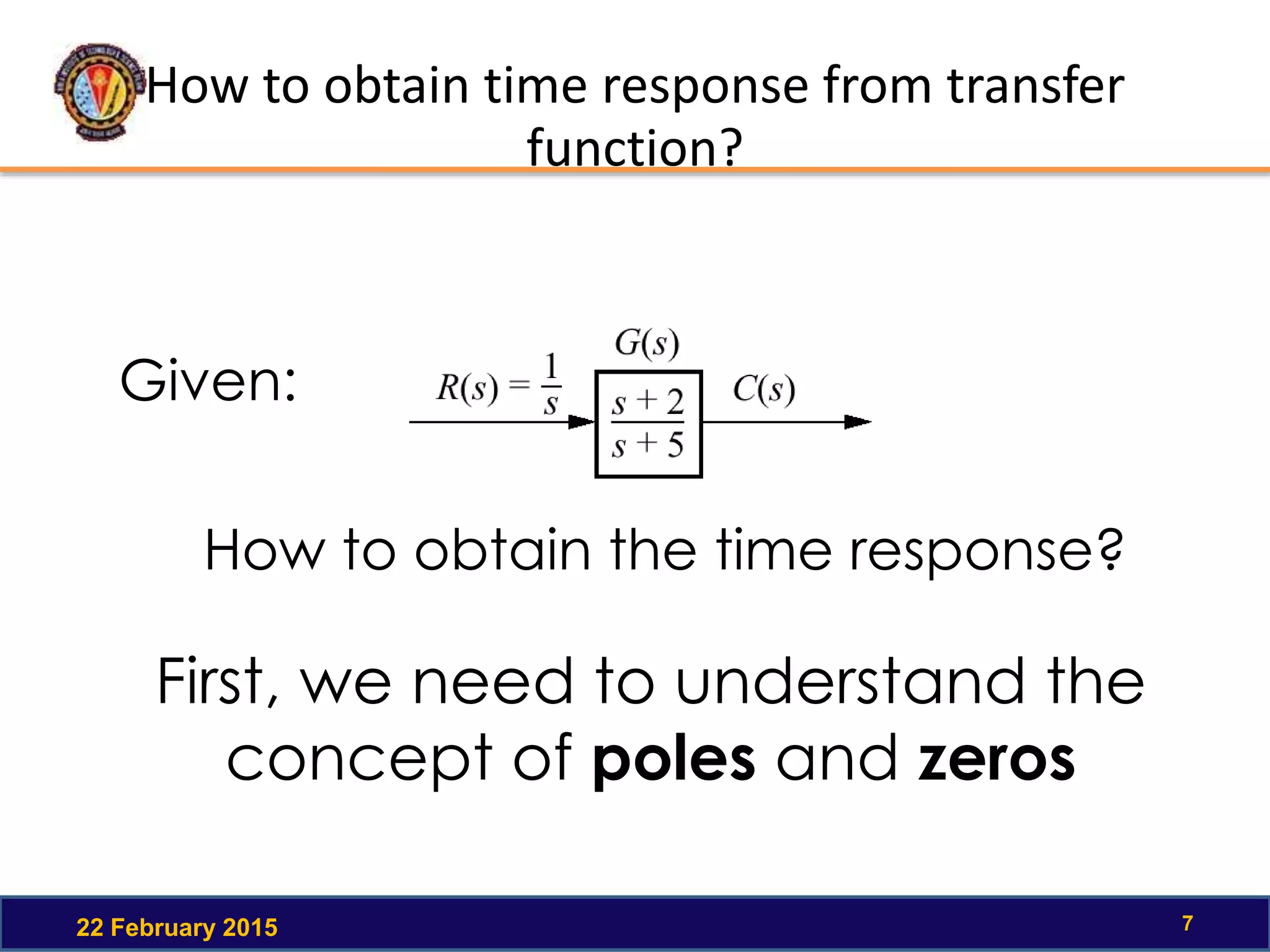
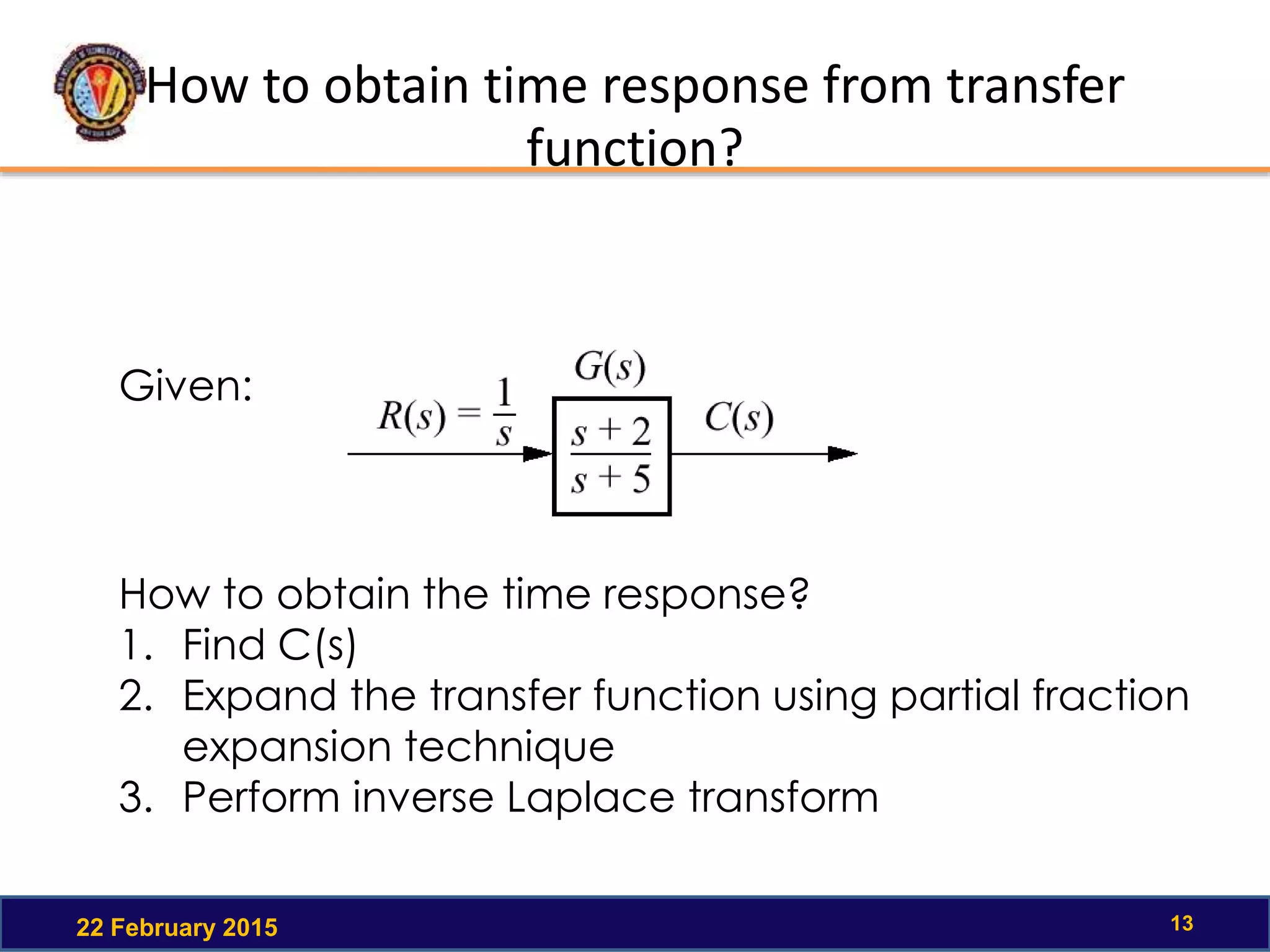
Given:
How to obtain the time response?
First, we need to understand the
concept of poles and zeros
How to obtain time response from transfer
function?
22 February 2015 8
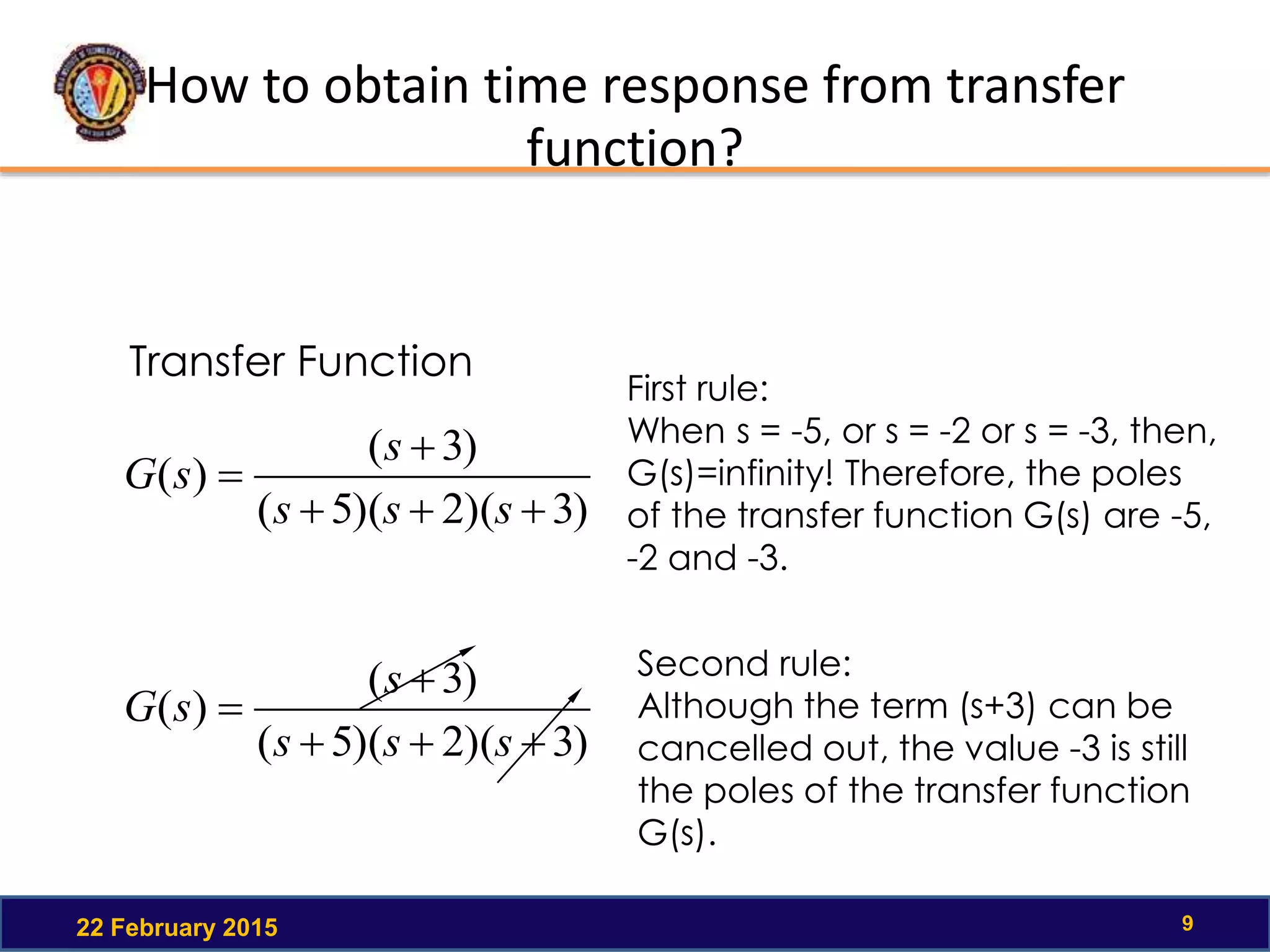
First rule:
The values of Laplace transform variable,
s, that cause the transfer function to
become infinite.
Second rule:
Any roots of the denominator of the
transfer function that are common to the
roots of numerator
What are poles ?
How to obtain time response from transfer
function?
22 February 2015 9
Transfer Function
)3)(2)(5(
)3(
)(



sss
s
sG
First rule:
When s = -5, or s = -2 or s = -3, then,
G(s)=infinity! Therefore, the poles
of the transfer function G(s) are -5,
-2 and -3.
)3)(2)(5(
)3(
)(



sss
s
sG
Second rule:
Although the term (s+3) can be
cancelled out, the value -3 is still
the poles of the transfer function
G(s).
How to obtain time response from transfer
function?
22 February 2015 10
First rule:
The values of Laplace transform variable,
s, that cause the transfer function to
become zero.
Second rule:
Any roots of the numerator of the transfer
function that are common to roots of the
denominator
What are zeros ?
How to obtain time response from transfer
function?
22 February 2015 11
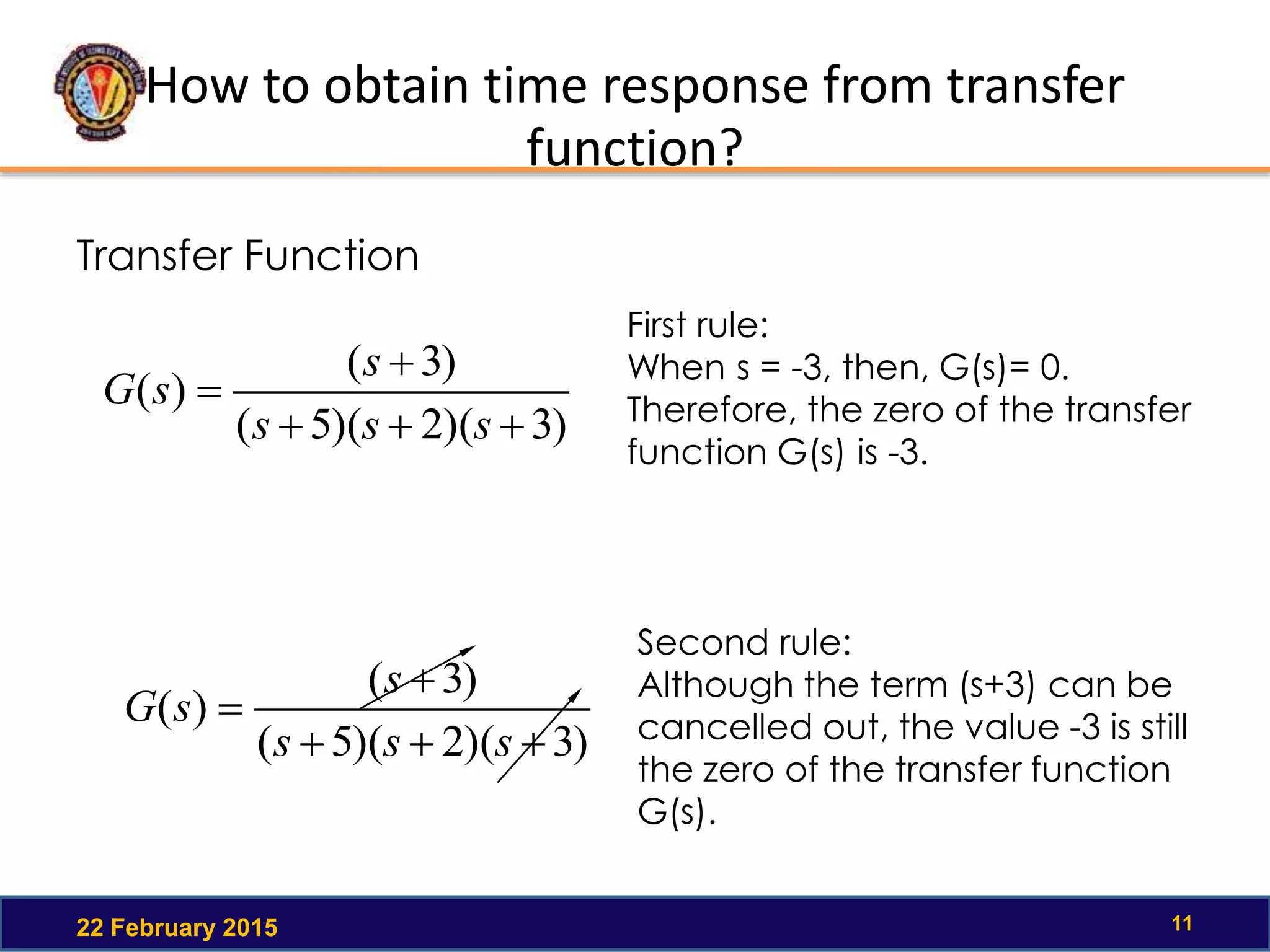
Transfer Function
)3)(2)(5(
)3(
)(



sss
s
sG
First rule:
When s = -3, then, G(s)= 0.
Therefore, the zero of the transfer
function G(s) is -3.
)3)(2)(5(
)3(
)(



sss
s
sG
Second rule:
Although the term (s+3) can be
cancelled out, the value -3 is still
the zero of the transfer function
G(s).
How to obtain time response from transfer
function?
22 February 2015 12
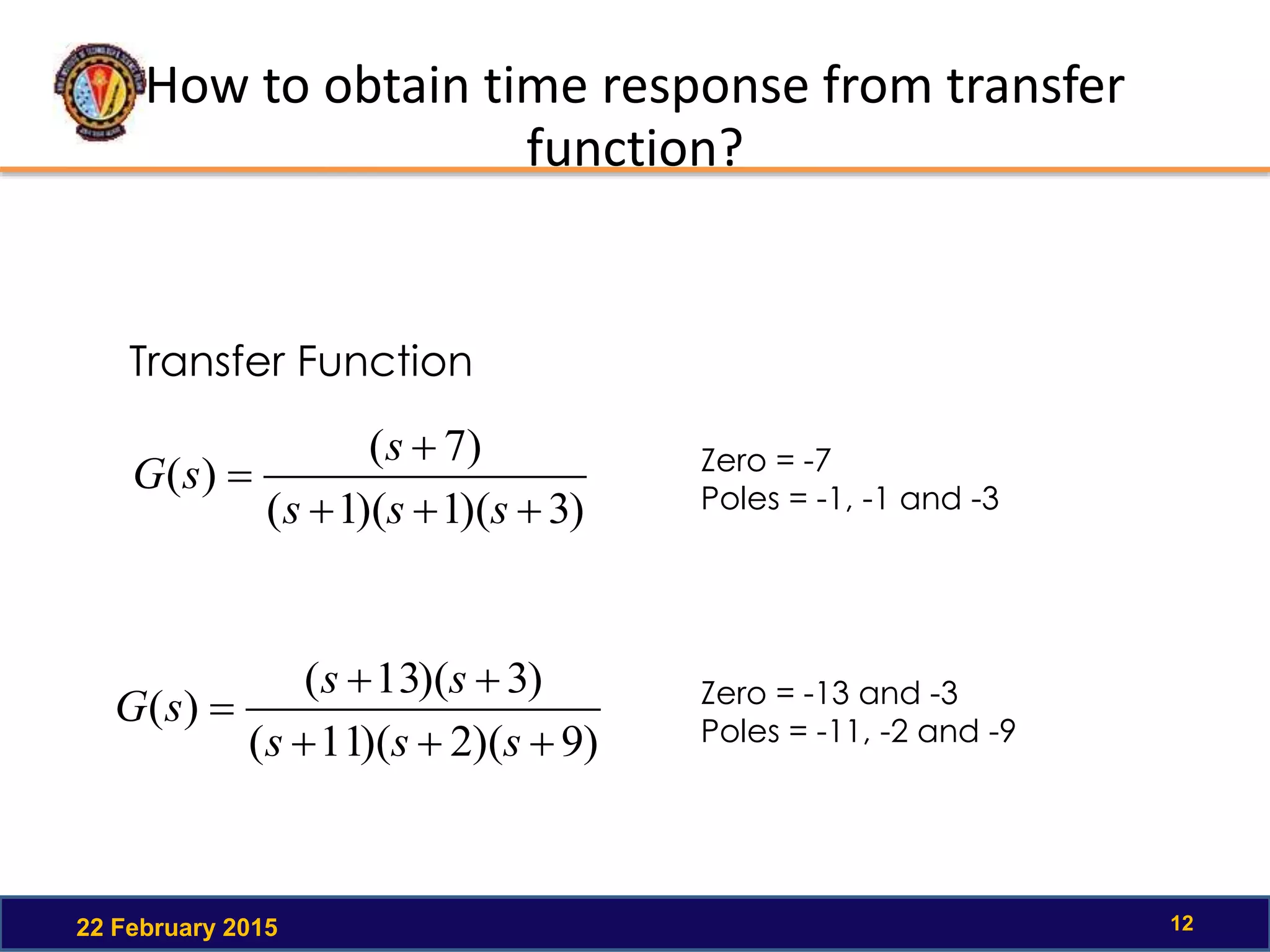
Transfer Function
)3)(1)(1(
)7(
)(



sss
s
sG
)9)(2)(11(
)3)(13(
)(



sss
ss
sG
Zero = -7
Poles = -1, -1 and -3
Zero = -13 and -3
Poles = -11, -2 and -9
How to obtain time response from transfer
function?
22 February 2015 13
Given:
How to obtain the time response?
1. Find C(s)
2. Expand the transfer function using partial fraction
expansion technique
3. Perform inverse Laplace transform
How to obtain time response from transfer
function? –Find C(s)
22 February 2015 14
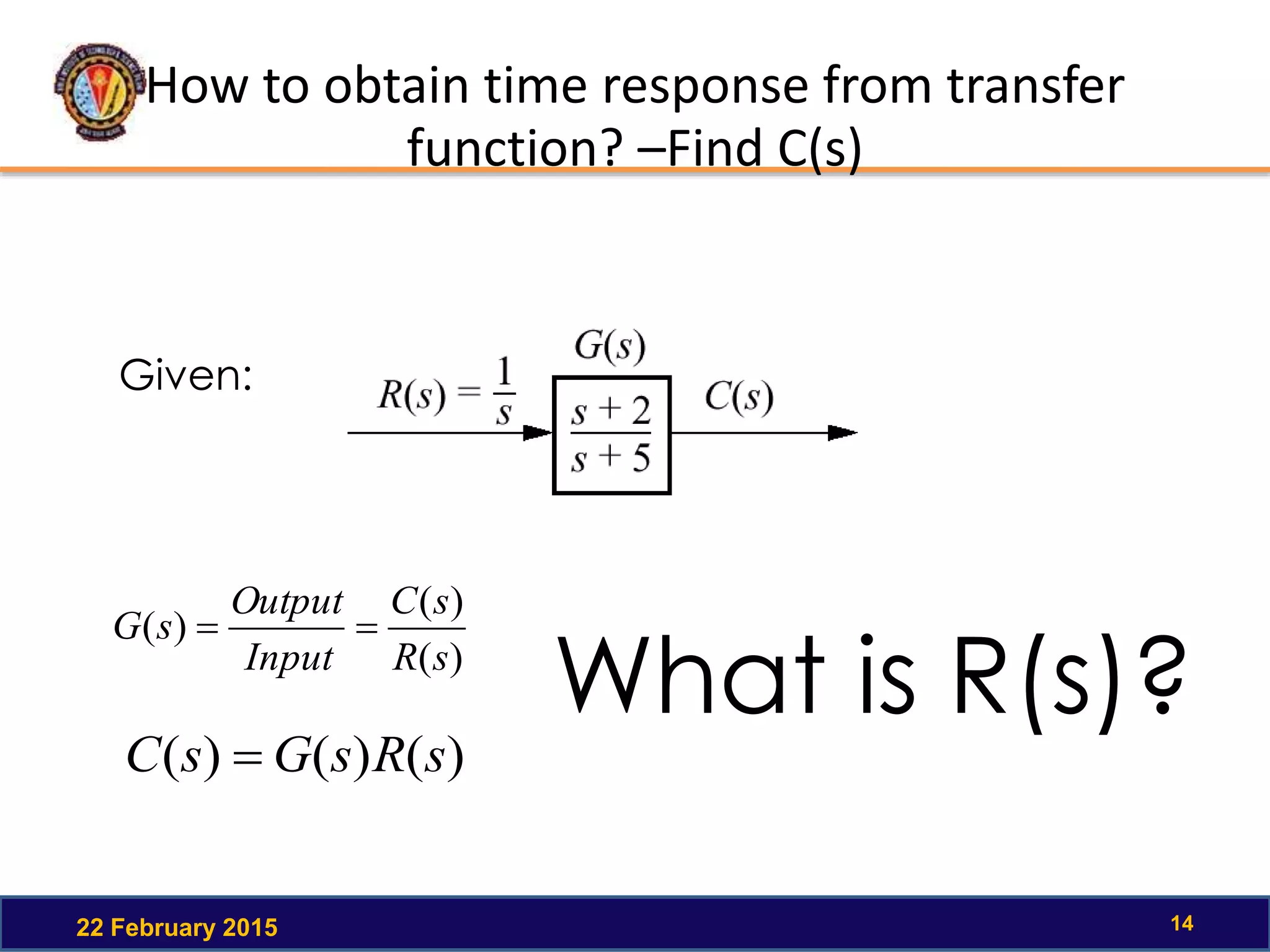
Given:
)(
)(
)(
sR
sC
Input
Output
sG 
)()()( sRsGsC 
What is R(s)?
Test Input Signal
• Unlike electric networks, inputs to many practical
systems are not exactly known ahead of time.
• Difficult to design a control system to satisfy all
possible input signals
• For purpose of analysis and design some basic types
of test inputs assumed, so that performance can be
evaluated.
• Gives an idea of response to other complex inputs.
• Response of complex signals can be determined by
superimposing those due to simple test signals
15Control Systems
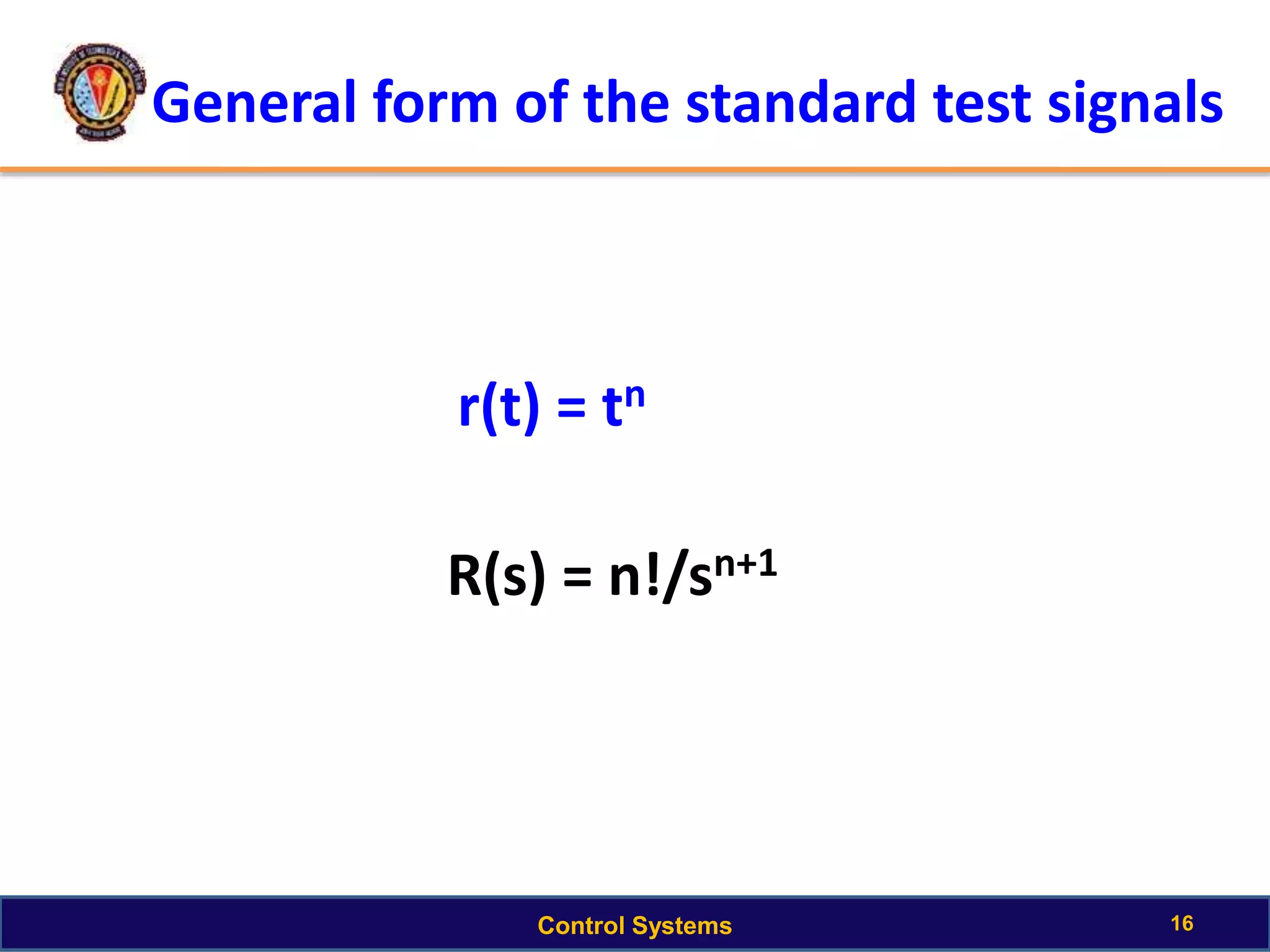
General form of the standard test signals
r(t) = tn
R(s) = n!/sn+1
16Control Systems
Types of test signals
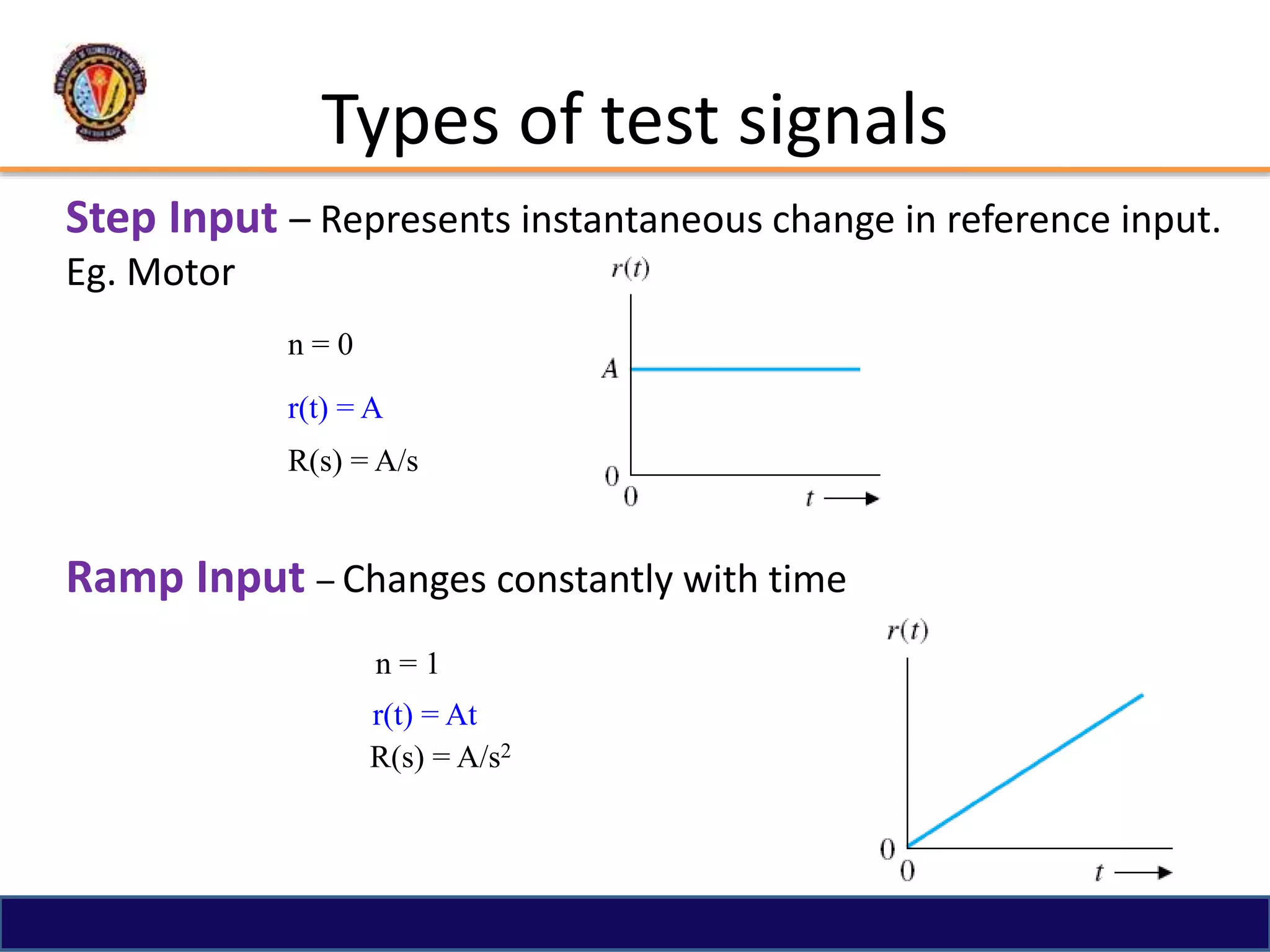
Step Input – Represents instantaneous change in reference input.
Eg. Motor
n = 0
r(t) = A
R(s) = A/s
Ramp Input – Changes constantly with time
r(t) = At
n = 1
R(s) = A/s2
Types of test signals
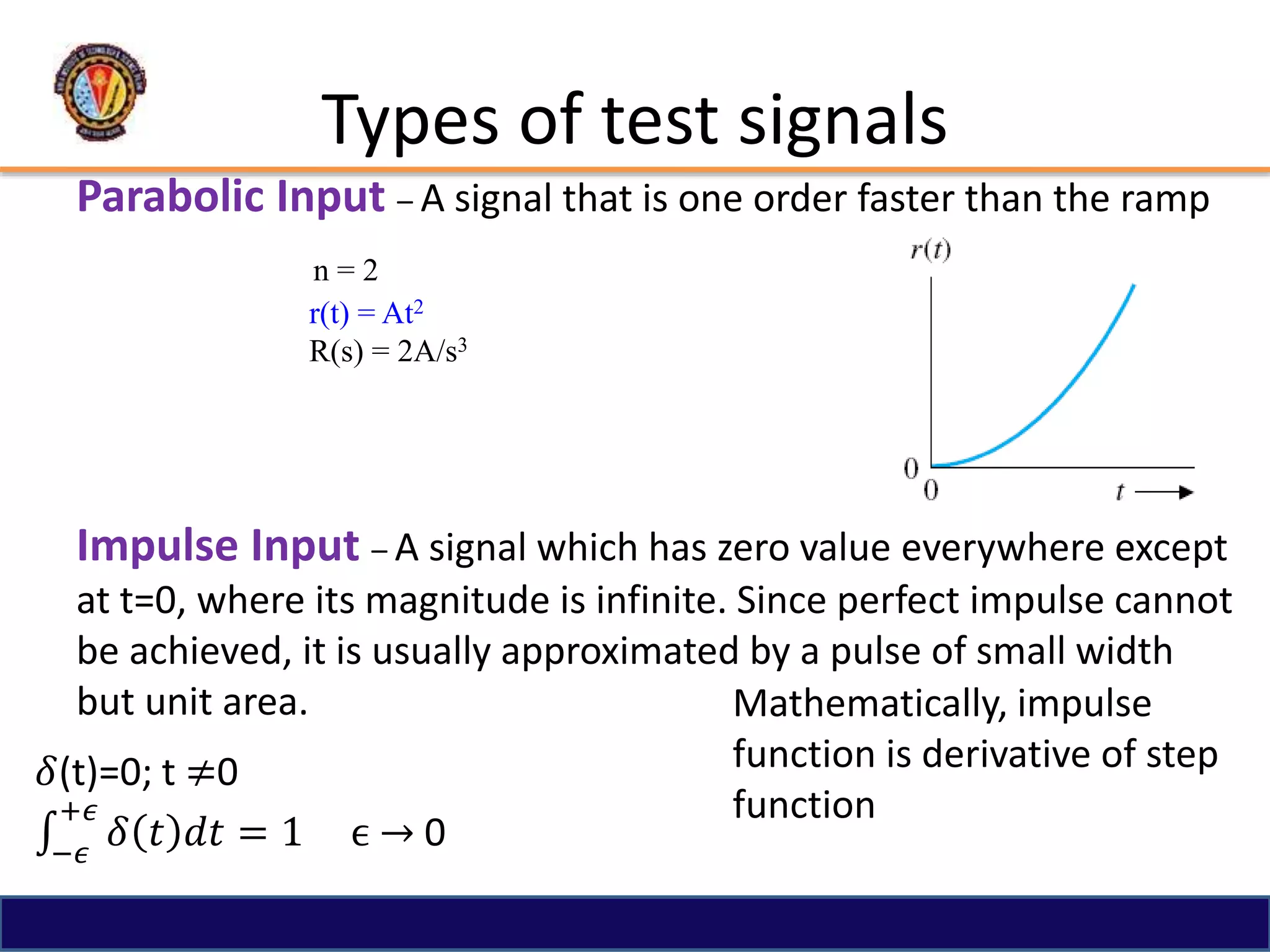
Parabolic Input – A signal that is one order faster than the ramp
n = 2
r(t) = At2
R(s) = 2A/s3
Impulse Input – A signal which has zero value everywhere except
at t=0, where its magnitude is infinite. Since perfect impulse cannot
be achieved, it is usually approximated by a pulse of small width
but unit area.
𝛿(t)=0; t ≠0
−𝜖
+𝜖
𝛿 𝑡 𝑑𝑡 = 1 ϵ → 0
Mathematically, impulse
function is derivative of step
function
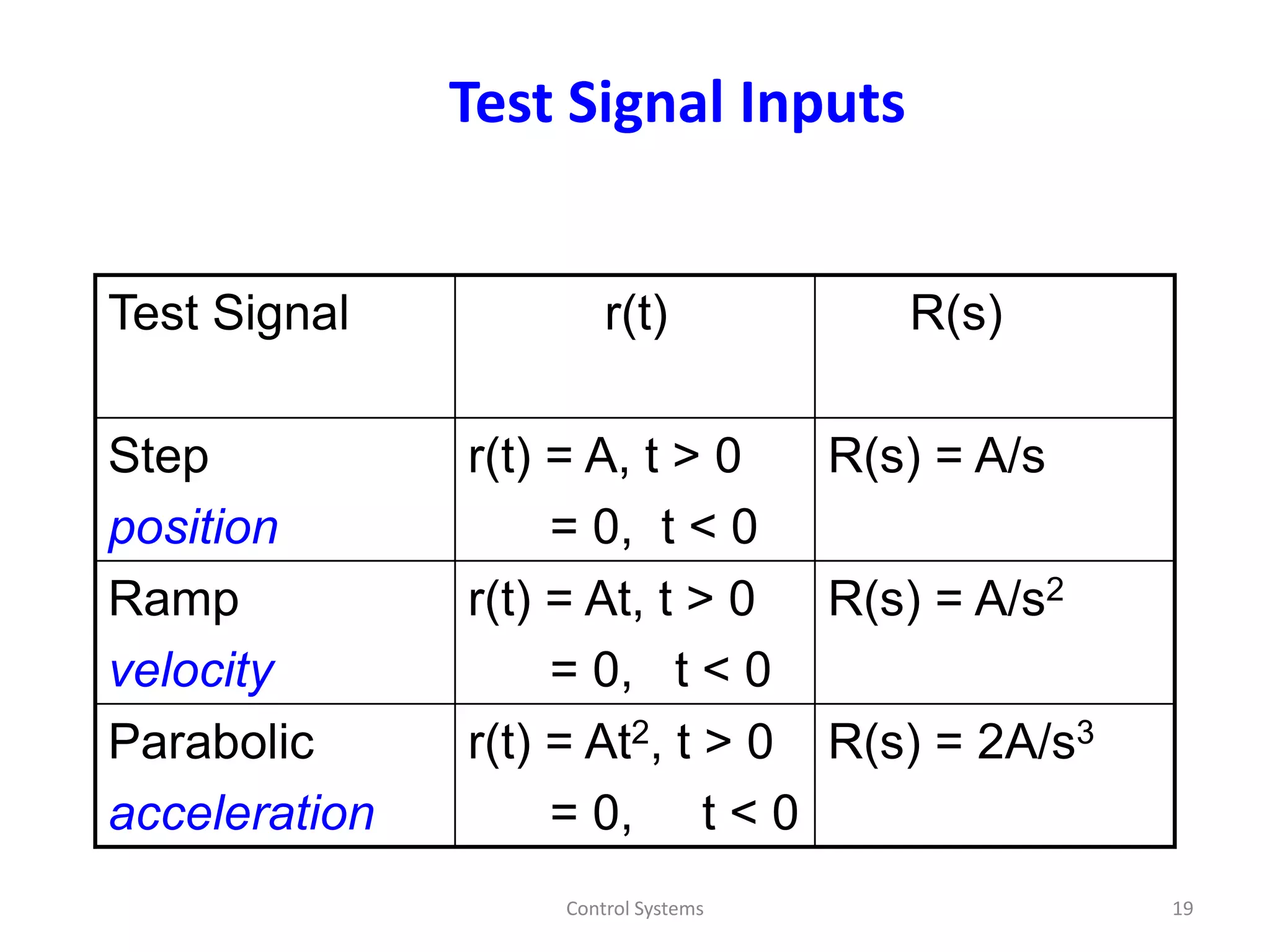
Test Signal Inputs
Test Signal r(t) R(s)
Step
position
r(t) = A, t > 0
= 0, t < 0
R(s) = A/s
Ramp
velocity
r(t) = At, t > 0
= 0, t < 0
R(s) = A/s2
Parabolic
acceleration
r(t) = At2, t > 0
= 0, t < 0
R(s) = 2A/s3
19Control Systems
How to obtain time response from transfer
function? –Find C(s)
22 February 2015 20
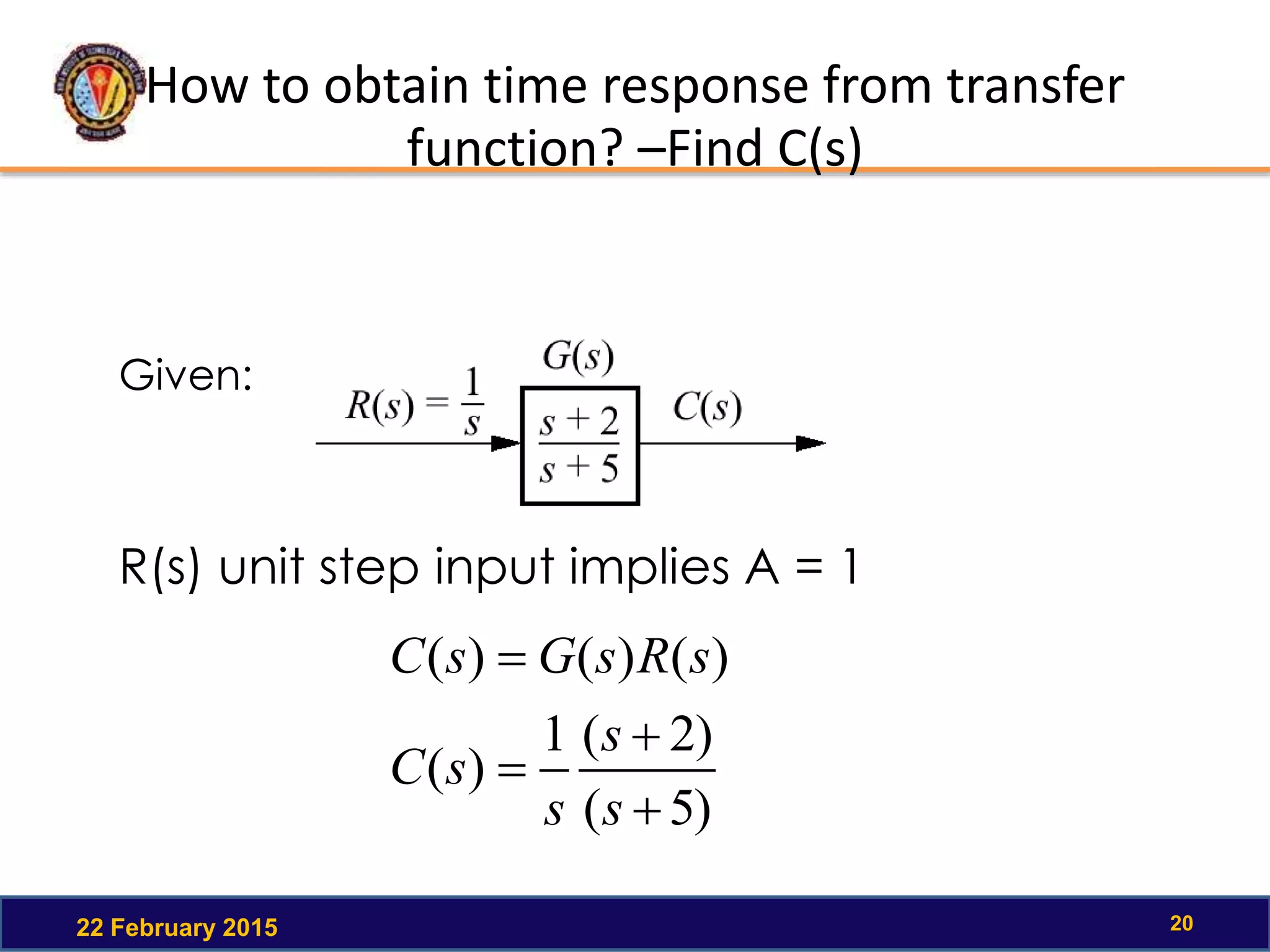
Given:
R(s) unit step input implies A = 1
)5(
)2(1
)(
)()()(




s
s
s
sC
sRsGsC
How to obtain time response from transfer
function? – Expand C(s)
22 February 2015 21
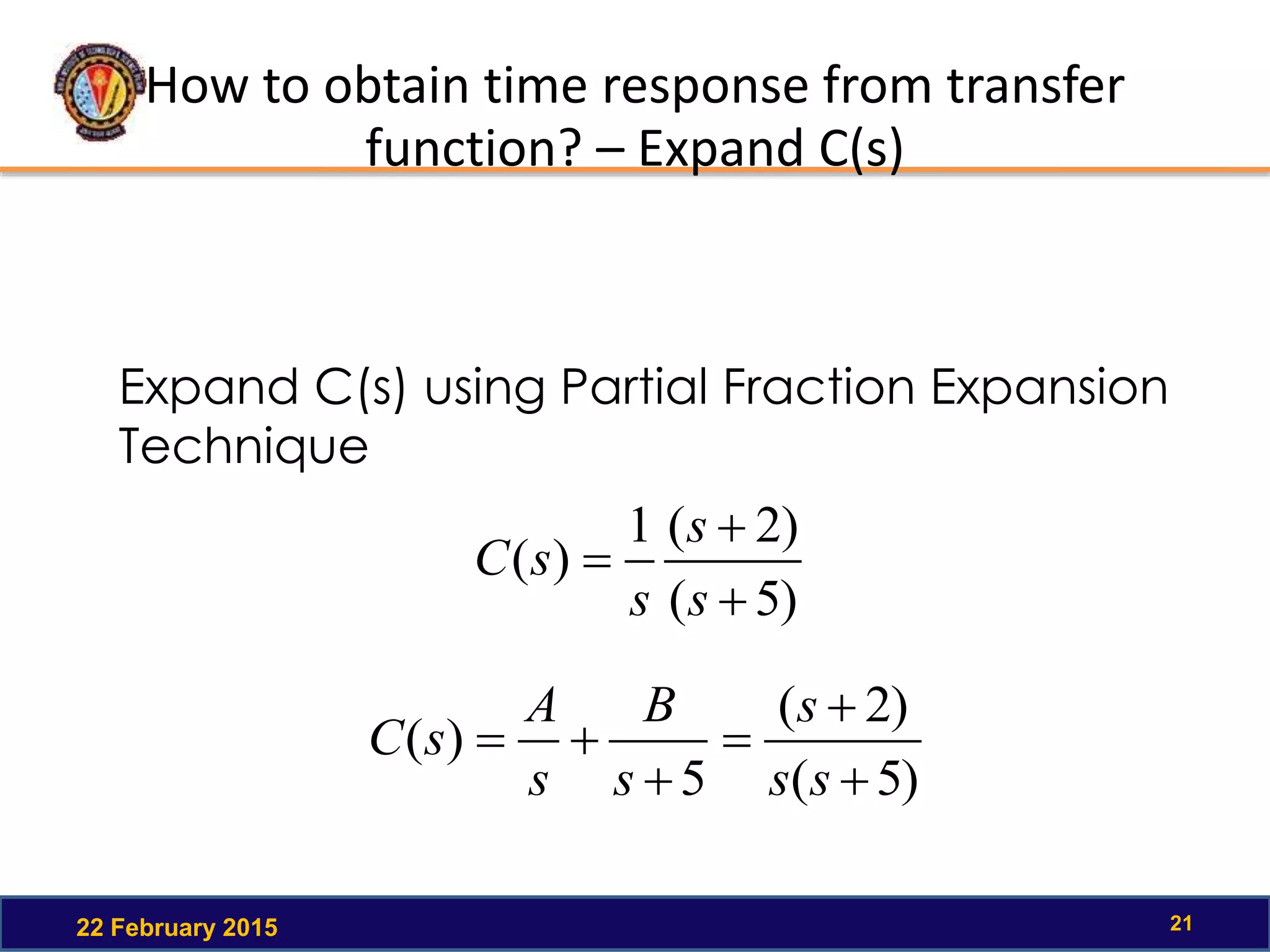
Expand C(s) using Partial Fraction Expansion
Technique
)5(
)2(1
)(



s
s
s
sC
)5(
)2(
5
)(





ss
s
s
B
s
A
sC
How to obtain time response from transfer
function? – Expand C(s)
22 February 2015 22
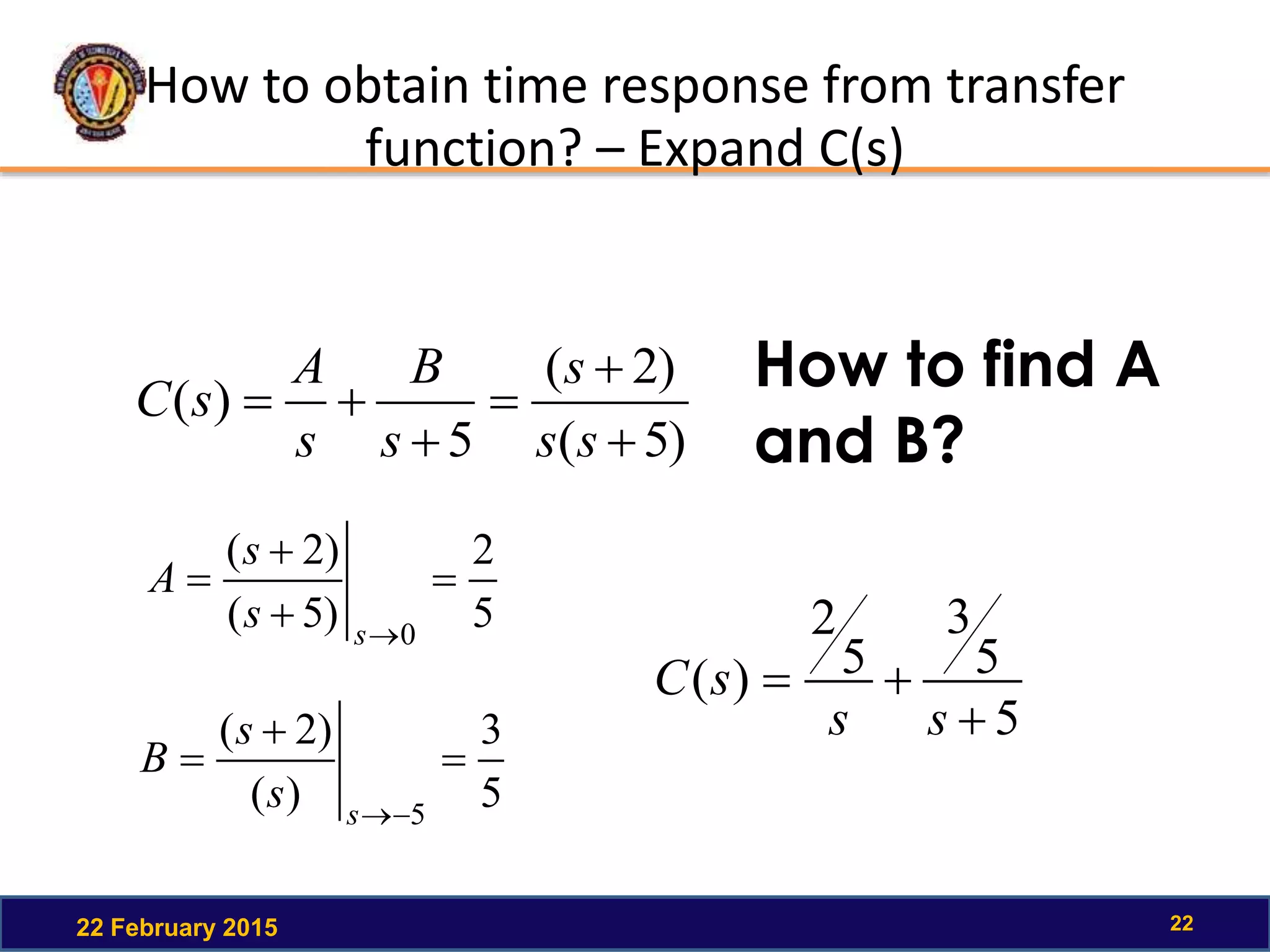
)5(
)2(
5
)(





ss
s
s
B
s
A
sC
5
2
)5(
)2(
0




s
s
s
A
5
3
)(
)2(
5



s
s
s
B
5
5
3
5
2
)(


ss
sC
How to find A
and B?
How to obtain time response from transfer function?
– Inverse Laplace Transform
22 February 2015 23
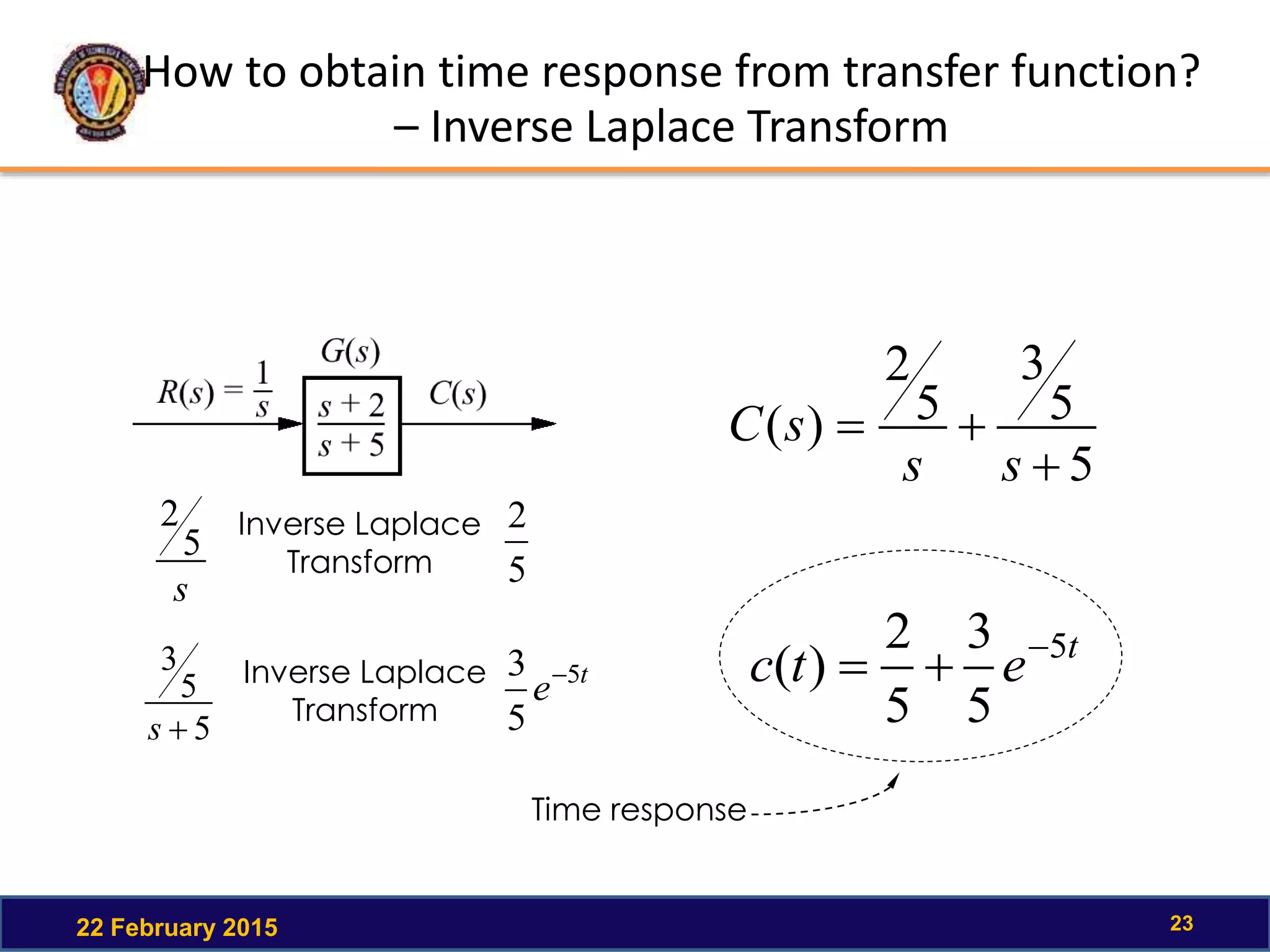
5
5
3
5
2
)(


ss
sC
s
5
2 Inverse Laplace
Transform 5
2
5
5
3
s
Inverse Laplace
Transform
t
e 5
5
3 
t
etc 5
5
3
5
2
)( 

Time response
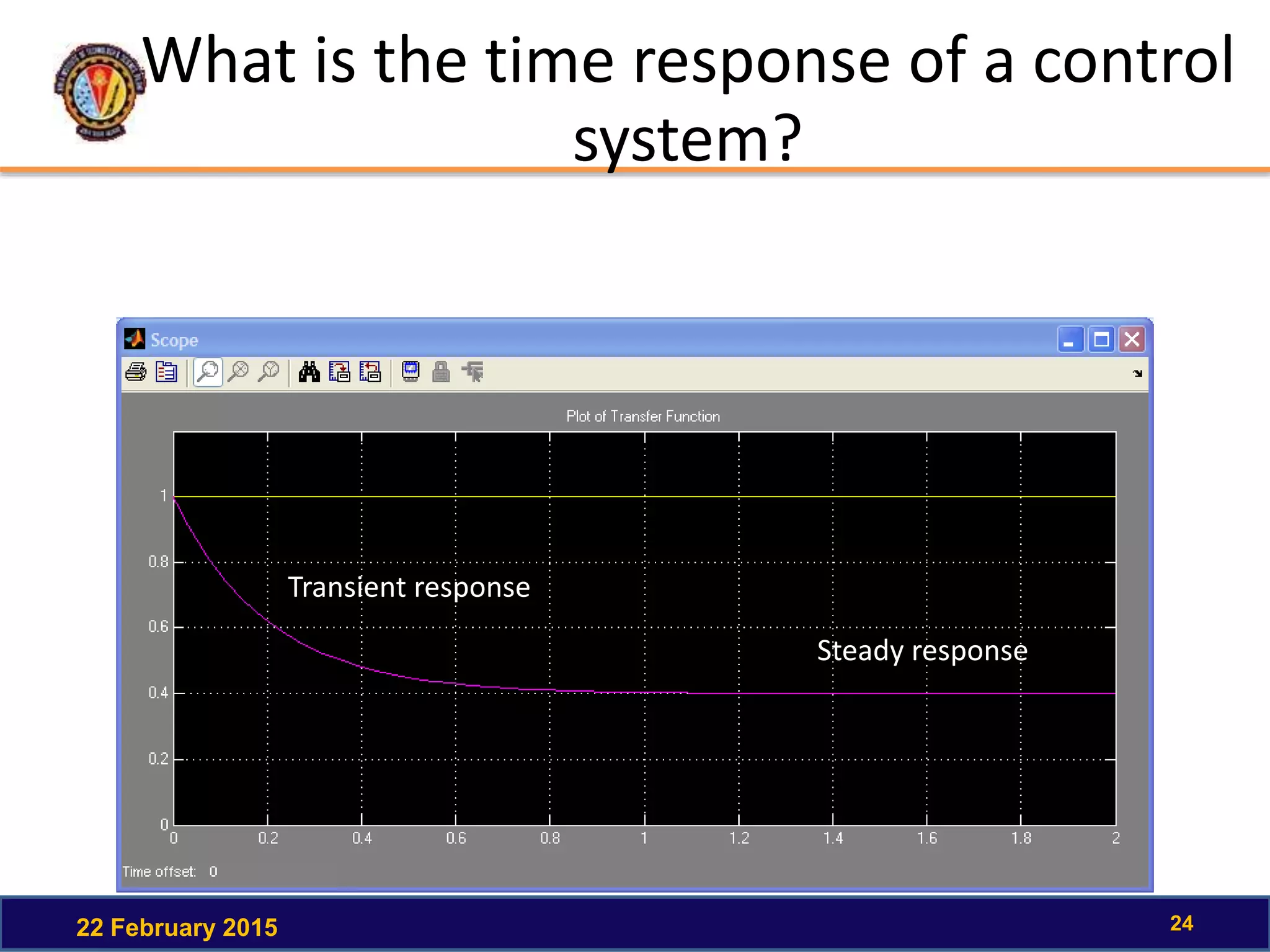
What is the time response of a control
system?
22 February 2015 24
Steady response
Transient response
What is time response of a control system?
22 February 2015 25
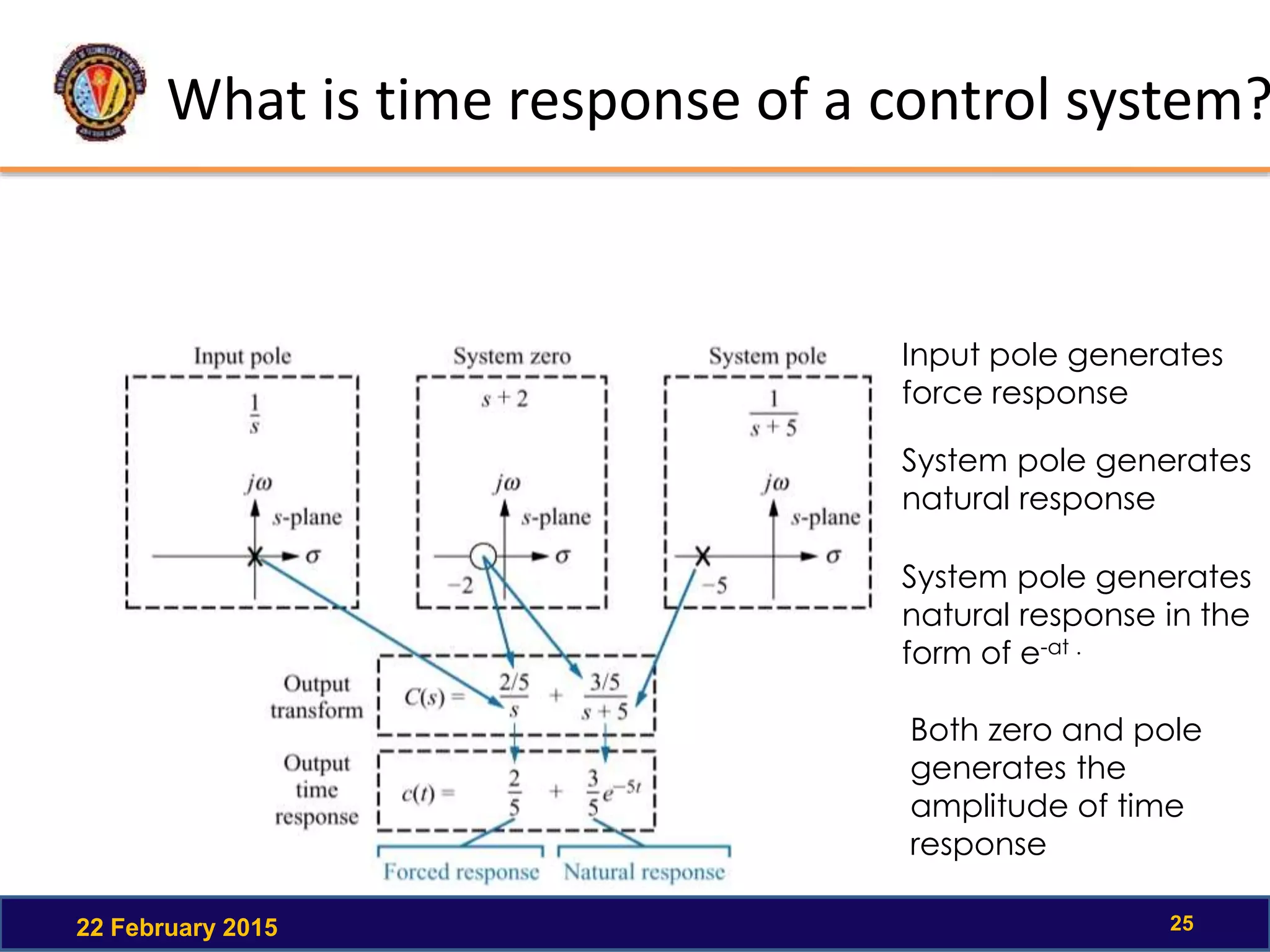
Input pole generates
force response
System pole generates
natural response
System pole generates
natural response in the
form of e-αt .
Both zero and pole
generates the
amplitude of time
response
What is time response of a control system?
An Example
22 February 2015 26
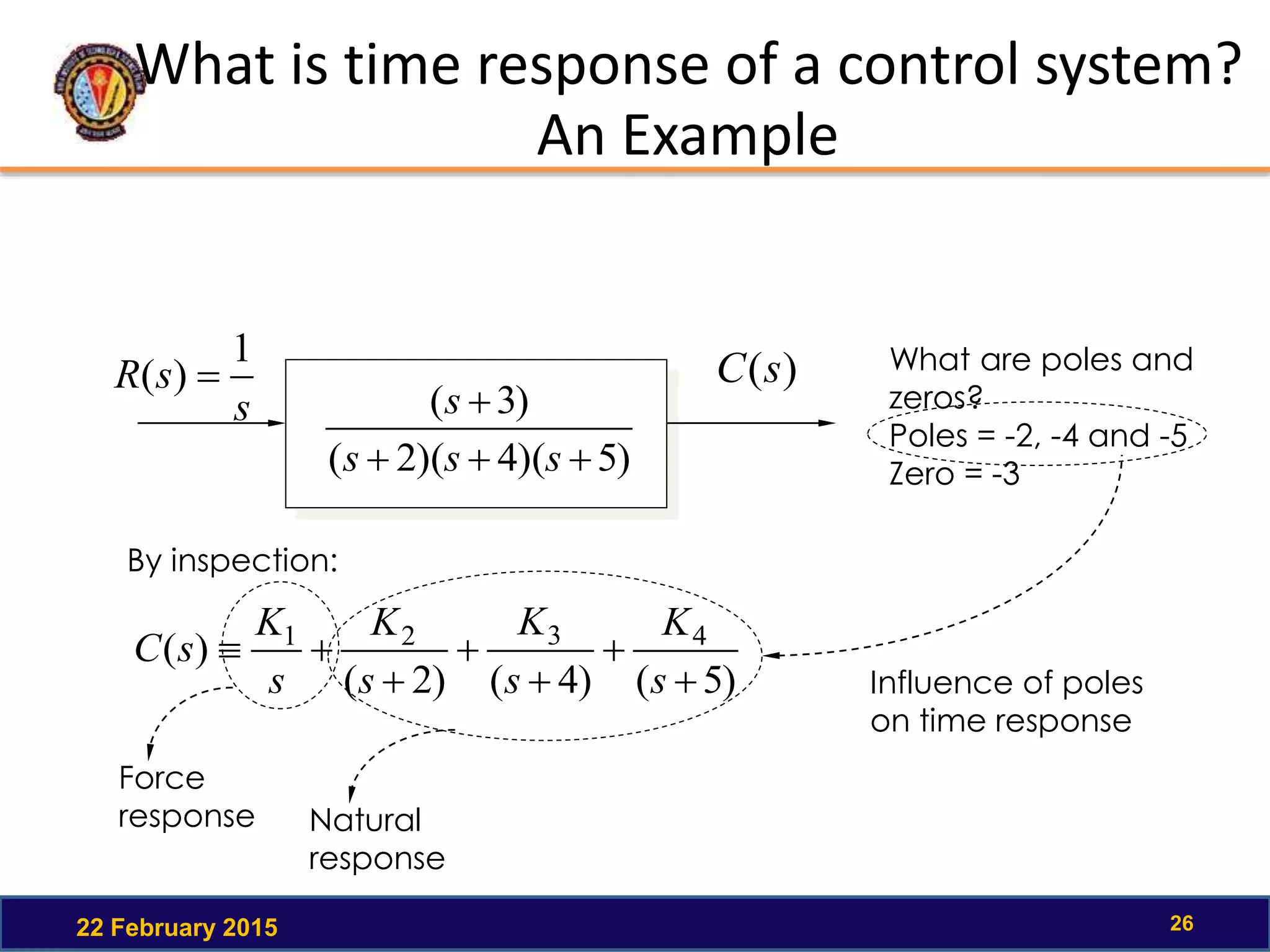
)5)(4)(2(
)3(


sss
s
)(sC
s
sR
1
)( 
By inspection:
)5()4()2(
)( 4321






s
K
s
K
s
K
s
K
sC
What are poles and
zeros?
Poles = -2, -4 and -5
Zero = -3
Force
response Natural
response
Influence of poles
on time response
What is time response of a control system?
An Example
22 February 2015 27
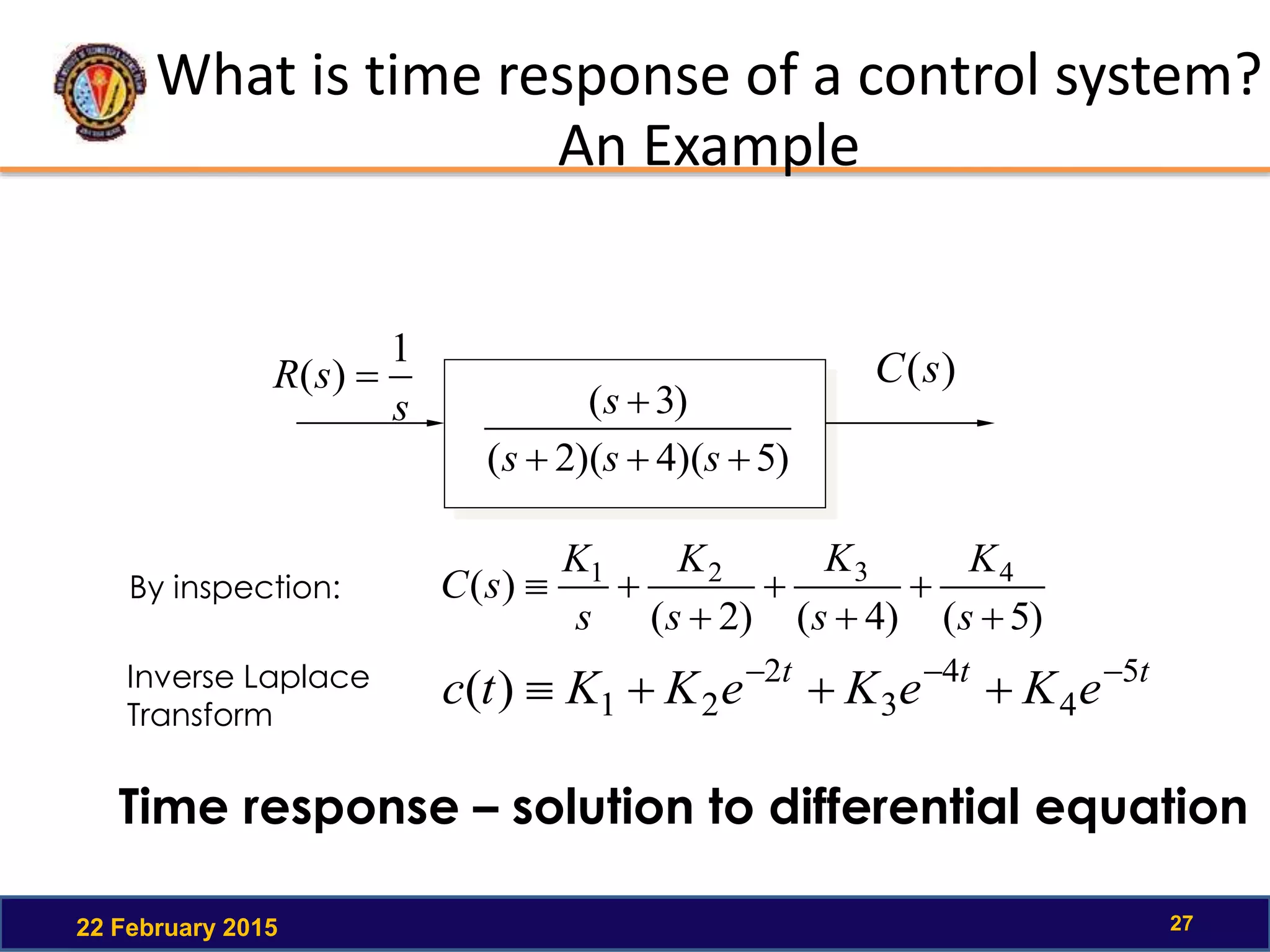
)5)(4)(2(
)3(


sss
s
)(sC
s
sR
1
)( 
By inspection:
)5()4()2(
)( 4321






s
K
s
K
s
K
s
K
sC
Inverse Laplace
Transform
ttt
eKeKeKKtc 5
4
4
3
2
21)( 

Time response – solution to differential equation
What is time response of a control system?
An Example
22 February 2015 28
)5()4()2(
)( 4321






s
K
s
K
s
K
s
K
sC
ttt
eKeKeKKtc 5
4
4
3
2
21)( 

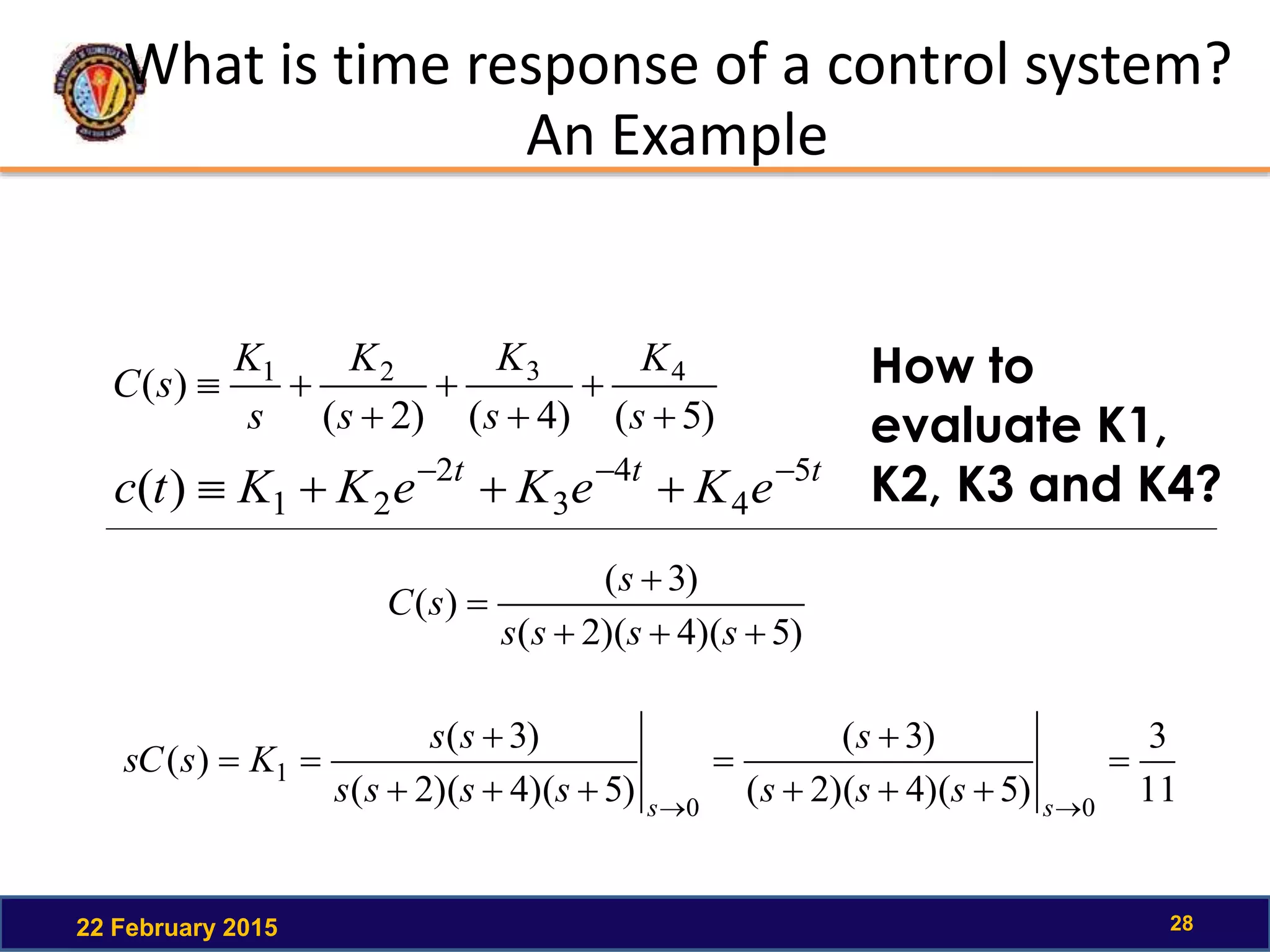
How to
evaluate K1,
K2, K3 and K4?
)5)(4)(2(
)3(
)(



ssss
s
sC
11
3
)5)(4)(2(
)3(
)5)(4)(2(
)3(
)(
00
1 






 ss
sss
s
ssss
ss
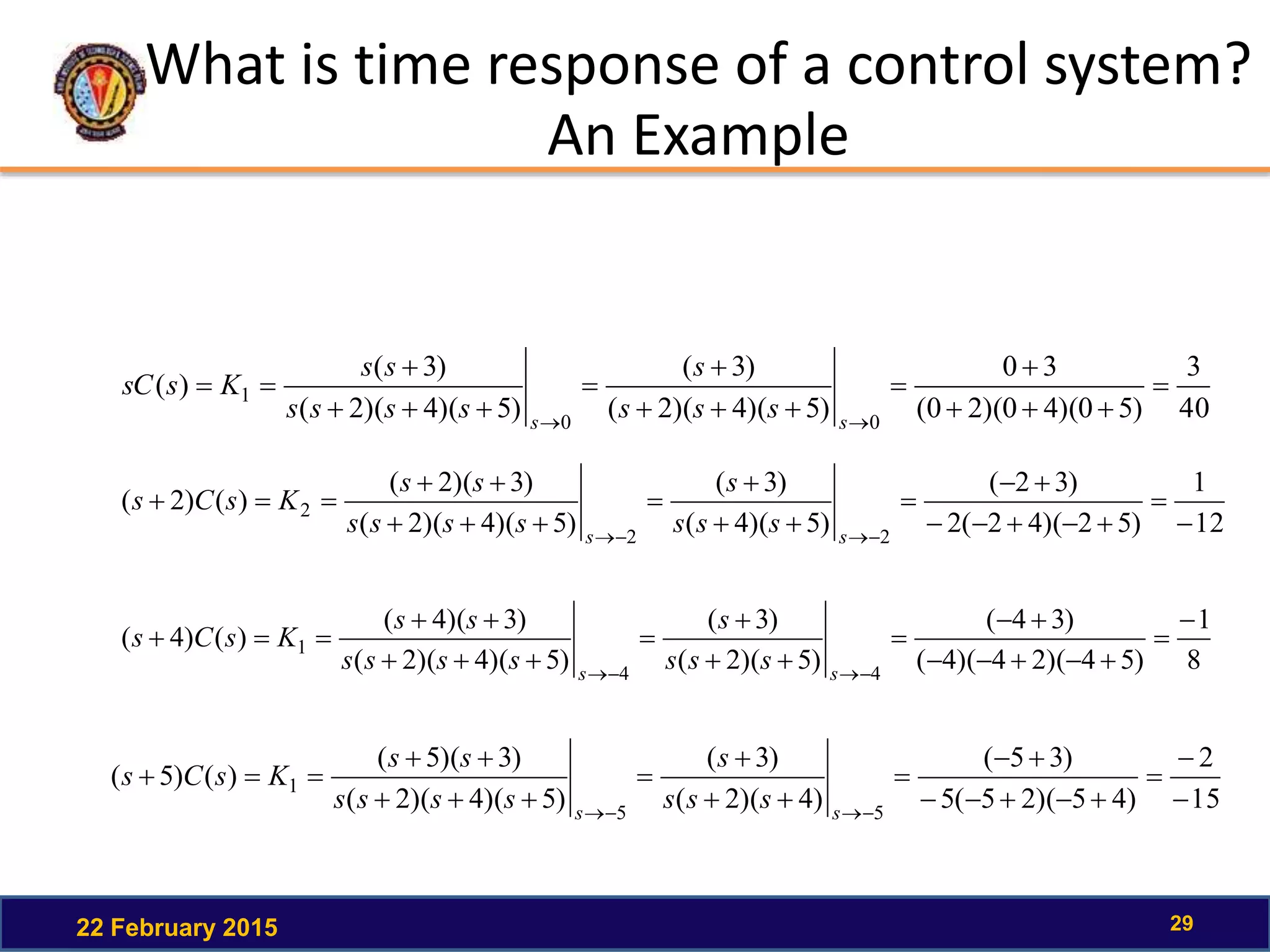
KssC
What is time response of a control system?
An Example
22 February 2015 29
40
3
)50)(40)(20(
30
)5)(4)(2(
)3(
)5)(4)(2(
)3(
)(
00
1 









 ss
sss
s
ssss
ss
KssC
12
1
)52)(42(2
)32(
)5)(4(
)3(
)5)(4)(2(
)3)(2(
)()2(
22
2











 ss
sss
s
ssss
ss
KsCs
8
1
)54)(24)(4(
)34(
)5)(2(
)3(
)5)(4)(2(
)3)(4(
)()4(
44
1











 ss
sss
s
ssss
ss
KsCs
15
2
)45)(25(5
)35(
)4)(2(
)3(
)5)(4)(2(
)3)(5(
)()5(
55
1












 ss
sss
s
ssss
ss
KsCs
What is time response of a control system?
An Example
22 February 2015 30
ttt
eKeKeKKtc 5
4
4
3
2
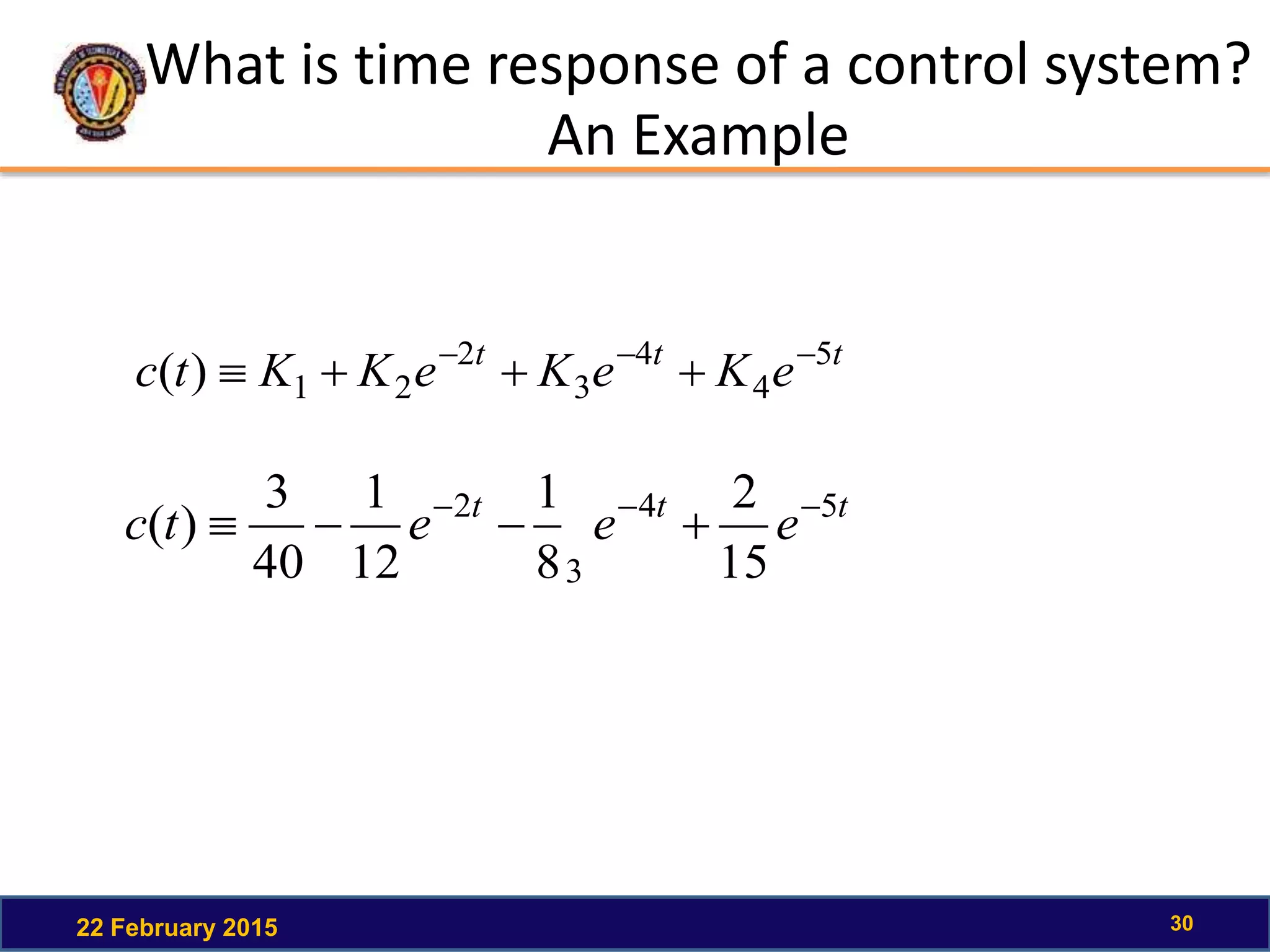
21)( 

ttt
eeetc 54
3
2
15
2
8
1
12
1
40
3
)( 

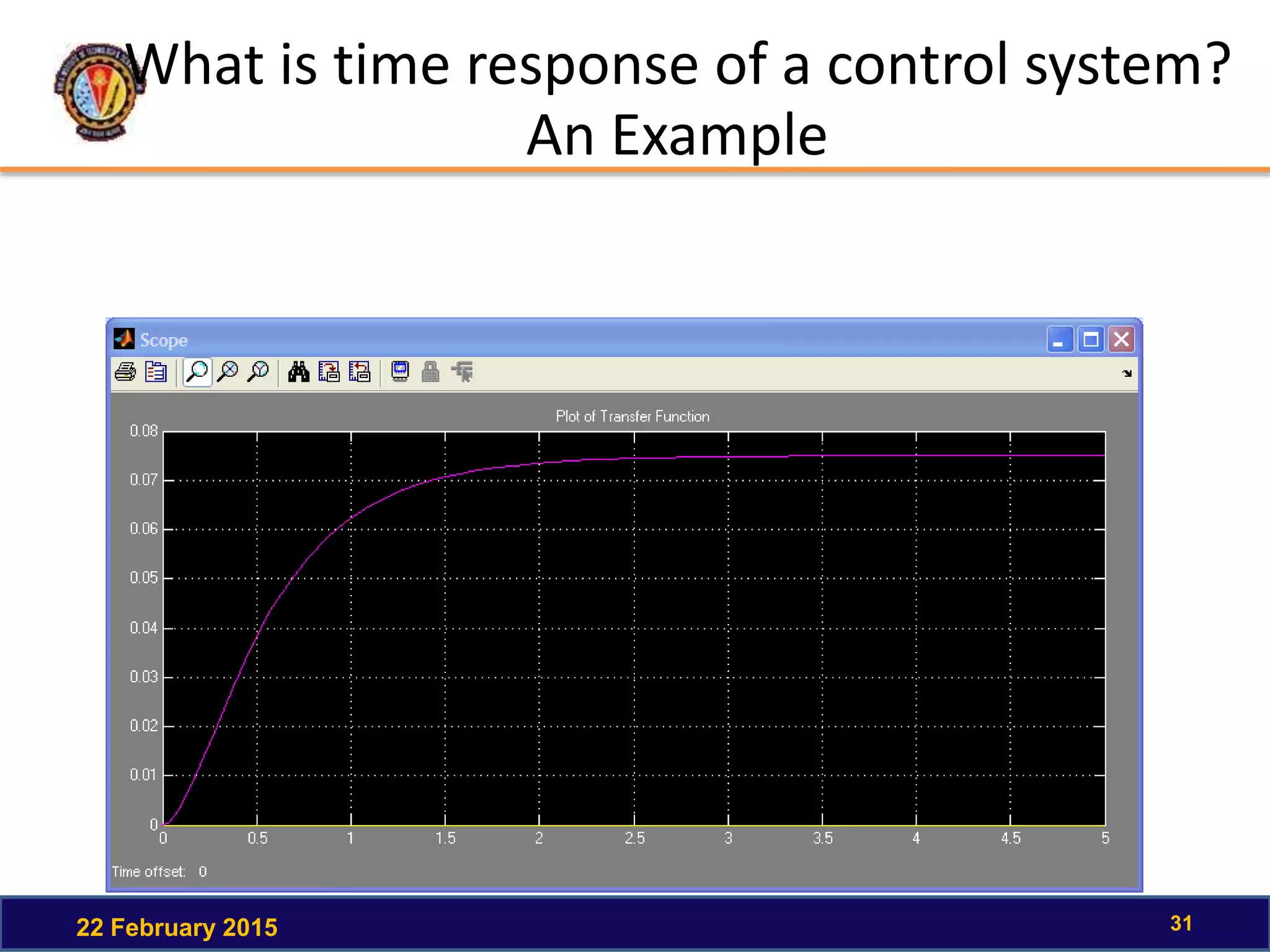
What is time response of a control system?
An Example
22 February 2015 31
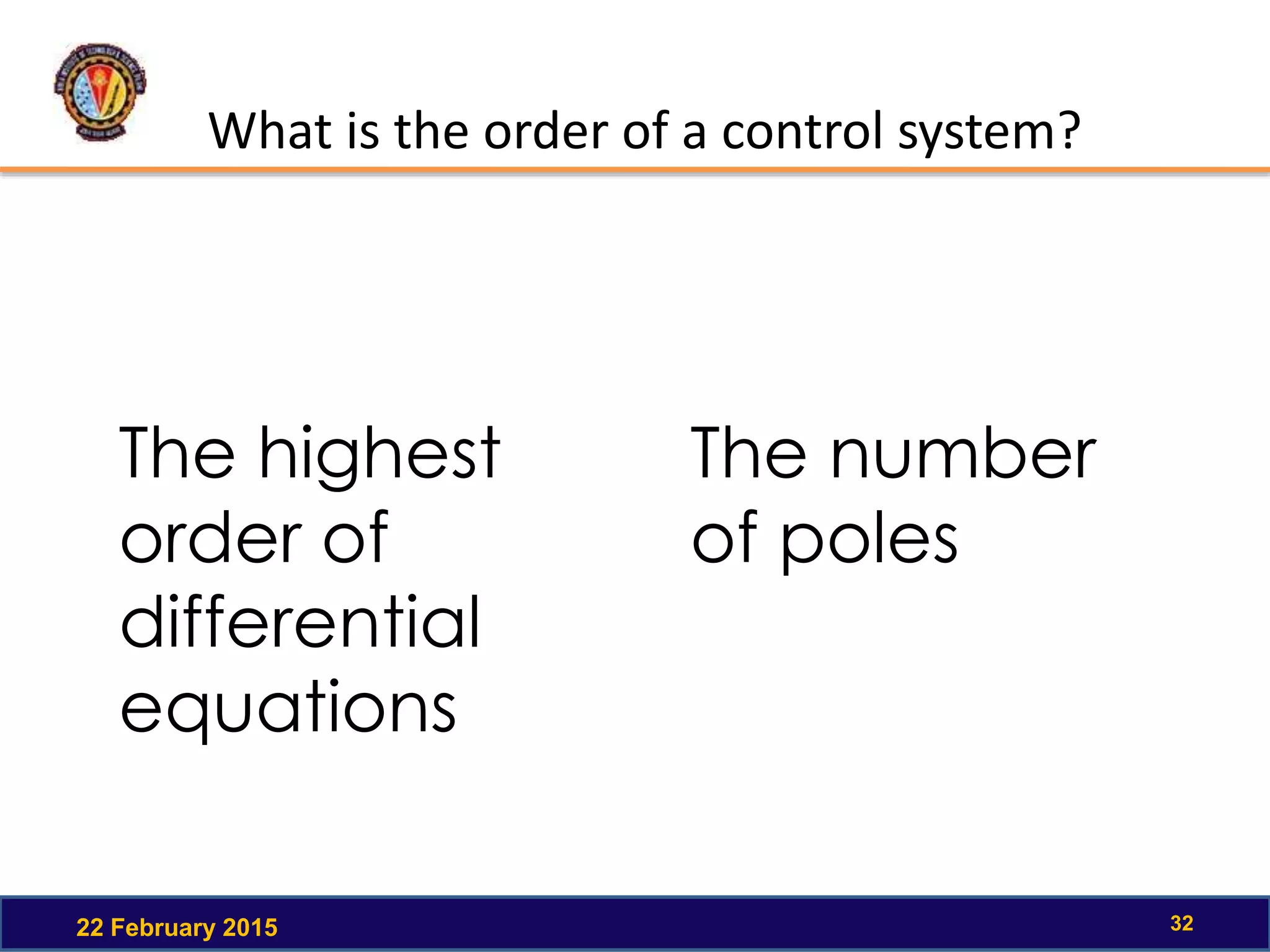
What is the order of a control system?
22 February 2015 32
The highest
order of
differential
equations
The number
of poles
What is the first order of a control system?
22 February 2015 33
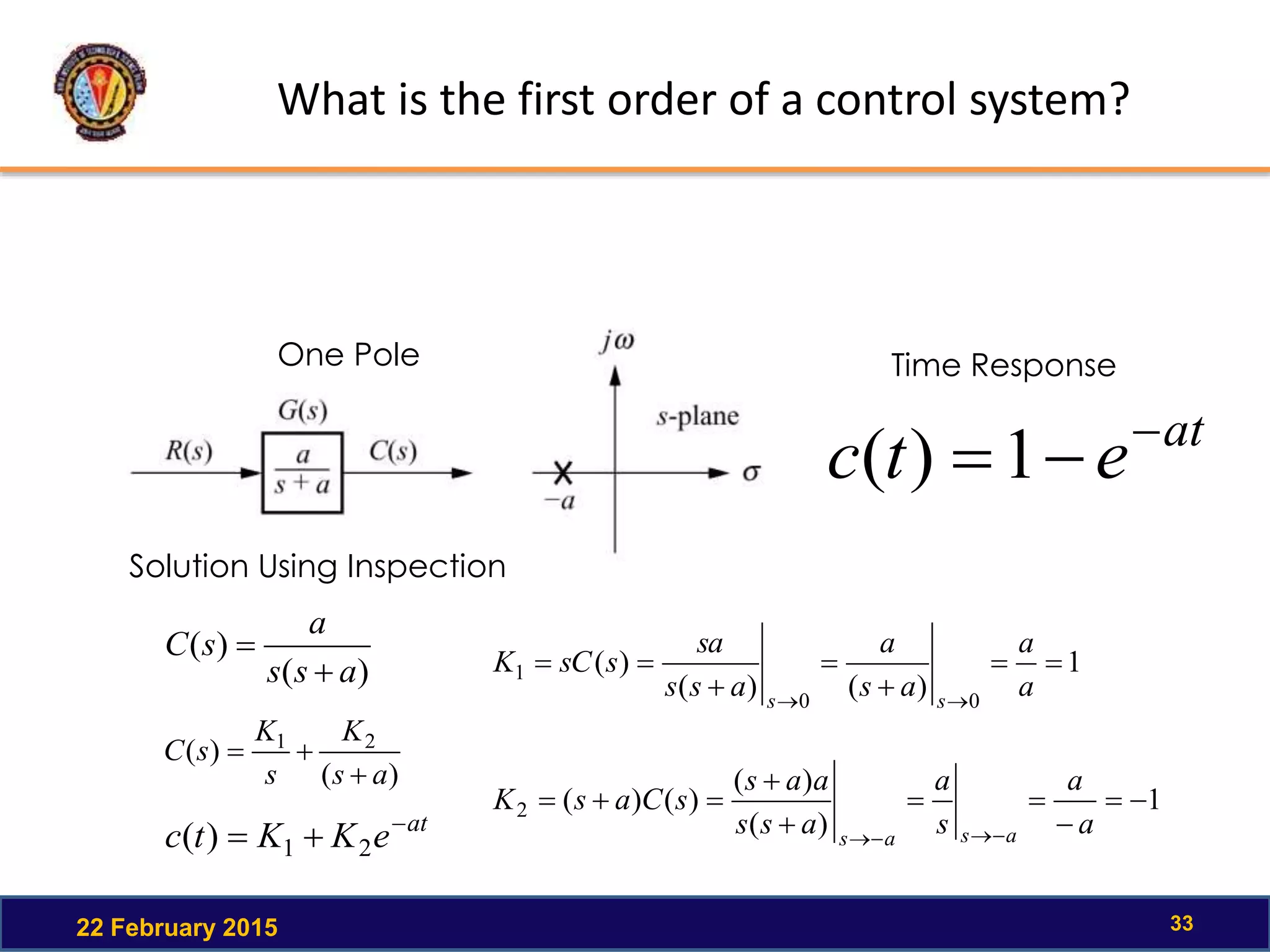
Solution Using Inspection
at
eKKtc 
 21)(
)(
)(
ass
a
sC


)(
)( 21
as
K
s
K
sC


1
)()(
)(
00
1 





a
a
as
a
ass
sa
ssCK
ss
1
)(
)(
)()(2 






a
a
s
a
ass
aas
sCasK
asas
at
etc 
1)(
One Pole Time Response
What is the first order of a control system?
22 February 2015 34
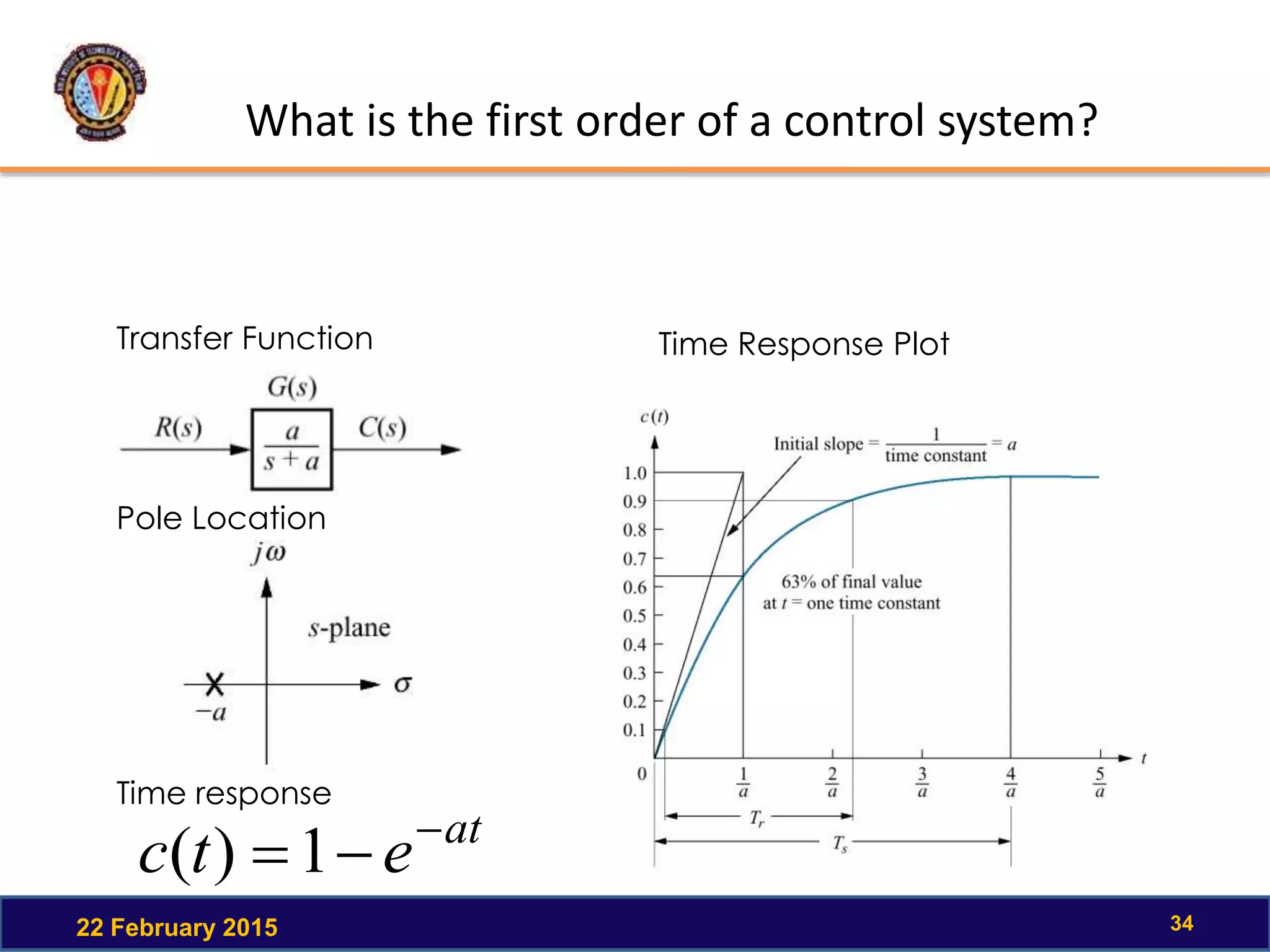
at
etc 
1)(
Transfer Function
Pole Location
Time response
Time Response Plot
What is the first order of a control system? –
Performance Parameters
22 February 2015 35
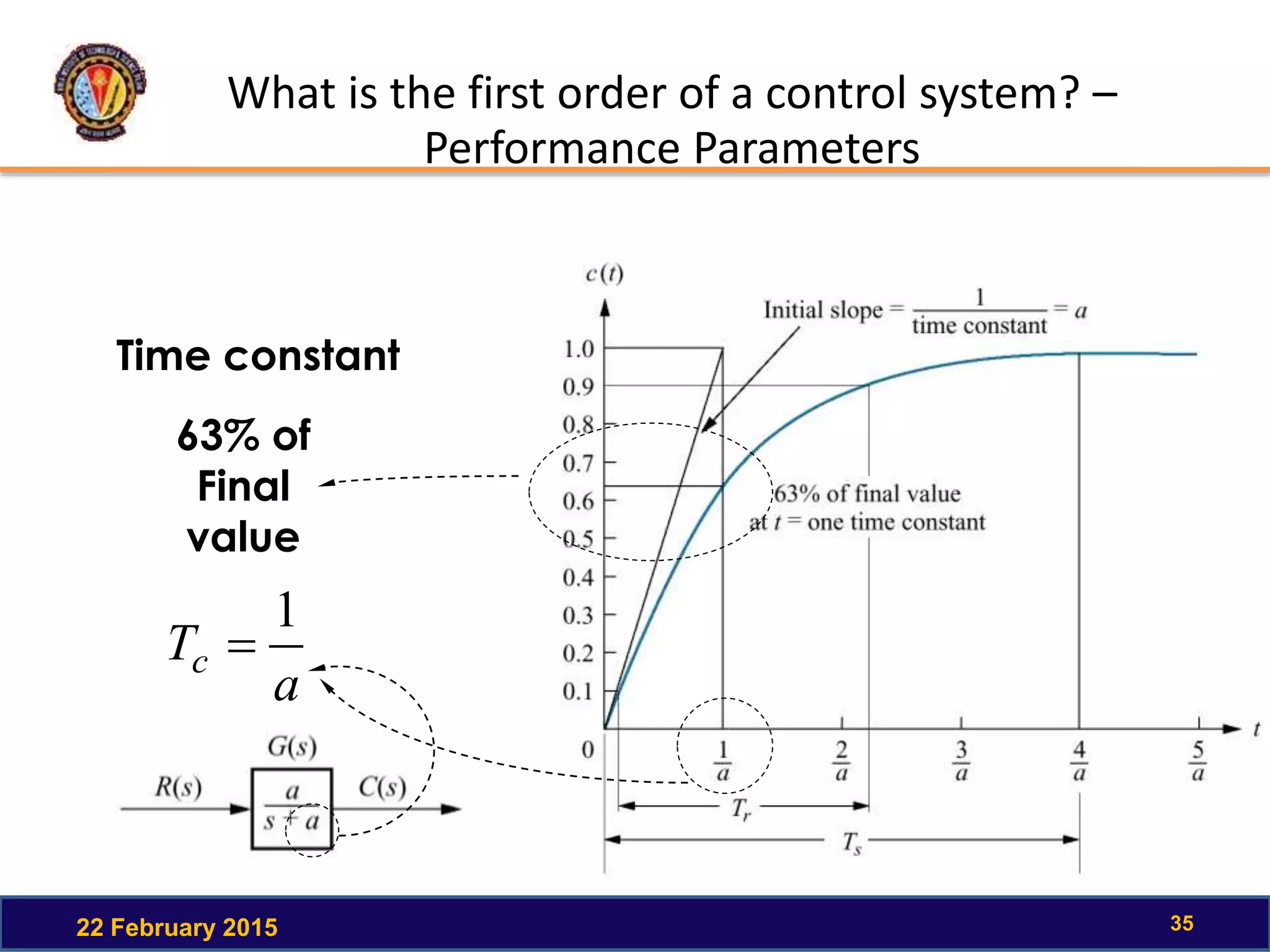
Time constant
a
Tc
1

63% of
Final
value
What is the first order of a control system? –
Performance Parameters
22 February 2015 36
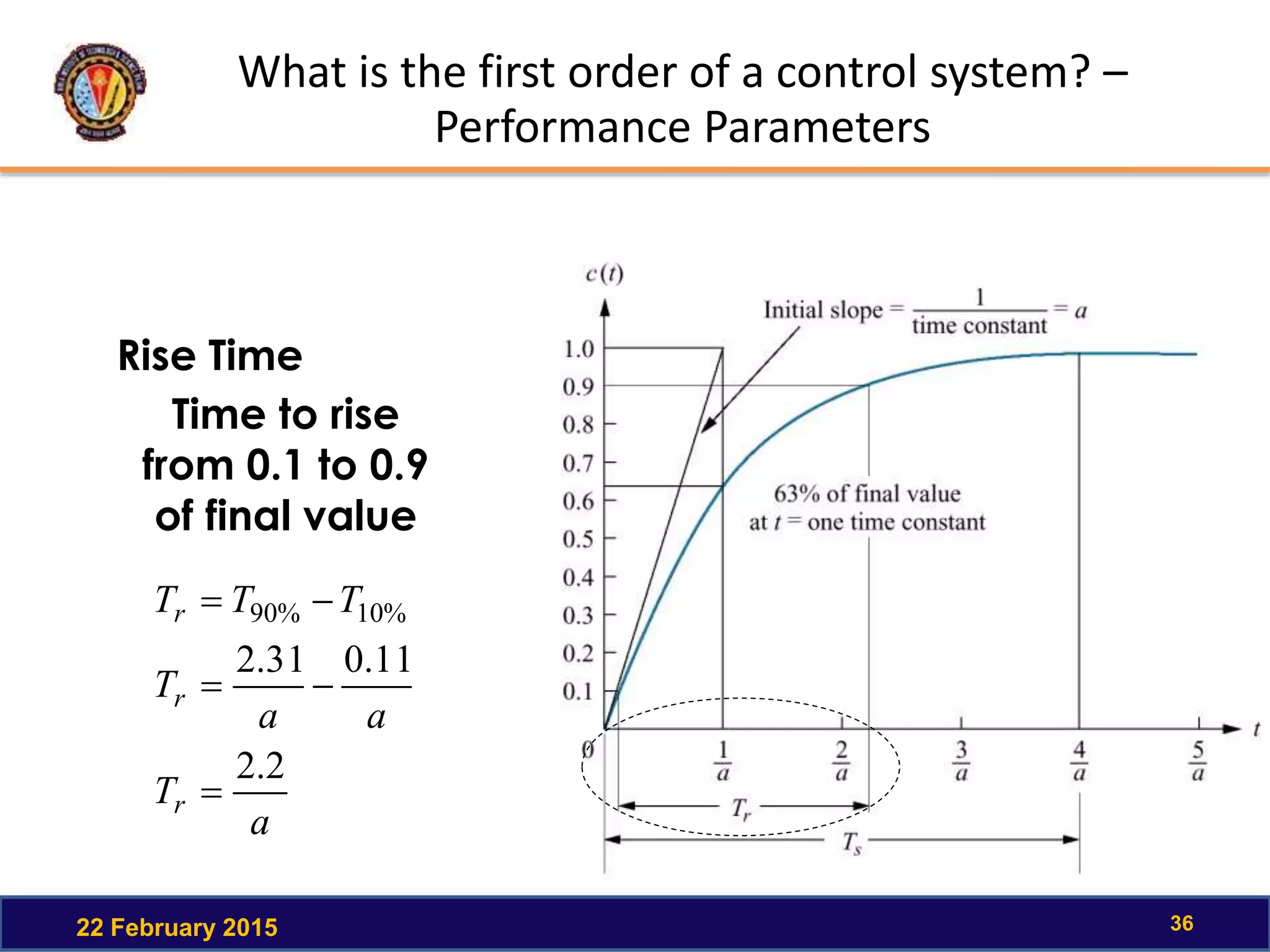
Rise Time
a
T
aa
T
TTT
r
r
r
2.2
11.031.2
%10%90



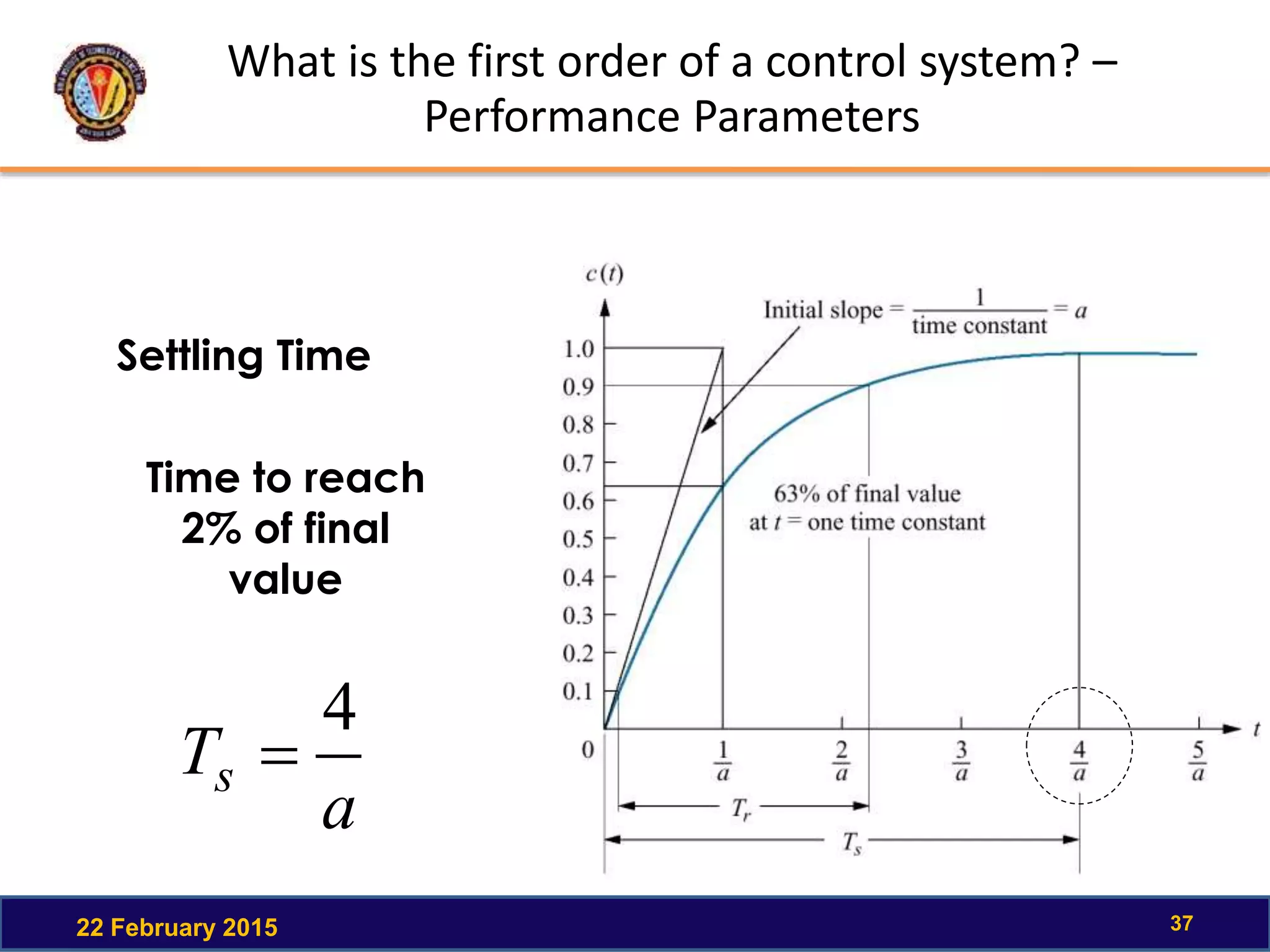
Time to rise
from 0.1 to 0.9
of final value
What is the first order of a control system? –
Performance Parameters
22 February 2015 37
Settling Time
a
Ts
4

Time to reach
2% of final
value
What is the first order of a control system? –
Performance Parameters
22 February 2015 38
Settling Time
a
Ts
4

Time to reach
2% of final value
Rise Time
a
Tr
2.2

Time to rise from
0.1 to 0.9 of final
value
Time constant
a
Tc
1

63% of Final
value
What is the first order of a control system? – An
Example
22 February 2015 39
Settling Time
sec
50
44

a
Ts
Rise Time
sec
50
2.22.2

a
Tr
Time constant
sec
50
11

a
Tc50
50
)(


s
sG
First Order because one
pole: pole = a = -50
t
etc 50
1)( 

By inspection the solution of
unit step input is:
s
sR
1
)( 
What is the first order of a control system? – An
Example
22 February 2015 40
50
200
)(


s
sG
)1(4)( 50t
etc 

By inspection the solution of
unit step input is:
s
sR
1
)( 
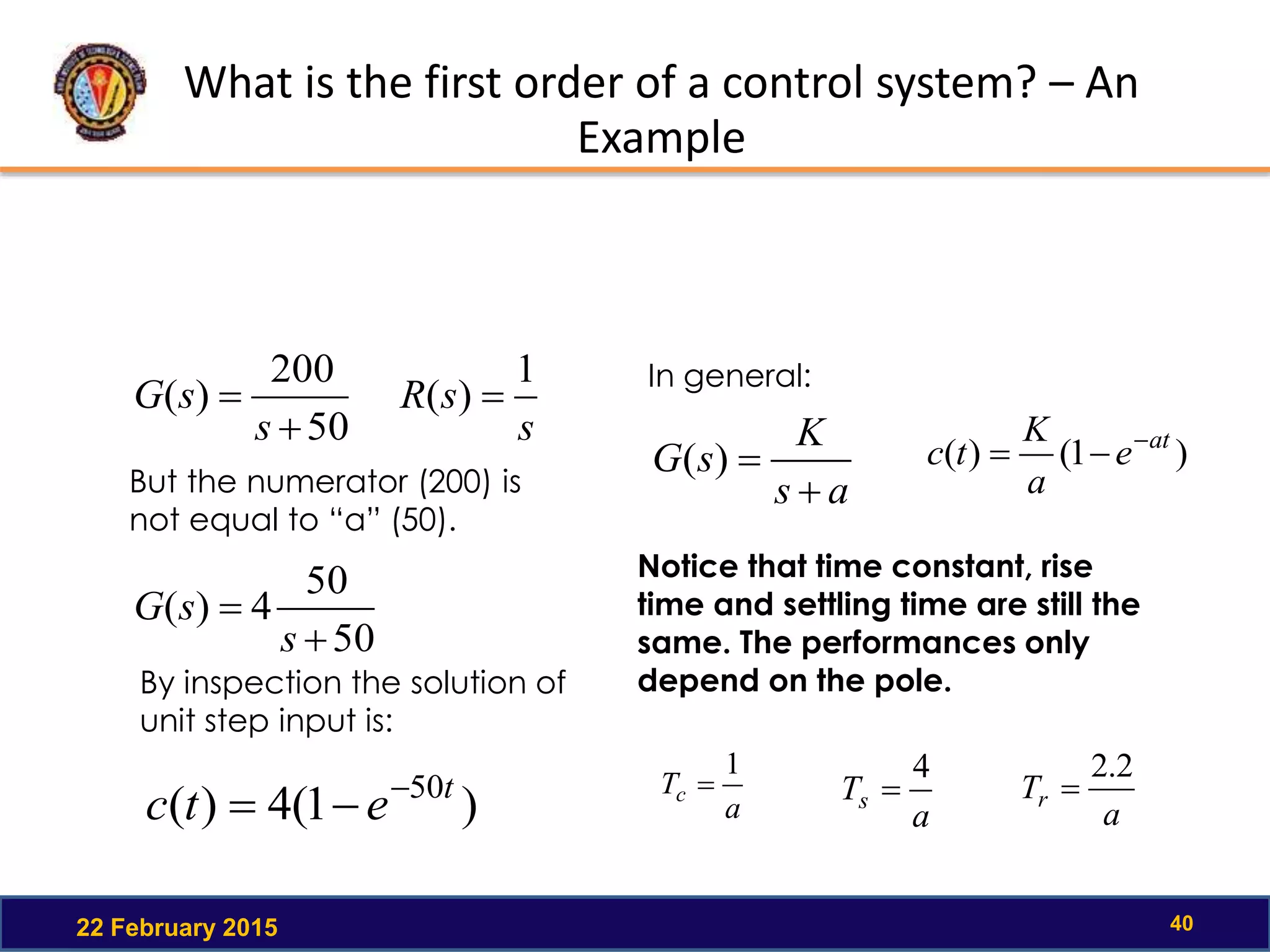
But the numerator (200) is
not equal to “a” (50).
50
50
4)(


s
sG
In general:
as
K
sG

)( )1()( at
e
a
K
tc 

Notice that time constant, rise
time and settling time are still the
same. The performances only
depend on the pole.
a
Ts
4

a
Tr
2.2

a
Tc
1

What is the first order of a control system? – An
Example
22 February 2015 41
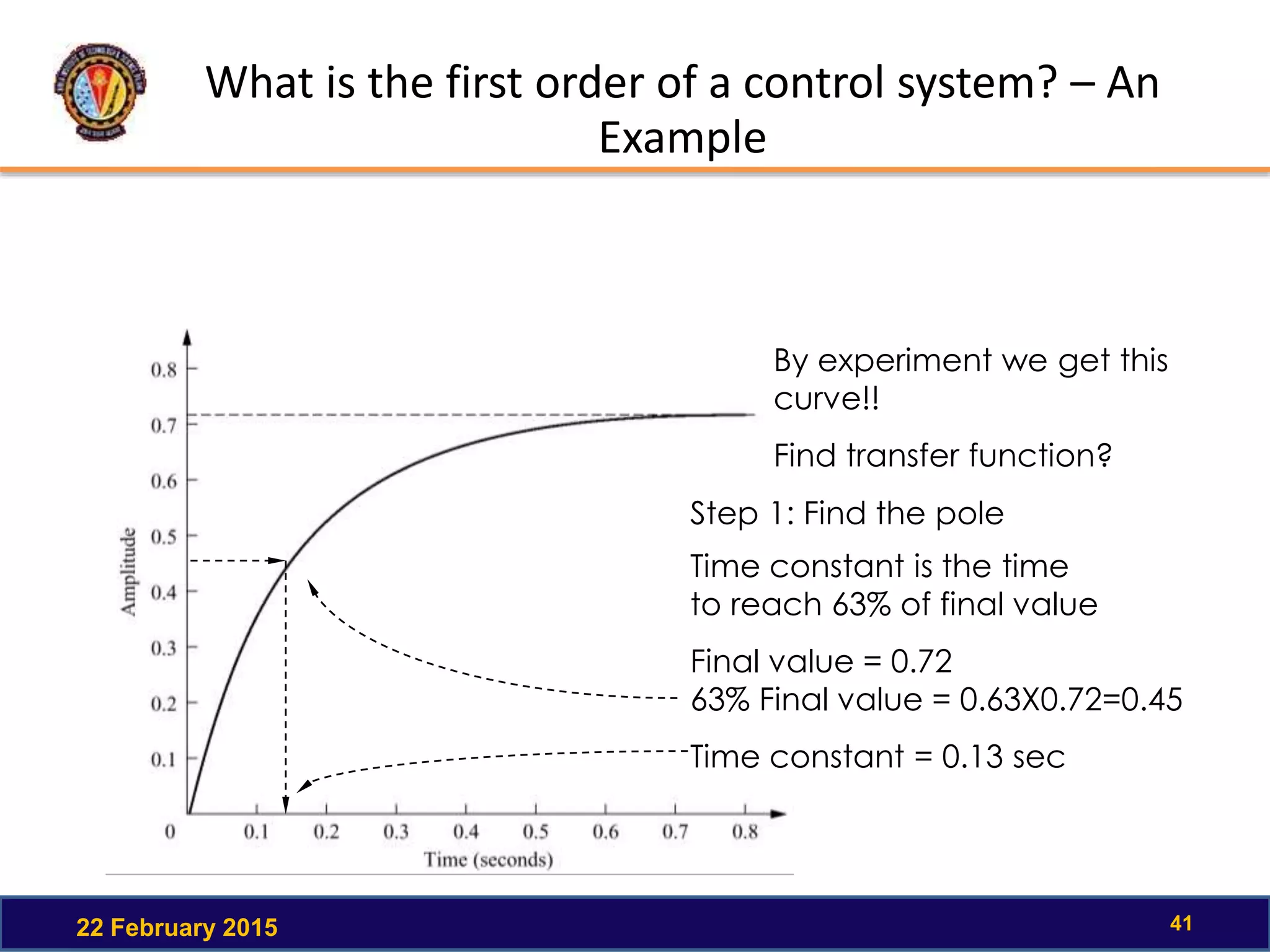
By experiment we get this
curve!!
Find transfer function?
Step 1: Find the pole
Time constant is the time
to reach 63% of final value
Final value = 0.72
63% Final value = 0.63X0.72=0.45
Time constant = 0.13 sec
What is the first order of a control system? – An
Example
22 February 2015 42
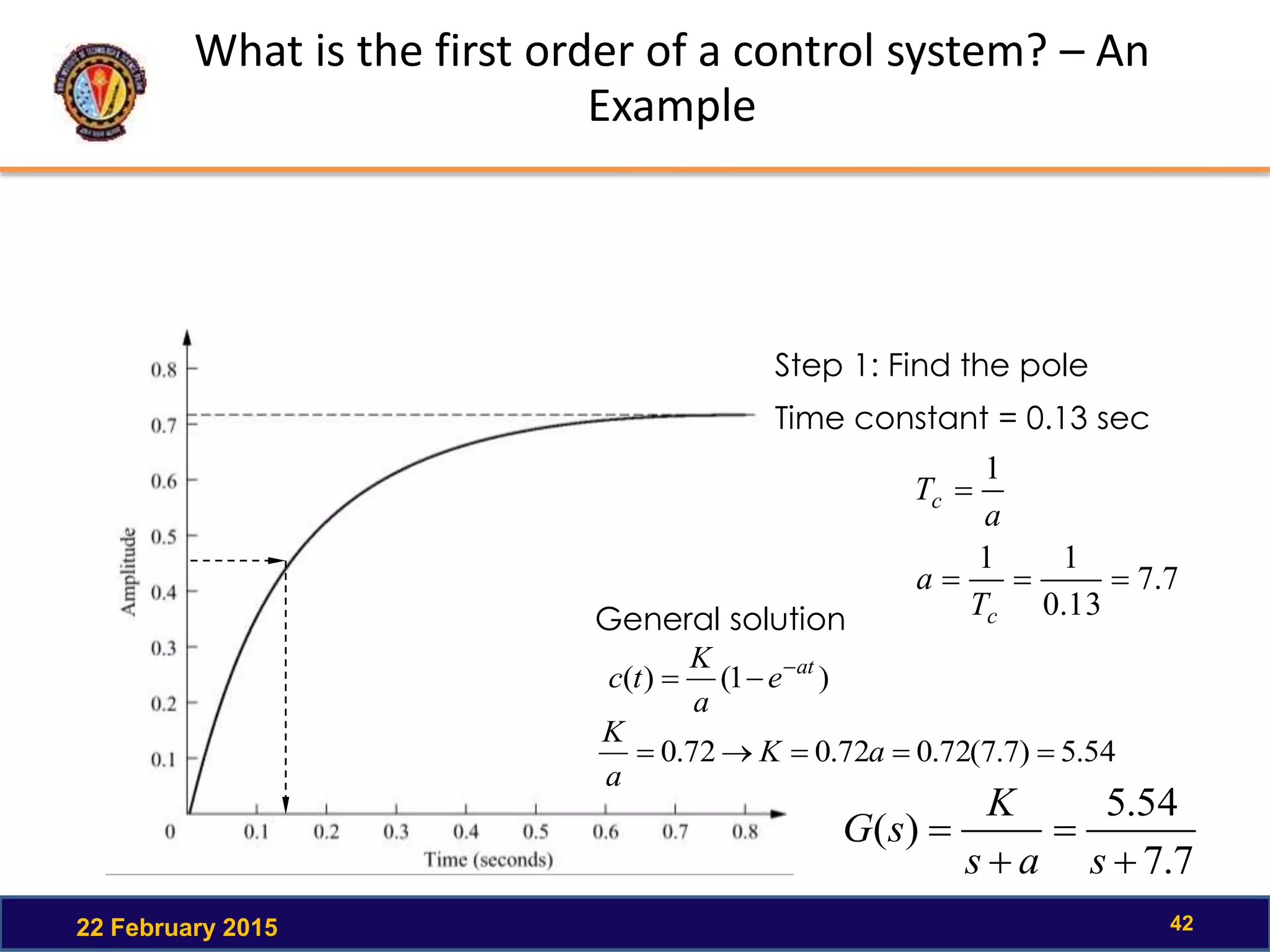
Step 1: Find the pole
Time constant = 0.13 sec
7.7
13.0
11
1


c
c
T
a
a
T
)1()( at
e
a
K
tc 

General solution
54.5)7.7(72.072.072.0  aK
a
K
7.7
54.5
)(




sas
K
sG
What is the first order of a control system? – An
Example
22 February 2015 43
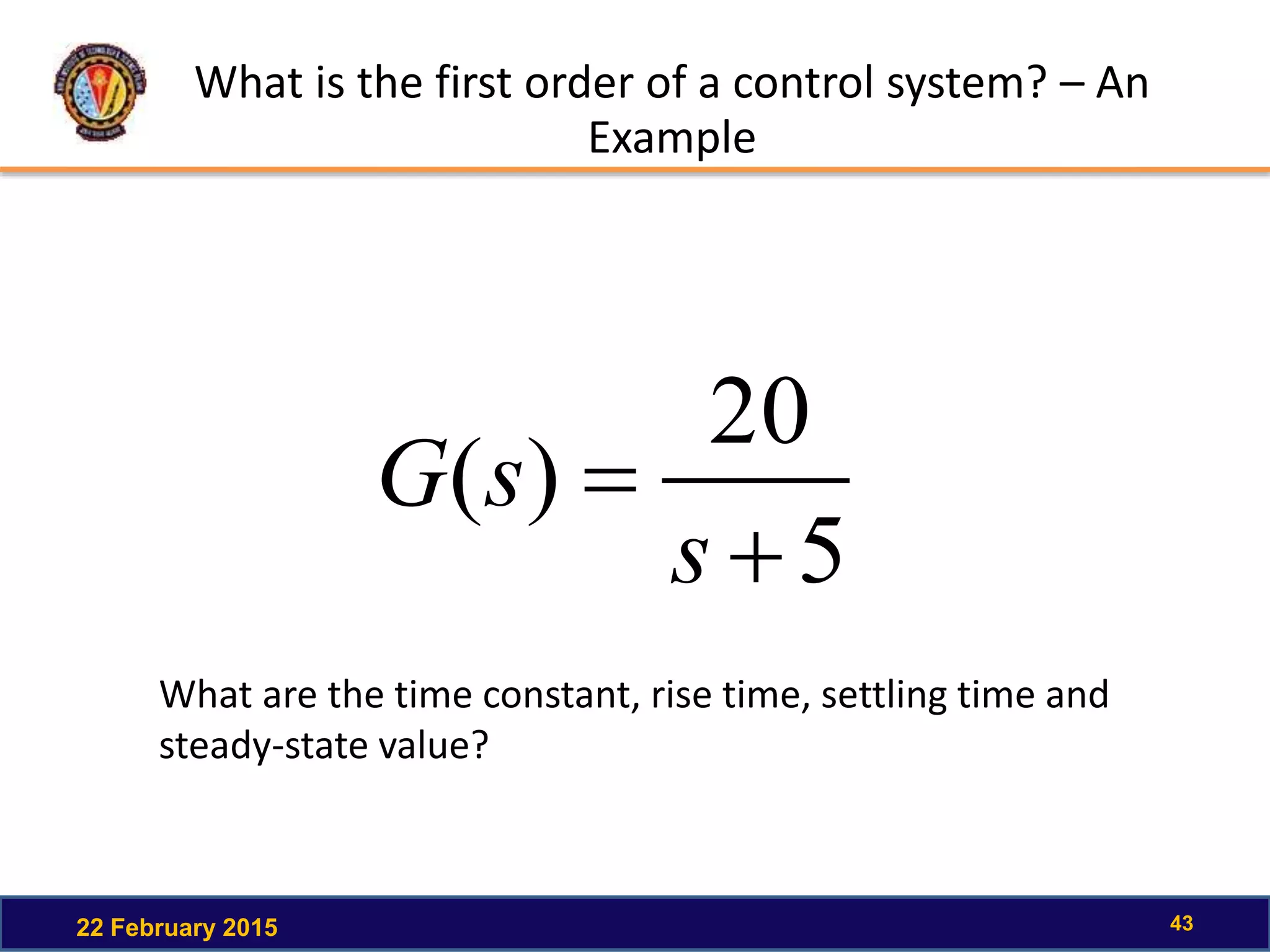
5
20
)(


s
sG
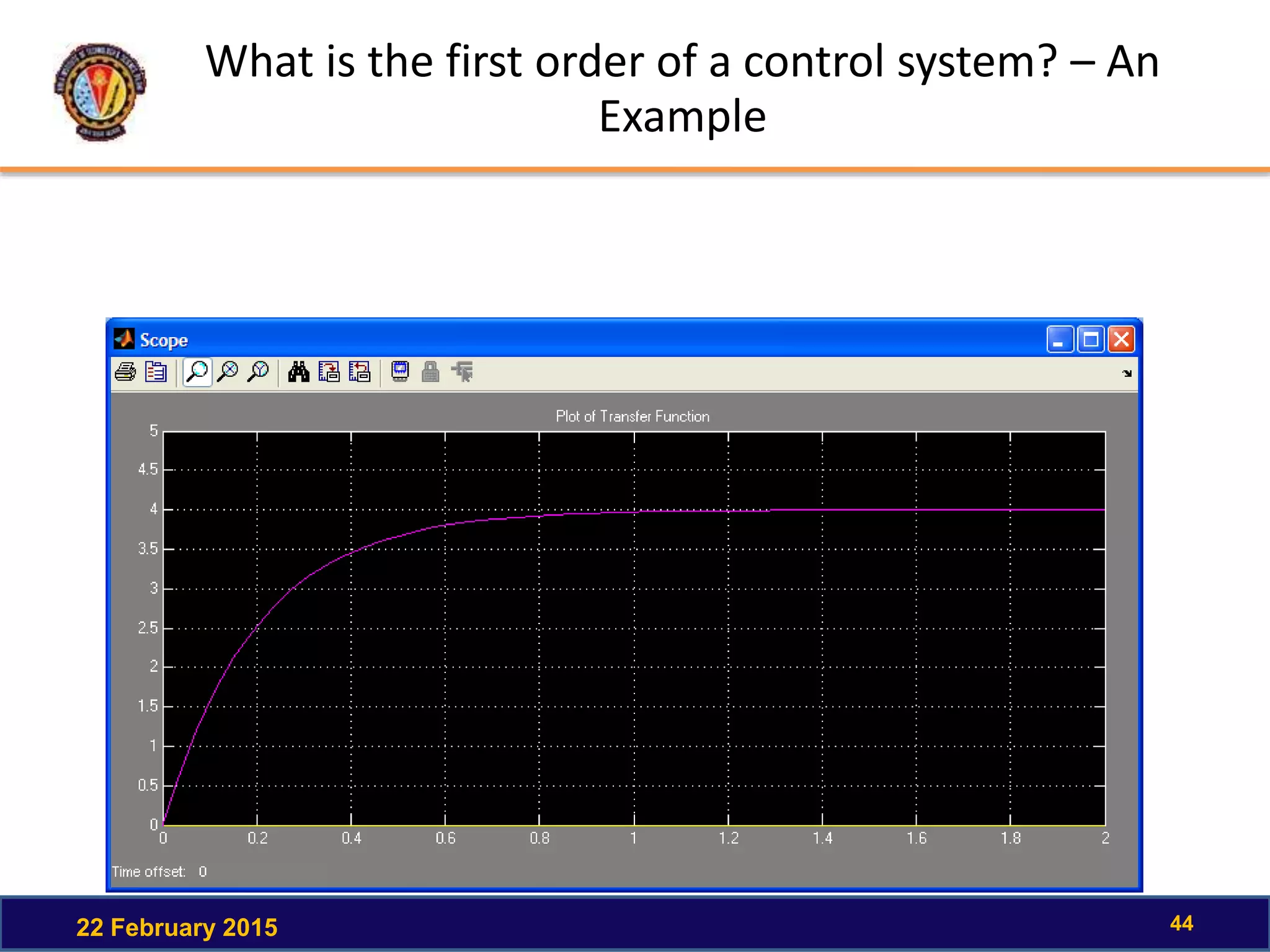
What are the time constant, rise time, settling time and
steady-state value?
What is the first order of a control system? – An
Example
22 February 2015 44
Examples
• Discharge of electronic camera flash
• Flow of fluid form a tank
• Cooling of a cup of coffee
22 February 2015 45

Csl9 4 f15

  • 1.
    Time Response ofFirst Order System 22 February 20151 Madhuri Bayya
  • 2.
    What is thetime response of a control system? 22 February 2015 2 Time response: The time solution to differential equation.
  • 3.
    What is thetime response of a control system? 22 February 2015 3 Time response consists of: 1.Natural response 2.Forced response
  • 4.
    What is thetime response of a control system? 22 February 2015 4 Time response Plot Forced response or Transient response Steady-state response Time solution to differential equation Caused by the input
  • 5.
    How to obtaintime response? 22 February 2015 5 Schematic M )(tf xM Kx )(tfKxxM  Differential Equation )(2 sFKXMXs  Laplace Transform Time Response Why Transfer Function? Transfer Function KMssF sX sG   2 1 )( )( )(
  • 6.
    How to obtaintime response? 22 February 2015 6 Why use Transfer Function? 1.Solution by inspection 2.Qualitative solution
  • 7.
    How to obtaintime response from transfer function? 22 February 2015 7 Given: How to obtain the time response? First, we need to understand the concept of poles and zeros
  • 8.
    How to obtaintime response from transfer function? 22 February 2015 8 First rule: The values of Laplace transform variable, s, that cause the transfer function to become infinite. Second rule: Any roots of the denominator of the transfer function that are common to the roots of numerator What are poles ?
  • 9.
    How to obtaintime response from transfer function? 22 February 2015 9 Transfer Function )3)(2)(5( )3( )(    sss s sG First rule: When s = -5, or s = -2 or s = -3, then, G(s)=infinity! Therefore, the poles of the transfer function G(s) are -5, -2 and -3. )3)(2)(5( )3( )(    sss s sG Second rule: Although the term (s+3) can be cancelled out, the value -3 is still the poles of the transfer function G(s).
  • 10.
    How to obtaintime response from transfer function? 22 February 2015 10 First rule: The values of Laplace transform variable, s, that cause the transfer function to become zero. Second rule: Any roots of the numerator of the transfer function that are common to roots of the denominator What are zeros ?
  • 11.
    How to obtaintime response from transfer function? 22 February 2015 11 Transfer Function )3)(2)(5( )3( )(    sss s sG First rule: When s = -3, then, G(s)= 0. Therefore, the zero of the transfer function G(s) is -3. )3)(2)(5( )3( )(    sss s sG Second rule: Although the term (s+3) can be cancelled out, the value -3 is still the zero of the transfer function G(s).
  • 12.
    How to obtaintime response from transfer function? 22 February 2015 12 Transfer Function )3)(1)(1( )7( )(    sss s sG )9)(2)(11( )3)(13( )(    sss ss sG Zero = -7 Poles = -1, -1 and -3 Zero = -13 and -3 Poles = -11, -2 and -9
  • 13.
    How to obtaintime response from transfer function? 22 February 2015 13 Given: How to obtain the time response? 1. Find C(s) 2. Expand the transfer function using partial fraction expansion technique 3. Perform inverse Laplace transform
  • 14.
    How to obtaintime response from transfer function? –Find C(s) 22 February 2015 14 Given: )( )( )( sR sC Input Output sG  )()()( sRsGsC  What is R(s)?
  • 15.
    Test Input Signal •Unlike electric networks, inputs to many practical systems are not exactly known ahead of time. • Difficult to design a control system to satisfy all possible input signals • For purpose of analysis and design some basic types of test inputs assumed, so that performance can be evaluated. • Gives an idea of response to other complex inputs. • Response of complex signals can be determined by superimposing those due to simple test signals 15Control Systems
  • 16.
    General form ofthe standard test signals r(t) = tn R(s) = n!/sn+1 16Control Systems
  • 17.
    Types of testsignals Step Input – Represents instantaneous change in reference input. Eg. Motor n = 0 r(t) = A R(s) = A/s Ramp Input – Changes constantly with time r(t) = At n = 1 R(s) = A/s2
  • 18.
    Types of testsignals Parabolic Input – A signal that is one order faster than the ramp n = 2 r(t) = At2 R(s) = 2A/s3 Impulse Input – A signal which has zero value everywhere except at t=0, where its magnitude is infinite. Since perfect impulse cannot be achieved, it is usually approximated by a pulse of small width but unit area. 𝛿(t)=0; t ≠0 −𝜖 +𝜖 𝛿 𝑡 𝑑𝑡 = 1 ϵ → 0 Mathematically, impulse function is derivative of step function
  • 19.
    Test Signal Inputs TestSignal r(t) R(s) Step position r(t) = A, t > 0 = 0, t < 0 R(s) = A/s Ramp velocity r(t) = At, t > 0 = 0, t < 0 R(s) = A/s2 Parabolic acceleration r(t) = At2, t > 0 = 0, t < 0 R(s) = 2A/s3 19Control Systems
  • 20.
    How to obtaintime response from transfer function? –Find C(s) 22 February 2015 20 Given: R(s) unit step input implies A = 1 )5( )2(1 )( )()()(     s s s sC sRsGsC
  • 21.
    How to obtaintime response from transfer function? – Expand C(s) 22 February 2015 21 Expand C(s) using Partial Fraction Expansion Technique )5( )2(1 )(    s s s sC )5( )2( 5 )(      ss s s B s A sC
  • 22.
    How to obtaintime response from transfer function? – Expand C(s) 22 February 2015 22 )5( )2( 5 )(      ss s s B s A sC 5 2 )5( )2( 0     s s s A 5 3 )( )2( 5    s s s B 5 5 3 5 2 )(   ss sC How to find A and B?
  • 23.
    How to obtaintime response from transfer function? – Inverse Laplace Transform 22 February 2015 23 5 5 3 5 2 )(   ss sC s 5 2 Inverse Laplace Transform 5 2 5 5 3 s Inverse Laplace Transform t e 5 5 3  t etc 5 5 3 5 2 )(   Time response
  • 24.
    What is thetime response of a control system? 22 February 2015 24 Steady response Transient response
  • 25.
    What is timeresponse of a control system? 22 February 2015 25 Input pole generates force response System pole generates natural response System pole generates natural response in the form of e-αt . Both zero and pole generates the amplitude of time response
  • 26.
    What is timeresponse of a control system? An Example 22 February 2015 26 )5)(4)(2( )3(   sss s )(sC s sR 1 )(  By inspection: )5()4()2( )( 4321       s K s K s K s K sC What are poles and zeros? Poles = -2, -4 and -5 Zero = -3 Force response Natural response Influence of poles on time response
  • 27.
    What is timeresponse of a control system? An Example 22 February 2015 27 )5)(4)(2( )3(   sss s )(sC s sR 1 )(  By inspection: )5()4()2( )( 4321       s K s K s K s K sC Inverse Laplace Transform ttt eKeKeKKtc 5 4 4 3 2 21)(   Time response – solution to differential equation
  • 28.
    What is timeresponse of a control system? An Example 22 February 2015 28 )5()4()2( )( 4321       s K s K s K s K sC ttt eKeKeKKtc 5 4 4 3 2 21)(   How to evaluate K1, K2, K3 and K4? )5)(4)(2( )3( )(    ssss s sC 11 3 )5)(4)(2( )3( )5)(4)(2( )3( )( 00 1         ss sss s ssss ss KssC
  • 29.
    What is timeresponse of a control system? An Example 22 February 2015 29 40 3 )50)(40)(20( 30 )5)(4)(2( )3( )5)(4)(2( )3( )( 00 1            ss sss s ssss ss KssC 12 1 )52)(42(2 )32( )5)(4( )3( )5)(4)(2( )3)(2( )()2( 22 2             ss sss s ssss ss KsCs 8 1 )54)(24)(4( )34( )5)(2( )3( )5)(4)(2( )3)(4( )()4( 44 1             ss sss s ssss ss KsCs 15 2 )45)(25(5 )35( )4)(2( )3( )5)(4)(2( )3)(5( )()5( 55 1              ss sss s ssss ss KsCs
  • 30.
    What is timeresponse of a control system? An Example 22 February 2015 30 ttt eKeKeKKtc 5 4 4 3 2 21)(   ttt eeetc 54 3 2 15 2 8 1 12 1 40 3 )(  
  • 31.
    What is timeresponse of a control system? An Example 22 February 2015 31
  • 32.
    What is theorder of a control system? 22 February 2015 32 The highest order of differential equations The number of poles
  • 33.
    What is thefirst order of a control system? 22 February 2015 33 Solution Using Inspection at eKKtc   21)( )( )( ass a sC   )( )( 21 as K s K sC   1 )()( )( 00 1       a a as a ass sa ssCK ss 1 )( )( )()(2        a a s a ass aas sCasK asas at etc  1)( One Pole Time Response
  • 34.
    What is thefirst order of a control system? 22 February 2015 34 at etc  1)( Transfer Function Pole Location Time response Time Response Plot
  • 35.
    What is thefirst order of a control system? – Performance Parameters 22 February 2015 35 Time constant a Tc 1  63% of Final value
  • 36.
    What is thefirst order of a control system? – Performance Parameters 22 February 2015 36 Rise Time a T aa T TTT r r r 2.2 11.031.2 %10%90    Time to rise from 0.1 to 0.9 of final value
  • 37.
    What is thefirst order of a control system? – Performance Parameters 22 February 2015 37 Settling Time a Ts 4  Time to reach 2% of final value
  • 38.
    What is thefirst order of a control system? – Performance Parameters 22 February 2015 38 Settling Time a Ts 4  Time to reach 2% of final value Rise Time a Tr 2.2  Time to rise from 0.1 to 0.9 of final value Time constant a Tc 1  63% of Final value
  • 39.
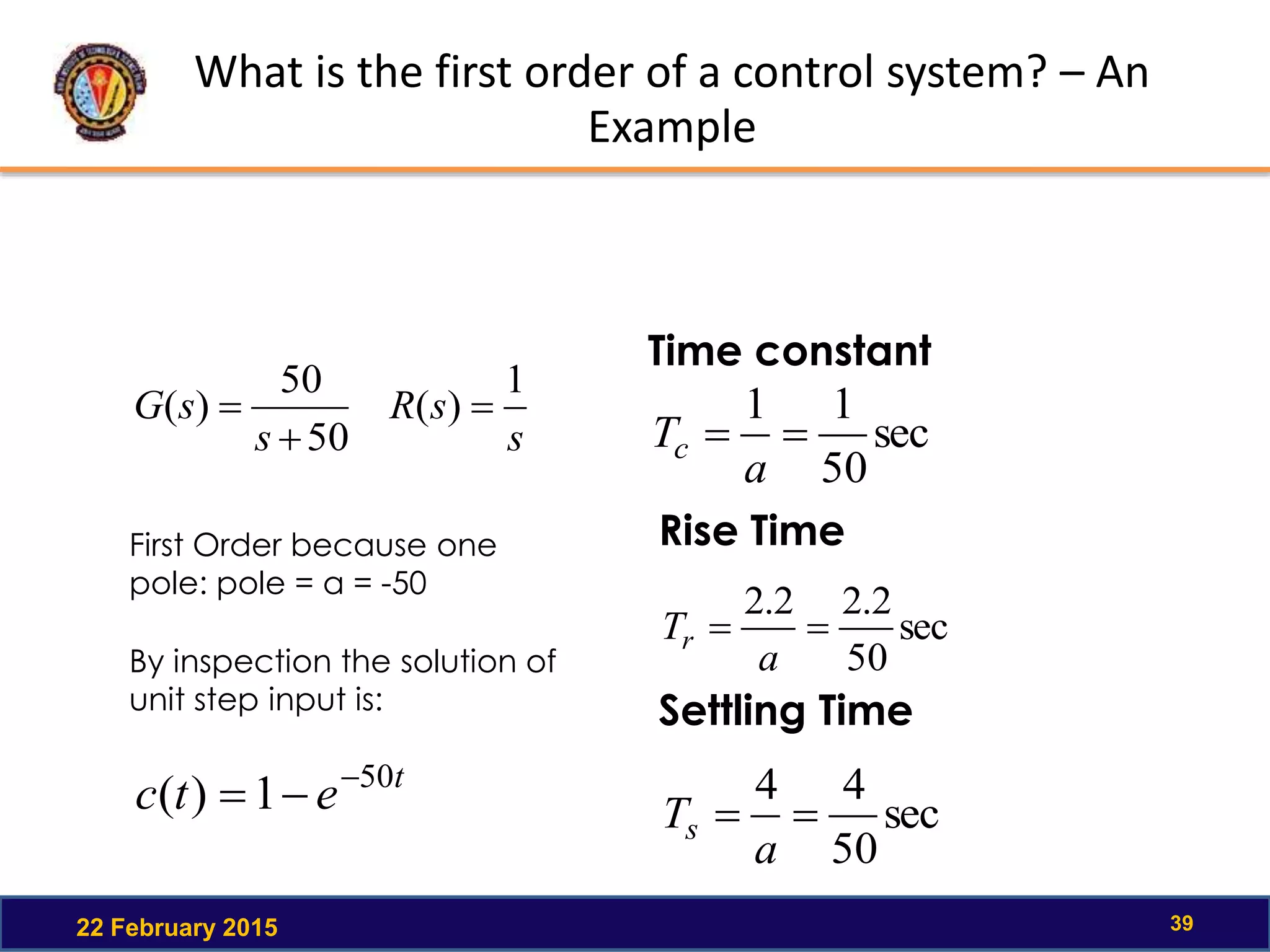
    What is thefirst order of a control system? – An Example 22 February 2015 39 Settling Time sec 50 44  a Ts Rise Time sec 50 2.22.2  a Tr Time constant sec 50 11  a Tc50 50 )(   s sG First Order because one pole: pole = a = -50 t etc 50 1)(   By inspection the solution of unit step input is: s sR 1 )( 
  • 40.
    What is thefirst order of a control system? – An Example 22 February 2015 40 50 200 )(   s sG )1(4)( 50t etc   By inspection the solution of unit step input is: s sR 1 )(  But the numerator (200) is not equal to “a” (50). 50 50 4)(   s sG In general: as K sG  )( )1()( at e a K tc   Notice that time constant, rise time and settling time are still the same. The performances only depend on the pole. a Ts 4  a Tr 2.2  a Tc 1 
  • 41.
    What is thefirst order of a control system? – An Example 22 February 2015 41 By experiment we get this curve!! Find transfer function? Step 1: Find the pole Time constant is the time to reach 63% of final value Final value = 0.72 63% Final value = 0.63X0.72=0.45 Time constant = 0.13 sec
  • 42.
    What is thefirst order of a control system? – An Example 22 February 2015 42 Step 1: Find the pole Time constant = 0.13 sec 7.7 13.0 11 1   c c T a a T )1()( at e a K tc   General solution 54.5)7.7(72.072.072.0  aK a K 7.7 54.5 )(     sas K sG
  • 43.
    What is thefirst order of a control system? – An Example 22 February 2015 43 5 20 )(   s sG What are the time constant, rise time, settling time and steady-state value?
  • 44.
    What is thefirst order of a control system? – An Example 22 February 2015 44
  • 45.
    Examples • Discharge ofelectronic camera flash • Flow of fluid form a tank • Cooling of a cup of coffee 22 February 2015 45