Expert Systems 
Kiran Paul
EXPERT SYSTEM 
Expert system are intelligent computer 
programs designed to stimulate the problem-solving 
behavior of human experts. 
These programs perform a task that would 
otherwise be performed by a human expert. 
It create a tool that can be used by a layman 
to solve difficult or ambiguous problems.
There are expert systems that can be diagnose 
human illnesses, make financial forecast, and 
schedule routes for delivery vehicles. 
They also play chess, underwrite insurance policies, 
and perform many services which previously required 
human expertise. 
Some expert systems are designed to take the place 
of human experts, While others are designed to aid 
them.
DEFINITION 
“An expert system is an interactive computer-based 
decision tool that uses both facts and heuristics to solve 
difficult decision problems based on knowledge acquired 
from an expert.” 
An expert system compared with traditional computer : 
Inference engine + Knowledge = Expert system
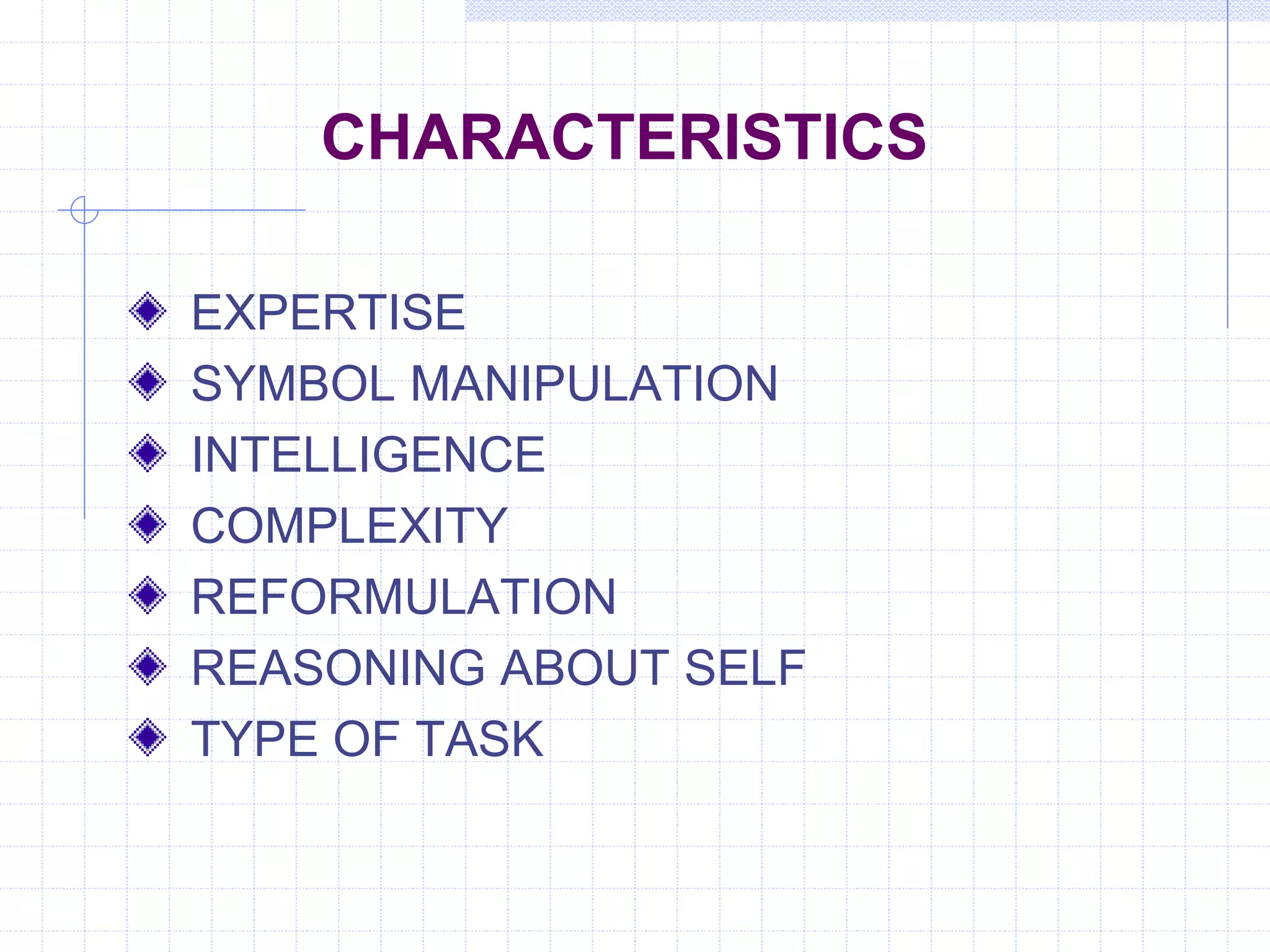
CHARACTERISTICS 
EXPERTISE 
SYMBOL MANIPULATION 
INTELLIGENCE 
COMPLEXITY 
REFORMULATION 
REASONING ABOUT SELF 
TYPE OF TASK
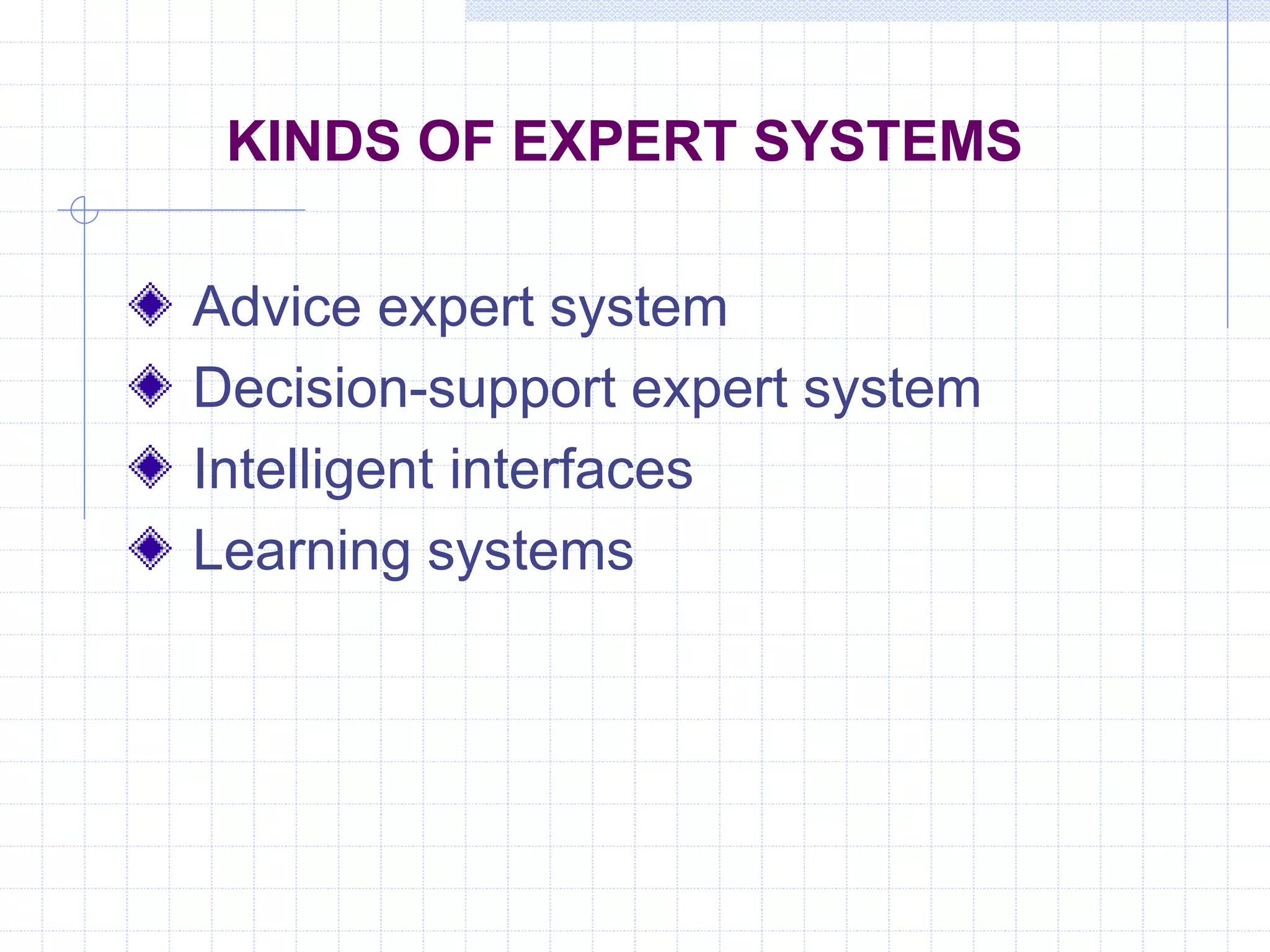
KINDS OF EXPERT SYSTEMS 
Advice expert system 
Decision-support expert system 
Intelligent interfaces 
Learning systems
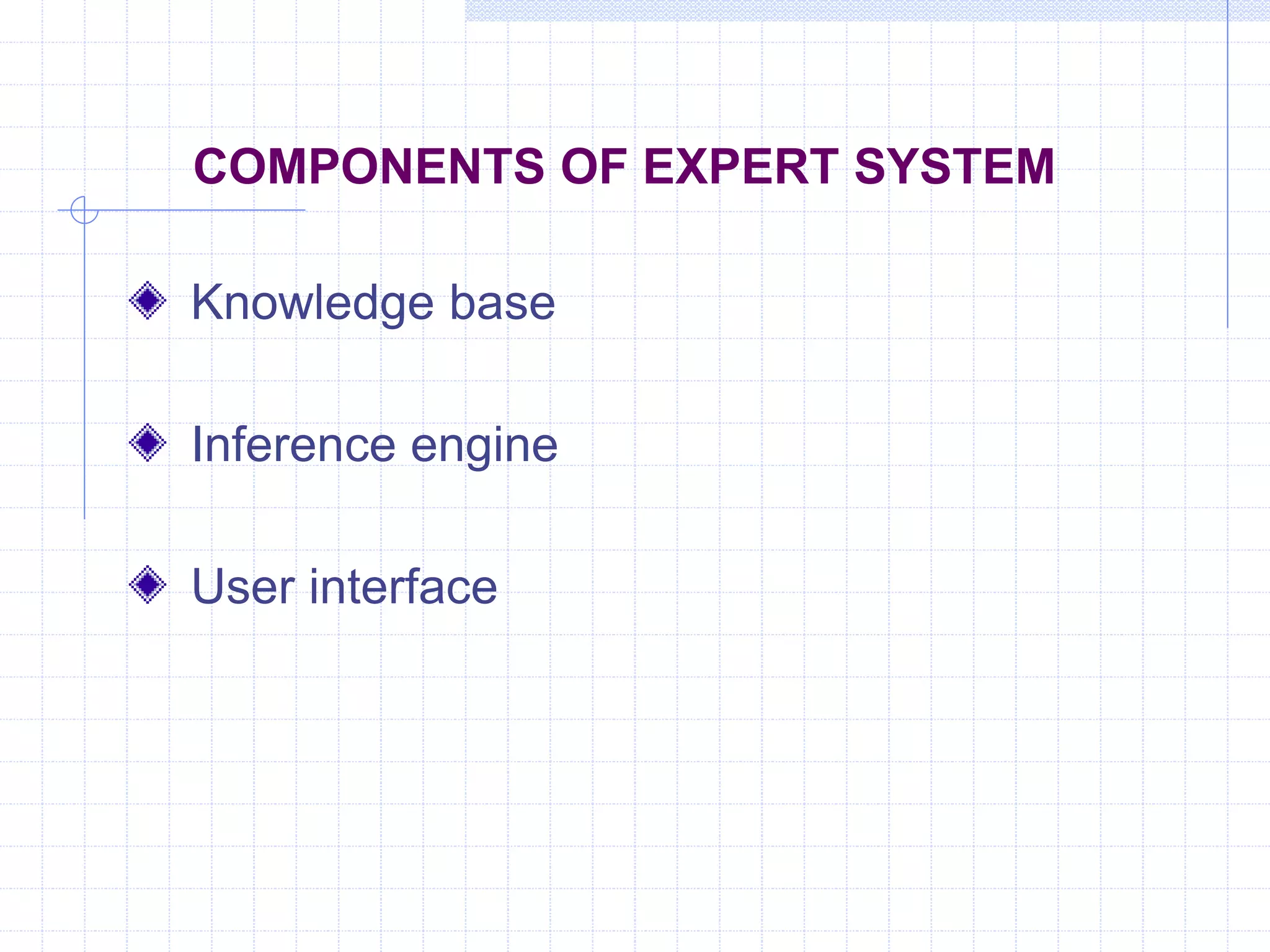
COMPONENTS OF EXPERT SYSTEM 
Knowledge base 
Inference engine 
User interface
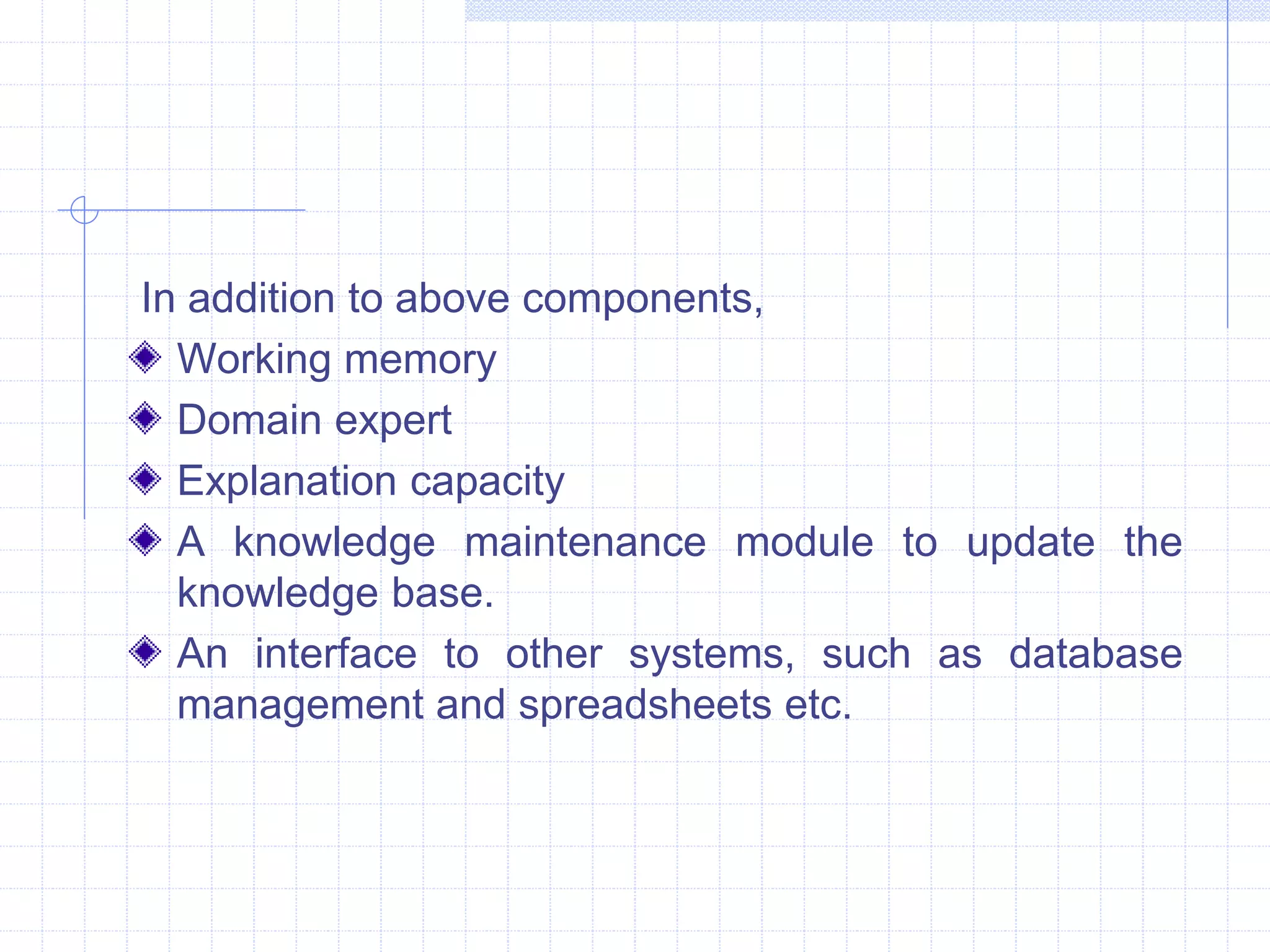
In addition to above components, 
Working memory 
Domain expert 
Explanation capacity 
A knowledge maintenance module to update the 
knowledge base. 
An interface to other systems, such as database 
management and spreadsheets etc.
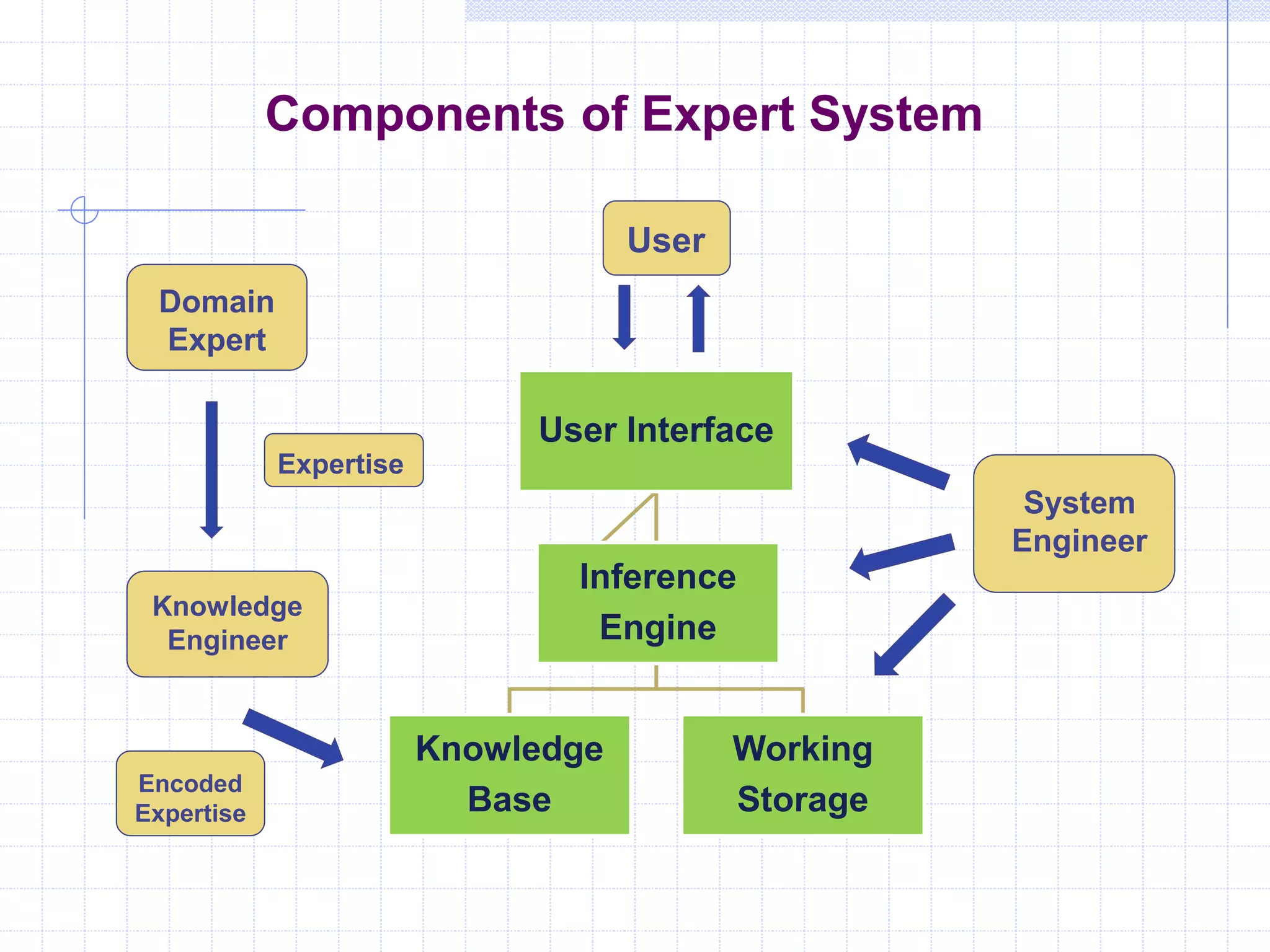
Components of Expert System 
User Interface 
Inference 
Engine 
Knowledge 
Base 
Working 
Storage 
User 
System 
Engineer 
Domain 
Expert 
Expertise 
Knowledge 
Engineer 
Encoded 
Expertise
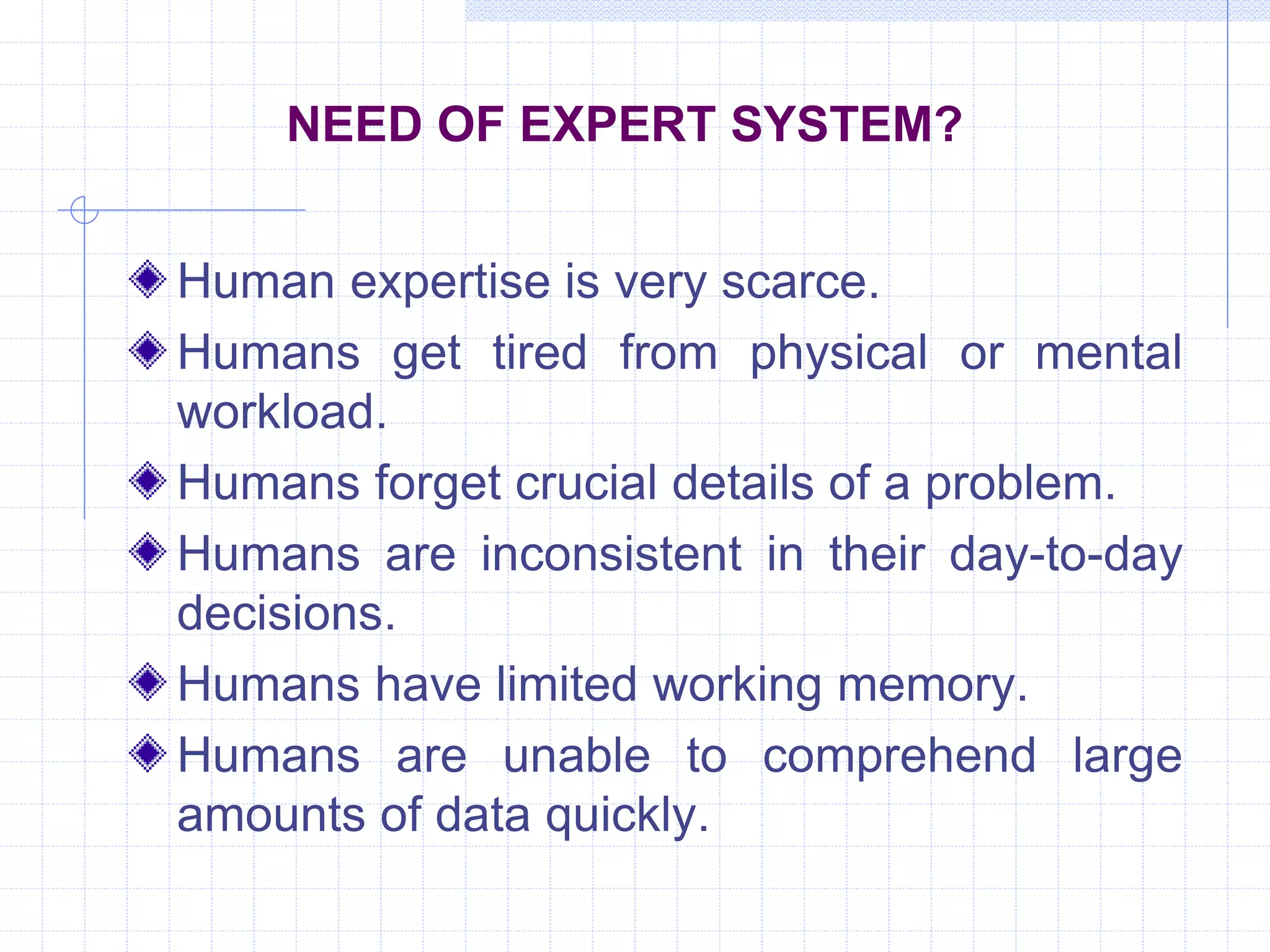
NEED OF EXPERT SYSTEM? 
Human expertise is very scarce. 
Humans get tired from physical or mental 
workload. 
Humans forget crucial details of a problem. 
Humans are inconsistent in their day-to-day 
decisions. 
Humans have limited working memory. 
Humans are unable to comprehend large 
amounts of data quickly.
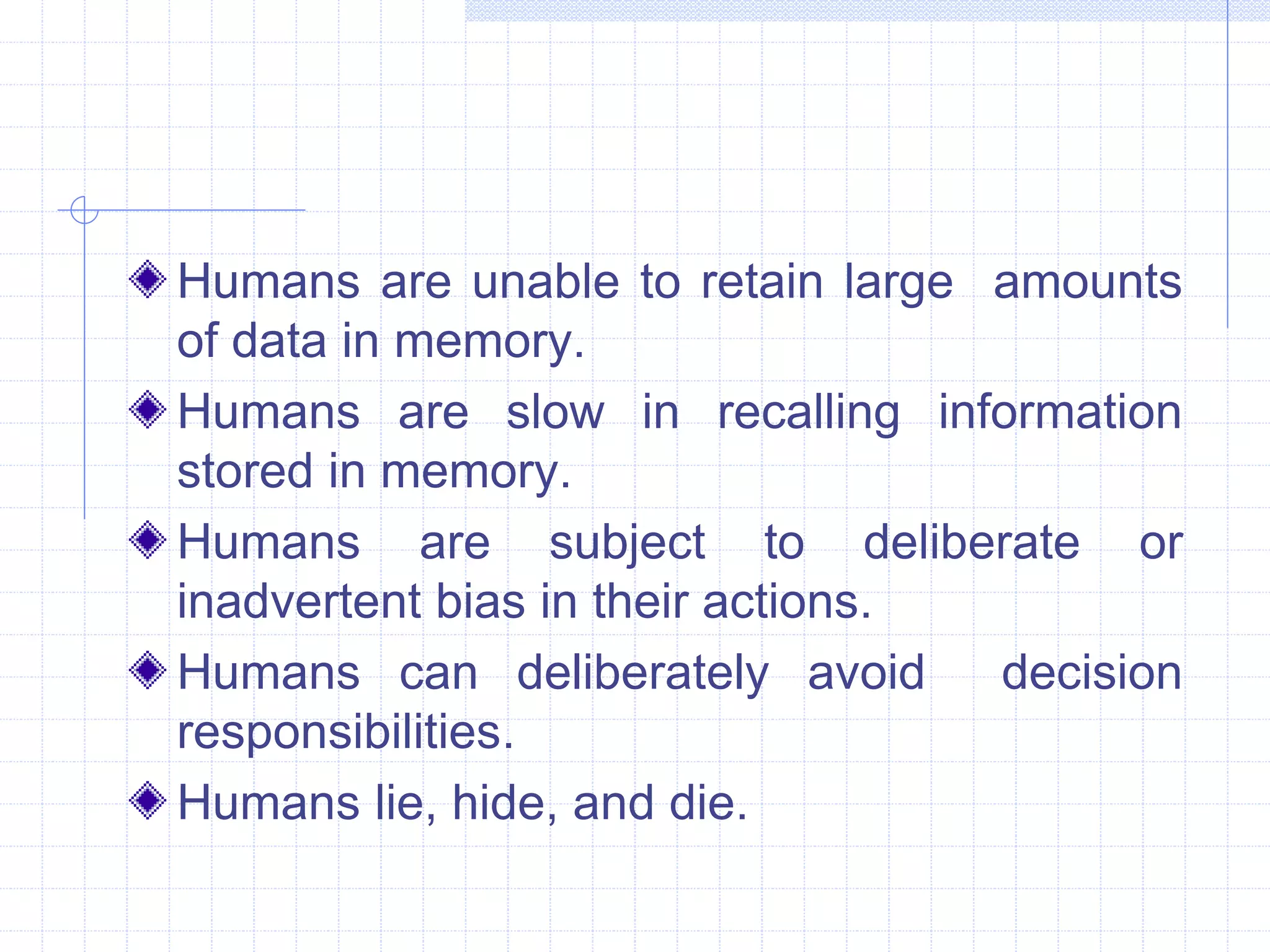
Humans are unable to retain large amounts 
of data in memory. 
Humans are slow in recalling information 
stored in memory. 
Humans are subject to deliberate or 
inadvertent bias in their actions. 
Humans can deliberately avoid decision 
responsibilities. 
Humans lie, hide, and die.
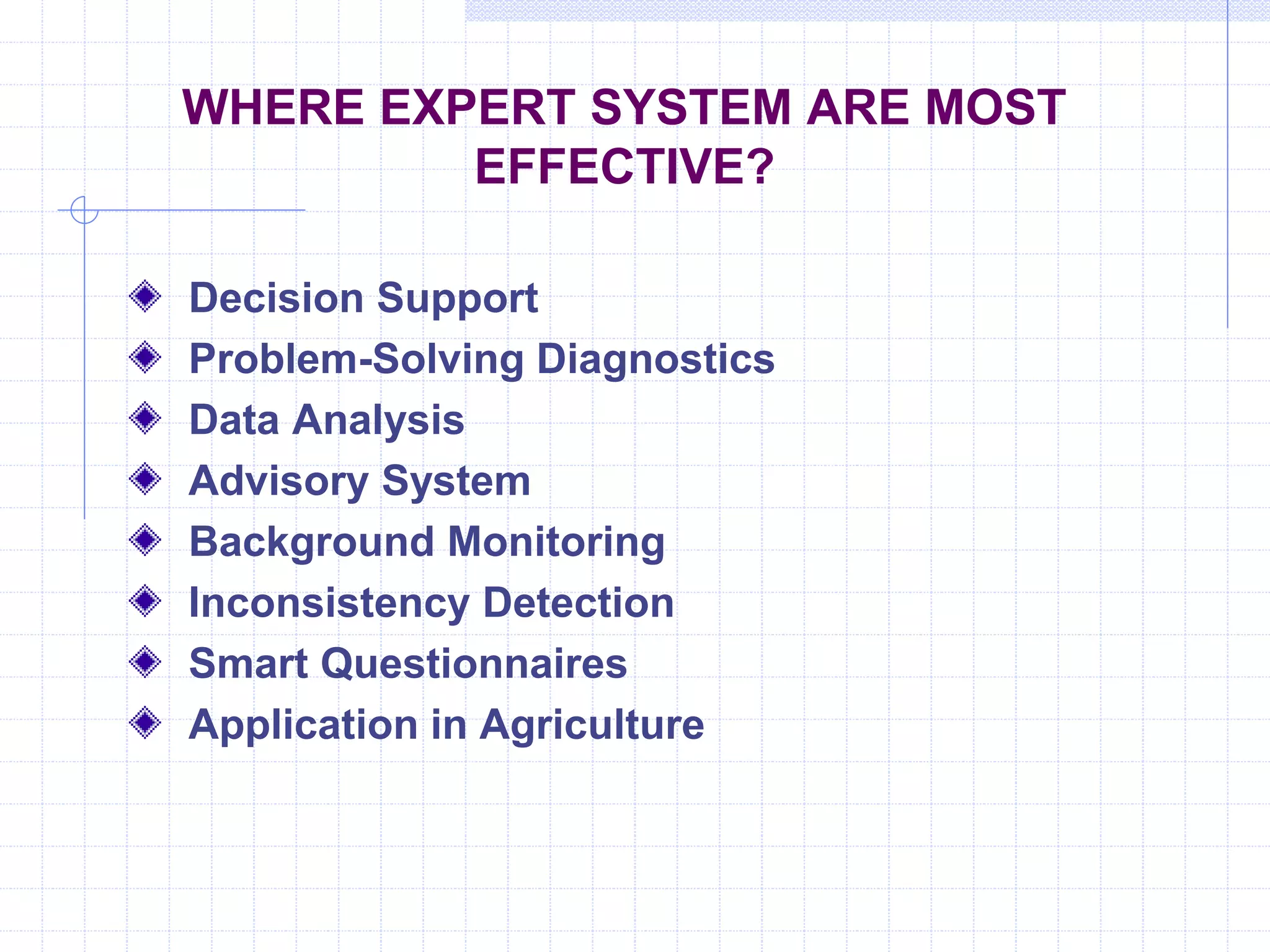
WHERE EXPERT SYSTEM ARE MOST 
EFFECTIVE? 
Decision Support 
Problem-Solving Diagnostics 
Data Analysis 
Advisory System 
Background Monitoring 
Inconsistency Detection 
Smart Questionnaires 
Application in Agriculture
Diagnosis diseases of wheat 
symptoms - recommendations. 
Problem in leaves- disease may be 
Stem rust(h1) 
Problem in leaves- disease may be Flag 
smut (h0)
The developmental process then adds 
additional information to help determine 
whether the hypothesis “disease is flag 
smut on leaves” is true.
This is not as simple as it might look as 
other considerations include 
symptoms appeared on the defected 
parts including size of patches 
color of spots 
condition of defected organ and other 
information.
The representation of flag smut disease is 
mentioned below. 
• RULE [Is it going to find the problem 
area which is flag smut?] 
• If [season] = "spring" and 
• [stage]="early" and 
• [problem_is_in]="leaves" and 
• [leave_part]="upper" and 
• [strip_color]="light_green_to_grey_black
Then [the problem] = "FALG 
SMUT IS DIAGNOSED" 
• [recommendation 1]= "CAUSAL 
ORGANISM: Urocystic tritici" and 
• [recommendation 2]= 
"PERPETUATION: The disease is 
perpetuated through seed borne and/or 
soil borne spores, which can survive in 
the soil up to a period of three years" 
and 
• [
• recommendation 3]= "MANAGEMENT: 
1. GROW RESISTANT CULTIVARS. 
5. EARLY PLANTING 
6. USING THE WET METHOD OF 
SOWING. IRRIGATING JUST AFTER 
SOWING. 
7. ROGUE OUT AND BURN THE 
INFECTED PLANT. "
Starting consultation
Problem classification
season
EXPERT SYSTEM IN AGRICULTURE 
AMRAPALIKA: An expert system for the diagnosis of 
pests, diseases and disorders in Indian mango. 
Dr. Wheat: A Web-based expert system for diagnosis 
of diseases and pests in Pakistani wheat.
BENEFITS OF EXPERT SYSTEMS 
Increase the probability, frequency, and 
consistency of making good decisions. 
Help distribute human expertise. 
Facilitate real-time, low-cost expert level 
decisions by the non expert. 
Enhance the utilization of most of the 
available data.
Permit objectivity by weighing evidence without bias 
and without regard for the user’s personal and 
emotional reactions. 
Permit dynamism through modularity of structure. 
Free up the mind and time of the human expert to 
enable him or her to concentrate on more creative 
activities. 
Encourage investigations into the subtle areas of a 
problem.
LIMITATIONS OF EXPERT SYSTEMS 
Not widely used or tested. 
Limited to relatively narrow problems. 
No “common sense”. 
Cannot readily deal with “mixed” knowledge. 
Possibility of error. 
Cannot refine own knowledge base. 
Difficult to maintain. 
System are not always up to date. 
May have high development costs
Conclusion 
An expert system is a powerful tool with 
extensive potential in various field. 
The development of an expert system 
requires the combined effort of specialists 
from many fields of different areas and can 
only be accomplished with the cooperation of 
the users and advisors who will use them.

Expert system in computer

  • 1.
  • 2.
    EXPERT SYSTEM Expertsystem are intelligent computer programs designed to stimulate the problem-solving behavior of human experts. These programs perform a task that would otherwise be performed by a human expert. It create a tool that can be used by a layman to solve difficult or ambiguous problems.
  • 3.
    There are expertsystems that can be diagnose human illnesses, make financial forecast, and schedule routes for delivery vehicles. They also play chess, underwrite insurance policies, and perform many services which previously required human expertise. Some expert systems are designed to take the place of human experts, While others are designed to aid them.
  • 4.
    DEFINITION “An expertsystem is an interactive computer-based decision tool that uses both facts and heuristics to solve difficult decision problems based on knowledge acquired from an expert.” An expert system compared with traditional computer : Inference engine + Knowledge = Expert system
  • 5.
    CHARACTERISTICS EXPERTISE SYMBOLMANIPULATION INTELLIGENCE COMPLEXITY REFORMULATION REASONING ABOUT SELF TYPE OF TASK
  • 6.
    KINDS OF EXPERTSYSTEMS Advice expert system Decision-support expert system Intelligent interfaces Learning systems
  • 7.
    COMPONENTS OF EXPERTSYSTEM Knowledge base Inference engine User interface
  • 8.
    In addition toabove components, Working memory Domain expert Explanation capacity A knowledge maintenance module to update the knowledge base. An interface to other systems, such as database management and spreadsheets etc.
  • 9.
    Components of ExpertSystem User Interface Inference Engine Knowledge Base Working Storage User System Engineer Domain Expert Expertise Knowledge Engineer Encoded Expertise
  • 10.
    NEED OF EXPERTSYSTEM? Human expertise is very scarce. Humans get tired from physical or mental workload. Humans forget crucial details of a problem. Humans are inconsistent in their day-to-day decisions. Humans have limited working memory. Humans are unable to comprehend large amounts of data quickly.
  • 11.
    Humans are unableto retain large amounts of data in memory. Humans are slow in recalling information stored in memory. Humans are subject to deliberate or inadvertent bias in their actions. Humans can deliberately avoid decision responsibilities. Humans lie, hide, and die.
  • 12.
    WHERE EXPERT SYSTEMARE MOST EFFECTIVE? Decision Support Problem-Solving Diagnostics Data Analysis Advisory System Background Monitoring Inconsistency Detection Smart Questionnaires Application in Agriculture
  • 13.
    Diagnosis diseases ofwheat symptoms - recommendations. Problem in leaves- disease may be Stem rust(h1) Problem in leaves- disease may be Flag smut (h0)
  • 14.
    The developmental processthen adds additional information to help determine whether the hypothesis “disease is flag smut on leaves” is true.
  • 15.
    This is notas simple as it might look as other considerations include symptoms appeared on the defected parts including size of patches color of spots condition of defected organ and other information.
  • 16.
    The representation offlag smut disease is mentioned below. • RULE [Is it going to find the problem area which is flag smut?] • If [season] = "spring" and • [stage]="early" and • [problem_is_in]="leaves" and • [leave_part]="upper" and • [strip_color]="light_green_to_grey_black
  • 17.
    Then [the problem]= "FALG SMUT IS DIAGNOSED" • [recommendation 1]= "CAUSAL ORGANISM: Urocystic tritici" and • [recommendation 2]= "PERPETUATION: The disease is perpetuated through seed borne and/or soil borne spores, which can survive in the soil up to a period of three years" and • [
  • 18.
    • recommendation 3]="MANAGEMENT: 1. GROW RESISTANT CULTIVARS. 5. EARLY PLANTING 6. USING THE WET METHOD OF SOWING. IRRIGATING JUST AFTER SOWING. 7. ROGUE OUT AND BURN THE INFECTED PLANT. "
  • 19.
  • 20.
  • 21.
  • 22.
    EXPERT SYSTEM INAGRICULTURE AMRAPALIKA: An expert system for the diagnosis of pests, diseases and disorders in Indian mango. Dr. Wheat: A Web-based expert system for diagnosis of diseases and pests in Pakistani wheat.
  • 23.
    BENEFITS OF EXPERTSYSTEMS Increase the probability, frequency, and consistency of making good decisions. Help distribute human expertise. Facilitate real-time, low-cost expert level decisions by the non expert. Enhance the utilization of most of the available data.
  • 24.
    Permit objectivity byweighing evidence without bias and without regard for the user’s personal and emotional reactions. Permit dynamism through modularity of structure. Free up the mind and time of the human expert to enable him or her to concentrate on more creative activities. Encourage investigations into the subtle areas of a problem.
  • 25.
    LIMITATIONS OF EXPERTSYSTEMS Not widely used or tested. Limited to relatively narrow problems. No “common sense”. Cannot readily deal with “mixed” knowledge. Possibility of error. Cannot refine own knowledge base. Difficult to maintain. System are not always up to date. May have high development costs
  • 26.
    Conclusion An expertsystem is a powerful tool with extensive potential in various field. The development of an expert system requires the combined effort of specialists from many fields of different areas and can only be accomplished with the cooperation of the users and advisors who will use them.