Fourth Five- 
Year Plan 
(1969–1974) 
Represented by:- Kiran Paul
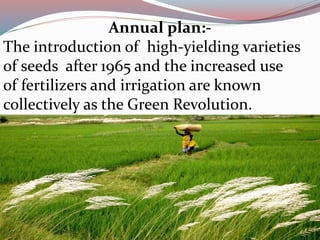
Annual plan:- 
The introduction of high-yielding varieties 
of seeds after 1965 and the increased use 
of fertilizers and irrigation are known 
collectively as the Green Revolution.
Country condition:- 
•1966 & 1968 were famine years which 
disrupted the planning process in mid 
1965. 
•India also faced two wars 1962 with 
China and 1965 with Pakistan. 
•Huge set back to the economy as defense 
expenditure increased sharply & there 
negative impact on industrial & 
agricultural growth.
Objective:- 
•To attain 5.5 percent growth in national 
income per annum. 
•To bring economic stability 
•To achieve self reliance 
•To achieve social justice & equality 
•To utilize Panchayati Raj institution in 
local & regional planning. 
•To ensure the achievement of self-reliance, 
price stability, Income of rural 
population, supply of essential mass 
consumption goods etc.
Programmes of 4th five year plan 
Area development:- 
Drought prove area programme 
Agricultural development:- 
Marginal farmers & agricultural labors (MFAL) 
Small farmer development agency(SFDA) 
Crash scheme for rural employment 
Nutritional progamme:- 
Supplement nutrition programme(SNP) 
Training programme:- 
Women vocational training programme (WVTP) 
Welfare programme:- 
Short stay houses for women& girls 
Rural programme:- 
Accelerating rural water supply programme 
Rural electrification corporation
During these years (1969–1974) :- 
•1st super fast train Rajdhani express 
was introduced. 
•India’s first atomic power station 
becomes operational 
•Madras renamed Tamil Nadu. 
•Target Growth: 5.7% Actual 
Growth: 3.30%
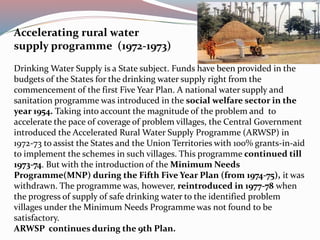
Accelerating rural water 
supply programme (1972-1973) 
Drinking Water Supply is a State subject. Funds have been provided in the 
budgets of the States for the drinking water supply right from the 
commencement of the first Five Year Plan. A national water supply and 
sanitation programme was introduced in the social welfare sector in the 
year 1954. Taking into account the magnitude of the problem and to 
accelerate the pace of coverage of problem villages, the Central Government 
introduced the Accelerated Rural Water Supply Programme (ARWSP) in 
1972-73 to assist the States and the Union Territories with 100% grants-in-aid 
to implement the schemes in such villages. This programme continued till 
1973-74. But with the introduction of the Minimum Needs 
Programme(MNP) during the Fifth Five Year Plan (from 1974-75), it was 
withdrawn. The programme was, however, reintroduced in 1977-78 when 
the progress of supply of safe drinking water to the identified problem 
villages under the Minimum Needs Programme was not found to be 
satisfactory. 
ARWSP continues during the 9th Plan.
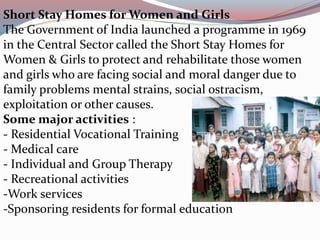
Short Stay Homes for Women and Girls 
The Government of India launched a programme in 1969 
in the Central Sector called the Short Stay Homes for 
Women & Girls to protect and rehabilitate those women 
and girls who are facing social and moral danger due to 
family problems mental strains, social ostracism, 
exploitation or other causes. 
Some major activities : 
- Residential Vocational Training 
- Medical care 
- Individual and Group Therapy 
- Recreational activities 
-Work services 
-Sponsoring residents for formal education
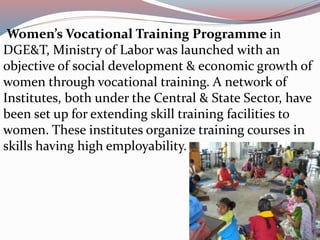
Women’s Vocational Training Programme in 
DGE&T, Ministry of Labor was launched with an 
objective of social development & economic growth of 
women through vocational training. A network of 
Institutes, both under the Central & State Sector, have 
been set up for extending skill training facilities to 
women. These institutes organize training courses in 
skills having high employability.
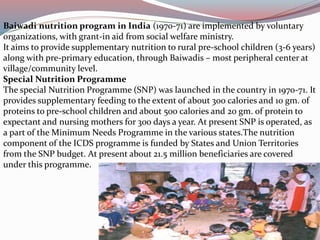
Baiwadi nutrition program in India (1970-71) are implemented by voluntary 
organizations, with grant-in aid from social welfare ministry. 
It aims to provide supplementary nutrition to rural pre-school children (3-6 years) 
along with pre-primary education, through Baiwadis – most peripheral center at 
village/community level. 
Special Nutrition Programme 
The special Nutrition Programme (SNP) was launched in the country in 1970-71. It 
provides supplementary feeding to the extent of about 300 calories and 10 gm. of 
proteins to pre-school children and about 500 calories and 20 gm. of protein to 
expectant and nursing mothers for 300 days a year. At present SNP is operated, as 
a part of the Minimum Needs Programme in the various states.The nutrition 
component of the ICDS programme is funded by States and Union Territories 
from the SNP budget. At present about 21.5 million beneficiaries are covered 
under this programme.
The Crash Scheme for Rural 
Employment (CSRE) which spanned 
from 1971-72 to 1973-74 was one among 
them. The scheme aimed at direct 
generation of employment in all the 
districts of the country at the rate of 2.5 
lakhs man days per annum in each district 
through the execution of labor intensive 
projects and creation of durable assets in 
consonance with local development plans
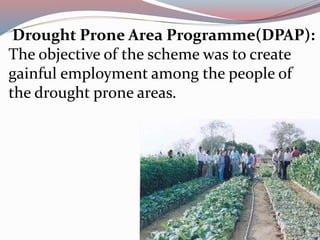
Drought Prone Area Programme(DPAP): 
The objective of the scheme was to create 
gainful employment among the people of 
the drought prone areas.
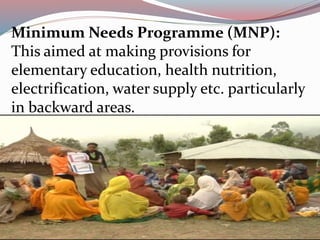
Minimum Needs Programme (MNP): 
This aimed at making provisions for 
elementary education, health nutrition, 
electrification, water supply etc. particularly 
in backward areas.
4th five year plan of India

4th five year plan of India

  • 1.
    Fourth Five- YearPlan (1969–1974) Represented by:- Kiran Paul
  • 2.
    Annual plan:- Theintroduction of high-yielding varieties of seeds after 1965 and the increased use of fertilizers and irrigation are known collectively as the Green Revolution.
  • 3.
    Country condition:- •1966& 1968 were famine years which disrupted the planning process in mid 1965. •India also faced two wars 1962 with China and 1965 with Pakistan. •Huge set back to the economy as defense expenditure increased sharply & there negative impact on industrial & agricultural growth.
  • 4.
    Objective:- •To attain5.5 percent growth in national income per annum. •To bring economic stability •To achieve self reliance •To achieve social justice & equality •To utilize Panchayati Raj institution in local & regional planning. •To ensure the achievement of self-reliance, price stability, Income of rural population, supply of essential mass consumption goods etc.
  • 5.
    Programmes of 4thfive year plan Area development:- Drought prove area programme Agricultural development:- Marginal farmers & agricultural labors (MFAL) Small farmer development agency(SFDA) Crash scheme for rural employment Nutritional progamme:- Supplement nutrition programme(SNP) Training programme:- Women vocational training programme (WVTP) Welfare programme:- Short stay houses for women& girls Rural programme:- Accelerating rural water supply programme Rural electrification corporation
  • 6.
    During these years(1969–1974) :- •1st super fast train Rajdhani express was introduced. •India’s first atomic power station becomes operational •Madras renamed Tamil Nadu. •Target Growth: 5.7% Actual Growth: 3.30%
  • 7.
    Accelerating rural water supply programme (1972-1973) Drinking Water Supply is a State subject. Funds have been provided in the budgets of the States for the drinking water supply right from the commencement of the first Five Year Plan. A national water supply and sanitation programme was introduced in the social welfare sector in the year 1954. Taking into account the magnitude of the problem and to accelerate the pace of coverage of problem villages, the Central Government introduced the Accelerated Rural Water Supply Programme (ARWSP) in 1972-73 to assist the States and the Union Territories with 100% grants-in-aid to implement the schemes in such villages. This programme continued till 1973-74. But with the introduction of the Minimum Needs Programme(MNP) during the Fifth Five Year Plan (from 1974-75), it was withdrawn. The programme was, however, reintroduced in 1977-78 when the progress of supply of safe drinking water to the identified problem villages under the Minimum Needs Programme was not found to be satisfactory. ARWSP continues during the 9th Plan.
  • 8.
    Short Stay Homesfor Women and Girls The Government of India launched a programme in 1969 in the Central Sector called the Short Stay Homes for Women & Girls to protect and rehabilitate those women and girls who are facing social and moral danger due to family problems mental strains, social ostracism, exploitation or other causes. Some major activities : - Residential Vocational Training - Medical care - Individual and Group Therapy - Recreational activities -Work services -Sponsoring residents for formal education
  • 9.
    Women’s Vocational TrainingProgramme in DGE&T, Ministry of Labor was launched with an objective of social development & economic growth of women through vocational training. A network of Institutes, both under the Central & State Sector, have been set up for extending skill training facilities to women. These institutes organize training courses in skills having high employability.
  • 10.
    Baiwadi nutrition programin India (1970-71) are implemented by voluntary organizations, with grant-in aid from social welfare ministry. It aims to provide supplementary nutrition to rural pre-school children (3-6 years) along with pre-primary education, through Baiwadis – most peripheral center at village/community level. Special Nutrition Programme The special Nutrition Programme (SNP) was launched in the country in 1970-71. It provides supplementary feeding to the extent of about 300 calories and 10 gm. of proteins to pre-school children and about 500 calories and 20 gm. of protein to expectant and nursing mothers for 300 days a year. At present SNP is operated, as a part of the Minimum Needs Programme in the various states.The nutrition component of the ICDS programme is funded by States and Union Territories from the SNP budget. At present about 21.5 million beneficiaries are covered under this programme.
  • 11.
    The Crash Schemefor Rural Employment (CSRE) which spanned from 1971-72 to 1973-74 was one among them. The scheme aimed at direct generation of employment in all the districts of the country at the rate of 2.5 lakhs man days per annum in each district through the execution of labor intensive projects and creation of durable assets in consonance with local development plans
  • 12.
    Drought Prone AreaProgramme(DPAP): The objective of the scheme was to create gainful employment among the people of the drought prone areas.
  • 13.
    Minimum Needs Programme(MNP): This aimed at making provisions for elementary education, health nutrition, electrification, water supply etc. particularly in backward areas.