1
Presented by
SABANNA, K. METI
PG11AGR3020
Seminar - I
EXPERT SYSTEM FOR EFFECTIVE
EXTENSION SERVICE
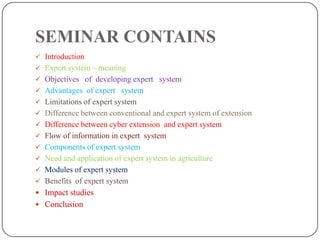
SEMINAR CONTAINS
 Introduction
 Expert system – meaning
 Objectives of developing expert system
 Advantages of expert system
 Limitations of expert system
 Difference between conventional and expert system of extension
 Difference between cyber extension and expert system
 Flow of information in expert system
 Components of expert system
 Need and application of expert system in agriculture
 Modules of expert system
 Benefits of expert system
 Impact studies
 Conclusion
INTRODUCTION
EXTENSION SERVICE
- Extension workers
- Extension Teaching Methods
5
PERSONAL & GROUP CONTACT IN THE
19TH CENTURY
USE OF PRINT MEDIA IN THE 20TH
CENTURY
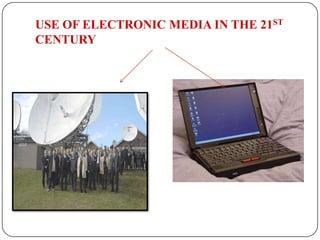
USE OF ELECTRONIC MEDIA IN THE 21ST
CENTURY
Poor
ratio of SMS
to agents
Lower level of
education of
extension agents
Short supply
of extension
agents
More number of
farmer per extension
worker
More area to
be covered by
agents
Less number
of female
extension
agents
Human Resource
of Extension
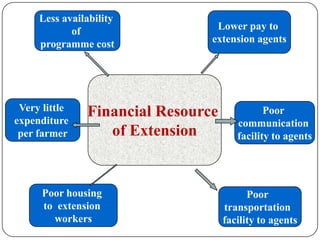
Poor
transportation
facility to agents
Lower pay to
extension agents
Less availability
of
programme cost
Poor housing
to extension
workers
Poor
communication
facility to agents
Very little
expenditure
per farmer
Financial Resource
of Extension
What should I do?
EXTENSION CLIENT
Market
5 km
Land
2 acres
Labour
5 members
Capital
Rs. 5000
Power
Pair of bullock
Source of
Irrigation
Pump set
My
resources
Which choice
is best?
Which choice
is income
generating?
Which choice
requires less
labour?
Which choice
requires less
land area ?
Which choice
is not much
affected by
season?
Which choice
requires less
input?
Fisheries
Crops
Fruits
Piggery
Flowers
Poultry
Dairy
Bee
keeping
Magazine
Television
Extension
worker
Neighbour
News paperFriend
Who will help me
in appropriate
decision making?
The answer to all these questions is:
EXPERT
SYSTEM OF
EXTENSION
Is an intelligent computer program that uses knowledge
and inferences procedures to solve problems
( Daniel Hunt,1986 )
EXPERT SYSTEM – MEANING
OBJECTIVES OF DEVELOPING
EXPERT SYSTEM
To enhance the performance of agricultural extension
personnel and farmer
To make farming more efficient and profitable
To reduce the time required in solving the problems
To maintain the expert system by continuously upgrading
the database
CHARACTER OF AN EXPERT SYSTEM
 A rich knowledge base
 An organization of knowledge that is readily accessible
 Expert’s own knowledge and experience
ADVANTAGES OF EXPERT SYSTEM
 Solves critical problems by making logical deductions without
taking much time
 It combines experimental and conventional knowledge with the
reasoning skills of specialists
 To enhance the performance of average worker to the level of an
expert
LIMITATIONS OF EXPERT SYSTEM
 Expensive computer program
 Mostly developed not in regional languages
 Requires AC power and internet connection all the time
 Complex software requires computer skilled personnel
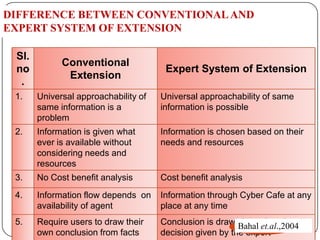
DIFFERENCE BETWEEN CONVENTIONALAND
EXPERT SYSTEM OF EXTENSION
Sl.
no
.
Conventional
Extension
Expert System of Extension
1. Universal approachability of
same information is a
problem
Universal approachability of same
information is possible
2. Information is given what
ever is available without
considering needs and
resources
Information is chosen based on their
needs and resources
3. No Cost benefit analysis Cost benefit analysis
4. Information flow depends on
availability of agent
Information through Cyber Cafe at any
place at any time
5. Require users to draw their
own conclusion from facts
Conclusion is drawn based on the
decision given by the expert
20Bahal et.al.,2004
DIFFERENCE BETWEEN CYBER EXTENSION V/S EXPERT SYSTEM
Cyber extension
Extension over the cyber
space, the imaginary
space behind the inter
connected
telecommunication and
computer-networks, the
virtual world
(Mishra,1999)
Expert system
An expert system is simply
a computer software
programme that mimics
the behavior of human
experts.
(Ahmed
Rafea, 2002)
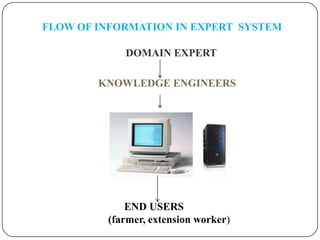
FLOW OF INFORMATION IN EXPERT SYSTEM
DOMAIN EXPERT
KNOWLEDGE ENGINEERS
END USERS
(farmer, extension worker)
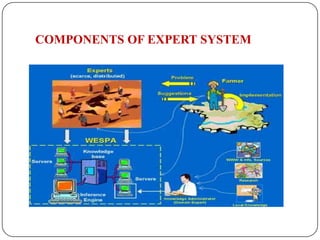
COMPONENTS OF EXPERT SYSTEM
NEED OF EXPERT SYSTEM IN EXTENSION
 Agricultural technology is constantly changing day by day
 To deal with the overgrowing complexities of agricultural
technologies
 To make efficient and accurate decisions
APPLICATION OF EXPERT SYSTEM IN
AGRICULTURE
• Crop production estimates
• Crop selection
• Soil management
• Nutrient management
• Plant diseases and pests management
• Weed management
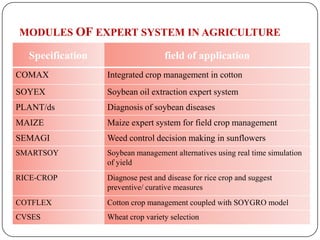
MODULES OF EXPERT SYSTEM IN AGRICULTURE
Specification field of application
COMAX Integrated crop management in cotton
SOYEX Soybean oil extraction expert system
PLANT/ds Diagnosis of soybean diseases
MAIZE Maize expert system for field crop management
SEMAGI Weed control decision making in sunflowers
SMARTSOY Soybean management alternatives using real time simulation
of yield
RICE-CROP Diagnose pest and disease for rice crop and suggest
preventive/ curative measures
COTFLEX Cotton crop management coupled with SOYGRO model
CVSES Wheat crop variety selection
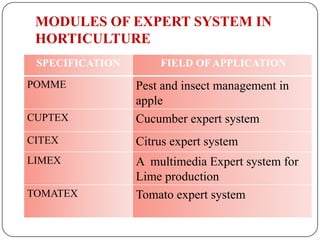
MODULES OF EXPERT SYSTEM IN
HORTICULTURE
SPECIFICATION FIELD OF APPLICATION
POMME Pest and insect management in
apple
CUPTEX Cucumber expert system
CITEX Citrus expert system
LIMEX A multimedia Expert system for
Lime production
TOMATEX Tomato expert system
MODULES OF EXPERT SYSTEM IN OTHERS
SPECIFICATION FIELD OF APPLICATION
GRAIN MARKETING
ADVISOR
Determination of grain marketing alternatives
ESIM Expert system for irrigated management
CROPES Multiple crop selection
CROPLOT Determining the suitability of crops to given plot
ETES Estimation method selection
TANKES Tank system operational guidelines real time
operation
OASIS Operation of control structures real time
metereological
EXSYS Drainage diagnosis
CUE Crop variety selection
MKBS fertilizer and irrigation applications
KBS Economic feasibility of irrigation system selection
CUE Irrigation system selection & canal water distribution :
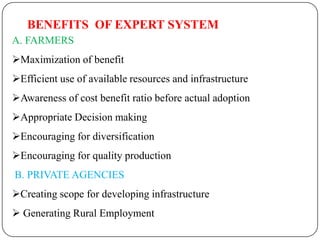
BENEFITS OF EXPERT SYSTEM
A. FARMERS
Maximization of benefit
Efficient use of available resources and infrastructure
Awareness of cost benefit ratio before actual adoption
Appropriate Decision making
Encouraging for diversification
Encouraging for quality production
B. PRIVATE AGENCIES
Creating scope for developing infrastructure
 Generating Rural Employment
Screen clipping taken: 17/10/2012, 21:26
Screen clipping taken: 17/10/2012, 21:43
Screen clipping taken: 17/10/2012, 22:08
IMPACT STUDIES
36
1. STUDY
Using expert system as a training tool in the agriculture
sector in Egypt
(A. Rafea and K. Shaalan 1995)
CUPTEX IRRIGATION RESULTS
Average
score before
(%)
Average
score after
(%)
Enhancemen
t
Percentage
of
enhancemen
t
Water qty 38.10 73.60 35.50 93.18
interval 41.90 71.20 29.30 69.93
Average 40.00 72.40 32.40 81.00
2. (Exp) CITEX IRRIGATION RESULTS
AVERAGE
SCORE
BEFORE (%)
AVERAGE
SCORE
AFTER (%)
ENHANCEM
ENT
PERCENTAG
E
OFENHANCE
MENT
Water qty 31.3 67.5 36.2 115.65
Interval 39.7 60.6 20.9 52.64
Average 35.5 64.05 28.55 84.15
Findings
This study suggest that the expert system an
effective training tool in agriculture extension
programs
Expert system integrated with other
information technologies can be used to
strengthening the link between research and
extension.
Integrating multimedia with expert system for
crop production management
3.STUDY
(Rafea et al, 1995)
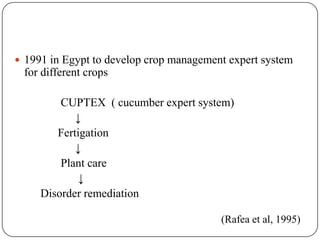
 1991 in Egypt to develop crop management expert system
for different crops
CUPTEX ( cucumber expert system)
↓
Fertigation
↓
Plant care
↓
Disorder remediation
(Rafea et al, 1995)
 CUPTEX in two research sites has revealed that
approximately 26% increase in production
 15% decrease in direct cost have been attained
 This results show that CUPTEX could pay off
approximately 60% of development cost in four months
4. STUDY
An Intelligent front-end for selecting evapo-transpiration
estimation methods, computers and electronics in agriculture
(Mohan and Aramugam, 1995)
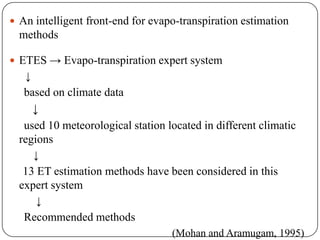
 An intelligent front-end for evapo-transpiration estimation
methods
 ETES → Evapo-transpiration expert system
↓
based on climate data
↓
used 10 meteorological station located in different climatic
regions
↓
13 ET estimation methods have been considered in this
expert system
↓
Recommended methods
(Mohan and Aramugam, 1995)
 ETES also suggests suitable correction factors for
converting the resulting ET values to those of methods
that result in accurate estimation
47
CONCLUSION
48

EXPERT SYSTEM FOR EFFECTIVE EXTENSION SERVICE by sabanna.k.meti(M.Sc agri) uas raichur

  • 1.
  • 2.
    Presented by SABANNA, K.METI PG11AGR3020 Seminar - I EXPERT SYSTEM FOR EFFECTIVE EXTENSION SERVICE
  • 3.
    SEMINAR CONTAINS  Introduction Expert system – meaning  Objectives of developing expert system  Advantages of expert system  Limitations of expert system  Difference between conventional and expert system of extension  Difference between cyber extension and expert system  Flow of information in expert system  Components of expert system  Need and application of expert system in agriculture  Modules of expert system  Benefits of expert system  Impact studies  Conclusion
  • 4.
  • 5.
    EXTENSION SERVICE - Extensionworkers - Extension Teaching Methods 5
  • 6.
    PERSONAL & GROUPCONTACT IN THE 19TH CENTURY
  • 7.
    USE OF PRINTMEDIA IN THE 20TH CENTURY
  • 8.
    USE OF ELECTRONICMEDIA IN THE 21ST CENTURY
  • 9.
    Poor ratio of SMS toagents Lower level of education of extension agents Short supply of extension agents More number of farmer per extension worker More area to be covered by agents Less number of female extension agents Human Resource of Extension
  • 10.
    Poor transportation facility to agents Lowerpay to extension agents Less availability of programme cost Poor housing to extension workers Poor communication facility to agents Very little expenditure per farmer Financial Resource of Extension
  • 11.
    What should Ido? EXTENSION CLIENT
  • 12.
    Market 5 km Land 2 acres Labour 5members Capital Rs. 5000 Power Pair of bullock Source of Irrigation Pump set My resources
  • 13.
    Which choice is best? Whichchoice is income generating? Which choice requires less labour? Which choice requires less land area ? Which choice is not much affected by season? Which choice requires less input? Fisheries Crops Fruits Piggery Flowers Poultry Dairy Bee keeping
  • 14.
    Magazine Television Extension worker Neighbour News paperFriend Who willhelp me in appropriate decision making? The answer to all these questions is: EXPERT SYSTEM OF EXTENSION
  • 15.
    Is an intelligentcomputer program that uses knowledge and inferences procedures to solve problems ( Daniel Hunt,1986 ) EXPERT SYSTEM – MEANING
  • 16.
    OBJECTIVES OF DEVELOPING EXPERTSYSTEM To enhance the performance of agricultural extension personnel and farmer To make farming more efficient and profitable To reduce the time required in solving the problems To maintain the expert system by continuously upgrading the database
  • 17.
    CHARACTER OF ANEXPERT SYSTEM  A rich knowledge base  An organization of knowledge that is readily accessible  Expert’s own knowledge and experience
  • 18.
    ADVANTAGES OF EXPERTSYSTEM  Solves critical problems by making logical deductions without taking much time  It combines experimental and conventional knowledge with the reasoning skills of specialists  To enhance the performance of average worker to the level of an expert
  • 19.
    LIMITATIONS OF EXPERTSYSTEM  Expensive computer program  Mostly developed not in regional languages  Requires AC power and internet connection all the time  Complex software requires computer skilled personnel
  • 20.
    DIFFERENCE BETWEEN CONVENTIONALAND EXPERTSYSTEM OF EXTENSION Sl. no . Conventional Extension Expert System of Extension 1. Universal approachability of same information is a problem Universal approachability of same information is possible 2. Information is given what ever is available without considering needs and resources Information is chosen based on their needs and resources 3. No Cost benefit analysis Cost benefit analysis 4. Information flow depends on availability of agent Information through Cyber Cafe at any place at any time 5. Require users to draw their own conclusion from facts Conclusion is drawn based on the decision given by the expert 20Bahal et.al.,2004
  • 21.
    DIFFERENCE BETWEEN CYBEREXTENSION V/S EXPERT SYSTEM Cyber extension Extension over the cyber space, the imaginary space behind the inter connected telecommunication and computer-networks, the virtual world (Mishra,1999) Expert system An expert system is simply a computer software programme that mimics the behavior of human experts. (Ahmed Rafea, 2002)
  • 22.
    FLOW OF INFORMATIONIN EXPERT SYSTEM DOMAIN EXPERT KNOWLEDGE ENGINEERS END USERS (farmer, extension worker)
  • 23.
  • 24.
    NEED OF EXPERTSYSTEM IN EXTENSION  Agricultural technology is constantly changing day by day  To deal with the overgrowing complexities of agricultural technologies  To make efficient and accurate decisions
  • 25.
    APPLICATION OF EXPERTSYSTEM IN AGRICULTURE • Crop production estimates • Crop selection • Soil management • Nutrient management • Plant diseases and pests management • Weed management
  • 26.
    MODULES OF EXPERTSYSTEM IN AGRICULTURE Specification field of application COMAX Integrated crop management in cotton SOYEX Soybean oil extraction expert system PLANT/ds Diagnosis of soybean diseases MAIZE Maize expert system for field crop management SEMAGI Weed control decision making in sunflowers SMARTSOY Soybean management alternatives using real time simulation of yield RICE-CROP Diagnose pest and disease for rice crop and suggest preventive/ curative measures COTFLEX Cotton crop management coupled with SOYGRO model CVSES Wheat crop variety selection
  • 27.
    MODULES OF EXPERTSYSTEM IN HORTICULTURE SPECIFICATION FIELD OF APPLICATION POMME Pest and insect management in apple CUPTEX Cucumber expert system CITEX Citrus expert system LIMEX A multimedia Expert system for Lime production TOMATEX Tomato expert system
  • 28.
    MODULES OF EXPERTSYSTEM IN OTHERS SPECIFICATION FIELD OF APPLICATION GRAIN MARKETING ADVISOR Determination of grain marketing alternatives ESIM Expert system for irrigated management CROPES Multiple crop selection CROPLOT Determining the suitability of crops to given plot ETES Estimation method selection TANKES Tank system operational guidelines real time operation OASIS Operation of control structures real time metereological EXSYS Drainage diagnosis CUE Crop variety selection MKBS fertilizer and irrigation applications KBS Economic feasibility of irrigation system selection CUE Irrigation system selection & canal water distribution :
  • 29.
    BENEFITS OF EXPERTSYSTEM A. FARMERS Maximization of benefit Efficient use of available resources and infrastructure Awareness of cost benefit ratio before actual adoption Appropriate Decision making Encouraging for diversification Encouraging for quality production B. PRIVATE AGENCIES Creating scope for developing infrastructure  Generating Rural Employment
  • 32.
    Screen clipping taken:17/10/2012, 21:26
  • 33.
    Screen clipping taken:17/10/2012, 21:43
  • 35.
    Screen clipping taken:17/10/2012, 22:08
  • 36.
  • 37.
    1. STUDY Using expertsystem as a training tool in the agriculture sector in Egypt (A. Rafea and K. Shaalan 1995)
  • 38.
    CUPTEX IRRIGATION RESULTS Average scorebefore (%) Average score after (%) Enhancemen t Percentage of enhancemen t Water qty 38.10 73.60 35.50 93.18 interval 41.90 71.20 29.30 69.93 Average 40.00 72.40 32.40 81.00
  • 39.
    2. (Exp) CITEXIRRIGATION RESULTS AVERAGE SCORE BEFORE (%) AVERAGE SCORE AFTER (%) ENHANCEM ENT PERCENTAG E OFENHANCE MENT Water qty 31.3 67.5 36.2 115.65 Interval 39.7 60.6 20.9 52.64 Average 35.5 64.05 28.55 84.15
  • 40.
    Findings This study suggestthat the expert system an effective training tool in agriculture extension programs Expert system integrated with other information technologies can be used to strengthening the link between research and extension.
  • 41.
    Integrating multimedia withexpert system for crop production management 3.STUDY (Rafea et al, 1995)
  • 42.
     1991 inEgypt to develop crop management expert system for different crops CUPTEX ( cucumber expert system) ↓ Fertigation ↓ Plant care ↓ Disorder remediation (Rafea et al, 1995)
  • 43.
     CUPTEX intwo research sites has revealed that approximately 26% increase in production  15% decrease in direct cost have been attained  This results show that CUPTEX could pay off approximately 60% of development cost in four months
  • 44.
    4. STUDY An Intelligentfront-end for selecting evapo-transpiration estimation methods, computers and electronics in agriculture (Mohan and Aramugam, 1995)
  • 45.
     An intelligentfront-end for evapo-transpiration estimation methods  ETES → Evapo-transpiration expert system ↓ based on climate data ↓ used 10 meteorological station located in different climatic regions ↓ 13 ET estimation methods have been considered in this expert system ↓ Recommended methods (Mohan and Aramugam, 1995)
  • 46.
     ETES alsosuggests suitable correction factors for converting the resulting ET values to those of methods that result in accurate estimation
  • 47.
  • 48.