PRESENTATION
ON
KNOWLEDGE
ACQUISITION
AND
VALIDATION
Presented by:
ADITYA SARKAR
MBA/40076/2019
BIT Mesra Extension Centre
Lalpur , Ranchi
WHAT IS KNOWLEDGE ACQUISITION?
 Knowledge acquisition is process of extracting , structuring
and organising knowledge from one or more sources.
 It may also include acquiring knowledge from other sources
such as books , technical manuscripts and drawings.
 It includes elicitation, collection, analysis, modelling and
validation of knowledge.
 It facilitates the assimilation of knowledge and experiences
of different specialties.
PROBLEMS IN KNOWLEDGE ACQUISITION
 Unaware of Knowledge used
 Unable to verbalize the knowledge
 May provide irrelevant knowledge
 May provide incomplete knowledge
 May provide incorrect knowledge
 May provide inconsistent knowledge
THE TASKS IN KNOWLEDGE ACQUISITION
Different Tasks involved are:
1) COLLECT
2) INTERPRET
3) ANALYZE
4) DESIGN
ISSUES WITH KNOWLEDGE ACQUISITION
 Most knowledge rest with experts so cannot be extracted
directly
 Continuously changing the nature of knowledge
 Sometimes the knowledge are sub contious
 An expert is not always correct
 No single expert knows everything
 Lack of time and unwillingness to cooperate
 Incomplete collection of knowledge elicitation method
 Lack of recognising specific knowledge when mixed up with
irrelevant data.
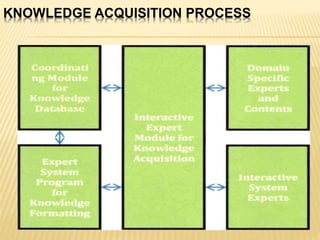
KNOWLEDGE ACQUISITION PROCESS
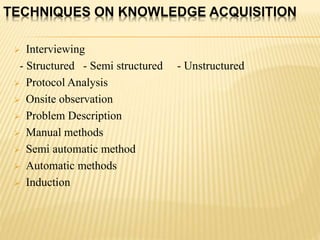
TECHNIQUES ON KNOWLEDGE ACQUISITION
 Interviewing
- Structured - Semi structured - Unstructured
 Protocol Analysis
 Onsite observation
 Problem Description
 Manual methods
 Semi automatic method
 Automatic methods
 Induction
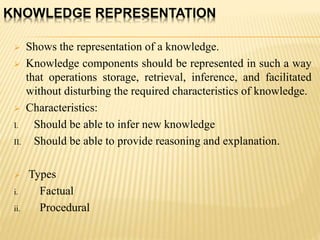
KNOWLEDGE REPRESENTATION
 Shows the representation of a knowledge.
 Knowledge components should be represented in such a way
that operations storage, retrieval, inference, and facilitated
without disturbing the required characteristics of knowledge.
 Characteristics:
I. Should be able to infer new knowledge
II. Should be able to provide reasoning and explanation.
 Types
i. Factual
ii. Procedural
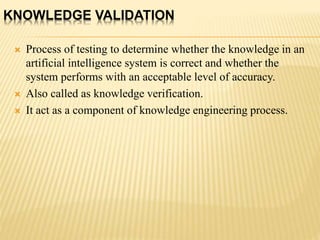
KNOWLEDGE VALIDATION
 Process of testing to determine whether the knowledge in an
artificial intelligence system is correct and whether the
system performs with an acceptable level of accuracy.
 Also called as knowledge verification.
 It act as a component of knowledge engineering process.
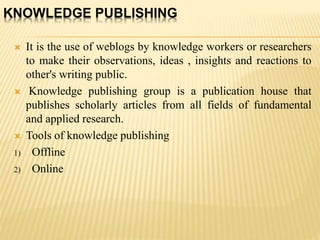
KNOWLEDGE PUBLISHING
 It is the use of weblogs by knowledge workers or researchers
to make their observations, ideas , insights and reactions to
other's writing public.
 Knowledge publishing group is a publication house that
publishes scholarly articles from all fields of fundamental
and applied research.
 Tools of knowledge publishing
1) Offline
2) Online
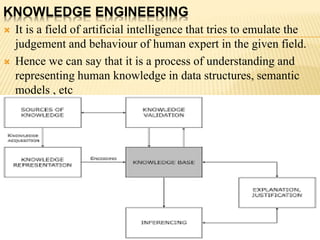
KNOWLEDGE ENGINEERING
 It is a field of artificial intelligence that tries to emulate the
judgement and behaviour of human expert in the given field.
 Hence we can say that it is a process of understanding and
representing human knowledge in data structures, semantic
models , etc
CONCLUSION
 Recognition of the central role of knowledge acquisition in
the development of ES is an unavoidable prerequisite for any
knowledge engineering project. If domains are defined and
experts chosen with this in mind, a project's chances for
success will be greatly increased.
 Once an appropriate domain is identified and a cooperative,
available expert with the necessary stamina is found, then the
practical approaches to knowledge acquisition outlined
should be of help.
 Knowledge acquisition is integrally tied to how the mind
organizes and represents information. ... The most important
property of knowledge is that it is organized semantically;
therefore, learning methods should enhance meaningful study
of new information.
  Presentation on "Knowledge acquisition & validation"

Presentation on "Knowledge acquisition & validation"

  • 1.
  • 2.
    WHAT IS KNOWLEDGEACQUISITION?  Knowledge acquisition is process of extracting , structuring and organising knowledge from one or more sources.  It may also include acquiring knowledge from other sources such as books , technical manuscripts and drawings.  It includes elicitation, collection, analysis, modelling and validation of knowledge.  It facilitates the assimilation of knowledge and experiences of different specialties.
  • 3.
    PROBLEMS IN KNOWLEDGEACQUISITION  Unaware of Knowledge used  Unable to verbalize the knowledge  May provide irrelevant knowledge  May provide incomplete knowledge  May provide incorrect knowledge  May provide inconsistent knowledge
  • 4.
    THE TASKS INKNOWLEDGE ACQUISITION Different Tasks involved are: 1) COLLECT 2) INTERPRET 3) ANALYZE 4) DESIGN
  • 5.
    ISSUES WITH KNOWLEDGEACQUISITION  Most knowledge rest with experts so cannot be extracted directly  Continuously changing the nature of knowledge  Sometimes the knowledge are sub contious  An expert is not always correct  No single expert knows everything  Lack of time and unwillingness to cooperate  Incomplete collection of knowledge elicitation method  Lack of recognising specific knowledge when mixed up with irrelevant data.
  • 6.
  • 7.
    TECHNIQUES ON KNOWLEDGEACQUISITION  Interviewing - Structured - Semi structured - Unstructured  Protocol Analysis  Onsite observation  Problem Description  Manual methods  Semi automatic method  Automatic methods  Induction
  • 8.
    KNOWLEDGE REPRESENTATION  Showsthe representation of a knowledge.  Knowledge components should be represented in such a way that operations storage, retrieval, inference, and facilitated without disturbing the required characteristics of knowledge.  Characteristics: I. Should be able to infer new knowledge II. Should be able to provide reasoning and explanation.  Types i. Factual ii. Procedural
  • 9.
    KNOWLEDGE VALIDATION  Processof testing to determine whether the knowledge in an artificial intelligence system is correct and whether the system performs with an acceptable level of accuracy.  Also called as knowledge verification.  It act as a component of knowledge engineering process.
  • 10.
    KNOWLEDGE PUBLISHING  Itis the use of weblogs by knowledge workers or researchers to make their observations, ideas , insights and reactions to other's writing public.  Knowledge publishing group is a publication house that publishes scholarly articles from all fields of fundamental and applied research.  Tools of knowledge publishing 1) Offline 2) Online
  • 11.
    KNOWLEDGE ENGINEERING  Itis a field of artificial intelligence that tries to emulate the judgement and behaviour of human expert in the given field.  Hence we can say that it is a process of understanding and representing human knowledge in data structures, semantic models , etc
  • 12.
    CONCLUSION  Recognition ofthe central role of knowledge acquisition in the development of ES is an unavoidable prerequisite for any knowledge engineering project. If domains are defined and experts chosen with this in mind, a project's chances for success will be greatly increased.  Once an appropriate domain is identified and a cooperative, available expert with the necessary stamina is found, then the practical approaches to knowledge acquisition outlined should be of help.  Knowledge acquisition is integrally tied to how the mind organizes and represents information. ... The most important property of knowledge is that it is organized semantically; therefore, learning methods should enhance meaningful study of new information.