Measurement
T- 1-855-694-8886
Email- info@iTutor.com
By iTutor.com
What Do We Measure?
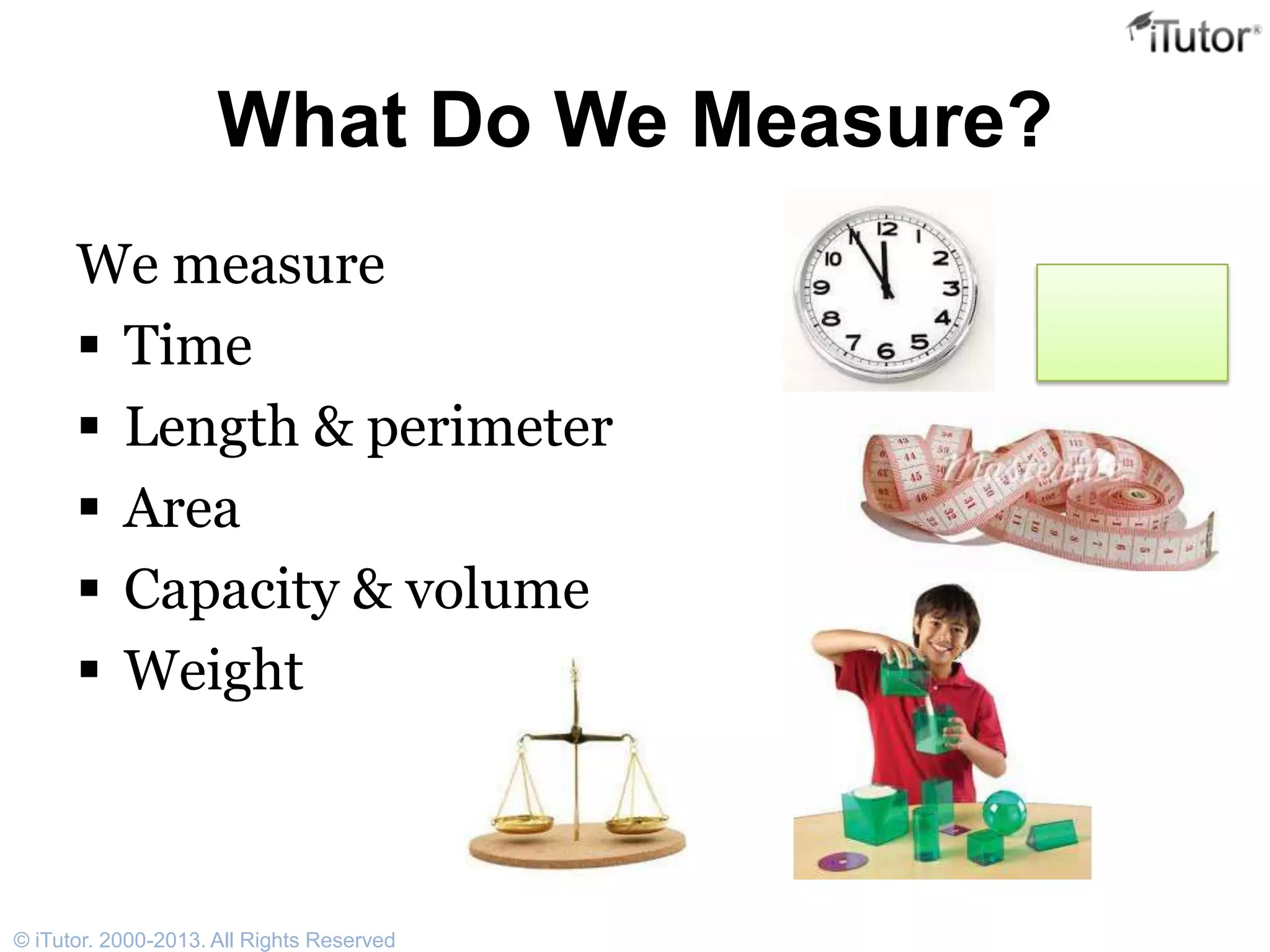
We measure
 Time
 Length & perimeter
 Area
 Capacity & volume
 Weight
© iTutor. 2000-2013. All Rights Reserved
Time Units
Seconds  The smallest unit of time on a clock.
Minutes  There are 60 seconds in one minute.
Hours  There are 60 minutes in one hour.
Days  There are 24 hours in one day.
Weeks  There are 7 days in one week.
Months  The number of days and weeks in a month is
different for each month.
Years  There are 365 ¼ days in one year.
Decades  There are 10 years in one decade.
Centuries  There are 100 years or 10 decades in one century.
Millennia  There are 1000 years, 100 decades, or 10
centuries in one millennium.
© iTutor. 2000-2013. All Rights Reserved
Measuring Time
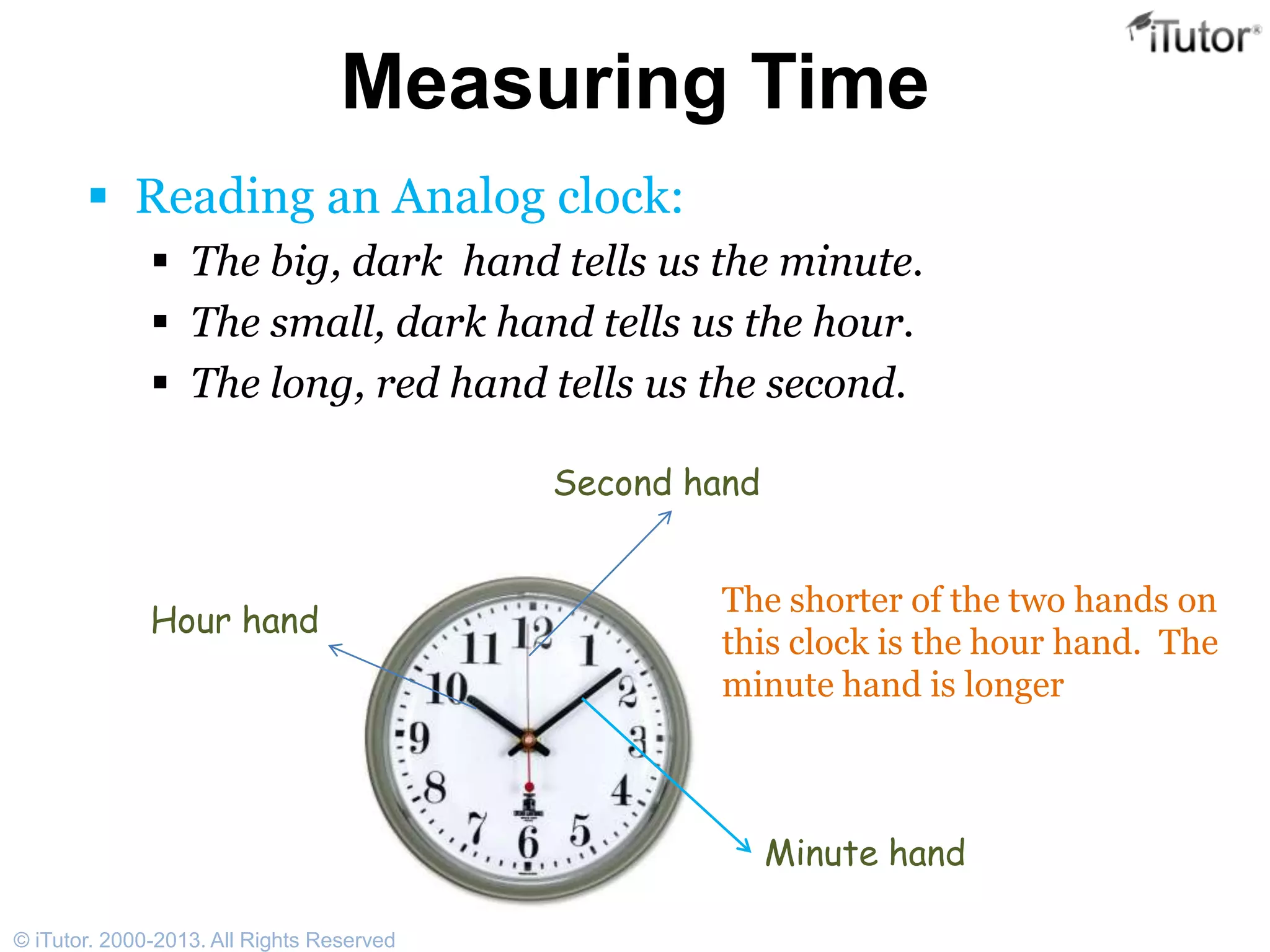
 Reading an Analog clock:
 The big, dark hand tells us the minute.
 The small, dark hand tells us the hour.
 The long, red hand tells us the second.
Hour hand
Second hand
Minute hand
The shorter of the two hands on
this clock is the hour hand. The
minute hand is longer
© iTutor. 2000-2013. All Rights Reserved
Measuring Time
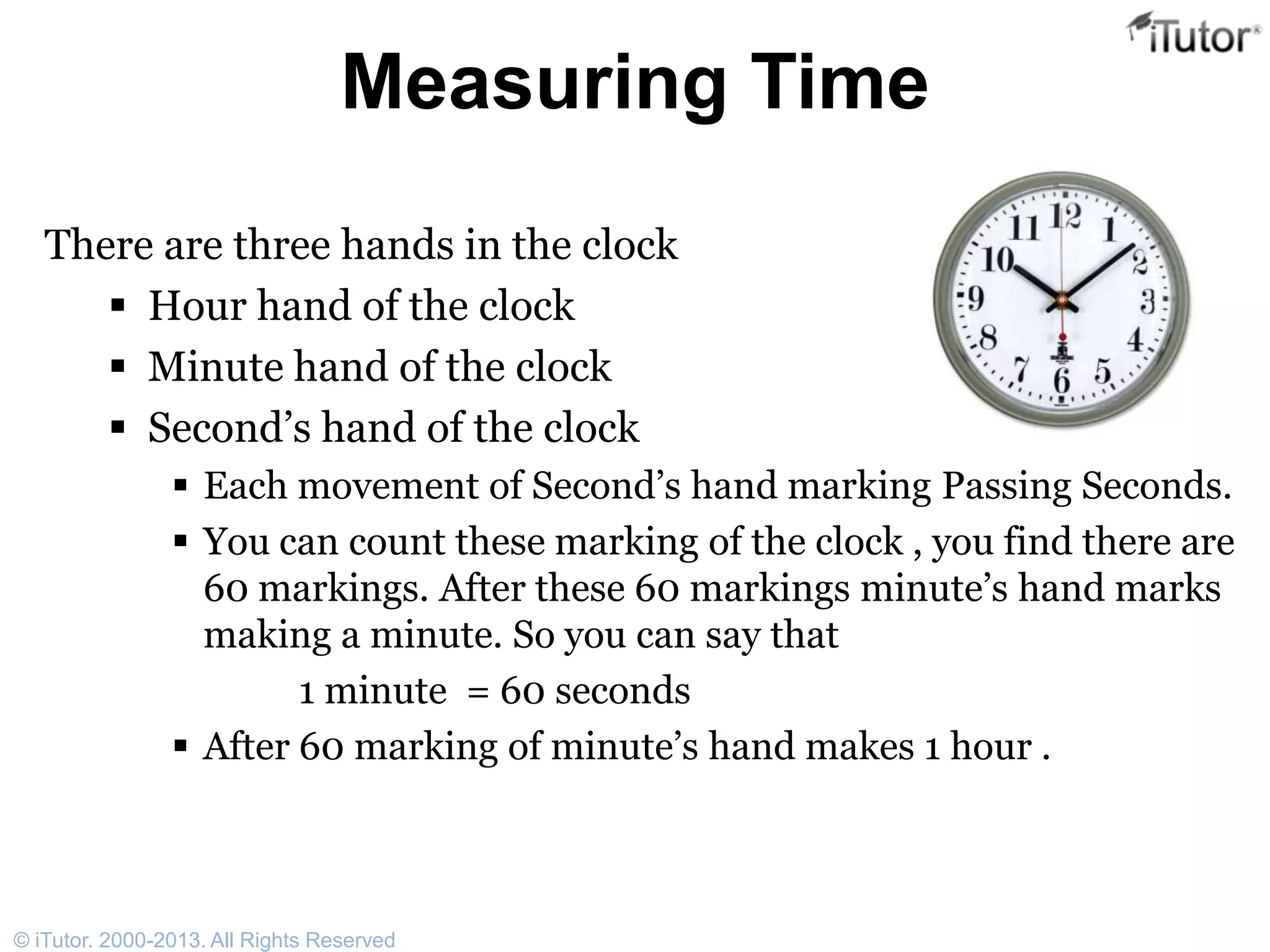
There are three hands in the clock
 Hour hand of the clock
 Minute hand of the clock
 Second’s hand of the clock
 Each movement of Second’s hand marking Passing Seconds.
 You can count these marking of the clock , you find there are
60 markings. After these 60 markings minute’s hand marks
making a minute. So you can say that
1 minute = 60 seconds
 After 60 marking of minute’s hand makes 1 hour .
© iTutor. 2000-2013. All Rights Reserved
Reading an Analog clock:
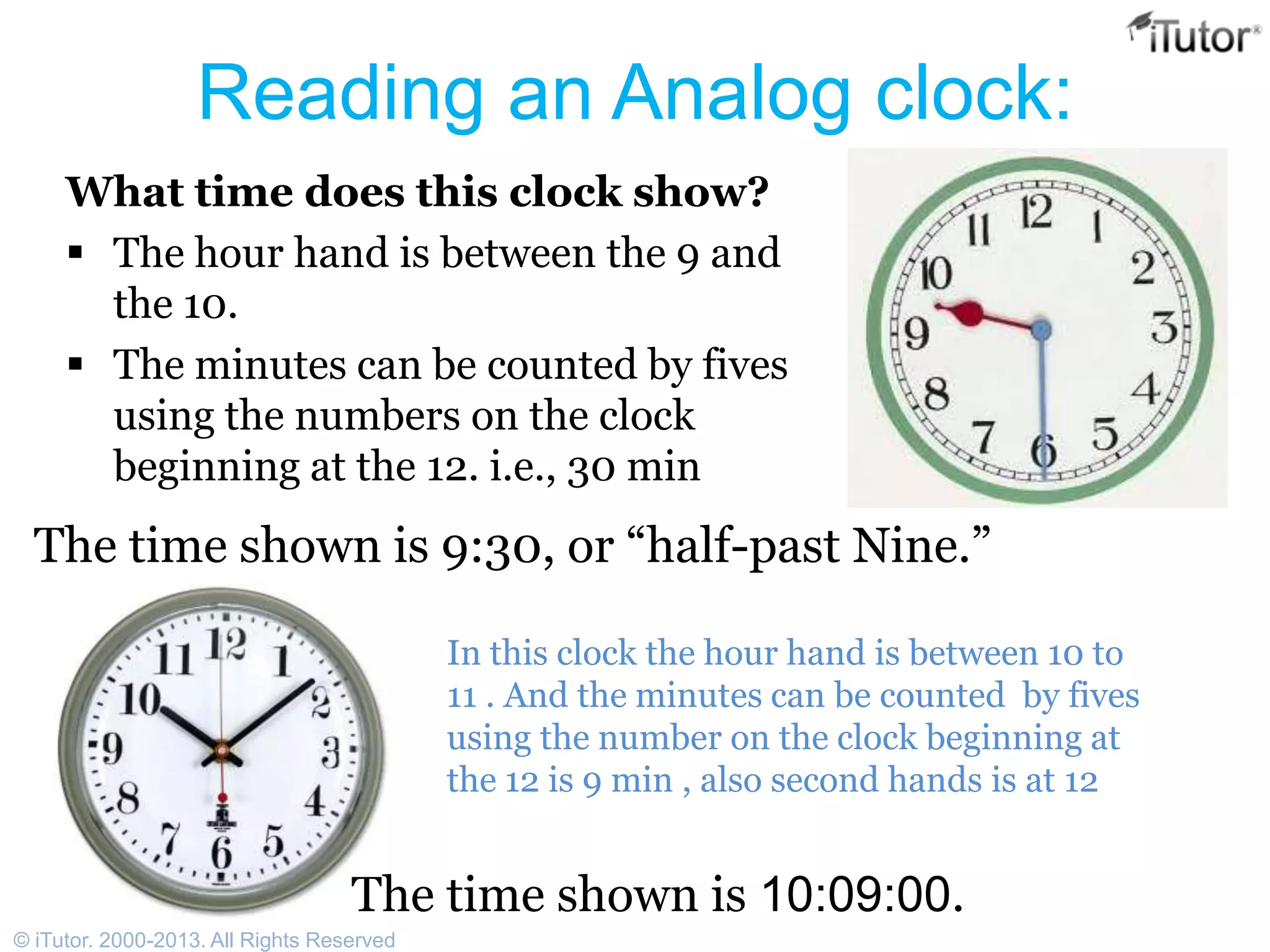
What time does this clock show?
 The hour hand is between the 9 and
the 10.
 The minutes can be counted by fives
using the numbers on the clock
beginning at the 12. i.e., 30 min
The time shown is 9:30, or “half-past Nine.”
In this clock the hour hand is between 10 to
11 . And the minutes can be counted by fives
using the number on the clock beginning at
the 12 is 9 min , also second hands is at 12
The time shown is 10:09:00.
© iTutor. 2000-2013. All Rights Reserved
AM and PM
 “AM” stands for the Latin phrase Ante Meridiem
 which means “before noon”
 “PM” stands for Post Meridiem :
 Means “after noon.”
 What is Noon and Midnight?
 A.M. and P.M. start immediately after Midnight and Noon
(Midday) respectively.
 This means that 00:00 A.M. or 00:00 P.M. (or 12:00 A.M.
and 12:00 P.M.) have no meaning.
 Every day starts precisely at midnight and A.M. starts
immediately after that point in time e.g. 00:00:01 A.M.
© iTutor. 2000-2013. All Rights Reserved
Measuring Length
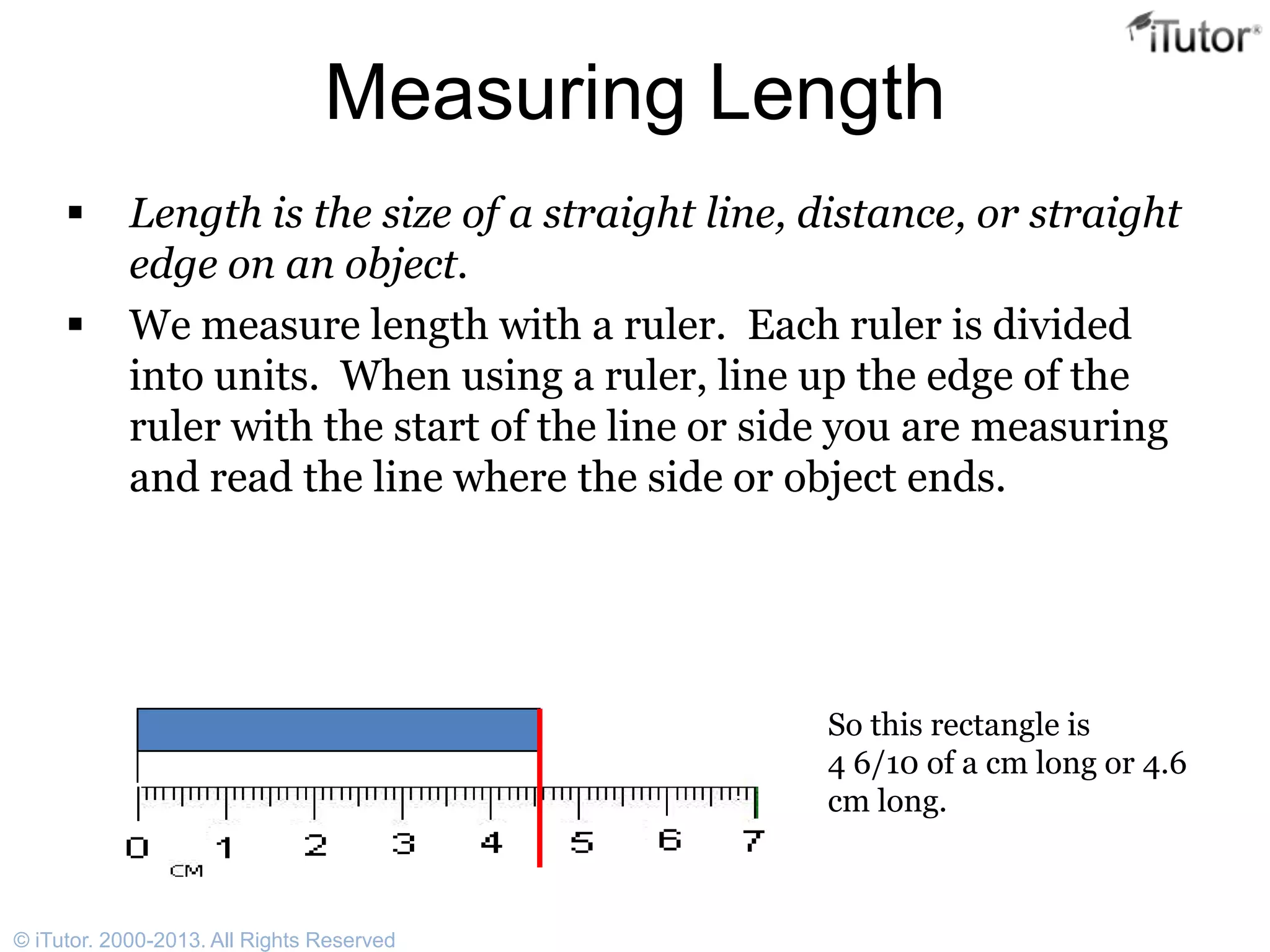
 Length is the size of a straight line, distance, or straight
edge on an object.
 We measure length with a ruler. Each ruler is divided
into units. When using a ruler, line up the edge of the
ruler with the start of the line or side you are measuring
and read the line where the side or object ends.
So this rectangle is
4 6/10 of a cm long or 4.6
cm long.
© iTutor. 2000-2013. All Rights Reserved
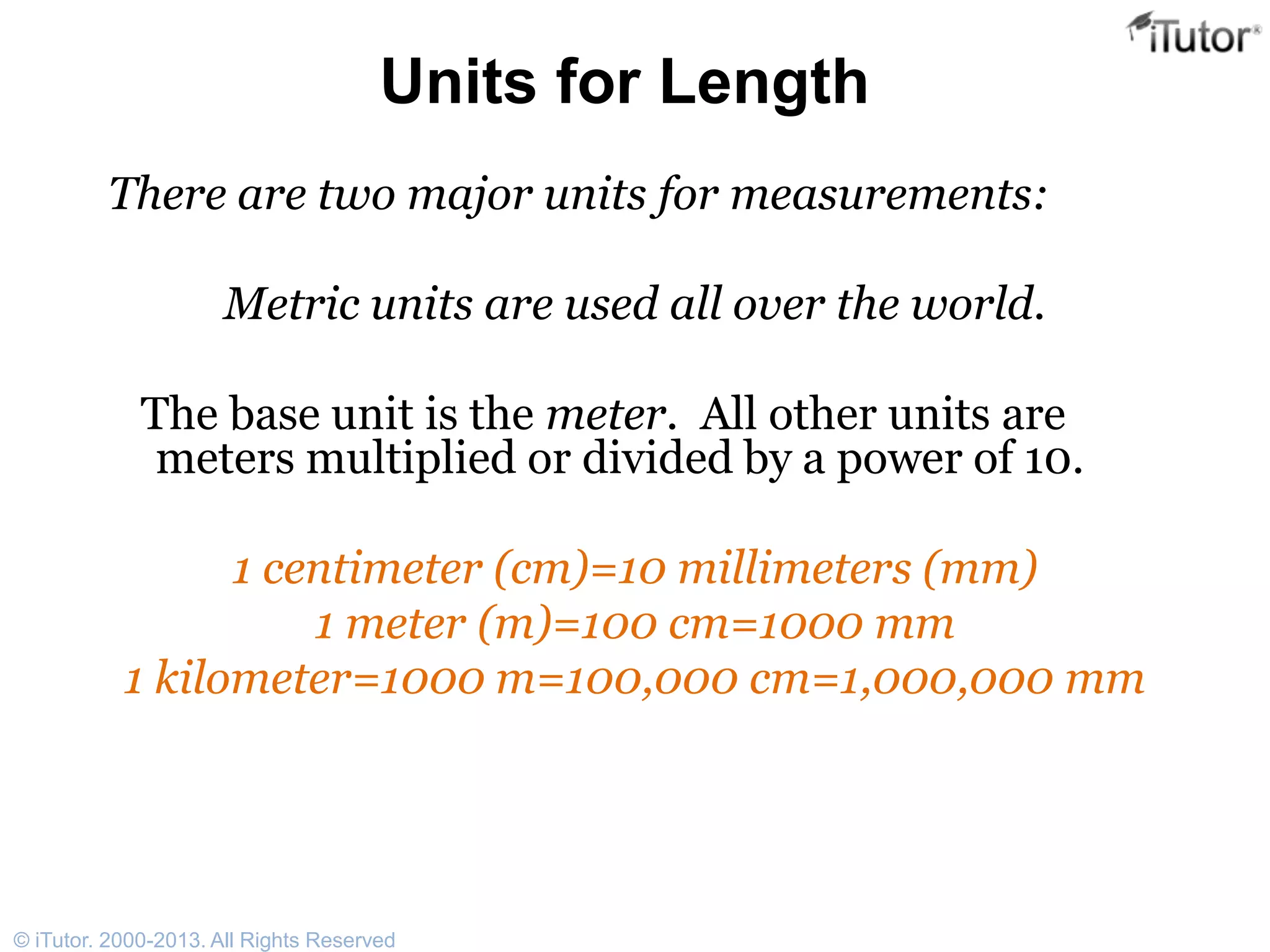
Units for Length
There are two major units for measurements:
Metric units are used all over the world.
The base unit is the meter. All other units are
meters multiplied or divided by a power of 10.
1 centimeter (cm)=10 millimeters (mm)
1 meter (m)=100 cm=1000 mm
1 kilometer=1000 m=100,000 cm=1,000,000 mm
© iTutor. 2000-2013. All Rights Reserved
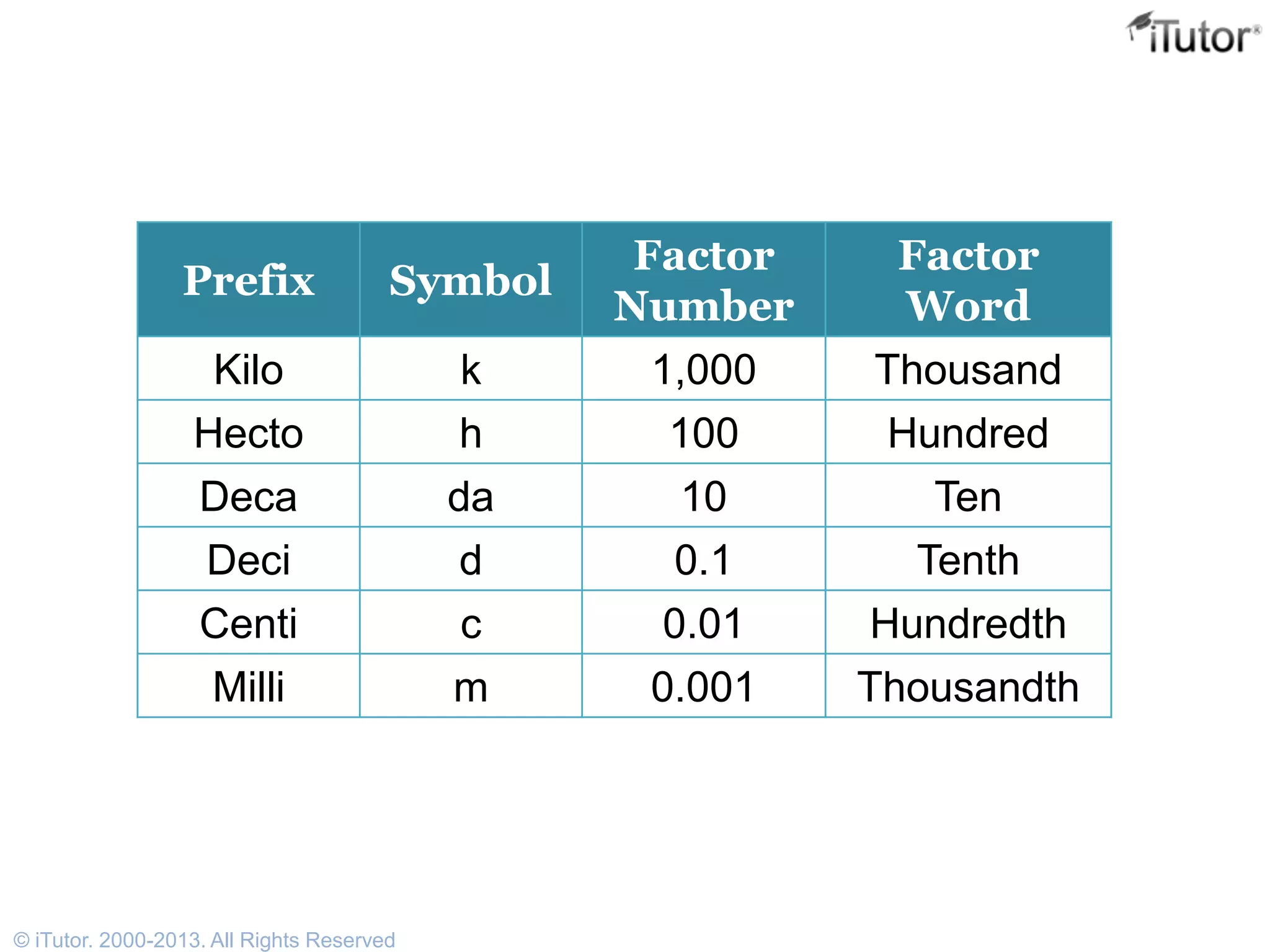
Prefix Symbol
Factor
Number
Factor
Word
Kilo k 1,000 Thousand
Hecto h 100 Hundred
Deca da 10 Ten
Deci d 0.1 Tenth
Centi c 0.01 Hundredth
Milli m 0.001 Thousandth
© iTutor. 2000-2013. All Rights Reserved
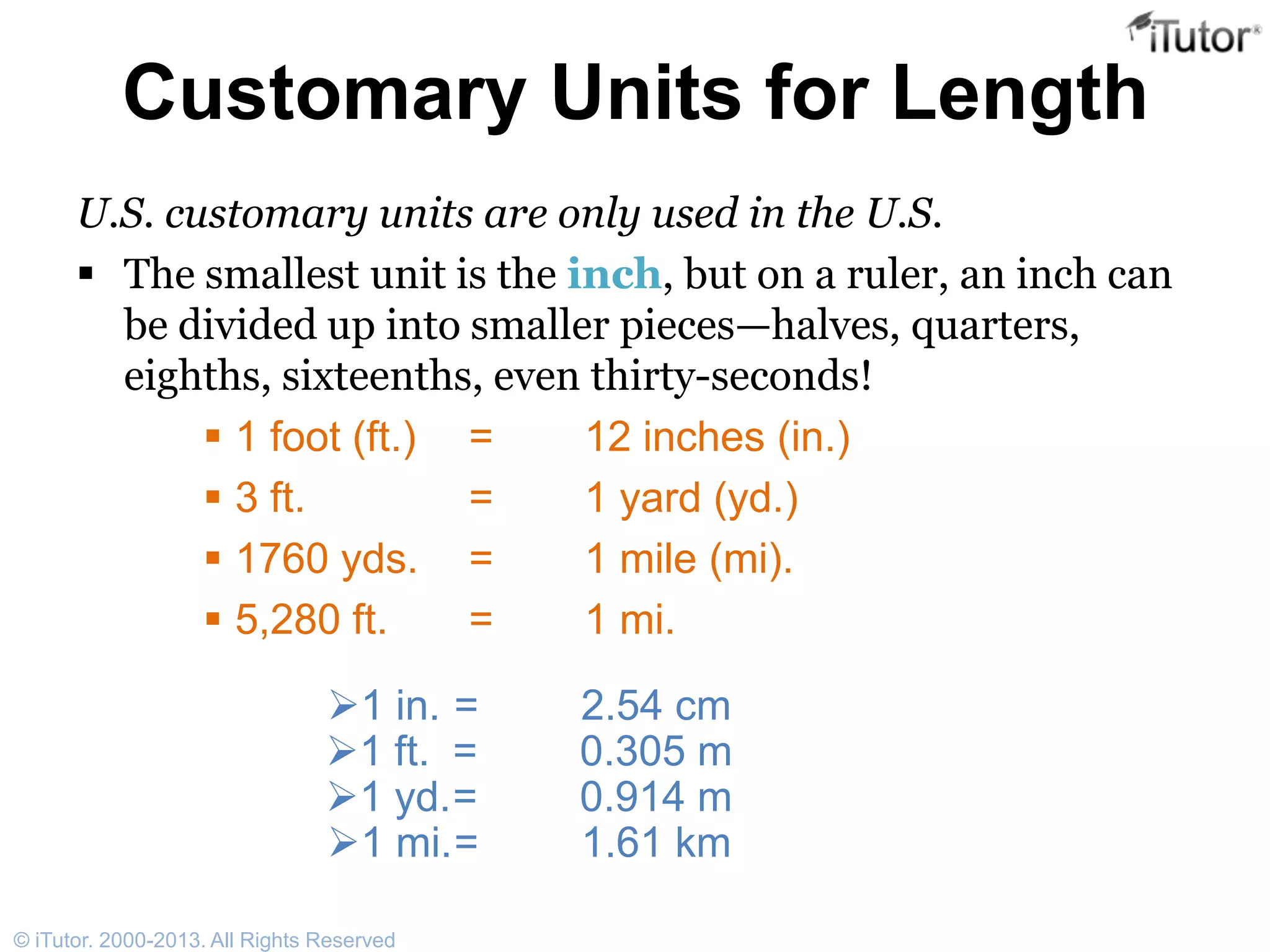
Customary Units for Length
U.S. customary units are only used in the U.S.
 The smallest unit is the inch, but on a ruler, an inch can
be divided up into smaller pieces—halves, quarters,
eighths, sixteenths, even thirty-seconds!
 1 foot (ft.) = 12 inches (in.)
 3 ft. = 1 yard (yd.)
 1760 yds. = 1 mile (mi).
 5,280 ft. = 1 mi.
1 in. = 2.54 cm
1 ft. = 0.305 m
1 yd.= 0.914 m
1 mi.= 1.61 km
© iTutor. 2000-2013. All Rights Reserved
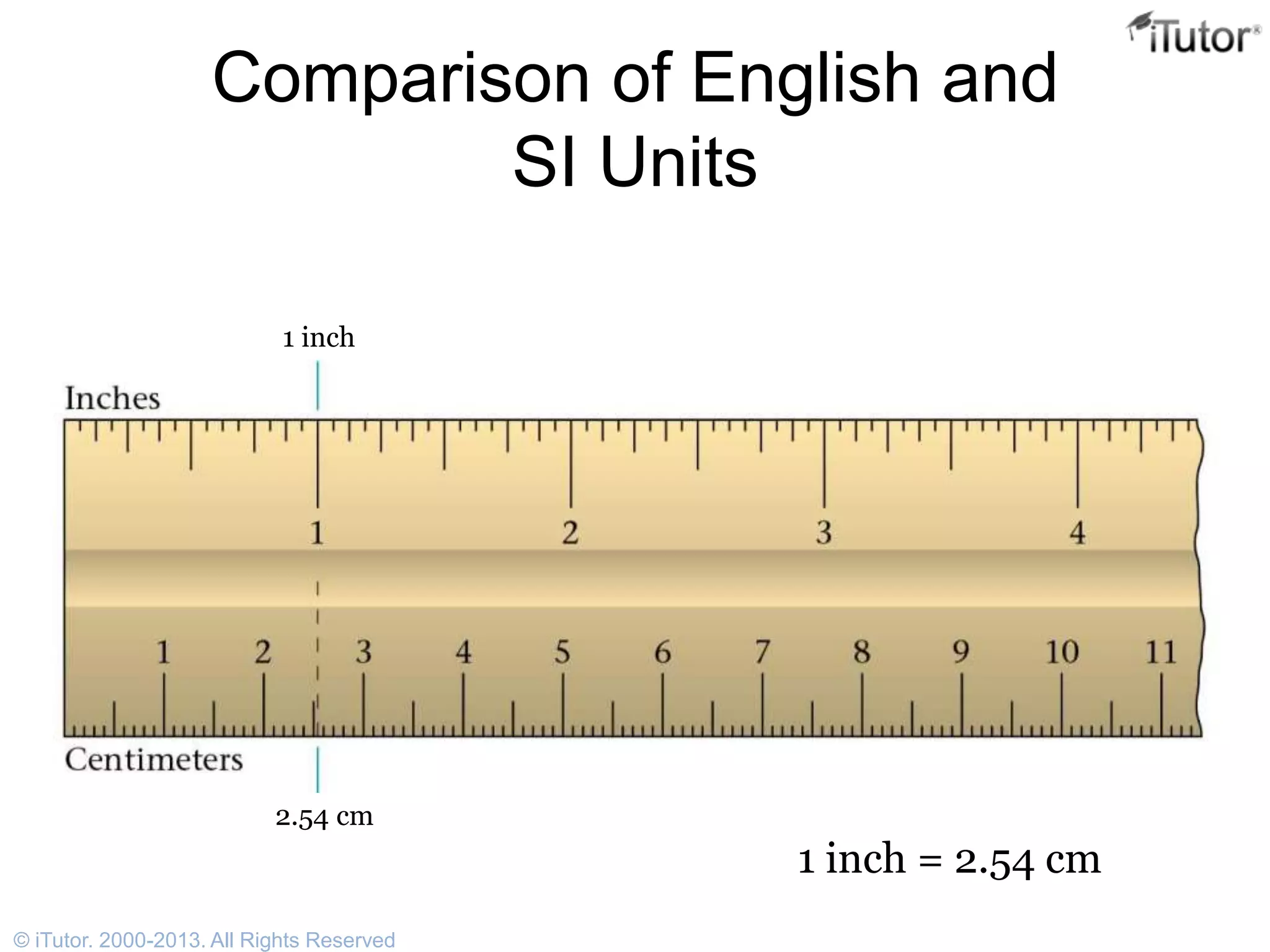
Comparison of English and
SI Units
1 inch
2.54 cm
1 inch = 2.54 cm
© iTutor. 2000-2013. All Rights Reserved
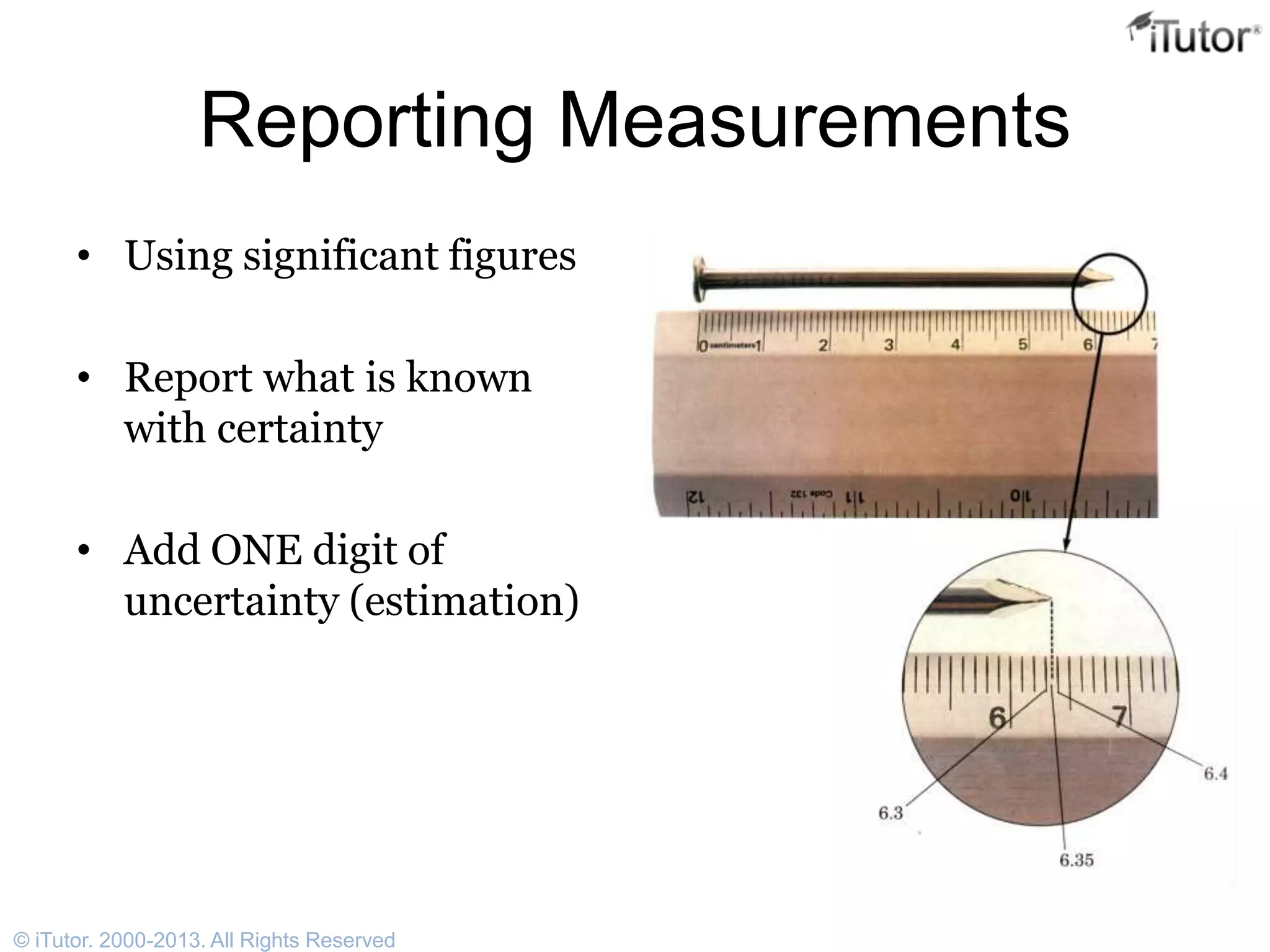
Reporting Measurements
• Using significant figures
• Report what is known
with certainty
• Add ONE digit of
uncertainty (estimation)
© iTutor. 2000-2013. All Rights Reserved
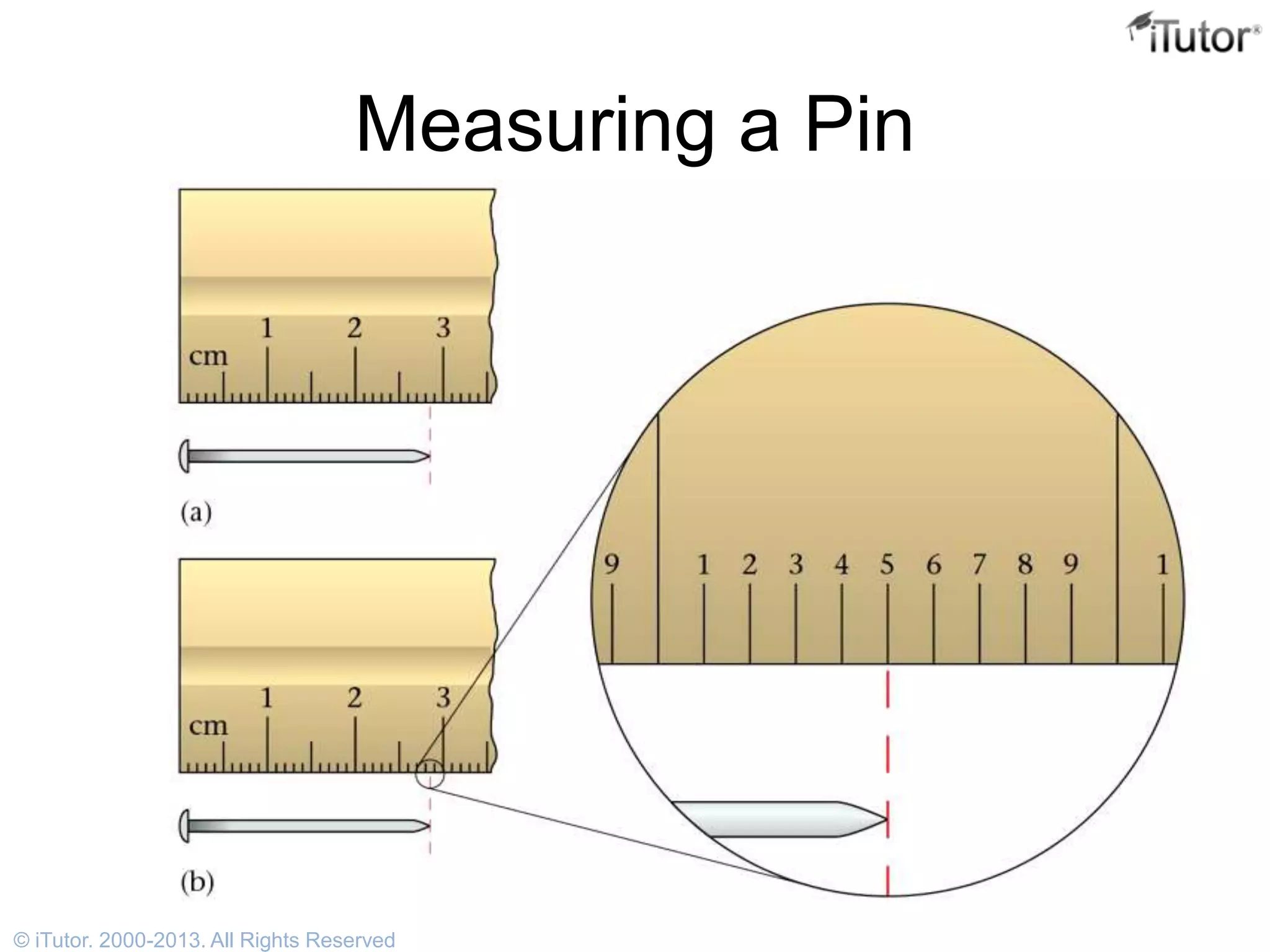
Measuring a Pin
© iTutor. 2000-2013. All Rights Reserved
Measuring Area
Area tells us how many squares you can lay out on a flat
surface like a shape.
To find the area of a
 Rectangle: Multiply the length of the object by its width.
 Triangle: Multiply the length of the triangle’s base by its height.
 Different Shape: Cut the shape into rectangles and triangles.
Add the areas of these shapes to get the total area of the shape.
Units: You are measuring area in squares, so your units must
also be squares—square inches (sq. in.), square meters (m2), etc.
 Basically take the units that the length was measured in and let us
know that they are now squares.
© iTutor. 2000-2013. All Rights Reserved
Capacity & Volume
 Capacity is how much you can fill a space with. We
usually talk about capacity with empty containers.
 Volume is how much space an object takes up. We talk
about volume with both solid objects (no empty spaces)
and with empty containers.
 One way to measure the capacity or volume of an object is
by using the lengths of the height and the sides of the base
to find the volume of the solid.
 Another way to measure volume is to find out how many
cubes of the same size you can fit into the object.
 The other way you can measure the capacity or volume of
an object is to find out how much liquid you can fill it with.
© iTutor. 2000-2013. All Rights Reserved
Measuring Liquids
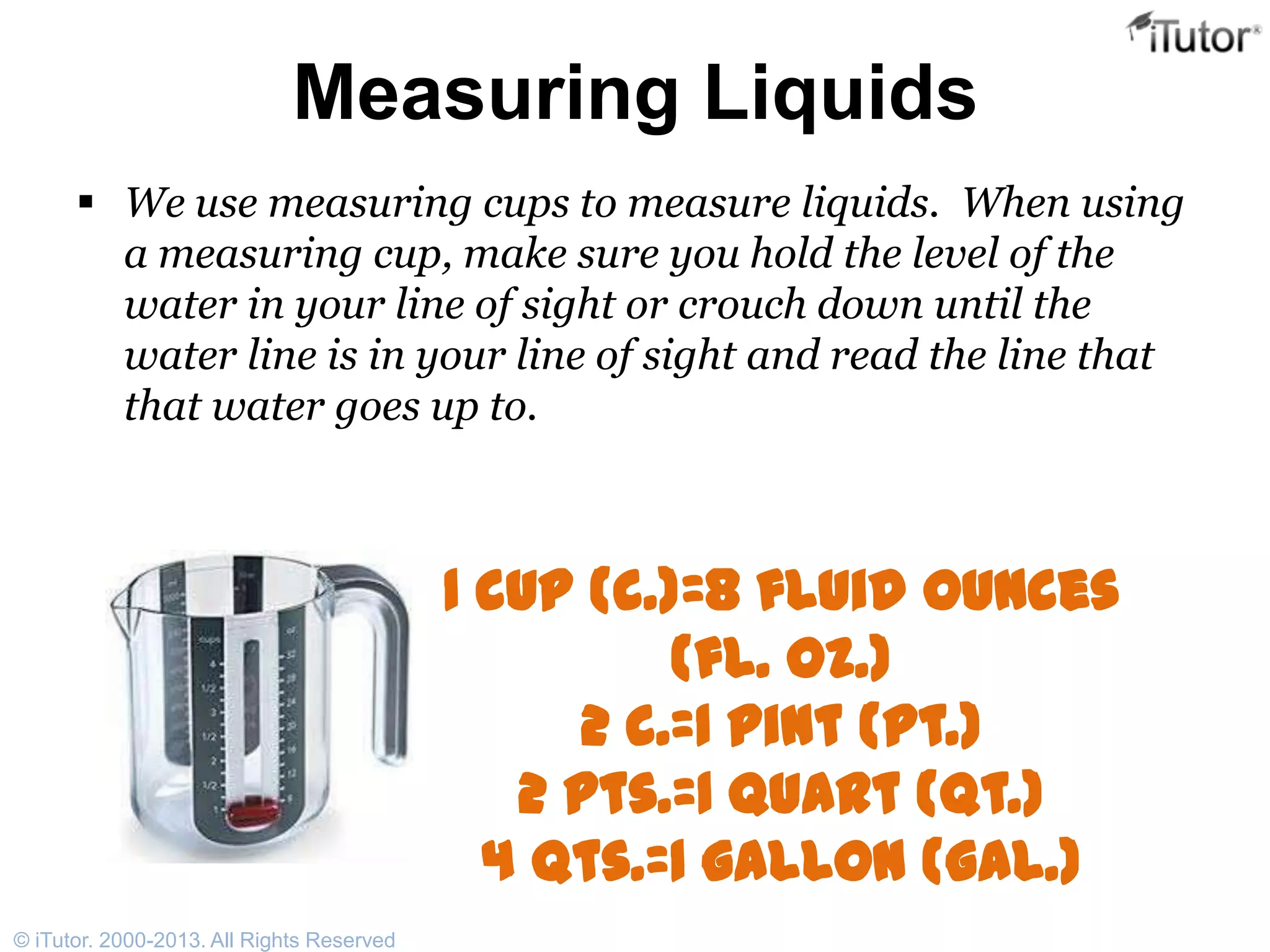
 We use measuring cups to measure liquids. When using
a measuring cup, make sure you hold the level of the
water in your line of sight or crouch down until the
water line is in your line of sight and read the line that
that water goes up to.
1 cup (c.)=8 fluid ounces
(fl. oz.)
2 c.=1 pint (pt.)
2 pts.=1 quart (qt.)
4 qts.=1 gallon (gal.)
© iTutor. 2000-2013. All Rights Reserved
Measuring Liquids
• Like with metric units for length, all units are the base
unit (in this case the liter) multiplied or divided by a
power of 10.
• The main units you will use in measuring liquids will be
milliliters and liters.
1,000 milliliter (mL)= 1 liter (L)
A little connection with volume of solids:
1mL=1 cubic centimeter (cc)
© iTutor. 2000-2013. All Rights Reserved
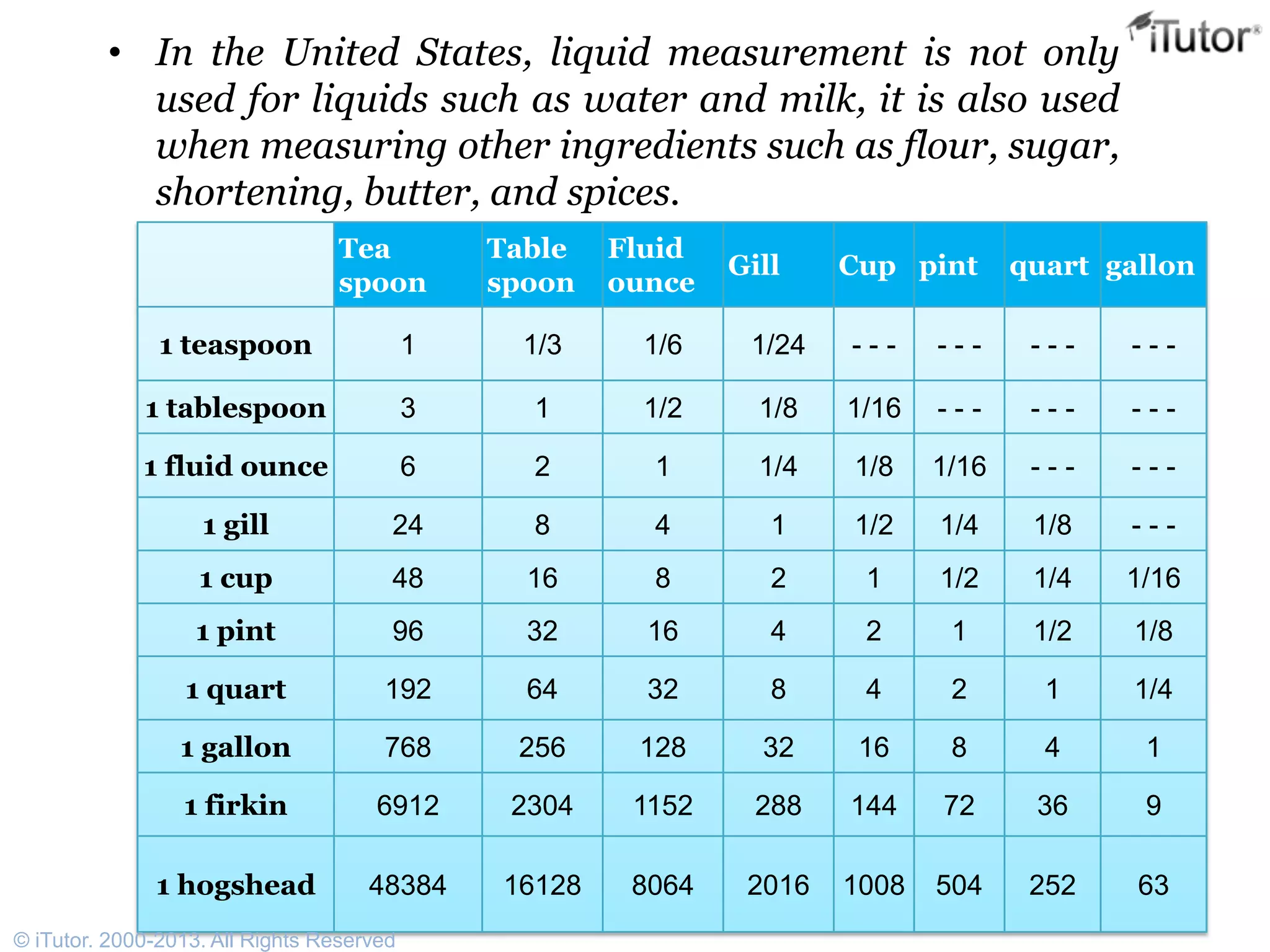
• In the United States, liquid measurement is not only
used for liquids such as water and milk, it is also used
when measuring other ingredients such as flour, sugar,
shortening, butter, and spices.
Tea
spoon
Table
spoon
Fluid
ounce
Gill Cup pint quart gallon
1 teaspoon 1 1/3 1/6 1/24 - - - - - - - - - - - -
1 tablespoon 3 1 1/2 1/8 1/16 - - - - - - - - -
1 fluid ounce 6 2 1 1/4 1/8 1/16 - - - - - -
1 gill 24 8 4 1 1/2 1/4 1/8 - - -
1 cup 48 16 8 2 1 1/2 1/4 1/16
1 pint 96 32 16 4 2 1 1/2 1/8
1 quart 192 64 32 8 4 2 1 1/4
1 gallon 768 256 128 32 16 8 4 1
1 firkin 6912 2304 1152 288 144 72 36 9
1 hogshead 48384 16128 8064 2016 1008 504 252 63
© iTutor. 2000-2013. All Rights Reserved
Measuring Weight
 The smallest unit is the ounce, although it can also be
broken into smaller pieces or fractions of an ounce.
 The base unit is the gram, and all other units of weight in
the metric system are grams multiplied or divided by
powers of 10.
1000 milligrams (mg)= 1 gram (g)
1000 g=1 kilogram (kg)
16 ounces (oz.)=1 pound (lb.)
2000 lbs=1 ton (T.)
1 oz=28.35 g
1 lb=0.454 kg
1 g=0.035 oz.
1 kg=2.202 lbs.© iTutor. 2000-2013. All Rights Reserved
The End
Call us for more
Information:
1-855-694-8886
www.iTutor.com
Visit

Measurement

  • 1.
  • 2.
    What Do WeMeasure? We measure  Time  Length & perimeter  Area  Capacity & volume  Weight © iTutor. 2000-2013. All Rights Reserved
  • 3.
    Time Units Seconds The smallest unit of time on a clock. Minutes  There are 60 seconds in one minute. Hours  There are 60 minutes in one hour. Days  There are 24 hours in one day. Weeks  There are 7 days in one week. Months  The number of days and weeks in a month is different for each month. Years  There are 365 ¼ days in one year. Decades  There are 10 years in one decade. Centuries  There are 100 years or 10 decades in one century. Millennia  There are 1000 years, 100 decades, or 10 centuries in one millennium. © iTutor. 2000-2013. All Rights Reserved
  • 4.
    Measuring Time  Readingan Analog clock:  The big, dark hand tells us the minute.  The small, dark hand tells us the hour.  The long, red hand tells us the second. Hour hand Second hand Minute hand The shorter of the two hands on this clock is the hour hand. The minute hand is longer © iTutor. 2000-2013. All Rights Reserved
  • 5.
    Measuring Time There arethree hands in the clock  Hour hand of the clock  Minute hand of the clock  Second’s hand of the clock  Each movement of Second’s hand marking Passing Seconds.  You can count these marking of the clock , you find there are 60 markings. After these 60 markings minute’s hand marks making a minute. So you can say that 1 minute = 60 seconds  After 60 marking of minute’s hand makes 1 hour . © iTutor. 2000-2013. All Rights Reserved
  • 6.
    Reading an Analogclock: What time does this clock show?  The hour hand is between the 9 and the 10.  The minutes can be counted by fives using the numbers on the clock beginning at the 12. i.e., 30 min The time shown is 9:30, or “half-past Nine.” In this clock the hour hand is between 10 to 11 . And the minutes can be counted by fives using the number on the clock beginning at the 12 is 9 min , also second hands is at 12 The time shown is 10:09:00. © iTutor. 2000-2013. All Rights Reserved
  • 7.
    AM and PM “AM” stands for the Latin phrase Ante Meridiem  which means “before noon”  “PM” stands for Post Meridiem :  Means “after noon.”  What is Noon and Midnight?  A.M. and P.M. start immediately after Midnight and Noon (Midday) respectively.  This means that 00:00 A.M. or 00:00 P.M. (or 12:00 A.M. and 12:00 P.M.) have no meaning.  Every day starts precisely at midnight and A.M. starts immediately after that point in time e.g. 00:00:01 A.M. © iTutor. 2000-2013. All Rights Reserved
  • 8.
    Measuring Length  Lengthis the size of a straight line, distance, or straight edge on an object.  We measure length with a ruler. Each ruler is divided into units. When using a ruler, line up the edge of the ruler with the start of the line or side you are measuring and read the line where the side or object ends. So this rectangle is 4 6/10 of a cm long or 4.6 cm long. © iTutor. 2000-2013. All Rights Reserved
  • 9.
    Units for Length Thereare two major units for measurements: Metric units are used all over the world. The base unit is the meter. All other units are meters multiplied or divided by a power of 10. 1 centimeter (cm)=10 millimeters (mm) 1 meter (m)=100 cm=1000 mm 1 kilometer=1000 m=100,000 cm=1,000,000 mm © iTutor. 2000-2013. All Rights Reserved
  • 10.
    Prefix Symbol Factor Number Factor Word Kilo k1,000 Thousand Hecto h 100 Hundred Deca da 10 Ten Deci d 0.1 Tenth Centi c 0.01 Hundredth Milli m 0.001 Thousandth © iTutor. 2000-2013. All Rights Reserved
  • 11.
    Customary Units forLength U.S. customary units are only used in the U.S.  The smallest unit is the inch, but on a ruler, an inch can be divided up into smaller pieces—halves, quarters, eighths, sixteenths, even thirty-seconds!  1 foot (ft.) = 12 inches (in.)  3 ft. = 1 yard (yd.)  1760 yds. = 1 mile (mi).  5,280 ft. = 1 mi. 1 in. = 2.54 cm 1 ft. = 0.305 m 1 yd.= 0.914 m 1 mi.= 1.61 km © iTutor. 2000-2013. All Rights Reserved
  • 12.
    Comparison of Englishand SI Units 1 inch 2.54 cm 1 inch = 2.54 cm © iTutor. 2000-2013. All Rights Reserved
  • 13.
    Reporting Measurements • Usingsignificant figures • Report what is known with certainty • Add ONE digit of uncertainty (estimation) © iTutor. 2000-2013. All Rights Reserved
  • 14.
    Measuring a Pin ©iTutor. 2000-2013. All Rights Reserved
  • 15.
    Measuring Area Area tellsus how many squares you can lay out on a flat surface like a shape. To find the area of a  Rectangle: Multiply the length of the object by its width.  Triangle: Multiply the length of the triangle’s base by its height.  Different Shape: Cut the shape into rectangles and triangles. Add the areas of these shapes to get the total area of the shape. Units: You are measuring area in squares, so your units must also be squares—square inches (sq. in.), square meters (m2), etc.  Basically take the units that the length was measured in and let us know that they are now squares. © iTutor. 2000-2013. All Rights Reserved
  • 16.
    Capacity & Volume Capacity is how much you can fill a space with. We usually talk about capacity with empty containers.  Volume is how much space an object takes up. We talk about volume with both solid objects (no empty spaces) and with empty containers.  One way to measure the capacity or volume of an object is by using the lengths of the height and the sides of the base to find the volume of the solid.  Another way to measure volume is to find out how many cubes of the same size you can fit into the object.  The other way you can measure the capacity or volume of an object is to find out how much liquid you can fill it with. © iTutor. 2000-2013. All Rights Reserved
  • 17.
    Measuring Liquids  Weuse measuring cups to measure liquids. When using a measuring cup, make sure you hold the level of the water in your line of sight or crouch down until the water line is in your line of sight and read the line that that water goes up to. 1 cup (c.)=8 fluid ounces (fl. oz.) 2 c.=1 pint (pt.) 2 pts.=1 quart (qt.) 4 qts.=1 gallon (gal.) © iTutor. 2000-2013. All Rights Reserved
  • 18.
    Measuring Liquids • Likewith metric units for length, all units are the base unit (in this case the liter) multiplied or divided by a power of 10. • The main units you will use in measuring liquids will be milliliters and liters. 1,000 milliliter (mL)= 1 liter (L) A little connection with volume of solids: 1mL=1 cubic centimeter (cc) © iTutor. 2000-2013. All Rights Reserved
  • 19.
    • In theUnited States, liquid measurement is not only used for liquids such as water and milk, it is also used when measuring other ingredients such as flour, sugar, shortening, butter, and spices. Tea spoon Table spoon Fluid ounce Gill Cup pint quart gallon 1 teaspoon 1 1/3 1/6 1/24 - - - - - - - - - - - - 1 tablespoon 3 1 1/2 1/8 1/16 - - - - - - - - - 1 fluid ounce 6 2 1 1/4 1/8 1/16 - - - - - - 1 gill 24 8 4 1 1/2 1/4 1/8 - - - 1 cup 48 16 8 2 1 1/2 1/4 1/16 1 pint 96 32 16 4 2 1 1/2 1/8 1 quart 192 64 32 8 4 2 1 1/4 1 gallon 768 256 128 32 16 8 4 1 1 firkin 6912 2304 1152 288 144 72 36 9 1 hogshead 48384 16128 8064 2016 1008 504 252 63 © iTutor. 2000-2013. All Rights Reserved
  • 20.
    Measuring Weight  Thesmallest unit is the ounce, although it can also be broken into smaller pieces or fractions of an ounce.  The base unit is the gram, and all other units of weight in the metric system are grams multiplied or divided by powers of 10. 1000 milligrams (mg)= 1 gram (g) 1000 g=1 kilogram (kg) 16 ounces (oz.)=1 pound (lb.) 2000 lbs=1 ton (T.) 1 oz=28.35 g 1 lb=0.454 kg 1 g=0.035 oz. 1 kg=2.202 lbs.© iTutor. 2000-2013. All Rights Reserved
  • 21.
    The End Call usfor more Information: 1-855-694-8886 www.iTutor.com Visit