Class 6 PPT SCIENCE Chapter 5 Measuring-Length-and-Motion-A-Journey-of-Discovery.pptx
1.
Measuring Length andMotion:
A Journey of Discovery
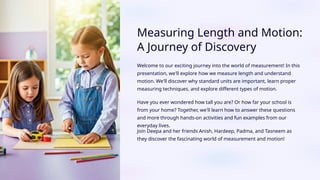
Welcome to our exciting journey into the world of measurement! In this
presentation, we'll explore how we measure length and understand
motion. We'll discover why standard units are important, learn proper
measuring techniques, and explore different types of motion.
Have you ever wondered how tall you are? Or how far your school is
from your home? Together, we'll learn how to answer these questions
and more through hands-on activities and fun examples from our
everyday lives.
Join Deepa and her friends Anish, Hardeep, Padma, and Tasneem as
they discover the fascinating world of measurement and motion!
2.
Traditional Measuring Methods
Handspan
Measuringwith the stretched distance between thumb and little finger, called "balisht" in some parts of India
Stride
Farmers count the number of steps to measure land and divide fields into beds
Foot Length
Using the length of feet to measure distances on the ground
Arm Length
Measuring cloth using the length from shoulder to fingertip
For thousands of years, people used parts of their body to measure things. Even today, some craftspeople like carpenters and tailors still use these traditional methods for quick
estimations. These methods are convenient but have a significant drawback - they vary from person to person!
3.
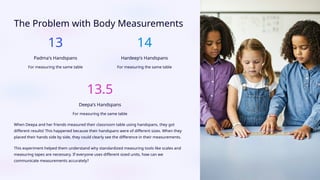
The Problem withBody Measurements
13
Padma's Handspans
For measuring the same table
14
Hardeep's Handspans
For measuring the same table
13.5
Deepa's Handspans
For measuring the same table
When Deepa and her friends measured their classroom table using handspans, they got
different results! This happened because their handspans were of different sizes. When they
placed their hands side by side, they could clearly see the difference in their measurements.
This experiment helped them understand why standardized measuring tools like scales and
measuring tapes are necessary. If everyone uses different sized units, how can we
communicate measurements accurately?
4.
Understanding Units ofMeasurement
What is a Unit?
A unit is a standard reference
value used for measurement.
When we say a table is 13
handspans long, "handspan" is
the unit and "13" is the number
of units.
Why Standard Units?
Without standard units,
measurements would differ
from person to person. Standard
units ensure that a meter in
Mumbai is the same as a meter
in Delhi or anywhere else in the
world.
Complete Measurement
A complete measurement
always has two parts: a number
and a unit. For example, "5
metres" tells us both how many
units (5) and which unit we're
using (metres).
Imagine if everyone used their own body parts to measure things! It would be very confusing to communicate
measurements. If I told you my desk is "6 handspans" wide, that wouldn't tell you much unless you knew exactly how
big my handspan was!
5.
Ancient Indian MeasurementSystems
Angula
Finger width used as a basic unit of measurement
in ancient India, still used by some traditional
craftspeople today
Dhanusa
A larger unit of measurement mentioned in ancient
Indian literature, used for measuring longer
distances
Yojana
A unit for very large distances used in ancient
Indian texts and town planning
Harappan Scales
Artifacts with ruled markings that could be
measuring scales have been excavated from
Harappan Civilization sites
India has a rich history of measurement systems dating back thousands of years. Ancient texts mention various units like angula (finger width),
dhanusa, and yojana for measuring everything from small objects to vast distances between cities.
Archaeological excavations at Harappan Civilization sites have uncovered objects with ruled markings that archaeologists believe were used as
measuring scales. Some traditional craftspeople in India still use angula for their work today!
6.
The International Systemof Units (SI)
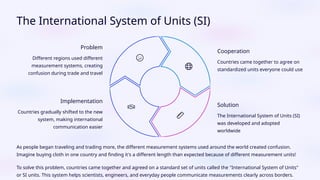
Problem
Different regions used different
measurement systems, creating
confusion during trade and travel
Cooperation
Countries came together to agree on
standardized units everyone could use
Solution
The International System of Units (SI)
was developed and adopted
worldwide
Implementation
Countries gradually shifted to the new
system, making international
communication easier
As people began traveling and trading more, the different measurement systems used around the world created confusion.
Imagine buying cloth in one country and finding it's a different length than expected because of different measurement units!
To solve this problem, countries came together and agreed on a standard set of units called the "International System of Units"
or SI units. This system helps scientists, engineers, and everyday people communicate measurements clearly across borders.
7.
The Metre: OurStandard Unit of Length
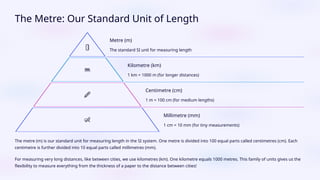
Metre (m)
The standard SI unit for measuring length
Kilometre (km)
1 km = 1000 m (for longer distances)
Centimetre (cm)
1 m = 100 cm (for medium lengths)
Millimetre (mm)
1 cm = 10 mm (for tiny measurements)
The metre (m) is our standard unit for measuring length in the SI system. One metre is divided into 100 equal parts called centimetres (cm). Each
centimetre is further divided into 10 equal parts called millimetres (mm).
For measuring very long distances, like between cities, we use kilometres (km). One kilometre equals 1000 metres. This family of units gives us the
flexibility to measure everything from the thickness of a paper to the distance between cities!
8.
Choosing the RightUnit
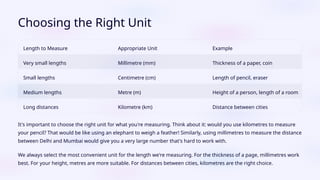
Length to Measure Appropriate Unit Example
Very small lengths Millimetre (mm) Thickness of a paper, coin
Small lengths Centimetre (cm) Length of pencil, eraser
Medium lengths Metre (m) Height of a person, length of a room
Long distances Kilometre (km) Distance between cities
It's important to choose the right unit for what you're measuring. Think about it: would you use kilometres to measure
your pencil? That would be like using an elephant to weigh a feather! Similarly, using millimetres to measure the distance
between Delhi and Mumbai would give you a very large number that's hard to work with.
We always select the most convenient unit for the length we're measuring. For the thickness of a page, millimetres work
best. For your height, metres are more suitable. For distances between cities, kilometres are the right choice.
9.
Looking Closer ata Measuring Scale
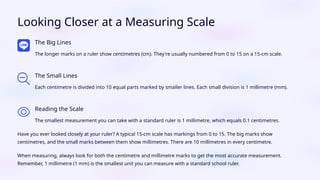
The Big Lines
The longer marks on a ruler show centimetres (cm). They're usually numbered from 0 to 15 on a 15-cm scale.
The Small Lines
Each centimetre is divided into 10 equal parts marked by smaller lines. Each small division is 1 millimetre (mm).
Reading the Scale
The smallest measurement you can take with a standard ruler is 1 millimetre, which equals 0.1 centimetres.
Have you ever looked closely at your ruler? A typical 15-cm scale has markings from 0 to 15. The big marks show
centimetres, and the small marks between them show millimetres. There are 10 millimetres in every centimetre.
When measuring, always look for both the centimetre and millimetre marks to get the most accurate measurement.
Remember, 1 millimetre (1 mm) is the smallest unit you can measure with a standard school ruler.
10.
The Correct Wayto Measure
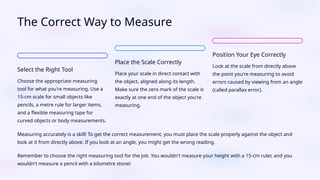
Select the Right Tool
Choose the appropriate measuring
tool for what you're measuring. Use a
15-cm scale for small objects like
pencils, a metre rule for larger items,
and a flexible measuring tape for
curved objects or body measurements.
Place the Scale Correctly
Place your scale in direct contact with
the object, aligned along its length.
Make sure the zero mark of the scale is
exactly at one end of the object you're
measuring.
Position Your Eye Correctly
Look at the scale from directly above
the point you're measuring to avoid
errors caused by viewing from an angle
(called parallax error).
Measuring accurately is a skill! To get the correct measurement, you must place the scale properly against the object and
look at it from directly above. If you look at an angle, you might get the wrong reading.
Remember to choose the right measuring tool for the job. You wouldn't measure your height with a 15-cm ruler, and you
wouldn't measure a pencil with a kilometre stone!
11.
What If YourScale is Broken?
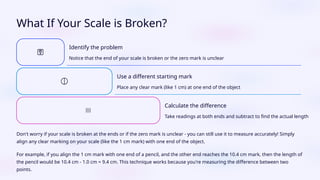
Identify the problem
Notice that the end of your scale is broken or the zero mark is unclear
Use a different starting mark
Place any clear mark (like 1 cm) at one end of the object
Calculate the difference
Take readings at both ends and subtract to find the actual length
Don't worry if your scale is broken at the ends or if the zero mark is unclear - you can still use it to measure accurately! Simply
align any clear marking on your scale (like the 1 cm mark) with one end of the object.
For example, if you align the 1 cm mark with one end of a pencil, and the other end reaches the 10.4 cm mark, then the length of
the pencil would be 10.4 cm - 1.0 cm = 9.4 cm. This technique works because you're measuring the difference between two
points.
12.
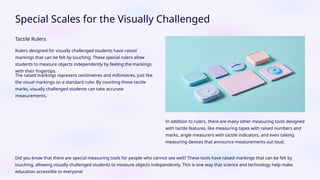
Special Scales forthe Visually Challenged
Tactile Rulers
Rulers designed for visually challenged students have raised
markings that can be felt by touching. These special rulers allow
students to measure objects independently by feeling the markings
with their fingertips.
The raised markings represent centimetres and millimetres, just like
the visual markings on a standard ruler. By counting these tactile
marks, visually challenged students can take accurate
measurements.
In addition to rulers, there are many other measuring tools designed
with tactile features, like measuring tapes with raised numbers and
marks, angle measurers with tactile indicators, and even talking
measuring devices that announce measurements out loud.
Did you know that there are special measuring tools for people who cannot see well? These tools have raised markings that can be felt by
touching, allowing visually challenged students to measure objects independently. This is one way that science and technology help make
education accessible to everyone!
13.
Measuring Activity: Let'sTry It!
Select objects to measure
Choose common objects like a comb, pen, pencil,
and eraser
Use a scale properly
Place the scale correctly and view from directly above
Record measurements
Write down each measurement with both number
and unit
Compare results
Check if your measurements match those of your
classmates
Now it's your turn to practice measuring! Select some objects around you and measure their lengths using a ruler.
Remember to write down both the number and the unit for each measurement.
After taking your measurements, compare your results with your classmates. Are they exactly the same or slightly
different? If they're different, discuss possible reasons why. Perhaps the scale wasn't placed exactly at the end of the
object, or maybe the eye position wasn't directly above the scale.
14.
Measuring Curved Lines
Usinga Flexible Measuring Tape
A flexible measuring tape can bend and follow the curves of
an object. This makes it perfect for measuring curved lines,
like the circumference of a ball or the girth of a tree.
Tailors use flexible measuring tapes to measure body
dimensions for making clothes. The tape can follow body
contours to get accurate measurements.
Using Thread Method
If you don't have a flexible tape, you can use a string or
thread. Place the thread along the curved line, making sure
it follows the curve exactly.
After the thread is positioned, mark or cut it at both ends of
the curved line. Then straighten the thread and measure its
length using a regular ruler. This length equals the length
of the curved line!
Not everything we need to measure is straight! How would you measure the curved arch of a doorway or the rim of a circular
plate? For curved lines, we need special approaches.
Remember when Anish and his parents needed to measure the arches of their verandah to put up string lights for a
celebration? They couldn't use a straight ruler for this task. Instead, they likely used a flexible measuring tape or the thread
method described above.
15.
Proper Symbols forUnits
Lowercase Letters
Units like kilometre, metre, centimetre, and millimetre are
written with lowercase letters, except at the beginning of a
sentence.
Symbols
The symbols km, m, cm, and mm are also written in
lowercase letters. They are never followed by 's' for plural
(write 5 km, not 5 kms).
No Full Stop
Don't write a full stop after the symbol unless it's at the end
of a sentence.
Space Required
Always leave a space between the number and the unit
(write 5 cm, not 5cm).
When writing measurements, it's important to follow proper conventions. Did you know that "5 cms" is actually incorrect? The right
way to write it is "5 cm" - without an 's' at the end of the unit symbol.
These rules for writing units are part of the international standards that help everyone communicate measurements clearly.
Remember to leave a space between the number and the unit (write 5 cm, not 5cm), and don't use full stops after unit symbols except
at the end of a sentence.
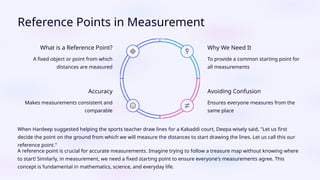
Reference Points inMeasurement
What is a Reference Point?
A fixed object or point from which
distances are measured
Why We Need It
To provide a common starting point for
all measurements
Avoiding Confusion
Ensures everyone measures from the
same place
Accuracy
Makes measurements consistent and
comparable
When Hardeep suggested helping the sports teacher draw lines for a Kabaddi court, Deepa wisely said, "Let us first
decide the point on the ground from which we will measure the distances to start drawing the lines. Let us call this our
reference point."
A reference point is crucial for accurate measurements. Imagine trying to follow a treasure map without knowing where
to start! Similarly, in measurement, we need a fixed starting point to ensure everyone's measurements agree. This
concept is fundamental in mathematics, science, and everyday life.
18.
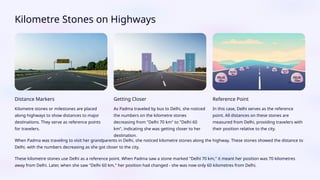
Kilometre Stones onHighways
Distance Markers
Kilometre stones or milestones are placed
along highways to show distances to major
destinations. They serve as reference points
for travelers.
Getting Closer
As Padma traveled by bus to Delhi, she noticed
the numbers on the kilometre stones
decreasing from "Delhi 70 km" to "Delhi 60
km", indicating she was getting closer to her
destination.
Reference Point
In this case, Delhi serves as the reference
point. All distances on these stones are
measured from Delhi, providing travelers with
their position relative to the city.
When Padma was traveling to visit her grandparents in Delhi, she noticed kilometre stones along the highway. These stones showed the distance to
Delhi, with the numbers decreasing as she got closer to the city.
These kilometre stones use Delhi as a reference point. When Padma saw a stone marked "Delhi 70 km," it meant her position was 70 kilometres
away from Delhi. Later, when she saw "Delhi 60 km," her position had changed - she was now only 60 kilometres from Delhi.
19.
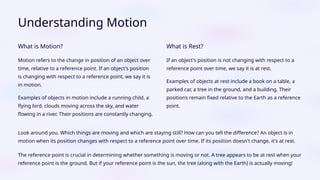
Understanding Motion
What isMotion?
Motion refers to the change in position of an object over
time, relative to a reference point. If an object's position
is changing with respect to a reference point, we say it is
in motion.
Examples of objects in motion include a running child, a
flying bird, clouds moving across the sky, and water
flowing in a river. Their positions are constantly changing.
What is Rest?
If an object's position is not changing with respect to a
reference point over time, we say it is at rest.
Examples of objects at rest include a book on a table, a
parked car, a tree in the ground, and a building. Their
positions remain fixed relative to the Earth as a reference
point.
Look around you. Which things are moving and which are staying still? How can you tell the difference? An object is in
motion when its position changes with respect to a reference point over time. If its position doesn't change, it's at rest.
The reference point is crucial in determining whether something is moving or not. A tree appears to be at rest when your
reference point is the ground. But if your reference point is the sun, the tree (along with the Earth) is actually moving!
20.
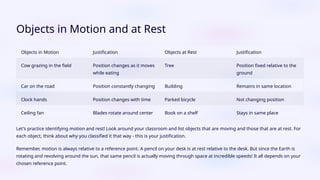
Objects in Motionand at Rest
Objects in Motion Justification Objects at Rest Justification
Cow grazing in the field Position changes as it moves
while eating
Tree Position fixed relative to the
ground
Car on the road Position constantly changing Building Remains in same location
Clock hands Position changes with time Parked bicycle Not changing position
Ceiling fan Blades rotate around center Book on a shelf Stays in same place
Let's practice identifying motion and rest! Look around your classroom and list objects that are moving and those that are at rest. For
each object, think about why you classified it that way - this is your justification.
Remember, motion is always relative to a reference point. A pencil on your desk is at rest relative to the desk. But since the Earth is
rotating and revolving around the sun, that same pencil is actually moving through space at incredible speeds! It all depends on your
chosen reference point.
21.
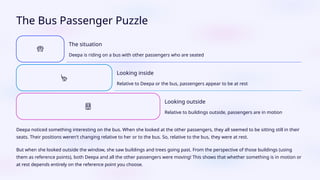
The Bus PassengerPuzzle
The situation
Deepa is riding on a bus with other passengers who are seated
Looking inside
Relative to Deepa or the bus, passengers appear to be at rest
Looking outside
Relative to buildings outside, passengers are in motion
Deepa noticed something interesting on the bus. When she looked at the other passengers, they all seemed to be sitting still in their
seats. Their positions weren't changing relative to her or to the bus. So, relative to the bus, they were at rest.
But when she looked outside the window, she saw buildings and trees going past. From the perspective of those buildings (using
them as reference points), both Deepa and all the other passengers were moving! This shows that whether something is in motion or
at rest depends entirely on the reference point you choose.
22.
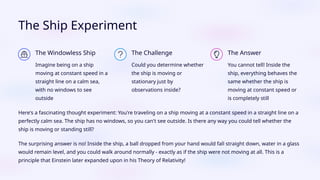
The Ship Experiment
TheWindowless Ship
Imagine being on a ship
moving at constant speed in a
straight line on a calm sea,
with no windows to see
outside
The Challenge
Could you determine whether
the ship is moving or
stationary just by
observations inside?
The Answer
You cannot tell! Inside the
ship, everything behaves the
same whether the ship is
moving at constant speed or
is completely still
Here's a fascinating thought experiment: You're traveling on a ship moving at a constant speed in a straight line on a
perfectly calm sea. The ship has no windows, so you can't see outside. Is there any way you could tell whether the
ship is moving or standing still?
The surprising answer is no! Inside the ship, a ball dropped from your hand would fall straight down, water in a glass
would remain level, and you could walk around normally - exactly as if the ship were not moving at all. This is a
principle that Einstein later expanded upon in his Theory of Relativity!
23.
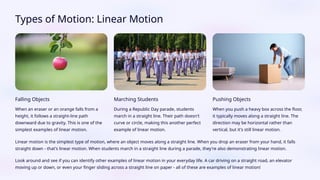
Types of Motion:Linear Motion
Falling Objects
When an eraser or an orange falls from a
height, it follows a straight-line path
downward due to gravity. This is one of the
simplest examples of linear motion.
Marching Students
During a Republic Day parade, students
march in a straight line. Their path doesn't
curve or circle, making this another perfect
example of linear motion.
Pushing Objects
When you push a heavy box across the floor,
it typically moves along a straight line. The
direction may be horizontal rather than
vertical, but it's still linear motion.
Linear motion is the simplest type of motion, where an object moves along a straight line. When you drop an eraser from your hand, it falls
straight down - that's linear motion. When students march in a straight line during a parade, they're also demonstrating linear motion.
Look around and see if you can identify other examples of linear motion in your everyday life. A car driving on a straight road, an elevator
moving up or down, or even your finger sliding across a straight line on paper - all of these are examples of linear motion!
24.
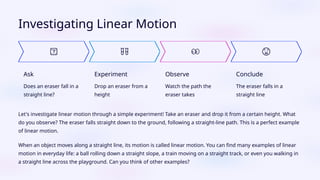
Investigating Linear Motion
Ask
Doesan eraser fall in a
straight line?
Experiment
Drop an eraser from a
height
Observe
Watch the path the
eraser takes
Conclude
The eraser falls in a
straight line
Let's investigate linear motion through a simple experiment! Take an eraser and drop it from a certain height. What
do you observe? The eraser falls straight down to the ground, following a straight-line path. This is a perfect example
of linear motion.
When an object moves along a straight line, its motion is called linear motion. You can find many examples of linear
motion in everyday life: a ball rolling down a straight slope, a train moving on a straight track, or even you walking in
a straight line across the playground. Can you think of other examples?
25.
Types of Motion:Circular Motion
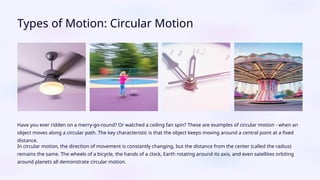
Have you ever ridden on a merry-go-round? Or watched a ceiling fan spin? These are examples of circular motion - when an
object moves along a circular path. The key characteristic is that the object keeps moving around a central point at a fixed
distance.
In circular motion, the direction of movement is constantly changing, but the distance from the center (called the radius)
remains the same. The wheels of a bicycle, the hands of a clock, Earth rotating around its axis, and even satellites orbiting
around planets all demonstrate circular motion.
26.
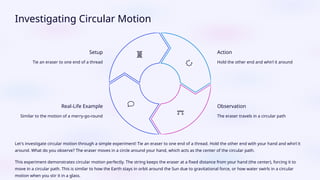
Investigating Circular Motion
Setup
Tiean eraser to one end of a thread
Action
Hold the other end and whirl it around
Observation
The eraser travels in a circular path
Real-Life Example
Similar to the motion of a merry-go-round
Let's investigate circular motion through a simple experiment! Tie an eraser to one end of a thread. Hold the other end with your hand and whirl it
around. What do you observe? The eraser moves in a circle around your hand, which acts as the center of the circular path.
This experiment demonstrates circular motion perfectly. The string keeps the eraser at a fixed distance from your hand (the center), forcing it to
move in a circular path. This is similar to how the Earth stays in orbit around the Sun due to gravitational force, or how water swirls in a circular
motion when you stir it in a glass.
27.
Types of Motion:Oscillatory Motion
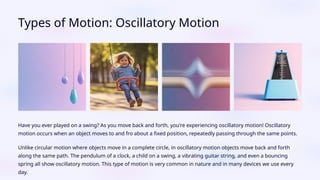
Have you ever played on a swing? As you move back and forth, you're experiencing oscillatory motion! Oscillatory
motion occurs when an object moves to and fro about a fixed position, repeatedly passing through the same points.
Unlike circular motion where objects move in a complete circle, in oscillatory motion objects move back and forth
along the same path. The pendulum of a clock, a child on a swing, a vibrating guitar string, and even a bouncing
spring all show oscillatory motion. This type of motion is very common in nature and in many devices we use every
day.
28.
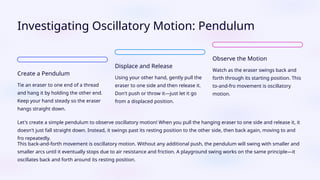
Investigating Oscillatory Motion:Pendulum
Create a Pendulum
Tie an eraser to one end of a thread
and hang it by holding the other end.
Keep your hand steady so the eraser
hangs straight down.
Displace and Release
Using your other hand, gently pull the
eraser to one side and then release it.
Don't push or throw it—just let it go
from a displaced position.
Observe the Motion
Watch as the eraser swings back and
forth through its starting position. This
to-and-fro movement is oscillatory
motion.
Let's create a simple pendulum to observe oscillatory motion! When you pull the hanging eraser to one side and release it, it
doesn't just fall straight down. Instead, it swings past its resting position to the other side, then back again, moving to and
fro repeatedly.
This back-and-forth movement is oscillatory motion. Without any additional push, the pendulum will swing with smaller and
smaller arcs until it eventually stops due to air resistance and friction. A playground swing works on the same principle—it
oscillates back and forth around its resting position.
29.
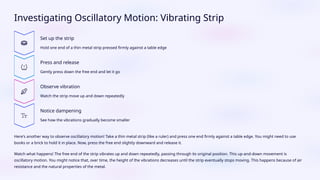
Investigating Oscillatory Motion:Vibrating Strip
Set up the strip
Hold one end of a thin metal strip pressed firmly against a table edge
Press and release
Gently press down the free end and let it go
Observe vibration
Watch the strip move up and down repeatedly
Notice dampening
See how the vibrations gradually become smaller
Here's another way to observe oscillatory motion! Take a thin metal strip (like a ruler) and press one end firmly against a table edge. You might need to use
books or a brick to hold it in place. Now, press the free end slightly downward and release it.
Watch what happens! The free end of the strip vibrates up and down repeatedly, passing through its original position. This up-and-down movement is
oscillatory motion. You might notice that, over time, the height of the vibrations decreases until the strip eventually stops moving. This happens because of air
resistance and the natural properties of the metal.
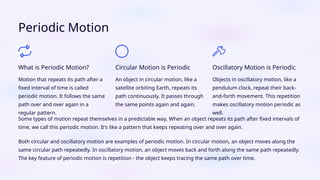
30.
Periodic Motion
What isPeriodic Motion?
Motion that repeats its path after a
fixed interval of time is called
periodic motion. It follows the same
path over and over again in a
regular pattern.
Circular Motion is Periodic
An object in circular motion, like a
satellite orbiting Earth, repeats its
path continuously. It passes through
the same points again and again.
Oscillatory Motion is Periodic
Objects in oscillatory motion, like a
pendulum clock, repeat their back-
and-forth movement. This repetition
makes oscillatory motion periodic as
well.
Some types of motion repeat themselves in a predictable way. When an object repeats its path after fixed intervals of
time, we call this periodic motion. It's like a pattern that keeps repeating over and over again.
Both circular and oscillatory motion are examples of periodic motion. In circular motion, an object moves along the
same circular path repeatedly. In oscillatory motion, an object moves back and forth along the same path repeatedly.
The key feature of periodic motion is repetition - the object keeps tracing the same path over time.
31.
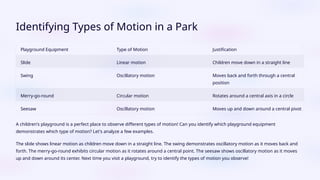
Identifying Types ofMotion in a Park
Playground Equipment Type of Motion Justification
Slide Linear motion Children move down in a straight line
Swing Oscillatory motion Moves back and forth through a central
position
Merry-go-round Circular motion Rotates around a central axis in a circle
Seesaw Oscillatory motion Moves up and down around a central pivot
A children's playground is a perfect place to observe different types of motion! Can you identify which playground equipment
demonstrates which type of motion? Let's analyze a few examples.
The slide shows linear motion as children move down in a straight line. The swing demonstrates oscillatory motion as it moves back and
forth. The merry-go-round exhibits circular motion as it rotates around a central point. The seesaw shows oscillatory motion as it moves
up and down around its center. Next time you visit a playground, try to identify the types of motion you observe!
32.
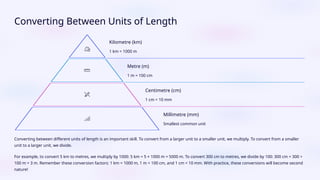
Converting Between Unitsof Length
Kilometre (km)
1 km = 1000 m
Metre (m)
1 m = 100 cm
Centimetre (cm)
1 cm = 10 mm
Millimetre (mm)
Smallest common unit
Converting between different units of length is an important skill. To convert from a larger unit to a smaller unit, we multiply. To convert from a smaller
unit to a larger unit, we divide.
For example, to convert 5 km to metres, we multiply by 1000: 5 km = 5 × 1000 m = 5000 m. To convert 300 cm to metres, we divide by 100: 300 cm = 300 ÷
100 m = 3 m. Remember these conversion factors: 1 km = 1000 m, 1 m = 100 cm, and 1 cm = 10 mm. With practice, these conversions will become second
nature!
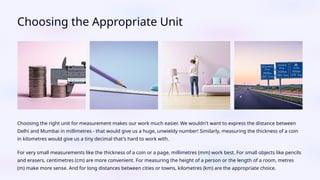
33.
Choosing the AppropriateUnit
Choosing the right unit for measurement makes our work much easier. We wouldn't want to express the distance between
Delhi and Mumbai in millimetres - that would give us a huge, unwieldy number! Similarly, measuring the thickness of a coin
in kilometres would give us a tiny decimal that's hard to work with.
For very small measurements like the thickness of a coin or a page, millimetres (mm) work best. For small objects like pencils
and erasers, centimetres (cm) are more convenient. For measuring the height of a person or the length of a room, metres
(m) make more sense. And for long distances between cities or towns, kilometres (km) are the appropriate choice.
34.
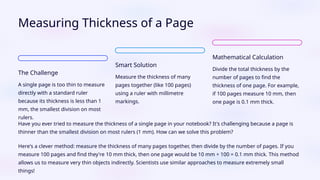
Measuring Thickness ofa Page
The Challenge
A single page is too thin to measure
directly with a standard ruler
because its thickness is less than 1
mm, the smallest division on most
rulers.
Smart Solution
Measure the thickness of many
pages together (like 100 pages)
using a ruler with millimetre
markings.
Mathematical Calculation
Divide the total thickness by the
number of pages to find the
thickness of one page. For example,
if 100 pages measure 10 mm, then
one page is 0.1 mm thick.
Have you ever tried to measure the thickness of a single page in your notebook? It's challenging because a page is
thinner than the smallest division on most rulers (1 mm). How can we solve this problem?
Here's a clever method: measure the thickness of many pages together, then divide by the number of pages. If you
measure 100 pages and find they're 10 mm thick, then one page would be 10 mm ÷ 100 = 0.1 mm thick. This method
allows us to measure very thin objects indirectly. Scientists use similar approaches to measure extremely small
things!
35.
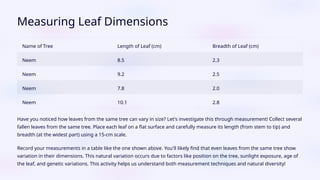
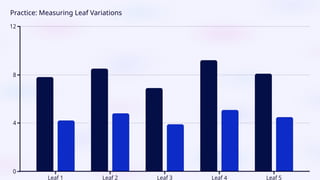
Measuring Leaf Dimensions
Nameof Tree Length of Leaf (cm) Breadth of Leaf (cm)
Neem 8.5 2.3
Neem 9.2 2.5
Neem 7.8 2.0
Neem 10.1 2.8
Have you noticed how leaves from the same tree can vary in size? Let's investigate this through measurement! Collect several
fallen leaves from the same tree. Place each leaf on a flat surface and carefully measure its length (from stem to tip) and
breadth (at the widest part) using a 15-cm scale.
Record your measurements in a table like the one shown above. You'll likely find that even leaves from the same tree show
variation in their dimensions. This natural variation occurs due to factors like position on the tree, sunlight exposure, age of
the leaf, and genetic variations. This activity helps us understand both measurement techniques and natural diversity!
36.
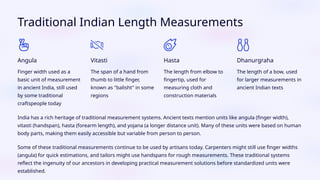
Traditional Indian LengthMeasurements
Angula
Finger width used as a
basic unit of measurement
in ancient India, still used
by some traditional
craftspeople today
Vitasti
The span of a hand from
thumb to little finger,
known as "balisht" in some
regions
Hasta
The length from elbow to
fingertip, used for
measuring cloth and
construction materials
Dhanurgraha
The length of a bow, used
for larger measurements in
ancient Indian texts
India has a rich heritage of traditional measurement systems. Ancient texts mention units like angula (finger width),
vitasti (handspan), hasta (forearm length), and yojana (a longer distance unit). Many of these units were based on human
body parts, making them easily accessible but variable from person to person.
Some of these traditional measurements continue to be used by artisans today. Carpenters might still use finger widths
(angula) for quick estimations, and tailors might use handspans for rough measurements. These traditional systems
reflect the ingenuity of our ancestors in developing practical measurement solutions before standardized units were
established.
Creating a MeasurementMaze
Make Your Own Measurement Maze
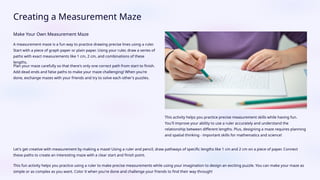
A measurement maze is a fun way to practice drawing precise lines using a ruler.
Start with a piece of graph paper or plain paper. Using your ruler, draw a series of
paths with exact measurements like 1 cm, 2 cm, and combinations of these
lengths.
Plan your maze carefully so that there's only one correct path from start to finish.
Add dead ends and false paths to make your maze challenging! When you're
done, exchange mazes with your friends and try to solve each other's puzzles.
This activity helps you practice precise measurement skills while having fun.
You'll improve your ability to use a ruler accurately and understand the
relationship between different lengths. Plus, designing a maze requires planning
and spatial thinking - important skills for mathematics and science!
Let's get creative with measurement by making a maze! Using a ruler and pencil, draw pathways of specific lengths like 1 cm and 2 cm on a piece of paper. Connect
these paths to create an interesting maze with a clear start and finish point.
This fun activity helps you practice using a ruler to make precise measurements while using your imagination to design an exciting puzzle. You can make your maze as
simple or as complex as you want. Color it when you're done and challenge your friends to find their way through!
39.
Measuring Distance witha Bicycle
Set Up Your Bicycle
Attach a flexible metal strip to the
spoke of the front wheel so that it
hits the frame and makes a sound
with each complete rotation.
Measure the Wheel
Use a string to measure the outer
boundary (circumference) of the
wheel. Straighten the string and
measure its length with a ruler.
Ride and Count
Ride the bicycle slowly and count
each sound, which represents one
complete wheel rotation. Multiply
this count by the wheel's
circumference.
Did you know you can use a bicycle to measure distances? This fun method involves attaching a flexible metal strip to
a spoke of the front wheel in such a way that it hits the frame and makes a sound with each rotation.
As you ride, count the number of sounds (rotations). Then, multiply this number by the circumference of the wheel
(measured using a string) to find the total distance traveled. This creative technique is similar to professional
methods used in road races! The Jones Counter, used to measure official race courses, works on a similar principle.
40.
Professional Distance Measurement
OfficialRace Courses
Marathon and road race courses must be precisely
measured to ensure standard distances for record-
keeping
Jones Counter
A specialized device attached to a bicycle wheel that
counts wheel rotations with high precision
Calibration
The bicycle and counter are first calibrated on a known
distance to ensure accuracy
Certification
Only courses measured with approved methods receive
official certification
The simple bicycle measuring method we explored is similar to professional techniques used to measure official race courses!
Race officials use a device called a Jones Counter, which attaches to a bicycle wheel and precisely counts the number of wheel
rotations.
Before measuring a course, they first calibrate the bicycle by riding it on a known distance called a "calibration course." This tells
them exactly how many counter clicks equal one kilometre. Then they carefully ride along the planned race route, following the
shortest possible path that runners could take. This method ensures that marathon courses are exactly 42.195 kilometres - not a
metre more or less!
41.
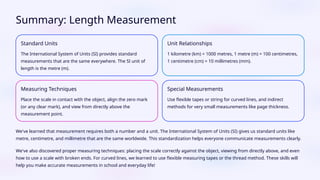
Summary: Length Measurement
StandardUnits
The International System of Units (SI) provides standard
measurements that are the same everywhere. The SI unit of
length is the metre (m).
Unit Relationships
1 kilometre (km) = 1000 metres, 1 metre (m) = 100 centimetres,
1 centimetre (cm) = 10 millimetres (mm).
Measuring Techniques
Place the scale in contact with the object, align the zero mark
(or any clear mark), and view from directly above the
measurement point.
Special Measurements
Use flexible tapes or string for curved lines, and indirect
methods for very small measurements like page thickness.
We've learned that measurement requires both a number and a unit. The International System of Units (SI) gives us standard units like
metre, centimetre, and millimetre that are the same worldwide. This standardization helps everyone communicate measurements clearly.
We've also discovered proper measuring techniques: placing the scale correctly against the object, viewing from directly above, and even
how to use a scale with broken ends. For curved lines, we learned to use flexible measuring tapes or the thread method. These skills will
help you make accurate measurements in school and everyday life!
42.
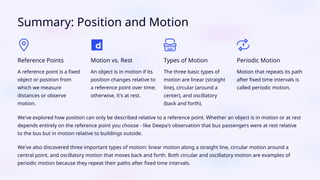
Summary: Position andMotion
Reference Points
A reference point is a fixed
object or position from
which we measure
distances or observe
motion.
Motion vs. Rest
An object is in motion if its
position changes relative to
a reference point over time;
otherwise, it's at rest.
Types of Motion
The three basic types of
motion are linear (straight
line), circular (around a
center), and oscillatory
(back and forth).
Periodic Motion
Motion that repeats its path
after fixed time intervals is
called periodic motion.
We've explored how position can only be described relative to a reference point. Whether an object is in motion or at rest
depends entirely on the reference point you choose - like Deepa's observation that bus passengers were at rest relative
to the bus but in motion relative to buildings outside.
We've also discovered three important types of motion: linear motion along a straight line, circular motion around a
central point, and oscillatory motion that moves back and forth. Both circular and oscillatory motion are examples of
periodic motion because they repeat their paths after fixed time intervals.
43.
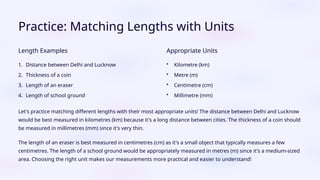
Practice: Matching Lengthswith Units
Length Examples
1. Distance between Delhi and Lucknow
2. Thickness of a coin
3. Length of an eraser
4. Length of school ground
Appropriate Units
• Kilometre (km)
• Metre (m)
• Centimetre (cm)
• Millimetre (mm)
Let's practice matching different lengths with their most appropriate units! The distance between Delhi and Lucknow
would be best measured in kilometres (km) because it's a long distance between cities. The thickness of a coin should
be measured in millimetres (mm) since it's very thin.
The length of an eraser is best measured in centimetres (cm) as it's a small object that typically measures a few
centimetres. The length of a school ground would be appropriately measured in metres (m) since it's a medium-sized
area. Choosing the right unit makes our measurements more practical and easier to understand!
44.
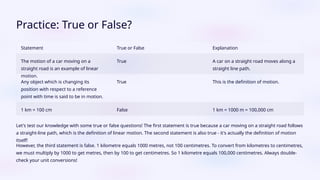
Practice: True orFalse?
Statement True or False Explanation
The motion of a car moving on a
straight road is an example of linear
motion.
True A car on a straight road moves along a
straight line path.
Any object which is changing its
position with respect to a reference
point with time is said to be in motion.
True This is the definition of motion.
1 km = 100 cm False 1 km = 1000 m = 100,000 cm
Let's test our knowledge with some true or false questions! The first statement is true because a car moving on a straight road follows
a straight-line path, which is the definition of linear motion. The second statement is also true - it's actually the definition of motion
itself!
However, the third statement is false. 1 kilometre equals 1000 metres, not 100 centimetres. To convert from kilometres to centimetres,
we must multiply by 1000 to get metres, then by 100 to get centimetres. So 1 kilometre equals 100,000 centimetres. Always double-
check your unit conversions!
45.
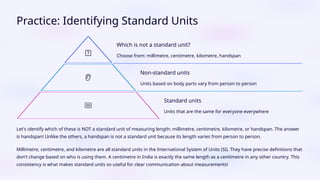
Practice: Identifying StandardUnits
Which is not a standard unit?
Choose from: millimetre, centimetre, kilometre, handspan
Non-standard units
Units based on body parts vary from person to person
Standard units
Units that are the same for everyone everywhere
Let's identify which of these is NOT a standard unit of measuring length: millimetre, centimetre, kilometre, or handspan. The answer
is handspan! Unlike the others, a handspan is not a standard unit because its length varies from person to person.
Millimetre, centimetre, and kilometre are all standard units in the International System of Units (SI). They have precise definitions that
don't change based on who is using them. A centimetre in India is exactly the same length as a centimetre in any other country. This
consistency is what makes standard units so useful for clear communication about measurements!
46.
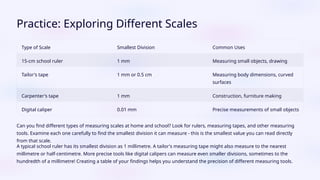
Practice: Exploring DifferentScales
Type of Scale Smallest Division Common Uses
15-cm school ruler 1 mm Measuring small objects, drawing
Tailor's tape 1 mm or 0.5 cm Measuring body dimensions, curved
surfaces
Carpenter's tape 1 mm Construction, furniture making
Digital caliper 0.01 mm Precise measurements of small objects
Can you find different types of measuring scales at home and school? Look for rulers, measuring tapes, and other measuring
tools. Examine each one carefully to find the smallest division it can measure - this is the smallest value you can read directly
from that scale.
A typical school ruler has its smallest division as 1 millimetre. A tailor's measuring tape might also measure to the nearest
millimetre or half-centimetre. More precise tools like digital calipers can measure even smaller divisions, sometimes to the
hundredth of a millimetre! Creating a table of your findings helps you understand the precision of different measuring tools.
47.
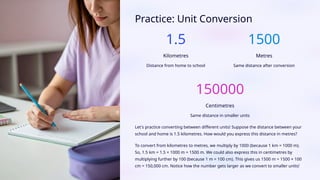
Practice: Unit Conversion
1.5
Kilometres
Distancefrom home to school
1500
Metres
Same distance after conversion
150000
Centimetres
Same distance in smaller units
Let's practice converting between different units! Suppose the distance between your
school and home is 1.5 kilometres. How would you express this distance in metres?
To convert from kilometres to metres, we multiply by 1000 (because 1 km = 1000 m).
So, 1.5 km = 1.5 × 1000 m = 1500 m. We could also express this in centimetres by
multiplying further by 100 (because 1 m = 100 cm). This gives us 1500 m = 1500 × 100
cm = 150,000 cm. Notice how the number gets larger as we convert to smaller units!
48.
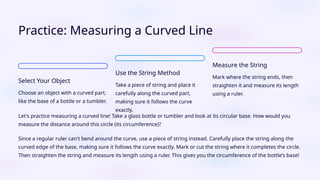
Practice: Measuring aCurved Line
Select Your Object
Choose an object with a curved part,
like the base of a bottle or a tumbler.
Use the String Method
Take a piece of string and place it
carefully along the curved part,
making sure it follows the curve
exactly.
Measure the String
Mark where the string ends, then
straighten it and measure its length
using a ruler.
Let's practice measuring a curved line! Take a glass bottle or tumbler and look at its circular base. How would you
measure the distance around this circle (its circumference)?
Since a regular ruler can't bend around the curve, use a piece of string instead. Carefully place the string along the
curved edge of the base, making sure it follows the curve exactly. Mark or cut the string where it completes the circle.
Then straighten the string and measure its length using a ruler. This gives you the circumference of the bottle's base!
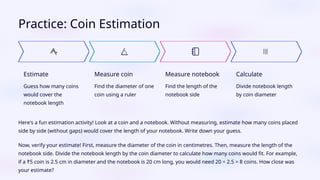
Practice: Coin Estimation
Estimate
Guesshow many coins
would cover the
notebook length
Measure coin
Find the diameter of one
coin using a ruler
Measure notebook
Find the length of the
notebook side
Calculate
Divide notebook length
by coin diameter
Here's a fun estimation activity! Look at a coin and a notebook. Without measuring, estimate how many coins placed
side by side (without gaps) would cover the length of your notebook. Write down your guess.
Now, verify your estimate! First, measure the diameter of the coin in centimetres. Then, measure the length of the
notebook side. Divide the notebook length by the coin diameter to calculate how many coins would fit. For example,
if a ₹5 coin is 2.5 cm in diameter and the notebook is 20 cm long, you would need 20 ÷ 2.5 = 8 coins. How close was
your estimate?
51.
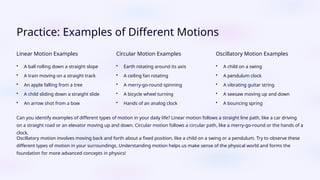
Practice: Examples ofDifferent Motions
Linear Motion Examples
• A ball rolling down a straight slope
• A train moving on a straight track
• An apple falling from a tree
• A child sliding down a straight slide
• An arrow shot from a bow
Circular Motion Examples
• Earth rotating around its axis
• A ceiling fan rotating
• A merry-go-round spinning
• A bicycle wheel turning
• Hands of an analog clock
Oscillatory Motion Examples
• A child on a swing
• A pendulum clock
• A vibrating guitar string
• A seesaw moving up and down
• A bouncing spring
Can you identify examples of different types of motion in your daily life? Linear motion follows a straight line path, like a car driving
on a straight road or an elevator moving up and down. Circular motion follows a circular path, like a merry-go-round or the hands of a
clock.
Oscillatory motion involves moving back and forth about a fixed position, like a child on a swing or a pendulum. Try to observe these
different types of motion in your surroundings. Understanding motion helps us make sense of the physical world and forms the
foundation for more advanced concepts in physics!
52.
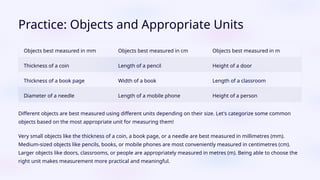
Practice: Objects andAppropriate Units
Objects best measured in mm Objects best measured in cm Objects best measured in m
Thickness of a coin Length of a pencil Height of a door
Thickness of a book page Width of a book Length of a classroom
Diameter of a needle Length of a mobile phone Height of a person
Different objects are best measured using different units depending on their size. Let's categorize some common
objects based on the most appropriate unit for measuring them!
Very small objects like the thickness of a coin, a book page, or a needle are best measured in millimetres (mm).
Medium-sized objects like pencils, books, or mobile phones are most conveniently measured in centimetres (cm).
Larger objects like doors, classrooms, or people are appropriately measured in metres (m). Being able to choose the
right unit makes measurement more practical and meaningful.
53.
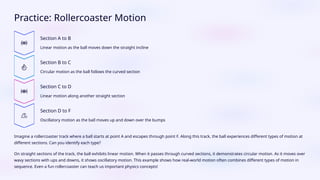
Practice: Rollercoaster Motion
SectionA to B
Linear motion as the ball moves down the straight incline
Section B to C
Circular motion as the ball follows the curved section
Section C to D
Linear motion along another straight section
Section D to F
Oscillatory motion as the ball moves up and down over the bumps
Imagine a rollercoaster track where a ball starts at point A and escapes through point F. Along this track, the ball experiences different types of motion at
different sections. Can you identify each type?
On straight sections of the track, the ball exhibits linear motion. When it passes through curved sections, it demonstrates circular motion. As it moves over
wavy sections with ups and downs, it shows oscillatory motion. This example shows how real-world motion often combines different types of motion in
sequence. Even a fun rollercoaster can teach us important physics concepts!
54.
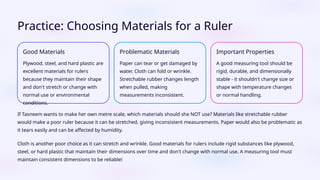
Practice: Choosing Materialsfor a Ruler
Good Materials
Plywood, steel, and hard plastic are
excellent materials for rulers
because they maintain their shape
and don't stretch or change with
normal use or environmental
conditions.
Problematic Materials
Paper can tear or get damaged by
water. Cloth can fold or wrinkle.
Stretchable rubber changes length
when pulled, making
measurements inconsistent.
Important Properties
A good measuring tool should be
rigid, durable, and dimensionally
stable - it shouldn't change size or
shape with temperature changes
or normal handling.
If Tasneem wants to make her own metre scale, which materials should she NOT use? Materials like stretchable rubber
would make a poor ruler because it can be stretched, giving inconsistent measurements. Paper would also be problematic as
it tears easily and can be affected by humidity.
Cloth is another poor choice as it can stretch and wrinkle. Good materials for rulers include rigid substances like plywood,
steel, or hard plastic that maintain their dimensions over time and don't change with normal use. A measuring tool must
maintain consistent dimensions to be reliable!
55.
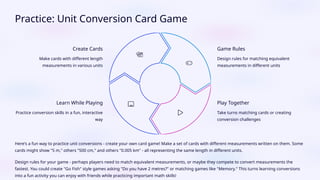
Practice: Unit ConversionCard Game
Create Cards
Make cards with different length
measurements in various units
Game Rules
Design rules for matching equivalent
measurements in different units
Play Together
Take turns matching cards or creating
conversion challenges
Learn While Playing
Practice conversion skills in a fun, interactive
way
Here's a fun way to practice unit conversions - create your own card game! Make a set of cards with different measurements written on them. Some
cards might show "5 m," others "500 cm," and others "0.005 km" - all representing the same length in different units.
Design rules for your game - perhaps players need to match equivalent measurements, or maybe they compete to convert measurements the
fastest. You could create "Go Fish" style games asking "Do you have 2 metres?" or matching games like "Memory." This turns learning conversions
into a fun activity you can enjoy with friends while practicing important math skills!
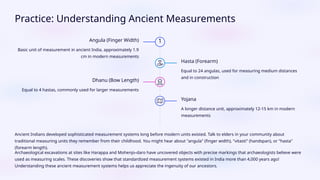
Practice: Understanding AncientMeasurements
1
Angula (Finger Width)
Basic unit of measurement in ancient India, approximately 1.9
cm in modern measurements
Hasta (Forearm)
Equal to 24 angulas, used for measuring medium distances
and in construction
Dhanu (Bow Length)
Equal to 4 hastas, commonly used for larger measurements
Yojana
A longer distance unit, approximately 12-15 km in modern
measurements
Ancient Indians developed sophisticated measurement systems long before modern units existed. Talk to elders in your community about
traditional measuring units they remember from their childhood. You might hear about "angula" (finger width), "vitasti" (handspan), or "hasta"
(forearm length).
Archaeological excavations at sites like Harappa and Mohenjo-daro have uncovered objects with precise markings that archaeologists believe were
used as measuring scales. These discoveries show that standardized measurement systems existed in India more than 4,000 years ago!
Understanding these ancient measurement systems helps us appreciate the ingenuity of our ancestors.
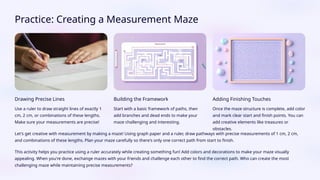
58.
Practice: Creating aMeasurement Maze
Drawing Precise Lines
Use a ruler to draw straight lines of exactly 1
cm, 2 cm, or combinations of these lengths.
Make sure your measurements are precise!
Building the Framework
Start with a basic framework of paths, then
add branches and dead ends to make your
maze challenging and interesting.
Adding Finishing Touches
Once the maze structure is complete, add color
and mark clear start and finish points. You can
add creative elements like treasures or
obstacles.
Let's get creative with measurement by making a maze! Using graph paper and a ruler, draw pathways with precise measurements of 1 cm, 2 cm,
and combinations of these lengths. Plan your maze carefully so there's only one correct path from start to finish.
This activity helps you practice using a ruler accurately while creating something fun! Add colors and decorations to make your maze visually
appealing. When you're done, exchange mazes with your friends and challenge each other to find the correct path. Who can create the most
challenging maze while maintaining precise measurements?
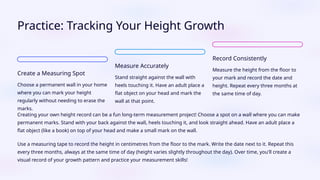
59.
Practice: Tracking YourHeight Growth
Create a Measuring Spot
Choose a permanent wall in your home
where you can mark your height
regularly without needing to erase the
marks.
Measure Accurately
Stand straight against the wall with
heels touching it. Have an adult place a
flat object on your head and mark the
wall at that point.
Record Consistently
Measure the height from the floor to
your mark and record the date and
height. Repeat every three months at
the same time of day.
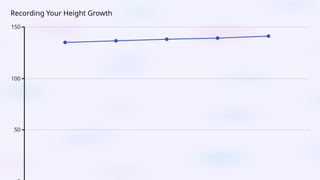
Creating your own height record can be a fun long-term measurement project! Choose a spot on a wall where you can make
permanent marks. Stand with your back against the wall, heels touching it, and look straight ahead. Have an adult place a
flat object (like a book) on top of your head and make a small mark on the wall.
Use a measuring tape to record the height in centimetres from the floor to the mark. Write the date next to it. Repeat this
every three months, always at the same time of day (height varies slightly throughout the day). Over time, you'll create a
visual record of your growth pattern and practice your measurement skills!
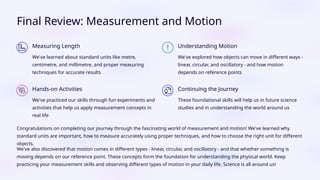
60.
Final Review: Measurementand Motion
Measuring Length
We've learned about standard units like metre,
centimetre, and millimetre, and proper measuring
techniques for accurate results
Understanding Motion
We've explored how objects can move in different ways -
linear, circular, and oscillatory - and how motion
depends on reference points
Hands-on Activities
We've practiced our skills through fun experiments and
activities that help us apply measurement concepts in
real life
Continuing the Journey
These foundational skills will help us in future science
studies and in understanding the world around us
Congratulations on completing our journey through the fascinating world of measurement and motion! We've learned why
standard units are important, how to measure accurately using proper techniques, and how to choose the right unit for different
objects.
We've also discovered that motion comes in different types - linear, circular, and oscillatory - and that whether something is
moving depends on our reference point. These concepts form the foundation for understanding the physical world. Keep
practicing your measurement skills and observing different types of motion in your daily life. Science is all around us!
 Most read
 Most read
 Most read