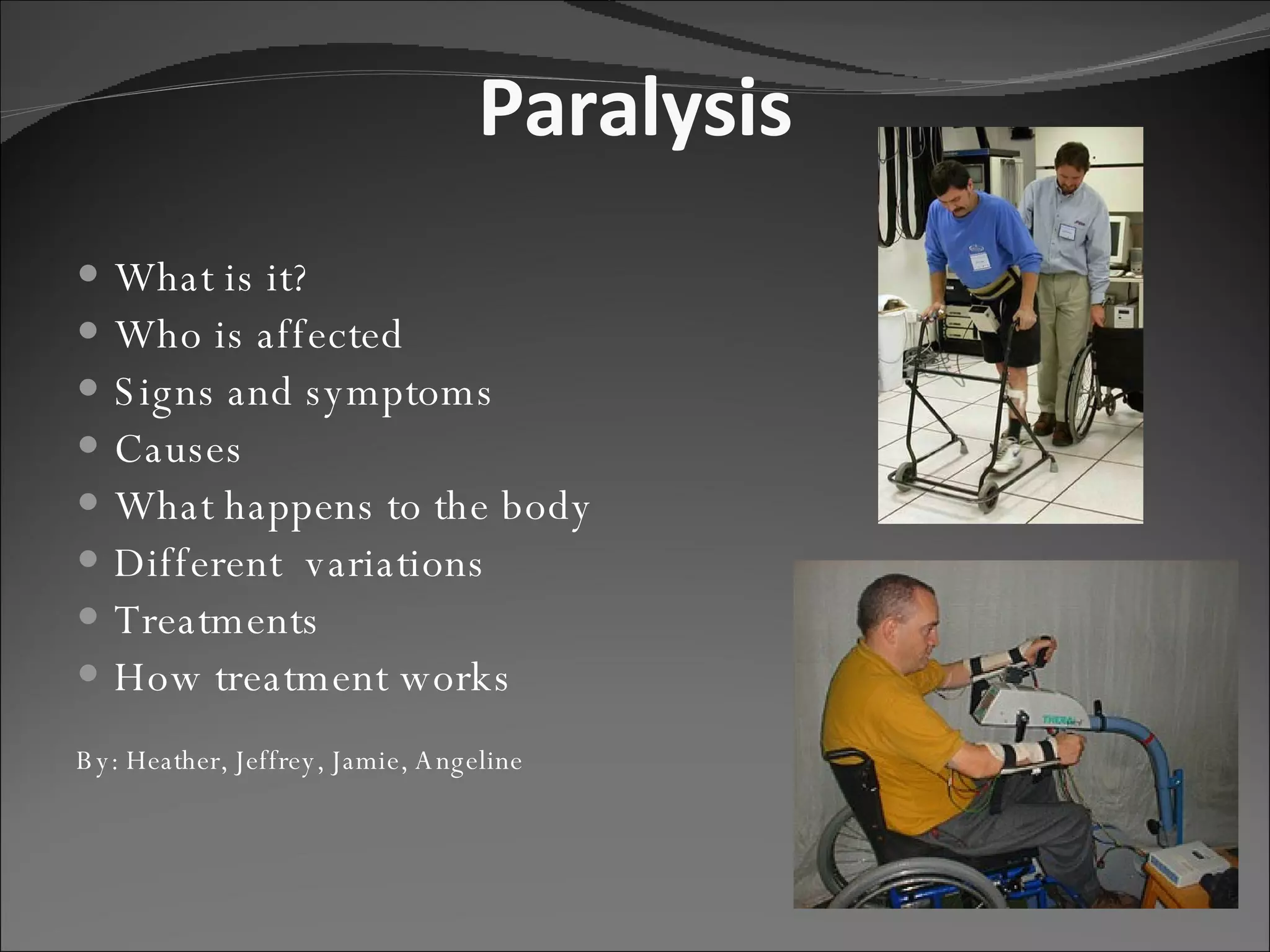
Paralysis What is it? Who is affected Signs and symptoms Causes What happens to the body Different  variations Treatments How treatment works By: Heather, Jeffrey, Jamie, Angeline
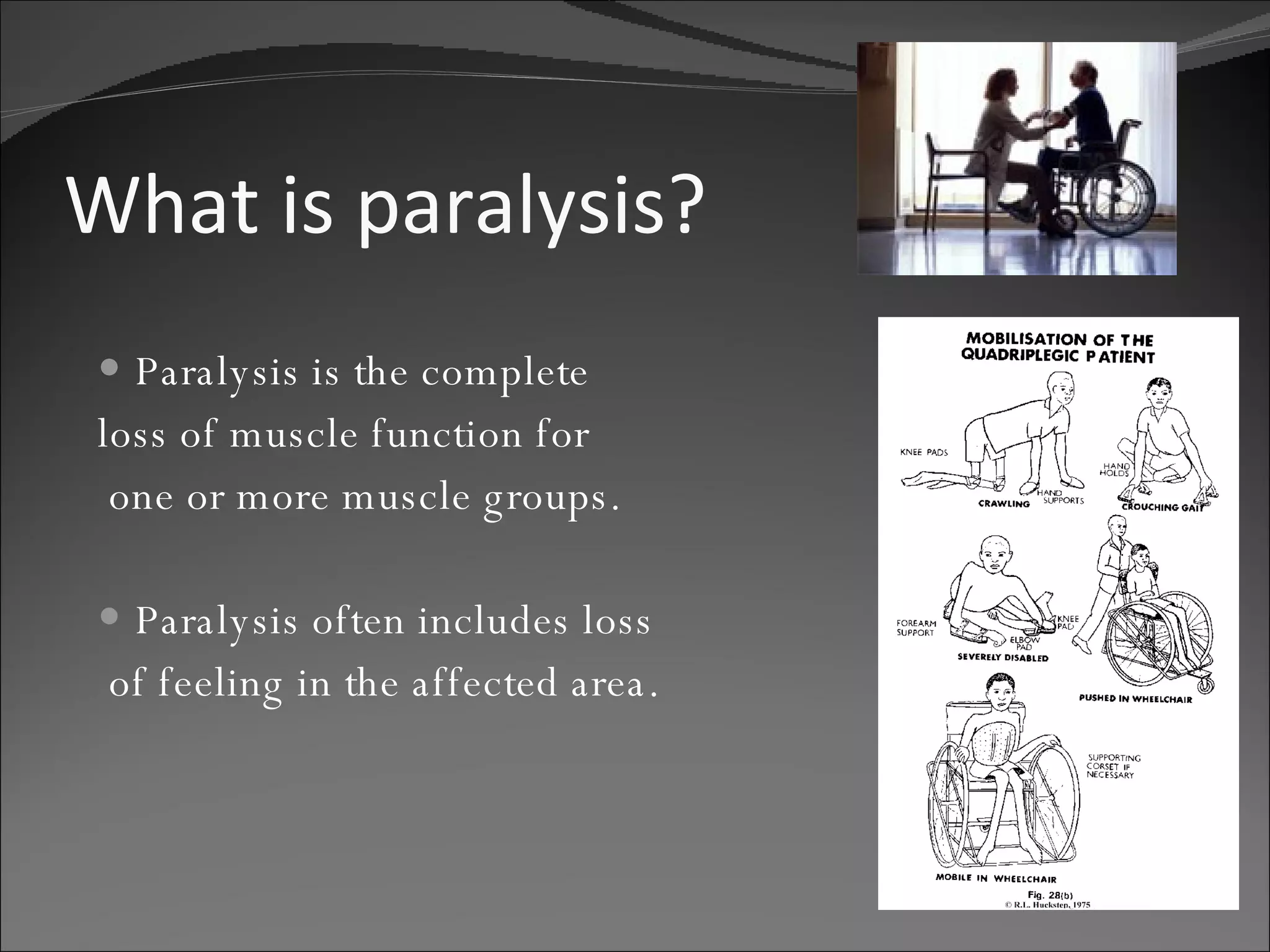
What is paralysis? Paralysis   is the complete  loss of muscle function for one or more muscle groups.  Paralysis often includes loss of feeling in the affected area.
Types of Paralysis Paralysis is caused by damage to a neuron (nerve supplying to muscle) Upper motor neurons convey the message from the brain to the nervous system -Damage causes an increased tightening in muscle called spasticity. Lower motor neurons provide the final path for the signal to reach the muscle -Damage leads to loss of tone called flaccidity
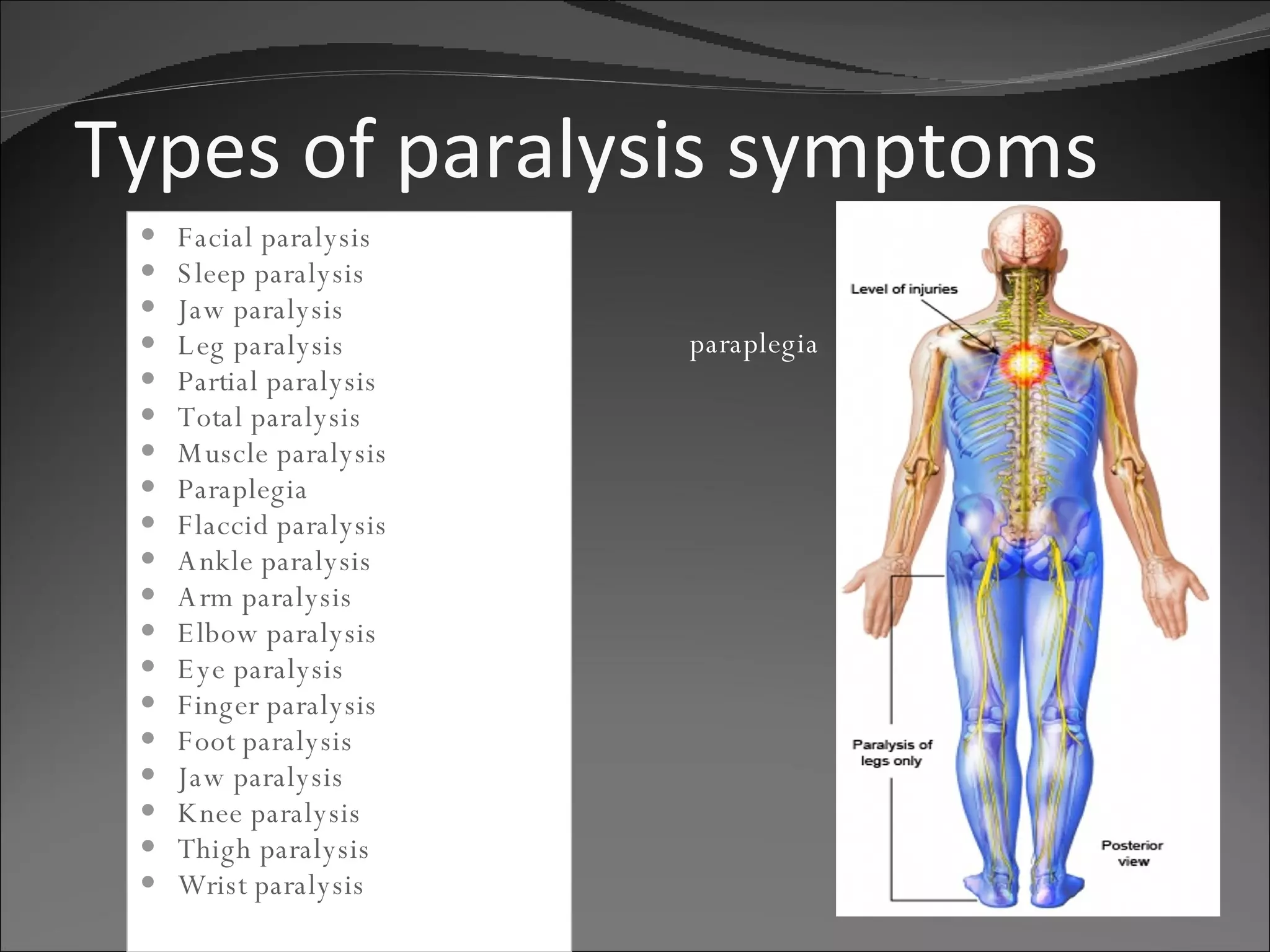
Types of paralysis symptoms Facial paralysis   Sleep paralysis   Jaw paralysis   Leg paralysis   Partial paralysis   Total paralysis   Muscle paralysis   Paraplegia   Flaccid paralysis   Ankle paralysis   Arm paralysis   Elbow paralysis   Eye paralysis   Finger paralysis   Foot paralysis   Jaw paralysis   Knee paralysis   Thigh paralysis   Wrist paralysis   paraplegia
Signs and symptoms Sudden paralysis is most often caused by injury or stroke.  Damage to the right side of the brain - paralysis on the left side of the body Damage to the spine -equal sided paralysis Damage to the lower spine - paralysis of both legs (paraplegia) Damage done higher on the spine  -  paralysis of all four limbs (quadriplegia)
More signs and symptoms symptoms may include : numbness  tingling pain changes in vision difficulties with speech problems with balance difficulties in breathing. Numbness  Tingling in leg
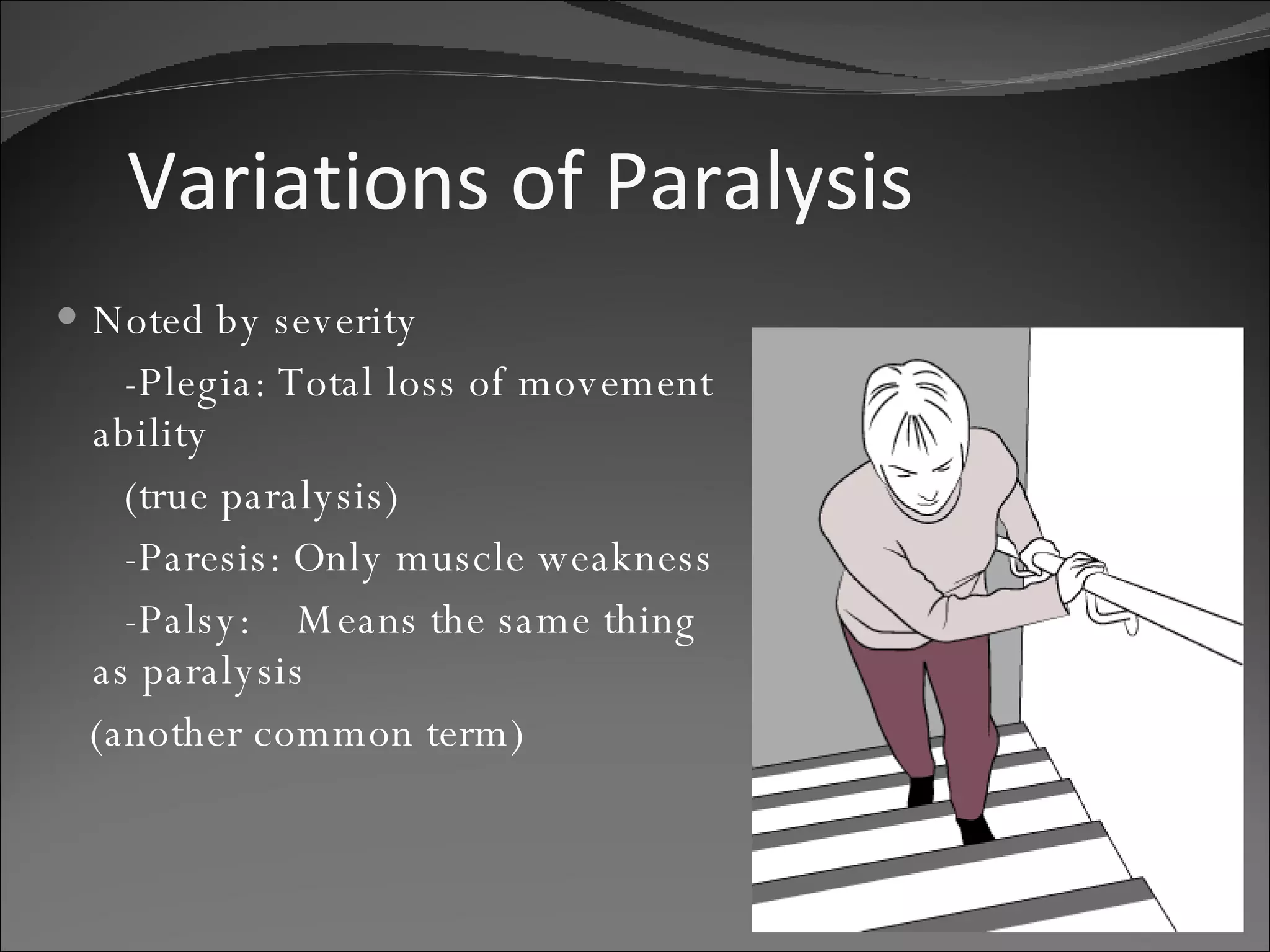
Variations of Paralysis Noted by severity -Plegia: Total loss of movement ability  (true paralysis) -Paresis: Only muscle weakness -Palsy:  Means the same thing as paralysis  (another common term)
Upper and Lower Neuron Damage The range of causes is very vast and is complicated further when both neuron groups are affected. Conditions that affect the brain and spinal cord usually result in upper motor neuron damage -i.e. Stroke, tumors, multiple sclerosis, spinal bifida, cerebral palsy, or severe injury to the neck, head, or back Lower motor neuron damage resulting in flaccid paralysis is less common and can occur when an injury to a limb involves a nerve supplying to muscle -i.e. An injury to the upper arm could lead to the loss of movement in the hand and forearm
Polyneuropathies A large number of rather rare disorders that can cause more widespread paralysis Can be inherited May be triggered by drugs, allergies, or poison May be a symptom of diabetes A more well known example would be poliomyelitis
Motor Neuron Disease A group of progressive neurological disorders that destroy motor neurons Causes both types of paralysis -This can also occur when people suffer severe injuries such as head or spinal injury, along with lower motor neuron paralysis from injury to the nerves providing to muscle.
Who is affected? Strokes (certain types) Spinal cord injuries Broken necks Neurological diseases Autoimmune diseases Bell’s palsy Source: Medline Plus
Treatments and how the treatment works Physical therapy Mobility Range of motion Muscle strength Source: Health A to Z
Treatments and how the treatment works Occupational therapy Modify home Allow self-care Other  Respiratory therapist Psychologist Speech therapist Respiratory therapist
Work cited page Health A to Z Medline Plus Brain an spine foundation Wrong diagnosis  Power point and presentation by: Heather, Jamie, Jeffrey and Angeline

Paralysis

  • 1.
    Paralysis What isit? Who is affected Signs and symptoms Causes What happens to the body Different variations Treatments How treatment works By: Heather, Jeffrey, Jamie, Angeline
  • 2.
    What is paralysis?Paralysis is the complete loss of muscle function for one or more muscle groups. Paralysis often includes loss of feeling in the affected area.
  • 3.
    Types of ParalysisParalysis is caused by damage to a neuron (nerve supplying to muscle) Upper motor neurons convey the message from the brain to the nervous system -Damage causes an increased tightening in muscle called spasticity. Lower motor neurons provide the final path for the signal to reach the muscle -Damage leads to loss of tone called flaccidity
  • 4.
    Types of paralysissymptoms Facial paralysis Sleep paralysis Jaw paralysis Leg paralysis Partial paralysis Total paralysis Muscle paralysis Paraplegia Flaccid paralysis Ankle paralysis Arm paralysis Elbow paralysis Eye paralysis Finger paralysis Foot paralysis Jaw paralysis Knee paralysis Thigh paralysis Wrist paralysis paraplegia
  • 5.
    Signs and symptomsSudden paralysis is most often caused by injury or stroke. Damage to the right side of the brain - paralysis on the left side of the body Damage to the spine -equal sided paralysis Damage to the lower spine - paralysis of both legs (paraplegia) Damage done higher on the spine - paralysis of all four limbs (quadriplegia)
  • 6.
    More signs andsymptoms symptoms may include : numbness tingling pain changes in vision difficulties with speech problems with balance difficulties in breathing. Numbness Tingling in leg
  • 7.
    Variations of ParalysisNoted by severity -Plegia: Total loss of movement ability (true paralysis) -Paresis: Only muscle weakness -Palsy: Means the same thing as paralysis (another common term)
  • 8.
    Upper and LowerNeuron Damage The range of causes is very vast and is complicated further when both neuron groups are affected. Conditions that affect the brain and spinal cord usually result in upper motor neuron damage -i.e. Stroke, tumors, multiple sclerosis, spinal bifida, cerebral palsy, or severe injury to the neck, head, or back Lower motor neuron damage resulting in flaccid paralysis is less common and can occur when an injury to a limb involves a nerve supplying to muscle -i.e. An injury to the upper arm could lead to the loss of movement in the hand and forearm
  • 9.
    Polyneuropathies A largenumber of rather rare disorders that can cause more widespread paralysis Can be inherited May be triggered by drugs, allergies, or poison May be a symptom of diabetes A more well known example would be poliomyelitis
  • 10.
    Motor Neuron DiseaseA group of progressive neurological disorders that destroy motor neurons Causes both types of paralysis -This can also occur when people suffer severe injuries such as head or spinal injury, along with lower motor neuron paralysis from injury to the nerves providing to muscle.
  • 11.
    Who is affected?Strokes (certain types) Spinal cord injuries Broken necks Neurological diseases Autoimmune diseases Bell’s palsy Source: Medline Plus
  • 12.
    Treatments and howthe treatment works Physical therapy Mobility Range of motion Muscle strength Source: Health A to Z
  • 13.
    Treatments and howthe treatment works Occupational therapy Modify home Allow self-care Other Respiratory therapist Psychologist Speech therapist Respiratory therapist
  • 14.
    Work cited pageHealth A to Z Medline Plus Brain an spine foundation Wrong diagnosis Power point and presentation by: Heather, Jamie, Jeffrey and Angeline