What is Production Function?
The basic relationship between the factors of production and the output
is reffered to as a Production Function.
The firm’s production function for a particular good (q) shows the
maximum amount of the good that can be produced using alternative
combinations of capital (K) and labor (L)
q = f(K,L)
Important facts about production function
 A Production function is expressed with reference to a particular
period of time.
 It expresses a physical relation because both inputs and outputs are
expressed in physical terms.
 Prodction function describes a purely technological relation because
what can be produced from a given amount of inputs depends upon the
state of technology
TYPES OF PRODUCTION
FUNCTION
The nature of production function, ie.how output varies with change in the
quantity of inputs,depends upon the time period allowed for the adjustement
of inputs.
On this basis Production function is classified into two types:
Production function
short run production function- Time when one input (say, capital)
remains constant and an addition to output can be obtained only by using
more labour.
long run production function= Both inputs become variable
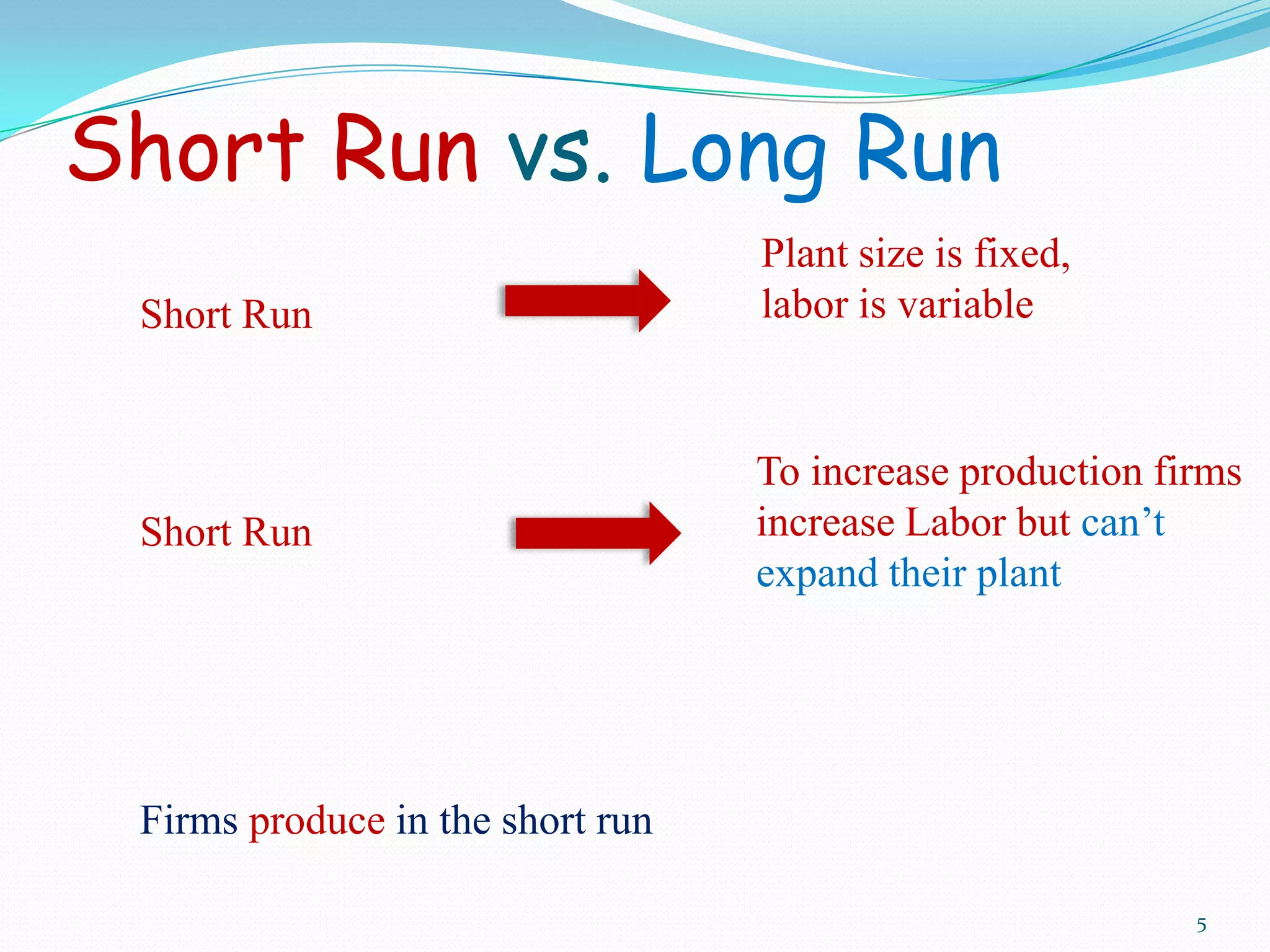
Short Run vs. Long Run
5
Plant size is fixed,
labor is variableShort Run
To increase production firms
increase Labor but can’t
expand their plant
Short Run
Firms produce in the short run
6
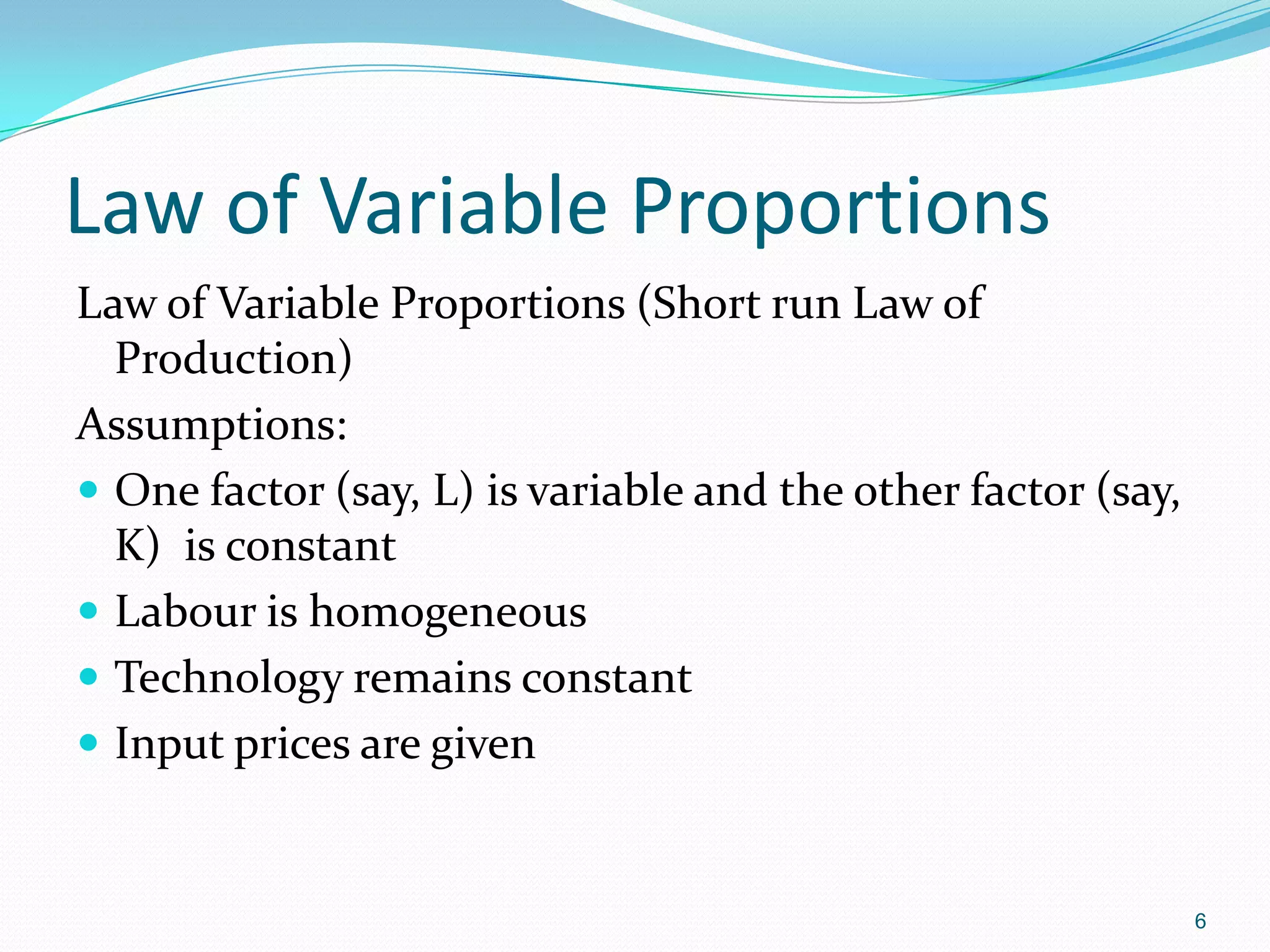
Law of Variable Proportions
Law of Variable Proportions (Short run Law of
Production)
Assumptions:
 One factor (say, L) is variable and the other factor (say,
K) is constant
 Labour is homogeneous
 Technology remains constant
 Input prices are given
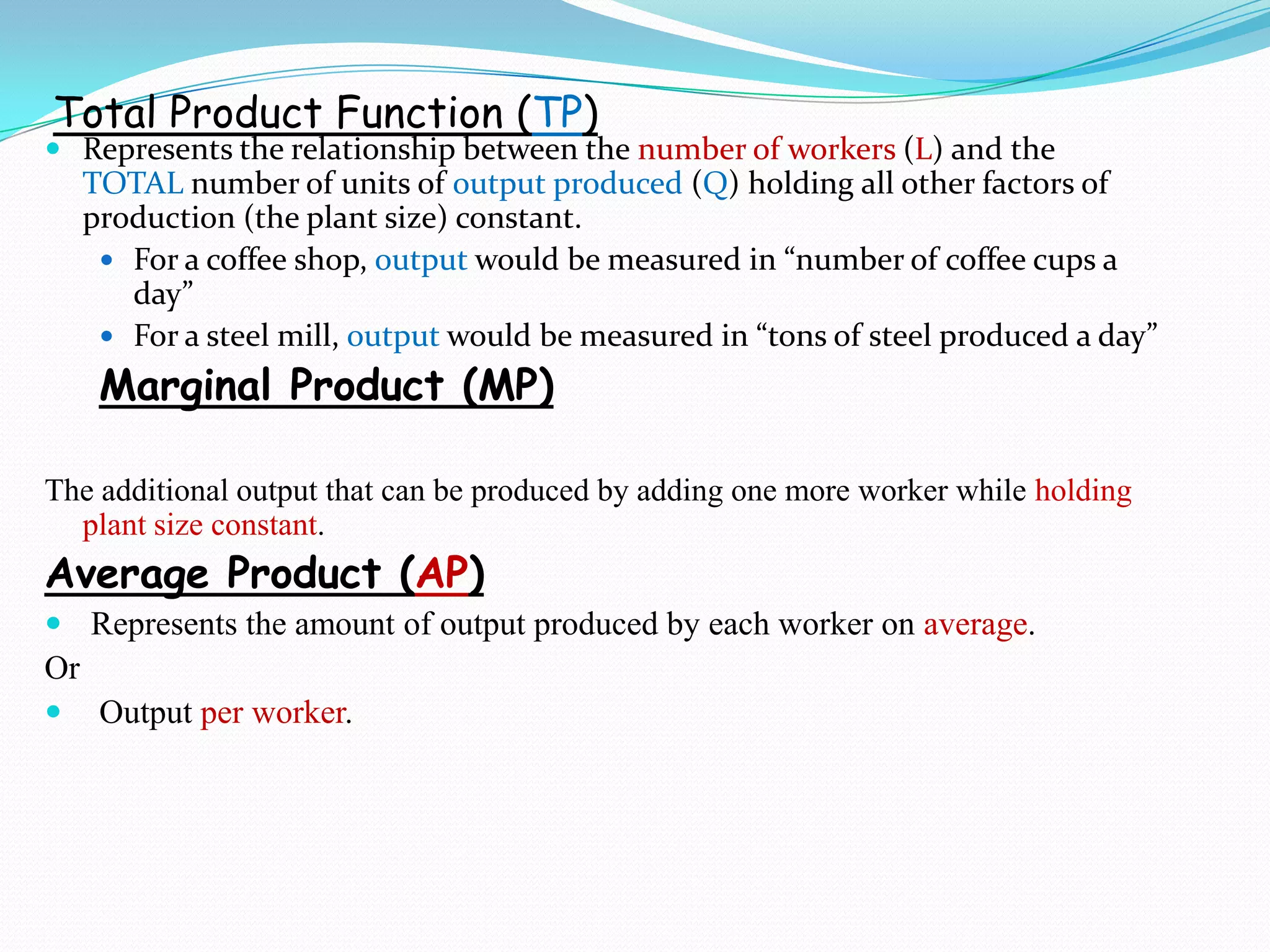
Total Product Function (TP)
 Represents the relationship between the number of workers (L) and the
TOTAL number of units of output produced (Q) holding all other factors of
production (the plant size) constant.
 For a coffee shop, output would be measured in “number of coffee cups a
day”
 For a steel mill, output would be measured in “tons of steel produced a day”
Marginal Product (MP)
The additional output that can be produced by adding one more worker while holding
plant size constant.
Average Product (AP)
 Represents the amount of output produced by each worker on average.
Or
 Output per worker.
Short run production function
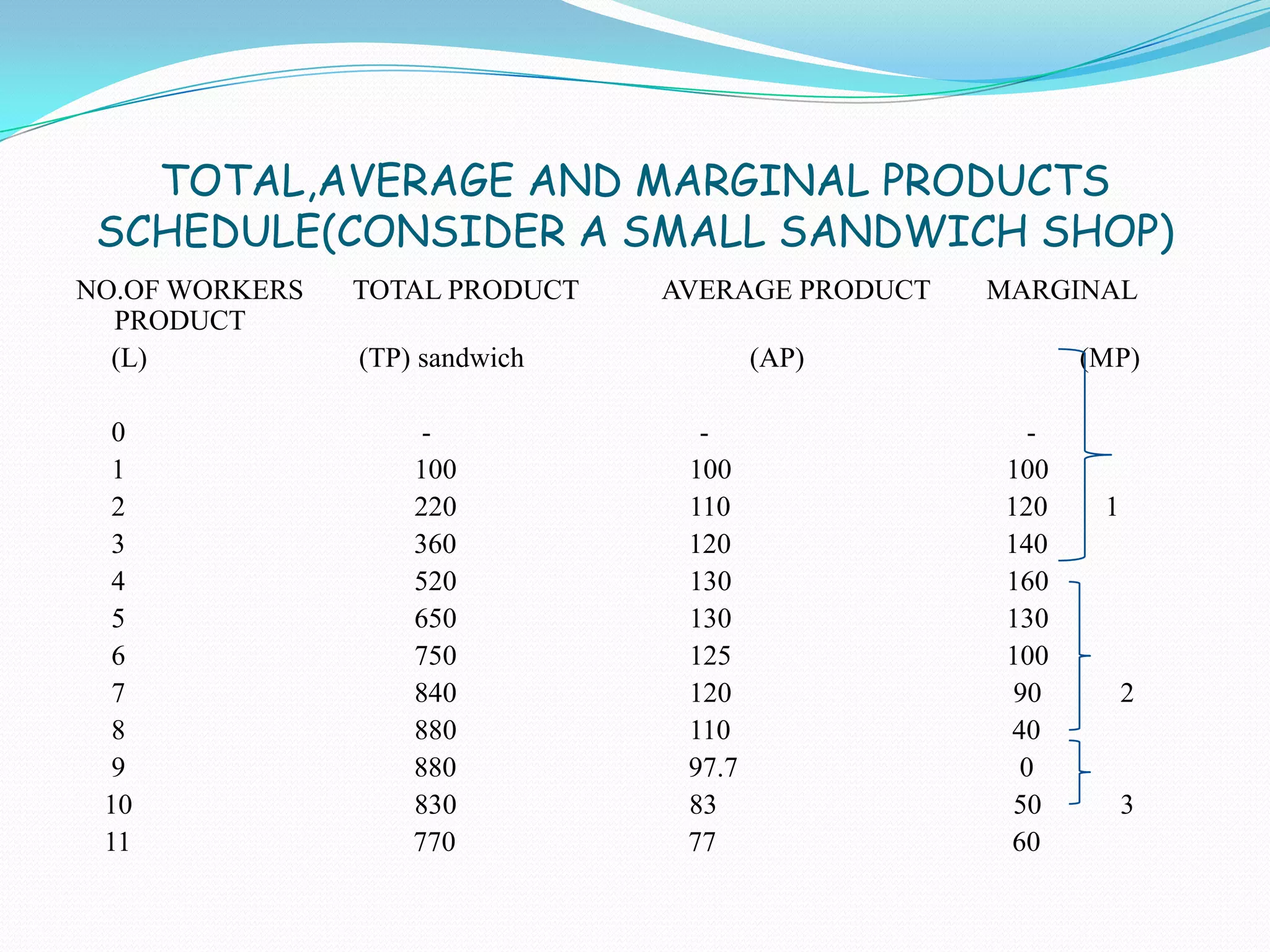
TOTAL,AVERAGE AND MARGINAL PRODUCTS
SCHEDULE(CONSIDER A SMALL SANDWICH SHOP)
NO.OF WORKERS TOTAL PRODUCT AVERAGE PRODUCT MARGINAL
PRODUCT
(L) (TP) sandwich (AP) (MP)
0 - - -
1 100 100 100
2 220 110 120 1
3 360 120 140
4 520 130 160
5 650 130 130
6 750 125 100
7 840 120 90 2
8 880 110 40
9 880 97.7 0
10 830 83 50 3
11 770 77 60
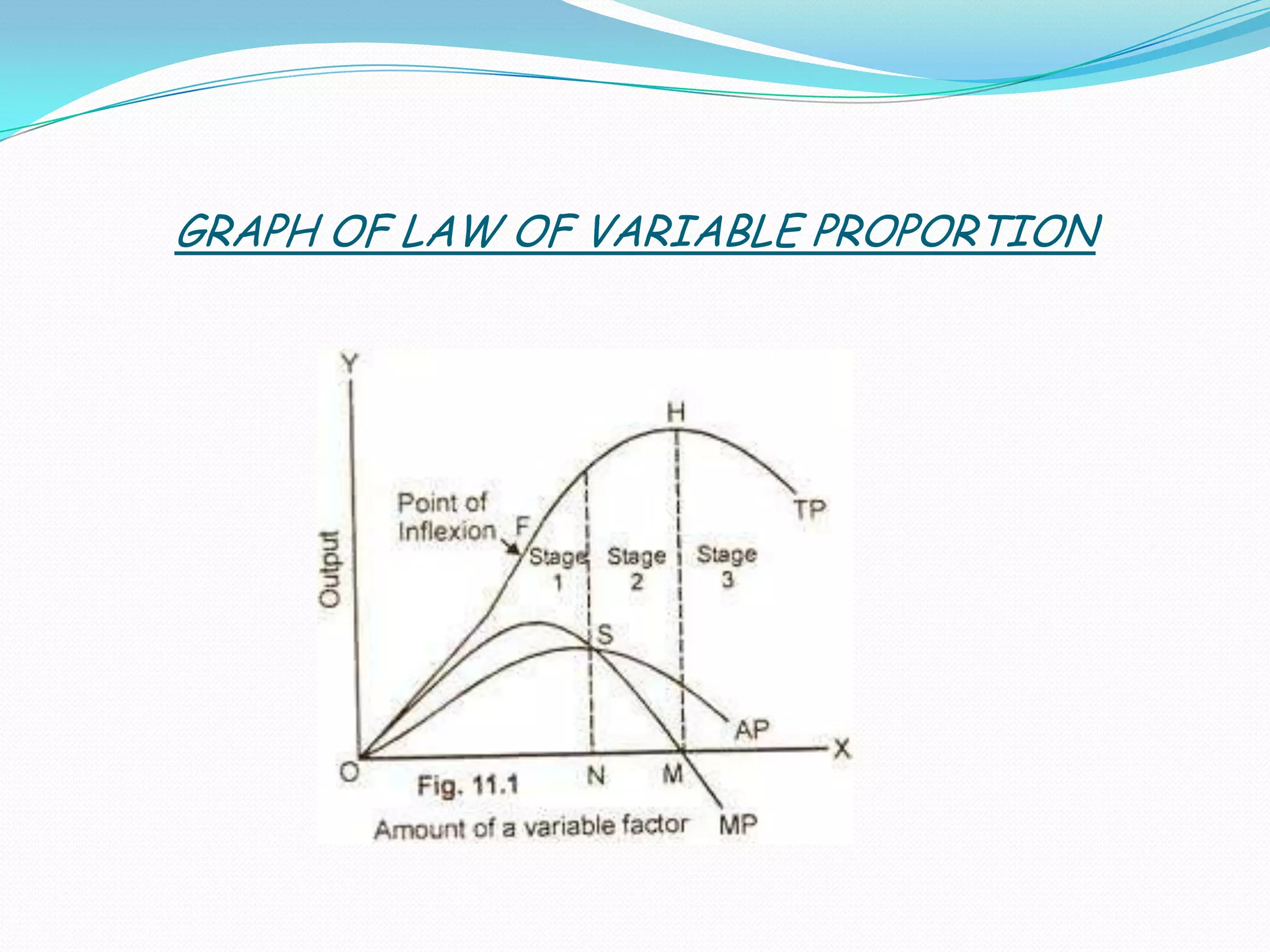
GRAPH OF LAW OF VARIABLE PROPORTION
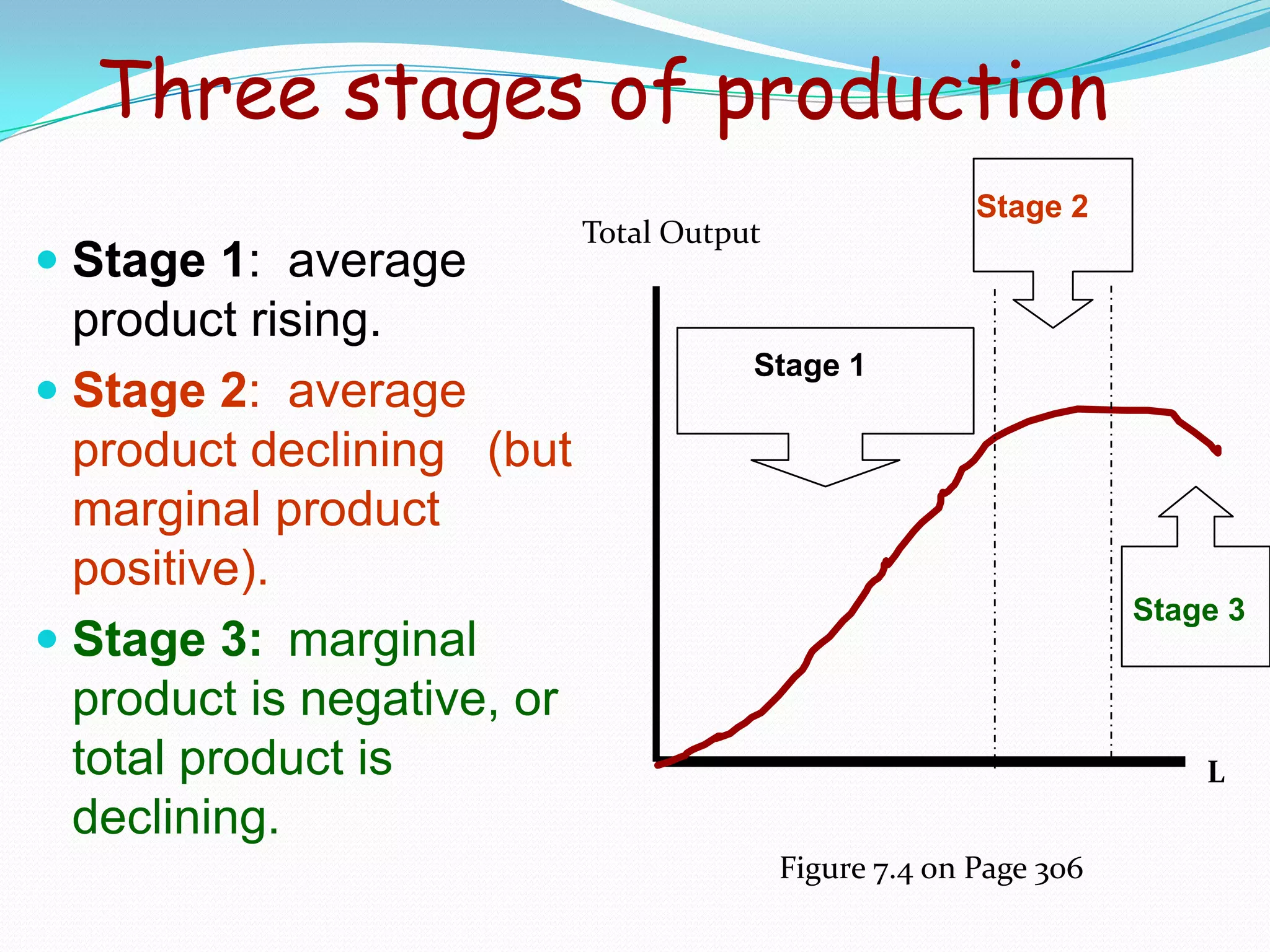
Figure 7.4 on Page 306
Three stages of production
 Stage 1: average
product rising.
 Stage 2: average
product declining (but
marginal product
positive).
 Stage 3: marginal
product is negative, or
total product is
declining.
L
Total Output
Stage 1
Stage 2
Stage 3
RELATIONSHIP BETWEEN DIFFERENT PRODUCTS
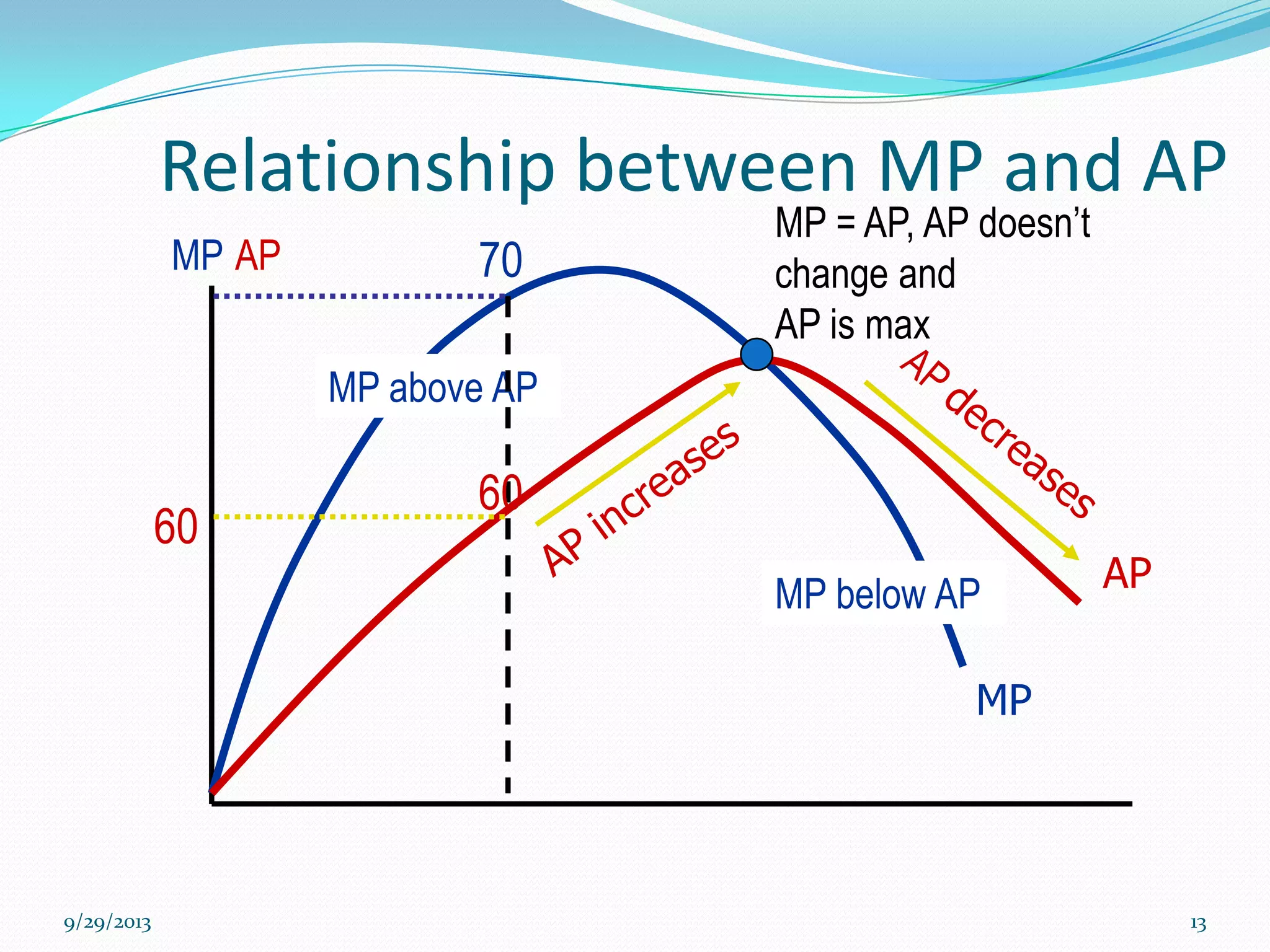
Between AP and MP
 WHEN MP > AP,AP INCREASES
 WHEN MP < AP,AP DECREASES
 WHEN MP = AP,AP IS MAXIMUM
Between TP and MP
 WHEN TP INCREASES AT INCREASING RATE,MP INCREASES
 WHEN TP INCREASES AT DECREASING RATE,MP DECREASES
 WHEN TP IS MAXIMUM,MP IS 0
 WHEN TP DECREASES,MP IS NEGATIVE
Relationship between MP and AP
9/29/2013 13
MP
APMP below AP
MP above AP
MP AP
MP = AP, AP doesn’t
change and
AP is max
70
60
60
conclusion
 Production function is simply a catalogue of
production possibilities.
 It is an engineering concept and since money prices do
not appear in it,it merely depicts the physical
relationship between the output and inputs.
Production function

Production function

  • 2.
    What is ProductionFunction? The basic relationship between the factors of production and the output is reffered to as a Production Function. The firm’s production function for a particular good (q) shows the maximum amount of the good that can be produced using alternative combinations of capital (K) and labor (L) q = f(K,L)
  • 3.
    Important facts aboutproduction function  A Production function is expressed with reference to a particular period of time.  It expresses a physical relation because both inputs and outputs are expressed in physical terms.  Prodction function describes a purely technological relation because what can be produced from a given amount of inputs depends upon the state of technology
  • 4.
    TYPES OF PRODUCTION FUNCTION Thenature of production function, ie.how output varies with change in the quantity of inputs,depends upon the time period allowed for the adjustement of inputs. On this basis Production function is classified into two types: Production function short run production function- Time when one input (say, capital) remains constant and an addition to output can be obtained only by using more labour. long run production function= Both inputs become variable
  • 5.
    Short Run vs.Long Run 5 Plant size is fixed, labor is variableShort Run To increase production firms increase Labor but can’t expand their plant Short Run Firms produce in the short run
  • 6.
    6 Law of VariableProportions Law of Variable Proportions (Short run Law of Production) Assumptions:  One factor (say, L) is variable and the other factor (say, K) is constant  Labour is homogeneous  Technology remains constant  Input prices are given
  • 7.
    Total Product Function(TP)  Represents the relationship between the number of workers (L) and the TOTAL number of units of output produced (Q) holding all other factors of production (the plant size) constant.  For a coffee shop, output would be measured in “number of coffee cups a day”  For a steel mill, output would be measured in “tons of steel produced a day” Marginal Product (MP) The additional output that can be produced by adding one more worker while holding plant size constant. Average Product (AP)  Represents the amount of output produced by each worker on average. Or  Output per worker.
  • 8.
  • 9.
    TOTAL,AVERAGE AND MARGINALPRODUCTS SCHEDULE(CONSIDER A SMALL SANDWICH SHOP) NO.OF WORKERS TOTAL PRODUCT AVERAGE PRODUCT MARGINAL PRODUCT (L) (TP) sandwich (AP) (MP) 0 - - - 1 100 100 100 2 220 110 120 1 3 360 120 140 4 520 130 160 5 650 130 130 6 750 125 100 7 840 120 90 2 8 880 110 40 9 880 97.7 0 10 830 83 50 3 11 770 77 60
  • 10.
    GRAPH OF LAWOF VARIABLE PROPORTION
  • 11.
    Figure 7.4 onPage 306 Three stages of production  Stage 1: average product rising.  Stage 2: average product declining (but marginal product positive).  Stage 3: marginal product is negative, or total product is declining. L Total Output Stage 1 Stage 2 Stage 3
  • 12.
    RELATIONSHIP BETWEEN DIFFERENTPRODUCTS Between AP and MP  WHEN MP > AP,AP INCREASES  WHEN MP < AP,AP DECREASES  WHEN MP = AP,AP IS MAXIMUM Between TP and MP  WHEN TP INCREASES AT INCREASING RATE,MP INCREASES  WHEN TP INCREASES AT DECREASING RATE,MP DECREASES  WHEN TP IS MAXIMUM,MP IS 0  WHEN TP DECREASES,MP IS NEGATIVE
  • 13.
    Relationship between MPand AP 9/29/2013 13 MP APMP below AP MP above AP MP AP MP = AP, AP doesn’t change and AP is max 70 60 60
  • 14.
    conclusion  Production functionis simply a catalogue of production possibilities.  It is an engineering concept and since money prices do not appear in it,it merely depicts the physical relationship between the output and inputs.