TOPIC 8 SOLUTION OF LINEAR EQUALITY AND LINEAR  INEQUALITY WITH ONE  VARIABLE . GRAPH INEQUALITY
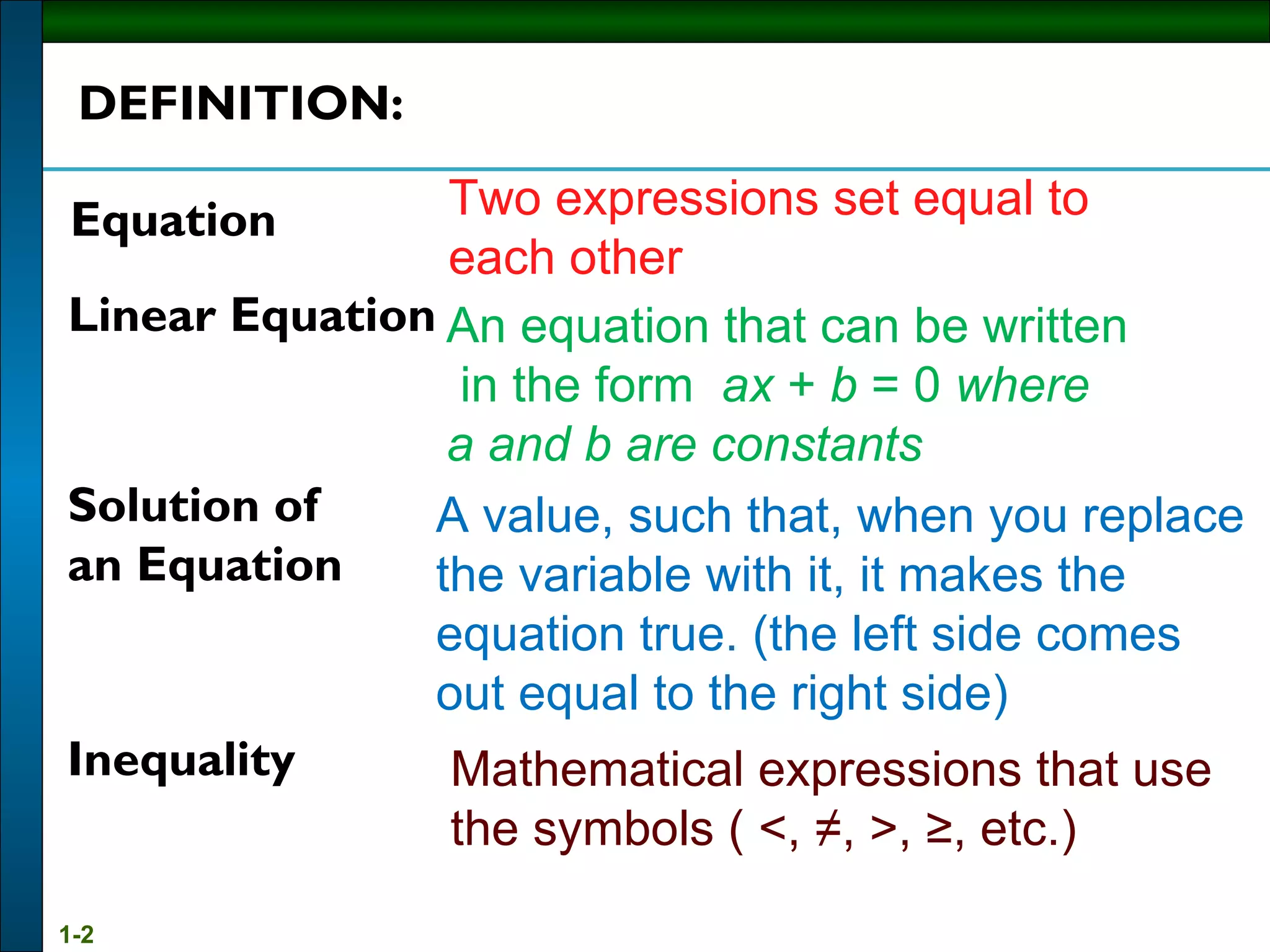
DEFINITION: Equation Inequality Solution of  an Equation Two expressions set equal to  each other Linear Equation An equation that can be written in the form   ax  +  b  = 0  where  a and b are constants   A value, such that, when you replace the variable with it, it makes the equation true. (the left side comes out equal to the right side) Mathematical expressions that use the symbols ( <, ≠, >, ≥, etc.)
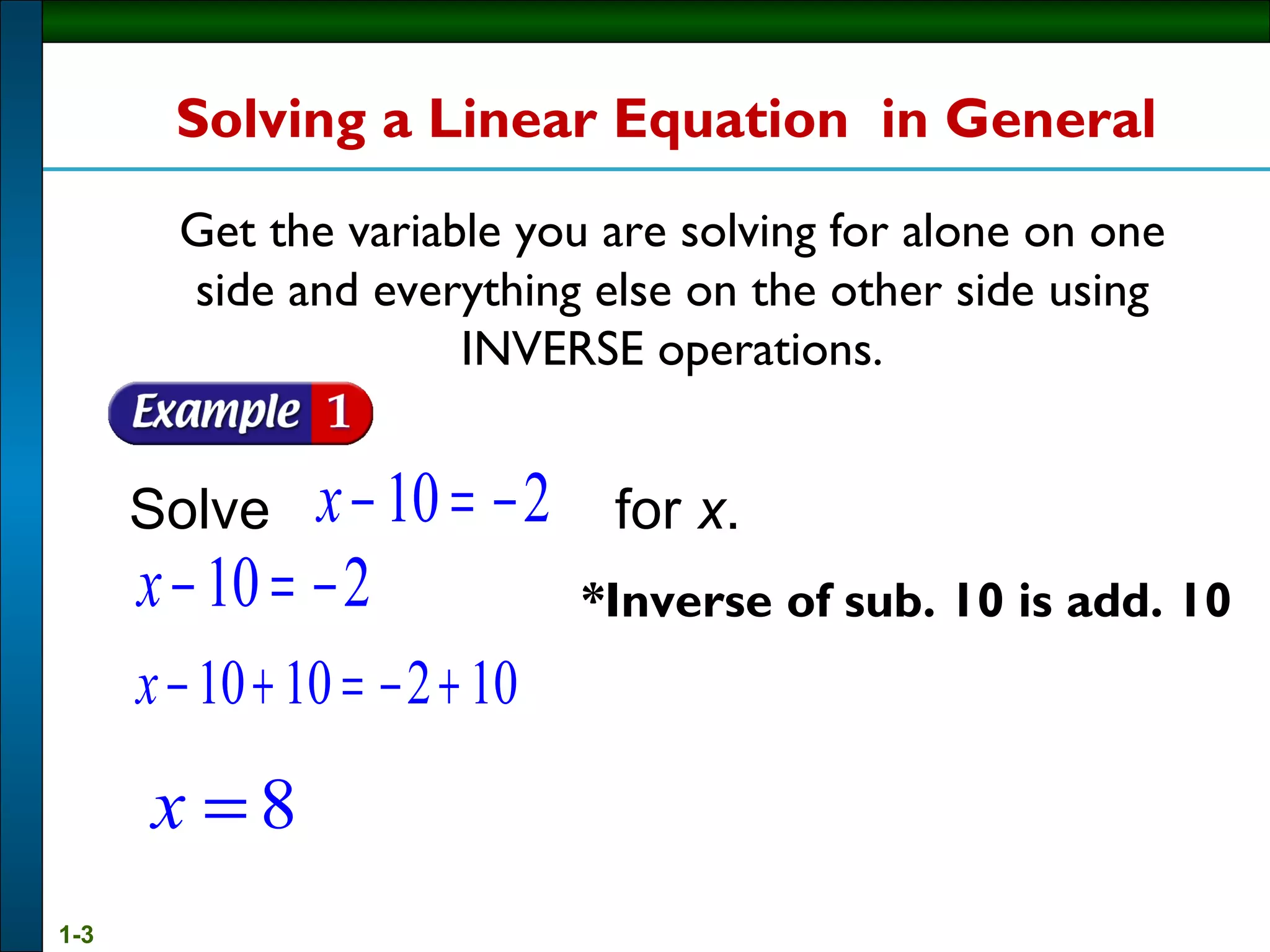
Solve   for  x .  Solving a Linear Equation    in General   Get the variable you are solving for alone on one side and everything else on the other side using INVERSE operations. *Inverse of sub. 10 is add. 10
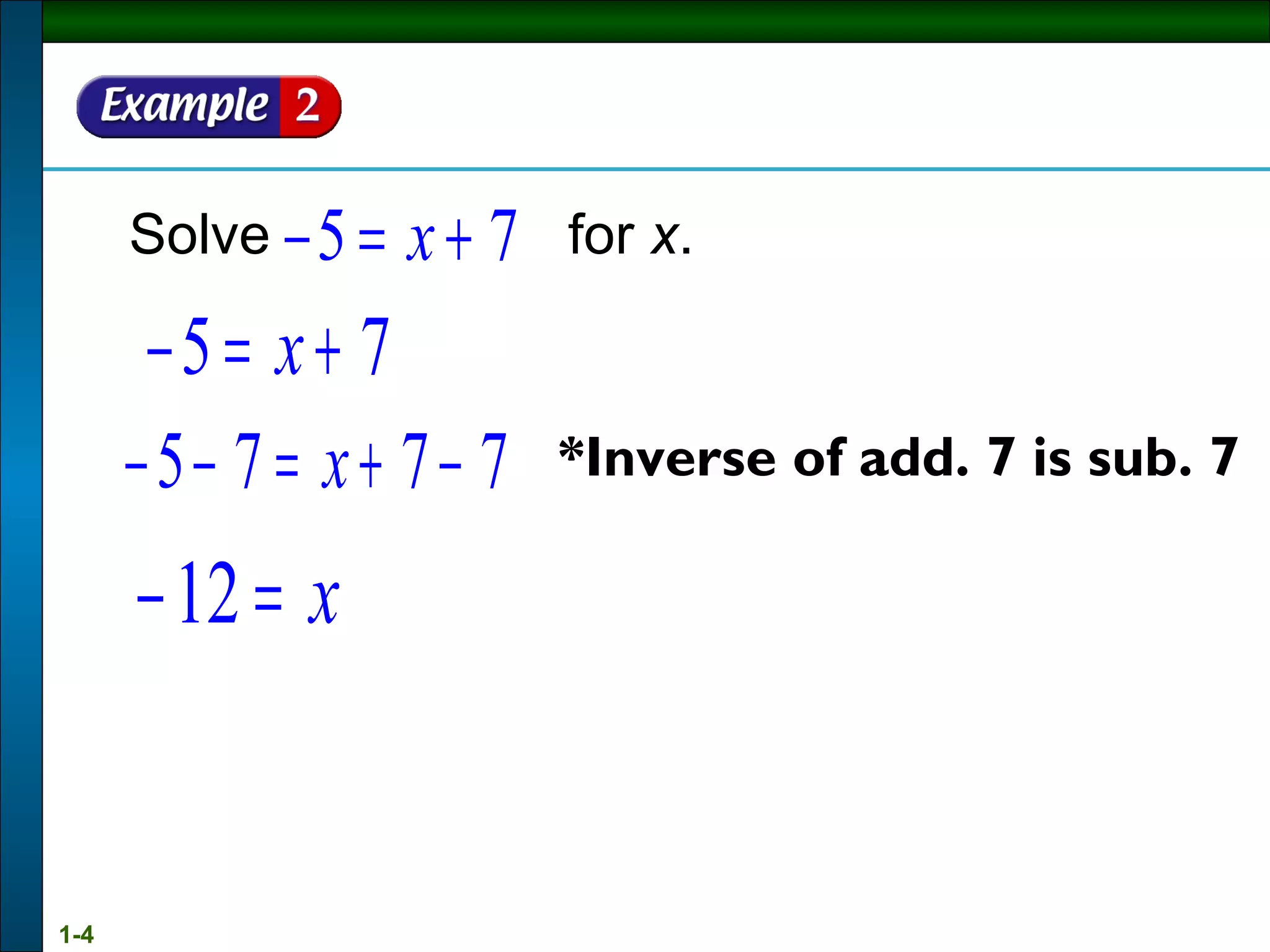
Solve      for  x .  *Inverse of add. 7 is sub. 7
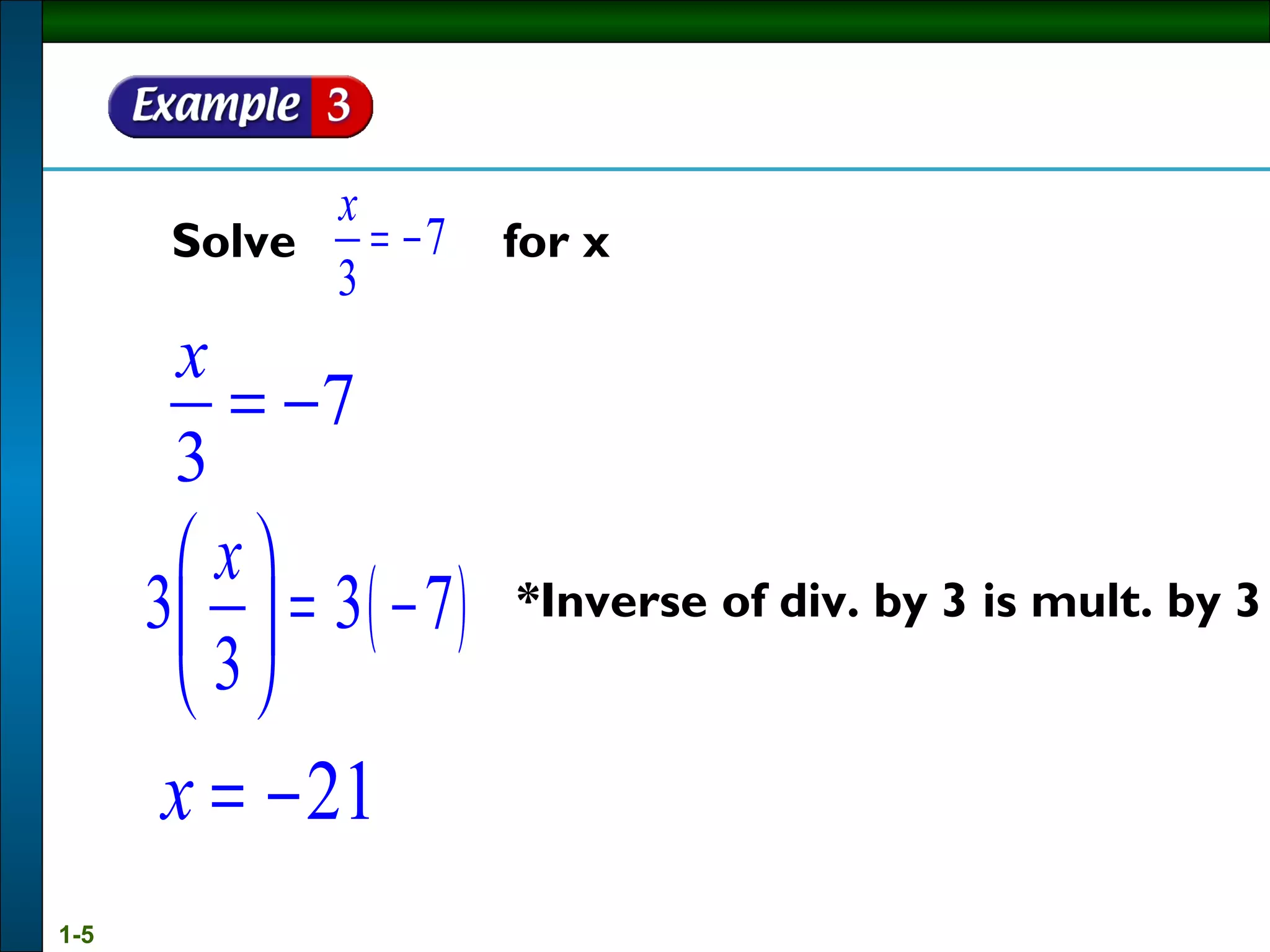
*Inverse of div. by 3 is mult. by 3 Solve  for x
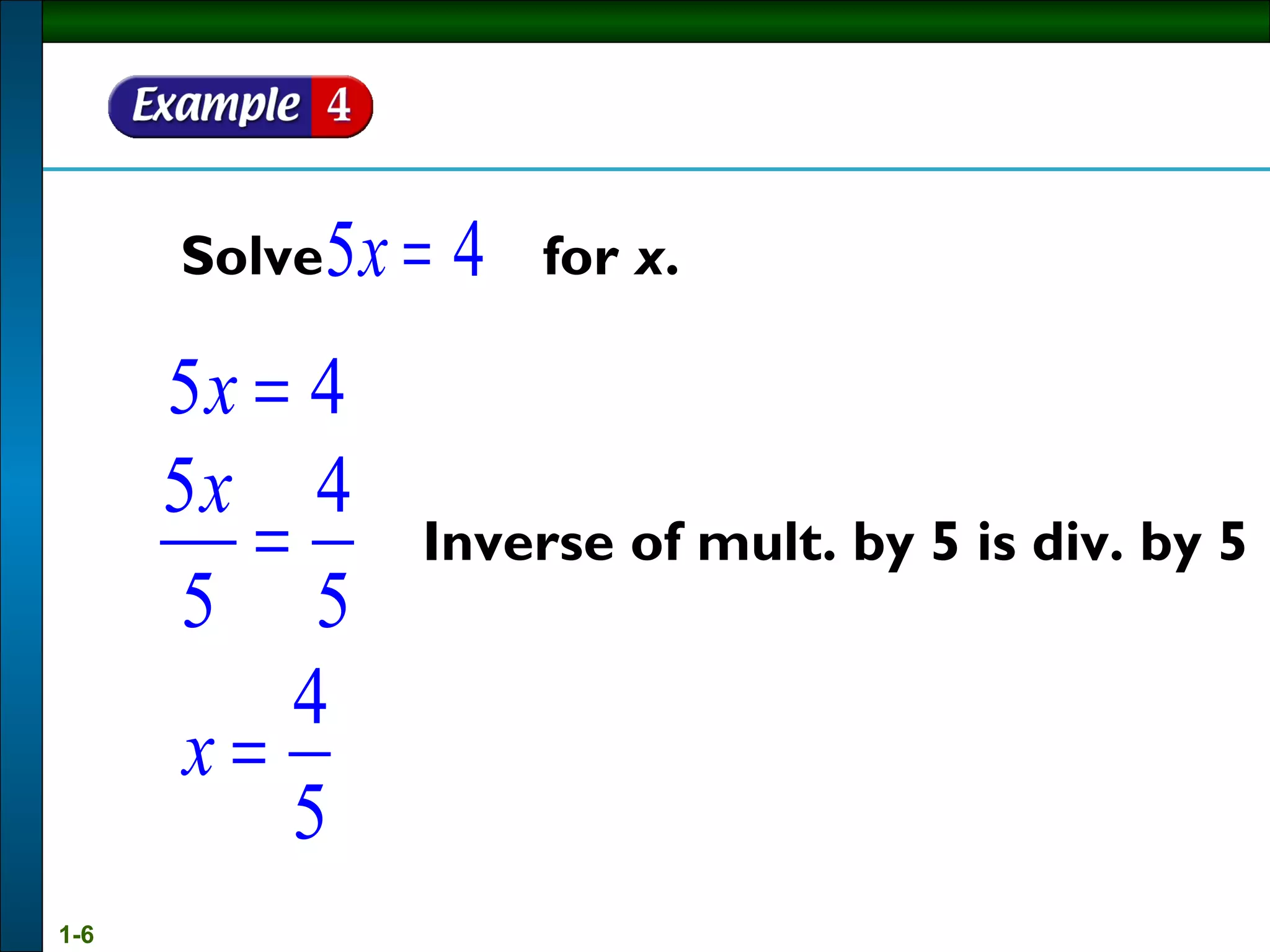
Inverse of mult. by 5 is div. by 5   Solve    for  x .
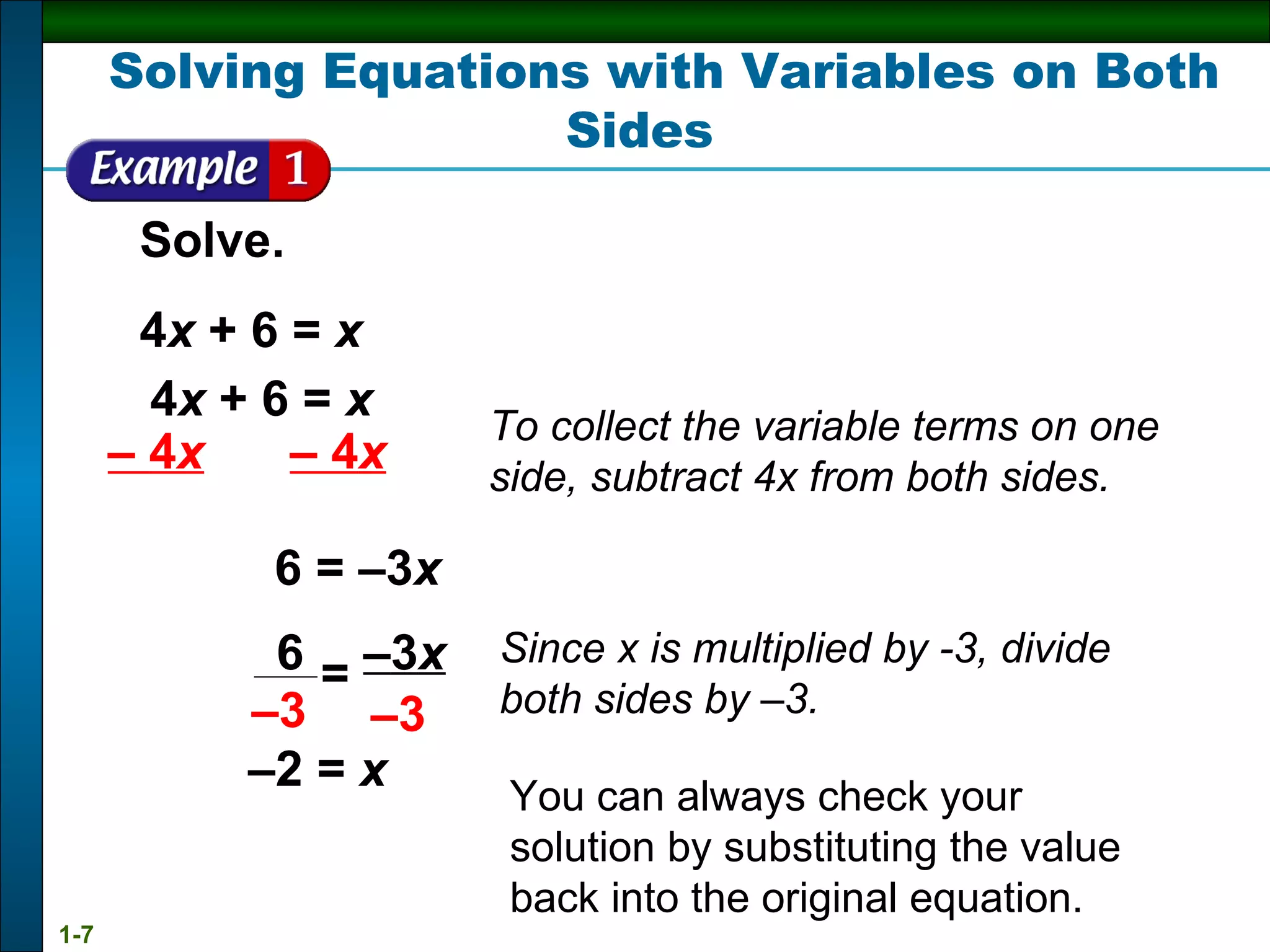
Solve. 4 x  + 6 =  x Solving Equations with Variables on Both Sides 4 x  + 6 =  x –  4 x   – 4 x 6 = –3 x To collect the variable terms on one side, subtract 4x from both sides. Since x is multiplied by -3, divide both sides by  – 3. – 2 =  x   You can always check your solution by substituting the value back into the original equation.  6 – 3 – 3 x – 3 =
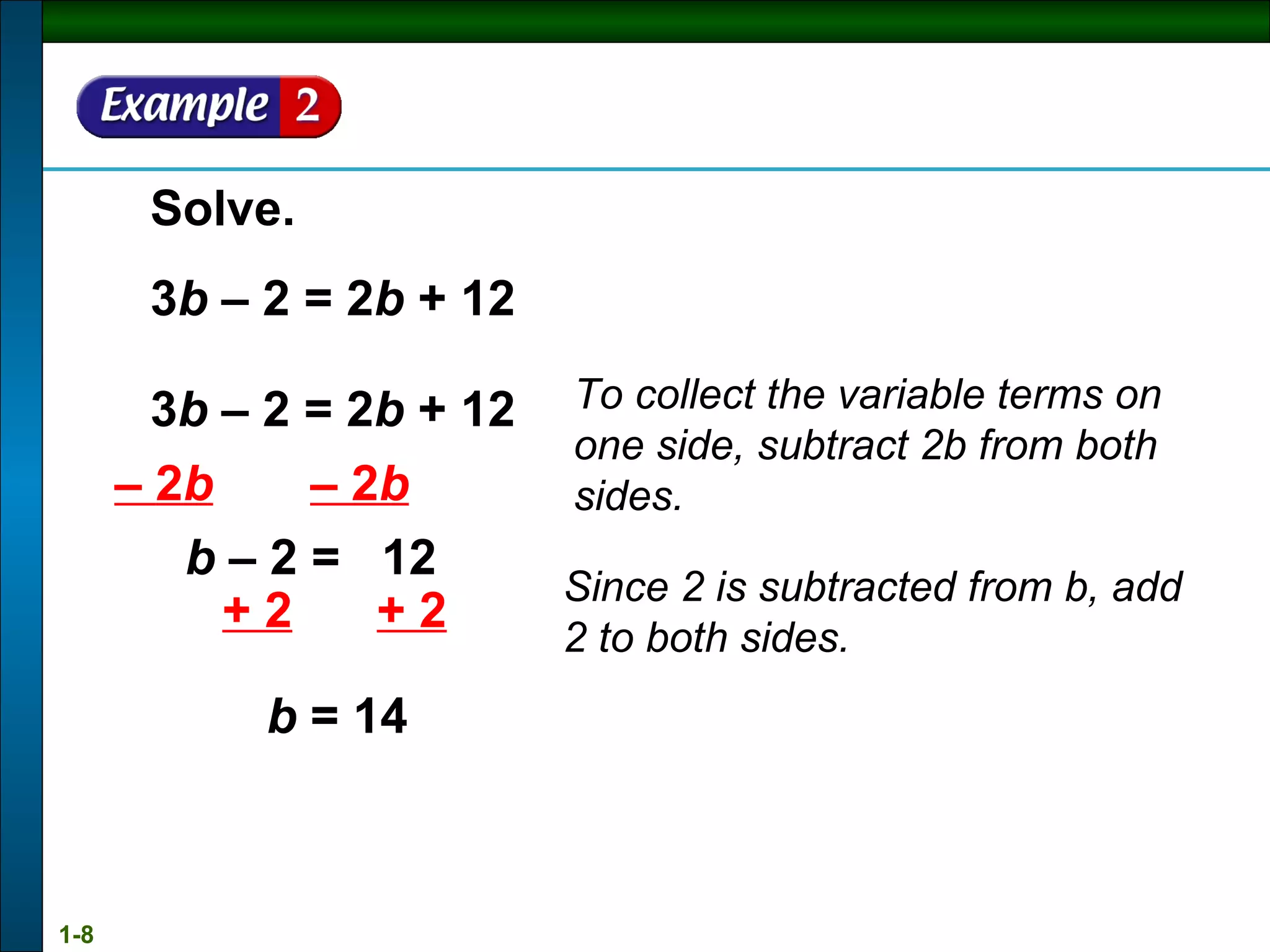
Solve. 3 b  – 2 = 2 b  + 12 3 b  – 2 = 2 b  + 12 –  2 b   – 2 b b  – 2 =  12 + 2   + 2 b  = 14 Since 2 is subtracted from b, add 2 to both sides. To collect the variable terms on one side, subtract 2b from both sides.
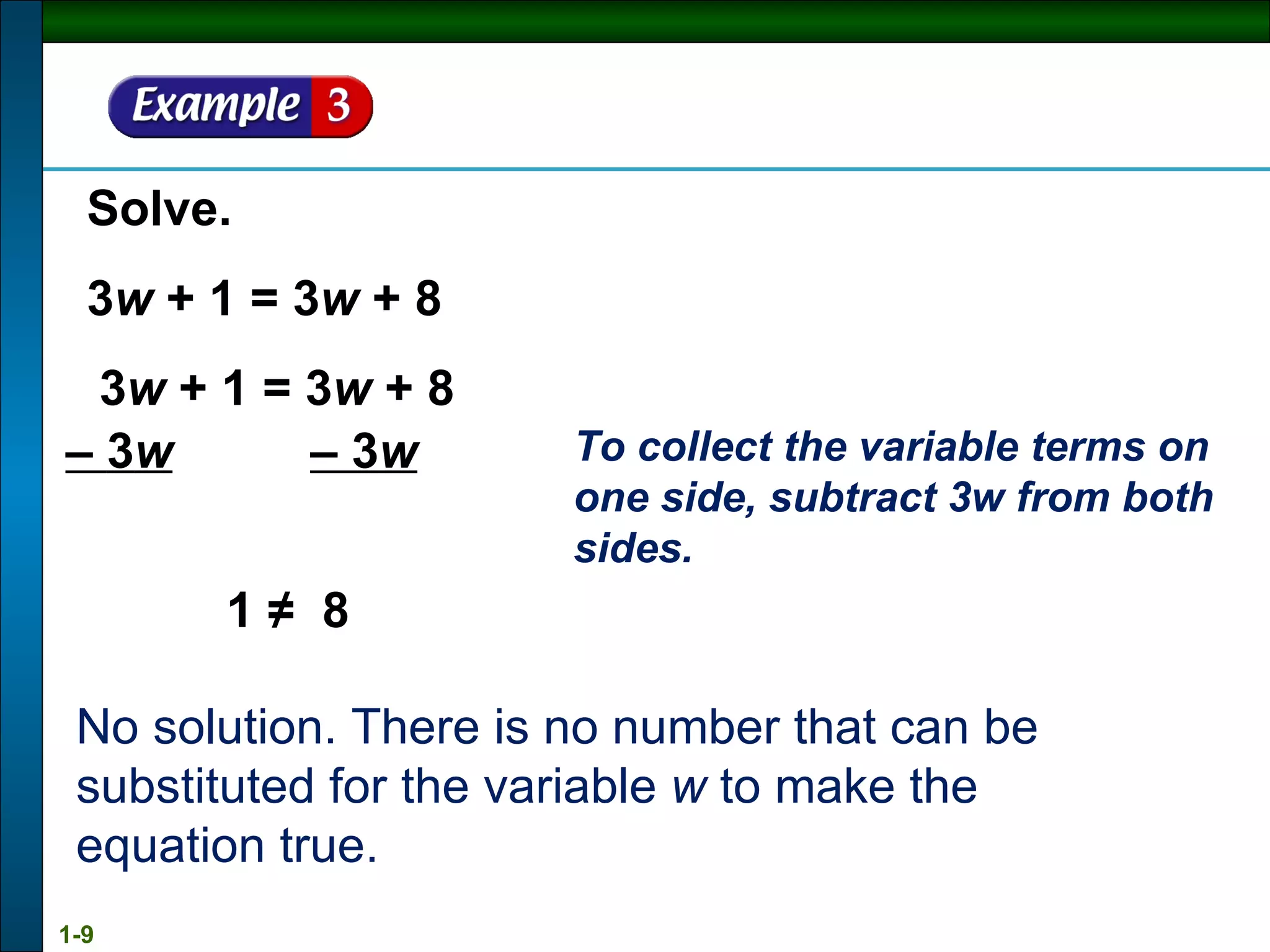
Solve. 3 w  + 1 = 3 w  + 8 1 ≠  8 No solution. There is no number that can be substituted for the variable  w  to make the equation true. 3 w  + 1 = 3 w  + 8 –  3 w   – 3 w To collect the variable terms on one side, subtract 3w from both sides.
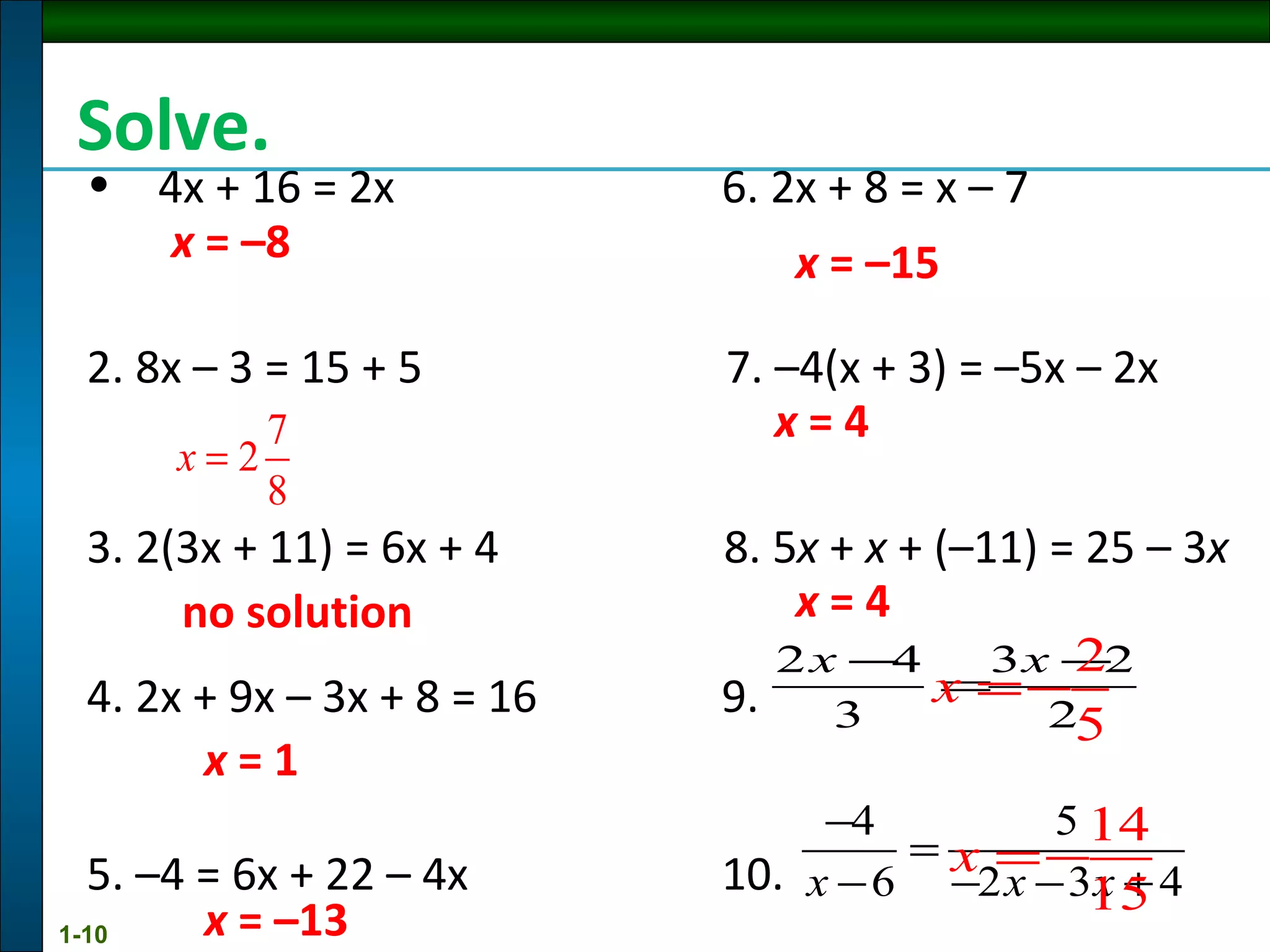
4x + 16 = 2x  6. 2x + 8 = x – 7 2. 8x – 3 = 15 + 5  7. –4(x + 3) = –5x – 2x  3. 2(3x + 11) = 6x + 4  8. 5 x  +  x  + (–11) = 25 – 3 x 4. 2x + 9x – 3x + 8 = 16 9.  5. –4 = 6x + 22 – 4x 10.  x  = –8 no solution x  = 1 x  = –13 x  = –15 x  = 4 x  = 4 Solve.
SOLVING LINEAR INEQUALITY IN ONE VARIABLE
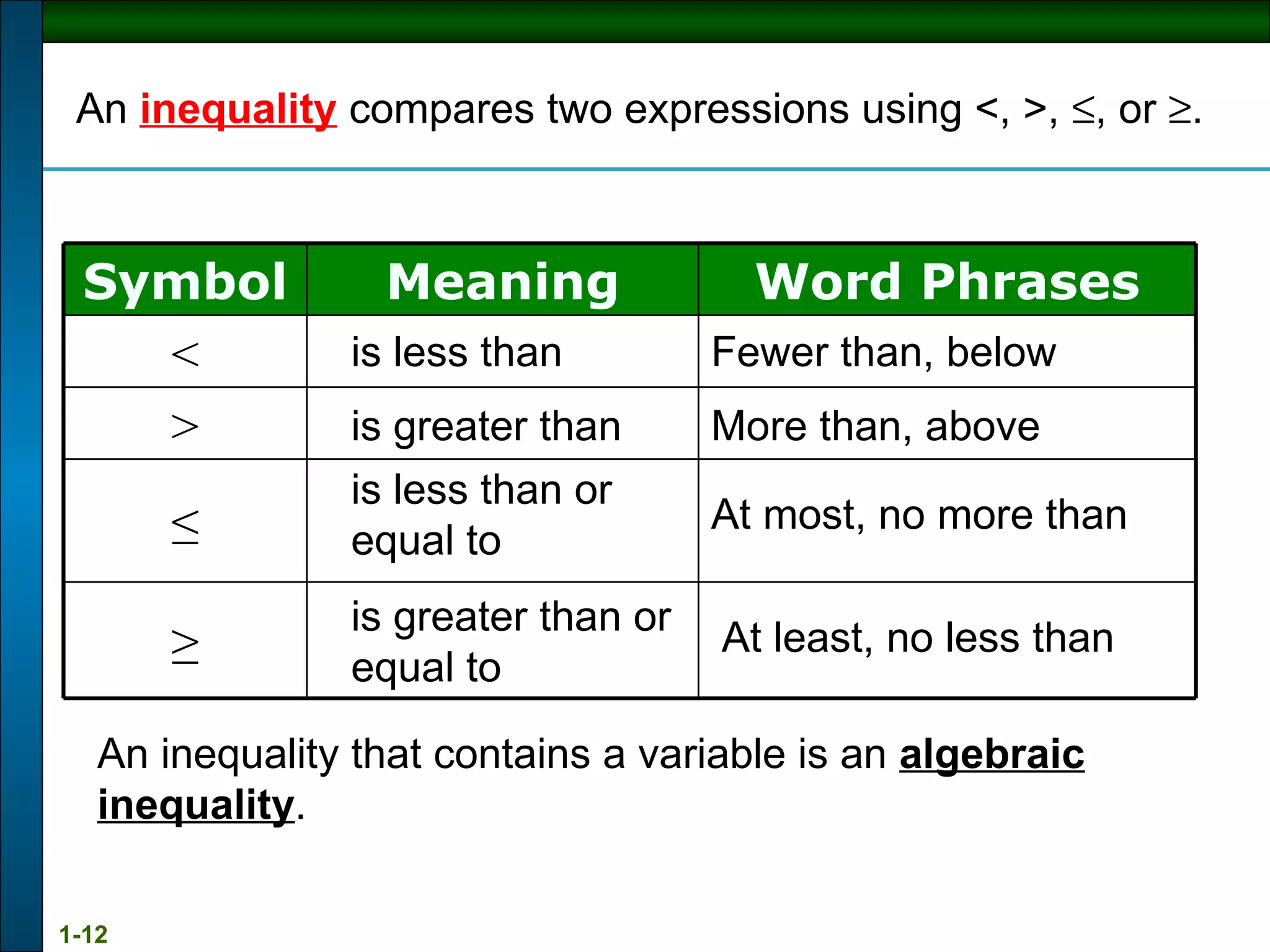
An  inequality   compares two expressions using <, >,   , or   . is less than is greater than is greater than or equal to is less than or equal to Fewer than, below More than, above At most, no more than At least, no less than An inequality that contains a variable is an  algebraic inequality .  Symbol Meaning Word Phrases < > ≤ ≥
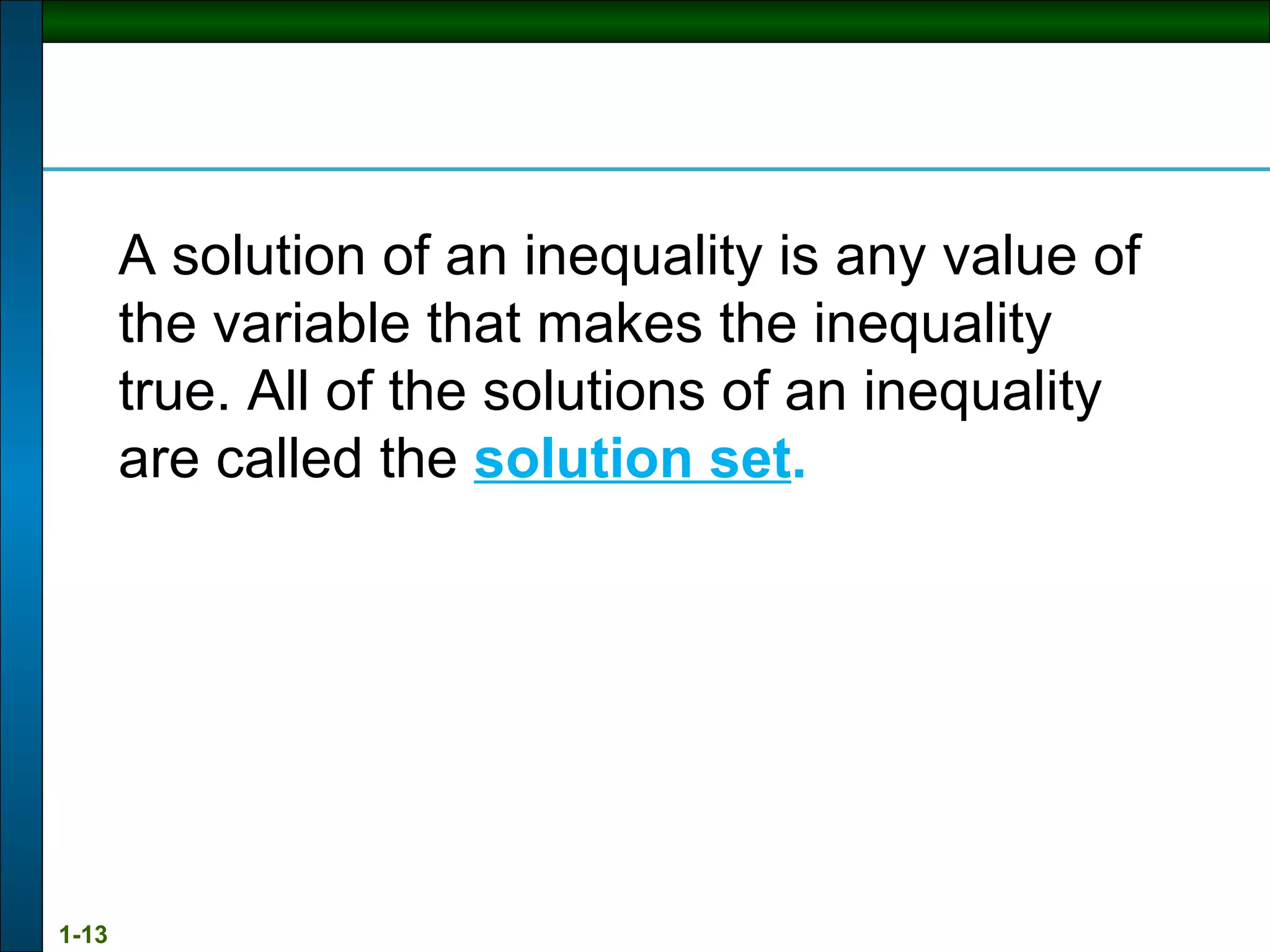
A solution of an inequality is any value of the variable that makes the inequality true. All of the solutions of an inequality are called the  solution set .
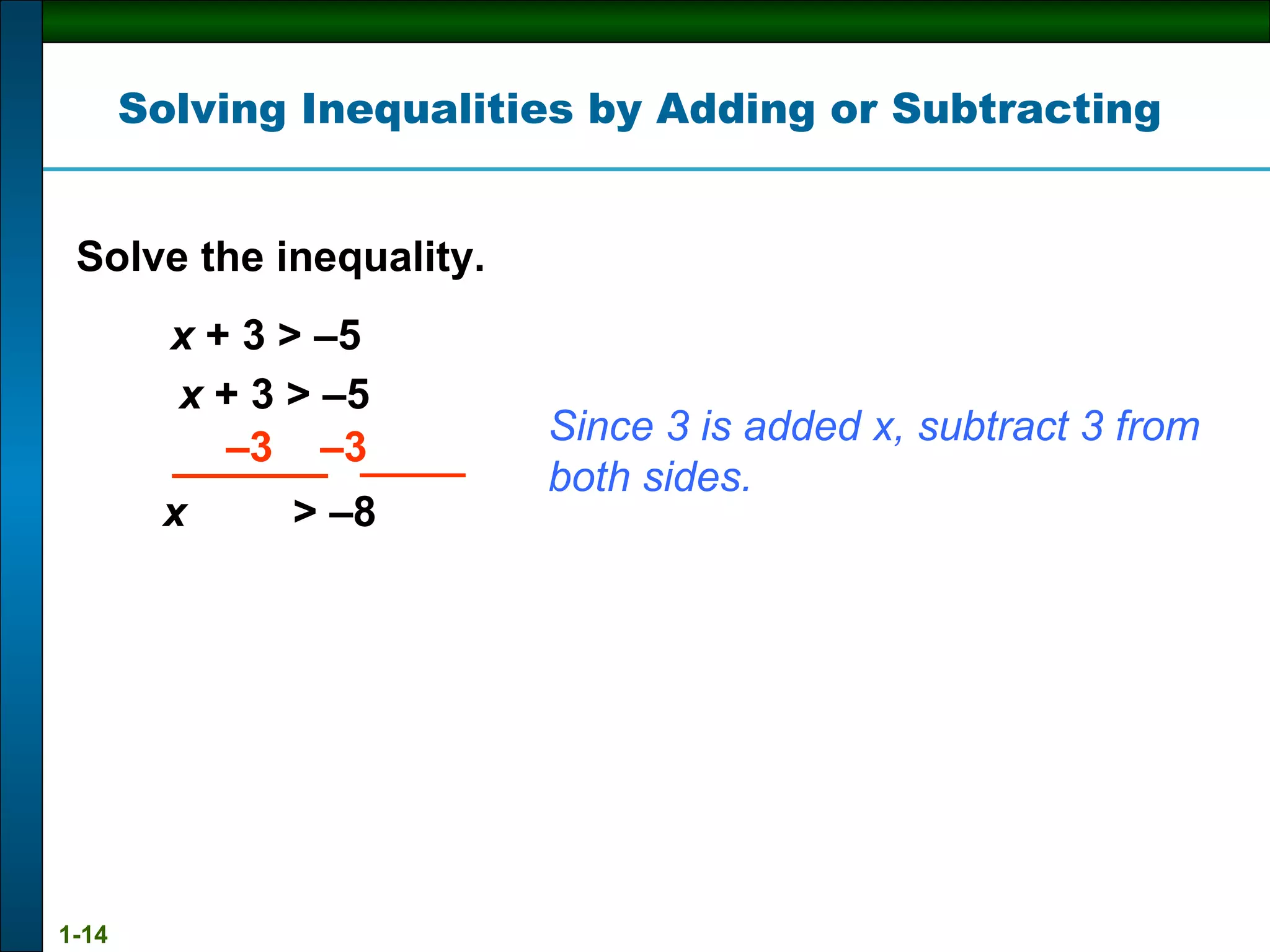
Solve the inequality. Solving Inequalities by Adding or Subtracting x  + 3 > –5 x  + 3 > –5 – 3  –3 x  > –8 Since 3 is added x, subtract 3 from both sides.
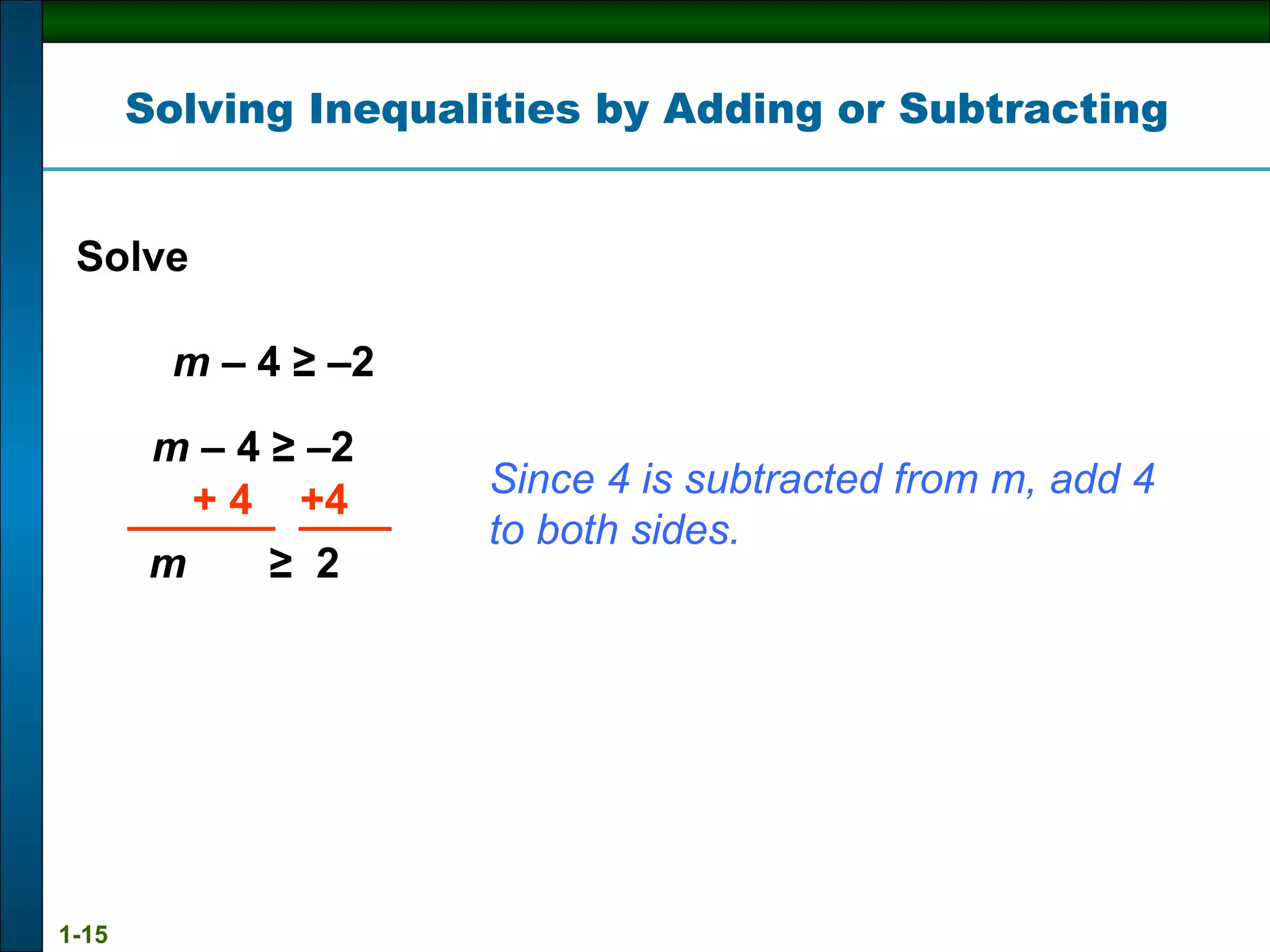
m  –   4 ≥ –2 m –  4 ≥ –2 + 4  +4   m   ≥  2  Since 4 is subtracted from m, add 4 to both sides. Solve Solving Inequalities by Adding or Subtracting
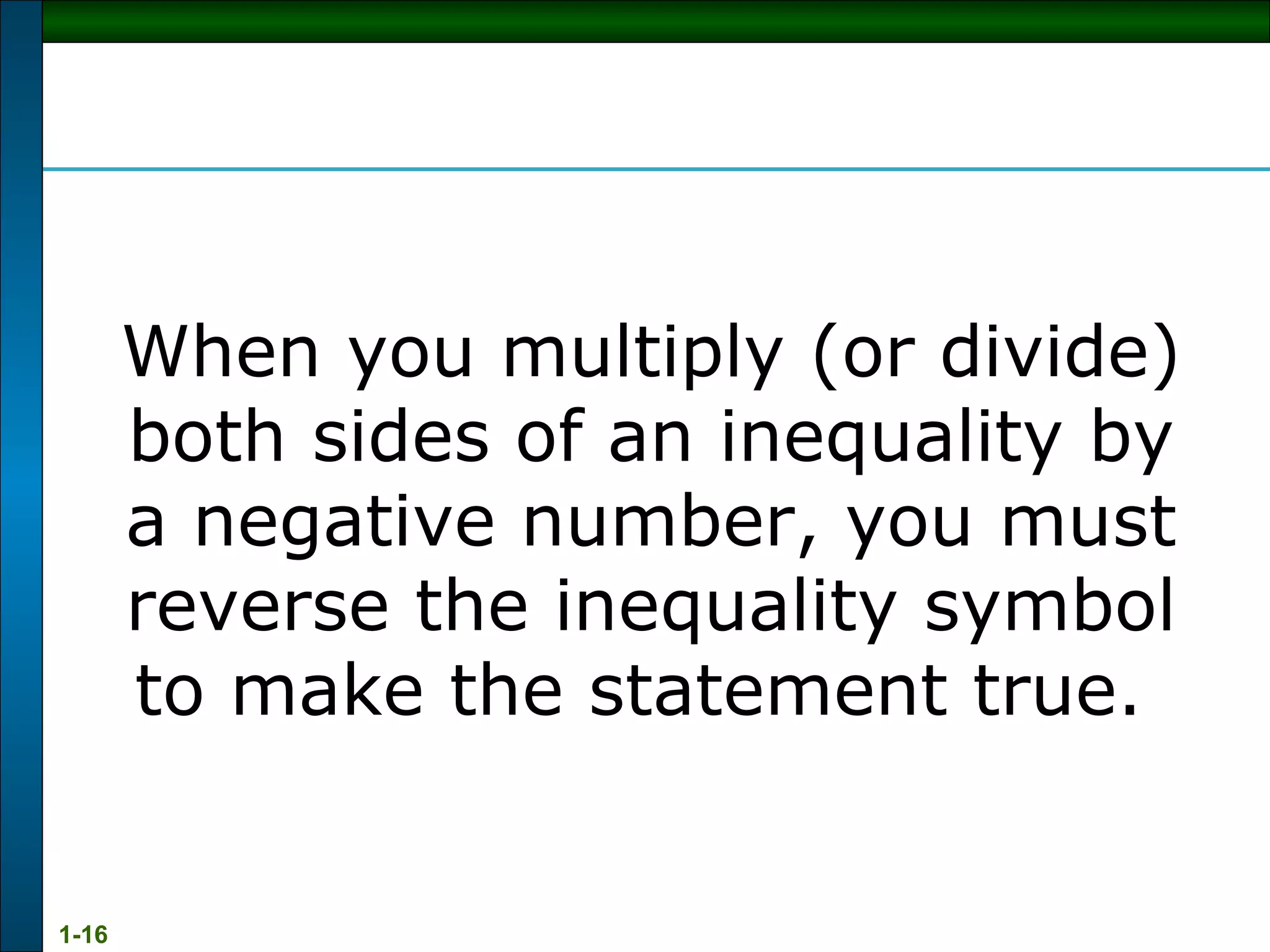
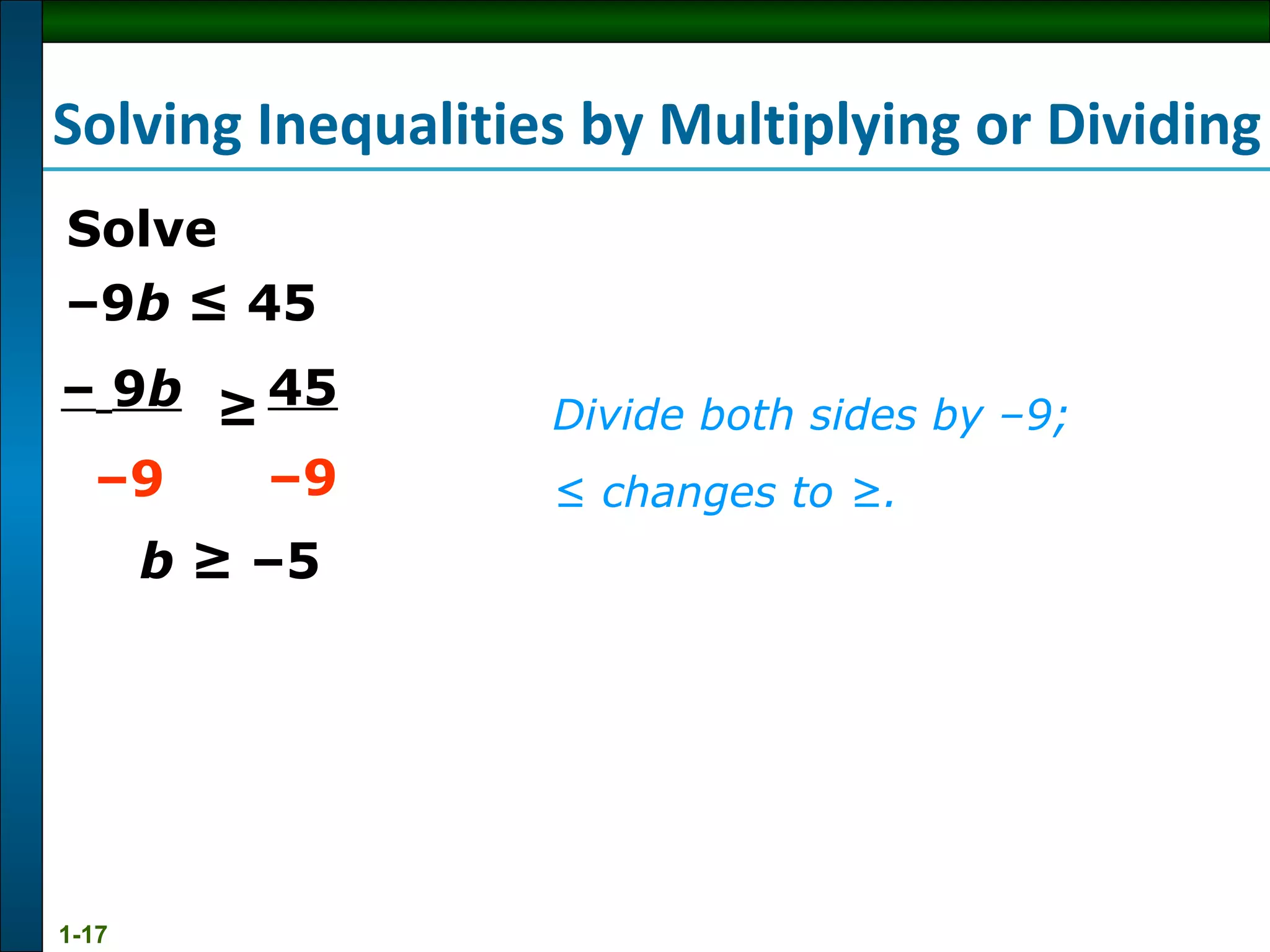
When you multiply (or divide) both sides of an inequality by a negative number, you must reverse the inequality symbol to make the statement true.
b  ≥ –5 – 9 b  ≤ 45  Divide both sides by –9;  ≤  changes to ≥. Solve Solving Inequalities by Multiplying or Dividing ≥  45   – 9 –  9 b   – 9
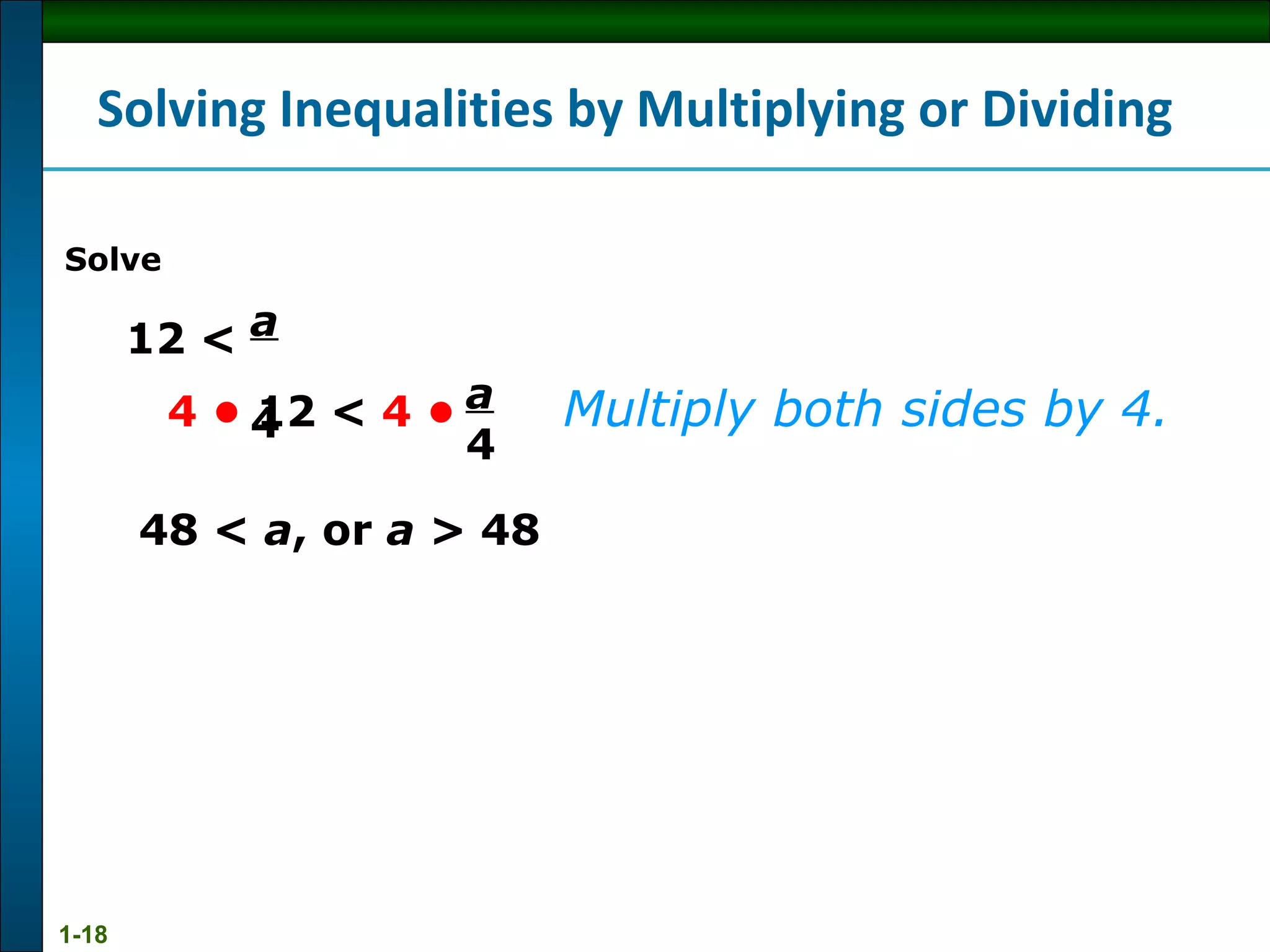
48 <  a , or  a  > 48 12 <  Multiply both sides by 4. Solve Solving Inequalities by Multiplying or Dividing a   4 4   •  12 <  4 •   a   4
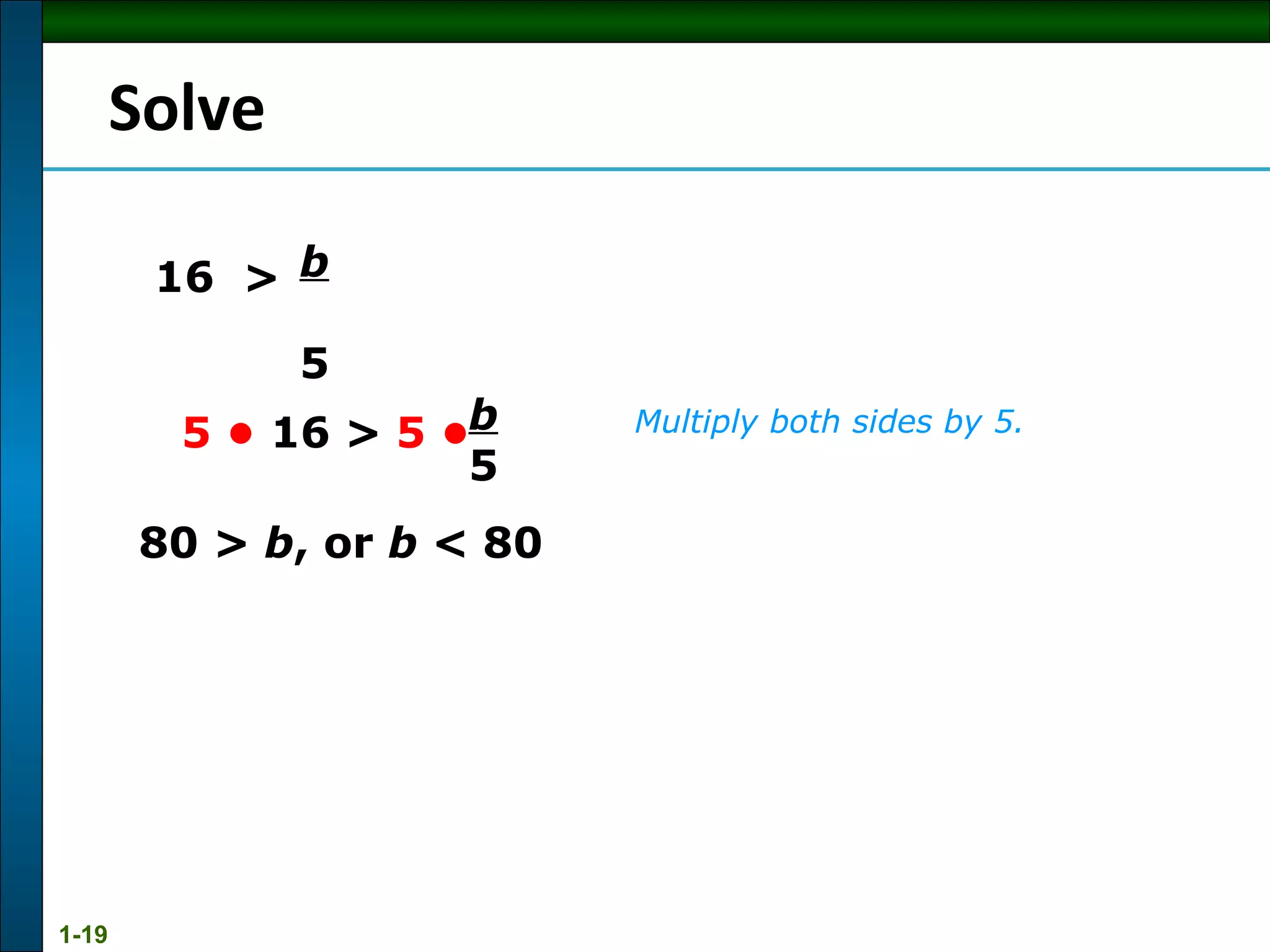
80 >  b , or  b <  80 16  >  Multiply both sides by 5. Solve b   5 5   •  16 >  5 •   b   5
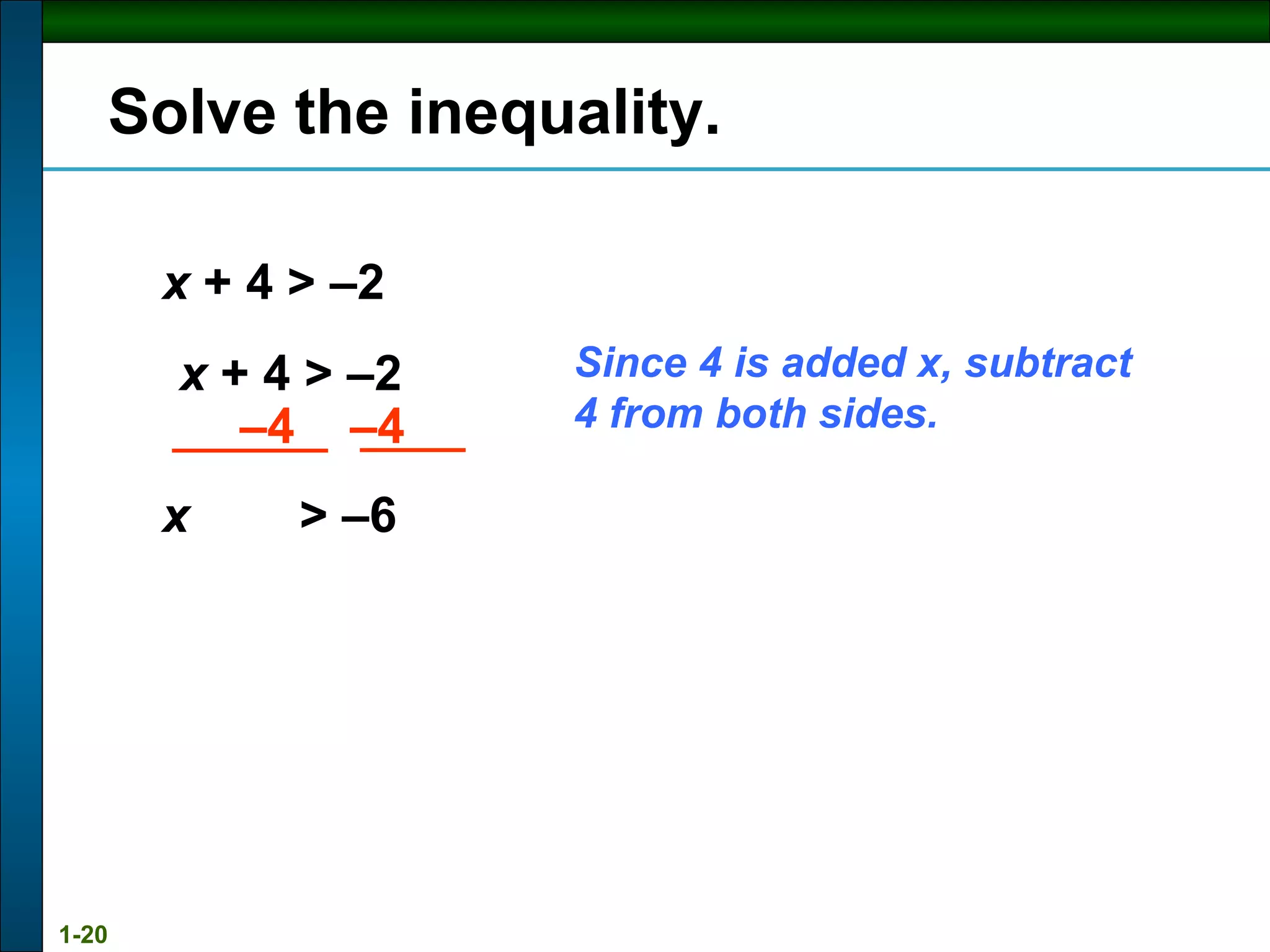
Solve the inequality. x  + 4 > –2 x  + 4 > –2 – 4  –4 x  > –6 Since 4 is added x, subtract 4 from both sides.
GRAPHING INEQUALITY IN ONE VARIABLE
You can graph the solution set on a number line. The symbols  <  and  >  indicate an  open circle  while  ≥  and  ≤  indicate a  close circle.
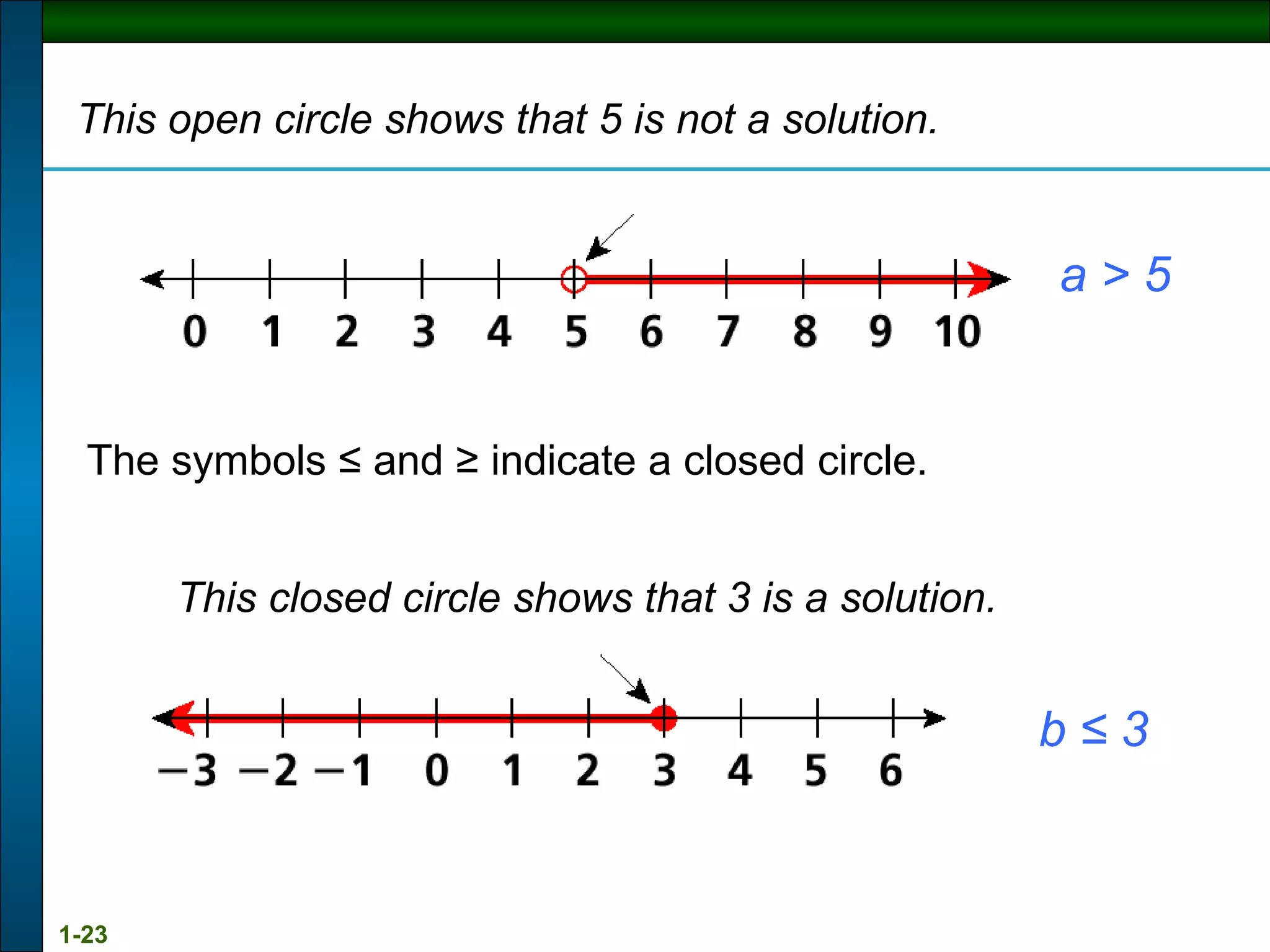
This open circle shows that 5 is not a solution.  a > 5 The symbols ≤ and ≥ indicate a closed circle. This closed circle shows that 3 is a solution. b ≤ 3
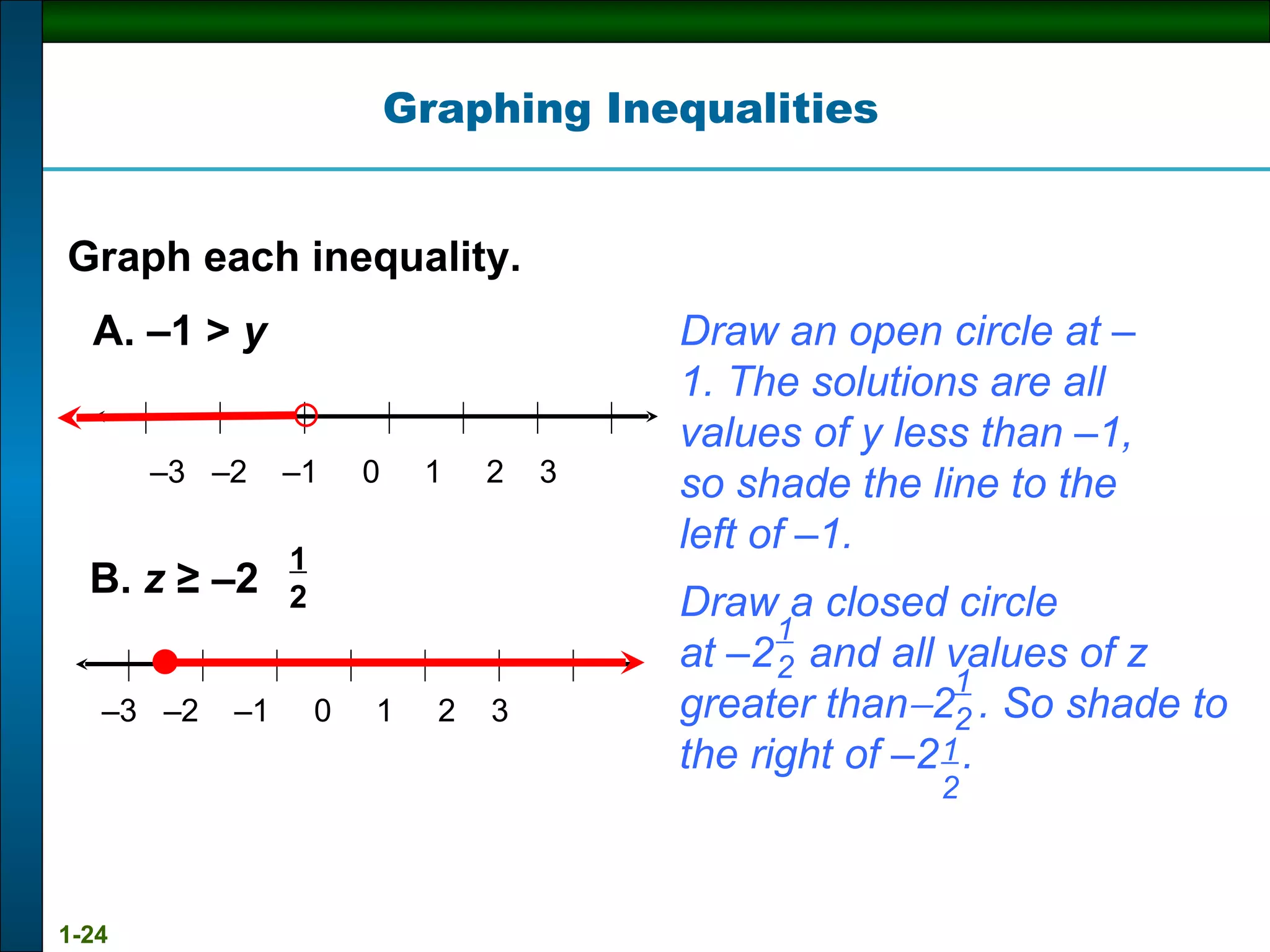
Graph each inequality. – 3  –2  –1  0  1  2  3 A. –1   >  y Draw an open circle at –1. The solutions are all values of y less than –1, so shade the line to the left of –1. B.  z  ≥ –2 – 3  –2  –1  0  1  2  3 Graphing Inequalities 1 2 Draw a closed circle at –2  and all values of z greater than  2  . So shade to the right of –2  .  1  2  1  2  1  2
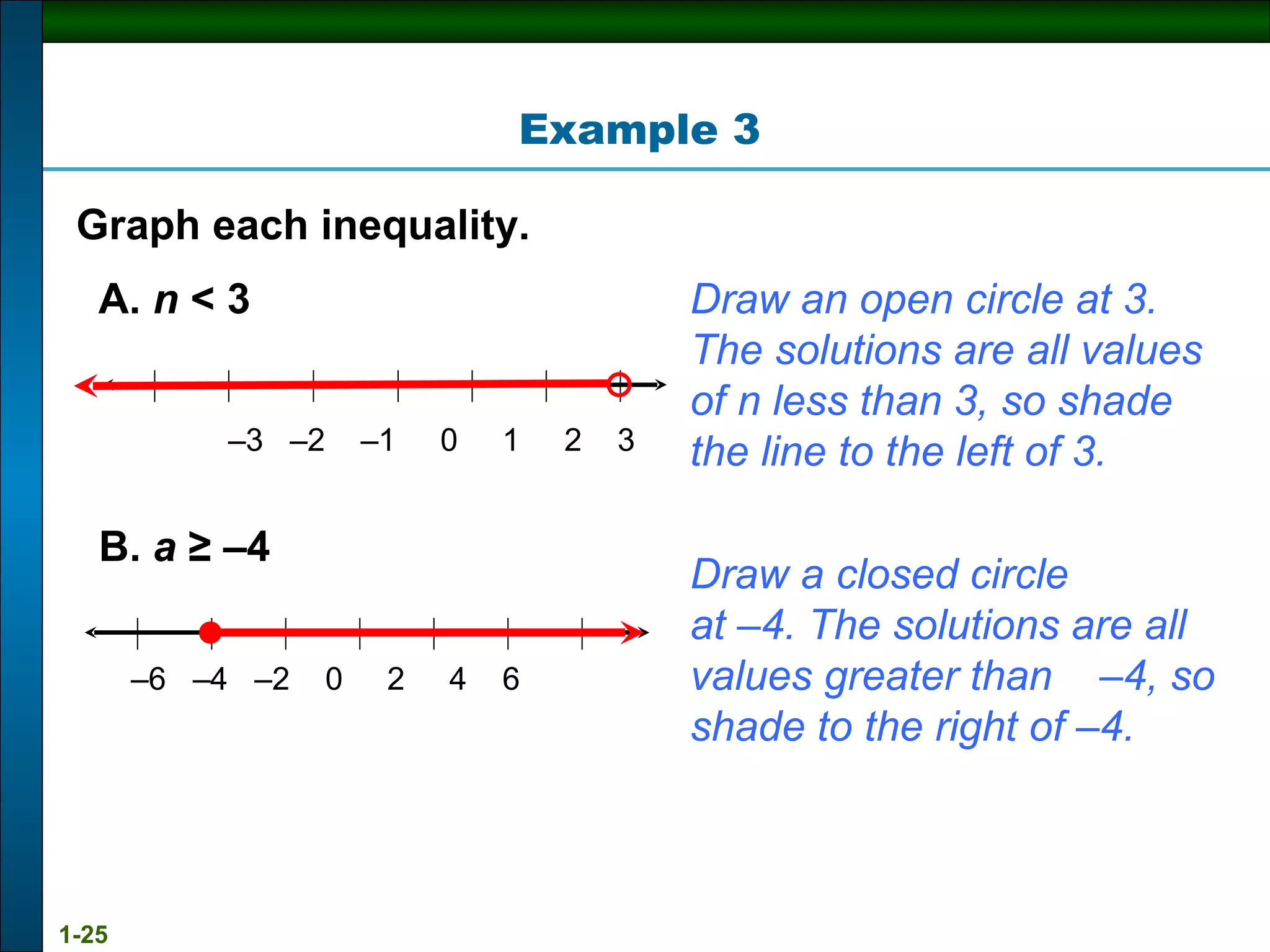
Graph each inequality. – 3  –2  –1  0  1  2  3 A.  n  < 3 B.  a  ≥ –4 – 6  –4  –2  0  2  4  6  Example 3 Draw an open circle at 3. The solutions are all values of n less than 3, so shade the line to the left of 3. Draw a closed circle at –4. The solutions are all values greater than  –4, so shade to the right of –4.
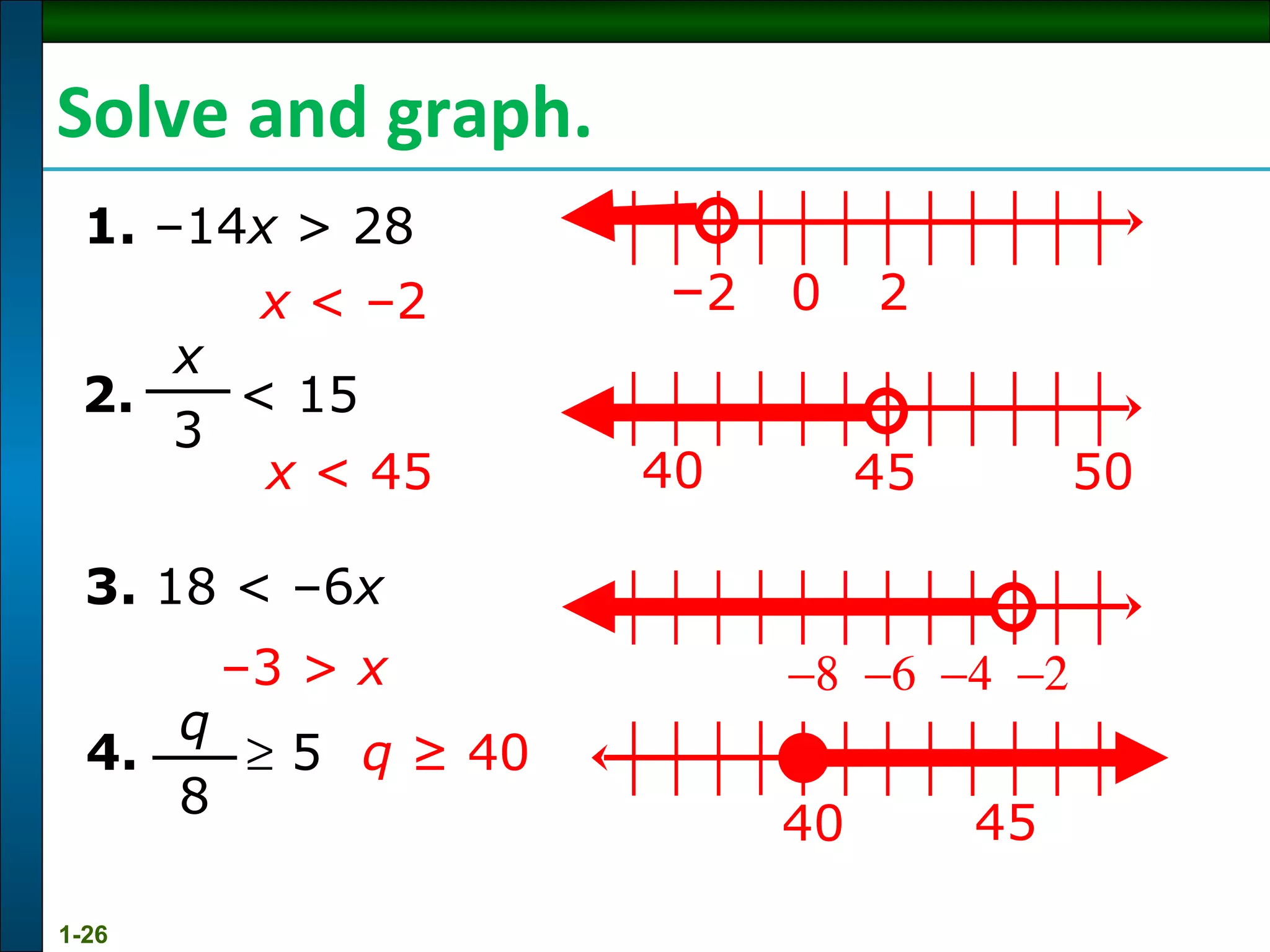
Solve and graph. 1.  –14 x  > 28 2.  < 15    5 3.  18   < –6 x x  < –2 q  ≥ 40 – 3 >  x x  < 45 4. – 2 0 2 50 40 45    40 45 x 3 q 8
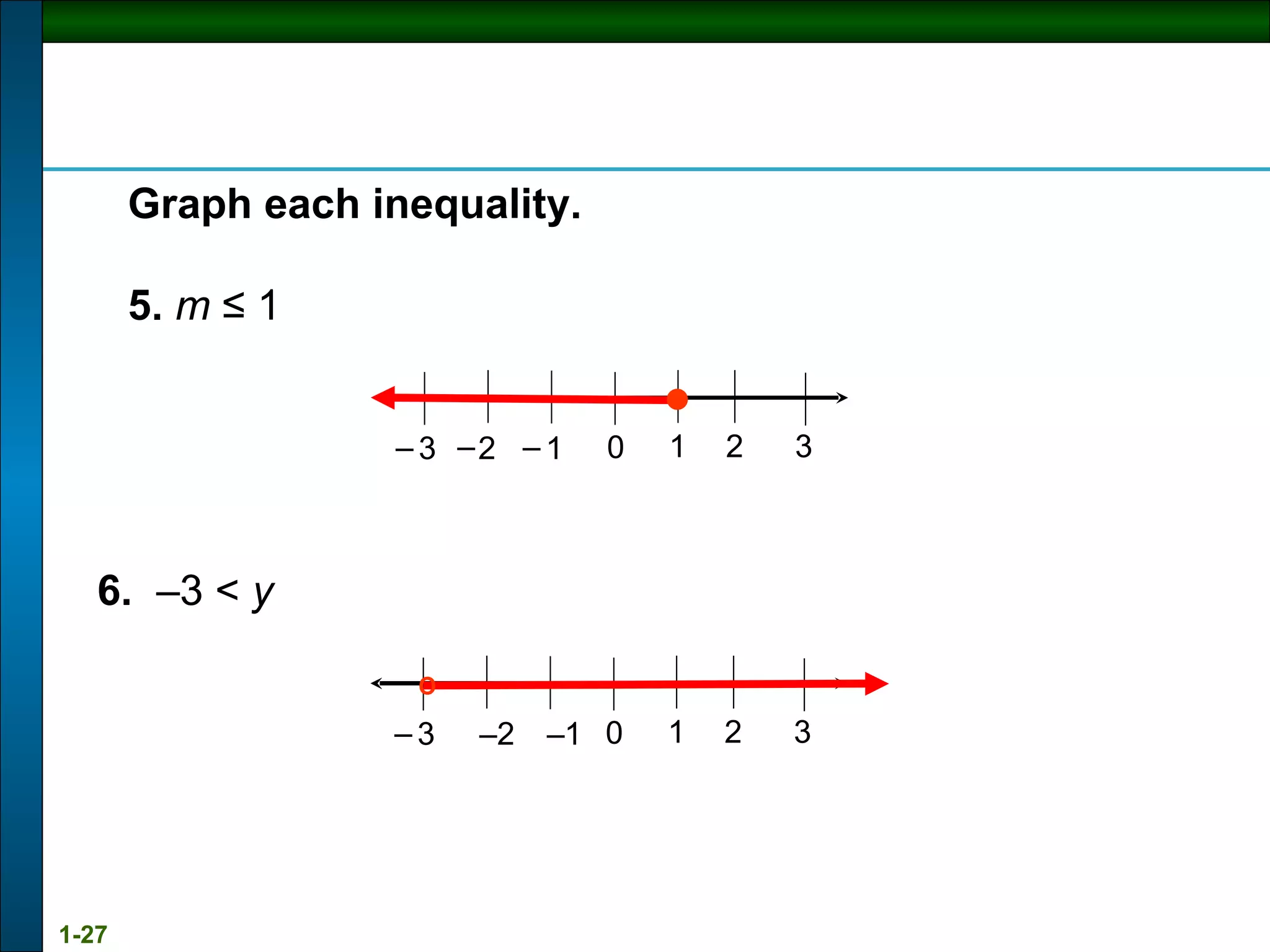
6.  –3 <  y Graph each inequality. 5.   m  ≤ 1 0 º 1 2 3 – 1 – 2 3 – – – – 0 1 2 3 1 2 3

Solution of linear equation & inequality

  • 1.
    TOPIC 8 SOLUTIONOF LINEAR EQUALITY AND LINEAR INEQUALITY WITH ONE VARIABLE . GRAPH INEQUALITY
  • 2.
    DEFINITION: Equation InequalitySolution of an Equation Two expressions set equal to each other Linear Equation An equation that can be written in the form  ax + b = 0 where a and b are constants A value, such that, when you replace the variable with it, it makes the equation true. (the left side comes out equal to the right side) Mathematical expressions that use the symbols ( <, ≠, >, ≥, etc.)
  • 3.
    Solve  for x . Solving a Linear Equation  in General Get the variable you are solving for alone on one side and everything else on the other side using INVERSE operations. *Inverse of sub. 10 is add. 10
  • 4.
    Solve    for x . *Inverse of add. 7 is sub. 7
  • 5.
    *Inverse of div.by 3 is mult. by 3 Solve for x
  • 6.
    Inverse of mult.by 5 is div. by 5 Solve   for x .
  • 7.
    Solve. 4 x + 6 = x Solving Equations with Variables on Both Sides 4 x + 6 = x – 4 x – 4 x 6 = –3 x To collect the variable terms on one side, subtract 4x from both sides. Since x is multiplied by -3, divide both sides by – 3. – 2 = x You can always check your solution by substituting the value back into the original equation. 6 – 3 – 3 x – 3 =
  • 8.
    Solve. 3 b – 2 = 2 b + 12 3 b – 2 = 2 b + 12 – 2 b – 2 b b – 2 = 12 + 2 + 2 b = 14 Since 2 is subtracted from b, add 2 to both sides. To collect the variable terms on one side, subtract 2b from both sides.
  • 9.
    Solve. 3 w + 1 = 3 w + 8 1 ≠ 8 No solution. There is no number that can be substituted for the variable w to make the equation true. 3 w + 1 = 3 w + 8 – 3 w – 3 w To collect the variable terms on one side, subtract 3w from both sides.
  • 10.
    4x + 16= 2x 6. 2x + 8 = x – 7 2. 8x – 3 = 15 + 5 7. –4(x + 3) = –5x – 2x 3. 2(3x + 11) = 6x + 4 8. 5 x + x + (–11) = 25 – 3 x 4. 2x + 9x – 3x + 8 = 16 9. 5. –4 = 6x + 22 – 4x 10. x = –8 no solution x = 1 x = –13 x = –15 x = 4 x = 4 Solve.
  • 11.
  • 12.
    An inequality compares two expressions using <, >,  , or  . is less than is greater than is greater than or equal to is less than or equal to Fewer than, below More than, above At most, no more than At least, no less than An inequality that contains a variable is an algebraic inequality . Symbol Meaning Word Phrases < > ≤ ≥
  • 13.
    A solution ofan inequality is any value of the variable that makes the inequality true. All of the solutions of an inequality are called the solution set .
  • 14.
    Solve the inequality.Solving Inequalities by Adding or Subtracting x + 3 > –5 x + 3 > –5 – 3 –3 x > –8 Since 3 is added x, subtract 3 from both sides.
  • 15.
    m – 4 ≥ –2 m – 4 ≥ –2 + 4 +4 m ≥ 2 Since 4 is subtracted from m, add 4 to both sides. Solve Solving Inequalities by Adding or Subtracting
  • 16.
    When you multiply(or divide) both sides of an inequality by a negative number, you must reverse the inequality symbol to make the statement true.
  • 17.
    b ≥–5 – 9 b ≤ 45 Divide both sides by –9; ≤ changes to ≥. Solve Solving Inequalities by Multiplying or Dividing ≥ 45 – 9 –  9 b – 9
  • 18.
    48 < a , or a > 48 12 < Multiply both sides by 4. Solve Solving Inequalities by Multiplying or Dividing a 4 4 • 12 < 4 • a 4
  • 19.
    80 > b , or b < 80 16 > Multiply both sides by 5. Solve b 5 5 • 16 > 5 • b 5
  • 20.
    Solve the inequality.x + 4 > –2 x + 4 > –2 – 4 –4 x > –6 Since 4 is added x, subtract 4 from both sides.
  • 21.
  • 22.
    You can graphthe solution set on a number line. The symbols < and > indicate an open circle while ≥ and ≤ indicate a close circle.
  • 23.
    This open circleshows that 5 is not a solution. a > 5 The symbols ≤ and ≥ indicate a closed circle. This closed circle shows that 3 is a solution. b ≤ 3
  • 24.
    Graph each inequality.– 3 –2 –1 0 1 2 3 A. –1 > y Draw an open circle at –1. The solutions are all values of y less than –1, so shade the line to the left of –1. B. z ≥ –2 – 3 –2 –1 0 1 2 3 Graphing Inequalities 1 2 Draw a closed circle at –2 and all values of z greater than  2 . So shade to the right of –2 . 1 2 1 2 1 2
  • 25.
    Graph each inequality.– 3 –2 –1 0 1 2 3 A. n < 3 B. a ≥ –4 – 6 –4 –2 0 2 4 6 Example 3 Draw an open circle at 3. The solutions are all values of n less than 3, so shade the line to the left of 3. Draw a closed circle at –4. The solutions are all values greater than –4, so shade to the right of –4.
  • 26.
    Solve and graph.1. –14 x > 28 2. < 15  5 3. 18 < –6 x x < –2 q ≥ 40 – 3 > x x < 45 4. – 2 0 2 50 40 45  40 45 x 3 q 8
  • 27.
    6. –3< y Graph each inequality. 5. m ≤ 1 0 º 1 2 3 – 1 – 2 3 – – – – 0 1 2 3 1 2 3